From the FasterSkier archive — posts syndicated from athletes’ and coaches’ own blogs between 2004 and 2012, kept online as published. Current coverage is at fasterskier.com.
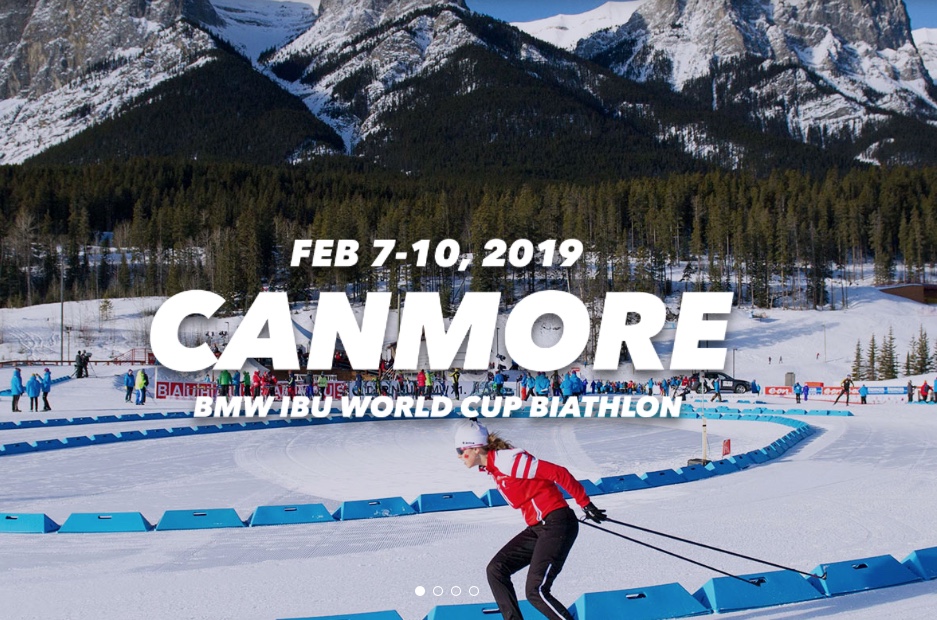
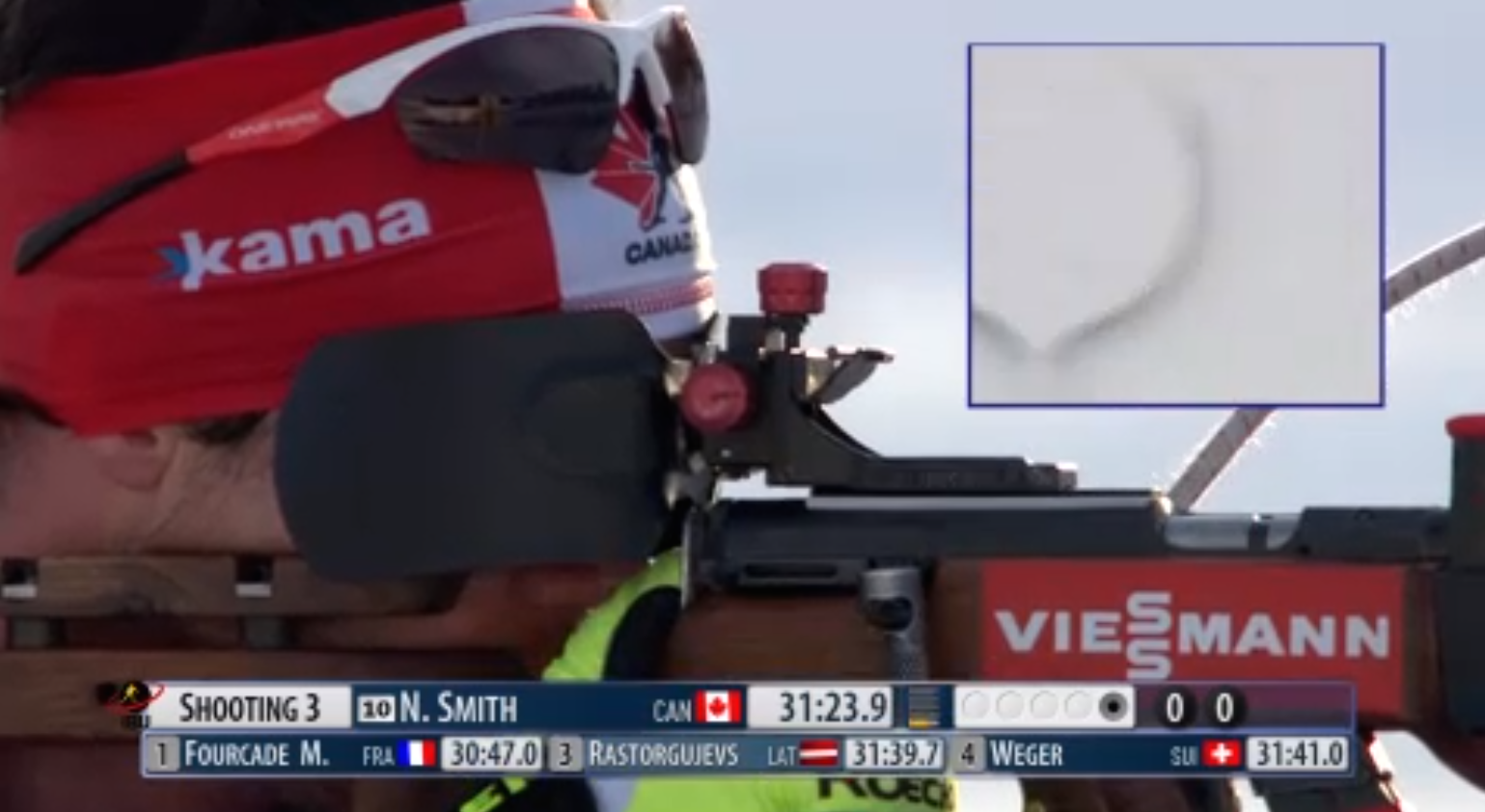
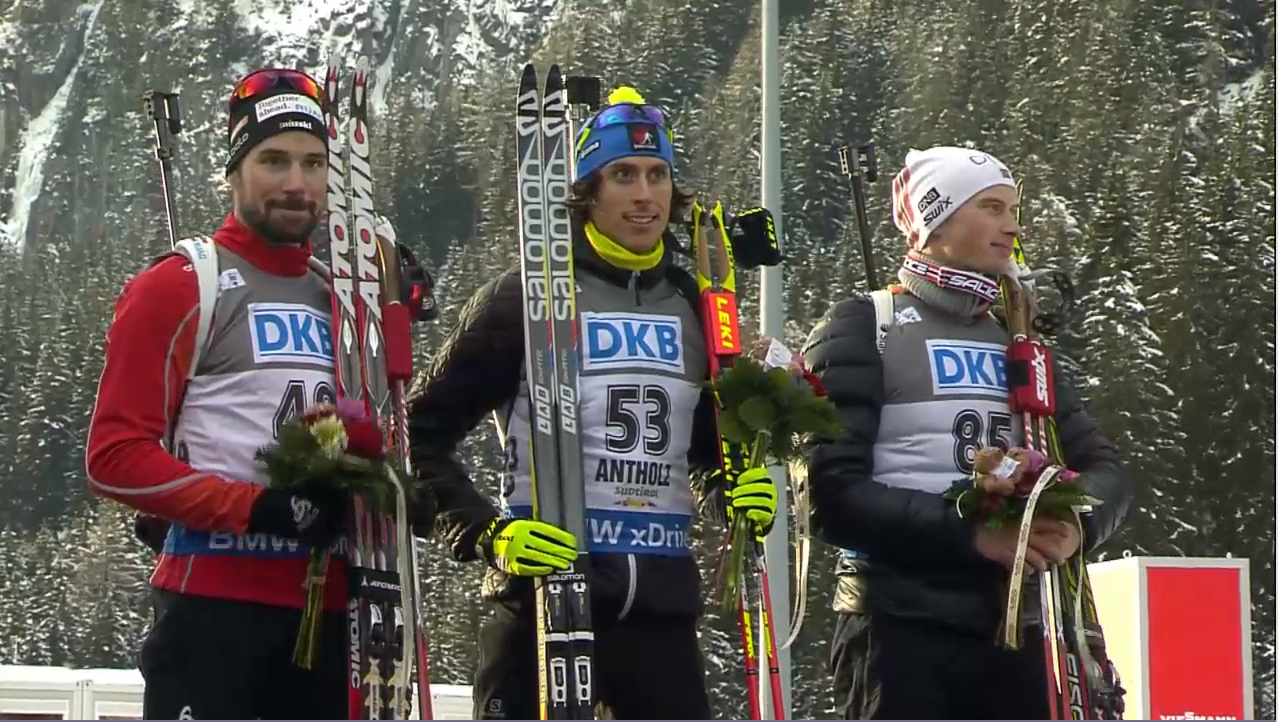
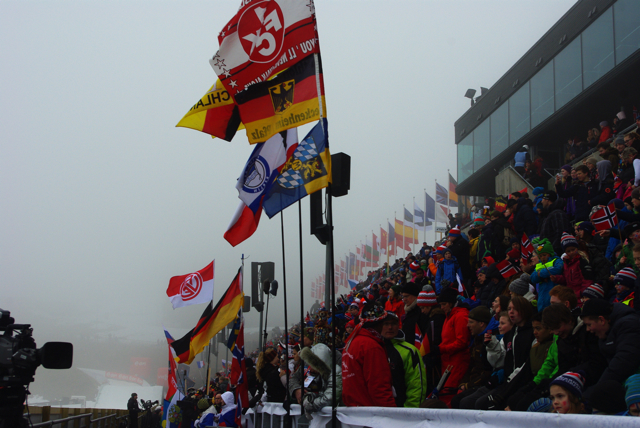
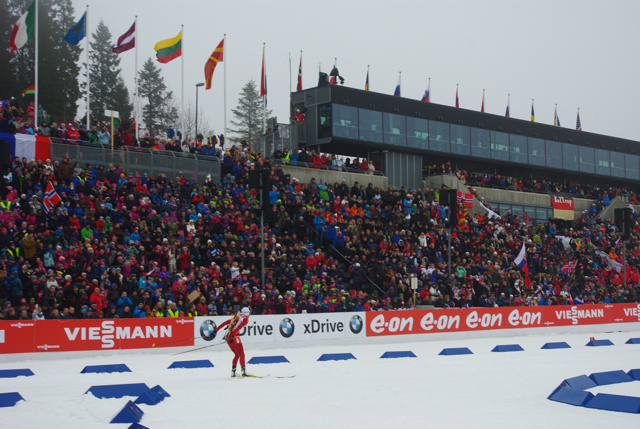
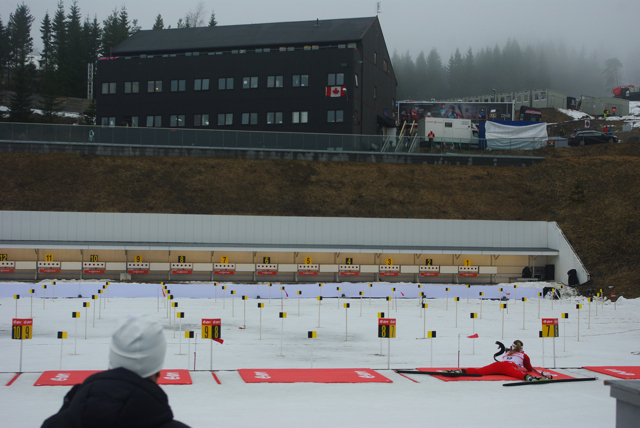
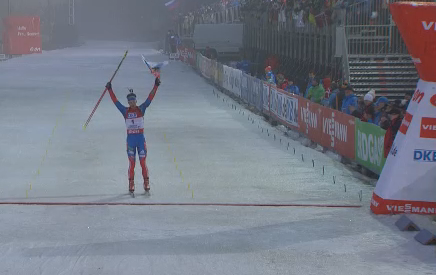
IBU World Cup in Canmore. (Photo: canmorebiathlon.ca screenshot)
Canmore, Canada IBU World Cup 4 x 7.5 k/ 4 x 6 k relay
Friday in Canmore was team relay day. Norway’s Lars Helge Birkeland, Vetle Sjåstad Christiansen,Erlend Øvereng Bjøntegaard and Johannes Thingnes Bø won the men’s 4 x 7.5-kilometer relay in 1:16:36.6 hours while acquiring no penalties on the shooting range and using seven spares.
In second place was France’s Antonin Guigonnat, Emilien Jacquelin, Simon Fourcade, and Quentin Fillon Maillet. The French team finished 1:10.4 minutes back with no penalties while using eight spares.
Russia took the third podium position with Evgeniy Garanichev, Eduard Latypov, Alexander Loginov, and Alexander Povarnitsyn. With no penalties and using nine spares, the Russians crossed the finish line 1:48.4 minutes back.
Christian Gow, Scott Gow, Jules Burnotte, and Brendan Green racing for Canada all began in bib 18 as the 18th ranked team and hopped eight positions in the final standings to finish 10th (+4:53.2). In total, Canada had two penalties while using 18 spares. It was also the final race of Green’s career.
The U.S. team of Sean Doherty, Leif Nordgren, Max Durtschi, and Travis Cooper was lapped and not given an official time. Doherty skied the first leg and tagged off 41.4 seconds behind first-place France. Nordgren raced second and tagged Durtschi with a 2:49.7 minute deficit. Durtschi was lapped on his third and final ski loop after shooting 3+3 and 2+3.
The women’s 4 x 6 k relay Vanessa Hinz, Franziska Hildebrand, Denise Herrmann, and Laura Dahlmeier took the win in 1:10:16.3 hours. The German foursome had a total of one penalty lap while using 12 spares.
Emille Aagheim Kalkenberg, Ingrid Landmark Tandervold, Tiril Eckhoff, and Marte Olsbu Roeiseland raced to second place, 30.2 seconds back. Kalkenberg used all her spares and skied two penalty laps to put the Norwegians in an early hole. On the next three legs, Norway used four spares total to pull themselves back into contention.
Anais Chevalier, Justine Braisaz, Anais Bescond, and Julia Simon racing for France placed third (+41.6, 0+12).
The U.S women took eighth overall, finishing 3:58.4 minutes behind. Susan Dunklee, Clare Egan, Joanne Reid, and Emily Dreissigacker had two penalties while using 12 spares during the race.
For Canada, Sarah Beaudry, Emma Lunder, Megan Bankes, and Rosanna Crawford For Canada, Sarah Beaudry, Emma Lunder, Megan Bankes, and Rosanna Crawford placed 18th. The Canadians were lapped on the final ski loop of the second leg.
Tomorrow’s scheduled sprints for both the men and women have been postponed to Sunday die to predicted cold temperatures.
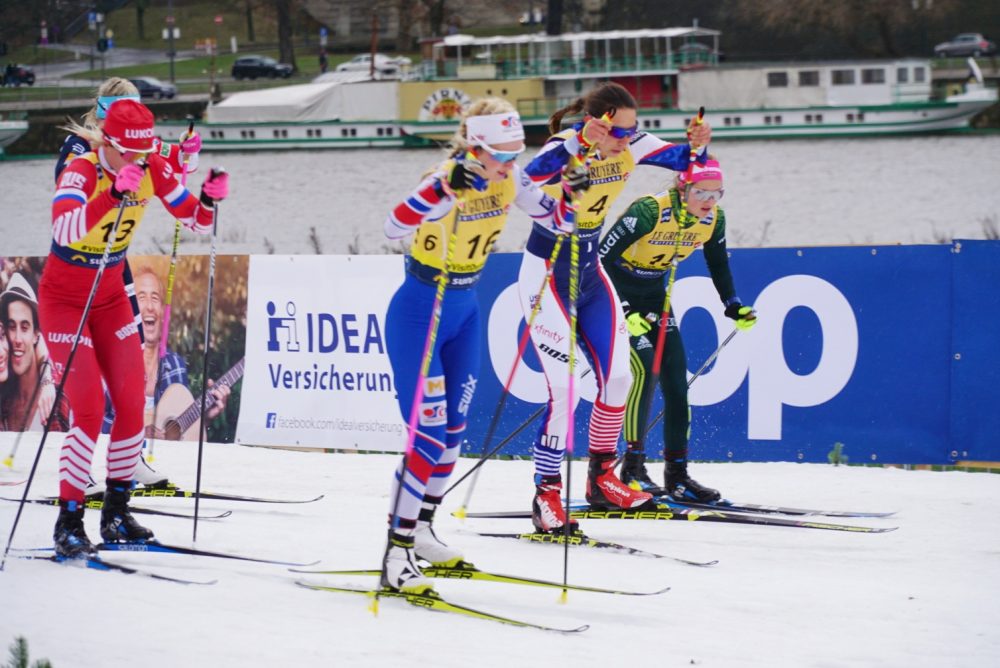
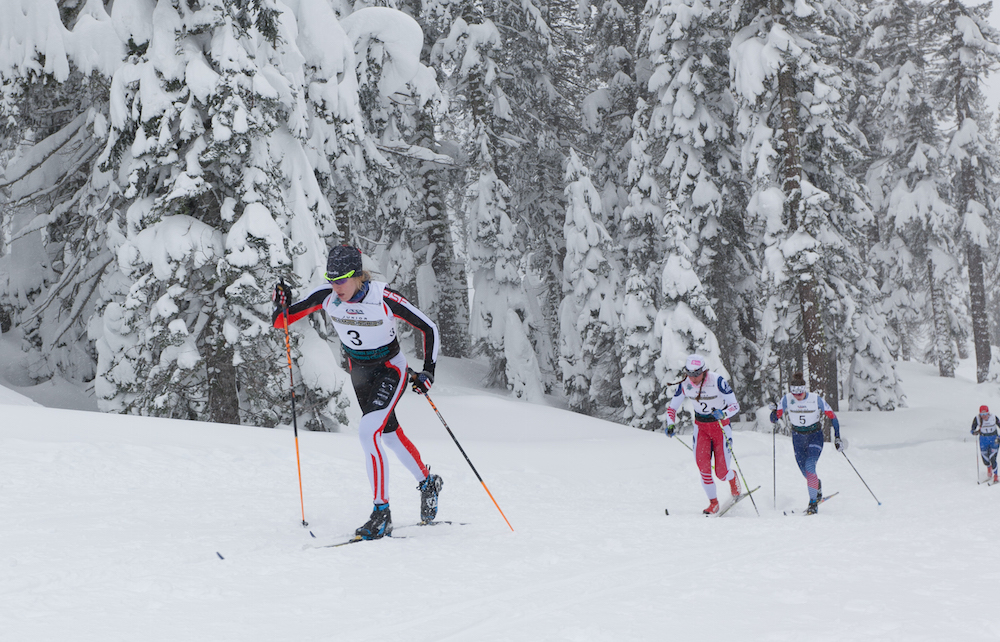
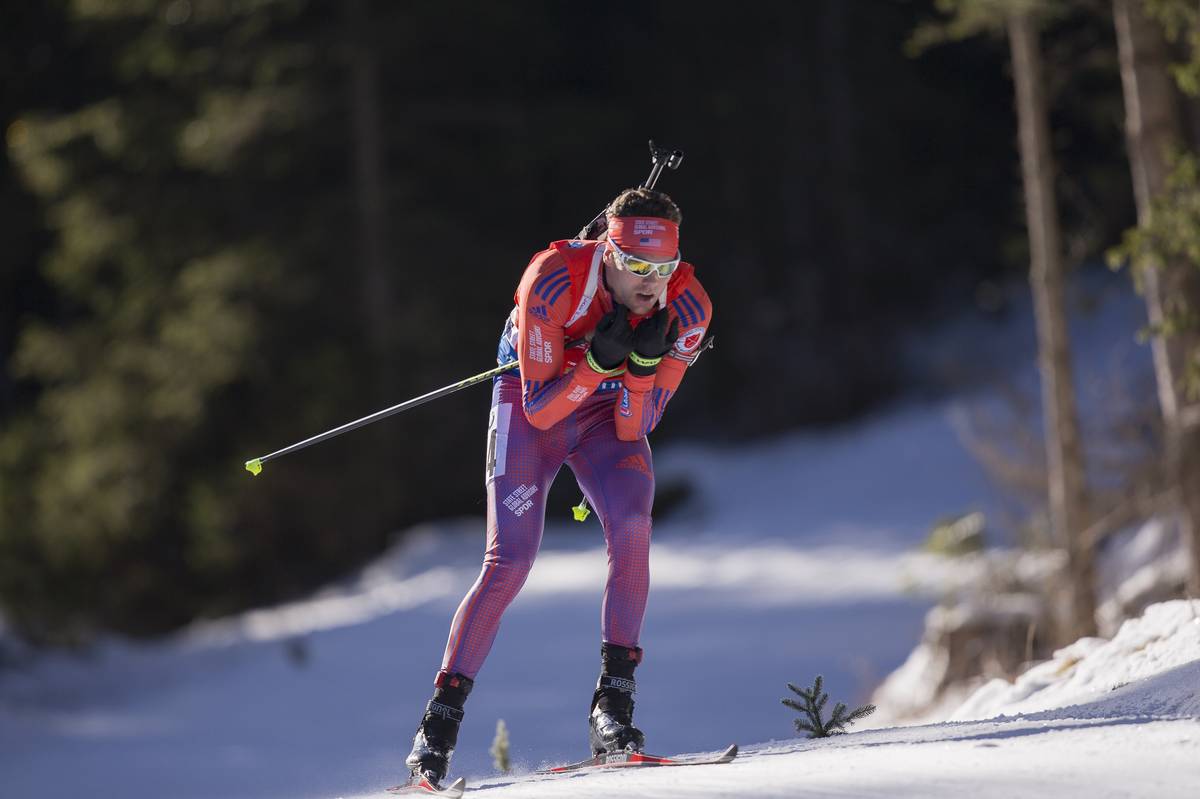
Racing in bib 4 for the U.S., Julia Kern keeps pace in the women’s team sprint during the Dresden, Germany World Cup on Sunday. (Photo: Garrott Kuzzy).
FIS World Cup Dresden, Germany 6 x 1.6 k Freestyle Team Sprint
The first World Cup team sprint of the season was run amidst drizzle and the Dresden, Germany city-scape as the women raced a total of six 1.6-kilometer laps.
Round and round on the looping course, the pace was a mix of tactically subdued speeds with sustained bursts of energy to break the pack.
After all the speed changes and exchanges with one athlete tagging off to the next, it came down to a 1.11 second difference between first place Sweden I and the three closet teams chasing from behind that ended in a photo finish.
Sweden I’s Stina Nilsson and Maja Dahlqvist won in a time of 24:02.5 minutes. Sweden II’s Ida Ingemarsdotter and Jonna Sundling placed second (+1.11), and Norway I, with Eide Mari and Maiken Caspersen Falla in third (+1.11).
U.S. I, featuring Julia Kern and Sophie Caldwell placed fourth (+1.11) after the photo finish was reviewed.
The U.S. entered a second team, consisting of Ida Sargent and Hannah Halvorsen. That duo contested the first semi-final, the same semi as U.S. I, but did not advance after placing fourth (+5.44). The top-three teams from each semi advance to the final, along with the next four fastest teams which are the combined “lucky losers”. Today, the second semi was the faster of the two. The four lucky loser team advancing to the final all originated from the second semi.
In the men’s 6 x 1.6 k skate team sprint race, Norway I and Norway II took the top two podium spots.
In a lunge at the line, Norway I’s Erik Valnes and Sindre Bjørnestad Skar won the final in 22:38.72 minutes. Pål Golberg and Eirik Brandsdal of Norway II placed second (+0.75) and Russia I’s Artem Maltsev and Gleb Retivykh third (+0.80).
Canada’s Bob Thompson and Len Valjas placed seventh (+2.46) in the first semi-final and did not advance to the final. It was the same fate for the only U.S. team entered in the men’s team sprint. Andy Newell and Erik Bjornsen placed 10th (+3.66) in the second semi, and failed to make the finals.
Canada placed 15th in the final standings, the U.S. 19th.
IBU World Cup Oberhof, Germany 4 x 6 k / 4 x 7.5 k Relay
In the women’s 4 x 6 k relay, Russia placed first in a time of 1:18:46.4 hours. Evgeniya Pavlova, Margarita Vasileva, Larisa Kuklina, and Ekaterina Yurlova-Percht made up the team that used eight spares on their way to the win.
Germany placed second (+33.5) with two penalty loops and 10 spare rounds. Karolin Horchler, Franziska Hildebrand, Franziska Preuss, and Denise Hermann comprised Germany’s second place team that had two penalties while using 10 spares. The Czech Republic’s Lucie Charvatova, Veronika Vitkova, Marketa Davidova, and Eva Puskarcikova placed third (+36.7) with 1 penalty loop and six spares.
The top spot for the podium came down to the final leg, when Yurlova-Percht pulled out the win when Hermann skied two penalty loops. The Russian used three spares but escaped with no penalties to take the lead out of the shooting range on the final ski loop.
Susan Dunklee, Clare Egan, Joanne Reid, and Emily Dreissigacker all represented the U.S. and placed 12th (+5:35.8) while skiing five penalty loops and using 16 spares.
Canada’s Sarah Beaudry, Emma Lunder, Megan Bankes, and Rosanna Crawford finished in 13th (+5:58.8) with four penalty loops and 15 spares.
Russian also claimed the men’s relay, winning in a time of 1:20:54.3 hours. The winning team of Maxim Tsvetkov, Evgeniy Garanichev, Dmitry Malyshko, and Alexander Loginov skied no penalty laps and used six spares on their way to victory.
Antonin Guigonnat, Simon Desthieux, Quentin Fillon Maillet, and Martin Fourcade raced for France. The French team placed second (+1:01.1) while skiing a single penalty lap and using eight spares.
Austria’s Tobias Eberhard, Simon Eder, Dominik Landertinger and Julian Eberhard placed third (+2:18.6) with one penalty lap and using seven spares.
Canada’s Scott Gow, Christian Gow, Jules Burnotte, and Brendan Green and the U.S. team of Leif Nordgren, Sean Doherty, Travis Cooper, and Max Durtschi were eventually lapped. Neither team was given an official finishing time.
Canada was ranked 18th in the final standings, the U.S. 19th.
For both relays today, the snowy weather and tough course conditions made for a strenuous day of shooting and skiing.
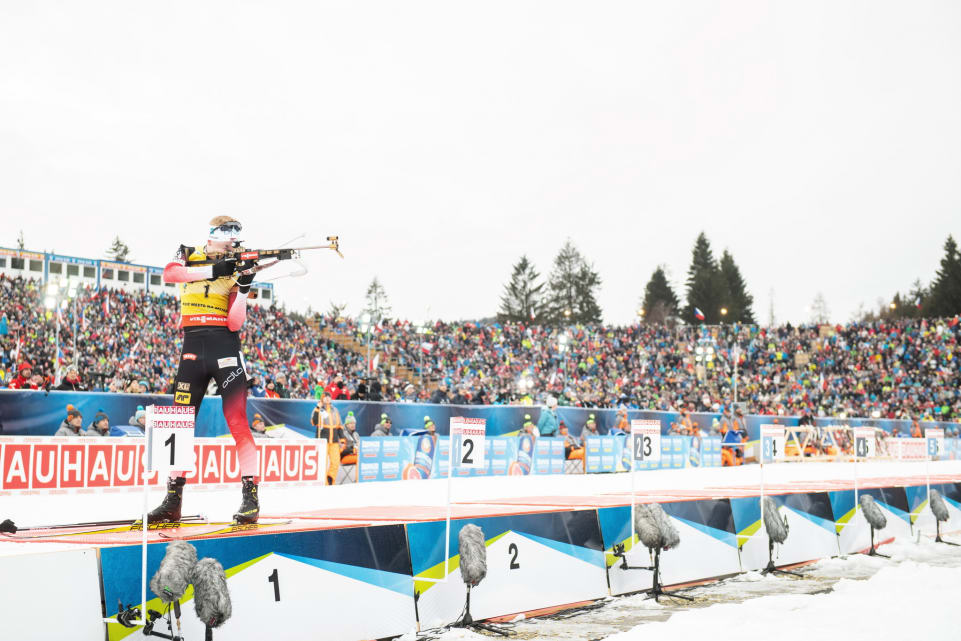
Johannes Thingnes Bø of Norway has dominated the win column. Sunday marked his sixth victory of the season as he won the 15-kilometer mass start race in Nové Město, Czech Republic in a time of 37:25.2 minutes. (Photo: biathonworld.com)
IBU World Cup Nové Město, Czech Republic Mass Starts
Sunday’s mass start races wrapped up the first stretch of IBU World Cup race calendar. And with it, on the men’s side, Johannes Thingnes Bø of Norway has dominated the win column. Sunday marked his sixth victory of the season as he won the 15-kilometer mass start race in Nové Město, Czech Republic in a time of 37:25.2 minutes. Bø shot clean on Sunday as he takes the World Cup lead into the holiday break and celebrates his 36th career World Cup win and a clean sweep of races in Nové Město.
In second place was France’s Quentin Maillet Fillon finishing 46.5 seconds back after amassing two penalties. Evgeniy Garanichev from Russia placed third (+54.1) after shooting clean.
Christian Gow of Canada was the only North American to qualify for the mass start. Gow placed 28th (+4:51.8) with three shooting penalties during his race and sits 26th overall on the World Cup.
In the women’s 12.5 k mass start, Slovenia’s Anastasiya Kuzmina took her first won of the season as she crossed the line in 35:34.4 minutes. Kuzmina suffered two penalties during her race. It was Kuzmina’s 11th World Cup win. Teammate Paulina Fialkova placed second (+12.1) with two penalties. Anais Chevalier of France finished in third (+13.3) with three penalties.
Clare Egan for the U.S. was the only North American to qualify for the mass start after Saturday’s pursuit race. Egan placed 14th finishing 1:22.3 minutes back with three penalties. It was Egan’s fourth individual top-20 of the season. Italy’s Dorothea Wierer leads the overall World Cup with 381 points, Egan heads into the holiday break ranked 22nd with 127 points.
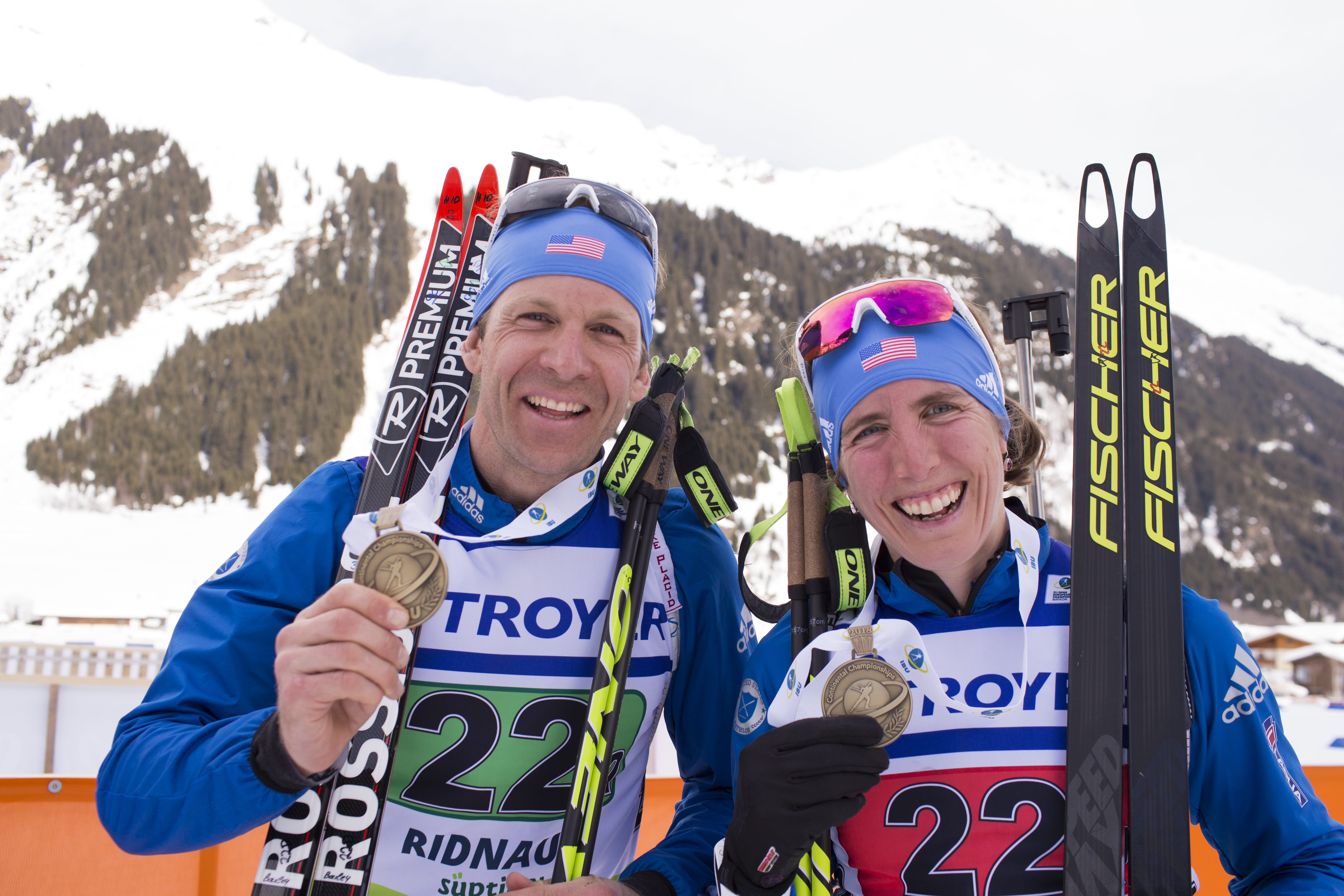
US Biathlon’s Lowell Bailey (l) and Susan Dunklee after teaming up for bronze in the single mixed relay at 2018 IBU Open European Championships on Sunday in Ridnaun, Italy. (Photo: Manzoni/NordicFocus)
IBU Open European Championships (Ridnaun-Val Ridanna, Italy): Single mixed & mixed relays
Susan Dunklee and Lowell Bailey teamed up for the final day of the 2018 International Biathlon Union (IBU) Open European Championships in Ridnaun, Italy, and raced to a bronze medal in the single mixed relay.
The American duo, both of which earned individual medals at last year’s IBU World Championships, finished just 9.1 seconds out of first, which went to Norway’s Thelka Brun-Lie and Vetle Sjåstad Christiansen. The Norwegians won in 35:39.6 with zero penalties and six spares. They took the lead after Brun-Lie’s second leg, where she cleaned both stages without spares.
France placed second, 8.6 seconds back, with Julia Simon and Emilien Jacquelin, who combined for no penalties and 11 spares. They led the first half of the race, but slipped to second behind Norway on Simon’s second leg.
Dunklee put the Americans off in second on her first leg, which she cleaned with a spare in each stage, then they slipped one place to third on Bailey’s first leg, where he cleaned as well and used three spares. In all, they used 10 spares and avoided the penalty loop, and finished half a second out of second place.
“Over Christmas, we trained a little bit with the French athletes, including Jacquelin,” Bailey said, according to a US Biathlon press release. “So I know that he has quite a fast finish, and I thought I am kind of an old man here, I should maybe try to go harder on the first part of the lap. But he stayed with me all the time and had me in the end.”
“It was a good opportunity to tune up the race shape, build some confidence and find that sharp feeling heading into the Olympics,” Dunklee told US Biathlon. “The single mixed relay is one of my favorite race formats and today was a blast!”
Canada’s Sarah Beaudry and Carsen Campbell placed eighth of 24 teams in the single mixed relay, finishing 1:03.6 out of first with just eight spares and zero penalties. In 11th after the first leg, they moved into eighth on Campbell’s first leg, which he cleaned with one spare. Beaudry then cleaned her second leg without any spares, and Campbell anchored them to eighth.
The U.S. entered a team in the mixed relay that followed, with Chloe Levins, Deedra Irwin, Paul Schommer, and Alex Howe placing 17th (+5:55.5) of 19 teams with no penalties and 12 spares.
Ukraine won the mixed relay to conclude the championships, with Yuliia Zhuravok, Iryna Varvynets, Artem Pryma, and Dmytro Pidruchnyi combining for zero penalties and six spares and finishing in 1:11:40.1.
Russia placed second (+11.7) with Victoria Slivko, Anastasia Zagoruiko, Evgeniy Garanichev, and Alexander Loginov combining for zero penalties and nine spares.
Norway followed in third (+33.2) with Emilie Ågheim Kalkenberg, Kaia Wøien Nicolaisen, Håvard Gutuboe Bogetveit, and Fredrik Gjesbakk combing for no penalties and just four spares.
U.S. SuperTour (Craftsbury, Vermont): 5/10 k freestyle
Two Alaska Pacific University (APU) athletes topped the podium on Sunday at the SuperTour in Craftsbury, Vermont, with David Norris winning the men’s 10-kilometer freestyle individual start in 21:54.9 and Becca Rorabaugh topping the women’s 5 k freestyle in 12:06.4.
Norris won the men’s race by 6 seconds over Canada’s Andy Shields (Lappe Nordic) and Kevin Bolger of the Sun Valley Ski Education Foundation (SVSEF) placed third (+15.8). Kris Freeman (Caldwell Sport) was the third American in fourth overall (+23.7), and three Canadians took fifth through seventh with Michael Somppi (Lappe Nordic) in fifth (+27.9), Evan Palmer-Charrette (NTDC Thunder Bay) in sixth (+37.5) and Scott Hill (Barrie Cross Country) in seventh (+37.6), ahead of Brian Gregg (Team Gregg/LNR/CXC) in eighth (+39.4), Tad Elliott (Ski Club Vail) in ninth (+44.3) and Jack Hegman in 10th (+50.4).
Rorabaugh won the women’s race by just 2.2 seconds over her APU teammate Rosie Frankowski in second, and Erika Flowers of the Stratton Mountain School (SMS) T2 Team placed third (+4.6). Two Craftsbury Green Racing Project (CGRP) skiers finished fourth and fifth, with Kaitlynn Miller in fourth (+12.1) and Liz Guiney in fifth (+22.5), Kelsey Phinney (SVSEF) was sixth (+25.8), and Canadians Olivia Bouffard-Nesbitt (Rocky Mountain Racers) seventh (+26.4) and Frederique Vezina (Pierre-Harvey National Training Centre) eighth (+36.0). Corey Stock, of the Bridger Ski Foundation (BSF) placed ninth (+39.9), and Felicia Geisor (CXC Team) was 10th (+44.4).
On Saturday, the Craftsbury Outdoor Center hosted its 37th annual Craftsbury Marathon, with Nils Koons winning the 48 k men’s race in 2:28:51.0 hours and Hannah Dreissigacker winning the 48 k women’s race in 3:01.48.7.
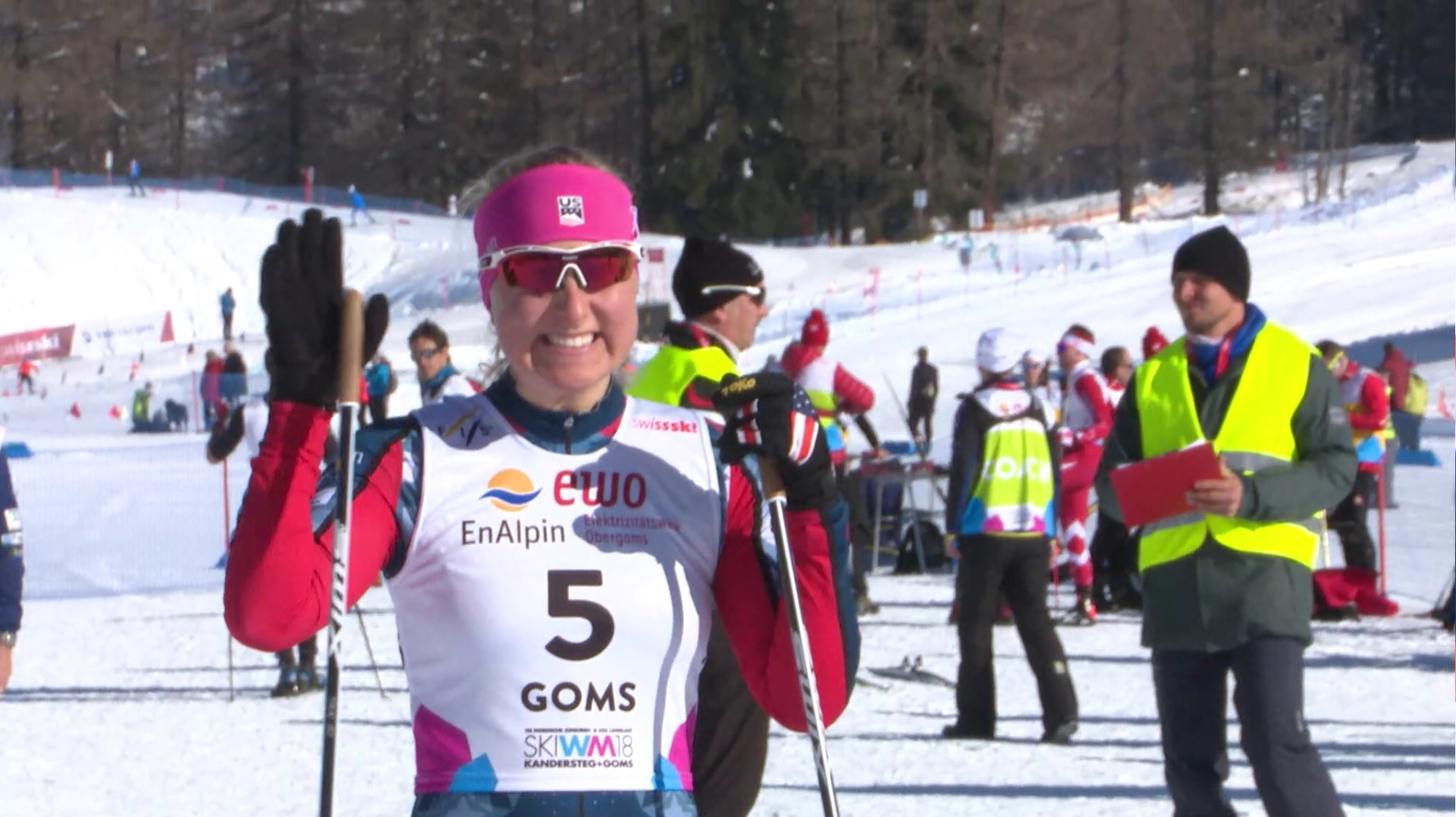
Hannah Halvorsen of the U.S. Ski Team and APU on the start line in Ulrichen, Switzerland, after finishing fifth in the sprint qualifier. (FIS screencap)
FIS Cross Country World Junior Championships (Ulrichen, Switzerland): Freestyle sprints
World Junior Championships kicked off today with freestyle sprints in Ulrichen, Switzerland. Moa Lundgren of Sweden claimed with women’s title by 1.89 seconds over Kristine Stavås Skistad of Norway in the final, with Sweden’s Frida Karlsson finishing third (+1.89).
Hannah Halvorsen of the United States qualified in fifth place before skiing to second in her quarterfinal heat. Halvorsen hovered around third or fourth place through much of her semifinal and was unable to snipe any spots in the finishing straight, ending up fourth in the heat and eighth on the day.
Fellow Americans Margaret Gellert and Sofia Shomento also made the quarterfinals, finishing 18th and 23rd, and Canada’s Hannah Mehain wound up 29th on the day.
The new men’s junior world champion is Tom Mancini of France, who nipped Norway’s Jørgen Lippert by just 0.10 seconds to take the win. Valerie Grond gave the Swiss crowd a thrill by making it all the way to the final and taking home bronze, despite qualifying in just 21st position. The Swiss junior narrowly edged France’s Vincent Buiatti for the final step on the podium.
Canada’s Graham Ritchie finished second in his quarterfinal after qualifying in 28th position, earning an automatic spot in the semifinals. There he finished sixth (+9.30 behind Mancini), winding up 12th on the day. Teammate Antoine Cyr also made the quarterfinals where he had an impressive crash, slinging off the trail and into the infield, finishing 30th on the day. For the U.S., Gus Schumacher was the lone qualifier for the heats. He finished fourth in his quarterfinal and was just 0.22 seconds away from a “lucky loser” spot in the semifinals. Schumacher finished 19th on the day.
In the junior women’s race, Hannah Rudd of the United States finished 35th in qualification, +18.15. For Canada, Annika Richardson finished 52nd (+24.09), Catherine Reed-Metayer 56th (+28.25), and Alexandra Racine 69th (+37.27).
In the junior men’s sprint, Canada’s Reed Godfrey finished a tough 31st, just 0.21 seconds out of making the quarterfinals. Etienne Hebert rounded out the Canadian finishers in 36th place (+11.81) in the qualifier. Canyon Tobin was 41st in qualification for the U.S. (+13.46), followed by Karl Schulz in 54th (+16.90) and Luke Jager in 60th (+18.15).
FIS Nordic Combined World Cup (Seefeld, Austria): Individual normal hill/15 k
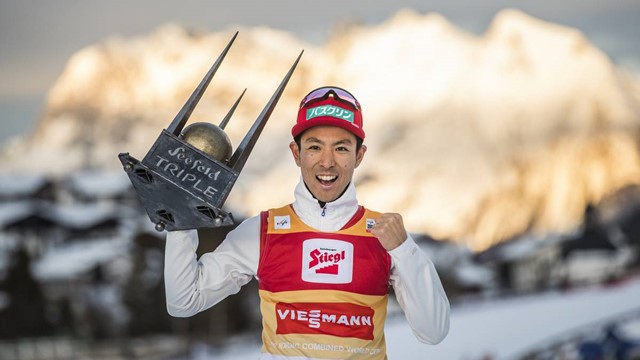
Japan’s Akito Watabe after winning the 2018 Seefeld Triple Nordic Combined World Cup. He is the only athlete besides Germany’s Eric Frenzel to win the event. (Photo: FIS Nordic Combined)
On the final day of the Seefeld Triple, Japan’s Akito Watabe completed his sweep of the three-day weekend and Norway’s Jarl Magnus Riiber reached the podium for the third-straight day, placing second. Germany’s Fabian Rießle placed third for his second podium in the last two days.
Watabe jumped to first on the normal hill and started the 15 k Gundersen 48 seconds ahead of Riiber in second. He went on to win the race by 1:14.9 minutes in 34:58.6, becoming the only man besides Germany’s Eric Frenzel to win the Seefeld Triple in its five-year history.
After jumping to fifth, Rießle won a photo finish for third (+1:57.9), edging Germany’s Vinzenz Geiger by less than a tenth of a second. Geiger moved up from ninth in the jump to fourth overall (+1:57.9).
Norway’s Jørgen Graabak followed in fifth (+2:02.4),Frenzel placed sixth (+2:07.4), Norway’s Jan Schmid was seventh (+2:09.8), Finland’s Eero Hirvonen eighth (+2:13.5), Norway’s Espen Andersen ninth (+2:28.0), and Austria’s Mario Seidl 10th (+2:42.1) out of 28 finishers.
No Americans contested the final day of the Triple, the last World Cup before the 2018 Winter Olympics in PyeongChang, South Korea.
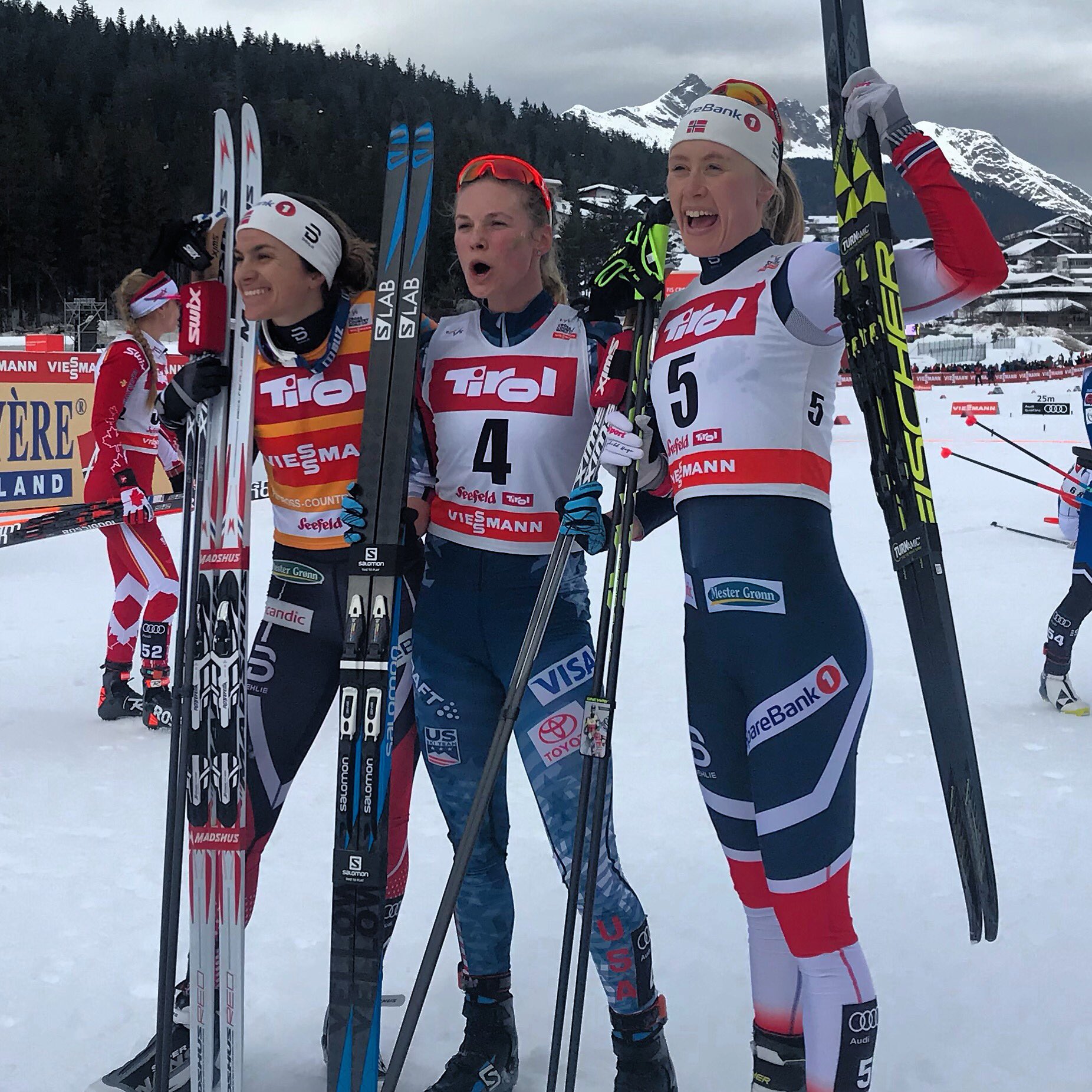
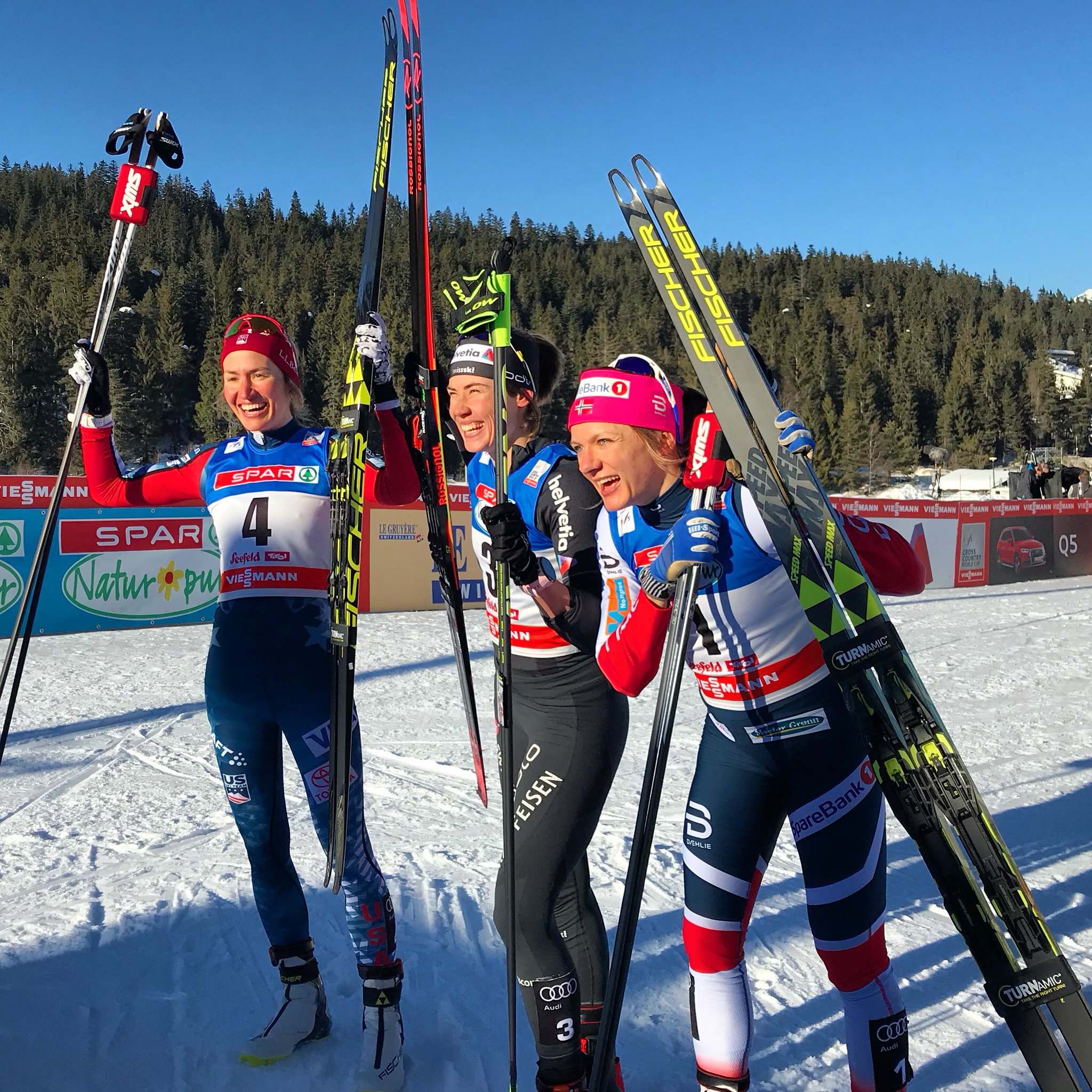
Jessie Diggins of the U.S. Ski Team (center) celebrates after winning the 10 k mass start freestyle in Seefeld, Austria, over Heidi Weng (left) and Ragnhild Haga of Norway. (Photo: FIS Cross Country/Twitter)
FIS Cross Country World Cup (Seefeld, Austria): 10/15 k mass start freestyle
In the final World Cup race before the 2018 Olympics, Jessie Diggins achieved the ultimate goal to give herself the utmost confidence heading into PyeongChang — winning the women’s 10-kilometer freestyle mass start at the World Cup in Seefeld, Austria, on Sunday.
The win was her first of the season and fourth individual victory of her career. Diggins, a 26-year-old U.S. Ski Team member, pulled it off by attacking on a long climb and leaving Norway’s Heidi Weng, Ragnhild Haga and Ingvild Flugstad Østberg chasing. While Diggins was several seconds ahead over the top and all alone on the long descent that followed, Weng and Haga worked to close the gap — and nearly did in the finishing stretch. But Diggins held them off, winning by 0.7 seconds over Weng in second place and 1 second ahead of Haga in third, and threw her fists down in celebration as she crossed the line first in 23:08.5 minutes.
“I just put my head down and it wasn’t pretty, but I just hammered,” Diggins told the International Ski Federation (FIS) in a televised post-race interview.
She was the only non-Norwegian in the top five, with Østberg in fourth (+8.7) and Marit Bjørgen in fifth (+16.7). Austria’s Teresa Stadlober placed sixth (+16.9), Norway’s Kari Øyre Slind was seventh (+19.1), and American Sadie Bjornsen placed eighth (+20.5), ahead of Switzerland’s Nathalie von Siebenthal in ninth (+30.3).
The U.S. had three in the top 15 with Kikkan Randall (U.S. Ski Team) in 14th (+48.5), and two more women in the top 30, with Caitlin Patterson (Craftsbury Green Racing Project) in 23rd (+1:00.7) and Liz Stephen (USST) in 29th (+1:18.2). Rosie Brennan (USST) finished 53rd (+2:26.9).
Emily Nishikawa led the Canadians in 35th (+1:36.5), followed closely by teammate Cendrine Browne in 37th (+1:36.6). Dahria Beatty finished 45th (+1:58.9).
Dario Cologna of Switzerland (center) won the men’s 15 k skate mass start in Seefeld, Austria, over Alex Harvey of Canada (left) and Martin Johnsrud Sundby of Norway (right). (Photo: FIS Cross Country/Twitter)
The Olympics are nearing and so Switzerland’s Olympic legend Dario Cologna is ramping up: after winning the Tour de Ski, he took another win in the 15 k mass start skate in Seefeld, Austria, on Sunday.
With much of the field staying relatively close together until the finish, Cologna nabbed the win by 1.4 seconds over Canada’s Alex Harvey, who took his second podium of the season in addition to also finishing third in the overall Tour de Ski.
Norway’s Martin Johnsrud Sundby was third (+2.9), then teammate Didrik Tønseth in fourth (+5.9) and France’s Maurice Manificat in sixth (+7.5).
The U.S. Ski Team’s Erik Bjornsen had a breakthrough day finishing ninth (+9.3), followed by Simi Hamilton in 12th (+12.4). Behind them, Scott Patterson placed 27th (+23.4), then Patrick Caldwell 49th (+1:26.2), Ben Lustgarten 55th (+1:42.7), and Tyler Kornfield 77th (+3:00.0).
Canada’s Devon Kershaw and Graeme Killick finished 30th (+26.5) and 31st (+27.4), respectively. Len Valjas placed 58th (+1:53.1), Knute Johnsgaard 82nd (+3:23.1), Bob Thompson 87th (+4:27.5), and Julien Locke 92nd (+4:56.9).
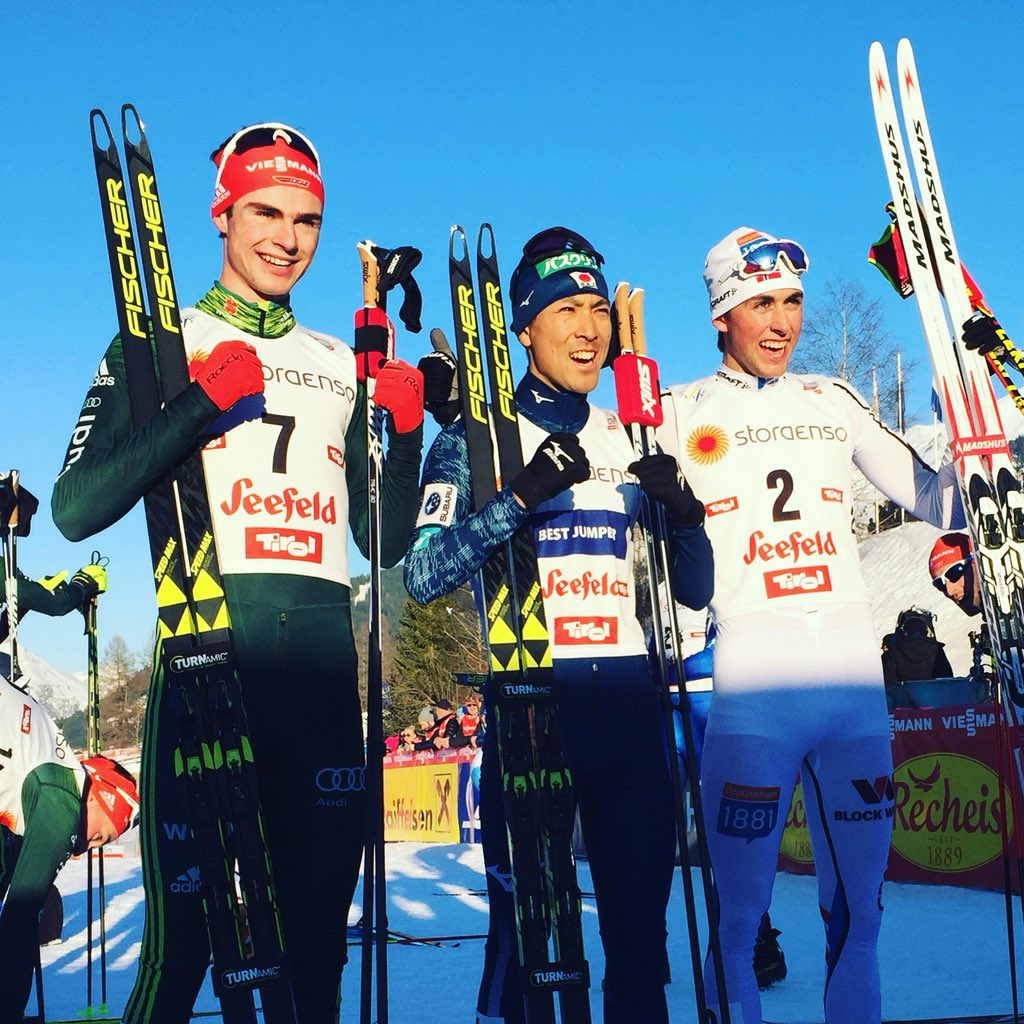
The podium for Day 2 of the Seefeld Triple Nordic Combined World Cup, with Japan’s Akito Watabe in first (c), Germany’s Vinzenz Geiger (l) in second and Norway’s Jarl Magnus Riiber (r) in third. (Photo: FIS Nordic Combined/Twitter)
FIS Nordic Combined World Cup (Seefeld, Austria): Normal hill/10 k
Two of the same men from Friday repeated on the podium on Day 2 of the Seefeld Triple Nordic Combined World Cup, with Japan’s Akito Watabe notching his second-straight win on Saturday.
Norway’s Jarl Magnus Riiber, who finished second on Friday, placed third in Saturday’s individual normal hill/10 k Gundersen, while Germany’s Vinzenz Geiger placed second, more than a minute behind Watabe.
Watabe jumped to first and started the 10 k with a 25-second head start on Riiber in second. Geiger started seventh, 1:45 minutes back, and rose to second at the finish, 1:05.5 behind Watabe (who won in 23:28.5) and 3.4 seconds ahead of Riiber in third (+1:08.9).
For the second day in a row, Norway’s Jan Schmid narrowly missed the podium in fourth (+1:14.1), up from fifth after the jump.
Taylor Fletcher was the lone American competing on Day 2, and he ended up 31st, up 10 places after jumping to 41st. Fletcher started the 10 k race 4:44 out of first then finished 3:52.9 behind Watabe.
The Seefeld Triple concludes Sunday with the individual normal hill/15 k Gundersen.
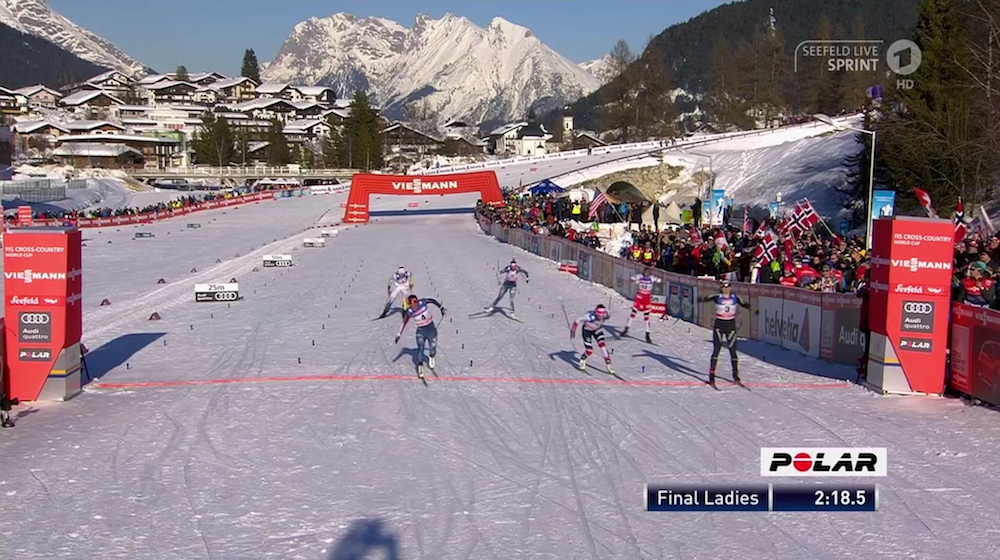
American Sophie Caldwell (l) and Switzerland’s Laurien van der Graaff (r) tied for first on Saturday in the women’s 1.1 k freestyle sprint final at the World Cup in Seefeld, Austria, while Norway’s Maiken Caspersen Falla placed third. (Screenshot: ARD broadcast)
FIS Cross Country World Cup (Seefeld, Austria): Freestyle sprints
It doesn’t get any closer than that. On Saturday, American Sophie Caldwell and Switzerland’s Laurien van der Graaff tied for first in the women’s 1.1-kilometer freestyle sprint final at the World Cup in Seefeld, Austria. They both finished within one-hundredth of a second of each other to take the victory — the last sprint before the Olympics — in 2:18.65 minutes.
Norway’s Maiken Caspersen Falla finished 0.21 seconds later for third place.
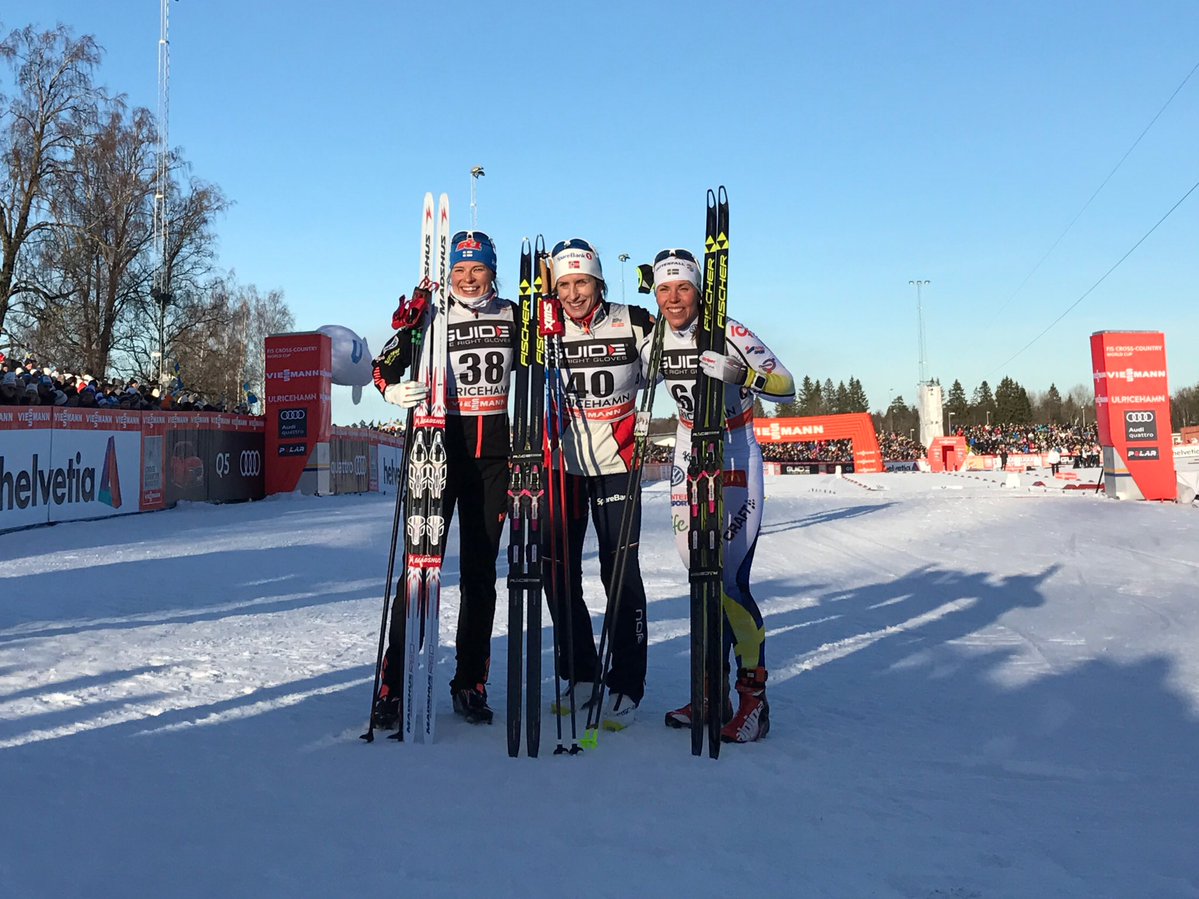
The women’s freestyle sprint podium at Saturday’s World Cup in Seefeld, Austria, with American Sophie Caldwell (l) and Switzerland’s Laurien van der Graaff (c) tying for first and Norway’s Maiken Caspersen Falla (r) placing third. (Photo: FIS Cross Country/Twitter)
“I broke my pole in the semifinal, then I got really tired,” van der Graaff said in a post-race interview with the International Ski Federation (FIS). “But I still believed I can be with Maiken and Sophie, and that I could catch them in the final was just great.”
Norway and the U.S. both had two in the final, with Kathrine Rolsted Harsem of Norway placing fourth (+1.34), Sweden’s Linn Sömskar finishing fifth (+1.83) and American Sadie Bjornsen taking sixth (+2.26).
Falla had raced to first in the qualifying round with a time of 2:21.44, Italy’s Greta Laurent qualified second (+1.43), van der Graaff third (+1.66), Caldwell fourth (+1.84), and Bjornsen fifth (+2.01).
Van der Graaff then won her quarterfinal and placed third in the first semifinal, 0.77 second behind Caldwell, who won it. Falla was second in that semifinal (+0.16) and van der Graaff advanced as a lucky loser.
Caldwell and Falla went head to head in every heat, with Falla winning their first quarterfinal by 0.08 seconds over Caldwell in second.
Bjornsen won her quarterfinal and finished second to Harsem in the second semifinal.
A third American, Kikkan Randall also qualified for the heats, placing 18th in the qualifier then finishing third in her quarterfinal (1.33 seconds behind Sömskar in first) to end up 14th overall.
Canada’s Dahria Beatty placed 30th in the qualifier to nab the last spot in the rounds, then finished fourth in her quarterfinal (1.65 seconds behind Laurent in first) for 20th overall.
For the U.S., Ida Sargent missed qualifying by about half a second in 37th (+8.20), Rosie Brennan finished 42nd (+9.86) and Caitlin Patterson was 52nd (+13.0).
Also for Canada, Emily Nishikawa finished 51st (+12.68) and Cendrine Browne was 54th (+13.34).
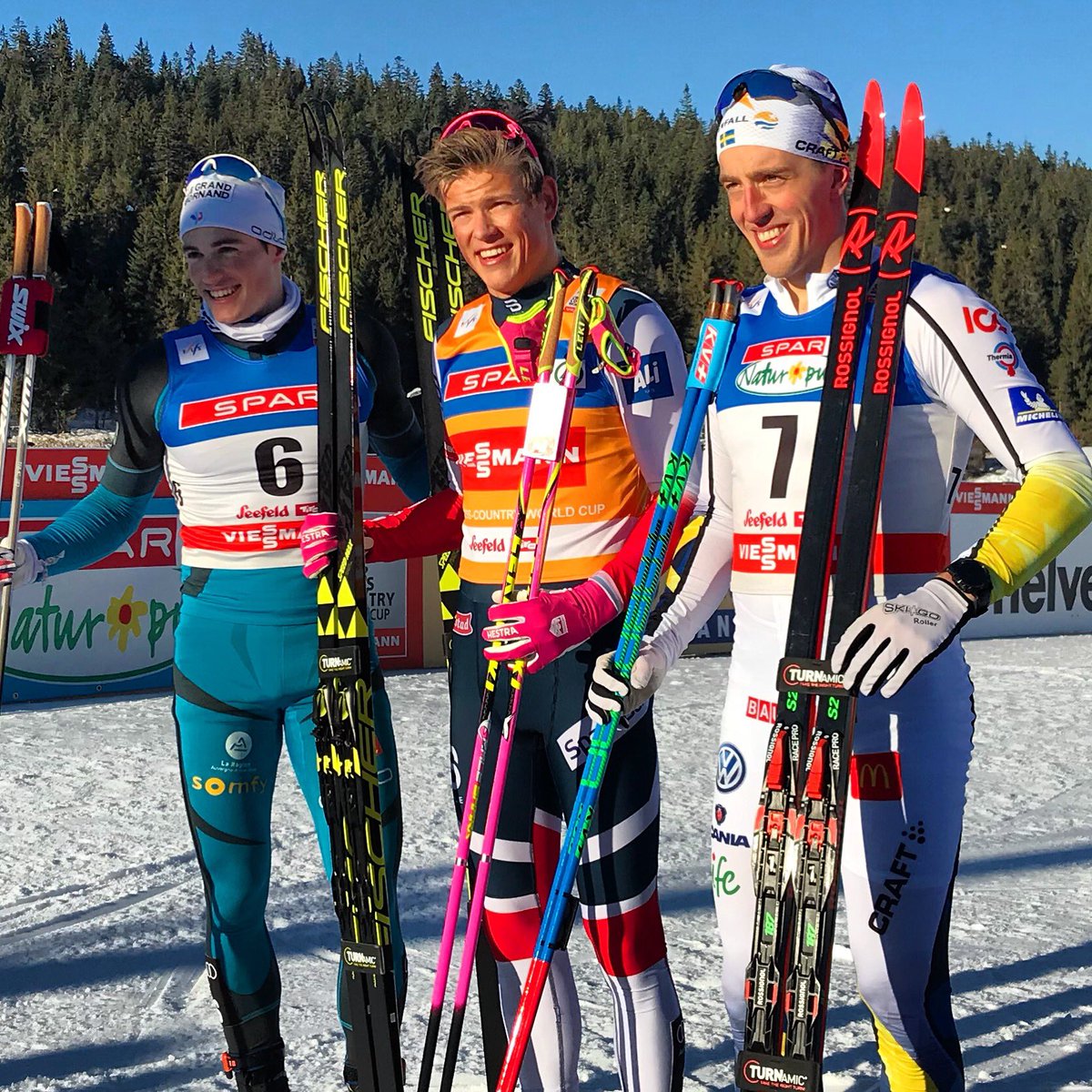
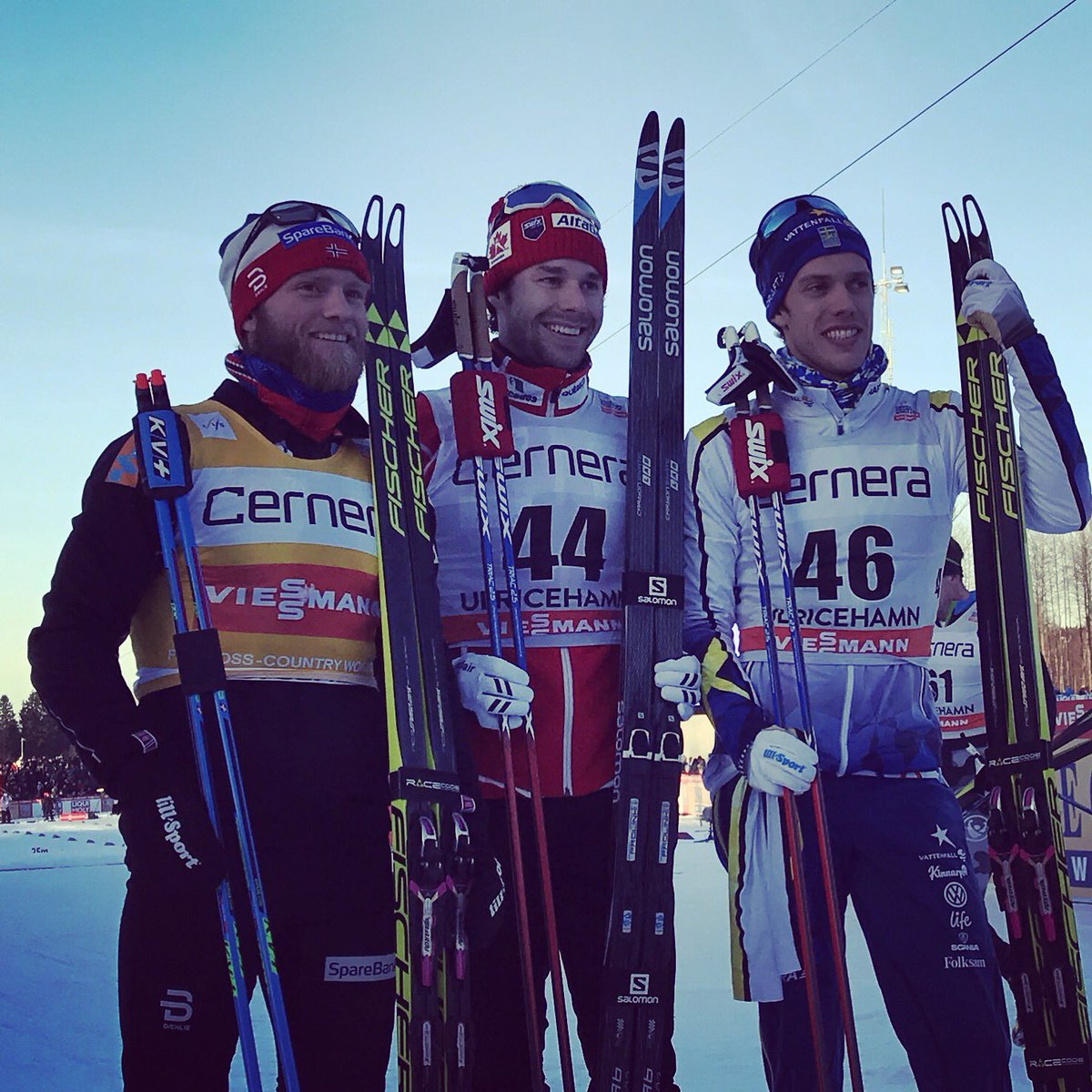
The men’s 1.4 k freestyle sprint podium at the World Cup in Seefeld, Austria, with Norway’s Johannes Høsflot Klæbo (c) in first, France’s Lucas Chanavat (l) in second and Sweden’s Calle Halfvarsson (r) in third. (Photo: FIS Cross Country/ Twitter)
The men raced 1.4 k, with Norway’s Johannes Høsflot Klæbo qualifying first in 2:46.89 then winning his quarterfinal and semifinal before putting the hammer down for one last time in the final, finishing first in 3:02.66.
France’s Lucas Chanavat placed second in the final, 0.48 seconds back, after qualifying sixth, winning his quarterfinal and placing second in the first semifinal (0.33 seconds behind Klæbo). Sweden’s Calle Halfvarsson took the third spot on the podium after finishing 0.97 seconds after Klæbo. Halfvarsson had previously qualified seventh, taken second in his quarterfinal and advanced as a lucky loser in third in the first semifinal (0.52 seconds behind Klæbo).
Italy’s Federico Pellegrino missed the podium in fourth (+1.06), Russia’s Gleb Retivykh placed fifth (+1.17), and Norway’s Emil Iversen was sixth (+5.57).
Canada’s Alex Harvey and American Simi Hamilton both made it to the semifinals, where they finished fourth and fifth, respectively, and did not advance to the finals. Harvey had qualified for the rounds in 22nd and won his quarterfinal, then raced in the second semifinal, where he finished fourth, 0.47 seconds behind Iversen in first. That put Harvey eighth overall on the day.
Hamilton clocked the fifth-fastest qualifying time, 6.46 seconds back from Klæbo’s top time. The U.S. Ski Team member then placed second to Pellegrino in his quarterfinal and was fifth in the first semifinal, 2.61 seconds behind Klæbo. Overall, Hamilton placed ninth.
Also for the U.S., Erik Bjornsen finished 37th in the qualifier, 0.89 seconds out of the top 30 and 11.99 second out of first, Logan Hanneman was 39th (+12.52), Andy Newell 42nd (+12.90), Reese Hanneman 65th (+17.91), and Ben Lustgarten 76th (+21.88).
Canada’s Len Valjas placed 40th (+12.72), Julien Locke 43rd (+13.31), Knute Johnsgaard 51st (+14.74), Bob Thompson 58th (+16.55), Graeme Killick 61st (+17.28), and Devon Kershaw 70th (+19.53).
France’s 22-year-old Chloé Chevalier racing to her second win and third podium of the week in as many individual races at 2018 IBU Open European Championships on Saturday in Ridnaun, Italy. (Photo: IBU/Biathlonworld)
IBU Open European Championships (Ridnaun-Val Ridanna, Italy): Men’s and women’s pursuits
France’s Chloé Chevalier picked up her second win and third podium of the week at the International Biathlon Union (IBU) Open European Championships on Saturday in Ridnaun, Italy, winning the women’s 10 k pursuit, while Russia’s Alexander Loginov rose to the top step of the podium in the men’s 12.5 k pursuit on Saturday.
Chevalier started the women’s pursuit in second, 13 seconds behind Ukraine’s Iryna Varvynets (who won Friday’s sprint and thus started first), and shot clean to take the lead after the third stage — where Varvynets missed one. Chevalier went on to clean the final stage for perfect 20-for-20 shooting and crossed the line first in 29:25.4. Varvynets finished second, 11.0 seconds back after missing a single target in the first standing (0+0+1+0), and France had two on the podium with Julia Simon in third (+43.2). Simon also shot 19-for-20, with her miss coming in the second prone stage (0+1+0+0).
“Three medals in three races is definitely more than I had expected,” Chevalier, 22, told the event’s organizers on Saturday. “Today I saw that Iryna shoots faster than I, and so I really gave my all in the track. Even if it might not look like it, after the many races in the last few days I am noticing that I am getting more and more tired.”
American Chloe Levins rose from 59th at the start to 42nd at the finish (+4:11.8), with three clean stages and two misses in the first standing (0+0+2+0). She had the 28th-fastest overall range time and 30th-ranked shooting time.
In the men’s pursuit, Loginov started first as Friday’s sprint winner Latvia’s Andrejs Rastorgujevs did not start. Loginov held the lead throughout the race despite two misses — one in the first stage and another in the last stage (1+0+0+1) — and secured the win in 32:22.1. Bulgaria’s Krasimir Anev started second, 19 seconds after Loginov, and held his place as well, shooting clean and finishing second, 27.6 second back.
“I am really happy here in Ridanna and the results reflect that,” Loginov, 25, told organizers. “Not to start in the individual event on Wednesday was the right decision because the last few days had been very demanding with six races in eight days. I am cross with my two errors in the shooting range, but very happy with my performance in the track.”
Russia had two on the podium with Evgeniy Garanichev in third (+1:10.7) after Garanichev started in bib 19 and overcame three penalties (1+0+2+0) with the fastest overall course time.
Canada’s Macx Davies started 27th and finished 35th (+4:33.9) with five misses (3+0+2+0), while American Alex Howe rose from 53rd at the start to 43rd (+5:53.5) with five penalties (2+2+1+0).
The 2018 Open European Championships conclude with the single mixed relay and mixed relay on Sunday. American Susan Dunklee and Lowell Bailey are on the start list for the single mixed relay, Canada’s Carsen Campbell and Sarah Beaudry. For the mixed relay, the U.S. has entered Levins, Maddie Phaneuf, Paul Schommer, and Alex Howe.
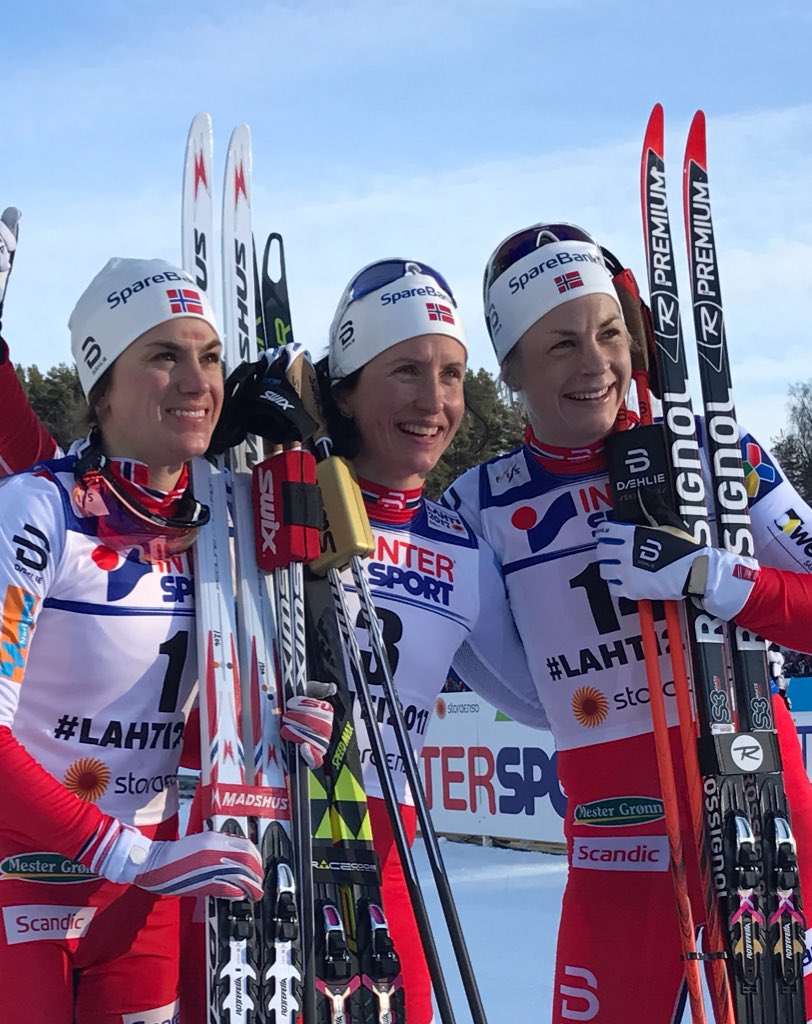
The all-Norwegian women’s 30 k freestyle mass start podium at 2017 Nordic World Championships in Lahti, Finland, with Marit Bjørgen (c) in first, Heidi Weng (l) in second, and Astrid Uhrenholdt Jacobsen (r) in third. (Photo: FIS Cross-Country/Twitter)
FIS Nordic World Championships (Lahti, Finland): Women’s 30 k freestyle mass start
Marit Bjørgen made it a four-peat on Saturday with her fourth gold and third individual win over the last week at 2017 Nordic World Championships in Lahti, Finland. (She previously won the 15-kilometer skiathlon, 10 k classic, and 4 x 5 k relay.)
The 36-year-old Norwegian closed out the championships with a 1.9-second victory in the women’s 30-kilometer freestyle mass start, finishing in 1:08:36.8 hours after setting the pace and leading a large group for much of the race. The group began to separate around 15 k, where it was down to 13 women with five seconds of first. At that point, Americans Jessie Diggins and Chelsea Holmes were within that lead pack.
While Holmes started to fall off the pace around 16 k, Diggins stuck with the leaders to the very end, only until four Norwegians broke away to race for the medals over the final kilometer.
With Bjørgen still charging hard up front, her teammates Heidi Weng, Astrid Uhrenholdt Jacobsen, and Ragnhild Haga followed, while Finland’s Krista Pärmäkoski trailed another second back in fifth and Diggins was one more second behind in sixth.
Bjørgen led the downhill into the stadium and skied away from her teammates before the finishing stretch, leaving Weng and Jacobsen to duke it out for second place. Weng got it by less than one-hundredth of a second, Jacobsen took bronze (+1.9), and Haga completed the Norwegian top-four sweep in fourth (+7.4).
Diggins passed Pärmäkoski and notched fifth (+10.4) for her career-best 30 k result. Pärmäkoski placed sixth (+11.3), Sweden’s Charlotte Kalla finished seventh (+13.9), Austria’s Teresa Stadlober was eighth (+15.5), Sweden’s Anna Haag ninth (+20.3), and Russia’s Yulia Tchekaleva 10th (+1:20.9) after edging Switzerland’s Nathalie von Siebenthal in a photo finish. Germany’s Stefanie Böhler placed 12th (+1:23.5) and Holmes finished 13th (+1:28.1) for her career best.
U.S. Ski Team member Liz Stephen placed 25th (+3:09.4), 6.6 seconds ahead of Canada’s national U25 Team skier Cendrine Browne, who notched a career best 26th (+3:16) in her first World Championships.
Holmes’s Alaska Pacific University (APU) teammate Jessica Yeaton, who races for Australia, finished 33rd (+4:32), Canada’s Dahria Beatty was 34th (+4:45.2), and American Caitlin Gregg 36th (+5:03.7).
Great Britain’s Annika Taylor, a California native, placed 38th (+6:19.4). Canada’s Emily Nishikawa was 40th (+6:41.5) and Katherine Stewart-Jones 41st (+7:18.6), and Brazil’s Jaqueline Mourão, who trains in Quebec, was 46th (+13:44.6) out of 47 finishers.
IBU World Cup (PyeongChang, South Korea): Women’s and men’s pursuits
The women’s 10 k pursuit podium at the IBU World Cup in PyeongChang, South Korea, with Germany’s Laura Dahlmeier (c) in first, Finland’s Kaisa Mäkäräinen (l) in second, and France’s Anais Bescond (r) in third. (Photo: IBU)
Coming off a fifth place in Thursday’s 7.5-kilometer sprint, Susan Dunklee held her position despite three penalties in the women’s 10 k pursuit on Saturday to finish fifth again at the International Biathlon Union (IBU) World Cup in PyeongChang, South Korea.
Germany’s Laura Dahlmeier racked up her second-straight win in as many races in PyeongChang (and sixth-straight, counting World Championships), finishing in 27:58.0 minutes with clean shooting. She was just one of four women out of 58 finishers that hit all 20 targets in Saturday’s four-stage race.
Finishing more than a minute later, Finland’s Kaisa Mäkäräinen placed second (+1:12.6) after starting fourth based on her sprint result. Mäkäräinen had two penalties, both in the first standing, but cleaned the other three stages (0+0+2+0). France’s Anais Bescond raced up from eighth at the start to third place (+1:18.9) at the finish, with a single penalty (0+0+1+0), while Norway’s Tiril Eckhoff missed her second-straight podium in fourth place (+1:32.0) after starting second but accumulating five penalties (1+2+1+1).
Eckhoff edged Dunklee, of the U.S., by half a second as Dunklee placed fifth (+1:32.5) with three misses (1+1+0+1).
Canada’s Rosanna Crawford rose from 30th to 19th (+2:49.1) for her best non-relay result of the season, with two penalties (1+1+0+0). Her teammate Megan Tandy also landed her first top 30 of 2016/2017 in 30th (+3:26.2) with two misses (1+0+1+0) after starting 39th. Also for Canada, Julia Ransom finished 44th (+4:18.4) after starting 41st and skiing four penalty loops (1+0+1+2).
Also for the U.S., Clare Egan finished 36th (+3:41.9) with three clean stages but three misses in her first standing (0+0+3+0), after starting 33rd. Joanne Reid slipped from 35th at the start to 52nd (+4:53.4), with five penalties (1+1+0+3).
The men’s 12.5 k pursuit podium on Saturday at the IBU World Cup in PyeongChang, South Korea, with France’s Martin Fourcade (c) in first, Russia’s Anton Shipulin (l) in second and Austria’s Julian Eberhard (r) in third. (Photo: IBU)
[UPDATED] One day after locking up the overall World Cup title, Martin Fourcade was back at the top of the podium in the men’s 12.5 k pursuit in PyeongChang.
Fourcade started third, after finishing third in Friday’s sprint, then shot clean to win in 31:24.2. Russia’s Anton Shipulin, who started 23rd, also shot 20-for-20 to race up to second place, 34.5 seconds behind Fourcade, with the fifth-fastest course time. In comparison, Fourcade’s course time was third fastest.
Friday’s sprint winner, Julian Eberhard of Austria finished third (+36.7) after skiing three penalty loops (0+2+0+1). His teammate Simon Eder placed fourth (+1:03.2) after starting eighth and cleaning three stages before missing two on the last standing (0+0+0+2).
Russia’s Evgeniy Garanichev improved from ninth at the start to fifth (+1:09.5) with two penalties as well (0+1+1+0). France’s Simon Desthieux was sixth (+1:13.5), Austria’s Dominik Landertinger seventh (+1:20.3), Germany’s Benedikt Doll eighth (+1:20.4) with the fastest course time after starting 20th.
American Lowell Bailey was another 0.2 seconds back in ninth (+1:20.6), just ahead of Italy’s Lukas Hofer in 10th, who finished with the same time. Bailey previously tallied the third podium of his career on Friday, placing second in the sprint, but had two penalties on Saturday (1+0+1+0) to slip to ninth.
Also for the U.S., Leif Nordgren improved to 28th (+2:28.9) after starting 37th and shooting 19-for-20 (0+0+0+1).
Christian Gow shot clean to lead Canada in 32nd (+3:17.4), up from 56th at the start. His older brother Scott Gow slipped from 27th at the start to 43rd (+4:05.9) with five penalties (0+1+1+3), and Brendan Green followed in 44th (+4:09.8) with three penalties (2+1+0+0) after starting 28th.
Emil Iversen celebrates his win in the 30 k classic mass start in Falun, Sweden, on Sunday. Norwegian teammate Martin Johnsrud Sundby finished second and Sweden’s Calle Halfvarsson third.
FIS Cross-Country World Cup (Falun, Sweden): 15 / 30 k classic mass start
In the women’s 15-kilometer classic mass start on Sunday, Norway swept the podium with Marit Bjørgen taking the win in a time of 41:28.8 in Falun, Sweden. Crossing just half a second behind her was her teammate, Ingvild Flugstad Østberg in second place. Rounding out the podium was Heidi Weng in third (+8.1).
American Jessie Diggins was the first to cross the line for the U.S. in 10th (+1:37.5). Three other U.S. women finished in the top 30, with Sadie Bjornsen finishing 21st (+2:43.6), Rosie Brennan 24th (+2:57.0), and Liz Stephen in 29th (+3:24.5).
Just outside of scoring World Cup points was American Caitlin Patterson in 32nd (+3:47.6) and Ida Sargent in 34th (+4:02.8). Canada’s Cendrine Browne finished 46th (+5:41.4) and American Liz Guiney 49th (+6:22.6).
After losing the skate sprint yesterday in a photo finish to Italy’s Federico Pellegrino, Emil Iversen ascended to the top step of the podium in the men’s 30 k classic mass start on Sunday in Falun.
The Norwegian was often near the front, but hadn’t tried to lead a breakaway like his teammates Martin Johnsrud Sundby and Sjur Røthe did earlier in the race. In the final two kilometers, Sundby – the overall World Cup leader – put in a sprint to try to drop the field. But Iversen caught up, drafting his veteran teammate into the stadium. In the final up-and-over before the finish line, Iversen made a pass and then accelerated down the finishing stretch to beat Sundby by 1.14 seconds.
“I got motivation from yesterday’s last 20 meters,” Iversen told FIS in a finish-line interview. “So today I fought all the way, and I was really stronger. It is amazing for me to be second yesterday and first today. I’m really proud of that.”
Calle Halfvarsson, who had been falling off the back of the lead pack just a few kilometers earlier, managed to get back to the front and claim third place for Sweden (+1.72 seconds) in a photo finish with Røthe (+1.76 seconds). Niklas Dyrhaug was next (+2.52 seconds) to give the Norwegian men’s team four in the top five.
In his return to the World Cup stage, Norway’s Petter Northug finished 31st (+3:10.6).
Alex Harvey was the lone Canadian on the start line. After skiing near the front of the field for the early part of the race he was dropped by the lead pack in the final kilometers, finishing 15th (+1:17.5).
Erik Bjornsen and Noah Hoffman took 35th and 37th places for the United States, finishing +3:30.8 and +3:59.8, respectively. SuperTour leader Matthew Gelso — familiar with the Falun course after competing in 2015 World Championships — finished 44th (+5:23.6), and Andy Newell placed 53rd (+7:45.3).
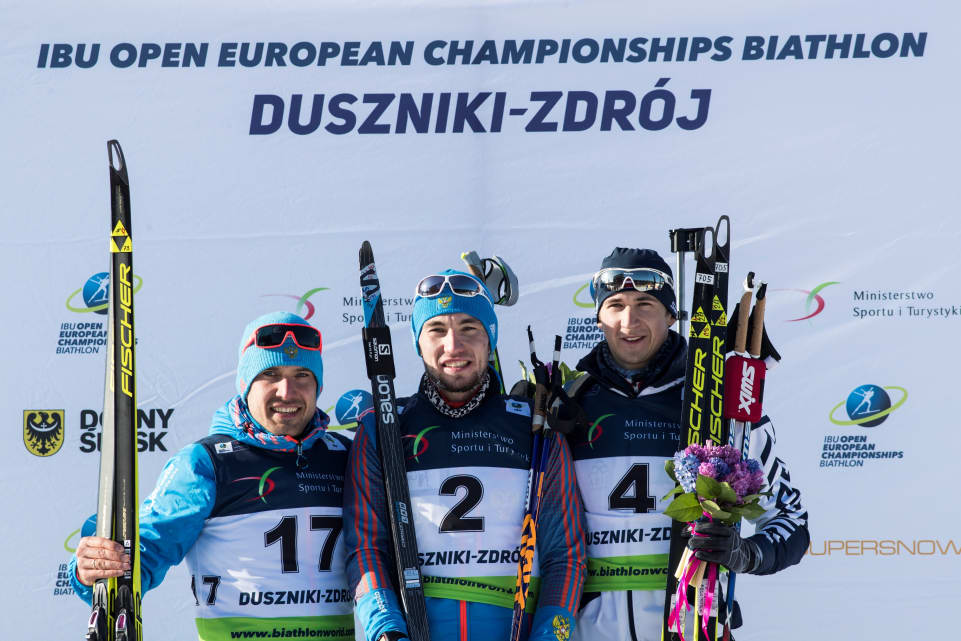
IBU Open European Championships (Duszniki-Zdrój, Poland): Single mixed & mixed relay
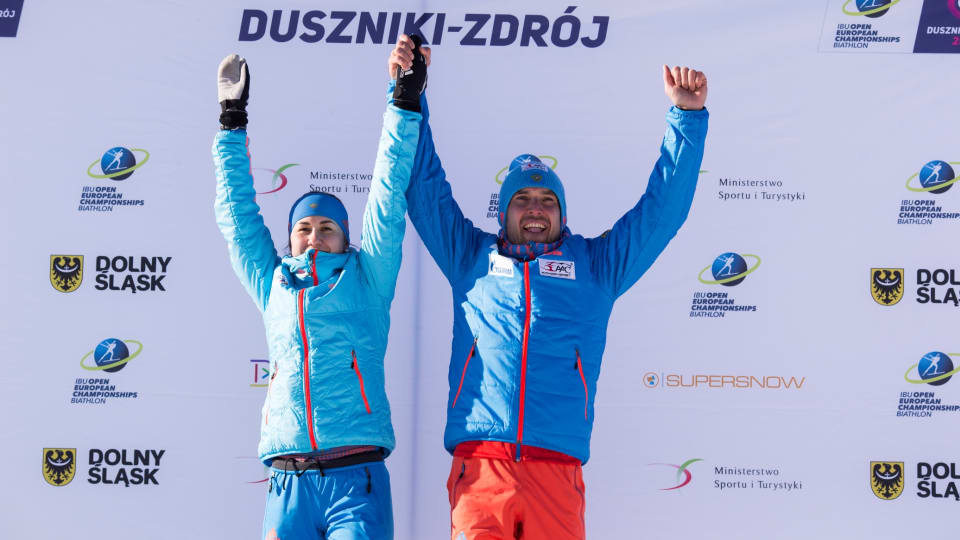
Russia’s Alexander Loginov (center) is greeted at the finish by his teammates Irina Starykh, Svetlana Sleptsova and Alexey Volkov after anchoring his team to the gold medal in the mixed relay at the 2017 IBU Open European Championships in Duszniki-Zdrój, Poland. (Photo: IBU)
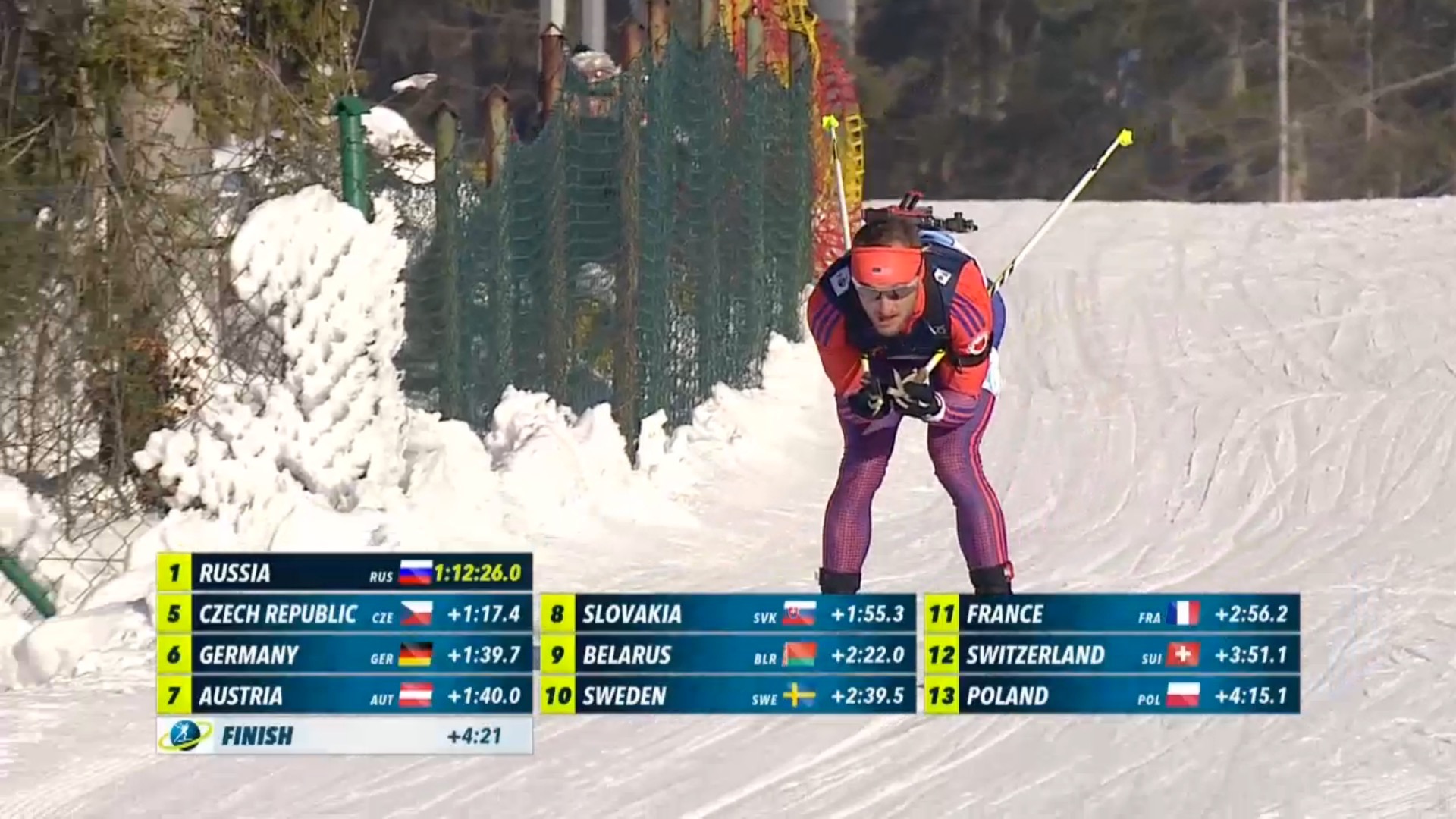
[UPDATED] The Russian victory in the final 2 x 6 + 2 x 7.5-kilometer mixed relay event of the 2017 International Biathlon Union (IBU) Open European Championships in Duszniki-Zdrój, Poland, was only briefly in doubt, when Alexander Loginov skiing the anchor leg required all spares in his prone shooting stage. But with his final shot he managed to also hit that target to avoid the penalty lap, leaving the range with a lead of more than 30 seconds.
Loginov then did not need any spares in the last standing stage, and could take his time on the final loop. Unlike Russia’s Evgeniy Garanichev earlier in the day during the single mixed relay, he also managed to pick up a flag for the final meters of the race, crossing the line in a time of 1:12:26.0 hours.
The Russian team with Irina Starykh, Svetlana Sleptsova, Alexey Volkov and Loginov led from the first exchange and required only six spares with zero penalties.
With this medal, the 28-year-old Volkov became the most successful athlete in history at European Championships, according to an IBU press release, surpassing the retired Polish biathlete Tomasz Sikora. Russia was the most successful team of the 2017 Open European Championships with six gold, four silver, and three bronze medals.
Behind them, a number of teams vied for the positions on the podium. Sweden initially looked like a strong contender exchanging in second place after the women, but fell back with three penalty laps to only finish 10th.
Still six seconds back after the final shooting, Norway’s Fredrik Gjesbakk caught up to and outsprinted Ukraine’s Ruslan Tkalenko in the finishing stretch to claim the silver medal (+36.4) with the bronze left for Ukraine (+37.1).
“I thought that I made sufficient gap to win silver,” Tkalenko told the IBU. “But in the end, on the final downhill before the finish, I was very surprised when the Norwegian guy passed me, I truly did not expect that.”
The Norwegian team with Karoline Erdal, Marion Rønning Huber, Erlend Bjøntegaard, and Gjesbakk needed nine spares and had no penalties.
Ukraine with Anastasiya Merkushina, Yulia Dhzyma, Oleksander Zhyrnyi (who originally started for Russia before making the switch in 2014) and Tkalenko required six spares, and Dhzyma had to ski a penalty lap only temporarily setting the team back.
Bulgaria finished fourth (+1:16.4), with its anchor Vladimir Iliev narrowly beating Czech Republic’s Lukas Kristejn (+1:17.4) in the finishing stretch. Both teams needed 11 spares and had no penalties.
Jakob Ellingson skiing the anchor leg for the U.S. mixed relay at the 2017 IBU Open European Championships in Duszniki-Zdrój, Poland. The U.S. team finished 14th. (Photo: IBU/Eurovisionsports.tv screenshot)
Starting at the back of the field in bib 20, US Biathlon’s Emily Dreissigacker got her team off to a strong start with a clean prone shooting and one spare round in standing, exchanging in 10th, a minute behind the leaders. Hallie Grossman needed one spare in each of her stages, tagging off to the men in 14th position and now 2:39 behind. Max Durtschi also had one miss each in prone and standing, coming into the last exchange still in 14th position, but another minute back. Jakob Ellingson required all three of his spares in his prone shooting stage narrowly avoiding the penalty lap, and one more in his final shooting stage. As the team from Finland was racing over a minute behind the Americans, he was able to keep the 14th position into the finish (+4:47.4), with a team total of nine spares and no penalties overall.
For Biathlon Canada, Erin Yungblut starting in bib 19 shot clean in her prone stage and required two spares in her standing shooting, tagging off in 18th position and more than two minutes back from first. Leilani Tam von Burg stayed clean in her prone shooting stage and needed one spare in standing, moving up two positions to exchange in 16th place, yet more than four minutes behind the leaders. After the exchange to the men, both Matthew Neumann and anchor Carsen Campbell managed to shoot clean in all of their stages, but lost additional time on the course to finish 16th (+6:39.9) ahead of four lapped teams.
Canada had the best shooting result of all 20 teams starting the relay, with just three spares and no penalty.
Russia’s Daria Virolaynen (l) and Evgeniy Garanichev after winning Sunday’s single mixed relay at the 2017 Open European Championships in Duszniki-Zdrój, Poland. (Photo: IBU)
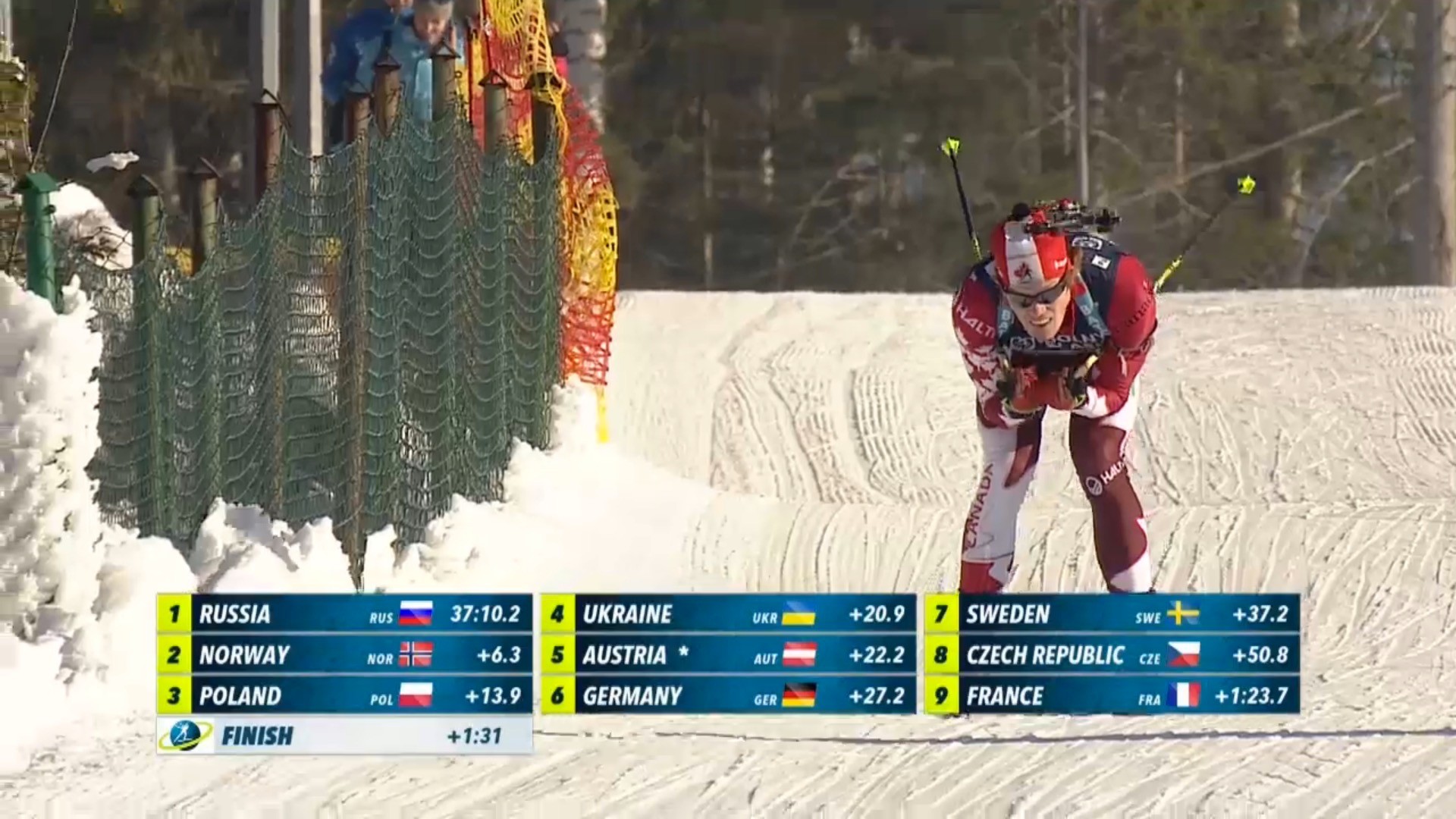
Earlier on Sunday, pretty much the only thing that went wrong for Russia’s Daria Virolaynen and Evgeniy Garanichev in the single mixed relay happened on the last meters of the finishing stretch, with Garanichev gesturing for a Russian flag he wanted to cross the line with. But the handoff was too short and the flag dropped past his outstretched hand to the snow. He glanced back, weighing if his lead was big enough to ski back, but decided it was not worth the risk, instead skiing into the arms of his partner waiting for him behind the line in a time of 37:10.2 minutes.
Russia needed seven spare rounds and incurred zero penalties. Garanichev secured the victory in the final shooting, when he only needed one spare – albeit fumbling a few seconds to insert it – while his direct opponents standing next to him required more time to hit their targets.
“Probably, I took some risk at the last standing,” Garanichev said, according to an IBU press release. “I wanted to shoot fast and clean, but missed with the last shot. But in general, I felt very comfortable; came and worked at the range in my rhythm.”
6.3 seconds behind, Norway with the team of Ingrid Landmark Tandrevold and Vetle Sjåstad Christiansen placed second, with seven spares and zero penalties.
“These are very short loops,” Christiansen commented on the fairly new, single mixed relay format. “You feel the pressure from the crowd and to shoot fast every time.”
The 20-year-old Tandrevold previously earned three bronze medals, including one in the single mixed relay, also with Christiansen, at last year’s Open European Championships in Tyumen, Russia.
To big cheers from their home crowd fans who had come out to the Duszniki Arena in beautiful but cold weather, the Polish husband-and-wife team of Krystyna Guzik and Grzegorz Guzik placed third with just five spares and zero penalties (+13.9), not quite able to keep up with Christiansen on the final loop after leaving the range together within a second.
“It is so nice to win a medal here in Poland,” Krystyna Guzik said. “We were both very disappointed with all of our mistakes in the other competitions. So today, we were relaxed and laughing before the competition, hoping not to have those mistakes again. We did not … and now have a medal.”
It was the first medal for Poland at these championships.
Ukraine with Iryna Varvynets and Andriy Dotsenko finished fourth, also with five spares and zero penalties (+20.9).
Biathlon Canada’s Aidan Millar skiing the final loop of the single mixed relay at the 2017 IBU Open European Championships in Duszniki-Zdrój, Poland. With teammate Sarah Beaudry, Canada finished 13th (Photo: IBU/Eurovisionsports.tv screenshot)
For Biathlon Canada, Sarah Beaudry and Aidan Millar required seven spares during their race and had no penalty, just like the winning Russians and Norwegians, but could not quite keep up with the best teams on the course in the fast-paced race format with short loops somewhat comparable to a team sprint in cross-country.
Beaudry cleaned her first shooting stage and then needed one spare to hit all targets in standing. At the first exchange Canada was 10th, 35.8 seconds behind the then leading team from Poland.
Millar missed one shot in his first prone stage, leaving the range again in ninth position. Then he needed two spares in his standing shooting on the way to exchanging back to Beaudry in 11th (+56.4).
On her second leg, Beaudry had one miss in prone and required two spares in standing, falling back a bit to exchange in 13th (+2:12.0).
On his final leg, Millar was able to shoot clean in both stages, reducing the time gap to the top but not able to make up another position, and finished in 13th place (+1:56.1).
US Biathlon is only represented with two women at the Open European Championships in Poland, and decided to forgo a start in the single mixed relay, instead entering a team in the mixed relay later on Sunday.
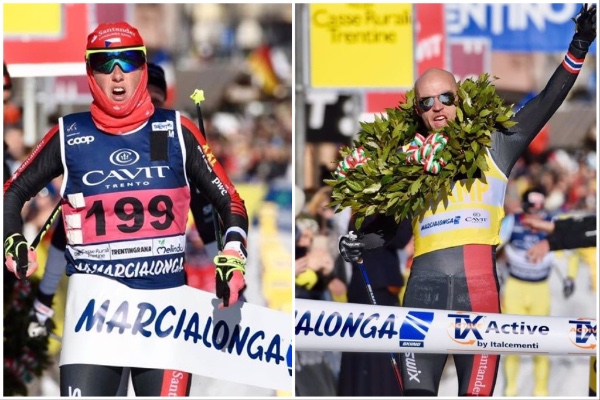
Katerina Smutna (left) and Tord Asle Gjerdalen (right) of Team Santander won the 2017 Marcialonga. (Photo: Visma Ski Classics)
Tord Asle Gjerdalen won the Marcialonga, a Worldloppet and Swix Ski Classics marathon for the third time – in a row. This year was on a shortened course, “just” 57 rather than the traditional 70 kilometers.
The Team Santander athlete finished in two hours, eight minutes, and 36 seconds, edging Johan Kjølstad (Team United Bakeries) and Morten Eide Pedersen (Team BN Bank) in a sprint finish by 2.6 and 2.9 seconds, respectively.
Tyler Kornfield and David Norris of Alaska Pacific University finished 43rd (+5:03.8) and 66th (+10:43.1). Canadian Paralympian Brian McKeever finished 57th (+9:13.5) and guide Graham Nishikawa 81st (+12:56.5), followed by Ian Murray in 85th (+13:37.5) and Erik Carleton in 111th (+17:50.2).
In the women’s competition, Katerina Smutna, also of Team Santander, won her third straight Ski Classics competition. She crossed the line in two hours, 22 minutes, and 46.4 seconds. Britta Norgren of Team Lager 157 was second by just 0.8 seconds, and Sara Lindborg (Team Serneke) third, +4:22.2. University of Utah alum Maria Graefnings was tenth, +10:35.8.
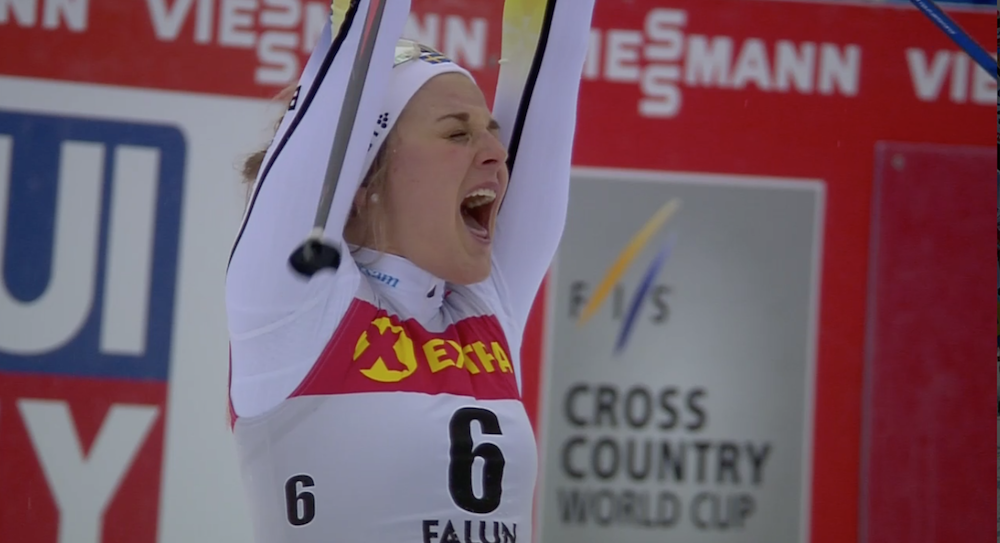
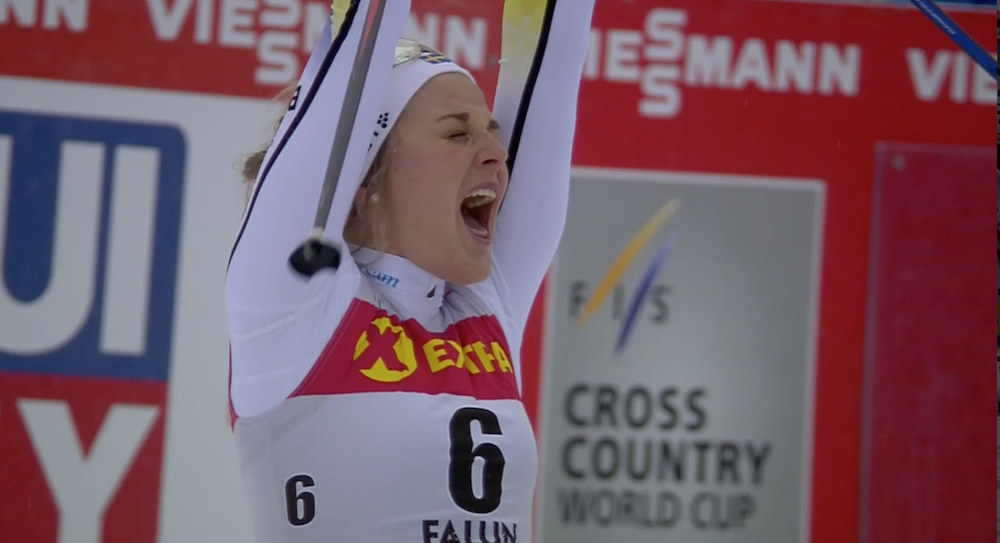
Sweden’s Stina Nilsson celebrates her second-straight World Cup sprint victory on Saturday after winning the 1.4 k freestyle sprint at home in Falun, Sweden.
FIS Cross-Country World Cup (Falun, Sweden): Men’s & women’s freestyle sprints
[UPDATED] Kikkan Randall reached the final for the first time since March 2015 on Saturday in the women’s 1.4-kilometer freestyle sprint at the World Cup in Falun, Sweden. The American qualified 26th and went on to advance in second out of her quarterfinal and semifinal to reach the six-woman final, where she ended up fifth.
Sweden’s Stina Nilsson won the final by one-hundredth of a second over Norway’s Maiken Caspersen Falla, finishing in 3:00.24 minutes. Nilsson had started the day by qualifying in sixth, 2.52 seconds behind Norway’s Marit Bjørgen, who won the qualifier in 3:00.64. This is Nilsson’s second-straight World Cup sprint win after skipping the freestyle sprint in Toblach, Italy, following the Tour de Ski.
While Bjørgen went on to win her quarterfinal, she finished fifth in her semifinal to end up ninth on the day.
Norway had two on the women’s podium with Heidi Weng in third, 1.88 seconds behind Nilsson. Finland’s Krista Parmakoski placed fourth (+1.99), and Randall was fifth (+2.56) for her best result in two years (she took last season off to have a baby). Sweden’s Jonna Sundling reached the final as well and finished sixth (+8.02).
Five U.S. women qualified for the heats, with Jessie Diggins qualifying fifth and ultimately crashing in her semifinal, where she finished fifth. That put her 10th overall on the day. Sophie Caldwell qualified third and finished fourth in her quarterfinal for 16th on the day, Sadie Bjornsen qualified 17th and also finished fourth in her quarterfinal for 19th overall, and Ida Sargent made the top-30 qualifying cutoff in 30th, then placed fifth in her quarterfinal for 25th overall.
Bjørgen topped the freestyle sprint qualifier on Saturday morning, clocking the fastest time around the 1.4 k course by just 0.08 seconds over Hanna Falk of Sweden.Caldwell qualified third (+1.23),Digginsqualified fifth (+2.39),Bjornsen17th (+5.04),Randall26th (+6.64), andSargent 30th (+8.28). Rosie Brennan (U.S. Ski Team) missed the cut in 37th (+10.90) and Liz Guiney finished 56th (+32.87). The lone Canadian woman racing on Saturday, Cendrine Browne placed 46th (+14.02).
In the men’s 1.4 k freestyle sprint final, Italy’s Federico Pellegrino held off three Norwegians and two Swedes to win in 2:45.77. The defending Sprint World Cup champion qualified second and went on to win his quarterfinal and semifinal before taking the final by six-hundredths of a second.
Norway took the remaining spots on the podium with Emil Iversen in second (+0.06) and Sindre Bjørnestad Skar in third (+0.47). Sweden’s Oskar Svensson was three-hundredths of a second off the podium in fourth (+0.50). The fastest qualifier in 2:34.49, Norway’s Johannes Høsflot Klæbo reached the final and ultimately took fifth (+1.32), and Sweden’s Teodor Peterson placed sixth (+2.08).
Canada’s Len Valjas was the top North American in 10th. He qualified 20th, advanced in second from his quarterfinal and finished fifth in his semifinal.
American Andy Newell was 16th after qualifying in 25th and finishing third in his quarterfinal. U.S. teammate Simi Hamilton followed in 18th, after qualifying 13th and finishing fourth in his quarterfinal.
In the men’s qualifier, Klæbo was 1.05 seconds faster thanPellegrinoand another 0.02 seconds faster than Russia’s Sergey Ustiugov in third.
For the U.S., Hamiltonqualified 13th (+4.52) andNewell qualified 25th (+6.74). Erik Bjornsen placed 43rd (+9.30) and Matt Gelso 59th (+13.12).
Valjaswas the lone Canadian man to make the heats, qualifying 20th (+6.22). The only other starter, Alex Harvey, placed 46th (+9.71).
IBU Open European Championships (Duszniki-Zdrój, Poland): Men’s & women’s pursuits
The men’s pursuit podium at 2017 IBU Open European Championships on Saturday in Duszniki-Zdrój, Poland, with Russia’s Alexander Loginov (c) in first, Evgeniy Garanichev (l) in second, and Latvia’s Andrejs Rastorgujevs (r) in third. (Photo: IBU)
Russia’s Alexander Loginov racked up his second win of the 2017 International Biathlon Union (IBU) Open European Championships on Saturday in the mens’ 12.5-kilometer pursuit in Duszniki-Zdrój, Poland.
After starting second, 5 seconds behind Bulgaria’s Vladimir Iliev, who won Friday’s sprint, Loginov proceeded to clean three straight stages before missing one on his final standing to cross the line first in 31:46.2 minutes.
“It was not as easy as it seemed, because from the first loop Vladimir set a really good speed,” Loginov said, according to an IBU press release. “Today we had great sunny and windless weather again, so I managed to shoot well. Probably that is why it [looked] so easy.”
Russia took first and second place with Evgeniy Garanichev following 27.8 seconds later, after starting 17th (56 seconds out of first) and shooting 19-for-20 (0+0+1+0).
“After yesterday’s sprint, I managed to work well and to show good result in pursuit, so I’m sure glad to win the silver medal,” Garanichev said, according to the IBU.
Latvia’s Andrejs Rastorgujevs improved on his fourth place in the sprint to reach the pursuit podium in third (+59.5) despite four penalties (0+1+1+2).
“On the last loop I had the information about the guys who were behind me and in front of me,” Rastorgujevs said, according to the IBU. “I was just fighting and did all I could do to get to the podium.”
Bulgaria’s Krasimir Anev, who started third, slipped to fifth (+1:28.6) with two penalties (0+1+1+0), behind Russia’s third man in the top four, Alexey Volkov in fourth (+1:01.6). Iliev as the first starter ended up 11th (+1:41.7) with six penalties (2+2+0+2).
The two Americans who had qualified for the pursuit by placing in the top 60 of Friday’s sprint, Paul Schommer and Alex Howe improved to 48th (+5:07.1) and 51st (+5:42.3), respectively.
Schommer started 58th, just ahead of Howe in 59th, and missed five targets, all in his first two prone stages (3+2+0+0). Howe accumulated four penalties (1+2+1+0).
No Canadians qualified for the pursuit.
[UPDATED] In the women’s 10 k pursuit that followed, Russia’s Irina Starykh picked up her second win and third consecutive podium of the championships, with clean shooting en route to a 19.8-second victory in 30:04.4.
Starykh started third, 38 seconds behind Ukraine’s Juliya Dzhyma and 11 seconds after her Russian teammate Svetlana Sleptsova, respectively. Dzhima missed two on her last two standing stages (0+0+1+1) to slip to second, and Sleptsova dropped one place to third (+32.1) with one prone penalty (0+1+0+0).
Veronika Vítková of the Czech Republic improved from seventh to fourth (+47.8) with two penalties (0+1+1+0), and Russia’s Svetlana Mironova moved all the way up from 13th to fifth (+1:29.6) with three misses (0+1+1+1). Just 0.2 seconds behind her, Poland’s Monika Hojnisz improved from 16th at the start to sixth (+1:29.6) with one penalty (0+0+0+1).
No North Americans qualified for the pursuit.
Open European Championships conclude Sunday with the single mixed and mixed relay.
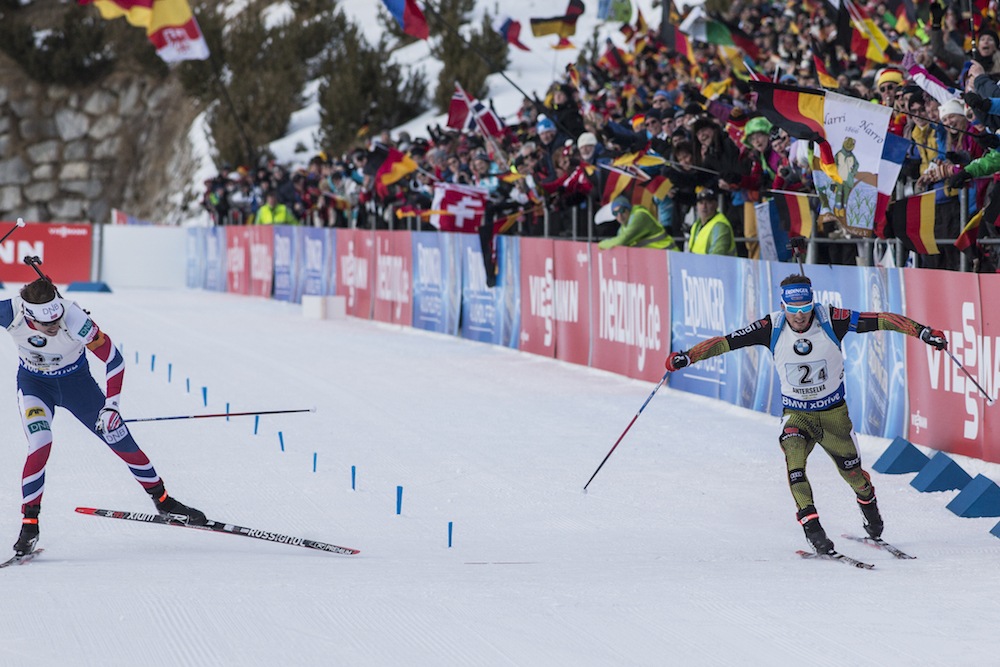
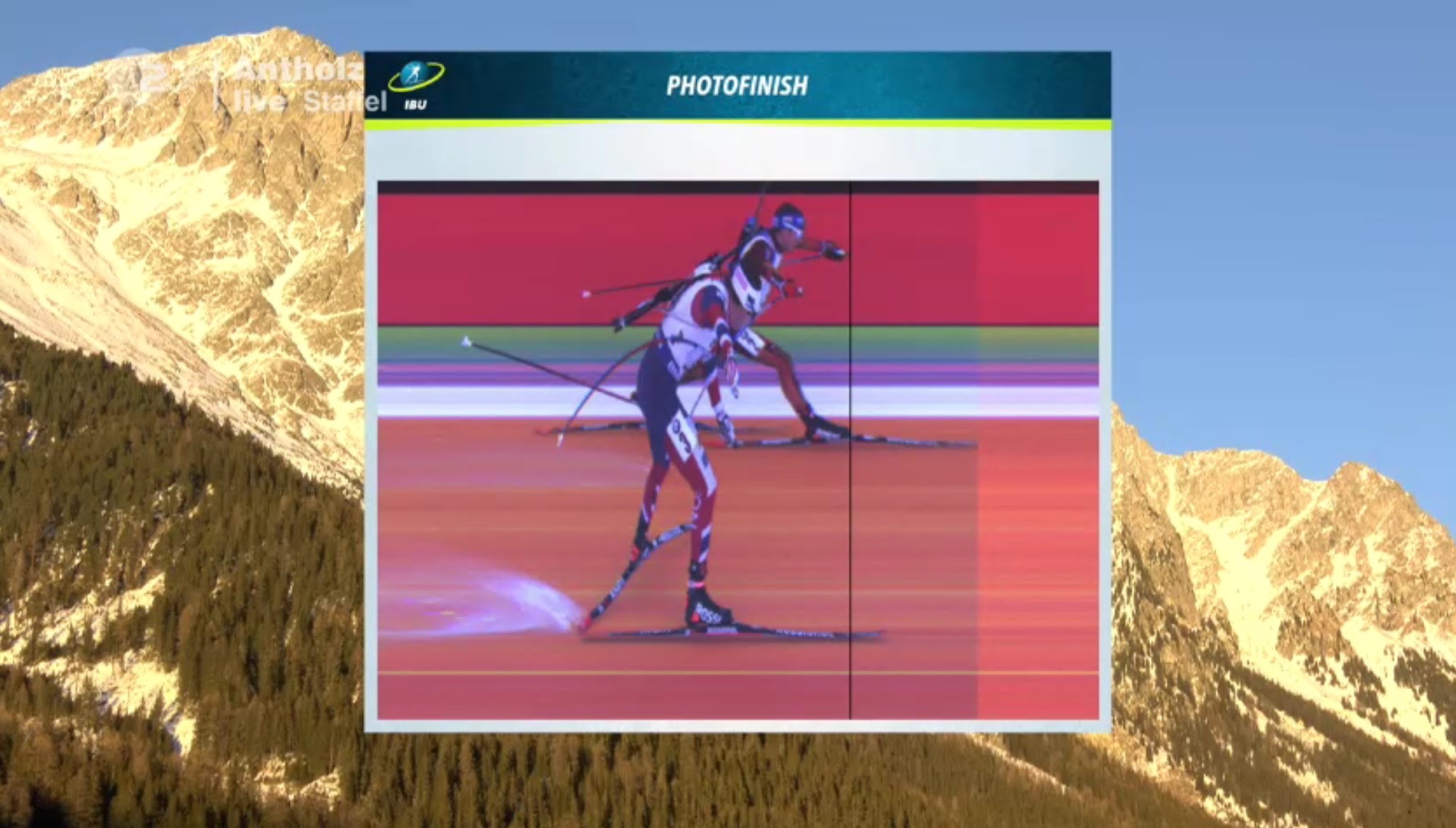
The photo finish for first in the IBU World Cup men’s 4 x 7.5 k relay on Saturday in Antholz, Italy, with Germany’s Simon Schempp (r) edging Norway’s Emil Hegle Svendsen (l) by 0.1 seconds. (Photo: IBU/Christian Manzoni)
For Germany and Norway, it was a two-way battle for first following the final exchange of the men’s 4 x 7.5-kilometer relay on Saturday at the International Biathlon Union (IBU) World Cup in Antholz, Italy.
There, thanks to third-leg Johannes Thingnes Bø, Norway had taken the lead by 17.7 seconds over Germany and built a 38-second gap to Russia in third. Ukraine was another nine seconds back in fourth, skiing just ahead of France and the U.S. in fifth and sixth through the exchange, respectively.
So for the U.S. in Saturday’s relay, the last one before 2017 IBU World Championships in Hochfilzen, Austria, next month, it was a fight for a team-best result — which would have been fourth.
Before we get to where they finished, let’s remember where the U.S. men’s relay started: in bib 24 of 25, at the back of the pack.
Lowell Bailey raced them into sixth at the first exchange and 8.6 seconds out of the lead, with Russia’s Maxim Tsvetkov reaching the exchange first. Bailey had skied the fifth-fastest course time on that leg and shot quickly to clean with one spare in each of his two shooting stages.
Eighth after the first prone stage, he moved into sixth after his standing shooting. One loop later, he tagged his teammate Leif Nordgren in sixth.
Leif Nordgren (US Biathlon) skiing the second leg of the men’s 4 x 7.5 k relay on Saturday at the IBU World Cup in Antholz, Italy. (Photo: USBA/NordicFocus)
Nordgren proceeded to jet into third after his prone stage, despite using two spares to clean.
“It was a big bummer to miss two in prone, but the rest of the group also missed so I was able to leave towards the front,” Nordgren explained in a US Biathlon press release.
He used one more spare to clean his standing stage and remained in third heading into his final loop. There, Nordgren’s lack of racing this season caught up to him (this was his fifth World Cup race of the season), and he tagged off in ninth, 27.6 seconds behind Russia’s Evgeniy Garanichev in fifth.
“In the last loop I was holding on for dear life,” Nordgren told US Biathlon. “Those other guys have a lot more racing under their belts this year. I have four [races], so that made for a hard loop.”
While Nordgren and teammate Tim Burke had a shaky tag, which Burke described as a “bit of a collision,” Burke was able to emerge from it unscathed. He went on to ski the fourth-fastest third leg to bring the U.S. to sixth.
“I felt solid on course today,” Burke wrote in an email, after posting the third-fastest course time for that leg.
He used three spares to clean prone — any more misses and he would’ve had to ski a penalty loop — and started his second loop in ninth. The next time in the range, Burke cleaned standing without any spares and set out on his last loop in seventh.
“I pushed hard all the way to the shooting point before prone, which, in hindsight, was probably a bit too aggressive,” he reflected. “For standing my goal today was stay aggressive and I was happy with how that worked out.”
Burke started his last loop with France’s Simon Desthieux. “We were able to really push on the last loop and pull the others back,” Burke explained. “I wanted to hand off to Sean with the group that would fight for third place.”
Burke tagged his teammate Sean Doherty in sixth, 11.6 seconds out of third and just 4.3 seconds behind fourth. Meanwhile, Norway had taken the lead after Bø’s standing stage with clean shooting (and after using just one spare to clean prone) while Russia dropped to third with a total of four spares from Dmitry Malyshko.
Germany’s third-leg skier Arnd Peiffer took the lead after a miss-free prone stage, and using one spare in standing, left the range just 6 seconds after Bø to bring Germany into second at the final tag, 17.7 seconds from first.
Over the last three loops and two shooting stages, Norway’s anchor Emil Hegle Svendsen and Germany’s final skier Simon Schempp drew closer, with both cleaning prone without a miss. At the start of the second loop, Schempp was within 12.7 seconds of Svendsen. Back in the range for the last time, Svendsen missed his second and fifth shots, requiring two spares, and Schempp needed one spare to clean, and the two set out on the final loop together, with Svendsen leading by 0.3 seconds.
The two went head to head all the way to the finish, where Schempp ultimately outlunged Svendsen in a photo finish by one-tenth of a second. He secured the win for Germany in 1:13:57.2 hours, and the team — with Erik Lesser, Benedikt Doll, Peiffer and Schemmp — used a total of seven spares to avoid the penalty loop.
“I gave it everything I had in the end, and wanted to attack a little earlier but [Svendsen] attacked incredibly up the bridge,” Schempp recalled in a post-race interview with ZDF. “I had a feeling that we crossed the line pretty much together. Then I had to wait what the computer would show as a result.”
“He was a little stronger,” Svendsen told NRK after. “I have no other explanation than that. I had to make sure I did not ski into him … so I lost a little momentum there.”
At the last World Cup relay in Ruhpolding, Germany, Norway won with Ole Einar Bjørndalen, Vetle Sjåstad Christiansen, Henrik L’Abee-Lund, and Svendsen. Russia finished second, Germany was third, and the U.S. was 12th.
“I think we presented ourselves with top ski speed today, and on the shooting range it clearly went better than in Ruhpolding, especially for me,” Lesser said, referring to his penalty and the team’s total of nine spares in the Ruhpolding relay (compared to Russia, which had two, and Norway with five spares in Ruhpolding).
“We still have those seven spares, I can remember the last time we became World Champions we only had two spares, so we definitely can get down there, but it was a cool final rehearsal,” Lesser said.
Norway took second with Lars Helge Birkeland, L’Abée-Lund (who brought the team from fourth to second at the second exchange), Bø, and Svendsen, after using nine spares.
Russia ended up third (+33.6), with Tsvetkov, Garanichev, Malyshko, and Babikov, with a team total of nine spares as well, and Ukraine pulled off fourth (+46.7) with just five total spares, with Artem Pryma, Sergey Semenov, Vladimir Semakov, and Dmytro Pidruchnyi.
Ukraine embarked on the last leg in fourth, 1:04 minutes out of first and just ahead of France in fifth and the U.S. in sixth.
On their first loop together, Doherty moved into fourth, trailing Russia’s Babikov in third by about eight seconds. With France’s Quentin Fillon Maillet, Doherty bridged the gap to Babikov, passing the Russian but remaining in fourth as the Frenchman skied into third.
In their prone stage, Doherty used one spare and Fillon Maillet cleaned to leave the range just ahead of him in fifth, while Doherty followed in sixth. Five teams continued to fight for the podium, with Ukraine’s Pidruchnyi leading them in third.
Pidruchnyi didn’t miss a shot in either stage to hold that position until his final loop, where Babikov passed him to claim the third spot on the podium, 12.9 seconds ahead of him.
Sean Doherty (US Biathlon) crossing the finish line in sixth for the U.S. men’s 4 x 7.5 k relay on Saturday at the IBU World Cup in Antholz, Italy. (Photo: USBA/NordicFocus)
In the final standing stage, Doherty and Austria’s Dominik Landertinger both used one spare and left the range in fifth and sixth, respectively. France dropped out of contention when Fillon Maillet had to ski a penalty lap.
“It was really exciting,” Doherty said of the last shooting in an interview with IBU TV. “The pace was really high. Came in and just tried really hard to focus on my own work, knowing there were some guys close in front and behind me. Luckily only one spare, and I was able to get out of there with staying out of the [penalty] loop.”
While Doherty left the range about three seconds ahead of Landertinger, the Austrian passed him during the first kilometer of their final loop. Landertinger extended his gap to Doherty to 12 seconds with less than half a kilometer remaining and anchored Austria to fifth (+49.2), 2.5 seconds out of fourth. Doherty finished sixth for the U.S. (+1:04.9), 15.7 seconds out of fifth.
Behind him, France’s Fillon Maillet finished seventh (+1:34.7). In all, Austria used eight spares and the U.S. had 10, but both avoided the penalty lap. France accumulated 14 spares and one penalty.
“Today’s sixth place was a very strong effort for the team,” Doherty told US Biathlon. “I am very happy to be skiing up in the mix and looking at the podium. There is still room to improve for World Championships, but it seems we are headed in the right direction.”
“Today we showed that we are competitive with the best in the world,” Bailey said in the same press release. “With 10 extra rounds, this is far from our best, but it is a big step in the right direction and exactly where we want to be heading into world champs.”
For the U.S., sixth was one place back from its team-best fifth, which it achieved with the same four men last year at the World Cup in Presque Isle, Maine.
“We are very satisfied with the result today,” Burke said. “With the exception of Lowell, it has been a bit of slow start for the rest of us with a mix of injuries and illnesses. This was definitely important for our confidence heading into World Champs.”
For every man on the team except Bailey, Saturday marked the last World Cup race before World Championships, which start Feb. 9.
Burke planned to stay in Antholz for the next two weeks to prepare.
“I feel like I am still not near my best, but at least I have been consistently in the mix the past two weeks,” Burke wrote. “Hopefully with a good training block over the next two weeks, I can still come to a higher level for World Championships.”
Bailey competed in Sunday’s 15 k mass start and finished 16th, 1:33.4 behind Norway’s Bø, who cleaned the four-stage race to win in 37:04.3. Bailey had two penalties in his last two stages (0+0+1+1), and in his first World Cup mass start, Canada’s Scott Gow finished 30th (+4:09.9) with four penalties (1+0+2+1).
The Canadian men’s relay finished 16th on Saturday (+4:13.8), with Christian Gow, Scott Gow, Macx Davies, and Brendan Green combining for two penalties and 11 spares. Both penalties came on Davies’s third leg. While the team was in 15th after Scott Gow’s second leg, they dropped to 18th on the third leg, but Green recovered two places to finish 16th.
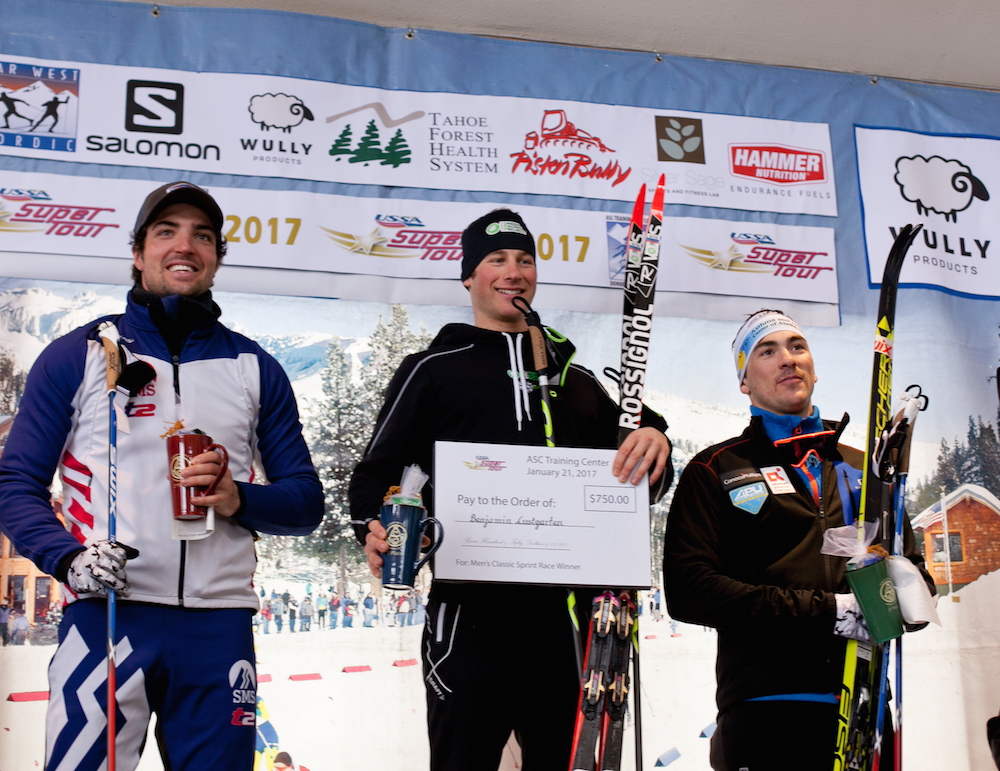
Ben Lustgarten (Craftsbury Green Racing Project) with his $750-dollar check for winning the men’s SuperTour classic sprint on Saturday near Truckee, Calif. Stratton’s Ben Saxton (l) placed second and APU’s Reese Hanneman (r) was third.
Lustgarten, of the Craftsbury Green Racing Project, raced to a 1.58-second victory in the men’s A-final at the Auburn Ski Club in Soda Springs, Calif., finishing in 3:03.4. Ben Saxton, of the Stratton Mountain School (SMS) Elite Team, placed second, and Reese Hanneman, of Alaska Pacific University (APU), was third (+2.77).
Hannenman’s younger brother Logan also reached the final and placed fourth (+4.5), Dakota Blackhorse-von Jess (Bend Endurance Academy) was fifth (+5.86), and the third APU skier in the final, Tyler Kornfield sixth (+18.69).
Blackhorse-von Jess started the day off as the fastest qualifier in 2:58.8. Saxton qualified second, 4.1 seconds back, Logan Hanneman qualified third (+4.2), and Lustgarten fourth (+6.5). Blackhorse-von Jess went on to win his quarterfinal and place second in his semifinal, while Lustgarten and Saxton both won their quarterfinals and semifinals.
Jennie Bender (3) of the Bridger Ski Foundation leading Stratton’s Julia Kern (2) and Sun Valley’s Deedra Irwin (5) during the second women’s classic sprint semifinal at Saturday’s SuperTour near Truckee, Calif. Bender went on to win the semifinal, as well as the final.
In the women’s A-final, Jennie Bender of the Bridger Ski Foundation, coming off a classic sprint win at nationals, scored another victory in 3:29.07. She edged Craftsbury’s Kaitlynn Miller by just seven-hundredths of a second, and Stratton’s Julia Kern placed third (+3.42). Racing at home, Hannah Halvorsen (Sugar Bowl Academy) finished fourth (+3.88). Craftsbury had three in the women’s final with Caitlin Patterson in fifth (+3.93) and Heather Mooney in sixth (+27.35).
Miller proved to be the woman to beat throughout the day, winning the qualifier in 3:30.9, along with her quarterfinal and semifinal. Kern qualified second (+3.2) and Bender third (+4.6). Bender went on to win her quarterfinal and semifinal as well before facing off with Miller in the final.
NorAm Western Canadian Championships (Whistler, B.C.): 10/15 k classic
It was interval-starts day at Western Canadian Championships at Whistler Olympic Park and national-team veteran Emily Nishikawa completed the four laps of the women’s 10 k classic in 30:35.5 to win ahead of teammate Dahria Beatty, 16.5 seconds behind. Maya MacIsaac-Jones completed the national team and Alberta World Cup Academy (AWCA) sweep in third (+1:36.5).
Sovereign Lake’s Hannah Mehain, of the national junior team, was the top junior for the second-straight day in eighth overall (+3:22.1).
In the men’s 15 k, Lappe Nordic’s Andy Shields won the six-lap race in 40:34.2, showing some of the form that won him the NorAm overall last season. National-team member Jess Cockney collected his second-straight podium, finishing second, 4.3 seconds behind Shields. Evan Palmer-Charrette (NTDC Thunder Bay) completed the podium in third (+55.1).
FIS Cross-Country World Cup (Ulricehamn, Sweden): 10/15 k freestyle
The men’s 15 k freestyle podium at Saturday’s World Cup in Ulricehamn, Sweden, with Canadian winner Alex Harvey (c), Norwegian runner-up Martin Johnsrud Sundby (l), and Sweden’s Marcus Hellner (r) in third. (Photo: FIS Cross Country/Twitter)
First individual win of the season (second straight, after winning last weekend’s team sprint), fifth individual victory of his career. That’s the latest news on Canada’s Alex Harvey, who won the World Cup men’s 15-kilometer freestyle individual start on Sunday in Ulricehamn, Sweden, for his first victory in a 15 k skate race and fourth individual podium of 2016/2017.
To say Harvey is on a roll is an understatement. On Saturday, he beat Norway’s Martin Johnsrud Sundby by 6 seconds after starting a minute behind the Norwegian defending World Cup champion. Harvey’s fastest time across the line in 32:46.2 held up through 76 finishers, with Sweden’s Marcus Hellner coming somewhat within range after starting a minute behind him. Hellner ended up 14.3 seconds back from Harvey at the finish for third place, behind Sundby.
Switzerland’s Dario Cologna missed the podium by 0.5 seconds in fourth (+14.7), and Norway’s 24-year-old Daniel Stock broke through in fifth (+16.2) for his first World Cup top 20.
Great Britain’s Andrew Musgrave placed sixth (+18.7), Sweden’s Daniel Rickardsson was seventh (+25.0), Norway’s Finn Hågen Krogh eighth (+32.2), Russia’s Petr Sedov ninth (+33.9), and Japan’s Keishin Yoshida 10th (+34.2).
American Erik Bjornsen landed in the points as he tied Norway’s Simen Andreas Sveen for 28th (+1:09.2), leading fellow U.S. Ski Team members Noah Hoffman, who placed 41st (+1:28.8), and Simi Hamilton in 53rd (+1:56.2). Also for the U.S., Matt Gelso, the Period 1 SuperTour leader from the Sun Valley Ski Education Foundation (SVSEF) Gold Team, finished 68th (+3:00.3).
Harvey’s Canadian World Cup teammates Len Valjas finished 35th (+1:17.7) and Devon Kershaw 38th (+1:22.2). Knute Johnsgaard (Canadian U25 Team) did not start.
The women’s 10 k freestyle podium on Saturday in Ulricehamn, Sweden, with Norwegian winner Marit Bjørgen (c), Finland’s Krista Parmakoski (l) in second and Sweden’s Charlotte Kalla (r) in third. (Photo: FIS Cross Country/Twitter)
In her first World Cup race in over a month and at a brand-new World Cup venue, Norway’s 36-year-old Marit Bjørgen returned to her winning ways, topping the women’s 10 k freestyle on Saturday in Ulricehamn.
Bjørgen started 40th out of 61 finishers and took the lead from Finland’s Krista Parmakoski at the finish with a time of 23:46.3 minutes. Parmakoski, who started a minute ahead of her in bib 38, ended up second, 10.7 seconds back. Sweden’s Charlotte Kalla reached the podium for the second time this season in third (+24.9).
“It is always great to win,” Bjørgen said, according to an International Ski Federation (FIS) press release. “I stayed at home for five weeks and was training. It is great to come back with a victory. I know that the training I had done was good. It was an amazing atmosphere today by the course. There were people cheering everywhere.”
Norway swept fourth through sixth with Astrid Uhrenholdt Jacobsen in fourth (+25.7), Ragnhild Haga in fifth (+32.3) and Heidi Weng in sixth (+34.0).
American Jessie Diggins raced to seventh (+34.9), ahead of Sweden’s Hanna Falk, who recorded her best distance result in eighth (+36.4). Norway’s Ingvild Flugstad Østberg finished ninth (+44.8), and Germany’s Sandra Ringwald was 10th (+56.6).
“I didn’t have the snappy good feelings I was hoping to have in my body today, but it was a solid race,” Diggins wrote in a post-race email to FasterSkier. “It’s always hard when you know that on your best days you are capable of more, but at the same time we had great skis, and it was really fun for me to be able to ski with my teammates today!”
The U.S. had three in the top 20 and four in the top 30 with Sadie Bjornsen in 12th (+1:00.5), Liz Stephen in 16th (+1:07.3) and Rosie Brennan in 24th (+1:30.7).
Cendrine Browne as Canada’s lone woman in the race achieved 35th (+1:52.0) for her career best in an individual race. Also for the U.S., Kikkan Randall placed 40th (+1:59.6) and Liz Guiney of the Craftsbury Green Racing Project 52nd (+2:33.2).
The photo finish of the men’s 4 x 7.5 k relay on Saturday at the IBU World Cup in Antholz, Italy, with Germany’s Simon Schempp outlunging Norway’s Emil Hegle Svendsen. (Photo: ZDF broadcast screenshot)
For the U.S. men, top six was a target for the 4 x 7.5 k relay on Sunday in Antholz, Italy, according to US Biathlon Men’s Coach Jonas Johansson.
Mission accomplished. In the final team event before 2017 World Championships, Lowell Bailey, Leif Nordgren, Tim Burke, and Sean Doherty combined for sixth, finishing 1:04.9 minutes behind the German winners. The Americans used a total of 10 spares but avoided the penalty loop, as did the Germans who used seven spares to clean the eight-stage race and won it in 1:13.57.2.
Germany’s Simon Schempp narrowly outlasted Norway’s Emil Hegle Svendsen in the finishing stretch to secure the victory for Germany (with teammates Erik Lesser, Benedikt Doll and Arnd Peiffer) by one-tenth of a second. Norway finished second with nine spares and no penalties (with Lars Helge Birkeland, Henrik L’Abee-Lund, Johannes Thingnes Bø, and Svendsen), and Russia secured third (+33.6) with nine spares and zero penalties as well (with Maxim Tsvetkov, Evgeniy Garanichev, Dmitry Malyshko, and Anton Babikov).
Ukraine used a total of just five spares and had zero penalties for fourth (+46.7), and Austria took fifth (+49.2) with eight spares and no penalties, after Austria’s Dominik Landertinger skied away from Doherty on the final loop and finished 6.9 seconds ahead of him for fifth place.
For the U.S. men, sixth was close to their team-best fifth with the same lineup in last year’s World Cup relay in Presque Isle, Maine. The same group also took sixth in Ruhpolding, Germany, last year as well.
With all four making US Biathlon’s World Championships team, announced Saturday, they will likely be aiming for a best championships result early next month in Hochfilzen, Austria.
Canada (Christian Gow, Scott Gow, Macx Davies, and Brendan Green) finished 16th (+4:13.8) on Saturday with two penalties and 11 spares. Scott Gow skied them up to 15th by the second exchange but they dropped to 18th after Davies had two penalties on the third leg. With Green anchoring and using just one spare, they recouped two places before the finish.
In the women’s race, Germany’s Nadine Horchler achieved a lifetime dream with her first World Cup win, after starting in bib 30 and earning her start as a reserve athlete. Germany took first and second with Laura Dahlmeier in second, and the Czech Republic’s Gabriela Koukalova placed third. Susan Dunklee of the U.S. was the lone North American starter and finished 24th after leading at the start of the second loop.
FIS Nordic Combined World Cup (Chaux-Neuve, France): Individual large hill/10 k
Saturday’s Nordic Combined World Cup podium in Chaux-Neuve, France, with German winner Johannes Rydzek (c), German runner-up Fabian Rießle (l) and Japan’s Akito Watabe (r) in third. (Photo: FIS Nordic Combined/Twitter)
The first part of Saturday’s Nordic Combined World Cup individual large hill/10 k competition was a shining moment for U.S. Nordic Combined skier Ben Berend, who jumped to second for a total of 127.5 points, trailing only Norway’s Jarl Magnus Riiber with 139 points in Chaux-Neuve, France.
Berend flew farther than Germany’s Eric Frenzel, who jumped to third on the Chaux-Neuve large hill.
Later in the day, they started the 10 k Gundersen in that order, with Riiber heading out first, followed by Berend 46 seconds later, then Frenzel 53 seconds back in third.
Germany’s Johannes Rydzek started 1:15 minutes back in 12th and skied the fastest 10 k to take the victory at the finish (in 23:01.7). He held off his German teammate Fabian Rießle by 2.8 seconds for the win, after Rießle started sixth and 1:01 back. Japan’s Akito Watabe reached the podium in third (+5.7) after jumping to seventh and starting the race 1 second behind Rießle.
Frenzel ended up fourth (+8.3), and the fourth German in the top five, Björn Kircheisen improved to fifth (+22.6) after starting 11th.
Riiber dropped to 15th (+54.0), and Berend fell outside the top 30 to end up 32nd (+2:26.0) with the 39th-ranked course time.
Berend finished 12.2 seconds ahead of his U.S. teammate Taylor Fletcher, who placed 34th (+2:38.2) after the jump put him in 48th.
Bryan Fletcher was 49th after the jump but did not start the 10 k.
The Nordic Combined World Cup continues Sunday in Chaux-Neuve with another large hill/10 k.
Ski Classics #5: La Diagonela (Zuoz, Switzerland): 50 k classic
[UPDATED] Under “blue skies, no wind and perfect track conditions” in the Swiss Engadin Valley on Saturday, according to a Ski Classics press release, Russia’s Ilya Chernousov and the Czech Republic’s Kateřina Smutná won the men’s and women’s La Diagonela, respectively, in Zuoz, Switzerland.
Chernousov, of Team Pioneer Investments, and Tord Asle Gjerdalen (Team Santander) led a large pack of men into the final major climb on the 50 k course. There, Gjerdalen attacked and Chernousov matched him, accelerating away from his competitors up the last steep pitch to the finish, according to the press release. He finished in 2:03:39.6 hours, holding off Gjerdalen by 1.5 seconds, while Øystein Pettersen (Team BN Bank) finished third (+3.0).
In the women’s race, Smutná (Team Santander) pushed to break up the field around the halfway point, where the men caught the women. Britta Johansson Norgren (Lager 157 Ski Team) hung with Smutná, but lost contact over the last 5 k. After finishing second in the last two Ski Classics races, Smutná took the win by 1:03.2 minutes in 2:20:49.2. Nordgren finished second, ahead of Sara Lindborg (Team Serneke) in third, who finished more than three minutes later (+4:17.4).
American Lowell Bailey racing to ninth in the men’s 12.5 k pursuit on Saturday at the IBU World Cup in Nove Mesto, Czech Republic, with Canada’s Scott Gow (r) chasing. Gow ended up 40th. (Photo: USBA/NordicFocus)
As Lowell Bailey rounded the course on Saturday in Nove Mesto, Czech Republic, a total of five times in the men’s 12.5-kilometer pursuit, he couldn’t hear a thing his coaches were shouting at him.
The 35,000 spectators in the stadium and lining the track were overpowering them, but their movements gave the US Biathlon veteran all the information he needed to know.
“It was, by far, the loudest spectator crowd I’ve ever experienced,” Bailey recalled on the phone on Saturday. “… There were stands on the course, bleacher stands, that was packed 15, 20 people deep, and I literally couldn’t hear a single bit of information that the coaches were screaming at me.”
After hitting every target in his final shooting stage, Bailey left the range for the last time in 11th, four seconds out of ninth. He wasn’t certain of his place or how many people he should try to catch on the last lap, he just knew it was go-time.
“I figured I was close to the top ten because of where I shot and who I was around, and the way the coaches were moving, jumping up and down,” he said. “But it was literally so loud I couldn’t hear a single bit of information.”
Bailey ended up passing those two competitors just seconds ahead of him on the last climb. He pushed through the finish for ninth place — his best result since placing second in a sprint in March 2014 — 1:22.1 minutes behind the winner, France’s Martin Fourcade, and about a second back from eighth. Behind him, the top Czech skier of the day, Michal Krcmar finished five seconds later in 10th, and Russia’s Evgeniy Garanichev was another second back in 11th.
Martin Fourcade after winning the 12.5 k pursuit at the IBU World Cup in Nove Mesto, Czech Republic, for his 55th World Cup victory, with Russian runner-up Anton Shipulin (r). Including Sunday’s mass start, Fourcade has won 10 of the 11 races so far this season (including relays). (Photo: IBU)
“It was one of those days when I had a little bit left in the tank, and I really like this course, especially the last half,” Bailey said. “I was able to make up enough time in the technical sections to get in a position to pass those guys … I was pretty psyched about my last lap, for sure.”
Bailey had started the day in 20th, 48 seconds behind Fourcade, based on the 10 k sprint on Thursday. Fourcade headed out on course with a two-second lead on Russia’s Anton Shipulin, the sprint runner-up. The man slated to start third, Norway’s Emil Hegle Svendsen, did not start because of a cold.
Shipulin passed Fourcade early and left the range 1.3 seconds ahead of him with the clean shooting and the fastest range time in the first prone stage. Fourcade hit all five targets as well, but four seconds slower than Shipulin. The fourth starter, Norway’s Johannes Thingnes Bø, missed one to drop to fifth.
Meanwhile, Bailey missed his first shot of the day.
“When I was shooting I was pretty frustrated to miss that last shot in my first prone,” he said. “That’s not a way you want to start a pursuit.”
That put him in 25th, 1:17 minutes behind the leaders. One loop later, with a clean second prone, Bailey was back in the top 20 in 19th (+1:18.5).
There, Shipulin cleaned again to firmly take control in first, while Fourcade missed one to fall 22.6 seconds back to second with a penalty lap.
A Czech favorite, Ondrej Moravec crashed and broke his rifle in half on the second loop, before that second stage.
“There was a lot of ice on the course, and there was this one downhill in particular that was really treacherous; you just really had to be on your toes going through it,” Bailey said. “I think it was a series of curves, and a lot of the top biathletes were struggling there. … You could tell it had taken victims every time because there were broken poles strewn everywhere. It was one of the most difficult downhills sections I’ve ever witnessed on the World Cup.”
Fortunately for Bailey, he made it to the finish without an incident.
“We had great skis today. The wax crews have done good jobs, they have really nailed it, so I have to thank them,” he said.
With the fastest course time on the third lap, Fourcade raced his way back into the lead, cleaning the first standing stage and leaving the range 10.9 seconds ahead of Shipulin, who had his first penalty of the day.
France’s Quentin Fillon Maillet moved into fourth with his third clean stage, behind Bø, who had cleaned the last two stages as well.
Bailey missed one on that standing but remained in 16th after the eighth-fastest course time on the third loop. At the end of the day, his course time averaged out to 11th overall.
“I’m really happy with that course time,” he reflected. “To get a top 20 in this field with Martin Fourcade and Svendsen and Bø. That’s my target, and then if you can put together a good shooting performance, you can be vying for the podium, so that’s where I want to be.”
Martin Fourcade celebrating his 55th World Cup victory in Saturday’s 12.5 k pursuit in Nove Mesto, Czech Republic, which he won by 30.2 seconds over Russia’s Anton Shipulin. (Photo: IBU)
On the final standing stage, Fourcade thrived under pressure as usual, cleaning his targets while Shipulin again missed one. This time, Fourcade started the last loop with a 40.8-second cushion to Shipulin, and eased up to a casual pace to take in his surroundings, acknowledge the crowd, and finally bow to thank them before finishing first in 32:53.6, without anyone else in sight.
“My wish is to be as complete a biathlete as possible, not just because I ski fast,” Fourcade said, according to an IBU press release. “That’s what I trained all summer and what I am trying to do now. These kind of wins are the best for an athlete.”
After leaving the penalty lap and distancing himself from the two skiers closest to him, Shipulin also eased off on the last loop. Fillon Maillet had moved into third and Germany’s Simon Schempp fourth with clean shooting on the last stage, leaving the range within four seconds of each other and about nine seconds behind Shipulin.
While Shipulin crossed the line in second, 30.2 seconds after Fourcade, Maillet and Schempp battled throughout the 2.5 k loop for third. Maillet outlunged Schempp by 0.1 seconds at the finish, taking third (+38.3) while Schempp — who shot clean to rise from 17th at the start — placed fourth (+38.4). (Maillet had started just ahead of him in 16th and also cleaned all 20 targets to reach the podium.)
“Today many athletes shot clean because of the good conditions,” Shipulin said after, according to an IBU press release. “After the race I told myself that I must shoot clean in these conditions … Martin is very strong throughout the whole season, so it’s very complicated to compete against such a strong athlete. Hopefully he will give us a new year’s present and let us compete for the win in 2017.”
Bø took fifth (+1:02.7) with three penalties (1+0+0+2), and Bailey crossed the line 19.4 seconds later in ninth (1+0+1+0).
“I’ve done this sport long enough that I know you can make the best plan, and best preparation, and then things don’t go the way you want them to go,” Bailey said. “But I feel like the preparation was really good this year, the training conditions, the training group, the coaching, the staff that we have now, all those variables are good and in the right place, and I’m really satisfied with the way this season has started.”
Two Canadian men also started the pursuit, with Scott Gow heading out in 18th and Brendan Green in 52nd. After a clean first prone, Gow had three penalties (0+2+1+0) and ended up 40th (+3:31.2) while Green finished 54th (+5:30.6) with five misses (1+0+3+1).
In his first pursuit since 2014, American Russell Currier was lapped on his fourth loop.
Bailey was the lone North American to qualify for the 30-man mass start, where he placed 21st on Sunday, 1:17.1 minutes back from winner — once again — Fourcade. Bailey is currently ninth in the overall World Cup standings. Stay tuned for the men’s 15 k mass start report.
The women’s 12.5 k mass start starts at 8:15 EST. American Susan Dunklee was slated to start but did not. Watch it live on Eurovisionsports.tv.
Germany’s Erik Lesser celebrates his first victory of the season in the men’s 15 k mass start at the IBU World Cup in Ruhpolding, Germany. (Photo: IBU/Ernst Wukits)
In recent weeks, Germany’s Erik Lesser had become annoyed with questions on a single topic: whether he was concerned about not having fulfilled the “World Championships norm” yet.
German biathletes are required to post at least one top eight or two top 15’s in an IBU World Cup within a season to qualify for major championships. And Lesser, a gold medalist in the pursuit and relay at 2015 World Championships in Kontiolahti, Finland, was the only senior team member — male or female — who had yet to achieve that mark ahead of 2016 World Championships.
On Saturday evening, in front of a home crowd of more than 20,000 spectators in the biathlon arena and around the course in Ruhpolding, Germany, Lesser put all doubts to rest, winning the men’s 15-kilometer mass start in 40:29.3 minutes with perfect 20-for-20 shooting. Despite heavy snowfall, Lesser cleaned all four shooting stages, and on the final loop, he held his own ahead of France’s World Cup leader Martin Fourcade, beating him by 9.8 seconds.
Fourcade had a single penalty on the last stage to place second, and Russia’s Evgeniy Garanichev missed one on the last shooting to finished third (+13.1). Fourcade and Garanichev had come into the final stage just ahead of Lesser, but then had to complete the 150-meter penalty lap after each missing a target.
The two North Americans in the mass start, Canada’s Nathan Smith placed 15th (+1:20.8) and American Lowell Bailey finished 21st (+2:08.4), both with one penalty.
After the race, Lesser was highly satisfied, and claimed he never had any doubt about his ability to qualify for the upcoming IBU World Championships in Oslo, Norway.
“Now you have to shut up about that, huh. Now I don’t want to hear about that again after giving you what you wanted,” Lesser said with dry wit when he got interviewed by German TV broadcaster ZDF. “I couldn’t care less about the norm. I knew I had that in me; I just couldn’t put it together. Today thankfully everything worked out.”
Questioned again if his coaches were also as convinced, and whether he had been anxious to achieve that kind of result, Lesser added:
“Yeah, the next time I’m waiting for my World Championships norm, I’m taking you guys with me into the [athletes’] container, then you can watch us while you analyze our races, and there really was everything but a bad mood after my races. Everything was good, also between the coaches and me. Everyone was understanding,” he said.
Outside the top 25 in the overall World Cup standing, Lesser had to qualify for the mass start as one of five additional athletes with the best performances of the race week. He narrowly managed to do that by placing 17th in the 20 k individual competition on Wednesday, earning the final start in bib 30.
Since he thus had to start at the back of the field in the mass start, Lesser decided to set out at a steady pace allowing a little gap to form, in order to avoid what he called the “accordion effect” of constantly having to slow down and accelerate again as the field bunches up before climbs and then extends again like pearls on a string.
“The bib number at the start really doesn’t matter. But I always heard the public announcer in the arena bellowing, ‘Oh Erik Lesser runs behind the field on the first loop.’ But it was planned exactly like that,” Lesser told ZDF. “I could ski behind others for four loops, and then only had to lead on the last one; that suits me well. The [wax] technicians really put together great equipment again, like the whole time here in Ruhpolding, and that makes it a little easier.”
In the first prone shooting, 16 starters shot clean, including all of the eventual podium finishers, and US Biathlon’s Bailey. That put Smith, of Biathlon Canada, who had missed one target, at an early disadvantage, leaving the penalty lap and range in 23rd place and about 30 seconds behind the leaders.
“Since my miss came in the first prone, I ended up a little back heading out onto the second loop,” Smith explained in a Biathlon Canada press release. “With the next three cleans, I moved up a little each time, but the field as a whole was shooting so well today, it was tough to make any big moves.”
“I was aiming for a top 10 finish and knew that would take [hitting] 18 or 19 [targets] with strong skiing,” Smith wrote in an email to FasterSkier. “13 of the top 30 athletes shot 19 or better, even with snowy conditions. That’s some cut throat competition!”
After the second prone, a large group still remained in contention. However, this stage did set back a few favorites, such as Norway’s Tarjei Bø, who had entered the range in first and left in 20th after two misses. He would eventually finish in 11th (+1:07) with three penalties.
France’s Martin Fourcade leads the snowy men’s 15 k mass start on Saturday at the IBU World Cup in Ruhpolding, Germany. He went on to place second after a penalty on the last shooting. (Photo: IBU/Ernst Wukits)
On the third 3 k loop, Fourcade, Norway’s Johannes Thingnes Bø and Garanichev emerged as the top three, with five athletes not far behind them: Lesser, Russia’s Maxim Tsvetkov, Norway’s Emil Hegle Svendsen, as well as the Czech Republic’s Ondrej Moravec and Michal Krcmar.
At this point, slugging through the heavy snowfall was visibly hard, and several athletes took feeds to keep up their energy.
Lesser was able to separate himself from that chase group, slowly closing the gap. “Super equipment, super speed,” one of his coaches yelled from the side of the course.
Before the third shooting stage, Lesser had closed the gap, and while Johannes Thingnes Bø missed two of his targets to fall out of contention (he ended up 12th with three penalties), the other three leaders stayed clean, leaving the range together again, all within two seconds.
On the penultimate loop, Fourcade tried to force an early decision, jumping up the longest climb with great speed, and created a gap of a few seconds to Lesser. Garanichev followed in Lesser’s draft, and Moravec trailed the group by about 25 seconds in fourth.
“Martin did a really good fourth lap, and I had some problems in the uphills,” Lesser said during the post-race press conference.
In the final shooting, Lesser entered the range in third, but shot clean while his two opponents each missed their first and only target of the day.
Lesser headed out on the final loop just 12.3 seconds ahead of Fourcade with Garanichev 0.6 seconds behind as the two stormed out of the penalty lap eager to catch the German. On the first long climb it looked like his lead was starting to shrink, but at the next timing point, Fourcade was 12.6 seconds behind in second.
Then Garanichev started his final attack and overtook Fourcade, but was not able to create a significant gap, coming through the next split still 10.9 seconds behind Lesser.
“Nine seconds ahead, go Erik, go!” cheered a German assistant coach while running next to him on the side of the track.
The last loop took Lesser a little longer than most of his previous times around the track, but he was able to stay ahead over a flat section and downhill leading into the arena, finally coming into the finish with the welcoming roar from the sold-out arena, while Fourcade managed to take second back from Garanichev in the final sprint.
Asked to describe his feelings on the final loop, Lesser said at the press conference: “From happy, to exhausted, to really happy.”
“The relay yesterday was hard for me, I was really exhausted after the race” Lesser added in a video interview with the IBU’s Jerry Kokesh. “But I’m really happy that I had the right power for today’s last lap. After all the sh*tty races this season, yup, really happy to be on the podium again.”
“I did the grooming machine all the competition,” Fourcade said at the press conference of skiing at the front of the pack. “So I felt a bit exhausted on the last lap. In the beginning I thought I could catch Erik, but then I also wanted to keep my second place … So I focused on the Evgeniy fight, and am happy about my second place today.”
“I am really happy about my two weeks in Ruhpolding. I created a good gap for the overall ranking and am really satisfied, that was my main goal for January,” he added. “I must say that when I see the crowd today, and the atmosphere, it was something crazy, so I am a bit sad to move because it was better every day. Great competitions, great organization, and I think all the athletes really enjoyed their stay these two weeks.”
“Starting from the first stage in the World Cup season [in Östersund, Sweden] I have been good in speed, and just performing on the same high level,” Garanichev said at the press conference through a translator. “I am glad to be on the podium again, but I have to be careful about saying this is my best race so far because it was a really tough race, the sixth in ten days. So I would say it was a good race,”
“Martin is not the type of guy who will easily let someone go,” he said of passing Fourcade on the final loop, not really expecting to create a gap. “So I just focused on fighting with Erik, and tried to do my best.”
With a significant distance to the three podium finishers, Garanichev’s teammate Anton Shipulin placed fourth (+42.5) with one penalty, Krcmar was fifth for the best World Cup result of his career so far (+47.2 with one penalty), and Germany’s Simon Schempp finished sixth (+48.0, two penalties).
This was Schempp’s first race this year after returning from the lengthy aftereffects of a respiratory infection, which caused him to drop from third in the World Cup standings (after the races in Pokljuka, Slovenia, just before the holiday break) to seventh.
“I was really satisfied with my race,” Schempp told the IBU. “I was not so aggressive in the beginning, but I feel okay, and happy with sixth place…. It’s so much fun, especially because I’m at home here, training the whole year in this stadium. Really happy to see so many spectators, and the atmosphere is great.”
Lowell Bailey (US Biathlon) racing to 21st in the men’s 15 k mass start at the IBU World Cup in Ruhpolding, Germany. He shot 19-for-20 amid heavily falling snow. (Photo: USBA/NordicFocus)
“It’s always a great atmosphere here in Ruhpolding. I love the German fans!” Bailey wrote in an email.
Sweden’s Torstein Stenersen was the only athlete in the field besides Lesser who cleaned all four stage, but skied considerably slower to finish 20th (+1.54.4).
Smith skied the 23rd-best overall course time in the difficult conditions, but was able to move up a bit on each loop thanks to three clean stages after his early miss (1+0+0+0) to place 15th.
“The ski course was extremely slow going with the fresh snow falling. The 15 kilometre time was close to what the winning time was for the 20 kilometre individual race,” Smith told Biathlon Canada. “I had been feeling kind of fatigued the last few races, but I am happy that I was able to overcome that by performing well on the shooting range and end up with a very respectful final result.”
Bailey cleaned three out of four stages, missing one on his first standing (0+0+1+0) for 21st.
“I had the goal of staying with my shooting focus and not getting distracted by the excitement of the competition,” Bailey wrote. “I accomplished this, and overall I’m happy with the way shooting is going at the moment.”
Asked if his solid shooting throughout back-to-back World Cup weeks in Ruhpolding was a result of the range (which most athletes generally considered to be easy due to the downhill approach and good wind protection, though in heavy snowfall, that might be drastically different) or any newfound adjustments, he wrote:
“You work your whole career on the small little details that comprise a solid shooting approach, but at the end of the day, sticking to simple key cues has been what I’ve been using throughout the season. The fundamentals have to be developed, but then the key is getting your mind and body in a place where they can execute the things you’ve trained to do.”
After posting the 20th-fastest time on the first loop out of the start, Bailey’s skiing became a bit slower on the subsequent rounds, and he ended the day with the 28th course time.
“It was one of the more challenging races of my career. I just felt tired from the start,” Bailey wrote. “We’ve had six races in the last eight days, most of which occurred in slow conditions … I just think I reached my limit and didn’t quite have the energy required to ski with the best today”.
Bailey and Smith were certainly not alone feeling their energy run low after a hard block of races. Norwegian biathlon legend Ole Einar Bjørndalen finished last in 30th (+5:42.6), with 10 penalties and the third-slowest course time.
After two weeks in Ruhpolding, the World Cup tour now moves to Antholz-Anterselva, Italy, with sprints on Thursday and Friday, followed by pursuits on Saturday, and another relay on Sunday.
“Antholz is always really good competitions, good snow, good for fights, and most of all the weather is often good,” Fourcade said. “I am also really happy to move to Antholz, and to have some Italian food, too, that’s something I like.”
France’s Martin Fourcade celebrates across the line as he won the men’s 15 k mass start on Sunday in Ruhpolding, Germany, for his 41st IBU World Cup win. (Photo: IBU/Eberhard Thonfeld)
Still suffering from the aftermath of an illness earlier this weekend, French biathlete Martin Fourcade was back to his usual strength in Sunday’s 15-kilometer mass start in Ruhpolding, Germany, winning in a time of 34:07.2 with one penalty while skiing the second-fastest course time of all starters. Ondrej Moravec of the Czech Republic finished second, (+13.7), and Norway’s Tarjei Bø third, (+29.7).
With the 41st win of his career, Fourcade extended his lead in the overall World Cup standings to his biggest rivals, and is now also leading the mass start score after two competitions.
Fourcade was one of the best performers in Ruhpolding, finishing fourth in the sprint and second in the pursuit.
“That’s cool, after two competitions close to the victory I am really satisfied to win this competition in Ruhpolding,” he added in an IBU video interview. “Yesterday it was a really close gap from the victory. Today I am satisfied about my whole competition, but especially my shooting spirit.”
Fourcade had one missed target in the first shooting stage, but then climbed up through the standings as he cleaned round after round.
On the penultimate loop, he caught the leaders and with Norway’s Emil Hegle Svendsen managed to create a gap to a chase group led by Moravec and Russia’s Evgeniy Garanichev.
Fourcade came into the last shooting stage with Svendsen. But while Fourcade managed to clean the stage again and leave it still in first place, Svendsen lost his position in the race by shooting three more penalties for four total. He only finished in 13th place, 1:12.3 minutes back.
Fourcade meanwhile took the lead after the final stage, and extended it from 5.8 seconds to his eventual comfortable margin.
“I was really confident on my last shoot, about my chances to shoot clean,” Fourcade said in a video interview after the press conference. “I thought that Emil will be with me on the last loop, but he had three mistakes and so he didn’t fight with me. And on my last loop I was confident to keep my gap to Ondrej Moravec. So that was a quite good and exciting competition.”
Ondrej Moravec of the Czech Republic after cleaning the 15 k mass start for his first IBU World Cup podium of the season on Sunday in Ruhpolding, Germany. (Photo: Fischer/NordicFocus)
Moravec was the only one of the 30-man field to clean in all four stages. It was the first podium of the World Cup season for the three-time medalist from the 2014 Olympics.
“For sure it is a relief; I feel much more comfortable now,” Moravec said in the press conference. “I think this is the third zero [shooting competition] in my life. That was good work … especially in standing, because yesterday I was too risky on the range in the pursuit. So today I am satisfied with my work on the shooting range, focusing on the job.”
Bø, who had placed second in the sprint and fourth in the pursuit this weekend, shot three penalties.
“I cannot quite understand that I managed to get back up there, because I got the worst possible start,” Bø told NRK. “There were strong winds on the first shooting, and I got two misses … I struggled my way into third. I was determined to go well on the last shooting.”
Norway’s Tarjei Bø (2) racing to third in the men’s 15 k mass start, at the IBU World Cup in Ruhpolding, Germany. He’s currently third in the overall World Cup standings as well. (Photo: Fischer/NordicFocus)
Even after cleaning the final round, Bø left the range in seventh place.
Fourcade’s older brother Simon left the shooting range in third position, skiing out on the final loop 27.3 seconds back. But three athletes from a chase group were still able to pass him, with Bø ultimately able to secure the last spot on the podium in a sprint on the finish stretch. He finished just ahead of Ukraine’s Dmytro Pidruchnyi in fourth (+31.4, two penalties), Germany’s Arnd Peiffer in fifth (+33.3 with one penalty), Simon Fourcade in sixth (+36.9 with one penalty), and Garanichev in seventh place (+38.4 with two penalties).
Bø skied the fastest course time of the day and was able to prevail in a larger chase group on the final loop.
“To be honest, I am not so surprised,” Bø said in the press conference regarding his season so far and this race in particular, achieving a podium despite three penalties. “I have not been so good on the overall World Cup in many years due to a lot of things, I missed events due to sickness, and so on. I was happy to win medals last year [at the World Championships], but in the total score I have been really bad for three years. This year I had no trouble at all, and I know I will fight every race. So I am really happy about the total score.”
Bø currently stands in third position after this race, behind Martin Fourcade and his teammate Svendsen.
Two North Americans in the Mass Start
Lowell Bailey (US Biathlon) on his way to 16th in the men’s 15 k mass start at the IBU World Cup in Ruhpolding, Germany. (Photo: USBA/NordicFocus)
Two North American men — American Lowell Bailey and Canadian Nathan Smith — had qualified for the mass start by virtue of being ranked in the top 25 of the World Cup.
US Biathlon’s Tim Burke, who was narrowly outside that group and had hoped to be called up from a “reserve athletes standby list”, did not get his wish granted. Norway’s Ole Einar Bjørndalen, who is ranked ahead of him, returned from illness for his first race of the weekend. Bjørndalen finished the day in 12th place, with three penalties.
Bailey’s race got off to a good start, with clean rounds in both prone shooting stages despite difficult wind conditions. In the third stage, Bailey had the first miss of his day, and came out of the penalty lap still in ninth place, 27.1 seconds back, as several athletes at the top of the field incurred penalties as well.
He came into the last shooting stage in a pack of athletes still with a chance for at least a top-10 position, but two more misses set him back. He left the range and penalty laps again in 15th place. On the final loop he slipped to 16th, 1:15.2 back.
“Ahhhhhhh!!!!” That about sums it up! So close. Thx to USBA wax crew… INCREDIBLE SKIS!!!“ Bailey tweeted after the competition.
Canada’s Nathan Smith, who had hoped to build on the strong skiing and shooting form he had demonstrated to achieve a sixth place in the pursuit on Saturday, struggled through a difficult day on the shooting range.
With changing winds repeatedly forcing athletes to adapt their sights – for example blowing strongly left-to-right in the first stage and then almost not at all on the second stage – Smith recorded six misses on the day, only shooting clean during his final stage (1+2+3+0).
He finished the day in 25th place, 2:23.4 back from Fourcade.
Simon Schempp of Germany celebrates his second-straight win at the men’s 12.5 k pursuit in Pokljuka, Slovenia. (Photo: IBU/Kvetoslav Frgal)
Perfection in a pursuit. That’s what’ll get you ahead and keep you there, as Germany’s Simon Schempp demonstrated on Saturday at the International Biathlon Union (IBU) World Cup in Pokljuka, Slovenia.
Two days after winning the men’s 10-kilometer sprint, Schempp started the 12.5 k pursuit with a 15-second head start on Norway’s Ole Einar Bjørndalen in second. Twenty-five and 26 seconds back in third through fifth, respectively, Russia’s Evgeniy Garanichev and Alexey Slepov and France’s Martin Fourcade set out after Schempp.
After placing third in the sprint, Garanichev fell out of contention for another podium with a miss in the first prone stage. He went on to clean the next two stages, but missed another on the final standing to end up sixth overall.
Slepov fared worse, with two penalties in each of the first two prone stages, then one in each standing for a total of six penalty laps. He placed 25th at the end of the day, while Schempp controlled the race from start to finish, winning with perfect 20-for-20 shooting in a time of 30:46.5.
France’s Martin Fourcade finishing second in the IBU World Cup pursuit on Saturday in Pokljuka, Slovenia, while Russia’s Anton Shipulin enters the finishing straight for third. (Photo: IBU/Kvetoslav Frgal)
Only Fourcade, the fifth starter, came close, rivaling Schempp with clean shooting through the first three stages. The Frenchman missed one on the last standing, which put him 18.4 seconds back leaving the range after a costly penalty loop. He finished 16.6 seconds after Schempp in second, and Russia’s Anton Shipulin rose from sixth to third with the fastest course time.
Shipulin finished 23.4 seconds after Schempp with two penalties (0+1+1+0), besting Norway’s Tarjei Bø, who was 1.8 seconds off the podium in fourth. Bø posted the second-fastest course time to pick off five places after starting ninth.
Only three out of 59 finishers cleaned the four-stage race: Schempp, France’s Simon Fourcade (who placed 10th), and Sweden’s Fredrik Lindström (14th).
“Maybe the last 200 meters were easy. Everything else was extremely hard,” Schempp said in an post-race interview with ZDF. “I didn’t quite have my best day out on the course today, and except for one loop with Martin, I always had to ski in front alone. That was quite energy-sapping.”
Fourcade was the fastest out of the start early on, racing from fifth up to third behind Schempp and Bjørndalen as they entered the range for the first time. There, all three men cleaned and Bjørndalen left the range nine seconds after Schempp in second while Fourcade was another 10 seconds back in third.
Second prone was more of the same, with the three leaders cleaning, yet Schempp maintained his distance with a 10-second cushion to Fourcade and Bjørndalen skiing together in second and third.
On the third loop, Fourcade, 27, dropped the 41-year-old Norwegian and entered the range right behind Schempp, where the top two cleaned all five targets once again. They set out on the penultimate loop together, where Fourcade made clear that he did not want to take the lead. Despite shooting faster, he waited for Schempp to go ahead of him.
Germany’s Simon Schempp and his smoking gun. Schempp shot 100 percent on Saturday to win the men’s pursuit at the IBU World Cup in Pokljuka, Slovenia. (Photo: IBU/Kvetoslav Frgal)
“That was the same as last week, he just didn’t want to go in front,” Schempp said of Fourcade. “He had shot faster, then he stepped to the side and wanted to let me pass. I just yelled ‘Together!’ to him, and then he nodded and we changed back and forth. At first there was a bit of a disagreement, but then that calmed down…”
“I don’t really understand why he does that sometimes,” Schempp added. “We were in front, but the others are pressuring from behind, and if you work together, you should be faster and can create a small gap. My opinion is that you should work together, except for the last loop of course, but before that, yeah, I just have a slightly different opinion than him.”
“We collaborated a lot …,” Fourcade said in a post-race press conference. “It was a good solution. We were making sure we had positions one and two.”
In the final standing stage, Fourcade shot quickly, but missed the fourth shot, while Schempp cleaned.
“In the last shooting, I thought his second shot had missed. At least it sounded that way,” Schempp recalled.
“Before the race, I thought that I would try to do all I can to be first,” Fourcade said in the press conference. “Simon was a little calmer at the last shooting. He had his own rhythm.”
Fourcade came out of the penalty lap with an 18.4-second deficit, which proved insurmountable. He skied what appeared to be comfortable pace to the finish for second, 6.8 seconds ahead of Shipulin. After the race, Fourcade and Schempp hugged each other. It was Schempp’s eighth World Cup victory, his third win this season, and the third time he won both a sprint and the following pursuit in the same venue.
While Shipulin secured third on the final loop, he overcame a couple penalties. One miss in the second stage dropped him to eighth, and he left the range after another penalty in the third stage in sixth. When Bø missed one in the final shooting, Shipulin seized the opportunity and cleaned when it counted, leaving the range in fourth, three seconds behind Bø and passing him on the final loop to avoid a sprint to the finish.
“After the second penalty loop, I thought it was possible,” Shipulin said in a press conference. “I was hoping to shoot clean and thought I had a chance to get on the podium.”
According to the IBU website, with one race to go — Sunday’s mass start — Shipulin is eager to see his newborn son.
“I want to go home and see my son, but I try to stay motivated and focused on the upcoming competitions,” he said.
Burke Cracks Top 10
American Tim Burke (14) during one of his last two standing stages, while shooting alongside a German, Slovenian, and Russian. (Photo: IBU/Kvetoslav Frgal)
After starting 14th and 55 seconds behind Schempp, American Tim Burke improved to ninth with a single penalty (0+0+1+0), finishing 1:21.9 behind the German winner.
“[I’m] really happy with today; I had a really simple game plan with my shooting to try to stick to my few key words,” Burke said in a post-race phone interview. “I felt really comfortable out there.”
He skied alone for most of the race, which he found both odd and challenging. Burke started 9 seconds behind the 13th starter, Simon Desthieux of France, and four seconds ahead of US Biathlon teammate Lowell Bailey.
After cleaning the first prone stage, Burke had made his way up to 11th and 50.7 seconds behind Schempp, while Bailey had slipped one spot to 16th, 1:02 back. Both Americans cleaned the first shooting, but Bailey went on to miss one in each stage thereafter (0+1+1+1) and ended the day in 29th (+2:46).
“Not a bad day for me, but without near perfection, it’s hard to compete with this field,” Bailey said in a US Biathlon press release. “There was great overall shooting in the men’s field today so I lost a few places with penalties in each of the last three stages.”
Meanwhile, Burke cleaned the second prone and missed one on the third shooting to hover in the top 10 throughout the race. After hitting all his targets on the final standing, he left the range in ninth. Simon Fourcade trailed him by almost seven seconds in 10th at the beginning of the last loop, while Norway’s Emil Hegle Svendsen was almost 18 seconds ahead in eighth.
Tim Burke (US Biathlon) racing to ninth in the men’s 12.5 k pursuit on Saturday at the IBU World Cup in Pokljuka, Slovenia. (Photo: USBA/NordicFocus)
That left Burke in no-man’s land once more. On the first loop, he had worked hard to catch the group that was fighting for top-10 results, and while he bridged the gap 500 meters before the range, he exited the range just far enough behind those skiers that he remained alone, one loop after another.
“It was a little bit tougher for sure,” he said of the solo race. “I was hoping I’d be able to tuck in on the second loop and catch a little bit of a break.”
Burke worked especially hard the first couple loops to catch those ahead of him and said he felt the effects of that effort later in the race. Still, he held on and most importantly held it together for the last shooting.
“So much can change on the last shooting…,” Burke said. “I was hoping that people would finally start making mistakes there on the end. The last shooting, I shot on point 11 and shot zero and moved up one place. I was really happy to move back into the top 10; it’s the best race I’ve had in a while.”
At the same time, he reflected on how tight the race was. Given the race he had, with 19-for-20 shooting and the 19th-fastest course time, Burke would have guessed he would have finished in the top six. Not the case when the fastest guys don’t have to ski many penalty laps.
“It’s a fairly easy approach to the range here of so a lot of people shoot well here,” he noted.
Burke will be one of three North Americans starting Sunday’s 15 k mass start, with Canada’s Nathan Smith in bib 12, Bailey in 19th and Burke in 26th out of 30. Three seasons ago, Burke placed third in the Pokljuka mass start.
“I think it’ll be a great opportunity for me,” Burke said. “Typically I do well at the end of these trimesters … these three weeks of racing.
“At this point, fatigue definitely plays a big role for everyone, both mentally and physically,” he added. “A lot of people want to get home at this time. … For me, it’s one more race. I need to focus for 40 minutes out there and I think I can handle that.”
On Monday, the day after the Pokljuka World Cup ends and the IBU World Cup goes on holiday break, he’ll fly home to Lake Placid, N.Y.
While Bailey was the second man for the U.S. in 29th, Brendan Green was the top Canadian in 30th (+2:53.3). After starting 46th and cleaning the first three stages, Green missed two on the last standing and fought for a top 30 on the final loop.
For the first time in history, five Canadian men started the pursuit. Smith finished 35th (after starting 24th) with three penalties (1+0+2+0). Scott Gow started 35th and finished 45th with four misses (1+1+2+0), and Macx Davies slipped from 34th to 57th with six penalties (3+2+2+1). Despite skiing in the top-30 for a portion of the race, Christian Gow, in bib 37, did not finish.
“On my fourth lap I developed a debilitating cramp and had to stop the race,” Gow wrote in an email about his DNF. “I really wanted to finish, especially since I was having a good race, but I simply couldn’t. It is disappointing for me, but sometimes these things are out of your own control.”
“It was a tough day for our team,” Biathlon Canada’s High-Performance Director Eric de Nys said in a press release. “The coaches are thinking there may be a bit of a flu bug going around. Nathan and Rosanna [Crawford] both felt off today. Christian completely cramped up and Megan [Tandy] blacked out on the course. It was an off day, but they will review the day with the athletes and bounce back from this.”
American Leif Nordgren made up a few spots in 49th (after starting 52nd) despite four penalties (0+1+2+1).
The men’s sprint podium at the IBU World Cup in Pokljuka, Slovenia, with winner Simon Schempp (c) of Germany, Norway’s Ole Einar Bjørndalen (l) in second, and Russia’s Evgeniy Garanichev (r) in third. (Photo: IBU/Kvetoslav Frgal)
Does anybody remember when Simon Schempp placed 77th in the first International Biathlon Union (IBU) World Cup sprint of the season two weeks ago in Östersund, Sweden? The German missed four out of five targets in each of two shooting stages for an insurmountable eight penalties. That was three days after he placed second in the 20-kilometer individual race, in which he hit 19-of-20 targets.
As the best biathletes know, sometimes you’ve got it, sometimes you don’t.
Lowell Bailey (US Biathlon) cleaned the IBU World Cup sprint to place 15th on Thursday in Pokljuka, Slovenia. (Photo: USBA/NordicFocus)
However, Schempp, 27, appears to be on something of a streak after winning his second-straight sprint in the last two World Cup weekends: he fired on all cylinders and cleaned to win in Hochfilzen, Austria, then topped Norway’s Ole Einar Bjørndalen with some blazing-fast loops in Pokljuka, Slovenia, to win the men’s 10 k sprint on Thursday.
With a winning time of 23:02.5, Schempp shot 100 percent with the best of them: Bjørndalen in second (+15.2) also cleaned, as did the two Russians in third and fourth — Evgeniy Garanichev (+25.1) and Alexey Slepov (+25.3), respectively.
France’s Martin Fourcade was fastest with a single miss (0+1) and ended up fifth (+25.6).
“I just felt good again today,” Schempp told the German broadcaster ZDF after the race. “Everything worked well on the shooting range again. The conditions for shooting were very good. … I felt good on the track, and of course it’s crazy if it was sufficient again today.”
For Schempp, the World Cup victory was his seventh in his career and it came on a day with practically invariable conditions. The sun was shining in Pokljuka and there wasn’t much wind, helping nine of the eventual top-15 finishers hit all of their targets.
Norway’s Tarjei Bø racing to ninth on Thursday at the IBU World Cup sprint in Pokljuka, Slovenia. (Photo: IBU/Kvetoslav Frgal)
While Schempp started 52nd and picked off his biggest rivals for the win, including Bjørndalen in bib 14, Garanichev in bib 17 and Fourcade in bib 20, with the second-fastest overall course time, US Biathlon’s Lowell Bailey started seventh and cleaned both stages for his moment in the spotlight.
Albeit briefly, Bailey was initially first at the finish after holding off Norway’s Tarjei Bø on the final loop. Bø started 30 seconds behind Bailey, and ultimately bested the American’s time by 22.2 seconds. With a single standing penalty (0+1), Bø placed ninth overall (+36.9), while Bailey settled into 15th (+59.1).
“Although I started out fairly slow in the first lap, I was happy that I was able to keep Tarjei off my back for the final loop,” Bailey wrote in an email. “He’s in great shape right now and I wasn’t sure I could keep him behind me until the finish!”
Bailey explained the Pokljuka course is one of his favorites on the circuit, with long gradual uphills — totaling 336 meters (1,100 feet) of climbing per loop — and several transitions. He chose the early start as he and his coaches thought the tracks would be fastest at the beginning of the race.
There were some icy patches, as Fourcade nearly crashed on the first loop on a steep downhill where racers approached 70 kilometers per hour. Fourcade narrowly avoided skiing off the trail and finished the race 0.5 seconds off the podium.
Germany’s Arnd Peiffer fell at the end of his first loop while approaching the range, breaking the sole of his boot and costing him valuable time. Despite clean shooting, he ended up 42nd (+1:38.6).
Tim Burke (US Biathlon) leads Norway’s Emil Hegle Svendsen (21) on Thursday in the men’s IBU World Cup 10 k sprint in Pokljuka, Slovenia. Svendsen placed 11th and Burke finished 14th. (Photo: USBA/NordicFocus)
Bailey’s teammate, Tim Burke set out on the course in bib 37, cleaned prone and missed one standing to place 14th, 4.5 seconds ahead of Bailey. It was Burke’s first top 20 of the season.
And Bailey, like Schempp, had recovered from 68th in the Östersund sprint (with six penalties), to place 12th in Hochfilzen with perfect 10-for-10 shooting.
“I was really happy with the way that shooting went [today],” Bailey wrote on Thursday. “I didn’t feel 100% on the tracks, but it wasn’t bad either.”
While Bailey had the fifth-fastest shooting time (and 41st-ranked course time), Burke was 13th-fastest on the course.
“This is definitely one of my favorite courses,” Burke wrote in an email. “I think it suits my strengths well with long, sustained gradual climbs. I am able to V2 most of the course, which is definitely my best technique.”
He explained he focused on his race plan rather than a specific result. In two previous sprints this season, Burke placed 30th in Hochfilzen (and 27th in the following pursuit), and 45th in Östersund. Thursday marked his best shooting in an individual race this season.
“Of course I always want a better result but I am satisfied with my time back,” he wrote. “In the sprint last week and this week, I had the skiing to make it to the podium with clean shooting and that’s where I want to be.”
Nathan Smith led the Canadians in 24th with 90-percent shooting (1+0). He started ninth and finished 1:15.9 back from Schempp, notably with the second-fastest shooting time and third-ranked range time of 102 finishers.
Burke, Bailey and Smith all qualified for Saturday’s pursuit, along with four other Canadians, including Macx Davies in 34th (+1:28.8), and Scott Gow in 35th (+1:30), both with a single penalty. Christian Gow cleaned to place 37th (+1:31.3) and meet the top-60 pursuit criteria, as did Brendan Green, who had two prone misses en route to 46th (+1:47.3). American Leif Nordgren finished 52nd (+2:02), with one standing penalty, and his teammate Sean Doherty placed 71st (+2:31.3) with four misses (3+1).
Nathan Smith (Biathlon Canada) en route to cleaning three-straight stages in Thursday’s 20 k individual at the IBU World Cup in Oslo, Norway. He went on to miss his third shot in his last standing to place 12th.
In the last three races, Canada’s Nathan Smith has hit 49 of 50 targets, and that’s something he can be proud of — even if it didn’t beat his teammate Brendan Green’s record.
“I had Brendan’s 50 out of 50 record from earlier in the season in my mind today,” Smith told Biathlon Canada after the men’s 20-kilometer individual on Thursday in Oslo, Norway. “We were joking around a little before the race that I would try and steal that glory away from him.”
Smith was on track for that kind of performance early on in the individual race at Holmenkollen, starting 10th and cleaning his first three shooting stages with some of the quickest range times in the 94-man field.
He didn’t try anything different in the longest-format race on the IBU World Cup; he just wanted to replicate the kind of success he found last weekend in Nove Mesto, Czech Republic, where he notched a career-best seventh in the sprint followed by a new best of fifth in the pursuit.
“I tried to get into the same relaxed mindset for the shooting that I used in Nove Mesto,” Smith wrote in an email.
After knocking down his first five targets, Smith found himself in fifth through nine starters. At least 14 men cleaned the first prone as well, bumping him down to 11th and then 15th, but by the second stage, he was back up to fifth with another perfect round.
“From watching the women’s race I knew there would be a LOT of cleans or near cleans,” Smith reflected. “With 19 or 20 [shooting] I thought a top 10 should be reasonable. However, once the race was underway I could tell my skiing just wasn’t quite at the same level as last week.”
In soft, draggy snow, his lap times ranked in the mid-40s for most of the race, until the last lap, where he knew he had to kick it into high gear. After cleaning his third stage and reclaiming fifth, 54 seconds behind race leader Martin Fourcade of France, Smith missed his third shot on his final standing.
“On the last standing I think I managed the situation really well compared to races before Christmas,” Smith reflected. “I felt way more calm and wasn’t worried if I had to reset or take an extra breath. It’s too bad I missed a shot but I don’t think it was from nerves.”
Despite the one-minute penalty, he left the range in fourth, 2:14.6 behind Fourcade. There, he concentrated on strong last lap to make up for what he considered “lackluster earlier loops.”
With the 27th-ranked course time on the last lap, Smith initially finished seventh, 2:38.5 behind Fourcade as the eventual winner. He ultimately placed 12th for his best 20 k individual result after five men in the top 10 cleaned all four stages.
“It was a little disappointing to miss one in the last bout, but 19 is still my best shooting ever in an individual,” Smith observed. “So despite that shot and slightly slow skiing I can’t complain at all.”
Beyond IBU World Championships, which take place March 3-15 in Kontiolahti, Finland, Smith — who ranks 25th in the overall World Cup — was looking toward the next-and-final World Cup from March 18-22 in Khanty-Mansiysk, Russia.
“Biathlon Canada is sending a minimal team to Khanty-Mansiysk at the end of the season and are chasing top-25 rankings,” he explained. “12th helps a long way to move into that group.”
Nordgren Hits 19 for 20th
Leif Nordgren (US Biathlon) racing to 20th in Thursday’s IBU World Cup 20 k individual at Holmenkollen in Oslo, Norway, for his best 20 k result. (Photo: USBA/NordicFocus)
Another North American who put down his best-ever individual race on Thursday, Leif Nordgren of the U.S. had sort of the opposite race of Smith — missing one in the first stage then cleaning every bout thereafter.
With the snow quality deteriorating throughout the day in warm temperatures (above 40 degrees Fahrenheit), Nordgren as the 57th starter described the conditions as “fairly nasty.”
“The tracks weren’t too bad, there were plenty of parts that stayed pretty hardpacked all through the race, but a couple of the hills that get more sun were pretty deep and mushy, not to mention the entire range,” he wrote in an email.
“Skiing wise I felt ok today, I tried to start out more on the conservative side knowing that it would be a tough race, but I could tell I was having a good ski already by the second loops so I blew caution to the winds and started to push every loop a little more after that,” he added.
Like Smith, Nordgren posted course times that ranked around 40th, but it was his shooting — with the 13th-fastest range time overall and 19-for-20 accuracy — that lifted him.
Through three stages, he sat around 24th, one minute from ninth. With a clean final round, Nordgren improved to 14th, 2:22.7 behind Fourcade, and set off on his last lap chasing a top 15, which would have been a career best.
“Leaving the range in 14th the final time, was a good feeling, I knew that it would be tight and a few guys would probably catch me, but I still had some energy left so all I could do was push till the end,” he wrote.
With the 34th-ranked course time on the last lap, he initially finished 19th. Russia’s Maxim Tsvetkov in bib 67 took 10th with clean shooting, bumping Nordgren to 20th, where he’d stay for his third-best World Cup result (after placing 16th in the Nove Mesto sprint last weekend).
“I’m really happy with this result, mostly because it proves that last week wasn’t a total fluke or anything,” Nordgren wrote. “This was a new week with a new course and totally different conditions, conditions that I’ve struggled with in the past. … I’m happy with 19 for 20 shooting, to have just one bad shot in the entire race is acceptable to me, for sure it could have been better, but I had one shot in my second prone which was a split, and it barely knocked the target down, so I got a little lucky in that regard.”
Overall IBU World Cup leader Martin Fourcade of France all alone on the range for his final standing stage in Thursday’s 20 k individual in Oslo, Norway. Fourcade went on to win for his sixth victory this season (and 35th in his IBU World Cup career) with perfect 20-for-20 shooting. (Photo: IBU/Christian Manzoni)
Fourcade as the first starter led from the third stage on, staying just ahead of Russia’s Evgeniy Garanichev, who started fourth and also hit all his targets to chase Fourcade throughout the five-lap race.
But Fourcade was faster, posting the second-fastest overall course time after Slovenia’s Jakov Fak, who ended up fourth with two penalties, 1:36.6 behind Fourcade. Garanichev had the fourth-fastest course time.
Jakov led after the first prone, and Fourcade was 21 seconds back in 12th. Two men remained ahead of Fourcade after the second shooting — Russia’s Anton Shipulin and Germany’s Simon Schempp — who cleaned the first two stages as well. After the first standing, Shipulin led Schempp by 12.3 seconds, and Fourcade was 21.8 seconds out of first in third.
But two more stages took care of that. Both Shipulin and Schempp missed two on the third bout, dropping the Russian to 18th and the German to 29th. While Shipulin cleaned the last stage to place seventh (+1:59.4), Schempp had another miss on the final standing to end up 27th (+3:45.3).
Meanwhile, Ukraine’s Sergey Semenov shot 20-for-20 to land in the top three, 48.8 seconds behind Fourcade. Garanichev came up 14.2 seconds short of Fourcade, who won in 51:26.8, to finish second, 34.6 seconds ahead of Semenov in third.
“It was not easy to start with the pressure of starting with bib number 1,” Fourcade, the overall World Cup leader, told the IBU. “It was a battle against myself all day … It was a strange feeling, but I enjoyed the competition.
“Shooting was not easy,” he added. “I stopped after the third shot in both standing stages to make sure I hit the other targets.”
In all, three Canadian and three Americans competed on Thursday, with Canada’s Green placing 44th (+5:01.2) with three penalties (0+1+0+2) and Scott Gow finishing 60th (+6:32.9) with three penalties as well (1+1+1+0).
Like Green, Tim Burke and Lowell Bailey of the U.S. started strong, cleaning their first prone, but slipped to 47th (+5:10.3) and 62nd (+6:48.4), respectively, by the finish. Burke missed four total (0+1+0+3) and Bailey had two of his three penalties on his last stage (0+1+0+2).
Biathlon Canada’s Brendan Green (l) acknowledges the crowd, including his parents, during his first appearance in an IBU World Cup awards ceremony on Thursday in Antholz, Italy. He placed fifth in the men’s 10 k sprint for a career best. (Photo: Matthias Ahrens)
Brendan Green couldn’t put his finger on it after the men’s 10-kilometer sprint in Antholz, Italy, but whatever it was, he was hoping it kept up.
The 28-year-old Canadian rolled to his fourth-straight flawless IBU World Cup race on Thursday — flawless in the sense that he didn’t miss a single shot, and perhaps the most perfect of all four given that he achieved a career-best fifth place in doing so.
“I’ve always loved racing here in Antholz and it is definitely my favourite stop on tour,” Green wrote in an email. “It’s hard to say exactly why I’ve been able to find success here. It’s a fun venue to race, the atmosphere and fans are awesome, the weather is almost always perfect, and the course is one that maybe plays a little more into my strengths.”
Just over a year ago, Green recorded his previous career-best World Cup result of eighth in the Antholz sprint. On Thursday, he broke an IBU record for the longest clean-shooting streak of any man on the circuit in the last two years, according to RealBiathlon.
Brendan Green (Biathlon Canada) celebrating fifth place in the men’s 10 k sprint on Thursday at the IBU World Cup in Antholz, Italy. It topped his previous career best of eighth, which he previously achieved in the Antholz sprint last year. (Courtesy photo)
As of last Sunday, Green was the first biathlete to clean a three-race weekend in 2014/2015, closing out the races in Ruhpolding, Germany, in 18th in the mass start.
And on Thursday, he became the first male in the last two seasons to notch 50-for-50 shooting, matching Belarusian female biathlete Nadezhda Skardino, who did so in Ruhpolding last season.
“It’s been awesome to have had such success with my shooting since Christmas,” wrote Green, who hasn’t missed a target in a race so far this second World Cup trimester. He returned to the circuit in Ruhpolding, starting with a relay on Jan. 15.
“After the first trimester of racing I came home with some specific changes in mind that I needed to address before I continued back on the World Cup circuit,” he explained. “No major changes or revelations, but I did make a few small positional adjustments and then from there fine tuned a few areas in my approach to shooting. So far it seems to be working and I really hope that I can continue on in the season with strong shooting.”
But no pressure.
“At the moment I’m trying not to overthink it too much and focus more on each race day to day,” he added.
With his fifth-place result, Green will start Saturday’s 12.5 k pursuit in fifth, 24 seconds behind sprint winner Simon Schempp of Germany. On Thursday, the Canadian finished 24.4 seconds behind Schempp and 3.5 seconds off the podium.
Schempp, who tied Italy’s Lukas Hofer for first in last season’s Antholz sprint, won it outright on Thursday in 23:18.8, 14 seconds ahead of Russia’s Evgeniy Garanichev. It was the German’s second-straight victory and fourth ever since he won the Ruhpolding mass start four days earlier.
Germany’s Simon Schempp on the podium after his second-straight IBU World Cup win (and fourth overall) in the men’s 10 k sprint on Thursday in Antholz, Italy.
Schempp cleaned his third-straight race with the second-fastest course time. Switzerland’s Benjamin Weger was fastest on course in the three-lap race, but missed one prone target to place fourth, 30.9 seconds behind Schempp and 0.8 seconds off the podium (behind Slovenia’s Jakov Fak in third).
“This is crazy. The last three races were really good for me,” Schempp told the IBU. “I think I made good progress in my training over Christmas. I am really happy about January.”
Green’s overall course time ranked ninth and his range time was 31st-fastest among 102 finishers. The 42nd starter, Garanichev cleaned with the third-fastest range time and skied to second with the sixth-fastest course time — coming closer than anyone but still 14 whole seconds away from Schempp, who started in bib 29 ahead of him.
An early leader, Norway’s Ole Einar Bjørndalen exhausted at the finish of the IBU World Cup men’s 10 k sprint on Thursday in Antholz, Italy. He ended up ninth.
Fak started 48th, and with the fourth-fastest ski time and sixth-ranked range time, the Slovenian was headed for first with one shooting stage and one lap to go, but missed his final shot (his lone penalty of the day) to finish 20.1 seconds behind Schempp.
“The pressure on the trigger was not quite right and I missed by a small amount,” Fak told the IBU. “I was shooting really well in zeroing — no misses. That probably gave me too much confidence. It is better to miss a few and then you work harder to make sure you hit in the race.”
However, for Green, who started 53rd and jumped from 15th after prone to fifth after standing, it was about keeping his momentum going.
“Brendan always seems to get into race shape in skiing and shooting after Christmas, it takes him a while to gain the right pacing and shooting confidence in race intensity,” Biathlon Canada Head Coach Matthias Ahrens wrote in an email.
“We worked a little bit on his zeroing pending on what type of race related to how the pace is being pushed, i.e. individual compared to sprint, mass start, relay, etc.,” Ahrens explained. “Historically he also has quite good races in Antholz with fast ski times, maybe it is the combination of the altitude with the course profile which suits him.”
Green compared it to his training base in Canmore, Alberta, in terms of “weather, snow, and terrain,” he wrote. “I’m sure training and living at 1400 meters [4,600 feet] in Canmore would also be another factor. The fact that I have had some of my better results here, like my sprint race last year is definitely a motivator as well.”
Brendan Green after finishing a career-best fifth in the men’s 10 k sprint at the IBU World Cup in Antholz, Italy.
He also had his parents to race for and in front of, after they traveled three days from the Northwest Territories to watch him race for the weekend. They arrived in Antholz on Wednesday night.
“I think the most special part of today was having my parents in the crowd,” Green wrote. “They’ve dedicated so much time and energy towards my career and for them to see in person what I spend my winters doing and experience the World Cup atmosphere was awesome for them. It was really special to be able to share my result today with them and I think that’s what I’ll remember most from today — seeing my parents smiling and waving a flag from the grande stand during the prize ceremony.”
From the start, Green knew his skiing already felt stronger than last week. And after his first shooting stage, he realized he was on track for a top result if he stayed on the same unblemished path.
“I tried not to take any risks shooting and focus more on a steady and consistent race,” he wrote. “I think if I can race in control with a process that I know I can trust, that will be the key factor to good results for me.”
Leaving standing with 10-for-10 shooting behind him, he looked up at the big screen to see his split time: fifth. From there, the Canadian staff gave him splits on the final lap.
“I did all I could on my last lap, I knew it was tight and that the podium was close, there really wasn’t too much else going through my mind,” Green wrote.
Brendan Green (c) in fifth stands between Swiss fourth-place finisher Benjamin Weger (l) and Norway’s Henrik L’Abee-Lund, who was sixth, at the 10 k sprint awards ceremony in Antholz, Italy.
When he finished, he looked up again, confirmed he had held onto fifth and turned his attention to the stands. Still standing at a time when most other racers collapse to catch their breath, he raised one arm to celebrate.
“Today was a great result for me,” he wrote. “I’m sure I’ll think about those 4 seconds to the podium eventually, but for now I’m especially happy with the race I executed and the end result.”
According to a tweet from Biathlon Canada, Green will receive “clean shooting pins” for his last several performances.
Former US Biathlon racer Sara Studebaker explained in an email that the national-team coaches used to reward her teammates for clean-shooting races with “Fika” — coffee and pastries.
“It really is pretty cool that Brendan cleaned the whole weekend! If that had been me, I probably would have celebrated with a couple glasses of wine with my team,” Studebaker wrote after his Ruhpolding performance. “But at the same time, it’s your job to shoot well … so you can’t go too crazy. It’s awesome, but also kind of like, ‘yeah, that’s what I’m SUPPOSED to do.’ ”
“ I probably would have celebrated with a couple glasses of wine. … It’s awesome, but also kind of like, ‘yeah, that’s what I’m SUPPOSED to do.’ ” — former US Biathlon member Sara Studebaker on clean shooting
Biathlon Canada High Performance Director Chris Lindsay noted that Green’s progression and shooting success has been in line with the team’s expectations.
“Brendan has consistently been a very strong shooter for a number of seasons,” Lindsay wrote in an email. “The change in the past two years following his [back] injury has been that the ski speed has improved. I think that the work that our physiologists, physiotherapists, and strength coaches did to rebuild his fundamental movement skills has been paying off and serves as a lesson for young athletes. You have to get the basic fitness correct before working on the things that will shave the final seconds off your time. It’s a similar philosophy to shooting — hit the targets first, then worry about speeding up.”
Lindsay also pointed out that Green is following a similar pattern to last season, “where December laid the foundation for the success around the Olympics,” he wrote.
But Green explained that he had hoped to start this season stronger than he did.
“It was never really the plan to follow a similar trajectory as seasons past,” he wrote. “I would say almost the opposite, this year I was really hoping to start off the season and first trimester with a bang. I’m not sure why I historically get better as the season progresses but it’s starting to seem more and more like a very difficult trend for me to change.”
Lowell Bailey (US Biathlon) racing to 32nd in the IBU World Cup 10 k sprint in Antholz, Italy. (Photo: USBA/NordicFocus)
With his first-ever appearance in the flower ceremony (top six), Green led three teammates, including Christian Gow, who qualified for Saturday’s pursuit in 52nd (+2:03.9). Scott Gow finished 74th (+2:38.5) with three penalties (2+1), and Nathan Smith ended up 78th (+2:43.3) with four misses (2+2).
Two Americans made the top-60 cutoff for the pursuit as well, with Lowell Bailey placing 32nd (+1:31.2) with a single standing miss, and Tim Burke finishing 48th (+2:02.1) with three penalties (1+2).
Also for the U.S., Sean Doherty placed 63rd (+2:19) with three misses (1+2), and Leif Nordgren missed four for 80th (+2:49.5).
OSLO, Norway– Usually, you want to end a racing season on a good note – preferably with sunshine and nice snow.
That was not in the cards at Holmenkollen today, when biathletes woke up to heavy fog for the last World Cup sprint of the season. The fog cleared somewhat for the women’s race and disappeared completely by the time the men hit the course, but it wasn’t a good omen.
The ski trails, too, were less than welcoming. Warm temperatures left them slushy and deep in some places, and icy in others. The corners going into and out of the shooting range, even, were dicey. A number of athletes fell on uphills and downhills alike, and at least one broke the stock of his rifle.
And then there was the range. While a few skiers were able to clean, there were a lot of penalties, including from several top competitors who shot abominably. Kaisa Makarainen of Finland, for example, is the overall World Cup leader. She picked up four penalties, as did Olympic bronze medalist Tiril Eckhoff of Norway, 2012 World Championships silver medalist Tim Burke of the U.S., and 2010 Olympic gold medalist Evgeniy Ustyugov of Russia.
“I think today we got all the things together, windy and foggy and really soft snow,” Darya Domracheva of Belarus said in a press conference. “It was a tough race. On the track, in some places a few girls fell down. It was difficult today. I think the IBU organizers made it especially for spectators today, to get more extreme biathlon.”
Domracheva prevailed in the women’s 7.5 k sprint, collecting a penalty but still taking the win by ten seconds over Tora Berger of Norway.
Berger has not had the season she was expecting – last year she ran away with the World Cup total score – and is retiring after this weekend of racing. She cleaned all ten targets, and said that finally, at the end of the season, her form seems to be coming around.
“It’s really good today, for me it was really good shooting,” she said. “The first time all season was last week in the sprint that I shot zero. Now I have one more. This was really fun to do such a good race today on such difficult conditions.”
Both women are trying to steal the Total Score from Makarainen. With two races remaining, it seems possible. Saturday is a pursuit based on the sprint results, and starting in positions one and two, they will have a huge advantage over the Finn, who will start in 23rd. But both said they were trying not to think about the crystal globe.
“I feel a little tired at the end of the season,” Domracheva admitted. “I try to have fun and not think about the points and the World Cup. I just want to enjoy these races and the end of the season.”
In the men’s 10 k sprint, World Cup leader Martin Fourcade didn’t falter as much as Makarainen, but he did pick up two penalties and finish 11th. Luckily for him, he already has the Total Score locked up.
Instead, it was Jakov Fak of Slovenia who made his return to the top for the first time since last season.
“I think the wind was the main problem, but I managed to shoot [almost] clean, and this was a big advantage for me,” Fak said.
An early starter, he held the lead for a long time until Evgeniy Garanichev of Russia started in bib 69. When Garanichev went clean through both shooting bouts, there began to be questions of whether he would take the win from Fak. But despite receiving splits and making a desperate lunge at the line, he finished just half a second from the win and Fak went home with the victory.
“I was giving an interview and was watching on the screen,” Fak said of when he realized he had won. “I saw on the last uphill that [Garanichev] was behind, so I was confident.”
Björn Ferry of Sweden, who has been on fire the last few weeks, placed third. A former Olympic champion like Berger, he will also retire at the end of the weekend.
“I don’t know,” he said of his recent string of results (which unfortunately began after the Olympics). “I’m surprised after every race but now I have five podiums after seven races. It cannot only be luck. I thought with the fog and deep snow this would not be my day. But zero-zero, I am here again, it is a great feeling.”
As for Fak, he, too, wished he could have won earlier in the season, but was still going home pleased.
“I’m very sad that it’s almost the end of the season,” he said. “It was not such a great season for me. Still today I beat Björn Ferry and I’m very happy.”
Racing continues on Saturday with pursuit competition, and then mass starts will finish off the season on Sunday.
Martin Fourcade of France (right) skied the fastest course time in the 20 k individual, making up for his one missed shot and taking home his second gold medal of the Olympics.
FasterSkier’s coverage is made possible through the generous support of Rudy Project.
SOCHI, Russia – For the last several years, it’s been clear that Martin Fourcade is the best biathlete in the world.
Did he fall short at big events sometimes? Yes – the Norwegians, among others, showed up with their “A” game and the perfect peaking plan at 2013 World Championships, taking three individual golds to the Frenchman’s one.
And did he mess up sometimes, on the big stage? Yes – like in the opening mixed relay in Östersund, Sweden, this year, when he not only missed four shots in the standing stage, but forgot to use all of his spare rounds and earned his team a two-minute penalty.
And yes, there have been races where Fourcade didn’t seem like himself – missing shots or skiing anything other than the fastest split time of the day. This year, there have been questions of whether the pressure of an Olympic season was getting to him. They were never stronger than on Saturday, when he missed one shot, skied the second-fastest time, and still ended up somehow in sixth place instead of on the podium.
But it is the Frenchman’s style to take each of these incidents and bounce back with an even bigger and bolder show of success. Here at the Olympics, Fourcade made his first statement by winning Monday’s 12.5 k pursuit in dominant fashion.
Today, he furthered his claim as best biathlete in the world by skiing to a 12-second win in the 20 k individual. It was the first time since 1968 that a French athlete has won two gold medals at the same Games.
“It is a really different feeling from two days ago, which was a lot of relief,” Fourcade said in the press conference. “I’m just incredibly happy and it’s a wonderful thing.”
Fourcade excelled on the 4k loop’s huge climbs.
Fourcade picked up a penalty in his second of four shooting stages. In the individual format, each missed shot is penalized by one minute of added time, so Fourcade had knocked himself out of medal position at the race’s halfway point. But he was clean for the rest of the race climbing back into the lead as other competitors accumulated penalties and slower ski times.
And then he had to wait.
Because how good is Fourcade? That has been the question all year. Is he one minute, and thus one penalty, better than the rest of the field? Two minutes? Three minutes over 20 kilometers?
“You are just by yourself,” Fourcade said of the individual format. “You have four firing lines, four shooting rounds. And all the mistakes, they cost a lot. I had to be in my top form.”
Even with one miss, it would take perfect shooting for one of his competitors to beat Fourcade and earn that minute of penalty time back. Before Fourcade had made it to the final stage, an earlier-starting athlete, Dominik Landertinger of Austria, had cleaned all four stages. Landertinger wasn’t skiing fast enough to contend with Fourcade – his ski time was almost two minutes slower – so Fourcade could relax knowing that his gold was safe from this threat.
But it showed that on the quiet, windless Sochi range, it was definitely possible that more people would shoot clean. And soon, one did.
Erik Lesser of Germany came into the range for the final time tired and shaking. He was clean so far, and knew that any errors would destroy the good race he had going. So he shot very slowly, but methodically knocked down all five targets. Based on Fourcade’s split times, Lesser had a ten-second advantage heading into the final four kilometers.
Could he take the gold away from the most dramatic competitor on the circuit?
“To be honest, yes I had that thought,” Lesser said in the press conference. “I tried to do my best during the final loop and I hoped that my colleague from France wouldn’t be that fast.”
Erik Lesser of Germany.
But while Fourcade had turned in what ended up as the fastest finishing-loop time, as well as the fastest overall ski time, Lesser couldn’t quite do it. He slowly hemorrhaged seconds to Fourcade and eventually ended up in second.
“Well, it didn’t happen!” Lesser laughed. “But nevertheless I consider this to be a great success for me. It was a major success. At some point I was even thinking about winning a gold medal, but one cannot be disappointed with a silver medal at all.”
After Lesser, only Anton Pantov of Kazakhstan cleaned, but was so much slower on his skis that he only finished 27th.
For Fourcade, the day was more relaxed than his pursuit win, because it was not head-to-head racing and he was out on the trails alone with fewer head games.
“The emotions were different, because this was an individual race and we had less excitement and less pressure,” he said. “I knew what I had to do and I love individual races. Of course I was a favorite and I knew that I will be doing well. I almost fell down but the most important thing was to stay put…. I wouldn’t complain about the two golds.”
While he has made history for France and is jet-setting into the history books for his sport, he said that he doesn’t consider himself alongside Ole Einar Bjørndalen, the Norwegian who won his 12th Olympic medal in Saturday’s sprint, or Fourcade’s countryman Raphael Poirée, who won 44 World Cup races before retiring.
“I love sports but I never thought about becoming part of history and part of this,” Fourcade said. “But I am happy and I would like to share my happiness with my teammates and my friends. Maybe this is why I am good at what I am doing.”
The other podium finishers were doing it for history in a different sort of way. Lesser’s grandfather Axel Lesser was an East German cross country skier who competed in the 1976 Olympics. In the relay, he was in second place but collided with a spectator and was injured, and had to withdraw from the race. Today, his grandson paid that debt back.
The younger Lesser has said that he considers his grandfather his hero, along with Bjørndalen.
Evgeniy Garanichev of Russia, hammering hard.
“For me, the opportunity to win an Olympic medal is a great opportunity and especially having such a relative,” he said.
On top of that, Lesser’s great-grandfather really wanted to see him race in the Olympics (this is 25-year-old Lesser’s first Games, after he broke through on the World Cup circuit with his first podium last season).
“He is quite old, by the way,” Lesser said of his 93-year-old great-grandfather. “He was anxious to see my first Olympic Games [while he was still alive]. I promised him that I could do that. I am happy that he could see this result.”
The bronze medal went to Evgeniy Garanichev of Russia, an early leader – the earliest leader, actually, after having started in bib number one. With a single penalty and the second-fastest ski time, Garanichev held onto the lead for 15 minutes after he crossed the finish line.
That’s the thing about in individual race: it’s a waiting game.
“When I was changing, our therapist came and we heard through the walkie-talkie the info about athletes arriving,” Garanichev said through a translator. “The coaches told us everything about what was happening. I didn’t think about it – I was satisfied with my race and my shooting. Only after a little bit of time, I went out and started watching.”
By then, Fourcade had surpassed his time by 34.5 seconds. And later, Lesser bumped Garanichev down one spot further to bronze.
The result was Russia’s second biathlon medal of this home Games, although they have yet to win gold. But Garanichev, too, was charting a course into the history books. He won his bronze on his 26th birthday, and is believed to be the first athlete to win an Olympic medal on their birthday.
It was a good present.
“I think one always has some hope,” he said. “This is what you’re looking for this is what you prepare for. The Olympics only happen once in four years. So you start to be optimistic and you do your best every time you race.”
Austria was narrowly edged out of the medals, with Simon Eder finishing three seconds down on Garanichev and the clean-shooting Landertinger landing in fifth. Jean Guillaume Beatrix of France continued his stellar Olympics by placing sixth with one penalty, while Emil Hegle Svendsen of Norway, on the opposite end of the spectrum, continued to disappoint in seventh, also with a single penalty.
“Normally on a day like this I’d be fighting with Fourcade,” Svendsen told Norways’ NRK broadcaster. “I’m surprised that I’m so far behind. I’m disappointed and sad.”
After starting first and never missing a single shot on the range, Dmitry Malyshko of Russia was unchallenged as he skated his way to his second career victory in Oberhof on Sunday.
Pursuits sometimes seem like an unfair race format: after all, good results on day one mean a better chance at doing well on day two. Without giving athletes a clean slate, is it really fair to assign two sets of World Cup points so heavily dependent on a single day of racing?
It’s a good argument, but that’s biathlon and there are two rebuttals. The first is that anything can happen in biathlon, and sometimes athletes can move up many places in a pursuit – fifteen or twenty if they have a bad sprint but shoot well the next day.
The other possibility is that the strongest athlete will sweep both races, and that was certainly true for Russia’s Dmitry Malyshko this weekend. He started Sunday’s 12.5 k pursuit in Oberhof with a 12.6-second lead over teammate Evgeniy Garanichev, but hardly needed any advantage to claim his second win a row, and the second of his career.
“This was probably the best race that I ever ran,” Malyshko said of a phenomenal weekend that saw him also anchor the winning relay team on Thursday.
No matter the format, it seemed that nothing could stop Malysko in Oberhof. In the first two races of the series, he won on speed, turning in the second-fastest anchor leg on Thursday and the fastest ski time on Saturday. But in the pursuit, he didn’t even have to push himself to that level. Shooting perfectly through all four stages, the competition never came within 15 seconds of the Russian after the start. Alone on the range in every stage, he knocked down all twenty targets and won by 42 seconds.
Malyshko, focused on the range.
“Winning the relay gave me a lot of confidence and I held again today,” Malyshko said through a translator in a press conference. “But before I came here, I never expected this… I want to keep this high note next week in Ruhpolding, but it is too early to think about the World Championships.”
Clean shooting was the requirement of the day after the women’s pursuit was marred by high penalty counts. Behind Malyshko, Garanichev and Alexis Bouef of France were also clean through three stages and skiing together, while Ondrej Moravec of the Czech Republic, who had started in 11th, was also clean and moving through the ranks.
He was caught on the fourth lap by Emil Hegle Svendsen of Norway, who had been trying to climb into podium position after two penalties in the first stage but had been knocked back by another penalty in the third stage. The two had Garanichev and Boeuf in their sights and Svendsen in particular worked hard and made up 15 seconds in the final 500 meters before entering the shooting range the final time.
Garanichev set up the fastest and missed his final shot; three targets into the set, Boeuf missed as well, so as Svendsen began shooting it seemed like he had an opportunity. But he collected two penalties, as did Boeuf. Instead, it was Moravec, coming onto the range a bit behind them, who shot clean. The Czech hit the trails in second place, just as Garanichev was exiting the penalty loop.
“I now know that I am capable of staying focused at the shooting range,” Moravec said of his effort, clearly somewhat in awe of his perfect record in the pursuit.
Garanichev, however, flew past him on the trails and into second place, repeating his result from the sprint.
“It is great for the fans and my people at home,” he said of the Russians efforts this weekend, with a relay victory, three wins, and two second-place finishes. “That takes away a bit of pressure; beating guys like Fourcade and Svendsen gives me a lot of confidence.”
Despite flagging on the last loop – he had just the 35th-fastest time there – Moravec was pleased to be on the podium for a second time this season. His second-place finish in the sprint in Pokljuka, Slovenia, before Christmas was the first podium of his career.
“These results are a good motivation for the World Championships,” Moravec said in a press conference. 2013 World Championships will be on his home turf in Nove Mesto.
Svendsen turned in the fastest loop time on the last lap and moved into fourth, fifteen seconds off the podium. He now trails Martin Fourcade of France, who had four penalties and finished 14th, by less than 50 points in the World Cup total score.
Benjamin Weger of Switzerland placed fifth, Evgeniy Ustyugov of Russia sixth, and Boeuf seventh after tiring on his penalty loops. Alexei Volkov of Russia, Klemen Bauer of Slovenia, and Michal Slesingr of the Czech Republic rounded out the top ten.
The U.S. team had not been thrilled with their sprint results, but couldn’t manage huge improvements in the pursuit. Tim Burke dropped from 26th to 30th; after having shot clean in the prone stages and skied his way into the top 20, he collected two penalties in each standing stage. Lowell Bailey also had four penalties, but moved from 52nd up to 41st. Leif Nordgren dropped from 36th to 48th with six penalties.
While the Americans had hoped to build on their fifth-place relay result, the gargantuan effort put in to garner that finish may have emptied their tanks a little more than they realized.
“I was definitely a little tired in the sprint,” Burke told FasterSkier in an e-mail. “My legs felt OK but I just had really low energy throughout the entire [sprint] race. I think the relay probably took a little out of me. Normally this would not be a problem but I think the hard effort combined with trying to get over jet-lag was a bit too much for me.”
For Canada, Marc-André Bédard moved from 57th up to 37th with just two penalties and Jean-Philippe Le Guellec moved from 55th up to 49th with the same shooting score.
In an e-mail to media and supporters, Bédard wrote that it was “possibly the best pursuit of my life” and it was “too bad I started with such a handicap.”