Tag: Evgeniy Ustyugov

  • With A New Weapon In His Arsenal, Svendsen Wins 20 k, Sets Up For Olympic Dominance

    With A New Weapon In His Arsenal, Svendsen Wins 20 k, Sets Up For Olympic Dominance

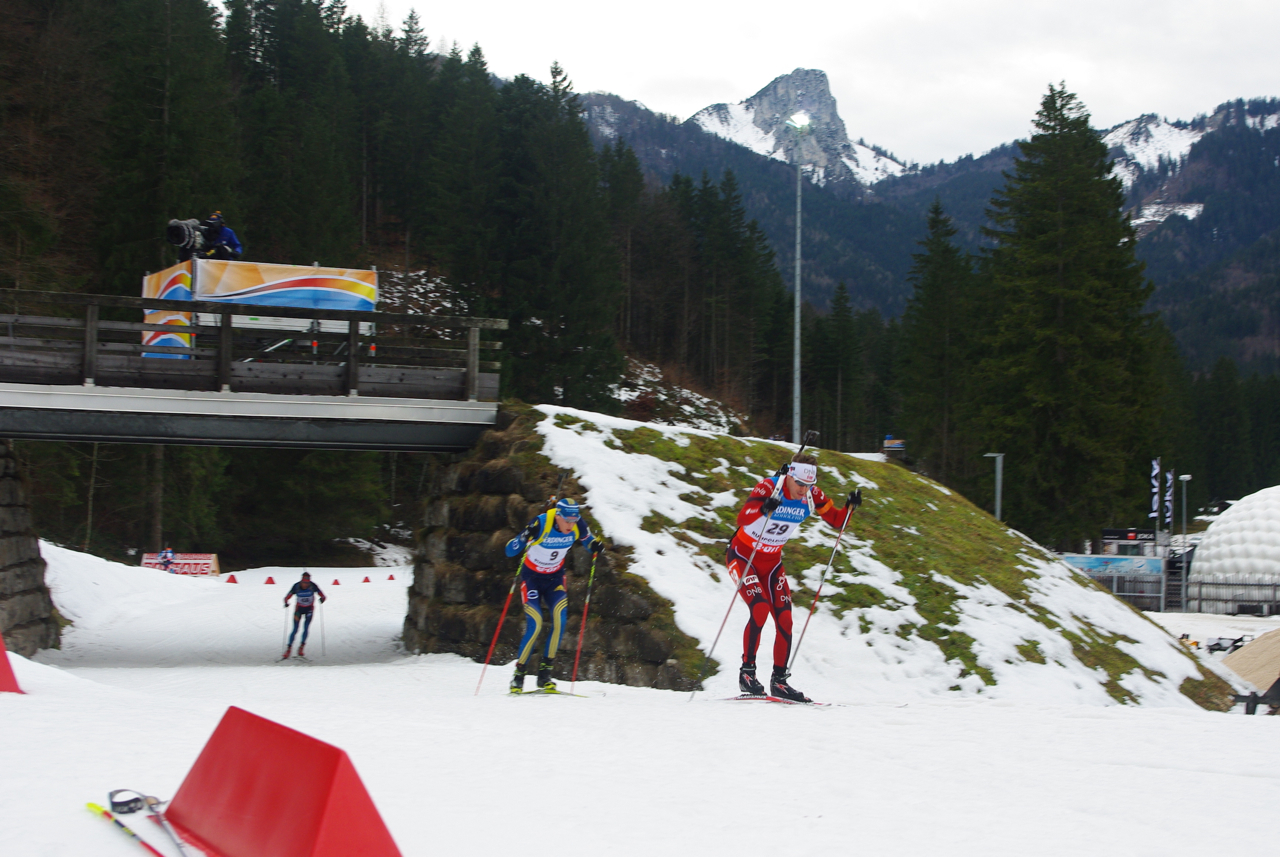
    Emil Hegle Svensen (NOR) leads Bjorn Ferry (SWE) out on course in Ruhpolding today. Svendsen won the 20 k individual, while Ferry missed three shots to place 15th.
    Emil Hegle Svensen (NOR) leads Bjorn Ferry (SWE) out on course in Ruhpolding today. Svendsen won the 20 k individual, while Ferry missed three shots to place 15th.

    RUHPOLDING, Germany – Emil Hegle Svendsen didn’t have the most auspicious start to today’s 20 k individual race. He missed a shot in prone: bam, a minute of added time as a penalty. With many athletes cleaning that first stage, he was left down in 51st place after four kilometers.

    But the veteran Norwegian has an added tool in his arsenal this year: mental resilience. He came back to hit every one of his next 15 shots, which combined with the fifth-fastest ski time of the day earned him his 34th World Cup victory.
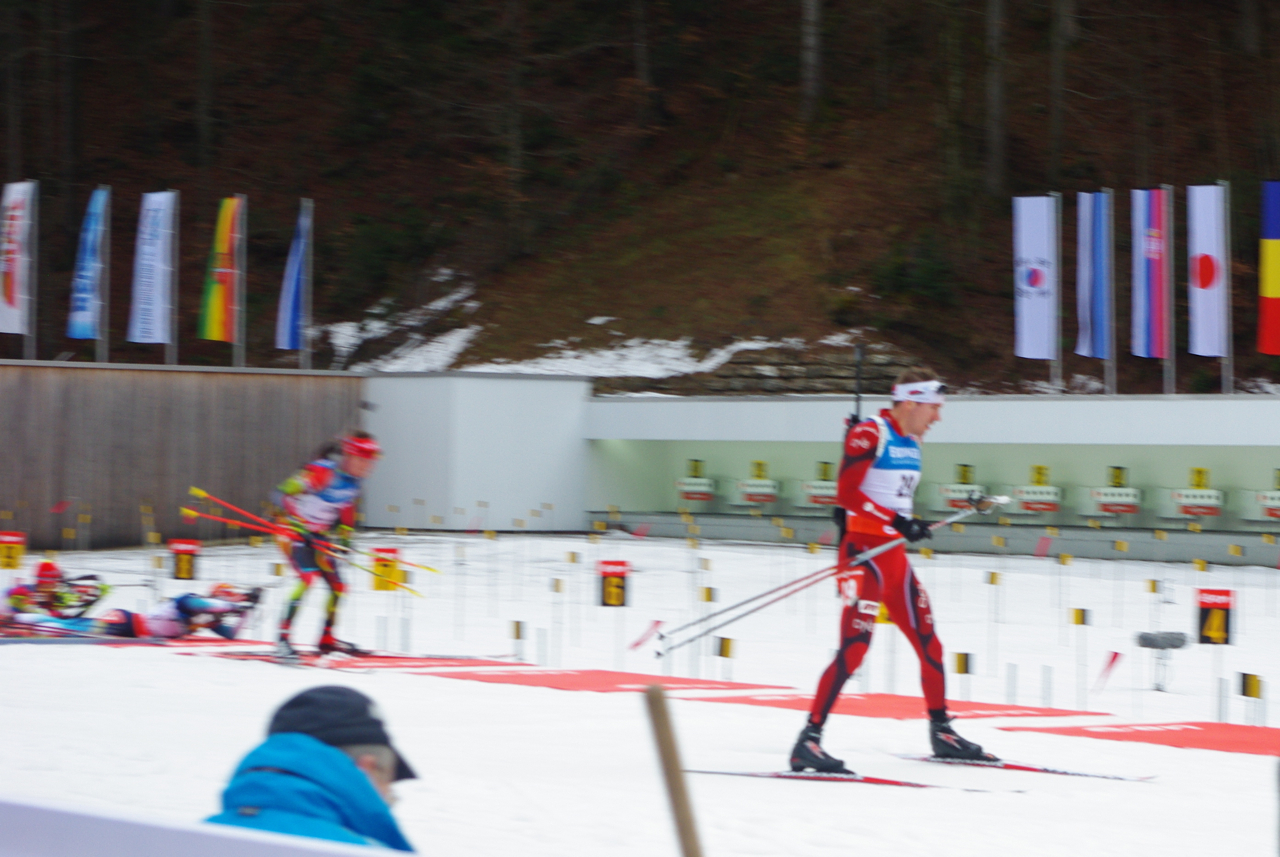
    Entering the range is now a zone of calm for Svendsen.
    Entering the range is now a zone of calm for Svendsen.

    “I found a way to focus on the right way,” Svendsen said of this season. “What is different now is that I really focus on doing it the same every time and not letting myself slack when I do a good race. I focus on doing the same thing race after race, and I think this is the recipe for good and stable racing – to do the same thing every time.”

    By the second clean stage, Svendsen was up to 13th place. After the third, he was in sixth. When he cleaned his final five targets, he moved into the lead, at the time by 27 seconds over Evgeniy Ustyugov of Russia.

    Later in the start order, Alexei Volkov, also of Russia, hit all 20 of his targets. He left the final stage only four seconds down to Svendsen. But he was unable to ski anything near the Norwegian’s pace, and Svendsen ended up winning by 14 seconds. Volkov barely managed to hold on to second place over Ustyugov.

    Among the things that Svendsen has changed this year is to work hard on his mental game. Once dominant in the sport – he won three medals at the 2010 Olympics as well as that year’s overall World Cup title – Svendsen has been pushed hard in recent seasons. Martin Fourcade of France has come on strong, taking the overall title both of the last two seasons.

    Where Svendsen’s incredible ski speed used to be plenty to win him races, even if he made mistakes on the range, coming into this year’s Olympics he knew he needed to be more than just fast. He needed to be accurate, if he was to beat Fourcade on the sport’s biggest stage.
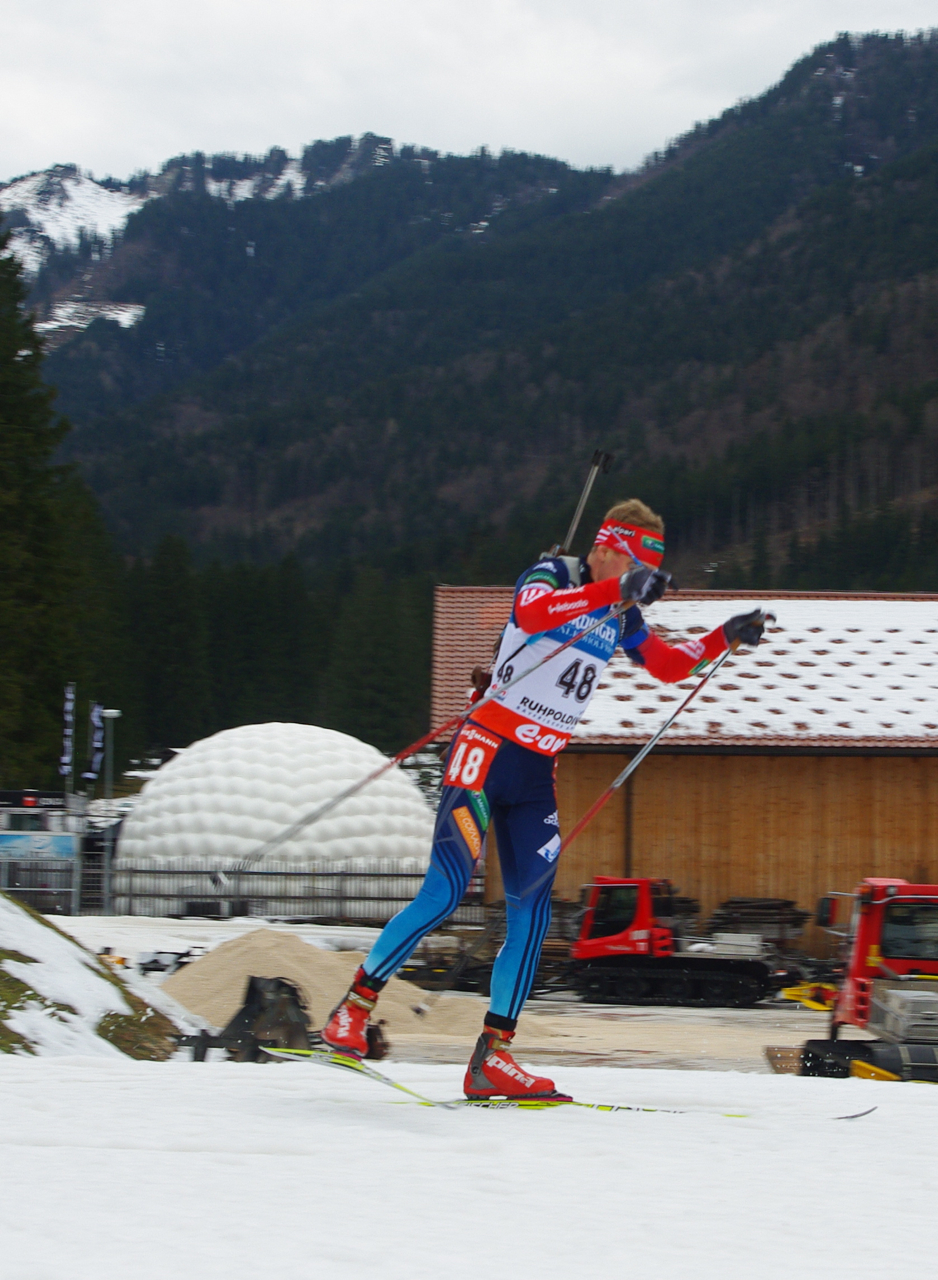
    Alexei Volkov (RUS) used clean shooting to secure second place.
    Alexei Volkov (RUS) used clean shooting to secure second place.

    The press hasn’t always been easy on him when he loses races, either. “I’m a big fat man,” he joked today of how hard the last loop was, alluding to the way that Norwegian broadcaster NRK dedicated an entire story to the fact that he gained six kilograms over the summer.

    It doesn’t seem to have cost him anything. Svendsen is still fast, and now he’s better on the range, too. This weekend, Fourcade isn’t here – he’s off training. But last weekend in Oberhof, Svendsen beat his French rival in back-to-back races for the first time this season.

    “I think the biggest difference is that I’m stronger on the shooting range,” Svendsen said. “I have been working a lot of course with the shooting in the summer and the fall, and also in the winter.”

    The mental work isn’t just about staying focused in a single race, but also over the course of a season. Svendsen had a tough opening, failing to make the top ten in either of the opening individual races in Östersund, Sweden, while watching Fourcade take a more than two-minute win in the kickoff competition. But this year, Svendsen cares about the big picture. That’s the Olympics.

    “This is one of my advantages now, I’m strong mentally,” he said. “I have been doing a lot of good mental work and it is starting to pay off… Hopefully I can keep it that way even in the Olympics when it’s even more pressure. It is going to be fun to see if I can keep it together.”

    Fourcade will likely take the Total Score again, but can he beat Svendsen at the Olympics? The Norwegian has shown that he can be at his best when it counts, including last year when he won gold in both the sprint and pursuit, as well as the relay, which Foucade had hoped France would win. It was a slap in the face considering how dominant Fourcade was for the entire rest of the season.

    Svendsen believes that he’s setting up for another chance to win the gold.

    “This victory is very important to me today, especially considering the shooting,” Svendsen told NRK. “The 20 k is a shooting competition, and today it turned out that I’m on a good track for the Olympics.

    To be at his best in Sochi, Svendsen is taking the next weekend of World Cup racing off in order to relax and focus.

    “I race tomorrow and after that I go home for some days, and after that we are going to Switzerland, to Lenzerheide, for preparation for the Olympics,” he said. “For me now, it’s important to get some rest and get my head straight before the Olympics. I think it’s going to be very big and very tough, and it’s important to be in top shape.”
    Results

    Evgeniy Ustyugov (RUS), third place.
    Evgeniy Ustyugov (RUS), third place.
  • On Last Try, Russian Men Win One for the Home Team in Sochi, But Fans Still Complain

    On Last Try, Russian Men Win One for the Home Team in Sochi, But Fans Still Complain

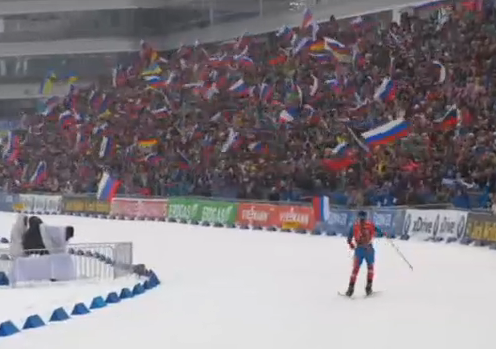
    It was quite a scene in the Laura Biathlon Stadium in Sochi as Evgeniy Ustyugov came home with the win for Russia.
    It was quite a scene in the Laura Biathlon Stadium in Sochi as Evgeniy Ustyugov came home with the win for Russia.

    Finally, on the last day of racing at the new Laura Biathlon Stadium in Sochi, Russian fans got what they were looking for: not Martin Fourcade coming around the turn, but instead a Russian finishing the relay with a huge lead to land a victory for the home country.

    The crowd was roaring as first Dmitry Malyshko – who took the team from tenth to first with the fastest ski time of the third leg – then anchor Evgeniy Ustyugov cleaned their targets without relying on any spare rounds in the men’s 4 x 7.5 k relay. By the time Ustyugov skied into the stadium with a 40-second lead and grabbed a flag to wave across the finish line, the fans were going crazy.

    Still, though, Russian fans are fickle. In the post-race press conference, a Russian journalist stood up and chided first- and second-leg racers Anton Shipulin and Alexandr Loginov for not interacting with their fans enough or rewarding them for their loyalty. Another journalist then admonished Loginov for holding his skis to close to his face in the photo-ops, and not providing the best picture.

    It was ironic considering that just a day before, Ustyugov had commented on the fans in an interview with Russian website Chempionat after finishing second in the sprint.

    “We tried to please our fans with wins and even with a hat trick,” he said. “But recently we didn’t please them for a long time, so hopefully this second place is a joy for us and them, especially in a place like this.”

    Ustyugov: perfect on the range.
    Ustyugov: perfect on the range.

    Loginov seemed like an especially unfair target, given that he is a junior and this is only his second week on the World Cup; realistically, he hasn’t yet learned the ropes. Or, he said, even gotten over the stress of representing his country on the sport’s biggest stage.

    “Before the competition I am trying to keep calm, and so I am trying not to pay attention to the fans,” he told the journalist. “The same goes for the time after the race – I am really tired and I am trying to analyze what is going on in my head, what was the race about. Mostly you’re just really tired. And also I guess it is my character, but at least this year I have learned to smile sometimes! That’s really progress for me.”

    Shipulin, who missed the last week of racing in Oslo, kicked things off for the Russians with a strong effort: despite two spare rounds, he tagged off in third, just a second and a half behind first place.

    “I felt better than yesterday, and I believe that in Khanty-Mansiysk I will do even better,” he said through a translator in the press conference, clearly happy to have turned in a good race. “Being sick influences me a lot and impacts my shape. It’s very sad, but it happens to everyone, and hopefully I’ll be able to avoid it in the future and next season.”

    From there the weight shifted to Loginov, who was in his very first World Cup relay. As he said, he didn’t find the experience easy.

    “This is a very, very stressful event, but I tried to stay calm and relaxed and not to think about the fact that there were lots of fans and that they were all hoping for me,” he said. “I tried to act like it was a standard race.”

    Nonetheless, the young racer struggled on the range, using all three spares in prone and still skiing a penalty loop. Then in standing he used another spare round. By the time he tagged off, the team was in tenth place, 40 seconds back.

    But luckily for Russia, some other teams had trouble as well. Austria, which had been leading coming into standing, had used spares; Jakov Fak of Slovenia, who had been in second, had to hit the penalty loop. That left space for some other teams to catch up.

    And once Malyshko took the tag, it was off to the races for the home team. Malyshko did the kind of skiing that earned him a few wins this season, and soon Ustyugov set off with a slight lead over Germany. The gap to third was large, with France, Slovakia, and Italy battling it out about 35 seconds back.

    The fight for first place hardly seemed fair, however. Ustyugov matched up agains Benedikt Doll of Germany, who was in his first relay of the year; unlike the Russian, he hasn’t won any World Cups, or been on the podium. Just 22 years old, he was a bit more nervous than the veteran Ustyugov.

    “My goal was that I wanted to hold the place that the skier before me gave to me,” Doll said in the press conference. “And of course I wanted to have a good and stable shooting. In the end it didn’t work out perfectly.”

    That slight lack of confidence showed, as he used two spare rounds in prone and three in standing. It allowed Ustyugov to skate away to his win unchallenged. Doll didn’t completely unravel though – skiing the fourth-fastest course time, he hung onto second place for Germany even though last weekend’s sprint winner Ondrej Moravec of the Czech Republic used a single spare and was charging forward.

    But while the podium was a significant accomplishment for the Czech team, it was all about Russia today.

    “We hope very much that during the Olympics we will be able to repeat today’s result and yesterday’s too,” Ustyugov said. “Yesterday’s sprint helped me a lot and gave me lots of confidence. In my case it was most important to prepare for clean shooting, and I managed to do that. I’m quite happy with my own result and very happy with the team – I’d like to thank our service team and especially our coaches.”

    Results


  • Sochi Course is Built For Fourcade as Frenchman Takes Second Win

    Sochi Course is Built For Fourcade as Frenchman Takes Second Win

    Martin Fourcade competing at World Championships in Nove Mesto, Czech Republic, last month.
    Martin Fourcade  at World Championships in Nove Mesto, Czech Republic, last month.

    In the early going of Saturday’s 10 k World Cup sprint in Sochi, Russia, it looked like it might be a close race.

    After the first shooting, four of the sport’s big names were all ranked within four seconds of each other. Martin Fourcade of France had the fastest time. But also shooting clean, Evgeniy Ustyugov of Russia was just 1.8 seconds back, followed by Erik Lesser and Arnd Peiffer of Germany. Behind them, Norwegians Henrik L’Abee-Lund and Tarjei Bø hovered within ten seconds of the lead.

    On Thursday, Fourcade had put on a dominating show of ski prowess en route to winning the 20 k individual, besting Germany’s Andi Birnbacher despite having an extra minute of penalty time.

    And so it was perhaps not surprising that by the time Fourcade, who in bib 50 was the latest starter of the group of six, cleaned his standing stage, it wasn’t a close race at all. He had put 30 seconds into Lesser in the intervening 3.3 kilometers. Ustyugov, meanwhile, had missed a shot, and sat in third just ahead of L’Abee-Lund.

    The real question was how much more time Fourcade could pick up by the finish. He turned that lead into a 42.3-second win, solidifying his place as the man to beat when the Olympics hit these trails next year. In good news for the home country, it was Ustyugov who made it into second, as Lesser faded and lost 20 seconds in the last lap of skiing.

    L’Abee-Lund took third place for the first podium of his career.

    It was Fourcade’s 16th podium of the season, a new record for a male biathlete.

    “This is a warning shot to competitors,” NRK commentator and 1998 Olympic gold medalist Halvard Hanevold said of these two days of competitions.

    Maybe next time don't ask him about Svendsen...
    Maybe next time don’t ask him about Svendsen…

    Fourcade certainly feels the same way. It’s true that his biggest rival, Norway’s Emil Hegle Svendsen, is sitting these races out. But Fourcade insisted in Thursday’s press conference that Svendsen’s presence wouldn’t have made a difference in his results.

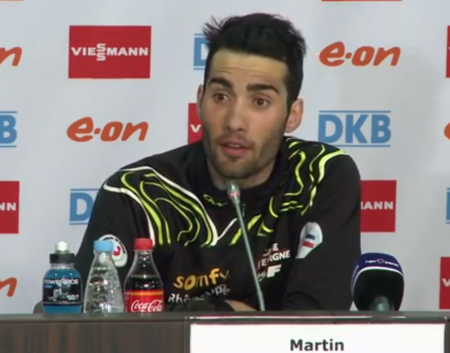
    “What I think about Svendsen?” Fourcade asked in response to a question from IBU  Communication Director Peer Lang. “He’s a great champion and he had wonderful results at World Championships, but I was better this year. I don’t care if he’s there or not.”

    After Thursday’s hard-packed and fast trails, Saturday brought some fresh snow and much softer conditions, taking if anything an extra toll on racers’ legs even though Thursday had already been universally described as brutal.

    “It was even harder today, with the soft snow,” L’Abee-Lund said in a press conference. “The uphills were harder and the downhills were slow and hard.”

    It took some other tolls, too – Maxim Tsvetkov of Russia went flying off the course, over the snowbank and into the trees on a downhill corner (video here), and had to pull out of the race.

    All this is a preview for the Olympics, and Fourcade likes it. In fact, he said that he didn’t feel like these races were anything special; instead, he achieved the wins by just being himself.

    “I am just a man with two arms and two legs,” he said in Saturday’s press conference. “I am in really good shape now. This week, my goal was to get a good feeling for the Sochi tracks.”

    Mission accomplished: he has picked up good information.

    “I don’t care if the track is flat or soft or hard, I want to do everything to win gold next year,” Fourcade told German broadcaster ZDF.

    If he skis anything like he has this year, it seems inevitable. Having already locked up the World Cup Total Score, Fourcade is set to take a lot of hardware back to France with him. These two wins gave him both the Sprint and Individual trophies as well, and he had already clinched the Pursuit title.

    In the last discipline, the mass start, Fourcade holds a lead going into the final competition in Khanty-Mansiysk, and seems likely to take the title as well.

    While Ustyugov was the only Russian to make the podium, the team had plenty to celebrate as his third-best ski time was also bested by Alexey Slepov, who skied the second-fastest time. Dmitry Malyshko had the fifth-best time and junior Alexandr Loginov the ninth-fastest. If the team can get their shooting together, the possibilities in Sochi seem good.

    But of all the podium finishers, L’Abee-Lund was perhaps the happiest.

    “It has been almost within reach so many times,” the 26-year-old told NRK. “Today it worked out completely, and it feels great. I’m very happy with the race and it was incredibly fun.”

    Tim Burke and Lowell Bailey finished 28th and 30th with two and one penalties, respectively, to lead the U.S.; Leif Nordgren finished 40th with one missed shot and Russell Currier 91st with five penalties.

    For Canada, both Scott Gow and Jean Philippe Le Guellec shot clean to place 49th and 52nd. Scott Perras had five penalties and just edged Currier in 90th.

    Results


  • Shoulder Injury Behind Him, Fourcade is Back in Fighting Shape and Cocky as Ever in Ruhpolding

    Shoulder Injury Behind Him, Fourcade is Back in Fighting Shape and Cocky as Ever in Ruhpolding

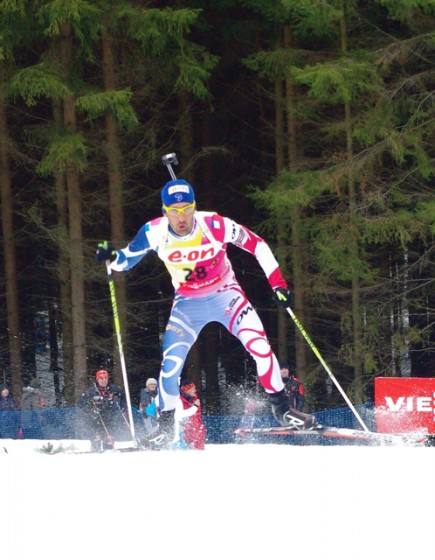
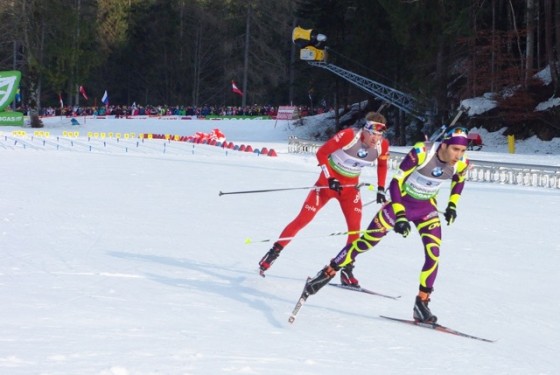
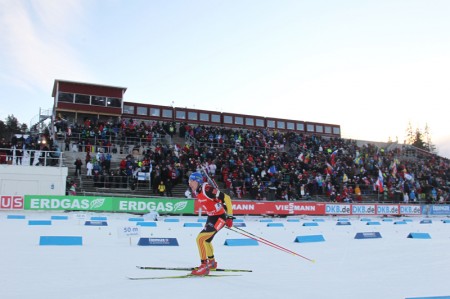
    Martin Fourcade of France and Emil Hegle Svendsen of Norway approaching the range as last season's World Championships in Ruhpolding; today, Fourcade took a big win in the sprint and Svendsen just missed the podium in fourth.
    Martin Fourcade of France and Emil Hegle Svendsen of Norway approaching the range as last season’s World Championships in Ruhpolding; today, Fourcade took a big win in the sprint and Svendsen just missed the podium in fourth.

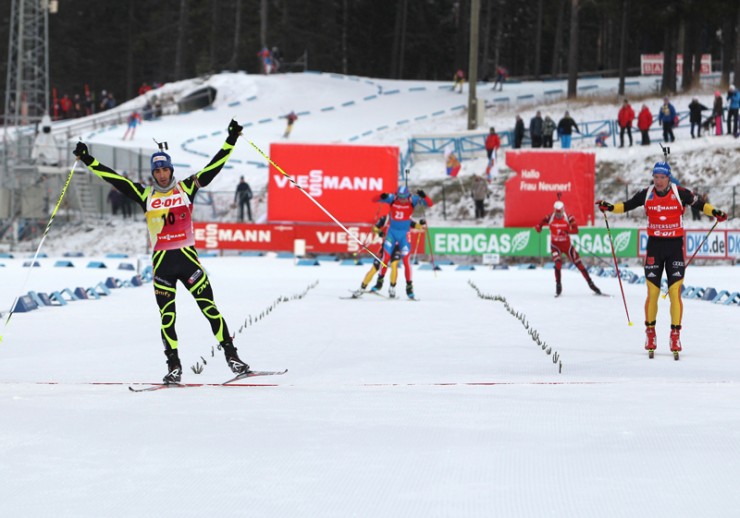
    Martin Fourcade slowed up before the finish line, pumping his fists in the air and screaming to celebrate his victory.

    An ill-timed lunge was the only thing the kept Dmitry Malyshko off the podium – as it was, he finished just 0.1 seconds behind Emil Hegle Svendsen of Norway, whom the Russian had vanquished twice last weekend.

    This might make Saturday’s World Cup biathlon race in Ruhpolding, Germany, like an exciting mass start, or perhaps a pursuit or relay. But no: it was a humble sprint. And yet the interval-start 10 k brought all the drama that is often reserved for head-to-head racing.

    Sprints can bring one more piece of drama too, and that’s the opportunity for a late starter to rear his head and shake things up after everyone thinks the race is over. Starting in bib 85, Andrei Makoveev was justifiably thrilled to cross the line in third place, bumping both Svendsen and Malyshko off the podium.

    After two podium finishes last year, including a win in Nove Mesto, Makoveev had been frustrated with his season so far. And on the extremely deep Russian team, finishing in the top ten doesn’t get you much – today, as they did in last weekend’s sprints, the Russians placed three in the top six. Hence Makoveev’s late starting spot.

    “Until today I was not happy with my season but I hope the rest of the season goes better now,” he said in a press conference.

    While the same could be said for all of the podium finishers, the day belonged to Fourcade, who is finally returning to the dominant form he showed last season. That seems strange to write, since it’s his third win of the season, but after winning both the World Cup total score last year and three individual races at World Championships, there were big expectations for the French star this season.

    He was hindered slightly by a shoulder injury, but said today that it was “not a problem anymore.”

    “When I was warming up for my race, I saw that all the guys that started before me were cleaning,” he told Biathlonworld. “It was amazing.”

    It’s true: the wind was calm on the Ruhpolding range, which is already shooter-friendly because the trails approach off a downhill. 23 men, or almost a quarter of the field, hit all ten targets, including all of the podium finishers and eight of the top ten.

    That turned the competition into more of a ski race than anything else, and after one clean stage Fourcade had a 3-second lead on Anton Shipulin of Russia. (Later starters eventually came between them even at that early checkpoint, and Andriy Deryzemlya of Ukraine ended the day with the fastest split through one stage.)

    “When I was first after prone shooting, I knew that the race was only for me, that I could win it or I could lose it,” he said. “But I had it.”

    By the standing stage, Fourcade had widened his lead to 13 seconds, now over Ustyugov, who had sped up significantly on the second lap. By the finish, Fourcade’s margin over the Russian was 16.4 seconds, although he didn’t push all the way to the line.

    Fourcade and Ustyugov also skied a lap together, so the Frenchman knew exactly what he had to do to win, although he clearly didn’t count on someone coming from the back of the field onto the podium. And conversely, as Ustyugov waited at the finish, he knew what Fourcade was capable of.

    “Congratulations to Martin,” he said after the race. “You led me through the loops today…You proved that you will be hard to beat this year. It was good to follow you today.”

    And for Ustyugov, a multi-time World Cup winner, being on the podium carried the same benefits that it does for Makoveev: finally, recognition on a team that has many stars.

    “I was always in the top ten for most of the season so far, and being here in second place is big weight off my shoulders,” Ustyugov said in a press conference.

    Despite leading the race early on, teammates Emil Hegle Svendsen and Tarjei Bø, newly returning from an illness-plagued fall, were knocked down to fourth and seveth. After Malyshko in fifth it was another Norwegian, Lars Helge Birkeland, who made an appearance in the top ten, clocking in at sixth place. Despite showing strong potential in both biathlon and skiing, this was his first top ten and a career best; his previous top finish had been 21st.

    Jean Guillame Beatrix of France, Andriy Deryzemlya of Ukraine, and Scott Perras of Canada rounded out the top ten.

    results


  • After Blocking Birnbacher Into Finishing Lanes, Fourcade Picks Up Victory Number 16, Moving into Fifth on All-Time List

    After Blocking Birnbacher Into Finishing Lanes, Fourcade Picks Up Victory Number 16, Moving into Fifth on All-Time List

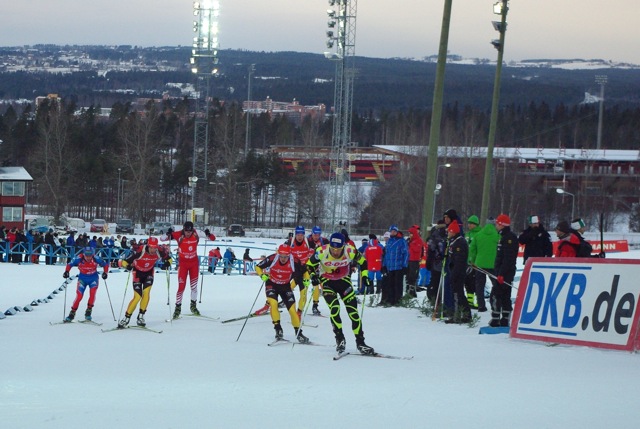
    Martin Fourcade of France (red/yellow bib) leads a chase pack on the first lap of the 12.5 k pursuit, where he moved from tenth position to secure a win.

    ÖSTERSUND, Sweden – After placing a disappointing tenth in yesterday’s 10 k sprint, Martin Fourcade of France was seeking redemption – and to stay in the overall World Cup leaders bib that he had earned after winning Wednesday’s individual race.

    Last year’s overall champion missed only a single one of his twenty shots in today’s 12.5 k pursuit, which put him on a trajectory towards the front. The penalty came in the second standing stage, dropping him to seventh place, 25 seconds back from Russia’s Evgeniy Ustyugov; after two clean stages, Fourcade had climbed to fourth.

    “My strategy was to shoot slow and clean and I did it, but I was always a little bit behind,” Fourcade said in a press conference. “I tried to fight hard and get contact, but they were really fast as well, so I had to be always going hard, all through the race.”

    After three stages Russia’s Evgeniy Ustyugov was solidly in control, leaving the range with an 18-second lead over Alexis Boeuf, Fourcade’s teammate who had placed second in the sprint. But Fourcade charged towards the front, regaining contact with Andreas Birnbacher of Germany and Emil Hegle Svendsen of Norway, who were skiing in third.

    In the final round, Ustyugov and Boeuf handed the chasers a huge favor when they collected two and one penalties, respectively. Suddenly, Birnbacher and Fourcade were leaving the range in the lead after both cleaning their targets. But others were close behind. The two decided to work together.

    Andreas Birnbacher skis through the stadium. Photo: Fischer/NordicFocus.

    “After the shooting range I talked to Andi that we had to ski together on the beginning of the loop,” Fourcade said. “Andi did the first part of the loop and I did the last part. And then my strategy was to stay in the front position and keep Andi and make him ski more if he wanted to go by me. My strategy was good today and I think he will know it for next time.”

    While Fourcade got the better end of the deal tactically, Birnbacher said in the press conference that the decision was about survival for him.

    “On the last lap I was tired because in every round I thought I must go slower on the next round, and every round was fast for me!” he explained. “So I tried to get behind Martin so that nobody would come from behind. I knew that he is very strong and that it could be a hard sprint. On the last corner he was in front and it was very hard to go out and pass.”

    Fourcade did do his best coming into the finishing lanes to prevent Birnbacher from passing; it was awkward to watch. Even as it was, the Frenchman only finished with a 0.7-second victory.

    And what’s more, the chasers had actually gained ground on them. Arnd Peiffer of Germany had left the range 7.7 seconds behind, but crossed the finish line 4.1 seconds back; he lost a sprint with Anton Shipulin of Russia to end up fourth. Svendsen was just behind, unable to muster his usual finishing sprint, to place fifth.

    Shipulin, for one, was surprised to make it so close to the front, especially after a bad sprint race that left him with bib 23, starting more than a minute out of the lead. Despite missing a shot, he was able to climb through the field rapidly. Leaving the final shooting stage with Svendsen, he thought he’d be satisfied to ski for fourth place.

    “Honestly, I was thinking that it would be really great to have a fight with Emil on the last finish lane,” Shipulin said through a translator a the press conference. “I know that he’s very good at these. But it was a little different today. We didn’t expect that we would reach Peiffer, but we also reached him.”

    In some ways, it was not surprising to see Birnbacher near the front; last season’s mass start champion, he is always strong in this type of head-to-head racing.

    “I don’t know why exactly, but I like this kind of competition,” he said. “For shooting, it’s better for me to shoot between the others.”

    But the podium also came as a huge relief to the German, who overtrained this summer and was unsure of what to expect this season.

    “It was very important [to do well today] because I didn’t think before that I was in that good shape,” he said. “In autumn it was very hard for me, I was very tired because of the training. And now it’s getting better and better, so it’s good for me. I think I trained too much in the summer, and I slept all the time!”

    Instead of being disappointed to lose the sprint finish with Fourcade, he was – at least publicly – happy with his finish.

    “I won second place and not lost first place,” Birnbacher said.

    As for Fourcade, he was tired and said that this had been a very difficult race to win.

    “The race was really hard,” he said. “It was a really hard battle. Everyone was really compact on the start, and I knew that we had to shoot clean if we wanted to win.”

    The win today brings Fourcade’s total to 16 World Cup victories, which moves him into fifth place on the all-time list, passing Frode Andresen of Norway and Vladimir Dratchev of Belarus.

    “One of my aims this year was to become the fifth biathlete in World Cup victories, and I am happy today to be it,” Fourcade said in the press conference.

    Don’t get too cocky, though: fourth place belongs to Svendsen, who has 28 wins and will surely add a few to the tally this year, while teammate Ole Einar Bjørndalen has won a seemingly impossible 93 World Cups.

    After his penalty on the last stage, Boeuf held on for sixth, just ahead of Dimitri Malyshko, Ustyugov, Evgeniy Garanichev, and Alexei Volkov of Russia. With half of the top ten, the Russian team seems to have a good start on the Nations Cup competition.

    Results


    Martin Fourcade celebrates as Andreas Birnbacher…. doesn’t. Photo: Fischer/NordicFocus.