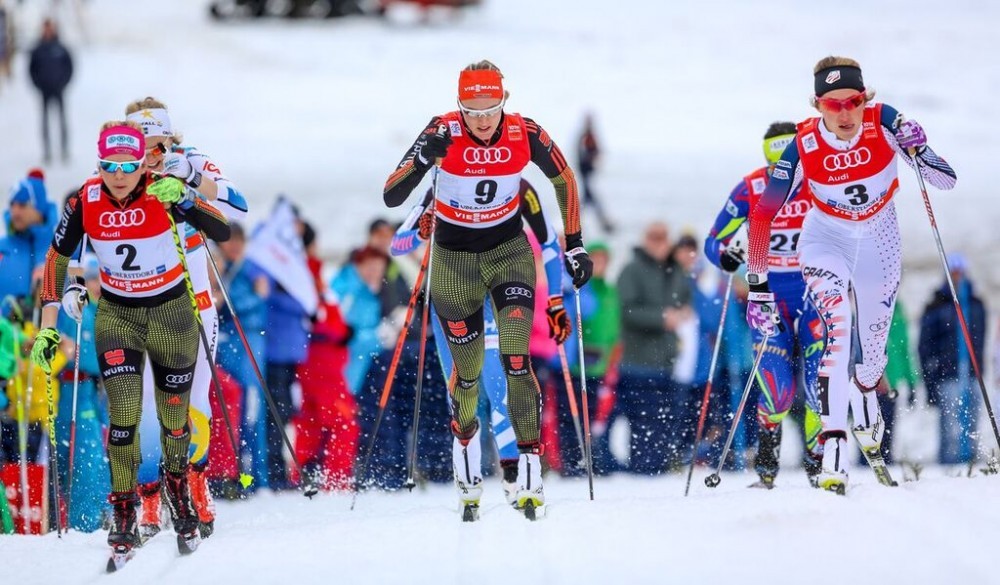
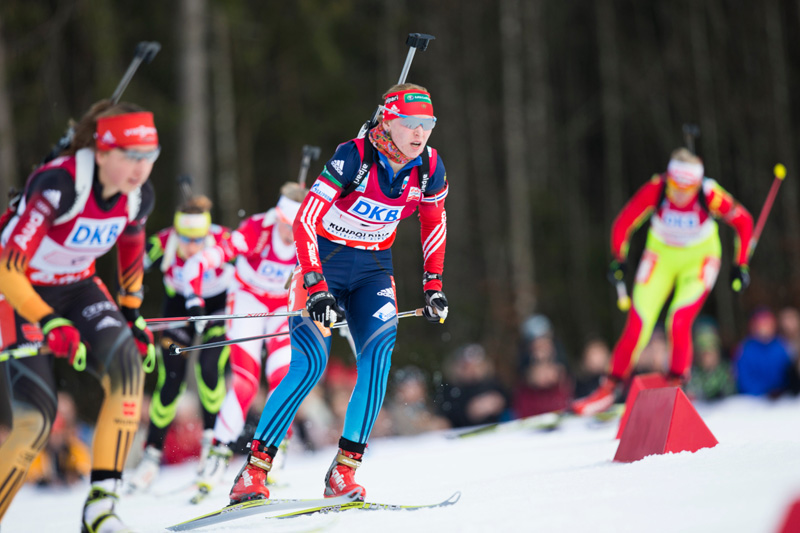
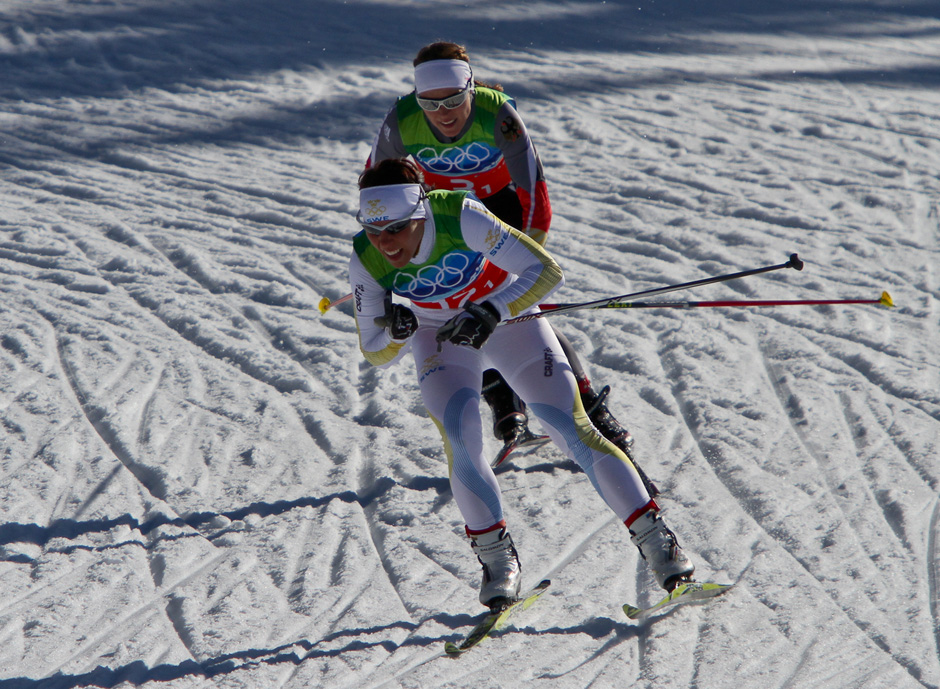
Germany’s Denise Herrmann (9) races alongside teammate Sandra Ringwald (2) and American Sophie Caldwell (3) during Stage 4 of the 2016 Tour de Ski in Oberstdorf, Germany. (Photo: Marcel Hilger)
On Wednesday, German cross-country World Cup skier Denise Herrmann announced a new chapter in her athletic career at age 27: a switch to biathlon.
“This step and the timing is certainly surprising to many, but I have pondered these thoughts for a while now,” Hermann stated in a German Ski Federation press release and in a post on her Facebook page. “I owe a lot to cross-country skiing, it was a great time with many highlights, but now I want to face new goals. The switch to a new discipline will be a big challenge, I am aware of that, but I am confident that I can do it with diligence, courage, and determination!”
Germany’s Denise Herrmann (11) leads American Jessie Diggins (in white) in the women’s 6 x 1.2 k freestyle sprint final at 2015 World Championships in Falun, Sweden. Germany finished fourth behind Norway, Sweden and Poland, respectively, while the U.S. placed eighth. (Photo: FlyingPointRoad)
The German Ski Federation (DSV) wants to support Herrmann in her new career direction.
“Denise has been one of our most important performers in cross-country skiing for many years,” DSV director of sports Karin Orgeldinger said in the press release. “She will surely leave a gap there. On the other hand, we are happy that Denise is looking for a new challenge in biathlon, so she will remain available to the German Ski Federation as an elite athlete.”
Professional cross-country skiing and biathlon are both organized under the same association in Germany, not in separate entities as is the case in the U.S. or Canada. The press release did not include comments from a biathlon coach or team manager.
Herrmann made her debut in the FIS Cross-Country World Cup in February 2009. Mostly known as a sprinter, she earned bronze medal at the 2014 Olympics in Sochi, Russia, with the German women’s 4 x 5 k relay, and was second overall in the Sprint World Cup at the conclusion of the 2013/2014 season. She achieved six individual World Cup podiums plus two in team sprints, and twice finished the overall World Cup in ninth place (2013/2014 and 2014/2015). She narrowly missed a medal at World Championships, placing fourth in the team sprint at the 2015 championships in Falun, Sweden, as her best result. At the end of last season (2015/2016), Herrmann finished 12th in the Sprint World Cup and 23rd in the overall standings.
While it can be considered a bold step for a successful cross-country skier to switch disciplines to biathlon in the middle of her career, it is certainly not unheard of, and even the German Ski Federation has seen several athletes make the transition back and forth.
Herrmann is good friends with and a summer training partner of Maren Hammerschmidt and Vanessa Hinz, both current members of the German national biathlon team. Similar to Herrmann, Hinz also switched from cross-country skiing in 2012. A 2002 and 2010 Olympic gold medalist, Evi Sachenbacher-Stehle switched from cross-country to biathlon toward the end of her career for the 2012/2013 season, before retiring after the 2014 Olympics following a positive doping test. Miriam Gössner, another member of the current biathlon national team, earned silver medals with German cross-country women’s relay teams early in her career at the 2009 World Championships in Liberec, Czech Republic, and the 2010 Olympics in Vancouver, Canada.
Herbal supplements could land you with not only a doping ban, but also in the emergency room. (Photo: Ano Lobb / flickr creative commons)
With the World Anti-Doping Agency (WADA) prohibiting the use of many stimulants and other drugs, some athletes turn to herbal or “natural” supplements to increase their energy, stimulate weight loss, or ensure that they are receiving necessary minerals and nutrients.
This can have catastrophic consequences for an athletic career. Because such supplements are largely unregulated, what’s in the box may not match the listed ingredients.
There have been roughly 1,000 positive tests for that stimulant, methylhexaneamine, most of them accidental by athletes who were using herbal supplements which they had assumed would be safe.
A new study published in the New England Journal of Medicine shows another reason to avoid herbal and “natural” supplements.
The paper, authored by Dr. Andrew Geller and colleagues at the Centers for Disease Control and Prevention, finds that over 20,000 emergency room visits per year in the United States can be attributed to such supplements.
The authors frame the topic with some stats on herbal supplements: there are over 55,000 of them on the market, as of 2012. About a third of Americans use “complementary health approaches”, with one in five taking supplements other than vitamins. And the market is work billions of dollars.
One might assume that the large and profitable market means that manufacturers don’t have much incentive to improve labeling or safety in the near future: if it’s not broke, don’t fix it?
It has been hard to track health problems caused by supplements because only the most serious, for instance hospitalization and death, are required to be reported.
To close the data gap, Geller and his colleagues looked at 10 years of data from each of 63 hospitals around the country. They looked for emergency room visits caused by supplements, excluding drinks like energy drinks or the tea supplements that tripped up Sachenbacher-Stehle. So their data may actually underestimate the complications caused by products from the herbal supplement industry.
With only non-food and non-drink supplements counted, the authors estimated that between 18,000 and 27,000 emergency room visits per year were caused by the products. About 2,000 of those visits each year led to hospitalization.
Alarmingly, almost a quarter of the emergency room trips were caused by allergic reactions to the supplements.
Another 10% were caused by the patient taking a larger dose than suggested. Many people seemed to think that because a supplement was “herbal” or “natural”, there was no such thing as too much – but many substances and chemical compounds can become toxic at a certain level. After all, most synthetic drug compounds either replicate or imitate compounds found in nature.
The study also found that herbal supplement use can damage other people in a patient’s family, with just over 20% of the emergency room visits due to “unsupervised ingestion” of a supplement by children in the house.
But back to athletes. The majority of the cases came from supplements claiming to promote weight loss, increase energy, or provide micronutrients like calcium, iron, and potassium.
Those are exactly the sort of products which may appeal to athletes hoping to become more lean or have more zip in their training, but who avoid regulated drugs because they include banned supplements.
For instance, a 2011 study found that between 70 and 80% of elite Finnish athletes used nutritional and dietary supplements, but less than a third had ever consulted a dietary specialist about why or how to do so.
Those types of supplements may be even more dangerous than the stimulants athletes are trying to avoid.
“Weight-loss or energy products caused more than half these visits, commonly for cardiac symptoms (palpitations, chest pain, or tachycardia),” the authors of the new study wrote. “Notably, cardiac symptoms were documented more frequently in emergency department visits for adverse events associated with weight loss (43%) and energy products (46%) than for prescription stimulants.”
The message? There’s even more reason to limit the number of substances and supplements which athletes rely on. Talk to a doctor and rely on safe, regulated products which are not on WADA’s banned list, or focus on a balanced diet and a healthy lifestyle to keep the pep in step.
The German nordic sports experience at the 2014 Olympics could perhaps be summed up on the last day of competition.
In the men’s 50 k, Germany entered four men. The finishers were led by Thomas Bing, about to turn 24 years old, in 36th place.
Next came Axel Teichmann, more than ten years Bing’s senior. Then two biathletes – Arnd Peiffer and Erik Lesser, in their 50 k debuts on the world stage and within a minute of Teichmann’s time.
Four years earlier, Teichmann had captured silver for Germany in the same event, but on that day in February he labored to 39th place, more than four minutes behind the winning Russian skier. While Germany still had a few of their stars from days past on their roster, they were mostly stars no more.
Peiffer and Lesser had teamed up for a silver medal in the biathlon relay the day before, but they surely were not on fire in the 50 k (understandably). While they treated the race as a fun way to end their Games – and some other biathletes and nordic combined skiers probably would have jumped at the chance to do the same thing – their participation brought up an uncomfortable question: can Germany find nobody else?
To say that Sochi was a disappointment for Germany would be an understatement. While expectations were somewhat tempered by their team’s performance so far that year, it was hard not to remember Vancouver. There, biathlete Magdalena Neuner won two golds and a silver, Simone Hauswald shared the podium with her when she earned bronze in the mass start, and the relay also took bronze.
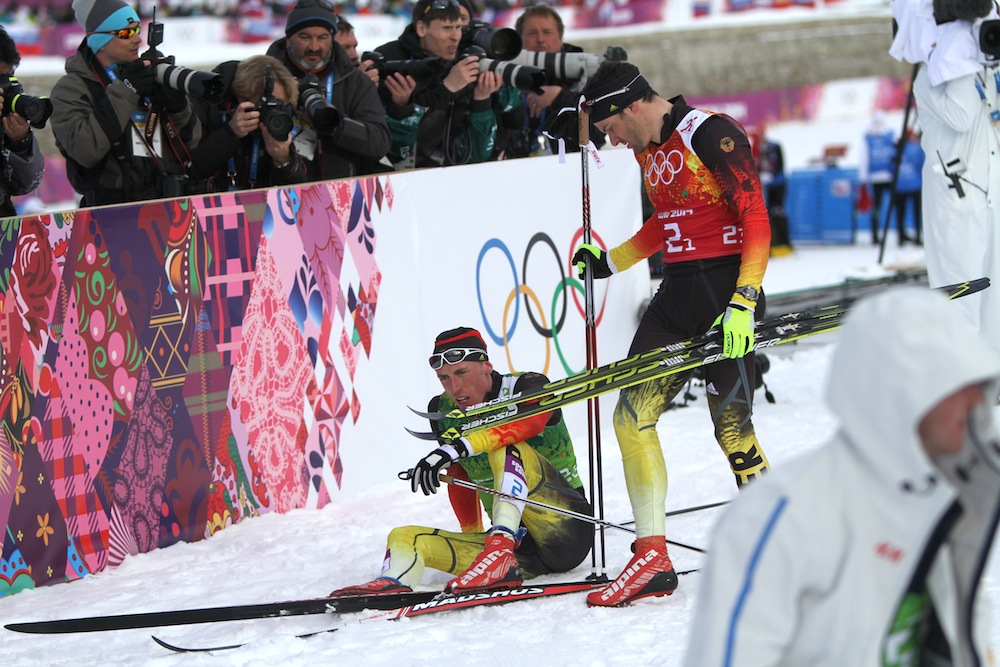
Germany’s Tim Tscharnke (l) after the finish of the 2014 Olympic team sprint with teammate Hannes Dotzler. The two finished seventh after Tscharnke fell a few hundred meters before the finish as a result of a tangle with Finnish anchor Sami Jauhojärvi. Finland took gold and Germany placed seventh.
In cross country, Nystad and Evi Sachenbacher-Stehle had teamed up for gold in the Vancouver team sprint, Teichmann and Tim Tscharnke took silver in the men’s event, the German women were second in the relay, and the men won two individual silver medals.
For a little perspective: in 2014, Germany came away with three medals, total, in cross country and biathlon combined.
Where to start with the embarrassments? Was it Sachenbacher-Stehle testing positive for a banned stimulant? Or was it Tscharnke falling down in the final stretch of the team sprint and, instead of getting up and likely earning bronze, lying in a heap whimpering about how he missed out on gold?
In a Deutscher Olympischer SportBund report obtained by FasterSkier, the country’s Olympic committee assesses the success of each sport at the 2014 Olympics, and looks for actionable plans to move forward and upward. The document runs more that 230 pages and not only focuses on each sport individually, but also on funding partners, medical and logistical support, and what other countries are doing to succeed. It’s an impressive analysis of a huge and complex system.
A Cross Country Team Too Old and Too Young
“Denise Herrmann and Josef Wenzl improved in the world rankings in the 2013/2014 season and even at times led the Sprint Cup,” the report noted of young German skiers. “But the pre-Olympic season was marked by a disappointing World Cup, and the coaching change in 2012 didn’t bring the expected turnaround.”
Herrman was one of the great hopes for Germany – a medal in the skate sprint seemed very possible for the 25-year-old (and if that doesn’t sound “young”, the report notes that the average age of a medalist was 28 for women and 29 for men). But like other favorites including Marit Bjørgen and Kikkan Randall, she didn’t make the final.
That was symbolic of the single medal and three top-8 finishes by German skiers, their worst performance at an Olympic Games since 1998.
While performances by the team’s young stars showed that maybe they weren’t ready for literally the biggest stage in the sports world, the squad was also filled with older athletes. The single medal came in the women’s relay, where 36-year-old Nystad was helped earn bronze and the team came into the sprint finish with the leaders.
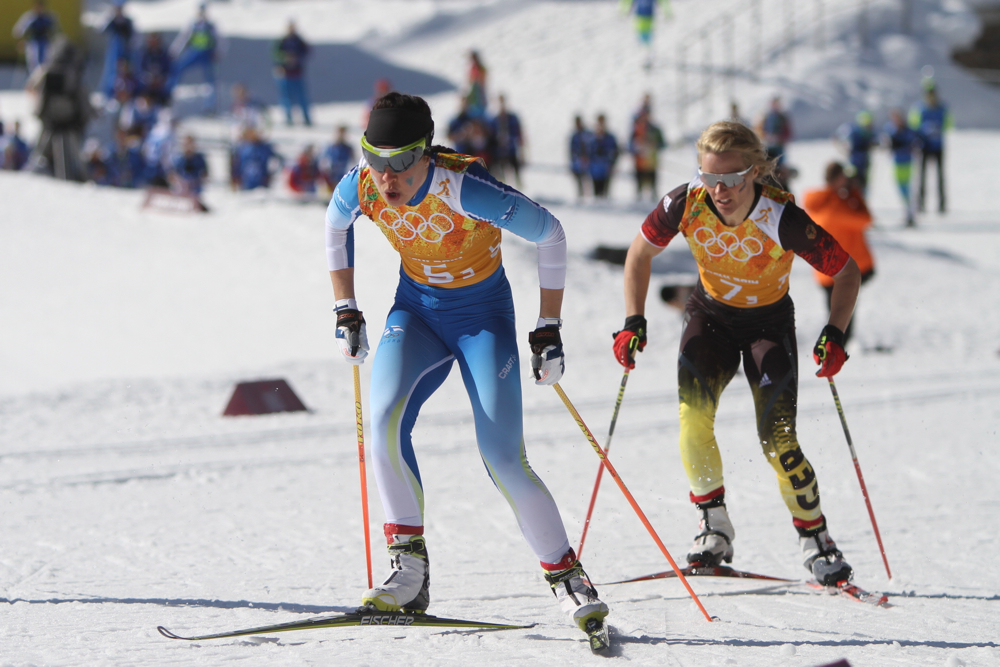
Kerttu Niskanen of Finland leading Claudia Nystad of Germany in the Olympic relay. Nystad completed her comeback from retirement with a bronze medal.
The report noted that Nystad was the oldest medalist in cross-country skiing. But they didn’t say what the rest of the team’s aging veterans accomplished: because Teichmann didn’t contribute much, nor did 36-year-old Tobias Angerer. None of the women who competed in the 15 k skiathlon were under the age of 30.
Nordic sports are particularly difficult to analyze, the report noted, with different techniques and physiological demands of uphill and flat sections, aggression needed on downhills, transitions essential on rolling terrain, and equipment and ski service becoming increasingly important.
But the best athletes, the report explained, are in general among the best at each of these different aspects, and having a weakness in one area can’t necessarily be compensated for by excellence in another area due to the high level of competition in the field.
What do they recommend to get German skiing back on track? For once thing, they focus on a “long-term development structure” and suggest that the objectives and tasks be reworked after observing other country’s strategies for developing cross country skiers.
Another recommendation is that while providing for an athlete’s development, not to treat them as machines: “An essential prerequisite of all participating institutions is to in close cooperation control the sport, but also the personal development of the athletes and to focus on the achievement of future excellence in high-performance.”
Finally, the committee noted that the ski association’s current strategy of setting up different training groups seems to be effective, but that it should look towards biathlon and nordic combined for how to systemize development at the junior level.
If there’s more talent coming up, there may finally be starts for them. Teichmann, Angerer, and Katrin Zeller retired. Nystad is back in action and had a strong race in Beitostolen, Norway, this weekend.
What Happened to Biathlon?
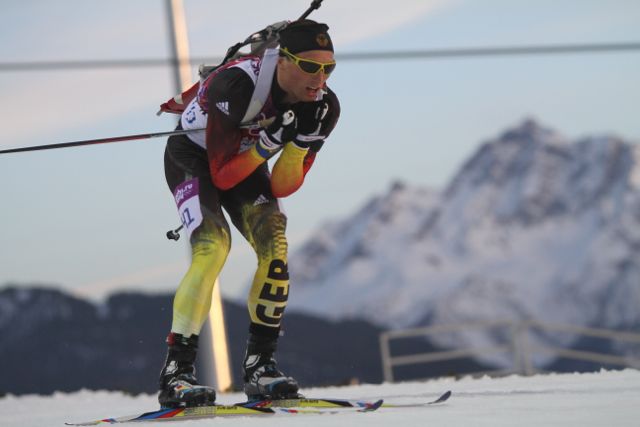
Erik Lesser of Germany en route to a silver medal in Sochi.
Biathlon was an unmitigated disaster for Germany at the Sochi Olympics. On the second page of the biathlon section of the report, the committee addresses an ugly truth: the medal rankings. Germany collected two medals, one silver and one bronze, which landed them in fourth place (although there were several ties; five teams were better, two the same). The Czech Republic surged past them with five medals.
“Besides the established nations of Germany, France, Russia, and Norway, increasingly athletes from Austria,the Czech Republic, Slovenia, and Canada are gaining podiums and placing among the world leaders,” the report noted.
Echoing a sentiment expressed by many of the sport’s observers, the committee crunched some numbers and showed that biathlon is, in fact, getting increasingly competitive: the same level of performance that might have won a medal in the past just doesn’t cut it anymore.
“In order to achieve podium finishes, the men at maximum about 1.2 percent behind in skiing, and hit targets at a rate of of about 98 percent. The previously assumed requirement to be 1.5 percent back and a 95 percent hit rate are therefore obsolete now… in the women’s field, a hit rate of 96 percent and maximum ski speeds less than 2.0 percent back are needed to reach medal placings… the best individual performances in the opening contest, the sprint, were… clearly behind the world leaders in both skiing and hit rate as well as in the shooting times. Because they were immediately dependent on the sprint results, the prospects were thus low for the subsequent pursuit.”
Forget medals – it didn’t get any better for Germany when considering top-8 performances: in other words, they weren’t even close to winning more medals. The team had only three top-eight finishes (discounting those from Evi Sachenbacher-Stehle after her doping ban). Norway and the Czech Republic led the way with 11, while France had 10. Germany’s three tied it with the United States, Canada, and Slovakia.
The women’s team, the report noted, was highly variable. After the Vancouver Games, three stars retired (Kati Wilhelm, Martina Beck, and Simone Hauswald), while Magdalena Neuner called it quits after the 2012 World Championships in Ruhpolding, Germany.
“[The team] ultimately consisted of two juniors (Franziska Preuss, Laura Dahlmeier); a very experienced senior athlete (Andrea Henkel); an experienced, former cross-country skier – with considerable training effort for the stabilization of the shooting performance (Evi Sachenbacher-Stehle); and an athlete who in comparison to previous years increased her experience but at events as big as Sochi still has far to go (Franziska Hildebrand). The challenging tracks in Sochi required a high level of competition experience with regard to the race schedule. Their could succeed in competition only on the basis of a high level of physical and mental performance. These parameters within the existing team structure are pronounced insufficient for an Olympic Winter Games.”
Magdalena Neuner, a three-time World Cup champion, double Olympic gold medalist, and winner of 17 World Championships medals, has been critical of the DSV’s biathlon program. Photo: NordicFocus/Fischer.
Since the Olympics, Neuner has publicly criticized the Deutscher Skiverband (DSV, the governing body for snow sports) and accused them of being behind the times and resistant to change.
“Times have changed, and the level of the World Cup has increased,” she told Der Spiegel. “[They] didn’t want to think differently… the team needs someone who has a bit more sensitivity for the young girls. The World Cup is a tough business. And because they are currently not as successful, it is even harder. Now they need a coach who is fully behind them.”
In a separate conversation with Sport1, Neuner said that far too much pressure had been put on the likes of Dahlmeier and Preuss, who just two years before had been competing at the Youth Olympic Games.
Her leadoff leg of the women’s relay was tough to watch – she fell, and also had her rifle sight clogged with snow. Perhaps additionally discombobulated by Sachenbacher-Stehle’s doping result, Preuss tagged off three minutes behind the leader and in tears. She was 19 years old, and has since made it clear that she never wants to revisit the memory.
“It’s always difficult in the first World Cup season, and especially at the Olympics for young athletes: the pressure is greater than they had ever imagined,” Neuner told Sport1. “You think you’re now relaxed on the World Cup, but it is different than before. The public attention is so high and the pressure as well.”
She also said that the trainers did not sufficiently individualize training plans, and as a result many of the athletes were often exhausted and sick. Neuner trained more or less independently of the national team during her most successful years.
Neuner has since been in contact with the DSV, and they have reportedly offered her a position to advise them.
Henkel – who has medals from three Olympics and teamed up on relays with the strongest German biathletes ever, from Uschi Disl to Neuner – has since retired, married longtime boyfriend Tim Burke, and is planning a life in the U.S. German media is calling the very young German women’s team perhaps the most challenging squad since the reunification of East and West Germany.
“You shouldn’t compare these girls to what was before, but give them some time to develop and not have a lot of worry,” the told news.de.
What About Everyone Else?
How does Germany apply the same logic to other countries? The report also contains information on each of Germany’s main rivals: France, Canada, Norway, Russia, and the United States. A few interesting assessments:
France, it notes, won 15 medals – but all came in ski and snow sports, a “problem” noted by the head of the French effort and which will be targeted for expansion in coming years. How does France fund their efforts? Among other things, through the military, customs, and border patrol, which provides athletes with salaries. 60 percent of the medals won came from athletes in these programs, and only in jumping was the success unrelated.
“There is a positive trend in the spending from 2010 to 2013, for the key role of competitive sports the Institute for French High-Performance Sports [INSEP] used 63 percent of its total expenditures, or about 21 million euros. The budget for research projects amounted in 2012 to about 18 percent or 5.8 million euros and in 2013, about 12 percent or 3.9 million euros. Research and development activities to support the development of competitive sports staffed 18 employees of the Research Department of the INSEP.”
In assessing Canada, the report mentioned the governments Athlete Assistance Program (AAP) and discusses Own the Podium (OTP) at length. It concludes:
“Given increasingly costly global funding for sports and declining sponsorship in Canada, it needs to be clarified whether Canada can afford wider sports funding at present. The summer sports have obtained more financial due to the larger number of sports, despite fewer medals. After Sochi there is again, as before in 2013, debate about the questions: is it important for the summer sports to be equally successful as the winter ones? Is success in some sports more important than others? Does Canada have to be equally successful in Olympic and Paralympic Games?”
And how does the U.S. succeed? Germany marvels at the U.S. Olympic Committee’s very different funding strategy:
“With the relaunch of the USOC site ‘Team USA,’ the creators succeeded with the new website and numerous promotions to make an increasingly patriotic, emotionally-tinged connection between the American ‘consumers’ and Team USA. According to the 2012 Annual Report of the USOC, 130 million Americans are ‘fans’ of the Olympic Movement and at the end of 2012, USOC social media sites had more than 3.5 million followers. Team USA is 34 business partners, sponsors and suppliers – including Coca Cola, Dow Chemical, Samsung, VISA and Nike. The message [is that] that all Americans are part of the team behind the team USA and that without the willingness to provide financial support for the athletes a successful performance in the international arena is not possible…”
Can German nordic sports get their mojo back this season? We’ll have a hint at an answer this weekend: the FIS Cross Country World Cup kicks off in Kuusamo, Finland, and on Sunday the first IBU Biathlon World Cup will be held in Östersund, Sweden.
Germany’s Evi Sachenbacher-Stehle leaving the range during the 2014 Olympic mass start race. She placed fourth, but was later disqualified after testing positive for a prohibted stimulant. Her ban was reduced from two years to six months, so she will return to competition.
Evi Sachenbacher-Stehle was banned from competition for two years by the International Biathlon Union (IBU) for testing positive for the stimulant methylhexanamine at the 2014 Olympic Games in Sochi, Russia.
Sachenbacher-Stehle claimed from the beginning that she ingested the banned supplement accidentally in one of her several herbal supplements, and in her hearing with the IBU presented test results obtained after the fact to show that, indeed, one of her supplements did contain the substance. Methylhexanamine has been the culprit in many accidental-positive cases across sports. However, the IBU had little sympathy and still applied the maximum ban possible, the same amount of time it doled out to a Russian who tested positive for the blood-doping drug recombinant erythropoetin.
Sachenbacher-Stehle was disappointed with the ruling, and appealed to the Court of Arbitration for Sport (CAS). Their board, headed by Italy’s Luigi Fumagalli, ruled that the ban should be only partially upheld: they reduced the sentence to six months.
Since Sachenbacher-Stehle began her suspension at the Olympics, more than six months have now passed.
“She is therefore eligible to start again in the coming season,” IBU Communications Director Peer Lange wrote in an email to the media this afternoon.
CAS also ruled that the IBU owes Sachenbacher-Stehle 7,500 Euros to cover her legal fees.
The specific reasoning for the decision is not currently available, but Lange wrote that more details would be released soon.
The ruling is in line with many past decisions by CAS and individual federations in methylhexaneamine cases, where sentences for tennis players, swimmers, and track athletes among others have often reduced to six months or one year as opposed to two years.
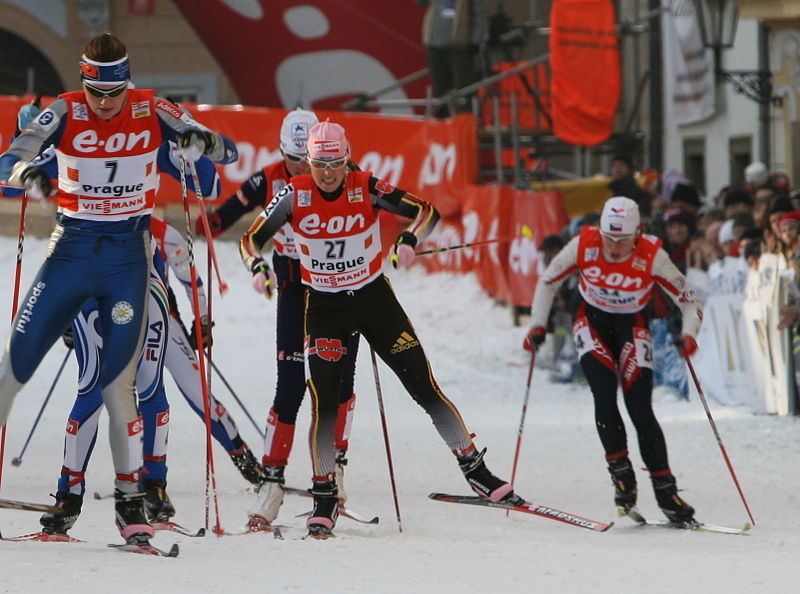
Germany’s Evi Sachenbacher-Stehle (27) in the quaterfinals of the 2007 Tour de Ski in Prague. (Photo: Wikimedia Commons/Petr Novák)
At 33, German biathlete Evi Sachenbacher-Stehle might have been ruled out of the game by some, considering she was banned from competing for two years after testing positive for the stimulant methylhexanamine at the Sochi Olympics.
But she said then that she would seek a reduced ban, one less harsh than the two-year ban the International Biathlon Union (IBU) Anti-Doping Panel simultaneously handed down to two other female biathletes who tested positive for EPO, recombinant erythropoietin.
She took a tea powder.
“I took a dietary supplement that was contaminated … I did not want to cheat,” she recently told a publication called the Star, according translated article by T-online. “Fact that I will now [be] cast with criminal dopers, with people, for example, that inject EPO into their veins … that’s almost worse when the two-year ban.”
Sachenbacher-Stehle, a former cross-country skier who won two Olympic gold medals and three silvers before switching to biathlon in 2012, placed fourth in the mass start in Sochi. Her results in Sochi were later nulled.
According to the Associated Press, the Court of Arbitration for Sport (CAS) says she’s seeking a three-month ban instead — which she’s already served. The retroactive suspension started Feb. 17, 2014. She would need her appeal to be processed on a fast-track basis, which the IBU must approve first.
“Although I am already 33 years old, and time is running [out], I do not want to cede as a doping sinner,” she said, according to a translation. “This is not to be the last picture of me.”
In similar cases, the CAS shortened suspensions of two Jamaicans track stars, Asafa Powell and Sherone Simpson, who also sought reduced bans of three months — down from the original 18 months they were sentenced to.
Germany’s Evi Sachenbacher-Stehle leaving the range during the 2014 Olympic mass start race. She placed fourth, but was later disqualified after testing positive for a banned stimulant.
German skier-turned biathlete Evi Sachenbacher-Stehle has been banned from competition for two years after testing positive for methylhexanamine, a banned stimulant, at the Olympic Games in Sochi in February.
Sachenbacher-Stehle is an Olympic gold medalist in the team sprint from the 2010 Vancouver Olympics. She subsequently switched to biathlon and had a very successful two years; she had placed fourth in the mass start in Sochi, but the result was nullified after her positive test.
Sachenbacher-Stehle had, from the beginning of the case, asserted that the stimulant entered her body through a contaminated dietary supplement; she takes nine supplements, she said, and had tested three which were manufactured in countries with a history of drug contamination to make sure that they did not contain anything on the World Anti-Doping Agency’s (WADA) Prohibited List.
Teepower Schisandra, a concentrated tea powder which Sachebacher-Stehle took for immune system support and “general health”, was not one of them – and turned out to contain the banned supplement. It’s unclear whether it is an intentional ingredient in the tea, or appeared via contamination.
Sachenbacher-Stehle argued that since she had ingested the stimulant accidentally, with no intention to use it to enhance her performance, her ban should be reduced.
But the Anti-Doping Hearing Panel organized by the International Biathlon Union (IBU) rejected this idea, despite the fact that there is a written guideline for how to reduces sentences. The three-member panel seemed to reject the entire notion that this was appropriate.
But other times, it’s pretty clear that athletes didn’t do their homework and did end up taking a prohibited substance without meaning to, most commonly through dietary supplements. That makes them negligent, but not intentional cheaters. There are literally hundreds of cases – 758 between 2008 and 2013 – of athletes around the world testing positive for methylhexaneamine alone, due to dietary supplements. This represented 7 % of all positive tests in 2012. Only testosterone and marijuana are more frequently detected.
Yet accidental ingestion has claimed careless athletes around the sporting world: Jamaican sprinters, South African rugby players, and Major League Baseball prospects. One reason for the confusion is that the substance goes by many different names, including the seemingly innocuous “geranium oil”.
For instance, this is what Sachenbacher-Stehle says happened to her: she knew that she could get into trouble with the nine supplements that she uses, so she took some precautions. She had read the Teepower Schisandra labels and the substance was not listed. Because it was not manufactured in a country where supplement mislabeling and contamination is common, she did not have it tested, though she did test three of her other supplements.
The vast number of mostly accidental positive tests has contributed to debate about whether the drug should even be banned. In the case of methylhexaneamine, the issue is complicated by the fact that there has never been a well-designed study to assess whether the stimulant is actually performance-enhancing when used by athletes. One doctor estimated that its effects might be only slightly stronger than a cup of coffee.
“If she was trying to enhance her performance, there are much better ways to do it,” IBU Vice President for Medical Issues Jim Carrabre told FasterSkier regarding Sachenbacher-Stehle.
Rules for Reduced Sentencing
Appearing in person at the arbitration hearing, Sachenbacher-Stehle sought to argue that her sentence should be reduced because she did not knowingly take the stimulant and was not seeking to enhance her performance.
Through the InternatioIBU rules (which are based on WADA code), a ban can be reduced or negated if an athlete demonstrates two conditions: first “establish how a Specified Substance entered his or her body” and second “that the athlete did not intend the Specified Substance found in the athlete’s system to enhance the athlete’s sport performance.”
The strategy has worked in stimulant/supplement cases in the past in other sports. Notably Jamaican sprinters Asafa Powell and Sherone Simpson had their bans reduced to six months by the Court of Arbitration for Sport after the court was satisfied that they unwittingly ingested oxilofrine, a stimulant in the same class as methylhexaneamine, in their dietary supplements.
The hearing panel did, too. They recognized that methylhxaneamine came through the Teepower supplement (which she had tested after her positive test, and to her dismay discovered that it had caused the violation), and that she didn’t mean to take it.
But they struggled with the second part of the requirement, about the Specified Substance not being meant to enhance performance (their debate can be found in the minutes). Choosing to take “Specified Substance” to be the supplement, not the stimulant per se, they wrote that of course it was intended to be performance-enhancing. So would eating a steak or an apple – everything an elite athlete does is meant to help performance, they explained:
“almost everything a serious athlete does in his or her life is to enhance his or her sport performance, be it to get enough sleep; eat balanced and nutritious foods; maintain an appropriate weight level for the competition at hand; get enough rest to permit proper recovery from workouts; take permitted medication [sic] when sick; take consideration of the appropriate altitude to train at for a particular competition; and so forth. Following healthy practices to ‘enhance’ one’s sport performance is not bad/cheating.”
Instead, they focused on another section of the anti-doping code, which states that athletes are strictly responsible for anything that enters their bodies. The hearing panel was clearly thinking about setting precedents and the long-term implications of its decision. In a subtle dig at Sachenbacher-Stehle, they noted that “experienced athletes training at the international levels” should be held to strict standards.
Sachenbacher-Stehle, for example, argued that she had read the ingredient list and that nothing prohibited was on it. She had also consulted her nutritional expert, who repeatedly told her that the supplement was safe. She heard that other athletes had taken the supplement and not failed a doping test. She had even googled the product name with “doping”, and found nothing.
That wasn’t strict enough. The panel countered: “Any elite biathlete who took the product after reading the [product’s website, which claims to boost endurance] would be taking the product fully aware that the product was purported to enhance performance.”
In other words, even supplements or other natural substances which may help performance without using prohibited substances should be avoided on principle. The message seemed to be that the IBU was taking a stronger stance than other regulators.
Accordingly, they banned the German Olympic champion for two years.
What About Contamination?
While the decision ends the waiting over this case, it leaves many issues regarding nutritional supplements less than crystal clear. Athletes routinely take supplements; what is their burden in order to ensure that nothing prohibited is in these supplements?
An issue which the panel did not even touch upon was the contamination of supplements from factories which make multiple products.
An IOC study in 2002 found that 14-19% of herbal supplements contained steroids or hormones which were not declared on the label as a result of contamination. A separate study in the UK found similar numbers when it included stimulants in the analysis.
For instance, the panel wrote that Sachenbacher-Stehle should have asked a medical doctor whether the supplement was safe. But it’s doubtful that any medical doctor is familiar with each and every nutritional supplement or whether it has previously faced issues of contamination. They might simply take the same investigatory steps that Sachenbacher-Stehle herself took.
Her nutritionist, Stefan Saxinger, for example, has 15 years of experience working with elite athletes including tennis pros and champions in windsurfing and sailing. He probably knew as much about dietary supplements as many medical doctors; the end result was still a positive test.
The panel produced no instruction on the issue of contaminated supplements, only the repeated and assertive comment that because the supplement claimed to boost endurance, Sachenbacher-Stehle should have known it was illegal. They also wrote that because it was recommended to take small doses, this was another clue that it was probably prohibited.
Yet many supposedly natural products offer claims to boost everything from energy levels to memory – it’s probably more likely that a product simply doesn’t work, than that it works because it contains a prohibited substance.
Confusion Over the Sentence
Ross Tucker, a well-known South African sports scientist, wrote in 2010 that methylhexaniamine positives were the fault of an “unregulated” supplement industry, which is where the lion’s share of the blame should be placed – for being dangerous, and for ruining athletes’ careers.
That’s partly why the WADA exception was made: if an athlete really did make a good-faith effort to ensure that they were playing by the rules with their supplements, the World Anti-Doping Agency (WADA) decided, they should be punished less harshly for failing in the end.
The IBU panel did not consider Sachenbacher-Stehle’s effort to be good enough – or perhaps they wanted to set a precedent that they did not agree with WADA’s previous stance on this issue.
Sachenbacher-Stehle was particularly offended because the verdict for the Irina Starykh case came out on the same day, where the same three-man panel handed down an identical ban. Starykh, a Russian biathlete, had taken recombinant erythropoetin, a much more potent drug which irrefutably boosts the oxygen-carrying capacity of the blood and thus improves performance.
“For me it is completely incomprehensible that my case of unknowingly ingesting something is treated at the same level as a cheater knowingly taking EPO,” she said.
She believes that the case is being used to set an agenda.
“It forces suspicion on the basis of my case that food supplements are looked down upon,” she said in a written statement, according to a translation. “He called for the maximum sentence, saying, inter alia, that a reduction of the sentence would send a wrong signal to the Biathlon World. It has in my opinion nothing to do with factual considerations, but is exclusively politically motivated.”
The German ski federation, DSV, was also disappointed in the decision.
“We were surprised that the ban was for two years because this is usually reserved in cases of deliberate doping,” DSV president Franz Steinle said according to the German newspaper Der Spiegel.
Steinle said that, nonetheless, DSV considers Sachenbacher-Stehle to have been “negligent”.
Michael Vesper of the German Olympic Sports Confederation also expressed his shock.
“It is a harsh assessment for the use of stimulants which are prohibited in competition, but not even in training,” he told Die Welt. “Obviously, the world governing body has found no extenuating circumstances, which frankly surprises me based on other cases.”
Mark Heinkelein, Sachenbacher-Stehle’s lawyer, told Die Welt that the team was analyzing the decision and deciding whether or not to appeal to the Court of Arbitration for Sport.
Pundits note that at age 33, Sachenbacher-Stehle’s career is likely over if she serves a two-year ban.
German Ski Association spokesman Stefan Schwarzbach takes questions following Friday’s women’s relay race, after news broke that day that German biathlete Evi Sachenbacher-Stehle had tested positive for a banned stimulant.
Editor’s Note: This is an editorial written from a firsthand perspective of covering Friday’s news of the Evi Sachenbacher-Stehle doping case.
KRASNAYA POLYANA, Russia – Early Friday afternoon I got a frantic email from a colleague asking if there was any way I could make an impromptu press conference at the German House at the Olympic mountain venue, where details of a positive drug test by a Norwegian athlete would be released.
I sprinted there, incredulous. Norwegians don’t test positive; their results in the endurance sports I cover, cross-country skiing and biathlon, are usually unassailable, as the country has little history or culture of cheating among its athletes.
I ran my stuff through a metal detector and went inside, where I was told that there was, in fact, no press conference. Someone had released information prematurely, and we would have to wait for more details.
Hours later, following an afternoon of frantic reporting and parsing the output of Google Translate, we finally learned that the athlete involved was a German: 33-year-old biathlete Evi Sachenbacher-Stehle. It was not a Norwegian, which explained why the rumored press conferenced had been scheduled for the German house.
I’ve covered nordic sports for five years. I’m 26 and not a veteran by any means, but I’ve already written about my fair share of doping scandals: three Russian cross-country skiers who were busted in the summer of 2009, plus an Estonian Olympic champion in the same sport who was caught using the blood-boosting drug erythropoietin before the 2011 World Championships.
Those cases had been frustrating for the American and Canadian athletes I cover. But they hadn’t been personal—the Russian and Estonian teams have never had close ties to the North Americans, given the barriers stemming from geography, and the lack of a shared language.
Sachenbacher-Stehle, 33, wasn’t a Norwegian, but nonetheless, her case was different.
This was someone the North Americans were friendly with, had spoken to. She was a cross-country skier for 15 years before switching to biathlon last winter, so athletes from both circuits knew her.
She’s on the same German team as Andrea Henkel, who dates Tim Burke, the American biathlete. I’d interviewed her just Monday, waiting 10 minutes for a brief one-on-one once she finished taking questions in German after her fourth-place finish in the mass start biathlon race.
Her positive test came literally half an hour later.
“She’s always been pretty friendly and outgoing, and we’ve chatted at times,” said Kikkan Randall, the American cross-country skier. “She’s always seemed like such a nice and sincere person, so it’s definitely kind of shocking.”
The news Friday felt like it sucked up all the spare energy and attention of an Olympic Games that had seemed to be winding down uneventfully.
It was a big distraction for the Americans cross-country skiers and biathletes, who were preparing for races on Friday evening and over the weekend.
“I came back from lunch after training and walked into our chalet, and all the girls were sitting around the table and asked me if I’d heard,” Randall said, who called Sachenbacher-Stehle “the last person, really, that you would suspect.”
“It was definitely a real, definite sad thing to hear for all of us,” she said. “Even if she’s in biathlon, it still puts suspicion into cross-country, and that’s just not fair, because these games have been going on so positively.”
By the evening, a plausible explanation seemed to have emerged.
It turned out Sachenbacher-Stehle had tested positive for a stimulant, methylhexanamine, the benefits of which were not immediately clear. It’s not one of the bread-and-butter blood-boosting or muscle-building drugs like erythropoietin or steroids. The Germans said the evidence suggested she could have ingested a contaminated supplement.
I’m not so naïve that I’m willing to take their word for it. As noted by Beckie Scott, the Canadian former Olympic champion in cross-country skiing who now works with the International Olympic Committee and the World Anti-Doping Agency, Sachenbacher-Stehle “seemed nice enough. But we all know that nice guys dope too.”
In her hearing before the International Olympic Committee on Friday, Sachenbacher-Stehle’s defense was disappointing.
According to minutes from the hearing, she said that she had been taking supplements at the recommendation of her nutritional adviser for more than a year. Some, she said, had been tested at a lab in Germany, and were found to be clean. But others, also taken at the recommendation of her adviser, had not been tested—instead, according to the minutes, she simply trusted the “advice and assurance” from her adviser that they were clean, as well.
Under questioning from an IOC official at the hearing, Sachenbacher-Stehle “indicated that the nutritional adviser was her personal adviser, who has no connection with the German Olympic Committee, is not a doctor, but a former athlete who also advises other athletes and businessmen, although she does not know who.”
Well then.
Endurance athletes are taught to be wary of supplements—in fact, the German skiers and biathletes are supplied with a list of approved products known to be clean, according to Stefan Schwarzbach, a spokesman for the German Ski Association.
Sachenbacher is 33; in Sochi, she was competing in her fourth Olympic Games.
“Any athlete that’s even halfway educated these days should know better than to make these mistakes,” Scott said. “An athlete as experienced and long-term in the sports arena as she has been—it does beg the question, ‘What happened to the education and awareness component?’
To their credit, the Germans, through Schwarzbach, didn’t try to dodge responsibility, even as they maintained that Sachenbacher-Stehle’s actions were not aimed at cheating intentionally.
“It really seems that it is a mistake,” Schwarzbach said. “And she has to handle the consequences.”
But in some ways, in this case, those consequences seem a little out of proportion to the offense. Sachenbacher-Stehle now faces a year-long ban from her sport, at least, and has to face the voracious appetite of the international press, which is more than likely to lump her in with the three biathletes from Russia and Lithuania who tested positive before the games—at least one of whom was using erythropoietin, a more sinister drug.
And even if it turns out that Sachenbacher-Stehle’s ingestion of the drug was accidental, the damage has already been done to biathlon and cross-country skiing—to sports which, despite the recent positives, many athletes and officials feel are predominantly clean.
“The story will be headlines all over the international media. And it just puts biathlon in a negative light—especially for what I think this is, which is just all a big mistake. I think that’s really sad,” said Burke, the American biathlete. “My personal feeling is that this is the cleanest biathlon field that’s ever competed in an Olympics. I do not go to the start line thinking I’m at a disadvantage.”
Max Cobb, the president of the U.S. Biathlon Association, put it another way.
“I think accidental doping happens from time to time. It’s a real shame for athletes involved. But there’s a big difference between this kind of accusation, versus blood doping. There’s no way you can blood dope by accident. There’s a big difference between having someone stick a needle in your arm, and eating the wrong sports bar,” he said. “On the other hand, you have millions of people around the world watching the Olympics right now. For many of them, they won’t bother to differentiate between a real case of blood doping, and a case of accidental doping.”
If there’s any solace for the Americans involved in biathlon, it’s that at least someone they know, and involved in a German program that they trust, doesn’t appear to have intentionally abused that trust.
“I just couldn’t imagine it was something that the German team was doing, some kind of systematic doping program,” Cobb said late Friday. “It didn’t fit with anything we know of those coaches, and know of their program. I was happy to hear that it was accidental. That makes a lot more sense. It’s more consistent with what I know about these people.”
Germany’s Evi Sachenbacher-Stehle leaves the range during Monday’s Olympic mass start race.
FasterSkier’s coverage is made possible through the generous support of Swix.
KRASNAYA POLYANA, Russia – A veteran German athlete tested positive for a banned stimulant after Monday’s biathlon mass start race, according to the German Olympic Committee.
Evi Sachenbacher-Stehle, an Olympic champion in cross-country skiing who took up biathlon last winter, had both her A- and B-samples test positive for the stimulant methylhexanamine.
The German Olympic Committee is sending her home immediately, it said Friday evening.
Methylhexanamine can be found in several supplements, including geranium oil, and the U.S. Anti-Doping Agency has cautioned athletes against accidental ingestion. Multiple athletes in sports like basketball, soccer, and track and field have been slapped with suspensions after accidentally taking the substance, among them Jamaican sprint World Champion Sheri-Ann Brooks.
In a prepared statement provided by the German Ski Association, Sachenbacher-Stehle maintained that she had always confirmed the legality of her nutritional supplements with a laboratory.
“I am experiencing the worst nightmare that one could possibly imagine, because I cannot explain how I have received a positive test,” she said. “All I can do at this moment is assure everyone that I have at no time deliberately taken banned substances, and I will do everything possible to clear up this matter completely.”
Sachenbacher-Stehle is the fourth biathlete to have failed a doping test recently, after the International Biathlon Union in January announced positive tests from a Lithuanian and two Russians.
The German Olympic Committee said that it had been notified of Sachenbacher-Stehle’s positive A-sample on Thursday evening.
Sachenbacher-Stehle was informed around midnight, said Stefan Schwarzbach, a spokesman for the German Ski Association.
German Ski Association spokesman Stefan Schwarzbach takes questions after Friday’s women’s relay race.
Schwarzbach said that the association provides its athletes with a list of approved supplements, and said it was possible that Sachenbacher-Stehle had ingested a contaminated product.
“It really seems that it is a mistake,” he said. “And she has to handle the consequences.”
Under the principle of strict liability, athletes are responsible for banned substances found in their samples regardless of whether they were ingested intentionally or not.
The news of the positive test—bits and pieces of which trickled out throughout the day—cast a pall over athletes, coaches, and officials involved in biathlon and cross-country skiing at the Sochi games.
Many said they were shocked to learn that the athlete involved was Sachenbacher-Stehle. Both biathletes and cross-country skiers described her as a cheerful, positive presence on their circuits—American cross-country skier Kikkan Randall called her “the last person, really, that you would suspect.”
Some said they found Sachenbacher-Stehle’s claims plausible, while others dismissed her denials as typical for an athlete who has been caught red-handed.
“The first line of defense that you always hear, in virtually every possible doping case, is that: ‘It was in my supplement. It was inadvertent,’” said Canadian Beckie Scott, a retired Olympic champion cross-country skier who’s a member of both the International Olympic Committee, and the executive committee of the World Anti-Doping Agency. “I’m a really hardened cynic when it comes to those kinds of defenses.”
But American biathlete Tim Burke, whose girlfriend is Andrea Henkel, another member of the German team, said he was “really shocked” to learn of the positive test.
“I’m sure she’s taking some sort of supplement that had something in it that wasn’t listed on it,” Burke said. “I feel awful for her—she’s a multiple-time Olympic champion, and I’m sure she did that clean. And now, she’s always going to have this stain on her name.”
Sachenbacher-Stehle trains in Rupholding, in southwest Germany, with the country’s national biathlon team.
Her coach is Ricco Gross, a German who won eight Olympic medals in biathlon in the 1990s and 2000s as an athlete.
Gross has ties to the American biathlon team, as Bernd Eisenbichler, the team’s high-performance director, was Gross’s personal ski technician for five years.
Eisenbichler said he found it hard to believe that Gross would have any role in a doping program.
“I cannot see any evidence that he would be involved with that at all. I got to know him as a very hard-working sportsman and athlete,” he said. “But for sure, I don’t know. That’s just my feeling.”
In 2006, Sachenbacher-Stehle was given a five-day suspension for elevated levels of hemoglobin just before the start of the Turin Olympic Games. Hemoglobin is the protein in blood that carries oxygen, and high levels have been associated with doping—though they can also occur naturally.
On Friday, news reports were quick to cite the incident from 2006, but Burke, the American biathlete, noted that Americans, including Randall and another cross-country skier, Leif Zimmerman, were both handed the same five-day ban as Sachenbacher-Stehle.
“And I can guarantee you they weren’t doping,” Burke said. “Everyone reads that and just sees that as a doping violation. But it’s not.”
Burke and Max Cobb, the president of the U.S. Biathlon Association, said they were worried about how the report of Sachenbacher-Stehle’s test would reflect on their sport—which both asserted is predominantly clean.
Cobb said he saw the preliminary details of Sachenbacher’s case as distinct from one in which an athlete had been caught using blood-boosting drugs.
“There’s a big difference between having someone stick a needle in your arm, and eating the wrong sports bar,” he said. “On the other hand, you have millions of people around the world watching the Olympics right now. For many of them, they won’t bother to differentiate between a real case of blood doping, and a case of accidental doping.”
Burke said that the news about Sachenbacher-Stehle had been a challenge for the German women’s team, which includes Henkel, his girlfriend.
“She was just shocked, and she was really confident that it was just a mistake. But that doesn’t stop people from pointing fingers and saying bad things about the entire German team that aren’t true,” he said. “And it just puts biathlon in a negative light—especially for what I think this is, which is just all a big mistake.”
Evi Sachenbacher Stehle (GER) has reportedly tested positive for a banned substance.
FasterSkier’s coverage is made possible through the generous support of Swix.
KRASNAYA POLYANA, Russia – German biathlete Evi Sachenbacher-Stehle, 33, has tested positive for the use of a prohibited substance, according the German news agency DPA.
The agency did not cite the source that gave them Sachenbacher-Stehle’s name. She is a biathlete who switched to the sport from cross-country skiing last winter.
Stefan Schwarzbach, a spokesman for the German Ski Association, said Friday evening that he could confirm that an A- and B-sample from a German skier had tested positive for a stimulant.
He did not identify the athlete’s name or gender, or the sport in which the athlete competed. But he said the athlete belonged to his association, which includes teams from biathlon, cross-country skiing, nordic combined, ski jumping, alpine skiing, and extreme sports.
Schwarzbach stressed that the substance was not one of the banned blood-boosting drugs like erythropoietin, which athletes have used in endurance sports like cross-country skiing and biathlon to enhance their fitness. The fact that the substance was not erythropoietin, he added, suggests that it could have been administered accidentally.
Schwarzbach said that he could not confirm the athlete’s identity until more information is released by the International Olympic Committee, which is responsible for drug testing at the Olympics.
“I only confirm that it’s an athlete of our ski federation,” he told a group of reporters at the Olympic biathlon venue.
On Thursday evening, the International Olympic Committee informed the German Olympic Committee that a sample from one of its athletes had been tested and returned an adverse analytical finding, according to a statement from the GOC on Friday.
An adverse-analytical finding is a preliminary positive test. The GOC said that a test of the athlete’s B-sample had been scheduled for Friday, and that more information would be released afterwards.
At the 2006 Olympics, the IOC benched Sachenbacher-Stehle due to a high hemoglobin reading, and was not allowed to start competing until the reading went down.
Hemoglobin is an oxygen-transport protein in the bloodstream, and higher hemoglobin is generally desirable in endurance sports. Sachenbacher-Stehle appealed the decision to the Court of Arbitration for Sport, but lost. (You can read the verdict here.)
Sachenbacher-Stehle is not on the start list for Friday evening’s women’s biathlon relay. She placed fourth in the 12.5 k mass start competition, losing out on a bronze medal in a sprint finish with Norway’s Tiril Eckhoff, but then had a relatively weaker performance in the mixed relay, using two spare rounds in each shooting stage.
Schwarzbach said that the team for Friday’s race had been set “long before” the report of the adverse analytical finding from the IOC.
Sachenbacher-Stehle’s brother Josef told the German newspaper Bild that “she has done nothing wrong,” and that she “would never dope.”
In a brief interview Friday, Wolfgang Pichler, a German who now coaches part of the Russian women’s biathlon team, said that the report of the positive test is “a catastrophe for the sport.”
Germany’s Evi Sachenbacher-Stehle leaves the range during Monday’s Olympic mass start race.
FasterSkier’s coverage is made possible through the generous support of Swix.
SOCHI, Russia – Winning an Olympic medal is generally the result of years of dedication, often from childhood.
Then, there’s Germany’s Evi Sachenbacher-Stehle, who came a single second away from a bronze in Monday’s biathlon race here, despite taking up the sport just a year-and-a-half ago.
After hitting 20 consecutive shots in the women’s mass start competition, Sachenbacher-Stehle, 33, left the shooting range for her last of five 2.5-kilometer laps in third place, and only narrowly missed out on bronze in a sprint finish with Norway’s Tiril Eckhoff—a performance that the German women’s coach called “huge.”
“What she did today was remarkable,” said Bernd Eisenbichler, another German who’s the high-performance director for the American biathlon team. “This performance should have deserved a medal.”
Okay, there’s a caveat: when Sachenbacher-Stehle, 33, made the switch to biathlon, she was already an internationally successful cross-country skier, having won five Olympic medals in the sport between 2002 and 2010.
But skiing is only half of biathlon—and shooting, the other half, can be so difficult to master that athletes who have been competing in the sport for more than a decade can still struggle to drop their targets.
That’s what makes Sachenbacher-Stehle’s performance Monday so impressive: She didn’t miss a single target over her four shooting stages, which was a feat that only five out of the 30 women in the race accomplished.
It was the first time in Sachenbacher-Stehle’s short career that she had ever finished a four-stage race without a trip to the penalty loop.
“That feels really good,” Sachenbacher-Stehle said in an interview afterwards. “I’m doing biathlon one-and-a-half years now—it’s not so long, and I should be very happy to shoot clean in a race.”
While impressive, Sachenbacher-Stehle’s quick adaptation to biathlon is not entirely without precedent.
Sachenbacher-Stehle at the finish Monday.
Another German, Kati Wilhelm, switched to biathlon from cross-country skiing during the winter of 2000, then won a world championship in the sport just one year later.
Sweden’s Anna Carin Zidek gave up cross-country after the 2002 Olympic Games, and in her second season in biathlon finished in the top 30 on the World Cup circuit. She went on to win two Olympic medals.
Sachenbacher-Stehle said she switched after participating in a training camp with the German biathletes.
“I was shooting just for fun,” she said. “They asked me: ‘Come try to do biathlon.’ And I said: ‘Why not? I can’t lose anything.’”
Sachenbacher-Stehle, whose international career in cross-country skiing began in 1998, said she had been getting “a little bit tired” of that sport, and she began with biathlon after the winter of 2012, for a new challenge.
“I tried, and it was successful, I think,” she said.
Sachenbacher-Stehle had a bit of a rocky initiation to the international circuit last winter: In her first four World Cup races, she racked up 20 penalty laps, which was far from an auspicious start.
Some were skeptical she would be able to achieve competitive results, given that she had entered the sport relatively late in her career; both Wilhelm and Zidek had been under 30 years old when they made their transitions.
“We were all a little bit surprised, because she was in her older age as an athlete,” said Eisenbichler, the Americans’ high-performance director. “When Kati changed, or (Zidek), they were not in the age that Evi was—like, after the peak.”
Sachenbacher-Stehle started to show some promising signs at the end of last season, when she placed sixth at one of the World Cup races in Sochi that was serving as a test event for this year’s Olympics.
She hit all 10 of her targets in the competition, and said at the time: “I hope I can make one more step next year.”
Her performances in Sochi this month should be enough to silence most of the skeptics: In addition to her fourth place finish in Monday’s race, she was also 11th in the Olympic sprint on Feb. 9, with just one miss in 10 shots.
Sachenbacher-Stehle plans to keep competing through next year.
“And then, we will see,” she said.
The tight sprint with Eckhoff was tantalizingly close to a podium, but Sachenbacher-Stehle seemed to brush it off, telling the German press immediately afterwards that “alles gut.”
“I’m very happy with my race,” she said later, in English. “Even if it’s no medal. That’s life. One has to be fourth, and now I’m the fourth.”
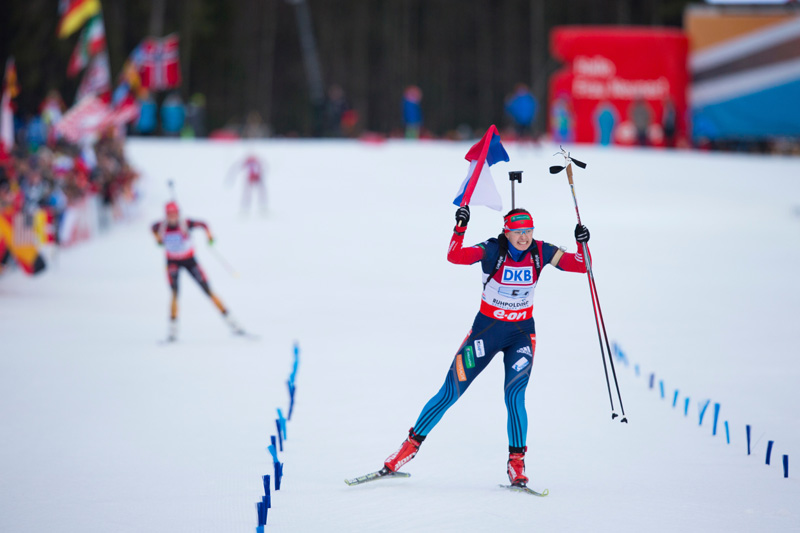
Olga Vilukhina skis across the finish line with the Russian flag, as Franziska Hilebrand (GER) skis it in for second place. Photo: Fischer / Nordic Focus.
The most exciting days in sports are when a team that is down by a seemingly insurmountable margin comes back for the win. Those are the kinds of days that fans live for: when almost as much adrenaline courses through their own veins, as they wonder “will they?”, as through those of the athletes themselves.
Today’s 4 x 6 k relay in Ruhpolding, Germany, was not one of those days. The Russian women were never more than 10 seconds from the lead and skied a consistent, if unremarkable, race. Anchor Olga Vilukhina secured a six-second win by using a single spare round on her own leg.
But even though the Russians still won, it was almost – almost! – one of those days. Fans knew they were in for something special when Evi Sachenbacher-Stehle, an Olympic gold medalist in cross country skiing, took the tag from German teammate Franziskza Preuss.
Preuss had led off with a painful penalty lap in the first prone stage of the race, then also used a spare round in standing. She was in 18th place, almost a minute behind the top team.
Sachenbacher-Stehle was having none of it.
Ekaterina Glazyrina (RUS) in the women’s biathlon relay in Ruhpolding (GER). Photo: Fischer / Nordic Focus.
She may not be a veteran on the range. This is only Sachenbacher-Stehle’s second year competing in biathlon. But you’d never know it. Not only did she use her skiing skills to turn in the fastest course time of all the second-leg skiers, but she also dropped all of her prone targets in quick succession and used a single spare round in standing. Her shooting times weren’t even that much slower than her competitors, who have been doing this their whole lives.
After the prone stage, she had climbed to 13th. Then after standing to sixth, but still over 20 seconds behind the lead.
No matter. By the time she tagged off to Laura Dahlmeier, Sachenbacher was at the front of a four-woman pack, and technically crossed the line first.
Germany was unable to hold onto the lead; Dahlmeier skied and shot impeccably and entered her own exchange even with Russia’s Irina Starykh, but anchor leg Franziska Hildebrand (new to the job) lost just a few seconds to Vilukhina, and Germany ended up second.
It wasn’t as good as a win, but Sachenbacher-Stehle’s exciting performance may have jazzed up the German crowds even more than a more even-keeled winning race would have.
The Germans were without both veteran star Andrea Henkel, who is sitting this race out, and Miriam Gössner, who ended her season early after being unable to fully recover from fractured vertebrae sustained in a bike accident this spring.
The final podium spot went to Norway, which had a major turnaround of its own. Tiril Ekhoff led off with two spare rounds in prone and then two penalty loops in standing, and was left in 22nd place, far behind even Preuss.
But Ann Kristin Flatland began the comeback, taking the team up to 10th, and then Synnøve Solemdal shot perfectly – a rare feat for her – to ski all the way to third as teams around her continued to make errors.
Anchor leg Tora Berger, who won the mass start in Oberhof last week, could have arguably pushed for second place. Instead, she used a spare round in each stage and was in fourth place for much of the race. She eventually buried Ukraine’s Valj Semerenko in the final loop and made up more than 20 seconds on the leaders, but Solemdal could be forgiven if she was a little grumpy with her teammate’s performance on the range.
Ukraine settled for fourth and France used an excellent anchor performance by Anais Bescond to move from 11th to fifth.
The other big excitement came as Switzerland surprised by earning their first-ever top ten in a women’s relay, thus meeting the Swiss Ski standards for an Olympic nomination. The team consists of three sisters, making the trip together even more meaningful (read more).
The Canadian team of Rosanna Crawford, Megan Imrie, Audrey Vaillancourt, and Megan Heinicke finished 12th with a combined seven spare rounds.
Olga Zaitseva (RUS), Ekaterina Glazyrina (RUS), Olga Vilukhina (RUS), Irina Starykh (RUS) celebrate their IBU World Cup biathlon relay victory in Ruhpolding (GER). Photo: Fischer / Nordic Focus.
Andrea Henkel en route to a podium finish earlier this season in Ostersund; today she turned in a strong relay performance.. Photo: Fischer/NordicFocus.
When Germany talked about having a “new” women’s relay team this season, it was assumed that they were talking about one thing: replacing Magdalena Neuner, their World Cup winner and many-time World Champion.
But by the time the women made it to Sochi for the second-to-last World Cup of the season, the relay team had become even fresher. It included one newcomer who was still a junior, and had never expected to compete on the circuit this season – and another in her first year of biathlon, period.
Joining veteran Andrea Henkel and teammate Miriam Gössner were newly crowned World Junior Champion Laura Dahlmeier and former cross country skier Evi Sachenbacher-Stehle. That might seem like a risk, but Germany skated through Sunday’s relay with one strong performance after another and ended up with an eleven-second victory.
“I never imagined such a season,” Dahlmeier marveled in the post-race press conference. “I focused on the World Junior Championships, and I hoped to be good there. After that I heard that I could go to the World Championships in Nove Mesto and I started in the relay, and it was really great for me. Then I heard that I could go to the World Cups in Russia. But I never imagined that it would be possible to be a winner in the relay.”
None of the newcomers were cut any slack, and neither were the veterans. Henkel started things off with one of her strongest efforts of the season. On the podium in Ostersund, Sweden, earlier this season, Henkel had told reporters that her coach had said she was too old to be strong all season. That seems to be an underestimation of the eight-time World Champion, who picked up silver in Nove Mesto and was still plenty quick today.
Henkel used a single spare round and skied the fastest time among all the scramble legs to hand off in first place.
Evi Sachenbacher-Stehle battling Charlotte Kalla of Sweden as she skied to a gold medal in the team sprint at the Vancouver Olympics.
“It’s always fun when you win, but we always put effort into our relay and our races,” she said in the press conference. “So it’s nice that it worked out today. Of course it’s hard work to win, but when it has this prize at the end, we are fine now.”
Next up was Sachenbacher-Stehle, probably the biggest question mark in the lineup. The day before, she had stunned by shooting clean and placing sixth in the sprint. An Olympic gold medalist in skiing, it is her first year of biathlon. Could she repeat the performance?
Not quite – Sachenbacher-Stehle used two spare rounds in standing. But her years of skiing on the World Cup circuit no doubt came in handy as she handled the pressure with aplomb and still tagged off in third.
The deficit was not small; 46 seconds separated the team from the Czech Republic. Germany was right on the tails of Ukraine as they embarked on the third leg.
But Czech racer Jitka Landova, after cleaning prone, had a disastrous standing stage and fell out of the picture completely. Instead, Valj Semerenko of Ukraine took the lead. Gössner hadn’t shot so well herself, skiing a penalty loop after standing, but managed to drag herself within five seconds of Semerenko by the time she tagged off.
And from there, it was a race. Dahlmeier, the rookie, was anchoring for Germany, but the woman she was chasing wasn’t so experienced herself. Mariya Panfilova, like Dahlmeier, has only joined the World Cup circuit in the last few weeks. She placed 13th in the individual race in Sochi, but said that anchoring this relay team – which has done so well in the past – was a serious obstacle.
“For me the biggest challenge in Sochi was not the tracks or the weather but the fourth lap today,” she said. “It was a very high burden for me, and not as successful as it could have been.”
But you wouldn’t have guessed these women’s relative inexperience if you hadn’t been told. Both cleaned the first stage, with Dahlmeier trailing Panfilova out of the range by eight seconds. They battled around the loop; their ski times were separated by less than a second. Despite using a spare round, Panfilova left the range with a scant five second lead.
But Dahlmeier soon charged past her, and went on to claim the win. The other thing that the young Ukrainian might have to worry about was a threat from further back: World Cup leader Tora Berger of Norway had moved into third place.
As it turns out, Panfilova’s coaches made sure she didn’t worry about that.
“To tell the truth I wasn’t aware of the fact that Tora was following me,” Panfilova said in the press conference. “I just knew that when I left she was thirty seconds behind me, and with thirty seconds I was sure to beat her.”
At that point, teammate Olena Pidhrushna leaned over and whispered something in her ear. Panfilova laughed and kept talking.
“Actually, it was twenty seconds!” she said. “I was told thirty seconds, so I felt quite confident.”
Regardless, her lead was safe, and Ukraine took silver while Norway was stuck with bronze.
It was better than they might have hoped for: after Hilde Fenne and Tiril Eckhoff had raced the first two legs, Norway sat in sixth, over a minute and 15 seconds back. Veteran Ann Kristin Flatland cut that deficit to 33 seconds before Berger took over.
“I think it’s very important that every does a good race,” Flatland said. “If everyone has good races, then we can be on the podium. But I’m very glad that Tora is on our team, because she is really strong, especially on the last shooting and the last loop.”
Dahlmeier, though, was almost as strong, skiing only eight seconds slower than Berger on her six-kilometer leg.
“These were good races for me and I hope to be so strong in Khanty-Mansiysk also,” she said.
Sachenbacher-Stehle, too, wondered at her success this weekend. Both hope that next year they can be a part of the Olympic team on these very trails.
“Now I feel for the first time more like a biathlete than a cross country skier,” Sachenbacher-Stehle said. “I’m really happy to be part of the World Cup team now for the last races. I hope that I will be part of the World Cup team for next year too. I will work hard for that, and it will be my goal.”
When that time comes around, Henkel admitted, “maybe we are one of the favorites now.”
Claudia Nystad celebrating her team's performance in the women's 4×5 k relay at the 2010 Olympic Games.
Olympic gold medalist Claudia Nystad has announced she has stepped down from professional cross-country skiing. Nystad’s career marked a very succesful period for the German Ski Association, as she captured not only five Olympic medals but also five from World Championships.
Eventually, the 32-year-old felt her triumph at the Olympic Games in Vancouver turn into another sensation.
“The Games in Vancouver were a highlight of my career,” said Claudia Nystad. “I’ve been thinking a lot in recent months and I found out that it is now time for me to start a new life. After Vancouver, it has become difficult for me to find motivation. ”
Nystad’s decision was not entirely unexpected, but was received with great regret.
“Claudia was one of the best athletes we have ever had with the German Ski Association [DSV],” said DSV Sport Director Thomas Pfüller. “The gap she leaves behind in our team will be for young athletes very difficult to close. Therefore, we would have appreciated it if she had continued for one or two years. However, we respect her decision and wish her success in future life. ”
Eight years after the team’s sensational gold in the women’s relay in Salt Lake City, Nystad together with her team mate Evi-Sachenbacher-Stehle delivered the biggest surprise of the Olympic Winter Games 2010 from the German perspective. In the team sprint, they rolled over the world’s elite and won a gold medal again!
Besides cross-country skiing, Nystad has studied graphic design, and was active in fundraising. In the summer of 2007, Nystad auctioned her Olympic relay gold from Salt Lake City for the benefit of a foundation for abused children. The medal was purchased by the Russian Olympic museum in Smolensk.
For the coming years, the Olympic and World champion has already set new priorities. Instead of endurance, technique and power there will be soon entirely different “sessions” in her timetable–Nystad wants to study Business.
Whistler, British Columbia – Pouring rain, heavy snow, back to pouring rain, classic Whistler weather, and no one was more happy than Justyna Kowalczyk. She plowed her way through the muck to earn the first Polish gold in Olympic cross-country ski history.
Kowalczyk’s Olympics to date had hardly been poor. She won the silver in the sprint, bronze in the pursuit, and skied well in the 15km, and has made no bones about the fact that these courses do not suit her.
But the best female skier in the world over the last two years could hardly be satisfied with a single medal, and a silver at that.
She responded to a furious attack by Marit Bjoergen at the 22km mark, coming back from a 30-meter deficit, and the two skied the last 5km together. Neither could get away, and it all came down to the final 100 meters – the two women charging neck and neck toward the line, 29.9 kilometers down, and still no edge either way.
Finally, with just 20 meters to go, Kowalczyk crept ahead, Bjoergen switching to classic striding in desperation. But her fate was sealed – the gold to Kowalczyk and a silver for Bjoergen, an amazing 5th medal joining her three golds and a bronze.
Two hours before race time, it was raining heavily in downtown Whistler, meaning snow a few hundred meters higher at Whistler Olympic Park, at least briefly. By 11:00 though, it was just rain, falling relentlessly, soaking the already soft track, and making the 38 degrees feel substantially colder.
Classic waxing for the day would be challenging, especially with specter of a return to snowfall hanging low over the stadium. But for the first time at the Olympics, racers would be allowed to switch skis – three times during the race. This added an additional element of strategy to the race. Switching skis potentially means faster skis, especially in the warm wet conditions, but each swap takes time that must be made up.
The rolling Whistler course skied harder than usual with greatly reduced rest due to the slow conditions. Kowalczyk led out early pushing a moderate pace. At several points over the first five kilometers the large lead pack stretched, but never broke, always coming back together on the gradual terrain.
The pack approaching the 10km mark.
There isn’t much more to say about the first half of the race – other than it was miserable, at least from a spectator’s standpoint, cold and wet, the rain showing no sign of stopping. Several top skiers opted for early ski switches, but they quickly closed back on the pack ending any potential drama.
At the halfway mark, a strong pack of a dozen skiers remained at the front, including a trio of Norwegians – Bjoergen, Kristin Stoermer Steira and Therese Johaug as well as Kowalckyk, Aino-Kaisa Saarinen, Charlotte Kalla, Evi Sachenbacher-Stehle and Marianna Longa.
The action heated up as the race moved back through the stadium at the 20-kilometer mark. Kowalczyk, Bjoergen and Saarinen all switched skis and Steira took advantage. She attacked out of the stadium, and continued to push up the big climb.
Steira’s attack looked strong, but Saarinen said that she wasn’t concerned.
With ten long kilometers still to go in the race—and a long flat and downhill section approaching—the lightweight Steira didn’t pose too much of a threat.
The Finn proved correct as Steira’s teammate Bjoergen quickly countered and closed back up. However, the charge did have the effect of finally splintering the group.
After bridging up Bjoergen sat on Steira’s tails for 500 meters before launching her own attack, and what an attack it was.
It looked like she was skiing almost as hard as in her gold medal heat in the sprint. She went by Steira like her teammate was standing still, then continued on her own.
But Kowalczyk refused to go away. More relaxed in her skiing, it didn’t seem like she was working nearly hard enough to keep up. But according to Bjoergen, the gap never made it over six seconds.
“I knew that I had to go fast…because six seconds is not too much,” she said.
For a time the two remained even, Bjoergen unable to extend the 20-meter lead, and Kowalczyk’s efforts to close stuck in neutral.
But slowly but surely the Pole crept up, Bjoergen, checking over her should several times.
By the time they reached the stadium at 25 k, Kowalczyk had done what nobody else here had been able to do in a mass start race: catch Bjoergen.
Saarinen and Steira staged their own surge, unnoticed as the leaders stole the spotlight. They had no chance of regaining contact with Bjoergen, but maintained a furious pace, the bronze medal a fine consolation.
Leaders
At that point, even though she remained in the lead for the next three kilometers, Bjoergen had recognized that it was time for her to pull back a bit and recover, so that she would have some fuel left for a final sprint.
Bjoergen lead Kowalczyk up and out of the stadium, neither stopping for new skis. In just over two kilometers, the pair had opened a gap of a nearly minute on the rest of the field.
Saarinen and Steira came through next, clear of the rest of the chasers. Saarinen stopped to change skis for the third time and Steira took the opportunity to attack once again.
Saarinen acknowledged that the switch was potentially a bit “risky.” But she said afterwards that once she had made the decision before the race to change skis three times, she never considered deviating from that plan—even when locked in a duel with Steira.
Despite the temptation to ski right through the exchange and follow the Norwegian up the first climb, Saarinen said that she had seen enough races come down to the final downhill into the stadium to know that switching skis would be worth it.
“It was the only thing I should do there,” she said. “It’s better to have good glide when you come to the stadium.”
Steira said she had seized the opportunity to make a move, but that in retrospect, she probably could have used a fresh pair of boards herself. Her glide, she said, wasn’t as good on her last lap.
Saarinen struggling with her last ski change
But in the moment, Steira’s decision seemed prescient. Saarinen, hands frozen, struggled to get her bindings clipped on. She started out of the transition area only to lose a ski, dropping more time to Steira as she retreated to attach it.
Saarinen ended up back in 7th, 16 seconds in back of the Norwegian.
Meanwhile, at the front, regardless of what she said after the race, it didn’t look like Bjoergen backed the pace off much. Kowalczyk content on Bjoergen’s tails, dropped off the pace only on the downhill corners.
The rain had finally stopped and the 4,000 fans packed into the stadium area waited with bated breath for the pair to emerge from the woods for the final time. Would it be Kowalczyk or Bjoergen with the legs for a final attack?
The pace remained fast, but Kowalczyk finally shifted into a higher gear, making the pass with just one kilometer to go. Bjoergen wasn’t going anywhere however, and they hit the last climb with fury, matching stride for stride.
Going up the final pitch before dropping into the stadium for the sprint, Kowalczyk and Bjoergen were glued together. Kowalczyk led, but Bjoergen was all but standing on her tails—not giving an inch.
But going over the top, Kowalczyk found just a single ounce more, drawing on the reserves built up by hundreds of hours of training and countless races. She got a few meters on Bjoergen as the pair crested the rise, which widened as the two swooped down the final corner into the stadium.
Bjoergen closed the gap with some furious double poling on the backstretch, then swung out from behind Kowalczyk on the finishing straight. The two drew even, then Bjoergen pulled ahead, then Kowalczyk, and then they were even again. But over the last 20 meters, Kowalczyk edged a few inches forward, and Bjoergen, despite switching to some frantic striding, had no answer.
Bjoergen said afterwards that to win, she needed to be at the front on the last descent, since the slower snow in the outside track kept her from swinging alongside Kowalczyk until the homestretch..
“One track is faster than the other, before the last 100 meters,” she said. “Had I been first, maybe I could take the gold, but today, Kowalczyk was stronger.”
Said Kowalczyk “I am happy and I am tired. It is great to be Olympic champion.”
While Kowalczyk and Bjoergen recovered in the finish area, Saarinen hammered down the finish to take bronze. She caught Steira two kilometers into the final 5km lap, bringing Sachenbacher Stehle and Therese Johaug with her. Steira continued to fight and with Saarinen slipping badly on the big climbs, she pulled back into the lead.
But Saarinen’s fresh skis were faster, and on the easier terrain, she quickly pulled away. The skis were too much for Steira to overcome, and her dream of an individual Olympic medal came to an end.
She dropped back to 8th, with Sachenbacher-Stehle taking 4th. Masako Ishida (JPN) staged a late attack to move up to 5th, her best-ever Olympic result.
Despite her low profile, Ishida was gunning for a medal. She finished 3rd last year in this same event at the Trondheim World Cup, and she spent the day within the top-10.
Kalla was next in 6th – a very good race for the Swede, and Johaug capped a strong Olympics in 7th.
“It was a really great race,” said a glowing Sachenbacher-Stehle. “I did not expect it would be such a great day. The start of the season was not so good for me. I did not expect a good Olympics, but now they have been very good. I have two medals and a 4th place. Now I am very happy. “
Sachenbacher-Stehle noted she had very good skis at the end helping her to a strong finish. “I realized during that race that I might have a shot for a medal. I came up short, but I am so happy about this 4th place.”
Johaug was also pleased saying, “I’m really satisfied with the race today. It was really tough tough conditions, but I fight.”
Johaug called the race “special” noting the accordion action of the pack for the first half. “We would spread out, then catch up – up and down,” she said.
Canada’s Sarah Renner wrapped up an outstanding career, finishing a gutsy 16th.
Kikkan Randall ended her excellent Olympics with a career-best 24th in this distance.
While the Olympic racing is over for this year, both Bjoergen and Kowalczyk are already looking ahead.
29 years old, Bjoergen could easily add to her treasure chest of medals at the Sochi Games, in 2014. But after a career filled with ups and downs that reached its pinnacle in Whistler, the newly-crowned queen of cross country would only commit to racing the 2011 World Championships in Holmenkollen.
“It’s a lot of [work]…to be at the front in cross country, and I think it’s four years to Sochi,” she said. “I’m not sure—we’ll see after Holmenkollen.”
Kowalczyk, at 27, will almost certainly continue on to the 2014 Games, according to Sebastian Parfjanowicz, a Polish journalist covering the Olympics for the TV station TVP Sport.
Parfjanowicz said Kowalczyk is smitten with Russia and its people, and likes the Sochi courses much more than the ones in Whistler—which she criticized heavily.
“She says that [Sochi’s trails] are the best tracks for her,” said Parfjanowicz. “She has spoken with people from Russia who are responsible for the tracks, and tracks in Sochi are going to be very difficult…not like this.”
“Her goal is to be Marit Bjoergen of Sochi,” he said.
Claudia Nystad (GER, R) passing Anna Haag (SWE) on the last lap of the Olympic team sprint finals
The prolonged, brutal physical demands of the team sprint make the event a fickle friend. Just ask Charlotte Kalla and Anna Haag.
After blowing the doors off the eight other teams in their semifinal, the Swedish women came into the gold-medal round as an irresistible force. But they ran head on into the immovable object of Claudia Nystad and Evi Sachenbacher-Stehle, a pair of veteran German women without the speed for the first round, but with the years and years of hard training needed to be able to ski fast late into the day.
In the last two hundred meters of the finals, Nystad showed that she still has some speed in those 32-year-old legs of hers, dropping Haag in the sprint to take her first Olympic gold since 2002—precisely according to the strategy laid out by their coach, former Norwegian superstar Tor-Arne Hetland.
“He…said that Evi is the motor of our team, and I am the sprinter.” Nystad said. “That was the plan, and it fits exactly.”
In their semifinal heat, the Swedish women had simply skied away from the rest of the field, which included Norway, Slovenia, and the U.S. They won that round by over ten seconds, after slowing down considerably in the stadium on their last lap.
In the finals, they looked to be on their way to a repeat win in the same manner when Kalla set a hard pace from the gun.
As the pack made its way around the first uphill corner, France’s Karine Laurent Philippot got tangled up and went down.
Kikkan Randall (USA) chasing
The U.S.’s Caitlin Compton was off to the left of Philippot, and almost made it around unscathed. She said that she had moved to the inside of the turn after seeing an opening.
“Sure enough, the group on the [outside] went down into a little bit of a crash,” she said. “I though, ‘oh, perfect, I missed that.’”
But as one of the fallen women tried to stand up, she took out Compton by stepping on her ski—putting a serious dent in the American medal hopes.
“That pile-up definitely put us back, and kind of changed our game plan from being in the thick of it to having to play catch-up,” Compton said.
Up front, Kalla was stretching things out, with Italy, Germany, and Finland trying to stay close enough to keep her from breaking the race open. Kalla finished her first lap two seconds up on the chasers, which was too little to keep the gap from being swallowed up after the exchange.
Over the next four laps, the racing was tactical, with Sweden, Germany, Italy, and Russia forming a lead group. As they entered the final lap, a smooth tag by Sachenbacher-Stehle left her teammate Nystad with
Charlotte Kalla (SWE) leads Evi Sachenbacher-Stehle
a small lead over Haag, and the German appeared to put in a surge heading up the initial hill. But Haag fought back, retaking the lead over the top.
Up the final climb, Haag poured it on, doing everything she could do put a gap on Nystad. But the German doggedly held her ground, never letting a gap widen to more than a single meter. Confident in her closing sprint, Nystad knew that all she had to do was keep Haag close.
“I had to focus on the last, long stadium loop,” Nystad said. “That was the plan.”
Nystad actually ended up starting her sprint a little early—before the final bend that led into the finish straight. Halfway through, she said she was out of gas.
“I was on the limit the last sixty meters. At the end, I though everybody could pass me—I felt s—y,” she said. “But nobody came.”
Haag just didn’t have the speed to match Nystad at the finish. She said that could have been because she used too much energy at the start of the heat.
“We fought really hard from the beginning, and that cost us,” said Haag.
The Russian team of Natalia Korosteleva (L) and Irina Khazova (R) after winning a bronze medal
Behind the leaders, Russia trailed in uncontested for bronze, while Italy and Norway each followed a few seconds later.
Quietly, since the crash on the first turn, the American women had been moving up, and closed in on the Canadian team just as the pair entered the stadium some 45 seconds after Nystad and Haag.
In a knock-down, drag-out finishing sprint, Kikkan Randall just bested Sara Renner for
Canada's Sara Renner helping her team to sixth place
sixth place—and bragging rights for the title of fastest women’s sprint team on the continent.
If not for the crash, Randall said that she and Compton had the fitness to compete with Norway and Italy, if not the top three teams.
“It’s too bad we had that bad luck at the beginning, because I would have liked to see if we could have stuck in there,” she said.
For the Germans, it was a nice bookend to a pair of Olympic careers that began with promise eight years ago in Salt Lake City, where the German women won in the distance relay. Sachenbacher-Stehle, especially, has struggled through some rough seasons—she has just two individual World Cup podiums since 2006—but today it all came together again.
“You believe this, you work for this,” Nystad said, “and in the end, it works out, and that feels pretty good.”