
There’s a lot of reasons to want to win the American Birkebeiner, the 50 kilometer point-to-point ski marathon from Cable to Hayward, Wisconsin.
There’s the satisfaction of beating one of the best-assembled U.S. distance fields: racers with marathon credentials will fly in from Alaska, the Pacific Northwest, or New England, plus there’s always the rabid Midwest contingent.
There’s also the glory that goes along with winning the Birkie. In one part of the country, the title arguably carries more weight than winning a national championship.
And finally, there’s the money. The Birkie doles out a whopping $7,500 for the winner, scaling down to $1,000 for sixth place. In American ski terms, that’s a fortune, enough to bankroll an entire season of racing, or to turn the pursuit from a wallet-draining hobby to something that approaches a real career. That kind of money just doesn’t happen.
So every year, Americans line up in Cable, eager to capture those three things that come with a Birkie title. Because the Birkie is part of an international marathon circuit, some European racers always show up – and are always in the mix for a win. But in 2012 Tad Elliott led a U.S. podium sweep, turning the tide after two years of European victories.
At the start this year, it was clear that the Americans would have to fight for the title.
“I did know,” said Bryan Cook, who races for Craftsbury. “[Fabio] Santus won a couple of years ago, so I knew him and I knew he raced with a couple of the other Italians… I recognized the Czech, Martin Koukal as well – he has a pretty distinctive style.”
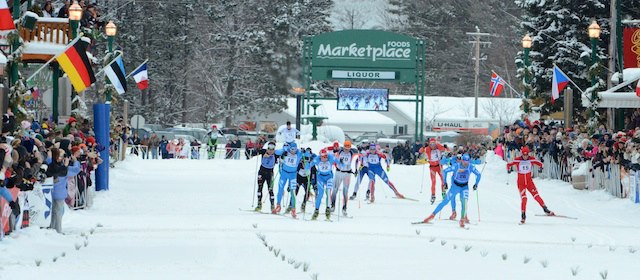
By the time the lead pack of 15 skiers turned on to the finish stretch in Hayward, the teamwork and tactics of the Europeans had overwhelmed the Americans in the group.
A four-strong squad of Italians swept the top four places, led by Sergio Bonaldi, a 34-year old from the
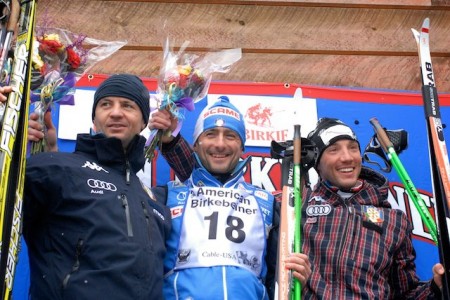
northern city of Bergamo, with Fabio Santus and Alan Martinelli rounding out the top three. Two Czech skiers claimed fifth and sixth, consigning Matt Liebsch, the first U.S. finisher, to seventh—just out of the money.
Were the Americans frustrated that they hadn’t hit the podium? Heck yes.
Were they bitter, though? Not too much. In a race that many described as “fun”, the top six finishers were within a second of each other, and the top twelve within five seconds of the winning time, 2 hours, nine minutes, and 18.1 seconds, attributed to both Bonaldi and Santus on the results sheet.
“It’s good to be mixing it up with them,” Liebsch said. “I like that they come over and it raises the level of the race–if it was just Americans out there, all of a sudden that would have been my responsibility or somebody else’s…it was kind of nice to play defensively.”
But, he more or less added: “Ideally, they would have come over, and we could have kicked their behinds.”
Give an Italian a Hand
As the race left Cable on a base of freshly packed new snow, a group of four Italians moved to the front and began to take long, hard pulls that left much of the field hanging on, but unable to respond.
“It was pretty clear right from the beginning how strong the Italians were,” Cook said. “For the most part, we were just at the back. There wasn’t much we could do to help each other.”
The pace wasn’t consistent; Cook said that the leaders would push up and over the tops of the hills, and then sometimes slow down—ratcheting up their speed to drop other skiers off the back of the pack, then allowing things to come together again.
“The idea was to keep the speed high, not to have too many on the final sprint,” Bonaldi told FasterSkier through a translator.
Bonaldi had been sick last week, and tried to stay in the draft behind his teammates for the first part of the race. The Italian, who currently sits fourth in the world marathon standings, was keeping an eye on Frenchman Benoit Chauvet—his closest competition on the circuit.
Bonaldi said that the Italians didn’t have a coordinated strategy. “Everyone’s competing for himself, but if they can, they give an Italian a hand.”
But the Americans saw things differently—the Italians’ grip on the front of the race, Liebsch said, was tight, as one of the Russian competitors in the front group learned.
“He tried to get around the Italians and he ended up breaking his pole,” Liebsch said. “They were pretty
protective of the front of the lead the whole race. When I was up there and near the front, I was getting my stuff stepped on, so I chilled out and just skied pretty defensively.”
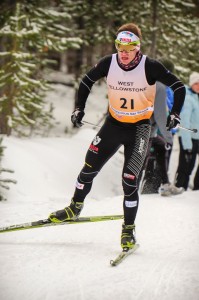
So, coming across the lake towards Hayward, with 49 kilometers down and one to go, there was still a sizeable pack at the front. Of fifteen men, just five were American. Liebsch and Cook–who described himself at that point as “hurting pretty good”–were joined by Patrick Johnson of Idaho’s Sun Valley team, Johnson’s coach Colin Rogers, and Brian Gregg of Wisconsin’s own CXC squad.
At that point, even more than before, Liebsch said he knew he had his work cut out for him.
“We brought a lot of fast sprinters to the line,” he said. “I think I could have pushed hard to try to get up in that mix a little bit and a better spot, but I was nervous about breaking a pole. And I definitely didn’t want to break a pole.”
As the field hit the finishing lanes, the Italians spread out four abreast and dueled each other to the finish, sweeping the first four places. The rest of the men had to simply battle behind them, unable to pass. One of the two Russian skiers tried to get into a position where he could have spread to an open lane.
“If he could have had a free shot, I think he could have lit everybody up,” Liebsch said.
He couldn’t, though – and neither could anyone else. Koukal and Czech teammate Petr Novak edged Liebsch, Chauvet, and Johnson just behind the Italians, with four others all crossing the line within five seconds.
The finish was so close that Bonaldi, who had been overtaking his teammates, didn’t learn he had won the race until 20 minutes after his boot crossed the line, when a race official informed him that he’d edged out Santus.
Swept Out
Liebsch was acutely aware that a fraction of a second could have put him in the top six and earned him $1,000–and that two seconds could have earned him the full $7,500.
“The Birkie is, like, the biggest payout race,” Liebsch said. “For domestic U.S. racers, this is our one shot to make a little bit of income off of ski racing, so to get swept out of that and have all six spots go to Euros, that’s definitely tough.”
Liebsch and others noted, though, that the Europeans put more of a premium on long races than most American athletes, who typically tailor their training for shorter distances.
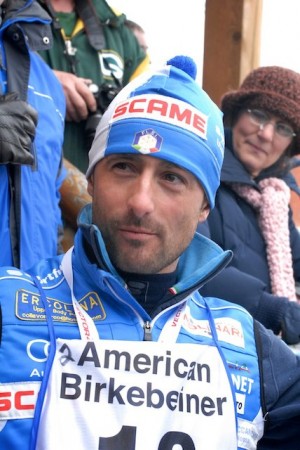
Bonaldi, for example, had already won one marathon this year before the Birkie, and placed fourth in another.
“That’s why they’re here—they do all these long marathons,” said Pepa Miloucheva, the coach of the Craftsbury team. “For us, it’s just one of the races.”
The Italian group clearly arrived in Wisconsin with a plan. According to Scott Wilson, who hosted the team at his lakeside resort in Hayward, the squad had a special system for ski testing, and they also arranged for apartment-style accommodations so that they could cook their own food.
The real secret to their success, though? Wilson seemed to think it was wine (and beer), which he observed the Italians imbibing with meals.
“That seemed to be a part of their routine,” he said. “And we could probably learn from them.”

