From the FasterSkier archive — posts syndicated from athletes’ and coaches’ own blogs between 2004 and 2012, kept online as published. Current coverage is at fasterskier.com.
The Nordic Ski Club of Fairbanks (NSCF) is looking for an energetic and enthusiastic individual to lead its junior racing and training program, Fairbanks Cross Country (FXC) as Head Coach. This person would also serve as the Director of Skier Development, overseeing FXC and the club’s other instructional programs.
Salary starts at approximately $45,000, plus reimbursements for retirement and health care costs, depending upon experience. The Head Coach/Director of Skier Development reports directly to the Skier Development Oversight Committee, which committee reports to the Nordic Ski Club of Fairbanks Board of Directors.
Ideally, the candidate who is selected would arrive in Fairbanks to start leading the program by late summer. NSCF/FXC will assist with travel and/or moving costs.
Interested parties should send letters of interest and resumés to administrator@nscfairbanks.org. The position will remain open until filled. A selection committee from the NSCF will conduct interviews via telephone with qualified candidates.
Information about the program, the club and the community:
FXC has been in existence for 12 years, growing in that time from a program with less than a dozen skiers to a program with 100 or more skiers involved in seasonal and year-round programs at the Competition, Prep, and Junior Development levels, as well as a modest Masters program. Besides the head coach there is one year-round assistant coach as well as part-time coaches. The club’s other instructional programs include the Junior Nordic program for skiers up to middle-school age, and an Adult Lessons program.
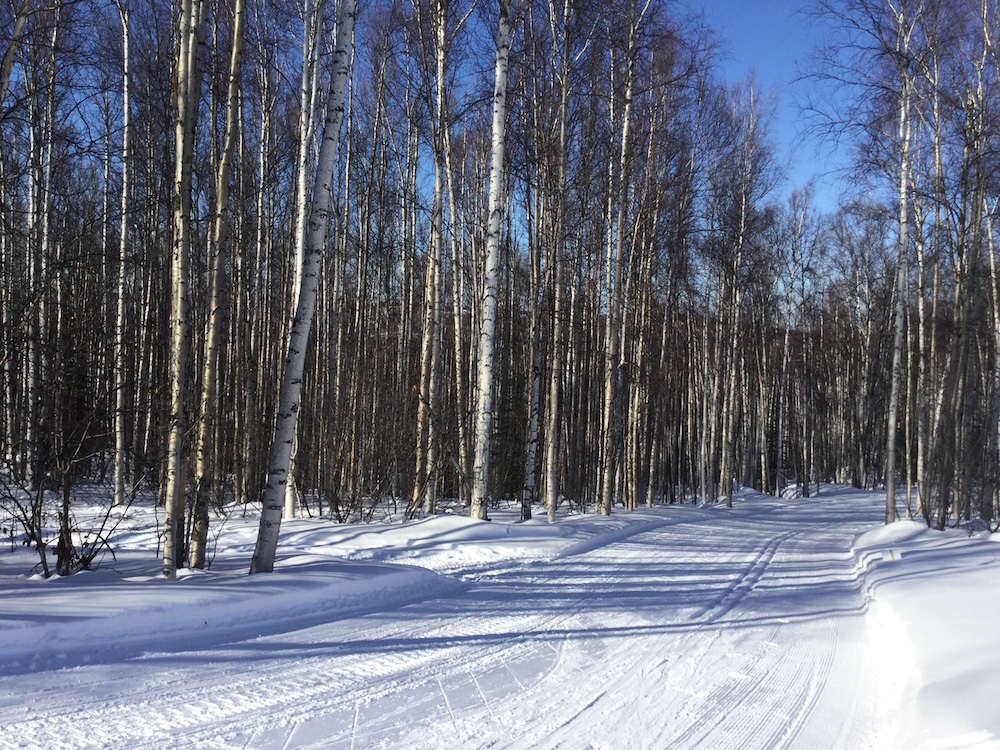
Fairbanks is blessed with one of the longest ski seasons in the nation on natural snow – from late October to late April – at an elevation of under 1000’ above sea level. The home venue for the program is Birch Hill Recreation Area, known around the US for its outstanding trail network and world class facilities.
FXC has dedicated space in buildings at Birch Hill. FXC also owns a 2016 passenger van and trailer for hauling gear. FXC skiers participate in a full schedule of local races, as well as JNQ races elsewhere in Alaska. Top skiers in the program participate in US National Championships. FXC coaches are part of the coaching staff on the Alaska Junior National Team.
The 50-year-old Nordic Ski Club of Fairbanks has approximately 1000 members and is in sound financial condition. It has provided strong support for cross country skiing in general and for FXC in particular since its inception in 2006. Fairbanks also has a strong tradition of high school cross country skiing. i migliori operatori di casinò italiani
There are exceptional opportunities for a wide variety of exciting outdoor recreational opportunities in and nearby Fairbanks. Fairbanks has a full array of dining, entertainment, lodging and shopping options and is the home of the University of Alaska Fairbanks, which has a cross country ski team. Fairbanks has excellent connections by passenger jet to major airports throughout the US. The population of the Fairbanks North Star Borough is approximately 100,000.
The Nordic Ski Club of Fairbanks (NSCF) is looking for an energetic and enthusiastic individual to lead its junior racing and training program, Fairbanks Cross Country (FXC) as Head Coach. This person would also serve as the Director of Skier Development, overseeing FXC and the club’s other instructional programs.
Salary starts at approximately $45,000, plus reimbursements for retirement and health care costs, depending upon experience. The Head Coach/Director of Skier Development reports directly to the Skier Development Oversight Committee, which committee reports to the Nordic Ski Club of Fairbanks Board of Directors.
Ideally, the candidate who is selected would arrive in Fairbanks to start leading the program by late summer. NSCF/FXC will assist with travel and/or moving costs.
Interested parties should send letters of interest and resumés to administrator@nscfairbanks.org. The position will remain open until filled. A selection committee from the NSCF will conduct interviews via telephone with qualified candidates.
Information about the program, the club and the community:
FXC has been in existence for 12 years, growing in that time from a program with less than a dozen skiers to a program with 100 or more skiers involved in seasonal and year-round programs at the Competition, Prep, and Junior Development levels, as well as a modest Masters program. Besides the head coach there is one year-round assistant coach as well as part-time coaches. The club’s other instructional programs include the Junior Nordic program for skiers up to middle-school age, and an Adult Lessons program.
Fairbanks is blessed with one of the longest ski seasons in the nation on natural snow – from late October to late April – at an elevation of under 1000’ above sea level. The home venue for the program is Birch Hill Recreation Area, known around the US for its outstanding trail network and world class facilities.
FXC has dedicated space in buildings at Birch Hill. FXC also owns a 2016 passenger van and trailer for hauling gear. FXC skiers participate in a full schedule of local races, as well as JNQ races elsewhere in Alaska. Top skiers in the program participate in US National Championships. FXC coaches are part of the coaching staff on the Alaska Junior National Team.
The 50-year-old Nordic Ski Club of Fairbanks has approximately 1000 members and is in sound financial condition. It has provided strong support for cross country skiing in general and for FXC in particular since its inception in 2006. Fairbanks also has a strong tradition of high school cross country skiing.
There are exceptional opportunities for a wide variety of exciting outdoor recreational opportunities in and nearby Fairbanks. Fairbanks has a full array of dining, entertainment, lodging and shopping options and is the home of the University of Alaska Fairbanks, which has a cross country ski team. Fairbanks has excellent connections by passenger jet to major airports throughout the US. The population of the Fairbanks North Star Borough is approximately 100,000.
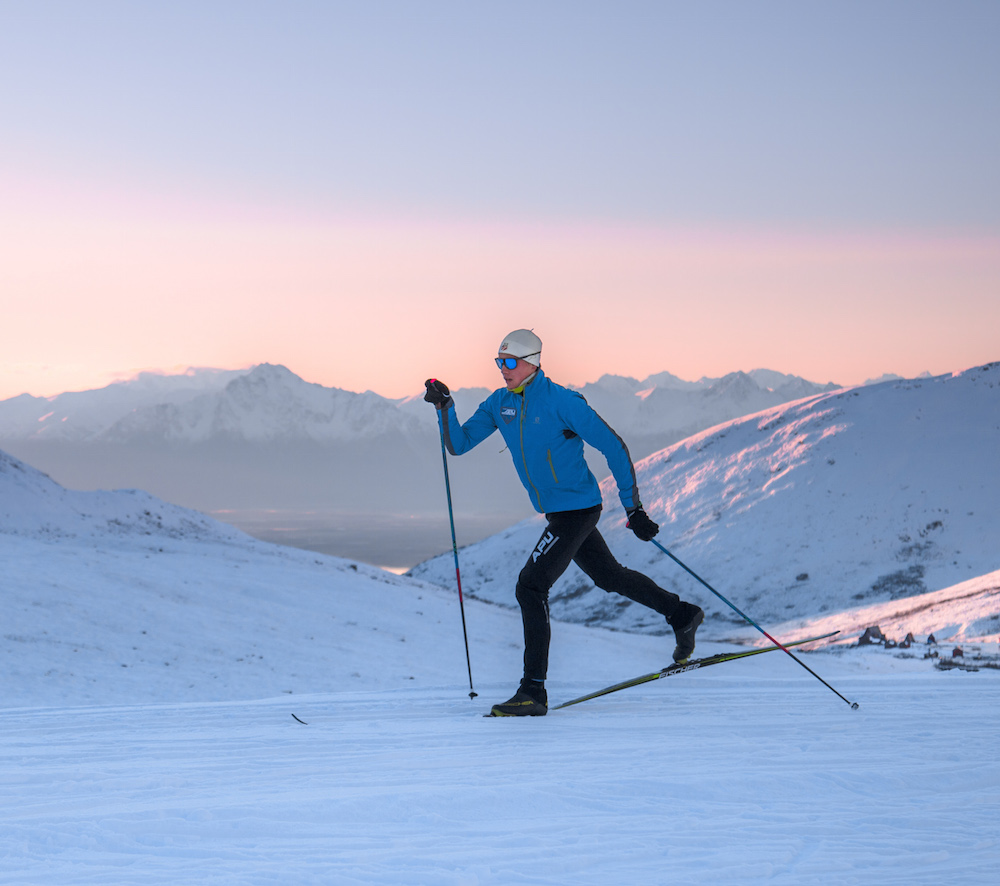
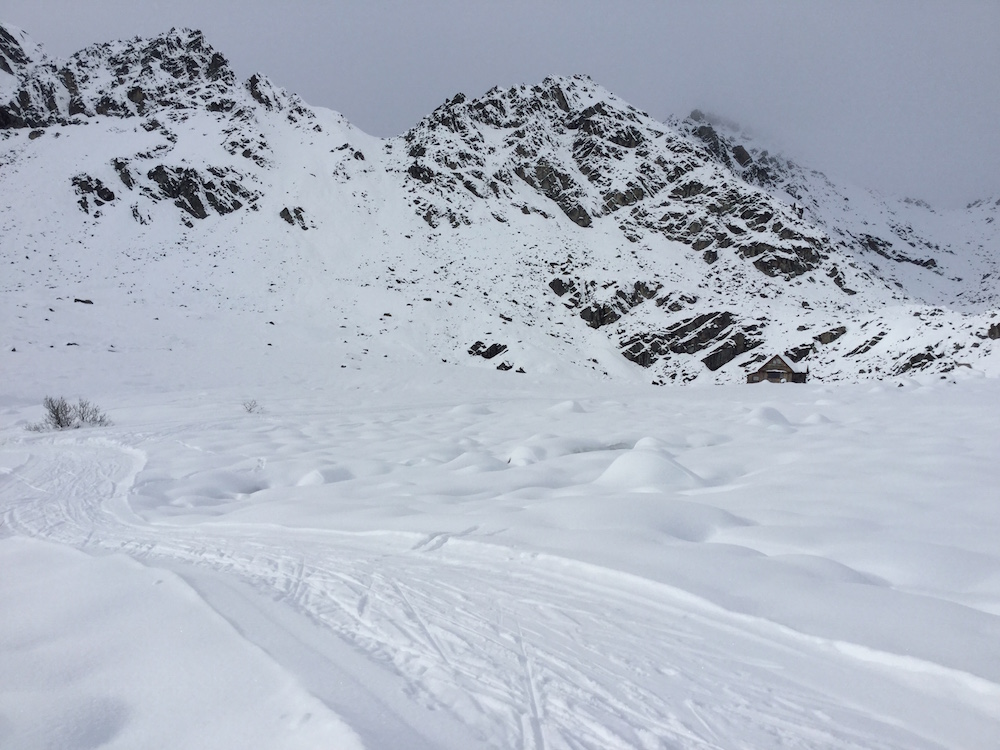
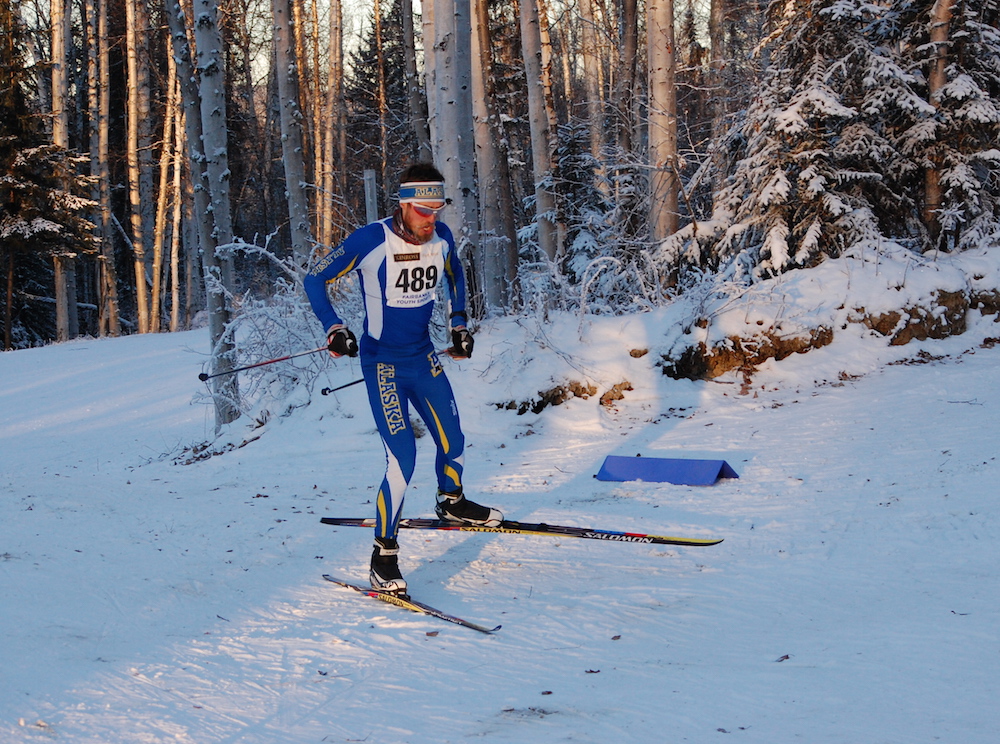
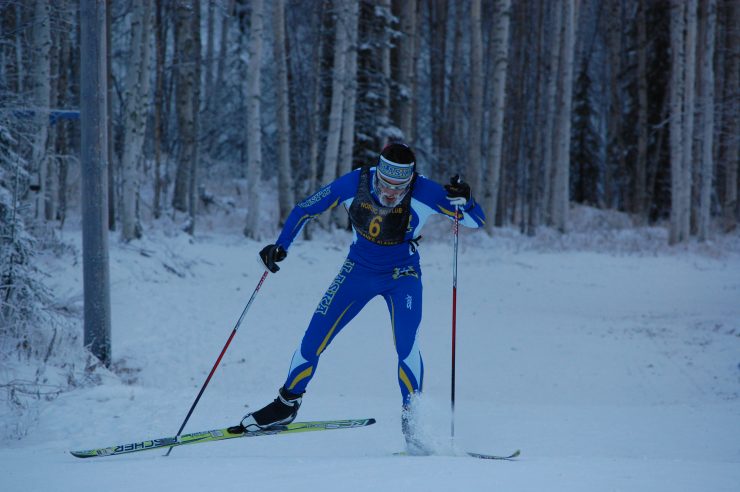
Alaska Pacific University’s Luke Jager strides it out at Hatcher Pass, above Palmer, Alaska, on Oct. 19, 2017. (Photo: Ophira Group)
Note: We’re seeking submissions for this year’s “Where The (Skiable) White Stuff Is” early snow report. If you know where there’s November or even October skiing in the U.S. or Canada, please write us with details (When does it open or how long has it been open? How many groomed kilometers are there? Is there snowmaking? Any special events planned, like American Thanksgiving camps? Anything else we should know?) and original photos at info@fasterskier.com with the subject line: “Fall Skiing”. Deadline for submissions is Nov. 3.
***
HATCHER PASS, above Palmer, Alaska — Winter is in the eye of the beholder, but whatever you’re looking for to mark the skier’s favorite season, this spot at 3,500 feet in the Talkeetna Mountains probably has it.
Seven kilometers of groomed trails? Check. Literally Extra Blue conditions? Check. A nearby lodge with a fireplace serving up hot chocolate and sweeping mountain views? Check. Fresh snowfall, gorgeous alpine vistas, and a side dose of Alaskan mining history? All of the above. Judging by the cars in the parking lot this weekend, there are plenty of skiers in southcentral Alaska who are ready for winter to be upon us.
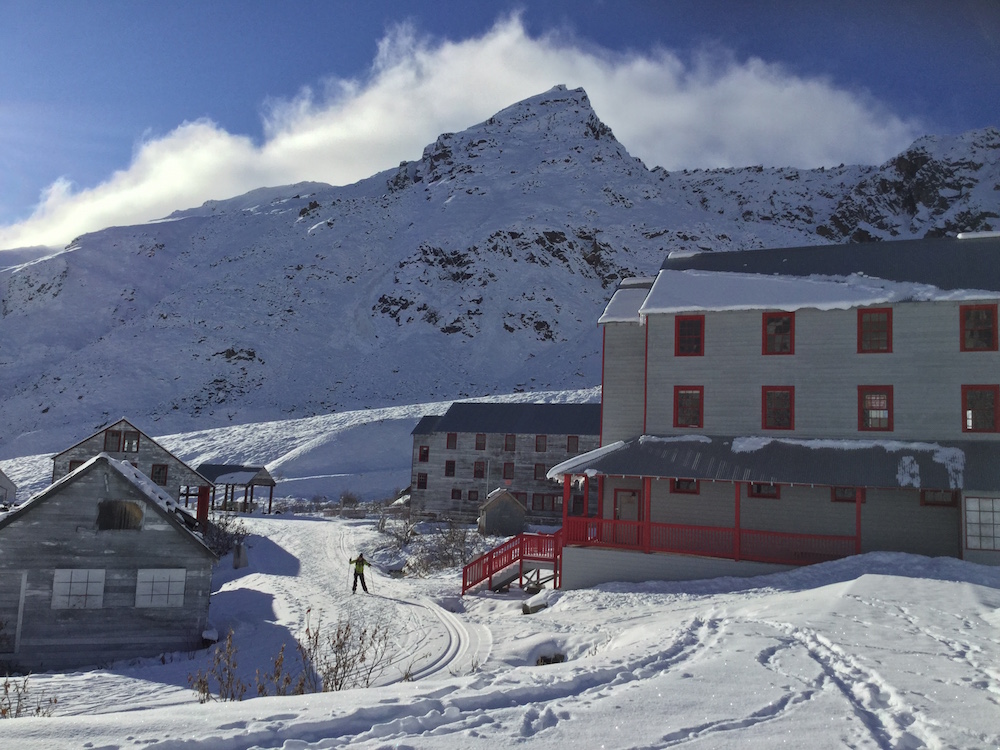
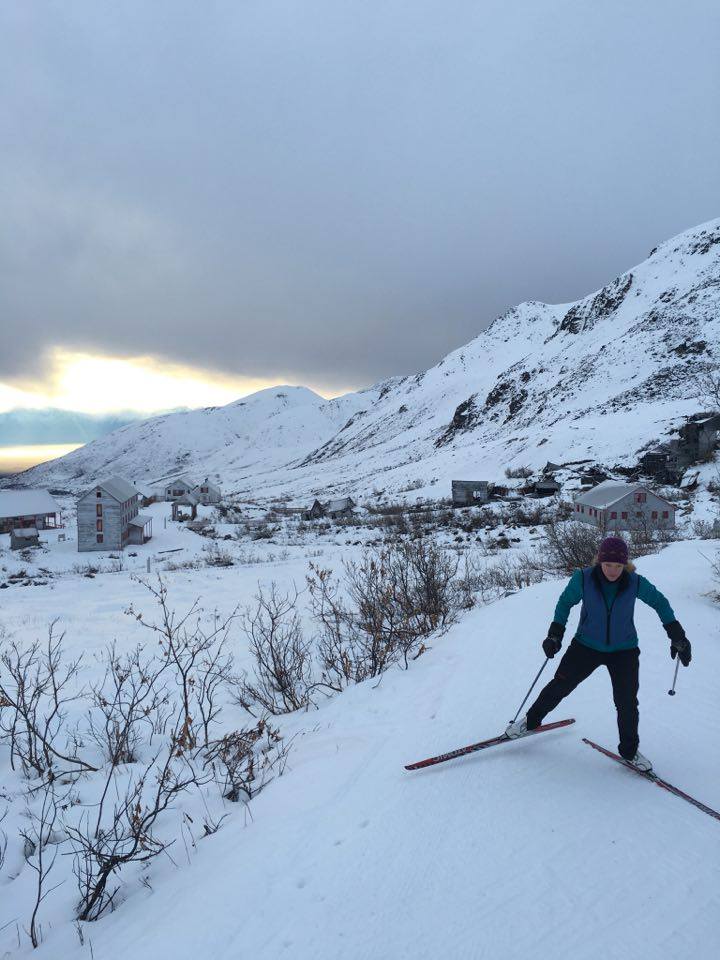
Skiing through the historic mine buildings at Hatcher Pass on Oct. 18. (Photo: Gavin Kentch)
Skiing at Hatcher Pass began in earnest roughly ten days ago, when the cold rains of October finally turned to snow up high. When the weekend of Oct. 14 dawned sunny and gorgeous, the pilgrimage was on, with skier-set classic tracks throughout the area by Saturday afternoon. Formal grooming followed on Monday morning, courtesy of the Mat-Su Ski Club. Alaska Pacific University (APU) skiers have been making the trek out to the Matanuska–Susitna Valley, roughly an 80-minute drive from Anchorage, most days since (including Sadie Bjornsen, Erik Bjornsen, Reese Hanneman, and Eric Packer, among others). For the APU Elite Team, the #roadtopyeongchang runs through Hatcher Pass, whether skiing or getting a jump on ski testing.
The ca. 2 k, 200-meter-elevation-gain continuous climb (so, not exactly FIS-legal) from the lower parking lot to the highest point on the current course doesn’t hurt for training, either. No word if the climb popularly known for the last four years as “Sochi Hill” has been renamed for the current Olympic cycle, though.
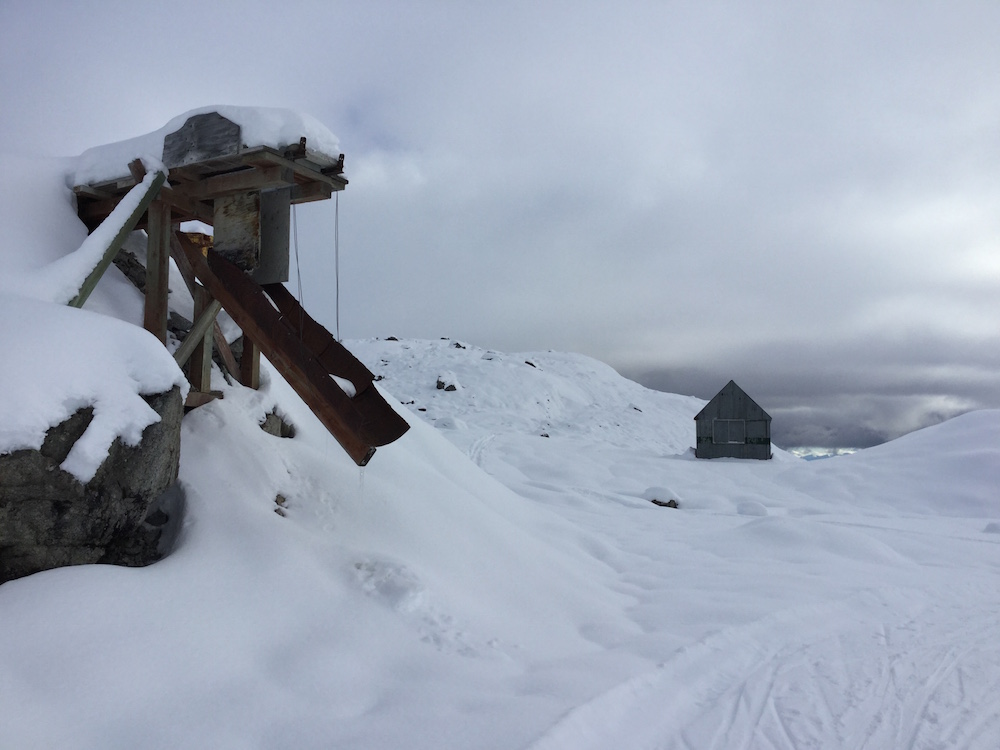
Old mining equipment borders the ski trails at Hatcher Pass on Oct. 18. (Photo: Gavin Kentch)
But Hatcher Pass isn’t just a superb early-season training venue. It’s also a truly lovely place to spend time. John Updike famously wrote of Fenway Park that it was “a lyric little bandbox of a ballpark,” a description that lends itself surprisingly well to the central-mine area that the ski trails wend through. In that vein, University of Alaska Anchorage English professor and local masters skier Shannon Gramse later set the scene by describing the historic mine buildings and detritus left over from the area’s early-20th-century mining heyday, then wrote, “Imagine skiing through an Old West ghost town turned collectible Christmas village.” By any standard, Hatcher Pass is a very special place.
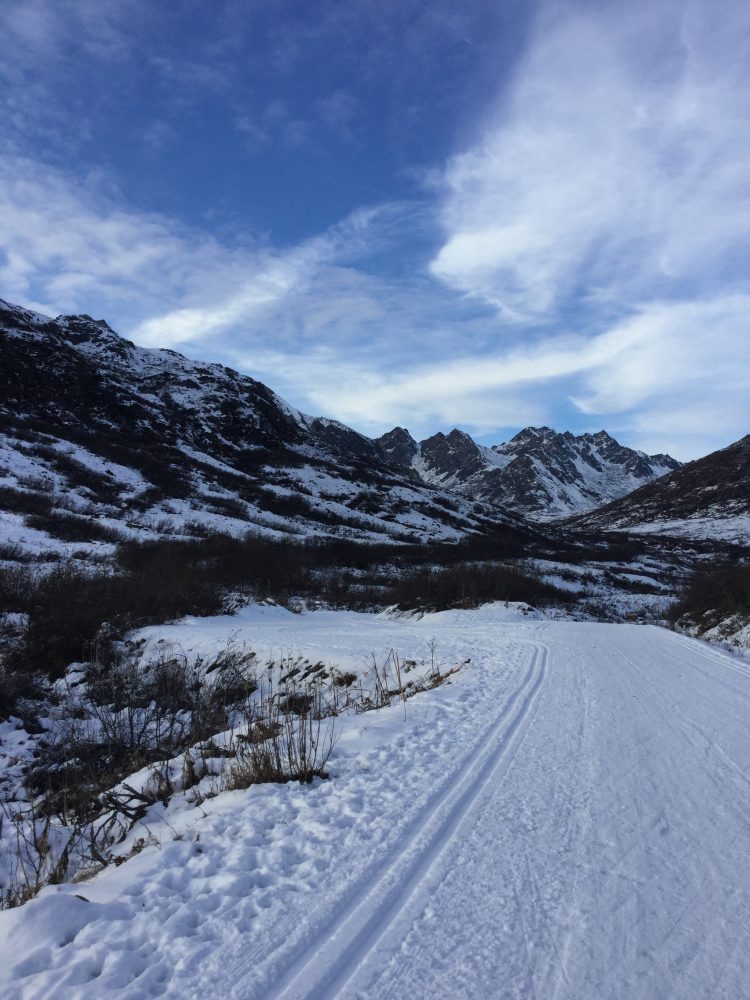
Mountain views from the groomed trails at Hatcher Pass on Oct. 18. (Photo: Gavin Kentch)
This year’s Oct. 16 start to grooming at Hatcher Pass was “one day later than average,” Mat-Su Ski Club board member Ed Strabel told former FasterSkier reporter Nat Herz, now of the Alaska Dispatch News.
Three hundred miles to the north, winter is also right on schedule at Birch Hill Ski Area in Fairbanks. Longtime area race director John Estle (who was also chief of competition for some of the last FIS World Cup races held in this country, in 1984, as well as head coach of the U.S. Ski Team from 1990–1993, as well as having a role in pretty much anything involving skiing in interior Alaska in the last 35 years) wrote in an email on Thursday, “The ground is frozen, we’ve had 3″-4″ of snowfall, and the groomers have rolled a few k’s of trails.”
In a follow-up note to FasterSkier, Estle clarified that this date for the first grooming was “about average” for Fairbanks. “It’s on the early end of average for the past few years, but right in the long-term average which is October 15-25. But that is an anecdotal average with no scientific basis.”
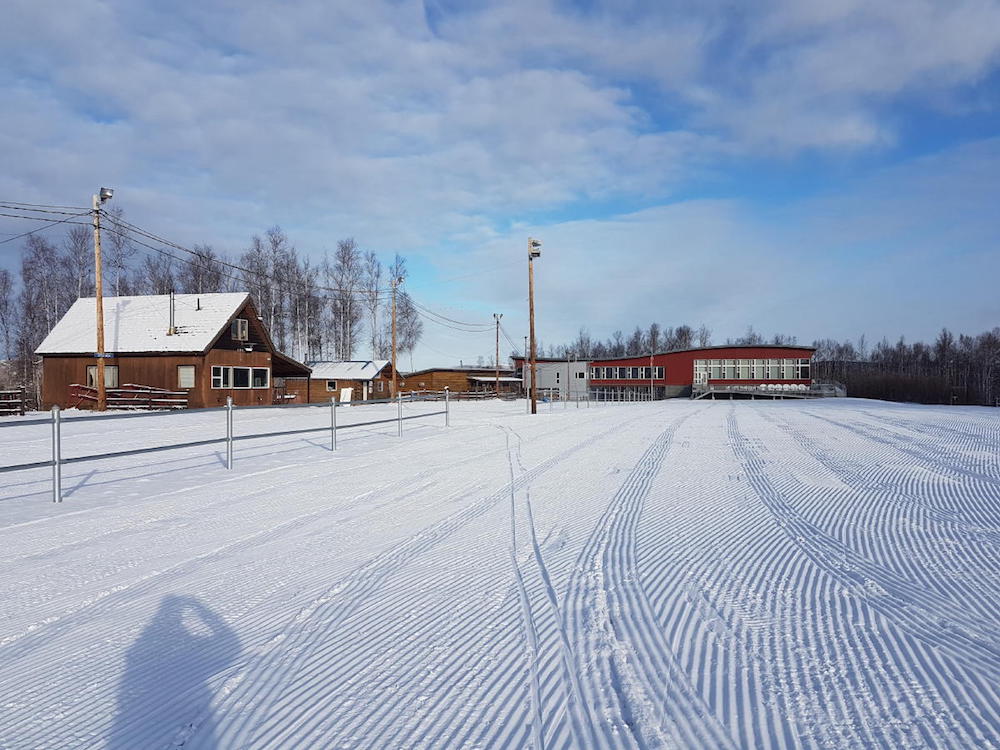
The stadium at Birch Hill Ski Area in Fairbanks, Alaska, on Oct. 19, 2017. (Photo: John Estle)
(It should be noted that Estle’s sense of anecdata is close to unassailable, given his knowledge of Fairbanks skiing over the past four decades.)
Current trail conditions for Birch Hill should be available here soon. Current conditions for Hatcher Pass (and some other areas as well) may be found here.
The Mat-Su Ski Club plans to hold its season-opening race, the Race to the Outhouse #1, on Nov. 4. It would potentially be the first ski race in this country of winter 2017/2018… except that Fairbanks has set the first race of the Wednesday Night Race Series for Nov. 1. At least in Alaska, winter is upon us.
***
Reminder: Send us the snow/grooming report and other relevant information concerning your favorite ski spot. If there’s skiing in November, we want to hear about it! Email info@fasterskier.com with the subject line “Fall Skiing” by Nov. 3.
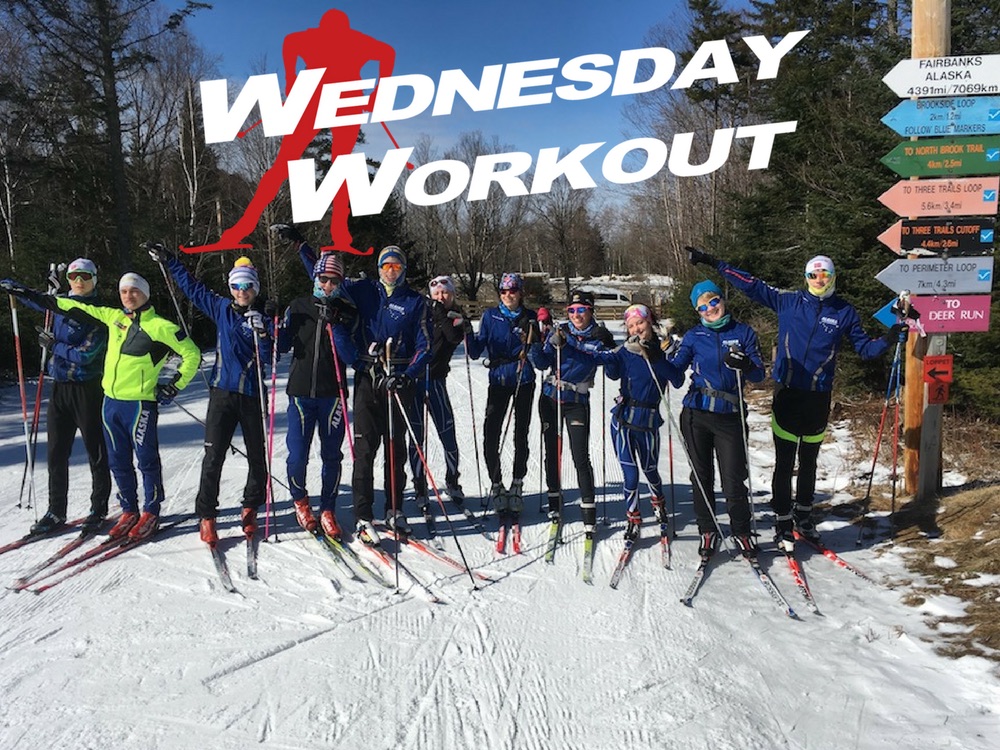
The NSCF-FXC crew points toward home (some 7,000 kilometers away) at 2017 Junior Nationals this past March in Lake Placid, N.Y. (Photo: Peter Leonard)
The following workout comes from Alasdair Tutt, interim coach for the Nordic Ski Club of Fairbanks/Fairbanks XC (commonly known as NSCF-FXC). Tutt recognizes that while training in central Alaska has its perks (like reliable snow), it can also be tough for skiers to excel outside of their familiar environment (like on significantly warmer snow). This is true for anyone racing in variable climates and at both high and low elevations across North America. So for NSCF-FXC, the goal is to get develop speediness for races in the lower 48.
***
Training in Fairbanks, Alaska, may have many advantages: skiable snow for six months a year, tough homologated loops at Birch Hill and the endless wilderness to explore regardless of the season. However, it presents many challenges for the 33 junior athletes who are part of our summer Comp Team when they compete out of town in temperatures often >30 degrees warmer than the average Fairbanks day.
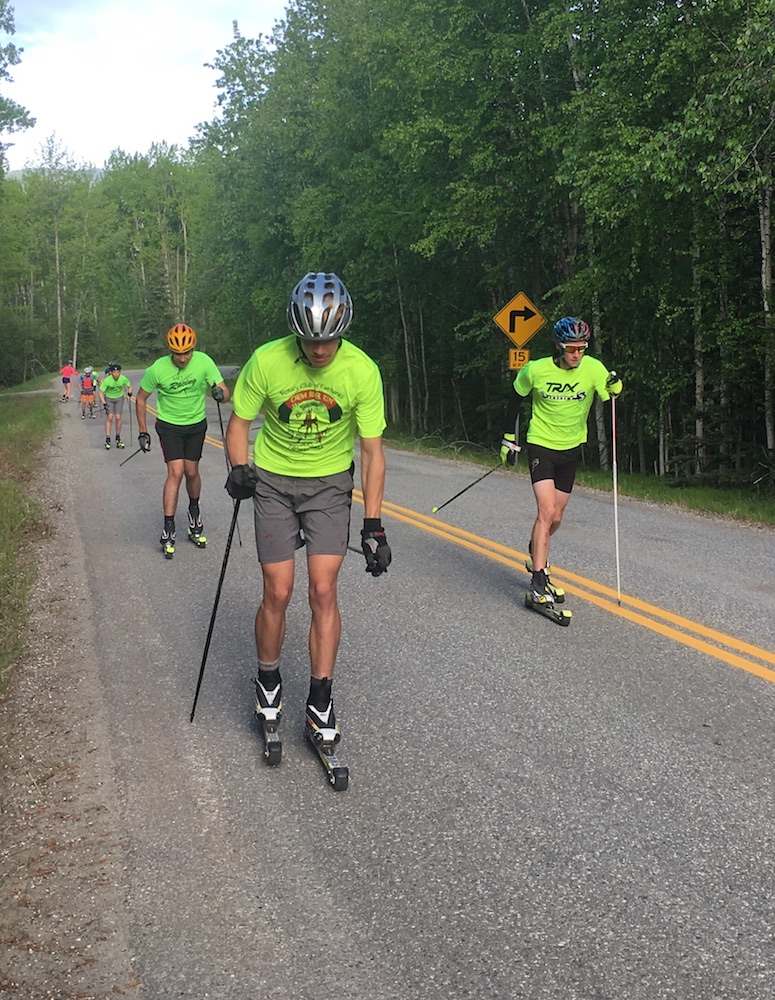
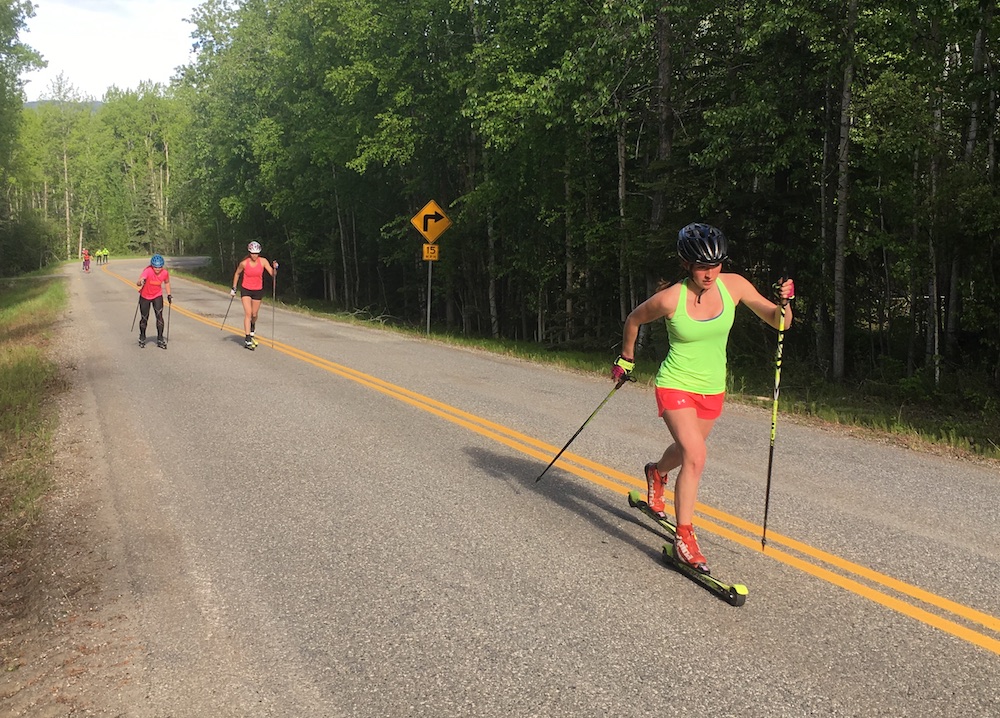
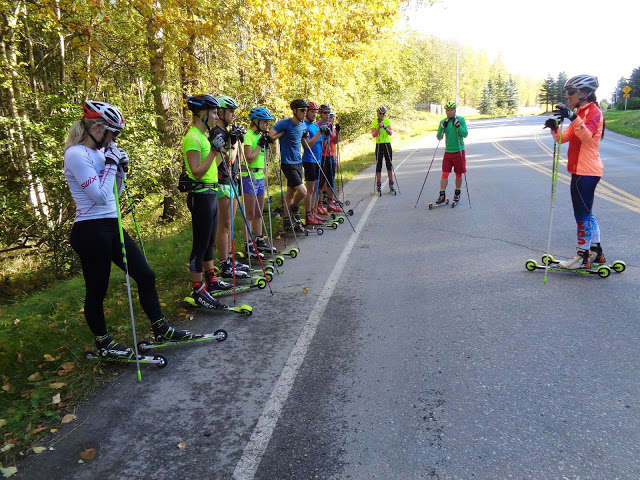
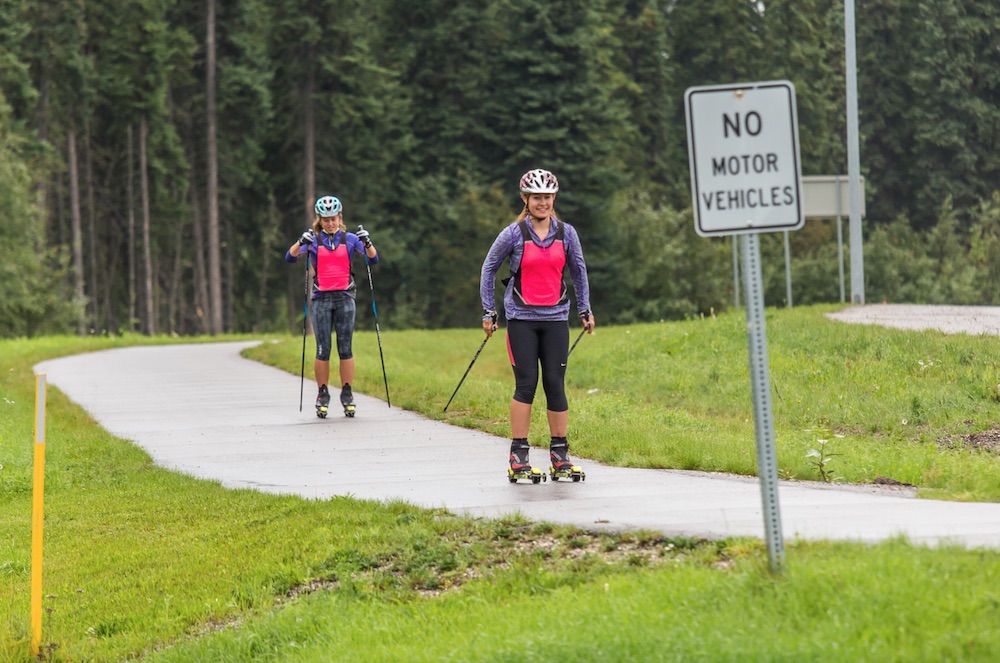
(From left to right) NSCF-FXC skiers Ben Keener, Ari Endestad and Ti Donaldson work on diagonal striding during a summer workout near Fairbanks, Alaska. (Photo: Alasdair Tutt)
This workout is designed to counteract the effect of always skiing on slow snow and steep terrain at Birch Hill mid-winter so the athletes can be competitive in faster conditions at the U.S. Cross Country Championships (a.k.a. Senior Nationals) or Junior Nationals. It can be completed skating, bounding, double poling, or diagonal striding. We have primarily focused on using it to improve diagonal striding this summer.
We have no problem getting our skiers to be strong or have a high-aerobic capacity, but we often struggle to further develop the neuromuscular capacity of our skiers once the snow hits the ground. This can also be true when our athletes compete in high-school cross-country running, as their training can become pretty monotonous and low volume unless they make a considerable effort to add their own ski training on top of the running. This workout is applicable to all athletes though, as I believe all junior athletes need to first develop their capacity to go fast before learning to use that speed over a longer distance.
The workout: Alaska-Specific (Speed) Training
Warmup: Preparation and Mobility
Our warmup is typically 20-30 minutes long consisting of about 10 minutes easy skiing to our start point, followed by 10-15 minutes of mobility and preparation exercises specific to the technique being performed on the day (we do this workout skating, double poling and striding depending on the goals of the team as a whole from last year)
Intervals: 2-3 sets of 3-5 x 150-250 meters at 2-3 k pace, and 50-80 m at 400 m pace over a course with two separate hills — not so steep as to lose full range of motion, but to challenge the athletes’ balance a little. Then, take a short recovery to return to the start of the next interval.
The course should cover around 150-250 m for the longer interval and 50-80 m for the shorter one on a gradual hill that is typically able to either be climbed in double pole or diagonal striding to induce a high speed.
First do the ~200m interval at a speed similar to how you would a hill in a 2-3 k event, then after a short recovery, complete the ~60 m interval at a speed just below that of an all out sprint (about 400 m pace). The idea being to have a repeated sprint stimulus and a clear difference in pace between the short and long speeds, without exhausting their capacity in one set.
Recovery: About 4-6 minutes active recovery between sets.
Between the longer and shorter sprint, just a rolling recovery back to the base of the hill repeated 3-5 times. Between each set there is a 4-6 minutes of active recovery with a chance to grab a drink or watch some video of technique.
Cool down: 30-45 minutes of easy rollerskiing back to the starting location.
Technique Notes: We are looking for full extension through the arms to the back, a pendulum arm swing to return and a relaxed body position with hips over the heel when gliding on a ski during these intervals, as it quite easy to get into a posture with limited range of motion through the shoulders or a “back-seat” body position with little glide and a late kick when mostly skiing on green hardwax. As always when striding on classic rollerskis, we are careful to emphasize an early initiation of power with the lower body and a quick weight transfer from the center of mass over the gliding ski.
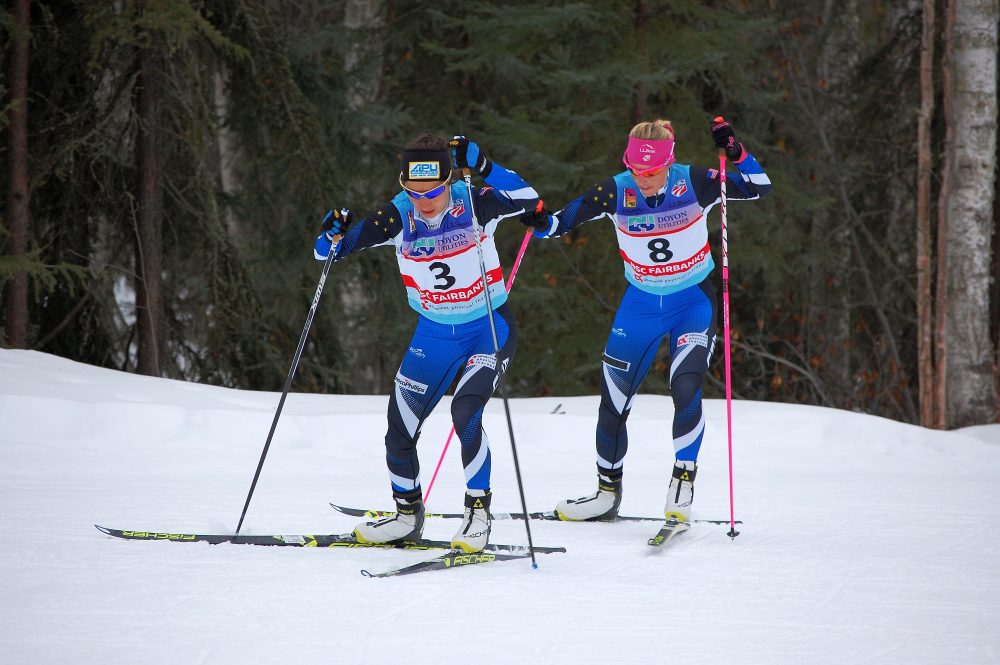
NSCF-FXC skier Jenna DiFolco (r) leads Mackenzie Parrott (l) and Zoe Ratzlaff (c) during a diagonal-striding workout near Fairbanks, Alaska. (Photo: Alasdair Tutt)
***
Have a workout you want to share? Email info@fasterskier.com with the subject line: Wednesday Workout.
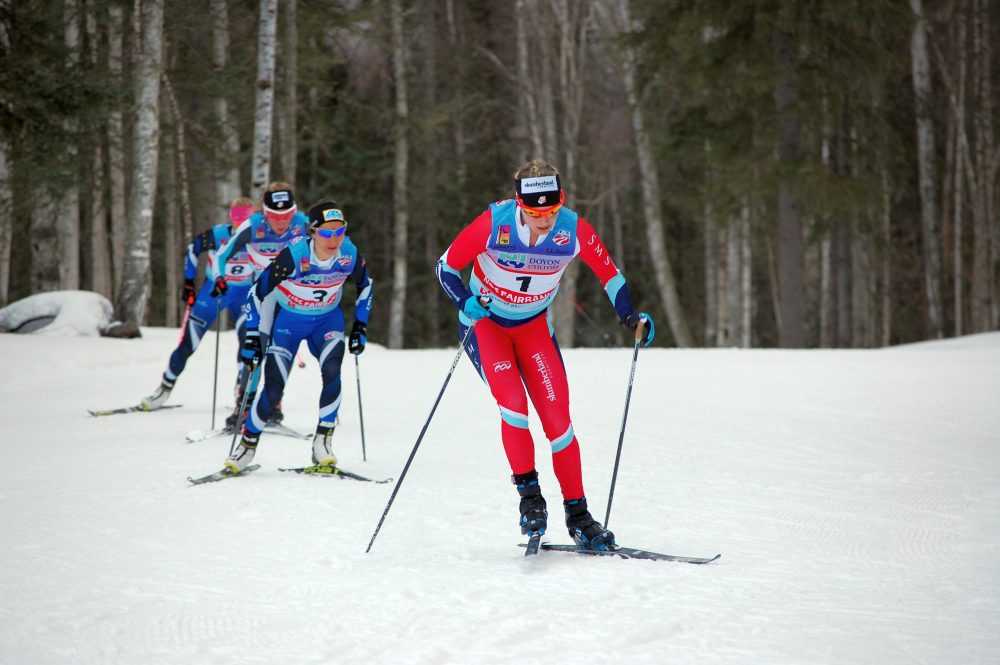
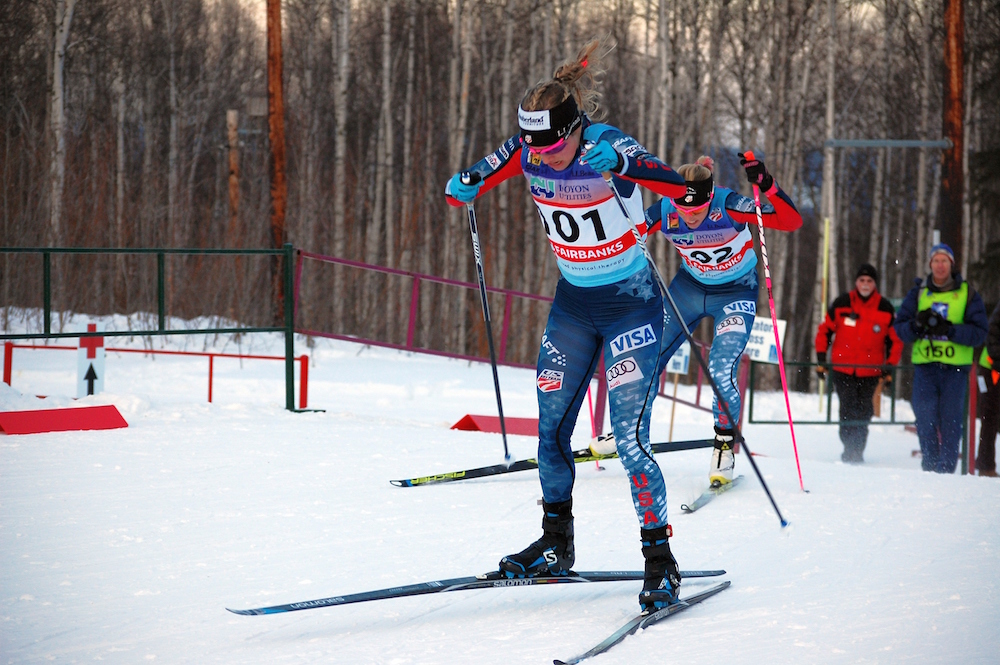
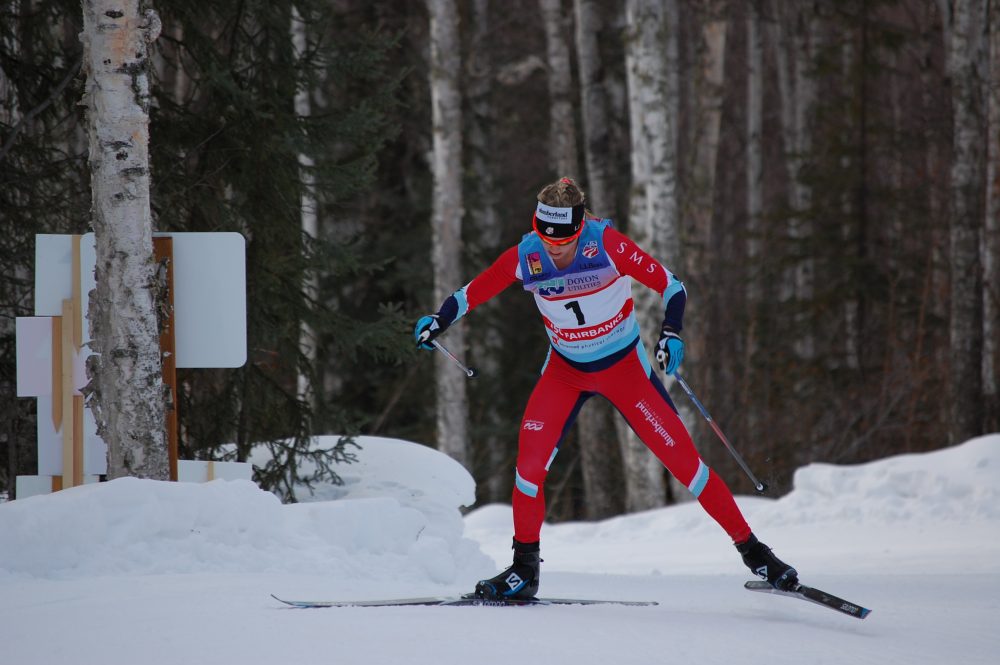
Jessie Diggins making her decisive move during the women’s 30k freestyle at the 2017 U.S. Distance Nationals in Fairbanks, Alaska. (Photo: Max Kaufman)
U.S. Distance Nationals (Fairbanks, Alaska): 30/50 k freestyle mass starts
On Sunday in Fairbanks, Alaska U.S. Distance Nationals came to a conclusion for the women as they contested a 30-kilometer skate mass start.
Spoiler alert: Diggins swept the week.
Marked from the start was Jessie Diggins of the Stratton Mountain School (SMS) Elite Team and the U.S. Ski Team (USST). Diggins is coming off a World Cup campaign where she placed sixth overall and won a sprint silver and team sprint bronze at the 2017 World Championships in Lahti, Finland.
Her overseas haul became a bit heavier this week in Fairbanks: Diggins placed first in the skiathlon, first in the freestyle sprint, and first with the SMS Elite Team mixed relay squad.
No doubt Diggins remains in form as she closed out her season on Sunday. She was the skier to mark as this much was a certainty: Diggins would at some point turn the pace-setting screws.
Early into the race, seven skiers separated themselves by a gap of approximately 12 seconds at the 5 k mark. (The 5 k split times were taken as the women completed their single lap of the South Tower Course Loop. The remainder of the race’s 25 k were comprised of three 8.3 k loops.) Speeding along in a pace line were Diggins, Chelsea Holmes of Alaska Pacific University (APU), Caitlin Gregg of Team Gregg/Loppet Nordic Racing, Kikkan Randall (APU/USST), Annie Hart (SMS Elite), Caitlin Patterson (Craftsbury Green racing Project), Sophie Caldwell (SMS Elite), and Rosie Frankowski (APU).
“I wanted to take the opportunity at the start to work on my pack skiing, and because it’s the end of the season, it should be fun,” Diggins said after the race on the phone. “Around the 12-13 k mark, I decided to start upping the pace a little bit. And then I kind of slowly pulled away. Once I had made a gap, I said, ‘OK, now I need to stick with this,’ and settled into my pace.”
What was once a group streamlining thinned as the race progressed. Note: Diggins soon began to charge ahead solo. At the second split, the Diggins gap was 17 seconds on Randall, Holmes and Gregg.
Patterson at that point was skiing in fifth, roughly 46 seconds back. While Frankowski, Hart, and Caldwell trailed Diggins by nearly one minute and thirty seconds.
Chelsea Holmes leads Kikkan Randall as they protect their podium spots during the women’s 30 k freestyle at the 2017 U.S. Distance Nationals. (Photo: Max Kaufman)
Just as Diggins separated herself, Randall and Holmes eventually pulled away from Gregg. The Randall-Holmes duo made it a two-skier race for second and third. They minimized their loss to Diggins up front and created enough of a buffer to those chasing from the back that minus a gear-breaking fall or a tumble-induced injury, they were a lock for the remaining podium spots.
Diggins secured her third individual and fourth win of the week as she won the U.S. Distance Nationals 30 k skate in 1:20:55.1 hours. Randall followed 1 minute and 37.2 seconds back in second and Holmes placed third (+1:50.4).
“At the end of the season it is one of those things where you need a little bit of luck, you need to be healthy, and everyone is in totally different places,” Diggins said. “I think it is a little unfair to compare how we ski right here to how we would ski during the season. That said, I have been working on a lot of things and working hard and so it is nice to have all that hard work show through during the races.”
Unofficially, with Holme’s third place, she’ll be the overall SuperTour winner on the women’s side. As the overall winner, the APU skier will earn World Cup starts for Period 1 of the 2017/2018 World Cup.
Liz Stephen (Burke Mountain Academy/USST) did not start the race, citing the onset of illness.
The junior women, who began their race in a group mass start with the senior women, raced a 15 k skate competition. Nicole Schneider of Northern Michigan University (NMU) placed first in 38:22.5 minutes. Margaret Gellert (Alaska Winter Stars) skied to second (+3.3), Anna Darnell (University of Alaska Fairbanks) was third (+30.9).
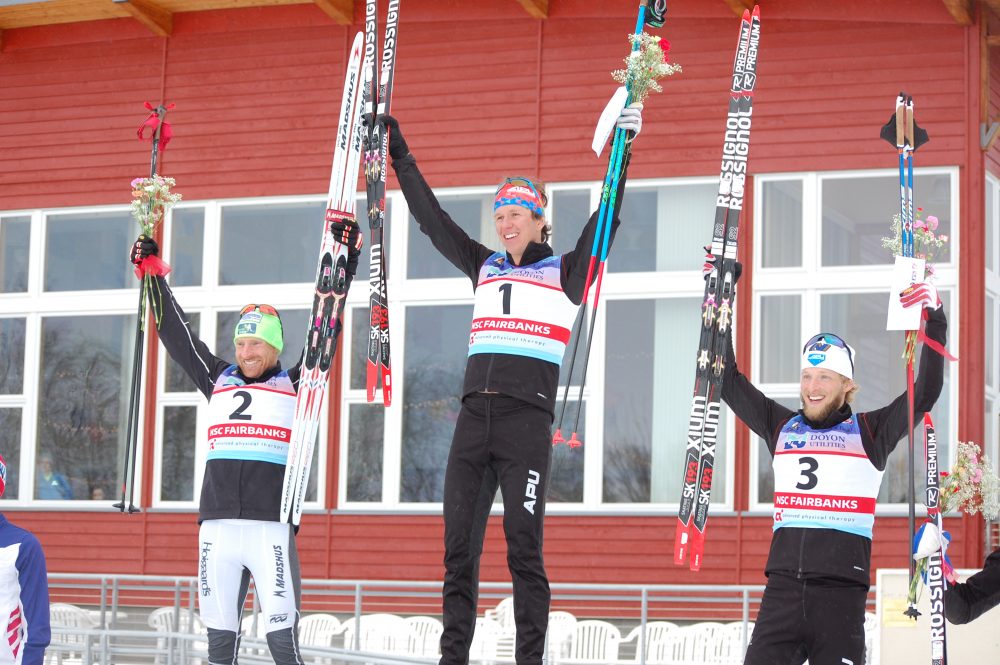
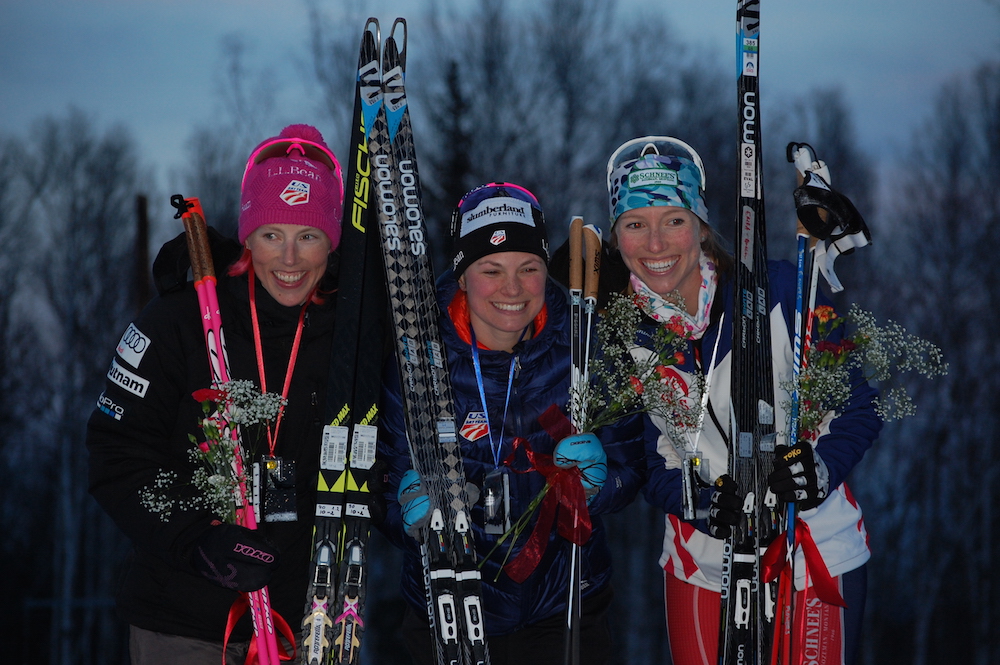
Men’s 50 k freestyle podium from the 2017 U.S. Distance Nationals in Fairbanks Alaska. Scott Patterson (c) from APU placed first, Brian Gregg (l) skiing for Team Gregg second, and Eric Packer (r) also from APU was third. (Photo:Max Kaufman)
In the men’s 50 k that followed, APU’s Scott Patterson racked up his second win of the week, after winning the skiathlon, finishing first in the 50 k freestyle mass start race in a time of 2:19:36.3 hours.
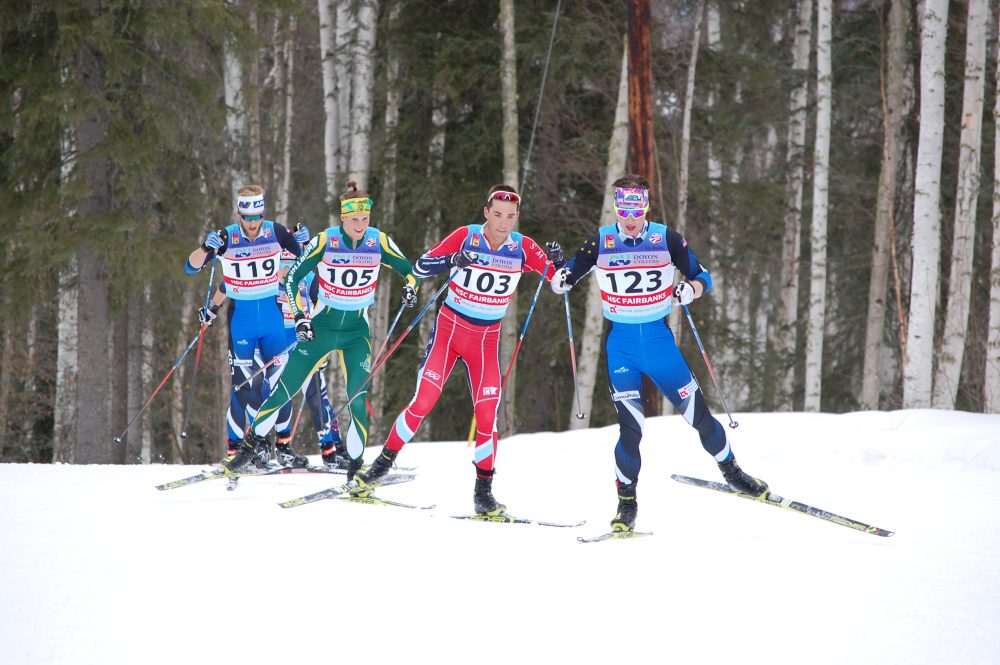
The chase for third place during men’s 50 k freestyle at the 2017 U.S. Distance Nationals in Fairbanks, Alaska. Thomas O’Harra leads, followed by Patrick Caldwell (103), Adam Martin (105), Eric Packer (119), Tyler Kornfield, and Tad Elliott. (Photo: Max Kaufman)
While Ski and Snowboard Club Vail’s (SSCV) Tad Elliott set the pace for the first 10 k, Patterson who was position just behind Elliott, eventually took over the lead before another 5 k. From then on, Patterson presided as the pace setter. He was followed closely by Stratton’s Paddy Caldwell (USST D-team), Team Gregg’s Brian Gregg (Loppet Nordic Racing), NMU’s Adam Martin, and Canada’s Michael Somppi (NTDC Thunder Bay).
Once given the reins, however, Patterson didn’t let up. He continued to dictate the lead for the remainder of the race, besting Gregg as the runner-up by 3:19.9 minutes.
Moving his way up during the second half of the race was APU’s Eric Packer, who finished third (+4:14.2). Another APU skier, Tyler Kornfield, crossed 22.4 seconds later in fourth (+4:36.6). In a photo finish, Caldwell placed fifth (+4:37.6) ahead of Martin in sixth (+4:37.6).
Four APU skiers finished in the top 10, with Thomas O’Harra placing seventh (+5:24.5). Elliott finished eighth (+6:52.1), Norway’s Håkon Hjelstuen ninth (+7:00.7) and Somppi 10th (+8:13.4).
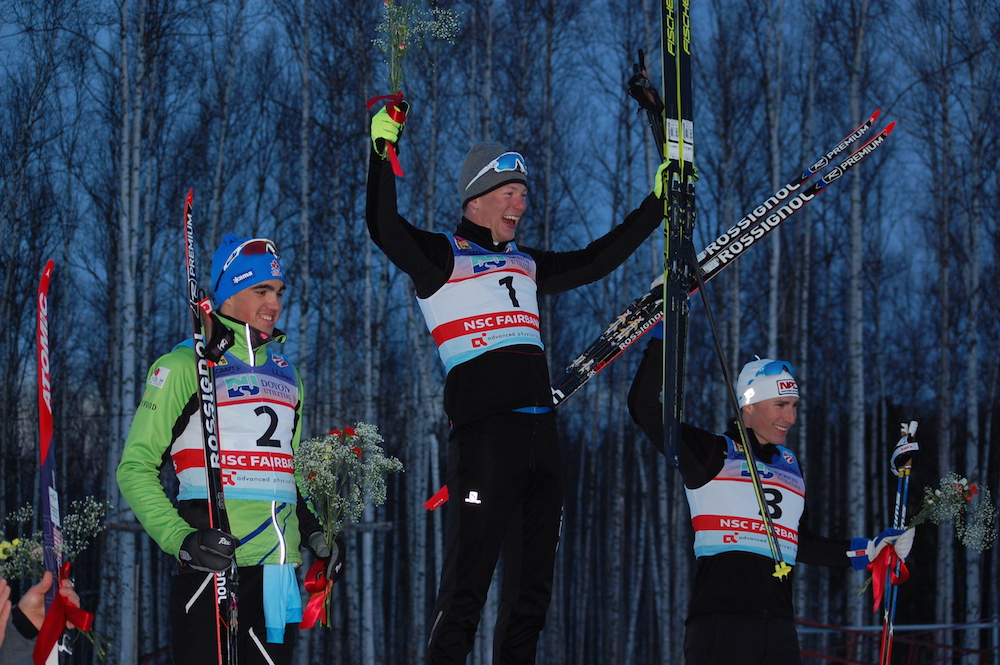
In the junior men’s 20 k freestyle mass start competition, Alaska Winter Stars Gus Schumacher won the event in a time of 54:03.3. Ti Donaldson racing for the Nordic Ski Club of Fairbanks/Fairbanks Cross-Country placed second, just 5.4 seconds after Schumacher. Rounding out the junior men’s podium was Northern Michigan University’s Lars Sønsterud in third (+2:05.2).
Jessie Diggins (SMS Elite) leads fellow U.S. Ski Team member Kikkan Randall (APU) to the finish of the women’s freestyle sprint final on Wednesday at SuperTour Finals in Fairbanks, Alaska. (Photo: Max Kaufman)
U.S. SuperTour Finals (Fairbanks, Alaska): Freestyle sprints
On Wednesday the 2017 U.S. SuperTour Finals, also referred to as Spring Series, the last of the year’s elite level sprints went down in Fairbanks, Alaska.
The women raced a 1.5-kilometer course while the men skied a slightly longer 1.6 k course, both run at the Birch Hill Recreation Area in Fairbanks.
Earlier in the week, Jessie Diggins of the Stratton Mountain School (SMS) Elite Team and U.S. Ski Team (USST) showed why she’s one of the World Cup’s top overall skiers as she dominated the SuperTour Finals skiathlon.
Once again, and early on, Wednesday’s sprint had the appearance of another race to lose for Diggins. She qualified first, completing the course in 3:34.09 minutes. Her nearest competitor in qualification was Kikkan Randall of Alaska Pacific University (APU) and the USST, 6.72 seconds back.
As the heats progressed the looks of a Diggins-Randall show was in the makes. Both skiers were convincing in their trajectory to the finals as they placed first in their respective quarters and semis. And in the finals it became a two-skier race with the pair skiing decisively off the front.
Diggins scorched the finals, toeing the line in 3:30.39 minutes, nearly four seconds faster than her qualifying time. Randall, who skied in a tight race with Diggins until the closing stretch, placed second (+2.39).
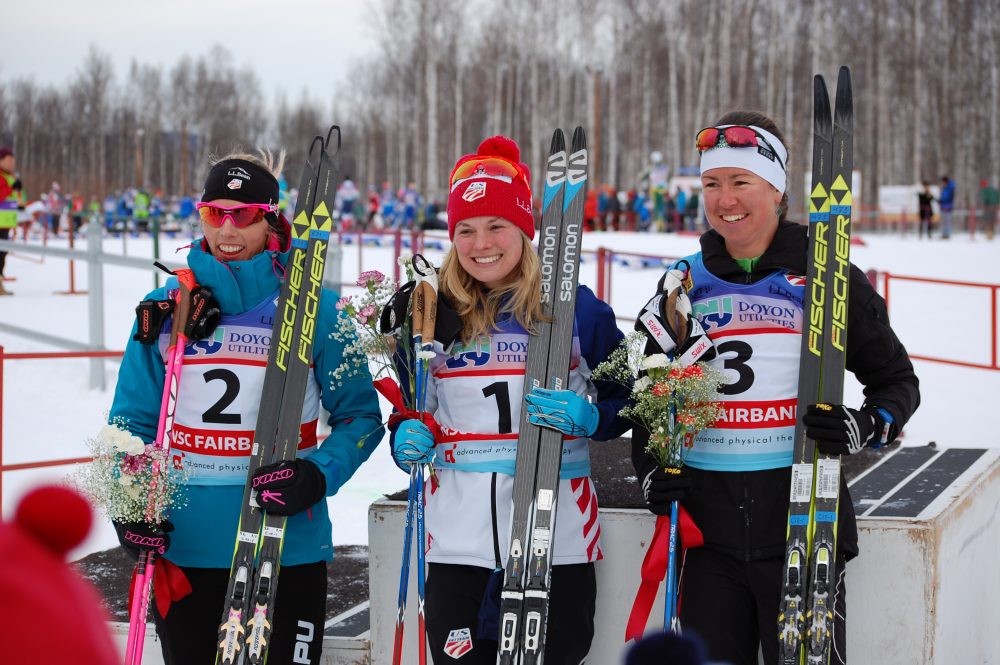
The women’s freestyle sprint podium at SuperTour Finals on Wednesday night in Fairbanks, Alaska, with Jessie Diggins (c) in first, Kikkan Randall (l) in second and Erika Flowers (r) in third. (Photo: Max Kaufman)
Erika Flowers (SMS Elite Team) reached the podium in third (+15.65), ahead of her teammate Sophie Caldwell (SMS Elite Team/USST) in fourth (+19.03), Kelsey Phinney (Sun Valley Ski Education Foundation) in fifth (+23.06), and Ida Sargent (Craftsbury Green Racing Project/USST) sixth (+27.77).
“I thought it was normal, given I set the pace, so I did it to myself,” Diggins said on the phone, recalling the final. “I thought it felt like a pretty normal, brutal World Cup final. I was going out hard, playing for keeps, that is what you do when it comes to Spring Series, you still have fun but you race hard.”
Asked is she felt any added pressure to perform well racing stateside, Diggins noted she attempts to keep things in perspective.
“There is some pressure and at the same time there’s not,” Diggins added. “Because my goals for the year focused around World Championships and the Tour de Ski, that is where I am aiming to be fast and those are the targets I am intending to hit. So coming here, you are always wanting to ski fast … I feel like there is not an incredible amount of pressure because it is the end of the season and everybody is in a totally different place and mentally I am super excited for that place flight to Hawaii I am going to be on the day after the races. I think everyone is in very different places and I think it’s not fair for us to put pressure on ourselves. I think we just go out and have fun and race hard. This isn’t how you qualify for the Olympics and there is good reason for that.”
SMS Elite Team Head Coach Pat O’Brien provided some insight into the large time gaps in the women’s final.
“Coarse was pretty long and hard, I think it plays to people with some more muscular endurance and less fast twitch, especially this late in the season when people are tired,” O’Brien wrote in an email. “This isn’t a 3 min sprint on manmade that prioritizes finishing speed like a European World Cup. It was just straight tough out there! … No falls, just a bunch of tired ladies slugging it out at 8PM at night near the arctic circle. Hard work by all!”
Local skier Logan Hanneman (APU), who grew up and attended college in Fairbanks, made the hometown proud. He eventually pulled out the win in the men’s final.
Hanneman qualified fourth (+6.27) behind Simi Hamilton (SMS Elite Team/USST) who topped the qualifier in 3:11.35 minutes. (After the qualifier Hamilton pulled from the competition).
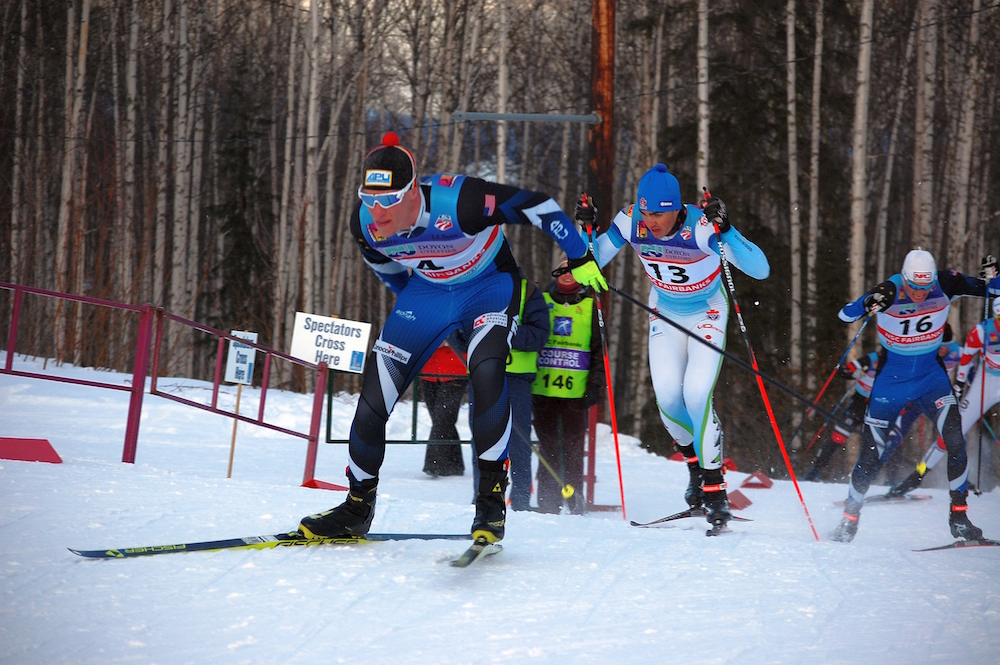
Logan Hanneman (APU) leads Canada’s Evan Palmer-Charrette (13) of NTDC Thunder Bay and Tyler Kornfield (16), his APU teammate, in the men’s freestyle sprint final on Wednesday at SuperTour Finals in Fairbanks, Alaska. (Photo: Max Kaufman)
In the men’s final, several skiers appeared to be in play for the win. Hanneman placed first in his quarter and semi. Canadian skier Evan Palmer-Charrette (NTDC Thunder Bay), also looked like a threat as he proved a knock-out type closer. Another guest skier, Norway’s Haakon Hjelstuen, a former Michigan Tech skier, skied heady and strong.
Also appearing in the men’s finals were two skiers who are known to pounce when opportunity knocks: Tyler Kornfield (APU) and Dakota Blackhorse-von Jess (Bend Endurance Academy). Tad Elliott (Ski & Snowboard Club Vail) completed the six-skier final.
Heading into the last technical descent on course Hanneman was third behind Kornfield and then Palmer-Charrette. A few tight corners remained with a climb back up to the finish.
“I ended up taking the last sweeping left corner very wide and accelerated as I moved right,” Hanneman explained in an email. “Then we were able to hit the bottom of the climb basically 3 abreast. Once I saw that I had a lane open I just opened it up and went for it!”
Here’s how the final played out: Hanneman placed first in 3:16.77 minutes, Palmer-Charrette was second (+1.08), Kornfield third (+3.84), Hjelstuen fourth (+3.98), Blackhorse-von Jess fifth (+6.38), and Elliott sixth (+7.17).
It appears Hanneman was able to channel his nervous energy into positive forward momentum.
“I definitely put a lot of pressure on myself to win this race,” Hanneman wrote of performing in front of his hometown crowd. “To have these races in my hometown is one thing, but then knowing that I could do well in the sprint added a lot of nerves to the equation. I definitely really wanted to perform well for the volunteers, the crowd, etc. they have supported me through all of the skiing programs here in Fairbanks for years and I really wanted to ski my best for them. I am so very happy that this is how it turned out!”
Hunter Wonders (APU) won the junior men’s sprint in 3:32.76 (he was also the winner of Monday’s 11.25 k classic) with a hard-charging final push, Max Donaldson (University of Alaska Fairbanks) placed second (+0.40) and Logan Mowry (Nordic Ski Club of Fairbanks/FXC) was third (+4.76).
For the junior women, Hannah Rudd (University of Alaska Anchorage) took the lead on the final climb and secured the win in 4:08.46, Dottie Anderson (Loppet Nordic Racing) placed second (+1.96) and Jenna Difolco (Nordic Ski Club of Fairbanks/FXC) was third (+7.64).
Racing continues Friday with a mixed gender/mixed technique relay.
The men’s freestyle sprint podium on Wednesday night at SuperTour Finals in Fairbanks, Alaska, with Fairbanks native Logan Hanneman (c) in first, Canada’s Evan Palmer-Charrette (l) in second and Tyler Kornfield (r) in third. (Photo: Max Kaufman)
Jessie Diggins (Stratton Mountain School Elite Team/U.S. Ski Team) with no chasers in sight during the women’s 15 k skiathlon on Monday at 2017 SuperTour Finals in Fairbanks, Alaska. She won by nearly two minutes. (Photo: Max Kaufman)
U.S. SuperTour Finals (Fairbanks, Alaska): Women’s and men’s skiathlons
The first day of racing was skiathlon day at the 2017 U.S. SuperTour Finals, also referred to as Spring Series, in Fairbanks, Alaska. It marked the first time in eight years since a skiathlon was held at the SuperTour level in Fairbanks.
The women’s 15-kilometer skiathlon (7.5 k classic + 7.5 k freestyle) was dominated by Jessie Diggins of the Stratton Mountain School (SMS) Elite Team and U.S. Ski Team (USST). Diggins crossed the line in 42:17.1 minutes for the win at the Birch Hill Recreation Area trails.
During the classic leg, it was clear Diggins was on form and in the zone with her striding.
“Classic skiing is something for me that is still a work in progress,” Diggins said on the phone post-race. “I think even with a World Championship medal in a classic event, it is still one of those things for me I am always going to feel like I am trying to fix it, always trying to work on it, which is good.”
Diggins has done her work and couldn’t be contained from the start. “It was a fun surprise to feel technically good in that classic leg and having good skis really helped with that,” Diggins added. “It was just fun to be like, ‘Hey I can do this classic thing. I am not only a skater.’ ”
The women’s top spot was never in doubt for Diggins after the ski exchange — the closest Diggins-chaser beginning the skate portion, and nearly a minute back, was Kikkan Randall of Alaska Pacific University (APU) and the USST. She was followed out of the stadium by a group of five skiers within 10 seconds that included Kaitlynn Miller and Caitlin Patterson, both of the Craftsbury Green Racing Project (CGRP), Chelsea Holmes and Australian Jessica Yeaton of APU, and Liz Stephen of Burke Mountain Academy/USST. At that point, the race for third was wide open.
The women’s 2017 U.S. SuperTour Finals skiathlon podium on Monday in Fairbanks, Alaska, with Kikkan Randall (l) in second, Jessie Diggins (c) first, and Caitlin Patterson (r) third. (Photo: Max Kaufman)
7.5 k of skating later, the chasers reordered and shook out; Randall placed second overall (+1:52.9), Patterson third (+2:09.1). Holmes missed the podium by 1.6 seconds in fourth, and Stephen lost some ground on the skate and finished fifth (+2:19.8).
“I think part of the reason I felt great today was I just really relaxed and was just looking to have a good time out there,” Diggins said. “I was like, ‘I am going to pace my own race and ski the way I want to ski.’ I didn’t have any real concrete race plan, I just went out and wanted to see what happens.”
The men raced a 22.5 k skiathlon (11.25 k classic + 11.25 k skate), and until the race’s midpoint when classic were swapped out for skate skis, ten skiers were within five seconds of one another.
Scott Patterson (APU) after breaking away from the field in the skate portion of Monday’s 22.5 k skiathlon at SuperTour Finals in Fairbanks, Alaska. He went on to win by 24.3 seconds. (Photo: Max Kaufman)
The eventual winner, Scott Patterson (APU) was the clear pacesetter beginning the skate leg. Looming in his midst seconds back after the transition were the likes of David Norris (APU), Ben Lustgarten (CGRP), Tyler Kornfield (APU), Paddy Caldwell (SMS Elite/USST D-team)and Tad Elliottand Kris Freeman of Ski & Snowboard Club Vail.
“When we came through the transition there was a little separation that formed,” Patterson wrote in an email. “David Norris, Eric Packer, and I got through quite quick and were able to create a slight gap. I knew I could use that gap. I learned in Korea earlier this year, that I can charge right from the transition while some people take a little time to get going. Also skating has always been my stronger technique. I used that knowledge to build a lead as quickly as I could and never look back.”
Patterson’s lead stretched on the skate leg. He claimed the win in 59:17.6 minutes, 24.3 seconds ahead of Caldwell in second and 26.8 seconds ahead of Elliott in third. Lustgarten finished 14 seconds off the podium in fourth (+40.8), about 8 seconds ahead of Adam Martin of Northern Michigan University (NMU) in fifth (+48.9), while Norris and Freeman followed in sixth (+54.8) and seventh (+55.2), respectively.
The men’s 2017 U.S. SuperTour Finals skiathlon podium on Monday in Fairbanks, Alaska, with Paddy Caldwell (l) in second, Scott Patterson (c) first, and Tad Elliott (r) third. (Photo: Max Kaufman)
The Junior women contested a 7.5 k classic race. Hannah Halvorsen (Sugar Bowl Academy/USST D-team) skied to first place in 24:00.6 minutes. Nicole Schneider (NMU) skied to second (+30.8), and 14-year-old Fairbanks local Kendall Kramer (Nordic Ski Club of Fairbanks/FXC) placed third (+36.3)
Like the junior women, the junior men raced a single-technique race. Hunter Wonders (APU) won the 11.25 k classic race in 31:44.9 minutes. Luke Jager (APU) was second (+25.8), and Canyon Tobin (APU) finished third (+1:05.2).
Racing continues Wednesday with freestyle sprints.
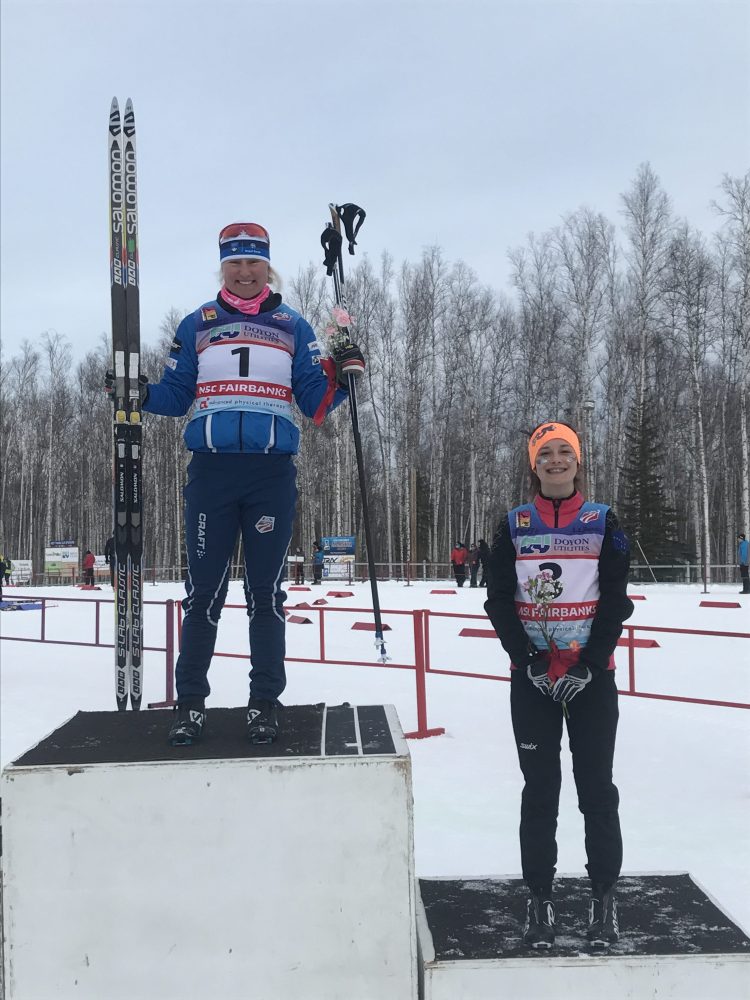
APU swept the junior men’s podium in the 11.25 k classic on Monday at SuperTour Finals in Fairbanks, Alaska, with Hunter Wonders (c) in first, Luke Jager (l) second, and Canyon Tobin (r) third. (Photo: Max Kaufman)The junior women’s 7.5 k classic podium on Monday at SuperTour Finals in Fairbanks, Alaska, with Hannah Halvorsen (Sugar Bowl Academy/USST D-team) in first and Kendall Kramer (Nordic Ski Club of Fairbanks/FXC) in third. Second-place finisher Nicole Schneider (NMU) was not present for podium ceremony. (Photo: Reader submission)
The Birch Hill Recreation Area stadium last Friday, March 24, where U.S. SuperTour Finals and Distance Nationals will be held March 27-April 2 in Fairbanks, Alaska. (Photo: Gavin Kentch)
The 2017 U.S. SuperTour Finals and Distance Nationals, also known as Spring Series, opens today with men’s and women’s skiathlons at the Birch Hill Recreation Area in Fairbanks, Alaska. The races will be held late each day to take advantage of the warmest parts of the day and lambent late-afternoon sunlight, as well as to accommodate volunteers and spectators.
FasterSkier is seeking photos from this week’s Spring Series. If you are on site and able to send photos after the events, please email with photo caption and credit info to alex@fasterskier.com.
A look at the trails on Friday, March 24, at Birch Hill Recreation, where U.S. SuperTour Finals and Distance Nationals will be held March 27-April 2 in Fairbanks, Alaska. (Photo: Gavin Kentch)
Spring Series race schedule: (At start times = Alaska Daylight Time)
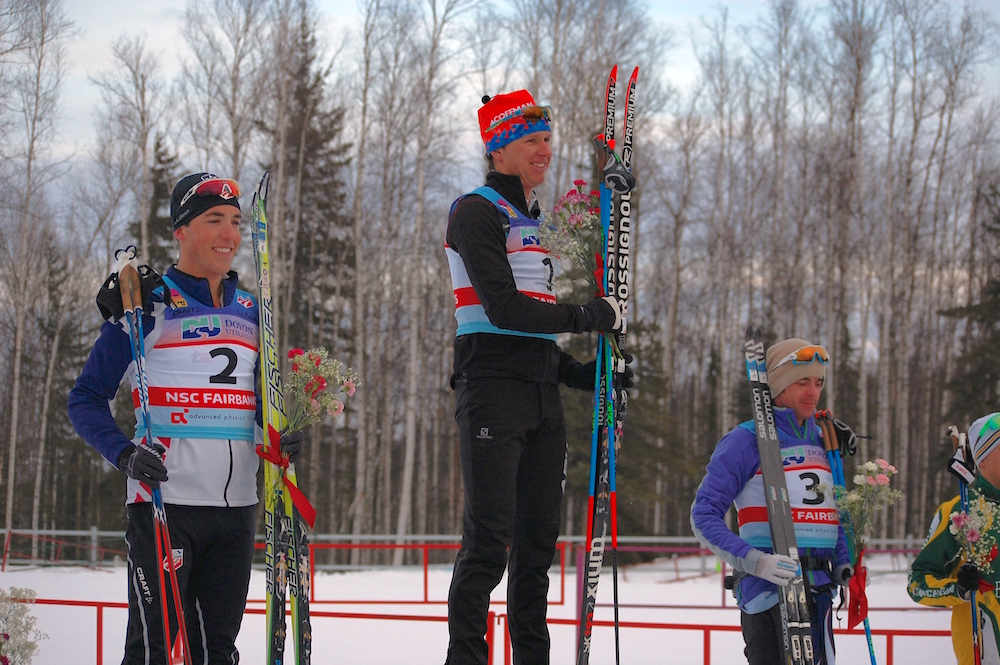
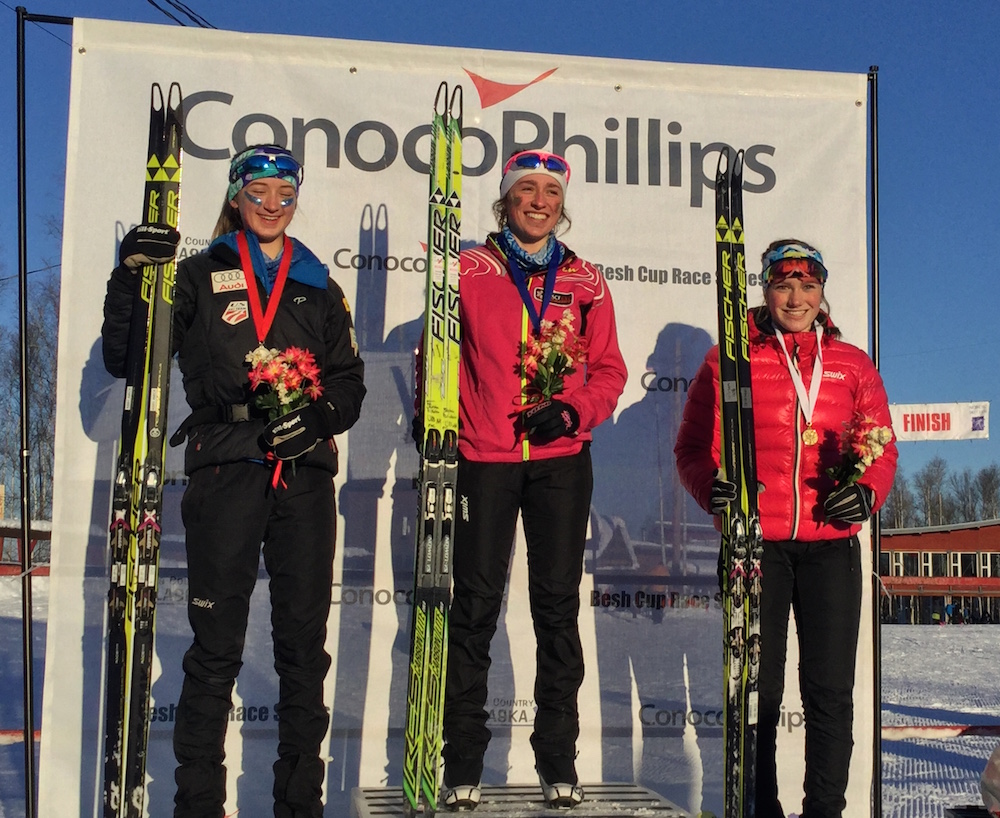
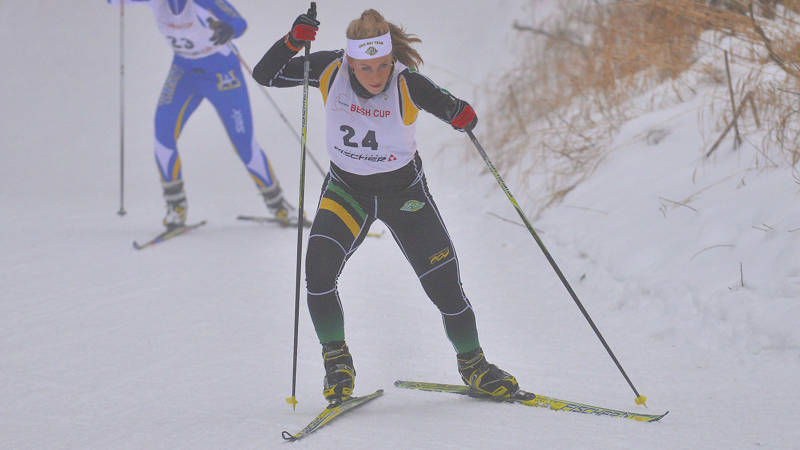
Jenna DiFolco (c) of FXC, Abby Amick of APU (l), and Addison Gibson of ANR (r) on the podium for the U18 girls division of the Besh Cup 5 k skate race in Fairbanks, Alaska, Feb. 4, 2017.
FAIRBANKS, Alaska — Alaska Airlines operates roughly 10 flights a day between Anchorage and Fairbanks. Last Friday morning many of those flights were packed with skiers, and ski bags piled up at baggage claim in Fairbanks, as Anchorage skiers streamed north for the final weekend of Besh Cup racing to select Alaska’s representatives to next month’s Junior Nationals in Lake Placid, N.Y. Two days later many of those same skiers returned south with plans to fly all the way to Lake Placid, where Team Alaska will have roughly equal representation from the state’s two largest cities.
The 2016/2017 Besh Cup series concluded with a pair of distance races at Birch Hill ski area: freestyle interval start on Saturday, classic mass start on Sunday. The weather for both days was Fairbanks at its mid-winter best, clear and sunny and relatively warm. Cold powder and hard glide waxes were de rigueur.
(The emphasis here is on relatively, as national FasterSkier readers might find Saturday’s race-time temperature of 10 degrees Fahrenheit, or Sunday’s reading of 2 degrees, objectively not all that warm. But it was -16 degrees at the airport on Sunday – Birch Hill’s elevated location on a hill above town often keeps it significantly warmer than the low-lying areas of central Fairbanks where official temperature readings are taken – and it is forecast to be -35 degrees in Fairbanks by later this week. So, relatively warm.)
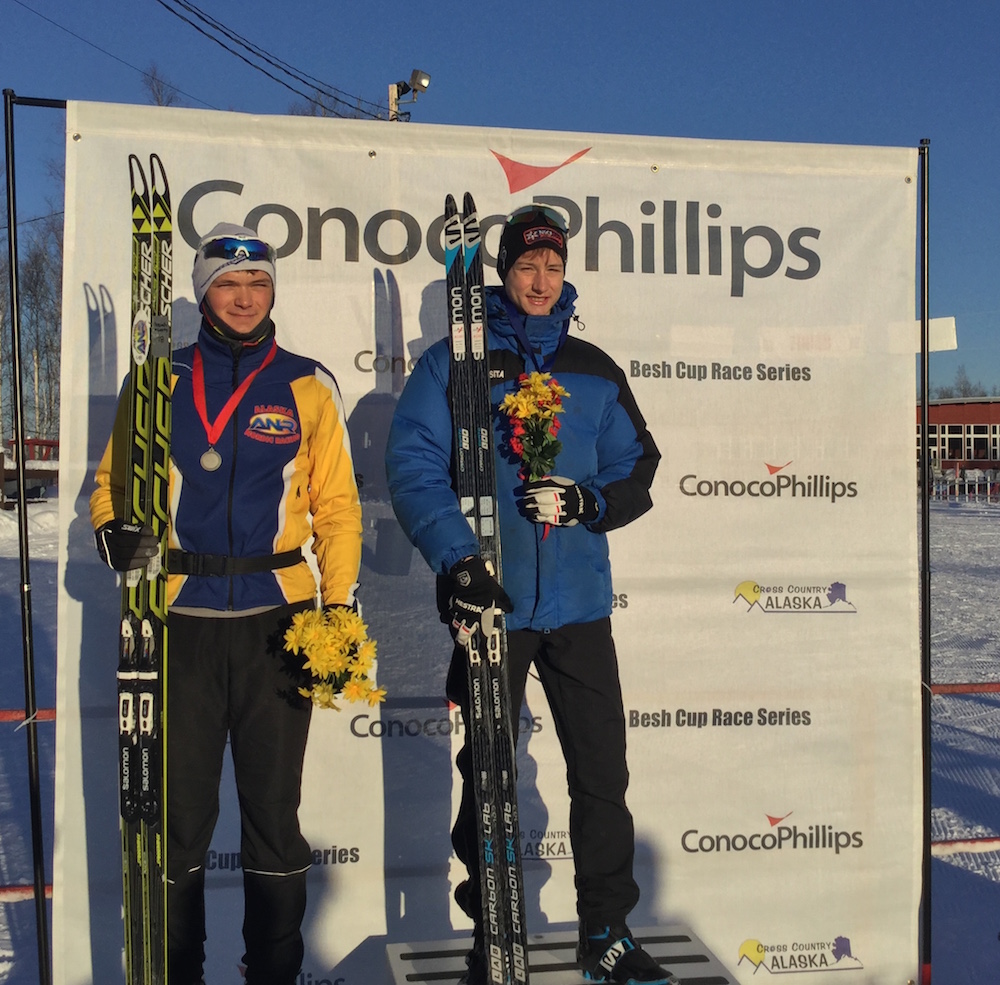
The first race on Saturday was the boys 10-kilometer freestyle individual start for racers in the U18 division and older, 45 starters in all. The overall podium on Saturday was U18 skier Ti Donaldson of the Nordic Ski Club Fairbanks racing team (FXC), Senior skier Cody Priest of Alaska Nordic Racing (ANR), and U18 skier Josiah Alverts (ANR).
Among U20 men, FXC skier Benjamin Koenig was first, leading his teammate Logan Mowry in second and Dax Cvancara of ANR in third.
The U18 boys division, which saw two of the top-three overall finishers, had Donaldson in first, Alverts in second, and APU skier Tristan Wiese in third.
U16 boys raced a 5 k skate individual start, covering one lap of the blue course that 10 k skiers completed twice. Eli Hermanson of Alaska Winter Stars (AWS) led the all-Anchorage-area podium in the 5 k, followed by George Cvancara of ANR and Zanden McMullen of APU.
Finally, the U14 boys raced a 1 k skate ski-cross event, with jumps, gates, slaloms, and other technical challenges. The event is a crowd favorite that, race organizers wrote, “helps develop skiers’ abilities to ski in a ‘pack’ along with developing technical skills.” (It may also soon be coming to a race series near you! Here is an example from the 2016 Youth Olympic Games in Lillehammer.) In another Anchorage-area sweep, Aaron Maves of APU took the A-Final, followed by Rudy Schumacher of AWS and Konrad Renner from ANR.
On the girls side, a field of 57 racers (U16 and older) contested a 5 k skate individual start. At the end of one lap around the blue course, APU skier Maggie York took the overall victory by 40 seconds over FXC skier Jenna DiFolco, with Kendall Kramer (FXC) another 14 seconds back.
York also topped the U20 podium. She was followed there by Alyeska Daniels and Lupua Oba, both of FXC.
DiFolco, second overall, was first among U18 girls. Second in this division was Abby Amick of APU, with ANR’s Addison Gibson third.
U16 girls took third through fifth overall in the combined U16/U18/U20/Masters field for the 5 k (there were no Senior skiers in the race). Locals Kendall Kramer and Kaya Ratzlaff of FXC led this division, with Annika Hanestad (ANR) third.
U14 girls also raced a 1 k ski cross. First here was Quincy Donley of AWS, continuing her winning ways from the Anchorage and Soldotna Besh Cup weekends. She was followed across the finish line of the A-Final by Marit Flora of APU and Katey Houser of ANR.
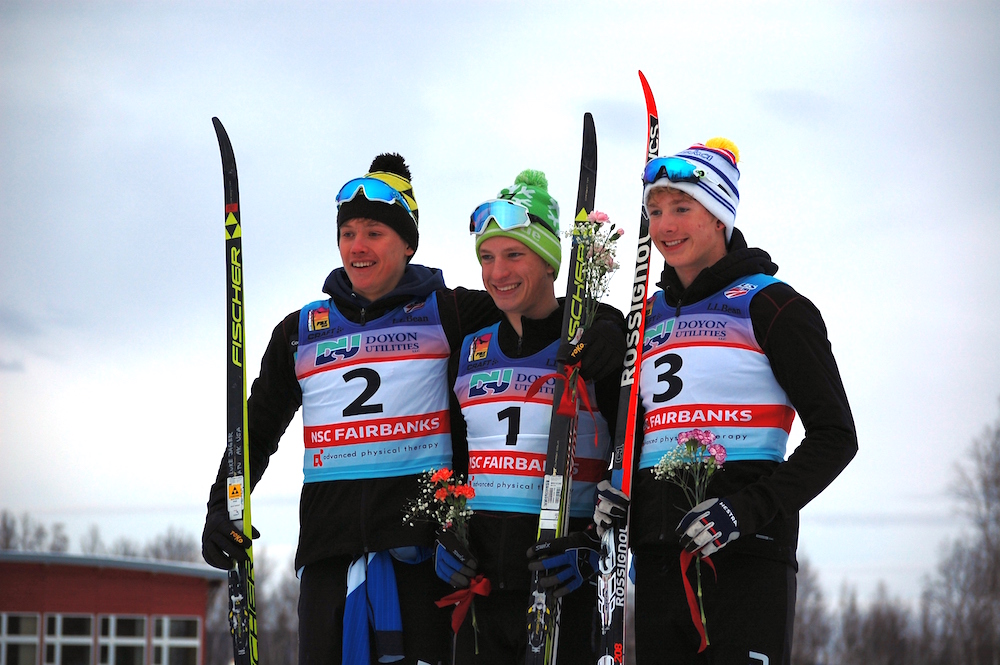
Ti Donaldson of FXC (r) and Josiah Alverts of ANR (l) on the podium for the U18 boys division of the Besh Cup 10 k skate race in Fairbanks, Alaska, Feb. 4, 2017.
Saturday’s overall winner for the boys race, U18 skier Ti Donaldson, was racing on home turf. “I’ve had a few wins [in the Besh Cup series] in the past,” Donaldson told FasterSkier in an in-person interview following the race. “Most of them have been in Fairbanks. I’m from here, so definitely a home-field advantage.”
Donaldson came in expecting a “brutal” race, based on his knowledge of the course and his time previewing it. “But I knew it would be pretty fast conditions,” he continued – “it was nice and hard, and it wasn’t too cold. So I was pretty excited to see how it would go, and really just wanted to work the transitions and stay strong on the climbs, and crest over. So I stuck to that plan, and it worked out pretty well.”
Donaldson was looking forward to 2017 Junior Nationals in March.
“I’d be thrilled with a top-five finish,” Donaldson said of his goals for next month. “Two years ago, when I was racing the same kids, I placed fourth in a race, and so I’d like to repeat that result. That would be a good goal of mine.”
Jenna DiFolco, the U18 girls winner and second-place overall skier, was also racing at home. She credited “my FXC coaches” for waxing her winning skis, and had hot cereal for breakfast, with raisins and dried cranberries, at home before heading out to Birch Hill.
The race was “really fun,” DiFolco recounted in an in-person interview. “Warming up, I didn’t feel so good, I was feeling kind of tired, maybe I’d overdone it this week. And then I expected this course to be really hard, because there are so many hills. And it was definitely, like, it was a rough course. But it went a lot better than I expected it to.”
DiFolco described her strategy for racing a one-lap 5 k course with nearly constant climbing or descending: “The first part is mostly downhill, so I kind of just started out like a sprint almost, because I knew I’d be able to recover on the downhill. And the first couple of hills I was just trying to keep it light, keep it relaxed, and then really start hammering up South Tower [the high point of the course], because I got a big break after that. And then the last two hills are basically just hard, really hard.”
Looking ahead to Lake Placid, DiFolco said that she was “hoping to get a couple top-10 finishes.” She added, “A big dream, it’d be a big stretch, but I’m hoping to get, like, a podium would be really, really cool. But top 15, top 10 would be awesome.”
Sunday saw classic mass starts instead of freestyle individual starts, and temperatures around 10 degrees colder, but otherwise it was more of the same. Seven of eight age-group winners from Saturday picked up a second victory on Sunday, as a pair of distance races rewarded skiers who were consistent in both techniques. (The first two weekends had featured one sprint and one distance race apiece, leading to greater variability in the podium finishers.)
Sunday’s classic race also rewarded skiers who were good at traditional classic skiing, in light of the relatively slow snow and the impressive elevation change of a Birch Hill race course.
The trails at Birch Hill are built on the side of, well, a hill (also, there are birch trees). The courses used for this weekend’s races were marked by an impressive Height Difference (the elevation change between the lowest and highest points on the course) of 89 meters within a 5-kilometer course. The World Cup skiathlon race that was contested in South Korea the same weekend, on the trails that will be used for the 2018 Winter Olympics in PyeongChang, featured height differences of only 58 and 41 meters on the two skiathlon courses.
In fact, a height difference of 89 meters is a greater elevation spread than was present on most of the traditional World Cup courses this season, including in Davos (84m), Lillehammer (74m), Falun (69m), and Ulricehamn (57m). That said, some of those courses had more average climb per kilometer than the Birch Hill 5 k course. But only some of them. This may help explain why the winning time for a 10 k skate on Saturday was 29:22 for the men, and 16:15 for 5 k for the women, in a race with some of the top junior skiers in the country. (Winning times for Sunday’s 10 k classic races were 32:17 and 37:53.)
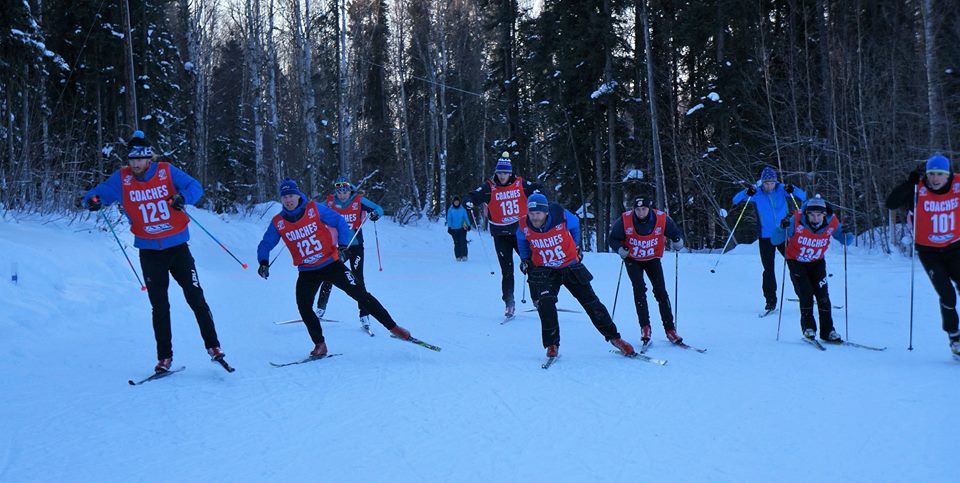
Coaches compete in the final ski-cross heat of the day, the coaches’ race, on Feb. 4 in Fairbanks, Alaska. Racers include Galen Johnston (129), Eric Strabel (125), Anson Moxness (126), and Pete Leonard (101). (Courtesy photo)
APU Devo and Master Coach Galen Johnston shared his thoughts on the effects of such a course profile after spending the weekend watching his athletes race up and down these hills. “One of the best parts of the weekend was to see how the combination of slow snow and lots of strideable sustained climbing put the focus of the [classic] races on striding and fitness rather than simply double pole strength,” Johnston wrote to FasterSkier on Monday.
“Courses designed like this can keep striding a viable, and even necessary part of classic skiing,” Johnston continued by email. “Birch Hill has some of the most progressive course designs that I’ve seen and it’s paying off. Skiers ski differently than they did even 10 years ago, and it’s really neat to see a course that can accommodate and challenge that change in style without turning things into an unskiable death march. Estle is keeping people very honest, but still allowing for ample fun,” Johnston concluded in reference to longtime Fairbanks race director and ski-course designer (and former U.S. Ski Team coach) John Estle.
On Sunday the best strider was DiFolco, who took first place in the 10 k classic mass start race by 19 seconds over Saturday’s winner York. Third overall was ANR skier Heidi Booher (ANR), another 23 seconds back.
York was again first in the U20 women division. The rest of the podium was also unchanged from Saturday, with Daniels in second and Oba in third.
DiFolco was again first among U18 girls. Second on Sunday was Booher, with Emma Nelson of ANR third.
There was a substantial drop-off in distance from U18 girls to U16 girls, with the latter group racing not 10 k but a 3 k classic mass start. First after just under 10 chaotic minutes was Kramer again, edging out her FXC teammate Ratzlaff by 0.7 seconds. Tjarn Bross rounded out the all-FXC podium in third.
U14 girls raced the same 3 k course as the U16 girls. And after 11 to 12 minutes of racing, it was precisely the same U14 girls podium as on Saturday: Donley, Flora, and Houser.
On the boys side, U18/U20/Senior/Masters skiers raced a 10 k classic mass start on the same course as the girls. First overall was Lukash Platil (officially unaffiliated, but listed on the University of Alaska Fairbanks (UAF) ski team roster), followed by Donaldson of FXC and Wiese of APU.
Platil was also first in the Senior men’s division. He was followed there by Kenny Brewer (now unaffiliated, formerly of UAF) and Matt Muffoletto (The Other Guys).
Among the U20 men, Koenig picked up his second first place of the weekend, and Mowry his second second place. Hamish Wolfe (APU) was third.
Donaldson and Wiese led the U18 boys. They were followed by Alverts, as the age group podium remained largely unchanged from Saturday.
The U16 boys raced a 3 k classic mass start. This was the only age group to see a new winner on Sunday, as Cvancara moved up from second the day before to nudge Hermanson down a step on the podium. Everett Cason of APU was third.
And the U14 boys (also 3 k classic) were again an all-Anchorage affair: Maves once again in first, Rowan Morse (APU) in second, and Schumacher in third.
Later Sunday afternoon a crowd gathered in the Birch Hill Recreation Center, ignoring Super Bowl LI then in progress, for the naming of Team Alaska for this year’s Junior Nationals (JNs).
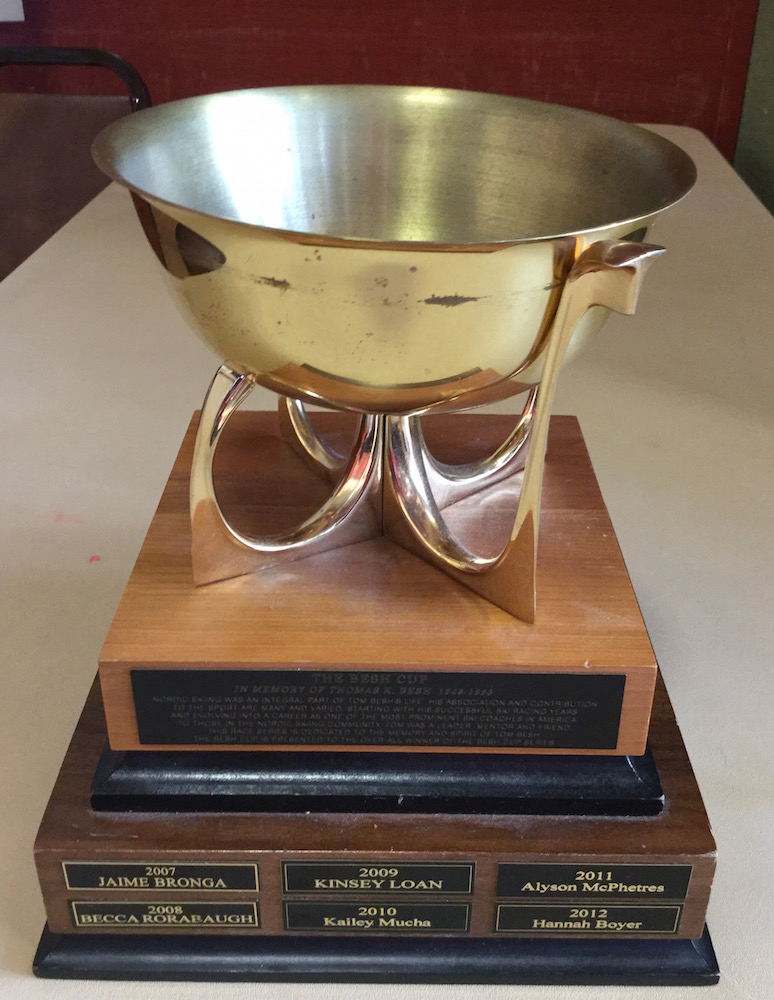
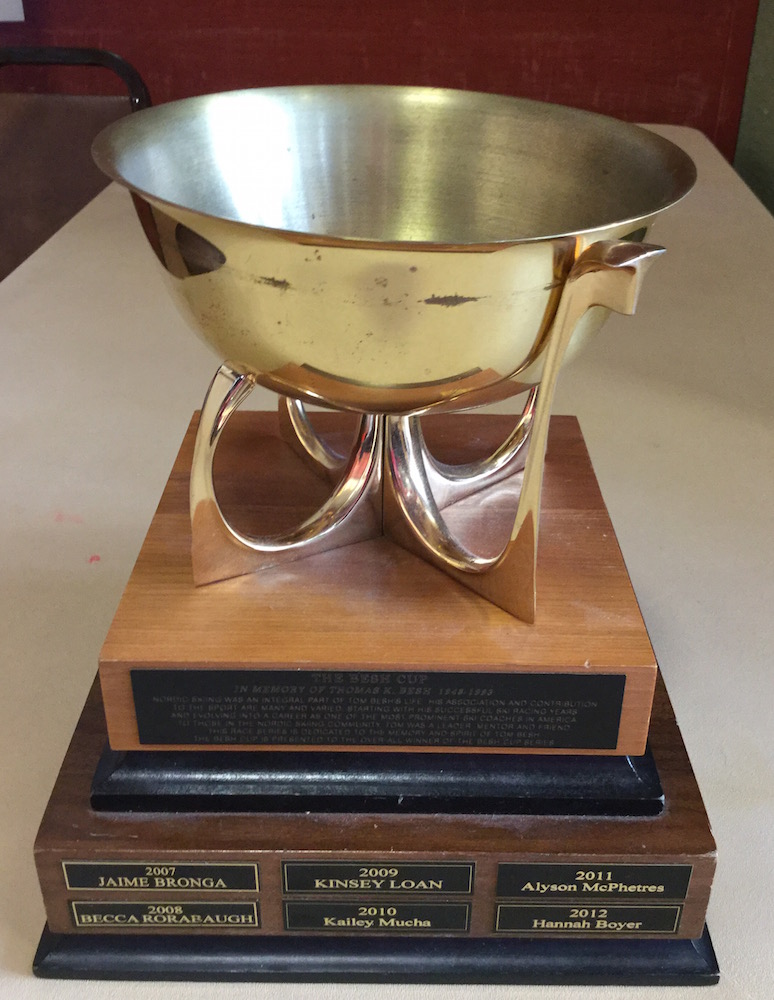
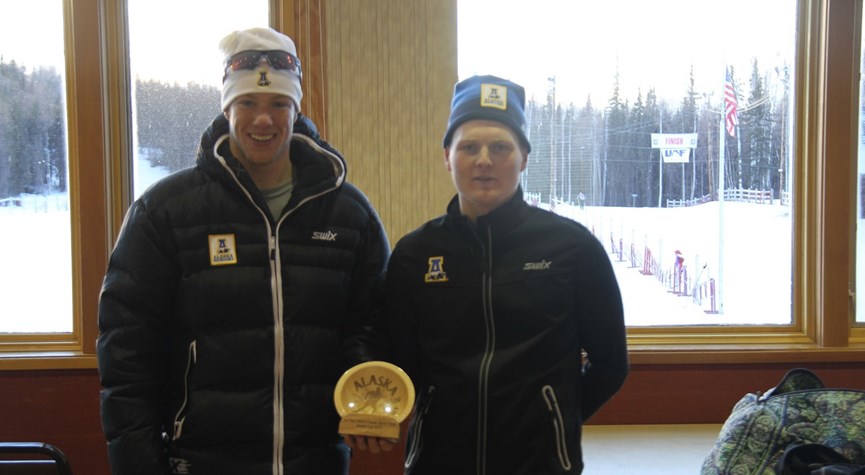
The Besh Cup Trophy, photographed in Fairbanks, Alaska, in February 2017.
Cross Country Alaska also awarded the Besh Cup Trophy, given to the U18 or U20 skier with the greatest number of JN qualifying points across all six races combined. This year’s winners were Josiah Alverts for the boys and Jenna DiFolco for the girls. Their names will be added to a trophy, Stanley Cup-style, that includes on its plinth recognizable names from American skiing such as David Norris, Becca Rorabaugh, Reese Hanneman, Andy Liebner, Zach Hall, Eric Strabel, Kate Pearson, and Rob Whitney.
While winning the Besh Cup Trophy is undeniably prestigious, it also necessarily rewards the best skier who was in Alaska all winter for the races, as opposed to competing Outside or internationally. For example, among U18/U20 girls, you may have heard that the University of Alaska Anchorage’s Hailey Swirbul was racing in Soldier Hollow, while Molly Gellert was on the Scandinavian Cup trip in Norway.
DiFolco graciously acknowledged as much, telling FasterSkier on Sunday soon after receiving the trophy, “I think some of the fastest skiers are not here, because they pre-qualified [for JNs] and they went on big trips.” But DiFolco still skied the races and earned the results, including two firsts and two seconds in the final four races of the series.
“It’s pretty cool,” DiFolco said of the season-long honor. “I never would have really expected this to happen a year ago. … I’m pretty proud of it. I’m happy with it.”
Shortly after the awards ceremony ended the migration began to repeat itself in reverse, as out-of-town skiers loaded up cars in the Birch Hill parking lot for the 7-hour drive south to Anchorage or paraded ski bags through the Fairbanks airport. The flight home for Anchorage skiers was marked by ski hats, team jackets, and quiet chatter, as athletes talked about next month’s trip to the East Coast and parents fretted about missed school days and makeup work.
Junior Nationals begin in Lake Placid in early March. The first race is a 5/10 k freestyle individual start on March 6.
FasterSkier is seeking contributions (written, photography or videography) from regional race circuits across North America. Please email info@fasterskier.com if interested.
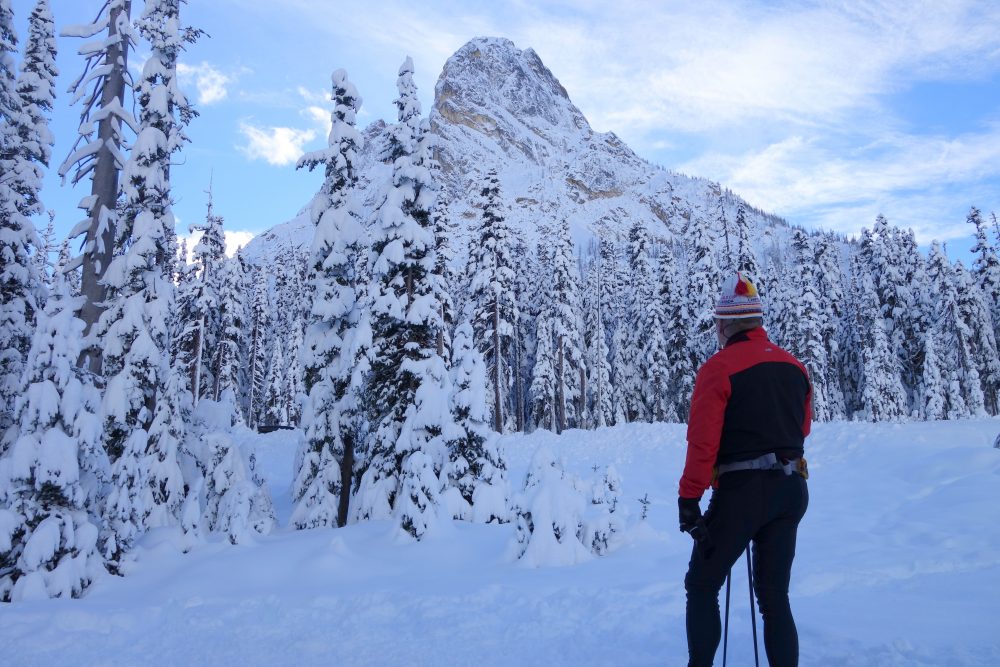
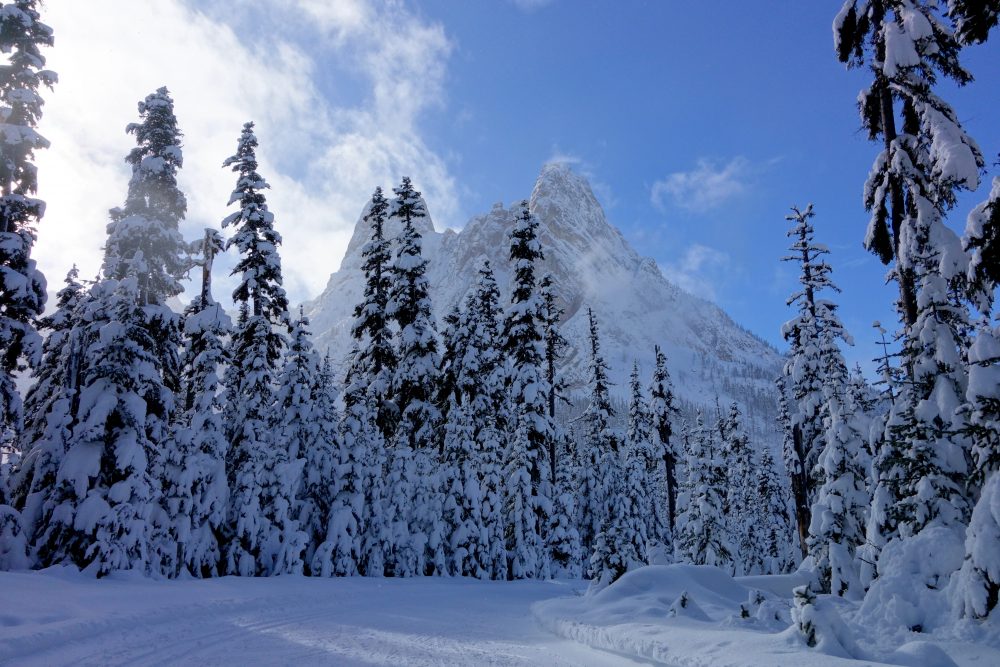
Skiing under Liberty Bell on Washington Pass in November, 2016. (Methow Trails courtesy photo)
Natural snow is where it’s at, unless there’s none to be found. In high-elevation places like West Yellowstone, Mont., (roughly 6,600 feet above sea level) and Crested Butte (nearly 9,000 feet), November skiing is almost always a given — which is why those venues have hosted Thanksgiving-week ski camps for 16 to 30+ years. And they are again this year, while looking to the skies and weather forecasts in hope of more snow — much more.
While there are only two well-known Thanksgiving camps currently being held in the U.S., there are dozens of other places around the country you can likely go skiing. We did our best to present some of the most dependable options, so at the very least you can plan a future trip on snow this time next year. No offense to the in-laws, but wouldn’t you rather be skiing on Thanksgiving? Stay tuned for our Canadian early skiing edition, and feel free to share your favorite November ski spot in the comments section below.
***
What: Yellowstone Ski Festival
Where: West Yellowstone, Montana
A rendezvous point at the Rendezvous Ski Trails as seen last year in West Yellowstone, Mont., during the 2015 Yellowstone Ski Festival. (Photo: 2015 courtesy photo)
How many years running: Over 30 years. “It started with Drew Barney, Torbjorn Karlsen and Dick Hunt back in the 1980s as a Fall Camp, offering clinics for coaches and citizen racers looking to improve their technique,” West Yellowstone Ski Education Foundation Program Director Moira Dow explained. “Over the years, the camp grew into one of the top training camps available to the cross-country ski community.”
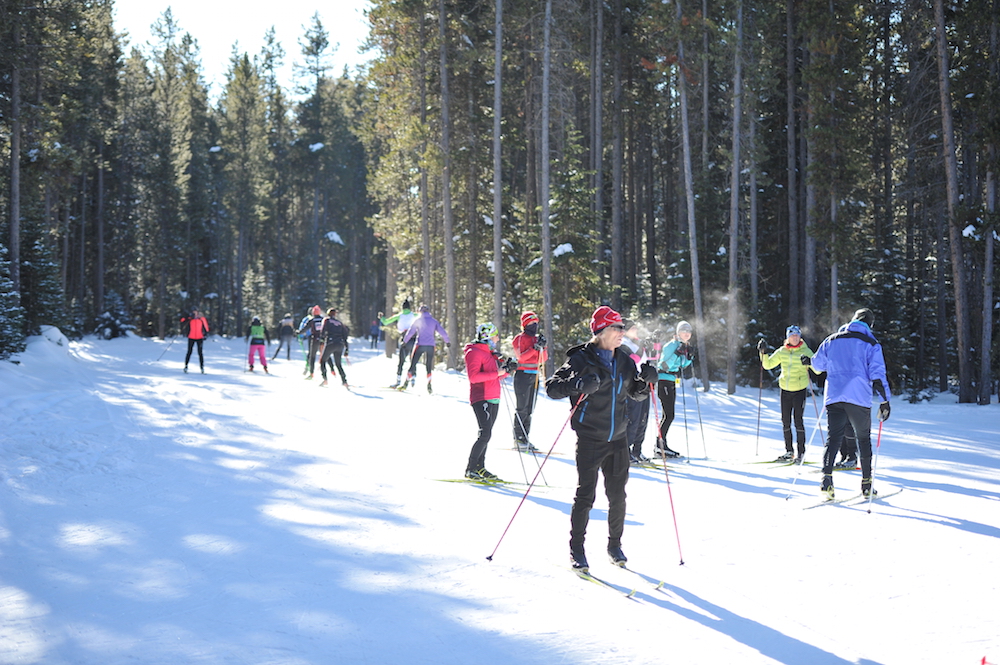
Skiers at the trailhead of the Rendezvous Ski Trails in West Yellowstone, Mont., on Monday, Nov. 21, 2016. (Photo: FBD)
Target audience: Open to the public and all levels of skiers.
Anticipated participation: Around 2,500. “We think it might be a little bit lower this year because of the late snow and the lack of the SuperTour,” Dow noted. “Last year we had a lot. We had really really early snow last year. Around 3,500 in years past.”
Advance reservation required? Yes for clinics and races. Online registration only. “The competitive events and the clinics all require you to be pre-registered, but all the evening events are open to the public,” Dow said.
Trail pass rates: $55 for the month of November for adults. $26 for kids, which is 10 and under. Day passes are $12 and $6
Grooming report:Approx. 20-25 k groomed as of Monday, Nov. 21.
A young skier darts out of the start at last year’s Yellowstone Ski Festival in West Yellowstone, Mont. (Photo: 2015 courtesy photo)
What makes this camp unique?
“Good, early, reliable snow,” Dow said.
“Also it’s a place where skiers from all across the country, juniors to seniors to masters, come together,” she added. “… And as a junior, that’s pretty unique to get to be able to do that. And also to see all the equipment from vendors and see wax clinics. To have all of the elements in one spot is one of the most unique things about this camp.
“We’re a tiny town out in the middle of nowhere,” she continued. “Our ability to put on such a big event, is, in my opinion, probably one of the most unique aspects of our camp. We are almost entirely volunteer run. The fact that the people who run the festival have little to no experience cross-country skiing, but put on these races, is just flabbergasting to me. It’s pretty incredible.”
Special events: See website for complete lineup of clinics and more, including:
Presentation: Wildlife photographer Tom Murphy
Yellowstone Historic Center presents The Ski Hero Soldiers of Yellowstone
Whiskers, Whiskey, and Waxing featuring whiskey tasting samples from Willie’s Distillery of Ennis, MT
Branch Beer Bash: Micro and craft beer tasting
Presentation: Kaatsu Training by Doug Barnard
Winter Wildlands Alliance Backcountry Film Festival
Women, Wine, and Waxing
Keynote speaker Ruff Patterson
Yellowstone Ski Festival Social
— Gabby Naranja
***
What: Crested Butte Nordic Thanksgiving Camp
Where: Crested Butte, Colorado
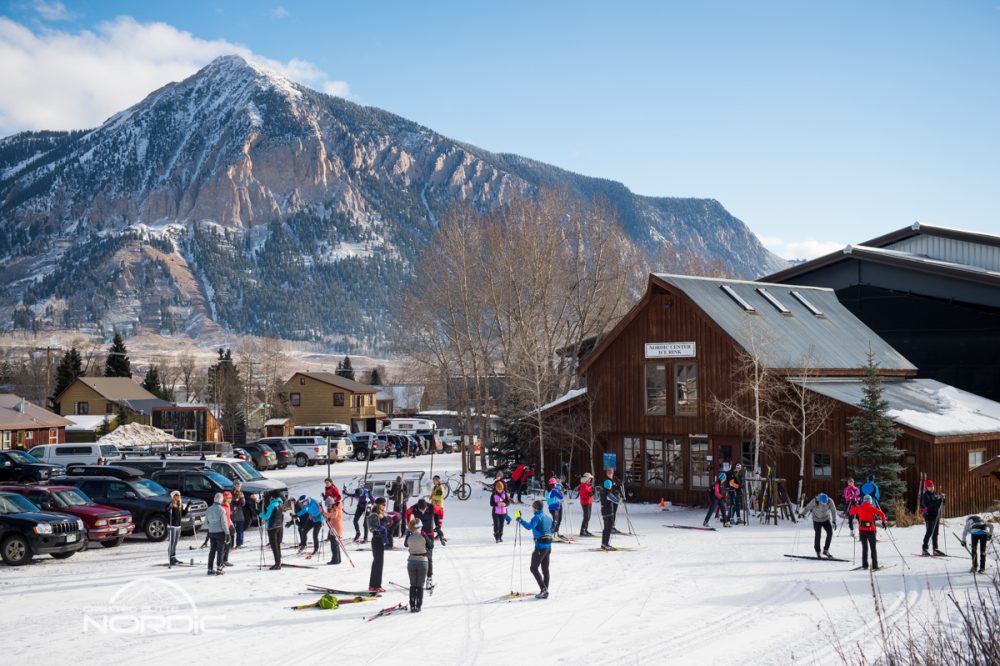
The downtown-based Crested Butte Nordic Center. (2015 courtesy photo)
When: Wednesday, Nov. 23, to Sunday, Nov. 27, 2016
How many years running: 16 as an official, organized camp: “In case of a low-snow year, like our current situation, we have a low-snow venue called Lily Lake and that’s up on Kebler Pass which is six miles West of town,” said Drew Holbrook, marketing director for Crested Butte Nordic.
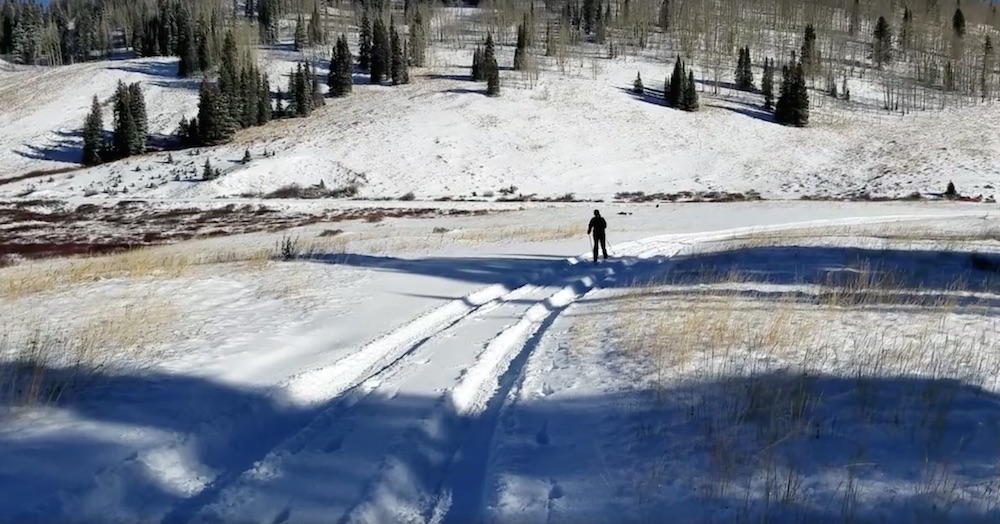
Skiing at Lily Lake in Crested Butte, Colo., on Nov. 18, 2016. (Photo: CB Nordic/Facebook video)
The road up to Kebler Pass is maintained by the county. Individuals or groups can drive up to the pass, but carpooling is encouraged when the low-snow option is in play.
“We have vans to shuttle people up to try and minimize traffic and congestion — it’s kind of like a similar situation in terms of people (but not as and because not quite as many people) as driving up on the South Plateau outside West Yellowstone, so we shuttle people up there. For the people taking clinics we shuttle them all up in vans.”
The Lily Lake area receives 600 inches of annual snowfall and no trail pass is required. As of Nov. 18, Lily Lake had received nearly six inches of snow.
The Nordic Center located in town is also prepared for low snow, according to Holbrook. “Just in the last three years we have had the trail right next to the Nordic Center in town, called Ruthie’s Run, homologated re-engineered. So it’s seeded with grass, it is mowed and basically we can groom that with literally six inches of snow or so. It’s kind of interesting because it snows a lot more up on Kebler Pass at Lily Lake, it might snow two feet up there and only six inches in town, but it’s easier to actually groom on Ruthie’s down in town if we get the snow. Lily Lake is on Forest Service property, so we have to wait until there is a foot of snow before we are allowed to groom up there.”
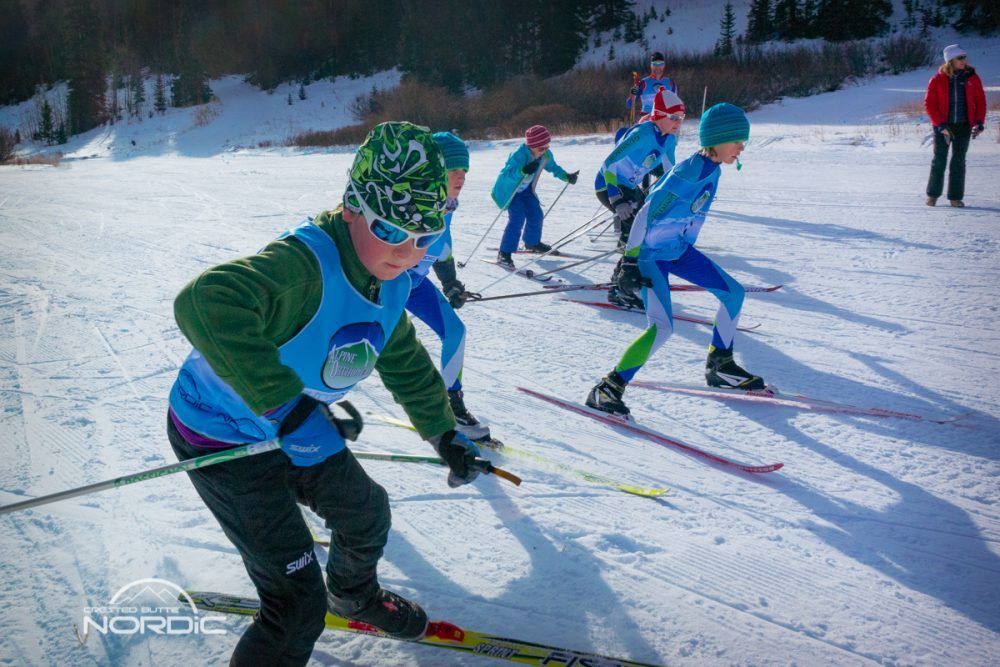
Crested Butte Thanksgiving Camp: not just for big people. (2015 courtesy photo)
Target audience: All ages and abilities. New skiers are encouraged to come try the sport out.
Anticipated participation: Holbrook expects 60 participants for the clinics offered. A round-robin classic “refresher” will be held Thursday, Nov. 25, with full-day clinics on the 26th and 27th.
Advance reservation required? Strongly encouraged. “For the clinics it is best to sign up ahead of time,” Holbrook said. “We never get too many people signing up until it starts snowing, but they do fill up. You might get lucky the morning of and come into the Nordic Center and sign up and get a spot, no guarantees.”
Trail pass rates: $20/day, skiers 17 & younger ski free. $150 for a 10-punch transferable pass.
Grooming report: Lily Lake is receiving snow. The low-snow option looks more than promising.
What makes this camp unique? “One thing that makes it unique, Lily Lakes is a great locals’ place to ski,” Holbrook said. “It’s pristine and scenic. And of course, its great skiing from the Nordic Center in town, too. There is plenty of room on the trails for everybody, you are not getting swarmed by people and not being able to do your workout. It’s easy to get in a good ski.”
Special events:
Ski Free Day: Wednesday, Nov. 23 at the Crested Butte Nordic Center
Crested Butte Mountain Resort “Donation Day”. Donate some money, you decide the amount, and ski with a little help from gravity at the downhill area. All proceeds support the Crested Butte Snowsports Foundation
Round-robin refresher clinic: Thursday, Nov. 24
U16 Junior Training Camp: Nov. 25-27
Alley Loop Race Series (Race #1) 5 k & 10 k skate
Winter Kick-Off Party (Saturday night): Fundraiser for Crested Butte Nordic, tickets $25/adult,$15/children. (Author’s note: Crested Butte throws fun parties.)
— Jason Albert
***
NOT CAMPS, PER SE, BUT YOU’RE PROBABLY WONDERING ABOUT:
ALASKA
Fairbanks
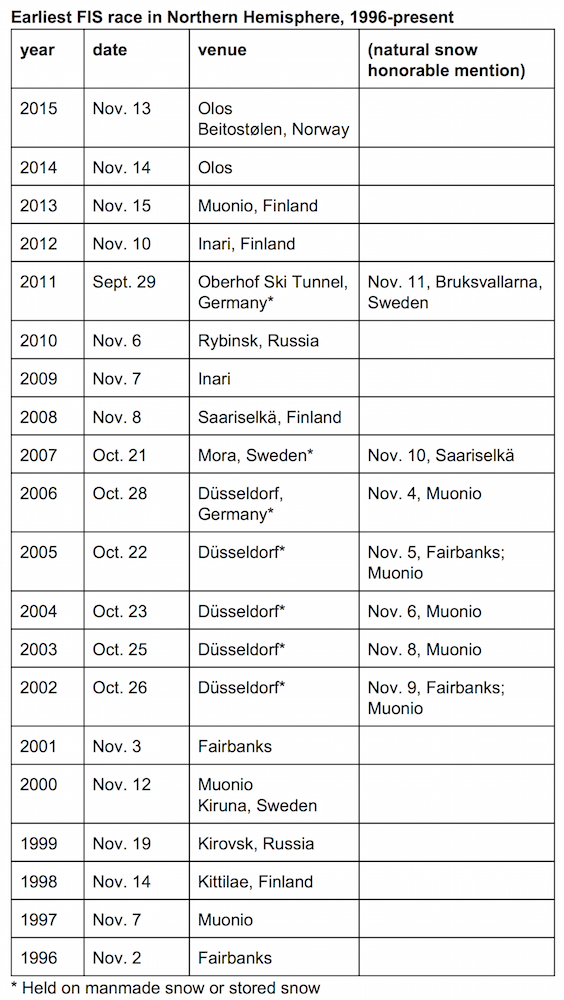
Birch Hill Ski Area, in Fairbanks, is probably the most reliable spot in North America for groomed early-season skiing. This is the venue that once held a FIS race on Nov. 2. Temperatures are reliably cold, and any snow that falls tends to stay. The Nordic Ski Club of Fairbanks grooms approximately 35 k of trails at Birch Hill. The trails are meticulously maintained in summer, if not manicured, and are justly renowned for their ability to provide good skiing after mere inches of snowfall.
University of Alaska Fairbanks skier Alex Eckert racing in the Alaska Nordic Cup FIS races in Fairbanks, Alaska, on Nov. 19, 2016. (Photo: Max Kaufman)
Birch Hill again held FIS races on the recent weekend of Nov. 19-20. It had snowed approximately 5″ total in Fairbanks this winter by that point. Weekend racers – and there were hundreds of them, from kindergarteners without poles to the APU Elite Team – skied on trails that had been packed and dragged to create a base of approximately 2″. There were admittedly some leaves and dirt showing through in places – but, crucially, it was leaves, not rocks. Most skiers in the FIS/USSA class of the weekend’s races competed on their prior-generation, few-years-old race skis.
Locals consistently described the conditions, which led half the APU Elite men’s team to make the trek north from Fairbanks for the weekend, as among the worst mid-November conditions in living memory.
Anchorage and nearby
Under normal conditions, as measured by a 30-year average, Anchorage around Thanksgiving is a nordic nirvana. There are at least 40 kilometers of groomed trails at Kincaid Park, on the west edge of town, and another 16 k at Hillside, on the east edge of town. (16 k are lit at Kincaid, and 8 k are lit at Hillside.) The two ski areas are connected by a network of dozens of kilometers of additional trails (also groomed, or at least snowmachine dragged), ranging from moose-dense forest to urban greenbelt, including the Coastal Trail, which runs along the shores of the Pacific Ocean for most of its 15 k. You can ski from Hillside up into the Chugach Front Range, and from the frontcountry into true backcountry. Around 20 miles out of town to the north, Beach Lake has another 20 k of groomed trails (nine of them lit). 40 miles to the south, Girdwood boasts a growing trail network of around 10 k total, including a competition-level 5 k loop. All trails are open 24/7, and there is no trail fee for any of them.
Hillside ski trails in Anchorage, Alaska, on Oct. 22, 2016, before the rains came. (Current conditions are far worse.) (Photo: Gavin Kentch)
Judging from the last three winters, however, Anchorage sadly simply cannot be recommended as a viable option for Thanksgiving snow in these days of climate change. While all three winters saw the first snowfall in October or early November, and some period of good skiing immediately thereafter, all three gave way to wind and rain by Thanksgiving week. As of the weekend of Nov. 19-20, 2016, Anchorage has no natural snow on the ground at Kincaid, a 1-2″ base of bulletproof sheet ice at Hillside, and skritchy skiing on a local golf course. On the bright side, the trail running is amazing (bring your Icebugs), and the nordic skating is world class.
Kincaid has limited snowmaking capabilities, which are capable of covering a loop of as much as 3-4 k centered around the main stadium area. (This is where over 95 percent of Anchorage ski races have occurred over the last two winters.) The Nordic Skiing Association of Anchorage (NSAA) turned the snowguns on briefly on Nov. 16, then again on Nov. 18. Recent cold temperatures have allowed them to operate continuously since. NSAA stated on Sunday morning that there were no trails open for skiing yet, but that they were “getting closer” to opening the first loop and had reached the stage where the PistenBully was starting to move snow around. A loop of approximately 2 k was opened amidst single-digit temperatures on Thanksgiving morning, Nov. 24.
In a recent email to FasterSkier, NSAA Program Manager Tamra Kornfield addressed the possibility of, for example, guaranteeing skiable snow by Thanksgiving in exchange for attracting skiers and generating user fees. Kornfield wrote, “The theory of trail fees has been discussed for many years, but currently our ski trails are on Municipal Park land, and we cannot charge to access these parks. However, I can say that the snowmaking system was designed to extend the ski season, not create it from scratch, so I do foresee doing more to fundraise for this great expense that has now saved the last two ski seasons.”
Mat-Su Valley
Archangel Road above Palmer, Alaska, on Nov. 4, 2016 (current conditions are better than this). (Photo: Gavin Kentch)
The Matanuska–Susitna Valley, approximately one hour outside of Anchorage on a major highway (call it up to 90 minutes to the ski areas discussed here), has been described on this website as having “the season of winter that starts in the fall and ends in the spring.” That’s pretty fair.
The Mat-Su Ski Club, including the redoubtable Ed Strabel and sometime FasterSkier contributor Jeff Kase, typically groom 7 k of Bill Spencer-designed trails at Government Peak Recreation Area (to be expanded as soon as next summer), 7.5 k (one-way) on Archangel Road, and 5 to 10 k at Hatcher Pass. Archangel Road hosted one of the last North American ski races of 2015/2016 and one of the first of 2016/2017. Hatcher Pass is a truly special place, as the groomed trails wend their way past the historic buildings of an old gold mine nestled in a bowl in the Talkeetna Mountains. “Imagine skiing through an Old West ghost town turned collectible Christmas village,” local Master and English professor Shannon Gramse once wrote in these pages.
Skiing at Hatcher Pass, above Palmer, Alaska, on Nov. 20, 2016. (Photo: Nat Herz)
As of Nov. 19, Government Peak (a one-hour drive one-way from central Anchorage), which is at a lower elevation than the other two areas, did not have enough snow to ski on. Archangel Road (75-minute drive) had a base of approximately 4-5″, but it is bulletproof hardpack that should provide a reliable base until spring. The Mat-Su Ski Club has been grooming there several times a week, and the skiing is good to superb. The Mat-Su Ski Club also groomed Hatcher Pass (90-minute drive) over the weekend.
For the best information on current trail conditions, including formal grooming reports when available: Anchorage (official NSAA and user-generated), Mat-Su, and Fairbanks.
— Gavin Kentch
WASHINGTON
Then there are the possible Northwest options for early season skiing, including the well-known:
Bluebird day on Washington Pass in November 2016. (Methow Trails courtesy photo)
Methow Valley
“I giggle about the current skiing up at Washington Pass which is a the top of the North Cascades Highway,” said Kristen Smith, marketing director for Methow Trails based in Winthrop, Washington. “What they have groomed is almost exactly one mile or a 1.6-kilometer loop. It goes out to the Washington Pass overlook, which is stunningly gorgeous. I mean the whole ski is the most beautiful, their probably can’t be a place anywhere in the world that has more beautiful scenery than this, on this little loop.”
Smith explained the loop is being groomed for skate and classic. “It’s a handful of super-dedicated locals who do the grooming completely on their own and you don’t pay to ski there,” Smith said.
But here’s the important beta: call or check online before you head to the Methow or think you might ski at the top of Washington Pass. The Washington Department of Transportation is closing the pass temporarily due to possible hazardous weather and avalanche conditions as of Monday, Nov. 21.
Skiing at Washington Pass, Nov., 2016. (Courtesy photo)
“It will not mean a loss of skiing,” Smith explained in the event the pass is closed for the season. “If the gate is closed farther down on the road to Washington Pass, they will start to groom different areas that we can still access. So to get the snowfall that is expected, they will start to groom just start to groom a bit lower, but bigger loops than what we have up there at Washington Pass. If we are really lucky we will get a big snowfall here on the valley floor and then Mehto Trails who I work for, we will start grooming our system. And we are all set and ready to go the moment we get six inches of snow we will start grooming our trails here.
Conditions: Pass is closed. SR 20, the North Cascades Highway, is closed from milepost 134 to milepost 171 due to impending weather and potential increasing avalanche hazard.
Restrictions Eastbound: Pass Closed
Restrictions Westbound: Pass Closed
— Jason Albert
EAST-COAST SNOW?
While they’re often among the last to get on natural snow, let’s throw eastern skiers a bone. Wintry conditions exist in New England and northeastern New York. While we can’t list them all (and are obviously unable to cover all the open nordic centers across the country), here are a couple weather-dependent options in this region’s “North Country”.
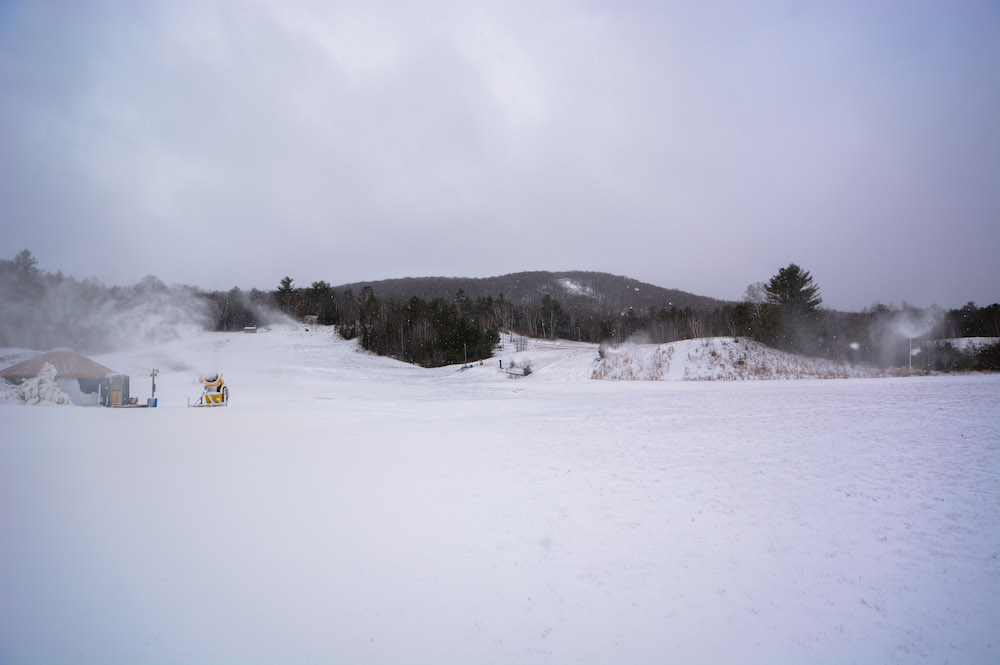
Snow guns a’blazing at Gore Mountain’s Ski Bowl in North Creek, N.Y., on Monday morning, Nov. 21, 2016. (Photo: Mike Pratt)
Gore Mountain Ski Bowl
According to general manager Mike Pratt, Gore Mountain in North Creek, N.Y., expects to open its newly homologated ski bowl on Friday, Nov. 25. Gore’s new 4.24-kilometer trail network includes 3.19 k of trails with snowmaking.
“We should have quite a bit of terrain for an opening weekend,” Pratt wrote in an email, adding that they’re hoping for trails A, B, C, and G, which would amount to a total of 2.3 k. “The open stadium could accommodate more lanes if needed, but next week’s weather will ultimately determine how much terrain is available.”
This Friday through Sunday at the Ski Bowl, the Hudson United Race Team (HURT) is holding a three-day ski camp for its junior members. Skiers of all ages not associated with the club can buy a day pass and ski on the trails as well.
“We set up this camp as a way to highlight what Gore has been doing,” HURT coach David Kvam explained.
Craftsbury
Then there’s the Craftsbury Outdoor Center, the Northeast Kingdom’s iconic ski center. Although the ski trails were dry as of Nov. 18, the forecast has potential. According to Craftsbury’s Marketing Director Sheldon Miller, the National Weather Service issued a winter storm warning for six to eight inches of snow by the end of Monday. Asked about snowmaking, Miller replied, “We’re looking for cold and dry for snowmaking, but there’s definitely some potential this week. We do need 28 [Fahrenheit] at a minimum, but colder is always better.”
With overnight temperatures forecast for low to mid 20s Sunday through Thursday, the weather looks inclined to support snowmaking.
Elsewhere, Prospect Mountain in southern Vermont received snow. According to their conditions page, they’re closed, but Zach Caldwell posted this photo montage on Sunday:
As of Tuesday, Prospect reported more than 28 inches of packed powder. Current conditions
Mt. Van Ho
A skier skates on fresh powder at Mt Van Hoevenberg last Sunday, Nov. 20, in Lake Placid, N.Y. (Courtesy photo)
In Lake Placid, N.Y., Mt. Van Hoevenberg reported “beautiful packed powder” and 30 kilometers of skiing open on a 7-inch base. Current conditions
Josie’s Cabin, Mt. Van Hoevenberg’s ski-to destination, will be open for Thanksgiving. (Courtesy photo)
“The Olympic Cross Country ski trails of Mt Van Hoevenberg have been graced with just under two feet of snow in the last few days,” nordic program manager Kris Cheney-Seymour wrote in an email. “We have a little over 30k of trails groomed very good skiing. Classic tracks are set on varied terrain.”
The lodge is open with rentals and a snack bar for Thanksgiving, along with Josie’s Cabin, a “ski-to destination.” and a ski-to destination
“Upgrades over the last two summers on the famous Ladies 5k have allowed for the earliest opening of this trail in our history,” Seymour continued. “Our 5k homologated loop will be the primary course for the upcoming 2017 Junior National Championships hosted here this March.”
— Peter Minde & Alex Kochon
***
WE WANT PHOTOS! Share your Thanksgiving week ski photos with us by emailing info@fasterskier.com (please note when and where they were taken). We’ll post our favorites to Instagram, and if you’d like to share a firsthand trail report from your favorite spot or nordic center, do so in the comments below!
University of Alaska Anchorage freshman Hailey Swirbul races through the stadium at Birch Hill Ski Area in Fairbanks, Alaska, in the Alaska Nordic Cup on Nov 19. (Photo: Zachary Hall/UAA Athletics)
FAIRBANKS, Alaska – Scott Patterson is on a roll. The Alaska Pacific University (APU) skier has now won all of the ski races he entered this year – and over half the ski races held in this country in the 2016/2017 winter to date– after picking up wins on both days of racing in the Alaska Nordic Cup at Birch Hill Ski Area in Fairbanks, Alaska, this past weekend, Nov. 19-20.
APU’s Jessica Yeaton was also a double winner on the weekend. And in the collegiate ranks, the University of Alaska Fairbanks (UAF) maintained its hold on the Alaska Nordic Cup against the University of Alaska Anchorage (UAA).
Skiers from both universities competed with a new lease on athletic life, after learning earlier this month that the ski programs would not be cut at either UAA or UAF.
The Alaska Nordic Cup is an early season, relatively low-key (but nonetheless International Ski Federation (FIS) sanctioned) competition between Alaska’s only two NCAA nordic programs. Prior to this season, in which UAF switched its conference affiliation from the Central Collegiate Ski Association to the Rocky Mountain Intercollegiate Ski Association (RMISA), it marked the only time outside U.S. nationals that Alaska’s college skiers might compete head to head until, potentially, NCAA Skiing Championships in March.
The Nordic Cup is held each year in November, alternating between the Fairbanks and Anchorage areas. 2016 marked the 13th annual Nordic Cup competition. The UAF Nanooks enjoy a healthy historical advantage over their southern rivals, the UAA Seawolves, entering the weekend with an 8-3-1 all-time record (eight wins, three losses, and one tie) in the first 12 years of the dual meet. Scoring is typically based on an individual race on Saturday plus a relay on Sunday. Lowest combined time wins.
But despite a strong team showing from UAF that carried the Nanooks to victory, and some standout individual performances from UAA, it was APU that owned the top steps of the podium throughout the weekend.
APU’s Becca Rorabaugh (l) and Jessica Yeaton (r) at U.S. SuperTour Spring Series in March 2016. (Photo: John Lazenby/Lazenbyphoto.com)
In the women’s race, Jessica Yeaton, an Australian national-team member who competes for Australia internationally but lives in Anchorage and trains with APU, finished Saturday’s 6 kilometer freestyle interval start in 16:52.1, skiing smoothly in relatively cold and slow conditions. APU’s other entrant, Fairbanks native Becca Rorabaugh, finished second, 34.1 seconds back. Third went to Hailey Swirbul, 1:27 back, in the UAA freshman’s college racing debut. UAF skiers swept the next four spots, led by senior Nichole Bathe, the day’s final starter, in fourth.
Yeaton appreciated the early season racing opportunity. “It was awesome to race up here on good snow,” she wrote to FasterSkier. Yeaton added, “The conditions were thin but still provided a really good opportunity for a race effort. We are lucky to have these early races to help prepare for the Supertour in a couple weeks – the [Nordic Ski Club of Fairbanks] did a great job making them happen despite the lack of snow!”
Swirbul, a Colorado native, echoed Yeaton’s praise for the venue and host club: “Thanks to Fairbanks for using their limited snow and delivering excellent (all things considered) courses and conditions for us to open our season this past weekend,” she wrote in a Sunday email to FasterSkier.
Swirbul added, reflecting on the sensation of putting on a race bib once more: “As usual, it’s an interesting feeling to return to an on-snow race scene after long summer months without one… nerves, waxing, morning jogs and stretching, race strategy, etc. I sure enjoyed being back at it this weekend! I was satisfied with my and my team’s skiing this weekend, considering it is only November, and think we have great things ahead of us. We are all revving our engines preparing for a long winter ahead, ready to establish a new name for our team with many young skiers, and meanwhile prove to the president of our university that we are more than worthy of being part of a long lasting ski team at UAA! I am very excited for what the season has to bring for UAA.”
Bathe, originally from Madison, Wis., was likewise pleased by the strong first-day showing of the UAF team. “I thought today went well especially for our whole women’s team,” she wrote in an email on Saturday. “To have four women right in there is always awesome and makes us excited for the season! It’s nice to see all the summer training pay off and start getting back into race mode again.”
On the men’s side, the top-seeded Patterson took advantage of his position as the final starter to ski to the victory over several of his APU teammates, including David Norris in second.
“Snow instead of ice made coming to Fairbanks [from Anchorage] for races an easy decision,” Patterson wrote. “Although I hadn’t raced here since high school, I have always enjoyed the Birch Hill trails. During the race, I had to remember how to race a little after getting some early splits that I was even with David and knowing his fitness through the summer and fall. Overall it was a great chance to chase out some early season rust and get ready for important races.”
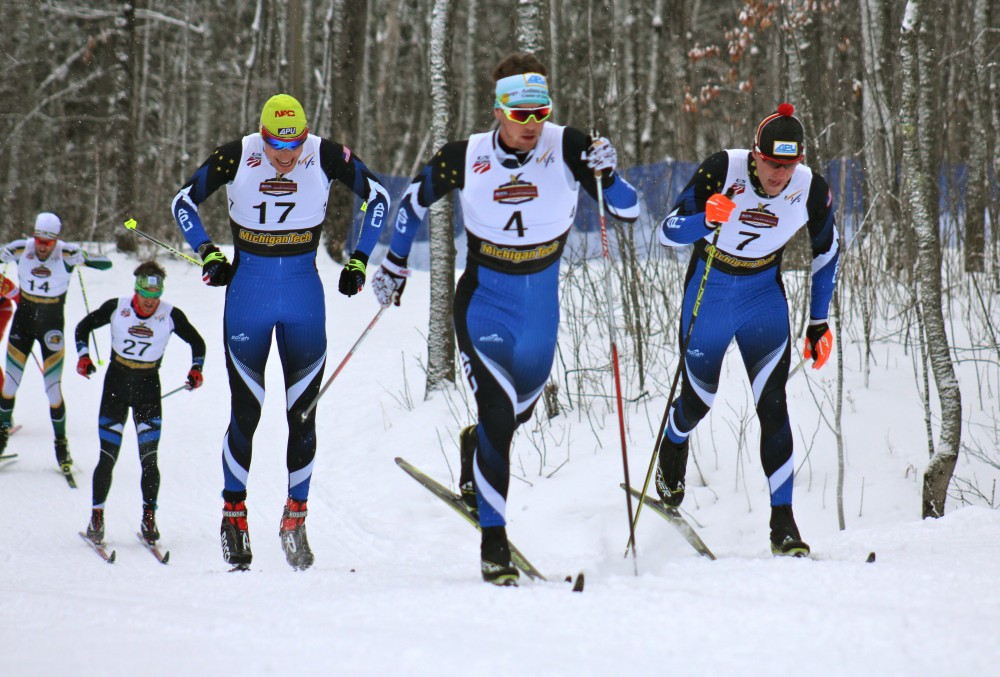
APU teammates and brothers Logan Hanneman (7) and Reese Hanneman (4) lead teammate Tyler Kornfield (17) during their quarterfinal of the men’s 1.5 k classic sprint at 2016 U.S. nationals in Houghton, Mich.
Patterson completed the 8.25 k skate race in 19:36.3. Norris finished 16.7 seconds behind him. Tyler Kornfield rounded out the APU podium, finishing 1:03 back of Patterson.
Patterson and Kornfield grew up in Anchorage. Norris is a Fairbanks native. Their good-natured geographic rivalry stretches back a decade or more, to when they were all competing in Alaska high school skiing. (“We hated the Anchorage guys,” Fairbanks skier Reese Hanneman told the Alaska Dispatch News “with more amusement than venom” in a summer profile. “We were like the rednecks from Fairbanks, out skiing in the woods, going up against the city boys.”)
APU skiers took the top five spots on the day, with Anchorage skier Thomas O’Harra in fourth and Fairbanks local Logan Hanneman in fifth.
The top college skier was UAF junior Max Donaldson, another Fairbanks product, in sixth, 1:37 back of Patterson. The top UAA skier was sophomore Toomas Kollo, from Estonia, 2:35 back in ninth.
At the end of the first day of racing, the combined times of the top three UAA women put them just 23.5 seconds behind the top three UAF skiers. On the men’s side, UAF created a larger gap of 2:14.2 over UAA’s combined times, giving UAF an advantage of roughly 2:38 heading into Sunday’s relays.
Sunday saw more of the same: APU took the easy win, Swirbul shined for UAA, and UAF used its depth and balanced performances to take the overall victory.
APU entered only one team in the relay, but it included the top two finishers from each of Saturday’s individual races. Unsurprisingly, the team of Patterson, Rorabaugh, Norris, and Yeaton posted the fastest time in all four legs of the 4 x 4 k skate relay, finishing in 46:57.4.
UAA skiers Hailey Swirbul (l) and Casey Wright (r), on the UAA campus in October 2016. (Photo: Gavin Kentch)
The top college team was Nanooks A (Donaldson, Sarissa Lammers, Michael Fehrenbach, and Bathe), finishing just over three minutes behind APU in 50:10.1. Donaldson and Fehrenbach posted the fastest male collegiate times of the day in their legs. Seawolves ‘A’ (Kollo, Swirbul, Marcus Deuling, and Casey Wright) was less than eight seconds behind the Nanooks in 50:18. Swirbul was again the fastest collegiate woman on the day, while Wright similarly recorded the day’s fastest anchor leg.
Nanooks ‘B’ was next, followed by Seawolves ‘B’. Ultimately, the time gaps from day one grew, and UAF finished with a 4:08 cumulative advantage over UAA, taking home its ninth Nordic Cup overall and second in a row.
UAF nordic coach Nick Crawford said in a Sunday press release, “The Seawolves had a good day today and it was very exciting to watch the race unfold. The margin between our two teams was much smaller today, so it made it that every skier had to race hard which isn’t always the case in relays. The victory was for sure a team effort today with both the men and the women putting together good races. We really enjoy the collaboration we have with our Anchorage rivals.”
UAF skier Anna Darnell expressed similar sentiments, telling the Fairbanks Daily News-Miner, in light of the recent political rollercoaster of threatened cuts to both schools’ ski programs, “We feel a lot closer to the UAA team after this.”
Meanwhile, at the top of the results sheet, Patterson’s brace of victories on the weekend, combined with his easy victory at the Race to the Outhouse #1 outside Palmer, Alaska, earlier this month, meant that the APU skier has now won every single race he has entered this winter, as well as 60 percent of all the ski races held in this country this year. (The Mat-Su Ski Club held a pair of 5 k skate and classic races at Hatcher Pass on Nov. 19 and 20.)
“I’ll have to get a time turner for the coming weekends,” Patterson wrote in an email as he reflected on his current track record, “so I can continue to win every single race in the U.S.”
This particular race was slightly more competitive than the Race to the Outhouse. FasterSkier unofficially calculates the USSA race penalty (a measure of the strength of the field) for Saturday’s men’s race as an impressive 29.03, well below the USSA minimum penalty of 35 for a College Event or Regional Scored Event. (The penalty for the women’s race was unofficially a higher, but still respectable, 60.52.)
Reflecting the cosmopolitan nature of NCAA skiing, competitors in the 45-racer FIS/USSA field hailed from at least eight foreign countries, including Canada, Norway, Germany, Australia, Sweden, the Czech Republic, Italy, and Estonia. They were joined by roughly 200 more skiers in the day’s other races, ranging from kindergartners in snowsuits who skied a 500 meter course without poles to the 60- and 70-year-old age brackets in the community 4 k race.
The strong community support, and college athletes who had finished their race but stayed to cheer on their teammates, combined to make the atmosphere as electric as can be found for American cross-country skiing. Dozens of spectators lined a late-race climb back up to the stadium, where racers were met by an even larger, frenzied crowd cheering them on.
The University of Alaska Fairbanks ski team poses with the trophy for the Alaska Nordic Cup at Birch Hill Ski Area in Fairbanks, Alaska, on Nov. 20, 2016. (Photo: Nick Crawford/UAF Athletics)
Conditions were, as the athletes acknowledged, undeniably snow rather than ice (as on the Anchorage trails these days), but unfortunately not that much of it. Fairbanks has seen approximately five inches of total snowfall so far this winter. The impeccably maintained trails at Birch Hill meant that racers found a base of roughly two inches of compacted snow, with some leaves and sporadic dirt showing through, but no rocks. Most skiers in the FIS race competed on their prior-generation race skis.
Although the official high for the day at the Fairbanks airport was a barely FIS-legal 1° F (-17 degrees Celsius), temperatures at the relatively elevated Birch Hill were comparably temperate, hovering around 10° F (-12 C) throughout the afternoon.
At least in the sunlit stadium. Racing at Birch Hill on clear and cool winter days can be an oddly hellish experience. Not because it is unenjoyable – far from it; the trails are a delight to ski, and the snowy birch forest is sublimely beautiful– but because it evokes the sensation of voyaging into the underworld and back again. The stadium is in the sun, and elevated, and relatively warm; many trails drop down leaving the stadium, sending the skier into the realm of dark and cold. And so one goes from light to dark, sun to shade, warmth to cold, and back again with each new trail, the stadium become a modern-day Cumae (entrance to the underworld in classical mythology) and the skier Heracles or Odysseus, re-enacting the journey between worlds.
RMISA college racing resumes early next year with the Utah Invitational at Soldier Hollow on Jan. 7.
University of Alaska Anchorage skier Casey Wright skis in the Alaska Nordic Cup in Fairbanks, Alaska, on Nov. 20, 2016. (Photo: Max Kaufman)
Alaska Pacific University skier Jessica Yeaton skis the anchor leg of the winning relay team in the Alaska Nordic Cup in Fairbanks, Alaska, on Nov. 20, 2016. (Photo: Max Kaufman)
University of Alaska Fairbanks skier Alex Eckert skis in the Alaska Nordic Cup in Fairbanks, Alaska, on Nov. 20, 2016. (Photo: Max Kaufman)
University of Alaska Fairbanks skier Alex Eckert skis in the Alaska Nordic Cup in Fairbanks, Alaska, on Nov. 19, 2016. (Photo: Max Kaufman)
University of Alaska Fairbanks skiers Sarissa Lammers (464) and Hannah Rowland (462) ski in the Alaska Nordic Cup in Fairbanks, Alaska, on Nov. 19, 2016. (Photo: Max Kaufman)
Second-place finisher Alaska Pacific University skier Becca Rorabaugh approaches the finish line of the Alaska Nordic Cup in Fairbanks, Alaska, on Nov. 19, 2016. (Photo: Max Kaufman)
First-place finisher Alaska Pacific University skier Scott Patterson approaches the finish line of the Alaska Nordic Cup in Fairbanks, Alaska, on Nov. 19, 2016, ahead of UAF skier Max Donaldson (494). (Photo: Max Kaufman)
Alaska Pacific University skier David Norris skis the third leg of the winning relay team in the Alaska Nordic Cup in Fairbanks, Alaska, on Nov. 20, 2016. (Photo: Max Kaufman)
Early-season snow: first tracks in Chugach State Park, above Anchorage, Alaska, on Sept. 18, 2015. (Photo: Gavin Kentch)
Twenty years ago today, on Nov. 2, 1996, a ski race sanctioned by the International Ski Federation (FIS) was held in Fairbanks, Alaska, on the trails at Birch Hill. It appears to be the earliest FIS race ever held on natural snow in the Northern Hemisphere. This is a look back at that race, and at the significance it has, or does not have, for some of its participants.
Setting the stage
It was the final days before a hard-fought presidential election. Clinton was widely expected to prevail over the Republican candidate, although a strong third-party showing and voter dissatisfaction with the two major parties were complicating the electoral calculus. The Alaska Republican Party was running newspaper ads promising to “defend State’s rights.” And people were skiing in Fairbanks. Plus ça change.
There were also some differences. The front page of the Fairbanks Daily News-Miner on Nov. 3 ran an article headlined “Dole hoping for an upset” over, of course, Bill Clinton. Then on Nov. 4: “Perot plans last-minute television blitz.”
Elsewhere in the paper, movie listings included the Leonardo DiCaprio vehicle Romeo + Juliet. Agate type in the sports section recounted promising rookie Ray Allen leading the Milwaukee Bucks to a victory over the Boston Celtics. (It was the second game of Allen’s career. He would go on to play 1,298 more games after that.) And an ad for an ISP, or internet service provider, explained to potential customers the appeal of “the Internet.” You could “interact with people from around the world,” it promised, or, “Find answers and advice in newsgroups.”
In Fairbanks, meanwhile, it was winter, and it had been winter for a long time. The News-Miner reported that October had seen record-breaking cold, even for Fairbanks, with an average temperature for the month of 13.6 degrees. Through Nov. 3, it had snowed 22 inches so far that winter; given those temperatures, and the relative lack of solar radiation in Fairbanks in winter, most of it was presumably still on the ground.
The Nanook Challenge
Given this weather and snow conditions, it hardly seems newsworthy that a ski race was held. Plus several members of the U.S. Ski Team (USST) had been in town for early-season training, so the skiers were there.
The field for the 10-kilometer classic interval start – official title the “Nanook Challenge: FIS Series Race No. 1” – was small but distinguished. There were 10 women and 18 men entered. At least four current members of the U.S. Ski Team competed, along with several former USST members.
The top-five finishers in the men’s race were Ben Husaby, Marcus Nash, Patrick Weaver, Scott Loomis, and Carl Swenson, respectively, a bevy of elite skiers that would not have been out of place at a mid-1990s national championship race. (Indeed, all five men would place in the top seven in the 15 k skate race at U.S. nationals later that winter in Bend.)
The women’s podium was headed up by USST skiers Laura Wilson and Suzanne King. Third place went to Julie Southwell, described by the News-Miner as “a national team contender who trains in Fairbanks.” (Five years later, a profile of Southwell by Inge Scheve in The Bulletin of Bend, Ore., would call her “a former Colorado resident who says she sort of follows the snow.”)
Wilson’s winning time was 33:28 for 10 k. Husaby finished the same course in 27:56. Conditions were described in the News-Miner as “near-perfect,” with an 11 a.m. race temperature of “20 degrees under a pale white ceiling of clouds.” (The season’s second FIS race, a 15 k skate, was held the following weekend, in arguably less perfect conditions. The high temperature for Fairbanks on November 9, 1996, was –1°. The low was –26°.)
(Story continues below)
The Fairbanks Daily News-Miner’s 1996 story on a Nov. 2 cross-country ski race, the earliest FIS-sanctioned event ever held in the Northern Hemisphere.
The Fairbanks Daily News-Miner’s 1996 story on a Nov. 2 cross-country ski race, the earliest FIS-sanctioned event ever held in the Northern Hemisphere.
The Fairbanks Daily News-Miner’s 1996 story on a Nov. 2 cross-country ski race, the earliest FIS-sanctioned event ever held in the Northern Hemisphere.
The Fairbanks Daily News-Miner’s 1996 results from the second race on Nov. 9.
Looking back
Swenson, the fifth-place finisher in the opening 10 k classic, has fond memories of Fairbanks as an early-season training destination generally, though scant recollections of this race specifically. When asked about this race in a recent phone interview, following his workday doing indigent defense for the New Hampshire Public Defender, Swenson began by musing, “I’m just trying to place what year that would have been,” and attempting to reconstruct whether World Champs had been held that spring or the year before. “We’d always have a race real quick after we got there,” Swenson continued. “And we’d get to Fairbanks in mid-October.”
In a race of more recent vintage: Carl Swenson, competing for Steinbock Racing, made the trip from southern New Hampshire for the 2010 Boulder Mountain Tour in Sun Valley, Idaho. (Photo: Toko)
“I remember it fondly,” Swenson, now 46, says of Octobers and Novembers spent in the Golden Heart City. “Not a lot of sunlight, lots of skiing.” He adds that “everyone was so excited be on snow again; I always looked forward to it. I don’t know if everyone looked forward to it, but I always did.”
“We were always able to ski” somewhere in or near Fairbanks, Swenson notes, “but sometimes it was really thin. … There could be pretty bad skiing, but I always remember we skied.” They would – much like modern-day juniors competing in the Besh Cup series – stay at the Wedgewood Resort, and “we’d all pile up and drive to Birch Hill. When it was a bad snow year, we’d all drive up to an elementary school” that had trails (Salcha Elementary), “and it would be ridiculously cold.”
Swenson’s lack of specific memories may be attributable not only to the passage of time and multiple fall trips to Fairbanks, but also to the fact that Nov. 2 was early in the season for him in more ways than one. “I probably hadn’t done much rollerskiing” at that point, Swenson candidly admits. “I was still catching up.”
(Uniquely among top-level cross-country skiers, Swenson had “made the bold decision to pursue a professional mountain-bike career and continue to ski race internationally in the winter,” FasterSkier previously wrote. 1996 was his first summer of pro mountain biking in the “offseason.”)
When asked whether he had simply kept the rollerskis in storage through September or had at least gotten out a few times a week during the summer, Swenson at first suggests digging up an old training log from storage, then says, “it would depend on if I went to late-season mountain bike races that year. Sometimes I would be – World Championships are at the end of the season in mountain biking. In ’96, I think I would have been in Boulder. And maybe I would have started doing some rollerskiing in the summer – not much, if any.”
Swenson was clearly unconcerned about his results in a November race two months before U.S. nationals and more than three months before World Championships. He recalled that his focus for his first two weeks back on snow would have been volume, and guessed that he would have logged approximately 20 hours of skiing per week while in Fairbanks. “I’m sure everybody up there was concentrating on volume, and things like that,” Swenson notes. “There would be people chasing points, to make an early trip – but I doubt anyone was doing that up there.”
Swenson improved his position with a third-place finish in the 15 k skate a week later, suggesting that he may have been racing his way into skiing shape.
The ’90s force is strong: Ben Husaby (USST) racing at 1993 U.S. Nationals in Rumford, Maine. (Courtesy photo)
At the top of the results sheet, Husaby won both races, the 10 k classic on Nov. 2 and the 15 k skate on Nov. 9. His memory of that fateful week in Fairbanks borders on the eidetic. “That weekend actually stands out for me as one of the more memorable ones in my ski career,” Husaby recently said when cold-called about a race from the Clinton administration.
Husaby, who turns 51 next month, spoke with FasterSkier by phone from Bend, where he works as executive director of the Bend Endurance Academy. (Husaby once cracked that he enjoys being a ski coach because “I get to drive a Ford Econoline van down winding roads in inclement weather.”) Husaby clarified that in his current job he coaches only one skier, national-class athlete Dakota Blackhorse-von Jess; he assists nordic director Bernie Nelson and will go out with other athletes, but says that he is following Nelson’s lead.
Husaby still recalls how fast he skied, but poignantly acknowledges that his timing was somewhat suboptimal.
“I’ll just say, it was the fastest I’ve ever skated, for sure,” Husaby declares. “And you certainly don’t want that to happen in the first week of November, but it did. It’s bittersweet, because it’s the wrong time, but it was amazing. Those two races, they were effortless.”
Husaby speaks with evident emotion about the sensation of skiing so easily:
“So, nobody wants to be a Christmas star, and I was a November star. But, the race course [in Fairbanks] was a very challenging race course, and I blew around that course effortlessly. And that was a really, really cool feeling. I had traditionally struggled in tough skating race courses, and, you know, I walked all over everybody. And so, you know, that was exciting. And one of the things I remember is, how cold I felt being as quote-unquote ‘skinny’ as I was. I was in the low 180s. And I was colder than I had normally been.
“I also remember feeling really light and fleet and dynamic. I remember – and it’s always weird, because when we got back to the hotel – you know, those first races of the year, people are always talking about how they’re going to get better, where they made mistakes… generally everyone wants to downplay their early races. And here I was – I’m looking in retrospect in terms of how fast I really did ski. At the moment I didn’t realize that that was probably as fast as I had ever gone, but in retrospect, I realize, wow.
“There were a couple of World Championship results, there were a couple World Cup results where I was competitive, and probably moving along at the same speed – but this particular weekend, it was completely effortless.”
Husaby had been a member of the U.S. Ski Team from 1991 through 1995, but in fall 1996 was training solo. But he finished ahead of all current USST members in both races in Fairbanks.
“Particularly the skate race,” Husaby enthuses, “I mean, for me to beat everybody by over a minute – I think it was a minute and change – in a 15 k skate. I mean, I never did that. I’m not really sure why.” (Husaby correctly recalls that he beat second-place John Bauer by 1:04 in the skate race.)
Early-season snow: skiing past Summit Lake, in Hatcher Pass above Palmer, Alaska, on Sept. 23, 2016. (Photo: Gavin Kentch)
At the time, Husaby felt strongly that his performance merited selection for bigger stages: “I do remember being like, ‘God, I wish they would have selected me to go back to the World Cup.’ Because they sent Marcus [Nash]. They took Marcus, not me. And I do remember being like, ‘Dangit, I killed everybody, they should be taking me.’ But it’s always like that – you always think that you should be the one that’s named.”
But he now waxes much more philosophical about the vagaries of team selection. “I’ve had 20 years to think about it,” Husaby now analyzes, no regret or animosity in his voice. “There are a lot of arguments why I should have been chosen for it, and a lot of arguments why I shouldn’t have been chosen for it. It’s just the nature of sport.”
As he left Fairbanks in November 1996, Husaby had high hopes that these results presaged a breakthrough season for him.
“Like any athlete, you think, ‘Oh my gosh, this is the start – it’s really going to happen here.’ Particularly when you’ve had five years of mediocre racing on the World Cup, right? … In the previous five years, I had everything [in World Cup results] from low 20s to, you know, 112th place. And so all of a sudden a result like this comes along early in the season, and I’m thinking to myself, ‘Man, if this is the start of things to come, this year is going to be totally lights out.’ ”
Husaby did not receive World Cup start rights that season, and in fact never raced on the World Cup again. He spent the 1996/1997 season on the domestic Yoko Cup, an inchoate version of the national-level race series that ultimately became the SuperTour.
Despite – or maybe because of – the fact that the Fairbanks races ultimately proved to be a highwater mark of the season rather than a springboard to successful European racing, Husaby frequently uses the experience as a teaching moment for his athletes.
“As much as we really think that we have our finger on the pulse,” Husaby theorizes, “and that we can really dial in when we’re going to be fast, and really pick and choose the big events, and how it’s all going to play out – you never really know when you’re going to have your moment. You don’t know. The body and the mind are really – sometimes they’re diametrically opposed, sometimes they’re incredibly in sync, sometimes one is lined up and the other one’s not. And a huge part about athletic growth is just realizing that you never really know when you’re going to have your moment. So when you do have your moment, hopefully you get something from it, you gain something from it. For me, this was an indicator that my training, the change in training, had an effect, the weight loss had an effect, maybe the release of not being on the ski team any more had an effect.”
“I guess the moral is to pull something positive out of a good race, regardless of when it happens.”
When asked about his strongest memories from his time in Fairbanks, Husaby mentions two things. First, despite the subzero temperatures for the skate race, “I remember that that climb – I felt like Superman going up that far outer climb [on the race course]… I remember charging up it. It’s got like three rises in it.”
Early-season snow: fresh snow on top of fall colors in Chugach State Park, above Anchorage, Alaska, on Sept. 18, 2015. (Photo: Gavin Kentch)
And second, “I remember that being a very cold week. … I wasn’t a ‘do a loop many times’ kind of guy. I was always an explorer. Well, I spent most of my training time in Fairbanks actually out on the White Bear [Trail] and out on the military roads. I used to bring really crappy skis, just so I could ski on the military roads. But I recall that week being incredibly cold. And my motivation was to ski out to the end of White Bear, look at the thermometer, and then ski back in. Just to reaffirm how cold it really was. That was it. Besides that race, that was my memory of that week.”
In addition to multi-time Olympians, other notable names on the results sheet include “Jason Cork, UAF, 34:23.3,” in 12th, surrounded by several of his teammates from the University of Alaska Fairbanks ski team. Cork was born and raised in Alaska, and graduated from North Pole High School in 1995. He skied for UAF before embarking on a coaching career that ultimately brought him to his current position as Assistant Men’s Coach for the U.S. Ski Team.
Early-season history
The participants may not have realized it at the time, but they were, in the world of high-level ski racing, making history. The race remains the earliest FIS-sanctioned race ever held on natural snow in the Northern Hemisphere, according to the FIS database.
(A FIS-sanctioned race is one whose results can be used to help calculate a skier’s FIS points, “theoretically a universal ranking system for skiers around the world who have never competed against one another.” Generally speaking, a FIS race is held on a course with climbs of specific height differential and grade, as well as a total climb requirement. A FIS race is held on a relatively challenging course, and attracts a relatively high caliber of skiers.)
Here are the earliest FIS races from 1996 to present, as listed in the online FIS results database. Amidst a host of early-November dates from several venues across northern Scandinavia, November 2, in Fairbanks, Alaska, stands out as the earliest by a small margin. But Fairbanks shares one significant thing in common with the other names frequently occurring on this list: a far northern latitude. Fairbanks is at, in round numbers, 65 degrees north latitude; Olos and Muonio, 68°; Inari, 69°; Beitostølen, a downright tropical 61°. (The Arctic Circle is at 66°34′.)
Table of year’s earliest FIS race, 1996-2015. (Source: FIS database)
As FasterSkier wrote over a decade ago, Fairbanks in early winter presents a “surreal setting. … The air is still, day after day, and the temperatures hover around zero even though it is barely November.”
(The table distinguishes between natural snow races and artificial snow loops when relevant – it is truly impressive that Mora had a sprint race on a stored ribbon of snow on October 21, but it makes for an apples-to-oranges comparison to Fairbanks or Muonio. Also note that the 1996 cutoff for this table is not artificially hiding an earlier race out there. The earliest FIS race from any of 1990-1995 was held on November 6, 1993 (also in Fairbanks, also the Nanook Challenge). And by the 1990/1991 season, there are only a dozen races listed for the entire season (down from hundreds for 2015/2016), underscoring the limitations of the otherwise remarkable FIS database.)
All that said, simply skiing in Fairbanks in November is a news story on the level of “dog bites man.” September snowfall in Fairbanks is not unusual. Groomed (or at least dragged) skiing in October is expected. Throughout the 1990s, Birch Hill was a mecca for early-season training for high-level skiers from across the country. (The second FIS race of 1996, the 15 k skate a week later, boasted a top-8 of Husaby, John Bauer, Swenson, Loomis, Weaver, Todd Boonstra, Adam Verrier, and Audun Endestad. That’s a lot of good skiers. And a combined 15 Winter Olympics.)
Ken Leary is a longtime Fairbanks local who oversaw the low-key Wednesday Night Race Series ($20 for eight races!) for many years. In an email to FasterSkier, Leary wrote that “the first Nordic ski race of the season in Fairbanks is the annual Wednesday Night Halloween race held on the Wednesday nearest to Halloween.”
Leary added, “To my knowledge, Fairbanks has never had a Nordic ski race in the month of September, but it would have been possible in years 1992, 1993, 1996, and 2015 because of early snowfall.”
(In Anchorage, which like Beitostølen is situated at a balmy 61° north latitude, early high-level ski races on record include “a 15 km APU race that [then Alaska Pacific University head coach] Jim Galanes held on the Spencer Loop on October 25, 2001,” as recounted on local skier Tim Kelley’s blog. More recently, the University of Alaska Anchorage ski team held a time trial on the Spencer Loop a week ago today.)
Max Olek (University of Alaska Fairbanks), No. 22, leads eventual winner Lex Treinen (also UAF), No. 18, in a ski race held at Birch Hill in Fairbanks, Alaska, on May 8, 2013. (Photo: YouTube screenshot)
And at the other end of the season, following a winter of roughly average snowfall but then a spring of record-breaking cold, Leary once hosted a race at Birch Hill on May 8, 2013, when the 6:45 p.m. start time occurred a full four hours before sunset. (The YouTube video is worth a quick watch (and not only because a cross-country ski race leads the sports news on local CBS affiliate K13XD Channel 13). It shows racers in shorts on what can only be described as close to 100 percent snow coverage on a 50-degree day. Many skiers have raced in midwinter in far worse.)
What it all means
There is an undeniable draw to being on snow – especially when you’re not supposed to be. (Or maybe especially when others are not, and you can brag on social media that you are.) Rollerskiing is good as far as it goes, but Annie Pokorny once credibly likened it to a rebound girlfriend, writing, “Every spring, Nordic skiers must undergo a reluctant breakup with the perfect girl” and console themselves with mere rollerskiing.
As Chelsea Little previously wrote in a lyrical piece on FasterSkier, she clings to the idea that, “at any given moment, somewhere in the world, there’s great skiing. If I can’t be back home and if it’s not December through March, then a corner of my mind is occupied wondering where that snow is and whether I can get there.” For Swenson, Husaby and a handful of other elite American skiers throughout the 1990s, the answer to “where the snow is” in October and November was consistently Fairbanks, Alaska.
The University of Alaska Anchorage nordic team talks technique with assistant coach Sara Studebaker-Hall (r) during a rollerski session last Tuesday in Kincaid Park. (Photo: UAA Nordic.blogspot.com)
ANCHORAGE, Alaska – The University of Alaska president has recommended two options that could preserve the future of intercollegiate skiing at one or both of Alaska’s NCAA member schools – but both options may be without precedent in modern NCAA history. The final decision will be made by the Board of Regents in mid-November.
The future of college skiing in Alaska has had a bumpy ride since this spring, with alternating suggestions first that there was little cause for concern for ski-team supporters, but then that skiing at either or both of the University of Alaska Anchorage (UAA) and University of Alaska Fairbanks (UAF) was under threat. The current status is that the teams are once more in limbo, and awaiting a final decision from the Board of Regents later this year.
At a University of Alaska (UA) Board of Regents meeting in Juneau, Alaska, last Thursday, UA President Jim Johnsen presented his initial directions regarding Phase I of Strategic Pathways, the campus-wide audit aimed at reducing costs in light of reduced oil prices, a decimated state budget, and declining financial support for all aspects of the UA system.
Regarding intercollegiate athletics, President Johnsen recommended:
Pursue with NCAA: (1) waiver of ten team rule, or (2) consortium; BOR [Board of Regents] action would be required
Increase private funding support
If waiver or consortium unsuccessful, consider modifying existing programs to reduce cost and/or elimination of 1 or both programs
The decision is in some ways a non-decision, to the extent that it directs further action but does not make a final decision at this time. (The Strategic Pathways site states, “President Johnsen will appoint teams to begin the implementation workability of each of the options presented.”)
The Alaska Dispatch News, or ADN, reported that the Board of Regents reacted to Johnsen’s Thursday recommendation by expressing that it hoped to avoid any option involving the elimination of an athletic program: “But regents said they were concerned that eliminating UA’s athletic programs would trigger community backlash and create instability for current student athletes, as well as issues with recruiting. They unanimously passed a motion directing university management to develop options to allow UA to avoid eliminating athletic programs.”
The ADN also quoted Alaska Governor Bill Walker as telling the Board, “I feel pretty strongly about athletics. … It would be hard to have a university without athletics as part of it. So I’m a strong supporter of athletics.”
How feasible are these options?
President Johnsen’s team investigating the feasibility of either option may face a tough go of it: it appears that both options are without precedent in modern NCAA history.
The Strategic Pathways team charged with analyzing intercollegiate athletics already recognized as much. As it wrote earlier this year when it first discussed the option of a consortium model, “This model would require an unprecedented exception from the NCAA to allow two athletic programs who are geographically isolated from one another to compete as one program while not duplicating sports in either location.”
The athletics review team added that cons of this approach include, “May be difficult to obtain NCAA approval due to unprecedented exception.” And, “Longest timeline to implementation.”
Christian Dennie, a Texas attorney who has previously worked for Division I athletics departments and whose current practice includes representing both student-athletes and athletic departments in disputes over NCAA waivers and conference rules, mirrored the review team’s skepticism regarding this proposal.
“As far as the consortium model,” Dennie wrote to FasterSkier after hearing the facts of the UA proposal, “it does not seem feasible due to the distance unless all of the athletes were on one campus, which would be more like a consolidation.”
As FasterSkier previously explained, typical examples of schools in a consortium model are much closer to each other than the 360 road miles that separate Anchorage and Fairbanks.
The NCAA Office of Public and Media Relations did not respond to multiple requests for comment regarding whether either proposed option had any precedent.
While examples exist of schools that successfully operate in some version of a consortium model, there may be no other coeducational college or university in existence that has successfully proceeded under President Johnsen’s first option, that is, obtaining a waiver of the 10-team rule.
The reference is to section 20.10.3(a)-(b) of the NCAA Division II Bylaws, which provides that “A member of Division II shall sponsor in Division II a minimum of” either five sports for each of men and women, or four sports for men and six for women. Section 20.10.3.3.11 provides for a probationary period and restricted membership status for a school’s failure to meet minimum sports sponsorship criteria.
While section 20.10.3.3.12.1 discusses the possibility of waivers for a failure to meet the “minimum contests or participants” standards – that is, a school failed to have a sufficient number of ski meets in a year, or to enter sufficient athletes in a meet – this rule envisions “situations beyond the control of the institution (e.g., weather conditions or disaster preventing completion of a scheduled competition, or verified injury or illness at the site of competition preventing the participation of the required minimum number of individuals).”
There does not appear to be any bylaw provision that would allow either UAA or UAF to consistently and purposefully operate an athletics program with fewer than the required number of sports teams, and still maintain its NCAA Division II status.
(Regarding a potential waiver to the 10-team requirement, Dennie wrote, “I know of at least one institution that has less than 10 sports at the D2 level. Texas Woman’s University in Denton, Texas has 5 sports. I am not sure if they received a waiver or not.” But this is likely kosher under bylaw section 20.10.3(c), “single-gender programs.” That section states, “Institutions that sponsor and conduct athletics programs for only one gender must sponsor a minimum of five varsity intercollegiate sports, including at least two team sports.” That is, it may, strictly speaking, be the five-team-per-gender rule that controls this situation, not the 10-team rule.)
The ADN reported that the university system has yet to make any sort of formal request to the NCAA, but quoted President Johnsen as saying, “We have engaged expert counsel to advise us and assist us with this.”
Town hall meetings throughout the state
President Johnsen’s recommendation follows a spate of public meetings and public outreach over the last several weeks.
In early September, a town hall meeting was held in Fairbanks to discuss the Strategic Pathways recommendations, which cover multiple areas within the University of Alaska system, and not just athletics. As the Fairbanks Daily News-Miner reported, meeting attendees “were nearly united in their mission to protect UAF’s athletics programs. Largely absent from the discussion was nonathlete students.”
University of Alaska Fairbanks nordic skiers rollerskiing on campus last fall. (Photo: UAF)
Reached by email shortly after the meeting, UAF Head Nordic Coach Nick Crawford wrote to FasterSkier, “I didn’t make it to the town hall unfortunately… I’ve been pretty swamped with the first few weeks of the athletes being back in town! Anyhow a few of the athletes went and said we had good support for athletics and the ski team specifically!”
A week later, and 300 miles to the south, a similar meeting was held in Anchorage. UAA Head Nordic Coach Andrew Kastning wrote to FasterSkier soon after that meeting, “It was encouraging to hear all the supporters of athletics speak up, but it was difficult to tell if President Johnsen was swayed at all from up in his podium. I will say that the outpouring of support for college skiing in Alaska from around the world has been tremendous and we very much feel the tight-knit ski community at work. I feel this is a battle we can still win and we as a coaching staff and community of skiers are doing everything we can to that end.”
Kastning added, “Regents meet Sept. 14th to discuss the options and hopefully return to the drawing board. Final decisions reached Nov. 10-11 and announcements made shortly after.”
UAA campus newspaper The Northern Light, mirroring the tone of the News-Miner, reported of this meeting that, “Although the forum was meant to be a place for students, staff, and community members to speak about all things with phase I of Strategic Pathways, the discussion was overwhelmingly focused on the possibility of cutting UAA athletics.”
The Northern Light quoted UAA student-body president Sam Erickson as saying, “I am most concerned with the preponderance of public backlash that has resulted from the athletics suggested cuts. I recognize it’s a highly visible program and that’s why those cuts are going to garner outrage. I’m concerned that that’s drowning other news, just as significant. Things that would significantly change the educational future for all students.”
Lobbying efforts and Winter Olympians
As UAF’s Crawford recently wrote to FasterSkier, “We’ve reached out to our supporters in Fairbanks and around the world in support of skiing both at UAA and UAF and have gotten a very positive response. There was a community forum with UA President [Jim Johnsen] recently and our UAF Skiing supporters had a strong presence in support of Nanook skiing and apparently the online commenting option has gotten some very good responses as well. It’s not too late to write in with your support so we would encourage anyone who hasn’t done so yet to do so!”
Meanwhile, in Anchorage, lobbying efforts were more ambitious. Earlier this month, the Nordic Skiing Association of Anchorage sent an email to all of its members, subject line: “Help Save Collegiate Skiing in Alaska.” The email, signed “The UAA Ski Team,” wrote, “Our program is facing a potential elimination from the University of Alaska-Anchorage Athletics Department. We are fighting for our kids and the future of our team.”
The ski team listed a number of potential talking points that supporters could use, and encouraged them to submit comments to the Strategic Pathways review team. “Bottom line,” the email concluded, “we desperately need your help.”
University of Alaska Anchorage Seawolves logo (GoSeawolves.com)
UAA Head Skiing Coach Sparky Anderson shared a similar message on his public Facebook page, writing to supporters, “Many of my friends are former athletes who I’ve had the privilege to work with from over a decade of coaching at UAA. You are all shining examples of what the ski team does for the state of Alaska. The UAA ski team attracts top minds such as yourself who graduate, excel, enrich Alaska’s community, work and provide employment for other Alaskans.”
Anderson added, “Now, we need your help. Please use and share this Strategic Pathways feedback link to comment about the UAA Ski Team’s mission of fostering a culture of education at UA. It’s imperative that UA President Jim Johnsen understands that our shoulders are up against the same wheel. With your help, I look forward to many more years working with outstanding individuals here at the UAA ski team.”
Finally, UAA brought out a bevy of boldface names in support of its cause. Last week, Holly Brooks, a two-time Winter Olympian recently retired from competitive skiing with Alaska Pacific University (APU) and the U.S. Ski Team, delivered a letter to the UA President, Board of Regents, and Athletic Directors. The full letter makes the case for the benefits of skiing in general, and its suitability to Alaska in particular.
Brooks wrote, “Nordic and alpine skiing are wildly popular recreational sports in Anchorage and the collegiate teams serve as examples or ‘pedestals’ of what many Anchorage citizens aspire to in their own athletics. Anchorage hosts the largest high school ski race in the entire country, the Lynx Loppet. Many youth in Anchorage including the Junior Nordic Program and the ASD high school programs look forward to seeing UAA skiers zip by them on the trails, serving as a ‘real-life’ example of fitness and/or technique. What other sports can recreational or developing athletes literally jump in behind collegiate athletes and hang on for the ride?”
In a follow-up email to FasterSkier, Brooks added, in reference to options for cross-country skiing in the Anchorage area, “choices are healthy and competition is healthy. We need UAA, APU, WinterStars, ANR.”
(The acronyms are references to the collegiate program at the University of Alaska Anchorage, the elite and community program at Alaska Pacific University Nordic Ski Center, the community program at Alaska Winter Stars, and the community program at Alaska Nordic Racing, respectively.)
The letter was co-signed by a dozen other Winter Olympians with strong local ties to Anchorage and/or UAA, including cross-country skiers Erik Bjornsen, Sadie Bjornsen, Lars Flora, Kikkan Randall, James Southam, and Adam Verrier; biathletes Rachel Steer and Sara Studebaker-Hall; Alpine skiers Anna Berecz, Megan Gerety, and Tommy Moe; and freestyle skier Alex Wilson. At least eight of the signers had attended, coached at, and/or skied for UAA. Between them, the signers boasted 24 Olympics appearances, two Olympic medals, and two FIS World Championships medals.
The dollar amounts involved
In 2015, the athletics program at UAA and UAF cost a combined $16 million for a total of 23 varsity sports teams. The ADN explained that $3 million of this came from “private sources, including ticket sales.” The remaining $13 million came from the UA general fund.
The ADN has suggested that the UAA ski team has a budget of “about $500,000.” But this number may be too high, or at least may somehow overstate the cost savings that would result from potentially cutting the team: FasterSkier previously quoted internal documents generated by the UA athletics review team as saying that suspending or eliminating the UAA ski team “would produce an immediate net savings of $272,981.00 based on FY 16 figures.”
But Anderson, the head ski team coach, confirms the higher figure, recently telling Anchorage radio station KSKA that the budget for the entire UAA ski team is “just north of $500,000.” That covers the men’s and women’s alpine and nordic programs, and includes what Anderson said is a total of 12 scholarships for a combined 23 athletes. (UAF has only a nordic program. In 2015/2016, the most recent year for which information is available, it had seven women and 11 men on its nordic team.)
Kastning, UAA’s nordic coach, said in the same radio program that he would far rather cut program costs by, for example, 10 or 20 percent than lose the entire ski program. He mentioned some money-saving steps that the nordic team has already taken for the 2016/2017 season, such as reducing the size of the travel team and eating out less while on the road.
Kastning also said that all schools in the Rocky Mountain Intercollegiate Ski Association (RMISA) will be instituting a ban on pure fluoro waxes for all races save championship meets, a move made as much for health reasons as for economics.
Finally, in a poignant nod to his personal history of job loss and displacement, Kastning noted that he left (former RMISA program) University of Nevada, Reno, shortly before it cut its nordic program, and he and his wife went to (former RMISA program) Whitman College, where she was coaching skiing, only to see Whitman cut its nordic program, also. Kastning said they thought they would be safe moving to a ski program in Alaska.
Reactions and next steps
Crawford, the UAF coach, wrote to FasterSkier last Friday following President Johnsen’s statement, “Seeking permission from the NCAA to form a consortium between athletics at UAA and UAF or pursuing an exemption to the 10 sport minimum rule seems to be bad for collegiate skiing at first glance. The 10 sport minimum rule is in place to promote smaller sports like skiing and cross-country so that collegiate athletic departments around the country sponsor more sports than just the big TV sports like football, basketball and to some extent hockey. I’m worried that if the NCAA accepts either the consortium or 10 sport minimum it will create a legal precedence that would be bad news for many of the non revenue generating sports across the country.”
Crawford added, “I was relieved to see that the UA Board of Regents is strongly in support of ‘preventing the elimination of intercollegiate athletics’ as shown by their 10-0-0 vote in favor of [a related motion on this issue]. This gives me confidence that skiing and cross country running will remain at UAF as they are very cost effective for the university and are strongly supported by our local community.”
Kastning did not respond to an email asking for a response to President Johnsen’s recommendation.
UAA Athletic Director Keith Hackett told the ADN last Thursday that he wasn’t yet ready to comment on the recent discussion at the Board of Regents meeting.
Final decisions are expected to be made at the UA Board of Regents meeting on Nov. 10-11. UAA and UAF begin their ski seasons with an informal dual meet at Birch Hill in Fairbanks the following weekend. The ADN recently reported that the UAA hockey team, which faces the same concerns about its future as all UAA sports teams, is still scouting potential recruits for the 2017/2018 season, but is not currently extending scholarship offers.
Snowmakers in action at Soldier Hollow in January 2014. The 2002 Olympic venue in Midway, Utah, last hosted the U.S. senior national championships in 2014 (as well as the year before in 2013) before Houghton, Mich., hosted in 2015 and 2016. Nationals are returning to SoHo this coming January.
PARK CITY, UT – Top cross country athletes from across America will participate in 16 races at seven different stops as part of the U.S. Ski and Snowboard Association’s (USSA) annual USSA SuperTour. The 2016-17 tour kicks off in December in Bozeman, MT.
The SuperTour is a series of International Ski Federation (FIS) sanctioned cross country ski races taking place across America, produced by the USSA, together with its divisions and clubs. The Tour is a vital piece of the USSA’s development program, providing top level racing at key cross country centers around the nation. It’s a proving ground for club athletes with aspirations of making it to the U.S. Ski Team and competing on the FIS World Cup tour and in the Olympic Winter Games. Caitlin Patterson (Craftsbury, VT; Craftsbury Green Racing Project) and Eric Packer (Anchorage, AK; Alaska Pacific University) took the season long titles in 2015-16.
“The USSA has had great support from its clubs and divisions in putting together this year’s calendar,” said USSA Nordic Domestic Program Director Robert Lazzaroni. “We’ve rotated a few sites this year and will continue to move around in the future to get the SuperTour to new places. Moving the event around helps stimulate top-level racing in America.”
Period 1 includes stops in Bozeman, Mont., and Silver Star (Sovereign Lake), British Columbia. The decision was made at USSA Congress to start the series one week later than previous years and to combine with Canada to increase the field.
Period 2 will open in January with the L.L.Bean U.S. Cross Country Championships at Soldier Hollow in Midway, Utah. Soldier Hollow is also a site for the 2017 FIS Nordic Junior and U23 World Ski Championships. Athletes will then continue on to Truckee, Calif., for races on the Auburn trail system.
The third period will feature two stops in the midwest. Athletes will race on a new homologated trail in Ishpeming, Mich., before participating in America’s largest cross country race, the Slumberland American Birkebeiner, on Feb. 25 in Hayward, Wis. The series wraps up with the SuperTour Finals Mar. 27- April. 2 in Fairbanks, Alaska. Finals will also double as the L.L.Bean U.S. Championships for long distance and freestyle sprint.
“The divisions, venues, technical delegates and homologation inspectors have been working hard to develop new venues and evolve current courses to strengthen the SuperTour,” stated USSA Cross Country Development Coach Bryan Fish. “We are making strides to include junior and collegiate racing within the SuperTour to enhance head-to-head racing with juniors, college athletes and our top World Cup competitors. Our collaboration with Cross Country Canada will also better prepare athletes for international competition. It’s an exciting year for cross country in the United States, and we’ll get to showcase this to the world during Junior World Championships.”
Athletes will also vie for for points across the tour to earn Continental Cup leader starts and World Cup starts. There will also be spots available for the 2017 FIS Nordic World Ski Championships Feb. 22 – March 5 in Lahti, Finland. Those spots will be awarded after the conclusion of the U.S. Cross Country Championships in January.
(*Note: U.S. championships also include a freestyle sprint qualifier, which serves as a qualifier for 2017 World Championships but will not be scored as a U.S. nationals or SuperTour event)
Jan. 21-22, 2017
Truckee, CA
Men: Sprint CL, 10 km Free
Women: Sprint CL, 5 km Free
Period 3
Feb. 17-19, 2017
Ishpeming, MI
Men: Sprint Free, 10 km CL
Women: Sprint Free, 5 km CL
Feb. 25, 2017
American Birkebeiner
Hayward, WI
Men’s and women’s 50 km Free
Period 4
Mar. 27-April 2, 2017
SuperTour Finals
Fairbanks, AK
Men: 24 km Skiathlon, Sprint Free, Relay, 50 km Free
Women: 14 km Skiathlon, Sprint Free, Relay, 30 km Free
FAIRBANKS, Alaska – As Mike Campbell famously said in The Sun Also Rises, he went bankrupt two ways: “Gradually and then suddenly.” Alaskan breakup – the season known as “spring” in other parts of the world – proceeds much the same way.
A field of nearly 300 skiers experienced a little of both in the Sonot Kkaazoot family of races, held last Saturday, March 26, in Fairbanks, Alaska. At the end of the day, Fairbanks skier Rebecca Konieczny and Anchorage skier Seiji Takagi came away victorious in the flagship 50-kilometer skate races. But the real victory may have been that the races were held at all.
Sonot kkaazoot comes from the Athabaskan (indigenous language group) words for “springtime” and “to slide your feet across the snow.” The race with this name has been held in Fairbanks on the last weekend in March every year since 1988. Reflecting the cold winter temperatures of Interior Alaska, as well as Fairbanks’s location at 65° N latitude, the race has never been canceled despite this late date (although the course has occasionally been modified).
Traditionally, the race starts on the Chena River in the heart of downtown Fairbanks, travels 10 k east along the river, proceeds inland to Birch Hill Recreation Area, spends 30 k covering most of the trails in the renowned trail system, and then returns to the river to finish 10 k west in central Fairbanks. The 2016 race covered this full course. Barely.
A field of 106 racers started the combined 40 k and 50 k races at 10 a.m. The first water hazard came approximately 300 meters into the race, as the field had to negotiate overflow several inches deep (the video shows the 20 k start). Once past the water crossing, a lead pack of a dozen racers quickly formed, including five skiers from the University of Alaska Fairbanks (UAF), five skiers from Alaska Pacific University (APU), and two junior skiers from Fairbanks’s West Valley High School.
Takagi, a sophomore skier for UAF, set an honest pace from the start.
“I know a lot of these guys will be mad at me for doing that but I kind of like doing that in mass starts, going out a little fast and then kind of settling,” Takagi told the Fairbanks Daily News-Miner in an in-person interview after the race.
Takagi led for much of the initial 10 k down the river, occasionally trading off the lead with other skiers. Despite his desire to push the pace, the lead pack remained intact 10 kilometers and approximately 25 minutes into the race, as all 12 skiers who had made the initial break continued to ski in a pack.
Shortly after leaving the river, the race course proceeds to the base of the Ft. Wainwright downhill ski area, then takes a series of switchbacks to the top of the alpine hill.
Takagi put in a surge immediately upon reaching the base of the hill.
“I just worked on trying to open that gap after that and maintaining it,” Takagi told News-Miner. Although his energy flagged considerably over the remaining 39 kilometers – “I had about less than 10 percent left, negative 10 percent left” by the finish, Takagi later said – he skied relatively unchallenged to the end. He would finish first by over two minutes in 2:20:30.2, taking the victory in his first time racing the Sonot.
Behind him, there was heated competition for the remaining podium spots.
“Soon after we started up the downhill resort the pace increased,” wrote eventual third-place finisher Fischer Gangemi of Takagi’s move. “As we rounded the first corner [going uphill] I could see Seiji already making a gap.”
APU skier Andre Lovett, who would eventually finish fourth, tried to stick with Takagi. Two chase packs formed behind the leaders. Gangemi eventually bridged the gap to Andre Lovett and the two 40 k racers.
“By that point,” he wrote, “Seiji had a considerable lead but we could still see him.”
The next time Gangemi saw Takagi, he was at least 2 ½ minutes back of the UAF skier. Gangemi skied alone for some time, until he was eventually caught by UAF skier Nick Lovett (no relation to Andre).
“We skied together [through Birch Hill, back to the river, and] all the way until the last 1 kilometer mark,” Gangemi wrote, “trading drafts regularly in the very hard push down the river and around the overflow. Both of us tried to make futile pushes a couple times. Finally Nick had much more gas in the last kilometer and slowly gapped me to the finish.”
Nick Lovett finished second in 2:22:34.5, 2:04 back from Takagi. Gangemi was third in 2:22:45.0, roughly ten seconds behind. Andre Lovett came in fourth, nearly three minutes later.
The top nine men’s finishers were split between UAF and APU, with five members of the UAF ski team and four from the APU university and masters teams. (The APU Elite Team was busy contesting its own slushy 50 k in Craftsbury.)
(Story continues below)
Rebecca Konieczny (5) and Ann-Cathrin Uhl (11) racing to first and second, respectively, in the women’s 50 k at Sonot Kkaazoot in Fairbanks, Alaska, in 2016. (Photo: Max Kaufman)
(Photo: Max Kaufman)
(Photo: Max Kaufman)
While Takagi skied away early for the solo win in the men’s race, the women’s race featured heated competition throughout. In a battle between UAF past and present, UAF past took the narrow victory. After 50 kilometers of head to head racing, Konieczny, a former Nanooks skier who now coaches for the Nordic Ski Club of Fairbanks, finished first in 2:42:00.7. Ann-Cathrin Uhl, a sophomore skier for the Nanooks from Mühlenbach, Germany, crossed the line less than six seconds back in 2:42:06.6. Third place went to Anchorage’s Sarah Freistone, who finished roughly eight minutes later in 2:50:07.4.
Konieczny won the race for the third year in a row, but was thrilled to have some competition, and some company, this time. “I actually want to thank Ann Uhl,” Konieczny told the News-Miner. “Usually I follow the men for 20 k-ish, not even, and then I have to ski the whole race by myself. So it was really fun to ski with her and go back and forth.”
Konieczny added, “I was excited to ski with a couple of the UAF ladies. Thought it would make it a little more fun for me.”
Although Freistone finished some distance off the podium, she hardly had to ski by herself.
“Throughout the race I was skiing in small packs of people,” she wrote in an email. “Whenever I felt the pack I was with was slowing down or if I thought I could go faster, I tried to make a move to the next group of people.”
Freistone also had a personal source of motivation: “I was also trying really hard to catch my mom before the finish,” she wrote. “That kept me motivated when the skiing got rough and slow. She competed in the 40k and finished about a minute in front of me.”
In the day’s other races, Maria Bray won the 40 k for the women in 2:21:21.7, with Jenna DiFolco second and Alyeska Daniels third. Local high school skiers Ti Donaldson and Benjamin Koenig were first and second in the men’s 40 k, with Donaldson setting a winning time of 1:52:29.3. Pete Leonard was third.
Kaya Ratzlaff was fastest in the women’s 20 k, with Emma Jerome second and Anna Rix third. Mike Kramer, Jonathan Burrell and Jacob Moos were the top three in the men’s 20 k.
Lynne Petersen was the winner, and only entrant, in the women’s 50 k classic race. Daniel Serventi won the men’s 50 k classic in an impressive 2:49:48.1 solo effort, with Bill Husby and Owen Hanley second and third.
All skiers in all races had to contend with conditions that may charitably be described as variable. Fairbanks began experiencing a dramatic springtime freeze–thaw cycle somewhat earlier than normal this March. Temperatures on the Birch Hill section of the course were never lower than 36 degrees Fahrenheit during race grooming the night before, and were still as high as 52 degrees at 2 a.m., eight hours before the 10 a.m. start. They then fell to slightly below freezing by 6 a.m.
Between the springtime conditions, the initial 10 k on the river, the groomed trails at Birch Hill, and the final 10 k back on the river, plus temperatures that climbed at least 15 degrees during the race, racers encountered a range of conditions. There was standing water, flowing water, sheet ice, bulletproof crust, melting snow, dirty snow, perfect midwinter corduroy, and what appeared to be midwinter corduroy but was in fact soft and painfully slow groomed snow. Then came the final 10 k on the river, when the sun came out, the morning’s ice broke down into slush, and even the top finishers faced a grinding trip to the end.
Strategies for dealing with the range of conditions varied. One racer was heard muttering at the finish that he literally would have saved time had he skied with a Structurite tool in his water belt the entire way, then stopped before returning to the river to quickly hand-structure his skis.
For her part, women’s winner Konieczny told the News-Miner, “My skis were fast when the conditions were right for it but then up at Birch Hill, especially, it got really really soft. It made it actually more interesting too because you had to be more tactical and find spots to pass.”
Gangemi, who was on eponymous RCS Plus skis, was slightly less sanguine. He reported that he waxed with Holmenkol Betamix Red, plus “whatever structure tool Mike Hajdukovich from Trax [Outdoor Center] made available.” He added, “I think I should have used a graphite wax as well to improve the durability because it seemed they became slower as the race progressed not just because of variable conditions and fatigue.”
The challenging conditions were reflected in the finishing times. Konieczny was more than 18 minutes off her course-record time of 2:23:40 from 2015. Takagi, similarly, was over eight minutes slower than last year, when APU skier Jack Novak won in 2:12:10.
Three-time winner Konieczny was not the only frequent contender. Second-place skier Uhl had finished only one second off the podium in the Oosik Classic 50 k the weekend before. Third-place finisher Freistone was also third in the 2015 Sonot Kkaazoot, first in the Kachemak Nordic Ski Marathon earlier this month, and first in this winter’s season-long Anchorage Cup series. Among the men, Nick Lovett was third and Takagi fifth in last weekend’s Oosik, while Gangemi won the Kachemak Marathon.
But the real story of the 2016 Sonot Kkaazoot was the weather. Despite race organizers’ assiduous attention to ice conditions in the days leading up to the race, including drilling at several sites to check for ice thickness near the start and delaying a final decision on whether or not to ski on the river until the morning of the race, everyone was surprised when a small portion of the Chena River experienced breakup during the race.
(Story continues below)
Overflow on the surface of the Chena River, following a partial breakup of the Chena River in Fairbanks, Alaska, on March 26, 2016. The groomed trail originally went through the foreground of this picture. Two skiers can be seen in the background safely detouring around the overflow on the established detour route. (Photo: Stella Wisner)
A relatively small piece of ice went out at some point while the lead 50 k skiers were traversing Birch Hill. The Chena River promptly began flowing over the ice for a stretch of several hundred meters. While skiers had blithely skied down the groomed river trail earlier in the race, on their return they were met with a lengthy stretch of overflow.
No one was injured. A detour route was quickly established, requiring returning skiers to head inland for approximately 100 meters, traverse around the farthest reaches of the overflow, step up on to some shore-fast river ice along the bank, duck under some alders, and return to the established race course on the far side of the overflow. (Two skiers can be seen on the detour route in the above picture.)
In a blog post on the race website, race organizers wrote, “Huge thanks to David Frey, nordic ski coach at Tanana Middle School who alerted Sonot Kkaazoot officials of the major disruption of the Sonot Kkaazoot trail on the river and provided standby guides around the hazardous area until Sonot volunteers could set up an alternative course.” (Organizers declined further comment on the breakup incident.)
As the race director told skiers in his pre-race remarks, imploring them to stay on the set course, “If you go off the course, you may die.” It appears he may have been correct.
Or, as third-place finisher Sarah Freistone observed in an email, “I was really happy with how my race went this year despite the tough conditions.” She added, “I have never really worried about falling into a river in a ski race before, but I guess there’s a first for everything.”
The reporter would like to thank local skier Max Kaufman for his sterling hospitality all weekend long, as well as for taking all the racer pictures in this story.
About the Author: Gavin Kentch lives in Anchorage. He skis with the Alaska Pacific University Masters team, plays with his two adorable daughters, and occasionally works as a solo attorney. He was probably on snow this year before you were.
Nordic Ski Club of Fairbanks’ Fairbanks Cross Country (NSCF-FXC) junior racing program is looking for an assistant coach to begin work this summer.
NSCF-FXC Comp Team enjoying an early October ski last year. (Courtesy photo)
Our team has been steadily growing and improving since its inception in 2006; the program currently engages more than 120 athletes on an annual basis and qualified 17 athletes to Junior Nationals and Arctic Winter Games this season.
Athletes in the FXC racing program are split among three tiers and the prospective coach would work with all groups over the course of the year, although primary responsibilities would be with the Jr. Devo (late elementary) and Comp Team (high school and post-graduate). This position could also be involved in a potential expansion of our masters program.
The assistant coach is a year-round position and generally involves 5-6 days and 20-30 hours of work per week, although additional hours are required at busier times of year. The starting wage is $19/hr ($20/hr with completion of USSA L100 coaches certification). The coaching schedule can allow for additional employment within the local ski community (high school coaching, lessons, grooming, etc.) and the Fairbanks community at large. The University of Alaska offers a wide variety of college and graduate level courses at its Fairbanks campus for those wishing to further their education.
The ideal candidate would have raced at the collegiate level or higher, be enthusiastic about and have experience coaching or working with youth, possess excellent communication and organization skills, and be able to complete miscellaneous projects in a timely manner with minimal oversight. The assistant coach must be able to pass a background check and possess a valid driver’s license. If not already certified, it would be expected that the candidate completes the USSA Level 100 certification within 90 days of hire (with educational costs to be covered).
For a broader sense ofthe NSCF as a whole, please consult our website: www.nscfairbanks.org, or the NSCF-FXC Facebook page for a better picture of our program. For questions or to submit an application, contact NSCF-FXC Head Coach and Director of Skier Development Pete Leonard at pete@peterleonard.net or (907) 978-6325. Applications should be submitted to the aforementioned email address and should include a cover letter, resume and contact information for three references. Initial review of applications will begin April 1, and the position will remain open until filled. Ideally the candidate would be on the ground in Fairbanks by late May or early June.
Nick Crawford, 28, who headed the Bogus Basin Nordic program as well as the Lathrop High School ski team, will assume the role of head coach of the University of Alaska Fairbanks nordic and cross-country running teams in July. (Courtesy photo)
After a four-year hiatus from Alaska, Nick Crawford is returning to Fairbanks to take over as the new head nordic and cross-country running coach at University of Alaska Fairbanks (UAF).
Originally from Hawley, Mass., Crawford skied for Bowdoin College in Brunswick, Maine, and spent two years in Fairbanks from 2009 to 2011 as the assistant coach for Fairbanks Cross Country and head coach at Lathrop High School. While at Lathrop, he coached Logan Hanneman to the Alaska state Skimeister title in 2011. Hanneman swept the individual freestyle and classic races that year.
Crawford, 28, recently finished a master’s degree in exercise science from Boise State University and applied for the opening at UAF in April. In addition to his studies, Crawford was head coach and program director of the Bogus Basin Nordic Team in Boise, and oversaw its youth ski programs.
“This is really perfect timing for me to return to Fairbanks because it’s a place I really love to be a skier, an excellent community and a fantastic program with Alaska Nanooks,” Crawford said in a phone interview last week.
The coaching position opened suddenly, as Scott Jerome, head coach of the Nanooks’ nordic and cross country teams for 10 1/2 seasons, was put on administrative leave shortly before the 2015 U.S. Cross Country Championships took place in January. His contract expires June 30 and will not be renewed.
Citing confidentiality policies regarding personnel, UAF officials did not comment on the circumstances surrounding Jerome’s departure. In January, UAF spokeswoman Marmian Grimes told the Fairbanks Daily News-Miner that his leave was not a result of NCAA eligibility sanctions placed on UAF last November.
“It’s not related to the past NCAA violations; it’s not new violations that prompted this issue,’’ Grimes said. “It was just us [UAF] needing to go in a different direction with coaching for these teams.”
During his senior season on the team, Jonas Lӧffler told the Nanooks’ Sun Star in February that the skiers themselves vocalized a need for a leadership shift.
“We athletes were involved in the whole process of Scott leaving. We were the initial people to say we needed change,” Lӧffler said.
Scott Jerome, former head coach of the UAF cross-country running and nordic teams. (Photo: UAF.edu)
Jerome was one of several switchups in the UAF athletics department. Also this past winter, volleyball head coach Mallory Larranaga was let go after two seasons “following the self-reporting of violations of NCAA rules on Jan. 13,” according to the Star.
“There are many rumors swirling on why Larranaga was fired on Feb. 12, from the less than stellar record of 7-48, to the NCAA violations that happened with a recruit this past summer [of 2014], which included the filming of visits and practices,” the Star stated.
As of mid-May, UAF was looking to fill the vacancies left by its outgoing women’s basketball assistant coach Greg Bruce, who retired in April after 30 years with the program, and sports information director Drew Desrosiers, who planned to step down when his contract ends June 30, the News-Miner reported.
Jerome, 44, coached 17 All-Americans, including Marius Korthauer, who became the Nanooks’ first national champion at 2008 NCAA Skiing Championships in the men’s 20-kilometer classic race.
More recently in 2014, senior Max Olex placed second in the 20 k freestyle at NCAAs and Nichole Bathe finished fourth as a freshman at the championships. Before joining UAF in 2004, Jerome spent four years heading the nordic and cross-country teams at Gustavus Adolphus College in St. Peter, Minn.
In an email to FasterSkier, Jerome wrote that he was still in Fairbanks and had “begun a PhD program in biochemistry at UAF focusing on human performance, specifically overtraining syndrome.”
Following his departure in January, assistant nordic coach Christina Turman took over as interim head coach, with support from Josh Eide, of Marquette, Mich. She will remain in the position until Crawford officially starts in July.
Christina Turnman came on as UAF assistant nordic coach in 2013. (Photo: UAF.edu)
Turman, 27, did not apply for the head-coach position, but said she felt pressure from university’s administration, friends, family, and athletes to do so. She explained she preferred to remain an assistant, to work and learn under someone else to develop as a coach while preserving time for her family. She will remain assistant coach.
“I’m delighted to have her stay on,” Crawford said. “I think the program has done really well under her tenure as interim head coach. I look forward to working with her. ”
For Turman’s part, she’s excited for the future of the team.
“I think the future is bright. I’m excited to be back with the program for a third season next year, we have some really solid returning athletes and some good ones coming in,” she said in an interview in her UAF office. “There’s no reason UAF shouldn’t have one of the most competitive teams in the nation. We have the resources, we have the trails, we have the climate for it, so I look forward to continuing to be with the program and watch it build and become more and more successful.”
“There’s no reason UAF shouldn’t have one of the most competitive teams in the nation.” — Christina Turman, assistant coach entering her third season with the UAF nordic team
UAF has a young team, with most of its returning women being either sophomores or juniors, and a lot of depth in the men’s team as well. This season, they picked up incoming freshmen Max Donaldson, three-time Alaska state Skimeister and 2015 Junior National champion. Turman coached him while head coach of West Valley High School before starting at UAF.
As for Crawford, he said that he is joining a successful program and doesn’t want to change too much too soon. Both he and Turman said that they have already discussed working together on what to tweak and what to keep the same in order to continue to build on the Nanooks’ success.
“You really want to make sure you have a good philosophical fit with the program,” UAF Athletics Director Gary Gray said in an interview at UAF, referring to Crawford. “It’s also important – this happens sometimes – we’ll hire someone from the lower 48, and in a year they’re homesick. And that’s not completely unusual. So it’s trying to find someone that is that right fit, of someone that we think is going to give that stability to the program.
“Things that attracted us to Nick included his familiarity with this community,” Gray continued. “He has coached here, he has recruited here. He had some successful results with his club program in Boise. … The fact that Nick has been here before and was part of this community, that seems to speak well of his fit to Fairbanks.”
“The fact that Nick has been here before and was part of this community, that seems to speak well of his fit to Fairbanks.” — UAF Athletics Director Gary Gray
Crawford is also a close personal friend of FasterSkier’s former editor, Nat Herz, who also skied for Bowdoin.
“Nick’s decision not to use me as a reference has clearly paid off again,” Herz wrote in an email. “I look forward to testing his mettle when we both race in next year’s Oosik Classic in Talkeetna. Also, his athletes should ask him about that time he tried — and failed — to complete the gallon challenge when we were in college together.”
Nordic Ski Club of Fairbanks’ Fairbanks Cross Country (NSCF-FXC) junior racing program is searching for an assistant coach to work as part of a team of professional and volunteer coaches in helping guide its junior and masters athletes as they pursue their goals and dreams in Cross Country skiing.
This is an exciting opportunity to join a program that has been steadily growing and improving since its inception in 2006; the program currently engages more than 120 athletes on an annual basis.
The NSCF-FXC program is part of an integrated development path that begins with the club’s highly successful Junior Nordics program, which instructs over 200 young skiers ages 5-13 each winter. Athletes in the FXC junior program are split among three tiers: the Jr. Devo Team for late elementary skiers, the Prep Team for middleschoolers and the Comp Team for high school and post-graduate athletes. There is also a growing Masters program that was begun in 2013.
We are fortunate to have great opportunities as ski racers in Interior Alaska, due in large part to a strong and exceptionally supportive local ski community. Our home trail system at Birch Hill Recreation Area – one of two primary groomed ski trail networks in Fairbanks (and one of several in the Fairbanks area) – includes over 40 km of trails, 11 km of lighted trails, a full array of FIS homologated race loops, a terrain garden for ski play, and a 10,000-square-foot ski center with various outbuildings. The club provides grooming throughout the 6- to 7-month ski season, and our nationally recognized competition crew organizes a full slate of races ranging from youth events, to marathons, JN qualifiers, National Championships and FIS races. The long days of summer offer great dryland training opportunities particularly for activities on trails, and ready access to some of the most expansive wilderness in North America.
This position would start as a summer position with the potential to expand to year-round (our preferred scenario). Summer would include coaching with all levels of our junior program, while winter would involve both the juniors and work with our Masters program as part of an expansion of our programming at the masters level. Summer training would involve morning and afternoon and/or evening workouts 5-6 days per week with middays free; winter would be primarily afternoons and evenings with some weekend duties.
The ideal candidate would have raced at the collegiate level or higher, be enthusiastic about and have experience working with or coaching youth, possess excellent communication and organization skills, and be able to complete miscellaneous projects in a timely manner with minimal oversight. The assistant coach must be able to pass a background check and possess a valid driver’s license. If not already certified, it would be expected that the candidate completes the USSA Level 100 certification within 90 days of hire (with educational costs covered by the club).
The typical hourly commitment during the busy summer and winter seasons would be 15-25 hours of coaching per week plus 5-10 hours of organization and miscellaneous tasks. Weeks involving training camps, trips or important races would likely exceed 40 hours. The schedule allows for potential additional employment within the local ski community (coaching, lessons, grooming, etc.) and the Fairbanks community at large. The University of Alaska offers a wide variety of college and graduate level courses at its Fairbanks campus for those wishing to further their education.
For a broader sense ofthe NSCF as a whole, please consult our website: www.nscfairbanks.org, or the NSCF-FXC Facebook page for a better picture of our program. For questions or to submit an application, contact NSCF-FXC Head Coach and Director of Skier Development Pete Leonard at pete@peterleonard.net or (907) 978-6325. Applications should be submitted to the aforementioned email address and should include a cover letter, resume and three references. Initial review of applications will begin April 27, and the position will remain open until filled. Applicants should expect to be on the ground in Fairbanks by early June.
UAA junior Mackenzie Kanady led the Seawolves on Day 1 with a individual win in the women’s 5 k freestyle mass start on Saturday. (Courtesy: Sam Wasson/UAA Athletics)
The University of Alaska Anchorage (UAA) nordic team pulled the interstate/intercollegiate upset of the last half a decade on the University of Alaska Fairbanks (UAF) on Sunday, winning the Alaska Nordic Cup — which belonged to UAF for the last two seasons.
The championship was held over a two-day span at Birch Hill Recreation Area, where UAA took a 25-second lead after Saturday’s 5- and 7.5-kilometer freestyle mass-start races. On Sunday, the Seawolves won the women’s sprint relay and took second in the men’s relay to extend the margin to 39 seconds for their first Nordic Cup win since 2011, according to the Fairbanks Daily News-Miner. It was UAA’s third time capturing the title. The Nanooks have won seven of the last 11 years.
Logan Hanneman (l) and Hallvard Evjestad partnered to win the men’s relay on Sunday at the 2014 Alaska Nordic Cup. (Photo: UAF Athletics/AlaskaNanooks.com)
“It was a very good day of racing by both teams today,” UAF Head Coach Scott Jerome said in a university press release. “Our team gave it our best shot and had a relay win today which was great. I’m really proud of our effort.”
The Seawolves combined for a winning two-day time of 3 hours, 5 minutes, 36.7 seconds, while the Nanooks finished in 3:06:15.7. UAF leads the all-time series with 7 wins, 3 losses and a tie.
UAF’s Hallvard Evjestad, a freshman from Norway, notched back-to-back wins in Saturday’s 7.5 k skate and with Logan Hanneman in Sunday’s 6 x1.4 k k relay. UAA’s top men’s relay, Clement Molliet and Mario Roncador, finished about 2 seconds back in second.
Mackenzie Kanady led the Seawolves to a win in Saturday’s skate race and teamed up with Kathrin Schratt to top the women’s relay on Sunday. UAF’s Anne-Tine Markset, who was second on Saturday, and Nichole Bathe placed second in the relay, about 7 seconds back.
One of Johnny Klister’s Oct. 2013 posts: “When Lex Treinen grows up, he’s clearly going to be the President of Russia.” Klister is now living in the same state as Treinen — not that far from Russia.
A FasterSkier investigation has revealed that Johnny Klister, the former internet cross-country ski publishing sensation, has fled his former life and is now living off-the-grid in Fairbanks, Alaska.
Property records show that a John E. Klister purchased a cabin off Ester Dome Road in Fairbanks, where a reporter located him this spring wearing a mankini while swinging in a hammock along with a scantily clad Sylvan Ellefson, the American cross-country skiing star who had not been seen since winning the U.S. Nationals 30-kilometer championship in January.
In an interview, Klister told FasterSkier that the stress from the fast-paced ski publishing lifestyle had gotten to him.
“Trying to keep up with the output of Noah Hoffman’s blog was impossible. I was drinking 12 cups of coffee a day, pounding a dozen gels, and huffing xenon gas before bed to keep from losing my edge,” Klister said. “None of it worked. That kid is a goddamned blogging machine.”
The former best-selling internet ski author seemed at peace with his new lifestyle. His is writing a memoir, tentatively titled, Klister: Sex, Drugs, and Cold Powder in the Cross-Country Ski World.
With a large plot of land outside of Fairbanks, he is an avid cabbage And root Gardiner.
Ellefson hitchhiked to Alaska following in the footsteps of Christopher McCandless, vowing to test his nordic skills in the land of the midnight sun.
Tracing the hoofprints of a Dall sheep, he found himself on Klister’s property staring into a double-barreled shotgun.
Ellefson recognized Klister’s trademark mankini, and the two celebrated with a happy reunion at Skinny Dick’s Halfway Inn.
Ellefson has no immediate plans to return to work, thanks to the $750,000 he won by betting all of his national championship winnings on the 1,000 to 1 odds that Aku Nikander would win the 50 k national title in March.