From the FasterSkier archive — posts syndicated from athletes’ and coaches’ own blogs between 2004 and 2012, kept online as published. Current coverage is at fasterskier.com.
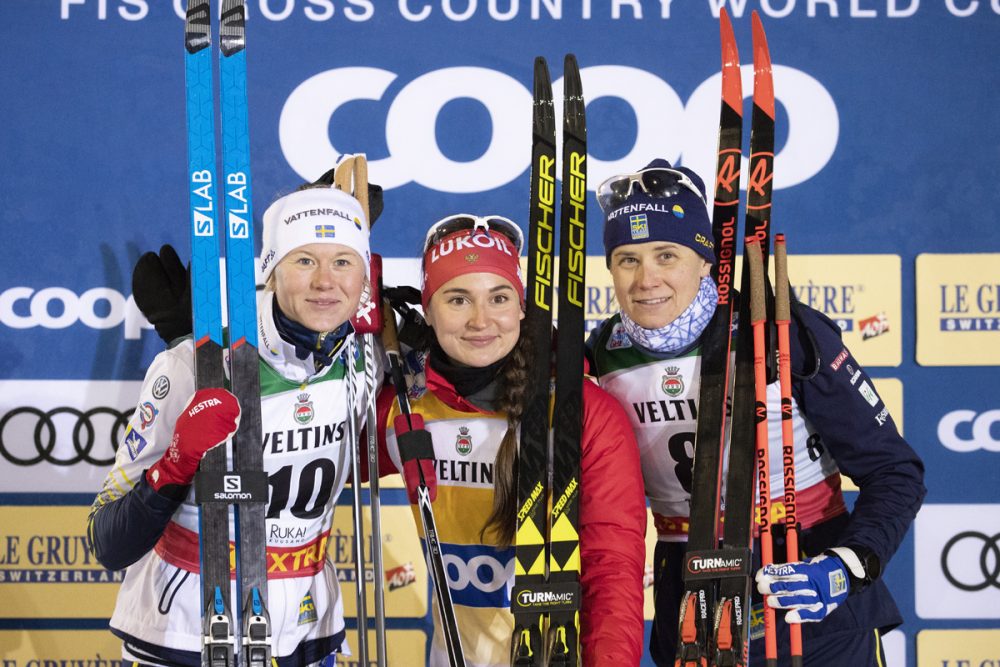
The women’s 1.4-kilometer classic sprint podium (l to r): Sweden’s Maja Dahlqvist, Russia’s Yulia Belorukova and Ida Ingemarsdotter of Sweden. (Photo: Fischer/Nordic Focus)
FIS Cross-Country World Cup in Kussamo, Finland: Classic sprint
On Saturday in Kussamo, Finland the 2018/2019 World Cup season began with a 1.4-kilometer classic sprint.
Twenty-three-year-old Yulia Belorukova from Russia won the final in 2:52.62 minutes. It was Belorukova’s first World Cup win. Second place went to Sweden’s twenty-four-year-old Maja Dahlqvist who crossed the line 1.12 seconds back. Also from Sweden, Ida Ingemarsdotter was third (+1.51), Norway’s Maiken Caspersen Falla fourth (+1.52), Krista Pärmäkoski of Finland fifth (+4.71), and Stina Nilsson of Sweden, sixth (+12.33). Nilsson crashed in the final.
In the women’s qualifier, Russia’s Natalia Nepryaeva set the fastest time in 2:56.50 minutes. Seventy-three skiers started the qualifier.
Three U.S. Ski Team (USST) women advanced to the heats by qualifying in the top-30. Sadie Bjornsen in 5th (+3.01), Sophie Caldwell in 22nd (+6.97), and Ida Sargent 24th (+7.23).
Caldwell and Sargent did not advance out of the heats. Caldwell was third in the first heat, won by second fastest qualifier, Falla. Caldwell finished 0.36 seconds behind Falla and ultimately did not secure a lucky loser spot. Sargent raced in the third heat where she placed sixth (+4.50).
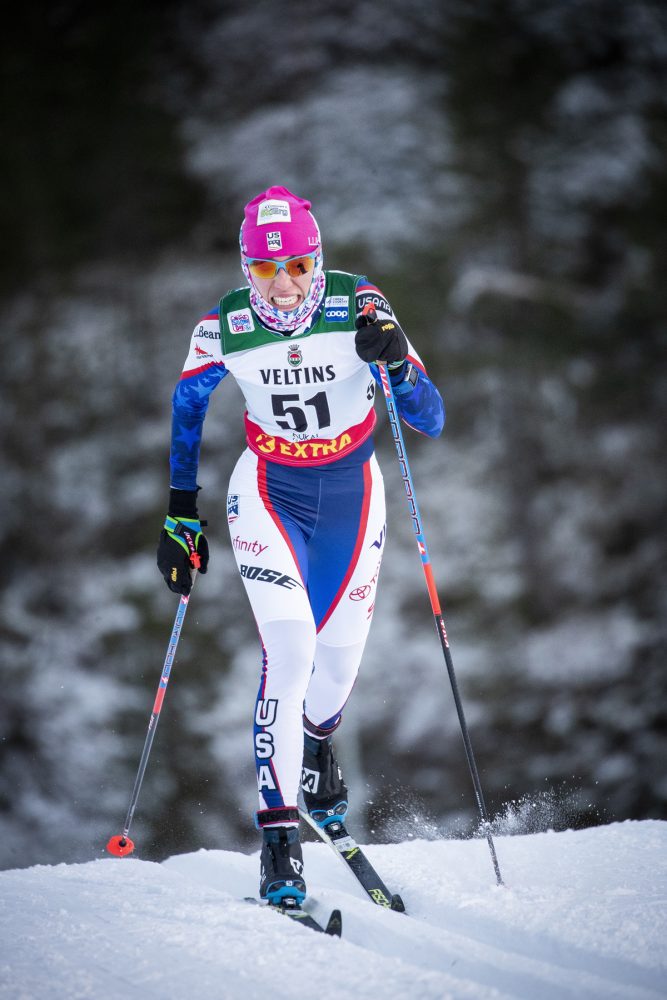
Four U.S. women bowed out in the qualifier, with last season’s second overall skier in the World Cup standings, Jessie Diggins, placing 33rd (+9.05). Rosie Brennan (APU) skied to 38th (+10.74), Kelsey Phinney (SMS-T2) 46th (+13.49), and last season’s overall SuperTour leader, Kaitlynn Miller (CGRP), was 58th (+18.06).
Kaitlynn Miller racing for the U.S. in the women’s 1.4-kilometer classic qualifier on Saturday in Kussamo, Finland. (Photo: Fischer/Nordic Focus)
No Canadian women entered the race.
In the men’s race, last season’s World Cup overall and sprint cup winner, Johannes Høsflot Klæbo, scorched the qualifier in 2:28.95, winning by 3.21 seconds over he next fastest qualifier, teammate Eirik Brandsdal.
Klæbo won his heat and his semifinal. But the semi was tight: Klæbo won by 0.1 seconds over Russia’s Alexander Bolshunov.
In the final, Bolshunov won in 2:29.35 minutes, Klæbo was second (+0.31), Brandsdal third (+1;35). Also of Norway, Emil Iversen placed fourth (+3:04), Russia’s Gleb Retivykh fifth (+3.86), and Norwegian Sondre Turvoll Fossli sixth (+4.85).
The only North American to advance to the heats was Canada’s Alex Harvey, who qualified in 25th (+9.40) and ended the day in eighth. Harvey advance out of the heats by placing second to Russia’s Gleb Retivykh in the fourth quarterfinal. In the second semifinal, Harvey placed fourth (+2.30) and did not advance as a lucky loser.
Also for Canada, Julien Locke (CNST)finished 69th (+15.43), Andy Shields 75th (+18.59), and Russell Kennedy (Team R.A.D.) 76th (+18.61).
For the U.S., Erik Bjornsen (USST) placed 42nd (+11.41), Kevin Bolger (USST) 55th (+13.19), Ben Saxton (SMS-T2) 70th (+15.68), David Norris (APU) 78th (+19.05), and Simi Hamilton (USST) 82nd (+1:11).
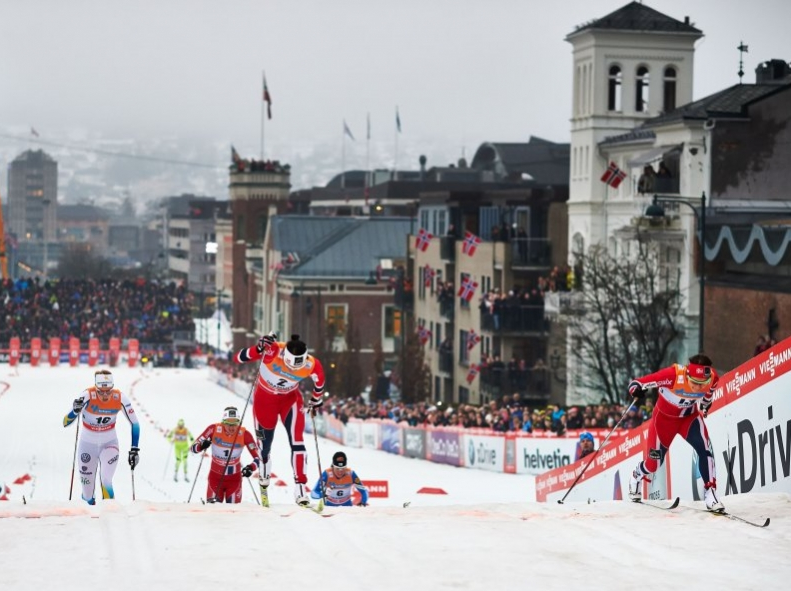
The women’s classic sprint race was held Wednesday in Drammen, Norway. In spite of the damp weather, the streets were packed with fans eager to watch Norwegian skiers win, and they were not disappointed.
In the first women’s quarterfinal heat, Ingvild Flugstad Østberg of Norway led out of the gates, wearing bib number one as the fastest qualifier of the day, and being closely followed by Russian sprinter Evgenia Shapovalova. After a hundred meters or so the trail narrowed to three tracks, forcing the lower seeded skiers to merge right into a lane. Sadie Bjornsen of the USA, the 21st qualifier of the day, sought to squeeze her way into the tracks, just ahead of Astrid Jacobsen of Norway. Bjornsen’s timing was clearly off, she stepped into the tracks far too close to Jacobsen, her feet just ahead of the Norwegian’s, toppling Jacobsen and herself, and ending the hopes of either advancing to the semifinals.
Østberg easily won the heat, followed by Shapovalova. Kerttu Niskanen of Finland finished third, with a fast enough time to qualify for a lucky loser position. Bjornsen was relegated to thirtieth, last place among the heats as a reprimand from FIS for obstructing Jacobsen.
The second women’s heat was lead early on by Finland’s Mona-Lisa Malvalehto, with Sweden’s Magdalena Pajala hanging on behind her. Kikkan Randall of the USA started cautiously, skiing in fifth, just ahead of Canada’s Perianne Jones for the first half of the course until the long downhill. Tucking outside of the tracks as most skiers tried to do, Randall’s skis looked like they were gliding well, and she steadily gained ground on the descent to put her in second position behind Malvalehto.
Heading into the finishing straightaway, a steadily ascending climb to the finish line, Randall used her power to pull past Malvalehto. But just before the line Pajala appeared in the inside lane, striding forcefully and beating Randall by four tenths of a second.
Denise Herrmann of Germany led quarterfinal number three from the starting gun. Slovenia’s Alenka Cebasek fell in her bid to make it into a lane at the bottleneck. She leaned so far over her skis that she tumbled forward, and falling out of contention for the semifinals. Sweden’s Jennie Oeberg also seemed to have been caught when the trail narrowed, and she fell behind.
Sweden’s Stina Nilsson led the heat into the finishing straightaway and appeared to have the heat wrapped up when a hard charging Krista Lahteenmaki of Finland double poled her way in front of her to steal first from the Swede.
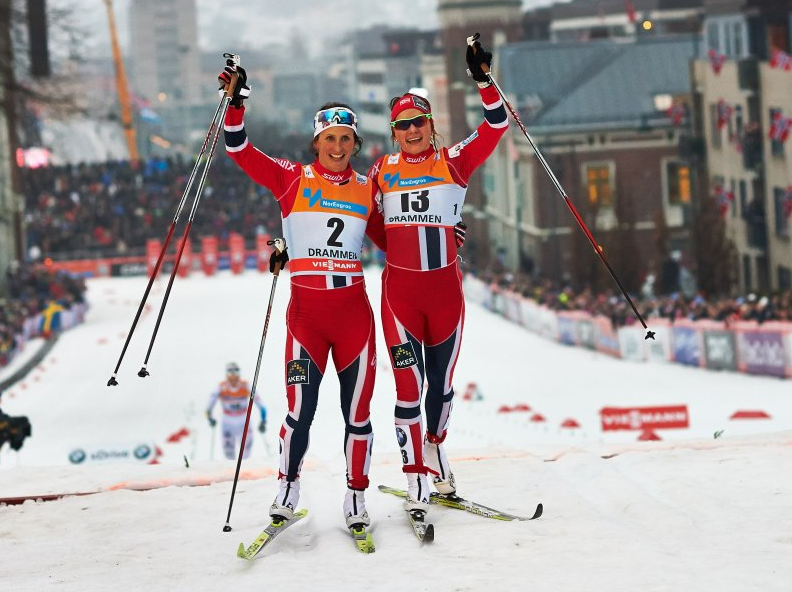
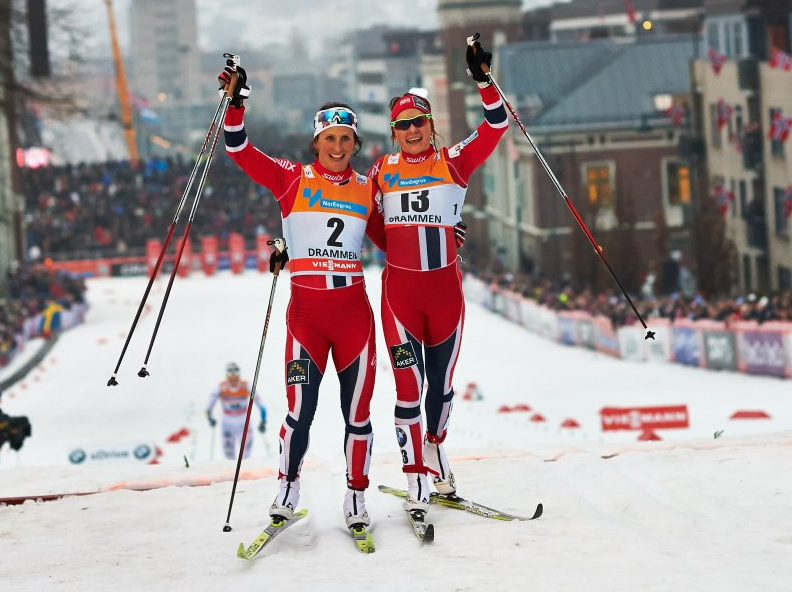
Bjørgen and Falla at the finish line. Photo: Fischer/Nordic Focus
Marit Bjørgen, the three-time gold medalist for Norway in Sochi, led the fourth heat, with no intention of letting anyone else ski in front of her. Bjørgen took the downhill at 48 kilometers per hour, and at the base of the hill her teammate behind her, Katherine Rolsted Harsem, stumbled dramatically and nearly collided with the advertising boards before regaining balance. Bjørgen won the heat easily and quickly. Harsem was second, 1.1 seconds behind, and Russia’s Anastasia Dotsenko was third by 1.7 seconds, yet fast enough for a lucky loser position in the semifinals.
The fifth and final women’s quarterfinal heat was led straightaway by Norwegian Maiken Caspersen Falla, with Slovenia’s Katja Visnar right behind her. Therese Johaug, looking to hold onto her overall World Cup title over her teammate Bjørgen’s late season challenge, found herself skiing in the back before working her way up to Falla.
Johaug stayed as close as she could to Falla on the downhill, riding precariously on the back of her skis at speeds approaching 50 kph. Visnar, skiing in the outside track, moved past Falla just before the final up slope finishing stretch, but Falla strode past her at the end to win the heat ahead of Visnar. Johaug faded late to finish fourth.
In the first semifinal, Nilsson and Østberg led, Randall in fourth, and Niskanen, Shapovalova, and Pajala all in the mix. Randall’s skis again looked to be gliding superbly on the downhill and she carried her momentum into a well timed left corner, exiting the base of the hill to put her in second position behind Østberg heading into the finish.
Østberg hammered down the center track while Randall jumped to the other middle track and fought to catch up with Østberg. Bearing down on both outside tracks were the Swedes, Nilsson and Pajala, and the finish line camera showed a confusion of lunging feet.
Østberg won the heat with a photo finish between Randall and Nilsson that was eventually called in Nilsson’s favor. She won a berth in the final heat over Randall by just .02 seconds. Nevertheless, it was a good day for Randall. Her result gave her enough points to secure the overall World Cup sprint title for a third season. Randall will receive the crystal globe next week in Falun, Sweden.
The second semifinal saw Harsem misplant her pole between her legs shortly after starting; it broke with a snap loud enough to sound like a second starting gun. She collected a new pole quickly, but had no real opportunity to get back into the race.
Bjørgen immediately took charge of the heat, leading into the finish with Visnar and Falla challenging. Falla outstrode Bjørgen at the line to win the semifinal. Visnar was third and Lahteenmaki fourth, with both women making the final heat as lucky losers.
In the final heat, Østberg flew to the front, with Nilsson hanging on behind her and Bjørgen in the outside track followed by Visnar, Falla, and Lahteenmaki.
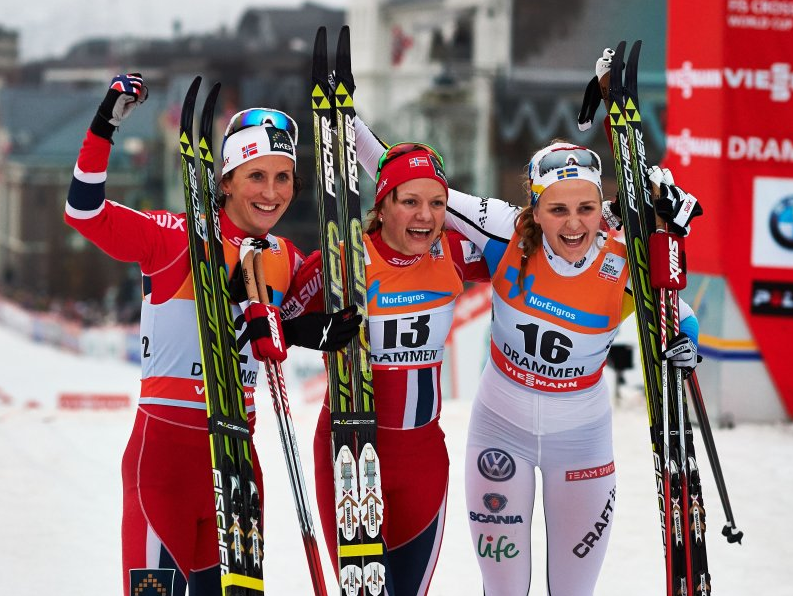
Østberg led all the way through until the last corner where Bjørgen passed her and took off with furious double poling, Falla and Visnar threatened on the outside and Østberg, who was skiing right behind Bjørgen seemed to clip her skis, causing her to stumble slightly, a costly error so close to the finish line. Closing in on the finish it was Falla and Bjørgen neck and neck, with Nilsson gaining ground. At the line it was Falla’s foot that crossed before Bjørgen’s with a time of 3:06.82. Bjørgen was .28 seconds behind, and Nilsson was third, one and half seconds after Falla.
Falla spoke to FIS after the race and said, “I am really with my shape. It is nice to win a classical technique sprint. I fell last week so I was motivated to ski well. It feels nice to be back on the podium again. Marit [Bjørgen] and I train a lot together and Marit usually wins when we practice the finish. It is nice to beat her.”
Bjørgen, for her part said, “I always ski well here in Drammen. In general I feel I am stronger in classic technique and this course with an uphill at the start and finish favors my strengths. It is such a great atmosphere for competing. I always look forward to the World Cup when it is here in Drammen.”
Nilsson too was pleased with her race, “I was in a very good in Sochi and I really wanted to ski in Lahti. Unfortunately I became sick and had to stay at home. I was not sure if I kept the shape. I am surprised to be on the podium. I think the final was little bit slower than the previous heats. I had a very good finish, which brought me to the podium.”