From the FasterSkier archive — posts syndicated from athletes’ and coaches’ own blogs between 2004 and 2012, kept online as published. Current coverage is at fasterskier.com.

Tag: Falun 2015

  • FasterSkier’s Cross Country Performances of 2015: Jessie Diggins, Caitlin Gregg and Alex Harvey

    FasterSkier’s Cross Country Performances of 2015: Jessie Diggins, Caitlin Gregg and Alex Harvey

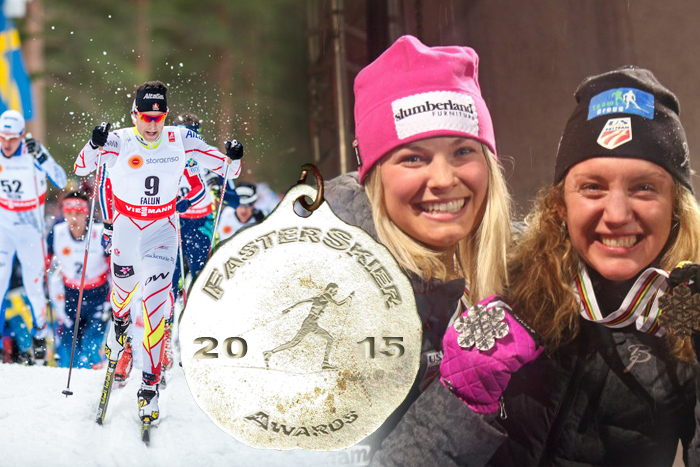
    FasterSkier's cross country performances of the year come from Alex Harvey at the 2015 World Championships where he won silver and bronze medals in the sprint and skiathlon. Jessie Diggins and Caitlin Gregg are co-recipients of the women's award for their 2-3 finish in the 10 k freestyle at Worlds.
    FasterSkier’s cross country performances of the year come from Alex Harvey (l) at the 2015 World Championships where he won silver and bronze medals in the sprint and skiathlon. Jessie Diggins (c) and Caitlin Gregg (r) are co-recipients of the women’s award for their 2-3 finish in the 10 k freestyle at worlds.

    With the 2014/2015 season officially in the rearview, FasterSkier is excited to unveil its annual award winners for this past winter. Votes stem from the FS staff, scattered across the U.S. and Canada, and while not scientific, they are intended to reflect a broader sense of the season in review.

    ***

    Jessie Diggins and Caitlin Gregg, 2015 World Championships 10 k freestyle individual start

    It’s rare for American cross country skiers to earn World Championships medals. Before this winter the U.S. had only stood upon the podium four times over the history of the sport – Bill Koch in the 1982 30 k, Kikkan Randall in the 2009 sprint, and Randall and Jessie Diggins in the 2013 team sprint.

    Come February of 2015 the count increased to six because of pair of midwestern skiers, Diggins and Caitlin Gregg, who surprised nordic fans across the globe with their 2-3 finish in the World Championships 10 k freestyle individual start.

    The day was far from ordinary as light flurries turned to a dumping of wet snow that slowed the trails in Falun, Sweden for the competition’s late starters. Gregg, in bib 3, missed the majority of the heavy snow but skated over the two-lap course with confidence and control to cross the line with the leading time. Her stay in the leader’s chair lasted longer than expected, as skier after skier failed to match her effort. It was only until Diggins entered the finish that Gregg lost her spot in on the hallowed seat.

    When the whirlwind day — filled with blowing snow, tears and cheers — was complete, Diggins and Gregg placed second and third, respectively, behind home-crowd favorite Charlotte Kalla of Sweden. Kalla’s time of 25:08.8 outpaced Diggins by 41.0 seconds and Gregg by 46.9.
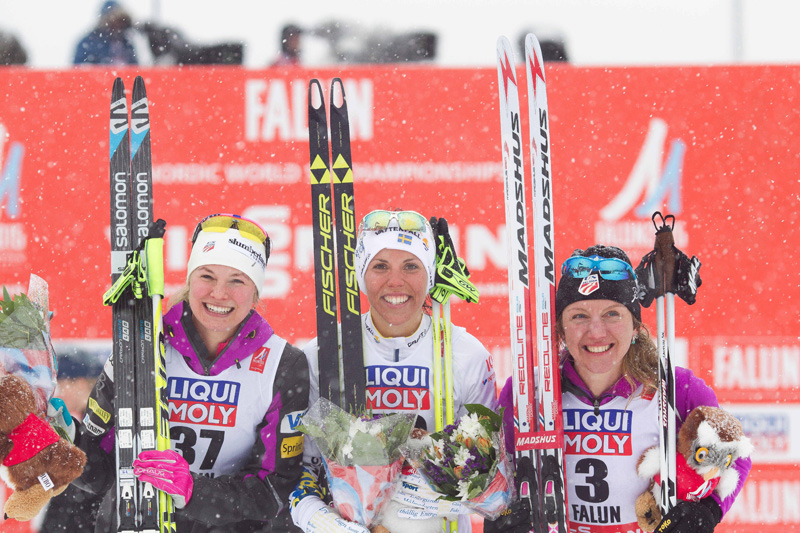
    Americans Jessie Diggins (l) and Caitlin Gregg (r) share the women's World Championships 10 k freestyle podium with Sweden's Charlotte Kalla (c), who won the race by 41 seconds for her first individual gold in Falun, Sweden. Diggins took second while Gregg took third, 46.9 seconds back. Both finishes were the best distance result in history for a U.S. woman at a World Championships. (Photo: Fischer/NordicFocus)
    Americans Jessie Diggins (l) and Caitlin Gregg (r) share the women’s World Championships 10 k freestyle podium with Sweden’s Charlotte Kalla (c), who won the race by 41 seconds for her first individual gold in Falun, Sweden. Diggins took second while Gregg took third, 46.9 seconds back. Both finishes were the best distance result in history for a U.S. woman at a World Championships. (Photo: Fischer/NordicFocus)

    The historic performances – which were the best distance results of an American women at a championships event – were a product of a combination of efforts, from coaching to a phenomenal wax team, and the two Americans took advantage of the opportunity that was handed to them. The night before the 10 k freestyle U.S. Ski Team women’s coach Matt Whitcomb gathered the team for a pep talk. According to Diggins and Gregg, the theme of his speech revolved around the simple question: Why not?

    He emphasized that many skiers count themselves out before they’ve even had the chance and that every member of the U.S. team had the opportunity to achieve their best. The two skiers didn’t know it at the time, but Whitcomb’s central message — anything is possible –– would become a reality the next day.

    Taking Whitcomb’s advice, both athletes entered the 10 k with high expectations. Diggins, a regular on the World Cup circuit, explained her goal was a top six: “If I was having an amazing day,” she said.

    Gregg, on the other hand, skied with the aim of being an early leader. She easily accomplished her objective, but soon realized that her time was much better than she ever could have expected.

    “My goal was to try to come in, be the leader, and put in a good time,” she said. “I think it took maybe another twenty or thirty skiers before I started realizing that it was actually a really, really good time.”

    Gregg watched Diggins from the leader’s chair as the 23 year old trailed on the final climb and then roared into the finish to best Gregg by nearly six seconds. “Then all of a sudden things started to become a reality,” she said.

    The silver was Diggins’ second-career World Championships medal. Her first came from the 2013 freestyle team sprint in Val di Fiemme, Italy, where she joined forces with Kikkan Randall to claim gold. The pair was the first to earn a World Championships title in the history of U.S. skiing.

    Gregg hasn’t been at, or near, the top of international skiing since the start of her career. The 34-year-old’s best World Cup result was in a 2010 Canmore World Cup, where she place 14th in the 10 k freestyle. Her next best result was last year in Falun at the 2014 World Cup Finals where she had the 25th fastest time in the 10 k pursuit. Last season, Gregg missed a spot on the Olympic team despite dominating the domestic distance circuit.

    As the 2014 SuperTour leader, Gregg started the 2014/2015 season on the World Cup, but contracted shingles and consistently race in the 50s on the World Cup.

    Due to USSA criteria and the previous year’s Olympic selections, it appeared uncertain whether or not Gregg would be named to the U.S. World Championships team. Come Jan. 26, however, Gregg’s name was on the list and she was preparing conquer the 10 k freestyle — a race she had been focusing on all year.

    According to Gregg, her bronze medal was validation of a career that has consisted of hard work and perseverance. She said her medal sent a clear message that developing skiers who aren’t often given the best opportunities from the start of their careers can still be successful — all it takes is a little passion and grit.

    “If you really truly feel it in your heart, keep pushing, keep pushing,” she said.  “Anything is possible.  Obviously, a lot of things fell together today for me, but I think it is a super strong message.”

    “Some skiers just take a little bit longer to get going,” she added with a laugh. “You can win your medal at 34 years old.”

    Both Diggins and Gregg will return to the U.S. Ski Team to compete on the World Cup in the 2015/2016 season.

    Alex Harvey, 2015 World Championships

    When it came time to pick the male cross country performance of the year choosing the recipient was an easy decision. Alex Harvey was the leading North American man of the year and gave many inspiring displays of athleticism over the course of the winter.

    Then the hard part came: choosing his best performance.

    Over the course of the regular season, Harvey skied to earn ninth overall on the World Cup ranking list, but it was at the World Championships where the 26-year-old truly shined. His collective results from the year’s most important two weeks of racing warranted an award for not just a single race, but for multiple performances.

    It all began at the first race of World Championships: the classic sprint. Harvey started the day qualifying in fifth position. He continued to advance through the heats – but not without some close calls. From the quarterfinal to the final, Harvey would ski at or near the back of the pack, at times would seem as if he was out of the running. By the finish, however, he would always be positioned at the front.

    In the final Harvey sat in fourth on the last hill before charging into the line. He finished second only to Norway’s Petter Northug.

    Canadian National Team Head Coach Justin Wadsworth said he believed Harvey could have overcome Northug, had the finishing straightaway been longer.

    “I think if it would have been five more meters, he would have won the race,” Wadsworth said in a post-race interview. “[Harvey] said ‘oh i timed it kind of bad,’ but I think it was an amazing race, especially after being in last place at the top of the hill.”

    Norway's Petter Northug (l) and Canada's Alex Harvey (r) lunge in the 1.4 k classic sprint at the 2015 FIS Nordic World Championships in Falun, Sweden. Northug won the are by 0.05 seconds over Harvey, who earned his best individual finish at a Championships. (Photo: flyingpointroad)
    Norway’s Petter Northug (l) and Canada’s Alex Harvey (r) lunge in the 1.4 k classic sprint at the 2015 FIS Nordic World Championships in Falun, Sweden. Northug won the are by 0.05 seconds over Harvey, who earned his best individual finish at a Championships. (Photo: flyingpointroad)

    Harvey reflected a similar sentiment, saying that he was gaining on Northug as they approached the finish. However, the Canadian was cautious in his speculation, adding, “I wouldn’t redo the race just to take that chance.”

    When asked how he was able to advance from dead-last to a podium position, Harvey explained that his come-from-behind day wasn’t necessarily planned.

    “I would like to lead on this course on the first hill if I could. [The course] is a bit more endurance-based and I am a bit more of an endurance-based athlete.” he said.

    Despite trailing the pack at the key point in the race, Harvey explained the first hill was more of a “warmup” and the second hill was where he needed to make his move. The Canadian added that he was confident in his skiing despite his position, because he knew his finishing speed was strong.

    Wadsworth agreed, adding that fast skis also played a large role in Harvey’s performance.

    “I think he knows what he’s capable of and he knew the skis were good enough to do that,” he said. “This course has such a fast downhill. Then all you have to do is run up that and everyone is going to run the same. Then you have to have enough speed for the end and his double poling has been really good.”

    The silver medal marked Harvey’s highest individual placement at a World Championships. Prior to the sprint, the Canadian had won two other medals. In 2011 he and Devon Kershaw powered to a World Championship title in the team sprint and in 2013 he claimed third in the classic sprint.

    There was more to come from Harvey as the championships progressed.

    Two days after his silver medal performance, Harvey competed in the 30 k skiathlon. He stayed near the front of the race, often switching the lead with the event’s favorites – eventual winner Maxim Vylegzahanin, Dario Cologna, and Maurice Manificat among others.

    As the finish approached, Harvey sat nearly seven seconds behind Vylegzahanin, Cologna, and Didrik Tønseth. He charged hard to close the gap, and nearly caught them on the second-to-last climb. While Cologna and Vylegzhanin skied out of reach, Harvey trailed Tønseth closely, passing him 5 seconds before the finish.

    “It was so mushy and I was starting to not see clearly,” Harvey recalled, noting that his legs felt extremely spent after 15 k of classic followed by 15 k of skating on Falun’s notoriously tough course — and in soft conditions on an above-freezing afternoon. “I knew my legs were not 100 percent, so I wouldn’t have an amazing sprint, but it was good enough to grab one place, that was good for the podium.

    “I had two medals in my career in World Championships, and now I have two in three days,” he added after achieving his fourth medal. “It’s crazy.”

    Wadsworth noted the impact the results had on the program after Canada took home one medal between the last two previous championships (2013 World Championships and the 2014 Olympics).

    “To have two medals [in Falun], it’s more [about] showing that we do have one of the best programs for waxing and we’ve invested a lot in it,” he said. “We’ve also done things that are a little bit different than other teams or the U.S. by having a little bit smaller team. We’re here to get medals and this is what’s going to help our program in the long run, where we can put it back into development and other things. We have to go for it at these big events like this.”

    Harvey continued a successful Championships with earning the fastest first leg time in the men’s 4 x 10 k relay in which Canada eventually placed 10th. Harvey skied to fifth in the 50 k classic mass start after leading for much of the race to close out the two weeks of racing.

    Harvey will once again return to competition in the 2015/2016 season as Canada’s leading man. He began his spring training May 1, after dual surgeries on his iliac arteries. Armed with new hardware, the 26-year-old will look to add another successful year to his name.

    ***

    Other 2015 FS Awards: Junior | Collegiate | Nordic Combined | Biathlon | Para Nordic | Breakthrough | Coach | Continental

  • Olsson Completes ‘Mission Impossible’ with 15 k Victory at World Championships

    Olsson Completes ‘Mission Impossible’ with 15 k Victory at World Championships

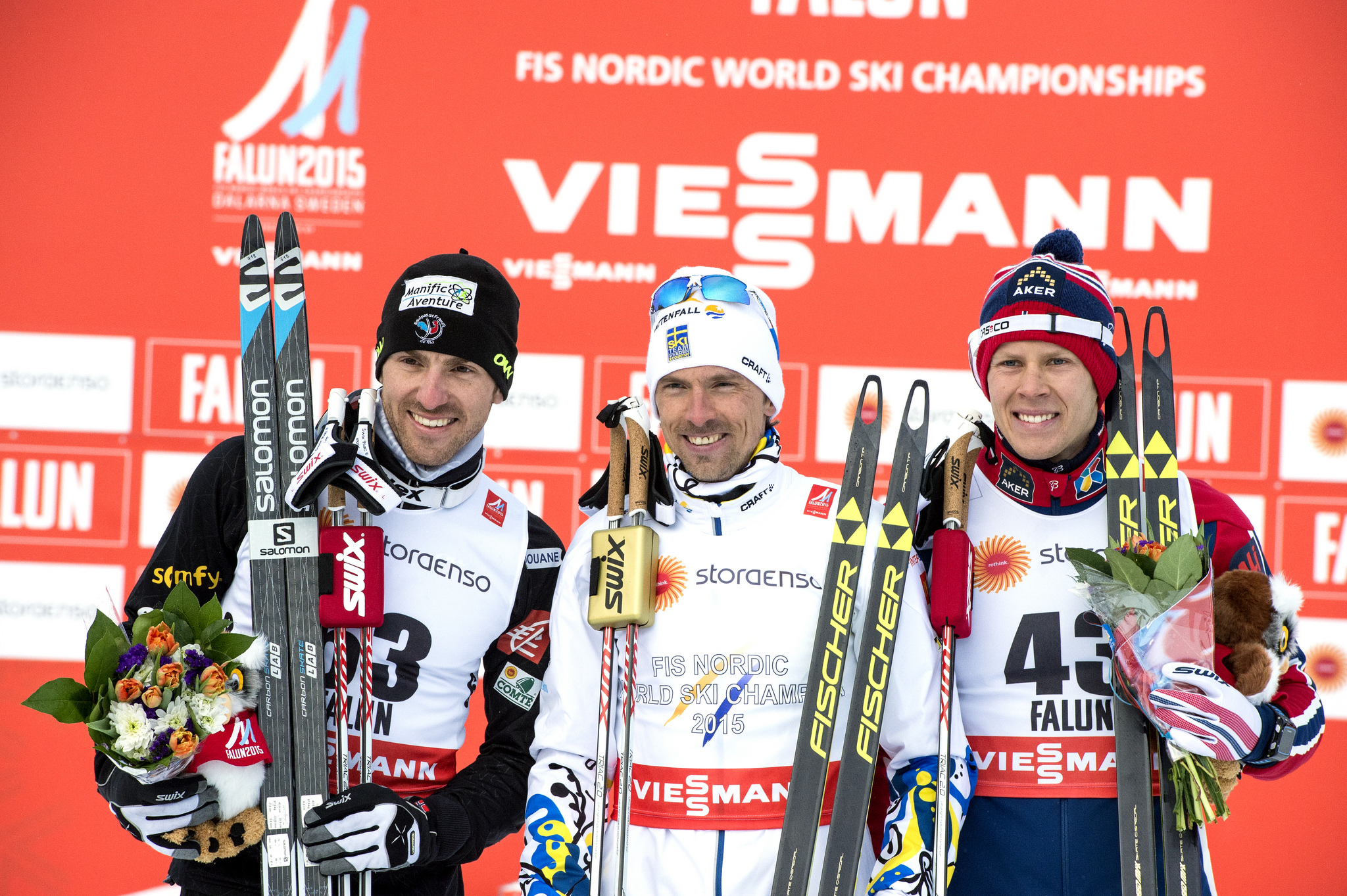
    France's Maurice Manificat (l), Sweden's Johan Olsson (c) and Norway's Anders Gløersen (r) in Wednesday's 15 k freestyle podium at the 2015 FIS Nordic World Ski Championships in Falun, Sweden. Olsson won the race by 17.8 seconds over Manificat. Gløersen finished third, 19.2 seconds back. (Photo: Falun 2015)
    France’s Maurice Manificat (l), Sweden’s Johan Olsson (c) and Norway’s Anders Gløersen (r) in Wednesday’s 15 k freestyle podium at the 2015 FIS Nordic World Ski Championships in Falun, Sweden. Olsson won the race by 17.8 seconds over Manificat. Gløersen finished third, 19.2 seconds back. (Photo: Falun 2015)

    FasterSkier’s coverage of the 2015 FIS Nordic World Ski Championships in Falun, Sweden, is brought to you by the generous support of L.L. Bean, now featuring a complete line of Kikkan Randall training wear.

    FALUN, Sweden — It was a self-described ‘mission impossible’ for Johan Olsson at the 2015 FIS Nordic World Ski Championships. The 34-year-old, who plans to retire after the 2015 season, barely raced in the year prior to the championships due to illness. When he wasn’t bedridden, the Swede was separated from his family and wondering whether he should have retired a year earlier.

    It appears his mission impossible wasn’t unattainable, after the Swedish skier coasted to victory in Wednesday’s 15 k freestyle individual start with a time of 35:01.6. Olsson won by a large margin, finishing 17.8 seconds ahead of Frenchman Maurice Manificat. Anders Gløerson placed third and crossed the line 19.2 seconds behind the Swede.

    An early starter in bib 17, Olsson realized that conditions would deteriorate as skiers traversed the 7.5 k loop and planned accordingly. He skied the first lap aggressively to take advantage of the fast conditions while they lasted. While his loop was the second-fastest by 0.3 seconds behind Manificat, Olsson excelled through the deepening snow to post the fastest finishing time. He remained in the leader’s chair for the rest of the competition, watching skiers fail to best his winning effort.

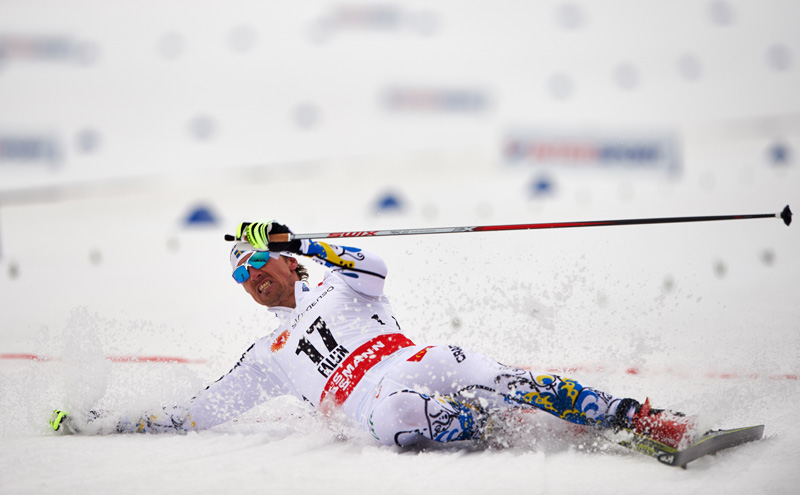
    Johan Olsson of Sweden collapses after posting the best time in Tuesday's 15 k freestyle at the 205 FIS Nordic World Ski Championships in Falun, Sweden (Photo: Fischer/Nordic Focus)
    Johan Olsson of Sweden collapses after posting the best time in Tuesday’s 15 k freestyle at the 205 FIS Nordic World Ski Championships in Falun, Sweden (Photo: Fischer/Nordic Focus)

    “I knew I had done a really good race – perhaps the best skating race of my life” Olsson told the press after his finish. “I was able to push very hard all through the race. I was trying to be very aggressive in the beginning to get a good first lap as my starting number at 17 would be an advantage in these conditions to go quite early.”

    Olsson credited much of his performance to a strong Swedish wax team that provided him with “the best skis in the field.” He said that half of his medal belonged to his personal wax technician, who also serviced the skis teammate Charlotte Kalla used in Tuesday’s 10 k victory.

    Olsson has stepped away from World Cup competition in recent years to focus on championship events. He started no World Cup competitions in 2014, and his only race of 2015 was the recent Östersund 15 k where finished fifth. The Swede’s strategy appears to have worked, especially given his championship results from the past three years. In the 2013 World Championships he was second in the 15 k freestyle and first in the 50 k classic. At the 2014 Olympics he was second in the 15 k classic.

    “When you have a goal and a mission that’s really impossible, that’s what gets me going,” – Johan Olsson  

    “I don’t think anyone has invested so heavily in the World Championships as I have,” he explained. “I have left the World Cup behind me completely and had a clear plan for the World Championships.”

    Even with a reduced racing schedule, Olsson’s path to success hasn’t been easy.

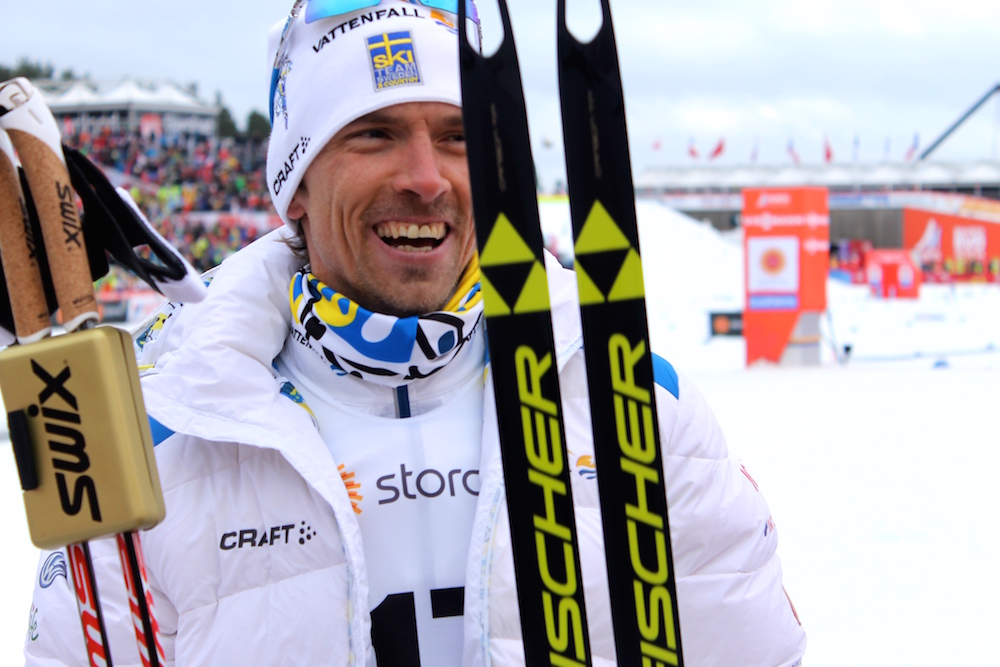
    Johan Olsson of Sweden smiles after his win in the 10 k freestyle at the 2015 FIS Nordic World Ski Championships in Falun, Sweden.
    Johan Olsson of Sweden smiles after his win in the 15 k freestyle at the 2015 FIS Nordic World Ski Championships in Falun, Sweden.

    The world champion lost a month of training in December when he succumbed to a strong virus that left him bedridden. At the time, he believed his last year of racing might have been for nothing.

    “When i was sick, I was wondering why did I continue one more year,” he said. “I was trying to do some mission impossible for the championships. Of course as an athlete you don’t belive in yourself when you can’t train and can’t do anything.”

    Despite the low moral, Olsson continued to build fitness with his sights set on the Championships in Falun. After his recovery he trained roughly 100 hours in January and skied over 300 k in just 15 days. The training came at a price, however, as Olsson was unable to see his two children – who were in attendance at Wednesday’s race – for seven weeks prior to the Championships in Falun.

    “From the new year, no one has put in as much effort as I have done,” he said in a press conference. “I haven’t seen my kids for seven weeks and that is quite strainful to have two small kids at home and not see them. Every night you think is it worth it to be away from your kids.”

    Olsson added that while the decision to be apart from his family was difficult, it was days like Wednesday that he and his wife “are pretty convinced that it was worth it.”

    “When you have a goal and a mission that’s really impossible, that’s what gets me going,” he said.

    In second, Manificat earned the first French medal at a cross country World Championships event in 10 years since Vincent Vittoz was crowned victor in the 2005 30 k pursuit. He is now one of only four French men to claim a medal at Worlds.

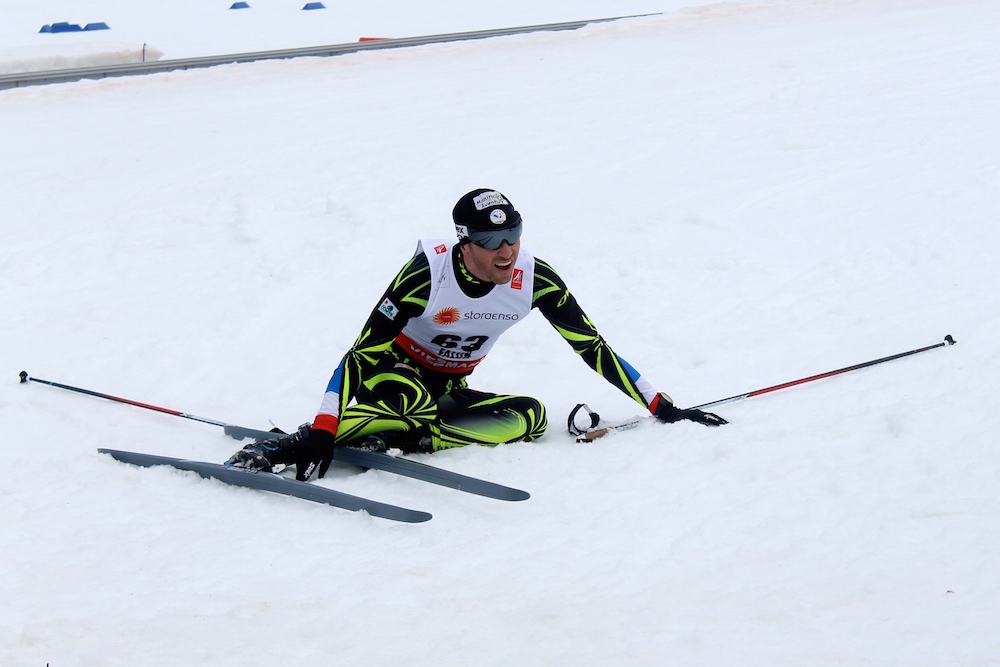
    Maurice Manificat realizes his podium placement after the finish of the 10 k freestyle at the 2015 FIS Nordic World Championships in Falun, Sweden. He finished second to earn the first World Championships medal for France in 10 years.
    Maurice Manificat realizes his podium placement after the finish of the 15 k freestyle at the 2015 FIS Nordic World Championships in Falun, Sweden. He finished second to earn the first World Championships medal for France in 10 years.

    Manificat entered Wednesday’s race with confidence – he hasn’t finished lower than eighth in a 15 k freestyle event in the 2015 season. At the pre-World Championships 15 k freestyle in Östersund, he also placed second.

    As one of the day’s late starters in Bib 63, Manificat skied through the worst of the wet, soft snow. While it made the race more difficult, he explained that he excels in such conditions.

    “The last lap, the snow was softer maybe. But I like the soft snow and it is no problem” he said to the press. “I felt difficulty so I knew it would be difficult to keep the medal. But I believed it until the end and I did it to the finish line.”

    Gløersen also faced a soft course, and explained he believed results were fair to all starters.

    “There was good glide in the the snow,” he said. “You have to fight harder the whole way around and try to think too much about the feeling and think about the results to motivate myself to stay in the race.”

    Gløersen is one of Norway’s best sprinters, but has demonstrated a shift to distance skiing in the 2015 season. In December, he won the Davos 15 k freestyle. He explained he didn’t want to enter Wednesday’s race with high expectations because of his inexperience in distance racing.

    Anders Gløersen of Norway en route to his third place finish in Wednesday's 15 k freestyle at the 2015 FIS Nordic World Ski Championships in Falun, Sweden. (Photo: Fischer/Nordic Focus)
    Anders Gløersen of Norway en route to his third place finish in Wednesday’s 15 k freestyle at the 2015 FIS Nordic World Ski Championships in Falun, Sweden. (Photo: Fischer/Nordic Focus)

    “It’s been my goal this entire season to qualify for the team for the 15 k here. In my head I’ve been preparing to fight for a medal, so for me it’s not surprising,” he said. “I may be a little reluctant to say that I thought I could get a medal. I’ve been a sprinter for now six, seven years on the World Cup, so for me to just suddenly start focusing on the 15 k to say I was going for a medal was a bit too high. I‘m just really happy to achieve my goal today.”

    Gløersen’s result comes on the heels of a difficult waxing day for the Norwegian women. In Tuesday’s 10 k the team’s best finish was 22nd, with previous favorites like Marit Bjørgen finishing outside the top-30.

    There was no such trouble for Norway in Wednesday’s 15 k, as Gløersen said his skis were gliding well. Norwegian men’s coach Trond Nystad echoed Gløersen saying, “the skis seemed to have worked and they seemed to be a lot better than yesterday.”

    With four in the top-nine, Nystad explained the Norwegian national team was pleased with the day’s results given the level of competition.

    “We knew it was going to be hard to get a medal,” he told FasterSkier. “The men’s race is pretty tight so one second back or one second forward can mean one or two places. We were in the medals so we were psyched. We were actually pretty happy that we did well as a team.”

    The only Norwegian result outside the top-10 was from Petter Northug who finished his day in 62nd. Northug has already been crowned world championships twice in Falun, with wins in the classic sprint and team sprint. According to Nystad, Northug wasn’t feeling well and decided to “tour” so that he could rest for the upcoming relay and 50 k classic mass start.

    Racing at the 2015 FIS Nordic World Ski Championships in Falun, Sweden continues Thursday with the women’s 4 x 5 k relay.

    Results

  • Harvey Rockets from Last to Claim Second in World Champs Sprint Behind Northug

    Norway's Petter Northug (l) and Canada's Alex Harvey (r) lunge in Thursday's 1.4 k classic sprint at the 2015 FIS Nordic World Championships in Falun, Sweden. Northug won the are by 0.05 seconds over Harvey, who earned his best individual finish at a Championships. (Photo: flyingpointroad)
    Norway’s Petter Northug (l) and Canada’s Alex Harvey (r) lunge in Thursday’s 1.4 k classic sprint at the 2015 FIS Nordic World Championships in Falun, Sweden. Northug won the are by 0.05 seconds over Harvey, who earned his best individual finish at a Championships. (Photo: flyingpointroad.com)

    FasterSkier’s coverage of the 2015 FIS Nordic World Ski Championships in Falun, Sweden, is brought to you by the generous support of L.L. Bean, now featuring a complete line of Kikkan Randall training wear.

    FALUN, Sweden — Alex Harvey may tell you he’s a distance skier, but don’t let him fool you. As demonstrated by his performance in Thursday’s classic sprint at the 2015 FIS Nordic World Ski Championships, Harvey is certainly one of the word’s best all-around skiers.

    Starting each of his three heats at the back of the pack, Harvey appeared to be out of the running as skiers traversed the hilly course that featured 1.4 k of twists and turns. However, by the end of every race the 26-year-old from Saint-Ferréol-les-Neiges, Quebec propelled himself into qualifying position. In the final his come-from-behind tactics earned him second overall.

    Lunging for a photo finish with Norwegian Petter Northug Harvey topped his previous best individual finish at Worlds – third in the same event in 2013 at Val di Fiemme, Italy. Thursday, he finished 0.05 seconds behind Northug who crossed the line with a time of 3:02.32. Northug’s teammate Ola Vigen Hattestad took the last podium position after a photo finish with Russian Nikita Kriukov. The two trailed the victor by 0.35 and 0.38 seconds, respectively.

    Italian sprinter Federico Pellegrino was fifth and finished 0.67 seconds behind Northug. He was followed by Norwegian Thomas Northug to take the last spot in the heat. He was 17.28 seconds behind his brother after leading the first third of the final.

    Harvey began his day on a strong note, placing fifth in the qualification round. He finished 2.4 seconds behind the qualifier winner, Kriukov, despite skis that were “too light on kick.”

    “The qualifier was a great start for me. I’m never that strong in qualification, usually. I was really happy to see that,” he said in a post-race interview.

    Once in the quarterfinals, Harvey explained he struggled tactically, but was able to recover in time to take advantage of several strategic openings near the end of the race. He charged past Calle Halfvarsson of Sweden in the final meters to finish second behind Pellegrino and secure a spot in the semifinals.

    According to Harvey, the Canadian  regrouped after the close call and thought to himself, “this is on now.”

    Harvey’s semifinal would present a different challenge, however, as it featured four Norwegians including the two Northugs, Hattestad, and Eirik Brandsdal. The Canadian knew the Norwegians would push for a fast heat so that all four could advance to the final via automatic qualification and lucky loser positions. Harvey ultimately spoiled their party as he was able to finish in a close fourth position. The heat was one of  the quickest on the day, and Harvey’s time was fast enough to advance him to the final.

    “[I] just [had to] bite my teeth on the climbs and be strong in the finish,” he said of his effort in the semifinal.

    The men's 1.4 k freestyle sprint at the 2015 FIS Nordic World Ski Championships. Canadian Alex Harvey (l) placed second, Norwegian Petter Northug (c) earned first, and Northug's teammate Ola Vigen Hattestad (r) finished third. (Photo: Falun2015)
    The men’s 1.4 k classic sprint at the 2015 FIS Nordic World Ski Championships. Canadian Alex Harvey (l) placed second, Norwegian Petter Northug (c) earned first, and Northug’s teammate Ola Vigen Hattestad (r) finished third. (Photo: Falun2015)

    The much anticipated final began with strong push from Thomas Northug, who led each of his heats to much success throughout the day. He powered out of the stadium and up the largest climb with Hattestad and the rest of the pack following closely behind. As the six skiers tackled the steep pitch, Petter Northug made a forceful move on the inside and bounded past his two teammates to take the lead.

    Heading into the downhill, Harvey was in sixth and close to losing contact with the group. “I’m just too slow at the start so I couldn’t contend near the front,” he said of his position.

    But Harvey wasn’t about to give up. As the skiers entered the second major climb of the course, the Canadian took advantage of a slowing Thomas Northug to surge past the Norwegian and Kriukov into fourth position.

    Pellegrino led Northug and Hattestad into the stadium to the cheers of 18,000 fans, as Harvey rapidly gained. With 200 meters to go, Harvey powered past Hattestad to ski alongside Pellegrino and behind Northug. The Canadian soon realized he had the energy to overcome the leading Norwegian, and moved to the left track to challenge Northug.

    The top four skiers were tightly grouped as each meter progressed, with Harvey leading the charge just inches behind Northug. The Canadian nearly pulled even with Northug at the finish line and attempted to out-lunge him. While the initial results reflected a near-tie, it was Northug who was able to outlast the Canadian by 0.05 seconds for the win.

    “It’s a big relief when you’re crossing the line first. A sprint day is really long you have to focus for many hours,” he said in a post-race press conference. “You just try to stay focused and have your plan. For sure, I wanted to have everyone as tired as possible. That was my plan when I felt that the speed was going a little bit down on the first climb. I’m happy with my tactic and my final … I think I couldn’t do anything else.”

    Northug, who had a turbulent year after an arrest for drunk driving in May, explained the focus of the season has beenWorld Championships and that the dates of the event had been “marked with red.” Northug has yet to win a World Cup in the 2015 season and said that he earned his starting spot in the World Championships sprint after winning the Norwegian National Championships sprint earlier this month. The Norwegian has now won every single competition at World Championships over the course of his career with the sprint victory in Falun.

    According to the 29-year-old, Thursday’s final was especially meaningful because it gave him the opportunity to race his younger brother, Thomas.

    “For sure it’s big. It means a lot to me, maybe more than my brother, that we were racing together.” Northug said. “It gives you a little bit extra to be fighting with your brother.”

    Canada's Alex Harvey celebrates his second place finish in Thursday's 1.4 k freestyle sprint. Harvey skied from behind in each of his heats to achieve the result. (Photo: flyingpointroad.com)
    Canada’s Alex Harvey celebrates his second place finish in Thursday’s 1.4 k classic sprint. Harvey skied from behind in each of his heats to achieve the result. (Photo: flyingpointroad.com)

    Canadian National Team Head Coach Justin Wadsworth said he believed Harvey could have overcome Northug, had the finishing straightaway been longer.

    “I think if it would have been five more meters, he would have won the race,” Wadsworth said in a post-race interview. “[Harvey] said ‘oh i timed it kind of bad,’ but I think it was an amazing race, especially after being in last place at the top of the hill.”

    Harvey reflected a similar sentiment, saying that he was gaining on Northug as they approached the finish. However, the Canadian was cautious in his speculation, adding, “I wouldn’t redo the race just to take that chance.”

    When asked how he was able to advance from dead-last to a podium position, Harvey explained that his come-from-behind day wasn’t necessarily planned.

    “I would like to lead on this course on the first hill if I could. [The course] is a bit more endurance-based and I am a bit more of an endurance-based athlete.” he said.

    Despite trailing the pack at the key point in the race, Harvey explained the first hill was more of a “warmup” and the second hill was where he needed to make his move. The Canadian added that he was confident in his skiing despite his position, because he knew his finishing speed was strong.

    Wadsworth agreed, adding that fast skis also played a large role in Harvey’s performance.

    “I think he knows what he’s capable of and he knew the skis were good enough to do that,” he said. “This course has such a fast downhill. Then all you have to do is run up that and everyone is going to run the same. Then you have to have enough speed for the end and his double poling has been really good.”

    Louis Bouchard, Harvey’s personal coach for the last 10 years and head coach of the Pierre-Harvey National Training Centre, said the course largely favored the 26-year-old because of its lengthy hills and prolonged finish. He explained that as the day went on, Harvey grew in strength while his competitors became tired.

    Bouchard pointed to his athlete’s development as another piece of the Harvey success story. “The maturity and he’s more stable, he has less injury, he can train more and recover more, so I think it’s normal to expect to see him get better and better at 26 years old,” he siad.

    Canada's Alex Harvey skiing in his quarterfinal en route to second in the 1.4 k classic sprint at the 2015 FIS Nordic World Ski Championships in Falun, Sweden. (Photo: flyingpointroad.com)
    Canada’s Alex Harvey skiing in his quarterfinal en route to second in the 1.4 k classic sprint at the 2015 FIS Nordic World Ski Championships in Falun, Sweden. (Photo: flyingpointroad.com)

    Bouchard also explained that Harvey’s best-ever individual finish at a World Championships was meaningful, both on the individual level and because of the implications for the team. Cross Country Canada’s funding was reduced after a medal-less 2014 Olympics, and a strong result such as Harvey’s at the World Championships will help many within the organization to argue for increased finances.

    “Now we can expect so many things,” he said. “You need it for the program. You need it for the development. That is a benefit for everybody in Canada, so that is good.”

    As Harvey looks to the remainder of the Championships he will focus on Sunday’s 30 k skiathlon and the following week’s 50 k classic mass start. Last year in the 2014 World Cup finals Harvey won the 30 k skiathlon on the trails of Falun. While the course is slightly different in 2015, Harvey is hopeful that he will find similar success. He also joked that if either distance race were similar to Thursday’s sprint, he would have a longer time to win a final sprint.

    “The 50 k will take longer to do that last stretch so maybe I will have time to go around him,” Harvey said, referring to his finishing battle with Northug.

    In third, Hattestad said he was relieved to have won the photo finish over Kriukov.

    “If I had lost the photo finish against Kriukov, it would be a black day.” he said to Fædrelandsvennen. “There are small margins between success and failure. He came quickly, and I thought I lost it. It was lovely to see that I was ahead.”

    Hattestad added that he entered the championships with high hopes due to his fitness since the new year.

    Only 0.32 seconds from the podium, Pellegrino finished his day in fifth, marking his best classic sprint result to date. The Italian won the last three freestyle sprints on the World Cup circuit and considers himself a freestyle specialist.

    “I am satisfied because I did 100 percent of my possibilities, not only physically, but also mentally. I tried to make the best tactic that my abilities could do so I am satisfied,” he said expressing his excitement for Sunday’s team sprint.

    “This season for me was a very good season in free technique, today was classic technique. I know that physically I have to grow up, I have to be more strong, so for me in fifth place is good,” he added.

    Cross country competition at the 2015 Nordic World Ski Championships continues Saturday with the 15/30 k skiathlons.

    Results

  • Valjas 14th, Jones 24th for Canada in World Champs Sprint

    Canada's Lenny Valjas (l0 skis alongside Andy Newell, Teodor Petersen, and Dakaota Blackhorse-von Jess en route to a third place finish in his quarterfinal of the 1.4 k classic sprint in Falun, Sweden. Valjas finished his day in 14th. (Photo: flyingpointroad.com)
    Canada’s Lenny Valjas (l0 skis alongside Andy Newell, Teodor Petersen, and Dakaota Blackhorse-von Jess en route to a third place finish in his quarterfinal of the 1.4 k classic sprint in Falun, Sweden. Valjas finished his day in 14th. (Photo: flyingpointroad.com)

    FALUN, Sweden — Lenny Valjas’ best results of the 2015 season, whether in Davos or Östersund, have been just outside the semifinals. It was a trend that continued Thursday in the 1.4 k classic sprint at the 2015 FIS World Ski Championships where he placed 14th overall, adding to a successful day for Canada that saw teammate Alex Harvey claim second place behind Norwegian Petter Northug.

    Qualifying in 21st position, Valjas entered his quarterfinal with two other North Americans –  Andy Newell and Dakota Blackhorse-von Jess of the U.S. Ski Team – in addition to Russian Nikita Kriukov, Teodor Peterson of Sweden, and German Sebastian Eisenlauer.

    Valjas trailed the five skiers as they left the stadium, but held contact over the first hill. By the time he reached the second climb, the Canadian was rearing to go and charged to the lead. “You just have to run like a camel up the hill, with big, long steps,” Valjas said of his advancement from last to first. “When you have good skis it is actually not that hard.”

    Valjas entered the downhill in the lead, which he described as a disadvantage due to drafting. Regardless, the 26-year-old explained that he was able to hold his position through the downhill due to fast skis. As he and the other leaders entered the stadium’s U-turn, Valjas allowed Kriukov to inch past him on the inside, thus losing a valuable position as he, the Russian, and the Swede entered the final straightaway into the finish.

    “I messed up when I didn’t try to block Nikita [Kriukov] in the last stadium hill. I should have gone right and I had the room,” Valjas explained. “I knew he was coming fast and I should have taken the inside line, and instead I look the outside around the whole way. I got out-gunned in the double pole. I had no chance.”

    Unable to hold pace with Kriukov or Peterson, Valjas finished his heat in third position. Because the quarterfinal was the slowest of the day, he did not advance as lucky loser.

    Valjas said that he was disappointed not to advance because the conditions were favorable and similar to those in Drammen, Norway, where the Canadian won his first World Cup silver medal in 2012. According to Valjas, the result was also frustrating because he has been just outside the semifinals all season. Last weekend in Östersund, Sweden he finished 13th in the same event.

    “Last week I missed just by a tenth and this week just under a second. I had good shape for this course today too,” Valjas explained. “I feel like I just came up short.”

    Teammate Jesse Cockney joined Harvey and Valjas in Thursday’s race, ultimately finishing 49th.

    Canada's Perianne Jones raced to fifth place in her qualifier to finish 24th overall in the 1.4 k classic sprint in Falun, Sweden for the 2015 FIS Nordic World Ski Championships. (Photo: flingpointroad.com)
    Canada’s Perianne Jones raced to fifth place in her qualifier to finish 24th overall in the 1.4 k classic sprint in Falun, Sweden for the 2015 FIS Nordic World Ski Championships. (Photo: flingpointroad.com)

    In the women’s classic sprint, Perianne Jones was the lone starter for the Canadian team. She qualified in 28th position and ended her day in 24th after finishing fifth in her quarterfinal. After a slow start in the heat, Jones trailed the five women for much of the winding course. While she was able to make up some ground on the downhills, it was only enough to get her past Switzerland’s Laurien van der Graaff.

    “I actually felt pretty good when I was climbing the top of the first hill and the second hill but I was just too far back at that point,” Jones explained in a post-race interview. “I did have really fast skis, so when I came into the stadium I was able to close a little of the gap but it wasn’t enough.”

    Jones, who took time off from World Cup racing during the holiday season, said she was feeling in better racing shape since her return to Europe.

    “I stayed at home for a month and did some racing in Canada. I think that helped me a lot. I got kind of stale on the World Cup,” she said. “I think the quality of work I was able to do at home, and the racing I did helped a lot to get me in shape.”

    Jones explained that her goal for Thursday’s sprint was to crack the top-12, but that considering her previous fall of racing she was pleased to be in the heats.

    While two other Canadian women, Emily Nishikawa and Olivia Bouffard-Nesbitt, are in attendance at Worlds, both sat out Thursday’s race due to illness. According to Canadian National Team Head Coach Justin Wadsworth, Devon Kershaw and Graeme Killick are also sick, but will look to race later in the championships.

    “Olivia is the most sick, which is really too bad because she might miss the whole championships,” Wadsworth said.

    Cross country competition at the 2015 Nordic World Ski Championships continues Saturday with the 15/30 k skiathlons.

    Results: men | women

  • Harvey Fifth in World Champs Sprint Qualification as Five North American Men Make Finals

    Canada' Alex Harvey skiing to fifth in the qualification round of the 1.4 k classic sprint at the 2015 FIS Nordic World Championships in Falun, Sweden. (Photo: Steve Fuller/FlyingpointRoad)
    Canada’ Alex Harvey skiing to fifth in the qualification round of the 1.4 k classic sprint at the 2015 FIS Nordic World Championships in Falun, Sweden. (Photo: flyingpointroad.com)

    FALUN, Sweden — With thousands of fans cheering under an emerging sun, five north American men qualified for the finals of the World Championships 1.4-kilometer classic sprint. Alex Harvey led the charge in the wet and warm conditions to finish fifth overall.

    Harvey finished 2.4 seconds behind qualification winner Nitika Kriukov of Russia who crossed the line with a time of 2:59.92. He was followed by Ola Vigen Hattestad of Norway who trailed Kiukov by just 0.02 seconds. In third and fourth were Thomas Northug of Norway and Ueli Schnider of Switzerland, who trailed by 0.14 and 0.27 seconds.

    Andy Newell (+3.64) was the top American finisher in 10th position. The result was his best international sprint qualification finish of the year. Given the warm and often slushy conditions, Newell attempted to find the fastest snow around the 1.4 k course. According to USSA press officer Tom Kelly, Newell radioed in after his race to report where the better conditions on the course were for the last two American starters, Dakota Blackhorse-von Jess and Ben Saxton.

    Behind Newell was Canadian Lenny Valjas (+5.81) who placed 22nd.

    “It’s super tough and harder than it looks,” Valjas said of the course in a post-qualification interview. “I had enough grip but it was on the edge at the top [of the course]. I can for sure make a few changes and get a few seconds back,” he said.

    He explained that to have a successful finish in the heats, he would need more kick and a focus on the double-pole finish.

    Squeaking into the top-30 were Americans Simi Hamilton (+6.64) and Dakota Blackhorse-von Jess (+7.33) who finished 28th and 30th.

    Hamilton said his body and fitness were feeling strong in Thursday’s race despite the challenging conditions. “It’s tough conditions for me today. It’s slow and sloppy and I’ve always kind of struggled with skiing in that kind of stuff,” he said.

    Blackhorse-von Jess explained he was pleased with his race and thrilled to hang on for a qualifying position.

    “There’s a rhythm that you get when you’re doing it right,” Blackhorse-von Jess said of his race. “Today I was looking for right, and I found it.”

    Two North Americans did not advance to the finals — Canadian Jesse Cockney and American Ben Saxton who finished 49th and 54th.

    “It was the worst race of the entire year,” Saxton said after his finish. “I was never moving fast, I was just flat the whole time, and I’m not sure why that was the case. I’m pretty disappointed now.”

    Men’s and women’s heats in Falun begin at 15:15 CET.

    Men’s qualification results

    FasterSkier’s coverage of the 2015 FIS Nordic World Ski Championships in Falun, Sweden, is brought to you by the generous support of L.L. Bean, now featuring a complete line of Kikkan Randall training wear.