From the FasterSkier archive — posts syndicated from athletes’ and coaches’ own blogs between 2004 and 2012, kept online as published. Current coverage is at fasterskier.com.

Tag: Falun Sweden

  • A Different Skiathlon—Weng Bests Diggins by .1

    A Different Skiathlon—Weng Bests Diggins by .1

    This coverage is made possible through the generous support of Marty and Kathy Hall and A Hall Mark of Excellence Award. To learn more about A Hall Mark of Excellence Award, or to learn how you can support FasterSkier’s coverage, please contact info@fasterskier.com.

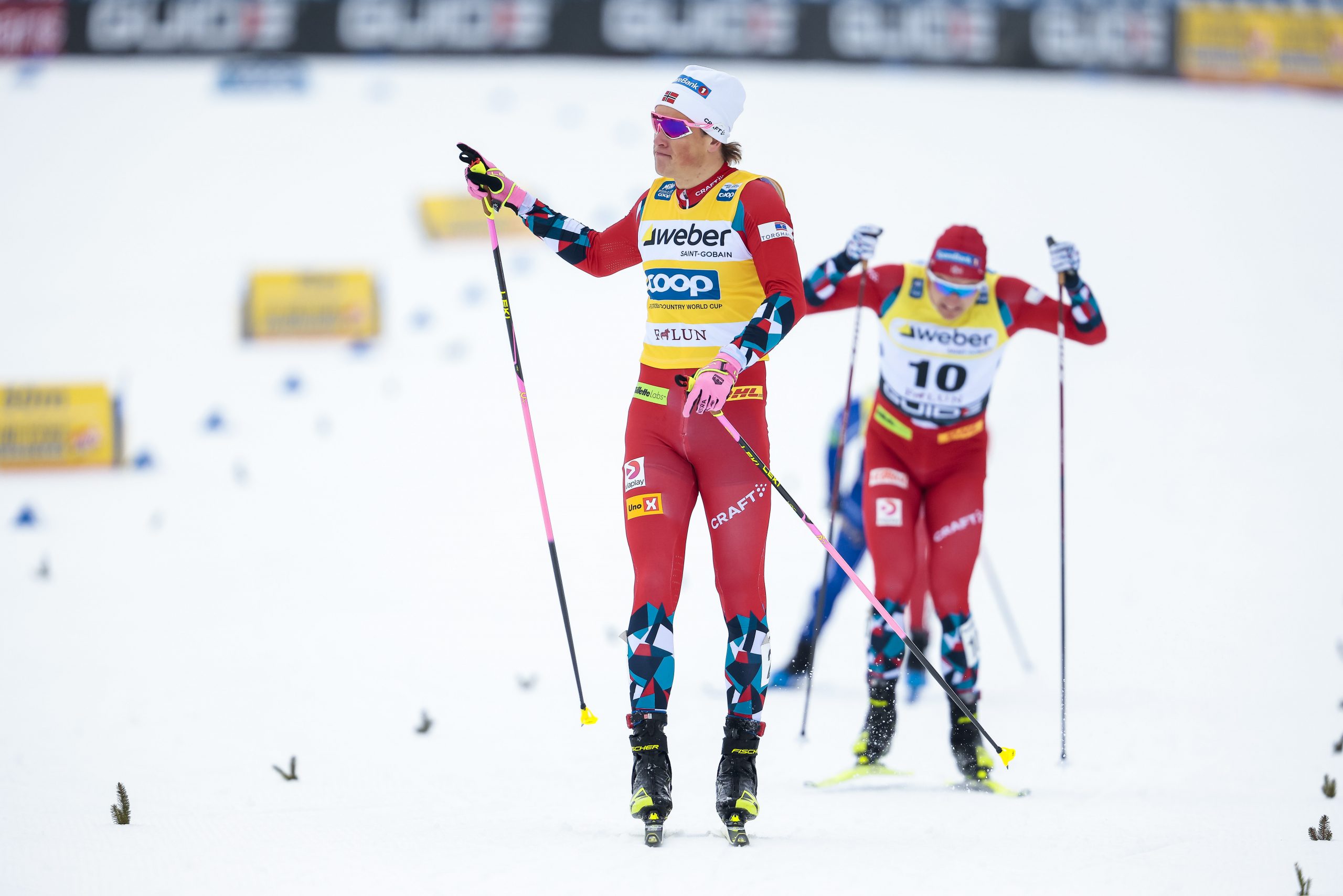
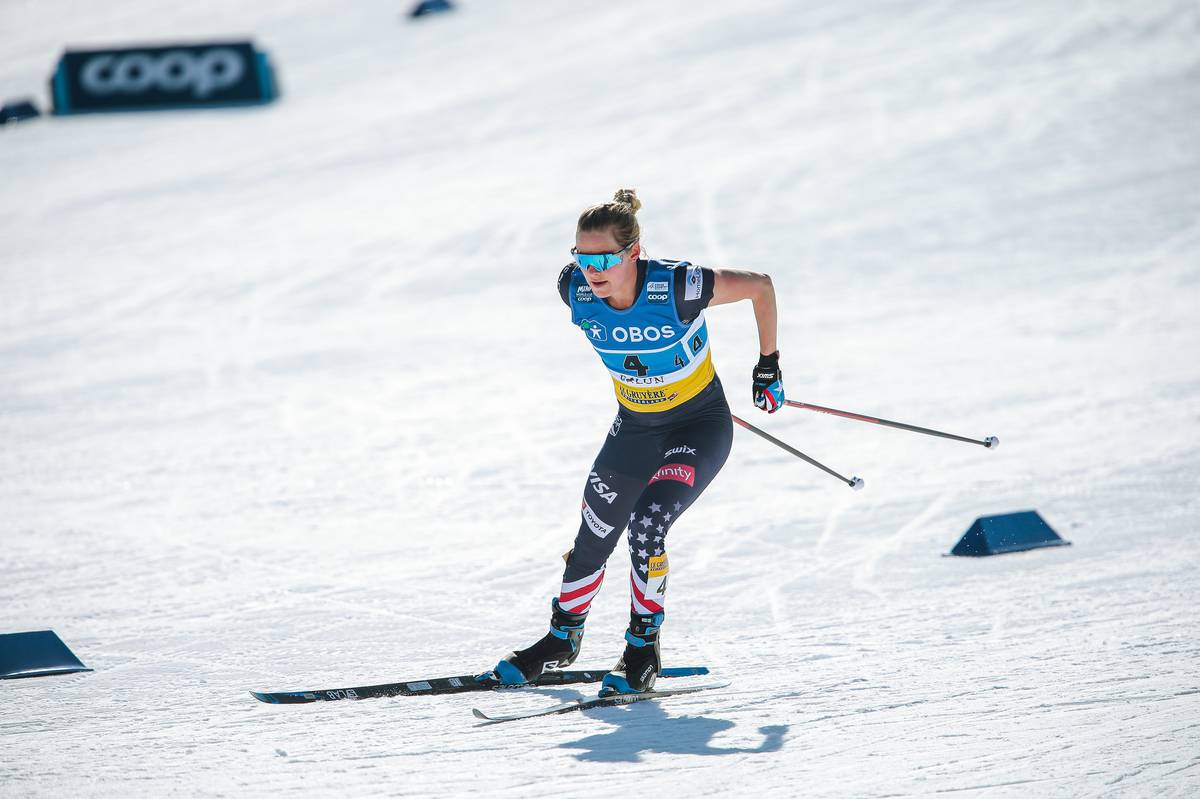
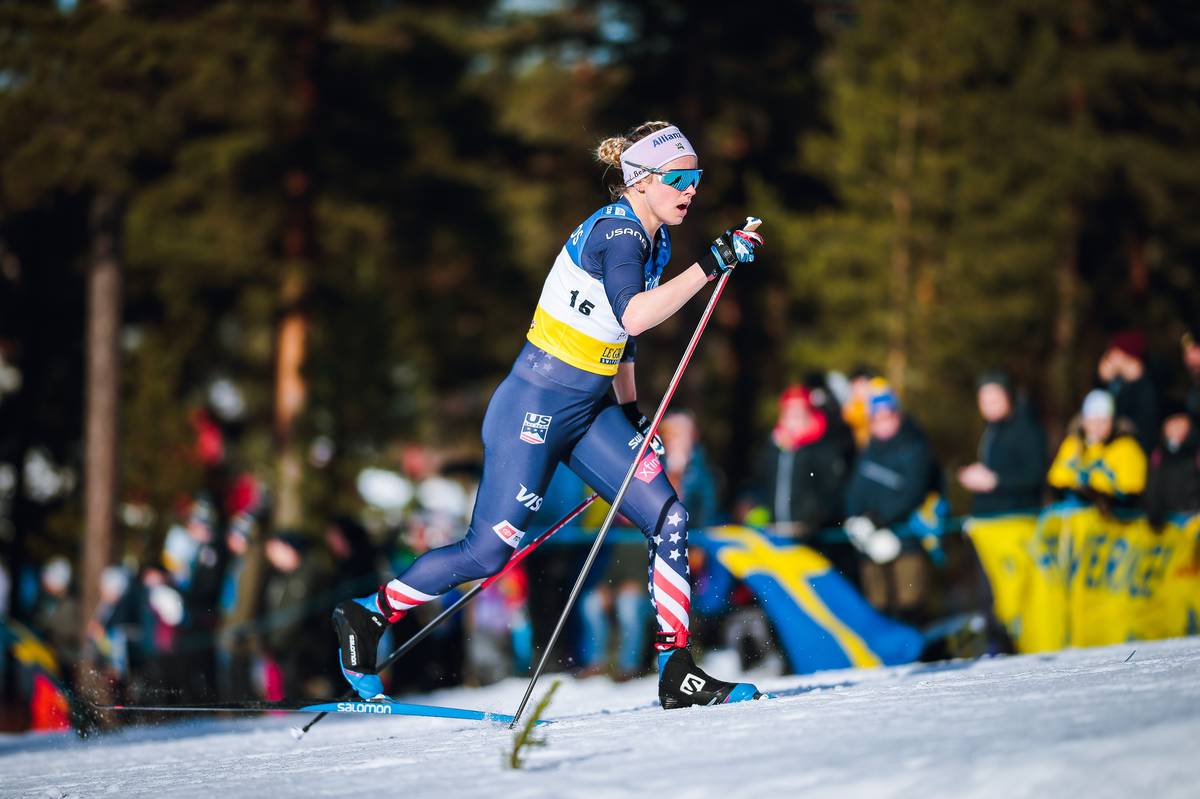
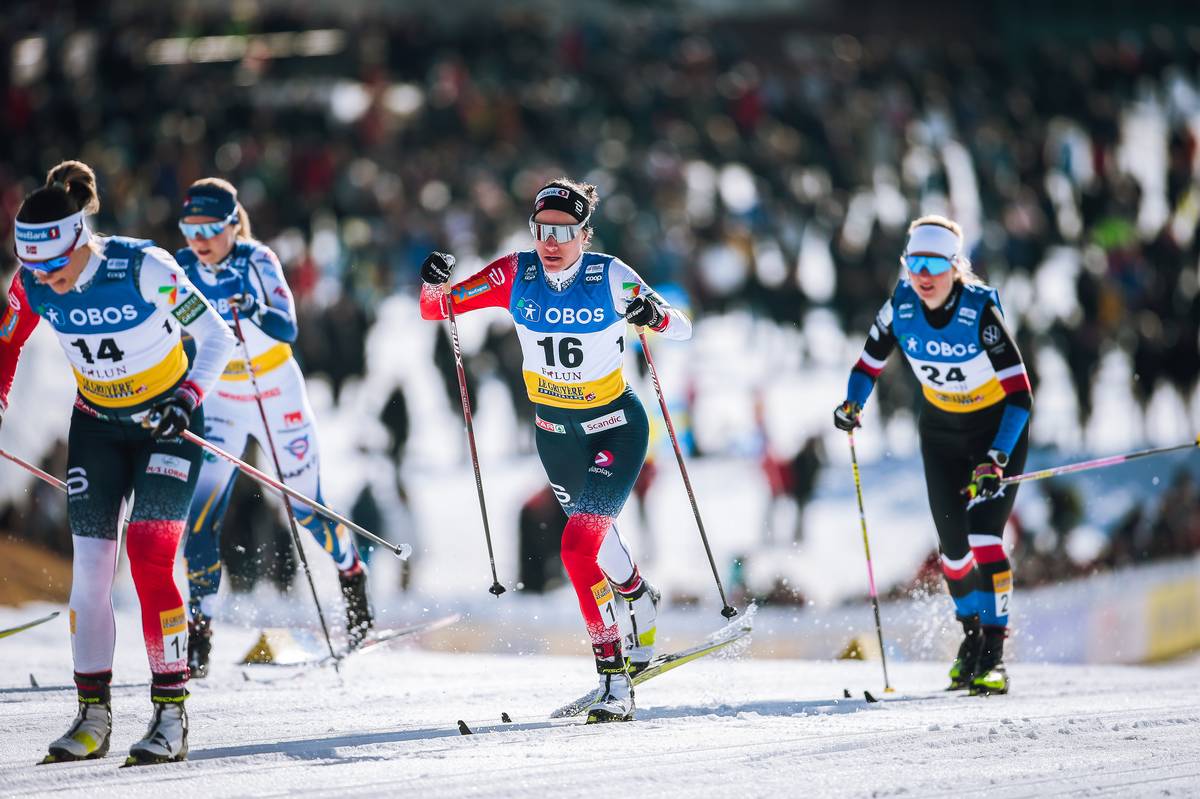
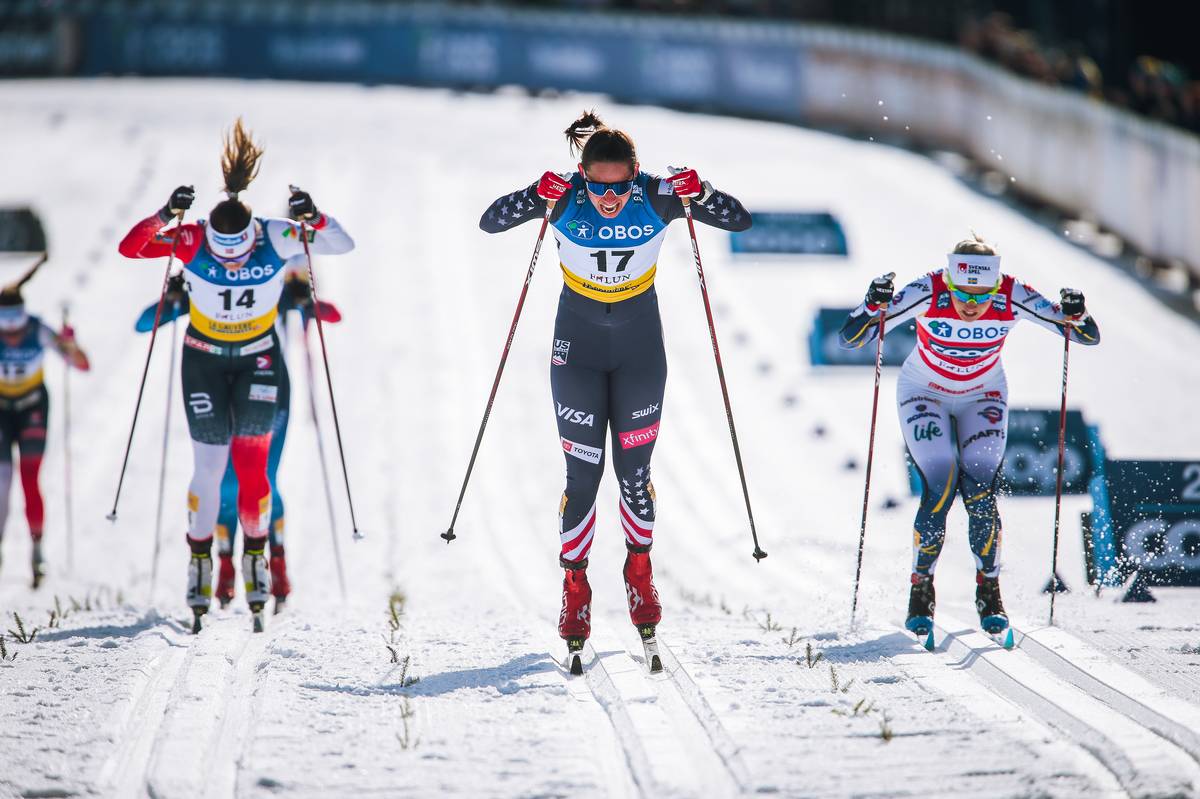
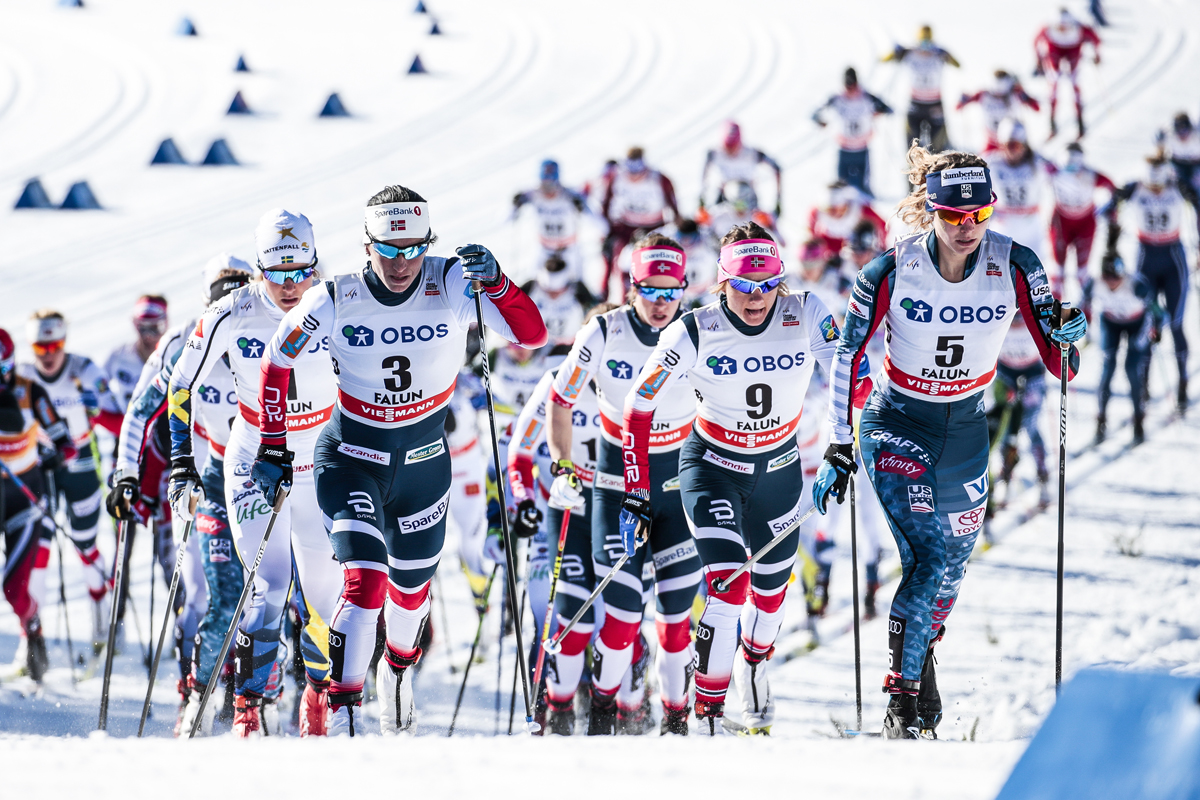
    Jessie Diggins (USA), Frida Karlsson (SWE), Heidi Weng (NOR) in a finish for the ages . . . Falun’s 2 x 10 k Skiathlon came down to a three-skier drag race. (Photo: Authamayou/NordicFocus)

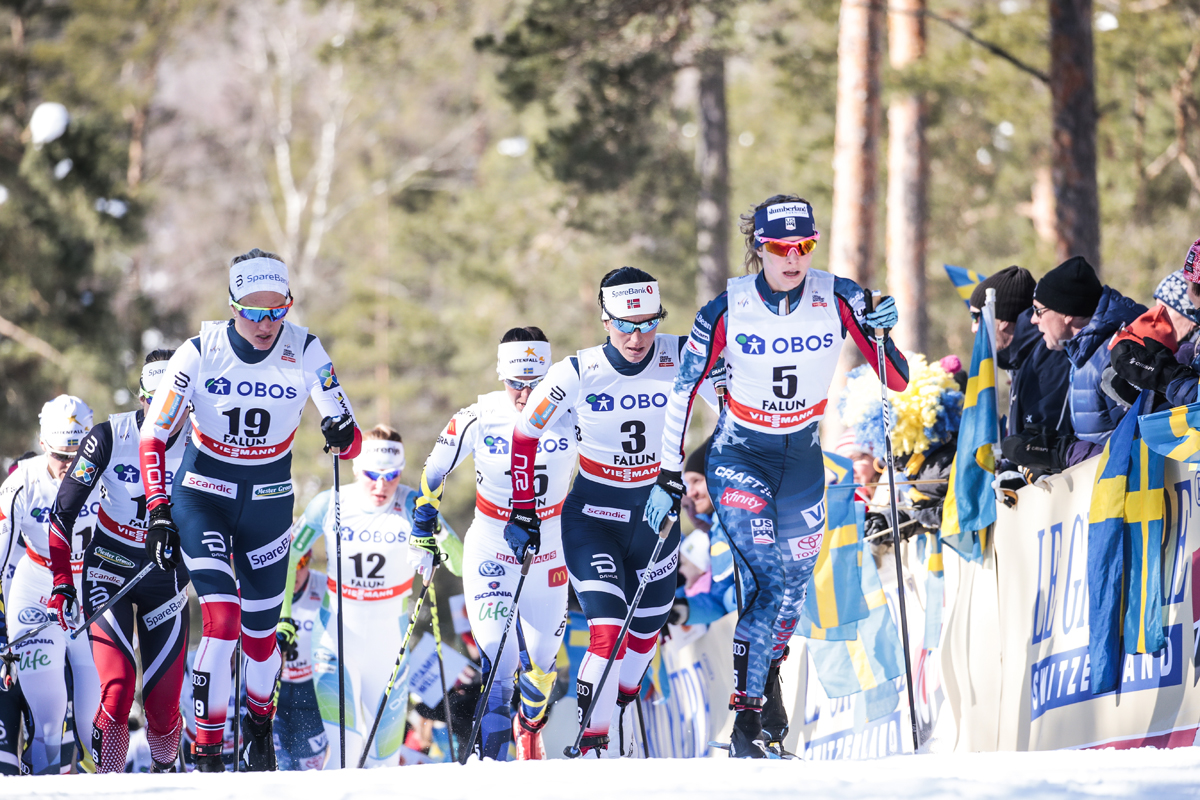
    Cross-country ski racing fans know how the Women’s field races—flat out, wire to wire, merciless. That’s what made Falun’s 2 x 10 k Skiathlon look like an indicator of just how challenging and exhausting last week’s Olympic races must’ve been. The predicted contenders were together at the front, but the pace was unexpectedly conservative.

    “When Karlsson is ‘on,’ she goes for it,” said on-screen commentator, Kikkan Randall. But Frida Karlsson (SWE) wasn’t going for it. She skied to the front of the Skiathlon field numerous times, but never seeming to have an intention to truly press the issue, or to attempt to break away. Fans will remember that Karlsson fell ill during the Olympic Games (after gold medals in both teh Skiathlon and the 10 k Freestyle), eventually choosing not to start the 50 k Classic where she had been the odds-on favorite to take gold. That race was only one week ago, so if Karlsson was then too sick to ski, it’s not inconceivable that she might still be feeling the effects of that sickness. Usually, Karlsson would race from the gun. Not today . . .

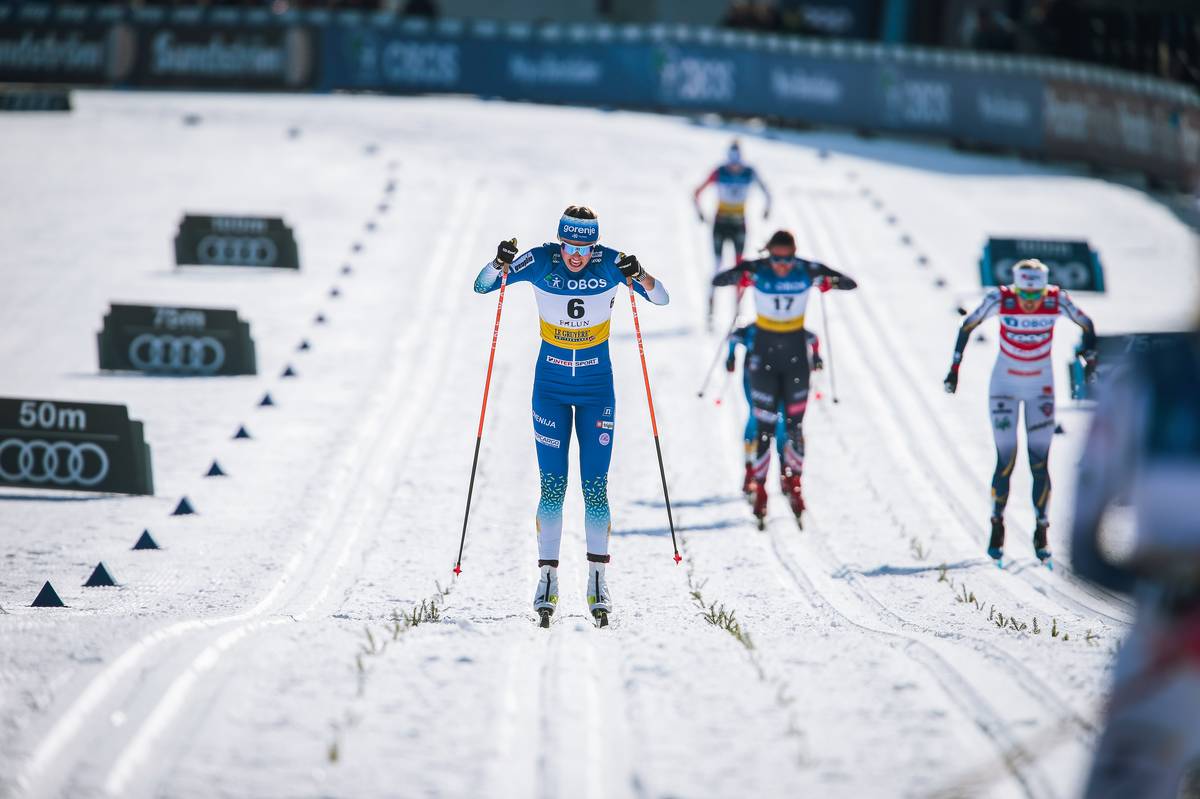
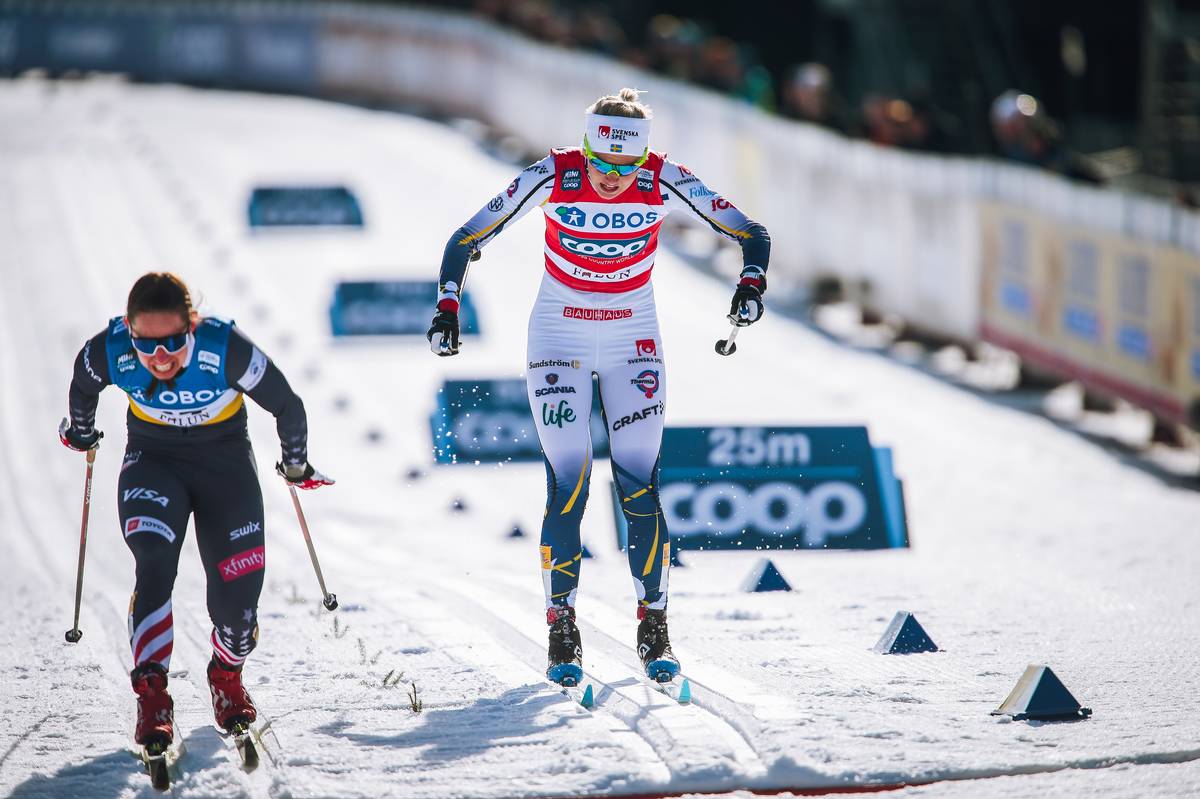
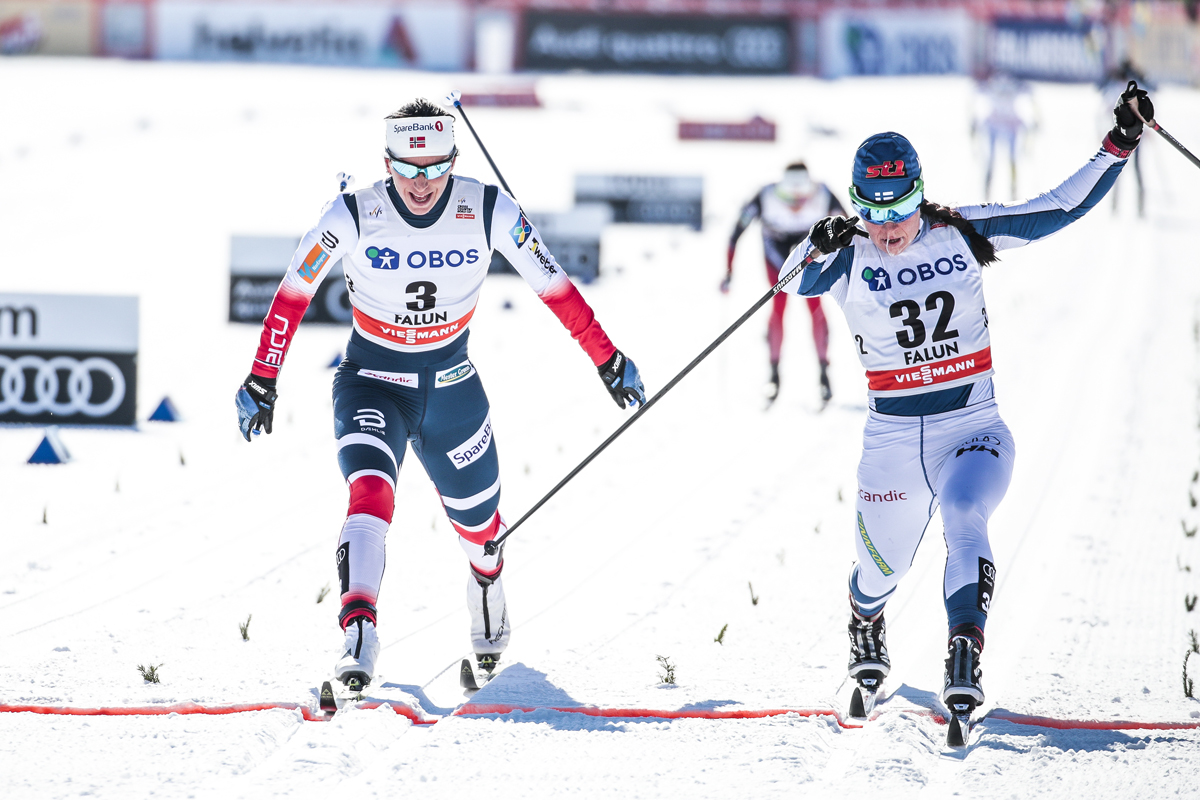
    In a race that was oddly lacking for fireworks, the three prime contenders still managed to separate themselves from the rest of the field . . . but not from each other. Twenty kilometers of measured racing came down to a three-way sprint in a crowded finishing straightaway. With 50 meters remaining, Karlsson, Jessie Diggins (USA), and Heidi Weng (NOR) sprinted in a three-abreast dead heat, a drag race that was ultimately won by the narrowest of margins by a resurgent Weng. Diggins would finish a breathtaking .1 seconds behind, with Karlsson less than a second behind her.

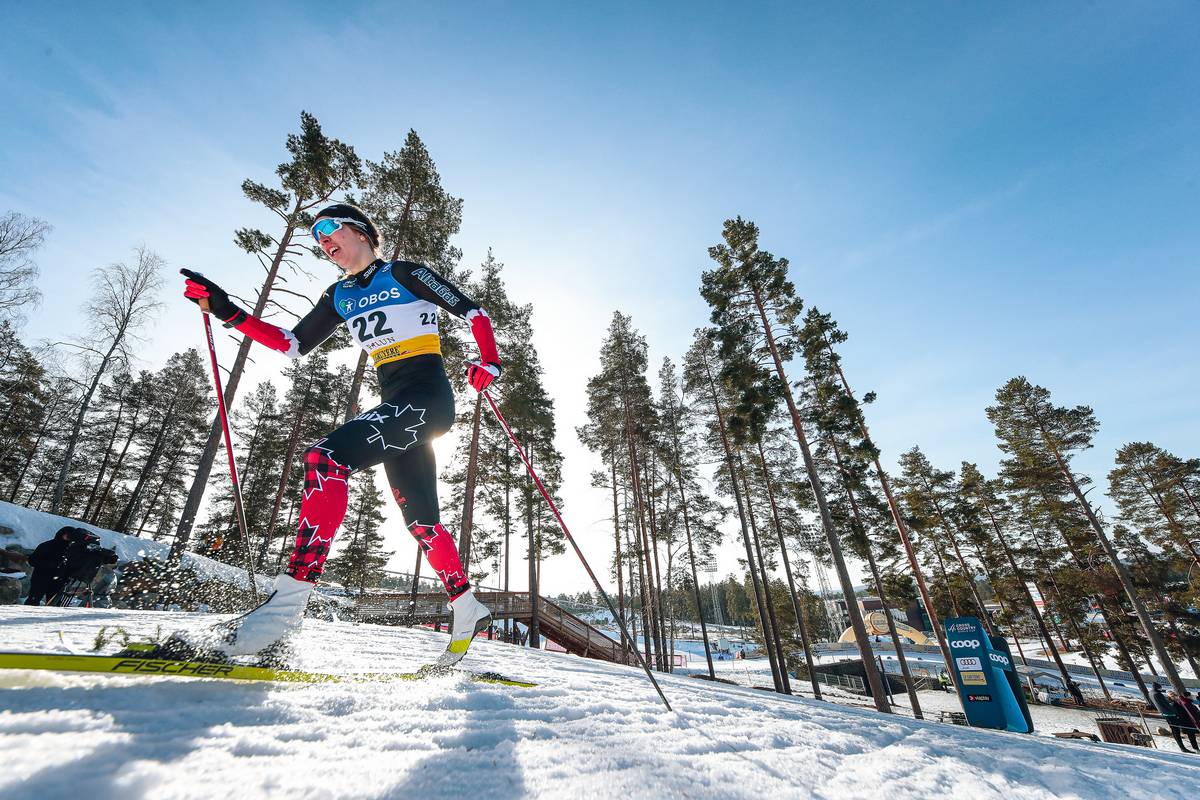
    Canadian skiers posted impressive finishes with Liliane Gagnon 17th, Alison Mackie 20th, Jasmine Drolet 37th, and Olivia Bouffard Nesbitt 41st.

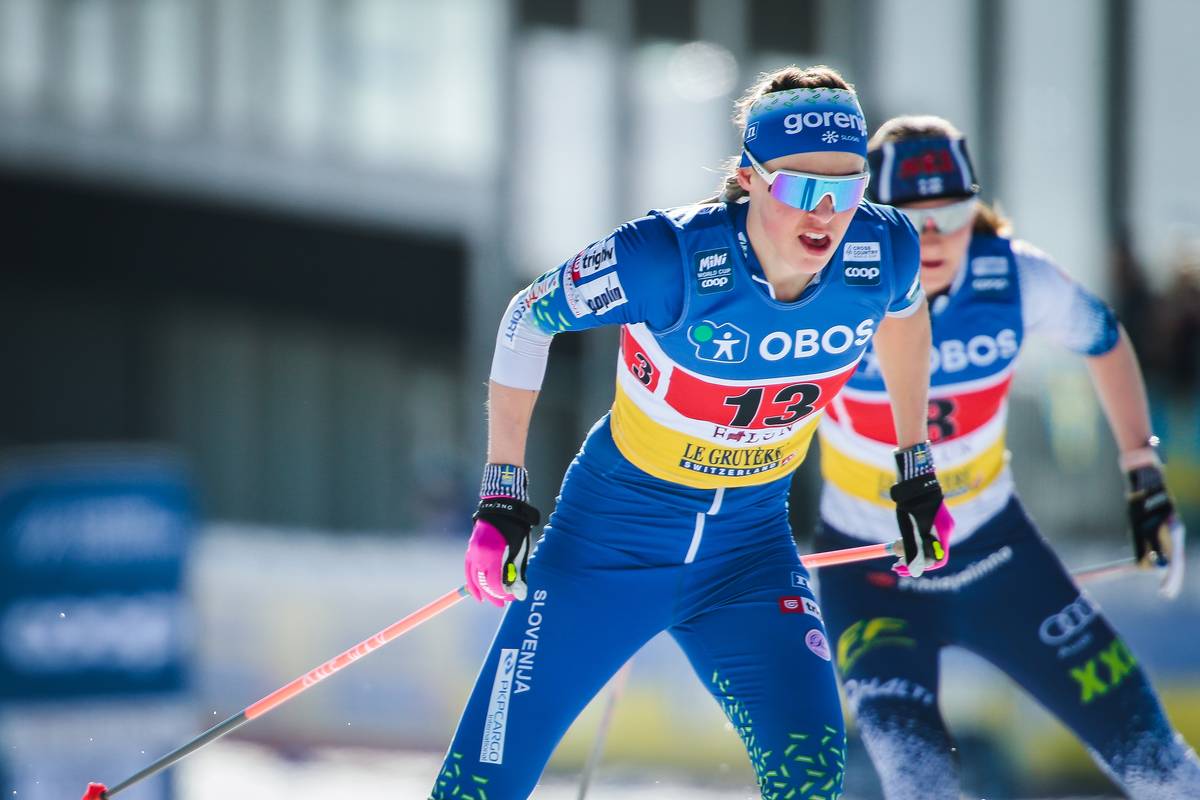
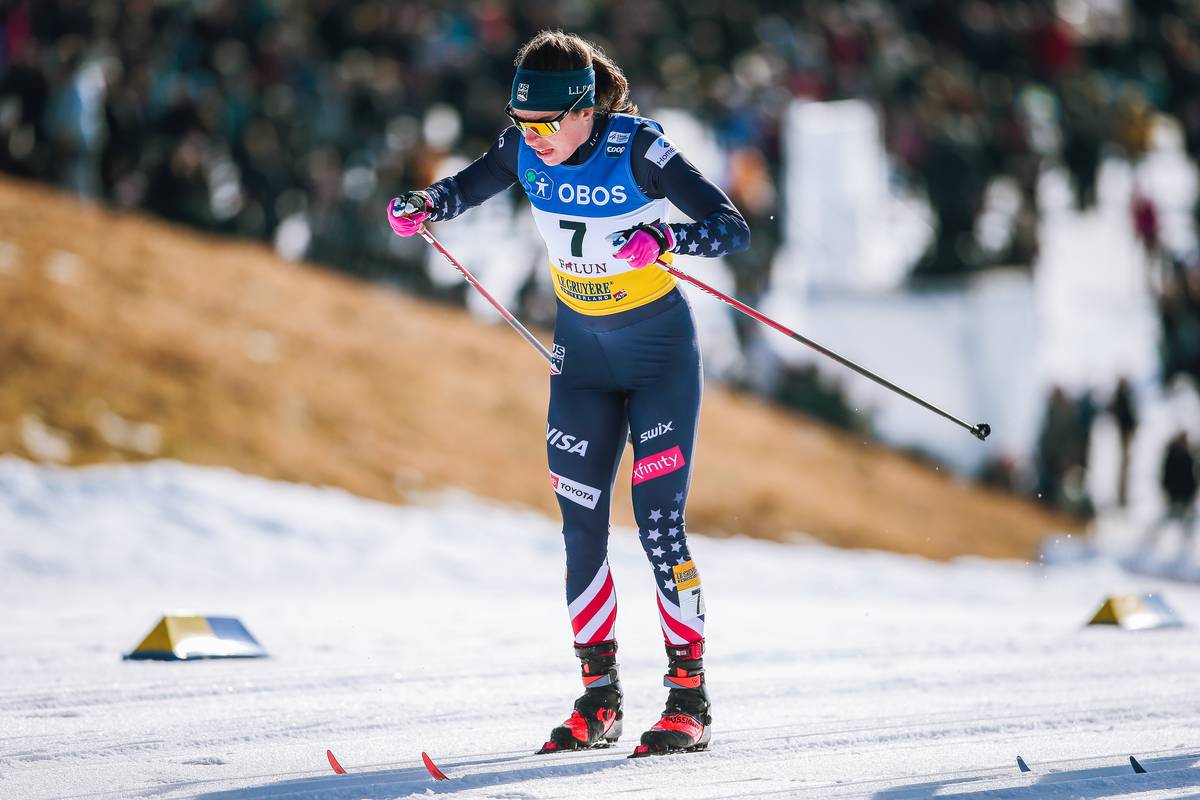
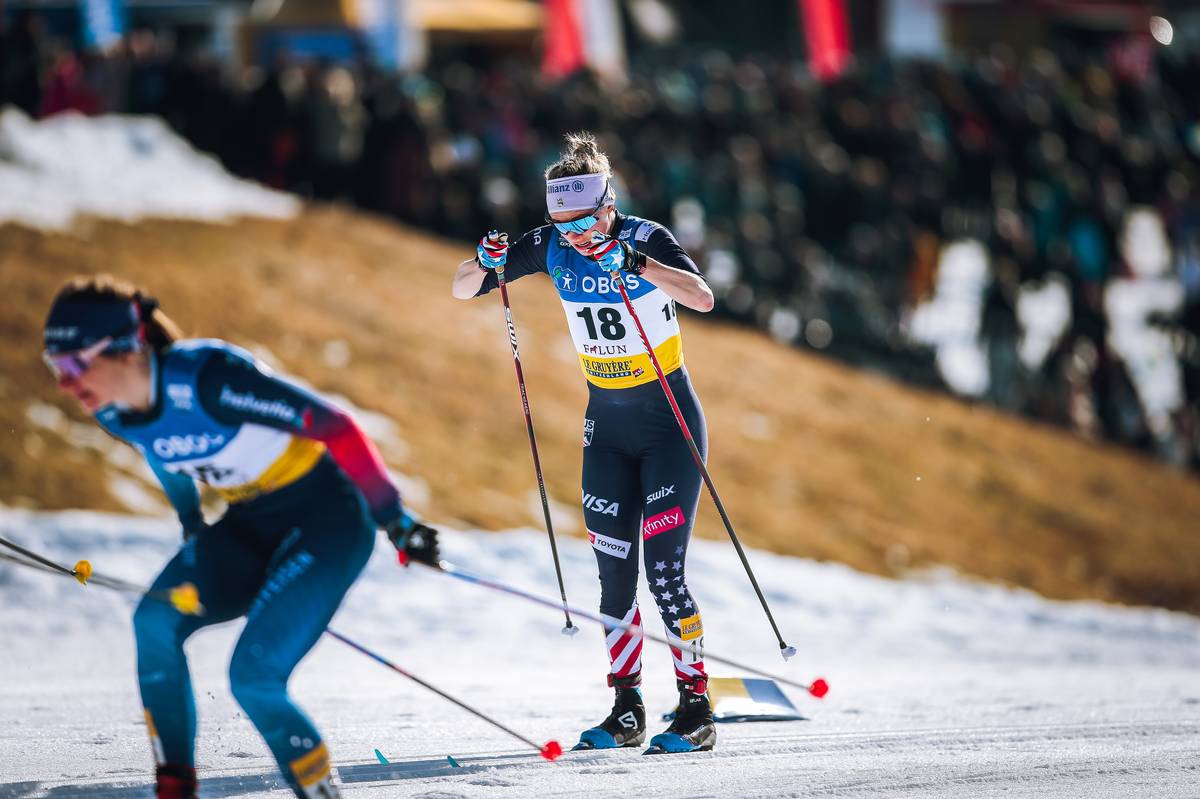
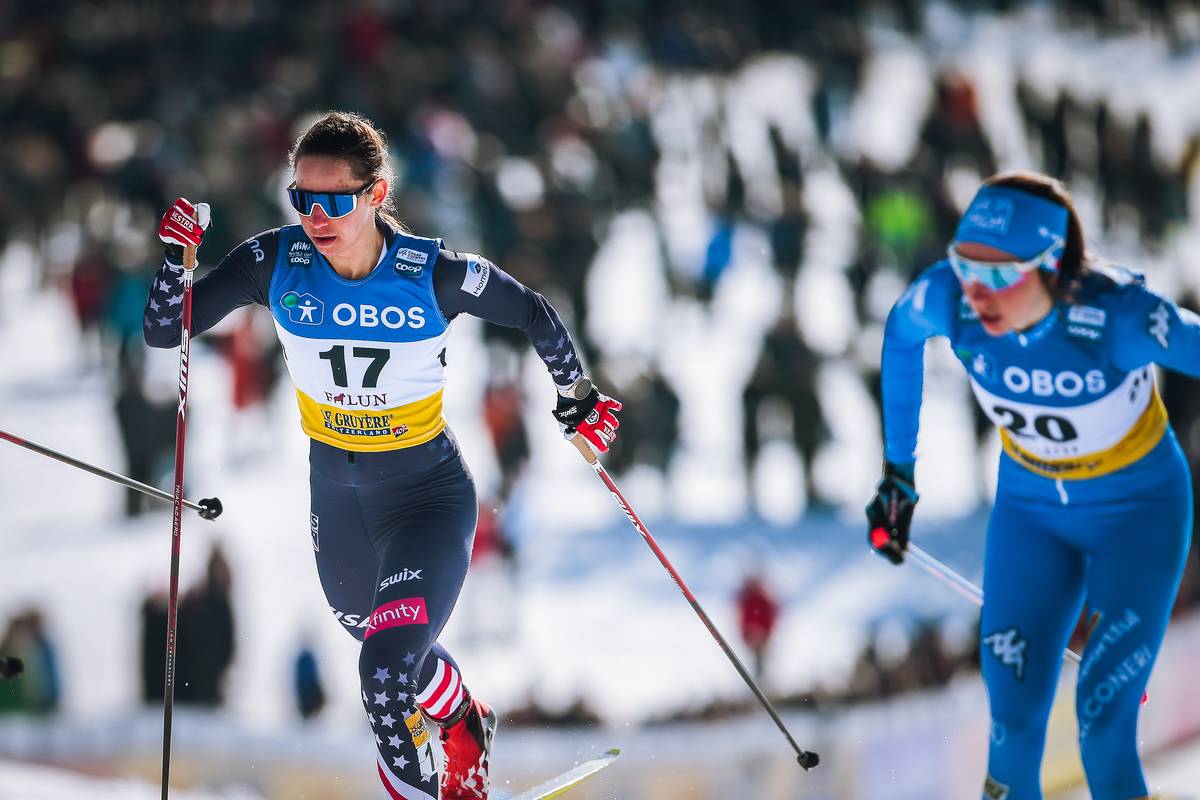
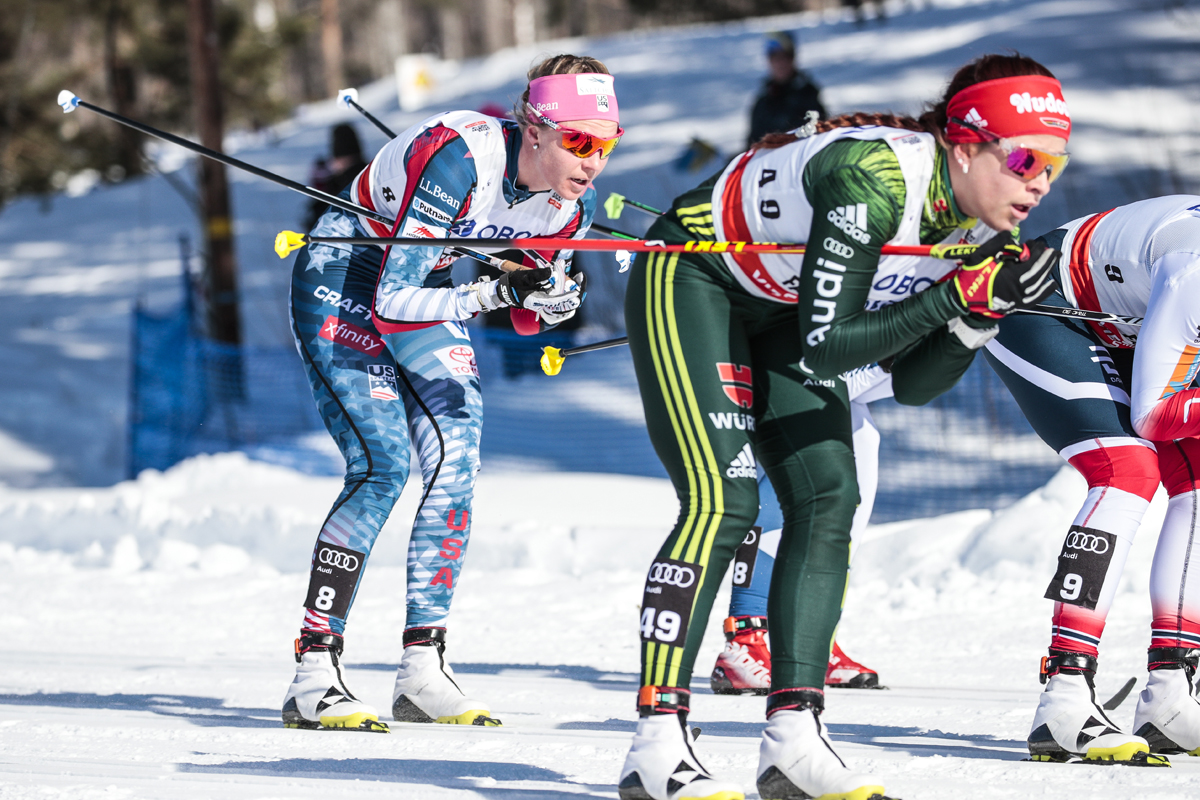
    Kendall Kramer (USA) has come out of the Olympic Games with new condifence and refined fitness. She skied to a career-best ninth place finish in Falun’s World Cup Skiathlon. (Photo:  Authamayou/NordicFocus)

    Just behind the lead group, Kendall Kramer (USA), would post a career-best placing, skiing forward from her #35 starting position to finish the day in ninth. Other American finishers included Hailey Swirbul 33rd, Rosie Brennan 35th, Novie McCabe 42nd, and Emma Albrecht 44th.

    “I must have gotten a 50k fitness boost they talk about!” said Kramer. “This felt like the easiest race all season, and I could go faster at every point, felt in control and like I had more and more energy. I got a lot of semi-altitude training done during the Olympics and have just been enjoying skiing around since then! Usually, I falter off during the spring due to a long XC running season before Nordic starts, so without that this year, things look a little different with trajectory.”

    Heidi Weng (NOR) has always been a contender, and often finishes on the World Cup podium, but she hadn’t had a World Cup win in four years. Falun’s Skiathlon delivered her some long-awaited redemption. (Photo: Authamayou/NordicFocus)
    Classic Leg

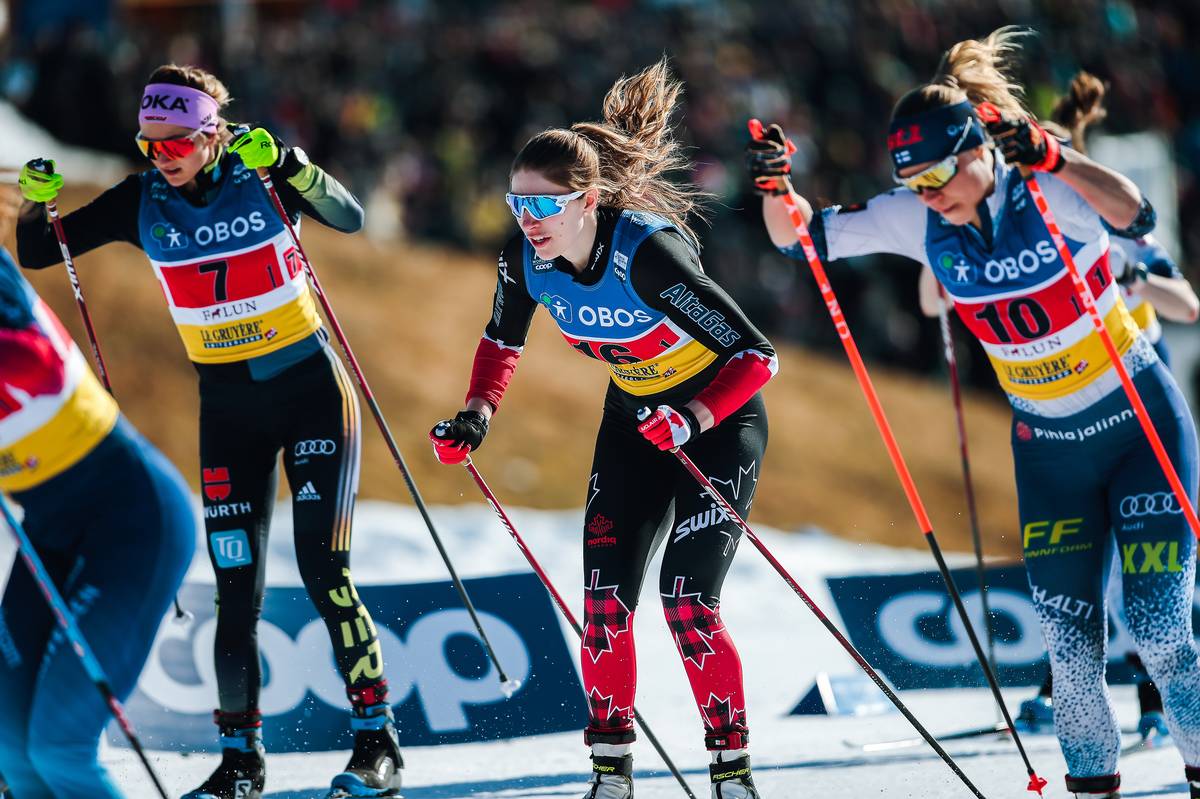
    Falun’s racing conditions would be challenging for ski technicians: 1.2 degrees Celsius (just over 34 degrees Fahrenheit) with very high humidity. Snow had fallen earlier in the day, so a nightmare wax-scenario was a very real possibility. And struggling through the ten kilometer Classic leg can prove disastrous. Randall mentioned the difficulty of preparing skis for the day’s conditions. “Many of the skiers had brought both pairs of skis to the start line . . . deciding which way to go,” she commented. Having been in that position, herself, during her long and storied World Cup career, Randall described the situation as “nerve wracking.”

    Karlsson, Weng, Simpson-Larsen, and Diggins al seemed to be in possession of expertly prepared skis; they went to the front to begin making pace. Moa Ilar (SWE)—Diggins’ primary challenger in the season-long World Cup standings—appeared to struggle initially as her skis proved slick on the uphills.

    Mackie latched on to the tail of the chase group as well, though she appeared to be struggling bravely with slippery skis. Early in the race, Kramer maneuvered through the field to overcome her early start position, skiing forward into a chase group that hovered ten seconds behind the leaders.

    “I had perfect skis in Classic—kick every step and shooting ahead on the downhills,” said Kramer. “So I was granted some standing up rest time. I could double pole more than other girls were doing and that saved me a lot of leg energy. A good classic day does not always happen for me, but when I get the perfect kick (thank you, Per-Erik!!!) classic is very comfortable for me. When I am sloppy, I can’t hang with the pack at the start and am out of it from the beginning. I was happy to actually execute my fitness and stay with the leaders from the start and hang on from there- I’m learning in World Cup mass starts, if you’re not in it from the start (sprinting off the line), you’re out of it, so that was knowledge I carried with me here!”

    As the pace settled, Diggins appeared confident, Weng appeared determined, Karlsson appeared tentative. Diggins would win top bonus points (15) at the 5.4 kilometer bonus sprint. Her closest World Cup rival, Moa Ilar, was eighth, earning three points. After ten kilometers of racing, the leading three would approach the ski exchange together. Diggins entered the ski exchange in front, but a bit of extra fiddling with her pole straps cost her time. She would start the skate leg near the back of the ten-skier lead group.

    Kramer’s high start number meant her ski exchange gate was far down the line from the leaders (and off camera). Throughout the Classic leg, she had continued to press forward through the field, moving up to eighth place on the course and re-establishing contact with the lead pack. A slower exchange left her off the back of the lead group as the skate leg began. Still, Kramer’s position was only 11 seconds behind the leaders.

    Frida Karlsson (SWE), led much of the day, but she was never able to deliver the sizzling agression that often accompanies her mass-start efforts. (Photo: Authamayou/NordicFocus)
    Freestyle Leg

    The skate loop would include Falun’s infamous climb, the Mördarbacken. Karlsson went to the front up the climb, followed by Weng. Diggins seemed content to remain within the lead group while her rivals did the work. Having been gapped slightly after the ski exchange, Kramer settled into a three-person chase group with Maia Dahlqvist (SWE) and Nora Saness (NOR).

    Another bonus sprint was offered at the 14 kilometer mark. And the slower pace had allowed Ilar to rejoin the lead group along with Daria Nepryaeva (AIN). Ilar would finish third at the bonus, earning 12 points. But she would make up no distance on Diggins who crossed first to earn 15 points.

    The slower pace of the day had also allowed another dark horse to sneak into contention. With five kilometers to go, the leaders became aware of the presence of Olympic Sprint champion, Linn Svahn (SWE) wearing bib 32. Always a capable Distance skier throughout her career, Svahn is enjoying a period of great form in these days following the Olympics. If the leaders failed to drop Svahn before the finishing straightaway, she would definitely steal the whole race.

    Karlsson had not skied like herself this day, but when she saw Svahn in the lead pack, something seemed to click. Straight to the front went Karlsson. But it was a counter-attack by Weng that truly animated the race. Up a steep climb, Weng raised her tempo and established a bit of a gap over Karlsson. Behind them, Diggins tried to limit the damage in third, followed by a wobbling Nepryaeva and a game Svahn who appeared calm in her willingness to let a gap develop. Nobody panicked yet, but Weng had made her intentions clear. With four kilometers to go, she was committed to the finish line.

    Diggins is a seasoned and experienced racer with enough mass-start races under her belt to know that gaps can be overcome by skiers who resist panicking on the parts of the course that are their weakness, and taking advantage of those parts of the course that are their strengths. For Diggins, her strength is found in the downhills where she is often able to close gaps. She knew she might still have a chacne to bridge up to Weng and Karlsson. With three kilometers remaining, Diggins regained contact.

    Weng continued applying pressure, with the top three establishing a considerable gap ahead of Svahn. Within the final two kilometers, Karlsson again moved to the the front. She would know that her career results placed her no better than third among the sprint abilities of this lead group. Either she would drop Weng and Diggins, or one of them would snatch victory from her.

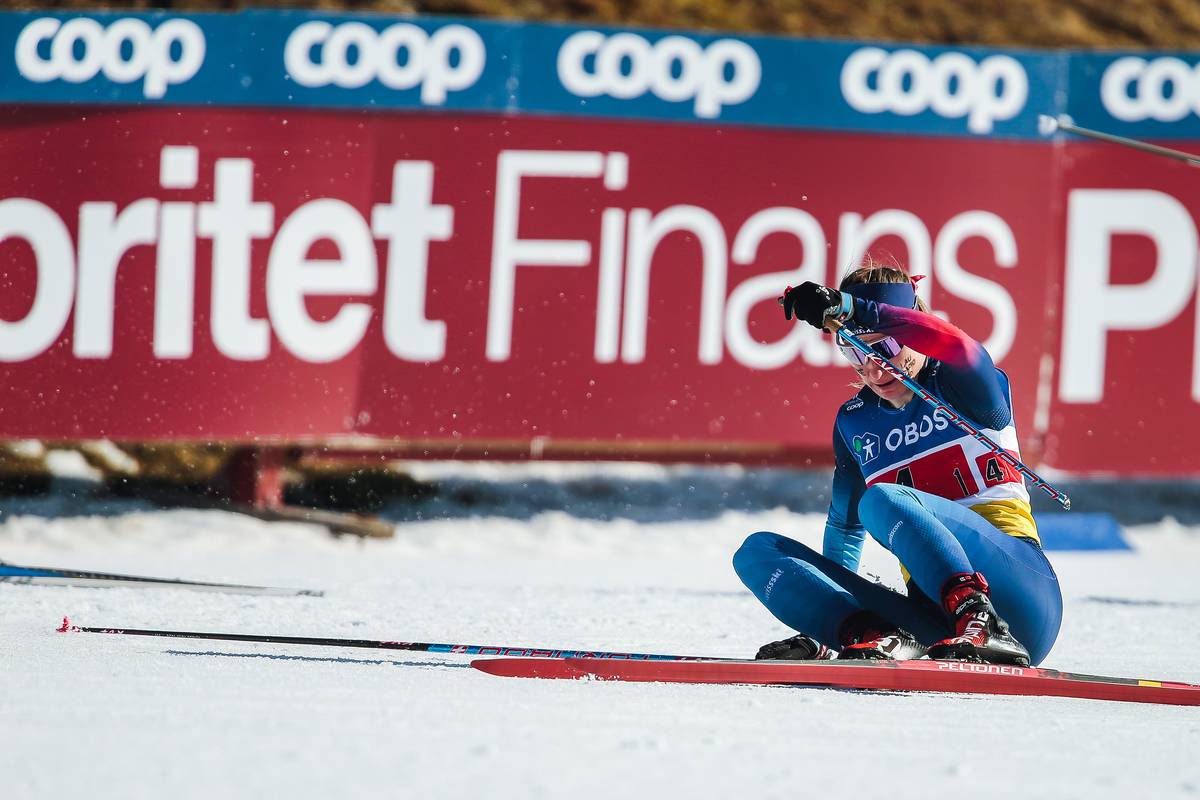
    The final kilometer of the Freestyle loop re-traces the finish of Falun’s Sprint course, where it’s well known that leading over the final hill can be disastrous. Falun’s infamous draft favors those who follow up the hill and slingshot down the other side. Karlsson continued to insist on leading, though all three contenders seemed to stall at the top of the final uphill where Karlsson had still not managed to gap Weng, and while Diggins struggled she did not lose contact. With the Sprint-draft downhill ahead of her, Karlsson was in an unenviable position. She managed to maintain her position at the front as the trio entered the finishing straightaway. Fortunately, that straightaway was groomed three skiers wide, as the leaders charged toward the line three abreast. With 20 exhausting kilometers already in tehir arms and legs, the sprint would be as much about resolve as it was about sprint ability. Karlsson took the middle, Diggins eased past her on skier’s right, but it was Weng on the left who proved to have the most energy remaining. Four years removed from her last individual World Cup victory, Weng raised her arms in victory, elation, and relief. Diggins would cross just .1 seconds behind her, and less than a second ahead of a totally spent Karlsson.

    Svahn would finish fourth, 11 seconds behind, just ahead of Nepryaeva. Kramer would conclude her day in ninth place, posting the best finish of her young World Cup career.

    Diggins continued to extend her lead in the race for the 2026 Overall World Cup Crystal Globe, a competition that will be decided—and a trophy that will be awarded—at the season-concluding races a few weeks from now in Lake Placid, New York.

    Falun Women’s Skiathlon Sprint RESULTS

    Love Stories Like This? Help Keep Them Coming.

    Feature stories like this one take time, access, and care to produce. If you value thoughtful storytelling and independent ski journalism, please consider becoming a Voluntary Subscriber. Your support directly fuels the work we do to cover the people, places, and moments that make our sport special.

    Join the FasterSkier community!
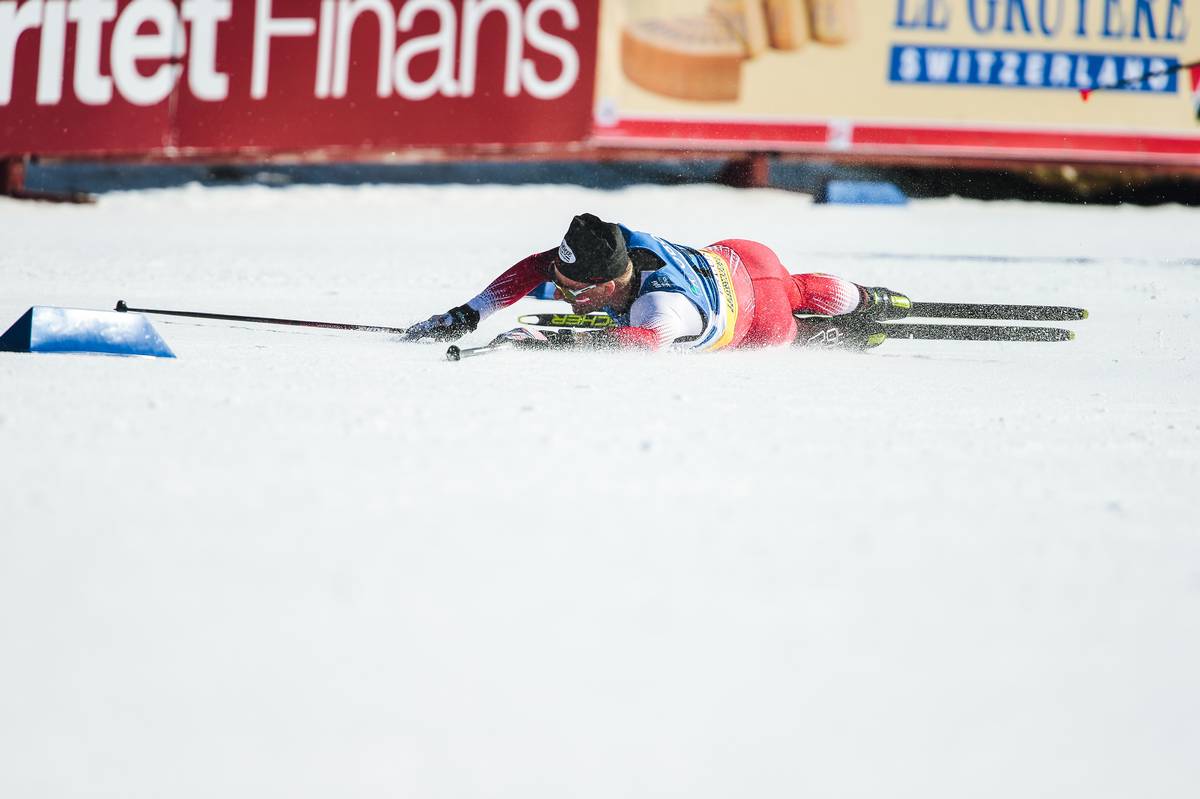
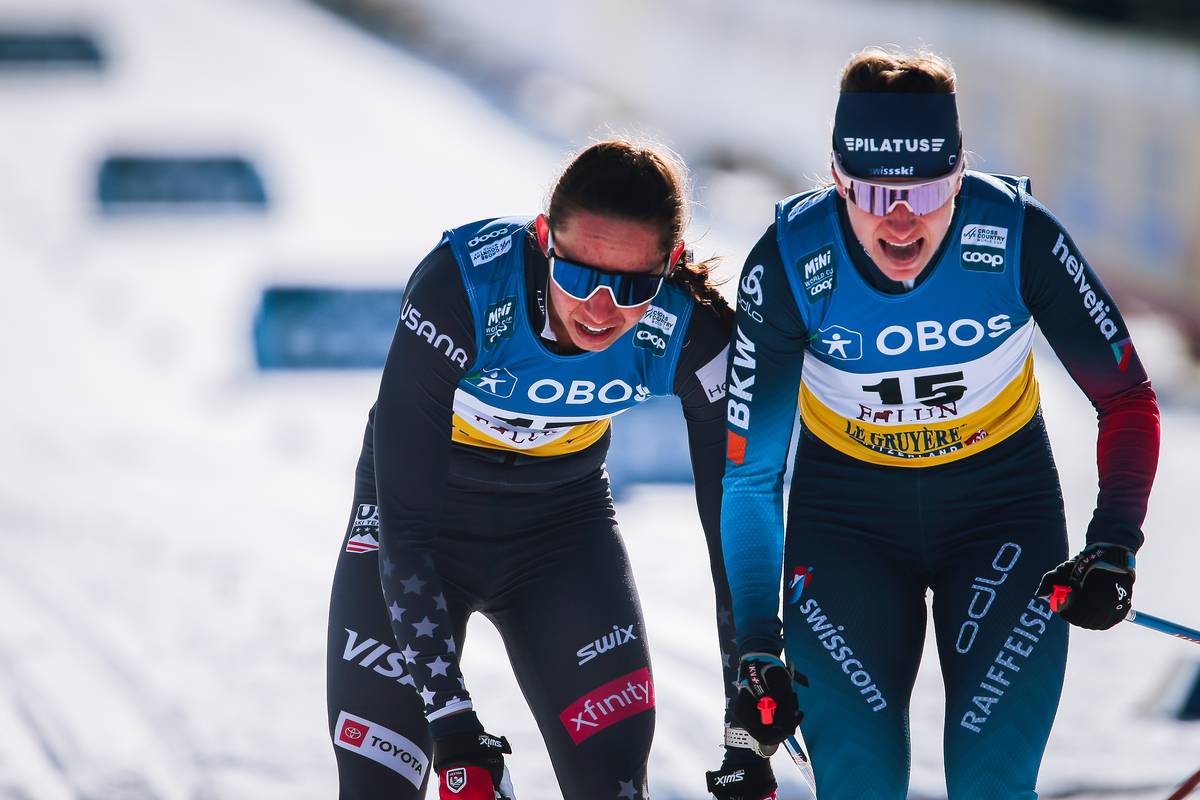
    The cost of doing business: athletic carnage among podium finishers at the finish line of the Women’s 2 x 10 k Skiathlon in Falun. (Photo: FasterSkier screenshot)


  • Falun World Cup Freestyle Sprint: It’s Klaebo’s World . . .

    Falun World Cup Freestyle Sprint: It’s Klaebo’s World . . .

    This World Cup coverage is made possible through the generous support of Marty and Kathy Hall and A Hall Mark of Excellence Award. To learn more about A Hall Mark of Excellence Award, or to learn how you can support FasterSkier’s coverage, please contact info@fasterskier.com. 

    Once in his career, Johannes Hoesflot Klaebo (NOR) stood up too early before the finish line and was famously (and embarrassingly) nipped at the line. In Falun’s World Cup Freestyle Sprint, no other sprinter was even close. (Photo: Modica/NordicFocus)

    This guy is simply incredible . . . can we just admit that? Thirty skiers qualify for every sprint quarterfinal—all having demonstrated their sprint prowess, all with a burning desire to win—Johannes Hoesflot Klaebo (NOR) routinely bests them all. Sprint courses provide tight turns to maneuver and steep hills to hop-skate, yet those never seem to present the same sorts of challenges to Klaebo that they present to others. There are poles that can snap and skis that can tangle, yet none of this ever seems to befall him. Sprint days are exhausting, with repeated lactate-producing efforts accumulating throughout the day; Klaebo never seems to tire. Getting through quarterfinals and semifinals and finals on a sprint day is skiing’s version of a minefield: be as skilled and prepared and careful and lucky as possible, but some unseen obstacle may still undo you. Even the world’s best sprinters seem incapable of mustering any significant degree of consistency: Federico Pellegrino (ITA) is a great sprinter, yet he often fails to advance to the final (last week in Drammen he failed to even qualify for the heats). Even Northug (NOR) has the famous family name and presumably the sprint genetics, but he is not consistently a factor (failing to advance to the final in Falun). Richard Jouve (FRA) won last season’s World Cup Sprint championship in Klaebo’s absence, but his results are irregular, and his endurance sometimes comes into question. Occupying second place in the season-long World Cup Sprint standings, Lucas Chanavat (FRA) is the most consistent of the other sprint contenders, but it’s difficult to even remember him being a factor in sprint finals this season. The rest of the world’s best sprinters—Erik Valnes (NOR), Edvin Anger (SWE), Renaud Jay (FRA), Ben Ogden (USA), Marcus Grate (SWE), Calle Halfvarsson (SWE), Jules Chappaz (FRA), Paal Golberg (NOR)—consistently peck away at each other, failing or advancing seemingly at random, buffeted by quarterfinal and semifinal sprint-storms that never seem even to ruffle Klaebo’s neatly coiffed hair. Nordic Sprinting is Klaebo’s world; everyone else is just living in it . . .

    In today’s World Cup Freestyle Sprints at Falun, Sweden, that dominance was clearly on display as Klaebo coasted to a win ahead of Valnes and Pellegrino. It was Klaebo’s 17th World Cup win of the season (his 8th sprint victory). After today’s races in Falun, his lead (over Chanavat) in the season-long Sprint World Cup competition stands at an astonishing 235 points.

    Ogden was the highest finishing American, qualifying 12th, though ultimately finishing 17th. His high-profile, high-speed efforts in the last few races may be catching up with him this week, as he appeared relatively flat in his quarterfinal, a slow heat in which he finished fourth (and from which no lucky losers advanced). Other Americans included Kevin Bolger 36th, Zak Ketterson 49th, Luke jager 58th. Among Canadians, Graham Ritchie was 42nd, Russell Kennedy 44th, Xavier McKeever 59th, Antoine Cyr 61st, Olivier Leveille 63rd.

    Johannes Hoesflot Klaebo (NOR) is careful never to lead until the moment comes to break for the finish line. He calmly stalked Lucas Chanavat (FRA) and Even Northug (NOR) in the Individual Sprint semifinal at Falun, Sweden. (Photo: Modica/NordicFocus)
    Men’s Freestyle Sprints

    Well, that was weird . . . or maybe it was a brilliant tactical attempt on Chanavat’s part? Whatever the reason, the final did not go according to Klaebo’s plan; though seemingly nothing could have affected the predictability of the outcome.

    Klaebo was joined in the final by Pellegrino, Valnes, Chanavat, Jouve, and the surprising Haaakon Asdoel, making his first World Cup start and reaching his first World Cup Sprint final. They’re all great sprinters, but really they were likely to be fighting each other for Klaebo’s table scraps. It’s as though Falun’s sprint course was designed specifically for Klaebo and his skis, for Klaebo and his speed, for Klaebo and his tactics. A ski-speed downhill leads into a slingshot rise and descent, emptying into a long straightaway to the finish line. Klaebo skied the course to script and to perfection in his quarterfinal and semifinal, each time emerging from the pack on the downhill, separating himself by virtue of his perfect timing, innovative line selection, and blazing fast skis.

    Staying out of the lead, and making sure others are first onto the downhill: Johannes Hoesflot Klaebo (NOR) follows Edvin Anger (SWE), Lucas Chanavat (FRA), and Even Northug (NOR) in a sprint semifinal in Falun, Sweden. Chanavat attempted to undo Klaebo’s plan in the sprint final, but the end result was the same. (Photo: Modica/NordicFocus)

    “This sprint in Falun is really tactical,” Klaebo said in post-race interviews. “Don’t be in the front on the last downhill: that was my tactic.” That’s the tactic Klaebo had demonstrated throughout the day. In the final, Chanavat seemed determined to interrupt that. So, when the field reached the top of the final downhill, Chanavat just stopped.

    “Everyone stopped at the top,” Klaebo explained. “No one wanted to go first down.” What resulted was a race that virtually came to a halt, with Pellegrino caught drifting to the front. Pellegrino actually turned around to look at the other racers, and would’ve come to a complete stop had not Chanavat given him a gentle nudge down the hill. Even then, Pellegrino wouldn’t take the bait, and the pack slow-skied down the upper slope. It was at that moment that Klaebo awoke to the situation, realizing that his typical advantage—his fast skis on the downhill—was being negated. But there’s no situation in sprinting in which Klaebo is not superior: he’s the best tactician, and possessed of the highest top speed. He’s the most adept descender and cornerer, while also being capable of the most rapid acceleration. His skis are always the fastest on the course, and both his V2 and freeskate technique are unmatched. The race might not have been going according to Klaebo’s plan, but he was still in position to win. Springing into action, Klaebo quickly accelerated down the middle of the hill, breaking into a freeskate that none of his rivals could match. Though his original tactic had been undone, the result was the same: Klaebo reaching the slingshot bump in the lead, and pulling away with time to stand and salute the crowd before crossing the line as sprint-mayhem continued unfolding behind him. Pellegrino—always the capable opportunist—sprinted clear of a flat-footed Chanavat and an exhausted Jouve, and nearly caught Valnes at the finish line. The best sprinters had made it to the podium . . . and of course the best sprinter had won. Order was restored on the Sprint course, and the world was Klaebo’s again.

    Men’s Freestyle Sprint RESULTS

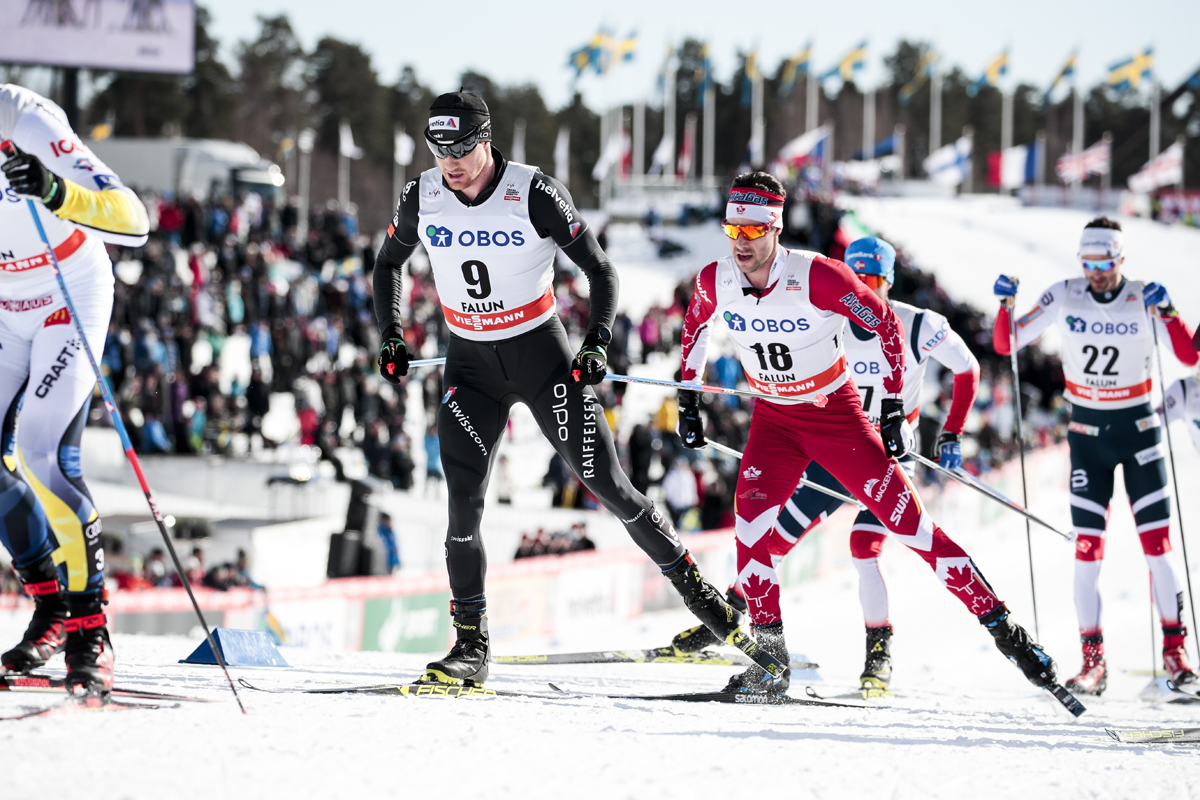
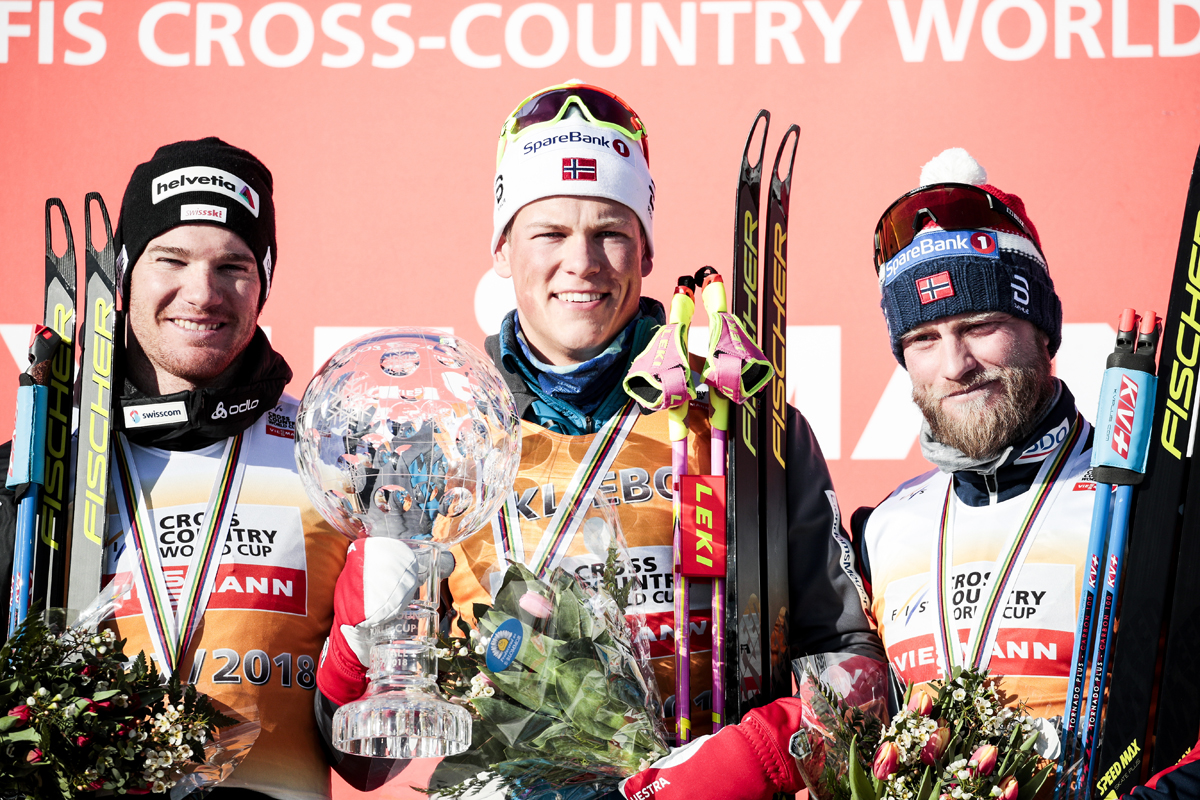
    Erik Valnes (NOR), Johannes Hoesflot Klaebo (NOR), Federico Pellegrino (ITA) on the podium at FIS World Cup cross-country, Individual Sprint in Falun, Sweden. (Photo: Modica/NordicFocus)
  • With Diggins as Anchor, USA I Comes Out On Top in Falun’s Mixed Relay

    With Diggins as Anchor, USA I Comes Out On Top in Falun’s Mixed Relay

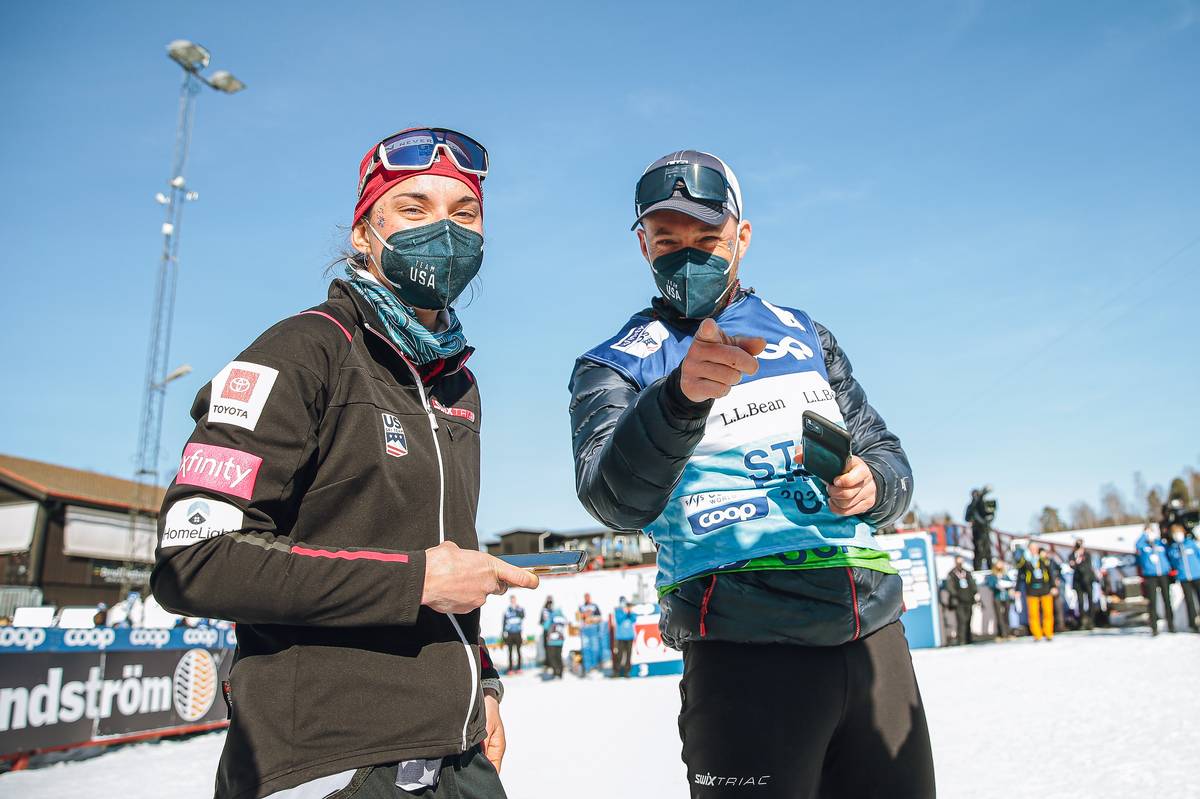
    Julia Kern and US Ski Team head coach Matt Whitcomb watch the 4 x 5 k relay from the stadium. (Photo: NordicFocus)

    This World Cup coverage is made possible through the generous support of Marty and Kathy Hall and the A Hall Mark of Excellence Award.  To learn more about A Hall Mark of Excellence Award or to learn how you can support FasterSkier’s coverage pleasecontact info@fasterskier.com.

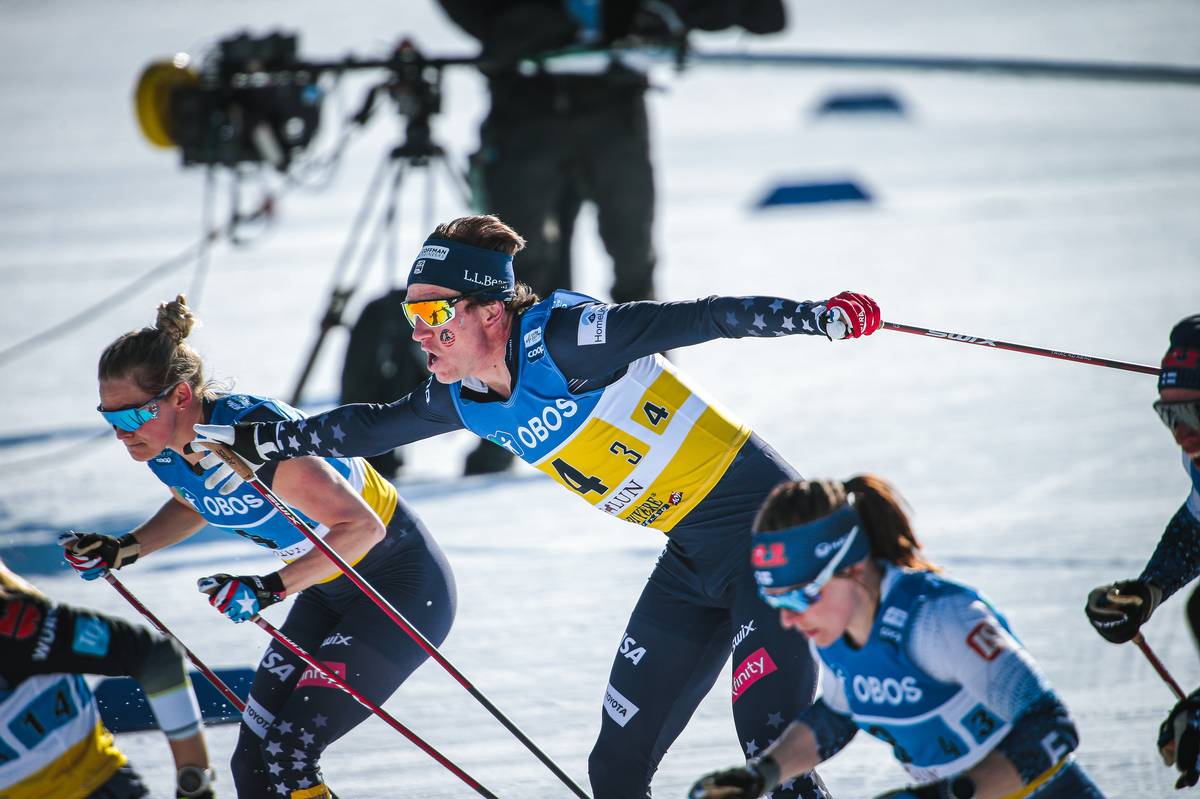
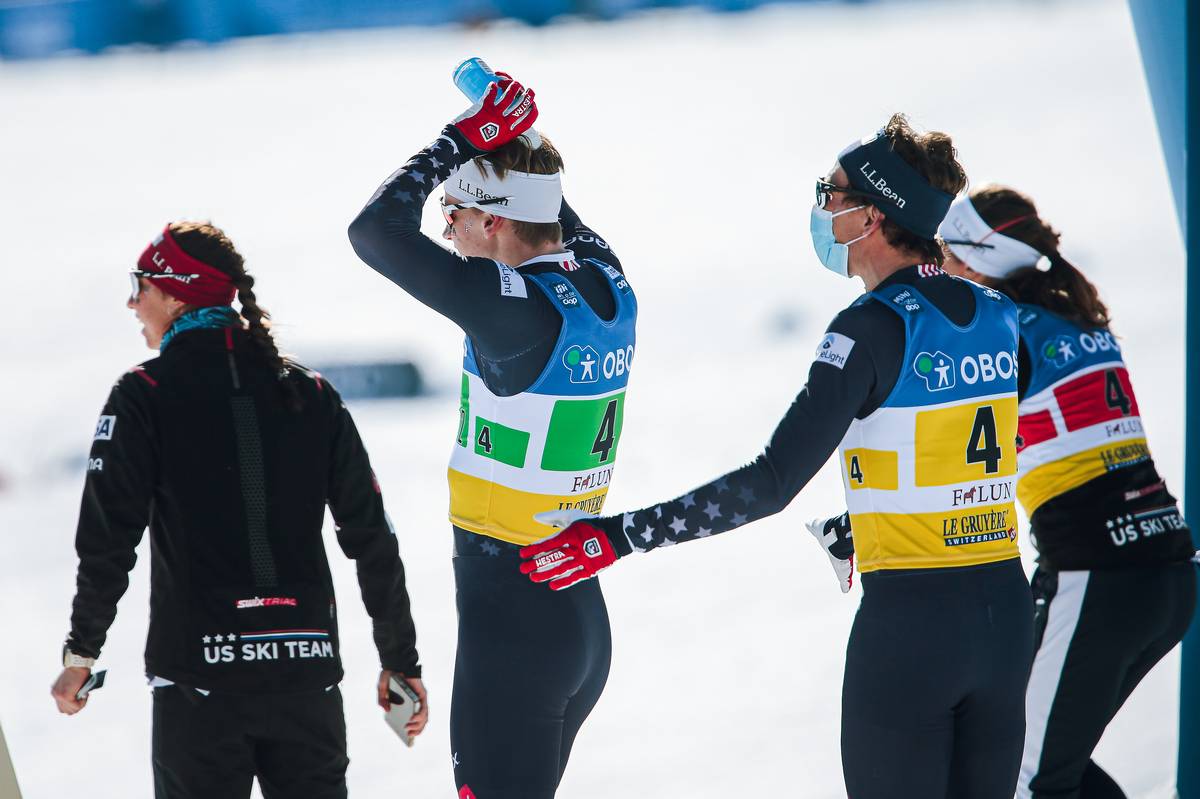
    While it was perhaps not the final event originally planned for the season, today’s 4 x 5-kilometer freestyle mixed relay in Falun, Sweden shaped up to be quite a way to go out. Particularly for Team USA, who broke away in the final lap to take the win in 42:01.8. 

    With Rosie Brennan scrambling to tag Zak Ketterson for the second leg, Scott Patterson skating third, and Jessie Diggins anchor, it was a team composed of four skiers who had all raced into the top-15 in yesterday’s 10/15 k skate, three within the top-eight. Perhaps the only team more loaded was Norway 1, which featured Heidi Weng, Hans Christer Holund, Didrik Tønseth, and Therese Johaug, all of whom placed in the top-five yesterday, including both of the day’s winners in the final two relay spots. Also a force, Finland I consisted of three Olympic medalists, one of whom is the 2022 men’s World Cup distance champion with the lineup: Kerttu Niskanen, Perttu Hyvarinen, Iivo Niskanen, and Krista Pärmäkoski. 

    Each nation was allowed two teams, allowing the US to start a second lineup of Julia Kern, Logan Hanneman, Adam Martin, and Caitlin Patterson. Canada raced one team, which included Katherine Stewart-Jones, Antoine Cyr, Philippe Boucher, and Jasmine Drolet, racing in that order. 

    Stars and stripes at the front, as Julia Kern scrambles for USA II in Falun’s mixed relay. (Photo: NordicFocus)

    New to the World Cup, the mixed relay is modeled after the biathlon competition format, which debuted in 2005. It had originally been slotted onto the calendar for the Canmore World Cup events in March 2020, which were canceled as COVID-19 began to spread around the globe. It had been tested on the tracks in Falun during the 2021 Swedish senior national championships, with local club leader Johan Eriksson saying afterward, “Team cohesion was strengthened when ladies and gentlemen fought against the same goal line. At the same time, the entertainment was great with reversals in the result lists and tactical moves in team line-ups.”

    The entertainment value was certainly high today, particularly for American ski fans. Racing a distance now only seen in relays, it would be a painful blend of sprinting and distance. And the Americans would be lucky to have a woman anchoring the team who has previously been described as the “Queen of the 5 k skate”. 

    Rosie Brennan scrambles for USA I during the inaugural World Cup 4 x 5 k mixed relay in Falun. (Photo: NordicFocus)

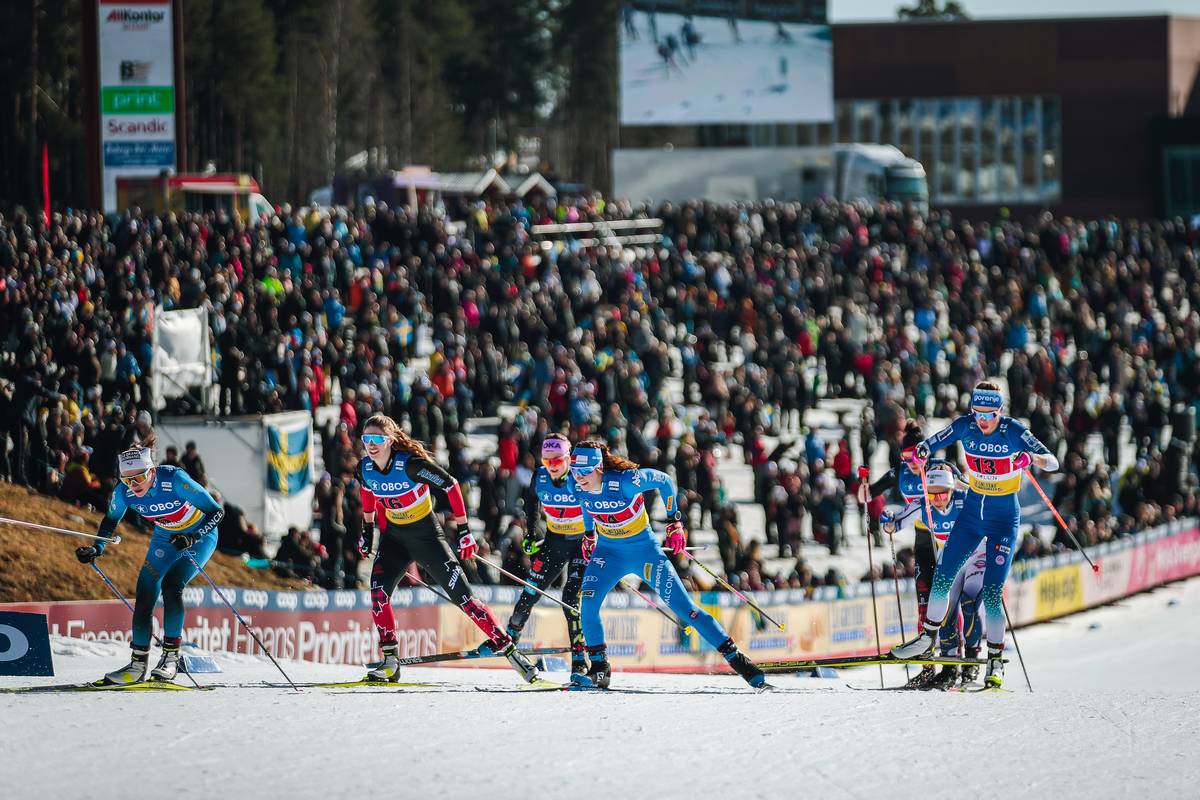
    As expected, the pace was high from the start, as the Star Wars theme blared through the stadium loud-speakers. Up for the task at hand, Brennan went toe-to-toe with the other women at the front through two 2.5 k laps. Later describing the event as “fast and furious”, Brennan kept USA I within the lead group, Kern duking it out on USA II  alongside through the first lap.

    “I think our goal today was to stay out of trouble and stay in the pack, and then let Diggy do her thing that she does best,” Rosie told FIS post-race with a laugh. “And that worked out really well.”

    Brennan handed off to Ketterson at the first exchange, in line with Germany I, Norway I, and Sweden I, Finland I just behind. 

    Though new to the World Cup this season, Team Birkie’s Ketterson has consistently shown his range. Domestically, he won three SuperTour sprints, and stood on the podium in four distance races, one of which was also a win. He chiseled away at the World Cup puzzle, finishing just outside the top-30 during the Tour de Ski, and returning following the Olympic break to place 41st in Lahti’s distance classic race and at the 50 k classic at Holmenkollen. Smashing a 15th place finish in yesterday’s 15 k free, Falun has been a breakthrough weekend.

    Though 5 k is not a distance men traditionally race on the World Cup, Ketterson emailed post-race that the event felt familiar and reminiscent of his early days in the sport. 

    “I am a huge fan of the 5 k race distance as I spent four years in Minnesota high school races doing that distance multiple times a week in the winter. Today brought me back to those days! It was super chaotic pack skiing but I felt really strong the whole time and did my best to keep up with the leaders. Honestly, when Jessie is your anchor, you don’t really have to worry too much about the rest!”
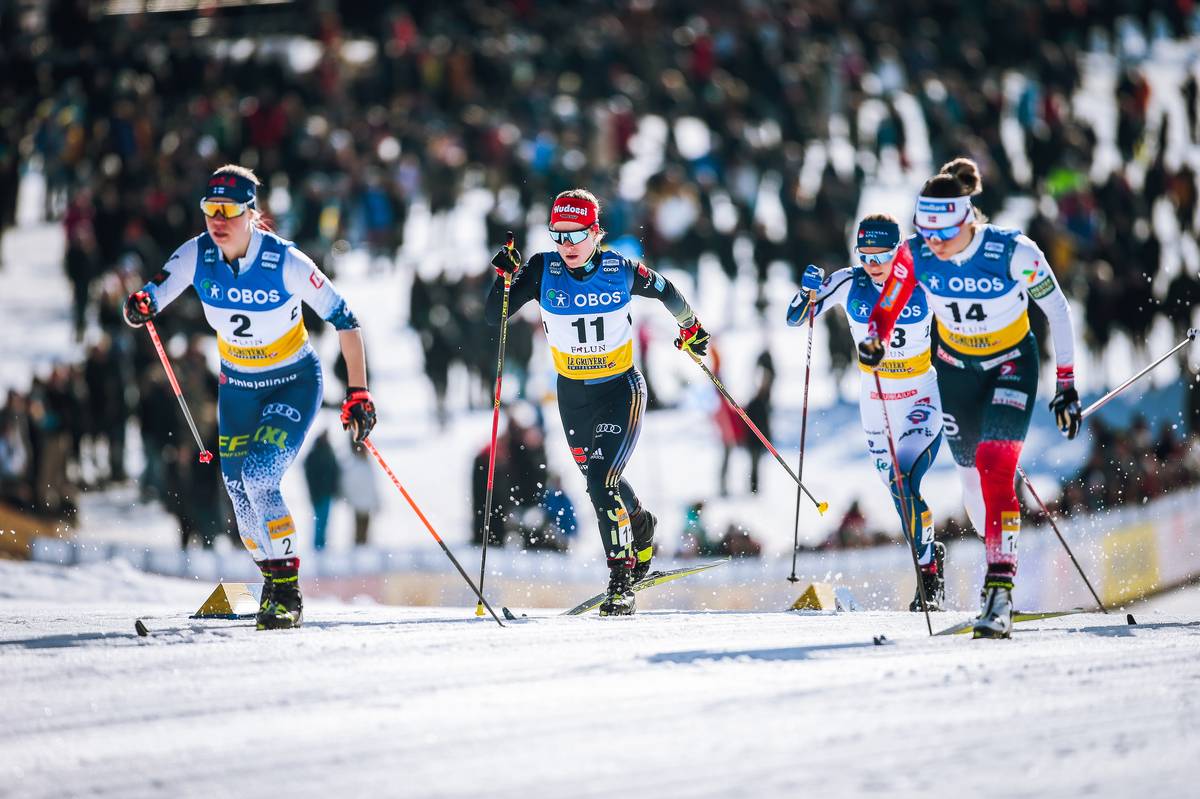
    Zak Ketterson tags Scott Patterson during the 4 x 5 k mixed relay in Falun. (Photo: NordicFocus)

    On lightning fast tracks with matching skis, Ketterson skied smoothly within the large lead group, keeping USA I within contact of the leaders, while Sjur Røthe tried to crack open pack for Norway II. Tagging Patterson roughly four seconds back, USA I sat in 10th, alongside Canada, at the second exchange. USA II tagged in 14th, +34 seconds back. 

    Still a large and dense group of front runners, Patterson worked at the back of the lead group to minimize further time losses, keeping his team within reach of the podium. With both Norwegian teams at the front in the second lap, Patterson whittled down the American’s time back, tagging Diggins 2.2 seconds behind the leaders to “do her thing” over two 2.5 k laps. Canada had lost contact with the front group, sitting in 11th (+17.9), while USA II tagged following a gap in 15th (+1:14.5). 

    “My goal was to hang on with the pack early and get in the groove, then try to match accelerations later,” Patterson wrote after the race. “I knew I wasn’t going to be the one with super accelerations but could sprint the whole way. During the race I was thinking ‘Just hold on’, so Jessie could work her magic relay anchoring skills. There were a few moments where some gaps formed but I barely managed to cling on.”

    Scott Patterson races the third leg for USA I in Falun. (Photo: NordicFocus)
    Scott Patterson makes the final tag to Jessie Diggins during the 4 x 5 k mixed relay in Falun. (Photo: NordicFocus)

    Diggins quickly got to work. Halfway through the first lap, it was Diggins marking Johaug at the front, with Krista Pärmäkoski for Finland I and Victoria Carl for Germany I tucked into their wake. Recall that Carl had anchored the German relay team for an Olympic silver medal in Zhangjiakou just a few weeks ago.

    Skis ripping on the downhill, Diggins moved to the front to lap through the stadium 1.4 seconds ahead of Finland I and Norway I, Frida Karlsson for Sweden I challenging Germany’s Carl just behind. 

    Jessie Diggins brings USA 1 through the stadium in the lead after her first lap. (Photo: NordicFocus)

    Diggins worked patiently up the climb, once more tucking behind the rapid fire tempo of Johaug on the uphill, and tucking calmly into the draft of the Norwegian and Finn heading into the descent. Diggins hit the second climb hard as the three women hop-skated up and over. Among the best descenders on the World Cup, Diggins skis were only fueling the fire, allowing her to maintain her lead in the rolling last kilometer and into the stadium which erupted with noise from the packed sidelines. 

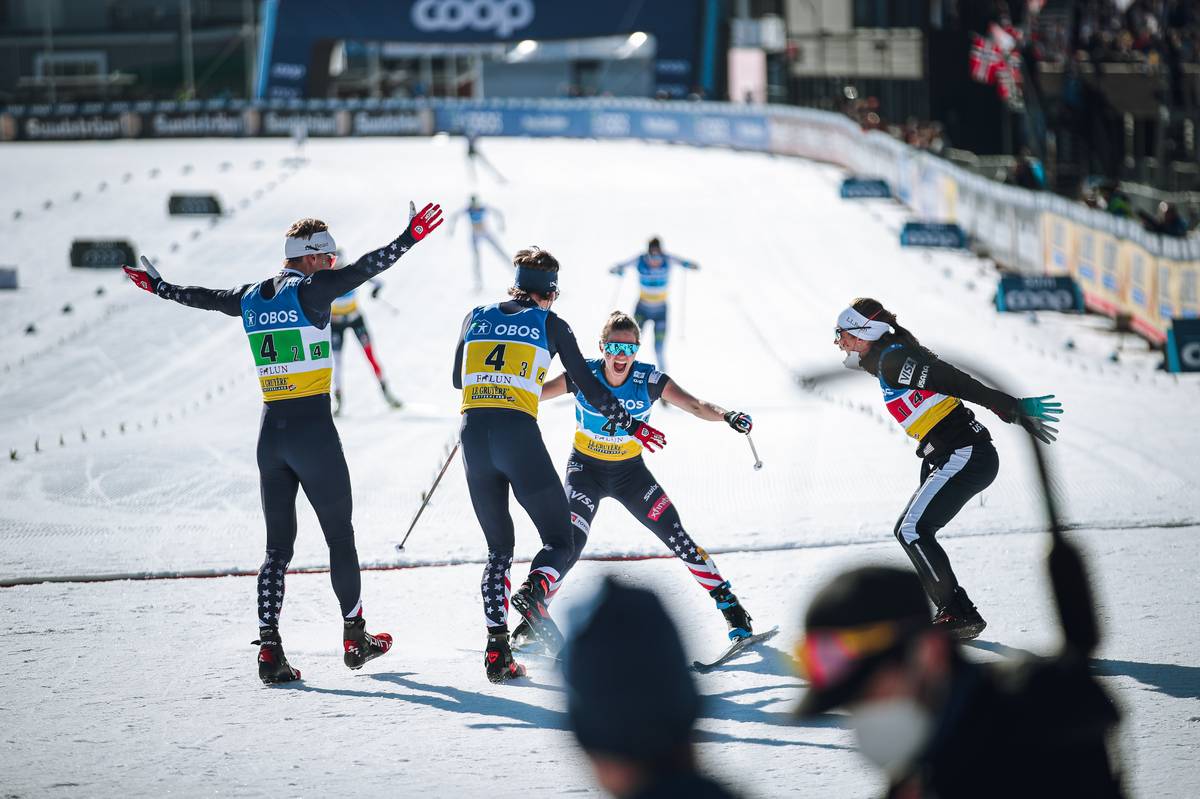
    Rounding the final bend with a clear shot to victory, Diggins took a few tuck skate pushes before powering in V2 across the line with a fist pump and loud cheer, and maybe an expletive, before collapsing onto all fours surrounded by her ecstatic teammates.

    Nerves run high as the American team waits for Jessie Diggins at the finish of the 4 x 5 k mixed relay in Falun. (Photo: NordicFocus)
    USA I celebrates victory as Jessie Diggins crosses the finish of the 4 x 5 k mixed relay. (Photo: NordicFocus)

    Outsprinting the World Cup distance champion, Pärmäkoski edged out Johaug to bring Finland I to the line in second (+3.8), leaving Norway I just 0.5 seconds behind in third. Having strung out over the last lap, Sweden I took fourth (+9.1), with Germany I fifth following another gap (+16.2).

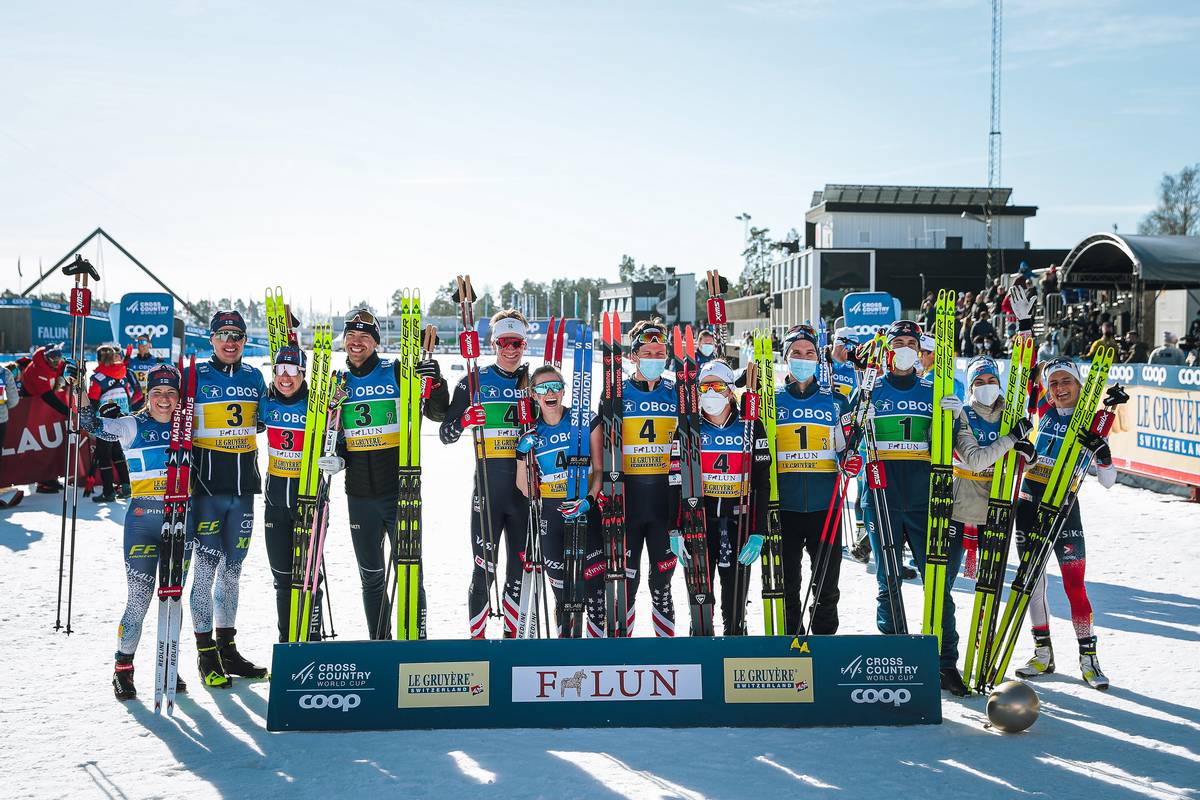
    A packed podium for the 4 x 5 k mixed relay in Falun. USA I took the win ahead of Finland I and Norway I. (Photo: NordicFocus)

    Describing the experience of winning the mixed relay on the final day of World Cup racing, Diggins told FIS with a laugh, “[It] feels like champagne getting sprayed on you.”

    Surrounded by her teammates, she continued, “That was so, so fun. We really pulled together as a team. We live together as a team for four months on the road, so it’s pretty cool to get to end the season racing for each other. I’m so proud of these guys, so I was feeling pretty inspired.”

    Jessie Diggins helps USA I to the mixed relay win in Falun. (Photo: NordicFocus)

    Later sharing her strategy in a post-race audio clip as the remainder of the team packed their bags to begin travel home tomorrow, Diggins discussed her strategy as anchor, adding how the rockets under her feet allowed the race to unfold somewhat differently than she anticipated.

    “I knew that those downhill working corners were one of my strengths, so I knew that if I got to the top of that big sprint climb first, then I could ski all the other downhills how I want and have a good shot at setting up a finishing sprint. As it turned out, we had such great skis that I didn’t need that finishing sprint, but it was so fun to go ski that as hard as I could. Again, I’m just so proud of the team. It was so special and fun to share that with everyone, and I can’t think of a more perfect way to end a really awesome year.”

    Full post-race audio clip from Jessie Diggins:

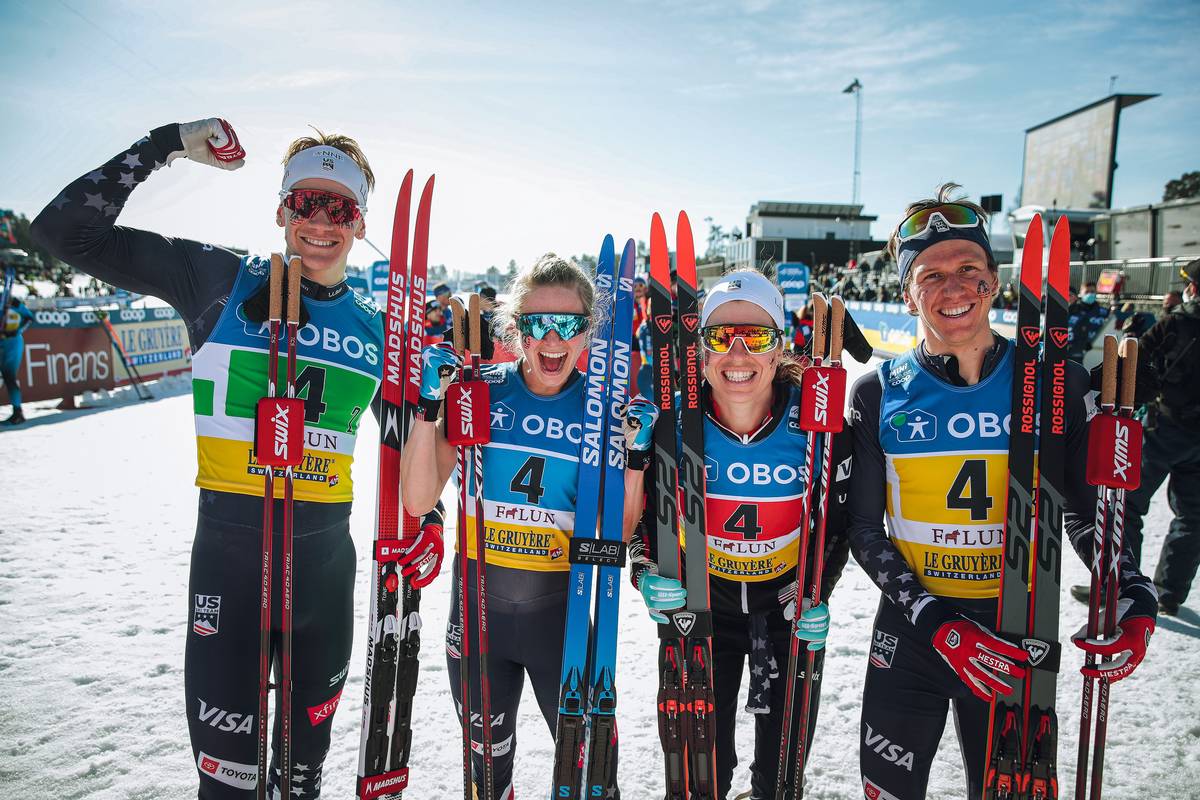
    USA I ends the season on top in the 4 x 5 k relay. From left to right, Zak Ketterson, Jessie Diggins, Rosie Brennan, and Scott Patterson. (Photo: NordicFocus)

    “What a way to close out the World Cup season!!!!!” Brennan emphasized in an email. “After Scott and Zak had great days yesterday, I felt that we definitely had a chance, but I was not expecting a victory like that! It was fast and tactical racing out there and in the scramble leg, I wanted to stay near the front of the pack and stay out of trouble. I found myself further back in the pack than I wanted on the 2nd lap, but also knew a fall or broken pole would cost us so I tried to be patient, calm and tag off in the pack. Zak, Scott and I had the same strategy and Scott made a great move to get ahead of a split in the pack to tag Jessie in a great place. Jessie skied an insane leg and I feel lucky to have her as a teammate!” 

    Echoing her sentiments to conclude his post-race email from the road, Patterson added, “It’s really cool to win the last World Cup and especially awesome to be part of the team. The mixed gender event was extra special as the guys were finally able to tap into the relay energy the women have cultivated over many years.”

    Canada’s anchor Jasmine Drolet receives a tag from Philippe Boucher during Falun’s mixed relay. (Photo: NordicFocus)
    Adam Martin tags his Craftsbury teammate Caitlin Patterson, who raced the anchor leg for USA II. (Photo: NordicFocus)

    Losing contact over the third and fourth legs, consequently racing alone, Canada ended the day in 12th (+1:45.2), while USA II pushed alongside Finland II through its final lap. Edged out in the final sprint, Katri Lylynpera (FIN) snuck her boot over the line ahead of Caitlin Patterson’s, leaving USA II in 14th (+2:10.9). 

    Celebrations fed by cheering crowds, energy was high throughout the stadium. Regardless of finish order, acts of camaraderie and sportsmanship could be seen and heard as cameras meandered through the groups of athletes waiting for their relay teammates. We could hear a Frenchman congratulate Norway’s Tønseth on ending his season with an individual win, Ketterson and Kern anxiously trying to predict what might happen in the American’s final legs, along with a host of supportive cheers as teammates and coaches egged on the racers.

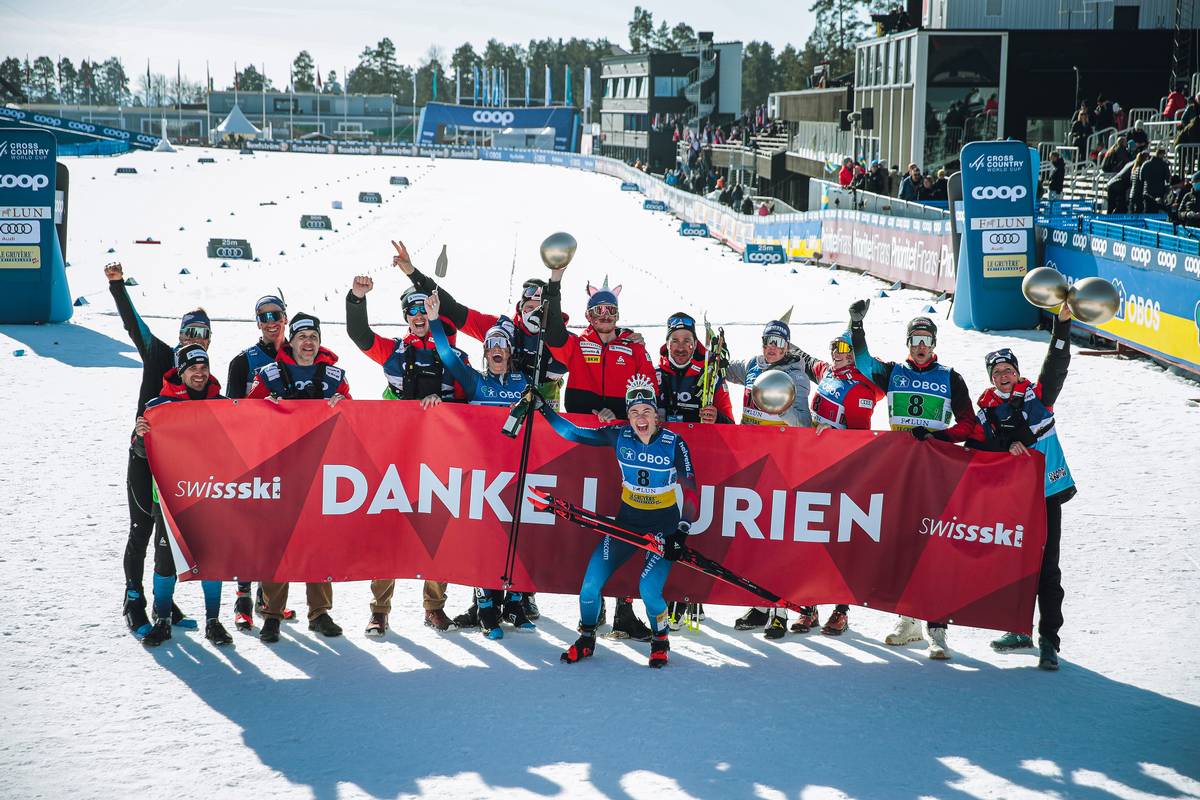
    Awaiting the Swiss anchor Laurien Van der Graaff was a princess tiara, teammates in golden unicorn horns, and a large banner that read “Danke Laurien”, in celebration of her retirement. The 34-year-old has long been a presence on the World Cup, collecting a slew of podiums and a World Championship team sprint silver medal along the way.  

    The Swiss program celebrates the retirement of Laurien Van der Graaff at the finish of the 4 x 5 k mixed relay in Falun. (Photo: NordicFocus)

    With revelry and thrill in the air, only the mixed team sprint remained on deck as the 2021/22 World Cup season drew to a close in Falun. The American program did not enter the team sprint competition, and will next compete as a team at the Whistler Olympic Park in British Columbia March 20th – 27th. The event will serve as both the Canadian National Championship and SuperTour Finals.

    Results

  • Concluding the 2021/22 World Cup Season, Sundling and Halfvarsson Cruise to Gold in Mixed Team Sprint

    Concluding the 2021/22 World Cup Season, Sundling and Halfvarsson Cruise to Gold in Mixed Team Sprint

    This World Cup coverage is made possible through the generous support of Marty and Kathy Hall and the A Hall Mark of Excellence Award.  To learn more about A Hall Mark of Excellence Award or to learn how you can support FasterSkier’s coverage please contact info@fasterskier.com.

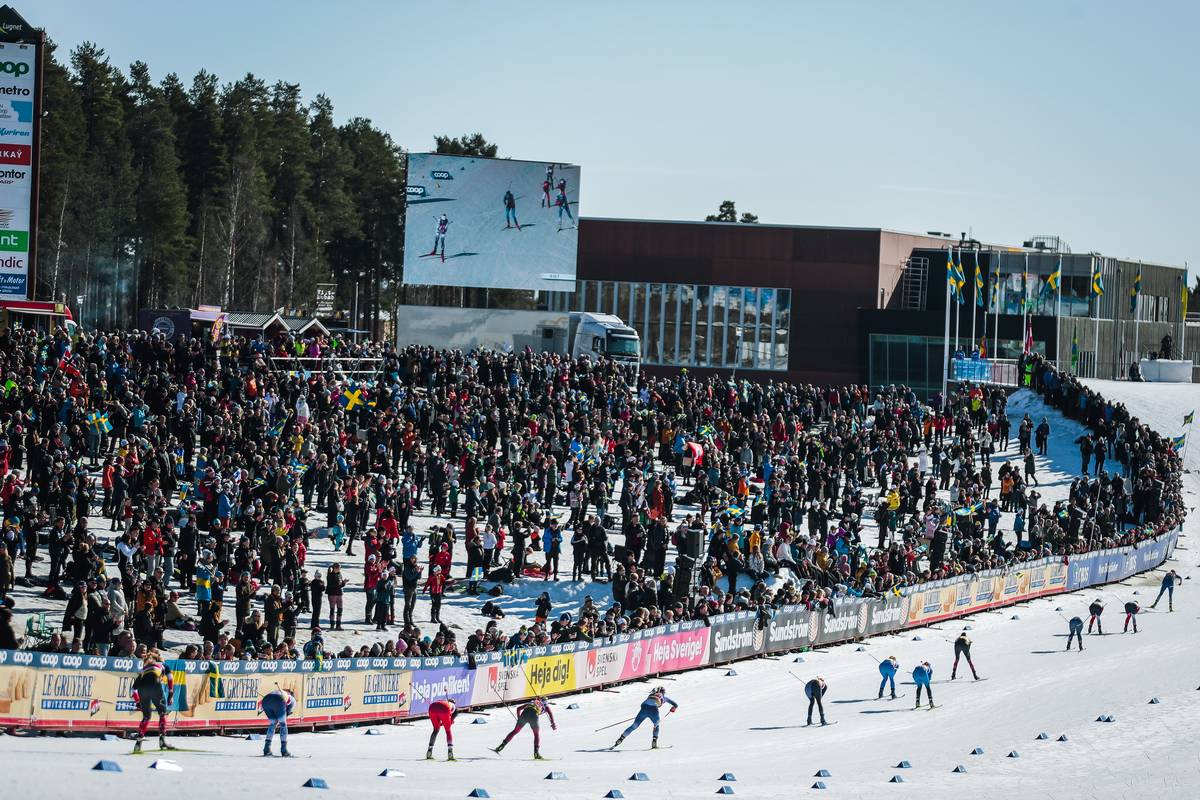
    A packed stadium for the final day of World Cup racing in Falun Sweden (Photo: NordicFocus)

    We’ve arrived at the final event of the 2021/22 World Cup Season and the second new event of the day. It was a fast and furious mixed team sprint in Falun, Sweden, happening just hours after the mixed team relay which ran in the morning. In the first iteration of this event, teams composed of one woman and one man raced six laps of a 1 k course each, making for 12 k of skiing total.

    To keep things spicy, the last two teams in the exchange after the even-numbered laps 2 -10 were eliminated. So although seventeen teams started the competition, only seven made it to the finish. In order to limit the chaos, given the number of teams, there was no tagging in the exchange, just a finish line and a start line for the athletes to gauge themselves. 

    The atmosphere in the Lugnet Ski Stadium was festive as fans enjoyed the 45°F degree weather and sunshine. “I think this is very nice to be together with the men,” said Nadine Fähndrich of Switzerland, “it makes more team spirit between the men and the women.” She alluded to the feeling of both the athletes and the spectators during the mixed team relay in which Team USA I took the gold in an exciting race. “I’m excited for the [race] and to [enjoy] the atmosphere here,” she concluded. 

    The women head out for one of six laps for the mixed team sprint event (Photo: NordicFocus)

    With Team USA I taking the victory and Team USA II coming in 14th, the Americans did not enter a team in the mixed sprint event. Out of the seventeen teams that started, twelve nations were represented in the start list and only five nations made it to the finish. 

    The women started and as would be expected, Jonna Sundling skiing for Sweden I, was at the front. She was paired with Calle Halfvarsson who earned his first podium finish since 2018 in the 15 k freestyle on Saturday. 

    Celebrations for Team Sweden I after dominating the mixed team sprint (Photo: NordicFocus)

    The first round of eliminations at 2 k took Estonia and France II out of the running. As Sundling concluded her second lap, she had created a +2.1 second gap and Halfvarsson seized this opportunity. Instead of waiting around for the rest of the field, he pushed hard and grew the gap to +3.84 seconds on his next 1 k lap. This same lap saw Benjamin Moser of Austria fly off the course on the corner descending into the stadium, taking himself and his teammate Teresa Stadlober out of the race. Latvia was also eliminated in that round. 

    Benjamin Moser (AUT) slides out on a fast corner (Photo: NordicFocus)

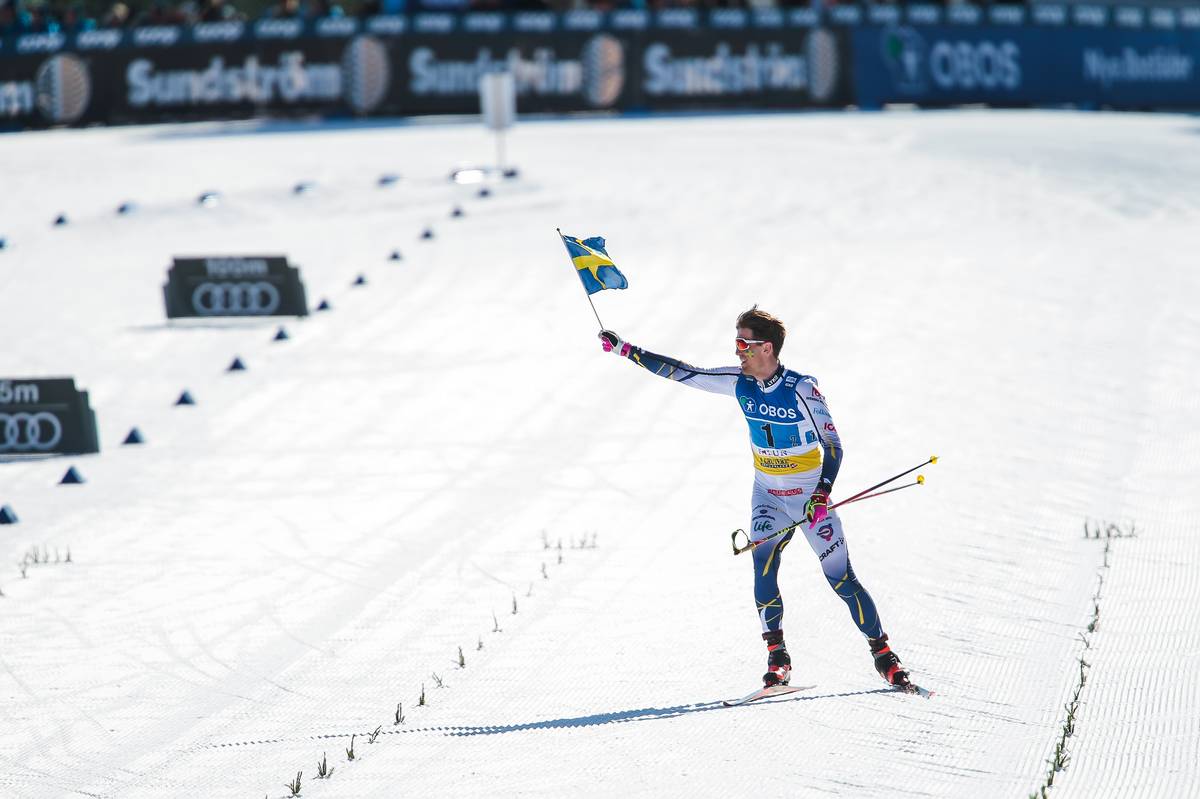
    Once Sweden I had made their move, it stuck. At 5 k they were +9.61 seconds ahead, at 7 k they were +22.2 ahead, at 11 k the gap was up to +26.84. After 23:05.91 of cumulative race time, Halfvarsson crossed the finish line waving a Swedish flag.

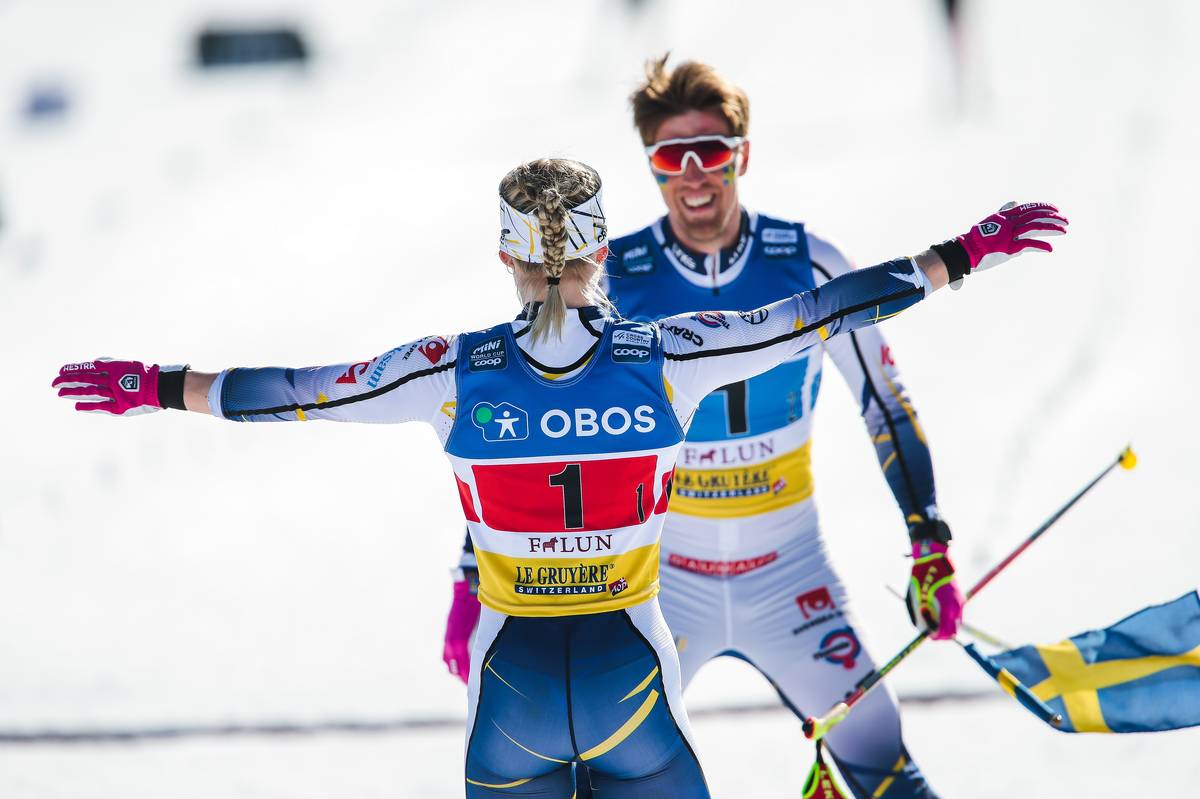
    “It’s easy when I go with Jonna [Sundling],” he said to FIS after the race, “she is so fast, it’s no match.” For her part, Sundling said, “It was a little bit exciting before the race, how to ski, how should our tactic be… but it felt like we did a really good race and ended up first so it’s really fun.” 

    Calle Halfvarsson enjoys a big time cushion as he and Jonna Sundling take gold in the first ever mixed team sprint event (Photo: NordicFocus)

    Rewinding a bit, the women’s third lap saw Fähndrich shoot off the course in the same fashion as Moser. Minutes later, Joni Maki of Finland I and Harald Østberg Amundsen of Norway I both went down on the corner entering the exchange area. A quick recovery by Amundsen ensured that his team stayed in the race but Maki and his partner Jasmi Joensuu were eliminated, along with Fähndrich and Janik Riebli for Switzerland. 

    Nadine Fähndrich (SUI) picks herself up after a fall during the mixed team sprint event (Photo: NordicFocus)

    The fourth round of elimination took out Slovenia and Finland II, though due to the tight nature of the eliminations, the women were starting unless it was clearly evident that they were one of the last two. Thus we saw Anamarija Lampic (SLO) battling Tiril Undes Weng of Norway II for second, even though Slovenia had already been eliminated. 

    Anamarija Lampic (SLO) teamed up with Vili Crv (SLO) for the mixed team sprint (Photo: NordicFocus)

    Entering the 10th exchange and the fifth elimination, Sweden I was 19 seconds ahead, with Norway I and II duking it out behind. This meant that it was the twins, Tiril and Lotta Udnes Weng battling each other for their final lap.

    With Canada II and France I eliminated, the men took off for their sixth and final lap. Amundsen of Norway I was just ahead of Martin Nyenget of Norway II, though entering the stadium Nyenget used the slip stream to move in front of his compatriot. With Sweden I well across the line in gold medal position, a tight sprint between the two Norwegians ultimately went to Nyenget, meaning Norway II earned silver and Norway I came away with the bronze. 

    Harald Østberg Amundsen (NOR) and Martin Loewstroem Nyenget (NOR) during the early stages of the mixed team sprint (Photo: NordicFocus)

    Italy with Nicole Monsorno and Federico Pelligrino finished fourth. Sweden II ended up fifth, and Germany I came in sixth. Canada I (Dahria Beatty and Graham Ritchie) were the last team to avoid elimination and finish in seventh. 

    Dahria Beatty (CAN) and Graham Ritchie came in seventh in the mixed team sprint (Photo: NordicFocus)

    With the last race of the day complete, the World Cup season has come to a close. For North-American ski fans, Canadian Nationals will be combining with US Super Tour Finals for a culminating event series in Whistler, Canada. The racing begins March 20th and you can find more details about the event here. 

    Results: Mixed Team Sprint

  • Sundling Dominates Final Sprint; Kern Finishes a Close Fourth

    Sundling Dominates Final Sprint; Kern Finishes a Close Fourth

    This World Cup coverage is made possible through the generous support of Marty and Kathy Hall and the A Hall Mark of Excellence Award.  To learn more about A Hall Mark of Excellence Award or to learn how you can support FasterSkier’s coverage please contact info@fasterskier.com.

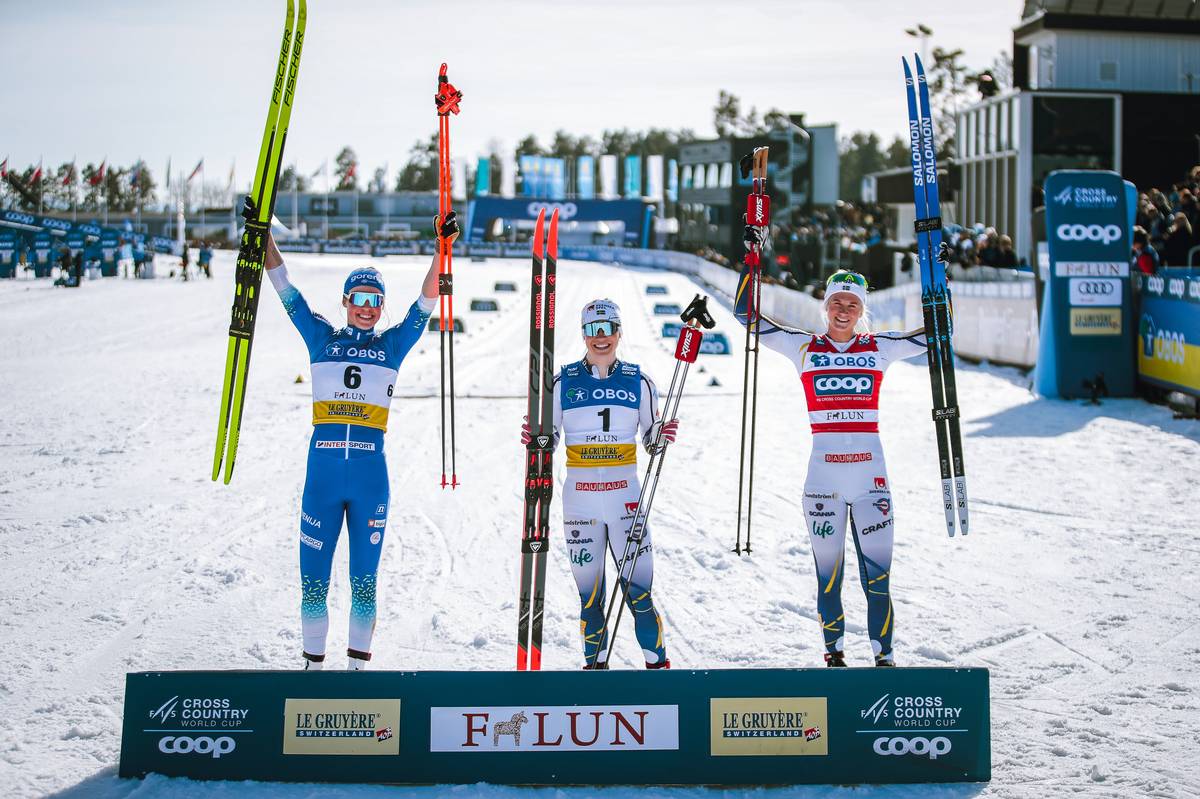
    Women’s 1.4 k classic sprint podium in Falun, Sweden: Jonna Sundling (SWE) took the win ahead of Anamarija Lampic (SLO) and Maja Dahlqvist (SWE). (Photo: NordicFocus)

    We’ve arrived at the final weekend of World Cup racing. After the cancellation of the finals scheduled to take place in Tyumen, Russia and the difficulty of finding a last-minute replacement, these three days of racing in Falun, Sweden will be the culmination of the 2021/22 World Cup season. On a warm sunny day, in full spring conditions, the women executed an exciting classic sprint on the familiar 1.4 k Falun sprint course. With this being the last sprint of the season, it was also a day to cement the places in the running for the overall women’s sprint globe (none of the team events happening Sunday will influence the rankings). 

    Starting with a bang, Jonna Sundling of Sweden won the qualifier by an astonishing margin of +8.41 seconds, ahead of runner up Jasmi Joensuu of Finland. The American’s put three women into the quarter-finals, led by Rosie Brennan in 7th (+9.61). Julia Kern qualified in 17th position (+12.30), followed by her teammate and roommate, Jessie Diggins in 18th (+12.49). 

    Jessie Diggins on her way to 18th place in the qualifier. Diggins ultimately ended her day 19th. (Photo: NordicFocus)

    These were the only three American women competing today as unfortunately some late-stage positive covid tests barred the rest from competing. Having made it through a winter of international travel, living, and competing during the Omicron surge, Hailey Swirbul and Katherine Ogden announced on Monday that they had both tested positive in Norway. Lauren Jortberg, who had her World Cup debut in Lahti, Finland two weeks earlier, came directly to Falun to prepare for this weekend, only to test positive on Wednesday. 

    No Canadian women made it into the top thirty, their first finisher was Olivia Bouffard-Nesbitt in 32nd (+17.54). Katherine Stewart-Jones led a string of fellow country-women, finishing 37th (+19.49), followed by Dahria Beatty in 38th (+19.75) and Jasmine Drolet in 39th (+20.08). After competing at World Juniors in Lygna, Norway, Drolet joined the senior women and made her first World Cup appearance in the Holmenkollen 30 k last weekend where she finished 42nd. 

    Dahria Beatty (CAN) racing to 38th in the classic sprint qualifier on Friday (Photo: NordicFocus)

    As crowds of fans gathered, the women’s quarterfinals kicked off at 12:15 local time. In the first heat, a fast pace bought three women tickets to the semi finals, led by Anna Svendsen of Norway. After winning the classic sprint qualifier in Drammen, Norway last week only to fall in the quarter finals, Johanna Hagström (SWE), skiing on a home course, made it safely through in second. Kerttu Niskanen of Finland took third but with a fast enough time to snag a lucky loser position.

    Heat two was controlled entirely by Sundling as she skied easy out front, spreading the rest of the field. Behind her came Johanna Matintalo of Finland and Julie Myhre of Norway who made it to the semis as the second lucky loser. Brennan (USA) finished fourth, +3.39 behind Sundling, ending her day in 16th overall. 

    Rosie Brennan races the quarterfinal after qualifying 7th. (Photo: NordicFocus)

    “It was warm and wild out there today,” wrote Brennan after the race. “This course is quite technical and has some challenging downhills which has made it a tough course for me in the past so I was ready to make some progress today. I had a good qualifier and that gave me some confidence for the heats. I had a very stacked heat which can go either way for me. I struggled finding space to move on the uphills which is my strength and that ultimately cost me moving on to the semi-finals by less than a second. In the bigger picture, I do think I made some strong progress on some of my weak spots on this course and I am really excited about that. I am also still feeling good and excited to race which bodes well for the rest of the weekend.”

    In heat number three, Anamarija Lampic of Slovenia took on the lead, as Diggins and Moa Lundgren of Sweden chased. Entering the final straight Nadine Fähndrich of Switzerland employed her blistering finish speed to surpass both Diggins and Lundgren, and nearly overtake an unsuspecting Lampic. This left Diggins in fourth place in a heat that was not quick enough to make lucky loser. Diggins ends the sprint season in fourth place in the overall sprint standings with 351 points; having entered the day in third with 339 points, she was bumped off the podium by Sundling. 

    Jessie Diggins races in heat number three in the 1.4 k classic sprint in Falun. (Photo: NordicFocus)

    Heat four saw an easy pace from the gun, with the pack largely staying together. With all six athletes still in touch as they crested the big climb, Kern navigated into third place on the ensuing tight downhill corner. An injection of speed from Maja Dahlqvist (SWE) over the next rise split the pack as Lotta Udnes Weng (NOR) shadowed, followed by Kern still in third. In the long downhill glide-out, Weng overtook the Swede, entering the final corner in first. Right with her were Kern, Dahlqvist and Laura Gimmler of Germany. A close finish saw Kern out double-pole Dahlqvist to take the win, with Weng coming second. However, a disqualification for Weng bumped Dahlqvist into second and thus have her a ticket to the semi-finals. 

    Jasmi Joensuu (FIN) and Maiken Caspersen Falla (NOR) duke it out in the quarter-final (Photo: NordicFocus)

    After a redeeming win in Drammen last week, Maiken Caspersen Falla of Norway charged off the startline for heat five. Joensuu (FIN) and Heidi Weng (NOR) took up the chase and eventually overtook Falla on the long descent back into the stadium. Together the two Norwegians pulled away from the Finn as Joensuu faded slightly. Falla finished first and Weng, with a scream of satisfaction, crossed in second. 

    Heidi Weng (NOR) racing in quarterfinal heat number five (Photo: NordicFocus)

    Echoing her moves from the quarter-final, Sundling (SWE) approached semi-final number one in the same manner, skiing smooth and easy out front. Lampic (SLO) followed with some occasional slips on a mushy course. Those front two continued to pull away, Sundling making it look easy as she found herself well clear of the rest of the competition. Lampic maintained second position and Matintalo (FIN) came in third, though was not quick enough to move onto the final. 

    In the second semi-final, Falla (NOR) took the lead, again trailed by Weng (NOR). Once again, Kern (USA) moved into third position on the tight middle downhill portion, setting herself up well. A fall from Weng on the next hill took her out of contention as Dahlqvist (SWE) moved into second position, Kern still in third. Switching tracks, Dahlqvist stumbled but managed to stay on her feet as Kern took the lead into the final corner. Kern held onto first position with some strong double poling and behind her Dahlqvist, Falla and Fähndrich all qualified for the final in second through fourth positions respectively. 

    Julia Kern, closing out fast (Photo: NordicFocus)

    Making her first sprint final since a stage race in Lenzerheide, Switzerland in December, Kern was all smiles on the start line as the athletes lined up for their final round. Right away, Sundling and Lampic began to pull away from the rest of the field. Up the A-climb, Sundling broke into a herringbone, clearly moving fast as she increased her lead. Dahlqvist who had been in third was overtaken by Kern who topped the hill in third. Lampic was holding strong in second, though being chased by Kern. Navigating the remaining corners and descents, Sundling cruised easily to the finish with enough of a lead to give a celebratory wave before crossing the line.

    No challengers around, Jonna Sundling cruises to victory. (Photo: NordicFocus)

    Coincidentally, Sundling won by the same margin over Lampic (+8.41 seconds) as she had on second-place qualifier Joensuu (FIN) earlier this morning. “I don’t know what is behind this result today, but the last weeks I’ve been feeling really good and it’s nice to keep the shape still,” said Sundling after her dominant victory. She added, “I didn’t compete so much in the beginning [of the season] because of injury but my motivation is on top and so is my shape, and it’s just fun to ski right now.”

    Behind them, Dahlqvist was finding a second wind in the finish straight and overtook Kern to finish in third. Kern finished fourth, matching her season personal-best from Lenzerheide where she also finished fourth, in a skate sprint. 

    Anamarija Lampic (SLO) heads towards a silver medal as behind her Maja Dahlqvist (SWE) overtakes Kern (USA). (Photo: NordicFocus)

    “[Kern] was really smart through the quarters and semis,” reflected coach Matt Whitcomb, “where she would ski really smooth through the first climb, and position herself really well. And normally what was happening is she was both being smart tactically and feeling very good today and that just led to a break between positions 3 or 4 and allowed her to get away. And her doublenpole punch at the end was as good as I’ve ever seen her today.”

    Julia Kern after fending of Nadine Fähndrich (SUI) to finish fourth in the 1.4 k classic sprint. (Photo: NordicFocus)

    Regarding the final in which Kern seemed to have a lock on third but lost out in the closing stages Whitcomb said, “We talked about if there was a big mistake she made and we decided she could do the same thing 10 times and maybe land on the podium four or five times. She had some stumbles, had those things not happened, it would have been a little bit closer between her and Maja [Dahlqvist], but I don’t want to discredit Maja, she had all kinds of fire in the finish today.”

    He added, “It was cool, Julia’s parents are out here today, she has raced well when her parents are watching. It’s important to point out that she was fourth and not fifth, she fended off a hard-charging Fähndrich and we’re really happy with her performance today.”

    Listen to the full interview with U.S. Ski Team Head Coach Matt Whitcomb here.

    Julia Kern races through the heats in Falun. (Photo: NordicFocus)

    Kern has put together a string of strong performances in the final period of World Cup racing, placing in the top-10 in each of the last three sprints. These results come on the tails of a first Olympic appearance that left her wanting more, after having rebounded early-season from a 2020/21 season she had described as challenging.

    “It’s a bit of a bittersweet ending,” Kern said in a call. “We’ve been on the road for so long now that, after the Olympics, especially, I was feeling excited to go home. But now when things are going well and I’m feeling really good, I don’t want to go home and I don’t want the season to end. I’m happy to end on a high note and find my stride after a frustrating Games. It’s just kind of reminded me how important having some sense of normalcy is, and I’ve kind of embraced that more after the Games. I think that’s paid off, plus some hard work, and I’ve had a little extra fire from the frustration after the games. Happy to end the season this way, and [we have] another shot tomorrow, so I’m excited for that race.”

    Commenting on how these strong results and better energy feed momentum, Kern discussed a mid-week training session she felt primed her for today’s sprint.

    “Now that I’ve been having really good energy in training… I have to give a big shoutout to our staff. On Tuesday this week, I did an interval workout here on the courses. I had Matt, Kate [Barton], and [tech] Chris Hecker out there with me, racing me around the course doing speeds, throwing elbows, pulling tactical moves, practicing the slingshot. Those types of sessions are super valuable for me when I put the energy to put in a good interval session. I learned so much from that session, and it gave me the confidence here today to ski well in the heats and be ready for anything.”

    Kern continued with a laugh that her family is her fourth place good luck charm, as they also watched her race to fourth in Lenzerheide, SUI during the Tour de Ski, ending with a comment on the American team as the season draws to a close.

    “I think our team has done a really incredible job, working through all the different colleges this season has brought. When things get tough, we bring out humor and come together. I just feel more and more appreciation for the team. My wax tech Eli and I have worked really hard all season together to start linking together some classic performances. We’ve had four classic races in a row now, and pretty much all personal bests, so that’s been a really fun relationship to build and [I appreciate] all the hard work the wax team puts in.”

    Full post-race interview with Julia Kern. Apologies for the bad echo — working through the kinks as we work our way along the audio learning curve.

    Julia Kern edges out Maja Dahlqvist (SWE) in the classic sprint semifinal in Falun. (Photo: NordicFocus)

    Dahlqvist already had the sprint globe on lock, but her third place finish today only reinforced her strength in sprint racing this season as she racked up 638 points throughout the year. She began the season with four straight wins and earned a silver medal in the Olympic skate sprint last month. A fourth place finish in Drammen was the only time this season in which she did not finish on the podium in a sprint event.

    “It feels really really, super duper good,” said Dahlqvist about taking home the globe. “I’m super happy with that.” 

    Sweden’s Maja Dahlqvist is the 2022 World Cup sprint champion. (Photo: NordicFocus)

    Last year’s sprint globe winner, Anamaria Lampic (SLO) finished second this year with 506 points. After today’s victory, Sundling (SWE) overtook Diggins (USA) to move into third in the sprint standings with 442 points. Delaying her start to the season after sustaining an injury in an early-season FIS race, Sundling’s first World Cup start was Dresden in mid-December where she finished second in the individual skate sprint. She did not take part in the Tour de Ski, but returned to the World Cup circuit in dominant fashion, after collecting three Olympic medals, one of each color, and taking fourth place in the 30 k.

    In the final three weekends of World Cup racing, Sundling landing on the podium in four out of the five races she entered, including a third place finish in the legendary Holmenkollen 30 k classic last weekend. 

    Anamarija Lampic (SLO) congratulates the days winner, Jonna Sundling (SWE) (Photo: NordicFocus)

    Racing continues tomorrow with a 10 k skate interval start for the women. Sunday will feature two new team events, with a mixed relay happening in the morning followed by a mixed team sprint in the afternoon. 

    Results:

    Qualification | Final | Sprint Overall Standings

  • Bolshunov Wins a Nail-Biter in Falun; Schumacher 9th and Patterson 15th (Updated)

    Bolshunov Wins a Nail-Biter in Falun; Schumacher 9th and Patterson 15th (Updated)

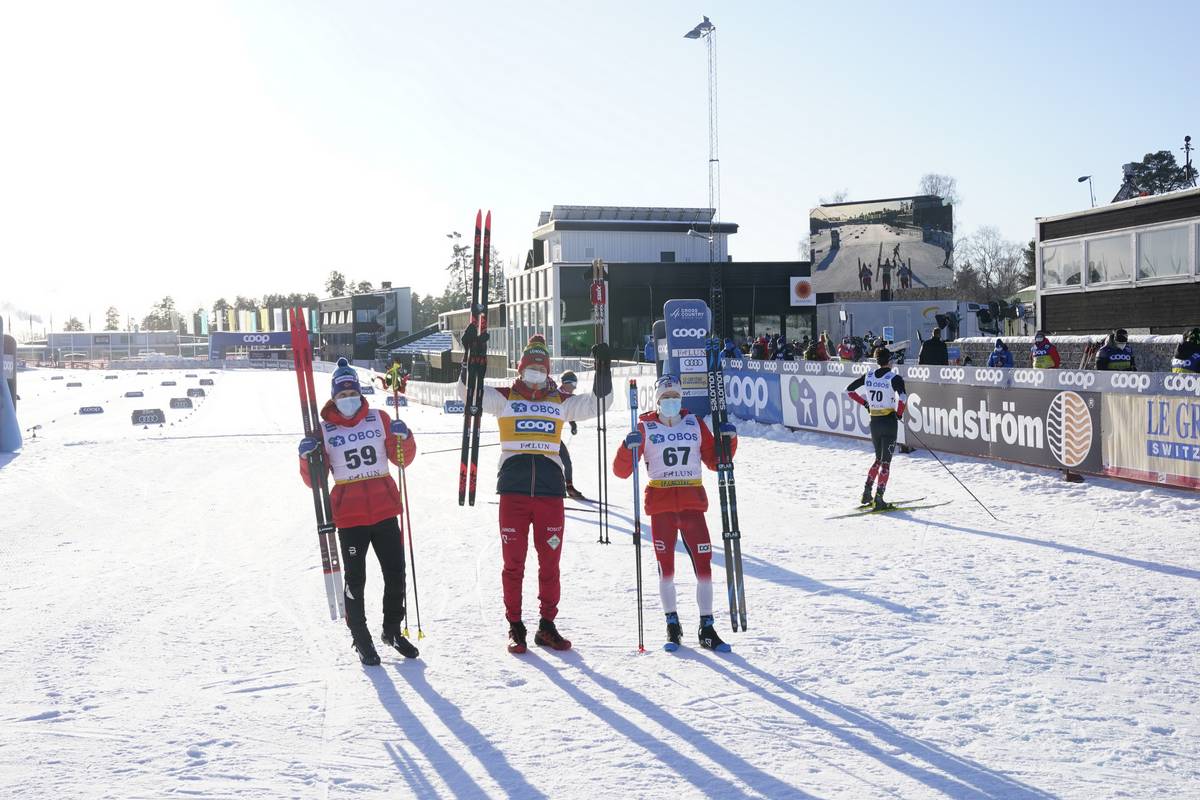
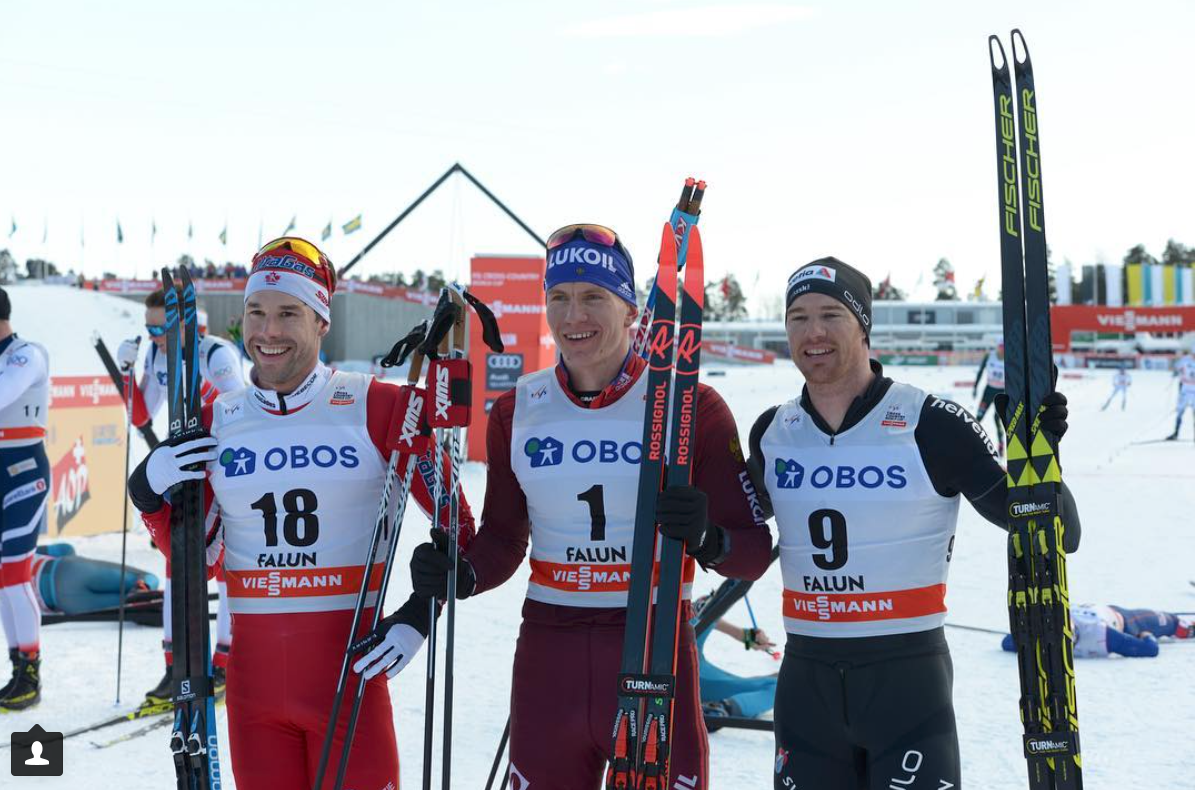
    The men’s 15 k skate podium from Falun, Sweden: Simen Hegstad Krüger (NOR) second, Alexander Bolshunov (RUS) first, and Sjur Røthe, (NOR) third, (l-r). (Photo: NordicFocus)

    This World Cup coverage is made possible through the generous support of Marty and Kathy Hall and their A Hall Mark of Excellence Award. To learn more about A Hall Mark of Excellence Award or to learn how you can support FasterSkier’s coverage please contact info@fasterskier.com.

    Sunny skies and cold snow greeted the skiers for the start of the men’s 15 k individual freestyle on Friday, kicking off an extended weekend of racing in Falun, Sweden. With temperatures below 10°F (-14.1°C to be exact) the athletes were well bundled as they headed out of the start gate, one by one. Joni Mäki of Finland, perhaps better known now after his relay performance and ensuing run-in with Russia’s Alexander Bolshunov in Lahti last weekend, was the first starter in a field of 84. 

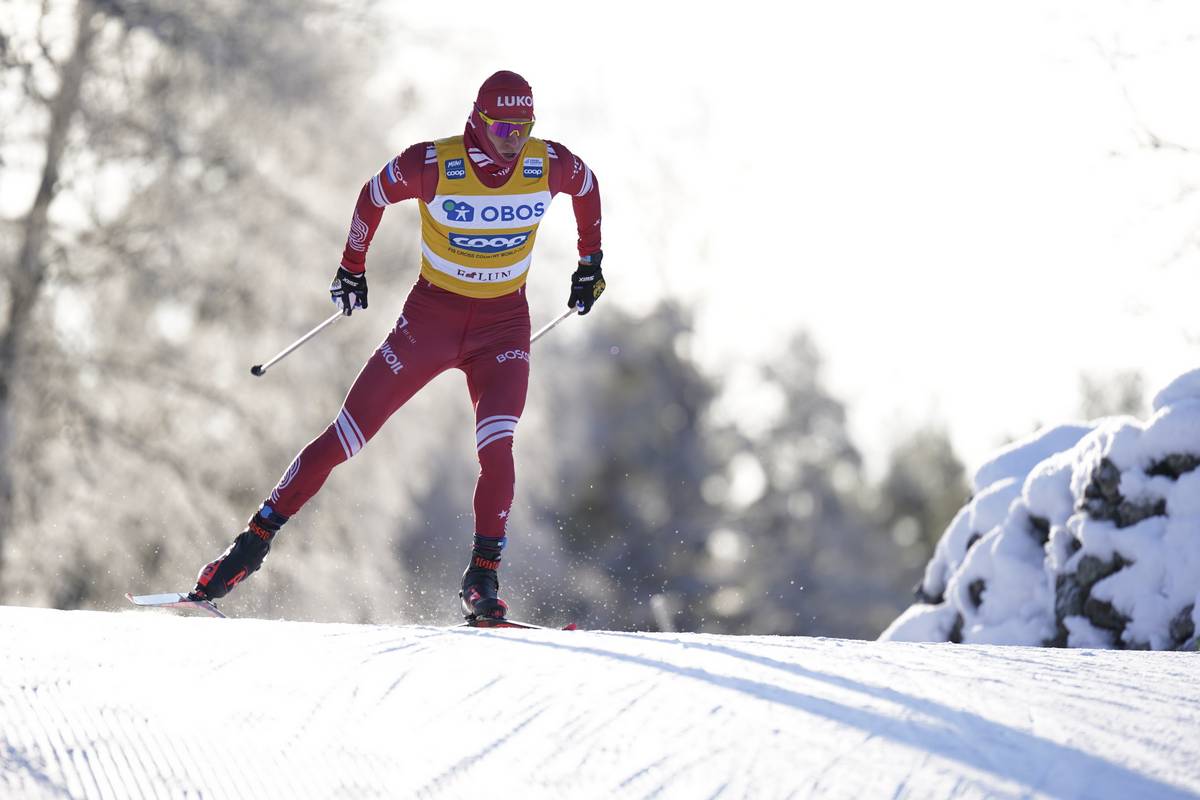
    Racing to yet another distance win, Russia’s Alexander Bolshunov squeaked out the 15 k victory in Falun, Sweden. (Photo: NordicFocus)

    Initially, it seemed as though it would be another runaway performance from Bolshunov. With the exception of the first split at 1.8 k (taken by Sergey Ustiugov of Russia), Bolshunov led with an ever-growing margin over the course of 15 kilometers. When he finished, wearing bib 41, he led by over a minute (-1:14.5), ahead of the young Norwegian, Harald Amundsen. Among those first 41 finishers was Johannes Høsflot Klæbo of Norway, who returned to the World Cup circuit a week later than his fellow countrymen. Today marked his first World Cup race since the season opener in Ruka, Finland, in November 2020. 

    In his first World Cup race since the Ruka series, which concluded in early December, Johannes Høsflot Klæbo of Norway placed seventh in the Falun 15 k skate. (Photo: NordicFocus)

    In a pre-race interview Klæbo said, “It’s great to be back and something I’ve been looking forward to for a long time now and to be back here in Falun, finally able to compete again, it’s something that I think will be really good… I think it will be really interesting, I’m going to do my best and go as fast as I can but there are a lot of strong guys here so it will be interesting.”

    When asked whether he had been following the races in his absence, Klæbo replied, “Yeah for sure I’ve been following it, every weekend. I love skiing so for sure I’ve been following and the guys look really strong so it’s sad to be at home and not to be able to compete. The guys look really strong so we’ll see how it goes for me.” 

    Klæbo began in bib number 39 and just before 12.8 k was caught by Bolshunov, who started two places behind. At the conclusion of the day, Klæbo placed seventh, +1:01.3 back from Bolshunov. 

    Norway’s Simen Hegstad Krüger toeing the line- he missed the win by 1.8 seconds on Friday. (Photo: NordicFocus)

    However, Bolshunov was not completely unchallenged. Further back in the field was a string of Norwegian starters who, spearheaded by Simen Hegstad Krüger, mounted an attack. At 6.8 k, Krüger was 6.5 seconds behind Bolshunov, and Sjur Røthe nine seconds behind the Russian. Jump forward to 11.3 k and Bolshunov had stretched the lead to +10.5 over Krüger while Røthe was down +23.9, having been overtaken by his teammate Hans Christer Holund.

    At 14.1 k, however, Bolshunov’s lead began a precipitous decline, as Krüger raced through +0.7 seconds behind. Despite his best efforts, however, the victory remained elusive for Krüger as Bolshunov came away with the win, yet again, in a time of 32:33.3. Røthe closed hard and regained time from Holund, sneaking into third place (+23.9).

    Sjur Røthe, on form, skiing to third overall in the Falun 15 k skate. (Photo: NordicFocus)

    After the race Bolshunov spoke through a translator, saying, “This is my third victory in a row in Falun for a skating race, so this place is lucky. Big thanks to the technicians and my team, I had really good skis today.”

    With such a dominant season thus far, Bolshunov is well on his way to taking the Overall Crystal Globe at the end of the season – he currently leads the standings with 1491 points, more than double that of the runner-up, Ivan Yakimushkin of Russia (720 points). When asked about this, Bolshunov responded, “[today’s victory] is really important because I have quite a secure lead in the overall, so I can add to it and that makes me relaxed and confident and I can focus on getting ready for World Champs.” 

    Scott Patterson for the U.S. remains on form skiing into 15th overall. (Photo: NordicFocus)

    The day’s most notable results came in the form of two Americans in the top 20. Scott Patterson, who started bib 2, paced well throughout the race and held the leader’s chair through the first 24 starters, until his teammate, Gus Schumacher, crossed the finish line –18.9 seconds ahead of him. In an email, Patterson wrote, “My thought for the race today was to really take advantage of the power V2 and gradual rolling terrain.  A lot of people look at Falun and see the Morderbaken as the key feature, but really there is a lot of time elsewhere on the course.  I also figured after last weekend returning to low altitude from our post tour time in Seiser Alm that I really wanted to push hard the whole course and not hold much back pacing early. In the end I think this worked out quite well and I felt that I was able to charge even the last time up Morderbaken.” 

    “The coaches tried to provide some good information from splits, but I knew as an early starter it was mostly about hammering and then hammering some more.  The big benefit of the early start was that I got to spend quite a bit of time in the leader’s chair at the finish.  It made it even better than when I finally was displaced it was by Gus.” Patterson finished in 15th, a season-best finish for him, one-upping his 16th place in Davos, Switzerland during the 15 k skate.

    Looking forward, Patterson wrote, “I’ve always been aiming for world champs as the focus of this season so it is good to be moving in the right direction.  I’m feeling pretty good about my skating and fitness right now, but I really want to have some good classic races and boost my confidence there.  My big goal for worlds is to get a top 10 in one of the individual distance races. I also am pretty excited that we seem to have a little momentum going for the guys team. It would be really sweet to throw down a good 4x10k relay.”
    Gus Schumacher racing into the top-10 in Falun’s 15 k skate. (Photo: NordicFocus)

    For Schumacher, today proved that his stellar performance in Val di Fiemme during the Tour de Ski, where he placed 8th, was no fluke. In a fully stacked field, Schumacher finished the day in 9th with a time of 33:50.7. Placing just behind him were a string of Russians, including Denis Spitsov, Evgeniy Belov, and Sergey Ustiugov. 

    Post race interview with Gus Schumacher:


    Simi Hamilton, in his first World Cup since the Tour de Ski, was just outside the points in 32nd. (Photo: NordicFocus)

    Also in the field for the Americans was Simi Hamilton, who placed 32nd having recently returned to the World Cup circuit after a brief break. David Norris placed 40th, Hunter Wonders was 52nd, and Kevin Bolger finished 61st. 

    Post-race interview with U.S. Head Coach Matt Whitcomb


    For the second weekend in a row, Russell Kennedy skied into the top-30, placing 29th on Friday in Falun. (Photo: NordicFocus)

    The Canadian men were led by Russell Kennedy who finished in 29th, matching his result from last week’s skiathlon in Lahti, Finland. Behind Kennedy, Philippe Boucher finished 58th, and Remi Drolet 63rd. 

    Racing continues tomorrow with a 15 k mass start.

    Results: Men’s 15 k

  • The Devon Kershaw Show: Falun’s Mass Starts and Eating Words

    The Devon Kershaw Show: Falun’s Mass Starts and Eating Words


    Sometimes when the unexpected happens, it’s a good thing. That’s what went down today in Falun, Sweden. In the men’s 15 k mass start skate, it was not a scrum of 20 to 30 skiers in a cluster at the finish. A fast and furious pace set by Hans Christer Holund turned that concept on its head. Although the race was won by Alexander Bolshunov, the wily Norwegian that is Holund, took it out hot and broke the field apart. For the women, well…, it was Johaug as predicted, but it was a tight race dictated by a select three of Johaug, Ebba Andersson, and Heidi Weng.

    The men’s 15 k mass start animator: Norway’s Hans Christer Holund (center). (Photo: NordicFocus)

    We are not eaxctly all over the map in this episode, but we cover some ground: from the lack of national diversity in the men’s top 10, to how soon is too soon for athlete’s not meeting a national team’s health standards to be back on the World Cup. Today was the Swedish phenom Frida Karlsson’s first World Cups of the season since the opening weekend in Ruka, Finland. She had been held from elite competiton by the national team, for health reasons. She showed early signs of her former speed and endurance in her first race back. (Karlsson took the ski scene by storm last year, when she won three medals as a nineteen year old at the 2019 World Championships.)

    As always, thanks for listening. If you have questions for Devon, please send them to devon@fasterskier.com or info@fasterskier.com.


  • Sunday Race Rundown (Updated 2x)

    Sunday Race Rundown (Updated 2x)

    The podium from the 10 k skate in Falun, Sweden. From left to right, Sweden’s Ebba Andersson in third, Norway’s Therese Johaug in second, and the U.S. Ski Team’s Jessie Diggins in third. (Photo: fis-ski.com screenshot)

    FIS World Cup Falun, Sweden 10k/15k Inidividual Freestyle

    The sun rises. The sun sets. And Norway’s Therese Johaug won the 10-kilometer individual start freestyle in Falun, Sweden. In 25:23.9 minutes, Johaug made her winning statement. Sweden’s Ebba Andersson placed second (+18.75), with the U.S. Ski Team’s (USST) Jessie Diggins in third (+30.3).

    Fourth place went to Ingvild Flugstad Østberg of Norway who finished 30.8 seconds back.

    Sadie Bjornsen (USST) raced to 12th (+1:05.7), Julia Kern (USST) 25th (+1:53.9), Rosie Brennan (APU) 27th, Kaitlynn Miller (CGRP) 34th (+2:21.5), and  Rosie Frankowski (APU) 35th (+2:26.1).

    Results


    The men’s 15 k skate was won by Russia’s Alexander Bolshunov in 33:18.6 minutes. Martin Johnsrud Sundby of Norway was second (+8.9) and Didrik Tønseth third (+17.7).

    The top North American finisher was Canada’s Alex Harvey in 11th (1:10.9). Jack Carlyle finished in 66th (+5:55.5).

    For the U.S., David Norris (APU) placed 16th (+1:15.3), Kevin Bolger (USST) 45th (+2:41.9), and Scott Patterson (USST) 54th (+3:39.8), Kyle Bratrud (SMST2) did not start.

    Results

    ***

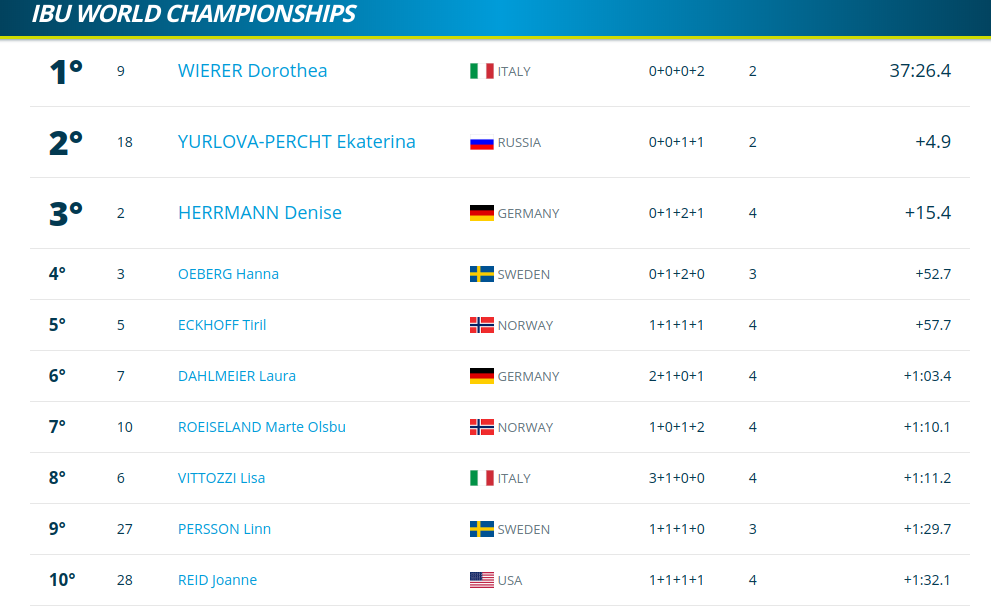
    IBU World Championships Östersund, Sweden 12.5 k Mass Start

    Here’s the top-10 results from today’s 12.5 k mass start in Östersund, Sweden. The eyes need only read 10 skiers down for U.S. biathlete Joanne Reid’s name. There it is: 10th place for a career best individual result at a championship event.

    Her teammate Clare Egan placed 26th (+3:01.4, 0+0+3+2).

    Results

  • U.S.A. Storms Falun World Cup Finals Podium; Diggins 2nd in Overall World Cup

    U.S.A. Storms Falun World Cup Finals Podium; Diggins 2nd in Overall World Cup

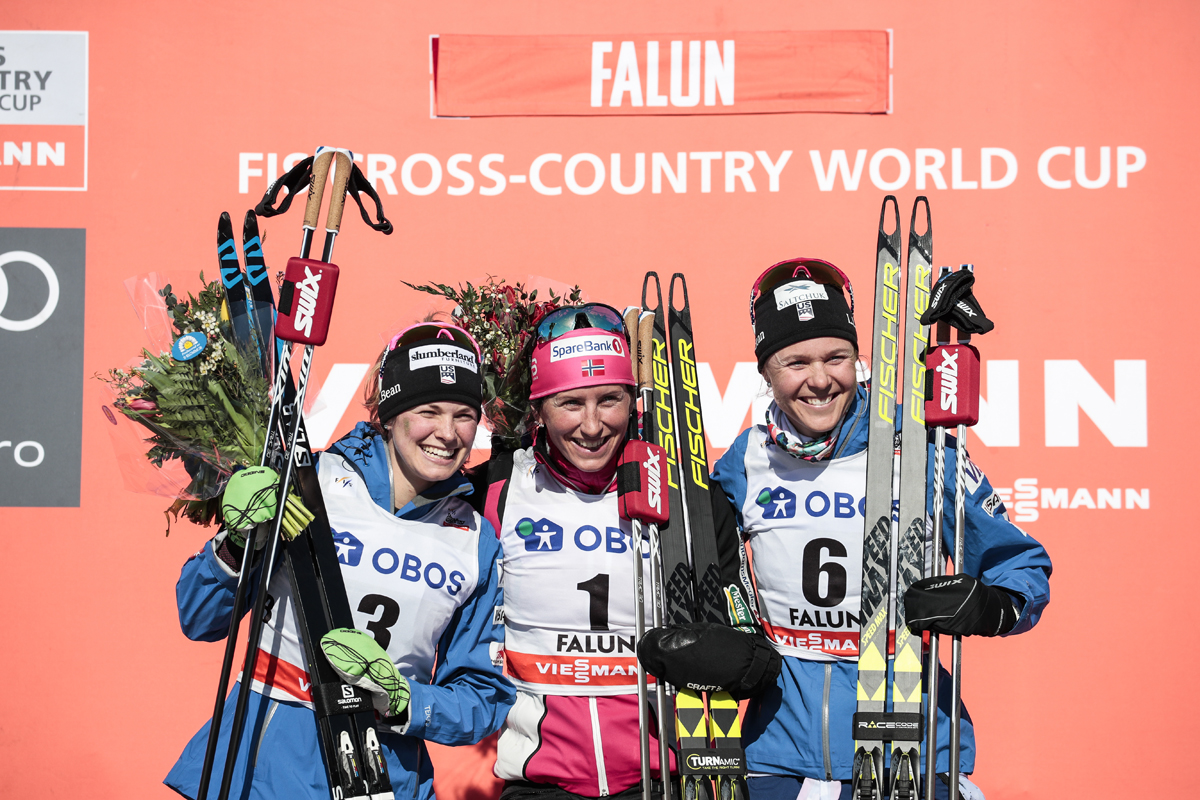
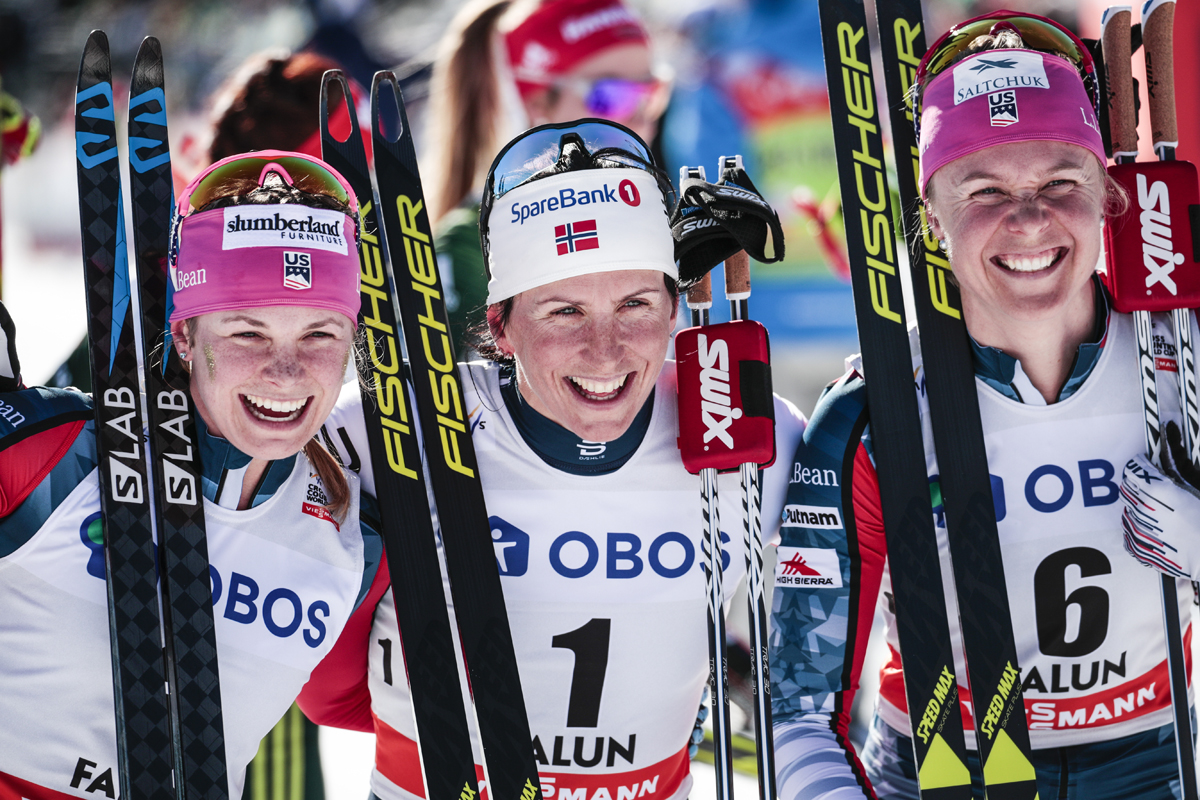
    The women’s 10 k freestyle pursuit podium on the last day of 2018 World Cup Finals in Falun, Sweden, with Norway’s Marit Bjørgen (c) in first, and Americans Jessie Diggins (l) and Sadie Bjornsen (r) in second and third, respectively. (Photo: Fischer/NordicFocus)

    FALUN, Sweden — NOR. USA. USA.

    Looking at the results monitor, those were the tri-letter country codes that popped into the top three at the end of the women’s 10-kilometer freestyle pursuit at World Cup Finals on Sunday.

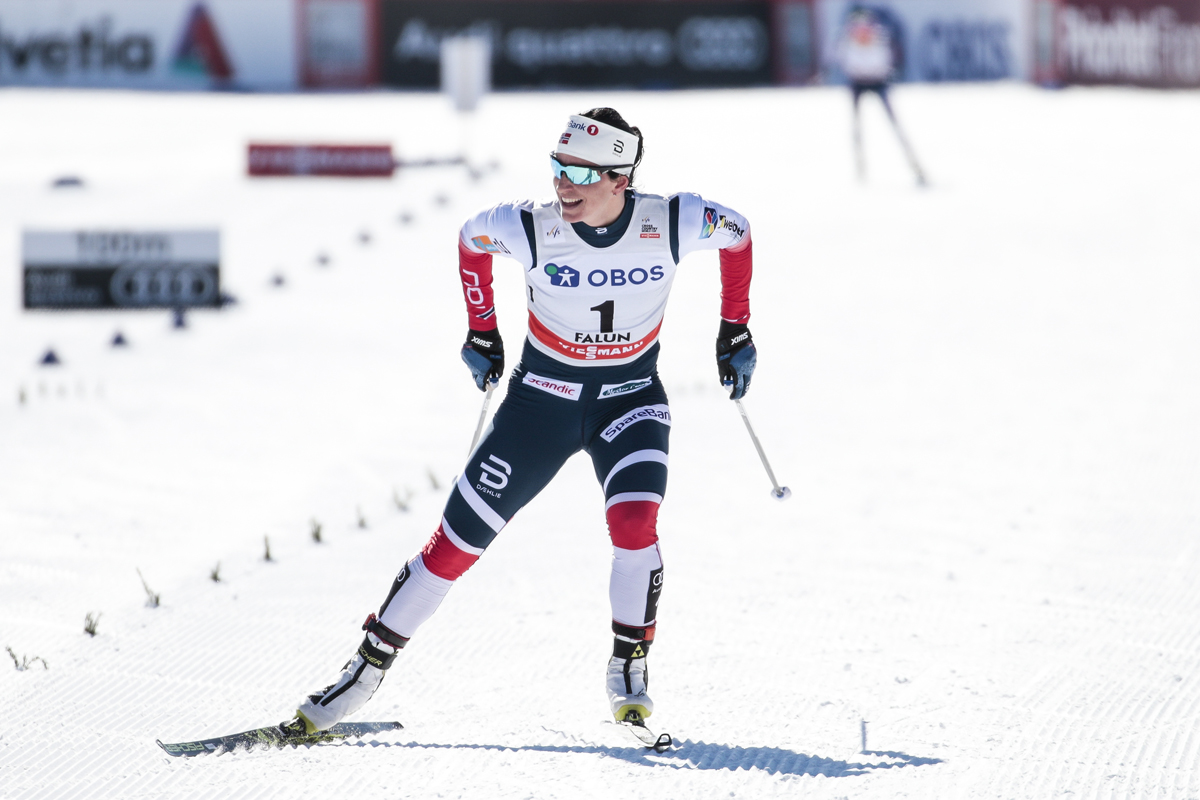
    The “NOR” belonged to Marit Bjørgen of Norway, who ended her 2017/2018 World Cup season with yet another win. In Sunday’s pursuit, the 37 year old led from start to finish and ended where she started, in first after covering the course in a time of 24:18.9 minutes.

    For many who follow the World Cup, a Norwegian name — like Bjørgen, who has won more than 110 individual World Cup races — at the top of the results is nothing new. All due respect.

    But the pressure for Scandinavia to hold off an American entourage is mounting; Sunday’s race presenting itself as a prime example.

    A 41-second gap separated American Jessie Diggins from Bjørgen by the time she flipped past the start wand, her characteristic cheek sparkles visible from the stands. As the third starter on course, Diggins had sewn shut the 5 seconds that the day’s second starter, Ingvild Flugstad Østberg of Norway, had on the American and within the first kilometer, was establishing herself as Bjørgen’s main threat.

    “I had 45 seconds in the total time at Mördarbacken the first time,” Bjørgen reflected in a post-race interview with FasterSkier. “And then it was 30 and then 20, then I was a little bit stressed. I thought, ‘Aha, I have to work harder a little bit.’ I feel like on the uphill I was the same speed as Jessica, but she was better than me on the easier part of the tracks. And I’m really happy to make it. I had to push hard in the end.”

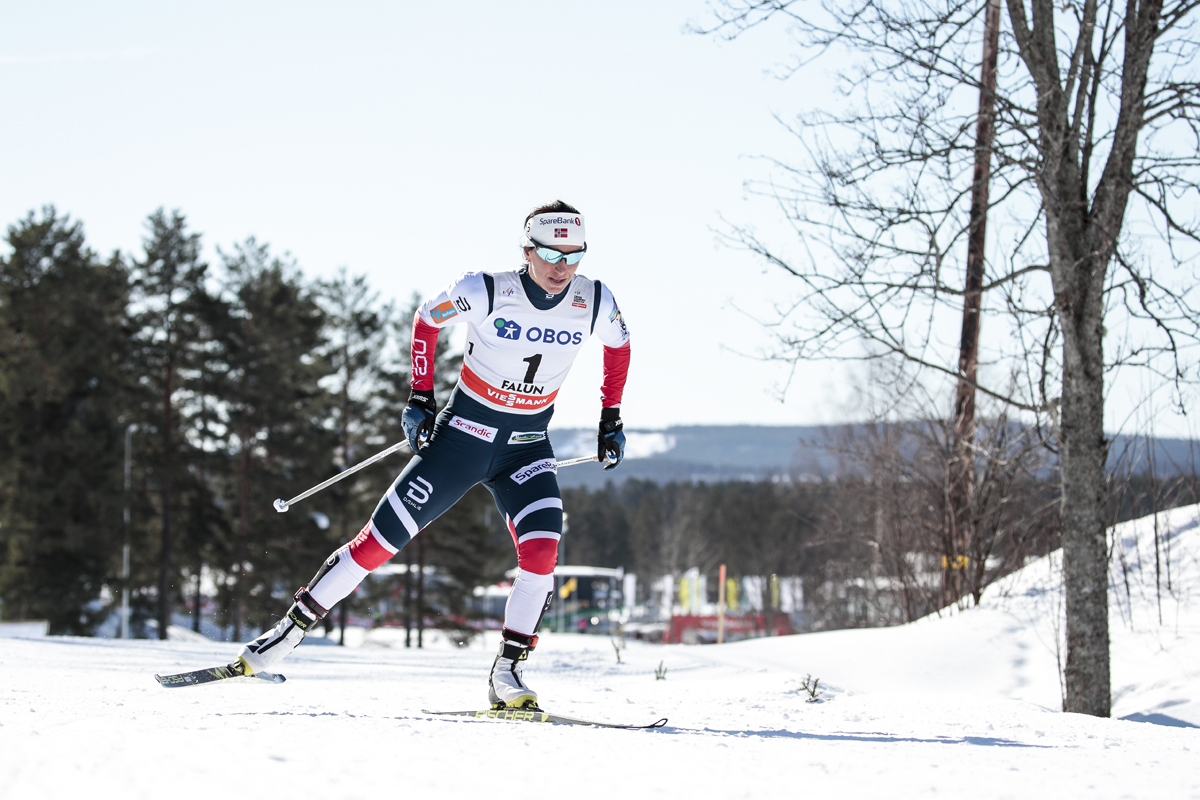
    Norway’s Marit Bjørgen leading off the front during the women’s 10-kilometer freestyle pursuit on Sunday at World Cup Finals in Falun, Sweden. (Photo: Fischer/NordicFocus) (Photo: Fischer/Nordic Focus)

    After catching Østberg, Diggins led the Norwegian and eventually dropped her by 17 seconds at 3.75 k. On Bjørgen, she had gained just over five seconds in time. By the 5 k mark, Diggins was a little less than 30 seconds back, and had put 13.4 more seconds into the race leader.

    “I was grateful to feel so good today,” Diggins told FasterSkier. “We had amazing skis and that was really important. Especially on a course with so much gradual climbing and gradual working downhills, you needed to have good skis, and our techs delivered. And they gave us the tools we needed to have a good day.”

    At the 7.5 k mark, 20 seconds separated the American from the win. By the time Diggins crossed the finish line in second, she was 16.7 seconds behind Bjørgen. The effort from Diggins gave her the fastest time of day in 23:54.4 minutes, which was 24.5 seconds faster than Bjørgen’s time.

    “It’s a sport of patience,” Diggins said. “I feel like I’ve been coming into my own with the confidence to know that any race I start, I can be trying to fight for the podium and racing like I can win. Instead of racing like, ‘Oh, I’m going to try to just see what I can do,’ it’s like, ‘No, I’m going to try to win.’ ”

    But Diggins was not the only American hunting and holding off Norwegians. Her U.S. teammate Sadie Bjornsen, who had gone out hot in Saturday’s race in hopes of a podium, earned it on Sunday in a sprint finish for third (+1:11.5) between herself and Norway’s Ragnild Haga and Astrid Uhrenholdt Jacobsen.

    In the finishing stretch, Bjornsen, Haga and Jacobsen had gone head to head, with the American outlunging Haga — the gold medalist from this year’s Olympic 10 k state — by exactly half a second and beating Jacobsen by 1.3 seconds for the final spot on the podium.

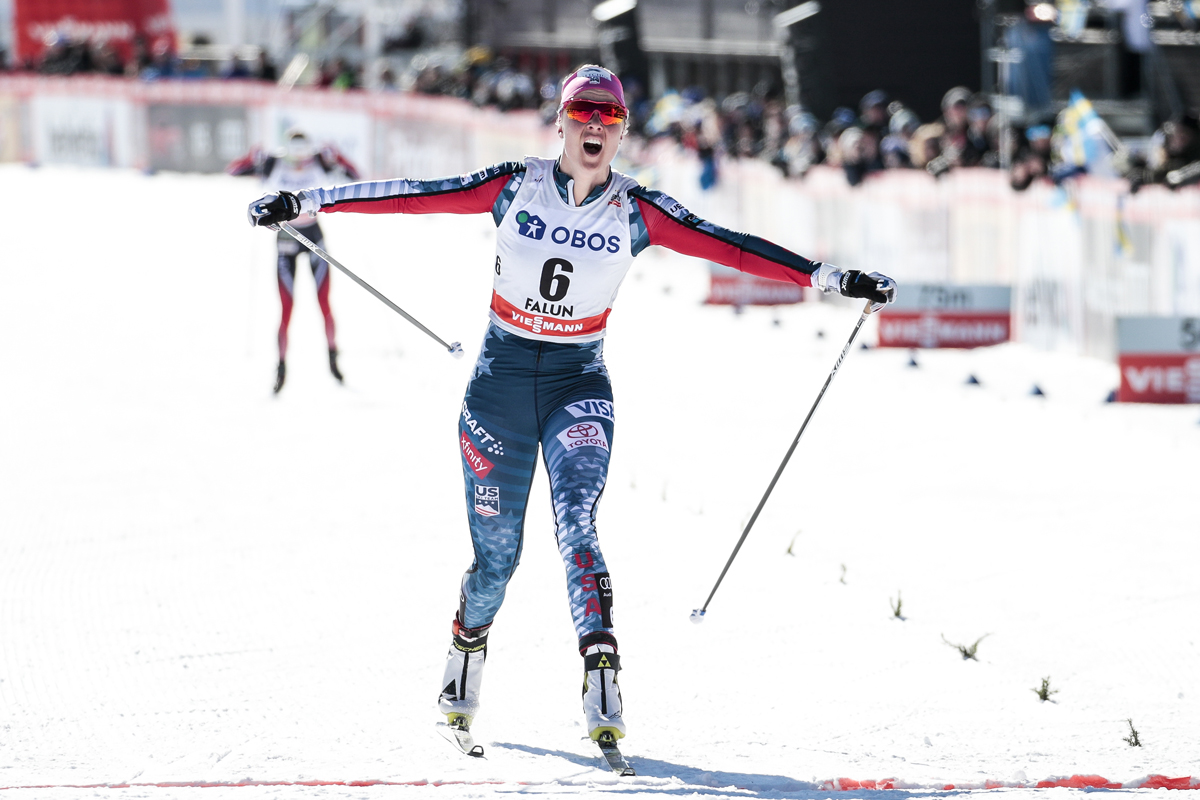
    American Sadie Bjornsen earning third in the women’s 10-kilometer freestyle pursuit on Sunday at 2018 World Cup Finals in Falun, Sweden. (Photo: Fischer/NordicFocus)

    “Coming into the final stretch I was like, ‘OK, that is the last time you get to do the final stretch this year and make it count,’ ” Bjornsen told FasterSkier. “It ended up working out for me, and that turned into quite the dream day.

    “I think the step I made this year is one step closer to being in a place where Jessie is racing right now,” Bjornsen continued.  “To have a teammate who is just pushing the bar just every single day and making me believe that in order to be the best racer in the world, you have to have no fear. Jessie is a great example of that and it is certainly contagious.”

    On Sunday, Bjornsen had started 21 seconds behind Østberg and 29 seconds ahead of Haga. By 7.5 k Haga had caught the group battling for third, which included Bjornsen, Finland’s Krista Pärmäkoski, Østberg, Sweden’s Charlotte Kalla, and Jacobsen. The group stayed together until the downhill back toward the stadium. 

    “I was like, ‘OK, I have to be smart here and keep pushing the pace hard enough that we do not get caught from behind, but conserve for that final sprint and then when I came into the sprint lap,’ ” Bjornsen reflected.

    Along with being a podium threat in Sunday’s race, the Americans are also gunning full-speed ahead toward the top three in the overall, sprint or distance World Cup standings. On Friday, Sophie Caldwell of the U.S. claimed third in the season-long Sprint World Cup. On Sunday, Diggins stood on the podium in second in the Overall World Cup and third in the Distance World Cup.

    “We are really showing that we are a skiing nation, and it’s taken so many years and so much hard work from a lot of people, but I think it’s so cool to show that we can be in the fight,” Diggins said.

    The women’s 10 k freestyle pursuit podium on the last day of 2018 World Cup Finals in Falun, Sweden, with Norway’s Marit Bjørgen (c) in first, and Americans Jessie Diggins (l) and Sadie Bjornsen (r) in second and third, respectively. (Photo: Fischer/NordicFocus)

    “It’s been a many year goal of ours to be ranked in the top three for the women’s team and we secured that for the first time today,” U.S. Ski Team Women’s Coach Matt Whitcomb told FasterSkier of his team’s best-ever Nations Cup ranking.  “We’ve come into [past] finals, I believe, ranked third and then come out of finals ranked fourth. We’ve been fifth. And I think as an entire team, men and women combined, … I think we’ve finished fifth, which would be exceptional. It was really quite an achievement for both our men’s and women’s teams.”

    Whitcomb was right; the U.S. Ski Team placed fifth in the Nations Cup.

    In the decade leading up to the past two World Cup seasons, podiums from American women peppered the circuit, but predominantly in sprints. Kikkan Randall holds most of those, having recorded 28 individual podiums before 2016, only five being in a distance greater than 2 k. Sophie Caldwell broke through with a third-place sprint finish in 2014.

    American Liz Stephen had also reached the World Cup podium four times in distance races prior to 2016 — twice outright and twice for time of day.

    From 2016 on, the number of podiums that have gone to U.S. women has only increased. Caldwell earned three podiums this season alone. Diggins has racked up a total of 14 individual World Cup podiums since her first (which was also a first place) in 5 k freestyle in Toblach, Italy, in 2016. Bjornsen now has a total of five podiums over the course of two seasons. Stephen added two more to her name, one time of day and one outright, and Randall another top three in this past December’s Davos sprint. 

    Whitcomb was quick to point out that much of this success, started with U.S. Ski Team veterans Randall and Stephen, who skied the last World Cup races of their careers on Sunday. Randall finished the race in 43rd (+4:33.3) with the 29th-fastest time of day, and Stephen 50th (+4:57.2).

    “Honestly I start crying every time I think about it,” Whitcomb said, referring to the fact that Randall and Stephen will be retiring after this season. “It’s been a day that I have feared for my whole career, basically since I started working with Kikkan and Liz, really since they started working with us.

    “I know we are not saying goodbye forever, but definitely we are saying goodbye in a certain capacity to two of the most important people that have ever set foot on the U.S. Ski Team,” he added.

    The two spoke with Fasterskier after their last race together, perhaps fitting as Stephen joined the team in 2006, only a year after Randall. The pair have worked with Whitcomb for the past 12 years.

    “As your whole career flashes before your eyes, it’s the people that are the best part,” Randall, 35, said.

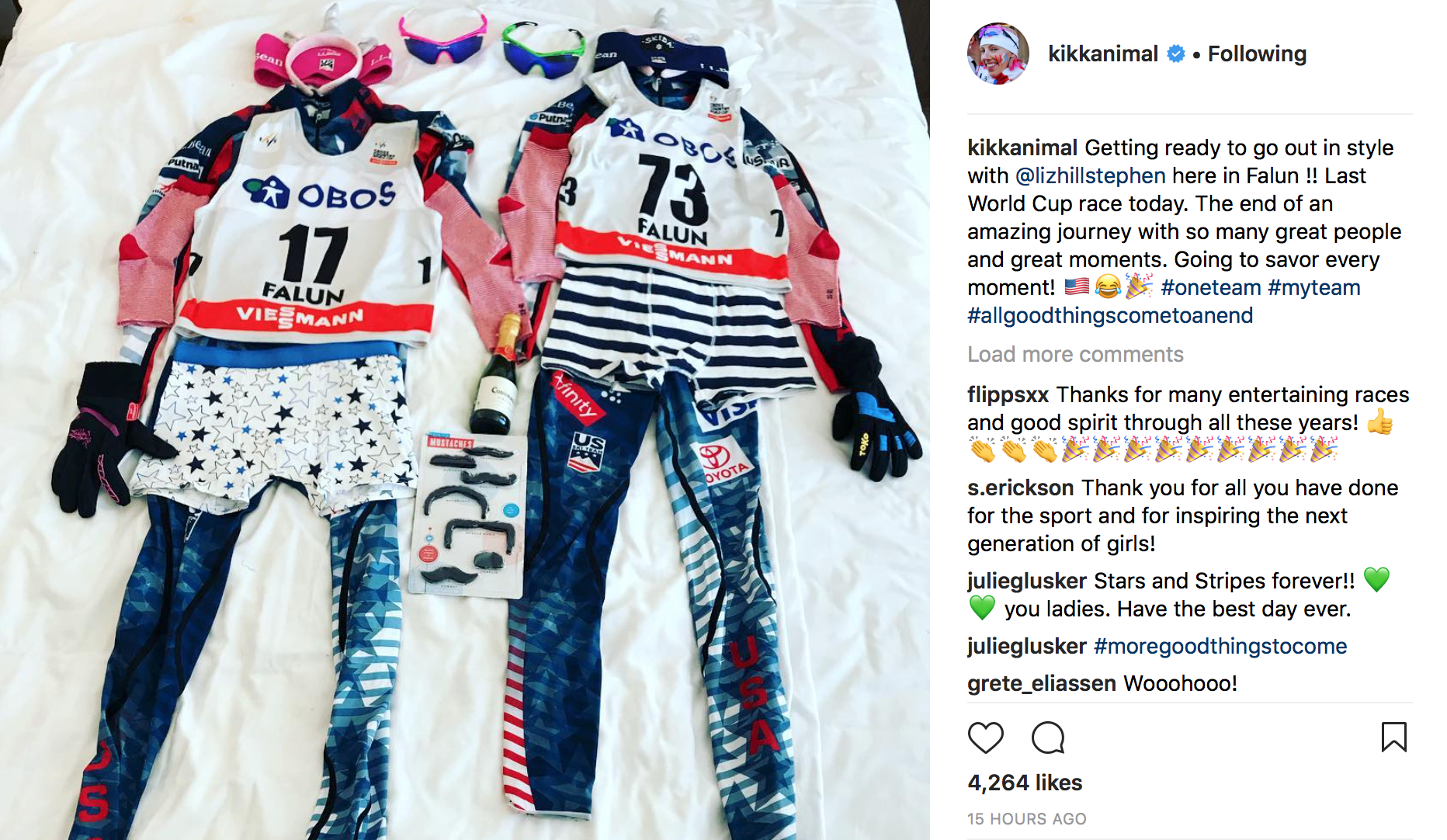
    In their career final World Cup race on Sunday, both Randall and Stephen donned unicorn headbands, pink arm warmers and spandex boyshorts inscribed with the words “Thank You!!” across the backend. During their pre-race morning run, they felt something was missing and made a spur-of-the-moment stop at a store to purchase a few “costume pieces” for the race. Their outfits sparked smiles as they completed the race, and there was no denying the message they hoped to send off as they departed the ski-racing world: the energy and enthusiasm of a strong team.

    (Article continues below)

    The last-race outfits worn by Kikkan Randall and Liz Stephen for Sunday’s World Cup Finals pursuit. (Photo: Kikkan Randall/Instagram)

    “We are all most proud of the team we built,” Randall said. “To see it at such a good point and to know just because we are leaving the scene doesn’t mean it’s going away; these girls are going to continue to carry the torch, the young girls coming in.”

    “I would second that,” Stephen, 31, said. “One of the main things was that we wanted to leave a program that sustain itself, and I think that we both feel very happy and confident that that is going to happen. Like Kikkan said, Jessie won more points this year alone than we used ever see in an entire season men and women combined, you know, 10 years ago, and so I think that is a testament of the success that we have been able to create for one another.”

    Both Randall and Stephen were also given the opportunity to take a victory lap after the race, alongside Finland’s Aino-Kaisa Saarinen and Sweden’s Anna Haag, who sported a Disney Princess bath towel as a superhero cap, as well as a bejeweled crown (in an interview with FasterSkier, Haag explained the outfit had not been coordinated with the Americans, but was rather a coincindence. The Americans and Swedish skier are longtime friends and shared a nonalcoholic-champagne beverage in the finish area after the race).

    “I certainly wasn’t expecting a send-off like that,” Stephen said. “That was really special, that the four of us were able to do that together.”

    “I have done this 20 years … and I have raced my goals and even more,” Saarinen told FasterSkier. “Actually this skiing family is the thing what I’m going to miss the most.”

    Also racing for the U.S. on Sunday, Caitlin Patterson finished the pursuit in 35th (+3:58.4) with the 22nd-fastest time of day, Caldwell finished in 36th (+4:00.7), Rosie Frankowski 46th (+4:41.3), Kaitlynn Miller 56th (+6:13.8), and Ida Sargent 57th (+7:06.4).

    “It’s been a really unexpected good season, and I am really happy with it,” Miller said. “Today was awesome seeing Sadie and Jessie finish out the World Cup season like that.”

    The Canadians were led by Cendrine Browne, who finished 39th (+4:14.4) with the 27th-fastest course time, followed by Emily Nishikawa in 48th (+4:43.7), Dahria Beatty in 54th (+6:04.3) and Zina Kocher in 60th (+9:28.4). 

    “I love the course, it is perfect for me,” Browne wrote in an email to FasterSkier. “Steep up hills and one skate sections are what I prefer best! I was suprised yes!!! All season I was trying so hard to get into the top 30. Maybe I was trying to hard and putting to much pressure on myself. Today, I decided to have fun and to forget everything and it just happened!”

    “I am really happy about my season even if it was filled with so many emotions,” Browne continued. “Going to the Olympics and placing 33rd at my first Olympic race is definitely a highlight. Also, my 36th place in Holmenkollen is a huge accomplishment for me. Even if I fell twice and should have been in the top 30, it was an awesome race. And today’s 27th place is definitely the best thing that happened this season. Finishing the season like this fills my heart with joy and hope for next season.”

    ***

    Norway’s Marit Bjørgen finishing first in the women’s 10 k freestyle pursuit at 2018 World Cup Finals in Falun, Sweden, while American Jessie Diggins (in background) chases for second place. (Photo: Fischer/NordicFocus)

    Notes: While there has been a lot of discussion about retirements, Bjørgen isn’t saying it’s over. 

    “I want to finish [the season] in a good way, but I think I’ve been at my very best. I’ve passed it [my peak],” Bjørgen said in a loosely translated interview with NRK on Friday. 

    So will she race next winter? Bjørgen estimated she would need to train at least 850 hours if she wanted to compete with her teammate Therese Johaug, who will be returning to the World Cup next season.

     “It’s going to be a lot of training, and you have to prioritize a lot. That’s the toughest thing,” Bjørgen said. “But when I’m at work, it’s no problem. I’m here to do the job. Should I do one more year, I will not do it halfway [half-hearted].”


    ***

    Results: Pursuit | Overall Standings | Distance Standings | Mini-Tour Standings

  • Bolshunov Breaks Through in Falun; Harvey Second in Pursuit

    Bolshunov Breaks Through in Falun; Harvey Second in Pursuit

    The men’s 15 k freestyle and 2018 World Cup Finals podium, with Russia’s Alexander Bolshunov (c) in first, Canada’s Alex Harvey (l) in second and Switzerland’s Dario Cologna (r) in third. (Photo: Svenska Skidspelen/Instagram)

    It is a wrap.

    The 2017/2018 World Cup season concluded Sunday in Falun, Sweden with the men’s 15-kilometer freestyle pursuit. The World Cup Finals featured a three-race mini tour with a skate sprint, 15 k class mass start and Sunday’s pursuit.

    Russia’s Alexander Bolshunov, a spry 21 year old, began the pursuit with a 38-second lead over second starter, Johannes Høsflot Klæbo of Norway. Emboldened with confidence after winning his first-career World Cup on Saturday, Bolshunov set off on another sunny Sweden day in cruise control. His initial efforts looked smooth and powerful yet lacked the apparent stress of being chased by the likes of Norwegians Martin Johnsrud Sundby and Klæbo, Swiss skier Dario Cologna, and Swede Calle Halfvarsson.

    In fact, for a little more than the first kilometer, his closest chase group resembled a nonchalant pack, as if they’d already agreed to let Bolshunov go. With Halfvarsson looking comfortable in front, and Bolshunov’s lead expanding, Sundby came around a little over three minutes into the race and began the hard work of actually preventing the second chase group, which included Canada’s Alex Harvey, from latching on. (Harvey started 18th, 1:16 minutes behind Bolshunov.)

    The story up front, Bolshunov’s insurmountable lead, was dramaless. The emergent Russian’s time gaps spoke of hard bursts of speed and a settling chase group’s concern with a second and third place. Bolshunov led by 52.3 seconds at 5.2 k and 1:23.6 minutes at 11.25 k.

    Bolshunov enjoyed a solo ski into the finish to win the day in 35:03.3 minutes for his second World Cup win and his first mini-tour victory. Along with his win, Bolshunov ends the season fifth overall in the World Cup standings.

    “After trying all season for a win and getting it yesterday, I had a lot of confidence today and I felt strong,” Bolshunov told the International Ski Federation (FIS), according to a press release. “It’s great to win like this at the end of the season. It leaves me with positive feelings heading into the training season.”

    The story behind Bolshunov unfolded with more complexity. The 5.2 k checkpoint was the last mark for a seven-skier chase group to stay away from skiers looking to link up from behind. As much as Swedes Halfvarsson and Oskar Svensson, Cologna, Sundby, Italians Francesco De Fabiani and Federico Pellegrino, and Klæbo (who looked gassed) tried in earnest to stay away, a near-constant throttling pace from Harvey brought the lead chase group within sight.

    By 7.5 k, the first and second chase groups had merged, ballooning to a sixteen-skier pack. With half the race to go and Bolshunov uncatchable, several racers would test themselves, and the group, as they attempted to split the chasing posse. Sundby gave it a go. Cologna gave a try. Norway’s Hans Christer Holund looked fresh and strong upping the pace. But none could separate themselves or splinter the pack.

    Switzerland’s Dario Cologna (9) leads Canada’s Alex Harvey (18) during the men’s 15 k freestyle pursuit at 2018 World Cup Finals in Falun, Sweden. Harvey went on to place second and Cologna third. (Photo: Fischer/NordicFocus)

    Harvey was omnipresent — smooth on the climbs, unnerved by any attacks. On the last grind up the infamous Mördarbakken, Harvey pushed over the top to lead a six-skier group that included Cologna and Sundby.

    Two minutes out, Cologna gave a burst of hop-skate in a failed break away attempt. Cologna’s effort, however, did stymie the followers enough to allow he and Harvey to accelerate over the top. It came down to the finishing straight to settle the 15 k pursuit score.

    Harvey bested the others to place second (+47.1) and skied the fastest time of day in 34:34.3 minutes. Cologna followed just behind in third (+47.5), and Sundby placed fourth (+48.7).

    Sunday’s result matches Harvey’s best 2017/2018 result and was his fourth podium of the season. He placed third in the sixth stage of the Tour de Ski (TdS), third overall in the TdS, and was second in the 15 k freestyle mass start in Seefeld, Austria.

    “I like these end-of-season tours,” Harvey told FIS. “On the podium now two seasons in a row at World Cup Finals. They are hard though and I am tired. It took some effort to get up to the leaders but I still felt strong and knew I needed to go for it coming into the final kilometer.”

    With the conclusion of the season, Harvey ended up fourth in the World Cup standings with 1179 points. The Canadian was 82 points behind Sundby in third overall, after Sundby amassed 1261 points.

    The men’s 2017/2018 Overall World Cup podium, with Norway’s Johannes Høsflot Klæbo (c) in first, Switzerland’s Dario Cologna (l) in second, and Norway’s Martin Johnsrud Sundby (r) in third. (Photo: Fischer/NordicFocus)

    Although Sunday’s Falun finale was a fade for Klæbo — he placed 25th in the pursuit (+1:45.8) — the season belonged to the 21-year-old Norwegian. He had already clinched his second-consecutive Sprint World Cup Crystal Globe several weeks ago. In Falun on Sunday, Klæbo earned his first Overall World Cup title after winning 11 individual World Cup races this season. He is the sixth Norwegian to win the overall Crystal Globe. He also becomes the youngest overall winner; Sweden’s Gunde Svan was 22 when he won the 1983/1984 season overall.

    Cologna placed second in the Overall World Cup with 1290 points and won the Distance World Cup with 698 points (41 points over Sundby in second) and appeared satisfied after the race.

    “I think it’s fun to win races,” Cologna said in a translated interview with Swiss broadcaster SRF. “Those are very nice emotions, which I was allowed to experience again this winter. Now I’m surely a bit tired and it’s natural to have a little break, a little holiday.”

    It has been a revival year for Cologna: he won the TdS and a gold medal in the Olympic 15 k skate along with several other hallmark victories. On Sunday he was awarded the Distance Crystal Globe, his fourth Distance World Cup title — a new record. (Sundby has won three distance globes.)

    “You could say it has been perfect with an Olympic victory, the Tour de Ski and now the small crystal globe,” Cologne reflected to SRF. “Also the win at Holmenkollen [50 k] was a very important and beautiful success. So after two years that have not been so easy to come back from and [when] the big successes were missing and then a couple of races I had to miss myself that was really… If someone had told me that before this season I would instantly have taken/accepted that. And until the end, I was in the fight for the Overall World Cup even if it had already been pretty much decided. But if someone had told me in December that it would be open until the end I wouldn’t have believed it. So it was a great season.

    Switzerland’s Dario Cologna with his 2017/2018 Distance World Cup Crystal Globe. (Photo: Fischer/NordicFocus)

    Yet the 32-year-old skier, despite solidifying his already storied legacy, told SRF he has no clear intention of retiring. 

    “The motivation is still there,” Cologna added. “I’ll have to see, next year is Seefeld and that’s almost a World Championship at home for us. That’s three hours from my home. So for that surely the motivation is there to be ready and fight for the medals.”

    In the Distance World Cup, Norway’s Holund claimed third with 599 points, just 5 points ahead of Harvey in fourth. France’s Maurice Manificat had been third in the distance standings heading into Sunday, but finished the pursuit in 26th (+2:11.9) and dropped to fifth in the final rankings behind Holund (who moved up from fourth) and Harvey (who moved up from fifth).

    Kershaw in the Points Again; Bjornsen with 22nd-Fastest Time

    In the pursuit itself, Devon Kershaw was the next-best Canadian outside of Harvey’s podium as he finished in 28th place (+2:21.9).

    “I felt pretty good again,” Kershaw said. “I’m not quite strong enough at the start there, so I wasn’t quite strong enough to get back to the group, which is too bad, because they were going slow for a while. But, no, I am satisfied. I mean, another race in the points, so it’s not a bad way to end the season. I was consistent.”

    Canada’s Devon Kershaw racing to 74th in the freestyle-sprint qualifier at 2018 World Cup Finals in Falun, Sweden. He went on to finish the mini tour in 28th. (Photo: Fischer/Nordic Focus)

    Kershaw still has yet to commit to another World Cup season, but he concludes the year with five consecutive top-30 finishes in distance races. Kershaw also noted he had been a consistent top-30 classic skier.

    “I think every classic race except one that I competed in, distance, I was in the points,” Kershaw, 35, said. “I feel proud of that. And since the Olympic 50 k, I’ve been in the top 30 every race I did, so, that’s five or six races now, and it’s just consistent. But again, just lacking that last little bit. But the highlight I think was Alex coming second today from bib 18 so that was phenomenal.”

    Also for Canada and in his final career World Cup start, Graeme Killick placed 56th (+4:33). Julian Locke did not start.

    For the Americans, Erik Bjornsen moved up from 51st to place 38th (+3:10.4) and skied the 22nd-fastest time of day. Simi Hamilton was 49th (+4:07.8), Scott Patterson 58th (+4:41.5), Patrick Caldwell 59th (+4:41.6), Kevin Bolger 60th (+4:43.5), and David Norris 64th (+5:09.8).

    “After yesterday, I was not hoping for much in the final. It was over for results for the Tour,” Bjornsen told FasterSkier on Sunday. “But I went out there it is sunny out it is a good day, so I was just trying to finish off the season with a hard push knowing that the result wasn’t going to be what I was hoping for. But still I just saw the time of day, and 22nd on time of day is a good one. I will see more points for the end of the season.”

    Those points bumped Bjornsen into 38th in Distance World Cup list.

    “I think it was a step in the right direction,” Bjornsen added. “I still need a few more steps like that before I can fight for podiums.

    Bjornsen has made gains this year. And given a moment on Sunday to reflect on his progress, the 26-year-old U.S. Ski Team member recalled several notable examples of his World Cup progression.  

    “Finishing in the top 30 in most of the races, the majority of them, that was great,” Bjornsen said of his 2017/2018 season. “It makes it feel like you are more in the fight and it is a lot more fun to racing in the top 30. The top 10, I was really excited about that in Seefeld. And qualifying for, I think, five heats this year — all in all pretty happy with it. Still, it has always been my goal to stand on the podium some day. I still think I have a few more steps to get there if I can keep on improving like this last year, maybe there is still a chance.”

    The PyeongChang Olympics were a ‘wow’ moment for Patterson. During Saturday’s mass start, Patterson was initially caught in an early race crash and then lost and retrieved a ski. Not the race the upstart skier had hoped for, but not spirit-breaking.

    “Better than yesterday — got my skis on today,” Patterson joked after Sunday’s pursuit.  

    The mishaps from yesterday and Patterson’s ability to put them in context underscore his strong finish to his first full-time World Cup campaign. (Patterson did not contest the TdS as he returned stateside to compete in U.S. nationals.)

    “I improved through the season,” Patterson, 26, said of his improved results starting in PyeongChang, where  he placed 21st or better in three individual races, including 11th in the 50 k freestyle. “Obviously, Period 1 I didn’t score any points. I was a bit disappointed with that, but I could’ve. I came close a couple times, but I think I regrouped pretty well through nationals. Got sick there, but kind of cleared something out that I had from Period 1, a bit of bronchitis.

    “Going into the Olympics, I didn’t really know how I was going to do,” he continued. “I had … first points of the season right before that. So, I think I was on a nice upswing. I had a great Olympics. I mean, could’ve asked for a medal, but I did a lot better than I was expecting, really. And then Holmenkollen was great, too. I feel like right now I’m kind of in 50 k shape instead of 15, but overall I think it was a great season, and got some things to work on for next year, and look forward to coming back and solidly being in the points every race I can.”

    Results:

    Pursuit | Time of day 

    Final Overall World Cup rankings | Finals Distance World Cup rankings

  • Pärmäkoski Wins Another 10 k Classic; Diggins 8th, Bjornsen 11th in Falun

    Pärmäkoski Wins Another 10 k Classic; Diggins 8th, Bjornsen 11th in Falun

    American Jessie Diggins (5) and Norway’s Marit Bjørgen (3) and Maiken Caspersen Falla lead early in the women’s 10 k classic mass start at World Cup Finals in Falun, Sweden. (Photo: Fischer/NordicFocus)

    FALUN, Sweden — To those watching, even to those racing, the winner was the woman who had led most of Saturday’s 10-kilometer classic mass start: Norway’s Marit Bjørgen.

    “Marit and Tiril [Udnes Weng], another Norwegian young girl, they were skiing really fast and I thought that they would be first and second,” Norway’s Ingvild Flugstad Østberg told FasterSkier after the race.

    Seven minutes after the start gun, Bjørgen had moved to the apex of the field and there she seemed intent to stay.

    No doubt, the 37-year-old Norwegian holds a close relationship with the 10 k classic event. Over the course of her World Cup career, she has amassed 31 podiums in the distance/discipline, 16 of those being in first place.

    Last year in Lahti, Finland, Bjørgen was crowned the 10 k classic world champion, and she also holds the 10 k classic World Championships title from 2011.  At the 2006 Olympics in Turin, Italy, she earned silver in the 10 k classic event. The next time a 10 k classic was featured at the Olympics, in 2014 in Sochi, Russia, she finished fifth.  

    With substantial backing, Bjørgen seemed well on her way to another 10 k classic win at 2018 World Cup Finals on Saturday in Falun. Finland’s Krista Pärmäkoski may have not looked like a real threat — until the finishing stretch.

    In the corner before the final 100 meters, Pärmäkoski pulled up just behind Bjørgen. Just two kilometers earlier, the Finn had been skiing two seconds off of the Norwegian’s pace.

    Backtracking to the race’s halfway mark, Pärmäkoski had been even farther behind Bjørgen. Three seconds had separated the chase pack from Bjørgen and Tiril Udnes Weng, who led the race at 5 k. At that point, Sweden’s Charlotte Kalla had been spearheading the charge to close down the gap, while Pärmäkoski skied in fifth, almost one second back from Kalla and four seconds back from Bjørgen.

    Even earlier in the race, when Bjørgen made her move to the front at 3.75 k, Pärmäkoski, who had started in bib 32, was 19 places out of first.

    “I had to start so much behind the others,” Pärmäkoski told FasterSkier, referring to her bib number, which was based on her finish in the opening race of the World Cup Finals, Friday’s freestyle sprint.

    “But my body worked very well today … and I had really good grip and glide [with] my skis,” Pärmäkoski continued. “I passed the other athletes when we got to the downhill, the long downhill.”

    By the descent heading back toward the stadium, Pärmäkoski had passed Tiril Udnes Weng and moved around Kalla. Close to two seconds stood between her Bjørgen and Østberg, the latter of which had moved into second at the 7.5 k mark.

    “I didn’t dare to look back and see how many girls were keeping up with [us] in front,” Østberg said.

    If she had looked back, she would have seen the Finn firing on all cylinders.

    By the descent back toward the stadium, Pärmäkoski had caught Østberg and hunted her next Norwegian. She closed in on Bjørgen in the corner just before the finishing stretch.  Fifty meters to go and Pärmäkoski pulled up just alongside Bjørgen.

    Finland’s Krista Pärmäkoski (32) edges Norway’s Marit Bjørgen for the win in the women’s 10 k classic mass start at 2018 World Cup Finals in Falun, Sweden. (Photo: Fischer/NordicFocus)

    The two approached the finish line in tandem. Pärmäkoski, however, was stronger in the final double-pole push and nabbed the win by just 0.2 seconds over Bjørgen in a time of 26:00.5 minutes. Bjørgen took second behind the Finn in a time of 26:00.7.

    “I thought that maybe I was stronger than her and I feel that I was doing a good finish, but she was stronger than me,” Bjørgen told FasterSkier, referring to the sprint finish between Pärmäkoski and herself.

    “I thought Marit was gonna take it on the last 100 meters, but Krista was too strong,” said Østberg, who finished 5.1 seconds back in third.

    The win is Pärmäkoski’s third 10 k classic title in a row this season. Her first came in Planica, Slovenia –which was also her first World Cup win — and her second came two weekends ago in front of a home crowd in Lahti.

    For Østberg, the World Cup podium was her first since January.

    “It’s been a while since I’ve been on the podium individually, in an individual race, so I was just so happy that I managed to finish in third place,” Østberg said.

    Less than 10 seconds behind her, a pack of five surged to the finish line, with Sweden’s Ebba Andersson crossing in fourth (+14.5), Japan’s Masako Ishida fifth (+14.8), Kalla in sixth (+15.2), Austria’s Teresa Stadlober in seventh (+15.4) and American Jessie Diggins in eighth (+15.5). Exactly 1 second separated the five-skier spread, with Diggins bookmarking the tail end.

    American Jessie Diggins leading the pack up an early climb with Norway’s Kathrine Rolsted Harsem and Marit Bjørgen just behind during the women’s 10 k classic mass start at World Cup Finals in Falun, Sweden. (Photo: Fischer/NordicFocus)

    “I was a little bit bummed I didn’t quite have the same feelings in my body that I’ve been having,” Diggins told FasterSkier. “It wasn’t a bad race at all … I just was struggling to find that last gear. I know it’s there because it was there in the sprint yesterday. So I am just going to go hard tomorrow and see what I can do.”

    Bjørgen currently leads the World Cup Finals mini tour and will be the first skier on course in Sunday’s 10 k freestyle pursuit. Starting 36 seconds after her will be Østberg in second, then Diggins, 41 seconds back in third.

    In the Overall World Cup standings as well, Diggins ranks third with 1226 points. The American is 106 points behind Østberg in second and 213 points behind Norway’s Heidi Weng in first. At most, with a win, Diggins could score 200 points on Sunday. Behind her, Pärmäkoski is 112 points back in fourth.

    An Olympic gold medal already achieved and a couple other firsts to her name this season (last weekend, she became the first American woman to podium in a 30 k Holmenkollen), Diggins’ drive is for a personal best on Sunday.

    “I am just excited to keep pushing hard and see if I can break through and get some new firsts for me,” Diggins told FasterSkier. “I am fighting for a good spot in the overall [World Cup] and in the overall distance [ranking] as well … it’s fun to try to do something new and definitely motivates me to keep fighting really hard. It kept me pushing for every second today.”

    Diggins is also third in the Distance World Cup standings, 64 points behind Østberg in second and 43 points ahead of Pärmäkoski in fourth.

    Rounding out the remainder of Saturday’s top 10 was Norway’s Astrid Uhrenholdt Jacobsen in ninth (+24.8) and Finland’s Kerttu Niskanen in 10 (+26.2). Just 0.1 seconds outside of the top 10 was American Sadie Bjornsen in 11th (+26.3).

    American Sadie Bjornsen skiing just behind Germany’s Katharina Hennig during the women’s 10 k classic mass start at 2018 World Cup Finals in Falun, Sweden. (Photo: Fischer/NordicFocus)

    This World Cup season has marked somewhat of a breakthrough season for Bjornsen, with the 28 year old earning her first distance podium and two classic sprint podiums.

    On Friday, she appeared to be pulling for a podium again. Bjornsen charged hard to the front of the pack in bib 8, three bibs back from Diggins, who led the first 2 k of the race before Bjørgen took over.

    When asked about the risk involved with taking such a race tactic and why she chose to do so, Bjornsen was thoughtful. Reflecting on her recent strong results in sprint qualifiers, she explained that she was testing “what can happen if I have no fear, if I have no fear of failing.”  

    “I keep trying to tell myself that in the distance races … any amount of fear really pulls you back from that podium potential. So this last week I made it a goal of mine to try to race from the gun and see if I can hang on,” Bjornsen said.

    With this being the final weekend of World Cup racing until next season, Bjornsen also saw it as an opportune time for her to try going out harder at the start. In a sense, test her pacing in an insular way.

    “It’s the best time of the year [for that],” Bjornsen said of a hot start. “You have nothing to lose. I definitely am fighting in the overall [World Cup] for places, too, but at the same time it’s not fighting for a podium. So if I absolutely explode, like I did today in the middle of the race, there is just no failing with that.

    “I am learning how to [ski in the front] this year and next year I’m ready to come back and take that risk more often,” she added.

    Bjornsen is currently ranked eighth in the Overall World Cup standings with 799 points. Ahead of her is Kalla in seventh (828), Bjørgen in sixth (835), and Stadlober fifth (836). In the distance standings, Bjornsen is 10th. She will start Sunday’s pursuit in sixth, 57.3 seconds after Bjørgen. 

    American Kikkan Randall tucking during the women’s 10 k classic mass start at 2018 World Cup Finals in Falun, Sweden. (Photo: Fischer/NordicFocus)

    Also competing for the U.S. on Saturday was Sophie Caldwell, who placed 41st (+1:36.1), Rosie Frankowski in 44th (+1:43.7), Caitlin Patterson in 47th (+1:54.8), Kikkan Randall in 57th (+2:34.1), Kaitlynn Miller in 64th (+2:50.7).

    In her final weekend of World Cup racing, Randall explained Saturday’s result was not quite where she hoped to be, partly as her body still felt the effects of Friday’s sprint effort.

    “I always just like to end on a good note feeling like I just really raced hard and [with] regards to the results, feel competitive,” she said. “Yesterday was more along those lines, today was just hard, but it’s still good to be up here. Such a beautiful day for racing, perfect temperature, good tracks, good skis.”

    Emily Nishikawa led Canada in 36th (+1:31.1), followed by Cendrine Browne in 50th (+2:05.7), Dahria Beatty in 61st (+2:46.6), and Zina Kocher in 69th (+6:12.0).

    Results | Mini Tour Standings Day 2 | Women’s pursuit start list 

    Overall World Cup standings | Distance World Cup standings

  • Lahti Qualifiers, Press Conferences, Pre-Sprint Stats, and Photos

    Lahti Qualifiers, Press Conferences, Pre-Sprint Stats, and Photos

    Iran’s Seyed Sattar Seyd racing to fourth in the men’s 10-kilometer classic individual start, a qualifying race for World Championships, on Wednesday at the 2017 Nordic World Championships in Lahti, Finland. (Photo: John Lazenby/Lazenbyphoto.com)

    LAHTI, Finland — Yesterday’s lick of blue sky winter sun was fleeting, as Lahti woke to overcast skies and buzz that new snow was imminent. Race time temps hovered around 24 degrees Fahrenheit, but with 78-percent humidity and a brisk wind — some would say ripping —  blowing out of the west, it felt wind-brief cold.

    Wednesday’s kickoff events were an opportunity for volunteers, camera crews and even hundreds of local Finnish school children who spectated, to test the venue’s preparedness in a soft opening. For both the men and women on Wednesday, athletes from non-traditional ski countries — skiers without the prerequisite International Ski Federation (FIS) points — raced in 5/10-kilometer classic qualifiers for the 2017 FIS Nordic World Championships distance races. All registered racers are able to contest Thursday’s freestyle sprint qualification. However, only the top 10 from Wednesday’s men’s 10 k and women’s 5 k classic individual starts would qualify for Lahti’s distance events.

    In both races the list of representative countries vying for precious world-champs starts was a testament to FIS’s attempt to market a more globalized brand. There was Ecuador, Brazil, Lebanon, Venezuela, and India to name a few. A colorful splash of international pizazz. But in the end, all these aspiring skiers had to qualify on a championship-level course.

    On the women’s side Iceland’s Elsa-Gudrun Jonsdottir took the win, completing the the 5k loop in 15:23.9. Nansi Okoro from Bulgaria skied to second place (+20.1) with Australia’s Katerina Paul third (+34.2).

    Mongolia’s Otgontsetseg Chinbat racing to fourth in the women’s 5 k classic qualifying race on Wednesday at 2017 Nordic World Championships in Lahti, Finland. (The top 10 finishers qualified for the distance races at these championships.) (Photo: John Lazenby/Lazenbyphoto.com)

    Top-10 Women’s Qualifiers:

    1. Elsa-Gudrun Jonsdottir (Iceland)
    2. Nansi Okoro (Bulgaria)
    3. Katerina Paul (Australia)
    4. Otgontsetseg Chinbat (Mongolia)
    5. Gabrijela Skender (Croatia)
    6. Kitija Auzina (Latvia)
    7. Katya Galstyan (Armenia)
    8. Maria Ntanou (Greece)
    9. Enkhtuul Ariunsanaa (Mongolia)
    10. Vanesa Emilova (Bulgaria)

    In the men’s 10 k classic, Croatia’s Kresimir Crnkovic took the win in the non-medal event, covering the course in a time of 26:21.5.

    Finishing 55.6 seconds back was Lithuania’s Deividas Klisevicius in second place. Rounding out the men’s podium in third (+1:05.5), was Achbadrakh Batmunkh of Mongolia.

    Top-10 Men’s Qualifiers:

    1. Kresimir Crnkovic (Croatia)
    2. Deividas Klisevicius (Lithuania)
    3. Achbadrakh Batmunkh (Mongolia)
    4. Seyed Sattar Seyd (Iran)
    5. Jens Hulgård (Denmark)
    6. Thibaut De Marre (Belarus)
    7. Tue Rømer (Denmark)
    8. James Clugnet (Great Britain)
    9. Omer Aycicek (Turkey)
    10. Apostolos Angelis (Greece)

    Results: Women | Men

    ***

    Lahti 2017 Freestyle Sprint

    Seasoned heavy hitters to World Championships first timers will make their way to the race the venue on Thursday for the second World Championships event: a 1.4 k freestyle sprint.

    U.S. Ski Team member Jessie Diggins during training day on Wednesday at 2017 Nordic World Championships in Lahti, Finland. (Photo: John Lazenby/Lazenbyphoto.com)

    In the women’s field, Sweden’s Stina Nilsson and Norway’s Maiken Caspersen Falla rank as the top-two favorites following this World Cup season. For the past three freestyle sprints Nilsson has entered, she has placed first, her most recent victory this past Saturday in Otepää, Estonia. Falla, however should not be counted out, she took the win in last year’s freestyle sprint held in Lahti, Finland, while American Jessie Diggins claimed second.

    For the men, Italy’s Federico Pellegrino emerges as the top non-Scandinavian favorite for the sprint. He won the most recent freestyle sprint in Falun, Sweden, last month and placed second in this year’s Tour de Ski Stage 1 freestyle sprint.

    Many men, however, will be vying Pellegrino for the top spot. This includes Norwegians Johannes Høsflot Klæbo, Finn Hågen Krogh, Emil Iversen, as well as Russia’s Sergey Ustiugov, to name a few.

    U.S. Freestyle Sprint Entries:

    Women

    • Jessie Diggins
    • Sophie Caldwell
    • Ida Sargent
    • Kikkan Randall

    Men

    • Simi Hamilton
    • Andy Newell
    • Erik Bjornsen
    • Cole Morgan

    Canada Freestyle Sprint Entries:

    Women

    • Dahria Beatty
    • Cendrine Browne
    • Katherine Stewart-Jones

    Men

    • Alex Harvey
    • Len Valjas
    • Jesse Cockney
    • Knute Johnsgaard

    Qualification start lists: Women | Men

    ***

    Behind the scenes on Wednesday, FIS President Gian Franco Kasper was part of a press conference that in part discussed the latest doping news: the five Russian skiers who appealed to the Court of Arbitration in Sport (CAS) had been denied immediate reinstatement to race.

    Sarah Lewis, FIS Secretary General made this statement regarding Norwegian star Therese Johaug’s doping case. “The other one on the table is the Norwegian Anti-Doping Agency’s decision that was issued last week in the case of Therese Johaug,” Lewis said. “It was received by FIS on the 14th of January. The present status is that it is being studied by FIS doping panel and this will continue until the 7th of March and at that time a communication will be issued. In the meantime, FIS has got no further statement to give on this case.”

    During Wednesday’s press conference, FIS President Gian Franco Kasper (center) defended himself from comments he made to The New York Times.

    That part of the press conference was administrative. Then during a question-and-answer period a journalist asked this of Kasper: “You gave an interview to The New York Times where you said the sport is clean and the athletes have been irritated with that quote from you. How do you respond to the criticism that’s been thrown your way?

    (The most recent comment from Kasper in the Times was this past November. He reportedly said, “We need to stop pretending sport is clean. It’s a noble principle, but in practice? It’s entertainment. It’s drama.”)

    Kasper was blunt and stern in his response. “Well don’t forget this, your colleague from The New York Times, she wrote whatever she wanted,” Kasper said during the press conference. “Her question to me was, it must really disturb or hurt the sport of skiing in particular cross country? I said of course it hurts our credibility of sport in general and also skiing is damaged by all the open cases we have at the moment. But at the end for the public watching at home, the Olympics in particular, it’s still the drama that comes up, the joy if you win, disappointment if you lose, that is part of the game. It’s more or less a mirror of the social world … I never said it doesn’t matter for the importance of the Games, of course not.”

    Later on Wednesday, Kasper was part of a group that met with athletes to discuss his response to halt doping in nordic sport.

    ***


  • Dethroning the Distance King, Ustiugov Wins Falun 15 k Mass Start

    Dethroning the Distance King, Ustiugov Wins Falun 15 k Mass Start

    Russian Sergey Ustiugov (center) takes the win ahead of Italy's Francesco De Fabiani (l) and Norwegian Niklas Dyrhaug (r) during the men's 15 k freestyle mass start on Sunday in Falun, Sweden. (Photo: Fischer/NordicFocus)
    Russian Sergey Ustiugov (8) takes the win ahead of Italy’s Francesco de Fabiani (l) and Norwegian Niklas Dyrhaug (2) during the men’s 15 k freestyle mass start on Sunday at the World Cup in Falun, Sweden. (Photo: Fischer/NordicFocus)

    Sunday’s 15-kilometer freestyle mass start in Falun, Sweden, ended similarly to how it started: skiers sprinting en masse. One major difference, however, marked the finish line. The yellow bib of Norway’s Martin Johnsrud Sundby was not in first. Or second. The king of distance finished the day in third.

    “A war,” is how the renowned distance skier, Sundby described the battle that ensued between approximately 20 competitors who were still within the lead pack coming into the finishing stretch, according to a Norwegian press release.

    In the end, the 100-meter battle to the finish line left Russian sprint specialist, Sergey Ustiugov triumphant. He completed the 3 x 5 k course in a time of 31:42.5 for his first distance World Cup win.

    “I’m very happy,” Ustiugov told FIS after the race. “This is a fantastic win for me because I only won in sprint … so this is amazing.”  

    Just 0.3 seconds back, Italy’s Francesco de Fabiani outlunged Sundby for second place by one-tenth of a second.

    “The race of the day goes to Fabiani,” Canadian Devon Kershaw said during a post-race phone interview. “It’s always fun to see people that maybe other people don’t expect to come out and have a really strong sprint like that at the end. That was really cool.”

    Typically stronger in classic races, de Fabiani proved his freestyle finishing kick as a force to be reckoned with on Sunday. In the last 50 meters, he propelled himself past Norwegians Finn Hågen Krogh, Niklas Dyrhaug and Sundby, moving from fifth to second place.

    “I am not a sprinter like some of the others but maybe after 15 km I am fast enough,” de Fabiani told FIS.

    Norway's Martin Johnsrud Sundby (yellow World Cup leader's bib) and Niklas Dyrhaug (2) lead eventual race winner Sergey Ustiugov of Russia during the men's 15 k freestyle mass start on Sunday in Falun, Sweden. (Photo: Fischer/NordicFocus)
    Norway’s Martin Johnsrud Sundby (yellow World Cup leader’s bib) and Niklas Dyrhaug (2) lead eventual race winner Sergey Ustiugov of Russia during the men’s 15 k freestyle mass start on Sunday in Falun, Sweden. (Photo: Fischer/NordicFocus)

    From the start of Sunday’s competition, de Fabiani raced consistently in the middle of the lead pack. It was only at the 13.2 k mark that he positioned himself among the five frontrunners.

    Taking a more ‘surge-filled’ race tactic, the overall winner, Ustiugov, saw both the front of the lead group, the back of the lead group, and finally the front once again at the finish.

    The Russian tied Krogh for first at the 3.2 k bonus sprint. However, by the time the skiers hit the 5 k lap, France’s Robin Duvillard had picked up the lead. With merely seconds separating them, the top-20 racers headed out for their second lap with Duvillard up front. 

    At 8.2 k, Sundby steamed ahead attempting to shake the field. However, as the racers rounded the final bend into the stadium, Sundby’s red suit and yellow bib were swallowed by the blue suits of the Russians. De Fabiani steadily pushed past the 10 k mark in 19th, while Sundby skied in 14th.

    Emerging in first from the Russian trio was Ustiugov, leading the nordic mob into the third and final lap. However, after pushing the pace for a little over a kilometer and a half, the eventual race winner faded to the back of the pack.

    Getting fewer glimpses of the lead group’s tail end by the final lap, Kershaw remained unable to close the distance between himself and the front skiers.

    Russian Sergey Ustiugov leads Norway's Martin Johnsrud Sundby down a descent during the men's 15 k freestyle mass start on Sunday in Falun, Sweden. (Photo: Fischer/NordicFocus)
    Russian Sergey Ustiugov leads Norway’s Martin Johnsrud Sundby down a descent during the men’s 15 k freestyle mass start on Sunday in Falun, Sweden. (Photo: Fischer/NordicFocus)

    “I’d get to the back of that big lead group right when someone would change the lead and attack and then you get that accordion effect off the back,” Kershaw said.

    “He just didn’t have the shape to push up to that lead group,” Canada’s head coach Justin Wadsworth said on the phone. “He was right on the back of it for a while and then it kind of started to split and he didn’t have to speed to go with them. It was kind of agonizing because they were right there.”

    As Ustiugov and Sundby pressed on, Kershaw’s efforts to latch on became more difficult.

    By the final climb, Ustiugov made his move around to the right of Sundby and descended into the stadium in the lead for his first distance victory.

    “It is obvious that in the end of the season Russian team is getting better and better, so it is a real success,” Ustiugov told FIS.

    Kershaw Top North American in 28th

    Kershaw was the first North American across the line in 28th, finishing 45.1 seconds after Ustiugov. It was his second-best freestyle distance result this season, after placing 20th in the 30 k freestyle in Davos, Switzerland.

    “I’m pretty disappointed with how it played out,” Kershaw said of Sunday’s race.“I got kind of caught between the big giant lead pack and then the charging back pack. I just wasn’t strong enough today to bridge the gap and stay there.” 

    Erik Bjornsen finished 5.2 seconds later to lead the U.S. men in 35th (+50.3).

    “That was my first World Cup mass start 15km skate,” Bjornsen explained in an email. “I think there is a reason they don’t these races very often. It’s just so hectic, the whole time I felt like I was fighting for position. People were stepping all over my stuff, let’s just say there were some elbows being thrown.

    “I started in 58th place which I think was a pretty big disadvantage,” he continued, referring to his bib number. “I wasn’t in position when the lead group went. I was bummed to miss the points by such a small margin. I had a small tangle with 400 meters to go that I think costed me the points today.”

    At the same time, Bjornsen added he was glad to feel “back in shape” after posting a season-best 21st in Saturday’s 10 k classic.

    “I hope I can ride this momentum through the Canadian Tour,” he wrote.

    Canada's Devon Kershaw (r) leads Graeme Killick (l) during the men's 15 k freestyle mass start on Sunday in Falun, Sweden. (Photo: Fischer/NordicFocus)
    Canada’s Devon Kershaw (r) leads Graeme Killick (l) during the men’s 15 k freestyle mass start on Sunday in Falun, Sweden. (Photo: Fischer/NordicFocus)

    His fellow U.S. Ski Team member Noah Hoffman, who had been skiing in 17th and 18th until 8.2 k, finished in 41st, 58.9 seconds behind the winner. Simi Hamilton followed in 61st (+1:56.7) and Canada’s Graeme Killick placed 68th (+2:13.5).

    “Graeme was definitely not feeling good today,” Wadsworth said. “He said he just felt heavy and tired right out of the start. He also took a crash during the race.” 

    Also for Canada, Alex Harvey did not feel well and sat out Sunday’s race.

    “He was sick today, he was actually probably sick yesterday too,” Wadsworth said, referring to Saturday’s 10 k classic.

    U.S. SuperTour leaders Scott Patterson finished 74th (+2:21.6) and Reese Hanneman 88th (+5:25.8).

    “Racing was quite rough for me this weekend,” Patterson wrote in an email. “In this field if one is a couple percent off, one gets spat out the back pretty quick. Racing was quite congested but I was never really in the mix to have that matter.”

    “Altogether, I will be looking to regroup, recharge, and recover for the next weekend in Lahti and the Canadian tour,” he added.

    Opting out of next weekend’s World Cup races in Lahti, Finland, the Canadians will head back to Canmore to prep for the Ski Tour Canada from March 1-12.

    “Everyone is going back to Canmore now. We’re skipping Lahti,” Wadsworth said of his team. “We have a bit of an altitude program there just to get everybody ready for the Tour de Canada, especially the Canmore races.” 

    Not only are the Canadians looking forward to returning home for the first time in a few months, but also to peak in the eight-stage World Cup Finals on their home turf.

    “The season this year has been consistent for me, between 20 and 30 most races, of course, I would like to have one top 10,” Kershaw said. “So that’s the big goal for the Tour de Canada, is have one or two races that are actually standout; I’m really looking to having some of my best races at home.” 

    Results

  • Johaug Powers to Skiathlon Victory as Jacobsen and Kalla Battle for Second in Falun

    Norway's Therese Johaug celebrates her win the 2015 FIS Nordic World Ski Championships 15 k skiathlon in Falun, Sweden. She finished over five seconds ahead of teammate Astrid Jacobsen and Charlotte Kalla of Sweden who finished second and third, respectively. (Photo: flyingpointorad.com)
    Norway’s Therese Johaug celebrates her win the 2015 FIS Nordic World Ski Championships 15 k skiathlon in Falun, Sweden. She finished over five seconds ahead of teammate Astrid Jacobsen and Charlotte Kalla of Sweden who finished second and third, respectively. (Photo: flyingpointroad.com)

    FasterSkier’s coverage of the 2015 FIS Nordic World Ski Championships in Falun, Sweden, is brought to you by the generous support of L.L. Bean, now featuring a complete line of Kikkan Randall training wear.

    FALUN, Sweden —  Mördarbacken, or “murder-hill”, has its name for a reason. It’s a long, steep pitch where competitors either sucumb to fatigue or thrive on the challenge of the climb. Such was the case in Saturday’s 7.5-kilometer classic + 7.5-kilometer freestyle skiathlon at the 2015 FIS World Ski Championships. Norway’s Therese Johaug embraced the challenge of her last time on the hill and powered ahead of teammate Astrid Jacobsen and Charlotte Kalla of Sweden in to take her first-ever win in a championship skiathlon.

    Johaug held the lead and collapsed across the finish line to earn her third individual World Championship. She ended her 15 k effort with a time of 40:57.6, over five seconds ahead the heated battle for second between home-crowd favorite Kalla and Jacobsen. In the end Jacobsen crossed the line ahead of Kalla by 0.3 seconds to take silver. The two finished 5.7 and 6.0 seconds behind Johaug, respectively.

    Saturday’s skiathlon started in typical fashion with defending World Champion, Marit Bjørgen, commanding the charge out of the stadium with a group of fellow Norwegians, Swedes and Finns hot on her tail. The pace was relaxed and roughly 30 skiers grouped together in the first kilometers.

    Unsatisfied with the speed of the pack, Johaug took charge from her teammate and quickened the tempo. The Norwegian and Kalla traded the lead throughout the majority of the first 7.5 k as the fight for gold was narrowed to six skiers, with the two leaders plus Jacobsen, Bjørgen, Kerttu Niskanen of Finland, and Sofia Bleckur of Sweden all within 10 seconds.

    Therese Johaug leads the push in the classic leg for the women's 15 k skiathlon at the 2015 FIS Nordic World Ski Championships in Falun, Sweden. (Photo: flyingpointroad.com)
    Therese Johaug leads the push in the classic leg for the women’s 15 k skiathlon at the 2015 FIS Nordic World Ski Championships in Falun, Sweden. (Photo: flyingpointroad.com)

    As the group entered the freestyle portion, Johaug explained she began to tire and questioned her aggressive tactics in the race’s classic portion. “I wanted to go out hard from the start, but when I came into the swap zone from the classical part I thought I maybe had gone out too tough,” the world champion said in a press conference. Given her fatigue, the 26-year-old rested behind Jacobsen and Kalla as they exited the stadium.

    Clocking the second-fastest pit time, Jacobsen left the exchange in first. The Norwegian explained that she hadn’t planned to be at the front so early given her starting spot but was pleased to find herself skiing with Johaug for much of the classic portion.

    “I wasn’t good seeded so I started on the third line but everything opened up and I could go behind Therese. She’s skiing so well right now, but it’s easy to follow her because she has good rhythm,” Jacobsen said.” When Therese attacked first on the classic, then I just thought that I should try and follow.”

    Jacobsen skied with large, bold glides as she led Kalla and Johaug into the second half of the course. She knew her skiing was strong but expected to see a large train of women following close behind. Instead, Jacobsen, Kalla and Johaug skied alone, with defending world champion Bjørgen nowhere in sight. “I was surprised that we were suddenly only three left because I thought there was going to be a big line behind,” she said.

    With roughly seven kilometers left, Kalla took the lead and increased the pace with Johaug hot on her tail. While Jacobsen struggled on many of the climbs, she made contact with the two skiers on the downhills.

    As the three started up Mördarbaken for the last time, Johaug made a decisive move. Swerving around a slowing Kalla, the Norwegian began to jump-skate  the steep hill to accept its challenge wholeheartedly. The move was successful, as Johaug lengthened her lead over the two skiers with each stride. By the time she reached the top of Mördatbacken at the 12.5 k mark, Jacobsen and Kalla trailed by 5.1 seconds and 11.3 seconds, respectively.

    “My chance was to attack on the last hill,” Johaug said. “I tried and I made a gap. My legs was really stiff to the top, but I tried to work really hard with myself so I could pass the finish line that know I that I was the World Championship.”

    Jacobsen attempted to stay with her teammate but after several meters knew the attempt was futile. “When she attacked again on skating it was just game over,” Jacobsen said. “I tried to follow but I had no chance.”

    With gold all but secured for Johaug, the race became a heated fight for second. Jacobson’s attempt to stay with Johaug cost her precious energy and Kalla soon caught her. For the remaining 2 k, Kalla gained a narrow lead on each of the uphills while Jacobsen surged back on the downhills.

    The game of cat and mouse was almost over as Norwegian and Swede entered the stadium together. The two rounded the U-turn and jostled for the best lane into the finish. Afterwards, Jacobsen said the fight gave her extra energy to out-sprint Kalla across the line.

    “When Charlotte caught me again, then I felt ‘ok, I need to stay on two feet so you can take the last medal.’ But when I came down to the stadium, I practiced so much on this last climb on the stadium, I just had to do it as well as I did in training yesterday,” Jacobson explained. “Then we were fighting towards the finish line, like what lane to take. I felt a bit provoked so I got more energy.”

    Johaug, who started Saturday’s race as one of the favorites, explained that the skiathlon victory was something she had been working towards all season. “It was a dream here to take gold medal,” she said in a press conference. “I have trained more than a thousand hours over the past year to experience this. I really love the course here, it’s my type of course.”

    She said the roughly 45,000 fans who lined the course gave her energy as she climbed Mördarbacken. Johaug added that it was great to have such a heated competition between two rivals, Norway and Sweden, in front of die-hard fans from both countries.

    Although she was unable to match the form of her teammate, Jacobsen compared her silver medal to a win. It was her first individual World Championships medal in eight years after earning gold and two bronze in Sapporo, Japan.

    The years since have been filled with difficulty for the 26-year-old. Just one day before the start of the 2014 Olympic Games, her brother and training partner passed away unexpectedly, causing emotional hardship for the Norwegian throughout the event and remainder of the year. Later that season she crashed into a lamppost in the Holmenkollen 30 k and was rushed to the hospital. With no serious injuries resulting from the crash, Jacobsen began what looked to be a productive training season that spring. By the fall of 2014, however, Jacobsen told NRK that her body was no longer responding to training.

    Charlotte Kala leads Therese Johaug and Astrid Jacobsen in the final kilometers of Saturday's 15 k skiathlon at the 2015 FIS Nordic World Ski Championships in Falun, Sweden. (Photo: flyingpointroad.com)
    Charlotte Kala leads Therese Johaug and Astrid Jacobsen in the final kilometers of Saturday’s 15 k skiathlon at the 2015 FIS Nordic World Ski Championships in Falun, Sweden. (Photo: flyingpointroad.com)

    Jacobsen started the year’s World Cup circuit in Lillehammer, Norway, where she placed in the 30s. Her next World Cup came after a long break when she won the 10 k freestyle in Rybinsk in late January. Although Jacobsen’s participation in World Championships appeared to be a longshot at the turn of the year, her win in Russia along with a strong Norwegian National Championships, secured her spot in Falun.

    Jacobsen told FasterSkier that her main goal in Saturday’s skiathlon was to enjoy racing and allow the experience to sink in. “My biggest goal was just to go out there and enjoy and have fun. This is the World Championships and it’s our biggest feast. I just decided that I didn’t want the seriousness to take all the space, so my goal was to enjoy today and just suck in all the good atmosphere,” she explained.

    Jacobsen said that racing Kalla in front of the large Swedish and Norwegian crowds was a memorable experience that motivated her throughout the 15 k. The Norwegian explained that she races best when she’s positive and enjoys what’s she’s doing.

    “To ski out there today was awesome because [there were] so many Norwegians and even more Swedes. This dual between Charlotte and me made the crowds go crazy. These 40 minutes went away so fast,” she said to Fasterskier. “I created some really good memories, and that was my biggest goal.”

    With her third place, Kalla earned her first individual World Championships medal in front of a home crowd. She explained in a press conference that an individual medal was her main goal of the 2015 season. “I’m very happy to have an individual world champion medal. I have worked hard for this and it has been a special season for me,” she said.

    According to the Swede, the pressure from the home crowd was nerve-wracking but ultimately motivating.

    “I was quite nervous today in the morning getting into the competition area. I saw from my hotel window that there was a lot of audience going to the Lugnet,” she explained. “When I came to the track and started to test the skis I just focused everything good during the warmup. It was fantastic to go on Mördarbacken and hear all the audience because they were cheering for me and I felt that everyone was there for me to do a really good race today.”

    Finishing sixth, Bjørgen ended her day far from where many expected. She explained that Johaug’s pace was too fast for her to maintain contact.

    “It was tough for me out there today. My body just wasn’t there. I felt it as soon as Therese surged on Mördarbacken the first time. I just had to let go,” Bjørgen said to Norwegian reporters. “It was too hard when we had to ski hard and fast for a longer period than the sprint.”

    While the World Cup points leader was unable to achieve her quest in Saturday’s skiathlon to tie Russian Elena Välbe for the most World Ski Championships wins, Bjørgen said she was happy to see Jacobsen on the podium given the hardships she has faced.

    “She deserved this medal after all she’s been through this last year, starting with the death of her brother during the Sochi Olympics and then illness and injuries all through the summer and fall,” Bjørgen said.

    Racing continues Sunday in Falun with the men’s and women’s team sprint competition.

    Results