From the FasterSkier archive — posts syndicated from athletes’ and coaches’ own blogs between 2004 and 2012, kept online as published. Current coverage is at fasterskier.com.
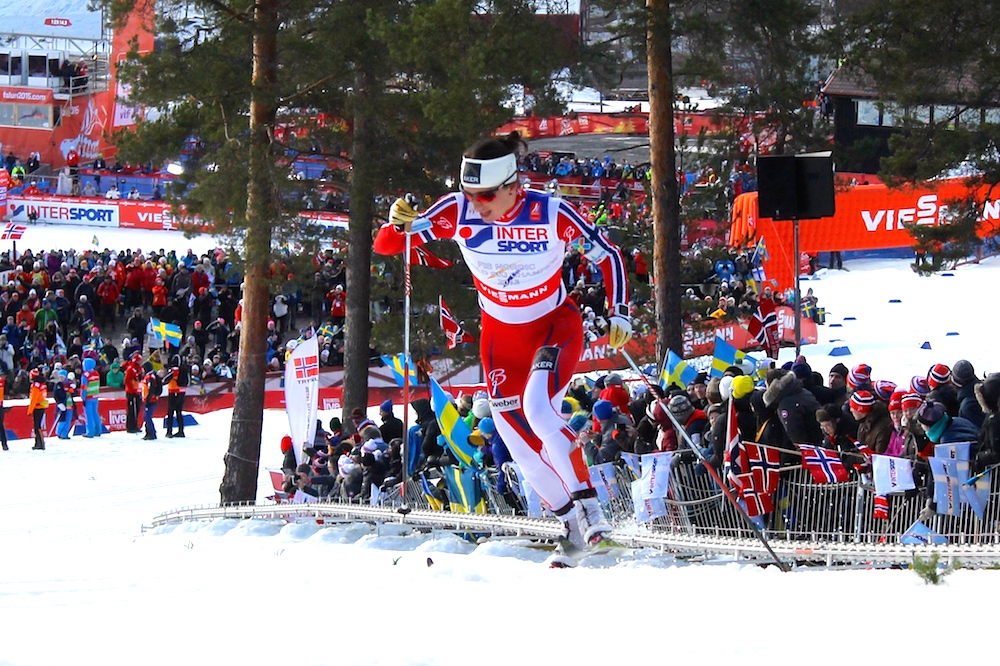
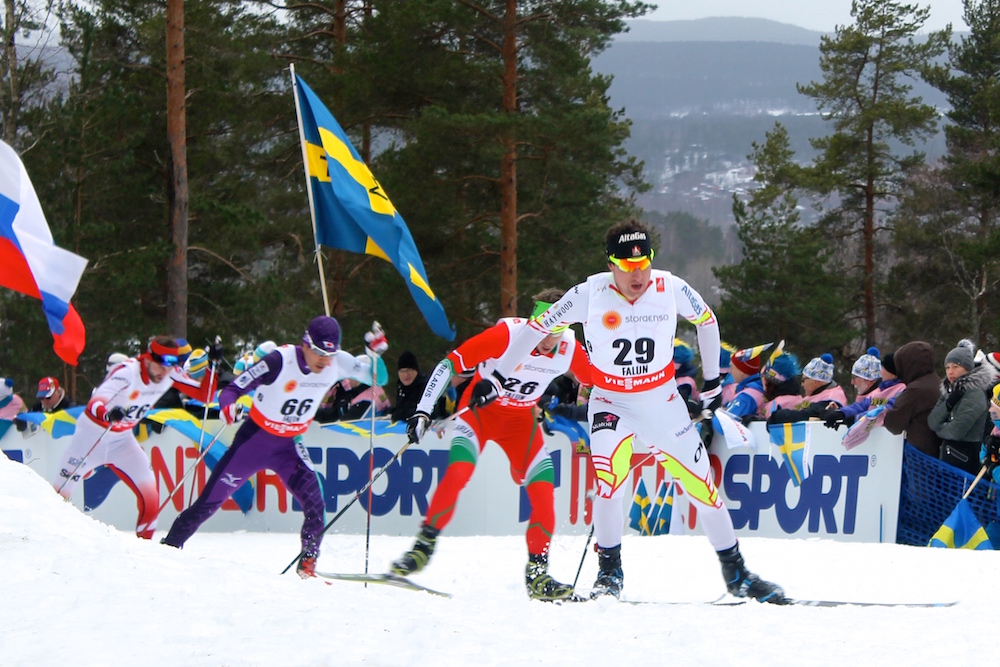
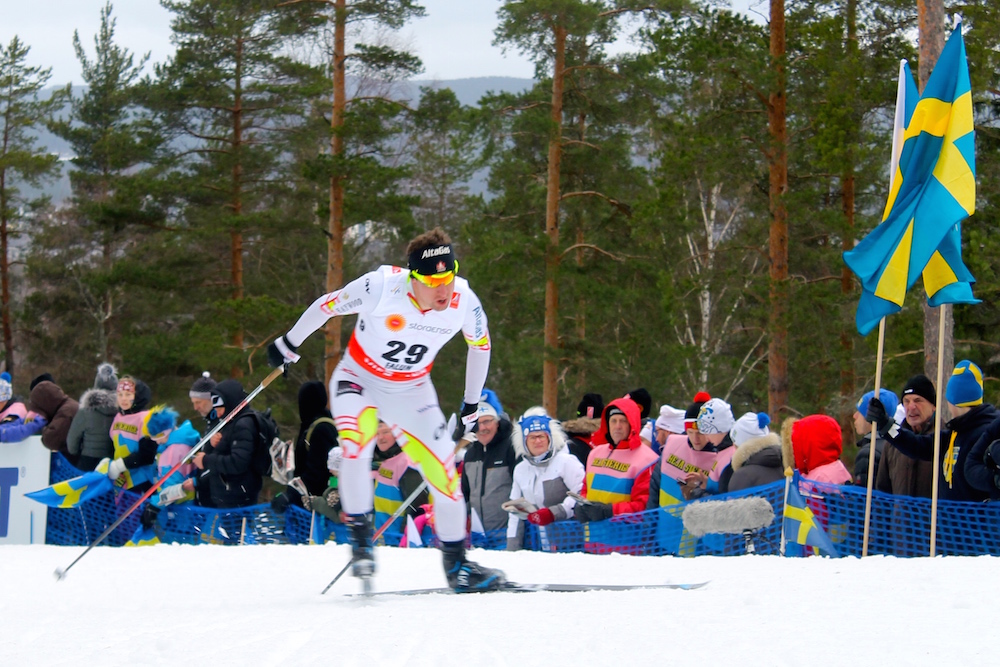
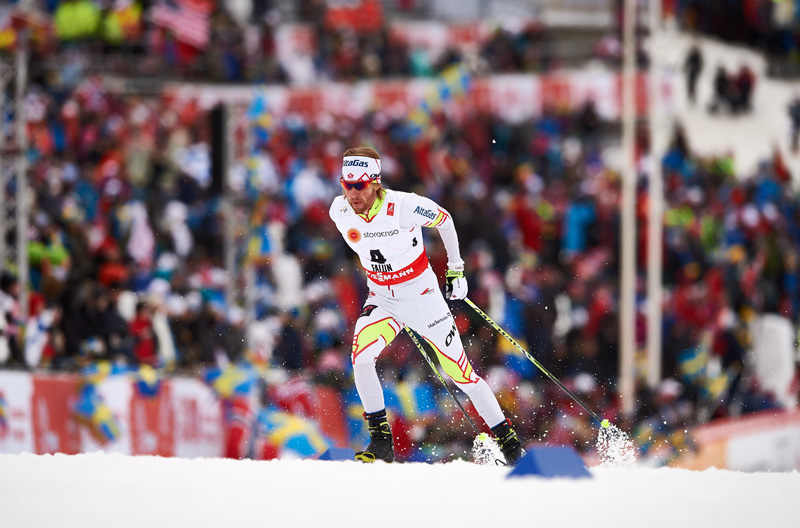
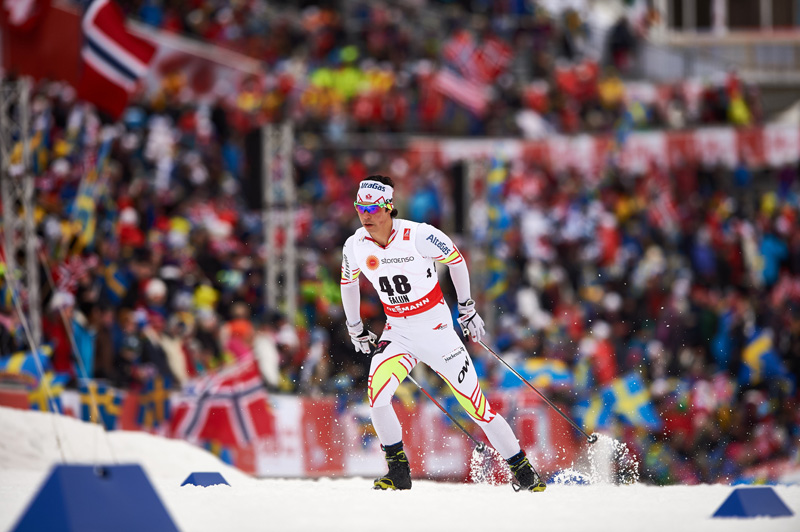
Taylor Fletcher delivered the 2015 FasterSkier nordic combined performance of the year. (photo: Flyingpointroad)
Taylor Fletcher
The youngest of the two Fletcher brothers is doubling up with his second FS Award of 2015, this time in the performance category for his showing in Sapporo, Japan.
There in late January, Taylor, 24, rose from 28th on the large hill to third in the 10-kilometer Gundersen start with the fastest cross-country time for his second-career World Cup podium.
He worked with older brother Bryan, who jumped to 27th and started two seconds ahead of him, as the two tried to pick off the places with a “controlled but quick pace,” according to Taylor.
While Bryan was battling sinus/head cold symptoms in Japan and planned to settle into the lead group once they caught it, Taylor wasn’t ready to let up.
“Taylor went right to the front, as soon as he did that the group shattered and guys were coming off the back,” Bryan recalled.
Taylor continued to push the pace, dwindling the pack of 15 into two remaining groups of three and five. Ultimately, the race came down to an all-out sprint for the final 1 1/2 kilometers.
“It was a matter of putting yourself in a position at the end,” Taylor wrote in an email. “I decided it was better to ‘Go Ugly, Early’ and not wait for the field sprint. So just into the first hill I made almost a cycling attack and tried to get away from the rest of the skiers.”
Two men passed him in the stadium before the finish: German winner Eric Frenzel, who topped him by 3.5 seconds and Japan’s Akito Watabe, who was 1.7 seconds ahead of him in second. The bronze medal marked Taylor’s second individual podium since 2013 in Seefeld, Austria.
“To get another podium feels incredible as I knew it was possible,” Taylor wrote. “My last podium was not a fluke. I have been struggling with my jumping for a year and half now but in the last couple weeks it has been getting better.”
Honorable mention
Bryan Fletcher
While Bryan placed eighth that day in Sapporo and skied the second-fastest 10 k behind his brother, that wasn’t the single performance that earned him honorable mention.
At 2015 World Championships in Falun, Sweden, the 28-year-old Bryan notched his season-best individual result (and career best in four World Championships) of fifth in the large-hill/10 k. He skied up from 13th to do so.
“It was like, ‘Well since these are the Championships, and it’s not really worth being anything but on the podium, I’m just going to go for it as hard as possible and lay it all out there,’ ” he recalled.
He started 44 seconds behind Austria’s Bernhard Gruber, who led the competition after the jump, and finished 23.4 seconds behind Gruber, who also won outright. Bryan was 8.5 seconds off the podium and 8.3 seconds out of fourth.
“To be on the podium would have been a dream come true, but to be in the fight was more what I was really looking for,” Bryan said after his career-best World Championships individual result.
“I really just want to ski a good race, a good race to the best of my ability and the best of my performance,” he added. “I was happy that I was able to do that today.”
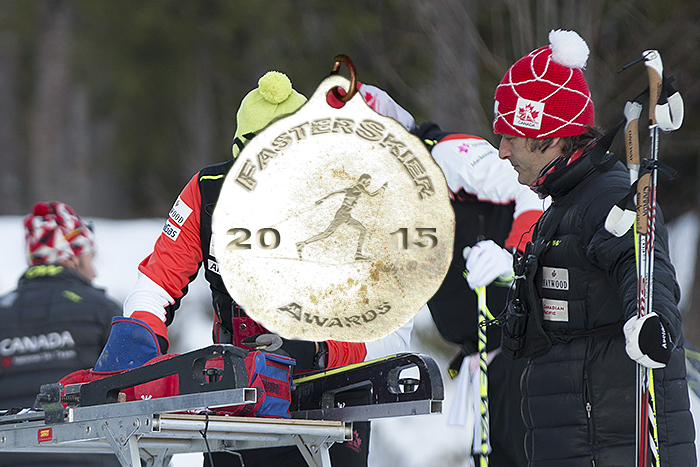
Louis Bouchard (r), a Canadian World Cup Team coach and Alex Harvey’s personal coach, at work with the team’s wax staff. Bouchard is FasterSkier’s pick for 2015 Coach of the Year. (Photo: Cross Country Canada)
With the 2014/2015 season officially in the rearview, FasterSkier is excited to unveil its annual award winners for this past winter. Votes stem from the FS staff, scattered across the U.S. and Canada, and while not scientific, they are intended to reflect a broader sense of the season in review.
***
Louis Bouchard has been Alex Harvey’s go-to coach for the last decade and the man in charge of the Pierre-Harvey Training Centre — one of three national training academies in Canada — for 15 years.
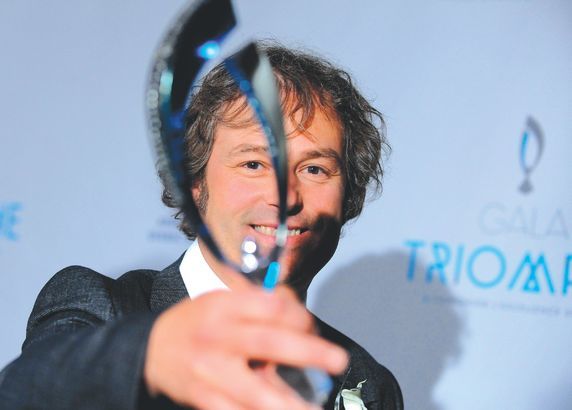
Also Cross Country Canada’s co-World Cup coach, Bouchard is well known across the country and internationally. He’s won multiple awards, including the 2014 Gala Triomphe International Coach of the Year, one of 15 accolades recognizing top athletes, coaches, volunteers, and sporting events around Québec City.
Louis Bouchard, Gala Triomphe 2014 Coach of the Year (Photo: CCC/Simon Clark)
The soft-spoken French Canadian re-entered the spotlight this past February when Harvey, 26, lunged for a best-ever silver in the classic sprint at 2015 World Championships in Falun, Sweden. Not only had Harvey outdone his previous best of third in the classic sprint at 2013 World Championships, he also secured an important initial medal for Canada.
“Now we can expect so many things,” Bouchard said after the Falun sprint. “You need it for the program. You need it for the development. That is a benefit for everybody in Canada, so that is good.”
Development was key when it came to Harvey’s rise to two individual medals at 2015 World Championships in the classic sprint and the skiathlon (in which he took bronze two days later).
“He’s more stable, he has less injury, he can train more and recover more, so I think it’s normal to expect to see him get better and better at 26 years old,” Bouchard said.
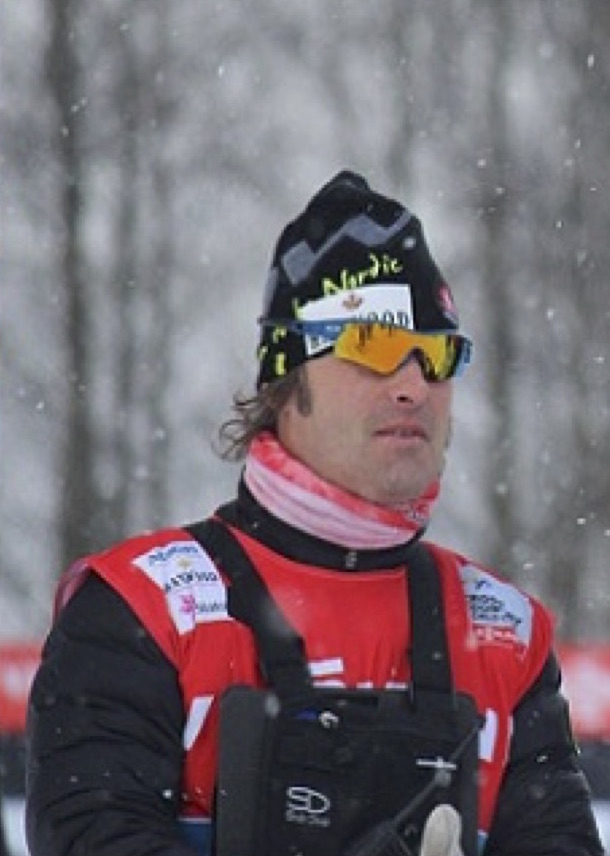
Louis Bouchard (Photo: CCC)
And Bouchard is also responsible for developing a strong contingent of up-and-coming skiers in and around Québec City. Five of his athletes were nominated to the 2015/2016 national junior team (Anne-Marie Comeau, Marie Corriveau, Phillipe Boucher, Zachary Cristofanilli, and Olivier Hamel), and Cendrine Browne was one of five women named to Canada’s senior team (specifically, the C-U23 development team).
“I spend a lot of time thanking the people who occupy each of the development stages in my sport. Without them, I would not have this success,” Bouchard said after receiving his 2014 Gala Triomphe award, according to a translation. “I’m just finishing a job that was started long ago with Alex, as well as other athletes. All these people are important.
“We have developed a healthy human relationship exchange,” he added. “Alex is an academic, me, coach. He teaches me and I learn it.”
This season, Bouchard and national-team head coach Justin Wadsworth will trade off weekends heading the World Cup Team in Europe. The two have worked together with the team’s highest-level athletes for the last five years.
“Louis and I [have] a great relationship and great communication,” Wadsworth said shortly after CCC announced its integrated coaching structure in April. “I think that working relationship now is almost stronger than ever.”
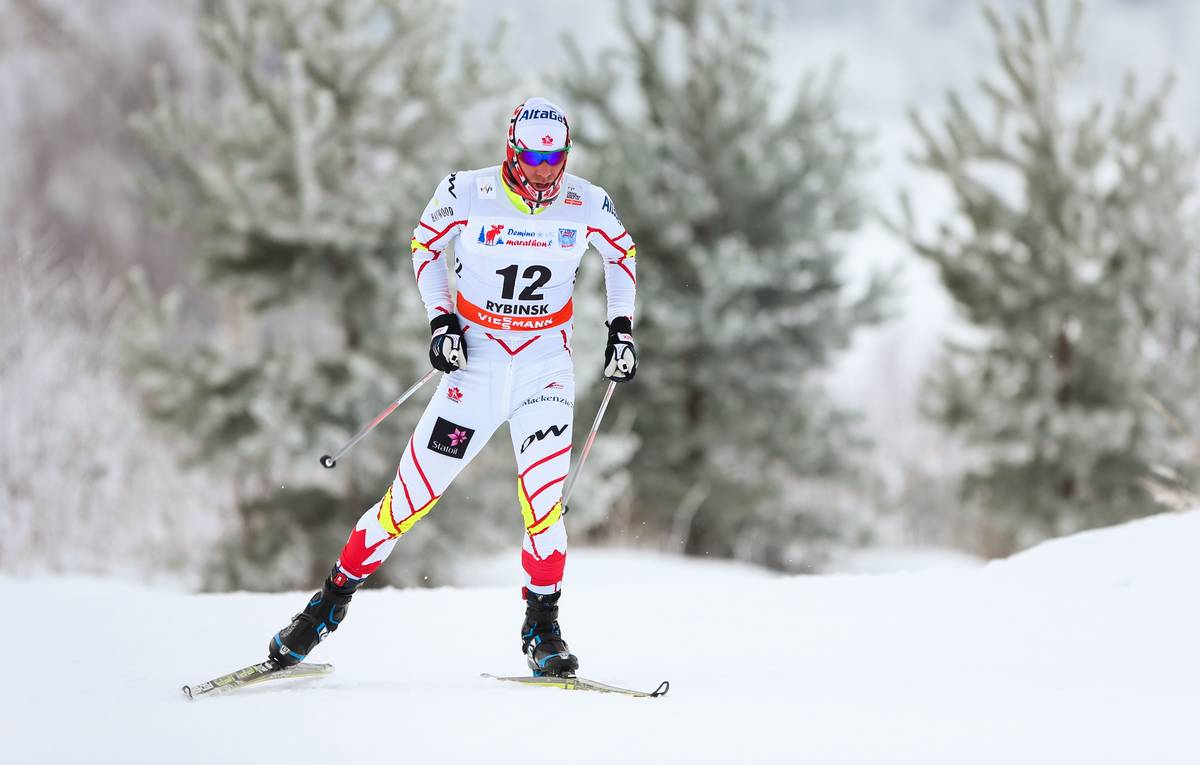
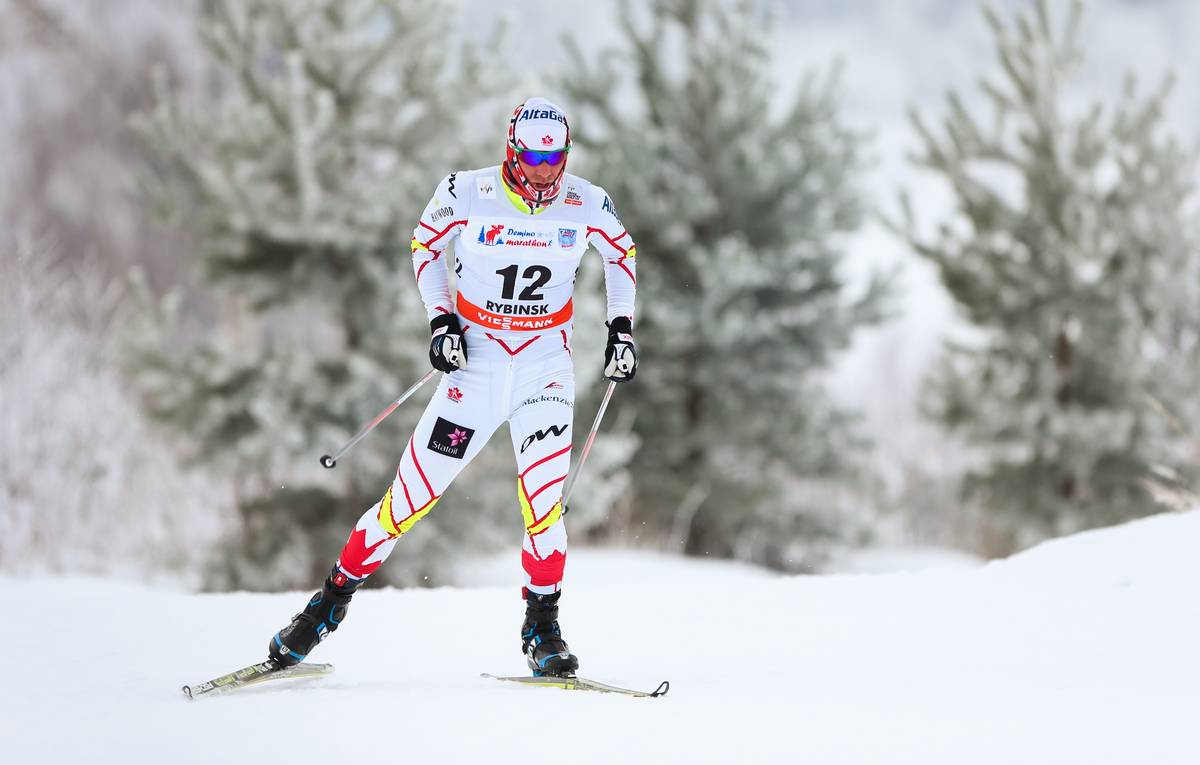
Devon Kershaw (Canadian World Cup Team) racing to 36th in the World Cup 15 k freestyle individual start on Jan. 23 in Rybinsk, Russia. (Photo: Fischer/NordicFocus)
What started out like any other cold turned into a season-ending downward spiral for Devon Kershaw, who, in the midst of what would have been his eighth World Championships, had to forgo racing and head to his fiancée’s home in Oslo, Norway, to recover.
A day after being diagnosed with mycoplasma pneumonia, commonly known as walking pneumonia, Kershaw found himself in the car last Saturday with his mom and fiancée Kristin Størmer Steira’s parents — driving from Falun, Sweden, to Oslo.
It all happened fairly fast, but the 32-year-old Canadian World Cup Team member couldn’t say he didn’t see it coming.
“The World Cup weekend in Östersund [Sweden], I came down with a really light cold, nothing that serious, just had a little bit of coughing and not feeling that good and a little bit of congestion,” Kershaw, a 2011 World Championships team-sprint champion with Alex Harvey, said in a phone interview on Wednesday.
“It was a really wussy cold, but I wanted to be careful ahead of World Championships so I didn’t travel down with the team from Östersund to Falun,” he explained. “I stayed up in Östersund, but I just never got better and the races kept ticking by.”
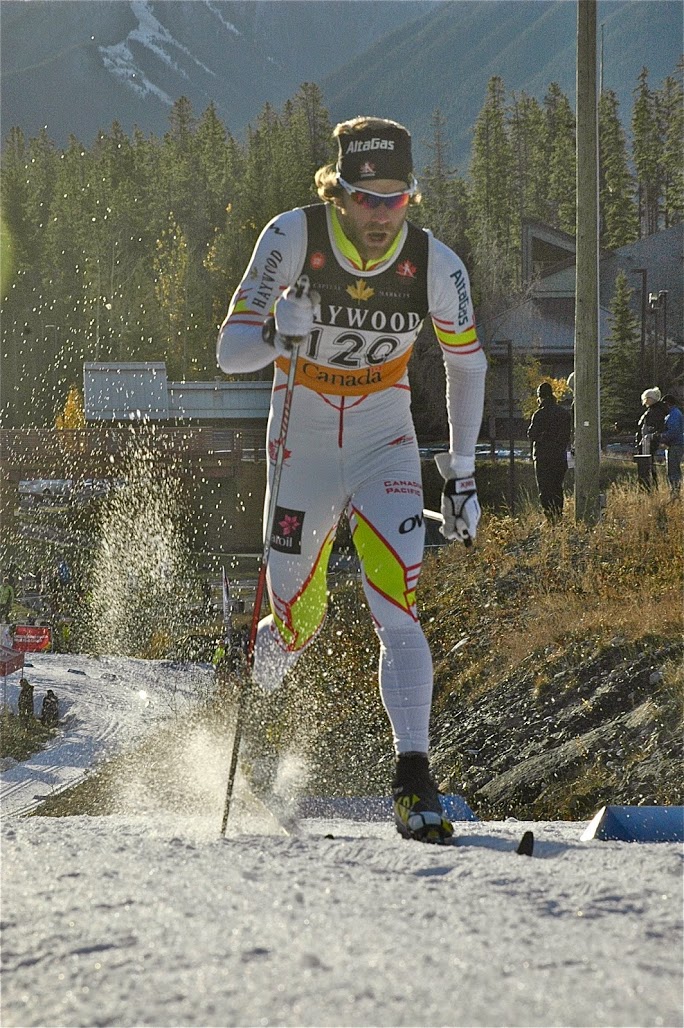
Devon Kershaw tuning up his classic sprinting in a preseason race on Oct. 24 at Frozen Thunder at home in Canmore, Alberta. (Photo: Angus Cockney)
At World Championships in Falun, Kershaw had planned to do the classic sprint, 30-kilometer skiathlon, 4 x 10 k relay, and 50 k classic mass start, as well as the team sprint if he raced well enough to make the two-man team.
But with each passing day and little improvement in his health, the races went on without him. Kershaw remained in Östersund until Sunday, Feb. 22, when he drove to Falun with three other teammates that had been fighting illness as well. While each of them got better and competed in the championships, he didn’t.
The morning of his trip to Falun, Kershaw started coughing uncontrollably. Unable to stay in Östersund, he traveled with his teammates to Falun. Burdened with a dry cough there, he felt his energy had improved.
“I think I started lying to myself because I really wanted to race the relay on Friday,” he reflected. “I was trying to ski, but I didn’t do any intensity or anything and it was just getting worse and worse. I wasn’t sleeping that well because every time I lied down I’d cough incessantly and we didn’t have a team doctor with us at that point.”
By the time he got there, Harvey’s mom, Canada’s volunteer doctor for beginning of World Championships, was already on her way fly back to Quebec.
“That week we didn’t have the team doctor with us,” Kershaw explained. “Thursday I tried skiing again and realized really fast that I wasn’t going to be able to do [the relay]. I was just feeling way too bad and coughing like crazy, couldn’t ski at all without having to stop and really cough, like lung-busting coughing.”
He arranged to meet with Norway’s team doctor, Knute Gabrielsen, and physiologist, Erland Hem, whom he described as an expert on lung function.
“They checked me out and did a bunch of tests and it turns out I had mycoplasma pneumonia,” Kershaw explained. “That ended my World Championships and ended the season actually. There’s only two weeks left of the season and I won’t be able to recover in time to do the 50 k in Holmenkollen [on March 14]. It’s too close. Especially a 50 k race, it’s not going to happen.”
He last raced Jan. 25 at the World Cup in Rybinsk, Russia, where he was 34th in the 30 k skiathlon and 36th in the 15 k freestyle on Jan. 23.
“I’m gutted,” he said. “My season ended before it started. Like every team, my training was really tailored towards the four [or] five races at the World Championships and I felt like I was in really good shape coming out of the training camp we did, and I have a lot of experience, too, so I trust that shape. … To not even get the chance to use it at all is really discouraging.”
“It’s like my car broke down on the way to the exam, but I live like far away and there’s no way I can get to the exam, and I got a zero.” — Devon Kershaw on having his season end with walking pneumonia
He started on antibiotics as soon as he was diagnosed, but as of Wednesday of this week, Kershaw said they didn’t seem to be working as well as he’d hoped. He wasn’t sleeping through the night and the inhalers he was on hadn’t cleared his lungs.
“I think the name of the game is really just patience,” he said.
Looking back on his season, essentially two months long, Kershaw described it as “bad,” with highlights at the World Cup opener in Kuusamo, Finland, where he placed 14th in the 15 k classic, and in the Tour de Ski freestyle sprint, when he qualified for the first time this season and finished 22nd. Over the next two stages of the Tour, he placed 21st in the 10 k classic and 25th in the 25 k freestyle pursuit.
“If you look through my history, my speed before Christmas … especially in sprint qualifiers, is usually pretty bad. I think I’ve only been in the final once before Christmas in my whole career,” he said. “So I wasn’t qualifying before Christmas, which was kind of normal but a bit frustrating and skating was a real problem…
“The Tour wasn’t spectacular by any stretch of the imagination; it started actually quite bad. Again the skating just wasn’t quite feeling that great,” he continued. “We had a major debacle with the skis in the 15 k [classic] mass start in Val di Fiemme the [second-to-last stage] of the Tour de Ski and that destroyed all our chances. Ivan [Babikov] and Alex and myself, we were minutes behind with like some of the worst skis I’ve ever had. That ended the Tour right there, which was tough. [Then leading up to] Rybinsk, I was training a ton and doing a lot of volume and my mind was on the World Championships so it didn’t really work out that well in Rybinsk, either…”
So that was it. For the last week, Kershaw said he was doing his best to pass the time, playing some guitar and trying to get his energy back. Once he started feeling better, he planned to finalize some wedding plans with Steira in Lofoten, a group of islands in northern Norway. The two have a wedding date set there for July 26.
He also planned to get an X-ray in a month to check on his recovery.
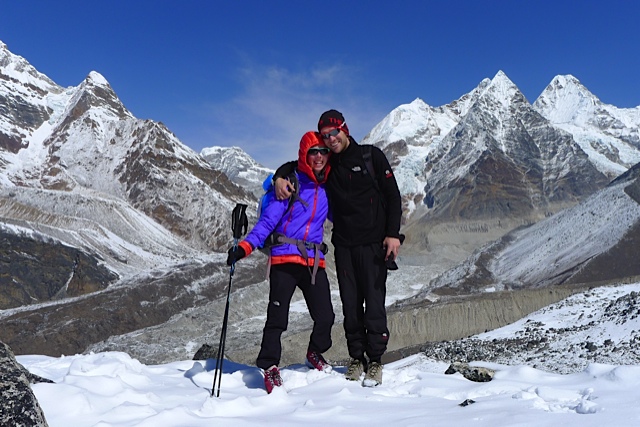
Kristin Størmer Steira (l) and Devon Kershaw during a day hike on one of their acclimatization days in Nepal’s Himalayas. The couple got engaged last April after summiting Mera Peak during a three-week trek. (Photo: Devon Kershaw)
Meanwhile, Steira was taking classes toward her MBA degree and healing a foot injury she sustained on a run two days before the 30 k classic mass start at World Championships. That prevented the 33-year-old Norwegian from competing in what would have been her seventh World Championships. A fractured pelvis previously derailed the first half of Steira’s season.
“This week she’s trying to get some answers and in the meantime she’s going to school,” Kershaw said on Wednesday. “She’s had an MRI done, but she hasn’t heard anything yet. She’s pretty discouraged, too. She trains so hard. To come back from a fractured pelvis and even make the Norwegian [World Championships] team is ridiculous. I was really proud of her. When she called me and said, ‘I can’t kick my skis. My foot’s really sore,’ I’m just like, ‘What? Two days ago you were just so smiley and good and loving it and things were great.’ So she had some really bad luck, too.”
If Kershaw is feeling up to it and still in Oslo (not up north in Lofoten) next weekend, he explained he would watch the 30 and 50 k season-ending World Cup races in Holmenkollen.
“That might be wishful thinking, but we’ll just see how the body recovers,” he stated. “It’s always so hard to watch races that you want desperately to be competing in, but that’s life sometimes and you got to take your knocks on the chin and keep going.”
In late April, he said he’ll head back to Canada to hopefully do some ski touring before revving up for another season. If Steira’s foot injury isn’t too serious, she’ll likely join him in May in Canmore, Alberta.
“I would like to ski next year purely because you can’t go out like this,” Kershaw said. “I showed that I can still ski at an international level and I know that I can still do the training that allowed me to. I was in good shape before all this happened and I know that’s lip service now, but at the same time I do have a wealth of experience. It’s not like I was getting murdered-murdered on the World Cup every weekend.”
Next year, he’s looking forward to competing at 2016 World Cup Finals, dubbed the Tour du Canada, which will take place at five venues across Canada: Gatineau, Montréal, Québec City, Canmore, and Lake Louise.
“Racing at home like that is a pretty incredible opportunity,” Kershaw said. “In the short term, it’s hard mentally, you feel like you’re beat up. You did so much in preparation. I’ve already trained 800 hours already this year and all for what? At the end of the day you’re like, God damn. It’s like my car broke down on the way to the exam, but I live like far away and there’s no way I can get to the exam, and I got a zero. Not being able to sit down and write it is going to take some time to get over for sure, but I’m still keen and I think we have a good team.
“This year for sure, Alex has been a major standout. For the last two seasons, no questions, Alex has been keeping our team afloat because others, myself included, we haven’t delivered like we have in the past,” he added. “So it’s time for us to start pulling our weight a bit joining Alex on the international level. I’m still motivated, absolutely, but you want to do it properly, too. We’ll just have to see how long it takes to fully recover from this.”
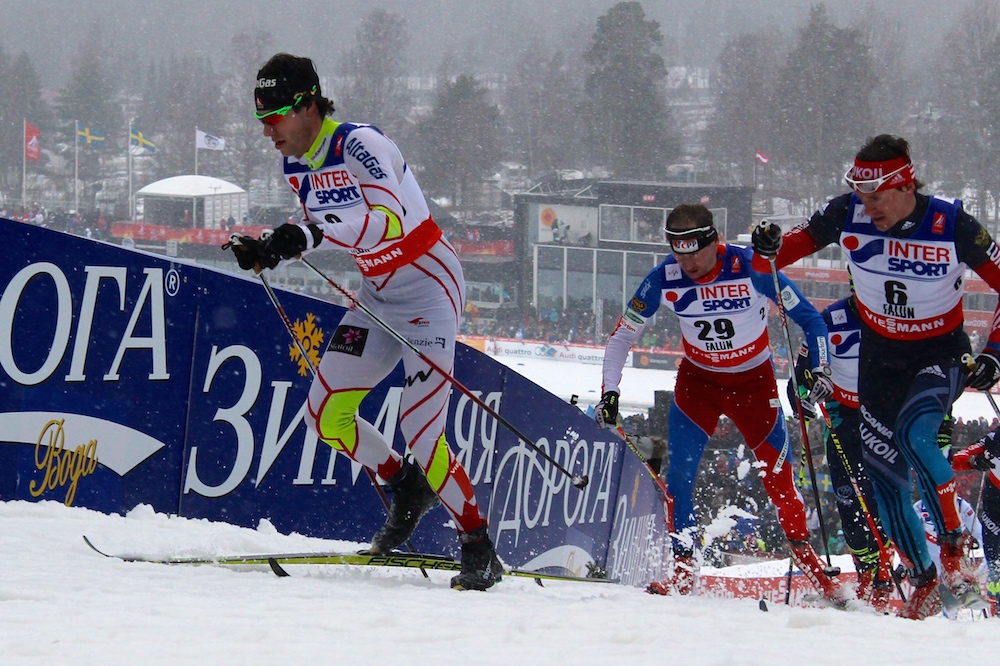
Canada’s Alex Harvey (l) leads Russia’s Maxim Vylegzhanin (4) and the Czech Republic’s Lukas Bauer (29) up a steep hill around 29 k in the men’s 50 k classic mass start at 2015 World Championships in Falun, Sweden.
FasterSkier’s coverage of the 2015 FIS Nordic World Ski Championships in Falun, Sweden, is brought to you by the generous support of L.L. Bean, now featuring a complete line of Kikkan Randall training wear.
FALUN, Sweden — After two medals at the 2015 FIS Nordic World Ski Championships, it was easy for Alex Harvey to think what could have been in the moments after the men’s 50-kilometer classic mass start on Sunday.
He had just been recognized at a snowy medals ceremony, held in the center of the stadium on the final day of Falun’s World Championships. But instead of a gold, silver or bronze, the 26-year-old Canadian received a wooden horse.
Fifth wasn’t what he had gone into the race hoping for, and had he made a few different decisions during it, Harvey couldn’t help but speculate he would have been in podium contention by the finish.
“I should have adapted my strategy better in the race and not try to go for the breaks,” Harvey said, noting the snowfall and choppy conditions made it nearly impossible to ski away from the group. “It is my best championship ever so I am really happy, but today, it felt like I could have got a bit better.”
Conditions were as slow as they get on Sunday, once again a few degrees above freezing and with wet snowfall — which came down heavily at times during the race — that made the salted course even softer.
“It was one of the slowest 50 k’s in modern history,” Harvey said, referring to the winning time of 2 hours, 26 minutes. “It was slow everywhere.”
“Some places it was perfect, really nice, and some places it was just mashed potatoes,” said his teammate, Ivan Babikov. “Couldn’t ski, couldn’t walk it, especially at the beginning of [each] lap, it was really bad. … The last uphill was the worst … just going in knee-deep slush.”
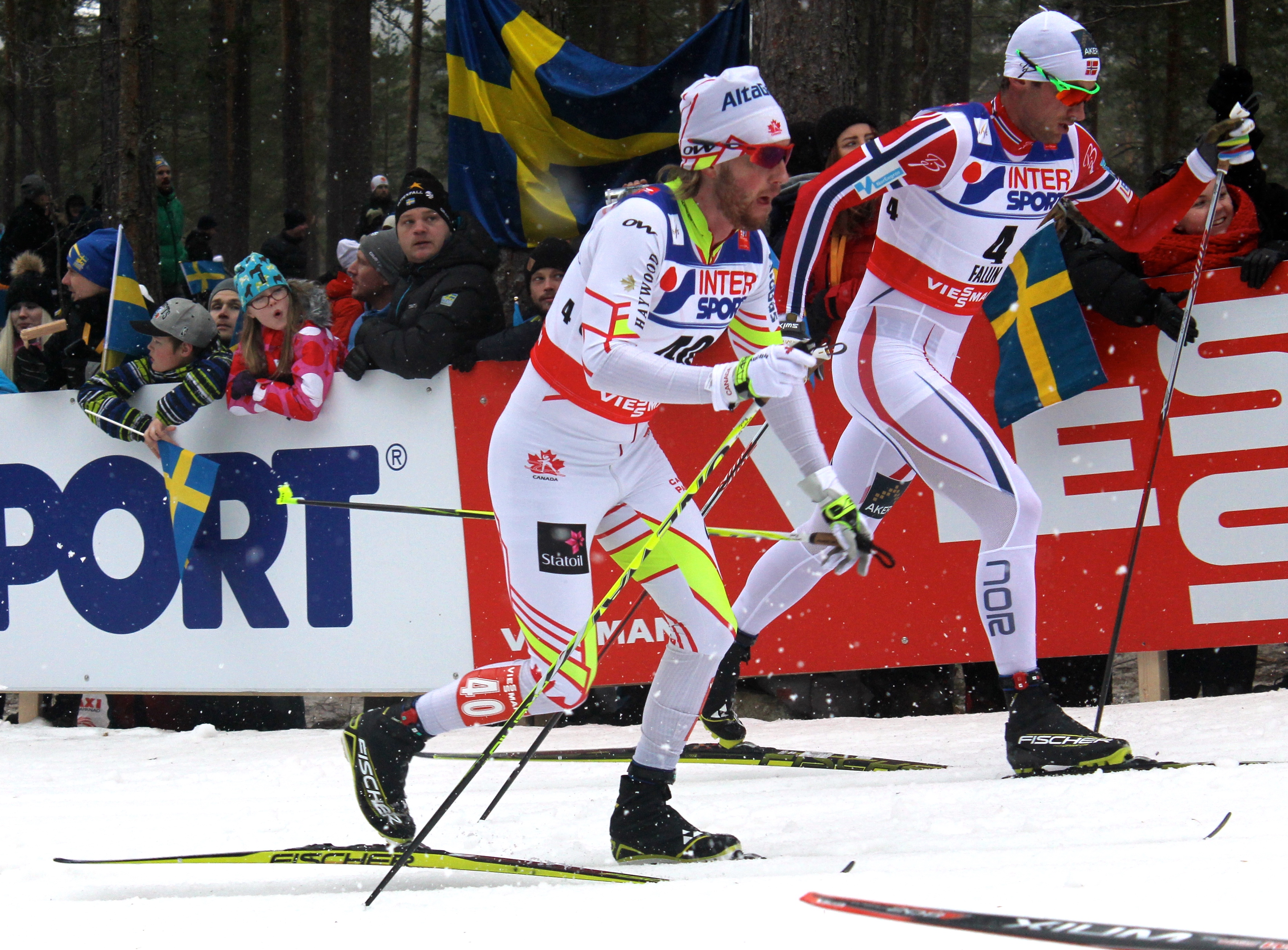
Canada’s Graeme Killick skiing with eventual winner, Petter Northug of Norway (r), around 14 k of the men’s 50 k classic mass start at 2015 World Championships. Killick went on to place 19th for a career-best international result.
Canada’s third man in the race, 26-year-old Graeme Killick, found the hardest part to be the initial ascent out of the stadium.
“It was so loose, you felt like you needed a canoe to get through [it],” Killick said.
Harvey, Babikov and Killick all put themselves squarely in the lead pack out of the start. At 3.3 k, Harvey and Babikov were in the top seven, within 2.4 seconds of the leader (Norway’s Didrik Tønseth at the time). Upon returning to the stadium at 5 k, Harvey and Babikov skied together in seventh and eighth, still 2.4 seconds back, while Killick was another eight seconds behind in 30th.
After topping the biggest climb on the course, affectionately known as Mördarbacken, Babikov and Harvey led the 49-man pack with American Noah Hoffman and Great Britain’s Andrew Musgrave just behind them. There, at 7.8 k, Killick was 2.4 seconds back in 13th.
“When you’re going easy, you might as well be in the front, because then that’s when everybody’s sketchy on the downhills,” Harvey explained. “There’s guys who are not going easy just to follow that pace, and they’re sketch on the downhills. So when the pace is that slow, it’s good to be at the front.”
At the bottom of the course at 10 k, Babikov was still in the lead, just ahead of Hoffman and Finland’s Matti Heikkinen, as well as Sweden’s defending 50 k world champion, Johan Olsson. Over the next 10-plus kilometers, Olsson took control up front, sharing the workload with competitors like Heikkinen, Tønseth and Russia’s Maxim Vylegzhanin.
But the Swede never made the move that Harvey, for one, was waiting for.
“Everybody thought Olsson would try to break away,” Harvey recalled. “He was trying — he would open 15-second gaps and stuff, but it would always come back on the downhill.
“I should have read the situation better and adapted the plan more than I did,” he added. “I knew Olsson was in good shape and really motivated, but with the snow falling there was … no point trying to break away. [I] spent a lot of energy there.”
Norway’s Niklas Dyrhaug and Sweden’s Anders Södergren spent some time in the limelight leading for much of the third of five 10 k complete laps.
At 27.8 k, once again at the top of Mördarbacken, Harvey led again, ahead of Vylegzhanin and the Czech Republic’s Lukas Bauer, while Olsson hung in seventh, 5 seconds behind. Killick and Babikov were about 12 seconds back in the top 30.
At 30 k, Olsson left the stadium first, 0.9 seconds ahead of Vylegzhanin and 1.5 seconds ahead of Kazakhstan’s Alexey Poltoranin in third, while Harvey skied 1.9 seconds back in fourth. Babikov was within four seconds of the lead in sixth, and Killick was just 6.2 seconds back in eighth.
“Our skis were just amazing,” Killick said. “You can feel better than what you’re actually at so I was keeping that in mind, just trying to stay as relaxed as possible and even if I felt like I could be skiing right up at the front, just trying to stay relaxed in the top 15 there and not overdoing it on the steeps and using the skis on the downhills to get back in there.”
Ivan Babikov (20) leads Canadian teammate Alex Harvey (l) up Little Mördarbacken around 34 k into the men’s 50 k classic mass start at 2015 World Championships in Falun, Sweden.
Team tactics weren’t a part of the plan, according to Canadian National Team Head Coach Justin Wadsworth. But with three men in the lead pack, it made the race a lot more fun for the Canadians.
“It’s always easier to ski with your teammates,” Wadsworth said. “When they could do that, they were taking advantage of it. Everybody had good skis and you kind of feel a little something extra when you see your whole team up there in the front of the race for most of the race.”
Like everyone else in the race, Harvey and Killick changed their skis twice, but Babikov was one of two skiers out of 45 finishers that switched just once (Japan’s Hiroyuki Miyazawa was the other).
“I couldn’t believe that my skis were so good,” Babikov recalled.
One reporter thought he saw him laughing at one point.
“I was just smiling,” Babikov said. “I was enjoying myself.”
Around 34 k, Babikov went several meters off the front of the pack while Harvey and the rest of the group followed up Lille “Little” Mordarbacken. Both he and Harvey said the pace was slow at the time — Harvey described it as Zone 2 — and at the tops of a series of hills, Babikov glanced back, stopped and waited for everyone else to catch up.
“I didn’t realize I had a gap,” Babikov said. “It was maybe a bit foolish, but I had no idea. It was not my intention to drop the pack, I was just trying to keep the pace up [the hill] the same.”
“I couldn’t believe that my skis were so good … I was just smiling. I was enjoying myself.” — Ivan Babikov, Canadian World Cup Team member, after leading several parts of the 2015 World Championships 50 k classic mass start
At 35 k, Babikov and Killick blew past the pit stop to leave the stadium in first and third, respectively, with Bauer between them. Harvey opted to use his second available ski change and emerged from the stadium in 13th, 16 seconds back. Just over a kilometer later, Harvey was back in sixth, 12 seconds behind Södergren, who by then had opened up a nine-second gap on Olsson in second.
“We said change if your skis don’t feel good; we kind of gave him the option,” Wadsworth explained. “Killick kept going and Babs kept going, but Harvey changed, and you never know, maybe that was the right [decision].”
Ivan Babikov (Canada) leading around 34 k into the men’s 50 k classic mass start at 2015 World Championships in Falun, Sweden. He went on to place 30th.
About a kilometer later, on the far side of the course, someone skied over Babikov’s pole and broke it, Babikov said. He dropped to 24th, nearly 28 seconds out.
“I fell out of the group; it took some energy to get back,” Babikov said. “Maybe that cost me.”
By 40 k, the pack had pulled Södergren back in, with France’s Maurice Manificat, Vylegzhanin and Harvey leading the effort. Killick hung in 21st, 36 seconds back, and Babikov was in 27th, nearly 50 seconds out of first.
“It was really good for two-thirds [of the race],” Babikov said. “Last 10 k, that was really rough, I started cramping everywhere. I couldn’t even sit down on the downhill.”
Throughout the final 10 k, the pace picked up considerably, with Harvey pushing to keep himself in the medal hunt while skiing in the top 10.
“He looked strong, but the pace was going hard and I could tell he was trying to position himself, but not quite getting into the top four,” Wadsworth said.
That is, until he put himself in fifth by passing Switzerland’s Dario Cologna in the stadium before the finish. Coming off a high-speed downhill, he used his momentum to slip past Cologna and stay ahead of him on the final rise and curving descent toward the finishing straight.
“With five k to go, or by the top of Mördarbacken, I started getting low-energy levels,” Harvey said. “I was still in contention on the [final steep uphill] and then I was completely spent. … There was just four guys ahead of me by [the last rise], so I was still within reach of the podium, but I couldn’t move. I couldn’t make any speed.”
Canada’s Alex Harvey (9) works within a chase pack around 39 k with Russia’s Maxim Vylegzhanin (6), France’s Maurice Manificat (7), and Sweden’s Johan Olsson (r) during the men’s 50 k classic mass start at 2015 World Championships in Falun, Sweden.
He finished 6 seconds after Norwegian winner Petter Northug, while Bauer took silver, 1.7 seconds back, and Olsson edged Vylegzhanin for third by 0.8 seconds. Harvey finished 3.2 seconds later in fifth.
“I didn’t have anything left,” he said.
Killick placed 19th (+1:44.1) for his best international result after placing 28th in the 50 k freestyle mass start at the Olympics last year. With that performance in mind, he said he aimed for a top 30 on Sunday.
“I was just hoping I would hang in there and not cramp on the last few laps,” Killick said. “[When it comes to] 50 k’s, it seems like they’re really hit and miss for me. Domestically I’ve struggled to get top 15, but internationally, my best results have been in the 50. If I’m in shape, they can go really well, but I would say the focus for me [at World Championships] was the pursuit [skiathlon], which I didn’t end up doing because I got sick in Östersund two weeks ago. When that was out, the 50 became the main focus.”
He said the fans lining the course, which included his parents and girlfriend, helped motivate him in the tough conditions.
Graeme Killick, of the Canadian Development B-team, after finishing a career-best 19th in the 50 k classic mass start at 2015 World Championships in Falun, Sweden.
“Just the whole way up Mördarbacken, they’re cheering you the whole way,” he said. “It gives you the little bit extra to get up the hard hill like that.”
Reflecting on his season so far and first World Championships, Killick, a Canadian National Development B-team member, said he was excited about his prospects.
“This year I was able to start on the World Cup for the first time in my career and spend a significant portion of the year over here,” he said. “Just seeing the level and seeing how these guys train and race I think has given me a lot of ideas for next year. I’m really excited to try to take the next step and become a contender here on the World Cup.”
Babikov finished 30th (+3:48.4), and he said he was pleased with his effort, all things considered.
Canada’s Alex Harvey after finishing fifth in the 50 k classic mass start at 2015 World Championships in Falun, Sweden.
“It was a bit too much for me at the end, just a bit of the on-and-off pace, and that’s what put me under,” he explained. “I used what I had today. I gave my 110-percent for sure.”
With three men competing out of a possible four (Kershaw had to skip the one race he planned to compete in at World Championships after being diagnosed with walking pneumonia), Wadsworth spoke positively about their results.
“They all skied pretty strong, and fifth place is not bad,” Wadsworth said. “We were obviously hoping for a medal, but it’s been a good championships.”
For most everyone on the team, he said the results met or exceeded expectations. And it took a total team effort, from the wax technicians, who “nailed the skis so many times in a row” to Cross Country Canada’s high-performance director Tom Holland “running around the grocery store, buying food for our cook,” Wadsworth said.
“We brought a strong team that came here and all did well,” he said. “That’s awesome. That’s what we’re looking for.”
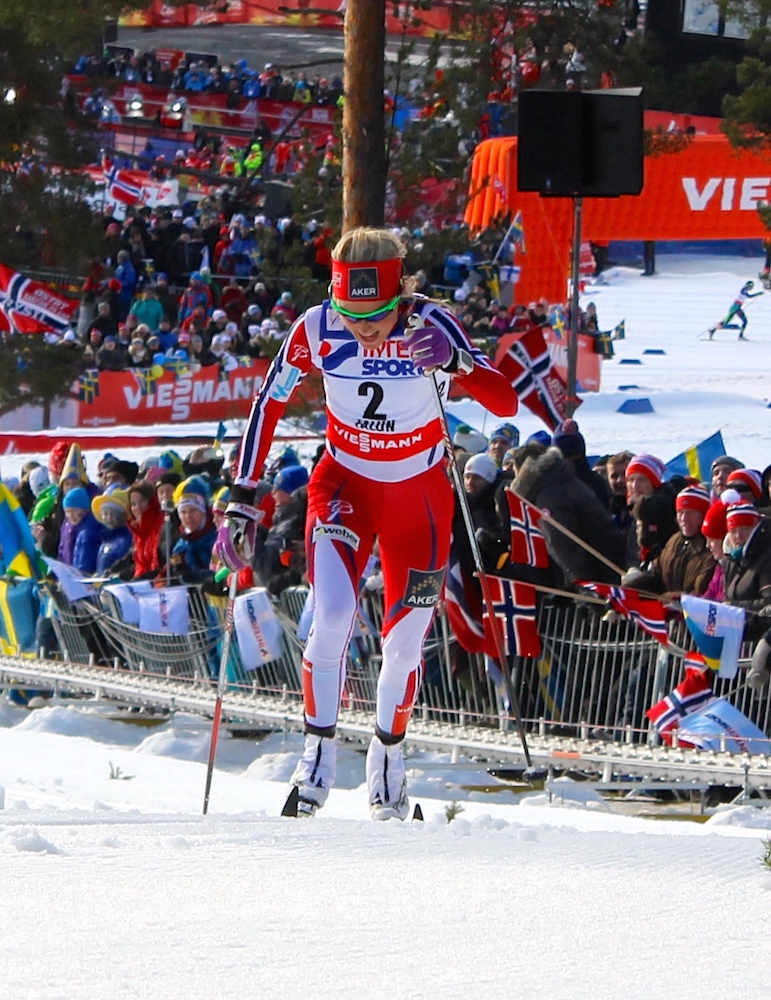
Norway’s Therese Johaug, still attacking on one of the final climbs of the 30 k classic course at 2015 World Championships in Falun, Sweden. She went on to win by 52.3 seconds for her first 30 k classic title.
FasterSkier’s coverage of the 2015 FIS Nordic World Ski Championships in Falun, Sweden, is brought to you by the generous support of L.L. Bean, now featuring a complete line of Kikkan Randall training wear.
FALUN, Sweden — While Therese Johaug made Saturday’s 30-kilometer classic mass start look like a solo walk in the park, the 26-year-old Norwegian’s race didn’t come without some serious anxiety.
The first minor cause for concern came around 7 k. Skiing at the front of the 49-woman pack out of the start, Johaug found herself leading with teammate Marit Bjørgen, Sweden’s Sofia Bleckur and Charlotte Kalla, and Poland’s Justyna Kowalczyk.
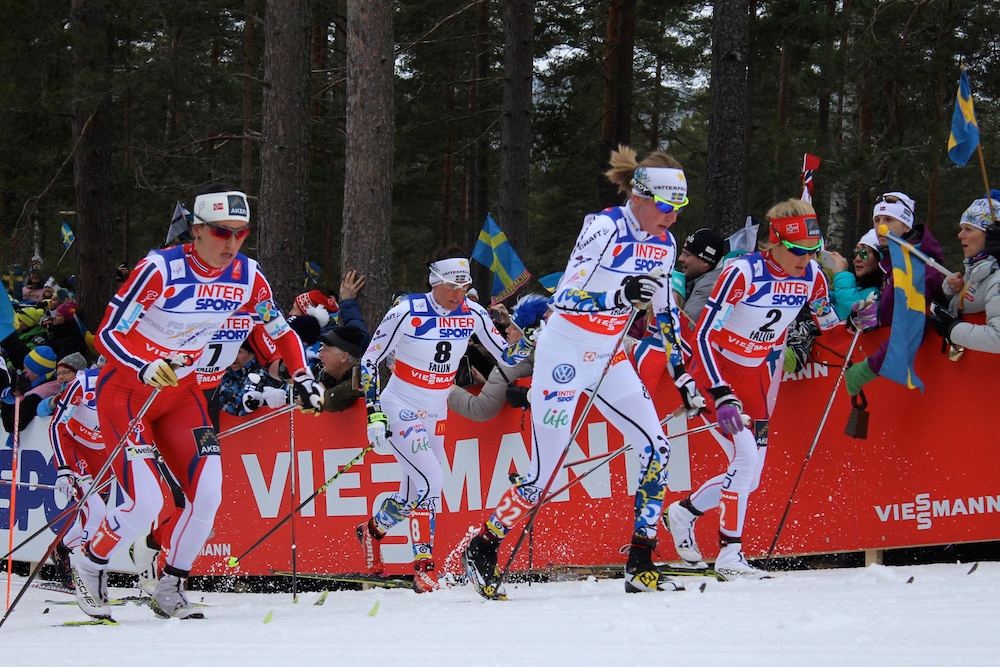
Sweden’s Sofia Bleckur (center) leading the race early up Little Mordarbacken with Norway’s Marit Bjørgen (near) and Therese Johaug (2), and Sweden’s Charlotte Kalla (8).
As they completed the red loop comprising the first half of each 10 k lap, Johaug decided pace was too slow. She didn’t want to attack, but she did want to pick it up a bit to break up the large group.
She did so on the largest climb on the second half of the course, known as “Big Mördarbacken” on the blue loop.
“I feel that the skis were so good and I had also really good grip, but I never thought I will get a gap there,” Johaug said in a post-race press conference. “I thought the other girls were behind me.”
As she reached the high point, they weren’t — at least they weren’t as close as she thought.
“The coaches standing at the top said that I had five or six seconds on the others, and I thought, ‘Oh my God, it’s early. I have 23 kilometers to the end,’ ” Johaug recalled. “But I understand that the skis were really good and the shape was good so I just focused on myself and the technique.”
Therese Johaug of Norway skiing well ahead of the pack around 19 k into the women’s 30 k classic mass start at 2015 World Championships in Falun, Sweden.
After leading Kowalczyk, Kalla, her two teammates Heidi Weng and Bjørgen, Finland’s Kerttu Niskanen, and Bleckur up the climb, Johaug came through the 7.8 k timing point nearly 8 seconds ahead of anyone else. Kalla was in second, followed by Finland’s Aino-Kaisa Saarinen and five others in the group. From there, Johaug continued to distance herself from the women behind her — coming through the stadium at 10 k with a 17-second lead on Bjørgen in second.
One-and-a-half kilometers later, back on the red loop, she was more than 40 seconds ahead of Niskanen and Saarinen, which led the chase pack in second and third.
“I heard all the ways in the tracks that I get more and more seconds to the girls behind me,” Johaug said. “It was amazing to ski here and the people around the tracks, they give me so much energy.”
In all the excitement, she got a little confused. Coming down off the red trail and back into the stadium for an opportunity to change skis at 15 k, Johaug feared she took a wrong turn and suddenly wondered whether she had accidentally skied on the blue course.
“I began to snowplow and stopped completely,” she told NRK, according to a translation. “I yelled to the officials, ‘I have gone wrong?’ I almost started to cry.”
Unable to get an answer fast enough, she pressed on, fearing disqualification if she inadvertently took a shortcut and missed the stadium.
“I just bet that I was on red. I came down and thought ‘yes, yes!’ when I saw it was correct,” she recalled.
Finland’s Kerttu Niskanen (10) and Sweden’s Charlotte Kalla (8) skiing together with another Swede, Sofia Bleckur (22), Norway’s Marit Bjørgen (l) and Heidi Weng (3), and Finland’s Aino Kaisa Saarinen (21) in pursuit of Therese Johaug, a Norwegian who dropped the field to score a big win in the 30 k classic.
By then, the chase group had made up some ground on her. While Johaug changed skis, the two Finns — Saarinen and Niskanen — did not, and were within 30 and 31 seconds of her leaving the stadium at 15 k.
Bjørgen and everyone else in the chase pack switched to a freshly waxed skis as well, and Bjørgen left the pit stop in fourth, 11 seconds after Niskanen. Weng followed, as did Bleckur and Kalla, all of which were within 45 seconds of Johaug.
Meanwhile, Sweden’s Anna Haag in eighth led a second chase group around 27 seconds back, with Germany’s Stefanie Böhler, Austria’s Teresa Stadlober, Norway’s Martin Ek Hagen, the Czech Republic’s Eva Vrabcová-Nývltová, and Americans Rosie Brennan and Liz Stephen.
Back on the blue course, Johaug gathered time back while ascending Mördarbacken for the second time, while Bjørgen caught and challenged the Finns on the same climb. By 16.2 k, Bjørgen was up to second, 54.4 seconds behind Johaug and just ahead of Niskanen in third. About 9 seconds later, Saarinen skied alone while Weng and Bleckur stuck together another four seconds back.
Kalla came through the checkpoint in seventh, 24 seconds after Bjørgen, and Vrabcová-Nývltová, Stephen, Stadlober, Brennan, Böhler, Hagen, and Haag were another 17 seconds back in eighth through 14th place.
Johaug didn’t know it, but she had successfully strung out the group as she’d intended. Except by 17.8 k, with more than a minute gap to second, it didn’t really matter.
Soaring down into the stadium with a 1:05 lead on Bjørgen, Johaug continued to push, as did Bjørgen and the rest of the women chasing a podium.
The deficit was up to 1:15 by 25 k, where Johaug came charging through the stadium for the second-to-last time, skipping a feed there and keeping her head down.
Sweden’s Charlotte Kalla charging alone to bronze in the 30 k classic at 2015 World Championships in Falun, Sweden.
About a kilometer back, Kalla worked hard up Little Mördarbacken to pass Bleckur and Niskanen and put herself in third. With 5 k to go, she was 2:08.1 behind Johaug and 53 seconds behind Bjørgen. Leaving the stadium with Niskanen, Weng and Bleckur, Kalla dropped them a kilometer later. By 27.8 k, she was within 35 seconds of Bjørgen, and 12 seconds ahead of Niskanen.
“You have to never stop believing,” Kalla said at the press conference. “The audience around the track gave me so much energy. When I was about 10 seconds up, the coaches told me I [put] seconds [into] second and that gave me more energy when I reached the bronze group. I recognized that I had good skis and I decided to push as hard as I could to get a gap.”
With 2.2 k to go, Johaug had kept herself 1:13 ahead of Bjørgen and was essentially in the clear. As she crested the second-to-last sprint climb, Norwegian fans showered her with champagne. She could literally taste the win.
On the next uphill, she took a Norwegian flag from the sidelines and carried it in one hand all the way to the finish — even up the final stadium ascent.
“Then I could look up and see how much people that were in the arena,” she said. “When you’re training a lot, it’s these memories that are so huge. Also the sun came out in the end of the race. The championships can not end better.”
Temperatures were around 38 degrees during the race on another partly cloudy afternoon in Falun. The sun peaked through the clouds a couple times, especially toward the end of the 30 k.
Norwegian fans spray champagne at Therese Johaug as she skis towards gold in the women’s 30 k classic at 2015 World Championships in Falun, Sweden.
With a winning time of 1:24:77, Johaug secured her third gold of these championships (after winning the 15 k skiathlon and 4 x 5 k relay with Norway) for her seventh World Championships title. Bjørgen held her own in second, 52.3 seconds behind, and Kalla finished 1:31.6 after Johaug in third.
For Bjørgen, it was her first silver and third medal of the 2015 worlds (after winning the classic sprint and anchoring the relay). Coming into the 30 k classic, she was unbeaten in the event since Kowalczyk won the event at the 2010 Olympics. Johaug had won the 30 k skate at Holmenkollen in 2011 and 2013, but never a 30 k classic.
“I never have like been in such good shape before. It feels good to have it here at World Championships,” Johaug said. “I have been training a lot for this distance, and before we start this championships, it was this day I was really looking forward to. That I can reach my goal and take the gold medal here today, it’s a dream.”
“I tried [to catch her], but she was too strong today and I didn’t have a chance,” Bjørgen said at the conference. “After 15 kilometers, we changed skis and I had a gap back to the other girls then I knew it was possible to take the silver. I’m really really happy for it.”
Diehard fans
With less than three kilometers to go, a Norwegian fan running alongside Bjørgen with a selfie stick slammed into a tree. Once he came to, Erlend Holberg, 24, told NRK that he had been waiting for Bjørgen to pass by, and when she did, he sang while sprinting through the woods next to her.
“Suddenly, I ran straight into a tree and fall to the ground,” he said, according to a translation. “… It was most important to focus on Bjørgen. I was very focused on the task.”
Norway’s Marit Bjørgen charging over the top of a hill a kilometer from the finish en route to silver in the women’s 30 k classic at 2015 World Championships in Falun, Sweden.
Bjørgen didn’t see it happen, but after finishing, she heard about the collision, which was caught on video.
“[At first] I thought, ‘Oh, maybe it was one of our coaches,’ ” Bjørgen said. “I don’t know who the man is. … He [got] up again. Maybe he’s a little bit … in the head.”
She pointed at her head and circled her finger around to gesture “crazy.”
After the final women’s race in Falun, Bjørgen said she considered these World Championships a success.
“We had some bad skis on the 10 k and not the best day on the pursuit, but I have three medals and I’m really really happy with that,” she said.
For Kalla, her fourth medal of the championships (in every race she competed in) marked her first in a 30 k classic event.
“My biggest goal this season was to go very well in Falun and feel that I did every thing I could every single race I started in,” she said. “I’m really satisfied with the way I have done my competitions.”
Niskanen took fourth, 31.6 seconds off the podium and 1:55.2 after Johaug, and Bleckur finished fifth (+ 2:09.3). Böhler was sixth (+2:36.9), Saarinen placed seventh (+2:45.2), Weng eighth (+2:45.7), Vrabcová-Nývltová ninth (+2:52.4), and Østberg passed Stephen in the stadium for 10th (+3:01.1).
The 30 k classic runner-up at the 2013 World Championships to Bjørgen, Kowalczyk finished 17th (+3:56).
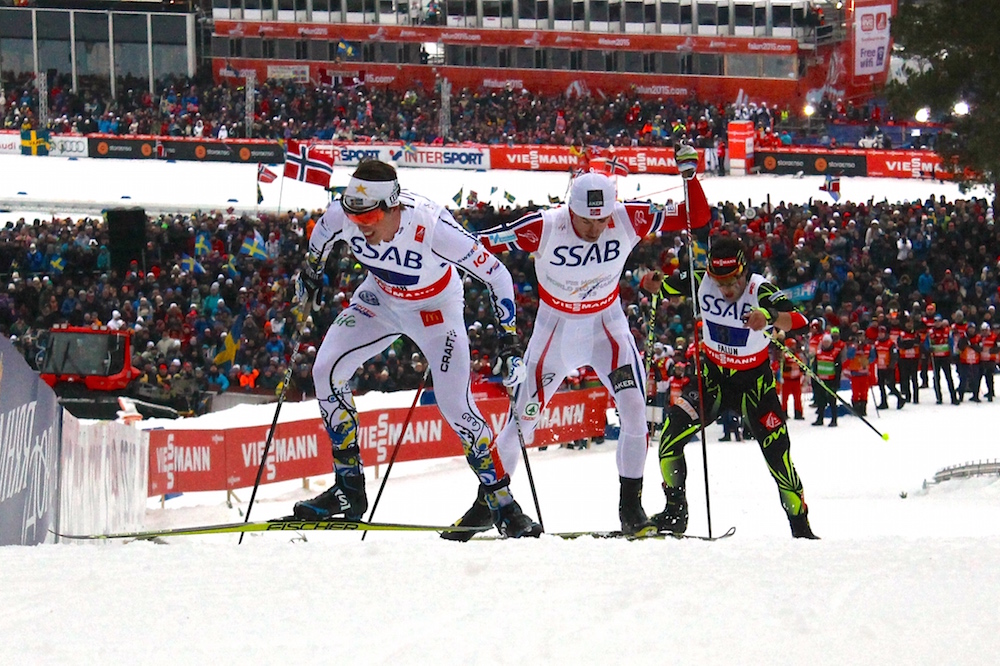
Sweden’s Calle Halfvarsson leads Norway’s Petter Northug (c) and France’s Adrien Backscheider on the second-to-last major hill on the last lap of the men’s 4 x 10 k relay at 2015 World Championships in Falun, Sweden. Northug went on to edge Halfvarsson by 0.6 seconds for gold, Sweden took silver and France was 8.9 seconds back for bronze.
FasterSkier’s coverage of the 2015 FIS Nordic World Ski Championships in Falun, Sweden, is brought to you by the generous support of L.L. Bean, now featuring a complete line of Kikkan Randall training wear.
FALUN, Sweden — All of Calle Halfvarsson’s trash talking gave Petter Northug something to get fired up about in the last couple hundred meters of the men’s 4 x 10-kilometer relay at FIS Nordic World Ski Championships on Friday.
Trailing Halfvarsson down into the stadium and leading up to the final rise before the finish, Northug rode on the tails of the Swede and blew past him on the climb, before giving him the ultimate run on the descent toward the finish.
There, Northug, who had already racked up two golds at these championships (in the classic sprint and freestyle team sprint), V2-ed like a madman to keep the slightest edge on Halfvarsson over the finishing flat. The Norwegian did so, and Halfvarsson let up about 20 meters before the line to accept his defeat.
It’s a lesson as old as time: talk smack and be ready to deal with the repercussions. Halfvarsson had to settle for silver when he was leading the fight for gold, and then watch Northug shush him at the finish.
That’s right, Northug, the now 12-time world champion (with two Olympic golds as well), put his finger to his lips after crossing the line, looking at cameras rather than back at Halfvarsson to send a message to the Swede.
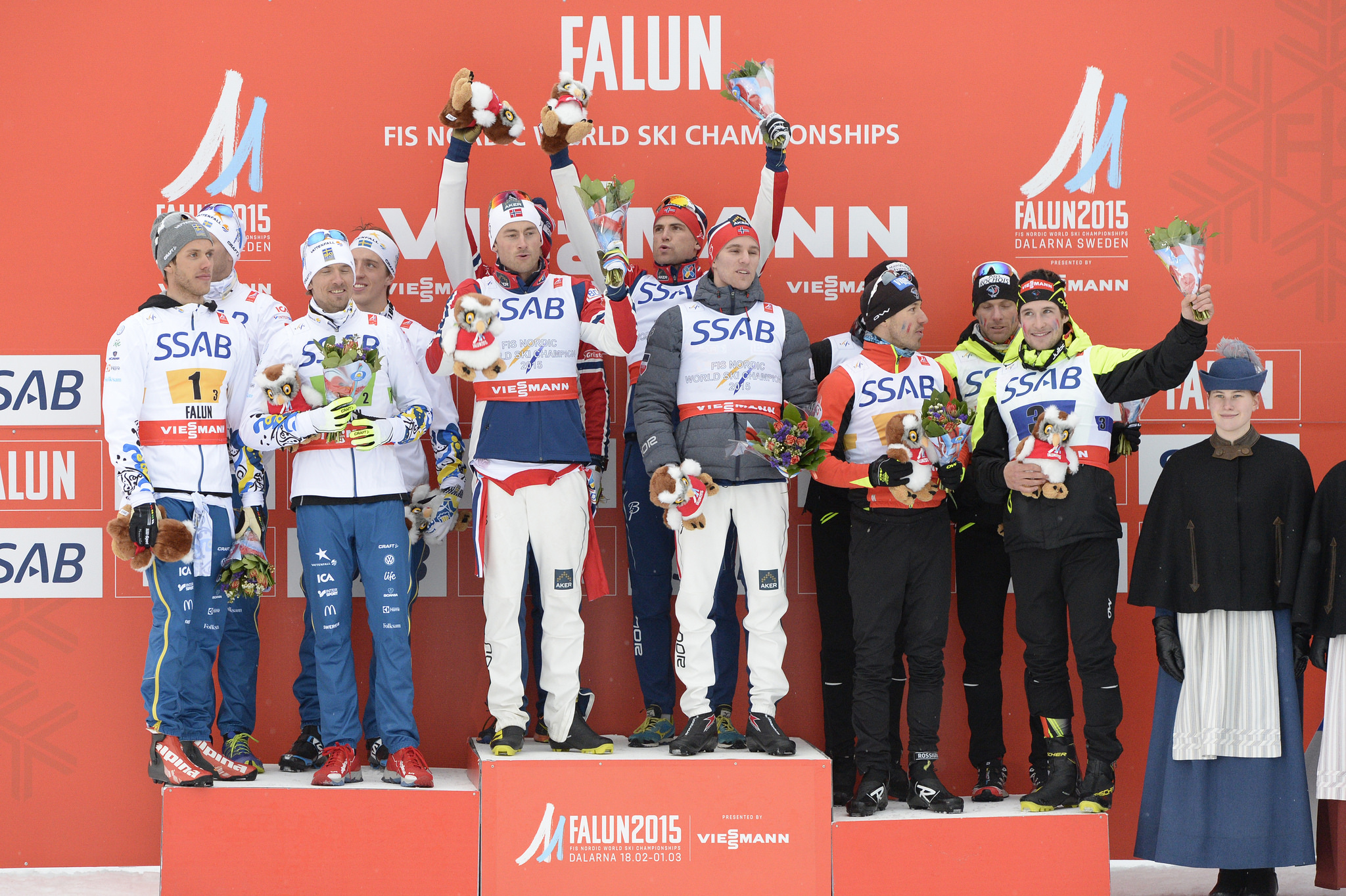
The French men’s relay team (right) skied the entire World Championships 4 x 10 k with the Norwegians (center) and Swedes, proving something to themselves and the ski world: they belong as championships medalists. (Photo: Falun2015.com/Flickr)
“When Calle crosses the finish line, [I wanted to] make it hurt so much that he takes [it] with him for a lifetime,” the 29-year-old Northug told NRK, according to a translation, after sealing the win for Norway in 1:34.18.5, six-tenths of a second ahead of Sweden.
So what exactly did Halfvarsson do to get him so riled? A year ago, he said he would beat Northug in a finishing sprint on home soil in Sweden. Unfortunately for Halfvarsson, in front of more than 41,000 spectators in Sweden on Friday, it didn’t happen.
The Swede led much of the last lap, countering Northug’s attack on the second-to-last major climb on the 2.5 k freestyle course while France’s Adrien Backscheider clung to the duo as well.
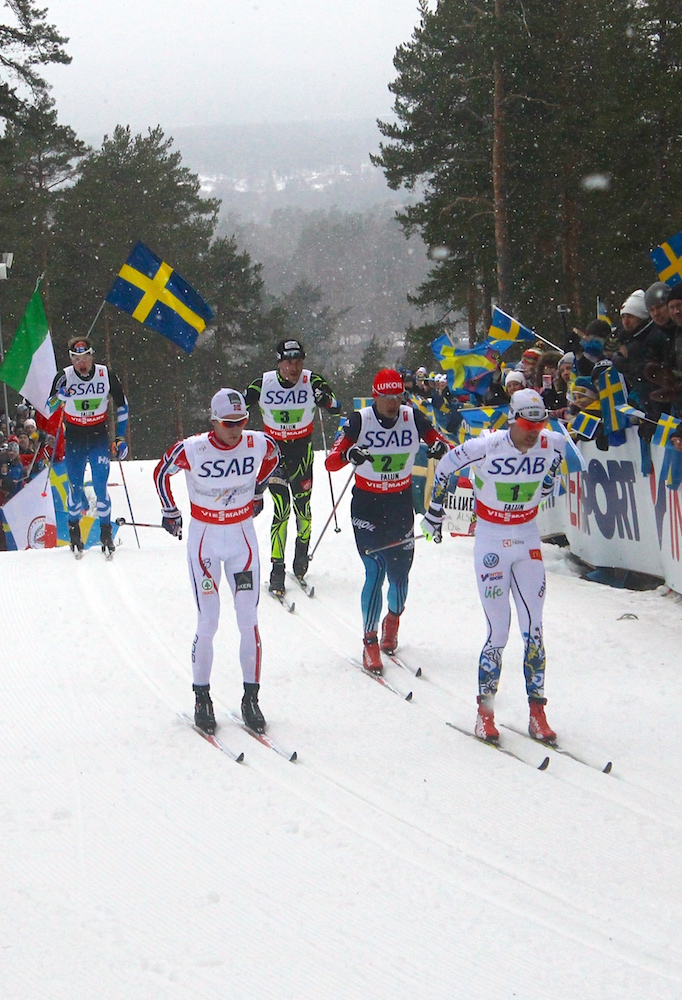
The three had skied on their own, a healthy distance away from Russia in fourth, since the end of the second classic leg. Sweden’s Johan Olsson had brought the team from seventh and 20 seconds out to first, ahead of France’s Maurice Manificat and Norway’s Didrik Tønseth, by the halfway point amid heavily falling snow — which lightened up considerably for the first skate leg.
“It was really nice to be able to exchange first,” Olsson said in a press conference, after tagging Swedish teammate Marcus Hellner with a 6.7-second lead on France’s third skier, Robin Duvillard. “I was a little bit worried before the race. Yesterday I didn’t recover so much after the 15 k race. Of course I’m really satisfied with my race and the other guys as well.”
After catching the leaders, Johan Olsson of Sweden (1) skied through to the lead on the second leg of the men’s 4 x 10 k relay in Falun, Sweden. Here he’s shown leading the third of four laps with Norway’s Didrik Tønseth (left) and Russia’s Alexander Bessmertnykh (2), and Maurice Manificat of France (3).
A two-time world champion, Olsson won Wednesday’s 15 k freestyle individual start by 17.8 seconds over Manificat in second, and Norway’s Anders Gløerssen took bronze, 19.2 seconds behind.
On Friday, Gløerssen skied the third leg for Norway, heading out 14.1 seconds after Hellner, and over the course of his four 2.5 k laps, he lifted Norway to first.
“I tried to set my own pace in the start and when I went out on the second lap, I was closing a little bit so I tried to speed up and close the gap,” Gløerssen said in the conference. “When I joined with the teams in front, I was a little bit tired so I tried to calm down. In the end i made a little attack just to see what happened.”
The result was Norway leading France by 3.8 seconds to start the last leg. Hellner tagged Halfvarsson in third, 6.4 seconds out of first.
“I think [Olsson] did a fantastic job and I was really satisfied with that gap, but I tried really hard but I wasn’t so strong today,” Hellner said. “The other guys were stronger and I lost some seconds to them.”
With one last skate leg to go, Northug led Halfvarsson and Backscheider out of the stadium. The Frenchman put himself in first for the first of two steeper climbs, both of which were used on the championships sprint courses, while Halfvarsson and Northug followed closely in second and third.
Meanwhile, Russia’s Evgeniy Belov pushed to catch the leaders, after his teammate Alexander Bessmertnykh brought his team from sixth to fourth on the second classic leg. Bessmertnykh finished his leg 32.4 seconds out of first and 18.3 seconds behind third. Alexander Legkov kept the Russians in fourth, tagging Belov about 40 seconds out of the mix.
From there, Belov — who ended up skiing the fastest anchor leg — cut the deficit in half early. Behind him, Italy’s Federico Pellegrino, Switzerland’s Toni Livers and the Czech Republic’s Petr Knop contended within a chase group. Germany’s Tim Tscharnke and Finland’s Ville Nousiainen skied together in eighth and ninth, and Simi Hamilton of the U.S. initially led Canada’s Lenny Valjas on the first of their fourth laps together in 10th and 11th.
Adrien Backscheider attacks around 3 1/2 k into his 10 k skate leg as the anchor for France in the men’s 4 x 10 k relay at 2015 World Championships in Falun, Sweden. He went on to place third behind Norway’s Petter Northug and Sweden’s Marcus Hellner, respectively.
About 3 1/2 k into the final 10 k leg, Backscheider decided to push the pace to ensure a medal. Russia was closing, or so he thought, and he didn’t want Belov to get anywhere near the top three.
“I started in second position and I just skied to make the gap with the Russian guy,” Backscheider told FasterSkier.
A 22-year-old bronze medalist from this year’s U23 World Championships, Backscheider’s timing wasn’t exactly spot on. While he slightly increased the distance to Belov to 26.7 seconds at 5 k and was seven seconds ahead of Halfvarsson and Northug at the halfway point, the Swede and Norwegian pulled him back in by the third lap.
On that same lap, Livers and Pellegrino two minutes behind the leaders dropped Knop, while Tscharnke and Nousiainen, Valjas and Hamilton, continued to ski in their own mini groups within the top 11.
With just over a kilometer to go, Northug upped the ante and tried to pass Halfvarsson on the first, longer climb. Halfvarsson stayed in front of him, while Backscheider matched them stride for stride in third over the top.
Not long after on the next steep uphill, Halfvarsson took his turn — looking at Northug and attacking at the base. Northug stuck on him, tucking behind him in second, while Backscheider hung on at the back.
“I didn’t want to be in front in the sprint hill; I wanted to stay in second, conserve power and I also didn’t want to [ski into] the wind,” Northug said in the press conference. “The last 150 meters was not that good, but I think it was pretty difficult today because it was really icy [in the finishing stretch].”
Racers had a mix of conditions, from light to heavy snow to in the classic portion, to hardly any precipitation for the skate legs. Organizers salted both courses beforehand to cope with the above-freezing temperatures and near-100-percent humidity, which has made the track increasingly soft throughout the week.
While most of the skate course was breaking down, the finishing straight was fast and hard-packed. There, Northug and Halfvarsson focused on skiing fast while staying on their feet.
“The most important thing is to cross the finish in first,” Northug said after racking up his fifth World Championships relay gold.
“You never know what’s going to happen in a relay, but we had a better chance this year on the last leg than in Sochi,” he added, referring to last year’s Sochi Olympics, in which the Norwegian men placed fourth behind Sweden, Russia and France, respectively. “It feels good to be back on top again. … It’s a lot of pressure on the Norwegian team before a relay. We knew before the championships that only gold makes the Norwegians satisfied.”
The defending Olympic relay champions, which came 0.6 seconds short of gold on Friday, Sweden took silver with essentially the same four-man lineup (except Halfvarsson in place of Lars Nelson, who scrambled for the team in Sochi).
Daniel Richardsson of Sweden and Niklas Dyrhaug of Norway leading the men’s 4 x 10 k relay in Falun, Sweden.
This time around, Richardsson led Swedes out instead, finishing his first leg in seventh behind Canada’s Alex Harvey in first, Finland’s Sami Jauhojaervi in second and Kazakhstan’s Alexey Poltoranin in third. Norway’s Niklas Dyrhaug tagged in fourth, followed by Germany’s Johas Dobler and Russia’s Maxim Vylegzhanin, respectively.
While the top six were within 5 seconds of one another at the first exchange, Richardsson was 20.5 seconds back in seventh. (France’s Jean-Marc Gaillard was another 0.7 seconds back in ninth, behind Italy’s Francesco de Fabiani in eighth.)
“Yesterday I was a little bit worried that we wouldn’t take a medal at all,” Olsson said. “We know that Norway is the team to beat, and with Petter as the last leg, he’s almost Mr. One-Hundred Percent at the finish. … We’re satisfied with the medal, but of course we would be more satisfied with the gold.”
For Halfvarsson, it was personally his first medal of his home championships. Two years ago at World Championships in Val di Fiemme, Italy, the Swedish men’s relay — with the same team and order — placed second to Norway by 1.2 seconds.
After Friday’s race, Halfvarsson realized his mistake.
“[Northug] came into my draft behind and got better speed and knew exactly how he’d run into the [downhill corner before the finish],” Halfvarsson told HD.se, according to a translation.
“I had trouble keeping track of where he was, then suddenly he just takes off. It might have been better to get in back of him before the stadium.”
He acknowledged that Northug was stronger, as did Backscheider, who finished 8.9 seconds back in third for bronze for France.
“The finish was hard — I need more experience to have a better finish,” Backscheider said at the press conference.
Regardless, France was pleased to repeat its bronze medal following the 2014 Olympics.
“We believed that it is possible,” Manificat said in the conference. “Championships is always a surprise, but we fight for this and … it’s really perfect.”
Russia’s Evgeniy Belov in fourth tries to close the gap to the top three, on his first of four laps in the men’s 4 x 10 k relay at 2015 World Championships in Falun, Sweden.
Belov finished fourth for Russia, 31 seconds after Norway, and Livers skied away from Pellegrino to finish fifth for Switzerland, 2:03 behind Norway and 24.2 seconds ahead of Italy in sixth.
Tscharnke and Nousiainen raced to a photo finish for seventh, in which Germany had the edge, while the Czech Republic placed ninth 5.6 seconds later.
Canada’s Valjas held off Hamilton by 1.4 seconds for 10th (+3:03.5).
Norway’s prime minister, Erna Solberg, attended the race and personally congratulated her nation’s four-man team after the finish.
“I enjoyed it very much,” she told FasterSkier. “But it became a bit too exciting. I always want them to have a bigger lead in the last part, but of course Petter Northug is like this. He keeps it until the last 200 meters. … He always makes me nervous.”
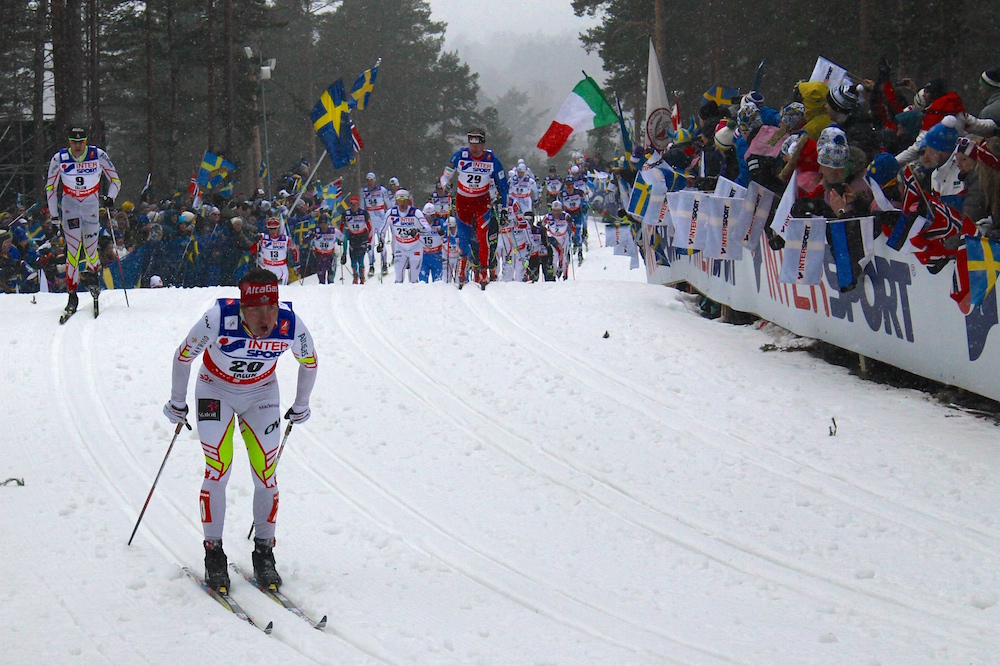
Canada’s Ivan Babikov (29) leads a train of skiers on the second lap of Wednesday’s 15 k freestyle up Mördarbacken: the longest, steepest hill of the 2015 World Championships course. Babikov placed 20th after a considerably faster second lap.
FasterSkier’s coverage of the 2015 FIS Nordic World Ski Championships in Falun, Sweden, is brought to you by the generous support of L.L. Bean, now featuring a complete line of Kikkan Randall training wear.
FALUN, Sweden — It only took a kilometer or so for Ivan Babikov to realize that he needed to go much, much faster. Two years ago at World Championships, the Canadian World Cup Team member placed fourth in the 15-kilometer freestyle individual start. In Falun on Wednesday, he was practically in last place for the first few thousand meters of the same race.
“The gaps right away were shocking,” Babikov recalled after the 15 k freestyle at 2015 FIS Nordic World Ski Championships. “I couldn’t believe it, like, ‘What the hell? I’m not skiing that slow. What’s going on?’ ”
That moment gave him the kick he needed to get going, but yet throughout the first of two 7.5 k laps, he struggled to find a consistent pace.
Fortunately for him, that was the worst of it.
Ivan Babikov (Canadian World Cup Team) on his first of two laps in the men’s 15 k freestyle at 2015 World Championships in Falun, Sweden. He went on to place 20th. Two years ago, Babikov was fourth in the 15 k freestyle at 2013 World Championships.
“The worst was the first two splits, after that I couldn’t hear too much at the end of the course [in the stadium],” he said. “Then, second lap, I felt like i was picking it up.”
Babikov, 34, went from ranking 70th of 86 men at 1.5 k to 45th at the halfway point. After starting 29th, he sped up considerably on his second lap, clocking the eventual 23rd- and 21st-fastest times at 11.4 k and 12.8 k, respectively.
He finished 20th, 1:45.4 minutes behind Sweden’s Johan Olsson, who won the race by 17.8 seconds on home soil in 35:01.6. Considering it was a ways off from his fourth place at the last World Championships, Babikov had mixed feelings about his result.
“My pacing was really weird — I don’t know how to feel about it,” Babikov said, noting that his second lap ended up being 24 seconds faster than his first.
“I don’t know how that’s possible,” he added. “I kind of had in my head that the second lap will be really important so maybe that made me go too slow in the first lap, but it didn’t feel like it. … I kind of turned it around and had an amazing second lap. It’s hard to wrap my head around what happened, today was so weird.”
While he explained that skis made a “huge difference” in the slushy snow on the 5-degree Celsius overcast afternoon, with sprinkles of rain toward the end of the race, he added that his team’s skis were on par with most other nations’. At the same time, a few teams had “rockets” despite the variable conditions, he observed.
Graeme Killick (AWCA/Canadian National Development B-team) racing to 32nd in the men’s 15 k freestyle individual start, his first race of 2015 World Championships in Falun, Sweden. (Photo: Fischer/NordicFocus)
“I would say 70 percent of the course was just mush,” Babikov said. “Some of the steep uphills were ankle-deep slush.”
Throughout the race, he was unable to take full advantage of his strength in climbing. Most of the course was one-skate (V2), with the exception of the long, grinding uphill known as Mördarbacken. Babikov said only a minute or two of the 7.5 k loop, the steepest part of it, required offset (V1).
“I felt good on Mördarbacken, so climbing was not problem,” he said. “When I went to the second lap, I realized I still have a lot of energy so I started pushing all out…
“Top 20 sounds nice, but when you think about my fourth place, which came really surprisingly two years ago, it’s not even close,” he added. “Considering everything, I would probably be OK [with today’s result].”
By everything, Babikov meant the nasty cold, “some kind of viral thing,” he came down with a month ago in Rybinsk, Russia. After that World Cup, he flew home to Canada and spent the better part of the next week there down and out. When he returned to Östersund, Sweden, for the last World Cup before World Championships, Babikov placed 49th in the 15 k freestyle.
“I didn’t really know what to expect,” he said of Wednesday’s race, his season-long focus. “I had some good skating in the skiathlon a few days ago and that kind of gave me a piece of my mind. Every day is different so I tried to give 100 percent.
Jess Cockney (AWCA/Canadian National Development B-team) racing to 57th in the 15 k freestyle at 2015 World Championships in Falun, Sweden. It was his first distance race in nearly three months. (Photo: Fischer/NordicFocus)
“Going into the relay, I think it’s a good sign,” he added of Friday’s 4 x 10 k team event. “I’m more positive about [today’s] race than bummed out.”
The second-fastest Canadian on Wednesday, Graeme Killick placed 32nd in his World Championships debut, 2:26.7 back from Olsson. The result stood as a career best at the World Cup level (excluding Olympics) after placing 39th in a World Cup 15 k classic last season in Toblach, Italy.
At the 2014 Olympics, Killick went on to place 28th in the 50 k freestyle mass start. Also in Sochi, Russia, he finished 44th in the 30 k skiathlon and 65th in the 15 k classic.
Recently, the 25-year-old Canadian National Development B-Team skier hadn’t raced since Rybinsk on Jan. 23 and 25, where he was 43rd in the 15 k freestyle and 40th in the skiathlon. Sick for the beginning of World Championships, he didn’t arrive in Falun until Sunday (Killick, Devon Kershaw, Emily Nishikawa, and Olivia Bouffard-Nesbitt stayed back in Östersund to recover from their illnesses for the first few days of worlds).
On Wednesday, Killick said he had been feeling well for the last three days.
“Skate really isn’t my strength so I think I didn’t quite blow up like I normally would on a course like this, so I think it was OK,” he said of his 15 k. “Good lead-up into the 50 [k classic mass start on Sunday] and just good to get a hard effort in after missing the [skiathlon].”
Jess Cockney after his final race of 2015 World Championships, the 15 k freestyle, in which he placed 57th in Falun, Sweden.
His teammate on the Alberta World Cup Academy (AWCA) and national-development team, Jess Cockney raced his first distance event since Dec. 7, when he was 67th in the World Cup 15 k classic pursuit in Lillehammer, Norway.
With fellow Canadians Alex Harvey preparing for other races (the relay and 50 k) and Kershaw also saving his energy for the final races of World Championships, Cockney asked his coaches if he could enter the 15 k skate and considered it a bonus.
“I just wanted to see if I could be consistent and have some of the hard training show itself in a result today,” Cockney said after placing 57th (+4:14.5). “I don’t think it really did, but it’s still good to be skiing distance races again. … I’ve just gotta work on fitness.”
Reflecting on his first World Championships, where he raced the classic sprint (49th), team sprint (13th) and 15 k skate, the 25-year-old Cockney said he’s learned a lot.
“I think I’m still not totally there mentally for the big races,” he said. “I kind of psyche myself out still a bit. I did at the Olympics last year and I did last week for the sprints so [I need to] just work on a little bit of mental training because we do enough stuff physically that my brain’s gotta be there, too.”
Canada’s Emily Nishikawa (Alberta World Cup Academy/National Development Team) racing to 30th in Tuesday’s 10 k freestyle for her best World Championships result at 2015 worlds in Falun, Sweden. Nishikawa led the Canadian women with the result and Perianne Jones placed 32nd. (Photo: Fischer/NordicFocus)
FasterSkier’s coverage of the 2015 FIS Nordic World Ski Championships in Falun, Sweden, is brought to you by the generous support of L.L. Bean, now featuring a complete line of Kikkan Randall training wear.
FALUN, Sweden — With the pressure off, the Canadian women posted some career-best performances on Tuesday in the 10-kilometer freestyle individual start at 2015 FIS Nordic World Ski Championships.
In Emily Nishikawa’s first race coming off illness, which kept her and fellow Canadian World Championships team member Olivia Bouffard-Nesbitt back in Östersund, Sweden, until Sunday, recorded her first top 30 at her second World Championships.
“I was sick last week so I didn’t really know what to expect, how my body would react,” Nishikawa said after placing 30th, 2:20.5 behind Sweden’s Charlotte Kalla, who won the 10 k skate in 25:08.8. “It could’ve gone either way and it went well today, so I’m very happy with that.”
Canada’s Perianne Jones (Alberta World Cup Academy/National Development B-Team) racing to 32nd for her best World Championships distance result at 2015 worlds in Falun, Sweden. (Photo: Fischer/NordicFocus)
Meanwhile, team veteran Perianne Jones notched yet another best distance result at worlds in 32nd after placing 37th in Sunday’s 15 k skiathlon. And in what she anticipates to be her last season of professional racing, and ultimately her last races, Jones, 29, didn’t expect to do any of the distance races.
“I had zero expectations going in,” Jones said after finishing 2:26.7 back from Kalla. “Coming into these championships, I thought I was going to do the sprint and the team sprint … and I ended up doing the sprint and the 10 k and the pursuit.”
Even on the World Cup, Jones hadn’t done better than 32nd in a distance race since placing 30th two years ago in a 15 k classic mass start in Nové Město na Moravě, Czech Republic.
And then there was Nishikawa, 25, who cracked the top 30 for the first time this season on the World Cup, placing 29th in the 10 k classic in December in Davos, Switzerland.
The 54th starter out of 71, the Alberta World Cup Academy (AWCA) and Canadian National Development Team skier faced some of the toughest conditions of anyone in Tuesday’s race, skiing two different loops of a 10 k course in heavily falling, wet snow.
“It was snowing pretty heavily, [but] my skis felt great,” Nishikawa recalled. “I pushed as hard as I could … I was just dying to get here to Falun. I’m so happy to be here and to be racing is a real treat.”
Nishikawa, Jones and Canada’s third woman at the championships, Bouffard-Nesbitt, warmed into their races, with Nishikawa’s 1.5 k time ranking 45th, followed by Jones in 46th and Bouffard-Nesbitt in 53rd.
By 5 k, Nishikawa was up to 35th and 2.8 k later, 33rd, before closing hard for 30th. At the end of the day, she finished 3.1 seconds ahead of Norway’s star skier Marit Bjørgen, who placed 31st (for her first result outside the top 24 in a World Championships in at least 14 years).
Jones, who sped up to clock the 34th-ranked 5 k time and 32nd 6.3 k time, finished 6.2 seconds behind Bjørgen, the 65th starter.
“I was lucky I started early — I was number 22 so I have probably never been that close to Bjørgen in a skate distance race ever,” Jones said. “I just wanted to ski hard and pick a pace up those hills I could maintain. I was pretty sure the girl behind me [France’s Coraline Thomas Hugue] was going to catch me, so I just tried to stay with her for as long as possible.”
While Hugue had a career-best day of her own in 12th, Jones said this race would go down as one she’d remember — and likely her last international race.
“This was my final World Champs, probably my final international ski race,” she said. “After last year, I just kind of wanted to give it another shot, and it has been a good year in a lot of ways — I have been really healthy, more than I have been in the past. I think these last few distance races, too, I have surprised myself a little bit even though they weren’t in the plans.
“This is the first time this week that I skied with teammates, so it is really nice to have the other girls here and for us all to come to the start line together and to have a teammate to hug at the finish line,” Jones added. “It has been a great year and I think there are lots of good ladies coming up and it has been fun to spend a year with them and hopefully pass some things on.”
Canada’s Olivia Bouffard-Nesbitt (Rocky Mountain Racers) racing to 52nd in Tuesday’s 10 k freestyle, her debut race of 2015 World Championships in Falun, Sweden.
In her first World Championships, Bouffard-Nesbitt, of Rocky Mountain Racers, placed 52nd, 4:05.4 behind the winner.
“Today was just a really cool experience,” she wrote in an email. “I was loving every second of it. The fans, the atmosphere, the location, the conditions, so many things that made today amazing and memorable.”
Less than three weeks ago, Bouffard-Nesbitt earned her spot on Canada’s World Championships team with a 12th-place finish in the skiathlon at U23 World Championships in Almaty, Kazakhstan. Coming off that performance, she came down with a long-lasting cold.
“The race itself wasn’t great,” Bouffard-Nesbitt wrote of Tuesday’s race. “My movements were lacking power, and I didn’t feel that race fitness that generally leads to good races. I was missing that ability to really push, my body just wasn’t really doing it today.”
She hoped the effort would be good preparation for Saturday’s 30 k classic mass start.
“I was dealing with pretty low energy and a cold last week, but I’ve bounced back from that and am healthy now,” the 22 year old wrote. “I’m not upset about my race. I just raced my first ever World Champs and I’m totally psyched about that. There isn’t much that can take away from how amazing it was to be on the start line! And there was so much to be stoked about today too.
“Today wasn’t about me. I raced, and I was super pumped about being in the race, but I was also super excited for [American medalists] Jessie [Diggins] and Caitlin [Gregg] who had just mind blowing performances, and for Emily having her second top 30 of the year!” Bouffard-Nesbitt added. “It was a pretty great day!”
With three women at World Championships, Canada will not field a relay for Thursday’s 4 x 5 k team event. Instead, Nishikawa and Bouffard-Nesbitt will likely focus on the final race in Falun: the 30 k classic on Saturday.
FasterSkier’s coverage of the 2015 FIS Nordic World Ski Championships in Falun, Sweden, is brought to you by the generous support of L.L. Bean, now featuring a complete line of Kikkan Randall training wear.
FALUN, Sweden — Two days after Alex Harvey earned his second medal of the 2015 FIS Nordic World Ski Championships, more than any other Canadian at a Nordic World Championships, FasterSkier caught up with the 26-year-old Harvey in Falun, Sweden. With two more races on his schedule at worlds, he talks about his last few days in the limelight and the possibility for taking home more hardware.
Russia’s Maxim Vylegzhanin (l) and Switzerland’s Dario Cologna (r) go head to head for first in the finishing stretch of the men’s 30 k skiathlon on Saturday at the 2015 World Championships in Falun, Sweden. Behind, Canada’s Alex Harvey (second from l) and Norway’s Didrik Tønseth battle for third. The spectator grand total for the day was 44,300 people. (Photo: FlyingPointRoad.com)
FasterSkier’s coverage of the 2015 FIS Nordic World Ski Championships in Falun, Sweden, is brought to you by the generous support of L.L. Bean, now featuring a complete line of Kikkan Randall training wear.
FALUN, Sweden — The Canadian team chef better get cooking. After promising cakes in exchange for medals at 2015 FIS World Ski Championships, the man by the first name of Mattias will have to get working on his second batch following Alex Harvey’s second medal in as many races so far in Falun.
When the team hired the Swedish chef for the two-week championships, some of its athletes requested cakes, according to Canadian World Cup Team member Ivan Babikov.
“He joked back, ‘Well if there will be medals, there will be cakes,’ ” Babikov said. “Now he makes more cakes for Alex to celebrate with another medal.”
Babikov’s teammate, Harvey became the first Canadian to rack up two medals at a single Nordic World Championships, and he did so in the first two races. Harvey, 26, found a final gear to rise from fourth to third in Saturday’s 30-kilometer skiathlon, passing Norway’s Didrik Tønseth late in the finishing stretch for bronze.
Alex Harvey (Canadian World Cup Team) leads up Mördarbacken early in the classic portion of the men’s 30 k skiathlon, ahead of Estonia’s Aivar Rehemaa (52), Russia’s Evgeniy Belov (2), Switzerland’s Dario Cologna, and Norway’s Niklas Dyrhaug (5) among others. Harvey went on to place third for his second-straight medal of the 2015 World Championships in Falun, Sweden. (Photo: FlyingPointRoad)
After spending most of the six-lap race in the lead, Harvey was pleased to end up third, 1.6 seconds behind the winner, after Switzerland’s Dario Cologna attacked the last time up the most grueling climb on the course: Mördarbacken. Russia’s Maxim Vylegzhanin went with him, and Tønseth eventually latched onto the two leaders with just over two kilometers remaining.
Meanwhile, Harvey in fourth concentrated on reining in the leaders, while Cologna and Vylegzhanin duked it out up front. On the last major climb, Vylegzhanin maneuvered around Cologna and boxed him out over the top before descending into the stadium.
The defending Olympic champion (in both the skiathlon and 15 k classic), Cologna hung on tight, but wasn’t able to get ahead of the Russian, as Vylegzhanin sealed his first World Championships title in 1:16:25.9 hours, 0.4 seconds ahead of Cologna.
“I simply don’t have the words to describe how happy I am over this gold medal,” said Vylegzhanin, a three-time runner up at World Championships (twice in the 50 k freestyle mass start and once in the 30 k pursuit), during a press conference. “It has been a really long journey here.
“Throughout the race it seemed like everyone around me was really, really strong,” he added. “I gave it everything I had in the final spurt and didn’t really get the feeling that it was enough for gold until I passed the goal line.”
Harvey finished 1.6 seconds back in third and 1.8 seconds ahead of Tønseth in fourth. France’s Maurice Manificat took fifth (+10.2), and Calle Halfvarsson finished as the top Swede racing for 44,300 adoring spectators in sixth (+22.8).
After slipping about seven seconds back from the three leaders with about 1 1/2 k to go, Harvey charged hard to close the gap, and nearly caught them on the second-to-last climb. While Cologna and Vylegzhanin skied out of reach, Harvey trailed Tønseth closely, passing him 5 seconds before the finish.
“It was so mushy and I was starting to not see clearly,” Harvey recalled, noting that his legs felt extremely spent after 15 k of classic followed by 15 k of skating on Falun’s notoriously tough course — and in soft conditions on an above-freezing afternoon. “I knew my legs were not 100 percent, so I wouldn’t have an amazing sprint, but it was good enough to grab one place, that was good for the podium.
“I had two medals in my career in World Championships, and now I have two in three days,” he added after achieving his fourth medal. “It’s crazy.”
“I had two medals in my career in World Championships, and now I have two in three days. It’s crazy.” — Canada’s Alex Harvey after winning bronze in Saturday’s skiathlon
An early leader with Finland’s Iivo Niskanen, Harvey skied in second for much of the first few kilometers before following Sweden’s Lars Nelson, France’s Jean Marc Gaillard and Swedish race-favorite Marcus Hellner, respectively, at the 5 k checkpoint.
As the climbs began on the second classic lap, Gaillard initiated a break from the large lead group, and Nelson went with him. Nelson looked back at one point to gauge the space behind them and nearly tripped up in the tracks, but he regained his composure and the two skied together up front until about 8.5 k. There, Harvey at the front of the chase pack caught them.
“I was trying to see if guys would want to break away. When I saw that it was Gaillard and Lars Nelson, I mean, they are good skiers, but not the favorites, I decided not to go with [them],” Harvey said.
Had it been someone like Cologna or Russia’s Evgeniy Belov “or some guys I think can go all the way, then I would have pushed it to break away [with them],” he added. “The plan was to try to break away if it was possible, but it just didn’t happen.”
Instead, Harvey aimed to control the pace from the driver’s seat, leading Nelson into the stadium at the end of 10 k. With one 5 k classic lap to go, 25 men remained within eight seconds of the lead and 18 of them were 3 seconds from Harvey.
By 11.5 k, Niskanen was back up front again, just ahead of Harvey, and Tønseth held his position in third while Nelson skied in fourth. Vylegzhanin hovered in fifth while Cologna was a few seconds back in seventh. Throughout the next lap, the lead switched several times between the frontrunners, including Tønseth and Gaillard, but by the ski change at 15 k, Harvey was back in first.
He and Gaillard entered the transition simultaneously, and Harvey emerged 0.3 seconds faster. On the following skate lap, the Canadian sensed something he hadn’t felt during the classic — his body wasn’t feeling so great. In fact, it hadn’t felt very good in freestyle races this season, he later explained.
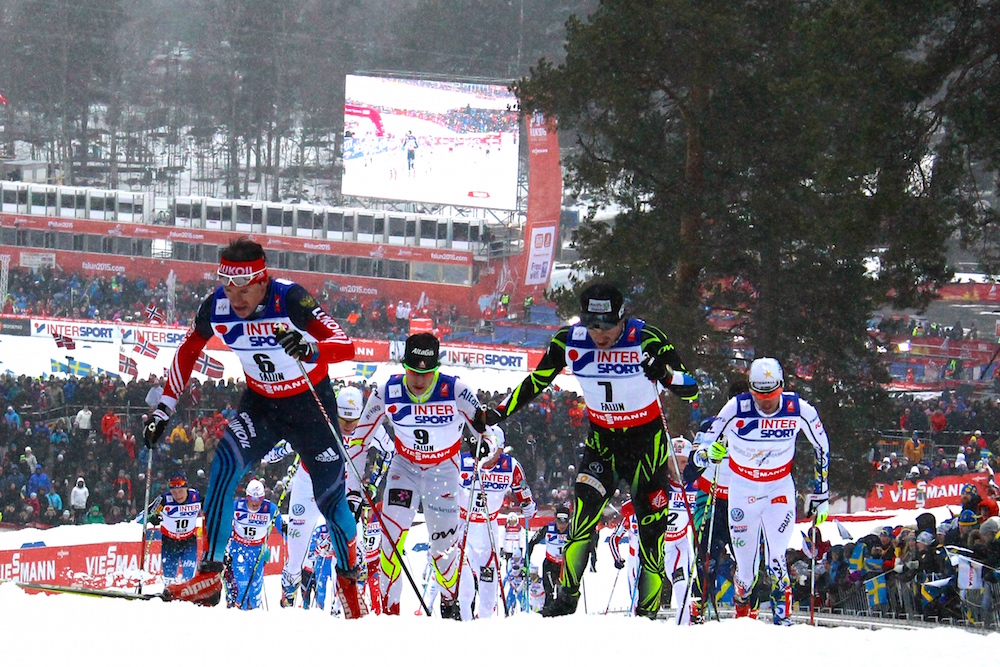
Canada’s Alex Harvey leads Russia’s Evgeniy Belov (2) and the rest of the lead pack the first of three times skating up Mördarbacken around 18 k in the men’s 30 k skiathlon at 2015 World Championships in Falun, Sweden. (Photo: FlyingPointRoad)
Harvey reasoned his best chance for staying in the race required that he keep leading, and he did so for the next five kilometers.
“[I decided] I am going to stay in the front and go slow on the climbs, because that is where I am weak in skating, and try to do that for as long as I can,” Harvey said.
By the end of the first skate loop, he led 15 men within seven seconds of him through the stadium.
With two laps to go, the Canadian sprint silver medalist started to show some wear as Hellner moved to the front ahead of Belov, Norway’s Niklas Dyrhaug, Tønseth, Vylegzhanin, Cologna, and Harvey, respectively. At 21.3 k, Harvey was 4.5 seconds back in seventh.
Even there, though, Canadian National Team Head Coach Justin Wadsworth wasn’t concerned.
“[Leading is] what he did a lot last year in the skiathlon that he won here in the World Cup Finals, and he said he felt like that was the way he wanted to do it,” Wadsworth said. “He wanted to control and not let people make surges, and he knows that a lot of people respect him right now … no one attacked him; they knew he was one of the favorites. When you can play or use that as your advantage, I think it’s huge.”
“When Hellner went on the second lap, I just had to drift back,” Harvey explained. “If I pass the line, it just doesn’t come back. [My leg started to cramp], so I just had to feather it a little bit.”
That same lap, by the second-to-last climb, Harvey worked his way back up front while the two Russians in the mix — Belov and Vylegzhanin — clung tight to him.
Wadsworth noticed how Harvey one-skated (V2-ed) most of the course while others relied on the more labor-intensive offset (V1).
“The speed was slow enough that he could do that,” Wadsworth said. “He knew he was saving himself and he knew the legs were going to get tired at the end no matter what.”
Hellner led the last time through the lap zone, followed by Belov, Harvey, Vylegzhanin, Dyrhaug, Gaillard, and Manificat, in that order. Cologna came through with the pack, 2.3 seconds back in eighth, just ahead of Halfvarsson, Tønseth and Norway’s Petter Northug.
With 5 k remaining, Cologna advanced to third early in the lap to prepare for the final push. Meanwhile, Harvey skied in seventh leaving the stadium, then rose to third once more before the start of the big climbs.
There, Cologna made what he hoped would be the game-changing attack: “I knew that I’m strong in the uphill so I was not sure what I have to do and when I have to go, but in the end I was in front on Mördarbacken the last time,” he told FasterSkier. “So I said, I will try everything, and I think it was the right tactic.”
Tønseth worked hard to get back in contact with Cologna and Vylegzhanin, who immediately went with him up the remainder of the hill, while Harvey and Manificat fell off the pace in fourth and fifth.
Along the next flat, Harvey decided to go hard in pursuit of third place or better.
“You’ve just got to be selfish; I made [Manificat] work on the flat and downhill stuff to get the draft and then as soon as we hit the next little hill, I just went by him and I went full blast,” he said.
Harvey dropped Manificat and bridged the gap to Tønseth on the penultimate climb. Up front, Cologna let up slightly to prepare for the finishing showdown with Vylegzhanin.
“I let him go in the last uphill because I thought maybe it’s a little better to relax on the last downhill to focus for the sprint, but I was not able to pass him again in the finish,” Cologna said. “Vylegzhanin was still there and a little bit fresher at the end.”
Despite missing out on gold by four-tenths of a second, Cologna was happy with silver.
“It’s always great to win a medal,” he said. “Everybody wants to be in good shape and to win, so it was a very good start for me, these championships, and it’s good to have the medal already in the first race. Now I’m looking forward to the next one.”
For Canada, ‘The biggest thing is redemption’
A few seconds behind, Harvey concentrated on staying on his feet before going for bronze.
“I was first trying to just stay on my skis because my legs were pretty jammed,” he said.
“It’s a great day for me. Hard to believe,” he said in a Cross Country Canada press release. “The skis were fantastic. I had really good training over the summer, and I think the wax team are doing such a great job, it’s hard for me not to be on the podium these days.”
“We’re so pumped about this,” Wadsworth said. “I think we came into the day really feeling like Alex could win the race, but realistically, how his legs are doing skating these days, a medal today is as good as gold. We couldn’t want anything more.
“The biggest thing is redemption for our wax team,” he added. “We really battled after Sochi last year, and we added some new people and took a lot of time in the summer to meet together and to get communication working. There’s been some hiccups through the winter, but we’ve kept really pushing to get on top of it and it’s paid off. That’s the thing that’s the most exciting.”
Babikov, who placed 23rd on Saturday after skiing up from 30th at the transition, said the team was beyond excited for Harvey — even when some of them weren’t personally having their best races.
“Compared to Alex’s medal, [23rd is] not so good, but I’m just really happy and pumped for him,” Babikov said. “Every single person on the team … we’re just so psyched. It’s the best world championships so far for Cross Country Canada. We’re so happy for Alex. It’s good for us, it’s good for our team, it’s awesome that one of the best guys in the world is on our team and we train together.”
“It’s the best world championships so far for Cross Country Canada.” — Ivan Babikov, Canada’s second man in Saturday’s skiathlon in 23rd
For Harvey, it was his fourth World Championships medal of his career. In 2011, he won the classic team sprint with Devon Kershaw, and in 2013, he was third in the individual classic sprint — the event he claimed silver in two days ago.
Wadsworth noted the impact this had on the program after Canada took home one medal between the last two previous championships (2013 World Championships and the 2014 Olympics).
“To have two medals [in Falun], it’s more [about] showing that we do have one of the best programs for waxing and we’ve invested a lot in it,” he said. “We’ve also done things that are a little bit different than other teams or the U.S. by having a little bit smaller team. We’re here to get medals and this is what’s going to help our program in the long run, where we can put it back into development and other things. We have to go for it at these big events like this.”
While Canada’s plan for Sunday’s team sprint was originally to start Harvey and Lenny Valjas, Wadsworth explained that would likely change out of a need to rest Harvey.
On Saturday night, Jess Cockney and Valjas were listed to start.
“It was [going to be Alex] and Len, but the way his legs were kind of acting at the end of [today’s] race, we’re … thinking that he might not do it and start to recover for the 50 k, maybe use the relay as a tuneup for that,” Wadsworth said.
During Saturday’s race, Babikov explained he struggled with the sugary conditions during his classic leg and couldn’t blame it on his skis.
“[Alex and I] had the same skis prepared so I think it was just me, I was just struggling with those conditions,” he said. “Maybe I was too tight … Most of the time in the skiathlon I have a problem with classic so I maybe worked too hard to stay with the pack so that made me too tired. That’s why I was surprised I felt so good in skate.”
A minute behind Harvey at the halfway point, Babikov had the seventh-fastest transition time and immediately started picking off places during the freestyle leg. Twenty-eighth at 20 k, he was up to 23rd at 21.3 k.
“[I came into the ski change] ten or 15 seconds behind [Italy’s Roland] Clara, some Germans [Jonas Dobler and Florian Notz] and some Japanese athletes [Keishin Yoshida and Akira Lenting],” he said. “I think I was with [Finland’s Sami] Jauhojaervi. I started fighting them and catching them one by one, and the group kind of exploded … I worked my way up. It took me half a lap to catch that group ahead of me, maybe on the Mördarbacken, I caught them.
“I had a good feeling skating and was feeling pretty satisfied with my skate part,” Babikov concluded after finishing 2:43.8 behind Vylegzhanin in 23rd.
For the rest of World Championships, he was looking forward to the 15 k freestyle “and maybe the relay,” he said.
Erik Bjornsen (U.S. Ski Team) races up Mördarbacken during the the men’s 30 k skiathlon at the 2015 FIS Nordic World Ski Championships in Falun, Sweden. He finished 28th for his best distance result of the season. (Photo: FlyingPointRoad.com)
FasterSkier’s coverage of the 2015 FIS Nordic World Ski Championships in Falun, Sweden, is brought to you by the generous support of L.L. Bean, now featuring a complete line of Kikkan Randall training wear.
FALUN, Sweden — The timing was right for Erik Bjornsen in the first race of his second FIS Nordic World Ski Championships on Saturday.
For the first time this season, the 23-year-old U.S. Ski Team member cracked the top 30 in a distance race and he did so after skiing in the top 30 for most of the men’s 30-kilometer skiathlon.
After starting the mass start in bib 47 of 63, Bjornsen made his way up to 34th, 9.2 seconds from the lead, within the first 1.5 k of the opening 15 k classic leg. Meanwhile, his U.S. teammate Matt Gelso, of the Sun Valley Ski Education Foundation, hung with the group in 31st, 8.1 seconds behind.
“I have been working on my classic technique and just trying to stay really relaxed,” Bjornsen recalled.
After the women rounded two similar courses for the 15 k skiathlon earlier Saturday afternoon, the men were left with mostly chewed-up conditions in temperatures around 35 degrees Fahrenheit. Race officials salted two hills on the men’s 5 k freestyle course, according to Gelso, who said, “Those were awesome and the rest, the main hill on Mördarbacken, was so deep and soft and smushy…”
Bjornsen and Gelso skied near each other for the first lap, with Bjornsen in 35th at 3.3 k, 10.5 seconds behind the leaders, and Gelso just 0.7 seconds back in 38th.
By the end of the first lap, Bjornsen was up to 28th, 7.7 seconds out of first, while the second U.S. man at the time, Kris Freeman (Freebird) lapped through the stadium in 42nd, 13 seconds back. Gelso was 0.8 seconds behind Freeman in 44th, and U.S. Ski Team (USST) member Noah Hoffman lost contact with the lead group to complete his first of six laps in 54th, 43.7 seconds from first.
From that point, Bjornsen continued to the lead the U.S., skiing in 27th at 15 k, 14.1 seconds back, and 24th after the ski change at 15 k. At that point, he was 43.7 seconds behind race leader Alex Harvey of Canada.
“For the first couple of laps, it was really good, I was having solid kick,” Bjornsen said of the first half of the race. “Last lap I was starting to slip, but I knew I had some really fast skis so really just trying to work up the tops of the hills. I was really happy with the classical leg.”
He completed his first skate lap in 25th, 1:04.4 behind, and hung in 29th (+1:37.1) with 5 k to go.
“I got a split with, like, two laps to go and I was like 28th or 29th,” Bjornsen recalled. “I was starting to cramp and I was trying to hold on for dear life. I mean, I was pretty happy with the last few kilometers. I was able to pick off a couple more spots. It was awesome.”
He ended up 28th, 2:54.0 behind Russian winner Maxim Vylegzhanin after posting the 25th-fastest classic leg, 25th-ranked skate leg and 20th-fastest transition time.
Bjornsen said the key was trying to hold onto the group then passing them when he felt good in the final kilometers. In doing so, he overtook some competitors he hadn’t seen earlier in the race.
“I felt like I was always with people trying to hold on, knowing that those guys in front of me were probably dying just as bad as I was,” he said. “I am pretty confident with my finishes and I knew if I could just hold onto those guys for those the first two laps of skating, I would be able to makes something happen the last lap and I was able to.”
He finished 0.3 seconds behind Germany’s Jonas Dobler in 27th, 0.5 seconds behind Finland’s Iivo Niskanen in 26th and a second behind Japan’s Akira Lenting in 25th.
“I was right behind a few more spots,” Bjornsen said. “It would have been nice to have a little bit more in the tank, but I was happy with it.”
Noah Hoffman racing to 44th Saturday’s 30 k skiathlon at 2015 World Championships in Falun, Sweden. (Photo: NoahHoffman.com/Jonas Birgerson)
Behind him, Freeman reached the ski change in 49th, 2:52.6 back from the lead, Hoffman came through 53 seconds later in 51st (+3:45.7), and Gelso nearly another minute back in 52nd (+4:43.0).
Hoffman went on to post the 39th-ranked skate leg to finish 44th (+7:09.1) in his first classic race of the season, after he broke his fibula in the 15 k classic World Cup opener in November in Kuusamo, Finland. Last week at the World Cup in Östersund, Sweden, Hoffman was 38th in the 15 k freestyle.
“Not what I was hoping for,” Hoffman said after Saturday’s skiathlon. “The classic leg was really challenging from the gun. So early on it was so bad, and I’m not sure why.
“I was definitely trying to ski a race where I could move up in the skate leg but that whole thing kind of went out the window when I found myself being dropped from a 60-person group in the classic leg,” he continued. “At that point, you have to do everything you can to hold on.”
In a blog post on Saturday evening, Hoffman wrote that his “energy and technique felt okay, I was just slow. The race was brutally hard; I felt like I’d been hit by a truck afterwards.”
He told FasterSkier his goal coming into the race — just his second race of the season after spending more than two months healing, rehabbing and recovering — was to get into the points with a top 30.
“That didn’t happen today. I think I can still do that in the coming races, but I need to refocus,” Hoffman said. “There’s two more good races [the 15 k skate and 50 k classic mass start] coming up for me plus the relay will be really fun, and then a couple of World Cups after World Champs. I’m just hoping to build. Today was not what I was looking for, but there’s lots more possibilities.”
Freeman finished 48th (+7:57.1). Up until two days ago, he explained he wasn’t sure he was going to race after catching a cold at his last races, the SuperTour mini tour, in Craftsbury, Vt.
“I felt flat and it showed,” he said. “I’m not happy with it. I blew up spectacularly at eight kilometers when I lost the group and then I regrouped around 20 k, which is a good thing, and I was able to come back and actually race again, but it was obviously unimpressive.”
Freeman reflected that he may have opted for too much kick while testing his skis.
“I could run up a wall, but they weren’t running very fast, and I just kept losing a little bit on the downhill and I wasn’t strong enough to overcome it,” he said. “To stay with the pack today, I was going to need an advantage in skis and I think a slight disadvantage just killed me, but it was totally my fault — I went back for more.”
The last time up the infamous Mördarbacken hill, Hoffman caught Freeman with just a couple kilometers to go.
“He was at a different level going up that so I think he is going to have a good race in the 15 k [next week],” Freeman said. “I am hoping that this blew the snot out of me and I will be back for the 15 k.”
In his first-ever World Championships race, Gelso, 26, finished 54th (+11:26.4), and explained after he felt “pretty awful” during it.
“I was struggling with the classic. I was OK the first lap and then I just started blowing up and I don’t know why,” he said. “I was hoping to be with the pack in the classic and see what happened in the skate, but that didn’t happen for a number of reasons.”
Gelso added that the skiathlon had been his focus race while in Falun.
“I just didn’t have it today, that is for sure,” he said.
At the same time, Gelso observed that the racing scene in Falun, with more than 44,000 spectators on Saturday, was unlike anything he’d ever experienced before.
“I thought this was just going to be like a World Cup, but just a little bit bigger,” he said. “Like Hoff and I talked about, it’s more like a mini Olympics than a big World Cup. There’s lot going on, there’s a lot of people, there’s a ton of effort that goes into this. It’s a pretty serious event.”
Commenting on the team’s overall performance on Saturday, USST Head Coach Chris Grover called it, “a solid day; great for some just okay for others.” In the women’s race, Liz Stephen led the team in 11th.
In the men’s race, Grover observed that Bjornsen had “really fantastic skis, which you could see on the downhills. He was gliding super well and maybe dropped a couple places during the classic leg on the ups and then he would just grab them right back on the downs,” he said.
“He and his coach, Erik Flora, have just managed to find the form when it counts,” Grover added. “Here is another championship just like last year where he has just started off in excellent form so that is pretty exciting.”
On Sunday, two of U.S. sprint veterans — Andy Newell and Simi Hamilton — will race the two-man freestyle team sprint in that order. At the last skate team sprint in Otepää, Estonia, they missed qualifying because of a crash and placed 19th. At last year’s Sochi Olympics, Hamilton teamed up with Bjornsen to finish sixth in the classic team sprint.
Norway’s 23-year-old World Championships rookie Didrik Tønseth placed fourth in the skiathlon on Saturday, his first race of 2015 World Championships, and missed the podium by 1.8 seconds. (Photo: Twitter)
FasterSkier’s coverage of the 2015 FIS Nordic World Ski Championships in Falun, Sweden, is brought to you by the generous support of L.L. Bean, now featuring a complete line of Kikkan Randall training wear.
Norway’s Didrik Tønseth was looking at a podium finish in his very first FIS Nordic World Ski Championships event. Now he’s looking at doing more pushups.
Twenty-three-year-old rookie Tønseth was leading for part of the way in the men’s 30-kilometer skiathlon on Saturday.
“I was thinking that, ‘This is it. I’m going to nail it today,’ ” Tønseth said to Norwegian reporters about the first half of his race.
But then about halfway through, he hit the wall.
“In the middle of the race, I was just thinking that I needed to just finish and go home and work on pushups,” Tønseth said.
But he fought his way back and with just a couple of kilometers to go, he was in the top three. Tønseth kept his position until the final stretch to the finish, and barely missed the podium in the last five or so meters after Canada’s Alex Harvey passed him before the line. He collapsed across the finish, 1.8 seconds back from third in fourth place.
“In a way, I’m happy with the race, but fourth place is nothing,” Tønseth said afterward.
“The race was good but the sprint wasn’t so good,” he told FasterSkier.
But he didn’t spend much time thinking about the ranking. Tønseth raced as hard as he could. He squeezed every ounce of energy out of his body, and he is gearing up for the rest of World Championships.
“It’s the 50 k a week from now that I’m really here for. That was the original plan anyway,” Tønseth said, noting that the skiathlon was a warmup event for him.
And while fourth place is no podium, Tønseth was rewarded with a spot on the Norwegian relay team for the 4 x 7.5 k relay next Friday.
Canada’s Alex Harvey, 26, celebrates his second place finish in Thursday’s 1.4 k classic sprint on the opening day of the 2015 World Championships in Falun, Sweden. (Photo: flyingpointroad.com)
By Colin Abbott
FasterSkier’s coverage of the 2015 FIS Nordic World Ski Championships in Falun, Sweden, is brought to you by the generous support of L.L. Bean, now featuring a complete line of Kikkan Randall training wear.
FALUN, Sweden — By now most of the ski world and probably a number of people outside of it know about Alex Harvey’s standout result from Thursday. Harvey’s classic-sprint silver stood as his third-consecutive podium in three-straight World Championships.
What we see on TV and read in blogs highlight the results — the shiny finished products that we associate with greatness. What we don’t see is the production of those results; the hands and minds that build them and the organizational structures that establish environments where greatness is possible.
After disappointing Olympic results last year, Cross Country Canada (CCC) evaluated gaps that could have contributed to the lack of results at Sochi. If Thursday is any indicator, changes made last year to optimize results have worked. Tom Holland, CCC high-performance director, offers us some insight into the changes CCC made to improve skiing immediately and in the future for Canada.
Canada’s Alex Harvey racing to 14th in the men’s 10 k classic individual start at the 2014/2015 Tour de Ski’s fourth stage in Toblach, Italy. (Photo: Fischer/NordicFocus)
FasterSkier: What changes did CCC make after Sochi that helped Alex reach the podium yesterday?
Tom Holland: We did a very in-depth analysis after Sochi of what worked, what didn’t work, what did we learn and what could we do better. In answering those questions, we went into this season with a significant decrease in our budget. So, it has been a year that has had to be focused on priorities.
One of those top priorities was to find things we could do better with ski preparation — in that respect our technical team and coaches were mandated to continue to innovate and research, this is the only way to stay ahead of the game with our ski fleet and ski preparation. Additionally we created a ski-pilot position, in a few key competition periods to support Alex Harvey; this has been a successful collaborative effort with our whole support team. We are very satisfied with the work our techs and coaches have done this year to close any gaps identified after Sochi.
FS:How will Harvey’s World Championships medal impact development of a stronger national team in Canada? Will Own The Podium (OTP) funding and/or Sport Canada (SC) funding be affected next year?
TH:How the national team performs at [World Championships] and [the Olympic Winter Games] impacts development, particularly in how Sport Canada allots AAP [Athlete Assistance Program] carding. OTP funding is performance-driven based on podiums and real podium potential. OTP is also starting to look at each sport’s 2022 podium potential. It is up to OTP to decide how they will distribute the limited money they have for winter sports. Medals help, however a very comprehensive HP [high-performance] plan is critical for OTP/SC funding.
Cross Country Canada’s headquarters in Canmore, Alberta.
FS: While we have already seen one standout result this week, the depth of the Canadian team is something that could be improved. What initiatives does CCC have in place to bring up the next generation of world cup medalists?
TH: This is outlined in the HP section of our business plan which is posted on the CCC website. In brief, we have some talented athletes now between the ages of 17 and 22. We need to be very supportive of this group of athletes, particularly in defining a clear long-term path for these athletes to 2022; this includes addressing key athlete retention factors that coaches and athletes have identified over the last year. In supporting this next generation of talent, we have to realize that success is not a straight upward curve — we have to stay the course with them to sustain their individual performance growth curve. We have developed a number of strategies to ensure this happens.
The men’s 1.4 k classic sprint podium at the 2015 FIS Nordic World Ski Championships in Falun, Sweden. Canadian Alex Harvey (l) notched second, Norwegian Petter Northug (c) took first and Northug’s teammate Ola Vigen Hattestad (r) finished third. (Photo: Falun2015)
About the Author: Colin Abbott hails from the Yukon Territory where he learned to ski and race from a young age. Years later his life mostly revolves around skiing. At the moment, Colin is racing for the Yukon Elite Squad and the Carleton Ravens university team. He sits on the board of directors for Cross Country Canada and is involved in the education and womens committees there. He has also started writing ski-related articles for XCOttawa and FasterSkier and for the next week is supporting the Trinidad and Tobago team at FIS Nordic World Ski Championships.
Germany’s Johannes Rydzek (5) celebrates his first World Championships title in the first nordic-combined competition of 2015 World Championships on Friday in Falun, Sweden. He edged Italy’s Alessandro Pittin in the normal hill/10 k individual by 1.3 seconds. (Photo: FlyingPointRoad)
FasterSkier’s coverage of the 2015 FIS Nordic World Ski Championships in Falun, Sweden, is brought to you by the generous support of L.L. Bean, now featuring a complete line of Kikkan Randall training wear.
FALUN, Sweden — Johannes Rydzek hadn’t seen the podium in a World Championships competition since his first World Championships in 2011 in Oslo, Norway, where he won three silver medals between the large-hill individual and two team events.
Four years later, the 23-year-old German rose to gold in the normal hill/10-kilometer individual on Friday, the first day of nordic combined at 2015 FIS Nordic World Ski Championships.
“Every child that comes to sport has this dream to be a world champion, and now I am one,” Rydzek told the Associated Press.
Rydzek jumped to fifth on the 100-meter hill at Lugnet Arena in Falun, Sweden, then overcame a 31-second starting deficit to make a break for first on the last lap of the 10 k Gundersen start. Rydzek answered an attack from Italian leader Alessandro Pittin with about half a kilometer to go, trailing him down into the stadium. On the final rise before a sweeping downhill toward the finish, Rydzek passed Pittin and outlasted him by 1.3 seconds for the win.
“I tried everything to go alone,” Pittin told the AP. “But for sure, Johannes was faster than me when we entered the stadium.”
Pittin had raced up to second with the fastest ski time, latching onto the lead pack on the fourth-and-final lap. He jumped to 14th and started the 10 k race 1:16 minutes behind Germany’s Eric Frenzel, who led the jumping portion.
Rydzek posted the fourth-fastest ski time to win in 26:38.9, while France’s defending Olympic champion Jason Lamy Chappuis finished third (+5.0) after starting third, 25 seconds back. Frenzel placed fourth (+6.1) with the 20th-ranked time.
Håvard Klemetsen led Norway in fifth (+9.6) after starting sixth, and Japan’s Akito Watabe and Yoshito Watabe placed sixth (+12.2) and seventh (+14.4), respectively. The two were among the most competitive in the jump on a windy afternoon, which included delays, with Yoshito soaring to second and Akito ranking fourth heading into the 10 k.
Norway’s Jørgen Graabak improved from 11th to eighth, Germany’s Fabian Riessle rocketed from 23rd to ninth with the fifth-fastest time, and Austria’s Bernhard Gruber went from 17th to 10th overall.
U.S. Nordic Combined’s Taylor Fletcher (25) racing to 19th in Friday’s 10 k after jumping to 25th on the normal hill in Falun, Sweden. Fletcher was the lone American in the top 20 on the first day of nordic combined at 2015 World Championships. (Photo: FlyingPointRoad)
Taylor Fletcher led the U.S. in 19th after starting 25th, 1:31 behind Frenzel, and finished 1:32.5 after Rydzek. His ski time ranked 18th.
“I felt like I had good speed, I just I never got into a rhythm,” Fletcher said afterward. “I felt like I was swimming and I was never comfortable. I had people stepping all over my poles and I was going in and out of the line of people trying to move up, and I didn’t race my style.”
Fletcher started four seconds behind his older brother Bryan, who jumped to 20th and ended up 21st (+1:40.9).
“We were really hoping that we’d be able to pull away or work together and pull up to the front, but with the way the conditions were and just how I was skiing, it was really hard to actually make up ground on anybody,” Bryan said.
While temperatures cooled slightly to around 35-degrees Fahrenheit by the start of the race at 4 p.m., the course had turned to a mashed-potato-like consistency with the sun beating down on a 40-degree afternoon.
The 50-man field saw the jumping portion delayed from 10 a.m. to 1:30 p.m. because of winds, leaving competitors with about 50 minutes after the last jump to prepare for the pursuit-style race.
“We didn’t get much of a warmup and we were only able to ski the upper part of the course,” Bryan said. “They didn’t have the full course open or anything so that was tough. It was a quick turnaround.”
Ben Berend (U.S. Nordic Combined) competing in his first World Championships competition on Friday in Falun, Sweden. After jumping to 16th on the normal hill, Berend finished 45th in the 10 k. (Photo: FlyingPointRoad)
He noted that his teammate Ben Berend, in his first World Championships, had more adversity to deal with jumping as the ninth starter in the first group.
“Every time they were going to start the competition today, he’d have to get dressed, go all the way to the top of the jump and by the time he’d get there, they’d say, ‘OK we’re not going to do it,’ and he’d have to come right back down,” Bryan said. “For us in the later group, it wasn’t nearly as bad. It certainly is a lot of warming up and then, ‘OK, we’re not going yet.’ … It’s the same for everybody. It used to happen a lot more on World Cup then it does these days with TV and everything, but it’s just something you have to deal with.”
Berend jumped to 16th, the second best of the four Americans after Billy Demong leapt to 10th.
After having competed at one World Cup beforehand, the 19-year-old Berend was surprised to discover he led the jump through the first 18 men.
“I went and actually got equipment checked. I was in there forever and I came back out and they were like, ‘You’re still in the lead. You need to come back to the leader’s chair,’ ” he recalled. “I’ve never been there before so that was a pretty awesome experience being able to take that in.”
The 19th jumper, Demong bumped him out of it.
“Having Bill take me out of that leader’s chair, it couldn’t have been more perfect,” Berend said.
“They were like, ‘You’re still in the lead. You need to come back to the leader’s chair.’ ” — Ben Berend (U.S. Nordic Combined), who was 16th in Friday’s jump and 45th overall for his career best in his second World-Cup-level individual competition
Demong went on to finish 25th in the 10 k (+1:51.8), and Berend placed 45th (+4:54.6).
“I’m not fast enough to ski at the front of these races,” Berend said. “The conditions just made it tougher so the race was pretty brutal, but you learn. It was good experience for me out there. … Overall it was an awesome day. I’m looking forward to learning from this and moving on to better results in the future.”
Demong noted that this was Berend’s first World Championships and third-ever World Cup event (after two competing twice at last month’s World Cup in Schonach, Germany).
“To execute well and sit in the lead, that’s huge,” Demong said. “At 19 it’s a lot easier to train a few years and get faster at cross country than it is to make a ski jumper. Ski jumping is a really funny sport. When I was his age I was a great jumper, but I struggled in cross country. I’d rather start with someone who is a talented athlete, a great jumper, and try to teach them the cross-country side.”
In his eighth World Championships, the 34-year-old Demong explained that jumping has been his strong point this year.
“I haven’t competed a whole lot, and seemingly in my old age not training much for jumping has paid off,” he said. “The same can’t be said about cross country. I haven’t raced super well this year, but it’s been stable. Today, I started out harder, hoping to make something happen and paid for it the second half of the race. Ordinarily, these were my racing conditions. When I was my fittest this is where I would win, like Vancouver and Liberec. That being said, when you’re not the fittest, it is punishing.”
The second of four nordic-combined events is scheduled for Sunday with the 4 x 5 k team event.
“Sunday is going to be great if we can jump like we did today,” Demong said. “I think Taylor and Bryan skied a really good first half today. They’ve been two of the fastest, if not the fastest guys this year, so hopefully I can pull my stuff together and we’ll have a fight for a medal.”
Ben Berend racing to 23rd on Day 1 of the Nordic Combined Continental Cup in Park City, Utah. (Photo: Craig Ward)
We can’t imagine anything much more exciting than making an event like World Championships for the first time, so we contacted the North American skiers living that exact dream this year.
Instead of interrogating them with the usual “tell us how you’re feeling,” we decided to pose the following 10 questions to each of the North Americans headed to their first World Championships from Feb. 18-March 1 in Falun, Sweden.
***
The youngest member of the five-man U.S. Nordic Combined World Championships Team, 19-year-old Ben Berend, of Steamboat Springs, Colo., recently competed at the FIS Junior World Ski Championships in Almaty, Kazakhstan.
There, he notched a best individual result of 13th in the normal hill/5-kilometer competition and placed seventh in the 4 x 5 k team event with fellow Americans Jasper Good, Ben Loomis and Koby Vargas.
“I’m on a little bit of a different agenda than the rest of the world champ team,” Berend told the National Nordic Foundation while en route from Almaty to meet teammates Adam Loomis and Taylor Fletcher in Ramsau, Austria. After competing in the Continental Cup there, they traveled to Falun on Monday.
Ben Berend (U.S. Nordic Combined B-team) warming up before his first-ever World Cup in January in Schonach, Germany. There, he placed 46th in the normal hill/10 k individual competition and seventh with the U.S. in the team event. (Courtesy photo)
“For me, I don’t really have any expectations because I have no idea what to expect. As the 5th man and youngest member of the team my biggest goal is just to absorb all the information that comes my way,” he said. “Our team consists of Olympic and World Championship medalists who I can learn a lot from. It will be awesome to see first hand how Bill [Demong], Bryan [Fletcher], Taylor, and Adam prepare and handle a championship event.
“My biggest advice for the young guys in our sport is just to stay patient and work hard,” the U.S. Nordic Combined B-team member added. “Improvement doesn’t happen overnight so don’t get frustrated if it takes some time. If you put in the work though, it will ALWAYS pay off eventually. Also don’t be afraid to ask for help or advice from any of us older guys. We not only want to achieve our goals but we want to help you achieve yours as well. It may be an individual sport, but it’s a team effort.”
On Friday, he was listed to compete in the first nordic-combined competition of the week — the 100-meter normal hill/10 k individual — along with Demong and the Fletcher brothers.
1. What was the first thing you did when you found out you were named to the World Championships team?
“When I saw the press release of the World Championship team, telling my Mom and Dad was the absolute first thing I did. They have been so supportive of my skiing career over the years.”
2. What’s been the biggest performance of your career so far? What one race stands out the most and why?
“I think two results stick out the most to me. My 14th place finish in the Park City Continental Cup last winter was really huge. Not only was it my first time in the top 30 but it really showed me that I belonged in these competitions and could be competitive. Also last week’s result at the Junior World Championships in Almaty was a testament to how much I have improved over the last few years. My top result in 2013 was 26th, in 2014 it was 23rd, and this year my top result was 13th. It’s one thing to feel an improvement but to see results justifying that is a great feeling.”
3. What are you most looking forward to at World Championships?
“I’m really looking forward to the atmosphere in Falun. With one World Cup start to my name I’m very new to that whole scene. I honestly have no idea what to expect and I think that’s kind of fun. It will also be awesome to witness how Bill, Bryan, Taylor, and Adam handle and prepare for a Championship event. These guys have had a lot of success at this level and I know I’m going to learn a lot from them.”
4. What’s your biggest motivation while competing?
“There are two types of motivation, self motivation and outside motivation. Up until this year I definitely fell into the first category. Outside factors have never really affected my motivation. I just wanted to prove to myself that I could accomplish things. This spring our funding was cut and we were basically told that the future of our sport didn’t have podium potential at the Olympics or World Championships. To me that was a slap in the face because I was one of the younger guys coming up. A lot of my motivation now comes from wanting to prove that the younger generation of this sport can be as successful as the guys that came before us.”
Ben Berend at the FIS Nordic Combined Continental Cup on Dec. 12 at Utah Olympic Park in Park City, Utah. (Photo: Paul Loomis)
5. Which event(s) do you hope or plan to compete in?
“As the 5th guy, I have no idea what events I will compete in. We have a very strong team going into Falun with four guys who have really proven themselves on the World Cup. However, if I could choose any event it would be the Big Hill 10km because one of my strengths is jumping on larger hills.”
6. If you could race the team sprint with anyone in the world, who would it be?
“I would definitely convert Gabriela Soukalová [of the Czech Republic] from a biathlete to a nordic-combined skier so we could race together and fall in love.”
7. Which world cup skier would you least like to meet in a dark alley (or the final 100 meters of a race)?
“I would not want to meet Magnus Moan in a dark alley or in the last 100 meters of a race because he is tall, scary, and has bad ass tattoos all over his arms.”
Gabriela Soukalova of the Czech Republic after winning an IBU World Cup 7.5 k sprint in Khanty-Mansiysk, Russia.
8. What will be your key to success in Falun?
“As a team, our key to success is experience. Between Bill, Bryan, and Taylor there are 6 World Championship medals to account for. These guys have been here before and know how to perform when it matters.”
9. Finish this sentence: If I made the podium at World Champs __________.
“… I would yell ‘I’m going to Disney Land!’ as I crossed the finish line. I would celebrate with my teammates and savor that moment forever. Also I would quit my job as a dishwasher immediately.”
10. Name a person who’s had a major influence on your skiing career.
“I can’t name a single person because so many people have influenced my skiing career. I think the most influence has come from my teammates on the World Champ team. As a young kid I watched Bill Demong win World Championship and Olympic Medals. He really set the bar for US Nordic Combined skiing and I so badly wanted to follow in his footsteps. Last year I made the National team and had the opportunity to move in with Taylor Fletcher and have Bryan Fletcher live right next door. Throughout the year I’ve learned from these guys what it means to handle oneself like a true professional inside and outside of the sport. On any given day Bill, Bryan, Taylor, or Adam would be helping me with my cross country skiing. Even though they were focused on their own skiing, they would all go out of their way to help me develop my own skills as an athlete. It’s a real team effort and I couldn’t ask for better teammates and friends.”
Sophie Caldwell (21) follows Norway’s Celine Brun-Lie (10) in their 1.4 k classic-sprint quarterfinal on Thursday at 2015 World Championships in Falun, Sweden. Caldwell went on to place third in the heat and advanced as a lucky loser. It was the first time she had raced heats in a classic sprint all season and she finished the day 10th overall. (Photo: FlyingPointRoad)
FasterSkier’s coverage of the 2015 FIS Nordic World Ski Championships in Falun, Sweden, is brought to you by the generous support of L.L. Bean, now featuring a complete line of Kikkan Randall training wear.
FALUN, Sweden — Leading up to the 2015 FIS Nordic World Ski Championships, Sophie Caldwell had raced six World Cup sprints this season. Five of them were skate sprints.
On Thursday, the 24-year-old U.S. Ski Team member embarked on her second classic-sprint outing of the winter. Just over a month ago in Otepää, Estonia, Caldwell missed qualifying in her first classic sprint by nine-hundredths of a second in 31st.
So while she was happy to simply qualify in the opening race of World Championships, the 1.4-kilometer classic sprint, Caldwell was certainly looking for a little more beyond that.
The top North American women’s qualifier in 21st, 7.87 seconds behind qualifying winner Justyna Kowalczyk of Poland, Caldwell went on to place third in her quarterfinal behind Kowalczyk and Norway’s Celine Brun-Lie, respectively.
Sophie Caldwell (U.S. Ski Team) racing to 21st in the women’s 1.4 k classic sprint qualifier on the first day of medal competition at the 2015 World Championships in Falun, Sweden. (Photo: Flying Point Road)
Fortunately for her, her finishing time of 3:31.75 (which was 2.2 seconds back from Kowalczyk) was the fastest among all the third-place finishers in the quarterfinals, and Caldwell advanced to the semifinals as one of two lucky losers (the other being Sweden’s Ida Ingemarsdotter).
“I tired a little in this long double-pole stretch, but our skis were awesome,” Caldwell said after the quarterfinal, in which she found herself in fourth early.
Before descending down into the stadium for the final push up and over the last hill, Caldwell put herself in third behind Kowalczyk and Brun-Lie, then nearly caught Brun-Lie, finishing 0.52 seconds behind her.
“I wanted to get into their draft and I still had no idea how close people behind us were,” she explained, still unsure at the time whether she would advance to the next round.
“I felt like we went really fast and I’m hoping the time shows that, too,” Caldwell said.
It was as the Vermont native, who placed sixth in the 2014 Olympics freestyle sprint but sustained two separate elbow injuries last summer and fall that kept her from competing on the World Cup until early December, made it to the semifinals in her second World Championships appearance.
Two years ago at the last World Championships in Val di Fiemme, Italy, she competed in one race — the classic sprint — where she placed 20th as the second-best American woman (U.S. teammate Kikkan Randall finished 19th).
Even that year, Caldwell didn’t make the semifinals.
Knowing her strengths in skiing efficiently and relaxed, she aimed to keep her cool on two of the biggest climbs of Falun’s sprint course. But the pace out of the start of her semifinal was “pretty fast,” she said.
“I found myself at the back of the pack, definitely getting tired on the ups, but I knew I had fast skis so I just focused on getting a really low tuck through [the stadium] and picked off sixth place,” she said.
Caldwell skied up from sixth to fifth, finishing 5.86 seconds behind Norwegian semifinal winner Marit Bjørgen, who went on to win the final as well. Two Norwegians placed second (+0.41) and third (+1.08) behind Bjørgen — Maiken Caspersen Falla and Kari Vikhagen Gjeitnes, respectively — and Finland’s Kerttu Niskanen finished fourth, 5.34 seconds back from the winner and 0.52 seconds ahead of Caldwell.
“My upper-body strength has improved a lot, but I still have some work to do on my double pole,” Caldwell said after the semifinal, which put her in 10th at the end of the day. “I held off sixth, which was great but it would’ve been nice to make a move on fourth, but I’m happy with the day.”
“That’s three championships in a row where Sophie’s our best sprinter,” U.S. Ski Team Head Coach Grover said Thursday night. “She’s continually showing that she’s a big-game, big-competition skier and she skis well in that arena when the pressure is up.”
Another American and Caldwell’s boyfriend, Simi Hamilton achieved his second-best classic sprint result of the season (and made the semifinals for the second race in a row) less than a week after placing 11th in the World Cup classic sprint in Östersund, Sweden.
Simi Hamilton (U.S. Ski Team) during Thursday’s 1.4 k classic sprint qualifier, in which he placed 28th to advance to the quarterfinals in Falun, Sweden. He went on to make the semifinals and ended Day 1 of 2015 World Championships in 12th overall. (Photo: FlyingPointRoad)
Hamilton qualified 28th in the men’s 1.4 k sprint, 6.64 seconds behind Russian qualifying winner Nikita Kriukov and 0.69 seconds within the top 30. His teammate, Andy Newell qualified 10th, 3.64 seconds back for his best qualifier of the season.
Hamilton went on to place fourth in his quarterfinal, 2.74 seconds behind the winner, Norway’s Thomas Northug. Older brother Petter Northug — the eventual men’s final winner — took second, 0.09 seconds behind Thomas, who won the heat in 3:00.42, and a third Norwegian, Eirik Brandsdal placed third (+0.71).
Hamilton’s quarterfinal ended up being the fastest by more than three seconds, and he advanced to the semifinal as the second lucky loser with Brandsdal. With about 10 minutes before the first men’s semifinal, Hamilton spent a few minutes on the spin bike trying to regroup for his next big effort.
“I felt like I was able to maintain a good effort through the quarter, which sometimes, at least in the past I’ve struggled with a little bit,” Hamilton, 27, reflected. “I’ve always had good top speed, but I think my fitness has been one of my shortcomings. I feel like my fitness is good right now.”
In his quarterfinal, Hamilton left the stadium trailing the pack in sixth, then moved to fifth by the top of the first major climb. He picked off another place in fourth ahead of Switzerland’s Jovian Hediger while making his way back into the stadium, the followed the Northug brothers and Brandsdal into the finish.
Catapulted into the first semifinal, Hamilton once again found himself in sixth shortly after the start. He improved to fifth on the long climb, then slipped back to sixth, finishing 8.14 seconds behind Kriukov, the semifinal winner. Italy’s Federico Pellegrino placed second in that semifinal (+0.14), Sweden’s Teodor Peterson was third (+0.77), Switzerland’s Ueli Schnider was fourth (+1.05), and Finland’s Ristomatti Hakola fifth (+2.18).
“I actually felt really good for the first probably 500 meters of that semi … then the wheels kind of came off,” Hamilton said after placing 12th overall. “I think the effort in the quarter just kind of caught up with me pretty quickly. But it was still sweet … great day, it’s always fun to be here in Falun where the fans are so amazing. This venue’s so great. The trails are awesome. Good first day to the championships.”
Six U.S. Ski Team skiers in the heats
In all, six of the eight U.S. athletes who started Thursday’s sprint qualified for the rounds, including Newell and Dakota Blackhorse-von Jess on the men’s side (in 10th and 30th, respectively), and Sadie Bjornsen and Ida Sargent for the women (in 26th and 29th).
Kikkan Randall (U.S. Ski Team) during Thursday’s 1.4 k classic sprint qualifier, in which she placed 36th to miss advancing to the heats on the opening day of 2015 World Championships in Falun, Sweden. She finished 35th overall after Sweden’s Hanna Falk was disqualified. (Photo: FlyingPointRoad)
Kikkan Randall placed 36th in the qualifier, missing out on the necessary top 30 by 3.22 seconds, and 21-year-old Ben Saxton was 54th in his World Championships debut.
Grover noted that the team’s overall performance on Thursday essentially matched its freestyle-sprint showing at last year’s Olympics in Sochi, Russia, where four women (Caldwell, Jessie Diggins, Randall, and Sargent) and two men (Newell and Hamilton) qualified for the heats.
But at the end of the day, the U.S. didn’t get the A-final it had been aiming for.
“I think when we set out in the year, we were hoping for more by today, for sure, but at the same time it’s just the first race of the championships,” Grover said. “Classic sprints have always been a hard one for us. … It’s hard to take those podiums away from the Scandinavians in the classic sprints … those athletes were in a different class that ended up on the podium and at this point at the moment, we’re not at that level.”
With changing conditions throughout the afternoon, mostly well above freezing but with a dampness that firmed the tracks before dusk, Grover explained that the team’s wax technicians worked well together to keep their skis competitive.
“It was a good day,” Grover said. “Good kick, good glide … It wasn’t perfect for every skier on every round, but it worked out good.”
Sadie Bjornsen (U.S. Ski Team) racing to fourth in her classic-sprint quarterfinal for 19th overall on the opening day of 2015 World Championships in Falun, Sweden. (Photo: FlyingPointRoad)
Sadie Bjornsen fell behind early in her quarterfinal when Sweden’s Hanna Falk obstructed her on their way out of the stadium. For Falk, it was her second yellow card within moments of her first (she received a yellow card for a false start) and she was disqualified after the heat finished.
“Hanna just came on the top of me with absolutely no room and it forced me to have to stop,” Bjornsen said of the obstruction that set her back to sixth early on.
From there, she lost contact with the pack on the long-and-winding uphill, and despite trying to catch Italy’s Francesca Baudin in third, Bjornsen ended up fourth, 9.51 seconds off the winning pace set by another Swede, eventual-silver-medalist Stina Nilsson. Bjørgen placed second in that quarterfinal (+0.84), and Baudin was third (+6.5).
“I wasn’t in the draft with them and it’s a bit hard to work your way back into that,” said Bjornsen, who ended up 19th overall. “It’s a bummer because I felt really good, but I guess that happens, it’s racing. Everybody wants to be aggressive at World Champs. I gave it a go and I’m still looking for more at the championships.”
Ida Sargent (U.S. Ski Team) was the first starter in Thursday’s 1.4 k classic sprint on the opening day of 2015 World Championships in Falun, Sweden. She qualified in 29th and went on to finish 29th overall. (Photo: FlyingPointRoad)
The first starter of the day, Sargent went out in bib No. 1 and qualified 29th. She then placed sixth in her quarterfinal, 8.56 seconds behind Falla as the winner.
“Not what I was hoping for, but that’s ski racing,” Sargent said. “I had trouble finding any kick. My strength right now is really my striding so having three big hills and not being able to stride on them was a challenge for me.”
While she was able to get out of the tracks and regain contact on the first long climb, she explained she got hung up behind Germany’s Denise Herrmann and lost contact with the leaders.
“I just didn’t have much left after fighting the whole time for the finishing stretch,” Sargent said. “Mona Lisa [Malvalehto of Finland is] really powerful, and I didn’t have anything when she went by me.”
Malvalehto finished fifth, 1.82 seconds ahead of Sargent. While the sprint didn’t go as the American had hoped, putting her in 29th overall, she explained she’d never forget that experience of starting first.
“The crowd just erupted when I started,” Sargent said. “That was a really special feeling. I prefer not to be the first starter. I’ve been the first or second starter in the last three World Cups so I think it would’ve been nice to have a little more course reports … especially on a day like today when you’re not allowed to ski on the course until you’re in the race, [but] being the first racer in the World Championships, that’s a really special moment that I’ll always remember.”
Andy Newell (U.S. Ski Team) racing to 10th in the men’s 1.4 k classic sprint qualifier on Thursday, the first official day of 2015 World Championships in Falun, Sweden. He went on to place fourth in his quarterfinal for 17th overall. (Photo: FlyingPointRoad)
Newell finished 17th overall and Blackhorse-von Jess placed 30th after the two faced off in the same quarterfinal. Newell skied up to third early out of the start, then second, before Blackhorse-von Jess surged up alongside Newell and then ahead of him near the top of the first climb.
“They talk about how fast the World Cup is, but also no one’s going as fast as they can, especially in the quarterfinal,” Blackhorse-von Jess said after rising from sixth out of the start to first at the top of that hill. “I had to really disadvantageous start position being the last [qualifying] bib and I just waited. Nobody wants to ski the edge tracks and I didn’t mind being there.
“I didn’t really mean to take the lead up the first hill, but I wanted to be in the top few coming down the hill,” he continued. “The first thought in my head was, ‘Damnit!’ … I thought somebody was moving on the outside and I was hoping they would hammer around and take the lead. They didn’t do that.”
By the second uphill, Peterson took control for a moment before Canada’s Lenny Valjas moved ahead of him over the top. Newell tripped up slightly on that same horseshoe corner and Blackhorse-von Jess slipped to fifth.
Valjas held his own until the last rise, but at the finish, Peterson had the edge by 0.17 seconds over Kriukov, who took advantage of some others’ slip-ups to move to second, and Valjas finished 0.68 seconds back in third.
Newell nearly fell on his way down into the stadium after riding too close behind Germany’s Sebastien Eisenlauer and took fourth (+1.06), Eisenlauer was fifth (+2.35), and Blackhorse-von Jess was 2.9 seconds back in sixth.
From left to right: Canada’s Lenny Valjas (21), American Andy Newell, Sweden’s Teodor Peterson, and another American, Dakaota Blackhorse-von Jess lead early in the men’s 1.4 k classic sprint quarterfinal on Thursday at 2015 World Championships in Falun, Sweden. (Photo: FlyingPointRoad.com)
“It went completely to plan up until then and then I was out of it all of a sudden because I lost a lot of speed,” Newell said of his second tangle of the heat, in which he “came in really tight on [Eisenlauer’s] draft” and had to free his ski from the German’s boot to move around him.
Newell balanced on one ski for a moment then pushed to come back from fourth, but wasn’t able to make up for the lost time.
“It’s just little mistakes like that that can take it out of you, especially in a quarterfinal,” Newell said. “I feel like my shape’s good, my speed’s good, my fitness is good, but I’m just struggling in the finish there and I think it would’ve been a good day if I was able to get through.”
Dakota Blackhorse-von Jess (Bend Endurance Academy) racing to 30th in the men’s 1.4 k classic sprint qualifier in his first World Championships race on Thursday in Falun, Sweden. (Photo: FlyingPointRoad)
Recapping his first World Championships race, Blackhorse-von Jess described it as “incredibly fun. It’s hard coming to World Championships and having it be your first sprint heat,” he said. “You make one tactical error and that really is the end of your day, and I was hoping to bring it back. … I was just a little too far back.”
“I was definitely excited for Dakota,” Grover said. “I was excited to see him sneak in there for his first time getting into the points [in a World-Cup-level race]. I was excited for Andy’s qualification. To be just three seconds back [from the top qualifier], that was showing he was kind of coming into form. Unfortunately, he didn’t have the best quarterfinal; he just got hung up at the end.
“Simi skied great, but unfortunately he just didn’t have time to recover [between heats],” he added. “[Those were] good signs from Simi but we’ve had those all year. … and Sadie probably didn’t get the fairest shake at it with the obstruction.”
With Sunday’s freestyle team sprints on the horizon after the men’s and women’s skiathlons on Saturday, Grover said the discussions for who would comprise the women’s team in particular were still ongoing.
“We really just don’t have the athletes that have made the 100-percent solid case [for their selection],” he said, adding that the decision would be based off “today’s results, recent trends and historical trends,” as well as the track conditions.
“[We have] a lot of discussion to do this evening in order to figure out how we’re going to approach the team sprint and how we’re going to approach the skiathlon,” Grover added.
Norway’s Marit Bjørgen (c) celebrates her 13th World Championships gold and record-setting 30th overall medal (between Olympics and World Championships) with a classic-sprint win in the women’s 1.4 k final on Thursday, the official first day of the 2015 World Championships in Falun, Sweden. She edged Sweden’s Stina Nilsson (r) in second and Norway’s Maiken Caspersen Falla (l) in third. (Photo: FlyingPointRoad)
FasterSkier’s coverage of the 2015 FIS Nordic World Ski Championships in Falun, Sweden, is brought to you by the generous support of L.L. Bean, now featuring a complete line of Kikkan Randall training wear.
FALUN, Sweden — Marit Bjørgen really needed to turn it on at one pivotal point in the women’s 1.4-kilometer classic sprint final on Thursday, the first day of medal competition at the 2015 FIS Nordic World Ski Championships. And in her eighth World Championships — more than any other Norwegian cross-country skier can lay claim to — she knew exactly where to do it.
Just before the sun set around 5 p.m. in Falun, Sweden, Bjørgen, 34, hit the stride she had been waiting for all day, coming from behind to take her 13th World Championships gold medal ahead of Sweden’s Stina Nilsson and Norwegian teammate Maiken Caspersen Falla, respectively.
Between the Olympics and World Championships, the gold marked Bjørgen’s 30th medal, putting her in yet another league of her own. Before Thursday’s sprint, she was tied with Norwegian skiing legend Bjørn Dæhlie with 29 total medals.
“Thirty medals is great,” Bjørgen said at a post-race press conference. “The sprint was my first individual gold in 2003 so to still be fighting for a medal in the sprint 12 years after, it’s great and it’s a good feeling. … I’m 34 years [old] and still taking all the sprints around me.”
But Bjørgen wasn’t in it for the record books — she had a job to take care of on Thursday, especially if she wanted to breathe easy for the rest of World Championships.
Four out of five Norwegians made it all the way to the final (with the exception of Celine Brun-Lie, who placed fifth her her semifinal), where Falla led out of the start and up the initial winding climb out of the stadium. Nilsson followed Falla closely in second and Bjørgen remained tight in third, ahead of Norway’s Ingvild Flugstad Østberg and Kari Vikhagen Gjeitnes, and Poland’s Justyna Kowalczyk, who initially trailed in sixth after a slow start.
“I overslept at the start and it had an impact on everything,” Kowalczyk told TVP1, according to a translation.
As the incline intensified, Falla, who had qualified second earlier in the day (0.24 seconds behind Kowalczyk) and won her quarterfinal before placing second in her semifinal to Bjørgen, dug deeper in the final. She remained up front, leading her three Norwegian teammates in the same lane, while Nilsson skied alongside and slightly behind her over the top.
Meanwhile, Kowalczyk surged from last to fourth, just behind Bjørgen, before the quick turn at the summit into an immediate fast descent.
Falla led up the subsequent climb — also steep but shorter than the first — followed by Nilsson, while Kowalczyk and Bjørgen took advantage of open lanes on the right. At the crest, Bjørgen moved left and in front of Kowalczyk, sneaking ahead of Nilsson as well as the group veered left down toward the stadium. Bjørgen sat back on her fast skis and rode up on the tails of Kalla, passing her to take the lead before the bottom.
As the lead four, with Bjørgen, Falla, Nilsson, and Kowalczyk, cruised into the stadium, they had one last rise before a final descent and sharp righthand turn into the finishing flat.
Before that uphill, Nilsson soared to second with superior glide, tucking past Falla, and chased Bjørgen over the top before challenging her to the finish. While she never drew even with Bjørgen, the Norwegian was well aware of the Swede’s presence.
“I feel Stina right behind me for the last 150 meters and I did have to push really hard before the finish line,” Bjørgen said.
The women’s classic sprint podium at 2015 World Championships on Thursday in Falun, Sweden, with winner Marit Bjørgen (second from l) of Norway, Sweden’s Stina Nilsson (l) in second, and Norway’s Maiken Caspersen Falla in third. (Photo: Falun2015)
She held off Nilsson by 0.42 seconds, winning in 3:26.63, while Falla hung onto third, 0.99 seconds after Bjørgen and 0.44 seconds ahead of Kowalczyk.
“I’m incredibly happy and relieved,” Bjørgen told NRK after winning gold in her first try at 2015 World Championships. “When I got to the finals, the beast woke in me. Then I knew the smell of medal and I knew I was really nervous at the starting line.”
Bjørgen nervous? It might’ve had something to do with the fact that she raced the final on brand-new skis, which were stoneground on Monday, according to VG.
“In the quarterfinals, I went on the old couple that I’ve won so much, but then I decided to switch to the new skis,” she said in the press conference.
After qualifying sixth, 2.54 seconds off Kowalczyk’s top time of 3:24.89, Bjørgen placed second in her quarterfinal, 0.84 seconds behind Nilsson, and won her semifinal by 0.41 seconds over Falla. Gjeitnes as the third-fastest qualifier raced to third in that semifinal, 1.08 seconds behind Bjørgen, to advance to the final as one of two lucky losers.
Østberg was the other with a third-place finish in her semifinal after Kowalczyk and Falla, respectively.
“I’m feeling in good shape, but I think anything is possible. If you have good skis, good day, it is possible to have more medals,” Bjørgen said of her outlook for the rest of the World Championships.
She could race all six events, or she might opt out of the team sprint on Sunday — she said she wouldn’t decide until Saturday.
“I have taken my goal, one individual gold, and I can relax a bit more,” she said at the conference.
For Nilsson, 21, the silver medal marked her first podium in her second appearance at World Championships. In 2013 in Val di Fiemme, Italy, she placed fifth in the classic sprint — her lone race of the championships.
As she crossed the finish in second on Thursday, she threw her arms up and yelled exuberantly. The 18,300-strong crowd boomed with excitement as well.
“I have not had time to think about what I’ve done,” she told Aftonbladet, according to a translation.
“I’m very happy,” she added. “I [felt] very empty when going in to the finish, but it’s nice to be empty and be second. … Not doubt about it that Marit was the strongest today.”
After what she considered a normal morning (“I had the feeling that I have every morning; I felt hungry,” she said at the press conference), Nilsson qualified fifth and made sure to finish in the top two of her next two heats. Then she completed the day in second overall, and while the moment hadn’t quite sunk in after the race, she had to acknowledge the Swedish fans.
“Every time they introduced me in the stadium, I got just as much praise as Marit,” she told Aftonbladet. “It does not happen every day. … It’s nice to know that there were people here for my sake.”
In the conference, a Swedish reporter even tried to get Norwegian men’s winner Petter Northug to comment on Nilsson.
“I think [runner-up Alex] Harvey knows more about Stina Nilsson…,” Northug said with a smirk.
“Not me,” responded Harvey, the Canadian silver medalist, then jokingly added, “Maybe my teammate.”
The 2014 Olympic champion in the freestyle sprint, Falla, 24, told NRK that she gave everything she had in the final, but that ultimately cost her.
“I had a very good day, and I felt better and better,” she said. “I used up everything I had, but Marit was simply too strong today.”
That said, the success was obviously good for the team. Gjeitnes placed fifth after Kowalczyk, 6.10 seconds behind Bjørgen, and Østberg finished sixth, 10.47 seconds back.
And while they were Norwegians in Sweden, both Falla and Bjørgen said they heard Swedes cheering for them — or maybe it was just Nilsson.
“The atmosphere here is really good,” Falla said in the conference. “I have a lot of supporters here, a lot of family, to know that all the people that are really important to me are standing around of course, it means a lot and helps me reach my goal here in Falun.”
She told reporters she wasn’t sure whether the classic sprint would be her lone race in Falun, or if she’d race the freestyle team sprint as well.
“Today, I am just enjoying third in this race,” Falla said.
Kowalczyk came up short of her first individual podium of the season at this level, after placing fourth in the 10 k classic in the opening World Cup in Kuusamo, Finland, and fifth in a 5 k classic during the Tour de Ski. She did not finish the Tour, pulling out before the final hill-climb pursuit despite ranking fifth overall, then went on to place third in last month’s World Cup freestyle team sprint in Otepää, Estonia, with teammate Sylwia Jaskowiec.
“On the one hand, I am glad that I was in the final, but on the other hand, I’m equally sorry,” Kowalczyk said to TVP1. “The opportunity was great, perhaps the only one in this championship.
“I was ready for a medal,” she added. “I should not have a worse start than Marit, because it is not her specialty, and I was weaker. I have to blame myself for it. If I could kick, I would have kicked. I have not watched the final [from behind].”
Bjørgen was complimentary of Kowalczyk’s season-best sprint.
“I would say she’s back and is good in classic,” Bjørgen said in the conference. “It’s great to see her there, and I really wanted her to be there.”
Among the semifinalists who ended up in the top 12, Finland’s Kerttu Niskanen placed seventh, Slovakia’s Alena Prochazkogva was eighth, Brun-Lie placed ninth, Sophie Caldwell of the U.S. was 10th, Slovenia’s Katja Visnar 11th, and Sweden’s Ida Ingemarsdotter 12th.
Sophie Caldwell (U.S. Ski Team) racing to 21st in the women’s 1.4 k classic sprint qualifier on the first day of medal competition at the 2015 World Championships in Falun, Sweden. (Photo: Flying Point Road)
FasterSkier’s coverage of the 2015 FIS Nordic World Ski Championships in Falun, Sweden, is brought to you by the generous support of L.L. Bean, now featuring a complete line of Kikkan Randall training wear.
FALUN, Sweden — Four North American women advanced to the heats on the first day of medal competition at the 2015 FIS Nordic World Ski Championships, with American Sophie Caldwell leading the crew in 21st in Thursday’s classic-sprint qualifier.
Poland’s Justyna Kowalczyk racing to first in the women’s 1.4 k classic sprint qualifier on the first day of medal competition at 2015 World Championships in Falun, Sweden. (Photo: Flying Point Road)
Poland’s Justyna Kowalczyk rounded the 1.4-kilometer course, marked by two significant climbs, with a top time of 3:24.89. Norway qualified in second through fourth, with Maiken Jaspersen Falla finishing 0.24 seconds back in second, Kari Vikhagen Gjeitnes clocking 0.51 seconds back in third, and Ingvild Flugstad Østtberg finishing 0.65 seconds behind in fourth.
Stina Nilsson led Sweden in fifth in the qualifier, 1.19 seconds after Kowalczyk, and Norway’s fourth of five women, Marit Bjørgen ranked sixth (+2.54).
Caldwell finished 7.87 seconds back in 21st, leading three American women in the top 30. Sadie Bjornsen was 26th (+9.47) and Ida Sargent qualified in 29th (+11.64).
“It was really hard,” Caldwell said after. “It was a long course with a lot of climbing. I think I took it out a little hot, but it was fun. It was crazy with the crowd.”
For the quarterfinal, she explained she’ll try to conserve as much as possible before a final downhill leading into a 90-degree turn and the finishing flat.
“Saving a little bit for the final stretch is going to be key,” Caldwell said. “It’s a long finish stretch.”
Canada’s lone female racing on Thursday, Perianne Jones qualified in 28th (+9.98), advancing to the quarterfinals for the second time this World Cup season.
“Compared to last week’s sprint course [in Östersund, Sweden], which was pretty short and little ups and downs, this was a hard hill off the start, for sure, but it’s a great sprint course,” Jones said. “I hope I feel a little better in the heats, but I’m happy at least to be in.”
One of the U.S. team’s favorites, Kikkan Randall did not make the heats for the second-straight classic sprint after placing 36th, 3.22 seconds out of the top 30 and 14.86 seconds behind Kowalczyk.
“I’m a little bummed, I’m frustrated,” Randall said. “I was hoping to find some better speed this late in the season but I’m still excited for the skate events to come up. Skating’s been going a lot better than classic for me, so good to get this one out of the way.
“For me, classic skiing is really 50/50,” she said. “When I nail it, I can be really strong and today I just felt like technically I didn’t nail it so I lost some key momentum on the top of the climbs. I was flooded, I gave it everything I had, but just haven’t quite found that magic yet this season.”
Randall’s Alaska Pacific University teammate Jessica Yeaton, racing for Australia, placed 51st in her World Championships debut, 31.46 seconds behind the winner.
“It’s kind of overwhelming, but at the same time it’s just another race so once you figure that out, it’s really fun,” Yeaton said. “Today I was kind of hoping to finish in the top 50 … I was pretty close. Really, [I’m not setting] super-high goals, but just trying to gain experience.”
Seventeen-year-old Chi Chunxue (c) celebrates her qualifying win on Wednesday in the women’s 10 k freestyle, which advanced her along with the top 10 to the remaining distance races at 2015 FIS Nordic World Ski Championships in Falun, Sweden. Bosnia and Herzegovina’s Tanja Karisk (l) placed second (+49.3) and Australia’s Casey Wright was third (+1:07.5).
By Colin Abbott
FasterSkier’s coverage of the 2015 FIS Nordic World Ski Championships in Falun, Sweden, is brought to you by the generous support of L.L. Bean, now featuring a complete line of Kikkan Randall training wear.
FALUN, Sweden — The buzz is building at the 2015 FIS Nordic World Ski Championships with the completion of the first races in Falun. Wednesday saw the individual-start distance qualification races take place with 45 women and 69 men and women skiing 5 kilometers and 10 k, respectively.
These initial races did not crown world champions, but they have another purpose that is just as important to the athletes racing. These races offer the opportunity for skiers that have not in the past year made the minimum International Ski Federation (FIS) point standard for men (90 points) and women (120 points). The top-10 men and women in these races qualify for the remaining distance races at World Championships (the skiathlon, individual start and mass start).
Athletes selected with these races are part of a nations quota of starts. Most countries with a regular presence on the World Cup have athletes with low FIS points and select teams long before the start of the World Championships. This leads to lesser-known ski nations concentrating on these races as an opportunity for athletes to qualify and participate in World Championships.
Mark Rajak (19) racing for Trinidad and Tobago in Wednesday’s 10 k freestyle individual start qualification race on the first day of 2015 World Championships in Falun, Sweden.
After the races on Wednesday, FasterSkier caught up with skiers hailing from countries where many citizens will never see snow. Trinidad and Tobago, Iran, Australia, and Brazil offered us a glimpse into the role of skiing in their nations.
The Australian ski program has grown into a World Championships team that includes 11 athletes and six support staff. Central to their success as a nation is a development program termed the “Victorian squad” — an inclusive, tiered learn-to-ski program focused on teaching children how to ski and supporting athletes who want to race. Those young racers have athletes such as Callum Watson and PK Kovacs to look up to now which, according to 22-year-old skier Mark Pollock, is key to motivating and developing high-performance skiers.
At a certain point, the lack of snow makes it difficult to progress as an athlete in Australia. Their best skiers are seeking out options to continue skiing in other places. Last summer, Pollock trained with the Bridger Ski Foundation in Bozeman, Mont., while his teammate Jessica Yeaton trained with Alaska Pacific University in Anchorage, Alaska. These training initiatives taken by Australian athletes have allowed them to improve their depth and competitiveness internationally, with Yeaton qualifying for the nation’s full-fledged World Championships team outright.
Fabrizio Bourguignon racing for Brazil in Wednesday’s 10 k freestyle individual start qualification race on the first day of 2015 World Championships in Falun, Sweden.
Brazil was represented by three national team members on Wednesday: one woman, Mirlene Picin, and two men. Leandro Lutz, 33, and Fabrizio Bourguignon, 38, have both been skiing for a number of years. Like Yeaton and Pollock, Lutz decided that in order to optimize his training, an on-snow location was necessary for part of the year. Lutz chose to spend the first half of this winter in Denver, Colo., to train on snow in order to prep for three months of racing in Europe. And like Australia, Brazil is experiencing a growth in the popularity in skiing. According to Lutz, there are seven Brazilian junior racers currently in Europe — three racing the IBU Youth/Junior World Championships in Belarus and the remainder racing FIS junior races in Scandinavia.
Racing the sprint on Thursday is another Brazilian, Leandro Rubella. Two years ago, Rubella started a social project in Sao Paulo to help children from impoverished families escape violence and poverty and establish the skills needed to live a good life. This project took the unlikely form of a learn-to-rollerski program. A key message of this initiative is that “anything is possible.” The hope is that a citizen from a country with no snow can make it to the Nordic World Championships, a child born into poor circumstances will see that it is possible to overcome the most difficult challenges.
The birth of a similar program may soon occur in another tropical country, Trinidad and Tobago. Mark Rajack, 33, toed the start line Wednesday afternoon in Falun to compete for the Caribbean island nation in his first international race. Even though Rajack, who has lived in Ottawa, Ontario, since a young age, has only been skiing for two years, he sees the potential for skiing to bring positive changes to his native country.
Rajack sees benefits similar to those envisioned by Rubella in Brazil. In addition to teaching important life skills, Rajack sees a rollerski program as a way to teach citizens a skill that would allow immigrants from Trinidad and Tobago to easily integrate with societies in the Northern Hemisphere, should they choose to leave their country. This vision originated with the positive experience Rajack has had with the ski community in Ottawa.
Seyed Sattar Seyd of Iran (l) with his coach after the men’s 10 k freestyle individual start qualification race on the first day of 2015 World Championships in Falun, Sweden. He placed eighth to qualify for the remaining distance races at the championships.
Seyed Sattar Seyd posted one of the best Iranian cross-country skiing results ever on Wednesday after finishing eighth in the men’s qualifying race. Seyed, 27, is an experienced racer, having competed in both the 2010 and 2014 Winter Olympics.
Iran now has a FIS-homologated race site at Knoor, approximately 60 k outside its capital of Tehran. Much of the training done by Iranian athletes happens within the borders of Iran and it appears that the current government will assist in keeping it that way. The addition of a biathlon range is planned for the Knoor facility in the near future and the Iranian contingent here in Falun sees a bright future for the sport.
Below are the top-10 competitors that qualified for the remaining distance races at 2015 World Championships. Those who did not qualify have the opportunity to race Thursday’s 1.4-kilometer classic sprint qualifier.
OFFICIAL RESULTS
Women’s 5 k freestyle
1. CHI Chunxue 1998 CHN 13:33.8
2. KARISIK Tanja 1991 BIH +49.3
3. WRIGHT Casey 1994 AUS +1:07.5
4. TRNKA Anna 1994 AUS +1:07.8
5. MUIZHNIECE Anda 1991 LAT +1:09.7
6. PASHKOVSKA Inga 1992 LAT +1:37.3
7. PAPP Ildiko 1982 HUN +1:39.1
8. KIROSKA Rosana 1991 MKD +1:44.9
9. KLAUZA Laima 1969 LAT +1:47.0
10. GALSTYAN Katya 1993 ARM +1:49.2
About the Author: Colin Abbott hails from the Yukon Territory where he learned to ski and race from a young age. Years later his life mostly revolves around skiing. At the moment, Colin is racing for the Yukon Elite Squad and the Carleton Ravens university team. He sits on the board of directors for Cross Country Canada and is involved in the education and womens committees there. He has also started writing ski-related articles for XCOttawa and FasterSkier and for the next week is supporting the Trinidad and Tobago team at FIS Nordic World Ski Championships.
Canada’s Alex Harvey (l) placed second in the Feb. 14 World Cup classic sprint in Östersund, Sweden, less than a week before the start of the World Championships in Falun. (Photo: Fischer/NordicFocus)
FasterSkier’s coverage of the 2015 FIS Nordic World Ski Championships in Falun, Sweden, is brought to you by the generous support of L.L. Bean, now featuring a complete line of Kikkan Randall training wear.
Cross Country Canada announced its 2015 Nordic World Ski Championships team Feb. 9, and surprised many by selecting the smallest championship team in recent years. Led by World Cup Team members Alex Harvey, Devon Kershaw, Ivan Babikov, and Len Valjas the squad features nine athletes, including Jess Cockney (AWCA/NST-Dev.B), Graeme Killick (AWCA/NST-Dev.B), Perianne Jones (AWCA/NST-Dev.), Emily Nishikawa (AWCA/NST-Dev.), and U23 standout Olivia Bouffard-Nesbitt (Rocky Mountain Racers).
FasterSkier discussed the nine athletes and their chances at worlds with Canadian National Team Head Coach Justin Wadsworth following the announcement.
Canada’s Alex Harvey started first and finished second in the men’s 15 k freestyle pursuit at the 2014 World Cup Finals last season in Falun, Sweden for a career-best third overall in the World Cup. He will look to have similar success in the 2015 World Championships in the same venue. (Photo: Fischer/Nordic Focus)
FasterSkier: Tell us about the 2015 Canadian World Championships Team. What are its strengths?
Justin Wadsworth: “It’s a very accomplished team that has a lot of experience. You obviously have some skiers who have placed second and third place in the men’s overall World Cup with Devon [Kershaw] and Alex [Harvey] and there’s multiple medals with Lenny [Valjas] and stage World Cup podiums from Ivan [Babikov]. Those are the four key players of the team. It’s a very experienced team.
“On the women’s side, Perianne [Jones] has gotten a medal on the World Cup before and Emily [Nishikawa] is not quite at the medal level, but she’s been quite consistent this year. Then we have Olivia [Bouffard-Nesbit] coming from U23s, who were are really excited about. We’re really happy to give her the opportunity to race well in Falun.”
FS: This year the team is smaller compared to more recent championships (Canada brought 12 to worlds in 2013). Why such a small team?
JW: “We do have standards for both the men’s and women’s programs. I’d love to take more men and more women, but we have the standards that we feel like the athletes need to meet. We’ve decided that the World Championships is not a developmental tool. If we compare ourselves to the U.S. you also [have to consider] they have a deeper program and are a bit stronger. I would argue that comes from a stronger club and university program that feeds up to the national team, not because they’ve taken more athletes to World Championships or Olympics in the past.”
Perianne Jones will lead a small squad of three Canadian women in Falun, Sweden at the 2015 World Championships. (Photo: Angus Cockney)
FS: Why didn’t the women meet those standards you were looking for in World Championships athletes?
JW: “We have a standard on the World Cup of being close or scoring points – basically good international racing at the World Cup level. We just haven’t seen that from any of our other ladies. We did set a standard of the top-12 for the U23s, and I really did want to take more U23s women to the Championships. We had one woman step up to the plate and perform really well. That was the standard that needed to be met just like the men. The reason we set the standard is that we don’t view the World Championships as development. We look specifically to medal at World Championships.
“We feel like if our team size exceeds and grows beyond that, these women aren’t going to be sitting in the top-40, then we put more stress on our wax team and staff and that decreases the chance of a medal. I would point to the U.S., and maybe our team also, when you’re trying to service 12 to 15 people with a small wax team things can happen and you can make mistakes. We saw no medals from either program at the Sochi Olympics. We really feel strongly about giving a chance to athletes who are at the standard.”
FS: Was there any talk of adding a fourth women so the team could field a relay?
JW: Yeah, we really wanted to do that. We were hoping the results would be better in the earlier World Cups and U23s but no one really met the criteria. If someone really performs amazingly on the Scandinavian tour we could bring someone in for that event.
FS: What would it take for someone to be chosen as the fourth women’s team member?
JW: “We look at it objectively because you never know the field is in these races. We can’t say ‘oh if they’re top-five or top-10.’ We look at the field size, the competition, the time back and make our decision from there.”
FS: Apart from the three athletes who met objective criteria (Harvey, Kershaw, and Babikov), how was the team chosen?
JW: “We tried to get away from domestic trials and put more emphasis on international results. We looked at any World Cup results or U23 or Junior World results. The next notch down was looking at domestic results, in case somebody was really just killing it domestically on a consistent basis and wasn’t getting an international start.
Olivia Bouffard-Nesbitt (Rocky Mountain Racers) at U23 World Championships last week in Almaty, Kazakhstan. There, the 22-year-old Bouffard-Nesbitt posted the best result of her career (12th in the 15 k skiathlon) and was thus named to the Canadian World Championships team. (Photo: Raphaël Couturier)
FS: Oliva Bouffard-Nesbit hasn’t had any World Cup or World Championships experience. What do you want to see from her in Falun?
JW: “I spoke with Olivia and I told her that our main goal for her is to get some good racing at the World Cup and World Championships level, more than anything for experience. She traveled over to Kazakstan and and performed well. I don’t want to put any more pressure on her with any ‘you need to be top-50’ or whatever… I just want her to be focused, relaxed, and enjoy the experience and I know she’ll race her heart out. Coming out of that I hope she is motivated and learns from her teammates and gets some experience that she can take with her in the future for her ski career.”
FS: What do you want to see from the team as a whole?
JW: “We really want to see medals. We’ve only had one podium up to this point in the year [Harvey has since earned the second podium in the Östersund classic sprint]. Alex is really capable of getting a podium – he’s done it in the last two World Championships. Devon, Ivan, and Len have all proven they can do it in the past. They haven’t had the greatest year up to this point but they’ve been improving steadily. Ivan had some really good glimmers of racing, as did Devon. Their chances are as good as any. I want those guys to give it their all, be professional, and be good teammates. What falls will fall. I’m not making any medal predictions, we just want strong performances.”
FS: What events are the team’s best chances at a top performance?
JW: “In every race we have good opportunity. It is just putting it together on the right day. I consider the team strong in the skiathlon, the sprint, and the 50 k. Those are our three best chances at a medal opportunity and the other races we can be strong in but I’m not going to make any predictions.”