From the FasterSkier archive — posts syndicated from athletes’ and coaches’ own blogs between 2004 and 2012, kept online as published. Current coverage is at fasterskier.com.
The International Ski and Snowboard Federation (FIS) unveiled its proposed 2026/2027 cross-country skiing World Cup calendar this week at the FIS Spring Meetings in Portorož, Slovenia.
The schedule — first shared publicly through FIS social media and still pending FIS Council approval — builds the season around the 2027 World Championships in Falun, Sweden, with three pre-Christmas stops, a nine-race Tour de Ski, a stretch of three weekends between the Tour and Worlds, and a Scandinavian closing kick that ends with the Finals in Ulricehamn.
For North American fans, the calendar is once again entirely European, with no scheduled stops in Canada or the United States.
Frida Karlsson (SWE) poses with Mr. and Mrs. Claus following the 10k Classic to start last season in Ruka (FIN). (Photo: Modica/NordicFocus)
Pre-Holiday: Ruka, Trondheim, Davos
The season opens where it almost always does — in Ruka, Finland, where the World Cup begins November 27. From there, the circuit moves to Trondheim, host of the 2025 World Championships, before the pre-Christmas block closes in Davos, Switzerland, with a team sprint.
November 27-29, 2026: Ruka, Finland
27/11: 10km Interval Start Classic
28/11: Sprint Classic
29/11: 20km Mass Start Freestyle
December 1-3, 2026: Trondheim, Norway
01/12: 10km Interval Start Classic
02/12: Sprint Freestyle
03/12: 20km Skiathlon
December 11-13, 2026: Davos, Switzerland
11/12: 5km Heat Mass Start Freestyle
12/12: Sprint Freestyle
13/12: Team Sprint Freestyle
With Jessie Diggins (USA) now retired, there will be a new FIS Overall Crystal Globe and Tour de Ski champion next season (Photo: Vanzetta/NordicFocus)
Tour de Ski 2026/2027
The Tour de Ski returns to a three-country format, opening in Les Rousses, France, on New Year’s Day, moving to Oberstdorf, Germany, and finishing with three races in Val di Fiemme, Italy — capped, as ever, by the Final Climb up Alpe Cermis.
January 1-3, 2027: Les Rousses, France
01/01: Sprint Classic
02/01: 20km Mass Start Classic
03/01: 15km Pursuit Freestyle
January 5-6, 2027: Oberstdorf, Germany
05/01: 15km Mass Start Classic
06/01: 5km Heat Mass Start Freestyle
January 8-10, 2027: Val di Fiemme, Italy
08/01: 15km Skiathlon
09/01: Sprint Freestyle
10/01: Final Climb
Gus Schumacher (USA) and the rest of the US team will hope to continue their success in Toblach (ITA). (Photo: Modica/NordicFocus)
After the Tour, Before Worlds: Engadin, Toblach, Lahti
Three weekends bridge the Tour de Ski and the World Championships. Engadin opens its weekend with a mixed relay — a format the FIS has been working into more World Cup weekends — and Lahti closes the pre-Worlds stretch with its classic 20km skiathlon and 10km interval start.
January 22-24, 2027: Engadin, Switzerland
22/01: Mixed Relay
23/01: Sprint Freestyle
24/01: 20km Mass Start Freestyle
January 29-31, 2027: Toblach, Italy
29/01: 10km Interval Start Freestyle
30/01: Sprint Freestyle
31/01: 20km Mass Start Classic
February 12-14, 2027: Lahti, Finland
12/02: Sprint Classic
13/02: 20km Skiathlon
14/02: 10km Interval Start Classic
Kendall Kramer (USA) had a breakout World Cup Skiathlon in Falun (SWE) last season. (Photo: Authamayou/NordicFocus)
2027 FIS Nordic World Ski Championships: Falun, Sweden
The 2027 FIS Nordic World Ski Championships run from February 22 through March 7 in Falun, Sweden, with all title formats on the program. Falun last hosted Worlds in 2015.
Final Period: Oslo, Drammen, Ulricehamn
The closing stretch is a Scandinavian one. Oslo’s Holmenkollen weekend features back-to-back 50km mass start classic races on March 13 and 14 — long a fixture of the late-season calendar — before a one-day sprint stop in Drammen and the World Cup Finals in Ulricehamn, Sweden.
March 13-14, 2027: Oslo, Norway
13/03: 50km Mass Start Classic
14/03: 50km Mass Start Classic
March 16, 2027: Drammen, Norway
16/03: Sprint Classic
March 19-21, 2027: Ulricehamn, Sweden (World Cup Finals)
19/03: 10km Interval Start Freestyle
20/03: Sprint Freestyle
21/03: 20km Mass Start Classic
The calendar remains subject to FIS Council approval.
We’re gearing up for our on-site coverage of the World Championships in Trondheim, Norway, with a recap of last weekend’s racing in Sweden. Top U.S. distance skier Gus Schumacher joins us to break down his podium finish. We’ll be back soon with a Trondheim preview episode, if not more than one.
Get at us at nat@fasterskier.com and devon@fasterskier.com. Thanks for listening.
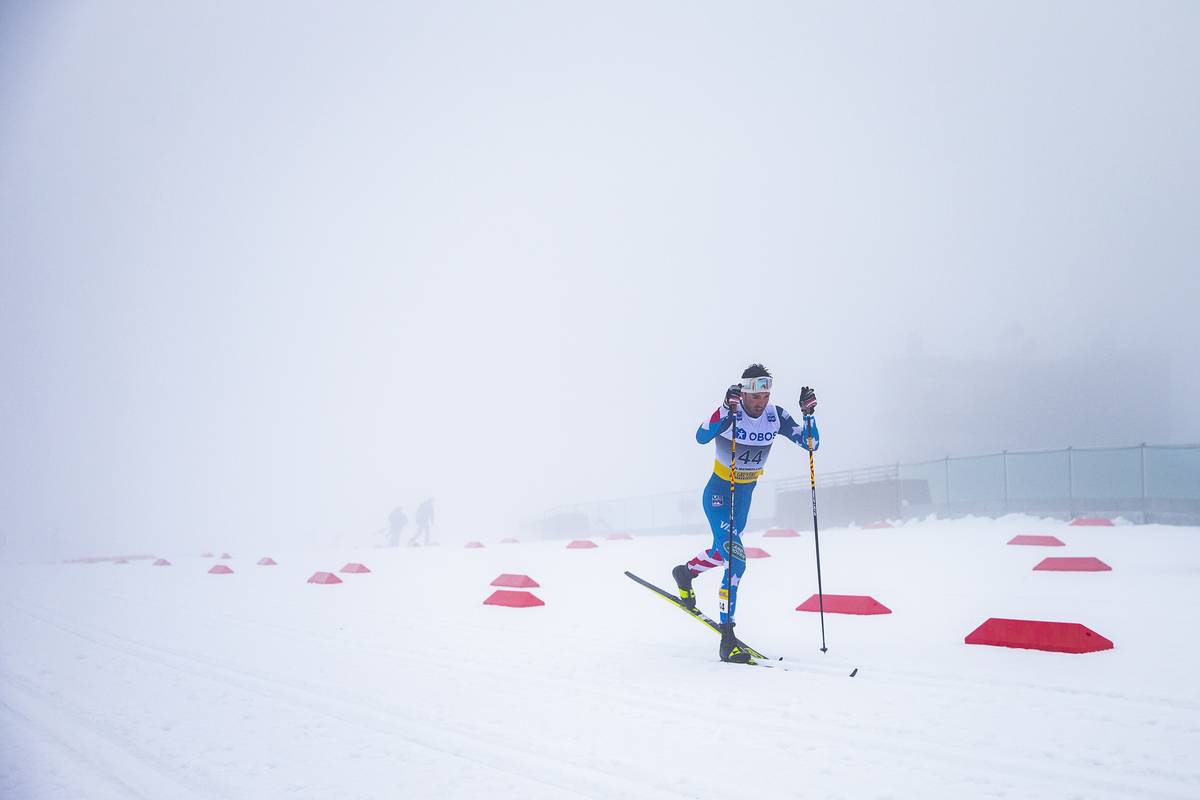
Ian Torchia (SMS T2) races through dense fog at the 50 k classic at Holmenkollen in March, 2020. (Photo: NordicFocus)
Click here to read an account of physical therapist Ned Dowling’s first stint overseas with the US Ski Team in March, 2020.
Holmenkollen, Norway. March 8, 2020 – Men’s 50k Classic World Cup. 33 degrees and raining. The ski jump was engulfed in clouds. Spectators were forbidden from attending the Super Bowl of cross country skiing due to the impending COVID pandemic. My first stint as a physical therapist traveling with the US Ski Team was ending in an Oslo fog.
Salt Lake City, Utah. Late March, 2020 – Buzz kill. In the week following my return from Norway, my son’s school was closed, my clinic was closed, people were fighting over toilet paper and hand sanitizer. It was the end of the world as we knew it. And we didn’t feel fine.
July 6, 2021 – I received an email from Chris Grover asking if I could travel with the ski team again in 2022. We were amidst the calm before the storm. People were getting vaccinated. COVID cases were dropping. We went on vacation. Delta had not yet jumped out from behind the grim reaper. The light at the end of the tunnel was getting brighter and brighter.
I had declined an offer to travel the previous winter. I knew I couldn’t get permission from either the boss at work or the boss at home. And I sure couldn’t tell my kid, who was still doing school remotely, “You keep up with those classes on Zoom while Daddy is off to Europe.”
But now things were looking up. By the time I’d be overseas in March, the COVID thing would be a distant memory. Hell yes! Sign me up Chris.
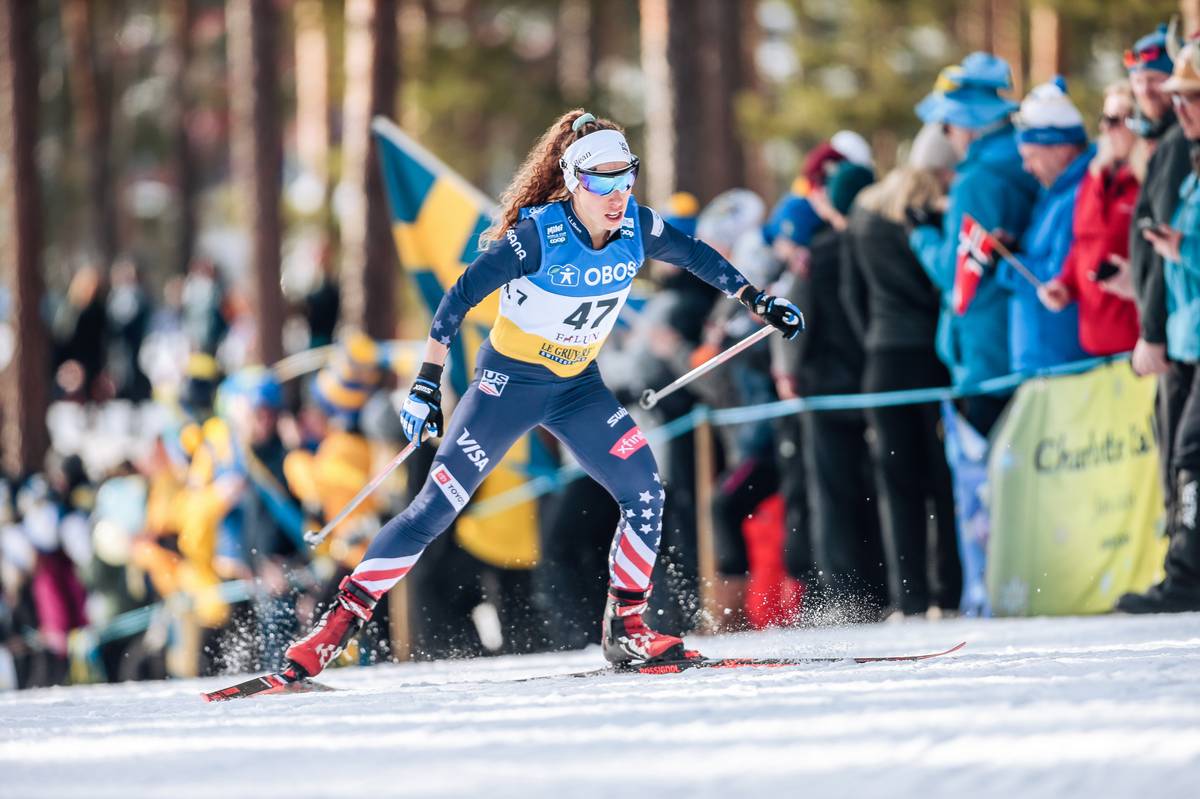
Rosie Frankowski races the 10 k freestyle in Falun, Sweden in March 2022. (Photo: NordicFocus)
Summer, Fall, Winter – We all know what happened next. The light at the end of the tunnel was an oncoming train and the shit hit the fan. Lots of shit hit lots of fans. First, the Delta variant, then Omicron. Through all of that, I did my best to stay optimistic about my opportunity to work the last two weekends of World Cup races in Falun, Sweden and Tyumen, Russia.
Falun was a bit of a known entity, or at least easily researched on the internet. The World Cup had been racing there for years. Trail maps showed a good network of tourist tracks (which is a good thing because the race course is no joke). Videos of old races on YouTube showed huge crowds, which were sorely missed at the pre-COVID Holmenkollen.
Tyumen, the Pearl of Siberia, was going to be much more of an adventure. Much to my relief, the plan was to have a chartered flight from Stockholm to Russia. I really, really didn’t want to fly (or crash) on a commercial Russian plane. With a lot of digging and Google Translate, I could glean some information about the race venue and its environs.
February 9, 2022 – Chris emailed me about getting a Russian visa. He told me to contact someone at the Russian Consulate in Washington: call this guy, do what he says, pay what he says, we’ll reimburse you. The next day I anxiously called Bogdan, to whom I would be entrusting my passport. “You send passport, extra photo, and $250. You complete visa application online and send password for application, so I fix your mistakes. You send postage to mail back.” I had him repeat that three or four times while I nervously scribbled notes to myself. I reminded him that I was flying to Sweden on March 6 and would very much need my passport back by then. “No problem. You get passport.”
The visa application was nerve racking. Employment history. List of all countries traveled to in the last 5 years. “Have you been trained in firearms, artillery, or nuclear warfare?”
With sweaty palms and my heart rate in L4, I mailed off my passport and hopefully everything else I was supposed to. Then I waited.
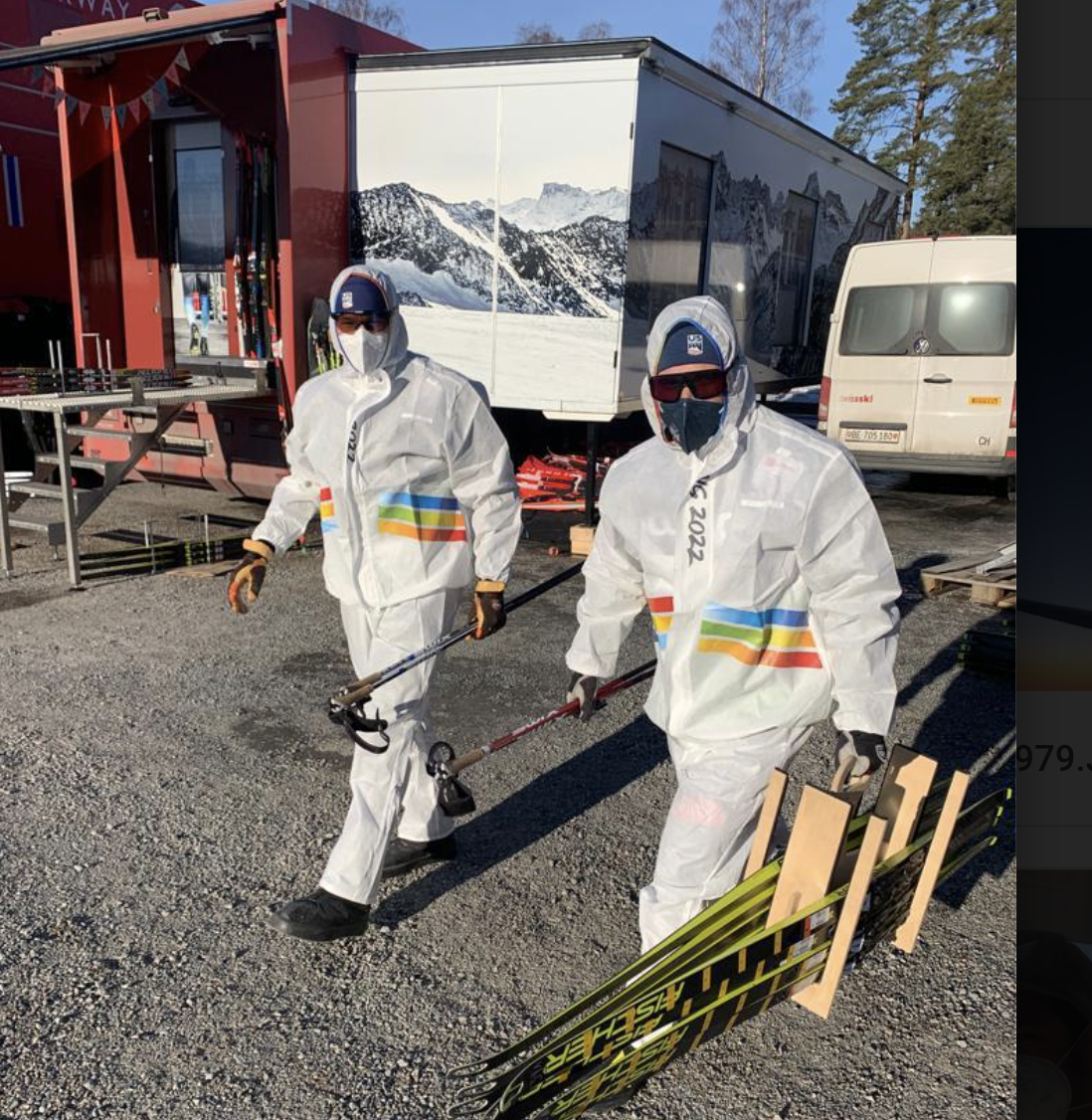
A different kind of Olympic suit: US wax techs take COVID precautions while testing and preparing skis in Falun, SWE. (Courtesy photo)
Thursday, February 24, 2022 – Russia invaded Ukraine. The world as we knew it ended once again. Chris texted me that the trip to Russia was canceled (the US team’s decision not to go to Russia preceded FIS’s decision to cancel the races). “Get your passport back right away.” I called Bogdan, my contact at the Russian Consulate. “We’ve had a change in plans, and I won’t be traveling to Russia. Can you please send my passport right away?” “No. I do not have your passport. Embassy has passport. I cannot get until finished with visa. But I mail it.” I could hear a toddler crying in the background. Bogdan apologized for the crying. I told him he shouldn’t have taken my call at home. He said, “Do not worry with passport. Visa will finish on Monday or Tuesday, then I mail. I call you when I mail.”
Friday, Saturday, Sunday, Monday, Tuesday – Nope. Not going to happen. I’m never going to see my passport again. They’ve all left the embassy. My passport is too low of a priority. They’re just going to be jerks and not send it back. So much for going to Sweden. COVID, war, what’s next?
9:21am, Tuesday, March 1, 2022 – Bogdan called. “Naatan, I mail passport. You get tomorrow.”
I thanked him profusely. And I said a little prayer. This man is living in America, raising a family in America. Yet he works for the Russian government. He is a Russian in a country that, overnight, hates Russians. I spent the last 5 days completely stressed because I didn’t have possession of a passport that would allow me to travel to Sweden for the sake of people skiing around in circles. This man, who must pay at least some attention to Western media, must have spent the last 5 days completely stressed over the safety and ultimate fate of his family and country.
(I do not mean to discredit ski racing or initiate some existential debate. As crazy as it seemed for the World Cup, and even Olympics, to carry on through this pandemic–and now war, I know I found great benefit from the distraction that racing provided. It was a slice of normalcy and vicarious living, which was invaluable to me as so much of what I took for granted was upended. But my little problems did seem very small compared to Bogdan’s.)
Wednesday, March 2, 2022 – Scott, our friendly (seriously, he waves to everyone) neighborhood mail carrier delivered my passport. Huge sigh of relief.
After a series of hurdles, Ned Dowling is wheels up on his way to Sweden. (Courtesy photo)
SLC International Airport. Sunday, March 6, 2022 – I hugged my son, kissed my wife goodbye, and donned my N95 mask which I wore for 18hrs straight. SLC direct to Amsterdam. Enough layover to grab a bottle of Scotch at the duty-free. A packed flight to Stockholm and a 2.5 hr bus ride to Falun. Jet lagged and sleep deprived, I met up with the team as they’d just gotten off their bus from Oslo. We all stood around in LL Bean team gear and N95s awaiting instructions on where to schlep our massive duffles.
Our accommodations for the week were not at the Scandic Hotel, the FIS-provided standard lodging for all of the teams. It was decided that the hotel and its buffet meals were too COVID risky. Instead we stayed two-each in a group of camping cabins equipped with bunk beds and a small kitchen. We were on our own for breakfast and lunch. Dinners were catered by restaurateur parents of Swedish sprint star Maja Dahlqvist (the World Cup circle is pretty close knit).
Cheers for negative COVID tests!
Falun, Sweden. Tuesday, March 7, 2022 – COVID testing. The team was shedding skiers and staff with positive tests. A few soldiers were left behind to wait out quarantine in an Oslo airport hotel. A couple more made it to Sweden but wouldn’t see a race bib. Anxiety was high. A positive test meant no racing, no human interaction, no trip home until the negative. One car load at a time we went to a testing center in Falun for nasal – very, very nasal – PCR tests.
“I think it touched my eyeball!” “I had 31 tests in China and that was the most aggressive one ever!” “Damn, that was legit!”
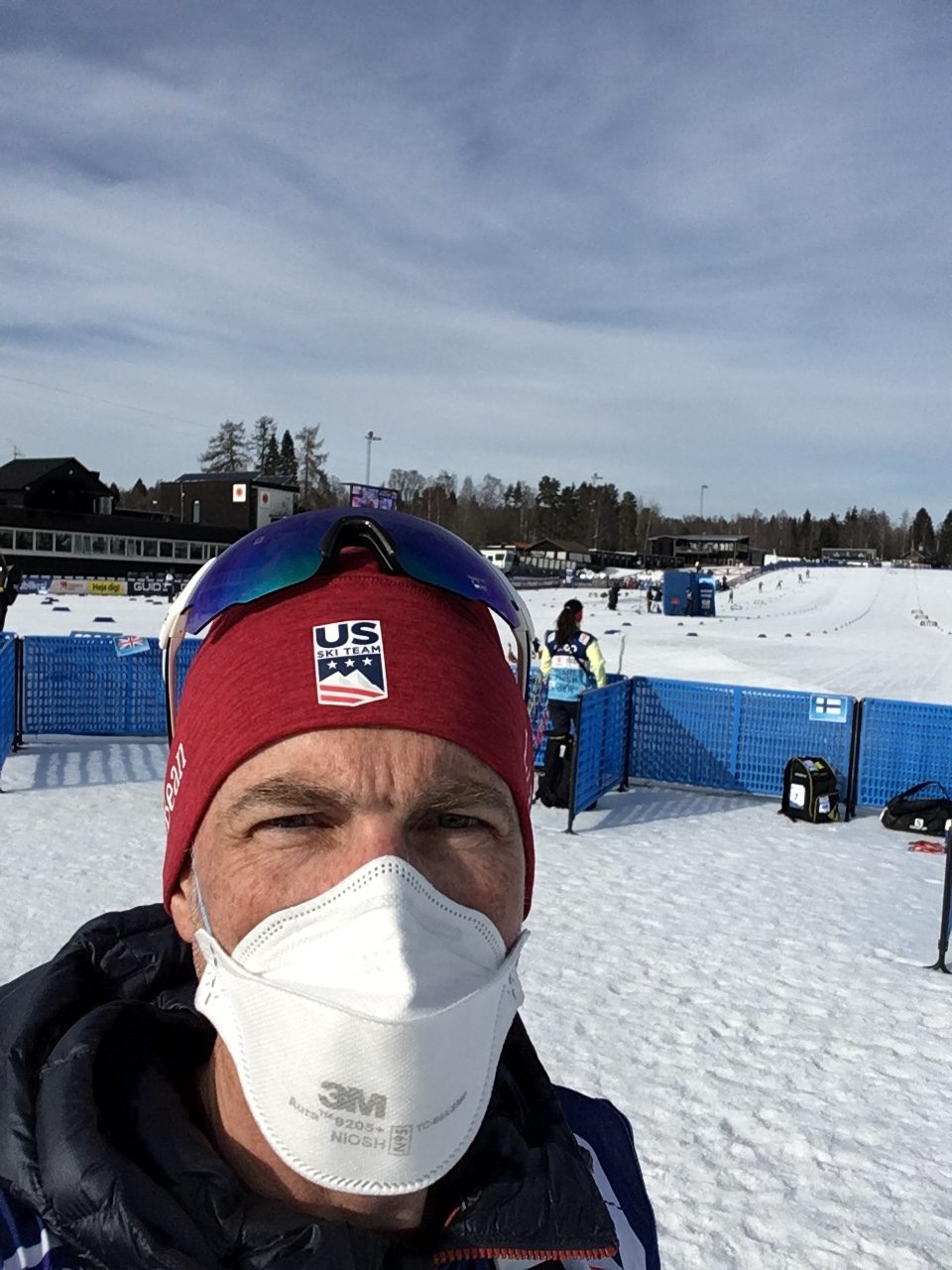
Physical therapist Ned Dowling snaps a masked selfie while supporting the US Ski Team in Falun, SWE. (Courtesy photo)
Wednesday, March 8, 2022 – All tests were negative. Collective sigh of relief. With that reassurance, I finally had some customers on the physio treatment table. Thankfully, everyone’s bodies were holding up reasonably well for being that late in the season. I felt guilty for being over there without much to do, but I figure that my boredom means they don’t need me and if they don’t need me it’s because they’re healthy, which is the goal (or they don’t want me because they’re COVID paranoid – there was plenty of that too, understandably so). So, until the racing began, I didn’t have much to do besides ski every day. Poor me.
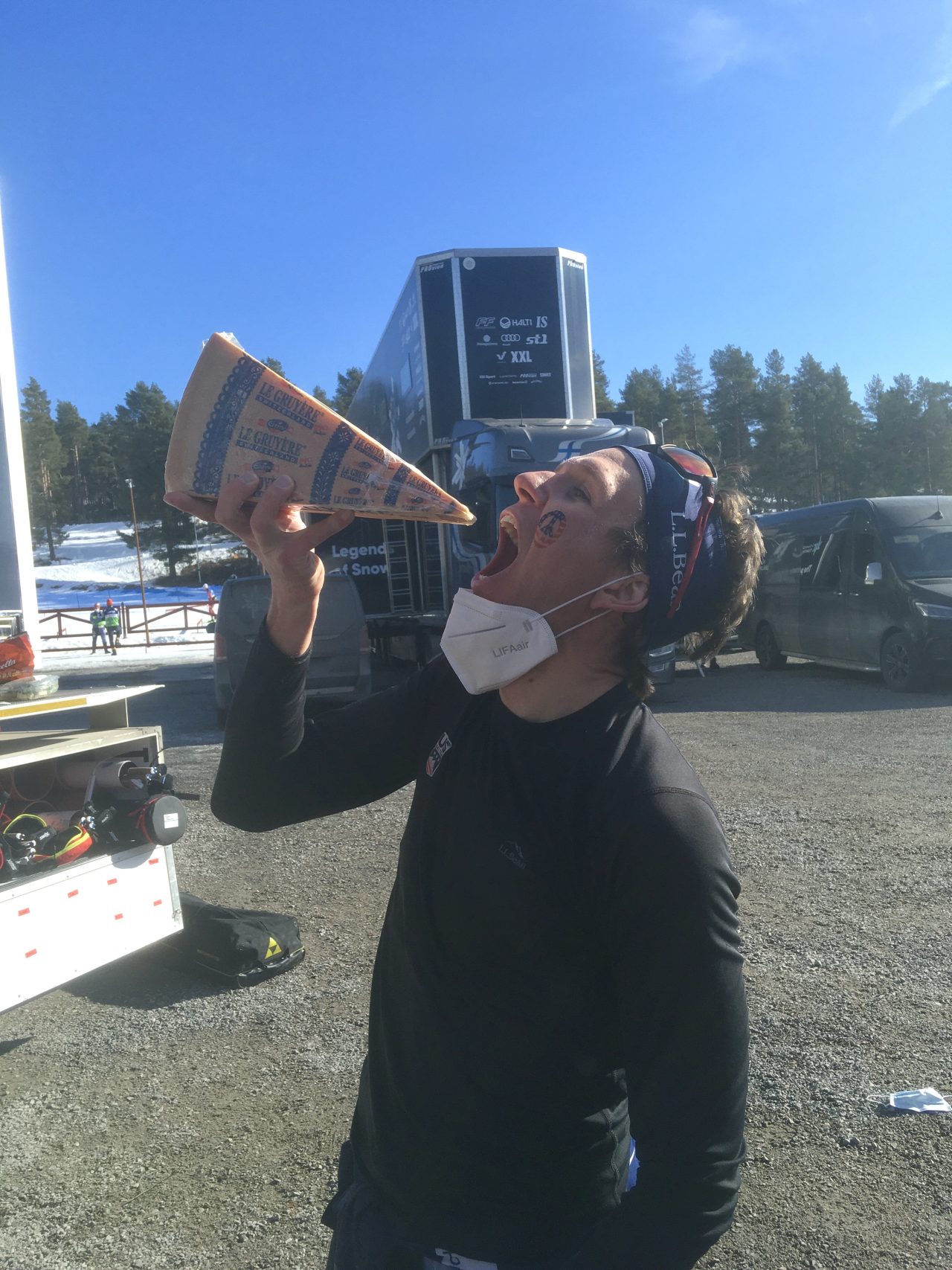
March 11-13, 2022 – Let’s go racing! My experience with the team is that they are always a great group of people to be around, but they’re even more fun with podiums. Lots of good results all around with some “first World Cup points” to some near-misses to some 5.5 lb chunks of Gruyere podium cheese.
Scott Patterson takes a bite of victory cheese after helping the USA 1 team to victory in the 4 x 5 k mixed relay in Falun, Sweden. (Courtesy photo)
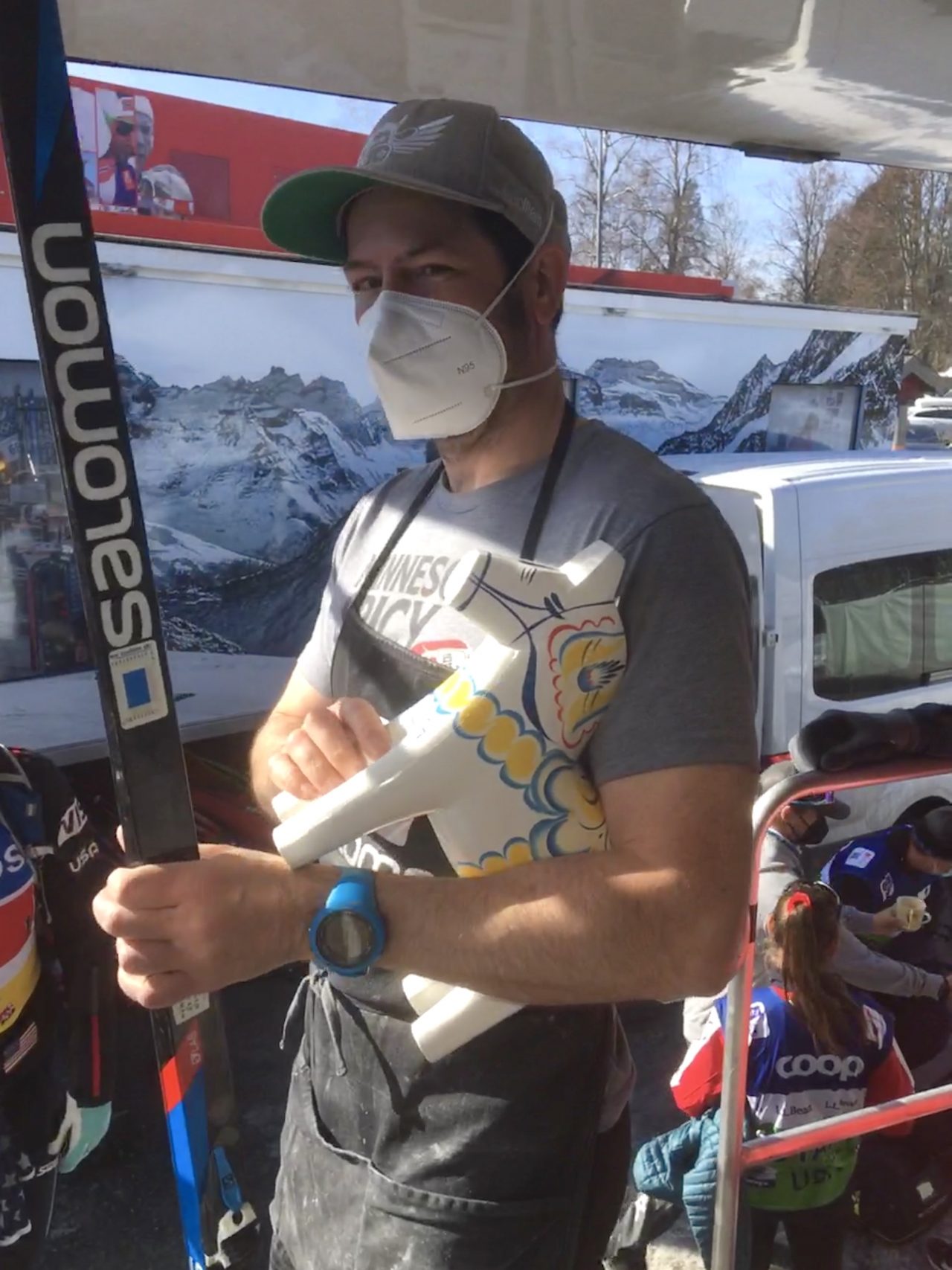
The man behind the fast skis: Jason Cork sports podium goods in Falun. (Courtesy photo)
4:30pm, March 13, 2022 – The final race: antigen testing for entry back into the US. Again, all negative. We’re going home! That night in the bar at a Stockholm airport hotel, I finally saw some faces that’d been hidden behind N95s all week. The poor bartender had a tough time keeping up with the drink orders. Elation, exhaustion, and simple relief that they’d survived another crazy race season and were finally heading home after four months of living out of suitcases, always masked, always nervous.
Maybe next year we can race without a pandemic or war or plague of locusts.
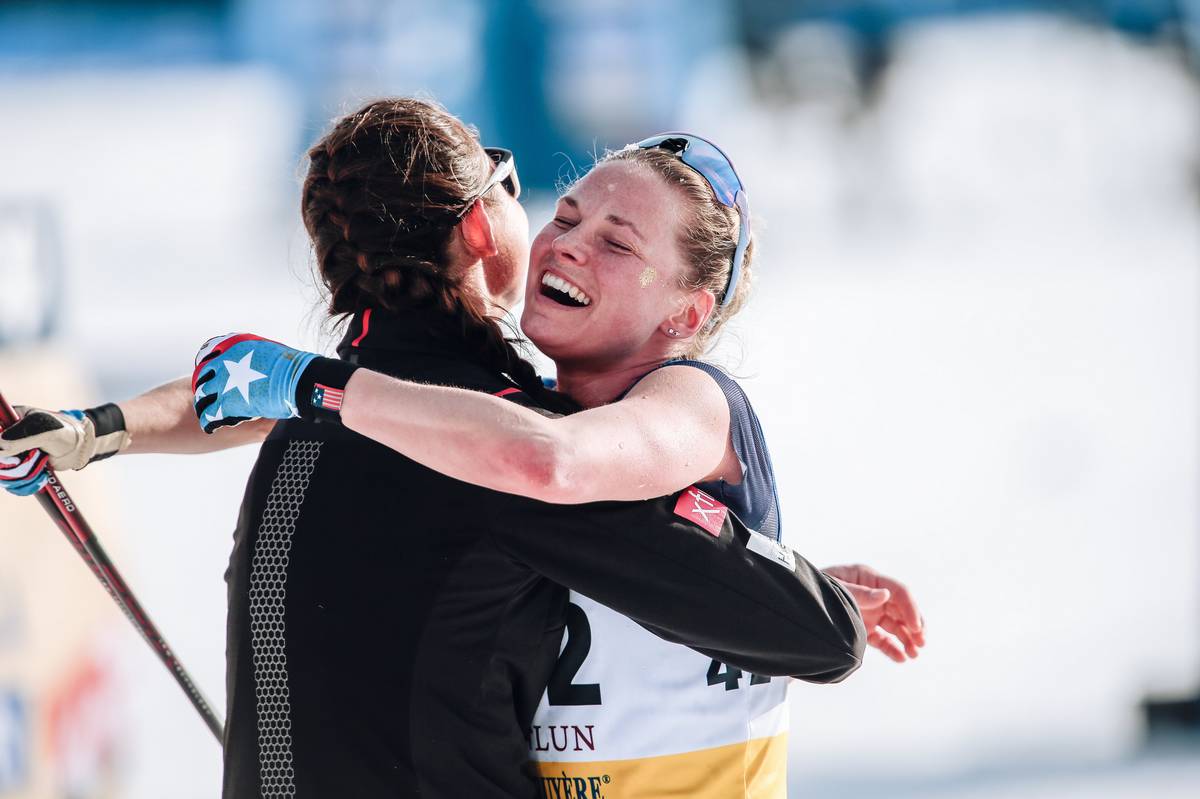
Jessie Diggins hugs teammate Julia Kern at the finish of the 10 k freestyle in Falun. (Photo: NordicFocus)
It was full sun and full gas in Falun, Sweden, for one last hurrah of World Cup racing. The three-day weekend brought us new formats, American podium performances (plural!) and any number of other highlights. Thanks for listening over the course of the World Cup tour — we’ll be back periodically during the off-season with interviews and updates.
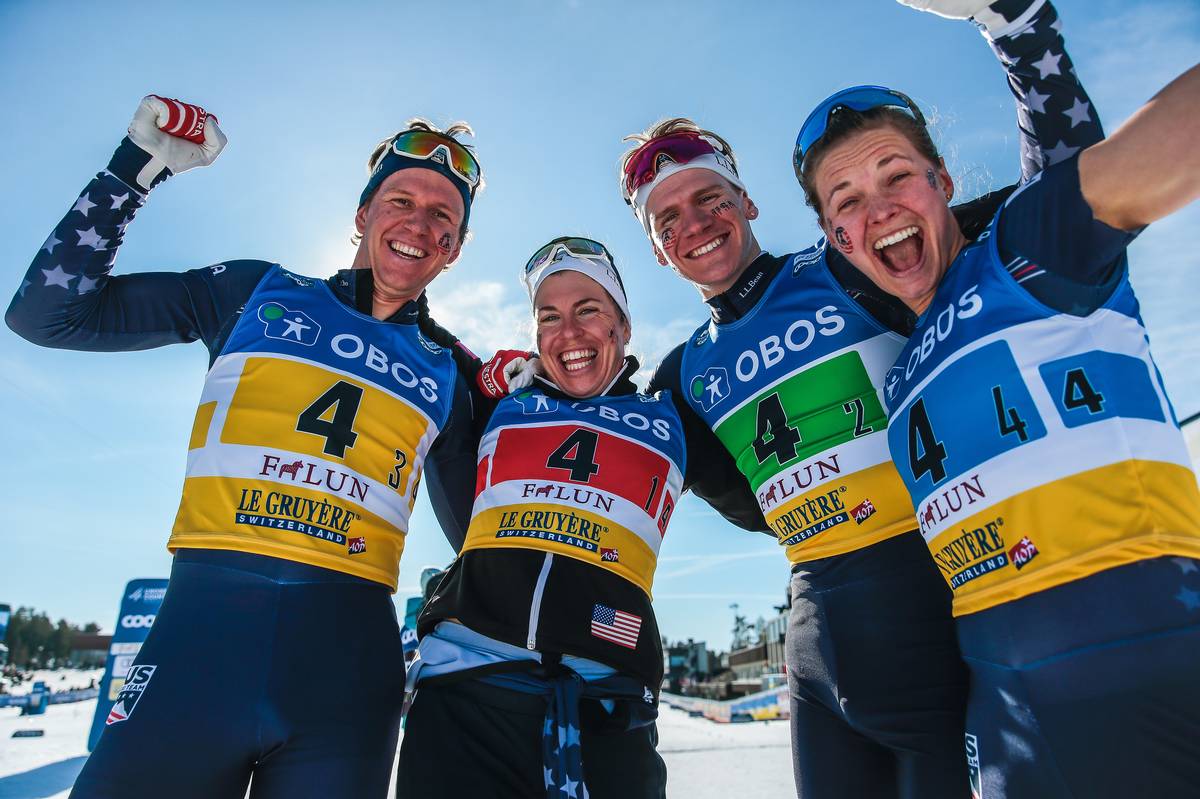
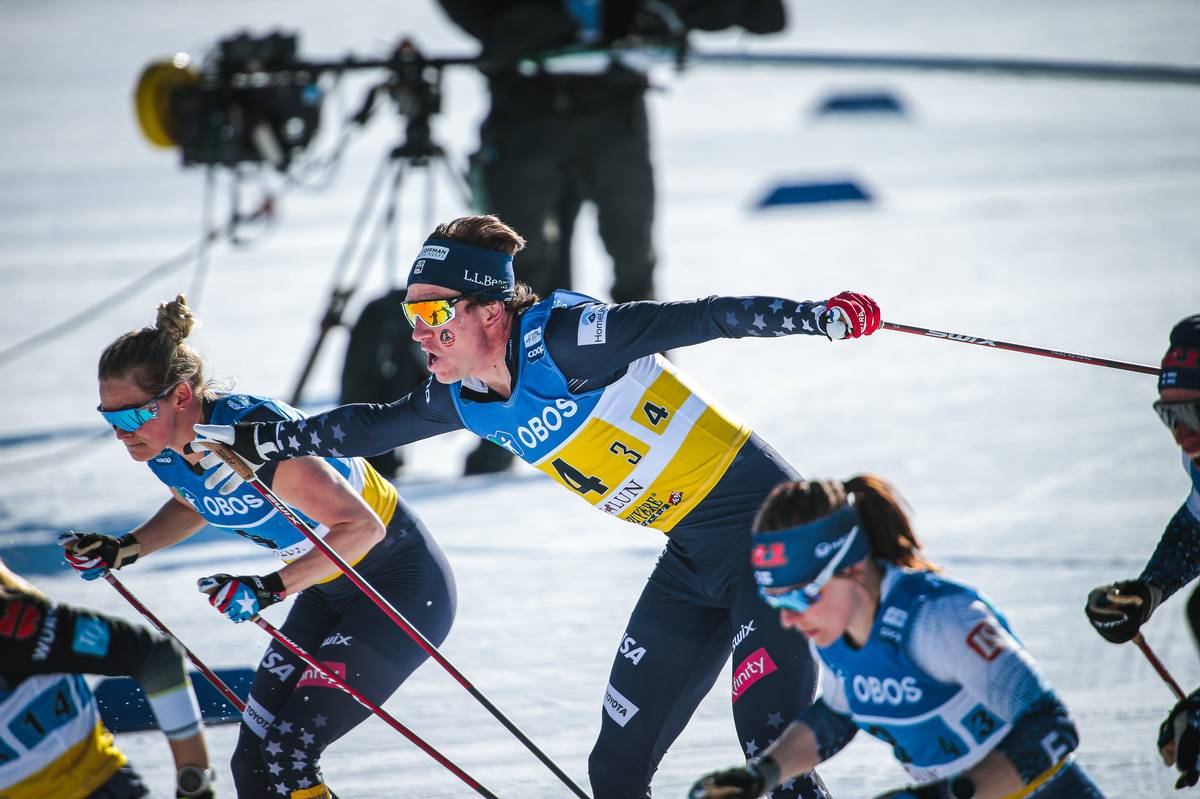
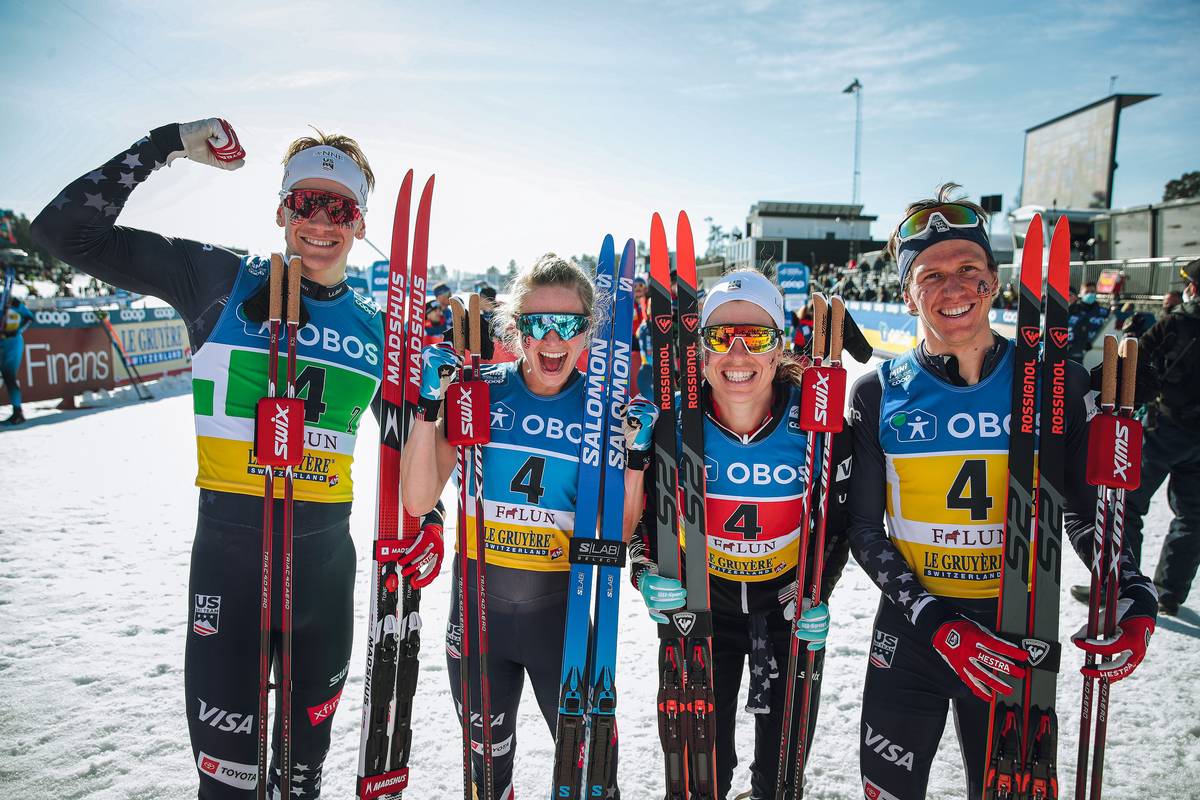
USA I takes the win in Falun’s 4 x 5 k mixed relay. From left to right, Scott Patterson, Rosie Brennan, Zak Ketterson, and Jessie Diggins. (Photo: NordicFocus)
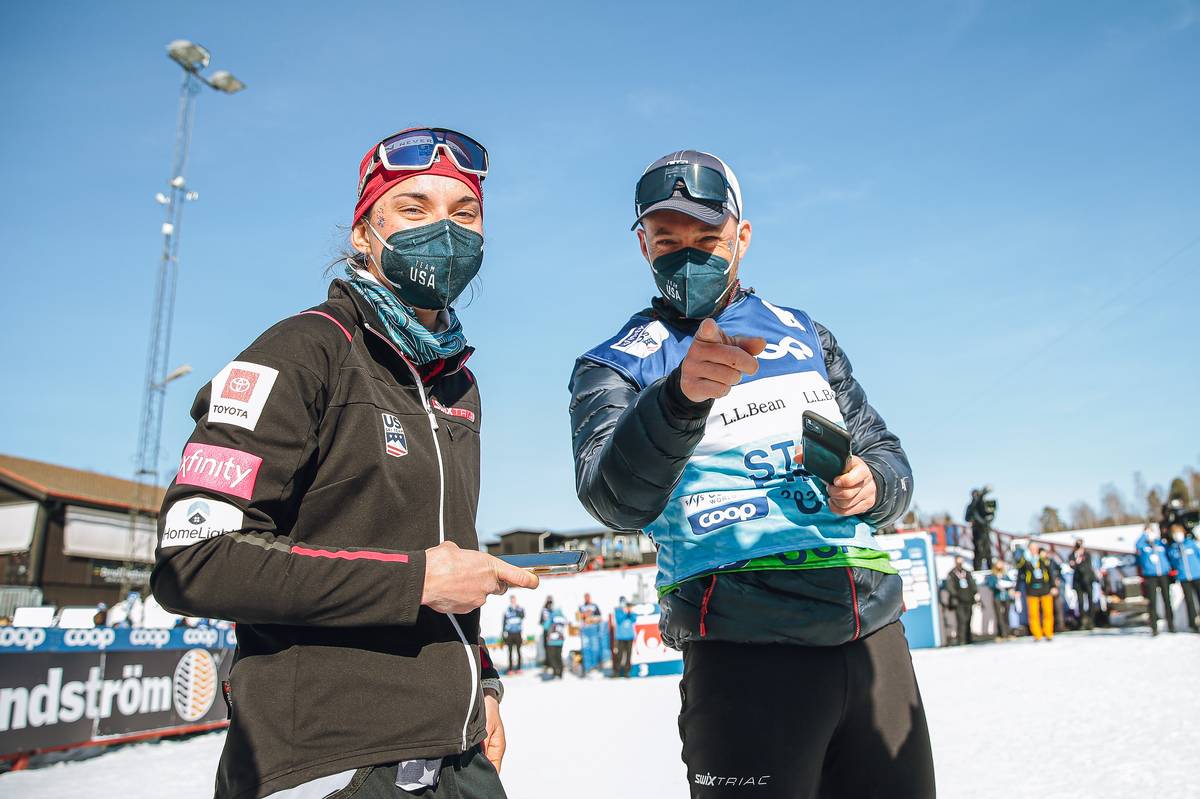
Julia Kern and US Ski Team head coach Matt Whitcomb watch the 4 x 5 k relay from the stadium. (Photo: NordicFocus)
This World Cup coverage is made possible through the generous support of Marty and Kathy Hall and the A Hall Mark of Excellence Award. To learn more about A Hall Mark of Excellence Award or to learn how you can support FasterSkier’s coverage pleasecontact info@fasterskier.com.
While it was perhaps not the final event originally planned for the season, today’s 4 x 5-kilometer freestyle mixed relay in Falun, Sweden shaped up to be quite a way to go out. Particularly for Team USA, who broke away in the final lap to take the win in 42:01.8.
With Rosie Brennan scrambling to tag Zak Ketterson for the second leg, Scott Patterson skating third, and Jessie Diggins anchor, it was a team composed of four skiers who had all raced into the top-15 in yesterday’s 10/15 k skate, three within the top-eight. Perhaps the only team more loaded was Norway 1, which featured Heidi Weng, Hans Christer Holund, Didrik Tønseth, and Therese Johaug, all of whom placed in the top-five yesterday, including both of the day’s winners in the final two relay spots. Also a force, Finland I consisted of three Olympic medalists, one of whom is the 2022 men’s World Cup distance champion with the lineup: Kerttu Niskanen, Perttu Hyvarinen, Iivo Niskanen, and Krista Pärmäkoski.
Each nation was allowed two teams, allowing the US to start a second lineup of Julia Kern, Logan Hanneman, Adam Martin, and Caitlin Patterson. Canada raced one team, which included Katherine Stewart-Jones, Antoine Cyr, Philippe Boucher, and Jasmine Drolet, racing in that order.
Stars and stripes at the front, as Julia Kern scrambles for USA II in Falun’s mixed relay. (Photo: NordicFocus)
New to the World Cup, the mixed relay is modeled after the biathlon competition format, which debuted in 2005. It had originally been slotted onto the calendar for the Canmore World Cup events in March 2020, which were canceled as COVID-19 began to spread around the globe. It had been tested on the tracks in Falun during the 2021 Swedish senior national championships, with local club leader Johan Eriksson saying afterward, “Team cohesion was strengthened when ladies and gentlemen fought against the same goal line. At the same time, the entertainment was great with reversals in the result lists and tactical moves in team line-ups.”
The entertainment value was certainly high today, particularly for American ski fans. Racing a distance now only seen in relays, it would be a painful blend of sprinting and distance. And the Americans would be lucky to have a woman anchoring the team who has previously been described as the “Queen of the 5 k skate”.
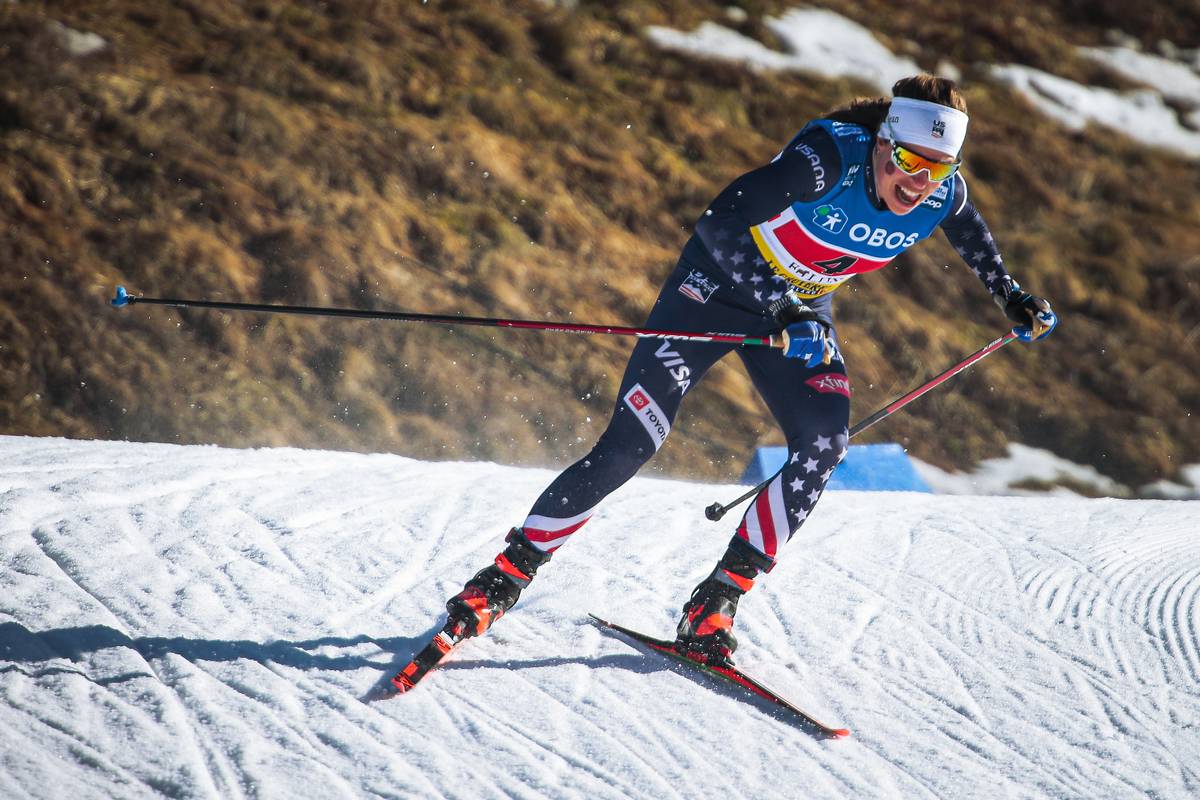
Rosie Brennan scrambles for USA I during the inaugural World Cup 4 x 5 k mixed relay in Falun. (Photo: NordicFocus)
As expected, the pace was high from the start, as the Star Wars theme blared through the stadium loud-speakers. Up for the task at hand, Brennan went toe-to-toe with the other women at the front through two 2.5 k laps. Later describing the event as “fast and furious”, Brennan kept USA I within the lead group, Kern duking it out on USA II alongside through the first lap.
“I think our goal today was to stay out of trouble and stay in the pack, and then let Diggy do her thing that she does best,” Rosie told FIS post-race with a laugh. “And that worked out really well.”
Brennan handed off to Ketterson at the first exchange, in line with Germany I, Norway I, and Sweden I, Finland I just behind.
Though new to the World Cup this season, Team Birkie’s Ketterson has consistently shown his range. Domestically, he won three SuperTour sprints, and stood on the podium in four distance races, one of which was also a win. He chiseled away at the World Cup puzzle, finishing just outside the top-30 during the Tour de Ski, and returning following the Olympic break to place 41st in Lahti’s distance classic race and at the 50 k classic at Holmenkollen. Smashing a 15th place finish in yesterday’s 15 k free, Falun has been a breakthrough weekend.
Though 5 k is not a distance men traditionally race on the World Cup, Ketterson emailed post-race that the event felt familiar and reminiscent of his early days in the sport.
“I am a huge fan of the 5 k race distance as I spent four years in Minnesota high school races doing that distance multiple times a week in the winter. Today brought me back to those days! It was super chaotic pack skiing but I felt really strong the whole time and did my best to keep up with the leaders. Honestly, when Jessie is your anchor, you don’t really have to worry too much about the rest!”
Zak Ketterson tags Scott Patterson during the 4 x 5 k mixed relay in Falun. (Photo: NordicFocus)
On lightning fast tracks with matching skis, Ketterson skied smoothly within the large lead group, keeping USA I within contact of the leaders, while Sjur Røthe tried to crack open pack for Norway II. Tagging Patterson roughly four seconds back, USA I sat in 10th, alongside Canada, at the second exchange. USA II tagged in 14th, +34 seconds back.
Still a large and dense group of front runners, Patterson worked at the back of the lead group to minimize further time losses, keeping his team within reach of the podium. With both Norwegian teams at the front in the second lap, Patterson whittled down the American’s time back, tagging Diggins 2.2 seconds behind the leaders to “do her thing” over two 2.5 k laps. Canada had lost contact with the front group, sitting in 11th (+17.9), while USA II tagged following a gap in 15th (+1:14.5).
“My goal was to hang on with the pack early and get in the groove, then try to match accelerations later,” Patterson wrote after the race. “I knew I wasn’t going to be the one with super accelerations but could sprint the whole way. During the race I was thinking ‘Just hold on’, so Jessie could work her magic relay anchoring skills. There were a few moments where some gaps formed but I barely managed to cling on.”
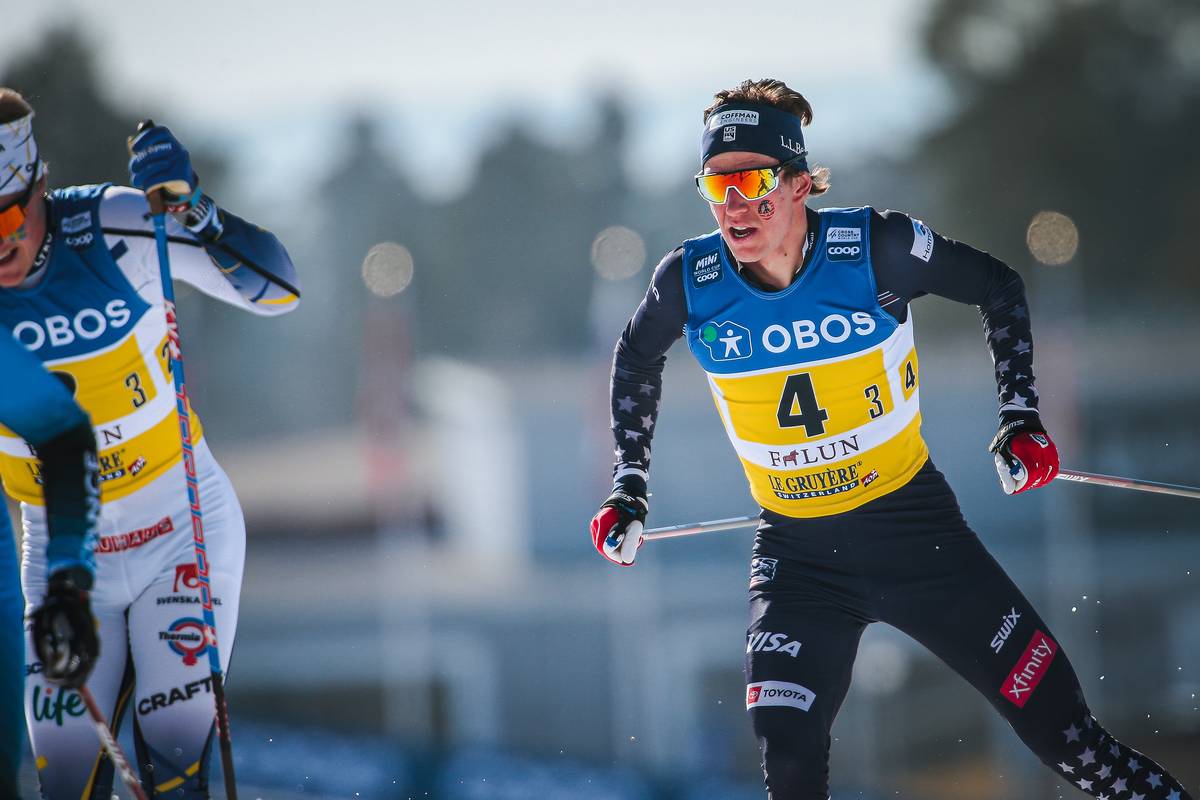
Scott Patterson races the third leg for USA I in Falun. (Photo: NordicFocus)Scott Patterson makes the final tag to Jessie Diggins during the 4 x 5 k mixed relay in Falun. (Photo: NordicFocus)
Diggins quickly got to work. Halfway through the first lap, it was Diggins marking Johaug at the front, with Krista Pärmäkoski for Finland I and Victoria Carl for Germany I tucked into their wake. Recall that Carl had anchored the German relay team for an Olympic silver medal in Zhangjiakou just a few weeks ago.
Skis ripping on the downhill, Diggins moved to the front to lap through the stadium 1.4 seconds ahead of Finland I and Norway I, Frida Karlsson for Sweden I challenging Germany’s Carl just behind.
Jessie Diggins brings USA 1 through the stadium in the lead after her first lap. (Photo: NordicFocus)
Diggins worked patiently up the climb, once more tucking behind the rapid fire tempo of Johaug on the uphill, and tucking calmly into the draft of the Norwegian and Finn heading into the descent. Diggins hit the second climb hard as the three women hop-skated up and over. Among the best descenders on the World Cup, Diggins skis were only fueling the fire, allowing her to maintain her lead in the rolling last kilometer and into the stadium which erupted with noise from the packed sidelines.
Rounding the final bend with a clear shot to victory, Diggins took a few tuck skate pushes before powering in V2 across the line with a fist pump and loud cheer, and maybe an expletive, before collapsing onto all fours surrounded by her ecstatic teammates.
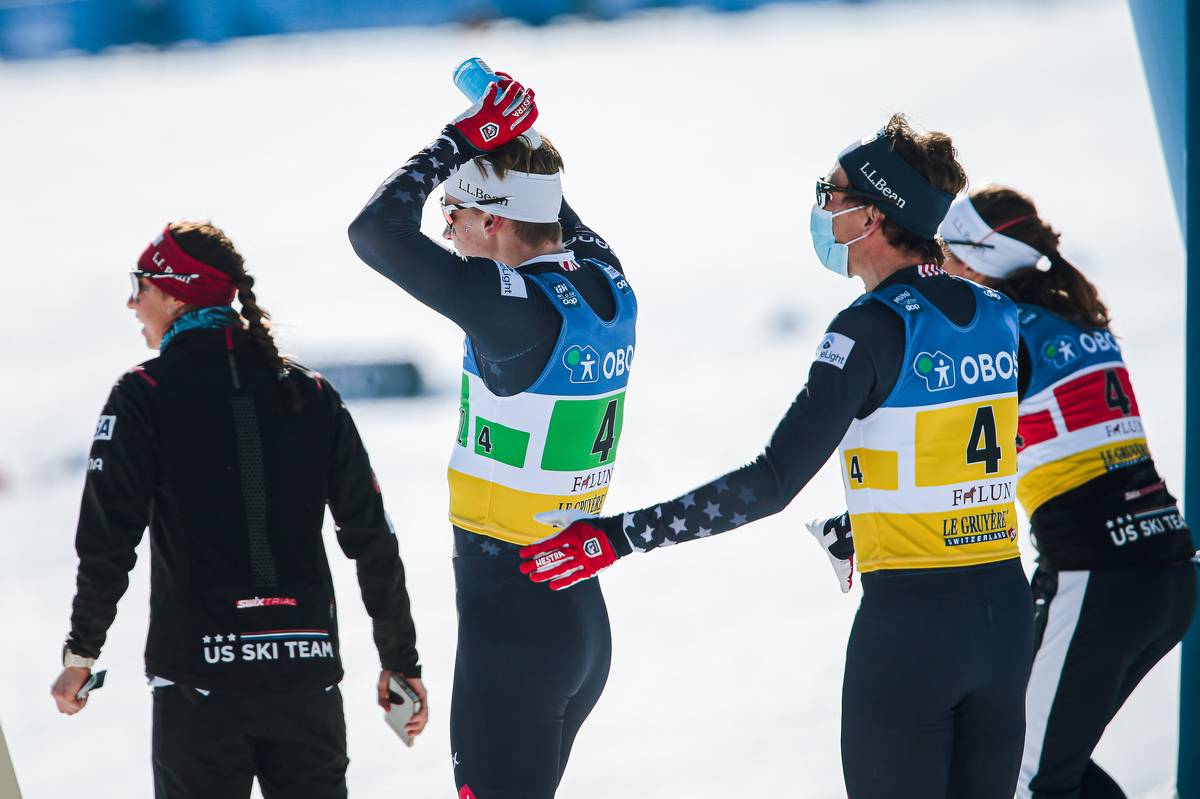
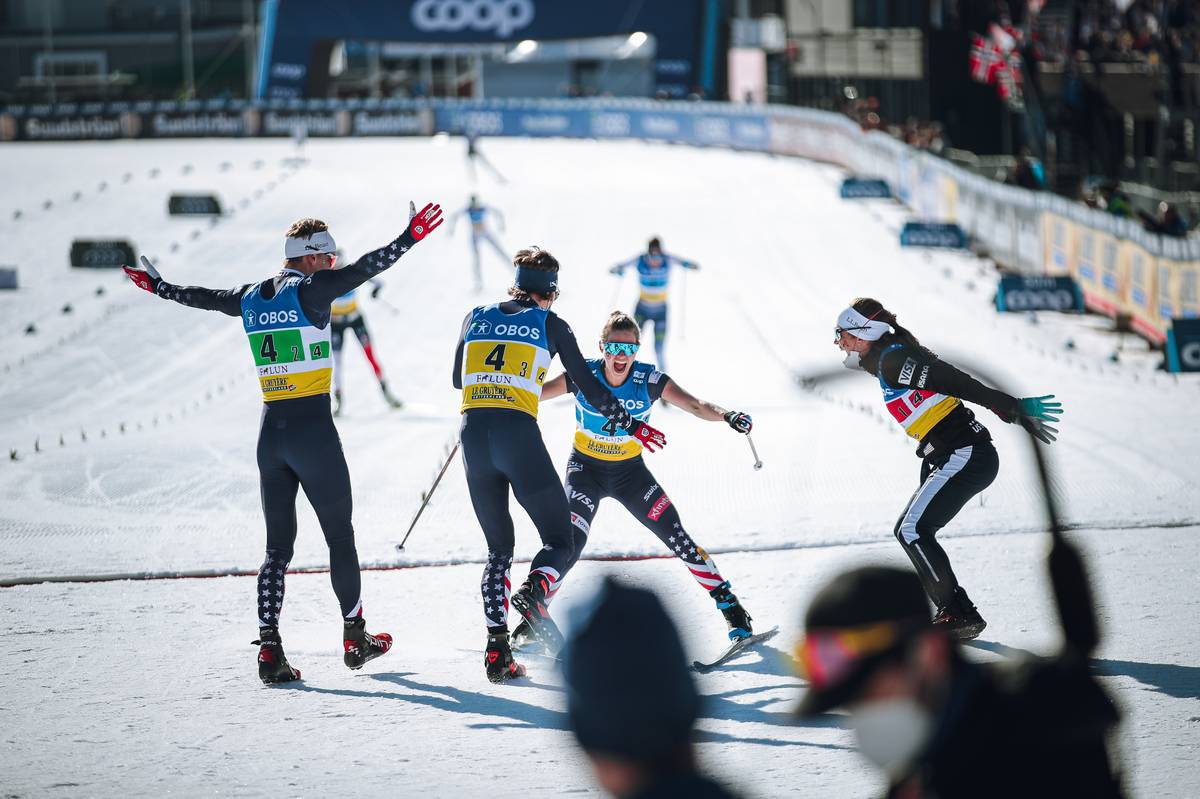
Nerves run high as the American team waits for Jessie Diggins at the finish of the 4 x 5 k mixed relay in Falun. (Photo: NordicFocus)USA I celebrates victory as Jessie Diggins crosses the finish of the 4 x 5 k mixed relay. (Photo: NordicFocus)
Outsprinting the World Cup distance champion, Pärmäkoski edged out Johaug to bring Finland I to the line in second (+3.8), leaving Norway I just 0.5 seconds behind in third. Having strung out over the last lap, Sweden I took fourth (+9.1), with Germany I fifth following another gap (+16.2).
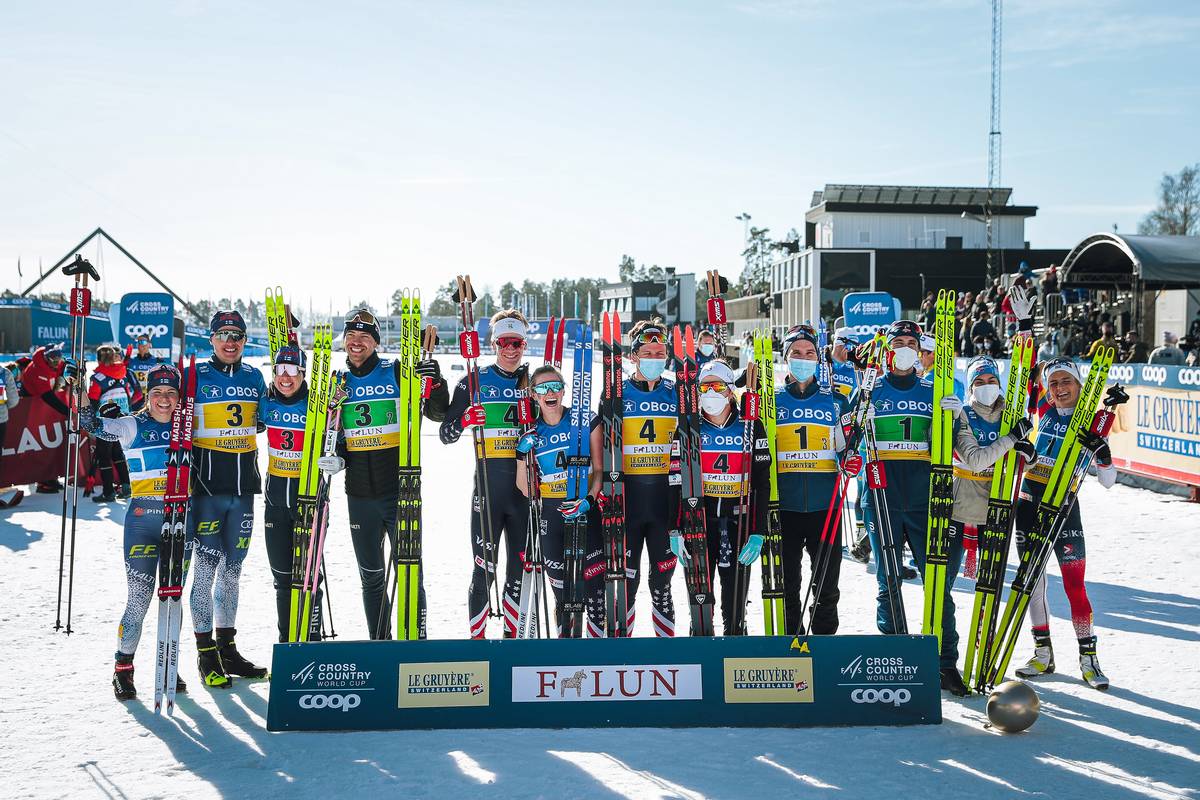
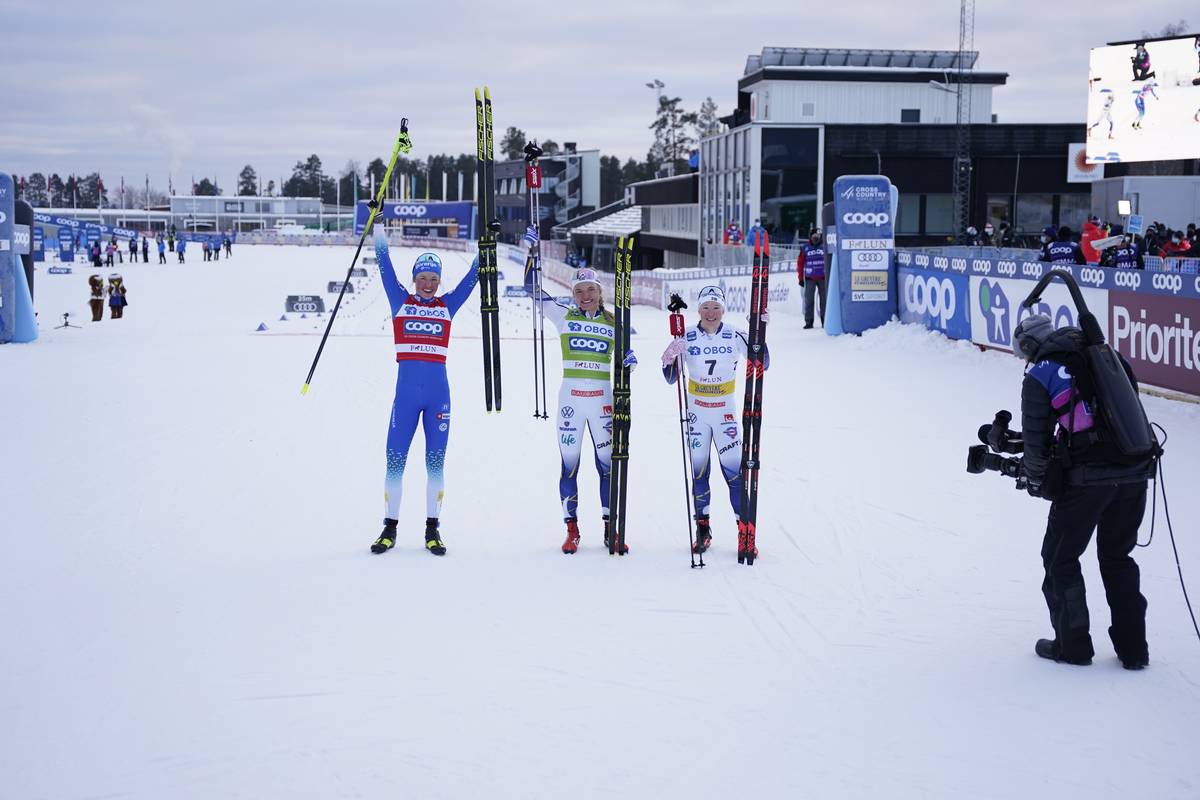
A packed podium for the 4 x 5 k mixed relay in Falun. USA I took the win ahead of Finland I and Norway I. (Photo: NordicFocus)
Describing the experience of winning the mixed relay on the final day of World Cup racing, Diggins told FIS with a laugh, “[It] feels like champagne getting sprayed on you.”
Surrounded by her teammates, she continued, “That was so, so fun. We really pulled together as a team. We live together as a team for four months on the road, so it’s pretty cool to get to end the season racing for each other. I’m so proud of these guys, so I was feeling pretty inspired.”
Jessie Diggins helps USA I to the mixed relay win in Falun. (Photo: NordicFocus)
Later sharing her strategy in a post-race audio clip as the remainder of the team packed their bags to begin travel home tomorrow, Diggins discussed her strategy as anchor, adding how the rockets under her feet allowed the race to unfold somewhat differently than she anticipated.
“I knew that those downhill working corners were one of my strengths, so I knew that if I got to the top of that big sprint climb first, then I could ski all the other downhills how I want and have a good shot at setting up a finishing sprint. As it turned out, we had such great skis that I didn’t need that finishing sprint, but it was so fun to go ski that as hard as I could. Again, I’m just so proud of the team. It was so special and fun to share that with everyone, and I can’t think of a more perfect way to end a really awesome year.”
Full post-race audio clip from Jessie Diggins:
USA I ends the season on top in the 4 x 5 k relay. From left to right, Zak Ketterson, Jessie Diggins, Rosie Brennan, and Scott Patterson. (Photo: NordicFocus)
“What a way to close out the World Cup season!!!!!” Brennan emphasized in an email. “After Scott and Zak had great days yesterday, I felt that we definitely had a chance, but I was not expecting a victory like that! It was fast and tactical racing out there and in the scramble leg, I wanted to stay near the front of the pack and stay out of trouble. I found myself further back in the pack than I wanted on the 2nd lap, but also knew a fall or broken pole would cost us so I tried to be patient, calm and tag off in the pack. Zak, Scott and I had the same strategy and Scott made a great move to get ahead of a split in the pack to tag Jessie in a great place. Jessie skied an insane leg and I feel lucky to have her as a teammate!”
Echoing her sentiments to conclude his post-race email from the road, Patterson added, “It’s really cool to win the last World Cup and especially awesome to be part of the team. The mixed gender event was extra special as the guys were finally able to tap into the relay energy the women have cultivated over many years.”
Canada’s anchor Jasmine Drolet receives a tag from Philippe Boucher during Falun’s mixed relay. (Photo: NordicFocus)Adam Martin tags his Craftsbury teammate Caitlin Patterson, who raced the anchor leg for USA II. (Photo: NordicFocus)
Losing contact over the third and fourth legs, consequently racing alone, Canada ended the day in 12th (+1:45.2), while USA II pushed alongside Finland II through its final lap. Edged out in the final sprint, Katri Lylynpera (FIN) snuck her boot over the line ahead of Caitlin Patterson’s, leaving USA II in 14th (+2:10.9).
Celebrations fed by cheering crowds, energy was high throughout the stadium. Regardless of finish order, acts of camaraderie and sportsmanship could be seen and heard as cameras meandered through the groups of athletes waiting for their relay teammates. We could hear a Frenchman congratulate Norway’s Tønseth on ending his season with an individual win, Ketterson and Kern anxiously trying to predict what might happen in the American’s final legs, along with a host of supportive cheers as teammates and coaches egged on the racers.
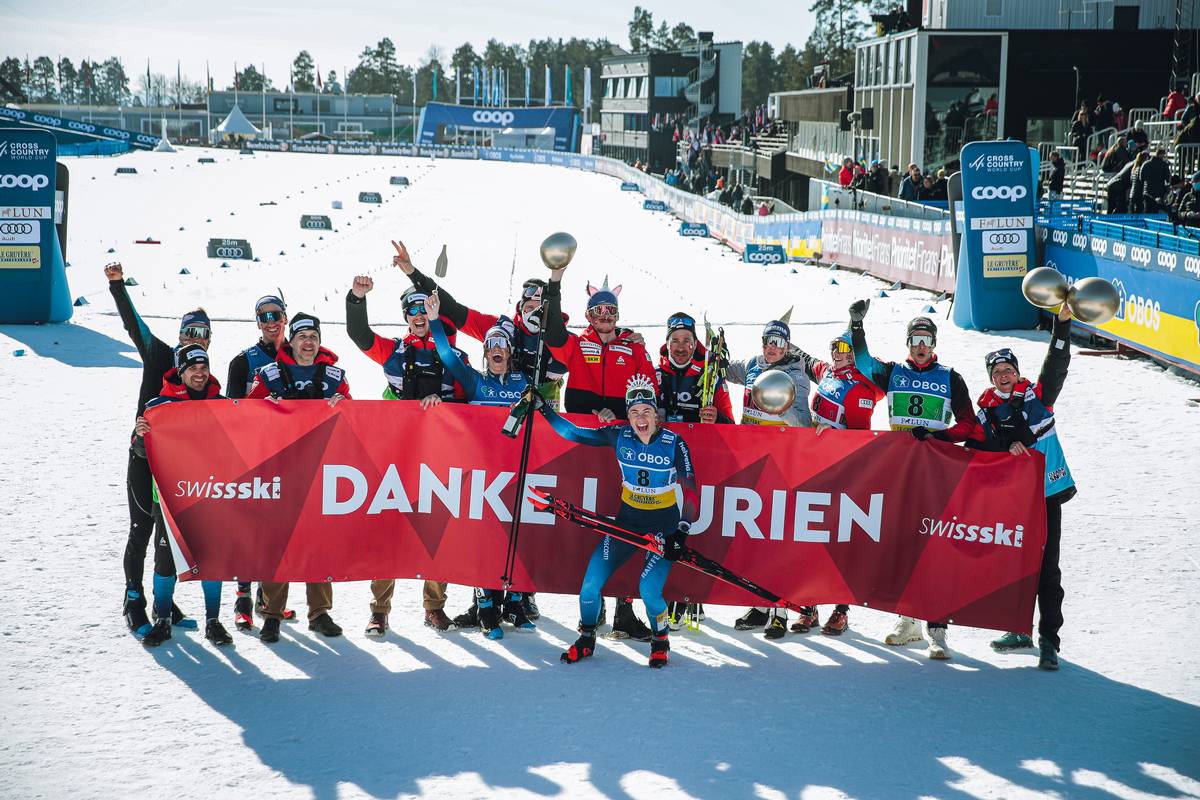
Awaiting the Swiss anchor Laurien Van der Graaff was a princess tiara, teammates in golden unicorn horns, and a large banner that read “Danke Laurien”, in celebration of her retirement. The 34-year-old has long been a presence on the World Cup, collecting a slew of podiums and a World Championship team sprint silver medal along the way.
The Swiss program celebrates the retirement of Laurien Van der Graaff at the finish of the 4 x 5 k mixed relay in Falun. (Photo: NordicFocus)
With revelry and thrill in the air, only the mixed team sprint remained on deck as the 2021/22 World Cup season drew to a close in Falun. The American program did not enter the team sprint competition, and will next compete as a team at the Whistler Olympic Park in British Columbia March 20th – 27th. The event will serve as both the Canadian National Championship and SuperTour Finals.
This World Cup coverage is made possible through the generous support of Marty and Kathy Hall and the A Hall Mark of Excellence Award. To learn more about A Hall Mark of Excellence Award or to learn how you can support FasterSkier’s coverage please contact info@fasterskier.com.
There wasn’t much to be decided, only facts to reaffirmed.
In the last individual race of the World Cup season on Saturday, a 10-kilometer individual start freestyle in Falun, Sweden, the overall World Cup standings of consequence were already decided. Individual season goals for each racer were already moving towards reflection.
Off the course, bare patches of ground seemed to suggest that even the snow was ready to move on from this winter and this ski season. The air was in agreeance; it was 6℃ (44℉) at race start.
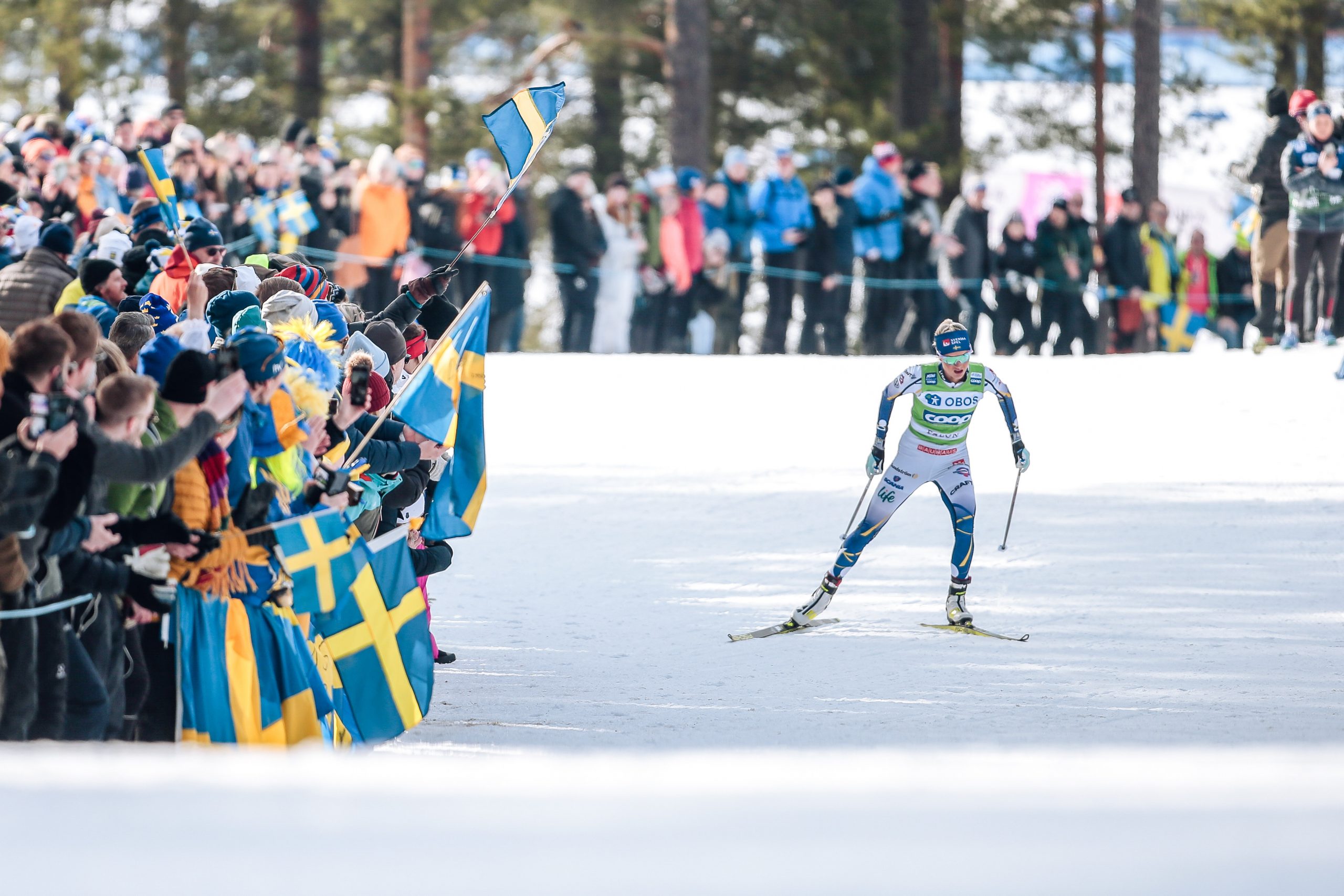
Frida Karlsson (SWE) skis past a vibrant Swedish scene in Falun. Karlsson finished 12th in the 10 k freestyle (+1:07:00), but ends the season as the World Cup Distance runner-up behind Therese Johaug (NOR). (Photo: NordicFocus)
And why wouldn’t they be? For all the hints of a return to some kind of normalcy this World Cup season – fans back at venues, a majority of courses covered with natural snow – the World Cup couldn’t out-ski the anxieties and the full-blown winds of change that the winter of 2021-22 has sent around the world. At its conclusion today, the World Cup overall will be awarded to a skier, Natalia Nepryaeva (RUS), who was barred from competing on account of the Russian government’s invasion of Ukraine. Nepryaeva sits atop a World Cup Overall points list that was shaped, and is shaped by, COVID-19 – which forced multiple cancellations of World Cup events in January, and across the season has seen individuals and teams miss races.
All we could hope for from skiing, across this season and at today’s race, was for some sort of center to hold. That we could watch and see something that we had seen before, and that it would bring light and levity to the challenges of the times.
For that type of drama? Well, while World Cup finals may have moved from Siberia to Sweden, their final destination could have been Shakespeare’s Globe.
Woven and interlocked throughout the 10 k individual start were acts ski fans have come to know by heart over the past few years and over the course of this season. But that didn’t make them any less impactful to watch. We would see valiant efforts from early starters, a women’s field where margins are only ever a few seconds throughout a race, capped off, apropos the start order,by the one question that has animated distance racing on the World Cup for nearly a decade, posed for the last time – what about Therese Johaug?
To get to the answer to that question, we would have to wait. In the meantime, the Falun course played host to narratives that followed the contours of its terrain. The 10 k was raced as 3 laps – one 2.5 k loop that was relatively flat, before two laps of a 3.75 k loop where the terrain was punctuated with a set of climbs that would look to separate the field.
Julia Kern skis to 20th in Falun’s 10 k individual start skate. (Photo: NordicFocus)
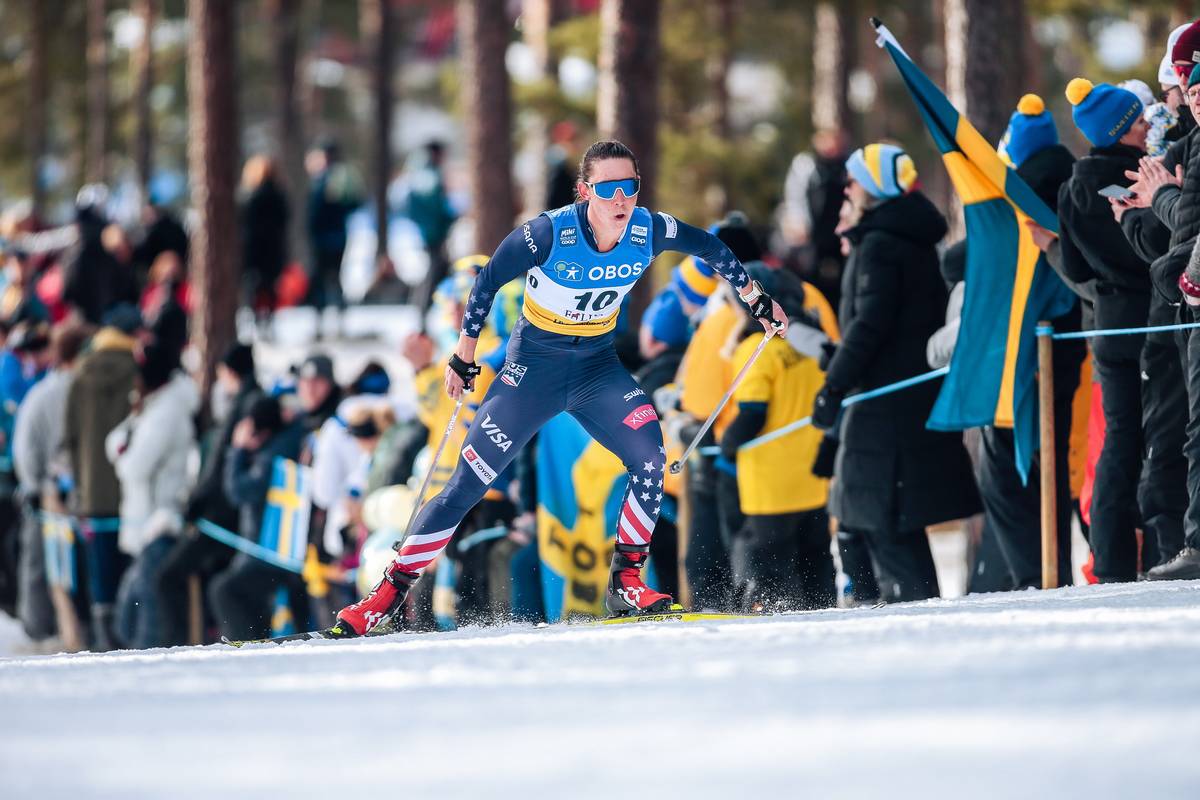
The early racer to watch in the field was bib 10, Julia Kern, who came through the 1.5 k checkpoint 3.7 seconds ahead of the field. While the top racers would soon follow, with Frida Karlsson (SWE) eventually topping Kern’s mark as she moved through the course, Kern would prove to be a pace-setter for the earlier starters throughout her 10 k effort. She set the fastest time on course at the finish, but it would fall as seeded athletes followed. Her efforts though, ultimately yielded a 20th place finish (+1:30.3), and the image of Kern crossing the line as a champion (even if it proved temporary) seemed an appropriate conclusion to a season where she had battled to overcome the growing pains of World Cup skiing from last season and prove to be one of those American women that ought to be seen as a force on the start line.
“She raced four rounds yesterday. There was gonna be a limit to the energy, [and yet] she swung really hard today and came up with a big result today. I think a fresh Julia Kern can race with the top ten, and that’s not diminishing her 20th place today. There’s more to give, and that’s exciting” said US Ski Team Head Coach Matt Whitcomb on Kern’s result in an interview with FasterSkier.
Full audio interview with Matt Whitcomb.
Jessie Diggins races to third in Falun’s 10 k skate. (Photo: NordicFocus)
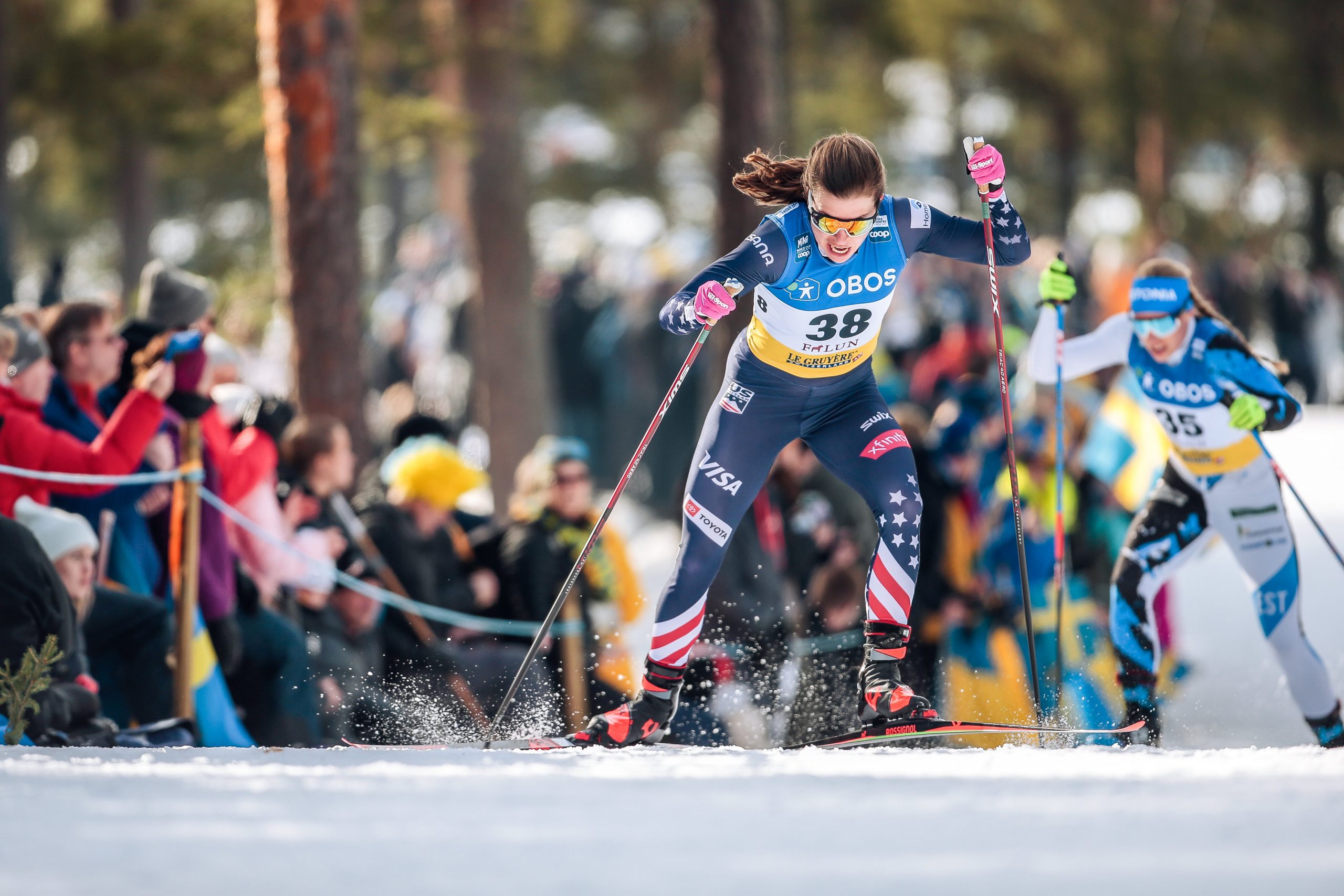
Joining her in the category of American women to be excited about throughout the season has been Rosie Brennan and Jessie Diggins. Brennan started in bib 38 today, with Diggins two minutes later in bib 42. They followed the lead of Frida Karlsson and Krista Pärmäkoski throughout the duration of the course. Karlsson, in bib 23, was the first skier to top Kern’s 1.5 k mark, coming in at 2.8 seconds over the field. Pärmäkoski, in bib 30, came through that checkpoint in 2nd, +1.6 back on Karlsson. When Brennan came through, she was +2.5 seconds off Karlsson and in 5th place, and when Diggins came through she was +0.2 off Karlsson and had put herself in 2nd place. The field, in other words, was tight, and those skiers, Karlsson, Pärmäkoski, Brennan, and Diggins – along with Ebba Andersson (SWE) and Kertu Niskanen (FIN) – would jockey and swap places through the remaining 8.5 k.
Krista Pärmäkoski races the 10 k individual start free in Falun. (Photo: NordicFocus)
At 4.3 k, Pärmäkoski had overtaken Karlsson by 1.2 seconds. Brennan came in +1.7 off of Pärmäkoski. Diggins moments later came in +1.8. Through the halfway point with the group the standings read: Pärmäkoski first, Karlsson second, Brennan third, and Diggins fourth, with less than 2 seconds between them.
By 7.7 k, the gaps had started to grow. Pärmäkoski came through with a 14.6 second advantage over Karlsson, while Brennan was +21.6 off the top and back in fourth place. The, in one of the familiar sights that colored the day, Jessie Diggins had started to somehow, someway, increase her pace. She came through 7.7 k now in second place, just +2.6 seconds off of Pärmäkoski.
Rosie Brennan on course Saturday. Brennan finished 8th in the 10 k freestyle. (Photo: NordicFocus)
At 9.1 k, Pärmäkoski still had first place, but Diggins had cut her deficit to a mere +0.6 seconds. As Pärmäkoski crossed the finish in first place with 21.8 seconds on the field, one started to get the exhilarating feeling that the camera would soon cut to Jessie Diggins doing what Jessie Diggins does best.
There was almost dramatic irony to it – we, the audience, just knew that there would be Diggins, free skating, looking ahead, and somehow increasing her tempo from 100% to beyond that. Then, she did it. Diggins crossed the finish line having not only erased her deficit, but gained a second on Pärmäkoski to finish in first place, 1.9 seconds ahead of the rest of the field.
In remarks to FasterSkier, Diggins said that her race today reflected renewed energy levels after her silver-medal winning 30 k at the Olympics, “Today was wonderful. After [sitting out the Holmenkollen race], I felt like I could go out and race the way I wanted to, having the energy to really attack the course.”
Jessie Diggins sits in the winner’s circle after crossing the line in first place on a sunny day in Falun. Diggins would eventually cede the spot to Jonna Sundling (SWE), before Therese Johaug (NOR) crossed the line in first. Final results: 1st Johaug, 2nd Sundling, 3rd Diggins. (Photo: NordicFocus)
Diggins’ result though, only was a subset of the dramatic irony that prevaded the overarching race. Behind her, wearing the red leader’s bib (56, last starter in the field), fresh off of a win at the Holmenkollen 50 k, and in her individual last professional ski race, was Therese Johaug (NOR). The immensity of her character in the drama of the day was hard to understate. Johaug had already secured the Distance World Cup title for the season – her record-breaking fifth time winning that title (breaking a record jointly held by Justyna Kowalczyk and Dario Cologna). Coming into today, she was looking for her 100th World Cup win. She had been on every World Cup distance podium except one (a 4th place in a 10 k classic two years ago) since 2019.
Posting outstanding results across all distances, Jonna Sundling takes second in Falun’s 10 k skate. (Photo: NordicFocus)
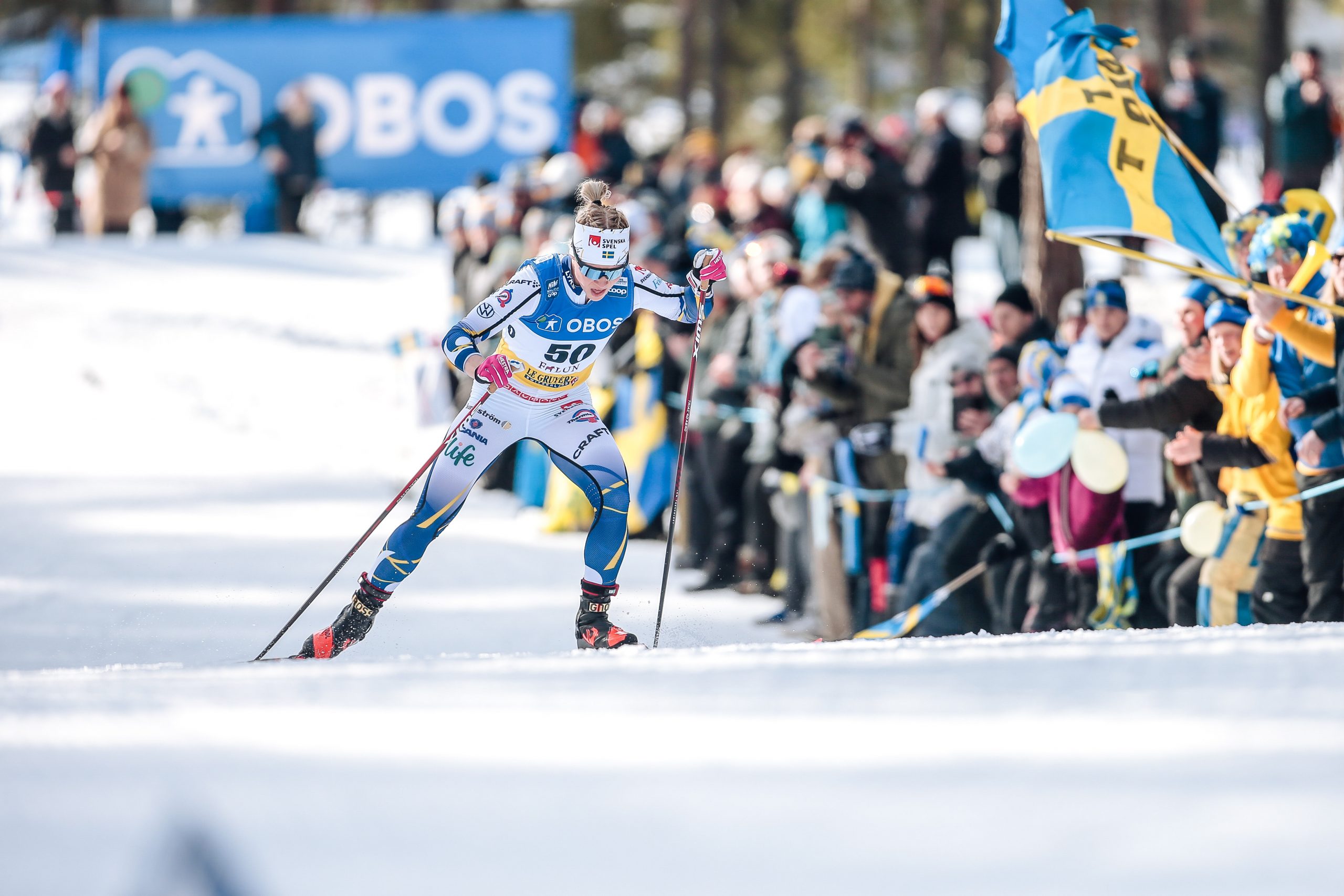
What she might achieve in today’s 10 k was continuously foreshadowed throughout the course by Jonna Sundling, who wore bib 50. The Swede, on her home turf, broke through the jockeying at the top of the field when she came through the 1.5 k checkpoint 8.1 sec ahead of the field. When Johaug came through behind her in 2nd place, +4.0 sec, the little separation the pair had created seemed to be a turning point in the race. Johaug might do it. She could do it. She would probably do it. And then, she was doing it.
“It,” of course, was opening a commanding gap on the best skiers in the world. At 4.3 k, she had a 14.1 second gap on Sundling. At 7.7 k, the gap was 30.6 seconds. At 9.1 k, the gap was 35.4 seconds. Building steadily, Johaug had set the stage for a final, triumphant act.
Jonna Sundling skis past her home crowd in Falun, Sweden. Sundling finished 2nd place, after a dramatic sprint to finish 0.4 seconds ahead of third place Jessie Diggins (USA) at the line. (Photo: NordicFocus)
First though, Jonna Sundling would add another scene. As she crested the hill going into the stadium the background was dotted by her country’s flags. The clock put her agonizingly close to Jessie Diggins. She did what she does better than any other skier at the moment – the Olympic gold medalist in the freestyle sprint unleashed a finish line burst that saw her come in 0.4 seconds ahead of Jessie Diggins in first place. The Swedish crowd let out a roar. It was the best that skiing as a spectator sport has to offer.
And then, it was surpassed by the best that skiing, period, had to offer. Therese Johaug finished in first place in a time of 22:34.4. To sum up her career, all you have to do is remove the last preposition.
Therese Johaug finished in first place.
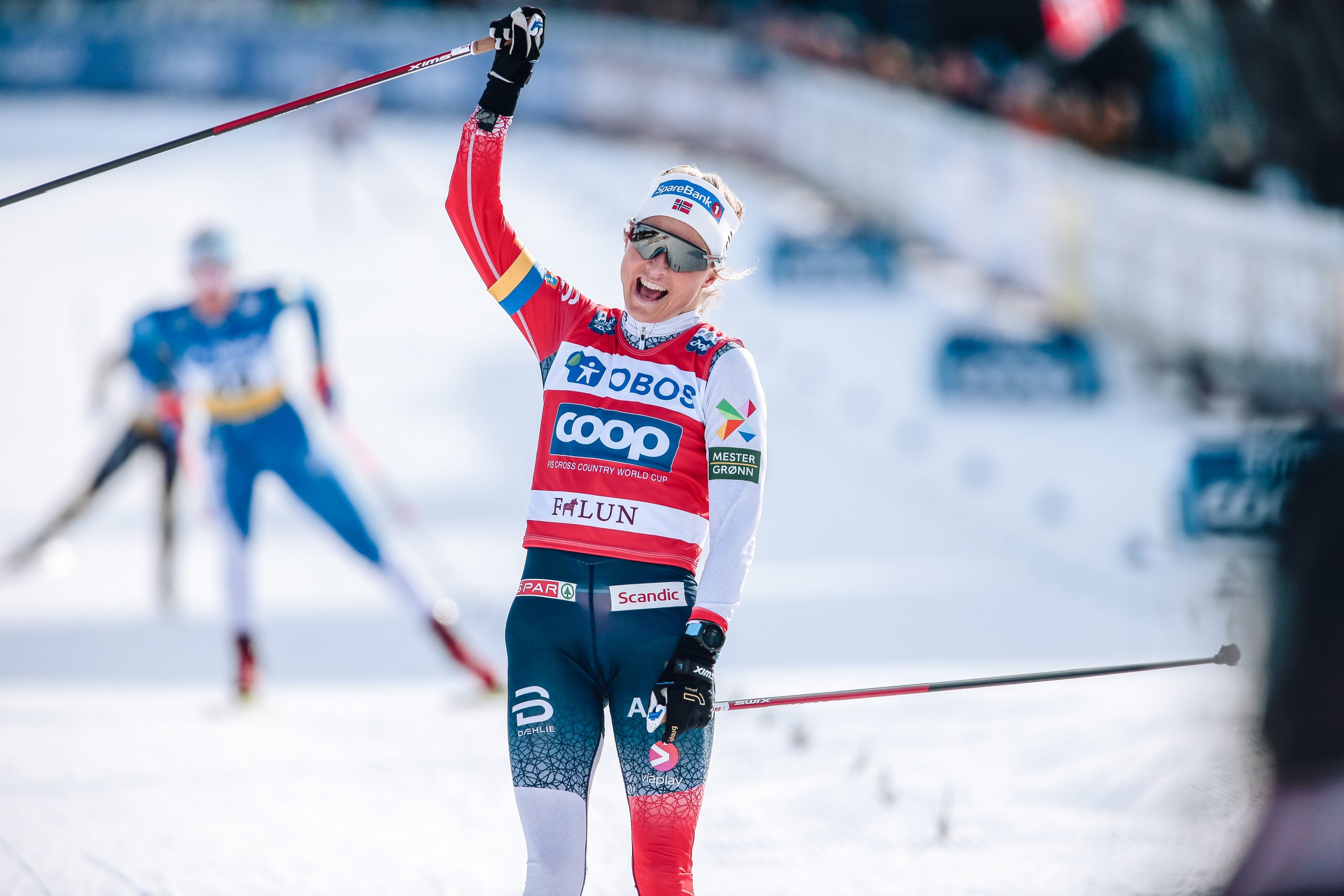
Therese Johaug (NOR) crosses the finish line, in first place, for the final time in her remarkable career. Johaug won on the day (22:34.4), and also secured the distance World Cup title for the season in Falun. (Photo: NordicFocus)
Joahaug came across her last finish line with a yelp, and then quickly turned to her competitors still mulling in the finish area. In an instance, she had gone from racer to ambassador.
With the Norwegian at the back of the seeded group, this meant the podium would be Johaug on top, Sundling in second (+35.9), and Diggins third (+38.5). Rounding out the top-five, Pärmäkoski took fourth (+38.2), with Norway’s Heidi Weng in fifth (+42.7).
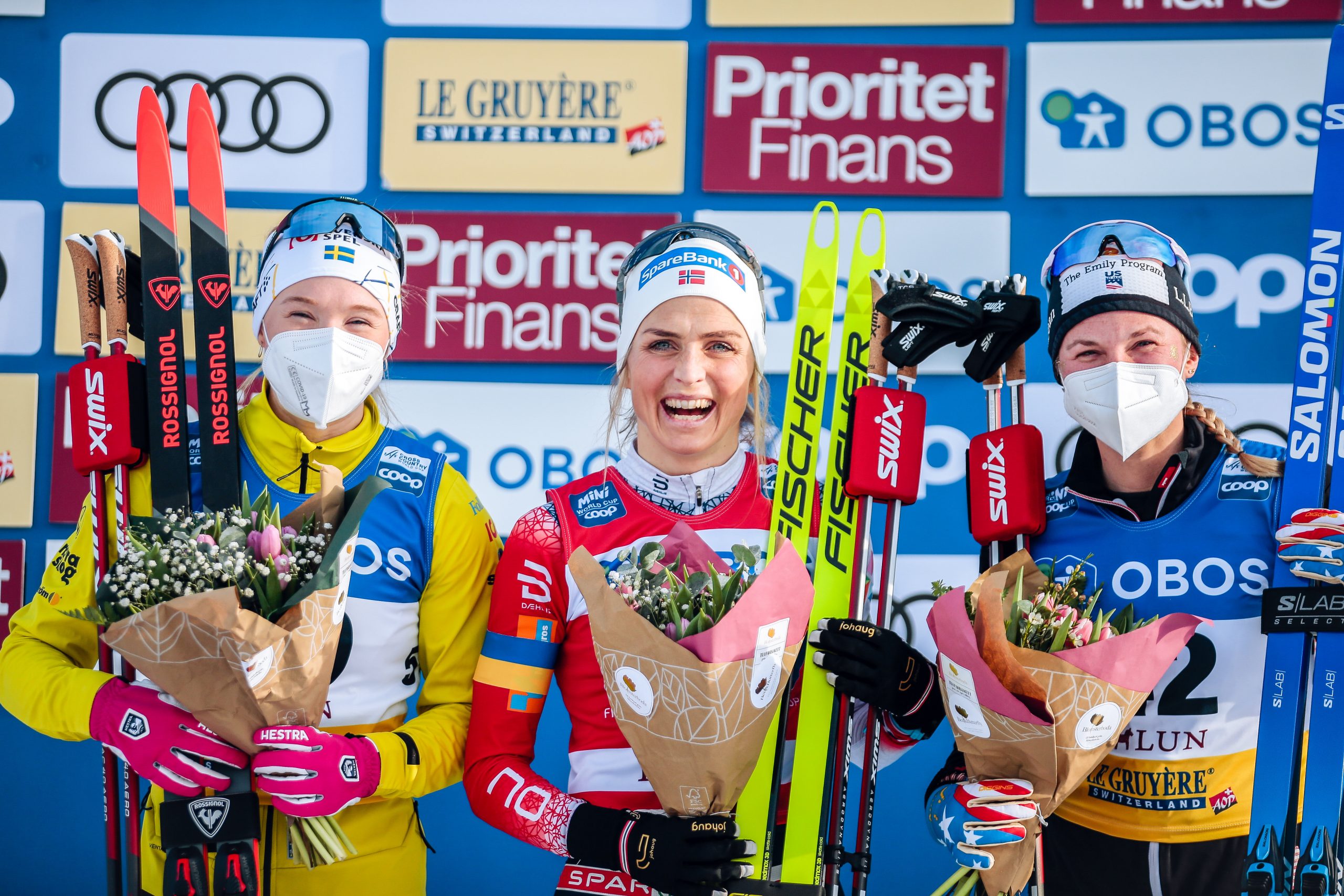
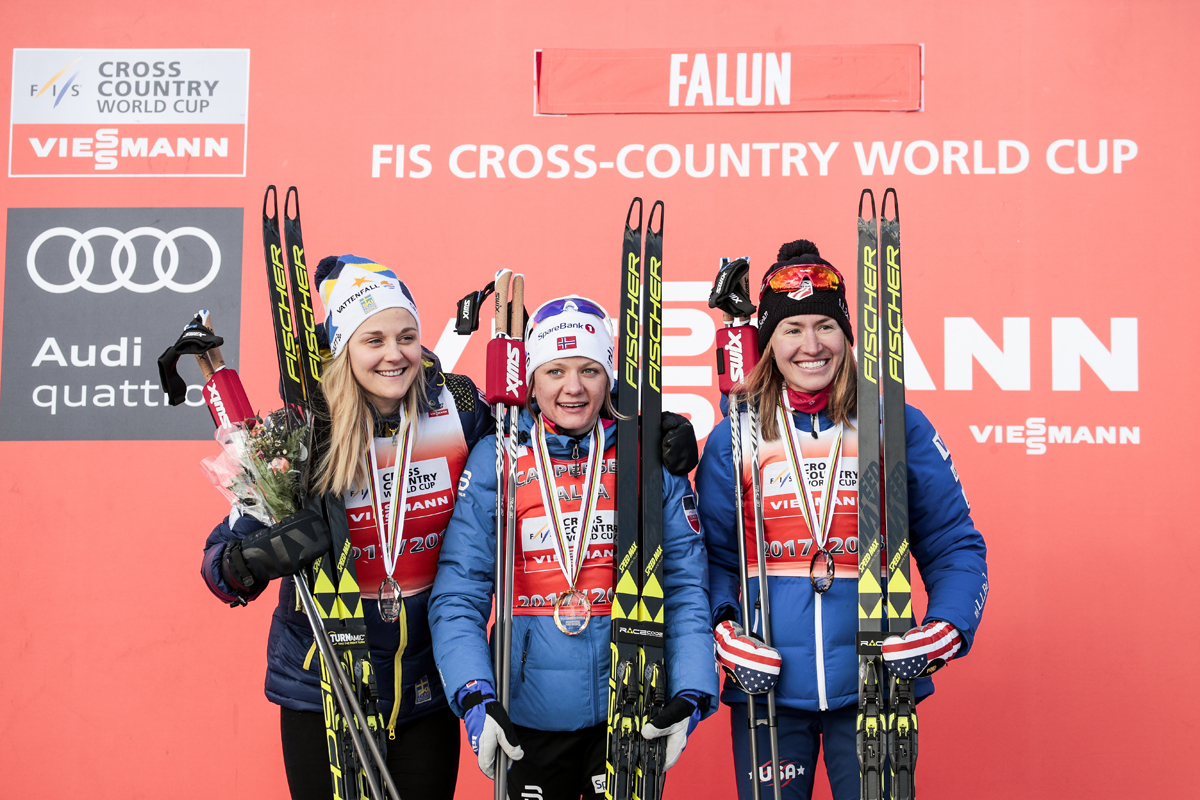
The Falun 10 k freestyle podium. (l-r) 2nd place Jonna Sundling (SWE), 1st place Therese Johaug (NOR), and 3rd place Jessie Diggins (USA). (Photo: NordicFocus)
Johaug leaves a sport that’s transformed since she first raced a World Cup in 2007. For one, it is a sport in which Therese Johaug has raced. Her ability to win races so decisively, and consistently, will cast a long shadow. She finishes her final World Cup Distance title with 177 point advantage over 2nd place Frida Karlsson (SWE), who at the young age of 22 looks poised to chart a course that follows in Johaug’s footsteps. 3rd place in the classification will go to Krista Pärmäkoski (FIN).
It’s also a sport where its leading star is an American, joined by her teammates who are now capable of putting two skiers in the top ten (Diggins 3rd and Brennan 8th), and three in the top thirty (Kern 20th, +1:30.3). The depth of the Americans, in fact, was one of the great takeaways from today’s race. Caitlin Patterson just missed a top thirty finish, coming in 31st (+1:49.5). Rosie Frankowski finished 41st (+2:26.4).
Rosie Frankowski (USA) comes down the final stretch in Falun. Frankowski finished 41st (+2:26.4). (Photo: NordicFocus)
Diggins, in particular, has proved skiing’s muse of fire, her grit and heroics adding to the depth of what ski racing purports to be the ideal for. Just today, she came into the race just one point ahead of Ebba Andersson (SWE) in the World Cup Overall. Between her and Andersson, the first finished today would secure World Cup runners-up. After Diggins podium finish today, adding to the mountain of evidence she’s accrued that belief and push are worth it, she secured that title. The overall champions’ title and crystal globe, meanwhile, will go to Natalia Nepryaeva (RUS).
Diggins said of her runners-up in the World Cup overall standings:
“It was really special to finish 2nd in the overall World Cup. I’m really proud. It represents a lot of hard work and consistently giving it everything I have everytime I race…
“I’m definitely still processing it. For me, this was a season where I came in with very concrete goals about my preparation physically and mentally for the Olympics. That was the big target. I’m really proud of how as a team (coaches and teammates) we handled that, and having World Cup wins and podiums was really just the icing on the cake.”
Full post-race audio clip from Jessie Diggins.
Therese Johaug holding her record 5th World Cup Distance crystal globe after winning in Falun. Johaug announced she is retiring from professional skiing last week in Holmenkollen. (Photo: NordicFocus)
Johaug leaves a sport too, at the end of a weary and winding road of a season. Not only out-skiing the best skiers in the world, but navigating the inextricable circumstances that surround the sport in our times. COVID-19, for one, but also the rapidly shifting planes of geopolitics – and the interplay between nationalism, identity, and narrative – that have always been at the heart of all sports, and in particular (as we’ll be reminded in the team event tomorrow) skiing.
That state of flux in the meanings surrounding the sport of skiing will continue. More so now than ever. As will the stories of athletes that are, in their pursuit of dreams, caught in contested ideas that animate the world way beyond this sport.
But then again, we have seen that all before. And as today showed, when in skiing we see something familiar, it is drive, passion, and joy in their pure human forms, that make us turn our heads and pay attention.
That is, after all, the drama of skiing, and in Falun today, we saw one of its best examples.
The Canadian women also had a string of strong results today. Katharine Stewart-Jones finished 33rd (+1:57.7), Dahria Beatty finished 43rd (+2:36.7), and Jasmine Drolet finished 52nd (+3:08.2).
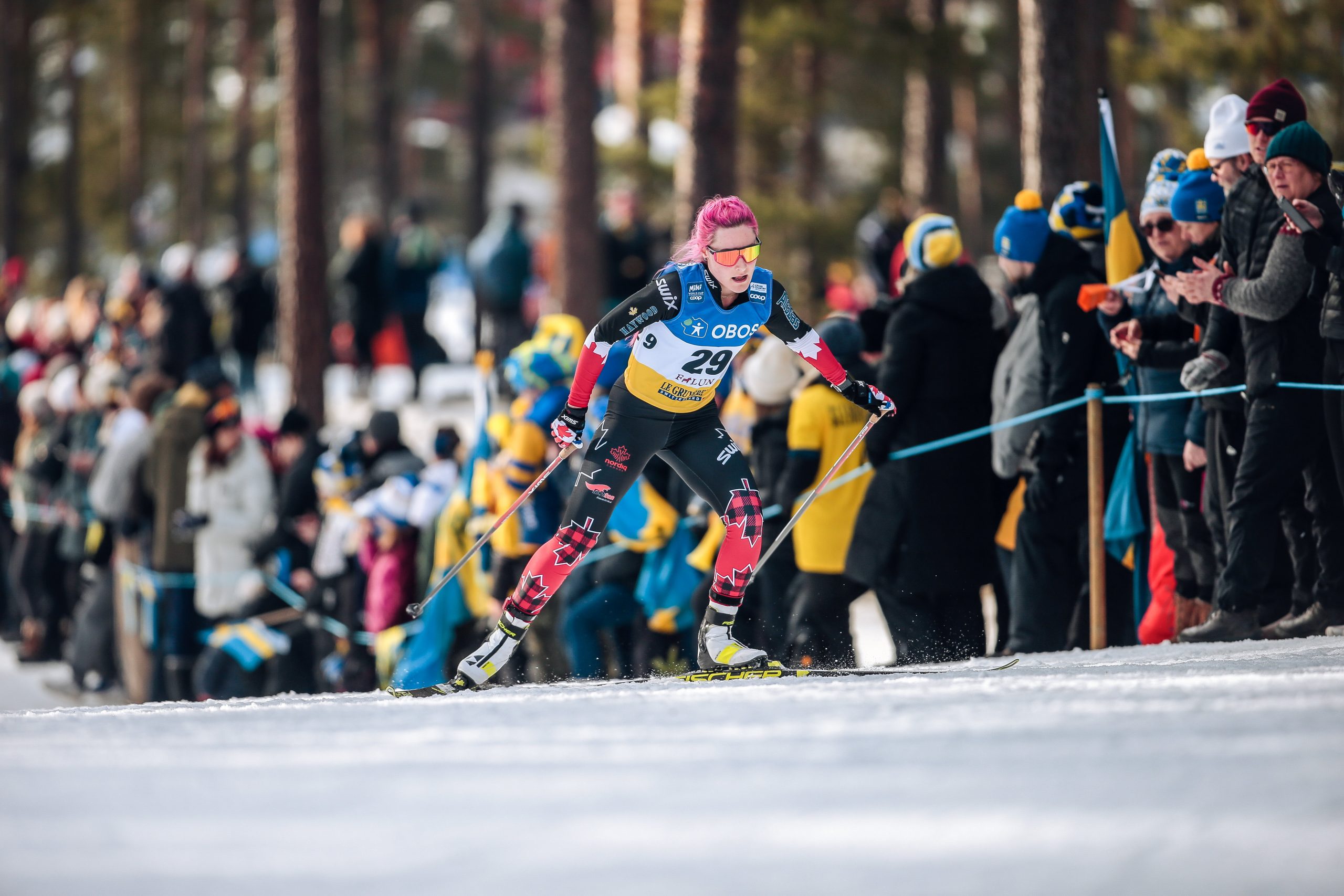
Canada’s Jasmine Drolet sporting Dartmouth’s signature pink-hair look as she raced her way to a 52nd on the World Cup in Falun. (Photo: NordicFocus)
This World Cup coverage is made possible through the generous support of Marty and Kathy Hall and the A Hall Mark of Excellence Award. To learn more about A Hall Mark of Excellence Award or to learn how you can support FasterSkier’s coverage please contact info@fasterskier.com.
Women’s 1.4 k classic sprint podium in Falun, Sweden: Jonna Sundling (SWE) took the win ahead of Anamarija Lampic (SLO) and Maja Dahlqvist (SWE). (Photo: NordicFocus)
We’ve arrived at the final weekend of World Cup racing. After the cancellation of the finals scheduled to take place in Tyumen, Russia and the difficulty of finding a last-minute replacement, these three days of racing in Falun, Sweden will be the culmination of the 2021/22 World Cup season. On a warm sunny day, in full spring conditions, the women executed an exciting classic sprint on the familiar 1.4 k Falun sprint course. With this being the last sprint of the season, it was also a day to cement the places in the running for the overall women’s sprint globe (none of the team events happening Sunday will influence the rankings).
Starting with a bang, Jonna Sundling of Sweden won the qualifier by an astonishing margin of +8.41 seconds, ahead of runner up Jasmi Joensuu of Finland. The American’s put three women into the quarter-finals, led by Rosie Brennan in 7th (+9.61). Julia Kern qualified in 17th position (+12.30), followed by her teammate and roommate, Jessie Diggins in 18th (+12.49).
Jessie Diggins on her way to 18th place in the qualifier. Diggins ultimately ended her day 19th. (Photo: NordicFocus)
These were the only three American women competing today as unfortunately some late-stage positive covid tests barred the rest from competing. Having made it through a winter of international travel, living, and competing during the Omicron surge, Hailey Swirbul and Katherine Ogden announced on Monday that they had both tested positive in Norway. Lauren Jortberg, who had her World Cup debut in Lahti, Finland two weeks earlier, came directly to Falun to prepare for this weekend, only to test positive on Wednesday.
No Canadian women made it into the top thirty, their first finisher was Olivia Bouffard-Nesbitt in 32nd (+17.54). Katherine Stewart-Jones led a string of fellow country-women, finishing 37th (+19.49), followed by Dahria Beatty in 38th (+19.75) and Jasmine Drolet in 39th (+20.08). After competing at World Juniors in Lygna, Norway, Drolet joined the senior women and made her first World Cup appearance in the Holmenkollen 30 k last weekend where she finished 42nd.
Dahria Beatty (CAN) racing to 38th in the classic sprint qualifier on Friday (Photo: NordicFocus)
As crowds of fans gathered, the women’s quarterfinals kicked off at 12:15 local time. In the first heat, a fast pace bought three women tickets to the semi finals, led by Anna Svendsen of Norway. After winning the classic sprint qualifier in Drammen, Norway last week only to fall in the quarter finals, Johanna Hagström (SWE), skiing on a home course, made it safely through in second. Kerttu Niskanen of Finland took third but with a fast enough time to snag a lucky loser position.
Heat two was controlled entirely by Sundling as she skied easy out front, spreading the rest of the field. Behind her came Johanna Matintalo of Finland and Julie Myhre of Norway who made it to the semis as the second lucky loser. Brennan (USA) finished fourth, +3.39 behind Sundling, ending her day in 16th overall.
Rosie Brennan races the quarterfinal after qualifying 7th. (Photo: NordicFocus)
“It was warm and wild out there today,” wrote Brennan after the race. “This course is quite technical and has some challenging downhills which has made it a tough course for me in the past so I was ready to make some progress today. I had a good qualifier and that gave me some confidence for the heats. I had a very stacked heat which can go either way for me. I struggled finding space to move on the uphills which is my strength and that ultimately cost me moving on to the semi-finals by less than a second. In the bigger picture, I do think I made some strong progress on some of my weak spots on this course and I am really excited about that. I am also still feeling good and excited to race which bodes well for the rest of the weekend.”
In heat number three, Anamarija Lampic of Slovenia took on the lead, as Diggins and Moa Lundgren of Sweden chased. Entering the final straight Nadine Fähndrich of Switzerland employed her blistering finish speed to surpass both Diggins and Lundgren, and nearly overtake an unsuspecting Lampic. This left Diggins in fourth place in a heat that was not quick enough to make lucky loser. Diggins ends the sprint season in fourth place in the overall sprint standings with 351 points; having entered the day in third with 339 points, she was bumped off the podium by Sundling.
Jessie Diggins races in heat number three in the 1.4 k classic sprint in Falun. (Photo: NordicFocus)
Heat four saw an easy pace from the gun, with the pack largely staying together. With all six athletes still in touch as they crested the big climb, Kern navigated into third place on the ensuing tight downhill corner. An injection of speed from Maja Dahlqvist (SWE) over the next rise split the pack as Lotta Udnes Weng (NOR) shadowed, followed by Kern still in third. In the long downhill glide-out, Weng overtook the Swede, entering the final corner in first. Right with her were Kern, Dahlqvist and Laura Gimmler of Germany. A close finish saw Kern out double-pole Dahlqvist to take the win, with Weng coming second. However, a disqualification for Weng bumped Dahlqvist into second and thus have her a ticket to the semi-finals.
Jasmi Joensuu (FIN) and Maiken Caspersen Falla (NOR) duke it out in the quarter-final (Photo: NordicFocus)
After a redeeming win in Drammen last week, Maiken Caspersen Falla of Norway charged off the startline for heat five. Joensuu (FIN) and Heidi Weng (NOR) took up the chase and eventually overtook Falla on the long descent back into the stadium. Together the two Norwegians pulled away from the Finn as Joensuu faded slightly. Falla finished first and Weng, with a scream of satisfaction, crossed in second.
Heidi Weng (NOR) racing in quarterfinal heat number five (Photo: NordicFocus)
Echoing her moves from the quarter-final, Sundling (SWE) approached semi-final number one in the same manner, skiing smooth and easy out front. Lampic (SLO) followed with some occasional slips on a mushy course. Those front two continued to pull away, Sundling making it look easy as she found herself well clear of the rest of the competition. Lampic maintained second position and Matintalo (FIN) came in third, though was not quick enough to move onto the final.
In the second semi-final, Falla (NOR) took the lead, again trailed by Weng (NOR). Once again, Kern (USA) moved into third position on the tight middle downhill portion, setting herself up well. A fall from Weng on the next hill took her out of contention as Dahlqvist (SWE) moved into second position, Kern still in third. Switching tracks, Dahlqvist stumbled but managed to stay on her feet as Kern took the lead into the final corner. Kern held onto first position with some strong double poling and behind her Dahlqvist, Falla and Fähndrich all qualified for the final in second through fourth positions respectively.
Julia Kern, closing out fast (Photo: NordicFocus)
Making her first sprint final since a stage race in Lenzerheide, Switzerland in December, Kern was all smiles on the start line as the athletes lined up for their final round. Right away, Sundling and Lampic began to pull away from the rest of the field. Up the A-climb, Sundling broke into a herringbone, clearly moving fast as she increased her lead. Dahlqvist who had been in third was overtaken by Kern who topped the hill in third. Lampic was holding strong in second, though being chased by Kern. Navigating the remaining corners and descents, Sundling cruised easily to the finish with enough of a lead to give a celebratory wave before crossing the line.
No challengers around, Jonna Sundling cruises to victory. (Photo: NordicFocus)
Coincidentally, Sundling won by the same margin over Lampic (+8.41 seconds) as she had on second-place qualifier Joensuu (FIN) earlier this morning. “I don’t know what is behind this result today, but the last weeks I’ve been feeling really good and it’s nice to keep the shape still,” said Sundling after her dominant victory. She added, “I didn’t compete so much in the beginning [of the season] because of injury but my motivation is on top and so is my shape, and it’s just fun to ski right now.”
Behind them, Dahlqvist was finding a second wind in the finish straight and overtook Kern to finish in third. Kern finished fourth, matching her season personal-best from Lenzerheide where she also finished fourth, in a skate sprint.
Anamarija Lampic (SLO) heads towards a silver medal as behind her Maja Dahlqvist (SWE) overtakes Kern (USA). (Photo: NordicFocus)
“[Kern] was really smart through the quarters and semis,” reflected coach Matt Whitcomb, “where she would ski really smooth through the first climb, and position herself really well. And normally what was happening is she was both being smart tactically and feeling very good today and that just led to a break between positions 3 or 4 and allowed her to get away. And her doublenpole punch at the end was as good as I’ve ever seen her today.”
Julia Kern after fending of Nadine Fähndrich (SUI) to finish fourth in the 1.4 k classic sprint. (Photo: NordicFocus)
Regarding the final in which Kern seemed to have a lock on third but lost out in the closing stages Whitcomb said, “We talked about if there was a big mistake she made and we decided she could do the same thing 10 times and maybe land on the podium four or five times. She had some stumbles, had those things not happened, it would have been a little bit closer between her and Maja [Dahlqvist], but I don’t want to discredit Maja, she had all kinds of fire in the finish today.”
He added, “It was cool, Julia’s parents are out here today, she has raced well when her parents are watching. It’s important to point out that she was fourth and not fifth, she fended off a hard-charging Fähndrich and we’re really happy with her performance today.”
Listen to the full interview with U.S. Ski Team Head Coach Matt Whitcomb here.
Julia Kern races through the heats in Falun. (Photo: NordicFocus)
Kern has put together a string of strong performances in the final period of World Cup racing, placing in the top-10 in each of the last three sprints. These results come on the tails of a first Olympic appearance that left her wanting more, after having rebounded early-season from a 2020/21 season she had described as challenging.
“It’s a bit of a bittersweet ending,” Kern said in a call. “We’ve been on the road for so long now that, after the Olympics, especially, I was feeling excited to go home. But now when things are going well and I’m feeling really good, I don’t want to go home and I don’t want the season to end. I’m happy to end on a high note and find my stride after a frustrating Games. It’s just kind of reminded me how important having some sense of normalcy is, and I’ve kind of embraced that more after the Games. I think that’s paid off, plus some hard work, and I’ve had a little extra fire from the frustration after the games. Happy to end the season this way, and [we have] another shot tomorrow, so I’m excited for that race.”
Commenting on how these strong results and better energy feed momentum, Kern discussed a mid-week training session she felt primed her for today’s sprint.
“Now that I’ve been having really good energy in training… I have to give a big shoutout to our staff. On Tuesday this week, I did an interval workout here on the courses. I had Matt, Kate [Barton], and [tech] Chris Hecker out there with me, racing me around the course doing speeds, throwing elbows, pulling tactical moves, practicing the slingshot. Those types of sessions are super valuable for me when I put the energy to put in a good interval session. I learned so much from that session, and it gave me the confidence here today to ski well in the heats and be ready for anything.”
Kern continued with a laugh that her family is her fourth place good luck charm, as they also watched her race to fourth in Lenzerheide, SUI during the Tour de Ski, ending with a comment on the American team as the season draws to a close.
“I think our team has done a really incredible job, working through all the different colleges this season has brought. When things get tough, we bring out humor and come together. I just feel more and more appreciation for the team. My wax tech Eli and I have worked really hard all season together to start linking together some classic performances. We’ve had four classic races in a row now, and pretty much all personal bests, so that’s been a really fun relationship to build and [I appreciate] all the hard work the wax team puts in.”
Full post-race interview with Julia Kern. Apologies for the bad echo — working through the kinks as we work our way along the audio learning curve.
Julia Kern edges out Maja Dahlqvist (SWE) in the classic sprint semifinal in Falun. (Photo: NordicFocus)
Dahlqvist already had the sprint globe on lock, but her third place finish today only reinforced her strength in sprint racing this season as she racked up 638 points throughout the year. She began the season with four straight wins and earned a silver medal in the Olympic skate sprint last month. A fourth place finish in Drammen was the only time this season in which she did not finish on the podium in a sprint event.
“It feels really really, super duper good,” said Dahlqvist about taking home the globe. “I’m super happy with that.”
Sweden’s Maja Dahlqvist is the 2022 World Cup sprint champion. (Photo: NordicFocus)
Last year’s sprint globe winner, Anamaria Lampic (SLO) finished second this year with 506 points. After today’s victory, Sundling (SWE) overtook Diggins (USA) to move into third in the sprint standings with 442 points. Delaying her start to the season after sustaining an injury in an early-season FIS race, Sundling’s first World Cup start was Dresden in mid-December where she finished second in the individual skate sprint. She did not take part in the Tour de Ski, but returned to the World Cup circuit in dominant fashion, after collecting three Olympic medals, one of each color, and taking fourth place in the 30 k.
In the final three weekends of World Cup racing, Sundling landing on the podium in four out of the five races she entered, including a third place finish in the legendary Holmenkollen 30 k classic last weekend.
Anamarija Lampic (SLO) congratulates the days winner, Jonna Sundling (SWE) (Photo: NordicFocus)
Racing continues tomorrow with a 10 k skate interval start for the women. Sunday will feature two new team events, with a mixed relay happening in the morning followed by a mixed team sprint in the afternoon.
The second weekend with Norway back on the scene was a reveal. Therese Johaug, arguably the second greatest cross-country skier of all time, was bested by an in form and dialed in Jessie Diggins. Interval starts, for what its worth, most often do not command a television or streaming audience. This show is a must watch. It may just be Diggins’ best career race.
Jessie Diggins locked in for the win: Falun, Sweden 10 k skate. (Photo: NordicFocus)
So we chat a ton about Diggins. But we also dive in head first and discuss some other stout race performances – Schumacher’s 9th place, Bolshunov’s double-win weekend, Linn Svahn’s supremacy on the sprint course, and the dicey nature of Saturday’s mass start racing.
Johannes Høsflot Klæbo (NOR), Alexander Bolshunov (RUS), Pål Golberg (NOR), (l-r) after the tight finish of the men’s 15 k mass start classic on Saturday. (Photo: NordicFocus)Svahn takes the second heat of the quarterfinal, while Diggins fights for a lucky loser position. (Photo: NordicFocus)
As we inch closer to the World Championships at the end of February, it’s time to start thinking about who might bring home some hardware. Falun’s three race series gave us a glimpse into who’s star might shine in Obertsdorf.
Rosie Brennan charges up the first and longest climb on the sprint tracks in Falun, Sweden. (Photo: NordicFocus)
This World Cup coverage is made possible through the generous support of Marty and Kathy Hall and their A Hall Mark of Excellence Award. To learn more about A Hall Mark of Excellence Award or to learn how you can support FasterSkier’s coverage please contact info@fasterskier.com.
If you had any question about the strength and depth of the Swedish sprint team, look no further than the qualification list from today’s classic sprint in Falun. Led by Johanna Hagström with a time of 3:14.18, Sweden put six women in the top-10. This number was repeated in the semi-final, leading into a half-Swedish final round on home soil.
The sprint tracks featured the longest climb first, followed by a spiraling curve to send the women up the second climb. A sharp left turn and a roller brought the athletes back toward the stadium and into the final stretch. As the heats unfolded, this looked like a series of uphill sprints out of the track, some furious double poling, and some powerful cornering.
The profile of the sprint tracks in Falun, Sweden. (Photo: https://skidspelen.se/)
Of the Americans in the heats, Jessie Diggins was the top qualifier in 15th, with Rosie Brennan 20th and Sophie Caldwell Hamilton, back from her mid-season Vermont training camp, in 25th.
During the first heat of the quarters, Diggins looked confident in her tactics, sitting in the middle of the pack. Making assertive moves to seize optimal tracks, she swung wide in the final curve to set herself up to capitalize on her double pole as she sprinted her way from fourth to first. Diggins ceded time at the line to Sweden’s Linn Svahn to finish comfortably in second.
Jessie Diggins skis to 8th in the classic sprint in Falun, Sweden. (Photo: NordicFocus)
Racing in the first heat of the semis, Diggins looked to be employing a similar tactic of patiently waiting to pounce in the back half of the loop. Heading up the second climb in the 5th spot, she began to hammer, but by that time, Svahn and Norway’s Tiril Udnes Weng had created a small gap she could not close. Challenging Anna Dyvik of Sweden, Diggins powered over the final roller and worked her double pole, but was unable to make up any ground and finished 4th.
This ended Diggin’s day, putting her in 8th place overall.
“Whew, today was exhausting!” wrote Diggins after the race. “I think all the all-out efforts in the cold finally started to catch up to me, as I was definitely getting pretty tired in my semifinal. But I was really proud of how I skied today – especially in really tricky kicking conditions with steep hills and tracks that were deteriorating, and a ton of herringbone out there! It’s a very encouraging step forward in my classic technical skiing. We also had great skis which is always important!”
Advancing from the second heat of the semis, Slovenia’s Anamarija Lampic took the lead to pull the group through a fast heat. A few meters back, Sweden’s Jonna Sundling edged out Ane Appelkvist Stenseth and fellow Swede Hagström in a tight finish, which allowed all three women to advance to the final.
Poling in sync, the final round of the classic sprint in Falun takes to the tracks. (Photo: NordicFocus)
Let’s regroup. Three Swedes, two Norwegians, and one Slovenian in the final: Svahn, Sundling, Hagström of Sweden; Weng, Stenseth of Norway; and Lampic of Slovenia. The two semifinal leaders, Svahn and Lampic, pushed the pace from the front, up and over the two significant climbs. Sitting in a tuck to conserve energy for a final sprint over the roller and toward the lanes, Svahn was on the tails of Lampic, with Sundling just behind. The Swedes gained ground over the roller, setting up an exciting race down the finish lanes.
Anamarija Lampic and Linn Svahn push the pace during the final round of the classic sprint in Falun, Sweden. (Photo: NordicFocus)
With the line just moments away, Svahn simply attacked the ground with her double pole, pulling ahead for a back-to-back win in Falun.
Just behind, Lampic and Sundling were virtually tied as they crossed the line in a photo finish. Though times were the same to the hundredth of a second, Lampic was declared second and Sundling third.
Linn Svahn takes back-to-back wins in Falun, while Anamarija Lampic and Jonna Sundling slide in for the remaining podium spots. (Photo: NordicFocus)Anamarija Lampic (SLO) edges out Jonna Sundling (SWE) for second place in the classic sprint in Falun, Sweden. (Photo: NordicFocus)
“I’ve been feeling a little bit tired since yesterday’s race, but it’s so fun to compete in Falun. I really enjoy racing on a home course, so it was a good day,” Svahn told FIS at the finish.
Despite her age, this is 21-year-old Svahn’s 7th individual win in a World Cup sprint, split almost equally between skate and classic. It is also her second consecutive classic sprint victory on the Falun tracks, as she stood atop the podium in February 2020, also alongside Sundling third place.
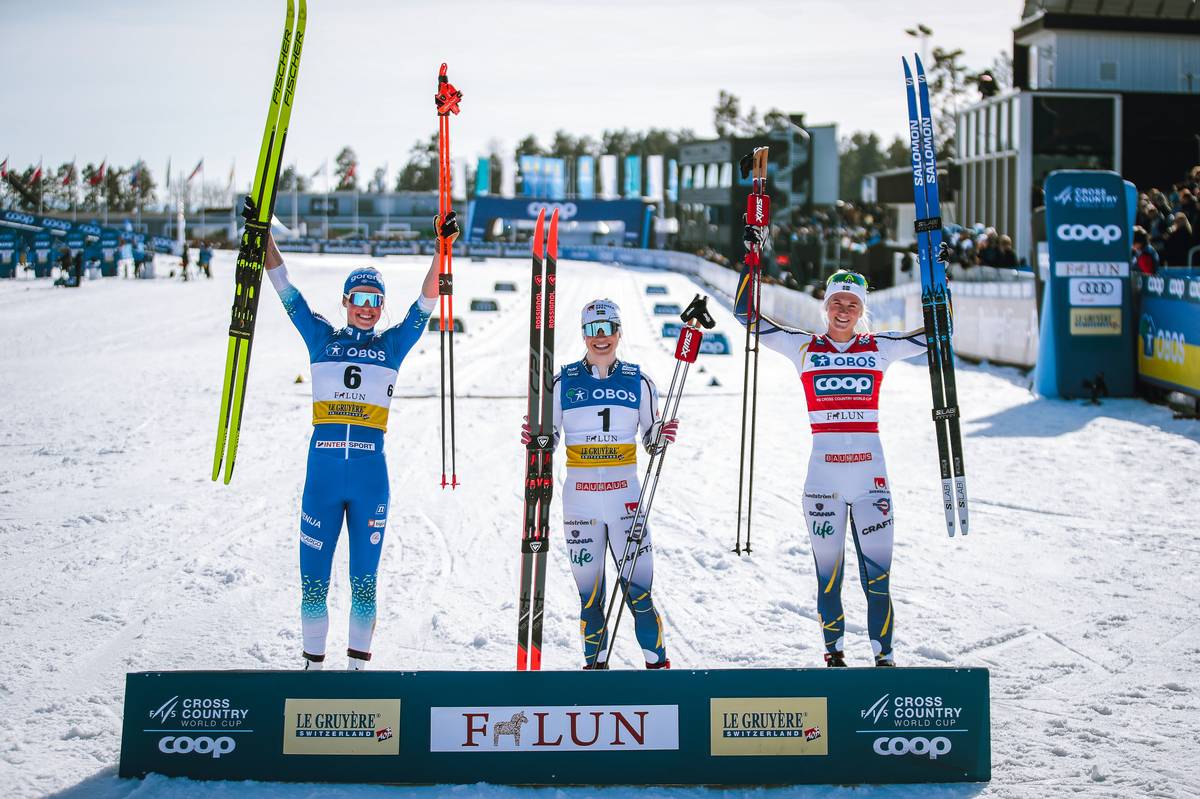
The women’s classic sprint podium in Falun. Linn Svahn nailed her second consecutive win on the course, with Anamarija Lampic (SLO) second, and Jonna Sundling (SWE) third. (Photo: NordicFocus)
Svahn was also asked about the close finish and whether she was sure of her win in the moment.
“I’m never sure of a victory until I pass the finish line first, but it’s cool to see how many strong girls we are competing in sprint races. I think the levels are really high now and it’s tough to win each race, but I’m really glad I managed to do that today, especially in a classic sprint, because it’s my goal this year.”
Looking back, Brennan raced in heat 4 of the quarter finals, where she finished 4th, unable to advance. This left Brennan in 19th overall.
Powering uphill, Rosie Brennan skis her way to 4th in her quarterfinal in Falun, Sweden. (Photo: NordicFocus)
After a conservative start, Caldwell Hamilton skied her way into 2nd position at the top of the intermediate climb. Looking strong as she transitioned from double pole into diagonal stride over the last roller, she held her position around the final curve and into the finish lanes. Swinging around her and quickly closing the gap with her double pole, Sweden’s Hanna Falk overtook the American in the final meters. As the second heat ended up the fastest, Caldwell Hamilton was not able to advance and ended her day in 16th.
“Today was a really solid race for me,” wrote Caldwell Hamilton in a post-race email. “It wasn’t my best, but it was my first time skiing the heats in a classic sprint this year (actually probably in 11 months) and after a qualifier that felt so-so, I was happy with how I skied my quarter. Falun is a very tough course with some big climbs and technical downhills, but I like those features in a classic course.”
Sophie Caldwell Hamilton crests the intermediate climb on the sprint tracks in Falun, Sweden. (Photo: NordicFocus)
“After the first few races of the tour, I took the opportunity to spend a few weeks at home in Vermont during a time where I wouldn’t be missing many sprints,” Caldwell Hamilton continued. “It was such a nice break and I had skiing at the nordic center our neighbors own, Wild Wings, that I could ski to from my house, so I was a pretty happy camper to just spend some time at home doing some solid training and taking a break from the World Cup scene. Now I feel mentally and physically recharged and ready to take on the last couple months of the season! My qualifier today felt a little like I hadn’t done an effort like that in awhile, but I think every race effort will help make that feel a little more normal.”
Jessie Diggins and Canada’s Katherine Stewart-Jones (bib 29) climb side by side during the first heat of the quarterfinals in the classic sprint in Falun, Sweden. (Photo: NordicFocus)
After qualifying in 29th, Canada’s Katherine Stewart-Jones landed in the first heat of the quarterfinals with Diggins. Stewart-Jones held strong with the lead group through the second climb, but fell off the pace to finish last in the heat, just behind Norway’s Anna Svendsen. Stewart-Jones was 30th in the final results.
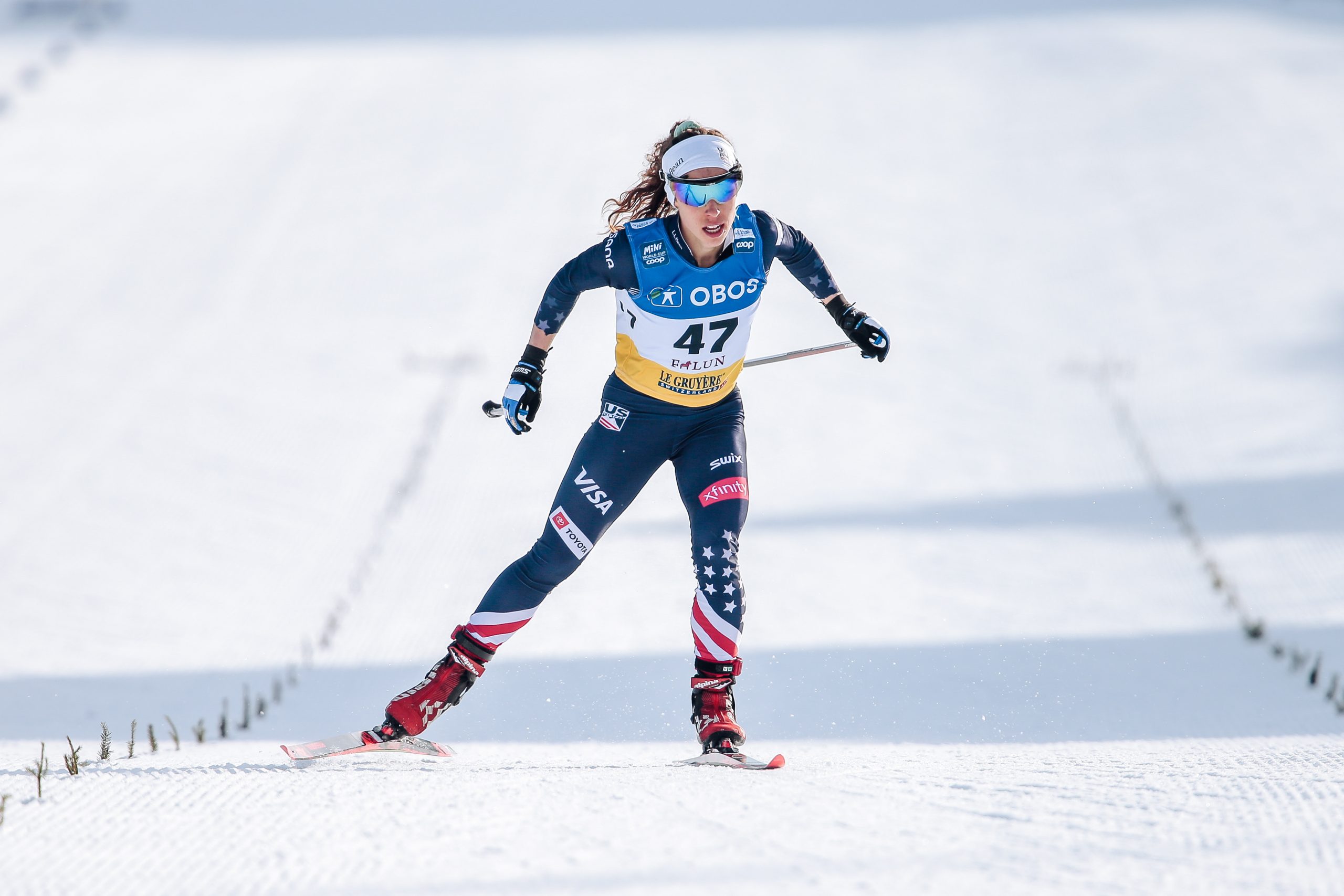
Outside the rounds, Julia Kern qualified in 35th (+12.95), Hannah Halvorsen 56th (+22.59), and Alayna Sonnesyn 65th (+30.2).
Maya Macisaac-Jones (CAN) races to 54th in the qualifier of the Falun, Sweden classic sprint. (Photo: NordicFocus)
Racing for Canada, Dahria Beatty qualified 48th (+17.29), Maya Macisaac-Jones 54th (+21.77), and Laura Leclair 58th (+24.77).
Jessie Diggins (yellow bib) strides amidst a pack of contenders during the 10 k mass start classic in Falun, Sweden. (Photo: NordicFocus)
This World Cup coverage is made possible through the generous support of Marty and Kathy Hall and their A Hall Mark of Excellence Award. To learn more about A Hall Mark of Excellence Award or to learn how you can support FasterSkier’s coverage please contact info@fasterskier.com.
In case you missed it, yesterday’s 10-kilometer skate in Falun, Sweden was a standout day for the Americans, highlighted by a gutsy victory by Jessie Diggins. How deep into the well Diggins explored was evident in her writhing and occasionally dry heaving body at the finish as she regained enough oxygen and composure to stagger to the leader chair. She upset the prolific Norwegian distance champion Therese Johaug, whose 66 World Cup distance victories both garner immense respect and some frustrated “She won again…” comments from non-Norwegian followers.
But the story does not end there. Rosie Brennan skied to 8th and Sadie Maubet Bjornsen landed in 10th in her first World Cup race of the season. Three in the top 10 in a full field hungry to to prove their mettle before World Championship selections are solidified. Not a bad day in the office.
On the front lines, Jessie Diggins (left) and Rosie Brennan (right) take to the course during the 10 k mass start classic in Falun, Sweden. (Photo: NordicFocus)
In today’s 10 k mass start classic, the excitement builds a little differently. Versus a drawn out rise in excitement as the splits of the seeded group fly by the various checkpoints, today was head-to-head, with all eyes on what Johaug’s rebuttal would be and how the American’s (and Swedes and Russians and the remaining Norwegians, for that matter) would respond.
Mass start and classic technique, in which Johaug excels. Conversely, Diggins’ has struggled to achieve the same results in classic as skate, though she has displayed marked progress this season.
Jessie Diggins watches her finish time hold up against distance champion Therese Johaug in the 10 k skate in Falun, SWE. (Photo: NordicFocus)
In a pre-race interview, FIS phrased the question to Diggins as this. “What are you in for today?”
“Oh boy! [It’s] a very different race!” she laughed. “I’m very excited to give it my all. All you can give on race day is your own effort. I’m looking forward to crossing that finish line knowing I gave it everything I had. For me, if I can do that, then it was a good day.”
Awaiting the gun to send them off, the athletes quietly slid back and forth in the squeaky frozen tracks, keeping nerves at bay and blood flowing in the single digit Fahrenheit temps. Skiers familiar with an outing in such conditions understand the sounds that go along with these conditions. The cacophonous start sounded like a lightsaber battle.
Germany’s Katharina Hennig (center) chases Therese Johaug (NOR) with Ebba Andersson (SWE) in pursuit. (Photo: NordicFocus)
It was clear early that Johaug and her teammate Heidi Weng wanted to push the pace. They attempted to pull away from the group in the opening kilometers creating a small gap. But in the first downhill back toward the stadium, Diggins gave them something to worry about. Her skis like rockets, she overtook them in the descent, slingshotting around the curve and into the lead as they lapped through the stadium.
In fact, no one could break away. Not even the breakaway specialist Johaug. At the 5 k mark, the top-10 skiers were separated by less than two seconds, with Diggins sitting fifth, smack in the middle.
Left to right, Heidi Weng (NOR), Jessie Diggins, and Frida Karlsson (SWE) stride toward the finish of the 10 k classic in Falun, Sweden. (Photo: NordicFocus)
After a sprint bonus point opportunity at 5.8 k, which was narrowly snagged by Johaug over Sweden’s Ebba Andersson, the pace began to accelerate. At roughly the 6.5-kilometer mark, Johaug began her surge, creating a new gap of a couple seconds by the subsequent top of the climb. But the slinky phenomenon repeated itself, as Andersson, Linn Svahn, Katharina Hennig, and Weng closed the gap on the descent to the stadium. Diggins fought hard to maintain contact, tucked in behind Sweden’s Frida Karlsson just behind the leaders with a train of chasers close on their tails.
With 1 k of downhill and fast terrain to go, this pack was still tight, Svahn and Hennig pushing from the front. An ill-timed crash on a downhill curve took Anderson, who had been in 4th, out of contention, but one could not look away as five remaining women flew toward the finish.
Hammering the uphills, Johaug crested the final sustained climb in the lead, tucking as she pushed into the final sweeping downhill. Svahn stayed tight in the corner, hugging the v-board and capitalizing on her fast skis to sneak by Johaug on the inside. The Swede held herself less than a ski-length ahead of Johaug over the final rollers and into the finish lanes. At that point, it was all over; Johaug was no match for the sprint star’s closing speed.
Linn Svahn (SWE), Katharina Hennig (GER), Therese Johaug (NOR), (l-r) closing down on the finish line on Saturday. (Photo: NordicFocus)Linn Svahn (SWE), Yulia Stupak (RUS), Katharina Hennig (GER), Therese Johaug (NOR), (l-r) poling in for a tight finish. (Photo: NordicFocus)
Poles whipping in double pole fury, Svahn held her ground at the front to stop the clock at 25:57.1. Meanwhile, Russia’s Yulia Stupak sprinted past Johaug in the final meters to take second (+0.4), while Hennig forced the final podium position to be decided by photo. It was determined that Johaug held onto third (+0.9).
The women’s 10 k mass start classic podium: Yulia Stupak (RUS) second, Linn Svahn (SWE) first, and Therese Johaug (NOR) third (l-r). (Photo: NordicFocus)
“I was really looking forward to competing because I’ve been home since the Tour de Ski and I felt pretty strong the last week,” Svahn told FIS after the race. “I just tried to keep my focus on the course and do everything right. When they couldn’t get a gap on the last uphill, the hardest uphill, I thought, ‘Well, now it’s my turn to try to do my best to the finish line.’
“I felt strong and had really amazing skis,” Svahn continued. “It was a victory for the whole team, especially the waxers, because my skis were unbelievable.”
In a gutsy finish, Sweden’s Linn Svahn takes the win in the Falun 10-kilometer mass start classic. (Photo: NordicFocus)
Yana Kirpechenko (RUS) finished at the back of the tight lead group in 5th (1.9), with Norway’s Helene Fosseholm bringing in the chase pack in 6th (+7.7), Diggins 7th (+8.3), and Weng 8th (+8.8).
“Today was awesome,” wrote Diggins in an email. “We had really competitive skis, and I actually have been loving how cold it is because when it’s cold like this I feel like I can just keep pushing and pushing my body! This course had a lot of power striding, and I was just focused so hard on keeping my technique as together as I could with a flooding body. I was sending it as hard as I could the entire race, and I’m very proud of that effort. And fun to be so close to the front in a classic race!”
Jessie Diggins, filling the lungs after placing 7th on Saturday. (Photo: NordicFocus)
Sadie Maubet Bjornsen was next up for the Americans, finishing in a pack of chasers in 15th (+35.7).
“Another exciting day of racing in Falun here,” Maubet Bjornsen emailed. It is the first time in a while that I have started a ways back in a mass start, and boy, it is a different type of racing! Huge respect for all those who put together amazing races from that position! I kind of felt like I was burning matches more than I would have loved just trying to weave my way through.
“I was once again feeling encouraged by these first races. With five weeks away from hard intensity as I have worked through a back injury, my huge achievement was making it to the finish line. Classic has been particularly tough for it, so today was a real wild card. But I had some really encouraging feelings, and I look forward to working towards more exciting feelings in the weeks to come.”
Back on the World Cup, Sadie Maubet Bjornsen puts together solid back to back distance results with a 15th place finish in the 10 k classic mass start in Falun, Sweden. (Photo: NordicFocus)
Maubet Bjornsen took her first long-term absence from international skiing recently. During the pandemic, she has remained mostly in Anchorage, Alaska working and training.
“After spending 11 months away from [World Cup] racing, this weekend has been particularly fun to just kind of re-remember how this works. I haven’t yet raced without spectators, and I will say it is a different feeling. It almost feels like a super serious summer time trial. You hear your coaches cheering more than ever, which is kind of fun in a new way! It kind of takes racing back to the core, which is special.”
Outside the top-30, Rosie Brennan took 33rd (+1:15.6), followed by Katharine Ogden in 42nd (+1:49.1), Sophia Laukli 50th (+2:37.1), Caitlin Patterson in 51st (+2:41.2), and Alayna Sonnesyn in 56th (+3:33.2).
Post-Race Comments from U.S. Head Coach Matt Whitcomb.
Rosie Brennan finishes 33rd in the 10k mass start classic in Falun, Sweden. (Photo: NordicFocus)Face covered at the finish, Katharine Ogden skied to 42nd in the 10 k mass start classic in Falun, Sweden. (Photo: NordicFocus)
Leading the Canadian women with her second individual top-30 in two World Cup stops was Katharine Stewart-Jones in 17th (+36.2), her career best individual result at this level. Despite a string of wins and podiums last season, both domestically and in Opa Cup events, and a top-30 finish in the 2020 Scandinavian World Cup Ski Tour, a seemingly break-through season, Stewart-Jones was not named to the Canadian national team for 2020/2021. Another top-20 result will automatically qualify her to make the team next season.
“It was a super fun race,” Stewart-Jones wrote after the race. “The pace went out hot but I knew it was the type of course where gaps are hard to make but also hard to close so my goal was to get myself into a good position in the first lap and hold on. The techs did an awesome job with my skis which helped me relax both on the downhills and climbs.
“Overall I’m just extremely happy to be back racing and also very excited about how the team has been performing so far. Cendrine [Browne’s] result yesterday was really inspiring and I am confident that this is just the beginning for our team.”
Stride and glide: Canada’s Katharine Stewart-Jones (bib 35) and Sadie Maubet Bjornsen (bib 24) work their way toward the finish of the 10 k mass start classic in Falun, Sweden. (Photo: NordicFocus)
Cendrine Browne rounded out the Canadian finishers in 38th (+1:45.1). The race saw 60 finishers.
The men’s 15 k skate podium from Falun, Sweden: Simen Hegstad Krüger (NOR) second, Alexander Bolshunov (RUS) first, and Sjur Røthe, (NOR) third, (l-r). (Photo: NordicFocus)
This World Cup coverage is made possible through the generous support of Marty and Kathy Hall and their A Hall Mark of Excellence Award. To learn more about A Hall Mark of Excellence Award or to learn how you can support FasterSkier’s coverage please contact info@fasterskier.com.
Sunny skies and cold snow greeted the skiers for the start of the men’s 15 k individual freestyle on Friday, kicking off an extended weekend of racing in Falun, Sweden. With temperatures below 10°F (-14.1°C to be exact) the athletes were well bundled as they headed out of the start gate, one by one. Joni Mäki of Finland, perhaps better known now after his relay performance and ensuing run-in with Russia’s Alexander Bolshunov in Lahti last weekend, was the first starter in a field of 84.
Racing to yet another distance win, Russia’s Alexander Bolshunov squeaked out the 15 k victory in Falun, Sweden. (Photo: NordicFocus)
Initially, it seemed as though it would be another runaway performance from Bolshunov. With the exception of the first split at 1.8 k (taken by Sergey Ustiugov of Russia), Bolshunov led with an ever-growing margin over the course of 15 kilometers. When he finished, wearing bib 41, he led by over a minute (-1:14.5), ahead of the young Norwegian, Harald Amundsen. Among those first 41 finishers was Johannes Høsflot Klæbo of Norway, who returned to the World Cup circuit a week later than his fellow countrymen. Today marked his first World Cup race since the season opener in Ruka, Finland, in November 2020.
In his first World Cup race since the Ruka series, which concluded in early December, Johannes Høsflot Klæbo of Norway placed seventh in the Falun 15 k skate. (Photo: NordicFocus)
In a pre-race interview Klæbo said, “It’s great to be back and something I’ve been looking forward to for a long time now and to be back here in Falun, finally able to compete again, it’s something that I think will be really good… I think it will be really interesting, I’m going to do my best and go as fast as I can but there are a lot of strong guys here so it will be interesting.”
When asked whether he had been following the races in his absence, Klæbo replied, “Yeah for sure I’ve been following it, every weekend. I love skiing so for sure I’ve been following and the guys look really strong so it’s sad to be at home and not to be able to compete. The guys look really strong so we’ll see how it goes for me.”
Klæbo began in bib number 39 and just before 12.8 k was caught by Bolshunov, who started two places behind. At the conclusion of the day, Klæbo placed seventh, +1:01.3 back from Bolshunov.
Norway’s Simen Hegstad Krüger toeing the line- he missed the win by 1.8 seconds on Friday. (Photo: NordicFocus)
However, Bolshunov was not completely unchallenged. Further back in the field was a string of Norwegian starters who, spearheaded by Simen Hegstad Krüger, mounted an attack. At 6.8 k, Krüger was 6.5 seconds behind Bolshunov, and Sjur Røthe nine seconds behind the Russian. Jump forward to 11.3 k and Bolshunov had stretched the lead to +10.5 over Krüger while Røthe was down +23.9, having been overtaken by his teammate Hans Christer Holund.
At 14.1 k, however, Bolshunov’s lead began a precipitous decline, as Krüger raced through +0.7 seconds behind. Despite his best efforts, however, the victory remained elusive for Krüger as Bolshunov came away with the win, yet again, in a time of 32:33.3. Røthe closed hard and regained time from Holund, sneaking into third place (+23.9).
Sjur Røthe, on form, skiing to third overall in the Falun 15 k skate. (Photo: NordicFocus)
After the race Bolshunov spoke through a translator, saying, “This is my third victory in a row in Falun for a skating race, so this place is lucky. Big thanks to the technicians and my team, I had really good skis today.”
With such a dominant season thus far, Bolshunov is well on his way to taking the Overall Crystal Globe at the end of the season – he currently leads the standings with 1491 points, more than double that of the runner-up, Ivan Yakimushkin of Russia (720 points). When asked about this, Bolshunov responded, “[today’s victory] is really important because I have quite a secure lead in the overall, so I can add to it and that makes me relaxed and confident and I can focus on getting ready for World Champs.”
Scott Patterson for the U.S. remains on form skiing into 15th overall. (Photo: NordicFocus)
The day’s most notable results came in the form of two Americans in the top 20. Scott Patterson, who started bib 2, paced well throughout the race and held the leader’s chair through the first 24 starters, until his teammate, Gus Schumacher, crossed the finish line –18.9 seconds ahead of him. In an email, Patterson wrote, “My thought for the race today was to really take advantage of the power V2 and gradual rolling terrain. A lot of people look at Falun and see the Morderbaken as the key feature, but really there is a lot of time elsewhere on the course. I also figured after last weekend returning to low altitude from our post tour time in Seiser Alm that I really wanted to push hard the whole course and not hold much back pacing early. In the end I think this worked out quite well and I felt that I was able to charge even the last time up Morderbaken.”
“The coaches tried to provide some good information from splits, but I knew as an early starter it was mostly about hammering and then hammering some more. The big benefit of the early start was that I got to spend quite a bit of time in the leader’s chair at the finish. It made it even better than when I finally was displaced it was by Gus.” Patterson finished in 15th, a season-best finish for him, one-upping his 16th place in Davos, Switzerland during the 15 k skate.
Looking forward, Patterson wrote, “I’ve always been aiming for world champs as the focus of this season so it is good to be moving in the right direction. I’m feeling pretty good about my skating and fitness right now, but I really want to have some good classic races and boost my confidence there. My big goal for worlds is to get a top 10 in one of the individual distance races. I also am pretty excited that we seem to have a little momentum going for the guys team. It would be really sweet to throw down a good 4x10k relay.”
Gus Schumacher racing into the top-10 in Falun’s 15 k skate. (Photo: NordicFocus)
For Schumacher, today proved that his stellar performance in Val di Fiemme during the Tour de Ski, where he placed 8th, was no fluke. In a fully stacked field, Schumacher finished the day in 9th with a time of 33:50.7. Placing just behind him were a string of Russians, including Denis Spitsov, Evgeniy Belov, and Sergey Ustiugov.
Post race interview with Gus Schumacher:
Simi Hamilton, in his first World Cup since the Tour de Ski, was just outside the points in 32nd. (Photo: NordicFocus)
Also in the field for the Americans was Simi Hamilton, who placed 32nd having recently returned to the World Cup circuit after a brief break. David Norris placed 40th, Hunter Wonders was 52nd, and Kevin Bolger finished 61st.
Post-race interview with U.S. Head Coach Matt Whitcomb
For the second weekend in a row, Russell Kennedy skied into the top-30, placing 29th on Friday in Falun. (Photo: NordicFocus)
The Canadian men were led by Russell Kennedy who finished in 29th, matching his result from last week’s skiathlon in Lahti, Finland. Behind Kennedy, Philippe Boucher finished 58th, and Remi Drolet 63rd.
The women’s podium in Falun, Sweden. Linn Svahn (SWE) took the win ahead of Natalia Nepryaeva (RUS) and Jonna Sundling (SWE). (Photo: NordicFocus)
Not the backdrop one might expect from Scandiavia in mid-winter, rather, green grass, bare ski jumps, and a ribbon of snow were found in Falun, Sweden. However, what was lacking in snow was made up for by a densely packed crowd of cheering fans, erupting as athletes flew by in the women’s classic sprint.
An occurrence that might meet our expectations is that the Swedish women showed up on home turf. Johanna Hagström won the qualifier in 3:15.96, followed by Anna Dyvik. Sweden also took 4th, 5th, 8th, 9th, and 10th. Yes, seven of the top ten qualifiers were from Sweden. Only Sophie Caldwell, Ane Appelkvist Stenseth of Norway, and Anamarija Lampic of Slovenia in 3rd, 6th, and 7th, respectively, were the outliers from other nations.
Sophie Caldwell chases Anna Svendsen (NOR) and Jonna Sundling (SWE) during the quarterfinal of the classic sprint in Falun. (Photo: NordicFocus)
Five of the seven continued on to the semifinals, along with four Norwegians who weren’t going to back down easily. To round out the remaining three nations, Sophie Caldwell advanced to the semis as a lucky loser after a photo finish with Sweden’s Jonna Sundling in the first heat, which was won by Russia’s Natalia Nepraeva. Lampic moved on by taking second in the next heat.
Fast racing in the semi-final of the 2020 classic sprint in Falun, Sweden. (Photo: NordicFocus)
The intensity ramped up in the stacked first heat of the semi: Nepryaeva, Lampic, Hagström, Jonna Sundling (SWE), Maiken Caspersen Falla (NOR), and — perhaps unexpected in a sprint semi — Therese Johaug. Nepryaeva led the charge with Sundling and Hagström. The pack took the troublesome corner fast, but the women kept their composure, with Nepraeva shooting out of the turn with high speed. She held the lead all the way into the stadium as a group of Lampic, Sundling, and Falla duked it out for the remaining spots in the final.
In the final sprint, Lampic and Sundling created a gap to Falla, surging to a photo finish. Lampic took second, Sundling third, and Falla crossed a second behind in fourth. As the pace was hot, all four women moved on.
Sophie Caldwell matches Sweden’s Jonna Sundling stride for stride up the climb in Falun. (Photo: NordicFocus)
For Caldwell, the next round was spicy. With a misstep on a punchy climb, Sweden’s Anna Divyk dropped to her knee, catching Caldwell’s arm and pole with hers and robbing some of the American’s momentum. Climbing halfway, Caldwell was trapped on the inside of a left turn. Skis were stepped on, racers were slipping, but she made it through. Calm and collected, she dropped into a tuck and glided into third as they headed for the final climb.
Attacking the double pole sprint down the straightaway, Caldwell challenged Norway’s Astrid Jacobsen for the second guaranteed spot in the final. Caldwell threw her boot early, with Jacobsen’s foot matching hers at the line for a photo finish. After review, the two could not be differentiated. It was declared a perfect tie, down to the hundredth. Though their times were too slow for a lucky loser, both women advanced, making it a final of seven women.
Captured. A perfect tie between Sophie Caldwell and Astrid Jacobsen during the semifinal of the classic sprint in Falun. (Photo: Screenshot FIS-ski.com)
Six women across, with the second lucky loser, Falla, in the second row behind Svahn. And off they went.
The two Swedes, Svahn and Sundling, led the charge into the first climb, Lampic occupying the outside lane. Around the sweeping turn they went unscathed, Sundling continued to push the pace up the next climb, with Lampic losing grip alongside her. The lead group was four deep in the final climb and into the downhill towards the stadium.
Three across, Svahn, Sundling, and Nepryaeva powered down the final stretch as the crowds leaned in with bated breath. In the final meters, Svahn crept just ahead of the other two, throwing her boot for the win in 3:23.54. At her heel, the boots of Sundling and Nepryaeva slid across in a photo finish. It was deemed that the Russian was 0.02 seconds ahead of the Swede, taking the second spot on the podium. Both women were within a tenth of a second of Svahn.
By a boot, Linn Svahn takes her third World Cup victory as Johnna Sundling crosses just behind. (Photo: NordicFocus)
Linn Svahn takes the win in Falun, Sweden. (Photo: NordicFocus)
“It’s fantastic. I wanted to win so, so much today,” gushed an out of breath Svahn during her interview with FIS. “I pushed so hard on the final, and managed to win. Before the start, I saw Maiken behind me and I thought, ‘What is happening?’ So it was special, but so nice to compete in my hometown and to win. And to get Jonna on the podium as well, we are a strong team.”
A unique statistic, Svahn is the second woman to win three individual World Cup sprints before her 21st birthday, which she celebrates in September.
Lampic took the fourth spot in the final (+0.93), followed by Falla in fifth (+3.70). Jacobsen and Caldwell had fallen off the pace by the halfway mark. They finished sixth (+7.00) and seventh (+8.46), respectively.
After the race, Caldwell discussed her three week training block in Seefeld, Austria, interrupted by the races in Oberstdorf, Germany, where she finished fourth. She also spoke to the tangle with Divyk and how she stayed relaxed in order to ski the downhill well in order to reconnect with the group. She also discussed the evolution of her career and the effect of her plans to head back to Vermont after the FIS Ski Tour, missing the city sprints in Drammen, Norway to focus on the sprints in Quebec and Minneapolis.
Post-race interview with Sophie Caldwell.
Three victories before her 21st birthday, Linn Svahn strikes again in Falun, Sweden. (Photo: NordicFocus)
Three other Americans headed into the heats with Caldwell. Sadie Maubet Bjornsen qualified in 11th. Racing in the 4th heat, Maubet Bjornsen tucked into the middle of the group. As they reached the swooping icy found along the downhill halfway, the women began pumping the brakes to stay upright, and Maubet Bjornsen was nearly slingshot off course into the banner lining the outer edge of the turn. She regained her composure and made it through the remaining turns with more speed. However, she was not able to catch the leaders and finished 4th in the heat, 17th overall.
“I always struggle a bit in these conditions, so I didn’t have a star performance, but felt proud that I fought back even after coming dangerously close to falling on the fast, crazy corner,” Maubet Bjornsen emailed after the race. “At one point I feel like I skied the side of the fence, so I sure hope Bode Miller was watching me try to reinact his famous move!
“Despite a 17th place classic sprint, I am still believing in my body’s ability to feel sharper and shaper going into the Tour de 2020. Sometimes when I have been training at altitude, it takes my muscles a bit to get firing on high speed. The Swedes sure managed to find that speed today, so I will have to kick it into gear quickly to keep up! I look forward to another wild ride tomorrow for the 10k mass start. My goal is to stay on my feet, and find some of my gears that I know are in there!”
Jessie Diggins fights through the quarter final of the classic sprint in Falun, Sweden. (Photo: NordicFocus)
Jessie Diggins was the next American qualifier in 25th. She too finished 4th in her heat, ending the day in 20th. In a post-race call, Matt Whitcomb explained that Diggins was fighting a “tweaked neck”, but with the help of Zuzanna Rogers, the team therapist, it is showing improvement.
Whitcomb provided further insight into Diggins’ day, her likelihood to rebound tomorrow, and how the course and conditions affect the type of athlete that can excel on the tracks of Falun.
Post-race interview with Matt Whitcomb.
Hailey Swirbul qualified just behind Diggins in 28th for her third set of World Cup points. She landed in the top-30 on both days in Davos, Switzerland. Swirbul raced in the first heat with Caldwell, where she finished 5th in the heat and 25th for the day.
Hailey Swirbul charges the hill for the 28th fastest qualifying time in Falun, Sweden. (Photo: NordicFocus)
“I am learning so much with every World Cup race this season,” wrote Swirbul in a post-race email. “I thought my skis and support were great today on the tricky course. It was sweet to race in a heat with Sophie and learn from the best in the world up those climbs! I hope to get another opportunity to mix it up in the heats soon.”
Outside the points, Alayna Sonnesyn qualified in 46th (+23.45), followed by Caitlin Patterson in 47th (+23.50).
For Canada, Maya Macisaac-Jones qualified in 23rd and raced in the fifth heat, which was won by Svahn. She was fifth in the heat, ending her day in 24th.
Canada’s Maya Macisaac-Jones chases Katri Lylynpera (FIN) during the quarterfinal of the classic sprint in Falun. (Photo: NordicFocus)
Also bearing the maple leaf, Dahria Beatty qualified in 37th (+17.03), followed by Cendrine Browne in 43rd (+22.96), and Katherine Weaver in 48th (+23.62).
Sweden’s Charlotte Kalla leads American Jessie Diggins and Norway’s Ragnhild Haga during the 2018 Holmenkollen women’s 30 k freestyle mass start at the World Cup in Oslo, Norway. (Photo: Fischer/NordicFocus)
At the close of the season, after some striding and skating on some heavy courses, FasterSkier sent out a query to get some athletes’ opinions on which course (distance and sprint) was the most difficult? We also asked which specific World Cup climb was the deepest-dig grind.
Here are the responses. We’ve included some course profiles for reference at the end of the piece.
In your opinion what World Cup distance course is the most difficult and why do you find this course to be difficult?
Andrew Young: Lillehammer. I think I’ve raced 4 different 5k race loops there. All of them are hard. It’s a combination of a few things. There is a very little flat. The few flat sections come after long uphills so you have no speed through them. The downhills are very steep and very fast – so they are over quickly making the uphill/work to downhill/rest ratio pretty tough. In classic, a lot of the climbs are on the edge of diagonal stride or herringbone. So either you burn a lot of energy and stay in the track or you go slower and herringbone.
Andy Newell: Lillehammer or Ruka. Lillehammer has some massive sustained climes on it, maybe the longest being in the 4+ minute range. The downhills are also extremely fast with big sweeping corners in them. This means less time for the legs to recover. Ruka is difficult because of the sheer steepness of the climbs. There isn’t a venue in the US that compares to the grades of the Ruka hills. It takes me by surprise every year I race there.
Sadie Bjornsen: Davos- Sometimes I think the “easier” the course, the harder the race. Davos is at altitude, and because it doesn’t have any “huge” hills, there are also no extended rests, so it is just constant “work”.
Rosie Brennan: Holmenkollen is the hardest course in my opinion. It has the most climbing and more importantly, the climbs are almost all that very challenging grade that you want to kick up but have to have very good kick and be very strong to do so. I find the grade of climbs to be a more challenging factor than the length or number of climbs in most courses.
Charlotte Kalla: Lillehammer, because they have long uphills and quick downhills. It demands a lot of your capacity when you don’t get a long resting time.
Jessie Diggins: First off, it’s a little tricky, because everyone has their opinion on what makes a “good” World Cup course or what makes it “hard”.
For example, Davos is one of the flatter World Cup courses out there, but it’s incredibly hard because there’s almost no rest and it’s at altitude. Falun is a really hard course, but it’s downhills provide more rest than Lillehammer, so does that make it easier overall? You’re probably going to get a lot of conflicting answers, but here are my thoughts on it!
I think the Holmenkollen is the hardest. Somehow, this course feels like you’re always climbing without any rest at all. The downhills are really fast compared to longer more sustained climbs on the uphill on the red loop (the longer loop) and on the shorter blue loop, the downhills are all curved so you can’t get any rest, and the uphills are steeper.
I think this course is also one of the fairest courses on the World Cup, because the course is wide enough to pass at pretty much any point out there. It’s hard enough that people can’t catch a free ride the entire way, and it really separates the best in terms of fitness and technique.
Noah Hoffman: “Most difficult” is super ambiguous. “Most difficult” for me or “most difficult” in the traditional sense of the term? For me, anything flat where I have to generate sustainable high speed is going to scare me much more than the hilliest courses. I crave and live for the hilly courses. Fast flat courses that I dread include Toblach (old course), Ulricehamn and Quebec. The courses that are “most difficult” in the traditional sense of the term are Holmenkollen, Val di Fiemme, Otepaa, Kuusamo and Sochi. Those are also my favorite courses on tour, the ones where I had the most success. Of course, you can also throw altitude into the mix, which also played to my strength. The highest venue is La Clusaz. If you want my single vote for the “most difficult” for me, I’d say Ullricehamn. And for the “most difficult” in the traditional sense, I’d say Val di Fiemme (World Champs Course).
Which specific World Cup (distance course) climb is the most difficult?
Andrew Young: Mörderbacken (Murder Hill), Falun is probably the longest, toughest individual climb. Excluding Alpe Cermis. Other climbs of note are “the long hill” in Lillehammer – a series of 3 shorter climbs with short “flat” sections in-between. The final climb in Sochi – two climbs linked together with a 100m flat in-between. All of these climbs are pushing 3 minutes, if not more, of almost pure climbing for me. As I am one of the biggest guys racing world cup any climb at that length is pure hell.
Andy Newell: Lillehammer’s 4+ minute climb: It’s a tough grade. IF you feel good you can V2, if you are bonked it’s a slow grind V1 which makes it even worse. Either way, you need to mix up a lot of technique changes. It’s sustained but you have to constantly be changing between V1 and V2.
Sadie Bjornsen: Holmenkollen: It literally just keeps going up. Who knew you could ski straight uphill for 10 minutes without stopping. And then the downhill goes by so fast that you seem to be only climbing.
Charlotte Kalla: Tour de Ski’s Alpe de Cermis. It happens only one time a year and you don’t need to use that technique for uphills anywhere else.
Jessie Diggins: I would say the long climb on the Lillehammer course that goes from the bottom to the top. It’s a really long climb (several minutes) but it varies greatly from steeper pitches to almost flat sections, and that’s what makes it so hard – you have to be constantly pushing incredibly hard or you’ll find yourself losing seconds with every transition in pitch.
Noah Hoffman: The “most difficult” for me to ski effectively are the punchy climbs that are <30sec in Quebec. The “most difficult” in the traditional sense is probably the climb on the far side of the ski jump landing hill in Otepää.
Quebec is full of <30 second climbs that guys who are really effective at generating power (guys like Sim) can ski fundamentally differently from the way I’m able to ski them. I try to ski them like I ski a 4-minute climb and it’s just not very fast. I can’t generate enough power and don’t have good enough technique to ski them how they can be skied.
The far climb in Otepaa is close to 3 and a half minutes and it’s steep. It essentially is bottom to top of a K120 landing hill. It’s awesome.
Which World Cup sprint course is the most difficult?
Andrew Young: Lillehammer – it’s a tough sprint course. There is a lot of climbing, and it’s a fairly long course. Pacing is an issue, it’s very easy to be over cautious of the length of the course and the final big climb. A lot of sprinters start to easy and never really get up to speed. On the flip side, if you start too hard you can haemorrhage time on the last climb. The climbs are also an awkward gradient where you never really knows which technique they should be using.
Val Mustair – The course in itself is quite normal. But this is the highest altitude we race at on the world cup circuit. Sprinting at 1700m is horrible. Whether you are acclimatised or not, it’s going to hurt.
Drammen – It used to be kick wax versus double poling that made it tricky. Now they’ve added diagonal zones. The finish is higher than the start giving it the unusual uphill finish straight. The awkward transitions on the first climb. The long left hand bend at the top of the climb. The ever-running battle of when to change from double pole to diagonal on the final climb. The whole thing is just awkward. Not to mention very limited time testing skis or skiing on the track before the race. Tower-building games bring a fresh feel to online gambling. The Tower Rush game keeps things simple — you build floors higher to grow your payout multiplier before a crash happens. It’s smart to test a Tower Rush demo first so you get used to the timing. Once you’re comfortable, jump int Tower Rush to place a real bet and see how far you can climb. Playing at a licensed casino keeps your deposits safe, and you can also use the Tower Rush app to play right on your phone.
Andy Newell: Sprints are funny. Flat sprints can sometimes be the hardest.. especially if the conditions are slow. Flat sprints mean you need to be working the whole time and it will be a leg burning lactate fest by the end. Even a short downhill in a sprint provides a little bit of needed rest to the legs. For sprinting it kind of depends on a combination of the length and terrain. Ruka has a monster climb but it’s one of the shortest sprints we do so nobody thinks it’s that difficult of a course. Courses like Sochi and Cogne are tough because they require a lot of grinding work and have technical quick downhills, and are both over 3.25 mins
Cogne this year was a tough one because of the altitude and any time there is a sustained climb right from the start in a sprint combined with a long running time it’s going to be tough.
Sadie Bjornsen: This year I think the Val Mustair course was the hardest. The climb was super steep, and the downhill was so technical, while also trying to work the bumps they had put into the course. The combination of constant work and altitude made it a long sprint course with absolutely no rest.
Charlotte Kalla: Kuusamo. It is a tough finish and you have to keep push hard in the finishing sprint after you have taken the challenging Kuusamo-hill.
Jessie Diggins: There are a lot of courses that are difficult simply because they’re impossible to pass on, so you have to get out in the front right away or you have a huge struggle ahead of you trying to get to the front (Seefeld, Cogne, Dresden, Val Mustair, Falun). But in terms of pure difficulty on a course that gives a fair chance to pass, I’d say Lillehammer or Ruka. Ruka, because it ends with that monster steep climb onto flat terrain where everyone is gassed but has to double pole that long finishing stretch. And Lillehammer, because there are two main climbs that really test your sprinting endurance.
Noah Hoffman: I don’t sprint (obviously) but I had to race my fair share of World Cup sprints in tours. I hated flat sprint courses. Toblach in particular.
Double click the images to enlarge.
Holmenkollen lap 2-4 course profile for women’s 30 k.
Holmenkollen lap 1 course profile for women’s 30 k.
Holmenkollen men’s 50 k profile.
Holmenkollen course profile for 50 k men, 30 k women (view 2).
Men’s and women’s Falun 5 k loop course profile.
Falun sprint loop.
Kuusamo/Ruka 5 k loop course profile.
Kuusamo/Ruka 5k course profile
Kuusamo/Ruka sprint loop course profile.
2018 Lillehammer 5 k and sprint loop and course profile.
Norway swept the men’s podium of the 1.4-kilometer freestyle sprint in Falun, Sweden. With a narrow margin, Johannes Høsflot Klæbo (center) took the win over Emil Iversen (l) and Sindre Bjørnestad Skar (r). (Photo: Instagram Screenshot @fiscrosscountry)
The World Cup made its final European stop in Falun, Sweden before the field heads across the pond to Quebec City for the final series. For the men, the weekend opened with a 1.4-kilometer freestyle sprint, a last test before the freestyle sprint in Canada.
Heading into the weekend, Norway’s Johannes Høsflot Klæbo sat comfortably in the lead for the overall sprint standings with string of six back-to-back wins, not including a win at the World Championships. The 22-year-old phenom had earned a remarkable 604 points and held a lead of 145 points over second place, his friendly rival from Italy, Federico Pellegrino. Klæbo had not lost a sprint since the second World Cup weekend in Lillehammer where a broken pole in the semifinal took him out of contention. He was also humbled in the first race of the season where he looked over his shoulder and laid off the gas too soon, allowing Russia’s Alexander Bolshunov to take him at the line.
While the top of the podium might be more memorable than the other positions, in reflecting on the season, one cannot overlook Pellegrino’s freestyle sprint results. The Italian has landed on the podium, most frequently in second, in all but one skate sprint event this season — the city sprints in Dresden where he was issued a yellow card for obstruction in his quarterfinal, leaving him in 30th for the day. Eirik Brandsdal of Norway sat in third, followed by his teammate Sindre Bjørnestad Skar in fourth, and Gleb Retivykh of Russia in fifth.
Despite Falun sitting roughly 60 degrees north in latitude, a fair amount of grass showed aside the ski jumps and between the folds of the ribbon of snow making up the course. Above freezing temperatures and plenty of sun quickly caused the windy course to become chewed up, especially on some of the downhills and corners. With variable weather leading into the weekend as well, the event coordinators reportedly kept the course closed, even to athletes, techs, and coaches in an effort to preserve a solid track. But despite their best efforts, the course was no match for the sun.
As athletes skied their qualifier, the course eroded; uphills became soft and piles of corn snow could be found on the outside of the curves. This made for an exciting day of races as the sprints became a test of both speed and surefootedness. With numerous crashes in the heats for both men and women, tactics had to include staying on their feet as the athletes’ primary goal.
Federico Pellegrino (right) leads Johannes Høsflot Klæbo (yellow bib), Ristomatti Hakola (bib 4), and Lauri Vuorinen (bib 30) during the quarterfinal of the 1.4-kilometer freestyle sprint in Falun, Sweden. (Photo: Instagram screenshot @chiccopelle/@nordicfocus)
As expected given their introduction, Klæbo and Pellegrino went one-two in the qualifier. The two then met head to head in the first heat of the quarterfinal, where they debuted their chosen strategy of hanging back for the first half of the race, then slowly moving into better position before the last 30 seconds where they fired on all cylinders. Klæbo made his move a bit sooner than Pellegrino, demonstrating his signature powerful jump skate as he climbed a granular hill. Pellegrino took things closer to the wire, blasting his way into second place with a no pole skate in the final stretch. The two finished just 0.4 seconds apart in a heat where less than 1.5 seconds separated first through fourth.
The remainder of the quarterfinal heats proved to be close as well, in particular, the third heat, which ended in a four-way photo finish between Skar, Francesco De Fabiani of Italy, Richard Jouve of France, and Andrew Young of Great Britain. As the heat did not prove to be the fastest, only Skar and De Fabiani advanced even though the men were only separated by 0.2 seconds in all.
The course continued to keep things interesting in the semis, where Klæbo and Pellegrino faced Martin Bergström of Sweden, Bolshunov, Skar, and Miha Simenc of Slovenia. Again, Klæbo could be found toward the back 1:30 into the race, but his tactic did not play out as smoothly for him as it did in the quarters.
Rounding a curve late in the long downhill that caused so many skiers to lose their footing, Klæbo found himself boxed out by Bolshunov, forcing him wide into the loose corn on a turn. This robbed the Norwegian of some of his momentum, making it harder for him to position himself with a jump to the front as he did before.
Federico Pellegrino (right) leads Alexander Bolshunov, Johannes Høsflot Klæbo (left), and Miha Simenc (back) around a turn through loose granular snow during the semifinal of the 1.4-kilometer freestyle sprint in Falun, Sweden. (Photo: Instagram screenshot @chiccopelle/@nordicfocus)
Charging down the final stretch, Skar held the lead with Pellegrino on his tails. Klæbo surged desperately close behind, battling for position with Bolshunov and Bergström. With a final lunge, Pellegrino slid his boot across the line first, just 0.11 seconds head of Skar. Klæbo crossed 0.27 seconds behind Pellegrino in third, holding his breath that the heat would be fast enough to allow him to advance to the final as a lucky loser. Bergström finished fourth 0.91 seconds back, with an unlucky Bolshunov only 0.03 seconds behind him in fifth.
While not as close as the first, the second semi still kept spectators on edge. A broken pole took out Lucas Chanavat of France who had qualified in fifth and was seen as a favorite to win the heat. From there, Emil Iversen and his teammate Brandsdal skied comfortably to take first and second in the heat respectively. Luckily for Klæbo and Bergström, the second heat was indeed slower than the first, so both were able to advance. This put Bergström, who skied for the University of Utah, in unchartered territory, as the 27-year-old had never before made the finals in a World Cup sprint.
Perhaps this fact made Bergström more inclined to take the plunge. At the top of the perilous downhill midway through the final, the six men who had skied as a group to that point stood up and exchanged glances, not wanting to lead until later in the race. While his opponents paused, Bergström charged down the hill in front, staying on his feet through the curves. His lead did not last long, as he was overtaken by the three Norwegians, Iversen, Skar, and Klæbo, and by Pellegrino.
Neck in neck at the finish of the 1.4-kilometer freestyle race in Falun, Sweden. Johannes Høsflot Klæbo (far right) took the win over Emil Iversen (left) and Sindre Bjørnestad Skar (right center). Federico Pellegrino (left center) walked away empty-handed in fourth. (Photo: Instagram screenshot @chiccopelle/@nordicfocus)
Heart rates collectively increased for the racers and the crowd as Skar rounded the corner into the finish in first, just ahead of Pellegrino.
Had Klæbo’s tactic failed him again? Just on the leaders’ tails, Klæbo and Iversen skied furiously to reel them in. With little room to spare, Klæbo battled his way to the front, throwing his foot to stop the clock at 2:52.38. Iversen too overtook the fading Skar and Pellegrino, sliding across the line just 0.1 seconds behind Klæbo, with Skar 0.18 seconds behind to close out the Norwegians’ podium sweep. Pellegrino was left with the wooden medal after crossing the line in fourth, 0.71 seconds behind Klæbo. Bergström took fifth (+1.97) and Brandsdal sixth (+2.18).
“It was a really hard race,” Klæbo told the International Ski Federation (FIS) after the finish. “The conditions are quite difficult, especially on the downhills. So it was tough, but in the end there, it was really good conditions and it was a fair fight to the finish. So a bit of struggle in the semifinal, but in the final, a bit better.”
The Norwegians celebrate after sweeping the men’s podium of the 1.4-kilometer freestyle sprint in Falun, Sweden. With a narrow margin, Johannes Høsflot Klæbo (center) took the win over Emil Iversen (l) and Sindre Bjørnestad Skar (r). (Photo: Instagram Screenshot @emilivers)
U.S. skier Simi Hamilton (USST), qualified in 16th, but a hangup on an uphill early in his quarterfinal robbed him of his momentum and disrupted his plan, leaving him fifth in his heat. Hamilton ended the day in 22nd overall. Kevin Bolger (USST) advanced to the heats where he was eliminated, finishing in 27th overall.
Also for the U.S., Logan Hanneman (APU) placed 39th, and Ben Saxton (SMS T2) was 60th.
Alex Harvey of Canada ended his race in 31st. He was the only Canadian entered.
While two out of four entrants finishing in the top-30 is a positive result for the U.S., head coach Chris Grover explained that luck was not in their favor. In both the men’s and women’s races, crashes and tangles plagued the Americans throughout the day.
“Today was a day where everything started great, but it seemed like one version of misfortune struck followed by another, unfortunately,” Chris Grover told FasterSkier in a call. “But people were healthy, the service team made great skis all day long, so that was really good.”
Bolger had perhaps the best luck of the day.
“Kevin might have been the only guy who didn’t have a significant hangup or bauble out there,” reported Grover. He also felt that Bolger skied well technically, though Bolger felt his race left room for improvement.
“I’m very happy to have come here and qualified with such a strong field,” wrote Bolger in an email. “I was feeling very strong leading into the quarterfinal, unfortunately, a few mistakes led to me losing some time and positioning in my heat, so I can say I’m a little upset leaving the day not having moved on or finishing better. But every race is a learning experience, and I’m looking forward to the next race and applying new tactics!”
Despite feeling strong, Hamilton struggled a bit to feel powerful in the soft conditions during his qualifier. At the start of the heats, he felt poised for a good day but was struck by the poor luck Grover mentioned.
Simi Hamilton on course during the 1.4-kilometer freestyle sprint in Falun, Sweden. (Photo: Instagram screenshot @simihamilton/@nordicfocus)
“In the quarter, I wanted to get up front, or as far up as I could, just so I could have the first line into those downhill corners and try to control the heat,” explained Hamilton in a call. “I got off to an okay start, not great, but I just kind of slotted behind Chanavat, knowing that he would probably ski pretty well and ski toward the front, so I felt like I was in a great position.
“At the end of the long straightaway at the start, there’s a hard right-hand corner that goes into the little steep climb, and I just got completely skied into by one of the Finns, Mæki,” he continued. “I almost went down, but kind of saved it, but lost some pretty valuable time there and ended up getting stuck at the back. I still felt good at that point, my energy felt great, but I couldn’t really make any moves past people on the two climbs. And the nature of how the course was holding up today, it was pretty much impossible to pass people on the downhill corners, just because there was basically one line through the corners today and it was incredibly sketchy.”
This experience was frustrating for Hamilton, who is known for his agility on skis. Typically, the downhills and corners would have played to his strengths.
“I’m still psyched about where my fitness and shape are right now, and I’m still mentally engaged with everything, so I’m looking forward to the races coming up in Quebec,” he concluded.
The season has left Hamilton with “mixed feelings” as he has not been able to achieve the results he has felt capable of. He has also faced his fair share of illness.
“I think there have been points in the season that I’ve been really proud of an happy about,” he reflected. “I feel like I’ve had quite a few races this year where I was really close to having a great day, but for whatever reason, I couldn’t quite get there. I’m thinking specifically about the two skate sprints in the Tour [de Ski], both of those were bittersweet because I felt great for both of those, and in Toblach, I had that weird fall on the uphill, and then in Val Mustair, I felt pretty good again but had a pretty tough heat with Chanavat and Pellegrino and couldn’t quite move on. So I’ve felt like in quite a few races, I was just ready to break through and it didn’t quite happen.
“But at the same time, I think that there were a lot of positive moments and positive signs,” he continued. “I knew that my fitness was quite good all season, so I have a little more confidence in that, and have just kind of tried to enjoy it. It was definitely a bummer to get sick in January and miss Dresden, and then January and early February were just not awesome for me with getting sick and missing some training, and then a pretty bad weekend in Lahti. There were some down moments for sure, but looking back on the good races, I’m pretty proud of those.”
After three Olympics and consistently racing on the World Cup circuit since 2010, the 31-year-old Aspen, CO native feels that he is in the twilight of his career.
“All season, I was debating whether I was going to keep coming after this year or not, and right now I feel pretty fired up still and pretty motivated. I know that there are some really specific things that I can work on, so I haven’t fully made a decision yet, but I am definitely leaning toward skiing one more year. So right now, I’m just trying to focus on putting together the best sprint in Quebec and the best weekend in general that I can and have fun there skiing with a big North American team and have a lot of friends and family cheering us on, so I’m looking forward to that.”
Racing in Falun continues tomorrow with 10/15k freestyle events.
Norway’s Marit Bjørgen celebrates her overall win in the last race of 2018 World Cup Finals, the 10 k freestyle pursuit, on Sunday in Falun, Sweden. (Photo: Svenska Skidspelen/Instagram)
FIS Cross Country World Cup Finals (Falun, Sweden): 10/15 k freestyle pursuits
In the last women’s race of the World Cup season, U.S. Ski Team members Jessie Diggins and Sadie Bjornsen made it one they’ll remember for a long, long time as Diggins raced to second in the 10-kilometer freestyle pursuit and Bjornsen outlasted two Norwegians for third. The two finished the World Cup Finals mini tour in second and third, respectively, behind Norway’s Marit Bjørgen who won it in 24:18.9 minutes.
Bjørgen started with a 36-second cushion to her Norwegian teammate Ingvild Flugstad Østberg in second. Diggins started third, 41 seconds back, just ahead of Finland’s Krista Pärmäkoski in fourth (+43.0), based on their cumulative performances over the last two days of the mini tour (skate sprint and 10 k classic mass start).
While Østberg, Diggins and Pärmäkoski formed a chase pack, Diggins dropped them in pursuit of Bjørgen on the first lap. The American continued to push the pace throughout the three-lap race, coming within 16.7 seconds of Bjørgen at the finish.
Meanwhile, during the pursuit, a chase group of five, which included Bjornsen, caught Østberg and Pärmäkoski. The group of seven dwindled to three on the last two climbs, where Bjornsen and Norway’s Astrid Uhrenholdt Jacobsen and Ragnhild Haga broke away in a race for third.
The three were even entering the finishing stretch, where Bjornsen then beat them in a final 100-meter push to the line. Bjornsen claimed third (+1:11.5) for her fourth podium of the season and first in a distance skate race. Haga followed in fourth (+1:12.0) and Jacobsen fifth (+1:12.8), while Pärmäkoski placed sixth (+1:16.2), Sweden’s Charlotte Kalla seventh (+1:17.9), Østberg eighth (+1:19.0), Sweden’s Jonna Sundling ninth (+1:30.5) and Ebba Andersson 10th (+1:44.7).
Bjornsen now has five-career individual World Cup podiums to her name, and this is the first in a skate race longer than 5 k.
Diggins clocked the fastest time of day in 23:54.4, while Haga was second-fastest (+10.7) after starting the race in 17th. Bjørgen’s time ranked third, Jacobsen was fourth-fastest and Bjornsen fifth-fastest.
Diggins’s performance elevated her to second in the Overall World Cup standings, just 40 points behind Norway’s Heidi Weng (who placed 18th in the pursuit) in first for the second-straight year. Østberg slipped to third overall, 22 points behind Diggins. In the Distance World Cup, Weng took the title by 63 points over Østberg in second, while Diggins was another 32 points back in third.
Bjornsen ended up sixth in the Overall World Cup and 10th in the distance standings.
Also for the U.S., Caitlin Patterson raced from 46th at the start to 35th (+3:58.4) with the 22nd-fastest time of day, Sophie Caldwell placed 36th (+4:00.7), Kikkan Randall finished her last World Cup race in 43rd (+4:33.3) with the 29th-fastest time, Rosie Frankowski placed 46th (+4:41.3), Liz Stephen 50th (+4:57.2) in her final World Cup race, Kaitlynn Miller 56th (+6:13.8), and Ida Sargent 57th (+7:06.4).
For Canada, Cendrine Browne picked off 10 places to finish 39th (+4:14.4) with 27th-fastest time of day, Emily Nishikawa finished 48th (+4:43.7), Dahria Beatty 54th (+6:04.3), and Zina Kocher 60th (+9:28.4).
The men’s 15 k freestyle and 2018 World Cup Finals podium, with Russia’s Alexander Bolshunov (c) in first, Canada’s Alex Harvey (l) in second and Switzerland’s Dario Cologna (r) in third. (Photo: Svenska Skidspelen/Instagram)
In the men’s 15 k freestyle pursuit that followed, Russia’s Alexander Bolshunov started 38 seconds clear of Norway’s Johannes Høsflot Klæbo in second, and Sweden’s Calle Halfvarsson and Italy’s Federico Pellegrino headed out together another second later in third and fourth, respectively.
Norway’s Martin Johnsrud Sundby started the race in seventh (+53.0), and Switzerland’s Dario Cologna followed in ninth (+56.0), while Canada’s Alex Harvey started 1:16 back in 18th.
While Bolshunov skied the entire race on his own and won the weekend mini tour in 35:03.3, a number of racers battled for second, with Sundby moving into second in the chase pack, ahead of seven others, less than 2 k in. Several skiers found themselves at the front of that group, including Cologna, Halfvarsson, and even Harvey (with Harvey leading the chase at 9.3 k), while the time gap to Bolshunov grew.
With about 2 k to go, the group was down to six. Harvey attempted an attack, but Cologna matched him. Then, on one of the course’s final climbs, Cologna made his move to get a slight gap, but lost his balance slightly on the downhill, allowing Harvey to catch back up.
With one last uphill to go, Harvey was in the driver’s seat in second, Cologna in third and Sundby in fourth. That order held to the finish, with Harvey claiming second, 47.1 seconds behind Bolshunov, Cologna placing third (+47.5) and Sundby fourth (+48.7). Just behind them, Russia’s Maxim Vylegzhanin crossed in fifth (+50.3), ahead of Norway’s Hans Christer Holund in sixth (+51.7), Halfvarsson in seventh (+54.1), and Norway’s Sjur Røthe in eighth (+54.9). Nearly 10 seconds later, Norway’s Niklas Dyrhaug outlunged two Russians for ninth (+1:04.1): Denis Spitsov in 10th (+1:04.2) and Andrey Larkov in 11th (+1:04.3).
Harvey, who finished the season in fourth in both the Overall and Distance World Cup standings, won the time of day in 34:34.3. Holund had the second-fastest course time, 1 second off Harvey’s time, after starting the race in 22nd.
Harvey’s Canadian teammate Devon Kershaw tallied his fifth-straight distance top 30 in 28th (+2:21.9), after starting 27th, and Graeme Killick finished 56th (+4:33). Julien Locke did not start.
For the U.S., Erik Bjornsen clocked the 22nd-fastest time en route to 38th (+3:10.4), after he started 51st. Simi Hamilton improved 10 places to finish 49th (+4:07.8), Scott Patterson and Paddy Caldwell worked together to move up from 72nd and 73rd, respectively, to 58th (+4:41.5) and 59th (+4:41.6), respectively, at the finish. Kevin Bolger placed 60th (+4:43.5) and David Norris 64th (+5:09.8).
While Klæbo slipped from second to 25th in the pursuit (+1:45.8), the Norwegian still won his first Overall World Cup by 119 points over Cologna in second. Sundby placed third, 29 points out of second and 82 points ahead of Harvey.
Cologna claimed the Distance World Cup Crystal Globe by 41 points over Sundby, and Holund reached the Distance World Cup podium in third, 58 points out of second and just 5 points ahead of Harvey in third. France’s Maurice Manificat had been third heading into the final day of racing, but finished the pursuit in 26th (+2:11.9) and dropped to fifth in the final distance rankings.
In her last race of the season, Susan Dunklee returned to the podium. The American started fourth in Sunday’s 10-kilometer pursuit at the International Biathlon Union (IBU) World Cup in Oslo, then made her way into third by the final shooting stage. Dunklee shot 18-for-20 (1+0+1+0) and finished 29.5 seconds behind the winner, Darya Domracheva of Belarus, who missed two targets as well (1+0+1+0) and finished first in 30:37.4. Slovakia’s Anastasiya Kuzmina started the race in first (ahead of Domracheva in second) and ended up second (+9.2) with four penalties (0+2+2+0).
Canada’s Julia Ransom and Rosanna Crawford finished together in 51st and 52nd, respectively, both 4:52.4 out of first. Ransom had four penalties (0+1+1+2) while Crawford missed five (1+3+1+0). Emma Lunder did not finish.
In the men’s 4 x 7.5 k relay on Sunday, Norway’s team of Lars Helge Birkeland, Henrik L’Abee-Lund, Tarjei Bø, and Johannes Thingnes Bø used just three spare rounds to clean eight shooting stages and took the win in 1:13:13.7 hours. Austria finished 50.3 seconds back in second place, with Dominik Landertinger, Felix Leitner, Simon Eder, and Julian Eberhard, with a total of five spares. Russia’s Maxim Tsvetkov, Anton Babikov, DmitryMalyshko, and Anton Shipulin raced to third (+56.9) with just four total spares.
The U.S. men placed seventh (+2:01.5) with eighth spares, after Lowell Bailey put the team in seventh on the first leg. Sean Doherty skied them up to sixth on the second leg, Tim Burke slipped to 10th on the third leg, and Leif Nordgren posted the seventh-fastest anchor leg to put them in seventh at the finish.
Canada placed 16th (+5:42.4) with Christian Gow, Scott Gow, Brendan Green, and Macx Davies. The team had been in 19th at the final exchange, but Davies skied them up to 16th with the 14th-fastest anchor leg. In all, they used 10 spares.
American Jessie Diggins (5) and Norway’s Marit Bjørgen (3) and Maiken Caspersen Falla lead early in the women’s 10 k classic mass start at World Cup Finals in Falun, Sweden. (Photo: Fischer/NordicFocus)
FALUN, Sweden — To those watching, even to those racing, the winner was the woman who had led most of Saturday’s 10-kilometer classic mass start: Norway’s Marit Bjørgen.
“Marit and Tiril [Udnes Weng], another Norwegian young girl, they were skiing really fast and I thought that they would be first and second,” Norway’s Ingvild Flugstad Østberg told FasterSkier after the race.
Seven minutes after the start gun, Bjørgen had moved to the apex of the field and there she seemed intent to stay.
No doubt, the 37-year-old Norwegian holds a close relationship with the 10 k classic event. Over the course of her World Cup career, she has amassed 31 podiums in the distance/discipline, 16 of those being in first place.
Last year in Lahti, Finland, Bjørgen was crowned the 10 k classic world champion, and she also holds the 10 k classic World Championships title from 2011. At the 2006 Olympics in Turin, Italy, she earned silver in the 10 k classic event. The next time a 10 k classic was featured at the Olympics, in 2014 in Sochi, Russia, she finished fifth.
With substantial backing, Bjørgen seemed well on her way to another 10 k classic win at 2018 World Cup Finals on Saturday in Falun. Finland’s Krista Pärmäkoski may have not looked like a real threat — until the finishing stretch.
In the corner before the final 100 meters, Pärmäkoski pulled up just behind Bjørgen. Just two kilometers earlier, the Finn had been skiing two seconds off of the Norwegian’s pace.
Backtracking to the race’s halfway mark, Pärmäkoski had been even farther behind Bjørgen. Three seconds had separated the chase pack from Bjørgen and Tiril Udnes Weng, who led the race at 5 k. At that point, Sweden’s Charlotte Kalla had been spearheading the charge to close down the gap, while Pärmäkoski skied in fifth, almost one second back from Kalla and four seconds back from Bjørgen.
Even earlier in the race, when Bjørgen made her move to the front at 3.75 k, Pärmäkoski, who had started in bib 32, was 19 places out of first.
“I had to start so much behind the others,” Pärmäkoski told FasterSkier, referring to her bib number, which was based on her finish in the opening race of the World Cup Finals, Friday’s freestyle sprint.
“But my body worked very well today … and I had really good grip and glide [with] my skis,” Pärmäkoski continued. “I passed the other athletes when we got to the downhill, the long downhill.”
By the descent heading back toward the stadium, Pärmäkoski had passed Tiril Udnes Weng and moved around Kalla. Close to two seconds stood between her Bjørgen and Østberg, the latter of which had moved into second at the 7.5 k mark.
“I didn’t dare to look back and see how many girls were keeping up with [us] in front,” Østberg said.
If she had looked back, she would have seen the Finn firing on all cylinders.
By the descent back toward the stadium, Pärmäkoski had caught Østberg and hunted her next Norwegian. She closed in on Bjørgen in the corner just before the finishing stretch. Fifty meters to go and Pärmäkoski pulled up just alongside Bjørgen.
Finland’s Krista Pärmäkoski (32) edges Norway’s Marit Bjørgen for the win in the women’s 10 k classic mass start at 2018 World Cup Finals in Falun, Sweden. (Photo: Fischer/NordicFocus)
The two approached the finish line in tandem. Pärmäkoski, however, was stronger in the final double-pole push and nabbed the win by just 0.2 seconds over Bjørgen in a time of 26:00.5 minutes. Bjørgen took second behind the Finn in a time of 26:00.7.
“I thought that maybe I was stronger than her and I feel that I was doing a good finish, but she was stronger than me,” Bjørgen told FasterSkier, referring to the sprint finish between Pärmäkoski and herself.
“I thought Marit was gonna take it on the last 100 meters, but Krista was too strong,” said Østberg, who finished 5.1 seconds back in third.
The win is Pärmäkoski’s third 10 k classic title in a row this season. Her first came in Planica, Slovenia –which was also her first World Cup win — and her second came two weekends ago in front of a home crowd in Lahti.
For Østberg, the World Cup podium was her first since January.
“It’s been a while since I’ve been on the podium individually, in an individual race, so I was just so happy that I managed to finish in third place,” Østberg said.
Less than 10 seconds behind her, a pack of five surged to the finish line, with Sweden’s Ebba Andersson crossing in fourth (+14.5), Japan’s Masako Ishida fifth (+14.8), Kalla in sixth (+15.2), Austria’s Teresa Stadlober in seventh (+15.4) and American Jessie Diggins in eighth (+15.5). Exactly 1 second separated the five-skier spread, with Diggins bookmarking the tail end.
American Jessie Diggins leading the pack up an early climb with Norway’s Kathrine Rolsted Harsem and Marit Bjørgen just behind during the women’s 10 k classic mass start at World Cup Finals in Falun, Sweden. (Photo: Fischer/NordicFocus)
“I was a little bit bummed I didn’t quite have the same feelings in my body that I’ve been having,” Diggins told FasterSkier. “It wasn’t a bad race at all … I just was struggling to find that last gear. I know it’s there because it was there in the sprint yesterday. So I am just going to go hard tomorrow and see what I can do.”
Bjørgen currently leads the World Cup Finals mini tour and will be the first skier on course in Sunday’s 10 k freestyle pursuit. Starting 36 seconds after her will be Østberg in second, then Diggins, 41 seconds back in third.
In the Overall World Cup standings as well, Diggins ranks third with 1226 points. The American is 106 points behind Østberg in second and 213 points behind Norway’s Heidi Weng in first. At most, with a win, Diggins could score 200 points on Sunday. Behind her, Pärmäkoski is 112 points back in fourth.
“I am just excited to keep pushing hard and see if I can break through and get some new firsts for me,” Diggins told FasterSkier. “I am fighting for a good spot in the overall [World Cup] and in the overall distance [ranking] as well … it’s fun to try to do something new and definitely motivates me to keep fighting really hard. It kept me pushing for every second today.”
Diggins is also third in the Distance World Cup standings, 64 points behind Østberg in second and 43 points ahead of Pärmäkoski in fourth.
Rounding out the remainder of Saturday’s top 10 was Norway’s Astrid Uhrenholdt Jacobsen in ninth (+24.8) and Finland’s Kerttu Niskanen in 10 (+26.2). Just 0.1 seconds outside of the top 10 was American Sadie Bjornsen in 11th (+26.3).
American Sadie Bjornsen skiing just behind Germany’s Katharina Hennig during the women’s 10 k classic mass start at 2018 World Cup Finals in Falun, Sweden. (Photo: Fischer/NordicFocus)
This World Cup season has marked somewhat of a breakthrough season for Bjornsen, with the 28 year old earning her first distance podium and two classic sprint podiums.
On Friday, she appeared to be pulling for a podium again. Bjornsen charged hard to the front of the pack in bib 8, three bibs back from Diggins, who led the first 2 k of the race before Bjørgen took over.
When asked about the risk involved with taking such a race tactic and why she chose to do so, Bjornsen was thoughtful. Reflecting on her recent strong results in sprint qualifiers, she explained that she was testing “what can happen if I have no fear, if I have no fear of failing.”
“I keep trying to tell myself that in the distance races … any amount of fear really pulls you back from that podium potential. So this last week I made it a goal of mine to try to race from the gun and see if I can hang on,” Bjornsen said.
With this being the final weekend of World Cup racing until next season, Bjornsen also saw it as an opportune time for her to try going out harder at the start. In a sense, test her pacing in an insular way.
“It’s the best time of the year [for that],” Bjornsen said of a hot start. “You have nothing to lose. I definitely am fighting in the overall [World Cup] for places, too, but at the same time it’s not fighting for a podium. So if I absolutely explode, like I did today in the middle of the race, there is just no failing with that.
“I am learning how to [ski in the front] this year and next year I’m ready to come back and take that risk more often,” she added.
Bjornsen is currently ranked eighth in the Overall World Cup standings with 799 points. Ahead of her is Kalla in seventh (828), Bjørgen in sixth (835), and Stadlober fifth (836). In the distance standings, Bjornsen is 10th. She will start Sunday’s pursuit in sixth, 57.3 seconds after Bjørgen.
American Kikkan Randall tucking during the women’s 10 k classic mass start at 2018 World Cup Finals in Falun, Sweden. (Photo: Fischer/NordicFocus)
Also competing for the U.S. on Saturday was Sophie Caldwell, who placed 41st (+1:36.1), Rosie Frankowski in 44th (+1:43.7), Caitlin Patterson in 47th (+1:54.8), Kikkan Randall in 57th (+2:34.1), Kaitlynn Miller in 64th (+2:50.7).
In her final weekend of World Cup racing, Randall explained Saturday’s result was not quite where she hoped to be, partly as her body still felt the effects of Friday’s sprint effort.
“I always just like to end on a good note feeling like I just really raced hard and [with] regards to the results, feel competitive,” she said. “Yesterday was more along those lines, today was just hard, but it’s still good to be up here. Such a beautiful day for racing, perfect temperature, good tracks, good skis.”
Emily Nishikawa led Canada in 36th (+1:31.1), followed by Cendrine Browne in 50th (+2:05.7), Dahria Beatty in 61st (+2:46.6), and Zina Kocher in 69th (+6:12.0).
Russian Alexander Bolshunov celebrates as he wins his first-career World Cup, a 15 k classic mass start, just ahead of Sweden’s Calle Halfvarsson (11) at 2018 World Cup Finals in Falun, Sweden. (Photo: Svenska Skidspelen/Instagram)
Saturday was the second day of World Cup Finals mini tour, held in Falun, Sweden, which conclude the 2017/2018 season. Friday’s first stage began with a skate sprint, while Saturday featured a 15-kilometer classic mass start for the men.
As the season is no longer young, the fitness for some athletes frayed, a mass start could offer the opportunity for some to hide in the pack and others to exploit. On a sunny and cold Saturday in Falun, the leading distance skiers on the World Cup were unable to separate. The terrain was World-Cup hilly, yet the pace was never decisive enough to shatter the field.
That field was 91-skiers full. 182 poles. 182 skis. Churning from the start, only those skiers in the front rows of the start pyramid could pole and stride away unscathed. As is the nature of 91 skiers fighting for classic-track scarcity — the lanes taper down in number — pile-ups are the norm. So while some skiers like U.S. Ski Team members Erik Bjornsen and Scott Patterson lost time in a starting-scrum spill, others were looking for brighter opportunities up front.
Russia’s Alexey Chervotkin (43) and Canada’s Alex Harvey (32) lead another Russian Maxim Vylegzhanin 59), Sweden’s Calle Halfvarsson (11) and Italy’s Francesco De Fabiani (10) up a climb during the men’s 15 k classic mass start at World Cup Finals in Falun, Sweden. (Photo: Fischer/NordicFocus)
From the start the pace was hot. There was Finland’s Iivo Niskanen, Sweden’s Emil Jönsson, Norway’s Johannes Høsflot Klæbo, Martin Johnsrud Sundby, Niklas Dyrhaug, Canada’s Alex Harvey, Kazakhstan’s Alexey Poltoranin, Russians Alexey Chervotkin and Alexander Bolshunov, and Swedes Calle Halfvarsson and Marcus Hellner, all in either a strung-out or condensed formation 3.75 k into the race. Skiers were slowly slipping off the back. But even with the surging up front, the tactics playing out appeared to place a premium on safety in numbers.
Bolshunov surged at 4.5 k to snag the highest-value time bonus. Otherwise, for much of the race, identifying specific skiers was a task in itself. Coming down the hills a third through the race, the top-50 skiers were a sinuous and continuous line separated by 17.7 seconds. At the bottom of climbs, the compressive part of the accordion effect was in play. Skiers in front could push, those behind became a more dense cluster of lycra-clad athletes.
Despite the prevalent pulsing of pace, skiers like Chervotkin and Harvey had their moments of pluckiness. Each paced a long line of skiers through the 9.3 k mark. But clear at this point was that the pattern of this race would be defined by the collective mass of skiers that began the mass start. Yes, time gaps would balloon a bit by the finish, but at 12 k (the second time bonus), a gap of 1.7 seconds separated first through 35th place.
The move that mattered in this race came from the birthday boy, Halfvarsson. According to FasterSkier’s reporter on the ground, the Swedish crowd serenaded Halfvarsson, 29, with a happy birthday rendition prior to the start. Maybe it was birthday stoke, maybe it was an acknowledgment that with age comes fewer opportunities to seize the win, but with one kilometer to go, Halfvarsson ran like Klæbo. Up and over the hill, the Swede forged a small gap on the 30-plus chasers.
Again on the last short incline before the speedy descent into the stadium, Halfvarsson performed a masterful high-step run. Only Bolshunov at this point could suck up near the Swede’s tails. For a moment, rounding into the final straight, it looked like Halfvarsson’s icing on his birthday cake would be a Falun stage win.
The men’s 15 k classic mass start podium at 2018 World Cup Finals in Falun, Sweden, with Russia’s Alexander Bolshunov (c) in first, Sweden’s Calle Halfvarsson (l) in second, and Italy’s Francesco De Fabiani (r) in third. (Photo: FIS World Cup Svenska Skidspelen/Facebook)
Halfvarsson came into the straight out of the tracks. As he zeroed in to begin the double-poling finish, the birthday boy stumbled slightly slotting into the nearest lane. Bolshunov flew by with a supreme double pole and took the win in 36:59.8. Halfvarsson placed second (+1.3), Italy’s Francesco De Fabianithird (+3.1), Poltoranin fourth (+3.7) and Chervotkin fifth (+5.2).
For the 21-year-old Bolshunov, it was his first-career World Cup win. Prior to Saturday’s win, Bolshunov had stood on the podium six times in his first full season on the World Cup. (Bolshunov’s only World Cup start last season was in Drammen, Norway, in March 2017.) Along with Klæbo, also 21, Bolshunov has risen into one of the sport’s top athletes. He claimed three silvers and a bronze medal in PyeongChang. His two individual Olympic medals were a second in the 50 k classic mass start and third in the classic sprint.
“I have had many second and third place finishes this season so I am very happy to finally have a win,” Bolshunov told the International Ski Federation (FIS) after the race. “This feels good. I will do what I can tomorrow for another good result but for now, I will enjoy this win.”
Sunday’s final men’s race of the season and last race of the three-stage mini-tour, will be a 15 k freestyle pursuit. Bolshunov leads the mini-tour standings in first with a total elapsed time of 38:37 minutes. Klæbo, who finished 22nd (+13.6) on Saturday, sits in second (+38.0), while Halfvarsson is third (+39.2).
The Swede took away the positives from the day’s near-win in front of the home crowd.
“I tried today to get a win but it was too much,” Halfvarson told FIS. “Off the final corner, I was really tired. I am still happy with second place. I have been on a podium a few times this season and always third. So at least second place is an improvement even if I didn’t manage the win.”
Canada’s Alex Harvey was the best placed North American in 20th place (+10.7). He’ll begin Sunday’s pursuit in 18th (+1:16.1).
Canada’s Graeme Killick (75) skiing with Sweden’s Jens Burman during the men’s 15 k classic mass start at World Cup Finals in Falun, Sweden. Killick went on to finish 41st. (Photo: Fischer/NordicFocus)
Teammate Devon Kershaw finished 26th (+14.6) for his fourth-straight race in the top 30 (including his 26th-place finish in the Olympic 50 k classic). Graeme Killick placed 41st (+1:13) and Julien Locke was 81st (+3:29) for Canada.
“I felt quite good today,” Kershaw said after the race. “I was a little disappointed with the last kilometer because I was kind of out of position a little bit after Mördarbakken and couldn’t quite get up through traffic, but it’s really close. And a little disappointed to be 26th again; it seems like that’s kind of where I’ve lived all year, but it was a good race for me.”
Kershaw, a 35-year-old staple of the Canadian team, has been seeking a return to top form.
“Just races like today where I feel good and can execute decently well,” Kershaw explained. “To be honest this year I am super motivated after the championship. I’ve [been] having major, major asthma issues at the Olympics and that really really affected me and it took a long time to get a little better, but I felt like by the time I got to Lahti I was feeling quite a bit better. So that really helps, I mean, I can breathe again and I’m feeling good.”
Kershaw is expected to mull over the prospects of continuing his ski career in the coming weeks.
“We’re not sure, I’ll talk to the wife next week [Norwegian former elite skier Kristin Størmer Steira],” Kershaw said of his future plans. “You know there’s a lot of issues right now in Canada so I’ll have to think about it. A lot of guys are saying that they’re gonna call it a day. And I’m not getting any younger, but I still feel quite good, and I mean a race like today shows that I can still compete with the best in the world so that’s motivating, but we’ll definitely have to take some weeks to think about it.”
Nowhere to go: U.S. skiers Erik Bjornsen (bib 57) and Scott Patterson (bib 67) stuck in a pile-up after the start of the men’s 15 k mass start classic at World Cup Finals in Falun, Sweden. (Screenshot: SRF Sport broadcast)
For the U.S., Erik Bjornsen finished 52nd (+1:47.1), Simi Hamilton 62nd (+2:06.4), Kevin Bolger 69th (+2:27.1), David Norris 70th (+2:31.2), Scott Patterson 71st (+2:40.6), Paddy Caldwell 75th (+2:52.7), and Andy Newell 86th (+4:47).
Patterson’s race did not go as planned.
“I was in a big pile-up right at the start,” Patterson told FasterSkier after. “I was the second-to-last one out of the stadium and then the first time up Mördarbakken, my ski fell off. So I skied halfway down, got my ski back on, just turned back around and then just like stupidly chasing the rest of the race. …
“I felt OK,” Patterson added. “[Without] those two stupid things it would have been a good race. But I was so far off and then it was really hard to get back to the pack and then it was like, ‘Well, I can’t get to the pack. I am here with those guys.’ ”
Lately, Patterson, 26, has been a highlight for the U.S. distance skiing prospects. The first-year U.S. Ski Team member notched three individual top-20 results at last month’s Olympics, including 11th in the 50 k classic. Last weekend in Oslo, Norway, Patterson proved that was no fluke, as he placed 16th in a traditionally deep field at the Holmenkollen 50 k skate.
World Cup Finals conclude with 10/15 k freestyle pursuits on Sunday.
— Gabby Naranja, Harald Zimmer and Alex Kochon contributed
The Italian men’s team after Saturday’s 15 k classic mass start at 2018 World Cup Finals in Falun, Sweden, with (from left to right) Federico Pellegrino, Giandomenico Salvadori, Francesco De Fabiani, Maicol Rastelli, and Dietmar Nöckler. (Photo: Fischer/NordicFocus)
The women’s 10 k classic mass start podium at 2018 World Cup Finals in Falun, Sweden, with Finland’s Krista Pärmäkoski (c) in first, Norway’s Marit Bjørgen (l) in second and Ingvild Flugstad Østberg (r) in third. (Photo: FIS World Cup Svenska Skidspelen/Facebook)
FIS Cross Country World Cup Finals (Falun, Sweden): 10/15 k classic mass starts
Day 2 of World Cup Finals in Falun entailed 10- and 15-kilometer classic mass starts on Saturday, and in the first race of the day, Finland’s Krista Pärmäkoski pulled out a thrilling finishing-sprint victory over Norway’s Marit Bjørgen.
After American Jessie Diggins led early in the first 2.5 k loop, Bjørgen set the tone from the front for most of the race. With less than a kilometer to go, Norwegian powered up the final horseshoe-shaped climb in first, with Pärmäkoski and Bjørgen’s Norwegian teammate Ingvild Flugstad Østberg just behind her. The three had dropped the field while lapping through the stadium around the 7.5 k.
While Østberg fell off the pace on that final uphill, Bjørgen accelerated as she took a few quick strides over the top, gaining a few meters on Pärmäkoski as they headed into the descent. The finishing stretch is long in Falun, and Pärmäkoski was able to come on strong just before she and Bjørgen entered the final 100 meters before the finish. There, Pärmäkoski’s double-pole speed not only matched Bjørgen, but beat her, as Pärmäkoski passed her with several meters to go and took the win by 0.2 seconds in 26:00.5 minutes. It was Pärmäkoski’s second win of the season and fourth of her career (including time-of-day pursuit stage wins).
Just behind Pärmäkoski and Bjørgen, who congratulated each other immediately at the finish, Østberg finished 5.1 seconds back in third. Five women fought for fourth place, with Sweden’s Ebba Andersson taking it (+14.5) ahead of Japan’s Masako Ishida in fifth (+14.8), Sweden’s Charlotte Kalla in sixth (+15.2), Austria’s Teresa Stadlober in seventh (+15.4), and Diggins in eighth (+15.5).
Norway’s Astrid Uhrenholdt Jacobsen was the next finisher across the line in ninth (+24.8), then Finland’s Kerttu Niskanen in 10th (+26.2) and American Sadie Bjornsen in 11th (+26.3).
Canada’s Emily Nishikawa was the next North American in 36th (+1:31.1), and she led her teammates Cendrine Browne, who placed 50th (+2:05.7), Dahria Beatty in 61st (+2:46.6) and Zina Kocher in 69th (+6:12).
For the U.S., Sophie Caldwell finished 41st (+1:36.1), Rosie Frankowski 44th (+1:43.7), Caitlin Patterson 47th (+1:54.8), Ida Sargent 52nd (+2:10.2), Liz Stephen 54th (+2:20.0), Kikkan Randall 57th (+2:34.1), and Kaitlynn Miller 64th (+2:50.7). Rosie Brennan did not start.
The men’s 15 k classic mass start podium at 2018 World Cup Finals in Falun, Sweden, with Russia’s Alexander Bolshunov (c) in first, Sweden’s Calle Halfvarsson (l) in second, and Italy’s Francesco de Fabiani (r) in third. (Photo: : FIS World Cup Svenska Skidspelen/Facebook)
In the men’s 15 k classic mass start on Saturday afternoon, Russia’s 21-year-old Alexander Bolshunov notched his first-career World Cup win after reaching the podium seven other times this season (placing third in six of those seven races).
Bolshunov hung in the pack and took the lead at the start of the final lap at 11.25 k, ahead of four of his Russian teammates, Alexey Chervotkin in second, Evgeniy Belov in third, Andrey Larkov in fourth, and Maxim Vylegzhanin in fifth. Behind them, Switzerland’s Dario Cologna skied just ahead of Norway’s Martin Johnsrud Sundby and Canada’s Alex Harvey, who were among 29 skiers within four seconds of first.
While Sweden’s Calle Halfvarsson led the final climb before the stadium, Bolshunov caught him on the downhill and out-double-poled him in the finishing stretch, taking first by 1.3 seconds in 36:59.8. Halfvarsson finished second and Italy’s Francesco de Fabiani scored his second World Cup podium of the season in third (+3.1).
Kazakhstan’s Alexey Poltoranin missed the podium by 0.6 seconds in fourth (+3.7), Chervotkin followed in fifth (+5.2), ahead of Cologna in sixth (+5.6) and Italy’s Federico Pellegrino in seventh (+5.6), after they finished together. Sundby and his Norwegian teammate Niklas Dyrhaug also crossed the line at the same time in eighth (+6.3) and ninth (+6.3), respectively, just 0.1 seconds ahead of another one of their teammates, Sjur Røthe, in 10th (+6.4).
Less than five seconds later, Harvey finished 20th (+10.7), ahead of Norway’s Johannes Høsflot Klæbo in 22nd (+13.6). Klæbo slipped out of contention on the third of four laps, as he dropped from fourth to 22nd in less than two kilometers.
Canada’s Devon Kershaw finished 26th (+14.6) for his fourth-straight race in the top 30 (including his 26th-place finish in the Olympic 50 k classic mass start), Graeme Killick placed 41st (+1:13) and Julien Locke was 81st (+3:29).
Erik Bjornsen was the top American man in 52nd (+1:47.1), Simi Hamilton finished 62nd (+2:06.4), Kevin Bolger was 69th (+2:27.1), David Norris 70th (+2:31.2), Scott Patterson 71st (+2:40.6), Paddy Caldwell 75th (+2:52.7), and Andy Newell 86th (+4:47).
World Cup Finals conclude with 10/15 k freestyle pursuits on Sunday.
France won the International Biathlon Union (IBU) World Cup women’s 4 x 6 k relay to start the day at Holmenkollen, ahead of Germany and Italy, while the Canadian women’s team (Sarah Beaudry, Julia Ransom, Emma Lunder, and Rosanna Crawford) placed 11th and the U.S. (Clare Egan, Susan Dunklee, Joanne Reid, and Emily Dreissigacker) came back from 21st to finish 15th.
In the men’s 12.5 k pursuit that followed, France’s Martin Fourcade won his 10th race at Holmenkollen, putting himself 49 points ahead of Norway’s Johannes Thingnes Bø with three individual races in Tyumen, Russia, remaining. US Biathlon’s Sean Doherty tied his second-best result this season in 17th and his teammate Lowell Bailey raced up to 28th with the 19th-fastest time of day. Leif Nordgren placed 40th and Tim Burke was 47th, while Canada’s Scott Gow finished 51st and Christian Gow was 54th.
The women’s 1.4 k freestyle sprint podium at 2018 World Cup Finals in Falun, Sweden, with (from left to right) Sweden’s Jonna Sundling in second, Sweden’s Hanna Falk in first and Norway’s Marit Bjørgen. (Photo: Fischer/NordicFocus)
FALUN, Sweden — Even the sky had predictions for Sweden. Without a cloud in sight, cerulean blue and a golden sun served as Falun’s backdrop for the opening race of the 2017/2018 World Cup Finals on Friday: the 1.4-kilometer freestyle sprint.
Exactly nine weeks ago in the city sprint held in Dresden, Germany, Sweden’s Hanna Falk was showing shades of greatness. In the first race of the new year, the 28-year-old Swede claimed the Dresden freestyle sprint title for her first World Cup victory since 2010.
With the final sprint of the season taking place on the Falun ski trails, where Falk — a member of Sweden’s national team — spends most of her time training, the statistics were levied. All signs pointed to Sweden, in particular, Falk.
With one group of fans holding a banner that read “Falk för President” and still more waving the national flag, Falk won Friday’s Falun sprint final in 3:08.25 minutes, finishing the last sprint of the season the same way she started the new year: in first.
“This is just great to win here in Sweden. It’s my second victory this season and I am so happy that my parents are here to see it,” Falk said, according to an International Ski Federation (FIS) press release.
Falk started Friday with the fastest qualifying time of 2:59.88 (she remained the only woman to dip below the three-minute mark throughout the entirety of the day on the 1.4 k course).
Later, when Falk learned that the season’s overall sprint leader, Norway’s Maiken Caspersen Falla, would not advance to the final (American Sophie Caldwell and Norway’s Silje Øyre Slind snagged the two lucky loser spots in the final instead), Falk took a calculated approach for the final heat. She would be in control.
“With Maiken not in the final I knew that the pace might not be so high so I went for it on the second climb to make sure I had a good gap on the long downhill,” Falk told FIS.
From the start, Falk set the pace, leading through the first hill while Sweden’s Jonna Sundling and Anna Dyvik, Norway’s Marit Bjørgen, Slind, and Caldwell followed.
In the first descent, Falk maintained her position at the front, while Dyvik swung to her outside left and Bjørgen, Sundling and Caldwell clung just behind. Slind tucked in just behind in sixth.
Heading into the second uphill, Falk remained at the front with Dyvik matching her pace. Just before the crest of the hill, the eventual race winner visibly slowed, the rest of the field following suit. A half second later, Falk burst back to life, snapping over the top of the climb and putting close to two meters between herself and the group as they cornered back to the stadium.
Sweden’s Hanna Falk (r) smiles as she wins the fourth World Cup race of her career and first race in Falun, Sweden, with a victory in the women’s freestyle sprint at 2018 World Cup Finals on Friday. Her teammate Jonna Sundling (l) placed second while Norway’s Marit Bjørgen finished third. (Photo: Svenska Skidspelen/Instagram)
Chasing Falk on the descent was Bjørgen, then Dyvik and Sundling. Slind raced just behind them in fifth and Caldwell behind her in sixth. Coming into the final stretch, it was Falk in first, now at least three meters ahead. Sundling had moved around Dyvik and Bjørgen into second, leaving those two to battle for third.
Falk ultimately crossed first for her fourth-career individual World Cup victory, 0.53 seconds ahead of Sundling in second. Holding off a charge from Dyvik, Bjørgen crossed third, 1.4 seconds behind Falk.
In fourth was Dyvik (+1.72), followed by Slind in fifth (+4.30) and Caldwell in sixth (+6.99). The sprint finish marked Caldwell’s ninth World Cup top 10 this season. Additionally, the American finished eighth in the classic sprint at the Olympics last month in PyeongChang, South Korea.
Caldwell reached Friday’s final by qualifying in 16th, then winning the fourth quarterfinal and taking third in a photo finish with Slind (who followed in fourth) in the second semifinal. The top-four women from that semi all advanced to the final was fast-enough times.
Caldwell Achieves Goal of Top 3 in Sprint World Cup
While Falk’s win boosted the Swede from fifth to fourth in the final Sprint World Cup standings, Caldwell retained her podium position ahead of her in third. For the first time in her career, the 28-year-old Caldwell finished in the top-three of the overall Sprint World Cup.
Thinking back two years, Caldwell could remember a conversation she had with U.S. Ski Team Women’s Coach Matt Whitcomb about race goals. Whitcomb wanted Caldwell to write down goal in particular: to be in the Sprint World Cup overall top three.
“At the time I was like, ‘Eh, no, that seems pretty far off,’” Caldwell reflected in a post-race interview with FasterSkier.
“I remember she was a bit sheepish when we suggested it,” Whitcomb told FasterSkier on Friday.
The 2017/2018 women’s Sprint World Cup podium with Norway’s Maiken Caspersen Falla (c) in first, Sweden’s Stina Nilsson (l) in second and American Sophie Caldwell (r) in third. (Photo: Fischer/NordicFocus)
Yet on Friday, Caldwell looked on from the podium as an American flag rose in honor of her third-place finish in the overall sprint standings. With a total of 396 points, Caldwell claimed third behind Sweden’s Stina Nilsson, who had 495 points for second, and Norway’s Falla in first with 573 points.
“We were really psyched that she took after it because, all of us coaches, really believed it could be done,” Whitcomb said.
“I was of course thrilled to be up there today,” Caldwell said. “It’s been a good season with some really good results, but I think maybe what I am most proud of is just the consistency of my season — making it into the semifinals almost every sprint and skiing with confidence throughout the year.”
Though Caldwell expressed that results can be gratifying, they are not the be-all and end-all of her ski career nor what she attributes to her and the U.S. team’s momentum.
“My hope is that people back home see this team not only for our results, but also for the friendships we have and the atmosphere we have going on in this team,” Caldwell said. “I think this team has come so far … It started with Kikkan [Randall] sneaking into the top 30, then Kikkan finding herself on the podium, then Kikkan winning. She sort of showed us all that we could do it, too, and pulled us up with her, believed in us so that we could believe in ourselves. Now on any given weekend it could be any one of us on that podium, which is really cool.”
Falla, who finished Friday’s sprint in eighth after being eliminated in the semifinals, won the overall sprint title for the third-straight season, this time by 78 points over Nilsson in second after Nilsson missed Friday’s sprint due to illness.
“For sure I wanted to be able to fight for the podium today but I made a mistake in the semifinal and I wasn’t able to get back into position to advance,” Falla told FIS after finishing fourth in the first semifinal behind Falk, Sundling and American Jessie Diggins, respectively. “But I can’t be too upset as I have won my third Crystal Globe and I am very proud of that.”
Three Americans in Top 10
Rounding out the rest of Friday’s freestyle-sprint top 10 was Diggins in seventh, her U.S. teammate Sadie Bjornsen in ninth and Sweden’s Ida Ingemarsdotter in 10th.
Sadie Bjornsen (4) racing in Friday’s freestyle sprint semifinal with her U.S. teammate Jessie Diggins (2) and Slovenia’s Anamarija Lampic (25) while chasing Norway’s Maiken Caspersen Falla (left, pink headband), among others. (Photo: Fischer/NordicFocus)
After racing to second place in the first quarterfinal behind Falk, Bjornsen automatically advanced to the first semifinal. Diggins won the third quarterfinal to advance to the first semifinal as well.
In the semis, Diggins finished third, 0.42 seconds behind Falk in first and just 0.08 seconds behind Sundling, who automatically advanced in second.
Bjornsen followed in fifth, 0.87 seconds out of first, behind Falla in fourth (+0.68). Aside from the top two in that first semifinal, no one from that heat advanced to the final.
American Sadie Bjornsen racing to fourth in the women’s 1.4 k freestyle sprint qualifier at World Cup Finals in Falun, Sweden. She went on to finish the day in ninth overall. (Photo: Fischer/NordicFocus) (Photo: Fischer/Nordic Focus)
To start the day, Diggins had qualified for the rounds with the second-fastest time, 1.65 seconds behind Falk, while Bjornsen qualified in fourth (+2.96).
“I definitely felt really good about how my body feels. I guess I was wishing for a bit more today,” Bjornsen told FasterSkier after. “For the last sprint of the year it was a fun way to end, leaving something to hope for.”
The last World Cup sprint of her career, American Kikkan Randall qualified for the heats in 18th before advancing to the same quarterfinal as Diggins. While Diggins gapped the field by the final downhill back toward the stadium and won the heat, Randall remained in contention to automatically advance in second until the last lunge to the line. There, Randall finished third, 3.14 seconds behind Diggins and just 0.1 seconds shy of second place, which went to Ingemarsdotter.
“I did not feel good in the first half of that heat; my body just wasn’t quite warm yet,” Randall told FasterSkier after. “I just tried to keep myself in there.”
Randall was disappointed not to advance past the quarterfinals in her last sprint, but when asked to reflect on the season as a whole, the 35 year old remained thoughtful.
American Kikkan Randall racing to 18th in the women’s 1.4-kilometer sprint qualifier at World Cup Finals in Falun, Sweden. She went on to finish the day in 15th overall. (Photo: Fischer/NordicFocus
“I was really happy to be able to start a family and come back. I think that went as well as I could have hoped,” Randall said. “And even though it took some patience at times … and the season didn’t go exactly as I planned, with the foot injury mid-season, I came around big at the Olympics this year and happy that I was able to get back in form when I needed to.
“I’m glad I stuck with it this long,” she continued. “I’m just trying to enjoy the last bit of time with my teammates, my staff and all the World Cup friends.”
After the disqualification of Russia’s Natalia Nepryaeva for her second yellow card (due to a false start in her quarterfinal), American Ida Sargent finished the day in 36th, followed by Rosie Brennan in 49th, Caitlin Patterson in 63rd, Liz Stephen in 66th, Kaitlynn Miller in 69th, and Rosie Frankowski in 75th. Emily Nishikawa was the top Canadian woman in 40th, Dahria Beatty finished 48th, Cendrine Browne 60th, and Zina Kocher 71st.
Norway’s Johannes Høsflot Klæbo calm and cool as he crosses the line for another sprint win. This time, he won the 1.4 k skate sprint in Falun, Sweden, the last sprint of the World Cup season. (Photo: Svenska Skidspelen/Instagram)
At 21 years old, Johannes Høsflot Klæbo of Norway had already locked up his second-consecutive Sprint World Cup Crystal Globe several weeks ago. A down-to-the-wire, season-ending finale for the sprint globe was out of the question. Klæbo has simply been that good. Out of 11 sprint races this season, Klæbo won the seven out of the nine sprints he contested. He placed second and third, respectively, in the other two. One word to describe it all: dominant.
Russia’s Alexander Bolshunov won Friday’s qualifier in 2:36.23. Klæbo placed second (+0.46). Clearly, the Norwegian’s form was still on after steamrolling since the opening World Cup weekend in Kuusamo, Finland, on Nov. 24.
Beyond settling for second in Friday’s qualifier, Klæbo won the first quarterfinal, the first semifinal and the final. In the final, as he faced off with Italy’s Federico Pellegrino, Sweden’s Oskar Svensson and Teodor Peterson, France’s Lucas Chanavat, and Finland’s Ristomatti Hakola, Klæbo’s tactics would initially appear timeworn but effective.
Here’s how the Norwegian’s earlier tactics played out and eventually caught the spellbound finalists off guard. In Klæbo’s quarterfinal, also featuring Pellegrino, the pack of six skiers kept tight until the course’s final V1 climb. At 1:40 into the race, American Simi Hamilton, who had qualified in 13th (+4.1), came around the pack, pushed over the top and led out the string of skiers. Klæbo sat in fifth place. At 2:02 minutes, Klæbo and the group closed on Hamilton. Pellegrino led around the top of the final corner heading into the finish straight, then it was Hamilton followed by Klæbo. Stepping around the corner, and gliding out, Pellegrino and Klæbo unleashed a fifth-gear free skate and separated themselves from Hamilton. Klæbo and Pellegrino finished first and second, respectively, and Hamilton third. That put Hamilton 14th overall on the day as his time was not fast enough to move on as a lucky loser.
Simi Hamilton (U.S. Ski Team) racing to 13th in the men’s freestyle sprint qualifier at 2018 World Cup Finals in Falun, Sweden. He went on to finish the day in 14th overall. (Photo: Fischer/NordicFocus)
“With Simi, we took an aggressive approach today,” U.S. Ski Team coach Matt Whitcomb told FasterSkier in person after. “We threw him in with Klæbo and Pellegrino in the quarters and thought that he could potentially beat one of those guys and advance, or potentially be a lucky loser.
“He just got too tactical over the top of the last hill, so the lucky losers came from heats down the road,” Whitcomb continued. “And, Simi, unfortunately, ended up going over the hill in first and almost was able to hold it off. It was really impressive that he was able to hang onto third, but not enough for today. When he gets tactical, it tends to not be your lucky loser heat.”
On to the semis. In the first semifinal, Klæbo again allowed others, primarily Bolshunov, to do the pacing work. Bolshunov shot off the start like a starved thoroughbred chasing its first meal. Knowing Klæbo can close, the Russian hammered with a high-turnover tempo no other skiers could match. Bolshunov couldn’t pull away, but he could control for much of the semifinal.
As much as Klæbo can hide, he stalked in the back. Again, on the small hill before the finish, while Bolshunov faded, the Norwegian went. Right on cue Klæbo nailed his finish, outdueling second-place skier Peterson (+0.21), third-place Pellegrino (+0.32), and Ristomatti in fourth (+0.59). Bolshunov finished fifth (+3.10).
Coming into the final, Pellegrino, Hakola, and Peterson had already been schooled in Klæbo’s Falun-sprint scheme during the semi. After watching Bolshunov burn up taking a flyer off the front, that race strategy seemed unwise. But allowing Klæbo to draft in the pack had also proved futile.
Study Klæbo all you want. There’s still much to learn.
Up and over the first indecisive climb during the final, Klæbo paced behind Sweden’s Svensson. Stepping around a corner and into the course’s second hill, only 48 seconds into the race, Klæbo sent it: hop-skate style.
Klæbo’s burst of speed scorched the skiers behind. Initially, the others were caught off guard and failing in their response. Cresting the course’s third hill, Klæbo kept up the furious pace. One minute and 50 seconds in, Klæbo had nearly a thirty-meter gap over a chasing Chanavat.
The win was never in doubt at this point. It was as if Klæbo wanted to include a new chapter in his young career’s book of dominance. On Friday, Klæbo proved he could win a sprint by accelerating with nearly a kilometer to go. There was no fade. There was no catching up from behind. (Klæbo did pull up before the line to celebrate as Pellegrino came flying toward the finish.)
The men’s freestyle sprint podium at 2018 World Cup Finals in Falun, Sweden, with Norway’s Johannes Høsflot Klæbo (c) in first, Italy’s Federico Pellegrino (l) in second and France’s Lucas Chanavat (r) in third. (Photo: Fischer/NordicFocus)
Klæbo won the final in 2:37.03 minutes. Pellegrino was second (+0.39), Chanavat third (+1.76), Ristomatti fourth (+3.26), Svensson fifth (+3.88), Peterson sixth (+6.17). Klæbo earned 50 World Cup points for the win. Heading into the two final World Cup races of the season, a 15 k classic mass start on Saturday and a 15 k skate pursuit Sunday, Klæbo leads the Overall World Cup standings by 272 points over fellow Norwegian Martin Johnsrud Sundby. The winner of the entire weekend will get 200 World Cup points, so it’s safe to say Klæbo has that overall Crystal Globe locked up as well.
“I learned after Lahti that I needed to be away from Pellegrino if there was a long downhill with a fast finish so I attacked on the first climb today in the finals to make sure that I was far enough ahead before the finish,” Klæbo told the International Ski Federation (FIS) after the race. “It’s just been an incredible season with my second sprint globe and the Olympics. But I am focused on also taking home the overall crystal globe and will fight the next two days to make sure I get it.”
Bolger Reaches Quarterfinals
Kevin Bolger (Sun Valley Ski Education Foundation) racing to 50th in the men’s classic sprint qualifier at last week’s World Cup in Drammen, Norway. (Photo: Fischer/NordicFocus)
Along with Hamilton, Kevin Bolger was the only other North American to move onto the heats. In his third-career World Cup sprint, the Sun Valley based skier qualified in 29th and placed 30th overall after finishing sixth in his quarterfinal, 2.21 seconds behind Peterson in first.
In his World Cup debut two weeks ago, Bolger previously placed 11th overall in Lahti’s skate sprint. He went on to finish 50th in Drammen’s classic sprint. Bolger also skied to 52nd in last weekend’s Holmenkollen 50 k skate race.
“Qualifying, I was super excited,” Bolger, 24, told FasterSkier in Falun. “Obviously, it’s super early in these World Cups for me, so just qualifying is insane. Super fired up when that happened and just tried to kind of repeat what I did in Lahti, and didn’t work out, but I felt a little bit tired, maybe shaken out by the 50 k a little bit still, from Holmenkollen.”
Bolger is a recent graduate of the University of Utah and is in his first season as a professional skier. He skis with the Sun Valley Ski Education Foundation in Utah.
“I just came to Sun Valley this year so my coach Chris Mallory changed my tactics coming into sprints,” Bolger said about his early season work on qualifying. “I definitely, mentally and physically, been doing a lot of things differently. And just kind of going in with these World Cups, it’s a lot of pressure to do well. But at the same time, there are no expectations, really, so you just gotta go in with an open mind and hopefully, you don’t want to expect too much. So you just go in and do what you can.”
Whitcomb seemed as stoked as Bolger at his early World Cup success.
“Thrilling to see Bolger qualify in his second skate sprint,” Whitcomb said. “Being two-for-two in skate sprinting this year, in just a short tour with us and so fun to watch his excitement as a rookie, getting in there and mixing it up. I think it’s a unique course and it’s also the end of the long season for him as well, and just didn’t quite have the gear over the last hill, is what it looked like. But he by no means is getting blown out and it’s really exciting for the future.”
Also for the U.S., Erik Bjornsen missed qualifying by five-hundredths of a second in 31st, Andy Newell placed 43rd, Paddy Caldwell was 60th, David Norris 84th, and Scott Patterson 87th.
For Canada, Julien Locke placed 32nd, just 0.06 seconds out of qualifying, Alex Harvey was 34th, Devon Kershaw 74th, and Graeme Killick 81st.
Racing continues Saturday at World Cup Finals with a 15 k classic mass start for the men.