Tag: Fanny Welle-Strand Horn

  • Nordgren’s Solid Shooting Lifts U.S. in Mixed Relay; Doherty Anchors Team to Seventh

    Nordgren’s Solid Shooting Lifts U.S. in Mixed Relay; Doherty Anchors Team to Seventh

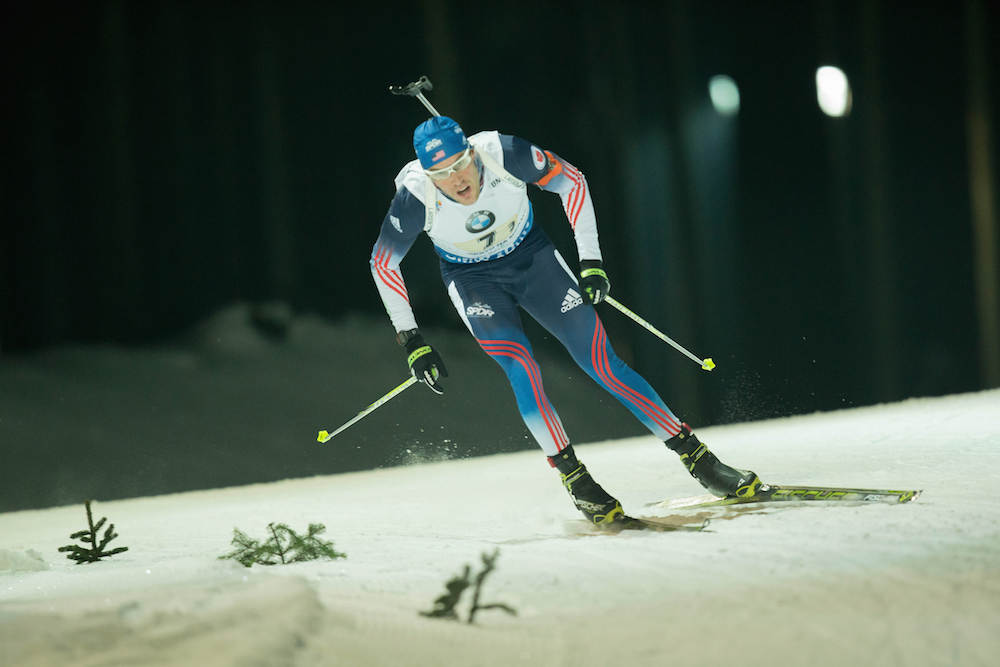
    Leif Nordgren (US Biathlon) raced the third leg of Friday's IBU World Cup mixed relay to put his team in fourth heading into the final exchange in Nove Mesto, Czech Republic. The U.S. ended up seventh. (Photo: USBA/NordicFocus)
    Leif Nordgren (US Biathlon) raced the third leg of Friday’s IBU World Cup mixed relay to put his team in fourth heading into the final exchange in Nove Mesto, Czech Republic. The U.S. ended up seventh. (Photo: USBA/NordicFocus)

    Note: This article has been updated to include comments from U.S. anchor Sean Doherty.

    Friday’s mixed relay had to have been one of Leif Nordgren’s best races of all time. Just last week, the 25-year-old US Biathlon A-teamer skied up from 51st to 19th in the men’s 12.5-kilometer pursuit at IBU Open European Championships in Otepää, Estonia, but US Biathlon Chief of Sport Bernd Eisenbichler didn’t see that race in person.

    What he did witness was one of Nordgren’s most memorable performances in the mass start at 2011 World Championships in Khanty-Mansiysk, Russia, in which he placed 17th with three misses. And that rivaled what he did on Friday as the third of four legs in the 2 x 6 + 2 x 7.5 k mixed relay.

    Nordgren brought the U.S. from 10th to fourth before the final exchange with clean prone shooting and a single standing miss. He used his spare to clean that stage and left the range for the last time in fourth, about a minute and a half behind the three race leaders (Norway, Ukraine and the Czech Republic).

    “You have to give a really big compliment to Leif today; he had world-class shooting today,” Eisenbichler said on the phone after Friday’s race, the second of two mixed relays (with Annelies Cook and Tim Burke placing ninth for the U.S. in the single mixed relay).

    “I never saw him in as good running shape as 2011 at World Championships … For sure, this was his best performance, and from 2011 to now, that’s four years so that’s really encouraging,” he added. “I’m extremely happy with where he is right now and I think he’s still going up to [2015] World Championships.”
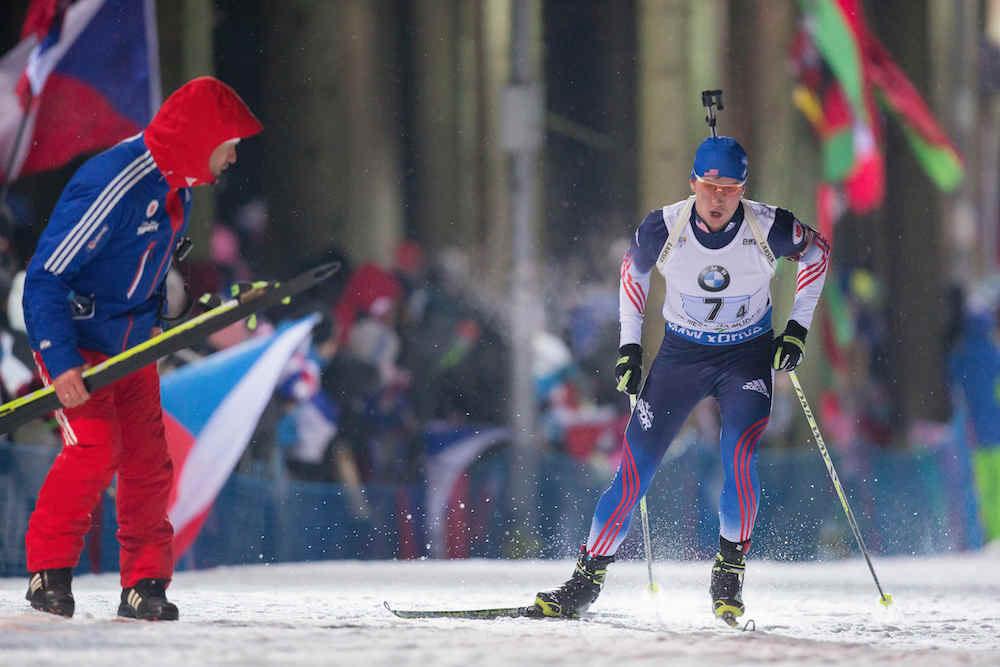
    Sean Doherty hung in fifth for most of Friday's mixed relay at the IBU World Cup in Nove Mesto, Czech Republic, before finishing seventh. (Photo: USBA/NordicFocus)
    American Sean Doherty hung in fifth for most of Friday’s mixed relay at the IBU World Cup in Nove Mesto, Czech Republic, before finishing seventh. (Photo: USBA/NordicFocus)

    Building on the foundation teammates Susan Dunklee and Hannah Dreissigacker laid as the first and second legs, respectively, of the Americans’ mixed relay on Friday, Nordgren tagged Sean Doherty in fourth.

    The 19-year-old Doherty anchored them to seventh, 2:23.8 behind the Norwegian winners (Fanny Welle-Strand Horn, Tiril Eckhoff, Johannes Thingnes Bø, and Tarjei Bø) and 0.2 seconds behind Germany in sixth.

    “We were only two-tenths of a second out of the flower ceremony today, which is an exciting accomplishment, and it also makes us very hungry for more,” Dunklee wrote in an email. “Everyone skied very well today, and the guys did some fantastic work with the shooting.”

    Dunklee used a total of four spares (two on each stage) to put the team in fourth after the first leg. She handed off to Dreissigacker, who used five spares (three prone and two standing) to tag Nordgren in 10th. Nordgren used just one spare, and Doherty used one in prone and two more in standing to finish seventh with a team total of 13 spares.

    “I was really happy with the race today for my part,” Nordgren wrote in an email after posting the fifth-fastest course time and fifth-fastest range time on the third leg. “This whole year I’ve struggled to put both good shooting and good skiing together on the same day. Today I did just that, so I think I can be happy that things seem to moving in the right direction as we approach [World Championships] in Finland.”

    Dunklee raced the fastest time of all 22 starters, leaving the range in 17th after her first shooting and improving to 10th before her last lap. By the time she got to Dreissigacker, Dunklee was up to fourth.

    “I always expect Susan to crush it and pass people like crazy and tag off near the front,” Dreissigacker wrote in an email. “That’s normal for her. But she really outdid herself with the passing today! I had to laugh when I saw how much she’d moved up by the time I’d made my way over to the exchange zone. I was psyched!”

    “I used more spares than I would have liked and channeled the frustration from the range into speed on the ski track,” Dunklee explained. “At the start of the second loop, I forgot entirely about pacing for a couple minutes and focused solely on regaining contact with the main pack.  Then my body reminded me that that wasn’t a sustainable pace.”

    She spent her last loop trying to ski “smarter” and save energy for the last climb. Leaving the range, she caught Switzerland’s Elisa Gasparin then slingshot by her before the last uphill.

    Dreissigacker reflected that her first lap skiing in the top four felt fast, “but I wasn’t really feeling too much…so I was able to go harder than I maybe should have,” she wrote.

    She seized the chance to ski behind France’s Marie Dorin Habert on her first lap, then slipped to seventh after her first shooting.

    “I think that the wind was a bit variable on the first stage, but mostly I just wasn’t super well-settled,” Dreissigacker wrote. “I’ve been having a bit of a prone-shooting slump for the last few days, so I’m hoping to improve on that.”

    Feeling the fatigue start to set in on her last two laps, Dreissigacker reminded herself how much she liked the course and “kept fighting.”

    “In standing, I felt good through the first 5 shots, but had one close miss and then I got shaky shooting spares,” she wrote. “I accidentally fired one spare way too early when I wasn’t even on target, so I was just happy to hit that last one!”

    Pushing to stay with Russia’s Ekaterina Shimulova on the last lap, Dreissigacker wasn’t able to do so and tagged Nordgren in 10th, 13 seconds behind Shimulova in eighth and 11.6 seconds back from Italy’s Federica Sanfilippo in ninth.

    “I wanted to stay with [Shimulova] and catch up to the pack ahead so that Leif would have a good pack to ski with,” Dreissigacker wrote. “Luckily he had an awesome day and managed to catch the pack all by himself. The rest of the team did so well and it was really fun to watch the rest of the race and cheer as I cooled down.

    “It was such an exciting finish!” she added. “Sean did awesome…and in a year or two, if not way sooner, he’ll be winning those photo-finishes.”

    For Nordgren, fast skis helped, he explained, as he caught the group ahead of him on the first loop.

    “I felt totally in control the first two loops, and I was able to push hard the last loop also,” he explained.

    Nordgren added that by the end of last week, he could already feel like his shooting was starting to come around. He felt similarly about his ski shape: “I had glimpses of good shape in Antholz, but with an additional 3 races in Estonia I think it really forced that good shape to come back a little quicker,” he wrote.

    “I really like that tracks here in Nove Mesto, I think they suit me perfectly, combine that with the near perfect snow conditions that we’ve had all week, and it just makes it really nice skiing,” Nordgren added. “As a team we all decided last night that we’d like to finish ahead of our bib number (7). So it was really close today, everyone from the team put in a really good effort, but sometimes it comes down to a few cm!!”

    Doherty hung in fifth for most of his race before France’s Martin Fourcade and Germany’s Benedikt Doll passed him before the finish. The youngest member of the U.S. team, Doherty pushed to stay with them, but finished 2.3 and 0.2 seconds back, respectively.

    “Funny thing, from where the warm up track is here in Nove Mesto you are a little bit out of the action, so I did not really know how well Leif was doing until I got into the start pen,” Doherty wrote in an email. “I was excited to be in such a good position, it is a great challenge and I am feeling good on the skis so I was excited to go against the other top athletes.

    “Really I just tried to keep a good pace,” he added. “For standing I was trying to focus on the good things that I had been working on in training. It did not work out as well as it could have but that is biathlon and it was still a good fight to the line. … I am very happy with my personal performance, I am feeling stronger and stronger on the skis. As for the team overall it is great. It is nice to have everyone at full health and it is a good sign that our program is improving as a whole.”

    At the end of the day, Eisenbichler was pleased, especially with both the team’s single mixed relay and four-person mixed relay finishing in ninth and seventh, respectively.

    “Top 10 is really something we should always reach for,” he said. “It was really, really tight, especially in the mixed relay.”
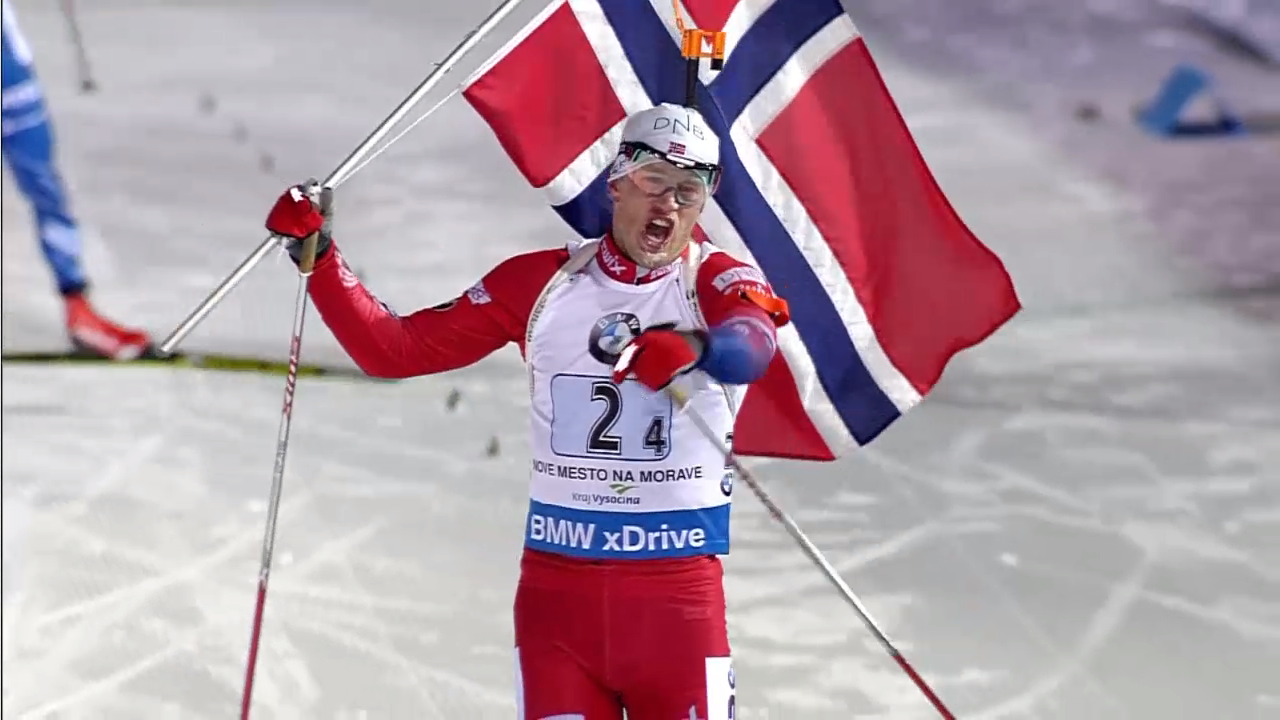
    An exhausted Tarjei Bø (2) celebrates his win for Norway in the 2 x 6 + 2 x 7.5 k mixed relay on Friday at the IBU World Cup in Nove Mesto, Czech Republic. He held off Ondrej Moravec of the Czech Republic by four seconds.
    Tarjei Bø  celebrates his win for Norway in the 2 x 6 + 2 x 7.5 k mixed relay on Friday at the IBU World Cup in Nove Mesto, Czech Republic. He held off Ondrej Moravec (l) of the Czech Republic by four seconds.

    Norway won the four-person relay in 1:12:49.2 with six spares, holding the Czech Republic (with Veronika Vitkova, Gabriela Soukalova, Michal Slesingr, and Ondrej Moravec) by 4.1 seconds. The Czechs used five spares, and Ukraine (Iryna Varvynets, Valj Semerenko, Dmytro Pidruchnyi, and Sergey Semenov) held tough for third (+1:21.3) with one penalty (from Semenov on his prone stage) and seven spares.

    “Moravec is one of the fastest standing shooters, so today I wanted to show Moravec that I am the fastest,” Norway’s anchor, Tarjei Bø, told the IBU.

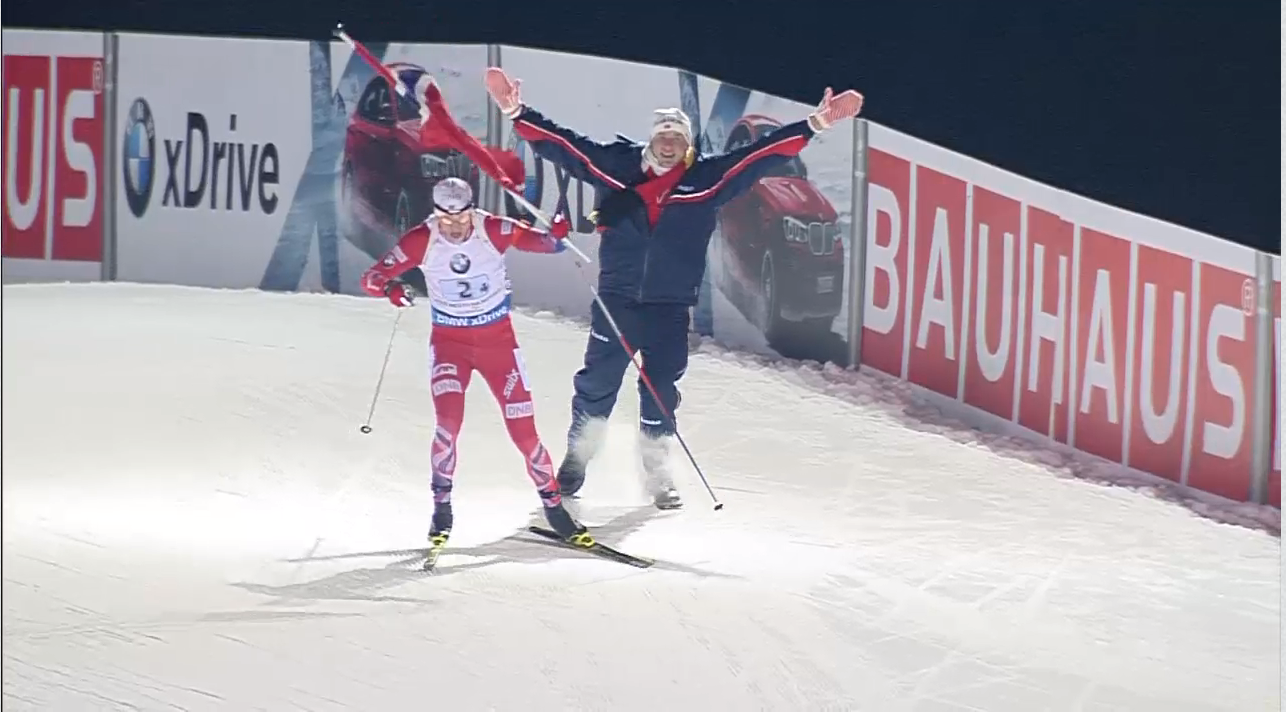
    Using just one spare in prone and cleaning standing, he took the lead by 13.9 seconds with one lap remaining. Moravec, who used one spare on his last stage, closed on him in the final kilometers to come within four seconds of Bø, who had enough time to grab a large Norwegian flag before the finish.
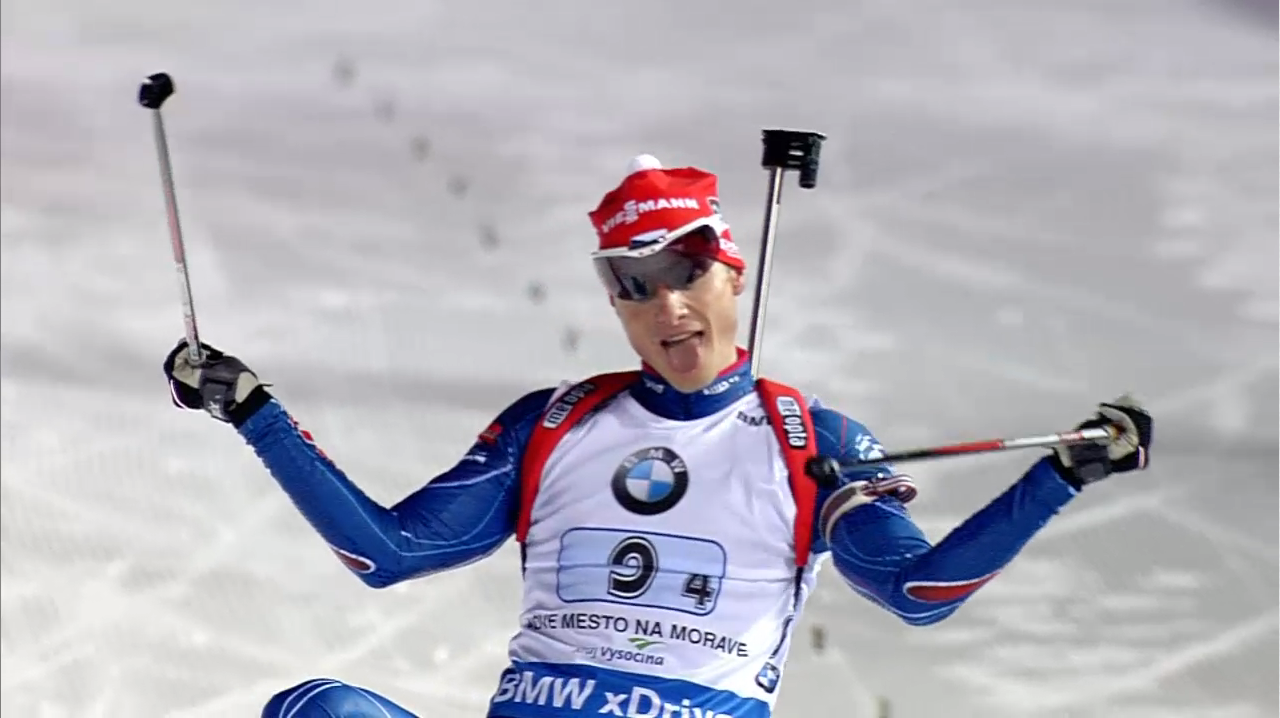
    Czech Ondrej Moravec mocks Russia's Alexey Volkov's finish-line celebration after Moravec finished second in Friday's mixed relay. Earlier that afternoon, Volkov anchored Russia to the single mixed relay win.
    Czech Ondrej Moravec mocks Russian Alexey Volkov’s finish-line celebration after Moravec finished second in Friday’s mixed relay. Earlier that afternoon, Volkov anchored Russia to the single-mixed-relay win.

    “I think we can be really happy with second,” Slesingr told the IBU. “[Ondrej and I] spent a little more time in standing … Before the race we would have been happy with second so there is no disappointment … We were able to give something back to all of the fans who came here … we can feel their support that has made biathlon almost the number one sport in Czech Republic.”

    Russia placed fourth, France was fifth and Germany was sixth.

    Canadians 14th

    Canada skied in the top 15 throughout the race with Audrey Vaillancourt, Rosanna Crawford, Nathan Smith, and Brendan Green ultimately placing 14th (+5:12.3).

    “Overall I think the team had a rough day, we all seemed to have problems with our standing shooting,” Vaillancourt wrote in an email.

    After her first mass-start experience on the World Cup, she cleaned the first shooting, but used three spares in standing to tag Crawford 1:28.4 back in 14th.

    “I had a good start, but on the second hill a girl stepped on my pole and it fell off my hand. I had to go backwards to get it back and therefore lost the pack,” Vaillancourt explained. “Then I tried to catch up, but couldn’t do it before the first shooting.

    “Skiing felt good, but I had a hard time making up for the time I had lost,” she added. “It might have affected my standing shooting. I wanted to get in, clean, and leave as fast as I could, but it didn’t work out so well. Instead I ended up using 3 spares.”

    Her skiing felt better than in past weeks, she added, after her team spent a week of training “on lots of real snow” in Mittenwald, Germany.

    Crawford explained she was starting to feel like her “old self” as well on Friday, after she skied the 10th-fastest course time of the second-leg skiers. She used two spares on her first stage, and then used three more and had a penalty loop after standing.

    “I wanted to catch the pack of three just in front of me so I could have someone to ski with. That worked but then I lost what ever I had gained with poor shooting,” she wrote.

    Crawford handed to Smith in 15th, 2:30 back.

    “I was a bit surprised by the analysis. I thought I skied better than it looks on paper,” she wrote. “But hopefully this will just have gotten all the gears running again and tomorrow [the sprint] will be better. It’s a really hard 2.5km course. One of the tougher ones on [World Cup] I’d say. So good technique and proper pacing will be important. But it’s also only 3 loops so you have to be sharp!”

    Smith cleaned prone to bring Canada up to 13th, but used two spares in standing and dropped one spot on the last lap to 14th. Green kept them there, with a clean first stage but had three spares and one penalty on his last shooting. He finished 14th, more than a minute and 10 seconds behind Italy in 13th.

    “We had little hiccups starting with Audrey loosing a pole and loosing contact to the group, Rosanna having a penalty loop, Brendan having a penalty loop, Nathan not being able to stay with [Austria’s Julian] Eberhard when he was passed,” Biathlon Canada Head Coach Matthias Ahrens wrote in an email. “Anyhow I believe we could be where the US team was today whom I congratulate for a great race by all members.”

    “I think we’re disappointed. But are looking forward to the weekend,” Crawford wrote.
    Results

    Tarjei Bø receives the Norwegian flag from an excited fan as he cruises down the finishing stretch to celebrate his win for Norway in the 2 x 6 + 2 x 7.5 k mixed relay on Friday at the IBU World Cup in Nove Mesto, Czech Republic.
    Tarjei Bø (l) receives the Norwegian flag from an excited fan as he cruises down the finishing stretch to celebrate his win for Norway in the 2 x 6 + 2 x 7.5 k mixed relay on Friday at the IBU World Cup in Nove Mesto, Czech Republic.
  • At Home in Ruhpolding, Heinicke Captures Career Best 11th; Norway’s Horn Nabs First World Cup Win

    At Home in Ruhpolding, Heinicke Captures Career Best 11th; Norway’s Horn Nabs First World Cup Win

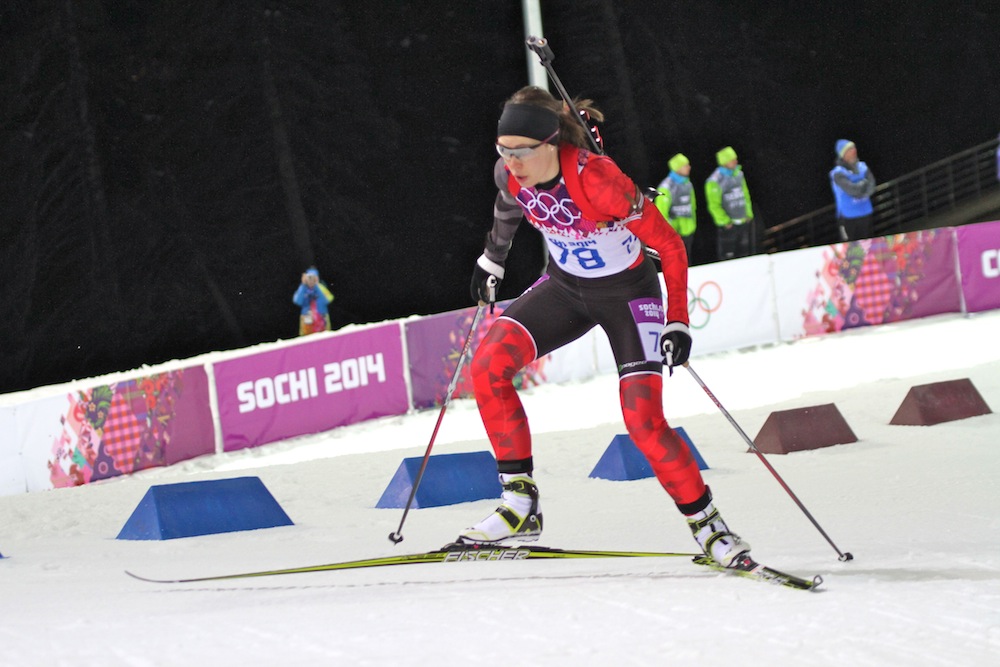
    Megan Heinicke (Biathlon Canada) racing to 59th in the 2014 Olympics sprint near Sochi, Russia.
    Megan Heinicke (Biathlon Canada) racing to 59th in the sprint at the 2014 Olympics near Sochi, Russia.

    Megan Heinicke had a little something called home-course advantage working in her favor on Friday, and for that matter, on Wednesday and this Sunday as well.

    The 26-year-old Canadian from Prince George, B.C., has called Ruhpolding, Germany, her home since September. Lucky for her, the fifth IBU World Cup stop of the season was there, with races Wednesday through Sunday. And on Friday, the six-year Biathlon Canada veteran qualified for her first-ever mass start after placing a career-best 11th in the 7.5-kilometer sprint.

    “This was one of my strongest skiing performances ever,” Heinicke wrote in an email after Friday’s race, in which she topped her previous World Cup best by one place (she was 12th in the 15 k individual at the beginning of the season in Östersund). “I simply felt strong and there is nothing more fun than fighting hard when you feel strong.”

    The 16th starter out of 98 women, she finished 52.3 seconds behind the winner after shooting 90 percent with a clean prone stage and one standing penalty.

    That put her in third overall after prone, and while her standing miss set her back to 10th and she slipped one more spot to 11th on the last lap, Heinicke initially finished fifth of 16 women.

    “I was well aware that starting with bib 16 meant that there were still a lot of strong girls behind me so I wasn’t disappointed to fall back a bit [in the final results],” she explained. “I was really hoping to stay in 10th, but 11th is a new personal best and I am really pleased with the result.”

    Throughout the race, she heard she was in contention with top women like Darya Domracheva of Belarus (who started 14th and ended up second) and Italy’s Dorothea Wierer (who started 19th and placed ninth). She wasn’t sure what that meant or where it would put her, but she felt strong and assumed she was doing well.

    Going into the race, Heinicke had hoped for a top 30, but more specifically, to “glide longer in the flat sections and be a bit more explosive with higher frequency on the few steep sections,” she wrote. “Shooting wise I had been trying out some keywords and those were all I wanted to think about on the range.”

    On Wednesday, Heinicke had another first, racing to second in the opening leg of the women’s 4 x 6 relay and putting her team 25 seconds from the lead at the exchange. The Canadians ended up 11th — not quite the team-best fourth they accomplished just over a year ago — but Heinicke saw it as a stepping stone.

    “I had a great relay leg this Wednesday and had also had a great relay leg in Oberhof which had me feeling determined and confident,” she wrote. “I am slowly starting to feel more confident and I have this fierce determination to shoot well which is enough to keep me focused.”

    The level of support she’s received has helped her as well.

    “I have had some big life changes this fall and am feeling like there is no pressure on me and I think that has been good for my head,” she explained. “I am really motivated by having several personal bests this season and I feel like the return of my self confidence is good for me. I am planning to keep racing with the same determined, task-oriented approach and who knows what can happen! I certainly wasn’t expecting these results to come this year!”

    With Friday’s result, Heinicke was one of two Canadian women to qualify for Sunday’s 12.5 k mass start. Rosanna Crawford sat out Wednesday and Friday because of a cold, but is currently 12th in the overall World Cup (making the top-30 criteria) and listed to start in bib 12.

    In her first-career mass start, Heinicke will start in bib 28.

    “I am glad I have been able to start our relay a few times so I am not feeling too nervous about starting in the pack,” Heinicke wrote.

    Also for Canada on Friday, Zina Kocher placed 48th, 2:18.8 behind the winner — Fanny Welle-Strand Horn of Norway. After starting 96th, Kocher found herself in the top 20 after a clean prone and the 23rd-fastest course time on the first lap. However, she missed three in standing, which put her back from 31st to 65th with one lap to go. Kocher posted the 13th-fastest course time overall.

    Audrey Vaillancourt finished 68th (+3:13.7) with a single prone penalty, and Julia Ransom, in her second World Cup sprint, was 81st (+3:55.8) with four penalties: one prone and three standing.

    Dunklee: ‘One of my best performances of the year’

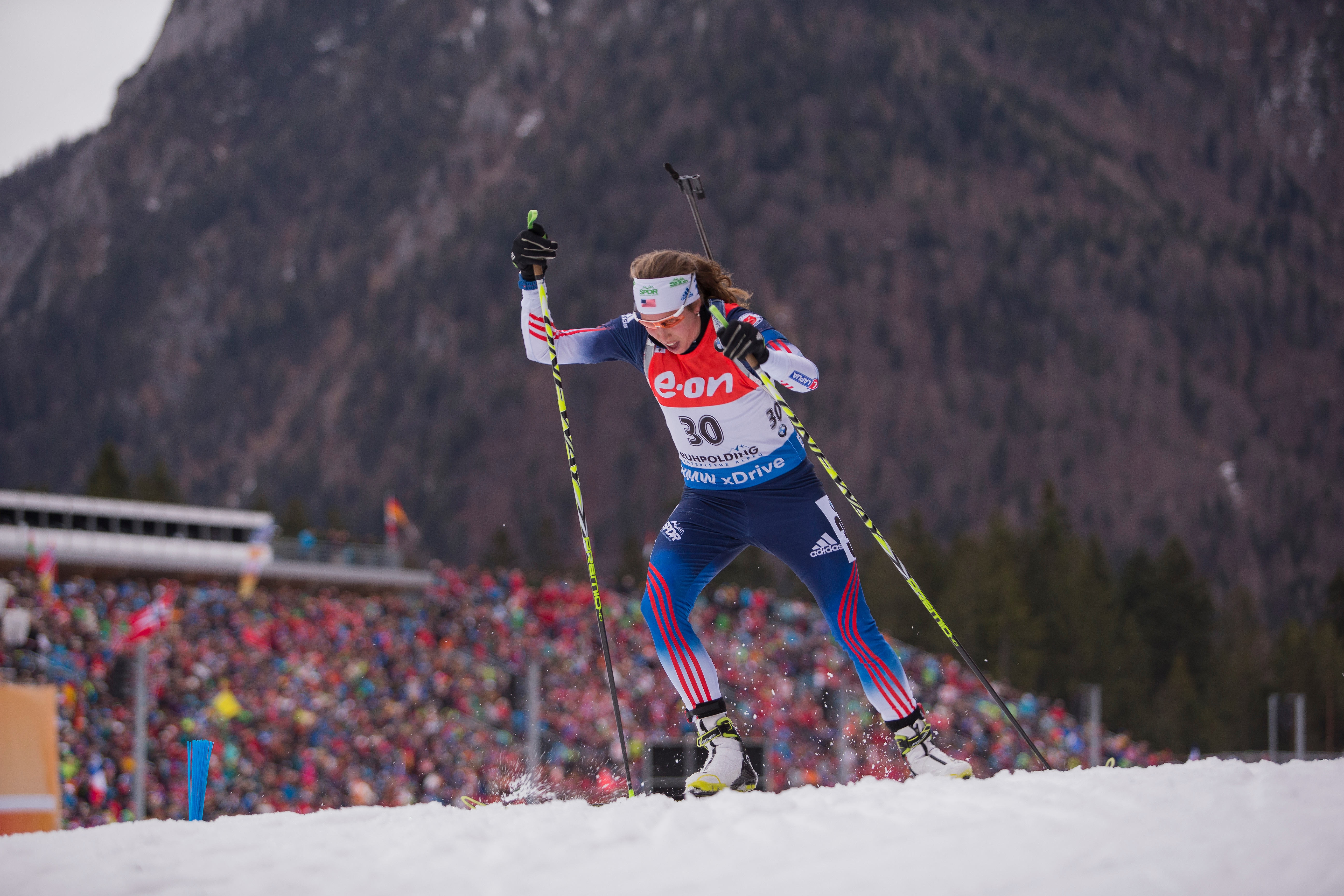
    Susan Dunklee (US Biathlon) on her way to 26th on Friday in the women's 7.5 k sprint at the IBU World Cup in Ruhpolding, Germany. (Photo: USBA/NordicFocus)
    Susan Dunklee (US Biathlon) on her way to 26th on Friday in the women’s 7.5 k sprint at the IBU World Cup in Ruhpolding, Germany. (Photo: USBA/NordicFocus)

    US Biathlon’s Susan Dunklee led the Americans in what she considered one of her best performances of the year, in which she placed 26th, 1:44 behind Horn.

    Dunklee started 30th and skied right around 30th for most of the race, cleaning prone and missing one in standing, and posted the 30th-fastest course time overall.

    In an email, she explained her skiing felt “snappy,” which left her surprised with the splits she was hearing: why weren’t they better?

    “There are always factors out of your control as an athlete,” Dunklee wrote. “Today we saw some tricky waxing conditions with wet snow and we didn’t nail it quite as well as we usually do.”

    Skiing aside, she explained she had her best shooting day of the season, “which is a huge confidence booster going forward,” she wrote. “Plus I was happy, relaxed and focused this morning; I was just plain psyched to be racing, more so than I have been lately.”

    On Sunday, Dunklee as the lone American in the women’s mass start will start in bib 23.

    “I’m ready to try again in the mass start,” she wrote.

    Her teammates, Annelies Cook and Hannah Dreissigacker, placed 52nd and 77th, respectively on Friday. Cook cleaned prone and missed one standing to finish 2:30.1 behind the winner, and Dreissigacker fell behind with two prone penalties and another miss in standing to end up 3:41.2 back.

    Horn Surprises for First World Cup Win

    While much of the attention in Friday’s sprint went to Domracheva, who started 14th and cleaned both stages despite using one spare in prone, there was also a lot riding on Norway’s Tiril Eckhoff, the 31st starter who came within 4.2 seconds of Domracheva’s time heading into the final lap.

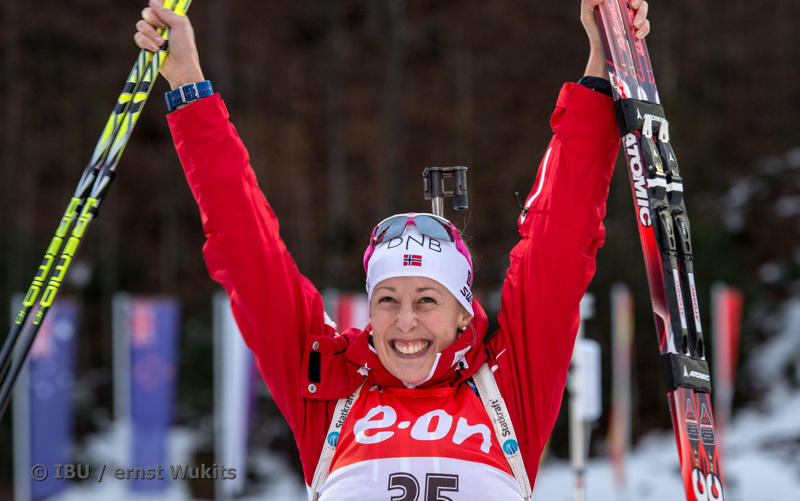
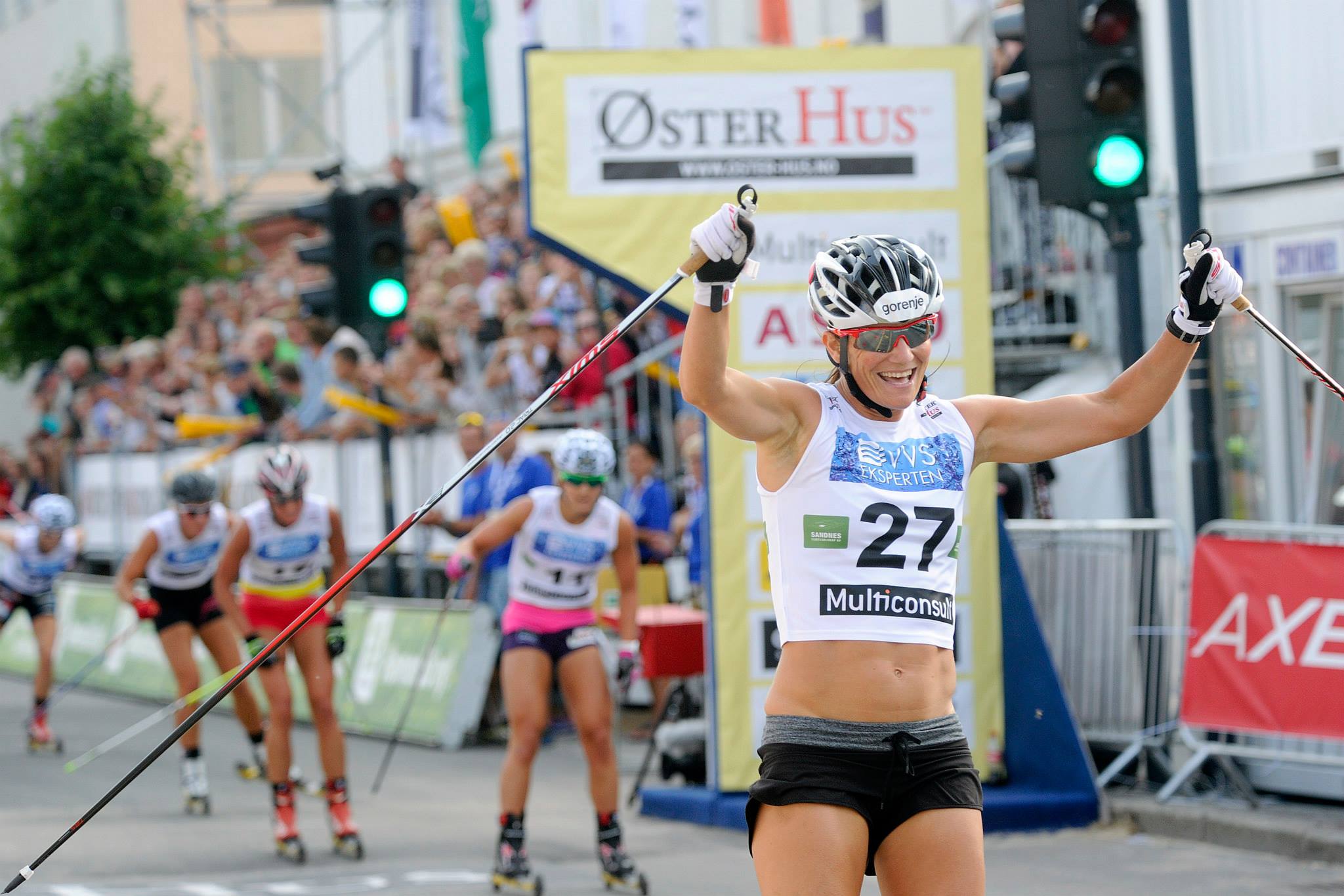
    Norway's Fanny Welle-Strand Horn celebrates her first IBU World Cup win and podium on Friday after the 7.5 sprint in Ruhpolding, Germany. (Photo: IBU/Ernst Wukits)
    Norway’s Fanny Welle-Strand Horn celebrates her first IBU World Cup win and podium on Friday after the 7.5 sprint in Ruhpolding, Germany. (Photo: IBU/Ernst Wukits)

    She couldn’t quite catch her, finishing 5.9 seconds behind Domracheva, but there was another Norwegian gunning for the win — Horn, who, at 26, had never before reached the World Cup podium.

    Horn started 35th, two minutes after Eckhoff, and took the lead with a clean prone. She hit all her standing targets as well to stay in control, then raced the seventh-fastest last lap to edge Domracheva’s time by 3.4 seconds in 21:07.4.

    “I have been in this game for a long time, five years in the World Cup,” she told the IBU afterward. “Today, everything worked out for me — skiing, waxing and shooting — I am really happy and I am really happy that I made 10 good shots.”

    Norway took two of the top three with Eckhoff in third, after Domracheva in second.

    “We had amazing skis today,” Eckhoff told the IBU. “We have a really strong team and it is really fun that I am on the podium with Fanny on top.”

    While Domracheva lost a few seconds loading the spare, she was glad she was able to avoid a penalty loop.

    “I am happy that I shot clean. Sometimes when things like that happens, an athlete misses the shot,” she said.

    She also liked the modified course: “The new course is good; there were not so many girls falling anymore,” Domracheva said.

    Ukraine’s Valj Semerenko placed fourth, 21 seconds after Horn, Finland’s Mari Laukkanen — an early leader after a clean prone stage — missed one standing to place fifth (+22.7), Germany’s Franziska Hildebrand cleaned for sixth (+28.6), and overall World Cup leader Kaisa Mäkäräinen missed one on each stage but skied the second-fastest course time to place seventh (+32).

    Veronika Vitkova of the Czech Republic had the fastest course time, but missed three (one prone and two standing) to finish eighth (+41.2). Wierer was ninth for Italy (+43.3), and Czech Jitka Landova placed 10th (+50.9), 1.4 seconds ahead of Heinicke.

    On Sunday, Mäkäräinen, who still leads the World Cup, will start the mass start in bib 1 alongside Domracheva in bib 2 and Semerenko in bib 3.

    Results

  • Blink Festival Concludes with Mass Starts and Sprints; Bailey and Burke Deliver for U.S.

    Blink Festival Concludes with Mass Starts and Sprints; Bailey and Burke Deliver for U.S.

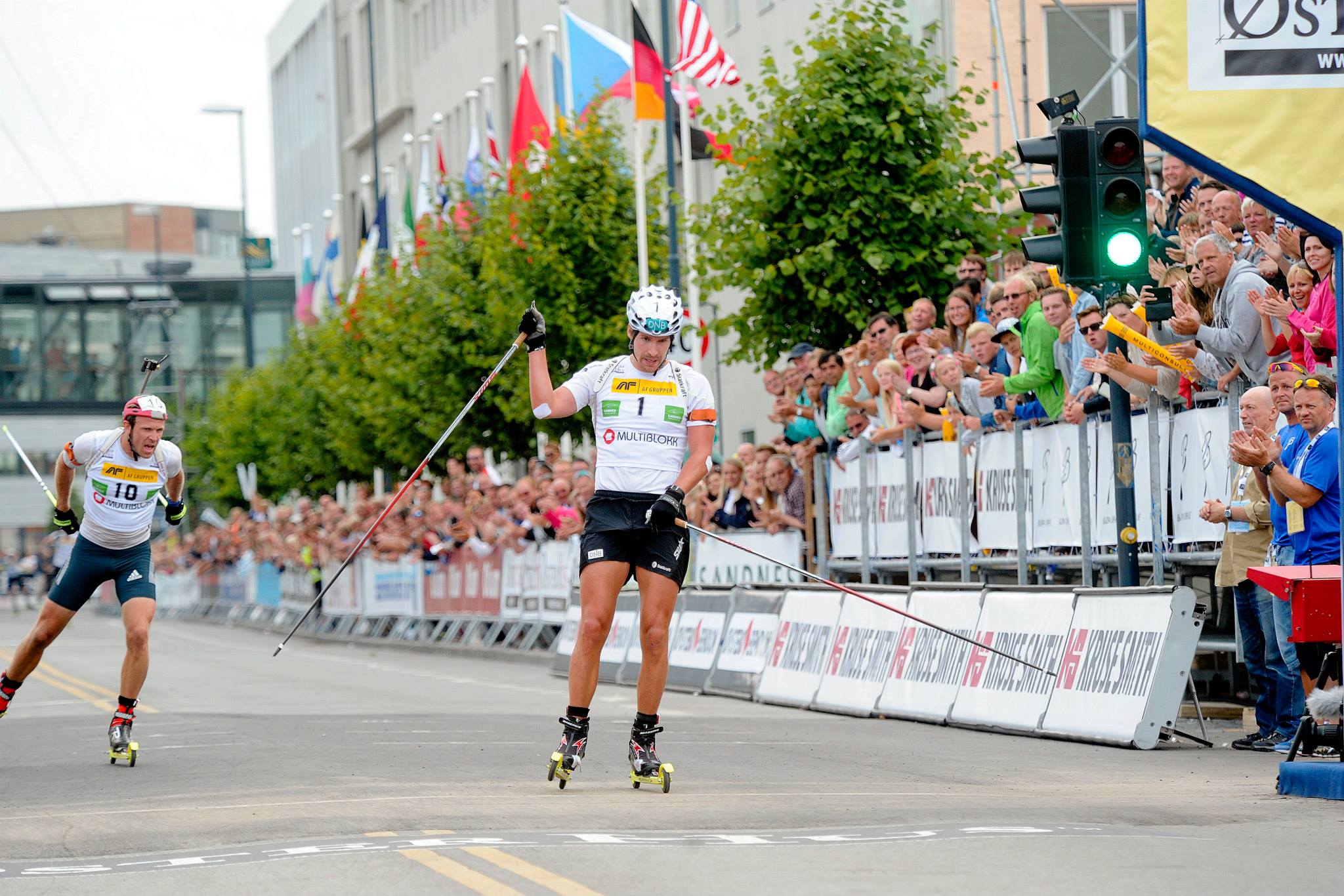
    Lowell Bailey (r) pushes himself across the finish line in Friday's biathlon 6.3 k mass start as part of the 2014 Blink Festival. Bailey finished second behind Emil Hegle Svedson (l) of Norway. (Photo: Skifestivalen Blink/Facebook)
    U.S. Biathlon’s Lowell Bailey (l) pushes himself across the finish line in Friday’s biathlon 6.3 k mass start as part of the 2014 Blink Festival. Bailey finished second to Emil Hegle Svedsen (r) of Norway. (Photo: Skifestivalen Blink/Facebook)

    When Lowell Bailey raced in the 2014 Blink Festival 7-kilometer hill climb just days after arriving in Norway, he was jolted by a “shock to the system,” he wrote in an email.

    Apparently the shock was what he needed to deliver a top-notch performance, as the U.S. biathlete finished second in the biathlon mass start the next day in the city of Sandnes.

    The road to the podium wasn’t an easy one. To participate in the mass start, competitors who were not already pre-qualified needed to place in the top six in the qualification round. The round consisted of five laps of 800 meters with prone shooting following the second lap and standing following the fourth.

    In a tough field, Bailey and U.S. teammate Tim Burke claimed the last two spots in the mass start by taking fifth and sixth.

    Once in the mass start, Bailey knew he had to focus on his shooting if he wanted to have any hopes of placing on the podium.

    “I told myself before the race that I was going to race my own race and try not to get caught up in the hurried shooting situations that always happen in this type of race,” Bailey wrote.

    Throughout the race, which consisted of nine laps on a 700-meter loop, and two prone and two standing stages, Bailey often took longer to shoot but maintained contact with the lead group.

    When he exited the final shooting he was the last of the four competitors he had arrived with to leave the mats.

    However, his fellow competitors had rushed through their shots and had penalty loops to compete. Bailey had shot perfectly and left the range with a five-second lead over Norway’s Emil Hegle Svedsen.

    Svedsen ultimately caught the American in the final stretches of the race, overcoming him by just 0.7 seconds.

    Bailey was followed by Norwegian Tarjei Bø, who finished 12.9 seconds behind Svedsen.

    Burke finished eighth in the mass start, 1:09.9 back.

    Katja Visnar (SLO) celebrates her victory in the women's 10 k mass start in the 2014 Blink Festival. (Photo: Skifestivalen Blink/Facebook)
    Slovenia’s Katja Visnar celebrates her victory in the women’s 10 k mass start in the 2014 Blink Festival. (Photo: Skifestivalen Blink/Facebook)

    In the women’s 6.3 k mass start Fanny Wele-Strand Horn of Norway was victorious with a time of 14:10.8. She was followed by Kaisa Makarainen of Finland and Marine Bolliet of France in second and third.

    American Susan Dunklee finished in eighth, 41.8 seconds behind Horn. Dunklee was one of five athletes who had pre-qualified for the mass start, but struggled with her shooting in the final.

    “Unfortunately I missed a lot of prone targets early in the final and despite passing a few people on skis, I never regained contact with the main pack,” Dunklee wrote in an email.

    The cross-country mass start races that took place later that day consisted of women’s 10 k and a men’s 15 k.

    In the men’s race, Teodor Peterson of Sweden claimed victory for the second day in a row on the rollerski course that consisted of 18 laps around an 800-meter loop. The sprint specialist finished with a time of 28:07.3. He was followed by Norwegian Øystein Pettersen in second and Cyril Gaillard in third.

    The men’s field was incredibly close with the top-23 finishers crossing the line within ten seconds of Peterson.

    Canadian Devon Kershaw was one such finisher. He placed seventh, just 3.7 seconds behind the Swede and 1.4 seconds off the podium.

    In an email, Kershaw explained that the curvy course and the 30 aggressive racers that populated it made for conditions he was not used to, but he was happy with how the day ended.

    “I was out of position near the end and with all the curves there was nothing I could do,” Kershaw wrote. “It was a fun evening though!”

    In the women’s 10 mass start, another sprint-specialist took the win. Slovena’s Katja Visnar finished with a time of 20:36.0. She was followed by German sprinter Denise Herrmann in second and Norway’s Ingvild Flugstad Østberg in third.

    American Liz Stephen finished 18th. In an email, she declared the race a success in that there were no major crashes.

    “It was good for my head in that I need to be less nervous about skiing in a pack close to other skiers, and after today snow seems like it should be no problem at all,” she wrote.

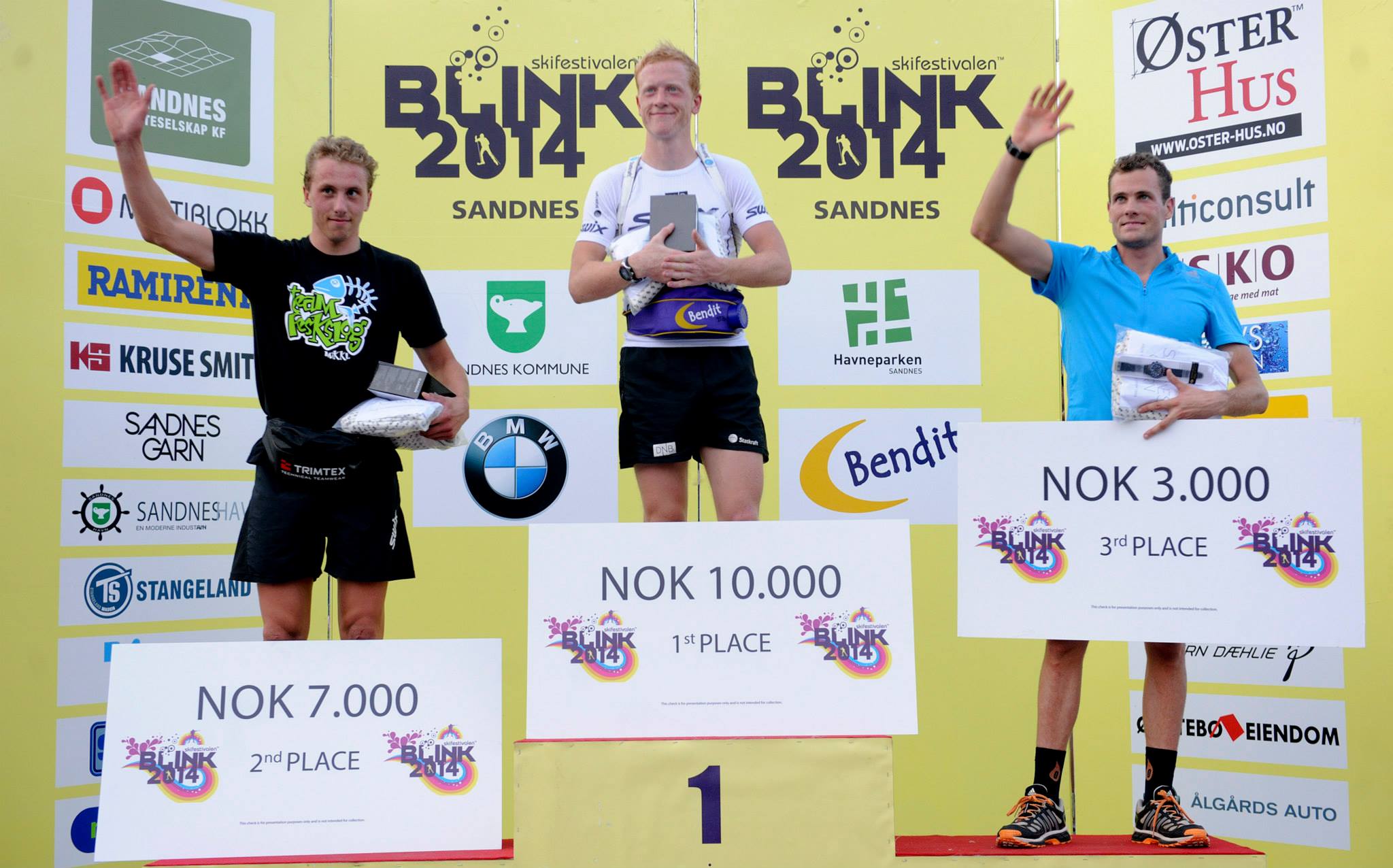
    Tim Burke (l) stands on the podium of the men's biathlon sprint Saturday at the 2014 Blink Festival. Burke finished third, completing a successful weekend for the Americans in attendance at the festival. (Photo: Skifestivalen Blink/Facebook)
    Tim Burke (r) stands on the podium of the men’s biathlon sprint Saturday at the 2014 Blink Festival. Burke finished third, completing a successful weekend for the Americans in attendance at the festival. (Photo: Skifestivalen Blink/Facebook)

    Sprint Day

    U.S. biathletes also shined in the final day of the Blink Festival with Burke and Bailey claiming third and sixth, respectively, in the biathlon sprint.

    Burke finished 8.7 seconds behind race winner Johannes Thingness Bø of Norway, who won the final in 12:25.8. Second place went to fellow Norwegian Marius Hol who crossed the line 7.4 seconds behind Bø.

    After struggling with his shooting in the mass start competition, Burke was pleased to have a strong result.
    “This was a good confirmation for me that I am headed in the right direction for the winter season,” he wrote.
    It was the first time the 32-year-old American had ever competed in heats for a biathlon race, which he found both unique and challenging.
    “I would say the shooting in this type of race is actually harder than a normal biathlon race because you are basically sprinting all out for 1 k before each shooting stage,” he wrote.

    Bailey finished sixth, 22.7 seconds behind the winner.

    In the women’s biathlon sprint, Dunklee placed sixth in her semifinal and did not advance to the final. The women’s biathlon final was won by was won by Bolliet, who was followed by French teammates Enora Latuilliere and Anais Chevalier in second and third, respectively.

    In the cross-country sprints, Norway’s Marit Bjørgen topped the women’s final. She edged teammate Maiken Caspersen Falla for the win by just 0.1 seconds. Visnar placed third, 1.1 seconds behind Bjørgen.

    Stephen was unable to advance from the quarterfinals.

    Sondre Turvoll Fossli of Norway won the men’s final in 3:08.1. He was followed by another Norwegian Martin Hammer in second and Sweden’s Peterson in third.

    2014 Blink Festival Results

    Friday’s mass starts: Men’s biathlon | women’s biathlon | men’s cross-country | women’s cross-country

    Saturday’s sprints: Men’s biathlon | women’s biathlon | men’s cross-country | women’s cross-country 

  • Germans Gap Field for Relay Win; Canadian Women Capture Unprecedented Fourth, U.S. Repeats in Eighth

    Germans Gap Field for Relay Win; Canadian Women Capture Unprecedented Fourth, U.S. Repeats in Eighth

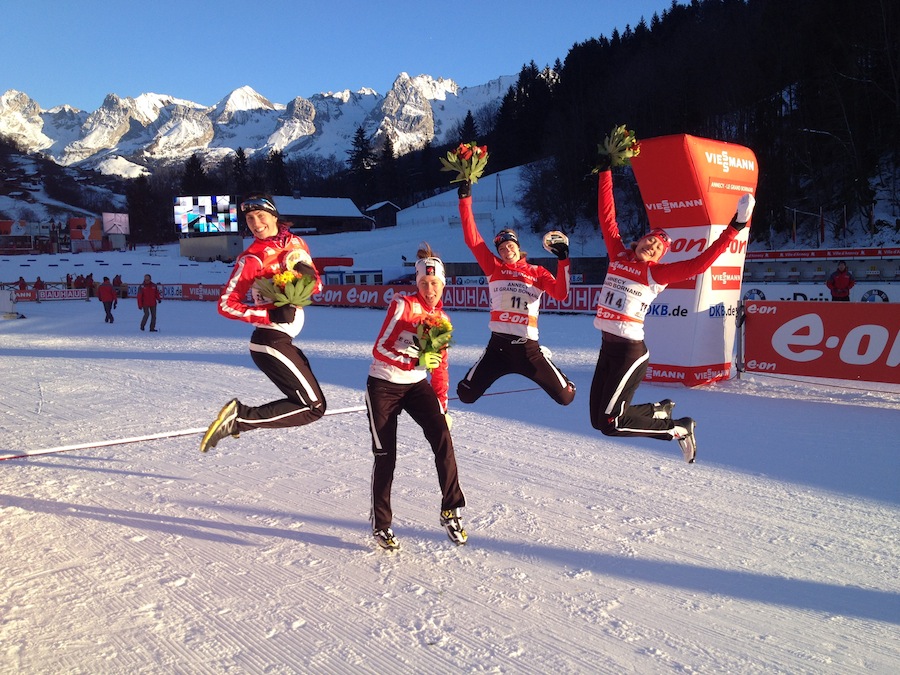
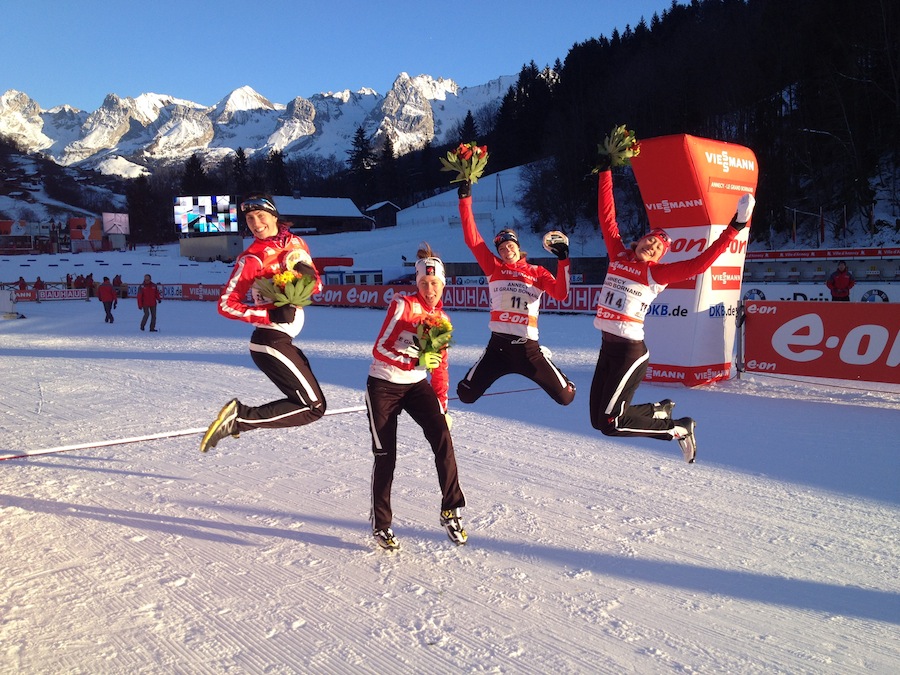
    The Canadian women jumping for joy after notching Biathlon Canada's best-ever finish in a relay. (Photo: Biathlon Canada/Matthias Ahrens)
    The Canadian women jumping for joy after notching Biathlon Canada’s best-ever finish in a relay. (Photo: Biathlon Canada/Matthias Ahrens)

    Note: The following has been updated to include quotes from Megan Heinicke.

    About halfway through the IBU World Cup women’s 4 x 6-kilometre relay on Thursday in Annency, France, it was pretty evident Germany had the race in the bag.

    Anything can certainly happen, but Andrea Henkel had opened a 10.5-second lead for the Germans by the end of the second leg, and after teammate Franziska Hildebrand’s third leg, they were up by 35 seconds on Norway. Laura Dahlmeier essentially had to go through the paces, shoot as clean as possible and ski strong to hold off Norway and Ukraine, both contending for the podium with somewhat of a surprise charging from behind – the Canadians.

    It wasn’t a surprise for Canada. Chris Lindsay, high-performance director for Biathlon Canada, has known for some time what his quartet of Rosanna Crawford, Megan Imrie, Megan Heinicke, and Zina Kocher were capable of. And on Thursday it was Canada’s best-ever relay result – in a female, male or mixed event. The nation’s previous best was sixth in a mixed relay in 2011 in Hochfilzen, Austria.

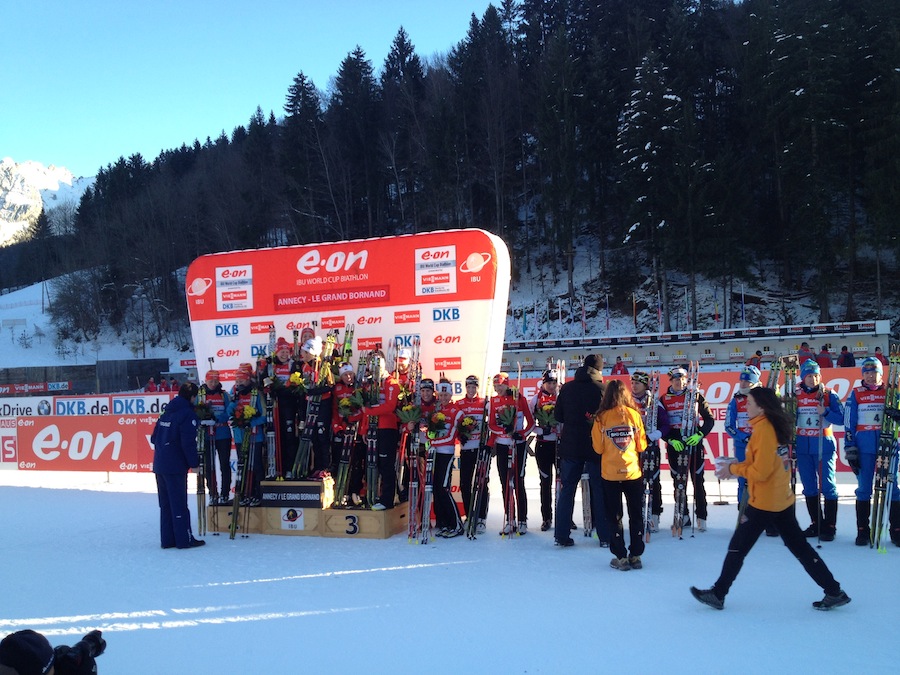
    The top teams in the 4 x 6 k women's relay gather around the podium Thursday at the IBU World Cup in Annency, France. Germany won, Ukraine was second, Norway placed third, and Canada notched a historic fourth. (Photo: Biathlon Canada/Matthias Ahrens)
    The top teams in the 4 x 6 k women’s relay gather around the podium Thursday at the IBU World Cup in Annency, France. Germany won, Ukraine was second, Norway placed third, and Canada notched a historic fourth. France placed fifth, Russia was sixth, Italy finished seventh, and the U.S. tied last week’s eighth place. (Photo: Biathlon Canada/Matthias Ahrens)

    The Canadian women placed fourth on Thursday behind Germany, Ukraine and Norway, respectively, with Germans Franziska Preuss, Henkel, Hildebrand, and Dahlmeier winning in 1:06:27.8, and using just three spare rounds in the process.

    Ukraine’s Juliya Dzhyma, Vita Semerenko, Valj Semerenko, and Olena Pidhrushna, placed second 23.3 seconds back with four spare rounds, edging Norway in third by 0.5 seconds with Tinril Eckhoff, Fanny Welle-Strand Horn, Synnøve Solemdal, and Tora Berger, who used a total of 10 spare rounds.

    The Canadians were 1:35.8 back in fourth after using nine spares.

    “Certainly holding the shooting together with the great skiing was the difference,” Lindsay wrote in an email. “Having a big result that is completely owned by the women helps to build an even stronger foundation upon which podiums will follow.”

    Heading out first with 22 other teams, Crawford cleaned her prone and used one spare on her standing to bring the team to fourth by the exchange.

    “I’ve learned from the past couple relays that being aggressive off the start and getting with the lead group will save you a lot of energy and make sure you don’t get tripped up most of the time!” Crawford wrote in an email. “I’ve got a strong double pole so I can usually be right behind the person in front of me and then it’s just a matter of [maneuvering] my way to the front group.”

    A fan of the range at Le Grand Bornand, Crawford explained she took advantage of the calm conditions and focused on one shot at a time. She left her first stage in second behind Switzerland’s Selina Gasparin, who cleaned both stages to tag off in first – but Gasparin wasn’t always in front (and her sisters Elisa and Aita, and teammate Patricia Josh ultimately dropped the lead on the second, fourth and third legs, respectively, so that Switzerland finished 13th).

    Italy’s scramble skier, Dorothea Wierer cleaned her prone and used one spare on her standing to put the team in third behind Germany’s Preuss, who used one spare on each stage to tag off in second.

    “Selina Gaspirin really didn’t want to lead, so we were able to catch up to her and then I passed her right before the range,” Crawford explained. “Standing was good, my hands were pretty cold so I had some trouble with my spares, dropping two, before I got one in and hit the target.”

    For the last loop, Crawford stuck with Preuss and Norway’s Eckhoff just behind the leaders, tagging off in fourth, 11.6 seconds after Gasparin in first and 3.2 behind Preuss in second. Italy tagged in third, Belarus was fifth, and Eckhoff came through in sixth for Norway, 15 seconds behind Gasparin and 3.4 behind Canada.

    With Susan Dunklee scrambling for the second-straight relay, the Americans started the second leg in eighth, 33.3 seconds behind Germany.

    From there, Imrie brought the Canadians to third with a clean prone and one spare in standing. Henkel took the lead for Germany with 10-for-10 shooting, and Imrie tagged just Heinicke 17.3 seconds behind Germany and 6.8 seconds behind Norway.

    Heinicke used three spare rounds – one in prone and two in standing – for the eighth-fastest third leg, but she managed to hold tight in fourth, a minute behind Germany, but just 10 seconds behind Ukraine.

    “I was disappointed about the prone miss because it really shouldn’t have happened, but in the moment I was just focused on doing my job which was loading that spare bullet calmly and efficiently,” Heinicke explained.

    In the second bout, she didn’t realize that her first spare didn’t hit and was partly out of position. “That was too bad, but I didn’t let it get in my head, didn’t hesitate and my second spare hit,” she wrote.

    As for her last lap: “I was feeling exhausted skiing and was just thinking to fight as hard as possible and not to give anything away,” Heinicke wrote. “I was already thinking about Zina and thinking that I just needed to keep that Ukranian within striking distance for her.”

    When Kocher received the final handoff, she tried to relax, focusing on her key words for shooting and most importantly, breathing.

    “I knew it was up to me to complete the task of the day and I felt that pressure,” Kocher wrote in an email. “I’ve been struggling with that a lot before today but I’ve been working all week on my shooting and staying with the process, not on the result and not on anyone else around me.”

    After using three spares in prone, Kocher found her team’s chance at a historic best slipping. France’s Marie-Laure Brunet cleaned both rounds, shooting especially fast on the standing and putting Kocher under pressure.

    “I was over cautious,” Kocher wrote of her first time in the range.

    Fighting for every shot the second time around, Kocher ended up using one spare round in standing and raced away on her final lap to catch Brunet from 20 seconds behind. Kocher passed her and finished 8 seconds ahead in fourth.

    Dahlmeier shot clean to hold off both Ukraine’s Pidhrushna, who also cleaned, and Berger, who used two spares on her standing but closed hard on the last lap to finish third, just a half second behind Pidhrushna.

    Knowing she’s a strong closer, Kocher explained she gave everything she had, but wasn’t sure it would be enough.

    “I did not know if I had enough to hold off the Russian or catch the French,” she wrote. “I just put my head down and focused on gliding.”

    While “a podium would have been incredible,” Kocher explained the team was thrilled to break through in fourth.

    “We are absolutely ecstatic and proud of each other that we all pulled it together what we knew was always possible,” she wrote. “I don’t think this is the last of us. Now we have this confidence and belief in ourselves and each other for the future.”

    In Hochfilzen last Saturday, Dec. 7, the Canadian women placed 11th and the men notched ninth, with JP Le Guellec, Scott Perras, Brendan Green, and Nathan Smith, in the World Cup relay.

    Two years ago in Hochfilzen, Imrie, Kocher, Le Guellec, and Green combined for Canada’s previous best of sixth in a mixed relay, according to Lindsay.

    “We’ve known for a long time that we are capable of a top 6 in a relay,” Crawford wrote.

    “The numbers have shown that we can be up playing with the best – but staying in the game is a skill in itself,” Lindsay explained. “Developing comfort at being in the ‘game’ takes some time.

    “Last weekend the women were mix for most of the race,” he added. “This week they were in it the entire race. There might be weaker races in the future but I have no doubt that we will continue to rack up time in the game and this will lead to medals.”

    U.S. Repeats Feat

    The U.S. women placed eighth in the Hochfilzen relay with Lanny Barnes subbing for one of their core national-team members, Annelies Cook. For all four skiers, it was a career best.

    On Thursday, they repeated the result with Dunklee, Sara Studebaker, Hannah Dreissigacker, and Cook, respectively. They placed eighth with six spare rounds, finishing 2:44.1 behind Germany.

    “Last week when we finished 8th, we were jumping up and down at the finish,” wrote Dunklee, who used just one spare on the second stage. “This week was also very exciting but more contained.  We know we can dream bigger now.  It was inspiring to see the Canadians do so well – if they can do that, we can do it.”

    In her first year on US Biathlon’s A-team, Dreissigacker was the highlight, cleaning both her stages in the third leg to bring the team from 12th to 10th.

    Dunklee got them off to a strong start, jetting out toward the front early to avoid getting stuck behind the pack on the course with several corners and short, steep hills.

    “In the past being so high up may have scared me, but today I felt relaxed and could still transition to the range with a calm focus,” she explained. “My last loop wasn’t great, no gas left in the tank, but I will be smarter pacing for the sprint.”

    Tagged in eighth, Studebaker started alone, nearly 10 seconds ahead of Ukraine in ninth but 22 seconds behind France in seventh. She used one spare in prone, then three in standing.

    “It was tough to ski that first loop mostly alone, and it definitely helped in the second loop to have people to ski with,” Studebaker wrote. “I had a little trouble in standing, missing one from the clip and then taking all three extras to get it.  It was certainly nerve-wracking!”

    Dreissigacker could see Sweden’s Asa Lif about 10 seconds ahead of her when she was tagged in 12th . She caught her and picked off one more place, bringing the team to 10th with fast-and-flawless shooting.

    “Fast shooting is a strength of mine, and when you don’t have to load spare bullets that also makes it a lot easier to pass people there!” Dreissigacker wrote. “I’m hoping that I can continue to shoot well in non-relay races too … and that it’s just that my last two races have gone well and they’ve happened to be relays.  … I think that I do well when I’m relaxed and having fun, and relays are good for that.  And I like to shoot well for my teammates!”

    Just two seconds behind Finland in ninth, Cook wasn’t sure where her team stood when Dreissigacker tagged her. After a close-call in the exchange, Cook was relieved to make it out unscathed, and didn’t see their place until she entered the range for the first time.

    She cleaned the prone and used one spare standing, putting her in prime position for the final lap.

    “I thought that maybe I could catch [Italy’s Karin Oberhofer] and bring us into 7th, but she skied well in her last lap and I couldn’t get her,” Cook wrote.  “I didn’t do anything special, I just tried to ski well and be relaxed when I got into the range – and luckily I hit my targets and the girls around me struggled.”

    Sensing Slovakia’s Anastasiya Kuzmina coming up from behind on that last lap, Cook focused on holding onto eighth.

    “Once I got to the last uphill, I knew I would be fine,” she wrote.

    “Sunday was our best relay in a while and we always try to beat our bib number,” Cook added, referring to their eighth seed. “It was fun to see Susan leading everyone and it’s really cool that Hannah cleaned. Sara also kept us right in the game and fought super hard. Everyone gave it. I was really glad that I could be part of a good result – because I only got to cheer last week!”

    “My lower legs have been feeling better,” she wrote of her bothersome shins, which kept her from last weekend’s competition. “But they usually don’t bother me until I go hard so I was definitely a bit nervous about how they would feel and they were the best they have been so far.”

    “We’re really in a good place right now and I think after two top-8s we’re getting hungry for more!” Studebaker explained. “It’s definitely an exciting place to be in this Olympic season.”

    Results