From the FasterSkier archive — posts syndicated from athletes’ and coaches’ own blogs between 2004 and 2012, kept online as published. Current coverage is at fasterskier.com.
This reporting costs money. Please support this coverage with a voluntary subscription (below) so FasterSkier can provide this level of access to the sport we all love year-round.
On the eve of the opening event of the Olympic cross-country program, U.S. head coach Matt Whitcomb sounded equal parts energized and grounded. Speaking with FasterSkier’s Nat Herz in the mixed zone, Whitcomb touched on everything from ski exchanges and early-Games logistics to the long arc of the U.S. program—and the feeling inside the team right now.
One technical focus that has drawn attention ahead of the Skiathlon is the ski exchange, especially after Jessie Diggins (USA) and Frida Karlsson (SWE) tangled while lining up for their respective individual exchange boxes in the last World Cup Skiathlon, but Whitcomb emphasized that there’s no single formula.
“It really varies,” he said. “This is a skill that we’ve practiced over a decade and a half in some cases, but each athlete really takes their own initiative.”
Some athletes choose to practice exchanges using the same straps on two pairs of poles; others use separate straps for each pair. The calculus, Whitcomb explained, comes down to risk versus reward.
“The thing that can go wrong in the ski exchange is everything,” he said. “And the thing that can go right is you can gain a second or two. And then the pack’s back together.”
That balance—between chasing marginal gains and avoiding catastrophic mistakes—often reflects an athlete’s mindset. Whitcomb pointed to Diggins, who had been practicing exchanges at full speed the day before, including simulated interference.
“She’s somebody who visualizes things, tries to practice them, goes back to visualizing, and then does it again,” he said. “You try a few different scenarios, and those all become part of your visualization. One thing we can guarantee is that there’ll be a lot of people in a small space. If that’s part of your visualization, you won’t be disappointed.”
Beyond the technical details, Whitcomb acknowledged the peculiar chaos that comes with the opening days of the Olympic Games.
“The schedules in the first few days are a little bit chaotic,” he said. “You’ve got press conferences, headshots—things that are kind of smack in the middle of a complicated schedule. And then on top of that, you’ve got 16 athletes with 16 different workouts.”
That congestion, he noted, eases once racing begins. Only four athletes per country race per day, and there’s a single training window on the course—simplifying logistics and allowing the staff to think about getting athletes off-site for training once the championships settle. Whitcomb mentioned options such as skiing the Marcialonga course or heading to Passo Lavazè or Predazzo for quality terrain and sunshine, but wanted to be careful to avoid too much altitude.
Asked how the team felt in that moment, Whitcomb didn’t hesitate.
“Really excited,” he said. “Very centered. Prepared. Our team is vibing in a really incredible way.”
Despite the athletes coming from different clubs and training backgrounds, he said the atmosphere feels unified.
“It feels like it is Team USA,” Whitcomb said. “It’s not one club versus another club. It’s just this amazing union. And I think the athletes would agree with that.”
Whitcomb also reflected on how much the program—and the sport in the U.S.—has changed over the course of Jessie Diggins’ career. He recalled the early years, when training camps meant homestays and catered enchiladas from a local Mexican restaurant, and waxing operations ran out of two Conex containers that had to be loaded and unloaded before and after every race.
“Now we’re renting houses and bringing a chef,” he said. “We’re in two trucks instead of two Conexes. We’re not moving 2,000 pounds of equipment every time.”
Just as striking, he said, is how expectations have shifted.
“We used to really celebrate a single top-30 on the whole team,” Whitcomb said. “We had a banner where we’d write those results down—29th in a World Cup, that went on the banner. And just the way the standard has changed across the board…”
That evolution, he explained, has been the product of steady, incremental growth rather than dramatic leaps. Whitcomb traced it back to the mid-2000s, when Pete Vordenberg secured funding to build a development team and expand the women’s program.
“I’ve benefited from nearly incremental progress every year with regard to budget,” he said. “And I think more than anything, the stability—not having a huge gap that takes us back five or ten years—has been key.”
Through all that growth, Whitcomb said the program has retained something essential.
“As the level of professionalism and resources has climbed, it’s remained fun and enjoyable, and we haven’t lost a human value,” he said. “That’s perhaps the thing I’m most proud of.”
He credited that culture in part to athletes like Diggins, Rosie Brennan, and Julia Kern—athletes whose long careers have helped define what the team is now.
As the racing is about to begin, Whitcomb’s message was clear: the work is done, the team is ready, and the foundation beneath it has been years in the making.
FasterSkier’s Nat Herz reporting from the Mixed Zone.
Help Support Our Olympic Coverage!
FasterSkier has our own Nat Herz on the ground at the Olympics, which is a significant financial lift for us. If you value the thoughtful work and access FasterSkier provides at championships like this one, please consider becoming a Voluntary Subscriber. Your support directly fuels our work to cover the people, places, and moments that make our sport special.
On a bright March afternoon at Dartmouth’s Oak Hill, with a soft and slow course under his skis and a band he himself had organized blasting in the stadium above, John Steel Hagenbuch approached the final climb where he learned something that would shape the early years of his career far more than any podium ever could.
He had come into the NCAA Championships with the weight of a thousand private dreams — a home championship crescendo and an entire community behind him. Then, with Utah’s Joe Davies charging to the finish line waving the Utes flag and Peter Graves’ voice echoing through the trees, Hagenbuch realized he was not going to win.
“I got dropped, and it just wasn’t gonna happen,” he says. “I told myself, you’ve got until the top of this hill to be upset about it.”
John Steel Hagenbuch was all smiles after crossing the 20k Freestyle finish in second place at the 2025 NCAA Championship where he represented Dartmouth College on their home course at Oak Hill. (Photo: Courtesy Photo)
What happened next wasn’t the reaction of an athlete who had just been beaten in the race he’d been thinking about, talking about, training for, and dreaming about for three years. It was something quieter. Something older. Something that didn’t look like the scripted champion he’d imagined — but ended up becoming the cornerstone of the athlete he is now.
“I stopped poling,” he says. “And I just kind of skated through the stadium… smiling, waving, like the Penguins of Madagascar — smile and wave.”
He remembers the sunshine, the thousands of people lining the stadium, the Stripers — Dartmouth’s biggest student band, coaxed back from post-graduation life because he wanted the place to feel alive — and the thrum of friends, professors, fraternity brothers, and family in the crowd.
“Did I win the ski race? No. But it actually didn’t matter,” he says. “I was just so grateful… all the amazing things in my life that had led me to that point.”
Every day since, he thinks about that race. “But not for the reasons you’d expect.”
John Steel Hagenbuch (USA) racing the World Cup opener in Ruka (FIN) in 2023. (Photo: Modica/NordicFocus)
Muonio, Finland: The Final Quiet Before the Season Begins
Eight months later, Hagenbuch is sitting in a small room in Muonio, Finland, speaking over a fickle internet connection. Outside, winter is closing in; inside, the early-season nervous energy is beginning to hum.
“It’s been a good way to start the season,” he says of the classic sprint and 10k skate he raced the previous weekend. “Hopefully more to come.”
He will likely stay on the World Cup through the Tour de Ski. His primary goal, stated simply and without ornament, is clear: “Primary goal is to go to the Olympics. Everything else is secondary.”
He’s 24, still at Dartmouth — technically a senior, though he took this fall off to focus on training. When winter term begins on January 7, he’ll be back in class, shifting between World Cups and essays, navigating the dual life of a college student and a professional skier the way only NCAA athletes truly understand.
But he is not rushed. Not impatient. Not gripping the rail of his career with white knuckles.
He learned something on that hill at Oak Hill, something that has become his ballast. “It reminds me why I do this,“ he says. “And why this sport is so special.”
Before he was an NCAA champion, skiing on the World Cup, and a trying to qualify for the Olympics, John Steel Hagenbuch was just a kid who loved skiing around on the trails of Sun Valley, ID. (Photo: Courtesy Photo)
The Long View: Three Olympics and a Full-Moon Ski
Hagenbuch surprises you with the distance of his vision.
When asked about the future, he doesn’t talk only about Milano-Cortina in 2026. He talks about three Olympics — a decade of life sketched out in calm, confident lines.
“I would love to go to the next three Olympics,“ he says. “Milano-Cortina, then the French Alps, and then retire at the Salt Lake City 2034 Games.”
Soldier Hollow, where he has raced “probably 50 times,“ would be the perfect ending. But it’s not the race he imagines most clearly. Not the ceremony. Not the result.
It’s the lead-up.
“What will be the crown jewel of my ski career,“ he says, “is having the 2034 Olympic pre-camp in Sun Valley. At my house. With all the fellows.”
He can picture it already: the team skiing at Prairie Creek under a full moon, crispy tracks at 15 degrees after a sunny day, the quiet of the Sawtooths pressing close.
“That’s what I’m gonna remember when I’m 75,“ he says. “That Prairie Creek ski.”
In this way, Hagenbuch does not think like most 24-year-old athletes. He thinks like someone who has already lost something, already gained something, and has made peace with what remains.
A Training Philosophy Built on Feel (and a Fearless Lack of Overthinking)
In an era where professional endurance athletes run lactate strips daily and analyze heart-rate drift with the devotion of day traders, Hagenbuch stands apart.
“Do you do lactate testing?“ I ask him.
“Maybe like once a year.”
He trains primarily by feel—not just how his body feels, but what he feels like doing: long backcountry days, ridge runs, mountain biking, skiing deep into the mountains around Sun Valley. There is structure, but only when he believes it should exist.
“Not taking it too seriously,“ he says, “and kind of just going by what I would like to do and what I think is going to be fun.”
June and July? “Absolutely not“ analytical. Fall? Yes, that’s when he “locks in a bit.”
And if it ever stops being fun, he says, “I will not stick around.”
He has seen athletes grind themselves into dust out of fear of what’s next. “I respect the grit,“ he says, “but… I’m incredibly grateful to have had experiences and opportunities in my life that that’s not the case for me.”
He isn’t clinging to skiing. He’s choosing it — every day — until it no longer feels right.
That clarity is rare. Maybe even elite.
Being cheered up a climb in Soldier Hollow by one of his SVSEF coaches, Rick Kapala, John Steel Hagenbuch proves athletes like him aren’t built by themselves or through the guidance of one coach, they are lifted by a community. (Photo: Tryg Solberg/Courtesy Photo)
The Consortium: Osgood, Whitcomb, Kapala, and Holmes
Though he trains by feel, he is not without guidance. His coaching structure is more like a board of advisors — four voices, each offering a different vantage point.
“I talk with Brayton at Dartmouth, and Matt on the U.S. team, and Rick — my high school coach — and Peter Holmes on the Gold Team,“ he says. “I get input from all of those guys.”
When deciding to come to Muonio early, he called all four. Not for permission — for perspective.
“When I’m at Dartmouth, I do Brayton’s plan,“ he says. “But if I feel like I need to do something different, he’s totally cool with that.”
And contrary to what a young elite athlete might hope to hear, most of what they tell him is not “do more.“
“Oftentimes,“ he says, “it’s settled down.”
Dartmouth College’s John Steel Hagenbuch skied to a 15-second victory on his home trails in the 7.5 k Classic at the NCAA Championship. (Photo: Tobias Albrigtsen)
The Place That Built Him
If you want to understand why Hagenbuch thinks the way he does — why gratitude flows so naturally through him, and why he measures life through moments rather than medals — you have to understand Dartmouth.
“NCAA skiing is a really special thing,“ he says. “People are going to roll their eyes… but there aren’t a lot of places that have the components Dartmouth has.”
The social component is not a distraction — it’s a pillar. “Last year, every single guy on the team was in a fraternity,“ he says. “Different fraternities.”
He explains the structure: students join Greek life in their sophomore year, after they’ve already found their people, their communities, their balance.
“Everything acts as a complement,“ he says. “And providing that much balance… makes everything greater than the sum of its parts.”
The feeling at NCAAs captured this perfectly. “Anyone who was there,“ he says, “left thinking two things: college skiing is [so] sick and Dartmouth is [so] sick.”
He means it.
And he knows it won’t come again — not in this form.
Luke Allen, one of his closest friends, once asked an older alumnus if life ever gets as good as Dartmouth skiing. The man looked him straight in the eye and said, “No.“
There was lots of great energy at Oak Hill for the final day of the 2025 NCAA Championship. (Photo: Tobias Albrigtsen)
The Beauty of Losing
Here is the strange and elegant truth of Hagenbuch’s current career: his most important athletic memory is a loss.
He doesn’t hide from that. He doesn’t twist it into “motivation“ or pretend it fuels some internal fire for revenge.
Instead, he carries it like a compass.
“I think about that race every single day,“ he says. “But not because I lost… It reminds me to be grateful for these amazing people, places, and things in my life.”
He printed 150 photos at CVS the night before leaving Hanover in August — family, friends, the Haig Glacier, Sun Valley, Dartmouth — and plastered them across his fridge at home.
“Think how many times a day you walk by your fridge,“ he says. “All my friends are right there.“
It’s his daily reminder of what matters.
The Thursday classic race at NCAAs, the unexpected great day, the team’s move from fifth to first — these have become larger in his memory than the race he thought he wanted most.
“What was the special day at NCAAs?“ he says. “It was Thursday. I wasn’t even thinking about Thursday. I didn’t care how that one went.”
And yet: “I had probably my best classic race ever… it was such a culmination of a lot of hard work and belief.”
This is the philosophy he now lives by: you learn more from your losses, and sometimes the thing you didn’t expect becomes the thing you carry forever.
John Steel Hagenbuch, who won the 7.5k Classic, celebrates with his teammates after the three raced Dartmouth into the NCAA Championship lead. (Photo: Courtesy Photo)
The Advice Only Someone Who Has Lived It Can Give
At the Haig Glacier last summer — years after his last high school camp there — Hagenbuch offered a piece of advice that caught the younger kids off guard.
They were expecting training insight. Intensity zones. Technique tweaks.
Instead, he told them the thing he wishes someone had told him at 15:
“Be a kid more.”
Growing up in Sun Valley, he had an idyllic childhood — but he wishes he’d stayed on the high school soccer team after freshman year. Wishes he’d allowed himself to do more of what felt right, not what looked right.
“Don’t try to do what you think you should do,“ he says. “Do what you feel you should do.”
And if your friends are doing something slightly reckless, something that wouldn’t make the parental brochure?
“Maybe… F-it, do it,“he says, laughing. “You’ll figure it out for yourself.”
Because that, too, is how you learn.
John Steel Hagenbuch (USA) racing the individual sprint at the Minneapolis World Cup. (Photo: Modica/NordicFocus)
A Career Just Beginning, with the Wisdom of One Already Lived
Hagenbuch is young — young enough to dream of three Olympic Games, young enough to talk about walking onto the Dartmouth lightweight rowing team or running the 5k or 10k for the track team “as a fun challenge“ in his final spring on campus.
But he is also old in the ways that matter. Not jaded — never that. But precise in what deserves his attention, and ruthless in discarding what doesn’t.
He knows what a good race feels like: “When you finish and think, damn, I could have gone a little harder.”
He knows what a good life feels like: something filled with people and place, community and joy, full-moon skis and carnival tailgates and the band you recruited yourself playing you through the stadium after a loss.
And he knows — already — that the real currency of this sport isn’t medals, nor money, nor even wins.
“If you wanted to have glory or make money in sports,“ he says, “we’re all doing the wrong sport.”
So what is it about?
“It’s about the things I’ve talked about,“ he says. “It’s the parking lot tailgates. The little antics in the van. The dumb jokes with your boys. The feeling of being part of something bigger.”
And that’s why the NCAA hilltop moment carries him into this World Cup season — a season he hopes travels through Italy, under Olympic lights, wearing the colors he’s dreamed about.
Because that hill taught him the thing every great athlete eventually learns:
Sometimes the race you don’t win becomes the story you never stop telling.
Sometimes the best version of your career begins the moment you stop being upset… and start taking in the view.
Love Stories Like This? Help Keep Them Coming.
Feature interviews like this one take time, access, and care to produce. If you value thoughtful storytelling and independent ski journalism, please consider becoming a Voluntary Subscriber. Your support directly fuels the work we do to cover the people, places, and moments that make our sport special.
It was the second consecutive NCAA championship for the now 28-year-old Havlick — he won the 2012 NCAA title in the 20 k classic. As a standout skier at the University of Utah, Havlick made the jump to Sun Valley Ski Education’s Gold Team. He skied with the team from 2013-2016. Eventually, Havlick expanded on his undergraduate degree in exercise physiology and earned a master’s degree in the same field from the Norwegian University of Science and Technology in exercise physiology.
Below is our recent interview with Havlick. The coach responded to FasterSkier’s questions in writing.
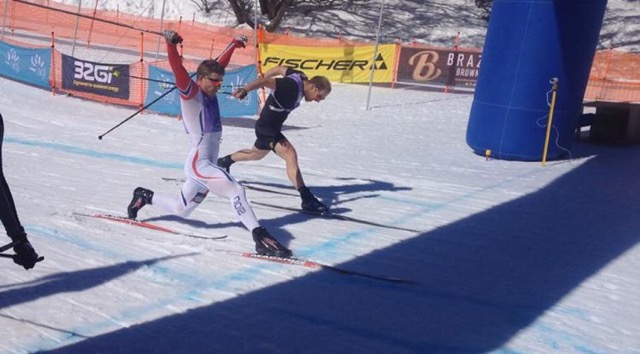
Miles Havlick (l) outlunges Australian National Team member, Phillip Bellingham for the win in the men’s 42-kilometer 2017 Kangaroo Hoppet at Falls Creek Resort. (Photo: AUSXC)
***
FasterSkier: You went unrecruited from Boulder High School in Boulder, Colo., and you were a walk-on at Utah. Big picture, what experience best informs your coaching?
Miles Havlick: My experiences as a racer certainly dictate my coaching decisions more than anything else. The lessons I have learned as a result of the highs and lows I have experienced as a competitor are my most valuable assets to advising my athletes in a more effective way.
FS: What was it like for you as an unrecruited athlete out of high school and what were your skiing opportunities?
MH: After high school, I decided to take a post grad year to ski with the Sun Valley Ski Education Foundation in Ketchum, Idaho. I found this year incredibly valuable in preparation for college life and easing the transition into the fast pace of RMISA skiing. This post grad year enabled me to train regularly with some of the top skiers in the country and learn from their professionalism, drive and dedication. It also provided an opportunity to learn how to take care of myself (cook, clean, get to bed early, etc.) without the additional stress of college classes. Those benefits along with the fact that I entered college a year older, stronger, and more mature (hopefully) really paid off! From there, I moved to Salt Lake City and began the most memorable years of my skiing career at the University of Utah.
FS: Utah can be a rather tough place to break through as they recruit heavily from Europe. How does your experience at Utah shape how you will recruit, assess, and develop athletes?
MH: Utah has typically maintained a relatively small team with roughly 6 men and 6 women on the Nordic side, allowing each athlete to optimize the resources available at the U. This also makes each member, whether joining the team as an American or from overseas, vitally important to the cumulative success of the team throughout the year. Foreign skiers in general tend to be very mature in terms of their knowledge of training philosophy and understanding their needs as an athlete. This is a result of skiing at a high level (often with a National or Development team) but also generally being a few years older than incoming American freshmen. I certainly benefited a lot from the wisdom and professionalism of my European teammates and hopefully I pushed them in daily training too – no Norwegian wants to let an 18-year-old American beat them in a rollerski speed! I continue to believe that the collaboration between American and foreign athletes in collegiate skiing is mutually beneficial and valuable for the development of cross-country skiing in the US.
FS: You clearly were a top college skier while at Utah. What do you attribute your growth to as an athlete while attending Utah? We’re guessing you had many skiers to push your limits while training.
MH: My most successful races in college were truly a reflection of the team. Our coaches really fostered a positive team atmosphere, which snowballed into a very productive environment at training, competitions and life at home. A goal I set early on was to learn something from each of my team members. Whether it was imitating their weight shift while skate rollerskiing up Emigration Canyon, showing up to practice with a contagiously positive energy, gritting the teeth for one more hard interval up Dry Creek, or just taking a spoonful of fish oil when feeling on the verge of sickness; there was always something to be learned from everyone.
FS: We like this quote attributed to your dad. We found it in an old Daily Camera piece. Here’s the quote: “For me, sports teaches you how to set goals and to deal with disappointment, and every once in awhile you get to drink from this intoxicating cup of success,” said his dad, Scott.
How have the sentiments articulated by your dad manifested for you as it relates to your ski career and how you might impart some wisdom on a younger generation of skiers?
MH: As a former coach of mine always said, “we are only elite ski racers for a very short period of time in our lives, so we need to make the most of every single day”. In other words, we need to set goals, both long term and short term and get better in one way or another every single day and from every single training session. From the beginning of June, we really only have 160 days until the snow flies again. That is not a whole lot of time to make meaningful changes, so being diligent and purposeful during each training session is critical to improvement. If we are doing this, despite disappointing results, we can be confident that we are heading in the right direction and making progress towards our goals. Success along the way provides an important boost in motivation and reassurance that we are on the right path, but in the end what counts is knowing that you did your very best and enjoying the process, not just the end result.
FS: What were the precise years you skied professionally. You won the Kangaroo Loppet in 2017, but you might have been a grad student by then.
MH: I raced with the Sun Valley Gold Team from 2013 to 2016 before deciding to pursue a Master’s degree. Luckily, I got a lot of time on snow while coaching leading up to the Kangaroo Hoppet, just enough to counteract the time spent sitting at school desk over the previous year!
FS: Can you provide us a run down of your coaching experience. We know you coached in Norway and in Australia, as well as served as a travel coach with the Australian National and National Junior Team.
MH: Throughout my years with the Gold Team, we ran group clinics for Master skiers in addition to some one-on-one coaching on the side. I helped out as a volunteer coach for the University of Utah for several fall semesters before I the SuperTour season kicked off. Between my years in Norway, I worked as a coach with the Birkebeiner Ski Club in Mount Beauty, Victoria for Australia’s winter season culminating with the 2017 Kangaroo Hoppet. This opportunity also lead into working as an assistant coach and wax tech for the Australian Junior National Team at several events around Europe including the World Junior Ski Championships in Goms, Switzerland. I was also fortunate enough to support the Australian contingent of the Swix China City Sprint Tour in Yan’an, China last March.
FS: You have an exercise physiology degree from Utah (2013) and master’s degree from Norwegian University of Science and Technology in exercise physiology in 2018. Why did you choose to study in Norway?
MH: Norway is the epicenter of cross-country skiing, they offer great study opportunities and I wanted to experience something new.
FS: What was the focus of your graduate thesis and what did you learn?
MH: I was researching the application of altitude training in elite cross-country skiers and the resulting physiological adaptations. I was lucky enough to work with the Norwegian Olympic Training Center, some of the world’s leading researchers in training science, and experience how dark Norwegian winters actually are…
FS: What can you tell us about the investment in Norway as it relates to applied academic research and cross-country skiing?
MH: Norway is the best cross-country skiing nation in the world for a reason. The entire country is made up of enthusiastic sports fans with PhD students devoted to improving cross-country ski technique, equipment development and optimizing training.
FS: How will your experience in Norway inform your ski coaching?
MH: My time in both Norway and Australia opened my eyes to two unique skiing cultures and allowed me to reflect on the unique challenges and opportunities that we face here in the US. This insight complements my experiences as a racer and I believe will prove quite valuable in developing skiers at Utah. In the big picture, it has not been all that long since I was skiing at the U, but everything I have done since then has improved my ability to make more informed decisions about skiing and training. If I knew everything I know now when I was a freshman at Utah, I believe I could have been a much better athlete. This knowledge is what I hope to instill upon the athletes that I am lucky enough to work with.
FS: Can we expect Utah to have a pipeline of skiers from Trondheim?
MH: I wouldn’t say that, but Trondheim certainly has a rich culture of skiing and obviously all the ingredients to produce a large population of great skiers. I would certainly be excited to expose another Trønder or two to the resources and training environment that surrounds the University of Utah.
FS: What do you see as your biggest challenges at Utah?
MH: There is obviously a mountain of things I need to learn being a new coach of NCAA skiing, exemplified by the delay in getting this interview back to you. The greatest challenge for me is balancing coaching with all of the administrative components while also implementing all of the ideas that I have to take the program to the next level. I am very excited to be part of this talented Utah coaching staff, work with amazing collegiate athletes and helping to carry on the long-standing traditions of skiing excellence at Utah.
FS: You come into a storied program that has gone through some major changes – the Head Nordic coach and head of skiing at Utah have been replaced within the last 12 months. What is the atmosphere like right now at Utah?
MH: The team has been energetic and looking great this fall. Everyone is strong, healthy and really psyched to get the race season underway. I’m excited to see what we can do!