

From the FasterSkier archive — posts syndicated from athletes’ and coaches’ own blogs between 2004 and 2012, kept online as published. Current coverage is at fasterskier.com.

Tag: FasterSkier Race Report

  • Nyenget Takes Oberhof 10 k Classic as Americans Build Momentum

    Nyenget Takes Oberhof 10 k Classic as Americans Build Momentum

    This coverage is made possible through the generous support of Marty and Kathy Hall and A Hall Mark of Excellence Award. To learn more about A Hall Mark of Excellence Award, or to learn how you can support FasterSkier’s coverage, please contact info@fasterskier.com.

    Martin Loewstroem Nyenget (NOR) came back to World Cup racing, posting the fastest time in the 10 k Interval Start Classic in Oberhof (GER). (Photo: Authamayou/NordicFocus)

    On Sunday morning in Oberhof, the snow had the kind of sheen that tells the truth before the clock ever does. It glittered under a clean winter sun, polished by a freeze–thaw cycle that left the tracks fast, brittle, and unforgiving. At 823 meters, tucked into the Thuringian Forest, the course looked generous from a distance—wide lanes, long sightlines—but it was the sort of generosity that disappears the moment a skier commits to a mistake. The margins here were not loud. They were sharp.

    This was the men’s 10-kilometer Classic Interval Start, a format that does not tolerate theater. There would be no pack to hide in, no draft to borrow, no tactical stalemates to blame. Every thirty seconds, a skier pushed out of the start gate alone, carrying only his pacing plan, his skis, his poles, and whatever composure he had managed to preserve through an Olympic build that has been compressing time for months. Period Three had begun. The calendar was no longer abstract.

    Classic skiing in these conditions demands restraint masquerading as confidence. The climbs are short but decisive; the downhills are technical enough that speed becomes a negotiation rather than a gift. Grip must be trusted without being tested. Push too hard too early, and the skis slide away beneath you; hesitate, and seconds vanish into the ice. It is possible—common, even—to ski very hard here and still ski poorly.

    Iivo Niskanen (FIN) was formerly the king of the 15 k Classic and showed he is one of the best in the 10 k Classic in Oberhof (GER). (Photo: Authamayou/NordicFocus)

    The interval start turns this dynamic inward. The course does not change for you, but your relationship to it does. You pass athletes who started ahead of you and are passed by those who did not. You hear split times shouted from the side of the trail—sometimes accurate, sometimes not—and you decide whether to believe them. In Oberhof, where artificial snow breaks down as the sun rises and the grooves lose their bite, the course becomes a moving target. Early starters gamble on freshness; later starters trade glide for information. No one gets everything.

    Absent from the start list were some of the sport’s most reliable reference points. Norway’s biggest names were racing at home, their national championships pulling them away from this quiet, consequential weekend, or focused on a pre-Olympic training block. Their absence opened space on the results sheet, but not relief. If anything, it sharpened the test. Without familiar benchmarks, the race would be defined less by expectation than by execution.

    The 10 k classic has become a strange distance in modern cross-country skiing—short enough to reward urgency, long enough to punish impatience. It asks skiers to operate just below the edge of recklessness and to stay there for more than twenty minutes. In Oberhof, that edge was particularly thin. The tracks shone. The corners demanded respect. The kind of mistake that costs half a second in softer snow could cost five places here.

    Erik Valnes (NOR) on his way to third and another statement to the Norwegian Olympic selection committee in Oberhof (GER). (Photo: Authamayou/NordicFocus)

    For the Americans, this was the last weekend considered in Olympic team deliberations, a fact everyone knew and no one needed to say out loud. The weight of it showed up not in desperation but in discipline. There were no grand gestures in the start lane. What mattered was whether an athlete could trust the work he had done and let the race unfold on its own terms.

    One by one, skiers disappeared into the forest, double-poling through the opening flats before settling into the rhythm that classic skiing requires when it is done well: patient climbs, clean transitions, downhill speed carried without panic. The clock ticked. The sun climbed. The track began to change.

    By the time the later starters reached the first split, the course had already started to tell its story. Early leaders came back. Conservative openings paid dividends. The race did not break open so much as it clarified itself, revealing who could manage the terrain without forcing it—and who could not.

    In an interval start, there is a particular moment when the race stops being about possibility and becomes about reckoning. It arrives quietly. A skier hears that he is catching someone he should not be catching. Another learns that the pace he thought was safe is not. In Oberhof, that moment came late and all at once, when the day’s best classic skier finally aligned patience with power and turned control into separation.

    By the finish, the gaps would look clean and decisive. They always do. But the truth of this race lived earlier, in the choices made on icy corners and rolling climbs, in the decision to ski smooth instead of merely hard. Oberhof did not demand brilliance. It demanded honesty.

    Martin Loewstroem Nyenget (NOR) on his way to the win. (Photo: Reichert/NordicFocus)

    A Course That Reveals Its Verdict Slowly

    The first skiers through the opening kilometers set times that looked sharp but provisional, the kind that exist only until the course and the day reveal themselves. The early splits came quickly, then stalled. The ice underneath the tracks was still holding, but the sun was beginning to soften the surface just enough to punish excess force. The race was already sorting itself by feel rather than bravado.

    Martin Loewstroem Nyenget (NOR) navigates the sugary snow in Oberhof (GER). (Photo: Authamayou/NordicFocus)

    Nyenget’s Patience Turns Into Separation

    When Martin Løwstrøm Nyenget finally entered the picture, it was without urgency. His opening lap was measured, almost quiet, the sort of start that invites doubt if one is inclined to look for it. But Nyenget had not come to Oberhof to prove speed in the first five kilometers. He had come to test something else.

    “I hadn’t planned to open very hard,” Nyenget said afterward in an interview aired on the FIS World Cup broadcast. “I’ve been training really hard for the last four weeks, so I didn’t quite have the speed on the first lap. But as soon as I heard that I was catching people, I started to feel really strong, and I knew I had something extra for the day.”

    The catching began gradually, then decisively. Where others tightened under the strain of the second lap, Nyenget loosened. His skiing did not change in form, only in intent. The double pole grew heavier, the transitions cleaner. On a course that demanded constant negotiation, he removed the argument.

    By the final kilometers, the race had become unmistakable. Nyenget was no longer racing the field so much as confirming what the course had already suggested. He crossed the line alone, the margins behind him clear and earned, his victory built not on dominance but on patience applied at exactly the right moment.

    “It’s fantastic to be back,” Nyenget said. “The longer I keep going in my career, the more fun I have racing. The training part isn’t always that fun anymore, so it’s great to be here in Oberhof with good conditions and really enjoy racing again.”


    An American Throughline: Skiing Well, Not Just Hard

    Behind him, the podium filled with familiar names and familiar styles — Iivo Niskanen (FIN +13.8) in second and Erik Valanes (NOR +14.5) in third — skiers who understand how to survive a day like this without surrendering it. The gaps were tight, the order decisive. It was the kind of race that leaves little room for argument afterward.

    For the American men, the story unfolded less in places gained than in choices validated.

    Zanden Mcmullen (USA) making one final statement to the US Olympic Team selection committee in Oberhof (GER). (Photo: Authamayou/NordicFocus)

    McMullen Finds His Shape Again

    Zanden McMullen arrived in Oberhof carrying momentum that had begun to take shape weeks earlier at U.S. Nationals. There, his skiing had looked settled again — confident without being rigid, aggressive without being rushed. In Oberhof, that trend continued.

    “I feel like I’ve started to find myself again, which is really reassuring,” McMullen said. “I think I was fully capable of skiing like this earlier in the season, but I needed a little more racing and confidence under my belt. This weekend feels like the tip of the iceberg.”

    His approach to the race was deliberate. Rather than forcing the issue early, McMullen allowed the course to come to him, focusing on terrain management rather than constant pressure.

    “My goal today was just to ski well through the terrain of the entire course,” he said. “Earlier this season, when I felt like I needed to force a good result, I wasn’t skiing well — I was skiing very hard, but not well. Today I focused on skiing smooth and fast rather than just hard, and I think that really paid off.”

    There were moments of vulnerability — a slight lapse near the end of the first lap — but McMullen recognized it in time to convert restraint into opportunity.

    “I was able to use that extra energy to ski hard and fast through the second half of the race,” he said.

    McMullen finished 18th, a result that read plainly on paper but carried deeper meaning inside an Olympic season defined by accumulation rather than singular peaks.

    “I know I’ve done what I can,” he said. “I’m happy to be back where I left off last year before I got sick. Now I can shift my focus to preparation. Olympic qualification is just the first step. I have very big goals for the Games themselves.”

    Hunter Wonders (USA) continued his 10 k Classic form he showed at US Nationals in Oberhof (GER). (Photo: Authamayou/NordicFocus)

    Hunter Wonders and the Familiar Language of Classic Distance

    For Hunter Wonders, Oberhof reinforced something that has been quietly consistent in his career: when the race is a classic distance interval start, the task tends to make sense. There is clarity in pacing, in grip management, in the slow accumulation of pressure rather than the sudden chaos of a sprint.

    Wonders skied into the points again, backing up his showing from U.S. Nationals with another disciplined performance on snow that rewarded trust over impulse. In conditions where early aggression often came undone later, his race held together. The opening kilometers were controlled, the middle steady, the final lap about preservation rather than rescue.

    That continuity mattered. In a field where seconds dissolved quickly into places, Wonders avoided the kind of oscillations that define fragile races. He neither chased the early benchmarks nor retreated from them. Instead, he stayed within a rhythm that allowed the course to do less damage than it did to many around him.

    On a day when classic specialists quietly rose, Wonders looked like one — not flashy, not forced, but coherent from start to finish.

    Luke Jager (USA) celebrated his birthday weekend in Oberhof (GER) with a top 30 in the 10 k Classic. (Photo: Authamayou/NordicFocus)

    Luke Jager and the Discipline of Attention

    A few minutes later, Luke Jager crossed the line inside the top 30, finishing a race that mirrored his own quiet trajectory. Though the calendar had marked it as his birthday weekend, the day itself passed without ceremony.

    “My main goal was just to be fully immersed in the experience,” Jager said. “To focus on doing my best and skiing each section of the course as well as I could.”

    On a course where margins evaporated quickly, that focus mattered.

    “The margins were definitely thin, but they always seem to be on the World Cup these days,” he said. “It doesn’t really help to stress about that, so I try to keep my attention on what’s right in front of me, so that when I cross the finish line I can say I found as many of those little margins as I could.”

    John Steel Hagenbuch (USA) striding his way to 52nd place. (Photo: Authamayou/NordicFocus)

    John Steel Hagenbuch and the Cost of Precision

    For John Steel Hagenbuch, Oberhof was less forgiving, finishing in 52nd place. Fast, icy tracks compress the margin for error until technique, pacing, and decision-making overlap completely. There is no room to separate them. When one slips, the others tend to follow.

    Hagenbuch’s race never unraveled dramatically, but it never fully unlocked either. The speed was there in moments; the continuity was harder to hold. In an interval start, that can be enough to drift backward without a single obvious mistake to point to afterward.

    Classic skiing on firm conditions is often less about what goes wrong than about what never quite arrives. A corner taken cautiously becomes a gap. A climb approached defensively compounds over kilometers. Oberhof exposed those small hesitations with clarity.

    Still, there were pieces to build from. Hagenbuch moved efficiently through the terrain, and his ski handling held under pressure. What the race demanded next — and what it withheld — was the seamless connection between intention and execution that defines skiing at this level.

    Zachary Jayne (USA) raced his first World Cup races of his career in Oberhof (GER). (Photo: Authamayou/NordicFocus)

    A ‘Welcome to the League’ Weekend

    For Zach Jayne, the weekend carried a different weight. After a breakthrough performance at U.S. Nationals, Oberhof marked his first exposure to the full scale of World Cup racing — the cameras, the movement, the relentless compression of time and attention.

    “After a good week at Nationals, I’m honestly pretty disappointed with my first few World Cup starts,” Jayne said. “I’m grateful to be here racing against some of the best in the world, but I really wanted to do something with my starts.”

    What surprised him most was not the pace but the environment.

    “There’s just a lot more going on — cameras, people, spectators,” he said. “For me, that translates into more stress, and I’m still learning how to manage that.”

    Still, Jayne was clear-eyed about the lesson.

    “I definitely had my ‘welcome to the league’ moment this weekend,” he said. “Now I have something bigger and better to shoot for.”

    Antoine Cyr (CAN) on his way to a top 30 finish in Oberhof (GER). (Photo: Authamayou/NordicFocus)

    The Canadians: Cyr Steady, Ritchie Searching

    Canada arrived in Oberhof with different objectives but shared terrain.

    Antoine Cyr delivered another composed World Cup performance, finishing inside the top 30 on a course that rewarded calm decision-making. His skiing carried the marks of experience: stable pacing, clean transitions, and an understanding of when to let speed come rather than chase it.

    In fast conditions, Cyr avoided the trap of overreaching. His race did not hinge on a single sector or surge but on the absence of mistakes — a strategy that proved effective as the track continued to glaze and soften through the day.

    For Graham Ritchie, the race served a different function. Returning to World Cup competition after a disrupted season, Oberhof was less about result than recalibration. The course asked questions he is still working back toward answering: how much risk to take, how much speed to trust, how long it takes to feel at home again in this environment.

    Ritchie skied through to the finish without drama, but the gaps reflected the difference between re-entry and fluency. On a day when the margins punished uncertainty, Oberhof made clear how narrow the corridor back to comfort can be.

    What Oberhof Demanded

    By the time the final starters finished, the course had softened just enough to underline its earlier warnings. The results sheet settled into place. Some athletes left Oberhof with confirmation, others with questions, all with fewer places left to hide.

    “It feels like everything is important right now — every part of the preparation,” Nyenget said. “Today, the goal was just to focus on the task. But of course, it’s a step closer to the bigger goal.”

    In Oberhof, the task had been clear all along: ski well, ski honestly, and let the rest follow.


    Men’s 10 k Classic Interval Start RESULTS

    Men’s FIS World Cup OVERALL DISTANCE STANDINGS


    Love Stories Like This? Help Keep Them Coming.

    Feature stories like this one take time, access, and care to produce. If you value thoughtful storytelling and independent ski journalism, please consider becoming a Voluntary Subscriber. Your support directly fuels the work we do to cover the people, places, and moments that make our sport special.

    Join the FasterSkier community!


    Iivo Niskanen (FIN), Martin Loewstroem Nyenget (NOR), and Erik Valnes (NOR), (l-r) share the 10 k Classic Interval Start in Oberhof (GER). (Photo: Authamayou/NordicFocus)
  • A Narrow Door, Held Open: The Men’s 20 k Freestyle at U.S. Nationals

    A Narrow Door, Held Open: The Men’s 20 k Freestyle at U.S. Nationals

    This article was made possible through the generous support of our voluntary subscribers. If you value coverage like this, please support FasterSkier with a voluntary subscription.

    The start of the US National Cross-Country Ski Championship Men’s 20 k Freestyle Mass Start. (Photo: Nancie Battaglia)

    There are moments in endurance sport when the noise falls away—not because the stakes are small, but because they are too large to announce themselves loudly. The men who gathered on the start line at Mount Van Hoevenberg on Thursday afternoon understood that kind of quiet. The banners said US National Championships. The calendar said 20 k Freestyle Mass Start. The course—four laps of five kilometers, stitched together by long climbs and fast descents—said this will be honest. But the silence said Olympics!

    For much of the week in Lake Placid, honesty had come quickly. The 10 k classic individual start exposed margins. The sprint laid bare specialization. By the time the men lined up for the 20 k Freestyle Mass Start, the argument had narrowed. There were medals to be won, yes, but more importantly, there were questions still unresolved about who might fit through the narrowing door of Olympic selection.

    For Zanden McMullen, the stakes were explicit. “Today’s race was a ‘one shot, one opportunity’ type of race for me,” he said later. He knew that anything short of a win would leave his Olympic case incomplete. That knowledge sat heavily over the first kilometers—not as panic, but as pressure carefully managed.

    What followed was not a race that fractured early or declared itself with theatrics. Instead, it unfolded as a study in restraint.

    A large, shifting group stayed at the front early on in the race. (Photo: Nancie Battaglia)

    A Race That Refused to Break

    From the opening lap, the field behaved in a way that confounded expectations. In contrast to the women’s race earlier in the day, no decisive break formed. Attacks surfaced briefly—on climbs, into transitions—but were quickly absorbed by the physics of the course. Downhills regrouped the field. Drafting mattered. The snow was fast, the air cold enough to preserve glide, and separation proved expensive.

    John Steel Hagenbuch allowed himself to drift deep into the pack early—sometimes close to twentieth—an approach that looked counterintuitive given both his fitness and his history on the course. It was neither indecision nor passivity. “I was just staying relaxed and letting people work out some energy that I knew wasn’t going to result in any meaningful gain,” he explained. “Racing in the U.S. is very different than racing on the World Cup, and being able to relax at the start of a mass start race is perhaps the best example of that.”

    Zanden McMullen (APU) and his APU teammates Hunter Wonders (#208) and Luke Jager (#204). (Photo: Nancie Battaglia)

    The early splits reflected this tension. Leaders rotated through the front, but gaps rarely exceeded a handful of seconds. By the midpoint of the race, the field had thinned not through violence but through attrition—skiers falling off the back as the pace remained relentlessly honest.

    McMullen, meanwhile, adhered to a plan that demanded patience. “My race strategy was to conserve as much energy as possible,” he said. “Every time a move was made, I made sure to match it calmly but decisively.” By the second lap, he sensed the race’s texture changing. The pack stretched. Breathing deepened. The small inefficiencies of earlier surges began to show.

    Zach Jayne, consistently present near the front group, felt that tension acutely. “Holding position is always difficult,” he said. “So being aware while racing is important.” In a race defined by proximity rather than separation, awareness became a skill as valuable as strength.

    Olivier Leveille (CNEPH), John Steel Hagenbuch (Dartmouth), Zanden McMullen (APU), Jakob Elias Moch (CU), and Brian Bushey (Craftsbury) (l -r). (Photo: Nancie Battaglia)

    Decisions Not Taken

    If the race hinged on a single moment, it may have been defined instead by two moments when nothing happened.

    Hagenbuch identified them clearly. The first came at the start of the third lap, at the base of the long climb—a place where he has both won and lost races before. “Looking back at it now,” he said, “the one that makes me wonder the most is the decision to not attack on the third lap.” His reasoning was sound. The conditions were fast. The field regrouped quickly on descents. “In order to get away, you would have to be very fit and have the best skis in the race,” he said. Unsure that any gap would hold, he chose restraint.

    Mons Melbye (UU) leads Zanden McMullen (APU) and John Steel Hagenbuch (Dartmouth), and Jakob Elias Moch (CU) (r – l) down the final downhill into the stadium. (Photo: Nancie Battaglia)

    The second moment arrived on the final sprint climb before the descent into the stadium. Again, Hagenbuch assessed the cost-benefit. He believed he could crest first—but likely only to be swallowed by the draft. “As such, I decided to follow Zanden over the top,” he said. “I think this was the correct thing to do tactically.”

    That calculus—when to go, when to wait—defined the race for several athletes. McMullen made the same choice from the opposite perspective. “There was no need to do anything rash,” he said. “Just go out and race hard and smart.”

    The result was a front group of four that arrived at the final kilometer together, legs full but not shattered, tension compressed into seconds.

    Zanden McMullen (APU) and John Steel Hagenbuch (Dartmouth) follow Jakob Elias Moch (CU) near the end of the race. (Photo: Nancie Battaglia)

    The Finish

    As the leaders dropped off the final descent and into the stadium, the race became what everyone suspected it would be: a matter of position, timing, and nerve.

    McMullen entered the final stretch calm by design. “During the final lap, I knew it would come down to the final meters,” he said, “and I just made sure to relax as much as I could.”

    Hagenbuch, attempting to execute his finishing move, found the narrow margins of mass-start racing unforgiving. “Getting around Jakob was the crux move of the finishing maneuver I was trying to execute,” he said. “And there just wasn’t enough room for me to come around.” Pushed slightly wide through the final sweeping corner, he lost the speed he needed. “That’s racing,” he added. “It didn’t pan out, but it doesn’t always.”

    McMullen surged cleanly to the line, stopping the clock at 47:37.0. The University of Utah’s Mons Melby was 7-tenths of a second behind, with Hagenbuch a second from the win for third. Behind them, the rest of the field streamed in—gaps small, order consequential.

    Zanden McMullen (APU), John Steel Hagenbuch (Dartmouth), and Jakob Elias Moch (CU) — with Mons Melbye (UU) off camera — come down the finish stretch. (Photo: Nancie Battaglia)

    What the Race Revealed

    On paper, the result was simple: a national champion crowned. In context, it was anything but.

    For McMullen, the victory represented survival as much as success. “The Olympic selection has definitely been looming over my head all week,” he admitted. The stress was real. So was the clarity. He did what he could do.

    For Hagenbuch, the outcome carried both frustration and resolve. “I still have faith that there is a path for me to the Olympics,” he said, while acknowledging that the decision now sits elsewhere. He stood by his choice to skip the Tour de Ski, citing health and long-term belief. It was not a plea, but a statement of readiness.

    Zach Jayne, who again placed himself among the front contenders, viewed the week through a longer lens. “If you look at my results a year ago or two, I was barely a name in the competitive field,” he said. Improvement, for him, is cumulative. “Overall development is just as important to me as any given race.”

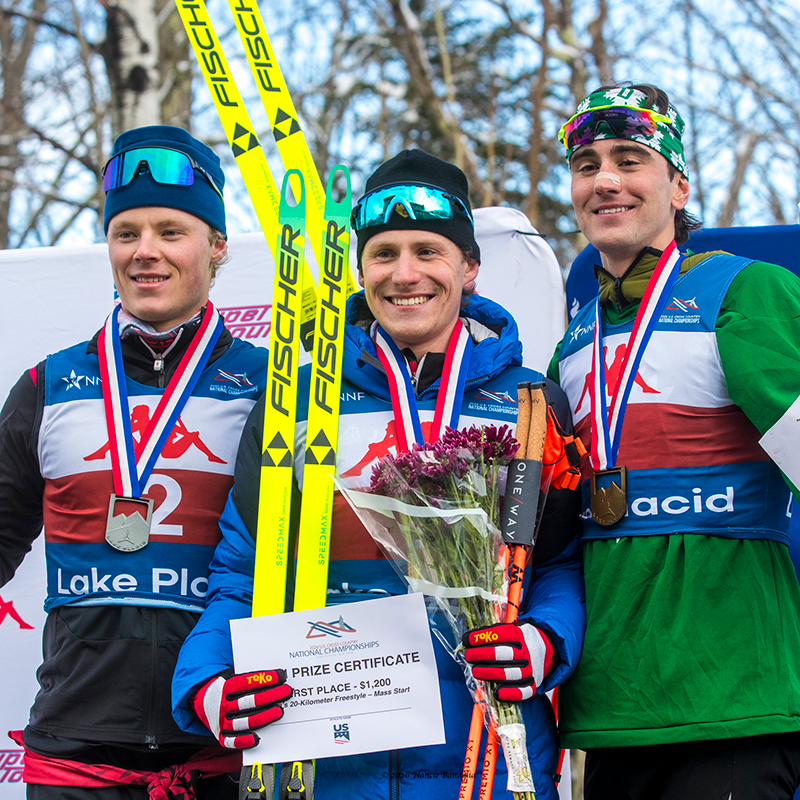
    The national podium for the US National Cross-Country Ski Championship Men’s 20 k Freestyle Mass Start with Zanden McMullen (APU) first, John Steel Hagenbuch (Dartmouth) second, and Zach Jayne (UU) third. (Photo: Nancie Battaglia)

    A Door, Not Yet Closed

    National championships often promise clarity. This one offered something subtler: differentiation without finality. The men’s 20 k freestyle did not decide everything, but it sharpened the picture. It showed who could manage pressure, who could read a race, who could wait—and who could finish.

    In an Olympic winter, those qualities matter as much as any single result.

    As the stadium emptied and the snow settled back into quiet, the door to Milan–Cortina did not swing wide. But for one, and hopefully two skiers, it remained open, narrow, demanding, and earned.


    RESULTS:

    US Nationals Men’s 20 k Freestyle Mass Start

    Love stories like this? Help keep them coming.

    Feature stories like this one take time, access, and care to produce. If you value thoughtful storytelling and independent ski journalism, please consider becoming a Voluntary Subscriber. Your support directly fuels the work we do to cover the people, places, and moments that make our sport special.

    Join the FasterSkier community!
     

    The feed zone is always full of chaos and excitement during a mass start. (Photo: Nancie Battaglia)
  • Klaebo Controls Toblach as Schumacher Anchors the Chase in Men’s 20 k Classic Pursuit

    Klaebo Controls Toblach as Schumacher Anchors the Chase in Men’s 20 k Classic Pursuit

    This coverage is made possible through the generous support of Marty and Kathy Hall and A Hall Mark of Excellence Award. To learn more about A Hall Mark of Excellence Award, or to learn how you can support FasterSkier’s coverage, please contact info@fasterskier.com.

    Johannes Hoesflot Klaebo (NOR) paced the Tour de Ski 20 K Classic in Toblach (ITA) to perfection. (Photo: Vanzetta/NordicFocus)

    By mid-morning in Toblach, the cold had settled into the valley in that particular Dolomite way—dry, bright, and unforgiving. The stadium clock read 10:30 a.m., the tracks were hard-packed, and the Tour de Ski—never gentle, always exacting—had reached a moment where patience mattered as much as power. Stage 4’s men’s 20-kilometer classic pursuit would not be decided by theatrics. It would be decided by discipline.

    From the first push out of the starting line, Johannes Høsflot Klæbo made that clear.

    The Norwegian leader skied as if tethered to an internal metronome, clicking off splits that barely wavered across five laps of the 4-kilometer loop. Behind him, the race congealed into a dense, minute-long chase—ambitious but realistic, orderly but never comfortable. Inside that group, Gus Schumacher did what pursuit racing rewards: work when it mattered, wait when it didn’t, and finish inside the race rather than on its margins.

    Johannes Hoesflot Klaebo (NOR) on his way to first place on the 20 K Classic Pursuit. (Photo: Vanzetta/NordicFocus)

    Klæbo’s Quiet Authority

    Klæbo entered the day with the yellow bib and skied as though intent on keeping it uncontested. At 4 kilometers, he led in 9:11.8; at 8 kilometers, 18:23.4; at 12, 27:34.6; and at 16, 36:53.3—the first three splits almost exact to the tenth. He crossed the line in 46:01.7, never once letting the chase compress to a threatening distance.

    Second place belonged to Mattis Stenshagen (+51.1), who skied the most assertive race of those behind Klæbo and briefly tested the cohesion of the chase on the fourth lap’s long climb. Third went to Edvin Anger (+59.8), tied on time with Italy’s Federico Pellegrino, whose classic form looked as efficient as it did economical. Emil Iversen finished fifth (+1:00.2), matching Schumacher stride for stride to the line.

    That minute—barely more than a breath in Tour de Ski terms—defined the race.

    Gus Schumacher (USA) did much of the work early to bring the chase into one pack behind Klaebo. (Photo: Vanzetta/NordicFocus)

    Schumacher in the Middle of It

    Schumacher finished sixth, also +1:00.2, part of the decisive chase that refused to fracture even as the course repeatedly asked for answers. The result came less than 24 hours after his 5 k freestyle win in Toblach, and the transition—emotionally and physically—was not trivial.

    “It was a little bit tough, honestly,” Schumacher said. “This pursuit started at 10:30 a.m., and I haven’t woken up before eight in probably a month because all our races have been so late. … I definitely enjoyed the win, but the focus was to refocus right away. It’s another new day, and this race was really important for the Tour.”

    Inside the race, Schumacher was not hiding. He described closing the gap to Iversen after the early climbs and doing much of the work that consolidated the group—an effort he acknowledged with pride. “I did most of that work, which I’m actually pretty proud of,” he said. What he didn’t do was overreach. “I wasn’t trying to catch Klæbo or anything,” Schumacher added. “Even though some of the guys might have been thinking that.”

    The fourth lap told the story. Stenshagen pressed hard on the long climb out of the stadium, stretching the elastic just enough to test resolve. Schumacher bent but didn’t break. Over the top, the group exhaled. The fifth lap came fast—but not frantic—and Schumacher found himself boxed in late, a tactical note he filed away rather than lamented.

    “With the overall standings so tight, I don’t think it’s worth thinking about it too much,” he said. “I’m sitting in third right now, and top ten is definitely still the goal. … Everyone from second through ninth is so close that it really comes down to focusing day by day.”

    That may be the most Tour de Ski answer of all.

    Gus Schumacher (USA), Emil Iversen (NOR), Edvin Anger (SWE), and Lars Heggen (NOR) worked together to prevent Klaebo from extending his lead. (Photo: Vanzetta/NordicFocus)

    A Chase by Committee

    Behind Schumacher, the chase’s cohesion owed as much to restraint as to strength. Lars Heggen (seventh, +1:00.3) and Benjamin Moser (eighth, +1:00.8) rounded out a group that included Harald Østberg Amundsen (ninth, +1:03.1). No one bridged to Klæbo; no one detonated the pack behind. The race’s geometry stayed intact.

    That stability mattered in a Norwegian context. With Olympic selection pressure already humming and only a few men’s spots still unsettled, Toblach functioned as both race and audition. Stenshagen’s second place was emphatic. The Tour does not reward one-off brilliance. It rewards survivability.

    Ben Ogden (USA) finding his classic distance form. (Photo: Vanzetta/NordicFocus)

    The Americans: Process Over Panic

    Further back, the pursuit revealed its less visible truths. Ben Ogden finished 29th (+3:03.3), a result that reads well on paper and even better when you hear how he raced it.

    “The biggest challenge is always the start,” Ogden said. “For me, it was about trying to pace the race properly, even when people were moving ahead of me early. … I started with a pack, then a bunch of them dropped me, and I just kind of let that happen, knowing I’d be able to catch some of them later—which I did.”

    That in-and-out rhythm—sometimes lonely, sometimes crowded—is pursuit racing in the middle of the field. Ogden framed it honestly. “Racing in a tight group is obviously more fun,” he said, “but you really have to pace yourself and try not to lose unnecessary time in a Tour, especially when you’re already a little tired.”

    For Zak Ketterson, who started deep in the order, the early kilometers were chaos by design. He finished 42nd (+3:55.1), but the route there mattered.

    “The wave is really challenging, especially starting in bib 70,” Ketterson said. “Five or six seconds have already passed before I even reach the start line. The first two laps were chaos, and I was just trying to stay relaxed and avoid trouble.”

    He did move forward—damage control after a Stage 2 crash that had already cost him minutes. “It was nice to move up a lot today,” Ketterson said, “but the classic sprint on Stage 5 is definitely the main focus now.”

    Ketterson also addressed the jury’s written reprimand for use of a banned technique in a marked stride zone—a penalty that did not disqualify him but appears in the official record. “The technique violation came from double poling in a stride zone,” he explained. “I changed tracks to pass someone, and the motion of doing that ended up being a double pole.”

    For Zak Ketterson (USA), the Tour de Ski hasn’t exactly gone as he had hoped, but today in the pursuit, he showed his form from earlier in the season. (Photo: Vanzetta/NordicFocus)

    When the Day Turns on a Ski

    Kevin Bolger finished 51st (+4:18.6), a result shaped by circumstance rather than strategy. Bolger had been patient by design, content to let early red-lining pass him by before advancing after lap two. Then a ski broke.

    “I like to settle in, and then after lap two start working my way up the field,” Bolger said. “I was just about to do that today when someone merged into my track and broke my ski, which cost me close to a minute. That was pretty disappointing.”

    Before that moment, his choices had been sound. Toblach’s two main climbs invite early commitment to kick wax, and Bolger leaned into it. “It was an easy choice to really feel the kick wax early,” he said. “The skis were feeling great, and I was really excited about how I was going to start moving up the field.”

    Bolger’s broader view was measured, almost cheerful in its realism. “This Tour isn’t quite as massive as some of the past ones,” he said. “It’s about gaining confidence and fitness, as long as you’re able to absorb it after the Tour.” Olympic energy is present, he acknowledged, but not consuming. “At the end of the day, I’m just trying to race fast.”

    J.C. Schoonmaker placed 56th (+4:42.7), while Jack Young finished 80th (+8:07.2), both navigating a day where patience was mandatory, and opportunities were earned in inches rather than meters.

    Andrew Musgrave (GBR) and Antoine Cyr (CAN), (l-r) moving up through the field together. (Photo: Vanzetta/NordicFocus)

    Canada: Trials Done, Work Ongoing

    Canada’s men arrived in Toblach with their Olympic trials already behind them and the Tour serving a different purpose. Antoine Cyr led the way in 13th (+1:54.5), with Thomas Stephen 28th (+3:02.6) and Xavier McKeever 30th (+3:08.1). The emphasis now is accumulation—fitness, familiarity, resilience—rather than immediate results.

    Context at the Margins

    The Tour de Ski has a way of narrowing options without warning. On Thursday morning, one Norwegian men’s Olympic hopeful, Oskar Opstad Vike, withdrew close to start time, a reminder that the margins between readiness and retreat are thin, especially in an Olympic year. Toblach did not create that pressure; it merely revealed it.

    Mattis Stenshagen (NOR) was excited when he crossed the finish line as if he knew he had shown the Norwegian Olympic selectors enough to make the team. (Photo: Modica/NordicFocus)

    What the Splits Say

    A look at the time checks explains why the race felt so controlled. Klæbo’s advantage barely fluctuated. The chase group’s gaps among themselves were measured in seconds—Schumacher, Iversen, Anger, and Pellegrino trading fractional advantages without a decisive rupture. Further back, time losses accrued not in dramatic collapses but in quiet inefficiencies: a missed pack, a broken ski, a moment of over-enthusiasm.

    The course profile—five laps, 137 meters of total climb—rewards restraint. Toblach does not forgive impatience.

    A broken ski for Kevin Bolger (USA) didn’t prevent him from showing his form in Toblach (ITA). (Photo: Vanzetta/NordicFocus)

    Looking Ahead

    Stage 4 did not reshuffle the Tour so much as clarify it. Klæbo remains the reference. The men chasing him know exactly how much ground they have—and how little room there is to gamble it away. Schumacher’s position near the top of the standings is real, earned through effort and discretion. Behind him, athletes like Ogden, Ketterson, and Bolger are racing a Tour that asks for perspective as much as speed.

    Val di Fiemme awaits with its own demands and, this year, Olympic resonance. But Toblach offered a simpler lesson. In a pursuit, the clock is visible; the choices are not. The best skiers make the hard ones look easy—and the easy ones count.

    Men’s 20 K Classic Pursuit Start RESULTS

    Men’s 2026 Tour de Ski OVERALL STANDINGS

    Fastest Skiers on the Day – Men (Top 15, Net Time Only)

    This ranking removes pursuit start gaps and shows who skied the fastest 20 km classic on Stage 4.

    Day Rank Athlete Nation Net Time
    1 Edvin Anger SWE 45:39.5
    2 Simen Hegstad Krüger NOR 45:44.0
    3 Federico Pellegrino ITA 45:45.5
    4 Mattis Stenshagen NOR 45:51.8
    5 Emil Iversen NOR 45:51.9
    6 Gus Schumacher USA 45:52.9
    7 Truls Gisselman SWE 45:58.5
    8 Antoine Cyr CAN 45:59.2
    9 Hugo Lapalus FRA 46:00.5
    10 Johannes Høsflot Klæbo NOR 46:01.7
    11 Benjamin Moser AUT 46:03.5
    12 Savelii Korostelev AIN 46:04.5
    13 Harald Østberg Amundsen NOR 46:07.8
    14 Andrew Musgrave GBR 46:13.6
    15 Lars Heggen NOR 46:17.0

    Net time calculated as finish time minus individual pursuit start offset.

    Places 3-7 where this close for Federico Pellegrino (ITA), Edvin Anger (SWE), Gus Schumacher (USA), Emil Iversen (NOR), (l-r) after 20 K in Toblach (ITA). (Photo: Modica/NordicFocus)

    Love Stories Like This? Help Keep Them Coming.

    Feature stories like this one take time, access, and care to produce. If you value thoughtful storytelling and independent ski journalism, please consider becoming a Voluntary Subscriber. Your support directly fuels the work we do to cover the people, places, and moments that make our sport special.

    Join the FasterSkier community!


    Mattis Stenshagen (NOR), Johannes Hoesflot Klaebo (NOR), and Edvin Anger (SWE), (l-r) shared the pursuit podium in Toblach (ITA). (Photo: Modica/NordicFocus)


  • In Davos, the Second Lap Always Tells the Truth

    In Davos, the Second Lap Always Tells the Truth

    This coverage is made possible through the generous support of Marty and Kathy Hall and A Hall Mark of Excellence Award. To learn more about A Hall Mark of Excellence Award, or to learn how you can support FasterSkier’s coverage, please contact info@fasterskier.com.

    Davos doesn’t reward urgency.

    It tolerates it, sometimes — lets it flirt with the clock through the opening kilometers — but it never forgets. Like a mysterious, wispy cloud, the altitude sits quietly above the stadium, thinning the air just enough that the consequences arrive late, not immediately. The first lap can feel generous. The second is where Davos asks what you’ve really brought with you.

    On Sunday, in the men’s 10-kilometer freestyle interval start at the World Cup in Davos, Switzerland, that truth arrived right on schedule. Athletes who attacked early were gradually called back. Athletes who waited found themselves moving forward without ever appearing to accelerate. And one skier — patient, smooth, and increasingly inevitable — turned the second lap into a private demonstration.

    Einar Hedegart of Norway won in 22:40.7, earning his second straight World Cup victory, this one built not on surprise but on control. Behind him came Harald Østberg Amundsen (NOR) at +11.7 seconds, Mattis Stenshagen (NOR) at +18.8, Johannes Høsflot Klæbo (NOR) fourth (+24.1), and Martin Løwstrøm Nyenget (NOR) fifth (+30.6). Andrew Musgrave (GBR) led the non-Norwegians in sixth (+31.1).

    Five Norwegians in the top five — but only one skied the race the way Davos prefers.

    Mattis Stenshagen (NOR) comes to the 10 k Interval Start Freestyle finish in Davos (SUI). (Photo: Modica/NordicFocus)
    The Temptation of the First Lap

    Interval starts strip racing down to decisions. No drafting. No cover. No negotiation. In Davos, those decisions begin almost immediately because the course invites speed from the start. The opening kilometers flow. The snow was hard and fast after an overnight freeze. Skis hummed. Breathing felt manageable.

    Several athletes took the invitation.

    Early time checks were brisk, and for a moment the race appeared to be tilting toward the skiers willing to press from the gun. Harald Østberg Amundsen, the reigning overall World Cup champion, was among them — assertive, controlled, but unmistakably on the front foot. At the first major checkpoint, Amundsen held a small advantage over Hedegart, exactly the kind of margin that feels reassuring on paper.

    Others followed similar scripts. Strong starters carved seconds in the opening loop, skiing as if Davos were simply another mid-altitude venue rather than one of the circuit’s quiet physiological traps. It all looked reasonable — until the course turned upward again.


    Why Davos Punishes Impatience

    At roughly 1,560 meters above sea level, Davos sits just high enough to distort pacing instincts. Red-lining a climb here doesn’t always feel catastrophic in the moment. The cost arrives later, when recovery never quite comes, and the second lap begins to feel longer than the first.

    That dynamic defined the race.

    Athletes who went hard early found themselves defending, not attacking, once the second lap began. Speed leaked away on the longer climbs. Transitions dulled. The ability to change gears — so critical in freestyle skating — started to fade.

    Hedegart, meanwhile, was doing something else entirely.

    Einar Hedegart (NOR) with Vili Crv (SLO) trailing during the 10 k Interval Start Freestyle in Davos (SUI). (Photo: Vanzetta/NordicFocus)
    Hedegart’s Patience — and the Moment it Mattered

    Hedegart did not lead early.

    That point matters.

    He allowed seconds to slip away in the first lap, skiing smoothly but without urgency, keeping his effort under control on the steepest sections. At altitude, that restraint isn’t passive — it’s strategic. Backing off even a few percent on the climbs can preserve a system that stays responsive later.

    When the race entered the second lap, the difference became apparent.

    Hedegart didn’t surge so much as continue. While others plateaued, he maintained tempo. While early leaders fought to hold speed, he quietly increased his advantage, taking time not through dramatic accelerations but through the absence of slowdown.

    By the 7.4-kilometer mark, the race had clarified. The seconds Hedegart had conceded early were gone — and then some. His advantage over Amundsen had grown decisively. The course was no longer offering second chances.

    The finish confirmed what the splits already suggested: Hedegart’s second lap was the fastest in the field, and it wasn’t close.

    Harald Amundsen (NOR) on his way to second place in Davos (SUI). (Photo: Vanzetta/NordicFocus)
    Amundsen, Stenshagen, and the Norwegian Sorting Hat

    Behind Hedegart, the Norwegian internal race unfolded in layers.

    Amundsen’s early aggression kept him close, but the cost was unavoidable. He remained solid — this was not a collapse — yet the final kilometers belonged to Hedegart. What had been a narrow early lead turned into an 11.7-second deficit at the line.

    Mattis Stenshagen, by contrast, skied one of the day’s most even races. Never flashy, never panicked, he moved steadily forward as others drifted back, finishing third and reinforcing his reputation as one of Norway’s most reliable distance technicians.

    Johannes Høsflot Klæbo offered another useful case study. After a frustrating sprint the day before, Klæbo looked sharper and more composed, staying in contention through the middle of the race. But Davos demands distance-specific economy, not just efficiency, and he lost ground late, finishing fourth — competitive, but never truly threatening Hedegart.

    Martin Løwstrøm Nyenget, wearing the red distance bib, rounded out the Norwegian sweep of the top five, steady as ever but unable to match the winning pace in the final lap.

    Five Norwegians, five slightly different races — and one clear template emerging at the top.

    Andrew Musgrave (GBR) was the fastest non-Norwegian skier in Davos (SUI). (Photo: Vanzetta/NordicFocus)
    The International Picture: Holding On vs. Moving Up

    Outside Norway, the same altitude logic applied.

    Andrew Musgrave (GBR) skied a disciplined race, managing his effort well enough to stay competitive throughout. He was rewarded with sixth place — not by attacking late, but by avoiding the fade that claimed others. In Davos, survival is often the first victory.

    France’s Mathis Desloges and Hugo Lapalus hovered near the top ten, their early speed gradually neutralized by the second lap. Italy’s Federico Pellegrino, so dangerous in sprint formats, found the sustained demands of the 10 km Interval Start less forgiving, finishing outside the top 30.

    The pattern repeated down the results list: strong early checkpoints followed by diminishing returns. Davos was collecting its debts.

    On his way to 30th place, John Steel Hagenbuch (USA) follows teammate Ben Ogden (USA). (Photo: Vanzetta/NordicFocus)
    The American View: Learning in Familiar Air

    For the U.S. team, John Steel Hagenbuch finished 30th, the top American on the day — a result that only hints at how complicated his Davos race really was.

    Hagenbuch has never considered himself particularly sensitive to altitude, a fact that quietly shaped both his expectations and his pacing plan.

    “I’m maybe not the best authority to say how altitude feels, as I usually don’t feel affected by it much,” Hagenbuch said. “I typically start slow and then pick up speed through races, and this pacing strategy is typically rewarded at altitude.”

    That approach aligned neatly with what Davos demanded. And while Hagenbuch is quick to downplay any physiological advantage from growing up and training in Sun Valley, Idaho, he did note a different kind of familiarity.

    “I think being from altitude can help with racing at altitude, but it’s certainly not a decisively significant factor — I was still plenty far behind the sea-level Norwegians today,” he said, with a laugh. “Speaking of familiarity, however, I remarked at how much Davos reminded me of home — the trails and the surrounding mountains strongly resemble Galena.”

    The race itself marked his best feeling of the opening World Cup block — even if the result came under less-than-ideal circumstances.

    “This Davos Skate 10 km was the best I’ve felt so far in Period 1,” Hagenbuch said. “But it unfortunately came only a day after I crashed hard on the infamously icy slalom downhill coming down from Flüelapass and subluxed my right shoulder for about the tenth time.”

    By race morning, the pain hadn’t gone away.

    “Even with a few thousand milligrams of acetaminophen down the hatch, every single pole stroke hurt,” he said. “So while it was nice to finally — barely — be top 30, I can’t help but think that without the injury and the stress associated with it, I could have done better. Alas, that’s life, and that’s skiing. I am not the only one to have had some bad luck in important races.”

    Zooming out, Hagenbuch remains confident in his trajectory, even if the opening block didn’t fully reflect it.

    “I feel confident in what I can achieve this winter — even if I didn’t necessarily show it during Period 1,” he said. “With this being an Olympic year, the competition was even higher than normal. For example, Per-Erik Bjornestad, one of our Norwegian wax techs, said that the Trondheim 10 km skate was the highest level of skiing he had ever witnessed.”

    Looking ahead, Hagenbuch’s plans are clear — and pragmatic.

    “Pretty much regardless of how today’s race went, I was going to go home to Sun Valley for Christmas,” he said. “I don’t think it makes sense for me to do the Tour de Ski, given how my health has been this fall and the start of the winter. I’m excited to go home and to compete at U.S. Nationals in Lake Placid.”

    Einar Hedegart (NOR) celebrates with a fist pump to the camera in Davos (SUI). (Photo: Modica/NordicFocus)
    Why this Race Matters More than it Looks

    It’s easy to treat Davos as an outlier — scenic, elevated, a little unique. The athletes don’t.

    The men’s 10 km Freestyle Interval Start is an Olympic format. It’s a race without shelter, without drafting, and without excuses. Davos amplifies all of that. Pacing errors are magnified. Aerobic limits are exposed. The second lap becomes a referendum.

    Hedegart passed that referendum emphatically.

    This was not a perfect-day fluke. It was not a tactical accident. It was the same pattern, repeated under different conditions, at a different altitude, against the deepest field in the sport. Ski patiently. Protect the climbs. Let others make the race hard early — then make it impossible late.

    Einar Hedegart (NOR) remained on the snow for several minutes after crossing the finish line in Davos (SUI). (Photo: Modica/NordicFocus)
    A Quiet Finish, a Louder Message

    There was no spectacle at the finish line. No disbelief. No chaos. Hedegart crossed, collapsed, and recovered — another man undone by thin air, but this time by his own effort.

    Two races. Two wins. Two second laps that separated him from everyone else.

    Davos didn’t raise its voice. It didn’t have to.

    It simply told the truth — the same one it always tells — and this time, Einar Hedegart listened better than anyone else.


    Men’s 10 k Individual Start Freestyle RESULTS


    Harald Amundsen (NOR), Einar Hedegart (NOR), and Mattis Stenshagen (NOR), (l-r) take the 10 k Freestyle podium in Davos (SUI). (Photo: Modica/NordicFocus)

    Love Stories Like This? Help Keep Them Coming.

    Feature stories like this one take time, access, and care to produce. If you value thoughtful storytelling and independent ski journalism, please consider becoming a Voluntary Subscriber. Your support directly fuels the work we do to cover the people, places, and moments that make our sport special.

    Join the FasterSkier community!


    Andrew Musgrave (GBR) gives the race winner Einar Hedegart (NOR) a sleigh ride after the pair had excellent days in the 10 k Freestyle in Davos (SUI). (Photo: Vanzetta/NordicFocus)


  • If This Was a Preview, February Will Be Wild: Sweden 1–2, Diggins Third

    If This Was a Preview, February Will Be Wild: Sweden 1–2, Diggins Third

    This coverage is made possible through the generous support of Marty and Kathy Hall and A Hall Mark of Excellence Award. To learn more about A Hall Mark of Excellence Award, or to learn how you can support FasterSkier’s coverage, please contact info@fasterskier.com.

    There are winter mornings when a World Cup feels like a World Cup, and there are winter mornings when the sport seems to slip into its future tense. Today, in Trondheim, was the second kind. The light came late and cold over the stadium, washing the course in the flat silver of early December, but everything else carried the charge of February. Coaches shouted splits with a little more strain in their voices; athletes tightened their warmups with a little more intent. You could feel the nerves of a nation in the Norwegian start pen. You could feel the confidence of another in the Swedish one.

    For the women on the line, the distance was familiar—ten kilometers of freestyle skiing, two laps, clean snow, no drafting, no negotiations—but the meaning was not. This is the race that will award an Olympic gold medal in Val di Fiemme in eight weeks. The stopwatch in Trondheim wasn’t just measuring form in early December; it was auditioning futures, exposing weaknesses, and hinting at hierarchies that might matter when the medals are real.

    What followed was not a rehearsal so much as a warning: Sweden already looks like a finished script; the United States has a veteran in her final season, refusing to yield the stage; and Norway—despite the home crowd—spent the afternoon hunting answers they did not entirely find.

    Jonna Sundling (SWE) and Swedish teammates set the early standard at the 2 k split in the 10km Individual Start Freestyle in Trondheim (NOR). (Photo: Modica/NordicFocus)
    The Swedish Wave: Sundling Lights It, Andersson, and Ilar Finish It

    The Swedish takeover announced itself at the 2 k timing banner. Jonna Sundling, better known as a sprint specialist, hammered through in 5:52, the fastest split of the day at that point. Within minutes, the entire top of the board was yellow and blue: Sundling, Ilar, Emma Ribom, Frida Karlsson, and Ebba Andersson stacked one through five in the early going.

    By 5 k, they had turned that into a proper blockade. Sundling led; Ilar, Andersson, and Ribom were essentially layered behind her on the clock; Karlsson hovered close. The question wasn’t whether Sweden would win but which Swede would be allowed to keep the flowers.

    At the same time, Italy made a serious bid to interrupt the pattern. Maria Gismondi, just 21, moved into the virtual lead near 5.9 k and held it through the stadium. Her final time of 26:31.4 ultimately held up against every challenge except the Swedish trio and Diggins, good for sixth and the best World Cup result of her career. It was exactly the kind of performance the Italian federation will want to see ahead of the home Olympics.

    The race for the win, though, narrowed to two names: Andersson and Ilar.

    Ebba Andersson (SWE) takes the win in the Women’s 10 k Individual Start Freestyle in Trondheim (NOR). (Photo: Modica/NordicFocus)

    Andersson, starting in bib 44, did what she has built a career on. She let Sundling shoulder the riskiest early pace, then began to grind everyone else down. By 6.9 k, she had moved to the top of the virtual standings. At 9.2 k—the final intermediate with 800 meters remaining—she led Ilar by just 1.6 seconds, with Sundling and Diggins already on the defensive.

    Ilar, celebrating her 100th World Cup start, skied the kind of race that confirms her status as more than a supporting player in the Swedish machine. She built steadily through the middle sections, using her high-tempo, slightly more elastic style to put serious time into Sundling and much of the field on the second lap. At that same 9.2 k split, she was 12.4 seconds ahead of Sundling and still closing on Andersson—setting up a finish that felt less like a December World Cup and more like a championship climax.

    With bib 40 pulled over her race suit, Ilar came across the line with the fastest time thus far (26:07.3), but down the last climb and into the final V2, Andersson did just enough. Her final 500 meters looked like a long, controlled sprint—less explosiveness than total commitment. She hit the line in 26:05.3, then folded over her poles as the result rang in—two seconds quicker than the time of her teammate Ilar.

    “I also felt that we had good skis,” Andersson said afterward—an understated summary of a day when Sweden appeared to have both the fastest boards and the strongest legs.

    After yesterday’s Skiathlon victory, Jessie Diggins (USA) went to the well again today in the 10km Freestyle. (Photo: Modica/NordicFocus)
    Diggins in the Pain Cave, Again

    If Saturday was Jessie Diggins’ day—her first-ever skiathlon World Cup win on this same Trondheim course—Sunday was about how much she had left. The 10 k freestyle is one of her signature events and will be her target distance at the Olympics in February. Still, it came after 20 punishing kilometers and a night filled with commitments that follow a World Cup win.

    From the first split, the American was chasing the Swedes rather than matching them. At 2 k, she was 1.3 seconds back; at 6.9 k, she trailed Andersson by 2.2 seconds and Ilar by six, sitting in a tight cluster with Sundling and Norway’s Astrid Øyre Slind in what quickly became a four-way fight for third. By 9.2 k, Diggins had slipped to 13.3 seconds off Andersson and roughly 11–12 seconds behind Ilar, but she still held a tenuous 0.7-second advantage over Sundling and a slightly larger buffer on Slind.
    That’s where the familiar part of the story began.

    Diggins came out of the final tuck, hammered into V2, and turned that 0.7-second margin on Sundling into 3.0 seconds by the finish. Slind, charging from behind, closed much of the gap but ran out of course, ending up 0.5 seconds short of Diggins and three-tenths ahead of Sundling.

    Afterward, Diggins said she felt encouraged by what the weekend revealed about her trajectory:
    “I’m really happy with how I’m racing right now—where I’m at, how the training’s been going, how my body’s been adapting to the training load, and how racing has played into the overall plan. That’s been really cool. I’m super grateful.”
    She also reflected on the advantage of experience in the late stages of her career:

    “It’s really fun to be an older athlete because you get to know your body and you get to know the courses and the flow of things, and you just get to enjoy it. I’m taking it week by week, but I’m not taking it for granted.”

    Jessie Diggins (USA) on her way to her second podium in as many days in Trondheim (NOR). (Photo: Modica/NordicFocus)

    And in her race execution today, she emphasized the fight:

    “I was definitely fighting for every single second out there… In an individual start, you never know when you’re going to need that hundredth of a second. My goal is always to ski as hard and as smart as I can and make sure I get to the finish line with nothing left.”

    What she was most proud of, she said, wasn’t only the podium:

    “I’m super proud of the process with the wax techs—how the team is driving and working together. The puzzle pieces are coming together, and that’s been really special.”

    In her final World Cup season, with retirement announced and Milano–Cortina confirmed as her last Olympics, third place in this exact format—on a day when Sweden finished 1–2, and Norway threw 12 athletes at the problem—counts for more than just another podium. It’s proof that Diggins is still firmly inside the medal conversation for the 10 k free next February.

    Astrid Oeyre Slind (NOR) led Norway in fourth place. (Photo: Modica/NordicFocus)
    Norway’s Almost-Answers

    For a team treating Trondheim as an Olympic trial, Sunday’s box score landed somewhere between reassuring and uncomfortable.

    Astrid Øyre Slind, at 37, produced the kind of race that will look excellent on any selection document. A marathon specialist with much of her career spent on the Ski Classics circuit, she paced the 10 k like someone who knows exactly how deep she can go. Slind wasn’t heavily featured in the early splits, but she climbed relentlessly through the second lap, arriving at 9.2 k close enough to threaten Diggins’ podium. Her final climb was ferocious; the line, unfortunately, came half a second too soon. She finished fourth (+17.0), the top Norwegian on the day.

    Behind her, Nora Sanness delivered a quietly excellent seventh-place finish, moving from roughly 8–9 seconds down at 2 k into the top 10 by the end. Heidi Weng, second in Saturday’s skiathlon, sat as close as 1.7 seconds off the lead at one intermediate but faded to 10th (+35.5) after a second lap that looked like someone running low on core stability and patience. Karoline Simpson-Larsen (11th) and Kristin Austgulen Fosnæs (12th) rounded out the Norwegian block just outside the top 10.

    As always with Norway, the question isn’t whether they have enough good skiers—but which ones they trust when medals are on the line. On Sunday, the answer was Slind and Sanness, with Weng still firmly in the conversation. For the rest of the red suits, Trondheim may end up filed under “evidence, but not enough.”

    Maria Gismondi (ITA) proved she will be one to watch when the women race this race again at her home Olympics in February. (Photo: Modica/NordicFocus)
    Breakthroughs and Quiet Statements

    Behind the podium and the selection drama, the Trondheim 10 k produced a handful of performances that will matter later:

    Maria Gismondi (ITA), 6th (+26.1) — The young Italian’s surge into the leader’s seat midway through the race and her eventual sixth place were arguably as important as any podium. With Italy hosting the Games, the federation will be delighted to see an athlete in blue who can stand up to Swedes and Norwegians for 10 kilometers in skate.

    Helen Hoffmann (GER), 9th (+33.5) — A former world junior champion in the 15 k freestyle, Hoffmann climbed from relative anonymity in the early splits into the top 10 by the finish—a statement performance for a German women’s distance squad trying to rebuild.

    The Finns’ fade — At the first split, Finland briefly went 1–2–3 through Vilma Nissinen, Jasmi Joensuu, and Jasmin Kähärä. By the end, Joensuu and Pia Fink would share 14th (+48.8), Nissinen would slide to 20th, and Kähärä to the low 20s—valuable data for a nation balancing sprint prowess with distance ambitions.

    For the rest of the American squad, it was a hard, unsentimental day. Julia Kern finished 40th (+1:30.2), Alayna Sonnesyn 55th (+2:03.9), and Kate Oldham 63rd (+3:01.4). Rosie Brennan, coming off a heavy workload in Saturday’s skiathlon and still working her way back, finished 51st (+1:59.7)—a result that likely reflects fatigue more than long-term form.

    Kendall Kramer (USA) had a solid day in 46th place. (Photo: Modica/NordicFocus)
    A December Race That Felt Like February

    On paper, Sunday in Trondheim will live forever as just another line in the FIS database: “Women’s 10 km Interval Start Free, December 07, 2025.” But everything around it felt bigger.

    The event is an exact match for one of the six women’s cross-country races on the Olympic program: the same distance, the same technique, the same individual-start format. The Olympic women’s 10 k free is scheduled for February 12, 2026, at the Tesero Cross-Country Skiing Stadium in Val di Fiemme. The names at the top of Sunday’s results—Andersson, Ilar, Diggins, Slind, Sundling, Gismondi—are almost certainly the names we will be circling when that start list goes up.

    In that context, Trondheim wasn’t just an early-season test. It was an audition, a rehearsal, and a warning shot.

    For Sweden, it confirmed what the rest of the world already suspected: the women’s distance team is so deep that a sprinter can lead a 10 k at 2 k, a rising star like Ilar can nearly steal the win, and a seasoned champion like Andersson can still slam the door in the final 500 meters.

    For Norway, it sharpened the selection dilemma: the best individual performance came from a 37-year-old marathon specialist, and the home crowd saw their women beaten soundly in an event they will desperately want to win in Italy.

    For Jessie Diggins and the U.S. team, the weekend now reads as a statement: a skiathlon win and a 10 k free podium on consecutive days, in her final World Cup season, in Scandinavia, in an Olympic-format race. With each race, she’s reminding everyone that the most decorated career in American skiing isn’t easing toward the exit—it’s still trying to slam through one more door.

    If Sunday in Trondheim is any indication, the women’s 10 k free in Milano–Cortina will not be decided by large margins. It will be decided by seconds—and maybe, once again, by whatever is left in the tank over the last kilometer.

    Women’s 10 k Freestyle Interval Start RESULTS

    Love Stories Like This? Help Keep Them Coming.

    Feature stories like this one take time, access, and care to produce. If you value thoughtful storytelling and independent ski journalism, please consider becoming a Voluntary Subscriber. Your support directly fuels the work we do to cover the people, places, and moments that make our sport special.

    Join the FasterSkier community!


    Moa Ilar (SWE), Ebba Andersson (SWE), and Jessie Diggins (USA) (l-r) take the podium in the Women’s 10 k Freestyle Individual Start in Trondheim (NOR). (Photo: Modica/NordicFocus)