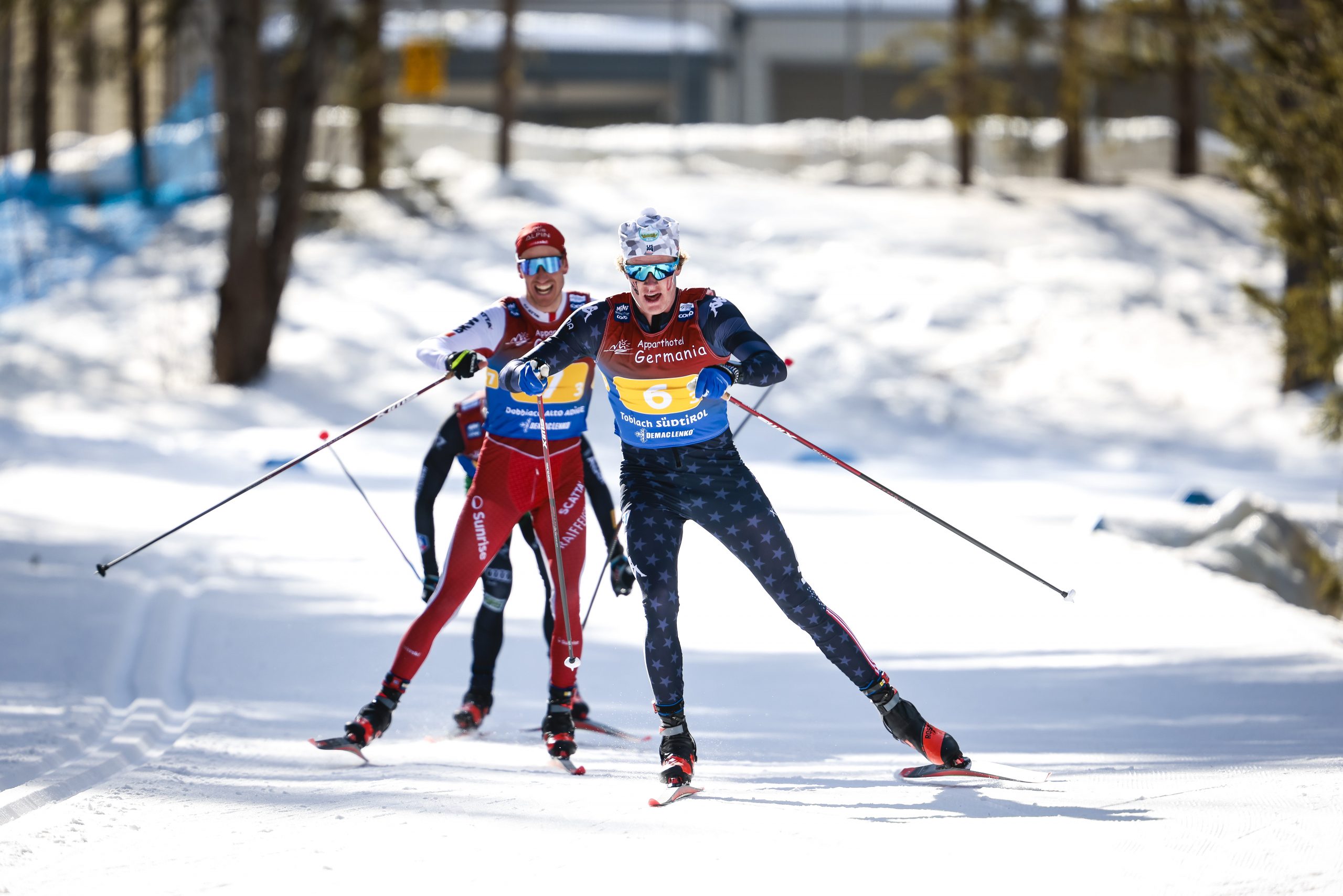
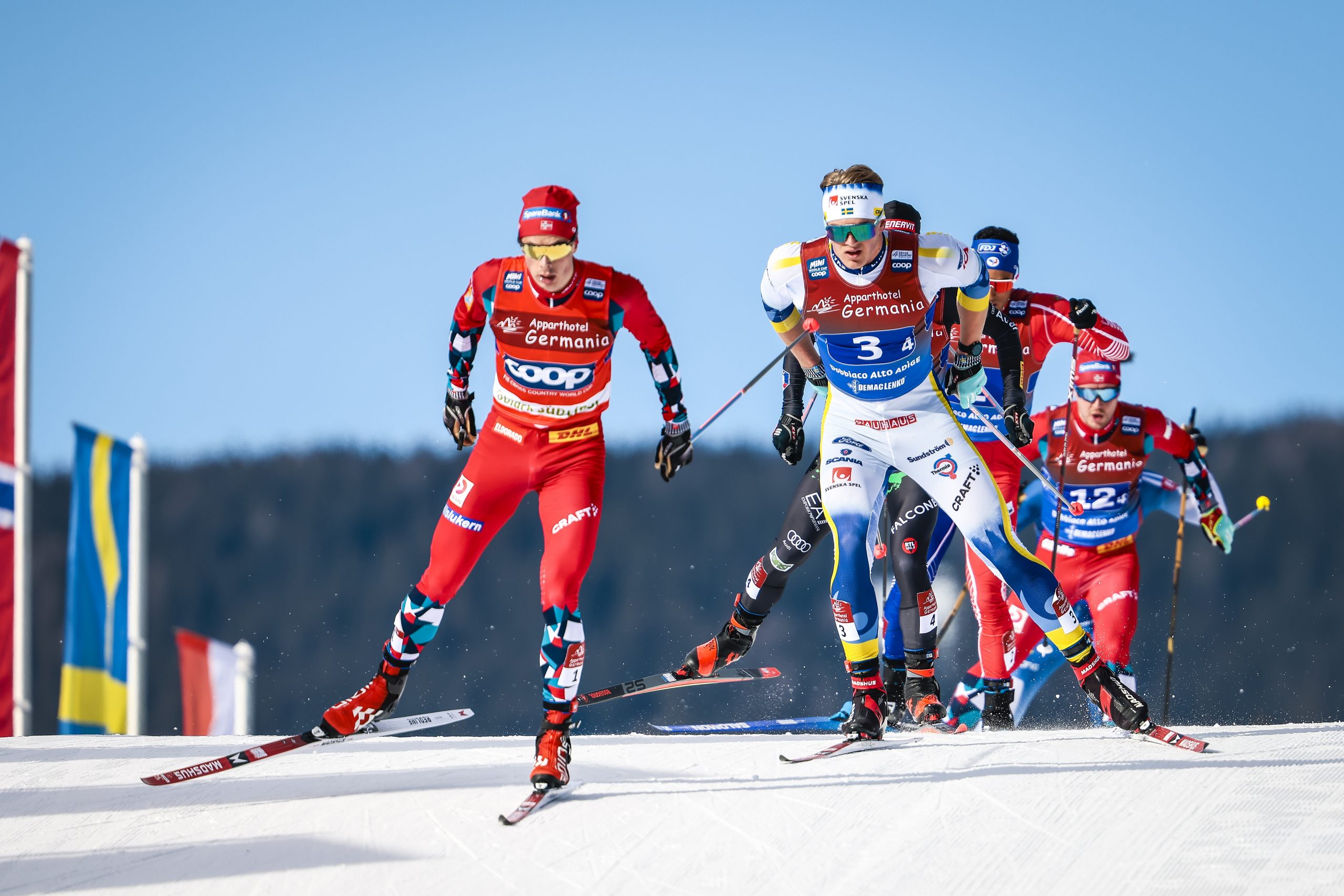
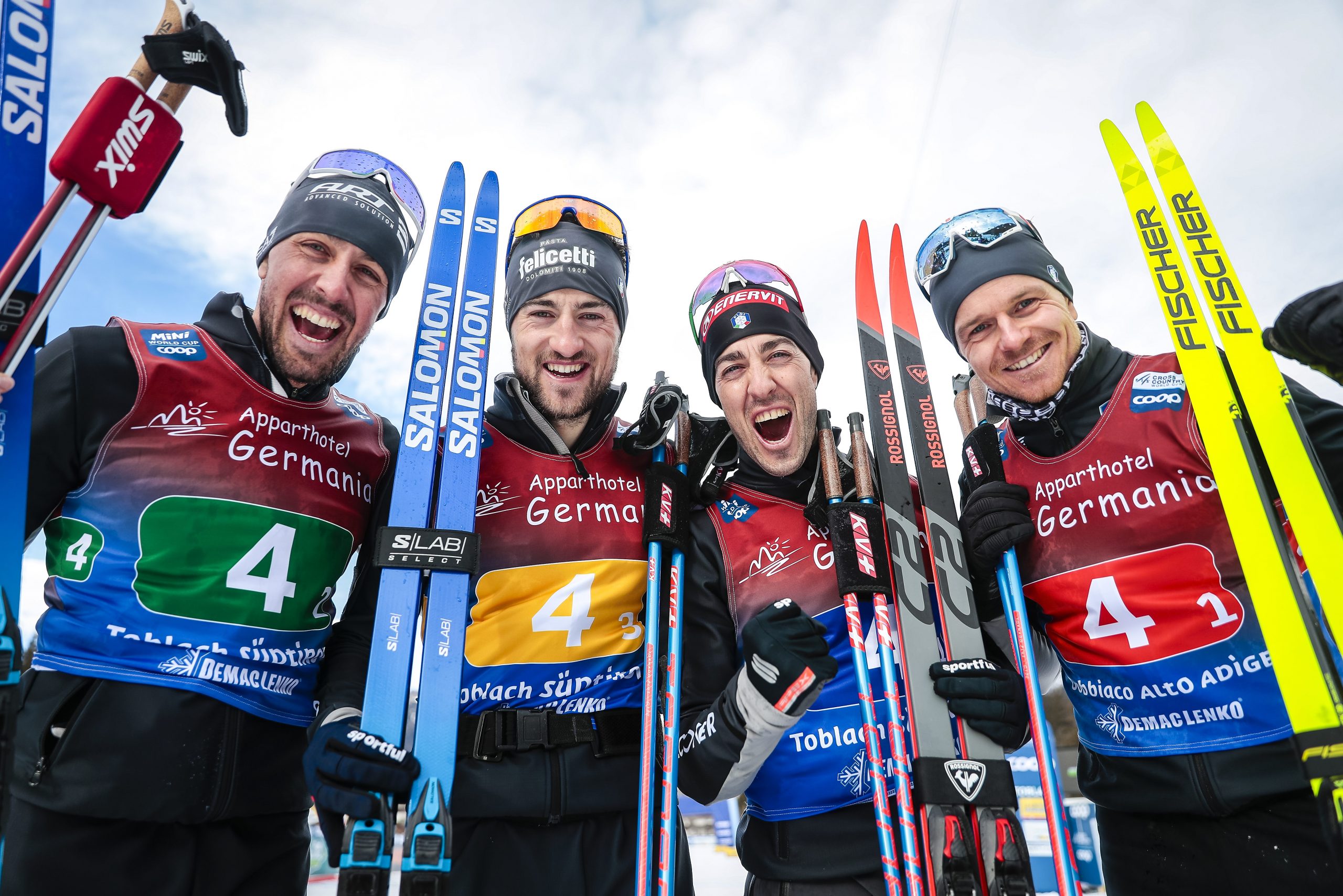
From the FasterSkier archive — posts syndicated from athletes’ and coaches’ own blogs between 2004 and 2012, kept online as published. Current coverage is at fasterskier.com.

Tag: Federico Pellegrino

  • All in the Timing: Inside Chicco Pelle’s Last Dance in Lake Placid

    All in the Timing: Inside Chicco Pelle’s Last Dance in Lake Placid

    This coverage is made possible through the generous support of Marty and Kathy Hall and A Hall Mark of Excellence Award. To learn more about A Hall Mark of Excellence Award, or to learn how you can support FasterSkier’s coverage, please contact info@fasterskier.com.

    LAKE PLACID, New York (March 21) — As the snow settled on Lake Placid and clouds began to dissipate over Mt. Van Hoevenberg, a growing sense that something momentous could happen permeated the crowd assembling for the last Sprint of the 2025-26 World Cup.

    That something unusual would happen was assured. With the Sprint Globe already secured to Johannes Høsflot Klæbo, the golden-haired juggernaut would not be on the starting line – opting instead to rest his legs, and head, in hopes of defending his 12-point lead over Harald Østberg Amundsen in the Distance standings. By default, then, someone other than Klæbo would stand atop Saturday’s podium – a rare occurrence in a season where the Norwegian had already won 8 of 11 Sprints in commanding fashion. (Two wins evaded Klæbo due to falls; the third because he did not start in Oberhof).

    Who would take his place? Ben Ogden, the Northeast’s homegrown favorite and the Sprint silver medalist in Milano-Cortina? Gus Schumacher, Ogden’s partner in the Olympic Team Sprint? France’s embattled specialist, Lucas Chanavat, who appeared on track to rival Klæbo during the 2023-24 season, who had seized the opportunity – and the win – after Johannes’ bobble in Davos last December? Ansgar Evensen (NOR), who had done the same in Drammen?

    Or, perhaps, it would be Federico Pellegrino (ITA) – the 35-year-old elder statesman of the league; making his 344th (and penultimate) World Cup start, eyeing an 18th and final Sprint victory?
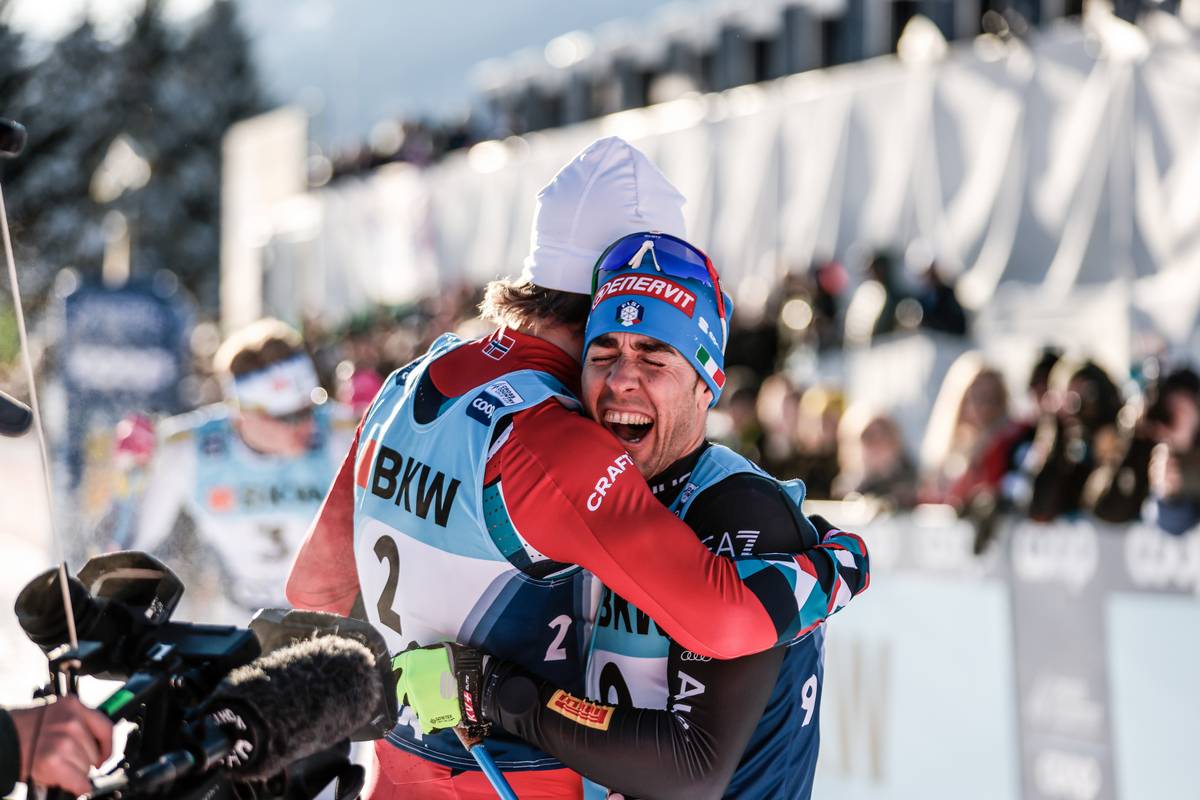
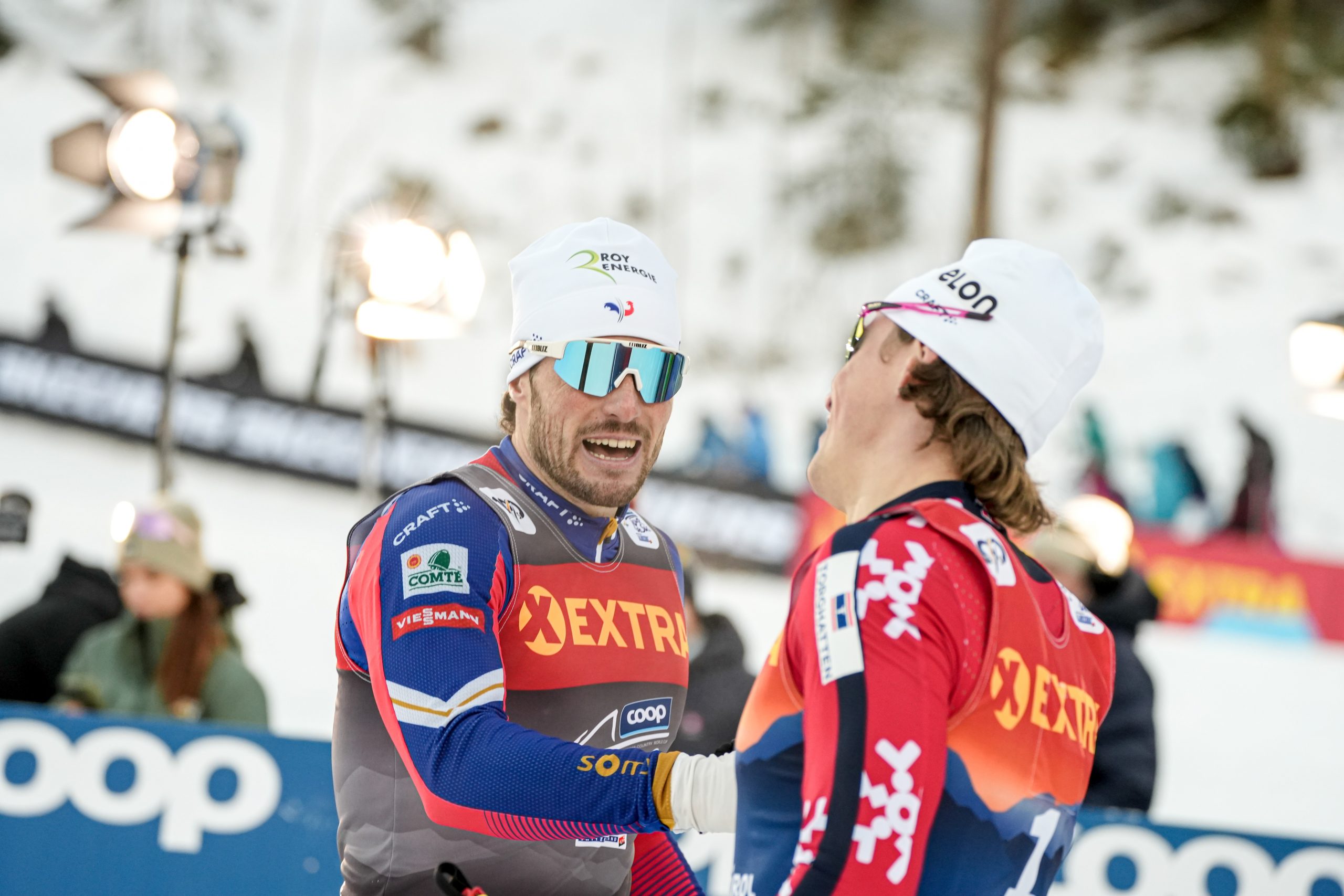
    Johannes Hoesflot Klæbo (NOR) and Federico Pellegrino (ITA) after the finish of the Finals in Davos, 2022. Pellegrino bested Klæbo on the eve of the birth of his first child. (Photo: Nordic Focus)

    It states the obvious to say that success in cross-country skiing is a matter of timing, and for “Chicco Pelle’s” 15 seasons, the timing had been just shy of right. The formative and final years of Pellegrino’s career were defined by the dominance of skiers other than he. Pellegrino made his World Cup debut in Drammen in March 2010, finishing 49th. The winner that day was Emil Joensson (SWE); runner-up was Petter Northug (NOR), then on his way to his first of two Overall Globes. These were the halcyon days in which Dario Cologna (CHE) descended from his Alpine fastness to rack up World Cup and Tour de Ski titles; when Northug, Joensson and Marcus Hellner (SWE) traded sprint victories and taunts in a bitter intra-Scandinavian rivalry. Pellegrino was 12th in his first World Championships Sprint (Oslo, 2011) and 11th at his first Olympic Sprint (Sochi, 2014).

    While notching his debut victory in December, 2014 in the Davos Freestyle Sprint, Chicco’s break came in the 2015-16 season. He won 5 of 13 sprint races, becoming the first non-Scandinavian male to win the Sprint Globe. As Pellegrino hit his stride, Northug’s star was showing its first flickerings ahead of a dramatic waning, Joensson had entered the twilight of his career, and although Sergey Ustiugov (RUS) was approaching his own prime, the factious cast of World Cup sprinters was looking for a new leading man.

    That man would not be Chicco. An upstart dramatist from Trondheim, Johannes Høsflot Klæbo, had arrived to script skiing’s long, and mind-bogglingly successful, next chapter. After making his debut in Drammen in 2016, Klæbo outscored Pellegrino in the 2016-17 Sprint standings, taking his first of 8 (and counting) Sprint Globes. The two went head to head at the 2017 World Championships in Lahti, Finland, where Pellegrino surged from behind to claim his first World Title ahead of a legendary lineup, including Ustiugov, Klæbo, and Northug, but this maiden gold would also be his last. In Pyeongchang the next year, the Olympic gold went to Klæbo; Chicco brought home silver.

    The wins did keep coming for Chicco, including a tear of three consecutive Sprint victories and his second Sprint Globe in 2020-21. And, though they admittedly came in greater abundance to Klæbo (who, it should be noted, did not start in those races, or the 2020-21 Tour de Ski), it is rather glib to assert that Chicco’s career had slid “in[to] the shadow of” the Norwegian. Pellegrino bested Klæbo in Dresden and Lahti in the spring of 2018; in Lillehammer that winter; and in Davos in 2022. He was near-omnipresent on Sprint podiums and won his second Olympic silver in Beijing in 2022; moreover, he was among the very few men who could disrupt Klæbo’s dominance in the discipline, and the clear favorite when Johannes was absent.

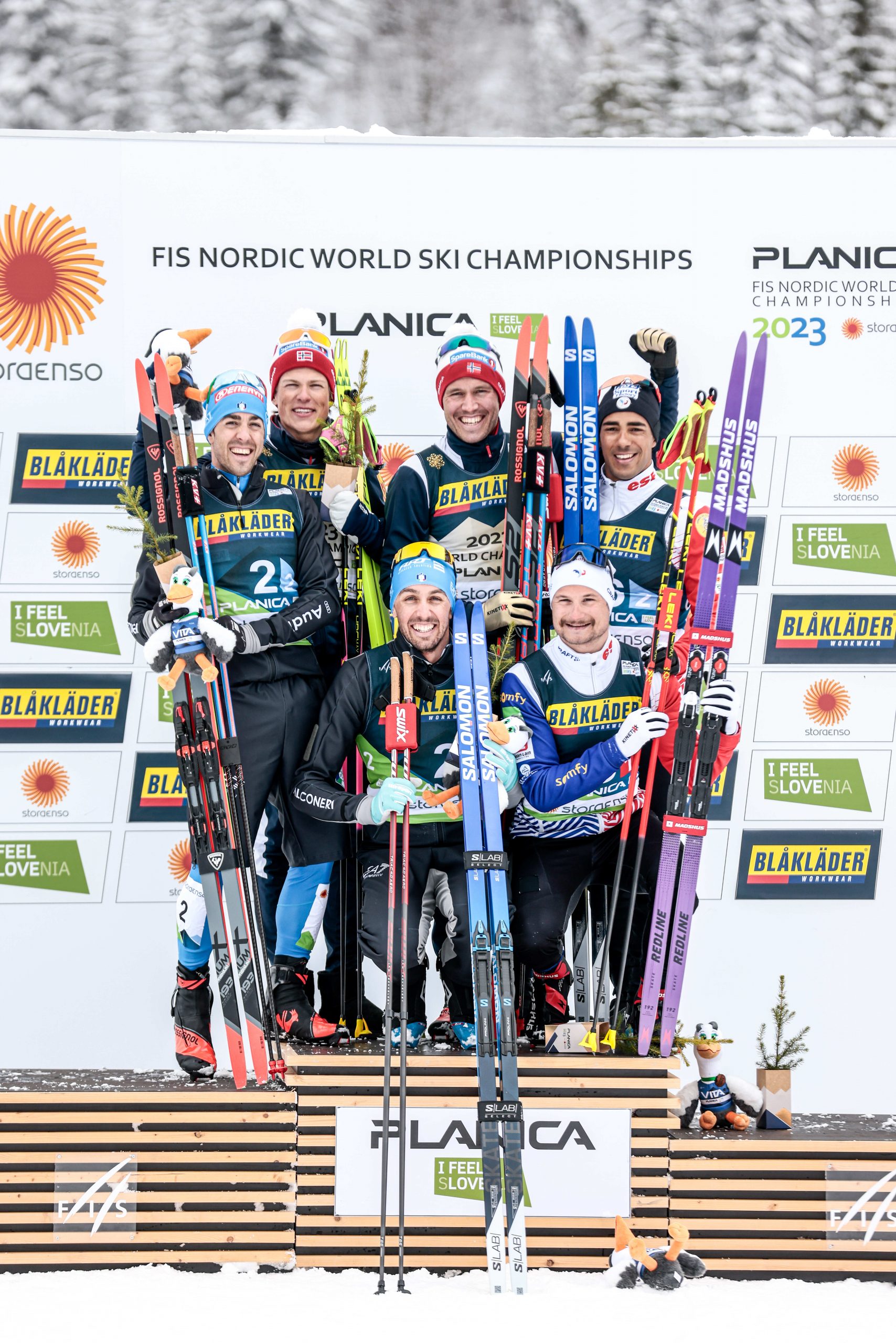
    But Pellegrino’s win in Davos in December 2022 marked the beginning of a long, and perhaps self-inflicted, World Cup drought. Chicco declared his intention to focus on distance races ahead of Milano-Cortina, and did indeed record four such podiums in classic, skate, and skiathlon formats, alongside a welter of Sprint podiums – including an ecstatic World Championships silver in Trondheim in 2025, and Olympic bronzes on home soil in the Team Sprint (alongside Elia Barp) and in the 4 x 7.5 k Relay (which he described as “the proudest day of [his] life!”) this February.

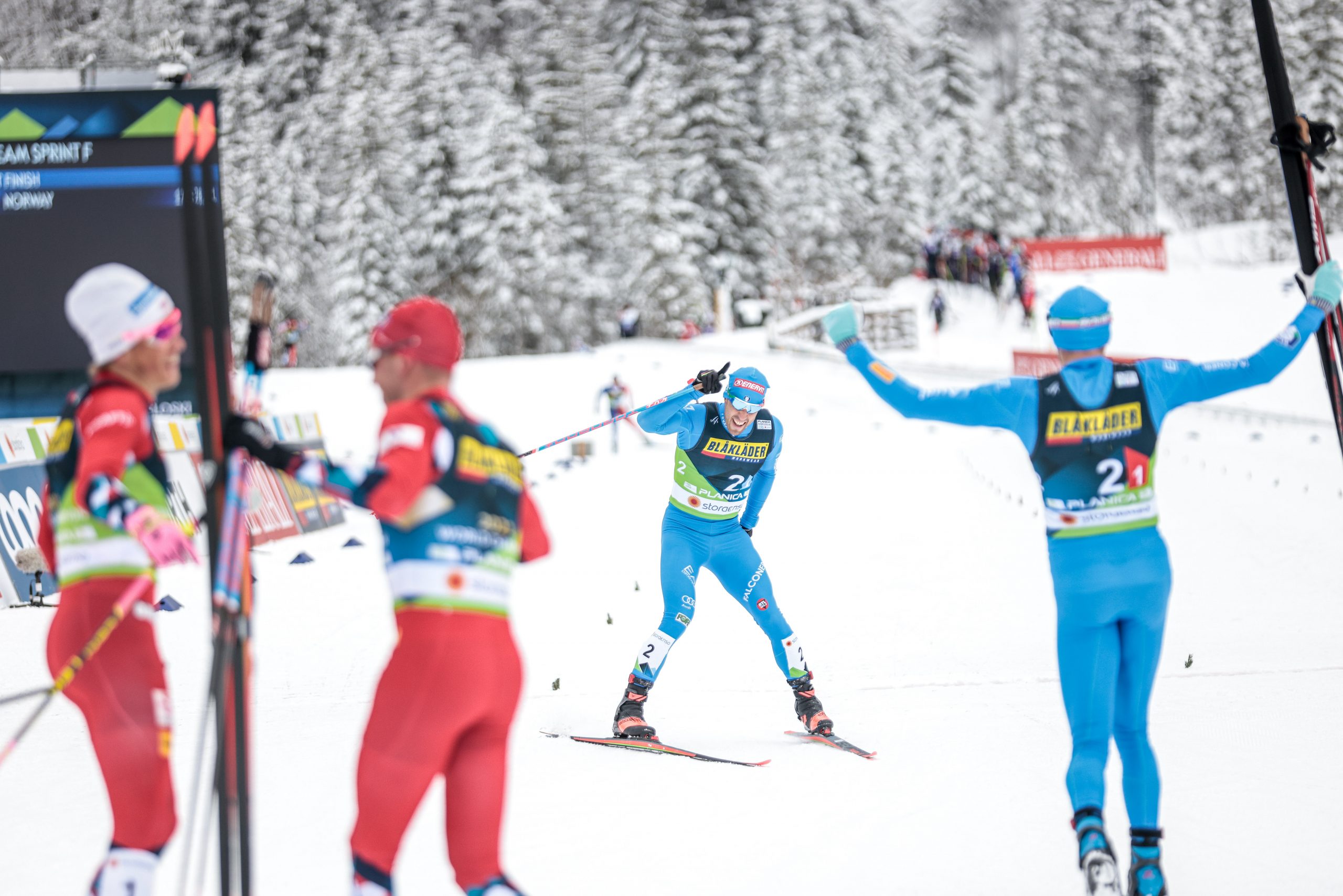
    Elia Barp welcomes Federico Pellegrino to a bronze-medal finish in the Olympic Team Sprint in Milano-Cortina, February 18th, 2026.
    (Photo: Vanzetta/Barbieri/NordicFocus)

    Outright wins, however, were not forthcoming. By the time March 21, 2026 arrived in Lake Placid, it had become Pellegrino’s last, best chance to secure one more Sprint victory.

    Anticipation and emotions ran high. While Pellegrino had been impervious to the crowd in Friday’s 10 k Classic – earbuds deadening the world beyond his blue racing cap during warmups, and his face a deaf mask of exertion during the race – their excitement overwhelmed him on Saturday. During his first warmup lap, he skated calmly up the course’s A-Climb through a chorus of “CHI-CCO, CHI-CCO, CHI-CCO.” On his second, the frenzied chant began again, and the gravity of the impending race dragged him to a halt. His skis splayed wide against the pitch; he buried face in his hands. “The energies I got in the Final were coming from the warmup lap, where I stopped in the middle of the climb, crying,” Pellegrino told me at the finish line. “I think the public deserved this kind of show, and I deserved to finish my career, with a Sprint skate like this.”

    Pellegrino embraces the crowd ahead of Sprint qualifying in Lake Placid. “The energies I got in the Final were coming from the warmup lap, where I stopped in the middle of the climb, crying.”
    (Photo: Thibaut/NordicFocus.)

    To reach that final finish line, however, was a perilous journey.

    After qualifying second, Pellegrino sidestepped two falls (the first from Jules Chappaz (FRA); the second from Elias Keck (GER)) in his Quarterfinal, moving from sixth to first in the course’s final descent and level hairpin. In Semifinal 1, he attempted to close on Lucas Chanavat (FRA) and Anton Grahn (SWE) through the crest of the A-Climb but couldn’t get by; pushed to the outside on the level hairpin, he was out-lunged by Lars Heggen (NOR) in the final meters, finishing third by 0.03.

    While the Lucky Loser spot was Chicco’s to lose heading into Semifinal 2, Erik Johansson (SWE), Harald Amundsen (NOR), and Even Northug (NOR) lost time playing for a slipstream position as they approached the top of the A-Climb. Pellegrino was on to the final by a comfortable margin.

    Lars Heggen (NOR) outlunges Federico Pellegrino (ITA) by 0.03 in Semifinal 1. Federico moved on to the Final as a Lucky Loser. (Photo: Thibaut/NordicFocus)

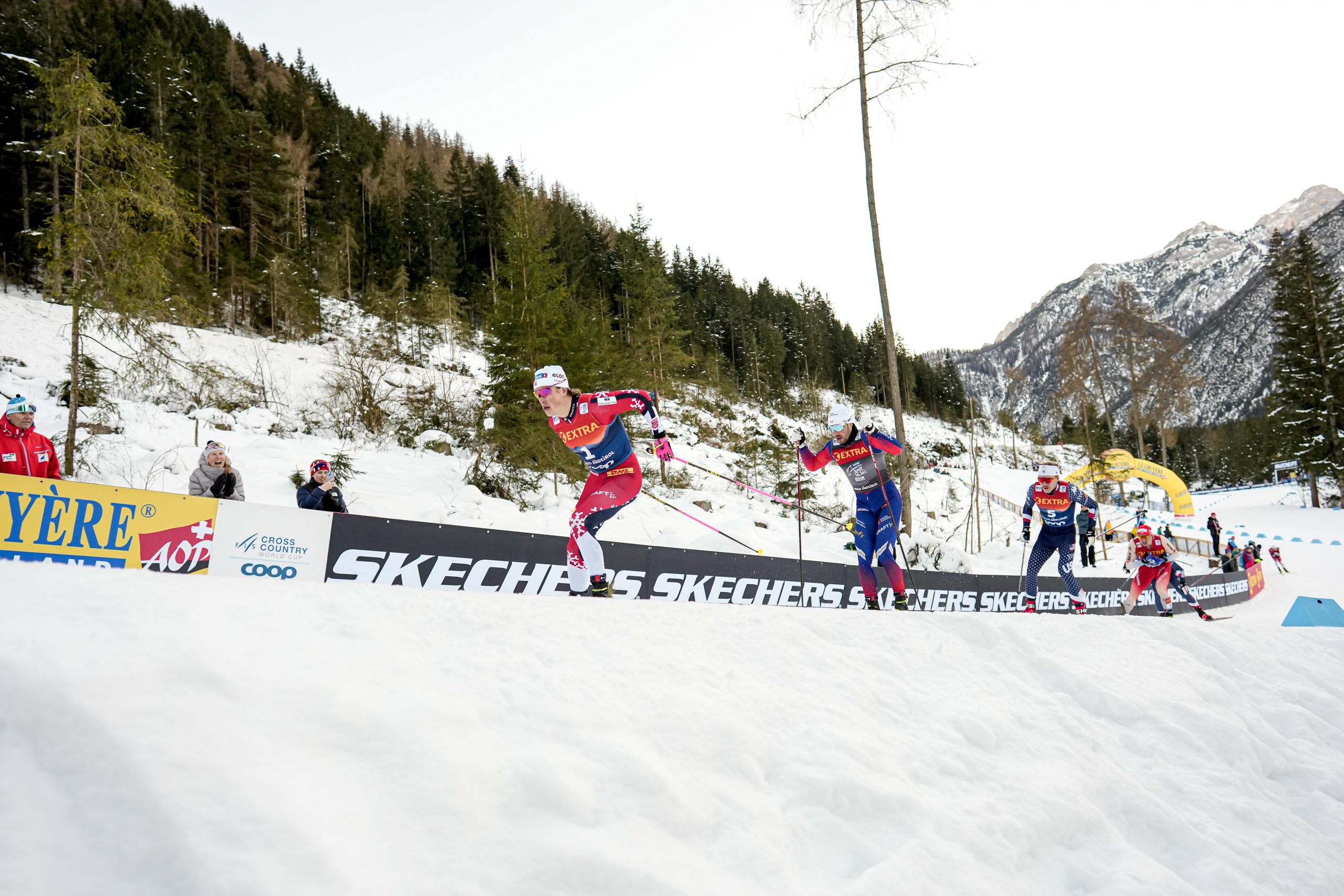
    Once more around the track, and the day could be his. After being fourth out of the gate, he attacked from the outside on the B-Climb; breaking into an aggressive V-2 and taking Chanavat and Heggen by surprise, he moved into second behind Grahn. The pace increased again at the base of the A-Climb, but where Grahn and Chanavat’s broad frames moved up the hill in sweeping, powerful strokes, Pellegrino leapt into a furious V-1.

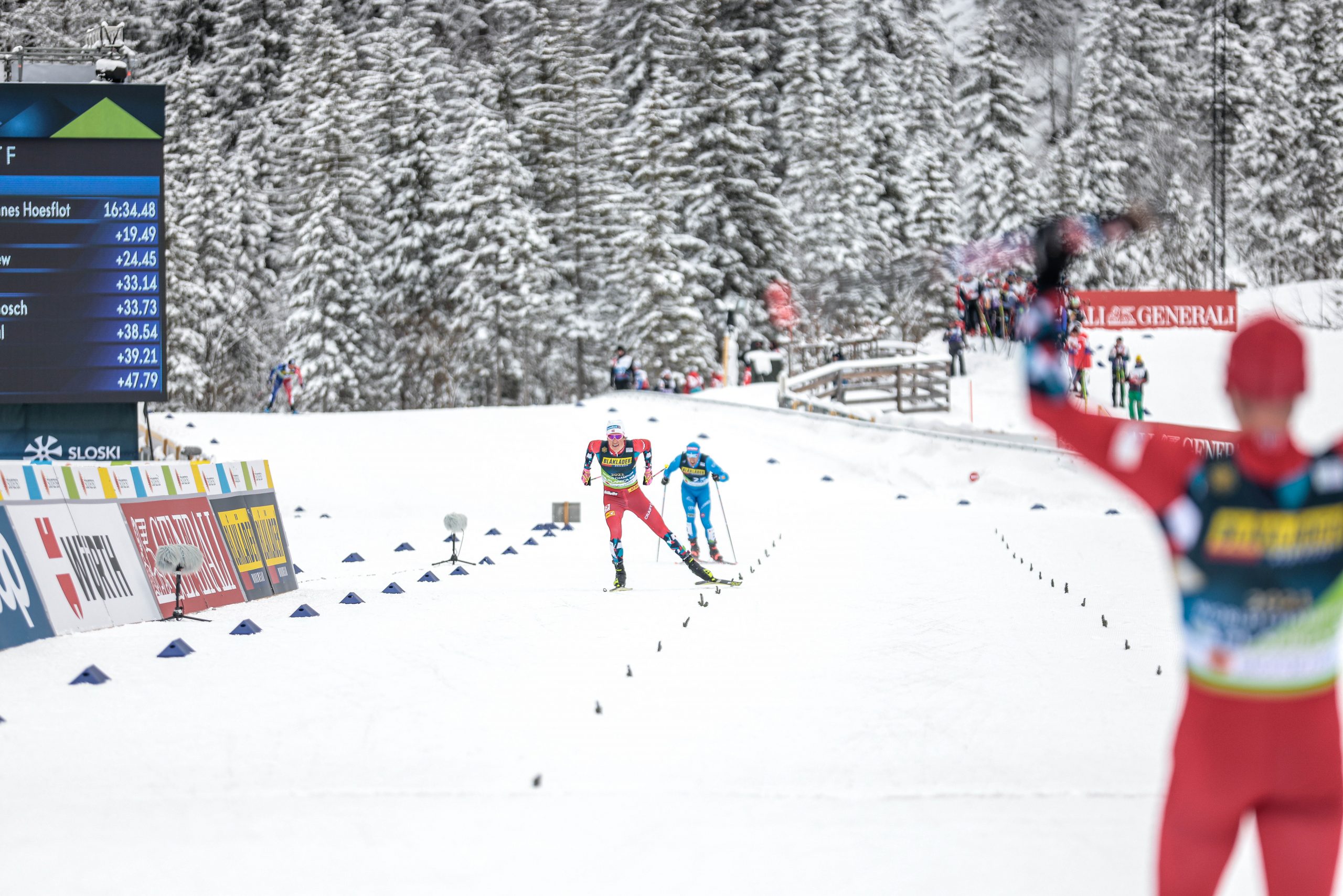
    The move was decisive. To the adulation of the crowd, he opened a decisive gap through the crest of the climb. His lead only grew through the final descent into the level hairpin, but Chicco was taking no chances. While Grahn and Heggen grappled for second behind him, Pellegrino hammered to the line, threw his arms wide and his head back, roaring with the crowd.

    An 18th victory and 46th career podium, clinched.

    Federico Pellegrino secures his 18th and final World Cup victory. Lake Placid, March 21, 2026. (Photo: Thibaut/NordicFocus)

    What had happened in the Semifinal, when this triumphant last dance had nearly evaded him by three hundredths of a second? And what had changed for the Final?

    “I could not do what I did in the Final, because the energies of the other athletes were still quite big,” Chicco admitted our post-race interview. “About the last downhill, I was not the same as the others. I am not, I know, but I have some different qualities, and if I could get quite good gap in the top of the uphill, then I knew that I could keep it until I end. This is what I did. This is how I loved to win all along my career – not wait until the last meter, but trying before.”

    “Sometimes it happened, mostly before Klæbo came,” he laughed. “But today I was there, and I studied the best tactics in the end . . . the public here in Lake Placid deserves this kind of show, and I think we are all happy now.”

    And, this was nothing short of “the best way” to end his journey. “I could not do different. In the end, the last four years have been strange. I didn’t focus so much on sprinting; I tried to discover my body in different fields. Sometimes I got really great feelings and performances, but then, to come back here . . . and to win in that way, I could not do more.”

    Pellegrino after his final win. “I think the public deserved this kind of show, and I deserved to finish my career, with a Sprint skate like this.” (Photo: Thibaut/NordicFocus)
    One more podium for Federico Pellegrino, alongside Lars Heggen (NOR) and Anton Grahn (SWE). (Photo: Thibaut/NordicFocus.)

    In 15 seasons, Pellegrino proved himself to be far more than a runner-up to those Swedish and Norwegian titans who loomed large over his early and later years. He had taken the Sprint Globe from the Scandinavians for the first time; outsprinted Klæbo, Ustiugov, and Northug in Lahti; perpetually challenged – and occasionally beaten – the greatest athlete in the history of the sport; and secured Olympic medals on home soil, alongside a team of up-and-coming Italians ready and eager to fill his boots. “I’m really happy that he finished his career with probably one of the best weekends for him so far,” Elia Barp (ITA) told me on Sunday. “I’m very happy for him; I’m very happy for the team. I think we have proved that we are ready to race without him – not only me, but a few other young guys are ready to try to take victories next year . . . [He showed] that it is important to keep fighting and try to be a good overaller as he was in the last years. And, now we know that it’s possible; everyone is human as us, and we can do that.”

    To Chicco’s fans, that determination – to grapple with giants; to reinvent himself; to seize the final, perfect timing and a final, perfect victory – defined his career. But for Pellegrino himself, “the biggest memories will not stay about the races, but much more about the hugs I got from the teammates, from the coaches, even outside of Italy, from my family, from the people that love me – and not only when things went well; even when things were not going so well. I think this is something that sport teaches us; that in the end, it’s only a cross-country ski race, and life is different. That’s it. The hugs are something I will remember for my entire life.”

    Pellegrino, the most popular man at Zig Zag’s on Saturday, March 21. (Photo: Lily Den Hartog)

    At Zig Zag’s Pub on Saturday night, Pellegrino told this reporter’s associate that his win vindicated his decision to retire. On Sunday, soaked with rain and champagne and tears after his last World Cup race, he reaffirmed it:

    “That’s it. I tried to enjoy today as well . . . I tried to give my best, as always, and it was good after the finish line; under the rain, it was special. But with the teammates and coaches and waxers celebrating this moment, it was good for me.”

    “Now, I really need to stay with my family. They deserve this, and I need to give them a lot of time.”


    Love Stories Like This? Help Keep Them Coming.

    Feature stories like this one take time, access, and care to produce. If you value thoughtful storytelling and independent ski journalism, please consider becoming a Voluntary Subscriber. Your support directly fuels the work we do to cover the people, places, and moments that make our sport special.

    “Grazie Papao!!” Team Italy was waiting at the finish of the 20 k Skate with champagne and a tribute to Pellegrino’s children and wife, Greta Laurent (ITA, ret.). (Photo: Thibaut/NordicFocus)
  • No One Lives Here,” They Said. Then 10,000 Plus Fans Showed Up in Lake Placid

    No One Lives Here,” They Said. Then 10,000 Plus Fans Showed Up in Lake Placid

    This coverage is made possible through the generous support of Marty and Kathy Hall and A Hall Mark of Excellence Award. To learn more about A Hall Mark of Excellence Award, or to learn how you can support FasterSkier’s coverage, please contact info@fasterskier.com.

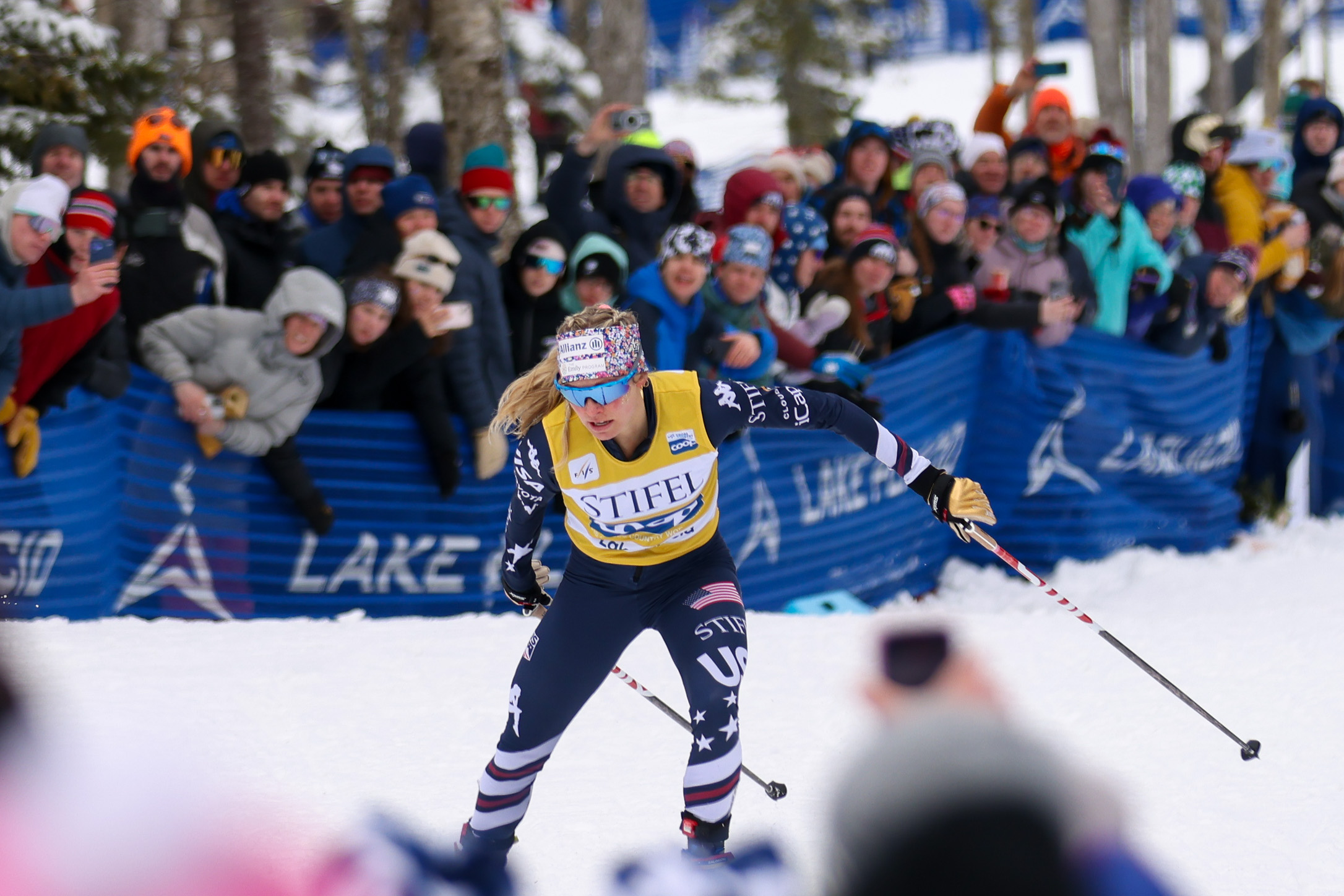
    Jessie Diggins during the quarterfinals of the Freestyle Sprint on Saturday in Lake Placid, New York, USA. (Photo: Voisin / FasterSkier)

    Lake Placid, N.Y. — The French coaches had questions. Two days before racing began at Mount Van Hoevenberg, they were standing in Saranac Lake — 55 degrees, windy, woods in every direction — wondering who exactly was going to show up to watch cross-country skiing in the middle of the Adirondacks.

    By Saturday, an estimated — rumored to be fair — 14,000 people had answered.

    Today, as Jessie Diggins lines up for the 20-kilometer mass start freestyle, the final race of her career, this corner of upstate New York will try to top itself one more time.

    Screaming fans, chainsaws, flags, signs, and glitter all over the course in Lake Placid, New York, USA. (Photo: Voisin / FasterSkier)
    A Weekend That Kept Building

    The first sign that Lake Placid was going to be different came Friday, and it wasn’t entirely smooth. With an initial estimate of 10,000 fans on Friday, the transportation system to and from Van Hoevenberg buckled under the demand. Some fans waited over two hours to get to the venue.

    Diggins finished fifth and clinched her fourth career overall Crystal Globe — her third in a row. She told reporters afterward that the crowd was so loud she couldn’t hear herself breathe. Johannes Høsflot Klæbo returned to win the men’s 10k, leading a Norwegian sweep of the top five.

    ORDA adjusted to the shuttle demand on the fly, pulling in school buses from across the region to shuttle people up the mountain, and by the time Saturday got started, things felt even bigger at the venue. The sprint course was packed — 14,000 fans by some estimates — as Sweden’s Linn Svahn dominated the women’s sprint and Maja Dahlqvist locked up the sprint Crystal Globe. And Federico Pellegrino, in his own final World Cup sprint, scripted the perfect ending with a masterful win — a retirement farewell that carried echoes of what’s coming today for Diggins.

    US Head Coach, Matt Whitcomb, after the races yesterday in Lake Placid was really happy because the standout performance was not one of his athletes, but instead the North American ski community that showed up in droves and created an electric atmosphere. (Photo: Voisin / FasterSkier)
    “Only Holmenkollen and Minneapolis”

    U.S. Ski Team head coach Matt Whitcomb has been on the World Cup circuit for years. He said the only events throughout his career that have ever rivaled the atmosphere here this weekend in Lake Placid are the Holmenkollen in Oslo — the sport’s grand prix if you will — and Minneapolis two years ago.

    That’s the company Lake Placid is keeping. And for those who were in Minneapolis, the comparison lands. Diggins said earlier this week that Minneapolis was the most special day of her career.

    “It was the most I’ve ever cried,” she said at Wednesday’s press conference. “I got to race in front of some of my grandparents who haven’t been able to travel overseas. They got to see me race for the very first time in a World Cup. And having so many friends and family and getting to share the thing that I love doing with them — that is the most incredible thing ever.”

    She paused, then added: “I think this weekend’s probably going to join that.”

    College skiers from all over the Northeast came in force to the trailside in Lake Placid, New York, for the races this weekend. (Photo: Voisin / FasterSkier)
    The Scene on the Ground

    What the numbers don’t capture is the texture. Young kids running around the venue in their NNF fan bibs — the ones with athletes’ faces printed on them — clutching Sharpies, hoping to meet their heroes. Fans who drove and flew from Vermont, from Alaska, from Minnesota, who planned vacations around this weekend months ago. The school buses that became part of the story, ferrying the faithful up the mountain road when the original plan couldn’t hold.

    This is what U.S. cross-country skiing looks like when it gets the stage. Not a packed NFL stadium or a sellout basketball arena — but thousands of people standing in the woods, screaming themselves hoarse for athletes from every country, because they love this sport and they know how rare these weekends are.

    The fans — especial the college skiers — made it sound like the race was happening in Davos, Switzerland with the chainsaws out on course. (Photo: Voisin / FasterSkier)
    One More Race

    Diggins has spent this weekend doing exactly what she said she would — being present, soaking it in, putting on a show. She clinched the Crystal Globe on Friday. She raced the sprint on Saturday. And now there’s one more.

    At Wednesday’s press conference, she talked about the way her mindset around suffering has evolved — how she’s learned to see the pain cave not as something to dread but as confirmation that she’s doing what she came to do.

    “This is what 100 percent feels like,” she said. “And sometimes this is what it looks like, and it’s some ugly scene, but that’s okay. It just has to be all heart and all effort, and that’s what I have to give in that moment.”

    She also made one thing clear about the team she’s leaving behind: “The team is going to be just fine without me. And I feel like that’s how I know I did my job.”

    Then, with a smile: “I’m excited to be a fan on the other side of the fence and get to cheer for them.”

    Today, in just ten minutes, Jessie Diggins will clip into her bindings for the last time as a World Cup racer. The 20-kilometer Mass Start Freestyle.

    And based on everything this weekend has shown us, “no one” will be watching.


    Love Stories Like This? Help Keep Them Coming.

    Feature stories like this one take time, access, and care to produce. If you value thoughtful storytelling and independent ski journalism, please consider becoming a Voluntary Subscriber. Your support directly fuels the work we do to cover the people, places, and moments that make our sport special.

    Join the FasterSkier community!


    When the sun finally came out the crowd got especially excited. (Photo: Voisin / FasterSkier)
  • Grazie, Federico—Pellegrino Scripts the Perfect Ending

    Grazie, Federico—Pellegrino Scripts the Perfect Ending

    This coverage is made possible through the generous support of Marty and Kathy Hall and A Hall Mark of Excellence Award. To learn more about A Hall Mark of Excellence Award, or to learn how you can support FasterSkier’s coverage, please contact info@fasterskier.com.

    Federico Pellegrino (ITA) during warmup, hearing his name called by the joyous crowd lining the course in Lake Placid. It was the beginning to a tremendous day, and the final Sprint victory of his glorious career. (Photo:  Thibaut/NordicFocus.)

    “The energy that I got in the warmup lap . . . I got this feeling of power from the public,” said Federico Pellegrino.”Cheering for me. “Chicco Pelle! Chicco Pelle! And then in the Final, I could not wait!”

    Though this race—this glorious victory— came at the end of a long and illustrious career, Pellegrino was true to his word. He could not wait. He blazed off the front of a complex and contact-filled Freestyle Sprint final to storm to the 18th win of his World Cup career—his 46th podium. He had won silver and bronze medals in front of his countrymen at the Olympics of Milano-Cortina just a few weeks ago. Perhaps this final victory in front of the cheering throngs of Mt. Van Hoevenberg was sweeter, still.

    Pellegrino was joined on the podium by Lars Heggen (NOR) and Anton Grahn (SWE), two young guns who may represent the future of the sport. But Pellegrino showed he was not yet ready to allow the great names of the past to be forgotten. One last Sprint victory, and one more chance to show his appreciation to an appreciative crowd.

    “Thank you Lake Placid,” smiled Pellegrino. “It was great!”

    Lars Heggen (NOR) may see himself as the heir apparent, the sprinter most likely to triumph when Klaebo is away. That may soon be true . . . just as soon as Federico Pellegrino (ITA) retires. (Photo: Thibaut/NordicFocus)

    A World Cup Sprint without Klaebo is two things at the same time: both a lot less interesting, and a lot more interesting. When Klaebo is in the Sprint field, Klaebo will win, won’t he? So what does it mean when Klaebo is absent? It means almost anyone can win. And with only the World Cup Distance championship remaining to be defended (in a close race with Harald Oestberg Amundsen), Klaebo elected to sit out the Freestyle Sprint . . . marking perhaps the only time that Klaebo has been able to watch an entire World Cup Sprint competition from the sidelines.

    “It’s not very often that you have the races (in the USA),” said Klaebo. “And it’s always fun—I mean it was amazing when we were in Minneapolis a couple of years ago, and I’ve been looking forward to this race for a long time. With what happens last week, (coming to Lake Placid) was a little bit uncertain. I’m really happy that I made it, and happy that I made it to the starting line.”

    “The Americans really know how to make noise and a good atmosphere,” said Klaebo of the Mt. Van Hoevenberg crowds lining the 10 k course on Friday. “It was cool!”

    “I think it’s the right decision to skip the (Sprint on Saturday),” said Klaebo. “Hopefully I will be back at it again on Sunday with enough energy to be able to fight.”

    JC Schoonmaker (USA) was the top American among five who qualified for Lake Placid’s Freestyle Sprint quarterfinals. He would put together a fine set of performances, advancing to the semifinal and finishing the day ninth. (Photo:  Thibaut/NordicFocus)
    Freestyle Sprint Heats

    Team USA would qualify five skiers into the quarterfinals: Gus Schumacher, Ben Ogden, Jack Young, JC Schoonmaker, and Zanden McMullen. Schumacher, Ogden, and Young delivered especially eye-popping qualifying efforts: fourth, fifth, and sixth,  respectively. While Americans would ski their way into the quarterfinals, it was not to be the Americans’ day.

    Schumacher caught his pole in the start gate and immediately surrendered ten meters to the field, but an initial slow pace in the heat allowed him to catch up quickly, and to surge forward into third position. Schumacher followed early leaders Benjamin Moser (AUT) and Anton Grahn (SWE), though it was Lars Heggen (NOR) sitting quietly mid-pack that should have occupied everyone’s attention. Heggen was badly positioned mid-race, pinched out of a spot to advance on the climb, and found himself at the very back. Schumacher was pushed wide on the final turn while Heggen masterfully weaved far inside, squeaking past to fuel his dash down the final straightaway. Heggen would finish second (behind Grahn) while Schumacher would find himself fourth. Schumacher’s time would not hold up as a lucky loser. He would finish the day in 21st.

    Quarterfinal 2 had Ogden lining up beside his teammate, McMullen, and with the legend, Federico Pellegrino. Loud cheers greeted the announcement of the Americans as Ogden waved to the crowd. The heat would be paced by Roman Alder (SUI) with Ogden and Pellegrino waiting patiently for the pace to settle. Pellegrino and Ogden vied for the lead at the top of the final uphill, but neither of them really wanted it. They baited Alder back into the lead, and prepared to take advantage of his slipstream on the descent. Pellegrino showed why he is a legend in the sport, weaving through the field and into the lead as he crossed the line. Ogden showed that he may still have much to learn as he skied himself into dead ends in the finishing straightaway, fading to fourth behind McMullen. McMullen would finish the day 15th, Ogden 17th.

    Chanavat led out Quarterfinal 3; a typical tactic for Chanavat, though one that has always found itself to be ineffective against Klaebo. But Klaebo wasn’t here today . . . and no one other than Chanavat really seemed to have a plan. Counter-punching in Sprint heats can sometimes result in advancement, but it rarely results in victory. It looked like Chanavat would have the advantage. Behind him, Schoonmaker scrubbed too much speed in the hairpin turn, finding himself dropped by the acceleration of Jir Tuz (CZE) on the significant downhill. Chanavat gave chase, and the heat was all but decided. Chanavat would step out of the draft and into the lead. Tuz would follow him across the line with Harald Oestberg Amundsen claiming a lucky loser spot. Schoonmaker would finish fourth in the heat, sitting in a hopeful lucky loser position with two heats remaining.

    Sasha Masson (CAN) set the pace in Quarterfinal 4, but found himself overtaken in the final curves. Eric Johansson (SWE) and Even Northug (NOR) would advance.

    Quarterfinal 5 pitted Young against Ansgar Evensen (NOR) and Jaume Pueyo (ESP). Young would drop to the back in the opening meters, but forced his way forward by the top of the first uphill. He found an open lane on the next uphill, but may have spent too much energy advancing. Young entered the final downhill in second position, but he would fade in the final straightaway, finding himself overtake by Pueyo and Evensen. Young would end the day in 13th place.

    Semifinals

    Schoonmaker followed Chanavat, Pellegrino, and Heggen into the first semifinal, where he would mark Heggen at the rear. Maybe patience would be the righ tactic? At thefront, Chanavat drove the pace, duking it out with Pellegrino on the uphill. Grahn, Heggen, and Pellegrino would all lunge at the line in a photo finish as Chanavat faded into a lunge for fourth with Schoonmaker. Ultimately, the lucky loser spots would belong to Pellegrino and Chanavat. Schoonmaker would finish ninth on the day.

    The second semifinal was led by Johansson, who was shadowed by Evensen and Amundsen. Pueyo, Northug, and Tuz trailed the field. Johanssen and Amundsen would advance at the line.

    Federico Pellegrino (ITA) came storming into the finish area al alone. The crowd let him know who their favorite really is. (Photo: Modica/NordicFocus)
    Sprint Final

    The Sprint final offered an excellent non-Klaebo lineup: Grahn, Johansson, Heggen, Amundsen, Pellegrino, and Chanavat.. The veterans (those likely to have a plan), Chanavat and Pellegrino, had advanced as lucky losers. Would they be fast enough to contend? The Norwegians featured a proven sprinter in Heggen with a points-hungry all-rounder in Amundsen. Sweden brought two young skiers eager to upset Norway’s podium pitch. And the starter’s pistol revealed how easy it is for even the most experienced racers to suffer the most rookie mistakes—Amundsen planted his pole tip on top of his own ski, and collapsed in a tangle in the very first meter of the race. Remarkably, he would jump to his feet and take off in pursuit of the field, which he caught before 30 seconds had elapsed. Amundsen was back in the race, but at what cost?

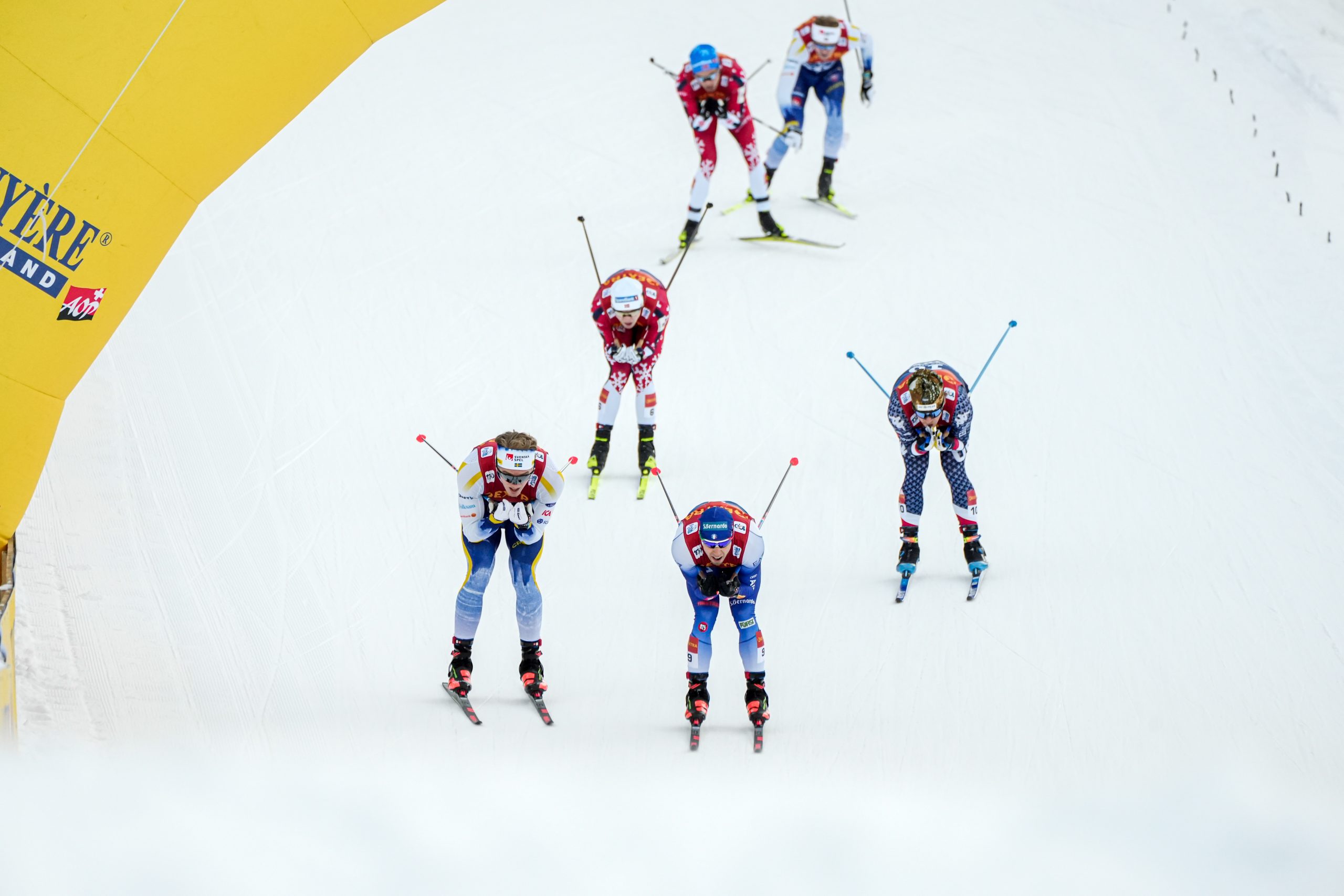
    At the front, Grahn and Pellegrino set the pace. They were followed by Chanavat who, for once, seemed willing to change his at-the-front tactics. As the climb began, Heggen’s ski tip fouled in Johansson’s binding. The Swede went down, and Heggen lost momentum. The leading three seemed to be getting away where Pellegrino was putting an entire career’s worth of energy to his hop skate up the steepest climb. Power-skating into the final downhill, Pellegrino had created a gap ahead of Grahn that meant the tall  Swede would not benefit from Mt. Van Hoevenberg’s notorious draft. Pellegirno would exult across his final Sprint finish line, capping a brilliant career with one final victory. Heggen would recover to dash forward to claim second, ahead of Grahn in third.

    “This was the way I dreamt, when I was young, to win races,” said Pellegrino. “To end my career in that way was fantastic.”

    World Cup Final Men’s Freestyle Sprint RESULTS

    World Cup Final Men’s Freestyle Sprint QUALIFYING

    Love Stories Like This? Help Keep Them Coming.

    Feature stories like this one take time, access, and care to produce. If you value thoughtful storytelling and independent ski journalism, please consider becoming a Voluntary Subscriber. Your support directly fuels the work we do to cover the people, places, and moments that make our sport special.

    Join the FasterSkier community!

    World Cup racing continues this weekend from Lake Placid and Mount van Hoevenberg:

    Sunday, March 22

    12:30 pm | Men’s 20km Mass Start Free

    2:30 pm | Women’s 20km Mass Start Free

    4:30 pm | ONE LAST LAP w/Jessie Diggins & the Retiring Stars

    Chicco Pelle and his fans. Grazie, Federico. (Photo: Thibaut/NordicFocus.)


  • What to Do in Lake Placid When You’re Not Watching World Cup Racing

    What to Do in Lake Placid When You’re Not Watching World Cup Racing

    You’ve got your tickets. You know the race schedule. You’re making the trip to Mt. Van Hoevenberg for the first World Cup finals ever held on American soil. But the racing doesn’t fill every hour of the day, and Lake Placid is the kind of town that rewards a little wandering. Over the last 15 years, my family and I have spent a lot of time in Lake Placid, and here’s what we’d suggest for filling in the gaps — whether you’re traveling solo, with a crew, or with kids in tow.

    Fuel up

    Start the morning at Big Mountain Deli & Crêperie on Main Street. They’ve got 46 sandwiches named after Adirondack high peaks, plus breakfast burritos, crepes, and all the espresso drinks you need to survive a cold morning in the stadium. A word of advice: order online in advance. The line moves faster if your food is already being made. Note that they’re closed on Wednesdays, so plan accordingly if you’re arriving midweek.

    If you’d rather sit down and take your time, The Breakfast Club is just up the street and serves a proper breakfast and lunch with views of Mirror Lake. The portions are generous, the pancakes are legit, and if you’ve got kids, the hot cocoa is a guaranteed win. They open at 8 a.m. daily and close at 1, so don’t dawdle.

    Lunch and dinner

    For a real meal, Lisa G’s is our pick. It’s a short drive from Main Street on Sentinel Road, with a menu that leans American but doesn’t phone it in — think elevated pub food with creative wings, excellent fish and chips, and a solid beer list. They serve lunch on Fridays through Sundays starting at 11:30, and dinner Thursday through Monday. Closed Tuesdays and Wednesdays, so keep that in mind for early-week arrivals.

    For something more upscale, the Mirror Lake Inn is one of the classic Adirondack properties — a lakefront resort with a polished dining room and views to match. And if you want something a bit more casual but still special, check out The Cottage, also on the Mirror Lake Inn grounds. It’s a cozy spot right on the water where you can grab dinner or a drink in an old gondola. It’s open Tuesday through Sunday — closed Mondays.

    If you’re looking for a spot that can handle a crowd, Dancing Bears at the High Peaks Resort is worth a look. It’s at the far end of Main Street and has plenty of space — which matters on a weekend like this one, when every restaurant in town is going to be slammed. We’re fans of the food here, especially the salmon. It’s a reliable pick when other spots have a 45-minute wait.

    Breweries

    Lake Placid has two breweries worth your time, and both serve food if you’re looking to make a full stop of it.

    Lake Placid Pub & Brewery has been an institution on Mirror Lake Drive for years. The beer list is deep, the vibe is pub-casual with college banners lining the walls, and the upstairs bar is a solid spot to post up after a day at the races. They’re open daily from 11:30 a.m. (noon on Sundays) and stay open late — midnight on weeknights, 2 a.m. on Fridays and Saturdays. If you can only try one drink, ask about the Smoked Berry Old Fashioned.

    Big Slide Brewery & Public House is out on Cascade Road, about a five-minute drive from downtown and right near the Olympic Jumping Complex — which makes it an obvious stop if you’re heading to the Skirious Problems live recording Saturday evening. The beer ranges from fruit-forward lighter options to solid IPAs and porters, and the food holds its own. The burgers are good, the pizza is legit, and the buffalo wings have a bit of a cult following. They’ve also got outdoor seating with fire pits and Adirondack chairs if the weather cooperates. Open daily from 11:30 a.m. (10 a.m. on Sundays).

    Catch some NCAA March Madness

    The World Cup finals land smack in the middle of the NCAA basketball tournament, and if you need a screen and a cold beer between race sessions, Lake Placid has you covered. Wiseguys Sports Bar & Grill on School Street is the classic move — TVs everywhere, good wings, no pretense. They’re open Wednesday through Sunday. Players Waterfront Eatery on Main Street is another solid option with screens and lakeside seating if the weather cooperates.

    Stroll and Explore Main Street

    Don’t underestimate a good Main Street stroll. Lake Placid’s downtown is walkable and full of shops worth ducking into.

    Saratoga Olive Oil Company is one of those places you walk into out of curiosity and end up spending way longer than you planned. They’ve got dozens of flavored olive oils and balsamic vinegars you can taste — some combinations will surprise you, and it’s a genuinely fun challenge for your taste buds. Great for picking up a gift or just entertaining yourself for half an hour.

    The Maple Shop is exactly what it sounds like — a deep dive into maple syrup and all things maple. But it’s more interesting than you might expect. They carry different varieties and grades, and tasting your way through the range is a quick education in how much variation there is in something most people think of as one flavor.

    Adirondack Popcorn Co rounds out the Main Street tasting tour. They specialize in creative popcorn flavors — some classic, some funky — and it’s the kind of snack you can grab and take with you to the races or back to wherever you’re staying.

    Get Outside

    You’re in the Adirondacks. Get some fresh air.

    Though having recently CLOSED at the end of the 2026 season, Olympic Speed Skating Oval is open for public skating and is one of the few outdoor refrigerated ovals in the country. If the oval’s schedule doesn’t line up with yours, Mirror Lake itself often has a maintained skating area — check conditions locally when you arrive.

    Get out on the Ironman Lake Placid course on Mirror Lake Drive — hopefully it won’t be raining — like IMLP Champion Trevor Foley. (Photo: Voisin / FasterSkier)

    For our money, no trip to Lake Placid is complete without a walk or jog around Mirror Lake. The loop is about 2.7 miles on a paved path, it’s flat and accessible, and the residential architecture along the shoreline is worth the trip on its own — beautiful old Adirondack homes mixed in with classic lake houses, all set against the mountains. It’s a perfect way to shake out your legs before or after a day in the stadium.

    If you’re looking for something a bit more rugged, there are dozens of short hikes in the area, but be warned: this time of year, trail conditions are unpredictable. You might hit packed snow, mud, ice, or all three in the span of a quarter mile. Bring traction devices if you have them, and dress for the mess. Cobble Hill is a nice short option with a rewarding view at the top — nothing too long or steep, but enough to feel like you earned it.

    Need to get out for a Nordic Ski

    If you’re itching to actually ski while you’re up here, your options may be limited. Mt. Van Hoevenberg’s trails will almost certainly be closed to the public during the World Cup weekend. But if you’re willing to make the drive, the Paul Smith’s College VIC in Paul Smiths — about 30 minutes north of Lake Placid — is a strong option. We checked in with Paul Smith’s head Nordic coach Matt Dougherty, who had his team out on the trails Wednesday morning for biathlon practice. “It was actually fantastic,” Dougherty told FasterSkier. “Conditions will reflect the temperatures — normal spring skiing.” Most trails are open and being groomed daily with the college’s PB 100, though a few trails that got washed out last week are closed for the season. The VIC maintains over 25 miles of trails, including more than 10 kilometers of FIS-homologated courses and 25 kilometers of skate skiing. The system benefits from heavier snowfall than other parts of the region, which tends to keep trails skiable even when conditions elsewhere are lean. Trail conditions are updated on their Nordic Pulse page. The VIC’s winter season runs through April 1.

    Saturday Evening at the Jumps

    After the sprint finals wrap up on Saturday, head over to the Olympic Jumping Complex on Cascade Road for a live recording of the Skirious Problems podcast at 6:00 p.m. Hosts Mika Vermeulen and James Clugnet will be joined by Ben Ogden, Frida Karlsson, and Federico Pellegrino. It’s free, but organizers are suggesting it may already have sold out — check the World Cup Finals event page for the link. After that, the Palace Theatre downtown is screening Threshold at 7:00 p.m.

    Family-friendly fun

    The Lake Placid Toboggan Chute on Mirror Lake is one of those only-in-Lake-Placid experiences — a 30-foot wooden tower that launches you and a toboggan out across the frozen lake. Warmer spring temperatures have caused the chute’s closing for this season, but it’s typically open Friday evening and Saturday and Sunday during the day. Lines can build, but it’s worth the wait.

    If you’re already out at Mt. Van Hoevenberg, the Hi Notch Indoor Climbing center is right inside the Mountain Pass Lodge. It will be CLOSED during the FIS World Cup finals, but other days you’ll find a 30-foot top rope wall with over 1,500 square feet of climbing space, plus bouldering and traverse walls. All gear is provided, and instructors are on hand during daytime sessions. It could be busy this weekend, given the crowds, but it’s a great option for families or anyone who needs to burn off some energy between races.

    If you’ve got a free morning or want a half-day excursion, the Wild Center in Tupper Lake is about 45 minutes west and worth every mile. It’s a natural history museum with live animals, hands-on exhibits, and the Wild Walk — a series of treetop bridges with panoramic views of the Adirondacks. It’s open Friday through Sunday, so you could pair it with a race day or build it into your travel schedule. Just know you’ll have to choose between the Wild Center and a morning at Van Hoevenberg if you’re trying to do both.

    Closer to town, the Palace Theatre on Main Street is a beautifully maintained old single-screen movie house — a perfect way to wind down after a long day in the cold. And if your group wants something more active, Lake Placid Lanes (also known as Big Z’s) has bowling, arcade games, shuffleboard, darts, and a full bar. Reservations are recommended, especially on weekends — this place fills up.

    Lake Placid has been hosting the world’s best winter athletes since 1932. The town knows how to do this. Get out there and enjoy it.

  • Hedegart Emerges From the Fog to Win Holmenkollen 50 k as Klæbo’s Absence Reshuffles the Distance Globe

    Hedegart Emerges From the Fog to Win Holmenkollen 50 k as Klæbo’s Absence Reshuffles the Distance Globe

    This coverage is made possible through the generous support of Marty and Kathy Hall and A Hall Mark of Excellence Award. To learn more about A Hall Mark of Excellence Award, or to learn how you can support FasterSkier’s coverage, please contact info@fasterskier.com.

    The start of the Holmenkollen Men’s 50 k Freestyle in Oslo, Norway. (Photo: Authamayou/NordicFocus)

    For nearly two hours on Saturday, 77 men disappeared into a stubborn curtain of fog that clung to the hillsides above Oslo, their figures swallowed by the mist somewhere between the stadium and the high point at Frognerseteren. When it was over, only one emerged with his arms in the air, and it was the one freestyle specialist who had been topping shorter freestyle distance races most of the season.

    Einar Hedegart, the 24-year-old former biathlete who only committed fully to cross-country skiing in November, surged past Harald Oestberg Amundsen in the final meters to win the Holmenkollen 50 k Freestyle in 1:51:38.2 — his first victory on cross-country skiing’s most storied stage, in just his seventh World Cup start.

    “This is the greatest feeling I’ve ever had,” Hedegart said after the finish. “This is just a nostalgia stadium. [A] legendary race, almost all my heroes have won this race, and especially Petter Northug. This might be the reason why I’ve been so motivated my whole life to be a cross-country skier.”

    Einar Hedegart (NOR) celebrates winning Norway’s most iconic race. www.nordicfocus.com. (Photo: Authamayou/NordicFocus)

    But the result that will echo loudest across the sport happened away from Oslo. Johannes Hoesflot Klaebo, the overall World Cup leader, was home nursing a mild concussion from a hard crash in the Drammen sprint two days earlier. Klaebo, who has already compiled a nearly perfect season, winning the Tour de Ski, all six Olympic races, secured the FIS Overall Crystal Globe, the FIS Sprint Crystal Globe, and only needed to keep racing the remaining distance races to take the clean sweep of the season with the FIS Distance Crystal Globe. BUT his absence from the start line meant zero points scored in the distance standing today. And with Amundsen’s second-place finish today, the distance crystal globe race was blown wide open: Amundsen now leads the distance standings by three points, 939 to 936, with two distance races remaining at the World Cup Finals in Lake Placid.

    Klaebo posted to Instagram yesterday: “Took a fall yesterday and hit my head pretty hard, but luckily everything is all good in the hood. Ended up with a concussion, so I’ll take some days off from both training and the internet just to make sure everything settles properly. Only got one head, so have to take good care of it.”

    He had been scheduled to fly to the United States on Sunday, but will now stay in Norway for a few extra days, hoping to recover in time for Lake Placid.

    Einar Hedegart (NOR) emerges from the fog to take the win. (Photo: Nordnes/NordicFocus)
    A Race Defined by Fog

    The Holmenkollen 50 k — first raced in 1888, a fixture of the World Cup since 1982, and a race that draws an estimated 100,000 fans to the forested hills above Oslo — returned to the calendar Saturday after a one-year absence. For the first time, the men’s and women’s 50 k races were held on the same day, the women starting 45 minutes behind the men in a format designed to create an all-day spectacle. The fog, however, had other ideas. Conditions were so thick that spectators along the course could hear the racers before they could see them.

    The course — six laps of 8.3 km with 334 meters of climbing per lap — was firm and fast after overnight salting despite an air temperature of 5.0°C. The salted, compact surface was ideal for skating, and the winning time of 1:51:38 came in roughly four minutes faster than the last time the Holmenkollen 50 k was contested in freestyle.

    Harald Oestberg Amundsen (NOR) on his way to second place. (Photo: Authamayou/NordicFocus)

    Through the first three laps, the race unfolded as a cautious tactical affair. A large pack of roughly 40 skiers stayed together, with Martin Loewstroem Nyenget, Mattis Stenshagen, and Federico Pellegrino taking turns at the front. The first athlete to make a decisive tactical move was Iver Tildheim Andersen, who changed skis early at the stadium after the third lap while the rest of the pack continued through. The fresh skis gave Andersen a burst, and when the lead group stopped for their own ski exchange one lap later, he suddenly found himself alone at the front with a roughly 15-second advantage.

    “Just stick with the field as long as possible and then hopefully be in position when the group starts swarming,” Hedegart said of his plan. “But today I was really offside, like 70 percent of the race. So I was lucky that no one took a gap.”

    The chase group — reduced to roughly eight athletes, all Norwegian once France’s Victor Lovera fell off the pace — gradually closed on Andersen through the fifth lap, with Hedegart, Simen Hegstad Krueger, Amundsen, Nyenget, Andreas Fjorden Ree, and Kasper Andersson Herland trading pulls at the front. By the time the group reached the final lap, they had swallowed Andersen, and the race became a question of who had saved enough for the final kilometers.

    Simen Hegstad Krueger (NOR) tried his best to get away for the win. (Photo: Authamayou/NordicFocus)
    Krueger’s Late Charge and Hedegart’s Final Kick

    Krueger, who was celebrating his 33rd birthday the day before, was omitted from the Norwegian Olympic team despite multiple Olympic medals in his career and was the winner of the last freestyle Holmenkollen 50 k. He drove the pace through the final lap. He pushed hard over the climbs near the iconic Holmenkollen church, stringing out the group and shedding Andersen off the back. But Krueger couldn’t sustain the pressure all the way to the finish, and as the group of seven came around the final corner and up the short, steep ramp before the descent into the home stretch, the sprint was on.

    Amundsen launched first, throwing everything he had at the final few hundred meters. But Hedegart, who had looked labored at points earlier in the race, found a gear no one could match. He came alongside Amundsen, took the lead in front of the grandstand crowd, and raised his fist in celebration as he skied across the line.

    “I felt, like, better,” Hedegart said of his position in the back of the pack through much of the race. “So I was just laying in the field, and I had to remind myself he did the same,” he added, referring to his idol Northug, whose trademark move was stalking from behind before unleashing a devastating sprint.

    Harald Oestberg Amundsen (NOR), Mattis Stenshagen (NOR), and Martin Loewstroem Nyenget (NOR), (l-r) stayed in the lead pack. (Photo: Authamayou/NordicFocus)

    Hedegart crossed in 1:51:38.2. Amundsen finished four-tenths of a second behind. Nyenget was third at +1.1. Ree took fourth (+1.5), followed by Herland (+2.1), Krueger (+3.0), Moseby (+4.8), and Andersen (+16.8) after his brave solo effort. Norway swept the top eight positions.

    France’s Lovera was the first non-Norwegian in ninth (+48.1), followed by AIN athlete Savelii Korostelev in 10th (+1:24.2).

    Zak Ketterson (USA) led the way for the Americans in the chase pack racing for 11th place; he ultimately finished 18th. (Photo: Authamayou/NordicFocus)
    Ketterson Fights for 11th in His Adopted Home

    Zak Ketterson, who spent the summer and fall living and training in Oslo, found himself in the thick of a battle for 11th place, a fight he learned about from coaches stationed along the fog-shrouded course.

    “I had heard from coaches on the side of the trail that our pack was fighting for 11th, and that was super cool,” Ketterson said. “I actually felt pretty fresh at the end and thought my finishing sprint would be pretty good, but I didn’t time it well and got really boxed in on the last couple turns into the finish.”

    Ketterson ultimately finished 18th (+1:54.2), part of a chase pack that came across the line within seconds of each other. He said everyone in the group knew a sprint was coming on the final lap.

    The fog made the tactical picture nearly impossible to read. “I couldn’t see more than 10 meters in front of me,” Ketterson said. “It definitely made it difficult to assess where I was relative to the leaders in the later laps. It also made some of the corners feel way sketchier because you couldn’t really choose an optimal line with such limited visibility.”

    For Ketterson, the race carried personal significance beyond the result. Having trained on the Holmenkollen course through the Norwegian summer and fall, he knew every climb and descent intimately. “This is definitely one of the most iconic and cool races we get to do,” he said. “It was especially special for me this year since I trained on this course all summer and fall living in Oslo. The highlight was definitely having my wife Julie and her family out there cheering me on.”

    What made the performance all the more impressive was the state of his body coming in. “I honestly feel like I am really running on fumes,” Ketterson said. “To be honest, I was not sure if I would even start this race in the morning. I felt so bad, and honestly, my body has felt super up and down in the last few weeks. I’m really curious to see how my body responds to this race. I was pleasantly surprised by how decent it felt, but I feel like the next week could go either way. Especially with the international travel tomorrow.”

    Brian Bushey (USA) gaining experience on his way to 59th place. (Photo: Authamayou/NordicFocus)
    The Rest of the North Americans

    Hunter Wonders was 45th (+5:46.9), Kevin Bolger was 48th (+6:51.3), and Brian Bushey was 59th (+12:24.9).

    Canada’s Xavier McKeever finished 41st (+5:11.4), while Thomas Stephen was 43rd (+5:18.1).

    Harald Oestberg Amundsen (NOR) takes over the FIS Distance Globe lead with just two distance races remaining. (Photo: Authamayou/NordicFocus)
    Distance Globe: Three Points

    The ramifications of Saturday’s race land squarely on the crystal globe picture. Before the race, Klaebo held a 128-point lead over Amundsen in the distance standings and a 636-point lead in the overall. With Klaebo watching from home, Amundsen’s 131-point haul (including bonus points) vaulted him into the distance lead: Amundsen now sits at 939 points, three ahead of Klaebo’s 936. Nyenget climbed to 914 in third.

    Klaebo’s overall World Cup lead, at 2,071 points to Amundsen’s 1,566, remains secure with a 505-point cushion. But the distance globe — awarded to the season’s best across distance events only — will come down to the final two races: a 10 k Classic Interval Start and a 20 k Freestyle Mass Start in Lake Placid, March 20-22.

    If Klaebo can travel to Lake Placid and race, he’ll have every opportunity to reclaim the lead. If the concussion keeps him out, the distance globe is likely to belong to Amundsen.

    Kasper Andersson Herland (NOR), who finished fifth, celebrates with Einar Hedegart (NOR), (l-r) at the finish of the Holmenkollen. (Photo: Authamayou/NordicFocus)
    A Star Made for This Stage

    Hedegart’s career trajectory is one of the season’s best stories. A junior biathlon world champion who struggled with his shooting, he drifted toward cross-country skiing after a surprising second-place finish at the Holmenkollen World Cup last season. He spent the summer training with a cross-country team while bringing his rifle to every camp, undecided. In November, after winning the popular pre-World Cup cross-country race in Beitostoelen, Norway, by a wide margin and missing eight of 20 shots in a biathlon event, he committed to leaving the rifle at home.

    Since then: an Olympic bronze in the 10 k Freestyle behind Klaebo, a team sprint gold partnered with Klaebo, victories in the Engadin Marathon, and now the Holmenkollen 50 k — a distance he had never raced at the World Cup level. He was asked whether his approach of sitting back resembled Northug’s famous stalking tactics.

    “Yeah, I felt like Petter,” Hedegart said. “So I was just lying in the field, and I had to remind myself he did the same.”

    For a race that dates to 1888, that has been won by the sport’s mythical stars, and that is contested before the King of Norway in a stadium surrounded by 100,000 fans, there is no small amount of weight to what happened Saturday at the Holmenkollen. Hedegart is, by every measure, now a cross-country skier.

    The season concludes with the World Cup Finals in Lake Placid, New York, March 20-22. Three races remain. The distance globe is separated by three points. And the world waits to see whether Klaebo can make it to the start line.


    Holmenkollen Men’s 50 k Freestyle FINAL RESULTS

    FIS Men’s Crystal Globe SPRINT STANDINGS
    FIS Men’s Crystal Globe DISTANCE STANDINGS
    FIS Men’s Crystal Globe OVERALL STANDINGS


    Love Stories Like This? Help Keep Them Coming.

    Feature stories like this one take time, access, and care to produce. If you value thoughtful storytelling and independent ski journalism, please consider becoming a Voluntary Subscriber. Your support directly fuels the work we do to cover the people, places, and moments that make our sport special.

    Join the FasterSkier community!


    Harald Oestberg Amundsen (NOR), Andreas Fjorden Ree (NOR), and Martin Loewstroem Nyenget (NOR), (l-r) share the Holmenkollen 50 k Freestyle in Oslo, Norway. (Photo: Authamayou/NordicFocus)
  • Lahti Sprint—Klaebo Remains Unbeatable

    Lahti Sprint—Klaebo Remains Unbeatable

    This coverage is made possible through the generous support of Marty and Kathy Hall and A Hall Mark of Excellence Award. To learn more about A Hall Mark of Excellence Award, or to learn how you can support FasterSkier’s coverage, please contact info@fasterskier.com.

    Babe Ruth, Muhammad Ali, Michael Jordan, Michael Phelps, this guy—Johannes Hoesflot Klaebo (NOR). (Photo:  Authamayou/NordicFocus)

    “It’s Johannes Klaebo’s ski world,” said skiandsnowboardlive.com’s on-air commentator, Andrew Kastening. “And we’re all just living in it.” Truer words were never spoken . . .

    “I didn’t have a plan,” said Klaebo after his dominant performance in Lahti Finland’s World Cup Freestyle Sprint. “I just went for it at the end there and managed to get enough meters to the young guys. Next year it will be even harder, so we’re going to enjoy this now for the rest of this year. Next year, it’s going to be way harder, I think.”

    Well, we don’t really believe Klaebo’s “no plan” claim. In fact, we probably aren’t sure we believe that next year will be “way harder,” either. Not with the way this year has gone, anyway. But Klaebo’s suggestion that we “Enjoy this for now?” No problem . . .

    Ironically, Klaebo’s absolute dominance leaves ski reporters scrutinizing the strengths and weaknesses of other skiers—scanning the notoriety of other results—for stories that will continue to capture readers’ imaginations. Where the heck has Sindre Bjoernstad Skar been? And how much resentment do Even Northug and Lars Heggen harbor after being left off the Norwegian Olympic team? And, after his recent U23 World Championship (and the pedigree afforded him by his mother, legendary Nordic skier, Bente Skari), is Filip Skari the real thing? And is Harald Oestberg Amundsen still in the running for the Crystal Globe? Or does he just need a Sprint day to warm him up for the Distance races? And who the heck is Mathias Holbaek? On a normal World Cup weekend, those questions—Norwegian questions—would occupy the imaginations and fill the column inches of ski journalists. But that was before the Olympic Winter Games of Milano-Cortina . . . the Games in which Ben Ogden (USA) and Gus Schumacher (USA) created scenes of flashing silver excellence. Now, reporters have another story to report: American sprinters have arrived on the scene. If Ogden and Schumacher have any energy left after the predictable post-Olympic celebrations, then they’ll have something to say about Lahti’s Sprint results, too.

    Gus Schumacher (USA) and Ben Ogden (USA) and Gus Schumacher (USA) have ushered in a new era of American men’s skiing. (Photo:  Vanzetta/NordicFocus)

    Granted, Ogden and Schumacher had far fewer Norwegian Sprint rivals to navigate among, through, and past on the way to their Olympic silver medals. That’s the salient reminder, folks: while the the Olympics offer the most valued, most brightly glittering prizes in the skiing world, the Olympics also offer the best chance for anyone to break through the Norwegian medals-monopoly. That’s because Norway is only allowed the maximum number of Olympic starters in any event: four starters. Conversely, in World Cup races, Norway is allowed at least seven starters . . . sometimes eight (if the race is in Norway). Any non-Norwegians—Ogden and Schumacher included—will find it far more difficult to snatch headlines in Lahti’s World Cup Freestyle Sprint. For that matter, American Sprinters (including Jack Young, JC Schoonmaker, Kevin Bolger, Zanden McMullen) will find it considerably more difficult to qualify for the heats, much less to advance through to semifinals and finals.

    And all this drama occurs in the shadow of the most predictable story—the one that we’ve probably grown tired of repeating by now: Klaebo’s going to win, right? I mean, he’s won the last 13 races he’s entered (sprints,  distance races, relays, Classic, Freestyle), including the six Olympic races that he swept during the Games of Milano-Cortina. And lining up for another Freestyle Sprint on a course where he has generally shown himself to be unbeatable seems unlikely to offer much hope to his rivals. Well, there’s always silver . . .

    Federico Pellegrino (ITA) is in Lahti, and so soon after he captured a magnificent bronze medal for Italy in the Team Relay. And Lucas Chanavat (FRA) is here, but he may finally have realized that he has never devised a tactic that’s even come close to allowing him the sort of success that his natural power and physical prowess would’ve suggested could be his. Among Americans, Schumacher qualified eighth. Jack Young 16th, Ben Ogden 22nd, McMullen 26th. Qualifying was won by Klaebo, followed by Chanavat and Pellegrino. The stage was set in an exciting race for silver. Sorry if that sounds like a weak set-up; we’re just calling it as we see it . . .

    Zanden Mcmullen (USA) held his own in a closely contested heat with Lucas Chanavat (FRA), Benjamin Moser (AUT), Lukas Mrkonjic (AUT), and Johannes Hoesflot Klaebo (NOR),. (Photo:  Authamayou/NordicFocus)
    Sprint Heats

    McMullen drew the first heat alongside Chanavat and Klaebo. Chanavat wanted the lead, but not the pace. With Klaebo positioned alongside him (staying near the front and out of trouble) the course was clogged and the pace was slowed.  Ultimately,  Chanavat found himself suckered into the lead at the top of the final downhill where he surrendered the draft and was predictably passed by Klaebo. Chanavat would actually fall in the final turn, allowing Klaebo to cross the line unchallenged, and making room for Benjamin Moser (AUT in the second spot to qualify for the semifinal. McMullen would cross in a closely-contested third place, too slow to advance as a lucky loser, but good enough for 20th on the day. There was some question about Chanavat’s fall (and whether or not he was interfered with), but the slo-mo replay made it appear that he’d done the damage on his own.

    In the second quarterfinal, Ogden decided to play his cards at the front where he was joined by Pellegrino. But coming through to make the pace was Skar (who has been absent from the World Cup scene for a few seasons, but returned to this venue in replacement of Olympic medalist, Oskar Oppstad Vike (NOR) who was injured at the recent U23 World Championships. Pellegrino would become impatient with Skar’s pace, driving forward to take the lead at the top of the final climb. But it was Heggen who would take advantage of the draft on the final downhill to take the heat win. He was followed across the line by Janik Riebli (SUI), Pellegrino, and Skar. Ogden would coast across the line a distant sixth, 28th on in the final Sprint results.

    Schumacher bided his time at the rear of the third quarterfinal, weaving through traffic to move forward into fourth position before the final downhill. Schumacher chose the outside line on the final left-hander, rocketing forward to steal an automatic ticket into the semifinal just ahead of Holbaek and Valerio Grond (SUI).

    Jack Young started at the rear of his quarterfinal, continuing to work his way through the field, but generally finding his way blocked and his momentum stymied. He entered the final downhill in fourth position, but with precieous little room to maneuver. Young came around the final turn in third, but was late to accelerate, finding himself still third at the line. In a slow heat, Young’s finishing time was not fast enough to advance. He would finish teh day in 15th.

    “My training during the Olympics absolutely allowed me to come in to Period 4 fresher and sharper,” said Young. “I felt faster today than I did in Falun, and I think I’m still on the way up.

    “Tactically, I’m making the progress I need to make,” Young continued. “I did a lot of things today in the heat that I haven’t done in the past. I was taking up space and shutting down moves made from behind me better than I ever have. In the future I need to keep skiing aggressively and find ways to get into the top two before the last 100 meters.

    Janik Riebli (SUI), Lars Heggen (NOR), Johannes Hoesflot Klaebo (NOR), Gus Schumacher (USA), Benjamin Moser (AUT), Davide Graz (ITA) in the Freestyle Sprint inLahti, Finland. (Photo:  Authamayou/NordicFocus)
    Sprint Semifinals

    Schumacher lined up next to Klaebo in the first semifinal. Klaebo was first off the line with Schumacher attached to his tails. They marked at the front by Heggen; no one wanted to get away, no one wanted to lead. Klaebo seemed to grow bored with the tactical pace, allowing himself to glide into the lead and initiating a small attack before the top of the uphill section. All day long, skiers in the lead on the final downhill have found themselves overtaken by those in the draft. But “all day long” is not enough of a precursor to undo the ski-dominance of Klaebo. He floated down the slope, surrendering no discernible advantage to those tucked in behind him. Klaebo would execute a couple of energetic pushes in the final straightaway to remain ahead of Riebli (who edged out Heggen). Schumacher never managed to make up enough ground, finishing the semifinal in fifth position, and ninth on the day.

    Chappaz skied to tactical perfection in the second semifinal, using the draft on the downhill to slingshot into the lead in the final meters. Behind him, numerous skiers were caught in traffic as Skari emerged from the pack for the automatic semifinal spot, ahead of Grond who advanced as a lucky loser.

    Sprint Final

    In Lahti’s quarterfinal and semifinal heats, Klaebo had shown that he could win from the draft, or win from the front. Subsequently, he would continue to provide a cryptic puzzle for Skari, Heggen, Chappaz, Riebli, and Grond. I mean, we expect Klaebo to win, we just don’t know exactly which way he’ll choose to do it.

    At the crack of the starter’s pistol, Klaebo rocketed forward (that much we could anticipate), controlling the front and dictating the early pace as he so often does. The rest of the skiers were left to wonder—will he just drill it at the front and drop us? Or will he lure one of us into the lead, only to slingshot around us at the end? Here’s what the other skiers must, by now, understand pretty clearly: if Klaebo makes you lead, you lose. On the other hand, if Klaebo puts his energy into keeping the lead, there’s no one who can come around him. That’s the kind of advantage a skier earns when he’s the best of all time. And the best of all time was simply not going to get beat in this little World Cup Sprint in Lahti. Heggen and Riebli did their best to follow Klaebo, but the draft effect that Heggen needed just never materialized. Heggen was in good position on the final downhill: all the laws of physics were on his side, all the likelihoods of ski race tactics were in his favor . . . still, Heggen never made up a single meter. He would hold on for second, ahead of a late-charging Chappaz. Klaebo would coast across the line for his zillionth career World Cup victory, his we-can’t-keep-track-of-how-many wins in a row.

    Johannes Hoesflot Klaebo (NOR) eases up at yet another World Cup finish line. It may not be exciting any more, but it certainly remains thrilling. (Photo: Authamayou/NordicFocus)

    He doesn’t get tired, he doesn’t get sick, he doesn’t get out-maneuvered, he doesn’t get out-smarted, he doesn’t get out-sprinted. In one of the most challenging endurance sports that humans have ever contested, one guy just seems to win at will. How incredible it is to be a ski-fan in this era when one skier displays such outright dominance. The legendary Marit Bjoergen (NOR) claimed 114 wins during World Cup history’s most decorated Nordic skiing career. In Lahti, Klaebo truly began drawing within sight of that landmark number. Six races remain in the World Cup season. If he were to win out this season, Klaebo would finish the year having overtaken Bjoergen for the most-wins distinction, as well as a few others.

    “I’m tired,” admitted Klaebo. “I’m barely training between the races. I’m just racing now, but we’ll see how long we continue to do that. Hopefully, we’ll be able to do that for two more weeks.”

    There’s never been a season like this one that Klaebo is likely to complete: World Cup Overall, World Cup Distance, World Cup Sprint, Tour de Ski, and six Olympic gold medals. That’s the real story . . . and I’m so glad I’ve been here to see it. Next year may be “way harder,” predicts Klaebo. As he advises, we’ll enjoy this for now.

    Lahti Men’s Freestyle Sprint RESULTS

    Lahti Men’s Freestyle Sprint QUALIFYING

    Love Stories Like This? Help Keep Them Coming.

    Feature stories like this one take time, access, and care to produce. If you value thoughtful storytelling and independent ski journalism, please consider becoming a Voluntary Subscriber. Your support directly fuels the work we do to cover the people, places, and moments that make our sport special.

    Join the FasterSkier community!
    Johannes Hoesflot Klaebo: another win in Lahti in a season for the ages. (Photo: Authamayou/NordicFocus)


  • The Devon Kershaw Show: A Tesero team sprint slugfest

    The Devon Kershaw Show: A Tesero team sprint slugfest

    This episode was made possible through the generous support of our voluntary subscribers.  If you value coverage like this, please support FasterSkier with a voluntary subscription.  

    The highs were high and the lows were low in the Olympic team sprint in Italy, with the Ogden-Schumacher men’s team claiming silver and the Diggins-Kern women’s pair finishing out of the medals. Devon and Nat break the whole thing down.

    We’ll be back after Saturday’s men’s 50 k. Reach us at devon[at]fasterskier.com and nat[at]fasterskier.com. We’re really grateful for all the support during the Olympics — thanks for notes and encouragement.

    A reminder: This is a homegrown podcast done by two guys working long hours and late nights. We’re also paying real money to be here in Italy. If you can, support the show and FasterSkier’s ongoing coverage with a voluntary membership. We’re also offering a bonus during the Olympics: a WhatsApp group with notes on Nat’s experiences in Italy, the food he’s eating, interview transcripts and more.

    Send nat[at]northernjournal[dot]com a confirmation of your voluntary membership and the number he should use for WhatsApp and we’ll get you signed up. You can also Venmo him directly at @nat-herz if a membership isn’t for you. We’re suggesting a minimum of $10, but we also won’t turn anyone away who wants to join because of an inability to pay.

    Help Support Our Olympic Coverage!

    FasterSkier will have our own Nat Herz on the ground at the Olympics, which, to be honest, is a very big financial lift for us. If you value the thoughtful work and access FasterSkier provides at championships like this one, please consider becoming a Voluntary Subscriber. Your support directly fuels the work we do to cover the people, places, and moments that make our sport special.

    Join the FasterSkier community!
  • Klaebo’s History, USA’s Glory—Olympic Team Sprint

    Klaebo’s History, USA’s Glory—Olympic Team Sprint

    This article was made possible through the generous support of our voluntary subscribers who have helped put our Nat Herz on the ground at the Olympics. If you value coverage like this, please support FasterSkier with a voluntary subscription.

    Gus Schumacher (USA), Ben Ogden (USA) announce the arrival of a new American cross-country tradition. (Photo:  Vanzetta/NordicFocus.)

    PREDAZZO, ITALY — Johannes Hoesflot Klaebo still had something special to do. American skiers still had something special to prove. But the Team Sprint is never as simple as just lining up and racing. Contending nations need to consider the field, rate the strengths and vulnerabilities of their competition, and make a plan to best take advantage of the circumstances. Then they have to ski it . . .

    Not that they needed to, but the Norwegians must have come up with a different plan. For nearly a year—since the straightforward, matter-of-fact Team Sprint victory of Klaebo and Valnes in last year’s World Championships—I’ve been thinking of the Norwegian Team Sprint strategy in only one way: whoever is paired with Klaebo just needs not to get dropped. Stay out of trouble, avoid tangles, respond to the attacks from other teams but don’t allow yourself to be made vulnerable by launching attacks of your (efforts that could, then, be counter-attacked). When considering strategy, picking Klaebo’s partner in this team event seemed like a straightforward selection to make . . . but more than one Norwegian could fit neatly into that role. It’s a role that’s been performed admirably by Valnes in the past, and by Iversen before him (both of them on this year’s Norwegian Olympic Team roster). It’s a role that could have logically been taken on by Harald Oestberg Amundsen, who is both a very fast sprinter and the reigning World Cup Distance champion. All three of them are fast, All three of them are great endurance skiers as well as fine sprinters. None of them would be likely to get dropped by anyone else in the field, and all have a wealth of experience skiing in the should-to-shoulder, rough-and-tumble style of pack racing that is typical of a Team Sprint event. Pick one of those guys, right?

    Not so fast . . .

    Johannes Hoesflot Klaebo finds himself paired in this Olympic Team Sprint with Einar Hedegart. Hedegart is certainly fast, and it’s rumored that he possesses the highest VO2 Max of any Norwegian athlete (in any sport). That would certainly come in handy if Hedegart’s job was to drop everybody in order to give Klaebo a head start on the anchor leg. But is that even necessary? The Team Sprint finishes on the same hill as the Individual Sprint. Remember that hill? The one that’s made Klaebo famous for his unmatchable 11 mph scamper that’s all over the internet? If you put all the best skiers in the world at the bottom of that hill, and say “go,” Klaebo will win a race to the finish line by a mile. We thought the plan for the Team Sprint would take advantage of that advantage.

    What does teaming with Hedegart get them? Those are questions that someone over in Norway must’ve considered. If Hedegart tries to break away, he makes his team vulnerable to counter-attack . . . and he already showed in the 10 k Freestyle (where he went out way to fast, and bonked like an inexperienced age-grouper) that he may not yet possess a full understanding of pacing. Furthermore, Hedegart possesses nowhere near as much World Cup Sprint experience as Iversen or Valnes or Amundsen. They’re less likely to get stepped on or pushed over or boxed in. With Hedegart—well, he’s fast, but the Norwegians really don’t know what they’re getting.

    On the other hand, Hedegart’s raw speed is what Norway may be seeking. With his bronze medal in the 10 k Freestyle, he showed that he was a fairly even match for the speedy Frenchman, Mathis Desloges (already with three silver medals in these Olympic races). And France is starting Desloges in the first leg of the Team Relay (opposite Hedegart). One way or another, Klaebo’s performance is fairly predictable, so all the significant question marks are swirling around Hedegart.

    Ben Ogden (USA) had one job to do—create the gap. (Photo: Barbieri/NordicFocus)
    The American Dream

    It seems like the American men also have decided to try out an unexpected strategy. It would have been easy to assume that Team USA might hope to get Ben Ogden—the team’s most accomplished sprinter—into the anchor leg so that he could battle his way to the finish line among the other designated sprinters. A sprint finish for the medals, assign your best sprinter. Right? Maybe not. The US team decided that the anchor leg will be skied by Gus Schumacher, himself no slouch as a sprinter, and an occasional visitor to World Cup  Sprint semifinals and finals. But if Schumacher skis the anchor leg, then he’s likely to find himself sprinting against Klaebo and Federico Pellegrino and Jules Chappaz. Schumacher may not match up too well against those three . . . but if Schumacher is given a lead going into the anchor leg, there aren’t many skiers in the world who can chase him down. Perhaps what USA is counting on is Ogden being able to launch an attack in the penultimate leg that disrupts the other contenders, allowing Schumacher to coast home alone. Klaebo may already be well off the front by then, but who knows? Maybe there’s a medal for the Americans in this strategy that might not otherwise have existed.

    “I was incredibly nervous before today’s race,” said Ogden. “But the parts, the moments where I’m nervous are, like, the lead up, you know? I know that once the race starts, I can just get to this headspace where I can be confident and be strong and be smart with my movements in the group. And that’s a really good feeling.”

    Time to line up and race . . .

    Einar Hedegart (NOR) would need to be both fast, and patient in an event that he had never skied before. (Photo: Vanzetta/NordicFocus)
    Men’s Team Sprint

    Unlike the Individual Sprint where the event is raced in heats of six skiers, the Team Sprint is a 15 team melee whose selection of teams is based on the compiled individual qualifying times of each team’s sprinters. Once the final field is decided, they just line ’em up, and say “Go.” With 15 teams charging around the Sprint course, it would seem to be anyone’s race.  Ironically, pre-race ski-pundits would have us believe that the three medals should only be distributed among four teams: Norway, France, Italy, and the USA. But teh efforts, attacks, and foibles of many other teams are likey to have an impact. As other recent relay events have amply demonstrated, there is much that can interrupt all best-laid plans between the prediction and the finish. Soon, either those experts would look like geniuses, or fools.

    Ogden would be compelled to deal with Desloges, Hedegart, and Anger in Leg 1. While the Ogden-strategy may have been to accelerate in his leg—creating a gap that will allow Schumacher to maintain an advantage—Ogden was not likely to pursue the all-out-from-the-gun that Diggins employed in the Women’s Team Sprint. It’s just too athletically expensive to race that way.

    Ogden started front and center of the front row, where he was followed quickly by Austra. The first meters were confusing as Riebli (SUI) needed to scramble to find a replacement pole in just the first few seconds of racing. Ogden and Desloges made the early tempo. The field would begin to stretch out, more out of concern for safety than exhaustion.

    “We did our one thing that we talked about: we were gonna meet on the right hand side of the exchange zone,” said Ogden. “Without fail, every single time we caught we came in on the other side, on the far and had to cross, and had to cross through like 15 people in order to get to our guy on the other side. And it was one of those things where we both honed in on the fact that being on the right hand side of the exchange room was not working. But it was also like, we can’t risk going to the left hand side and having him not see us. So we just had to sort of stick with it. And, you know, made for a couple fast first 20 seconds of the legs to try to catch back up.”

    Johannes Hoesflot Klaebo (NOR) will do what he’s going to do. Teams from all other nations will scramble for silver and bronze. (Photo: Vanzetta/NordicFocus)
    Leg 2—Klaebo’s fast lane

    Klaebo may not have been happy at being forced to weave through the field after the exchange (and Hedegart’s presence in the crowded scrum of the transition must have been nerve-wracking), but this is not Klaebo’s first rodeo. He made his way easily to the front followed by Pellegrino and Edvin Anger (SWE) who decided he wanted to take the lead. Klaebo and Pellegrino were only too happy to let the confident young Swede do the work.

    “I was trying to save energy and not lead,” said Schumacher. “When you start off out of the stadium and third or fourth, and another line comes up behind you, you’re eighth pretty quickly. And then, yeah, coming into the stadium, there was a big slingshot, and I was sort of like—I don’t know—I felt like I was generally on the wrong side of that . . . I kept my head, stayed calm, which I’m really proud of.”

    “It’s nice to be able to trust Ben,” Schumacher continued. “To tag him far back, and he’ll tag me back in a great spot. And he set me up in that last lap perfectly. Then I had a pretty simple job to do, and I’m really glad I was able to do that.”

    Leg 3—Hedegart’s patience

    Hedegart inherited the lead from Klaebo, but he led at a pace that indicated he was not interested in laying down the law. Not yet, anyway. Hedeagart settled in behind Lauri Vuorinen (FIN) while the field spread out behind them. No real breakaway yet, but the group was beginning to feel the strain. There wouldl be less “trouble” for Hedegart to encounter on the course, but he wasn’t out of the woods yet. All of Norway held its breath.

    Gus Schumacher (USA) has often shown the sort of speed and endurance needed in the anchor leg, but his performances in recent Olympic races left some questions. He answered loud and clear. (Photo: Vanzetta/NordicFocus)
    Leg 4—Schumacher’s arrival, Desloges’ disasters

    Hedegart had again come through transition with the lead, follwed by Sweden and France. Anger again wanted the front, perhaps hoping to create some gaps of his own. Desloges spent Leg 4 suffering his second broken pole of he day. France was faltering irretrievably, and the field sensed an opening in the medals. Team USA had sat concealed in the field all race, but Schumacher was begining to move forward, and to make his presence felt. Canada shadowed USA. With the field still hanging together, Team USA may have been ready for Ogden’s Leg 5 surge.

    Leg 5—Ogden’s encore

    Just like they may have planned it, there went Ogden leading Hedegart up the significant hill. Hedegart may have possessed the lead, but the USA was putting its plan into effect, as well. While all the leaders remained in contention, it looked like the pre-race script was remaining consistent.

    Celebration at the finish. Ben Ogden (USA) and Gus Schumacher (USA) team up to make history. (Photo: Barbieri/NordicFocus)
    Anchor Leg—USA!

    Ogden had done his job, as had Hedegart. One lap to go, with Klaebo enjoying a small lead over Schumacher, Anger, and Pellegrino. With only the anchor leg remaining, what USA needed was a skier with flashing speed and bottomless endurance. That’s Gus Schumacher . . .

    “The best way to do that is just go as fast as you can,” said Schumacher. “And I think today I did a good job of just looking forward. Klaebo was gonna ski this fast. If I can stay close to him, I’ll also ski it fast.”

    Schumacher made his way to Klaebo’s tails as Pellegrino dropped Anger. Medals waited on the horizon as Klaebo shifted into top gear on his signature hill. Pellegrino made up ground on Schumacher, but did not close the gap enough to benefit from the draft on the downhill where the field spread out in a test of glide wax and base prep. Gaps held as skiers entered the finishing straightaway where Klaebo wrote Olympic history to become only the second Winter Olympic athlete to win five golds in a single games. Additional history followed in Klaebo’s wake, as Schumacher erupted across the finish line to grab silver for Team USA, his first Olympic medal, and Ogden’s second silver of these Games.

    “Once the race starts, I just race the same way I have since I was five,” said Ogden. “So that’s a really nice feeling. And I think that the test of this championship has like, like, set me up really well to just be confident and leap, (to) control the pace and then go hard and be confident that I could, that I could make some time. So was a good feeling.”

    Pellegrino offered the home-crowd yet another thrill when he crossed the line to deliver his second bronze medal.

    Relief, exhaustion, satisfaction: Federico Pellegrino (ITA) has long carried the weight of Italian expectations. With his second bronze medal of these Olympic Winter Games, Pellegrino is writing the closing chapters of his career con brio e brillantezza. (Photo: Barbieri/NordicFocus)

    The legendary American speedskater, Eric Heiden, won every single event on the speedskating card in the Olympic Winter Games of Lake Placid, 1980. Those unprecedented triumphs—from the explosive 500 meter sprint to the brutal 10,000 meter marathon—made it clear that even among the very best in his sport, Heiden reigned supreme. As performers and performances have specialized across all sports, it appeared unlikely that anyone would ever so dominate a sport again. Well, with his own fifth gold medal, Klaebo has proven to be Heiden’s equal. And with one event still remaining in cross-country events at these Olympics, a modern athlete may yet prove the sort of dominance once known only to the great sportsmen of history.

    American sports fans certainly remember Heiden. But today, in Val di Fiemme, the performance that would make hearts beat and souls rejoice—the medal that would see American sports fans leaping from the couch in the middle of the North American night—belonged to Ben Ogden and Gus Schumacher, rivals throughout their long careers, teammates for a decade, and partners in the race that earned only the third cross-country skiing medal in America’s Winter Olympic history.

    Bill Koch has long borne the mantle of American cross-country skiing.  He is now joined in that task by more American skiing stars including Jesie Diggins, Ben Ogden, and Gus Schumacher. (Photo: Peter Ashley)

    Way back in 1976, American viewers were glued to the TV sets watching races from Innsbruck, hoping to see Bill Koch win his second Olympic medal. Back then, that’s what we thought would happen . . . win one medal, win another. But while Koch performed admirably in the race that followed his historic silver medal, he did not earn a place on the podium again. Today, in Val di Fiemme, Ben Ogden made a little history of his own, becoming the first American man to earn a second Olympic medal. He did so in a display of grit, of determination, of long-standing cameraderie and cooperation with his longtime teammate, the indefatigable Gus Schumacher who, himself, became only the third American man to claim an Olympic medal.

    Soon, we may stop talking about historic finishes for American skiers. As a team, most of the firsts and onlys now lie behind them. What arrives in their place is legitimacy and respect, and a future that may bring expectation and anticipation in place of mere hopes and dreams. American cross-country has arrived, just in time to establish a bright future when some of its bright stars are preparing to depart the stage. Mission accomplished, plan complete.

    Men’s Olympic Team Sprint RESULTS


    Help Support Our Olympic Coverage!

    FasterSkier will have our own Nat Herz on the ground at the Olympics, which, to be honest, is a very big financial lift for us. If you value the thoughtful work and access FasterSkier provides at championships like this one, please consider becoming a Voluntary Subscriber. Your support directly fuels the work we do to cover the people, places, and moments that make our sport special.

    Join the FasterSkier community!


    History in hand: Gus Schumacher (USA) and Ben Ogden (USA) hold American silver. (Photo:  Barbieri/NordicFocus)

    Ogden remained refreshingly loose on the podium: “I was giving (Klaebo) some $#!* for the fact that they had the least cool podium outfits,” Ogden recalled. “And then he said, ‘How many golds do you have?’ I was like, well, that’s a good point, but they still have the least cool podium outfits. There can be no denying that . . .”

  • When a Plan Comes Together—Norway’s Relay Gold

    When a Plan Comes Together—Norway’s Relay Gold

    This article was made possible through the generous support of our voluntary subscribers who have helped put our Nat Herz on the ground at the Olympics. If you value coverage like this, please support FasterSkier with a voluntary subscription.

    Johannes Hoesflot Klaebo (NOR) earned his fourth gold medal of these Olympic Games, but the lead he enjoyed in his anchor leg was delivered to hm on a silver platter by the hard work of his nNorwegian teammates. (Photo: Vanzetta/NordicFocus)

    When it comes to relays, Norway doesn’t need much of a plan. In place of a plan, what Norway has are the four fastest guys in the field. And it looked like the entirety of Norway’s plan was for those four fastest guys to ski like the four fastest guys . . . all so that the one fastest guy—Johannes Hoesflot Klaebo—could be somewhere in the vicinity of the lead with 500 meters left to race. If Norway could do that, then Norway would win the gold medal.

    It’s an important thing, this Olympic Cross-Country Relay, one that Norwegians look upon rather like their Super Bowl. The mood of this Nordic nation for the next four years will be affected by the result of today’s ski race. That’s a heavy burden to load onto the shoulders of four ski racers, but there’s just no way around it. The relay matters to Norway, and the Norwegian national identity relies almost entirely on the outcome. Win, and the world makes sense . . . Anything but gold, and the universe is completely out of whack.

    Norway remembers that it hasn’t always gone to plan: Russia upset Norway in 2022, Italy undid them in 2006, Sweden has been a regular interrupter of Norwegian bliss, most recently in 2010 and 2014. Norway almost always enters as the favorite, but sometimes their team was tripped up by circumstance: an untimely fall, an equipment malfunction, the wrong wax. At other times the reason was far worse—like against Russia in 2022—where Norway just got beaten by a faster team. For the Kingdom of Norway, that’s the kind of unthinkable tragedy they simply cannot tolerate.

    Well, Norway’s tolerance was not tested on this day of relay racing in Val di Fiemme, and the Olympic gold medal was all but won by the end of the first leg. Emil Iversen handed a lead to Martin Loewstroem Nyenget, who extended the advantage for Einar Hedegart, who gave Klaebo a lead sufficient to make the anchor leg into a relaxed, casual victory lap. Behind Norway, France fought through deficits in the early legs to pull clear for silver, ahead of a late charge by Federico Pellegrino that secured bronze for a jubilant host nation.

    Team Canada would race to an impressive fifth place finish on the combined efforts of Antoine Cyr, Xavier McKeever, Remi Drolet, and Thomas Stephen. They battled their way into contention in the early legs, and held on to cross the finish line well ahead of Team USA who finished sixth.

    “I had really high hopes going into this race, and we had a really strong team, and we all, like, gave it everything we had and left it all out there,” said Stephen. “It was like, I gave everything I had, because the whole time I could see the podium, and it was right in front of me, and I was fighting for it to catch them, but yeah, in the end, I just couldn’t quite get there.”

    Ben Ogden (USA) marked Emil Iversen (NOR) throughout Leg 1, giving Team USA a strong position at the first transition.  Barbieri/NordicFocus)

    The American men would ski well and proudly, securing the second-best relay finish in their many Olympic starts. But that brings up a fairly obvious question: might it not have been better if the American relay strategy were “Let’s skip this thing altogether, and save our energy for events where we actually could be contenders?” After all, the Team Relay is another exhausting competition for these skiers, and that represents an accumulation of fatigue that could be avoided, especially when the next event on the Olympic dance card is the Team Sprint. Team USA has skiers—Ben Ogden and Gus Schumacher—could team up to legitimately contend in that event, and both of them were on the roster for today’s athletically expensive Team Sprint. Why not let Norway and France and Italy spend their athletes’ energy today while we put up our feet and watch a race that our participation was truly unlikely to affect anyway? Even with a fifth place in yesterday’s Women’s 4 x 7.5 Relay, this reporter felt the same way about the American women’s efforts. Jessie Diggins and Julia Kern were both on the relay roster, and both skied their hearts out in a fifth-place effort that was actually a better result than anticipated . . . but still fifth. Presumably, Diggins and Kern will be the pair entered in the Team Sprint. Wouldn’t it have been more prudent to keep them fresh for that event? Well, it should not come as a surprise that no Olympic coaches sought out my advice prior to these relay events, so I’ll just sit here in my armchair, happily lobbing criticisms at seasoned professionals who know their athletes far better than I do.

    Emil Iversen (NOR) faced the pressure of leading off for Team Norway. He skied conservatively, stayed out of trouble, did his job. (Photo: Vanzetta/NordicFocus)
    Leg 1

    Ogden opened the American’s account in Leg 1, staying near the front, directly alongside Norway’s Emil Iversen who skied conservatively and kept Norway out of trouble. Ogden’s front row strategy seemed to be the essence of Team USA’s plan:

    “If you lose contact here in Leg 1, the US doesn’t have the depth to make that up,” said on-air commentator, Kikkan Randall. It was as though she was whispering in Ogden’s ear, as he drove the pace, marked by Italy’s Davide Graz and Norway’s Iversen. Xavier McKeever continued to represent Canada  in  Leg 1, alongside Lauri Vuorinen of Finland. Team France found itself gapped; they’d have work to do in Leg 2.

    “I love to be the scramble leg on the relay,” said Ogden. “It’s a really fun position to be in. And it’s not every day that I get to feel like I’m the one that chooses when the pace increases. And today I got to be that guy, which was pretty sick.”

    Leg 2

    Team USA was playing it’s strongest cards early—Gus Schumacher was tagged by Ogden as the Americans continued to push the pace. Finland’s Iivo Niskanen—arguably the best Classic skier in the field—settled back into the top five, where he was soon joined by the high-tempo scamper of France’s Hugo Lapalus. But the favorite was firmly ensconced at the front, where Martin Loewstroem Nyenget began to ski steadily away.

    “Tony Cyr took it out super hot, but it kind of it comes back together,” said Schumacher. “I felt like I was able to stay relaxed and kind of come back. It’s nice to have just like a solid day where I feel like I was skiing high, I feel like I can ski and tag off in a good spot.”

    “Yeah, I was really happy with my leg,” said Cyr. “Was pretty nervous going to today, just because I knew what this team’s potential was. And being leg one, you kind of get the first crack at setting the tone. And yeah, Ben Ogden went friggin hard up the big climb to the top on lap two. And I was kind of just like running for dear life, trying to hang on, and was able to catch up in the downhill.”

    Chasers: John Steel Hagenbuch (USA), Remi Drolet (CAN), Martino Carollo (ITA), Arsi Ruuskanen (FIN), Mathis Desloges (FRA). (Photo: Vanzetta/NordicFocus)
    Leg 3

    Norway’s Einar Hedegart (silver medalist in this week’s 10 k freestyle) was tagged by Nyenget with a 10 second lead over Finland. John Steel Hagenbuch took the tag from Schumacher just 15 seconds out of the lead, and in direct contact with the other medal contenders.

    “Gus and Ben tagged us off in a really good position to be with the leaders,” said Hagenbuch. “And I guess I had the I had the tough position of being the one to lose the lead a little bit, but I was trying as hard as I could, and I was with the leaders at the top of the hill, and then just trying to do as much damage control as possible for the rest of the lap, in the second lap as well. But, you know, I had a great day the other day, and it just didn’t come together in the same way today. I think it’s a testament to how great our team is, and how great our team culture is, that these guys were there for me after that.”

    “I got tagged by Tony in an amazing position,” said Drolet. “Right by the French team with Mattis Desloges. Obviously, he’s gotten two silver medals, obviously, and I think he was hungry to push the pace and try and catch Norway throughout the leg, and it was just so, so hard throughout that first lap.”

    If there had been a perceived chink in the armor of Team Norway, it was the inexperience of Hedegart. He had over-cooked the pace in the earlier Olympic 10 k freestyle, even while showing that he possesses some of the sharpest fitness and greatest athletic talent of any skier in the field. The primary concern in his leg of the relay may have been that he is less experienced racing in a crowded mass-start field. Luckily for Norway, the other parts of their plan had worked, and Hedegart would ski the entirety of Leg 3 all alone, though France’s Mathis Desloges (silver medalist in the recent 10 k Freestyle) began to whittle away some of Hedegart’s advantage,

    Federico Pellegrino (ITA) carried the hopes and aspirations of his countrymen, racing forward to catch Finland and securing the bronze medal for Italy. (Photo: Barbieri/NordicFocus)

    Leg 4

    Hedegart delivered a healthy lead to Klaebo, who could either drive home the issue, or wait to sprint against the fast-closing Frenchman, Victor Loverra. Klaebo still has two more events to race at these Olympics, so he could be forgiven for his casual pace in the anchor leg.

    Klaebo came through the first of his two laps with a 20 second lead over Loverra . . . one lap to go. Behind them, a national drama had begun to play out as Italy’s Federico Pellegrino had tracked down Finland’s Nikko Antola. There would be a battle for bronze.

    In the end, Klaebo would make his long-anticipated finish, coasting unrivaled down the final straightaway. He would wave to the crowd, but not with the sort of flag-waving, fist-pumping celebration that would be the practice of mere mortals. With his fourth gold medal of these games, Klaebo stood alone as the winner of more gold medals than any other Winter Olympic athlete.

    France was elated with its second place finish (improving upon the oft-repeated third-place finishes that have so often been France’s lot). Behind France, Pellegrino was welcomed by an ecstatic Italian crowd as Italy claimed the bronze.

    “The first, like, kilometer and half Pelly started, and I gave it everything I had,” said Stephen. “I knew if I wanted a shot at the podium, I had to catch Pelly. So yeah, I tried to, but as I approached him close, he then took off and caught the Finland. So yeah, I couldn’t quite close that gap, but Fifth place is like a really amazing event, and I’m really proud of the whole team, for everyone putting together, like an amazing relay, and having a good day and just leaving it all out there.”

    “It’s great for us, Olympic games at home,” said Markus Cramer, coach of the Italian Olympic Team. “And then bronze medal with the team, especially for Pellegrino. It’s great for us. Of course, we work long time for this, and now, of course, we were sure it was possible.”

    And Johannes Hoesflot Klaebo changed the landscape of Olympic history: no winter Olympian has won more than Klaebo. And he still has two events remaining in these Games.

    Men’s Olympic 4 x 7.5 k Relay RESULTS

    Help Support Our Olympic Coverage!

    FasterSkier will have our own Nat Herz on the ground at the Olympics, which, to be honest, is a very big financial lift for us. If you value the thoughtful work and access FasterSkier provides at championships like this one, please consider becoming a Voluntary Subscriber. Your support directly fuels the work we do to cover the people, places, and moments that make our sport special.
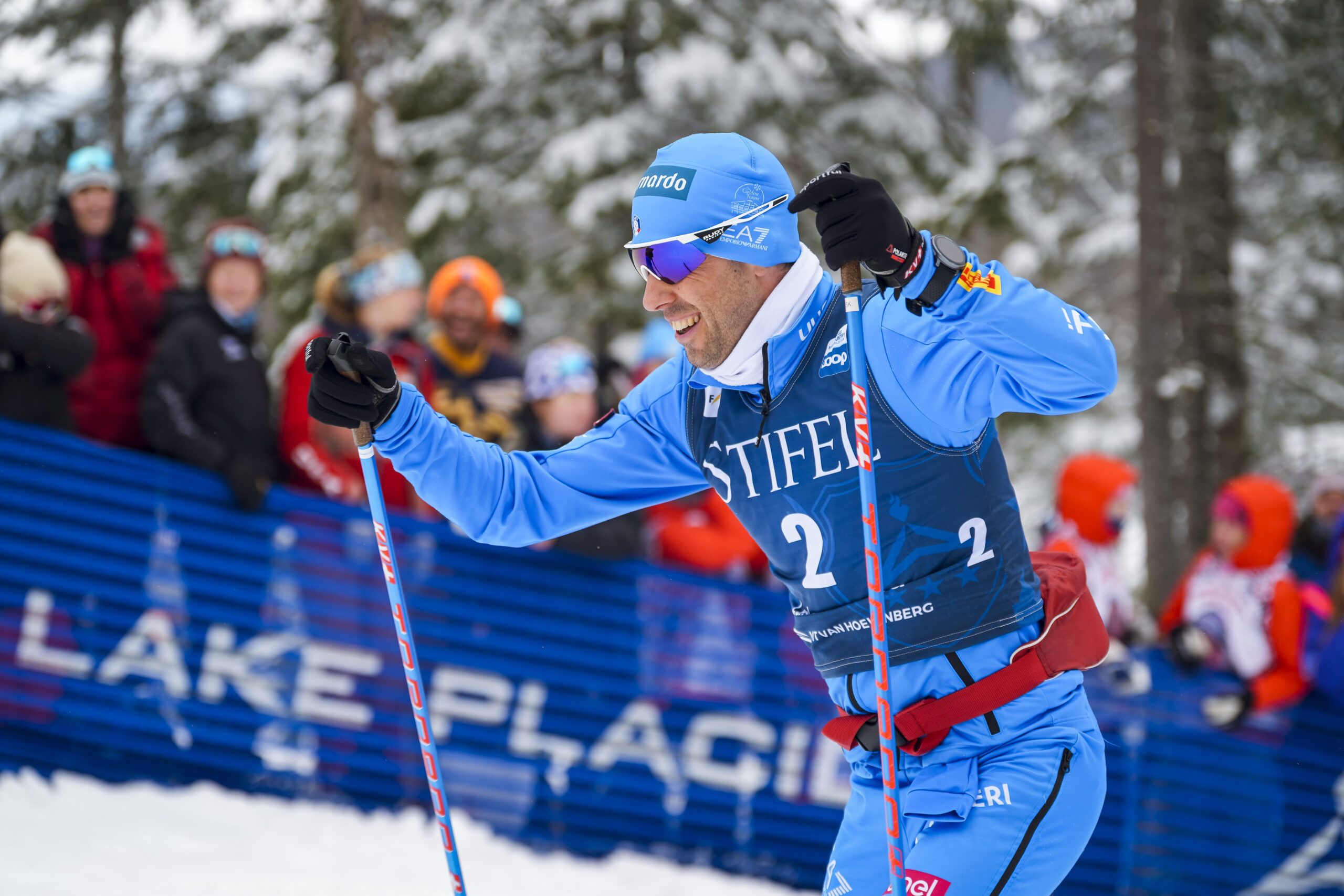
    Join the FasterSkier community!
    France (silver), Norway (gold),and Italy (bronze). National pride on the podium of the 4 x 7.5 k Relay. (Photo: Barbieri/NordicFocus)
  • Olympic Preview, Sort Of—USA Third in Goms Team Sprint

    Olympic Preview, Sort Of—USA Third in Goms Team Sprint

    This coverage is made possible through the generous support of Marty and Kathy Hall and A Hall Mark of Excellence Award. To learn more about A Hall Mark of Excellence Award, or to learn how you can support FasterSkier’s coverage, please contact info@fasterskier.com.

    It was a good day at the office, a stunning office, for Ben Ogden (USA) in Goms, Switzerland. (Photo: Authamayou/NordicFocus)

    For the skiing stars of Norway, World Cup victories are commonplace—almost expected. For the skiers of most other nations, any World Cup podium appearance is a career-defining event. That said, some of the most interesting World Cup racing takes place on those days when the strength of the field is re-shuffled, when a few notables stay home, when a few teams re-arrange their rosters. Those are days when World Cup podiums will still be filled, and a greater number of teams know they can rise to that occasion. Still, it’s not a straightforward task, and many teams find themselves stumbling over the challenge rather than rising to the top. Today was a day that the USA saw this opportunity, and rise they did . . .

    Norway may have won today’s Team Sprint (though with Harald Oestbeg Amundsen and Einar Hedegart are a team that’s unlikely to contend for this same win when the Olympics begin in Val di Fiemme), and Italy may have flown second across the finish on the wings of Federico Pellegrino (a performance he would hope to repeat in front of his countrymen in the Olympics), but it was the third-place effort of Team USA’s Ben Ogden and Gus Schumacher that really drew attention. The circumstances of the day offered them an opportunity to ascend to a World podium; they grabbed that opportunity with both hands. It’s great to see American men on World Cup podiums, even greater to see them earn that position with such fortitude and skill.

    “Today was a pretty full field,” said Ogden. “But there was no Klaebo today. There definitely will be Klaebo in Val di Fiemme. I’m sure that some teams will put up different athletes on their Team Sprint than they did today, but it’s really one of those things that’s not worth dwelling on until the time comes to actually seethe start list, to go out and get it done.”

    The day started with Gus Schumacher (USA) having a great qualification for the Team Sprint in Goms, Switzerland. (Photo: Authamayou/NordicFocus)

    The Alpine municipality of Goms, Switzerland (population 1,160) was the venue for a staging of an event that will take place in the Olympic Games in Val di Fiemme—the Freestyle Team Sprint—but today’s race was not exactly a dress rehearsal for that Olympic race. Specifically, the cast of characters is likely to change in the Olympics even as the strategy employed by today’s winner, Team Norway, is likely to remain the same. They’ll set the pace, they’ll stay at the front (and out of trouble). They’ll accelerate in the penultimate leg. They’ll hope to give Johannes Hoesflot Klaebo a lead at the beginning of the anchor leg. They’ll rely on Klaebo to remain unbeatable in any Freestyle Sprint where he enters the finishing straightaway with a lead. We really do expect this Olympic event to follow that script. Even so, many questions remain. Who will team with Johannes Hoesflot Klaebo in what is likely to be the gold medal favorite team? And who will the USA field as its Team Relay pair? Will Schumacher team with Ogden? Or will coaches choose another combination of abilities? Will Pellegrino and Elia Barp continue to be factors in the finishing straightaway? And which other teams will arrive with hopes of a medal: Finland? Switzerland? Sweden?

    “If history is any indicator, then Norway leading and everyone else following will likely (repeat as a strategy) at the Olympics,” said Ogden. “Val di Fiemme is definitely a harder course, so I anticipate it being something like that. Championship Team Sprints are definitely intense; it’ll have some similarities to today, and probably many differences.”

    Individual qualifying saw USA 1—comprised of likely Olympic teammates Ben Ogden and Gus Schumacher—as the third fastest qualifier. They would be joined in the 15-team Final by USA 2’s JC Schoonmaker and Zanden McMullen (who would finish 11th on the day).

    Home-team, Switzerland 1, was the top qualifier thanks to the efforts of seasoned Sprint competitors Janik Riebli and Valerio Grond (though packing a Team Sprint team with a pair of true sprinters is usually not considered to be the best way to excel in this event—Switzerland 1 would top all qualifiers, but would finish sixth on the day). Switzerland’s fast qualifying standard was followed by Norway 1’s Harald Oestberg Amundsen and Einar Hedegart, both of whom were recently named to the Norwegian Olympic team, but neither of whom are likely to appear in this event in Milano-Cortina. Fourth fastest qualifier was Italy 1’s Elia Baro and Federico Pellegrino who are likely to team up when the Olympic Team Sprint takes place in their homeland.

    Ben Ogden (USA) also had an excellent qualification for the Team Sprint – together with Schumacher, they posted the third-fastest time. (Photo: Authamayou/NordicFocus)

    A Plan to Follow—Easier Said than Done

    For some teams, Goms’ Team Sprint was an Olympic dress-rehearsal, for other teams, a consolation prize. Norway 1 had the potential to take a World Cup win, but they will certainly NOT be the Olympic duo that Norway fields in this event (that spot being reserved for Johannes Hoesflot Klaebo and (presumably) his gold medal partner from Beijing, Erik Valnes). Norway 2 was comprised of Ansgar Evensen and Even Northug, two of the world’s best sprinters who, nonetheless, found themselves overlooked when Norway selected its team of Olympians. While the skiers of Norway 2 may have hoped to prove that they belonged on the Olympic Team, their efforts fizzled in Goms. Norway 2 would place 15th, last among starters in the Team Sprint final.

    Norway 1, on the other hand, performed as expected. Amundsen led out Leg 1, keeping the pace high and keeping himself out of trouble. He was followed by Riebli, Barp, and Ogden. Ogden tangled skis briefly with Barp as they entered the exchange, but both skiers shook it off masterfully. Norway 1 continued to lead.

    Norway kept the pressure on to keep things stringed out. (Photo: Authamayou/NordicFocus)

    Ogden tagged Schumacher to begin Leg 2. Schumacher seems a logical choice to team with Ogden in the Olympic Team Sprint, a pairing suggested by the tactic of pairing a sprinter with a seasoned, fast-skiing all-rounder who can navigate in a tight pack and not get dropped. American Olympian, Jack Young, is a world-class freestyle sprinter, but even though it’s called the “Team Sprint,” there’s no use in fielding a team of two pure sprinters. The only sprint that matters is the one to the finish line at the end of the final leg. Before then, each teammate’s job is simply to steer clear of trouble, to hang on to the pace, and to not get dropped. More than perhaps any of his US Olympic teammates, Schumacher fits that bill.

    “The first leg was pretty chill,” said Schumacher. “I found myself a little far back after our tag, but made a good move on the fast corner.”

    “The second leg was pretty fast,” Schumacher continued. “But we still had a group, so it wasn’t too bad. We held the gap to Norway, which is good. Norway was definitely trying to string everyone out. They were really impressive, but we’re not far off. And I think. if the right person was in a good position, they probably could have held that. With Norway, that’s something to think about for the future.”

    Schumacher knows his role, and in Goms’ Team Sprint he skied it brilliantly. Through Leg 2, he remained in contact, preserving energy as Norway 1’s Hedegart set the pace at the front followed by Switzerland’s Grond and Sweden’s Edvin Anger. Leg 3 began with no changes in leaders, and with Ogden remaining solidly in contact with the top five. Amundsen continued to set the pace for Norway followed by Riebli and Barp.

    Einar Hedegart (NOR) clearly was racing with something to prove to the Norwegian team coaches about his place in the Olympic Team Sprint with Johannes Hosflot Klaebo. (Photo: Authamayou/NordicFocus)

    Leg 4 saw Hedegart stringing out the pace while Schumacher continued to mark the skiers at the front. The field began to string out, with Schumacher keeping USA 1 in contention.

    Leg 5 is where the field expects Norway to make a move; Amundsen did not disappoint, storming off the front even before the field had left the flat terrain around the exchange zone. By the time he reached the course’s first uphill, Amundsen enjoyed a lead of 30 meters. Rather than chase him in vain, the chase group—led by Barp—sat up a bit to preserve energy. Norway had earned a gap as Amundsen tagged Hedegart to begin the anchor leg. The rest of the field would fight for second and third.

    The way the Americans set up today’s relay team—with the sprinter, Ogden, leading off and the all-rounder, Schumacher, finishing—showed that Team USA may realize that the Olympic version of this event will NOT come down to a finishing line sprint, but to a final-leg high-speed dash that sheds sprinters and leaves all-rounders leading the way to medals. This may be the scene in a few weeks—Schumacher dueling Pellegrino in the final leg. If so, then today was a bit of a dress rehearsal after all. On the first of the final leg’s two uphills, Schumacher tried desperately to cross the gap to Amundsen. It was a bold ploy, but one that a fast distance skier needed to try in order to shake Pellegrino. Pellegrino shadowed Schumacher, but seemed to struggle in doing so. Over the second uphill, and Pellegrino struggled again under Schumacher’s re-application of pressure . . . but in order to beat a sprinter you need to drop a sprinter.

    Gus Schumacher (USA) kept the pressure on, leading the chase group behind Norway. (Photo: Authamayou/NordicFocus)

    Ahead of them, Hedegart show-boated playfully at the finish line, taking off his poles and sheathing them like a sword after a successful duel. Pellegrino undid Schumacher in the finishing straightaway—a cagey veteran having played his hand with seasoned mastery. Schumacher shrugged across the finish line in third, having done all he could to lengthen the sprint in an attempt to take the sting out of Pellegrino’s sprint.

    “Pellegrino is a super strong sprinter,” said Schumacher.” Today, he basically made me pull through. I didn’t want to mess around with a big bunch sprint, and I’m glad I didn’t. I’m fine with him beating me in the end. But, yeah, we’ll see how it plays out in Val di Fiemme. I think I can beat him if I can get a good draft. We’ll see; you need drop him before the finish line. I guess you just have to go faster! But he’s also a great distance skier, so that’s a tough one.”

    “Having Gus in the second leg felt good for me,” said Ogden. “He’s really good at positioning, and super strong and fit, and he’s going to have legs at the end when it matters . . . Today was just to try something and learn from it. I think that we thought it was a natural thing to try. We went with it today, and it worked out well.”

    After all the strategizing, all the jockeying, all the surging, all the positioning, it’s a skier like Pellegrino—a world-class sprinter who can also contend in distance races—who is the ideal finisher for a Team Sprint. Approaching the Olympic Team Sprint in his home country—and hoping for a gold medal in front of his countrymen—Pellegrino still has one major obstacle to overcome: Klaebo is the one skier who has proven to be even faster, even more durable than Pellegrino. If the Italian wants to claim gold on home turf, he’ll need to beat the best of all time in order to do it . . . but that will be the same for any skier who hopes to claim gold in any event when the Olympic races are run in Val di Fiemme.

    Gus Schumacher (USA) and Ben Ogden (USA), (l-r) proved they are true contenders for a medal in the Team Sprint at the Olympics. (Photo: Authamayou/NordicFocus)

    While the cast may be different when this event is staged at the Olympics of Milano-Cortina, the script is likely to be strikingly similar. If so, then Team USA will be there hoping. To recreate the tactics, the speed, the strength, and the brilliance that took them to a third place finish today in Goms. Ironically, today’s Norwegian winners are not likely to be offered the chance to pursue Olympic gold in this same event. When asked whether he thought this dominant performance ahead of numerous teams likely to contend in this event in Val di Fiemme could cause Team Norway to reconsider their starters in the Olympic Team Sprint, Hedegart was playful, yet again.

    “Message sent,” grinned Hedegart. “I hope the message is received.”

    Chance of Hedegart becoming the face of Team Norway in season’s to come? Quite high, it appears. Chance of Hedegart replacing Valnes (as Klaebo’s teammate) in Norway’s Olympic Team Sprint? Far less likely . . . but much could happen between the World Cup finish line in Goms and the Olympic starting line in Val di Fiemme.


    Goms World Cup Men’s Freestyle Team Sprint QUALIFYING

    Goms World Cup Men’s Freestyle Team Sprint RESULTS


    Help Support Our Olympic Coverage!

    FasterSkier will have our own Nat Herz on the ground at the Olympics, which, to be honest, is a very big financial lift for us. If you value the thoughtful work and access FasterSkier provides at championships like this one, please consider becoming a Voluntary Subscriber. Your support directly fuels the work we do to cover the people, places, and moments that make our sport special.

    Join the FasterSkier community!


    Federico Pellegrino (ITA), Elia Barp (ITA), Harald Oestberg Amundsen (NOR), Einar Hedegart (NOR), Gus Schumacher (USA), Ben Ogden (USA), (l-r) share the Team Sprint podium in Goms, Switzerland. (Photo: Authamayou/NordicFocus)
  • Fire, Ice, and Belief: Two Vermonters Deliver Under the Lights in Davos

    Fire, Ice, and Belief: Two Vermonters Deliver Under the Lights in Davos

    This coverage is made possible through the generous support of Marty and Kathy Hall and A Hall Mark of Excellence Award. To learn more about A Hall Mark of Excellence Award, or to learn how you can support FasterSkier’s coverage, please contact info@fasterskier.com.

    The lights come on early in Davos, not because they are needed, but because Davos wants them on. By mid-afternoon, the valley is already sliding toward dusk, the alpine light thinning and flattening, and the sprint venue leans into the moment the way it always has: music turned up, cowbells ringing with a little extra insistence, flames licking the edges of the course like stage cues. The effect is deliberate. This is not cross-country skiing as a quiet endurance ritual in the woods; this is cross-country skiing as spectacle.
    “Davos deliberately designs this event to feel like a rock concert,” U.S. head coach Matt Whitcomb said afterward. “They race at night, they bring in fire and lighting and music, and because it’s a two-lap course, you see the athletes twice as much. They invest in the experience, and it pays off.”
    Jack Young (USA) on his way to a fast qualification in Davos (SUI). (Photo: Modica/NordicFocus)
    On Saturday night, it paid off in a men’s freestyle sprint that delivered one of the most compelling American performances in years. Jack Young finished fourth, Ben Ogden fifth — the first time two American men had made a World Cup sprint final together in Davos — on a night when the script cracked open early and never fully resealed. Johannes Høsflot Klæbo was gone before the semifinals. A notoriously slick downhill corner became the day’s silent antagonist. And by the time Lucas Chanavat lunged across the line to win by three hundredths of a second, the story had already shifted: the U.S. men were no longer visitors to the sprint final. They were participants, with opinions about how it might have ended differently.
    For Young, the fourth-place finish marked his first World Cup sprint final — a breakthrough that felt less like a surprise than a confirmation. “This result means so, so much,” he said. “It really feels like proof that I can make it to the top in this sport. If I’d told myself three years ago that I’d finish fourth in a World Cup sprint, I would have thought I was insane.”
    Ben Ogden (USA) during qualification in Davos (SUI). (Photo: Modica/NordicFocus)
    A course that punishes impatience
    Davos is not a long sprint, but it is not a forgiving one. Two laps of just under 600 meters pack in a decisive climb, sustained skating tempo, and — this year especially — a downhill corner that demanded respect. The snow was entirely man-made, hard and fast, and as the temperature dropped through the evening, it glazed into ice. Athletes began to talk about the corner not as a feature, but as a test.
    “That bottom corner was particularly dicey this year,” Whitcomb said. “Man-made snow turns to ice quickly, and that corner claimed a lot of people over the last couple of days.”
    Ben Ogden felt it more than once. “That last corner was really the focus,” he said. “I fell there yesterday, JC fell there in practice, and I stumbled twice in the final and ended up against the boards. It was unfortunate, but every year you learn a little more about how the ice forms there.”
    The corner changed the race’s outcome. The first time through, athletes skied it conservatively, prioritizing stability over speed. The second time, with fatigue setting in and the finish looming, choices became riskier — and more consequential.
    Janik Riebli (SUI), Jack Young (USA), and Lars Heggen (NOR), (l-r) during the heats in Davos (SUI). (Photo: Vanzetta/NordicFocus)
    Qualifying hints, early shocks
    The qualifying round suggested a familiar hierarchy, but with enough irregularities to hint that Davos might misbehave. Lucas Chanavat of France was fastest, Ben Ogden second, Klæbo third. Jack Young qualified sixth — an excellent position that put him squarely in control of his bracket.
    “That’s one of the best qualifying results we’ve ever had on the U.S. team,” Whitcomb said. “Qualifying in the top ten gives you options. It lets you race offensively instead of defensively.”
    Klæbo’s day began to unravel in the quarterfinals. Boxed in and forced wide through the downhill, he finished fourth in his heat and failed to advance. His 16-race sprint win streak ended not with drama, but with traffic — a reminder that sprinting, for all its stars, is still governed by physics and positioning.
    Ogden and Young both advanced cleanly. Ogden won his quarterfinal with authority. Young skied his with the composure of someone who knew exactly what he needed to do — no more, no less.
    Ben Ogden (USA) and the US Ski Team had a lot to celebrate in Davos (SUI). (Photo: Modica/NordicFocus)
    Semifinals: the Americans arrive together
    By the semifinals, the noise in Davos had sharpened. Chanavat advanced. Ogden advanced. And then Young did, stepping into his first World Cup sprint final with the kind of quiet efficiency that suggested the moment had not surprised him.
    “To be honest, the first thing that went through my mind standing on the start line was how tired I was,” Young said. “But I reminded myself that anything can happen in a sprint final. I don’t train just for qualifiers and quarters — I train for the full day. It was time to execute.”
    For Ogden, the significance of sharing the moment wasn’t lost. “Racing with Jack today was awesome,” he said. “He has this infectious confidence, especially here in Davos. Last year we were in the semifinals together, and this year we were in the final together. That’s a big step.”
    Whitcomb saw it as more than a statistical milestone. “To put two guys into the men’s final is a dream,” he said. “When athletes finish a race seeing the podium and knowing they can be on it, that’s when things start to get dangerous — in a good way.”
    Jack Young (USA) had every right to be celebrated after his breakout race today in Davos (SUI). (Photo: Modica/NordicFocus)
    The final: margins measured in inches
    The men’s final unfolded at full speed. Chanavat and Federico Pellegrino established themselves early, both reading the race the way veterans do — not forcing it, but shaping it. Oskar Opstad Vike of Norway positioned himself patiently, waiting for the moment when commitment would matter.
    Ogden and Young stayed connected. Coming into the final corner, Ogden had position. Young had momentum.
    “I was really gunning for that podium,” Ogden said. “I felt like I was pretty close. With fewer stumbles and maybe a little better positioning, I think I could have made it happen.”
    The corner had other plans. Ogden’s line took him over the ice and was forced wide, momentarily pinned against the boards. Young exited cleaner, carrying speed into the finishing straight.
    Chanavat and Pellegrino lunged together at the line, Chanavat winning by three hundredths of a second. Vike took third. Young crossed fourth, Ogden fifth — separated from the podium by seconds, but not by belief.
    “I finally feel like I can truly compete at the top,” Young said. “That’s a special feeling.”
    Results — Men’s Sprint Freestyle, Davos
    1. Lucas Chanavat (France)
    2. Federico Pellegrino (Italy)
    3. Oskar Opstad Vike (Norway)
    4. Jack Young (USA)
    5. Ben Ogden (USA)
    6. Edvin Anger (Sweden)
    Notables: Johannes Høsflot Klæbo (Norway), 17th, and JC Schoonmaker (USA), 27th.
    It has been a tough trail back to the top step on the podium for Lucas Chanavat (FRA) so he was extremely excited to be standing on it today in Davos (SUI). (Photo: Vanzetta/NordicFocus)
    What Davos leaves behind
    Davos has always been good at revealing things. It reveals how athletes handle altitude, manage nerves, and respond when a race refuses to go according to plan. On Saturday night, it revealed something else: American depth at the sharp end of a sprint final.
    Young talked about the atmosphere as something that lifts him. “With all the energy, it’s easy to trick yourself into thinking you’re walking into a big arena,” he said. Ogden talked about validation — not just from results, but from proximity. “My target in these races is the podium,” he said. “It feels good to know I’m getting closer.”
    Whitcomb, standing back from it all, saw the longer arc. “We’re in a really good place with these guys,” he said. “There’s a lot more to come.”
    The flames went out eventually. The music faded. Davos returned to being a quiet alpine town under an early winter night. But for the American men — and for two Vermonters who now know exactly what a World Cup sprint final feels like in tandem — something lingered.
    Not noise. Not spectacle.
    Belief.


    Men’s Individual Sprint Final RESULTS


    Love Stories Like This? Help Keep Them Coming.

    Feature stories like this one take time, access, and care to produce. If you value thoughtful storytelling and independent ski journalism, please consider becoming a Voluntary Subscriber. Your support directly fuels the work we do to cover the people, places, and moments that make our sport special.

    Join the FasterSkier community!


    Federico Pellegrino (ITA), Lucas Chanavat (FRA), and Oskar Opstad Vike (NOR), (l-r) on the sprint podium in Davos (SUI). (Photo: Vanzetta/NordicFocus)
  • Fast Tracks: World Champs—These Results are a Bonus for Federico Pellegrino

    Fast Tracks: World Champs—These Results are a Bonus for Federico Pellegrino

    This reporting costs money. Please support this coverage with a voluntary subscription (below) so FasterSkier can provide this level of access to the sport we all love year-round.

  • Klaebo Thrills Hometown Crowd with World Sprint Title

    Klaebo Thrills Hometown Crowd with World Sprint Title

    FasterSkier’s coverage of this week’s FIS World Championships stands as a proud tribute to American Skiing Icon Marty Hall, who (with his wife, Kathy Hall, and their A Hall Mark of Excellence Award) has generously supported our coverage of international cross-country ski events. To learn more about A Hall Mark of Excellence Award, please contact info@fasterskier.com. We’ll miss you, Marty. 

    Johannes Hoesflot Klaebo (NOR) won bronze in the Individual Sprint way back in 2017 in Lahti, Finland (where he also placed fourth in the Team Sprint). In each of the three FIS World Championships since then (2019, 2021, 2023), he’s won gold in both Sprint events as well as gold in the Team Relay (for a total of nine gold medals at World Championships). Combined with his silver and bronze medals at various championships, Klaebo enters Trondheim tied with Petter Northug (NOR) for most gold medals by a male skier in World Championship history and tied with the immortal Bjorn Daehlie NOR) for most total medals (12). With a win in the Sprint, Klaebo would distance himself from every other skier in history . . . but this isn’t even the medal Klaebo’s eventual immortality demands.

    Johannes Hoesflot Klaebo (NOR) racing on his home snow, on his home trails in front of the home crowd in Trondheim, Norway for the opening race of the 2025 FIS Cross-Country Ski World Championhips. (Photo: NordicFocus)

    Imagine this sort of pressure: you’ve won Sprint, Team Sprint, and Relay for the last few World Championships and Olympics, so naturally you’re expected to win those again. Three more gold medals—the sort of haul that grants Nordic skiing immortality to any who could achieve it—yet that’s not nearly enough to satisfy your fans and countrymen. Klaebo is constantly reminded that he’s never won an individual Distance medal at World Championship or Olympic events (though he came breathtakingly close when he crossed the finish line first in the 2021 World Championships 50 k Mass Start, only to be disqualified for interfering with Alexander Bolshunov (RUS) in the final meters). Klaebo has won plenty of individual World Cup races—interval starts, skiathlons, mass starts, pursuits—but he’s never been able to deliver an individual distance win on the very biggest stages. Trondheim is his hometown; he’s determined to do better here, even to the point that an Individual Distance medal may be even more important to him than the Sprint, the Team Sprint, or the Relay. But, to be honest, failing to win any of those would be a bitter disappointment and would certainly supply the gold-hungry Norwegian media with ammunition to lob at him from yet another angle. The only way for Klaebo to win, is to win.

    Federico Pellegrino (ITA), and Johannes Hoesflot Klaebo (NOR), (l-r) enter the homestretch during the finals of the freestyle sprint. (Photo: NordicFocus)

    And win he did—showing the easiest speed, the greatest endurance, the most clever tactics, and the fastest skis. Klaebo drove up the final hill, rocketed down the other side, negotiated the final slush-filled turn, and cruised up the finishing straightaway ahead of an ecstatic Federico Pellegrino (ITA) and Lauri Vuorinen (FIN).

    “It was a lot of nerves, that’s for sure,” Klaebo said. “I’m just glad we’re done with it now, to be honest. So, I’m really satisfied. Tussen Takk, Trondheim!”

    All four Americans—Ben Ogden, Gus Schumacher, JC Schoonmaker, Jack Young—qualified for quarterfinal heats amid Trondheim’s deafening atmosphere that Ogden, described as crazy. “Norway knows how to throw a ski race, I’ll tell you that.” Ogden grinned. “I was nervous for this one, so I’m happy to be getting going. I’m gonna try and ski smart, ski hard, leave it all out there.”

    Ben Ogden (USA, during the quarterfinals) drove the pace during his semifinal heat with the hope of setting a fast enough time that four athletes would qualify from the second heat to advance to the final. Thanks to Ogden, that is just what happened, but unfortunately, he ran out of gas with mere meters to go, ultimately crossing the line in sixth place in his heat and 12th place overall. (Photo: NordicFocus)

    Ogden and Schumacher raced a tactical quarterfinal (won by Northug), with Ogden managing to win the boot throw at the line for the final qualifying spot. Schumacher never managed to develop the speed necessary to contend in the heat. He’d finish 27th on the day.

    JC Schoonmaker and Jack Young finished fourth and fifth in their quarterfinal. They’d finish the day in 15th and 18th, respectively.

    Among Canadians, Pierre Grall-Johnson was 36th, Graham Ritchie 48th, Xavier McKeever 51st, and Sasha Masson 54th.

    JC Schoonmaker (USA) put it out there to finish the individual sprint in 15th place at the World Championships in Trondheim (NOR).
    (Photo: NordicFocus)
    Men’s Sprint

    FasterSkier’s Devon Kershaw considered the Trondheim Sprint course in pre-race interviews, describing Klaebo’s chances of mastering it. “An athlete like Klaebo, for example, has every tool in the toolbox,” Kershaw said. “I don’t think it really matters; there’s no real crucial point. But, of course, this big right-hander into the finishing stretch is incredibly crucial. You have to carry a lot of speed and stay on your feet. It’s going to be an exciting competition.”

    Joining Klaebo on the Norwegian Sprint team were Matz William-Jenssen, Even Northug, Haavard Solaas Taugboel, and Ansgar Evensen. Erik Valnes (NOR) finished second in the most recent World Cup Sprint and stands second in the season-long World Cup Sprint standings, but withdrew with a back injury prior to the start of competition in Trondheim. Everybody else was here, all the hungriest World Cup contenders—the French, the Swedes, the Germans, the Italians, the Finns, the Austrians, the Americans—but it definitely looked to be Norway’s finishing order to sort out. There were six spots available in the Sprint Final, five Norwegians entered, and only three medals to hand out. Something had to give.

    Johannes Hoesflot Klaebo (NOR) charging up the climb in front of the home fans. (Photo: NordicFocus)

    As it turned out, what gave—at least a little bit—was Norway. Valnes’s withdrawal put Jenssen in the lineup, but Jenssen got tangled in his quarterfinal and was eliminated. Taugboel skied a lackluster quarterfinal without ever being a factor. Northug was able to advance through the quarterfinal, but only by making a Kamikaze dive into the final right-hand turn before the finishing straight.

    Predictably, Klaebo cruised brilliantly through his quarterfinal heat, showing the savvy tactics and fast skis that have always epitomized his Sprint performances. Pellegrino had a difficult time weaving his way through his quarterfinal but showed his blazing speed in the finishing straightaway to win the heat and advance to the semifinals. Edvin Anger (SWE) entered the World Championships ranked third in World Cup Sprint standings, but he raced carelessly in the quarterfinals and only advanced to the semifinal as a lucky loser.

    Federico Pellegrino (ITA), pulling away from Even Northug (NOR) and Richard Jouve (FRA) on the home stretch of their semifinal, found the fitness of years past today in Trondheim. (Photo: NordicFocus)
    Semifinal

    Semifinal 1 featured Pellegrino facing Klaebo, Northug, and Anger (who had only narrowly avoided elimination in the quarterfinals). Klaebo skied flawlessly, conserving energy as he cruised to a semifinal win ahead of Pellegrino. Jules Chappaz (FRA) claimed a lucky loser spot. Northug struggled to fifth while Anger—who never looked sharp—ended his day sixth in the semifinal.

    Ogden moved toward the lead of Semifinal 2, where he was joined by Lucas Chanavat (FRA). Ogden opened up the pace on the significant uphill section, only to find his skis overtaken on the final downhill by Lauri Vuorinen (FIN) and Chanavat. An errant pole plant in the final straight dropped Ogden to sixth while Vuorinen and Chanavat advanced.

    Ben Ogden (USA) struggled to keep his balance down the final hundred meters after pushing the pace so hard earlier in the semifinal. Ultimately Ogden would finish in 12th place overall. (Photo: NordicFocus)
    Men’s Sprint Final

    It must have felt a bit strange to Klaebo, being the only Norwegian in the Sprint Final. If it bothered him at all, he didn’t show it. Choosing the far-left start position all day, Klaebo moved quickly to the front in order to control the early pace. Pellegrino matched his speed, with Chanavat following. The fatigue of the day seemed to take its toll on the racers, as what appeared to be a moderate pace still managed to stretch out the field. Klaebo coasted to the front on every downhill, followed by a stubbornly determined Pellegrino. They crested the final uphill in that order, using the subsequent downhill to repeatedly check the positioning of their pursuers. Klaebo crossed the finish, punching the air to celebrate his first gold of these championships. But it appeared that the greatest elation at the finish line belonged to Pellegrino, who seemed almost overcome by his silver medal effort. Vuorinen outsprinted Chappaz for third.
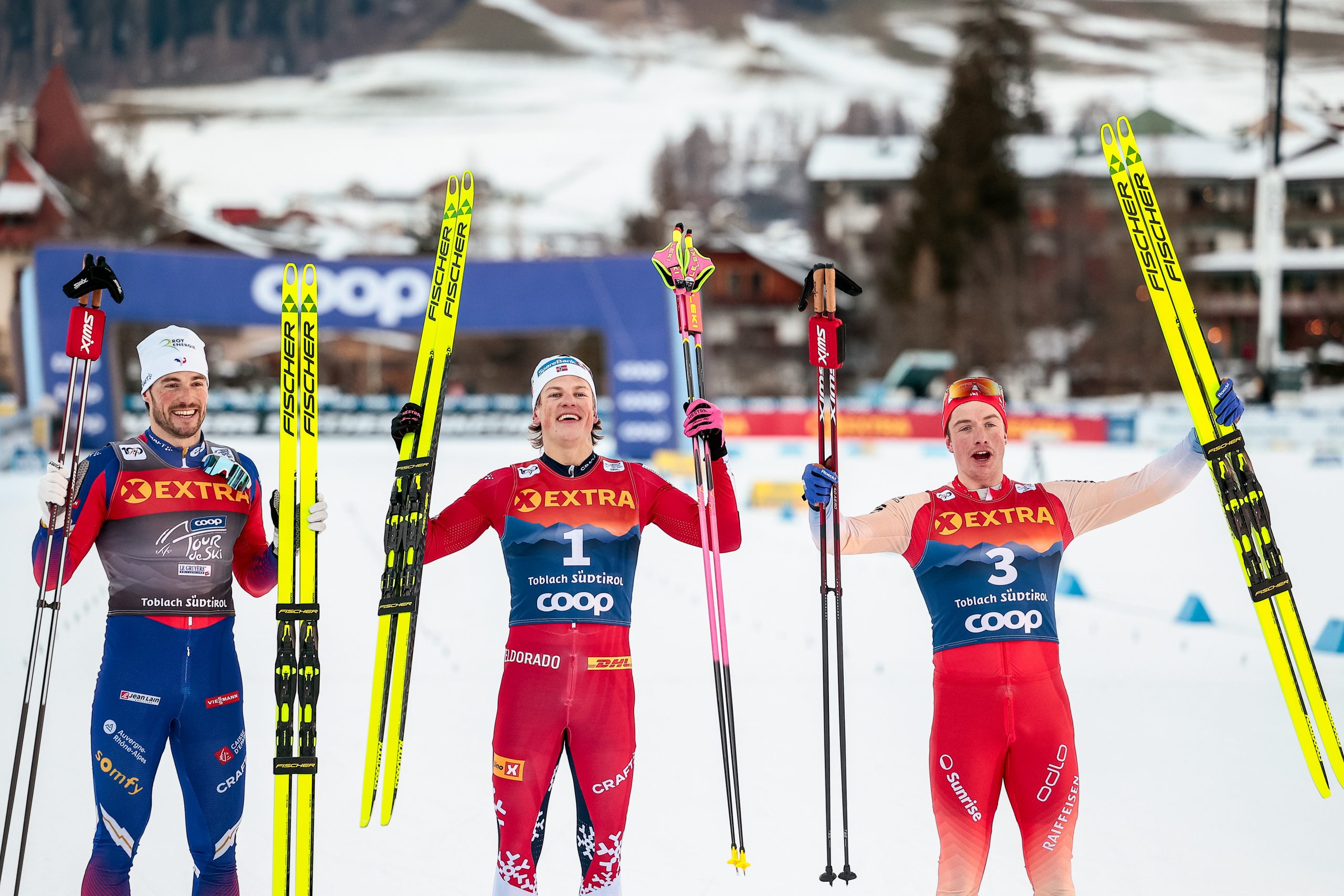
    Federico Pellegrino (ITA) may have been the happiest person in Trondheim, Norway after finishing the individual sprint in second place. (Photo: NordicFocus)

    The ovation of the Norwegian crowd lasted long after the skiers had crossed the line . . . and there are still plenty of races yet to run.

    “I’m out of words,” Klaebo said. “I mean, look at the spectators . . . it’s way different from what we are used to. This is how we do it in Trondheim . . . It’s amazing.”

    Projecting toward the upcoming Skiathlon—and the possibility of ending his own World Championship distance-racing drought—Klaebo said, “Come back on Saturday. It’s gonna be fun.”

    FIS World Championships Men’s Freestyle Sprint RESULTS

    Men’s Sprint QUALIFYING

    Federico Pellegrino (ITA), Johannes Hoesflot Klaebo (NOR) and Lauri Vuorinen (FIN) (l-r) take the Freestyle Sprint podium at the 2025 FIS Cross-Country Ski World Championships in Trondheim (NOR). (Photo: NordicFocus)

    – – – – – – – – – – – – – – – – – – – – – – – – – – – – – – – – – – – – – – – – – –

    Our ski boots on the ground coverage was provided by Nat Herz, Stuart Harden, and Aidan O’Connell.

    This reporting costs money. Please support this coverage with a voluntary subscription (below) so FasterSkier can provide this level of access to the sport we all love year-round.
    – – – – – – – – – – – – – – – – – – – – – – – – – – – – – – – – – – – – – – – – – – –

  • Ogden Battles Through Broken Pole in Final As Klaebo Wins Tour de Ski Stage 1

    Ogden Battles Through Broken Pole in Final As Klaebo Wins Tour de Ski Stage 1

    The 19th edition of the Tour de Ski is here once again! While many athletes have taken a conservative start to the season, skipping early races to focus on preparations for the World Championships in Trondheim later this winter, the excitement for the Tour remains high. With seven stages packed into just nine days — and rest days on Monday and Thursday — the Tour has historically seen relatively few skiers complete the entire event. However, many of the sport’s top athletes hope to compete all the way through, chasing bonus points and the opportunity to solidify their positions as World Cup leaders in this important week of racing.

    The Tour kicks off in Toblach, Italy, with a skate sprint as the opening event. The first four races will take place in Toblach before athletes transition to Val di Fiemme for the final three races on Friday, Saturday, and Sunday, marking the Tour’s conclusion.

    This course demands sharp strategy, precise lines, and well-timed pacing to finish in the front of each heat. Athletes must not only position themselves effectively on the uphills but also navigate the downhills skillfully, taking optimal lines to slingshot themselves around both the trail’s corners and their competitors. Completing two laps on this challenging course requires a careful balance of power and tactics. With the finishing stretch emerging from a downhill turn, positioning becomes crucial long before the finish line itself.

    Johannes Hoesflot Klaebo (NOR) with his trademark coast into the finish of the individual freestyle sprint in Toblach (ITA). (Photo: NordicFocus)

    The heats followed a familiar marching pattern to those we’ve already seen this season: with Johannes Hoesflot Klaebo (NOR) and Lucas Chanavat (FRA) skiing synchronously at the start of each heat to control pacing and claim podium positions together. Janik Riebli (SUI) followed closely behind, slipping into the final as a lucky loser, with the road paved to a podium position after competitors Ben Ogden (USA) broke a pole and Valerio Grond (SUI) slipped during the final ascent. Klaebo earned, in what appeared to be an easy win, his 95th sprint victory. “In the end, I’m really satisfied, and it’s the perfect way to start the tour,” he said upon finishing the race. 

    Four Americans advanced to the heats, with Ogden finishing 6th, Gus Schumacher, 10th, JC Schoonmaker, 14th, and Jack Young, 17th. Zanden McMullen just barely missed qualification, finishing 36th. On the Canadian side, Antoine Cyr (56th) and Olivier Leveille (60th) completed the race but did not qualify for the heats.


    Men’s Sprint Quarterfinals

    In the first heat, Klaebo and Chanavat dominated from the start, skiing side by side in a controlled performance that seemed almost choreographed, easily securing their spots in the semifinal heats. Other athletes vied for these positions, Emil Danielsson (SWE) tried to pass through the middle of Klaebo and Chanavat, who accelerated and maintained their position in front. French skier Remi Bourdin also approached the pair in front over the final ascent around two minutes into the race, though could not surpass Chanavat and finished third in the heat. 

    In the second quarterfinal heat, Ogden battled Riebli head-to-head for the leader position, both holding off sprint specialist Richard Jouve (FRA). The two exchanged leads throughout the race, with Ogden making a decisive move around the inside of the final turn. This maneuver set him up for a clear finishing sprint, allowing both Ogden and Riebli to advance together to the semifinals.

    Schumacher took an early lead in the third heat, facing challenges from Niilo Moilanen (FIN) and Davide Graz (ITA). After a minute and a half, Schumacher was able to solidify himself in front, accelerating through the descent to establish a small gap ahead of the field. His competition narrowed again in the final stretch, though Schumacher maintained his position in front to advance to the semifinals alongside Moilanen. Meanwhile, Evan Northug’s race took an unfortunate turn as he broke a pole just out of the gate, forcing him to pull to the side of the trail and effectively ending his chances of progressing. Currently ranked 3rd in the overall sprint standings, Northug is a strong sprinter, but this setback could jeopardize his Tour prospects, especially given his relatively weaker performances in distance disciplines.

    Federico Pellegrino (ITA), front, Edvin Anger (SWE), left, and Jack Young (USA), right, lead their quarterfinal heat. (Photo: NordicFocus)

    Young battled against Federico Pellegrino (ITA), 12 years his senior, in the fourth quarterfinal together with strong sprinters Edvin Anger (SWE) and Erik Valnes (NOR). Valnes established an early lead out of the start, joined by Pellegrino. Midway through the race, Anger accelerated into the lead, but the top three continued to trade positions as the heat progressed. Young stayed right in the mix, maintaining a strong position near the front of the pack.

    “I started as hard as I could and put myself in position near the front of the heat. After that, there wasn’t much I could do to get around Pellegrino or Anger,” Young explained. After being boxed out in the inside of the finishing stretch, Young’s chance of qualification was low but chances at a lucky loser position seemed high, ultimately missing qualification by 0.3 seconds. “The only thing I’m wondering about is whether I could have swung out wide on the turn into the finish instead of checking my speed to get the inside,” Young reflected after the race, “that could have given me the three-tenths necessary to get a lucky loser spot.” 

    Finally, Valerio Grond controlled the pace of quarterfinal five through much of the race, battling closely against Finland’s Lauri Vourinen. Italy’s Giovanni Ticco briefly challenged Grond for the lead initially but soon fell back, ultimately finishing last in the heat. Meanwhile, Schoonmaker stayed in the middle of the pack, focusing on “bringing good momentum into hills,” and positioning himself strategically to contest the leaders in the final sprint. Although he crossed the line in third, initially appearing poised to advance to the semifinals as a lucky loser, subtle time adjustments narrowly eliminated him from contention.


    Men’s Sprint Semifinals
    Johannes Hoesflot Klaebo (NOR), Lucas Chanavat (FRA), and Ben Ogden (USA) racing out of the stadium. (Photo: NordicFocus)

    A quick look at the start list made it evident which semifinal was likely to produce the fastest times—and from which the lucky losers would emerge. Klaebo and Chanavat were set to face off again in the first heat, joined by Ogden, Riebli, and Valnes, all formidable sprinters capable of pushing Klaebo to reconsider his race strategy.

    The heat unfolded precisely as would be expected, mirroring the quarterfinals.  Klaebo and Chanavat led the pack side by side, skillfully controlling the pace around the course before Klaebo pulled ahead to take first at the line. Ogden positioned himself right behind them, confident that the speed of this heat would give him a chance at entering the final as a lucky loser. Ogden raced confidently and quickly, taking tight lines around the course and crossing the finish line in third, just behind Chanavat in second. The real drama came down to Ogden and Riebli, sprinting neck and neck to the finish, successfully securing lucky loser positions.

    The second semifinal lacked a clear favorite, leaving the top two positions wide open for the competitors to claim. Richard Jouve and Federico Pellegrino both have a strong history in skate sprints, while Valerio Grond has recently delivered impressive results in the freestyle sprint discipline. Meanwhile, Anger, Vuorinen, and Moilanen have consistently been contenders in sprint finals this season.

    Ultimately, this semifinal—perhaps aware that the lucky loser spots had already been secured by the first heat—turned out to be one of the slowest of the day. With six skilled sprinters, strategic positioning within the pack became the decisive factor in determining who would advance. Grond skied steadily from the start, moving into the lead later in the short race. In a close finish, Jouve narrowly edged out Pellegrino to claim the second qualifying spot for the final.


    Men’s Sprint Final

    Again, Klaebo and Chanavat took an early lead, executing their well-rehearsed, almost synchronized strategy to control the pace of the heat before battling it out at the finish line—a contest Klaebo typically wins.

    While their dominance played out as expected, the race for the top three positions took an unexpected turn. Ogden broke a pole early on, losing contact with the leaders as they rounded the first corner. Moments later, Grond’s skis slipped on the uphill through the stadium, causing him to fall and take Jouve down with him. With three competitors effectively out of contention, Klaebo and Chanavat remained unchallenged at the front while Riebli skied through the chaos to contend for the third podium position. 

    Johannes Hoesflot Klaebo (NOR), right, and Lucas Chanavat (FRA), left, congratulating each other after the races. (Photo: NordicFocus)

    Ogden recounted the chaotic events of the final to FasterSkier after the race. “I was trying to weasel in behind Lucas [Chanavat], and someone behind me wasn’t thrilled about that,” Ogden reported, describing the battle for position that ultimately led to his pole snapping. “I was kinda able to ski with one pole, but then the exchange was incredibly hectic, and I tripped myself twice, and there was little to no hope after that.” Once Grond fell too, the two of them competed head to head for the remaining positions. 

    Despite the disappointing result, Ogden found pride in his approach to the heats. “I’m most proud of my confidence today in the heats,” he shared. “I was more nervous today than I’ve been for a while because I’ve got some memories.” He was referring to his breakthrough performance last season, which included his first-ever sprint podium on the Toblach course. “I feel like I handled it really well—skied smart and never got too frantic. It’s an unfortunate way to end after all that work, but what can you do? It’s part of the deal.”

    As for Klaebo, his victory came as no surprise, continuing his dominance in sprint racing this season. While another win may feel routine for the seasoned sprinter, Klaebo expressed excitement with his performance. “In the end, I’m really satisfied. It’s the perfect way to start the Tour,” he said with a smile. 

    With only Stage 1 of the Tour completed, Ogden is focused on the long week ahead. “My goals are to manage my energy as best as I can and make it all the way to the end!” he said, with his eyes on the Leader Bib. For now, fans can expect him to prioritize recovery, fueling for the upcoming races, and finding lighthearted distractions like browsing “clapped Jaguars and Porsches on eBay” to unwind between events.

    Men’s Freestyle Sprint Results

    Tour de Ski Overall Standings

    Lucas Chanavat (FRA), Johannes Hoesflot Klaebo (NOR), Janik Riebli (SUI) topped the podium in Toblach Tour de Ski Stage 1. (Photo: NordicFocus)


  • The Devon Kershaw Show: Winding down 2024 in Norway, with guest Sam Hendry

    The Devon Kershaw Show: Winding down 2024 in Norway, with guest Sam Hendry

    Long distance in Oslo, city sprints in Drammen. The World Cup takes its late-season swing through Norway and Devon and Nat have a full breakdown, with special guest Sam Hendry, a Canadian athlete who’s had some standout results late this season.

    We’re sprinting to the finish of the 2024 podcast season. Send your long-shot requests for off-season content to devon@fasterskier.com and nat@fasterskier.com. We’ll be back in a few days.


  • The Devon Kershaw Show: A French Canadian-inflected, 90-minute recap from Oberhof

    The Devon Kershaw Show: A French Canadian-inflected, 90-minute recap from Oberhof

    Prince of Quebec Alex Harvey and his protege on the Canadian team, Tony Cyr, check in with us after a three-day weekend of racing in Germany. We went kinda long. Also: We have a first-of-its-kind waxing and service report from U.S. Ski Team technician Eli Brown.

    Let us know what you think: We’re at devon@fasterskier.com and nat@fasterskier.com. We’ll be back after another weekend of racing in Switzerland before the World Cup circuit heads to North America.


  • The Devon Kershaw Show: Davos delivers flamethrowers, snow squalls and U.S. podiums

    The Devon Kershaw Show: Davos delivers flamethrowers, snow squalls and U.S. podiums

    We’re in deep to the Tour de Ski now, after a couple of legitimately rad days of racing in Davos, Switzerland. Mikael Gunnulfsen of Norway joins us to talk about the stunning performance of Henrik Doennestad, and of course we catch you up on the latest successes of Americans Jessie Diggins and Rosie Brennan and, oh yeah, Gus Schumacher.

    Get at us at nat@fasterskier.com and devon@fasterskier.com. We’ll be back once the athletes hit the top of the Alpe Cermis.


  • Two Sprint Victories in a Row for Chanavat, Schumacher fourth

    Two Sprint Victories in a Row for Chanavat, Schumacher fourth

    This coverage is made possible through the generous support of Marty and Kathy Hall and A Hall Mark of Excellence Award. To learn more about A Hall Mark of Excellence Award, or to learn how you can support FasterSkier’s coverage, please contact info@fasterskier.com.

    Gus Schumacher (USA) continued the recent trend of American men advancing to World Cup Sprint Finals. Throughout the heats, he would play a tactical game that saw him finish a career-best fourth. (Photo: Modica/NordicFocus)

    Lucas Chanavat (FRA) did a pretty impressive thing a few days ago in Stage 1 of the 2024 Tour de Ski: he won. Ask anyone who knows World Cup Sprinting, and they’ll tell you that Chanavat was fully equipped to win:  he was supposed to win, he was expected to win. But winning is still not an easy thing to do. For much of the 2023-2024 season, Chanavat has been the second best sprinter in the world. So when the. best sprinter in the world (Norway’s Johannes Hoesflot Klaebo) is absent from a sprint race, then Chanavat should win, right? Wouldn’t it be nice if the whole world were as simple as that? But that’s not the way World Cup Nordic skiing works. Again, Davos’ Tour de Ski Freestyle Sprint appeared to be Chanavat’s to win. but he still had to DO it . . .

    The middle of the Tour de Ski is often a place where distance skiers may excel in the Sprints. Exhausted sprinters develop chinks in their fast-twitch armor as the efforts of two prior days of distance racing tends to clip their wings. Evidently, Chanavat had a plan for that typical sprinter’s dilemma: he endured considerable criticism in the press this week for his performance in Monday’s Pursuit race—he effectively walked the challenging portions of the Pursuit course, and finished (among other skiers) well outside the Tour de Ski stage cut-off time. But Tour organizers seemed reluctant to disqualify their most charismatic sprinter, so Chanavat (and the other slow finishers) were granted a waiver of the cut-off time rule. Chanavat used that reprieve to become the top qualifier in the Davos Sprint competition which he would go on the win the Sprint with relative ease ahead of Edvin Anger (SWE) and Federico Pellegrino (ITA). American, Gus Schumacher would weave skillfully through the final of Sprint final contenders to finish a career-best fourth.

    Zanden McMullen and Kevin Bolger both qualified for the heats, but neither would advance beyond their quarterfinals. Tour de Ski Points Leader, Ben Ogden, dropped out of the tour prior to today’s competition. Coaches reported that Ogden’s roommate, JC Schoonmaker had fallen ill just prior to the Tour de Ski; while the team attempted to keep Ogden healthy, it seems that he has succumbed to the cold that felled his roommate.

    Lucas Chanavat (FRA) raises the traditional Davos’ World Cup winner’s trophy after his victory in the Tour de Ski Stage 4 Freestyle Sprint. In the absence of Johannes Hoesflot Klaebo (NOR), Chanavat is definitely the dominant World Cup sprinter. (Photo: Modica/NordicFocus)
    Men’s Freestyle Sprint

    Chanavat won Quarterfinal 1 with ease, ahead of Benjamin Moser (AUT) and Schumacher who would advance to the semifinal as a lucky loser. Current Tour de Ski leader, Harald Oestberg Amundsen (NOR), tumbled out of the race early in the heat, appearing to have been inadvertently interfered with by Moser whose pole may have poked the tail of Amundsen’s outside ski. Completely accidental, no penalty assessed: that’s just the way things go in sprinting. Even so, Amundsen was certainly displeased as he rose dejectedly and slammed his pole furiously into the snow. He knew what an advantage had been lost. His lead over his countryman, Erik Valnes, sat at just 32 seconds. Valnes would advance to the final, but would be visibly exhausted, finishing a distant sixth. The Overall Tour de Ski standings tightened at the top, but none of the contenders looked especially sharp.

    Zanden McMullen (USA) qualified for the heats for the first time in his young career, but he would face a seriously stacked quarterfinal that included Federico Pellegrino (ITA), Evensen, Lauri Vuorinen (FIN), Renaud Jay (FRA), and Paal Golberg (NOR). Evensen led out the quarterfinal while Pellegrino sat patiently, making his move in the finishing straight to win the heat. McMullen would finish fifth.

    Kevin Bolger (USA) was the day’s 16th fastest qualifier, and he would never have a better chance to advance than through his under-powered quarterfinal heat against Janik Riebli (SUI), Joni Maki (FIN), Martino Carollo (ITA), Emil Danielsson (SWE), and Valnes. Sadly, Bolger never truly contended in the heat, finishing fourth but well behind the lucky loser time.

    Gus Schumacher (USA) celebrates his fourth-place finish with Stifel U.S. Ski Team personnel. (Photo:
    Semifinals

    Semifinal 1 matched Chanavat against Evensen, Valerio Grond (SUI), Lauri Vuorinen (FIN), Moser, and Pellegrino. Chanavat simply powered at the front without ever seeming to over-commit. He eased across the line in first place, while Pellegrino (ever the cagey veteran) passed Grond on the inside of the final turn to take the other automatic qualifying spot.

    The second semifinal gave Schumacher his chance to show what he could do, but Haavard Solaas Taugboel (NOR), Valnes, Anger, Janik Riebli (SUI) stood in his way. Schumacher sat at the back of the field throughout the two laps as Anger and Riebli pushed the pace at the front. Riebli fell on the sweeping right hand turn that inexplicably claimed so many racers in Davos’ night sprint (what’s up with that turn?), allowing Schumacher to move up into a battle for second as the field reached the final uphill. Anger and Taugboel powered across the line (an exhausted Anger nearly taking himself down in the final meters). Schumacher was overtaken by Jenssen in the finishing straightaway, but both Jenssen and Schumacher advanced to the final as lucky losers.

    Visibly exhausted by his efforts thus far in the Tour, Valnes coasted across the line sixth, far behind the winners.

    Lucas Chanavat (FRA) (l) led from the front throughout each of the day’s heats in Davos. Gus Schumacher (USA), (r) wove skillfully through each heat to finish a career-best fourth. (Photo: Modica/NordicFocus)
    Sprint Final

    As he had done all day, Chanavat led out the sprint final. Schumacher lurked in the rear, staying out of trouble and stepping gingerly through the turn that had taken down so many contenders in Davos.

    Chanavat played his tactic to the end, launching an acceleration near the top of the final uphill that none of the others could match. Anger was quickly gapped, but managed to hold off Pellegrino over the top of the hil, and down the other side to the finish line. Chanavat first, Anger second (his first World Cup podium performance), Pellegrino third. Schumacher would work his way skillfully through the field to finish a career-best fourth.

    Chanavat has had quite a week—victory in Stage 1, lethargy and ridicule in Stage 3, another victory in Stage 4—winning the races that the oddsmakers expected him to win. It really doesn’t seem likely that Chanavat’s from-the-front tactic would’ve proven successful had Klaebo been here . . . but Chanavat knew the field that he was faced with. His confidence, fitness, and skill were more than enough to produce the victory in Davos.

    Tour de Ski (Davos) Freestyle Sprint RESULTS

    Zanden Mcmullen (USA) qualified 29th, advancing for the first time into World Cup Sprint heats. He would face a seriously-stacked field in his quarterfinal where his impressive fifth-place finish was a career-best. (Photo: Modica/NordicFocus)
  • Team Sprint: Klaebo Captures Third Medal, Canada Impresses in Fourth

    Team Sprint: Klaebo Captures Third Medal, Canada Impresses in Fourth

    This World Cup coverage is made possible through the generous support of Marty and Kathy Hall and A Hall Mark of Excellence Award. To learn more about A Hall Mark of Excellence Award, or to learn how you can support FasterSkier’s coverage, please contact info@fasterskier.com. 

    Johannes Hoesflot Klaebo (NOR) approaches the finish line ahead of Italy’s Federico Pellegrino. (Photo: Modica/NordicFocus)

    Three races: three medals. Johannes Hoesflot Klaebo (NOR) pursues the history that is available to him, but the history he pursues is likely to be marked with an Asterisk. He is one of the few skiers scheduled to compete in every event at these World Championships, and he is expected to medal in every event. Even so, Klaebo, himself, reminded reporters that Saturday’s silver medal in the 30 k Skiathlon was his first World Championship distance medal. He hasn’t always enjoyed this sort of dominance. And while many of the very finest skiers are here in Planica, many of the very finest are not. If Russian skiers were at these World Championships, Klaebo might still be collecting medals, but the racing would be quite different. As it is, the Russians languish at home, their exclusion from these championships (and from theWorld Cup tour) coming as a result of their government’s invasion of Ukraine. The championships go on without them, leaving predictable foregone conclusions: Norway the team to beat, Norway the favorite for victory, Norway on the podium, Norway with the gold. These are the World Championships of Cross Country Skiing . . . and Norway is the team to watch.

    Antoine Cyr (CAN), and Graham Ritchie (CAN) celebrate their fourth place finish in the Team Sprint at the FIS Cross Country World championships in Planica, Slovenia. (Photo:  Modica/NordicFocus)

    Team Norway—Klaebo and compatriot Paal Golberg—did not disappoint in the Team Sprint, holding off second place Federico Pellegrino and  Francesco de Fabiani of Italy, and third place Renaud Jay and Richard Jouve of France. Among North American teams, Canada was truly remarkable with Antoine Cyr and Graham Ritchie finishing fourth, while Ben Ogden and JC Schoonmaker of the United States finished tenth.

    Men’s Team Sprint

    Having watched the success of Julia Kern (USA) and Jessie Diggins (USA) in the earlier Women’s Team Sprint, it came as no surprise to see Schoonmaker following the example that had earned bronze for his teammates. Schoonmaker moved early to take the first position into the long rolling downhill at the beginning of the Planica course. Golberg and Jay were quick to counter the move, and Golberg went to the front of the pack on the climb with Jay in tow. Schoonmaker held third through the climb, but Golberg’s arrival at the front had subdued the field. Whereas the women’s race had gone full bore from the gun, the men’s race settled into a slightly more tactical affair. Schoonmaker handed off to Ogden in fifth place, with the pack tightly bunched.

    For the next four exchanges, the Americans did their best to hang on, while the stars did battle at the front. Various accelerations, small attacks, defensive coverages, and tactical speedings and slowings led to the three fastest teams—Norway, Italy, France—pulling away from the field (pursued doggedly by Sweden and Canada). In the end, Pellegrino tried to impress his will on Klaebo in the final leg, but the Norwegian was simply too strong, too fast, too resilient. Into the final hill, Klaebo ignited the hint of promise that had been there all along, skiing away from Pellegrino in a final sprint.

    Federico Pellegrino (ITA) skis into the embrace of his teammate, Francesco de Fabiani, earning silver in the World Championships Team Sprint. (Photo: Modica/NordicFocus)

    Pellegrino’s move on the final climb had landed the Italians second on the podium in definitive fashion. France was third, while Canada—on the back of a strong final closing move from Graham Ritchie—moved into fourth place on the day just ahead of Sweden. The United States moved down to 10th to finish inside the top ten.

    While much had been expected of Norway, it was Canada that exceeded expectations:

    “This was team sprint together, and we’ve set up a game plan that’s worked for us in the past,” said Ritchie. “We decided to not change anything today and see if we could knock off another position and it worked out for us.”

    “We have a good plan,” said Cyr. “Normally, I go in the first leg and move through the pack to get Ritchie in a good position so we push in the last lap. Today it really worked. Being out of the medal again is hard, but we will get there one day . . . It makes you feel like in a couple more years, we will get there.”

    Ritchie summed up the experience of the Canadians: “I had one guy to reel in on the last leg, and it was a good one. I had the whole lap to try and catch him, and was confident that I could . . . Seeing Jouve over the last bump gave me the motivation. We can see [the podium], it’s right there.”

    Men’s Team Sprint RESULTS

    Federico Pellegrino (ITA), Francesco De Fabiani (ITA), Johannes Hoesflot Klaebo (NOR), Paal Golberg (NOR), Richard Jouve (FRA), Renaud Jay (FRA), the Team Sprint podium at the FIS Cross Country World Championships in Planica, Slovenia. (Photo: Modica/NordicFocus
  • Italy Victorious in Italy! Men’s World Cup Relay in Toblach/Dobbiaco

    Italy Victorious in Italy! Men’s World Cup Relay in Toblach/Dobbiaco

    This World Cup coverage is made possible through the generous support of Marty and Kathy Hall and A Hall Mark of Excellence Award. To learn more about A Hall Mark of Excellence Award, or to learn how you can support FasterSkier’s coverage, please contact info@fasterskier.com.

    Federico Pellegrino (ITA) displayed brilliant tactics, unmatched speed, and Latin flare in securing the relay win in front of an adoring crowd at Dobbiaco, Italy. (Photo: © Modica/NordicFocus)

    The FIS World Cup calendar refers to this village as “Toblach,” but there’s more than one name for this wonderful, mountainous place. Located in the Sud Tirol of Northern Italy—a region suspended between Italy and Austria—this is a place where more than one language is spoken, more than one cuisine is served, and each town is known by more than one name (one German, one Italian). FIS may call it Toblach (the German-language version), but Italians, themselves, would likely call it “Dobbiaco.”

    Today, the Italians earned the right to call it whatever they want, as the Italy I relay team of Dietmar Noeckler, Francesco de Fabiani, Simone Dapra, and Federico Pellegrino was victorious in the World Cup 4 x 7.5 k Relay (the first World Cup relay victory for Italy since 2006). They were followed across the finish line by second place Sweden (Eric Rosjoe, Calle Halfvarsson, Johan Haeggstroem, Edvin Anger) and third place Norway I (Sjur Roethe, Didrik Toenseth, Simen Hegstad Krueger, Harald Oestberg Amundsen).

    Nordiq Canada did not enter a men’s relay team in Toblach, but the team from the United states (Hunter Wonders, Scott Patterson, Finn O’Connell, and Kevin Bolger) benefitted from a late race resurgence that saw them press forward to finish ninth.

    Men’s 4 x 7.5 k Relay

    Norwegian skiers may appear to have all the advantages, but each Norwegian competitor does suffer one distinct disadvantage . . . it’s the need to constantly beat the other Norwegian skiers. With the possible exception of current World Cup leaders Johan Hoesflot Klaebo and Paal Golberg, Norwegian skiers always seem to be auditioning for World Championship spots. With two Norwegian teams entered in today’s relay, that seemed like a situation likely to keep the pace high. That sort of aggressive pace-making allows a team like Italy to remain patient, to play defense, to mark the moves of more aggressive skiers, and to put their nation’s premier sprinter into the anchor leg so that he can unleash a sprint. The challenge for Italy, then, would be figuring out how to stay close while two teams of ambitious Norwegians slugged away at each other.

    First Leg

    Erik Valnes (Norway II) pushed the pace in the first classic leg, gapping the main field and establishing an 11 second lead at the exchange. Wonders had fallen off the pace halfway through the first leg, and was already 20 seconds behind by the 6.4 k checkpoint. By the time Wonders tagged Patterson to begin the second leg, USA was 33 seconds back in 11th place.

    Iivo Niskanen (FIN) animated the second classic leg, pulling the chase group up to Hans Christer Holund (Norway II) and bringing the field back together at the halfway point. But the Norwegian teams weren’t done slugging it out just yet. (Photo: Modica/NordicFocus)
    Second Leg

    Inheriting Valnes’ lead from the first leg, Hans Christer Holund (NORWAY I) continued increasing the gap ahead of the chase group. Most skiers in the second leg would’ve looked to classic specialist, Iivo Niskanen (FIN) to instigate a chase of the leader, though Niskanen seemed content to linger at the rear of the chase group. The first half of Niskanen’s leg seemed to be more of a training ski for him, but at the end of his first lap he unleashed an attack, setting off in pursuit of Holund. Calle Halfvarsson (SWE) followed Niskanen, and the field began to string out. In only a few minutes, Niskanen was able to close the gap to Holund (leading De Fabiani, and Halfvarsson). Midway through the second lap, all the leaders had come back together.

    Finn O Connell (USA) took advantage of a lull at the front of the race to re-establish contact with the chase group. His strong skiing in the third leg brought Team USA up to ninth place. (Photo: Modica/NordicFocus)
    Third Leg

    Norway returned to the front at the beginning of the third leg, led by Krueger who clogged the front and slowed the pace on narrower skate tracks that included the classic tracks of the earlier legs. World Cup skiers are certainly capable of skating right through the classic tracks, but at this point in the race all seemed content to follow a more moderate pace. Norway certainly had skiers fast enough to push the pace, but somehow a decision was made to slow things down. As it turned out, this was exactly the break in the action that the Italian team needed.

    Ultimately, Krueger did markedly increase the pace up the main hill, surprising his Norway II rival, Iver Tildheim Andersson, who struggled to hang on to the rear of the lead group. Despite being a World Cup winner this season, Andersson is most likely being left out of Norway’s World Championship team. That may have inspired him to drive back into contention on the consequential downhill . . . he rocketed into second as the third leg neared its end. Italy fell off the pace, and the lead group had shrunk to six as the racers entered the stadium for the final exchange.

    Anchor Leg

    Norway I handed off a lead of a few seconds to the final skier, Amundsen. Norway II blew the exchange and exited the stadium at the back of the lead group. The cagey veteran, Pellegrino, was able to overcome the gap with which Italy had entered the final exchange; he maneuvered back into contention and settled into the lead group. With two 3.75 k laps remaining, Amundsen found himself in a not-unexpected predicament: a distance specialist surrounded by rival anchor leg skiers who are primarily sprinters: Edvin Anger (SWE), John Maki (FIN), Richard Jouve (FRA), and the always-dangerous Pellegrino.

    Harald Oestberg Amundsen (NOR) led most of the anchor leg, hoping to tire the sprint specialists surrounding him. He’s followed by Edvin Anger (SWE), Federico Pellegrino (ITA) Richard Jouve (FRA) and Sindre Bjoernestad Skar (NOR), and Joni Maki (FIN). (Photo: Modica/NordicFocus)

    Amundsen established a significant gap at the beginning of the anchor leg, making it appear as though the finish could be a foregone conclusion. Spectators have seen Norway pull away so many times in the final leg of a relay, why would this day be any different? But Jouve recognized the chance to ski France onto the podium if he, himself, were the only sprinter brave enough to drive forward. Jouve set off in lone pursuit of Amundsen, leaving other strong sprinters in the chase (Maki, Pellegrino, Anger, Skar) to consider their options, to evaluate their strength, and to decide whether or not sprinting for third would be satisfactory.

    Jouve made contact with Norway (Amundsen), putting himself in position to contend in a final sprint (in which he would certainly be the favorite). Responding to Jouve’s presence, Amundsen seemed to sit up a bit, allowing the lead group to come back together with one lap remaining. Amundsen may have hoped to wear out the sprinters, but he had to know that one attack would not be enough. There would need to be more action in the final lap. The only real distance skier among the sprinters, Amundsen would need to go back to the lead: he’d have no choice. Amundsen went to work, gradually ratcheting up the pace, hoping to take the final sting out of the sprinters. Knowing how the final kilometers would certainly play out, Pellegrino marked Amundsen as Jouve came apart (his earlier efforts proving to have been too taxing to keep up with Amundsen’s late-race pace). Likewise, Maki and Florian Notz (GER) also lost contact with the leaders, and the final group had shrunk to four: Amundsen, Skar, Anger, and Pellegrino.

    Who knows why he would have chosen to do so, but Anger—a sprinter whose best strategy would’ve been to let others lead, and sprint at the last moment—led out the sprint with nearly a kilometer left to race. Way too early, way too far . . . and Pellegrino was only too happy to let Anger do the work. The finish of the relay is the same as the sprint course, and Pellegrino knew perfectly well how to construct his finishing sprint. Accelerating up the final hill, Pellegrino surged around Anger, squeezing the Swede into a position that pinched the line available to both Norwegian teams, delaying them just long enough for Pellegrino to get away. It was; of course it only succeeded because of Pellegrino’s unique prowess as both a sprinter and a distance skier. It’s supremely difficult to be in that position, to have that energy left, to know how to do what Pellegrino did, and then to pull it off in front of his Italian fans.

    The relay win in Dobbiaco represented the first Italian victory in a World Cup relay since 2006. It’s unlikely that Italy will be able to pull off a similar win at the World Championships in three weeks when Norway puts all its strongest skiers onto one team, but for the day in Toblach, the sun definitely shined on the Italians.

    Pellegrino revealed how much thinking and calculating goes into racing at this level. He commented that the team needed to ski intelligently and defensively to remain in contention: “And they did,” he beamed. He commented that he hoped his skis would be fast enough: “And they were,” he grinned. “I only needed to stay with the strongest team in the world, and then be the strongest.” He was . . .

    “Victory for us, victory for the whole Italian team,” De Fabiani was heard to say. Let the Italian celebrations commence . . .

    Men’s 4 x 7.5 k Relay RESULTS

    Toblach, Italy: Francesco De Fabiani (ITA), Simone Dapra (ITA), Federico Pellegrino (ITA), and Dietmar Noeckler (ITA) celebrate Italy’s first World Cup relay win since 2006. (Photo: Modica/NordicFocus)