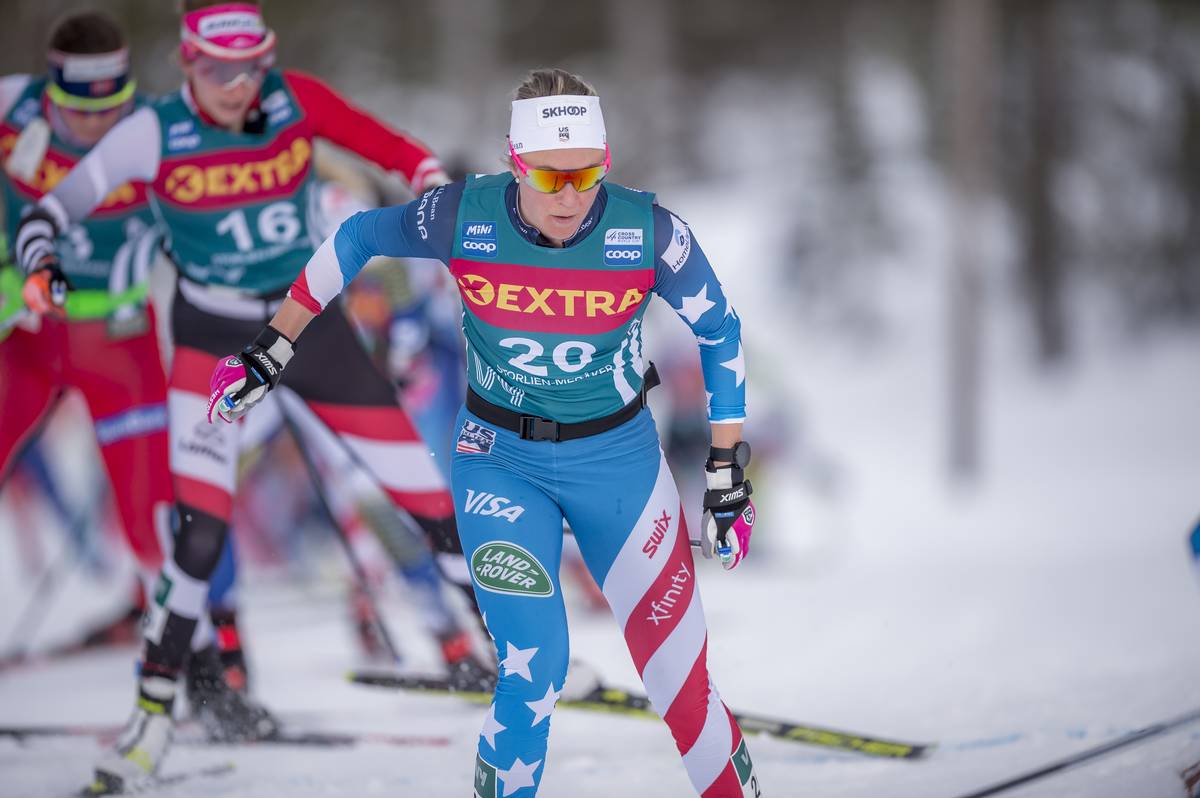
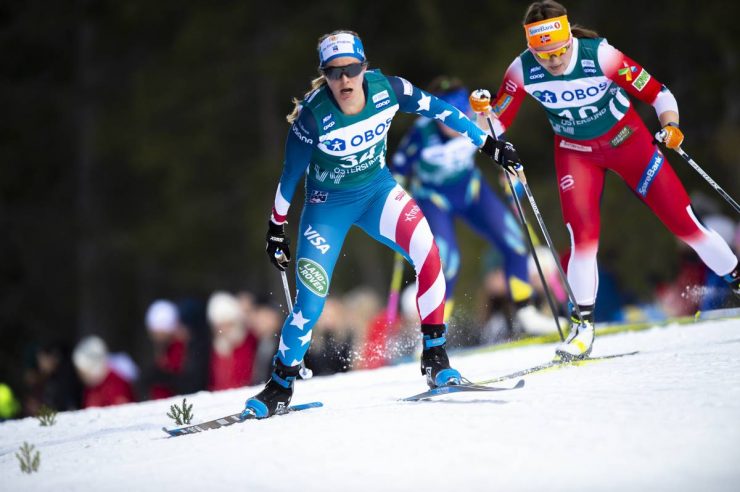
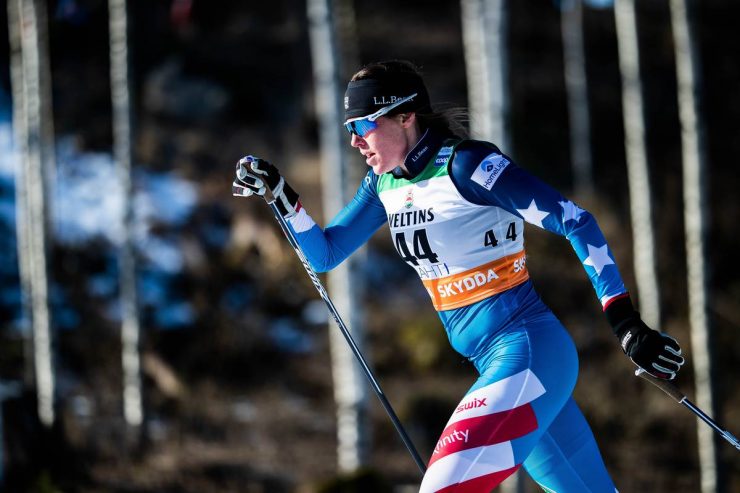
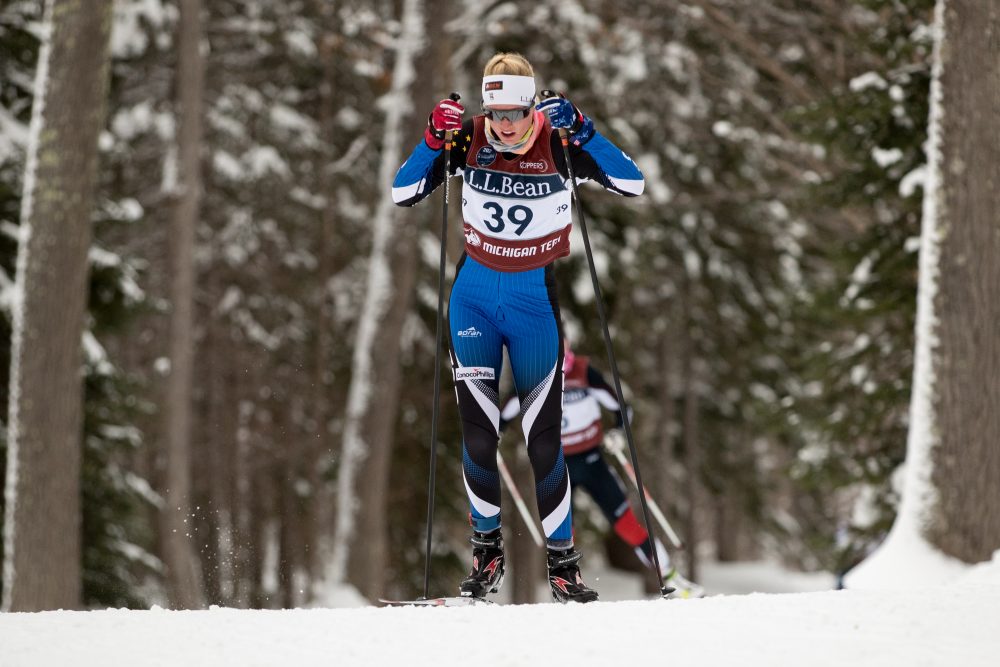
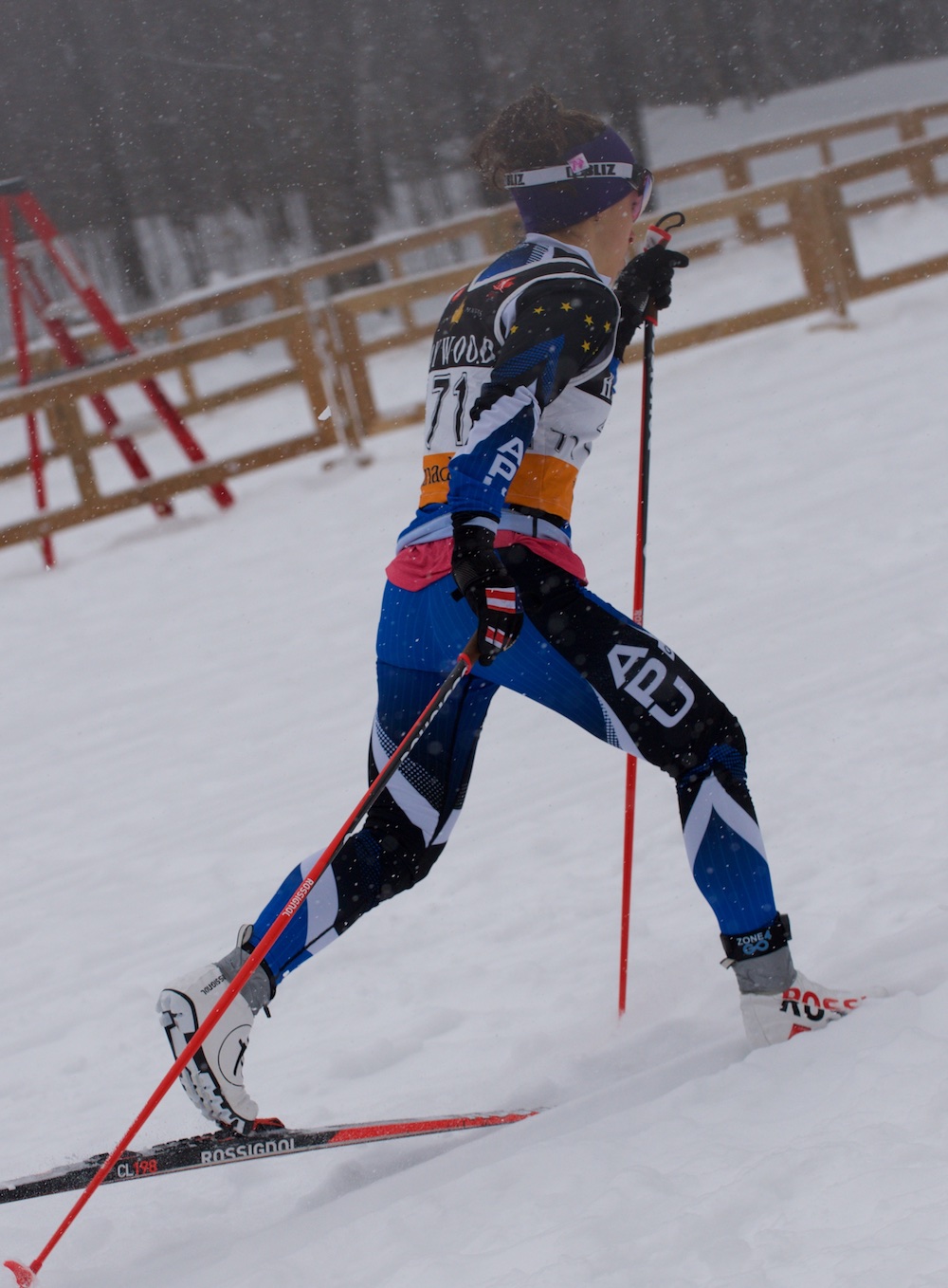
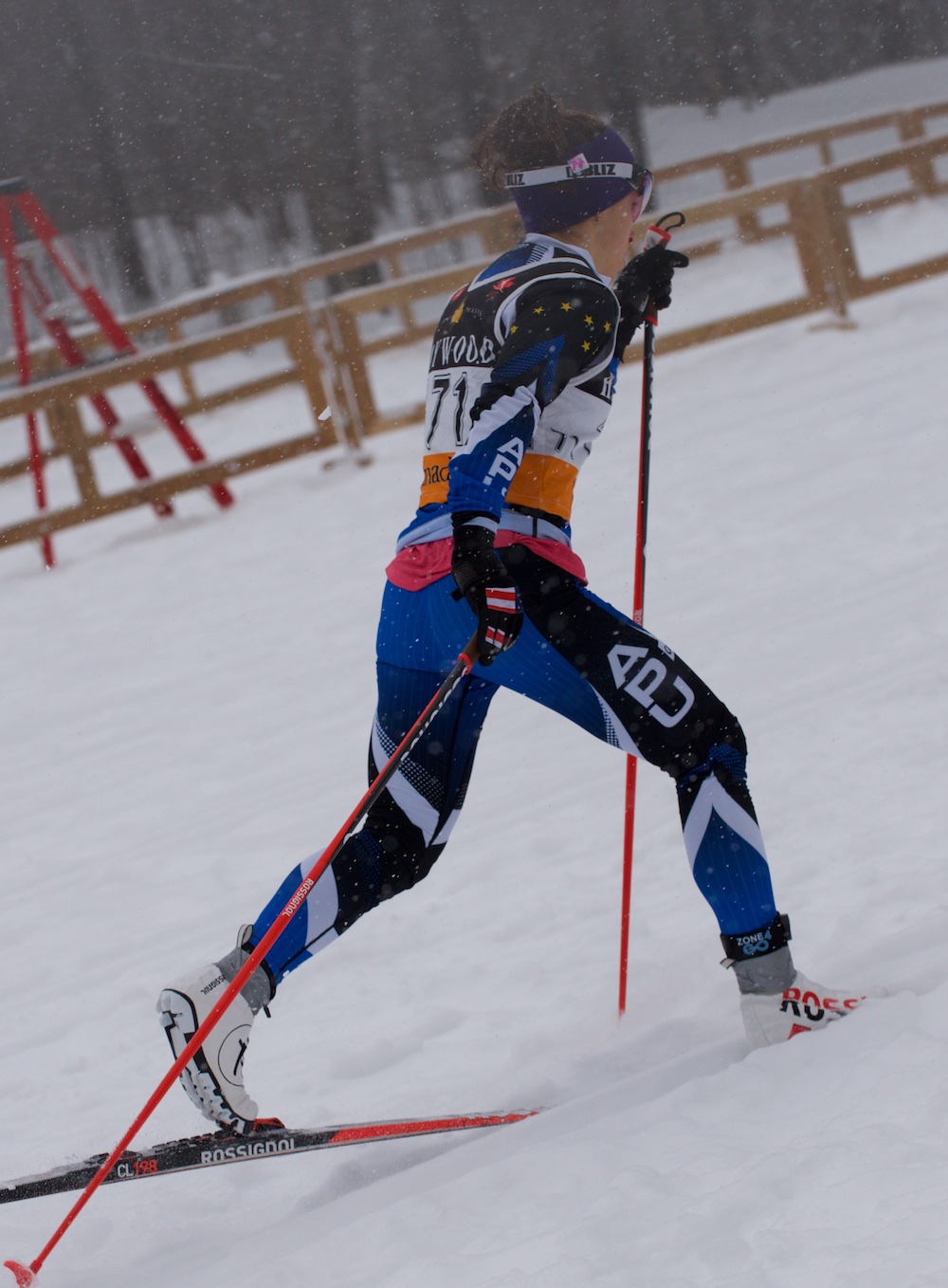
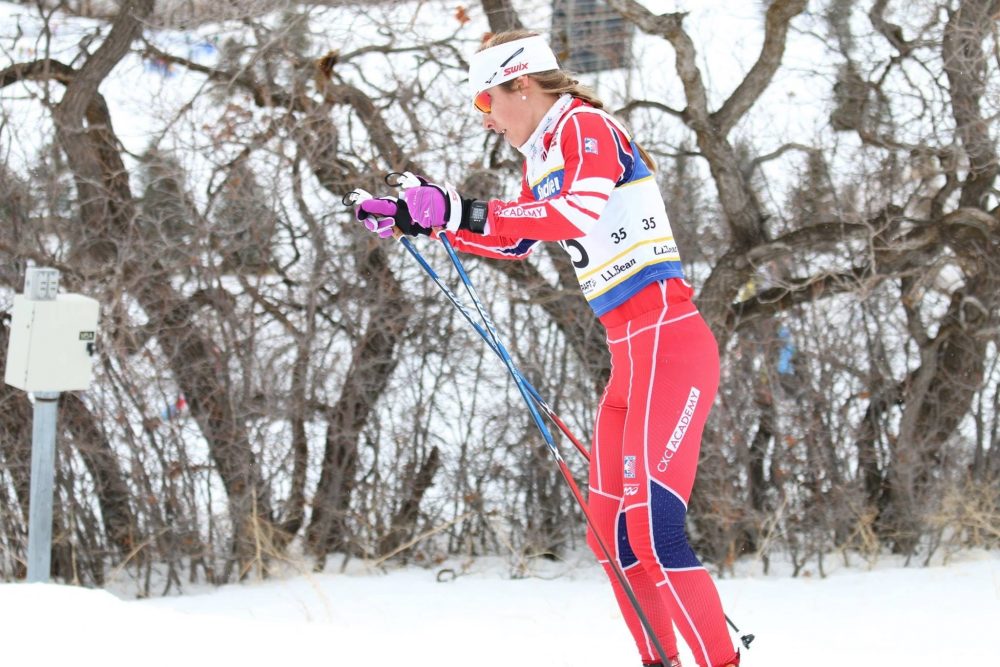
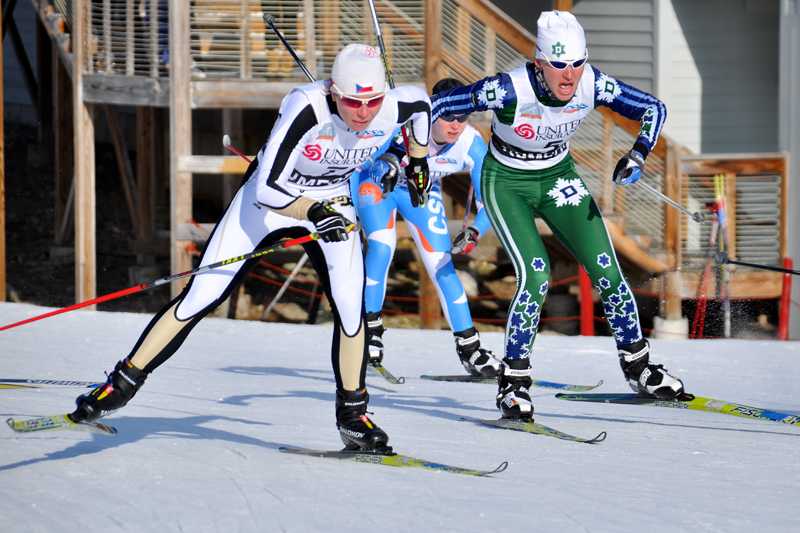
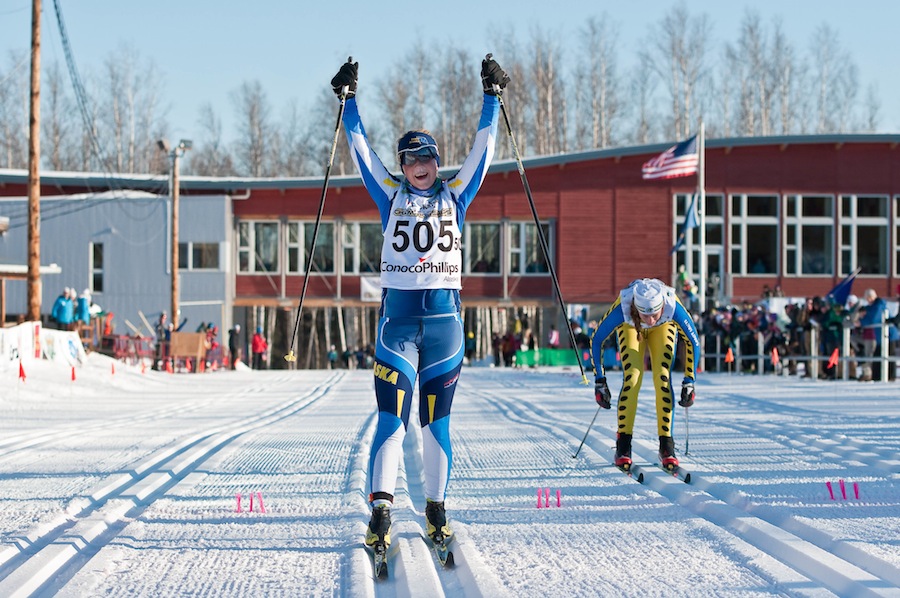
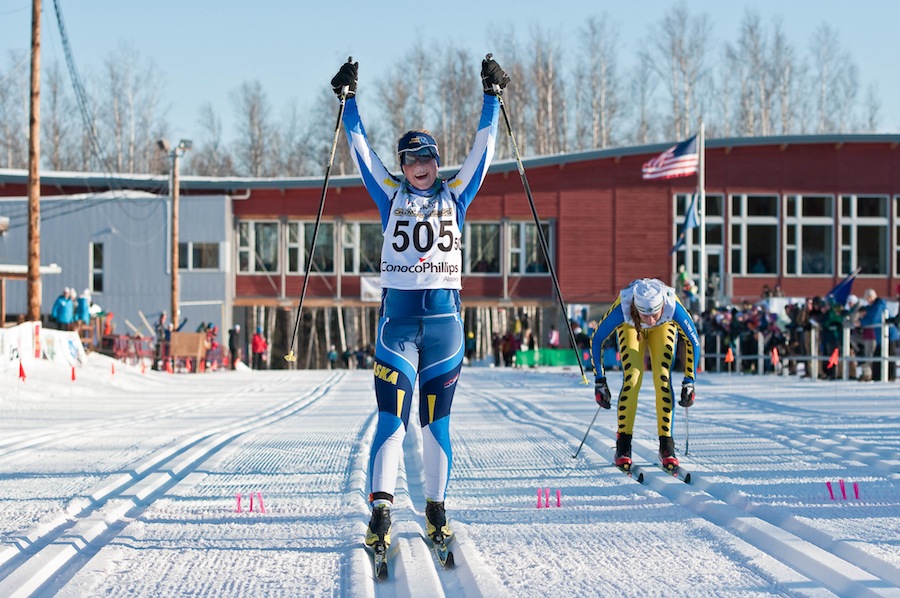
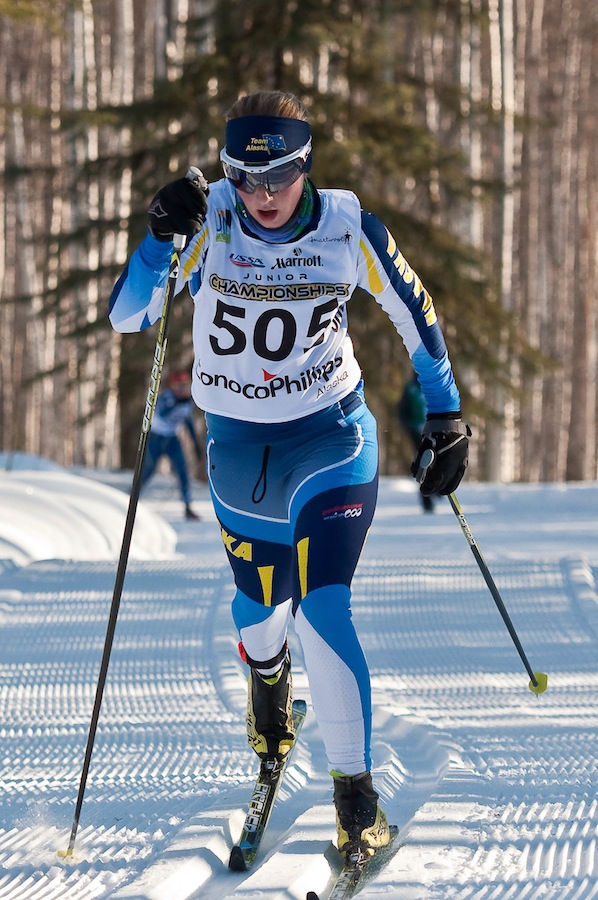
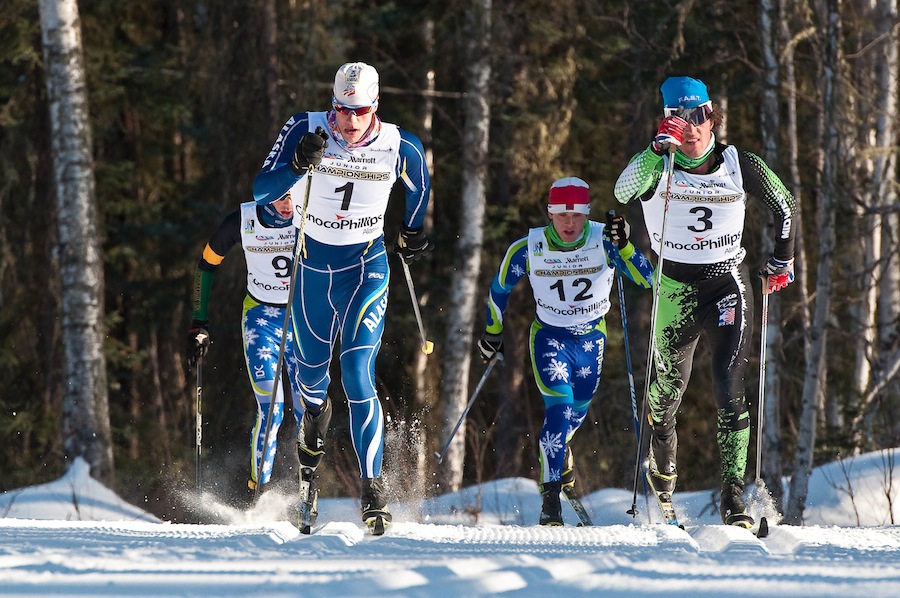
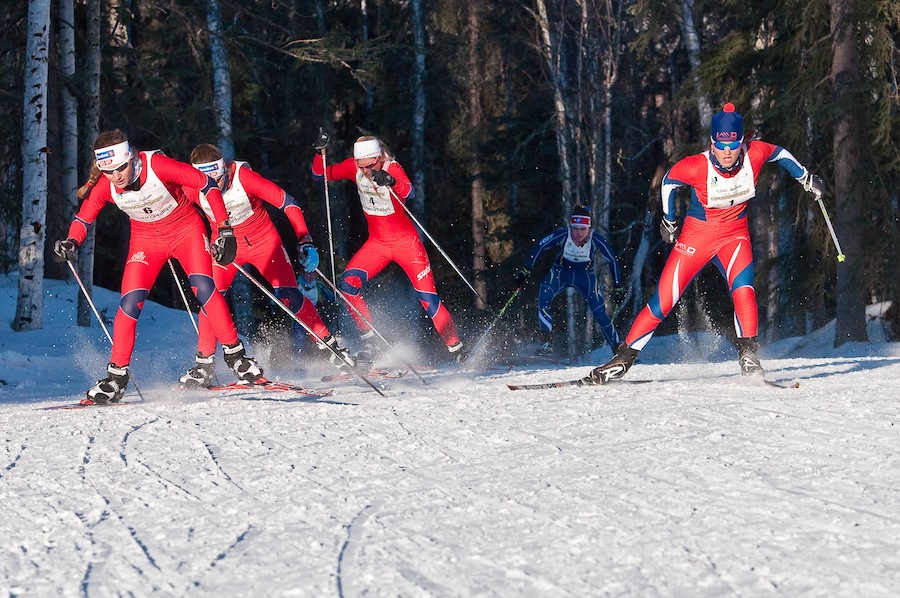
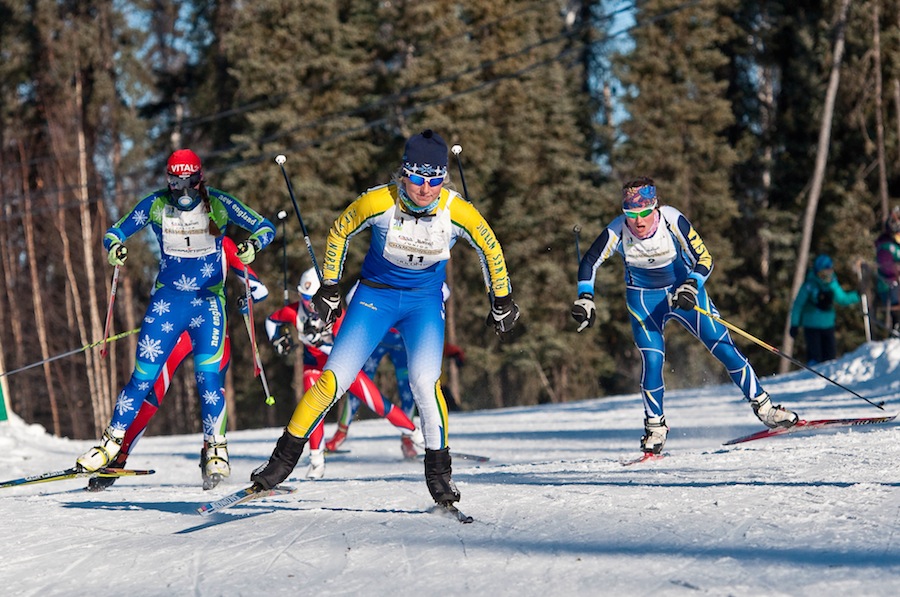
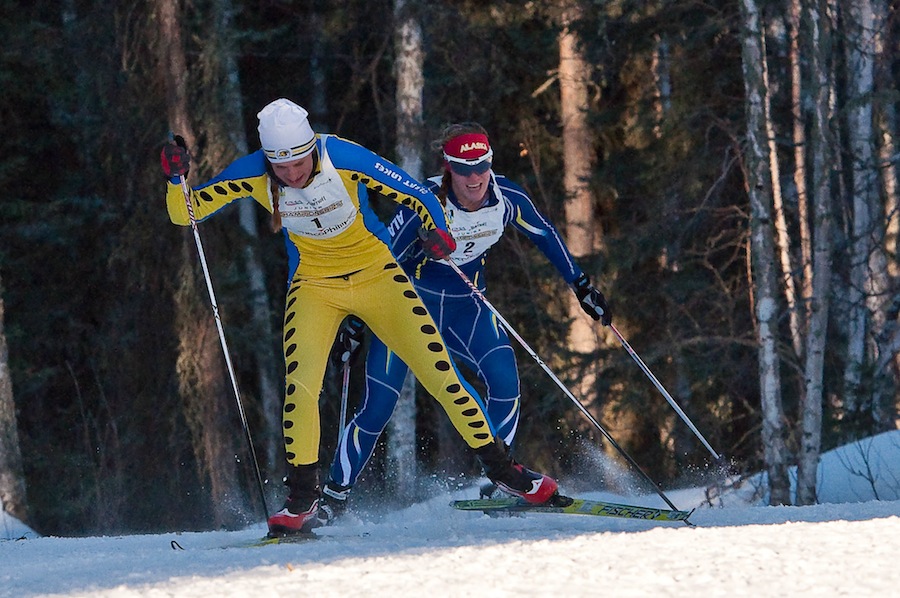
Hailey Swirbul of the USST D-Team races in Québec City, Québec, in March 2019. (Photo: John Lazenby/lazenbyphoto.com)
You may have heard that the World Cup is returning not only to North America, but also to American soil, within the next few weeks. The world’s best skiers will be contesting sprint races in Québec City on March 14 and 15; a sprint in Minneapolis on March 17; and distance races plus a mixed relay in Canmore on March 20-22.
For all six races, including the five across the border, the U.S. has an expanded nation’s group start quota (thanks, Canada, for letting us count as Canadian for a week), meaning that a remarkable thirty skiers total will toe the line in that distinctive candy-cane uniform. Here is a brief overview of the fifteen women with start rights in the three sprints (some of the sprinters will not be racing in Canmore, where some distance-oriented athletes will have starts instead).
In alphabetical order, with pictures where available (an asterisk by a name denotes an athlete making her first World Cup start in Québec City):
Sadie Maubet Bjornsen: Stage 4, Ski Tour 2020. (Photo: NordicFocus)
Sadie Maubet Bjornsen
Team and club: U.S. Ski Team (USST) A Team; Alaska Pacific University, or APU
Currently lives in: Alaska
Selected career highlights: Bronze medal, team sprint, 2017 World Championships; 7 individual and 5 team World Cup podiums; only American woman to ever wear the yellow overall World Cup leader’s bib; multiple national titles
Instagram page: @sbjornsen
Age: 30
Sophie Caldwell on course in Östersund, Sweden. (Photo: NordicFocus)
Sophie Caldwell
Team and club: USST A Team; Stratton Mountain School, or SMS
Currently lives in: Vermont
Selected career highlights: 3rd, Sprint Cup, 2017/2018 World Cup season; 9 individual and 4 team World Cup podiums
Instagram page: @sophiecaldwell
Age: 29
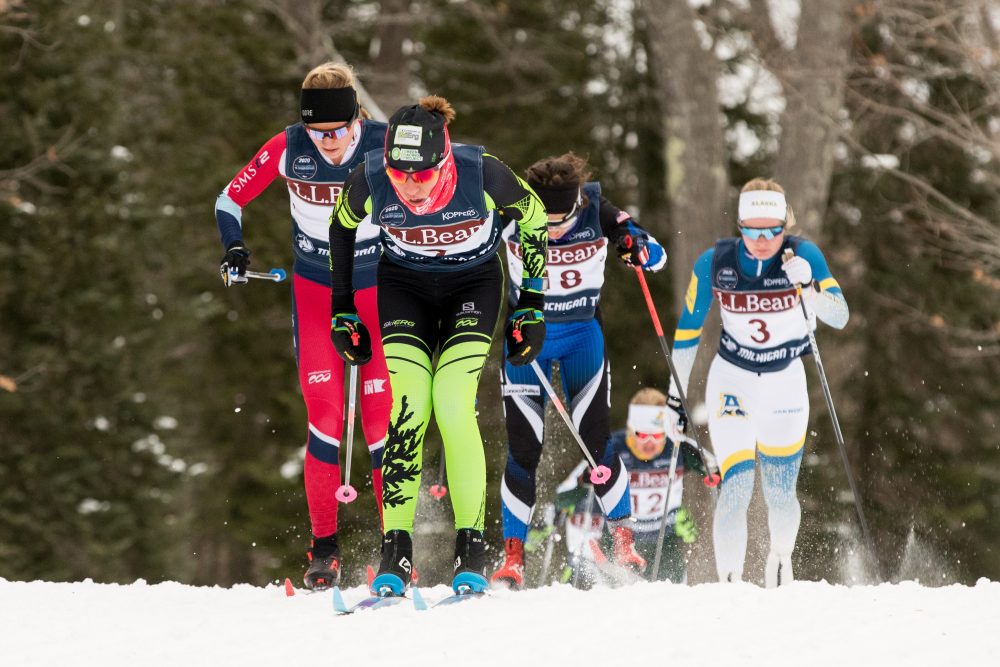
Hannah Cole racing at 2020 U.S. Nationals in Houghton, Michigan. (Photo: Karen Brown)
Hannah Cole*
Club: Crosscut Mountain Sports Center
Currently lives in: Montana
Selected career highlights: 9th, 2020 American Birkebeiner; 4th and 8th, SuperTour sprints in 2019/2020 season
Instagram page: @hanncole
Age: 24
Jessie Diggins skates to 8th in the first stage of the FIS Ski Tour 2020. (Photo: NordicFocus)
Jessie Diggins
Team and club: USST A Team; SMS
Currently lives in: Vermont
Selected career highlights: Gold medal, team sprint, 2018 Olympics; gold medal, team sprint, 2013 World Championships; three additional World Championships medals; 2nd overall and 3rd in distance standings, 2017/2018 World Cup; 26 individual and 7 team World Cup podiums; multiple national titles
Instagram page: @jessiediggins
Age: 28
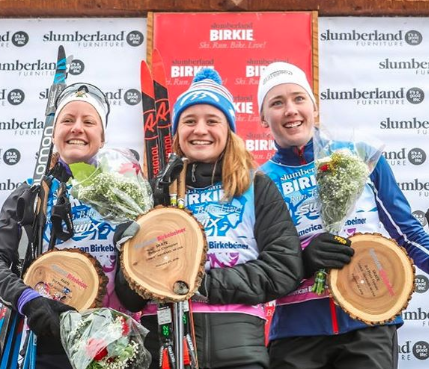
The women’s podium of the 2019 American Birkebeiner. Alayna Sonnesyn took first ahead of Anja Gruber and Katie Feldman. (Photo: Screenshot Instagram @asonnesyn)
Katie Feldman*
Club: SVSEF Gold Team
Currently lives in: Idaho
Selected career highlights: 3rd, 2019 American Birkebeiner; 5th and 6th in SuperTour races in 2019/2020 season; 7th in SuperTour sprint in 2018/2019 season
Selected career highlights: 3rd, 2020 American Birkebeiner; dozens of SuperTour podiums; three top-five finishes at U.S. Nationals over the past ten years
Instagram page: @eflowers89
Age: 30
https://www.instagram.com/p/Bgi2XuQBqKj/
Felicia Gesior*
Club: Crosscut Mountain Sports Center
Currently lives in: Montana
Selected career highlights: 10th, 2020 American Birkebeiner; 5th and 10th, 2019/2020 SuperTour races; four top-10 finishes, 2018/2019 SuperTour
Selected career highlights: Bronze medal, 10 km skate, 2015 World Championships; five-time champion, American Birkebeiner; multiple national championships
Instagram page: @caitlincgregg
Age: 39
Elizabeth Guiney races at the PyeongChang World Cup in 2017. (photo: Nordic Focus)
Elizabeth Guiney
Club: Craftsbury Green Racing Project, or Craftsbury
Currently lives in: Vermont
Selected career highlights: 8th, 2020 American Birkebeiner; six top-10 results, 2019/2020 SuperTour; 3rd, 2015 Nationals
Instagram page: @lizzie_guin
Age: 29
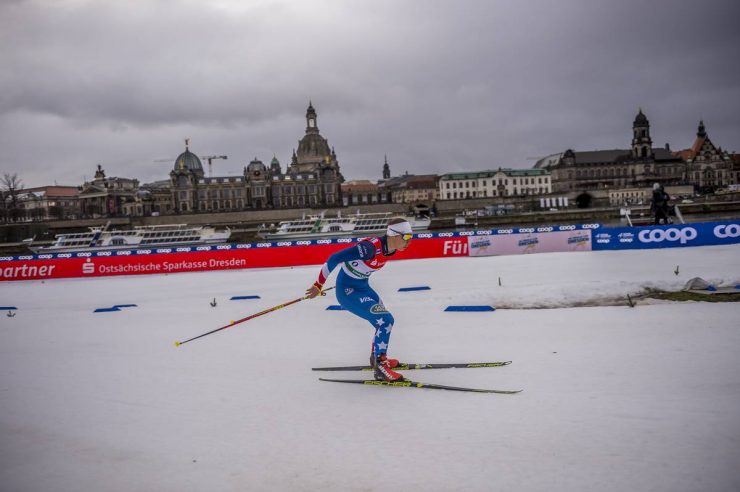
Julia Kern skis to 15th in the qualifier in Dresden in January 2020. (Photo: NordicFocus)
Julia Kern
Club: USST B Team; SMS
Currently lives in: Vermont
Selected career highlights: bronze medal, skate sprint, 2020 U23 World Championships; 3rd, Planīca skate sprint, 2019/2020 World Cup season; multiple other World Cup top-30 finishes; bronze medal, relay, 2017 World Juniors
Instagram page: @juliakernski
Age: 22
Kaitlynn Miller (front) during the women’s classic sprint at the 2020 Senior Nationals. (Photo: Reese Brown)
Kaitlynn Miller
Club: Craftsbury
Currently lives in: Vermont
Selected career highlights: Five national championship podiums, including 2016 classic sprint national championship; 17 SuperTour podiums; 34th in World Cup 10km skate race in 2018/2019 season
Instagram page: @kaitlynnbmiller
Age: 28
Becca Rorabaugh on course during the 10-kilometer individual start classic in Lahti, Finland, last month. (Photo: NordicFocus)
Becca Rorabaugh
Club: APU
Currently lives in: Alaska
Selected career highlights: Five national championship podiums, including 2014 10km classic national championship; 14 SuperTour podiums; 24th in sprint in 2012/2013 World Cup season, 39th in World Cup 10km classic last month
Instagram page: @beccarorabaugh
Age: 30
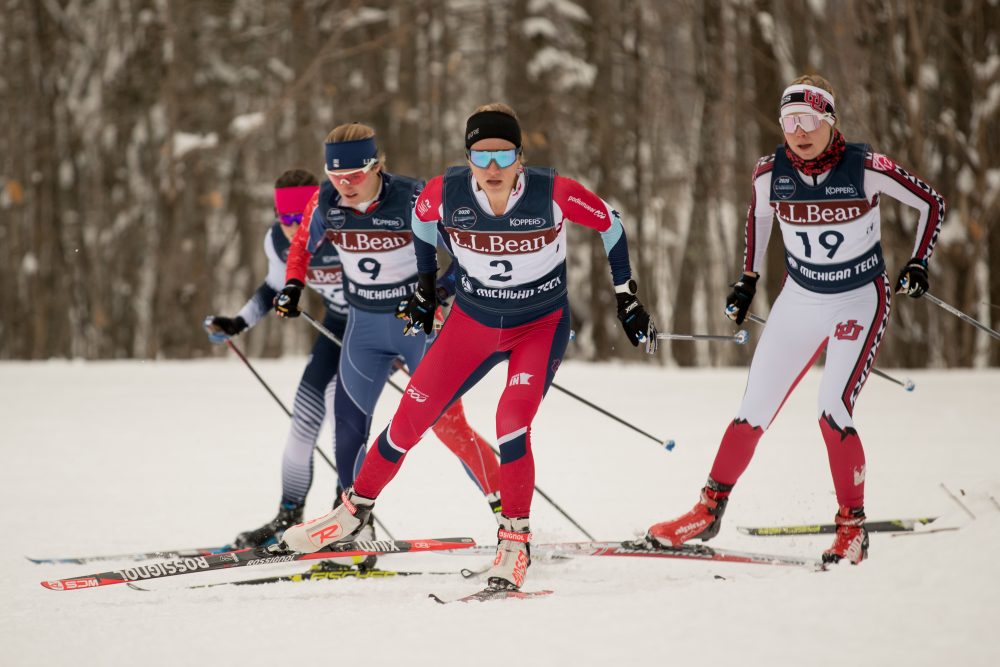
Alayna Sonnesyn (bib 2) races in the skate sprint heats at 2020 U.S. Nationals. (Photo: Reese Brown)
Alayna Sonnesyn
Club: SMS
Currently lives in: Vermont
Selected career highlights: winner, 2019 American Birkebeiner; three podiums at 2020 national championships; three SuperTour podiums; finisher, Ski Tour 2020
Instagram page: @asonnesyn
Age: 23
Hailey Swirbul (APU) during the women’s 10 k skate at 2020 U.S. Nationals. (Photo: Reese Brown)
Hailey Swirbul
Club: USST B Team; APU
Currently lives in: Alaska
Selected career highlights: silver medal, 5km classic, 2018 World Juniors; bronze medal, 10km skiathlon, 2018 World Juniors; 21st, Davos skate sprint, 2019/2020 World Cup season; three other World Cup top-30 finishes this season; bronze medal, relay, 2017 World Juniors
Instagram page: @hai.swirl
Age: 21
Callie Young, of Newport, Vt., racing to second overall in the women’s race at the 2017 App Gap Challenge in Fayston, Vt. (Photo: Laurel Minde)
Callie Young*
Club: Dartmouth
Currently lives in: Vermont
Selected career highlights: Fourth, FIS Junior Invitational “Rising Stars” Race, Québec City, March 2019; first, 2020 Bates Carnival; 54th, sprint qualification, 2020 World Juniors
Instagram page: @calliey0ung
Age: 19
* The athlete is making her World Cup debut in Québec City.
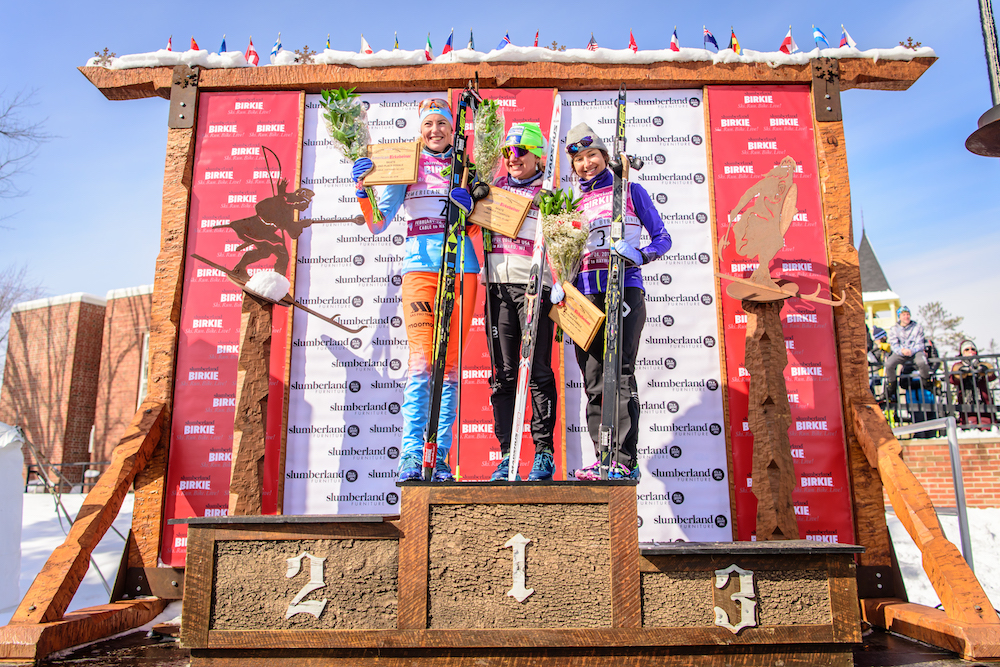
The elite women’s skate podium at the 2018 American Birkebeiner on Saturday in Hayward, Wisconsin, with Caitlin Gregg (c) in first, Sweden’s Maria Gräfnings (l) in second and Chelsea Holmes (r) in third. (Photo: American Birkebeiner Ski Foundation 2018)
Caitlin Gregg has raced the American Birkebeiner enough times — and won it more than anyone else — that she’s got the course down pat. Powerline, Big Bertha, High Point, Heckler’s, OO, Gravel Pit, Mosquito Brook, B*tch Hill, Hatchery, the lake, the bridge, the Main Street finish.
But the conditions and the competition, that’s something that changes from year to year. The elite racers were among the first to start the 50-kilometer American Birkebeiner (“Birkie”) skate races on Saturday, giving them the edge in terms of firmer conditions over nearly 13,000 other racers behind them, but it was still not the fastest Birkie on record after six inches of new snow had fallen the day before.
But away they went, jetting out of the Birkie’s new start line and embarking on the 50 k point-to-point course from Cable to Hayward, Wisconsin. The elite women’s skate race started at 8:30 a.m. followed by the elite men 20 minutes later.
While the women remained in a large pack for the first 15 k or so, according to Gregg, they were down to six around 20 k.
“I think this is one of the strongest fields that I’ve ever seen at the American Birkebeiner for the women,” Gregg recalled in a post-race press conference. “A lot of really fast ladies, a lot of depth, and so it was a pretty high-paced race the whole time. There were definitely five of us in that top six group taking leads and doing pulls, and we definitely worked together to kind of separate ourselves from the field behind us.”
Three of those racers fell of the pace, which left Gregg, Sweden’s Maria Gräfnings, and Chelsea Holmes contending for the win. Gregg, 37, races for the Central Cross Country (CXC) Team, Loppet Nordic Racing and Team Gregg. Gräfnings, 32, is a former University of Utah skier, and Holmes, 31, races for Alaska Pacific University (APU).
Just over 2 kilometers before the finish, as the three were skiing across Lake Hayward, the elite men’s race leaders caught them. Typically, the top elite women finish before the men.
“I could hear another snowmobile, and I knew what that meant, and I kind of looked around at the women and I said, ‘Oh, the men are coming,’ ” Gregg reflected. “… When they caught us, it was actually kind of a surprise because a couple went by, and then they just kept coming.”
The lead pack of men was still close to 30 strong at that point, just 2 k before the finish.
“It was the weirdest thing I’ve even experienced in a race, where you just have this consistent line of guys coming and it was actually, really great,” Gregg continued. “Because the women, we raced our own race, we jumped in towards the back of that pack, but we stayed in our own pack.
“At one point, I suggested maybe we should move over for the men,” she added. “I like these ladies; they were like, ‘NO. They can go around us. They can figure it out. We’re doing our own thing.’ So I thought that was pretty cool.”
Gräfnings had been leading when the men caught them.
“And then I thought ‘Now I can go with them,’ but, no, they were going really fast,” Gräfnings said at the press conference. “So, then I was leading the pack, the women’s, and I guess I was getting really tired when I was doing that…”
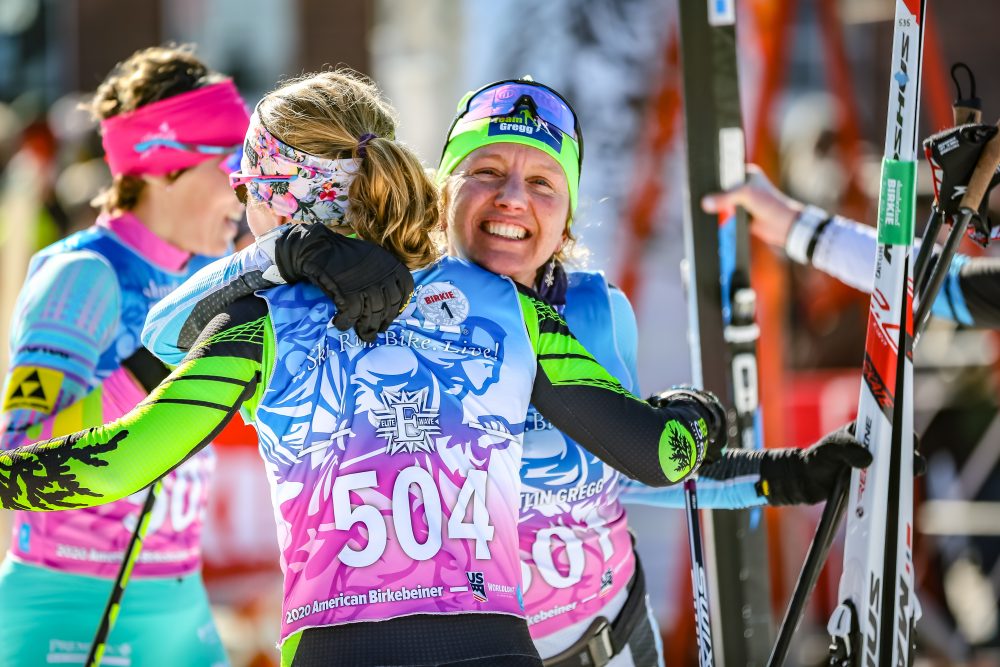
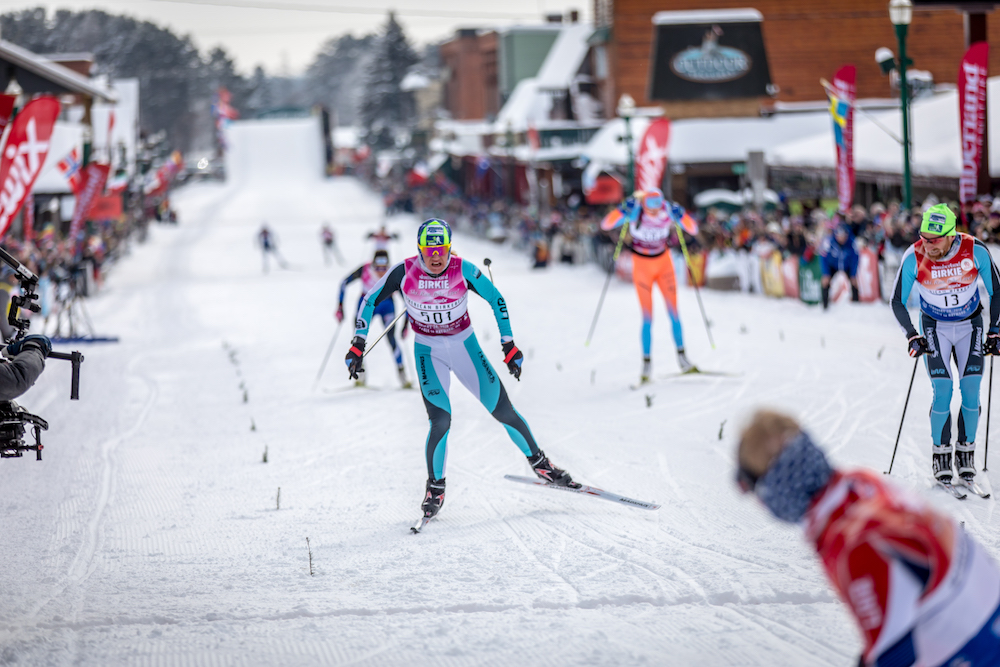
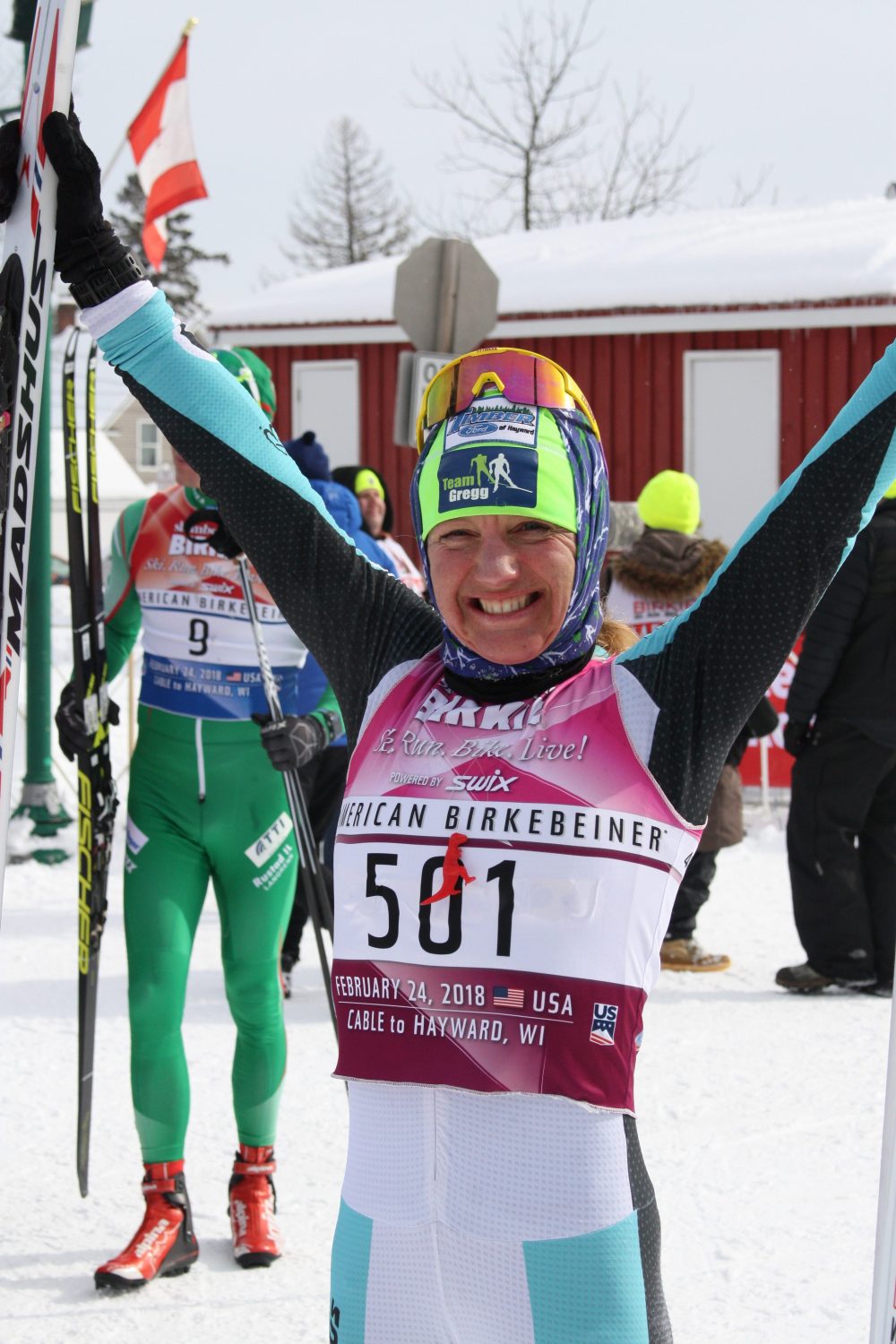
Caitlin Gregg (501) winning her fifth American Birkebeiner on Saturday in Hayward, Wisconsin, while skiing alongside her husband Brian Gregg (13), who placed 22nd in the elite men’s skate race. (Photo: American Birkebeiner Ski Foundation 2018)
Gregg took the lead just before the Birkie’s International Bridge and went on to hold off Gräfnings and Holmes for the win in 2:23:30.3 hours. Gräfnings finished second, 2.5 seconds back, while Holmes placed third (+3.8).
“I was like, ‘No, I can’t give up this. I have to really try to sprint then,’ ” Gräfnings recalled. “I’m glad I could get the second place.”
Gregg won the last American Birkebeiner contested in 2016 (last year’s race was canceled due to low snow) in 2:22:44. With Saturday’s win, she has most Birkie wins of any racer, male or female, with five victories (2011, 2013, 2014, 2016, and 2018).
“I’m trying to set the bar pretty high for the next person to come along and break that [record], so it feels amazing to win my fifth,” said Gregg, who lives in Minneapolis, Minnesota. “The conditions were absolutely perfect today. The course was just in amazing shape and just beautiful out there, and this is definitely one of my favorite races, that’s why I keep coming back. Everything about it, between the organization and the volunteers makes this a special event for so many people, but, for myself, especially. So yeah, I was really happy year to be able to race again and feel good and really fight for the win.”
Gräfnings said was pleased with her own race and glad to return to the U.S.
“I was studying in the University of Utah and now I’m back in America and it’s so fun to meet a lot of friends and it’s really special for me,” she said.
Holmes had previously raced the Birkie in 2014 and placed fifth, 3:45 minutes behind Gregg. She struggled with the cold and suffered in that race, she explained at the press conference.
Caitlin Gregg celebrates her fifth American Birkebeiner win on Saturday after winning the women’s 50 k skate race by 2.5 seconds over Sweden’s Maria Gräfnings in second place. (Photo: RJ Ochmann)
“I was very worried today about surviving with enough feeds and being warm enough,” Holmes said. “In the beginning, it’s a strange feeling because it always feels a little bit slow, like a very different race pace than even a 30 k that you do at other times, and especially with less climbing, which, I miss the hills a little bit … so that’s a little bit hard for me sometimes to sit in. But I think we shared the lead fairly well.
“It was … good for me always to remember to relax and be patient because even when you have 25 k, you’re only halfway there,” Holmes continued. “So it’s a unique experience, the 50 k, because sometimes it feels like you’re not working that much, and I felt quite good. And then when I got five meters from the finish line, my legs just, I basically walked across the line. So, clearly I was very tired, but that’s how it goes.”
France’s Aurelie Dabudyk was the fourth woman across the line, 28.7 seconds behind Gregg, Anja Gruber of Bozeman, Montana, placed fifth (+2:44.6), and Erika Flowers of the Stratton Mountain School (SMS) T2 Team finished sixth (+3:30.1). Also in the top 10 were Liz Guiney of the Craftsbury Green Racing Project (CGRP) in seventh (+5:33.8), Hallie Grossman (CGRP) in eighth (+8:03), Hannah Bettendorf of Duluth, Minnesota, in ninth (+8:19.2), and masters skier Laura McCabe of Winthrop, Washington, in 10th (+8:20.6).
The Birkie is the fifth of seven races on the 2018 FIS Worldloppet Cup calendar. Dabudyk now leads the overall standings by just 10 points over Gräfnings in second. In her first Worldloppet race of the year, Gregg ranks seventh.
In the men’s overall standings, France occupies the top four with Gerard Agnellet in first, just 1 point ahead of Ivan Perrillat Boiteux in second, and 120 points clear of Loic Guigonnet in third. Adrien Mougel ranks fourth, another 2 points behind, and Norway’s Anders Gløersen breaks up the French sweep in fifth, 3 points behind Mougel.
Norris Makes the Move, Gløersen Takes the Win
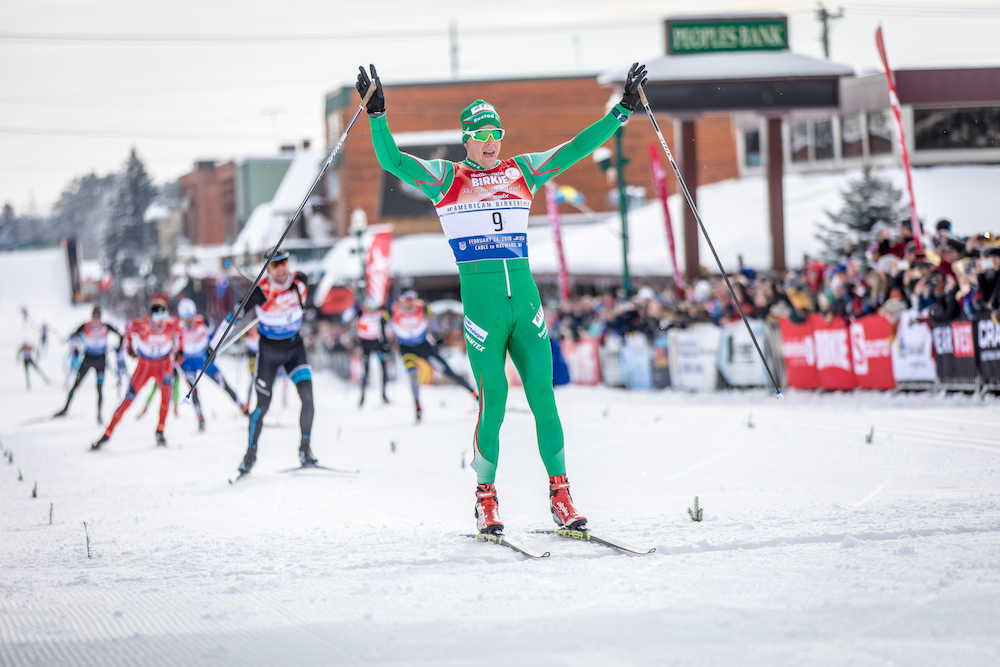
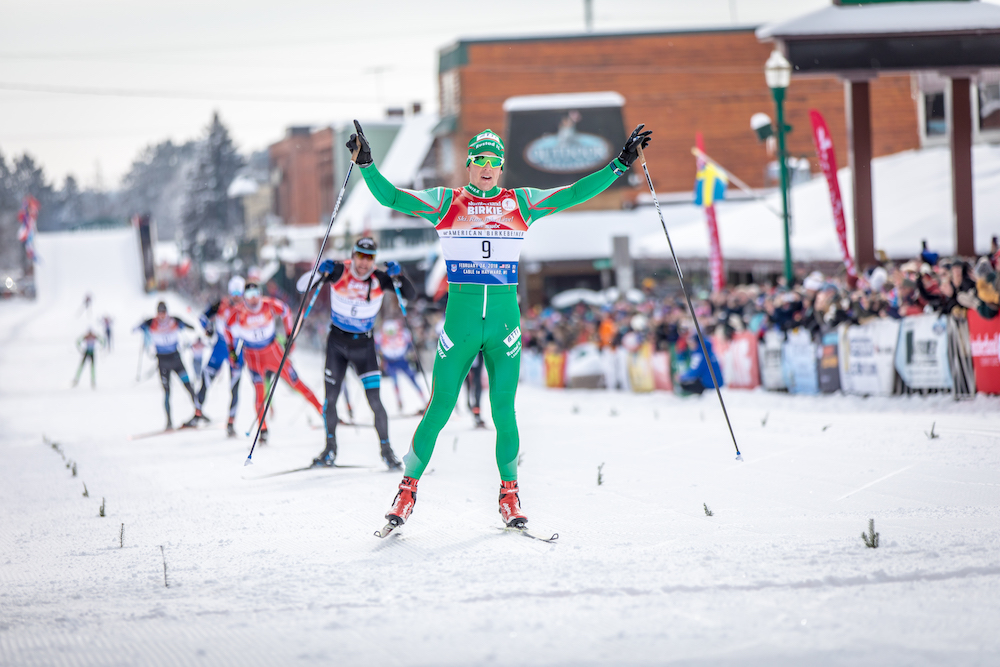
Norway’s Anders Gløersen winning the American Birkebeiner elite men’s 50 k skate race on Saturday in Hayward, Wisconsin. (Photo: American Birkebeiner Ski Foundation 2018)
Gløersen won the Birkie elite men’s skate race on Saturday in 2:02.29.6, just 1.9 seconds ahead of Perrillat Boiteux in second and 3.4 seconds ahead of American Kyle Bratrud (CXC Team) in third.
After as many as 30 men stayed together up until the last 2 kilometers, the men’s pack began to string out after coming off the lake. According to Bratrud, it was David Norris who made the defining move at that point in the race. Norris had launched a similar attack two years ago, just before the bridge, to win the 2016 Birkie.
“He started to string it out a bit and six or seven of us started to pull away from a line of about 30 of us,” Bratrud recalled at the press conference. “That’s kind of what led us to the break and ultimately to the sprint.”
The top-10 men were within eight seconds of first, with Mougel finishing fourth (+4.4), Norris losing his lead and ending up fifth (+5.1), France’s Bastien Poirrier placing sixth (+5.5), and Agnellet following in seventh (+5.7). France had six in the top 11 with Guigonnet in eighth (+6.6) and Benoit Chauvet in 11th (+13.3). Americans Ben Lustgarten (CGRP) finished ninth (+7.0) and Jack Hegman of the Sun Valley Ski Education Foundation (SVSEF) placed 10th (+7.2).
“It was a great race,” Gløersen, 31, said at the press conference. “Perfect conditions and nice weather. And it was a difficult to know how to do because I don’t know so many of the American skiers here, and I know the French guys … I had to watch out for them. So I just tried to stay in front of the big group to be ready if someone made an attack. It seemed like it was difficult to get away, and I was just glad when it was one kilometer left.”
After Norris’s attack, Gløersen made a point to follow him.
“I got the perfect position on the bridge here, just was number two and then had the perfect position going into the final 300 meters,” he said.
Asked about passing the women late in the race, he said it didn’t affect the men’s race too much.
“If it’s snowing, then it could make a difference because then you have the women making way, and when you pass them it’s going to be slower,” Gløersen said. “But today was quite good conditions so it was just fun to see when they catch them and to see who was in the group, but other than that, it doesn’t affect us much.”
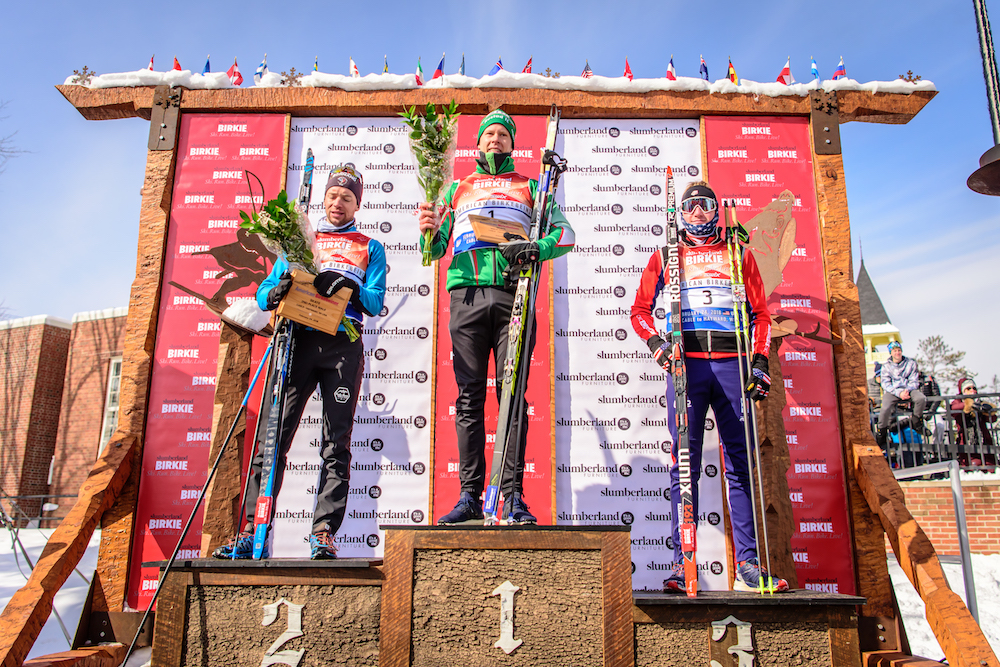
The elite men’s skate podium at the 2018 American Birkebeiner in Hayward, Wisconsin, with Norway’s Anders Gløersen (c) in first, France’s Ivan Perrillat Boiteux (l) in second and American Kyle Bratrud (r) in third. (Photo: American Birkebeiner Ski Foundation 2018)
While both Gløersen and Perrillat Boiteux are marathon regulars, this was the first American Birkebeiner for both of them.
“The Birkie was a great race, well organized, and I loved it,” Perrillat Boiteux, 32, said through a translator at the press conference.
Bratrud, 25, was born in Eden Prairie, Minnesota, and attended Northern Michigan University, yet this was his first Birkie. According to the FIS database, it was also his first marathon. Asked about skiing in such a large group for most of the 50 k race, he said it was a new experience, but it was likely because the field was so competitive.
“There’s a ton of strong guys there and no one really wanted to pull the other person to a victory,” Bratrud said. “So it was a lot of kind of cat and mouse and looking at each other and people made moves, but with so many strong skiers, it was hard for anyone to get away.”
In the 55 k Birkie Classic, Minnesota native Ben Saxton (SMST2) edged Cole Morgan (SVSEF) by 1.5 seconds at the finish for the win in 2:47:35.9. Mathias Rolid of Marquette, Michigan, followed in third (+6.1).
Wisconsin native Felicia Gesior (CXC Team) won the women’s classic race by more than 10 minutes in 3:08:07.3. Brandy Stewart of Bozeman placed second (+10:54.8) and Josie Nelson of Medicine Lake, Minnesota, reached the podium in third (+11:20.9).
$$$
While the Birkie’s 50 k skate race is part of the FIS Worldloppet Cup and reserves most of its prize money for first- through sixth-place finishers in both the elite men’s and women’s skate races (with $7,500 dollars for each winner), the 55 k Birkie Classic awards $1,000 to its men’s and women’s winners.
This year, there were also two $500 sprint bonuses in the Birkie skate race, which were awarded to the first male and female competitors to reach the intermediate sprint checkpoints. According to Gregg, the first “prime” was about 2 1/2 or 3 kilometers into the race, and the second came just before 20 k.
“I was curious how aggressive the women would be to go for those [sprint] primes and they were very aggressive, very fun,” Gregg said. “I think the first prime kind of set the tone and kind of strung things out a little bit.”
Caitlin Gregg (501) winning her fifth American Birkebeiner on Saturday in Hayward, Wisconsin, while skiing alongside her husband Brian Gregg (13), who placed 22nd in the elite men’s skate race. (Photo: ABSF/James Netz)
2018 American Birkebeiner (Hayward, Wisconsin): 50 k freestyle
The 44th annual American Birkebeiner took place Saturday on the world-famous course from Cable to Hayward, Wisconsin, with Minneapolis’s own Caitlin Gregg (CXC Team/Loppet Nordic Racing/Team Gregg) and Norway’s Anders Gløersen racing to victories in the elite women’s and men’s races, respectively.
Norway’s Anders Gløersen (9) winning the American Birkebeiner elite men’s 50 k skate race on Saturday in Hayward, Wisconsin. (Photo: ABSF/James Netz)
Gregg finished in 2:23:30.3 hours, just 2.5 seconds ahead of Sweden’s Maria Graefnings in second and 3.8 seconds over Chelsea Holmes, of Alaska Pacific University (APU), in third.
The Birkie win was Gregg’s fifth after taking the title in the 2011, 2013, 2014, and 2016 editions of the race as well. She won the last American Birkie contested in 2016, with a broken toe, in 2:22:44. (The race was canceled last year.)
Gløersen was the first across the line, after passing the entire elite women’s field, with a winning time of 2:02.29.6. France’s Ivan Perrillat-Boiteux finished 1.9 seconds back in second, and Kyle Bratrud (CXC Team) was the first American in third overall (+3.4).
The defending Birkie champion from 2016 (who won it in 2:05:35), David Norris (APU) placed fifth (+5.1).
In the 55 k Birkie Classic, Minnesota native Ben Saxton, of the Stratton Mountain School (SMS) T2 Team, edged Cole Morgan, of the Sun Valley Ski Education Foundation (SVSEF), by 1.5 seconds at the finish for the win in 2:47:35.9. Mathias Rolid, of Marquette, Michigan, followed in third (+6.1).
Wisconsin native Felicia Gesior (CXC Team) won the women’s race by more than 10 minutes in 3:08:07.3. Brandy Stewart, of Bozeman, Montana, placed second (+10:54.8) and Josie Nelson, of Medicine Lake, Minnesota, reached the podium in third (+11:20.9).
The SuperTour men’s 20 k freestyle podium on Saturday, Feb. 17 in Ishpeming, Michigan, with David Norris (c) in first, Kevin Bolger (l) in second, and Brian Gregg (r) in third. (Photo: APU)
U.S. SuperTour (Ishpeming, Michigan): Friday, Saturday and Sunday
The SuperTour circuit ventured to the Al Quaal Recreation Area in Ishpeming, Michigan, this past Friday, Saturday and Sunday for three days of racing Feb. 16-19.
Day 1
In Friday’s 1.6-kilometer freestyle sprints, Kevin Bolger of the Sun Valley Ski Education Foundation (SVSEF) posted a 2.69-second victory in the men’s final over his teammate Jack Hegman in second and 3.02 seconds ahead of David Norris of Alaska Pacific University (APU) in third.
Bolger started the day by qualifying first in 3:43.04 minutes (2.41 seconds ahead of Hegman in second). Eighteen men entered the race, all of which advanced to four quarterfinals. Bolger went on to win his quarterfinal and semifinal before ultimately winning the final in 3:38.45.
Kris Freeman (Caldwell Sport) finished fourth in the final (+6.4), Forrest Mahlen (APU) took fifth (+10.07), and Eric Packer (APU) was sixth (+10.1).
In the women’s sprint, Northern Michigan University (NMU) sophomore Anikken Gjerde Alnæs edged Erika Flowers of the Stratton Mountain School (SMS) T2 Team by 0.1 seconds for the win in 4:09.87. Alnæs, of Norway, had previously won the qualifier in 4:22.88, 1.72 seconds ahead of Flowers in second.
With 10 women entering the qualifier, all 10 were seeded in two semifinals. Alnæs won the first semi in 4:20.24, and APU’s Chelsea Holmes won the second semi in 4:14.18.
In the final, Alnæs shared the podium with Flowers in second and Kaitlynn Miller of the Craftsbury Green Racing Project (CGRP) in third (+6.75). Holmes placed fourth (+7.49), Liz Guiney (CGRP) was fifth (+2.13), and Canada’s Sophie Carrier-Laforte finished sixth (+7.3).
Day 2
The SuperTour women’s 15 k freestyle podium on Feb. 17 in Ishpeming, Michigan, with Chelsea Holmes (c) in first, Caitlin Gregg (l) in second and Erika Flowers (r) in third. (Photo: APU)
On Saturday, APU reigned, with Holmes winning the women’s 15-kilometer freestyle and Norris topping the men’s 20 k skate.
In the women’s race, Holmes and Caitlin Gregg (CXC Team/Loppet Nordic Racing/Team Gregg) broke away from the field and duked it out for first, with Holmes taking it by 5.9 seconds in 42:37.1. Almost two minutes back, Flowers placed third (+1:58.4) to return to the podium. Kristen Bourne (NMU) placed fourth (+1:59.7), Miller was fifth (+2:01.2), Guiney sixth (+2:01.6), and NMU had two more in the top eight with Nicole Schneider in seventh (+2:02.5) and Alnæs in eighth (+2:07.5), respectively. Carrier-Laforte finished ninth (+2:25.3) and another Canadian Alannah MacLean (NTDC Thunder Bay) was 10th (+2:45.7) out of 43 women.
In the men’s race, the top-eight finishers were separated by less than 10 seconds, with Norris taking the win by 2.9 seconds over Bolger in 50:01.7. Brian Gregg (CXC Team/LNR/Team Gregg) placed third (+5.9), 1 second ahead of Ben Lustgarten (CGRP) in fourth (+6.9). In a photo finish for fifth (+7.2), Tad Elliott (Ski Club Vail) took it by 0.1 seconds over Adam Martin (CGRP) in sixth (+7.3) and Hegman in seventh (+7.3). Ian Torchia (NMU) finished eighth (+9.9), Canada’s Evan Palmer-Charrette (NTDC Thunder Bay) was ninth (+16.0), and Kyle Bratrud (CXC Team/LNR) 10th (+18.1) out of 62 finishers.
Day 3
On Sunday, Norris raced to his second-straight win (and third in as many distance races since winning the 15 k classic pursuit on Feb. 4 at the NorAm/SuperTour in Gatineau, Quebec). With a time of 24:42.7, Norris skied 28.2 seconds faster than Lustgarten in second place, and Freeman joined them on the podium in third (+32.4). Martin followed in fourth (+34.5), Hegman was fifth (+35.9), Bolger sixth (+39.3), Zak Ketterson (NMU) seventh (+42.5), Bratrud eighth (+42.8), Elliott ninth (+1:00.5), and Torchia 10th (+1:02.2).
Miller won the women’s 5 k classic on Sunday in 14:53.9, just 2.7 seconds ahead of her Craftsbury teammate Guiney in second. Holmes returned to the podium in third (+7.8), and was followed by Felicia Gesior (CXC Team/Peak Nordic) in fourth (+32.4), Vivian Hett (NMU) in fifth (+36.5), Flowers in sixth (+46.5), Bourne in seventh (+58.5), MacLean in eighth (+1:00.8), Alnæs in ninth (+1:05.3), and Carrier-Laforte in 10th (+1:05.3).
Rosie Frankowski (APU) racing to a 2-second win in the women’s 10 k classic pursuit on Sunday, the final day of 2018 Eastern Canadian Championships in Gatineau, Quebec. (Photo: Rob Smith)
NorAm Eastern Canadian Championships (Gatineau, Quebec): 10/15 k classic pursuits
Rosie Frankowski defended her lead and tallied her second-straight win on Sunday, the final day of Eastern Canadian Championships, both a NorAm and a SuperTour. Meanwhile, David Norris overcame a 10-second starting deficit to make it all Alaska Pacific University (APU) atop the podium in the classic pursuits.
Frankowski started the women’s 10 k pursuit 47 seconds clear of her APU teammate Becca Rorabaugh in second and held Rorabaugh off by 2 seconds at the finish, crossing the line first in 1:00:32.6 hours on a warmer day around 0 degrees Celsius with heavy snow in Gatineau. Kaitlynn Miller of the Craftsbury Green Racing Project (CGRP) was the third American on the podium, racing up from seventh to third, 21.3 seconds behind Frankowski.
Olivia Bouffard-Nesbitt (Rocky Mountain Racers) led the Canadians in fourth (+3:09.2), up from sixth at the start, and Frédérique Vézina, of the Pierre-Harvey National Training Centre (CNEPH), followed in fifth (+3:15.2), after starting fourth.
Another 4.6 seconds back was Liz Guiney (CGRP) in sixth (+3:19.8). Felicia Gesior (CXC Team) finished seventh (+4:05.6), Corey Stock (Bridger Ski Foundation) placed eighth (+4:05.8), Annika Hicks of the Alberta World Cup Academy (AWCA) was ninth (+4:40.8), and Alannah Maclean of the National Team Development Centre (NTDC) Thunder Bay finished 10th (+5:25.9).
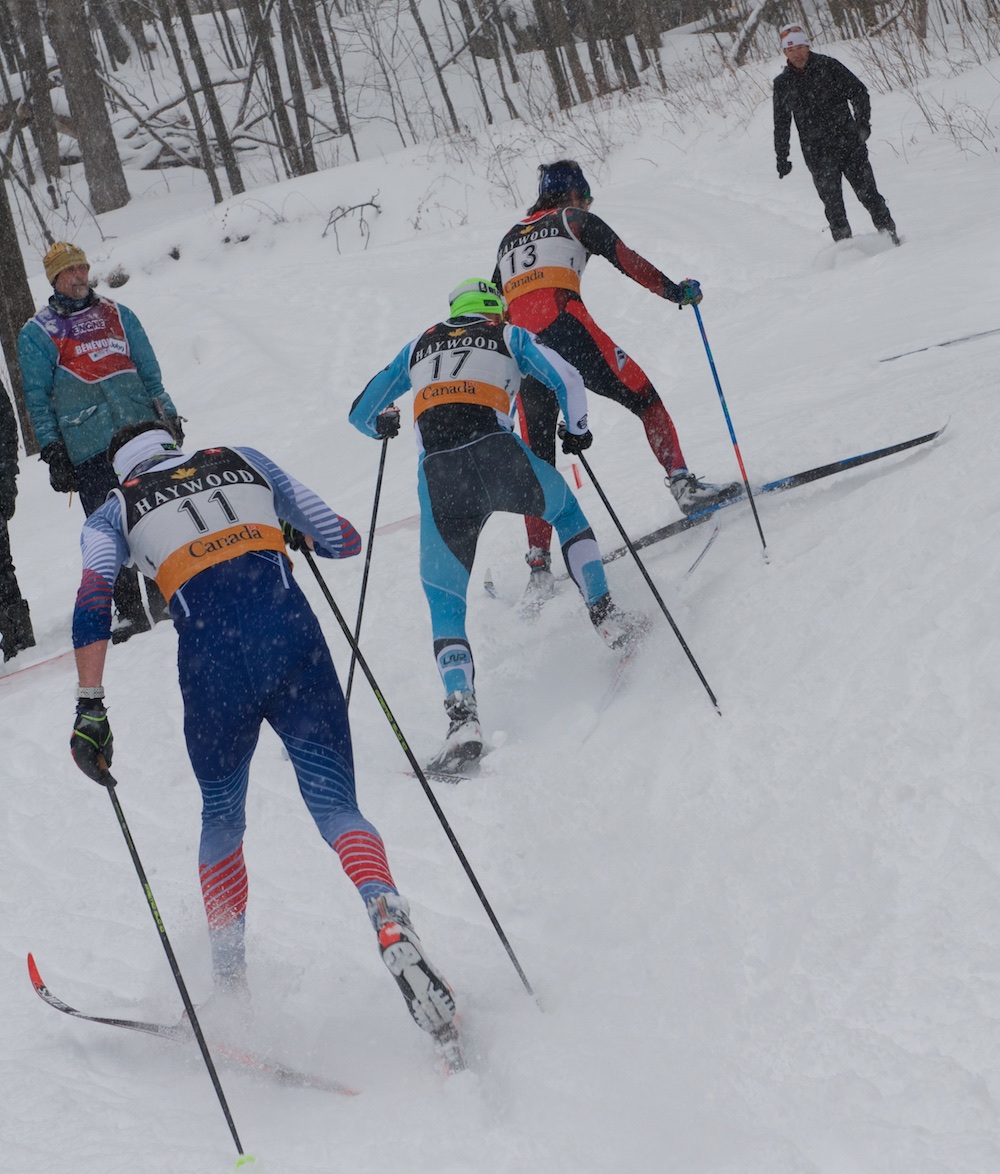
Tad Elliott (13) leads Brian Gregg (17) and Jack Hegman (11) up a climb during the men’s 15 k classic pursuit on Sunday at 2018 Eastern Canadian Championships in Gatineau, Quebec. Gregg went on to edge Elliott in a photo finish for third and Hegman followed in fifth. (Photo: Rob Smith)
In the men’s 15 k, Norris started second and caught leader Jack Hegman, of the Sun Valley Ski Education Foundation (SVSEF) early then raced alone to the victory in 1:19.26, while Ben Lustgarten (CGRP) followed 1:17.8 minutes later in second. Lustgarten started the race in sixth and Brian Gregg (Team Gregg/Loppet Nordic Racing/CXC) started seventh, with Gregg edging Tad Elliott (Ski Club Vail) by less than a tenth of a second in a photo finish for third (+1:38.5). Elliott had started third.
Hegman finished fifth (+1:42.6), his Sun Valley teammate Kevin Bolger was next across the line in sixth (+1:59.1), Adam Martin (CGRP) finished seventh (+2:01.2), Rogan Brown (SVSEF) was eighth (+2:02.9), Scott Hill (Barrie Cross Country) was the top Canadian in ninths (+2:22.5), and Jack Carlyle (AWCA) finished 10th (+2:44.2).
Nordic Combined World Cup (Hakuba, Japan): Large hill/10 k Gundersen
In the final nordic combined World Cup competition before the Olympics, Norway’s Jan Schmid came from 1:14 minutes behind at the start of Sunday’s 10 k to win the individual large hill/10 k event by 6.6 seconds in 25:36.5.
Schmid started the race in seventh, based on his competition jump, 1:14 behind Estonia’s Kristjan Ilves in first. Ilves had jumped to first and started the race 13 seconds ahead of Japan’s Yuto Nakamura in second, but while Nakamura dropped to 18th (+2:21.2) at the finish, Schmid moved all the way up to first with the fourth-fastest course time.
Japan’s Akito Watabe, who won Saturday’s large hill/10 k competition, took the final spot on the podium after a photo finish with the Czech Republic’s Tomas Portyk. They finished 11.1 and 11.2 seconds behind Schmid in third and fourth, respectively.
American Adam Loomis achieved his best individual result in three years, placing 24th (+3:03.4), after jumping to 30th and starting 3:20 out of first. Loomis skied the eighth-fastest course time.
His USA Nordic teammate Ben Berend placed 31st (+4:28.4) after ranking 28th in the jump.
Nordic Combined Continental Cup (Planica, Slovenia): Saturday and Sunday
Meanwhile on the Nordic Combined Continental Cup, Americans Bryan and Taylor Fletcher reached the podium on both Saturday and Sunday in Planica, Slovenia.
Bryan won back-to-back individual large hill/10 k Gundersen starts, while Taylor placed second on Saturday and third on Sunday.
On Saturday, Bryan jumped to third on the 139-meter large hill and started the 10 k race 22 seconds behind Germany’s Anton Schlüter in first. Taylor jumped to 14th and started 1:35 minutes out of first and posted the fastest course time in the 10 k to finish second to his older brother, 59.4 seconds back.
Bryan skied the third-fastest 10 k to take first in 26:24.1 minutes. About a minute behind Taylor, Austria’s Martin Fritz placed third (+1:58.8). Schlüter ended up 15th (+3:51.5).
Also for the U.S., Jasper Good raced from 26th in the jump to eighth overall (+3:08) with the fifth-fastest course time. Grant Andrews did not finish after posting the 38th-ranked jump.
Canada’s Nathaniel Mah placed 28th (+5:41.5) after starting 27th based on his jump.
On Sunday, Fritz jumped to first and finished between the Fletcher brothers in second place, 39.7 seconds behind Bryan, who repeated in first.
Bryan had jumped to second and started the 10 k just 9 seconds back. He skied the fourth-fastest course time en route to the win in 25:01.6.
Taylor’s jump put him in 15th and 1:40 back at the start of Sunday’s race, and he passed 12 competitors to claim third (+1:25.0) with the second-fastest course time.
Good finished 17th (+3:12), up from 23rd in the jump, with the ninth-fastest 10 k time, and Andrews placed 22nd (+3:38.2), up from 24th.
Mah finished 34th (+5:38.7) after jumping to 21st.
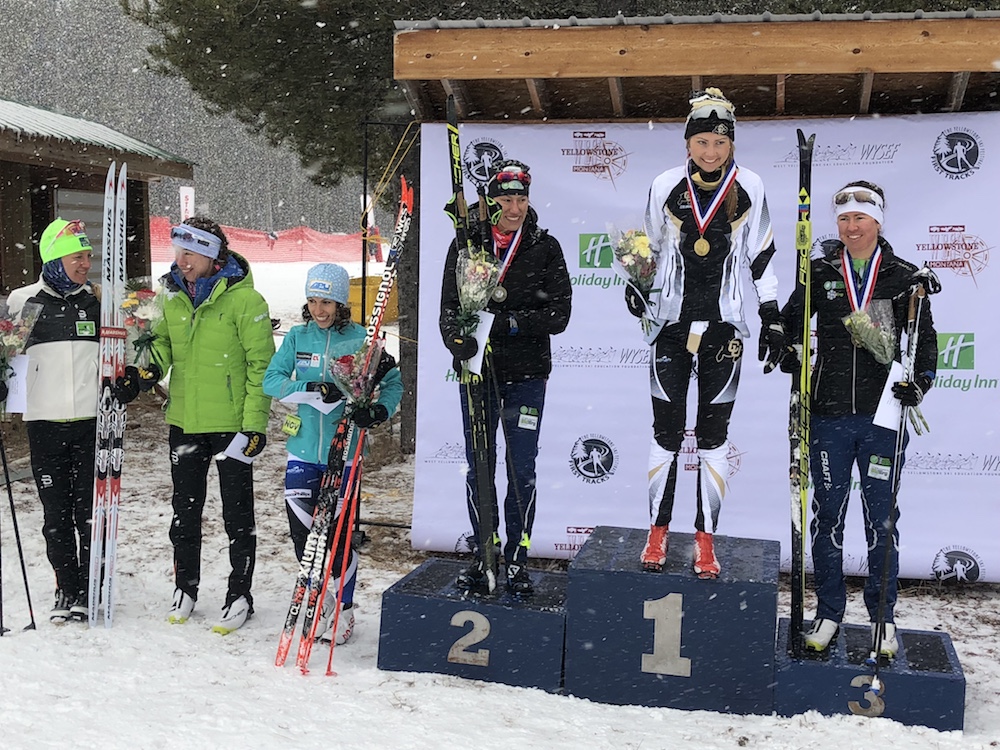
The SuperTour women’s 10 k classic mass start podium on Sunday in West Yellowstone, Montana, with Hedda Bångman (second from r) of the University of Colorado Boulder in first, and Craftsbury’s Kaitlynn Miller (third from r) and Caitlin Patterson (r) in second and third, respectively. From left: Caitlin Gregg in sixth, Katharine Ogden in fifth and Rosie Frankowski in fourth were also recognized at the flower ceremony. (Photo: FBD)
US SuperTour (West Yellowstone, Montana): 10/15 k classic mass starts
The second day of SuperTour racing took place as originally planned at the Rendezvous Ski Trails in West Yellowstone, with 22-year-old Hedda Bångman, of the University of Colorado Boulder (CU), and 33-year-old Brian Gregg (Team Gregg) winning the women’s 10-kilometer and men’s 15 k classic mass starts, respectively, on Sunday.
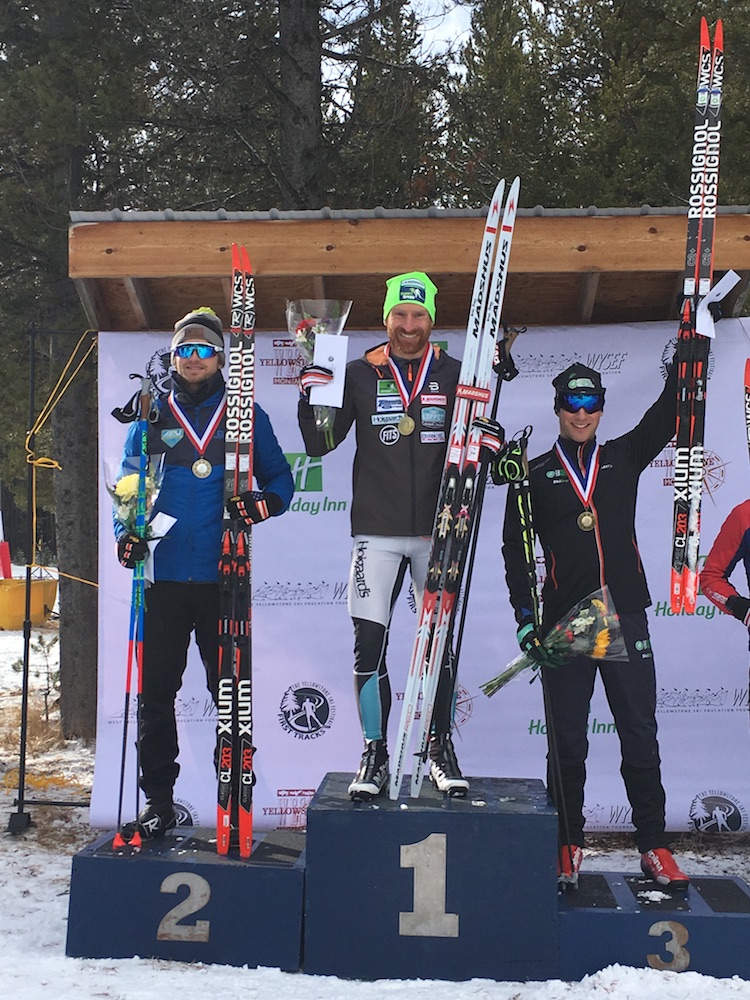
The men’s 15 k classic mass start SuperTour podium on Sunday in West Yellowstone, Montana,with Brian Gregg (c) of Team Gregg in first, David Norris (l) of APU in second, and Ben Lustgarten (CGRP) in third. (Photo: FBD)
Bångman, a Swedish freshman on the CU Ski Team, won the women’s race in 30:24.8, just ahead of two Craftsbury Green Racing Project (CGRP) skiers Kaitlynn Miller and Caitlin Patterson. While Miller placed second (+1.3) and Patterson was third (+3.4),
Rosie Frankowski of Alaska Pacific University (APU) finished another 10 seconds later in fourth (+13.5), and Katharine Ogden of the Stratton Mountain School (SMS) was fifth (+17.2). Caitlin Gregg (Team Gregg) followed in sixth, Felicia Gesior (CXC Team) was seventh, Anne Siri Lervik (CU) eighth, Erika Flowers (SMS Elite Team) ninth, and Corey Stock of the Bridger Ski Foundation (BSF) 10th.
In the men’s race, Brian Gregg pulled out a 1.9-second win over David Norris (APU), crossing the line first in 41:30.3. Ben Lustgarten (CGRP) reached the podium for the second-straight day (after placing second in Saturday’s skate sprint) in third (+4.6). Kyle Bratrud (CXC Team) finished fourth (+10.9) and Kris Freeman (Caldwell Sport) was fifth (+12.6). Tad Elliott (Ski & Snowboard Club Vail) followed in sixth, Eric Packer (APU) seventh, Ian Torchia (Northern Michigan University/U.S. Ski Team D-Team) eighth, Hunter Wonders (APU) ninth, and Martin Bergström (University of Utah Ski) 10th.
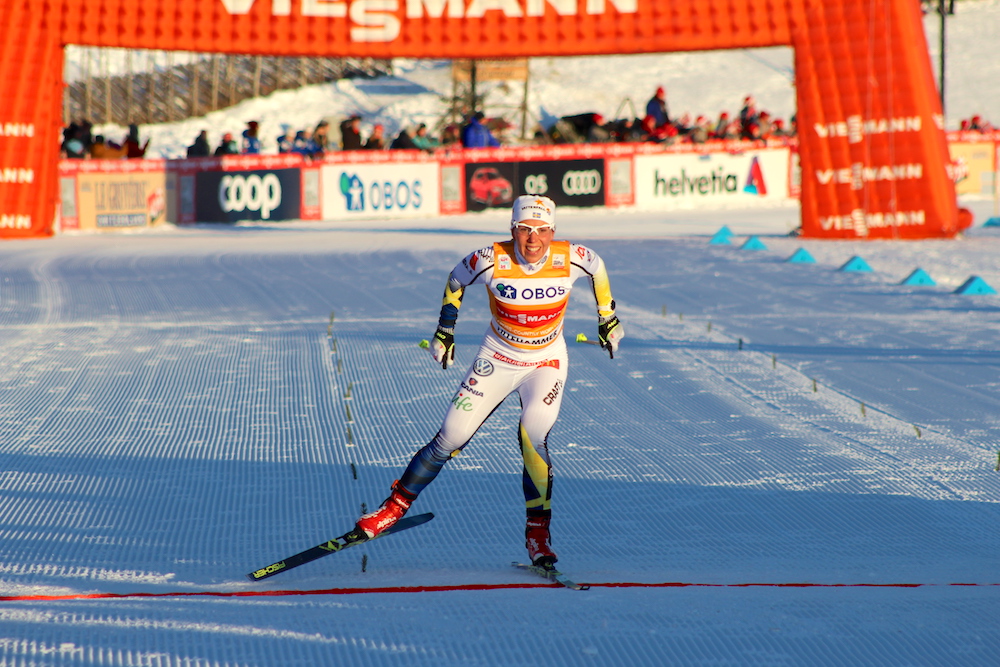
Sweden’s Charlotte Kalla winning the women’s 15 k skiathlon on Sunday at the Lillehammer World Cup in Norway. (Photo: Henrik Hunnes)
Sweden’s Charlotte Kalla pulled out another dominant distance performance on Week 2 of the World Cup, racing to a 19.7-second win in the women’s 15-kilometer skiathlon on Sunday, ahead of three Norwegians and American Jessie Diggins.
Kalla led at the halfway point of the skiathlon when skiers transitioned from classic to skate, just ahead of Norway’s Heidi Weng in second. The two had broken away around 4 k into the classic leg and put more than 20 seconds into the rest of the field by the transition, when Diggins came through 21.6 seconds back in third, leading a large chase group with Finland’s Krista Parmakoski, Norway’s Marit Bjørgen, Austria’s Teresa Stadlober, Norway’s Kathrine Rolsted Harsem, Finland’s Kerttu Niskanen, Norway’s Ragnhild Haga, and Switzerland’s Nathalie von Siebenthal, respectively.
While Kalla and Weng continued to trade the lead over the next 5 1/2 kilometers or so, by the 13.65 k marker, Kalla had dropped Weng, with 12 seconds between the two, while the chasers remained 29 seconds behind Kalla.
Over the next 1.2 k, that time gap grew to 20 seconds and 46 seconds, respectively, and Kalla skied off to her second win of the season in 42:24.7 minutes.
Weng placed second, 19.7 seconds back, and Haga claimed third (+43.6), after skiing alone for the last 4 k of the race. Bjørgen finished just ahead of Diggins for fourth (+54.3) and fifth (+57.0), respectively, and Stadlober was sixth (+1:04.9), Parmakoski seventh (+1:07.8), Norway’s Ingvild Flugstad Østberg eighth, Russia’s Natalia Nepryaeva ninth (+1:27.8), and Sadie Bjornsen 10th (+1:32.6).
Four Americans finished scored points in the top 30, with Kikkan Randall placing 16th (+2:06.5) and Rosie Brennan 29th (+3:07.7). Liz Stephen finished 36th (+3:25.7), Chelsea Holmes was 38th (+3:39.6) and Ida Sargent 55th (+6:41.1).
Cendrine Browne of the Canadian National U25 Team led Canada in 45th (+4:37.3), and Emily Nishikawa followed in 49th (+5:00.1). Katherine Stewart-Jones did not finish.
Klæbo Outlasts Sundby; Harvey 6th
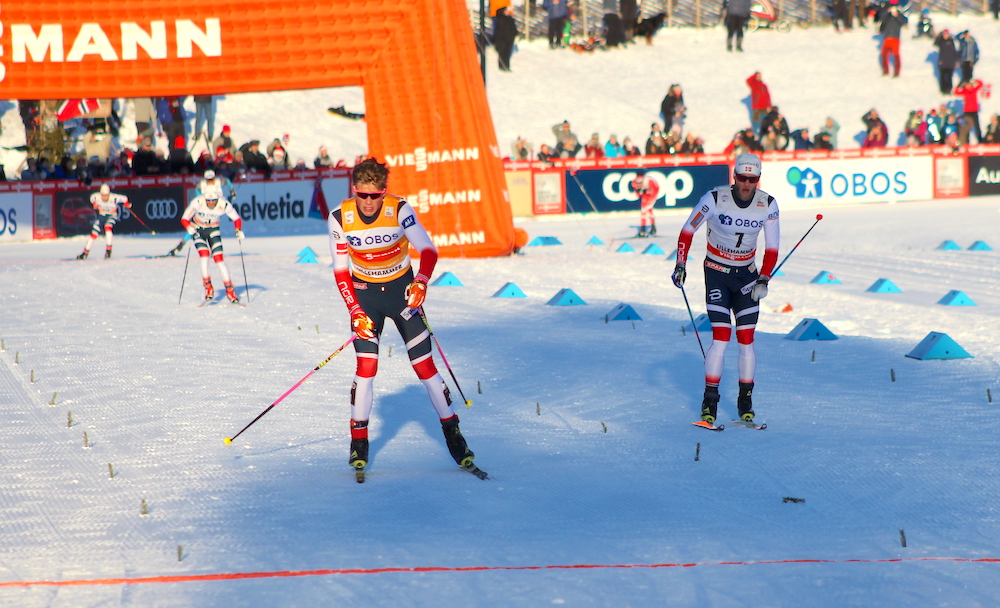
A gassed Johannes Høsflot Klæbo (yellow bib) holding off fellow Norwegian Martin Johnsrud Sundby (r) for the win on Sunday in the men’s 30 k skiathlon at the Lillehammer World Cup in Norway. (Photo: Henrik Hunnes)
In the men’s 30 k skiathlon that followed, Norway’s Johannes Høsflot Klæbo made it a five-peat, proving himself once again unbeatable, this time in the first multi-discipline distance race of the season.
Klæbo outlasted [edit: rocketed past] teammate Martin Johnsrud Sundby to beat him by 1.3 seconds for his fifth-straight win in 1:16:47.1, and Norway swept the top four with Hans Christer Holund in third (+6.8) and Simen Hegstad Krüger in fourth (+10.9).
France’s Maurice Manificat followed closely in fifth (+11.3) and Canada’s Alex Harvey was next in sixth (+13.1), ahead of Finland’s Iivo Niskanen in seventh (+16.2), and Russia’s Alexey Chervotkin, Sergey Ustiugov and Alexander Bolshunov in eighth (+37.7), ninth (+42.2) and 10th (+59.6), respectively.
Klæbo skied patiently in the pack for essentially the entire race. For instance, at 11 k he sat back in 18th, just seven seconds from Canada’s Devon Kershaw in the lead.
One kilometer later, Klæbo remained 5 seconds back in 13th while Kershaw was 8 seconds back in 16th.
At the ski exchange at 15 k, Niskanen led Sundby and Italy’s Francesco de Fabiani and a total of 10 men within three seconds of first. Klæbo clocked through 5 seconds back in 13th, just ahead of Harvey in 14th (+5.3). Sixteen men remained within six seconds and striking distance of first. Kershaw in 18th had fallen off the pace and was 36 seconds back at the transition, just behind Russia’s Andrey Larkov.
While Harvey continued to ski around third place during the first 5 kilometers of the skate leg, Klæbo worked his way closer to the front and led at 22.5 k. By then, the lead group had dwindled to six within two seconds of first. Harvey remained in fourth.
Over the next 7.5 k, the lead changed several times, with Klæbo hovering near the tail end of the group. With about 200 meters to go, however, it was down to Sundby and Klæbo, with the former leading by 2 seconds (and Holund skiing seven seconds back in third). Klæbo ultimately had the most finishing kick to take the win by 1.3 seconds over Sundby, while Holund crossed 6.8 seconds later for third.
Canada had two in the top 20 with Kershaw in 19th (+2:59.7). Last year’s NorAm winner Russell Kennedy (Team R.A.D.) placed 53rd (+7:30.7), and Canadian World Cup Team members Graeme Killick and Knute Johnsgaard finished 54th (+7:41.3) and 60th (+9:49), respectively.
Two U.S. men landed in the points with Erik Bjornsen (U.S. Ski Team) in 20th (+2:59.9; just 0.2 seconds behind Kershaw) and Noah Hoffman in 28th (+3:37.8). Scott Patterson finished 36th (+4:56.1) and Paddy Caldwell was 56th (+7:43).
— International Biathlon Union (@biathlonworld) December 3, 2017
France’s Martin Fourcade overcame an early penalty and his No. 2 starting position to take the men’s 12.5 k pursuit win on Sunday, 40.8 seconds clear of anyone with 19-for-20 shooting (1+0+0+0).
Fourcade started 1 second behind Saturday’s sprint winner, Norway’s Tarjei Bø, and took control of the race after cleaning the second shooting stage. Bø missed one on the first prone stage then five more later in the race (1+0+3+2) to slip to 19th (+1:49.5) while Slovenia’s Jakov Fak raced up from 10th to second, 40.8 seconds behind Fourcade, with two penalties (1+0+0+1). Just behind him, France’s Quentin Fillon Maillet took third (+42.1) with identical shooting after Fillon Maillet started 12th and skied with Fak for most of the race.
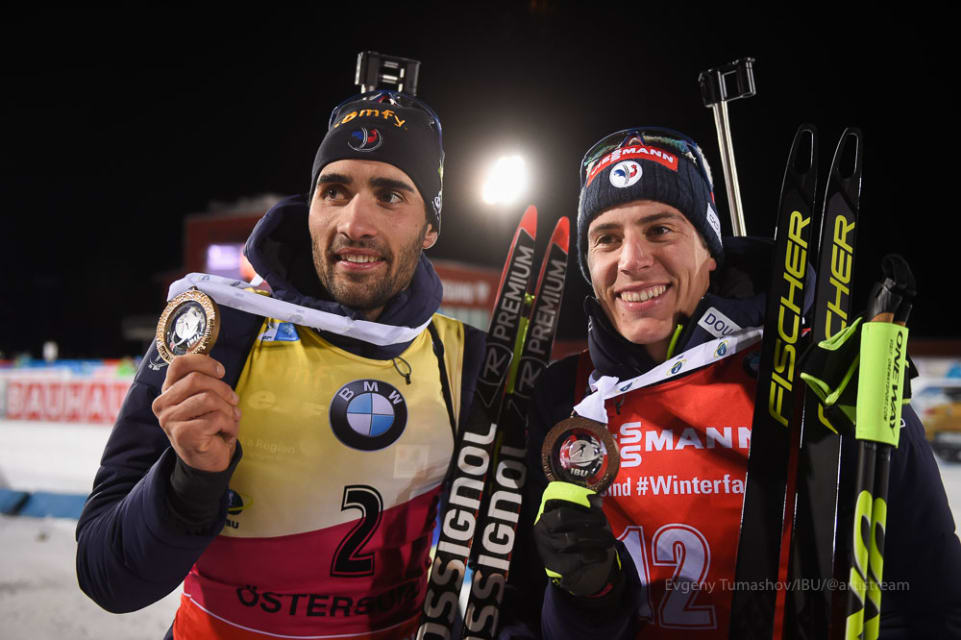
France’s Martin Fourcade (l) and Quentin Fillon Maillet after placing first and third, respectively, in the IBU World Cup men’s 12.5 k pursuit on Sunday in Lillehammer, Norway. (Photo: IBU/biathlonworld)
None of the 58 finishers cleaned the four-stage race. American Lowell Bailey improved from 22nd to 17th (+1:40.2) with two misses (0+1+0+1). Canada’s Christian Gow achieved a career best in 21st (+2:04.6), up from starting 26th, after shooting 19-for-20 (0+0+1+0).
Also for Canada, Nathan Smith slipped from 24th at the start to 42nd (+3:19.2, three penalties), Scott Gow finished 50th (+4:10.9; six penalties) after starting 16th, and Brendan Green placed 51st (+4:18.6; five penalties).
One other American qualified in the sprint top 60 for the pursuit, with Tim Burke finishing 48th (+3:52.7; four misses).
In the women’s 10 k pursuit earlier in the day, Germany’s Denise Herrmann tallied her second-straight win (and the second win of her IBU World Cup career). She started first and successfully held of France’s Justine Braisaz, who started 15 seconds behind her in second place, by 25.8 seconds. While Herrmann missed two on her third shooting (0+0+2+0), Braisaz was one of three women in the field to clean (0+0+0+0).
Norway’s Marte Olsbu raced up from seventh to third place (+48.0) with two penalties (0+1+0+1).
Canada’s Julia Ransom placed 23rd (+2:48.1), up from 29th at the start, with two misses (0+0+1+1). Two of her teammates also qualified for the pursuit, with Rosanna Crawford finishing 52nd (+5:25.1) with six penalties (0+3+1+2). In her first World Cup pursuit, Megan Bankes completed three shooting stages before being lapped (3+1+1).
No American women qualified for the pursuit.
With the conclusion of the first IBU World Cup in Östersund, the circuit moves to Hochfilzen, Austria, where racing kicks off again Friday, Dec. 8, with men’s and women’s sprints.
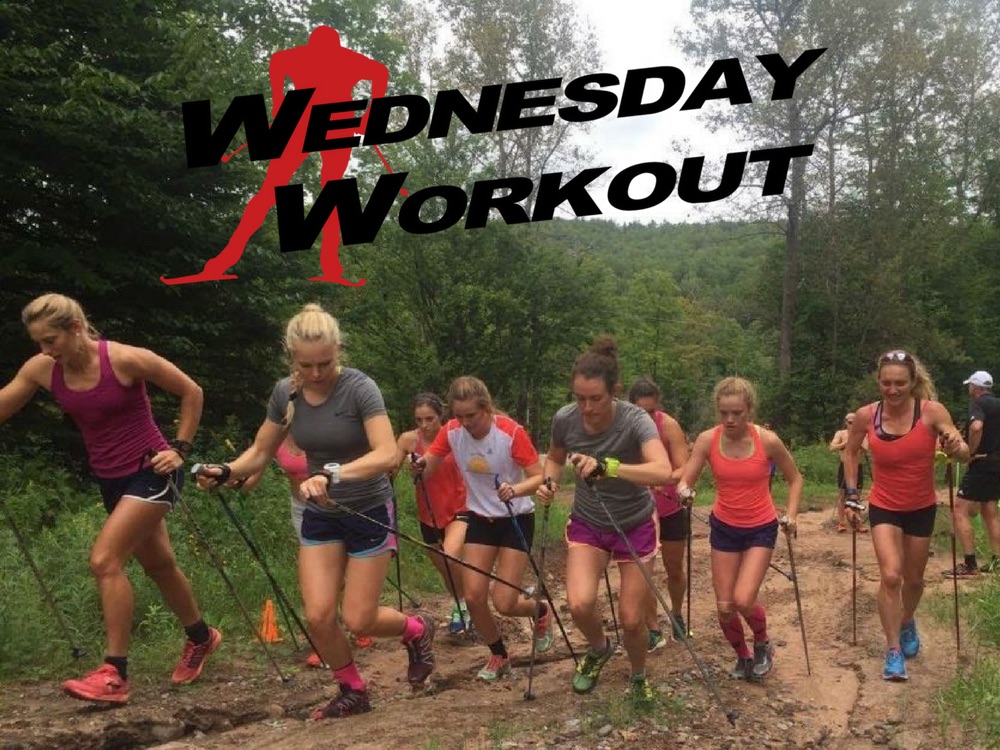
NMU alumnae Felicia Gesior (far left) and Caitlin Gregg (far right, blue shoes) during a fall training session with the Northern Michigan University (NMU) women’s ski team in 2016. (Courtesy photo)
This week’s Wednesday Workout comes from Central Cross Country (CXC) Team member Felicia Gesior. In her second year with CXC, Gesior, 24, is currently working on coordinating the Bergkönig Trail Run, an annual event that began six years ago to raise money for post-collegiate CXC skiers. Race registration and information can be found here.
***
Bergkönig. In German, it translates to “mountain king”. In 2011, it translated to the perfect name for the trail run Northern Michigan University (NMU) alums Maria Stuber and Bryan Cook were launching in an effort to fund their ski racing with Central Cross Country (CXC).
Both Stuber and Cook had been brainstorming a name to make the event, with 5- and 10-kilometer races, stand out from others in the mid-eastern Wisconsin area. Intending to email her brother for an outsider’s opinion, Stuber explained she accidentally sent a message to a “random guy” by the name of Thomas Stuber hailing from Germany. Thomas immediately informed Maria that she had the incorrect Stuber, but not before suggesting the trail run be called Bergkönig. In lieu of the erroneous email, the Bergkönig bank account and Bergkönig Trail Run began.
“Our goal was to give back to the local community, raise money for our winters, and create some awareness for the sport,” Stuber explained in an email to FasterSkier. “After a few years it became a big race and we felt fortunate to be able to rely on it for financial support every year. It was one of the factors that allowed up to keep ski racing as long as we did … something we are really proud of. We didn’t want to see it go away after we were done racing so we kept doing it for a couple years and put the money in a bank account to help future skiers with similar aspirations that needed funding.”
Felicia Geisor (CXC Team) at 2017 U.S. nationals in Soldier Hollow in January. (Courtesy photo)
One of those future skiers included CXC’s Felicia Gesior. Five years after the inaugural Bergkönig, Gesior, originally from Waukesha, Wisconsin, qualified for the 2016 U23 World Skiing Championships in Rasnov, Romania, and the Bergkönig extended its connections beyond Germany and the continental U.S. That year, it granted Gesior a round-trip plane ticket to get her to Romania.
“It was SO COOL for us to be able to send Felicia that check!” Stuber wrote.
This year, Gesior, a 2016 NMU graduate now in her second season with CXC, will be in charge of coordinating the very race that helped her get to U23 Worlds. Proceeds from this race will help cover her travel and ski expenses as well as go toward that “Bergkönig Scholarship Fund that will assist future generations of Wisconsin Skiers pursuing Olympic dreams after college,” the event’s website states.
Stuber, head nordic coach at the College of St. Scholastica, and Cook have stepped back this fall, though they both plan to drive down from Duluth, Minnesota, for the event. The race is scheduled for Nov. 11 in Delafield, Wisconsin, on the hilly trails of Lapham State Park, a course Gesior, Stuber and Cook all trained on as Peak Nordic skiers in high school.
“Many of the [Peak Nordic] coaches are the same today as they were when I was in high school and they went way above and beyond to support me throughout my entire career,” Stuber noted. “We are all so proud of this place that we would go to great lengths to see Felicia represent us at the highest level of U.S. skiing.”
Felicia Geisor on graduation day at Northern Michigan University in the spring of 2017. (Courtesy photo)
Gesior has been training in Marquette, Michigan, this summer and fall under the guidance of the CXC Team’s new head coachEliška Hájek Albrigtsen. Most of Gesior’s goals revolve around U.S. SuperTour races and U.S. nationals in January. She views being an American woman on the domestic race circuit as “an exciting time” with “everyone pushing to new levels.”
“Every time I have the opportunity, like at U.S. nationals, to race against those elite girls that’s just excellent because they’re pushing the whole field,” Gesior said on the phone last month.
When she isn’t training, Gesior substitute teaches at local schools in Marquette. The work not only serves as a supplemental income, but also as way for her to stay connected to her post-skiing career — she has a degree in education from NMU. She also plans to help with CXC’s ‘Nordic Rocks’ for Schools program, an initiative that aims to get more youth involved with nordic skiing.
“That’s one of CXC’s major goals is to get Nordic Rocks in more of the schools. My relationship is getting it into Marquette this year,” Gesior explained, adding that the program has donated up to 30 pairs of nordic skis to more than 200 elementary schools.
“Kids can put them on with their snow boots and then they can walk literally from the gym outside to the door … You can imagine all these little kids, it’s hilarious,” she said. “So that’s just another side thing where I can connect my two passions together.”
Beyond training and teaching, the Bergkönig will be the most forthcoming of Gesior’s fall focus, along with the Level 4 ski-walking intervals she recommends as race prep for the Bergkönig trail’s hills. May the best Mountain King win.
The Workout: “Marquette Mountain Repeats”
Type: Level 4 Ski Walking Intervals
The workout should be hard to complete with a focus on an elevated heart rate and mental fortitude. Gesior usually incorporates this workout into her plan towards the end of her summer training cycle and and continues doing it once a week through the fall.
She suggested doing this workout without ski poles to prevent building up too much lactate while climbing.
“The best part about this workout is that you do not get as much lactate build up as you might on a bounding workout because you don’t have poles in your arms,” Gesior wrote in an email. “Instead, you can push your heart without building up too much lactate. This is a good workout during a week that you don’t want to necessarily build lactate but still want to get in a hard effort.”
Terrain: Small alpine hill (should take 4-5 minutes to ascend; Geisor recommends no more than 6 minutes)
Warmup: 20-25 minutes jogging with a couple minutes of Level 3 toward the end of the warmup followed by strides
The set: 5-8 x 4-minute ascents; off time is amount of time it takes to descend the hill
The first 4-minute set should be done at the high end of a Level 3 pace. Each consecutive set should be done slightly faster.
“This workout is an interval ski walking workout so you ski walk up the hill swinging your arms as if you are classic skiing and you should be going at Level 3-plus into Level 4,” Gesior explained.
Cool down: 20-30 minutes easy jogging
Total time: 1.5 to 2 hours
Gesior’s Golden Rules:
Record; don’t get wrecked. Since each ascent should be faster than the previous one, Gesior indicated that recording times should not be overlooked, nor should going to hard from the start. “It is important to keep track of your times on each interval because you want to have your last ones be faster than your first ones,” she wrote. “You want to do the first one starting in L-3 and then you go for a faster time on each consecutive interval. The majority of the intervals are done in Level 4 and you should strive to push the pass towards the end of each interval as well as the last few intervals in your set.”
Make mental note. Don’t be afraid to use the intervals as practice for pushing past negative thoughts that might pay visit during competitions. “You should be focusing on your mental toughness that you tap into during races,” she wrote. “You should remember to use good ski walking technique in your legs as well as using your arms as if you were striding.”
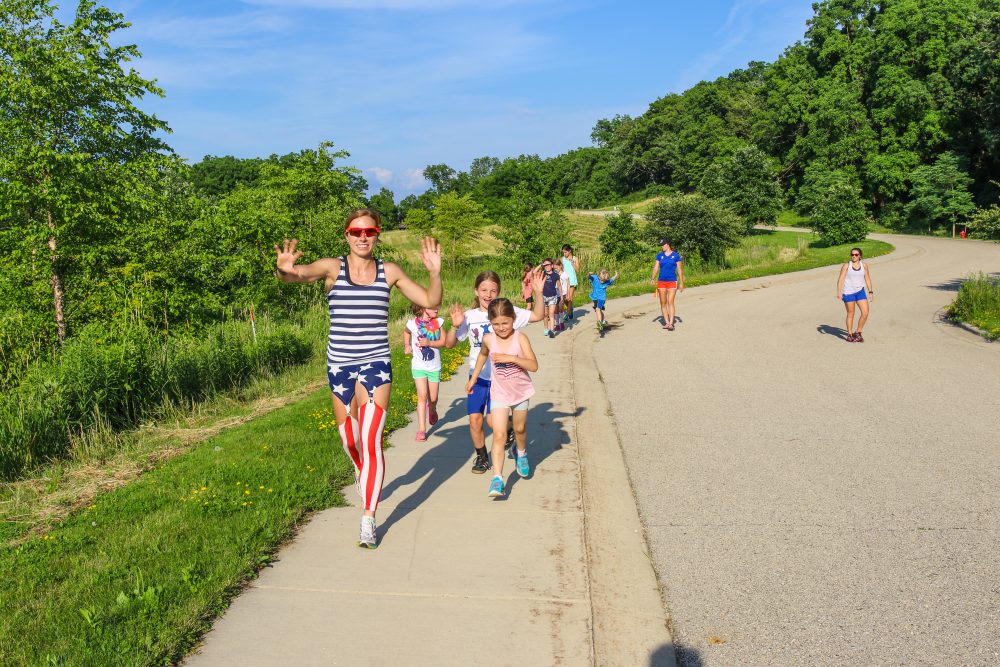
Eliška Hájek Albrigtsen (formerly Hájková, front right) with Madison Nordic Ski Club’s Trail Kids this summer.(Photo: Tobias Hájek Albrigtsen)
Many mornings, Eliška Hájek Albrigtsen’s husband, Tobias Albrigtsen, has to peel her out of bed. Living the life of an early bird like her spouse is nowhere near the top of her list — partly because she spends most nights prodding her hubby awake as he finishes his work, partly because she is strung out between four jobs of her own.
Being in charge of three ski programs while assisting a fourth is not where the 29 year old envisioned herself when she moved to Madison, Wisconsin, this past June to work for Central Cross Country (CXC). But a lot can change over the course of a summer and for Albrigtsen (formerly Hájková), a lot did.
After relocating to the Badger State’s capital from Lake Tahoe, California, to serve as CXC’s Community Olympic Development Director, Albrigtsen’s responsibilities began to accrue.
It started with the addition of coaching CXC’s online master’s program. Then she had an interest in helping with CXC’s Paralympic and adaptive athletes. Finally, in late August, Andy Keller left his head-coaching position with the CXC Team to join Northern Michigan University (NMU) as an assistant coach, and Albrigtsen was in a prime spot to take over the reins.
“When Andy took the assistant coaching job at NMU, it was kind of natural that I got the CXC Team head coach position,” Albrigtsen, a Czech Republic native, said during a recent phone interview. “For me, it’s not like a big promotion, it’s just more stuff to do while I still do all the stuff I was doing before. I have a lot of responsibilities all of a sudden that I didn’t start with.”
Among those responsibilities, she has been busy making informative videos for CXC Academy under the job title of Community Olympic Development Coach.
While attending the University of Colorado-Boulder (CU), she finished in the top 10 of 45 out of 48 races over the course of her college career, according to a CU press release, all while maintaining above a 3.5 grade-point average.
Eliska Hajkova (CU), racing against Sophie Caldwell (Dartmouth) and Corey Stock (CSU) during a sprint semifinal in 2012. Hajkova graduated in 2013 and after marrying, changed her last name to Hájek Albrigtsen. (Photo: James Doucett)
After three seasons coaching the BNJRT in Colorado, Albrigtsen moved to Kings Beach at the north end of Lake Tahoe last year, where the juggling act continued. There, she served as the head coach for Tahoe XC, while also volunteering with the Auburn Ski Club’s elite athletes, taught private ski lessons for Tahoe Donner, coached an online master’s program, and once again raced U.S. nationals, placing 12th in the 20 k classic mass start.
She’s also raced more than two dozen World Cups, most recently in 2014.
Though Albrigtsen indicates that she “never stops officially training or racing” this year might be a little different as it will be her first season coaching senior elite skiers. Still, the idea of more challenging practice sessions is enough to draw her in, even if it means scaling back her training a bit. As a coach she brings not only race experience, but the empathy and understanding of an athlete.
“With U14 kids, I mean, I was challenging them, but I was not getting challenged,” she reflected. “I think being challenged as a coach, being able to hang out with your athletes, you really see and you can really feel their pain. When you’re right on their butts and doing every exercise, you can see, ‘OK, I know that in the Level 4 on the fifth minute, during the sixth interval you died, so let’s figure that out.’ I think that’s one of my powers, that I can really be there when it’s happening.”
When asked of her strengths as a coach, CXC Executive Director Yuriy Gusev was quick to respond.
“Her racing experience, number one,” he said on the phone. “And [she’s] just very energetic and hardworking and organized.”
Albrigtsen will work with three CXC Team skiers this winter: Felicia Gesior, Kyle Bratrud and Sam Elfstrom. All three graduated from NMU, are currently based out of Marquette, Michigan, and will set their focus on the first few SuperTour races and U.S. nationals before re-evaluating their season goals. The fourth CXC Team member, Nichole Bathe (who graduated from the University of Alaska Fairbanks) remains on roster, but headed to Europe earlier this fall to train in Norway with a goal of making the 2018 Winter Olympic Games for Great Britain’s national team.
Until the first week of SuperTour racing in early December, the amount of time the other three CXC elite skiers and Albrigtsen work together will depend on the athletes. Albrigtsen wanted to keep the summer and fall schedule fairly flexible so her athletes would not feel restricted in the amount of paid work or fundraising they could accomplish while training for the upcoming season.
For example, Gesior made a trip to Madison earlier this fall for a training session on CXC’s rollerski treadmill with Albrigtsen, but will spend most the next few weeks training in Marquette and preparing for a fundraiser she’s organizing: the Bergkönig trail run on Nov. 11. The event features 10 k, 5 k and 1 k races and was originally created by Maria Stuber and Bryan Cook in an effort to raise money for local cross-country skiers looking to continue their ski careers post-college.
Gesior also works as a substitute teacher in Marquette, and most of her training this summer and fall has been with the NMU women’s team. Similarly, Bratrud and Elfstrom train with the NMU men’s team.
Felicia Geisor of the CXC Team prepares to hop on the treadmill in early September. (Courtesy photo)
“I think that’s OK that they follow [NMU],” Albrigtsen said, “That’s kind of the program that really took them where they are and they have something to top it. They don’t train like college skiers; I mean, it’s their job right now so they do train more. But the base is very similar and [NMU Head Coach] Sten [Fjeldheim] is being really nice about allowing them to train with them. Not all college coaches are that way, so we’re definitely really lucky.”
According to Gusev, partnerships like the one CXC has with NMU and other programs in the Midwest are the reason for CXC’s expansion. Over the last decade, he said CXC has grown from a $50,000-dollar organization to a million-dollar one.
“It’s all of those partnerships,” Gusev said of the CXC programs’ continued growth. “They’re incredible organizations so we’re able to work with all of them together and help them work together.”
The organization hopes to continue its expansion with the addition of a $12-million-dollar training complex just outside the Madison suburb of Middleton, Wisconsin, which is currently in the planning stages. The facility would not only include a competition venue, but snowmaking equipment, a lit rollerski loop, and 30,000-square-foot facility open for recreational use as well.
The idea behind the complex, Gusev indicated, would be to provide CXC athletes with a training venue, while simultaneously encouraging community members to get outside and active, using skiing as an example. The center already has one complex, the CXC Center of Excellence in Madison, complete with rollerski treadmill. “With the CXC Team, our number-one goal is to support the athletes that need the support. That’s as simple as that,” Gusev said. “But overall, our goal as an organization is to grow the sport at all levels.”
To Albrigtsen, the new facility is another reason Madison and CXC seemed like a good choice for her and her husband, Tobias, who is CXC’s media and communications coordinator, when moving from Tahoe to the Midwest. That, and the cost of living.
“We always talk about what can Midwest offer that other regions can’t. We don’t have the mountains, we don’t have the best winters, but what we really have is the best quality of life,” Albrigtsen said.
“You can live much cheaper here than anywhere else in U.S. and still make somewhat good money,” she continued. “Not everybody, especially in the U.S., there’s maybe 10-15 people who can do this professionally and get paid being skiers, otherwise you have to work and that’s something Midwest does have to offer. You can have a normal life and be a skier. You can do it here.”
While Albrigtsen’s “normal life” is somewhat busier than others might prefer, she is in no way deterred.
“I am a total sport addict, and I think every coach has to be, otherwise it’s not really worth it,” she said. “Tobias and I, we’re just trying to do what we love and give something back.”
Give something back, and get a little training in at the same time, even if it’s in between her multiple jobs.
“My motivation is also to fit in my jeans, wearing tight dresses,” Albrigtsen added with a laugh. “I have a five-year-younger husband so I have to take care of myself.”
Eliska Hájek Albrigtsen (formerly Hajkova) leading a Fourth of July run with Madison Nordic Ski Club’s Trail Kids this summer. (Photo: Tobias Albrigtsen)
The Alberta Cup men’s podium in Sunday’s 8.1 k classic interval start, with winner Kyle Bratrud (c) of CXC Team, NTDC Thunder Bay’s Evan Palmer-Charrette (l) in second and AWCA’s Dominique Moncion-Groulx (r) in third. (Photo: NTDC Thunder Bay/Twitter)
Here’s one that didn’t make Sunday’s Rundown: the Alberta Cup’s opening distance races, which took place Nov. 26-27 in Canmore, Alberta.
***
The Alberta Cup kicked off this past weekend with several big names competing in the distance races at the Canmore Nordic Centre on Saturday and Sunday.
Brian McKeever, Kyle Bratrud, Chelsea Holmes, and Felicia Gesior picked up victories, with the latter three all hailing from the U.S.
In the men’s 13.5 k freestyle interval start, McKeever, of Canada’s Para-Nordic Ski Team, took first in the men’s open race, beating his teammate Graham Nishikawa by 3.6 seconds with a winning time of 30:01.8. A visually impaired skier, McKeever races with Nishikawa as his guide in Paralympic races. But not on Saturday.
Bratrud, of the CXC Team, placed third in the 13.5 k skate, two seconds back from Nishikawa and 5.6 out of first.
David Palmer (Black Jack) was the second Canadian in fourth overall (+20.0), Matthew Hudec, of the Biathlon Alberta Training Centre (BATC), was fifth (+36.3), and Brian Gregg (Team Gregg) took sixth (+50.1). Rounding out the top 10 (of 54 in the open men’s field), Russell Kennedy (Team R.A.D.) placed seventh, Erik Carleton (Canadian Para-Nordic Ski Team) was eighth, Evan Palmer-Charrette (NTDC Thunder Bay) ninth, and Dominique Moncion-Groulx, of theAlberta World Cup Academy (AWCA), 10th.
Holmes, of Alaska Pacific University (APU), won the women’s 8.1 k freestyle on Saturday, finishing nearly 45 seconds ahead of Caitlin Gregg (Team Gregg) in 21:10.7. Biathlon Canada’s Emma Lunder placed third (+52.1) and junior biathlete Megan Bankes (BATC) finished fourth (+1:08.4), ahead of another BATC junior Nadia Moser in fifth (+1:13). Andrea Dupont, of Rocky Mountain Racers (RMR) finished sixth (+1:19.6) and Katherine Stewart-Jones (NTDC Thunder Bay/National U25 Team) was seventh (+1:30.8), while Kathryn Stone (University of Alberta) placed eighth, Annika Richardson (NTDC Thunder Bay) was ninth, and India McIsaac (RMR) 10th out of 33 women in the open category.
On Sunday, CXC posted this photo and caption about its women’s winner Felicia Gesior (l), runner-up Caitlin Gregg (Team Gregg) (c), and Annika Richardson (r) (NTDC Thunder Bay) who placed second in the junior race in the Alberta Cup classic distance race: “Double CXC Team Win! Felicia Gesior double poles to a victory in the women’s classic race. Photo with the other two girls to double pole the race. These girls are STRONG!” (Photo: CXC Skiing Facebook)
On Sunday, Bratrud came out with a 9.9-second win in the men’s 8.1 k classic interval start over Palmer-Charrette. Bratrud won in 19:00.1, Palmer-Charrette was second, and Moncio-Groulx placed third (+29.2).
On his first of of four laps, Moncion-Groulx recorded the fastest lap time of the day.
“I didn’t know if I was in the game, but I was happily surprised when I was third,” Moncion-Groulx said of his finish, according to an AWCA press release. “It’s an improvement, and there are definitely some good guys racing. It’s a good confidence boost.”
Michael Somppi (NTDC Thunder Bay) was fourth (+32.5), Julian Smith (NTDC Thunder Bay) fifth (+45.7), and for the second-straight race, Brian Gregg finished sixth (+53.0). Nishikawa was another two seconds back seventh, Palmer was eighth, Kennedy cracked the top 10 for the second straight day in ninth, as did Carleton in 10th.
McKeever finished 11th, half a second behind Carleton, his other Paralympic guide, out of 26 in the men’s open race. After Sunday’s race, McKeever tweeted, “Vented personal frustration today. Mental error=inability to count laps in today’s race. Realize I’ve put a lot of stress on myself lately.”
In another tweet on Sunday, he wrote, “Congrats to Kyle Bratrud from @cxcskiing and the @NDCTBay boys for laying down the hammer on the field today! Cool to see!”
Also on Sunday, Gesior won the women’s 6.3 k classic and Caitlin Gregg repeated in second. Gesior put down the fastest time in 17:46.8, and Gregg finished 9.3 seconds back, while Olivia Bouffard-Nesbitt (AWCA/National U25 Team) placed third (+13.1).
According to the AWCA press release, Bouffard-Nesbitt is still recovering from a stress fracture and spent three months this summer on crutches. “I know I need to step up to the challenge. I feel the pressure and it’s helping me become a better athlete,” she said.
Stewart-Jones double poled to fourth (+23.3), Holmes placed fifth (+36.0), and Dupont was sixth (+54.1). Alannah Maclean (NTDC Thunder Bay) placed seventh, Emma Camicioli (RMR) was eighth, Delphine Duvernay Tardif (AWCA) ninth, and Ember Large (University of Alberta) 10th out of 18 women in the open field.
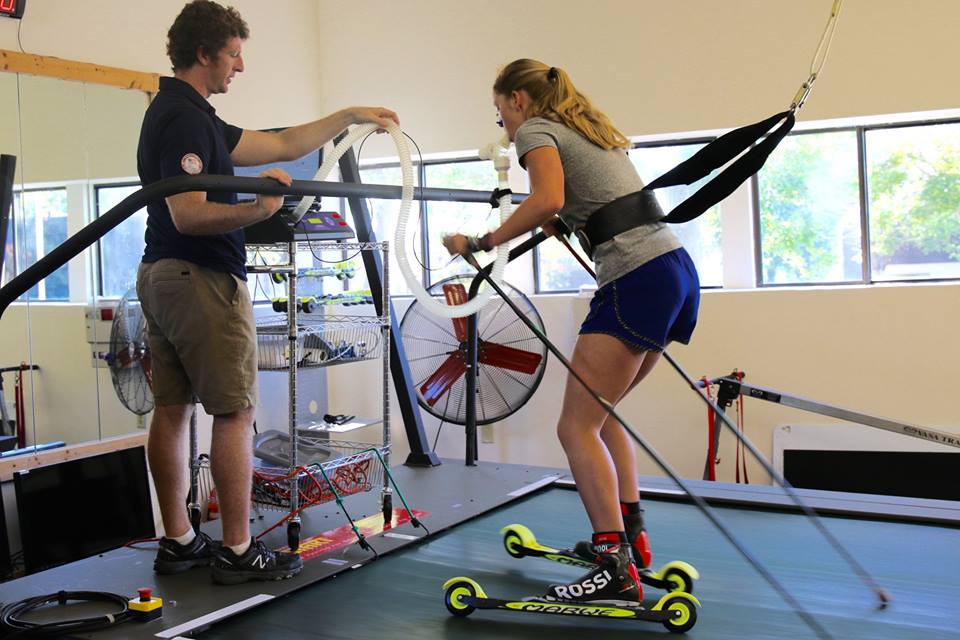
Central Cross Country (CXC) junior development skier Siri Martin (r) gets a mid-summer VO2max test on the rollerski treadmill at CXC’s Center of Excellence in Madison, Wis., in late July (Photo: CXC Facebook)
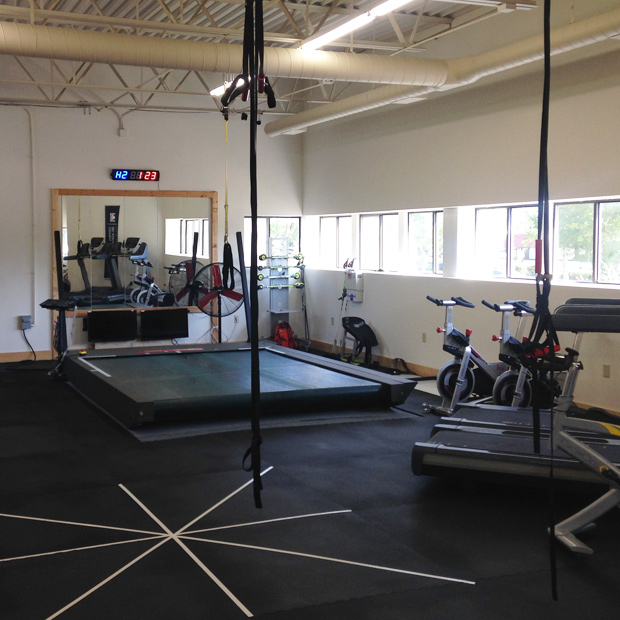
A glance into any one of the glass windows lining the east side of Central Cross Country (CXC) Academy’s Center of Excellence building might give the impression of the average athlete gym. But if you step across the front threshold or take a peek at the academy’s 360-degree virtual online tour and sport science page, you’ll find much more than treadmills, stationary bikes and medicine balls.
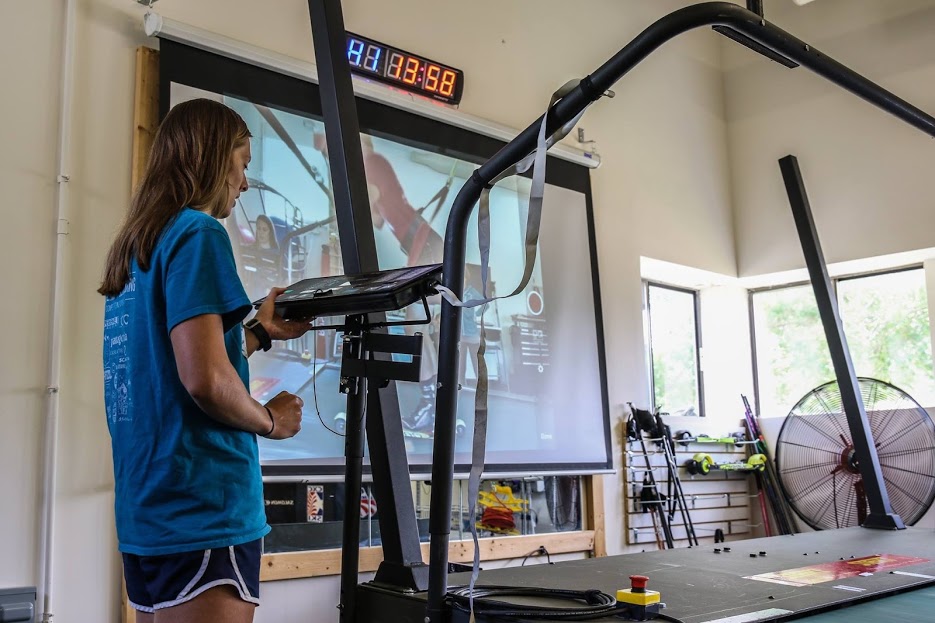
Located in Madison, Wis., the CXC Center of Excellence also houses a 10-by-12-foot rollerski treadmill, SkiErgs, and an in-house-made, power-pole machine. For many, though, equipment is not the most powerful tool in the center. Rather, it’s the center’s capacity to evaluate and educate its members and non-members alike about nordic skiing.
Currently, the Center of Excellence offers performance evaluations, as well as fitness testing for lactate and VO2max using the oversized treadmill. Recorded and individualized technique coaching sessions on the rollerski treadmill are also available for those willing to pay $150 dollars per hour. To help athletes gain a better understanding of their body within sport, the center is also presently working on developing a biomechanical analysis software.
The rollerski treadmill at the CXC Academy Center of Excellence (Photo: cxcacademy.com)
And CXC recently hired a sport development and education director, Egor Akimov, CXC head coach Andy Keller explained on the phone.
“He’s got a bachelor’s and PhD from the Russian State University in physical education and sport, so he majored in human physiology, he’s competed over in Russia and then he served on the Moscow Center of advanced sports technology as the head of the science department,” Keller said. “So he’s done a lot of research over in Russia on the biomechanics and stuff like that. He’s kind of leading our center [in Madison], doing a lot of the sessions down there and the technique work.”
According to the CXC Executive and Athletic Director Yuriy Gusev, the Center of Excellence is approximately 90 percent complete. Anyone from CXC club members, to donors, to CXC team members, and the general public, can access the center at no cost. Rollerski treadmill evaluations cost CXC clubs $250 per day, $150 per hour for all others.
“We are finalizing a few more partnerships on the sports science program and equipment but will start performing studies in cross country skiing this coming fall,” Gusev wrote in an email. “Our goal is to have top sports science facility to study latest innovations in the sport, potential application in cross country skiing to improve training, recovery and performance.”
While the CXC elite team, known as the CXC Team, uses the center for testing, its current base in Marquette, Mich. has also led the team to seek out other partnerships. This included collaborating with the Northern Michigan University (NMU) Olympic Training Site, allowing CXC Team members to use the school’s facility and other amenities.
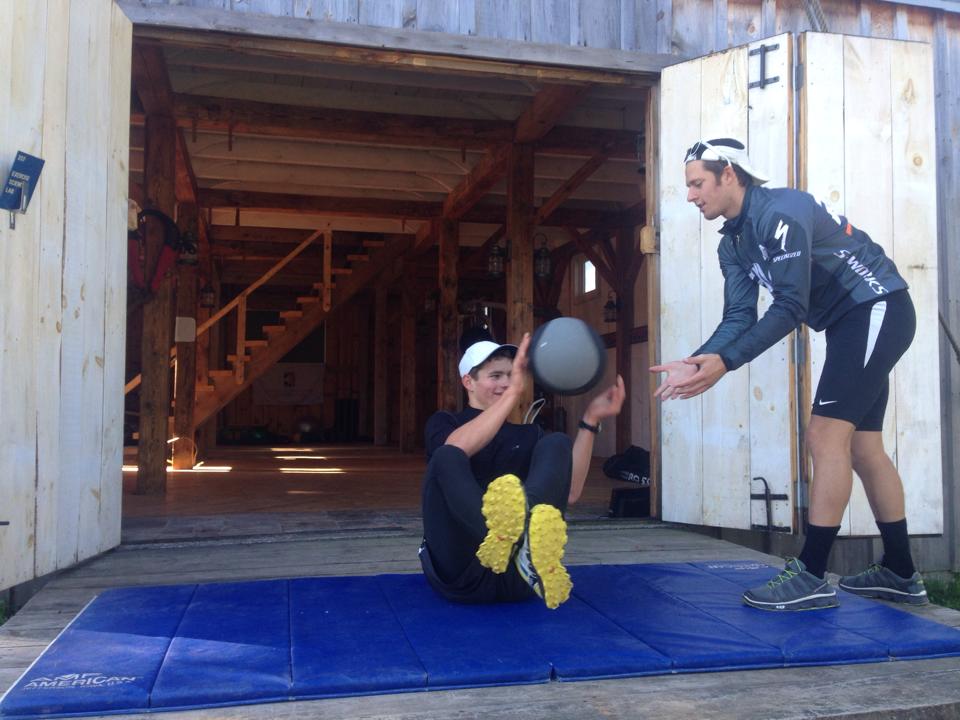
CXC Team Head Coach Andy Keller (r) works on strength with Scott Harrison outside a barn near the team’s former home base in Cable, Wis., in 2014. The team is now based in Marquette, Mich. (Photo: CXC/Facebook)
“This year we moved up to Marquette partly because a lot of the athletes have come from Northern Michigan, but also because there’s quite a bit of opportunity up here,” Keller said. “We’ve kind of partnered up with the Olympic training site located here. So we’ve been able to use the dorms on campus, offer schooling, have a training room and weight facilities available. … [The move to Marquette] has given us a lot more freedom with athlete housing and training opportunities.”
At present, the CXC Team has three full-time athletes and two part-time collegiate skiers. Kyle Bratrud returned to the CXC elite team for his second year; new full-time members include Dartmouth graduate Oscar Friedman and NMU grad Felicia Gesior. Jan Ketterson, a Dartmouth student currently taking the fall and winter trimesters off to focus on skiing, plans to race for CXC along with Nicole Bathe, presently a student at University of Alaska Fairbanks.
The growing numbers on the CXC Team was one reason CXC also recently decided to nix its marathon team, Keller explained.
“That was kind of another thing with refocusing with the marathon team, just my role and what resources I can put out just being by myself,” Keller said. “The main reason why we [ended our marathon team] is we’re trying to make a big push to promote club development.”
By discontinuing the marathon team, CXC saw an opportunity for athletes to return to their home clubs and promote racing on a more local, community-based level.
“The athletes that were on our team last year, both our current athletes and our previous athletes that we don’t have on the team anymore, we encouraged them this upcoming year to be a part of the clubs in their local area,” Keller said. “From what I heard in talking to them, most will continue to race in some facet.”
Chris Pappathopoulos won the men’s overall CXC Marathon Cup last season while competing for the CXC marathon team. (Photo: CXC)
He added that the team’s reigning CXC Marathon Cup winner Chris Pappathopoulos would likely be supported by companies like Rossignol and Boulder Nordic Sport.
While former CXC marathon team members like Pappathopoulos will look to return to their local clubs, Keller looks to expand the CXC Team program and podium at U.S. nationals with the athletes he’s currently working with.
“For a couple years [CXC] was really down and out from the years when we had Jessie [Diggins], Caitlin [Gregg], and Jennie [Bender], all those strong athletes,” he said. “So we definitely want to get back to fighting for SuperTour podiums, fighting for World Cup spots … and in this next year, I think there’s athletes who are on our team that are capable of it.”
With access to the NMU Olympic Training Site, CXC’s Center of Excellence and new scientific research taking place this fall, Keller doesn’t doubt CXC as a force to be reckoned with this season and seasons to come.
“We have the training group, we have the structure and the facilities,” Keller said. “And I think the more excitement we got here, the more we can achieve those goals of being at the top level.”
Alaska’s Hannah Boyer celebrates her OJ girls 10 k mass start victory over Felicia Gesior (Great Lakes) on Saturday at 2013 Junior Nationals in Fairbanks, Alaska. (Photo: bertboyer.zenfolio.com. Proceeds go to NNF)
FAIRBANKS, Alaska — Ben Saxton and Hannah Boyer couldn’t coast to the finish in their wins of the Older Junior classic mass-start races in the 2013 Cross Country Junior Nationals on Saturday. They had fierce competitors on their tales who also happened to be their friends.
Saxton of Midwest, and second-place finisher Logan Hanneman of Alaska, are good friends and were teammates at the World Juniors. But it was Hanneman, a Fairbanksan, who won the other three golds at these races. Saxton finished second in each of those races, including an incredibly close final sprint finish on Thursday, and he didn’t mind taking one from Hanneman.
“It was a pretty great feeling to finally come out on top,” Saxton said.
Boyer had to out-climb and out-double pole good friend Felicia Gesior, of Great Lakes, who is also a teammate with Boyer at Northern Michigan University. Knowing her competitor so well made Boyer nervous about the close finish.
“She’s one of the best double-polers on our team,” Boyer said of Gesior.
Two Sprints Decide First Through Fourth in Boys OJ Race
In the boys OJ 15 k, things really started to heat up in the third lap after the South Tower climb.
“It was super-fun because we were just chillin’ the first two laps,” said Hanneman. “Then Ben and I on the third lap were just dueling it out on every hill.”
With less than three kilometers left, Saxton and Hanneman were leading and skiing side by side.
Midwest’s Ben Saxton in awe of his first gold at 2013 Junior Nationals after edging Alaska’s Logan Hanneman (r) in the OJ boys 15 k classic mass start on Saturday in Fairbanks, Alaska. (Photo: bertboyer.zenfolio.com)
“I was hoping to be able to drop him on the hills before, but coming up out of White Bear I couldn’t get rid of him,” Hanneman said.
That’s when Saxton knew he had a chance to win it.
“When he didn’t lose me there, right then I could tell he was kind of tired on the switchbacks,” said Saxton. “It happens every time, no matter what the race, the hairs kind of stand up on the back of your neck, and you’re like, ‘All right, I can take this.’ ”
That’s where the race for third place really started to heat up, too. With just over a kilometer to go as they dropped into Sidewinder, Eli Hoenig led New England teammate Jack Hegman. When they dropped into Warm-Up with less than a kilometer to go Saxton and Hanneman were still neck and neck, but Hegman had pulled ahead of Hoenig.
As the leaders came climbing up Warm-up hill into the final stretch, Saxton pulled a little ahead of Hanneman and kept the lead as they double-pole sprinted to the finish.
“We both just launched it up the last hill, but he had a little bit more punch left up and over, so I couldn’t close it,” Hanneman said.
“The guy’s a killer sprinter,” Saxton said of Hanneman. “I fully expected him to come up and we would just go as hard as we could all the way to the line. That’s what we did, I just got a little bit on him before we got there.”
Saxton finished in 44 minutes, 13.5 seconds, just over one second ahead of Hanneman. Hegman and Hoenig were 30 seconds behind but they also had to sprint to the finish with Hegman winning third place by just three-tenths of a second.
By taking second Hanneman just missed out on sweeping the gold medals at this year’s Junior Nationals, a feat last accomplished four years ago by Hanneman. But he wasn’t upset.
“Three out of four isn’t too bad,” he said, adding that he saw benefit in losing.
“It’s also probably pretty good to not necessarily win on the last one because then it makes you hungry for training for the next division,” he said.
Boyer Comes from Behind to Win Her Last Junior Nationals Race
Saturday’s OJ girls classic mass start winner, Hannah Boyer (NSC Fairbanks-FXC), for her first Junior Nationals title. (Photo: bertboyer.zenfolio.com)
In the girls OJ race, Gesior pulled ahead of the lead pack of seven skiers during the South Tower climb in the second lap of the 10-kilometer race.
“I didn’t know where anyone was, so I just went for it,” she said.
Boyer saw Gesior and Sarah Friestone, of Alaska, pull ahead, but Boyer was behind three other racers.
“I got trapped on the top of tower,” Boyer said. “I couldn’t get around them.”
Eventually, Boyer did get around them and Friestone, but by then Gesior had a sizeable lead. With less than three kilometers to go she had a 20-30 meter gap on Boyer, who was leading the now stretched-out pack. Boyer started to close that gap by the time they reached Sidewinder about 1.5 kilometers later. Friestone led a pack of four skiers chasing Boyer.
As they dropped into Warm-up for the last descent and climb, Gesior still had the lead but only by about five or six meters.
“I knew she was coming, so I just tried to keep ahead of her,” Gesior said.
When they came back into sight climbing Warm-up hill with just over a 100 meters left, they were side-by-side. Boyer took the lead in that final stretch and opened enough of a gap to win by just over one second at 34 minutes, 26 second. Gesior was second at 34:27.1, and Friestone finished 20 seconds back at 34:46.3.
This is the last Junior Nationals for Boyer, who is from Fairbanks, so the win in her hometown was especially sweet.
“I really wanted to end this on a good one,” she said.
Friends and rivals, Logan Hanneman (l) of Alaska and Ben Saxton (r) of the Midwest square off in Saturday’s 15 k classic mass start at 2013 Junior Nationals. Saxton edged Hanneman by 1.2 seconds in the final race for his first gold of the week. (Photo: bertboyer.zenfolio.com)
For more photos from 2013 Junior Nationals, visit bertboyer.zenfolio.com. Proceeds go to the National Nordic Foundation (NNF).
Intermountain’s Annika Miller of Payette Lakes (r) takes on Lotta Weng (6) and her Norwegian teammates in Thursday’s J1 girls freestyle sprint A-final at the 2013 Junior Nationals in Fairbanks, Alaska. (Photo: bertboyer.zenfolio.com. Proceeds go to NNF)
FAIRBANKS, Alaska — Spectators watching halfway through the Junior 1 national championship girls sprint race on Thursday must have wondered whether three Norwegians were on their way to a sweep.
At that point, twins Tiril and Lotta Weng seemed in control, while fellow Norwegian Lisa Kvamme trailed slightly and American Annika Miller fought to stay close.
The next time spectators in the Birch Hill Recreation Area stadium spotted the skiers one tough climb and several hundred meters later, many must have been shocked to see Miller en route to a clear win at the U.S. Cross Country Junior Nationals.
“I really wanted to (win). I was like ‘You know, the U.S. needs to be on top today,’ ” said Miller of Team Intermountain, whose win was no fluke considering that she finished the qualifying round in first as well.
But keeping up with the Norwegians, who competed as guests and are not eligible to claim U.S. Championship medals, was no easy task.
“I was really worried coming up that first hill because they were just hammering,” Miller said.
Miller, from McCall, Idaho, quietly stalked the Norwegians and then charged past them on the final East Ramp uphill.
“I was kind of neck-and-neck with them coming up the last hill and then just off the top they just didn’t have enough left, I guess,” Miller said. “And so I hammered the top and hoped they didn’t have too much of a draft and just went for it.”
It was a risky strategy that could have backfired had the Norwegians hopped in Miller’s slipstream and slingshotted past her at the bottom of the hill leading into the flat finishing stretch.
Instead Miller won going away in 3 minutes, 4.14 seconds. Tiril Weng was runner-up a half-second behind, Lotta Weng placed third and Kvamme finished a distant fourth.
The other two skiers in the A Final, Marion Woods of Alaska and Zoe Snow of New England, placed fifth and sixth, respectively, but won the U.S. silver and bronze medals.
Hannah Halvorsen (Sugar Bowl Academy) leads New England’s Julia Kern (l) and Alaska’s Lydia Blanchet (r) in Thursday’s J2 girls freestyle sprint A-final at the 2013 Junior Nationals in Fairbanks, Alaska. Blanchet went on to win, Kern was second and Halvorsen placed third. (Photo: bertboyer.zenfolio.com)
In the J2 girls race, Lydia Blanchet of Anchorage could hardly believe she won.
“It just hadn’t crossed my mind that I could be a sprint champion,” said Blanchet, who considers herself more of a distance skier.
That Blanchet, the 2013 Alaska High School Skimeister, would top Julie Kern of New England seemed improbable, given that Kern was the defending J2 sprint champion and won Thursday’s qualifying round.
Blanchet grabbed the lead halfway through the 1-kilometer course with a nifty move on the inside of a tight corner. She held off Kern by 0.46 seconds and was never seriously threatened on the homestretch.
“I knew (Kern) was there. It wasn’t until I looked around and didn’t see anyone’s shadow that I kind of started realizing that ‘Oh my gosh, I might be able to win this race,” Blanchet said. “To pull this one off is just a good confidence boost for me.”
Hannah Halvorsen edged New England teammate Leah Lange to win bronze.
In girls OJ, Felicia Gesior credited her fast skis.
Clearly her talent had plenty to do with the decisive victory that gave Great Lakes its first gold medal of the championships.
Gesior, who competes for Northern Michigan University, placed 11th in the same race a year ago at Soldier Hollow, Utah. This time she and Stephanie Kirk of Alaska, the top two qualifiers, broke away from the pack early on. Gesior bided her time just behind Kirk for half the race, then blew past her on the final climb of the 1.25-kilometer course.
“Once I was gone, I kind of went,” Gesior said.
As Gesior powered through a stiff headwind on the finishing straight, Kirk struggled home 5.75 seconds later. Celia Haering of Alaska took bronze.