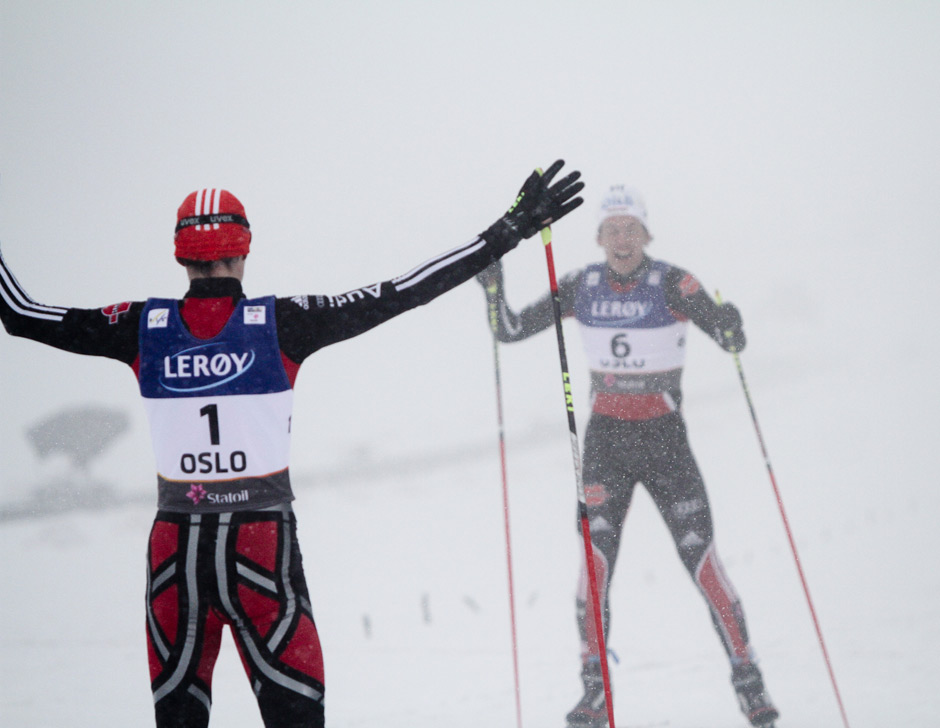
Eric Frenzel (L) greets his teammate Tino Edelman at the line.
The German cross-country team is off to an inauspicious start at the 2011 World Championships, but their Nordic Combined brethren are doing their best to make up for it.
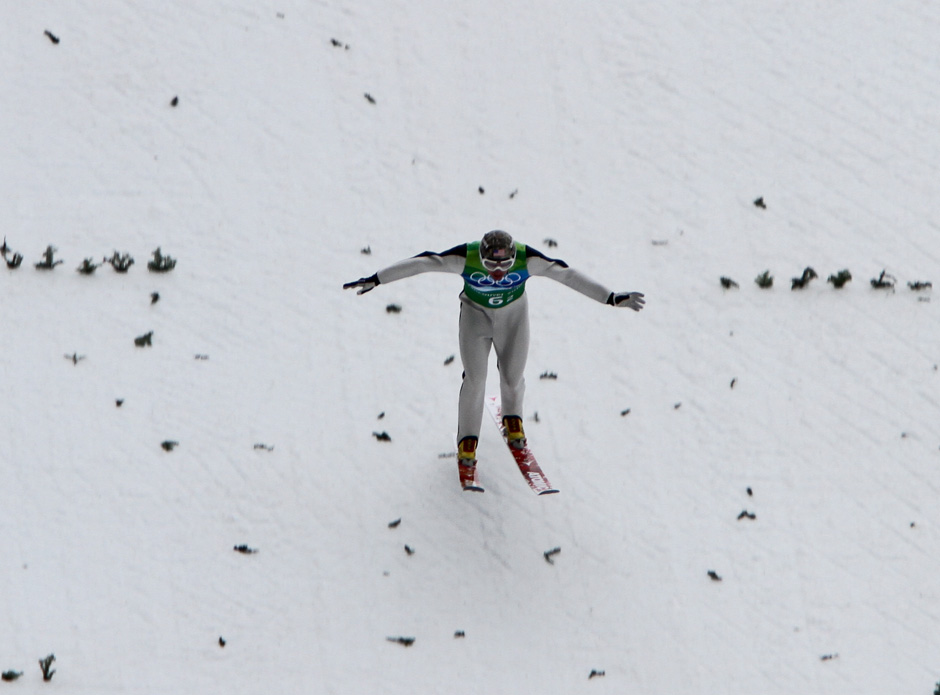
Twenty-two-year-old Eric Frenzel (GER) rode a stellar jump to a convincing victory in the men’s Normal Hill Gundersen 10km event in Oslo, Norway on Saturday afternoon. The 26,000 fans may not have been able to see much through the dense fog, but even if they had, their wasn’t much action at the front of the race.
Frenzel started the cross-country portion with a 19 second lead on Haavard Klemetsen (NOR) after earning the 131.8 points in the morning’s jump. Frenzel never looked back, and was never threatened by the large chase pack that came together early in the race.
Frenzel at the line.
The young German was joined on the podium by teammate Tino Edelman and Felix Gottwald (AUT).
French star Jason Lamy Chapuis, the favorite coming in was just 32 seconds down at the start, but struggled on the track. He dropped through the ranks, and was never in position to challenge for the podium.
By the three-kilometer mark, the chasers had come together, with Gottwald working his way to the front. Two-and-a-half k later, it splintered, Gottwald still driving the pace.
Three men followed the Austrian off the front – Edelman, yet another German ,Johannes Rydzek, and Akito Watabe (JPN). Frenzel continued to maintain a 30 second plus margin, looking strong at the front.
He may have looked relaxed, but was not taking anything for granted.
“I didn’t believe I could win until I saw the finish line. I was afraid of Gottwald, who was chasing me,” Frenzel said.
His fears were not ill-founded. The veteran Austrian has his fare share of triumphs, and took over the lead on the last of four 2.5km laps, continuing to drive the pace.
Rydzek and Watabe were unable to maintain the pace, and dropped off the back, while Edelman appeared content to ride on Gottwald’s tails. As the pair hit the last large climb, the same hill featured on the back-side of the cross-country sprint course, Gottwald made one last effort to escape, but again failed.
Once over the top of the hill, he dropped the pace to a crawl. He and Edelman cruised into the stadium and the obvious question was who had had one last push left.
The answer? Edelman, who used a final burst to get clear of Gottwald on the stadium hill, and cruise across the line
Felix Gottwald after the race.
and into the arms of the waiting Frenzel.
“It was a great race, perfect for the German team,” Edelman said. “Eric did a fantastic jump and mine was also very good. I’m sure we are going to celebrate this in the evening, but in a small scale, because the team race is coming soon – and now the German team is a favorite.”
Gottwald, spent, did not share the Germans’ joy at the finish, collapsing to the ground and covering his eyes. But later, he said that he was satisfied with his performance, and happy to earn a medal.
Frenzel, who has a four-year-old son, said simple “It feels fantastic to be referred to as the World Champion.”
Rydzek edged out Watabe for fourth, giving the German team three skiers in the top-four.
American Billy Demong turned in the fastest ski time of the day, besting Gottwald by seven seconds. He was undone on the jump, however, and ended the day in seventh,
“I am very disappointed,” Lamy Chapuis said. He finished 15th, but is looking ahead to the team competition where he believes France has a good chance.
Austria dominated the podium as Nordic Combined World Cup action continued in Germany. Felix Gottwald took first place clocking in 24:38.4, Mario Stecher was 15.6 seconds behind in second place, and Bernhard Gruber in third, 16.2 seconds behind Gottwald. Jason Lamy-Chappuis (FRA) who was first after the jumping, ended in 11th place overall.
Gottwald made a strong move on the last major climb of the course to open up a gap on his teammates and Jan Schmid (NOR).
Bryan Fletcher jumped well and started the cross-country in ninth place and 55 seconds behind Lamy-Chappuis, ready to battle the world for the podium. But the course wanted it differently, and rather than plucking racers off along the way, Fletcher damaged a pole early and played catch up from the 1K mark. He dropped to 31, almost two minutes behind the winner.
“Today was a bit bittersweet. I had a good jump and was very happy with my starting position. However I quickly ran into problems on the cross country,” Bryan Fletcher said to FasterSkier in an email.
“About 1 kilometer into the race I broke the basket on my pole. It was in the worst spot for it to happen. I had to ski almost another kilometer without a pole before I could get one. So that fried me quick. Afterwards I had to spend two laps recovering and relaxing before I could start working my way back up again,” Fletcher explained. However, Fletcher is moving on.
“Oh well, bad luck happens and my focus is now on Seefeld,” Fletcher said, taking away the highlight of the day: a good jump.
“I have a lot of confidence in my skiing so I am sure that with a good jump, I can be in there again. Today was just a very frustrating day, but it happens to everyone.
Rain and warm weather also added their share of challenges for the racers, especially on the cross-country course.
“The conditions were soft and warm, quite a change from out previous races. The course is pretty muddy but the organizers have done a good job keeping the course and the jump hill in good shape for the competitions with all the rain that has happened,” Fletcher said.
Tomorrow the US Nordic Combined team is entering the World Cup team competition, before moving on to the next World Cup events in Seefeld (AUT) January 14 to 16.
“For the team comps tomorrow I just want to have some fun and see what we as a team can accomplish. I will also be looking at how I can compare individually as well. It will be a good chance to work on some fine-tuning in competition before Seefeld,” Fletcher concluded.
The other Americans were Taylor Fletcher in 56th (3:18 behind), Brett Denney in 58th (3:45.4 behind) and Eric Camerota in 60th (3:58.8 behind). Complete results.
Hometown favorite Mikko Kokslien (NOR), who started the cross-country in 16th place, 1 minute and 4 seconds behind Braud Francois (FRA), won by 8.4 seconds over Lamy-Chappuis. Francois, who was first after a jump of 138.5 meters, ended up in 20th place overall. In the final kilometer of the race Kokslien dug into the reserves and beat the French Olympian to earn his first WC victory.
Kokslien jumped into the Norwegian national spotlight when he skied into second place in the World Cup opener in Finland last weekend, only narrowly beaten by Felix Gottwald (AUT). Lamy-Chappuis started the cross-country in third place, 18 seconds behind Francois, after a jump of 137 meters. Gottwald started in 32nd place, 1:50 behind.
Brett Camerota jumped the longest of the Americans, 126 meters, and started in 22nd place, 1:20 behind Francois. Bryan Fletcher jumped 119.5 meters and started in 35th place, 2:11 behind. Taylor Fletcher was 44th after the jumping (118.5 meters) and 2:30 behind, while Bill Demong (111 meters) started 3:20 behind. Except for Demong, who advanced from 53th to 45th over the 10K course, all had a tough time on the course and dropped spots in the overall.
Bryan Fletcher, who delivered his career best World Cup result in Finland last week when he hauled into 18thplace, was not content with Saturday’s effort.
“Today was not as good as I hoped. The race was tough today. Slow snow and a course with not a ton of rest so it was a very challenging day for myself and for others,” Bryan Fletcher admitted to FasterSkier, but has already put the race behind him and preparing for the next.
“I am just focusing on tomorrow. Tomorrow is a new day and we will try again. Hopefully I will have a better go. Oh well,” he said.
The Nordic world is focused on Kuusamo, Finland, this weekend. In addition to the cross-country World Cup taking place, the first Nordic Combined World Cup is taking happening in the same location.
Bryan Fletcher led the American contingent with a strong ski, moving himself four spots up on the result lists after finishing 22nd in the jumping competition Saturday. Fletcher started 1 minute 20 seconds behind the leader, only a second behind Mikko Kokslien (NOR), who ended up second overall. Fletcher went right to work from the get-go, and picked off a couple of spots in just the first quarter of the race. He was able to pluck off two more spots in the final kilometer of the race to earn himself 18th place.
“I was able to jump more like I had been jumping in training, which landed me in 22nd after the jumping,” Fletcher said to FasterSkier after the race. “I was able to ski strong and ski my own race without pushing it too hard and blowing up,” he said, explaining that he was happy with a top 20 result.
“Kuusamo was a tough place to start the season, cold weather and a large hill, with an even tougher course make it a really challenging opener for the season,” Fletcher said, noting that the cold added more trouble.
“The cold can really screw up your routines on the jump hill and on the race course. The weather was very, very cold and the humidity didn’t help. Everyone was freezing during and after the race. Because it so cold you tend to try to stay in a warm place as long as possible, however this can make you late for your jumps or the race and then jumping into the comp can be hectic,” Fletcher explained, adding that two hours after the race, his fingers were still tingling.
“I hope it is a breakthrough for him,” U.S. Nordic Combined Team head coach Dave Jarrett said to www.usskiteam.com.
“It’s a step in the build to 2014 where we need to have more different guys doing this more often. It starts with top 30s, then top 20s,” Jarrett continued. “But we need to keep it in perspective. It is his best result but we have higher expectations.”
Billy Demong jumped 111 meters to start the cross-country in 38th place, which Jarrett suspects is partly an equipment issue. Demong worked himself up two spots to finish in 36th but that doesn’t concern Jarrett too much at this point.
“With more and more jumps leading into Oslo [World Championships], he’ll have plenty of time to dial things in. That’s the focus for Bill this season,” Jarrett said.
Taylor Fletcher was 36th after the jumping with a distance of 115 meters, but dropped to 39th after the cross-country. Brett Camerota did not start the cross-country after a tough start on the hill.
Day for breakthroughs
It was the day for breakthroughs in Finland; Mikko Kokslien (NOR) was 21st after the jumping but skied into second place. Kokslien was narrowly beaten by Felix Gottwald (AUT), who won the competition after skiing from 26th to 1st place over the 10K course, only passing Kokslien on the last kilometer. Jason Lamy Chappuis (FRA), who earned himself a 15-second head start after soaring 140 meters in the jumping, ended up in third place.
Kokslien, who started 1:19 behind and lead the race for parts of the course, said he doesn’t know what to feel, losing first place by 7.5 seconds at the finish.
“I don’t know what I was thinking. This is a new situation for me. I thought the Austrian was a little ways back, but then suddenly he was right there,” Kokslien said to Norwegian television station NRK
“This was wicked good. I’ve worked so hard for so many years,” Kokslien said to NRK.
This is Kokslien’s best international result, and the Norwegian coaches consider it a breakthrough for the 25-year-old.
Francois Braud (FRA) was second after the jumping, but finished the cross-country in 16th place. Wilhelm Denifl (AUT) was third after the jumping but finished 11th overall.
More work
“Overall I am happy with my results in Kuusamo, however I know I can still do better,” Fletcher said. “The whole team is looking ahead to Lillehammer and hoping to post some solid results there. Our team knows we can be at the top and the group of guys here can definitely put it together, it’s just a matter of time,” Fletcher said.
And while Jarrett is excited about Bryan Fletcher’s break into the top 20, he is looking at the performance as a whole and seeing that there are plenty of things to work on. The crew now heads to Lillehammer (NOR) for a pair of World Cup races next weekend, and then to Ramsau (AUT) the weekend after, and looks to build on the season opener in Finland.
“Collectively we’re not skiing on par,” said Jarrett. “We come into a long block of racing now. If the plan goes as we’re hoping they’ll ski stronger in Lillehammer next weekend and be in good shape for Ramsau the following weekend.”
Todd Lodwick (USA) lands a jump during Tuesday's team event
As Billy Demong and Johnny Spillane strode triumphantly to the podium for the flower ceremony after today’s nordic combined competition, a parade of sullen-looking Europeans was walking through the mixed zone, in the other direction.
It was easy to miss them—after all, they weren’t the ones who won medals. But they had an interesting story to tell, too: how Thursday’s weather conditions in the jumping round had ruined their chances for Olympic glory.
Big names like France’s Jason Lamy-Chappuis, Austria’s Felix Gottwald, and Norway’s Magnus Moan were nowhere near the top, their races compromised by poor jumping that stemmed at least partly from the conditions.
“This jumping competition has nothing to do with fair competition,” said Gottwald, who, with seven Olympic medals to his name, should know.
In an event that is only held every four years, with such high stakes, Gottwald said, officials should have done more to ensure that all the athletes got a fair shot.
“A lot of athletes didn’t get the chance to show their performance,” he said.
The sport of nordic combined is split between two separate competitions. A ski jump, usually held in the morning, is used to determine the start order for a cross country race in the afternoon, and the athletes with the longest leaps get a head start.
Since jumpers are in the air for so long, buoyed by puffy suits that help them glide more than 100 meters, minor fluctuations in wind or precipitation can have a big impact on results. That’s what happened Thursday morning.
“It was switching on and off all day with the wind, and light snow on and off on the in-run,” said Taylor Fletcher, one of the American competitors in the event. “You really had to be on top of your game in order to put one down farther on the hill.”
During World Cup competitions, which are held almost weekly in Europe, the jury (the officials in charge of regulating the jumping and ensuring a level playing field) has more flexibility.
If conditions are too erratic, they can delay the jumping until the weather improves, or if things are far too dicey, they can scrap it altogether. If that happens, the cross country race is handicapped using the results from a competition from the day before, called the “provisional round.”
“Had this been a World Cup event, they would have cancelled today, and used the provisional jump,” said Dave Jarrett, the head coach of the American nordic combined team.
At the Olympics, though, no provisional jump is held, and Jarrett said that yesterday’s bad weather would have precluded one, anyway. As for a delay or postponement, Jarrett said many teams have flights scheduled for tomorrow—and that cluttered television lineups give officials little choice but to push ahead.
“The T.V. drives the times,” he said. “When you have the Olympics on such a tight schedule, that doesn’t leave much room for error.”
While Demong and Spillane both ended up benefiting from the weather, the problems on the hill affected all the teams—not just the Europeans. The third American medal contender, Todd Lodwick, had tough conditions for his jump, while some of the athletes from nordic combined powerhouses France and Austria made it through unscathed—including bronze medalist Bernhard Gruber (AUT).
But Jarrett did acknowledge that ultimately, the sport’s officials have some work to do.
“Something needs to change on the jumping hill,” he said.
One way the effects of the weather could be minimized, Jarrett said, would be if jumpers used thinner suits, like the ones worn by alpine or nordic racers. Those suits trap less air, reducing the impact of changes in wind.
“The fit and the materials can be a solution,” he said.
Whistler, British Columbia – The US Nordic Combined team will paying overweight on their flight back to Park City. A historic day doubled their Vancouver medal haul, giving them nearly nine pounds of hardware.
Billy Demong skied away from teammate Johnny Spillane and Austrian Bernard Gruber on the final climb to claim Olympic gold. With a move of his own, Spillane left Gruber in the dust, too—laying claim to his 3rd silver medal of the Games.
The US entered the 2010 Olympics never having won an Olympic medal in nordic combined. They leave with four and have cemented their place as the top team in the world.
Spillane and Demong were in excellent position after the morning jumping round, in 2nd and 6th respectively. Gruber posted the longest jump of the day, by an impressive five meters, and sat 34 seconds up on Spillane. Demong was another 12 behind.
In the jumping round, athletes had to content with snow, rain, and swirling winds, which wreaked havoc on the results. Clad in puffy suits, which help catch the wind and allow the athletes to sail so far, minute differences in weather can get amplified tremendously.
Conditions were so erratic this morning that officials scrapped the first round of jumping. But with tight TV schedules and many teams flying home tomorrow, the show had to go on.
That left a number of top Europeans out of contention, including France’s Jason Lamy Chappuis and Austria’s Felix Gottwald, who blasted the jury (the officials in charge of overseeing the jumping).
“This jumping competition has nothing to do with fair competition,” he said. “In my opinion, if all the athletes performed like the jury did today, then we would crash on the in-run.”
Lamy Chappuis and Gottwald weren’t the only ones who got thrown off by the weather—U.S. Nordic Combined Coach Dave Jarrett said that the conditions for Todd Lodwick’s jump were also less than ideal. But France, Austria, and the U.S. all had men in the top five, as well, and there was nothing to be done aside from strap on the skis in the afternoon.
“No matter how many times they restarted they restarted that competition, no matter how windy or snowy it got, we were going to do our best,” Demong said.
With the jumping results set in stone, Demong set about closing the gap to Spillane right out of the gate.
Already, by the end of their first 2.5 kilometer lap, Demong had dropped the skiers that started with him, bridging up to his teammate.
Trading the lead, the two worked to close the 30-second gap to Gruber—part of the plan they had devised before the race.
Spillane leads Demong through the stadium afte rthe first lap.
“The big goal that we had before the race was to get two guys on the podium, preferably one-two. And the way we were going to do that was exactly what we did: I had to ski up to [Spillane] alone, and then we had to go together like it was a team time trial, and do the best we could to work over Bernhard Gruber,” he said.
Knowing that he was outmanned, with the two Americans working together behind him, Gruber was conserving energy.
“I started out quiet as not to get tired legs,” he said. “I knew the two strong men…were coming from behind.”
USA takes over the lead.
Before the halfway point, Gruber had been caught, and more importantly, the large chase pack that formed behind was not gaining any ground. Poor skiers, the other athletes starting between Demong and Spillane quickly fell off the pace. But Mario Stecher (AUT), who outkicked Demong in the team event two days ago, and the always-dangerous Petter Tande (NOR), set to work, and their group continued to grow as more skiers came up from behind, including American Todd Lodwick, in bib 13.
Lodwick moved to the front of the pack, and taking a page from the Swedish cross-country team in the pursuit, he attempted to control the pace.
“I went in the lead [of the chase group] and slowed the pack down, said Lodwick. “Other skiers were not so happy, but who cares? We’re on the podium.”
Halfway through the 10 kilometer race, the chasers were 32 seconds back. At the next checkpoint, a k-and-a-half later, the gap was up to 46 seconds, and it was clear that the medalists were decided. The only question remaining was who would get gold.
Demong and Spillane continued to switch leads, and several times it appeared they had shaken Gruber. He seemed to struggle all day to maintain contact with the Americans, never even getting near the front. As soon as Spillane and Demong took the lead one lap in, they had the race in a vice grip, applying accelerations and pace changes to tire out the Austrian.
Demong and Spillane working over Gruber
The Americans had been in similar situations earlier this year, with multiple athletes in the lead group, but they hadn’t been able to take control the way they did here on Thursday.
“I think the major difference, especially today, was the fact that Johnny and I are really, really fit now,” Demong said. “We’re racing faster than we did before…that’s what makes the biggest difference. And today we had that luxury of being able to just go as hard as we could together, skiing away from everybody else, pretty confident that we could both beat Gruber—and that’s when team tactics really work.”
In to the stadium with one lap to go.
The Austrian especially had trouble maintaining the pace over the tops of the bigger climbs, but he always managed to claw his way back. This raised the specter of ski speed – the Austrians clearly had better boards in the team competition, most strikingly in the final push when Stecher easily glided away from Demong in the stadium.
But it was finally Demong’s Olympic day. With the fitness and speed that he has displayed in cross-country over the several seasons, he attacked furiously halfway up the final climb, and Gruber was gone instantly. Spillane could not match Demong, but he fired up his own engine, and dropped the hammer on the Austrian as well.
Spillane appeared to close on Demong down the backstretch, but the three-time World Championship medalist put in one final acceleration around the final corner. With that, the U.S. nordic combined team made history for the third consecutive race.
“That was the best finish I have had in a race all year,” a composed Demong told media. “We are racing faster than ever.”
The stadium video board shows Demong (left) and Spillane (right) breaking away.
The rest of the field came streaming in. The great Hannu Manninen (FIN) skied up from 16th at the start to finish 4th, and Gottwald, furious after the jump, threw down for the fastest ski time, 17 seconds ahead of Demong. That performance, however, only moved him up to 17th.
“I had a small chance for a medal,” said Manninen following the race, “but there were three better guys today, and the gap was too big.”
Demong was still at a loss for words at the press conference, an hour after the finish.
“I’m still trying to wrap my mind around that,” he said, when asked what it felt like to become the first American to win Olympic gold in the nordic sports. “I’ll let you know in ten or fifteen years from now.”
Demong – Victory!Spillane – Three races, three silver medals.
Whistler, British Columbia – The two skiers swept around the large curve down into the stadium, Billy Demong of the USA in the lead, Austrian Mario Stecher right on his heels, the gold medal waiting, just 200 meters away.
Stecher stepped out, tucking past Demong. There would be no sprint for the line. The gap was enough, and Austria champions. The American team, in claiming the silver, made US Nordic Combined history for the second time this Olympics. In the individual event last week, Johnny Spillane won the first US Olympic medal in the history of the sport. Today marked the first medal in the team competition.
It all started this morning on the jumping hill. Brett Camerota set the tone with an impressive leap in the first group. Todd Lodwick, who just missed a medal when he finishing 4th in the individual, raised the bar even higher. His jump would ultimately stand as the second-best on the day, as measured by total points. Spillane wasn’t far behind, and Demong was solid.
Head coach Dave Jarrett was very pleased with the jumping. “Brett and Todd, that was the farthest jump ever on that hill. Johnny was tremendously clutch. He was a little squirrely yesterday and in training today. And Bill has been solid almost every jump. It was what we needed to have happen.”
Meanwhile, the Austrians, as the only team that could match the Americans in terms of cross-country firepower, struggled on the hill. When jumping concluded, the US was in a perfect position, starting in second, just two seconds back from Finland. Austria was 36 seconds behind, France at 43 seconds, and the always-dangerous Germans 45 back.
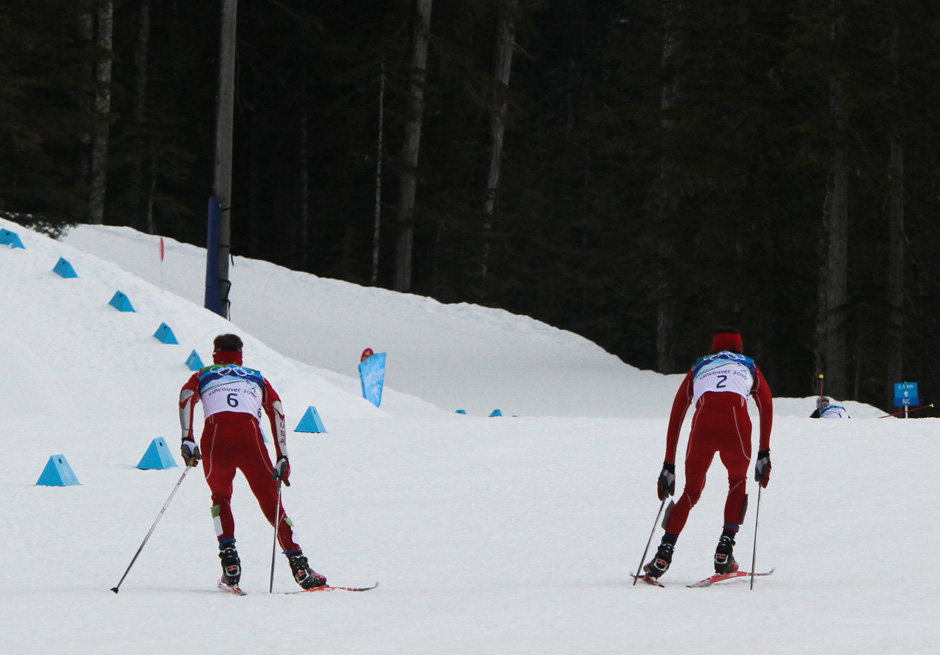
Camerota (in red) heading out on his 2nd lap
The final running order was determined by the athletes. Said Jarrett, “as a staff, we gave them our suggestions and deferred the decision to the team, because that is what it is about.”
The key for the Americans was Camerota. With a career-best World Cup finish of 18th, the 25-year-old was the weakest link. But he jumped extremely well in the individual competition, did so again today, then quickly closed on Finland’s Janne Ryynaenen in the ski. Camerota did exactly what he had to do: ski strong, and not give up too much ground to the chasers.
With a powerful move on the final climb of the 2×2.5km course, he dropped Ryynaenen and tagged off to Lodwick in first. The chase pack however, had closed ground quickly, and six teams headed out in pursuit, all within 12 seconds of the American.
The only concern following Camerota’s leg were his skis. It was clear to observers in the stadium that they were not running as fast as his Finnish counterpart.
The packs closed on Lodwick over his first loop, but he maintained a smooth pace—despite the yell from the stadium announcer that “in just a few seconds they will all be together.”
David Kreiner (AUT) and Tino Edelmann (GER) were the only two able to bridge up to Lodwick. All three headed out for the second lap together, but Edelmann tripped himself on the climb out of the stadium, as Kreiner took the lead and accelerated with Lodwick on his heels. The two opened up a gap on the field, setting up a battle between Spillane and Austria’s Felix Gottwald, who is one of the fastest skiers on the Nordic Combined circuit in his first year back after a two-year retirement.
The two exchanged leads, pushing the pace to keep anyone else from closing. Spillane’s skis were not running well either – he was forced to skate on the gradual terrain even when drafting off Gottwald, who was riding a tuck.
Johnny Spillane leading Austria's Felx Gottwald
On the big climb before the last descent into the stadium, Gottwald dropped the hammer, and Spillane had nothing left to respond. Over the final 400 meters of the loop, Spillane lost 15 seconds—five in the stadium alone.
“We both knew that we had to make the pace [ski fast],” said Gottwald. “Johnny was doing it at the beginning…and at the beginning of the second lap I tried to do my part to hold up the pace and get some seconds [on the chasers]. On the last uphill it is just ‘go.’ It hurts for everybody, and it is no question of strategy—it is just a question to get as fast as possible to the transition.”
Demong waiting for the tag.
But US anchor Billy Demong is used to coming from behind. Even though the team event is just five kilometers, as opposed to the ten contested in the individual competitions, the American was not out of the hunt.
And it wasn’t a two-team race – Germany had battled back as top skier Bjoern Kircheisen gave chase. Demong cut Stecher’s lead in half in the first 1.7 k, while Kircheisen knocked 13 seconds out of the 25-second deficit he began with.
Demong chasing…
Entering the stadium for the lap, Demong was just 2.2 seconds behind, and wasted no time in closing the remaining gap. With the Americans and Austrians battling each other, Kircheisen struggled to come closer. He gained a few more seconds, but as the meters flashed by, it became clear that the gold would not belong to Germany.
Demong turned on the jets on the last climb – the same spot where Tim Tscharnke (GER) gapped the field in Monday’s cross-country team sprint event, and where Demong himself passed Finland’s Anssi Koivuranta for the victory in the World Cup here last year.
“I needed to be clear of Mario before we got into that final downhill to have a chance,” said Demong. “I was going into that last hill really hard thinking ‘maybe I’m getting away,’ but then I hit him with my pole right toward the top and felt him back there.”
And so the finish was set up. Demong couldn’t shake the man known as “Super Mario,” and his chances to challenge for the gold in the finish stretch were undone by slower skis.
Demong was very clear in pointing out that his skis were not bad—just not as good as the Austrian’s. “I still had the fastest time on the 4th leg, so they were obviously working pretty well. And Mario had great skis – mine may have still been average.”
But his words may have been diplomatic, as he recognized that Stecher had better boards throughout the second lap. “On the downhills, when I was leading, he was running up on me and pushing my pole. And when I was drafting, I was just keeping up.”
The Austrians gave plenty of credit to their wax techs, saying, “today our skis were awesome…it made it easier to win.”
According to Spillane, one of the issues was the new snow that fell during the race—softly at first, then heavier as the race progressed. It was classic Whistler snow – heavy and wet.
“It’s an outdoor sport, and that is part of it, but I don’t think Bill and I had very good skis once it started snowing…but that is part of the deal.”
He also attributed the 15 seconds he lost to Gottwald in part to the ski issue.
“I was feeling really great. Then on the back side of the course, where it is all flat and downhill, I should have been able to just sit behind [Gottwald] and rest, because I was right behind him. He was tucking and I was in his draft having to skate. That makes it quite a bit more difficult than it should be.”
Todd Lodwick
US coach Dave Jarrett didn’t beat around the bush.
“They are only two guys [US Nordic Combined wax techs]. Every other team has more than two guys. There is only so much we can do as a staff to be out on the course with poles and splits, and only have two guys able to wax. The cross-country guys offered to help, and we took them up on that, but it just wasn’t coordinated enough to make a difference.”
It appeared to be less an issue of wax, and more of ski choice.
Demong noted that he chose a pair of skis, regularly his fastest, that worked very well during testing. But once the wet flakes started falling, they slowed considerably. The pair had a linear structure that got clogged with the high-humidity snow.
The Austrians had one pair of skis running so well that both their 1st and 4th leg skiers used it.
“Gruber and Mario used the same pair of skis,” said Jarrett. “They obviously had a magical pair…using it twice in the same race.”
“We are far out-manned when it comes to that stuff, but you have to make do with what you have,” he added. The US team even has an additional service man working the Olympics, when on the World Cup they usually have just one.
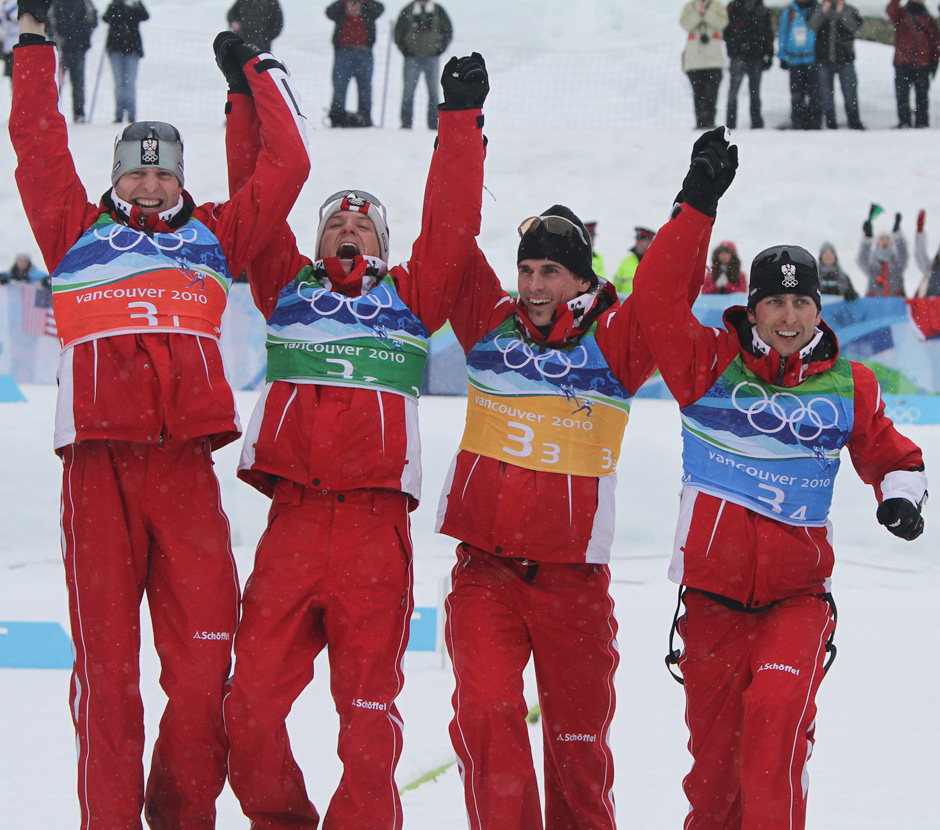
Despite the ski issues, no one on the US squad showed any disappointment with a silver medal. The quartet was greeted at the flower ceremony by chants of “USA! USA!” and both Demong and Lodwick climbed up into the stands to hug family members.
Demong (left) and Lodwick (right) get congratulations from friends and family
“The race could have gone any way,” said Jarrett. “It was there for the taking, but you can’t be kicking yourself about a silver medal you have never won before. We are happy – the coaching staff, the service team, everybody is psyched. Of course we wanted to win, but we still got second, and that is better than 3rd…You have to take your hat off to the Austrians. They skied well and they won it.”
“Today was a real team effort,” said Demong. “This day has just been a series of really good performance by every member of our team, and I’m really really happy to…have won our first ever medal in the team event.”
Lodwick, now the veteran of five Olympics added “If you give it your all and leave everything out there and we get second, we have won second…we have dreamed of this day for a long time.”