From the FasterSkier archive — posts syndicated from athletes’ and coaches’ own blogs between 2004 and 2012, kept online as published. Current coverage is at fasterskier.com.

Tag: finland

  • The Road to Ruka: A Sunset Bus Ride into the World Cup Winter

    The Road to Ruka: A Sunset Bus Ride into the World Cup Winter

    This coverage is made possible through the generous support of Marty and Kathy Hall and A Hall Mark of Excellence Award. To learn more about A Hall Mark of Excellence Award, or to learn how you can support FasterSkier’s coverage, please contact info@fasterskier.com.

    Aerial view of Ruka (FIN) this morning, with the start of the World Cup season less than a day away. (Photo: Modica/NordicFocus)

    For six hours on Tuesday, the U.S. Cross-Country Ski Team watched Finland scroll past the windows of a northbound bus, the day’s thin slice of sunlight slanting low across the snow. The sun in late November never rises entirely above the horizon there—”maybe ten degrees,” Matt Whitcomb noted—and so the world outside was washed in a pastel light that never quite felt like midday. In that part of the Arctic, sunrise and sunset are effectively the same event.

    That is the moment Whitcomb pays attention to every year.

    “As it sets, as you’re driving in those first two hours of the bus ride,” he said, “it sort of feels like it’s the official close of the preparation season.” The athletes may have left Muonio only hours earlier, but that sunset marks a boundary: everything before is training; everything after is racing. “That’s it,” he said. “The prep season’s over. It’s time to race now.”

    The bus carried all seventeen athletes—nine men and eight women—each holding a different version of readiness. Some were energized, some were still finding their legs, some were quietly anxious. An Olympic season magnifies everything. For veterans, this opener in Ruka is familiar and charged; for athletes on the bubble, the weekend marks the start of a two-month test whose outcomes will determine whether they get to ski in Italy in February.

    But for one last window of time, before the waxing trucks and the bib pickup and the official training, the whole team was suspended in this Arctic twilight. It is a soft entry into what quickly becomes a hard world.

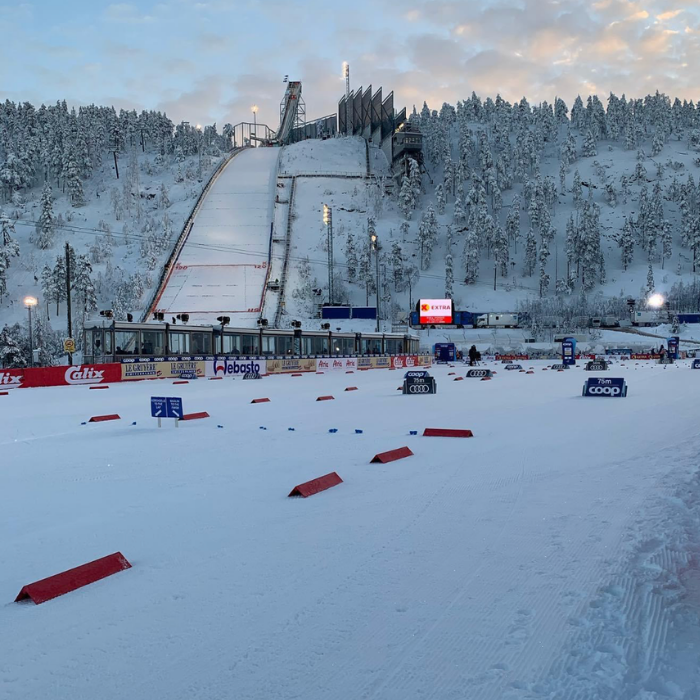
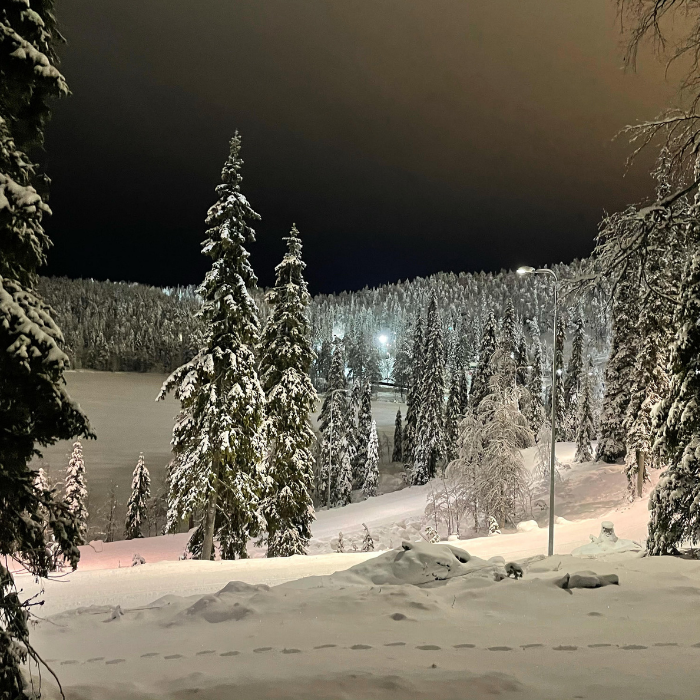
    When the bus crested the final kilometers into Ruka, the athletes looked out the left side toward the hill that dominates the course—a climb they will race up and over repeatedly in the coming days. “Every year,” Whitcomb said, “that road goes right up the largest hill on the course… your first trip up that is in the bus.” The hill glowed under floodlights. Below it, the village looked like it had been placed inside a glass ornament. “It’s lit up like a snow globe around here.”

    By the time the athletes stepped off the bus and into the cold, the World Cup season had begun.
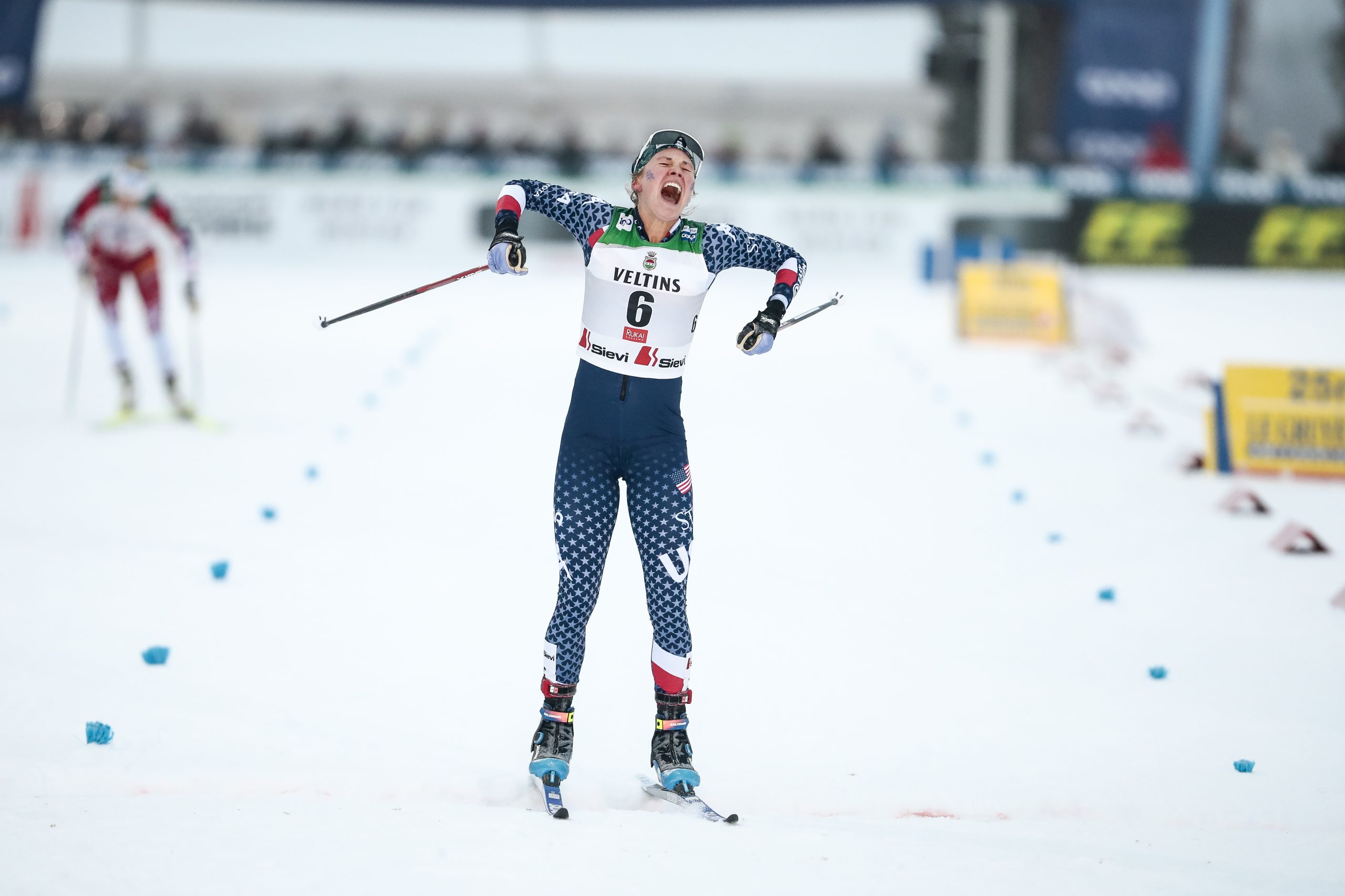
    Jessie Diggins (USA) was able to find another gear at the finish which no one could match to take victory in Ruka a year ago in the Mass Start. (Photo: NordicFocus)

    What They Carry From Muonio

    A week earlier, the team was skiing through air so cold it could freeze eyelashes. Muonio is remote even by Finnish standards, a strip of trails and cabins surrounded by deep quiet. The temperatures dropped to –5°F for the high and –10°F for the low, and the athletes masked up, moving carefully to avoid frozen lungs. No one did intensity that day; even the coaches agreed the cost wasn’t worth the risk.

    And yet the camp was a success.

    “It was right on the edge of being too cold,” Whitcomb said, “but we made it work. And nobody has residual coughing, so I think that’s the tangible indicator that we didn’t push too hard.”

    More importantly, Muonio was calm this year. There were no lingering illnesses, no cascade of early-season injury setbacks. “This year has been a better year with regard to preparation,” he said. “We’ve had fewer long-term illnesses, fewer acute injuries.” In an Olympic season, where every missed week feels like a month, that is no small thing.

    Muonio is the last place where the athletes can simply train, ski, nap, and repeat. Once they arrive in Ruka, the season accelerates in a way no one can fully control.

    Zanden Mcmullen (USA) coming to the line in Ruka in 2024. (Photo: Thibaut/NordicFocus.)

    Ruka’s Glow and Ruka’s Pressure

    Ruka is where the World Cup hardens into its proper form. The quiet trails of Muonio are replaced by a carnival of nations: wax trucks pulled side by side, technicians moving in practiced circuits, athletes from every powerhouse country striding around the stadium. For all teams, the opener reveals the truth of the summer: whose fitness is real, whose technique held up, whose body needs another two weeks before coming online.

    “The moment we arrived here in Ruka,” Whitcomb said, “you start to see the waxing vehicles from other nations… the reality of it hits, and you could feel butterflies sort of emerge as a team.” Even the veterans feel it. “Munio last week was all about recovering from jet lag… and you arrive here, and it’s like: official training, then race, race, race. It’s go time now.”

    He emphasized that the stress is not negative. Stress, in his framing, is a sign that something meaningful is at hand. “It’s indicative of the privileged environment that we live in,” he said. “We’re doing something important, something these athletes work really hard for, and something that they’re ready for—and that’s why they feel stressed.”

    In an Olympic year, there is no such thing as a low-pressure opener.
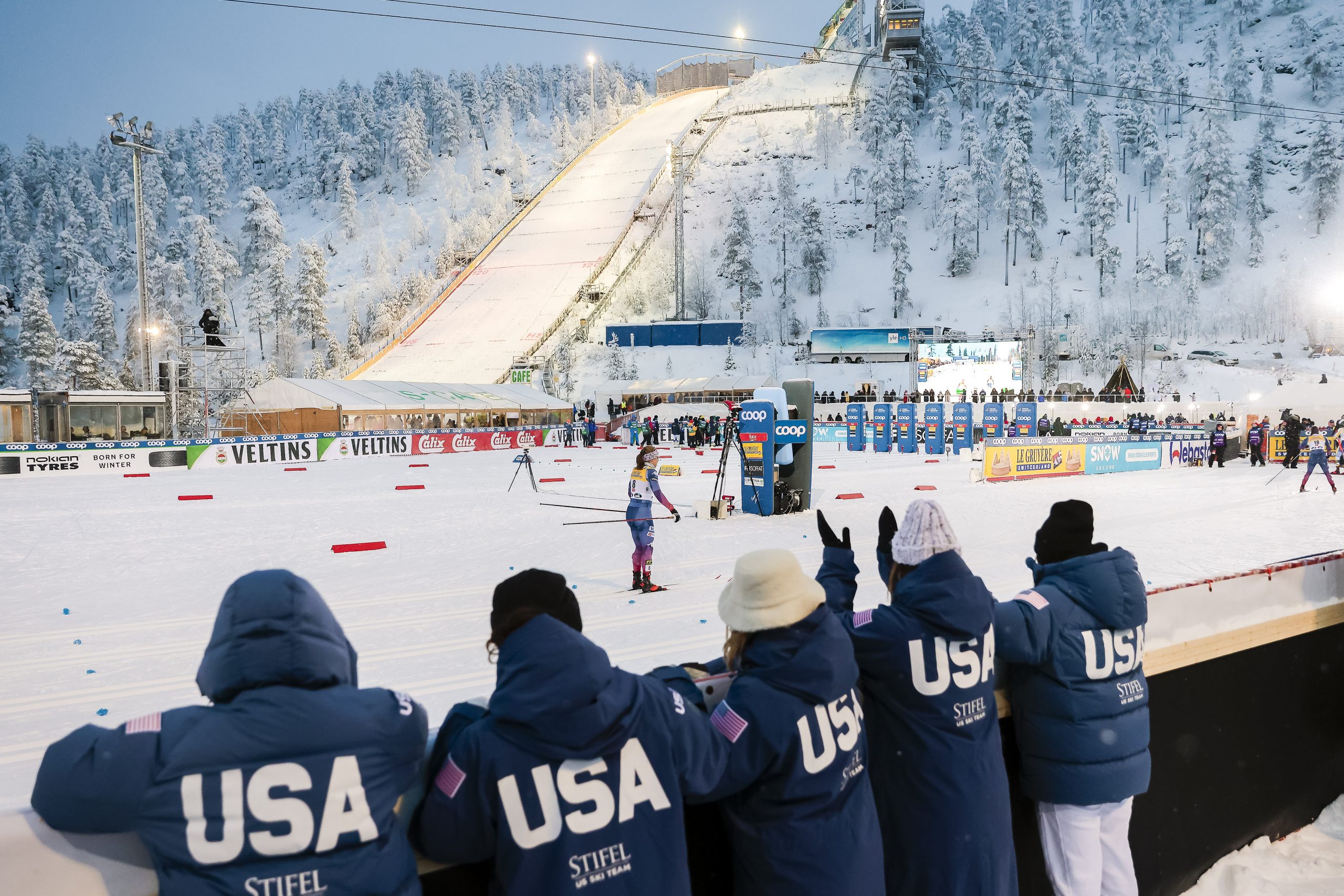
    The U.S. team looks on in Ruka in 2023.  (Photo: NordicFocus)

    The Team Within the Team

    The most striking thing about this group, Whitcomb said, is not its athletic potential—though several athletes are carrying top-10 ambitions into the weekend. It’s the internal energy.

    “It feels as supportive a team as I think we’ve ever had,” he said. “Not better, but certainly as good as any team we’ve ever had.” A year ago, he described a similar feeling, but something about the last month apart has deepened it. “They just vibe together,” he said. “They’ve really missed each other.”

    From outside, the U.S. team can look like a logistical patchwork—athletes based in Vermont, Alaska, Idaho, Colorado, Norway; college skiers who drop in and out; development athletes rotating through Europe. But when they’re together, Whitcomb believes the culture gives them a competitive advantage.

    “One of the privileges our nation has,” he said, “is that we are not as competitive as Norway is.” He doesn’t mean competitive in results—he means internally. In Norway, a single race in Beitostølen can determine whether an athlete gets a World Cup start or disappears back into domestic anonymity. “Literally that one race… has a lot of say in whether your winter is going to be successful,” he said.

    In the U.S., the pressure comes from the Olympics, not from your teammates. “A positive team vibe really does some work for you,” he said. It prevents the “little stresses”—the ones that accumulate in toxic environments—from becoming overwhelming in an Olympic year.

    “When the only stress you have to worry about is the silly one that is racing,” he said, “you can overcome that.”
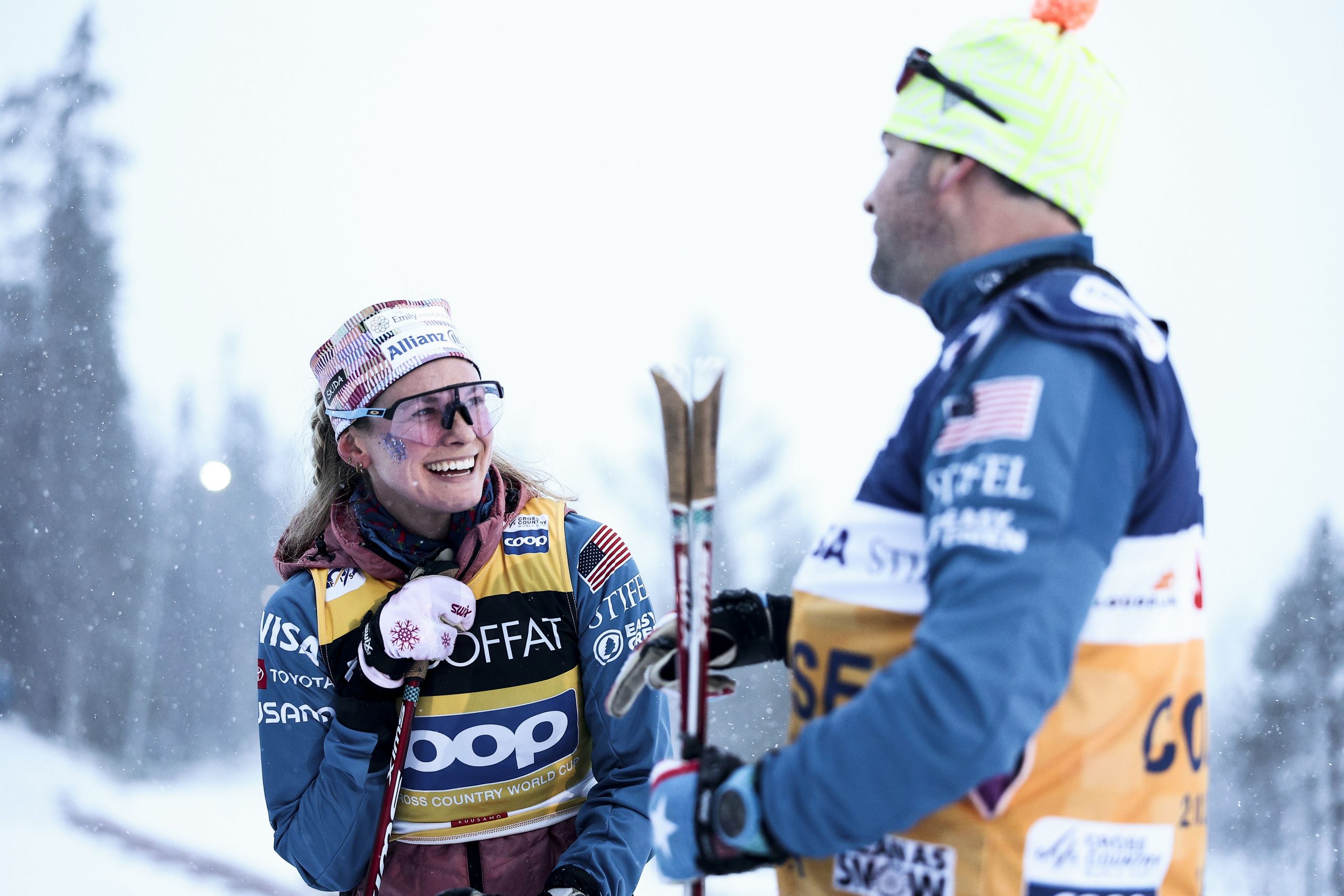
    Jessie Diggins (USA) keeping it light with her coach, Jason Cork. (Photo: NordicFocus)

    Olympic Stakes, Explained Clearly for Once

    For athletes and coaches, the rules of Olympic selection are a map that everyone has memorized; for the public, they are a maze. Whitcomb walked through the system with the clarity of someone who helped write it.

    There are three primary pathways:

    1. Top-8 in an Olympic event on the World Cup

    If an athlete finishes top-8—but only in a race that exactly matches an Olympic event—they automatically qualify.

    Classic sprint in Trondheim? Yes.

    20k Skiathlon in Trondheim? Yes.

    10k skate in Davos? Yes.

    Team sprint? No.

    Any race similar but not identical (ie, the 15k Skiathlons)? No.


    2. Top-45 on the World Cup ranking list (by Oberhof)

    Any athlete inside the top-45 overall (distance or sprint, depending on discipline) meets the selection criteria. They still need a spot available, but their case becomes strong.


    3. Discretionary selection

    This exists—but is avoided whenever possible.

    “To be candid,” Whitcomb said, “that’s a goat auction in itself.”

    In an Olympic year, the staff prefers not to touch discretion at all.
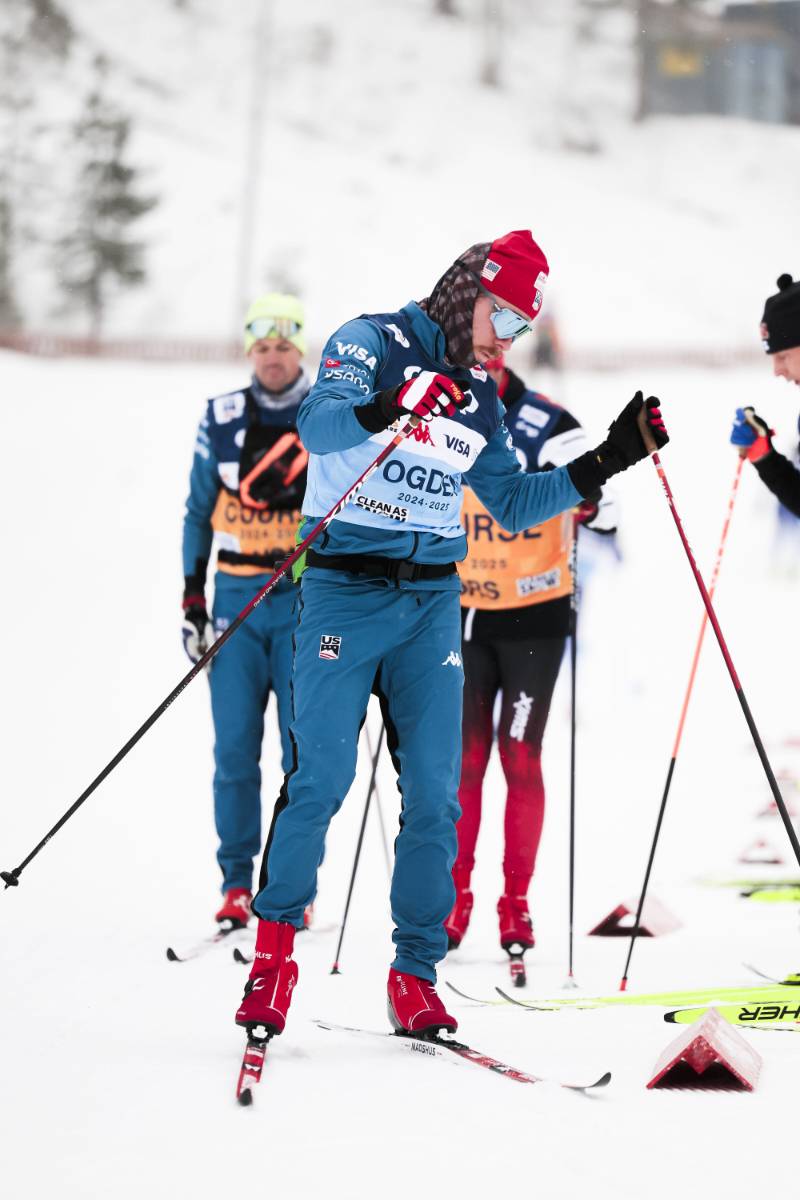
    Ben Ogden (USA) working on ski selection on Thursday in Ruka (FIN) a year ago. (Photo: NordicFocus)

    Roster limits

    Right now, the U.S. holds seven men’s spots and eight women’s spots, with a realistic chance of earning an eighth men’s spot. It will not exceed 8 + 8.

    Domestic results?

    For someone skiing exceptionally well at Senior Nationals to force their way in, there must be vacancies left by athletes who didn’t meet criteria on the World Cup. In most years, Olympic qualification is won or lost by Christmas.

    This is why every World Cup start in Period 1 matters. Every 12th place, every quarterfinal, every decent distance day contributes to the math.

    But to Whitcomb, that math isn’t the point. It’s how athletes handle pressure that determines whether the season becomes joyful or claustrophobic.

    “Meet Your Body Where It Is”

    On Thursday night, in the team meeting before the weekend races, Whitcomb planned to give a simple message.

    “You start that 10k, and you’re going up the first hill,” he said, “you just meet your body where it is. You do your very best that day.”

    He wants the athletes to tune out the noise:

    • the coaches on the sides of the trail
    • the athletes they pass
    • the athletes who pass them
    • the crowd, the music, the reporting, the points

    “You deal with the one vehicle that you’re driving,” he said. “And you try to enjoy it.”

    Because fitness today doesn’t predict February.

    Because the Olympic Games begin on February 7th, the only date that truly matters.

    Because early-season expectations are a trap: some athletes are ready this weekend; others won’t feel themselves fully until the Tour de Ski.

    “The human body,” he said, “is a wildly unpredictable thing.”

    If there is one truth that governs the first weekend of racing, it is that.
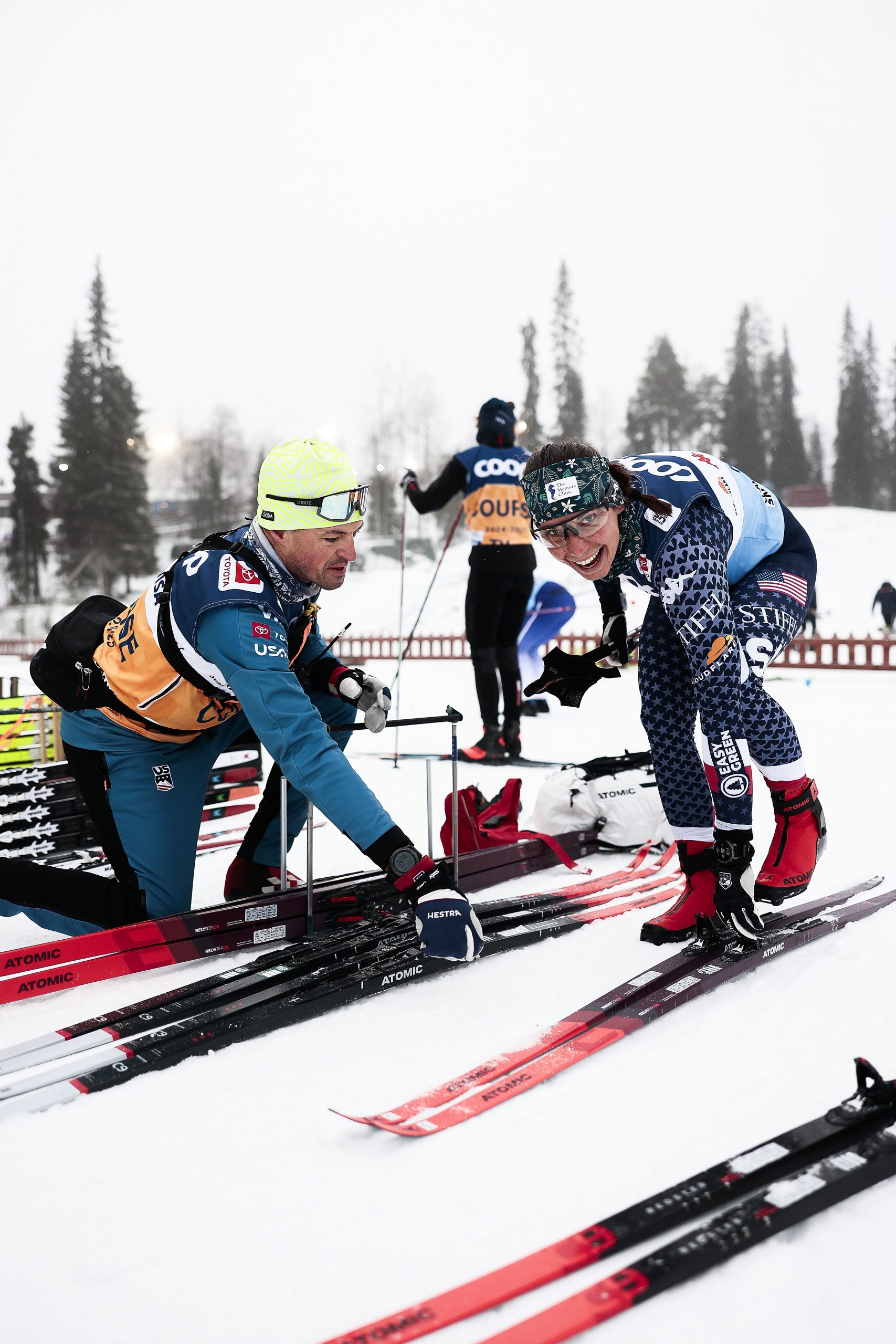
    Julia Kern testing her skis with her longtime tech, Eli Brown a year ago. (Photo: NordicFocus)

    Why Ruka Still Matters

    Still, the weekend is not symbolic. It is competitive, decisive, and formative. Whitcomb believes the team is “positioned well to have a great opener,” but he also knows that Ruka rarely tells the whole story of a winter. The temperatures are often frigid, and the travel is too recent. But it gives athletes one thing they cannot simulate anywhere else: the clarity of racing.

    “Early,” he said, “but it can’t come soon enough. We’re really excited.”

    Ruka is where the starting gun echoes for the first time, but it’s also where the season’s unseen forces begin working: confidence, doubt, momentum, cohesion, luck, health, and perspective. Many Olympic stories begin here without anyone realizing it until months later.

    The First Night in the Snow Globe

    By Tuesday evening, the team had unpacked their bags in the small condos near the stadium. By Wednesday, when we spoke, through Whitcomb’s thin door, we could hear athletes talking after dinner—laughing, telling stories, building team chemistry. “You can hear people probably through my door,” he said, because “they’ve really missed each other.”

    Outside, the northern lights edged across the sky.

    Inside, there were skis to prep, race plans to finalize, nerves to manage.

    And in the morning, the first climb of the season would begin at the bottom of that hill they had ridden over on the bus.

    There are a few actual rituals in a sport defined by travel and unpredictability. But in the U.S. team’s calendar, the bus ride to Ruka is one of them. It marks the line between the world that was and the one that’s about to begin. Between training and racing. Between imagining and knowing.

    The sun had long since set, but the trail lights of Ruka glowed through the fog, warm against the cold.

    The World Cup season officially starts tomorrow.

    And for the U.S. team—healthy, united, a little nervous, and very ready—there is nothing left to do but ski.

    Rosie Brennan (USA) dialing in her skis a year ago. (Photo: Modica/NordicFocus)

    How to Watch

    In the United States:

    Ski and Snowboard Live


    Schedule

    November 28th:  

    10k Interval Start Classic – Women at 4:30 am EST and Men at 7:15 am EST

    November 29th:  

    Classic Sprint – Heats begin at 5:25 am EST

    November 30th:  

    20k Mass Start Freestyle – Men at 4:00 am EST and Women at 5:45 am


    Love Stories Like This? Help Keep Them Coming.

    Feature interviews like this one take time, access, and care to produce. If you value thoughtful storytelling and independent ski journalism, please consider becoming a Voluntary Subscriber. Your support directly fuels the work we do to cover the people, places, and moments that make our sport special.

    Join the FasterSkier community!


    Jessie Diggins (USA) celebrates a hard earned victory in the Ruka 20k Freestyle in 2024. (Photo: NordicFocus)
  • “We Wanted More . . .” Team USA’s Hard Look at a Low Day

    “We Wanted More . . .” Team USA’s Hard Look at a Low Day

    BONUS ARTICLE: This article was made possible through the generous support of our voluntary subscribers.  If you would like to see more articles like this one, please support FasterSkier with a voluntary subscription.  

    In the early morning hours of any FIS World Cup race day, messages are bouncing back and forth among a team of diligent FasterSkier writers, doing their best to craft illuminating articles on the race coverage flitting across our screens. And on mornings when race results either exceed—or fall short of—viewers expectations, the message bouncing gets even more intense. What those writers hope is that Team USA representatives will continue to communicate with us as they’ve done for many seasons now: friendly, honest, prompt, revealing comments offered in the interest of providing the best and most compelling story. That’s what we received today . . . and we figured readers would want to peek behind the curtain a bit to see what kinds of athletes, coaches, and staff members wear the USA brand. We’re proud of them this morning; we hope our readers are, too.

    Something was “off” for Team USA in today’s Classic Sprint in Ruka, Finland. True, Ruka’s Sprint course is a challenging one, and the field of FIS athletes is as strong and competitive as that of any sport . . . but something was “off.” Only two American women (Jessie Diggins and Rosie Brennan) qualified to advance to Sprint heats, while no American men managed to qualify (on a team that justifiably hopes to send athletes to semifinals, finals, and podiums). FasterSkier crafted articles that alluded to what appeared to be team-wide issues. Within that process, our writers always seek quotes from Team USA members. On this day—the day of the Ruka Classic Sprint—Team USA truly responded. We thought our readers might like to see and hear it all. It’ll make you proud . . .

    Jessie Diggins shares a close relationship with her coach and technician, Jason Cork, which reflects the strength of the entire team competing on the World Cup circuit for the United States. All the athletes, coaches, and technicians form a supportive family, and their communication and teamwork are tested at every race. While today’s results did not meet their expectations, they understand that by trusting one another, they will soon achieve their goals. (Photo: NordicFocus)
    Jessie Diggins

    Ben Ogden

    Certainly surprising and extremely disappointing to not make the top 30 today. I feel as though I was just not strong enough today and will just have to keep working and hope that I can build into this season.

    Ben Ogden (USA) working on ski selection on Thursday in Ruka (FIN). (Photo: NordicFocus)
    Julia Kern

    Julia Kern testing her skis two days ago with her longtime tech, Eli Brown. (Photo: NordicFocus)
    Matt Whitcomb

    Hello from Ruka, and the first World Cup sprint of the season. Needless to say, this was a disappointing day for the team. We were excited, and athletes are feeling good. We wanted more. Our staff had a long debrief after the races were completed where we took a hard look at our ski preparation process, and some potential areas where mistakes in ski speed may have been made. While it’s difficult to gauge ski speed in a qualifier, a team-wide shift toward the bottom of the page makes it clear that something was off. While this wasn’t the case for every athlete, it’s possible that our skis didn’t have the best glide, and we’ve zeroed in on some solutions for tomorrow.

    It’s early in the season, and our team is still adjusting to the pace of being on the World Cup where the margins are very small. If three of our guys could’ve shaved a second from their time, we would’ve had five qualifiers, instead of two. Certainly, we’re not in mid-season form, and I want to make it clear that the skis were just a piece of the puzzle today. We operated seamlessly as a team, and still, we had an off day. It’s a hard game. We’ll bounce back tomorrow. We’ve already bounced back.


  • Niskanen Secures Victory at Home as Ruka Launches World Cup Season

    Niskanen Secures Victory at Home as Ruka Launches World Cup Season

    This coverage is made possible through the generous support of Marty and Kathy Hall and A Hall Mark of Excellence Award. To learn more about A Hall Mark of Excellence Award, or to learn how you can support FasterSkier’s coverage, please contact info@fasterskier.com.

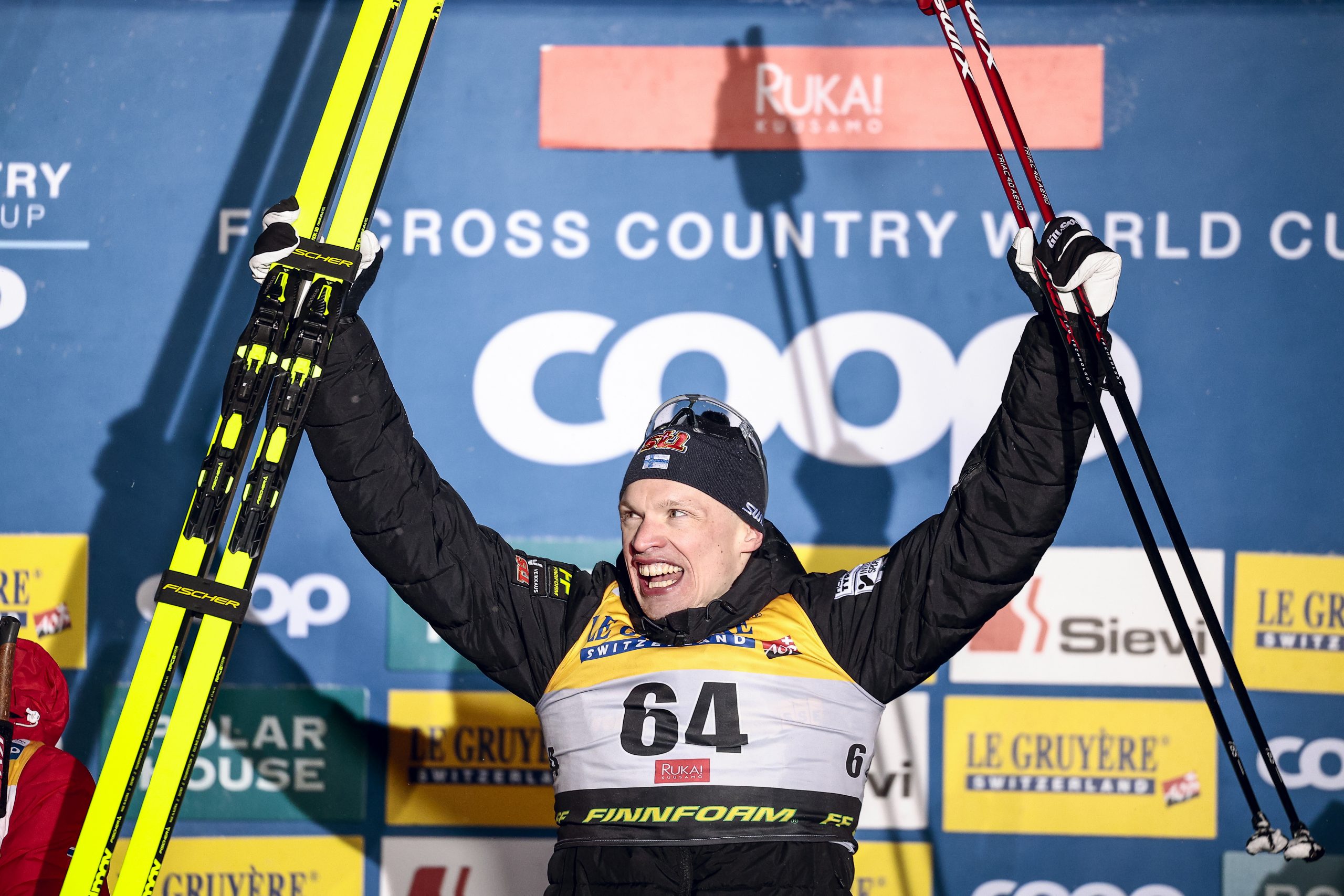
    Finland’s Classic skiing legend, Iivo Niskanen, raced to a victory in the men’s 10 k Classic Interval Start in Ruka, leading the field by 12 seconds into the finish (Photo: NordicFocus)

    Ruka, Finland is an area known for challenging race courses and rapidly changing conditions. As the women’s field wrapped up the morning race, the men took on the course under snowfall and near-freezing temperatures. With dusk settling in and the stadium lights casting a glow over the trails, it was a classic start to the World Cup season in Ruka. For the wax technicians, the unexpected snowfall added extra complexity to the afternoon’s preparations. With no precipitation predicted, technicians battled the fresh snow and near-freezing temperatures to craft a kick that would allow athletes to stride on Ruka’s infamous climbs. The loose snow on the uphills forced racers into herringbone, a technique that saps energy and momentum, while the choppy surface caused slips and stumbles as skiers fought to maintain their rhythm.

    The biggest question of the day: could Finland’s Iivo Niskanen finally outpace Norway’s Martin Loewstroem Nyenget in their highly anticipated battle after a close finish in last year’s event?

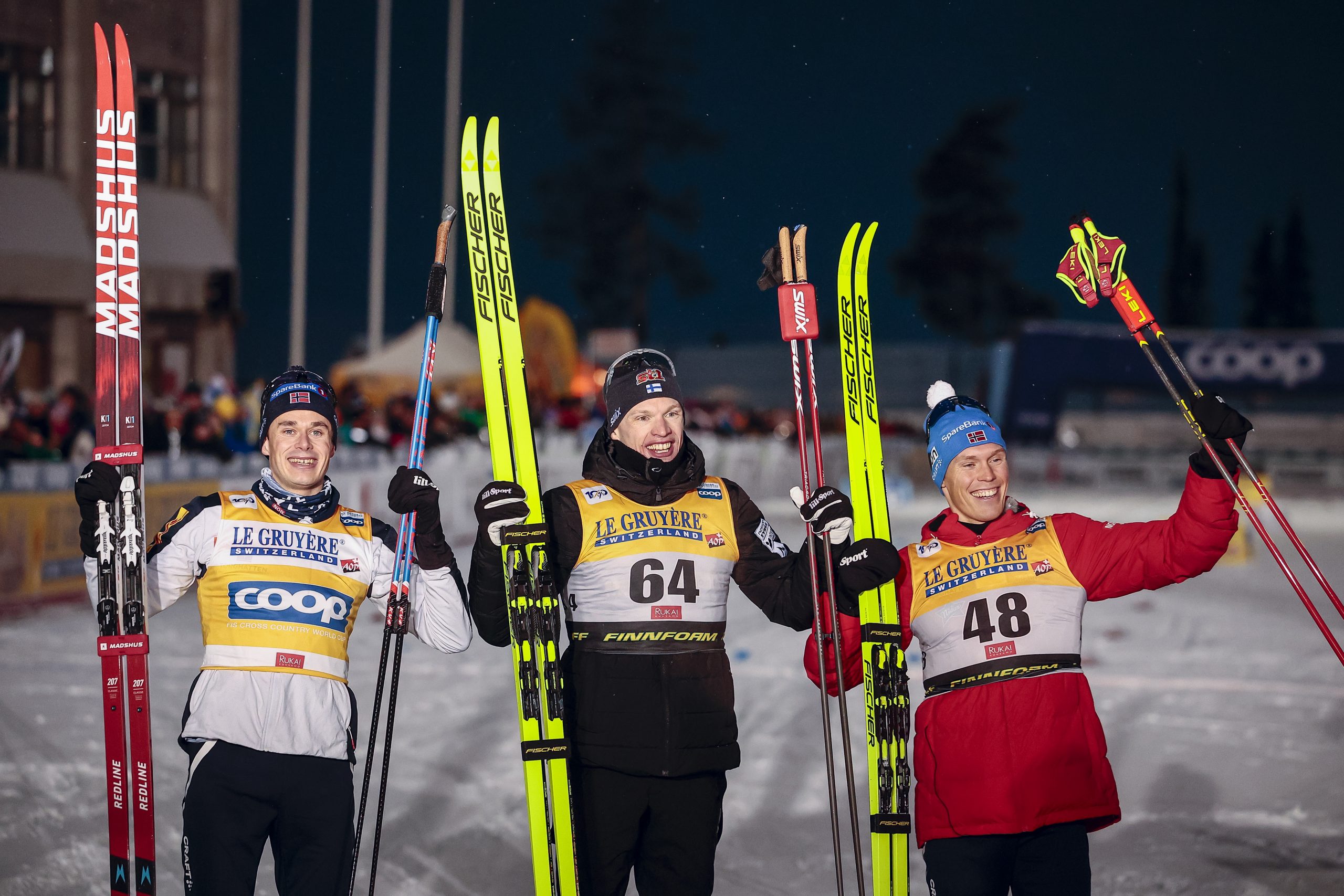
    It turns out he could. Niskanen claimed the top spot on the podium, delivering a thrilling victory for his home crowd by more than 12 seconds. He was followed by Norwegians Harald Oestberg Amundsen in second, and Nyenget in third, with just two seconds separating the teammates. This pair fought for the podium positions alongside other Norwegian teammates with similar splits over the course of the race. 

    North American skiers also celebrated strong results today: Gus Schumacher finished 18th, Ben Odgen, 29th, Zanden McMullen, 30th, Zak Ketterson, 36th, Hunter Wonders, 48th, and Michael Earnhart, 57th. 

    The two Canadian athletes, Xavier McKeever and Max Hollmann, finished 32nd and 50th, respectively. 


    Men’s 10 k Classic Interval Start

    Home-country favorite and distance specialist, Niskanen, claimed the victory, delivering a commanding performance before a crowd of his boisterous countrymen. Starting mid-pack, Niskanen quickly established his dominance, leading the field by the 1.5 k check. He extended his advantage to 5.1 seconds at 3.1 k, 10 seconds at 5 k, and maintained a steady pace to finish 12.5 seconds ahead of Amundsen in second place. Amundsen was a favorite for the podium, defending his overall World Cup win last season. Niskanen crossed the line beaming, pounding his hands in celebration toward the crowd, clearly thrilled with his victory on familiar terrain. Nyenget claimed third place, finishing just two seconds behind Amundsen after delivering a strong performance in the early stages of the race.

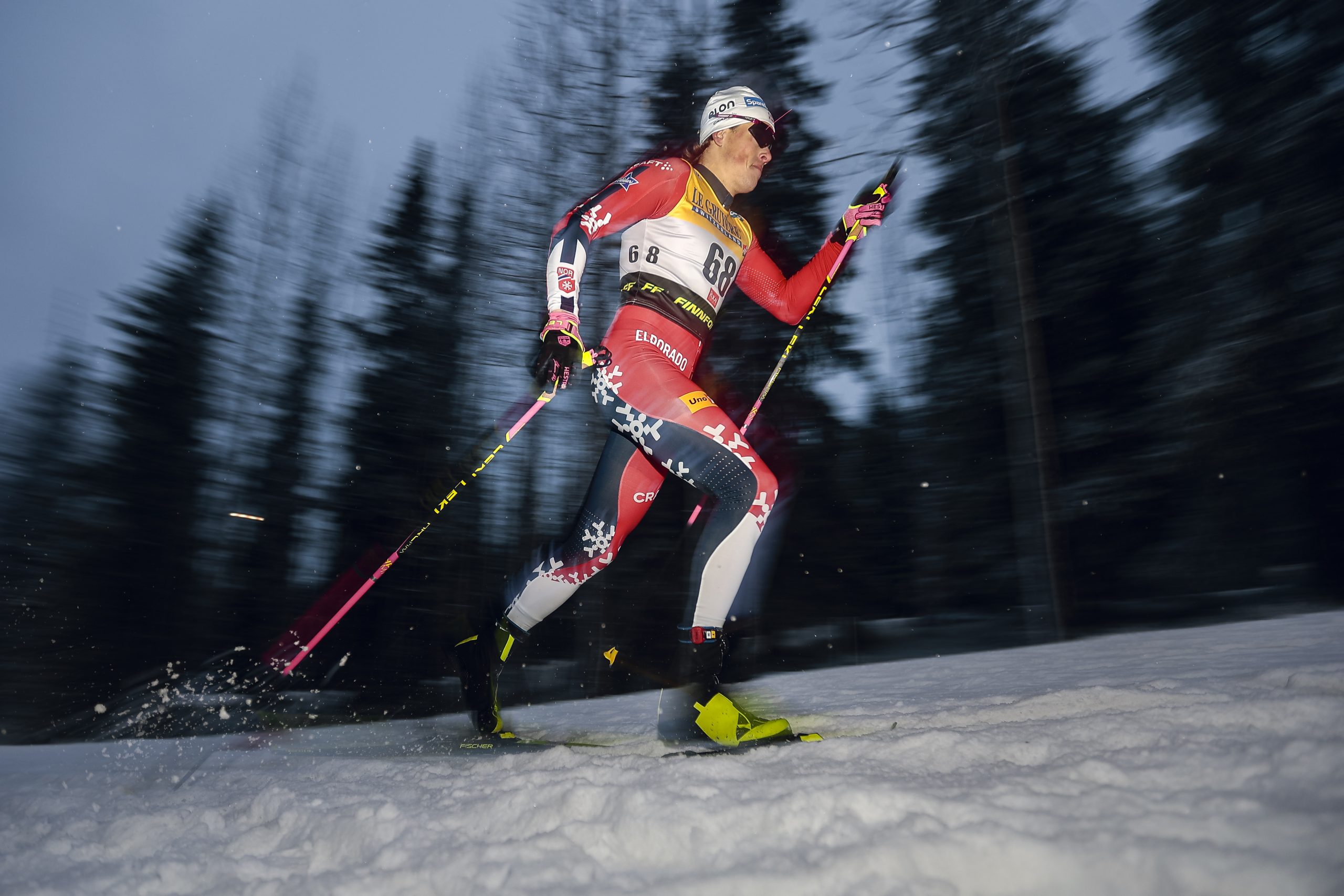
    A strong group of Norwegians competed for the following positions, coming in with similar splits throughout the race. This group included medalists Amudsen and Nyenget, as well as their teammates Erik Valnes, Johannes Hoesflot Klaebo, and Andres Fjorden Ree. Ree dropped back after 5 k and Simon Hegstad Kreuger caught up to the pace set by his teammates around 6 k. Just seconds behind this pack of six Norwegians was Jens Burman (SWE), a strong mid-distance skier who has seen success in this discipline before. 

    Johannes Hoesflot Klaebo (NOR) skied to fourth place in the 10 k classic in Ruka, 28 seconds off the winning time. (Photo: NordicFocus)

    Klaebo was favored to contend for the win after his dominance late last season, though finished 28 seconds behind Niskanen in fourth place today. While this might seem surprising, it’s not an uncharacteristic early season result for Klaebo, who placed 14th in this race last year before dominating the second half of the season. If he has taken a similar strategy this year, we might expect Klaebo to start challenging the top of the distance podium positions by the start of January. 

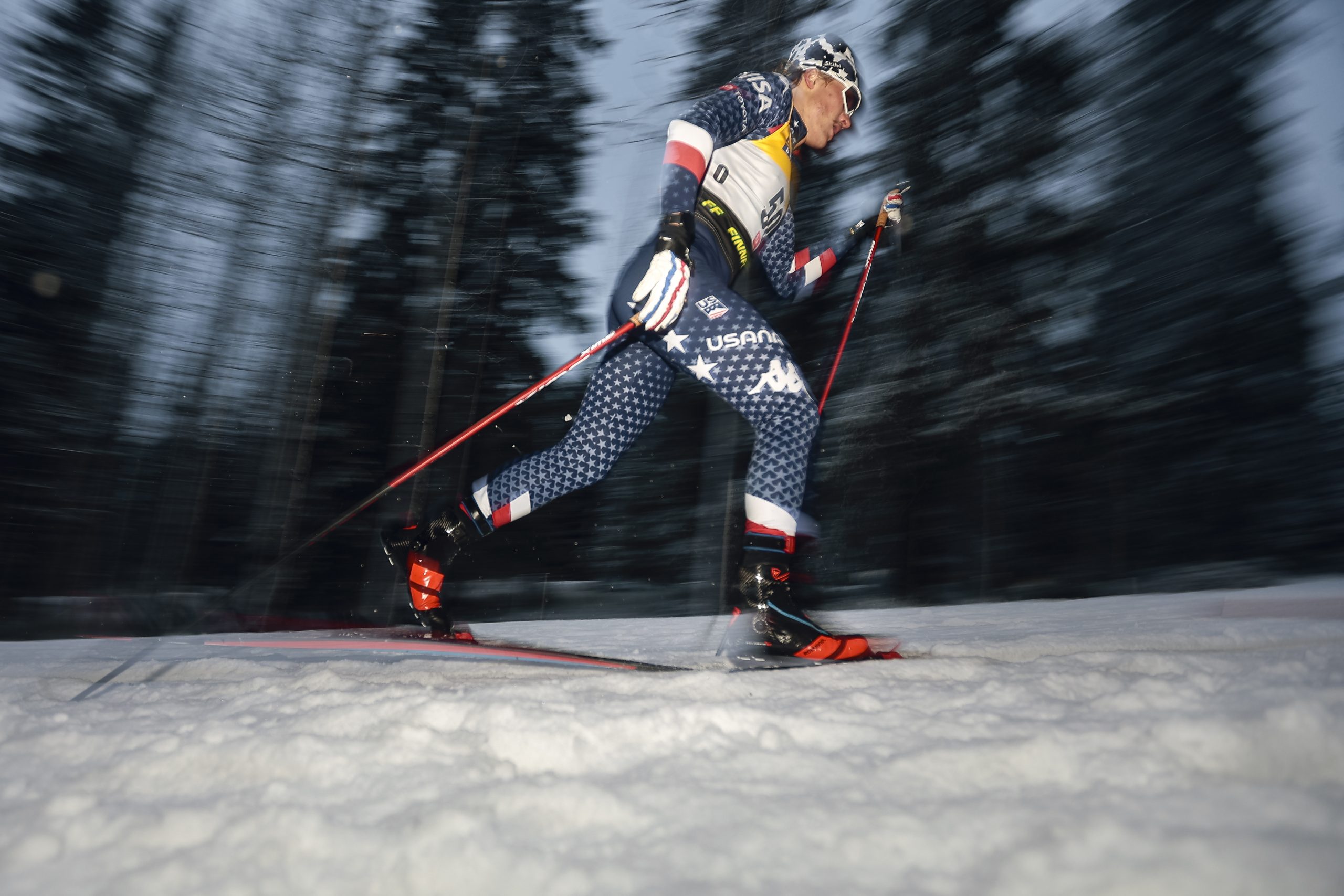
    The American men also saw progress compared to their results in last year’s Ruka 10 k classic. Schumacher delivered a strong 18th place performance, improving on last year’s 22nd place in this race with one of his best-ever finishes in this discipline, second only to his 15th-place results in Toblach (2023–24) and Oberstdorf (2022–23). “I’m always thinking about technique and I feel like that leads to slight improvements over the long term, Schumacher said. “I think that idea of slight improvements over long term is what gets me here today.” 

    Gus Schumacher (USA) raced to 18th place in Ruka, an improvement over last year’s 22nd place finish. (Photo: NordicFocus)

    Ogden, who is returning to the circuit after his previous season was cut short by mononucleosis, showed he’s back in form. “I worked on pacing in workouts,” Ogden noted regarding his transition back to the race circuit. “While today wasn’t perfect, I feel like It wasn’t bad by my standards, especially for not racing in a while. Excited to see how this can develop and make me faster over the next few months.” After finishing 39th in Ruka last year, Ogden opened this season with a strong 29th place finish today—a promising ten-spot improvement that bodes well for the upcoming season.

    “It’s so fun being back with everyone, team USA and beyond,” Ogden shared following his race. “Cross country skiing is a small community and sometimes I don’t appreciate how awesome everyone from all the nations are until I have to leave them for a while. Congratulating everyone after the races and getting fired up is just so fun.”

    Coach Matt Whitcomb is pleased with the team’s results.“We’re in a pretty good spot right now,” Whitcomb shared. “Very representative of a team that’s going to have a great season and isn’t quite sharp yet. So we all feel good about it.” 

    Be sure to follow the action in tomorrow’s skate sprint and Sunday’s 20 k skate, as the Americans continue to build strength and momentum heading into the rest of the season.

    RESULTS Men’s 10 k Classic Interval Start

    Harald Oestberg Amundsen (NOR), Iivo Niskanen (FIN), and Martin Loewstroem Nyenget (NOR) topped the podium in the Ruka men’s 10 k Classic.  (Photo: NordicFocus)
    Harald Oestberg Amundsen (NOR), Iivo Niskanen (FIN), and Martin Loewstroem Nyenget (NOR) topped the podium in the Ruka men’s 10 k Classic. (Photo: NordicFocus)
  • World Cup Season Opens in Ruka: Johaug Returns but Karlsson Flies

    World Cup Season Opens in Ruka: Johaug Returns but Karlsson Flies

    This coverage is made possible through the generous support of Marty and Kathy Hall and A Hall Mark of Excellence Award. To learn more about A Hall Mark of Excellence Award, or to learn how you can support FasterSkier’s coverage, please contact info@fasterskier.com.

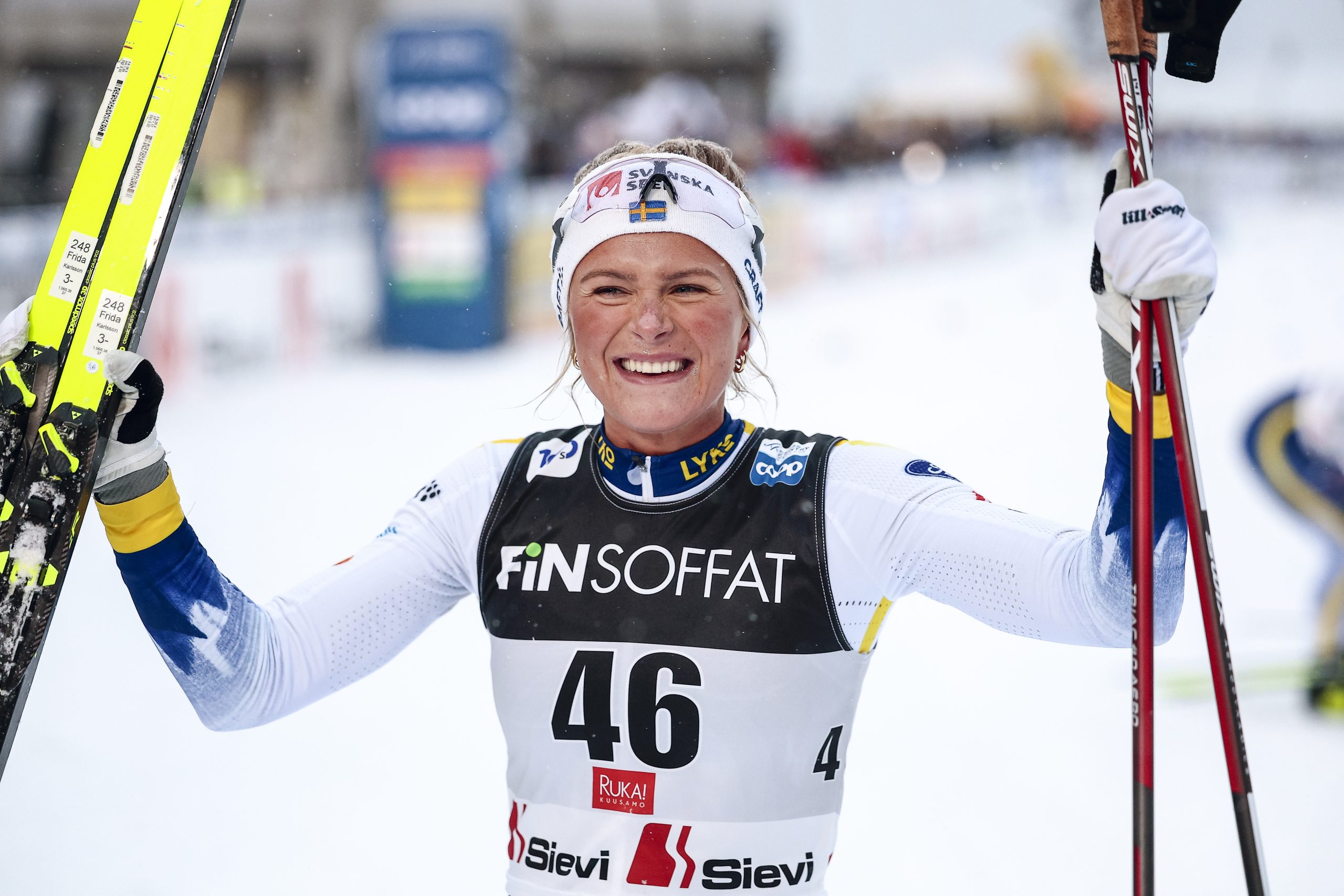
    Frida Karlsson (SWE) exults in the finish area after her dominant victory in the Women’s 10 k Classic Interval Start in Ruka, Finland. The World Cup season has begun, and Therese Johaug (NOR) has returned. But all eyes are likely to remain fixed on Karlsson. (Photo: NordicFocus)

    It’s been two full seasons since Therese Johaug last toed a starting line in a FIS World Cup distance event. In that time, the field has been able to convince itself that they were the best in the world. But Johaug has been lingering in the background all along—having a life, having a daughter, writing books, creating fashion empires—just waiting for the chance to come back to international competition. On Friday in Ruka, Finland, her long wait came to an end.

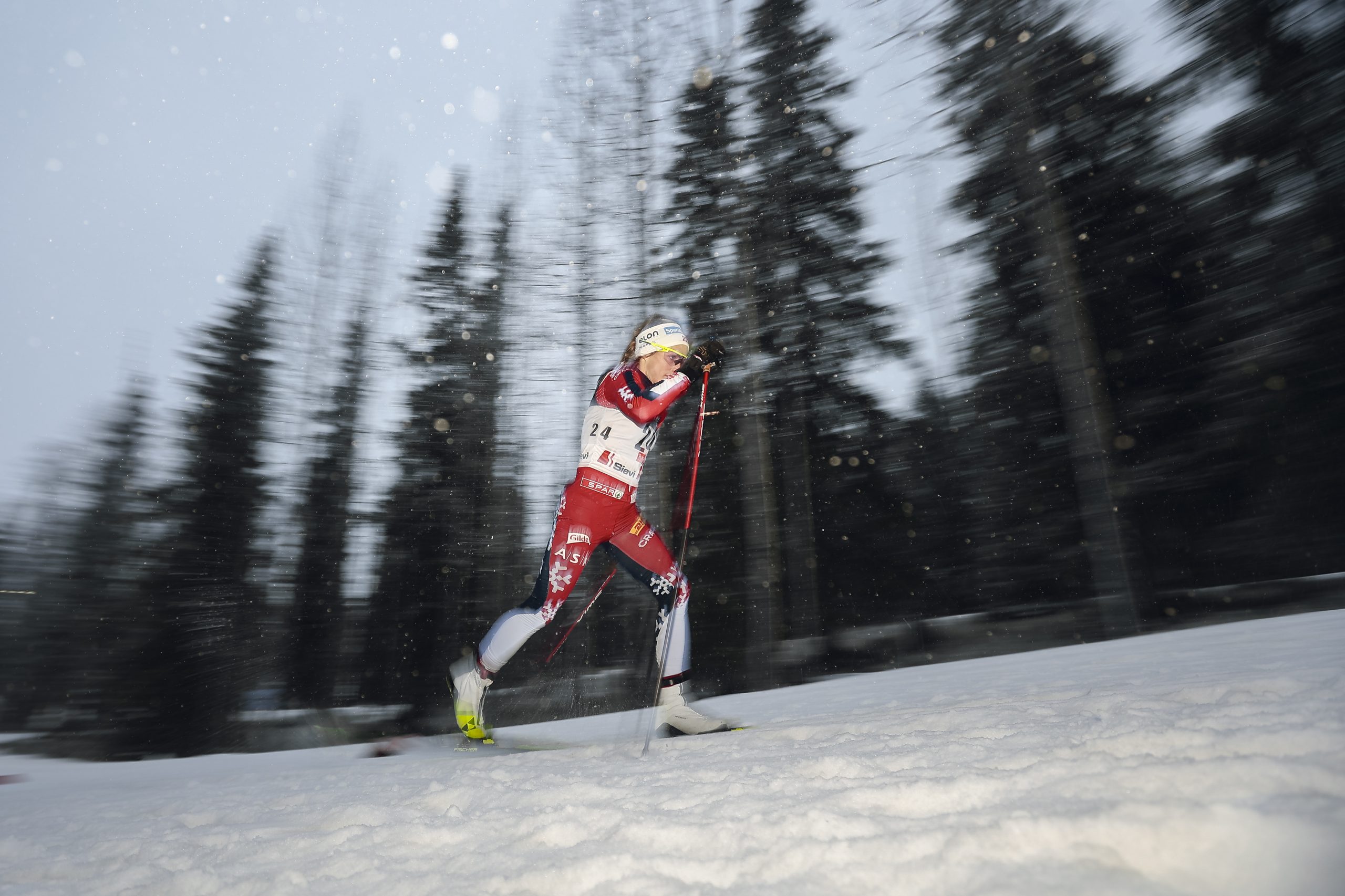
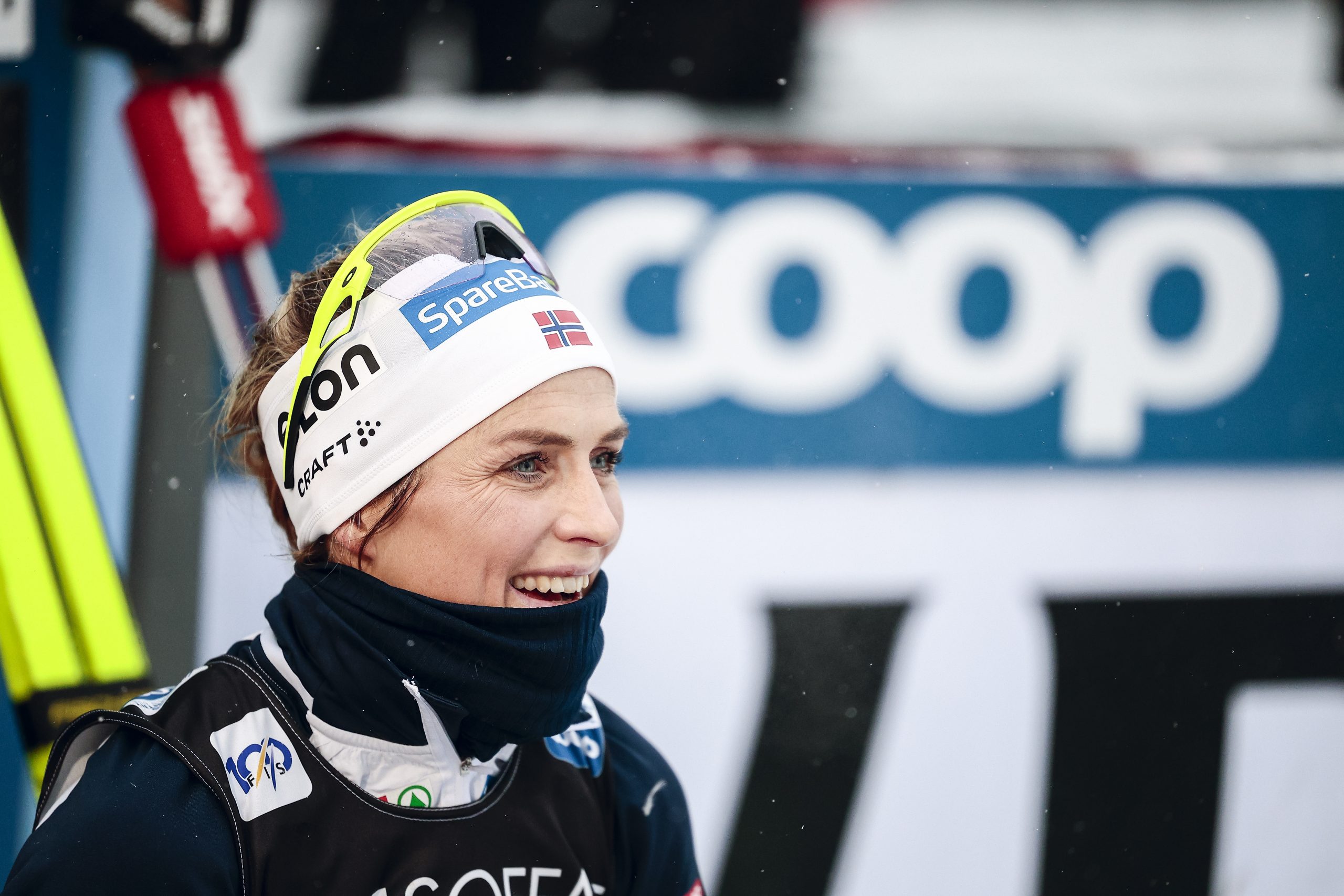
    Therese Johaug (NOR) on her way to a brilliant second place finish in the Ruka 10 k Classic. Only Sweden’s Frida Karlsson was faster. (Photo: NordicFocus)

    Therese Johaug (NOR) navigating a racecourse in full flight is an awesome sight to behold. Her competitive mode is flat-out intensity, un-stoppable momentum, wind-up-toy tempo. It looks for all the world like her only strategy is “go!” That degree of competitive abandon defined Johaug’s historic career, one in which she earned 82 World Cup wins, six Olympic medals, and 14 World Championships. Toward the end of Johaug’s storied career, a young Swedish challenger arrived on the scene: Frida Karlsson (SWE) showed unique abilities and a penchant for emulating Johaug’s style: high tempo, light touch, fearless pacing. Today in Ruka, Karlsson was the only athlete who could match Johaug; the only athlete who could better her. In the end, Karlsson snatched the fairytale ending from Johaug’s comeback story (at least for the moment), racing to victory by a shockingly large margin.

    “Maybe my best race ever,” said Karlsson in postrace interviews. “I felt really good.”

    Karlsson had her 2024 season interrupted by illness and injury—and a summer season in which she struggled with foot problems—but evidently her preparation has gone according to plan as she dominated Ruka’s 10 k Classic course like few before her ever have. Perhaps only Johaug . . .

    Ten kilometers after her first start in more than two years, the Nordic skiing world was reminded of Johaug’s grit, determination, fitness, and talent. She ultimately crossed the line with a large lead, only to see it evaporate into the Arctic sky with every new split recorded by Karlsson. In the end, Karlsson triumphed over Johaug by more than 45 seconds, with Astrid Oyre Slind (NOR) finishing third, another 7.5 seconds behind.

    Jessie Diggins (USA) raced to seventh place in Ruka, an improvement over her finish of a year ago when she ultimately claimed the FIS Overall World Cup. (Photo: NordicFocus)

    Jessie Diggins (USA) is the reigning World Cup Overall Champion, a distinction that also increases the number of her teammates allowed to enter World Cup races. In Ruka, eight American women raced the 10 k, with two finishing in the top ten. Behind Diggins steady 7th place (an improvement on her Ruka finish of a year ago), American finishers included Rosie Brennan (9th), Sophia Laukli (31st), Alayna Sonnesyn (48th), Julia Kern (49th), Sydney Palmer-Leger (56th), Haley Brewster (57th)

    Canadian finishers included Katherine Stewart-Jones (42nd) and Liliane Gagnon (46th)

    “Before I look at the results, I look back on the race,” Diggins continued. “How did it go? How did I communicate with my tech about my skis? Did I ask for what I needed? How’d the warmup go? How’d the race go: mentally, tactically, technique-wise, racing-wise? Then I come up with my scoring for myself before I look at the results. Today I was really really proud of all those categories, able to push really hard and stay very technique-focused.”

    Women’s 10 k Classic Interval Start

    November is the time of year when skiers wish for snow. Regrettably, those snow-wishes aren’t always granted, and November is often a month of roller ski pole tips clacking and slipping on near-frozen asphalt roadways. This year, though, the hills and trails appear different: Snow has arrived. The Central Rockies got totally dumped on this week—cars and trucks skidding and colliding up and down Vail Pass. New England finally got the Thanksgiving nor’easter that ski areas hope for every season. Now if they can just arrange another one for Christmas, then a couple more for President’s Day and Spring Break. Western Canada is blanketed in snow; Silverstar, BC is hosting camps for those programs savvy enough to plan early.

    The International Ski Federation (FIS) doesn’t take chances when scheduling season openers. For many seasons, the first World Cup stop has been in Ruka, Finland (25 kilometers north of the Arctic Circle). It may only be November, but skiers are pretty sure to find snow in Ruka.

    Skiers are also likely to find challenging conditions on Ruka’s Classic course that is designed to test the best athletes.

    “Both up and down, (Ruka) is very technical, said Diggins. “Very steep hills, and you need really dialed-in technique in order to run them. You also have to be able to transition in and out of herringbone really well. I’m still getting there, and I have more that I want to do. It’s exciting to feel like all that hard work is sinking in.”

    The first World Cup of the season—the Women’s 10 k Classic Interval Start—was raced in fresh snow with temperatures hovering around minus 2 centigrade. Conditions would be slower and more challenging than most athletes might’ve liked for the first test of the season, and many athletes lacked the snap typically seen in World Cup Classic races. The snow dragged at their skis, the hills sapped their energy. In the near-constant twilight of Arctic winter, racers struggled to find the form and rhythm that they’d refined all through the summer training season.

    It’s been two full seasons since the skiing world watched Therese Johaug (NOR) race. Ruka’s 10 k Classic was a reminder of her long and excellent career, and of the potential she still possesses with the Trondheim World Championships looming on the Norwegian horizon. (Photo: NordicFocus)

    Now 36 years old, Johaug had retired after the 2021-2022 season. The day’s 24th starter in Ruka, Johaug was seeking her 83rd World Cup victory. She departed the stadium in her usual staccato style, attacking a familiar course that has delivered victories for her many times before. Johaug was seen to be exiting the tracks in search of greater kick on the challenging uphills (as were many of her Norwegian teammates). Nevertheless, she established large leads at all her early splits.

    Other contenders (Diggins, Slind, Weng, Andersson) would match or better Johaug’s early splits, but ultimately each of her rivals faded . . . except for Karlsson. She stormed on through the Finnish forest, increasing her lead at each juncture. In a field of world class skiers who seemed generally to struggle with the day’s conditions, Karlsson appeared the lightest, most energetic, most efficient on her skis. Rarely out of the tracks, she was able to attack where others needed to measure their efforts.

    At the midway point, fast times had been turned in by Karlsson, Slind, and Katharina Hennig (GER) who were all positioned ahead of Johaug. Diggins hovered in fifth, just ahead of Heidi Weng (NOR). But only Karlsson and Johaug were able to maintain their technique—and their momentum—all the way to the end. Slind raced bravely as well, recovering her technique near the end to finish a strong third.

    “I think I went out a little hard,” Diggins confessed after the race. “I don’t necessarily regret it; sometimes you gotta go big and see what happens. But I think I was folding a little bit in my technique on that second lap.

    So, the 2024-2025 World Cup season is underway. Many weekends and many races lie ahead, and much will transpire before the FIS World Championships in Trondheim. Those races are what Therese Johaug identified as her goal event for the season, a week of racing that Frida Karlsson is likely to have circled on her calendar, as well.

    RESULTS: Women’s 10 k Classic Interval Start

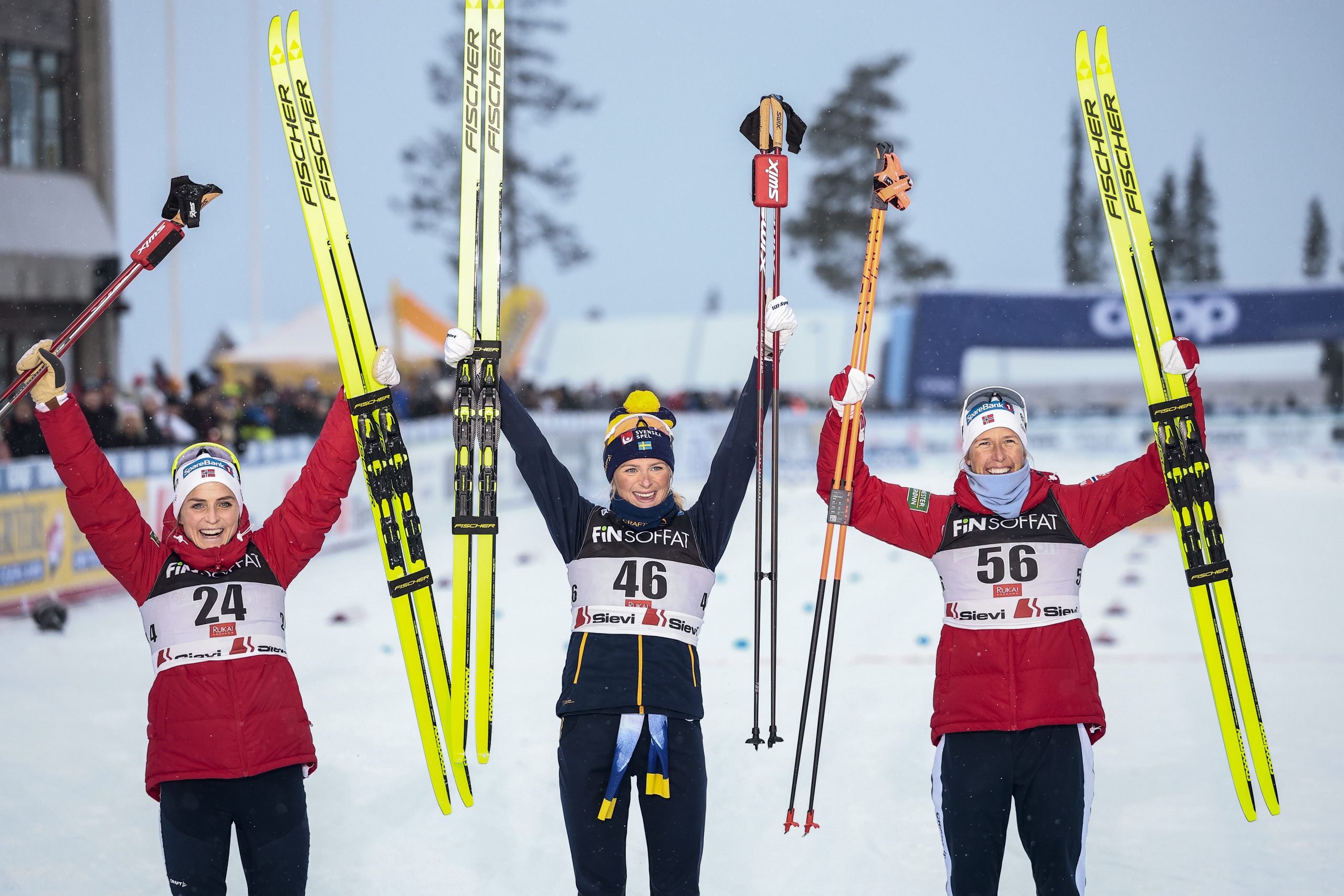
    First podium of the World Cup season: Therese Johaug (NOR), Frida Karlsson (SWE), and Astrid Oyre-Slind (NOR) celebrate on the podium in Ruka. (Photo: NordicFocus)
    First podium of the World Cup season: Therese Johaug (NOR), Frida Karlsson (SWE), and Astrid Oyre-Slind (NOR) celebrate on the podium in Ruka. (Photo: NordicFocus)
  • The Devon Kershaw Show: Burger King and the Thugometer

    The Devon Kershaw Show: Burger King and the Thugometer

    You know you missed us.

    Devon and Nat return with a soft launch into the 2025 winter season. We cover off-season developments and other hijinks, from the still-missing Russians to Therese Johaug’s return. Read here and here if you want to understand wth the references are in the show title.

    We’ll be back soon. Hit us up at nat@fasterskier.com and devon@fasterskier.com; we’re psyched to be back.

  • The Devon Kershaw Show: Ruka recap and guess whose apology tour

    The Devon Kershaw Show: Ruka recap and guess whose apology tour

    We’re back, with some incremental improvements to our audio production and full stoke for a new season of the Devon Kershaw Show. On this first episode of the new season, Devon and Nat break down the winter’s opening races in Sweden, Finland and Norway, and prime the pump for the World Cup kickoff in Finland next weekend. As always, email us at devon@fasterskier.com and nat@fasterskier.com.

    A resurgent Calle Halfversson had a breakout weekend in Ruka — until his encounter with the race jury on Sunday. (photo: Fischer/NordicFocus)
  • Ruka Women’s 10 Kilometer Classic: Sweden Dominates, Brennan Shines

    Ruka Women’s 10 Kilometer Classic: Sweden Dominates, Brennan Shines

    A_Hall_Mark_of_Excellence_Award-logo-300.png (300×244)This World Cup coverage is made possible through the generous support of Marty and Kathy Hall and A Hall Mark of Excellence Award.  To learn more about A Hall Mark of Excellence Award or to learn how you can support FasterSkier’s coverage please contact info@fasterskier.com.


    Ebba Andersson (SWE) on her way to victory in the women’s 10k classic in Ruka, Finland. (Photo: NordicFocus)

    Women’s 10K Interval Start:

    Today began a new chapter in World Cup racing as women and men competed at the same distances on the same course for the first time ever. This also marked the first distance competition since the retirement of Therese Johaug. With that competitive force no longer dominating the races, it would be left to the field to decide who would lead it into the future.

    The Results:

    The race was won by Ebba Andersson of Sweden, followed by Frida Karlsson of Sweden, and Katharina Henning of Germany. The top American was Rosie Brennan finishing in seventh place, 29 seconds out of first.  Jessie Diggins was the second American, finishing 21st, 1:18:0 out of first place.  Rounding out the field for the Americans were Novie McCabe in 39th, 2:03.4 back. Sophia Laukli in 45th, 2:26.2 back, Alayna Sonnesyn in 49th 2:38.4 back, Julia Kern 51st, 2:49.7. The top Canadian was Katherine Stewart-Jones, followed by Dahria Beatty and Olivia Bouffard-Nesbitt.

    Ebba Andersson (SWE) earned the win in the season’s first distance World Cup, the 10km classic individual start at Ruka, Finland.  (Photo: NordicFocus)

    The Race:

    The women’s individual race in Ruka, Finland was held this morning in cold,  overcast conditions.  The athletes competed on a five-kilometer course with a mix of natural and artificial snow with temperatures around 17 degrees Fahrenheit (-8.0 Centigrade) at the start.  Humidity was 93%.  Conditions were favorable as skiers used a mixture of klister and hard wax for kick.

    First out for the American’s was Alayna Sonnesyn starting in the 18th spot, followed by Novie McCabe in 22nd,  Sophia Laukli in 23rd, Julia Kern in 25th, Jessie Diggins in 38th, and Rosie Brennan in 42nd.

    Racing to an impressive seventh place finish, Rosie Brennan (USA) was the top American finisher. FIS world cup cross-country, 10km, Ruka, Finland.  (Photo:  NordicFocus)

    Karlsson Jumps out to the Lead:

    The steep hills of Ruka proved challenging as many skiers stepped out of the tracks to take advantage of loose snow going up hills. Most were resorting to herringbone on the second lap. Karlsson asserted herself early, taking a lead at the 3.1kilometer interval by ten seconds over Andersson by 6.5 seconds. Even so, by the 6.1 kilometer mark, Ebba Andersson took a 2.7 second lead over Karlsson.  Henning was in third place, 9.5 seconds back. At this point, Rosie Brennan was 21.9 seconds back in sixth place.

    Frida Karlsson (SWE) on her way to 2nd place. (Photo: NordicFocus)

    Andersson Takes a Slim Lead:

    By the 8.1 K mark Andersson’s lead had been reduced to the narrowest of margins, leading Karlsson by just 0.6 seconds. Henning had dropped back to fourth place, 8.5 seconds back.   Brennan was in fifth place, just behind Heidi Weng who had a very fast second half.

    Karlsson crossed the finish line and had to wait to see how Andersson would fare.  Karlsson had looked very strong as she finished, but would it be enough to hold off the surging Andersson? As it turned out, Karlsson’s time in the winner’s chair was short-lived as Andersson ferociously attacked the last hill to make time on Karlsson. Anderson had an incredible final two kilometers and ended up beating her teammate by 5.7 seconds to give Sweden first and second place.

    The surprise of the day was Anne Kjersti Kalva of Norway. Kalva missed the Olympics with Covid, but on this day she battled back to a fourth place finish, falling just two tenths of a second short of a podium finish.

    Complete Results

    Frida Karlsson (SWE) – second place, Ebba Andersson (SWE) – first place and Katharina Hennig (GER) – third place share the women’s podium of the 10k classic in Ruka, Finland. (Photo: NordicFocus)
  • Ruka Men’s 10 Kilometer Classic Individual Start:  It’s all Team Norway.

    Ruka Men’s 10 Kilometer Classic Individual Start: It’s all Team Norway.

    A_Hall_Mark_of_Excellence_Award-logo-300.png (300×244)This World Cup coverage is made possible through the generous support of Marty and Kathy Hall and A Hall Mark of Excellence Award.  To learn more about A Hall Mark of Excellence Award or to learn how you can support FasterSkier’s coverage please contact info@fasterskier.com.


    Ruka Men’s 10K Classic Individual Start

    Ruka presented less challenging conditions this year compared to last year for the athletes.  Temperatures were in the high teens (-8.0 Centigrade) with racers running on green cold waxes. Humidity was 100 percent, which posed the possibility of tracks glazing during the race. The racers competed on a 5-kilometer course with 30 seconds between the start of each racer.

    Johannes Hoesflot Klæbo (NOR) on his way to victory in the 10k in Ruka (FIN). (Photo: Nordic Focus)

    Results:

    The Norwegians dominated the field.  Johannes Klæbo finished first, besting countrymen Paal Golberg by 20.5 seconds followed by Martin Nyenget who was 28 seconds behind Klæbo.  An outstanding performance was turned in by Andrew Musgrave of Great Britain, who finished in fifth, 40.3 seconds behind Klæbo. Norweigans took six of the top ten spots.

    The top American was Ben Ogden, finishing 28th, 1:23.9 back.  He was closely followed by Zak Ketterson who finished 31st, 1:24.6 out of first.  Rounding out the field for the Americans was Hunter Wonders, who is also a competitive canoe racer, finishing in 39th. 2020 Junior World Champion in the 10 kilometer, Gus Schumacher, finished 48th. Scott Patterson finished 54th.

    The top Canadian was Graham Ritchie, finishing 35th.  He was followed by Olivier Leveile who finished 44th.

    Hunter Wonders (USA) on his way to 39th place in the 10k classic. (Photo: Nordic Focus)

    The Race:

    The steep climbs of Ruka proved challenging for the men who consistently jumped out of the tracks early on climbs, preferring to run up the loose snow on the sides of the course.  Prior to the race there had been much discussion about Klæbo’s health.  Questions continued to swirl when he hit the one-kilometer split in 21st place and still trailed at the 3.1- kilometer split.

    Calle Halfvarsson (SWE) on his way to 4th place in the 10k in Ruka (FIN). (Photo: Nordic Focus)

    Calle Halfvarsson of Sweden gave many of the Swedish fans in the crowd a thrill as he led the race at the first three splits.  Ogden was in the hunt at the one-kilometer mark, only 12.5 seconds out of the lead, but by the 3.1 checkpoint, his trailing margin had widened to 22.4 seconds.

    Starting at about the six-kilometer mark, Klæbo removed any doubt about his nagging injury when he jumped into the lead establishing a six second advantage over countryman Halfvarsson.  Meanwhile, Musgrave had pulled himself from 23rd to sixth place, only seven seconds away from a podium spot.  Musgrave turned in the fastest time from the 3.1 to 5.0-kilometer split.


    Andrew Musgrave (GBR) – FIS world cup cross-country, having an outstanding weekend in Ruka. (Photo Credit: NordicFocus)

    However, because of the start order, Klæbo was never really able to relax since he had started the race ahead of Golberg.  When Klæbo finished he had a 28 second lead over the next best finisher.  But most of the contenders were still on course, so he was uncertain as to where he would finish.  However, the writing was on the wall as Golberg entered the stadium and it became apparent that he wouldn’t be able to catch Klæbo.

    The only remaining question was would Norway capture all of the podium positions?  The question was only partially answered when Halfvarsson crossed the eight-kilometer checkpoint in fourth but was only 0.2 seconds behind Nyenget.  At the finish it appeared that Halfvarsson was struggling mightily but was able to hang on for a fourth place finish.  The results; Norway 1-2-3.

    Complete Results

    Paal Golberg (NOR), Johannes Hoesflot Klaebo (NOR) and Martin Loewstroem Nyenget (NOR) share the 10k classic podium in Ruka (FIN). (Photo: NordicFocus)
  • American Teams Announced for 2021 World Juniors/U23s in Vuokatti

    American Teams Announced for 2021 World Juniors/U23s in Vuokatti

    Novie McCabe races in the sprint heats during 2020 World Juniors in Oberwiesenthal, Germany. (Photo: Doug Stephen)

    Last week, U.S. Ski & Snowboard announced team nominations for 2021 FIS Nordic Junior and U23 World Ski Championships, which will be held in Vuokatti, Finland, in early February. The athletes selected were as follows:

    U23 World Championships Team

    Sophia Laukli races in the relay during 2020 World Juniors. (Photo: Doug Stephen)

    Women:

    • Hailey Swirbul (APU Nordic Ski Center/El Jebel, Colo.)
    • Sophia Laukli (Middlebury College/Yarmouth, Maine)
    • Alex Lawson (Middlebury College/West Burke, Vt.)
    • Hannah Halvorsen (APU/Anchorage, Alaska)
    • Renae Anderson (Loppet Nordic Racing/Golden Valley, Minn.)
    • Alternate 1: Leah Lange (University of Utah/Park City, Utah)
    • Alternate 2 Annika Landis (Sun Valley Ski Education Foundation, Hailey, Idaho)
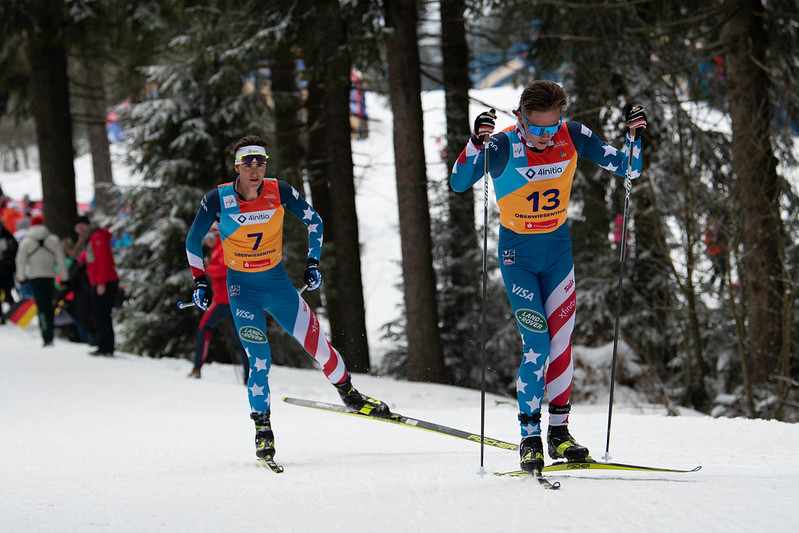
    Luke Jager (bib 13) and Johnny Hagenbuch (bib 7), during the junior men’s 30 k mass start skate during 2020 World Juniors. (Photo: Doug Stephen)

    Men:

    • JC Schoonmaker (Auburn Ski Club/Tahoe City, Calif.)
    • Gus Schumacher (Alaska Winter Stars/Anchorage, Alaska)
    • Hunter Wonders (APU Nordic Ski Center/Anchorage, Alaska)
    • Benjamin Ogden (University of Vermont/Landgrove, Vt.)
    • Luke Jager (University of Utah/Anchorage, Alaska)
    • Alternate 1: Peter Wolter (Middlebury College/Hailey, Idaho)
    • Alternate 2: Kai Meyers (APU Nordic Ski Center/Anchorage, Alaska)

    Junior World Championships Team

    Women:

    Sydney Palmer-Leger (bib 4) races the scramble leg of the relay at 2020 World Juniors. (Photo: Doug Stephen)
    • Novie McCabe (University of Utah/Winthrop, Wash.)
    • Sydney Palmer-Leger (University of Utah/Park City, Utah)
    • Kendall Kramer (University of Alaska Fairbanks/Fairbanks, Alaska)
    • Ava Thurston (Mansfield Nordic/Waterbury, Vt.)
    • Nina Seemann (Craftsbury Nordic Ski Club/Craftsbury, Vt.)
    • Haley Brewster (Ski and Snowboard Club Vail/Avon, Colo.)
    • Alternate 1: Waverly Gebhardt (University of Vermont/Steamboat Springs, Colo.)
    • Alternate 2: Garvie Tobin (Dartmouth College/Anchorage, Alaska)

    Men:

    Will Koch races in the 10k classic at 2020 Winter Youth Olympic Games, Lausanne, Switzerland. (photo: OIS/Chloe Knott)
    • Johnny Hagenbuch (Sun Valley Ski Education Foundation/Ketchum, Idaho)
    • Zanden McMullen (Montana State University/Anchorage, Alaska)
    • Will Koch (University of Colorado/Peru, Vt.)
    • Wally Magill (Steamboat Springs Winter Sports Club/Steamboat Springs, Colo.)
    • Finn Sweet (Craftsbury Nordic Ski Club/Waterbury, Vt.)
    • Michael Earnhart (APU Nordic Ski Center/Eagle River, Alaska)
    • Alternate 1: Brian Bushey (Green Mountain Valley School/Waitsfield, Vt.)
    • Alternate 2: Walker Hall (Methow Valley Nordic Ski Education Foundation/Winthrop, Wash.)
    Zanden McMullen races in a citizens race at Kincaid Park in Anchorage, Alaska, in December 2020, wearing an APU suit and a Montana State headband. (photo: Eric Packer)

    All athlete team affiliations and information are per the USSS press release. Athletes may claim additional affiliations; for example, APU Nordic Ski Center also lists Luke Jager, Garvie Tobin, and Zanden McMullen among its athletes named to this year’s teams, defensibly so given that all three athletes have trained with APU for years. Or Novie McCabe is listed elsewhere on the USSS site as skiing for Methow Valley, as well as for the University of Utah.

    There have been only four FIS race series held in this country so far this season, one in Anchorage in December and one at Soldier Hollow in early January, then one in Palmer, Alaska, and another one at Soldier Hollow last weekend, and a handful more USSS/NRL races. Some athletes were selected to this year’s teams after meeting objective criteria, such as World Cup results (Gus Schumacher, Hailey Swirbul, etc.) or a sub-50-or-60-FIS point result (Hunter Wonders in Anchorage; Peter Wolter and Sydney Palmer-Leger in Soho). The majority were selected via discretion, based on “both historical and current seasonal performances through January 3, 2021.”

    It appears that the following athletes named to this year’s team have not previously competed at World Juniors or U23 Championships: Nina Seemann; Will Koch; Brian Bushey; Renae Anderson; Annika Landis;  Peter Wolter; Kai Meyers; Ava Thurston; Haley Brewster; Garvie Tobin; Wally Magill; Finn Sweet; Michael Earnhart; and Walker Hall. Seemann, Koch, and Bushey all raced at last year’s Youth Olympic Winter Games.

    Brian Bushey races in the ski-cross qualification at 2020 Winter Youth Olympic Games, Lausanne, Switzerland. (photo: OIS/Joel Marklund/handout image supplied by OIS/IOC)

    The competition program for this year’s races will be as follows (click here for race start times, given in Eastern European Time):

    • February 9, U20 classic sprint
    • February 10, U23 classic sprint
    • February 11, U20 5/10 kilometer interval-start skate
    • February 12, U23 10/15 kilometer interval-start skate
    • February 13, U20 relay (4 x 3.3km for women, 4 x 5km for men) and U23 mixed relay (4 x 5km)
    • February 14, U20 15/30 kilometer mass-start classic

    Course profiles and details are here (scroll down for courses). The official website is here. Official FIS results are here. The Instagram page is here. The Facebook page (last year’s race featured free livestreaming on Facebook; it is still unclear if that will be offered this year) is here.

    The official hashtags, a media advisory states, are #vuokattisport, #roadtoJWSCVuokatti, and #JWSC2021Vuokatti.

  • The Devon Kershaw Show: The Norway, Sweden, Finland Opt-Out Episode

    The Devon Kershaw Show: The Norway, Sweden, Finland Opt-Out Episode

    Not two weeks ago, despite the pandemic, it appeared the FIS World Cup had dodged the proverbial positive-test bullet. The Ruka, Finland round of the World Cup went down with fantastic racing, and, as far as we know at the time of dropping this episode, no positive Covid-19 cases among the athletes in Ruka.

    The cracks began to appear shortly after the racing in Finland concluded. Several of Norway’s star skiers independently withdrew from World Cup racing through December – they were the first to go. Then three major World Cup players, Norway, Sweden, and Finland collectively opted out. As we reported on the FasterSkier website, these teams felt the safety protocols and fidelity to those Covid-19 prevention measures in Ruka were insufficient.

    We all know that race day is race day – you compete against those who wear the bibs. That said, we also know a World Cup race without Norway, Sweden, and Finland is like the Bulls without Jordan, a slalom race without Shiffrin, grooming with no classic tracks set.

    Devon breaks it down and provides his thoughts on where this all goes from here.

    Thanks for listening and here’s the disclaimer, this episode contains some un-beeped potty words.

  • From the World Cup Wax Truck – First Weekend in the Books

    From the World Cup Wax Truck – First Weekend in the Books

    The first weekend is in the books, and we can cross off a top 10, top 5, and technically a top 3 off of the to-do list.

    Being behind the scenes and waxing in the wax truck is a whole different perspective.  It is far more stressful but also incredibly fun.  I am mainly a part of the glide team and will help with testing, picking, and applying waxes for any given day.

    The conditions in Ruka for kick were extremely easy, and we ended up running on a hard wax binder with a purple/violet hard wax.  It gave us plenty of kick without compromising the glide, and the athletes were very happy both days with the kick options.

    The glide side of things, however, was a little more difficult.  With the colder, new snow underneath our groomed snow, a lot of moisture was coming up through the snow the more it was skied on. This changed the snow from really dry in the morning to glazed and wet in the afternoon.  We often tested before the races and then in between the races, changing from cold dry waxes in the morning to warmer wet waxes for the second part of the day.

    Athletes seemed to be really happy with the glide and kick all weekend and we have had numerous athletes saying they were able to roll up or drop other skiers on many of the downhills, which is always a good feeling on the first weekend of racing.

    I would not have been able to get through the weekend without the help of the other guys on our wax tech staff.  Everyone one of us brings some really skilled knowledge, and we are a team that will always listen to opinions and suggestions.  We collectively make the decisions on both glide and kick, and it is really fun to be with a team that wins and loses together.

    ventolin inhaler

    We are already in Davos, Switzerland preparing for the next world cup races two weekends from now, and we will start testing later in the week for athletes’ skis and also testing some of the future non-fluoro waxes!

  • Sweden and Finland Follow Norway and Withdraw from December World Cups (Updated)

    Sweden and Finland Follow Norway and Withdraw from December World Cups (Updated)

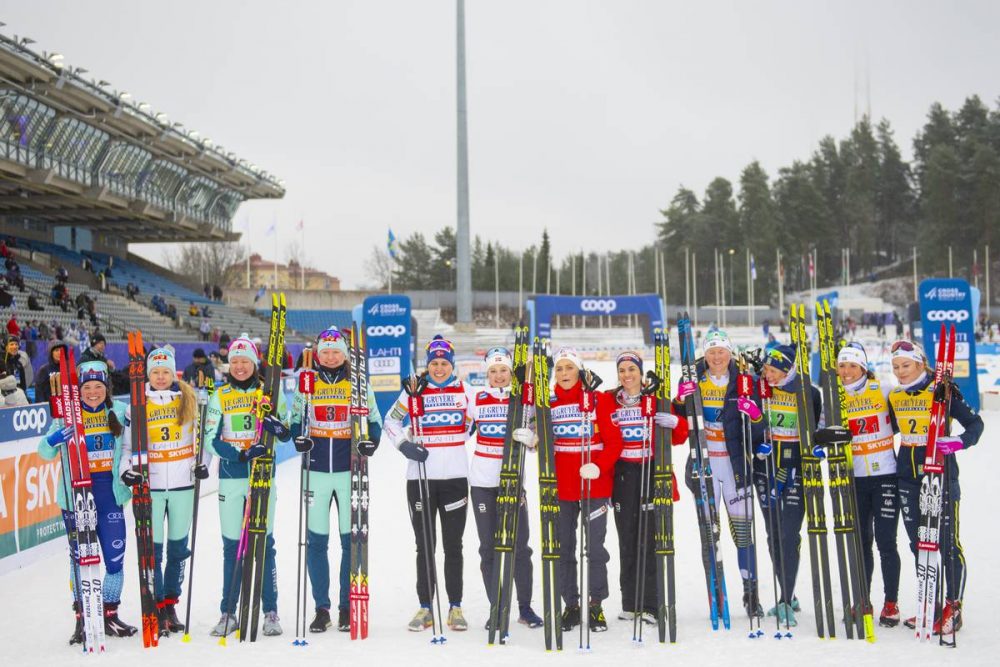
    The women’s podium of the 4×5-kilometer relay in Lahti, Finland’s during last season’s World Cup. Norway I took the win ahead of Finland I and Sweden. (Photo: NordicFocus)

    Yesterday Norway announced it would cease sending skiers to the World Cups in Davos, Switzerland and Dresden, Germany due to Covid-19 concerns. Rumors swirled that Sweden would make a similar decision. Twenty-four hours later the Swedish Ski Federation announced they too would withdraw from December’s competitions.

    “We learned some lessons about the implementation of a World Cup competition in Ruka. We have found that it went well. But we may also have been lucky. As it stands, we can not create an infection-free road to and from Davos or Dresden. If things go wrong, the disease can have potentially serious consequences for the person infected. None of us involved are willing to take that risk,” said Per Andersson, medical director of the Swedish Team, according to a translation of the press release.

    Finland also decided the best move forward was step away from the World Cup. In a press release, the Finnish Ski Association explained the ongoing pandemic and concerns about compromising their athletes were to blame. The association also claimed safety protocols in Ruka, the site of last weekend’s World Cup in Finland, were insufficient.

    “Unfortunately, at Ruka, we found that attitudes towards the coronavirus vary considerably between different people. When the Ruka World Cup was the first big event of the season, the organizers built a competition bubble according to the best knowledge, but due to the variability of the participants’ common understanding and commitment, the competition bubble did not materialize as required,” said Maarit Valtonen, Chief Physician of the Finnish Olympic Committee, according to a translation of the press release.

    Along with Norway, both Sweden and Finland have not made a decision about participating in the Tour de Ski which Begins on January 1.

    For those interested in the U.S. Ski Team, they remain in Davos preparing for the remaining December World Cups and the Tour de Ski. Chris Grover, Cross Country Program Director at U.S. Ski & Snowboard, provided the following statement regarding Ruka’s safety protocols and those nations electing to sit out the December World Cups:

    “We respect any nation’s decision to protect the health and safety of their own athletes and staff. Our team is in Davos training and we are planning on racing here, and in Dresden later this month. Ruka did a great job hosting three disciplines – cross country, jumping and nordic combined – and showed what was possible. Our team felt quite safe in Ruka as we followed the guidelines the local organizer, FIS and our own National Governing Body had in place.”

  • What A Way To Kick Off The World Cup For Madshus

    What A Way To Kick Off The World Cup For Madshus

    Sturla Holm Lægreid (NOR) crushed his competitors in the IBU biathlon World Cup opener  on Saturday and earned his first World Cup victory. On Sunday, turbo junior Helene Fossesholm (NOR) posted the second-fastest time of the day in the 10-kilometer pursuit at the FIS Nordic World Cup opener.

    “It hasn’t quite sunk in yet. I never imagined I would win,” Lægreid said after his race, which took place in in Kontiolahti (FIN).

    The 23-year-old dominated the 20-kilometer individual competition, shooting clean at the range and dropping his competitors on the course, winning the by nearly 20 seconds.

    “First, the coaches said I was even with Tarjei (Bø) and Johannes (Thingnes Bø), and then I was in the lead. It was insane to get those,” Lægreid said.

    The IBU season opener was only his fifth World Cup competition. Last winter, Lægreid won the silver medal at the IBU European Championships in Minsk (BLR) on March 1. He was then named to the national team for the World Cup in Nove Mesto (CZE) on March 6 and 8, where he finished 13 and 15. The next week, he was 10 and 11 at the World Cup in Kontionlahti, which were the last World Cup events of the 2019-20 season. In April, Lægreid was named to the Norwegian A-Team.

    Related coverage: 10 Madshus biathletes named to the Norwegian national teams

    Story continues below

    Sturla Holm Lægreid (NOR) won the IBU world cup opener in Kontiolahti (FIN) om Saturday, his first World Cup victory and his 5th World Cup race so far in his career. Photo: Nordic Focus

    Meanwhile, just a few hours north of Kontiolahti, the FIS cross-country World Cup kicked off the 2020-21 season with a three-day mini tour in Ruka (FIN), where turbo junior Helene Marie Fossesholm capped the weekend with her very first top-three World Cup finish.

    The 19-year-old posted the second fastest stage time in the 10km pursuit, just eight-tenths of a second shy of first place.

    After placing 38th in the sprint on Friday, Fossesholm finished 9th in the 10-kilometer classic race on Saturday. Combined, the two first races left her in 15th place for the pursuit on Sunday, starting nearly a minute and half behind the leader. But pushing relentlessly through the brutal course, she worked her way up to sixth place overall.

    “I’m super content with my effort today, and particularly with how I paced myself. I managed to hold back just a little out of the gate, which was key on this course. There is a hard hill in the first kilometer that will cost you if you are too eager at the start, but I skied smart and was able to stay strong the whole way,” Fossesholm says after her race.

    “But I have to admit I’m a little annoyed that I was less than a second from having the fastest time of the day,” the ambitious junior adds.

    Be warned.

    19-year-old Helene Marie Fossesholm (NOR) posted the 2nd-fastest time in the 10-kilometer pursuit that capped off the 3-day mini tour at the FIS World Cup opener in Ruka (FIN) on Sunday. Photo: Nordic Focus
  • All the Lightness as they Rotate Towards Winter: Chad Salmela and the Family in Finland

    All the Lightness as they Rotate Towards Winter: Chad Salmela and the Family in Finland

    FOMO: Fear of missing out. FOMO through the lens of envy is probably not the way to thrive. FOMO through the lens of seizing the day, on the other hand, has a lovely ring to it.

    Chad Salmela: biathlete, skier, running coach, forever linked with “HERE COMES DIGGINS”, husband, and parent. He is also the lone member of his family of four without a Finnish passport, although he has Finnish ancestry. His wife, Mimmu, hails from Finland, son Taavi (11), and daughter Iita (9) are all Finnish citizens. Prior to this year, Salmela said on a recent call from Finland, they had visited his in-laws for roughly three weeks each summer. Time. But not enough time.

    Then COVID. No in-person school last spring. Online learning to begin the school year in Duluth, Minnesota, Salmela’s hometown. With collegiate sports canceled in the spring, Salmela’s coaching position as a running coach at The College of St. Scholastica became hands-off in the extreme. Speaking of time, now the family had more of it. The family began to embrace the seize-the-day kind of FOMO.

    In July, they jetted off for what they thought would be a semi-extended stay in Finland. With schedules in flux, the prospect of extending their Finland visit beyond a month remained in play. Salmela admitted they prepared their home in Duluth to be rented just in case the pull towards Finland, during what has already been the mother of all disruptive years, was too great. 

    The pull was too great. 

    Biking in Finland: Taavi and Iita Salmela. (Photo: Chad Salmela)

    Finland’s schools are open for in-person learning. A huge plus to any child craving a social life away from caregivers. And the Salmela children, although emerging Finnish speakers, have been exposed to the language since they were infants. Although this was their second language, communicating verbally in Finnish remained within their grasp. Add to the mix a set of grandparents keen on spending time with grandchildren and you can see how the scales were tipped.  

    Mimmu left her job this past spring, and Salmela worked out plans to coach remotely until at least early winter.  

    “I had to talk to my employer and my boss about it and they have had a lot of understanding about this,” Salmela said from Finland. “I think my wife and my own ability to probably withstand it is one thing, but if you can get your kids to a place to go to a school, where they can go to school without masks on, and it is friendly, and they are learning and they interacting with kids, and playing their sports, that is huge. That is huge any way you slice it. That alone is worth any pain and suffering and stress that my wife and I had had to handle.”

    As graceful as living life in a foreign country sounds, the realities are rawer. There’s the possibility Chad has placed his coaching job in jeopardy. He had to think about the running program, and how he could effectively recruit from abroad. Then there’s leaving friends and neighbors. All practical considerations. Salmela is also one of the voices for NBC Sports cross-country and biathlon coverage. Initially, he was unsure if he would return to Stamford, Connecticut where NBC Sports’ studios are located, or if he could broadcast remotely from Finland. (For now, it appears Salmela will broadcast remotely from Finland.)

    According to Salmela, returning back to Duluth after four weeks in Finland was always an option. “We had a month while we were here to pull the trigger on this fully,” Salmela said. “In that month it just became clearer and clearer. I think I wrote in my blog, the third base coach is waving you home.”

    Fourth Generation First World Immigrant – Musings on culture, lifestyle, and sport, from a Finnish-American living in Finland, the name of Salmela’s blog, is his contribution to our Covid-19 isolation. The blog is many things: pithy, earthy, sharp-eyed. If you have the good fortune of pulling the plug and relocating a family, this blog might convince you it’s the right thing to do. It makes you realize how adaptable kids are. The blog provides a glimpse into Salmela’s life as he pens a near real-time memoir. It’s a welcome escape.

    There’s his earnest entry written on Sept. 26 titled “Into The Darkness”. Salmela and his clan know what’s coming. He writes that on their first day in Finland, July 20, the sun rose at 4:22 a.m. and set at 10:22 p.m. Sunsets that far north in latitude linger. The murky dusk fades over hours into an inky black.

    It is Finland. Relatively close to the arctic circle – darkness comes. 

    Here are some words from Salmela describing the phenomena.  

    “The first I actually thought about it for us this winter was at the end of August. We were still having nice days, but temps started to dip more regularly, and we were consistently twenty degrees cooler than Duluth. Duluth has since started to catch up, but I realized the time frame between the solstice and the equinox are exactly the same everywhere. Up here, the change is more drastic though. Not so drastic that you wake up one day and say, ‘Hey, what gives on this fall-back crap?!’ The change here is hard enough that they don’t need a day each year to mess with a savings of or returning of daylight. It happens quickly enough on its own. Just since September 1 the day has 2 hours and twenty minutes less daylight, and that’s just a running start to what October and November are going to bring us—longer and longer stretches of inescapable darkness.”

    Salmela, in his blog, does not dwell on impending doom, as the loss of daylight might suggest. He dives into the quotidian. Things like bathroom squeegees, the loveliness of Finland’s trails, the virtues of rye bread, and life as a wanderer when you’re a kid from the Iron Range of Minnesota. 

    A path leading to the Gulf of Bothnia, near the traditional Salmela farm in Finland. (Photo: Chad Salmela)

    Salmela, Mimmu, Taavi, and Iita are settled in Jyväskylä, where the kids attend school, and life rolls on. Speaking to Salmela, I found him, not so unexpectedly, vibrant. After all, he and his wife had executed something that they had discussed for years – an opportunity for their children to break away from much of what they have known. 

    “You cannot help but have a sense of pride as a parent,” Salmela said. “That you were able to pull this off somehow because it is so good for them. They don’t know how it feels politically or socially in the United States right now, with so much uncertainty. There is a lot of uncertainty here too, but it is not the same level, it is a shade of it. But in their daily lives, they are engaged in communicating in a completely foreign language and they are feeling proud of that. You can tell that they like that their Finnish is getting better.”   

    This piece originated with the idea that I would simply check in with Salmela and get some thoughts about the nuts and bolts of swapping time zones and making it work. But the more I read Salmela’s blog, the more I am reminded that each day, despite the head-spinning news cycle, brings tidy positive lessons. For now, we have this window into the Salmela clan’s life. Something wide open as the northern hemisphere revolves towards a frozen ground, snow, and darkness.

    It’s clear, Salmela knows what is coming too.  

    “It’s easiest to fall for something in its best light. The rates of divorce these days are a testament to that notion. For the most part, Finland for me and my kids has been from its best side—the side that says, ‘I think I want to marry this.’ It’s easy to be happy and love anything when it’s easy and lovely. Not that late fall and winter will be horrible here, but we’re going to get very familiar with it without its makeup on, when it needs to bathe, do its laundry, brush its teeth, comb its hair, and perhaps not be quite as jolly as when times are the best.  We’re going to get ‘more intimate’ with Finland than we’ve ever been. Mimmu hasn’t lived this far north through a winter since 1999. The kids and I never have. Most humans on earth have never done it. It’s probably not that scary, but it is an unknown, and it’s not Finland’s best side. I think addressing that up front is a wise strategy.”


  • The Devon Kershaw Show – Breaking Down Ruka

    The Devon Kershaw Show – Breaking Down Ruka

    This is a new project from FasterSkier and the podcast title pretty much says it: Devon Kershaw will be sharing his thoughts and insights of the 2019-2020 World Cup with us. It began this morning, Sunday, December 1, very early for me and not so early for Devon who is based in Lillehammer, Norway. Devon is a former longtime Canadian National Team member, a World Champion, and commentator for Eurosport at last year’s Seefeld, Austria World Championships.

    He is as deep as you can be in the world of high-level cross-country skiing and we are stoked to have him along. That’s pretty much it: a new podcast and the first episode. If you have questions for Devon, please send them to info@fasterskier.com. (We’ll be changing that email to devon@fasterskier.com, but that part is in the works. As the podcast evolves, Devon will be taking more control of the format. Thanks for reading and we hope you enjoy the new project.

    It might be a wee bit of time, but you’ll be able to subscribe to the podcast wherever you get your podcast fix.

    You can subscribe to the podcast on iTunes or Google Play.

    In this episode, Devon breaks down the three race series in Ruka, Finland which was the start of the 2019-2020 World Cup season.


  • Sunday Rundown: Pärmäkoski Wins At Home in Lahti 10 k; Poltoranin Tops 15 k

    Sunday Rundown: Pärmäkoski Wins At Home in Lahti 10 k; Poltoranin Tops 15 k

    Krista Pärmäkoski of Finland (center) won her second straight 10 k classic, to the delight of the crowd in Lahti. Natalia Nepryaeva of Russia (left) finished second and Marit Bjørgen of Norway third. (Photo: FIS Cross Country/Twitter)

    FIS Cross Country World Cup (Lahti, Finland): 10/15 k classic

    Women’s report

    Men’s report

    Racing at home in Finland, Krista Pärmäkoski picked a good time to collect the second World Cup victory of her career, and again in a 10 k classic. Pärmäkoski’s first win came in the 10 k classic in Planica, Slovenia, earlier this season.

    In second was Russia’s Natalia Nepryaeva, who picked up her first World Cup podium. The current U23 standings leader, Nepryaeva’s time was 20.9 seconds slower than Parmakoski. Both she and Marit Bjørgen of Norway, who finished third (+26.7), used a steady pace to reach the podium. At the 5 k split, Heidi Weng of Norway – wearing the yellow bib of the overall World Cup leader – was in second at the halfway point but faded to finish fifth (+43.3), and Kerttu Niskanen of Finland was in third place but she dropped to fourth by the finish, +27.0. Austria’s Teresa Stadlober finished sixth (+52.4).

    Sadie Bjornsen placed seventh (+57.6) to lead the American team. Caitlin Patterson was next, just missing the World Cup points in 32nd (+2:02.7). Ida Sargent and Sophie Caldwell  finished 40th (+2:21.9) and 42nd (+2:24.2),  respectively. Rosie Brennan finished 48th (+3:02.1) and SuperTour leader Kaitlynn Miller placed 51st (+3:09.1).

    Liz Stephen of the U.S. Ski Team did not start due to illness.

    Canada started only two women: Emily Nishikawa finished 41st (+2:22.2) and Dahria Beatty 44th (+2:40.7).

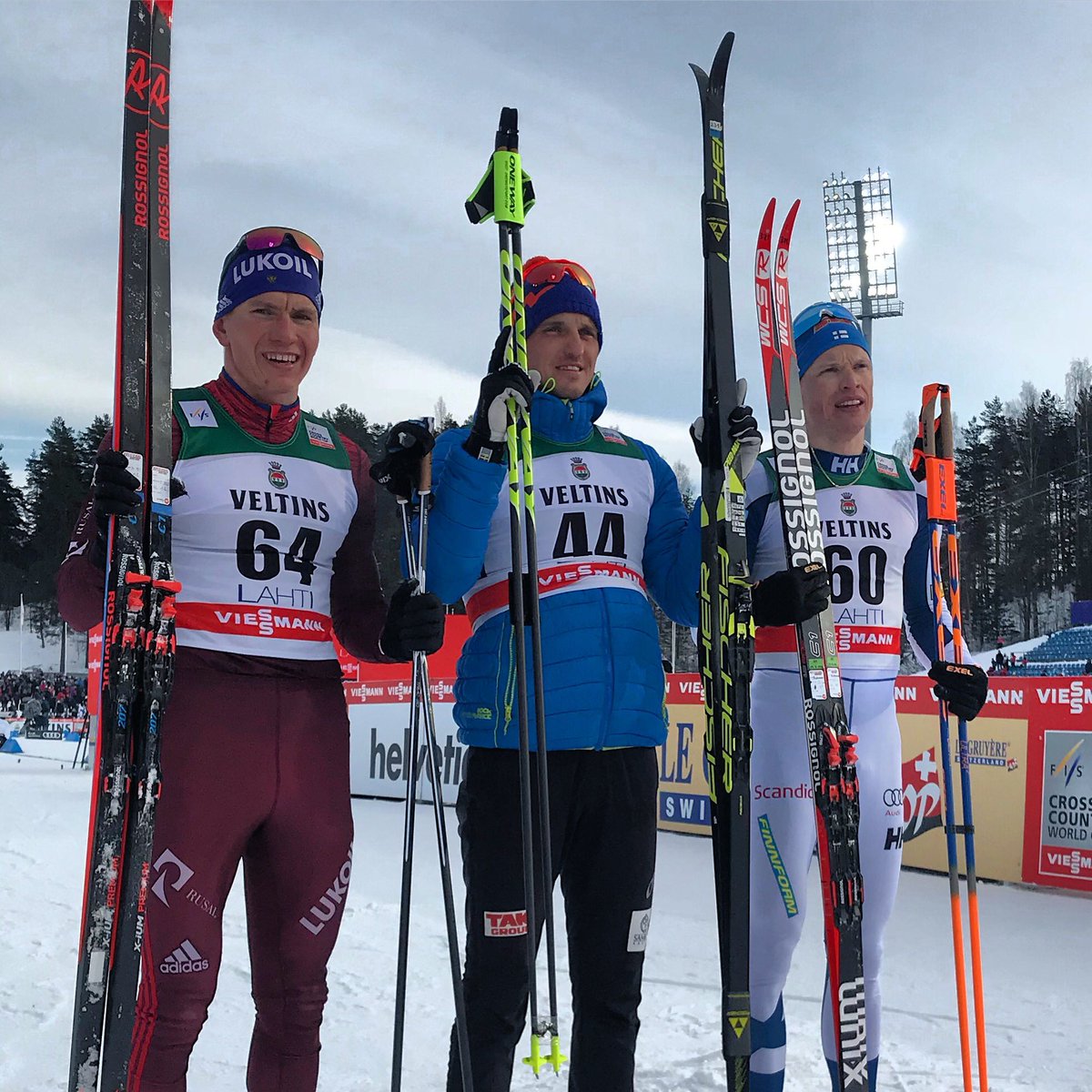
    The men’s 15 k classic podium at the World Cup in Lahti, Finland, with Kazakhstan’s Alexey Poltoranin (c) in first, Russia’s Alexander Bolshunov (l) in second and Finland’s Iivo Niskanen (r) in third. (Photo: FIS Cross Country/Twitter)

    In the men’s race that followed, Alexey Poltoranin of Kazakhstan got some redemption after a major bonk in the Olympics 50 k last weekend, winning the 15 k classic individual start in Lahti.

    Starting in the middle of the field in bib 44 (out of 71), Poltoranin paced it perfectly, skiing a steady race with some of the top split times and then turning it up another notch over the last several kilometers to take the win in 33:11.9 minutes. His biggest threat was Russia’s Alexander Bolshunov, who started 64th and clocked faster splits at every timing point throughout the three-lap race except the one that mattered most — the finish. There, Bolshunov came up 9.1 seconds short of Poltoranin’s time to place second, and Finland’s Iivo Niskanen — the Olympic 50 k champ — placed third, 20.9 seconds out of first.

    Norway took fourth through seventh, with Emil Iversen in fourth (+28.8), Martin Johnsrud Sundby in fifth (+39.9), Niklas Dyrhaug in sixth (+50.1), and Johannes Høsflot Klæbo in seventh (+1:00.3). Russia’s Alexey Chervotkin placed eighth (+1:08.3), Germany’s Thomas Bing was ninth (+1:08.5) and Sweden’s Daniel Rickardsson finished 10th (+1:09.2).

    Canada’s Devon Kershaw led the North Americans in 25th (+1:43.2), and Erik Bjornsen was the top American in 32nd (+2:06.6).

    Four Canadian men raced, with Graeme Killick placing 39th (+2:22.9), Julien Locke 69th (+4:56.6) and Andy Shields 70th (+5:42.1).

    The U.S. was represented by six men, with Noah Hoffman placing 40th (+2:24.0), Paddy Caldwell 45th (+2:40.5), Scott Patterson 50th (+2:58.7), Kevin Bolger 54th (+3:09.5), and David Norris 57th (+3:23.5).

    The World Cup picks back up again this Wednesday with classic sprints in downtown Drammen, Norway.

    Results: Women | Men

  • FasterSkier’s Unofficial Guide to 2018 Olympic Cross-Country and Biathlon Suits

    So many suits — The start of the women’s 15 k skiathlon on Saturday, Feb. 10, Day 1 of the 2018 Winter Olympics in PyeongChang, South Korea. (Photo: FlyingPointRoad)

    FasterSkier would like to thank Fischer Sport USA, Madshus USA, Concept2, Boulder Nordic Sport, and Swix Sport US for their generous support, which made this coverage possible.

    ***

    PYEONGCHANG, South Korea — This time last week, we brought you the basics of Olympic cross-country and biathlon cheat sheet, and not long after, we received a comment from a reader asking for a uniform cheat sheet. We, too, found ourselves sometimes befuddled. During Saturday’s skiathlon, this reporter found himself looking for the emblematic stars on the U.S. Ski Team’s new unis. There were stars, think Diggins and Kalla, just no obvious stellar-like branding on the USST suits.

    So for you and for us, here’s a basic cross-country race suit cheat sheet. Disclaimer: we do nordic here at FasterSkier. Which is saying fashion and nordic are often mutually exclusive. Sometimes we do fashion (right FBD?), but not really. For more fashion expertise here’s a site that popped up when googling “most famous New York fashion writer”. Back to race suits.

    Sweden: Out with the all-whites and in with the mostly royal-blue tights. The blue is emphasized on the thighs and blends into yellow knee-highlights, which in turn blends into white on the lower leg. Blue, yellow, white is all Sweden. Here’s Sweden’s own Charlotte Kalla racing to second in Thursday’s 10 k skate.

    Sweden’s Charlotte Kalla racing to second place in the women’s 10 k skate at the 2018 Winter Games in PyeongChang, South Korea. (Photo:FlyingPointRoad)

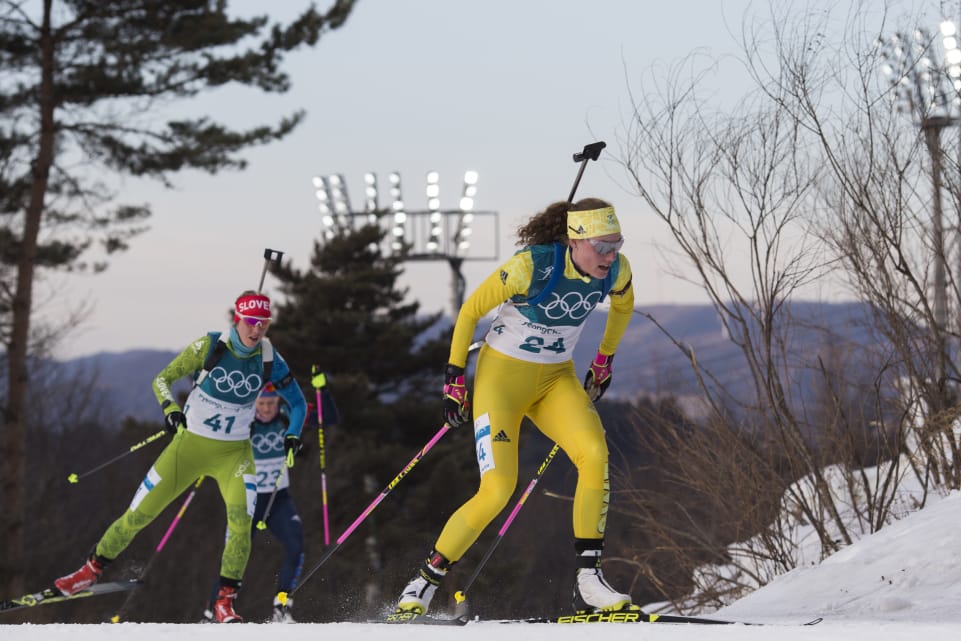
    Sweden’s biathlon race suits epitomize reductionism. In other words — K.I.S.S. — as in, keep it simple, Sweden. Our wish is their command. Two words to help identify Sweden on the biathlon range or tracks. Canary yellow. Thank you Sweden.

    Sweden’s Hanna Öberg on her way to a gold medal in the women’s 15 k individual at the 2018 Olympics in PyeongChang, South Korea. Öberg skied the sixth-fastest time and shot 20/20. (Photo: IBU/Biathlonworld.com)

    Finland: Every day is a new day. A positive outlook works wonders in the tough-to-win sport of World Cup skiing. Finland’s Krista Pärmäkoski is positive and owning it in Finland’s lycra whites. Yes, there’s navy blue on the forearms and just below the patella, but if you can kill in mostly white, you can kill on the ski course. That’s evidenced by Pärmäkoski’s arm raise: positive vibes and she’s in for the bronze. (Note: if Pärmäkoski is skiing away from you, the Finland suits emphasize blue on the backside. 

    Finland’s Krista Pärmäkoski crosses the line for bronze in the 2018 Olympic women’s skiathlon. (Photo: FlyingPointRoad)

    You’ll have to look past Canada’s Rosanna Crawford and zero in on Finland’s Mari Laukkanen in bib 22 to burn the Finn’s biathlon uniform into the synapses. Finland’s biathlon unis do the flag proud. It’s a zippy look that takes the essentials into play: blue and white. Certainly less white and more blue than their cross-country brethren. For the feisty Finns — they dealt with invading Soviets in winter of 1939 — we say it works.

    Fashionably crushing it, Canada’s Rosanna Crawford (bib 22) in the 7.5 k sprint in PyeongChang. Finland’s Mari Laukkanen (bib 21) skis behind Crawford. (Photo: FlyingPointRoad)

    France: We’re sticking with countries that begin with the letter F. C’est la vie. But we’ll go a little crazy and start with France’s biathlon garb. Why is that? Because of Martin Fourcade — the French force of biathlon. He shoots like a veritable post-doc in Jedi-studies and skis like he could crush the 15 k skate on the cross-country World Cup. France’s biathlon suits get jazzy in a sky blue kind of way on the lower leg. And just when you get complacent with all the blue tones, the right arm gets proud in red. You should get to know this suit, Fourcade is likely to rule these Games; he’s already won the men’s 10 k pursuit.

    France’s Martin Fourcade defending his Olympic gold from four years ago on Monday in the men’s 12.5 k pursuit at the 2018 Olympics in PyeongChang, South Korea. (Photo: FlyingPointRoad)

    France also gets props for keeping it easy on spectators and viewers. If you’ve studied Fourcade’s race suit already, you’re all set. In the image below, France’s Jean-Marc Gaillard (9) proves our point. Biathlon or cross-country, the suits are the same.

    Canada’s Alex Harvey (4) leading France’s Jean-Marc Gaillard (9) and Finland’s Iivo Niskanen (8) during the skate leg of the men’s 30 k skiathlon at the 2018 Olympics in PyeongChang, South Korea. Harvey went on to finish eighth. (Photo: FlyingPointRoad)

    Norway: It’s Norway after all. Nothing too drastic here, and certainly we’re imagining athletes will have several colors schemes to choose from at a later date. For now, the new kind of looks like the old. Which when consulting fashion guides, retro can be cool — think the resurgence of L.L. Bean’s duck boots or those Greg-Lemond-era Oakleys that Harvey has rocked.

    OK, the cross-country suits. Here’s Norway’s race wear as worn by Heidi Weng (bib 1) and Ingvild Flugstad Østberg (bib 2) during Saturday’s skiathlon. The easy thing about trying to identify the Norwegians in a deep field cross-country scrum: look towards the sharp end of the race. Most often in the lead pack you’ll see a predominately red-suited athlete pushing the pace. Yeah, that’s probably Norway. (That said, deference to Canada’s Harvey, we want to get our red suits straight. We’ll get to the maple leaf in a bit, but in the case of Canada just think a different shade of red, because Harvey is a front-pack skier. Big respect for Harvey in red.)

    The start of the women’s 15 k skiathlon on Saturday, Day 1 of the 2018 Winter Olympics, with (front row, from left to right) Austria’s Teresa Stadlober, Norway’s Ingvild Flugstad Østberg, Norway’s Heidi Weng, American Jessie Diggins, and Sweden’s Charlotte Kalla leading out of the stadium in PyeongChang, South Korea. (Photo: FlyingPointRoad)

    Here’s a shot of Norway’s biathlon suit. Again, Norway has gone with reliable themes. Yet in this case, pin striping rules. There’s the red, the deep blue, and the white. The striping certainly gives it a more formal look as if to say “we’re here to shoot clean”.

    Norwegian biathlete Erlend Bjøntegaard on his way to fifth in the men’s 10 k sprint. (Photo: FlyingPointRoad)

    Canada: Why not? Let’s break down Canada’s race gear next. Nothing too crazy here on the XC side from our good friends up north that brought us Bob and Doug McKenzie and sort of Kenny G. (Officially, Kenny G. is American; he was born in Seattle. But his mom is from Saskatchewan. A loose connection, but only separated by one degree. And Seattle is super close to Vancouver.) Like the Norwegians’ cross-country race suit, this is a mostly red affair. But it rocks perhaps the most identifiable flora icon on the planet: the maple leaf. In our opinion, this suit is an instant classic. Maple-leaf patterns run down the length of the arms. Nothing too gaudy here. No fluorescent yellow, no overdoing it with the “Canada-ness” of it all. And there’s just the right amount of white lycra highlights to keep it sleek looking. If you’re looking to impress on the Olympic trails but be simultaneously understated, look no further than Canada. Here’s Alex Harvey racing to seventh, his best individual result in his third Olympics, in Friday’s 15 k skate:

    Canada’s Alex Harvey racing to seventh in Friday’s 15 k freestyle at the 2018 Olympics in PyeongChang, South Korea. (Photo: FlyingPointRoad)

    Under the bright lights of the Alpensia biathlon venue, Biathlon Canada got a wee bit friskier. Down the right arm you’ll note … wait for it … white maple leaves of varying sizes. Little known fact, at least to FS, “an infusion” of maple-tree bark can be used to treat cramps and dysentery. Any chance that infusion works on norovirus? Just asking.

    Lots of digressions here. But this is for certain and maybe it’s a trickle-down effect of honoring the most beautiful autumn tree on the planet. Across the board, XC or biathlon, Canadian athletes are a delight to chat with. You parent-folk raise them well up north.

    Canada’s Brendan Green en route to 82nd in the men’s 10 k sprint at the 2018 Olympics in PyeongChang, South Korea. (Photo: FlyingPointRoad)

    The lower half of Canada’s biathlon unis are trending more towards what we have seen in the recent Canadian lycra past: bigger and badder maple leafs. A big white maple icon sits on the lower right leg, with a smaller slightly more delicate yet distinguished maple icon on the upper left thigh. There you have it. When in doubt, channel the red suit and the maple leaf and you’ll know it’s Canada at any of the nordic venues.

    Canada’s Christian Gow racing to 62nd in the men’s 10 k sprint at the 2018 Olympics in PyeongChang, South Korea. (Photo: FlyingPointRoad)

    U.S.A.: Jingoism = “extreme patriotism, especially in the form of aggressive or warlike foreign policy.” We are not jingoistic here at FasterSkier. Read Saturday’s skiathlon report and it’s clear we’re not jingoistic. The day’s winner Kalla — from Sweden — is given plenty of coverage. Yeah, Jessie Diggins killed, but Kalla was a force, too. 

    Jessie Diggins racing to fifth in the women’s 10 k skate for her third top-six (and second top-five) of the 2018 Olympics. (Photo: FlyingPointRoad)

    So the good ole’ red-white-and-blue (r-w-b). That’s pretty much still the theme. Visually speaking, we think it’s a nice blend of the r-w-b trifecta. It’s mostly blue. And a cool blue at that. Again coolness reigns with the white downward slanting stripes running from the lower thigh to below the knee. Those stripes scream, “Scoreboard!” And the red on the arms? Awesome. And if you’re like this reporter looking around in the pack for the U.S. skiers, it helps to read the bold print on the right upper arm. Read: U.S.A.

    American Noah Hoffman racing in the 15 k freestyle at the 2018 Olympics in PyeongChang, South Korea, where he finished 48th. (Photo: FlyingPointRoad)

    Now to US Biathlon. For starters, the national governing body of biathlon in the U.S. is … US Biathlon. A totally different sporting body than U.S. Ski and Snowboard. And the uniforms on the biathlon side make that clear. There’s little cross-pollination like we see with the Canadian suits.

    For awhile, U.S. Biathlon raced in suits with a distinct mix of blue and red. If you can harken back to elementary school art class, or if you’re in elementary school now, you’d have to pass this basic test to move onto more complex colors.

    Test: How do you make purple. Yes! Mix red and blue together.

    The older U.S. biathlon uniforms had a distinct purple hue on the bottom-half. The top was a tasteful strawberry red called into action by iconic Adidas striping down the arms. That purple hue is no longer. Get rid of that in your mind’s eye. We’re not even posting a photo of that older race suit. It’s so not now.

    Want to know where Susan Dunklee or Lowell Bailey are? Look for uniforms that harness the “blue blazer” in all of us. First let’s zoom in. (See photo below). We note here that it’s not simply a solid-blue pattern. The hat, shoulders and upper torso host a maze of small deep blue “three-stripe” hash marks printed over a lighter bluebird blue. Since those appear on several team’s 2018 Olympic suits (like Sweden, Germany, and the Olympic Athletes from Russia), all of which were made by Adidas, we’re guessing it’s a nod to their uniform supplier? (You know, with the “threes” theme.) Nonetheless, the upper is mostly covered by the bib. And from a distance, as we zoom out, it simply looks blue. But before we do that, here’s Clare Egan — total badass polyglot; she speaks Korean — during the women’s sprint here in PyeongChang.

    Clare Egan (US Biathlon) racing to 61st in the women’s 7.5 k sprint at the 2018 Olympics in PyeongChang, South Korea. (Photo: FlyingPointRoad)

    Now for the zoom out. This shot is great for many reasons, so a shoutout to FlyingPointRoad guru Steve Fuller. Since we are talking colors here, let’s just continue the shout out to Steve. This photo kills because a Swedish skier follows Tim Burke in a canary yellow race suit. Blue and yellow are primary colors. The blue-Burke here stands out more as he’s contrasted by the yellow-Swede. Intentional or not Steve, well done.

    Let’s focus on Tim Burke’s legs. That’s a solid royal blue, right? A basic blue, but a royal blue. There’s just no damn distractions from the business at hand here. Maybe the small USA on the left calf area is a nod to those fans still time-capsuled with Lake Placid’s 1980 gold-medal hockey team and the venerable announcer Al Michaels. That USA on the leg isn’t really yelling U.S.A!!! U.S.A!!! It’s sort of a kinder and gentler u.s.a. (no caps intentional). Like a whisper, saying we come in peace even though we’re charging hard with rifles on our backs. Back to the point. No distractions. #businesstime.

    USA = basically blue. Look for the blue. That’s the U.S. biathlon team. 

    Tim Burke (US Biathlon) en route to 47th in the men’s 10 k sprint at the 2018 Olympics in PyeongChang, South Korea. (Photo: FlyingPointRoad)

    Other notable suits:

    Switzerland: From a country we all associate with Swiss-Army-Knife red, we get thrown a change up. It took us all a few seasons to get accquainted with the race-lycra formal wear donned by the Swiss cross-country team. Cross-country World Cups aren’t exactly formal occasions, but the tuxedo black suits the Swiss have worn for a few years now — a look you’d seek if you were on the race equivalent of a Georgetown cocktail circuit — are gone. The Swiss sport maroon suits with red highlights on the lower legs and arms. 

    (Note: These suits resemble Russia’s cross-country race suits on the World Cup. Alas, they also resemble Russia’s suits during the Games despite the fact that Russia’s skiers are competing under the Olympic flag as Olympic Athletes from Russia (OAR). See photo featuring Great Britain’s Andrew Musgrave — that’s Denis Spitsov of the OAR chasing, not a Swiss skier. It helps that the Swiss skiers wear hats reading “Suisse”.)

    Switzerland’s Dario Cologna racing to gold in the men’s 15 k freestyle on Friday at the 2018 Olympics in PyeongChang, South Korea. (Photo: FlyingPointRoad)

    Great Britain: From the people who brought us the modern navy …  we get navy blue. Nothing says “we are not in your face” more than navy blue. Great Britain’s cross-country race suits are appropriately regal. Think the Queen, Lady Di, and the ever so cool and soon-to-be-in-line-for-the-throne, Meghan Markle. Also, Andrew Musgrave, as this reporter’s grandfather used to say, is the real McCoy. (The Scottish McCoy, not the Irish McCoy). It was a delight to watch the 2018 Olympic skiathlon unfold as a fly-on-the-wall surrounded by British journalists. Move over Chelsea. Move over Man-United. Yeah, that’s right. Musgrave is on your tails sporting navy blue lycra. 

    Britain’s Andrew Musgrave (10) during the men’s 30 k skiathlon in PyeongChang, South Korea, followed by Russia’s Denis Spitsov (16), skiing as a member of the Olympic Athletes from Russia. (Photo:FlyingPointRoad)

    Italy: Ah Italia. They exported high fashion with the house of Gucci and they school us in the color wheel. First, Italy’s cross-country race suits feature a halcyon blue. A blue when blues sang like a pristine alpine sky and times were simpler. A time perhaps when you were finishing an altitude camp in Seiser Alm and all you had to worry about was visiting the physio for a rub-down and connecting for a post-training sesh espresso with the whos who of the World Cup … also finishing an altitude camp.

    Second, we note orange. Orange is many things, but it does not scream Italy. However, we believe Italy is paying respect to its storied-art legacy by deferring to the color wheel — Italy’s suits have just a tad more than a splash of orange on the lower legs and lower arms. Blue and orange are complementary colors. That means they are opposite one another on the color wheel. Opposites attract. And if anything is attracting here, it’s Federico Pellegrino and his panache on the big stage. Dude can classic sprint, too. Here’s Pellegrino an eyeblink before crossing the line in the classic sprint final (he took silver).

    Third, and this may be breaking news, Italy may have a one-off suit for Pellegrino. If you compare the below image with the one below that (behind American Caitlin Patterson, there’s an Italian skier, Sara Pellegrini), newsflash — no splash of orange. Absent the orange, the suit is identical to Pellegrino’s. ITA adorns the upper-left quad area on each suit. Italy’s biathlon team also wears the all-blue suit. Ciao for now.

    Norway’s Johannes Høsflot Klæbo (l) and Italy’s Federico Pellegrino finishing first and second, respectively, in the first semifinal of the men’s 1.4-kilometer classic sprint at the 2018 Olympics in PyeongChang, South Korea. (Photo: FlyingPointRoad)
    American Caitlin Patterson leads Italy’s Sara Pellegrini (not to be confused with Pellegrino) into the finish of the women’s 15 k skiathlon at the 2018 Olympics. They finished 34th and 35th, respectively. (Photo: FlyingPointRoad)

    Austria: What’s black and white and red allover? Austria. Across the board: cross-country, biathlon, and nordic combined, the uniforms are all the same. You’ll never not notice Austria.

    Austria’s Dominik Landertinger racing to bronze in the men’s 20 k individual at the 2018 Olympics in PyeongChang, South Korea. (Photo: FlyingPointRoad)

    Germany: Embracing their inner-Vader is Germany. Like the old Swiss race suits but taking black lycra to “11”. Germany. Add just a sprinkle of white around the shoulders to lighten the mood. The red hat emblazoned with the Bundesadler — the German federal eagle — is a fitting cap for their race wear. As badass as Clare Egan is speaking Korean (go back to U.S.A. for a refresher), the Bundesadler is nearly her avian iconography equivalent.

    Germany’s Eric Frenzel (5) leads Austria’s Lukas Klapfer during the individual normal hill/10 k competition on Wednesday at the 2018 Olympics in PyeongChang, South Korea. Frenzel went on to win while Klapfer placed third. (Photo: FlyingPointRoad)

    Germany’s cross-country, biathlon, and nordic combined teams share the same uniform.

    Germany’s Laura Dahlmeier racing to her first Olympic gold (and first Olympic medal) on Saturday in the women’s 7.5 k sprint, the first biathlon race of the 2018 Winter Olympics in PyeongChang, South Korea. (Photo: FlyingPointRoad)

    We couldn’t cover every team, so we’re aware we left more than a few out. Hopefully this leaves you feeling a little more in-the-know when it comes to Olympic XC and biathlon spectating. Onto the relays (and biathlon mass starts) we go!

    ***

    A message from a Korean fan during the men’s 15 k freestyle on Friday at the 2018 Olympics in PyeongChang, South Korea. (Photo: FlyingPointRoad)
    A message from an unidentified spectator during the men’s 15 k freestyle on Friday at the 2018 Olympics in PyeongChang, South Korea. (Photo: FlyingPointRoad)
  • World Cup Windup: Finland

    World Cup Windup: Finland

    Finland’s Iivo Niskanen (c) celebrates his World Championship title as Norwegians Martin Johnsrud Sundby (l) and Niklas Dryhaug hoist him above their shoulders after the men’s 15-kilometer classic race at the 2017 Nordic World Ski Championships in Lahti, Finland. (Photo FIS/FIS twitter)

    Welcome to World Cup Windup, where we check in with the top-10 teams from last year’s FIS Cross Country World Cup tour before the season starts with the Ruka Triple in Kuusamo, Finland, on Nov. 24.

    FINLAND

    Overall in Nations Cup Last Year: Third, by just 106 points over Russia

    Women’s Ranking 2016/2017: Third

    Men’s Ranking 2016/2017: Fourth

    Who’s Back:

    World Cup overall title runner-up Krista Parmakoski, fifth-place Matti Heikkinen, and eighth-place Kerttu Niskanen; Iivo Niskanen, fourth in the distance standings (behind Heikkinen in third); and Laura Mononen, ninth in the distance standings. Plus, podium finisher Anne Kylloenen, and Aino-Kaisa Saarinen who returned to World Cup action after maternity leave and scored some top-tens.

    Who’s Missing:

    Sami Jauhojärvi. The veteran, who raced on the World Cup for 16 seasons and teamed up with Iivo Niskanen for gold in the 2014 Olympic team sprint, called it quits this spring. “I’m not tired of skiing, but at some point it just happens that competitive instincts begin to fade,” Jauhojärvi told InsideTheGames. “By training I could be pushing my limits for a few more years, but my competition mind is done. … I do not think any more about fighting for gold medals at future Olympics.”

    Pre-Season Results:

    Finland’s Krista Parmakoski skis to silver, her first World Championships medal, in the women’s 15 k skiathlon at 2017 Nordic World Championships in Lahti, Finland. (Photo: John Lazenby/Lazenbyphoto.com)

    Only a few of the team’s distance skiers competed so far. Krista Parmakoski won a 5 k classic in Muonio, Finland, while Anne Kylloenen won a 10 k skate where Laura Monenen was third and Aino-Kaisa Saarinen fourth, and Iivo Niskanen finished second to Russia’s Alexey Chervotkin in a 15 k skate the same day. Ristomatti Hakola won the sprint in Muonio.

    Recent Drama:

    According to the Finnish press, this will be the last Olympics for Matti Heikkinen, who will be 34 years old. He is targeting all the long-distance races and possibly the team sprint. Iivo Niskanen, meanwhile, will not to contest the skate races at the Olympics and focus on classic.

    Kerttu Niskanen changed trainers this year, and her new choice is controversial. She is working with Pekka Vähäsöyrinki, one of the coaches involved in the 2001 blood-doping scandal which resulted in suspension of the Finnish ski association. The coach was found to have lied in court; there are allegations that when he was the national team director, he gave EPO and growth hormones to the head coach to use for the athletes.

    Finland’s Kerttu Niskanen racing in the women’s classic team sprint at 2017 World Championships in Lahti, Finland, where her team (with Aino-Kaisa Saarinen, not shown) ultimately placed fifth.

    “For several seasons I have remained at about the same level,” Niskanen told the news agency YLE. “So I want to try something new. “For me [the allegations] are just that. History… People may think what they want. It does not matter to me.”

    Meanwhile, Krista Parmakoski is helping to organizing a youth ski racing series in her home district, called the “Krista Cup”. It will be a series of six races open to 7- to 16-year-olds and she will help organize the prizes. “It is important to encourage and inspire young skiers in every way, especially in the Häme district,” she told the local newspaper. “I still remember how much fun we young people had running around, seeing skiers and enjoying the atmosphere. With the Cup, young people can experience fun cross-country races throughout the winter.”

    Best Social Media Presence:

    On the women’s team, both Krista Parmakoski (Instagram) and Kerttu Niskanen (Instagram) provide consistent posts of training and daily life, as does Laura Mononen (Instagram).


    Sprinter Lari Lehtonen has an active Facebook page, posting almost daily, and often includes training videos. Iivo Niskanen is also a consistent Twitter and Instagram poster, where you can see his hobby of horse racing as well.

  • Summer Training… All Over Finland with Krista Niiranen

    Summer Training… All Over Finland with Krista Niiranen

    Krista Niiranen doing a workout running with poles in Rovaniemi, Finland. (Courtesy photo)
    Krista Niiranen doing a workout running with poles in Rovaniemi, Finland. (Courtesy photo)

    A World Junior Championships and World U23 Championships skier for Finland who had racked up top-10 finishes in her country’s competitive national-championships field, Krista Niiranen moved to the American Southwest last year.

    “I had been studying law in the University of Lapland in Finland, but for the last season I transferred to the University of New Mexico and represented the UNM Ski Team,” she explained.

    UNM's Krista Niiranen racing to seventh in the 5 k classic at 2017 NCAA Skiing Championships at the Jackson Ski Touring Center in Jackson, N.H. (Photo: flyingpointroad.com)
    UNM’s Krista Niiranen racing to seventh in the 5 k classic at 2017 NCAA Skiing Championships at the Jackson Ski Touring Center in Jackson, N.H. (Photo: flyingpointroad.com)

    Niiranen made a splash on the SuperTour and NCAA circuits, finishing sixth in the classic sprint and 10th in the 10 k freestyle at U.S. nationals before emerging as the top classic skier on the Rocky Mountain Intercollegiate Ski Association tour. She finished seventh in the 5 k classic at NCAA Championships and was named UNM’s Nordic MVP.

    This summer, Niiranen is back in Finland training hard with various friends and teammates from before her time as a college skier. She has taken training opportunities all over her country and shared what it’s like to be a top skier in Finland in the summer.

    ***

    FasterSkier: Where are you based this summer? 

    Krista Niiranen: My summer training is based in three areas this summer: Joensuu in Eastern Finland, the Vuokatti Olympic Training Center, and especially my current hometown, Rovaniemi, in Lapland on the Arctic Circle.

    I have to say that all of these three spots are top for skiers’ summer training. In the beginning of the summer break I was training in Joensuu, the same area I grew up in. If you happen to be a biathlon fan, I stayed within 30 minutes away from Kontiolahti Biathlon Stadium, where is also a great rollerski track for summer training. There is also another track for rollerskiing only in 10 minutes from my family home. Then in June I was training for three weeks in Vuokatti Olympic Training Center, where the majority of the Finnish nordic skiers were gathered up for some good summer training. Currently I am living and training in Rovaniemi in the Northern Finland as a neighbor of Santa Claus.

    Niiranen (left) and Iina Ahokas rollerskiing in Rovaniemi. (Courtesy photo)
    Niiranen (left) and Iina Ahokas rollerskiing in Rovaniemi. (Courtesy photo)

    FS: Compared to Ruka or the World Championships venue in Lahti, what is the landscape like where you are training? 

    KN: For Americans who have watched World Cup races, I would say that Eastern Finland is pretty similar to Lahti, which is four hours drive from my family home to south. The landscape in Vuokatti and Rovaniemi is pretty similar to Ruka with long and some steep hills. But you can definitely find beautiful hills and lakes from all over the Eastern and Northern Finland, where my training has been based for my entire skiing career.

    FS: Do you have a team that you are training with, or are most of your training sessions alone? 

    KN: During summer I have a couple of training camps in Vuokatti and Lapland with a group of athletes who are challenging the skiers in the Finnish national teams. In the beginning of the summer I was training in Joensuu and Vuokatti with a couple of skiers from the same local ski club I represent when I’m competing in Finland. There are also many skiers at my level living in my current hometown in Rovaniemi, so I can get company for training on a daily basis. I really enjoy training with other skiers, but sometimes it is nice to go for a session alone as well.

    FS: What is it like to rejoin a group after being away in the US for most of the year?

    KN: I was welcomed to participate in trainings and training camps even if I spent most of the year in the US. Of course it was a little bit different situation when I had not raced in any competitions in Finland last season, but I have many good skier friends here in Finland so it was just fun to catch up with them during rest afternoons and easy trainings.

    Jasmi Joensuu (left) and Krista Niiranen on a trail run outside of Vuokatti, Finland. (Courtesy photo)
    Jasmi Joensuu (left) and Krista Niiranen on a trail run outside of Vuokatti, Finland. (Courtesy photo)

    FS: During the summer, how do you design your training – is it based on a plan from New Mexico? Are you adapting it at all to be able to match with your training friends?

    KN: This summer I am designing my training plan based on the knowledge I have gained from my previous Finnish coach and during my time as a Lobo. I am adapting my plan to match with the fixed training camps and trainings of other skiers based on the same area. I think that doing intervals and other training in a group is a good way to develop as a skier and learn from each others. I am also trying to listen my body to keep the balance between hard training with lots of hours and rest time.

    FS: Are there typical workouts that you do that are different and probably wouldn’t appear on an American training plan?

    KN: The training is pretty similar here in Finland than on our American training plan in New Mexico, but the biggest difference is that we are used to do more really easy long distance and level 2-3 training in Finland, but not really level 4-5 training during summer time.

    In Finland I am also orienteering weekly basis as a training. I think that orienteering is a more Scandinavian or European thing, because in the US it was mostly an unfamiliar concept for many people. Running and navigating from point to point in the forest using a map and compass is actually pretty hard training. At least for me, a chill orienteering session ends up always being at least level 3 training when running fast in the forest and concentrating on reading a map.

    Iina Ahokas (left) and Krista Niiranen rollerskiing in Rovaniemi. (Courtesy photo)
    Iina Ahokas (left) and Krista Niiranen rollerskiing in Rovaniemi. (Courtesy photo)

    I have also added some elements, like without poles skate skiing, from our American plan to my training plan in Finland. I am also planning on doing some track sessions here in Finland – I was not used to doing that before my time in New Mexico.

    FS: What’s the hardest workout you have done so far this summer? 

    KN: Definitely, a traditional roller ski race in Vuokatti. The event consisted on 1.6 k uphill skate rollerskiing prologue, a 3 k cross-country running race, and 10 k skate rollerskiing pursuit where the final 1.6 k is uphill. The race was also mentally interesting, because I had not raced in Finland for over a year and therefore I did not really have any expectations when it comes to my current shape. After a hard competition, I was happy when I realized that I had set a new personal best in all the three stages after a year in the US.

    [Ed. Note: After the final stage, Niiranen was 10th, two minutes and 50 seconds behind biathlon World Champion Kaisa Makarainen, who won the women’s tour ahead of five-time Olympic medalist skier Aino-Kaisa Saarinen. World Champion Matti Heikkinen won the men’s tour.]

    FS: Are there any absolute favorite places to run or bike or rollerski? 

    Krista Niiranen (left) and Finnish teammate Petra Torvinen training in the Vuokatti ski tunnel. (Courtesy photo)
    Krista Niiranen (left) and Finnish teammate Petra Torvinen training in the Vuokatti ski tunnel. (Courtesy photo)

    KN: All the areas I have been training in this summer are among the best spots for summer training in Finland because the access to rollerski tracks, bike paths and trails is just by the front door. But if I should choose my absolute favorites, I would mention group training on a rollerski track and uphill classic rollerskiing in Vuokatti. Also running with good skier friends (and reindeer) on the countless of trails surrounded by a beautiful scenery in Rovaniemi is one of my favorites. I was also super excited to ski on real snow in a ski tunnel in Vuokatti, even if the scenery there is only a concrete wall.

    FS: Maybe related, is your area set up best for some parts of training? 

    KN: I would objectively recommend all of these three areas for summer training for any skier, but in Vuokatti there is everything what a nordic skier can ask for during summer. There are a rollerski track, long uphills, tens of kilometers of trails for long distance running and hiking, bike paths, a ski tunnel with real snow and beautiful scenery with hills and lakes in Vuokatti. It is not a wonder that there are other national teams in addition to Finnish skiers training in Vuokatti as well.

    It is just convenient that especially in Vuokatti and Rovaniemi: all the training possibilities and facilities are right after stepping out the front door, so there is no need to consume time and energy for driving for training.

    FS: What is the best part of Finnish summer, aside from training?

    KN: The best parts of Finnish summer are midnight sun, going to sauna and swimming in a lake, and everyman’s right to pick up berries and mushrooms to a freezer for the fall and winter.

    Midnight sun from an apartment window at the Vuokatti Olympic Training Center in Finland. (Photo: Krista Niiranen)
    Midnight sun from an apartment window at the Vuokatti Olympic Training Center in Finland. (Photo: Krista Niiranen)
  • U.S. Historic Second in Kontiolahti Single Mixed Relay, ‘Dream Come True’

    U.S. Historic Second in Kontiolahti Single Mixed Relay, ‘Dream Come True’

    Susan Dunklee and Lowell Bailey celebrate after finishing second in the World Cup single mixed relay in Kontiolahti, Finland. Austria won the competition. (Photo: IBU/Twitter)

    The single mixed relay is a relatively new format, and one that is not yet contested at World Championships or the Olympics.

    And so when a single mixed relay (two athletes) and a ‘normal’ mixed relay (four athletes) are held on the same day, the U.S. Biathlon World Cup team’s policy has always been clear: prioritize the mixed relay, and get the World Champs and Olympic team the most practice possible for their big days.

    All that changed in Kontiolahti, Finland, today.

    The U.S. decided to put Susan Dunklee and Lowell Bailey – both medalists at 2017 World Championships – on the single mixed relay. Even before the race began, expectations were high. The Americans were calling themselves the “dream team”.

    After the race? Oh, yeah.

    The duo finished second, claiming the first relay podium by an American biathlon team since 1994, when Beth Coats, Joan Smith Miller, Laura Tavares, and Ntala Skinner finished second in the women’s 4 x 6 k in Canmore.

    “We have known that if we had our best day on the right day, that it was possible in the mixed relay even a few years ago,” Dunklee said of having a relay podium. “For that mixed relay it just quite hasn’t happened for us. I think maybe we psyched ourselves out a few times… I have dreamed for a long time being able to run into the finishing pen and with a bib on and a rifle, and greet my teammates as they come in. It’s so cool to finally do that. It’s definitely a dream come true.”

    But if she pictured running into the finishing pen of a normal biathlon event, the single mixed relay might not have come to mind. The format of the newest World Cup competition is unusual. Loops are 1.5 kilometers, shorter than any other ski loops on the World Cup. The women ski (and shoot) twice, then tag off to the men just after shooting so the men can ski (and shoot) twice, then the women twice again, then the men twice, and finally the men getting to ski one last 1.5 k loop to reach the finish line.

    That unfamiliarity came with excitement: the team knew ahead of time that they had a good chance of a top finish. With a flat course, both Americans felt good about their power skiing. The format also has the highest shooting-to-skiing ratio of any biathlon competition, and the pair had been shooting almost unbelievably well in the second half of the season.

    “The stuff Susan and I have been working on throughout the training year in shooting, which is namely trying to reduce our shooting times and shoot quicker, lends itself to a race format like the single mixed relay,” Bailey said. “It was my first single mixed relay and Susan’s as well, and we were totally psyched. It’s a great moment to see both programs, both the men’s and the women’s teams, have a joint success like this.”

    Despite the new format, Dunklee found herself leading on the second loop, thanks to a fast and clean prone shooting.

    Then — she fell on a downhill.

    “It just happened so fast and before I knew it I was on the ground, and my rifle fell on the back of my head where I have a nice sore bruise now,” Dunklee said. “After that I just got up. I had a few hundred meters before I need to be ready to shoot, and that’s more important than freaking out and worrying about it too much.”

    She blamed “snow snakes,” but Dunklee managed to re-gain some determination. By the time she reached the shooting range she had re-focused. Dunklee hit all five targets in quick succession, claiming the fastest standing shooting time of all the women.

    She tagged off to Bailey in third place — just 8.9 seconds behind Kazakhstan and Germany — and the U.S. was back on track.

    Bailey, for his part, completed the second leg of the relay with two spare rounds, skiing comfortably  near the front of groups and tagging off in fifth, +17.2 seconds.

    “What’s interesting about this course is that it’s pretty flat except for one relatively modest uphill,” Bailey said. “Today there was quite a bit of wind on the course so to be leading was a disadvantage in a group. So you saw some tactical play up at the front of the race. I felt like I could’ve gone harder in the initial loops, but I also knew that with such a short, 1.5 k loop, the shooting really is where the race is won or lost. So my strategy was to just stay in contact with the lead group.”

    Meanwhile, Simon Eder of Austria had gone to the front and Austria would hang onto the lead for the rest of the race. Lisa Theresa Hauser had used two spare rounds in her first standing, but through both of Eder’s relay legs and Hauser’s second leg the team used only three. That turned out to be untouchable.

    “Once Austria got far enough off the chase pack, I felt it was more of a risk to try to go all out in my last leg to try to catch Austria, than try to hit my targets,” Bailey said.

    That’s because behind Austria, it was still a fight. After Bailey quickly hit his extra shots, it was Dunklee’s turn. She again cleaned prone before needing two spare rounds in standing. But the wind on the range in Kontiolahti had been tricky all day, and most of the other leaders also used spares. So despite the missed shots, Dunklee still managed to move up to second place.

    “I think everyone was struggling, especially standing,” Dunklee said. “I would not normally expect to be even with, or not lose a whole lot of places on, the leaders [with two spares], but since everybody else was struggling too it was okay… I think with this short format, you get a little bit more adrenaline and you are pushed a little bit harder in skiing. You get the shaky legs going when you’re standing.”

    With Austria seemingly untouchable, Bailey was left to battle it out with France, Germany, Switzerland, and Kazakhstan.

    After one more clean prone, he was fifth, but still with the group.

    In standing, Bailey needed a spare round. But again, he loaded them extremely fast – allowing him to leave the range in third place anyway. In his haste to hit the trails, he almost fell on the sharp corner leading out of the range and into the stadium. But he kept his balance, and then hit the gas.

    “The tactics at the front of the race in the third and fourth loops for me, the pace was not all that high, so I really felt pretty fresh when I came out of standing for that last 1.5 k loop,” Bailey said. “I knew that it was basically just a really long sprint finish. So I just tried to sprint from the mat essentially and hoped that I didn’t run out of gas by the finish line.”

    Ahead of Bailey: Roman Rees of Germany, just four seconds away. Rees is one year out of the junior ranks, and had only ever competed in one other World Cup relay of any kind. Twelve years older, Bailey set out to catch him.

    But behind: Jean Guillaume Beatrix of France, another veteran with as many podiums to his name as Bailey had. Leaving the range Beatrix was less than a second behind Bailey, and wanted to get onto the podium.

    Between Germany, France, and the United States, there was only room for two on the podium. As the 1.5 k loop wore on, Beatrix faded – only a few seconds, but enough to keep him and his French teammate Anais Chevalier in fourth place.

    By the time the race came to the stadium, Bailey had caught Rees. He tried to use all of his power to pass on the inside corner, but Rees held strong. The two ended up dueling down the finishing straight, with Bailey prevailing by just half a second.

    “YES!” he screamed as he crossed the finish line, 32.8 seconds behind the Austrian team. Dunklee ran out to meet him.

    “That was a first and it’s a great feeling,” Bailey said. “In a lot of ways it’s better than just going out and having a great race on your own, but to have a great team result like that, it’s a new experience. I shouldn’t say that, we’ve had some great team results in both the mixed relay and the men’s relay — we were fourth place last year in the mixed relay [in Canmore], but no one really wants to go out and celebrate in the finish zone with fourth place. This was the first time that you could hug your teammate in the finish zone. I’ve watched that phenomenon throughout my career so it’s nice to experience it.”

    The U.S. had matched the Austrians on the range, using just five spares to Germany’s six, but the timing was off: Austria had gone, and so Bailey had concentrated on winning second, not potentially blowing up in chase of first place.

    That turned out to be a good strategy, because Eder had knocked down his final five standing targets with scorching speed of 17.9 seconds. By comparison, Dunklee’s best mark among the women was 21.4 seconds.

    “I actually talked to Simon Eder after the race because I knew his last shooting was blistering fast, and I said, ‘Hey, what was your strategy there? You didn’t have to shoot that fast’,” Bailey said. “And he said, ‘I came in and the wind died right when I got into position so I knew I had just a few moments there to take advantage of it.’ By the time [our] chase group, which was 30 seconds or less behind him hit the mat, [the wind] was back to being gusty.”

    The Canadian team of Julia Ransom and Christian Gow finished 19th, +2:27.0, with eight spare rounds.

    In the mixed relay later in the day, the French team of Marie Dorin Habert, Anais Bescond, Simon Desthieux, and Quinton Fillon Maillet took the win, followed by Germany (+11.0 seconds) and Ukraine (+27.1).

    The American team of Clare Egan, Joanne Reid, Paul Schommer, and Sean Doherty finished eighth, +1:37.4.

    The Canadian team of Emma Lunder, Megan Bankes, Scott Gow, and Brendan Green finished 22nd in the mixed relay, +6:09.5.

    “I would just reiterated that I was just psyched to see the whole team do well, both in the single mixed and the mixed relay,” Bailey said. “It’s Nations Cup points, so it counts for our Nation Cup overall total score for the women and the men. It was a pretty important race in that regard. I’m really happy for the team. Everyone deserves it, the techs and everyone, it’s been a really long season and they’re still working as hard as ever so I’m really thankful for that.”

    Results