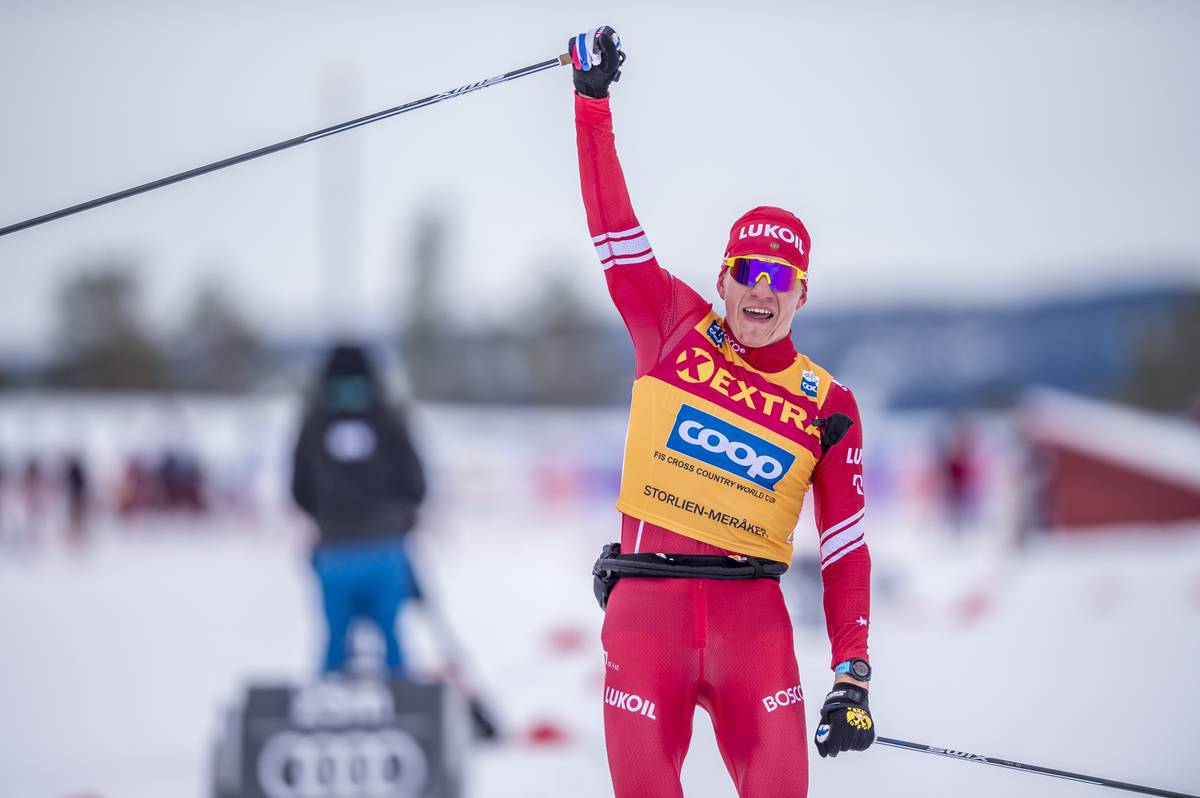
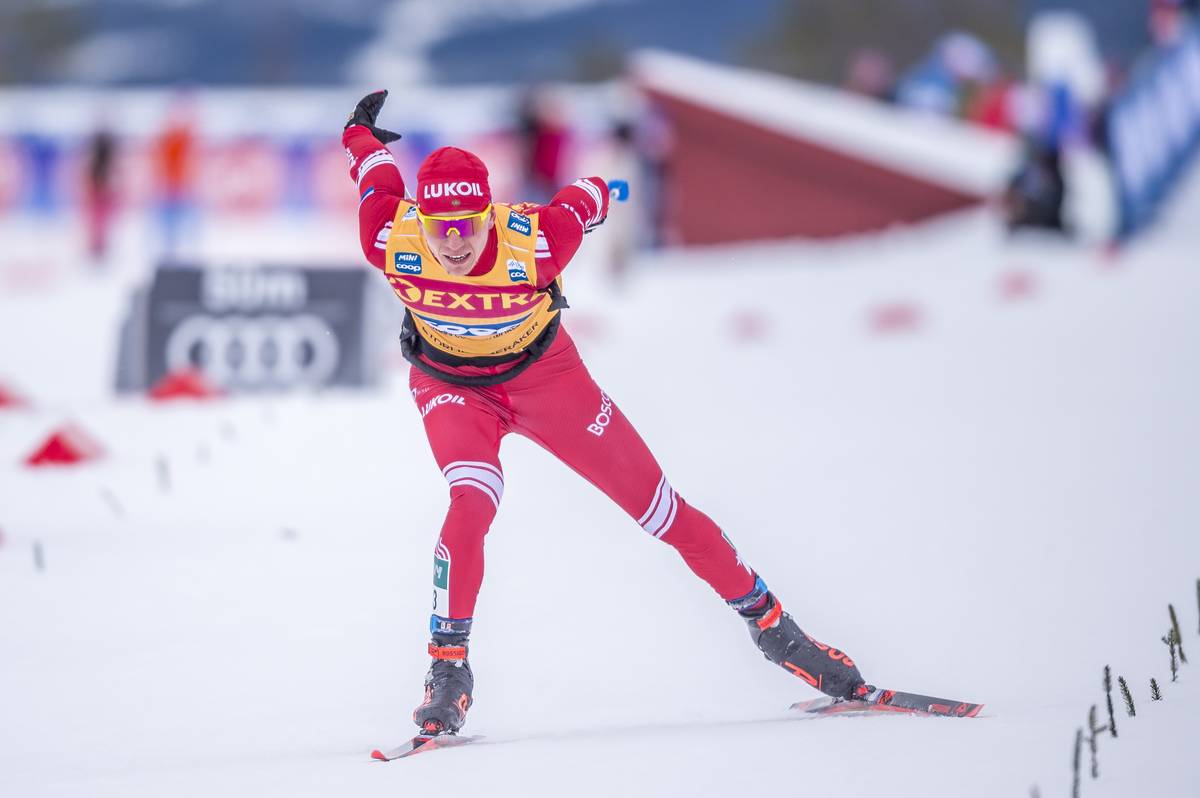
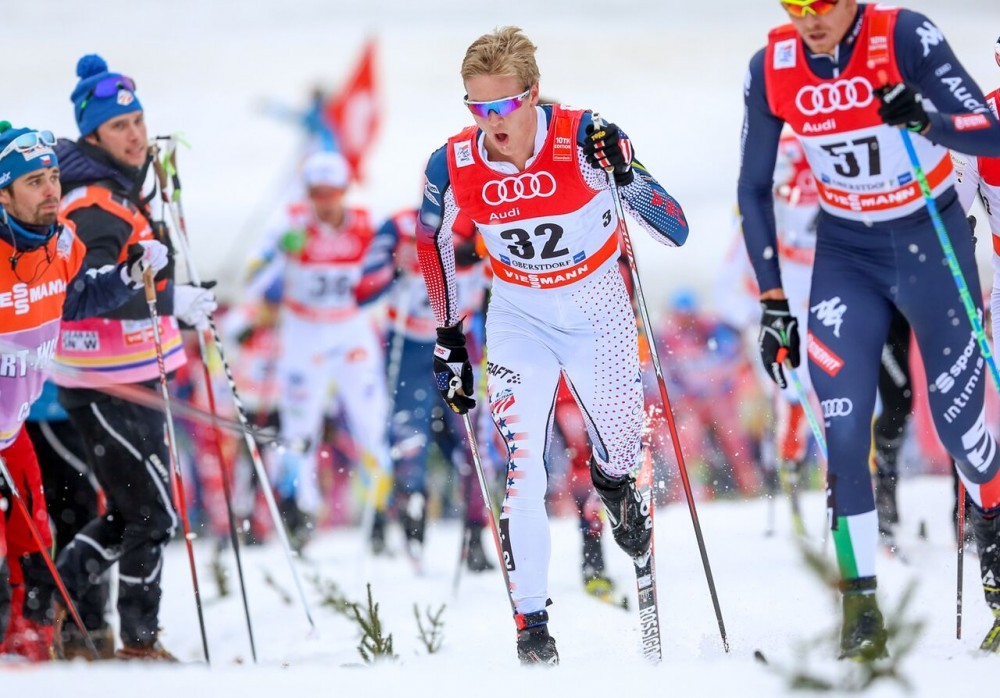
With the course re-routed from the original 38-kilometer mass start skate to essentially an out and back into Meråker, Norway’s ski stadium, the day belonged to Russia’s Alexander Bolshunov who appears, at this point in the season, to be unstoppable in the distance events.
In the end, it was all Alexander Bolshunov: peerless. (Photo: NordicFocus)
In a post-race interview, Devon Kershaw noted that men paced it World-Cup comfortable for much of the first portion of the race. In other words, the effort up-front, although speedy for most, was not a break apart the 79 starters into small groups of similarly paced pockets of effort.
Fast forward to the 14 k mark, and 32 men came through the time check within 1.8 seconds. At that point, Jens Burman of Sweden was driving that train.
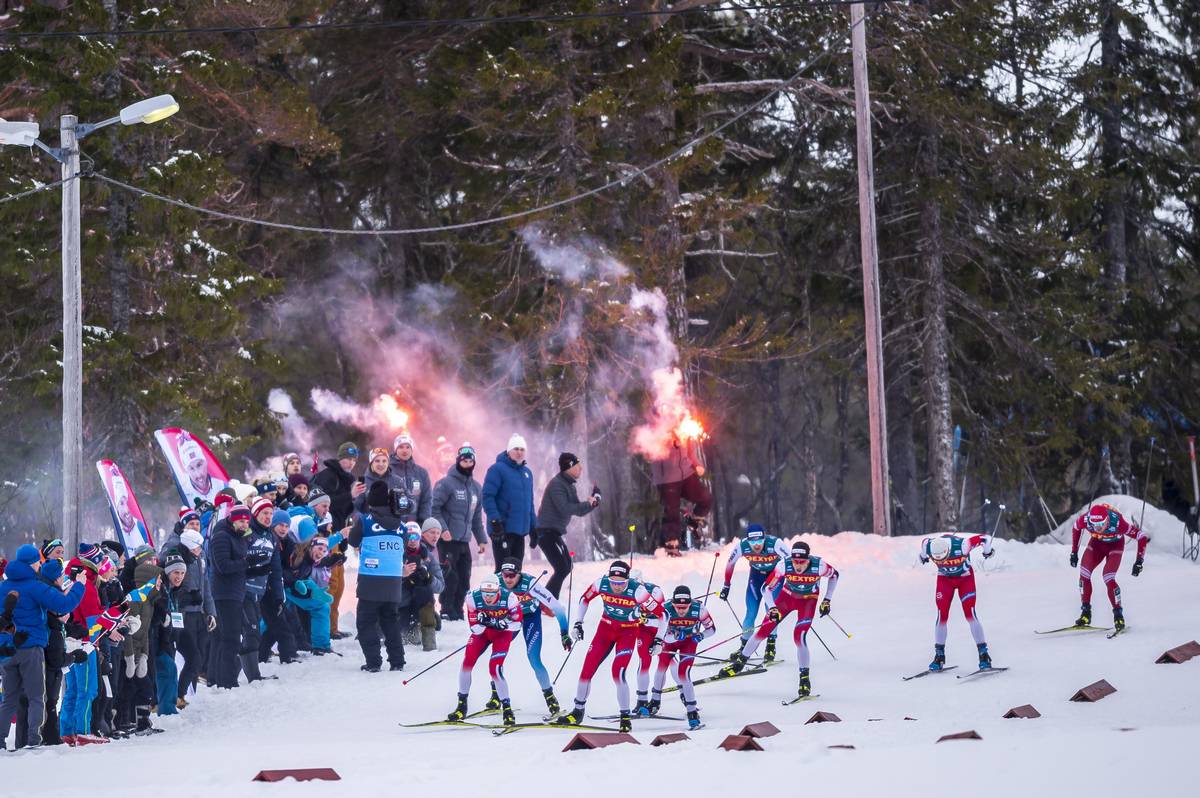
Through the race mid-point, the pack faced a steady headwind. Tactically, it made sense for any would-be endurance escape artist to wait until the turn home on the mostly out and back course, when a tailwind could aid their efforts, to make a move.
Pack skiing Norway style. (Photo: NordicFocus)
Sjur Røthe of Norway took big pulls leading as did his teammate Finn Hågen Krogh. Later in the race, Emil Iversen too sensed some podium opportunity. We could expand the list. But that would perhaps overshadow Bolshunov.
A select group began to pick up the pace as skiers sped towards the 20 k time bonus. This included Røthe, Krogh, Bolshunov, Iversen, and Johannes Høsflot Klæbo who came through the check-in 17th. (This was not the Norwegian national champs, although nine Norwegians, at that point, jammed the front 17 spots.)
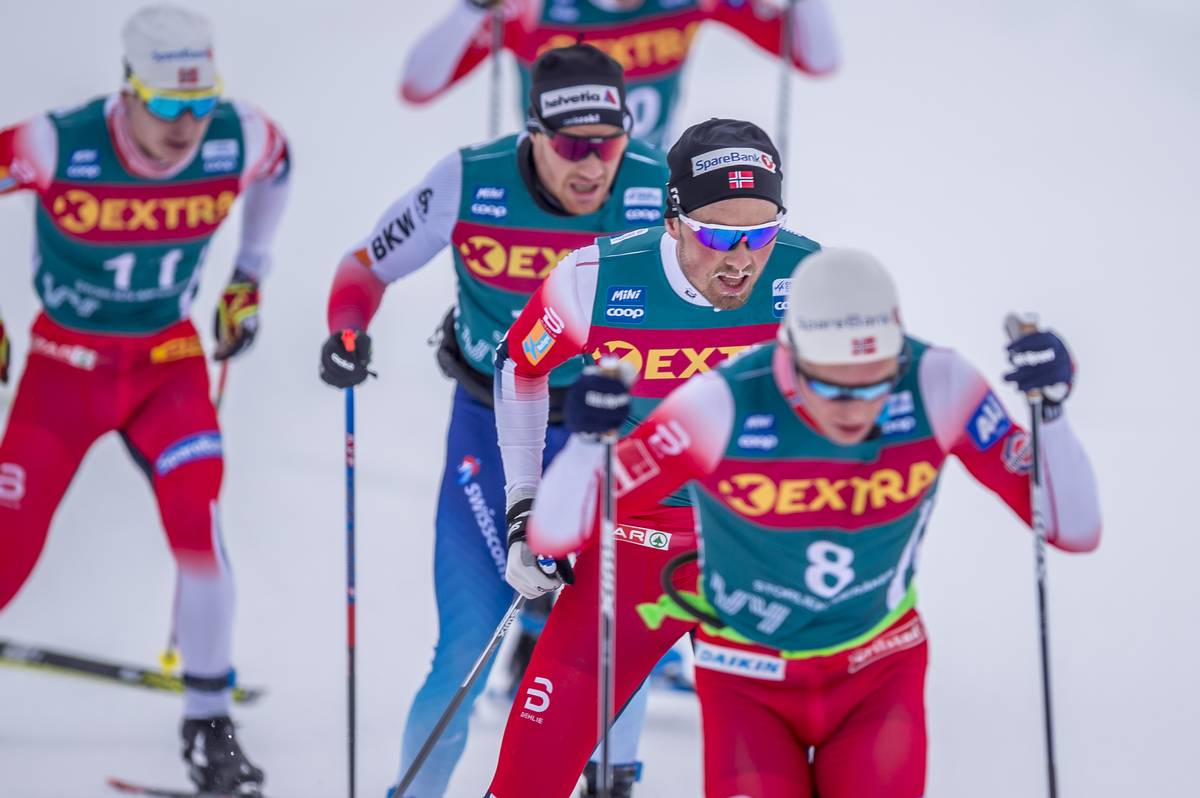
Martin Løwstrøm Nyenget (bib 8) leads Emil Iversen and Dario Cologna during the Stage 4, 34 k mass start skate. (Photo: NordicFocus)
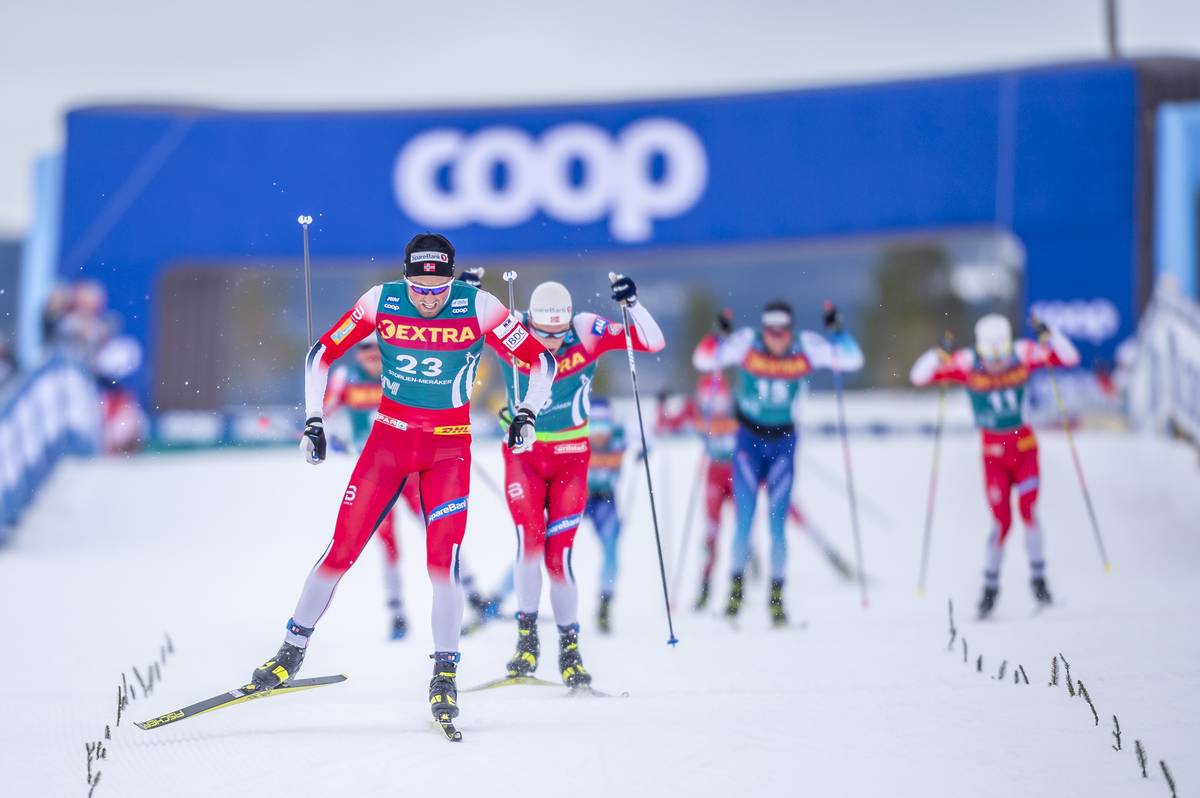
Emil Iversen comes in for third place on Stage 4 of the Ski Tour 2020. (Photo: NordicFocus)
Post-20 k time bonus, Bolshunov wound up, uncoiled, and made a decisive move. He set off solo, accelerating ahead of the pack of star names, and was able to gap the chase by 51.7 seconds at the finish for a solo effort win in 1:19:34.9.
Solo: Alexander Bolshunov way way off the front. (Photo: NordicFocus)
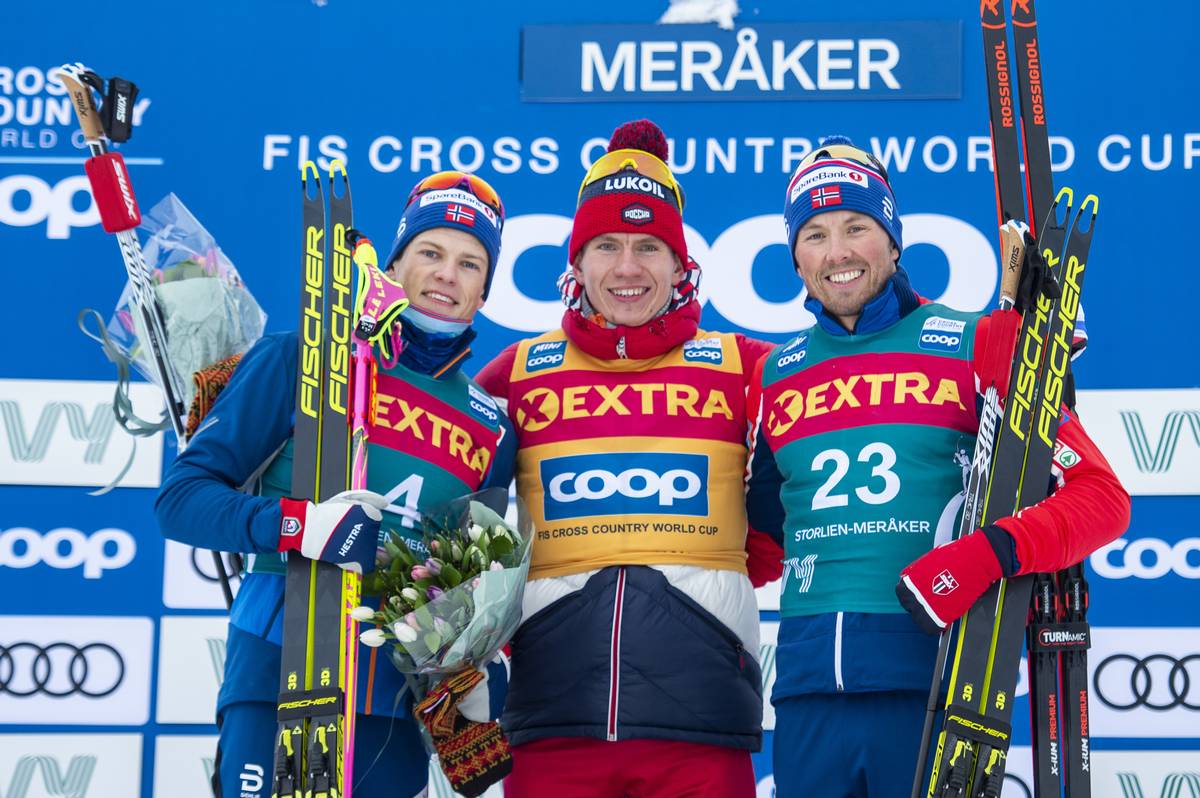
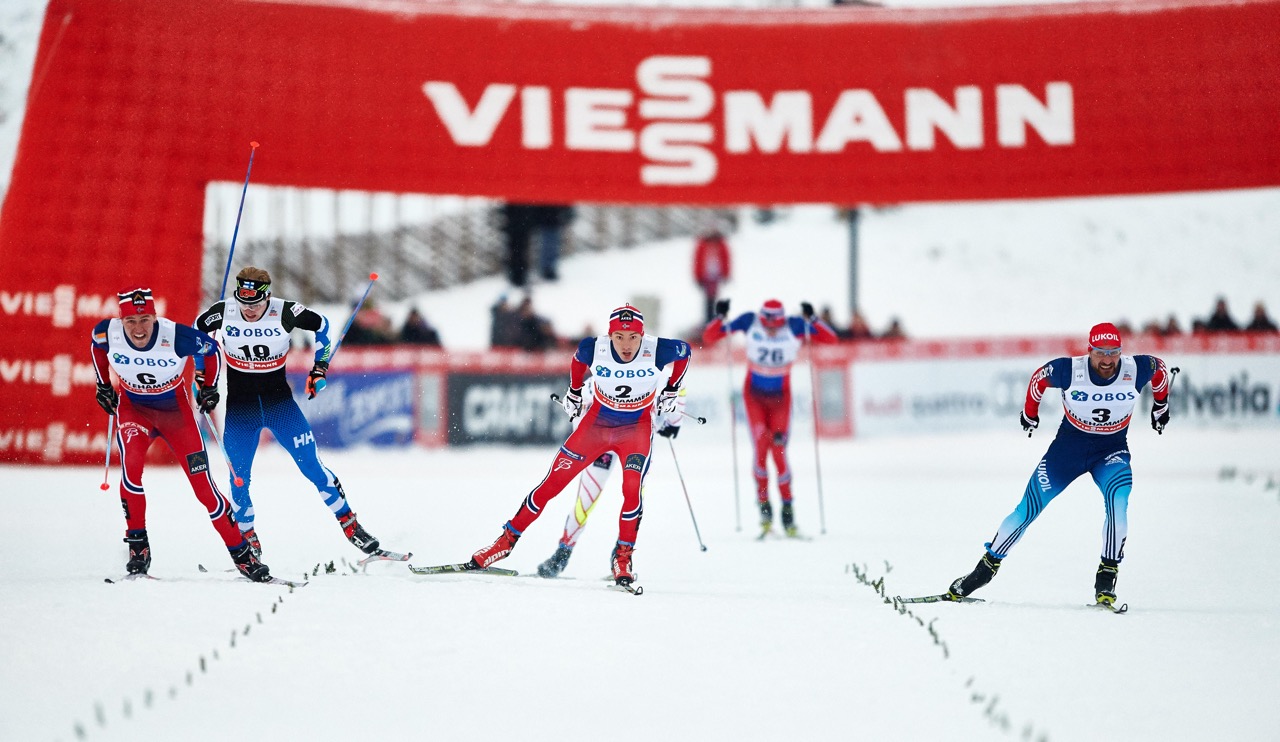
Klæbo placed second (+51.7), and hometown skier Iversen third (+51.8). Places fourth through 11th were separated by roughly nine seconds.
Bolshunov leads the Ski Tour 2020 with a total time of 2:26:16 hours after four stages. Golberg is second (+1:05), and Røthe third (+1:06).
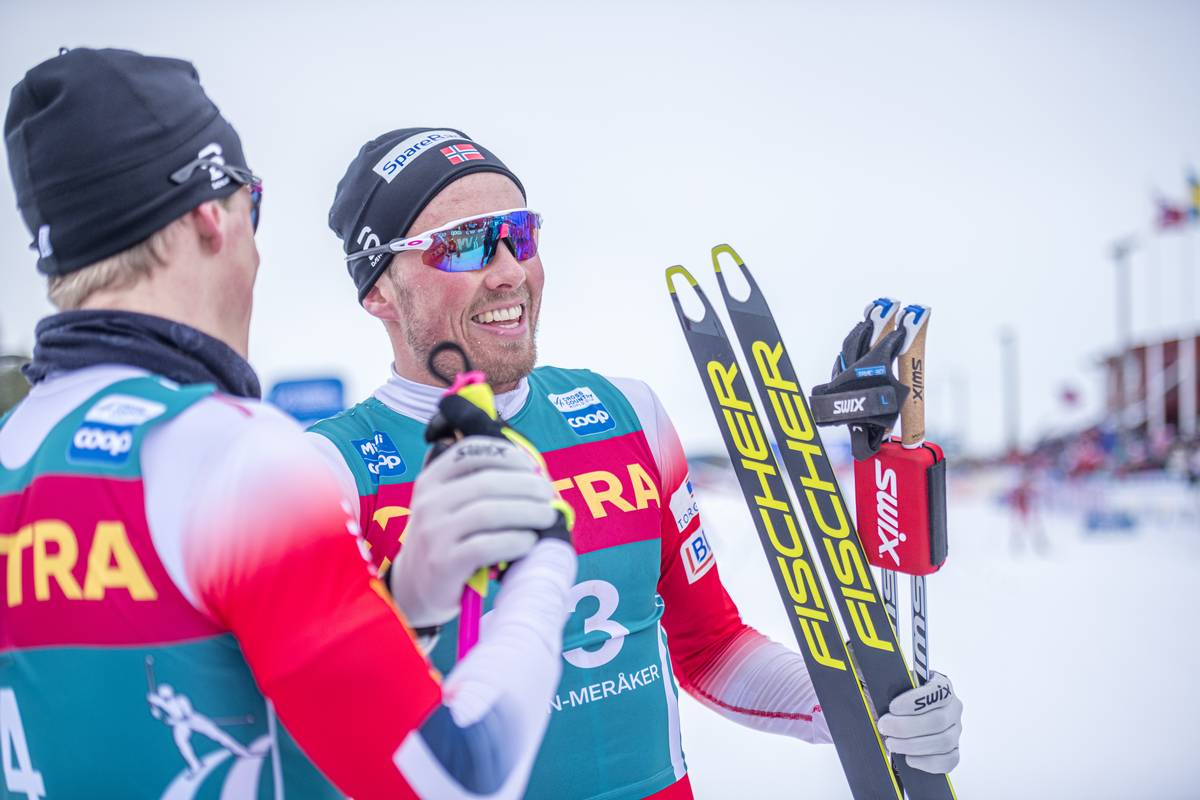
Emil Iversen (bib 3) and Johannes Høsflot Klæbo share a stoke-moment after the race. (Photo: NordicFocus)
David Norris was the top North American in 26th (+3:08.7). Ben Lustgarten placed 51st (+5:30), Kevin Bolger 69th (+8:06.7), Simi Hamilton 74th (+9:28.1), and Logan Hannmen 76th (+9:39.3).
Canada’s Evan Palmer-Charrette skied to 37th (+3:46.0), Russell Kennedy 39th (+3:59.9), Alexis Dumas 67th (+7:32.3), and Ricardo Izquierdo-Bernier 77th (+13:03.6).
Racing continues Saturday in Trondheim with a 1.5 k classic sprint, the sixth stage of the Ski Tour 2020.
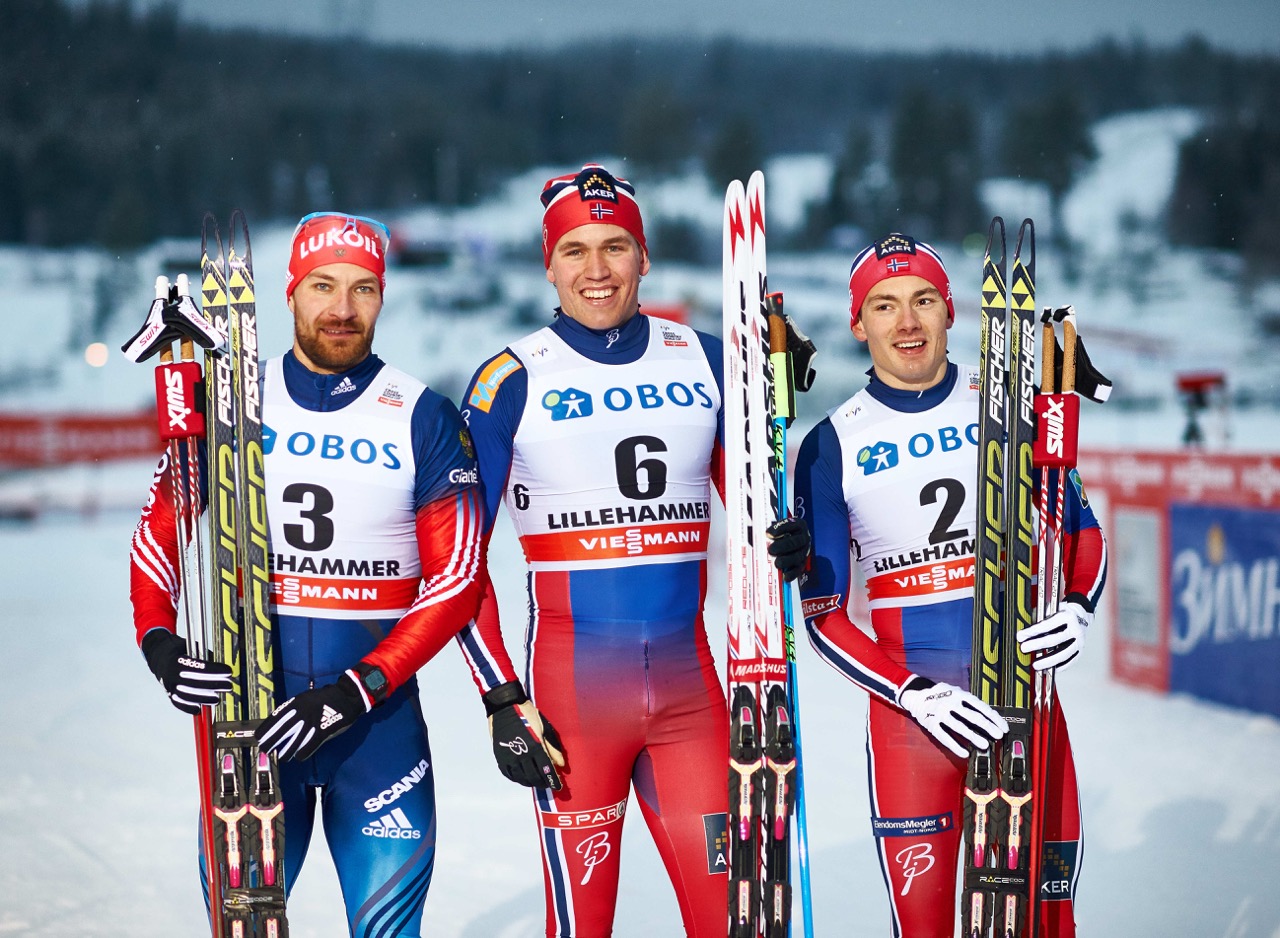
The men’s Stage 4 podium: Johannes Høsflot Klæbo (NOR) second, Alexander Bolshunov (RUS) first, and Emil Iversen (NOR) third, (l-r). (Photo: NordicFocus)
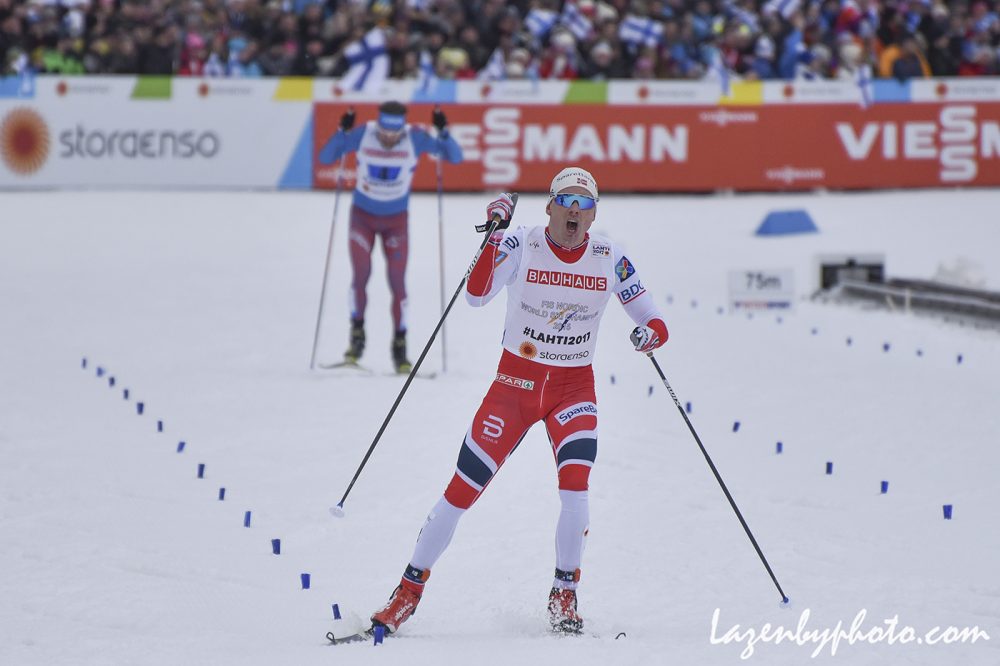
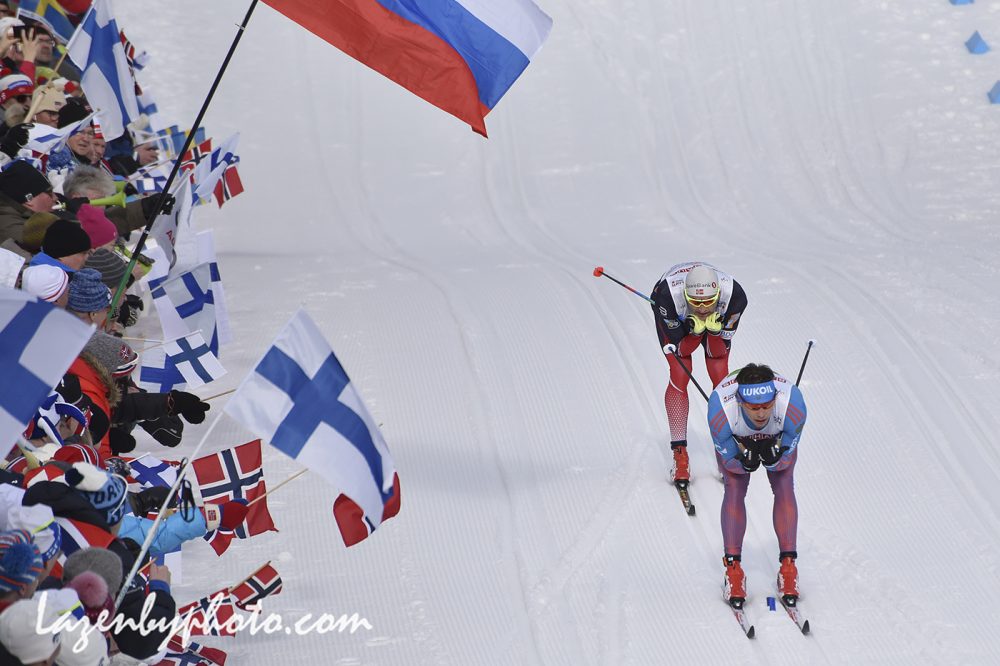
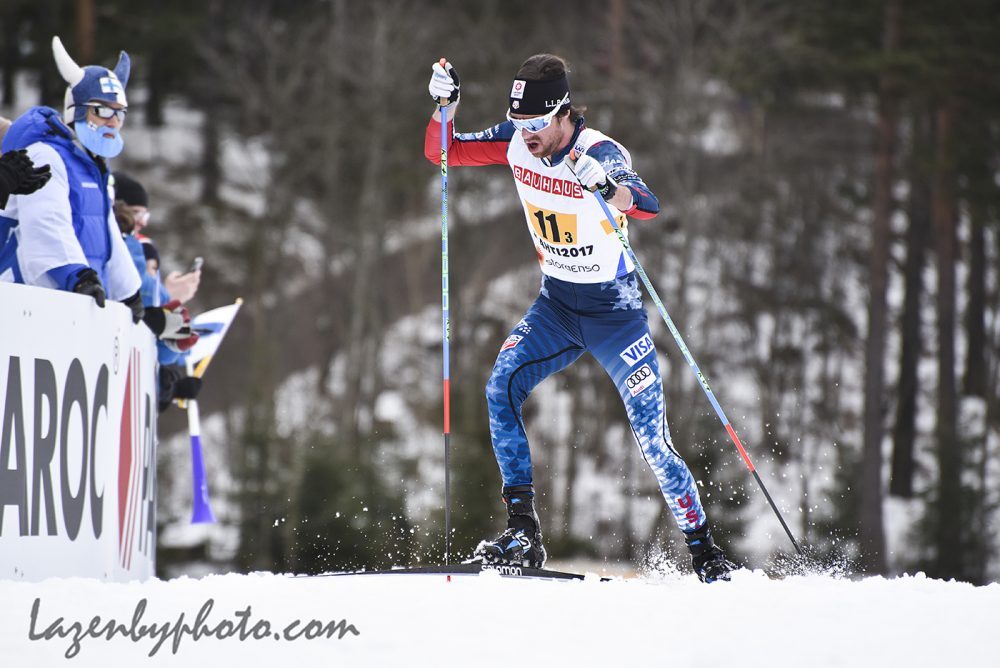
Norway’s Finn Hågen Krogh with the victory stoke as he wins the 4 x 10 k relay at the 2017 Nordic World Championships in Lahti, Finland, by 4.6 seconds over Russia’s Sergey Ustiugov (behind). (Photo: John Lazenby/Lazenbyphoto.com)
LAHTI, Finland — There were three medals up for grabs during Friday’s 4 x 10-kilometer relay at 2017 Nordic World Championships on Friday. Yet after the scramble leg, two distinct races: Norway and Russia’s dance for gold, and what eventually became a four-way tango between Finland, Sweden, Switzerland, and Germany for bronze and silver.
Russia’s Andrey Larkov and Norway’s Didrik Tønseth first strung out and then smoked the field late in their leg. By the tag to their second-leg skiers, Norway and Russia were twenty seconds up.
Russia’s Alexander Bessmertnykh leads Norway’s Niklas Dyrhaug as they sustain the break during the second leg of the 4 x 10 k relay at the 2017 Nordic World Championships in Lahti, Finland. (Photo: John Lazenby/Lazenbyphoto.com)
That margin grew to thirty seconds, as Russia’s Alexander Bessmertnykh and Niklas Dyrhaug finished Leg 2 and the transition to skating began.
Coming in just a half a minute later in third place, was Finland’s Iivo Niskanen, giving the fans a premature taste of the podium.
Racing the third leg was Norwegian Martin Johnsrud Sundby. Russia tried to match the Norway’s trump card with Alexey Chervotkin. The 21-year-old Chervotkin skied the third leg for Russia in both team relays that took place this season: the first in Nove Mesto, Czech Republic, the other in La Clusaz, France, where the team placed second both times to Norway.
However, the World Championship leg was the first time Chervotkin matched up against Sundby this year.
Late in the leg, it was unclear what Sundby’s strategy would be as the young Russian shadowed the 32-year-old Sundby move for move. With Sergey Ustiugov up for the Russians in the anchor leg against Norway’s Finn Hågen Krogh, many armchair-relay strategists would have thought the Norwegian’s line up ploy was a dud.
Not until 1.2 kilometers left in the leg did Sundby make a sufficient gap. At that point, the time spread from silver to gold was only eleven seconds. Not exactly a huge buffer for Krogh.
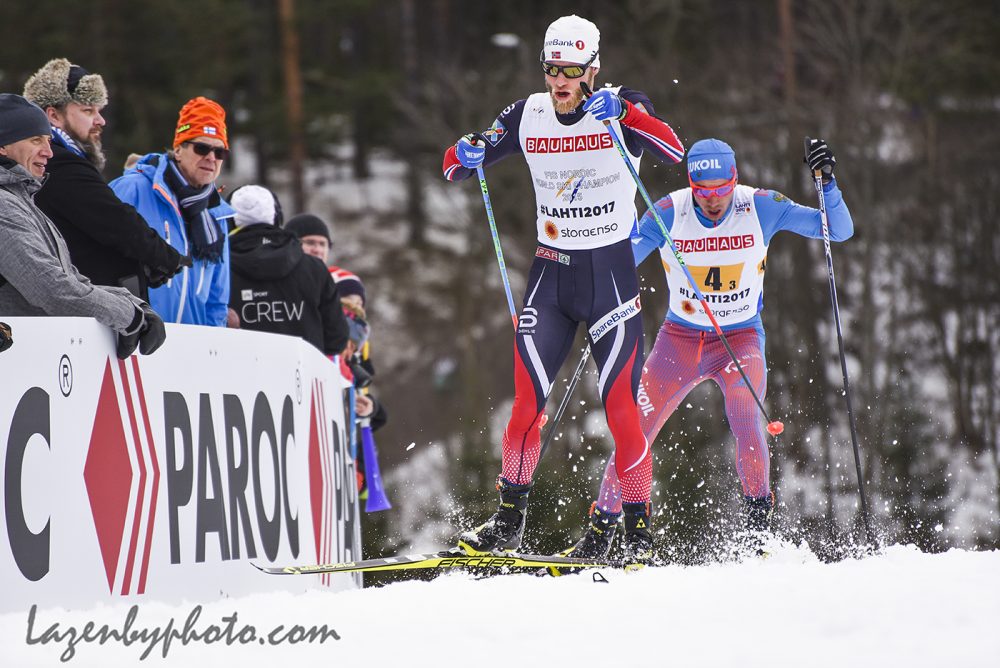
Norway’s Martin Johnsrud Sundby, marked by Russia’s Alexey Chervotkin (4), during a critical third leg of the 4 x 10 k relay at the 2017 Nordic World Championships in Lahti, Finland. (Photo: John Lazenby/lazenbyphoto.com)
By Sundby’s tag to the anchor skier, he had gifted Krogh a 17.7-second margin for error. The rhetorical question at the start of the fourth leg: when will Ustiugov catch Krogh?
“He’s the worst the worst guy you can have in back of you,” Krogh said during a press conference, referring to Ustiugov. “He made the race tough for me.”
At 1.3 k into that fourth leg, Ustiugov was 8.8 seconds back. In another 1.2 kilometers, it ballooned again to 11.6 seconds, and then it contracted again to 5 seconds with 3.8 k to go. But until the finishing stretch, when Krogh rounded the final turn with a 100-meter lead on the Russian, was Norway a sure win.
Krogh crossed first in a time of 1:37:20.1 hours for the ninth-consecutive Norwegian championship 4 x 10 k relay gold. Finishing 4.6 seconds later in second place was Russia’s Ustiugov.
“It’s not just for us, it’s the whole team,” Sundby said during a press conference of their ninth world-champs relay gold. “It’s for the waxers, it’s for the trainers. When you go the relay for the Norwegian team, you feel you’re going for your country. So it’s a massive victory for us.”
What kept the capacity crowd engaged was not so much the battle for gold and silver, but the fate of the on-again, off-again Finns.
Let’s back up to when Niskanen tagged off to Finnish skier Lari Lehtonen for the first freestyle leg. At that point, the Finns were in third, a solid 15 seconds ahead of France in fourth place, 32 seconds ahead of Switzerland in fifth, roughly 55 seconds ahead of Germany in sixth, and almost a minute ahead of Sweden in seventh.
“We are individual athletes, and you have to focus on your own leg,” Sweden’s Johan Olsson said after the race. “Both me and Daniel [Rickardsson] thought the medal chance was over when we had done two legs.”
The first sign that something was awry for the Finns was a restless home crowd. What may have been perceived as a plush-time cushion for Lehtonen was in fact cardboard thin.
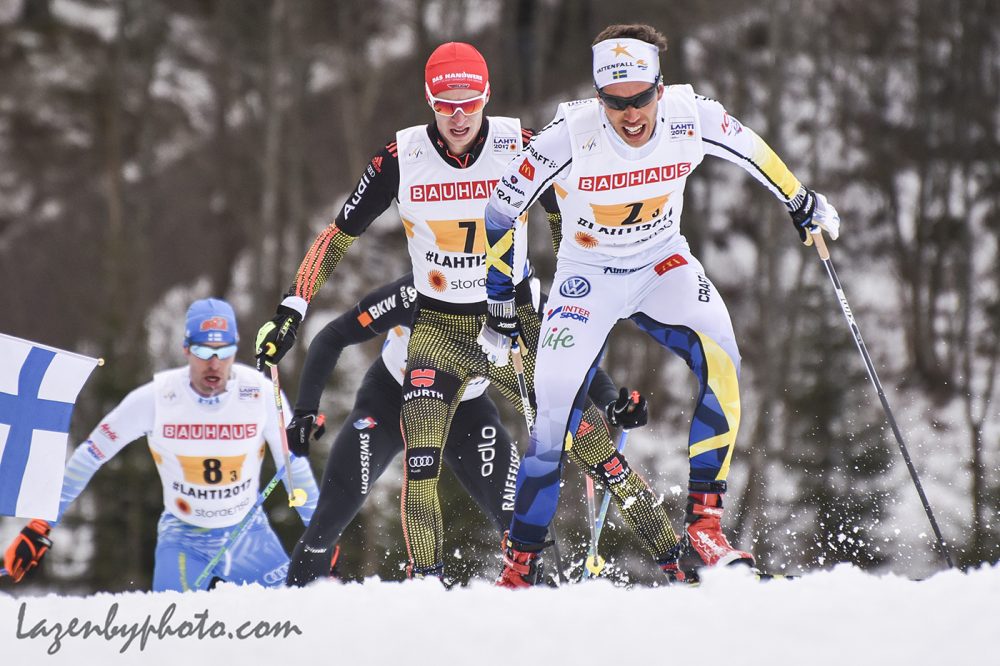
Sweden’s Marcus Hellner (r) leads Germany’s Florian Notz (7), Switzerland’s Dario Cologna (behind Notz), and Finland’s Lari Lehtonen (8) during the men’s 4 x 10 k relay at the 2017 Nordic World Championships on Friday in Lahti, Finland. (Photo: John Lazenby/Lazenbyphoto.com)
Sweden’s Marcus Hellner and Switzerland’s Dario Cologna were on the hunt. Seemingly an afterthought, Hellner skied the fastest third leg, animating the race for bronze by pulling Sweden back into contention.
These four teams — Finland, Germany, Switzerland, and Sweden — stuck together through the exchange into the fourth leg until the last headwall climb, called Indian Hill.
It was then that Finland’s Matti Heikkinen hop-stepped around Germany and Switzerland, bringing Sweden’s Calle Halfvarsson with him.
“I know that Matti will go on the last uphill and it was good game for me to go after him,” Halfvarsson said during the press conference.
The two appeared to have dropped Switzerland’s Curdin Perl, until Perl miraculously slotted behind the Finn-Swede duo. Finland entered the final 100-meter stretch in a sprint for bronze.
One errant pole plant as Heikkinen ramped up his gear, causing him to fall to the ground was Finland’s loss and Sweden’s gain. Halfvarsson crossed third for Sweden (+2:31.8) and Perl fourth for Switzerland (+2:32), and Finland ultimately crossed fifth (+2:42.4).
(Story continues below)
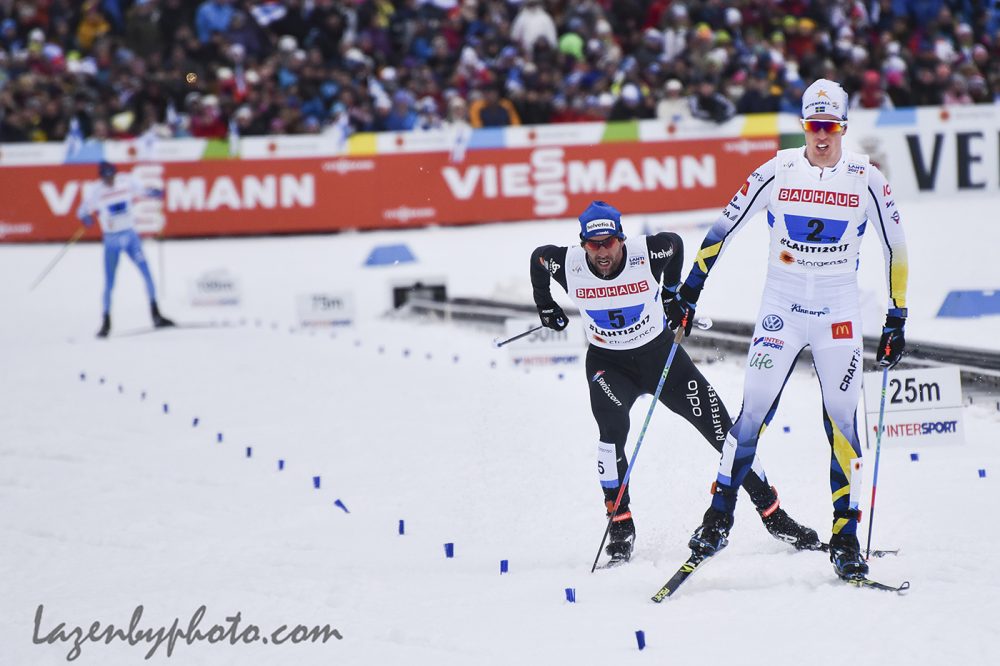
Sweden’s Calle Halfvarsson (2) crossing the line in third place, ahead of Switzerland’s Curdin Perl (5) in fourth at the finish of the men’s 4 x 10 k relay at the 2017 Nordic World Championships in Lahti, Finland. Finland’s Matti Heikkinen (far left) is seen after righting himself due to a errant pole plant. (Photo: John Lazenby/Lazenbyphoto.com)
The U.S. fielded a team comprised of Kyle Bratrud, Erik Bjornsen, Tad Elliott, and Simi Hamilton. Bratrud scrambled the first classic leg for the Americans, handing off to Bjornsen in 11th, 1:28.2 minutes behind the leader.
“I was definitely more nervous for this one because I was starting,” Bratrud said afterward.
While this is the second World Championships for Bratrud, a 24-year-old member of the Central Cross Country (CXC) Team, Friday was the first time he raced the scramble leg in a relay — he raced the third leg for the U.S. in the 2015 world champs 4 x 10 k relay in Falun, Sweden. Though he eventually lost contact with the front group, Bratrud was happy he was able to hold on for as long as he did, even if it caused him a yellow card for a technique violation.
“It was nice to at least see the front before they really picked up the pace,” Bratrud said.
“Props to Kyle on the yellow card,” Elliott wrote in an email. “Scrappy out there.”
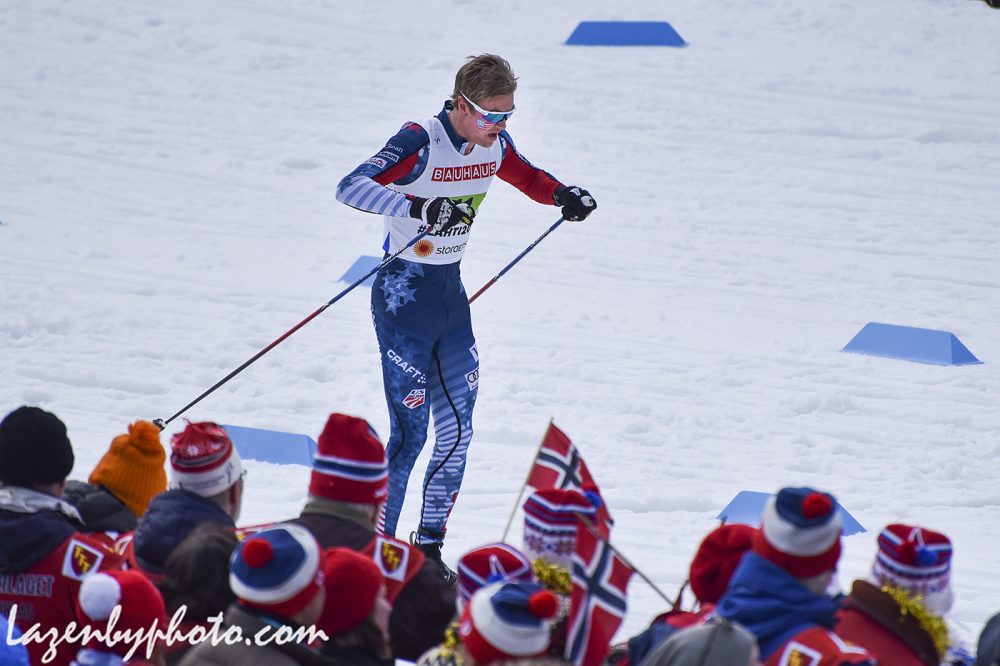
Tad Elliott racing the third leg of the U.S. men’s 4 x 10 k relay at the 2017 Nordic World Championships on Friday in Lahti, Finland. (Photo: John Lazenby/Lazenbyphoto.com)
While Bratrud had company for approximately one lap, Bjornsen raced completely alone.
“It’s not the position you necessarily want to be in, but took it for what it was worth and tried to charge up to the group in front of me, which was [the Czech Republic’s Lukas] Bauer and [Germany’s Jonas Dobler],” Bjornsen said.
“But I mean…they were moving fast,” the 25-year-old U.S. Ski Team member added. “I tried to mentally just keep pushing, but it’s tough to be out there by yourself. I felt pretty good, it’s just a different type of race.”
Bjornsen tagged to Elliott, for the Americans’ first freestyle leg. He skied the eighth-fastest third leg, 1:47 behind Hellner.
“I was also getting great splits from the coaches on making ground on the group in front of me,” Elliott wrote.”I wanted to catch them, I just didn’t really get there for Simi to save it all for his sprint. Simi skied one hell of a leg.”
Elliott handed off to Hamilton, the anchor leg for the U.S.
“By the time he tagged off to me, I think I was 10 or 15 seconds from [the Czech Republic, Kazakhstan and Italian teams],” Hamilton recalled. “They fortunately started pretty conservatively, which was nice for me.”
Those three teams were in fact 16 seconds ahead of Hamilton. He eventually closed that distance, putting the U.S. in contention for a top 10.
“I wanted to start fast and see if I could make up some time on them,” Hamilton siad. “And I did, I ended up catching them by the top of the climb after the tunnel. So I was psyched about that.”
However, when Hamilton came through for his fourth and final lap, the hill-laden course had taken a toll on his legs. He finished in 10th (+5:31.3), just half a second ahead of the Czech Republic’s Petr Knop in 11th (+5:31.8).
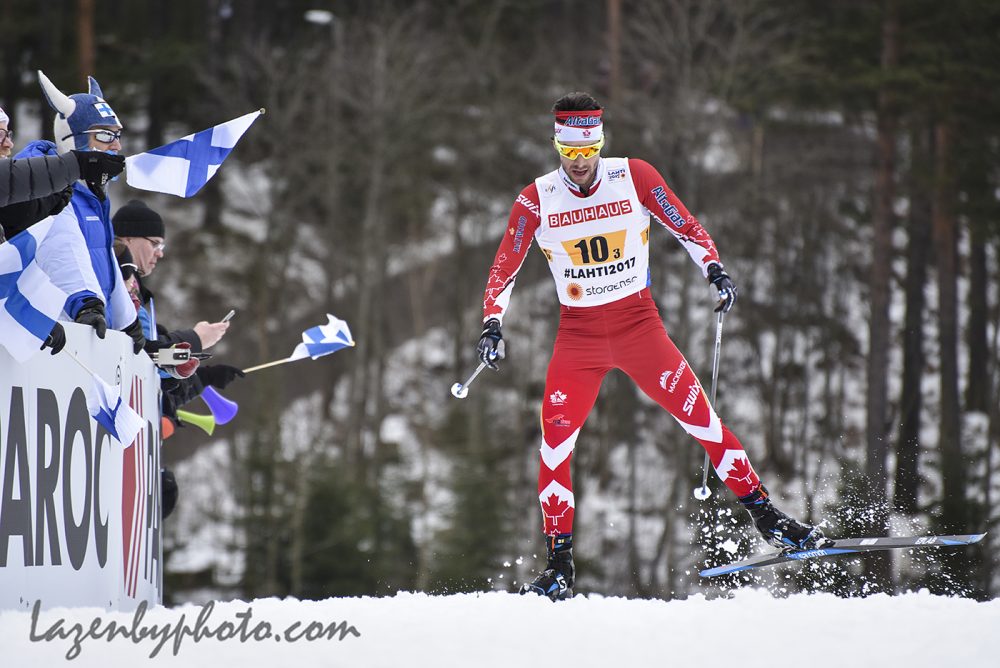
Canada’s Alex Harvey racing the third leg of the men’s 4 x 10 k relay at the 2017 Nordic World Championships on Friday in Lahti, Finland. (Photo: John Lazenby/Lazenbyphoto.com)
“That last lap my legs were definitely feeling it a little bit and those guys are all really good climbers,” Hamilton said. “I couldn’t quite make the moves that I wanted to in the last kilometer because I was a little whupped by then … but I was still able to pick off Czech Republic at the finish. Maybe not the best day for us, but still a day that we were fighting.”
Canada’s team of Graeme Killick, Devon Kershaw, Alex Harvey and Lenny Valjas finished 12th, after being lapped and thus pulled from the race on Valjas’s final leg.
In January of this year, Canada raced to a historic third place at the Ulricehamn World Cup relay in Sweden.
“It just wasn’t our day,” said a dignified Valjas after Friday’s relay. “We’re all in shape, it’s just none of us were on our A-game today and that’s what it takes to be fighting in this.”
Erik Bjornsen (U.S. Ski Team) racing the second leg of the men’s 4 x 10-kilometer relay at the 2017 Nordic World Championships on Friday in Lahti, Finland. (Photo: John Lazenby/Lazenbyphoto.com)
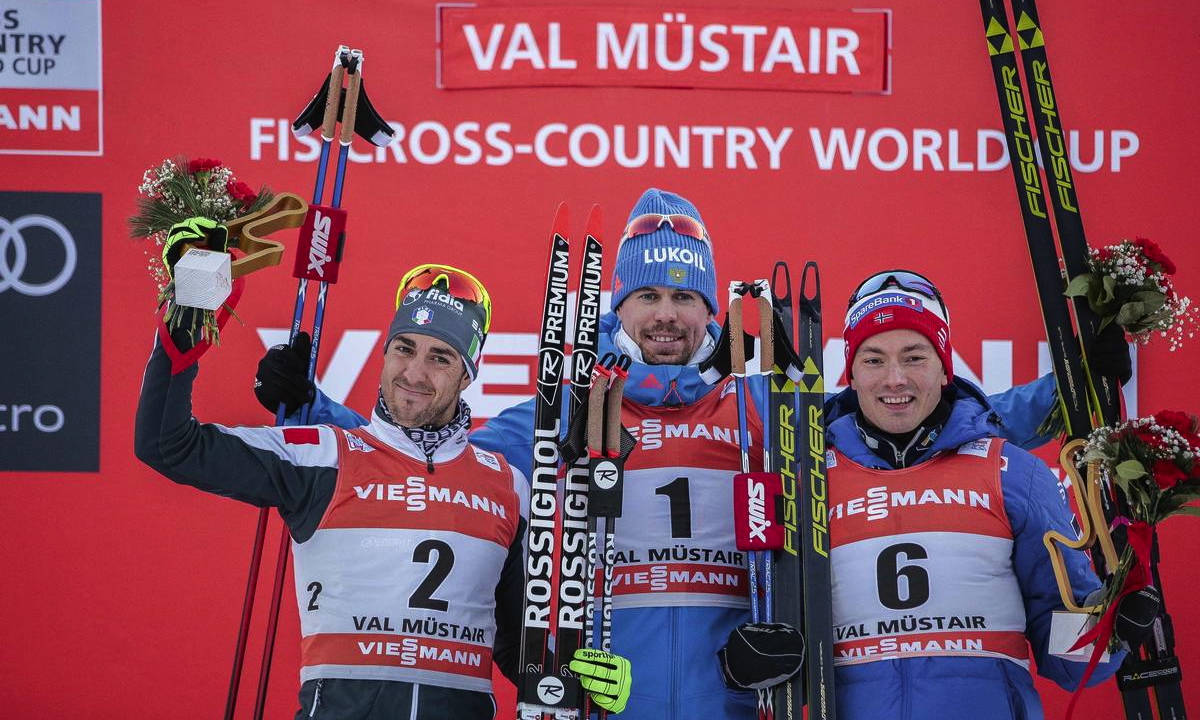
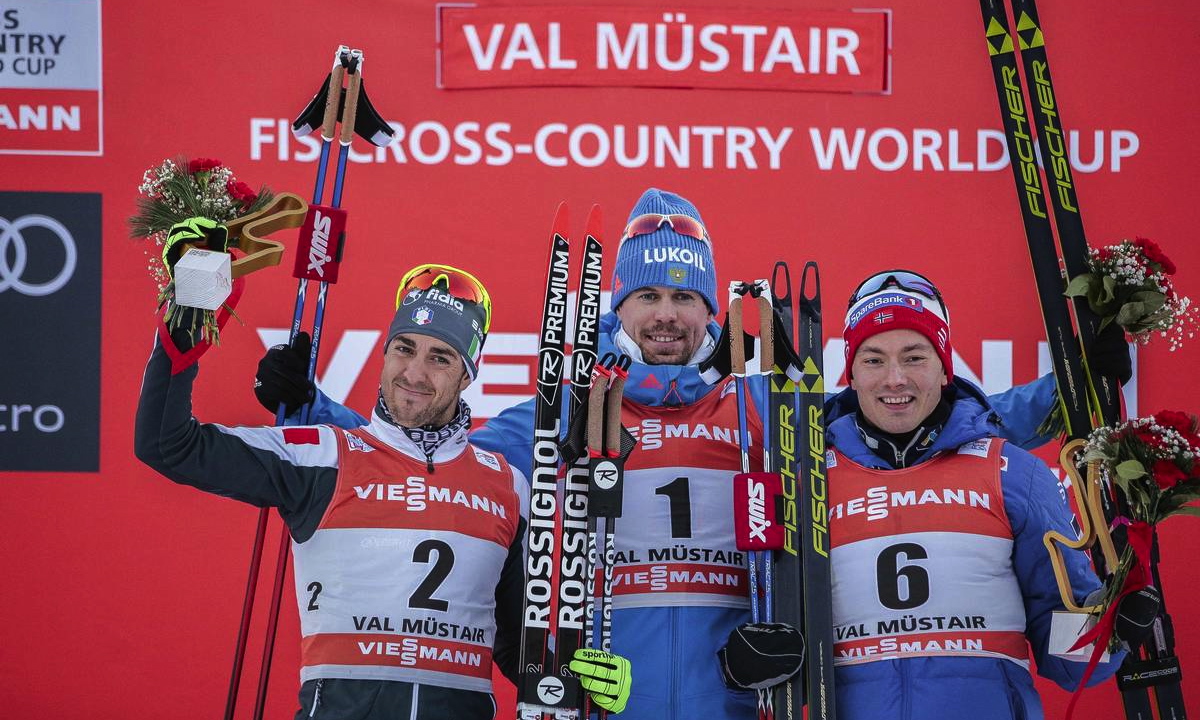
The men’s Tour de Ski 1.5-kilometer skate sprint podium at Stage 1 in Val Müstair, Switzerand. (Left to right) Italy’s Federico Pellegrino in second, Russia’s Sergey Ustiugov in first, and Norway’s Finn Hågen Krogh in third. (Photo: Fischer/NordicFocus)
The 11th Tour de Ski began Saturday in Val Müstair, Switzerland, with a 1.5-kilometer freestyle sprint.
Nearly three minutes flat — 3:00.50 specifically — is all it took Russia’s Sergey Ustiugov in the sprint final to deliver his country a positive sporting distraction. As the fastest qualifier to start the day, Ustiugov ran the tables in the quarters and semis, too. Last season’s overall Sprint World Cup winner, Italian Federico Pellegrino placed second (+ 2.03), and Norway’s Finn Hågen Krogh finished third (+2.80).
According to an International Ski Federation (FIS) press release, the 24-year-old Ustiugov played it humble, knowing the Tour is a tour, not a one-off sprint.
“I did not feel unbeatable but I felt very strong today,” Ustiugov said. “It is good start the Tour with a victory. I will try to stay behind [Norway’s Martin Johnsrud] Sundby tomorrow.”
Sunday’s stage, the second of the seven-stage Tour, is a 10 k classic mass start and should be a frenzy of tactics and searing lungs, but more on that big picture in a bit.
“I am very happy to be the strongest today and to tell the truth I want to be the best during the Tour for myself and for all the guys who stayed at home,” Ustiugov said in a post-race interview with FIS, referring to his provisionally suspended teammates. “We were training together. We [are] all very strong, but I will do it, I will try.”
No podiums until today — that sums up the high standards for Pellegrino. Last season, when he won the sprint globe, the Italian made five sprint podiums, all victories. Before Saturday’s second place, three World Cup sprints into the 2016/2017 season, he’d placed 18th, 17th and seventh, respectively.
“I did not have a good start to the season,” Pellegrino said to FIS. “I have been looking for a good shape and good feeling on skis. I am lacking maximum speed at the moment. But second place today is a good sign. After the qualification I knew I could be fighting for second place.”
Krogh is another overall player in the Tour. During last year’s edition, he was second overall to Sundby. A podium in the sprint sets him up for the long haul.
“I am satisfied with third place,” Krogh told FIS. “The goal of the day for me was to get to the final and get as many bonus seconds as possible. It’s a big bonus to finish on the podium today. Sergey [Ustiugov] showed his strength again. In the second lap Sergey and I were fighting for the lead. But I was not strong enough, my legs were burning. But I am happy with third.”
For clarity, let’s stick with the sprint specialist. This includes U.S. Ski Team member Simi Hamilton.
“I think he has kicked it,” U.S. coach Matt Whitcomb said on the phone Saturday, referring to Hamilton’s lingering cold the first part of the World Cup season. “He has been looking really good the last few days. Very punchy, very responsive to speed changes, and he laid down a pretty fast qualifier today in 14th.”
Hamilton’s qualifying time of 3:09.19, put him just over four seconds off Pellegrino’s second fastest qualifying time; a positive trend.
“I was really struggling with sickness earlier this year, and I got hit really hard a couple of weeks ago … and I had to take basically ten days totally of from doing anything because I got hit so hard with that cold,” Hamilton explained on the phone. “And then it moved into my chest so I was pretty sick from that, but the Christmas training block went really well, and it felt like my energy came back fairly quickly, so I just focused on getting my speed back over Christmas.”
Val Müstair’s course is technical; a succession of rollers that looks like it’d be perfect for a charging kids’ league, fast check-your-speed hairpin turns, and a grinding climb.
“It’s definitely a really hard course here,” Hamilton said. “It’s quite hilly and long. It’s a super-fun course … so I think that that’s suits me well. But at the same time I think it plays into my weaknesses a little bit, in that on both the laps it a long, grindy climb, with a V1 kicker at the end. I think I tend to ski a lot better, and ski a lot more confidently on courses where I’m able to use the terrain more, more rolling courses where I can hammer and recover, hammer and recover.”
Hamilton finished 18th on the day after finishing fourth in his quarterfinal (+0.85) and said he plans on racing Sunday’s 10 k classic mass start. Afterward, he’ll withdraw from the Tour and get in some training before contesting an OPA Cup sprint along with teammates Sophie Caldwell, Ida Sargent, and Andy Newell next weekend in Planica, Slovenia.
Canadian World Cup Team member and sprint specialist Len Valjas qualified 21st and placed 16th overall. Valjas was eliminated after skiing to third in the second quarterfinal (+0.41).
A Sum of Its Parts
This version of the Tour de Ski features one sprint. And it’s over. Starting Sunday, the remaining six stages for the men feature a 10 k classic mass start, then a 20 k skiathlon, a 15 k skate pursuit, a 10 k skate, a 15 k classic mass start — and that killer 9 k Alpe Cermis climb in Val di Fiemme, Italy, to call it good.
As much as Saturday’s sprint was a high-speed spectacle, it was also an opportunity to methodically position oneself for the overall.
That brings up Sundby — a Tour stalwart. He’s a two-time winner of the Tour and just last year beat second-place finisher Krogh by 3:15.7 — the largest margin of victory ever in a Tour de Ski.
Like continuity? Then you’re in luck. Sundby placed fourth in the sprint (+3.52). Strong, tactically wily, able to string out and pop most hangers on in a tour — he’s won the last eight World Cup Tour events not including the 2015 Tour de Ski from which he was later disqualified for a doping violation — Sundby may have been off the podium on Saturday, but based on precedent, he’s still the skier to beat.
The day’s winner, Ustiugov, finished third in last year’s Tour (+3.43.8). Krogh and Ustiugov are set up to at least parry one another, if not try to topple Sundby. But in the Tour, every day isn’t exactly a new day — your results are cumulative and one bad day can haunt.
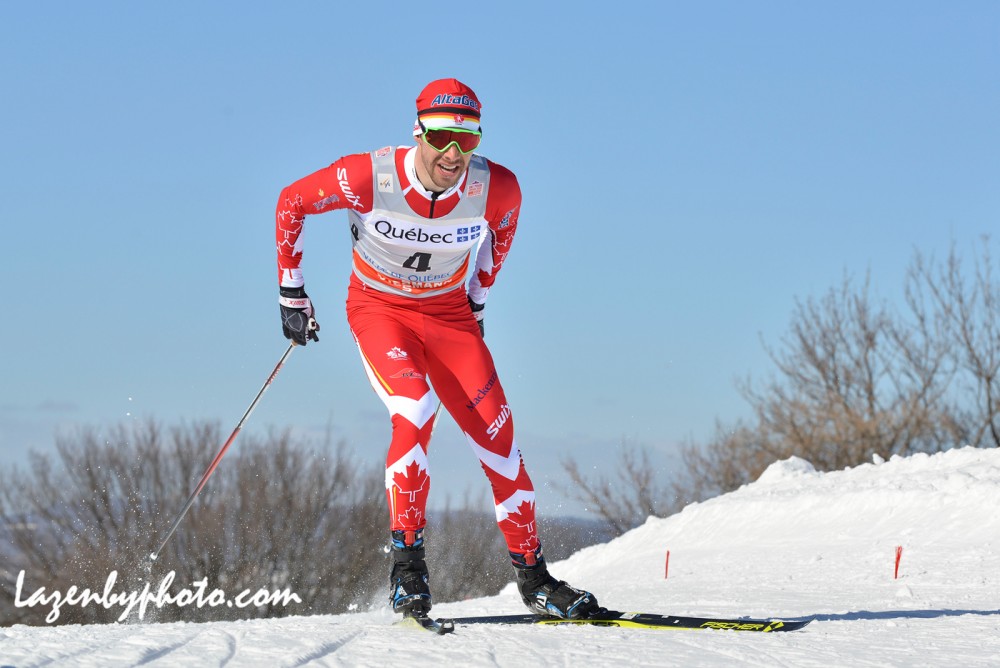
Alex Harvey (Canadian World Cup Team) last season at the 2016 Ski Tour Canada freestyle sprint in Quebec City. Harvey went on to place second in the final. (Photo: John Lazenby/Lazenbyphoto.com)
After the first stage, Canada’s Alex Harvey won’t be haunted. Harvey qualified 25th, but placed sixth overall.
Call it mustache-mojo, or whatever you want, the Canadian is well positioned; he’ll start Sunday’s Stage 2 with a 27.6-second deficit in the overall hunt. That beginning was better than expected when considering Harvey’s early sensations.
“Alex said he wasn’t feeling that great today, he was just tactically really strong, and he had it planned ahead,” Canadian World Cup coach Ivan Babikov on the phone.
“For the prologue I didn’t feel super good,” Harvey explained in a phone interview. “I had heavy legs, heavy breathing. I did my normal warmup, but my legs would get filled with lactate.”
Understanding his physical limitations for the day, the quick-to-fatigue legs, Harvey skied with more brains and less brawn.
“Every heat he executed perfectly, but he said he didn’t have very much pop, and wasn’t in super shape today,” Babikov noted. “This course is really hard, especially on the second lap, it’s people getting pretty lactated up. He saved most of his energy for the finish, and he kept out-sprinting people every time. He’s really strong, and he used what he had today, 200 percent. Bottom line, Alex made the final.”
Initially, it didn’t look like a slam dunk. In the early moments of his quarterfinal, it would have been easy to count Harvey out. He skied in sixth place. He looked poised to get dropped from the draft than advance to the semis.
Then Harvey moved. “I tried to position myself better, just be in a good position to attack the last hill,” Harvey said of his tactics. “That was good. I had my own line up the last hill, and I had enough jump and could gain a couple of spots there. And I had good cornering in the last downhill and went from fourth to third on the kind of speed bumps there and my final kick was really good.”
It was precise moves when it mattered most. Harvey won his quarterfinal. “I tried to do the same in the semi and it worked too,” Harvey said.
He advanced to the final with a second place in his semifinal.
In the final, Harvey noticed the heavy legs again and began to dial it back.
“Then at one point [in the final] spending a crazy amount of energy to maybe get fifth was kind of useless,” Harvey explained of his strategy. “I just skied to the line, but not kill myself to maybe get fifth because it’s two seconds more for bonus seconds. I’m still thinking of the big picture in the Tour so overall I am really happy because I made the most out of the situation.”
Devon Kershaw, Harvey’s Canadian teammate, was not satisfied with the day. He begins Sunday’s stage 1:14.6 back after placing 51st in the qualifier.
“Well, the thoughts are obviously those of disappointment with my performance today here in Val Mustair,” Kershaw wrote in an email. “I know that my old bones haven’t been the fastest on tour when it comes to Sprint Qualifiers these last 12 months — but here in Val Mustair the last two times we’ve been here I’ve been able to qualify top 20… So to be shelled and back in 51st is obviously a bit of a kick to the stomach…”
Kershaw, who turned 34 on Dec. 20, indicated he’s moving on, looking forward to the six stages of distance racing to come.
“So what’s done is done and now I shift the focus towards the longer races that suit my better,” he wrote. “I am really looking forward to a couple stages (tomorrow was one – but a 10km classic starting so far back on a twisty ribbon-of-snow 2.5 km loop will mean that it’ll be ‘busy’ out there on the tracks!) and I am feeling much better than in La Clusaz when I came down with a head cold.”
A mass start and not much real estate in terms of spreading the World Cup scrum out most likely means dicey skiing for the Tour’s second stage. “Tomorrow will be a very tight and probably a tad sketchy with so many bodies all wanting to be at the front and only 22-23 min to get it done — so I will want to keep my head up and make sure my horseshoe is under my bed tonight before I fall asleep,” Kershaw added.
Also for Canada, Graeme Killick finished 57th (+15.35) in the qualifier.
U.S. Ski Team (USST) member Erik Bjornsen finished 64th (+16.28), and teammate Noah Hoffman was 76th (+19.41).
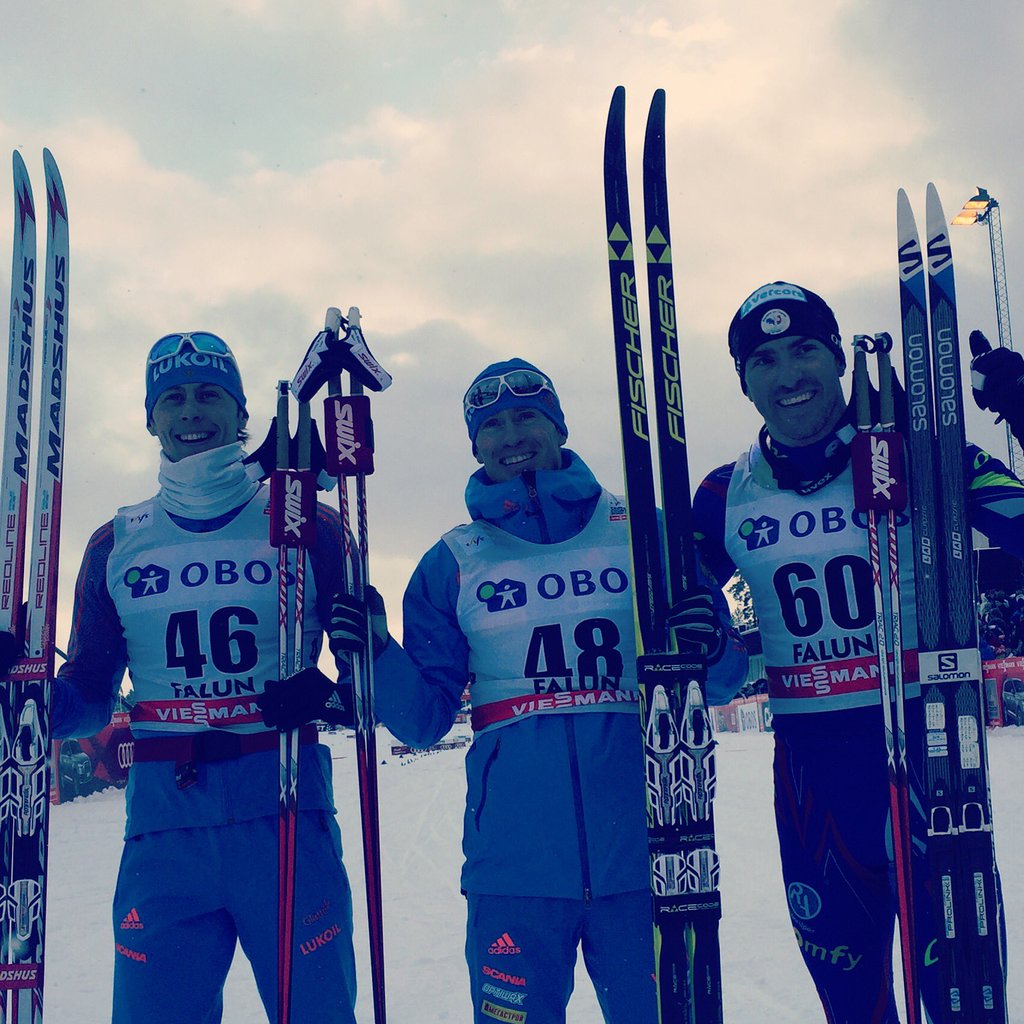
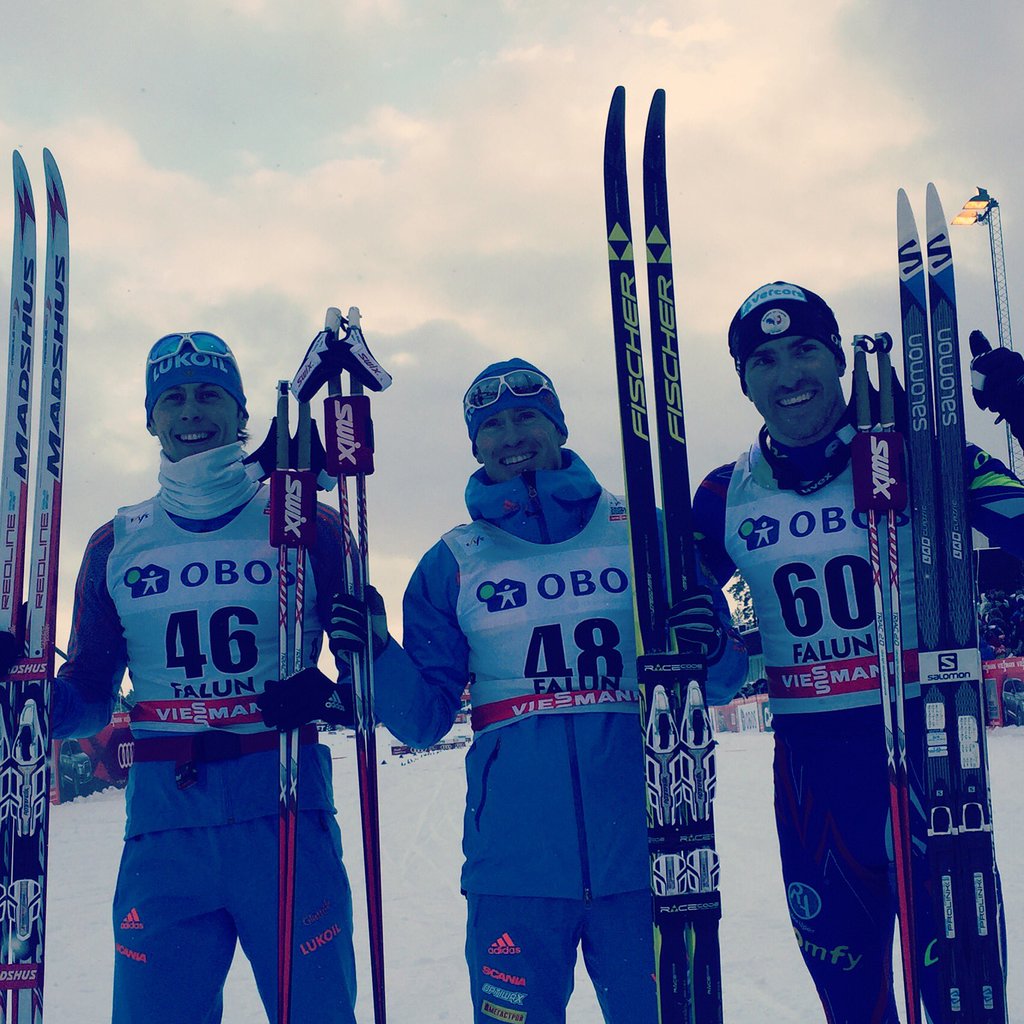
Russia took first and second in the men’s 10 k classic on Saturday in Falun, Sweden, with Maxim Vylegzhanin (c) in first and Alexander Bessmertnykh (l) in second and France’s Maurice Manificat placed third. (Photo: FIS Cross Country/Twitter)
There were a few striking anomalies at the World Cup on Saturday in Falun, Sweden. First, there’s the race format. The men skied a 10-kilometer classic race. Excluding tours, it’s the first time a 10 k classic has run as a regular World Cup event since February 2003. Second, Saturday’s results found Norway locked out of the podium.
Russia secured the two top spots. Maxim Vylegzhanin took first in 25:14.6, Alexander Bessmertnykh was second (+3.5). France’s Maurice Manificat, only a sliver out of second, finished third (+3.6). With four skiers in the top 10, Russia seemed resurgent. Beyond the top-two positions, Sergey Turyshev placed seventh, 19.8 seconds back, with Sergey Ustiugov in 10th (+22.5).
Norway also put four in the top 10, with 24-four-year old Emil Iversen in fourth (+7.8), Martin Johnsrud Sundby in fifth (+9.5), Didrik Tønseth in sixth (+19.2), Niklas Dyrhaug in eighth (+21.4). For the powerhouse nation’s top-of-the-podium benchmark, it was not Norway’s day. It was Russia’s.
“I am always happy for a win and it is even better to have two Russians on the podium with the victory,” Vylegzhanin said, according to a FIS press release. “It was a slow start to the season for me but I am getting better the past couple of weeks. The Tour de Ski didn’t go as I would have liked but there is still the Ski Tour Canada. “
With a good dose of snow falling at the race start, the light was the only thing about the course that was flat. The men skied two 5-kilometer laps, which equates to 364 meters of total climbing, including twice up the infamous Morderbakken.
The 33-year-old Vylegzhanin didn’t blink. He’s been on a podium roll. Last weekend in the Holmenkollen 50 k, he kept pace with the lead pack, along with three Norwegians, including race winner Sundby, ultimately finishing third. With his form dialed, and his past success on Falun’s trails (Vylegzhanin won the 30 k skiathlon at the 2015 Falun World Championships), the Russian strategically built his pace.
In terms of race strategy, there was little room for seconds lost. As the time margins for the 10 k suggest, this was a tight race. Only 22.5 seconds separated first from 10th place.
Vylegzhanin was 10.6 seconds back in seventh at 3.2 kilometers, 7.6 seconds off the pace at 6.7 k, and closing in for the win at 8.2 k, as he was 2.7 seconds back from Bessmertnykh’s leading time-split. Like a locomotive, maybe just a little bit sluggish at the start, Vylegzhanin’s accelerating pace won out.
Despite leading the race until the closing 1.8 kilometers, Bessmertnykh was pleased. “I am happy to be back on the podium as in Toblach. I prefer the interval start classic competitions. It is the best for me,” Bessmertnykh remarked in a FIS press release.
This was the 29-year-old Russian’s second World Cup podium this season. Back in December, he was second in the 15 k classic in Tobalch, Italy.
For France’s Manificat, Saturday’s race was a breakthrough. The French skier is a proven freestyle threat. He won the 15 k free in Nove Mesto, Czech Republic, in late January. According to FIS, this is Manificat’s best distance classic World Cup result ever.
In a FIS press release, Manificat remarked he, too, found Saturday’s format to his liking.
“This is my first individual classic technique podium,” Manificat said. “I am in good shape now after a training camp in Les Saisies the site from the 1992 Albertville Olympic Games. My preference, like Alexander, is interval start as it is really just a race against yourself and your mind. But I am looking forward to tomorrow’s [15 k freestyle] mass start and look for another good result.”
Sundby, uncharacteristically never led the race. Regardless he is still crushing the overall World Cup, he leads teammate and second overall skier, Finn Hågen Krogh, by 715 points. On Saturday, Sundby was second at the first two time checks and fourth by only one tenth of a second with 1.8 k to go. The winner of last weekend’s 50 k Holmenkollen classic race — get ready for some words rarely written about Sundby — ultimately fell off the pace.
In a roughly translated NRK article, Sundby spoke of the kilometers catching up to him. “I’m probably been a little pampered. But when one is not better, then you have to make do with what you get. I should like to know what the reason is. But it has been a hard run in the past, and I’m a little tired after last weekend,” Sundby said.
An Uptick for Bjornsen
Erik Bjornsen (32) racing during the fifth stage of the Tour de Ski, in which he placed 56th in the 15 k classic mass start in Oberstdorf, Germany. (Photo: Marcel Hilger)
For many of the North American men, it’s been a season where solid top-30 results, podium near-misses, and actual podiums have already come. There’s Canada’s Alex Harvey and Devon Kershaw. There’s Americans Noah Hoffman and Simi Hamilton. Add Erik Bjornsen to the list.
Bjornsen had the best North American men’s result on Saturday. He placed 21st overall, only one minute from first place.
U.S. Head Coach Chris Grover said in a phone interview that Bjornsen had been eying the Falun 10 k classic.
“He’s had a couple fantastic classic 7.5k relay legs this year. In fact, those relay legs have really been a couple of his really best races of the season,” Grover said.
One of those relay legs was back in December in Lillehammer, Norway. In a stacked field (it’s a World Cup in Norway after all), Bjornsen skied the fastest second classic leg. He bested Norwegian skiers Hans Christer Holund, Mathias Rungreen, and Tønseth. He beat all the men standing on Saturday’s 10 k podium in Falun.
“I think [Bjornsen] saw this 10 kilometer classic race, which is a little bit of an unusual distance for us, as for sure a target, and he took advantage of it,” Grover said. “He just cranked right out of the start. He went hard from the get-go, he was always in the mix at every split station.”
Bjornsen, who admittedly is disappointed with his season, needed the result.
“I had a rough summer of training,” Bjornsen said on the phone. “I had hand surgery, I didn’t do much classic rollerskiing for, I think, two two and a half months to let that hand recover. I also had some knee issues at the same time from trying to get back right after surgery. I tried to get back into it a little too quick … I was feeling really strong up until July when I had that surgery and it seemed like I never really got those feelings back. I’ve been pretty disappointed with my season so far.”
At 24, Bjornsen has been a skier maturing as an athlete on the World Cup. “I was hoping to have a trajectory since the Olympics two years ago of trying to knock five or so places off each year,” he said. “I haven’t quite had the trajectory the last couple years that I am looking for.”
With his 21st place on Saturday, Bjronsen’s long term trajectory may be more positive — he appears to have many more years on this stage to tick off those five or more places.
“I’m not in this sport just to crack into the top-30 every once in awhile. I’m doing this sport because I think I have a chance of bringing home medals someday,” Bjornsen said. “I want to keep doing it as long as I believe that is possible. I’m not going to lie, there has definitely been some periods throughout this winter that I doubted myself, I wasn’t sure if that was going to be possible.”
Bjornsen’s best-ever distance result came last season in a 15 k classic in Toblach, Italy, where he placed 18th. Saturday’s 21st stood as both a season-best and his second-best result.
Also for the U.S., Hoffman placed 56th (+1:50), Scott Patterson was 63rd (+1:57.7), Reese Hanneman 87th (+3:23.7), and Andy Newell did not start. According to Grover, Newell had a fitful night’s sleep and awoke not well rested.
No Canadians were in the points. Kershaw placed 44th (+1:34.3), Harvey 52nd (+1:46.3), Graeme Killick 55th (+1:49.6), Len Valjas 80th (+2:38.9).
Kershaw had the potential for a very fast ride — he started in bib 57. Thirty seconds back, Sundby in bib 58.
“It’s a huge gift this season to start 30 seconds ahead of the by-far the best skier in the world,” Kershaw explained in an email. “The reality is that if he catches you — and you can stay on him — it’s top 15. Simple as that. The hard part of course is actually staying with him — since he’s so much better than everyone else this season.”
At the first time check at 3.2 k, Kershaw had ceded 29.3 of those 30 seconds. “I was really motivated and excited for this 10km classic today — so I when I saw that I was starting only 30sec ahead of Sundby, I was pumped.”
Kershaw, flying back to Canada soon, hopes to be primed for the Ski Tour Canada beginning March 1.
“I am feeling fantastic. Last weekend [at Holmenkollen] and today I am feeling the best I’ve felt in two years probably,” he wrote. “Too bad the equipment hasn’t been there to actually see if those good feelings translate into great racing results. Patience is key now, and I guess I hope to keep the momentum (feeling good) going towards my big goal of the year — Ski Tour Canada. And of course I am looking forward to being back in those beautiful Rocky Mountains in only a few days time!”
Racing continues Sunday with the women’s 10 k and men’s 15 k freestyle mass starts.
Canada’s Alex Harvey finished second in Saturday’s 1.2 k classic sprint in Östersund, Sweden to earn one of his best World Cup results of the season. Here he’s pictured after winning the 30 k skiathlon and second stage of 2014 World Cup Finals in Falun, Sweden, the site of the upcoming 2015 World Championships. (Photo: Fischer/Nordic Focus)
When it comes to the World Cup, competitor’s personal expectations aren’t always met. But for Alex Harvey it was a good thing that Saturday’s 1.2-kilometer classic sprint didn’t go the way he thought it would. After examining the course, Harvey didn’t see much potential for a top result. It was a short loop that featured steep hills, and the 26-year-old Canadian had completed an altitude camp in Italy just days before.
However, as the men’s final entered the finish Harvey wasn’t an onlooker. Instead, he was in the thick of the action with 100 meters to go, double poling to fight for his best non-stage World Cup result of the 2014/2015 season.
Harvey finished second to Finn Hågen Krogh of Norway, who skied to victory with a time of 2:25.28. Harvey skied across the line in a close second, 0.47 seconds back. Timo Andre Bakken, also of Norway, placed third after winning the qualification round earlier in the day. He finished 1.41 seconds back from Krogh.
In fourth was Norwegian Sondre Turvoll Fossli, who competed in Östersund after winning the classic sprint at the U23 World Championships in Kazakhstan earlier this month. He was 4.27 seconds back from the win. Matias Strandvall (+5.86) of Finland and Alexander Panzhinskiy (+9.30) of Russia finished fifth and sixth.
Krogh skied a smart and technical race throughout the day. He placed himself behind the leaders in the beginning of both the quarterfinal and semifinal, yet surged ahead in the final meters of the 1.2 k course. In the final he did the same, but roughly halfway through the race he attempted to gap the field. While his fellow podium finishers were able to keep contact, it was a strategy that worked, as Krogh stretched out the pack and cruised across the line in first.
“It is great to have another win this season. It was really challenging today and it was important to race smart and stay out of trouble. I always tried to stay near the front and in the end it worked for me,” Krogh told the International Ski Federation (FIS) after his win.
Krogh is not officially slated to start at the 2015 World Championships set to begin next week, despite being a member of Norway’s team for the event. He explained that the result was a step towards earning a coveted Norwegian spot at the starting line in Falun. He also has a case for a start position in his world ranking. Krogh is now the World Cup sprint leader after Saturday’s win, toppling Italian sprinter Federico Pellegrino who finished Saturday’s race in 10th.
Unlike Krogh, Harvey had a roller-coaster ride to his best World Cup result of the season. Qualifying in 26th position, Harvey entered a stacked quarterfinal featuring Pellegrino and Norwegians Ola Vigen Hattestad and Pål Golberg. Harvey spent much of the race near the back of the pack, at one point falling to fifth in the second half of the race.
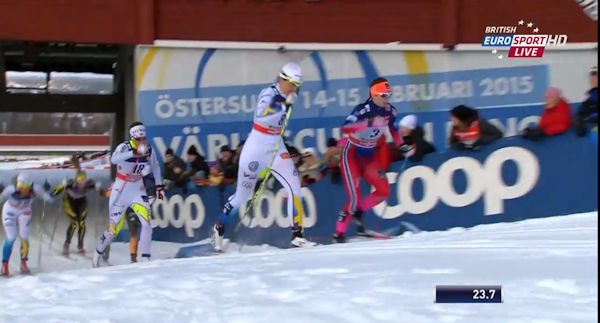
Pål Golberg (6) and Ola Hattestad of Norway slide off course in Saturday’s 1.2 k classic sprint in Östersund, Sweden. (Photo: CCC)
With Hattestad and Golberg in the lead, the skiers rounded a sharp corner before climbing the final hill. It was there the Norwegians fell victim to a race-ending crash as Hattestad slid into Golberg and the two flew off the course. With the leaders out, Pellegrino and Harvey took advantage of the situation to cruise into first and second.
“I still think I would have snuck into a lucky loser spot because our heat was really fast,” Harvey speculated in a post-race interview. “I was second but I think if those guys had stayed on their skis I would be lucky loser.”
Harvey once again started near the back of the pack in the semifinal, but surged ahead in the second half of the course to take second behind Fossli and ensure his advancement to the final. He explained that his skis in the quarterfinal had too much kick but that they were perfect by the time he started the semifinal.
“In the second lap I knew that guys would start fading a bit, so I was able to make my way to the front,” Harvey said of the heat.
In the final, Harvey had a slow start but inched forward through the pack over the first lap. By the time Krogh attempted to break away from the six men, Harvey was the first to respond, trailing the Norwegian closely and breaking even with him throughout much of the remaining meters.
“I think physiologically I’m not as fast as the pure sprinters. I’m not fast enough on the first lap, but on the second lap the pure sprinters get a little tired and I stay the same,” Harvey explained of his ability come from behind in the final.
Heading into the finish, Harvey lost a little ground to Krogh and was unable to match the Norwegian’s speed in the final 100 meters. Although the win was just out of sight, Harvey maintained his speed to outlast a late charge by Bakken.
“I was close to being perfect but just missing a little at the end,” Harvey said of the final.
Bakken, who skied in his first-ever World Cup final and notched a first career podium, said that the course favored his strengths and that the roughly 10,000 person crowd in Östersund was impressive because of their enthusiasm.
“I felt this was a good course for me and I am happy to have my first World Cup podium. I am Norwegian Champion this year but I have not much success on World Cup so this is a great feeling,” Bakken said to FIS.
Valjas 13th, Jones 21st for Canada
Harvey’s teammate Lenny Valjas was the only other Canadian male to qualify for Saturday’s heats in 18th position. In the quarterfinals, he spent much of the race in last position but was able to take advantage of a crash by Sweden’s Calle Halfvarsson to advance through the pack and take third. Valjas was only 0.05 seconds away from a lucky loser position and ultimately finished his day in 13th.
Jess Cockney was the final Canadian male, placing 75th.
Canada’s Perianne Jones skis behind Norway’s Celine Brun-Lie and Sweden’s Ida Ingamarsdotter in the quarterfinals of Saturday’s 1.2 k classic sprint in Östersund, Sweden. (Photo: CCC)
For the women, Perianne Jones raced to 18th in qualification. She skied to fifth in her quarterfinal to claim 21st overall.
“My qualifier was great – for sure the strongest one this year by far,” Jones wrote in an email. “I had some great skis, and executed everything the way I wanted to. I maybe used a little too much energy on the first lap, but overall I was really happy with it.”
Jones said that while she was in good position early on in her quarterfinal, she was unable to match the leader’s speed and lost ground.
“I wouldn’t have done anything differently, I need to be able to ski with those girls for the entire race, not just the first half,” she wrote.
In her first World Cup start, teammate Olivia Bouffard-Nesbitt was the only other Canadian woman to race Saturday. She finished 55th overall.
Harvey will not participate in Sunday’s 15 k freestyle individual start. He explained that while he wanted to use the race as training, his coaches’ plan said otherwise. As he and the Canadian squad shift their focus to World Championships, which start Feb. 18th, Harvey said that Saturday’s result is a boost before the year’s most anticipated races.
“It gives me a lot of confidence. I think the speed is there for sure and I know the endurance is there too,” he explained.
According to Harvey, the key to a successful championships will be to stay healthy and stick to his planned routine.
“I need to stay healthy. That’s always number one,” he said. “It’s routine now. I’ve been to a lot of championships, even from my junior days. I know the drill and how to prepare. So I’ll just stick to the plan and trust the plan and trust the shape.”
Canada’s Alex Harvey (r) congratulates Norwegian winner Pål Golberg at the finish of Friday’s 1.5 k freestyle sprint final. Harvey placed fifth for a season best. (Photo: Fischer/NordicFocus)
If you don’t count the Norwegians, most everyone’s skis in Friday’s 1.5-kilometer freestyle sprint were relatively even in terms of speed, according to men’s finalist Alex Harvey of Canada.
But the reality is, Norway is a big part of essentially every World Cup race, let alone one in Lillehammer, Norway. Their often-superior skis can be pivotal to their success, but they’re not the only thing they rely on.
Unless you ask Pål Golberg.
The men’s 1.5 k freestyle sprint podium on Friday at the World Cup mini tour in Lillehammer, Norway, with Norway’s Pål Golberg (c) in first, Russia’s Alexey Petukhov in second (l) and Norway’s Finn Hågen Krogh in third. (Photo: Fischer/NordicFocus)
After winning the men’s skate sprint — the first of three races in Lillehammer’s mini tour — by 0.24 seconds over Russia’s Alexey Petukhov, Golberg said in a press conference that his skis were so good, he simply had to believe he could win.
While that was easier said than executed, the 24-year-old Norwegian’s thought process worked.
“I have a past as a sprinter, so I should be doing well here,” Sundby told NRK. “But it’s fun to prove that I can do both [sprint and distance].”
Golberg stood as the sixth-fastest qualifier behind Russia’s Sergey Ustiugov, who clocked the fastest time of 3:14.99. In the qualifier standings, he followed his teammate Finn Hågen Krogh in second, Petukhov in third, Norway’s Petter Northug in fourth, and Sweden’s Calle Halfvarsson in fifth. Ten Norwegians qualified in the top 30, including several distance specialists: Sjur Røthe (in ninth), Martin Johnsrud Sundby (13th) and Niklas Dyrhaug (20th).
But Golberg, who’s notched seven World Cup podiums in sprints and won a 15 k classic in Lillehammer in 2013, went on to win his quarterfinal on Friday in a photo finish with Norwegian U23 Team member Emil Iversen. He beat out Sweden’s Emil Jönsson, Norway’s Ola Vigen Hattestad, Halfvarsson, and Great Britain’s Andrew Musgrave, in that order, with the second-fastest quarterfinal time of the day in 3:18.56.
Far from done, Golberg squeezed out another victory in his semifinal, this time over Finland’s A-team sprinter Juho Mikkonen in second and Ustiugov in third in a three-way photo finish. (Northug was relegated from fourth behind Ustiugov to last after cutting off Ustiugov in the finishing straight. Jönsson received a warning for a similar action in the quarterfinal, after impeding Iversen.)
Krogh won the other semifinal after dominating his quarterfinal as well — initially beating out France’s Jay Renaud by 0.22 seconds, Harvey (+0.36) and Mikkonen (+0.48), then winning his semifinal in 3:19.57, about 1.7 seconds faster than Golberg. He topped Petukhov (+0.11), Iversen (+0.37), Harvey (+0.59), Larkov (+0.66), and finally, Jay (+1.61) to do so.
Despite finishing third and fourth, Iversen and Harvey advanced to the final as lucky losers with the next-fastest semifinal times. For Harvey, it was his second time advancing in that fashion after doing the same with Mikkonen in the quarterfinal.
From there, teammates Golberg and Krogh would meet in the final, along with 23-year-old Iversen — and Petukhov, Mikkonen and Harvey.
“I knew I had good glide,” Golberg recalled in a translated interview with NRK. “If I managed to keep my back to Finn, I knew I was the only one who stood between myself and the finish. My skis were so good they almost did the job on their own.”
That kind of confidence allowed Golberg to sit patiently behind until the final climb, when he caught a ride out of the sharp lefthand-downhill corner and glided into the start of the long hill. Positioned around fourth with Petukhov and Iversen in tow, Golberg and Petukhov swallowed Harvey in third coming out of the bend. Golberg carried his momentum and attacked for second place by the top, trailing Krogh into the stadium. Petukhov went with him.
Pål Golberg (l) takes on Krogh (2) and Petukhov (3) for the win in Friday’s 1.5 k freestyle sprint at the Lillehammer World Cup. Golberg won it by 0.24 seconds. (Photo: Fischer/NordicFocus)
With a downhill into and around the final curve before the finish, Golberg and Petukhov put the pressure on Krogh — an early leader in the final. Golberg trusted his skis once more and powered past Krogh, winning in 3:20.51 while Krogh and Petukhov duked it out for second. Petukhov emerged on the better end of the photo finish, five-hundredths of a second faster than Krogh for second and 0.24 behind Golberg.
After taking a gutsy leap to the front out of the start, Mikkonen held strong for fourth (+0.56) and Harvey ran out of gas but pushed for fifth (+1.13) ahead of Iversen in sixth (+4.15).
“Right after the finish I was not so satisfied,” Krogh told FIS after cameras caught him shaking his head in disappointment. “I wanted to win, but now I am happy. My plan was to gain a gap before the final stretch, maybe if the gap was bigger I could have won.”
Petukhov explained he knew he had to catch Krogh and Golberg if he wanted a shot at the win.
“I think I could have skied better tactically today, but I am happy for the second place. Pål was very strong today,” he told FIS.
Harvey had similar respect for Petukhov and Krogh.
“I knew from the beginning that the last uphill was crucial,” he said in a phone interview with FasterSkier. “Finn Hågen has won skate sprints on big uphills and Petukhov is a beast on skate sprinting up big hills, so I knew what their move would be even before I skied with them, and I knew I had to make a move there, but for me it’s hard. I feel good coming into that last uphill, but I just can’t go, I just don’t have it yet. I knew I had to position myself first, second or third before the last downhill, but I just couldn’t do it because I didn’t have the jam in there.”
Day 1 put Golberg in the mini-tour lead by 2 seconds over Petukhov. Krogh is 4.9 seconds back in third, Mikkonen 10.2 in fourth, Ustiugov 11.5 in fifth (thanks to bonus seconds from his qualifier win), and Harvey 11.8 seconds back in sixth.
“It set me up good now I have to make sure I stay in the top five,” Harvey said. “After tomorrow, a couple of the guys ahead of me will slip after the 10 k [freestyle]. I think I’m in a good position, something like 15 seconds clear of Sundby and [6.6 seconds ahead] of Petter so I have to use that to my advantage tomorrow.”
Sundby, who was third in his quarterfinal (behind Golberg and Iversen) for 14th overall on Friday, is currently 15th in the mini-tour standings, 27 seconds behind Golberg. Northug, who ended up 12th after being relegated to last in his semifinal, sits in 10th, 18 seconds back from the leader.
“Martin has put himself in a good position [for the mini tour], but I have the best [position],” Golberg told VG with a smile.
“Tomorrow what matters is not the position, it’s the time behind the leader or maybe be the leader,” Harvey said. “Just be able to start in a good group on Sunday. I couldn’t have asked for a much better position than I am now. Any time you make a final in a mini tour or a Tour de Ski, you get a lot of advantage [in that mini tour] compared to other distance skiers.”
The only North American man to qualify for the rounds in 22nd, 6.26 seconds off the top qualifying time, Harvey went on to experience the angst and joy of being a lucky loser twice.
Third in his quarterfinal behind Krogh and Jay, he said he could tell their heat was a fast one based on the way it felt and information from his team’s wax technicians.
“I knew we had a chance of lucky loser already because I knew the first three heats were pretty slow — the techs said they were just crawling up the hill,” Harvey said. “Then I had a good finish, but already I could tell that I was missing some push, some power on the last uphill. Like in offset [V1] on the steep stuff, I was feeling fresh entering that uphill, but I could never have enough speed as the sprinters, but I was lucky to have a fast-enough finish.”
Krogh led their quarterfinal early on, and Poland’s Maciej Starega put himself in second early just ahead of Røthe. Harvey moved from fourth to third, eventually behind Krogh and Røthe, on the long descent before Jay attacked on the climb and Harvey slipped to fifth. The Canadian recovered, pushing into the stadium for third, 0.12 seconds ahead of Mikkonen, who came on late for the last lucky loser spot into the semis.
In the semifinals, Harvey knew his heat had to be faster than the first if he wanted to make the final.
“I knew that the first semi had gone really slow, so the plan was if I could take the lead, I would just go full blast and try to clock a decently fast time to give me a better chance at making the final,” he said. “With a mini tour like that, you get a lot of bonus seconds [for making the final].”
And that was his overarching goal. More bonus seconds meant a more competitive position for the second day of racing.
So, to the Eurosport announcers’ surprise, the usually calm-and-collected Harvey took control out of the start of his semifinal. From their estimations, he was “trying to conserve energy whilst leading” and did so all the way into the base of the big climb before the finish.
However, Krogh and Petukhov shot passed him on the way up it, and Harvey entered the final straight in fourth behind Iversen.
Regardless of his place, his tactic worked. Harvey heard a split after the first climb, around 40 seconds into their semifinal, that they were two seconds faster than the first heat. If they held up that pace, he knew he could finish outside the top two and still make the final.
“I’m usually pretty slow at the start so sometimes that’s my plan, to go to the front and push the pace, but it’s not every day that it happens,” he said.
In the final, Harvey said he looked back for the first time all day because he couldn’t hear anyone behind him — when he was in third behind Krogh and Mikkonen.
“About two-thirds of the way, we had a little gap,” he said. “[I looked back and] I saw that Petukhov was like four or five meters behind. I thought maybe we had a chance to break away and we did.”
Heading into the big hill, which he described as not as steep but longer than Kuusamo’s final 240-meter climb at around 315 meters, Harvey struggled to stay with the pace once again. It didn’t help him that fresh snow overnight made the track slower, and required V1 instead of the V2 he had been able to use to ski up it on Thursday.
“I felt good; I didn’t feel like I was spent or anything,” he said of his last time up that hill. “[Golberg and Petukhov] were side by side with me when we hit the really steep stuff, and when I switched to offset, I was going as hard as I could and I was still in a good position. Had I been strong, I would’ve been able to crest over the top in second place.
“It’s really my weakness in skating,” Harvey added. “I’m working on it, I improved a bit, but I’m still not the world’s best. To make a move like that when you’re in the final and you’re against two, three other dudes that are really good, you have to really be one of the best to make a difference there.”
Regardless, it was Harvey’s best result of the season so far. “Last year, I had three wins, and they were all in skating. … I think my best performances over time are in skating,” the 2013 World Championships classic-sprint bronze medalist said.