From the FasterSkier archive — posts syndicated from athletes’ and coaches’ own blogs between 2004 and 2012, kept online as published. Current coverage is at fasterskier.com.
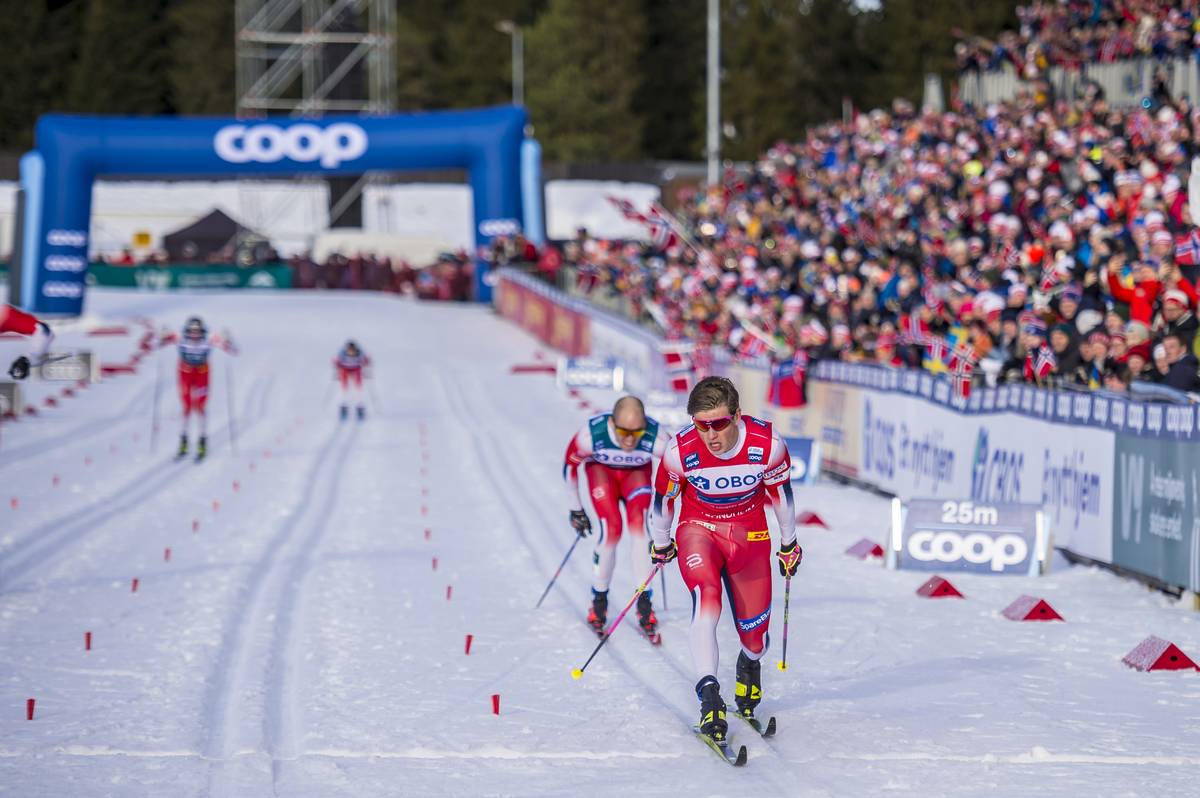
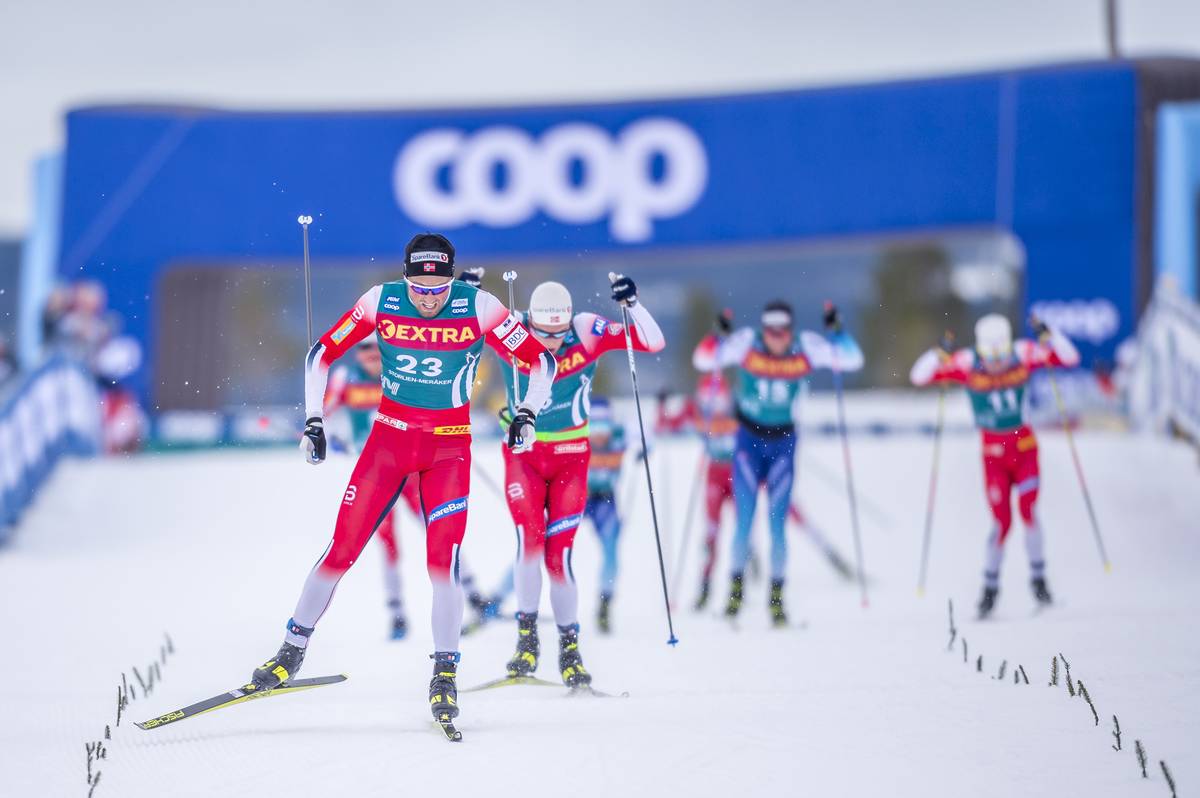
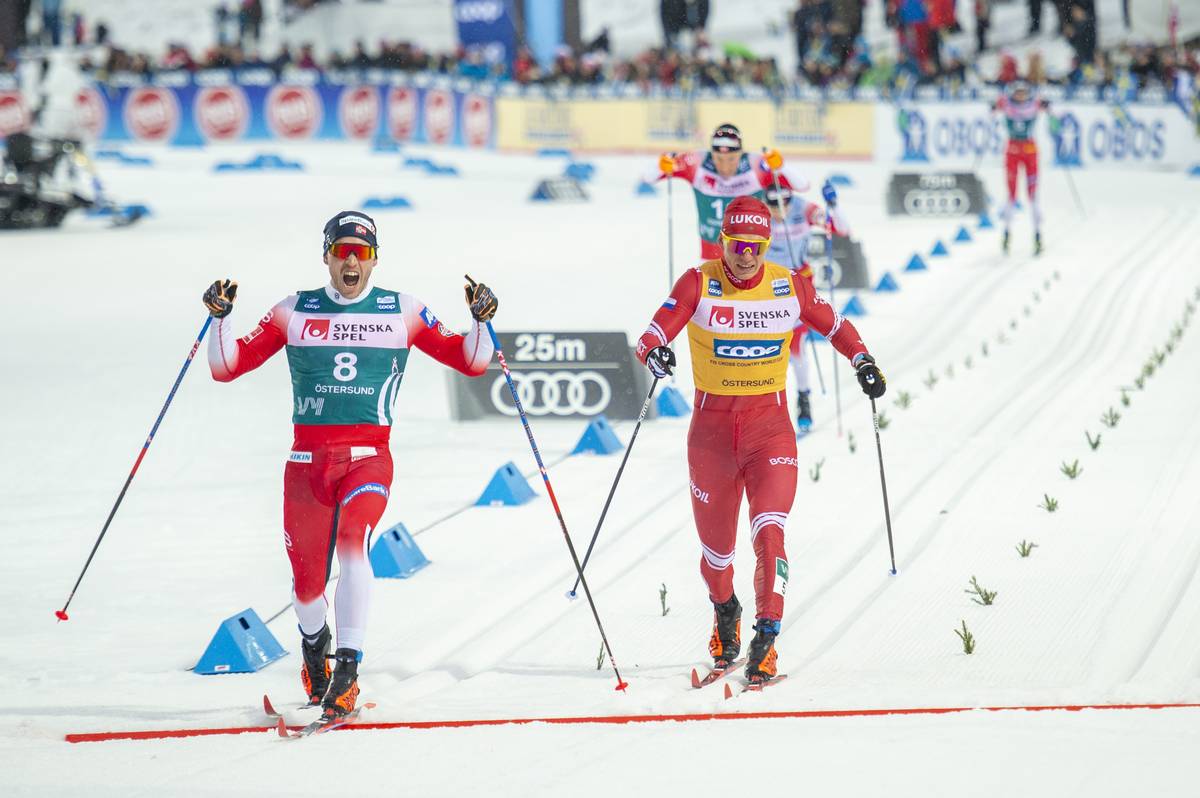
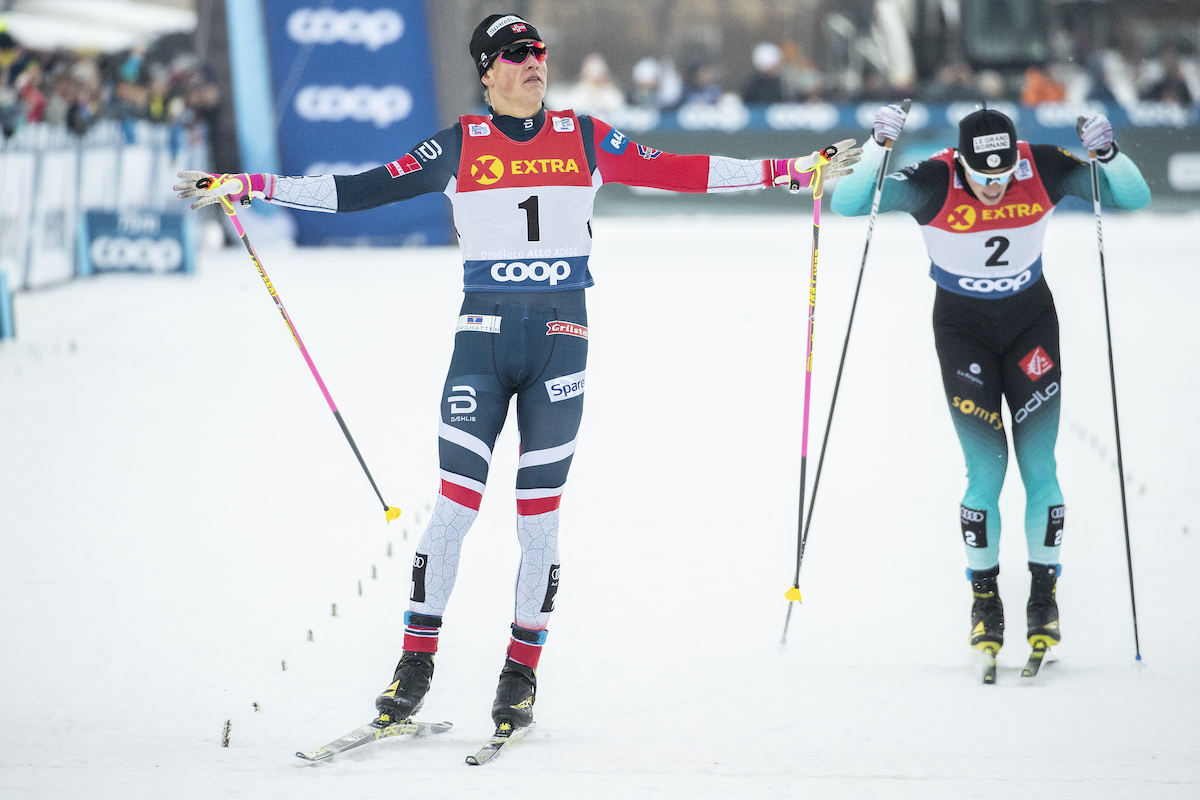
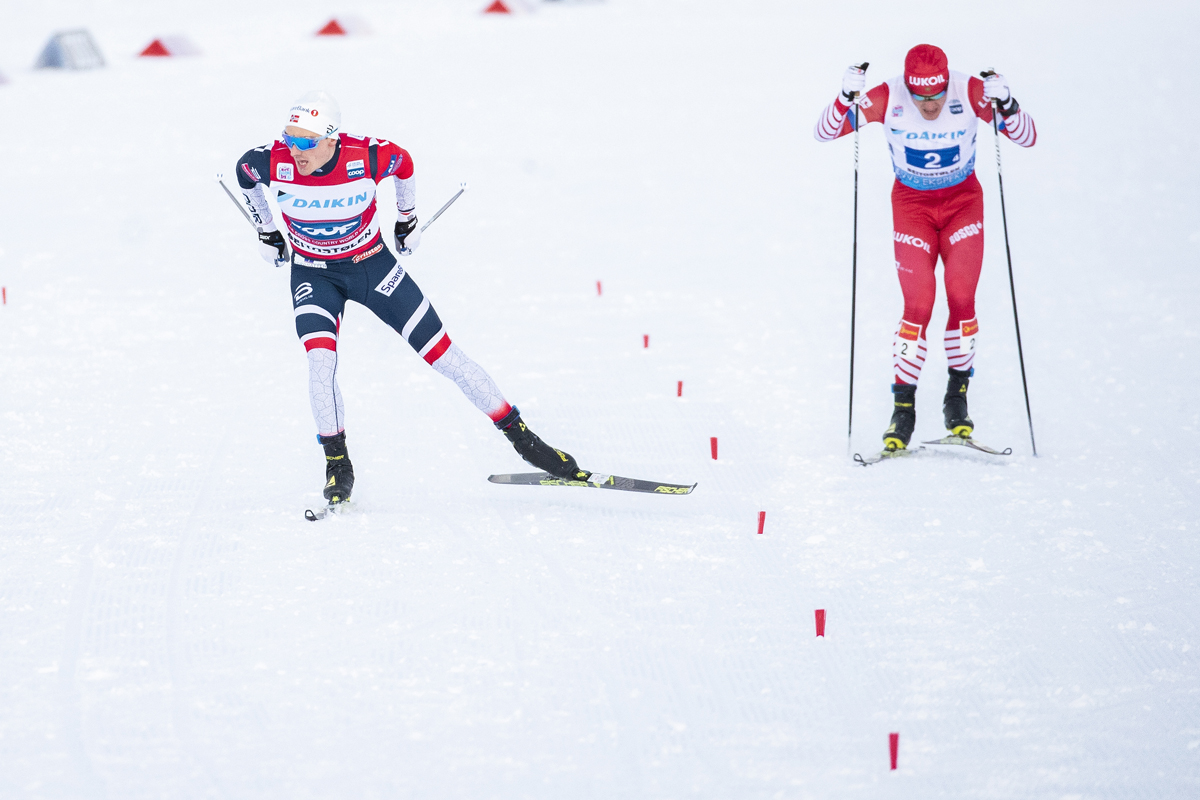
Norway’s Johannes Høsflot Klæbo crossing the line first for the last time of the day on Saturday to win the men’s 1.5 k classic sprint final, Stage 5 of the Ski Tour 2020, ahead of his teammate Pål Golberg, in his hometown of Trondheim, Norway. (Photo: NordicFocus)
Takeaways from Stage 5 (of 6) of the Ski Tour 2020? Alexander Bolshunov no longer has his minute-plus cushion to Pål Golberg in the overall, and Johannes Høsflot Klæbo is rounding into G.O.A.T. (Greatest-Of-All-Time) form.
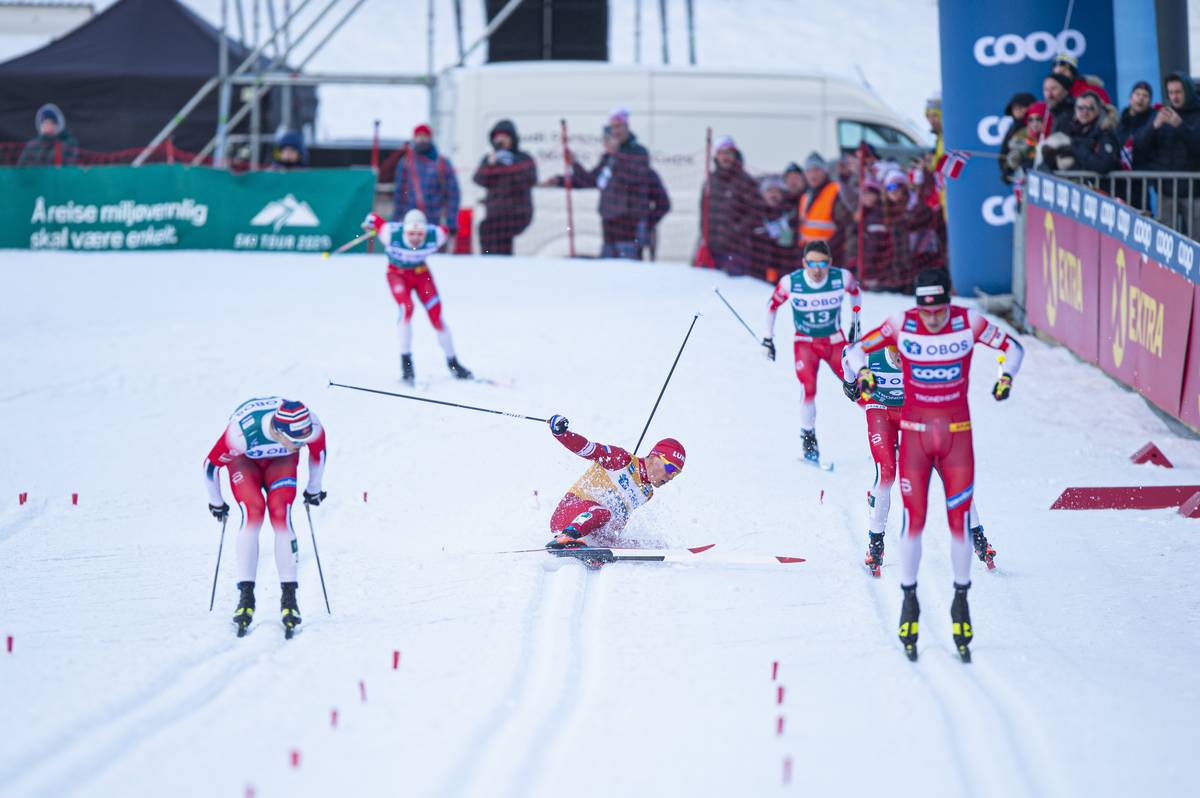
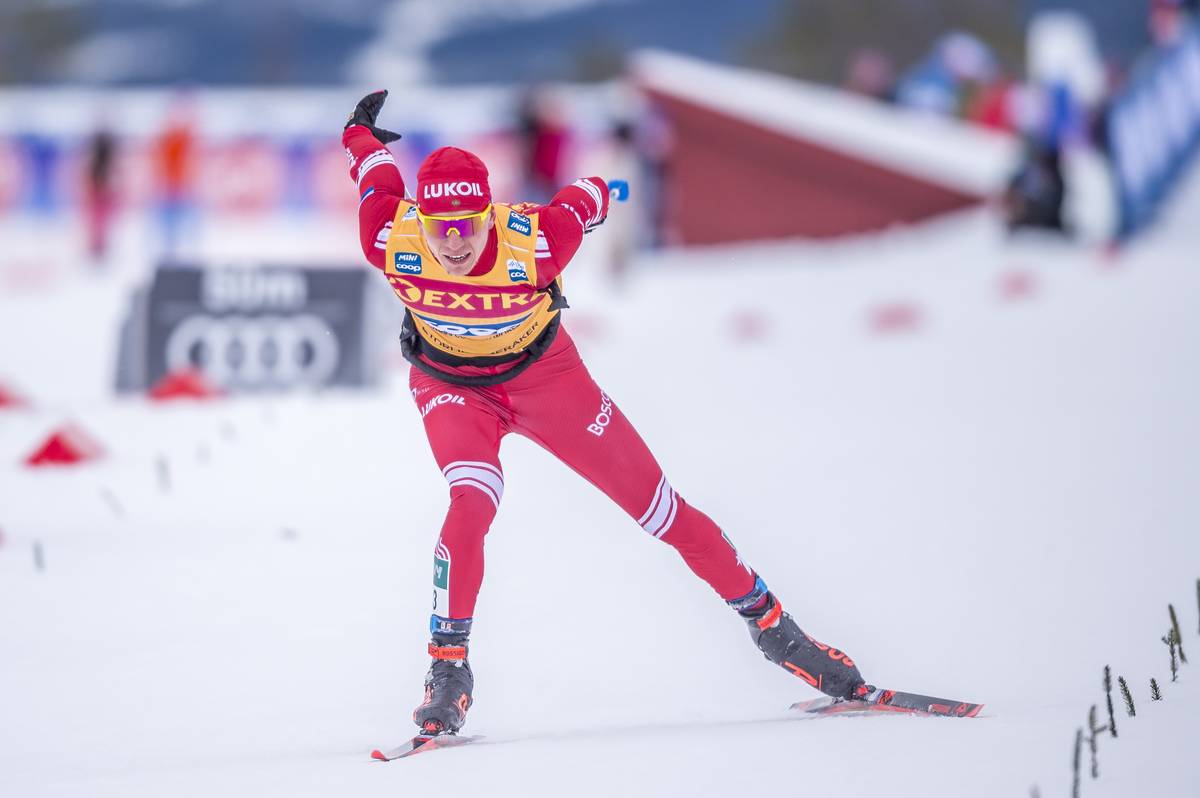
The 23-year-old Bolshunov, a Russian powerhouse who won the Tour de Ski last month, ranks first in the overall World Cup standings, and has landed on the podium in four out of five races so far this month (before Saturday’s classic sprint), crashed and burned in Saturday’s semifinal. He took himself out while switching tracks with 100 meters to go, clipping his left leg with his right ski and falling out of contention (from fourth to sixth) in the finishing straight. That was the end of his day, and his 1:05-minute lead in the Tour standings was reduced to 34 seconds on Golberg, who kept himself in prime position by finishing second to Klæbo in the final.
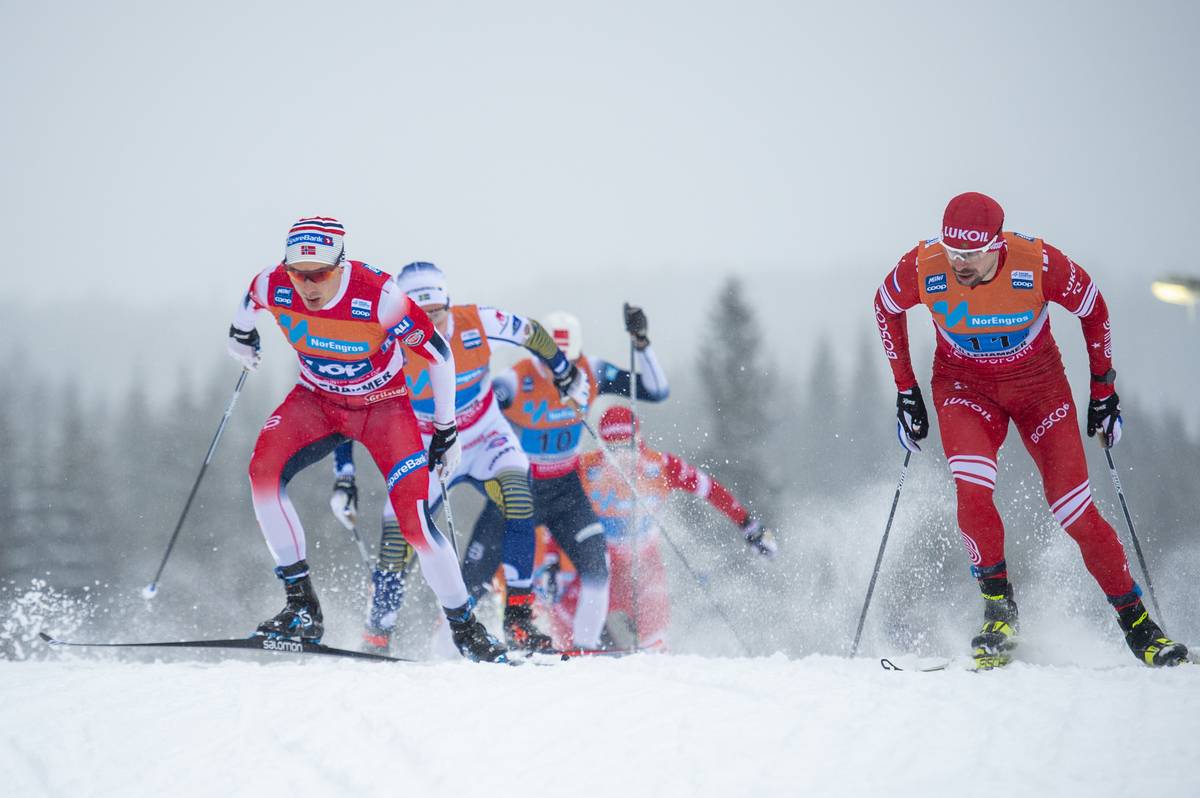
Russia’s Alexander Bolshunov (center) takes an untimely tumble with 100 meters to go in the first men’s semifinal of the 1.5 k classic sprint at the Ski Tour 2020 on Saturday in Trondheim, Norway. Up front, Norway’s Johannes Høsflot Klæbo (r) skis to first in the heat. (Photo: NordicFocus)
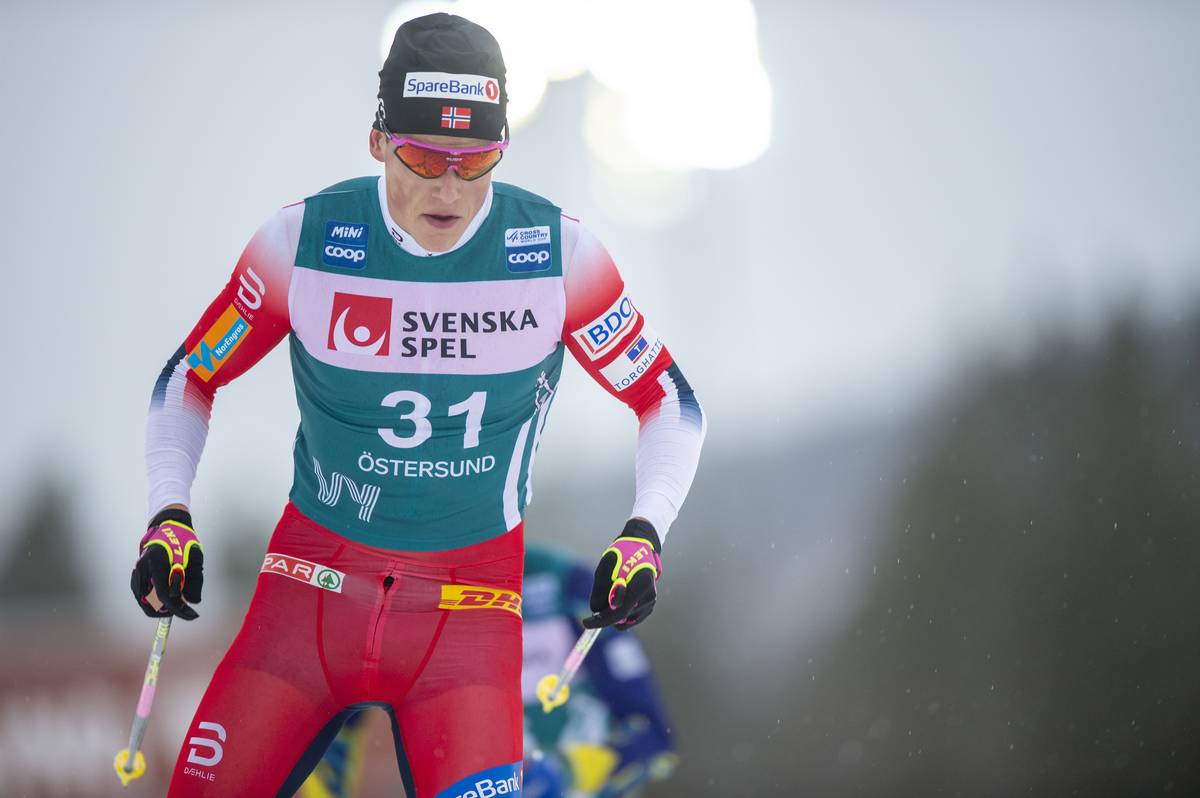
Then there was Klæbo, also 23, second in the overall World Cup standings and a Norwegian celebrity in his hometown of Trondheim, who did what he does best — dominate a sprint race — in front of a slew of familiar faces. He had never won a race at home in Trondheim before, and he did so Saturday in the men’s 1.5-kilometer classic sprint for his 14th straight World Cup individual win and 49th World Cup podium.
“I’ve been dreaming about this since I knew we were coming here,” Klæbo said of his latest victory in a post-race interview with the International Ski Federation (FIS) on Saturday. “So to be able to win here is just amazing, and I’m really proud to be able to win here today.”
He started the day by winning the qualifier by more than 2 seconds (over fellow Norwegian Erik Valnes +2.42 in second), and later advanced comfortably out of the quarterfinals and semifinals to the final. In the first quarterfinal, Klæbo cruised to second place behind Golberg, after Golberg set the pace up front for the bulk of the nearly 3-minute race, before decisively winning his semifinal (after passing Golberg on the last climb) by 1.2 seconds.
That semifinal saw five Norwegians — Klæbo, Golberg, Valnes, Finn Hågen Krogh, and Simen Hegstad Krüger — pinned against Bolshunov. They finished in that order after Bolshunov, who had qualified fourth and advanced in second behind Valnes in their quarterfinal, went down in front of the stands while Krogh and Krüger passed him by. Klæbo, who had the luxury and time to ease way off before the finish line, moved on to the final along with Golberg, Valnes, and Krogh. Bolshunov, who crossed the line nearly 17 seconds after Klæbo, did not, and he ended his day in 12th.
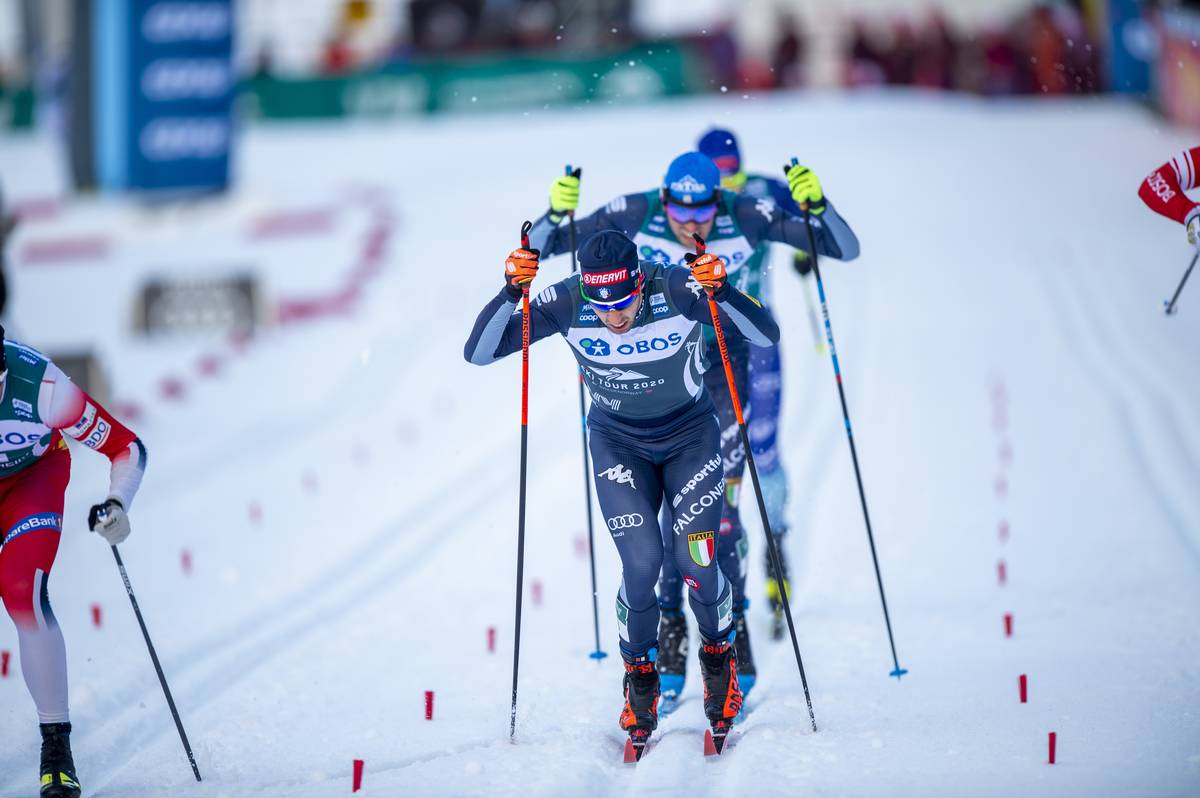
Powering up in Trondheim: Federico Pellegrino of Italy, followed by teammate Francesco de Fabiani . (Photo: NordicFocus)
The second semifinal was more diverse with two Italians — Federico Pellegrino and Francesco de Fabiani — going head to head with Norway’s Emil Iversen, Russia’s Gleb Retivykh, Finland’s Lauri Vuorinen, and Sweden’s Johan Haeggström. Wet snow that had begun in the later men’s quarterfinals had mostly stopped falling, and the sun began to poke through on the +3 Celsius afternoon.
On an early climb, Haeggström fell to his knees and broke his pole while skiing at the back of the pack. He quickly received a replacement, but wasn’t able to regain contact with the group while Pellegrino took charge up front. Despite leading into the stadium, Pellegrino lost some steam in the finishing stretch while Iversen came from behind to cross the line first, 0.3 seconds ahead of Pellegrino and 0.6 seconds ahead of Retivykh. Iversen and Pellegrino advanced to a nearly all-Norwegian final, with five men in red against the Italian in dark blue.
From there, it was another Klæbo jam sesh as the local hero set the tone in the final. Valnes initially led up the first climb while Klæbo, Golberg and Iversen followed closely. By the next uphill, Klæbo used his ferocious double pole to outmatch his teammates, who were still striding. Meanwhile, Pellegrino fell off the pace and into sixth. Klæbo kept the lead for the rest of the race, getting a gap on Valnes and Golberg on the descent into the stadium before running away with the win in 2:52:07. Golberg placed second, 1.2 seconds back, Valnes third (+1.6), Iversen fourth (+5.79), while Krogh, who also faded when Klæbo kicked into high gear, pulled some theatrics at the line and stalled before crossing 18.91 seconds back. Pellegrino finished last for sixth on the day, 22.78 behind Klæbo. That secured Klæbo’s spot as the men’s sprint champion for the Ski Tour 2020, while Pellegrino placed second, 13 points back, and Golberg was third, another 26 points back.
“It was an amazing day for us Norwegians,” Klæbo told FIS. “We had really good skis today, and I think we have done something right. It was a really fun race, and I think it’s an amazing to see how many people that actually come here and cheer for us. It’s something we really appreciate.”
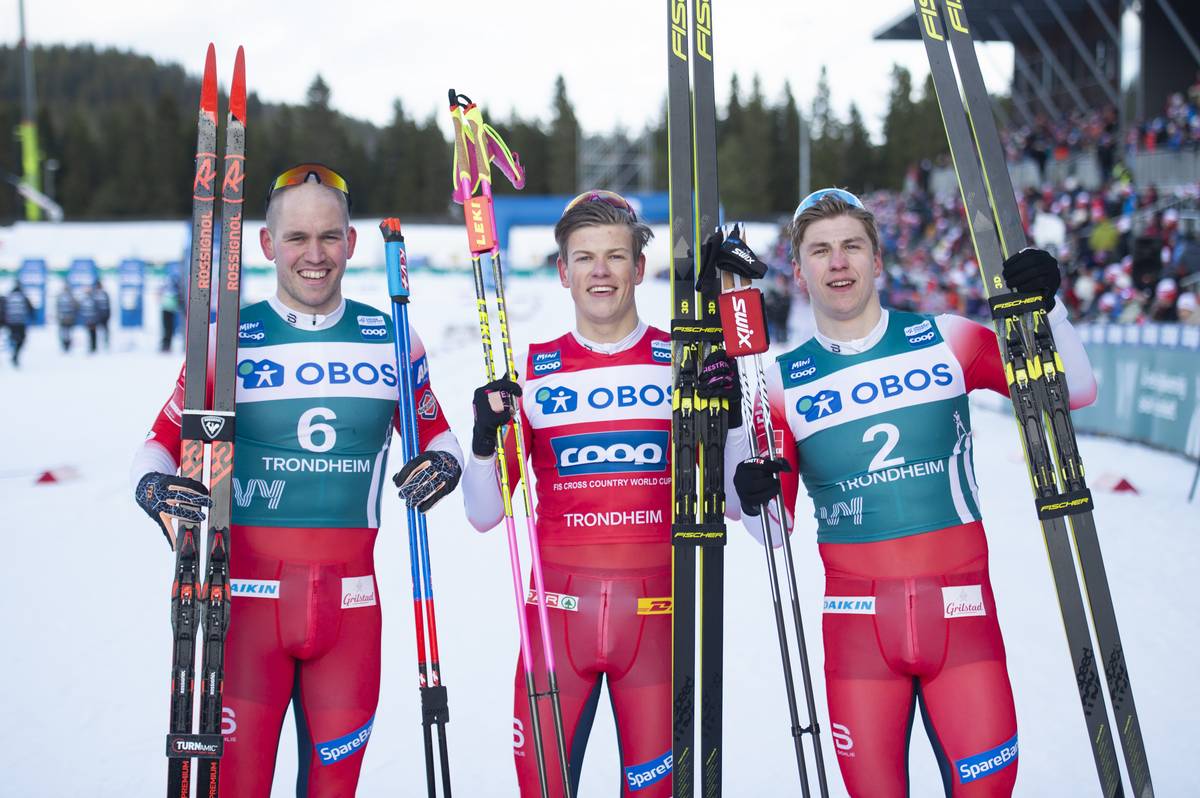
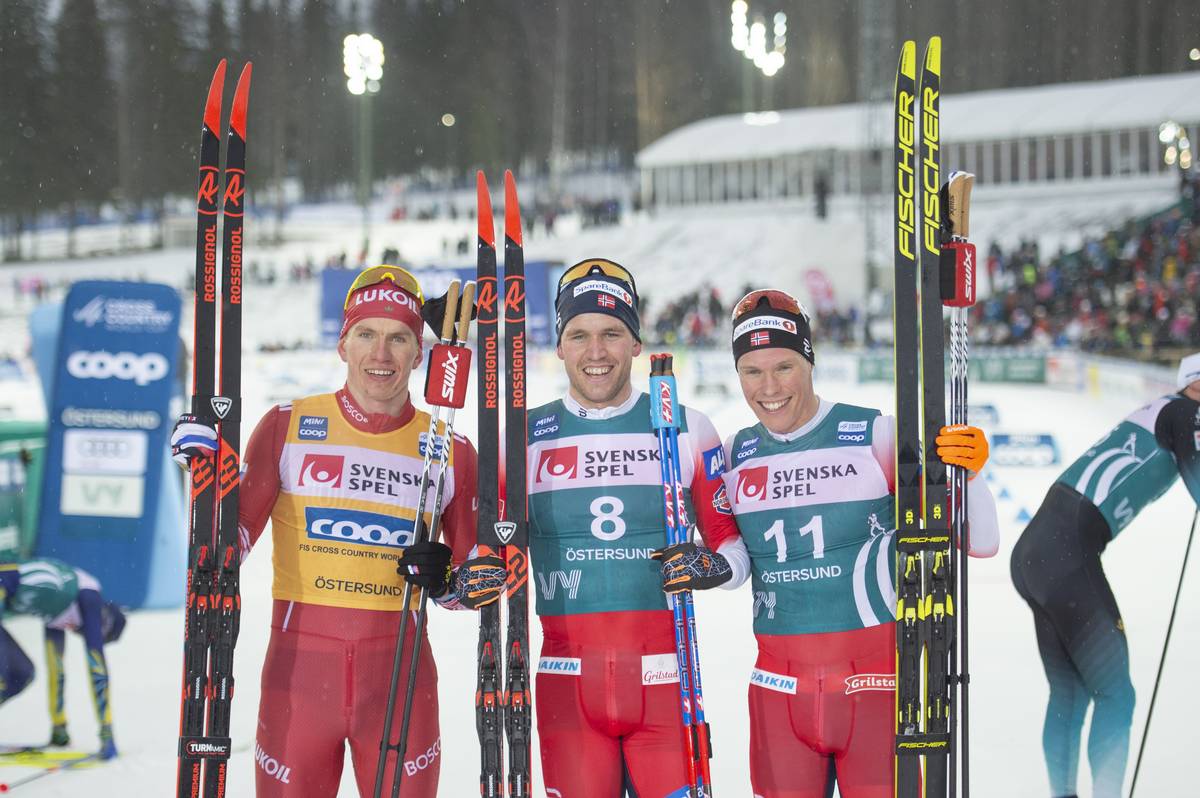
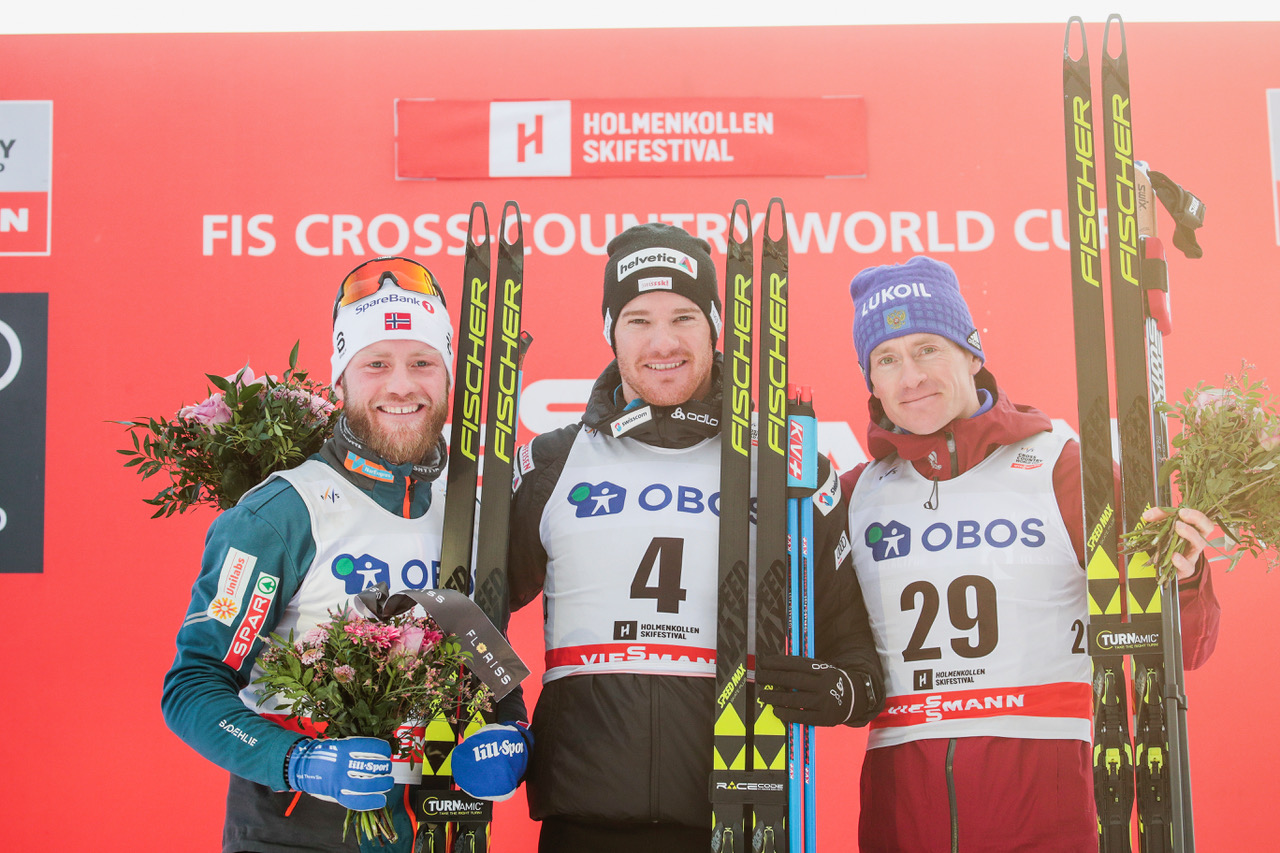
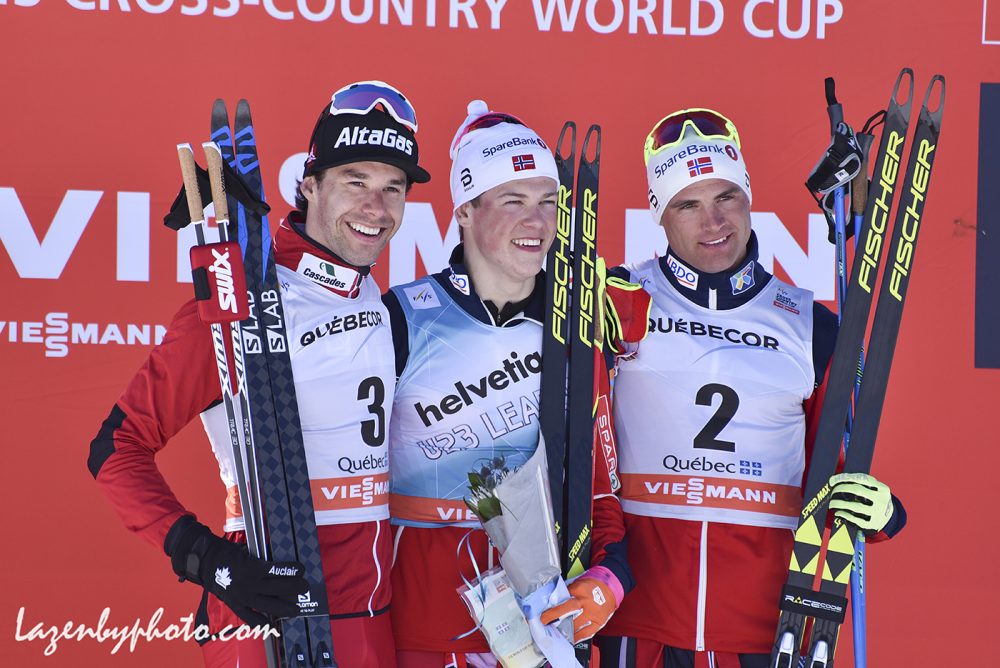
The all-Norwegian, Ski Tour 2020 Stage 5 men’s 1.5 k classic sprint podium on Saturday in Trondheim, Norway, with Johannes Høsflot Klæbo (c) in first, Pål Golberg (l) in second and Erik Valnes (r) in third. (Photo: NordicFocus)
In the overall Tour standings, Klæbo is up to sixth (+2:00.0) with one race — a 30 k classic pursuit — remaining on Sunday. Golberg will start 34 seconds behind Bolshunov, while Krogh in third overall will start just over a minute later (+1:35), ahead of Sjur Røthe (+1:40) and Martin Løwstrøm Nyenget (+1:46), also from Norway. In fact, eight of the top 10 men in the overall Tour standings are Norwegian. The other two are Russian: Bolshunov and Andrey Melnichenko (9th place).
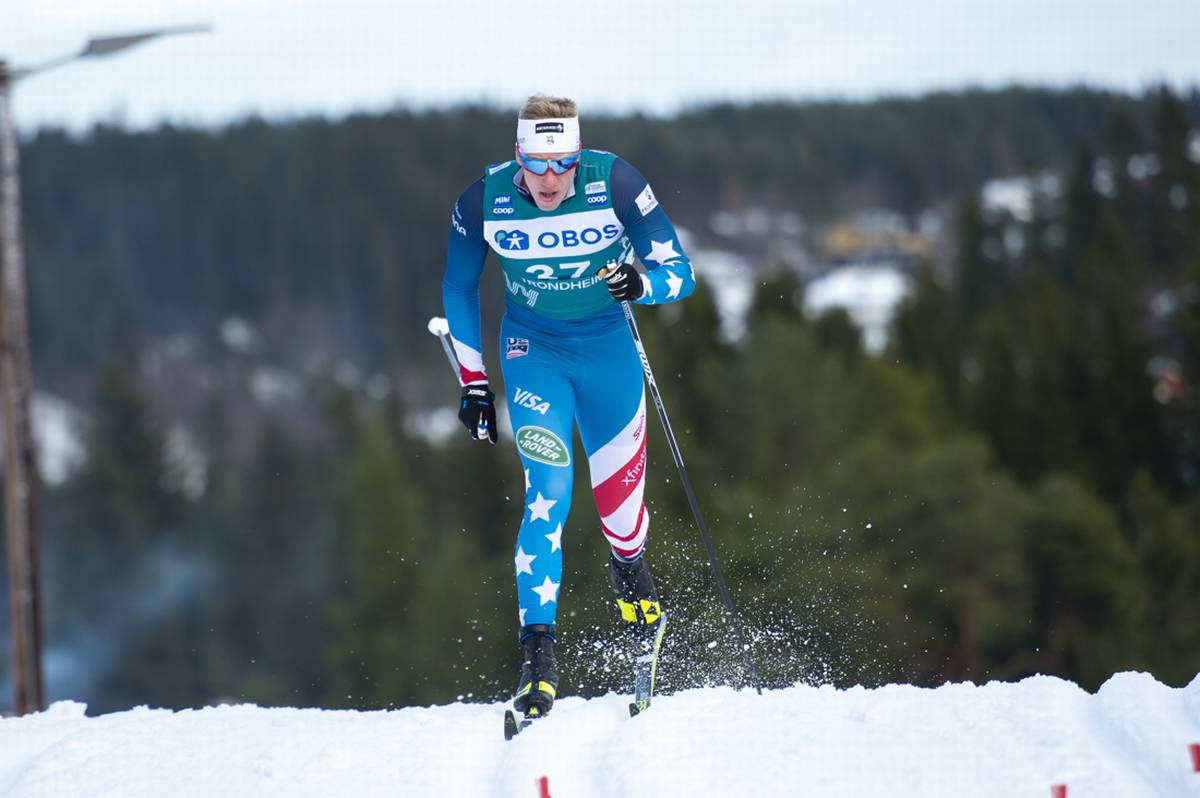
American Logan Hanneman (APU) racing to 34th in the men’s 1.5 k classic sprint qualifier at Stage 5 of the Ski Tour 2020 in Trondheim, Norway. (Photo: NordicFocus)
No North Americans qualified for the heats on Saturday, with Alaska Pacific University skier Logan Hanneman coming closest in 34th, 0.9 seconds out of 30th and 14.38 seconds behind Klæbo. Fellow American Kevin Bolger placed 48th (+17.28) while Canada’s Russell Kennedy followed in 49th (+17.43) in the qualifier. American Ben Lustgarten finished 57th (+18.81) while Canada’s Alexis Dumas, Evan Palmer-Charrette and Ricardo Izquierdo-Bernier placed 59th (+19.6), 61st (+20.54) and 62nd (+20.74), respectively. American David Norris was 69th (+23.81), while Simi Hamilton did not start and is thus out of the Tour.
According to U.S. Ski Team coach Matt Whitcomb, Hamilton and Bolger have mild head colds, and Bolger and Hanneman, who rank 64th and 71st, respectively, out of 73 still in the Tour, will not start Sunday’s final stage.
With the course re-routed from the original 38-kilometer mass start skate to essentially an out and back into Meråker, Norway’s ski stadium, the day belonged to Russia’s Alexander Bolshunov who appears, at this point in the season, to be unstoppable in the distance events.
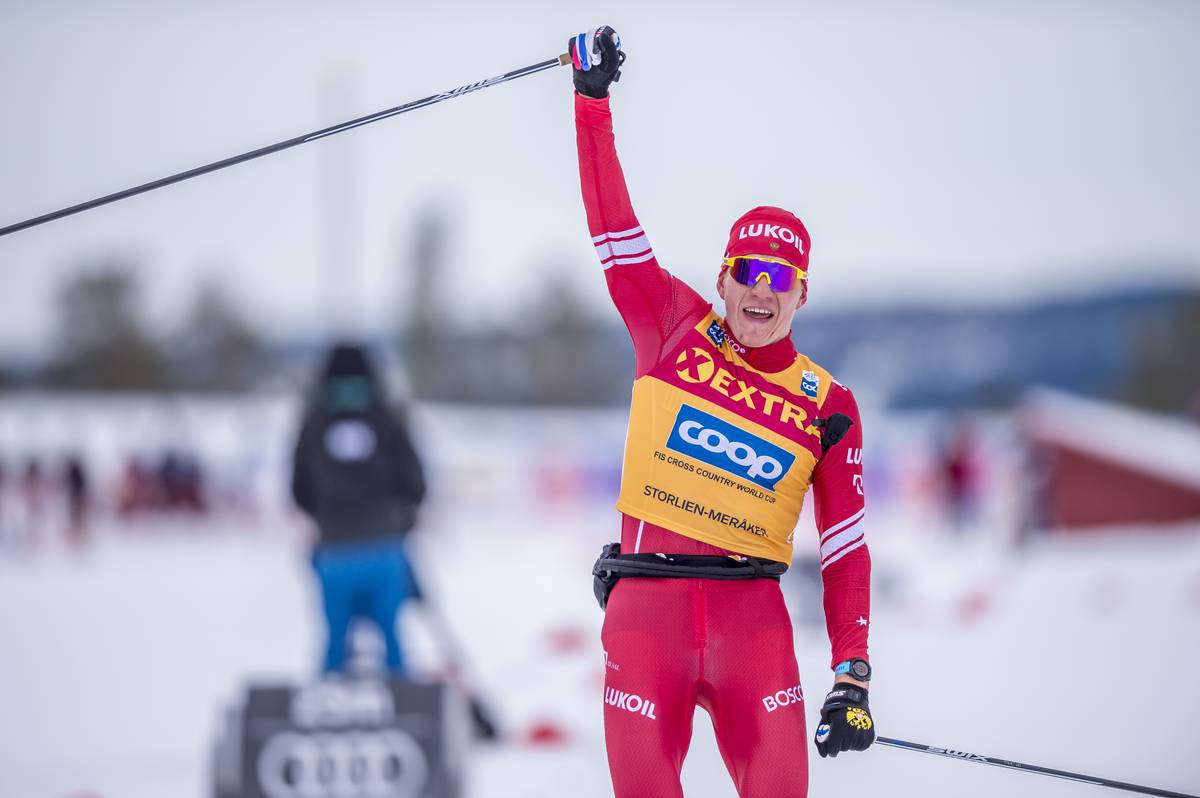
In the end, it was all Alexander Bolshunov: peerless. (Photo: NordicFocus)
In a post-race interview, Devon Kershaw noted that men paced it World-Cup comfortable for much of the first portion of the race. In other words, the effort up-front, although speedy for most, was not a break apart the 79 starters into small groups of similarly paced pockets of effort.
Fast forward to the 14 k mark, and 32 men came through the time check within 1.8 seconds. At that point, Jens Burman of Sweden was driving that train.
Through the race mid-point, the pack faced a steady headwind. Tactically, it made sense for any would-be endurance escape artist to wait until the turn home on the mostly out and back course, when a tailwind could aid their efforts, to make a move.
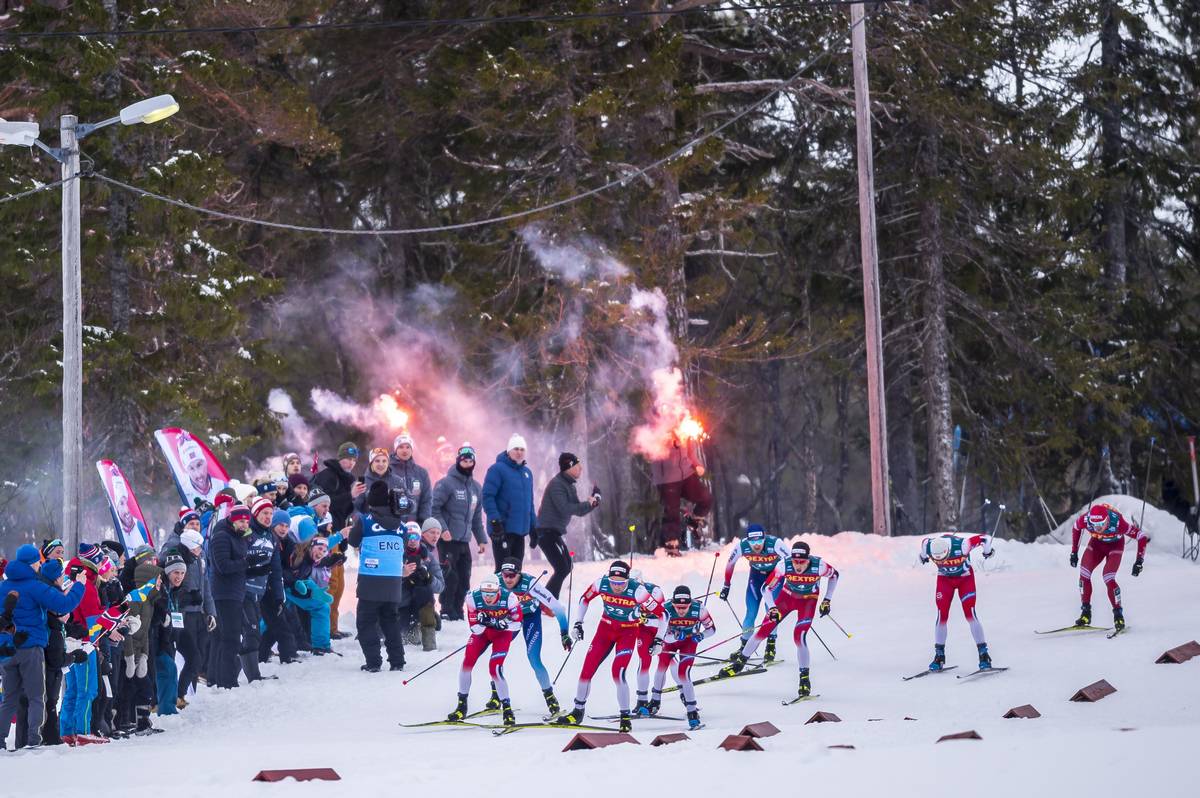
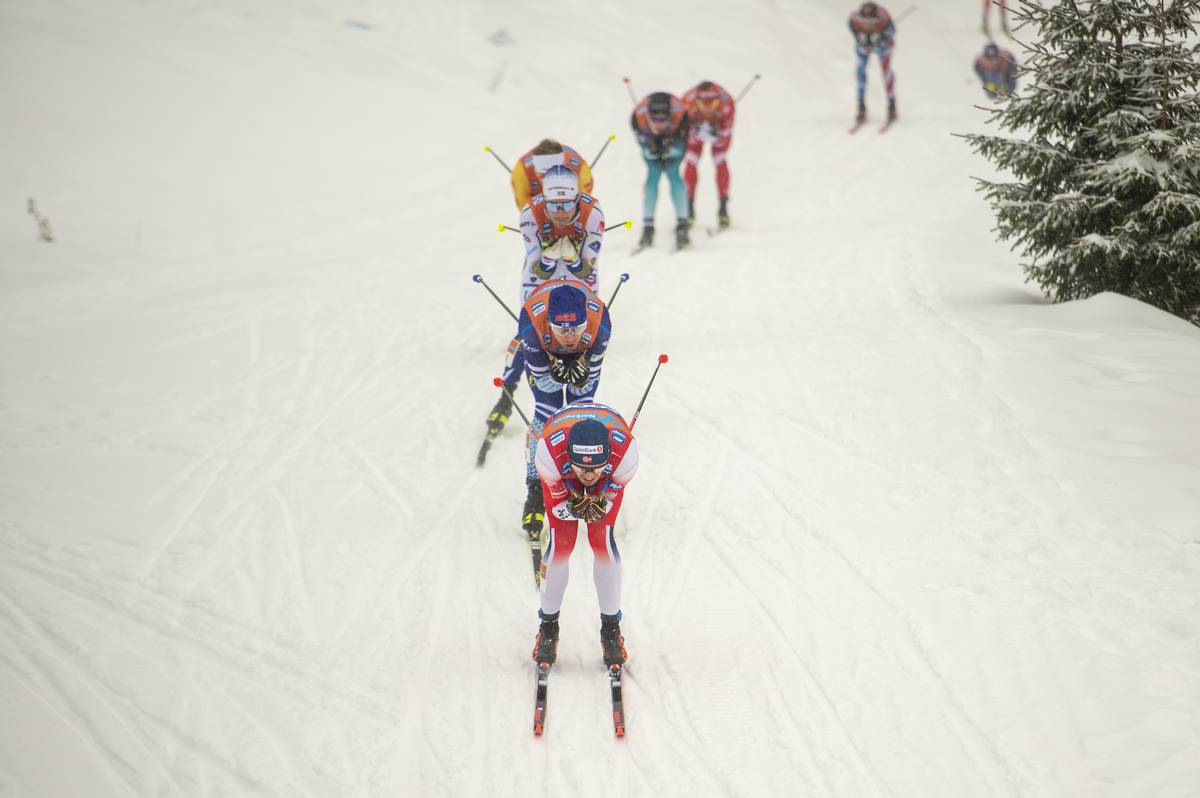
Pack skiing Norway style. (Photo: NordicFocus)
Sjur Røthe of Norway took big pulls leading as did his teammate Finn Hågen Krogh. Later in the race, Emil Iversen too sensed some podium opportunity. We could expand the list. But that would perhaps overshadow Bolshunov.
A select group began to pick up the pace as skiers sped towards the 20 k time bonus. This included Røthe, Krogh, Bolshunov, Iversen, and Johannes Høsflot Klæbo who came through the check-in 17th. (This was not the Norwegian national champs, although nine Norwegians, at that point, jammed the front 17 spots.)
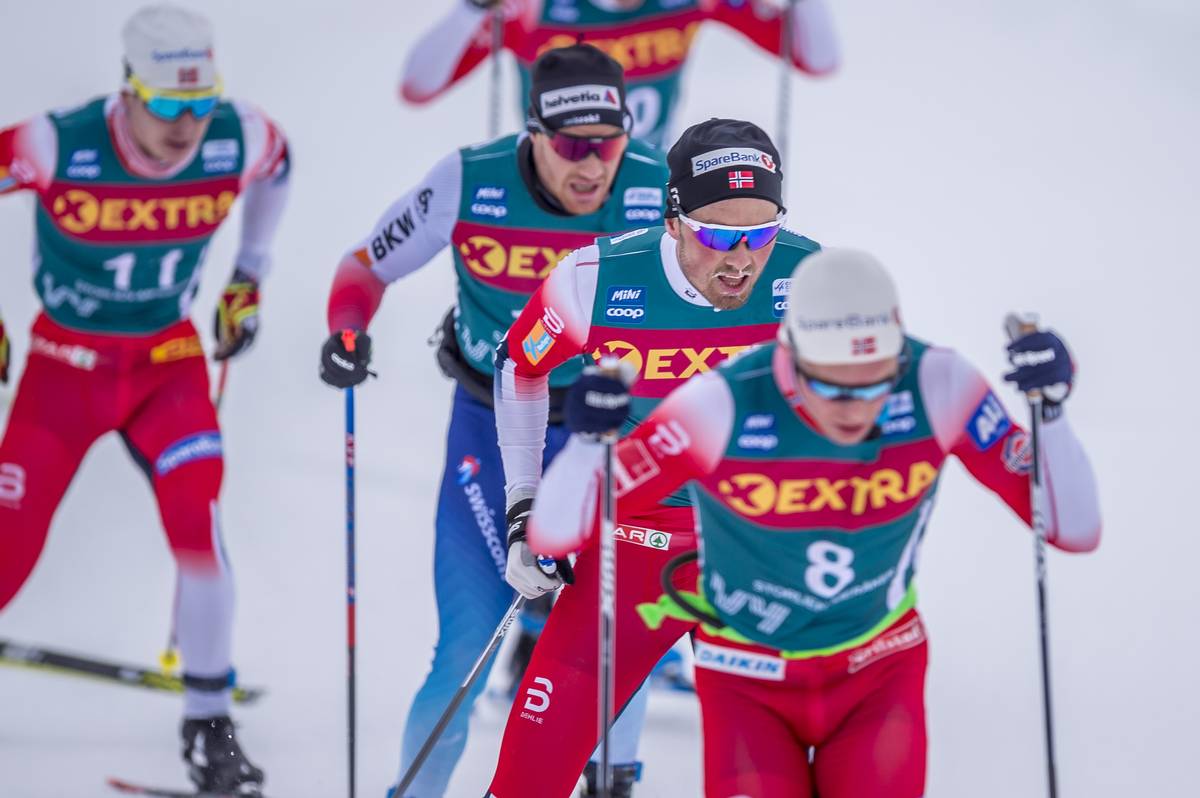
Martin Løwstrøm Nyenget (bib 8) leads Emil Iversen and Dario Cologna during the Stage 4, 34 k mass start skate. (Photo: NordicFocus)
Emil Iversen comes in for third place on Stage 4 of the Ski Tour 2020. (Photo: NordicFocus)
Post-20 k time bonus, Bolshunov wound up, uncoiled, and made a decisive move. He set off solo, accelerating ahead of the pack of star names, and was able to gap the chase by 51.7 seconds at the finish for a solo effort win in 1:19:34.9.
Solo: Alexander Bolshunov way way off the front. (Photo: NordicFocus)
Klæbo placed second (+51.7), and hometown skier Iversen third (+51.8). Places fourth through 11th were separated by roughly nine seconds.
Bolshunov leads the Ski Tour 2020 with a total time of 2:26:16 hours after four stages. Golberg is second (+1:05), and Røthe third (+1:06).
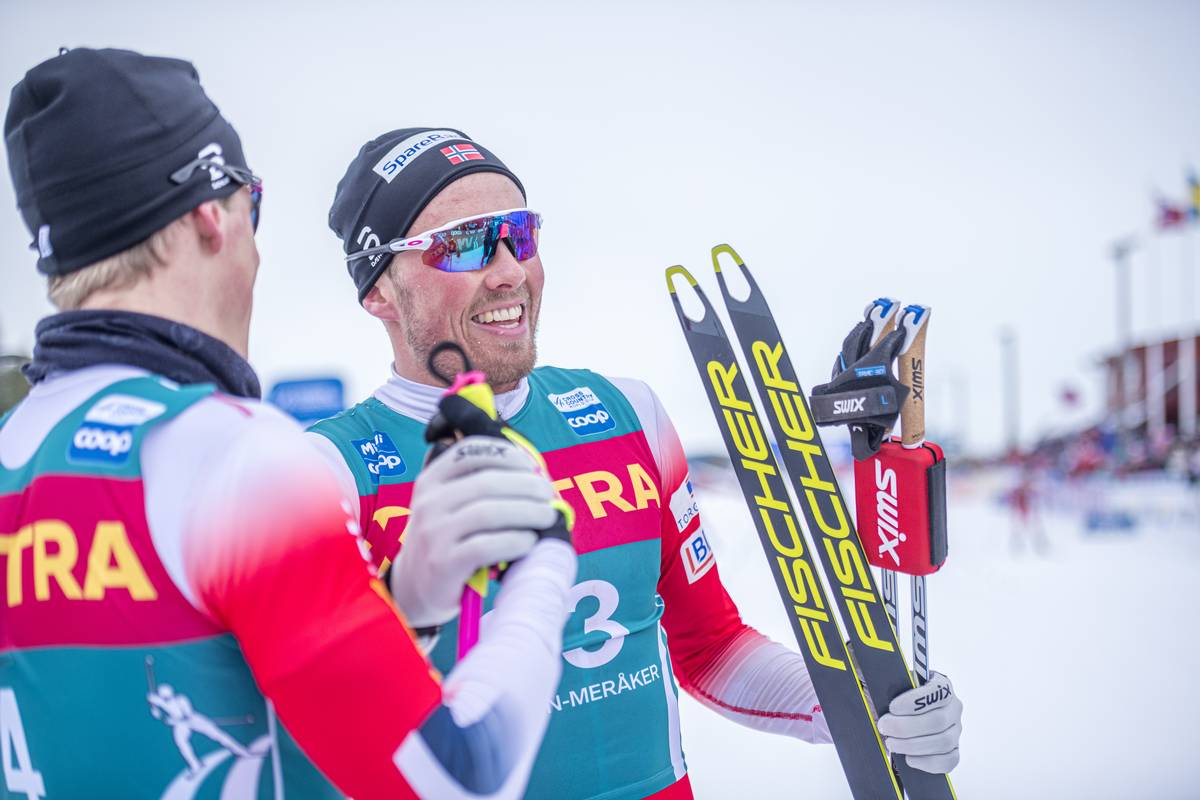
Emil Iversen (bib 3) and Johannes Høsflot Klæbo share a stoke-moment after the race. (Photo: NordicFocus)
David Norris was the top North American in 26th (+3:08.7). Ben Lustgarten placed 51st (+5:30), Kevin Bolger 69th (+8:06.7), Simi Hamilton 74th (+9:28.1), and Logan Hannmen 76th (+9:39.3).
Canada’s Evan Palmer-Charrette skied to 37th (+3:46.0), Russell Kennedy 39th (+3:59.9), Alexis Dumas 67th (+7:32.3), and Ricardo Izquierdo-Bernier 77th (+13:03.6).
Racing continues Saturday in Trondheim with a 1.5 k classic sprint, the sixth stage of the Ski Tour 2020.
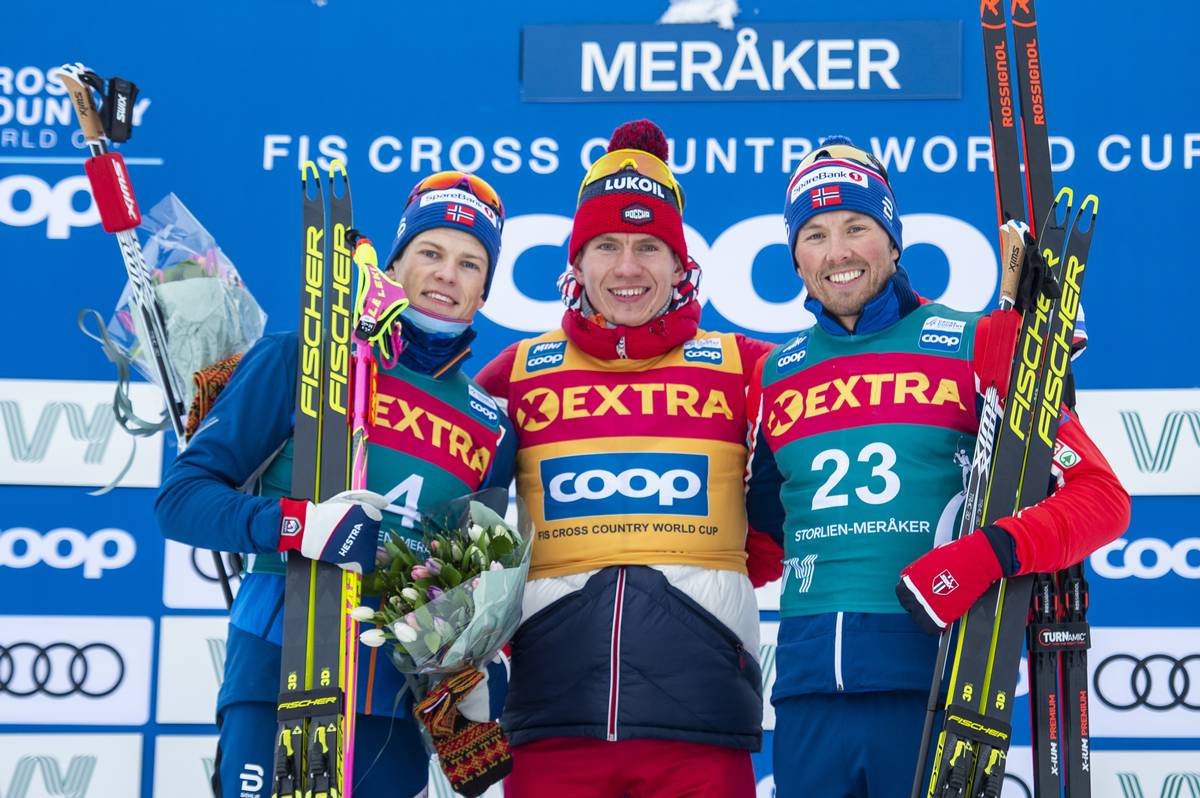
The men’s Stage 4 podium: Johannes Høsflot Klæbo (NOR) second, Alexander Bolshunov (RUS) first, and Emil Iversen (NOR) third, (l-r). (Photo: NordicFocus)
Picking up where we left off in Östersund, Sweden: a pursuit start 15-kilometer classic. Unlike the women’s field where Therese Johaug “administered a beatdown”, creating a large time gap for herself, the margins for the men were much smaller.
This year’s Tour de Ski winner Alexander Bolshunov of Russia, whose winning streak was interrupted, would start with a 22 second time deficit in fifth. Tenth place Ivan Yakimushkin (RUS) was 33 seconds back and Jens Burman (SWE) in 20th just inside a minute.
Alexander Bolshunov during Stage 2’s 15 k classic pursuit of the Ski Tour 2020. (Photo: NordicFocus)
With four 3.75 k laps to cover, the deficits were manageable. Perhaps the only Tour victory hopeful who was kept up about the work that needed to be done was Johannes Høsflot Klæbo, who would start 1:23 behind the leader after finishing 31st the day before.
The caveat would be to stay upright while navigating the icy winding bends of the primarily man made track. With grey skies and above-freezing conditions, it was fast and dicey, made evident by numerous crashes.
During one particularly noteworthy four-person pileup, Kamil Bury of Poland was taken out by Italy’s Maicol Rastelli as the two navigated a treacherous right hand turn at the bottom of a steep descent. Though neither had full control, Rastelli slid off the left side of the course, taking Bury along with him. Bury lost a ski and became tangled in the netting.
Just before impact… (Photo: Screenshot NBC/FIS Broadcast)
As Rastelli stood up and worked to right his skis, which were pointing in opposing directions, a third skier, Lin Bao of China, essentially slide tackled Rastelli, sending him in a complete backflip back down to the snow.
A fourth skier, Tadevos Poghosyan of Armenia, also lost control and slid into the pile. Bao and Poghosyan were able to stand up relatively quickly and continue on their way, but cameras cut away before the resolution of whether Bury found his ski and Rastelli was able to recover from his forced aerials.
Holy carnage… back to the race.
At the end of the first lap, it was as if the men were gifted ready-made groups. Røthe and Krüger matched stride for stride and double pole for double pole, while the remainder of the top five plus a handful of additional Norwegians, namely Pål Golberg, Hans Christer Holund, and Martin Løwstrøm Nyenget, chased from roughly six seconds back.
In bib 11, Martin Løwstrøm Nyenget (NOR) works his way towards the sharp end of the men’s 15 k classic pursuit. (Photo: NordicFocus)
It looked as though Røthe and Krüger might run away from the field, but it was not so easy. By 4.4 k, the gap was closed and an eight-man train chugged along the tracks. As Yakimushkin had fallen off the pace, it became seven Norwegians and Bolshunov.
Over the final two laps, the front pack whittled down from eight to five, where it remained with one k to go. Holund, Golberg, Røthe, Bolshunov, and Nyenget. The Russian in the yellow bib was primed to make a move.
Bending, rolling, and swooping, they headed for the stadium. Up the final punchy climb, Golberg and Bolshunov were side by side, and Golberg started to slip. He recovered and powered out of the climb, running with Klæbo-like dominance over the crest of the hill and into a tuck to lead into the stadium.
Bolshunov had fast skis and caught a draft before whipping into second place as the men entered the final straight. The Russian was right behind Golberg and absolutely charging. But there was not enough real estate. He changed lanes to challenge the Norwegian and looked as though he would overtake him, but the final meters evaporated and Golberg threw his foot for a clear win.
A lane switch wasn’t enough for Alexander Bolshunov as Pål Golberg of Norway takes the win. (Photo: NordicFocus)
Pål Golberg about to toe – during the 15 k classic pursuit, Stage 2 of th Ski Tour 2020 in Östersund, Sweden. (Photo: NordicFocus)
Golberg crossed the line in 34:50.8, with Bolshunov 0.3 seconds behind. Nyenget took third (+2.1) in a tight finish with Røthe (+2.5). Holund dropped off in the final sprint to round out the top five (+7.3).
Pål Golberg wins at the line over Alexander Bolshunov during the 15 k classic pursuit, Stage 2 of th Ski Tour 2020 in Östersund, Sweden. (Photo: NordicFocus)
“Perfect klister conditions,” Golberg told FIS at the finish. “I managed to get the ski pair from last weekend, so I had good skis this weekend as well. It was a really, really good day.”
The interviewer noted that conditions were much different than the previous day.
“It was hard in the middle,” Golberg explained. “It was a bit drier, so a bit difficult with klister in the downhill. But the tracks were perfect, so I’m really happy.”
Not the start of the FIS Ski Tour 2020 desired by Johannes Høsflot Klæbo. (Photo: NordicFocus)
Speaking of Klæbo, the Norwegian skied his way into 25th, but ceded an additional 52 seconds in the overall standings by finishing 2:15 back on the leaders.
FIS sent out a news brief shortly after the race with information regarding Klæbo’s injured finger. Here is the statement in full:
“Johannes Høsflot Klæbo (NOR) has to undergo an emergency check up for his broken finger. The check up has to take place with his doctor in Trondheim (NOR). As the rules of the FIS Ski Tour 2020 state no other transportation of athletes than by train, the jury gave permission to Johannes to travel by car to Trondheim and back to Åre for this special case. After the consultation, the jury will receive a report of the treating medical team in Trondheim.”
Leading again for the U.S., David Norris skis to 34th. (Photo: NordicFocus)
Stride and glide, Simi Hamilton climbs in Östersund, Sweden. (Photo: NordicFocus)
The American men hovered near their positions in Stage 1 at the end of the pursuit. Still grinding, David Norris finished 34th (+3:05.0), followed by Simi Hamilton in 43rd (+3:47.8).
Ben Lustgarten was the next American in 68th (+6:01.4), followed by Kevin Bolger in 70th (+6:12.7), and Logan Hanneman in 85th (+10:00.2).
Ben Lustgarten in the mix during the classic pursuit in Östersund, Sweden. (Photo: NordicFocus)
Racing for Canada, Russell Kennedy was again the top skier in 58th (+4:47.3). Next up was Alexis Dumas in 61st (+4:51.9), and Evan Palmer-Charette in 66th (+5:33.7).
Tomorrow is a rest day on the Ski Tour 2020, Stage 3, a skate sprint, will be held on Tuesday.
The men’s Stage 2 Ski Tour 2020 15 k classic pursuit podium: Alexander Bolshunov (RUS) second, Pål Golberg (NOR) first, and Martin Løwstrøm Nyenget (NOR) third, (l-r). (Photo: NordicFocus)
The pacing master of Stage 1 of the Ski Tour 2020: Sjur Røthe. (Photo: NordicFocus)
The six-stage Ski Tour 2020, which runs from Sweden to Norway over the next week, began Saturday in Östersund, Sweden with the men’s 15-kilometer individual start skate. The race began with twilight immersing Östersund with the sky eventually morphing into black as the seeded group of skiers looped around on what FIS called a 4.71 k course. This much can be concluded after a single day of what will be a hotly contested tour: the Norwegians fired on Stage 1 as they captured the top four spots in the field of 90 skiers.
The other take away beyond the Norwegian team’s blistering skis – Sjur Røthe paced himself a masterful 15 k of skiing as he won the event in 30:41.5 minutes.
However, not all looked shiny for the Norwegian as he went on to win his first World Cup of the season. At the 5 k time check, Røthe came through in 19th place, 19.5 seconds behind Hans Christer Holund, also of Norway. At 7.6 k, the halfway mark for the race, Røthe had moved up to 10th overall but remained 20.3 seconds off the fastest split set by yet another Norwegian, Simen Hegstad Krüger.
Then the tides turned, and Røthe began chiseling away at the time deficit. As he lapped through at 10 k, he sat in fourth, 15.4 seconds behind the virtual leader, Krüger. The chisel became a jackhammer; at 12.6 k Røthe was within six seconds of Krüger.
Simen Hegstad Krüger hammering during the 15 k skate, Stage 1 of the Ski Tour 2020. (Photo: NordicFocus)
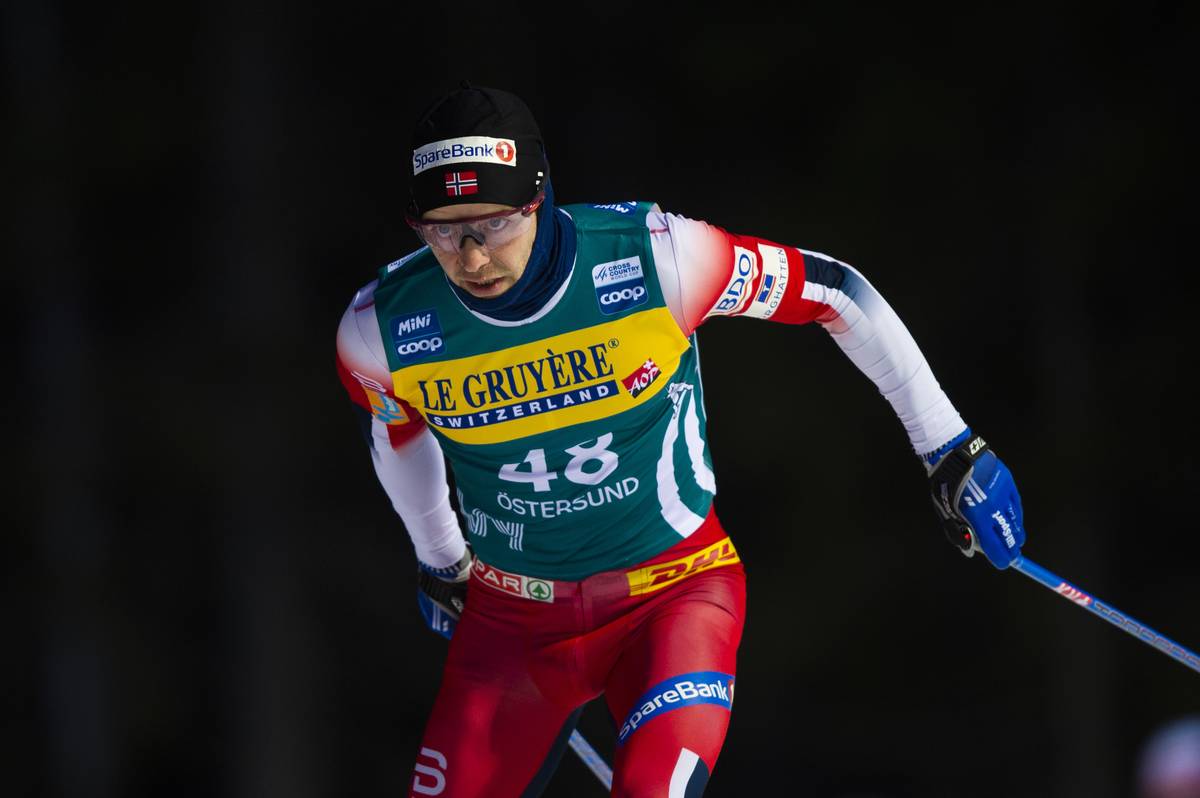
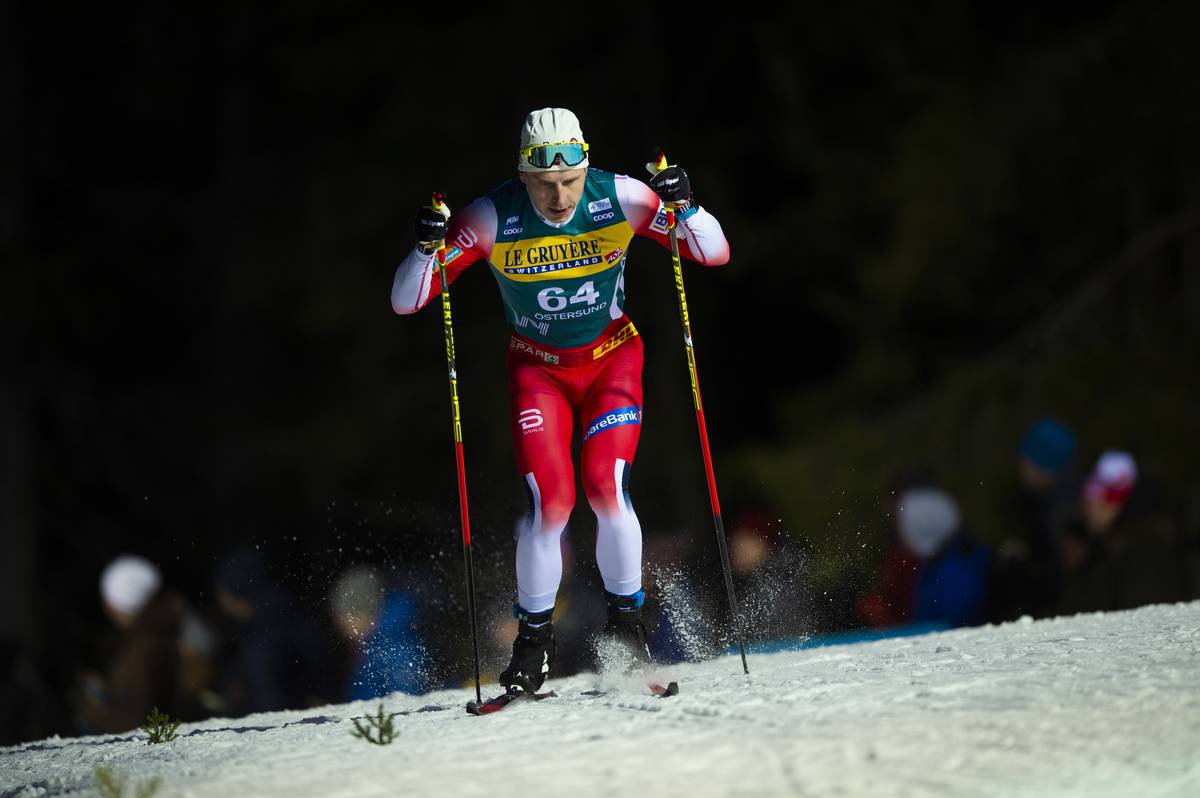
The pacing proved perfect only when Krüger crossed the line: Krüger was a later starter than Røthe: Røthe began in bib 48, Krüger in bib 64. Røthe could, however, pace himself off the splits of Norway’s Finn Hågen Krogh who began in bib 16. Of the early starters, Krogh set the fastest marks at 5 k, 10 k, and the finish, respectively.
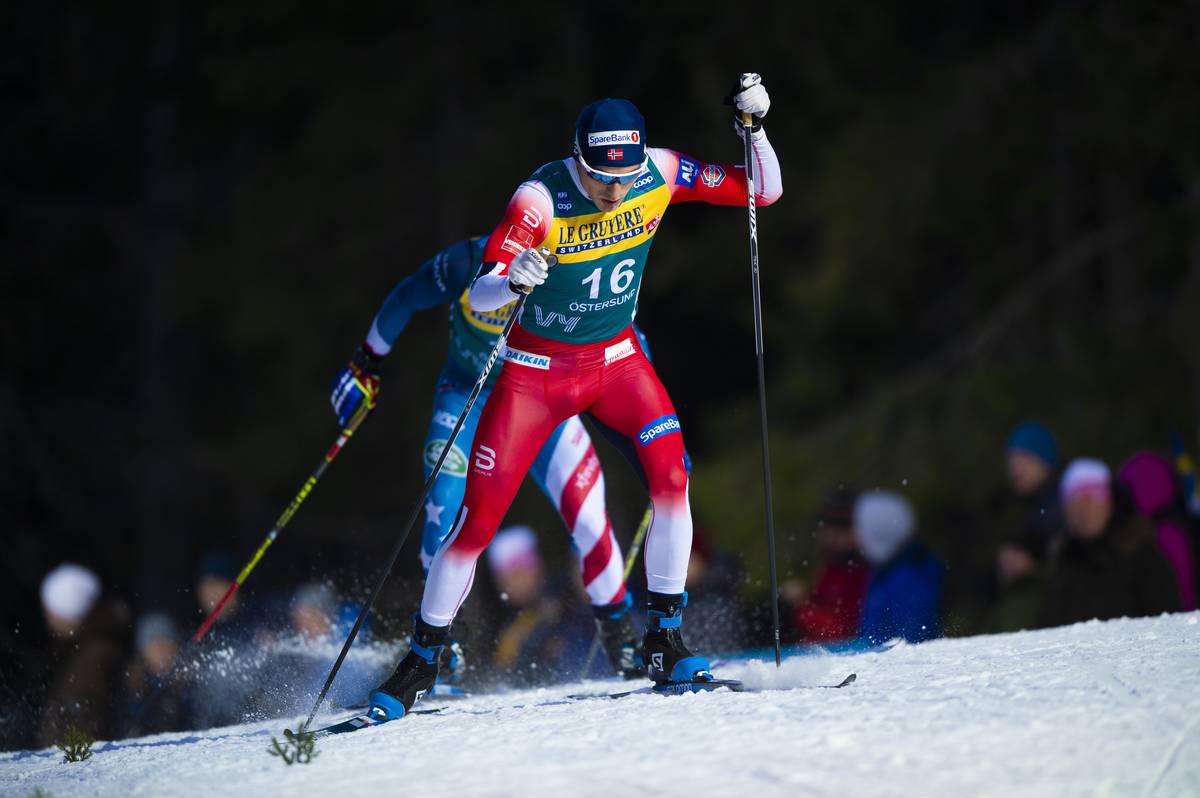
Finn Hågen Krogh (bib 16) an early starter during Stage 1 of the Ski Tour 2020, but fast through his 15 skate effort for third overall. (Photo: NoridcFocus)
Røthe’s first-place time (30:41.5) was 1.7 seconds faster than Krüger’s who took second on the day. Krogh was third overall (+16.6), and the veritable senior citizen of the Norwegian team, Martin Johnsrud Sundby, placed fourth (+17.3).
Saturday’s victory was Røthe first win of the season – however, it was his sixth individual podium which includes a second-place time of day podium in Ruka’s 15 k skate pursuit back in December. Last week, he was second in Falun’s 15 k mass start skate.
“It was a great day for me and the Norwegian team,” Røthe told FIS after the race. “I think we need to give a big hug to the guys in the wax cabin today. They made brilliant skis for us today, and for sure I have done my preparations well, I am really satisfied with today. I am looking forward to [the Ski Tour], it has been one of my main goals this season so for sure I am prepared, but I need to go home and get a good rest because it is not many hours before we do the classic race here in Östersund as well.”
For those playing the long-term odds in the Ski Tour 2020, after one stage down, Russia’s overall World Cup leader, and 2019-2020 Tour de Ski winner, Alexander Bolshunov, placed fifth (+22.2).
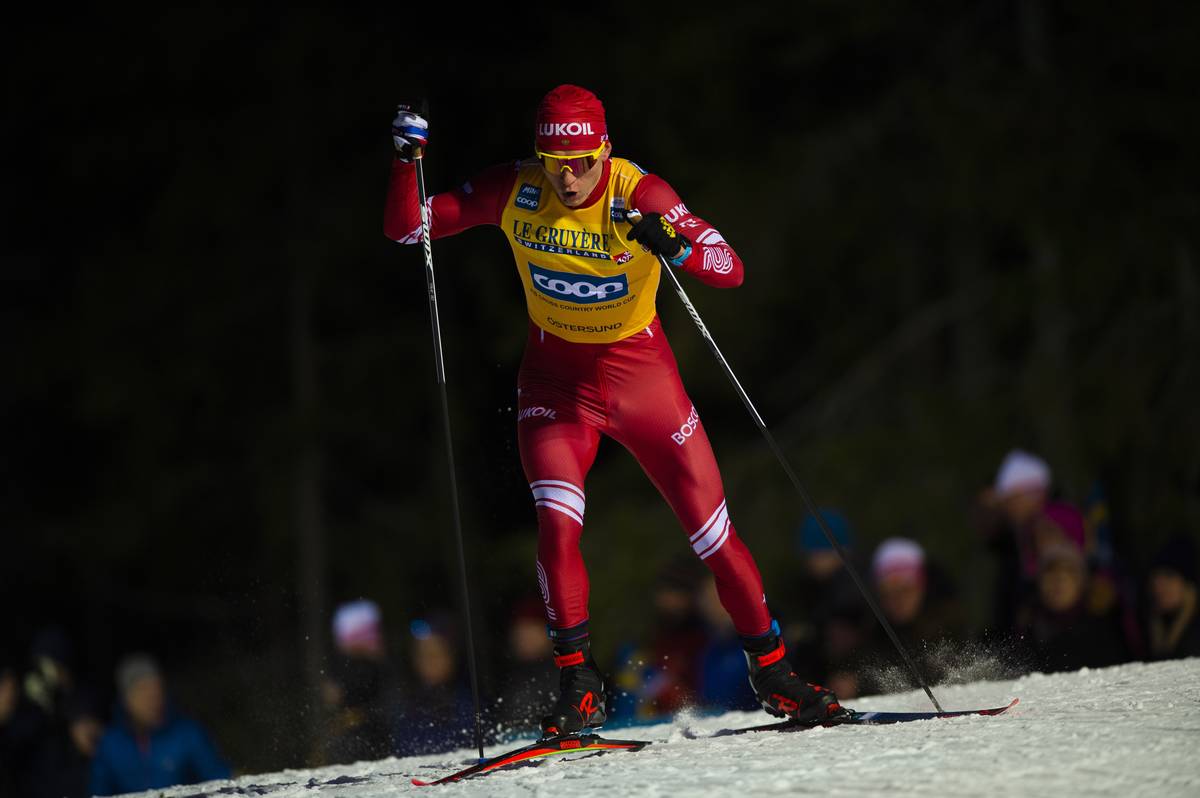
Russia’s Alexander Bolshunov, the overall World Cup leader here during Stage 1 of the Ski Tour 2020. He placed 5th on the day. (Photo: NordicFocus)
Along with capturing first through fourth places, Norway also claimed sixth (Hans Christer Holund), and eighth (Pål Golberg) place in the top-10. Norwegian Johannes Høsflot Klæbo was out of the points in 31st (+1:22.8). The Norwegian star returned after missing last weekend’s racing in Falun with a broken finger. Along with Bolshunov’s fifth place, Russia took ninth (Denis Spitsov) and 10th (Ivan Yakimushkin). The national team outlier in the top-10 was France’s Adrien Backscheider in seventh.
David Norris (APU), of the U.S., was the best-placed North American in 36th (+1:27.7). U.S. teammate Simi Hamilton (USST) placed 46th (+1:54.5). He returned to the World Cup racing after sitting out last weekend’s racing due to lingering neck pain. Kevin Bolger (USST) skied to 71st (+3:11.1), Ben Lustgarten (CGRP) 73rd (+3:12.2), and Logan Hanneman (APU) 86th (+4:35.6).
David Norris of the U.S. during the 15 k skate, Stage 1 of the Ski Tour 2020. (Photo: NordicFocus)
Post-race comments from U.S. World Cup Coach Matt Whitcomb
For Canada, Russell Kennedy skied to 52nd (+2:02.5), Evan Palmer-Charrette 60th (+2:31.9), Alexis Dumas 64th (+2:39.4), and Ricardo Izquierdo-Bernier 80th (+4:10.7).
Russell Kennedy of Canada, during Stage 1 of the Ski Tour 2020. (Photo: NordicFocus)
Racing continues in Östersund tomorrow with a 15 k classic pursuit for the men and a 10 k classic pursuit for the women.
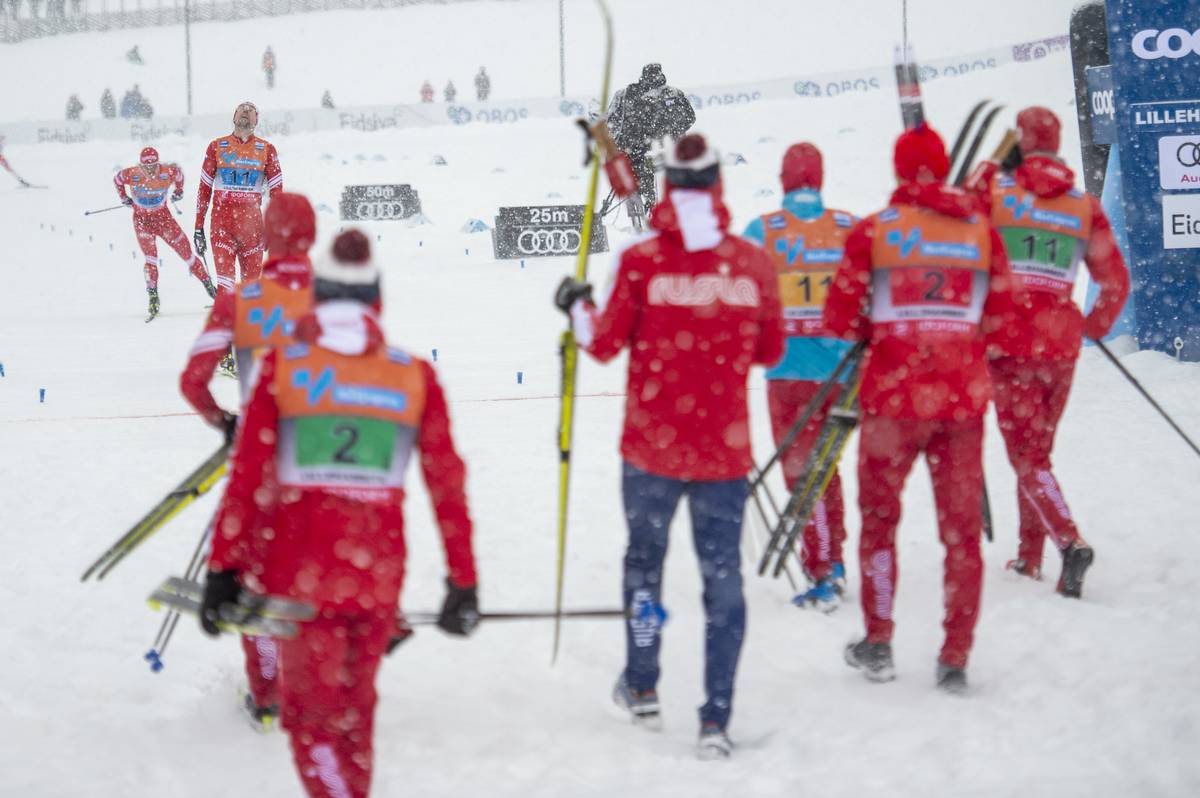
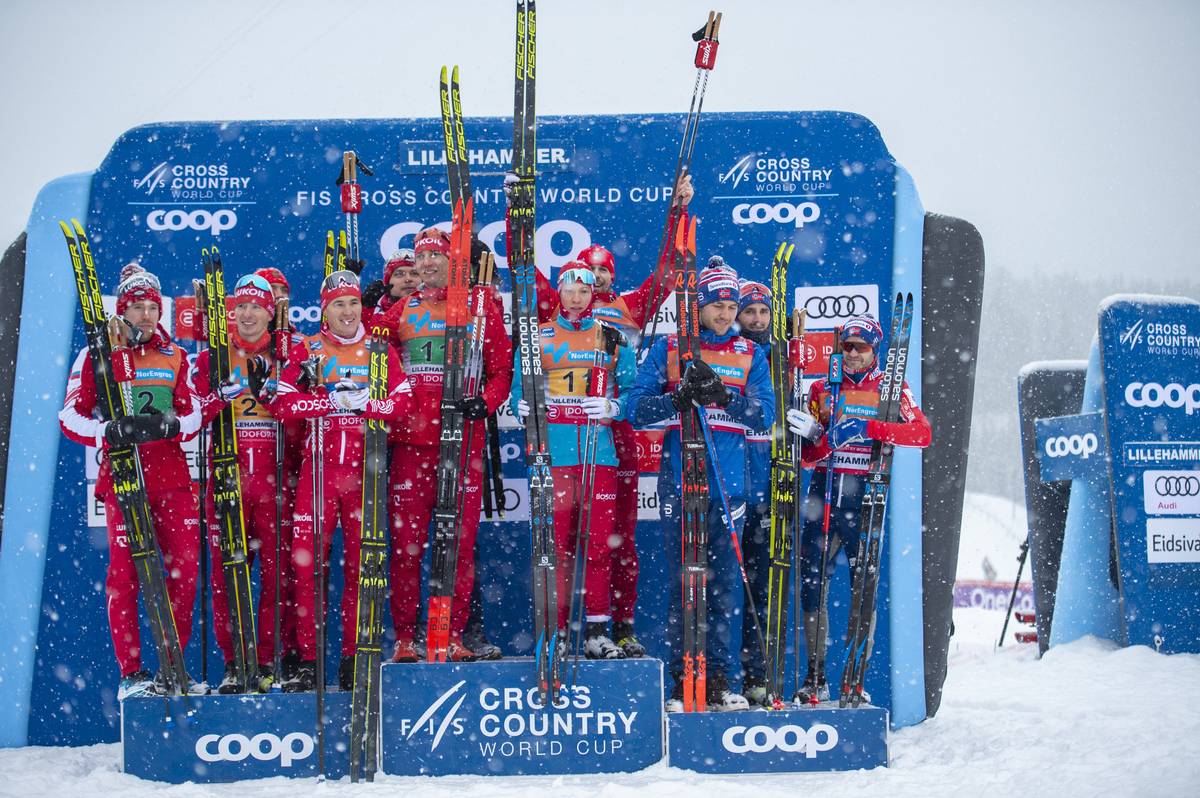
Russia soaking it in as they take 1-2 in the 4 x 7.5 k relay in Lillehammer, Norway. (Photo: NordicFocus)
Call it what you want: national pride, national bias, flag-waving: the team relays elicit nationalistic tendencies. In Lillehammer, Norway, you might think and maybe expect it’s your birthright to see the hometeam crush. That’s been the recent norm almost without exception.
Here’s the quick stats to either dispel or reinforce those tendencies: Norway has won nine of the last 11 relay races on the World Cup. Russia won the other two. In fact, Russia took first and second, Norway third in the last head-to-head 4 x 7.5 k match last season in Ulricehamn, Sweden. Throwing Norwegian dominance back into the equation, Norway has won five of the last six relays on home snow.
On paper, at least for Norway, some big names were missing from their team lineups. No No Emil Iversen. No Johannes Høsflot Klæbo. No Martin Johnsrud Sundby. That trio finished third, fourth. and fifth in Saturday’s 30k skiathlon. Add to that Didrik Tønseth who was busy representing Norway at the European Cross-Country Running Championships.
But Norway is deep with talent. As is Russia. For those keeping score, you’ll see no Alexander Bolshunov featured on either of the Russian teams — he won the skiathlon yesterday. That all said, in a non-championship year maybe it’s a time to tinker and experiment. Here were the teams holding the most podium potential.
Norway I: Pål Golberg, Hans Christer Holund, Sjur Røthe, Finn Hågen Krogh
Russia I: Andrey Larkov, Ilia Semikov, Denis Spitsov, Andrey Melnichenko
Russia 2: Ivan Yakimushkin, Evgeniy Belov, Ilia Poroshkin, Sergey Ustiugov
Pål Golberg (NOR) leading the pack during the scramble leg of the 4 x 7.5 k relay in Lillehammer, Norway. (NordicFocus)
The first tag, after 7.5 k, Russia I pulled through first, with Norway I and Sweden right behind. Russia II was 10.5 seconds back, Finland 15.5, the U.S. 17.0, and Norway II dangling 19 seconds off the lead.
As the classic legs ended at 15 k, the race was more about who was falling off out of contention, rather than a team up front making any decisive gesture for a kill shot. Finland came through first, with Russia II next (+0.4), then Norway I (+2.2), Russia II (+9.7), Norway II (+10.5), and Germany (+15.0).
The next closest team was Sweden, roughly twenty-nine seconds arrears in seventh place. At that point, the U.S. team of Erik Bjornsen, David Norris, Scott Patterson, and Kevin Bolger were in ninth (+1:13.7) and racing in a no-man’s-land with a sizable gap to France in eighth and Kazakhstan drifting back in 10th.
Simen Hegstad Krüger (bib 10) during the 4 x 7.5 k relay in Lillehammer, Norway. (Photo: NordicFocus)
The race began to look a tad spicy for Norway around the 21.2 k mark, nearly an hour into the race. Krüger for Norway II, a sometimes peerless skate skier at that, put his stamp on the affair as he powered ahead on the course’s most prominent climb. Norway I’s Røthe followed Krüger in step. And Sweden’s Jens Berman kept pace as well. The real tease was that Russia I (Spitsov) and Russia II (Poroshkin) appeared cooked as were their team’s chances for anything but third place.
But, it’s a four chapter race. And the fourth leg coalesced into a five team scrum by 25k. Both Russian teams, the Norwegian squads, and Germany were all in it. We should note that Ustiugov, tagged 15 seconds back at the exchange, looked impressive shutting down that gap as he reeled in the lead groups.
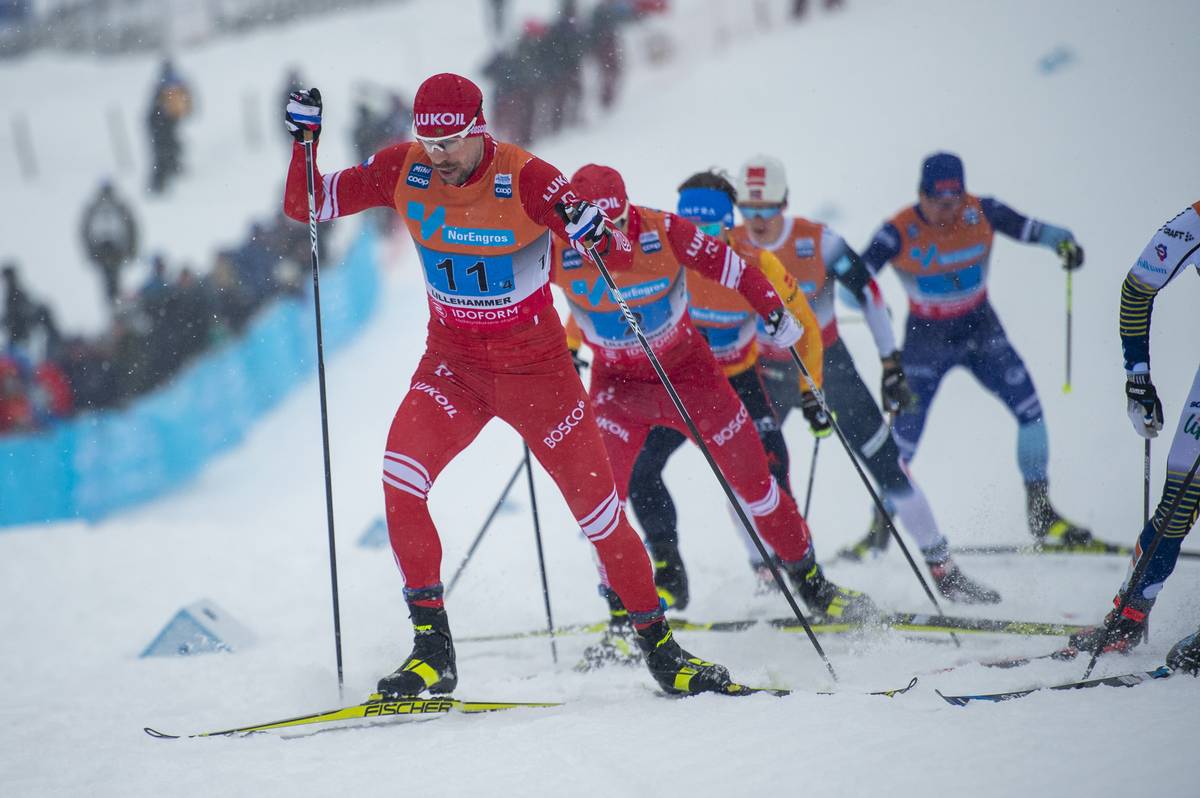
Russia’s Sergey Ustiugov (right) showing his solid form during the men’s 4 x 7.5 k relay in Lillehammer, Norway. (Photo: NordicFocus)
The racing scene’s old friend, Ustiugov, went to the front and eventually shut down the pace. It wasn’t exactly a crawl. It was Ustiugov revealing his tactical hand: wait until punishing terrain, and throw down a punishing push.
But it was Melnichenko for Russia I who made that move. Ustiugov kept pace and pulled through not long after Melinchenkov separted. Ustiugov looked like vintage Ustiugov: a full-body, all-in-it, furnace of power.
Sergey Ustiugov of Russia taking control during the 4 x 7.5 k relay in Lillehammer, Norway (Photo:NordicFocus)
And that was it. Norwegian dreams were snuffed, Russian dreams realized.
Russia I won in 1:26:46.8 hours. Russia II took second (+1.3), and Norway I third (+8.9). Norway II lost the toe-to-the-line finish by placing fourth (+9.0).
The U.S. team skied to ninth place, 3:33.3 minutes back. U.S. World Cup Coach Matt Whitcomb explained in an interview that relay racing is often a “game of contact and if contact is lost the race is often lost.” The U.S. did lose contact. It remained a relay for the U.S. bright moments and the reality of skiing solo for a few legs. (In the interview below, Whitcomb also notes the thrill of watching an emerging Chinese program finish the men’s relay in a non-championship event.)
Matt Whitcomb post-race interview
Closing out the day on the race course was China. They placed 11th (+12:44.6). Making note that the 2022 Olympics will be hosted by China, it will be interesting to see how this team develops.
Scott Paterson of the U.S. Ski Team during the third leg of the 4 x 7.5 k relay in Lillehammer, Norway. (Photo: NordicFocus)
Scott Patterson post-race interview
Kevin Bolger during the 30k skiathlon in Lillehammer, Norway. (Photo: NordicFocus)
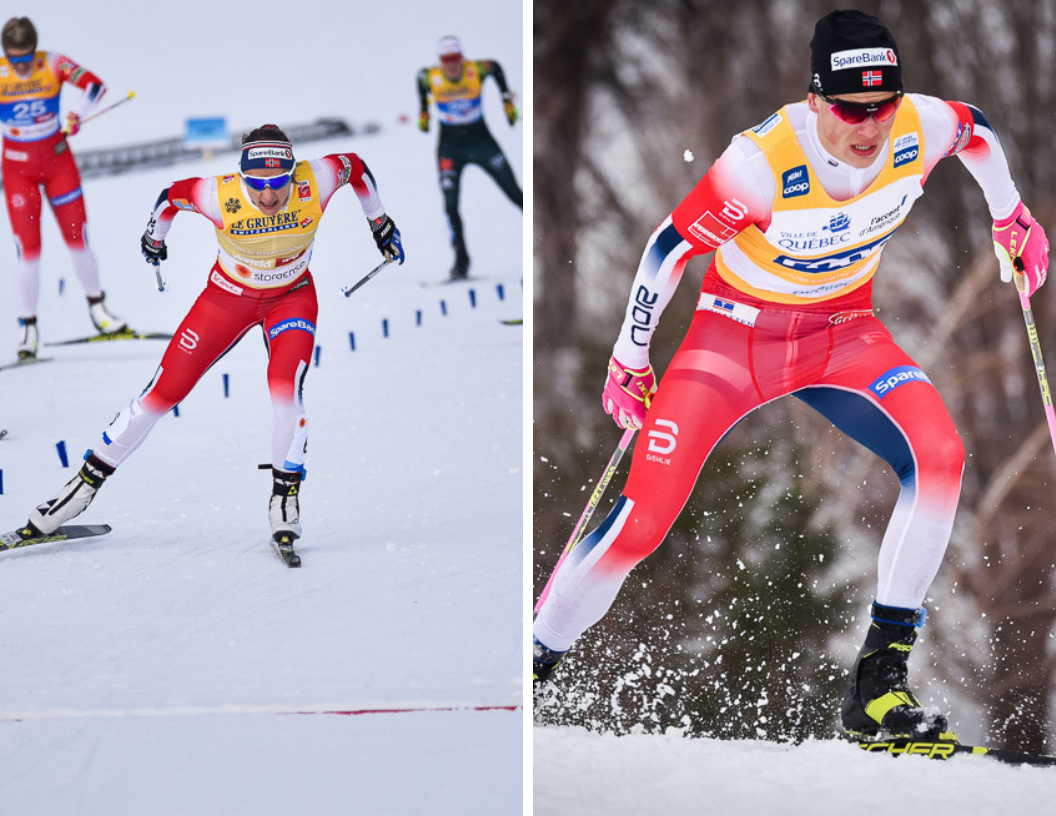
Norway’s Ingvild Flugstad Østberg (left) and Johannes Høsflot Klæbo (right) were the top money winners on the 2018/2019 World Cup. (Photos: John Lazenby/lazenbyphoto.com)
If you’ve read the International Ski Federation’s (FIS) website in the last few weeks and deviated from exploring the cross-country sub-site, U.S. alpine star Mikaela Shiffrin has been prominently featured. Her season was record-breaking. With 17 wins, she set a FIS World Cup record for alpine victories in a single season. With the fattening of her win total, was the commensurate growth of her bank account.
She became the first World Cup skier, male or female, to earn more than one million Swiss Francs (CHF) in prize money during a single season. She won 886,386 CHF for her regular World Cup haul, and 114,000 CHF for her gold and bronze at the Åre, Sweden Alpine Ski World Championships.
As of this writing, with the exchange rate set at 1 CHF = 0.98 USD, that equates to 980, 447.25 U.S. Dollars. Not exactly bottom feeding for a professional skier. (Since the beginning of April, the dollar has lost value against the Swiss Franc.)
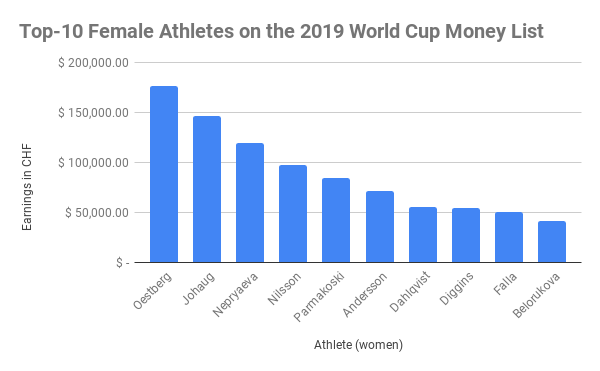
On the cross-country World Cup, Norway’s Ingvild Flugstad Østberg, the overall winner, was first on the money earnings list with 175,900 CHF. Her teammate Therese Johaug, the winner of the distance crystal globe, earned the second highest total with 146,375 CHF. (American Jessie Diggins was eighth with 54,525 CHF in earnings.)
Sweden’s Stina Nilsson, the fourth-ranked prize money earner and winner of the sprint globe earned just shy of the 100,000 CHF mark with 97,575 CHF in total earnings. Beyond her presumably sizable income from sponsors and endorsements, this is a proud living for fast skiing. Yet, it becomes a precipitous drop off in earnings from 10th place (Russia’s Yulia Belorukova with 40,950 CHF) to 30th, where Norway’s Kari Øyre Slind amassed 7,450 CHF.
Of the ninety female athletes on the money list, 32 earned less than 1,000 CHF.
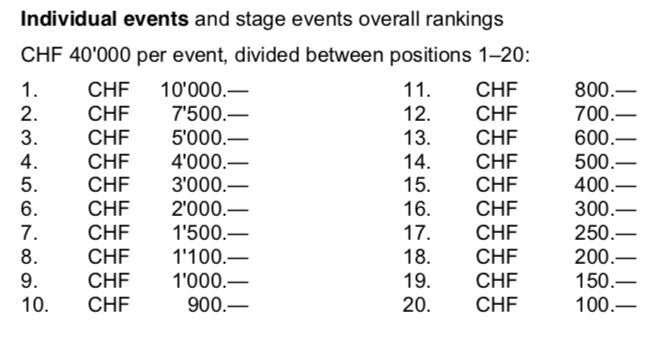
According to the Rules for the FIS Cross Country World Cup, the organizing committees must divide a sum of 40,000 CHF per individual race amongst the top-20 skiers. The winner receives 10,000 CHF, second place 7,500 CHF until the 20th place skier is left with 100 CHF. (See below for the specific breakdown.)
For individual sprints, prize money is reserved for those making the finals. A total of 30,000 CHF is divided amongst the top-six finishers in the final sprint standings. First place receives 12,000 CHF, second 8,000 CHF, third 4,000 CHF, fourth 3,000 CHF, fifth 2,000 CHF, and sixth 1,000 CHF.
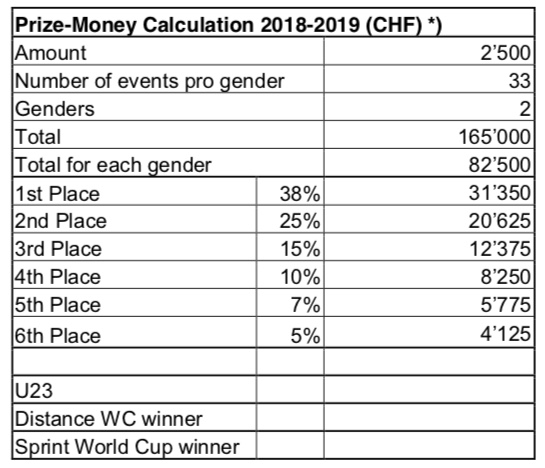
As far as earnings for the World Cup overall, each gender divides 82,500 CHF amongst the top six athletes. (See below for the breakdown.)
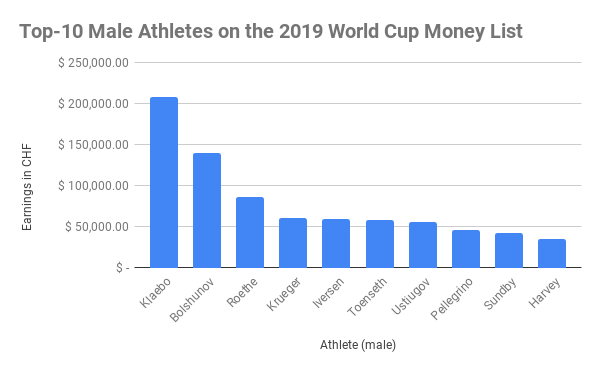
Like on the women’s side, those who dominate the men’s podiums collect the cash. Norway’s Johannes Høsflot Klæbo, with 207,500 CHF, was the top-ranked male on the money list. Of the top-ten male earners, six were Norwegian, two Russian, one Italian, and in tenth was Canada’s Alex Harvey with 35,550 CHF.
Only the top two athletes on the men’s list earned more than 100,000 CHF: Klæbo and the second overall prize money earner, Russia’s Alexander Bolshunov, with 139,625 CHF.
The 20th ranked skier, Gleb Retivykh of Russia, was the first male skier to fall below the 20,000 CHF threshold with 19,850 CHF. Keeping things tidy by tens, Norway’s Finn Hågen Krogh was ranked 30th — he was the first skier below 10,000 CHF in prize winnings with 9,150 CHF.
Breaking the numbers down.
Twenty different women stood on individual World Cup podiums this past year. For the men, the number bumped to twenty-eight different skiers.
Prize money is skewed towards the top performers. It follows that skiers like Østberg and Johaug would lead the money standings: Johaug won 11 individual World Cups this year, Østberg five. Østberg stood on twelve individual podiums and finished second a total of three times and placed third a total of four times. Nilsson, the top sprinter, won eight individual World Cup events. She also placed second once for her nine total World Cup podiums. The chart below shows the drop off in earnings for the women’s field — the top spots in World Cup races are secured by a relatively small number of skiers. Over twenty-nine individual races, three different skiers — Johaug, Østberg, and Nilsson — amassed 24 total wins.
By comparison, Diggins stepped on five podiums and placed fourth through 10th nine different times. Russia’s Yulia Belorukova, the tenth-ranked money earner, won a single race for her only podium and placed between fourth and 10th on 11 different occasions. The money stays near the podium: 10th place earns nine percent of the winner’s take in distance racing. That’s 900 CHF for placing 10th in the world.
It’s a similar story for the men, yet the drop off from the top two prize winners was steeper. (Again, 20 different women podiumed compared to 28 different men.) Klæbo won 13 individual World Cup races and placed second a single time. Bolshunov had 12 podiums: five wins, three second place finishes, and four third place results. Klæbo and Bolshunov locked up 18 wins between them over the 29 individual World Cup races.
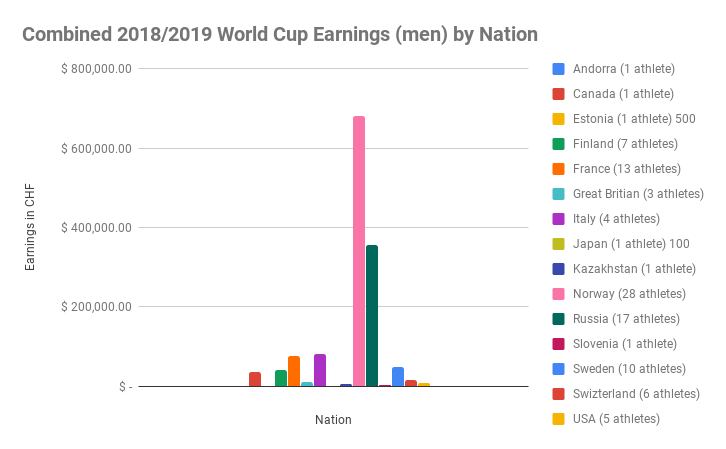
The trend of top-heavy earnings in the World Cup field is no mystery as this FasterSkier article from 2015 suggests. The article was titled, How to Score Points and Win Money on the World Cup (Hint: Be Norwegian). For the men, the main theme of that article still rings true. Norway had 28 different athletes in the money this season. In a nation to nation comparison, Norway’s men won the most cash. Russia, with 17 skiers earning prize money, clawed at Norway. Sweden, a country we often think of as a powerhouse, has been unable to field a well-rounded men’s team recently and lags behind the earnings of Italy (that’s skewed by Federico Pellegrino) and France. (Link to an interactive chart of the men’s data here.)
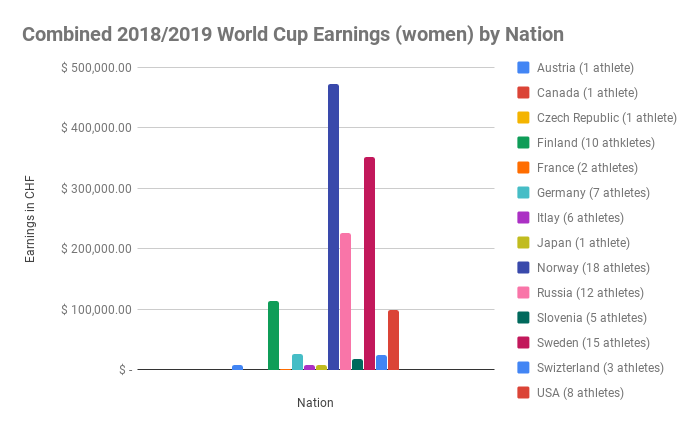
The nation to nation comparison for the women reveals a Sweden that has emerged as a challenger to Norway. Norway prevails with 472,375 CHF in total earnings. But, Sweden and Russia are serious contenders, while Finland and the U.S. have also separated themselves. (You can link to an interactive chart for the women’s data here.)
Does it pay to be an elite cross-country skier? That depends. And it may be of no concern to those who compete simply for the love of their chosen sport. Yet, for those at the top of the xc skiing food chain, prize winnings along with the padding of endorsements can make for a comfortable life. And it still doesn’t hurt if you are from Norway.
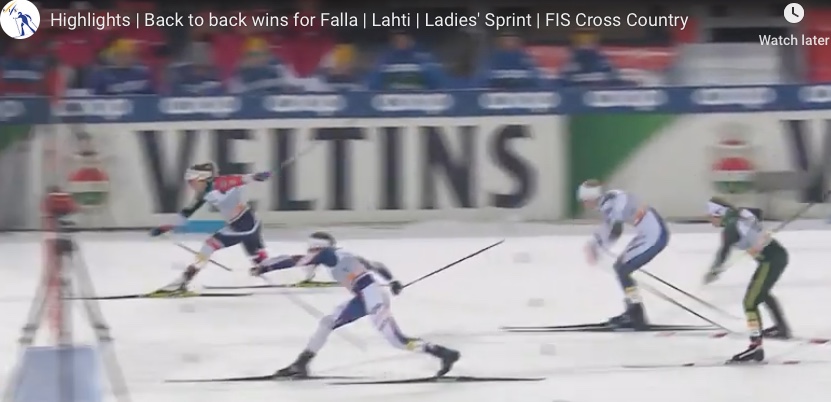
Norway’s Maiken Caspersen Falla taking the World Cup win in the 1.4 k skate sprint in Lahti, Finland. Sophie Caldwell of the U.S. Ski Team placed second. (Photo: fis-ski.com screenshot)
FIS World Cup Lahti, Finland 1.4 k/ 1.6 k Freestyle Sprint
In the women’s skate sprint qualifier in Lahti, Finland Slovenia’s Eva Urevc laid down the fastest time in 2:40.67 minutes. Swiss skier Nadine Faehndrich was the second fastest qualifier, 4.21 seconds back, with the U.S. Ski Team’s (USST) Sophie Caldwell third (+4.36).
Canada’s Dahria Beatty qualified 25th (+10.21). Also making the heats for the U.S. were Ida Sargent (USST) in 26th (+10.36), and Kelsey Phinney (SMS T2) in 27th (+10.54).
Of the top three qualifiers, only Caldwell advanced to the finals. The final was won by Norway’s Maiken Caspersen Falla in 2:43.64. Falla advanced to the finals as a lucky loser from the first semifinal. That semi was won by Caldwell who ended up placing second (+0.11) in the final. Sweden’s Maja Dahlqvist sprinted to third overall (+0.37).
Germany’s Sandra Ringwald placed fourth (+0.46), Norway’s Mari Eide fifth (+0.75), and Tiril Udnes Weng of Norway sixth (+0.94).
Phinney placed 19th overall, Sargent 30th. Canada’s Beatty was 24th in the final standings.
Also for the U.S., Julia Kern (USST D-Team) coming off of illness ended her day 38th overall. Hannah Halvorsen (USST D-Team) placed 41st.
Johannes Høsflot Klæbo won the men’s 1.6 k skate qualifier in 2:47.01 minutes. He was followed by teammate Haavard Solaas Taugboel in second (+4.15). Qualifying in third was Finland’s Joni Maeki who clocked a time of 2:51.36.
Klæbo won the final in 2:52.06 while Italy’s Federico Pellegrino raced to second (+0.30). Norway’s Finn Hågen Krogh was third (+0.61). Also from Norway, Eirik Brandsdal took fourth (+1.31) and Emil Iversen fifth (+1.75). Gleb Retivykh of Russia was sixth (+2.08).
No North American men qualified for the heats.
Logan Hanneman (APU) for the U.S. placed 32nd overall after missing the heats by .22 seconds. Simi Hamilton (USST) finished 36th overall, and Erik Bjornsen (USST) 42nd.
Evan Palmer-Charette was the lone Canadian entered; he placed 67th.
Rémi Drolet leads Julien Locke and Sam Hendry at the start of lap three. (Photo: Peggy Hung)
Canadian Western Championships, Telemark, Classic Mass Start
Day two of Westerns dawned with low clouds and intermittent light snow at -11C for the classic mass starts.
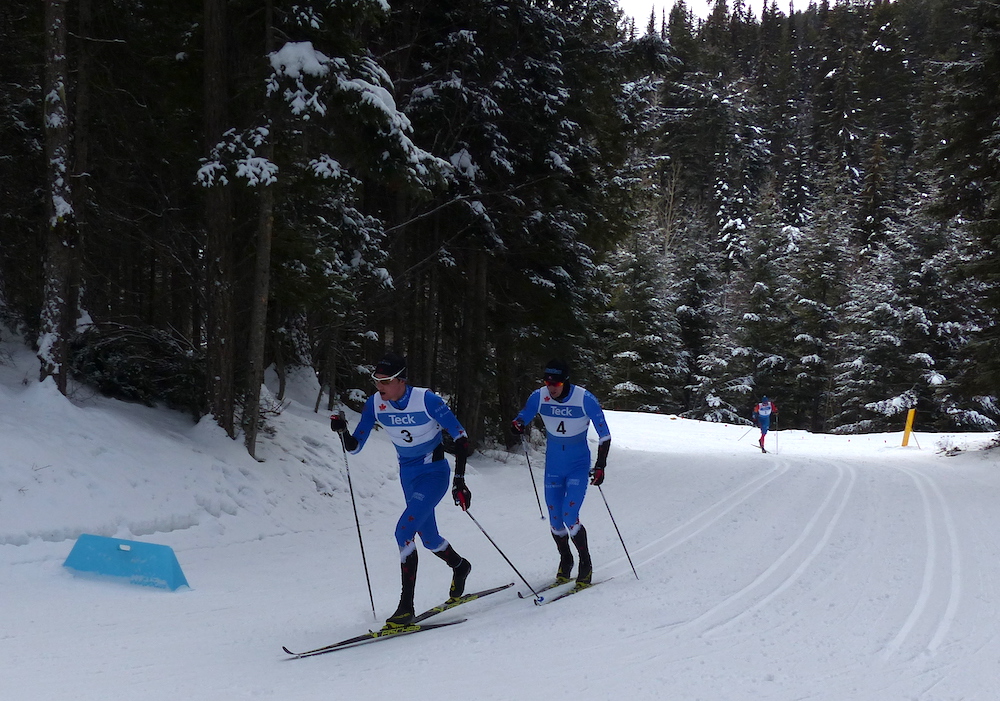
The men raced first, completing three laps of the new (and freshly homologated) 5km loop. Rémi Drolet (Black Jack) won in 42:18.4, getting from Julien Locke (CNST) on the last climb to earn a 4.8 second gap. Sam Hendry (Team R.A.D.) stayed with leaders until late in the second lap, finishing 42.2 seconds back. Rémi Drolet and Hendry are juniors who represented Canada at Junior Worlds in Lahti last month. Crystal Lust
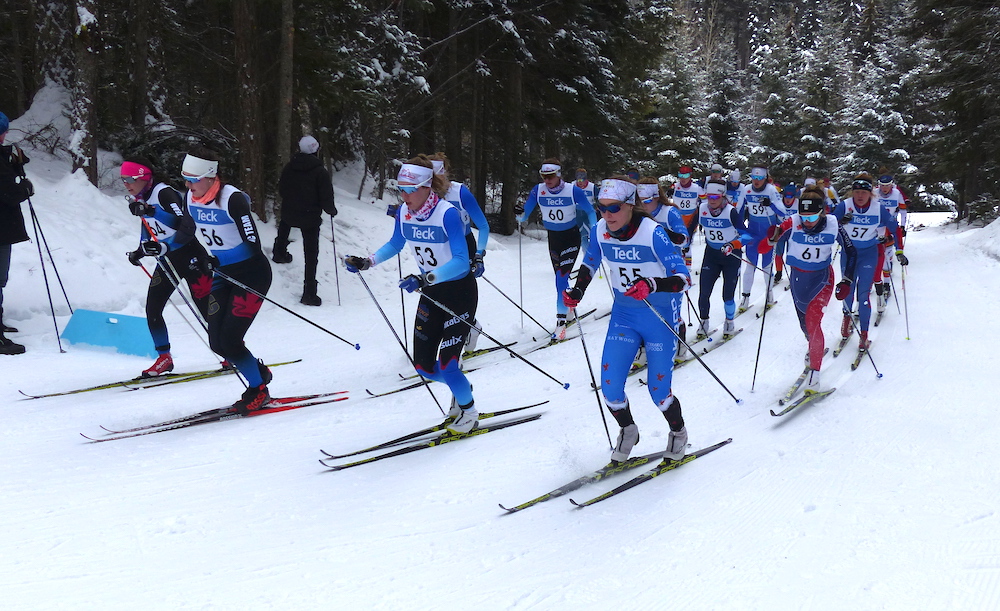
The first small climb of the Westerns 10km classic. Jasmine Drolet (#55) leads Novie McCabe (#61) in the left track. (Photo: Peggy Hung)
The open women skied two laps of the same course, with Novie McCabe (Methow) breaking clear on the first lap to win alone in 32:46.6. Jasmine Drolet (Black Jack) was second at 53.4 seconds followed by teammate Molly Miller at 1:28.1. All three raced at World Juniors in Lahti: Jasmine Drolet is 16 and the other two are 17.
There were 386 finishers on Saturday. Racing continues Sunday with relays.
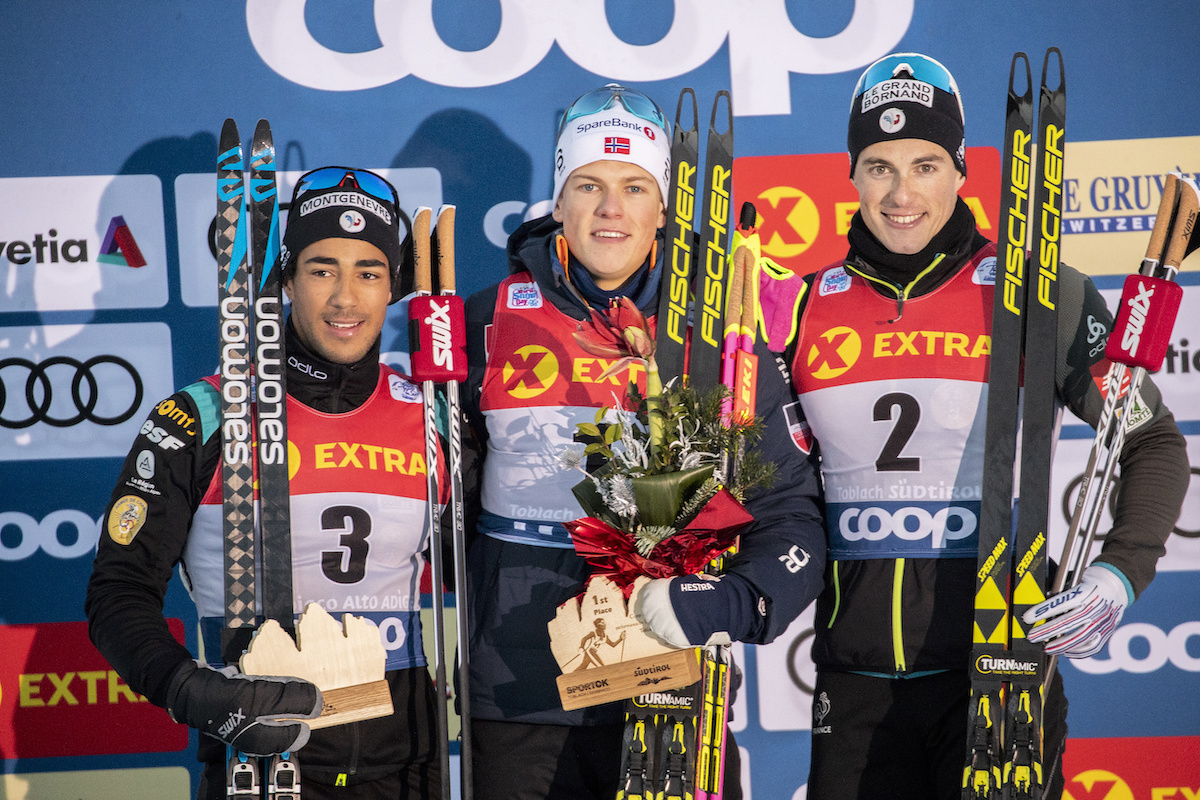
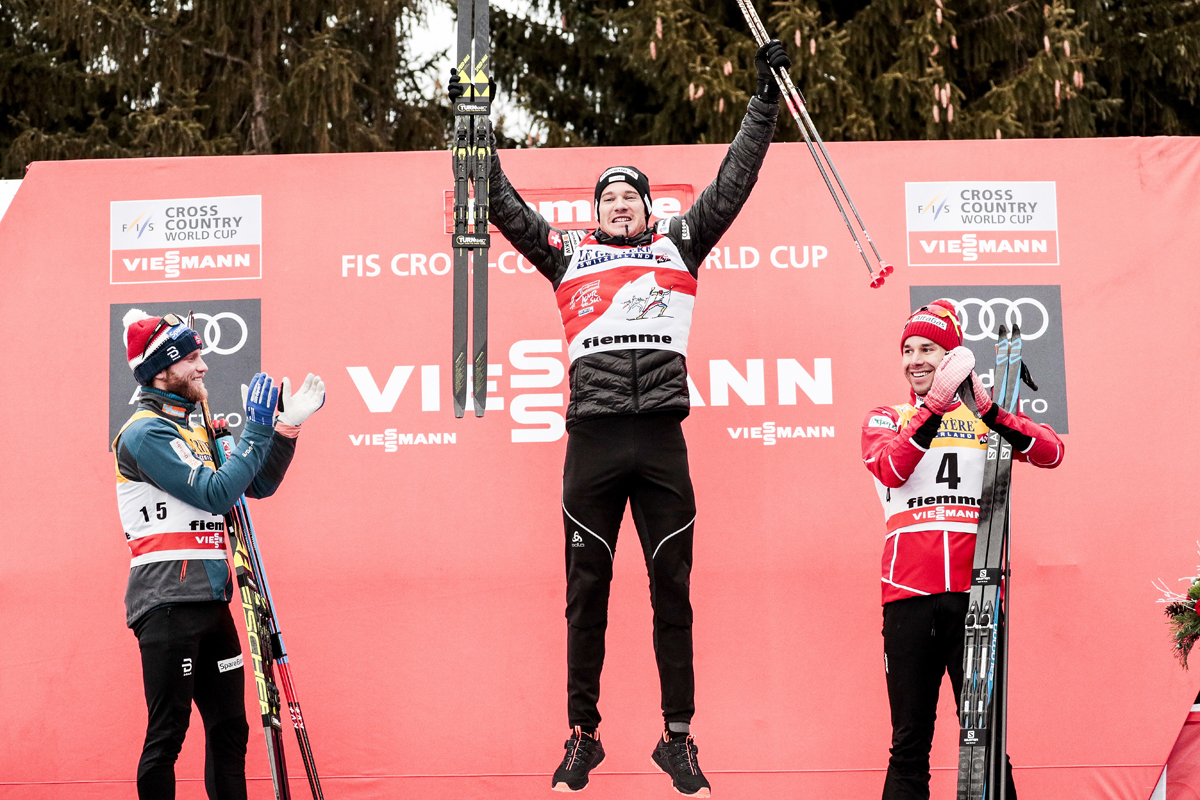
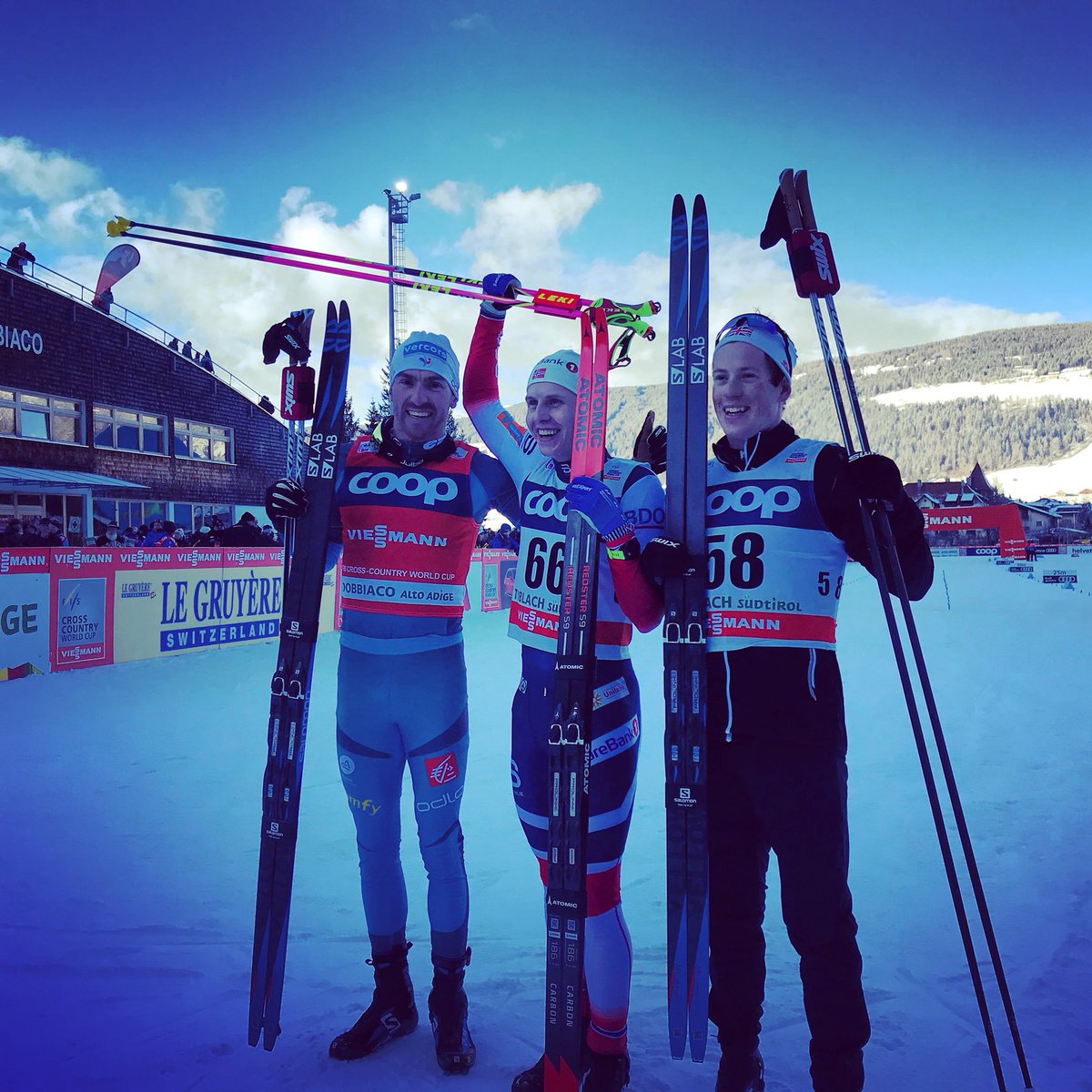
The men’s podium from Toblach, Italy’s first stage of the 2018/2019 Tour de Ski — a 1.3 k skate sprint. Richard Jouve (left) from France placed second, Johannes Hoesflot Klaebo (center) of Norway was first, and Lucas Chanavat of France (right) was third. (Photo: Fischer/Nordic Focus)
*Note: This article has been updated to include comments from U.S. Ski Team B-Tean member, Kevin Bolger
Without the visual of the grey and white U23 marker next to his name on an FIS results sheet, it’s easy to forget Norwegian Johannes Høsflot Klæbo is still under 23 years of age. As the Tour de Ski (TdS) celebrates its 13th edition this year, the twenty-two-year-old Klæbo (he celebrated his 22nd birthday this October) is only in his first TdS. He did not start last season’s 2017/2018 Tour. Nor did he start the 2016/2017 TdS. His debut World Cup race came in the spring of 2016.
Even so, by the opening race of this season’s TdS, a 1.3-kilometer freestyle sprint in Toblach, Italy, Klæbo maintained the composure of a seasoned Tour veteran. A skier used to winning and ready to do it again.
He started by posting the day’s fastest qualification time, placing first in a time of 2:16.86 minutes.
Klæbo then advanced to Quarterfinal 1, exchanging the lead with Russia’s Sergey Ustiugov for the first half of the sprint loop, before taking command and eventually duking it out with France’s Lucas Chanavat and Norwegian Sindre Bjørnestad Skar in the finishing stretch.
Johannes Høsflot Klæbo (bib 1) from Norway winning the men’s final in Toblach, Italy. Klæbo looked in form during the first stage of the 2018/2019 Tour de Ski.(Photo: Fischer/Nordic Focus)
Klæbo eventually won that quarterfinal, crossing first in a time of 2:19.71 minutes, just ahead of Chanavat. Both he and the Frenchman advanced to semi-final 1. Skar squeaked into the second semi as a Lucky Loser thanks to the heat’s fast times.
In the first semi-final, Klæbo once again took the lead from the start. He was shadowed closely by Chanavat and Italy’s Federico Pellegrino until the course’s second climb. There, the Italian made a push to the front, but by the bottom of the following hill, Chanavat had maneuvered his way around Pellegrino to take the lead. As the first semi-final skiers cornered into the finishing stretch, it was a four-skier battle between Chanavat, Pellegrino, Klæbo and Norwegian Eirik Brandsdal.
Chanavat took the semi final win. Crossing behind Chanavat, Klæbo (+0.07) bested Pellegrino (+0.10) by 0.03 hundredths of a second to advance to the final. Pellegrino did not move on.
By the time the men’s final rolled around, the line up included three Norwegians, two Frenchman, and a Russian. Norway’s Emil Iversen and Skar had advanced to the final as the two Lucky Losers from the second semi, which was won by France’s Richard Jouve followed by Russia’s Alexander Bolshunov.
From the start of the gun, it was Klæbo in front in the final. Clinging to his skis were Jouve and Bolshunov as the group headed toward the first climb. Klæbo maintained the leader’s pull just until the top of the climb, where Bolshunov positioned himself in first for the descent. Rolling into the second short climb, Bolshunov and Klæbo went head-to-head. Lurking just behind them was the French duo.
As they headed into the third climb, Chanavat moved to the outside right of the group. Jouve followed. By the time the final field crested the last climb on course, Klæbo was positioned in first, Jouve in second and Chanavat in third.
A final sling around the curve to the finish revealed Klæbo flurrying to hold off the attacks of Chanavat and Jouve. His efforts paid off and the Norwegian finished the sprint, his first TdS race, in first in a time of 2:17.99 minutes. Chanavat crossed 0. 34 seconds behind Klæbo for second.
Crossing a mere 0.05 hundreths of a second behind Chanavat was Jouve in third (+0.39). The podium is Jouve’s sixth in the top three (fifth individual) all of which, like his compatriot, were in the freestyle sprint discipline.
Rounding out the top 10 was Pellegrino in seventh, Brandsdal, in eighth, Sweden’s Oskar Svensson in ninth and Norway’s Finn Hågen Krogh in 10th.
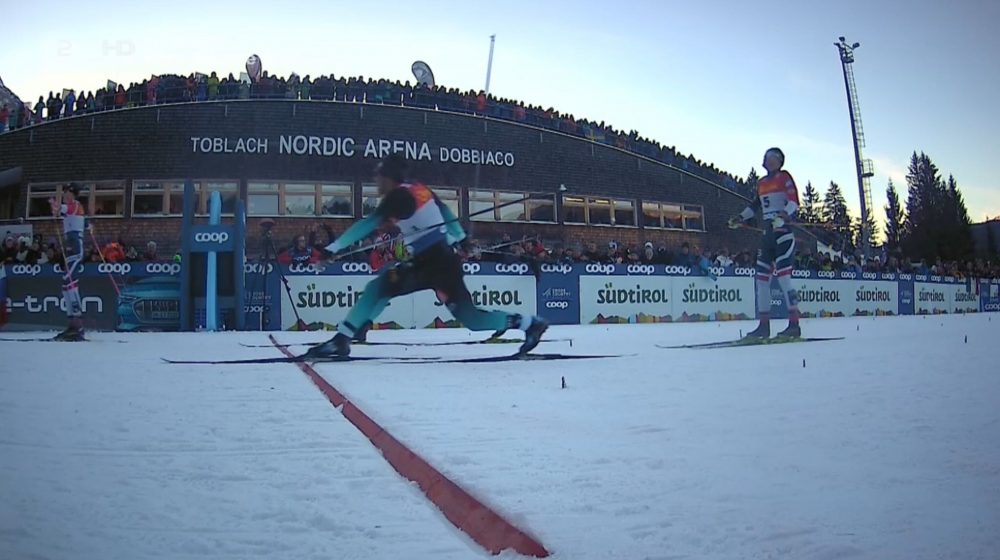
Johannes Høsflot Klæbo of Norway crossing the line in first as France’s Richard Jouve placed second and his teammate, Lucas Chavanat, was third. (Photo: ZDF Screenshot)
Two Americans qualified for the heats, with Simi Hamilton qualifying in eighth (+3.00) and Kevin Bolger of the U.S. qualifying in 13th (+3.98).
Hamilton, who advanced to the second quarterfinal, looked strong for the first two-thirds of the course. However, in the last climb of the sprint loop, while moving from fifth to third, Hamilton fell. The crash cost him advancing to the semis and he crossed his heat in sixth, ending the day’s sprint in 26th.
“I think he unfortunately just took himself out,” U.S. World Cup head coach, Matt Whitcomb said during a phone conversation. “From the side angle, it looked like he just started getting a little bit too far forward. He thought he might have hit something…But it was a bummer because he had a really speedy qualification and was just positioned perfectly to move on and was feeling great.
“It’s one of those instances where you can be disappointed but not discouraged because he’s where you want him to be,” Whitcomb continued. “He’s in a place where he’s good enough to be on the podium, can certainly ski with the best, but unfortunately that didn’t unfold today.”
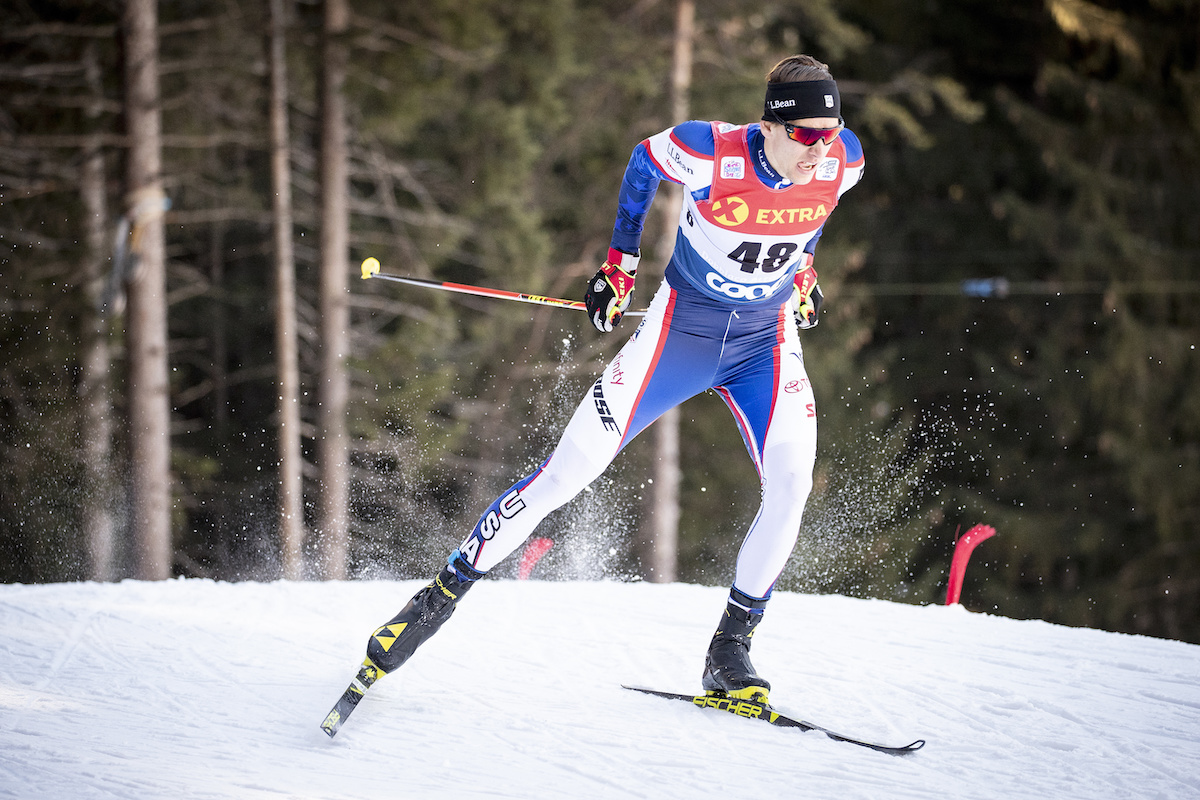
The U.S. Ski Team’s Kevin Bolger during the first stage of the 2018/2019 Tour de Ski — a 1.3k skate sprint. Bolger placed 21st overall. (Photo: Fischer/Nordic Focus)
Bolger, who advanced to the fifth quarterfinal remained in contact with Swedish skiers Karl-Johan Westberg and Viktor Thorn and Russian Alexander Bolshunov, who lead through the first and second climbs. Bolshunov picked up the pace on the second hill, pulling the rest of the field with him.
“I kind of assumed Bolshunov would want to take command of the heat, and he did from the start, and then he put in that surge just over the top of the second climb, I felt like I was ready but not in the best position to react, and was able to get back in contact with the group over the last climb, but making a move from there was tough,” Bolger wrote in an email to FasterSkier on Saturday. “We had one of the fastest heats of the day, if I was in any other heat I think I would have qualified.”
The Russian crossed the quarterfinal first with Poland’s Maciej Starega holding onto him to cross in second. Bolger eventually crossed in fifth for 21st on the day.
“Really exciting to see Kevin qualify,” Whitcomb said. “Watching his qualification rounds, he must have skied one of the fastest first climbs. His V1s were absolutely lightning fast. We’re really impressed with his trajectory throughout Period 1 getting gradually faster and faster and almost being there in Davos and he’s clearly there now.”
Two weekends ago, Bolger finished the Davos, Switzerland sprint in 31st, just one place outside of qualifying. These were the first heats of the season in which he qualified.
“I was excited, but also relaxed,” Bogler wrote of how he was feeling. “I don’t feel like a newbie in the world cup heats anymore, I’ve had experience. So I wanted to ski aggressive and attack and be in the mix from the start.”
“I will be dropping out of the tour after the 3rd stage, along with Simi, and Sophie,” Bolger continued. “But tomorrow’s 15 k skate will be a hard effort, but a fun fast course I’m looking forward to having a good race, but I’ll be putting a little more focus into the next skate sprint in Val Müstair!”
Canadians Alex Harvey finished in 50th (+7.16), Len Valjas in 55th (+7.46), and Bob Thompson 62nd (+8.10).
“My skis were great today!” Harvey wrote in an email after the sprint. “I was actually feeling quite good in the warm up and in the race. I just think that a 2:16 sprint is a bit too short for me. The conditions made for a quick and fairly easy prologue, I think 2 years ago in was more around 2:45 so to shave 30 sec of a sprint course is pretty impressive.”
“I would have liked to get in the heats and maybe put some time on some of the contenders for the overall but I guess I’ll have to wait for tomorrow to do that!” he added.
Another duo of North Americans started the qualifier, with Erik Bjornsen (USST) and Ben Lustgarten (CGRP) of the U.S. placing 76th (+10.38) and 105th (+15.23), respectively.
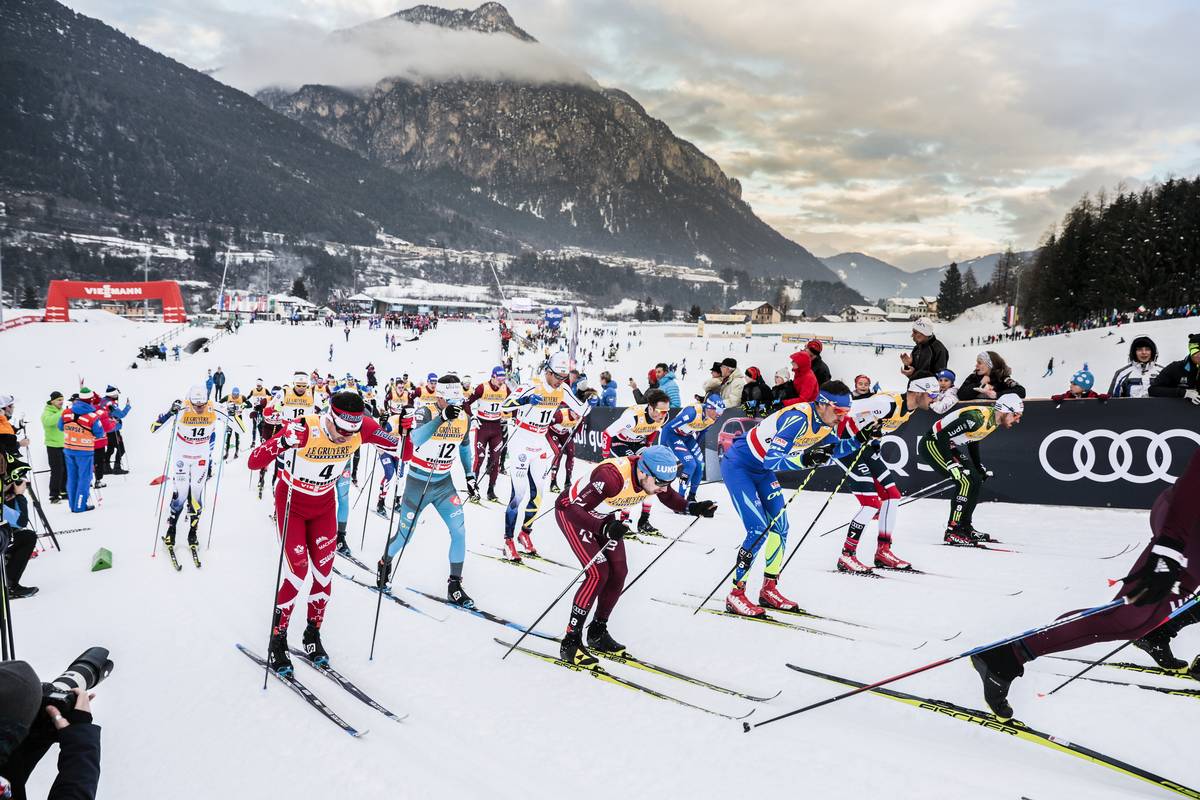
The start of the men’s 15 k classic mass start at Stage 6 of the 2018 Tour de Ski on Saturday in Val di Fiemme, Italy, with (front row, left to right) Canada’s Alex Harvey, Russia’s Sergey Ustiugov, Kazakhstan’s Alexey Poltoranin, Norway’s Martin Johnsrud Sundby, and Switzerland’s Dario Cologna. (Photo: Salomon/NordicFocus)
Beginning this Saturday in Toblach, Italy with a freestyle sprint is the 13th edition of the Tour de Ski (TdS). According to the International Ski Federation (FIS), over the course of seven stages the men will race 80.918 kilometers, the women 60.67 k.
The TdS has become both a staple and a spectacle of the annual World Cup calendar. With a jam-packed series of races primacy is placed on both the ability to recover well and wither less as the TdS transpires.
Prognostication can be tricky in a long-form template like the TdS. So much can go astray during seven races not to mention the travel and dicey germ-avoidance.
Last season’s winner on the women’s side, Heidi Weng of Norway, sits 18th overall in the World Cup standings (14th in distance). She has four top-20’s in the four distance events she’s contested with her best result an eighth in Lillehammer’s 10 k skate. Although featuring two sprints in the first three stages, the TdS remains a distance skier’s paradise.
Weng has skied solidly on the World Cup, but she has yet to show the form that made her a TdS overall winner in 2017 and 2018. Norway has won the last five iterations of the TdS: Marit Bjørgen won once in 2014/2015, Therese Johaug twice (2013/2014, 2015/2016), and Weng the last two years.
Austria’s Teresa Stadlober leads Norway’s Heidi Weng (2) and Ingvild Flugstad Østberg, American Jessie Diggins (3) and others around a downhill corner during the women’s 10 k classic mass start at Stage 6 of the 2018 Tour de Ski in Val di Fiemme, Italy. (Photo: Fischer/NordicFocus)
If Norway is to keep the streak alive, Ingvild Flugstad Østberg, last year’s TdS runner up, could be the heir apparent. She currently ranks second in the World Cup overall and 15th on the sprint list.
Johaug, having returned from an 18 month doping ban, has been on a distance race tear. She has won all five World Cup distance events this season. Johaug, however, will not be lining up for the TdS.
Only five different women have earned distance podiums this season — Johaug, Østberg, Sweden’s Charlotte Kalla and Ebba Andersson, and Finland’s Krista Pärmäkoski. Along with Johaug, Kalla and Andersson are skipping the TdS. (Andersson sits third overall on the World Cup, Kalla fifth.) With the TdS missing three of the five top ranked World Cup distance skiers, daily stages and the overall podium are up for grabs.
Last season’s third overall finisher, Jessie Diggins of the U.S. Ski Team (USST), often cites the TdS as a point in the season when her form trends towards podium performances. She sits eighth in the current distance standings and could very well have a stout TdS.
Russia’s Natalia Belorukova and Yulia Nepryaeva look strong as does Sadie Bjornsen (USST), and Austria’s Teresa Stadlober.
With less than predictable distance stage podiums for the women, it may simply come down to a drag race on the Alpe Cermis final climb Jan. 6.
Switzerland’s Dario Cologna (c) celebrates his fourth Tour de Ski overall title. He was joined by Norway’s Martin Johnsrud Sundby (l) and Canada’s Alex Harvey (r) on the podium in second and third, respectively. (Photo: Fischer/NordicFocus)
The men’s scene is also open to interpretation. Last season’s TdS winner, Switzerland’s Dario Cologna, was in fact a surprise victor. Prior to Cologna’s stage two win in last year’s TdS, it had been nearly three years since the four time TdS overall winner had won a World Cup. Cologna sits 21st overall on the World Cup currently. Given last year’s resurgence, anything is possible for the Swiss skier.
Then there’s Martin Johnsrud Sundby form Norway. He finished on the TdS podium the last three years. At thirty-four-years-old, Sundby is ranked first on the distance list, with a second, a third, and a fourth place in distance races this season.
Sundby won the TdS on two occasions – in 2013/2014 and in 2016. His 2015 win was stripped after he tested positive for excessive levels of Salbutamol. He placed second in the past two Tours.
In a field rife with talent, Sundby’s ability to race and rebound and race and rebound will be tested. Sjur Røthe, Emil Iversen, and Didrik Tønseth— all from Norway— look in form. And there’s Norway’s Johannes Høsflot Klæbo. The winner of last season’s overall World Cup has had flashes of his past explosive self. He could be a TdS protagonist.
The men’s field is notably tight. Along with the Norwegians, several Russians could pop a podium, a stage win, and the overall. Russia comes with a loaded team ready to exploit. Alexander Bolshunov leads the overall World Cup – he’ll turn twenty two on Dec. 31st. He’s backed by teammates Evgeniy Belov, Andrey Melnichenko, and Denis Spitsov.
Canada’s Alex Harvey placed third overall last year and he looked stronger as the TdS progressed.
The Stages
Stage 1: Dec. 29, skate sprint in Toblach, Italy.
Stage 2: Dec. 30, 10 k/15 k skate in Toblach, Italy.
Stage 3: Jan. 1, skate sprint in Val Müstair, Switzerland.
Stage 4: Jan. 2, 10 k/15 k classic mass start in Oberstdorf, Germany.
Stage 5: Jan. 3, 10 k/15 k skate pursuit in Oberstdorf, Germany.
Stage 6: Jan. 5th, 10 k/15 k classic mass start in Val di Fiemme, Italy.
Stage 7: Jan 6th, 9 k final climb skate pursuit in Val di Fiemme, Italy.
Teams
United States
Women: Sophie Caldwell, Sadie Bjornsen, Jessie Diggins.
Men: Ben Lustgarten, Simi Hamilton, Erik Bjornsen, Kevin Bolger.
U.S. Ski Team Head Coach Chris Grover noted in a text that Caldwell, Hamilton, and Bolger will likely cease the TdS after the stage three sprint. Additionally, this is a small team for the U.S. at the TdS. Several athletes turned down TdS nominations including Scott Patterson (USST), Andy Newell (SMS T2/Salomon), Kyle Bratrud (SMS T2), Rosie Brennan (APU), Rosie Frankowski (APU), Caitlin Patterson (CGRP), and Julia Kern (SMS T2). These skiers plan on racing U.S. Nationals this January in Craftsbury, Vermont.
Canada
Women: Emily Nishikawa, Dahria Beatty
Men: Alex Harvey, Lenny Valjas, Bob Thompson
Norway
Women: Ingvild Flugstad Østberg, Maiken Caspersen Falla, Astrid Uhrenholdt Jacobsen, Kari Øyre Slind, Kathrine Rolsted Harsem, Heidi Weng, Lotta Udnes Weng, Tiril Udnes Weng Mari Eide, Anna Svendsen
Men: Martin Johnsrud Sundby, Hans Christer Holund, Emil Iversen, Didrik Tønseth, Simen Hegstad, Krüger, Sjur Røthe, Johannes Høsflot Klæbo, Martin Løwstrøm Nyenget, Eirik Brandsdal, Finn Hågen Krogh
Russia
Women: Yulia Belorukova, Lidia Durkina, Anna Zherebyateva, Mariya Istomina, Natalia Nepryaeva, Anna Nechaevskaya, Anastasia Sedova, Elena Soboleva
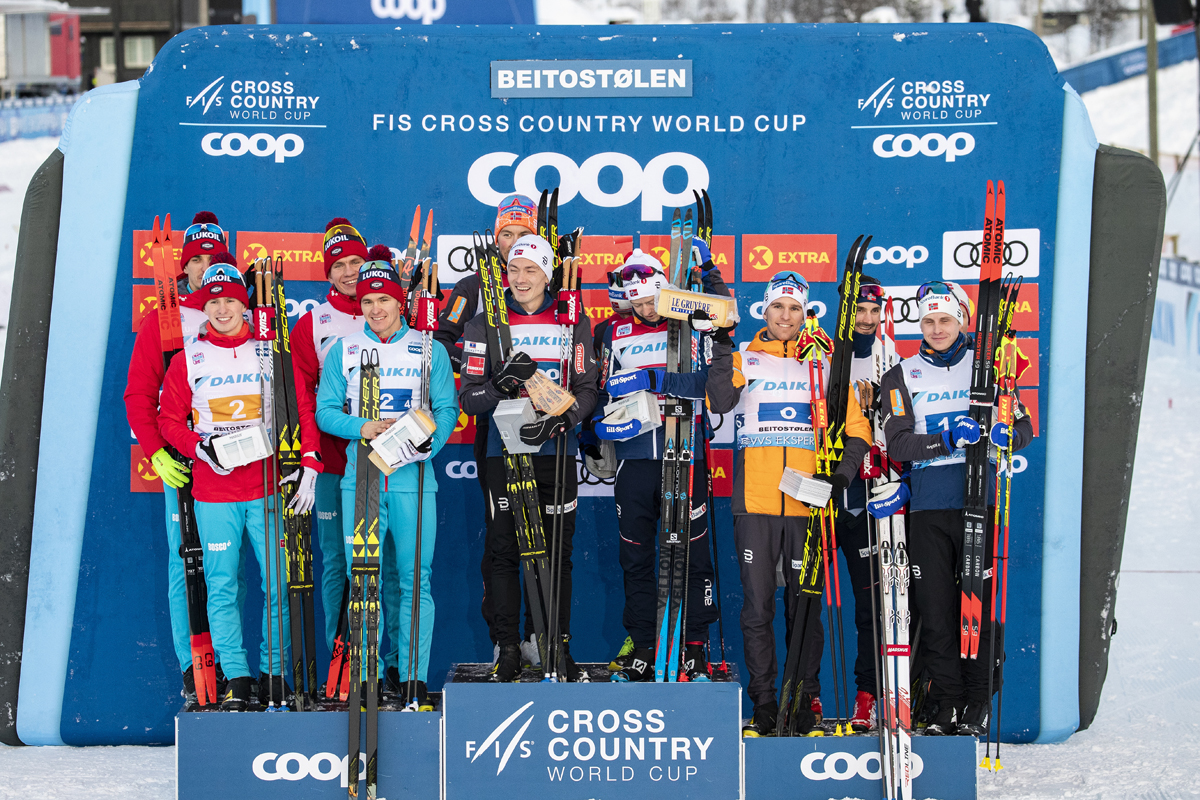
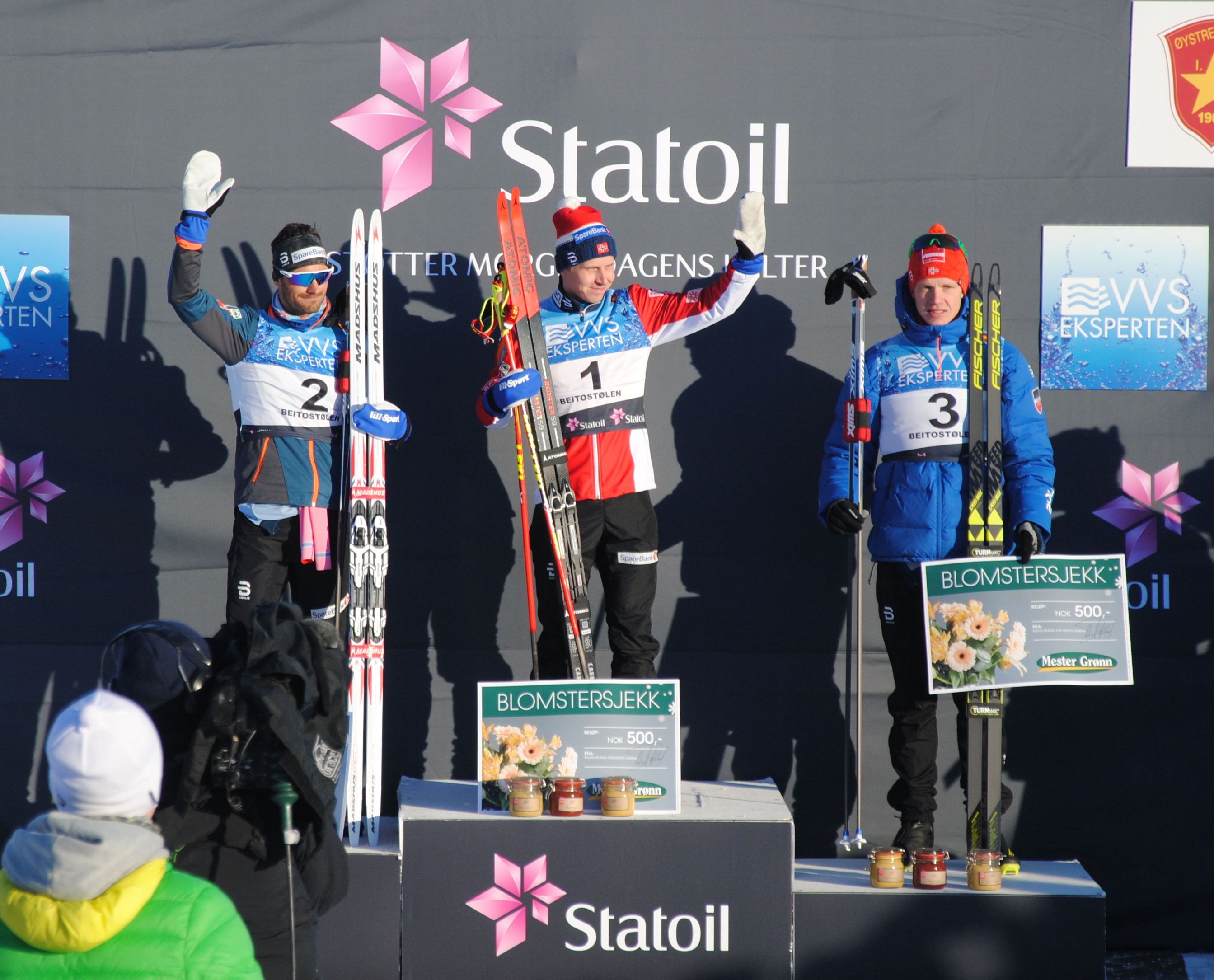
The men’s 4 x 7.5 k relay podium from Beitostølen, Norway. Norway I (center) won, Russia I (left) placed second, and Norway II (right) third. (Photo: Fischer/Nordic Focus)
As Emil Iversen took command of the field from the gun during the men’s relay in Beitostølen, Norway, striding smoothly up the first climb in the lead, the question quickly became, can anyone take down Norway?
The team of Iversen, Martin Johnsrud Sundby, Sjur Røthe, and Finn Hågen Krogh must have liked their odds. Norway has claimed eight of the last nine men’s relay victories on the World Cup, falling only to Russia in Lillehammer’s 2013 men’s relay. Norway’s last time missing a podium in a relay occurred in 2007. While historically, the race has been a 4 x 10-kilometer event, the men’s relay on Sunday consisted of four 7.5 k legs.
Norway’s Emil Iversen and Russia’s Evgeniy Belov lead the pack on the first leg of the men’s 4 x 7.5 k relay in Beitostølen, Norway. (Photo: Fischer/Nordic Focus)
At the first exchange, Iversen had a sizeable lead over second place Norway II team, who tagged 7.7. seconds back. Russia 1 came through with a gap of 16.1 seconds. The first leg of the relay, called the scramble leg, most often doesn’t break the pack apart. It’s part gamesmanship, part high-tempo effort to shake off any non-contenders.
As the second leg began, this much was clear: Russia wouldn’t let Norway run away with the race. Russia’s second leg skier, Alexander Bolshunov quickly caught Sundby during their first lap of the 3.75 k course. Before the end of their first lap, Bolshunov played his hand, upping his effort, and taking control of the second leg. By the time he tagged off for the third leg skier, Bolshunov had put nine seconds on Sundby and his Norway I mates.
Norway II fell off the back, tagging off 33.7 seconds back.
Røthe, winner of
At the final exchange, Norway was Russia’s heels, trailing by a mere 0.4 seconds. Third place Norway II was a distant 50 seconds behind the leaders.
Norway’s Finn Hågen Krogh is the master-closer. Here he crosses the line for first place over Russia’s Andrey Melnichenko in the men’s 7.5 k relay in Beitostølen, Norway. (Photo: Fischer/Nordic Focus)
Krogh, who has a history of being a strong closer, stayed calmly on the heels of Russia’s Andrey Melnichenko, matching his pace on climbs and tucking into his draft on descents. As the tempo accelerated for the final kilometer, Krogh edged around Melnichenko at a turn and held off the Russian through the final moments of the race. In the final stretch, it was clear that Krogh’s strategy had paid off as he glided through the finish with Melnichenko 0.7 seconds behind.
The third-place Norway II team of Didrik Tønseth, Hans Christer Holund, Magne Haga, and Simen Hegstad Krüger crossed the line 53.4 seconds behind the leaders.
“We are used to the tough race against Russia now,”, Sundby told the International Ski Federation (FIS) at the finish. “For the last relays, it has been the same way. They have a really strong team, with different skiers, but every time they have four strong guys. Same procedure today. Today we have back our last leg finisher with Finn [Krogh] and it was really nice for everyone to see him back in good shape. I think the last time was Lahti [World Championships in 2017]. And he’s back again now. So, it’s good for us and we hope for a nice race against for sure Russia.”
While the podium positions seemed to be locked up early on, the remaining top ten positions were in contention as a large chase pack had formed behind the leaders. During the first leg, the U.S. Ski Team’s (USST) Erik Bjornsen was in the mix. At times Bjornsen led the chase pack. In a tightly packed group, Bjornsen tagged off to Kevin Bolger in fourth position, 33.1 seconds back.
The U.S. Ski Team’s Erik Bjornsen (bib 9) during the first leg of Sunday’s 4 x 7.5 k relay in Beitostølen, Norway. (Photo: Aleks Tangen)
“It’s always fun to do a relay with the boys, so it was a good day, working out the cobwebs and getting ready for Seefeld,” Bjornsen told FasterSkier at the finish. Bjornsen was happy with his classic leg. When asked how he felt, he expressed, “Just great! It was really fun! Good crew out there.”
“On the men’s side, all four of our guys took a step forward today,” Matt Whitcomb told FasterSkier in an email. “While Erik isn’t quite in form yet to stay with the break, he controlled and drove a very competitive chase group. His performance was impressive.”
Bolger, the leg skier for the U.S., maintained his position in the chase pack for his first lap. He skied through the exchange/lap zone in ninth place. As the decisive moves were made, Bolger could not maintain pace. The group split in two, and he fell back with the second chase pack.
“Unfortunately, the relay is a contact game, and we lost that late in the second lap,” said Whitcomb. “Kevin dug deep, and was so close to keeping contact over the top of the last big climb, but once it opens slightly, it tears open.”
Bolger eventually tagged third leg Scott Patterson (USST) in 10th (+1:52.4).
“I’m happy with it,” said Bolger about his leg. “I wish I could’ve stuck together with the guys all the way through the finish but just to stick in and ski with some of those guys was good… I wish I could’ve skied it harder toward the finish, but I just got tired, went out a little hard maybe, but overall I’m happy, a lot of takeaways, so I’ll learn a lot from it.”
Scott Patterson took the first skate leg for the U.S., skiing with Italy and Sweden in the second pack. He tagged off to closer Simi Hamilton (USST) in 12th position, with a 2:19.6 minute deficit to the leaders.
“It was pretty good,” Patterson reflected on his race. “Kind of had a slow start to my season, today felt pretty good, skiing with Italy and Sweden, able to hang pretty well, so it was a fun one. … With these short relays, it’s so easy to hammer the first lap, the second is kind of hang on, and that’s a lot of what it felt like today.”
When asked how the 7.5 k legs, compared to the traditional 10 k distance, affected their pacing during the race, Patterson was adamant that the shorter course was an added challenge for distance skiers.
“Absolutely harder,” he said of the change. “We’ve had so many 15k’s that you’re kind of used to that pace, and this is… I mean for me, it’s almost sprint qualifier pace. You just gotta’ go and hang in.”
Though Hamilton was ultimately unable to gain any positions for the U.S., he was pleased with his performance and enjoyed the relay environment as the U.S. finished 12th (+3:22.7).
The U.S. team for the men’s 4 x 7.5 k relay in Beitostølen, Norway. From left to right, Erik Bjornsen, Simi Hamilton, Scott Patterson, and Kevin Bolger. (Photo: Aleks Tangen)
“I was happy with it,” Hamilton shared. “It wasn’t my best distance feeling ever, but it was a fun course, Scott tagged me in a great spot, just, right off of the tail of Viktor Thorn [of Sweden] and DeFabiani [of Italy] there, and those guys are really good skaters. B I tried. I didn’t really want to try to ski just dangling off the back the whole time, so I put in [a quick effort] there at the start, just to get in a draft behind them. And I feel like a relay is a kind of race where you kind of have to take the risk sometimes, especially later on in the race for the last couple of legs. So in that sense, it’s really fun. You just kind of throw caution to the wind and see what happens. But it was fun and I’m feeling like I’m kind of coming into better shape as the season progresses. I’m psyched for the sprint next weekend and everything else coming up this winter.”
“It was an impressive relay debut,” concluded Whitcomb. “Watching this men’s team fight hard for contact today made us all incredibly motivated. I think I share the sentiment with the rest of our staff and athletes – seeing the U.S. men’s relay hit the podium in a World Cup would rival the excitement of the Olympic gold. We’re not there yet, but we can see it from where we are. And we plan to close.”
The Canadian team did not field a men’s relay team.
Racing continues next weekend in Davos, Switzerland.
The women’s field cresting a hill during the scramble leg of the World Cup 4 x 5 k relay in Beitostølen, Norway.
FIS World Cup Beitostølen, Norway 4 x 5 k / 4 x 7.5 k Relay
Sunday in Beitostølen, Norway the women raced a 4 x 5-kilometer relay on firm tracks and under partly cloudy skies — Saturday’s races featured fresh snowfall.
Norway I took the win in a total time of 57:23.6 minutes. In order of relay legs, Heidi Weng, Therese Johaug, Ragnhild Haga, and Ingvild Flugstad Østberg comprised the team that raced at the sharp end of the race for all but the first leg.
Weng, the first leg skier for Norway, tagged Johaug in fourth, 7.3 seconds behind Russia’s Yulia Belorukova who scrambled for Russia I. From then on, Norway I set the speed benchmark.
Despite Russia I’s star power, it was Russia II that took second place Sunday. Lidia Durkina, Anna Zherebyateva, Mariya Istomina, and Elena Soboleva, having been gapped by Norway I, could pack-ski until the final stretch to slot over the line .5 seconds ahead of third place Finland I. (Russia II finished 37.3 seconds behind Norway I.)
Russia I’s anchor, Anna Nechaevskaya, fell in the final downhill turn losing several places for her team.
Finland I, the third-place team on the day, featured Johanna Matintalo, Krista Pärmäkoski, Ritta-Liisa Roponen, and Eveliina Piippo. Finland I finished 37.8 seconds behind winner Norway I.
The U.S. I team placed fifth (+48.0) in a performance that saw them out dual Sweden and Norway II in the closing moments of the race. Sadie Bjornsen, Rosie Brennan, Caitlin Patterson, and Jessie Diggins skied for the U.S. on a roster absent some names that were longtime staples of the U.S. team’s relay quartet — both Kikkan Randall and Liz Stephen retired from racing last season.
The U.S. had planned on fielding a second team featuring the U.S. Ski Team’s (USST) Sophie Caldwell (USST), Ida Sargent (USST), Kelsey Phinney (SMS T2), and Kaitlynn Miller (CGRP), however, they did not start.
Norway I held on for the win in the men’s 4 x 7.5 k relay today in Beitostølen in a time of 57:23.6 minutes. This was head-to-head racing at its finest. After 30 k of racing, the final standings came down to a lunge at the finish between Norway I and Russia I. Russia I placed second (+0.7).
Emil Iversen, Martin JohnsrudSundby,Sjur Røthe, and Finn Hågen Krogh formed the Norway I team. The Russia I team included Evgeniy Belov, Alexander Bolshunov, Denis Spitsov, and Andrey Melnichenko.
Norway II’s Didrik Tønseth, Hans Christer Holund, Magne Haga, and Simen Hegstad Krueger placed third (+53.4).
The U.S. team of Erik Bjornsen, Kevin Bolger, Scott Patterson, and Simi Hamilton placed 12th (+3:22.7).
IBU World Cup, Pokljuka, Slovenia 7.5 k / 12.5 k Pursuit
Looking smooth across the finish line, Norway’s Johannes Thingnes Bø, won the men’s 12.5 k pursuit in Pokljuka, Slovenia in a time of 30:20.4 minutes. That smoothness was matched in a photo finish with France’s Quentin Fillon Maillet who placed second, 0.1 seconds behindBø. Maillet cleaned his four shooting stages.
Bø looked in control for the last portions of the race. His strong skiing gave him a 50-second lead as he began his final shooting stage. There, the Norwegian missed two targets, allowing the chasers to latch back on during the final lap. In total, Bø missed three targets, one during his first prone stage, and two during his second standing stage.
Russia’s Alexander Loginov was third in the sprint, finishing 1.9 seconds back. Loginov missed one target in his first standing bout, otherwise, he shot clean.
Canada’s Christian Gow placed 14th (+1:09.1) while shooting clean. No other Canadians qualified for the pursuit.
For the U.S., Leif Nordgren was the best placed American in 33rd (+2:39.1, 0+2+1+0). Sean Doherty was 39th (+3:07.9, 0+0+2+2),
Kaisa Mäkäräinen of Finland won the women’s 10 k sprint in a time of 29:16.9 minutes. Mäkäräinen shot clean during the competition. Italy’s Dorothea Wierer was second, finishing 41.3 seconds behind while also shooting clean during all four shooting bouts.
Third place went to Paulina Fialkova of Slovenia. Fialkova finished 59.2 seconds back and shot clean for the day.
Clare Egan after placing sixth in the IBU World Cup’s 10 k pursuit in Pokljuka, Slovenia. (Photo: Biathlonworld.com)
For the U.S., Clare Egan placed a career-best sixth (+1:22.4, 0+0+1+0). Egan missed a single target during the race.
“I knew the pieces were there,” Egan told IBU TV after the race. “I had clean shooting in a [preseason] race at the Austrian trials before the World Cup. And then I had just awesome ski times this week, so I knew it was coming. I just had really good focus today, and I love competing head to head, so pursuit is a great race for me. I thought I was… I wasn’t sure if I was in fifth or sixth, and this Norwegian skier [Marte Olsbu Røiseland], really good, just got me at the finish. So I was so happy when I looked up and saw that I was in sixth in the flower ceremony.”
Also for the U.S., Susan Dunklee placed 39th (+3:36.3 0+1+0+1), and Joanne Reid 43rd (+3:51., 0+0+1+0).
CNST teammates Dahria Beatty (l) and Katherine Stewart-Jones charge the last hill of the 10km on their way to 6th and 1st respectively. (Photo: Peggy Hung)
Sovereign Lake NorAm/SuperTour 5k/10k Classic
The Sovereign Lake weekend wrapped up with individual start classic distance races and a more neighbourly distribution of results.
Katherine Stewart-Jones (CNST) won the women’s 10km in 31:48.4, hanging on in the last lap to finish ahead of APU’s Becca Rorabaugh (+7.1) and SMS’ Julia Kern (+7.8). APU’s Hailey Swirlbul snatched 4th at 10.9 seconds with Dahria Beatty (CNST) in 5th, 26.7 seconds back.
Kyle Bratrud on his way to victory in the 15km (Photo: Peggy Hung)
Kyle Bratrud (SMS T2) won the battle in the men’s 15km in 41:59.3, 3.8 seconds ahead of Ben Lustgarten (CGRP) and 34.7 seconds ahead of Ricardo Izquierdo-Bernier (NMU/CNEPH). Sam Hendry (CJNST) edged out Andy Newell (SMS T2) for fifth.
Individual start results are here with the full weekend here. Photos and interviews are coming in the Noram/SuperTour wrap-up.
The start of the Holmenkollen World Cup men’s 50 k freestyle mass start on Saturday in Oslo, Norway. (Photo: Fischer/NordicFocus)
OSLO, Norway — Thumping house music. Thousands of raucous fans, who, if not waving Norway’s flag, had their faces painted in their national colors of red, blue and white. If the American Super Bowl translated to cross-country skiing and snow, the Norwegian Holmenkollen is as close as it gets.
Saturday saw the 116th edition of the annual 50-kilometer men’s event, a race that totals roughly6,574 feet of climbing for those who complete it in full. Camped along the course fence, spectators adorned in Mariusgenser sweaters, many withkoozied Carlsbergs in hand, were not crazy for having hauled coolers and chairs through the snowy trailside. All said and done, racers would pass by six times on their way around the famed 8.3-kilometer loop.
Leading through the first 8.3 k, Norwegians Didrik Tønseth and Niklas Dyrhaug set the pace, followed by two Frenchmen: Clement Parisse and the World Cup distance leader, Maurice Manificat. Alex Harvey of Canada, who won last year’s World Championships 50 k, skied 2.3 seconds off the lead pace in 17th.
Eight skiers ahead of Harvey, Switzerland’s Dario Cologna and Norway’s Martin Johnsrud Sundby skied side by side in ninth. With the past two Holmenkollen titles in his name, Sundby was certainly in search of another on Saturday.
Through the next lap, Norway and France continued to push from the front led by Sjur Røthe and Robin Duvillard, respectively. As they passed the 16.6 k mark, a pack of 51 skiers still remained within 21 seconds of one another.
France’s Adrien Backscheider leading the Holmenkollen 50-kilometer freestyle mass start on Saturday in Olso, Norway. (Photo: Logan Hanneman)
France was three-strong in the front on the third lap, with Jules Lapierre, Adrien Backscheider and Manificat taking charge. Sundby and Harvey skied 20 seconds off the Frenchmens’ pace in 17th and 18th, respectively. Seventeen seconds ahead of them was Cologna in 12th. Three laps down, three laps to go and just over an hour of racing complete.
In another lap, France had faded from the front, while Norway subsumed the the lead. At 33.3 k, six of the top ten skiers were Norwegian, with Hans Christer Holund at the helm. Less than a second behind Holund was Sundby in second.
Russia’s Maxim Vylegzhanin followed in third, then Harvey in fourth, Norway’s Simen Hegstad Krüger in fifth, Tønseth in sixth, Norway’s Daniel Stock in seventh, Dyrhaug eighth, American Scott Patterson in ninth, and Sweden’s Daniel Rickardsson in 10th. Only 10 seconds separated first from 17th.
At this point, anyone who had watched the dual-skier showdown in last year’s Holmenkollen — which had broken around the 22 k mark — began to wonder how much longer the 17 skiers in Saturday’s lead pack would stay together.
The answer came with about five kilometers to go. Patterson, who had been skiing in the top six through the fifth lap, locked up with Manificat. The Frenchman dropped off the pace, along with 10 others.
“I was skiing right behind Maurice Manificat and one of the steep sections he just died, and that was right when that lead group pulled away so I missed the move,” said Patterson, a U.S. Ski Team member. “I didn’t quite have a strong enough group to pull back up to the leaders.”
The lead group was reduced to seven by 46 k, with Great Britain’s Andrew Musgrave, Vylegzhanin, Sundby, Cologna, Russia’s Denis Spitsov, Holund, and Røthe all still in the hunt for the podium.
Harvey was in 11th, about 15 seconds behind the lead group and 10 seconds ahead of Patterson in 14th.
“I wanted to see how my skis were doing compared to the other guys,” Harvey reflected, “And then after that just try to see who is looking strong and try to think ahead and think of the last lap, whose going to be a good bet to follow when the moves are going down.”
Norway’s Martin Johnsrud Sundby (r) and Switzerland’s Dario Cologna (4) sprint to the finish of the Holmenkollen 50-kilometer freestyle mass start on Saturday in Olso, Norway. (Photo: Fischer/NordicFocus)
In the last half lap, Musgrave put in a surge to the front. But he was soon swallowed and spit back into seventh. Rounding into the stadium for the final time, all seven remained together, though Sundby and Cologna now skied in the front. The two cornered back toward the final 100 meters and a head-to-head distance sprint finish ensued.
In a photo finish, Cologna outlunged Sundby for the win, before a somewhat silent, predominantly Norwegian-filled stadium. Cologna didn’t seem to mind. The 31 year old tossed his poles to the side, all smiles as he accepted his first 50 k Holmenkollen victory — the ultimate distance race of a given season (outside of the Olympics or World Championships) — in a time of 2:01:48.1 hours.
“It was a suspenseful race, something was always happening even though a large group stayed together for a long time,” Cologna said in an interview with Swiss broadcaster SRF, according to a translation. “Around the bonus sprints there were the most Norwegians so I was a little afraid to get attacked, but I got back fairly quickly. And in the end I felt very well. Maybe I could have risked something already earlier on the long climb, but I trusted in my finish and knew that I would surely have a good opportunity. But I didn’t expect Sundby would be quite as strong, he made my life hard on the last kilometer and then it really became very close, but thankfully it went well.”
The Holmenkollen men’s 50 k freestyle mass start podium on Saturday at the World Cup in Oslo, Norway, with Switzerland’s Dario Cologna (c) in first, Norway’s Martin Johnsrud Sundby (l) in second, and Russia’s Maxim Vylegzhanin (r) in third. (Photo: Fischer/Nordic Focus)
Sundby finished second, one-hundredth of a second behind. The 33 year old has reached the podium in all but one of the Holmenkollen races he’s finished.
“I dreamt about the third in a row here for sure, but I think Dario has also been a few centimeters behind in this race a couple of times, and I think he deserved this one,” Sundby said at the press conference. “I wasn’t good enough in the sprint and Dario seemed to be the stronger one out there today. … I am not disappointed. I am on the podium here in the 50 for my seventh time in a row, so I think that’s OK.”
In his first World Cup race since November of last year, Russia’s 35-year-old Vylegzhanin took the final podium spot in third, 1.1 seconds back from Cologna.
Rounding out the top 10 was Røthe in fourth (+4.2), Spitsov in fifth (+4.4), Holund in sixth (+4.5), Musgrave in seventh (+15.1), Germany’s Florian Notz in eighth (+25.9), Harvey in ninth (+32.4) and Duvillard in 10th (+33.5).
France’s Maurice Manificat (r) leads American Scott Patterson (32) and Canada’s Alex Harvey (5), among others, during the 2018 Holmenkollen 50-kilometer freestyle mass start on Saturday in Olso, Norway. (Photo: Logan Hanneman)
“I felt good, I have been really sick in Lahti, I was on antibiotics up until Thursday, so I really didnt know what to expect heading into today,” Harvey said. “I started back with a very bad result in Drammen, very close to last. So yeah I did not know what to expect but it was good, just missed a little bit on the last 500 meters over the top… but overall it was a good race.”
Following Harvey, Patterson was the second North American across the line, finishing in 16th (+56.3). Saturday was his third time racing at Holmenkollen and first time racing its freestyle format.
“It’s all just about staying relaxed,” Patterson said. “Kind of felt like five pretty easy laps and then one real hard one out there. … Actually I struggled a little bit on the third lap, my skis slowed down quite a bit and was able to switch on the fourth [lap] and then really had some rockets out there.
“I had one quite interesting moment when I was trying to thread the needle and got taken out by a Russian and had a Sweden next to me just somersault over top of me,” Patterson added, referring to a tumble he took in his fourth lap. “But we were able to get up pretty quick and rejoin the group.”
Devon Kershaw leads his Canadian teammate Andy Shields during Saturday’s Holmenkollen 50 k freestyle mass start in Olso, Norway. (Photo: Fischer/NordicFocus)
Canada’s Devon Kershaw finished in 28th (+3:43.6). When the Holmenkollen race veteran was asked why he continued to return to the challenging course, Kershaw, who lives with his family near Oslo, was bare bones in his response.
“After the Olympic 50 k, I promised myself I wouldn’t do a skating 50 k. Two weeks later, here I am. Kershaw said. “But I think the biggest reason for that is that it’s such a magical place to race. And I feel really grateful and honored to be able to race such at such a fabled venue … there is no better place in the world to do a ski race.”
Two more Canadians competed on Saturday, with Graeme Killick placing 34th (+4:55.1) and Andy Shields finishing 47th (+8:13.6).
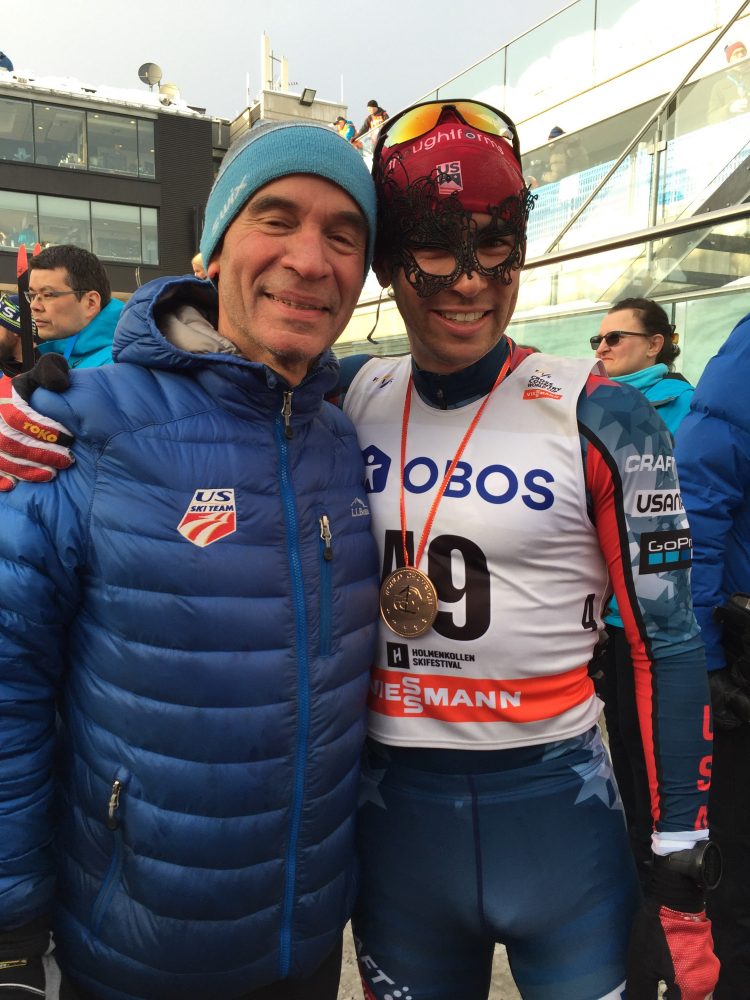
American Noah Hoffman with his dad after finishing the Holmenkollen 50 k freestyle on Saturday for the final race of his pro skiing career. (Black mask and photo courtesy of Liz Stephen)
Also racing on Saturday for the U.S. was David Norris in 37th (+6:19.7), Paddy Caldwell in 46th (+8:12.3), Noah Hoffman in 51st (+10:27.9), and Kevin Bolger in 52nd (+12:44.2). Simi Hamilton did not finish.
Before crossing the finish line in what would be his final Holmenkollen race, Hoffman pulled to the side of the course to give his father, who was present at Saturday’s race, a hug. Hoffman has been racing the Holmenkollen since 2011.
“The last one of my career so it’s a special one for sure,” Hoffman said of his last career race. “Pretty awesome to have my dad here and Zach [Caldwell] here. It was a little emotional on the last lap, but pretty fun.”
This pretty much sums up Stage 5 of the 2018 Tour de Ski, with a France’s Adrien Backscheider (an early race leader) crashing in the background while Switzerland’s Dario Cologna (red Tour leader’s bib) and Great Britain’s Andrew Musgrave (22) and others chase Norway’s Sindre Bjørnestad Skar (39) and others not shown in the men’s 15 k freestyle mass start on Thursday in Oberstdorf, Germany. (Photo: Harald Zimmer)
Like ants swarming a bread crumb — skating ants — on ice. That was one image that could be conceived from the men’s 15-kilometer freestyle mass start on Thursday, which served as Stage 5 of the 2018 Tour de Ski in Obertsdorf, Germany.
After high winds and fallen trees Wednesday in Obertsdorf left race organizers scrambling to set a new course for Thursday’s distance races, the end result was a 2.1 k loop (the women’s sprint course plus a flat section) with a maximum climb of 16 meters per lap for both the men and the women. The men rounded it seven times for 14.7 k and the women lapped five times for 10.5 k.
While Oberstdorf’s distance courses are typically “challenging and hilly and filled with attacks and strategic moves”, according to U.S. Ski Team Women’s Coach Matt Whitcomb, Thursday’s race was mostly flat. “It was probably the flattest race that many of these athletes have ever raced on the World Cup so it made for a really exciting pack race.
“[The organizers] just couldn’t use the course with the hills because the trees and the forest were unstable,” Whitcomb explained on the phone Thursday evening. “They also didn’t have time to clear the wood that fell. There were six or seven huge trees that fell on the course.”
It had also rained on Wednesday — in fact, a lightening storm struck the venue and led to the cancellation of Stage 4 after the women’s qualifier — so organizers opted to salt the course to preserve it as much as possible for the mass starts. It was raining again on Thursday, leaving the course icy with a thin coat of slush on top by the time the men raced after the women.
Start of the men’s 15 k freestyle at Stage 5 of the 2018 Tour de Ski in Oberstdorf, Germany, with Canada’s Alex Harvey (4), Russia’s Sergey Ustiugov (black bib) and Switzerland’s Dario Cologna (red Tour leader’s bib) up front. (Photo: Fischer/NordicFocus)
The men’s field, led by Russians Sergey Ustiugov and Alexander Bolshunov for almost all of the first lap, completed Lap 1 of seven in 4 minutes and 16 seconds (with Sweden’s Calle Halfvarsson leading through the checkpoint). There, at 2.1 k, all 67 starters were within 16 seconds of the lead.
One lap later, as Great Britain’s Andrew Musgrave led the large group through the stadium, just ahead of Norway’s Martin Johnsrud Sundby, Switzerland’s Dario Cologna, and Canada’s Alex Harvey, only one man had been dropped. Sixty-six still skied within 19 seconds of first.
Crashes dotted the entire race, with Bolshunov going down at least twice. Mostly, skiers tripped over one another on the slightly rolling course. Harvey even broke a pole at one point in the middle of the second-to-last lap. In a phone interview on Thursday, the lone Canadian in this year’s Tour de Ski (TdS) estimated he witnessed several crashes per lap.
“I saw for sure between 10 and 15 crashes that happened within my surroundings,” Harvey said.
For the first two laps, Harvey positioned himself in the top five, coming through the 3.6 k sprint bonus in fifth place to earn six bonus seconds (which count toward the overall Tour standings). On Lap 3, he dropped back to around seventh, still within 2 seconds of Musgrave and Norway’s Didrik Tønseth, who swapped the lead throughout the third lap.
On Lap 4, Cologna moved to the front, just ahead of Musgrave, Tønseth, Sundby and 30 others within 10 seconds of first at 7.8 k. There, Harvey was back in 30th, 9.2 seconds back. About 1.5 seconds behind him at 8.4 k, the end of Lap 4, was American Erik Bjornsen in 36th.
“I didn’t want to fall that far back, but I made a couple bad decisions, like picking wrong lanes and it was just a bit of a slower lane on one hill, so you’d lose five, six spots,” Harvey recalled. “Somebody would fall in front of you or in your lane, so then you’d come to a stop and lose 10 spots, so it was just real mayhem there. But my plan was to try to stay in the top five, top 10 all day, but I just didn’t do that.”
Lap 5 saw Cologna, Sundby, Tønseth, and even France’s Clement Parisse at the front of the pack, while Harvey moved back up to around 20th, just 3.5 seconds out of first.
On the penultimate lap, Harvey broke a pole.
“I had been kind out of position for a lap and half by then, so I was just trying to find ways to move, going on the outside, I think somebody just stepped on my pole, but it’s hard to tell,” he said.
Despite dropping to what he estimated to be 40th on that sixth lap, Harvey recovered, thanks to the tightly packed group, and lapped through the stadium in 27th, 5.3 seconds behind Tønseth in first.
Over the final 2.1 k, Harvey continued to pick off the places. One and a half k later, he was up to eighth, 3.4 seconds behind Norway’s Sindre Bjørnestad Skar in first.
“I was really focusing on staying outside the whole time, never going for the inside lane and then maybe people were starting to get tired a little bit, even though the course was not hard and the course was fast,” Harvey said. “… I think a lot of it was luck.”
In the final meters, when everyone at the front of the race turned it up another notch and Norway’s Emil Iversen attacked on the final rise before descending into the stadium, Harvey came out on top off a three-way photo finish for fifth place, edging Musgrave in sixth and Norway’s Finn Hågen Krogh in seventh. All three were within 4 seconds of first place, which went to Iversen.
Norway’s Emil Iversen (17) racing to the line with his teammate Sindre Bjørnestad Skar (39) for first in the men’s 15 k freestyle mass start on Thursday, which Iversen won by 0.4 seconds for his first win and podium of the season, and the first for a Norwegian man in the 2018 TdS. (Photo: Fischer/NordicFocus)
The win was Iversen’s first of the season, and Norway’s first on the men’s side in the 2018 TdS, and puts him in 13th, 2:13 minutes out of first, with two stages remaining.
“It was a fight from the start to the end, and I just had to be in my head… doing the right things,” Iversen told reporters in English after the race. “I did that really good today so I am satisfied with that.”
Iversen crossed finished first in 29:49.8, just 0.4 seconds ahead of his Norwegian teammate Skar in second place. Italy’s Francesco De Fabiani — who had been 34th at 8.6 k, seven seconds back and just ahead of Bjornsen — claimed third place, just 0.9 seconds behind Iversen. Cologna finished fourth (+3.7) to extend his overall TdS lead, followed by Harvey in fifth. Harvey is still fourth in the Tour, now 1:23.1 behind Cologna.
Asked if he was mostly focused on finishing close to Cologna, Harvey said he was actually keeping track of Bolshunov, who ended up 40th (+15.9) on Thursday. Heading into Stage 5, the Russian U23 skier was third in the Tour, 6.3 seconds ahead of Harvey in fourth. So Harvey knew that even 6 bonus seconds at one of two sprint bonuses on the course could be the difference between third or fourth in the standings.
At the first bonus sprint, where Harvey picked up 6 seconds, Bolshunov picked up 3. Then, at the second bonus sprint at 7.8 k, the Russian clocked through in sixth for 5 seconds. Harvey was 30th there for zero. At the end of the day, Harvey held onto fourth in the standings, 1:21.3 minutes behind Cologna, 30.1 behind Ustiugov, who’s still in second, and 15.5 behind Sundby, who improved to third. Meanwhile, Bolshunov slipped to fifth, 3.6 seconds behind Harvey.
“… He ended up crashing on the last lap, I think,” Harvey said of Bolshunov. “I was focusing more on the guys that are closer to me because Dario, he’s so solid, he never really has a bad day. I think a lot of people — nobody’s giving it to him, but it’s going be hard to get back on him, so I think people are starting to fight more for second place. It was more about Bolshunov and Ustiugov.”
Russia’s Sergey Ustiugov leading Norway’s Martin Johnsrud Sundby (6), Austria’s Dominik Bauldof (47), Kazakhstan’s Alexey Poltoranin (5) and the rest of the men’s field during the men’s 15 k freestyle mass start at Stage 5 of the Tour de Ski. (Photo: Fischer/NordicFocus)
Ustiugov finished 28th on Thursday (+11.1) and now trails Cologna by 53 seconds in the overall. Sundby finished eighth (+4.2) and picked up 23 bonus seconds in Thursday’s mass start to move up from sixth to third overall (+1:07.6).
“For sure, it has been difficult weather, difficult conditions for those who make this race, and I think you can argue in a lot of ways today, the race was difficult and blew many racers’ chances, both with the difficulties with the skis and poles,” Sundby told reporters in English after. “But I am happy that they decided to do the race. They found a short track we could ski in and no cancellation I think that was good.
“My main goal for the season is Olympics,” Sundby continued. “I think we use this Tour for, one: I love the Tour de Ski; it’s a beautiful competition, and two: to get in better shape for the Olympics. That is the main goal this season, but I still want to fight for the first [in the Tour]. It looks a bit a long ahead at this point, but we have two more races to go.”
For Harvey, the race was also about distancing himself from some of his biggest threats in the final climb on Sunday, such as Sweden’s Marcus Hellner, who entered Stage 5 in 10th and about 35 seconds behind him overall, and France’s Maurice Manificat, who was previously 36 seconds behind him in 14th overall. They’re still at least 37 seconds behind Harvey after Manificat finished 10th on Thursday to move up to 10th overall (+1:59.0), tied with Germany’s Thomas Bing, who placed ninth Thursday to put himself ninth overall (+1:59.0). Hellner follows in 11th overall (+2:05.3) after finishing 22nd in Stage 5.
“I think for me today was a really good opportunity to make some time, especially on the guys close behind me, like Manificat and Hellner,” Harvey said. “I didn’t lose much, but I kind of missed the opportunity to give myself a bit more of a cushion for the climb, so that’s mostly what I’m bummed out about. That and looking at the schedule of the Tour, [this mass start] was for sure where I thought my best chance at a podium would be. So I’m a bit bummed out that I missed out on that, but it’s part of the game.”
In a Cross Country Canada press release, Harvey was quoted on his frustration with the mass start being held on a short, narrow and relatively easy course.
“It’s just too bad, the organizing committee or the jury should have just made it a sprint or an individual start,” Harvey told FasterSkier. “It was just kind of a stupid race. I was lucky that I ended up not losing too much time but I didn’t feel like I raced. It was easy the whole time, with just nerves the whole time, trying not to fall and stay out of trouble, even though nobody I think was able to stay fully out of trouble today.”
Bjornsen ended up 32nd at the finish, 11.7 seconds out of first, and leaves the TdS in 20th (+3:10.7). After initially planning to race the entire Tour, he spoke with Whitcomb about withdrawing after Stage 5 on Tuesday night.
“Erik is in a great spot,” Whitcomb said. “He’s had a really strong period [1 on the World Cup]. He’s skiing a really strong Tour. He’s made a distinct step forward this year, and we want to not lose sight of the goal of doing well at the Olympics. Erik’s a guy where in a number of events, but especially in the team sprint, a medal could be on the table for him, so we’re really focused on making sure we don’t tap things too deeply when we don’t need to. So Erik decided to ski through today, then head to Ramsau for a little rest, then a training camp.”
“It was a hard decision since I’m feeling good and sitting in 20th place,” Bjornsen wrote in an email. “There is a team sprint coming up in a little over a week [in Dresden, Germany] that I want to prepare for. There are only a couple team sprints each year and I feel that is my best chance of stepping onto a World Cup podium. I can’t let those opportunities pass me by.”
“I was pretty disappointed with my result,” Bjornsen wrote of Thursday’s mass start. “I’ve been feeling strong and felt like I wasn’t able to use my fitness out there today. It was great practice skiing in a tight pack. The finish came way too fast.”
Also for the U.S., Paddy Caldwell raced to 39th on Thursday (+15.5), and Andy Newell was 53rd (+43.2) while Simi Hamilton did not start. Newell and Hamilton have also decided to leave the Tour, as they had originally planned after Oberstdorf, and head to Ramsau, Austria, in advance of the Dresden city sprint World Cup weekend Jan. 13-14.
“I chose to race today because I had held back a bit in the last skate race on stage 3 to rest up for the sprint, and then sure enough It was canceled,” Newell wrote. “So I felt like I still had some good energy and It was worth having one more hard race.
“I felt a lot better racing today than in the distance races at altitude so I was stoked about that,” he added. “It was raining and icy and fast so it made for an exciting time. Lots of crashes and broken poles for sure, it felt more like rollerski racing with such a tight pack. Aside from several small tangles on the uphills, I tried to avoid trouble and was happy to ski with the main pack during the the majority of the race.”
“Kind of a weird stage for sure but I think it’s actually good for the TDS,” he wrote. “Adds some excitement and plays to a different skill set to race on an icy flat course like that. Racing is racing. We have an all uphill stage of the TDS, I think it should be customary to have a flat one:) similar to cycling.”
He leaves the Tour in 65th (+9:37.1), while Caldwell will continue in his first-ever Tour de Ski ranked 60th (+6:58.2) out of 67.
“I felt like I was skiing with new people all the time,” Caldwell wrote in an email about Stage 5. “It was a very dynamic and chaotic race. There were countless crashes and tangles out there. Absolute mayhem. Poles breaking every climb and at least one serious pile up every lap.
“I am happy with my performance today though it is bittersweet being so close to the points and the top guys,” he wrote of his 39th-place stage result. “It has been a pretty rough Tour for me so far fighting a cold, but today was definitely a step in the right direction. Right now I am just hoping to keep working out this cold and be able to put together good efforts for the next two races.”
“I actually thought he skied fantastically today,” Whitcomb said, “and he’s sounding much better tonight so I think there’s quite a bit of hope for Paddy. He’s looking good right now.”
Other notable withdrawals from the Tour include Sweden’s Halfvarsson and Finland’s Iivo Niskanen. Halfvarsson placed 54th on Thursday to leave the Tour in 24th overall. Niskanen did not race in Oberstdorf.
The Tour de Ski Stage 5 women’s 10 k freestyle mass start podium on Thursday in Oberstdorf, Germany, with Norway’s Ingvild Flugstad Østberg (c) in first and Maiken Caspersen Falla (l) in second, and Finland’s Krista Pärmäkoski (r) in third. (Photo: FIS Cross Country/Twitter)
Tour de Ski Stage 5 (Oberstdorf, Germany): 10/15 k freestyle mass starts
In one of the more unconventional stages of the Tour de Ski — a rainy, seven-lap, 14.7-kilometer men’s freestyle mass start, and a five-lap, 10.5 k women’s mass start (both of which were adapted to a shorter course after damage from Wednesday’s storm) — two Norwegians outlasted a tightly packed group of competitors to the finish, with Emil Iversen winning the men’s race and Ingvild Flugstad Østberg capturing her third-straight win in the women’s race on Thursday in Oberstdorf, Germany.
Iversen posted his first win of the season after hanging in the pack throughout the relatively flat race, with a maximum climb of 16 meters and total climb of 50 meters.
In the finishing stretch, he outsprinted fellow Norwegian Sindre Bjørnestad Skar by 0.4 seconds for the win in 29:49.8 minutes. Italy’s Francesco De Fabiani reached the podium in third, just 0.9 seconds out of first. Switzerland’s Dario Cologna kept his overall Tour lead in fourth place (+3.7) and Canada’s Alex Harvey came out on top of a photo finish for fifth with Great Britain’s Andrew Musgrave taking sixth and Norway’s Finn Hågen Krogh seventh, all 4 seconds after Iversen.
Norway’s Martin Johnsrud Sundby placed eighth (+4.2), Germany’s Thomas Bing ninth (+4.9) and France’s Maurice Manificat 10th (+5.2).
Twenty-five skiers finished within 10 seconds of first, and 57 in the 67-man field ended up within 50 seconds of first.
Overall, Cologna continues to lead the Tour standings with two stages to go: a 15 k classic mass start on Saturday and 9 k freestyle hill climb on Sunday, both in Val di Fiemme, Italy. He is 53 seconds ahead of Russia’s Sergey Ustiugov, who placed 28th on Thursday, and 1:07.6 ahead of Sundby in third. Harvey remains in fourth, now 1:23.1 behind and 3.5 seconds ahead of Russia’s Alexander Bolshunov (+1:26.7), who finished 40th on Thursday after falling several times.
Erik Bjornsen led the U.S. men in 32nd (+11.7), Paddy Caldwell placed 39th (+15.5), and Andy Newell was 53rd (+43.2). Simi Hamilton did not start. Overall, Bjornsen is 20th in the Tour (+3:10.7), Caldwell 60th (+6:58.2) and Newell 65th (+9:37.1) out of 67, although this is expected to be Newell’s last stage of the Tour.
In the women’s race earlier in the day, Østberg secured a 1.9-second victory over her teammate, Maiken Caspersen Falla, a Norwegian sprint specialist. Østberg crossed the line first in 23:16.5 and Finland’s Krista Pärmäkoski joined the two Norwegians on the podium in third, 3.2 seconds out of first.
Switzerland’s Nathalie von Siebenthal finished 4.1 seconds back in fourth for her best World Cup result, Sweden’s Maria Nordström was fifth (+4.4) to tie her career best, Germany’s Nicole Fessel sixth (+5.5), Austria’s Teresa Stadlober seventh (+5.8), Norway’s Anne Kjersti Kalvå eighth (+6.5) for her first World Cup top 10, Russia’s Anastasia Sedova ninth (+6.7), and Sweden’s Emma Wiken 10th (+7.1). Norway’s Heidi Weng was another 0.1 seconds back in 11th (+7.2), and for the first time this season, no U.S. Ski Team members finished in the top 20.
Jessie Diggins placed 24th (+16.8), Sadie Bjornsen 26th (+20.8), Liz Stephen 28th (+24.5), and Rosie Brennan 36th (+52.7).
“Today was definitely a very different course than most due to the storm and trees falling down over the usual course!” Diggins wrote in an email to FasterSkier. “It was icy and flat, which meant that the pack stayed really tight together as there were no big climbs to break it up.
“Fortunately, I got into great position to sprint for the bonus seconds [on Lap 3],” she continued. “Unfortunately, 200 meters from the finish I hit ice and crashed hard into the boards, spinning around and losing quite a bit of time and places. But that happens sometimes in racing and I shook it off already!”
Østberg now leads the Tour standings by 57 seconds over Weng while Diggins is nearly 2 minutes back in third (+1:56.7). Pärmäkoski follows in fourth (+2:09.1), Finland’s Kerttu Niskanen is up to fifth (+2:34), Fessel is sixth (+2:39.8), while Bjornsen slipped two places to seventh (+2:47.0). Stephen is 27th overall (+5:12.2) and Brennan 33rd (+5:50.6) out of 43 women.
Ida Sargent and Sophie Caldwell did not start on Thursday and withdrew from the Tour to focus on the regular-season World Cup sprints next weekend in Dresden, Germany, which are also the focus for their U.S. teammates Kikkan Randall, Hamilton and Newell.
Russia’s Sergey Ustiugov (front) leads American Andy Newell (20), Norway’s Finn Hågen Krogh, Russia’s Andrey Larkov (behind Krogh), and Finland’s Iivo Niskanen in Quarterfinal 1 of the Tour de Ski 1.5-kilometer freestyle sprint on Saturday in Lenzerheide, Switzerland. Krogh won that heat, Ustiugov finished second, Larkov was third, Newell fourth, and Niskanen fifth. Ustiugov went on to win the men’s final while Krogh placed fifth overall. (Photo: Fischer/NordicFocus)
For Sergey Ustiugov, the Tour de Ski (TdS) is picking up where he left it last year. Last January, the 25-year-old Russian finished 2017 Tour’s final competition as the overall winner, earning his first TdS title over Norway’s Martin Johnsrud Sundby. In this season’s first stop — a freestyle sprint in Lenzerheide, Switzerland — the Russian reclaimed the coveted leader’s bib, earning not only the stage win, but the Tour’s overall lead with six stages remaining.
“I really wanted to win today to start the Tour strong,” Ustiugov said, according to an International Ski Federation (FIS) press release.
Ustiugov’s opening day began with his qualifier, which he won after covering the course in a time of 2:58.46 minutes. Italy’s Federico Pellegrino posted the second-fastest qualifying time, 1.08 seconds back from the Russian.
Ustiugov then advanced to the first quarterfinal, along with his teammate Andrey Larkov, Norway’s Finn Hågen Krogh, Finland’s Iivo Niskanen, Sweden’s Calle Halfvarsson, and American Andy Newell (Newell previously qualified in 20th (+5.94)).
The six balled together into a tight group from the start, with Krogh setting the pace up front and Ustiugov positioning himself at the back heading into the first climb. Halfway through the hill, Ustiugov surged, moving from sixth to second before cresting the top. The Swede’s skis proved faster, however, and by the first descent, Halfvarsson had surpassed Ustiugov, while Newell tucked into fifth between Niskanen and Larkov.
At the bottom of the course’s second climb, a misplanted pole brought Halfvarsson down. Just behind him, Newell narrowly quickly maneuvered to the right of the fallen skier’s skis to stay in contact with the leaders.
By the time Halfvarsson picked himself up, the group had reach the top of that climb and a break was beginning to form. Ustiugov and Krogh cruised in the front while Newell chased in third.
Heading into the final 100-meter stretch, the battle for the top two spots was on: Krogh, Ustiugov, Newell, Niskanen, and Larkov all in the mix. In the end, it was Krogh and Ustiugov who went 1-2, with the Norwegian besting the Russian by 0.07 seconds.
Larkov finished third (+0.36) and Newell crossed in fourth, 0.55 seconds behind Krogh. Neither Larkov nor Newell advanced to the semifinals, and Newell ultimately placed 19th on the day.
American Andy Newell racing the men’s 1.5 k freestyle-sprint qualifier at Stage 1 of the Tour de Ski on Saturday in Lenzerheide, Switzerland. He qualified 20th and went on to finish 19th overall. (Photo: Fischer/Nordic Focus)
“Despite not a great result today my strength, speed, and fitness are all feeling pretty good at the moment so I’m optimistic about the races to come,” Newell wrote in an email. “Always frustrating when you are feeling better than what the results show but sometimes that is sprint racing.
“I selected a tough heat on purpose to shoot for the A final but as always the quarters were tight and competitive and I was left wishing I could have made better attacks,” he added. “Stoked for the races to come.”
From there, Ustiugov left no doubt as to how he wanted to start the 2018 TdS and finish Saturday’s sprint. He and Krogh advanced to the first semifinal, along with Pellegrino, Finland’s Ristomatti Hakola, Russia’s Alexander Bolshunov, and Norway’s Emil Iversen.
In the semifinal, the Russian again took to the back of the pack for the first half of the course, a calibrated move for a racer who is known to prefer to control the pace from the front. The Russian would wait until just before the course’s second major climb to make a move. Nestled behind Krogh with one downhill left, Ustiugov waited for his chance to charge. It came in the final corner.
As the group rounded the final turn together, Ustiugov, Pellegrino and Krogh skied side by side, as if their skis were linked together with string.
In a photo finish, it was Ustiugov who crossed first in the semifinal, 0.04 seconds ahead of Pellegrino, who was just 0.02 seconds ahead of Krogh. The first of the day’s two lucky loser spots went to Krogh, the second went to Hakola in fourth (+1.11).
Heading into the final, it was Ustiugov, Pellegrino, Hakola, Krogh, Jouve, and another Frenchman, Lucas Chanavat, who had won both his quarterfinal and semifinal after qualifying in third.
By this time, Ustiugov’s tactic had changed. The cat was out of the bag and he was ready to lead. From the start he raced at the front, and Chanavat positioned to his left as they moved through the first climb. Pulling hard to their right was Pellegrino in third.
Ustiugov drove the front, pulling the rest of the finalists behind him. By the second climb it became obvious the Russian was ready to get what he came for. He gapped the field, leaving everyone but Pellegrino and Chanavat behind. In the finishing stretch, Ustiugov continued to distance himself from his competitors, finishing first in 2:57.28 while Pellegrino crossed 1 second later in second place and Chanavat finished 2.76 seconds back in third.
“The result is fine but I had some troubles with my legs today and I think that is from the training period before the start of the Tour,” the 27-year-old Pellegrino said, according to FIS.
France’s Lucas Chanavat (3) racing to his first individual World Cup podium at Stage 1 of the 2018 Tour de Ski, the men’s skate sprint in Lenzerheide, Switzerland. (Photo: Fischer/NordicFocus)
For Chanavat, 23, Saturday marked his first individual World Cup podium.
“I knew the second lap is going to be the most important one,” Chanavat told FIS. “Ustiugov was really strong on the flats but I could keep up with him. I was little bit struggling on the uphill. In the end I was lacking the speed on the home stretch but I am very happy for my first podium.”
Hakola finished fourth (+5.91), Krogh fifth (+14.39) and Jouve sixth (+21.01). Rounding out the top 10 was Canada’s Alex Harvey in seventh, Switzerland’s Jovian Hediger in eighth, Bolshunov in ninth, and Great Britain’s Andrew Young in 10th.
Harvey’s seventh place was the top North American finish on Saturday and puts him in seventh in the overall standings. After qualifying 18th (+4.98) he advanced to the fifth quarterfinal. There, he took a lesson from Ustiugov’s book and paced the first half of the course before making his move. It was not until halfway through the second climb that the Canadian made his way from sixth to second, slipping in behind Switzerland’s Roman Furger. By the final descent, Harvey had moved into the front. Waving to the crowd as he crossed first in his heat was Harvey in a time of 2:58.8, 0.56 seconds clear of Young in second place.
Both Harvey and Young advanced to the second semifinal, where the Canadian finished third, 0.01 seconds behind France’s Jouve, who automatically advanced in second (0.34 behind Chanavat in first). For Harvey (and for Young, who placed fifth in that heat), that was the end of the road. He missed the final by one-hundredth of a second.
“Body felt great again. I feel like I did 2 mistakes though, first one was when I took the lead heading into the 2nd lap,” Harvey wrote in an email. “I kinda eased up a tiny bit and Chanavat took me by surprise when he launched into the hill, he gapped me instantly. I should have driven it hard as soon as I took the lead.
“Second mistake was when I was trying to overtake Jouve, I tried to take go by him on the outside right at the bottom on the downhill, and then again in the last corner before the finish,” he continued. “Looking back I should have just chilled behind him in those two corners, not ski the longer way outside and where the snow was a bit slower and the just have a tiny more power for the finishing stretch…0.02s more extra power could have gone a long way.”
“It’s still very early in the Tour but so far so good,” Harvey concluded. “I have a bit of an advantage on the allrounders, other than Finn and Usti, so that’s nice.”
Leading the U.S. men was Simi Hamilton, who qualified in 15th and advanced to the second quarterfinal. Out of the start, Hamilton stayed in the back of the pack, pacing off Pellegrino in fifth. Hakola manned the front through the first climb. Heading into the first descent, Hamilton picked off two positions, moving into fourth behind Hakola, Norway’s Sindre Bjørnestad Skar, and France’s Baptiste Gros.
After a tight corner with Gros, Hamilton edged into third for the course’s flatter V2 section before the second major climb. The group continued uphill, Hakola and Pellegrino now charging up front. Corning into the final stretch, Pellegrino had created enough of a gap to ease into the finish, crossing first 0.35 seconds ahead of Hakola in second and 0.56 seconds ahead of Hamilton in third. That finish put Hamilton in 15th at the end of the day.
Two Americans finished in the top 10, with Newell in 19th, and Erik Bjornsen qualified for the heats in 27th and went on to place 25th overall after finishing fifth in his quarterfinal.
“Andy and Simi were right there in the middle of their heats, but today you just needed to be in a more aggressive position later in the course because the moves that these guys are often able to make weren’t possible today, so they’re a little frustrated I think,” U.S. coach Matt Whitcomb said on the phone. “And I think if we were to go back and do this again, we would ski the middle section of the course very aggressively and just put ourselves in front.”
“I’m not a regular heat skier, so just making the heats is usually my goal going into them,” Bjornsen wrote in an email on Saturday. “Today I was happy to feel strong in the heats and mix it up a bit.”
To kick off the 2018 TdS, Bjornsen bettered his finish by almost threefold. He qualified in 27th, 6.95 seconds behind Ustiugov, and then faced off with Jouve, Hediger, Bolshunov, Iversen, and Finland’s Martti Jylhä.
“Hopefully I can get some more practice in them because every time I feel a little more comfortable,” Bjornsen continued. He is currently 29th in the tour standings, based on adjustments for qualifying time and time bonuses. “Being in 29th is great but it’s really to early to start looking at overall tour position for me. The distance races are usually what start spreading people out.”
Out of the gate, Bjornsen tracked to the back, skiing in fifth just behind Iversen and Jylhä, while Hediger and Bolshunov commanded the front.
By the top of the first climb Bjornsen had moved around the inside of Jylhä and up into third. With the cheers of a homecrowd pushing him along, Hediger continued to lead up the second major climb. Bjornsen slightly lost contact in fifth as the group descended toward the finishing stretch, and in the final meters, it was Iversen clinched first, 0.2 seconds ahead of Jouve in second. Bjornsen finished fifth, 0.82 seconds out of first, to end up 25th overall.
Also racing for the U.S., was Paddy Caldwell who finished the qualifier in 74th. Devon Kershaw, the only other Canadian racing this year’s TdS, placed 86th out of 94 racers on Saturday.
–Harald Zimmer, Jason Albert, and Andrea Potyondy-Smith
Russia’s Sergey Ustiugov (c) after winning the first race ot the 2018 Tour de Ski, the men’s 1.5-kilometer freestyle sprint on Saturday in Lenzerheide, Switzerland. Italy’s Federico Pellegrino (l) placed second and France’s Lucas Chanavat (r) finished third. (Photo: Fischer/NordicFocus)
The women’s top-three finishers (below) after Stage 1 of the 2018 Tour de Ski, with (from left to right) American Sophie Caldwell in second, Switzerland’s Laurien van der Graaff in first, and Norway’s Maiken Caspersen Falla in third. Above, van der Graaff acknowledges her home crowd after winning her first World Cup in Lenzerheide, Switzerland. (Photo: FIS Cross-Country/Twitter)
FIS Cross-Country Tour de Ski (Lenzerheide, Switzerland): Stage 1 freestyle sprint
Sophie Caldwell is back on the podium. It’s been two years since the 27-year-old U.S. Ski Team sprinter won an individual World Cup race and became only the third woman in U.S. history to to do so. That was also in the Tour de Ski — but in a classic sprint.
In the time since, the U.S. women’s team has racked up several more podium accolades. Jessie Diggins has recorded three individual World Cup wins (and two World Championships medals), Sadie Bjornsen has notched three individual podiums (and a World Championships team sprint silver with Diggins) in the last year, and Kikkan Randall raced to bronze in the 2017 World Championships skate sprint.
But Saturday, the first day of the 2018 Tour de Ski, was Caldwell’s moment to stand on the second step of the podium. She started the morning by qualifying third in the women’s 1.5-kilometer freestyle sprint in Lenzerheide, Switzerland, 2.33 seconds behind Norway’s Ingvild Flugstad Østberg, who won the qualifier in 3:29.19 minutes. Diggins qualified second, 1.41 seconds off Østberg’s time.
Five out of the seven U.S. women entered in the Tour qualified in the top 30 to advance to the heats, with Bjornsen clocking the 13th fastest time (+5.20), Rosie Brennan 15th (+5.27), and Ida Sargent 30th (+8.69). Randall finished 44th and Liz Stephen 66th out of 71 in the women’s qualifier.
A three-way photo finish for first in the first women’s semifinal, with Americans Jessie Diggins (far side) and Sophie Caldwell (near) lunging at the line with Norway’s Maiken Caspersen Falla (pink headband). Falla won that heat, Caldwell was second and Diggins third, while all three plus Switzerland’s Laurien van der Graaff in fourth (in black) advanced to the final. (Screenshot: ARD broadcast)
Caldwell went on to win the first quarterfinal and place second in the semifinal by just six-hundredths of a second (behind Norway’s Maiken Caspersen Falla, who won the first semifinal).
Diggins advanced in second in her quarterfinal, 0.54 seconds behind Østberg who won that heat, then raced to third in the first semifinal, just another hundredth of a second behind Diggins. The final featured the two Americans as well as local favorite, Laurien van der Graaff of Switzerland, Falla, Russia’s Natalia Nepryaeva, and Germany’s Sandra Ringwald.
In front of friends and family, Van der Graaff went on to take the win — her first and Switzerland’s first on home soil since Toni Livers won in Davos in 2007.
She won the final in 3:25.8, 1.42 seconds ahead of Caldwell in second. Falla placed third (+1.86), Nepryaeva took fourth (+3.17), and Diggins finished fifth after breaking her second pole of the day (she previously broke a pole and skied a while without one in the quarterfinal). Ringwald fell and finished sixth (+31.68).
Van der Graaff had previously qualified fourth then won her quarterfinal and advanced as a lucky loser from the first semifinal, where she placed fourth behind Falla, Caldwell and Diggins.
“It’s incredible. I mean, to win on this course, home, is just crazy,” van Der Graaff said in a post-race interview with the International Ski Federation (FIS).
Bjornsen and Brennan finished the day in 14th and 15th, respectively, after placing third in their quarterfinals. The U.S. had five in the top 20 with Sargent in 20th, after she placed fourth in her quarterfinal.
The men’s podium after the Stage 1 freestyle sprint of the 2018 Tour de Ski, with Russia’s Sergey Ustiugov (c) in first, Italy’s Federico Pellegrino (l) in second, and France’s Lucas Chanavat (r) in third. (Photo: FIS Cross Country/Twitter)
In the men’s 1.5 k freestyle sprint, the defending Tour de Ski champion, Sergey Ustiugov of Russia, won his first World Cup race of the season by 1 second over Italy’s Federico Pellegrino.
Ustiugov started off by winning the qualifier in 2:58.46, and Pellegrino qualified second, 1.08 seconds off the Russian’s time. Ustiugov then raced to second in the first quarterfinal, just 0.07 seconds behind Norway’s Finn Hågen Krogh in first. In the second quarterfinal that followed, Pellegrino took the win over Finland’s Ristomatti Hakola in second (+0.35).
The first semifinal featured a three-way photo finish for first, with Ustiugov edging Pellegrino by 0.04 seconds and Krogh by 0.06 seconds. Hakola finished fourth (+1.11) in that heat to advance to the final as well.
There, the 25-year-old Ustiugov was first across the finish line in 2:57.28. Pellegrino claimed second (+1.0), and France’s Lucas Chanavat — whom had qualified third and won both his quarterfinal and semifinal — reached the podium in third (+2.76). Hakola was fourth (+5.91), Krogh fifth (+14.39), and the second French skier in the final, Richard Jouve sixth (+21.01).
Canada’s Alex Harvey missed reaching the final by one-hundredth of a second, placing third in Chanavat’s semifinal after a photo finish for second place. While Chanavat won that heat by 0.34 seconds over his French teammate Jouve, Harvey was another 0.01 seconds back in third. Ultimately, Harvey placed seventh overall (he started the day by qualifying in 18th).
Three out of four American men qualified for the heats, with Simi Hamilton in 15th, Andy Newell in 20th and Erik Bjornsen in 27th. Hamilton finished the day in 15th as well after placing third in his quarterfinal, Newell ended up 19th after finishing fourth in his quarterfinal, and Bjornsen was 25th after taking fifth in his quarter.
Paddy Caldwell finished 74th in the qualifier for the U.S. Canada’s second man in the Tour, Devon Kershaw finished 86th out of 94.
The photo finish for first in the men’s skate sprint final on Saturday at the NorAm in Rossland, B.C., with Julien Locke (near) outstretching Evan Palmer-Charette for first, and Julian Smith (r) taking third third ahead of Bob Thompson (yellow NorAm leader’s bib). (Photo: CCC/Twitter)
NorAm Mini Tour (Rossland, B.C.): Freestyle sprints
On Day 2 of NorAm racing in Rossland, British Columbia, Julien Locke, of the Black Jack Ski Club and Canadian National U25 Team, won the men’s 1.4-kilometer freestyle sprint final on his home trails by just one-hundredth of a second over Evan Palmer-Charrette, of the National Team Development Centre (NTDC) Thunder Bay, in 2:38.13. NTDC Thunder Bay had two on the podium with Julian Smith in third, 0.4 seconds behind Locke.
Locke started the day by qualifying second, just 0.06 seconds behind Bob Thompson (NTDC Thunder Bay), who won the qualifier in 2:39.49. Locke went on to finish second to Thompson in the first quarterfinal, then won the second semifinal while Thompson won the first semi.
In the final, Locke tallied his first NorAm win of the season, while Thompson, last weekend’s classic-sprint winner at Sovereign Lake, placed fourth (+0.43), missing the podium by three-hundredths of a second. Andy Shields (Lappe Nordic) finished fifth (+1.78) and Sebastien Boehmler-Dandurand (Canmore Nordic/Stefan Kuhn HP Team) sixth (+5.21) in the men’s final.
Also on Saturday, American Caitlin Gregg (Team Gregg/Loppet Nordic Racing) racked up her second-straight win in Rossland (after topping Friday’s 5 k classic), winning the women’s 1.4 k skate-sprint final in 3:03.36. Canada’s Andrea Dupont (Rocky Mountain Racers) finished 2.5 seconds later for second place and Zina Kocher (Foothills Nordic) scored her first podium of the season in third (+3.53).
Dupont won the women’s qualifier in 3:07.68, and Gregg qualified second, 0.87 seconds back. Dupont went on to win the first quarterfinal and first semifinal, while Gregg won her quarterfinal and semifinal as well. (Gregg’s quarterfinal had four racers, compared to five in Dupont’s quarterfinal, as only 21 women competed in the senior women’s heats.)
Also in the final, Laura Leclair, of the Centre National d’Excellence Pierre Harvey/Pierre-Harvey National Training Centre (CNEPH), finished fourth (+6.11), Maya MacIsaac-Jones (U25 Team) was fifth (+6.31) and Sophie Carrier-Laforte (Skinouk) sixth (+8.57).
On the second day of Alpen Cup (a.k.a. OPA Cup) racing in St. Ulrich, Ida Sargent of the U.S. Ski Team (USST) finished third in the women’s 5 k classic behind two Russians, Elena Soboleva and Natalia Matveeva, respectively.
Soboleva took the win in the individual-start race in 14:25.8, and Matveeva was 12.5 seconds back for second place. Just like Matveeva, Sargent reached the podium for the second-straight race in third (+18.1), after placing third in the freestyle sprint on Friday (Matveeva finished second in the sprint).
Germany’s Antonia Fräbel finished fourth (+21.0) and American Sophie Caldwell (USST), who won the sprint the day before, placed fifth (+22.7). The other USST member in the race, Julia Kern finished 15th (+53.5).
The men raced a 15 k classic, with France’s Alexis Jeannerod taking the win in 38:45.6. Germany’s Thomas Wick was 4.7 seconds back in second, and Russia’s Gleb Retivykh placed third (+11.3). The lone American man racing, Andy Newell (USST) finished 36th (+2:07.1) out of 125 finishers.
The three-day OPA Cup weekend in St. Ulrich wraps up Sunday with 10/15 k freestyle mass starts.
IBU World Cup (Annecy, France): Women’s and men’s pursuits
Susan Dunklee (US Biathlon) after placing sixth and reaching the flower ceremony in the women’s 10 k pursuit at the IBU World Cup on Saturday in Annecy, France. After starting 10th, sixth stands as a season-best for Dunklee. (Photo: Glen Crawford)
Germany’s Laura Dalhmeier captured her first win of the season, preventing Slovakia’s Anastasia Kuzmina from her third-straight win, and American Susan Dunklee raced to a season-best sixth in the women’s 10-kilometer pursuit on Saturday in Annecy-Le Grand Bornand, France.
Canada’s Emma Lunder achieved a career-best 18th after starting 34th, and her teammate Julia Ransom placed 27th after starting 39th.
In the men’s 12.5 k pursuit that followed, Norway’s Johannes Thingnes Bø started first, shot clean and fended off his competition to rack up his fourth-straight victory — winning by more than a minute.
And for the second-straight race, France’s Martin Fourcade finished second, this time 1:01.4 minutes behind Bø, who crossed the line first in 32:52.1. Fourcade had to ski two penalty laps later in the race (0+0+1+1), while Russia’s Anton Shipulin, who started sixth and had a single miss (0+0+0+1), rose to third place (+1:10.5).
American Lowell Bailey shot clean to race up to 14th (+2:13.9) after starting 35th. His US Biathlon teammate Tim Burke finished 26th (+3:03.1) with three penalties (1+0+1+1), after starting 10th.
Canada’s Scott Gow finished a second later for 27th (+3:04.1) after starting 16th and skiing four penalty laps (1+0+1+2). His brother Christian Gow moved up one spot to 29th (+3:06.6) after starting 30th and shooting 19-for-20 (1+0+0+0).
The U.S. had four men in the pursuit, with Sean Doherty placing 30th (+3:07.0) with three penalties after starting 17th.
Leif Nordgren improved to 48th (+4:54.9), up from 56th, despite three misses.
***
FIS Cross Country World Cup (Toblach, Italy): 10/15 k freestyle
The men’s 15 k freestyle podium at the Toblach World Cup in Italy, with Norway’s Simen Hegstad Krüger (c) scoring his first World Cup victory in first place, last weekend’s winner Maurice Manificat (l) of France in second, and Great Britain’s Andrew Musgrave (r) in third. (Photo: FIS Cross Country/Twitter)
In the men’s 15 k freestyle on Saturday in Toblach, 24-year-old Simen Hegstad Krüger achieved his first individual World Cup victory in 29:58.8 minutes, and was joined on the podium by France’s Maurice Manificat in second (+10.6) and Great Britain’s Andrew Musgrave in third (+11.5).
Canadian World Cup Team member Alex Harvey missed the podium by 2.5 seconds in fourth place (+14.0), tying his best result of the season after finishing Ruka Triple mini tour in fourth place late last month in Kuusamo, Finland.
Russia’s Sergey Ustiugov followed in fifth, Norway’s Finn Hågen Krogh was sixth and Hans Christer Holund seventh, Finland’s Matti Heikkinen eighth, Switzerland’s Toni Livers ninth, and notably, Norway’s Johannes Høsflot Klæbo — who hasn’t lost a race all season (he sat out last weekend’s 15 k skate in Davos, Switzerland) — was 10th.
Erik Bjornsen of the U.S. Ski Team (USST) was the lone American in the points (top 30) in 29th (+1:09.6), Noah Hoffman finished 40th (+1:24.5), Scott Patterson (USST) was 42nd (+1:29.4), and Paddy Caldwell (USST) 53rd (+1:50.0)
For Canada, Devon Kershaw (World Cup Team) placed 38th (+1:22.1), Graeme Killick (World Cup Team) was 49th (+1:47.8), Russell Kennedy (Team R.A.D.) 60th (+2:13.2), and Knute Johnsgaard (World Cup Team) 85th (+3:28.3).
The women’s 10 k freestyle podium on Saturday at the World Cup in Toblach, Italy, with Sweden’s Charlotte Kalla (c) in first, and Norway’s Ragnhild Haga (l) and Heidi Weng (r) in second and third, respectively. (Photo: FIS Cross Country/Twitter)
In the women’s 10 k freestyle individual start in Toblach, Sweden’s Charlotte Kalla tallied her third win of the season in 22:40.1 minutes, ahead of five Norwegians and American Jessie Diggins.
Norway’s Ragnhild Haga was 5.8 seconds shy of Kalla’s time for second place, and her teammate Heidi Weng was another 8 seconds back in third (+13.8).
Norway occupied second through sixth place, with Astrid Uhrenholdt Jacobsen in fourth (+17.9), Marit Bjørgen in fifth (+22.6) and Ingvild Flugstad Østberg in sixth (+29.3). Diggins led the U.S. Ski Team (USST) in seventh (+40.5), with Finland’s Kerttu Niskanen close behind in eighth (+43.5) and the second U.S. woman in the top 10, Sadie Bjornsen, another 0.4 seconds back in ninth (+43.9).
The USST had three in the top 20 with Rosie Brennan placing 19th (+1:15.2) for her second-straight top-20 result (following a 17th place in last weekend’s 10 k freestyle in Davos, Switzerland). Chelsea Holmes (Alaska Pacific University) finished 36th and Liz Stephen (USST) was 47th.
Emily Nishikawa (Canadian World Cup Team) led her team in 51st, Cendrine Browne (Canadian U25 Team) followed in 55th, Dahria Beatty (World Cup Team) was 69th, and Katherine Stewart-Jones (U25 Team) 77th.
Anne Hart (SMST2) racing at last year’s 5 k classic FIS race in West Yellowstone, Montana, where she finished 12th. A year later, Hart placed 19th in the Beitostølen, Norway, 10 k freestyle race. (Photo: Ian Harvey/Toko)
In one weekend of racing, Anne Hart has already learned a lot, the types of things you can only learn from careful observation and reflection. And for Hart, a 25-year-old member of the Stratton Mountain School (SMS) Elite Team, the season doesn’t truly begin until Dec. 2.
After racing to 19th in the women’s 10-kilometer freestyle individual start on Sunday in Beitostølen, 2:41.9 minutes behind Norwegian winner Marit Bjørgen, Hart talked about being inspired by numerous speedy Norwegians there — many of which are gunning for a spot on Norway’s World Cup team.
Hart ventured to Norway earlier this month to jumpstart her season before heading back to the U.S. to race the SuperTour opener in West Yellowstone, Montana, Dec. 2-3. In two previous races in Beitostølen on Friday and Saturday, she finished 31st in both the 10 k classic and classic sprint.
On Sunday, she resolved to leave it all out there, just as she’d seen Norwegian World Cup regular Finn Hågen Krogh do.
“Today we were watching the men’s race [before our race], and we watched Finn Hågen Krogh halfway up the hill the last time, the third time. I kid you not, he just stopped, bent over and he went on and finished fifth,” Hart reflected. “He went out hard, he blew up, but he made up so much time at the beginning that he just had to make it in.”
That’s precisely what Hart’s been working on.
“I really just pushed it from the go,” she said of her race. “After watching the [top] women start the classic race [on Friday], and then watching how fast they go in the sprints [on Saturday], there is just no easy pace out there … You just keep on going, and you suffer. But the harder you suffer the faster it is over.”
The women’s podium (and top six) after Sunday’s 10 k freestyle in Beitostølen, Norway, with Norway’s Marit Bjørgen (1) in first, Ragnhild Haga (2) in second, Heidi Weng (3) in third, Ingvild Flugstad Østberg in fourth, Astrid Uhrenholdt Jacobsen in fifth, and Tiril Udnes Weng in sixth. (Photo: Aleks Tangen)
Hart finished her 10 k, in what she described “beautiful skiing” conditions, in 26:37.1. Bjørgen raced to first for her second distance win of the long weekend in 23:55.2, 12.6 seconds ahead of Ragnhild Haga in second place. Norway once again swept the podium with Heidi Weng in third, 30.1 seconds behind Bjørgen.
“It’s a course that doesn’t have a lot of rest in it … basically I was just trying to V2 as much as I could, because I noticed that’s another thing they do over here,” Hart said. “It’s like riding a bike; it’s easier to go in a lower gear. … I know I am a stronger V2-er, and the longer I can V2 up the hills, I figured the better I would do overall. Then [I] backed off, worked on quick turnover, and then really tried to push the V2-ing.”
For much of the race, her split times hovered between 19th and 20th. But after a strong effort from 7 to 9.8 k, where she clocked the 15th fastest time in 7:58.2, Hart secured 19th, 8.5 seconds behind 18th-place finisher Silje Theodorsen, of the Norwegian National U23 Team, and 12 seconds ahead of 20th, which went to Norway’s Magni Smedås (Lillehammer Ski Club).
That stands as Hart’s best international finish outside of an Alpen Cup last season in Seefeld, Austria, where she notched two top 20’s. Each year, Norway’s season-opening FIS races in Beitostølen attract most of Norway’s top skiers and upcoming talent.
So 19th in Beitostølen is a big deal.
At the time of her post-race interview with FasterSkier, Hart wasn’t sure where she ended up. But she knew she pushed herself to the limit.
“I think last year I suffered from over-pacing, and it’s gonna hurt no matter what you do,” she said. “And I am very much of the mentality, for me anyways, to just go all in, no fear. And the worst thing that happens is you blow up.”
In terms of how her results in Beito will affect her moving forward, she said it was about building confidence with each race and “having faith in my training and my fitness. The worst feeling in the world is when you finish and are like, ‘Damn, I could have gone harder.’ I would much rather literally collapse out on the course.”
Great Britain’s Annika Taylor, who grew up in Truckee, California, and raced at the University of New Hampshire, placed 23rd (+3:09.9). Taylor, 24, finished 29th in the 10 k classic two days earlier
At the front of Sunday’s race, the final time between Bjørgen and runner-up Haga was what made the news. One Norwegian journalist asked Norwegian women’s team coach Roar Hjelmeset if “this was almost like a victory since the gap was so small”. He replied “no” but added that it was “a very good performance” for Haga.
Bjørgen started last in bib 63 and, as she typically does, clocked the fastest times through essentially every checkpoint and put more time into her competition with each passing kilometer. Haga’s time from 4.9 to 6.1 k was actually 2.5 seconds faster, but Bjørgen later told reporters that she expected a strong performance from her 26-year-old teammate.
“The race was acceptable,” she told NRK. “I was prepared for Ragnhild’s approach since she’s better at skating, but I felt like I was somewhat in control.”
Haga was pleased to hold on to second ahead of fellow World Cup Team members Weng (who ended up third) and Ingvild Flugstad Østberg in fourth (+32.3).
“I had hoped to kick harder from the start so that Ingvild wouldn’t catch up to me,” Haga told NRK. “I didn’t tighten up and was able to keep pushing. I couldn’t really do anything about Marit, but I was closer than normal.”
Both Weng and Østberg told NRK how impressed they were with Haga’s performance.
“Ragnhild has shown strength over a lot of years,” Østberg said.
Weng added that she was impressed Haga gave Bjørgen a fight for first place.
“[Haga] does this because she’s been able to train well over the course of long time, and she has done very well leading up to this season,” Hjelmeset explained to a group of reporters.
Krüger: ‘It’s a big deal’
In the men’s race, Norway’s Simen Hegstad Krüger took advantage of the optimal conditions — with temperatures between -6 and -9 degrees Celsius, firm tracks and a clear blue sky — to win the 15 k freestyle by 16.5 seconds in 32:59.6.
He did so after starting in bib 122 of 124 and taking control of the race at 2.1 k. Krüger led from that point on, clocking the fastest splits in every stretch except from 11 to 11.9 k. At the finish, he beat out the likes of fellow Norwegian World Cup Team members Hans Christer Holund in second, Hågen Krogh in fifth (+42.1), Sjur Røthe in sixth (+42.8), and Martin Johnsrud Sundby in seventh (+52.9).
The men’s podium after Sunday’s 15 k freestyle FIS race in Beitostølen, Norway, with Norway’s Simen Hegstad Krüger (1) in first, Hans Christer Holund (2) in second and Jan Thomas Jenssen (3) in third. (Photo: Aleks Tangen)
“This is incredibly cool,” Krüger told NRK. “Even if it’s early in the season, it’s not common to win at this level. It’s a big deal when entire Norwegian elite is here.”
Notably, 21-year-old Norwegian Jan Thomas Jenssen, of Hommelvik Il, placed third (+30.7). He’s never raced on the World Cup.
“What should I say? This is amazing,” he told NRK, adding that the experience was “indescribable.”
Great Britain’s Andrew Musgrave raced to fourth place (+37.1) as the only non-Norwegian in the top 24. American Noah Hoffman was next in 25th (+2:09.6), and Andy Newell (U.S. Ski Team) finished 52nd (+2:56.0).
“It was better than the other day, a step in the right direction and I feel pretty good and looking forward to next weekend,” Hoffman, who finished 29th in Friday’s 15 k classic, told FasterSkier on Sunday. “Part of it is just having a race under my belt, but beyond that, I think on these more gradual courses I’m better at skating than I am classic, and the conditions were better for me today.”
While he was able to navigate traffic on the course by picking off several racers, Hoffman was frustrated with his “lapse of concentration” that caused him to clip a V-board on the biggest downhill and fall on his second lap.
“[I] went down really hard, lost my glasses, but at least I didn’t hurt myself,” Hoffman said. “Got a little bit of whiplash, I think I might be sore from it. … I probably lost 10 seconds. It was just silly. It still was a good effort and it doesn’t make too big of a difference.”
Andy Newell (c) racing to 52nd in the men’s 15 k freestyle FIS race on Sunday in Beitostølen, Norway. (Photo: Aleks Tangen)
Newell started out skiing around 70th and made his way up to 38th mid-race, but lost time over the final three kilometers to finish 52nd. When he spoke with FasterSkier immediately after, he was unsure of how he placed.
“I don’t think my time will be great, but it was a good workout and my body felt good despite being a little tired and sore from yesterday,” said Newell, who placed 16th in Saturday’s classic sprint. “It was a good training race, and these guys are so fast, and since skating is not my best, I just looked for a good feeling in the body. …. I think I have a little more in the tank. I can save that for next weekend.”
The World Cup opens next Friday, Nov. 24 with the three-day Ruka Triple in Kuusamo, Finland.
Of the four Canadian men that raced on Sunday, Scott James Hill of Barrie Cross Country (BXC) led them in 64th (+3:09.8).
“Today was good, a lot better,” said Hill, who placed 84th in Saturday’s sprint and 99th in Friday’s 15 k classic. “The classic race was kind of my first race and time trial of the year so I wasn’t expecting much, but today I felt like I was ready to race.
“I think everything worked out well,” the 23 year old continued. “I was never skiing alone other than maybe the first half lap, so I was always being pushed, which was really good.”
Ryan Jackson (Team Asker) followed in 102nd, Maks Zechel (Team Asker) was 113th, and Joey Foster (BXC) finished 118th.
Marit Bjørgen carrying the Norwegian flag as she crosses the line first for Norway’s 100th World Championship win during the women’s 4 x 5 k relay at 2017 Nordic World Championships in Lahti, Finland. (Photo: John Lazenby/Lazenbyphoto.com)
Welcome to World Cup Windup, where we check in with the top-10 teams from last year’s FIS Cross Country World Cup tour before the season starts with the Ruka Triple in Kuusamo, Finland, on Nov. 24.
NORWAY
Overall in Nations Cup Last Year: First, by a landslide: 13,383 points to 7,053 by runner-up Sweden.
Women’s Ranking 2016/2017: First
Men’s Ranking 2016/2017: First
Norway’s Heidi Weng leading her teammates Ingvild Flugstad Østberg (middle r), Marit Bjørgen (middle l) and Sweden’s Stina Nilsson (far left) during the women’s 10-kilometer freestyle mass start in La Clusaz, France, last December. (Photo: Fischer/Nordic Focus))
Who’s Back:
Overall World Cup winners Martin Johnsrud Sundby and Heidi Weng; Sprint Cup winners Johannes Høsflot Klæbo and Maiken Caspersen Falla; World Cup race winners Finn Hagen Krogh, Emil Iversen, Sindre Bjørnestad Skar, Pål Golberg, Eirik Brandsdal, Ingvild Flugstad Østberg, and Marit Bjørgen, And that’s just the skiers who won World Cups last season. There’s also other folks like, oh, Petter Northug and Astrid Jacobsen, who didn’t pick up individual wins last season but are probably pretty hungry.
Who’s Missing:
Therese Johaug. The world champion and two-time World Cup overall champion is still sitting out a doping ban for using a lip cream containing a prohibited steroid.
Other than that, athletes usually don’t retire just before an Olympics, so pretty much everyone is back.
Pre-Season Results:
None of the national team members have raced at the pre-World Cup competitions so far, but Chris Andre Jespersenpicked up a win in Bruksvallarna, Sweden. Look for many more Norwegians to compete at their home opener in Beitostølen this coming weekend.
The second World Cup stop of the season is in Lillehammer, so the Beitostølen races will also likely determine who gets to compete as part of the “nations group” there, the host country’s extra bunch of quota spots.
Recent Drama:
Oh, there’s always something, isn’t there? For Norway, it’s about the Olympics. With just four starting spots per race and so many top skiers, it will be a tough fight to get named to the Olympic team.
Norway’s Emil Iversen crashes in the finishing stretch while Finn Hågen Krogh (2) leads Finland’s Ristomatti Hakola (10), Martti Jylhae (4) Canada’s Alex Harvey (13), and Poland’s Maciej Starega (22) during the second men’s skate-sprint semifinal on Feb. 23 at FIS Nordic World Ski Championships in Lahti, Finland. (Photo: Dustin Satloff)
Emil Iversen, for instance, remembers how he fell twice at last year’s World Championships, including in the team sprint, where he ruined a good chance at a win given to him by teammate Johannes Høsflot Klæbo. He says he is feeling good, but he wants to redeem himself from Lahti and that’s no easy feat. “Everyone says they have never been stronger,” he told NRK. “Being in the squad should be within reach, but getting all the race starts I want will be incredibly hard.”
Astrid Jacobsen, meanwhile, has changed her training and is in some ways imitating alpine skiers, focusing more on balance. “It’s hard to believe that you can improve oxygen capacity or become more persistent by exercising even more,” the 30-year-old said. “I have a thorough fitness already. I think there’s more to gain by catching up with new things… If I get a little better in this area and get better on the skis, I can be a little more efficient. Better efficiency will produce much better results than better capacity would.”
Otherwise, a few skiers are not in the shape they’d like to be in at this point in the season.
Finn Hagen Krogh is congratulated by his teammates after anchoring Norway to gold in the men’s 4 x 10 k relay on March 3 at World Championships in Lahti, Finland, 4.6 seconds ahead of Russia in second place. (Photo: John Lazenby/Lazenbyphoto.com)
Didrik Tønsethgot a bad concussion after a rollerski crash in Livigno, Italy, in early September, and had to miss a considerable amount of training. (Reminder: always wear a helmet while rollerskiing!) He skipped a recent high-elevation training camp because he sometimes still has headaches; he is otherwise doing some hard training again. Tønseth was part of the gold-medal relay team from 2017 World Championships but is worried about qualifying for the Olympics. “It’s a season where you have to do well before Christmas,” he told NRK, according to a translation. “It already counts from Kuusamo… so there is no favorable situation. I’m not completely satisfied.”
Best Social Media Presence:
The Norwegian ski stars generally don’t use Twitter much, but a few have great Instagram presences.
Unsurprisingly, the Norwegian who is best at conveying his brand on social media might be Petter Northug. When the IOC made the decision to disqualify several Russian athletes from the 2014 Olympics for doping – including the silver-medal men’s relay team – this was the response from Northug, who had anchored the Norwegian relay team which had finished fourth, failed to medal, and otherwise caused great soul-searching in the country:
Given the drama over who will anchor the men’s relay team in 2018, Northug is taking even one more laugh with this post.
But if it’s not satire and gamesmanship you’re after but rather smiles and a peek inside the women’s team, who from this perspective seem to be genuine friends, follow Heidi Weng on Instagram.
Left to right: Canada’s Alex Harvey alongside Norwegians Johannes Høsflot Klæbo and Niklas Dyrhaug on the men’s 15 k freestyle pursuit podium at World Cup Finals on Sunday in Quebec City. (Photo: John Lazenby/Lazenbyphoto.com)
Canada’s Alex Harvey has had one heck of a season.
In January, he reached the top of a World Cup podium for the first time in three years. The following weekend, he helped Canada to its first-ever relay podium and two weeks before that, won the men’s team sprint in Toblach, Italy, with his teammate Len Valjas. A little more than a month later, he earned his first individual World Championships gold.
The 28-year-old Harvey kept the ball rolling through the World Cup Finals in Quebec City this past Friday, winning the opening freestyle sprint before a roaring home crowd. The next day, he placed fourth in the 15-kilometer classic mass start.
To top it all off, he finished second in Sunday’s 15 k pursuit — less than one-hundredth of a second short of first after a photo finish with Norway’s Johannes Høsflot Klæbo — to secure not only another World Cup podium, but also third in the Overall World Cup standings and second in the Distance World Cup.
Norwegian Johannes Høsflot Klæbo leading the men’s 15 k freestyle pursuit at World Cup Finals on Sunday in Quebec City. (Photo: John Lazenby/Lazenbyphoto.com)
“It went more than perfectly,” Harvey said of his season to a group of reporters in French. “A gold at the Worlds, some World Cup victories, a second place overall all makes this by far the best season in my career.”
Harvey started the pursuit in third, 23 seconds behind the first starter, Klæbo, and one second behind another Norwegian, Niklas Dyrhaug. Though Harvey managed to catch Dyrhaug just before the 2 k mark, he admitted his real worry was not ahead of him, but behind. Norway’s Finn Hågen Krogh started 9 seconds after Harvey, and a kilometer after Harvey found Dyrhaug, Krogh was skiing three seconds behind.
“I didn’t know whether Finn Hågen would come back, which could of change entirely how the race played out, since he and Klæbo are sprint specialists,” Harvey said. “They could of worked together and bump me to fourth position, but I was glad the pace I was imposing in the beginning was enough for a spot on the podium.”
However, Harvey’s pace proved too fast for Krogh, who gave up the chase after the first lap at 3.75 k and let the chase group catch him on the first climb out of the stadium.
“I just blew up, so when there was no podium to race for, that was my only goal today,” Krogh told FasterSkier of his in-it-to-win-it mentality.
But more than let the chase pack absorb him, he skied the rest of the race just to finish and ended up 70th out of 73, and last place for time of day.
“I was tired at the end today,” he said. “I had a tough day. No power left today.”
Meanwhile, by 5 k, Harvey had pulled himself and Dyrhaug all the way up to Klæbo.
“From the start, I was closing on Klæbo, and I knew early on that a podium was in reach,” Harvey explained. “It’s a rare feeling of excitement to have during a race. Usually, only the last hundred metres will tell the story. After a lap and a half, when I realized Finn Hågen was dropped, I knew the podium was mine.”
That place on the podium, however, remained to be determined. With the Canadian doing all of the pulling up to Klæbo, he’d have to dig deep to find the speed for a sprint to the finish.
“I had my tactic, Johannes had his tactic, and I think Alex had his tactic,” Dyrhaug told FasterSkier. “It was a fair race, the only thing was, I couldn’t help Alex catch Johannes, that was Alex’s job as a Canadian. If I had gone on the front to help Alex catch Johannes, I would get in a lot of trouble with the Norwegian staff, but Alex was strong, and we caught up.”
Canada’s Alex Harvey leads Norwegian Niklas Dyrhaug during the men’s 15 k freestyle pursuit at World Cup Finals on Sunday in Quebec City. (Photo: John Lazenby/Lazenbyphoto.com)
The catch, from Klæbo’s perspective, was not unexpected. Realizing that the two had already put close to ten seconds into him by the 2 k mark and showed no signs of slowing down, Klæbo changed tactics.
“My first plan was to go from the start, but after Lap 1, I knew [Harvey and Dyrhaug] were coming pretty fast so I just had to focus on waiting for them and holding on to them,” Klæbo said.
With Klæbo now part of their train, the three began to take turns up front, Harvey going first, followed by Dyrhaug and Harvey again. The trio were met by no other competitors –only a loose dog as they headed into their fourth and final lap.
“I was looking towards the crowd for someone to pick him up.” Harvey said. “We all saw him. I think we were just hoping not to come across him in the final sprint.”
— NBC Olympics & Paralympics (@NBCOlympics) March 20, 2017
Luckily, the canine caused no problems for the racers and they all remained together during the final lap. At the top of a long descent into and out of the stadium, about a kilometer or so before the finish, all three racers suddenly backed off the pace and stood up. No one wanted to lead.
“Nobody wanted to stay first on the downhill because you can be attacked from behind,” Dyrhaug recalled. “We all knew the fight was about us three, and nobody wanted to go first.”
Finally, Klæbo accelerated in an attempt to catch the other two off guard. They shadowed him closely, and squared off for the second-to-last climb, where Dyrhaug made his move.
“Johannes made a sprint, and then we sat behind. and I tried it here again, so there were a lot of attacks in the last lap,” Dyrhaug said. “It was an exciting race to be a part of. It was a cool fight with Alex and Johannes.”
With 100 meters to go, Harvey cornered to the outside left, while Dyrhaug took the center and Klæbo the right. All three went pole for pole, lunging for the line with Klæbo emerging as the ultimate winner in a time of 32:44.5 minutes.
Harvey finished second, listed with the same time as Klæbo, and Dryhaug third, 0.1 seconds back.
“I lunged with everything I had,” Harvey told reporters in English. “I knew I was going to be second or first, but I had no idea.
“Klæbo is the best sprinter in the world,” he continued. “He has got the [Sprint] Crystal Globe at home already. He’s got a medal from world champs in the sprint.”
“It’s unbelievable to be able to win here in Quebec and to cross the finish line first,” Klæbo said. “My first plan was to go from the start, but after one lap, I knew they were coming pretty fast so I just had to focus on waiting on them and holding on to them because they were going pretty fast. …
“It is my first time in that situation,” he added of starting first in a pursuit. “And it is very easy to be go a little bit too fast, then it’s over, so I think I was tactically smart today so I am really happy to cross the finish line first.
“It’s a lot of people who cheered us forward in the tracks, so it’s amazing to go with Harvey and hear the voices and all the loud voice on the uphills there,” Klæbo continued.
“We have had many highlights [this season]” Harvey’s coach and Canadian co-World Cup coach Louis Bouchard told FasterSkier. “But … we are from Quebec so it’s normal for us to say the highlight is Quebec, because I am from here. I know everyone here. I know the spectators. I hope brings more younger athletes you know for the next generation.”
Canada’s Alex Harvey (r) lunging for first with Norway’s Johannes Høsflot Klæbo (not shown) and Niklas Dyrhaug (l). Harvey placed second and Dyrhaug third in the men’s 15 k freestyle pursuit at World Cup Finals on Sunday in Quebec City. (Photo: John Lazenby/Lazenbyphoto.com)
Led by Bjornsen in 11th, Four Americans in Top 30 for Time of Day
Also on Sunday, Erik Bjornsen of the U.S. Ski Team finished 25th (+2:19.1) and posted the 11th-fastest time of day, with 11th marking his best World Cup result to date.
“This is my first [mini] tour in the top 30, and that was my goal for this year was to finish one of the tours in the top 30, and I am really happy to knock that off.” Bjornsen said. “And I mean 11th on TOD [time of day], that is crazy. That is definitely my best result so I am psyched.”
U.S. Ski Team member Erik Bjornsen (33) racing to the 11th fastest time of day in the men’s 15 k freestyle pursuit at World Cup Finals on Sunday in Quebec City, for his career-best World Cup result. He finished 25th overall. (Photo: John Lazenby/Lazenbyphoto.com)
Bjornsen started 33rd and managed to catch and ski with Finland’s Matti Heikkinen, Canada’s Devon Kershaw, Germany’s Thomas Bing, France’s Jean-Marc Gaillard and Great Britain’s Andrew Young.
“It was hard, I was really worried I was working too hard to catch that group in the first 2 to 3 k,” Bjornsen said. “Luckily I just felt like I was recovering really well and sticking in the draft was really helpful. So it all worked out for me today.”
From Quebec, Bjornsen was bound for Anchorage, Alaska, where he trains with Alaska Pacific University (APU). Next week, he planned to compete at U.S. SuperTour Finals in Fairbanks.
“Excited to go home to sleep in my bed for the first time in four months,” he said.
Along with Bjornsen, four other Americans finished in the top 30 for time of day, with Paddy Caldwell in 25th, David Norris 27th, and Scott Patterson 30th.
Paddy Caldwell (U.S. Ski Team D-team/SMS) racing to 46th overall and 25th for time of day in the men’s 15 k freestyle pursuit at World Cup Finals in Quebec City. (Photo: John Lazenby/Lazenbyphoto.com)
Patterson was the first American across the line after Bjornsen, finishing in 41st (+3:45.6) after starting 46th. Norris was next, finishing 43rd (+4:15.9) after starting 55th. Caldwell came in 46th (+4:25.6) after starting 58th.
“That was one of the goals for the day so I am psyched about that,” Caldwell said of his time of day result. “I was working with David and Scott for most of the race and two other guys, so that was really fun, and fun to work as group and try to put down a fast time.”
Caldwell further explained that a great portion of his performance came from the way he approached the wave mass start.
“I was thankful I was sort of on the edge of the chevron right out of the gun. I just went hard as I could to try to get in front of that pack,” Caldwell said. “That actually ended up being a really good move to being towards the front of our chase pack and you know we just went from there.”
Also for the U.S., Andy Newell placed 44th overall (+4:23.0), Simi Hamilton 45th (+4:23.4), Matt Gelso 49th (+4:32.3), Noah Hoffman 52nd (+5:03.8), John Hegman 57th (+5:45.9), Brian Gregg 58th (+5:55.9), Ben Lustgarten 59th (+6:04.0) and Cole Morgan 65th (39:42.7).
“I started three people in front of the waves,” said Newell, who started 44th and finished in that position. “So I knew they were going to catch me, but that was fun because I got to ski with a lot of U.S. competitors. … Simi and I skied a lot together and Brian Gregg and you know it was fun to finish it off in the sun with some teammates.”
After Harvey, the next Canadian across the line was Devon Kershaw, who finished in 26th (+2:21.4) and posted the 19th-fastest time of day.
Canada’s Devon Kershaw racing to 26th in Sunday’s 15 k freestyle pursuit at World Cup Finals in Quebec City. He was 19th for time of day. (Photo: John Lazenby/Lazenbyphoto.com)
“It’s just kind of like a fitting ending to a kind of a tough season,” Kershaw said. “[I’ve been] just missing that top top gear a lot of the season and I think in all of the tours, I was [27th] in Lillehammer, 25th in Tour de Ski, and I think I was 26th [today]. I am constantly not amazing, but you know, at the same time it’s nice to make a few positions and [in] this beautiful atmosphere.”
Kershaw, who finished the 2011/2012 season in second in both the Overall and Distance World Cup, couldn’t have been more happy for his teammate and friend’s successful end to the season.
“He is one of my best friends and to see his development here and through the years, I have been saying this since he was a 1st year senior … I have never seen an athlete and work ethic like Alex,” Kershaw said. “To see the people of Quebec come out and support their hometown hero is couldn’t be happier for him.”
Among the Canadians, Graeme Killick finished 42nd (+3:45.9), Knute Johnsgaard 53rd (+5:09.6), Len Valjas 54th (+5:20.2), Evan Palmer-Charrette 60th (+6:11.4), Bob Thompson 61st (+6:12.8), Brian McKeever 62nd (+6:30.8), Joey Foster 64th (+6:39.9), Andy Shields 66th (+6:59.4), Russell Kennedy 67th (+7:06.0), Jess Cockney 68th (+7:17.2), Gareth Williams 71st (+9:21.6), Ricardo Izquierdo-Bernier 72nd (+10:22.7), and Julien Locke 73rd (+11:15.1).
–François Léger Dionne, Alex Kochon, Gerry Furseth, Ian Tovell, and Jake Ellis contributed
Canada’s Alex Harvey celebrates his second-place finish (and two overall World Cup medals, in the Distance World Cup and Overall World Cup) after the men’s 15 k freestyle pursuit at World Cup Finals on Sunday in Quebec City. (Photo: Gestev)