The Ski & Snowboard Australia Cross Country Committee (SSA XC) is seeking expressions of interest for a Head Coach with the Cross Country Skiing High Performance Program. The intention is for this to be a full-time year-round position.
The Head Coach will primarily be responsible for coaching and leading athletes on the Australian National Team. This includes at major international events, during international tours, on-snow during the Australian winter, and during dryland training periods between winters. Coaching of athletes includes overseeing year-round physical, technical and psychological development.
A significant part of the Head Coach role will also include working with SSA XC and state sporting bodies to develop cross country skiing in Australia, including providing direction to underpinning programs, promoting the sport domestically, and supporting athlete/coach development pathways.
The key roles of the position and desired skills and qualifications are provided in this linked PDF:
Remuneration will be dependent on the experience of the successful applicant and whether the position ends up being full-time year round. All travel and living expenses will be covered during training camps and on international tours, as well as other negotiated expenses. Intended to be a two-year contract initially through to April 2018.
For additional details or any questions contact SSA Cross Country Skiing High Performance Manager Finn Marsland on finn.marsland@gmail.com or +61 408147940. Interested persons should apply via email to jobs@skiandsnowboard.org.au by Friday March 18, 2016, briefly addressing the key selection criteria. Applicants may be invited to supply additional information and/or to attend an interview. The appointment will be made by a panel appointed by SSA XC.
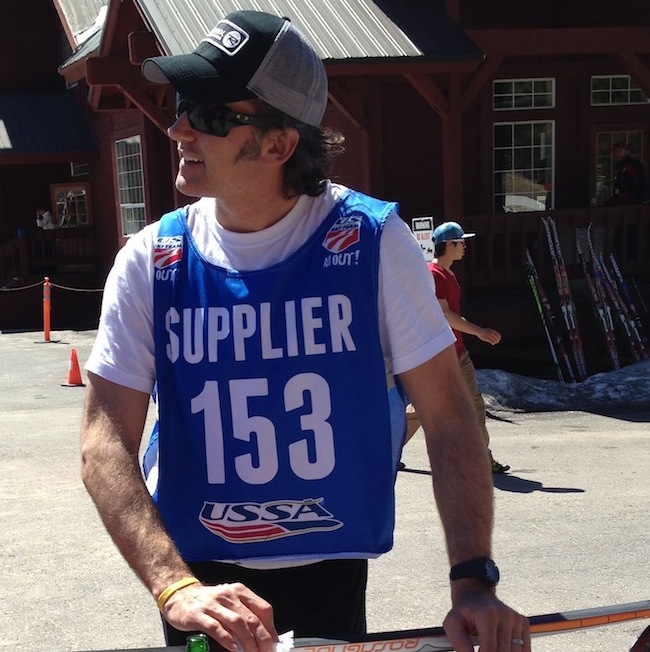
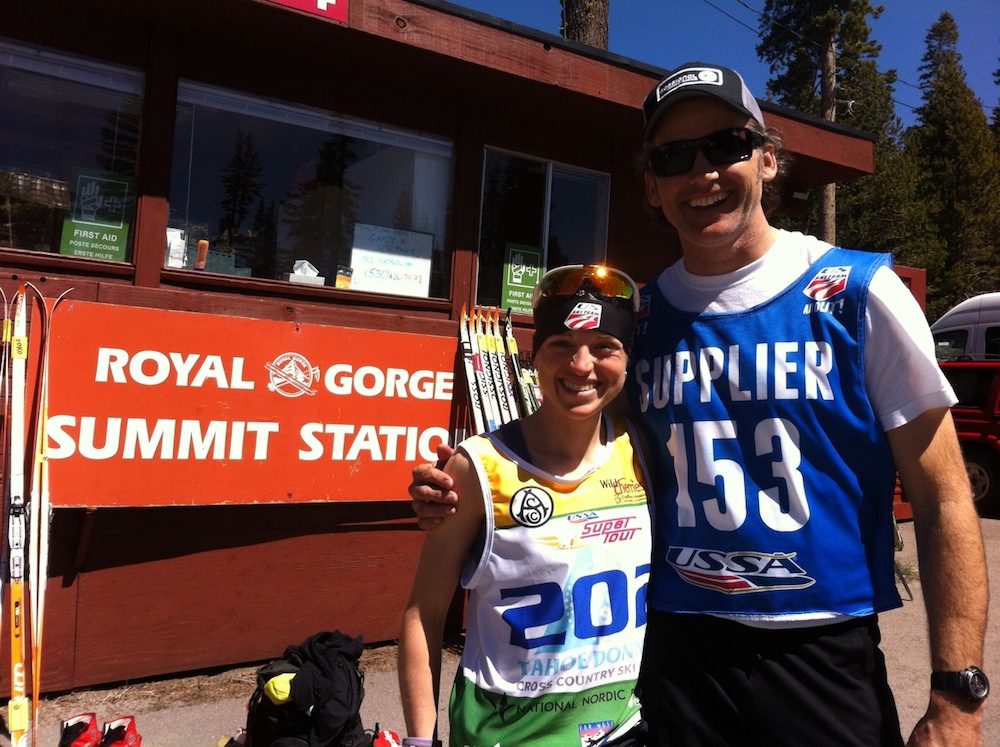
Randy Gibbs with Liz Stephen, whose skis he waxed at 2013 Spring Series. (Courtesy photo)
A serviceman for the U.S. Ski Team for eight years, Randy Gibbs recently called it quits. With a new baby in the house – his family’s first child – the World Cup lifestyle didn’t seem like a good fit.
“I have a new daughter who is 20 months old now, and it was just going to be too much traveling to be gone 100 days over the winter when she’s just a year and a half old,” he explained in a phone interview. “I couldn’t. It’s hard enough to go just for two days. It was a good decision. It’s been great to be around her as much as possible.”
But he was, in a way, still itching for the international racing trips, as well as for coaching – which he had done for 14 years in Minneapolis before joining the U.S. Ski Team staff. So when Australian Head Coach Finn Marsland asked him about leading one of his team’s trips this season, Gibbs was intrigued.
That’s how he ended up in Strbske Pleso, Slovakia, last week, coaching the Australian team at World University Games.
“It worked out perfect for me, because it was just a two-week trip and it was awesome,” Gibbs said. “It was really fun to be a coach again, too.”
The trip was a success for Australia, with Jessica Yeaton and Phil Bellingham both finishing eighth in the individual sprints, best-ever results for their country.
“Philip just missed the final by, like, a binding length,” Gibbs lamented. “He just missed the lucky loser. He could have had it I think. It was really close. He was really bummed he didn’t have just a little bit left to push and get in there.”
Callum Watson, who is recovering after a horrific ski crash that left him with a punctured lung, also notched two top-30’s.
Overall, Gibbs found the Australians fun and easy to work with – and said that the transition from acquaintance to coach at a major international event was “seamless”.
“It was really easy because all the athletes are really accommodating and were really interested to hear my ideas about things,” he explained. “We just bounced ideas off each other – I didn’t want to come in there and change everything they had been planning all season. They all pretty much already had a plan. But each day, coming up with a strategy for the next day and going through everything from the captains meetings, and things like pointing out strategic places to make moves on the course.”
Gibbs and Marsland are hoping to continue the partnership. Bellingham and Watson may attend Spring Series in Sun Valley, Idaho, where Gibbs will be waxing for the Sun Valley team and U.S. Ski Team member Liz Stephen (“Burke doesn’t have much of a team anymore,” Gibbs said of her club affiliation), but will add the Aussies to his roster.
He’s also looking at making up to three trips with the team next season, and working towards 2017 World Championships in Lahti, Finland, as well as the 2018 Olympics.
“It depends on how everything goes with their budget and their team,” he said. “It’s perfect for me because I can work a little bit, and still make a difference and still have a great time and help them out. But I don’t have to commit to a whole 100-plus night season.”
And as for the World University Games itself, Gibbs – who spent years attending World Junior and U23 Championships as well as traveling the World Cup – was impressed with the event.
“There was some really good competition,” he said. “Especially in the men’s. It was like a Russian army out there – some pretty high-end dudes. And the courses were extremely hard there. They were harder than 99% of the World Cup venues, for sure. Steep, pretty long climbs, and not really any rest. Some good high-speed corners and downhills.”
He explained that the event is one of only a few series that FIS explicitly sanctions and sends representatives to. The others are senior, junior, and U23 World Championships, the Olympics, and the World Cup. And some racers who have competed at those other events were also at World University Games – like Russia’s Andrey Larkov and Anton Gafarov, Kazakhstan’s Anastasiya Slonova, Poland’s Maciej Starega, and much of the Japanese team.
“It was really well-run,” he said. “Even the opening ceremony was really hard core! There were thousands of people who drove up the mountain to watch, too.”
He’s now wondering why it isn’t on the schedule for top U.S. racers. (The University of Wyoming has been sending its team for the last several years, but there is no trials-based selection as for World Juniors and U23s).
“I’ve been asking too, especially now [that I’ve seen it],” he said. “I’ve told those guys that we have to start doing that. It would be a great thing for the athletes who are just below making the World Junior and U23 teams.”
When he’s not working for the Australians, Gibbs is spending his time on two other projects. The first is a non-profit, Jenny’s Light, founded in the memory of his sister to combat post-partum depression. Gibbs serves as the Executive Director.
“I’ve been able to do more this winter than previously, which is good too,” he said. “It’s going well and it’s not coming to a grinding halt every winter like it had been.”
The second is Mantra Wax, a ski wax company which he launched with his U.S. Ski Team coworker Oleg Ragilo in 2013. Business is good, Gibbs said, but with a limited budget one of his main investments is time.
“It’s basically just word of mouth sales,” he said. “A lot of World Cup teams have bought a bunch of product, more than I thought this season. A bunch of teams at World University Games got some. And a lot of junior nationals teams already have some. Those coaches I’ve known for 20-some years and they are really psyched to try it out. I’ve gotten a lot of good feedback.”
He hopes to see Mantra Wax make a splash at the upcoming World Championships in Falun, Sweden.
“I’ve got a guy in Sweden who has been testing on the World Championships courses in Falun for the last month, and he will continue to do so and send me test results, and then I send those to all the World Cup coaches,” he said. “I’m trying to get people fired up about knowing what’s going to work there.”
Ben Sim jumping in Lake Placid earlier this month. Photo courtesy of Finn Marsland.
One year ago, Australian nordic combined didn’t even exist as a sport. But over the last few months, the country’s program has been gathering steam not just Down Under, but in both hemispheres.
Ben Sim, the cross-country skier attempting to make the crossover to nordic combined, has been making consistent progress on ski jumps in Lake Placid and Park City. And in Australia, officials at two ski resorts responded “favorably” to a visit from an American coach last month, to investigate potential sites for construction of the country’s own jumps.
In August, FasterSkier reported that the Australians, led by National Cross-Country Ski Team Coach Finn Marsland, were moving forward with an ambitious plan to bring nordic combined to the country.
With $40,000 in grant money from the International Ski Federation (FIS) and the International Olympic Committee (IOC)—and further funding at the margins from Ski Australia, the national governing body—the Australians are taking a two-pronged approach to the sport. While Sim is planning on spending the next four years learning to jump, and making a run at a berth in the 2014 Olympics in Sochi in nordic combined, Marsland is spearheading the construction of jumps and recruitment of youngsters back home.
Earlier this fall, Greg Poirier, a coach with the American nordic combined team, landed in Melbourne for a whirlwind visit. In the space of two days, Poirier met with officials from a pair of Australian ski resorts to pitch the idea of building of some small jumps, and he also gave a presentation on nordic combined to the Australian Institute of Sport (AIS).
According to Marsland, both resorts—Perisher Valley and Falls Creek—responded “quite favorably.”
“Greg was a great ambassador for the sport, and he was received very well,” Marsland said in an interview.
As far as actual earthmoving, the project’s goals are modest—at least initially. For the next Australian winter—that’s summer for northern hemisphere-dwellers—Poirier was pushing for the resorts to build a series of small jumps sculpted from snow, in sizes ranging from five to as large as 30 meters.
“We went in with the premise that we’re going to do really, really, low-impact—no construction. Anything we do, we’ll make with snow, or manmade snow,” Poirier said.
The plan is to set up the jumps for a few weeks at a time, giving kids an opportunity to test them out—perhaps with a coach present to run clinics and identify anyone with potential. Agreements haven’t been signed, and the details are still to be hammered out, but Marsland said that he was “optimistic” that there would be jumping in Australia next winter. The next step is still unclear, but Marsland is investigating the potential for building more
Ben Sim winning a race in Australia
permanent facilities.
Meanwhile, Sim departed from Utah last week after completing his second stateside training stint, which included time in Park City and Lake Placid with the U.S. Nordic Combined Team. He’ll return to Park City in December, and he plans to spend most of the winter there, jumping three to four times a week. His cross-country career is taking a backseat to nordic combined—while Sim will still race at World Championships in Oslo, his competition schedule for the rest of the winter is limited.
Sim still has a long way to go before he is flying from the 90- and 120-meter jumps used in elite nordic combined competitions. But in an interview, he said that he was pleased with the progress he was making on the 40-meter hill in Park City and, especially, on the 48-meter in Lake Placid, where the thicker air closer to sea level let him experience more of a soaring sensation.
“I felt like it was a little more productive to jump in Lake Placid, because I could fly a little bit further,” he said.
After his second camp, Sim was starting to get a better grasp of the fundamentals of technique, which he said entails the disconcerting sensation of leaning forward and committing to each jump.
“It’s almost diving forward,” Sim said. “It took a couple of days to have the balls to do it—it’s definitely a new feeling.”
When Sim returns to Park City for the winter, he’ll move to a 60-meter hill there, and his goal by the end of January, he said, is to work up to the 90-meter. It’s a much faster progression than typical path taken by developing ski jumpers, but Sim said that he has to continue advancing in order to stay on track to make it to Sochi.
Sim plans to debut on the nordic combined Continental Cup circuit in the winter of 2011-2012, with the potential for a stop at the last World Cup of the season.
Another reason that Sim will have to stick to a tight schedule is financial: The grants from FIS and the IOC expire next year, and Marsland said that he hopes obtain further funding stemming from publicity garnered by Sim’s pursuits—including, potentially, support from the AIS, and Australia’s Olympic Winter Institute. But for that money to come through, Marsland said that Sim will have to do more than just finish—he’ll have to excel.
“[It’s] unlikely that funding will come to just establish sports for participation. It’s all about elite international results,” Marsland said. “Ben’s performances have got that double incentive of attracting funds to him[self] to be able to keep going, and also to be able to get the sport going as well.”
If there’s pressure, though, Sim doesn’t seem to be wilting under it. He said he has been enjoying his time in Park City and Lake Placid training with the Americans—one of the first times he’s had the opportunity to travel with athletes his own age.
The feelings appear to be mutual. Sim just acquired a hand-me-down jumping suit—and his first pair of jumping skis—courtesy of Olympic gold medalist Billy Demong.
“It’s nice to have other athletes to work with,” Sim said. “They enjoy skiing with me, and I enjoy skiing with them.”
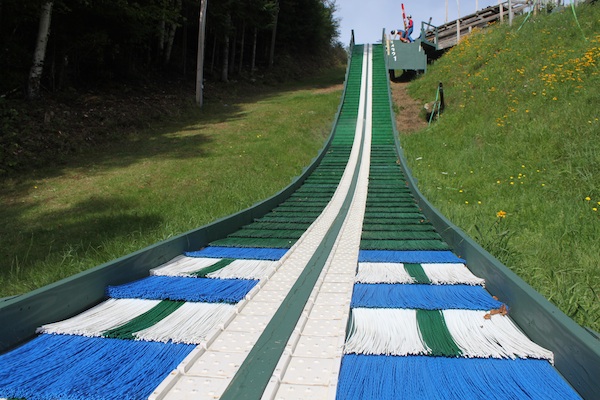
An 18-meter ski jump in Lake Placid. A new project in Australia could result in the construction of similar-sized hills in that country.
A few days before competing in the Engadin Marathon in Switzerland last March, Ben Sim stood atop a snow-covered hill in Germany. Sim, an Australian, was about to find out whether he could make the jump from cross-country skiing to nordic combined.
Literally.
Observing were Finn Marsland, the coach of the Australian cross-country ski team, and Fabian Mauz, a German coach who had assisted some Australian athletes at the Junior World Championships in the Black Forest in January.
Sim, an Olympian in cross-country, had never launched himself off a ski jump before. But he and Marsland had prevailed upon Mauz—who was also a nordic combined coach and former competitor—to loan Sim some equipment and let him try it out.
The conditions weren’t ideal. The small jump had been built by Mauz himself, and there was no grooming—the men had packed down the tracks with their boots the previous day.
Sim wasn’t intimidated at all, though. He strapped on his pair of borrowed skis, slid down the in-run, and flew through the air. Then he climbed back up to the top for another round, and kept at it for half a day.
Sim was enjoying himself, and it didn’t take long for him to get used to the equipment. By the end of their session, Mauz was impressed.
“Fabian was actually quite surprised how quickly he picked it up,” Marsland said. “He gave Ben a lot of really good feedback.”
From there, Marsland sprang into motion, and that single session in the Black Forest has now snowballed into an ambitious attempt to launch an Australian program in nordic combined—the sport that pairs cross-country skiing and ski jumping.
Around the same time Sim was taking flight in Germany, Marsland had contacted Greg Poirier, an American nordic combined national team coach, to get some information about athlete development. When he returned home, Marsland successfully applied for funding for an initiative to establish the sport in Australia, which has already paid for Sim to travel to Utah for a jumping camp, and could lead to his participation in nordic combined at the 2014 Olympics in Sochi. There’s more: Marsland’s ambitions may also result in the construction of a series of small ski jumps in Australia, where none currently exist.
Uli Wehling, the nordic combined race director for the International Ski Federation (FIS), said that a project like Marsland’s had never been attempted.
“In [the] case that we start from more or less zero to build up the discipline—I think it’s the first time,” he said. But, he added: “We welcome all new nations to take part in nordic combined.”
A Two-Pronged Plan
Ski jumping in Australia dates back at least to the 1930s—a 1932 article in the Australian Quarterly cites the incorporation, two years earlier, of the Australian Ski-Jumping Club. Several hills were constructed in the southern part of the country, but according to Sim and Marsland, none remain today.
Hal Nerdal, a Norwegian immigrant, is the only Australian ever to compete in the Olympics in either ski jumping or nordic combined—he finished dead last of 31 athletes in the nordic combined competition at the 1960 Squaw Valley Games.
Sim could be the next. While on a good day he can be competitive at the upper levels of cross-country skiing, Sim said that his two top-50 finishes in the sport in Vancouver most likely fell short of what was necessary to obtain future funding from the Australian government.
In fact, before the Olympics, a strength coach had suggested to Sim that at 5’10” and just shy of 150 pounds, his slighter build was more suited to nordic combined than to cross-country skiing. Sim laughed off the comment at the time, but after the Games, he and Marsland discovered that there was money available from FIS and the International Olympic Committee (IOC), to introduce countries to new Olympic sports. Facing the prospect of having to self-fund the next few years of his cross-country career—and after the promising day of jumping in Germany—nordic combined began looking like a more attractive option. Especially when Marsland, back in Australia, was able to quickly obtain a roughly $9,500 grant from FIS.
“When you have to work full-time to do your sport, to work to earn money so I can travel, it makes it a lot harder,” Sim said. “Doing nordic combined—it lets me just do another year of full-time training.”
The FIS grant, as well as additional money forthcoming from the IOC, will be used to pay for a two-pronged attempt to establish nordic combined in the Australia. First, Sim will spend at least a year learning to jump, with the hopes of reaching the World Cup nordic combined circuit by 2012-2013 and the Sochi Games in 2014.
Second, with the help of Poirier, Marsland is hoping to find a suitable location in Australia for the construction of some novice ski jumps, which will be used to introduce a pool of younger athletes to the sport.
“It’s the bigger project of trying to see whether we can put in a bit of a development plan,” Marsland said. “It would be fantastic if we could have jumps here in Australia to get development happening at a junior level. For any sort of long-term security of the sport, that’s the only way to go.”
An Uphill Battle for Sim
After obtaining the grant from FIS, Marsland worked with staff and coaches at the U.S. Ski and Snowboard Association to schedule a two-week jumping camp for Sim in Park City, Utah, in July.
Poirier connected Sim with Alan Alborn, a former Olympic ski jumper who now coaches Park City’s club program. Alborn had Sim start from scratch, beginning with trips down the landing hill of a 10-meter jump to get used to the summer sliding surface. By the time Sim returned to Australia a few weeks ago, he had worked all the way up to the venue’s 40-meter hill.
“He’s doing quite well, as far as the progression that we normally see,” Alborn said, adding that Sim had been very receptive to coaching.
Ben Sim at a World Cup race
To become a proficient jumper at age 25, Sim still has his work cut out for him. According to Poirier, nordic combined skiers typically start jumping before they turn 10 years old.
However, a similar path has been blazed at least once before, by American Matt Dayton. Dayton didn’t take up jumping until he was 18, then qualified for the 2002 Olympic Games seven years later and helped the U.S. team to a fourth-place finish in the relay.
According to current U.S. Nordic Combined Team Head Coach Dave Jarrett, Dayton was never among the top jumpers on the World Cup circuit. But like Sim, Dayton was a strong cross-country skier, and he relied on that fitness to propel him to three top-ten finishes over the course of his career.
“Had he been able to get his jumping a little bit closer, he would have been even better,” Jarrett said.
According to Poirier, Sim possesses the same qualities that made Dayton successful—drive and self-motivation.
“Ben Sim falls in that same ballpark,” Poirier said.
Sim is now back in Australia for the Southern Hemisphere’s winter season, but he will return to the U.S. for another two- to three-week camp at the end of September—possibly accompanied by a junior teammate, Jackson Bursill.
On that trip, Alborn said, Sim will likely move up to Park City’s 60-meter hill, where he’ll have to hunker down and spend a lot of time working on technique and accumulating repetitions.
Sim acknowledged that he still has some work to do to get comfortable. During his next camp, he said that he’ll be focused on staying “a bit more relaxed in the air.”
“I feel like I’m pretty tense,” he said.
Sim will take one more trip home in late October to spend time with his fiancée, then fly back to Utah again, where he plans on spending most of the winter, “just jumping every day, as much as I can.”
He’ll continue to train for cross-country skiing, but Sim will limit his racing to the U.S. domestic circuit, save for the World Ski Championships in Norway at the end of the season.
“Realistically, if I want to have any chance for trying to qualify for World Cup competitions or Olympics in four years, I think I need to learn how to jump pretty quickly,” Sim said.
Sim’s goal is to jump from the 90-meter hill—generally the smallest size used for elite competitions—by the end of the winter, which is “pretty realistic,” according to Alborn.
But Alborn added that graduating to larger jumps is not simply a matter of courage. Technique and fundamentals are crucial, and launching from the big hills can sometimes act as an impediment to learning by sending athletes flying at higher speeds.
“It inhibits them from learning the really basic skills for ski jumping,” Alborn said. “We like to teach the more fundamental ideas first, so they really groove that in.”
If his timeline goes according to plan, and if he demonstrates sufficient potential for the sport, Sim hopes to be able to obtain funding for future seasons of nordic combined training from Australia’s ski federation. But if he hasn’t been able to brave the 90-meter hill by next summer, the project will conclude.
“Fingers crossed it works,” Sim said. “I’m just keen to see how it goes, really.”
One thing that does not seem to be in doubt is Sim’s ability to cross-country ski with the best of the nordic combined athletes. According to Jarrett, Sim participated in a handful of workouts with the American team during his July jumping camp, and he “certainly held his own.”
“It’d be good for us to have another fast guy around,” Jarrett said.
The “Crazy Idea”
While Sim travels to the U.S. for his second camp in September, Poirier, the American coach, is planning his own trip to Australia.
For three or four days, Poirier will visit ski resorts in the towns of Falls Creek and Perisher Valley. Funded by the grant money, he’ll be scouting a suitable site for a series of small ski jumps designed to introduce juniors to the sport.
Initially, Poirier said, the jumps would be sculpted from snow, at a relatively minimal cost.
“It’s a matter of [a ski] area’s willingness to dedicate some snowmaking time and some Cat time,” he said. “Hopefully, they’ll be psyched for this kind of crazy idea.”
If the jumps go over well, more extensive work would be required to make them suitable for competitions. But for now, Poirier said, “I don’t think we need perfect jumps.”
“We just need a slope and a jump to get kids excited about trying jumping and nordic combined,” Poirier said. If they’re successful, he added, “then hopefully they’ll put some financial resources into the long run.”
Marsland said that he hopes Sim’s nordic combined exploits will inspire younger athletes to take up the sport. “That will certainly help bring a little more attention to nordic sports in general, and that’s definitely part of our thinking,” he said. “I think we should be able to get a bit of publicity…out of the media here in Australia.”
However, he cautioned, it’s still too early to tell whether Sim will be able to bring his jumping to a level that will get him results.
“That’s what Ben’s goal is at the moment—to make it to a competitive level,” Marsland said. “We’ll find out over the next year if he has what it takes, or if he doesn’t.”