From the FasterSkier archive — posts syndicated from athletes’ and coaches’ own blogs between 2004 and 2012, kept online as published. Current coverage is at fasterskier.com.

Tag: FIS Cross-Country

  • Development in Norway Isn’t Just a Plan. It’s a System.

    Development in Norway Isn’t Just a Plan. It’s a System.

    This article was made possible through the generous support of our voluntary subscribers. If you value coverage like this, please support FasterSkier with a voluntary subscription.

    Johannes Hoesflot Klaebo (NOR), Emil Iversen (NOR), and Martin Loewstroem Nyenget (NOR), (l-r) during the final kilometers of the Olympic 50 k classic. (Photo: Vanzetta/NordicFocus)

    A review of a recently published paper from Norway, “Long-term development culture for sustainable Olympic success: Lessons learned from Norwegian cross-country skiing” by Jacob Walther and Øyvind Sandbakk, is worth the time.

    Long-term development culture for sustainable Olympic success: Lessons learned from Norwegian cross-country skiing – ScienceDirect

    We’ve all heard enough about Norway. But this one simply cuts through some misconceptions, and it is worth the time to review. It strips away the mythology and gets back to what actually drives development and ultimately elite performance. Norway isn’t operating with better information. They’re more disciplined about applying what most programs already understand, and more consistent about what they refuse to do.

    The paper addresses this immediately and directly.  There is no “Norwegian method.” No magic interval session. No secret intensity zone you can implement and expect results. What they have is a system. And more importantly, a system built around their culture.

    We tend to frame their success in physiological and technical terms.  It’s not physiology, technique, health management, or mental health; they are all part of it, but they don’t explain the system. Most programs know early specialization is risky and inaccurate. Most coaches understand long-term development and the need to build training slowly and in phases based on training age. The difference is that Norway holds the line on it.

    The elements are not new. Delay early selection. Encourage multi-sport participation, and integrate sport science into daily coaching. Invest in coach education. Treat athlete health as part of development, not something that gets in the way of it. The result isn’t just better elite athletes.  It’s broader mass participation, more informed training, and a deeper pool of athletes and families engaged in the sport.

    Norway’s Johannes Høsflot Klæbo won his first World Cup at 20, in the men’s 1.6 k freestyle sprint in Otepää, Estonia, in 2017. (Photo: Fischer/NordicFocus)

    The paper uses Johannes Høstflot Klæbo as a case study. At 15, he placed 101st at junior nationals. Years later, he’s the most decorated Winter Olympian of all time. That’s a compelling outcome. But the value isn’t the result. It’s what the system expects and allows.

    In most programs, that athlete gets filtered out early. In Norway, they stay in longer. That’s the point. This isn’t about identifying talent earlier and directing resources and opportunities at those. It’s about not eliminating talent identification too soon. That requires patience, cooperation among club programs, trust in the system, and a willingness to ignore short-term validation.

    That’s where the Norwegian model sets itself apart. The turning point came in the lead-up to the 1994 Winter Olympics. Norway didn’t discover new physiology or invent new training methods. They organized themselves differently. They centralized expertise, embedded sport science into coaching, collected experience and training data across all Olympic Sports, and aligned the ski federation from the national team down to the club level.

    Olympiatoppen sits at the center, not as a lab removed from the field, but as part of the training process. It doesn’t drive the system, but it informs and shapes it. That balance matters. Norway didn’t just add sports scientists. They used sports science to improve coaching. At higher levels, many coaches are trained in exercise physiology. That reduces misinterpretation and creates consistency over time.

    Long-term development in Norway isn’t a slogan. It is intentionally implemented. It follows physiology. Peak endurance performance arrives in the late 20s, after years of consistent training. They don’t challenge that reality; they built their whole system around that reality.

    You see that athletes stay in the sport longer, as evidenced by high-level FIS races in Norway. Hundreds of skiers are over 25-30 years old. They build general capacity before narrowing focus. Skill development has time and the room to engrain. Training isn’t rushed. Volume and intensity progress over years, not seasons. Junior results are not used as a sorting mechanism.

    And this is where most systems break down. They say development matters, so select early and train accordingly. In Norway, youth championships are not selection events. They are part of the development process. The culture reinforces it. Clubs and schools coordinate so athletes can participate in multiple sports. Athletes regularly move across multiple ski disciplines. The recruitment base stays broad, and the system stays resilient.

    Norway hasn’t eliminated selection; they’ve delayed it and minimized its consequences. That distinction matters. What gets labeled as “talent” at 14–16 is often early maturation, better support, or more exposure, not long-term potential. Norway avoids that trap by not falling into it. While many other systems double down on it.

    Another principle sits underneath all of this: athlete health, physical and mental, comes before results. Training is managed for long-term progression. Training loads increase gradually over the years. High intensity is controlled, and low intensity dominates most of the training. The goal is adaptation over time, not accumulation in the short term.

    The paper also points to emerging pressure on this model. Rising costs, shifting societal trends, increasing early specialization, and changes in team structures all push against it. These aren’t theoretical concerns. There are real pressures that can erode the system if they’re not managed.

    Harald Oestberg Amundsen (NOR), Johannes Hoesflot Klaebo (NOR), and Einar Hedegart (NOR), (l-r) share the 20 k Freestyle Mass Start podium at the final World Cup in Lake Placid (USA) to end the 2025/2026 season. (Photo: Modica/NordicFocus)

    So what carries over?

    We can’t copy Norway. That misses the point. The lesson is alignment. Align incentives with long-term outcomes. Integrate sports science into coaching to improve the coach’s work. Build systems that allow athletes time to develop. And hold the line when short-term pressure starts to dictate decisions.

    Many countries can point to a standout athlete. But if success depends on outliers, unusual resilience, unusual support, unusual talent, you don’t have a system. You have anecdotes. Norway produces depth, that is, the expectation and the standard.

    There’s no secret session here. What they’ve built is a system that connects coaching and science, commits to long-term development, creates space for late progression, and maintains consistency over time. Not what they’re doing this week or next week, but what the athletes are doing ten years from now.


    Help Support Our Olympic Coverage!

    If you value the thoughtful work and access FasterSkier provides, please consider becoming a Voluntary Subscriber. Your support directly fuels our work to cover the people, places, and moments that make our sport special.

    Join the FasterSkier community!


  • Klaebo’s Lake Placid Decision Day Is Today

    Klaebo’s Lake Placid Decision Day Is Today

    This article was made possible through the generous support of our voluntary subscribers. If you value coverage like this, please support FasterSkier with a voluntary subscription.

    Fans from across the United States who will be in Lake Placid are anxiously hoping Johannes Hoesflot Klaebo (NOR) is well enough to travel and race in Lake Placid this weekend. (Photo: Authamayou/NordicFocus)

    Johannes Hoesflot Klaebo has been included in Norway’s 22-athlete squad for this week’s World Cup finals at Mt. Van Hoevenberg in Lake Placid, N.Y., BUT the six-time Olympic gold medalist’s participation hinges on a decision being made today.

    Klaebo, 29, suffered a mild concussion in a dramatic crash during the sprint semifinals at last Thursday’s World Cup in Drammen. American sprinter Ben Ogden lost his footing on the icy course and fell across Klaebo’s skis, sending the Norwegian backward and slamming the back of his head into the hard-packed snow. Klaebo lay on the ground for several minutes before being helped off course and transported to a hospital for evaluation.

    The Norwegian Ski Federation confirmed the concussion diagnosis on Friday, and Klaebo withdrew from Saturday’s 50-kilometer race at Holmenkollen.

    “He shall make an evaluation together with the national team doctor on Tuesday and would potentially travel on Wednesday,” Klaebo’s manager, Lasse Gimnes, told Norwegian broadcaster NRK on Monday. If cleared by national team doctor Ove Feragen, Klaebo would travel to New York on Wednesday — arriving just two days before Friday’s 10-kilometer classic interval start.

    The crash also disrupted a planned trip to New York City for media appearances with CNN, NBC, the New York Times, and the Wall Street Journal — a reflection of the enormous international attention Klaebo has drawn since his record-setting six-gold performance at the Milano Cortina Olympics. Those in-person interviews have been scrapped, though some may shift to virtual formats.

    Johannes Hoesflot Klaebo (NOR) poses with the FIS Crystal Globes he won last season at World Cup Finals in Lahti, Finland. (Photo: Thibaut/NordicFocus)
    The distance globe is on a knife’s edge

    The distance cup title is the central subplot heading into the finals. Before Holmenkollen, Klaebo held a 128-point lead in the distance standings. But with the Norwegian watching from home on Saturday, Amundsen’s 131-point haul vaulted him into the distance lead: Amundsen now sits at 939 points, three ahead of Klaebo’s 936. Martin Loewstroem Nyenget climbed to 914 in third. Just two distance events remain — Friday’s 10-kilometer classic interval start and Sunday’s 20-kilometer freestyle mass start. If Klaebo can travel and race, the margin is thin enough that a single strong result could flip the standings again. If the concussion keeps him out, the distance globe almost certainly goes to Amundsen.

    Klaebo has already clinched both the overall World Cup — his sixth, tying Bjoern Daehlie’s all-time record — and the sprint globe.

    Norway’s men’s squad: Harald Oestberg Amundsen, Martin Loewstroem Nyenget, Einar Hedegart, Andreas Fjorden Ree, Mattis Stenshagen, Emil Iversen, Johannes Hoesflot Klaebo, Lars Heggen, Even Northug, Ansgar Evensen, and Even Solem Michelsen.

    Jessie Diggins soaks in all the energy from the home crowd during her warmup in Minneapolis — the last time the World Cup was on American snow. (Photo: Leann Bentley/USST)
    Diggins’s farewell, and notable absences

    The Lake Placid finals will serve as the final competitive races for Jessie Diggins, the most decorated cross-country skier in U.S. history. The women’s overall cup and distance cup are both decided, with Diggins winning with a comfortable margin over Sweden’s Moa Ilar in second. The three-time Olympic medalist and three-time overall World Cup champion announced before the season that this would be her last, and a farewell on home snow in front of an American crowd at the first-ever U.S.-hosted World Cup finals is about as fitting a send-off as anyone could script.

    Klaebo is not the only notable question mark heading into the weekend. Norway’s Kristine Stavaas Skistad and Mathilde Myhrvold have opted to skip the finals to prepare for part two of Norwegian nationals in Harstad next week. Sweden’s Ebba Andersson has also pulled out.

    Norway’s women’s squad for Lake Placid includes Astrid Oeyre Slind, Heidi Weng, Kristin Austgulen Fosnaes, Karoline Simpson-Larsen, Nora Sanness, Karoline Groetting, Julie Bjervig Drivenes, Tiril Udnes Weng, Julie Myhre, Lotta Udnes Weng, and Milla Grosberghaugen Andreassen.

    The men’s freestyle mass start gets started at the US National Championships in Lake Placid, NY, 1/8/26. (Photo: Nancie Battaglia)
    A historic venue

    The Lake Placid finals mark the first Cross-Country World Cup finals ever held in the United States and the return of World Cup racing to Lake Placid for the first time since 1979. Racing kicks off Friday at Mt. Van Hoevenberg with the 10-kilometer classic interval start, followed by a freestyle sprint on Saturday and a 20-kilometer freestyle mass start on Sunday.

    This is a developing story. FasterSkier will update when Klæbo’s decision is announced.


    Help Support Our Olympic Coverage!

    If you value the thoughtful work and access FasterSkier provides, please consider becoming a Voluntary Subscriber. Your support directly fuels our work to cover the people, places, and moments that make our sport special.

    Join the FasterSkier community!


  • One Final Climb: Diggins Victorious in Tour de Ski

    One Final Climb: Diggins Victorious in Tour de Ski

    This coverage is made possible through the generous support of Marty and Kathy Hall and A Hall Mark of Excellence Award. To learn more about A Hall Mark of Excellence Award, or to learn how you can support FasterSkier’s coverage, please contact info@fasterskier.com.

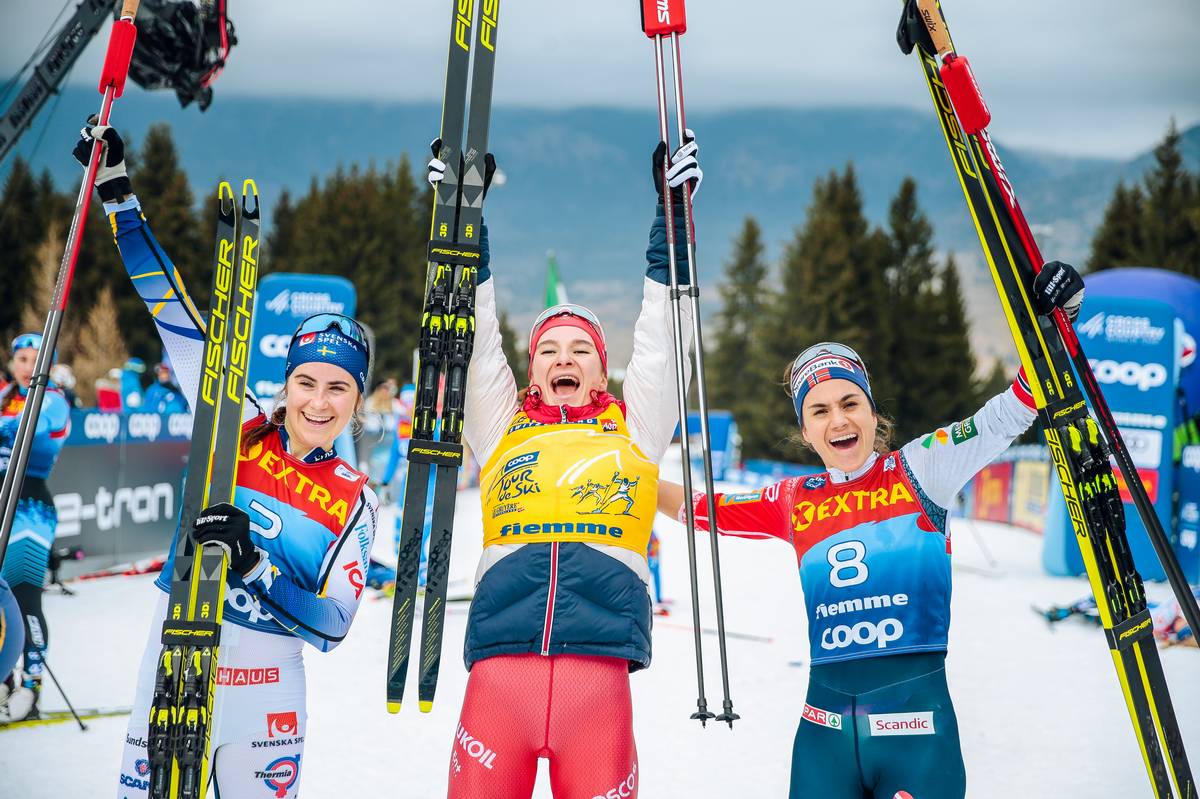
    Jessie Diggins (USA) claimed her third Tour de Ski overall victory in Val di Fiemme (ITA). (Photo: Vanzetta/NordicFocus)

    The Tour de Ski does not end so much as it compresses. By the time the women turned onto the ribbon of snow climbing Alpe Cermis, the race had already been going on for a week—measured not only in kilometers and seconds, but in fatigue accumulated quietly overnight, in sore muscles, achy backs, and in confidence gained or lost one race at a time.

    The final climb has a way of making those invisible things visible. It is steep enough to strip racing of pretense, long enough to punish impatience, and familiar enough that every skier arrives with memories—good ones, bad ones, and some they would rather forget. On Sunday afternoon in Val di Fiemme, the climb again became what it always is: less a finish line than a reckoning.

    For Jessie Diggins, that reckoning ended in confirmation. Diggins finished second on the stage, protecting her margin with experience and restraint, and secured her third career Tour de Ski overall title. It was not the loudest way to win. It was, however, the truest.

    Jessie Diggins (USA) paced the final climb perfectly to finish second on the day. (Photo: Modica/NordicFocus)

    A Climb That Decides Everything

    Stage 6 of the women’s Tour de Ski—10.0 kilometers, mass start, freestyle—began with the tension that always precedes Alpe Cermis. Some skiers arrived still dreaming of a stage victory. Others were guarding seconds earned days earlier. Still others were simply hoping to make it to the top without the climb turning overly cruel.

    The early kilometers unfolded with relative calm. The pace was honest but controlled, the group compact as it flowed through the lower valley before turning uphill. On Alpe Cermis, there is no hiding, but there is strategy: when to let others go, when to follow, and—most importantly—when not to.

    The decisive moves came as the gradient steepened and the field stretched into a long, thin line. Norway’s Karoline Simpson-Larsen skied with precision and patience, gradually asserting herself as the strongest on the day. She crested the final meters alone to win the stage in 37:05.3, earning the biggest single-day victory of her World Cup career.

    Behind her, the race unfolded with quieter drama. Diggins, who entered the day with a commanding overall lead, skied with calculation. She resisted the temptation to respond immediately when others surged, choosing instead to manage the climb in segments. When the grade lessened and the gap narrowed late, she allowed herself to push hard enough to secure second place, but not so hard as to invite disaster.

    Diggins crossed the line 8.8 seconds behind Simpson-Larsen, followed by Norway’s Heidi Weng in third at +14.4. The stage podium reflected the day’s effort, but it was Diggins’ second place that carried the most weight.

    Jessie Diggins (USA), as always, left everything out on the course. (Photo: Modica/NordicFocus)

    “Dying at the Right Moment”

    Diggins’ approach to Alpe Cermis was shaped by experience—and memory.

    “I was trying to be smart and safe in terms of the overall Tour,” she said afterward. “And then when I realized we were close enough, I thought, okay, now I can empty the tank. But I’ve paced it badly before where I blow up, and that last 600 meters is the slowest of your life.”

    It is a detail only veterans tend to mention: not the steepest pitch, but the final few hundred meters, when legs that have already been pushed too far simply refuse to respond. Diggins has lived that mistake. On Sunday, she avoided it.

    “I was trying to ski it smart and make sure I was dying at the right moment,” she said.

    That restraint—so often invisible to spectators—was the difference between managing the Tour and risking it. The margin Diggins had built over five stages gave her room to think clearly. The climb rewarded that clarity.

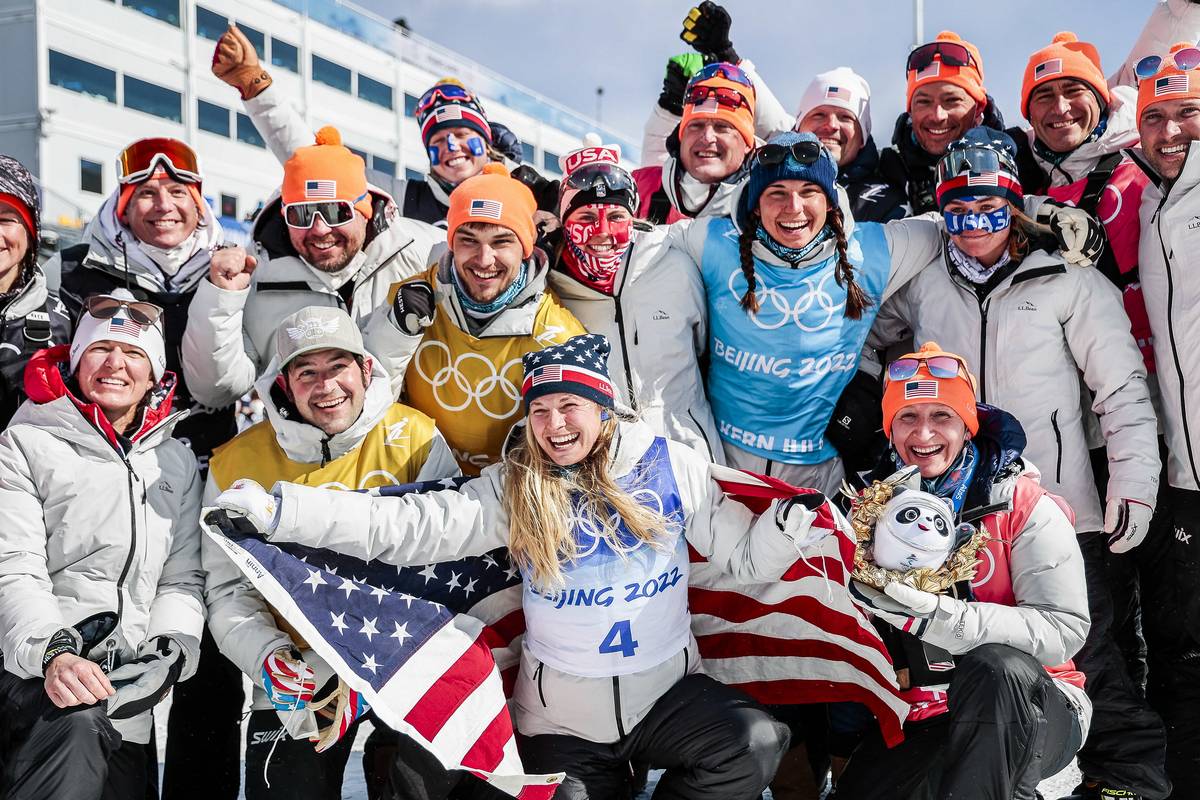
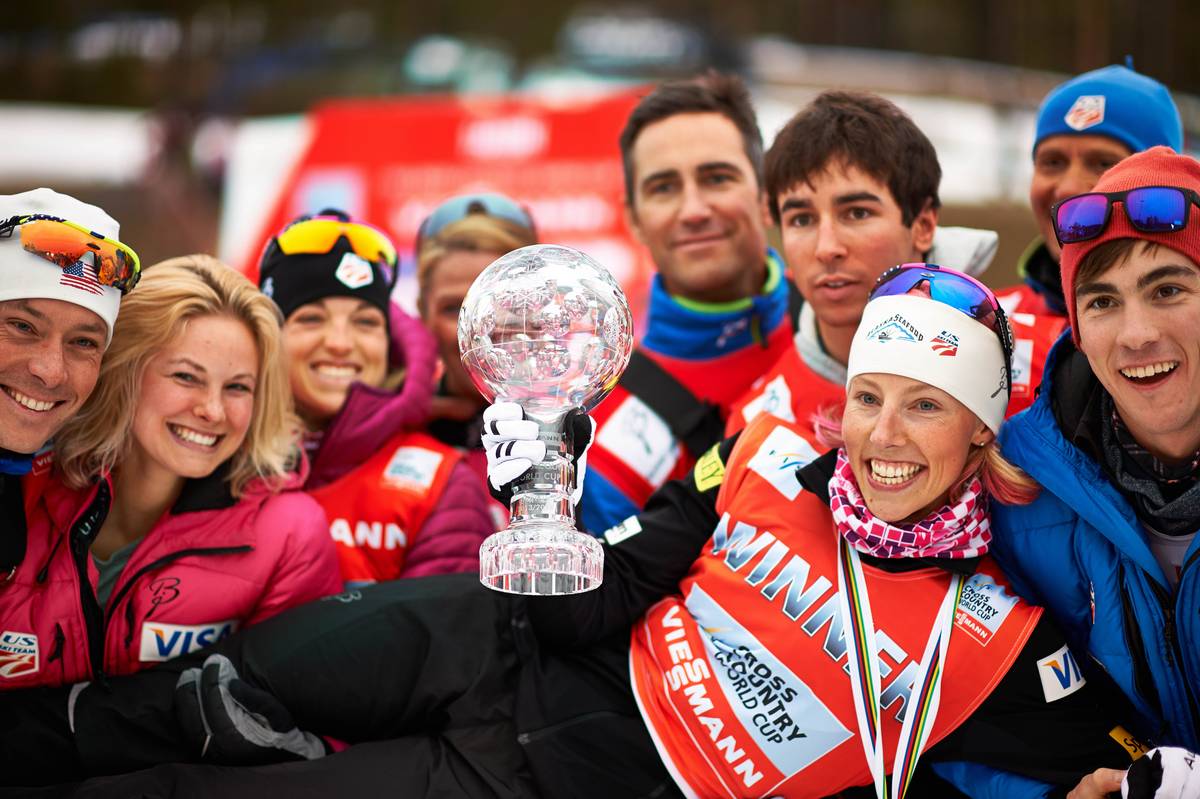
    Julia Kern (USA) and Jessie Diggins (USA) celebrate with US Cross-Country Ski Team coaches and staff, as well as US Alpine Ski Team athletes who came to support them at the end of the 2025/26 Tour de Ski. (Photo: Vanzetta/NordicFocus)

    The Meaning of a Tour

    In the mixed zone at the top, Diggins spoke not with relief so much as appreciation—for the work, the people, and the endurance the Tour demands.

    “The Tour de Ski is one of the hardest things to win,” she said. “When you win the Olympics, it’s amazing—it’s really special. But that’s one race. The Tour is day after day after day. You have to put it together back-to-back, under cumulative pressure. That’s really hard. It’s hard on you, and it’s hard on the team.”

    Her emphasis, repeatedly, returned to the collective effort. She spoke of team energy, of support staff, of consistency rather than dominance. It was a reminder that Tour victories are not seized in moments, but constructed patiently across an entire week.

    Diggins finished the Tour with a total time of 2:11:26.1, winning the overall by more than two minutes over Austria’s Teresa Stadlober. It was not a victory defined by a single attack or a single stage, but by accumulation—time gained when others faltered, mistakes avoided when margins were thin.

    Julia Kern (USA) makes her way up Alpe Cermis to finish 14th on the day. (Photo: Vanzetta/NordicFocus)

    Kern’s Quiet Confirmation

    For Julia Kern, Alpe Cermis offered something different: clarity.

    Kern finished 14th on the stage, 2:01.0 back, after a Tour that reflected both progress and unfinished business. She described the climb as meeting—or exceeding—her expectations.

    “Every year it’s a little different with who’s still left in the Tour,” Kern said. “But I’m taking away from today that my fitness is there. I just need to fine-tune some of the sprinting gears. That’s very trainable at this point in the season.”

    Her assessment mirrored her results. Kern was consistently strong in the distance races throughout the Tour, finding rhythm and confidence as the days passed. The sprint stages, by contrast, left her frustrated.

    “I was a bit bummed with my sprint days for sure, and hungry for more,” she said. “But at the same time, I had consistently good, strong distance races. Halfway through the Tour, I started to find my race legs again.”

    It is a pattern Kern recognizes—slow starts, gradual momentum, strength revealed in longer efforts. In an Olympic season, that trajectory matters more than any single result.

    Maja Dahlqvist (SWE) attacked at the end of the valley trail leading to the Alpe Cermis in Val di Fiemme (ITA) to secure her silver sprinters’ bib. (Photo: Vanzetta/NordicFocus)

    The Bib Battles

    Beyond the overall, the final climb also settled two secondary competitions that added layers of tension to the Tour’s closing act.

    The climber’s bib—awarded for cumulative performance on the Tour’s toughest ascents—went to Teresa Stadlober, who accumulated 45 points across the week. Diggins finished second in the standings with 39, underscoring how consistently she handled the steepest terrain without ever needing to gamble on a single climb.

    The sprint standings, marked by the silver bib, remained unsettled until the final stage, where one final set of bonus points was awarded at the beginning of Alpe Cermis. Sweden’s Maja Dahlqvist emerged with the title at 53 points, ahead of Switzerland’s Nadine Fähndrich and Sweden’s Johanna Hagström. Diggins finished fourth in the sprint competition—another reflection of her Tour: competitive everywhere, decisive where it mattered most.

    Teresa Stadlober (AUT) fought hard to defend her climbers’ bib. (Photo: Vanzetta/NordicFocus)

    Pain, Reconsidered

    Late in the mixed zone, Diggins reflected on something more personal—how different this climb felt compared to recent years.

    “The last two years I’ve been so injured that I was in so much pain outside of racing,” she said. “So for it to be only painful during the race was like, wow—that’s kind of nice.”

    It was not a dramatic declaration, but it carried weight. The Tour de Ski magnifies everything: fatigue, doubt, confidence, pain. To arrive at Alpe Cermis feeling capable—rather than simply enduring—marked a shift.

    She laughed when she added that she told herself, mid-Tour, that she would “never do this again.” Then she smiled at the familiar uncertainty that defines the race.

    “You never know how you’re going to feel every day on a Tour,” she said. “And today I felt really good. One of the best I’ve ever felt on the final climb.”

    Julia Kern (USA), Jessie Diggins (USA), (l-r) at the top of Alpe Cermis in Val di Fiemme (ITA). (Photo: Modica/NordicFocus)

    The American Picture

    For the U.S. women, the Tour ended with a sense of coherence. Diggins’ overall victory provided the headline, but Kern’s steady distance form pointed toward depth and durability within the team.

    Kern’s immediate plans reflect that long view. She will return home to Richmond, Vermont, for two weeks—prioritizing recovery before resuming training on familiar snow.

    “I did this last year, and it worked really well,” she said. “Just getting off World Cup, getting a lot of recovery the first week, being in my own bed.”

    From there, she will rejoin training camps and racing with an eye toward sharpening for the Olympics. It is a plan built on patience rather than urgency—much like Diggins’ approach on Alpe Cermis.

    Teresa Stadlober (AUT), Jessie Diggins (USA), Heidi Weng (NOR), (l-r) take the Tour de Ski overall podium. (Photo: Vanzetta/NordicFocus)

    What the Climb Leaves Behind

    When the last skier crested the climb and the finish corral emptied, Alpe Cermis returned to stillness. The Tour de Ski had done what it always does: clarified things.

    It clarified that Jessie Diggins remains one of the sport’s great stage racers—capable not just of winning races, but of managing weeks. It clarified that Julia Kern’s fitness base is real and growing, even if some pieces still need refinement. And it clarified, once again, that the Tour is not about brilliance alone, but about survival, intelligence, and trust in process.

    Diggins did not win the final stage. She did something harder. She won the Tour by knowing exactly when not to.

    At the end of the longest climb of the week, that knowledge mattered most.

    Women’s Alpe Cermis Climb RESULTS

    Women’s 2026 Tour de Ski FINAL STANDINGS


    Love Stories Like This? Help Keep Them Coming.

    Feature stories like this one take time, access, and care to produce. If you value thoughtful storytelling and independent ski journalism, please consider becoming a Voluntary Subscriber. Your support directly fuels the work we do to cover the people, places, and moments that make our sport special.

    Join the FasterSkier community!


    Jessie Diggins (USA), Karoline Simpson Larsen (NOR), and Heidi Weng (NOR), (l-r) share the final climb podium at the top of Alpe Cermis in Val di Fiemme (ITA). (Photo: Vanzetta/NordicFocus)
  • The Trial in Trondheim

    The Trial in Trondheim

    This coverage is made possible through the generous support of Marty and Kathy Hall and A Hall Mark of Excellence Award. To learn more about A Hall Mark of Excellence Award, or to learn how you can support FasterSkier’s coverage, please contact info@fasterskier.com.

    The men’s 20-kilometer Skiathlon at Granåsen never felt like an ordinary World Cup. From the moment the athletes stepped into the start pen, there was a tension in the air that didn’t match an early-December race. The stadium filled slowly; the fog sat low; the snow clung wetly to the klister underfoot. Yet the energy was unmistakable. It felt charged, anticipatory, almost uneasy.

    You could see it most clearly in the uniforms. Twelve Norwegians stood in the field of 91, and every one of them carried something heavier than usual race nerves. This wasn’t just about points. It wasn’t just about winning. It wasn’t even about bragging rights.

    Today, for Norway, was about the Olympics.

    Earlier that morning, Austria’s Mika Vermeulen summed it up bluntly when asked what he expected:

    “The Norwegians need to go fast to qualify for the Olympics.”

    It was the truth that everyone else was dancing around.

    On paper, this was a World Cup Skiathlon. On snow, it became something else entirely: an unofficial Olympic sorting ceremony, shaped by weeks of controversy, public criticism, and a federation under scrutiny.

    The start of the Men’s 20 k Skiathlon Trondheim (NOR). (Photo: Modica/NordicFocus)
    A Race Run Under a Shadow

    The tension surrounding this race didn’t begin in Trondheim. It started with a roster decision — or, in the eyes of many Norwegians, an omission. Emil Iversen, the veteran racer with a World Championship gold and a decade of elite podiums behind him, was left off the opening World Cup weekend in Ruka.

    The decision rippled across Norwegian media.

    The loudest voice belonged to Johannes Høsflot Klæbo.

    In a widely circulated VG article, Klæbo called the decision “dårlig håndverk” — poor workmanship — and argued that if the goal was to send the fastest athletes, Iversen had earned his seat on the plane.

    “If you are good enough, you should get to go,” he told VG.

    Former national-team director Espen Bjervig fired back in Stavanger Aftenblad, criticizing both Klæbo and Iversen for speaking publicly about selection practices, arguing that it “creates noise and negativity.”

    Suddenly, what is typically a quiet, internal Norwegian debate had spilled into full public view. Selection wasn’t just a technical matter — it was a national storyline.

    And this Skiathlon, the only one before the Olympics, sat squarely in the center of that storm.

    Iivo Niskanen made his way to the front during the classic leg, but ultimately faded to 25th place on the day. (Photo: Modica/NordicFocus)
    The Classic Leg: A Tense, Measured Beginning

    When the field set off into the opening 10 k of classic skiing, the pace was high but controlled. Nobody wanted to take on the risk of an early break. The lead shifted lightly — Finland’s Iivo Niskanen testing, Norway’s Martin Loewstroem Nyenget responding — but the main pack stayed dense, the elastic never stretching too far.

    What stood out was not who led, but how closely the Norwegians watched one another. Every surge drew an immediate answer. Every gap in the pack was filled. There was a vigilance to their movements: unspoken, but unmistakable.

    Behind them, American Gus Schumacher skied with patience, always hovering near the front third, avoiding trouble. Ben Ogden played the elastic back-and-forth of the pack, feeling the surging, slowing, and reshuffling that characterizes Skiathlon racing.

    Nothing broke the race open. But everything pointed toward what was coming.

    Emil Iversen (#37, white hat), Zanden McMullen (#26 USA), Andrew Musgrave (GBR), Gus Schumacher (#18 USA) and Ben Ogden (#24 USA) navigate the pack during the classic leg. (Photo: Modica/NordicFocus)
    The Transition: When the Real Race Began

    At the stadium, skis were neatly arranged in assigned pens; in the grandstand, the crowd pressed forward on their seats, and the atmosphere shifted. The transition from classic to skate is always an inflection point in a Skiathlon. But today’s felt like the release of a held breath.

    As athletes stepped out of classic skis and into skate gear, the pace vaulted. The race’s character changed instantly — no longer steady, but sharp. No longer patient, but aggressive.

    Within seconds of leaving the exchange zone, the field stretched into a long, thin line—athletes who had looked comfortable in the first half suddenly fought to hold contact. The front swallowed the course in powerful V2 tempo, and what had been a race of restraint transformed into a race of revelation.

    From this point on, the Skiathlon resembled more of a Norwegian internal selection trial than a World Cup.

    With Johannes Hoesflot Klaebo (NOR) and Emil Iversen (NOR) at the front, Federico Pellegrino (ITA), Elia Barp (ITA), (l-r) and the rest of the lead pack try to match pace during the initial kilometers of the skate leg. (Photo: Modica/NordicFocus)
    The Skate Leg: Norway Sorts Itself Out

    With 10 kilometers to go, the lead group had thinned to about twenty athletes. By the next climb, it was closer to fifteen. And among those fifteen were eleven Norwegians — each racing not only the field but each other.

    Every shift in tempo felt deliberate.

    Every climb tested hierarchy.

    Every acceleration seemed to ask a quiet question:

    If this is for a trip to Milan–Cortina, who survives?

    Nyenget pushed the climbs with authority. Harald Østberg Amundsen pressed from the front like a man intent on staking a claim. Mattis Stenshagen floated with the leaders, unfazed by the fire around him. And somewhere in that pack, Emil Iversen — overlooked just one week earlier — had battled from the 37th starting position and was skiing with a visible urgency, a visible hunger.

    The pace was unrelenting. When Andrew Musgrave surged near 15 km, the field snapped back immediately. No one would be allowed to disrupt the internal Norwegian calculus.

    This was not a race that welcomed outsiders.

    Behind them, Schumacher held position just beyond the front group, skiing an intelligent and confident race on a day that didn’t cater to anyone not wearing red. Ogden fought through the volatility of the middle pack as the front repeatedly drove the pace into the threshold.

    Ben Ogden (USA) finding his skate legs in his first freestyle race of the season during the 20 k Skiathlon in Trondheim (NOR). (Photo: Modica/NordicFocus)
    American Reactions: Schumacher and Ogden Describe the Chaos

    Schumacher, who had circled this Skiathlon as a key Olympic-learning opportunity, said the day unfolded exactly as he expected:

    “I’m still kind of building into the season… but I’ve got some good skiathlon experience, and they don’t feel so crazy now. Treat it like a race, try to do my best, and definitely learn some stuff.”

    He found those lessons quickly — particularly in the transition to skate:

    “The pace was definitely hot… right out of the start of the skate, they went hard. A lot of those fitness guys are trying to put some distance to the faster people. It’s tough on this course. I felt ready for it, but struggled a little bit with the skis. They were digging too much in the hills.”

    And he could feel the intensity radiating from the Norwegians:

    “It absolutely was their Olympic trial. There’s definitely some intensity from their side. A lot of those guys are really nervous — and to be honest, they don’t seem to be having that much fun right now. It’s a tough fight for those four spots.”

    Ogden, who finished 35th, echoed the shock of the pace — especially coming off a demanding classic leg:

    “The pace today was probably the hardest thing for me. The classic was just so fast… and I haven’t skated a lot this year. It came after the world’s hardest 10k classic.”

    He battled through the skate leg, trying to recalibrate on the fly:

    “I don’t think I skated very well. I didn’t push into the downhills very well, and I was just tired. You can go hard in the classic and still be competitive in the skate, but you have to be a little more tactical.”

    And, like Schumacher, he found himself needing to rewrite his goals mid-race:

    “Reevaluating your plan on the fly is always the hardest part. Once your plan falls apart, it’s easy to lose a little bit of grit mentally. Today, the goal just became to hang onto the back and try to beat a couple of them.”

    Maybe it isn’t in focus, but what is clear is Harald Oestberg Amundsen (NOR), Mattis Stenshagen (NOR), Johannes Hoesflot Klaebo (NOR), Emil Iversen (NOR), Jan Thomas Jenssen (NOR), Erik Valnes (NOR), Martin Loewstroem Nyenget (NOR), (l-r) all charging up the final climb of the 20 k Skiathlon in Tronheim, Norway. (Photo: Modica/NordicFocus)
    The Final Kilometers: A Reckoning on the Last Climb

    With three kilometers left, the stadium roar began to build. The final climb hovered ahead — long, grinding, decisive. The pack tightened—the Norwegian national and club team suits clustered near the front. And then the sorting began in earnest.

    Amundsen drove up the hill with power.

    Klæbo hovered, always exactly where he needed to be.

    And Iversen — the man left off the Ruka start list — refused to yield a single meter, emerging along the outside edge of the trail toward the front of the pack.

    The race crested the final hill, swept through the big left turn, and spilled into the descent where Skiathlon medals — and today, Olympic dreams — are so often decided.

    Klæbo did what only Klæbo does: timed the moment flawlessly, slid into open snow, and glided away with the control and confidence that has defined his career. Behind him, Amundsen locked up second.

    But all eyes were on third.

    There, straining every muscle, skiing with unmistakable desperation and defiance, was Emil Iversen.

    He crossed the line in third place — a podium on the only Skiathlon before the Olympics.

    For him, it was not just a race result.

    It was a reclamation.

    Johannes Hoesflot Klaebo (NOR) leads a Norwegian train down the home stretch. (Photo: Thibaut/NordicFocus)
    A Sweep That Spoke Volumes

    Norway swept the top eight.

    The best non-Norwegian — the always-impressive Mika Vermeulen — finished ninth.

    The top nine were separated by five seconds.

    The top fifteen by fifteen seconds.

    It was depth displayed as dominance, and dominance displayed as a message.

    For Klæbo, the picture is clear.

    For Amundsen, clearer still.

    For Stenshagen, it was a breakthrough.

    And for Iversen, it was a revival that carried the weight of the last two weeks on its shoulders.

    For the American men, Schumacher’s 21st showed consistency and smart racing in a field that spent much of the day executing internal warfare—Ogden’s 35th offered lessons in reading a volatile race and surviving wave after wave of pace changes.

    Harald Oestberg Amundsen (NOR), Johannes Hoesflot Klaebo (NOR), Emil Iversen (NOR), (l-r) take the Skiathlon podium in Trondheim (NOR). (Photo: Thibaut/NordicFocus)
    What This Means for the Olympic Picture

    Klæbo, with a smirk on his face, didn’t hesitate after the race:

    “I think I made the team now for sure.”

    He wasn’t wrong.

    Amundsen likely solidified his place as well.

    Stenshagen made himself hard to ignore.

    And Iversen forced the federation to confront the conversation it had hoped to avoid.

    Performance is supposed to matter.

    And Iversen delivered the clearest performance of anyone not named Klæbo.

    In the eyes of fans, teammates, and media, he didn’t just earn consideration — he demanded it.

    Emil Iversen may be the happiest person in Trondheim (NOR) today. (Photo: Thibaut/NordicFocus)
    A World Cup in Name Only

    As the sun faded over Granåsen and crews raked the sugary snow from the corners, it became apparent that what we had just witnessed was something far larger than a World Cup.

    This race was a referendum on form.

    A public test of internal politics.

    A stage where the world’s strongest skiing nation sorted itself out in real time.

    The stadium announcer called it the men’s 20 k Skiathlon.

    But everyone who watched, coached, raced, or cheered knew better.

    This was the reckoning.

    This was the day Norway began choosing its Olympic distance team.

    This was ‘The Trial in Trondheim!’


    Men’s 20 k Skiathlon RESULTS


    Love Stories Like This? Help Keep Them Coming.

    Feature stories like this one take time, access, and care to produce. If you value thoughtful storytelling and independent ski journalism, please consider becoming a Voluntary Subscriber. Your support directly fuels the work we do to cover the people, places, and moments that make our sport special.

    Join the FasterSkier community!


    Emil Iversen (NOR) was so happy to be back on the World Cup podium, but clearly his smiles were about something even bigger. (Photo: Thibaut/NordicFocus)
  • Ruka Launches an Olympic Winter: Karlsson Victorious, Diggins Fifth in 10k Classic Opener

    Ruka Launches an Olympic Winter: Karlsson Victorious, Diggins Fifth in 10k Classic Opener

    This coverage is made possible through the generous support of Marty and Kathy Hall and A Hall Mark of Excellence Award. To learn more about A Hall Mark of Excellence Award, or to learn how you can support FasterSkier’s coverage, please contact info@fasterskier.com.

    Okay, who else didn’t sleep last night? It felt like waiting for Santa Claus on Christmas Eve — that fizzy, restless anticipation you can’t shake, even as an adult who should know better. Part of it was simply the joy of finally watching World Cup racing again after eight long months. But more than that, this morning in Ruka felt like the beginning of something bigger: the start of the Olympic year, the opening chapter of a season that will define so many careers, answer so many questions, and launch a web of storylines that will stretch from today all the way to Milano-Cortina.

    This year, the stakes are different. For veterans, it’s legacy. For rising athletes, it’s opportunity. For everyone, it’s a race against time.

    And for those of us who follow this sport as if it were a second bloodstream, the first race in Ruka is the moment winter starts breathing again.

    Frida Karlsson (SWE) poses with Mr. and Mrs. Claus following the 10k Classic in Ruka (FIN). (Photo: Modica/NordicFocus)

    Before the Gun: What Was at Stake

    Even before the racers hit the snow, there were subplots everywhere.

    Norway opened the season in a moment of transition. Therese Johaug — retired again and pregnant with her second child — leaves a vacuum on the women’s team that hasn’t existed in over a decade. Who leads now? Is Heidi Weng’s late-career renaissance real? Is this the year Norway’s depth must finally be enough?

    Sweden, meanwhile, enters the Olympic season with the most complete women’s distance squad on earth. Their classic technique is crisp, balanced, efficient — a signature advantage on days like this.

    Finland carries the emotional core of the weekend. Krista Pärmäkoski, racing her final season, took her last opening-day start in Ruka on home snow. Kerttu Niskanen, always a threat in classic, lined up ready to test herself in front of the home crowd.

    And for the United States, the arcs were wide-ranging:

    • Jessie Diggins begins the final season of her career.
    • Rosie Brennan enters winter in deeply untraditional circumstances after an Epstein-Barr reactivation.
    • Julia Kern arrives healthier and steadier than in years.
    • Sophia Laukli brings a redesigned training life out of Norway.
    • And three additional American women (Kate Oldham, Kendall Kramer, and Alayna Sonnesyn) who begin the short, intense race for Olympic qualification.
    Alayna Sonnesyn (USA) lunges for the line at the end of the 10k Classic in Ruka (FIN). (Photo: Modica/NordicFocus)

    A Day Shaped Before It Started: New Snow, Glazing Tracks, and Wax Tech Calculus

    Ruka had been bitterly cold in recent weeks — until a foot of new snow fell and temperatures climbed toward freezing. The result was a wax technician’s nightmare: soft snow in the shade, glazing climbs in the sun, and a classic course twisting through varying microclimates.

    Kick wax that worked at the start failed on the climbs. Skis that kicked well on the climbs dragged on the flats. Double-pole sections demanded freedom; the final climbs demanded grip. There was no perfect answer — only compromise and risk.

    This race was always going to reward the skiers with the best technical balance and the wax techs bold enough to choose the right kind of “wrong.”

    Moa Ilar (SWE) charges down the finishing stretch at the end of the 10k Classic in Ruka (FIN). (Photo: Modica/NordicFocus)

    The Race: Karlsson Sets the Standard, Weng Returns, Ilar Rises, Diggins Surges

    1.1 km — Jessie Diggins Takes the First Lead of the Season

    From the moment the race began, the tone was unmistakable.

    With bib #1 Julie Bjervig Drivenes setting the baseline, Jessie Diggins blasted through the first checkpoint with the early lead — 1.3 seconds ahead of Frida Karlsson.

    It was classic Diggins: joyful, aggressive, fearless.

    3.3 km — Karlsson’s Stride Takes Control

    By 3.3 km, the race reshaped itself. Frida Karlsson, with her strong hip stability and long, economical stride, surged into the lead on the climbing sections. Diggins, whose double-poling and downhill flow looked excellent, lost time on the steepest pitches and slid to seventh.

    Behind Karlsson, Sweden formed a front of precision:

    • Moa Ilar at +3.0
    • Ebba Andersson at +5.1
    • Three Swedes in the top three splits.

    A message, delivered early.

    6.1 km — Heidi Weng Charges Back Into the Story

    Heidi Weng, skiing 30 seconds behind Diggins, mounted the late charge of the day. She began cutting into Karlsson’s lead — from 14 seconds at 6.1 km to only 10.5 by the line.

    After several up-and-down years, Weng signaled something unmistakable: she’s not done yet.

    Final Kilometers — Diggins Closes Hard, Ilar and Andersson Duel, Fosnæs Threatens

    Jessie Diggins mounted her own push on the flats and downhills, gaining time between 6.1 and 8.1 km. She crossed the line in a time that held the top spot until the final seeded skiers, ultimately placing fifth — one of her strongest classic results ever on this course.

    Moa Ilar executed a poised final push, taking third and bumping Andersson to fourth. Kristin Austgulen Fosnæs threatened Diggins’ time but ultimately finished behind her in sixth.

    Jessie Diggins (USA) was all smiles after the 10k Classic in Ruka (FIN). (Photo: Modica/NordicFocus)

    Jessie Diggins: Racing the First Day of Her Last Season

    As Diggins enters the last year of her storied career, her goals have nothing to do with podiums.

    “My goals are really not about race results at all,” she said. “My goals for the season are to be happy and healthy and just in the present moment… just really soaking in the moment and the feeling of, like, wow, I get to do this.”

    She brought that joy directly into today’s start.

    “I just wanted to go hard and use this race to get the season started.”

    And yet, the question remains: when Diggins puts on a bib, does instinct overtake the plan?

    “I do like to push myself to the max whenever I race — maybe not 100% where I’m scraped off the snow, but really darn close,” she said.

    “It’s part of my training plan with Cork — we use early season races to build sharpness.”

    On a tricky waxing day, Diggins was clear-eyed about the team effort.

    “I was really happy with my skis… a great mix of just enough kick but also really free. We needed the skis to be fast in the double-poling, and knowing I was going to herringbone the climbs anyway, we went for that in-between.”

    For Diggins, this wasn’t just a top-five finish. It was a signal: the last season of her career may feature some of her best classic skiing.

    Rosie Brennan (USA) with her signature long stride during the 10k Classic in Ruka (FIN). (Photo: Modica/NordicFocus)

    Rosie Brennan: “This Is Uncharted Territory”

    Rosie Brennan entered the winter with one of the most unconventional lead-ups of her career — a necessity after an Epstein-Barr reactivation forced her into weeks of “micro-intervals” and tightly controlled volume.

    Her return to full-distance racing revealed both progress and uncertainty.

    “If I’m honest, I had a little higher expectations for myself today, so I’m feeling a bit mixed about it,” she said.

    “There were some moments of skiing I was really happy with and some that left me wanting more.”

    The hardest part, she explained, has been adapting to Europe — travel, fatigue, recovery — with a body that no longer responds as it used to.

    “It’s been a really hard adaptation to Europe with a body that isn’t as resilient as I’m accustomed to… this is uncharted territory for me, and I just don’t know what will happen.”

    Still, she holds hope — and patience.

    “I have to keep trying and experimenting and figure out what will work for me this winter. I’m sure there will be a lot of ups and downs in the process.”

    For Brennan, today wasn’t a verdict — it was the next step in a complicated, courageous return.

    Ebba Andersson (SWE), Julia Kern (USA), (l-r) push up the climb in Ruka (FIN). (Photo: Modica/NordicFocus)

    Julia Kern: A Personal Best Hidden Behind the Result Sheet

    Julia Kern’s final ranking might not have turned heads on the results page, but the performance meant far more than the number beside her name. For Kern — often a slow starter in Ruka — today marked meaningful progress.

    “Actually, I’m proud of my race today,” she said. “If you just look at the result… You would think I’d be quite dissatisfied, but this was a personal best for me in the opening Ruka 10km.”

    The opener in Ruka has long been one of the toughest venues for her, a course whose steep climbs, cold temps, and early-season timing rarely align with her strengths.

    “This was my eighth time doing this race, and the result has never been great or representative of other races later in the season,” Kern explained. “I was proud of having moments out there where I skied with good technique, and my body had good energy.”

    Her long-term confidence remains intact — today was a step, not a verdict.

    “Of course, I want to climb higher in the results list, but my result today doesn’t worry me,” she said. “I use this race to race myself into shape and wake up the body for the sprint tomorrow and the rest of the season.”

    Like many in the field, she dealt with some of the day’s most fickle challenges: a mix of new snow, fog, drizzle, and instant glazing that made finding kick nearly impossible.

    “It was on and off snowing/light fog or drizzle… a classic Ruka day where the tracks seem to glaze in an instant,” she said. “The glaze made it really challenging to kick from the start, and even harder in the second lap.”

    But where the climbs demanded compromises, the flats rewarded her strengths.

    “Otherwise the conditions felt fast on the downs and flats,” Kern added, “and I felt strong on the flatter terrain today.”

    Kern leaves day one not discouraged, but energized — a skier who knows this course never tells the whole story and who trusts what today’s moments of good skiing suggest about what’s ahead.

    Heidi Weng (NOR), Frida Karlsson (SWE), Moa Ilar (SWE), (l-r) share the podium of the 10k Classic in Ruka (FIN). (Photo: Modica/NordicFocus)

    The Podium: Sweden Opens the Olympic Year With Authority

    The final standings reflected both power and depth:

    1. Frida Karlsson (SWE) 23:31.8
    2. Heidi Weng (NOR) +10.5
    3. Moa Ilar (SWE) +18.3
    4. Ebba Andersson (SWE) +21.2
    5. Jessie Diggins (USA) +27.6
    6. Kristin Austgulen Fosnæs (NOR) 37.2

    Sweden finished with three in the top four. Karlsson earned her 16th career victory; Weng her 139th career podium; Ilar her 9th.

    On the Finnish side, Krista Pärmäkoski delivered a valiant final Ruka classic performance. Kerttu Niskanen, traditionally a force here, struggled to find her usual early-season spark.

    And for the Americans, the opener delivered clarity: Diggins strong, Brennan resilient, the younger athletes gaining essential early-season data for Olympic qualification.

    The 10k Classic podium with Heidi Weng (NOR), Frida Karlsson (SWE), Moa Ilar (SWE), (l-r) in Ruka (FIN). (Photo: Modica/NordicFocus)

    What It All Means

    Today’s 10k classic didn’t answer every question — but it answered enough to shape the early contours of an Olympic year:

    • Sweden has the momentum.
    • Norway has a leader again.
    • Finland is beginning a farewell tour.
    • The U.S. has real reasons for belief — and real reasons for patience.
    • The waxing cabins will decide as much as the athletes.
    • The Olympic shadow looms over every split, every selection, every training day.

    And for those of us lying awake the night before the opener, waiting for winter like children waiting for Christmas — the season is here again.

    It begins in Ruka, with a direct path to the Olympics in Italy, and ends in Lake Placid.

    And today was the first chapter.

    Complete Results:  Women’s 10k Classic


    Love Stories Like This? Help Keep Them Coming.

    Feature interviews like this one take time, access, and care to produce. If you value thoughtful storytelling and independent ski journalism, please consider becoming a Voluntary Subscriber. Your support directly fuels the work we do to cover the people, places, and moments that make our sport special.

    Join the FasterSkier community!


    Frida Karlsson (SWE) looked pretty comfortable in the reindeer pelt-covered leaders chair following the 10k Classic in Ruka (FIN). (Photo: Modica/NordicFocus)
  • FIS World Cup 2023-2024: Scheduling and Viewing

    FIS World Cup 2023-2024: Scheduling and Viewing

    Another season about to begin: FIS World Cup Cross-Country events commence on November 24 in Ruka, Finland. (Photo: Thibaut/NordicFocus)

    With the beginning of the FIS World Cup season less than two weeks away, we wanted to remind readers that FasterSkier will continue to post same-day race coverage of all World Cup, Senior National, Junior National, and SuperTour events this season. Like last season, we’ve found that Ski and Snowboard Live is the easiest and most reliable streaming service available for World Cup events, so we’re encouraging our readers to subscribe to this live streaming service (that also provides event replays to view in something other than the middle of the night!). FasterSkier is not involved in the marketing of Ski and Snowboard Live, nor does FasterSkier derive any benefit from our readers subscribing to it. We just want to be sure that our readers will have access to live broadcasts of World Cup ski racing action!

    Upcoming FIS World Cup events in Ruka, Finland

    Nov 24 (Friday): Men’s and Women’s Classic Sprints

    Nov 25 (Saturday): Men’s and Women’s Classic 10k Interval Start

    Nov 26 (Sunday): Men’s and Women’s Freestyle Mass Start

    (Image: FIS)


    FasterSkier will be up early, and ready to report on all the on-screen action, as well as the behind-the-scenes interviews, athlete commentary, and media scuttlebutt that FasterSkier’s direct access to athletes, teams, officials, organizations, and broadcast entities allows. We look forward to sharing this season with you!


    Here’s a link to the Ski and Snowboard Live Nordic page:

    https://www.skiandsnowboard.live/channel/vfc-8ym7zfeij#gal-Nordics


    Here’s a link to the Ski and Snowboard Live Subscription page

    https://skiandsnowboard.live/


  • Cross-Country Skiing Mulls a Long Term Future Without Russia (Part 3)

    Cross-Country Skiing Mulls a Long Term Future Without Russia (Part 3)

    Click here to read part 1 and part 2 of this series, which takes a look at international news surrounding the Russian athlete ban through the spring. For how these bans have impacted a broader cross-section of the sporting world and analysis of the complex questions surrounding whether Russian athletes should be able to compete, check out this recent Sports Illustrated article by Michael Rosenberg.

    Historically, athlete bans meant to pressure a government have not been short. South Africa was banned by the IOC over its racial apartheid policies for 27 years from 1964 until 1991. In 1992 the U.N. sanctioned Serbia and Montenegro over the shelling of Sarajevo and urged their athletes to be banned from international competition. The IOC took up the ban, but reversed course and allowed Serbian athletes to compete under a neutral flag at the 1992 Olympics. 

    Stepanova has pointed out this example on her Instagram page as a precedent that should be followed, though it should be pointed out that Serbia was absent at the 1994 Lillehammer Games. All told, the Serbian state was largely exiled from international sport from 1992 – 1995. 

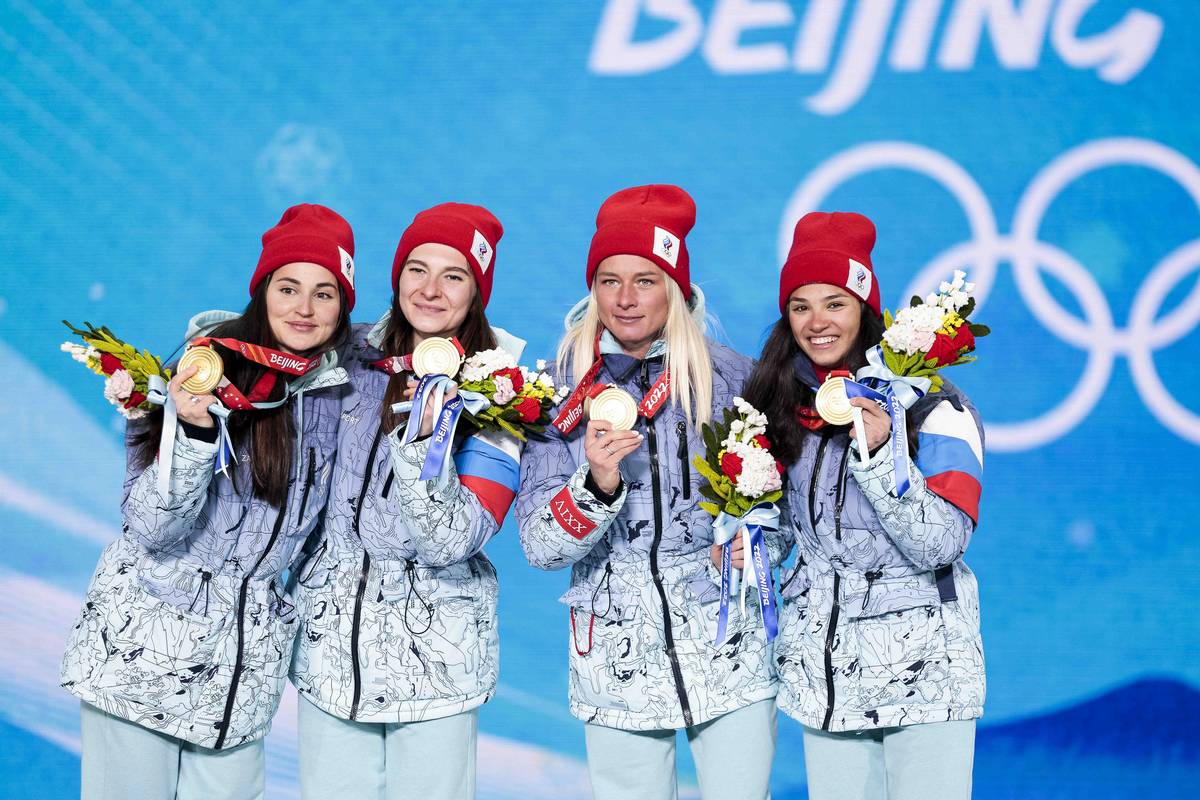
    Veronika Stepanova flexes with her Olympic relay gold medal during the 2022 Games in Zhangjiakou, CHN. (Photo: NordicFocus)

    Stepanova’s request to compete under a neutral flag rings a little hollow: the Russian ski team is already a little over two years into its four year WADA ban for state sponsored doping that requires it to compete under a neutral flag at championships. 

    A similar neutrality option was offered as a solution to the Russian national soccer team which was due to face Poland in a playoff match for qualification at the FIFA World Cup. Poland rejected the idea saying, “We are not interested in playing this game of appearances.” The Polish refusal to play Russia under any terms helped to force the IOC’s swift decision to recommend banning Russia from all sports. 

    “If doping wounds were quite successfully treated by time, then here the situation is different,” wrote an anonymous Russian blogger. “In fact, government policy has come into direct and insurmountable conflict with the ability to participate in the global sports movement. And now it seems that all this will last for years, if not decades.”

    ***

    Even if Russia were to return to the World Cup next season, it’s unclear that they would be able to operate at the same level as in the past, which has helped to fuel what US Ski Team Coach Matt Whitcomb refers to as a  “waxing arms race” on the World Cup circuit.

    According to Team Manager Elena Vyalbe, funding the Russian ski machine has been a challenge. She reported that the team’s budget in 2020 amounted to around 50 million rubles, roughly $600,000 at the time. According to Markus Cramer, who coached for Russia until this spring, the cost of supporting an athlete over the course of a year is more than $150,000—a figure that calls into question Vyalbe’s statement about the team’s budget.

    However, the Russian funding structure is murky, with much additional regional support to athletes provided by local extraction industries. Vyalbe complained in 2020 that sponsorships were scarce, saying, “No matter how well [Bolshunov] performed last year, we did not have a single new sponsor. God forbid that the current ones do not go away.” 

    In an April 5th interview with Championat, Vyalbe clarified the sources of the team’s funding: “We get most of the funds from the Ministry of Sports, the [Russian Olympic Committee] gives money for some things,” and that sponsorship amounted to “not even tears, but some kind of snot. We have a small budget.”

    The team’s primary sponsorship has come from Lukoil Oil Company since 1997. Whether or not Lukoil will be able to continue to fund Russian skiing remains to be seen. The company reported its highest annual profit in seven years at the same time that its shares plummeted on the London Stock Exchange after the invasion, losing 91% of their value before trading was halted March 3rd. 

    Though the ruble has recovered from its post invasion plummet, inflation in Russia is likely to reach at least 16% this year. That, coupled with uncertainty over the team’s competition status and the dismal prospects for the Russian economy, which is predicted by the IMF to contract 8.5% this year, has the potential to squeeze the team’s budget.

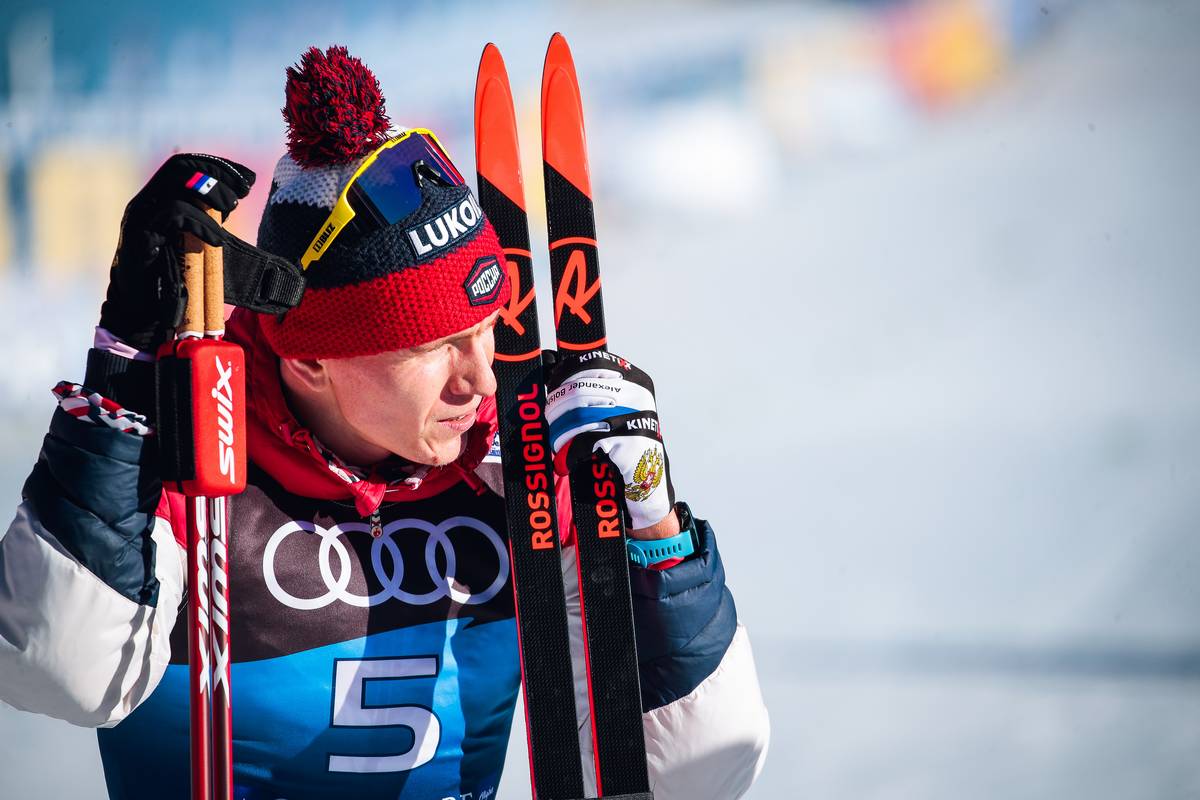
    Individual athletes also find themselves in a difficult position. Brav, the parent company of Swix and Toko, was quick to cancel sponsorship agreements with Russian  athletes, as did Kinetixx gloves. Expressen reported that Swedish ski company SkiGO was maintaining their partnership with Bolshunov, though SkiGO boss Christer Majbäck denied this, saying, “We don’t have any cooperation at all, it’s absolutely impossible. You don’t even have to ask me or SkiGO what we think about the war.”

    Alexander Bolshunov observes trailside during the 2021-2022 Tour de Ski in Oberstdorf, Germany. (Photo: NordicFocus)

    Rossignol was standing by Bolshunov until an Instagram photo proved to be too much: not long after Russia was banned, Bolshunov visited a museum and posed for a photo in an old-timey Soviet race suit, captioning the photo “USSR 1980” —which happened to be the year that Soviet Union invaded Afghanistan, though it may also have been a  reference to the 1980 boycott of the Moscow Olympics. In any case, Rossignol demanded Bolshunov remove the photo, which he did, but by the following day Rossignol said it was no longer supporting Russian athletes and removed them from its website. 

    Bolshunov could keep his skis, Rossignol said, but no new skis would be sent to Russia. 

    Similarly Fischer removed Russian athletes from its site. Fischer Communications Director Franz Fottinger wrote in an email, “All our contracts with athletes are based on their participation in World Cup races. If racers are excluded from the World Cup, there is no more basis to fulfill the contract.” 

    ***

    The Russian athletes have not exactly lost their ski partnerships, rather they are suspended until their return to the international circuit. Nevertheless, this has provoked a strong reaction in Russia, with calls to revamp ski production in the country.

    The only significant ski production facility in Russia is the STC factory in Balabovo, around 100 km southwest of Moscow. It employs 350 workers making mostly recreational and kids skis. Whether the factory can be retooled to the demands of making race stock skis is questionable.

    Alexander Pechersky, the head of service for the Russian ski team said that “No matter how optimistic I am, I understand that the process is not fast and it can take at least 4 to 6 years to produce skis of an acceptable competitive level.”

    Pechersky continued, “Miracles do not happen, but I want to try … I still look at this idea with optimism, it is very interesting to deal with it. If things move forward, then the Russian sports market can get a model that, for relatively little money, will cover the needs of at least youth sports.”

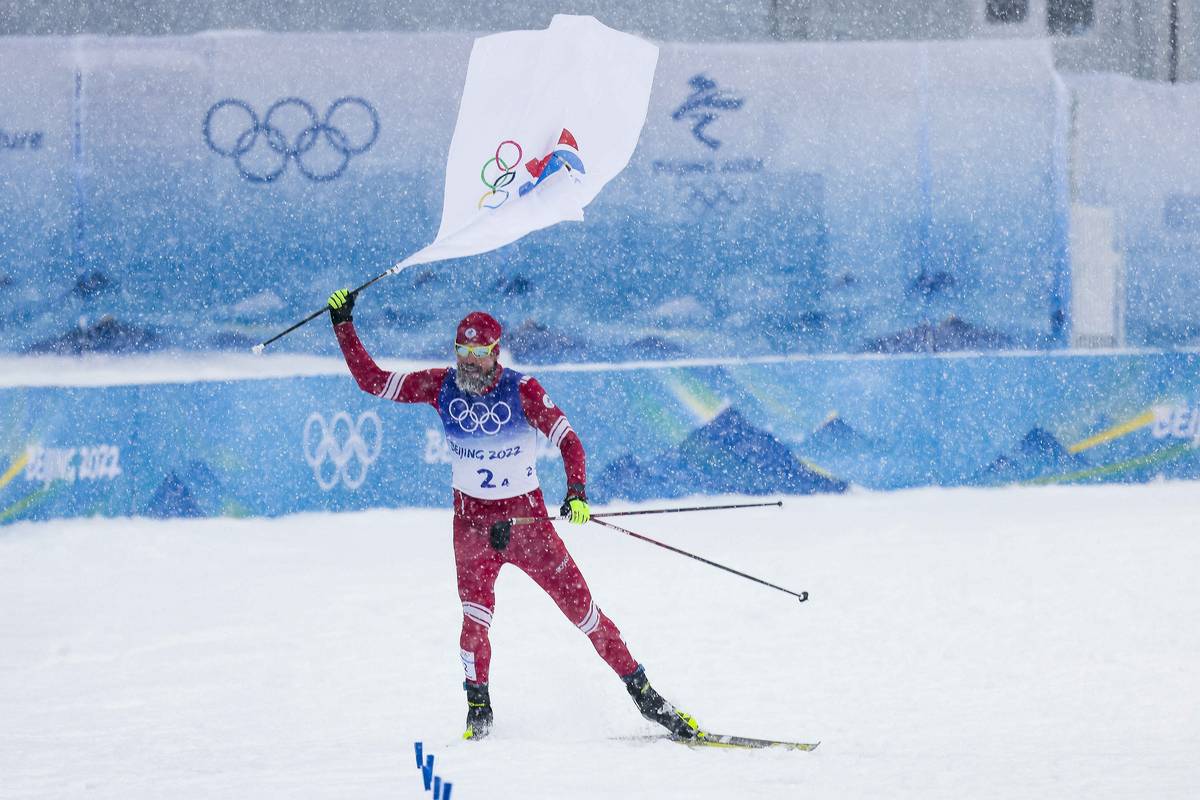
    The Russian Olympic Committee takes gold in the men’s 4 x 10 k relay in Zhangjiakou. (Photo: NordicFocus)

    Despite the public separation between sponsors and Russian athletes, some critical items are still quietly being made available to the team, according to Viktor Golovin, the deputy head of ski service for the Russian national team. “I will not name the companies, Golovin said, “but the Russian team at the start of the summer season is provided with new rollers in full, despite all the restrictions.

    The conflict in Ukraine also threatens to continue to squeeze the international supply of skis. Europe’s largest ski factory is located in Mukachevo, Ukraine and has traditionally produced some 800,000 pairs of cross country skis annually, primarily for Fischer. After a fire destroyed the facility in October of 2020, the factory remained offline for all of 2021 and was rebuilt into a state of the art ski production center. Just as final certification for the factory arrived in early February, the war broke out. 

    The factory’s director, Andriy Ryabich, wrote on his Facebook page on February 26th that “The work of the Fisher-Mukachevo enterprise has been suspended and the majority of the people went to the army in different directions and will defend our city, region and all [of] Ukraine.” 

    With much of the ski factories workforce at war during the critical spring months of ski production, ski shortages could once again factor in next season.

    ***

    For their part, the Russian Ski Federation has ordered the team to prepare with the expectation that they will compete on the World Cup, though their draft schedule indicates the team is planning to stay in Russia through next spring. 

    Curiously, in the face of unprecedented challenges the national team has expanded–to a historically large 46 skier strong team, divided into five training groups. 

    The team was dealt a blow with the departure of Markus Cramer this spring. He will join the Italian national team, though he will continue to coach Ustiugov from afar. 

    Former Russian ski coach Markus Cramer joins the Italian National Team for the 2022-23 season. (Photo: Nat Herz / ADN)

    Cramer’s tenure was instrumental in revamping the team’s training methods. Of the five training groups, three are closely tied to his methodologies. Two groups are led by Cramer protégés Egor Sorin and Petr Sedov, and a third by Sorin’s former assistant—Andrey Nutrikhin.

    The group led by Yuri Borodavko—who subscribes to a more Soviet era training philosophy and who was once suspended for doping activities—will add big names such as Yulia Stupak and Ivan Yakimushkin to an already impressive roster that includes Bolshunov and Neprayeva. Unmoved by the political climate, Borodavko’s group will begin the training year on May 15th with a controversial camp in Russian occupied Crimea.

    Yulia Stupak (RUS) races a freestyle sprint qualifier in Lahti, FIN in February 2022. (Photo: NordicFocus)

    A Russian return to the World Cup is complicated by the unusually acidic edge the team has brought to the circuit, with acrimony spilling over into social media trolling and confrontations on the ski course.

    Russian sport media has reacted strongly to the FIS ban by portraying the decision as a Norwegian power move and athletes such as Johannes Høsflot Klæbo who have supported the ban have been subjected to vitriol from Russian officials. Even before the invasion, Russian media has, in the post Sochi era, covered skiing in an increasingly strident and conspiratorial manner, dominated by a narrative of sporting victimhood and Russophobia. 

    Should Russia remain banned next season, or even longer, their absence may help FIS enact one of the most challenging maneuvers they have undertaken—the transition to fluoro-free racing, which FIS has now committed to enforcing next season. 

    Chris Grover downplayed the idea that Russia’s absence will make the transition easier, writing, “It doesn’t matter so much which nations are present at a given World Cup weekend. We need a testing system that all of the athletes, coaches, technicians and fans can trust.” 

    Fears of an imperfect test for fluoros have been punctuated with not so subtle hints of suspicion aimed at the Russian team. Golovin addressed these concerns, saying, “The Finns told us directly that the Russians are closed, no one knows what they do with skis. I suggested that they come to our wax truck and have a look…Come and see, and there is no need to make unfounded accusations.” 

    Nevertheless, Russia’s absence may lessen unstated distrust on the circuit, and perhaps improve cooperation and tolerance as the ban is enforced.

    To that end, it may be a mistake for FIS to end the ban before next season regardless of whether or not the war in Ukraine ends in the interim. All of the justifications for the ban are likely to continue into next season: security threats to Russian athletes, the Kremlin’s use of skiers for pro-war propaganda, and the inability of Ukrainian skiers engaged in the country’s defense to prepare for next season. Finally, there has been no attempt at reconciliation by Russian skiing toward the wider ski world, with intransigent blaming of Norway for the present situation. In short, Russian skiing has rejected the rest of the ski world and has found itself in the cold. 

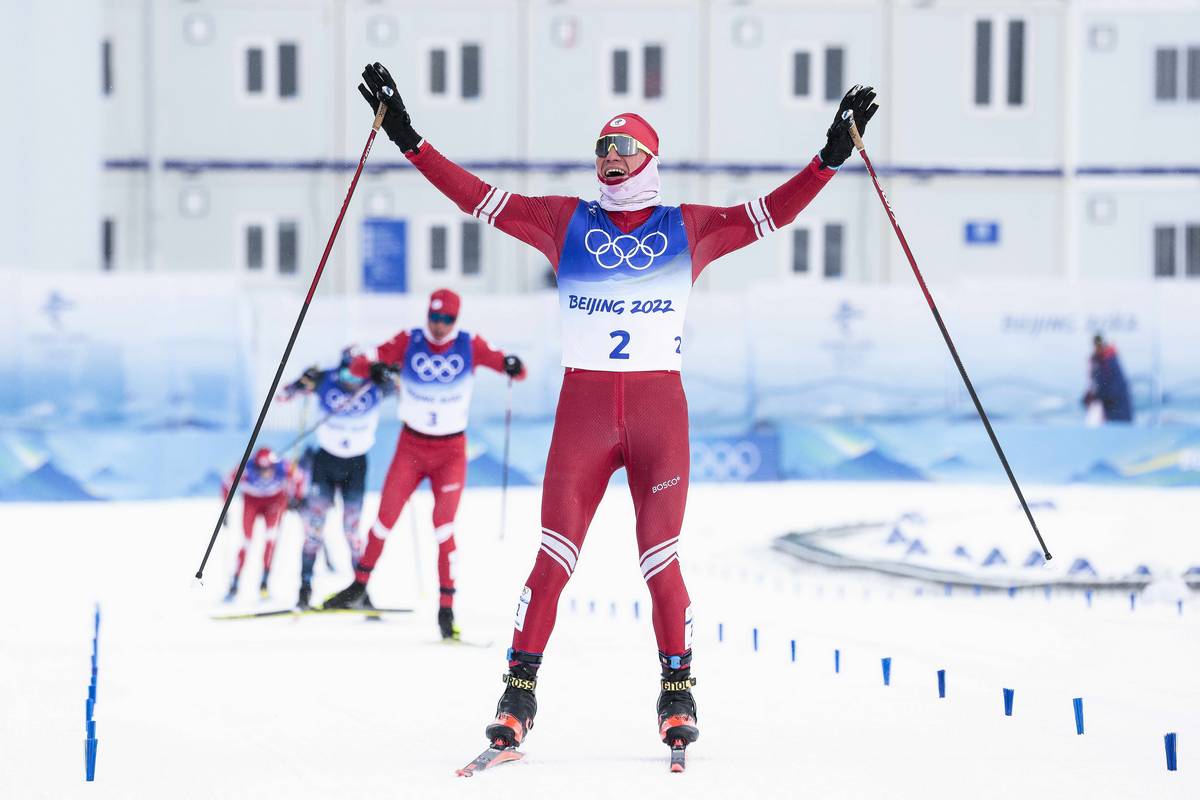
    Alexander Bolshunov takes Olympic gold in the men’s mass start 30 k, shortened from 50 k due to temperatures and extreme wind. (Photo: NordicFocus)

    As Ulvang pointed out, skiing cannot be separated from society. 

    “It’s very important that we split [distinctions] between the sanction against a nation and the sanction against the Putin regime,” Ulvang told FasterSkier reporter Nat Herz in March. “I hope I’m still friends with the athletes and that we’re able to split between a reaction against the regime. It’s nothing personal. In the big picture we are all repping our nations and our regimes. We need legitimacy from society to exist. We need public money [for] our training facilities and to make tracks and courses and we need support.” 

  • Cross-Country Skiing Mulls a Long Term Future Without Russia (Part 2)

    Cross-Country Skiing Mulls a Long Term Future Without Russia (Part 2)

    Click here to read part 1 of this series, which takes a look at international news surrounding the Russian athlete ban through the spring. For how these bans have impacted a broader cross-section of the sporting world and analysis of the complex questions surrounding whether Russian athletes should be able to compete, check out this recent Sports Illustrated article by Michael Rosenberg.


    Concerns over both fair play and propaganda have been tied to the necessity of the ban on Russian athletes. Yet ultimately the reason given by FIS for the ban was to “ensure the safety and security of all athletes”. This wording removed any political connotations, and was criticized for its weak stance that failed to condemn the war in Ukraine. 

    Natalia Nepryaeva slides for the heat win during a sprint stage of the 2021-2022 Tour de Ski in Oberstdorf, GER. (Photo: NordicFocus)

    Still, there were real concerns over the safety of the Russian athletes at European races. On March 1st, due to threats, the organizer of the World Junior Championships for jumping moved the Russian contingent out of their hotel in downtown Zakopane, Poland with the aid of 200 police officers. In Norway, Neprayeva reported being threatened in the team’s hotel in Oslo, and the Norwegian Ski Association was flooded with messages insinuating that if the Russian athletes started a race they would not finish.

    “[The] FIS followed the IOC decision and based [the ban] on security,” Ulvang said in a call in March with FasterSkier reporter Nat Herz. “This has also become a legal case because Russia has taken this to CAS [The Court of Arbitration for Sport].”

    While the FIS cited athlete security for the ban, the Federation took their cue from the IOC which recommended banning Russia due to the violation of the Olympic truce. This historical agreement, presented at the UN prior to the start of the Games, calls for the “cessation of hostilities” surrounding the Games, incorporating the Olympic values of sportsmanship and unity “with a view to protecting, as far as possible, the interests of the athletes and sport in general, and to harness the power of sport to promote peace, dialogue and reconciliation more broadly.” 

    Russia’s invasion of Ukraine on February 24th, 2022 violated the agreement, co-sponsored by the Russian Olympic Federation, to abide by the truce from February 4th through March 20th, surrounding both the Olympic and Paralympic Games in China.

    “We will see,” continued Ulvang, “whether this is within the overall statutes of sport or FIS actually, because our rules are not made for such special things. This is a very, very special circumstance. I have spoken to many lawyers who think this is an interesting question.”

    Waving the flag for the Russian Olympic Committee, Sergey Ustiugov brings home a win in the men’s 4 x 10 k Olympic relay. (Photo: NordicFocus)

    Russia has pursued aggressive appeals of bans in a variety of sports, though with exception of Luge, largely without success. On May 21st, Vyalbe conceded that after consultations with lawyers, the Russian Ski Federation would not appeal the ban in CAS, saying, “We won’t win.”

    An anonymous Russian blogger examined the legal considerations of banning Russia, and found that while the IOC had operated outside of its normal boundaries to call for a blanket ban, it had done so out of the special circumstances. Previously, it was the UN that called for athletic exclusions, such as that of Serbia during the siege of Sarajevo.

    In this case, with Russia being a permanent member of the UN Security Council, any resolution could be unilaterally vetoed by the country, so in turn the burden fell to the 

    IOC to take an action that was theoretically beyond its scope—though roughly in keeping with previous cases.  

    For Russia, there is no easy recourse for dealing with sporting sanctions. Unlike economic ones, they do not inflict mutual pain and any victories achieved in the sport courts could easily be undermined by canceled visas or boycotts. 

    Yet a sustained ban on Russian athletes is likely to reshape skiing in a number of ways, beginning with the sport’s media position. Russia now comprises the largest audience for cross country skiing, averaging 1.5 million per World Cup race and accounting for at least a third of the sport’s total audience. 

    After Russia was banned this spring, Match!TV—a large Russian public broadcaster— pulled coverage of all international ski races and redirected its energies toward covering domestic competitions where it is likely to remain focused until Russian athletes return to the World Cup. 

    Compounding the difficulties of that loss will be the continued transfer of ski racing from public TV in Norway, Sweden, and Finland to streaming service Viaplay, which charges a hefty subscription fee—as much as €40/month in Finland. 

    Traditionally, public broadcasts in the Nordic countries accounted for half of skiing’s total audience. In 2020/21 that share fell to a third, in part because of Covid restrictions that kept their teams at home. Norway especially tuned out, with a 55% reduction in viewers, and numbers in Sweden, Finland, and Germany also declined. 

    Offsetting this loss has been Russia, whose star skiers have propelled coverage of the World Cup from subscription channels to public TV in their country, boosting domestic viewership in 2020/21 by 600%.

    The men’s 4 x 10 k Olympic relay podium: the Russian Olympic Committee (ROC) came out on top ahead of Norway in second and France in third. (Photo: NordicFocus)

    While last season’s viewership numbers have not yet been published by FIS, during Period 1 of the World Cup last season, VG found that the races shown on Viaplay averaged far fewer viewers than would be typical for an NRK broadcast. 

    Should broadcasting continue to sustain a loss of 40% of its audience in the Nordic countries while also losing the majority of Russian viewers, the sport may find itself in crisis, as sponsors balk at paying for low return advertising. Still, it may be too soon to write Viaplay off completely—the service recorded more than a million Swedish viewers tuning in to the World Cup weekend in Lillehammer. 

    As a whole, FIS cross country skiing has struggled to hold its audience, and losses in some regions have been more than offset by the recent tide of Russian viewers.

    While Russian viewership is huge, most sponsors of the FIS World Cup are not particularly oriented toward Russia. Coop—the title sponsor of the Cross Country World Cup—is a Norwegian grocery chain. Coop early on sided with the Norwegian Ski Association in calling for the exclusion of Russian skiers. Many other sponsors have no business in Russia, and some, like Audi, have halted operations there. 

    Despite the €29 million that Russian viewership is estimated to be worth to sponsors, the audience may hold little allure, perhaps because of the average Russian’s low purchasing power. In 2021 the average Russian made around 40,000 rubles annually, or about $6,400. Now, with many western businesses pulling out of Russia, there is even less value placed on reaching Russian fans. 

    The women’s overall podium of the 2021-2022 Tour de Ski: Natalia Nepryaeva (RUS) was the overall champion ahead of Ebba Andersson (SWE) in second and Heidi Weng (NOR) in third. (Photo: NordicFocus)

    For sponsors, the Russian exclusion may ultimately be beneficial. Germany, and Central Europe in general, are a core market for skiing—a market which has been drying up in an era of poor performances by the region’s skiers. 

    With the German women winning gold at the Olympics and the retirement of the dominant force in distance racing, Norway’s Therese Johaug, the opportunities for success of sidelined countries could become plentiful on the women’s side with the additional absence of Russia.

    On the men’s side of skiing, though Norway remains poised to dominate, a potential lack of a Russian team would create significant podium opportunities for up-and-coming American, Canadian, French, German, and Czech athletes. In recent seasons the rivalry between Norway and Russia has consumed almost three quarters of the World Cup podiums. The long term absence of Russia could allow the podium of men’s skiing to once again take on a broader flavor. 

    Chris Grover, U.S. Ski & Snowboard Cross Country Program Director, clarified that a continued ban on Russian athletes wouldn’t change the quota system, writing, “We’ll have the same number of athletes starting each race. Obviously, Russia has a lot of the top performers, so there will be more opportunities for many other nations to secure podiums, gather World Cup prize money and points, and improve Red Group standing.”

    Julia Kern leads the way in the first leg of the 4 x 5 k mixed relay in Falun, SWE in Mar. 2022. (Photo: NordicFocus)

    All told, the changes that skiing will endure if Russia remains banned through next season may not be as dire as Russian sporting officials have suggested. 

    “The tired rhetoric that world sport will not be able to fully develop without Russia does not seem to inspire the speakers themselves anymore,” wrote the anonymous blogger. “It is no coincidence that you can already hear talk about alternative tournaments, leagues, and other ways of self-reliant development.” 

    The alternative for Russian skiing is to try to create its own circuit among friendly nations. To date, Russian skiing has only managed to solidify a sporting partnership with Belarus, via a cooperative agreement signed in May.

    Stay tuned for Part 3, which considers historic athlete bans, and barriers the Russian program face to keep their program operating in the interim.

  • Nordic Nation: Cross-Country Program Director Chris Grover on Looking Back and Planning Ahead 

    Nordic Nation: Cross-Country Program Director Chris Grover on Looking Back and Planning Ahead 

    Celebration abounds following Jessie Diggins’ Olympic silver medal in the 30 k mass start skate in Zhangjiakou, CHN. U.S. Ski Team head coach Matt Whitcomb and cross-country program director Chris Grover wear orange hats near the top-right corner. (Photo: NordicFocus)

    I think we can all agree that the last two years have been a wild ride.

    For those at the helm of the cross-country program at U.S. Ski & Snowboard, added layers of COVID safety precautions and expensive testing have increased the otherwise mounting demands of preparing for an Olympic Games. There have been numerous domestic and international competitions canceled, including a full season of SuperTour racing in 2020/2021, numerous World Cups canceled, and three consecutive years where the World Cup finals were either rescheduled or canceled. Amidst ever-changing travel policies country to country, the U.S. Ski Team tested, masked, and problem solved their way through two race seasons.

    U.S. Ski & Snowboard XC Program Director Chris Grover oversees training during a 2019 U.S. Ski Team camp in Bend, OR. (Photo: FS Archives)

    Throw into the mix preparations for an Olympic Games at a brand new venue where teams would be arriving site unseen and COVID testing protocols were extreme, and cap the season with the invasion of Ukraine and subsequent ban of the Russian cross-country powerhouse – there’s simply been a lot of curveballs thrown. 

    But as the 2022/2023 season approaches, we also sit at a transition point for World Cup racing that perhaps marks a few steps forward with gender parity. Namely, a move toward equal distance racing and the adoption of an initiative proposed by U.S. Ski & Snowboard to the FIS to incentivize supporting and developing more women to become ski technicians at the World Cup level. In this proposal, an additional set of course access bibs which could be used to test skis and product at World Cup events would be available only to women; therefore, a country could increase the size of its service staff by investing in the development of women techs and utilizing these women at World Cups.

    Though Grover explains this may best serve the nations with the biggest budgets – which does not include the United States – it’s greater purpose aligns with other grassroots initiatives at U.S. Ski & Snowboard to hire, develop, and support women in coaching and leadership to improve the balance of men and women representing all levels of the sport. 

    There’s also a recently-released 2022-23 roster of U.S. Ski Team athletes, featuring a bloom of young talent on the men’s side whose trajectory may enable a full field of men and women to race at the 2026 Olympic Games in Milano Cortina. And, there’s momentum building for a Minneapolis World Cup in 2024, followed by a trip to the Northwoods of Wisconsin for a super-Birkie – i.e., a World Cup sprint and 50k on the Birkie trails. 

    In short, there were no shortage of talking points for this insightful conversation with cross-country program manager Chris Grover, who joined us from his home in Hailey, ID upon returning from the U.S. Ski Team’s first training camp of the season at the Mt. Bachelor Nordic Center in Bend, OR. 

    Thanks for listening.

    Masked up, Jessie Diggins and Ebba Andersson (SWE) congratulate one another on podium performances in the 10 k skate in Falun in Mar. 2022. (Photo: NordicFocus)
  • Cross-Country Skiing Mulls a Long Term Future Without Russia (Part 1)

    Cross-Country Skiing Mulls a Long Term Future Without Russia (Part 1)

    Alexander Bolshunov takes fifth in his final World Cup race of the 2021/2022 season, a 15 k classic in Lahti, FIN. (Photo: NordicFocus)

    With Russian athletes banned from all FIS competitions, and no end in sight for the war in Ukraine, there is a growing belief that Russian skiers are unlikely to rejoin the World Cup next season. 

    Some commentators have gone further, proclaiming that we have seen the last of Bolshunov, Neprayeva, and the rest of the Russian team on the international stage. The pessimism is rooted in the history of similar bans—which tend to be long lived—and the uncertainty over what circumstances would allow for the Russians to rejoin. 

    Will the ban end when Ukrainian athletes can return fully to competition? That may not be possible until long after the end of the conflict. Perhaps a negotiated peace settlement? That possibility could still create discontent with athletes such as Bolshunov being used to fuel propaganda at home. Does the ban require the Putin regime to end? That could be a distant future. 

    “I expect that this situation will last as long as the conflict is unsolved,” said Vegard  Ulvang, the outgoing chairman of the FIS Cross Country Committee, “but that’s of course up to the FIS Council or IOC.” 

    Ulvang was outspoken in calling for the Russian exclusion from the Norwegian hosted World Cup events this spring. Ulvang said in a call, “We have a fairness rule in FIS that there should be equal opportunities. When one nation cannot compete because they have to go home to defend their country, and the attacking country is racing, that’s not nice.”

    Ukrainian biathlete Dmytro Pidruchnyi competes in an Olympic sprint during the 2022 Games, shortly before being called into military service to protect his country amidst Russian invasion. (Photo: NordicFocus)

    Ulvang’s point is underscored by the Ukrainian athletes now fighting on the front lines, with many called up just days after returning from the Beijing Olympics. Among the Olympians taking up arms was Dmytro Pidruchnyi, a biathlete who has won gold in the World Championships. The danger faced by the athletes defending their country was made clear early on in the conflict with the tragic loss of nineteen year old biathlete Yevhen Malyshev, who was killed defending Kharkiv on February 26th. 

    Another explanation for the ban was that it would help send a message to everyday Russians and deprive the state of a propaganda tool. 

    The charge that athletes were being used for propaganda purposes was confirmed during Russian President Vladimir Putin’s March 16th pro-war rally in Moscow. The event, titled “For a World Without Nazism” was MC’d by longtime biathlon TV commentator Dmitry Guberniev. Stars of the Beijing Olympics—including Alexander Bolshunov—were trotted out in front of the (reportedly) 100,000 strong audience in the Luzhniki stadium. 

    Questions remain about whether the athletes attended of their own accord, and there has been speculation about whether Bolshunov’s decision not to wear a letter Z pin on the stage—a pro-war symbol—reflected an ambivalent attitude to the conflict now raging near his home. 

    The women representing the Russian Olympic Committee strike gold in the 4 x 5 k relay. From left to right, Yulia Stupak, Natalia Nepryaeva, Tatiana Sorina, and Veronika Stepanova. (Photo: NordicFocus)

    On April 26th, a host of Olympic heroes were called to receive state awards by Vladimir Putin in a ceremony that required the athletes to quarantine prior to the visit. Putin congratulated the skiers, saying “First of all, I would like to note the long-awaited victories in the relay race…We have not had a simultaneous victory of both the women’s and men’s teams for exactly half a century. This is a big result.”

    A few notable Russian stars missed the Kremlin occasion: Bolshunov for dental surgery, Neprayeva because she arrived to quarantine sick, and Ustiugov because his wife had recently given birth. 

    Bolshunov’s absence at the event stirred further speculation that he had intentionally scheduled the surgery to avoid the ceremony, and with it the possibility of a personal ban set against him by FIS, much as FINA – the International Swimming Federation – did by banning Yevgeny Rylov for nine months after he stood next to Bolshunov at the March 16th rally.

    Elena Vyalbe, who heads the Russian Ski Federation, manages the national team, and sits on the FIS council, dismissed this speculation, saying, “Who wrote that Alexander [Bolshunov] refused? I already spoke about this…He was scheduled for surgery on the 24th [of April].”

    However, during the Olympics Bolshunov made it clear he dreaded the idea of the quarantine required to meet Putin, saying, “If they put me in jail forcibly, I’ll run away in two hours. I can’t just take it and throw 10-14 days out of my life. It’s unrealistic.”

    During the Kremlin ceremony, Putin singled out the missing Bolshunov for special praise: “I note that Alexander Bolshunov has collected a solid collection of awards in Beijing,” Putin said. “Everyone knows this well. He has three gold, silver and bronze medals. And the absolutely well-deserved symbolic title of king of skis.”

    Alexander Bolshunov displays four of the five Olympic medals he collected in Beijing, bringing his career total to nine medals earned over two Olympic Games. (Photo: NordicFocus)

    The political significance of the event, which was delayed due to the war in Ukraine, was not lost on anyone. Veronika Stepanova, the upcoming ski star from Kamchatka seized the moment to make a splash.

    Addressing Putin and the Kremlin audience, Stepanova said, “I am the same age as the century—I was born in January, 2001. Before my very eyes, Russia has again become strong, proud, and successful. Not everyone in the world likes it. It is obvious. But we are on the right track. And we will definitely win, as we won at the Olympics.”

    The overt statement of support from Stepanova far exceeded expectations of decorum that called for perfunctory public speaking at most. That Stepanova would jeopardize a burgeoning ski career for a soundbite even shocked Russian commentators who speculated that the 21 year old was positioning herself for a transition to politics. For her part, Stepanova responded saying, “Negative consequences for my international career? They don’t scare [me].”

    Far from distancing herself from the comments, Stepanova has brashly doubled down, saying, “Was I nervous when I spoke at the meeting with Putin? You have to believe in what you say. The presence of the president does not confuse or frighten, on the contrary, it energizes. You feel tremendous confidence next to him, you feel a special energy.”

    Stepanova’s words have reverberated as she has gained a following in the west: outgoing and fluent in English, as well as adept at social media, many fans as well as fellow competitors felt they could relate easily to her. 

    Helene Marie Fossesholm of Norway was one such skier that enjoyed a friendly rapport with Stepanova off the ski trails. In the wake of her Kremlin speech, Fossesholm told NRK she was uncertain of how the friendship would continue, saying, “I can not answer that until I have experienced it. But it is clear that it will not be forgotten, at all.”

    Flooded with foreign media requests to explain herself, Stepanova responded via her Instagram page, writing “I have an answer to [Western journalists]: Did you expect anything else from me? Just because I smile, speak a little English and am almost always ready for some nonsense, does that make me ‘another type of Russian?’ The peak of naivety!”

    21-year-old Veronika Stepanova anchored the Russian gold medal winning women’s 4 x 5 k Olympic relay team during the 2022 Beijing Winter Games. (Photo: NordicFocus)

    Vyalbe has been among Stepanova’s detractors this spring, criticizing her by saying that she may be suffering from “star disease” and that “now she is not an athlete, but a patriotic blogger.” For the head of Russian skiing, Stepanova has become irksome. “My senior leaders ask me questions about her,” Vyalbe told Championat, “and I feel ashamed and unpleasant.”

    For her part, Vyalbe faced pressure in her bid to remain on the FIS council, after the Ski Federations of Poland, Finland, and Sweden moved to bar her from running for reelection at the FIS Congress on May 26th. FIS, however, allowed Vyalbe’s candidacy.

    In allowing Vyalbe to run, FIS may have looked at the difficulties endured by the International Luge Federation (FIL). In early March FIL had voted to ban Russia in much the same manner as FIS, though Luge went a step further—voting in favor of expelling elected officials from Russia. 

    In April, Russia won their appeal in the FIL’s own Court of Arbitration, and saw the ban removed on the grounds that they were—according to the Russian Luge Federation—”dictated solely by political motives and had no legal grounds for adoption”.

    For FIS, the Luge ruling was likely a reminder that barring Vyalbe from running could run afoul of their own laws against politically motivated rulings. 

    Apart from from the symbolism of being Russia’s representative to FIS, Vyalbe had escalated tensions in the ski world by laying the blame for the ban squarely on the shoulders of Norway’s FIS representatives—Erik Røste, the head of the Norwegian Ski Federation and FIS councilor, and Vegard Ulvang, the outgoing chairman of the FIS cross country skiing committee. 

    In response, Røste said, “Norway will not vote for Russia because of the terrible things happening in Ukraine.”

    The Vyalbe election saga has proven to be a tender subject for Russian commentators. When Swedish skier Markus Grate commented that “There is no possibility that Vyalbe will remain on the council,” biathlon TV commentator Guberniev declared that if Grate was suggesting that Vyalbe be excluded on the basis of her nationality, then “he is a Nazi, these are the words of a Nazi.”

    Marcus Grate (SWE) races a freestyle sprint qualifier in in February 2022 in Lahti. (Photo: NordicFocus)

    In any case, Vyalbe lost the election on May 26th at the FIS Congress—finishing last. “In this situation, it was expected,” Vyalbe said. “There was a letter from the Ukrainian Federation, which says that everything should be politicized.” 

    With Vyalbe out of the FIS council, Russian skiing will likely recede further into seclusion. 

    Stay tuned for parts 2 and 3 of this series, which will be released over the next week. 

  • The Devon Kershaw Show: 2023 starts now. (Okay, three weeks ago.)

    The Devon Kershaw Show: 2023 starts now. (Okay, three weeks ago.)

    You’ve been waiting on pins and needles for the first episode of this season’s Devon Kershaw Show; we know. But it’s been a busy spring. This edition was recorded a couple of weeks ago, so apologies we’re not up to speed on all the latest developments, but we break down some retirements and other off-season news and we’ll be back soon with some discussion of equal distance racing and other news.

    You can email us at devon@fasterskier.com and nat@fasterskier.com.

    Kevin Bolger races a freestyle sprint qualifier in late February 2022. (Photo: NordicFocus)
  • Updates from the 2022 FIS Cross-Country Committee Spring Meeting (Press Release)

    Updates from the 2022 FIS Cross-Country Committee Spring Meeting (Press Release)

    The start of the women’s 10-kilometer mass start free during Stage 3 of the 2021/22 Tour de Ski in Oberstdorf, Germany. (Photo: NordicFocus)

    This press release originally appeared on fis-ski.com on Wednesday, March 18, 2022.


    May marks the month of the FIS Committee meetings, debriefing the season and setting up task and changes for the upcoming ones.

    All proposals that were elaborated by Sub-Committees and working groups members came on the table of the Cross-Country Committee (CCC) on Wednesday, 18th May. The Committee discussed them and forwarded the confirmed proposals on to the highest authority in FIS, the FIS Council.

    All proposals, including the extract of the major proposals presented below, are therefore subject to the approval of the FIS Council which will meet on 26th May.

    Decisions of the FIS Cross-Country Committee

    Equal Distances for Women and Men

    The question, if women and men are to race equal distances has been a very important topic for years and a prominent discussion building up to this year’s Cross-Country Committee meetings as the decision was on the agenda.

    With 57%, the CCC voted for equal distances for women and men.
    A historical decision.

    The implementation will be effective from the upcoming World Cup season on the World Cup level as well as on Junior and U23 World Ski Championships (JWSC/U23 WSC) and Youth Olympic Games (YOG) level for now. The decision whether to implement it on World Ski Championships level will be discussed with all stakeholders and decided in May 2023.

    In a second step, the voting members decided about the formats that will be in place and voted to use the following standard distances
    For World Cup: Sprint | 10km | 20km | 50km with Skiathlon being 20km (10km + 10km)
    For U23 WSC and JWSC: Interval 10km | Sprint | Mixed Relay 4x5km | Mst 20km
    For YOG: Interval 7.5km | Sprint | Mixed Relay 4x5km

    The National Ski Federations, of which the voting members consist, did not go into a long discussion but came with a clear opinion. All up front, the main argument to vote for equal distances was that there should not be any question whether women were capable of racing the same distances as men, as they prove that they physically are capable of doing so already.
    The main argument against was the time that women need to cover the same distance as men and the effective TV time.

    Above the Arctic Circle: Ruka, FIN is blanketed in frost and fresh snow for the opening of the World Cup season in November 2021. (Photo: NordicFocus)
    FIS Cross-Country Calendar

    The updated version of the calendar will be uploaded once approved by the FIS Council.

    Starting out with the traditional Nordic weekend at Ruka (FIN) from 25th to 27th November, the FIS Cross-Country family will stay in Scandinavia and move to Norway for two event weekends in Lillehammer and Beitostølen before going to altitude in central Europe with the famous Davos Nordic weekend in Switzerland, which will take place on 17th and 18th December.

    The Tour de Ski is set from 31st December to 8th January with stages in Val Müstair (SUI), Oberstdorf (GER) and Val di Fiemme (ITA).

    After a competition-free weekend, the World Cup family remains in Italy for the City Sprint in Milano, a three-day event in Les Rousses (FRA) and Toblach (ITA) as the final preparation before the World Ski Championships in Planica that is scheduled for 22nd February to 5th March 2023.

    The final period of the Cross-Country World Cup starts in Norway with Oslo and Drammen before heading to Falun (SWE), Tallin (EST) and Lahti (FIN) for the World Cup Finals.

    World Cup Points

    A dedicated working group compiled a new World Cup point table that is set to decrease the gaps between athletes in the overall standings without devaluing top results. The table that was approved by the CCC gives the opportunity to a wider range of athletes to score World Cup points and gives a higher value for Distance athletes to participate in Sprint races and vice versa.

    The new World Cup Point table will be uploaded in the World Cup Rules once approved by the FIS Council.


    Course bibs dedicated to female staff

    US Ski & Snowboard had submitted a proposal to add a number of course access bibs per team for female service staff only, with the wish to therewith encourage more National Ski Federations to invest into the education of female staff in the ski service field in cross-country skiing. The proposal was accepted by the CCC.

    The podium of the first 4 x 5 k mixed gender relay in March 2022. USA I took the win in Falun, SWE ahead of Finland I and Norway I. (Photo: NordicFocus)
    Quota for Team competitions

    Small nation’s quota
    To give more nations the possibility to join Team competitions, the CCC approved that every nation with a basic quota of less than four athletes has the right to start with four athletes per gender also in all individual competitions if there is a Relay or Team Sprint during the same World Cup stage.

    Mixed Relay starting order
    For the future Mixed Relay competitions, each nation will have the right to enter 2 teams per nation. The starting order will alternate between the order Woman | Man | Woman | Man and Man | Woman | Man | Woman.

    Mixed Nations
    The CCC approved that nations can enter mixed nations teams (athletes from max. two different nations), if they do not have enough athletes to form their own team.

    Vegard Ulvang steps back from his position as chairman of the FIS Cross-Country Committee. (Photo: fis-ski.com/NordicFocus)
    The Chairman says goodbye

    For Vegard Ulvang, Chairman of the Cross-Country Committee this was the last meeting after well 20 years in position as he announced to step back. His replacement will be elected via the FIS Council.
    The FIS Cross-Country family has gone through significant changes under the watch of the Chairman. As a former world-class athlete himself, Vegard stepped into position with an incredible experience and passion for his position and the sport.

    FIS Cross-Country sat down together with Vegard to reflect on his time as a Chairman of the Cross-Country Committee. Especially milestones such as the Sprint introduction in 2001, a renewed WSC program from 2005 and of course the introduction of the Tour de Ski were just some of the milestones set in Vegards’ Committee career.

    The extended FIS Cross-Country family would already now like to thank Vegard for his tireless dedication for the work behind the scenes of the Cross-Country sport. He gave an unparalleled commitment and took over the large responsibility that comes with the job and has triggered, influenced, and managed many historic decisions. Thank you Vegard for leading the way.

    For his contribution, Vegard was proposed to become a Honorary Member and will need to be confirmed by the FIS Council.

  • News from the Recent FIS Meetings

    News from the Recent FIS Meetings

    Racing during the 2021 men’s team sprint in Ulricehamn, Sweden. (Photo: NordicFocus)

    Last week, the International Ski Federation (FIS) held spring meetings to discuss the 2021-2022 cross-country race season. The Cross-Country Committee made several proposals that remain to be approved by the FIS Council.

    A familiar-looking draft of the 2021-2022 World Cup calendar was proposed. Ruka, Finland will kick off racing with a three-race weekend at the end of November. This series, however, will not be organized as a mini-tour. Period I advances with three races in Lillehammer, Norway then moves to Davos, Switzerland and Dresden, Germany. The early season’s main event, the Tour de Ski (Period II), consists of six races. The most recent edition of the Tour, won by American Jessie Diggins, was eight stages.

    Period III begins with three races in Les Rousses, France and concludes in Planica, Slovenia on January 23. Afyter Period III, the World Cup takes a hiatus for the Beijing Olympics which runs between February 4-20.

    Period IV begins February 26 and visits Lahti, Finland, followed by Norwegian stops in Drammen and Oslo, and ends with three races in Falun, Sweden. The World Cup Finals are scheduled for three races in Tyumen, Russia. According to the FIS database, 2015 was the last year a cross-country World Cup was held in Russia. As a result of the Sochi doping scandal and related doping violations, Russia has not hosted recent cross-country World Cup races. However, under a recent Court of Arbitration for Sport (CAS) ruling, Russia can host World Cup level events. Russia remains banned from hosting World Championship events until December 2022.

    The recently concluded season also witnessed several instances where obstruction and overtaking violations dictated race outcomes. The most high-profile case involved Alexander Bolshunov and Johannes Høsflot Klæbo during the closing meters of the men’s World Championship 50 k. According to FIS, six active athletes and several other stakeholders are discussing rule changes and language clarity regarding obstruction and overtaking. Any changes to the rules and language will be announced next fall.

    The final moments of the women’s World Championship team sprint in Oberstdorf, Germany. (Photo: NordicFocus)

    More changes were proposed for the team sprints. This past season, the rules clarified several paths to the finals. If the semis were timed, the top two teams from each semi auto-advance. The remaining final’s spots were earned by the six fastest teams (ranked 3rd – 8th) overall between the two semis. In instances where the semis were untimed, the top-five teams from each respective semi advance to the finals.

    The new proposed team sprint qualification rules promote the top four teams from each semi to the final. The next two fastest teams overall (considering both semis) will be considered “lucky losers” and advance to the finals.

    Finally, FIS also claims to be discussing inequities when it comes to race ski preparation at the World Cup Level. For nearly a decade, as some countries have purchased mobile wax buses and expanded their ski-prep-staff, a debate between the haves and have-nots has festered. The most recent statement from FIS claims to be addressing the unsustainable nature of the ski-prep arms race.

    “The working group will be challenged to completely re-think the status of ski preparation as the current system is interfering with the set focus to make the World Cup more sustainable, stated FIS. “A main point for the working group to focus on will also be the big impact the different possibilities of ski preparation between larger and smaller nations have on race results and their financial possibilities.”

  • A Glance at Some Anti-Doping Numbers in Cross-Country Skiing

    A Glance at Some Anti-Doping Numbers in Cross-Country Skiing

    A year and more has elapsed since a doping scandal rocked the 2019 cross-country World Championships in Austria. Over that time, we have learned a bit more about what transpired at the micro-level. In the broader picture, those covering doping in sport often scour The World Anti-Doping Agency’s (WADA) annual release of a voluminous document titled “Anti-Doping Testing Figures”. The data dump runs hundreds of pages. Looking for figures on the number of tests per sporting discipline, type of test, governing body administering the test, on and on, it’s in there. The WADA report also discloses the number of AAFs (adverse analytical findings which indicate the presence of a banned substance) and ATFs (atypical findings that warrant more testing and follow up.) Useful information if one is trying to glean how pervasive doping might be in a chosen sport and how effective the tests are. 

    If you’ve ever read those reports and you’re convinced athletes dope in nordic sport, then this much is true: very few athletes produce AAFs or ATFs.

    Link to WADA Anti-Doping Testing Figures. 

    2019-2020 FIS Anit-Doping Numbers

    The International Ski Federation (FIS) released its own annual Anti-Doping Testing Figures on April 15, which it called “detailed FIS testing statistics”. To call this detailed is over reach.

    The information does, however, provide the total number of FIS administered tests and disaggregates the numbers into “out-of-competition” and “in-competition” subcatagories for the 2019-2020 season. FIS catalogs the number of urine tests, ESAs (urine and blood tests which test for erythropoiesis-stimulating agents – think red blood cell boosters), blood tests, and specific tests for athlete blood passports (APB). 

    FIS reports a total of 606 in-competition tests this season with 332 of those specific to cross-country skiing (or roughly 55 percent of the total). In-competition tests for cross-country skiing broke down as follows: 170 urine tests, 112 ESAs, one blood test, and 49 blood passport tests. 

    For out-of-competition tests, FIS conducted a total of 2205 tests, with 1278 specific to cross-country (or roughly 58 percent of the total). For cross-country, FIS administered 302 urine tests, 245 ESAs, 151 blood tests, and 580 blood passport tests. 

    FIS accounts for a portion of the overall testing in cross-country skiing. National Anti-Doping Agencies, like USADA, are also responsible for testing athletes both in and out-of-competition.

    Without running through all the numbers, cross-country accounted for the majority of tests within the FIS family of sporting disciplines: cross-country, nordic combined, ski jumping, alpine skiing, freestyle skiing, and snowboard. Although the data released from FIS tells a story, it really is an intro or first chapter at best. There’s no indication of the number of AAFs or ATFs.

    Although it appears that FIS is doing its job, if that means administering tests, then we have no idea if these tests catch dopers. Although the evidence may be lurking out there, it is our understanding that the skiers caught in Seefeld at the 2019 World Championships who had been practicing autologous blood doping – transfusing one’s own blood – never flagged an AAF. And according to FIS reports, some of those same athletes arrested in Seefeld were concurrently using hGh.  

    We are glad for the testing. We just simply want to know if the testing is effective and does its intended job of deterring would-be-dopers. With the figures released in April by FIS, we simply do not know and neither do athletes who race clean. 

    2018 WADA Anti-Doping Testing Figures

    The 2018 Anti-Doping Testing Figures from WADA, the more thorough analysis of testing metrics, reveals the breadth of testing and the paucity of positives — which may be a good sign. Then again, it might not. (2018 is the latest data set publicly available from WADA.)

    In cross-country skiing, a total of 2916 in and out-of-competition urine and blood tests were administered. These tests found a total of seven AAFs. (From Table 2: Total Samples Analyzed in AIOW Sport/Disciplines (Urine and Blood)). 

    In cross-country skiing, 187 total hGh isoform tests were conducted (blood) with a single out-of-competition AAF. (Table 30)

    In cross-country skiing, 272 total hGh biomarker tests were conducted (blood) with no AAFs. (Table 31)

    In 2018, FIS specifically collected 228 hGh biomarker samples – the vast majority of those were collected out of competition — with no AAFs. (Table 19) 

    A total of 1448 Athlete Biological Passport samples were collected for cross-country in 2018. (Table 4). 


    WADA’s Explanation of their hGh tests, quoted from WADA’s Q & A page. 

    HgH Isoform: “WHAT IS THE HGH ISOFORM DIFFERENTIAL IMMUNOASSAYS (THE ‘ISOFORMS APPROACH’)? 

    Since the total levels of hGH secreted into circulation vary naturally, are widely fluctuating over time and may be influenced by several factors not associated with doping, it is practically impossible to develop an anti-doping test based simply on the measurement of increased total hGH concentrations. However, doping with recombinant hGH (recGH) alters the naturally constant proportions between the different isoforms of hGH present in blood of an individual.  The hGH Isoform Differential Immunoassays were developed to detect these changes in the proportions of different hGH isoforms after recombinant recGH injection.”

    HgH Biomarker: “WHAT IS THE HGH BIOMARKERS TEST (THE ‘MARKERS APPROACH)? 

    hGH affects the expression of many different proteins which may serve as biological markers of hGH activity.  These include markers of hGH action in the liver such as IGF-I, as well as markers of hGH action on soft tissue collagen turnover, such as the N-terminal peptide of procollagen type III (P-III-NP). The measurement of these two hGH markers in serum may serve to uncover the manipulation of the hGH/IGF-I axis independently of the doping substance used, be it recGH or other agents used to increase circulating hGH [for example analogs of GH-releasing hormone (GHRH), hGH secretagogues such as GH-releasing peptides (GHRP) or even hGH gene doping]. The detection and quantification of such biomarkers of hGH activity constitute the rationale of the indirect method for detection of doping with hGH, referred to as the ‘markers approach’.”

    If you want to dig deeper into the trove of WADA’s Q and As, here’s the link.


  • Cross Country Ski FIS World Cup on track for March 2020 Season Finale (Press Release)

    Cross Country Ski FIS World Cup on track for March 2020 Season Finale (Press Release)


    Press Release

    Cross Country Ski FIS World Cup on track for March 2020 Season Finale

     The Season Finale to be held at the Canmore Nordic Centre Provincial Park will welcome the world’s best skiers from around the world to compete for 3 days in March 2020.

     CANMORE, ALBERTA July, 22 2019 – The Alberta World Cup Society (AWCS) just completed a successful pre-World Cup site visit by FIS (Fédération Internationale de Ski), accompanied by FIS Marketing AG and Double Black Diamond – the TV producer engaged by the Alberta World Cup Society.  “We are very pleased with the preparation from the Organizing Committee for the FIS Cross-Country World Cup Season Finale in Canmore and are looking forward to March 2020. The entire team around Greg Thompson did a great job and we feel very confident to see excellent competitions including the first ever mixed relay as well as great events around the competitions at the Canmore Nordic Center”said Sandra Spitz, Event Coordinator Cross Country, FIS.

    FIS Site Visit: Craig Bullen (Sea to Sky Cable Cam), Nrobert Meier (AWCS), Chris Robinson (Double Black Diamond), Michal Lamplot (FIS), Sabine Mlekusch (FIS MAG), Greg Thompson (AWCS), Sandra Spitz (FIS) and Mike Norton (WinSport)

    “Our Organizing and Competition Committees were well prepared to present our race plans to the FIS officials.  The advance work done by our teams meant that we anticipated many of the FIS questions and I believe we’ve passed this test with flying colours”, commented Greg Thompson, Chairman Organizing Committee, AWCS.

    The AWCS has been working on this world cup for the past three years and we are excited to look ahead to hosting yet another great set of FIS World Cup Cross-Country Ski races at the Canmore Nordic Centre Provincial Park.  With the continued support of our community, businesses, volunteers, sponsors and the municipal, provincial and federal governments, we look forward to hosting a first-class event including numerous community activities.

    The 2020 Season Finale will feature the first ever mixed relay race on Sunday, March 22, 2020.  This ground-breaking event will be televised around the world and will feature 2 women and 2 men per nation racing in both classic and skating technique.   It will make for exciting racing, great television and a most wonderful way to finish the 2019/20 Cross Country FIS World Cup season.  The Crystal Globes trophies will be awarded at this event to recognize the Best Distance skier M/F, Best Overall skier M/F and Nations Cup for the season.

    The AWCS has held Cross Country Skiing World Cup events at the world-class Canmore Nordic Centre Provincial Park since 2005.  “We have an excellent track record of bringing World Cup Cross-Country Ski events to Canmore, having held 5 FIS World Cups and 2 Para-Nordic World Cups since the2005 Alberta Centennial World Cup.  Our facilities continue to be among the best in the world and we appreciate the hard work done by the Canmore Nordic Centre Provincial Park staff working with our event team to achieve the highest international standard of hosting excellence.”, said Norbert Meier, Events Chair, AWCS.

    Women’s Pursuit at the Canmore Nordic Centre, Ski Tour Canada 2016. (Photo: Pam Doyle Photography)

    The Alberta World Cup Society continues to promote its mandate of developing and growing cross-country skiing in Alberta through hosting World Cup races and by providing resources for the development of officials, coaches and athletes. All these activities are accomplished with the involvement of tireless volunteers who dedicate their time in different capacities to make this possible. 

    If you would like to have more information on this topic, please contact Norbert Meier at 403-760-0633 or by email: nmeier@albertaworldcup.com

  • FIS XC Approves 2017/2018 World Cup Calendar

    FIS XC Approves 2017/2018 World Cup Calendar

    On Sunday, the International Ski Federation (FIS) approved its calendar for the 2017/2018 Cross-Country World Cup season at its spring meeting in Portoroz, Slovenia. The season opens with the Ruka triple — three straight days of racing Nov. 24-26 in Kuusamo, Finland — and includes a sprint weekend in Dresden, Germany, classic races in Planica, Slovenia, and skate races in Seefeld, Austria (host of 2019 World Championships), all in Period 2.

    Next comes the 2018 Winter Olympics in PyeongChang, South Korea, from Feb. 9-25.

    The season wraps up with Period 4 in Finland, Norway and Sweden, with World Cup Finals in Falun, Sweden.

    Full calendar below or for original PDF, click here.


  • Ulricehamn Sets the Standard for Nontraditional World Cup Venues

    Ulricehamn Sets the Standard for Nontraditional World Cup Venues

    Charlotte Kalla racing to third place in the 10 k skate in front of a huge crowd in Ulricehamn, Sweden, on Saturday. (Photo: Fischer/Nordic Focus)
    Charlotte Kalla racing to third place in the World Cup 10 k skate in front of a huge crowd in Ulricehamn, Sweden, on Saturday. (Photo: Fischer/NordicFocus)

    Most of the time, the FIS Cross-Country World Cup visits towns and ski trails the racers already know well.

    Some venues, like Norway’s Holmenkollen and Switzerland’s Davos, are visited every year. Others, like France’s La Clusaz, are on the schedule every few years but are still always popular.

    “I’ve been on the World Cup for ten or eleven years, and we go to the same venues all the time,” the U.S. Ski Team’s Liz Stephen said.

    But every once in a while, a new place is thrown into the mix. Last weekend it was Ulricehamn, a town of 10,000 people in southern Sweden.

    The rave reviews from athletes, coaches and fans made it clear that Ulricehamn aced their World Cup hosting duties on the first try, giving other venues something to aspire to.

    The venue even faced some significant challenges, like how to prepare a race course in above-freezing temperatures. No matter – the races went off without a hitch.

    “This was the best World Cup venue of the year — by far,” Canadian skier Devon Kershaw wrote in an email. “The volunteers are so friendly and helpful and to have a five kilometer track with thousands and thousands of supporters lining the whole way was just so much fun. I’ve never raced in an atmosphere like this other than the legendary Holmenkollen.”

    Teammate Alex Harvey – who won the 15 k and won bronze in the relay together with Kershaw, Knute Johnsgaard, and Len Valjas – put it this way: there were so many spectators that it was impossible to find a quite moment to oneself.

    “On the warmup loop, there were people along the whole course,” Harvey said. “I couldn’t even take a piss in my warm up. Usually I take like six pisses in an hour, and I was like, ‘Man, I just can’t piss!’ There were people everywhere. It was fun. They were cheering my name the whole warmup, and the whole race too. In Scandinavia, they are always a well-educated crowd. This was like a championship crowd, like Falun or Oslo. It was awesome.”

    The Ulricehamn organizing committee reported that there were about 30,000 people in attendance each day.

    “If you go back and watch all the races (except maybe Lillehammer) this year, there have been like 1000-2000 spectators max,” Kershaw wrote. “Some venues had like 100 people, it seemed. So this was a big improvement… Bringing events to where people actually care and are passionate about the sport is always best, I feel. I mean, as an athlete to race in an atmosphere like this is really motivating. It looks way better on TV, and people are having a great time out there – which is what we want to promote as ski racing (I feel).”

    King Carl XVI Gustaf even came to watch Sweden win bronze in the women’s relay and silver in the men’s relay.

    “I watched the races on television yesterday and couldn’t help it [to come here],” he told the local newspaper. “I think I’ve had just as much fun as everyone else had here. It has been a fantastic day of skiing in Ulricehamn and extra fun to [hear] the athletes say they felt such powerful public support.”

    Anchoring the women’s relay was Hanna Falk, who grew up in Ulricehamn. The King personally congratulated her.

    https://www.instagram.com/p/BPkjYv8hUa0/

    “It seems that all the skiers have been very pleased,” Falk told the Skövde Nyheter newspaper, according to a translation. “I’ve heard many good things from many different countries, so that makes me a bit extra proud.”

    The venue’s success over the weekend is already being cited as a reason for other Swedish municipalities to invest into their ski infrastructure. For instance, some in Marcus Hellner’s hometown of Skövde, just over an hour north, would like to see a similar effort.

    “It shows that hard work, persistence and courage pays off,” a commentator from Göteborg, the nearest major city, wrote. “That you do not have to be the biggest to be the best is also a nice reminder in these times of centralization … Among the city’s 10,000 residents, there were people who wanted to do something special, people who love their homeland, their sports and who love to show off their hidden treasure for the rest of the world. Talk about daring, talk about winning.”

    Ulricehamn is already planning to host another World Cup weekend in 2019, and may continue getting awarded competitions if the success of their first event is any indication.

    Meanwhile, the World Cup will return back to North America in March. World Cup Finals were awarded to Quebec after being moved from Tyumen, Russia, due to a doping scandal.

    Some athletes felt that Canadian and U.S. ski fans could learn a thing or two about how to earn these rave reviews from athletes – the kinds of reviews that could eventually promote a venue to being a regular or semi-regular World Cup host.

    “Of course the fans were wonderful in Quebec last year, but when you see the amount of people on the courses here in Sweden, it is an insane amount,” Stephen said. “I would like to put it our there as a challenge for fans who are close to Quebec to come out. Let’s try to be as big as Sweden there, because the more the athletes have fun… I heard everyone talking about the crowds, on every team, even the Norwegians. When that kind of talk happens, more World Cups are given to that city or host venue.

    “All the fans who are thinking about maybe coming up, don’t think about it, just come,” she concluded. “It makes the atmosphere very appealing to the teams, and especially us athletes. It’s really fun.”

  • Time to Ruminate on the 83% Rule: The Future of Classic at the Highest Level

    Time to Ruminate on the 83% Rule: The Future of Classic at the Highest Level

    American Noah Hoffman (43) racing to 35th in the men's 30 k skiathlon, a best for the U.S. men in the sixth stage of the Ski Tour Canada in Canmore, Alberta.
    American Noah Hoffman (43) racing to 35th in the men’s 30 k skiathlon, a best for the U.S. men in the sixth stage of the 2016 Ski Tour Canada in Canmore, Alberta.

    In so much as a social-media statement, the International Ski Federation (FIS), the governing body of cross-country skiing, proclaimed itself a curator. For some context, here is the definition of “curate” from an old-school source, Merriam-Webster: one who has the care and superintendence of something; especially  :  one in charge of a museum, zoo, or other place of exhibit.

    Back to the FIS tweet from last Friday.

    FIS Tweet regarding the 83% rule.
    FIS tweet regarding the 83% pole length rule.

    Assuming FIS’s words were chosen carefully, the words “defend classic technique” stand out. It makes the assumption that FIS perceives that classic technique was/is under attack — that it requires protection from those tainting its technical sanctity.

    All the rumbling has to do with the decision to enforce a new rule limiting the maximum pole length to 83 percent of a skier’s total height (with boots on) during FIS-sanctioned classic cross country ski races.

    This Wednesday, FIS Cross Country published a Q & A on its website. In response to why the rule was accepted, FIS reiterated that it believed desperate times warrant desperate measures. “The evolution of double poling has been challenging the core of the Cross-Country Skiing sport. Several measures to slow down this development have been put in place (see paragraph 5),” it stated.

    Paragraph five in the document notes: “This will not stop anyone from double poling even in steep uphills but it is expected to stop the unwanted evolution of classic technique. The experiences from the upcoming season will be carefully examined next spring and further steps including a lowering of the percentage may be discussed.”

    Field of play

    Moving forward, let’s assume those percentages for pole length are a moving target. Rather than being relegated to museum status, classic technique remains living history.

    In recent years, if the image you’re seeking is to watch World Cup skiers stride up hills exclusively, then perhaps you’re wanting.

    On certain World Cup distance classic courses like Toblach (Italy) or Davos (Switzerland), and sprint courses like Drammen (Norway) and Stockholm (Sweden), it’s just as likely a double poler on skate skis prevails than a nordie with the magic combo of bomber kick and zippy skis. Some call it evolution, others, like FIS, call it an affront to a technique that has historically defined the sport and anchored it to the past.

    It does beg the question, what is the responsibility of a sport’s international governing body when it may have promoted that evolution in the first place?

    “In skiing, the field of play has changed tremendously and it has been driven by the governing body and that has driven the evolution of sport,” Zach Caldwell, of Caldwell Sport, said in a recent phone interview. “That’s why athletes are more powerful. Classic technique is totally different from what it was 30 years ago, 40 years ago. Completely different. Some of it is just plain equipment innovation, but mostly the equipment innovation reflects the field of play.”

    What Caldwell is referring to when he mentions “field of play,” which he did several times during the interview, is the actual classic-ski course. The ups and downs, course width, tracks, and resulting new-school skiing speed. FIS homologation requirements are extensive and technical. According to the 2016 FIS Cross Country Homologation Manual, modern FIS-approved courses should be “⅓ uphill, ⅓ downhill, and ⅓ undulating terrain”. Those uphills are broken down into “A”, “B” and “C” climbs where percent of the course’s total climbing and a specific hill’s percent grade have strict parameters. To fully understand the homologation document, be prepared for some basic math.

    PyeongChang, Korea Homologated Olympic Skiathlon Course. Source: Page 70 2016 FIS Cross-Country Homologation Manual
    The homologated Olympic skiathlon course in PyeongChang, South Korea. (Source: 2016 FIS Cross-Country Homologation Manual, page 70)

    FIS also opines on the subjective and murky territory of correlating course design, or field of play as Caldwell says, with human emotion when it states boldly in section 2.3 of the manual that, “The joy of skiing should be the ultimate goal”. (Note: FIS’s underline, not FasterSkier’s).

    Joyful or not, Caldwell asserts that FIS has made an effort in its course requirements that have inadvertently promoted the use of double poling.

    “Sport governing bodies need to understand that innovation is a product of the field of play that they have put in front of skiers,” Caldwell explained. “The FIS has made a series of decisions over the last decade to push the sport toward ever-faster speeds. The homologation requirements. The course width requirement. They apply a best line to the width of the course that they have got now and the speed, the average speed that they are producing on the average course permeation, demands double poling. It becomes compelling because of the sport that FIS has built. FIS has built this sport purposefully because they think they think it is going to be more compelling for a TV audience. They wanted a faster sport. They wanted a sport that looks better on televisions … it doesn’t look so much like old folks grinding it out. It looks like a flashy fast thing: that’s double poling … But to respond to innovation based on the field of play that they have put forth by deducing to add regulations about equipment or whatever else, it is kind of disingenuous and it’s a demand made by a bunch of people thinking really only about World Cup racing, not about the vast number of FIS races out there or about the practicalities of growing junior skiers or any of this. And frankly it’s not going to make a difference. People are going to double pole because that is the sport that FIS has built.”

    Another nordic lifer, Fairbanks resident, former U.S. Ski Team coach (1990-1993) and passionate ski-course designer, is John Estle. In an email, Estle pointed out that Europe’s snow conditions have played a part in the emergence of double poling.

    “Last winter many, if not most World Cup competitions were conducted on exclusively or primarily man-made snow,” Estle wrote. “The sometimes icy (and often rock-hard) quality of that snow, as well as races held in sketchy waxing conditions also promote double-poling.  Not to mention the influence of the use of double-poling by winners of all the major classic marathons.”

    At the core of evolution is the premise that evolutionary change is prompted by changes in environmental conditions — crudely put, it’s survival of the fittest. Estle agrees with Caldwell in that the modern field of play has incentivized double poling. “To this point, double-poling by many or most skiers in an event is correlated most closely with terrain … That may change in the future as skiers become stronger but for now the closest correlation is indisputably between ‘flat’ courses and double-poling,” Estle commented.

    Like courses, all skiers are not equal. For some double poling may be a practical answer to modern course design, for some it is not. Caldwell asserts that on the World Cup and the vast series of FIS races like its Marathon Cup, double poling will have its day, but it most likely will remain an option for a few.

    “If they [FIS] left it alone, if they let the top guys double pole, you would have the entire rest of the population of the skiing world try it, fail and continue to wax their skis,” Caldwell said of FIS’s broad-stroke solution to what he sees as a non-issue. “The level that is required to double pole is really, really high … The vast majority of skiers are not going to be well served by double poling entire marathons or distance cross-country races.”

    The trend of more double poling, according to Caldwell, may eventually wane as skiers bump up against their maximum power output. “It’s going to balloon, it’s going to bubble and it’s going to burst because there are physiological reasons to use your legs more, to use your legs more actively in less of a static mode,” Caldwell said. “You know, just as soon as everyone figures out they can double pole races really fast, some kid’s going to show up and start striding them and beat everyone.”

    “It’s going to balloon, it’s going to bubble and it’s going to burst. … Just as soon as everyone figures out they can double pole races really fast, some kid’s going to show up and start striding them and beat everyone.” — Zach Caldwell on the double-pole trend

    Estle asserted that how sport is played by elite athletes does not categorically promote seismic change at lower levels. “I don’t dunk, but I like to watch NBA and college basketball and occasionally to shoot hoops; I don’t throw a baseball 100 mph, but I like to play catch now and then, and still like to watch major league baseball.  Sport at the highest level IN NO WAY resembles sport as practiced by the vast majority of practitioners.  Where the elite level of sport competition has long since been out of the reach of the other 99% of participants, sports remain very popular to both spectators and participants. The fact that I can’t dunk doesn’t make me not want to watch the Golden State Warriors, nor does my lame arm prevent me from enjoying an MLB pitching duel between two flamethrowers.”

    And as far as keeping the sport viable and exciting, Estle offers this: “If classic skiing at the highest levels evolves naturally into double-poling, that may not be a problem. On hilly courses, skiers will have to make an important strategic decision about whether to wax or not to wax. That makes the sport interesting.”

    Ski Boots and Poles on the Ground: Hoffman’s Thoughts

    Current U.S. Ski Team member Noah Hoffman, who is coached by Zach Caldwell, has the pole rule on his radar. For now, Hoffman hasn’t done the math, but he believes his poles will have to be cut by a centimeter or two. Amongst his U.S. teammates, he says he may be the only one unable to continue using his current length classic poles.

    Of the skiers double poling classic courses on the World Cup with skate skis, Hoffman is not one of them.

    Noah Hoffman en route to a podium finish in the 2012 U23 World Championships. Hoffman strides it out.
    Noah Hoffman striding en route to a podium finish in the 2012 U23 World Championships.

    “Double poling is a weakness and I have worked on it a lot of course,” Hoffman said on the phone. “But I don’t think it will ever be world-class and competitive internationally as a stand-alone technique.”

    Hoffman knows his strong points and his limitations. “From an athletic standpoint, this rule change absolutely is a benefit to me because any rule that limits the amount of double poling is helpful to me in my career. … I respect the FIS council and the politics that go into it, but I don’t have a super-strong opinion.”

    Running through this year’s World Cup venues, Hoffman explained he thought FIS had remedied the double-pole conundrum in the short term.

    “Ulricehamn, the new venue in Sweden, is apparently quite flat. I have never skied there and that was pegged as a 15-kilometer classic race and that was the only other significant decision that came out of the FIS meetings last week: they switched that to a skate race and swapped it with Falun which will now be a classic race. So they have taken away the one venue where I think it was an issue,” he noted. “That being said, there were guys talking about double poling in Falun last year, which has the Mördarbacken. At least the loop they ran us on last year closes with three or four kilometers with gradual downhill terrain. It is a huge advantage not to have kick wax on your skis, and so I see the logic there. I don’t think that I can double pole a course like Falun faster than I can classic ski it, but I wouldn’t be surprised if some athlete can.”

    Davos and Toblach are on the schedule, both slated as freestyle events. There’s Kuusamo (Finland), Lillehammer (Norway), Val di Fiemme (Italy), and Val Müstair (Switzerland) all hosting classic races. And skiathlons in La Clusaz (France) and Oberstdorf (Germany) — all scheduled before World Championships in Lahti.

    “So you run through the venues and it’s all not an issue for me,” Hoffman said. “I don’t see any venue where it’s even close for me. But, I won’t be surprised if we see athletes double pole more hilly courses this year, but I won’t be one of them.”

    Estle thought pole-length restrictions might impact those choosing kick wax as their best fastest option on the World Cup — athletes like Hoffman.

    “Restricting the length of poles creates additional problems,” Estle wrote. “First, there may be (likely are) some skiers who like to classic ski, with wax on their skis, with poles that are longer than 83% of body height. Keeping them from using the poles they want in classic technique events doesn’t really accomplish anything. It will only make maximizing performance more difficult for those skiers.”

    “There may be (likely are) some skiers who like to classic ski, with wax on their skis, with poles that are longer than 83% of body height…” — John Estle, former U.S. Ski Team coach (1990-1993)

    Classic gasping on its death bed? Possible solutions

    Caldwell believes classic technique is safe and double poling part of its natural evolution. Although he mentioned several solutions to incentivize striding on the field of play.

    “The single biggest change that FIS could make to preserve striding is to create the need to accelerate from low speed to high speed on climbs; that’s really damn hard to do,” Caldwell advised if FIS wanted to ensure the preservation of kick and glide. The simple physics of gravity, steepness, inertia, and friction are restrictive.

    “You start from a stop on an uphill and you have to accelerate that is not an easy task,” Caldwell said of how to modify courses to promote kick and glide. “If they were to put a series of hairpin corners on the uphills … what if they were to go to the groomers and say, ‘Hey look, give us a nice track pan, but then let’s just till up the snow and not compact it on either side for you know forty centimeters wide outside the track and create a mess of a poling platform so there is no good poling platform.’ There are tons of ways that they can prepare the courses, lay out the courses, and set them up to be disadvantageous for double poling.”

    Norway's Martin Johnsrud Sundby racing to third in Wednesday's 10 k classic, the fourth stage of the Tour de Ski in Toblach, Italy. (Photo: Fischer/Nordic Focus)
    A double-poling machine: Norway’s Martin Johnsrud Sundby racing to third in the 10 k classic, the fourth stage of the 2016 Tour de Ski, in Toblach, Italy. (Photo: Fischer/Nordic Focus)

    Estle’s solutions? “For now, my recommendation would be: 1) DO NOT implement no double-pole zones under any circumstances, 2) have classic races on courses with big/long/steep uphills, 3) apply the pole-length rules only at the highest level of competition and 4) make enforcement the responsibility of the Jury.  The sport is already complicated enough!”

    In its Q & A, FIS made some clarifications in terms of enforcement. Athletes will be able to check the legality of their poles during training. “The controls will be performed randomly and/or will be targeted,” it stated. “It will be possible to perform the measurements before the start and after the finish. If necessary, more than one measurement device will be available.”

    Break a single pole during the race, FIS has you covered. Snap a single pole and receive a replacement greater than the 83-percent rule, you’re still in compliance. Break two poles, then it’s a strict application — “the poles must comply with the 83% body length rule.”

    Former U.S. Ski Team member and Alaska resident Tim Kelley had this observation: “The fate of classic skiing is up to the younger generations. There was a couple of years in the mid 80’s classic pretty much disappeared as all races were ‘freestyle’, your choice of technique.  So it was skating in classic boots and with short poles for a bit.  But it seems classic skiing has resiliency.  It survived a short death in the 80’s and was revived.  Should be interesting to see how classic skiing bodes in the future.”

  • FIS Calendar Approved and the Latest on Its Biggest Decisions

    FIS Calendar Approved and the Latest on Its Biggest Decisions

    06.12.2015, Lillehammer, Norway (NOR): the men's start   - FIS world cup cross-country, 4x10km men, Lillehammer (NOR). www.nordicfocus.com. © Felgenhauer/NordicFocus. Every downloaded picture is fee-liable.
    The start of the men’s 4 x 10 relay at last year’s World Cup in Lillehammer, Norway. While Lillehammer will host the first mini tour of the season this year, there won’t be any relays there. (Photo: Fischer/NordicFocus)

    The first mini tour of the 2016/2017 International Ski Federation (FIS) Cross-Country World Cup season will be held in Lillehammer, Norway, Dec. 2-4, but don’t fret, Ruka in Kuusamo, Finland, remains the season opener Nov. 26-27.

    FIS recently approved its schedule for the upcoming World Cup season, with the usual classic openers in Ruka (two races as opposed to sometimes three), followed by a three-day mini tour in Lillehammer (classic sprint, 5/10-kilometer freestyle and 10/15 k classic pursuit).

    The circuit then moves to Davos, Switzerland, another staple for December races, for its famous 15/30 k freestyle individual races followed by a freestyle sprint Dec. 10-11. La Clusaz, France, hosts the next World Cup Dec. 17-18 (skiathlon and a relay) to wrap up Period I.

    Period II kicks off with the 11th annual Tour de Ski, starting in Dario Cologna’s hometown of Val Müstair, Switzerland (skate sprint and 5/10 k classic mass start Dec. 31-Jan. 1). Athletes have one travel day before the Tour resumes with two stages in Oberstdorf, Germany (10/20 k skiathlon, 10/15 k freestyle pursuit), followed by another rest day and the final three stages in Italy (Toblach 5/10 k freestyle and Val di Fiemme’s 10/15 k classic mass start and final climb).

    After that, the regular World Cup season picks up again back in Toblach with two days of skate races (sprint and team sprint) Jan. 14-15. Then, it’s onto a brand-new venue on the World Cup as Ulricehamn (near Gothenburg), Sweden, hosts the 10/15 k classic and a relay Jan. 21-22. Skiers stay in Sweden for the next weekend of racing in Falun, with a skate sprint and 15/30 k freestyle mass start Jan. 28-29.

    The first weekend of February marks the pre-Olympic World Cup (i.e. venue and course preview) in PyeongChang, South Korea, with three races Feb. 3-5 (classic sprint, skiathlon and freestyle team sprint).

    By the Numbers:
    Race lineup for 2016/2017 World Cup season (excludes World Championships) 

    – Classic sprints (5)
    – Freestyle sprints (5)
    – 10/15 k classic individual races (5)
    – Skiathlons (3)
    – Freestyle pursuit (3 including hill climb)
    – Team sprint (2, both skate)
    – Relays (2)

    Period III entails just one World Cup before World Championships, and it’s being held in Otepää, Estonia, Feb. 18-19 (skate sprint and 10/15 k classic).

    The 2017 World Championships will take place in Lahti, Finland, Feb. 21-March 5.

    Period IV will be held entirely in Norway, with the Drammen classic city sprint on March 8 followed by the Holmenkollen men’s 50 k classic on March 11 and women’s 30 k classic on March 12.

    World Cup Finals are being held in Tuymen, Russia, with four races March 16-19 (3/5 k freestyle prologue, classic sprint, 10/15 k classic mass start, and 10/15 k freestyle pursuit).

    See the complete World Cup calendar here

    In addition to releasing its calendar, FIS Cross-Country outlined its most-important decisions made at its 50th Congress earlier this month in Cancun, Mexico.

    For starters, juries across the sport may designate and mark zones where double poling is not allowed “in order to preserve the classic technique,” but “as a consensus, it was agreed that this rule will not be applied at the World Cup, World Ski Championships and Junior World Ski Championships level.” In other words, this is going to be tested at lower levels of racing.

    There’s also a new age requirement for all FIS competitions: athletes must be at least 16 years old before the end of the calendar year (Jan. 1-Dec. 31).

    FIS points will be doled out at all FIS long-distance events (i.e. marathons) spanning 50 k or more (or 42 k if they’re at an elevation of at least 1,500 meters, roughly 5,000 feet) to encourage  higher levels of participation.

    And an equal quota of eight men and eight women per nation at U23 World Championships has been approved (note that four of each gender are allowed to start per race).

    On the World Cup, the start quota for competitions has been reined in, reducing the number of athletes each nation is allowed to enter per race to 15 (and 10 for the Tour de Ski). For team sprints and relays, all nations are allowed to enter up to two teams.

    In addition to each nation’s calculated start quota (awarded based on team standing from the previous season; see below), the defending overall World Cup champions (Martin Johnsrud Sundby and Therese Johaug) don’t count toward their nation’s quota, and last year’s overall Continental Cup winners earn Period I World Cup start rights for this season. National group quota remains unchanged (i.e. when a nation hosts a World Cup) at 10 athletes.

    Basic start quota “nation quota”, which is calculated according to the team cup standing in the previous season
    The FIS Cross-Country World Cup’s basic start quota “nation quota,” which is calculated according to the Team Cup standing from the previous season

    In terms of format, the heat selection tested in individual sprints (the 30 qualifying athletes per gender can choose their quarterfinal heat) has been approved and will be used at the World Cup, World Championships and Olympics.

    In regular-season team sprints, the top-four teams from each semifinal will now automatically advance to the final, and the remaining seven teams can qualify based on time. But at World Championships, the qualifying system is as it was before — with two teams from each semifinal automatically advancing and the next six-fastest teams qualifying as well (putting the pressure on to finish first or second).

    Interval starts will be mostly conducted the same, except in men’s races, 40 athletes will start in front of the seeded group (instead of 30) and the top-15 athletes can chose their start bib in that order (first to 15th).

  • Randall to Resume Training, Cautious but Excited: ‘I Feel Refreshed’

    Randall to Resume Training, Cautious but Excited: ‘I Feel Refreshed’

    June 1. That’s the date Kikkan Randall’s had in her head for a while now, and it has nothing to do with a milestone or a checkup involving her first child.

    That’s when she’s getting back at it.

    “I know I’m not going to be able to jump right in cold turkey to what I’ve been doing in the past so it’s going to be a gradual build,” Randall said on the phone from Anchorage, Alaska, earlier this month, about three and a half weeks after baby Breck was born.

    “Just talking with Erik [Flora], my coach, we’ve been trying to set it up so there’s different little stages to clear before moving onto the next thing,” she explained. “First building up the volume and then adding the intensity as each intensity feels good and then hopefully be a kind of normal training rhythm by the end of July into August.”

    Normally when she’s home for the summer, Randall, a four-time Olympian and three-time overall Sprint World Cup champion, trains with her team, Alaska Pacific University (APU), about four times a week. The rest of the week she trains solo or in small groups, and this summer, she plans to do a little of all of the above.

    With her coach, Randall has formulated a plan that works for her, her husband, Jeff Ellis, and most of all, Breck.

    “This first time at home has been so wonderful, just to have no schedule and spend some time getting to know Breck and be here for him,” she said. “That’s been great, but I also know that I miss training so it’ll be nice to have a blend where, it’s not like I have to disappear off to work for 8 to 10 hours and then miss him all day. I can go out and do my work and come back and be with him and then go out and do it again.”

    For the coming 2016/2017 race season, the 33-year-old Randall, who has been competing at the sport’s highest level since she was 19, plans to spend the entire winter in Europe on the World Cup circuit. That will involve traveling with Breck, her parents and in-laws at times, and eventually an au pair. Jeff will be there, too, as he works for the International Ski Federation (FIS) Cross Country marketing support.

    “We’re going to rely on our parents a little bit, they’re going to come over in intervals on certain weekends and periods and then there’s going to be a point in the middle of the season where we’d like to find a European-based nanny to help out,” Randall said.

    Several members of the U.S. Ski Team lift up Kikkan Randall after she won her third-straight World Cup sprint Crystal Globe a the end of the 2013/2014 season. (Photo: Fischer/Nordic Focus)
    Kikkan Randall and her U.S. Ski Team teammates and coaches after she won her third-straight Sprint World Cup Crystal Globe at the end of the 2013/2014 season. (Photo: Fischer/Nordic Focus)

    With the challenges of coordinating caregivers comes the cost of traveling with at least one extra person, like a nanny, on the circuit. While Randall retained her spot on the U.S. Ski Team’s A-team based on her FIS world ranking and Red Group status from two seasons ago and could potentially have much of her room-and-board costs covered by FIS, she anticipated the need to make different arrangements.

    “While I want to be as much a part of the team as I can, I don’t want to be disruptive and I think living in a hotel room with a baby for a whole year would be challenging,” she said.

    For the holiday break in late December, Randall and her husband reserved a condo in Davos, Switzerland, for a more-homey alternative and they are hoping to find a similar setup in Sweden before World Championships in Lahti, Finland.

    “We’ve started to formulate a plan, but we have a lot to learn, but we’re excited we get to bring [Breck] on this journey,” she said. “And our parents, we’re lucky that they’re able to assist and that’ll get us going, and we’ll learn the ropes as we go.”

    It’s a Boy!

    On April 14, after 13 1/2 hours of labor, Randall gave birth to her son, Breck Stuart Randall Ellis. The gender was a surprise, but they had a boy name ready.

    A few years ago, Jeff did a mountain-bike race called the Breck Epic in Breckenridge, Colo.

    “He came back with all this stuff, a T-shirt, a belt buckle and it said the name of the race on it and I thought, ‘Oh Breck, that sounds really cool! That could be a good name,’ ” Randall said. “So we just kind of had it tossed around for a while and when it came time to narrow it down, we just liked the sound of it. It’s kind of unique, but still simple.”
    Breck’s middle name, Stuart, is his grandfather’s first name, dad’s middle name and great grandmother’s maiden name.

    “It relates back to a royal clan in Scotland, apparently, so that’s got some fun family history,” Randall said.

    His second middle name is Randall, and Ellis is his last name.

    “The whole process has been so fun,” Randall reflected. “The pregnancy went great and toward the end, the anticipation was building and building, and we ended up inducing my labor so things progressed pretty quickly that day, so it was kind of fun to get to the point that we were pushing him out…”

    (Ed. note: Fun and childbirth aren’t usually part of the same sentence, but we digress.)

    “When he came out and he got put on my chest, that’s such a strong emotion at that point, it’s hard to put into words…,” she continued. “I kind of felt like it was the end of a ski race, particularly something like the Tour de Ski where it’s so hard and so painful and you’re pushing, but you just want to get to that finish line and then when you do it’s just like that bliss of laying in the snow, of course one hundred times greater, but kind of that similar feeling.”

    So what’s harder — the hardest ski race she’s ever done or giving birth?

    “It was a different kind of pain than I’ve ever experienced before,” Randall said of the latter. “I was curious to see how it would feel to the toughest race or VO2max test or tough intervals or something like that, but instead of being like a lactic-acid burning pain, it was almost like a flu, crampy kind of pain and I think the hardest part was just not knowing when it was going to end.”

    It eventually did end and Breck, 8 pounds, 11 ounces, was born. Within two weeks he was back up and slightly heavier than his birthweight — thriving in his new world — and in the 90th percentile for length and 60th for weight.

    “He’s a little string bean; he has big feet,” Randall said with a laugh. “He’s got a really good temperament, doesn’t get too fussy … He loves to be in the front carrier or the Chariot, that instantly puts him to sleep. I think he was used to riding along with me for the nine months.”

    Now a month-and-a-half old, he’s up to 11 pounds and out of the newborn outfits and diapers.

    “He’s awake a lot of the day now and even giving us some involuntary smiles,” she wrote in an email. “Can’t wait until the real ones start!!”

    Six-Week Marker

    This week, Randall goes in for her six-week checkup, at which point she’s hoping the doctor will give her the “all-clear.”

    So far, she’s done some easy rollerskiing and biking the last three weeks, in addition to walking and “testing the waters” with the SkiErg.

    “I feel like I’m healing up pretty well. I’ve been pleasantly surprised with how intact my abs feel and everything still feels like it has good tensions so I’m happy about that,” she explained. “… I’m trying to really keep this first six weeks as just an opportunity to heal and get my body ready to train, but just being careful so I don’t risk getting injured.”

    Regardless of how anxious she is, Randall asked the doctor to give it to her straight and what the most conservative approach is to returning to physical activity.

    “I have definitely been antsy and wanted to test things a little bit so it’s nice to have that voice in the back of my head that says, ‘No, just go on six weeks, be careful,’ ” she said. “I also have been in touch with Marit a little bit and she said to be cautious about coming back. She maybe feels like she pushed it a little bit.”

    Three months after having her first child, Norwegian legend Marit Bjørgen injured her hip while jogging in March, having previously completed a 42-kilometer ski race. She and Randall have exchanged some text messages in the time since.

    “I think you need to be cautious for caution’s sake,” Randall said. “But it’s so hard because you’ve essentially taken off a weight vest and you feel light.”

    In terms of goals, Randall’s focused on getting in shape for the U.S. Ski Team (USST) camp in Anchorage in mid-July. She figured that would give her six weeks of training beforehand. That Eagle Glacier camp will likely be her first time on snow.

    Randall with Breck in the front pack during a spring walk in Anchorage, Alaska. (Courtesy photo)
    Randall with Breck in the front pack during a spring walk in Anchorage, Alaska. (Courtesy photo)

    Beyond that, she plans to spend most of her summer and fall at home, with the exception of the USST October camp in Park City, Utah, and a trip north of Toronto to visit Jeff’s parents. Asked if she’ll take Breck along for some workouts (i.e. in one of her two Thule jogging strollers or in a front or back pack), Randall said she’d like to.

    “I could get in some good workouts with him, which would be fun, and Jeff will be along as well so we can do it as a family, and then there will be some times when I can just get out the door and do a workout and get right back. I think it’ll be a nice balance,” she said. “I have a lot of really good training opportunities right out my door for times where I just really need to go get in a workout and be right back and hopefully I’ll be able to join in some team sessions with APU as well, but that will really depend on how [Breck] is adapting to the schedule. Hopefully I can get it in that way, but we’ll have to just wait and see.”

    Come fall, she plans to start the season in Europe with the rest of the team on the World Cup in late November. Her goal is to be in top shape by February for World Championships.

    “Other than that it’s going to be a lot of playing it by ear and seeing how my body responds to things,” she said.

    After a year off and now a mother, will she be the same racer? Randall said she’s not sure.

    “This is a big question mark right now. There were certainly days where I was training while pregnant and as we got toward the end it was getting harder and harder and I felt a little more disconnected from those days when I was in peak shape. I just started to feel like, ‘Woah, getting back to that level is going to be challenging and racing every weekend and every discipline is going to be hard,’ ” she reflected. “Then on the other hand, I hear these amazing stories of women who say they only got stronger when they came back, training with that weight vest for at least six months of the pregnancy, and those nice physiological adaptations that you have throughout the pregnancy and then of course the change of focus, the fact that you don’t take your training time for granted any more, you maximize the time you have and you have this other thing in your life that is so important that you don’t sweat the small stuff.”

    Her friend and fellow Olympian James Southam told her that having a child gave him new motivation to do his best and set a good example.

    “I’m really curious to see how it feels,” Randall said of racing. “I know there’s parts that are going to be really challenging, just getting back into shape and trying to still be able to handle that high load with this new lifestyle, but on the other hand, I feel refreshed. My body is refreshed from a little break, my mind is refreshed and that could open totally new doors.”

    Randall’s not alone. Several other top World Cup women have also had their first children in the last year, including Finland’s Aino-Kaisa Saarinen (in early May), Slovenia’s Katja Višnar (last November) and Bjørgen (in December). FIS has taken notice and is initiating new rules that give caregivers (i.e. a nanny) World Cup accommodation travel rates and access to venues, according to Randall.

    FIS Cross-Country Event Coordinator Sandra Spitz said she could not comment on the changes until after the FIS Congress in early June.

    “I’m not really sure how to explain why this kind of [baby] boom hasn’t happened in the past,” Randall said. “This [past] year, it’s probably no coincidence that there was no major championship, if anyone had to miss a season this was the one to do it and you still have two years now leading into the Olympics. But we certainly had years like this in the past, so why now? I don’t really know how to explain that, but I think it is really cool, but I think it’s maybe becoming a little bit more acceptable. Maybe teams and sponsors are being a little bit more supportive so it’s not this scary unknown … There’s a support system for that.”

    She’s hoping this group of women, all of which plan to continue competing, can prompt change and show that one can continue with their career after starting a family, rather than have to chose one over the other.

    “I think [FIS is] recognizing, too, that it’s worth their while to keep the top athletes in the sport versus them leaving to have a family,” she added. “Any way you can encourage that is good for everybody.”

    As she held Breck in her arms, he cooed and grunted; she laughed and reviewed the last few weeks.

    “I don’t think I could’ve imagined just how happy and content I would be,” she said of motherhood. “When he’s just as cute as can be cuddled up, sleeping on my shoulder or when he’s just spit up for the third time and we’ve had to change his outfit and he’s spit up all over me, I seem to just really love every moment of it. And also how relaxed I’ve been able to be through it. I feel like I enjoy every moment and I’m just loving it.

    “It’s so crazy how your life really does change in an instant,” she continued. “You go from being completely independent to now always having this responsibility, but suddenly I can’t imagine that that life would be satisfying anymore because it’s so fun.”