From the FasterSkier archive — posts syndicated from athletes’ and coaches’ own blogs between 2004 and 2012, kept online as published. Current coverage is at fasterskier.com.
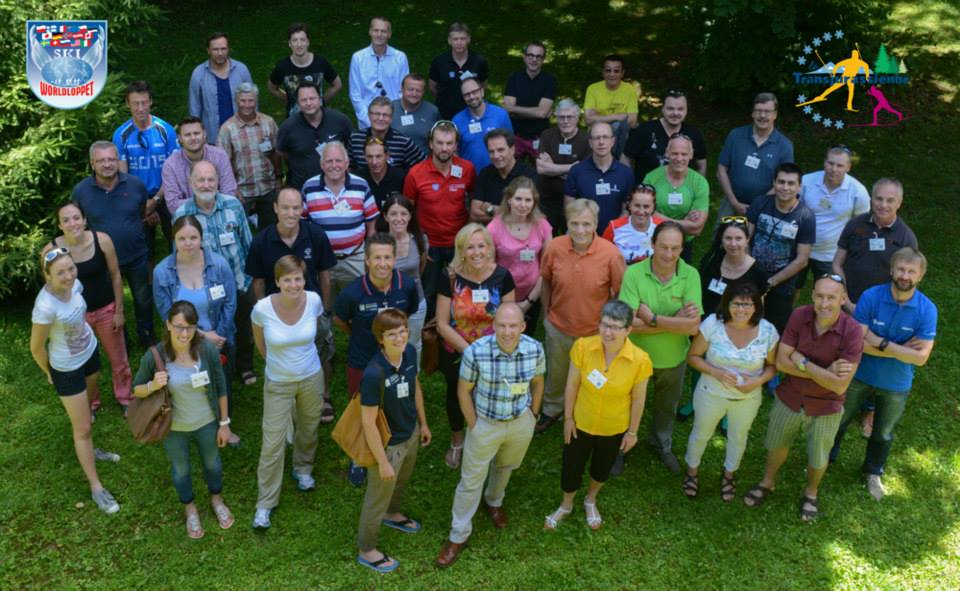
The delegates at last week’s Worldloppet annual meeting in Champagnole, France. (Photo courtesy of Ben Popp)
Astute observers might have noticed: the American Birkie, the biggest cross-country ski marathon in the United States, is not on the FIS Marathon Cup schedule next season.
According to Birkie Executive Director Ben Popp, the Birkie has been on the circuit for the last several years and has had top international marathon skiers in attendance as a result. But it’s actually not precedent for the race to be part of the series every single year.
“This year we fall on the same day as [Estonia’s] Tartu Marathon, and Tartu can’t do it next year because of the way the World Cup schedule works,” he said. “And so they asked us if we would take a year off so Tartu could do it, and we said sure. We understand. We’ll be back on it next year.”
In the past, the Birkie alternated the honor every year with the Finlandia Hiihto. Then, four seasons ago, it alternated to a structure of rotate every three years. Last season, the Finlandia-Hiihto turned down their spot, so the Birkie got three years in a row of FIS Marathon Cup recognition.
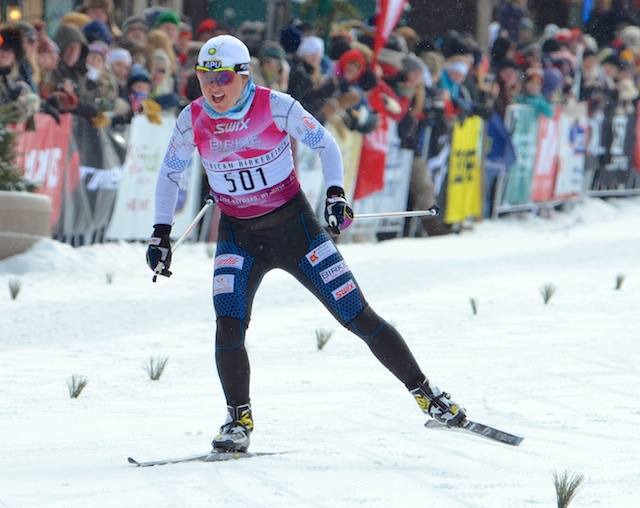
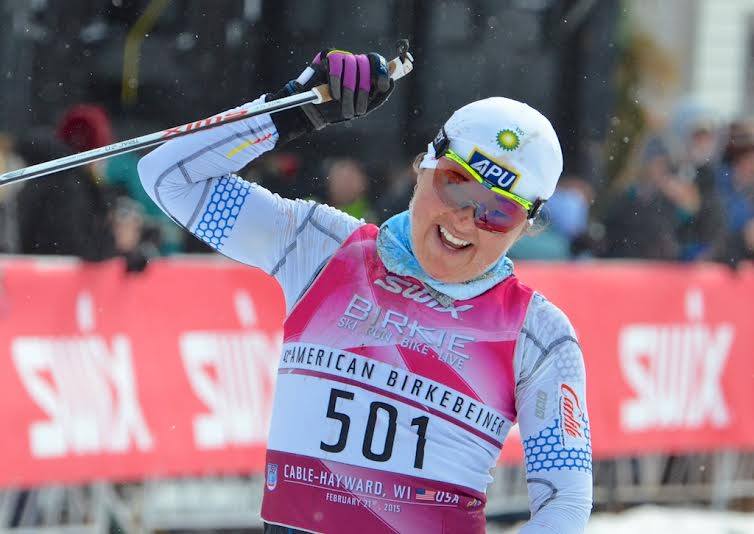
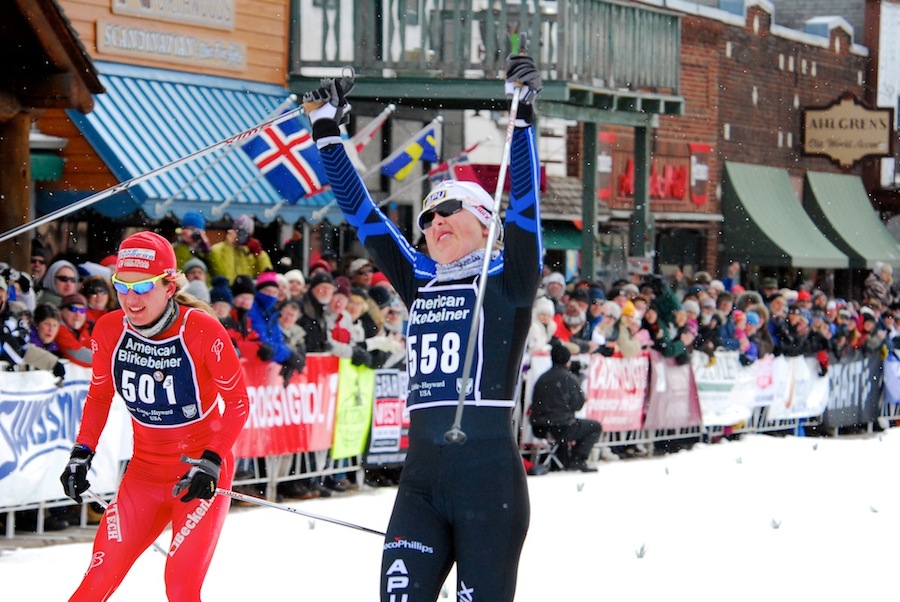
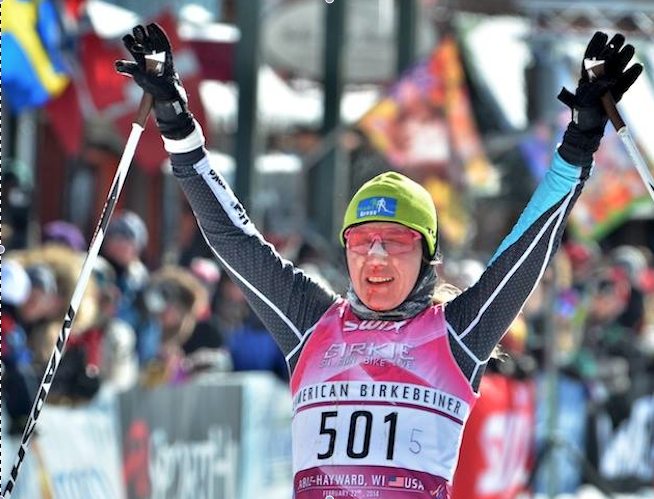
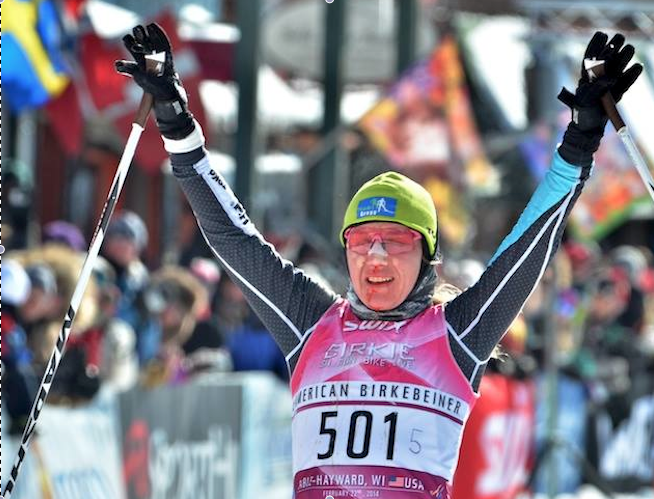
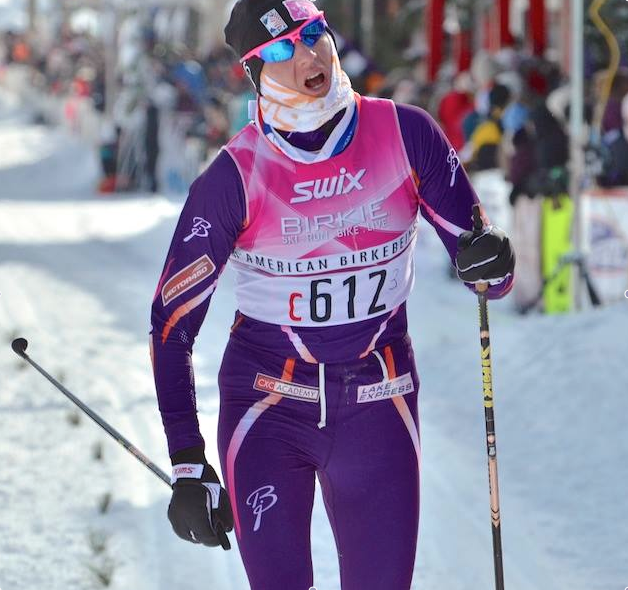
Holly Brooks racing to her second Birkie victory in Hayward, Wisconsin, in February. She used the points to power to third place in the FIS Marathon Cup. (Photo: Darlene Prois/ABSF)
It only seemed fair to share the opportunity when the need arose for the 2016 season, said Popp.
“There’s now 20 Worldloppet races and nine race weekends on the calendar, so there’s always that give and take to try to give everybody that opportunity to host the Marathon Cup,” he said.
Popp says that the Birkie will be part of the circuit again in 2017, and in the meantime it’s important to race organizers to try to maintain the international flavor of their race, even if Cup points aren’t on the line.
“That’s one of the unique things about cross-country skiing and marathon running, are two of the examples that come to mind, where you can have really elite-level athletes racing shoulder-to-shoulder with just popular athletes,” he said. “Like a couple of years ago when Northug did the Marcialonga… You can’t go out and shoot hoops with Michael Jordan, for instance.”
Part of the Worldloppet mission is to let skiers experience other cultures, and that’s part of the Birkie’s mission too.
“We also want people from other countries to come here, and experience skiing in the Midwest and see the culture here,” he said.
In terms of top racers, organizers were hoping to snag some World Cup athletes before they head to the Tour of Canada, the last period of racing which will span the entire nation. That turned out to be untenable.
“Instead of having the World Cup athletes, now because there’s a pretty big break in the schedule when the World Cup is off in North America, is allowing some of the Continental Cup athletes to come over,” Popp said. “So we’re working with some of the different federations to make that possible, maybe from Scandinavia and some of the other European countries.”
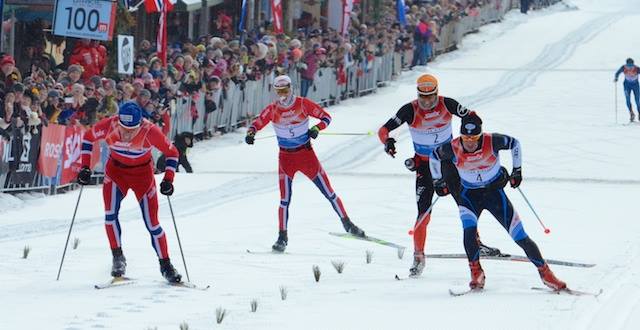
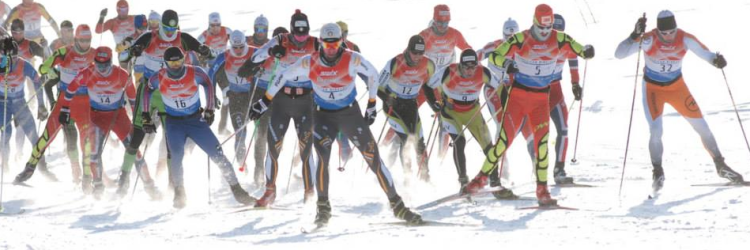
Italy’s Segio Bonaldi (r) outlasts three Frenchmen en route to a win in 2015, his second American Birkebeiner victory. (Photo: Darlene Prois/ABSF)
Along the way, Brooks blogged about each of the Worldloppet races she attended.
“When I went to the Marcialonga a few years ago, I had the help of their organizing committee because we knew them through the Birkie,” Popp said. “But I was thinking the whole time, if I’m just calling up from Minneapolis and want to go ski the Marcialonga, I don’t know anything. How can we break down some barriers?”
Brooks’ blog posts about not only her racing, but the experience of getting to, staying at, and experiencing venues in many different countries proved popular. Both Brooks and Popp hope that the accounts will be a guide for Americans who want to race in marathons overseas.
And so Popp urged other WorldLoppet races to do something similar. After all, there’s no foreign-language guide for how to come to his own race, the Birkie.
“We didn’t ask Holly to write about the Birkie, we wanted her to write about the Transjurassienne, or one of the other different races so people could see that it was really accessible,” he said. “So we want Benoit [Chauvet] to write about coming to the Birkie and how easy it was so the French group can really see that.”
And in another step towards accessibility, on their website the Birkie has identified ambassadors – Popp is one, as are board members – who Americans can email with specific questions about how to arrange trips to each different WorldLoppet race.
“When the WorldLoppet was founded, the whole idea was to travel the world through skiing,” Popp said. “We want to help Americans do that.”
A few other major changes at from the Worldloppet meetings:
The name of the race series was changed from the FIS Marathon Cup to the FIS Worldloppet Cup.“Certainly, a higher level of athletes brings more media attention,” Popp said of FIS’s involvement in the series. “So it is important to have them in the title. But I wanted to make sure that since Worldloppet is the one that funds it and administrates it, that they are part of the title as well. FIS doesn’t organize it, FIS doesn’t fund it, FIS doesn’t do anything with it other than give us the go-ahead to do it. So to call it the FIS Worldloppet Cup was really important to me.”
FIS points will also be awarded at all WorldLoppet races. Points have long been calculated for some of the most famous marathons in major ski countries, such as the Birkie, the Birkebeiner in Norway, and others. But all 20 ski marathons will now offer points. There had been technical limitations with timing holding back some organizing committees especially in the southern hemisphere, according to the Worldloppet website, but those appear to have been solved.
Holly Brooks (Alaska Pacific University/Salomon) racing to her second Birkie victory in Hayward, Wisconsin, in February. On April 11th, Brooks will try to wrap up the FIS Marathon Cup crown in Khanty-Mansiysk, Russia. (Photo: Darlene Prois/ABSF)
ZÜRICH, Switzerland– American racers might think the ski season is over, but not so for Holly Brooks.
“I think I might be the only North American skier who is still competing,” she laughed on Sunday. “Maybe someone else is out there, but I know a lot of people are heading to the beach.”
The Alaskan made the FIS Marathon Cup her season goal, and is about to fly to its last competition, the Ugra Ski Marathon in Khanty-Mansiysk, Russia. She currently leads the standings by four points over Tatjana Mannima of Estonia, with Aurelie Dabudyk of France only 41 points behind as well. With 100 points going to the winner, 80 to second place, then 60, then 50, any of the women could conceivably win the Cup.
That is, if any of them wins the actual race. Last year, marathon favorites Riita-Lisa Roponen of Finland and Seraina Boner of Switzerland finished second and third in the Ugra, minutes behind relative unknown Ekaterina Rudakova of Belarus. The podium finishers were the only non-Russians in a field of fast women.
In their head to head meetings, APU’s Brooks has beaten Mannima three times and Mannima has beaten Brooks twice, but both were in classic races. The Ugra is a 50 k skate, the technique which Brooks favors. FasterSkier caught her for an interview before she flew to Russia.
FasterSkier: What have you been up to for the last few weeks?
Holly Brooks: I’ve been country hopping, as per usual. Or, as usual for me this winter. The last week I spent in Chamonix, which sounds really exciting but it was gray and raining and I didn’t do a whole lot of skiing.
The week before that was kind of a Scandinavian tour. I spent the week in Trondheim with Anders Haugen, a Norwegian-Alaskan who just moved there. The snow wasn’t great there either. That was the week leading up to the Årefjällsloppet, the final of the Swix Ski Classics in Sweden. It was not a great race for me, but I was really happy to be there to experience and hang out with my team, Team Santander, who took the overall win. So that was really fun.
And then the week before that was the Norwegian Birkie. Which was great. You always have to check that off your bucket list as a cross-country skier.
FS: Your last FIS Marathon Cup race was a while ago at this point. How has it been trying to stay motivated?
HB: It’s really wild that the penultimate FIS Marathon Cup was the Engadin, which was March 8th, and the final, the Ugra Ski Marathon, is April 11th. So there’s more than a month there.
I have had a good month in between. I went to Holmenkollen and cheered on teammates there in the 30 and 50 k’s. I had some good racing – the Norwegian Birkie was a really fun experience. I actually cooked dinner for the head of the Norwegian Labor Party, who is potentially going to be the next Prime Minister of Norway. So I cooked his pre-Birken dinner, which was really fun. I’ve just gotten to see a lot more of Europe and of Scandinavia and places that are off the beaten path of the World Cup. And I’ve made a lot of new friends in the last month too.
FS: Now you’re off to Russia. You’ve had plenty of challenges this year with logistics, but how much harder is it with Russia?
HB: I don’t think I’ll believe I’m in Russia until I’m actually in Russia. It has been extremely hard. The logistics around this race have been a total bear. I will say that the people on the organizing committee have been really helpful and really welcoming.
But the visa alone, being a solo show I’ve had to do all the organization myself. For the visa alone I probably sent over 150 emails and made 30 calls. Put hours and hours and hours of time into that. And then figuring out the tickets and who will wax my skis, and all the normal solo stuff.
It will be a long journey to Khanty-Mansiysk. I didn’t even know where it was until I googled it. Siberia is quite far away. I think it’s five time zones away from central European time. I was definitely watching with interest when the biathletes ended their season there a couple of weeks ago. So yeah, I’m excited to get there.
FS: You’ve spent time racing in Russia before, on the World Cup and at the Olympics. Do you think that will help you deal with some of the unfamiliarity of things?
HB: I know that the only thing you can expect is that you have no idea what’s going to happen. You just have to be ready to roll with the punches. I definitely also know that you also have to be extremely patient, because things don’t necessarily happen in a timely manner or how you would expect them to happen.
The food could be great or it could be horrible. I’m definitely taking peanut butter, instant coffee, and instant oatmeal, amongst other things, just in case. And I’m supposed to be able to walk from my hotel room to the start/finish of the race. I’m hopeful that everything will go smoothly.
FS: In the beginning of the season you got a little cushion of time before you started racing, compared to the last couple of years and the World Cup crew. Now you’re going much later than them. What’s harder?
HB: This year has been interesting because I spent all of November and half of December in Alaska, studying. It was actually really hard being at home watching everybody kick off their season. Now I’m on the opposite end. Everyone’s done, they are headed to the beach, and I’m still going. Essentially my season is the same length, it’s just shifted back three weeks to a month.
I think this is a little harder. It was hard watching them race and I wanted to race at the beginning, and now I’m really tired and I’d like to be done. Everyone else is done and I have to stay focused and stay strong. I think the way I’ve done it this year is a little bit harder, but I’m hoping it will pay off.
FS: What’s the race preview?
HB: Well, I have a four point lead going into this race. It’s pretty crazy after an entire season of marathons in eight different countries, to have it be this close at the end is quite exciting but also a little stressful. The girl in second, Tatjana Mannima of Estonia, is only four points behind me and it’s the same as World Cup scoring so if I beat her, then I win the FIS Marathon Cup. If she beats me, then she wins. There’s a lot at stake here. I’m really just trying to stay focused for April 11th.
FS: And then what will you do?
HB: And then it will take me three days to get home [laughs]. I’m already having nightmares about potentially having to check four pieces of luggage on an international flight to Alaska! I’m really really excited to go home.
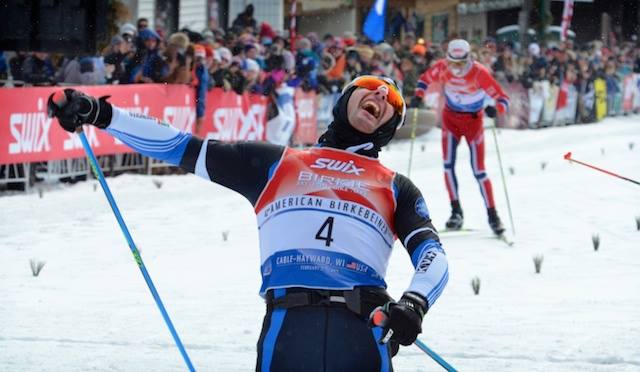
Italy’s Segio Bonaldi celebrates after winning in a sprint finish at the 2015 American Berkebeiner in Hayward, Wis. It was Bonaldi’s second Birkie title. (Photo: American Birkebeiner Ski Foundation)
The 2015 American Birkebeiner in Hayward, Wis., was spared the most frigid weather gripping the Eastern U.S., as temperatures hovered around 15 degreesFahrenheit when Saturday’s 51-kilometer freestyle elite race began. And despite three to four inches of new snow, even the sun made an appearance during the race.
In was in these conditions that American Holly Brooks, of Alaska Pacific University in Anchorage, Alaska, won her second Birkie, claiming victory in a time of 2:34:33.
Holly Brooks racing to her second Birkie victory on Saturday in Hayward, Wis., which she won by nearly 30 seconds to reclaim the FIS Marathon Cup overall lead. (Photo: Darlene Prois/ABSF)
However, she first had to ward off Aurelie Dabudyk of France, who stuck with Brooks until she began her final push on the flats of Lake Hayward, a few kilometers from the finish.
Brooks came into the race second overall in the FIS Marathon Cup, but reclaimed the lead after Saturday’s win.
The 32 year old told FasterSkier that the top four women were together for most of the race. At “B*itch Hill” – a steep climb about 40 k into the race – she said she heard a second snow machine behind her.
“I looked over my shoulder and there was the sea of men who had caught us,” she explained. “I knew it was a now-or-never moment.”
As the leading men passed the first four women, Brooks decided to make her move. She tagged onto the group of men and managed to break from the group.
However, she was surprised to find Dabudyk was able to hang behind her.
“I did not want to leave it to the finish sprint and therefore pushed as hard as I could on Lake Hayward. I did not dare to look back before the finish line to be sure not to lose any seconds,” she explained to the press. “I didn’t want to be ‘that skier’ who looked back and lost the sprint because you miss a crucial pole plant or something.”
As usual, she said Main Street in Hayward was incredibly loud and festive.
“It would have been fun to grab a flag and celebrate a bit but ensuring the win and reclaiming the red bib was more important!” she said. “I am really happy that I could win the Birkie again today!”
Holly Brooks celebrates after winning her second American Berkebeiner on Saturday in Hayward, Wis. The win put her back in the lead of the overall FIS Marathon Cup. (Photo: American Birkebeiner Ski Foundation)
Dabudyk went on to finish second, 28.1 seconds behind Brooks. Tatiana Mannima of Estonia was nearly two minutes back in third (+1:59.9), barely holding off German Anja Gruber, who placed fourth (+2:02.1).
Mannima has won the last two FIS Marathon Cup races, while Gruber is coming off three podium finishes earlier this month in SuperTour races in Craftsbury, Vt.
Dabudyk said to the press that she wanted to stay with Brooks until the finish, though down the stretch Brooks had too much power for her.
“But I am really happy with my second place,” she added.
Mannima said that she pushed hard from the start to see which skiers could hold onto her speed. She was able to stay in the lead group until Brooks and Dabudyk finally took off with 10 k to go.
“At Lake Hayward, I was trying to stay behind Gruber, as it was pretty windy on the lake. I hoped to pass her before the finish line, which I did,” she explained, adding that she is happy to just be on the podium.
American Caitlin Patterson (Craftsbury Green Racing Project) ended up fifth (+9:31), after winning the SuperTour 20 k classic mass start in Craftsbury late last month.
Bonaldi wins second Birkie in exciting fashion
Italy’s Segio Bonaldi (r) outlasts three Frenchmen en route to his second American Birkebeiner victory on Saturday in the 42nd annual Birkie in Hayward, Wis. (Photo: Darlene Prois/ABSF)
The men’s race offered a more dramatic finish, as Italian Segio Bonaldi outsprinted three Frenchmen to win by less than a second.
Bonaldi, Birkie winner in 2013, finished in 2:12:21.1. He passed France’s Christopher Perrillat-Collomb in the final 100 meters to win by just 0.5 seconds. Benoit Chauvet and Mathias Wibault were also in the lead group, and Chauvet finished in third (+1.7) while Wibault faded to fourth (+5.0).
Chauvet told the press that he tried to break out of the lead group of 20 at the first climb, but no one was willing to break with him. However, the racers slowly began to spread apart at about the 35 k point, and Chauvet was able to work with Perrillat-Collomb.
“At this point all were thinking about winning the race,” he said.
Chauvet explained that his tactics failed him, however, and that Bonaldi was smarter and stayed behind the others until the final stretch. Chauvet said he probably made his final sprint too early, as he tried to be first coming off the new bridge that drops the skiers into downtown Hayward and the final straightaway to the finish.
“I did not feel so well until 15 k before the finish,” Bonaldi said. “My skis were also not very good so I tried to stay behind and to wait for the finish sprint. I kept energy for that.”
The 36 year old added that he really wanted to win this year, especially after finishing third last year, but was not sure he would have a clear shot at victory until 100 meters before the finish line.
“I am very happy!” he said.
“I am little bit disappointed to be third as I wanted to win. I have to come back for the victory next year,” Chauvet said.
The top American, Lex Treinen (APU), finished nearly 20 seconds after Wibault in fifth and was 24.5 seconds from the win. Last year, he placed 10th in the Birkie. American Brian Gregg (Team Gregg/Madshus) finished in eighth (+1:51.4).
FIS Marathon Cup leader Petr Novak of the Czech Republic came through in 11th (+5:51.4).
“I had the worst skis of my life. I lost so much on the downhills. It was a mental fight for me all the way through and right until the end!” Novak said in a statement to the press. Despite his rough day, he still retains the lead in the overall FIS Marathon Cup standings.
American Matt Liebsch (XC United/Team Strong Heart), 2009 Birkie winner, finished 10th (+3:10.8), while 2012 Birkie winner Tad Elliott (Ski & Snowboard Club Vail Elite) took 16th (+10:29.5).
Naryshkina, Mork take classic titles
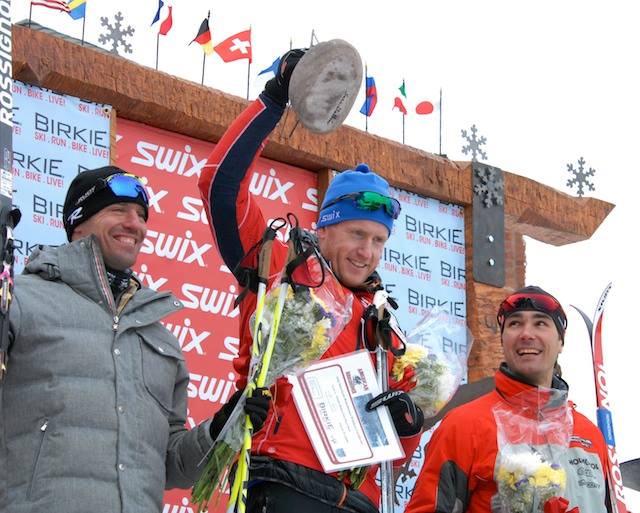
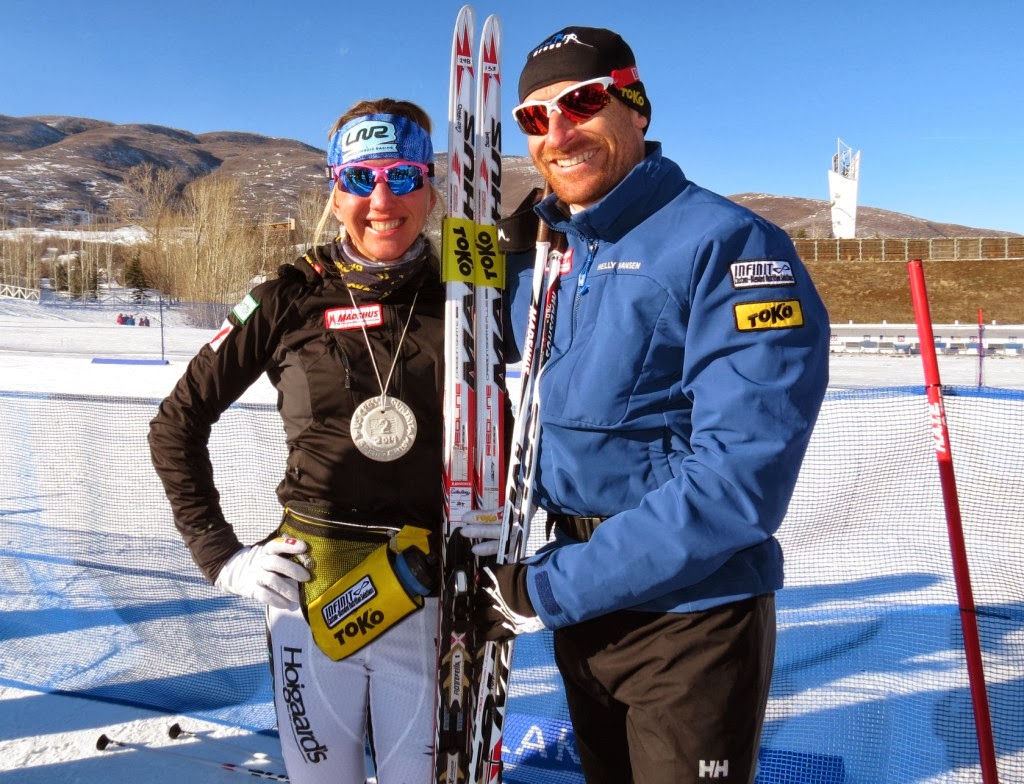
Men’s 55 k classic Birkie winner Ole Christian Mork (c) is with second-place finisher Torin Koos (l) and Thomas Seidel (r), who placed third. (Photo: ABSF/Facebook)
In the 55 k classic race, Natalia Naryshkina of Russia and the CXC Team took the women’s win in 3:19:20.2, while Norway’s Ole Christian Mork won the men’s race in 2:54:22.1.
Naryshkina beat runner-up Josie Nelson of Medicine Lake, Minn., by 3:44.9, and Kelly Sillicorn of Winona, Minn., by 3:50.9. Isabel Caldwell, younger sister of U.S. Ski Team member Sophie Caldwell, placed fourth (+6:14.8).
Mork, of Oslo, outlasted four-time U.S. Olympian Torin Koos by 8.8 seconds and Thomas Seidel, of Salt Lake City, in third by 14.7 seconds.
This past weekend saw the start of the FIS Marathon Cup for the 2014-2015 season in Livingo, Italy. Birkie Ambassador Holly Brooks (USA) started the season off right with a podium finish. She finished 2nd to World Cup stand out and Olympic Medalist Riita-LiisaRoponen (FIN).
The Men’s race was won in a photo finish by former Birkie Champion Benoit Chauvet (FRA) with runner up Petr Novak (CZW) also a veteran Birkie competitor.
The Birkie is the 6th of 9 FIS Marathon Cup competitions and will be an important race for the overall Champion racing for the $38,700 (31,000 euro) in prize money. Follow the races and results at www.worldloppet.com and keep an eye on these FMC Athletes registered for the 2015 Birkie.
All spring, summer and fall, Holly Brooks has been training. For what? She wasn’t 100-percent sure until recently.
Regardless of whether she started the coming winter in the U.S. or abroad, former U.S. Ski Team member had been working on her strengths: distance and endurance. Of course, Brooks, 32, knew she’d have to add in some speed here and there to learn how to respond to the pivotal moment in any race: the break.
She’d done some traditional training with her team, Alaska Pacific University (APU) in Anchorage, but for the first time since she made the U.S. Ski Team (USST) in 2012, she didn’t join its annual October camp in Park City, Utah. Instead, she was enjoying more flexibility in her life, like mountain biking in the Yukon with her husband Rob Whitney, while balancing her workouts with schoolwork as a counseling psychology grad student (with an emphasis on sport psychology) at APU.
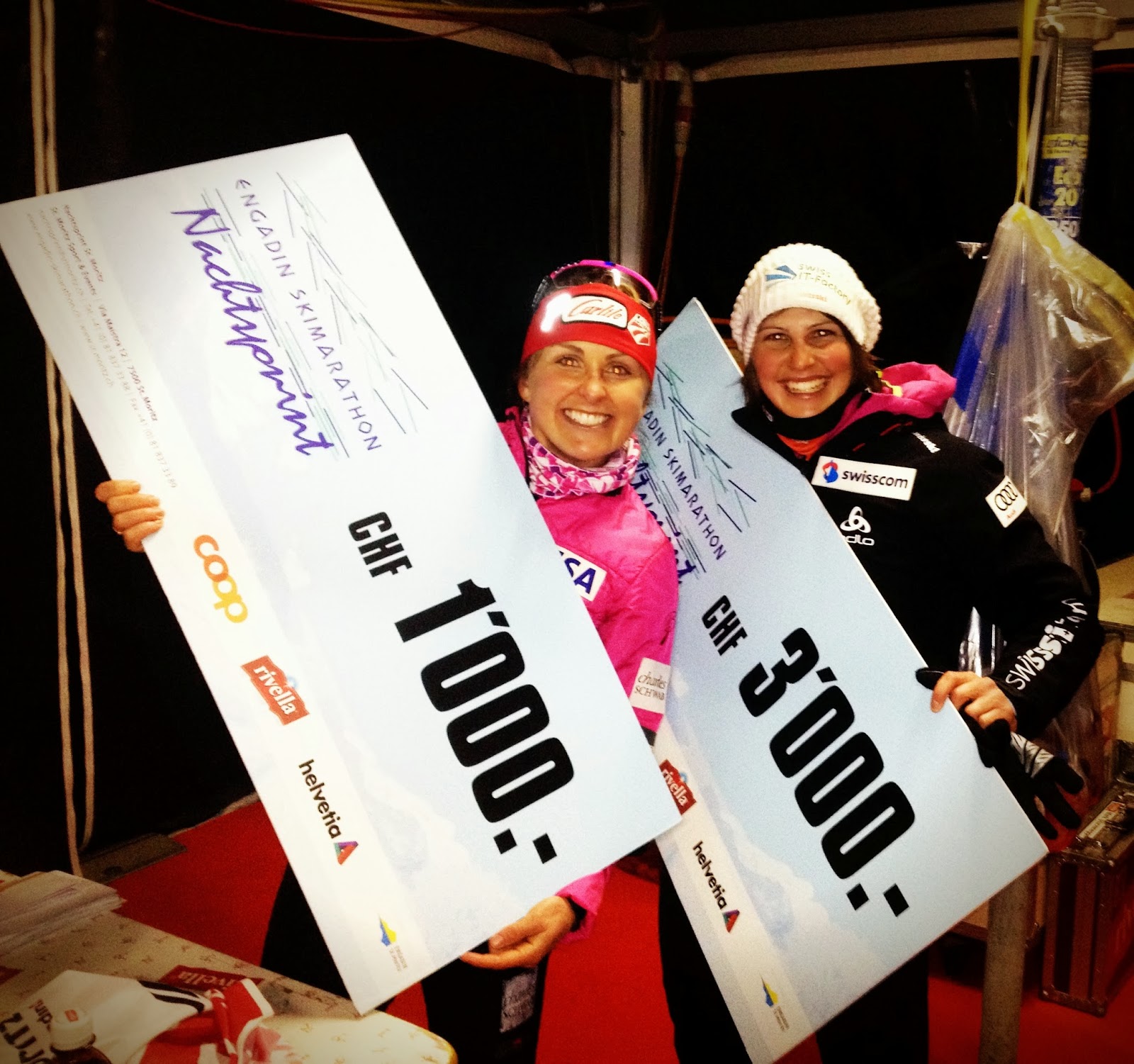
Holly Brooks (l) and Switzerland’s Bettina Gruber after placing third and first, respectively, in the St. Moritz night sprints before last year’s Engadin Marathon in Switzerland, where Brooks placed fourth after a late crash. (Photo: Hollyskis.blogspot.com)
“Typing the title of this blog solicits two very different responses from me,” she began. “The first excitement, the second terror.”
In a follow-up email, Brooks explained she named her winter: “Holly’s Distance Racing Project — Exploring the world and its people one ski marathon at a time.”
That made tackling the International Ski Federation (FIS) Marathon Cup series, with nine scored races between December and March, and her goal of landing in the overall top three, a little less intimidating.
To do so, she’ll be the American Birkebeiner’s first elite ambassador, which should help out with race entries and accommodations at the seven FIS Marathon Cup/Worldloppet races she plans to do. The Birkebeiner, also known as the Birkie, is the largest ski marathon in North America and one of 20 international Worldloppets.
“My goal is to increase awareness of ski marathons — to speak about the Birkie during my travels abroad as well as bring FIS Marathon stories back to North America,” she explained in an email.
“There are definitely a good handful of Americans that had experience with Worldloppets, but I don’t feel like anyone committed fully to the whole series and was real vocal,” she explained on the phone from Anchorage. “One of my goals is to go over and write about it and blog about it and make it more accessible to North Americans and make it more tangible in people’s minds.”
Announced Monday, Brooks became the Birkie’s first sponsored elite-athlete representative. In an email, American Birkebeiner Ski Foundation (ABSF) Executive Director Ben Popp wrote the foundation’s mission was to support the entire sport, and had previously done so in funding citizens races, youth and adult programs, and Wisconsin High School Nordic Ski Championships. Now, it was eager to sponsor Brooks and another elite ambassador Anne Hart, who grew up in Stillwater, Minn., skis for the Stratton Mountain School T2 Team and writes training tips on the Birkie website.
Holly Brooks winning the 2012 American Birkebeiner, four-tenths of a second ahead of Caitlin Gregg (l), for her first Birkie title. (Photo: Darlene Prois/ABSF)
“I’m excited to support [them] and help them be great role models for our next generation of skiers,” Popp wrote. “Additionally, having Holly chase the [FIS Marathon Cup] and skiing the Worldloppets will create a great amount of stories/visibility. … There are some really cool races around the world that many have no idea about. When [Birkie founder] Tony Wise created the Worldloppet, it was to create a medium ‘to travel the world through skiing.’ ”
While certain details of the partnership and its perks for Brooks weren’t immediately clear, she explained her goal is to increase interest and participation in the American Birkie, as well as promote the ABSF’s healthy lifestyle initiative during presentations in different countries.
“Sometimes motivation can be low, but when you commit to a race or an event, the incentive is real,” she said in a press release.
2014/2015 FIS Marathon Cup:
– Dec. 12: La Sgambeda 42 k (Italy)
– Jan. 18: Dolomitenlauf 60 k (Austria)
– Jan. 25: Marcialonga 70 k (Italy)
– Feb. 7: La Transjurassienne 56 k (France)
– Feb. 15: Tartu Marathon 63 k (Estonia)*
– Feb. 21: American Birkebeiner 50 k (Wisconsin)
– Feb. 28: Bieg Piastow 50 k (Poland)
– March 3: Engadin Skimarathon 42 k (Switzerland)
– April 4: UgraSki marathon 50 k (Russia)*
* *Brooks does not plan to race
The Birkie on Feb. 21 is on her list of races this season, after the 56-kilometer La Transjurassienne in France (Feb. 7) and the 50 k Bieg Piastów in Poland (March 1).
That means FIS World Championships from Feb. 18 to March 1 are out for Brooks, who’s competed in the last two (in 2011 in Oslo, Norway, and 2013 in Val di Fiemme, Italy). She also represented the U.S. last winter at the 2014 Olympics in Sochi, Russia, as well as the 2010 Vancouver Olympics.
“I think World Championships in Falun [Sweden] are going to be amazing and I’m actually part Swedish, too, so that’s going to be a bummer,” she said. “But at the same time, I’ve been to two World Championships, including Holmenkollen and I’m not sure Falun is going to be able to top Holmenkollen to be honest…”
“I’m ready for new challenges,” she continued. “When it comes down to it, I’m a competitor and I want to be in races where I’m in contention for a podium … especially after having a difficult season last year …. I miss going for the win, I miss fighting for the podium and when you’re on full-time World Cup, you’re not really winning anything.”
She laughed.
At the same time, jumping into the unknown without any teammates, coaches or wax techs to fall back on made her somewhat anxious. That, and she didn’t have her season entirely mapped out in terms of how she’d pay for it — with flights from Alaska to Italy (for the La Sgambeda on Dec. 12), back home, then to Austria, Italy, France, then Wisconsin (for the Birkie). After that, it’s back to Europe to Poland, Switzerland (Engadin Skimarathon on March 8), and Norway (for potentially the Holmenkollen 30 k on March 15, if the U.S. Ski Team grants her a World Cup start, and the Norwegian Birkebeinerrennet 54 k classic on March 21). Finally, she plans to finish the season at SuperTour Spring Series from March 20-26 in Sun Valley, Idaho.
In all, the traveling will amount to about one more trip to Europe than she’s used to (with an average plane ticket costing about $2,200), but on the bright side, she’ll spend Thanksgiving at home — possibly in Hope, where she and Whitney recently built a cabin with the help of their family.
“I’m actually going to have my first holidays at home for the first time since I can remember,” Brooks said. “And not just at home, in the states and at home.”
The unique marathon schedule requires her to start her season in early December in Italy, then fly home before her next race more than a month later. Considering her goal of a top three in the circuit and her decision to skip two of the nine scored races (the Tartu Marathon in Estonia and Ugra in Russia), she didn’t want to start the season having missed the first race.
It would be tough enough to achieve an overall podium at the end of the season; she didn’t need that initial mental hurdle of having to play catchup.
If all goes well, Brooks could make the Worldloppet’s selective red group with top results early on — as soon as after the first race. Much like on the World Cup, the red group comes with start rights and some support like room and board, although she’s not entirely sure how much, possibly two to three days of accommodation per race weekend.
“I’m not super familiar with all the rules because it’s such a new scene for me,” she said.
But with consistently competitive results, and the fringe benefits as an official Birkie ambassador, she hoped it would lighten the load and looming logistics of her season.
In addition to where she’ll stay during races, Brooks was unsure where she’d spend the weeks before and after each race in Europe, and who would help her find housing. But that’s where her connections from several years of international travel and pro racing could come into play; she’s established relationships she’s confident will help her in the months to come.
“I hope that word will get around that I’m … out there and I have this goal,” she said with a laugh. “I’m putting a lot of faith in strangers to help with logistics and the financial aspect.”
Compared to the World Cup, which costs $140 dollars per athlete per day based on the FIS fixed rate, there is no flat rate for the marathon circuit.
“Some of the countries are more expensive, some of them are a little bit cheaper,” she said. “It is really unclear how much this will cost. Part of me wants to have the whole season planned out in advance and know exactly where I’m staying and who’s going to be waxing my skis for every race, but I’ve come to the realization that I can’t take care of all those logistics ahead of time.
“One of the most intimidating parts of this goal is, not only do I have the regular fundraising to figure out, but I have all the logistics. I’m on my own,” she said. “[U.S. Ski Team Head Coach] Chris Grover is so organized and so good with logistics … and the coaches are always looking out for you and figuring out how you’re going to get to your next meal and how you’re going to get to the airport, and now that’s all on me.”
“While I’m dreading it, I’m excited for it.” — Holly Brooks, on her decision to go for an overall podium in the FIS Marathon Cup
When it comes to waxing her racing fleet (downsized from her 30 pairs of World Cup skis because she simply can’t carry that many alone), Brooks said she’ll rely on her sponsors, like Swix, and industry partners at certain races, like Salomon in France, and possibly the Birkie for individual attention (i.e., a personal tech).
“It’s scary because I know how hard I train and also how much money I’m spending,” she said. “To have skis that aren’t competitive could blow the whole thing, but that’s ski racing. I just have to do the best I can…”
Payouts for the marathons range, but the overall Marathon Cup winners receive a small crystal globe and about $7,500 dollars — that same amount each male and female Birkie winner gets. Second place earns $4,500 and third place gets $3,000.
“That goes to show I’m not doing it for the money,” Brooks said. “Winning is hard. I don’t know the exact level of competition, but I know what happened last year: [Finland’s] Riitta-Liisa Roponen won the overall and she won I think every Worldloppet race she entered.
“You could stand to do all right financially if you have all your expenses covered and you get to pocket your earnings,” she added. “I’m hoping to at least break even and not go into the red, but we’ll see. I have a couple irons in the fire and I’m hoping I [can] get people excited about the challenge that’s behind it.”
So far, her sponsors’ reactions have been favorable, although she said nothing was final yet.
Without teammates, Brooks could be looking for roommates to share the high cost of living in Europe. She entertained the idea of rooming with Roponen, “but I don’t know, I think she might think of me as a little more of a competitor than a teammate,” she laughed.
She considered racing for a professional European marathon team and had an offer from one, but Brooks declined the spot. “They wanted me to come over to Europe every month in the summer and fall, which is completely unrealistic when you think about it,” she said. “That wasn’t what I was looking for.”
Come February and March, she figured there might be a good possibility other Americans — those who don’t end up making World Championships — joining her at marathons like the Engadin and Birkebeinerrennet. But time will tell, and she was prepared to do it on her own.
Holly Brooks (c) with APU teammates and former U.S. Ski Team teammates Sadie Bjornsen (l) and Kikkan Randall at a recent Fast and Female event in Anchorage. (Photo: Hollyskis.blogspot.com)
“That’s one of the biggest differences going from being on a really strong team that is the U.S. women’s team to being a little bit more of a lone wolf,” Brooks said. “But I think that’ll force me out of my comfort zone … While I’m dreading it, I’m excited for it.”
Her decision to commit to the Worldloppet/Marathon Cup was a gradual one, starting with the idea that she might go to the SuperTour opener in West Yellowstone, then U.S. nationals, and potentially qualify for some World Cups.
“I kind of got sick of the maybe in my life,” she recalled. “Instead of just training and having no idea where I was going to be racing … I’m really excited to commit to this and solidify it. It’s pretty much all races that I haven’t been to before.”
In the meantime, she’s been taking classes three times a week, amounting to about nine to 10 hours of in-class time per week — not including the time she spends studying at home. On top of that, she typically trains 20-plus hours a week (and has another 10-15 hours of physical therapy) and stays involved with the community through events and presentations in her spare time.
“I’ve had to be really diligent with my time and be more focused and organized,” she said.
In early October, Brooks said she was thankful she didn’t have to rollerski first thing on a 19-degree Fahrenheit morning. She got on the Ski Erg instead.
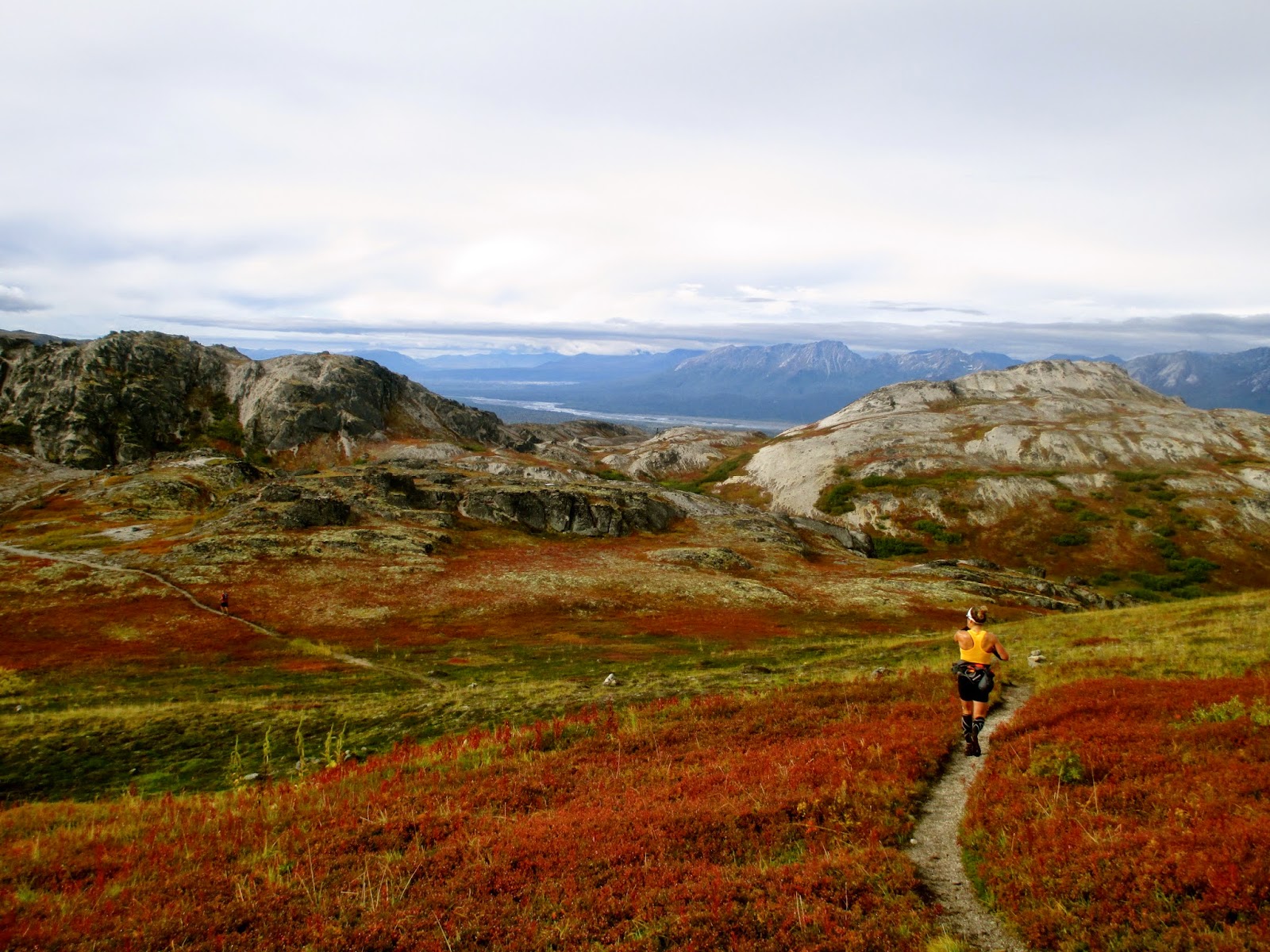
Earlier this fall, she did an “all uphill” rollerski-running workout at Hatcher’s Pass with friend and videographer Max Romey, who filmed her with a drone.
“It would hover right over my head, then he would lift it up and do these wide-sweeping panoramic shots,” she explained. “It’s really, really cool.”
Romey published the video Oct. 12.
Best of all: “He sent me the whole hour-and-a-half unedited version that I could use for technique,” she said.
***
Update: Early Monday, Brooks explained a recent development and possible race addition to her upcoming winter schedule. In an email, she wrote that the rules state FIS Marathon Cup/Worldloppet racers cannot collect their overall prize money unless they are present for the final race — the UgraSki marathon in Russia one month after the Engadin, which Brooks initially planned to be her final scored race. She had intended to skip the Ugra as well as the Tartu Marathon in Estonia.
“There is currently no information about the Russian race available – at least the link from the FIS World Loppet site goes no where…,” Brooks wrote. “This is a huge bummer for many obvious reasons. I’m waiting to hear clarification on this rule as well as some details on the race.”
Caitlin Gregg, winner of the 2014 Birkie crosses the finish line. (Photo: American Birkebeiner Ski Foundation)
Hayward, Wis. — The women’s race was destined to be a showdown between the two time Birkie winner and local favorite Caitlin Gregg of Minneapolis and the current leader of the FIS Marathon Cup, Antonella Confortola Wyatt, of Italy.
Gregg led the women’s race for much of the way, with Confortola Wyatt trying to keep up with her. Gregg said of the women’s field this year, “You know I was real impressed…[it was] a strong group of women this year.”
“I didn’t have a strategy,” Gregg said. “Typically with such a long race like this you know, there’s so many variables… so I always kind of want to be prepared for any situation and honestly the thing that caught me by surprise was that the elite men’s wave caught us, and after that, I realized there was an opportunity to get a really strong, strong pull from some fast guys.”
The elite women started twenty minutes ahead of the elite men, and when the men caught them, just before the halfway mark, Gregg really blew the race open.
Confortola Wyatt said that she felt she could see and chase Gregg, but when the men skied by, unlike Gregg she wasn’t able to ski with them.
Caitlin Gregg in Toblach, Italy. Photo: flyingpointroad.com / NNF.
“I really felt like I was skiing well, and they [the women’s leaders] were all staying with me,” said Gregg, “and I tried to put in a surge, I couldn’t drop them, and all of a sudden I heard some really loud grunts behind me and I stepped aside, thinking, ‘man, this girl is going for it,’ and she was real big and I realized, ‘oh that’s not a girl, that’s a guy’ and I watched the men crest the hill, and then thought to myself, ‘wait a second, that’s an opportunity.’ So I just put the hammer down like I never have before, and jumped on that train.”
“We were three left,” Confortola Wyatt said at the post race press conference. “So when the men came she was really good, she stayed together, and I was like surprised, a bit too slow, and then she was gone. I couldn’t keep that pace.”
The winner of the men’s race, Tom Reichelt of Germany was surprised to see Gregg hanging on with the men’s lead pack. “We kind of slowed down and this woman stayed with us,” Reichelt mused.
Gregg, who has successfully won the last two Birkies in a sprint finish, was wary of letting this years race be determined in the final meters. “This year, my fitness was really high, especially, we’ve been racing a lot of 10 k’s and 5 k’s, and I know I can push it in a skate race for that amount of time, so I kind of took a gamble, I went at it with about 25 k to go, but I thought, ‘I’ve got another gear here,’ I don’t want to wait for those girls that can sprint, I can go now.”
Gregg’s surge with the men was “pretty key” she said, and she was able to put a sizable gap on the women’s field. That left her to ski most of the second half of the race by herself, a test of whether she had the strength to ski the distance alone, or if Confortola Wyatt and Rosie Brennan of Park City, UT would slowly reel her in.
“There was definitely a very quiet kind of moment out on the trails,” Gregg said, “where I suddenly realized, I couldn’t see the men, I couldn’t see the women, and I thought, ‘hmmm, maybe this was a little bold!’ but I have to say, a guardian angel came, Matt Liebsch came up behind me just before the lake, and he knew that he wasn’t having the race that he needed, and he said, “Hey, if you’re feeling good, try to stay with me, and let’s work this in,” and he helped me so much, I couldn’t have asked for a better scenario.”
Natalja Naryshkina, winner of the women’s 2014 classic Birkie. (Photo: American Birkebeiner Ski Foundation)
“Matt is such a great supporter of us, and we’re such supporters of him, and what a true, true, sport champion. I mean, he is the epitome of a good sportsman, and obviously he showed it again today.”
With 2012 Birkie winner Liebsch leading Gregg across the fiercely windy final two kilometers over Lake Hayward, she came down Main Street triumphant, much to the delight of the spectators lining the finish. Gregg’s time was 2:40:57, a comfortable 1:16 over second place Confortola Wyatt, and 2:05 ahead of third place Brennan.
The women’s classic race was won by Natalja Naryshkina, originally from Russia who now lives in Cable, WI and skis with CXC. Her time was 3:26:00. In second was Elaine Nelson of Duluth, MN and in third place was Brooke Adams of Sarona, WI.
Gregg had been widely seen as a strong contender for an Olympic birth, particularly for the 30 k mass start skate race, also held on Saturday in Sochi. When asked whether today’s Birkie victory made up for the missed Olympic spot, she replied, “Yeah, you know, I’m psyched because today was the day I wanted to feel good, both for the 30 k at the Olympics, or for the Birkie, and to feel good today means that my peaking, just everything that I wanted to do this year, has been coming along. Obviously it’s always nice to be able to win some money, too [a $10,000 prize]. I mean, the Olympics, what an opportunity, what a wonderful event, and I’m super psyched that Brian [Gregg’s husband] is there, and I would have loved to have been there, but I think this is a pretty good consolation. This has been an awesome, awesome weekend.”
When asked about her future, Gregg responded, “Brian and I have been talking about this a lot, and you know, we’re having a great time. We’ve had a great year, we’re really, really having fun, which I think has been key to this year, and we still get along, even though we spend many days and hours together in a small studio apartment usually somewhere on the road, and I think we’re going to keep going! I think we’re going to keep racing until we see a time to stop, and then I think we’re actually going to be involved in skiing on many different levels. That’s definitely a passion of ours.”
Gregg finished ahead of Confortola Wyatt, who seized control of leaders bib in the FIS Marathon Cup with her Birkie result. The Marathon Cup continues with the final race on Sunday, March 9th with the Engadin Ski Marathon in Switzerland, after next weekends marathon, the Bieg Piastow in Poland was shortened due to poor snow conditions. The Italian leader is 9 points ahead of Finland’s Riita-Lissa Roponen, and when asked if she will keep the red bib until the end of the series she replied, “It will be hard, but it would be nice.” When Gregg was asked if this win would inspire her to compete for the Marathon Cup title in the future, she cagily answered, “That’s something that’s on our radar.”
Team Gregg celebrates Caitlin’s national title in the 20 k freestyle mass start at 2014 U.S. nationals in Midway, Utah. Earlier in the day, Brian placed second to Sylvan Ellefson (SSCV/Team HomeGrown) in the men’s 30 k freestyle mass start. (Photo: Caitlin Gregg/In the Arena)
The thirty three year old Gregg however isn’t hanging up her future Olympic ambitions just yet. “Something that I was told a while ago, was that I was kind of getting older, maybe too old for the Olympics, and that was quite a few years ago, and honestly, I don’t feel like I’m slowing down. I feel like I’m getting stronger, and I think it’s a real important message to show that you can set goals, and maybe come up short one year, but keep pressing on, and look for the next set of goals that are out there, so for me, that was not making the Olympics, and setting my sights on winning the Birkie, and I think that, four years from now, why not?”
“One thing’s for sure,” Gregg said of her chances of winning the Birkie again, “I never count my chickens before they hatch, but I will say, I have many, many more Birkie’s in me, that’s for sure.”
Gregg will return to the World Cup circuit next weekend in Lahti, Finland.
This is the first of a two-part profile on Swede Martin Rosvall, who recently completed hi post-graduate degree at the University of Washington. Rosvall finished 15th in the 2010 Vasaloppet, challenging some of the world’s top skiers.
Most of his competitors train full time; Martin Rosvall, 32, works full time. In March, Rosvall was 15th overall at the Vasaloppet, after having led the podium finishers large portions of the way from Sälen to Mora. No small feat for an amateur.
Rosvall became quite a celebrity among the Seattle-area skiers and beyond while doing his post-graduate research at the University of Washington from 2006 to 2008. Rosvall won just about every local race, was 9th at the 2008 US Nationals 50K in Fairbanks and delivered a long list of solid Nor-Am results, as well as placing 2nd in the 2009 Ski2Sea Nordic leg in Bellingham. This year he was 4th at Ski2Sea, beat by Ivan Babikov, Brian Gregg and Eric Bjoernsen, but edging out Olympians including Torin Koos. That following a season where he had skied alongside World Cup skiers such as Axel Teichmann, Jörgen Brink, Jerry Ahrlin and Mathias Fredriksson in several FIS events.
World Cup talent
Rosvall, a native of Umeå in northern Sweden and a member of Lycksele IF ski club, grew up training and competing with former Olympian Per Elofsson, as well as World Cup racers Björn Lind and Björn Ferry. While nobody could challenge Elofsson, Rosvall outskied Ferry and Lind on several occasions during his last junior season, and the success changed his perspective on racing.
“After chasing the podium for so many years, beating Björn Ferry and Björn Lind gave me a chance to feel what it was like to win. But it wasn’t what I thought it would be. It didn’t feel any different than before. That’s when I realized I love skiing for the sake of skiing. It’s not about winning. So for an underchallenged high school student, choosing a university degree over a World Cup career was not hard. And it’s a decision I have never regretted.”
The benefits of a career
Now Rosvall works full-time as an assistant professor in physics at the University of Umeå and finds that ski racing and a professional career are not mutually exclusive.
“I’m always the underdog. A pro should beat an amateur, so whenever I beat a pro, it’s a victory in itself,” Rosvall says, noting that having a career adds another dimension to his life.
“I notice that the moods of my full-time pro skier friends entirely depend on their performance. When they ski well, they’re happy. If they’re not having success, they’re grumpy. If I have a bad day on the trails or a bad race, I can always come back to my career and my research, and vice versa,” he says.
Furthermore, Rosvall thinks his lifestyle lets him get the most out of his training hours.
“Every workout is fun and feels like a luxury. If I were to increase my annual hours by 30 percent from 600 hours to just below 800 hours, I’d have a 50 percent chance of becoming 2 percent fasters. I’d also have a 50 percent chance of training too hard and becoming 10 percent slower,” Rosvall says.
Martin Rosvall at the 2010 Ski2Sea in Bellingham, Wash. Photo: Debbie Kolp
Less is more
So how does a full-time worker with time constraints, extensive work travel, conferences and hotel life in non-skiable places keep up with World Cup racers? The answer is simple, according to Rosvall: Less is more. Less hours means feeling fresher more often.
“I trained less this year than before. Every skier knows when to take a day off, but they don’t. This year I did. The result is that I start every intensity workout feeling fresh, and I recover better. I get the most out of every workout. I logged fewer hours overall, but better hours. I didn’t do any more intensity than before, just better quality,” Rosvall explains. And the strategy paid off.
“The only bonk I had was teaching a class. I ran out of things to say, my brain ran out of glycogen and class ended early. I tried to teach for five more minutes, but I realized that I couldn’t even understand what I was trying to say myself,” Rosvall recalls.
Then what separates the World Cup racers from a 15th place Vasaloppet finisher? Mostly, speed and sprint capacity.
“I couldn’t do well on Olympic courses compared to the pro skiers. There are no short cuts. 50 percent more training hours in the log makes you on average 2 percent faster. That equation doesn’t work with a full-time job,” Rosvall explains. “They’re sprinters and can burn lots of fuel in a short time. I get too much lactate sooner than they do. But in long races, it’s all endurance. In a flatter, 90K race, they don’t have that much of an advantage from being good at 15K courses with lots of hills.”
Changing the recipe
“Having a different strategy was certainly part of the success this year, but also I was stronger than I have been before,” Rosvall says. The secret to more strength? None. Rosvall simply started doing strength workouts on a regular basis.
“This was my first year in the gym,” Rosvall says with a laugh. He completed one or two max strength workouts in the gym each week, focusing on a few key exercises.
“I went in before work and did an hour of few reps and high weights. I focus on my weak parts, which is hamstrings and core,” Rosvall says. Dynamic/ explosive lunges with a weighted bar, chin-ups, dips and hamstring kick-back on a machine was the mainstay of the diet, in addition to a healthy dose of core drills.
Rosvall also changed the way he did intervals.
“No more pushing beyond threshold. I did mostly nine to ten minute intervals at race pace, or right below my lactate threshold,” Rosvall says, noting that he believes max effort intervals tend to increase recovery time while adding little to the capacity for marathon racing.
Additionally, Rosvall is convinced that countless hours running through wetlands with poles pay off.
“For a strength workout, there is nothing that really compares. It’s a full body workout, both strength and cardio, and all with very little impact on the joints compared to running even on trails,” he says, adding that running in sand might deliver similar benefits.
More than one basket
Rosvall didn’t put all his eggs in the Vasaloppet basket. He built up to the race by doing a number of other high-profile events, including the 42K Dolomitenlauf (skate) in the Alps, followed by the 70K Marcialonga (classic) in Italy the week after, and a handful of Swedish FIS-sanctioned races. Of the Swedish races, the 45K classic Åsanespelen stands out. Rosvall skied neck a neck with Jörgen Brink, Jerry Ahrlin and Mathias Fredriksson – Swedish World Cup and full-time racers that he would encounter again at the Vasa in March. Rosvall was 4th overall in Åsane.
“Åsanespelen was a great opportunity to ski with the best. I realized that I really could ski with them. I was right there for 30K, when we hit a long uphill. That’s where you recognized that they are World Cup skiers and I’m not. World Cup skiers start out fast on the hills and they continue at the same pace, even when you can’t see them anymore,” Rosvall explains.
Martin Rosvall at the summit of Cutthroat trail as it crosses the Pacific Crest Trail. Photo: Kent Murdoch
Racing field in the Engadin Ski Marathon, Switzerland (photo: engadin-skimarathon.ch)
The Engadin Ski Marathon is a 42 kilometer skate race which is run between Maloja and S-chanf near the southern border of Switzerland. Winding around castles and across frozen lakes, the course runs through St Moritz, then down to Pontresina, before heading back uphill toward the finish in S-Chanf.
The Engadin had its first race on March 16th, 1969, and is always run on the second Sunday of March.
The Engadin is the next-to-last Worldloppet which scores points for the FIS Marathon Cup. The last race which will determine the overall FIS Marathon Cup titles is the famous Norwegian Birkebeiner, a 54 kilometer classic race held this Saturday, March 20th.
Fabio Santus of Italy is currently the overall men’s leader with 405 points. Runner up is Oskar Svaerd with 340 points and in third is Marco Catteneo with 293 points. As a win will net 100 points, only Svaerd will be able to compete with Santus for the overall title.
The women’s overall title will come down to a battle between Jenny Hansson and Susanne Nystrom, both from Sweden. Hansson has 400 points and Nystrom has 360.
Of note:
– Andrew Johnson of Steinbock Racing was the first U.S. finisher in 31st, just 1:16.8 off Cologna’s winning time.
– Marshall Greene, of XC Oregon was just behind Johnson in 34th, 1:57.1 back from first place.
– Ben Sim, from Australia, whom fasterskier interviewed before his Olympic run in December, was just 16.5 seconds off the winning pace, placing 11th.
Very early in the morning the participants got ready for the upcoming race. The weather was beautiful and the tracks were in perfect condition. At 8.40 a.m. the elite group started. Favorites in the men’s race were Fabio Santus (ITA) – last years’ winner and leader of the FIS Marathon Cup, the Olympic champion Dario Cologna (SUI), and Marco Cattaneo (ITA). In the women’s race the favorites were last year’s winner Seraina Mischol (SUI), Jenny Hansson (SWE) – leader of the FIS Marathon Cup, and Susanne Nyström (SWE).
While the elite group moved with high speed towards S-chanf, in Maloja, 10,500 more cross country skiing fans from about 40 different countries began their race in the waves that followed.
After only a few kilometers a large lead group pushed the pace. Susanne Nyström (SWE), Seraina Mischol (SUI) and Natascia Leonardi Cortesi (SUI) were part of this group. In
St. Moritz Dario Cologna (SUI) won the Rossignol-Sprint. The group spread out more and more and in La Punt (km 32) a compact elite group with about 30 athletes took over the lead. In that group were Fabio Santus (ITA), Daniel Tynell (SWE, second at this year’s Vasaloppet), Dario Cologna (SUI) and Christophe Perrillat (FRA, who was this years winner of the La Transjurassienne).
Dario Cologna wins the 2010 Engadin Ski Marathon (photo: engadin-skimarathon.ch)
In a breathtaking finish Dario Cologna (SUI) won the race in a time of 1:36.58 – After winning a gold at the Olympic Games in Vancouver he has now won the famous 42km Engadin Skimarathon. With a lag of two seconds Daniel Tynell (SWE) was second, followed by Christophe Perrillat (FRA). The leader of the FIS Marathon Cup – Fabio Santus (ITA) – had an unlucky fall shortly before the finish line and ended up in sixth place, but he will still hold the lead of the overall FIS Marathon Cup going into the last marathon of the year – the Norwegian Birkebeiner.
The leading women’s group also showed an interesting race. The young local Selina Gasparin won the Interdiscount-Sprint in La Punt. Shortly before the finish Susanne Nyström took over the lead and passed the finish line with the win in a time of 1:43.02. She won with an advance of about 42 seconds ahead of Seraina Mischol (SUI) and Selina Gasparin (SUI).
The half marathon was also very successful. This race offers younger athletes an interesting challenge. Hudry Clergeon Gaëlle (Jg. 1992) from Le Grand Bornand (FRA) reached the finish line as winner in a time of 57.33,8, ahead of Kohler Tonja (Jg. 1994) from Vättis and Damaso Fabia (Jg. 1994) from Pontresina. The junior’s men race was won by Rezzonico Matteo (Jg. 1992) from Giubiasco in a time of 1.10,7. Second was Pecher Lukas (Jg. 1992) from Fichtelberg (D) and third was Hammer Reto (Jg. 1992) from Zweisimmen.
Thousands of racers crossed the finish line until 4 p.m in S-chanf.
The traditional Vasaloppet (SWE) last weekend represented the eighth of the ten races in this year’s FIS Marathon Cup. As at several other popular cross-country marathons this season, the Vasaloppet week set new records in terms of registered, started and finished racers. Altogether there were 50’553 skiers who crossed the finish line during the full week of activities in Mora, 15’901 of whom participated in the 90km main race.
The main race on Sunday was won by Jorgen Brink (SWE) who prevailed for his first ever Vasaloppet win in the last 100 meters of the race over three-time winner and countryman Daniel Tynell. Towards the end a four-man lead group was formed with Brink, Tynell, Jorgen Aukland (NOR) and Stanislav Rezac (CZE). Tynell then took the lead in the final kilometers towards the center of Mora and Brink and Tynell sprinted for the finish. Victory in ladies’ Vasaloppet was captured by Sandra Nyström ahead of Sandra Hansson (both SWE).
In the FMC rankings with just the Engadin Ski Marathon (SUI) and Birkebeinerloppet (NOR) remaining on the schedule, Italian Fabio Santus holds the overall lead with 365 points. Oskar Svaerd of Sweden is in an attacking position just 43 points behind. Both Marco Cattaneo (ITA) in 3rd and Stanislav Rezac (CZE) in 4th, too, still maintain (at least theoretical) chances of the FIS Marathon Cup victory. In the ladies’ rankings, the Swedes have a four-fold lead with Jenny Hansson comfortably sitting in top position ahead of Sandra Hansson and Susanne Nyström who are tied for 2nd (85 points behind). Nina Linzen is currently ranked 4th.
This year’s Swedish Vasaloppet saw a record number of racers. There were 15,702 finishers in the 90 kilometer classic race, which saw it’s first running in 1922 with 100 participants.
The race’s history comes from the beginning of Sweden’s independence from Denmark, led by nobleman Gustav Vasa. After his first failed attempt at recruiting his countrymen to join in his revolt, Vasa fled toward Norway. Two Swedish skiers were sent to bring Vasa back and they found him 90 kilometers away in the town of Salen. Vasa went on to lead Sweden in a successful revolt against the Danes and became King of Sweden.
The Vasaloppet is the biggest sporting event in Sweden, drawing 300,000 spectators and racers. There is a 10 day winter festival which culminates in the 90km classic race. There are also shorter classic and skate races held in the days leading up to the main event, and in most of these races participants finish at a wooden door on Mora’s main street which is inscribed with the words: “For Victory and the Future in the Trail of the Fathers.”
The following photographs and article (translated) are taken from vasaloppet.se.
Joergen Brink sprints for the Vasaloppet title against Daniel Tynell (photo: vasaloppet.se)
Jorgen Brink
Jorgen Brink, 35, competing for Hudiksvall, is this year’s winner of the SwedishVasaloppet in Mora, Sweden.
He took home the victory after an intense sprint against Daniel Tynell. Thus, a new profile entered the international long distance circuit.
“It’s good if I can help [by being a new name to win a marathon race] to increase interest in long races, “said Jorgen Brink after his victory.
Over the last ten years there has basically been about the same favorites competing and winning the FIS Marathon Cup (Långloppscupen) races. It is testament to the fact that it is very difficult to establish oneself among the top names in these races, but the new profiles increase the interest in these competitions. Therefore, there were many who felt additional pleasure when Jorgen Brink won Sunday’s Vasaloppet. It was a victory that meant a lot to everyone who works with international long distance ski races.
“It’s hard to compete against the best skiers. But now I’ve taken a big and important step. This might mean that I do a proper long-distance venture next season, “said Brink.
Changing focus
Before this season, Brink was trying to make the Olympic team in the biathlon. When he did not make the team, he switched focus and began investing in Vasaloppet training.
Brink showed his fitness two weeks ago when he achieved a second place finish in the Tartu Marathon, but he then experienced sickness that took him out of training for a week and a half. It was only four days before the Vasaloppet that he began training again. Brink did not make the decision to start the race until Saturday afternoon.
“Then I felt it was worth making an effort. During the race I concentrated to hang on for one kilometer at a time,” said Brink.
That explains why he kept a low profile in the main peloton, while several of the competitors were on the ball.
In the first hill, for example, a group of eight racers were pulling, including Norwegian Thomas Alsgaard and Czech Stanislav Rezac. They made a gap of two minutes on the main peloton. But Jorgen Brink was always calm.
“Yes, because there were so many talented riders in the main peloton. Therefore, it felt like we could go catch up with them.”
Tynell took over
Brink was right. After Oxberg all dissidents were picked up and then last year’s winner, Daniel Tynell, took the show. He made an initial pressure just before Hökberg, where the peloton broke but too many were hanging on. Therefore Tynell went in had to make a decision:
“The competitors looked tired while I felt very alert,” said Tynell. “Therefore it was natural for me to make several attempts to escape. But it was not and when five kilometers remaining, I realized that it would be in the finish sprint. Then I focused myself on this.”
Daniel Tynell, Jorgen Brink, Jorgen Aukland and Stanislav Rezac came simultaneously into the finish. Tynell drew up the run. Brink was behind him until he was one hundred yards from the finish, then Brink attacked for the first time and won by several feet over Tynell.
“You can say that I grew into the race. In the beginning I was unsure if I could cope. A few kilometers from the finish I started to believe in victory. In the race I [stayed a little back of] Daniel and then I began to race very hard with a couple hundred yards from the finish. It worked and I had the win,” says Brink.
Daniel Tynell, who had done most of the towing job, was baffled after the finish but was the first to congratulate Brink.
“He skiied a good race. However, I must still be satisfied. I gave 110 percent while the race developed as I had requested. I could not do more, “said Tynell.
Joergen Brink gets a kiss from Helene Soederlund (photo: vasaloppet.se)
Double Important victory
For Jorgen as a person and skier, this was more than a victory in the Vasaloppet. Until now, he’s most associated with having collapsed at the World Championship relay in 2003 at Val di Fiemme, destroying Sweden’s golden chance. Now, he can be remembered for something else.
“I am aware that it is hard to forget my effort in the World Cup relay. But now I am winner of the Vasaloppet and it’s icing on the cake for my ski career.”
Daniel Tynell, who won the race three times, ensures that Brink has a wonderful time ahead of him.
“You will notice how unbelievably great it is to win the Vasaloppet. For many, this is almost bigger than the World Cup and Olympic medals. Take the opportunity to enjoy this victory,” Tynell said, welcoming Jorgen Brink to the Vasaloppet title.
The Vasaloppet is the 8th of 10 Worldloppets in the FIS Marathon Cup Series. The last two races will be the Engadin Marathon on March 14th and the Norwegian Birkebeiner on the 20th. This is Brink’s only scoring points race and he is 16th on the list. Fabio Santus of Italy is in first place with 365 points, Oskar Svaerd of Sweden is in second place with 322 points and Marco Cattaneo of Italy is in third with 247 points.
Top Ten Men:
1 Jörgen Brink, Hudiksvalls IF, 4:02:59
2 Daniel Tynell, Grycksbo IF OK, 4:02:59
3 Stanislav Rezac, Tjeckien, 4:03:02
4 Jörgen Aukland, Norge, 4:03:06
5 Fredrik Östberg, Falun/Borlänge SK, 4:03:37
6 Marco Cattaneo, Italien, 4:03:51
7 Oskar Svärd, Vålådalens SK, 4:04:54
8 Erik Eriksson, IFK Mora SK, 4:05:04
9 Markus Jönsson, Ulricehamns IF, 4:05:08
10 Dan Moberg, Ulricehamns IF, 4:05:09
This year’s Swedish Vasaloppet saw a record number of racers. There were 15,702 finishers in the 90 kilometer classic race, which saw it’s first running in 1922 with 100 participants.
The race’s history comes from the beginning of Sweden’s independence from Denmark, led by nobleman Gustav Vasa. After his first failed attempt at recruiting his countrymen to join in his revolt, Vasa fled toward Norway. Two Swedish skiers were sent to bring Vasa back and they found him 90 kilometers away in the town of Salen. Vasa then led Sweden in a successful revolt against the Danes and became King of Sweden.
The race is the biggest sporting event in Sweden, drawing 300,000 spectators and racers. There is a 10 day winter festival which culminates in the 90km classic race. There are also shorter classic and skate races held in the days leading up to the main event, and in most of these races participants finish at a wooden door on Mora’s main street which is inscribed with the words: “For Victory and the Future in the Trail of the Fathers.”
The Vasaloppet is the 8th of 10 Worldloppets that are scored in the FIS Marathon Cup. With her win, Susanne Nystrom is now tied with Sandra Hansson in second place with 360 points. Jenny Hansson is in first place with 455 points. Next Up: The Engadin Marathon on March 14th and the Norwegian Birkebeiner on the 20th.
The following photographs and article (translated) are taken from www.vasaloppet.se.
Susanne Nystrom skis into the finish of the Vasaloppet (photo: vasaloppet.se)
Susanne Nystrom
What a Vasaloppet Week for Mora’s Susanne Nystrom: Last Saturday, she won TjejVasan [the largest women’s-only ski race, which is 30km long and has more than 8,000 participants] for the fourth time. One week later she brought victory home in the Vasaloppet.
“This is the biggest thing to happen to me as a skier. I’m both touched and happy at the same time,” said Nystrom after a race which was quite dramatic.
Immediately after the start, the three favorites – Jenny Hansson, Sandra Hansson, and Susanne Nystrom – were racing together, an unusual situation for the women’s Vasaloppet.
Never Gave Up
The distance between Sandra Hansson and Susanne Nystrom grew and was at most two minutes just before Oxberg.
“Even with the great distance I never felt that it was impossible to go catch up because the time between us went back and forth,” said Nystrom.
After Hökberg Sandra Hansson hit a wall. Nystrom worked to decrease the gap meter by meter. Shortly before Eldris, about ten kilometers from the finish, Nystrom could see Hansson.
“Then I felt that there was a chance. I began to wonder if I could pull directly or wait to make the move,” said Nystrom.
The result was that they were together for awhile just before Hemus, about four kilometers from the finish. This was when Nystrom increased the tempo.
“ The problem was that I immediately began cramping in the legs, but [increased the lead on Hansson]. Then it was only to fight on, “said Nystrom, who then raced into the finish alone to the cheer of the crowd.
“It was powerful to experience the feeling of being alone in the finish as a winner as I was both empty and tired but incredibly happy. I’m not familiar with the situation because I lost my four victories in TjejVasan by a sprint finish,” said Nystrom.
Tired second
Sandra Hansson came in as runner-up. She was extremely tired after the race and got taken care of in order to recover. In her case there was nothing wrong with her will to win. Third place was Sofia Bleckur, of Mora.
In the case of Susanne Nystrom, we are seeing the beginning of a continued investment in the long races. Nystrom has admitted that she viewed the previous season’s start in the long races as a time to see and learn. She got her perfect delivery by winning this year’s Vasaloppet. The question is what will happen next winter when she takes marathon racing more seriously?
It will be exciting to see.
The first ten women finishers:
1 Susanne Nystrom, IFK Mora SK, 4:33:07
2 Sandra Hansson, Norway, 4:33:39
3 Sofia Bleckur, IFK Mora SK, 4:35:59
4 Jenny Hansson, Vålådalens SK, 4:44:21
5 Nina Lintzén, Årsunda IF, 4:46:31
6 Kristina Strandberg, IFK Hedemora SK, 4:50:40
7 Manuela Henkel, Germany, 4:53:45
8 Solveig Steinsland, Norway, 4:55:16
9 Ellen Sandbakken, Norway, 5:00:57
10 Karin Nilsson, IFK Umeå, 5:09:39
Footnote: Women were allowed to officially (modification of the FIS competition rules) enter Vasaloppet in 1981. Vasaloppet has had an official women’s race since 1997. Susanne Nystrom has now become the first woman to win an official double, that is, both TjejVasan and Vasaloppet, in the same year.
The fastest man on the 63km ski track of 39th Tartu Marathon in Estonia was
Anders Aukland (with 2:59:41) from Norway. The second place belonged to
Joergen Brink (2:59:42) and third to Oskar Svaerd (2:59:42), both from
Sweden.
Anders Aukland, the winner of the second consecutive year said that is was a
difficult race and the track was very good. “I felt strong during the last
kilometers and stayed up front. I had enough power,” comments the winner.
The best female skier on the track was Sandra Hansson from Sweden who
finished 37th in overall standings. She managed to beat Jenny Hansson from
Sweden and Anu Taehtinen from Finland who took the second and the third
place in female standings.
The race was held in temperatures a little bit below -10 with no wind or
snowfalls.
The 39th Tartu Marathon took place on 21st of February on the hills and
slopes of Southern-Estonia. This year the event celebrated its 50th
anniversary with the largest number of registered participants (6500 people)
in more than twenty years. Tartu Maraton is also a part of Worldloppet and
FIS Marathon Cup.
The third of ten races in the FIS Marathon Cup took place at the foothills of the Dolomite Mountains in Obertilliach, Austria. Now in its 36th year, the Dolomitenlauf is touted as one of the first Worldloppet races and it is the largest nordic ski event to be held in Austria. Over 2000 participants from more than 20 nations took part in the races.
On Friday the Dolomitensprint, which is advertised as the oldest cross country sprint race in the world, provided a show for the spectators as it raced down main street in Lienz. The 42km Dolomiten Classic race held place on Saturday and ran from Obertilliach to Lienz. Stanislav Rezac of the Czech Republic won the overall race and Martina Stursova , also of the Czech Republic, was the first female finisher.
The titled event, the Dolomitenlauf Worldloppet race, was held Sunday on the same 42 kilometer track, but in the skate technique. Jenny Hansson of Sweden topped the women’s field in 1:56:15 to hold onto her overall lead in the loppet series. Natascia Leonardi from Switzerland finished second, more than two and a half minutes behind, while Tatjana Mannima from Estonia finished another 4 minutes behind, for third place.
The men’s race was much more competitive, as the top 16 men finished within 26 seconds of each other. Another boost to the excitement was the fact that some of the German National Team members who were at a training camp nearby decided to enter the race.
Fabio Santus of Italy outsprinted the field for the win in a time of 1:43:17, and the rest of the lead pack raced across the line within seconds. Tobias Angerer of the German National Team edged Thomas Friemuth of Germany for second place. Also racing at the top of the field from the German National Team were Axel Teichmann and Jens Filbrich who finished 15th and 16th, respectively.
The first U.S. finisher was Joshua Smith of the Vail Ski Club, who took 36th place in a time of 1:52:53.
With 7 races left in the FIS Marathon series, Jenny Hansson is well ahead on the overall list with 225 points. There is a three-way tie for second place between Valentina Shevchenko of Ukraine, Susanne Nystrom of Sweden and Sandra Hansson of Sweden, who all have 100 points.
On the men’s overall list it is Italy’s Fabio Santus in first place with 194 points. Oskar Svaerd is in second with 126 points.
Oskar Svard finishes just ahead of Alsgaard in the 50km Jizerská Padesátka, FIS Marathon
Oskar Svärd and Sandra Hansson, both from Sweden, won their respective titles in the second FIS Marathon Cup this Sunday. The Jizerská Padesatka is a 50km classic race held in Bedrichov, Czech Republic.
Estonian Andrus Veerpalu took the early lead in the men’s race, but there was a large pack of very strong racers such as Oskar Svärd, Jerry Ahrlin, Thomas Alsgaard, Mario Cattaneo and Stanizlav Rezac who skied together until the end.
Alsgaard (NOR), who has come out of retirement this year to compete in the Marathon series, seemed in the last kilometers to have a good hold on the race, but it was Svärd who had the final edge in the sprint and took the win. Local hero Stanislav Rezac of the Czech Republic came in third. Despite being such a long race, the top eight men finished within just 5 seconds of each other.
Svärd is now the overall leader of the FIS Marathon Cup series.
The women’s race was much more spread out, as winner Sandra Hansson won by more than 7 minutes over Jenny Hansson. Sussane Nyström came in third, another 3 minutes back.
Sweden stacked the women’s results, as the top four (including fourth place Nina Lintzen) were all from Sweden. Only these four received Marathon Cup points, however, as points are given only to those who are %10 back from the winning time.
Jenny Hansson is now the overall leader in the FIS Marathon Cup.
FIS announced Wednesday that the American Birkebeiner will return to its Marathon Cup circuit for 2009-2010. According to Birkebeiner Director of Race Operations Shellie Milford, the inclusion of the race in the circuit will bring additional elite skiers from Europe to compete for more prize money.
Milford said that the decision to participate in the circuit is made by the Birkebeiner, rather than FIS.
“It’s kind of a year-by-year decision,” she said. “We consider it every year—we decided that we would like to participate partly because of the fact that we do have an interest in bringing elite level European skiers over, and we certainly support the whole concept of the World Marathon Cup.”
Milford added that she did not expect to see additional participation from European citizen racers.