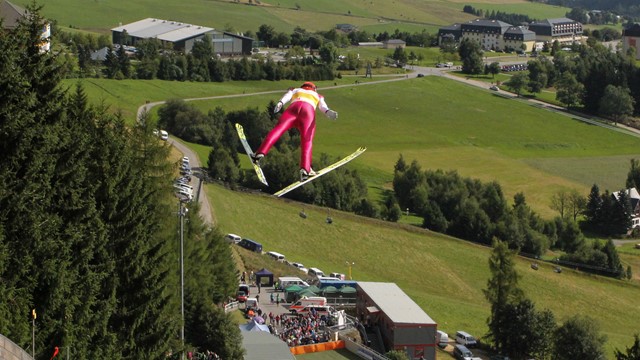
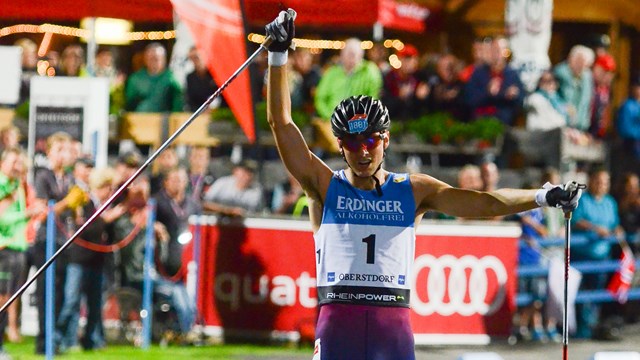
A skier flying during the FIS Nordic Combined Summer Grand Prix 2017 in Oberwiesenthal, Germany. (Photo: FIS)
Green grass, plastic jumping surfaces, big jumps, sunshine, rollerskis and no snow means one thing. It’s August in Europe and it’s time for the International Ski Federation (FIS) Nordic Combined Summer Grand Prix 2017.
Last weekend Aug. 19-20, Oberwiesenthal, Germany hosted a two-day Grand Prix event.
Day 1 featured a two-person team event with the requisite jump and 2 x 7.5-kilometer cross-country race to determine the winners.
Czech Republic’s first team (Czech Republic I), comprised of Tomas Portyk and Dvorak Miroslav, won the team competition in 28:52.9 after starting fourth, 11 seconds behind first. Germany I’s Fabian Rießle and Eric Frenzel raced to second (+0.3), and Germany II’s Jakob Lange and Vinzenz Geiger placed third (+11.2).
The U.S. had two teams entered. Bryan Fletcher and Taylor Fletcher (U.S. II) placed 12th (+2:37.0) while Jasper Good and Ben Berend (U.S. I) finished 14th (+3:03.5).
Day 2 of racing was an individual normal hill/10 k Gundersen start.
Austria’s Mario Seidl claimed the win in 25:18.5 after jumping to first and starting the 10 k four seconds ahead of Japan’s Akito Watabe in second. Germany’s Frenzel raced from ninth to second (+10.5), after starting 46 seconds after Seidle. Rießle finished third (+12.3), up from fifth in the jump, while Watabe narrowly missed the podium in fourth (+14.2).
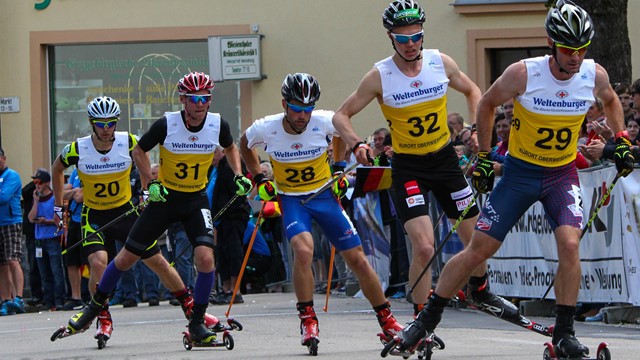
Bryan Fletcher (29) during this weekend’s Summer Grand Prix in Oberwiesenthal, Germany. He finished in 20th in Sunday’s individual normal hill/10 k event. (Photo: FIS)
Four U.S. skiers competed on Sunday, and Taylor Fletcher led them at the end of the day in 11th (+1:17.6) after jumping to 33rd and starting 2:01 minutes behind Watabe. Bryan Fletcher finished 20th, Berend 33rd, and Good 34th.
In an Instagram post, Taylor Fletcher described his first individual race of the series.
“First individual race in the books. I had a decent jump in a hard competition,” he wrote. “I started 33rd and ended up finishing 11th. I had a lot more to give but I thought I had another lap (I wish we did) before the coach said this was the last lap. Now @USAnordic is on the way to the next leg ready for another crack at it!!”
The Summer Grand Prix continues Aug. 23 with another normal hill/10 k in Tschagguns, Austria, and concludes in Oberstdorf, Germany, with back-to-back large hill/10 k competitions Aug 25-26.
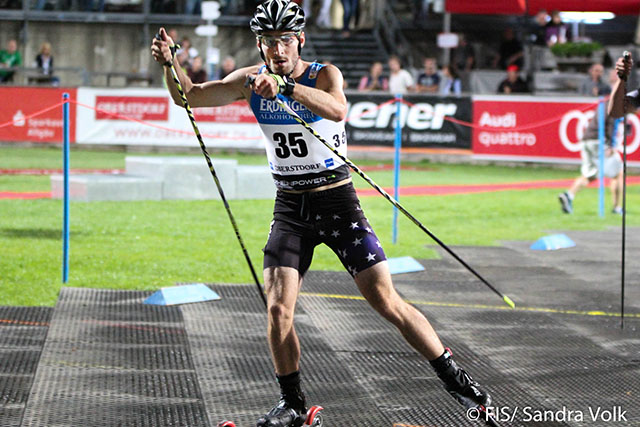
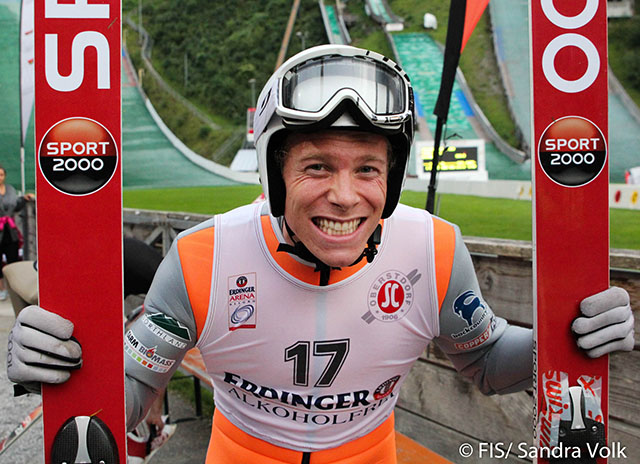
Taylor Fletcher (U.S. Nordic Combined) in Oberstdorf, Germany, during the FIS Nordic Combined Summer Grand Prix where he placed 15th overall in the series. (Photo: FIS/Sandra Volk)
(Note: This article has been updated to include comments from Taylor Fletcher.)
Logging hours: the rollerskiing, the jumping, running, strength and the in-between. For full-time athletes breaking up the quotidian cycle can be a spark. For the U.S. Nordic Combined team, late August and early September were spent racing events in the International Ski Federation (FIS) Nordic Combined Summer Grand Prix.
The last stop on the condensed three-venue tour was hosted by Oberstdorf, Germany, on Sept. 2 and 3. There, two things of note were evident.
First: 18-year-old Norwegian phenom Jarl Magnus Riiber flat-out dominated. He was first in three of the four individual races he contested. (On the second leg of the four Grand Prix individual races, Riiber scored the highest in the jump portion — he did not enter the roller ski leg.) Despite scoring in only three of four events, Riiber won the Grand Prix overall.
Riiber’s jumping dominance was sustained. In both Oberstdorf races, Riiber was the highest-placed jumper heading into the 10 k ski leg. On Friday’s race, the next closest skier, Germany’s Tobias Simon, started one minute and four seconds back. For Saturday’s race, a modest 59 seconds was Riiber’s head start.
But analyzing times reveals Riiber is still developing as a skier. He skied the 30th fastest time, winning by 13.7 seconds, on Friday.
Norway’s Jarl Magnus Riiber on his way to the FIS Nordic Combined Summer Grand Prix overall. (Photo FIS/Sandra Volk)
On Day 2, 17.6 seconds was Riiber’s margin of victory. Of the 51 skiers beginning the rollerski portion, Riiber raced only the 36th fastest time on the day. No matter, the young Norwegian prevails.
Second: the U.S. is showing promise in the jumping rounds and Taylor Fletcher has proven the ski shape is good.
On the U.S. side, let’s start with Fletcher. He jumped to 29th on Friday and began the rollerski 2:50 behind Riiber. Six laps later on the 1.75 km course, Fletcher had skied the fourth fastest rollerski leg, moving him up in the standings to 18th.
In a USSA press release, Fletcher made a point that Riiber has changed the jumping game. “The level of jumping is so high right now because of one guy,” Fletcher said. “He is the best jumper in all of Norway and could easily be the top guy on the ski jumping World Cup. That being said, to only start 2:50 behind him is somewhat a success. In the meantime, we are going to continue to jump and work on the technical aspects of jumping to close that gap down.”
FIS has implemented a rule change that places a higher value on overall jumping distance. Instead of the previous 1.5 points earned per meter jumped, now nordic combined jumpers are given 1.8 points per meter jumped. With a phenom jumper like Riiber, that marginal .3 point / m increase adds up. The time back for start position in the ski phase is decided by total points.
U.S. Nordic Combined Head Coach Dave Jarrett told USSA that Riiber is a one-man show racing for margin of victory. “Jarl Riiber is jumping on a very high level. He is splitting the field in every competition. And with the new rules changes, it became solely a race for second and third.”
Fletcher jumped to 35th during Saturday’s competition, flying 113 meters. Again, Fletcher played catch up on the ski. And he did catch up. He skied the third fastest time, strong enough to propel him up the standings to ninth overall (+1:20.8).
The European trip was a good sign for Fletcher as he finished the Grand Prix series ranked 15th despite being disqualified in Villach, Switzerland, the second leg of the series, due to a jump suit violation.
In an email, Fletcher described how he plans to challenge Riiber off the hill. “There are a few things that will allow me to close the gap to the leader which will make me closer to podiums for sure,” Fletcher wrote. “One thing is I can lose some weight for the jumping, which I have been doing. When I do this, I need to be careful that I don’t get too light as it will affect my cross country as I won’t have the same power. Another thing that will help is being more explosive and powerful on the take off, to do this I have been in the gym more this summer and reworking my strength and power programs to do this but its a process and you can’t expect it right away.”
The takeaway for Fletcher as the colder months approach leaves him optimistic. “I am happy with how the performances were in Europe.” Fletcher explained. “I was jumping at a much better level than last year and I was more in the hunt for the top places. Even though I was jumping better, I still don’t think I had my best jumps but they were still good. The cross country is right where I was expecting it to be and I will continue to progress as the summer and fall moves on! I am excited to get ready for winter as I know where I am in the pecking order and what to expect going into the first competitions of the year.”
The other senior U.S. players along for the Grand Prix ride were 18-year-old Ben Loomis and Ben Berend, 21. Loomis finished Day 1 of the Oberstdorf round in 32nd (+3:07), Berend 35th (+3:25.3).
Yet both skiers showed moxie off the jump. Loomis jumped to 16th while Berend was a place behind in 17th.
Day 2 proved another solid day off the jumping hill for Berend and Loomis. With 115 points after the jump, Berend’s effort was good enough for the 12th-best jump. Loomis was 10 spots back in 22nd. After the skiing portion, Loomis finished in 33rd, with Berend in 36th.
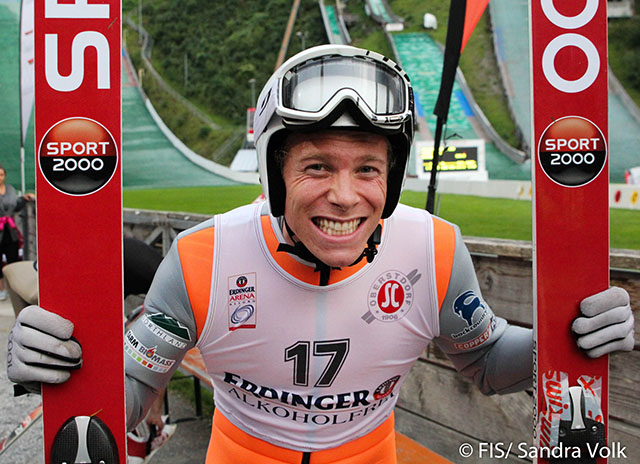
U.S Nordic Combined skier Ben Berend stoked on his jumping in Oberstdorf, Germany. (Photo: FIS/Sandra Volk)
In an email exchange with Berend, he explained the team is positive. “I would say that as a team the sensation is that we are moving in the right direction, Berend wrote. “This offseason we hired an Austrian jump coach Nik Huber. He has really given us a lot of confidence on the jump hill. Taylor showed in Oberwiesenthal that he can fight for a podium on the last lap. If Bryan was here, I truly believe he would have been fighting for the podium as well … The goal is to eventually have a strong enough 4 man team to fight for podiums at World Championship and Olympic Events. I think seeing Ben Loomis and I jumping into the top 20 is a huge step in that direction. It seems everyone is happy with where they are at right now. The next step is improving on that form before the winter.”
(Bryan Fletcher remained in Park City where he welcomed his newborn daughter last month.)
With a competitor like Riiber, establishing big time gaps with his jumping, it’s paramount that U.S. skiers like Berend attempt to minimize that gap with improved jumping.
“Throughout the two week Grand Prix Tour I had some of the furthest jumps on the hill,” Berend wrote. “By the time we got to Oberstdorf my confidence was through the roof. It got to the point where I knew I was going to go far even with a bad jump (Saturday’s 17th place was with a bad jump). This took a lot of pressure off of me and I was able to relax and just execute. In the past I have been inconsistent on World Cup. One day I jump to 10th and the next day I would jump to 45th. During the Grand Prix I jumped to 19th, 17th, and 12th. This is definitely the kind of consistency I have been looking for.”
The Nordic Combined World Cup season begins Nov. 27 in Kuusamo, Finland.
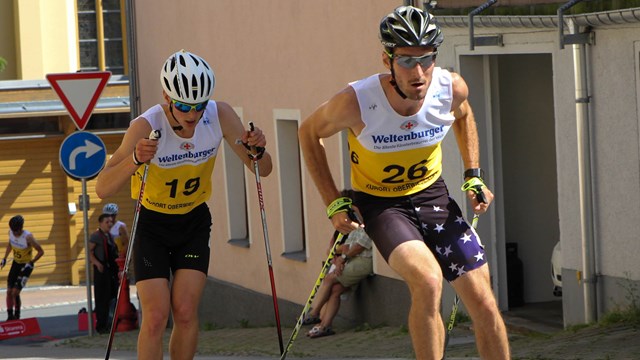
Taylor Fletcher (26) racing to the fastest time on the day and several overall at the Summer Grand Prix in Oberwiesenthal, Germany. (Photo Sandra Volk/FIS)
End of August. It’s not quite transition season yet. Leaves are green, there’s still the possibility of sweltering humidity, and if you’re inclined to fly off 100-meter ski jumping hills sans snow, the International Ski Federation (FIS) Nordic Combined Summer Grand Prix has you covered.
Last weekend, Oberwiesenthal, Germany, hosted the two-day opening round of the Summer Grand Prix. Although months away from on-snow events, jumping and racing on rollerskis against some of the best in the world is an incomparable way to size up dryland training.
Saturday featured a team sprint (teams of two) with a combined score jump followed by a 15-kilometer (2 x 7.5 k) race. Host Germany took the top prize. Germany I, with Björn Kircheisen and Eric Frenzel, placed first. Norway I (Jan Schmid and Magnus Moan) took second (+18.8), and Austria I (Bernhard Gruber and Philipp Orter) finished third (+19.7).
The U.S. entered two teams: Taylor Fletcher and Ben Berend for U.S. I and Jasper Good and Stephen Schumann for U.S. II.
Fletcher and Berend finished the jumping round in 14th; Good and Schumann ranked 19th. U.S. I held its 14th place after the ski portion, finishing 2:24.5 behind the winners. U.S. II ended the day in 18th overall.
Sunday’s normal hill/individual 10 k was a new day for U.S Nordic Combined’s reigning national champ Taylor Fletcher. (Of note: The race weekend featured half of the Fletcher clan. Taylor’s older brother Bryan remained in Park City, Utah, as he and his wife were expecting their first child. They welcomed their baby girl, Ellery Ardene Fletcher, on Monday, Aug. 29.)
Best off the jumping hill on Sunday, Aug. 28, was Norway’s Jarl Magnus Riiber. Taylor Fletcher jumped to 26th place. He started the ski portion 2 minutes and 25 seconds after Riiber.
Reading between the lines, Fletcher made progress in the jump portion. He flew eight meters farther on Sunday compared to his effort the previous day.
“Today was a good step forward,” Fletcher said Sunday about his Day 2 jump in a USSA press release. “I am pleased, for sure, but know I still have my work to do. I have had some really good jumps lately but haven’t had them in the competition yet. Today I put in a great jump after my miss yesterday (in team sprint) so that was a great feeling. I think this will help me relax knowing that with a jump like this I am in the hunt with my skiing, but of course the goal is to make it easier on the cross country side.”
Schumann jumped to 31st, while U.S. teammate Ben Loomis was 33rd.
Making it easier on the cross-country side was Fletcher’s performance trademark of tracking down early starters. On Sunday, he was true to form and strategy.
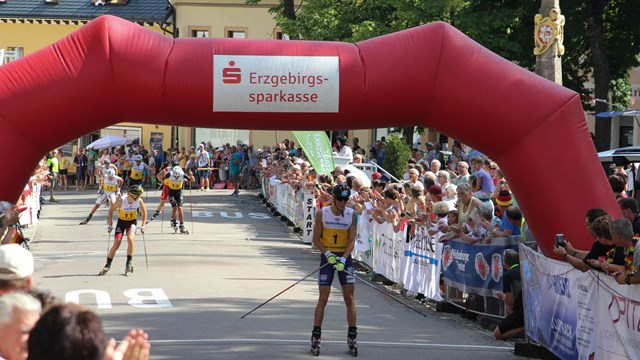
Norway’s Jarl Magnus Riiber crosses the line first last weekend for Day 2 of the Summer Grand Prix in Oberwiesenthal, Germany. (Photo: Sandra Volk/FIS)
Fletcher’s 24:28.9 marked the fastest rollerski time of the day, and brought him within 10.2 seconds of race winner Riiber, who finished in 26:43.7 . The hard-charging effort earned Fletcher seventh-place overall.
“I was happy with the weekend for sure,” Fletcher wrote in an email to FasterSkier. “I have been focusing on the jumping way more this year and with the addition of our new jump coach and philosophy I have been able to improve way more. I had pretty solid jumps in Oberwiesenthal but still not my best jumps so that is exciting knowing I can still jump better. I will try to keep those feelings with me as we get ready for competition [on Wednesday] in Villach, Austria.”
Behind Riiber on the podium were Austria’s Mario Seidl (+2.8) in second and Germany’s Kircheisen in third.
For the U.S., Schumann finished 42nd (+3:23.3), Ben Loomis was 45th (+4:11.7), while Adam Loomis did not start the ski portion after being disqualified for a suit violation during the jumping portion.
Asked why the team headed to Europe for the Grand Prix, Fletcher explained the race series provides a fitness litmus test against some of the best in the world.
“We come to Europe for these races to see where our form is at the moment, but also to get some competition and practice in,” he wrote. “These races are no different than the World Cups in the winter with the exception that a few people may be absent. Another reason we come over is for the equipment. All the jumping manufacturers are based in Europe and it is difficult to get equipment sent the USA. Also, every year the rules for jumping are changed and unless you are at a competition, it is hard to know if you bindings, suits, skis, gloves, helmets, undersuits are legal or not. Coming to Summer Grand Prix allows us to check out our equipment with the officials so we know we are inline with the rules and won’t get disqualified for unknown reasons.”
Fletcher elaborated on how jumping differs in the summer compared to jumping in colder, more dense, wintertime air. “The only thing that is different in the summer and winter is the air pressure really,” he wrote. “The surface is different but over time it starts to feel more like snow and the landing and in-run start to feel close. In the summer the temp is high causing the pressure to drop a little, especially in Park City and that makes the jumping a little harder. So without the air pressure, it sometimes feels like you are falling instead of flying through the air. The best jumping happens when the temperature is very cold(-F) as the air is very thick and you feel way more pressure under neath you! The speed is relatively the same as, the slope the hill doesn’t change from summer to winter.”
Bryan Fletcher holding his newborn, Ellery Ardene Fletcher. Fletcher and his wife Nikki welcomed their baby girl on Monday. (Photo: USSA Nordic/Facebook)
On Wednesday in Villach, Fletcher did not start the normal hill/10 k competition and final day of the Grand Prix. His teammate Berend led the U.S. in 33rd after posting the 19th-best jump, Ben Loomis finished 42nd after jumping to 31st, and Adam Loomis was 50th, improving upon his 57th-ranked jump.
Austria’s Seidl won at home with a 12.9-second victory over Germany’s Fabian Riessle, and Norway’s Håvard Klemetsen placed third (+15.1).
Now an uncle, Fletcher planned to head home to Park City after the Grand Prix series and spend the month prior to the start of the winter season training in Europe.