
Tag: FIS opener

  • Johaug Blasts the Field Again in Beitostølen; Slind States Her Case in Second

    Johaug Blasts the Field Again in Beitostølen; Slind States Her Case in Second

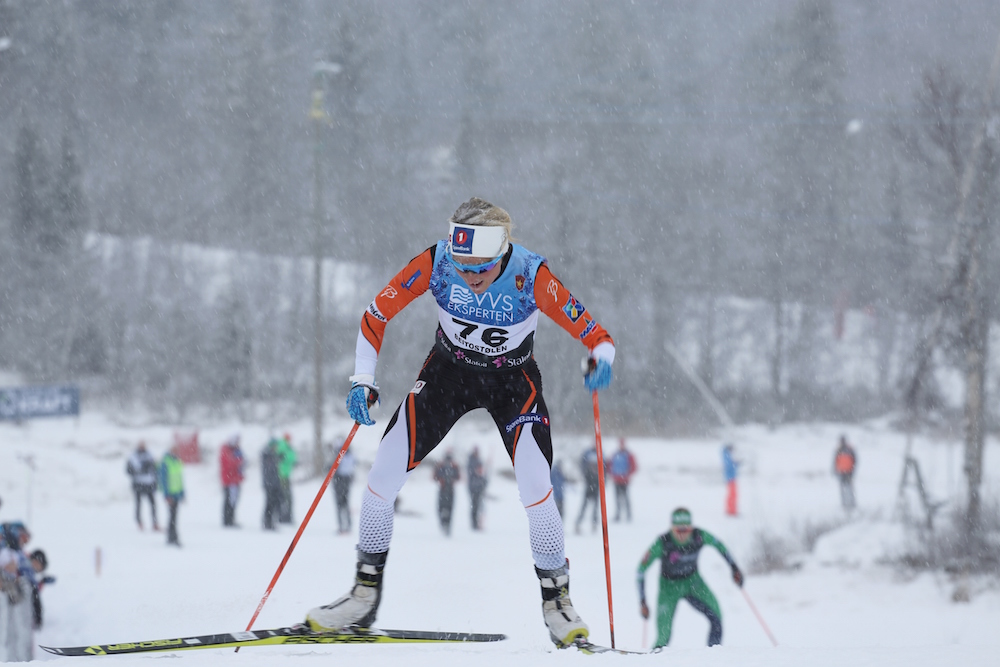
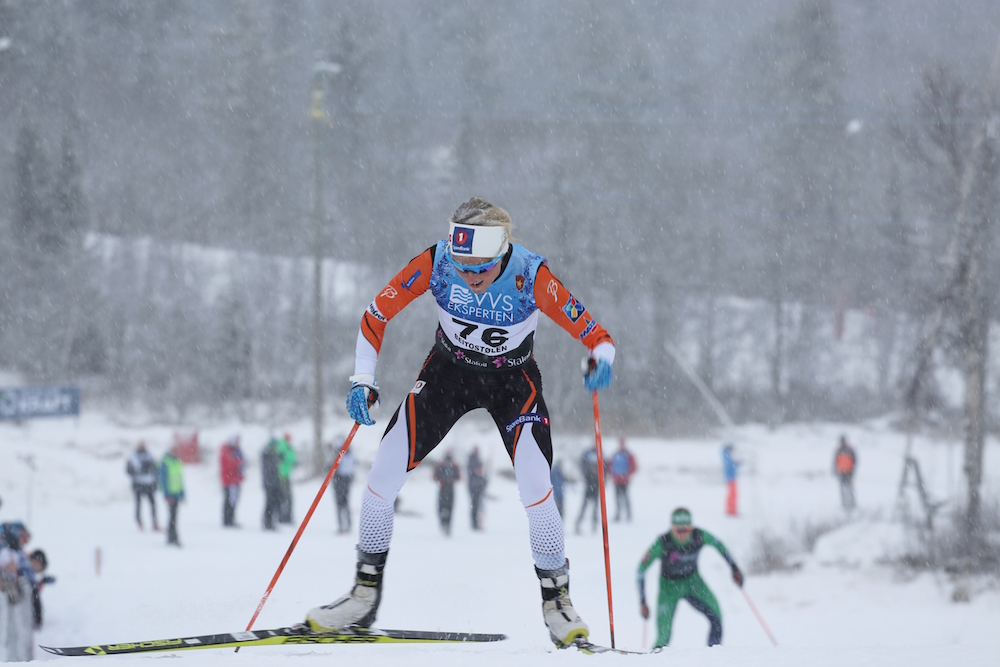
    Norway's Therese Johaug pushes through heavily falling snow on Saturday to win the 7.5 k freestyle at the FIS season opener in Beitostølen, Norway. She won Friday's 7.5 k classic race as well. (Photo: Eirik Lund Røer/SKIsport)
    Norway’s Therese Johaug pushes through heavily falling snow on Saturday to win the 7.5 k freestyle at the FIS season opener in Beitostølen, Norway. She won Friday’s 7.5 k classic race as well. (Photo: Eirik Lund Røer/SKIsport)

    With heavy snow falling on the second day of Norway’s season-opening FIS races in Beitostølen came another opportunity for the Norwegian women’s team to find their race rhythm.
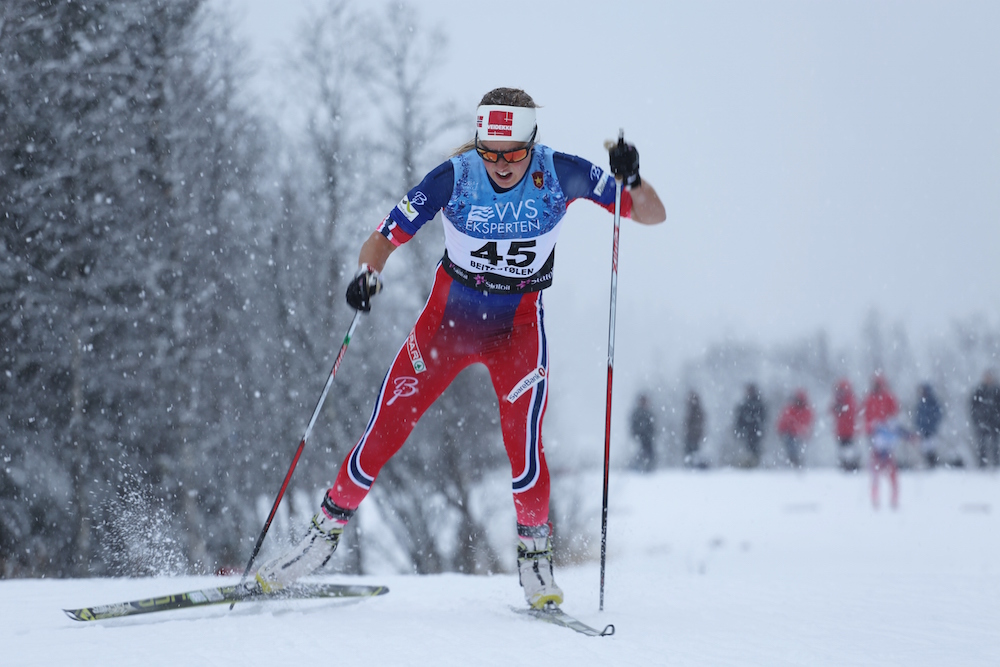
    Kari Øyre Slind, 24, of the Norwegian development team, races to second in Saturday's 7.5 k freestyle FIS race in Beitostølen, Norway. (Photo: Eirik Lund Røer/SKIsport)
    Kari Øyre Slind, 24, of the Norwegian development team, races to second in Saturday’s 7.5 k freestyle FIS race in Beitostølen, Norway. (Photo: Eirik Lund Røer/SKIsport)

    Therese Johaug is already primed. In a repeat performance — she won Friday’s 7.5-kilometer classic opener — Johaug never relented the lead. Starting last in a field of 76 women in Saturday’s 7.5 k freestyle, her lead on her fellow national-team members widened as the race progressed; Johaug was fastest at every split. She finished in 19:29.9, 39.6 seconds ahead of second-place skier Kari Øyre Slind, an upstart Norwegian National Development Team member.

    “The snow made for tough conditions,” Johaug said in a post-race TV interview with NRK. “I had to dig deep the whole way, but these conditions are my advantage. For me, this was another good race under my belt. I felt like my technique was solid, that I nailed each pushoff and the timing was right.”

    She passed teammate Astrid Uhrenholdt Jacobsen, who started 30 seconds ahead of her, by the 5.4 k mark. Jacobsen went on to place third, 41.5 seconds behind Johaug, and about two seconds back from Slind. It was the second-straight podium for Slind, 24, who placed third in Friday’s 7.5 k classic race behind Johaug and Heidi Weng.

    “I don’t really know what to say,” Slind said in a TV interview. “Two podium finishes here is way beyond what I expected. My plan was to get a few good workouts here at Beitostølen, but this is totally unreal. I sort of feel like somehow I must have cheated. But that’s totally impossible here. There are cameras and course marshals all over the place.

    “I guess this is a sign that I do well in both classic and skate,” she added with a smile.

    “I sort of feel like somehow I must have cheated. But that’s totally impossible here. There are cameras and course marshals all over the place.” — Kari Øyre Slind, 24-year-old Norwegian Development Team skier from Oppdal, Norway, on placing second in Saturday’s 7.5 k freestyle in Beitostølen

    Her two podiums so far this weekend make for a good bid for a ticket to the World Cup opener in two weeks in Kuusamo, Finland. But Slind takes nothing for granted.

    “They [the national team coaches] have their own schedules for when they announce the World Cup team. I will make plans when and if I hear from them,” she said, adding that she is terrible about carrying her cellphone. “I am a bit of a scatterbrain. But I guess I need to start keeping track of the phone now. There are a lot of people around me, so hopefully they will remind me to bring it when I go places.”

    Norway’s women occupied the top 10 on Saturday, with Germany’s Stefanie Böhler being the top non-Norwegian in 11th.

    Ingvild Flugstad Østberg finished fourth (+58.5), and Weng was just over a minute back from Johaug in fifth (+1:00.9).

    “She wins far too easily,” Weng said of Johaug. “But it was really fun to see Kari step up to second place today. She’s made huge steps this fall.

    “It doesn’t matter who beats me. It was really hard,” Weng added. “I felt like I started out fine, but after the first lap, it was just really hard. My body felt heavy and I felt like I couldn’t get up to speed. But it’s good to compete. I need to get a few races under my belt, but I can’t be too disappointed. There were a lot of girls behind me, too.”

    After two hand injuries this summer, Johaug had to make several changes to her training, but she said the modifications worked out well for her.

    “I have had more variation in my training program. I have done a lot of combination workouts where we have mixed both rollerskiing and running to make the sessions longer, and I have done a lot of rollerski workouts on the treadmill this fall,” she said. “I have had to be more creative with alternative training methods, but it looks like it has worked out well.”

    Results


  • Fewer Norwegian Girls Racing: “Incredibly Scary”

    Fewer Norwegian Girls Racing: “Incredibly Scary”


    Therese Johaug at the 2010 Olympics. (Photo courtesy of Kent Murdoch)

    BEITOSTØLEN, Norway – “It’s really too bad there weren’t more girls here,” Therese Johaug told Langrenn.com after the 10 k classic FIS race in Beitostolen on Sunday.

    That race had 25 Norwegian females on the result lists, while Friday’s 10K skate race featured 23 Norwegian women, and 21 completed Saturday’s sprint.

    “There are definitely fewer girls here than previous years,” said Egil Kristiansen, head coach for the Norwegian national team women.

    “Disappointingly few girls here,” said Norwegian national team director Åge Skinstad.

    But the most serious comments belonged to Steinar Mundal.

    “That we don’t have more girls racing at Beito is one thing, and in and of itself not that big of a deal. But this is an elite race, and there should have been more racers here. However, the general trend is incredibly scary. I am seriously concerned,” Mundal told Langrenn.com.

    Mundal pointed out that in the entire state of Buskerud, in the south of Norway, there is only one female skier left at the senior level who is pursuing the sport.

    “That’s just really sad. If this is a general trend, Norway will soon have very few female skiers,” he said.

    Who is responsible?

    “Somebody has to step up here. Soon,” Mundal said. ”But I don’t know who.”

    Not enough snow

    Therese Johaug thinks the lack of snow in parts of Norway is part of reason why so few girls raced this weekend.

    “A lot of the girls don’t feel like they’ve skied enough yet, and many of them have lofty ambitions for themselves here at Beito. But I still think there are too few girls racing. I hope we can increase the recruitment, and that the girls are well taken care of during the most critical phases – from the youth to the junior level and from the junior to the senior level,” Johaug said.

    Considerably More Swedes in the Swedish FIS Opener

    Parallel to the FIS opener at Beito last weekend, the Swedes held their FIS opener in Bruksvallarna. At those events, nearly 80 female skiers entered, and more than half of them were Swedish.

    Sweden has also had spotty snow coverage this fall, just like Norway.

    Erik Østli, the race director at Beito, is wondering what the reasons may be. “It’s disappointing how few girls are racing, and I also notice that there are huge gaps in the performance levels. I wonder if all the restrictions on entries in the past have scared people from registering,” he said.

    Encouraging Trend

    Erik Røste, vice president of the Norwegian Ski Association, doesn’t find the trend alarming. In fact, he finds it encouraging that fewer girls are racing the Beito opener.

    “As far as I know, this is a positive trend. Just look at the nationals. There are more racers than ever before,” Røste pointed out.

    What does he think about the sparse number of girls at the season opener?

    “It’s almost nice. We’ve tried to downplay the perceived importance of the Beito races for years. I’m actually encouraged to see less emphasis on this. There will be more important races later,” he said.

    From Langrenn.com, November 15, 2010. By Ola Jordheim Halvorsen, translation by Inge Scheve