From the FasterSkier archive — posts syndicated from athletes’ and coaches’ own blogs between 2004 and 2012, kept online as published. Current coverage is at fasterskier.com.

Tag: FIS World Cup

  • All in the Timing: Inside Chicco Pelle’s Last Dance in Lake Placid

    All in the Timing: Inside Chicco Pelle’s Last Dance in Lake Placid

    This coverage is made possible through the generous support of Marty and Kathy Hall and A Hall Mark of Excellence Award. To learn more about A Hall Mark of Excellence Award, or to learn how you can support FasterSkier’s coverage, please contact info@fasterskier.com.

    LAKE PLACID, New York (March 21) — As the snow settled on Lake Placid and clouds began to dissipate over Mt. Van Hoevenberg, a growing sense that something momentous could happen permeated the crowd assembling for the last Sprint of the 2025-26 World Cup.

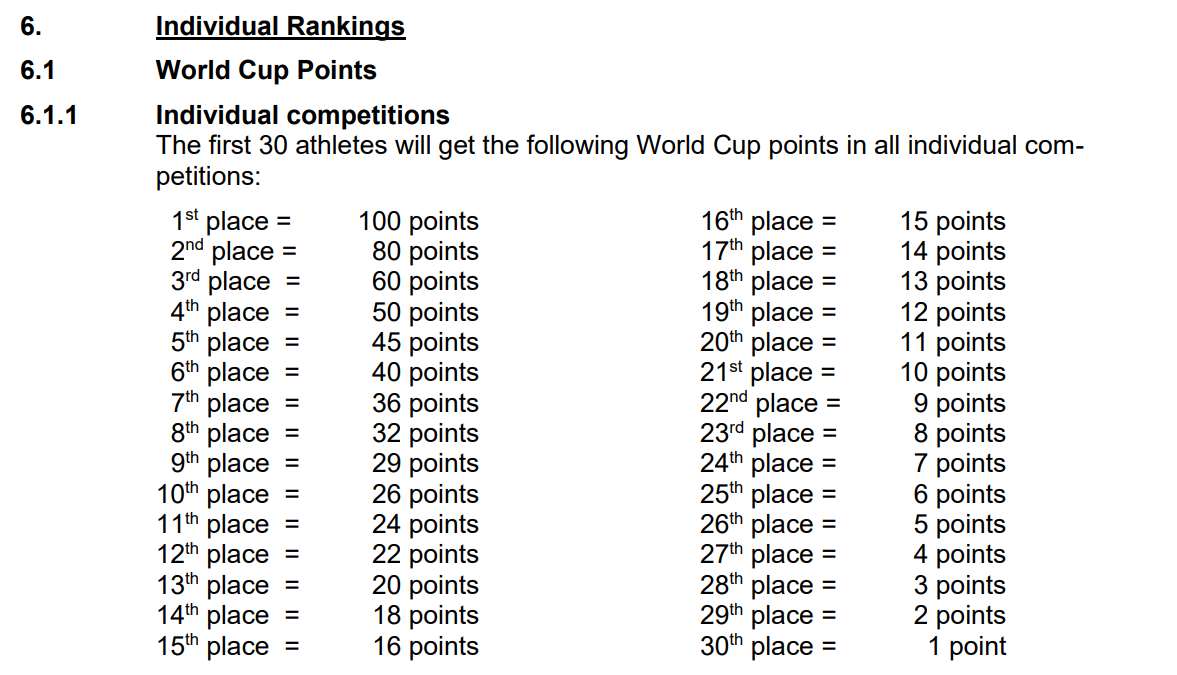
    That something unusual would happen was assured. With the Sprint Globe already secured to Johannes Høsflot Klæbo, the golden-haired juggernaut would not be on the starting line – opting instead to rest his legs, and head, in hopes of defending his 12-point lead over Harald Østberg Amundsen in the Distance standings. By default, then, someone other than Klæbo would stand atop Saturday’s podium – a rare occurrence in a season where the Norwegian had already won 8 of 11 Sprints in commanding fashion. (Two wins evaded Klæbo due to falls; the third because he did not start in Oberhof).

    Who would take his place? Ben Ogden, the Northeast’s homegrown favorite and the Sprint silver medalist in Milano-Cortina? Gus Schumacher, Ogden’s partner in the Olympic Team Sprint? France’s embattled specialist, Lucas Chanavat, who appeared on track to rival Klæbo during the 2023-24 season, who had seized the opportunity – and the win – after Johannes’ bobble in Davos last December? Ansgar Evensen (NOR), who had done the same in Drammen?

    Or, perhaps, it would be Federico Pellegrino (ITA) – the 35-year-old elder statesman of the league; making his 344th (and penultimate) World Cup start, eyeing an 18th and final Sprint victory?
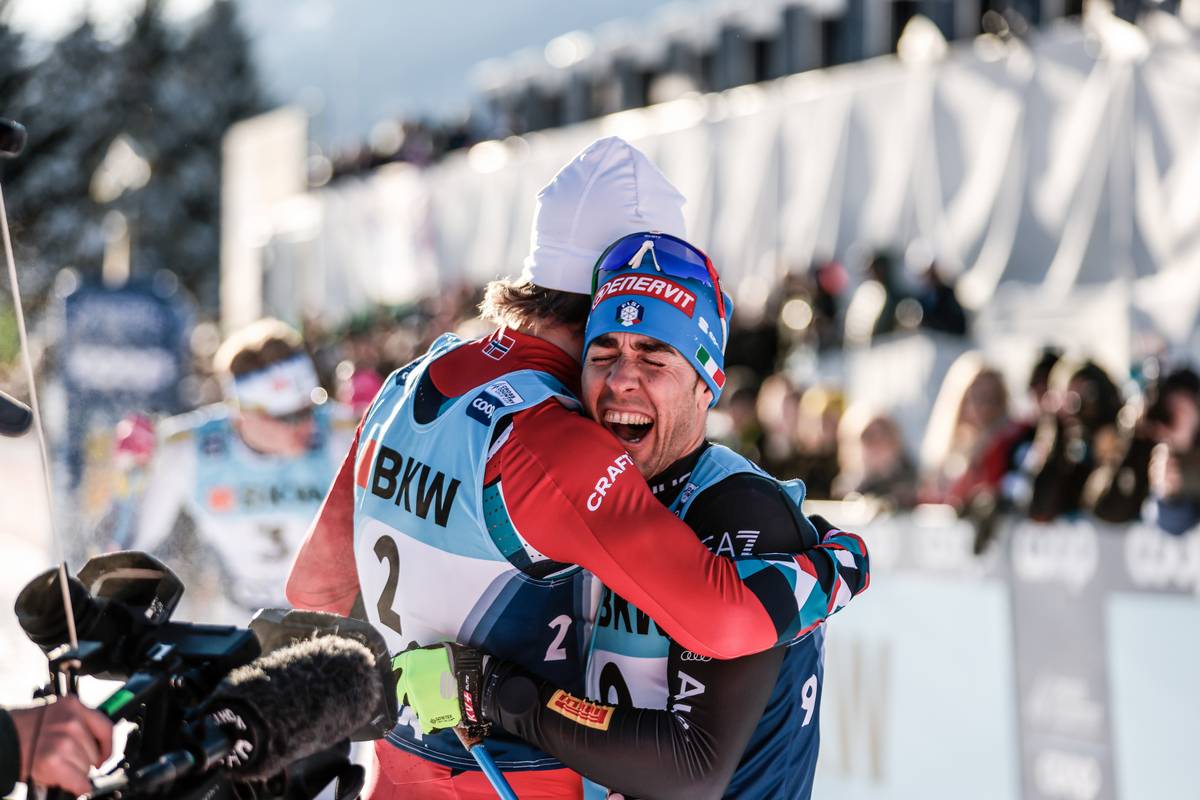
    Johannes Hoesflot Klæbo (NOR) and Federico Pellegrino (ITA) after the finish of the Finals in Davos, 2022. Pellegrino bested Klæbo on the eve of the birth of his first child. (Photo: Nordic Focus)

    It states the obvious to say that success in cross-country skiing is a matter of timing, and for “Chicco Pelle’s” 15 seasons, the timing had been just shy of right. The formative and final years of Pellegrino’s career were defined by the dominance of skiers other than he. Pellegrino made his World Cup debut in Drammen in March 2010, finishing 49th. The winner that day was Emil Joensson (SWE); runner-up was Petter Northug (NOR), then on his way to his first of two Overall Globes. These were the halcyon days in which Dario Cologna (CHE) descended from his Alpine fastness to rack up World Cup and Tour de Ski titles; when Northug, Joensson and Marcus Hellner (SWE) traded sprint victories and taunts in a bitter intra-Scandinavian rivalry. Pellegrino was 12th in his first World Championships Sprint (Oslo, 2011) and 11th at his first Olympic Sprint (Sochi, 2014).

    While notching his debut victory in December, 2014 in the Davos Freestyle Sprint, Chicco’s break came in the 2015-16 season. He won 5 of 13 sprint races, becoming the first non-Scandinavian male to win the Sprint Globe. As Pellegrino hit his stride, Northug’s star was showing its first flickerings ahead of a dramatic waning, Joensson had entered the twilight of his career, and although Sergey Ustiugov (RUS) was approaching his own prime, the factious cast of World Cup sprinters was looking for a new leading man.

    That man would not be Chicco. An upstart dramatist from Trondheim, Johannes Høsflot Klæbo, had arrived to script skiing’s long, and mind-bogglingly successful, next chapter. After making his debut in Drammen in 2016, Klæbo outscored Pellegrino in the 2016-17 Sprint standings, taking his first of 8 (and counting) Sprint Globes. The two went head to head at the 2017 World Championships in Lahti, Finland, where Pellegrino surged from behind to claim his first World Title ahead of a legendary lineup, including Ustiugov, Klæbo, and Northug, but this maiden gold would also be his last. In Pyeongchang the next year, the Olympic gold went to Klæbo; Chicco brought home silver.

    The wins did keep coming for Chicco, including a tear of three consecutive Sprint victories and his second Sprint Globe in 2020-21. And, though they admittedly came in greater abundance to Klæbo (who, it should be noted, did not start in those races, or the 2020-21 Tour de Ski), it is rather glib to assert that Chicco’s career had slid “in[to] the shadow of” the Norwegian. Pellegrino bested Klæbo in Dresden and Lahti in the spring of 2018; in Lillehammer that winter; and in Davos in 2022. He was near-omnipresent on Sprint podiums and won his second Olympic silver in Beijing in 2022; moreover, he was among the very few men who could disrupt Klæbo’s dominance in the discipline, and the clear favorite when Johannes was absent.

    But Pellegrino’s win in Davos in December 2022 marked the beginning of a long, and perhaps self-inflicted, World Cup drought. Chicco declared his intention to focus on distance races ahead of Milano-Cortina, and did indeed record four such podiums in classic, skate, and skiathlon formats, alongside a welter of Sprint podiums – including an ecstatic World Championships silver in Trondheim in 2025, and Olympic bronzes on home soil in the Team Sprint (alongside Elia Barp) and in the 4 x 7.5 k Relay (which he described as “the proudest day of [his] life!”) this February.

    Elia Barp welcomes Federico Pellegrino to a bronze-medal finish in the Olympic Team Sprint in Milano-Cortina, February 18th, 2026.
    (Photo: Vanzetta/Barbieri/NordicFocus)

    Outright wins, however, were not forthcoming. By the time March 21, 2026 arrived in Lake Placid, it had become Pellegrino’s last, best chance to secure one more Sprint victory.

    Anticipation and emotions ran high. While Pellegrino had been impervious to the crowd in Friday’s 10 k Classic – earbuds deadening the world beyond his blue racing cap during warmups, and his face a deaf mask of exertion during the race – their excitement overwhelmed him on Saturday. During his first warmup lap, he skated calmly up the course’s A-Climb through a chorus of “CHI-CCO, CHI-CCO, CHI-CCO.” On his second, the frenzied chant began again, and the gravity of the impending race dragged him to a halt. His skis splayed wide against the pitch; he buried face in his hands. “The energies I got in the Final were coming from the warmup lap, where I stopped in the middle of the climb, crying,” Pellegrino told me at the finish line. “I think the public deserved this kind of show, and I deserved to finish my career, with a Sprint skate like this.”

    Pellegrino embraces the crowd ahead of Sprint qualifying in Lake Placid. “The energies I got in the Final were coming from the warmup lap, where I stopped in the middle of the climb, crying.”
    (Photo: Thibaut/NordicFocus.)

    To reach that final finish line, however, was a perilous journey.

    After qualifying second, Pellegrino sidestepped two falls (the first from Jules Chappaz (FRA); the second from Elias Keck (GER)) in his Quarterfinal, moving from sixth to first in the course’s final descent and level hairpin. In Semifinal 1, he attempted to close on Lucas Chanavat (FRA) and Anton Grahn (SWE) through the crest of the A-Climb but couldn’t get by; pushed to the outside on the level hairpin, he was out-lunged by Lars Heggen (NOR) in the final meters, finishing third by 0.03.

    While the Lucky Loser spot was Chicco’s to lose heading into Semifinal 2, Erik Johansson (SWE), Harald Amundsen (NOR), and Even Northug (NOR) lost time playing for a slipstream position as they approached the top of the A-Climb. Pellegrino was on to the final by a comfortable margin.

    Lars Heggen (NOR) outlunges Federico Pellegrino (ITA) by 0.03 in Semifinal 1. Federico moved on to the Final as a Lucky Loser. (Photo: Thibaut/NordicFocus)

    Once more around the track, and the day could be his. After being fourth out of the gate, he attacked from the outside on the B-Climb; breaking into an aggressive V-2 and taking Chanavat and Heggen by surprise, he moved into second behind Grahn. The pace increased again at the base of the A-Climb, but where Grahn and Chanavat’s broad frames moved up the hill in sweeping, powerful strokes, Pellegrino leapt into a furious V-1.

    The move was decisive. To the adulation of the crowd, he opened a decisive gap through the crest of the climb. His lead only grew through the final descent into the level hairpin, but Chicco was taking no chances. While Grahn and Heggen grappled for second behind him, Pellegrino hammered to the line, threw his arms wide and his head back, roaring with the crowd.

    An 18th victory and 46th career podium, clinched.

    Federico Pellegrino secures his 18th and final World Cup victory. Lake Placid, March 21, 2026. (Photo: Thibaut/NordicFocus)

    What had happened in the Semifinal, when this triumphant last dance had nearly evaded him by three hundredths of a second? And what had changed for the Final?

    “I could not do what I did in the Final, because the energies of the other athletes were still quite big,” Chicco admitted our post-race interview. “About the last downhill, I was not the same as the others. I am not, I know, but I have some different qualities, and if I could get quite good gap in the top of the uphill, then I knew that I could keep it until I end. This is what I did. This is how I loved to win all along my career – not wait until the last meter, but trying before.”

    “Sometimes it happened, mostly before Klæbo came,” he laughed. “But today I was there, and I studied the best tactics in the end . . . the public here in Lake Placid deserves this kind of show, and I think we are all happy now.”

    And, this was nothing short of “the best way” to end his journey. “I could not do different. In the end, the last four years have been strange. I didn’t focus so much on sprinting; I tried to discover my body in different fields. Sometimes I got really great feelings and performances, but then, to come back here . . . and to win in that way, I could not do more.”

    Pellegrino after his final win. “I think the public deserved this kind of show, and I deserved to finish my career, with a Sprint skate like this.” (Photo: Thibaut/NordicFocus)
    One more podium for Federico Pellegrino, alongside Lars Heggen (NOR) and Anton Grahn (SWE). (Photo: Thibaut/NordicFocus.)

    In 15 seasons, Pellegrino proved himself to be far more than a runner-up to those Swedish and Norwegian titans who loomed large over his early and later years. He had taken the Sprint Globe from the Scandinavians for the first time; outsprinted Klæbo, Ustiugov, and Northug in Lahti; perpetually challenged – and occasionally beaten – the greatest athlete in the history of the sport; and secured Olympic medals on home soil, alongside a team of up-and-coming Italians ready and eager to fill his boots. “I’m really happy that he finished his career with probably one of the best weekends for him so far,” Elia Barp (ITA) told me on Sunday. “I’m very happy for him; I’m very happy for the team. I think we have proved that we are ready to race without him – not only me, but a few other young guys are ready to try to take victories next year . . . [He showed] that it is important to keep fighting and try to be a good overaller as he was in the last years. And, now we know that it’s possible; everyone is human as us, and we can do that.”

    To Chicco’s fans, that determination – to grapple with giants; to reinvent himself; to seize the final, perfect timing and a final, perfect victory – defined his career. But for Pellegrino himself, “the biggest memories will not stay about the races, but much more about the hugs I got from the teammates, from the coaches, even outside of Italy, from my family, from the people that love me – and not only when things went well; even when things were not going so well. I think this is something that sport teaches us; that in the end, it’s only a cross-country ski race, and life is different. That’s it. The hugs are something I will remember for my entire life.”

    Pellegrino, the most popular man at Zig Zag’s on Saturday, March 21. (Photo: Lily Den Hartog)

    At Zig Zag’s Pub on Saturday night, Pellegrino told this reporter’s associate that his win vindicated his decision to retire. On Sunday, soaked with rain and champagne and tears after his last World Cup race, he reaffirmed it:

    “That’s it. I tried to enjoy today as well . . . I tried to give my best, as always, and it was good after the finish line; under the rain, it was special. But with the teammates and coaches and waxers celebrating this moment, it was good for me.”

    “Now, I really need to stay with my family. They deserve this, and I need to give them a lot of time.”


    Love Stories Like This? Help Keep Them Coming.

    Feature stories like this one take time, access, and care to produce. If you value thoughtful storytelling and independent ski journalism, please consider becoming a Voluntary Subscriber. Your support directly fuels the work we do to cover the people, places, and moments that make our sport special.

    “Grazie Papao!!” Team Italy was waiting at the finish of the 20 k Skate with champagne and a tribute to Pellegrino’s children and wife, Greta Laurent (ITA, ret.). (Photo: Thibaut/NordicFocus)
  • Final Piece in Historic Puzzle—Klaebo Claims Distance Globe

    Final Piece in Historic Puzzle—Klaebo Claims Distance Globe

    This coverage is made possible through the generous support of Marty and Kathy Hall and A Hall Mark of Excellence Award. To learn more about A Hall Mark of Excellence Award, or to learn how you can support FasterSkier’s coverage, please contact info@fasterskier.com.

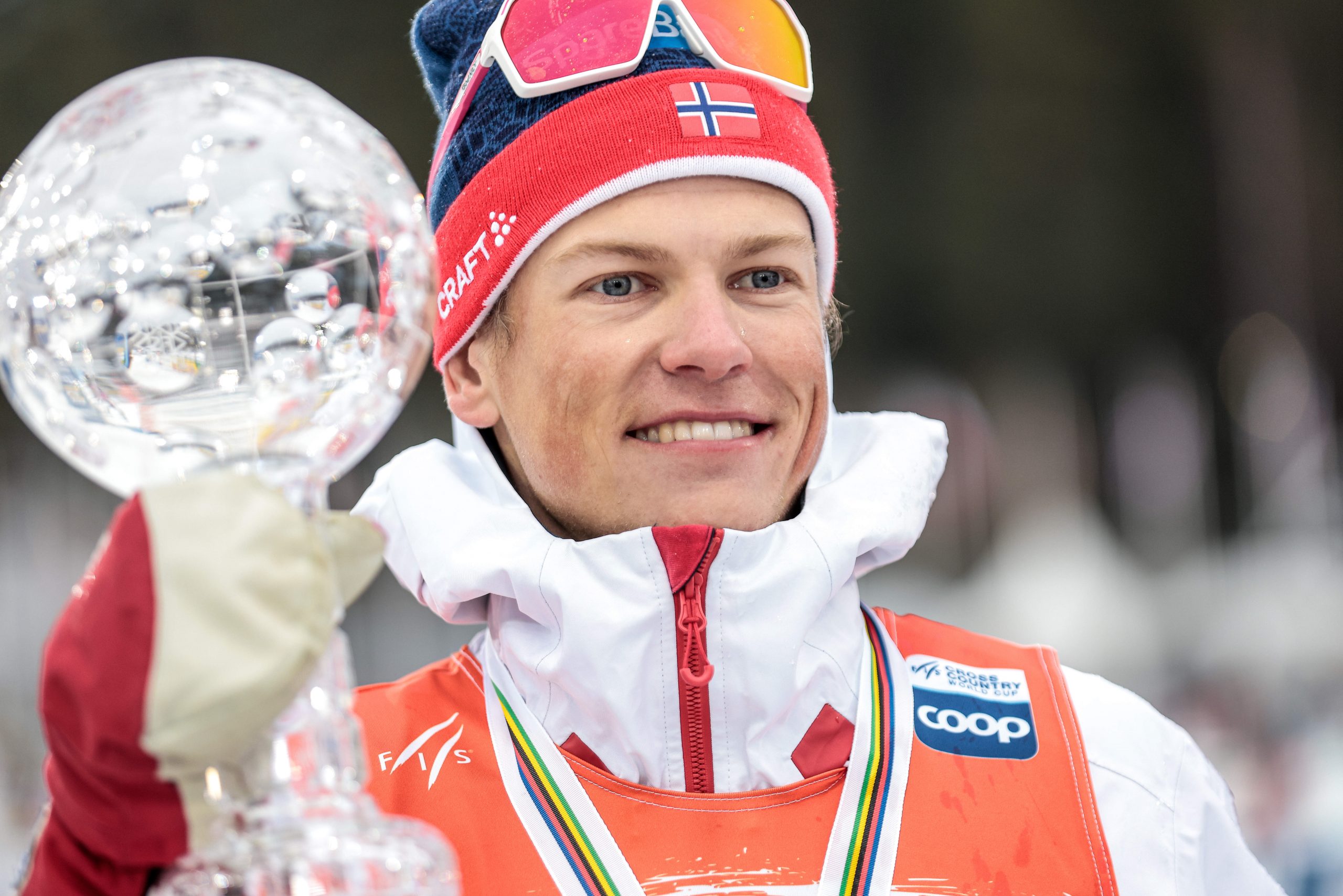
    Johannes Hoesflot Klaebo (NOR) had won it all—except for a Distance Crystal Globe. Today in Lake Placid, he finally added that most elusive piece of hardware to his expansive trophy case. (Photo: Modica/NordicFocus)

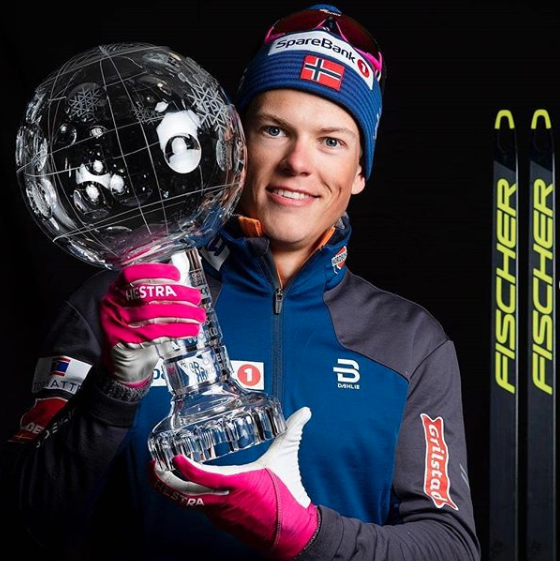
    The Kingdom of Norway expects much of its sport heroes. Johannes Hoesflot Klaebo knows this . . . that may be why this naturally gifted sprinter may have long coveted the prize that a skier of his sort is least likely to earn: World Cup Distance Crystal Globe. If he could capture that prize, he could place his name among those of revered strong men of cross-country skiing. But first he’d need to get past another Norwegian strong man: Harald Oestberg Amundsen, himself a past winner of both the Distance and All-Around Crystal Globes, and a skier who trails Klaebo by only 12 points heading into this final Distance race of the 2026 season. A Norwegian skier would go home from Lake Placid with the Distance Crystal Globe tucked safely in the overhead compartment of a chartered jet liner. But which Norwegian?

    Twenty kilometers of mass-start racing through the forests and hills of Mt. Van Hoevenberg would answer the question. But the manner in which that question would be answered would have bearing on ski history, as well. That’s because Klaebo could choose to employ more than one strategy in today’s race. He could park himself behind Amundsen, presumably sprint past him at the end, and claim the Cup regardless of his placing in today’s race. Norwegian fans would love to see a Norwegian claiming the Cup, but they would prefer to see the victory be claimed in a different way. What Norway would love to see is dominance delivered at the hands of the sport’s most dominant skier. The “dominance” strategy is far more risky—it could backfire, it could get counter-attacked, it could conceivably allow Amundsen to overcome a self-exhausted Klaebo. But that’s what Norwegian fans long to see.

    Back in 1983, Norwegian speedskater, Rolf Falk-Larssen won the World All Around Speedskating Championship by virtue of winning three of the championship’s four races. That was the rule back then—anyone who wins three of the four races is automatically crowned champion, regardless of their performance in the fourth race. Falk-Larssen won the 500 m, the 5,000 m, the 1500 m. Technically, all he had to do was finish the 10,000 (the final race of the championship) in order to wear the victor’s wreath and be proclaimed World Champion. He would finish that final race, but the way he raced it was also the reason that, to this day, few Norwegians are willing to even mention Falk-Larssen’s name. When Falk-Larssen had the chance to truly dominate, he chose, instead, to mail it in: he soft-pedaled the 10 k . . . finishing a full 37 seconds (that’s a lot) behind the race winner, Tomas Gustafson of Sweden, whose four-race performance actually accumulated a point-total that exceeded Falk-Larssen’s championship-winning total. Falk-Larssen was crowned champion, but the Norwegian crowd never forgave him.

    Norway expects much of its champions. Witness the racing strategies of Marit Bjoergen, of Therese Johaug, of Bjoern Daehlie, of Thomas Alsgaard. They were dominators, setting a blistering pace from the very start of any race, heedless of the consequences, daring any other racer to challenge them. Consider the tactics of Norwegian athletes in other sports: World and Olympic champions like hurdler Karsten Warholm or middle distance runner Jakob Ingebritsen—both of whom race from the front in daring, victory-or-death style. Norwegian fans love this . . . seeing the champions who throw caution to the wind, who stamp their authority onto every race situation, who prove true dominance.

    Fast-forward to Lake Placid New York, and the final race of the 2026 FIS World Cup cross-country ski season. At Mt. Van Hoevenberg, Klaebo could’ve been interested in only one thing: the World Cup Distance championship. In his long and illustrious career, it’s the one prize that has eluded him. He’s won the Overall Crystal Globe six times. He’s won the Sprint championship too many times to count. In this miraculous 2026, Klaebo has proven time and again that he is the man to beat. And though he is the world’s premier sprinter, he has shown that he can win from the front even when the world’s best Distance skiers are chasing him.

    The stage was set for 20 kilometers of racing on the steep and rainy trails of Mt. Van Hoevenberg.

    With his win in the 20 k Mass Start Freestyle at the World Cup Final in Lake Placid, Johannes Hoesflot Klaebo (NOR) completes the sweep of all sweeps. (Photo: Thibaut/NordicFocus)
    20 k Freestyle Mass Start

    In the old days of racing—especially on the trails around Van Hoevenberg—racers in Distance events would disappear into the trees, emerging from the forest hours later with practically no one having seen what transpired out on the course. Not today . . . the final race of the World Cup season was designed for the fans: five laps of four kilometers/lap. The crowd would get to see plenty of the racers, and that crowd ha already proven its ability to shower the skiers with cheering and support.

    The start order was determined by World Cup points; six of the top seven starting spots were claimed by Norwegian skiers (their total monopoly only prevented by the presence of the sixth starter, Italy’s Elia Barp). It’s been a long season, and the final 20 k is a long race. The field can be forgiven for taking it easy at the start. But Mika Vermeulen (AUT) is not an especially patient competitor . .  he would go to the front in the second kilometer to give the race some honest pace. Vermeulen’s effort seemed to remind the Norwegians of what they were supposed to do; by the 4 kilometer mark, Amundsen had powered to the front, followed by Klaebo and Pellegrino. A crowd of Norwegians and French race suits followed them. The players were all in position.

    Schumacher hovered around the top ten, continuing to show his skills as a mass-start racer. The field began to break up on the course’s challenging downhills; Schumacher continued to hold his own.

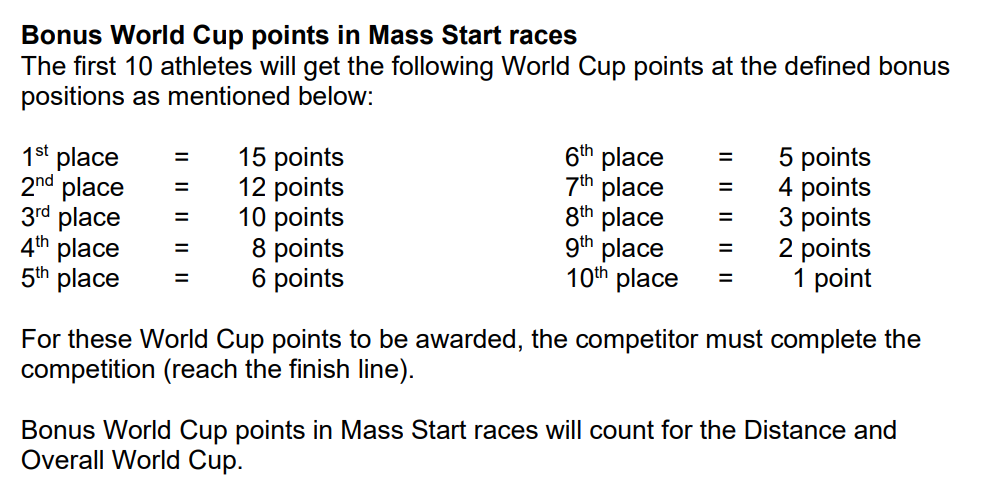
    At eight kilometers, Klaebo moved forward to  take control. That’s because racers were offered World Cup bonus points at 9 k and at 17 k, and Amundsen had admitted in pre-race interviews that he would plan to pursue those points. If he could snatch some of those points, he could close the gap on Klaebo. Huh . . . Klaebo grabbed those 15 bonus points for himself, followed by Amundsen’s 12 point second place consolation prize. Amundsen had hoped to narrow the gap. Instead it widened by three points.

    Soon after the bonus sprint, five Norwegian race suits began inexorably to pull away: Andreas Fjorden Ree, Mattis Stenshagen, Emil Iversen, Klaebo, and Amundsen. Schumacher eased his way forward to seventh position, just three seconds behind the leaders. The pace was fast, but fans could wonder if the skiers were really leaving it all out there. Who could blame them? All season long, Klaebo’s teammates—his closest rivals—had done all they could to drop the guy. Usually, whomever attempted to do so would find themselves dropped and distanced by their own teammates. It looked as though no one was willing to make such a risky play. But in that lull, Einar Hedegart had rejoined the leaders.

    At the 17 kilometer mark, Klaebo again moved forward to seize the bonus points. Klaebo 15 points, Reee 12, Amundsen 10. Barring any unforeseen disasters, Klaebo had the points-lead he needed to claim the Distance Cup. Now the Norwegian fans would eagerly watch how he would race to the finish.

    After the bonus sprint, the course returned to the finishing stretch utilized inhte Sprint course . . . Klaebo knows this part of the course so well. And he used the same tactic that took him to a Sprint victory just two days ago. Resplendent at the front, Klaebo turned on the jets up the final slope, jump-skating away from his rivals. Amundsen followed gamely, but the gap widened just enough to deprive Amundsen of the draft on the subsequent downhill. Klaebo was not to be denied in the final sprint, gliding across the line for his 113th World Cup victory, and the first Distance Crystal Globe of his career.

    Hedegart held on for third, perhaps inspiring the young biathlete to continue competing as a skier in seasons to come. Pellegrino would finish his final race in 13th place, securing his place on the third step of the World Cup Overall podium. Schumacher would race in the main chase group throughout the race, but would fade to 20th at the finish.

    Harald Oestberg Amundsen (NOR) chased Johannes Hoesflot Klaebo (NOR) through an entire season of Distance races. They finally settled the issue over twenty kilometers in Lake Placid. (Photo: Thibaut/NordicFocus)
    Dominance, indeed

    Not every Norwegian ski hero has been a front-runner. Norwegians began to learn of—and begrudgingly to accept—the strategic brand of racing that Pettter Northug employed during his brilliant career: sitting in and sprinting, snatching mass-start Distance races from Distance specialists. Perhaps Northug’s strategy became acceptable because it was so obvious that he was killing himself to hang on to the pace set by the Distance skiers just so he could have a chance to sprint at the end. Norwegian fans admired the effort, the tenacity, the fight. And they wanted a Norwegian skier to win, too. Northug delivered repeatedly, but Northug was an athlete of a different sort—spending off-season weeks gambling lavishly in Las Vegas, and getting into all sorts of trouble in Norway on account of his love of fast cars and strong drink. Northug definitely earned his place in the skiing Pantheon, but even his Norwegian countrymen remain unsure of him.

    The only real way to capture the love of the Norwegian ski fans is to dominate the competition. Klaebo knows this . . . and what he delivered was a season that included a Tour de Ski, a Sprint Globe, a Distance Globe, an Overall Globe, and six Olympic gold medals. Dominance, indeed.

    Referring to his haul of Crystal Globes, Klaebo said, “It’s going to be overweight getting back home, that’s for sure.

    “I always try to focus on a part of the course where I can use a different part of tracks to get an advantage,” Klaebo said. “Today I felt like I was pushing hard up the last uphill, and Harald was right behind me all the way. I managed to get a small gap at the end!

    “I saw it coming!” said Amundsen. “I tried to find his back and stay there. I knew that he would go fast on the last uphill. I just tried to follow.”

    “We had a great team effort,” said Amundsen. “And second place, in the end, was quite good.”

    Now, Team Norway will pack up its trophies and its flowers and its wheels of Gruyere cheese, and head back home to the land of Nordic skiing, and the cheering hordes of Nordic skiing fans.

    “I’m glad the season is over now,” said a smiling Klaebo after the race. “It’s time to rest a little bit.”

    And a well-deserved it will be. We’ve watched a remarkable season scripted by the greatest of all time. We’re unlikely to see such a season again.

    World Cup Final—Men’s 20 k Mass Start RESULTS

    Love Stories Like This? Help Keep Them Coming.

    Feature stories like this one take time, access, and care to produce. If you value thoughtful storytelling and independent ski journalism, please consider becoming a Voluntary Subscriber. Your support directly fuels the work we do to cover the people, places, and moments that make our sport special.

    Join the FasterSkier community!
    Here at the end of all things, another Norwegian podium. Harald Oestberg Amundsen (NOR), Johannes Hoesflot Klaebo (NOR), Einar Hedegart (NOR) celebrate the end of a long season. (Photo: Modica/NordicFocus)


  • Never Count Him Out . . . Klaebo Returns in the 10 k

    Never Count Him Out . . . Klaebo Returns in the 10 k

    This coverage is made possible through the generous support of Marty and Kathy Hall and A Hall Mark of Excellence Award. To learn more about A Hall Mark of Excellence Award, or to learn how you can support FasterSkier’s coverage, please contact info@fasterskier.com.

    A week ago, it looked likethe competitive season of Johannes Hoesflot Klaebo (NOR) might be over. Today, he returned to dominate the 10 k Classic Interval Start at the World Cup Final in Lake Placid. (Photo: Thibaut/NordicFocus)

    Two seasons ago in Minneapolis, the energy of an American crowd lifted an American skier—Gus Schumacher—to a surprising win in the 10 k Freestyle Interval Start. The FIS World Cup returns to the USA, but in a very different environment. Mt. Van Hoevenberg is an historic cross-country skiing destination and two-time host of the Olympic Winter Games (1932 and 1980), but the village of Lake Placid is tiny—barely 3000 residents. Not only is it small, but it’s really really far away from any urban centers that might provide spectators for these World Cup Finals events. New York City is nearly five hours away by car; Boston even farther. Even the closest airport (Albany, NY) is nearly three hours away, even in good weather. Many cross-country ski fans will undoubtedly arrive at Mt. van Hoevenberg for the chance to see their ski-heroes, but the crowds are not likely to be anything like what those heroes experienced two seasons ago in Minneapolis. Still, Americans will be enjoying the rare benefit of racing on home turf. Perhaps Schumacher—or another American on the rise—would be able to break through?

    Team USA sent Schumacher to the starting line along with his partner in the silver-medal-winning Team Sprint, Ben Ogden. Rounding out the American roster were Luke Jager, JC Schoonmaker, Zanden McMullen, John Steel Hagenbuch, Reid Goble, Benjamin Dohlby, Michael Earnhart, Zachary Jayne, Brian Bushey, and Hunter Wonders.

    As is often the case, Norwegian names crowded the ranks of seeded skiers: Emil Iversen, Harald Oestberg Amundsen, Mattis Stenshagen, Andreas Fjorden Ree, and Lars Heggen would toe the starting line, joined by a late-arriving Johannes Hoesflot Klaebo whose arrival was delayed while he—and Team Norway—debated his fitness to compete. After a dramatic fall (and subsequent concussion) in the Sprint semfinals in Drammen last week, Klaebo’s condition had remained in question. before the race, he admitted he might not be at his absolute best, but he felt he owed it to the fans gathered in Lake Placid to make an appearance.

    The arrival of Amundsen had never been in doubt, as he continues to joust with Klaebo in their rivalry for the Overall and Distance Crystal Globes. Like Klaebo, Amundsen remarked that he had been looking forward to this journey to Lake Placid.

    “I spoke with Ben Ogden, and he said it would be lots of people and a good vibe,” Amundsen remarked to FasterSkier in post-race interviews. “So I was looking forward to it. They are traveling to Europe and staying there a whole winter, so now it’s our turn to travel here and get some good races.”

    And a sentimental favorite during this World Cup Finals weekend would be Italy’s Federico Pellegrino who has announced that this World Cup season will be his last. At the end of this weekend, he will hang up his skis and glide off into retirement. Pellegrino’s chances for a fond farewell were improved by the announcement that his old friend and long-time rival, Klaebo, would not be competing in Saturday’s Sprint event.

    But, c’mon, the story of the day is the three point lead enjoyed by Amundsen over Klaebo in the chase for the World Cup Distance title. A week ago, it looked like Klaebo would run the table: Distance, Sprint, and Overall. Who knew this race could be so close. With as much as Klaebo has won this year, it would be understandable to assume that he would win all the Crystal Globes. But Amundsen has never been far behind . . . and with the disastrous collision between Klaebo and Ogden in the Drammen Spritnt (that resulted in Klaebo’s hospital stay for a concussion), Amundsen was able to ski well enough in the Holmenkollen 50 k to slide into the Distance lead.

    Amundsen would ski brilliantly in Lake Placid’s 10 k Classic Interval Start, battling snowy conditions, fighting his way to a fourth place finish behind Ree and Stenshagen. But it was Klaebo—who just a week ago looked like his season might be over—to reclaim what should rightfully have been his along.

    With the energy of a cheering and rowdy Lake Placid crowd,  Ben Ogden (USA) couldn’t hold back. (Photo: Modica/NordicFocus)

    Schumacher and Ogden would both claim impressive finishes: seventh and 11th, respectively.

    “I wanted to go out easy,” said Ogden. “But there was no hope of that with this many people cheering! I really had to fight for it at the end, but I wouldn’t have it any other way.”

    “The last couple of kilometers, it was really fun to hear so many people cheering,” said Schumacher. “And to know that what’s going to make them happy is me going as hard as I can.”

    Never Count Him Out

    Serious contenders in any Classic ski race would normally include Savelii Korostelev (AIN). But like his compatriot, Dariya Nepryaeva, Korostelev is a citizen of Russia. Despite his competing as an Individual Neutral athlete (AIN), he would not have qualified for an American visa. Korostelev would not get the chance to be on the starting line in Lake Placid.

    Snow continued to fall heavily during the Men’s race, gathering in fluffy inches on the course. Skiers continued to struggle, both uphill and down, and conditions looked likely to heavily influence the eventual results.

    Gus Schumacher (USA) would follow the example of his fast-starting teammate, Ben Ogden. Schumacher would finish seventh, Ogden 11th. (Photo:  Thibaut/NordicFocus)

    Ogden started in bib 20 with a loud and energetic fan club cheering him on. Ogden would lead the first 50 starters at the first checkpoint, but would find himself overtaken by Stenshagen, Pellegrino, Amundsen, and Schumacher. That’s right, Gus was on course, and charging.

    Klaebo would ease off the starting line, knowing that the accumulating snow was likely to favor earlier starters. His effort appeared measured; nonetheless, he was fastest through the first checkpoint, leading Amundsen (the only other skier whose placing probably concerned him) by 6.3 seconds, a lead that Klaebo extended to 16 seconds at 3.8 kilometers. If Klaebo was in race-shape today, Amundsen could find himself in trouble in Sunday’s 20 k Mass Start.

    Schumacher trailed Klaebo by only 20 seconds at the halfway mark. Between them could be found Pellegrino, Stenshagen, Ree, and Amundsen. Ogden still maintained a top-ten position, and he was able to spend some time in the leader’s chair while he waited for the arrival of later starters.

    Harald Oestberg Amundsen (NOR) wore the red leader’s bib in the Distance category. He is dertimined to fight to the end in his rivalry with countryman, Johannes Hoesflot Klaebo. (Photo: Modica/NordicFocus)

    As the race played out, the Norwegians gravitated to the top of the list of finishers. Stenshagen would take over the lead, only to be supplanted by Ree. Schumacher would cross the line just behind Pellegrino, and only 25 seconds behind Ree. But the crowd and the headlines were awaiting the arrival of Klaebo, His splits had been fastest throughout the race, and Klaebo was hoping for even more than the win. Klaebo needed to put his recent concussion behind him, and put Amundsen in his place.

    Amundsen—wearing the red Distance leaders bib—would cross the line and into the third slot . . . but that was not to last. Likewise, the red bib was soon to transfer back to the shoulders of Klaebo. To no one’s surprise—but to everyone’s surprise—Klaebo glided across the finish line for the win, some 14 seconds ahead of second place Ree, and 25 seconds ahead of fourth place Amundsen.

    “It was a tough fight, tough conditions,” said Amundsen. “But I think it was fair conditions for everyone.”

    “It was so much people, I couldn’t hear my own thinking,” grinned Amundsen.” That’s a good thing!”

    “I’m second place in the World Cup Overall, so I’m fighting for that,” said Amundsen. “And I’m twelve points behind Johannes for the overall, so it will be a close fight on Sunday. I need to take some points in the sprints during the race, and beat him in the end . . . we’ll see.”

    With two races remaining in the season—one of which (tomorrow’s Sprint) he is likely to skip—it really does appear that Klaebo will complete the near-perfect season, gathering up not only every Olympic gold medal, but the full slate of Crystal Globes—Sprint, Distance, and Overall—as well.

    World Cup Final Men’s 10 k Classic RESULTS

    Love Stories Like This? Help Keep Them Coming.

    Feature stories like this one take time, access, and care to produce. If you value thoughtful storytelling and independent ski journalism, please consider becoming a Voluntary Subscriber. Your support directly fuels the work we do to cover the people, places, and moments that make our sport special.

    Join the FasterSkier community!

    World Cup racing continues this weekend from Lake Placid and Mount van Hoevenberg:

    Saturday, March 21

    10:30 am | Women’s Sprint Qualification Free

    11:05 am | Men’s Sprint Qualification Free

    1:00 pm | Women’s Sprint Final Free

    1:00 pm | Men’s Sprint Final Free

    Sunday, March 22

    12:30 pm | Men’s 20km Mass Start Free

    2:30 pm | Women’s 20km Mass Start Free

    4:30 pm | ONE LAST LAP w/Jessie Diggins & the Retiring Stars

  • Svahn Goes the Distance, Diggins Clinches Crystal Globe

    Svahn Goes the Distance, Diggins Clinches Crystal Globe

    This coverage is made possible through the generous support of Marty and Kathy Hall and A Hall Mark of Excellence Award. To learn more about A Hall Mark of Excellence Award, or to learn how you can support FasterSkier’s coverage, please contact info@fasterskier.com.

    Linn Svahn (SWE) showed that she is no one-dimensional sprinter, holding off the season’s dominant Distance skier —Swedish teammate, Frida Karlsson—for the win in the FIS World Cup Final 10 k Classic Interval Start in Lake Placid. (Photo: Modica/NordicFocus)

    FasterSkier’s reporters watch every single race of the World Cup and Olympic season, so we have our own ideas regarding what may happen on any given race-day. We’ve followed who has been progressing up the standings, who has been fading, who has been injured or ill and how their recovery has progressed. And we follow the amazing and durable actions of Jessie Diggins (USA) who has competed in every single race of the season (That’s right, isn’t it? Someone check the record . . .). Alone among all World Cup competitors, Diggins continues to devote herself to performing at the highest levels on every available race day. If she’s tired, she deals with it. If she gets sick, she overcomes it. If she’s injured, she races through it. If there’s a start line and a finish line, drawn on the snow Diggins is racing. While it may be argued that she might’ve performed even better if she took a day off from time to time, evidently it’s impossible for her to just sit out those race opportunities. And Diggins is also one of only two skiers in the world (along with Johannes Hoesflot Klaebo) who has an honest chance to win on any given day, regardless of distance or discipline. And the reward for such devotion and fortitude?

    All eyes were on Jessie Diggins (USA) whose career is winding down to retirement, but not before another excellent top-five performance in the 10 k Classic, and the clinching of another World Cup Crystal Globe. (Photo:  Thibaut/NordicFocus)

    Any day’s race coverage begins with a check of the start list; that’s how we see the first inclinations of how the story might unfold. Here’s the context of today’s 10 k Classic Interval Start: perennial contenders, Ebba Andersson (SWE) and Kerttu Niskanen (FIN) have chosen to stay home home, Krista Parmakoski (FIN) retired at eh Holmenkollen finish line, and Dariya Nepryaeva (AIN) wasn’t allowed into the country (no American visas issued to Russian citizens) . . . The rest of the contenders appeared to be present. Among the logical contenders within the women’s field were those whose performances shined brightest this season, but whose illnesses and injuries kept them from contention in the year-long FIS World Cup competitions. Frida Karlsson (SWE) is undoubtedly the fastest skier in the world today as she proved repeatedly in the Olympic Winter Games and the recent Holmenkolen 50 k. She is joined by a list of other Distance contenders including Heidi Weng (NOR), Astrid Oeyre Slind (NOR) Karoline Simpson-Larson (NOR), Jonna Sundling (SWE), Moa Ilar (SWE), and Olympic Sprint champion Linn Svahn (SWE).

    Host-nation USA was allowed additional entries. In addition to the much-anticipated participation of Diggins, the American roster included Emma Reeder, Alayna Sonnesyn, Katey Houser, Renae Anderson, Emma Albrecht, Samantha Smith, Novie McCabe, Kendall Kramer, and Rosie Brennan.

    “It’s really awesome to know how many people care about skiing in America,” Kramer said in response to the crowds of eager spectators gather around the course. “It’s heart warming!”

    “I love racing at home!” said Brennan. “It’s so awesome. I had many moments when I was second-guessing myself out there. then Id get to a hill and everyone was going nuts, yelling my name, and I was like ‘Okay, I got this! I got this!”  ‘

    “Honestly, I don’t care about the results,” beamed Diggins after the finish. “I just wanted to enjoy the crowd, and feel the love and the excitement, and just go as hard as I could! Laying in the snow there at the end, I was like ‘That was one of the best 10ks of my life.’”

    In the end, it was Svahn winning a back-and-forth battle with her good friend, Karlsson. Sweden would top the podium, but Heidi Weng would prove the best of the rest, finishing 22 seconds behind the winner. Diggins would battle through the falling snow to secure a fifth place finish in the final interval start race of her career.

    Frida Karlsson (SWE) surged to a mid-race lead, but it was not enough to overcome the momentum of her teammate, Linn Svahn. (Photo: Modica/NordicFocus)
    Not Yet Spring

    While the field—and the spectators—may have been hoping for sunny and mild spring conditions. Wouldn’t that have been nice? But Lake Placid sits at an elevation of 2200 feet—quite high for the east coast—and spring is notoriously late to arrive in these Adirondack mountains. Race day dawned with dense cloud and swirling snow, conditions that seemed likely to challenge ski technicians and skiers, alike.

    The 10 k Classic would be skied over two five kilometer laps climbing immediately from the stadium into the woods. Svahn was the revelation among early starters, totally gapping the rest of the field at all early check points. At the halfway mark of the race, Svahn led all earlier starters by nearly a minute! Later starters among the top seed would begin whittling into Svahn’s times, but even Karlsson would trail by eleven seconds at the first checkpoint, with her teammate, Sundling, another five seconds behind.

    Diggins started in bib 58. She would trail Svahn by 23 seconds at the first checkpoint (13 seconds behind Karlsson, 10 seconds behind Slind). The contenders’ splits were bunched near the front, but it was definitely Svahn who appeared strongest. Svahn continued to hold that lead over Karlsson at the 3.8 kilometer checkpoint, by which time Diggins had managed to take six seconds out of Svahn’s lead.

    Svahn would surge again in the middle kilometers to put another six seconds into Diggins, but the splits identified the next serious challenger as Slind pulled within just a few seconds. And that’s when Karlsson made her move, pulling even with Svahn at 6.7 kilometers. Had Svahn gone out too fast?

    Svahn has won 14 Sprint races in her career, but it is less known that she’s also won three Distance races. She is certainly no slouch when it comes to long events, and she obviously possess great endurance ability. That’s what she must’ve drawn upon in the later kilometers as—despite the charge from Karlsson—Svahn would finish in a dominant 29:04, surging to the victory by 1.4 seconds to claim the first Individual Start Distance victory of her career.

    Diggins would thrill her fans with another gutsy performance, giving her all—as she has always been known to do—in finishing fifth on the day. She extended her lead in the Overall World Cup standings over her closest rival, Sweden’s Moa Ilar, virtually closing out that competition for the fourth time in Diggins’ illustrious career.

    World Cup Final Women’s 10 k Classic RESULTS

    Love Stories Like This? Help Keep Them Coming.

    Feature stories like this one take time, access, and care to produce. If you value thoughtful storytelling and independent ski journalism, please consider becoming a Voluntary Subscriber. Your support directly fuels the work we do to cover the people, places, and moments that make our sport special.

    Join the FasterSkier community!
    Frida Karlsson (SWE) gave it her all in Lake Placid, only to fall just short of the performance of her good friend, Linn Svahn. (Photo: Thibaut/NordicFocus)

    World Cup racing continues from Lake Placid this weekend:

    Saturday, March 21

    10:30 am | Women’s Sprint Qualification Free

    11:05 am | Men’s Sprint Qualification Free

    1:00 pm | Women’s Sprint Final Free

    1:00 pm | Men’s Sprint Final Free

    Sunday, March 22

    12:30 pm | Men’s 20km Mass Start Free

    2:30 pm | Women’s 20km Mass Start Free

    4:30 pm | ONE LAST LAP w/Jessie Diggins & the Retiring Stars

  • Karlsson Leads Swedish Sweep Through Holmenkollen Fog

    Karlsson Leads Swedish Sweep Through Holmenkollen Fog

    This coverage is made possible through the generous support of Marty and Kathy Hall and A Hall Mark of Excellence Award. To learn more about A Hall Mark of Excellence Award, or to learn how you can support FasterSkier’s coverage, please contact info@fasterskier.com.

    Frida Karlsson (SWE) claimed her third Holmenkollen win, her second at the 50 kilometer distance. (Photo: Authamayou/NordicFocus)

    The prize for winning Oslo’s Holmenkollen 50 k is lifelong bragging rights. Such is the nature of the prestige afforded this event within the Nordic ski community. Norwegian fans, especially, remember certain years, certain races, certain rivalries; especially those that are memorable for the racing conditions that challenged the athletes. Fans are likely to remember this 2026 edition, and the thick, stubborn fog that enveloped the racers throughout the 50 kilometer distance. Stadium announcers regularly reminded the audience that racers were entering the stadium . . . otherwise, fans might not have known. The fog may have appeared thicker and soupier through the lens of broadcast cameras, but it’s certain that the fog hung close to the ground, obscuring skiers’ views of the course, of the crowds, and of their competitors. Perhaps that had something to do with the more measured pace the leaders selected. By the halfway point of the race, the entire women’s field was still together (not at all the normally expected state of affairs in women’s mass-start Distance racing). The regular cast of contenders remained at the front—Frida Karlsson (SWE), Ebba Andersson (SWE), Heidi Weng (NOR), Astrid Oeyre Slind (NOR), Jonna Sundling (SWE), and Jessie Diggins (USA)—but none of them seemed eager to race off alone.

    Karlsson would emerge from the fog first, crossing the finish line all alone to claim her third Holmenkollen race, and her third at the 50 kilometer distance. Behind Karlsson, her Swedish teammates—Linn Svahn and Jonna Sundling—would sprint across the line in second and third, just ahead of Heidi Weng (NOR), Nora Sanness (NOR) and Jessie Diggins (USA).

    “It’s such a magic day for our team,” beamed Karlsson. “It’s our first “triple” in the distance, and it’s sick!”

    Alison Mackie (CAN) followed up a win at the U23 World Championships with a 14h place debut in the Holmenkollen 50 k. (Photo: Authamayou/NordicFocus)

    Canada’s Alison Mackie remained in the top 10 through the halfway mark, and continued to make her presence felt throughout the 50 kilometer distance. . A young skier with a bright future, Mackie was certainly making he most of her first Holmenkollen. She would finish the day in 14th, sandwiched between established distance-racing stars Kristin Austgulen Fosnaes NOR) and Astrid Oeyre Slind (NOR).

    Kendall Kramer (USA started 45th (out of 50 starters), but in the close company of the 46th starter, Delphine Claudel (FRA), a world class Freestyle competitor. If they could work together, they could make up many places in a hurry. By the five kilometer mark, Claudel had managed to work her way all the way up to the front . . . but Kramer was nowhere to be seen. Claudel would hang on to finish 28th. Kramer would cross the line 41st.

    Clearly the best . . . Frida Karlsson (SWE) raced away from her rivals, exiting the fog to claim victory in Holmenkollen’s historic 50 k Freestyle.  (Photo: Authamayou/NordicFocus)
    Holmenkollen 50 k Freestyle

    The Holmenkollen 50 k consists of six laps of an 8.3 kilometer loop, demanding 1000 feet of climbing per lap. And this day in Oslo, race organizers elected to stage the race in a manner that put both the women’s field and the men’s field on the course at the same time, albeit separated by half a lap’s distance. The men’s field would come through at the end of the bonus points at 19.6 kilometers just before the women started, providing a head start of approximately a four kilometers. Stragglers from the men’s field would ultimately be caught by the women. Likewise, stragglers from the men’s field would later be caught by the women. In the thick fog that hovered over the course during today’s race, there was plenty of opportunity for mild confusion.

    Karlsson Weng, Andersson, and Slind would ease to the front, providing the early pace, but not going straight to the accelerator as they might have done on a normal day. Behind them, another predictable tier of racers followed, including Nepryaeva, Sundling, and Diggins. The men’s field had already passed through 20 kilometers in a massive, cohesive unit. It was possible that the bizarre conditions on the day would influence the women’s field to do the same.

    Diggins won the bonus points at the three kilometer check point, gaining another 12 points over her closest rival in the chase for the Crystal Globe, Moa Ilar (SWE). Diggins would again remain ahead of Ilar at the 11.3 bonus points line. Diggins would collect eight points by crossing the line fourth.

    Just before the end of the second lap, Slind stumbled and fell. She would need to spend extra energy to rejoin the leaders, if she was even able to. The field would slow a bit in the feed zone, but Slind would still have a gap of nearly eight seconds to make up . . . and Weng, Andersson, Karlsson, and Diggins continued to make the pace at the front.

    Karlsson upped the pace as they approached the 27.9 bonus points line, gapping he rest of the field in the company of Weng and Karoline Groetting (NOR). Diggins led the rest just nine seconds behind, but it seemed that a gap was forming. Diggins would use the technical downhills of the Holmenkollen course to rejoin the leaders, though she also dragged other sprinters forward. With twenty kilometers remaining, the leaders had yet to get rid of Sundling and her Swedish teammate, Olympic Sprint champion, Linn Svahn. Karlsson and Weng would’ve known that their chances of victory relied on their ability to drop those sprinters. All the leaders opted to switch skis at the end of the lap. They would all be on new skis for the final two laps.

    Karlsson used the first uphill of the fifth lap to break away. She was followed briefly by Groetting, bu by the top of the slope, Karlsson was away, disappearing into the fog at the front. Groetting would dangle alone in the fog ahead of a chase group led by Svahn. Diggins would continue to bob at the back—on again, off again—repeatedly showing her ability to close gaps and make up ground.

    With 12 kilometers to go, Karlsson was away, in full flight, and powering through the fog. Her lead would continue to grow: ten seconds, 15 seconds, 30 seconds, ultimately extending to nearly two minutes. The solo chaser, Groetting, would be caught by the chase group that now consisted of six: Weng, Svahn, Sundling, Groetting, Nora Sanness (NOR), and Diggins. Diggins may be leading the World Cup Distance standings, but Karlsson was continuing to prove that she is the premier Distance skier in the world.

    Linn Svahn (SWE), Frida Karlsson (SWE), Jonna Sundling (SWE) made up what Karlsson described as “Our first triple” in World Cup Distance podiums. (Photo: Authamayou/NordicFocus)

    Karlsson would ski the last lap alone to claim her second Holmenkollen 50 k victory. The chase group would decide the podium with a sprint to the line, in which Svahn would outsprint Sundling. Weng would cross fourth, ahead of Sanness and Diggins.

    Karlsson had shown the potential to exit the recent Olympic Games in possession of four gold medals . . . her performances would deliver only two (the Skiathlon, and the 10 k Freestyle). After the disastrous tumble of Ebba Andersson in the Team Relay (which allowed Norway to steal away the gold medal), and Karlsson’s own illness that kept her from competing in the 50 k, Karlsson appeared still to have something to prove when she toed the Holmenkollen starting line in Oslo. She would ski away from the rest of the best, stamping her authority on this historic race and claiming the sort of lifelong bragging rights that only the Holmenkollen can provide.

    Holmenkollen Women’s 50 k Freestyle RESULTS

    Love Stories Like This? Help Keep Them Coming.

    Feature stories like this one take time, access, and care to produce. If you value thoughtful storytelling and independent ski journalism, please consider becoming a Voluntary Subscriber. Your support directly fuels the work we do to cover the people, places, and moments that make our sport special.

    Join the FasterSkier community!
    Good luck finding the finish line . . . Linn Svahn (SWE) and Jonna Sundling (SWE) race through Holmenkollen’s thick fog toward the Swedish flag held aloft by race winner, Frida Karlsson (SWE). (Photo: Authamayou/NordicFocus)


  • So Many Red Suits . . . And Klaebo In a League of His Own

    So Many Red Suits . . . And Klaebo In a League of His Own

    This coverage is made possible through the generous support of Marty and Kathy Hall and A Hall Mark of Excellence Award. To learn more about A Hall Mark of Excellence Award, or to learn how you can support FasterSkier’s coverage, please contact info@fasterskier.com.

    In the absence of any other aggressive pacemakers, Johannes Hoesflot Klaebo (NOR) was left to set the pace in Goms’ 20 k Classic Mass start. (Photo: Authamayou/NordicFocus)

    Klaebo wins . . . we saw that coming.

    Let’s face it: cross-country ski racing can be kinda boring. Races are long (even the short ones), speeds are really not that high, even the fastest accelerations occur in slow motion when compared to many other sports. There’s a bit of a draft that can protect opportunistic sprinters, but not really all that much. And even the most hotly contested World Cup races are typically dominated by a synchronized clot of red Norwegian suits striding up the trail in near-perfect unison, beautiful to witness, but kind of dull in its predictability. Watching cross-country ski racing isn’t for every sports fan, especially when predicting the winners is becoming such an un-challenging task.

    But I’m not bored: I’m fascinated. And I find myself even more fascinated with each passing week. Here’s what fascinates me: how can a skier just continue getting stronger and stronger? Wouldn’t that be awesome for all the rest of us to experience? Knowing that we could just keep getting better and better? Coaches, counselors, motivational speakers all tell us that it’s possible: keep working harder and you’ll just keep getting stronger. But the performances of athletes at all levels show us that this rosy prediction just isn’t true. There’s a limit, a breaking point, a glass ceiling. Plenty of athletes work hard, and all the skiers in these World Cup races are fully committed and supremely talented. Yet even the very best athletes plateau, even the strongest racers stumble. And the margins at the tippy-top of athletic performance become amazingly thin, showing that almost any world-class contender can win on any given day. Ironically, FIS World Cup rankings from second place through last place are regularly re-shuffled: Gus Schumacher was second yesterday, today he’s 22nd. But the guy in first place is often the same guy. Johannes Hoesflot Klaebo wins more than half of the World Cup races he enters—that’s just crazy. Klaebo won again today, and he did it in an offhanded fashion that makes it appear he has only himself to compete against. I’m fascinated . . .

    Johannes Hoesflot Klaebo (NOR) waits for the second and third place finishers at the end of the 20 k Classic Mass Start in Goms, Switzerland. (Photo: Authamayou/NordicFocus)

    Goms, Switzerland offered these final World Cup events prior to the arrival of these same athletes at Olympic venues in two weeks. Spectators are fully aware that the race we watch this week may not be the same as the race conducted a few weeks from now. Dominance in January can translate into further dominance in February, but there are plenty of miles to cover between now and then. Germ-filled airline flights and nights of fitful sleep, breakfasts and lunches and dinners to orchestrate, supplements and strategies to employ, training to undertake, reset and recovery to seek. And somewhere deep inside an athlete’s body, the systems are churning . . . getting ready for a day when speed and endurance are needed, when courage and fortitude may lead to victory and glory, or to humiliation and defeat. Goms offered as accurate an approximation of those Olympic races as it’s practical to stage: Olympic races staged in Val di Fiemme will include a Team Sprint (like Friday’s Team Sprint), and a Classic Sprint (like yesterday’s Classic Sprint). But today’s 20 k Classic Mass Start may not offer a precise predictor of the Olympic 50 k Classic Mass Start. Fifty kilometers is really really far . . . and plenty can happen in those 50 kilometers. The 20 k is more straightforward, and offers less space for multiple attacks to occur. It’s possible that a 20 k field will wait for a single significant move. That’s the way things played out in Goms, today.

    John Steel Hagenbuch (USA), Zak Ketterson (USA) moved steadily through the field during the FIS World Cup 20 k Mass Start in Goms, Switzerland. (Photo: Authamayou/NordicFocus)

    North American men performed well in today’s 20 k, especially considering the stress and accumulated fatigue of such a long and arduous World Cup weekend: Zak Ketterson was 18th, Xavier McKeever 19th, Schumacher 22nd, Antoine Cyr 34th, Hunter Wonders 36th, Zanden McMullen 38th, Remi Drolet 40th, Max Hollman 41st, Thomas Stephen 45th, Zach Jayne 52nd, John Steel Hagenbuch 55th, Luke Jager 59th. Many of those skiers began today’s race with start positions waaaay back in the field, spending 20 kilometers dodging pole tips and ski tips on their journey forward. Theirs was a decidedly different race from the calm, controlled, unmolested effort afforded the leaders. But everyone who’s ever started at the front got there by battling their way from the rear. The North Americans are battling . . .

    “There is a lot of scrambling in a field like that, especially when you are starting in a further-back bib,” said Ketterson. “The key is to just stay relaxed during the first two laps, because all those little moves have to be repaid with interest later in the race. It’s just about being smart with your energy.”

    “(Today’s race) was part of the progression,” said Schumacher. “This is sort of my overload; now I’ll recover, absorb it, and hopefully be fitter going forward. Travel day tomorrow headed to Livigno, and incorporating recovery by just chilling out, basically enjoying the Alps. Bunch of snow just fell kind of all over, which is cool.”

    Norwegian race suits dominated the front of the 20 k Mass Start, with a brief appearance by a lone skier in blue, France’s Mathis DeLoge. The Olympic 50 k in Val di Fiemme may prove different. (Photo: Authamayou/NordicFocus)
    Norway, Norway, Norway, Norway, Norway, Norway, Norway

    While it may not always be evident on the surface, there’s drama in every meter of a Mass Start race—emergencies averted, difficulties overcome, disasters dodged, over-crowding endured, loneliness faced. Racers usually want to avoid as much drama as possible, and the racers least likely to encounter difficulty are those who start in the front row.  Four Norwegians made up the front row—Klaebo, Amundsen, Mattis Stenshagen, and Andreas Fjorden Ree. They’d lead the field out onto the first of four loops, monitoring the early pace set by pre-race favorite, Klaebo.

    Lap 1 appeared to be a freebie. It’s understood that the pace would get high, but for every kilometer that Klaebo controls the pace at the front, it will be all that much more difficult to dislodge him later in the race. Klaebo is a fast skier, but his strategy is typically not one that attempts to shed other skiers. He’ll control the pace at the front, waiting for someone else to take control. If no one does, then Klaebo will likely win the sprint at the end. If another skier does attempt to assert themselves, then Klaebo will ride their tails and likely win the sprint at the end. Anyone who wants to beat Klaebo needs to drop Klaebo, and they need to do so well before the finishing straightaway approaches.

    The other skiers likely to test Klaebo’s long-form endurance—including Klaebo’s own Norwegian teammates—were decidedly passive in Goms. And Iivo Niskanen—the skier most likely to test the strength of the field two weeks from now Val di Fiemme—was absent from the Goms start list. Through five kilometers, the leaders continued to be relaxed. Klaebo, Harald Oestberg Amundsen, Andreas Fjorden Ree, Emil Iversen (NOR), Mathis Deloge (FRA) and Savelii Korostelev (AIN) who had started far back in bib 33. Schumacher came through the five kilometer mark in 12th place, only two seconds behind the leaders.

    Off the front, and receding into the distance: Johannes Hoesflot Klaebo (NOR), Emil Iversen (NOR), Harald Oestberg Amundsen (NOR) made Goms’ 20 k Classic Mass Start into a three-man race. (Photo: Authamayou/NordicFocus)

    Through 7.5 kilometers, Norway continued to enjoy the presence of eight skiers in the top 12, a level of numeric-dominance that Norway will not enjoy when the 50 k is run in Val di Fiemme (where Team Norway will be limited to four starters). The Norwegians were accompanied only by the persistent French, Korostelev, and Estonia’s surprising star, Alvar Elev. A small spit occurred in the field at 9.2 kilometers where bonus points were offered and Klaebo led a mini-break ahead of Iversen and Amundsen. What had looked like a pedestrian pace was revealed to have been a pace at which the vast majority of the skiers had been just barely holding on. Klaebo tapped the accelerator, and the field strung out helplessly behind him. Norway took the points for the first eight positions, but only Iversen and Amundsen were able to hold their positions at the front with Klaebo.

    Korostelev led the chase of the three leading Norwegians, and the rest of Team Norway appeared perfectly willing to let him do so. Valnes latched on to Korostelev’s tails,and the other remaining Norwegians lined up behind Valnes. If this were a bike race, viewers could assume that team tactics were being employed—Norwegians lining up to defend Klaebo’s lead, and forcing other nations to chase. But today made it look like the field simply stretched out in a ranking of available strength and endurance. Anyone who could’ve gone faster would certainly have gone faster.

    Though not exactly in dramatic fashion, the race continued to unfold at the front. Classic skiing creates a unique drafting dilemma: in order to be as close as possible to the skier in front, the following skiers are compelled to match the striding and/or double-poling tempo of the leader. It makes cross-country skiing uniquely picturesque, but it removes any advantage that a skier might seek by choosing a different tempo. Remember Therese Johaug? Her supernaturally-high tempo always appeared awkward and uncomfortable whenever she skied in the company of other racers. Fortunately for Johaug, she spent very little time in the company of other racers during her racing career. Today in Goms, the three dominant Norwegians set a steady pace ina predictable tempo. Iversen and Klaebo are in-season and off-season training patners: it makes sense that they’d adopt a similar tempo. Amundsen was the outlier of the three, but he followed their tempo in lockstep. Here’s the thing—if no skier seeks to take an individual advantage, then we can safely assume the at the advantage goes to Klaebo.

    Korostelev continued to lead the chase group, but trailed by an ever-widening margin. With one lap remaining, the gap had stretched to nearly 40 seconds. With four kilometers to go, Klaebo was seen tightening his pole straps. Another bike race analogy: when a rider reaches down to tighten the straps on their shoes, they’re preparing for the sprint. For Klaebo to have done so—so quietly and so matter-of-factly—must have caused the hearts of his rivals to sink. He’s not hanging on, he’s preparing to pounce.

    Klaebo would’ve been likely to outsprint both Iversen and Amundsen at the finish line . . . and while that may be the plan he intends to follow in Val Di Fiemme in a couple of weeks, it’s not the only winning strategy he possesses. Today in Goms, Klaebo showed that he can win in the most understated—though thrilling—way. He simply skied away. One little uphill (one of those from yesterday’s Sprint course) and he trotted lightly up it, exposing the truth that Iversen and Amundsen may have been close to their performance limits all along. Amundsen chose an inside line on the hill, but stalled on the steeper slope he ascended. Iversen sought better kick on an outside line beyond the groomed tracks, but continued to slip just a bit. And Klaebo just cruised off the front in a nonchalant manner that went all but unnoticed. None of the course-lining spectators even cheered. The decisive moment of a World Cup Mass Start Distance race, and almost no one even saw it happening. Well, Iversen and Amundsen might’ve noticed . . . both came nearly to an exhausted standstill at the top of the hill. Klaebo would get away to a gap of 40 seconds, ultimately coasting easily across the finish line followed by Iversen and Amundsen. Klaebo has shown in the past that he is a master of preparing for major championships. He appears ready, again.

    There have been plenty of easy-looking wins in Klaebo’s illustrious career, but few of those 107 individual wins ever looked easier than this. And, for additional perspective, this “easy” win came in a 20 kilometer Classic Mass Start race ahead of the world’s finest Distance skiers. Team France found itself overmatched—no pesky Frenchmen tweaking the race pace today. Team Norway found that it really has only one contender for gold—the rest of them can fight it out for silver and bronze. Korostelev found that the dominance he’d enjoyed in the last few seasons behind Russia’s curtain did not translate into similar dominance on the World Cup (but who knows what he’ll look like in the Olympics). And Iivo Niskanen—watching the race on TV from his sofa in Finland—would’ve seen that Klaebo is ready for any surge that the courageous Finn may choose to throw down in Val di Fiemme. It won’t be the same race as today in Goms, but Klaebo’s performance today makes it difficult to image how different the final outcome may be. Good luck, Iivo. Good luck Savelii. Team Norway is strong, and their man, Klaebo, is off the charts.

    There was one exciting moment: watching the eight-man chase group sprint to the line, where Stenshagen outsprinted Korostelev for seventh place. Korostelev tested himself against Team Norway, and found himself overmatched. Team Norway had faced another Russian challenger, and had stuffed him into the back seat. There’s a bitter rivalry there, one likely to be played out again when the Olympics get underway at the Nordic venues of Val di Fiemme in February. There won’t be quite so many Norwegians for Korostelev to deal with, but he might find that at least a few of those Norwegians—likely Amundsen, Iversen, and Klaebo—will be up the track, dividing the medals amongst themselves in the final kilometers.

    Men’s World Cup 20 k Mass Start RESULTS

    Help Support Our Olympic Coverage!

    FasterSkier will have our own Nat Herz on the ground at the Olympics, which, to be honest, is a very big financial lift for us. If you value the thoughtful work and access FasterSkier provides at championships like this one, please consider becoming a Voluntary Subscriber. Your support directly fuels the work we do to cover the people, places, and moments that make our sport special.

    Join the FasterSkier community!
    So many red suits . . . Emil Iversen (NOR), Johannes Hoesflot Klaebo (NOR), Harald Oestberg Amundsen (NOR) continue Norwegian dominance in World Cup Distance racing in Goms, Switzerland. (Photo: Authamayou/NordicFocus)
  • Schumacher! Two Days, Two Podiums

    Schumacher! Two Days, Two Podiums

    This coverage is made possible through the generous support of Marty and Kathy Hall and A Hall Mark of Excellence Award. To learn more about A Hall Mark of Excellence Award, or to learn how you can support FasterSkier’s coverage, please contact info@fasterskier.com.

    Gus Schumacher (USA) celebrates his second place finish in the World Cup Classic Sprint in Goms, Switzerland. It was his second World Cup podium finish in as many days. (Photo: Authamayou/NordicFocus)

    Maybe the Americans really are that good . . .

    With the Olympic Games just around the corner, American men (lots of them!) are surging toward the front of the World Cup field. And while the last few World Cup weekends have been events that were only sparsely attended by the sports brightest stars, today’s Classic Sprint in Goms Switzerland was a fully stacked field with most of the primary contenders present. Many of them would be hoping that this event would be a dress rehearsal for the Classic Sprint that will be raced during the Olympics in Val di Fiemme.

    Over the last few weeks, it’s been kinda cool to see what racing would look like in the absence of Johannes Hoesflot Klaebo . . . but now it’s time to turn from things as they have been, and return to things as they should be. Klaebo is back, and it’s an amazing time to watch ski racing: perhaps the greatest ever to do this sport is currently racing and skiing among us. Who knows? Maybe this will be his final season. If he were to succeed during the Olympic Winter Games of Milano-Cortina in the same way he succeeded at last year’s World Championships in Trondheim (six races, six wins, Nordic skiing immortality), there would virtually be nothing left for him to win. This skier has taken us to a rare place in sport history: Babe Ruth is alive and swinging, Muhammad Ali dances across the ring, and we get to watch history played out on live-streamed broadcasts. Let’s enjoy it—and marvel at it—while we can.

    Gus Schumacher (USA) claimed his second podium in as many days with a brilliant second-place finish behind,Johannes Hoesflot Klaebo (NOR) and ahead of Edvin Anger (SWE). (Photo:  Authamayou/NordicFocus)

    While Klaebo is back on tour—and coasted to yet another World Cup Classic Sprint victory—it felt more like an American coming out party and less like yet another Klaebo coronation. Gus Schumacher led the way with a brilliant and confident second place, ahead of a bull-headed Edvin Anger (SWE) who continues to think that Klaebo can be beaten with brute force and raw power. Klaebo proved Anger wrong yet again . . . but it was Schumacher who stole the show.

    “These courses are really hard, like that hill is about a minute long,” said Schumacher. “And yeah, being an all around athlete—like having some distance ability—it really helps me out there.”

    And Schumacher was not the only American to deliver standout performance in Goms. Five American men qualified in the top 17: Ben Ogden 6th, Zak Ketterson 9th, Schumacher 12th, Schoonmaker 13th, Zach Jayne 17th. Jack Young did not produce the Classic sprinting result he may have hoped for. He finished qualifying 39th, just over a second outside the advancing standard. Kevin Bolger also would’ve found himself disappointed this morning in Goms, completing his qualifying round in 61st.

    “The qualifier was a great opportunity to improve on my disappointing results last weekend,” said Jayne. “I created an ambitious race plan and with the great wax support, I delivered. Given that—and given the tough course—I don’t find the (qualifying) result too surprising, but it is a nice treat.”
    JC Schoonmaker (USA) was one of a host of American men delivering great performances in Goms. In the Classic Sprint, Schoonmaker would qualify 12th, and finish 10th overall. (Photo: Authamayou/NordicFocus)
    Americans Crowd the Heats

    The beginning of the Sprint heats made it look like Klaebo was involved in a different sort of drama . . . after the strong qualifying effort of Individual Neutral Athlete, Savelii Korostelev. With the Olympics approaching—and Korostelev improving his performances each week (especially in Classic events)—Klaebo may have felt it prudent to give the young Russian a better look so that he didn’t find himself surprised in Milano-Cortina. Facing Korostelev in Quarterfinal 1, Klaebo drifted craftily to the rear for a clearer view of the young Russian. There Klaebo stayed through the first uphill, and the second where Lauri Vuorinen lost momentum, blocking Klaebo’s progress and wedging him behind Korostelev. But all it took was one extra push from Klaebo over the top to send him flying down the other side—past Vuorinen, past Korostelev, past Valnes, and across the finish line for the heat win. Valnes held on for second in. front of a fast-closing Korostelev.

    Ogden followed Edvin Anger through the second quarterfinal, holding on for second ahead of a fast-charging Hovard Moseby (NOR) who would also secure a lucky loser spot.

    Zachary Jayne and JC Schoonmaker entered Quarterfinal 3 alongside Even Northug (NOR) and Oskar Opstad Vike (NOR). Jayne went straight to the front, determined to use his evident qualifying speed to insure a fast heat. Jayne’s enthusiasm would be quickly curbed by the thin air of high elevation and the slow snow that resulted from overnight accumulations. Jayne would fade to the rear of the field (ultimately finishing 27th on the day) while Schoonmaker surged forward in pursuit of Theo Schley (FRA). Schoonmaker would hold his advantage, even easing up a bit before the line ahead of Anton Grahn (SWE), Vike, and Northug.

    “The heats were just on another level,” said Jayne. “The heat selection was particularly stressful and something I have never experienced before. I chose heat 3 because, statistically, it has the most lucky losers. My position at the front just happened organically and I paid the price for a fast start. Happy to race the way I did, but unsatisfied with the outcome, more to learn and more to reach for. Great day for the Americans and I am truly honored to be a part of it, no matter how small my contribution.”

    After his all-out chase onto yesterday’s Team Sprint podium, it would be understandable if Schumacher appeared sluggish in Quarterfinal 4. But that’s not the way Schumacher races. He seems to have an ability to recover quickly, and to ride waves of seasonal momentum. He popped to the front at the top of the final climb (ahead of an inexplicable stall from Joni Maki), and surged down the other side where he would hold his advantage across the finish line

    Ketterson found himself at the front of what initially appeared to be a tactical heat. He employed an earlier diagonal stride on the first uphill than the rest of his heat, remaining light and quick. If there’s a smart way to ski at the front of a slow heat, Kettterson was demonstrating it. He scampered up the final hill as the field crowded around him, then veered, regretably, into the tracks on the shorter righthand side, slamming the door (as it turns out, a bit over-zealouslys) on Sweden’s Georg Ersson who was lucky to escape with poles and skis intact. Ersson would overcome Ketterson in the finishing straightaway, advancing to the semifinal. Ketterson would find himself disqualified in what would otherwise have been a personal best Classic Sprint performance.

    “Completely my fault!” said Ketterson. “He was in my blind spot and it was a split second decision that obviously ended up being a big blunder. I should have just stayed in my own track and taken the position behind him on the final downhill.”
    “The classic sprint at the Olympics has been my primary goal for the entire season, said Ketterson. “I hope I have shown enough ability to earn a start, but from this point on it’s not within my control so I will just do my best to focus one day at a time.”
    As they say in NASCAR, rubbing is racing . . . and American men were solidly in the mix in every heat of Goms’ Classic Sprint, including the first semifinal where Erik Valnes NOR) hit the deck as JC Schoonmaker (USA) headed for the hinterlands.  (Photo: Authamayou/NordicFocus)
    Classic Sprint Semifinals

    Three American men—Ogden, Schoonmaker, Schumacher—advanced to the Sprint semifinals. Three guaranteed finishes in the top 12: that’s a sign of a seriously strong team. But while it’s great to qualify for a Sprint semifinal, the names on the roster when you get there can be pretty daunting. Semifinal 1: Klaebo, Anger, Schoonmaker, Valnes, Ogden, Northug. That’s a seriously stacked heat. In that semifinal, Klaebo’s start was far more assertive than his quarterfinal, and it produced the result of luring Anger out into an early lead. On-air commentator, Andrew Kastening, got it totally right: “You’d think as time would go on, that Edvin Anger would learn to let Klaebo lead,” said Kastening. Evidently, Anger is not the quickest learner . . .

    Ogden and Schoonmaker maneuvered through the pack, their kick wax seeming sufficient on the ascent of the first hill, but their glide on the downhill seeming less than stellar. Anger continued to lead over the top of the second hill. On the subsequent downhill, Klaebo glided into a too-small gap on the inside of Anger, who held his line and allowed Klaebo to ease through without issue (well done, Edvin). The move allowed Klaebo into the lead, but it sent ripples through the skiers behind the leading duo. Valnes found his ski tips tangling with Schoonmaker’s tails . . . Valnes ended up flopping spectacularly onto his backside while Schoonmaker was launched through the V-boards and into the soft snow of the infield. Schoonmaker somehow managed to avoid complete disaster, stayed on his feet, and managed to find his way back on course. Ogden wove through the carnage to finish third, where he’d wait to see if he would advance to the final as a lucky loser. Schoonmaker would finish fifth behind Northug. Valnes would limp home in sixth.

    The second semifinal was relatively less star-studded, though still featured Sprint standouts such as Vike, Ersson, Joni Maki (FIN) Simone Mocellini (ITA), Anton Grahn (SWE), and Schumacher. Mocellini would make most of the pace in the heat, cresting the final hill with a slim lead over Schumacher. Schumacher would ride fast skis down the final slope, and step deftly inside of Mocellini as they entered the final double pole sections. Schumacher would hold on to cross the finish line first, and advance to the Sprint Final where he would join Ogden.

    Johannes Hoesflot Klaebo (NOR) pushed an unwitting Edvin Anger (SWE) into the lead in both the semifinal and final. (Photo: Authamayou/NordicFocus)
    Classic Sprint Final

    Two Americans advanced to the Classic Sprint Final—that’s a seriously legit statistic—where they’d be joined by Anger, Mocellini, Northug, and the omnipresent Klaebo. Ogden had already looked fatigued in the semifinal (after a high-intensity podium finish in yesterday’s Team Sprint, who can blame him?), but Schumacher continued to look fresh and fast.

    “I was definitely pretty tired from the Team Sprint yesterday,” said Ogden. “Gus and I were pretty fired up; hard to fall asleep (so) I was feeling yeseterday, today1 And with the training block I’ve been doing the last few weeks, I think that was on full display in the final. But I’m still stoked with how today went, for sure. The plan was not to be the best version of myself this weekend—maybe like second best version—so I’m feeling pretty good about how that went down!”

    “I think I still capitalized,” continued Ogden. “And got away with a really really solid day. Good stuff . . . awesome for the team, awesome for everybody!”

    Anger never seems to learn. Maybe one day he’ll become as dominant as his ski tactics currently imply he thinks he is . . . but in Goms’ Classic Sprint Final he was just another guy playing right into Klaebo’s hands. Schumacher is a quick study, though; he’s learned where he nees to be, and he slotted in right behind Klaebo who skied the very same race as in the semifinals: let Anger lead across the flats, step into an open lane to keep from getting bunched on the first uphill, while continuing to force Anger to keep his nose in the wind. Poor kid . . . he imagines himself in a rivalry with Klaebo, who seems only to consider Anger as a convenient stepping stone to ever more Sprint victories.

    That’s when Klaebo switched it up—flowing past Anger on a downhill, powering up the final climb, high-tempo diagonal stride from bottom to top, effectively deciding the race with 400 meters still to go. Schumacher rocketed past Anger as the rest of the field locked up behind the stultified Swede. Schumacher showed his tremendous form and fitness, remaining quick and snappy to the end, powering across the line just behind a relaxed and coasting Klaebo. Schumacher—and Team USA’—would earn a second World Cup podium in as many days. It’s bizarre to watch a Sprint Final become a death march, but such was the level of exhaustion that the Goms Sprint course had loaded into the arms and legs of these racers. Anger survived across the finish line in third. Ogden faded to sixth. Even so, two Americans in a Classic Sprint Final . . . there haven’t been many days that Team USA would celebrate more than this one.

    Schumacher summarized his progress,and his prospects: “The way it’s set up, these races actually probably will give me a bit of a boost, fitness wise, which is cool to think about.”

    Klaebo continues to lead in all World Cup categories this season: Sprint, Distance, and Overall. His level of dominance is unprecedented as the field approaches the Olympic Winter Games.

    Men’s Classic Sprint RESULTS

    Men’s Classic Sprint QUALIFYING

    Help Support Our Olympic Coverage!

    FasterSkier will have our own Nat Herz on the ground at the Olympics, which, to be honest, is a very big financial lift for us. If you value the thoughtful work and access FasterSkier provides at championships like this one, please consider becoming a Voluntary Subscriber. Your support directly fuels the work we do to cover the people, places, and moments that make our sport special.

    Join the FasterSkier community!
  • Oberhof Freestyle Sprint—Lars Heggen Proves His Point

    Oberhof Freestyle Sprint—Lars Heggen Proves His Point

    This coverage is made possible through the generous support of Marty and Kathy Hall and A Hall Mark of Excellence Award. To learn more about A Hall Mark of Excellence Award, or to learn how you can support FasterSkier’s coverage, please contact info@fasterskier.com.

    Lars Heggen (NOR) overpowered the field in Oberhof, but many of the world’s best sprinters—his Norwegian teammates—were absent from the day’s racing. (Photo: Authamayou/NordicFocus)

    Some day, Norway won’t be the only force in Men’s World Cup cross-country skiing. Some day, the participation of other nations will truly matter. Other nations will hear their anthems played, other skiers will excel, other results will be cited and praised. Some day, France may figure it out, or Finland may remember its heritage, or Sweden may return to prominence. The USA may identify another Bill Koch, or Italy another Pellegrino, or Switzerland another Cologna, or Russia another Bolshunov. Some day, the podium of the Men’s Cross-Country Skiing World Cup will not be decorated exclusively in Norwegian flags. While that’s not yet the cross-country skiing world that we live in, it is this upcoming World cup weekend in Oberhof where we expect to witness a kind of “It’s A Wonderful Life” view of Nordic skiing . . . the chance to see what the world would be like without them.

    France stayed home from Oberhof, presumably for national championships and team selections of their own. But everyone else is here, hoping to add to their World cup résumés with some of the scraps left on the tablecloth by absent Norwegians. Finland has sent its best (their Sprinters, anyway), and Sweden (in Norway’s absence they could make a splash), and the Italians (Federico Pellegrino and Elia Barp will see their chances to capture glory). The Czechs and the Swiss are here as well, hoping to grab World Cup distinction while the Norwegians are at home. And Team USA has sent it’s own hungry skate-sprinters, as well. Ben Ogden and Jack Young will be vying to return to the finals . . . even to imagine standing atop the podium (dare we say). JC Schoonmaker will be desperate to prove he belongs on the team that marches into Milano-Cortina. Gus Schumacher will be itching to prove that he and Ogden make a compelling Team Sprint team. There’s a lot going on . . . the same sort of drama that goes on every single week of the World Cup season, but no one really notices it because we’re so distracted by the Norwegian that tsunamis through every World cup venue.

    And where’s Norway? Well, Norway has more important business to attend to. World Cup wins, World Cup podiums, World Cup points: those are every-week occurrences for ski-crazy Norway. But 2026 is an Olympic year . . . the big prizes will be awarded at the Games of Milano-Cortina. So, this weekend in Oberhof, Norway sends stand-ins while the true contenders refine their technique or taper their training, or just put their feet up for a few hours before the headlong streak toward Norwegian immortality in Milano-Cortina continues.

    The elder Northug bother—Petter—was one of Norway’s greatest champions, but even he faced disappointment when it came to Olympic qualification. If Lars Heggen fails to make the team for Milano-Cortina, he will understand the parallels between his pain, and Northug’s. (Photo: Nordnes/NordicFocus)
    Norway Still Expects to Win

    Lars Heggen (NOR) is 20 years old . . . and he just dominated the Sprint competitions at the recent Norwegian Nationals. Granted, a number of Norway’s very best Sprinters weren’t there (no Klaebo, no Valnes, no Amundsen), but Heggen made enough of an impression that many Norwegian ski-pundits called for his immediate elevation to the Olympic Team. We can assume that Petter Northug was not among that enthusiastic group of pundits . . . especially since a 20-year-old Northug dominated 2006 Norwegian Nationals in an even more commanding manner than Heggen did in 2026. And Northug was unceremoniously denied an Olympic berth because of the selection committee’s assertion that, at only 20, he was too young for the pressures of Olympic competition, that Northug would benefit from more development time before being tossed into the Olympic maelstrom. Northug’s career turned out all right in the end, but it may have been even better if he’d collected another Olympic medal or two at the 2006 Games in Torino.

    Northug’s little brother, Even, competes for Norway in the World Cup Sprint this weekend in Oberhof. Like his brother 20 years ago, Even Northug has already been told that no spot is reserved for him on the Norwegian Team at the upcoming Olympic Games. Well, he’s still a world class Sprinter . . . it will be interesting to see how the younger Northug uses this weekend’s Sprint opportunity to comment on his being the second Northug to have been ignored in his efforts to make a Norwegian Olympic Team.

    But first, you need to qualify . . .

    The top American qualifier in Oberhof, JC Schoonmaker (USA) leading Even Northug (NOR), and Zanden Mcmullen (USA) in their quarterfinal heat. (Photo: . Authamayou/NordicFocus)
    Qualifying

    We don’t know exactly why, but it’s been reported that top 30 in today’s Sprint qualifying will be rewarded with increased FIS World Cup points (nearly double when compared to normal World Cups, or to races in tour de Ski that received only 50% points). It’s a good reason to be at your best in this particular qualifying event . . . and a pretty good way to continue shuffling the deck for numerous nations that are still choosing their Olympic Teams. And while a number of Norway’s best sprinters decided to sit this one out, Norway still manages to dominate most men’s Wold Cup racing. Case in point: six of Norways seven entries qualified for the heats, with Lars Heggen doing the job he was sent to do—winning the qualifier by 1.5 seconds.

    Americans took advantage of this diluted World Cup field with JC Schoonmaker finishing 13th, Jack Young 22nd, Zanden McMullen 28th, Michael Earnhart 35th, Kevin Bolger 44th, Owen Young 54th.

    “The heat selection strategy was definitely a bit different today with a lot of normal World Cup guys not being here,” said Schoonmaker. “I went for heat 1 because that felt like a good one to move on from and it was a better option than usual with  Klaebo not here. Other than heat selection the strategy didn’t differ at all for me, just trying to race my best!”

    McMullen is better known as a Distance skier, but his strong qualifying effort proved his versatility. “I do actually like using sprint races as a bit of a warm up,” said McMullen. “It puts my mind and body into a race mentality that I can’t really achieve on a race prep day. Sprints also typically feel lower stakes to me, so it’s just a nice way to go out and have some fun!”

    Sprint Heats—New Cast, New Strategies

    Skiing can be such a strange sport. Oberhof is a famed biathlon venue; if this were a weekend of biathlon races the grandstands would be packed. As it is, this was a cross-country weekend, and the stadium stood all but empty. The German fans who could’ve been here definitely missed a good show, and a fair indication of what the future of what World Cup Sprint events may look like in the near future. Even with a number of bright stars missing from the days entry list, the racing proved fast and furious.

    There was a lot going on in Quarterfinal 1: Lars Heggen wearing the green U23 World Cup leaders bib, alongside JC Schoonmaker, Zanden McMullen, and Even Northug. Everybody with something to prove, everybody with something to gain, and only two minutes of Heat 1 in which to do it. Schoonmaker led through the early parts of the course, but faded by mid-race. Heggen accelerated up the hill before the finish, sufficiently gapping his rivals and easing up before the finish line which he was followed across by a scrambling Even Northug. McMullen would finish fourth in the heat, followed by Schoonmaker in fifth. On the day, McMullen and Schoonmaker would finish 20th and 23rd, respectively.

    Pellegrino advanced out of Quarterfinal 2 in which Jack Young’s day would end with a fifth place heat finish. Young had led early in the quarterfinal, evidently hoping to press the pace in the hopes of advancing as a lucky loser. His strategy was bold, but it left him one place short. Young would finish 24th on the day.

    “I wanted to get to the front and control the race,” said Young. “Sadly, I wasn’t able to hold my position into the big climb—this wasn’t part of the plan. I then made up sole ground, but I didn’t have the energy to hold my position through the working finish.”

    Semifinal 1 included Heggen, Pellegrino, and Northug who all came in together at the bottom of the final climb. Heggen would V2 the entire climb, while Pellegrino switched to a high-tempo V1 to scoot past into the hole-shot. Northug faded as Lauri Vuorinen (FIN) edged into the top three. Pellegrino would coast across for the heat win, followed by Heggen’s lunge for second ahead of Vuorinen in third and Northug fourth. Those lucky losers would sit and wait for the results of the second semifinal.

    That second semifinal included one well known Sprinter—Switzerland’s Valerio Grond—who was joined by a cast of names we’re less accustomed to hearing: Filip Skari (NOR), Jaume Pueyo (ESP), Emil Liekari (FIN), Jiri Tuz (CZE), and Martino Carollo (ITA). Grond would finish second in the heat behind Liekari to advance to the final. Vuroinen and Northug—lucky losers from Semifinal 1—would advance as well.

    Federico Pellegrino (ITA) used a high-tempo V1 to position himself on the steep uphill of Oberhof’s Sprint course. But Heggen’s V2 would prove stronger. (Photo:  Reichert/NordicFocus)
    Plenty at Stake in the Final

    In the absence of truly dominant skiers, no one really knows what to do. The Sprint Final would become a bit of a curiosity as Heggen hoped to solidify his Olympic credentials . . . but Northug would be harboring similar plans of his own, and they’d both need to figure out how to deal with the cagey veteran, Pellegrino. In the final, Heggen and Pellegrino went to the front to control things, but neither looked eager to really drive the pace. Both the leaders chose the far-right line up the first climb as Liekari spun his wheels in the loose snow on the inside line. That was the point at which Grond took control, charging over the top of the climb. But Heggen’s fast skis could not be contained onthe subsequent downhill. He coasted easily into the lead, followed to the base of the final climb by Pellegrino and Northug. The final hill had offered a contrast in styles all day: Heggen’s V2 power vs. Pellegrino’s V1 tempo. This time up the hill, it was Heggen’s strategy that proved strongest, fending off Pellegrino’s V1 charge and holding on across the finish line for his first World Cup win. Northug would cross the line in third, a fine World Cup finish that was likely to be overlooked in Norway’s construction of its Olympic roster.

    The 20 year old upstart bested the 35 year old veteran. The question that remained was this: was the Norwegian Olympic Team Selection Committee watching?

    Oberhof World Cup Men’s Freestyle Sprint RESULTS

    Oberhof World Cup Men’s Freestyle Sprint QUALIFYING

    The Men’s Freestyle Sprint Podium in Oberhof—Federico Pellegrino (ITA always contends, Lars Heggen (NOR) hopes he proved his point, Even Northug (NOR) left wondering if anyone had noticed. (Photo: Authamayou/NordicFocus)


    Love Stories Like This? Help Keep Them Coming.

    Feature stories like this one take time, access, and care to produce. If you value thoughtful storytelling and independent ski journalism, please consider becoming a Voluntary Subscriber. Your support directly fuels the work we do to cover the people, places, and moments that make our sport special.

    Join the FasterSkier community!
  • If This Was a Preview, February Will Be Wild: Sweden 1–2, Diggins Third

    If This Was a Preview, February Will Be Wild: Sweden 1–2, Diggins Third

    This coverage is made possible through the generous support of Marty and Kathy Hall and A Hall Mark of Excellence Award. To learn more about A Hall Mark of Excellence Award, or to learn how you can support FasterSkier’s coverage, please contact info@fasterskier.com.

    There are winter mornings when a World Cup feels like a World Cup, and there are winter mornings when the sport seems to slip into its future tense. Today, in Trondheim, was the second kind. The light came late and cold over the stadium, washing the course in the flat silver of early December, but everything else carried the charge of February. Coaches shouted splits with a little more strain in their voices; athletes tightened their warmups with a little more intent. You could feel the nerves of a nation in the Norwegian start pen. You could feel the confidence of another in the Swedish one.

    For the women on the line, the distance was familiar—ten kilometers of freestyle skiing, two laps, clean snow, no drafting, no negotiations—but the meaning was not. This is the race that will award an Olympic gold medal in Val di Fiemme in eight weeks. The stopwatch in Trondheim wasn’t just measuring form in early December; it was auditioning futures, exposing weaknesses, and hinting at hierarchies that might matter when the medals are real.

    What followed was not a rehearsal so much as a warning: Sweden already looks like a finished script; the United States has a veteran in her final season, refusing to yield the stage; and Norway—despite the home crowd—spent the afternoon hunting answers they did not entirely find.

    Jonna Sundling (SWE) and Swedish teammates set the early standard at the 2 k split in the 10km Individual Start Freestyle in Trondheim (NOR). (Photo: Modica/NordicFocus)
    The Swedish Wave: Sundling Lights It, Andersson, and Ilar Finish It

    The Swedish takeover announced itself at the 2 k timing banner. Jonna Sundling, better known as a sprint specialist, hammered through in 5:52, the fastest split of the day at that point. Within minutes, the entire top of the board was yellow and blue: Sundling, Ilar, Emma Ribom, Frida Karlsson, and Ebba Andersson stacked one through five in the early going.

    By 5 k, they had turned that into a proper blockade. Sundling led; Ilar, Andersson, and Ribom were essentially layered behind her on the clock; Karlsson hovered close. The question wasn’t whether Sweden would win but which Swede would be allowed to keep the flowers.

    At the same time, Italy made a serious bid to interrupt the pattern. Maria Gismondi, just 21, moved into the virtual lead near 5.9 k and held it through the stadium. Her final time of 26:31.4 ultimately held up against every challenge except the Swedish trio and Diggins, good for sixth and the best World Cup result of her career. It was exactly the kind of performance the Italian federation will want to see ahead of the home Olympics.

    The race for the win, though, narrowed to two names: Andersson and Ilar.

    Ebba Andersson (SWE) takes the win in the Women’s 10 k Individual Start Freestyle in Trondheim (NOR). (Photo: Modica/NordicFocus)

    Andersson, starting in bib 44, did what she has built a career on. She let Sundling shoulder the riskiest early pace, then began to grind everyone else down. By 6.9 k, she had moved to the top of the virtual standings. At 9.2 k—the final intermediate with 800 meters remaining—she led Ilar by just 1.6 seconds, with Sundling and Diggins already on the defensive.

    Ilar, celebrating her 100th World Cup start, skied the kind of race that confirms her status as more than a supporting player in the Swedish machine. She built steadily through the middle sections, using her high-tempo, slightly more elastic style to put serious time into Sundling and much of the field on the second lap. At that same 9.2 k split, she was 12.4 seconds ahead of Sundling and still closing on Andersson—setting up a finish that felt less like a December World Cup and more like a championship climax.

    With bib 40 pulled over her race suit, Ilar came across the line with the fastest time thus far (26:07.3), but down the last climb and into the final V2, Andersson did just enough. Her final 500 meters looked like a long, controlled sprint—less explosiveness than total commitment. She hit the line in 26:05.3, then folded over her poles as the result rang in—two seconds quicker than the time of her teammate Ilar.

    “I also felt that we had good skis,” Andersson said afterward—an understated summary of a day when Sweden appeared to have both the fastest boards and the strongest legs.

    After yesterday’s Skiathlon victory, Jessie Diggins (USA) went to the well again today in the 10km Freestyle. (Photo: Modica/NordicFocus)
    Diggins in the Pain Cave, Again

    If Saturday was Jessie Diggins’ day—her first-ever skiathlon World Cup win on this same Trondheim course—Sunday was about how much she had left. The 10 k freestyle is one of her signature events and will be her target distance at the Olympics in February. Still, it came after 20 punishing kilometers and a night filled with commitments that follow a World Cup win.

    From the first split, the American was chasing the Swedes rather than matching them. At 2 k, she was 1.3 seconds back; at 6.9 k, she trailed Andersson by 2.2 seconds and Ilar by six, sitting in a tight cluster with Sundling and Norway’s Astrid Øyre Slind in what quickly became a four-way fight for third. By 9.2 k, Diggins had slipped to 13.3 seconds off Andersson and roughly 11–12 seconds behind Ilar, but she still held a tenuous 0.7-second advantage over Sundling and a slightly larger buffer on Slind.
    That’s where the familiar part of the story began.

    Diggins came out of the final tuck, hammered into V2, and turned that 0.7-second margin on Sundling into 3.0 seconds by the finish. Slind, charging from behind, closed much of the gap but ran out of course, ending up 0.5 seconds short of Diggins and three-tenths ahead of Sundling.

    Afterward, Diggins said she felt encouraged by what the weekend revealed about her trajectory:
    “I’m really happy with how I’m racing right now—where I’m at, how the training’s been going, how my body’s been adapting to the training load, and how racing has played into the overall plan. That’s been really cool. I’m super grateful.”
    She also reflected on the advantage of experience in the late stages of her career:

    “It’s really fun to be an older athlete because you get to know your body and you get to know the courses and the flow of things, and you just get to enjoy it. I’m taking it week by week, but I’m not taking it for granted.”

    Jessie Diggins (USA) on her way to her second podium in as many days in Trondheim (NOR). (Photo: Modica/NordicFocus)

    And in her race execution today, she emphasized the fight:

    “I was definitely fighting for every single second out there… In an individual start, you never know when you’re going to need that hundredth of a second. My goal is always to ski as hard and as smart as I can and make sure I get to the finish line with nothing left.”

    What she was most proud of, she said, wasn’t only the podium:

    “I’m super proud of the process with the wax techs—how the team is driving and working together. The puzzle pieces are coming together, and that’s been really special.”

    In her final World Cup season, with retirement announced and Milano–Cortina confirmed as her last Olympics, third place in this exact format—on a day when Sweden finished 1–2, and Norway threw 12 athletes at the problem—counts for more than just another podium. It’s proof that Diggins is still firmly inside the medal conversation for the 10 k free next February.

    Astrid Oeyre Slind (NOR) led Norway in fourth place. (Photo: Modica/NordicFocus)
    Norway’s Almost-Answers

    For a team treating Trondheim as an Olympic trial, Sunday’s box score landed somewhere between reassuring and uncomfortable.

    Astrid Øyre Slind, at 37, produced the kind of race that will look excellent on any selection document. A marathon specialist with much of her career spent on the Ski Classics circuit, she paced the 10 k like someone who knows exactly how deep she can go. Slind wasn’t heavily featured in the early splits, but she climbed relentlessly through the second lap, arriving at 9.2 k close enough to threaten Diggins’ podium. Her final climb was ferocious; the line, unfortunately, came half a second too soon. She finished fourth (+17.0), the top Norwegian on the day.

    Behind her, Nora Sanness delivered a quietly excellent seventh-place finish, moving from roughly 8–9 seconds down at 2 k into the top 10 by the end. Heidi Weng, second in Saturday’s skiathlon, sat as close as 1.7 seconds off the lead at one intermediate but faded to 10th (+35.5) after a second lap that looked like someone running low on core stability and patience. Karoline Simpson-Larsen (11th) and Kristin Austgulen Fosnæs (12th) rounded out the Norwegian block just outside the top 10.

    As always with Norway, the question isn’t whether they have enough good skiers—but which ones they trust when medals are on the line. On Sunday, the answer was Slind and Sanness, with Weng still firmly in the conversation. For the rest of the red suits, Trondheim may end up filed under “evidence, but not enough.”

    Maria Gismondi (ITA) proved she will be one to watch when the women race this race again at her home Olympics in February. (Photo: Modica/NordicFocus)
    Breakthroughs and Quiet Statements

    Behind the podium and the selection drama, the Trondheim 10 k produced a handful of performances that will matter later:

    Maria Gismondi (ITA), 6th (+26.1) — The young Italian’s surge into the leader’s seat midway through the race and her eventual sixth place were arguably as important as any podium. With Italy hosting the Games, the federation will be delighted to see an athlete in blue who can stand up to Swedes and Norwegians for 10 kilometers in skate.

    Helen Hoffmann (GER), 9th (+33.5) — A former world junior champion in the 15 k freestyle, Hoffmann climbed from relative anonymity in the early splits into the top 10 by the finish—a statement performance for a German women’s distance squad trying to rebuild.

    The Finns’ fade — At the first split, Finland briefly went 1–2–3 through Vilma Nissinen, Jasmi Joensuu, and Jasmin Kähärä. By the end, Joensuu and Pia Fink would share 14th (+48.8), Nissinen would slide to 20th, and Kähärä to the low 20s—valuable data for a nation balancing sprint prowess with distance ambitions.

    For the rest of the American squad, it was a hard, unsentimental day. Julia Kern finished 40th (+1:30.2), Alayna Sonnesyn 55th (+2:03.9), and Kate Oldham 63rd (+3:01.4). Rosie Brennan, coming off a heavy workload in Saturday’s skiathlon and still working her way back, finished 51st (+1:59.7)—a result that likely reflects fatigue more than long-term form.

    Kendall Kramer (USA) had a solid day in 46th place. (Photo: Modica/NordicFocus)
    A December Race That Felt Like February

    On paper, Sunday in Trondheim will live forever as just another line in the FIS database: “Women’s 10 km Interval Start Free, December 07, 2025.” But everything around it felt bigger.

    The event is an exact match for one of the six women’s cross-country races on the Olympic program: the same distance, the same technique, the same individual-start format. The Olympic women’s 10 k free is scheduled for February 12, 2026, at the Tesero Cross-Country Skiing Stadium in Val di Fiemme. The names at the top of Sunday’s results—Andersson, Ilar, Diggins, Slind, Sundling, Gismondi—are almost certainly the names we will be circling when that start list goes up.

    In that context, Trondheim wasn’t just an early-season test. It was an audition, a rehearsal, and a warning shot.

    For Sweden, it confirmed what the rest of the world already suspected: the women’s distance team is so deep that a sprinter can lead a 10 k at 2 k, a rising star like Ilar can nearly steal the win, and a seasoned champion like Andersson can still slam the door in the final 500 meters.

    For Norway, it sharpened the selection dilemma: the best individual performance came from a 37-year-old marathon specialist, and the home crowd saw their women beaten soundly in an event they will desperately want to win in Italy.

    For Jessie Diggins and the U.S. team, the weekend now reads as a statement: a skiathlon win and a 10 k free podium on consecutive days, in her final World Cup season, in Scandinavia, in an Olympic-format race. With each race, she’s reminding everyone that the most decorated career in American skiing isn’t easing toward the exit—it’s still trying to slam through one more door.

    If Sunday in Trondheim is any indication, the women’s 10 k free in Milano–Cortina will not be decided by large margins. It will be decided by seconds—and maybe, once again, by whatever is left in the tank over the last kilometer.

    Women’s 10 k Freestyle Interval Start RESULTS

    Love Stories Like This? Help Keep Them Coming.

    Feature stories like this one take time, access, and care to produce. If you value thoughtful storytelling and independent ski journalism, please consider becoming a Voluntary Subscriber. Your support directly fuels the work we do to cover the people, places, and moments that make our sport special.

    Join the FasterSkier community!


    Moa Ilar (SWE), Ebba Andersson (SWE), and Jessie Diggins (USA) (l-r) take the podium in the Women’s 10 k Freestyle Individual Start in Trondheim (NOR). (Photo: Modica/NordicFocus)
  • The Devon Kershaw Show: Buckle Up for a Six-Race Ruka Recap

    The Devon Kershaw Show: Buckle Up for a Six-Race Ruka Recap

    It’s on — the 2026 Olympic season, that is. Devon and Nat break down six season-opening races from northern Finland, including a thriller in Sunday’s men’s race.

    Contact us with fan mail, hate mail and everything in between: devon[at]fasterskier.com and nat[at]fasterskier.com. We’re looking for title and other sponsors for our Olympic coverage; email matthew[at]fasterskier.com with inquiries.

  • A Breakaway, a Broken Pole, and a Biathlete’s Bet: Amundsen Wins a Wild 20 k in Ruka

    A Breakaway, a Broken Pole, and a Biathlete’s Bet: Amundsen Wins a Wild 20 k in Ruka

    This coverage is made possible through the generous support of Marty and Kathy Hall and A Hall Mark of Excellence Award. To learn more about A Hall Mark of Excellence Award, or to learn how you can support FasterSkier’s coverage, please contact info@fasterskier.com.

    Sunday morning in Ruka had the look of a place holding its breath. The sun sat low over the trees, the air hovered just on the warm side of freezing, and the men’s World Cup field stepped into the stadium with the faint stiffness of athletes who had already skied two challenging races in two days. A thin glaze shone on the 4-kilometer loop, the kind that makes skis feel nervous and alive at the same time, and even before the starter raised his arm, you sensed the day would run fast.

    The stadium sits at the high point of the course in Ruka, so the men’s 20km mass-start free begins not with the controlled civility of a long climb but with a plunge. Skiers can hit 80 kilometers an hour on the opening descent, the field funneled into two uneasy lanes, and the whole pack—Johannes Høsflot Klæbo included, wearing the yellow bib and chasing the mythical 100th World Cup win—had to thread that speed through a hairpin that felt too tight for comfort even on TV.

    Harald Oestberg Amundsen (NOR) finds his way through the traffic of the Men’s 20 k Freestyle mass start in Ruka (FIN). (Photo: Modica/NordicFocus)

    Ruka is an odd, angular loop: long, steady work on the one side; a shorter, punchier grind up the Impilinna climb; then a sweeping dive back toward the stadium before the last drag to the line. Five laps. One early-season opportunity to reshape the winter. And an Olympic year, which meant that every Norwegian on the line was skiing for more than points—they were skiing for selection.

    Among the Americans, the storylines were as varied as their bibs: Gus Schumacher and Zanden McMullen seeking another elite result after their success in Ruka a year ago, Zak Ketterson racing with newfound confidence after a career-best 14th in Friday’s classic 10 K, and a young supporting cast learning the dynamics of a fast, narrow pack on a tricky course.

    Nothing broke early. The first lap was quick but calm, a kind of rolling truce among athletes who knew how violent the final lap could become. But the race’s character changed—the way good races do—at the unexpected moment.

    Mika Vermeulen (AUT) leads Edvin Anger (SWE) through the stadium. (Photo: Modica/NordicFocus)
    The Gamble at 9.1km

    At the 9.1km sprint banner, Sweden’s Edvin Anger made the first real incision in the race. The 23-year-old surged for bonus points—as expected—but then did something far more interesting: he kept going. Mika Vermeulen of Austria latched on, the two of them taking the descent like they meant it, and for the first time all day, the pack blinked.

    Within a kilometer, the gap was three seconds. Then seven. Then ten. The move was reminiscent of the early break in a bike race. The French and Germans led the chase instead of Norway. Hugo Lapalus briefly tried to bridge and cracked. The Norwegians refused to panic.

    Behind the break, Schumacher and Ketterson were having very different but equally impressive races. Schumacher hovered between fourth and eighth through the middle laps, completely comfortable in traffic. Ketterson floated near the top ten, choosing clean lanes, maintaining position with a calm that looked like something new.

    Further back, Einar Hedegart—the 23-year-old biathlete-turned-cross-country-skier whose win at the Norwegian opener in Beitostølen had already rattled some assumptions inside Norway’s Olympic selection system—drifted quietly toward the front.

    By 13 kilometers, Anger and Vermeulen’s advantage peaked at roughly 13 seconds. It wasn’t supposed to hold. But it looked real. And it was enough to force the race’s next twist.

    Einar Hedegart (NOR), follows Johannes Hoesflot Klaebo (NOR) through the stadium. (Photo: Modica/NordicFocus.)
    The Turn, the Crash, and the Broken Ski

    Gus Schumacher’s day changed off-camera.

    “The race was going super well,” Schumacher said after the finish. “It felt relatively easy; my body was super responsive with great energy. I was able to keep really good position, which is massive in this race.”

    Then came the downhill at roughly 14km, the kind of section where pack dynamics feel like a living organism.

    “I was gliding up on the left side, and Klæbo switched lanes right in front of me, sweeping my tips out. It was too quick and unpredictable for me to do anything,” Schumacher said. “I fell off the side of the trail, my ski ran into the hard snow on the edge, and it broke the tip.”

    He skied another full lap on the damaged ski.

    In the hard, fast conditions, it was just stable enough to keep him in touch—and switching skis would almost certainly have meant losing the group entirely. Remarkably, even with the partial break, Schumacher clawed back toward the front, positioning himself to sprint for a top spot.

    And then the bad luck doubled.

    “In the last kilometers, it got stuck in the deep snow of the test track and broke the tip fully, and that was the end.”

    He finished 39th, but the skiing he showed before the equipment failure will matter more than the result does.

    “I’m super proud of how I was skiing… My body is in a great place, but this weekend’s luck just hasn’t gone my way. Long season ahead.”

    Andrew Musgrave (GBR) and Einar Hedegart (NOR), (l-r) during the final race of the weekend in Ruka (FIN). (Photo: Modica/NordicFocus)
    The Pole Break, the Surge, and the Catch

    At ~16 kilometers, Harald Oestberg Amundsen—already a pre-race favorite—snapped a pole.

    It could have been the story. Instead, it became the turning point.

    Service handed him a new pole instantly. Amundsen slotted back in, glanced up the trail, and began to close the gap. Hedegart came with him. Nyenget followed. The chase, which had felt half-committed earlier, finally had purpose.

    With Anger and Vermeulen still dangling up the trail and the course running out of time, Amundsen moved to the front and began applying real pressure. The gap shrank visibly on the Valkosenvaara climb. By the time the race wound back toward the stadium, the two leaders were in sight, the rope fraying.

    What came next was pure Amundsen.

    He caught the break on the final climb. And then he kept going.

    Gus Schumacher (USA), (NOR), Johannes Hoesflot Klaebo (NOR), Zak Ketterson (USA), Harald Oestberg Amundsen (NOR), and Einar Hedegart (NOR) among others climbing up the final climb of the lap in Ruka, Finland. (Photo: Modica/NordicFocus)
    The Ruka Climb and the Decisive Moment

    With roughly 500 meters left—just before the crest of the Ruka climb—Amundsen stepped out from the group and launched his move. It wasn’t desperate or chaotic; it was clean, timed, and confident. Hedegart tried to respond. Nyenget tried. Anger fought with everything left.

    Nobody matched him.

    Amundsen crested alone, floated through the final meters, and took his 11th career World Cup win with the kind of clarity that defines a season.

    In an on-air broadcast interview after the finish, he explained the day as a study in patience and timing:

    “The conditions were so high-speed that I was quite nervous on the downhills,” he said. “On the first four laps I was pretty far behind and struggling to move up, but I had saved some energy. On the last lap, I felt very strong.

    When they got the gap at the beginning, I was quite far behind, so I just had to wait. But on the last lap, I thought, you can’t just let this go, so I put everything in and caught them on the last uphill… I had good legs today.”

    Behind him, Hedegart—just one year removed from biathlon—finished a remarkable second. Anger earned third after animating the race with the early breakaway. Nyenget was fourth; Vermeulen fifth.

    And Klæbo, in a rare off-day, was 15th.

    Zak Ketterson (USA), and Friedrich Moch (GER), (l-r) lapping through the stadium during the Men’s 20 k Mass Start Freestyle in Ruka (FIN). (Photo: Modica/NordicFocus)
    An American Breakthrough

    Zak Ketterson recorded the best American result of the day—ninth place, the first top-10 of his World Cup career in a mass start—and the performance looked more like the product of design than circumstance.

    Ketterson entered the day already benefiting from Friday’s career-best 14th in the 10 k classic, which earned him a forward bib placement on a course where position matters as much as fitness.

    “I was fortunate to start really far up in the pack because of my performance in the 10 k, and that was huge in such a tight and tactical field,” Ketterson said. “I knew if I moved too far back, it’d be really hard to move back up, so I planned to defend my position as well as I could.”

    He executed the plan with the kind of composure that has eluded him in past mass starts. On a slick, tense course where one mistake could cost half the field, Ketterson held clean lanes, avoided every significant disturbance, and stayed in the top 10–15 as the race stretched into the final lap.

    What’s emerging this season is not just fitness, but a foundation built well before Ruka.

    “This summer and fall, especially, my wife Julie and I went all in on trying to prepare as well as possible for this year,” he said. “I worked harder than I ever have and also have had a really good mindset. That it’s working so well so far is a big testament to all the hard work, and my wife Julie should get a lot of credit for being my number one support staff.”

    The strongest signal of progress came in the final kilometer, when the real attrition began, and Ketterson didn’t fade—he held and even advanced.

    “It meant a lot to be able to have a strong finish because, as I said earlier, I often would finish these types of races and move backwards in the pack,” he said. “I think the fact that I was able to relax so much of the race made it so that I had that energy that was necessary when the pace picked up. I am really proud of how calm I stayed, even though the race was so tight, and the conditions were super sketchy, icy, and fast.”

    For a U.S. men’s program that continues to build depth quietly, Ketterson’s weekend—14th + 9th—marks a meaningful step. It also gives the team, and head coach Matt Whitcomb, a new data point as Olympic-year relay and selection conversations begin.

    Einar Hedegart (NOR) celebrates the victory in Ruka (FIN). (Photo: Modica/NordicFocus)
    What This Race Means

    For Norway: The selection picture grows even more impossibly crowded. Amundsen is in towering early-season form. Hedegart is no longer a curiosity—he’s a factor. Nyenget remains brutally consistent. Klæbo is still the biggest star in the sport, but his chase for World Cup win No. 100 will now continue into Trondheim.

    For the rising generation: Three of the top six—Anger, Hedegart, Desloges—are 23 or younger. The youth wave is no longer a subplot; it’s the plot.

    For the Americans: Ketterson’s top-10 creates new conversations about relays and the Olympics. Schumacher’s form before the crash suggests he’s ready for significant results as soon as his luck stabilizes.

    For the sport: A genuine breakaway, a serious chase, a late-lap catch, a pole break, a ski break, and a new podium—all in one race.

    Ruka is supposed to be the season’s prologue. This one felt like chapter one.


    Men’s 20 k Mass Start Freestyle RESULTS


    Einar Hedegart (NOR), Harald Oestberg Amundsen (NOR), Edvin Anger (SWE), (l-r) share the podium of the Men’s 20 k Freestyle Mass Start in Ruka, Finland. (Photo: Modica/NordicFocus)

    Love Stories Like This? Help Keep Them Coming.

    Feature interviews like this one take time, access, and care to produce. If you value thoughtful storytelling and independent ski journalism, please consider becoming a Voluntary Subscriber. Your support directly fuels the work we do to cover the people, places, and moments that make our sport special.

    Join the FasterSkier community!


  • Nyenget Claims Ruka 10 k, But It’s Not Only Norway on the Podium

    Nyenget Claims Ruka 10 k, But It’s Not Only Norway on the Podium

    This coverage is made possible through the generous support of Marty and Kathy Hall and A Hall Mark of Excellence Award. To learn more about A Hall Mark of Excellence Award, or to learn how you can support FasterSkier’s coverage, please contact info@fasterskier.com.

    Martin Loewstroem Nyenget (NOR) was victorious in Ruka, Finland for the second time in his career. Norway continues its hold on the top of the podium, but more contenders are arising to vie for the remaining steps. (Photo: Modica/NordicFocus)

    Where skiing venues are concerned, winter arrives first in Kuusamo, Finland, site of the ski resort known as Ruka. It makes sense, then, that the 2025-2026 FIS World Cup season would begin in this far-northern place where sunrise and sunset are barely separated by actual daylight.

    The first races of the season are about straightening out the kinks and blowing out the cobwebs. Everyone needs to get back in the groove: athletes, coaches, wax techs, broadcasters, statisticians, reporters. Some pick up right where they left off, others stumble out of the gate, still others wonder why they’ve showed up at all. But the season is long, and performances in the first race (whether memorably good, or memorably bad) don’t forge a mold for the entire season.

    The first FIS World Cup broadcast of the 2025-2026 season suffered from many of the same problems befalling any local race conducted on slushy trails around a city golf course. Conditions are always challenging and stressful, waxing and ski selection make a difference, and the electric timing often fails to work perfectly. In Ruka, on-air commentators Chad Salmela and Kikkan Randall were often left with race splits that failed to update, or blank screens that gave them no information at all. But Salmela and Randall are seasoned pros: they rolled with the punches, and called the race that the cameras showed them. Likewise, most skiers hit their stride by race’s end, and the final results ended up looking like what many fans might’ve expected.

    In pre-race interviews, American, Ben Ogden, expressed the excitement at the start of a new season. “I’ve been hunkered down in Vermont, doing what I do,” grinned Ogden. “I’m excited to be traveling again . . . Nothing like a good ol’ Ruka 10 k to get your Classic skiing going again.”

    The 10 k distance is one requiring both endurance and speed, though neither quality is sufficient to guarantee success in this all-out event. Go out too fast, and you’ll flame out. Start too conservatively, and you’ll never catch up to faster starters. The winner will be the one who commits to the risk of a fast start, and is able to somehow pick up even a bit more speed at the end. Quite a balancing act, quite a miracle of modern athletic performance. Quite a harsh baptisim to start off a World Cup season. Let the racing begin!

    Mika Vermeulen (AUT) reminds us that more than just Norwegians have chances to earn glory in the season to come. (Photo:  Modica/NordicFocus)

    But nothing is certain when it comes to competing at this level—and even the most glowing reputations do not guarantee racing success. World Cup racing is FAST, and there’s no way to know if a racer has that speed until they pull on a bib and toe the starting line. Based on his unprecedented level of domination last season, we kind of expect Klaebo to win . . . but Klaebo didn’t win everything last season, and an interval start race is one in which just about anyone can pop up and deliver a good one. Ultimately, Klaebo earned a spot on the podium, but it seemed almost like an afterthought. Klaebo found himself in the unusual position of being overshadowed by not only the day’s winner—Martin Loewstroem Nyenget (NOR)—but also by the third place skier—Austria’s Mike Vermeulen. Norway had another big day, but it’s evident that Norwegians won’t be the only ones waving their flag on the World Cup podium this season.

    Americans were led by Zak Ketterson’s laudable 14th place finish. He was followed by Ben Ogden 33rd, Gus Schumacher, 36th, Zanden McMullen 47th, JC Schoonmaker 61st, John Steel Hagenbuch 62nd, Luke Jager 67th. No Canadian skiers were entered in this event.

    “I definitely made an effort to control my opening pace, and that’s been a huge focus of mine this offseason,” said Ketterson. “I had a lot of races in the past few seasons where I was top 10 in early splits before blowing up. I know I have this type of performance in me if I pace the race well and have good skis—today was both!”
    10 k Classic Interval Start

    Ten kilometers may not be a truly “classic” distance—the great events of our sports history were typically conducted over far greater distances—but beginning the season with a Classic Interval Start event seems like a tip of the hat to the long history of cross-country skiing. For generations, the races that mattered in cross-country skiing were those in which lone skiers strided into the forest, following narrow pre-set tracks, undertaking daunting solo time-trials toward distant finish lines.

    The lights had already turned on, illuminating Ruka’s ski jumping hill, before the men took to the trails for their 10 k Classic. Like the women’s field had done just a couple of hours before, the men raced two laps around a five kilometer course that climbed up and down Ruka’s steep, benchlike hill sides. The field of 109 starters included the flags of many nations not normally associated with cross-country skiing: Bermuda, Chile, Thailand, India, Peru, Armenia, Israel, Venezuela, Ecuador. It’s an Olympic year, after all, and races from many nations will want to carry their flags into that arena.

    The week leading up to today’s race had been very cold with no new snow, but temperatures approached freezing by race time. The difficulties of waxing and ski prep would be compounded by a light snow that began falling just before the start. Ski testing had all but concluded, setting the stage for any number of potential waxing disasters on Ruka’s steeply climbing course.

    Finland’s eyes were  on native son, Iivo Niskanen—a renowned Classic skiing specialist—who’s Classic skiing prowess was likely to impact the results. Win or lose, Niskanen races with passion and fire; he’s always likely to leave his heart on the course in Ruka. Wearing bib 51, Niskanen was the first of the pre-race contenders to test the course. All other chasers would judge themselves against Niskanen’s split times. Ogden’s pre-race enthusiasm had bubbled to the surface in the early kilometers, as he came through the 1.1 kilometer checkpoint first among early starters. His pace appeared even more solid when he was bettered by Niskanen, but only by a tenth of a second.

    Mika Vermeulen (AUT) was the surprise of the Ruka 10 k Classic. He raced hard from the gun, and secured a place for Austria on the podium. (Photo:  Modica/NordicFocus)

    Klaebo came through the first time check in seventh, a bit behind Niskanen and virtually tied with Edvin Anger (SWE). At 3.1 kilometers, the second time check showed a close race between Anger, Harald Oestberg Amundsen, Klaebo, and Niskanen. Mika Vermeulen (AUT) came surging through the field to put up the fastest split time at 6.1 kilometers.

    Wearing bib number 79, Nyenget possessed the advantage of being the latest starter of all the pre-race contenders. Nyenget used his late starting position to hunt down those who’d gone before, posting a time even faster than Vermeulen. Niskanen appeared to fade down the stretch, coming across as the fastest finisher at that point, just ahead of Mattis Stenshagen (NOR) and holding off Valnes by .1 seconds. Niskanen would finish the day in fifth. Like Niskanen, Anger faded late, ending his day in ninth.

    Nyenget came through with fastest splits at 8.1 kilometers (leading Klaebo by seven seconds). The race would depend on who finished with the most energy in the final two kilometers. Vermeulen crossed the finish line to displace Niskanen from the leader’s chair, but Klaebo and Nyenget were still on course and charging through the final kilometers. Vermeulen’s time in the leader’s chair was shortlived, as Klaebo drove across the line to push the Austrian into second place by 2.1 seconds.

    Seen here duroing the 10 k Classic from the 2025 World Championships in Trondheim , Zak Ketterson (USA) delivered a career-best performance (14th) in Ruka. (Photo: Modica/NordicFocus.)

    Nyenget began his drive to the finish at the same moment he caught up to American, Zak Ketterson.

    “When I saw pre-race that Nyenget was starting behind me, I figured he would catch me before the end of the first 5k lap,” Ketterson explained. “For him to not catch me until the very last hill at about 9.2k was a really nice surprise. It was just a case of matching his pace so that I didn’t get overexcited and go too fast up that hill.”
    Together, Nyenget and Ketterson powered up the final hill where Nyenget pulled away in the herringbone section after Ketterson caught a tip.

    “My plan was to ski fast over the top but I faceplanted at the top of the last hill when my kick wax iced up,” Ketterson said. “I tried to stomp off the snow that had built up, but the skis just stopped in their tracks and I faceplanted!”

    Ketterson would recover to claim his best-ever World Cup finish: 14th place, barely 30 seconds removed from the podium. Nyenget would hold on to best Klaebo by 2.1 seconds, earning the second Ruka Classic win of his World Cup career.

    In post-race interviews, Nyenget, himself, seemed a bit surprised by his victory. “When you hear Johannes is closing the gap—you know he has a beast of a finish,” Nyenget said. “I tried to just maintain my focus on myself.”

    10 K Classic Interval Start RESULTS

    Love Stories Like This? Help Keep Them Coming.

    Feature interviews like this one take time, access, and care to produce. If you value thoughtful storytelling and independent ski journalism, please consider becoming a Voluntary Subscriber. Your support directly fuels the work we do to cover the people, places, and moments that make our sport special.

    Join the FasterSkier community!


    First podium of the World Cup season: Johannes Hoesflot Klaebo (NOR), Martin Loewstroem Nyenget (NOR), Mika Vermeulen (AUT). (Photo: Modica/NordicFocus)
  • World Cup Streaming—Late-Nite Viewing and Daylight Replays

    World Cup Streaming—Late-Nite Viewing and Daylight Replays

    Beginning November 28, live-streamed coverage of FIS World Cup racing returns for North American viewers via skiandsnowboard.live. (Photo:  Modica/NordicFocus)

    Years ago,  I woke up early-early-early each morning to watch America’s Cup sailboat racing being broadcast live from Australia. Races filmed from hovering helicopters, boats inching (so it seemed) across the waves, occasional graphics showing virtual start lines and finish lines superimposed on the water, tactics played out seemingly in slow-motion, commentators speaking in code: it could’ve been stultifyingly dull. But it was thrilling . . . and totally worth it to wake up in the middle of the night.

    To the uninitiated (or to those who require bumper-to-bumper danger in order to continue paying attention) cross-country skiing broadcasts can feel like that. Especially since—when those events are broadcast live—those races must be watched n the middle of the night. And it takes a certain sort of athletic sophistication to truly appreciate such solitary endurance events. FasterSkier readers have just that sort of sport-appreciation . . . and our favorite season is almost upon us!

    Recent Instagram ads suggest there may be discounts available for those who purchase subscriptions early. Give it a try at skiandsnowboard.live.
    skiandsnowboard.live

    As has been the case in recent seasons, all FIS World Cup races (including the Tour de Ski) may be streamed live on skiandsnowboard.live. Subscription packages are available for purchase on their website, and their calendar of race events is fairly easy to use. Navigating the site is not difficult, though Nordic viewers should remember that the landing page of the site is devoted to the Alpine disciplines. You’re not in the wrong place, you just need to navigate to the “Nordic” options. There, you’ll find a lineup of events that include Nordic Combined, Ski Jumping, and Nordic events with listed broadcast times automatically corresponding to the region/time zone in which any viewer is situated. All events will be streamed live, and wil also have the option of being streamed as full-length replays.

    When compared to last season’s Ski and Snowboard Live coverage, the primary change is that Sprint events are divided into two different screening start times (on the same day). On those Sprint days, they now identify “qualifying” as the earlier broadcast, and “finals” as the later broadcast. We’ll see how that plays out. Could this mean that they’re streaming the actual qualifying round? That would be cool, but it’s really not necessary for most viewers, especially on a broadcast day (Sprints) that’s already considerably longer than any other broadcast except maybe a 50 k. One way or another, I’ll be up early to see whats going on on Sprint Day #1. And I’m kind of a ski nerd . . . so if I start by watching the qualifying, I’m likely to hang around through the heats and the final. I may be a zombie for the rest of the weekend, but at least I’ll have seen it all with my own two eyes.

    For North American viewers, Live World Cup viewing makes for an early morning, but it means you’ll be able to enjoy spectating in peace—no one asking “Why would anyone wake up in the middle of the night watch cross-country ski racing?” We know why: it’s thrilling, and totally worth it to wake up in the middle of the night.

  • The First World Cup

    The First World Cup

    This coverage is made possible through the generous support of Marty and Kathy Hall and A Hall Mark of Excellence Award. To learn more about A Hall Mark of Excellence Award, or to learn how you can support FasterSkier’s coverage, please contact info@fasterskier.com.

    The very first Cross Country World Cup was staged in the United States (December, 1978), and hosted by Wisconsin’s Telemark Resort (home of the American Birkebeiner).

    On February 17-18, the FIS Cross Country World Cup returns to the USA with events in Minneapolis, Minnesota. It’s been a long time since a World Cup was staged in the United States: 2001, in fact, when a pre-Olympic test event was staged at Soldier Hollow, Utah. Even before then, the list of American-hosted Cross Country World Cups is not long:

    1978: Telemark, Wisconsin

    1979: Lake Placid, NY

    1983: Anchorage, Alaska

    1984: Fairbanks, Alaska

    1985: Biwabik, Minnesota

    1989: Mountain Dell, Utah

    2001: Soldier Hollow, Utah

    An historic Cross Country World Cup photo—a gathering of all competitors at the very first World Cup in Telemark, Wisconsin. Look closely for immortal stars like Thomas Wassberg, Bill Koch, Maurilio DeZolt, Sven Åke Lundbaeck.

    Many fans of cross country skiing forget that the World Cup is not really that old a competition; the FIRST World Cup Cross Country race was staged in the United States . . . at Tony Wise’s Telemark Resort in the dense forests of northern Wisconsin. Labeled the Gitchi Gami Games, those first two days of World Cup racing introduced the notion of a season-long championship in cross country skiing. Ever since then, skiers and ski fans have considered the FIS World Cup Crystal Globes to be honors on par with Olympic and World Championship medals.

    Trail map at the Telemark Lodge, 1978.

    US Ski and Snowboard recently announced the team members who will be donning the Stars and Stripes in Minneapolis. Notably absent from this lineup is the USA’s Ben Ogden’s whose recent illness brings his season to a premature end. Ogden’s Instagram announcement outlined his situation.

    Minneapolis Star Tribune published this coverage of the upcoming Minneapolis World Cup weekend.

    Stifel Loppet Cup coverage will be streamed live—and free of charge—on Outside Watch. Races commence at 11am ET on Saturday (Men’s and Women’s Sprints), and Sunday at 1130am ET (Men’s 10 k Freestyle) and 145pm ET (Women’s 10 k Freestyle).

  • Tour de Ski—Flipping the Script

    Tour de Ski—Flipping the Script

    Johannes Hoesflot Klaebo (NOR) announced that recent illness (flu) will keep him out of this year’s Tour de Ski. (Photo: Johanns Hoesflot Klaebo/Instagram)

    And—just like that—the script is flipped. Johannes Hoesflot Klaebo (NOR)—every bookmaker’s favorite to take the Overall and Sprint world Cup Crystal Globes in 2024—today announced that he WILL NOT participate in the 2024 Tour de Ski. This changes everything . . .

    Klaebo took to his Instagram page to make the announcement:

    One year ago—January 1, 2023—Johannes Hoesflot Klaebo (NOR) wore the TDS Leader’s Jersey in the Classic Pursuit at Val Mustair, Switzerland. There will be no Tour de Ski for Klaebo this year. (Photo: Modica/NordicFocus

    Often the highlight of the International Ski Federation (FIS) World Cup season, the Tour de Ski celebrates its 18th edition in 2024. Seven races staged over nine days—concluding with a grueling mass start climb of Val di Fiemme’s Alp Cermis—will test the world’s best cross country skiers in imaginative and relentless ways that epitomize multi-day racing. It’s a test that can make or break any skier’s year-long campaign.

    In seasons when Olympic or World Championship medals are on the line, any number of the world’s best skiers may choose to opt out of the Tour de Ski. It’s even been suggested that FIS consider not staging the Tour de Ski during those packed and consequential seasons (when only those vying for season-long World Cup titles will really benefit from points gathered at the TDS). It’s well known that the day-after-day stresses of TDS racing can undo athletes physically and mentally. But the World Cup Tour needs action, and competition, and broadcast opportunities, . . . and viewers. So, the Tour de Ski really is staged for us.

    As is the case through the entirety  of the FIS World Cup season, the Tour de Ski will be available for LIVE streaming on Ski and Snowboard Live. And FasterSkier will offer every-day coverage of the Tour de Ski, providing the accurate and insightful reporting that our readers have come to expect.

    Tour de Ski, 2024

    Men’s and Women’s fields will race identical distances and disciplines on each day of competition.

    December 30—Freestyle Sprint (Toblach, ITA)

    December 31—10 k Classic Interval Start (Toblach, ITA)

    January 1—25 k Freestyle Pursuit (Toblach, ITA)

    January 2—Rest Day

    January 3—Freestyle Sprint (Davos, SUI)

    January 4—20 k Classic Pursuit (Davos, SUI)

    January 5—Rest Day

    January 6—15 k Classic Mass Start (Val di Fiemme, ITA))

    January 7—10 k Freestyle Mass Start (Val di Fiemme/Alpe Cermis, ITA))


    Even though the World Cup points that Klaebo will miss collecting at the Tour de Ski will likely prevent him from claiming the Overall World Cup this season, he seemed fairly stoic about his situation. Again, his comments were posted to his personal Instagram page:

  • Klaebo: Record-Tying Win, History-Defining Cup

    Klaebo: Record-Tying Win, History-Defining Cup

    This World Cup coverage is made possible through the generous support of Marty and Kathy Hall and A Hall Mark of Excellence Award. To learn more about A Hall Mark of Excellence Award, or to learn how you can support FasterSkier’s coverage, please contact info@fasterskier.com. 

    Winter conditions greeted competitors in Lahti, Finland, site of the final weekend of World Cup racing. (Photo: Modica/NordicFocus)

    The most dominant World Cup season ever by a male skier; a tally of wins that ties Theresa Johaug (NOR) for the greatest number of victories in a single season (20) by any skier, man or woman; a level of dominance across multiple disciplines rarely seen in any sport: that was the year orchestrated by Johannes Hoesflot Klaebo (NOR). It’s true that not every one of the world’s best skiers was there to race against him (Russian athletes were banned from competition by the FIS), but an athlete can only race those who toe the same starting line. Week after week, Klaebo undertook a campaign that tested his reserve, his endurance, his health, his speed, his tactics, and his place in history. Mission accomplished: Klaebo exits Lahti, Finland with two Crystal Globes in his hands—Sprint and All Around. By any standard, that’s quite a season.

    Nearly a year ago—when an injury suffered during training threatened his World Cup season—Klaebo left the Norwegian Team’s training program for training on his own, for endless laps in a pool, for roller skiing in Soldier Hollow. It worked . . .

    Months ago—when his World Cup season was interrupted by illness—Klaebo admitted to the media that he was unlikely to contend for the season-long World Cup. He was mistaken . . .

    Just hours ago—after the starter’s pistol had fired, and the race had been run, and the finish line had been crossed—Klaebo made it clear that he is more than just a sprinter, more than just a skier. He is becoming a legend. At only 26 years of age, that legend seems likely to grow in seasons to come . . .

    This has been the season of Johannes Hoesflot Klaebo, and we devoted fans of cross country skiing should count our lucky stars that we were here to watch it happen.

    Ben Ogden (USA) started the day in the green U23 World Cup Leader’s bib, a distinction he would win in the season-long competition. (Photo: Modica/NordicFocus)

    There were other stories to be told in Lahti: Iivo Niskanen (FIN) hoping to manufacture another classic skiing win in front of his cheering countrymen, Federico Pellegrino (ITA) hoping to hold his position on the World Cup Overall podium; Antoine Cyr (CAN) delivering an eighth place finish that confirms his arrival among the elite contenders in the sport; Ben Ogden (USA) wearing the green bib of the U23 Leader and hoping to end the season with that title in his hands. Ogden raced bravely—holding on to the lead pack until the half-way point and finishing a respectable 18th. That would prove sufficient to award him the U23 title. Other North Americans included Olivier Leveille (CAN) 20th, Zak Ketterson (USA) 28th, Luke Jager (USA) 33rd, Russell Kennedy (CAN) 38th, Gus Schumacher (USA) 40th, Xavier McKeever (CAN) 41st, Scott Patterson (USA) 50th.

    Johannes Hoesflot Klaebo (NOR), Harald Oestberg Amundsen (NOR), and Iivo Niskanen (FIN) pushed the pace int the early stages of Lahti’s 20 k Classic Mass Start.  (Photo: Modica/NordicFocus)
    Men’s 20 k Mass Start Classic

    The classic course in Lahti sends skiers around four laps of five kilometers each. Fans could be forgiven if they expected Klaebo to race like just any other talented sprinter who might tuck in behind other skiers and sprint past them in the finishing straightaway. Russian skiers and fans have been known to call him “Backpack,” referring to his propensity for sitting in while others do the work. The 20 k in Lahti was a mass start event, and tactics like those are entirely legal, and often heartily advised. But that’s not the race that Klaebo raced today.

    Through the halfway point, Klaebo and Niskanen set the pace at the front of the race; not exactly a blistering pace, but one that controlled the field, strung it out a bit, and reduced the contenders to a lead pack of fifteen. Few other skiers ever stuck their noses out in the wind, content as they were to let the battle at the front be waged between a hometown hero hoping to impress his fans, and a talented sprinter out to prove a point. Niskanen pressed, Klaebo countered, and the rest of the field worked to hang on to the best seats in the house.

    Ultimately, Niskanen’s efforts exhausted even him, as the faster skis of Norwegian athletes glided away from him on each downhill. Unlike last week during the night time sprints in Tallinn, Estonia, no predetermined waxing protocols were in place today; Norwegian wax-wizards were free to perform their magic. And the skis that came out of the vaunted Norwegian wax trailer were rockets . . . Klaebo’s most of all. That equipment advantage could have allowed him to simply re-use his favorite old strategy: punch up the last uphill, rocket away from his rivals down the last downhill, and coast across the finish line alone and unchallenged. But Klaebo appeared to have something more to prove.

    When it comes to setting up the finish of a distance race, it’s risky to go early: everyone knows that. Klaebo went early . . . Niskanen had spent all he had, and other Norwegians were positioning to charge, when Klaebo floored it. With nearly three kilometers remaining, he powered up the course’s A climb, gapping Niskanen near the top and distancing himself from the field once and for all. Klaebo may still have crossed the finish line alone and unchallenged, but this time he did it a different way. That was no sprinter’s move; that was the move of a legend.

    Behind him, his season-long rival—Paal Golberg (NOR)—sprinted clear of the chase group to take second, followed closely by this season’s other U23 revelation, William Poromaa (SWE). The final finish line of a long and challenging World Cup season had been crossed. All that remained was the awarding of Crystal Globes, the many interviews and photo opps, and the flights home to begin those plans and preparations that will bring these athletes back together next fall when the World Cup circus begins traveling again.

    26.03.2023, Lahti, Finland (FIN):
    Johannes Hoesflot Klaebo (NOR) alone at the finish line. (Photo: Modica/NordicFocus)

    Men’s 20 k Classic Mass Start RESULTS

    Men’s World Cup Distance FINAL STANDINGS

    Men’s World Cup Overall FINAL STANDINGS

    Paal Golberg (NOR), Johannes Hoesflot Klaebo (NOR), William Poromaa (SWE) at the finish line of the 20 k Mass Start Classic in Lahti, Finland. (Photo: Modica/NordicFocus)
  • What’s Up with World Cup Points this Season?

    What’s Up with World Cup Points this Season?

    The FIS instituted an overhaul of the points system used to determine the best individual skier in the World. We’re already seeing the consequences.

    Johannes Hoesflot Klaebo (NOR) crosses the finish line in Ruka, Finland while wearing the yellow Overall World Cup leaders bib. (Photo: NordicFocus).

    Johannes Hoesflot Klaebo had won all three races of the World Cup’s opening weekend races in Ruka. Any offseason doubts spurred by reports of his injuries or independent training practices went away. He was still the best skier in the world. Then, the following Friday in Lillehammer, illness forced Klaebo to sit out a 10 k skate race. His teammate Paal Golberg took over the World Cup overall lead with a 6th place finish. Klaebo returned the next day to handily win the sprint race:  usually, that would mean he would return to the top of the World Cup standings, and that he would start Sunday’s 20 k classic in the yellow overall leader’s bib (which he would likely continue wearing for weeks to come. Instead, Klaebo declared the season over. “I gave up the opportunity to win the World Cup overall when I did not start yesterday,” he remarked to Langrenn, in a statement that rightfully made headlines. When the next day’s race did come, Klaebo was nowhere to be found. Instead, the yellow leader’s bib went back to Golberg, where it remains.

    That Klaebo is the best male skier in the World is an easy conclusion to reach by watching any World Cup race in which he participates. Whether or not the World Cup points system is designed to objectively confirm that observation is a more complicated question, especially so since the International Ski Federation (FIS) instituted changes to its long-standing individual points system this season. Now three weeks into implementation, those systemic changes are resulting in more skiers earning more World Cup points. As a result, coaches and athletes are adjusting race plans, commentators are struggling to shake old habits, and the best skier in the world is apparently giving up on the whole thing. The rules of the game have changed, and it looks to be having an effect.

    Top 50 is the New Top 30: The Changes

    The start of the women’s 10 k Freestyle Mass Start during Stage 3 of the 2021/22 Tour de Ski in Oberstdorf, Germany. (Photo: NordicFocus)

    In remarks following the 10 k classic in Beitostolen—where Jessie Diggins finished 6th and Rosie Brennan finished 8th—US Ski Team Head Coach Matt Whitcomb’s reflections focused on one number: “It’s easy to forget that just 15 years ago it was often that we would have zero people in the top 30 in distance, so this is a natural progression and an important thing to remember.”

    For years, “top 30” meant earning World Cup points. That level of finishing result became a signifier for a specific kind of success—gaining a foothold on the World Cup stage—and that expanded to serve as that same signifier at every stage of international skiing progress. In the United States, every collegiate circuit uses a version of the World Cup points system to 30th place for NCAA Championship qualification. Some regions use a version of the “top 30” system to determine selection for US Junior Nationals. The “top 30” system etched itself into the sport’s evolution too. When the sprint became an integral part of skiing in the early 2000s, there was no set number of competitors who would move on from qualifiers to heats . . . until, that is, the FIS decided on the top 30.

    “Top 30 is good.” That’s what skiing has told us for a long time. So what happens when that single World Cup point gets pushed out to the skier in 50th place? 

    Well, it looks something like this:

    The NEW FIS World Cup points system:
    (Photo: “Rules for the FIS Cross-Country World Cup 2022-23.” 2022. “International Ski Federation.”)
    The OLD FIS World Cup points system:
    (Photo: “Rules for the FIS Cross-Country World Cup 2021-22.” 2021. “International Ski Federation.”)

    In the NEW system, the points stretch further down the results, and the steps down are much, much, smaller.

    Points stretching further down the results will primarily have consequences for skiers seeking selection to the World Cup, rather than  the World Cup Overall competition itself. With the points stretching to 50th place (just short of the size of a usual World Cup field) there is now a more quantifiable way to compare developing skiers and assign discretionary starts for national ski federations. Whereas under the top 30 system, skiers outside of the points were at the whims of the sometimes wonky FIS points system, there is now a better chance to judge a skier’s potential on the World Cup based on their performance on the World Cup. 

    Smaller steps in points from 1st place (100 points) down is where the World Cup Overall competition really changes. See Table 1. below with the points awarded for 1st-5th place in the NEW system, and Table 2. with the points awarded for 1st-5th place in the OLD system, and the equivalent place-points total under the NEW system.

    Table 1. Place-points total for 1st-5th place, NEW system

    NEW System Place NEW System Points
    1st 100
    2nd 95
    3rd 90
    4th 85
    5th 80

    Table 2. Place-points total for 1st-5th place, and equivalent place-points total in NEW system

    OLD System Place OLD System World Cup Points NEW System place-points equivalent.
    1st 100 1st
    2nd 80 5th
    3rd 60 11th
    4th 50 16th

    5th

    45

    19th


    When it comes to points earned, getting 1st place just doesn’t matter as much as it used to. That key change is amplified when considering that FIS has made very slight changes to the system surrounding the individual points matrix awarded for each race.

    Bonus Points System Remains the Same

    In a bid to introduce more dynamic racing a few years ago, FIS introduced a bonus point system in which checkpoint bonuses became incentives for World Cup points. That system remains unchanged and is found here:

    (Photo: “Rules for the FIS Cross-Country World Cup 2022-23.” 2022. “International Ski Federation.”)

    Based on the points classifications found in cycling’s Grand Tours (the “Green Jersey,” for Tour de France fans), the bonus system was intended to introduce a series of points that skiers would tactically approach as intermediate sprints. The dynamics of ski races are very different from the dynamics of a cycling race, however, and in practice, the sight of skiers shuffling for a sprint in the middle of a distance race has been rare.

    Why? Unlike cycling, ski racers exhibit less obvious discrepancies between who is a great sprinter and who is a great distance competitor. In mass start ski races, it’s rare to see a breakaway that is not comprised of skiers who would also excel at distance racing. The bonus points, in reality, have almost always gone to top contenders for the race itself.

    The NEW points system seems to retroactively fit the existing bonus points system into this skiing reality. The consequences: in the OLD system, the 15 points for being 1st place through an intermediate checkpoint could almost never displace the points total for finishing 1st versus 2nd, or 2nd versus 3rd. In the NEW system though, with five points separating each of the first five places, winning the intermediate sprints could theoretically displace the 1st place finisher for the most points won on the day for a skier in 3rd or 4th place.

    Example: In a 20 k mass start, the skier who will eventually finish 3rd place controls the front of the race for the first 10 k, earning 30 bonus points for winning two bonus point checkpoints (15 points each). The skier who will eventually finish 1st place is further down the pack through the early part of the race, but still in the top 10 through the checkpoints. They are 10th through each bonus point checkpoint, earning 2 total bonus points, before making a push to win the race. The 1st place skier’s total points for the race: 100 (1st place) + 2 (bonus points) = 102 total points. The 3rd place skier’s: 90 (3rd place) + 30 (bonus points) = 120 points total.
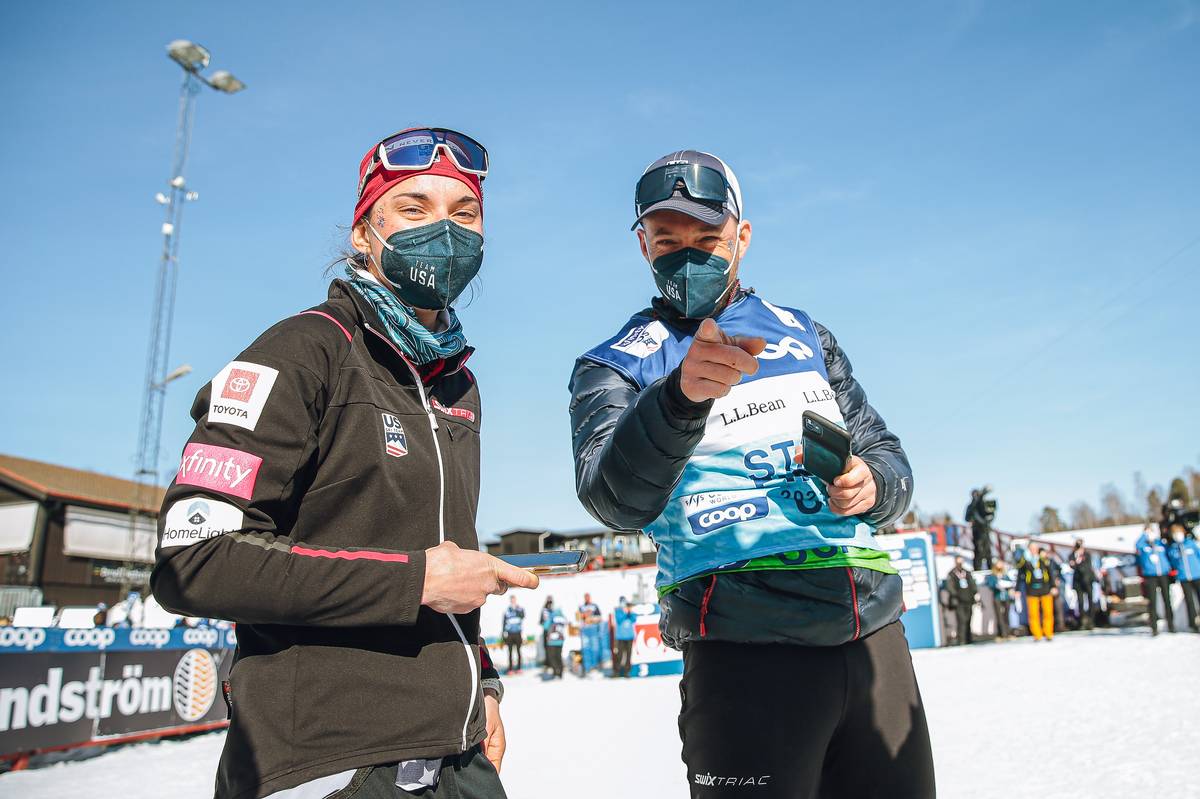
    That may be unlikely, but it is at least now in the realm of possibility. Again, a whole lot more points for a whole lot more skiers.

    Other Tweaks: Relays and Tour de Ski Bonus

    There are two other notable tweaks in the new FIS system that pertain to specific events:

    The first is that team events no longer are scored for individual points. That has already proven consequential in the way that the only team event so far this season has been raced. For instance, Matt Whitcomb identified the fact that no points were up for grabs as having directly influenced his decision that Jessie Diggins sat out the 4 x 5 km Team Relay in Beitostolen. Similarly, neither current World Cup overall leaders—Paal Golberg (NOR) for the men, nor Tiril Udnes Weng (NOR) for the women—raced the relay. 

    The second change is less drastic, but will be significant when the World Cup turns to the Tour de Ski (TDS) in a few weeks. FIS reduced the points bonus for winning the overall classification at the TDS from 400 points to 300 points, and adjusted the points bonuses for lower placings accordingly. The reduced emphasis in points—and subsequent reductions in prize money per placing—could result in the Tour de Ski becoming a less significant part of the World Cup calendar than it has been in recent years.

    What It All Means

    Johannes Høsflot Klæbo poses with his crystal globe after winning the 2019 Overall World Cup title. (Photo: Nordic Focus)

    So, is Johannes Hoesflot Klaebo justified in his World Cup fatalism? The answer just might be that the FIS wants him to be. By pushing more points onto competitors who so often come 2nd, 3rd, or 4th place to the young Norwegian, they have created a new dynamic in this year’s bid for the Overall Crystal Globe. Consider the top two skiers in the current classification:

    Top Two Places of Men’s Overall World Cup Points after Three weeks of racing, OLD system vs. NEW system:

    1. Paal Golberg (NOR) – NEW system 756 points, OLD system 575 points, Net Change: +181 points.
    2. Johannes Hoesflot Klaebo – NEW system 430 points, OLD system 430 points, Net Change: 0 points.

    Klaebo’s points have not changed because the benchmark for the FIS points system has not changed. He has won every race he has entered, and 1st place is still worth 100 points (with 15 points for winning sprint qualifiers). Golberg, though, has benefitted from starting more races, and getting more points for being top 10, not top 1. It is a simple comparison, but it is also the only one that really, really matters for evaluating the change that the FIS wanted to make to the World Cup adopting the NEW system. The eventual winner of the Crystal Globe will now be determined by an incentive to do well in the races you start, and to start more races. Those are just the rules of the game; once the rules are understood, then it’s possible to understand what the new rules are incentivizing. FIS has followed that all the way through with its NEW point system, assuring that the season-long champion will be the skier who is most consistent and who competes most often. 

    As for us—the fans—is this the system by which we want our skiers rewarded? Should the best skier also have to be the most consistent? Should the strongest skier in a mass start go off the front early, or show their strategic aptitude by controlling a pack? Should skiers specialize in sprinting or distance? Should they continue to have to do well in both? And, of course, is the “top 50” the new “top 30?”

    New points systems instituted by FIS has ski fans, ski coaches, and skiers talking;  that new system also has the game being played differently on the World Cup tour this season.


    Resources:

    2021-22 FIS Rulebook containing the OLD system.

    2022-23 FIS Rulebook containing the NEW system.

  • The Devon Kershaw Show: U.S. Ski Team veteran coach Matt Whitcomb

    The Devon Kershaw Show: U.S. Ski Team veteran coach Matt Whitcomb

    Matt Whitcomb has been a staple of the U.S. Ski Team coaching staff for a decade, seeing it through some of its most successful years. We hear from him about the coaching lifestyle, equal distance racing and other topics in another episode that we took a litttttle too long to post.


    You can email us at devon@fasterskier.com and nat@fasterskier.com.

    U.S. Ski Team head coach Matt Whitcomb (right) and Julia Kern seem course-side during the 4 x 5 k mixed relay amidst the 2021-2022 World Cup Finals in Falun, SWE. (Photo: NordicFocus)
  • Nordic Nation: Cross-Country Program Director Chris Grover on Looking Back and Planning Ahead 

    Nordic Nation: Cross-Country Program Director Chris Grover on Looking Back and Planning Ahead 

    Celebration abounds following Jessie Diggins’ Olympic silver medal in the 30 k mass start skate in Zhangjiakou, CHN. U.S. Ski Team head coach Matt Whitcomb and cross-country program director Chris Grover wear orange hats near the top-right corner. (Photo: NordicFocus)

    I think we can all agree that the last two years have been a wild ride.

    For those at the helm of the cross-country program at U.S. Ski & Snowboard, added layers of COVID safety precautions and expensive testing have increased the otherwise mounting demands of preparing for an Olympic Games. There have been numerous domestic and international competitions canceled, including a full season of SuperTour racing in 2020/2021, numerous World Cups canceled, and three consecutive years where the World Cup finals were either rescheduled or canceled. Amidst ever-changing travel policies country to country, the U.S. Ski Team tested, masked, and problem solved their way through two race seasons.

    U.S. Ski & Snowboard XC Program Director Chris Grover oversees training during a 2019 U.S. Ski Team camp in Bend, OR. (Photo: FS Archives)

    Throw into the mix preparations for an Olympic Games at a brand new venue where teams would be arriving site unseen and COVID testing protocols were extreme, and cap the season with the invasion of Ukraine and subsequent ban of the Russian cross-country powerhouse – there’s simply been a lot of curveballs thrown. 

    But as the 2022/2023 season approaches, we also sit at a transition point for World Cup racing that perhaps marks a few steps forward with gender parity. Namely, a move toward equal distance racing and the adoption of an initiative proposed by U.S. Ski & Snowboard to the FIS to incentivize supporting and developing more women to become ski technicians at the World Cup level. In this proposal, an additional set of course access bibs which could be used to test skis and product at World Cup events would be available only to women; therefore, a country could increase the size of its service staff by investing in the development of women techs and utilizing these women at World Cups.
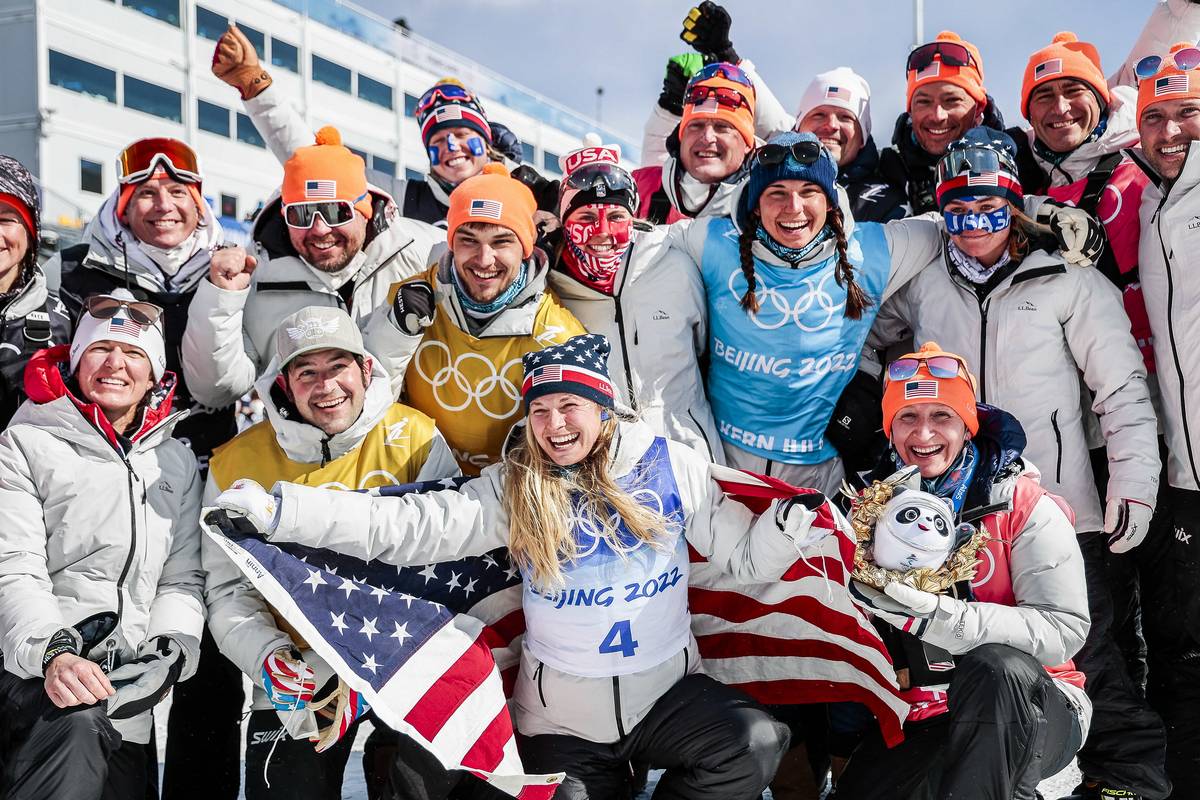
    Though Grover explains this may best serve the nations with the biggest budgets – which does not include the United States – it’s greater purpose aligns with other grassroots initiatives at U.S. Ski & Snowboard to hire, develop, and support women in coaching and leadership to improve the balance of men and women representing all levels of the sport. 

    There’s also a recently-released 2022-23 roster of U.S. Ski Team athletes, featuring a bloom of young talent on the men’s side whose trajectory may enable a full field of men and women to race at the 2026 Olympic Games in Milano Cortina. And, there’s momentum building for a Minneapolis World Cup in 2024, followed by a trip to the Northwoods of Wisconsin for a super-Birkie – i.e., a World Cup sprint and 50k on the Birkie trails. 

    In short, there were no shortage of talking points for this insightful conversation with cross-country program manager Chris Grover, who joined us from his home in Hailey, ID upon returning from the U.S. Ski Team’s first training camp of the season at the Mt. Bachelor Nordic Center in Bend, OR. 

    Thanks for listening.

    Masked up, Jessie Diggins and Ebba Andersson (SWE) congratulate one another on podium performances in the 10 k skate in Falun in Mar. 2022. (Photo: NordicFocus)
  • The Devon Kershaw Show: Distract yourself with Drammen

    The Devon Kershaw Show: Distract yourself with Drammen

    There’s a war going on in Ukraine, and we touch on its impacts on the World Cup. But ski racing is also continuing, so we’re forging on, with respect for and acknowledgment of the tragedy that’s unfolding in Europe. For a few hours at least, on Thursday, the classic Drammen city sprint provided one heck of a distraction, and Devon and Nat are back to break down some performances for the ages by Norway’s Maiken Caspersen Falla, the French men and China’s Wang Qiang.

    You can email us at devon@fasterskier.com and nat@fasterskier.com. We’re still hoping to catch up with an Olympic mailbag episode soon once things settle down.

    Rosie Brennan leads her quarterfinal during Drammen’s classic sprint. (Photo: NordicFocus)