Depending on where you live, rollerskis may seem like a distant memory, retired to a storage closet not to be looked at again until next May. For others, sliding on snow might not be the agenda for another month. Perhaps you are foregoing Thanksgiving travel to snow this year due to the pandemic, or you are an urban-dwelling weekend warrior whose usual routine of traveling regularly to snow has come to a halt.
Regardless of the circumstances, here’s a review of Fischer’s latest lineup of top-end rollerskis that make hitting the pavement enjoyable and feel realistic enough to keep you in love with the sport until your next chance to slide on snow.
Fischer Speedmax Classic Rollerski
The lightest classic rollerski on the market, the full carbon Fischer Speedmax Classic rollerski closes the gap between the dryland and on snow classic ski experience. (Photo: fischersports.com)
Launched this season, the Speedmax Classic rollerski holds bragging rights as the lightest classic rollerski available. With a full carbon frame, the medium flex ski weighs just 830 g, roughly 20% less than the RC7 classic model. Two models are available: medium for skiers less than 85 kg, and stiff for those greater than 80 kg. The stiff frame adds just 20 additional grams.
Let’s put it simply: it’s noteworthy. The return of the ski when swinging back through felt much more like a classic ski and less like a clunky rollerski. Despite the ratcheted wheel, this might be the factor most attributable to the realistic feel of rollerskiing on the Speedmax.
The bridge arch construction of the Fischer Speedmax classic rollerski shaft provides increased ground clearance while still maintaining a ski-like flex and feel.
The Speedmax features an arched construction shaft, mimicking the camber of a classic ski. A quick materials engineering lesson: while the frame is certainly stiff and rigid, a carbon weave is strongest when loaded axially, like the way you apply force along the shaft of your set of carbon ski poles. It also resists twisting, but we’ll get to that later.
When the rollerski is kicked, the load is applied perpendicular to the axis, meaning there is more forgiveness, giving a more realistic feeling of compressing a wax pocket. Though I’m about 25 kg below the threshold at which switching to the stiff shaft is advised, I had no trouble experiencing a realistic flex with the ski. I also noticed a significant amount of vibration dampening, making it comfortable — even for long sessions — to ski chip-seal or rough pavement.
The pair was also loaned to the top local junior, Kate Oldham, in the midst of her high volume summer training to join the Middlebury Ski Team this fall. Oldham noted a similar experience with the flex as one of the most remarkable features of the ski, expressing that it was more realistic than her aluminum Swix C1 pair she typically trained on. (Swix now sells a carbon fiber classic ski that FasterSkier has not yet reviewed.) Oldham also expressed that the resistance in the wheels provided a more realistic feel in terms of the glide from each push off and the control on downhills.
In addition to the lightness and realistic feel of the full carbon frame, the shaft provides torsional stability, keeping the ski balanced even when taking corners with speed. The 745 mm shaft is a few centimeters longer than other Fischer models and the 70 mm (45 mm width) wheels are smaller in diameter and wider than average. I felt this combo made it easier to drive the ski and glide straight more easily than other classic sets I’ve tried. The Speedmax tracking felt very balanced, smooth, and controlled, very similar to skiing outside the track on a groomed track.
The super lightweight Speedmax Classic features an innovative full carbon arched shaft, providing a realistic high performance option.
And now for the downsides: given the full carbon construction, it is likely that the shaft does not provide the same durability you might expect from a composite or metal shaft. The arched shaft does improve ground clearance when unweighted, which helps protect the shaft when rolling over uneven surfaces, like getting on and off the wooden pedestrian bridges I regularly encounter. As carbon fiber is brittle, it is unclear how these would fare for full time high volume use season to season. I was lucky not to take any bad crashes while putting them to use, and Oldham opted not to use them for agility sessions during her testing out of concern for fragility. Bailing onto the rocky shoulder on a downhill or bad encounter with a curb could be devastating — I did my best not to find out the hard way. Ultimately, it’s the same cost-benefit analysis with any other piece of carbon fiber sporting equipment. We’ll leave it to you to run your own numbers.
Fischer’s Speedmax Classic rollerski features a full carbon shaft with arched construction, making it the lightest classic rollerski on the market without sacrificing a realistic feel.
The Speedmax classic rollerski retails at $379.00 and can be found
Want to see more? Here’s a video from Fischer.
Fischer Carbonlite Skate Rollerski
Fischer’s 2020 Carbonlite Skate Rollerski is an excellent high performance option. (Photo: fischersports.com)
The 2020 Carbonlite Skate rollerski was a pleasure to test out. Fischer boasts that the Air Core Composite frame provides “excellent vibration dampening for smooth, efficient performance that feels just like real snow.” A new set of wheels definitely added fun and reward to what I normally see as a somewhat boring but necessary form of training to balance out the impact of summer running volume and keep my body feeling ready for ski season.
Near my home in Carbondale, CO, I have three standard rollerski options. One is a very smooth bike path, though I have to roll over ~1k of rough pavement and a raised wooden bridge to get there. One is a up-and-down 5k loop through a chip-sealed neighborhood with two bridge crossings that have gaps in the pavement at the entrance and exit and can be spicy if taken with speed. And one is a less-smooth bike path along ranches and the Crystal River with swooping curves that sometimes accumulate sand, gravel, and other debris from the ranch vehicles crossing at various points to access gates.
Fischer’s 2020 Carbonlite Skate Rollerski features superior vibration dampening with an agile shaft length and ski-like flex.
The Carbonlite Skate made all of these venues more enjoyable to ski. The 630 mm wheelbase allows for great handling, whether that be a quick reaction to dodge a patch of gravel or taking a corner at high speed during an interval. The length of the shaft also allows for a bit more flexion than I was accustomed, giving a more realistic push off.
The “razor shaped base” of Fischer’s Carbonlite Skate rollerski provides ample ground clearance even with extreme kick angles. (Photo: fischersports.com)
Adding to the agility and maneuverability of the shaft is the “Razor Shaped Base”. Cross-sectionally, the bottom edges of the shaft are beveled, ensuring adequate ground clearance even with a steep kick angle and reducing the wear and tear on the ski.
In addition to commenting that the flex provided a realistic feel, Oldham noted the clearance as a feature she appreciated on the Carbonlites.
“I enjoyed the height of the skate skis. The bolts never scraped the ground while turning and I never bottomed out while going over bumps.”
I’m not sure I’d go quite as far as “just like real snow”, but putting it generously, I’d say it comes close to being on par with ideal spring conditions where the trail base is softening from its bulletproof overnight freeze to the buttery, fast, and firm surface we all know and love. Fast, smooth, probably still some exciting encounters of the “late seasons hazards may exist” nature. After all, that’s skiing on varied pavement.
The Carbonlite Skate rollerski also retails at $379.00.
Fischer’s 2020 Carbonlite Skate Rollerski features superior vibration dampening with an agile shaft length and ski-like flex.
If you’re looking for a high end rollerski to support your training year round, both of Fischer’s 2020 releases are a worthy choice.
Tim Burke’s garage and “whap-stick” fleet. (All photos: FBD)
Instant Classic
While I have no actual data on this issue, there seems to be a sentiment in our world that classic rollerskis are the red-headed step child of summer training. Most skiers ride bikes, run and even check their dignity and safety at the door for a skate roll, but classic? In summer? On rollerskis? NFW.
Let’s be real clear here — classic skiing is awesome. It is the root of our sport. When everything is right, it’s a beautiful thing, but the numbers don’t lie — look no further than your local tracks this winter and you’ll see a lot more people out on skate gear than classic. Then there’s the fact that many purists don’t like classic rollerskis due to their “unlimited kick,” with the theory here being that the ratcheting wheel reinforces bad habits and just by looking at them, you’ll forget how to properly set the wax “for reals” (as we say in Philly) when you’re back on the real McCoy. Add to this that it’s also hard to classic ski well. In fact, probably my favorite quote on this topic is “skate is harder to do, but classic is harder to do well.” Church.
Therefore, given all of this, it’s no surprise that you’re more likely to find a nordic skier excelling in a stick-and-ball sport than you are to see them out tearing it up on the elusive classic whap sticks. Sure, my good buddy Noah Hoffman does five-hour laps around Park City two to three times a day, but Noah is crazy, we all know that. He’s also on the national team and you’re not.
Let’s “keep it 100” here though (the kids at the bus stop where I had to refill my drink belt taught me this, if you don’t know it, you’re old. Go look it up in your Encyclopedia Britannica, grandpa). We all know that deep, deep down the reason you don’t classic ski as much as you should is because you aren’t as good at it as you’d like to be. Trust me, *I* know what I’m talking about here. Classic skiing is awesome and here’s an idea, maybe you’d be better at it if you did it more. Plus, you’re smart — you religiously read my column (whenever the hell it seems to randomly appear) and you somehow knew this lecture was coming. You’ve already decided that this is the year that you would finally get your shit together classic skiing. Or, you’re nursing an over-use injury after reading Jacked Up Old Man’s blog and thinking, “I can train like that,” but now you realize that you can’t, you’re overtrained and/or injured and your Achilles feels like a piece of hot barbed wire that’s been set ablaze by your crushed dreams. Or maybe you’re a competitive high school/collegiate/pre-elite skier who races classic with equal regularity to that of skate. Or maybe you really are like Noah, just plain nuts, and classic is your jam.
Well, my friend, you are in luck, as we rounded up 10 pairs of the best classic whap sticks that money can buy and put them to the test.
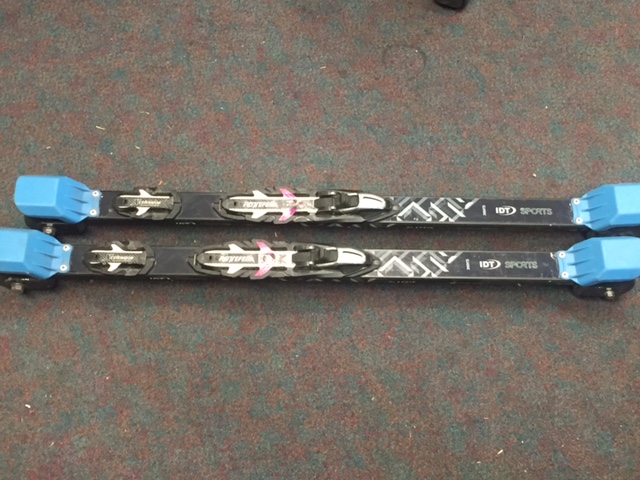
The big winner: the IDT Classic Elite. Time to book that trip to Norway.
While this phrase is purported to have its origins in Vegas and you’re a nordic skier, so you hate gambling, drinking, staying up late, standing on your feet, people, and anything else related to having fun and/or not skiing, hang in there with me on this, for in exchange for stomaching the colorful Vegas expression, I will reveal what our entire team found to be the best classic whap sticks available to man: the IDT.
Yes, yes, the astute reader will undoubtedly recall that I chided IDT a little bit in the skate review for their product not being readily available in the U.S. and lack of availability is a HUGE pet peeve of the FBD, as I find it infuriating to read a product review only to discover that said product isn’t available for six months or some other such nonsense. Here’s a suggestion for all of my reviewer colleagues out there (even though we all know that FBD has no equal) — how about doing a review when we, the eager consumer, can actually BUY your over-hyped, unnecessary piece of crap that we most likely don’t need and won’t use? That’s why we at FasterSkier are the voice of truth and light and only review crap that is A) available and B) you actually WILL use. So tell your accountant, significant other and conscience to relax, continue to promise yourself that you’ll save for that bathroom remodel next year, and obsess on the thought of new classic rollerskis until you work yourself into such a frenzy that you somehow manage to justify yet another ridiculous purchase. Remember, you really DO need these and no one deserves this more than you. Remind yourself of that time when you cleaned the garage two years ago or emptied the dishwasher all by yourself — selfless acts like that deserve some positive reinforcement. Push on in this psychological tug-o-war by promising yourself that you’ll feed them and walk them every day and that you’ll take REALLY good care of them. Plus, this is the year you swore you’d get good at classic — I’m pretty sure you wrote that down somewhere a few months ago.
Thanks to all of you loyal readers, this column has become a smashing success, therefore companies are now forced to actually take me (a bit) seriously. So when I told IDT that I wouldn’t review them until they created a viable distribution network in the U.S., they agreed. What this all means is that not only are these the best classic rollerskis, but you can actually get them. Currently, the best method is to order via their website, but IDT has also assured me that they are setting up U.S. distribution and the skis will be available in stores. Being the ever-vigilant, always skeptical, crackerjack investigative reporter than I am though, I could not in good conscious recommend that you order something online without first checking this out and everyone will be happy to hear that they do indeed arrive in a reasonable amount of time. Amazon Prime it is not, but I got a pair in about two weeks. Perfect? No. But reasonable enough for now.
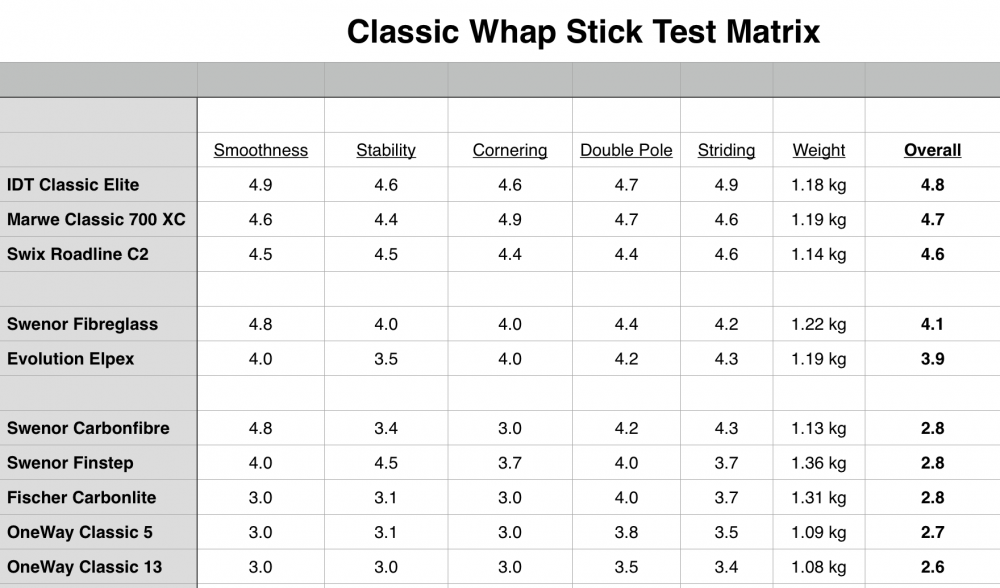
Now on to the review. What did we like about the IDTs? In short, everything. We approached this test with much of the same methodology as the skate test, with a few notable additions. As shown in the matrix below (Table 1), we added categories for striding and double pole (DP). Yes, yes, I know, you can (and should) DP in skate technique, but it was the opinion of our esteemed panel that DP plays a greater overall role in classic technique to merit its own category. Same deal with striding, which is, after all, the essence of classic skiing, so this new column should be quite self-explanatory. And the IDTs killed it in every one of these areas. Everyone loved the overall feel of the ski and while it was not light years in front of everything else, it was everyone’s favorite ski, bar none. Try to get seven people to agree on where to go for dinner or what movie to see and I think you’ll quickly see the point I’m making.
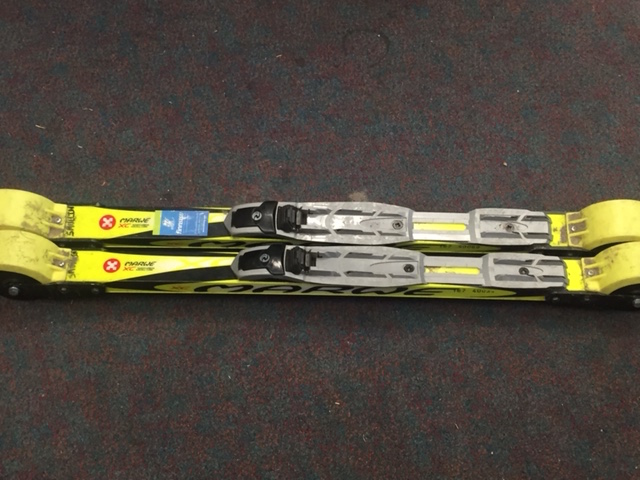
A close second, however, was the Marwe 700. Again, everyone loved these skis. In addition, they are cheaper and readily accessible, which is a plus for all of the impatient members of the studio audience. It should also be noted that Marwe has stood the test of time. We’ve been on the IDTs for the past few months and really like them, but we have literally years of experience and lots of usage data on the Marwe. We have no reason to believe that the IDTs won’t wear well, but we know the Marwes do. Look no farther than the garage of 12-year veteran of US Biathlon Tim Burke (photo at top of story) and you’ll see that they are the choice of many professional skiers. I went for a rip with Timmy in Lake Placid on a pair of his Marwes that were a few years old and they still skied great (yes, biathletes do classic ski and quite well, may I add).
Also testing well was the Swix ski. The scores weren’t quite as unanimous as the IDT and Marwes, but every reviewer but two had them in their top three, so sticking with my dinner/movie analogy, this speaks volumes. Like the Marwe, they are also cheaper than the IDT and readily available (well, as readily available as any rollerski is, and let’s be honest, it’s not like these skin removers are falling off the shelves at your local Walmart. But you can find both Marwe and Swix without calling Europe).
Just as we did in the skate rollerski review, we ranked the skis into three categories and the IDT, Marwe and Swix were at the top in a class by themselves. In all fairness, the gap down to the next group wasn’t as big in classic as it was in skate, so hold all of those angry letters, as this second group is also populated with good skis. And just like skate, depending on your weight, age, skiing style, goals and budget, some of the skis in this second group may work for you, as don’t forget, our goal here is twofold: 1) rank the overall best skis and 2) help describe which skis are best suited for more specific individual needs. So again, hold those letters. At least for a few more paragraphs.
Stacking the deck
I’ve mentioned this in past columns, but it bears repeating that it always makes me smile how different companies interpret our requests for gear reviews. All companies receive identical instructions and yet the interpretations of these instructions seem to vary wildly. Case in point, essentially every puffy coat manufacturer sent us a different combination of men’s and women’s jackets for last year’s puffy coat review. Rollerskis proved to be no different, as some companies provided skate only. Others only sent classic. Some missed the deadline by a few days, others by weeks, some by months and some wrote to inquire AFTER the review was published if they could still participate. Yes, really.
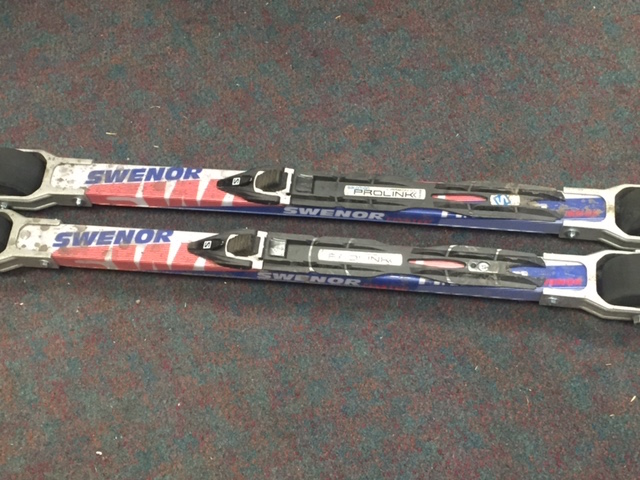
I bring this up because while many companies sell multiple models of skis, some picked one model and just sent that, while others decided to send us everything they could find. While this is obviously more work for us, that’s why we’re here and any good racer is an opportunist, so I actually kinda respect this approach. Swenor led the charge here by sending everything but the kitchen sink.
Swenor x 3
What was particularly interesting about Swenor is their product line probably offers the most diversity of any manufacturer. Most of the differences between BRANDS of rollerskis are often subtle and once you get within brands, the separations can be even smaller. This is not the case with Swenor — you know immediately which of their models you have on your foot.
Everyone’s favorite Swenor, the Fibreglass, a good all-around ski
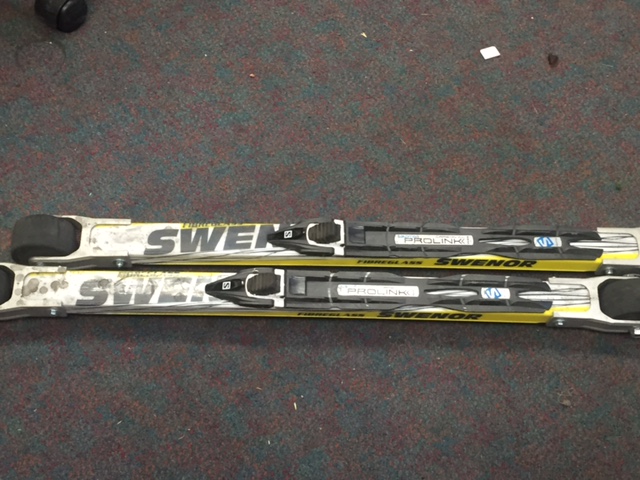
The ski that scored the highest for all-around versatility was the Swenor Fibreglass, which, as Table 1 shows, scored reasonably well in most categories. One thing that everyone loved about this (and all of the Swenors, with a few caveats that we’ll get into in a second) was the smoothness. The Fibreglass model without a doubt had the best balance of smoothness, flex and stability, making it overall a very solid pick. Where things got interesting with Swenor was with the Carbonfibre and the Finstep models.
The Swenor Carbonfibres in their safest configuration: pointed straight with minimal load
The Swenor Carbonfibre faired reasonably well for VERY light skiers (50-55 kg), but the scores showed a strong, inverse relationship to tester body weight. As even the casual reader knows, the FBD is a big, powerful man. Since my weight is a frequent and highly animated topic of conversation for both the men’s USA Nordic Combined and biathlon teams, I thought it was only appropriate that my current mass be verified by none other than Tim Burke. Mr. Burke was kind enough to witness, verify and notarize that at the time of the testing I tipped the scales at a svelte and swole 84.187 kg. This meant that me taking tight, fast corners on the Swenor Carbons was akin to driving a car with bald tires over ball bearings on ice. It felt as though a crash was imminent on every high-speed turn and if I looked carefully over my outside shoulder at the apex of any given corner, I could see my rear wheels sliding by me with reckless abandon, almost begging to send me into oncoming traffic or a handy drainage ditch. How, when and where we would end up was really anyone’s guess. I found that, um, unsettling.
In our endless pursuit of perfection and total objectivity, prior to publication, I sent the final draft of this story to all of the testers for their review and feedback. It can be tricky capturing the sentiments of a sizable group of people, so I was very careful to double check that I was providing an accurate representation of everyone’s viewpoints. When the comments came back from one of the testers who has probably some of the best feel for skis that I’ve ever seen, I thought his reaction to this part of the story was essentially perfect, “I took them (the Swenors) out for some more rips after we finished (the testing): they are good skis just as long as you don’t try to accelerate or push around a corner hard. If you are skiing mostly straightaways, there shouldn’t be a problem.” For the record, this reviewer is about 5 kgs lighter than me, so while he’s not quite FBD size, he’s in the ballpark. I’ll let all of you at home extrapolate the handling characteristics you will therefore likely encounter based on your specific body weight. Or you could just buy a pair of Marwes.
Swenor Finstep
The one ski that didn’t display the same velvety smoothness as the other Swenors was the Finstep. The light skiers didn’t like it as much as the Carbons and heavier skiers only liked it a little more than the Carbons, so when all of the scores were averaged out, the Carbons came out on top. I’m giving everyone “a peak behind the curtain” in this process, as this is one instance in which having a bunch of testers can be a bit misleading when averaging scores — pretty much the whole group agreed that if forced to choose between the Carbon and the Finstep, the Carbons are better for lighter skiers or those who train exclusively on abandon airport runways, and the Finstep are better suited for those with increased gravitational pull.
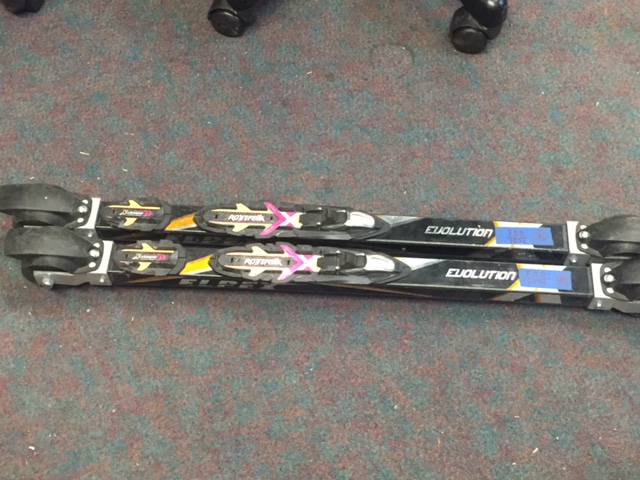
Sandwiched between the Swenor horde was the Elpex Evolution. Please note that this ski made the cut to the second group (as noted in Table 1) and was generally found to be a good ski. The only thing that really hurt this guy was stability — she’s tippy. As in six-margarita tippy. And while I love me a good margarita, I like them in the bar with a giant plate of nachos (84.187 kg, remember?), not on my feet. But if for some weird reason you’re not a heavy drinker or you’ve been blessed with balance like this, knock yourself out. Now the caveat here is that you can literally knock yourself out, but hey, you’ve been warned. Plus, we’ve already established that you’re not a drinker, so you need to do something for fun, so why not spend a few hours a day wrestling a pair of uncooperative skis. Consider it a lamer version of gator wrestling, but without the weird smells, dirty pond water and animal rights implications.
Good, solid citizens
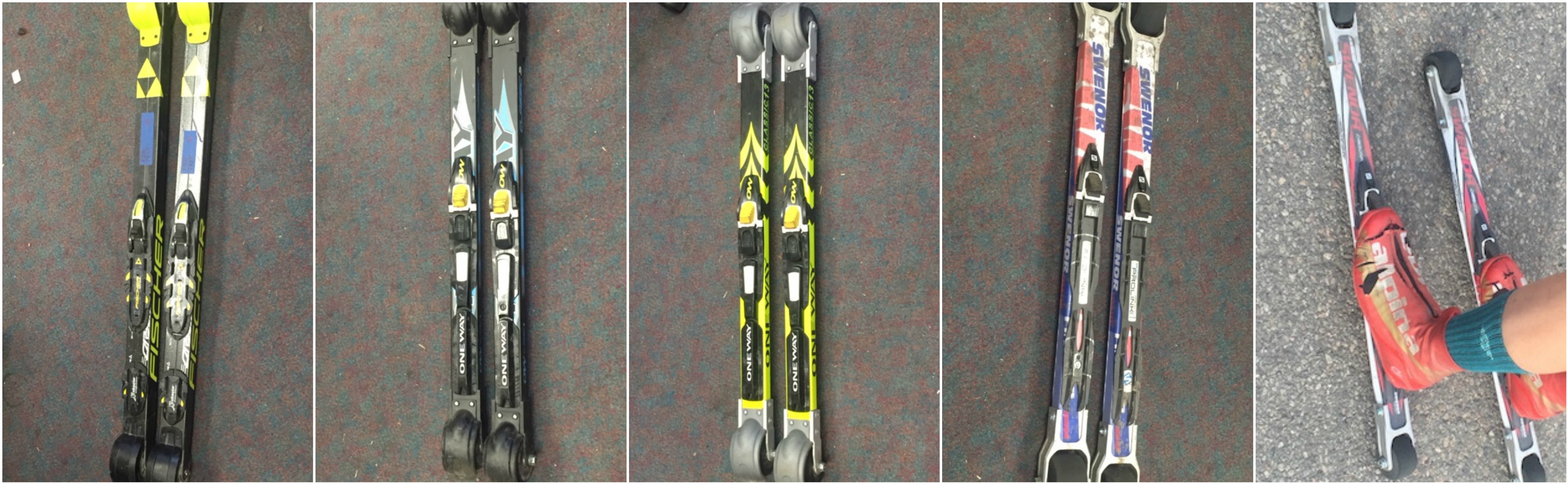
A five-way tie for the third-ranked group in the 2016 classic rollerski review: (from left to right): Fischer Carbonlite, OneWay Classic 5, OneWay Classic 13, Swenor Finstep, and Swenor Carbonfibre
Also milling around in the neighborhood of the bottom two Swenors were the Fischer and both OneWays (OW 5 and OW 13). Every reviewer had these five skis in the third group, but the order was slightly different on each score sheet. In essence, the marks were so similar that this was basically a five-way tie for third. It is important to note that while none of the scores in this group exactly set the world on fire, these are all still perfectly fine skis — in all likelihood you can get on them, do a workout and return home without any major drama (that is provided you are not skiing in Philadelphia, where drama is essentially guaranteed regardless of which skis you’re rocking). So again, please no angry letters that Swenor skis saved your grandfather’s life in the war or OneWays pulled your puppy from a burning building. As noted earlier, the deltas between all of the classic skis were smaller than those in the skate whap-stick review, even though this may not necessarily be reflected in the scores. Two different reviewers were used for this test (persons with more experience on classic skis), therefore resulting in a different frame of reference, making comparisons on scores between the classic and skate tests impossible, so don’t even try. It is also very important to point out that we were looking to find differences and in some cases had to get fairly nit-picky. Every ski in this group is still very solid.
It’s a wrap (not a whap)
In summary, all of us really liked the IDT, Marwe and Swix. All three of these are fantastic classic rollerskis and each of them truly deserves their spot in the top group. Just as with “real” skis, though, rollerskis can be a very personal thing. Our hope is that by testing all of these skis extensively in different conditions and with several different size and sex reviewers, we’ve been able to compile both qualitative and quantitive recommendations that will assist most, if not all, skiers in future purchasing and training decisions.
If you’re still pissed off after all of these qualifiers, please feel free to contact Zach Caldwell, as he loves to talk about stuff like this. I happen to know for a fact that he loves calls of this nature, anytime, day or night.
Up Next (ish)
One of the many things that warmed my cold heart after the skate review was all of the excellent comments and suggestions that we received. One recurrent theme was long-term wear, so I am very pleased to announce that we will be doing long-term wear tests on skate and possibly even classic, depending on interest. On this topic, you can feel free to submit comments. Everything else you should send to Zach though.
Since durability is understandably on many readers’ minds and I could be dead and/or fired by next year at this time, we decided it made sense to provide very preliminary results right now as well:
Swenor: The wheels on the Carbon model may offer a smooth ride, but they showed signs of wear after only a very few kms. This is troubling for as noted above, some of the testers were quite light, so this does not bode well for long-term wear for even a skier of 150 lbs or so, not to mention us big thumpers. Also, why no fenders? This annoyed everyone.
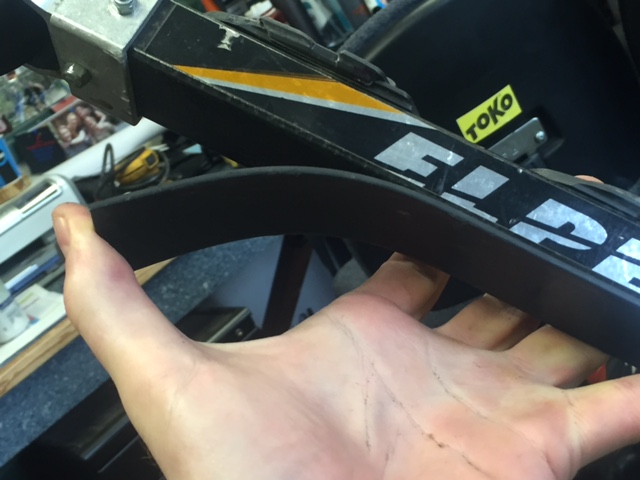
The Elpex Evolution rollerski delaminating after just a few months of use.
Elpex: One ski delaminated on the bottom. Again, not a very good sign if this is happening after just a few months of use, some of which from very light athletes.
Swix: One fender fell off and it was not at all easy to reattach.
Marwe: One of these fenders came off, but unlike Swix, this one was easily repaired. Despite losing the Allen bolt, a replacement of similar length, diameter and pitch was procured with no difficulty at the local hardware store. The only slight issue was that an Allen bolt wasn’t available, only a screw with a Phillips head. And yes, we’re now trying to do a better job checking the fenders. Damn, you people are needy.
See you out there.
FBD
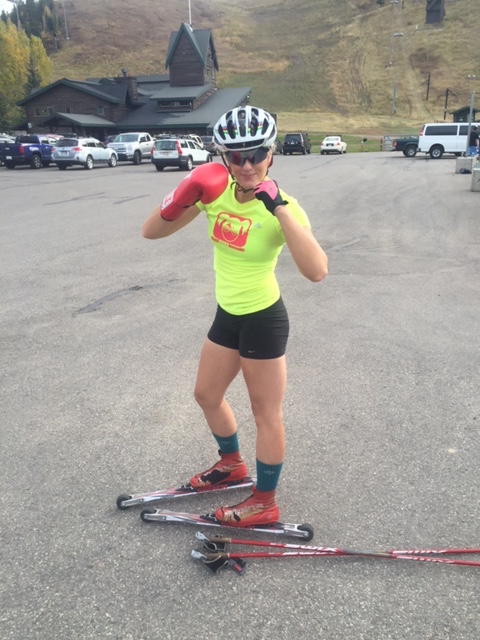
Former APU rockstar, current Steamboat Springs Winter Sports Club coach and ski-tester supreme Greta Anderson showing how we run our complaint department.