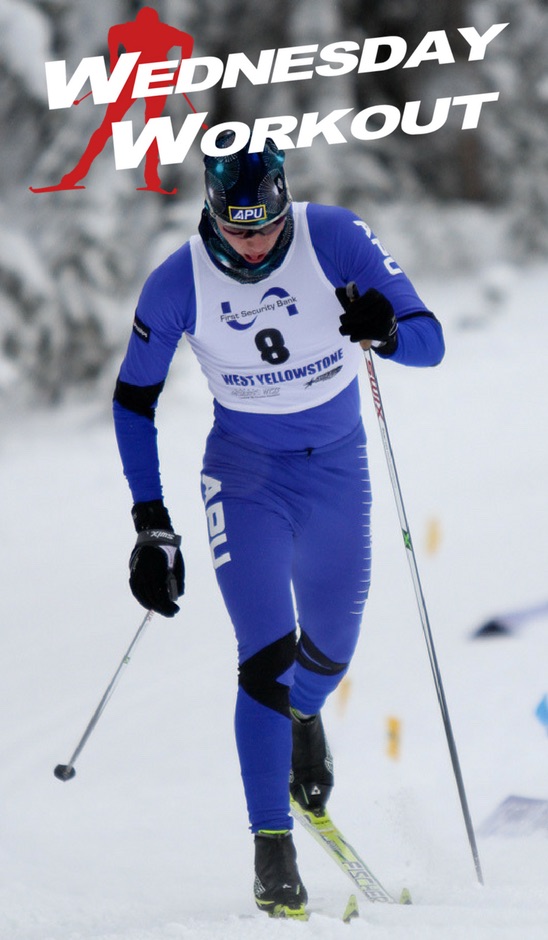
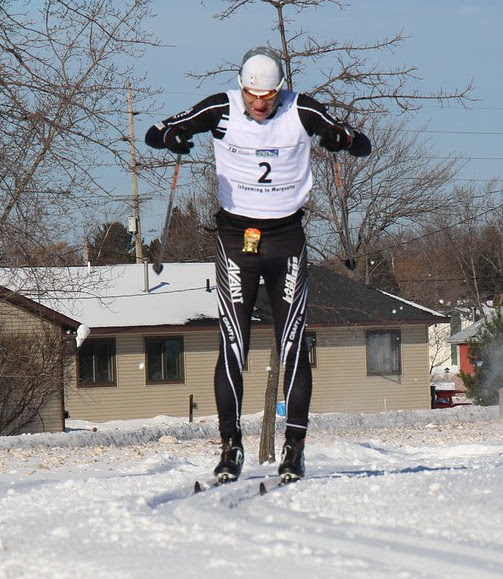
Alaska Pacific University’s Reese Hanneman racing in West Yellowstone, Montana, in November 2010.
This week, we bring you a Throwback Workout perfect for October from Alaska Pacific University’s Reese Hanneman. Now 27 and married, Hanneman, a Fairbanks native, still lives and trains out of Anchorage, Alaska, and is currently at a (not-so-dryland) U.S. Ski Team training camp in Park City, Utah. Read original workout here.
***
[circa December 2010]
If you’re wondering about your fitness heading into the new racing season, Reese Hanneman has a workout for you.
The session—a long threshold interval peppered with 30-second all-out sprints—will give you a good idea of whether you’re ready to rock, or whether you’ve got some more work to do before pulling on a bib.
“It’s a good one of those eye-opening workouts,” Hanneman said.
Hanneman has only done this session once, in mid-October with the rest of his team, the Anchorage-based Alaska Pacific University (APU).
The group began their workout at sea level—close to the ocean—then made their way uphill, ultimately climbing some 2,000 vertical feet.
The mechanics are straightforward: start with four-and-a-half-minutes of low level three (50 k pace, Hanneman said), followed immediately by a 30-second all-out sprint. Then repeat. And repeat, and repeat, until you’ve been going for 45 minutes, in Hanneman’s case. There are no breaks after the sprints.
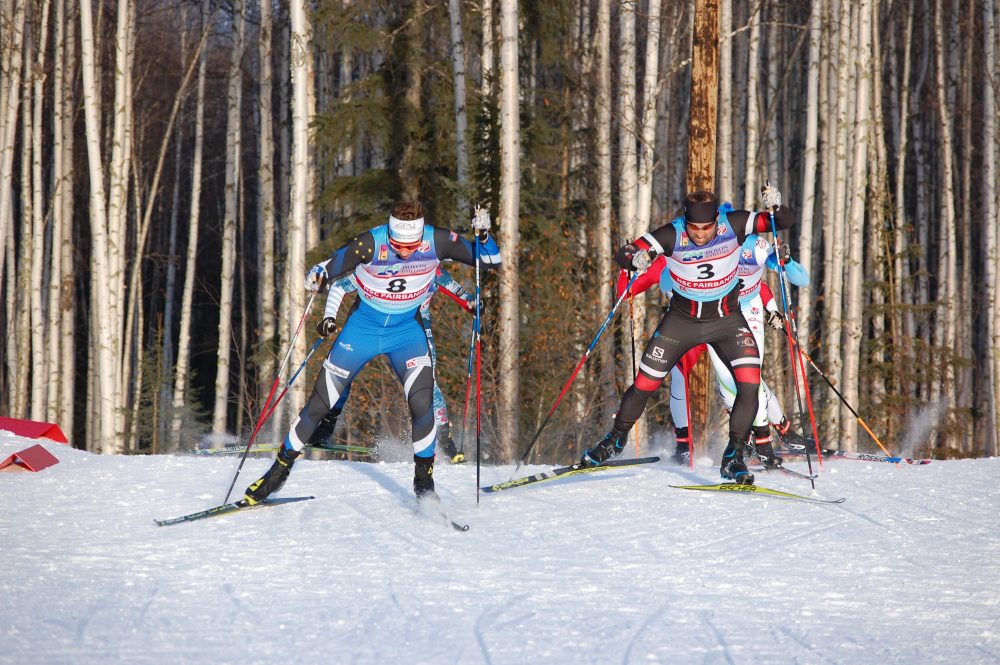
Left to right: Reese Hanneman (Alaska Pacific University) going head to head with Dakota Blackhorse-von Jess (Bend Endurance Academy) during their quarterfinal of the men’s 1.6-kilometer freestyle sprint at the 2017 SuperTour Finals in Fairbanks, Alaska. (Photo: Max Kaufman)
“You’re supposed to just keep rolling—you don’t stop,” he said. “You just revert back to threshold.”
The workout is an end in itself, but just as importantly, Hanneman said, it’s designed to show how quickly one can clear lactic acid.
For APU’s distance specialists, like James Southam, the surges might not be too difficult to handle. But they took a toll on Hanneman, who’s more of a sprinter.
“Within about 10 minutes, it became really obvious to me that I was having a hard time operating at all,” he said. “After the 30-second sprint, I would have to basically stop…and [Southam] could just kind of ski away from me. He was recovering right away.”
For Hanneman, the session ended up being a firsthand experience in the strengths and weaknesses of his fitness profile.
“I can go fast, and I can make a lot of lactate really quickly, but then the trick is dealing with that afterwards—and trying to keep going at a pace that’s not pathetic,” he said. “It’s one of the workouts that by next year, I want to be a lot better at…I think that’d be a good indication.”
Key to the workout, Hanneman said, is finding a consistent, challenging grade, because rolling terrain isn’t quite tough enough to keep him in zone three. Stop signs are problematic, too—you’ll want a clear path for the sprints.
While Hanneman limited the length of his session to 45 minutes, he said that some of the other members of his team, like Southam, will sometimes extend it to an hour. If you’re not quite up to that kind of challenge, you can try scaling it back to, say, 30 minutes.
And you don’t have to end the workout with a sprint—at least, APU doesn’t. That, Hanneman said, kept him from falling into the ditch on the side of the road.
“You can’t fake it, it doesn’t seem like,” he said of the workout. “I knew what I was in for after one sprint.”
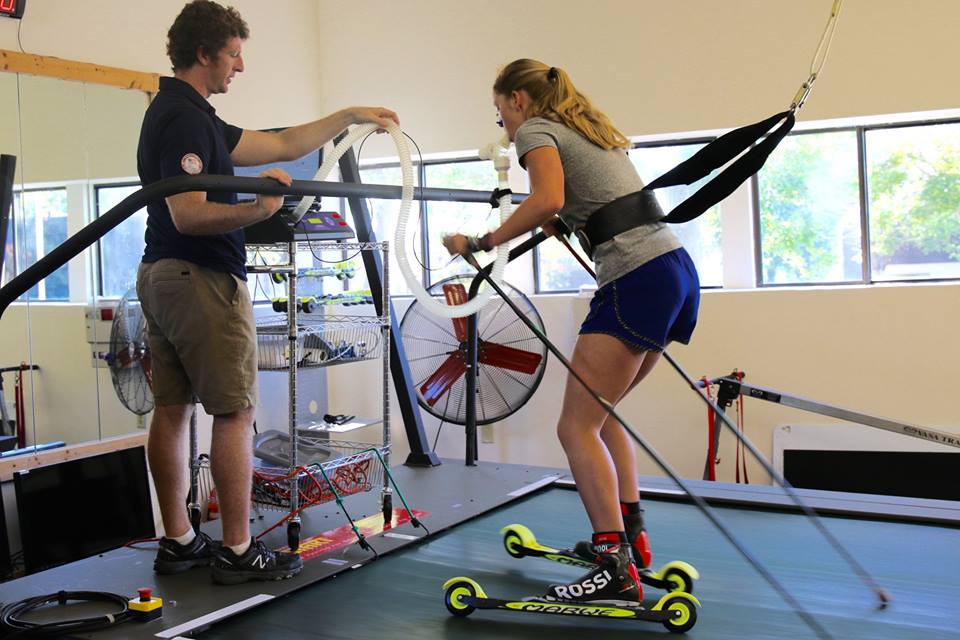
Central Cross Country (CXC) junior development skier Siri Martin (r) gets a mid-summer VO2max test on the rollerski treadmill at CXC’s Center of Excellence in Madison, Wis., in late July (Photo: CXC Facebook)
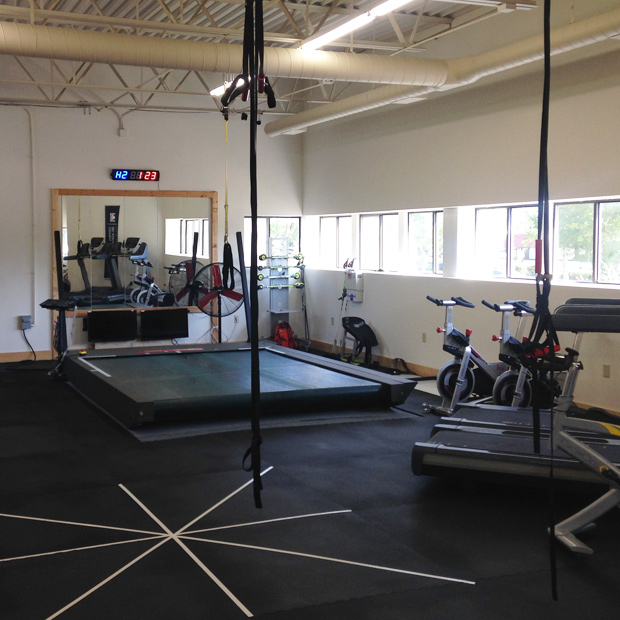
A glance into any one of the glass windows lining the east side of Central Cross Country (CXC) Academy’s Center of Excellence building might give the impression of the average athlete gym. But if you step across the front threshold or take a peek at the academy’s 360-degree virtual online tour and sport science page, you’ll find much more than treadmills, stationary bikes and medicine balls.
Located in Madison, Wis., the CXC Center of Excellence also houses a 10-by-12-foot rollerski treadmill, SkiErgs, and an in-house-made, power-pole machine. For many, though, equipment is not the most powerful tool in the center. Rather, it’s the center’s capacity to evaluate and educate its members and non-members alike about nordic skiing.
Currently, the Center of Excellence offers performance evaluations, as well as fitness testing for lactate and VO2max using the oversized treadmill. Recorded and individualized technique coaching sessions on the rollerski treadmill are also available for those willing to pay $150 dollars per hour. To help athletes gain a better understanding of their body within sport, the center is also presently working on developing a biomechanical analysis software.
The rollerski treadmill at the CXC Academy Center of Excellence (Photo: cxcacademy.com)
And CXC recently hired a sport development and education director, Egor Akimov, CXC head coach Andy Keller explained on the phone.
“He’s got a bachelor’s and PhD from the Russian State University in physical education and sport, so he majored in human physiology, he’s competed over in Russia and then he served on the Moscow Center of advanced sports technology as the head of the science department,” Keller said. “So he’s done a lot of research over in Russia on the biomechanics and stuff like that. He’s kind of leading our center [in Madison], doing a lot of the sessions down there and the technique work.”
According to the CXC Executive and Athletic Director Yuriy Gusev, the Center of Excellence is approximately 90 percent complete. Anyone from CXC club members, to donors, to CXC team members, and the general public, can access the center at no cost. Rollerski treadmill evaluations cost CXC clubs $250 per day, $150 per hour for all others.
“We are finalizing a few more partnerships on the sports science program and equipment but will start performing studies in cross country skiing this coming fall,” Gusev wrote in an email. “Our goal is to have top sports science facility to study latest innovations in the sport, potential application in cross country skiing to improve training, recovery and performance.”
While the CXC elite team, known as the CXC Team, uses the center for testing, its current base in Marquette, Mich. has also led the team to seek out other partnerships. This included collaborating with the Northern Michigan University (NMU) Olympic Training Site, allowing CXC Team members to use the school’s facility and other amenities.
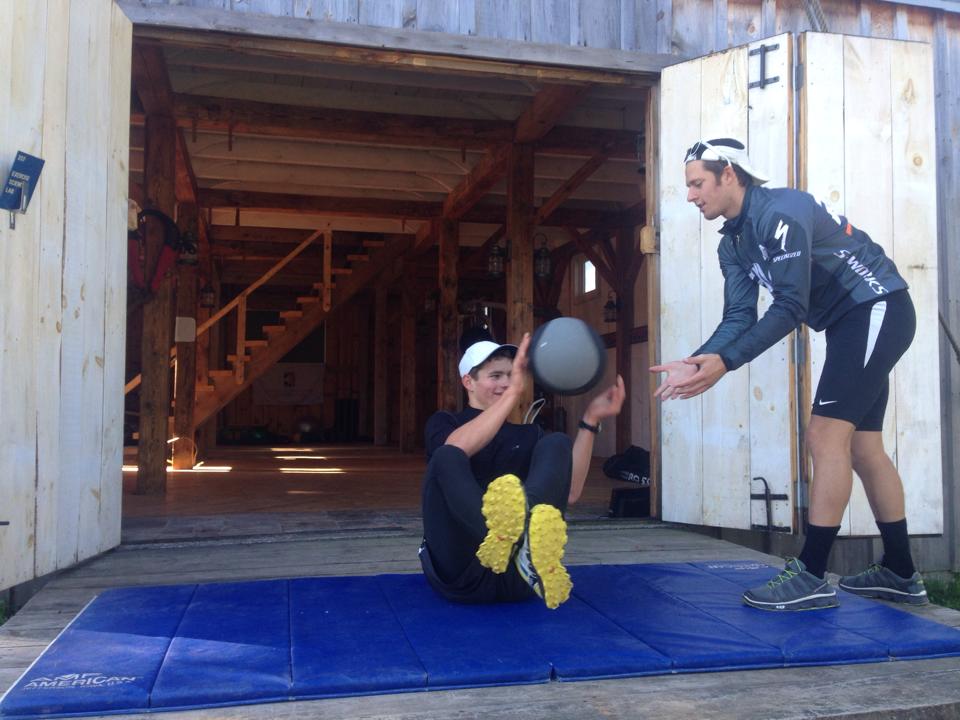
CXC Team Head Coach Andy Keller (r) works on strength with Scott Harrison outside a barn near the team’s former home base in Cable, Wis., in 2014. The team is now based in Marquette, Mich. (Photo: CXC/Facebook)
“This year we moved up to Marquette partly because a lot of the athletes have come from Northern Michigan, but also because there’s quite a bit of opportunity up here,” Keller said. “We’ve kind of partnered up with the Olympic training site located here. So we’ve been able to use the dorms on campus, offer schooling, have a training room and weight facilities available. … [The move to Marquette] has given us a lot more freedom with athlete housing and training opportunities.”
At present, the CXC Team has three full-time athletes and two part-time collegiate skiers. Kyle Bratrud returned to the CXC elite team for his second year; new full-time members include Dartmouth graduate Oscar Friedman and NMU grad Felicia Gesior. Jan Ketterson, a Dartmouth student currently taking the fall and winter trimesters off to focus on skiing, plans to race for CXC along with Nicole Bathe, presently a student at University of Alaska Fairbanks.
The growing numbers on the CXC Team was one reason CXC also recently decided to nix its marathon team, Keller explained.
“That was kind of another thing with refocusing with the marathon team, just my role and what resources I can put out just being by myself,” Keller said. “The main reason why we [ended our marathon team] is we’re trying to make a big push to promote club development.”
By discontinuing the marathon team, CXC saw an opportunity for athletes to return to their home clubs and promote racing on a more local, community-based level.
“The athletes that were on our team last year, both our current athletes and our previous athletes that we don’t have on the team anymore, we encouraged them this upcoming year to be a part of the clubs in their local area,” Keller said. “From what I heard in talking to them, most will continue to race in some facet.”
Chris Pappathopoulos won the men’s overall CXC Marathon Cup last season while competing for the CXC marathon team. (Photo: CXC)
He added that the team’s reigning CXC Marathon Cup winner Chris Pappathopoulos would likely be supported by companies like Rossignol and Boulder Nordic Sport.
While former CXC marathon team members like Pappathopoulos will look to return to their local clubs, Keller looks to expand the CXC Team program and podium at U.S. nationals with the athletes he’s currently working with.
“For a couple years [CXC] was really down and out from the years when we had Jessie [Diggins], Caitlin [Gregg], and Jennie [Bender], all those strong athletes,” he said. “So we definitely want to get back to fighting for SuperTour podiums, fighting for World Cup spots … and in this next year, I think there’s athletes who are on our team that are capable of it.”
With access to the NMU Olympic Training Site, CXC’s Center of Excellence and new scientific research taking place this fall, Keller doesn’t doubt CXC as a force to be reckoned with this season and seasons to come.
“We have the training group, we have the structure and the facilities,” Keller said. “And I think the more excitement we got here, the more we can achieve those goals of being at the top level.”