Tag: Flüela Pass

  • Diggins Gets Glimpse of Leader’s Chair, 11th Overall in Davos 15 k; Gregg 20th

    Diggins Gets Glimpse of Leader’s Chair, 11th Overall in Davos 15 k; Gregg 20th

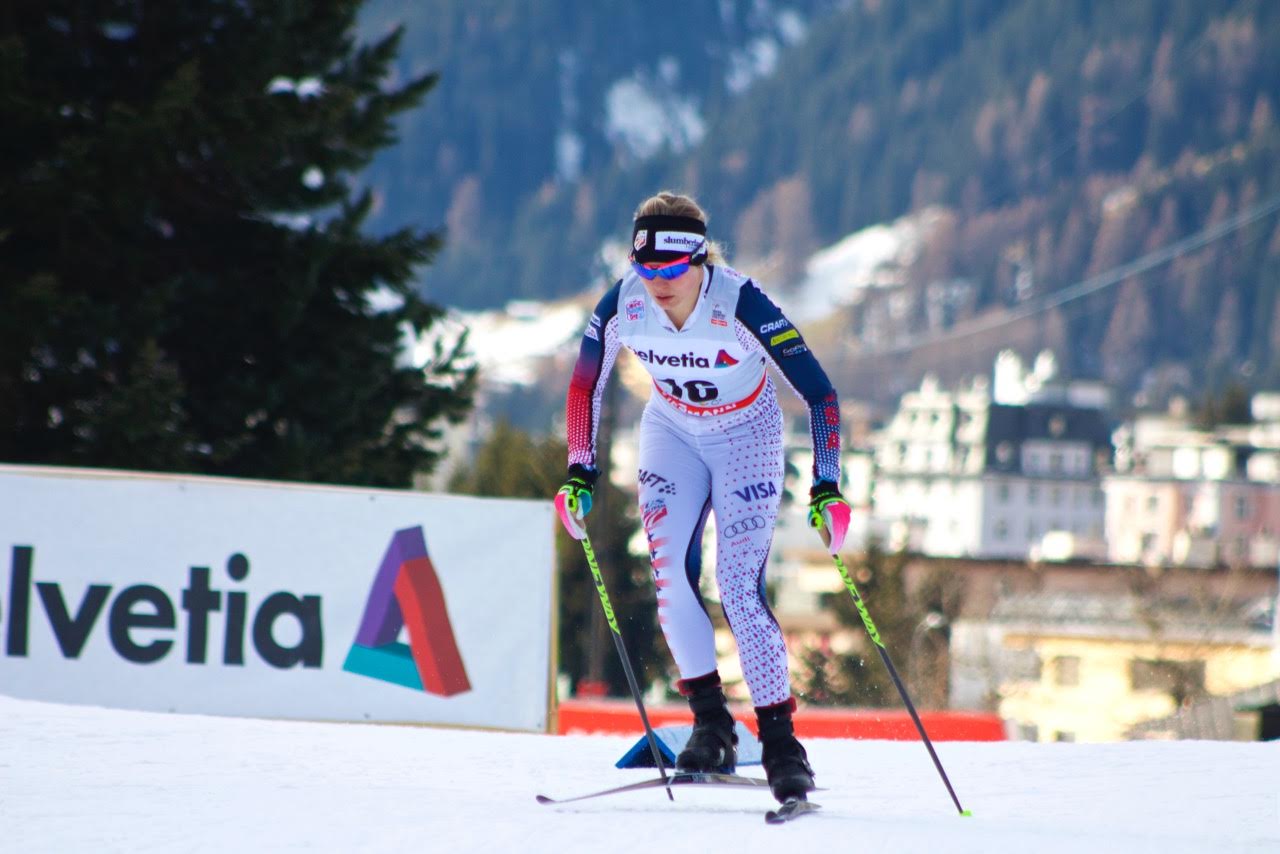
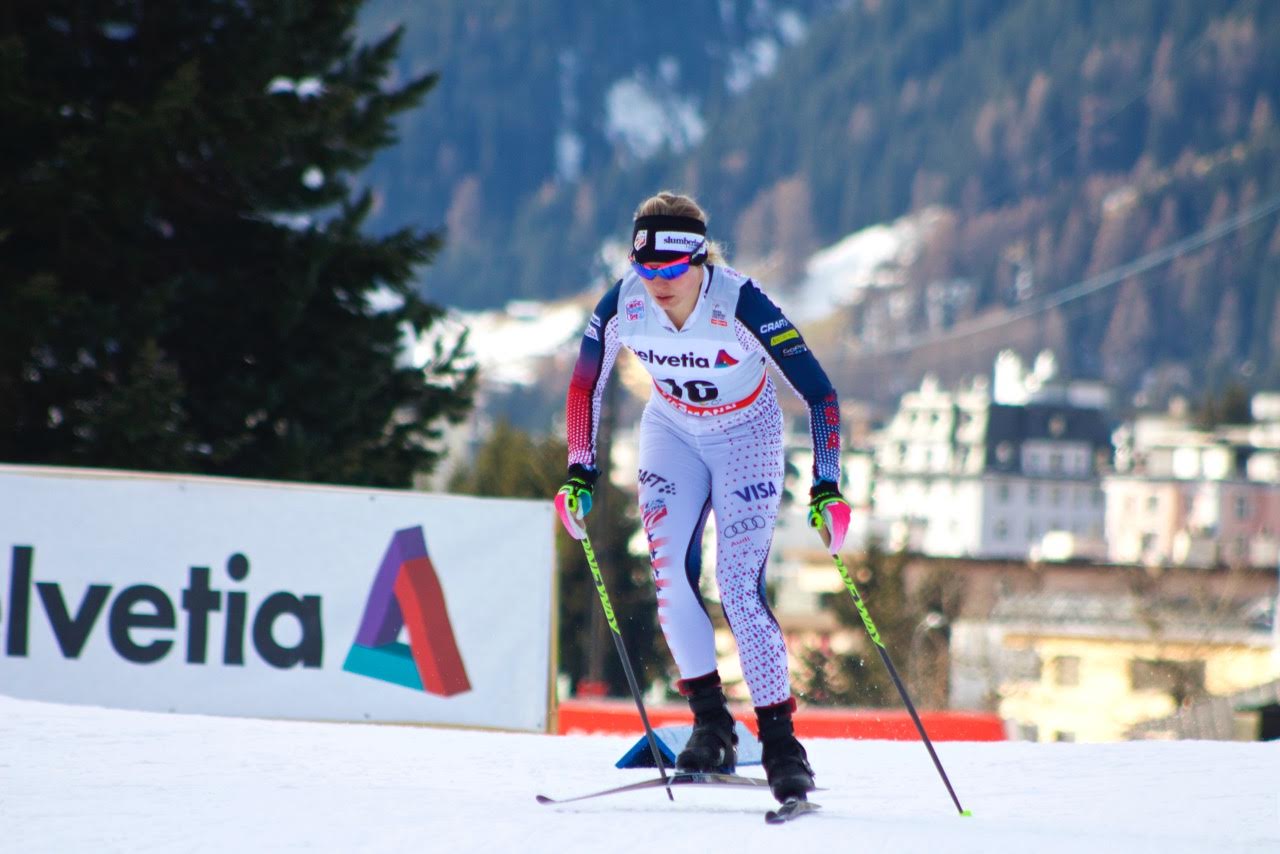
    Jessie Diggins racing to 11th in the women's 15 k freestyle individual start on Saturday at the World Cup in Davos, Switzerland.
    Jessie Diggins (U.S. Ski Team) racing to 11th in the women’s 15 k freestyle individual start on Saturday at the World Cup in Davos, Switzerland.

    DAVOS, Switzerland — Sitting in the leader’s chair in a World Cup event is a big deal, no matter how long it lasts. On Saturday, Jessie Diggins of the U.S. Ski Team posted a fast early time in the 15-kilometer freestyle individual start in Davos, Switzerland, which held up for 11th place overall.

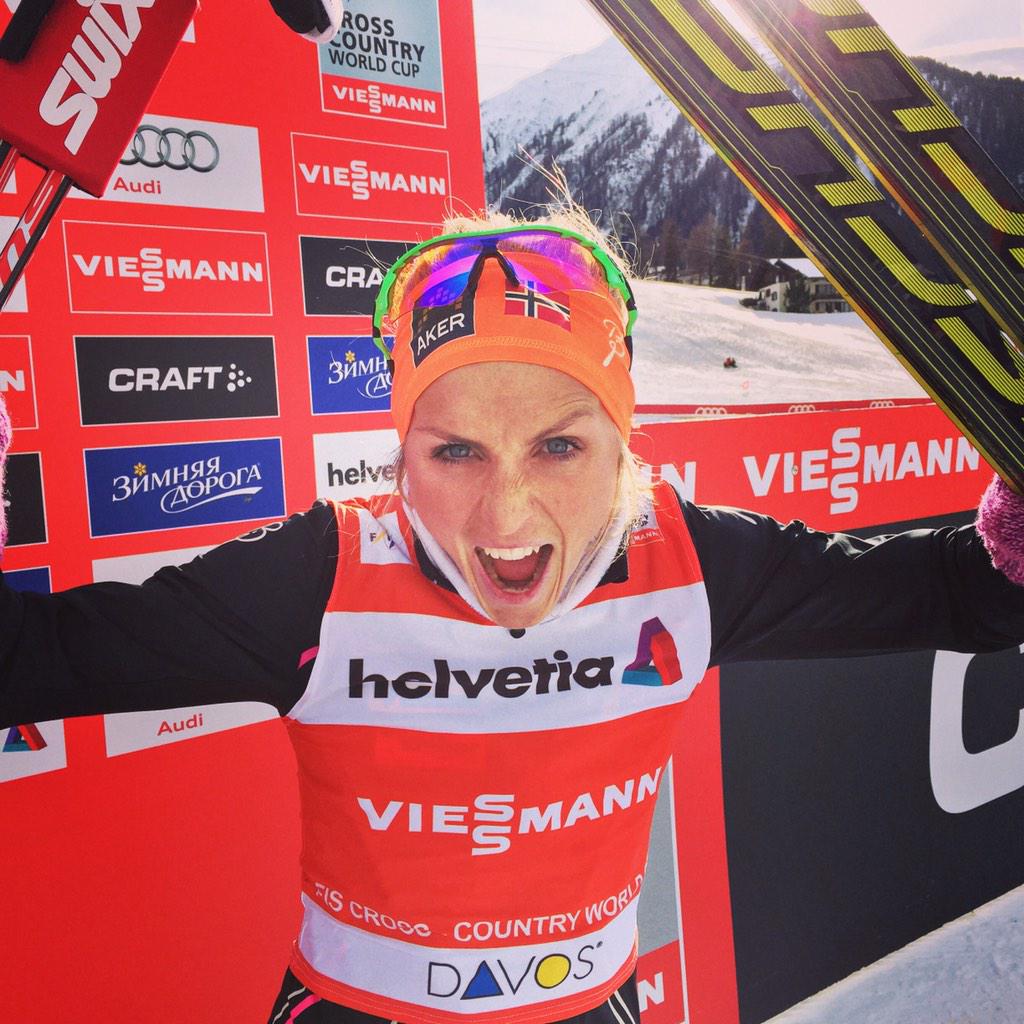
    After starting 16th, Diggins was the woman to beat after 19 finishers, giving her reign of the leader’s chair — long enough for her to put another layer of clothes. Germany’s Nicole Fessel in bib 20 was the first to best Diggins’ time (by 9.1 seconds), but Fessel was immediately bumped by the 24th starter, Therese Johaug of Norway, whose time of 35:40.3 would stand as the fastest of the day by over one minute.

    With all four U.S. women starting 18th or sooner, Diggins and her teammates had to wait to see where they stood after 48 potential finishers. When the final results were posted, Diggins’ time ranked 11th, 2:03.9 behind Johaug. Caitlin Gregg also cracked the top 20 in 20th for her best result this season and second-consecutive top 30, 2:45.5 back. Liz Stephen and Rosie Brennan rounded out the American contingent in 30th (+3:13.9) and 34th (+3:32.1), respectively.
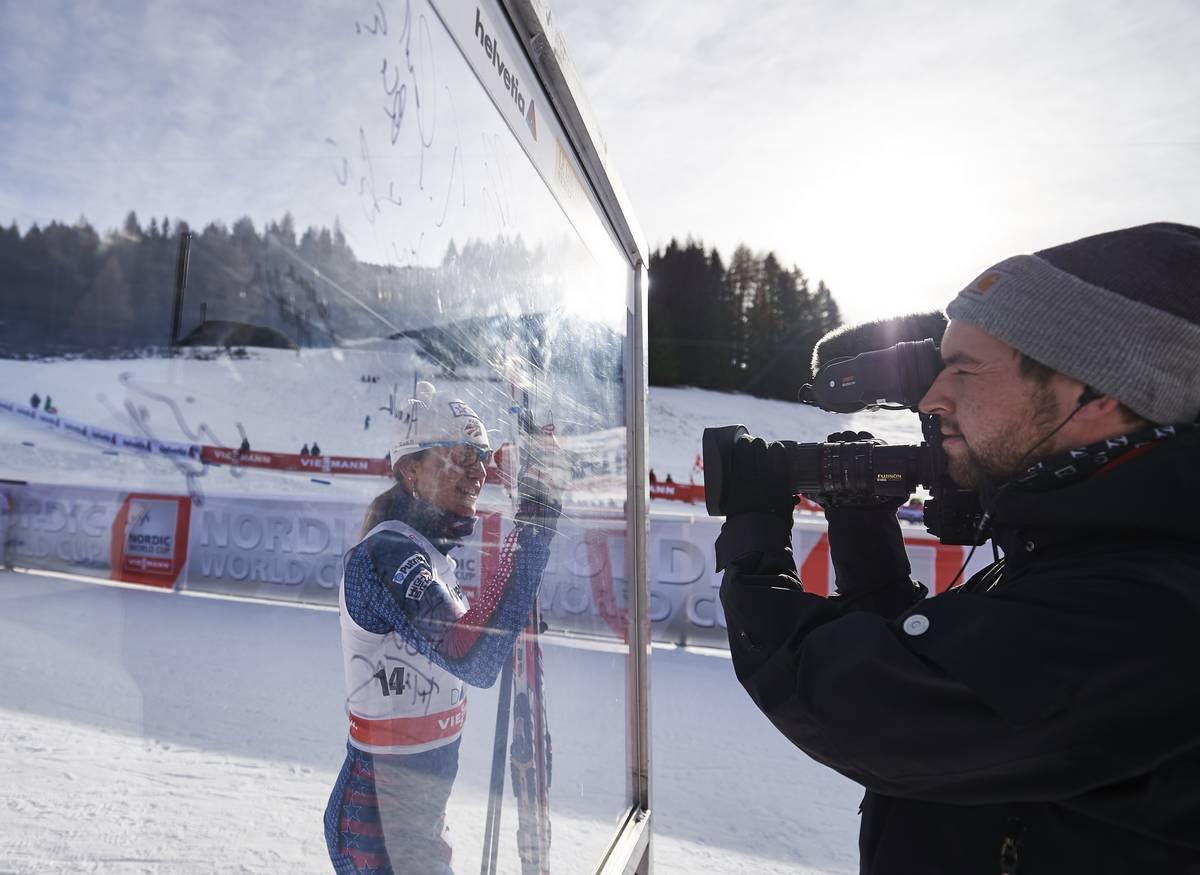
    U.S. Ski Team rookie Caitlin Gregg signs the pre-race autograph board at the Davos World Cup before the 15 k freestyle on Saturday in Switzerland. Gregg went on to place 20th. (Photo: Madshus/NordicFocus)
    U.S. Ski Team rookie Caitlin Gregg signs the pre-race autograph board at the Davos World Cup before the 15 k freestyle on Saturday in Switzerland. Gregg went on to place 20th. (Photo: Madshus/NordicFocus)

    On Saturday, the Norwegian women were in a league of their own, taking the top five positions led by another dominant Johaug victory. The first non-Norwegian was Finland’s Kerttu Niskanen in sixth (+1:40.6).

    By and large, skate races are the bread and butter of the U.S. women’s team, and the individual-start freestyle race was reminiscent of Diggins’ and Gregg’s historic double podium in the 10 k skate at 2015 World Championships last February in Falun, Sweden. Similar to Falun, Diggins posted a fast time early on Saturday and had to wait to see how that stacked up. But this time, the World Championships silver medalist and her teammates didn’t have to wait long as the top-seeded skiers, starting with Fessel, selected unusually early start positions.

    Higher-ranked athletes often start later to gain a better idea of how the race is playing out and hone in on times to beat, however, the potential for deteriorating course conditions on a 5 k loop likely influenced the start order on Saturday. Johaug chose to start 24th and headed out four minutes after Diggins.

    Because of a lack of snow, the annual Davos distance race was held on a manmade course, which featured a gradual climb out of the valley, followed by a long descent back into the stadium. The women had to round it three times; the men six.

    The snow reportedly held up well despite above-freezing temperatures at the start, which continued to rise during the late-morning race.

    “Davos is one of the classic World Cups,” U.S. women’s coach Matt Whitcomb explained. “Fluela Pass is a cold river valley that the race course runs up. It is a very unique course, one of the most unique. There is a lot of gliding and a lot of V2 with a long gradual grind and a long gradual descent that stumps a lot of people. It’s a little bit of a niche course.”

    The interval start on a difficult course more than 5,000 feet above sea level made for a physically and mentally challenging race.
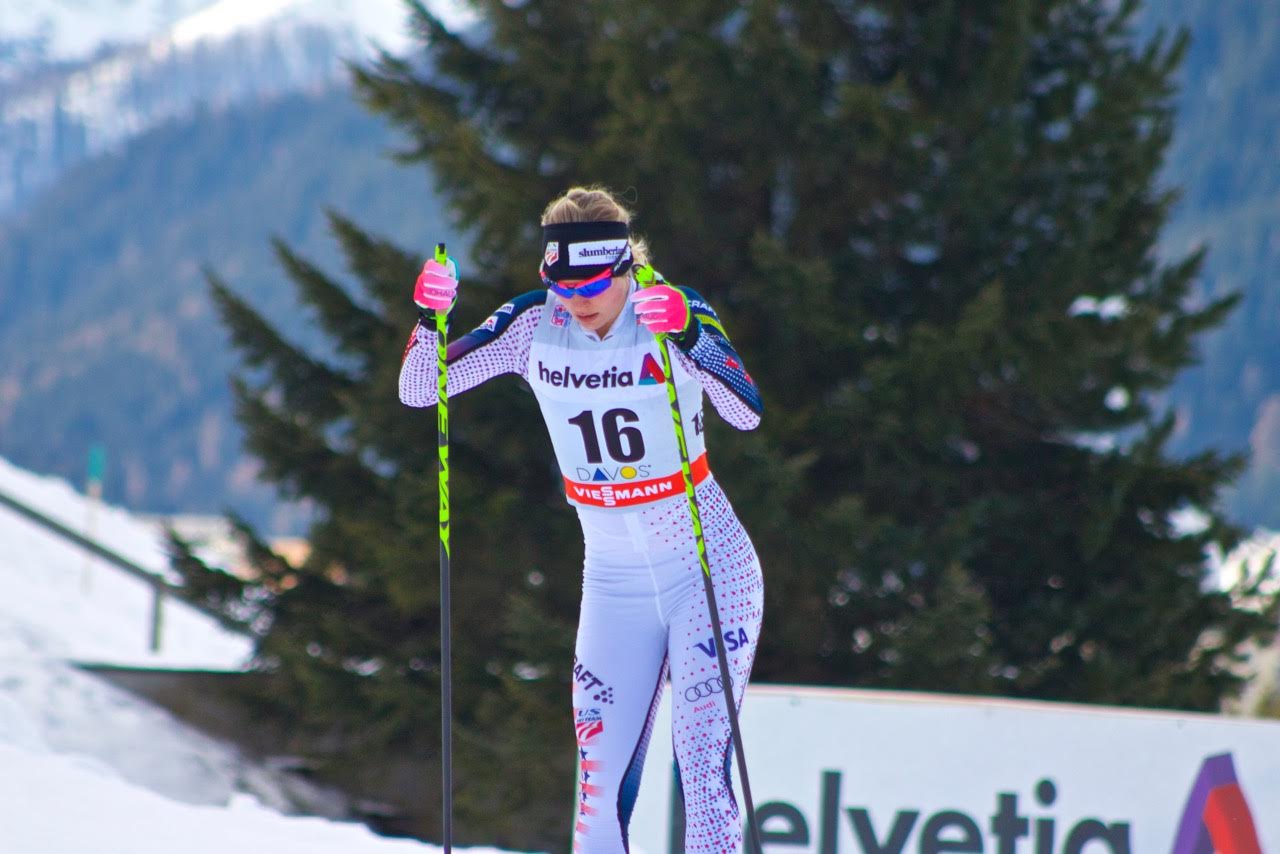
    Jessie Diggins racing to 11th in the women's 15 k freestyle individual start on Saturday at the World Cup in Davos, Switzerland.
    Jessie Diggins racing to 11th in the women’s 15 k freestyle individual start on Saturday at the World Cup in Davos, Switzerland.

    “There is no rest, it is all gradual up or down,” Diggins explained in a post-race interview. “It is really hard to figure out the pacing. My strategy was to be conservative on the climbs and rip the downhills so my last lap can be quality.

    “I think I could have done a better job,” Diggins added. “I’ve done better than in the past, but didn’t quite nail the pacing, but it was a step in the right direction.”

    In U.S. Ski Team press release, Diggins said she felt “a little disappointed” at the finish because she felt like she had some energy left.

    “If I could do it again, I would have gone for a faster first lap than I did,” she said. “But it was better for me to err on the side of being able to finish hard than blow up, so I’m still learning things every time I race this course!”

    Whitcomb was impressed with Diggins’ 11th-place finish — nine seconds behind Fessel in 10th.

    “She can really produce a lot of speed through the flats and the downhills and she really sends it through those technical downhills,” Whitcomb said.

    “Davos is a challenging race mentally because it is such a gradual climb and you are out there by yourself,” Stephens explained. “My approach was to have specific goals for each kilometer and execute them as best as I could.”

    To keep engaged, Diggins focused on technique on the long, steady climb.

    “I was just thinking about getting tall, crunching down on my poles, and really stacking my core,” she said.

    “Davos is a tricky course with the altitude and not a lot of rest — it is a fine line of pacing and skiing every section well,” Brennan said. “I felt really good on the V2 climb and I skied the downhills better than I have previously.”
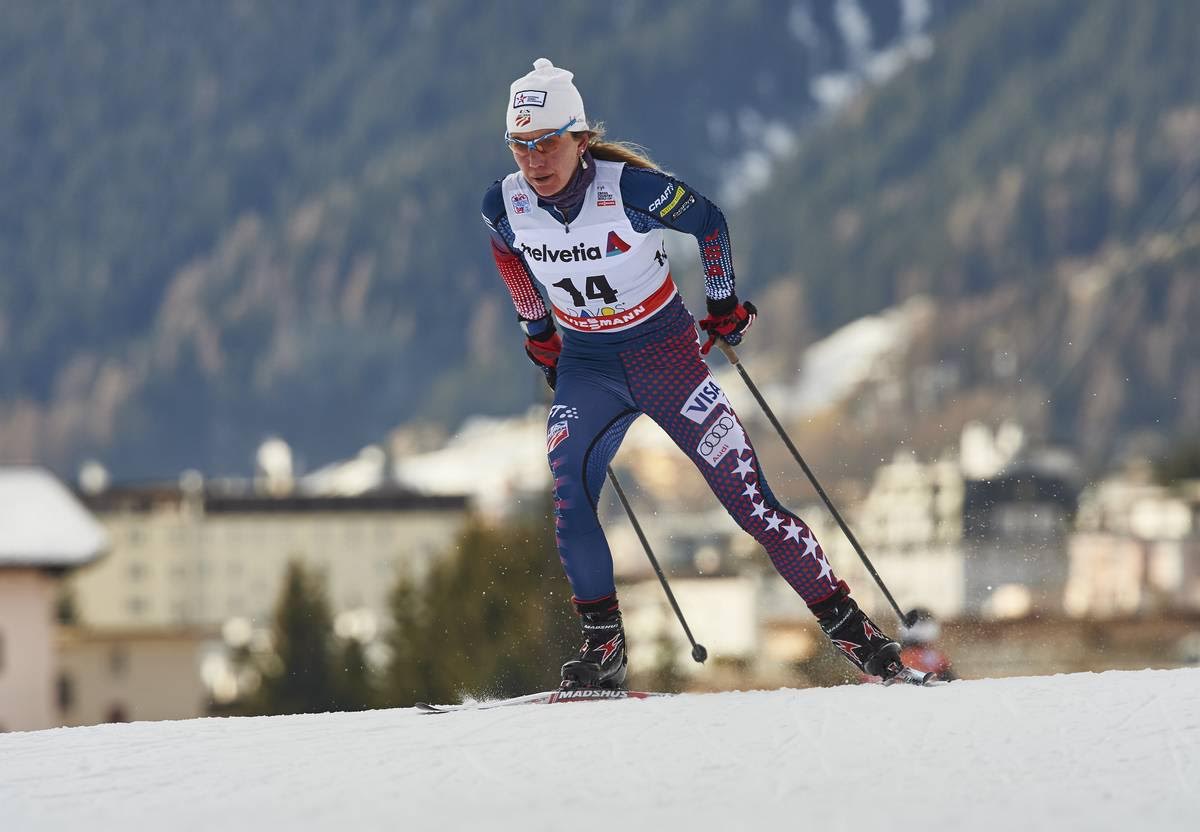
    Caitlin Gregg (U.S. Ski Team) racing to 20th in the women's World Cup 15 k freestyle on Saturday in Davos, Switzerland. (Photo: Madshus/NordicFocus)
    Caitlin Gregg (U.S. Ski Team) racing to 20th in the women’s World Cup 15 k freestyle on Saturday in Davos, Switzerland. (Photo: Madshus/NordicFocus)

    Pacing was a big part of Gregg’s approach as well.

    “I have the tendency to get excited and go out pretty hot,” the World Championships bronze medalist said. “I wanted to make sure I had something left for the last lap. I gave myself a B+ on that because I definitely felt the wheels come off a bit the last lap.”

    Despite trying to control her pacing, Gregg, who started 14th, set the time to beat at 2.2 k, which held up to rank 12th overall at that checkpoint.

    “The hardest thing about interval starts is to keep pushing and not get complacent,” Gregg said.  “You just have to think ‘Keep fighting, keep fighting.’ ”

    Whitcomb was pleased to see two U.S. athletes in the top 20, but said the team’s overall results on the day were a mixed bag.

    “We expected more out of today. We feel like our team is in better shape than our results expressed today,” he said. “But we are very comfortable with where everybody is, even those who did not put races together … It’s the World Cup so margins are small so If you miss by a little bit, you miss the whole thing.”

    Sunday’s race is a freestyle sprint, another strength for the U.S. women, and Whitcomb has high expectations.

    “I’m looking for big results tomorrow,” he said. “That’s an expectation that is not of greed, but one of observation made this week watching our athletes ski on these tracks. The team is looking really good and I think the sprinters are going to show that tomorrow.”

    Canadian Emily Nishikawa, of the Senior National Development Team, placed 39th ( +4:05.5) of 46 finishers.

    Results

    — JoJo Baldus contributed reporting

    ***

  • Johaug Proves Her Classic Chops Are No Joke, Wins Another 10 k in Davos

    Johaug Proves Her Classic Chops Are No Joke, Wins Another 10 k in Davos

    Norway's Therese Johaug won her second World Cup race of the season on Friday in Davos, Switzerland, another 10 k classic and again by 42 seconds over teammate Marit Bjørgen. (Photo: FIS Cross Country/Twitter)
    Norway’s Therese Johaug won her second World Cup race of the season on Friday in Davos, Switzerland: another 10 k classic and again by 42 seconds over teammate Marit Bjørgen. (Photo: FIS Cross Country/Twitter)

    DAVOS, Switzerland — Anyone who remembers Therese Johaug’s World Cup debut probably remembers knowing that she was going to be good.

    But sometime in her first few years on the circuit, Johaug earned a reputation as a skating specialist. While she was surely excellent in the freestyle technique, perhaps that has also been something of a fallacy – her first World Championships appearance came in 2007 in Sapporo, Japan, where she finished third in the 20 k classic, the second Norwegian.

    Regardless of whether the question “will Therese Johaug ever excel in classic” was ever a fair one, this season she has proved that the answer is definitely “yes.” On Saturday, she took her second-straight victory in a 10-kilometer classic World Cup – three if you count the ski times from last week’s pursuit race in Lillehammer, Norway, where she had the fastest split time but lost a sprint finish for the win against earlier-starting Marit Bjørgen.

    After Saturday’s race, she laughed in a press-conference when asked whether this was her new favorite race format.

    “I think so,” Johaug said. “It has been really good this season. As I said in Kuusamo, that was my first victory. Now I have a second victory in classic. I think I have taken a big step in this. I’m really happy. I feel also that my technique is really good, and my shape is also really good. So it’s fun to race.”

    Johaug, the 58th of 60 starters, led from start to finish. Teammate Bjørgen, the last of those starters, had information about Johaug’s splits, but could never catch her. After two kilometers she was within a second and a half of Johaug, but by the finish she was 42.5 seconds back. It was a big gap, but Bjørgen still had second place locked up.

    “I lost lots of seconds from Therese on the top [of the course] to the bottom,” Bjørgen said. “I’m not so very happy with that.”

    With barely any snow at the venue or in the town of Davos, the course has been constructed largely in the last week with snow blown up on the nearby Flüela Pass and then trucked down. Although she lost time on the downhills, Bjørgen said that they were in better shape than they had been the previous day.

    “Therese is really strong and she is in good shape,” she said. “Her technique is perfect today.”

    Johaug agreed, but said that it still wasn’t as perfect a race for her as her opening victory in Kuusamo.

    “Here is a lot of double pole and it’s more flat here than in Kuusamo,” she explained, which doesn’t fit as well with her climbing expertise.

    Bjørgen still holds the yellow bib of the overall World Cup leader, and will race in the freestyle sprint on Sunday to try to extend her lead.

    “Of course I will race tomorrow,” she said. “I have to try to get some more points there. I have done very good sprints this year, so I’m looking forward tomorrow.”

    Johaug will also compete in the sprint, but she has no illusions of being able to beat her teammate there.

    “I will try to sprint,” she laughed. “I’m not planning on sitting here tomorrow! It’s really good training for me, with high speed.”

    Sweden's Anna Haag racing to fourth, 1:07.1 behind Norwegian winner Therese Johaug, at the Davos World Cup 10 k classic on Friday.
    Sweden’s Anna Haag racing to fourth, 1:07.1 behind Norwegian winner Therese Johaug, at the Davos World Cup 10 k classic on Friday.

    Kerttu Niskanen of Finland finished third, 16 seconds behind Bjørgen. After Norway-only podiums in all of last weekend’s mini-tour competitions, it was refreshing to see a new face on the podium.

    Niskanen, always a top talent for Finland, hadn’t had a top result so far this season. Her previous best was ninth in the Lillehammer mini tour. But she had watched her younger brother Iivo win his first World Cup in Kuusamo in the beginning of the season, and that might have boosted her confidence.

    “I’m happy that Iivo and me can make good results,” she said. “I enjoy it a lot when my brother can make good results. It’s important when Iivo, for example the victory in Kuusamo, I was so, so happy. It’s nice that we both can do it.”

    Her strategy on the tough Davos course was to go faster and faster as the race progressed. She succeeded, moving from seventh place after two kilometers to fifth, then fourth, and finally third.

    “I tried to make my best,” she said. “I started, I think I tried to start at an easy speed and then tried to make it harder and harder. But I think that I didn’t make any big spurts in the second lap. I’m really happy that I’m number three. I like so much Davos. This track is really, really nice.”

    For the men’s 15 k classic coming up later on Saturday, she had one wish.

    “I hope that Iivo can make better results than me,” she laughed.

    Justyna Kowalczyk of Poland was skiing in third place for almost the entire race, but lost a lot of time in the final two kilometers. The stadium announcer speculated that she might have crashed, but it seems that she simply ran out of steam – already at 7.8 k, she was maintaining her place but her lead on fourth was slipping. The accelerations by the rest of the field couldn’t be matched and Kowalczyk, usually a favorite in classic races, finished seventh.

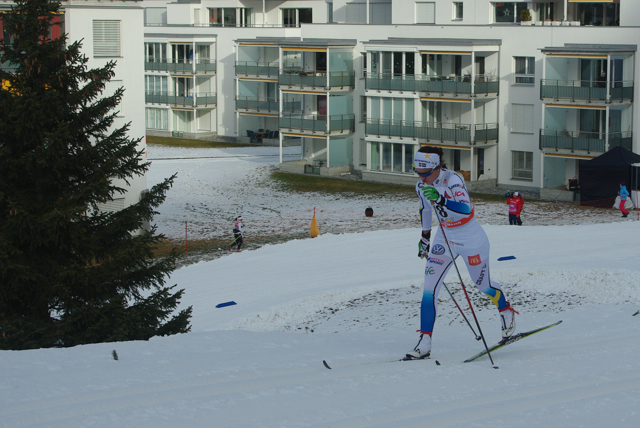
    Instead of the world champion and Olympic gold medalist, it was the Swedes who earned the next spots after Niskanen. Anna Haag and Sofia Bleckur finished fourth and fifth, a welcome supplement to Charlotte Kalla’s usual antics (she finished 15th today, unable to lead her team).

    “After all those years when it has not been so fun, it means more than you think,” Haag told Swedish newspaper Expressen, according to a translation. “I always make sure that I’m optimistic and positive. Before each competition I think, oh, I might win. Even if I maybe know it’s not possible. In this way, maybe the disappointments are harder when you’re positive.”

    Liz Stephen led the U.S. with a season-best 20th, and Emily Nishikawa as the only Canadian starter tallied a career-best 29th. Stay tuned for more reporting.

    Full results