From the FasterSkier archive — posts syndicated from athletes’ and coaches’ own blogs between 2004 and 2012, kept online as published. Current coverage is at fasterskier.com.

Tag: fluoro ban

  • U.S. Biathlon Season Preview with Lowell Bailey.  Part II

    U.S. Biathlon Season Preview with Lowell Bailey. Part II

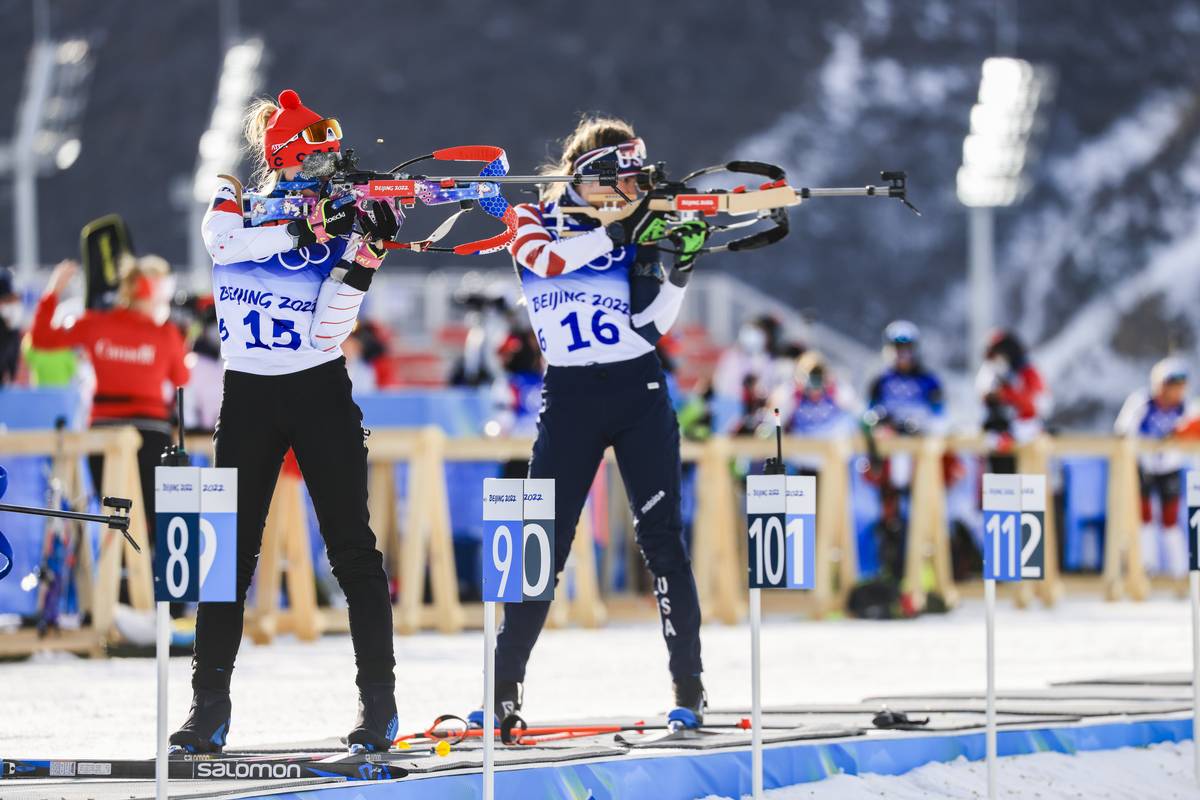
    Deedra Irwin (right) competes in the Women’s 15km Individual race during the 2022 Beijing Olympic Games. (Photo: NordicFocus)

    This article is part of a series based on an interview with Lowell Bailey. Mr. Bailey represented the United States in biathlon in four Olympic games, 11 World Championships, and 15 World Cup seasons. He is currently Director of High Performance for U.S. Biathlon. His World Championship gold medal race is one of the most thrilling races ever. If you haven’t seen it, the race is available on YouTube and is a great watch. His continued enthusiasm for biathlon continues, and is contagious.

    This interview has been edited for clarity and brevity.

    Part II:  Perspective on U.S. and International Biathlon.

    How does the U.S. training, support, and logistics compare to other national teams?

    In some ways it’s a David versus Goliath situation, with the Goliaths being the Germanys and Norways of the world, which are government supported, and budgets are not a challenge. I want to make very clear that we receive tremendous support from the USOPC (United States Olympic & Paralympic Committee). We are aligned in our pursuit of excellence. It does a huge amount of the lift. We definitely have the support of our Olympic committee. The USOPC has increased focus on sports that we [the United States] haven’t traditionally excelled in. The conversation has shifted to include focus on sports where there are opportunities in terms of increasing medal count. Biathlon has twenty-seven possible medals in an Olympics. So, it’s a huge opportunity. It’s also one of the most competitive sports. In particular the USOPC’s support for our Lake Placid facility is critical. There are dorms, food, and medical support under one roof for biathletes at every development level. This is critical. Every day we spend there is time we don’t have to spend elsewhere and spend money elsewhere.

    That being said, there are teams out there who really don’t have to worry about budget. Some of the European teams which are government supported have close to a blank check. They have higher staffing levels than we do. They have more coaches and wax technicians, physical therapists, and doctors. So we have to be creative and find ways to highlight our strengths. The Goliaths are more concerned about what’s the winning strategy and don’t really worry about how much the strategy costs. Still, we have better support than many other nations, but if the goal is podiums, the competition is the big programs. We have to find creative ways to be better every year.  But, it’s not all about money.
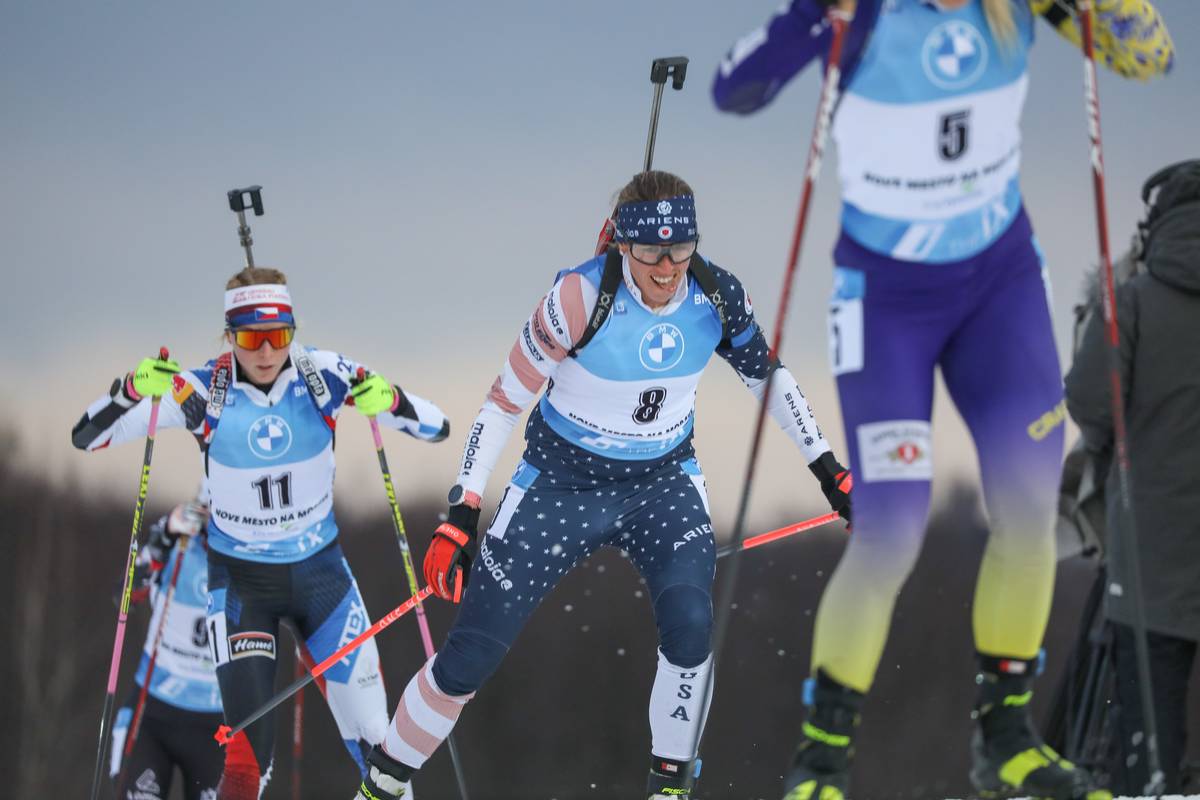
    Susan Dunklee (USA) racing to 8th place in Nove Mesto’s pursuit. (Photo: NordicFocus)

    What are the expectations long and short term?

    One of the biggest changes has been reassessing goals, not for next year only, but for the next eight years. What is it going to take for a U.S. biathlete to step onto the Olympic podium? This has been part of a targeted plan to focus on areas for sustained excellence. But, we also definitely focus on the present and maximizing the opportunities of success for our current athletes.

    Individual goals are determined by each athlete and the coaches. Athletes are individuals. A good coach understands that some athletes are very goal oriented and want to focus on those goals. Others just want to think about their training plan and be removed from nuts and bolts of goal setting and training plan design. They just want to trust their coach, be given a plan, and execute the plan. Others want to set their own goals.

    The season is long and grueling. How do the athletes manage?

    It’s very individual. For instance, Scandinavia in November is dark (sunlight wise) and challenging for some. For many athletes that’s really challenging. It’s critical for athletes to find joy in the effort. Athletes have to maintain the identity of “why I’m doing this.” If you want to get to the top of the world you have to put yourselves in tough places. You have to maintain the identity that “this is why I’m doing this.” Everyone has a choice to stay excited … finding the excitement against the World’s best. It’s exciting and you have to remind yourself that you’re on that exciting path, competing against the world’s best.

    Is it really possible to race at full intensity every weekend? Do racers intentionally hold back some weekends to save energy or taper for “bigger races?”

    Not really. I can’t speak for everyone, this is my personal thinking, but from my experience, that’s a bad idea. You might be slower some weekends than others. But, that’s more likely a function of fatigue from training or racing, not purposely taking it easy during a race. It’s not physically possible to go at the absolute top of your ability every weekend, but from my perspective, that’s not intentional. To cope with a long season, it’s better to set up a strategy of adjusting workouts instead of adjusting race pace. You can’t have the pedal to the metal every day. You get into a tricky spot when you say to an athlete that you only want them to give 90 percent or 95 percent. There may be athletes that go out and say I’m only going to race at 95 percent today. But, it’s a slippery slope to give less than 100 percent. I don’t think you want to give yourself the option of dialing it back. My way of thinking is you don’t want to have the programing to turn the dial back during racing. There’s more to lose from that than to gain. You adjust to stress and fatigue in ways other than on race day. But, at the end of the day, every athlete’s path to success is individual and specific to that athlete.

    Sean Doherty (USA) – IBU World Cup Biathlon, sprint men, Oestersund (SWE). (Photo: NordicFocus)

    Cross-Country recently adopted equal distances for men and women. Thoughts on biathlon adopting that?

    I haven’t heard anything from the IBU (International Biathlon Union) about it. I’ll be interested to see how it plays out. The athletes should have a very very big voice in that decision about race length. From the Federation’s viewpoint, there’s merit to consider what’s popular, is our sport competitive, are we appealing to fans? On the other hand, the athletes are the ones out there competing. IBU’s decision- making does consider the athletes’ voice as very important.

    How about fluoro bans?

    Athletes’ right now are concerned about the non fluorinated wax situation and how biathlon would deal with fluoro detection. There’s a lot of attention on that issue. There’s enthusiasm for being fluoro free. From the federation’s perspective, the IBU wants to reach a fluoro free race environment, but in a way so that the competition is fair.

    I recently watched your World Championship gold medal race on YouTube. Do you ever bring that up as inspiration or motivation for current athletes?

    I don’t try to highlight that. I trust the athletes with the knowledge that they’re prepared. We create an environment for every athlete to have had the best preparation that they can.  Specifically pointing to certain events, I’m open to discussing what went right. But, it’s more important to let an athlete experience for themselves what their journey looks like. If that means using U.S. biathlon history as something positive, then there’s a long list of success that provides positive thoughts. I lean away from saying, “Here’s what I know or here’s what I did.”

    That’s one of the most exciting biathlon races ever. By the end of the race even the commentators were cheering for you. Is that an event that you look back on a lot?

    I don’t make a point of highlighting that in my present day life.  It was one of the most impactful things that I was a part of. I say “a part of” because the drivers of success had to do with all the pieces of the puzzle coming together … logistics, training plan, ski prep. So, what I take away is how critical team support is for an athlete’s individual success. No athlete succeeds on the World Cup without team support. The margin in that race was 3.3 seconds over a 20 kilometer race.  Success then depends on so many different variables on that day and literally over the course of the preceding year. It shows the importance of being prepared on all platforms. When I look back, I feel our team worked together really well on all levels. I use it as an example of what can happen when you get everything right as a team.

    A healthy dose of perspective is important. Everyone we compete against is talented. How do you get that final fraction of a percent to get on the podium? How do you keep on moving things up a notch until there is a U.S. Olympic athlete standing on the podium? That’s what’s so motivating. The better you get, the harder it is to improve.
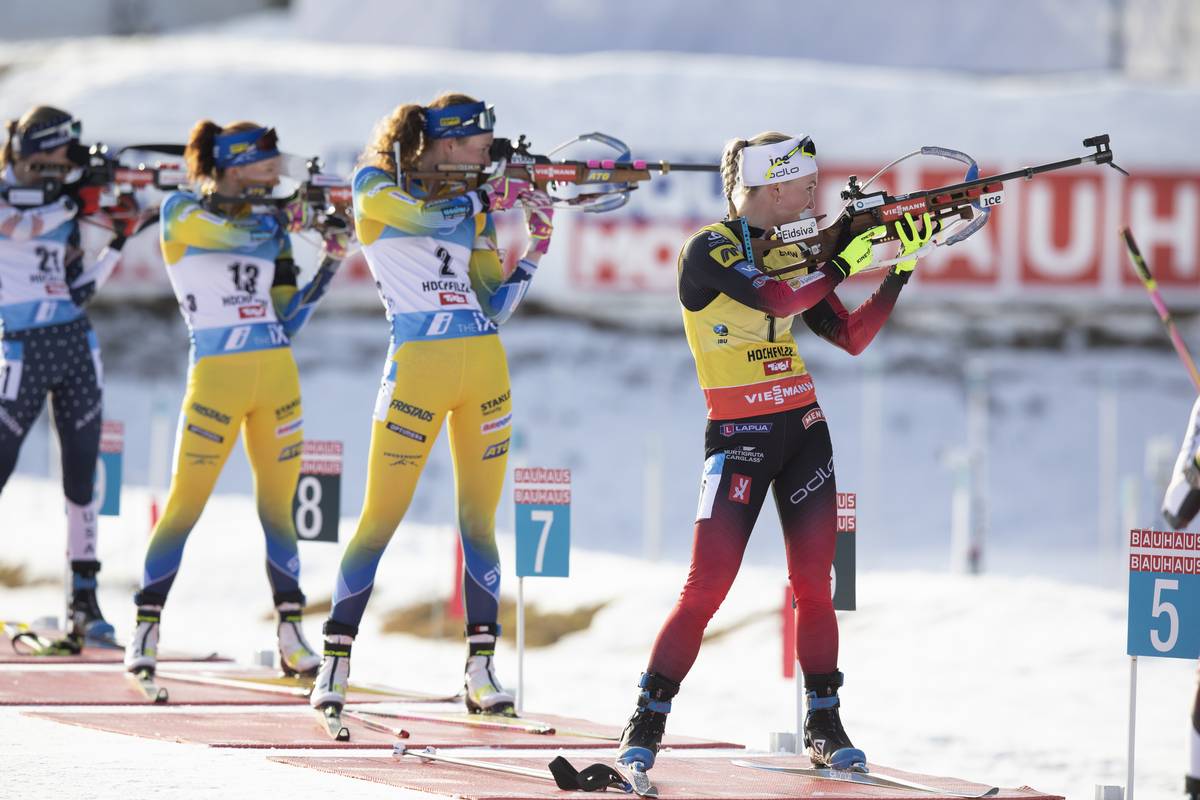
    Clare Egan (USA), Linn Persson (SWE), Hanna Oeberg (SWE), Marte Olsbu Roeiseland (NOR), (l-r) – IBU World Cup Biathlon, Hochfilzen (AUT). (Photo: NordicFocus)

    Anything else you’d like readers to know?

    Just our focus on our eight-year strategic plan of how we sustain competitive excellence. We are making very real and very big changes at all levels of our community. We have one of the most talented World Cup teams. We have a lot of forward momentum. We focus on our current team, and we are also playing the long game for sustained competitive excellence. World Cup careers are relatively short. We need to look at sustainability on the long term. We can be up there with the Germanys and Norways!
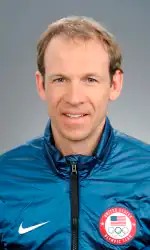
    Lowell Bailey, Director of High Performance, U.S. Biathlon (Photo: Team USA Biathlon)   
         
  • (News Brief) FIS Delays Fluoro Ban Implementation Again

    (News Brief) FIS Delays Fluoro Ban Implementation Again

    Beginning of the FIS World Championship Skiathlon in Oberstdorf, Germany in Febuary 2021 (Photo: Nordic Focus).

    The International Ski Federation (FIS) is again postponing its ban on the use of fluorinated (fluoro) waxes, originally passed in November 2019. The decision to delay the ban’s implementation until after the 2022-23 season was announced in a press release earlier today.

    The FIS cites the need for “further refinement of the fluoro testing device and to define procedures to protect the integrity of FIS competitions.” The same concerns over an efficient and effective testing procedure have already led to two prior announcements of delays in the implementation the fluoro ban in 2020 and 2021. This latest decision will mean that the World Cup, World Ski Championships, World Junior/U23 Ski Championships, and other FIS-sanctioned events will continue to see the unregulated use of waxes containing fluorocarbons this upcoming winter.

    Fluorinated waxes contain a class of chemicals called per- and polyfluoroalkyl substances, commonly referred to as PFAs, which have been the subject of increased regulation in the past decade following research showing significant environmental and human health risks. To read a comprehensive overview of this evolution in PFA regulation, read here. Fluoro ski waxes have been found to be some of the most PFA-rich substances on Earth, on account of their extreme hydrophobia. Wax manufactures are now shifting away from producing fluoro-containing race waxes, long a standard in competitive Nordic ski racing, and with that shift, regional, national, and international governing bodies have had to adopt policies regarding their usage in sanctioned competitions.

    Johannes Høsflot Klæbo lunges for the finish line in FIS World Cup action last February in Lahti, Finland. (Photo: Nordic Focus).

    When the FIS announced its ban in 2019, originally to be implemented at the start of the 2020-2021 season, it was on the forefront of fluoro policy-making. As the international governing body, FIS’ ban was set to take the broadest step possible in banning fluoros from Nordic ski racing. With the ongoing delays in implementation, however, a patchwork of policies across national governing bodies, and even individual races and venues, now govern fluoro wax policy. In the United States, U.S. Ski & Snowboard enacted a total ban on fluoro containing waxes in January of last year, following the Beijing 2022 Olympic qualifying period. Nordiq Canada has yet to release updated policy guidelines for the 2022-23 season, but it’s 2021-22 policy implemented a “tiered system” that essentially banned fluoros at all non-co-sanctioned Nordiq Canada and FIS events (SuperTours and the Canadian National Championships therefore, were exempt). Nordiq Canada’s policy will be of particular interest this season, with the 2023 FIS Nordic World Junior Ski Championships scheduled to be held next January in Whistler, British Columbia.

    In place of a ban, the FIS says it “will increase the systematic collection and testing of samples during the upcoming season 2022-23.”

    FIS World Cup start in Val di Fiemme in March, 2022. (Photo: Nordic Focus).
  • What makes a fast ski? A discussion on league-wide wax protocols and ski performance theory with Andy Gerlach, Zach Caldwell, and Knut Nystad (Part 2)

    What makes a fast ski? A discussion on league-wide wax protocols and ski performance theory with Andy Gerlach, Zach Caldwell, and Knut Nystad (Part 2)

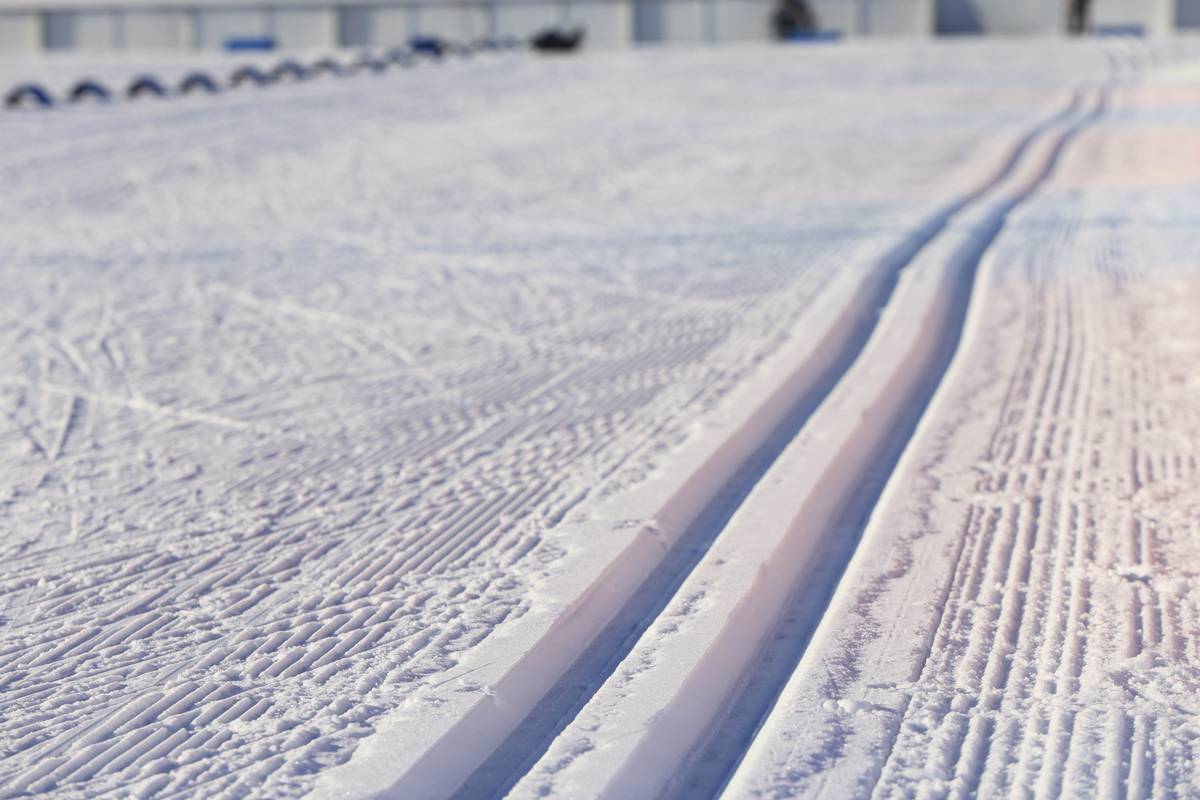
    Cold, firm tracks and perfect corduroy: the stuff of cross country skiers’ dreams. (Photo: NordicFocus)

    Click here to read part 1 of this story.

    In most states, youth skiing is divided between club and high school programming, where club programs support skiers looking to race competitively on a regional, national, or international level, perhaps with goals of NCAA skiing and beyond. High school ski programming is typically more participation focused, and comes with a much lower price tag for families, consequently with a much smaller program budget. It’s less about year-round training, and more about learning to ski, enjoying a low-cost introduction to the sport, and providing a healthy activity to get kids outside in the winter. In some places, athletes may fall into an overlapping Venn diagram of  categories, while in others, it may be a choice of club versus high school racing.

    Within high school programs, it is much less common to have multiple pairs of skis, and conversations on grinds and structures are less likely to be overheard between coaches. Here in Colorado, it’s one of the only (maybe the only?) high school sport that does not have a uniform rule – kids can essentially race in whatever they want; no lycra required.

    In this setting, a universal wax call might be a more reasonable proposition, according to Nystad. 

    “Arguments can be made on both sides. If everyone just agrees: ‘We have one pair of skis and we wax with blue.’ Okay, it probably will be as fair as you can probably make it, but just be aware that still there will be huge individual differences on the quality of the skis and how they differ from different conditions… there will still be variations, it’s not like everyone will start on the starting line having identical skis. That’s not realistic.”  

    Slovenian sprinter Eva Urevc tests skis with her wax technician at the 2022 Olympics in Zhangjiakou, CHN. (Photo: NordicFocus)

    With all of this in mind, is there a way to create equity via equipment or waxing at any level of the sport? 

    “No,” said Caldwell frankly. “No, there isn’t.” Adding perspective from his business, Caldwell explained that the cost of equipment has been steady over time with respect to inflation. That said, among competitive programs, the demand for skis has increased with time, in particular, following the removal of a now-banned leveler that we haven’t yet mentioned: fluorocarbons.

    “It’s a technical sport,” Caldwell said. “And the fact is that people have become more aware of the opportunity to get ahead with material. And I think what we’re seeing is a reaction to the reality of what the sport is. It’s not running. It’s just not. And yet people are doing the same thing in running with these carbon-plated shoes. Now you can only win if you have a high-tech shoe that goes 4% faster. Does that mean that those shoes shouldn’t have been invented? Or should they be banned? Possibly. I mean, whatever, we have to talk about this. 

    “They banned fluorocarbons for a lot of very good reasons, or they’re in the process of it. When it’s health and safety that is the problem, then you have to take the necessary steps. And yet, we also have to acknowledge that removing fluorocarbons really takes a big, big leveling factor out of the equation. There’s no opportunity to take a universal cold grind ski and put it in a wet race. That kid’s screwed. Every single time we remove the opportunity to optimize the solution that’s at hand, you’re penalizing the kids who don’t have the perfect setup.”

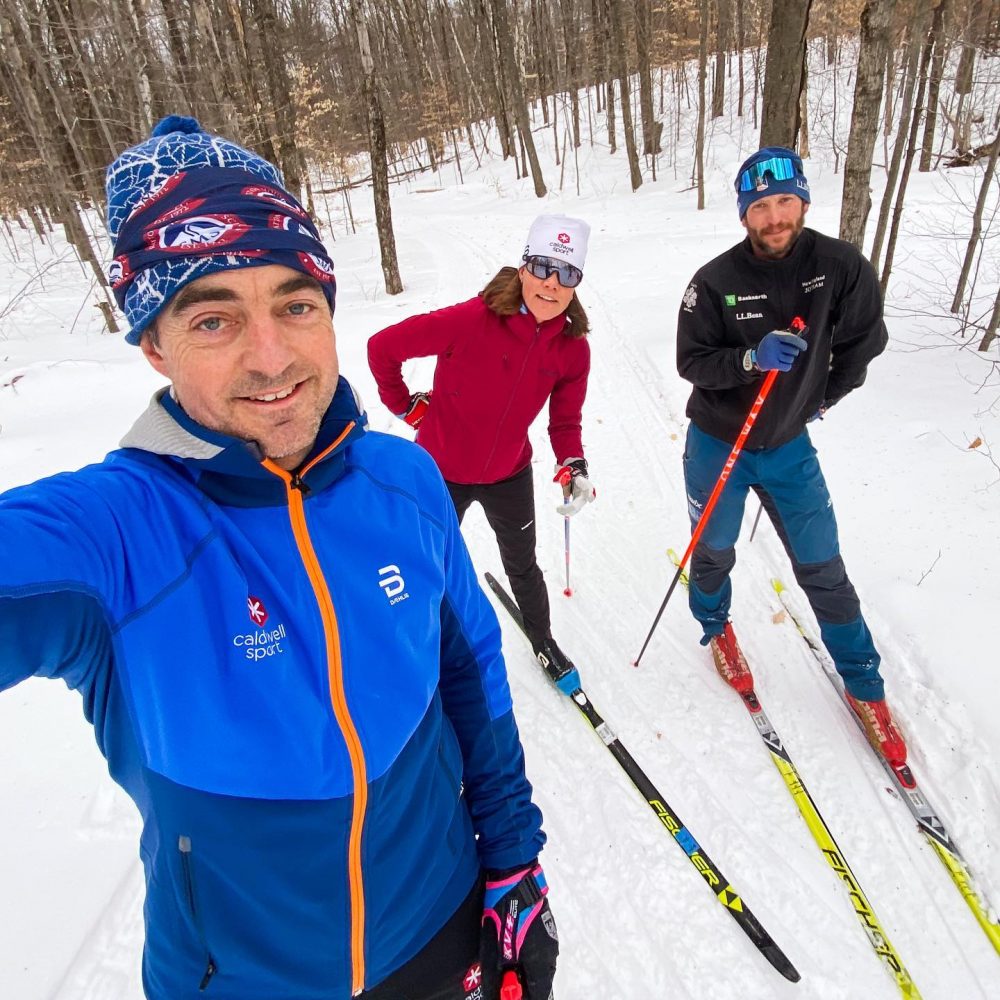
    Zach Caldwell (left) out for a ski with his wife and business partner Amy and Craftsbury Green Racing Project wax tech Nick Brown. (Photo: Facebook Caldwell Sport)

    Making it clear that his opinion is not clouded by the inability of a Colorado, Wisconsin, or Washington-based club skier to use a non-Swix wax purchased through Caldwell Sport, he added, “From a business perspective, with regard to my overall outlook, I probably should be applauding this model because it creates a massive incentive for kids to carry a lot more skis. And we’ve already seen this with the removal of fluoros from competition – you wouldn’t believe the uptick that we’ve seen in demand for warm weather skis, and grinds, and bases.”

    In Caldwell’s opinion, the opportunity for athletes and coaches to optimize a ski through testing and the use of a product line they know well, regardless of brand, is a more viable option for “leveling the playing field” as it could bring any ski closer to what he called it’s “terminal velocity.” A wax protocol that puts every athlete on the same brand and hardness of wax, creates “a situation where that opportunity doesn’t exist and the only way to gain competition advantage is to buy another pair of $800 skis. So it very quickly becomes a sport that, really, is hard to succeed at without a lot of personal resources.” 

    While the focus of these points might suggest that competitive youth skiing will trend toward an arms race, Nystad’s points included a reminder that a skier with limited access to equipment and race-day wax expertise may not be doomed. Other aspects of athlete development remain as important as ever in a skier’s trajectory and long term prospects. 

    “Quite honestly, I don’t want kids to have ten pairs of skis,” Nystad said. “I have kids that ski, but I try to limit the amount of skis and I try to buy used skis and rather look at what properties do the skis have, so that they have okay skis for for each condition. And then we focus on other things that are far, far more important. And that is the mentality to learn to train, to have fun while you’re training, and then to work on technique and tactics. So it’s also a cultural thing.

    “If you only focus on buying yourself time by buying equipment and buying wax and tweaking things and using resources — yes, you are probably going to gain some time, but you have to also say, ‘Are you investing as much time training and enhancing your technique and your tactic as the others are?’ So it’s definitely possible, even if you come from less resources, you can beat the guys with the most resources if you just train well and smart and develop good technique and good tactics.”

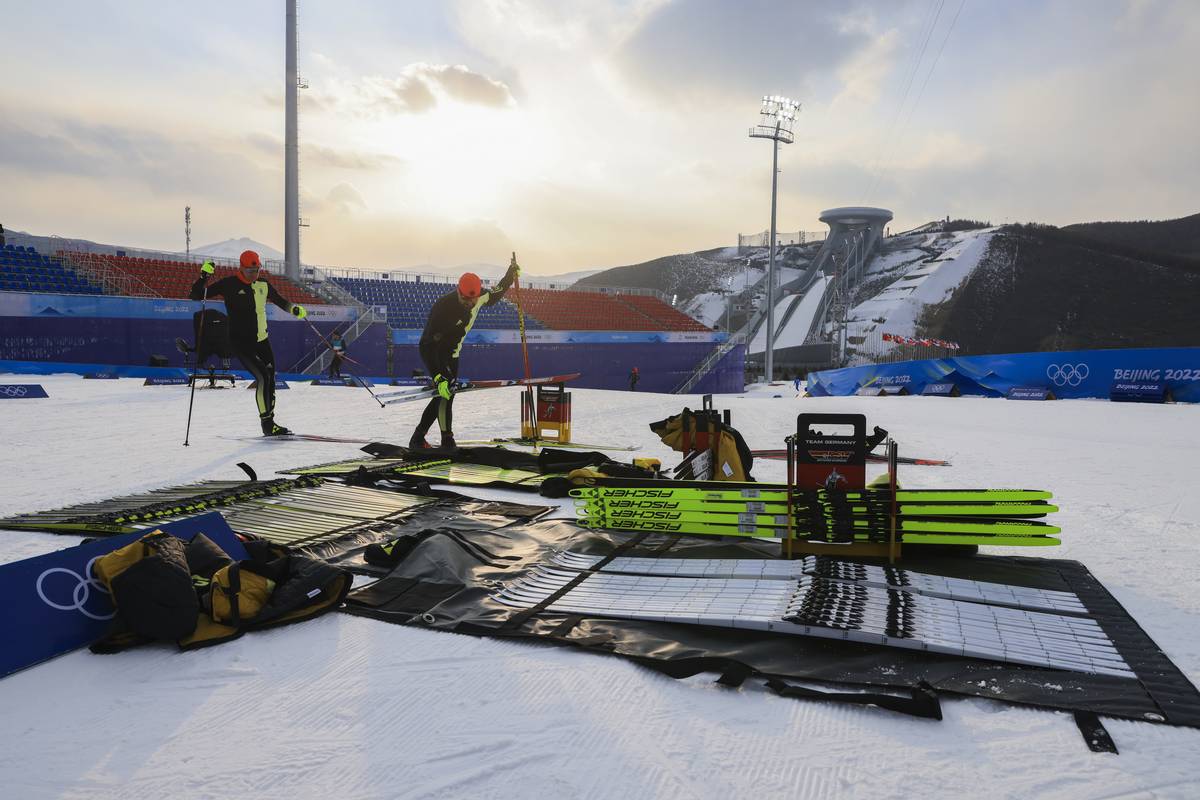
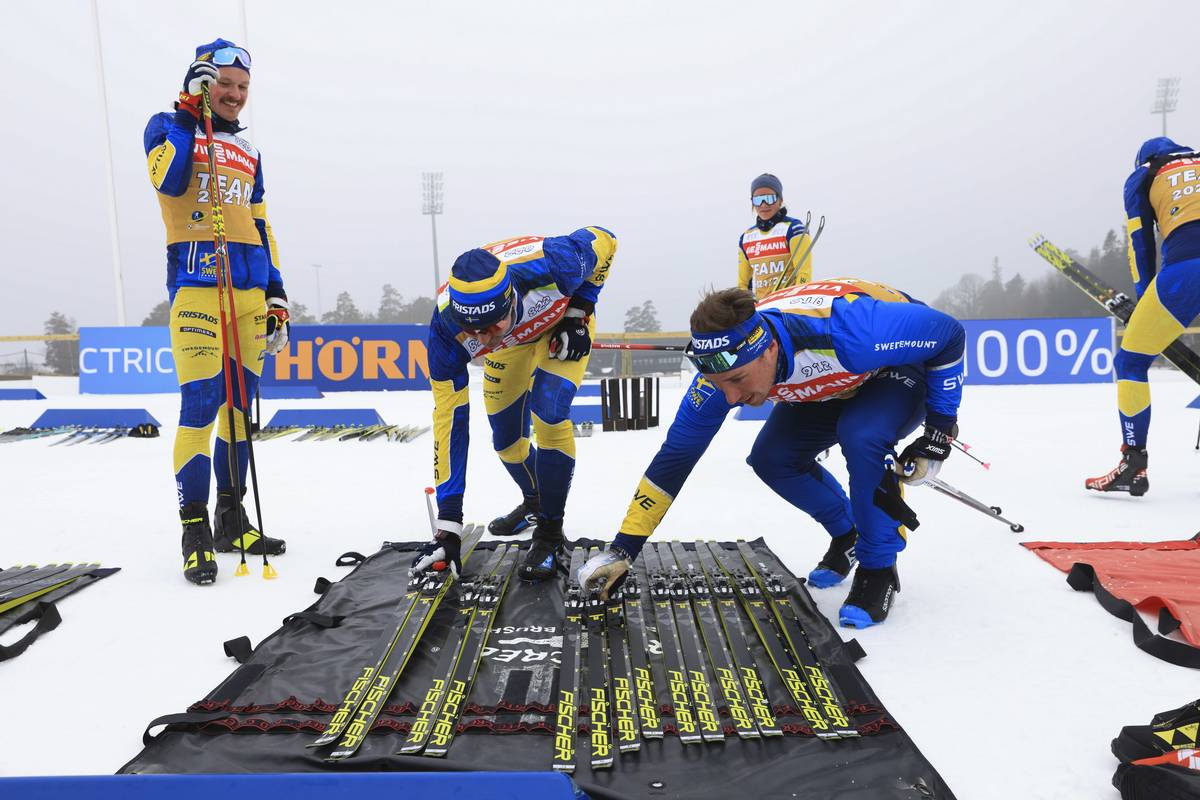
    The German biathlon team tests skis during the 2022 Olympic Winter Games in Zhangjiakou, CHN. (Photo: NordicFocus)

    As a serviceman working at the highest level of sport, Nystad also offered a thought-prompt on the impact to athlete knowledge and the ability to develop a new generation of wax technicians under a protocol, regardless of brand. 

    “If you want to educate athletes to also be able to become great service people at World Cup level races – if you take away that experience in club skiing or in high school skiing or in collegiate skiing, you will have no resources that are going to be able to serve your American athletes going to World Cups or World Championships or Olympics. Where are they going to get the knowledge? Because it’s like anything else, if you want to become good at something, you have to work at it.”

    According to Caldwell, incorporating a wax protocol is “reductionist attempt to level the playing field” that creates more disparity than equity. And so, the goal of leveling the playing field in cross country skiing remains “laudable”, but out of reach, and perhaps unattainable. 

    “I understand the discussion, but I think you have to cater to common sense,” Nystad concluded. “You can always tell people that we decide to [have] one pair skate, one pair classical. I think you can also try to have the waxes [matched]. But still be aware, it’s never going to be fair.” 

    Stay tuned next week for follow-up series which highlights some of the leagues who have enacted a waxing protocol, namely, the Wisconsin Nordic Ski League (high school & club), and coaches from Rocky Mountain, Intermountain, and the Pacific Northwest. This discussion includes the evolution and reasoning behind the protocols, and what advantages/disadvantages have been identified by each league.

  • What makes a fast ski? A discussion on league-wide wax protocols and ski performance theory with Andy Gerlach, Zach Caldwell, and Knut Nystad (Part 1)

    What makes a fast ski? A discussion on league-wide wax protocols and ski performance theory with Andy Gerlach, Zach Caldwell, and Knut Nystad (Part 1)

    FasterSkier shares insights into ski performance theory from Any Gerlach, Zach Caldwell, and Knut Nystad. (Photo: NordicFocus)

    In November 2021, the Wisconsin Nordic Ski League (WNSL), which oversees both high school and club level youth programming state-wide, accepted a sponsorship proposal from Swix and Salomon, which would provide the league with $10,000 in funding per year for three years. The proposal also included stipulation that a standardized wax protocol using Swix waxes would be adopted by the league at all affiliated races, including the state championship. 

    In practice, this would look like an email going out to all coaches a day or two prior to the event indicating which of a subset of Swix glide waxing products should be used by athletes that weekend. Equivalent temperature range and performance level waxes from other companies would be disallowed. In the sponsorship presentation given to the league by Swix, the proposal promoted the simplicity and affordability of a unified wax call, and a shift in focus for coaches away from time-consuming wax testing to race day support of their athletes. 

    The concept is not new, and WNSL is not the first league to adopt such a protocol. An equivalent protocol has been used by the high school, club, and collegiate level ski programs in the Rocky Mountain region (RMN and RMISA) for the last six years, and has more recently been adopted by the Pacific Northwest and Intermountain Division junior club programs. On the whole, these policies have been seen as beneficial by these regions. 

    While an additional $30,000 of funding has the potential to profoundly impact the reach of the WNSL, which will be discussed in a subsequent story, the adoption of the corresponding wax protocol also raised red flags, particularly among members of the Independent Nordic Distributors of America (INDA). The INDA includes distributors of wax products from other smaller companies like Start, Vauhti, Star, and more, and are primarily based in the Midwest. 

    The two primary issues that were flagged were the restriction of trade should Swix monopolize the buyer market encompassed by the WNSL, and also whether limiting the available choices to a single option actually creates the equity and uniformity that one might anticipate from putting all skiers on the same wax. Instead, could it widen the opportunity gap between those who could afford high-end skis with condition specific grinds and those who could not?

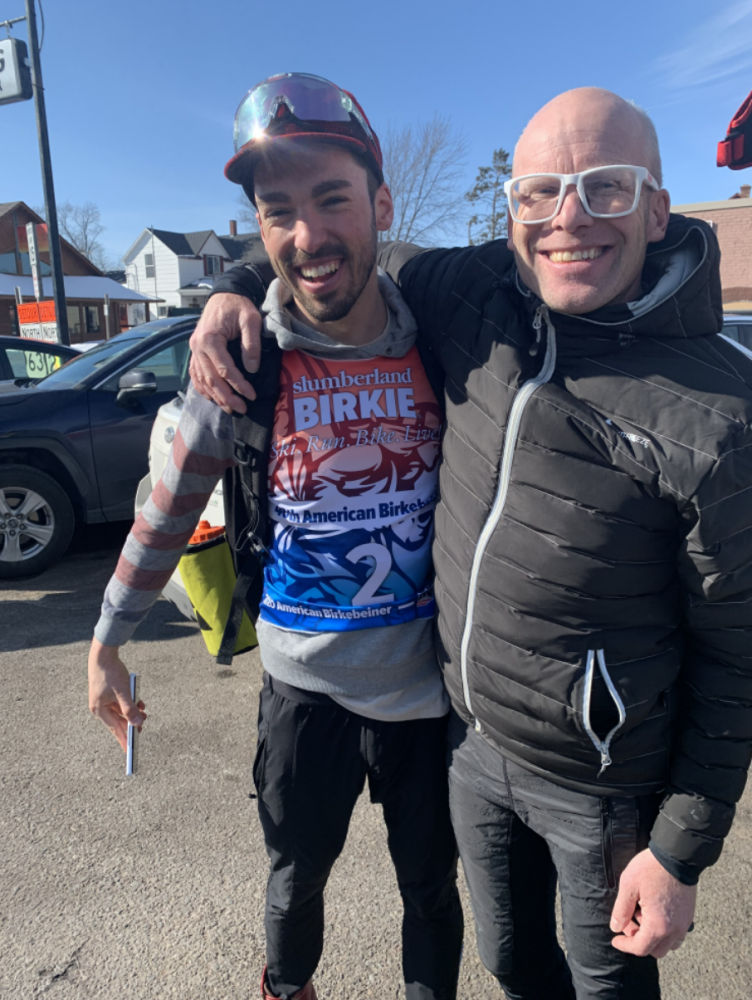
    Enjoy Winter’s Andy Gerlach snaps a picture with 2020 Birkie Champion Ian Torchia (SMS T2). (Photo: EnjoyWinter.com)

    In the fall, these issues were brought to FasterSkier by Andy Gerlach, director of Madison, WI based EnjoyWinter, which distributes Start, among other cross country related brands like Blitz Eyewear and Swenor rollerskis. With vested interests in the implications to his own business, but also as someone who offers brand-neutral education on wax theory for coaches, Gerlach actively opposed the decision by WNSL to accept the offer from Swix. 

    “The biggest argument against these exclusive sales agreements and proof that they are bad for the sport, and in fact illegal, is that they decrease the incentive for any other brand to fight for any part of a team’s or consumer’s business,” Gerlach said in the fall. “Why should my business continue to do wax clinics for Madnorski (Madison Nordic Ski Club) members if we know we are no longer getting a large chunk of their business. Why should any brand even visit Colorado clubs if we know we do not have a chance at a large chunk of the business there? Legal marketing arrangements should increase competition in the market, not decrease it. Change the agreements to marketing rights and not sales rights and every other brand would increase their efforts to reach the individual teams.”

    After discussions among the cross-country sport committee during the recent U.S. Ski & Snowboard annual spring congress meetings, Gerlach summarized his objections to wax protocols to the following four points.

    1. “They perpetuate a misconception that waxing is so difficult and mysterious. Our clinics state just the opposite.
    2. “They perpetuate a misconception that extensive testing is effective and needed to select a glide wax that an athlete can race up to their abilities with. Our clinics state just the opposite.
    3. “They increase the likely hood that those skiers with a quiver of skis will have the fastest skis. Multivariable mathematical analysis, as well as ski industry testing and ski sales figures shows this.
    4. “They endorse one brand ‘because it is the most available’ and in so doing extends this advantage.”


    There is plenty more involved in the debate on the legality and consequences on the business end of the decision whether to accept the sponsorship offer from Swix, which will be revisited in subsequent parts of this story. This installment, however, will focus on the underlying principles of ski performance theory, with input from experts, like Gerlach, on what factors ultimately determine ski speed, and whether restricting the waxes available for a given race would level the playing field by reducing variables, or adversely affect the pre-existing disparity between ski performance, thus limiting the potential of the skier clipped into the binding.

    Brimming with insights into ski performance, this thought-provoking conversation should provide fodder for discussion within race-leagues at all levels as they consider waxing protocols and avenues to improve equity within the sport. 

    ***

    We’ll start with what Gerlach identified as the factors that affect the performance of a ski from most to least significant, and where in this process limiting a coach/athlete to a single wax from a single brand becomes significant. 

    “In my hierarchy of ski speed deciding factors, it’s a flexible ski, the freshness of the base is the next important, the structure, then the hardness of the wax, and then the brand,” Gerlach explained in a call. “Now we’re going to take away the hardness of the wax as a differentiator between them. And now, all we have as the only differentiator is the ski model, the freshness of the base, and the structure.” 

    The understanding of this theoretical model underscores the remainder of the question. When we hear “wax tech”, the name seems to imply the key player being adjusted and assessed is the wax. Gerlach explained that this reasoning is misguided.

    “I, and scientific studies, will show you that 95% of this theoretical wax testing is not determining the fastest wax to apply that day. If it was, at US Nationals, or at any of these races, the line Saturday morning two hours before the race start would all be at one wax trailer. But you know, every coach comes up with their own thing… There is a different theoretical ideal wax for a Rossignol with an aggressive grind to the same Rossignol with a fine grind, and you would theoretically wax it differently. If you are testing on your Madshus cold skis and all your kids are on dried burnt out skis, or are on Fisher or on Salmon, theoretically, there’s a different wax [for each ski].”

    It’s a counterintuitive concept to those, like myself, who prefer to focus on the technique and training aspects of the sport, versus the technical side. Why doesn’t putting everyone on Swix PS8 on a day forecasted to be in the right temperature range remove a factor that might create disparity between ski performance, thereby improving equity? Particularly in a larger state, like Colorado, where teams are driving long distances (through vastly different elevation zones) to race without knowing exactly what conditions will be like until arrival, I could see the appeal for coaches of removing a step in the planning process. 

    Swedish Technicians at work at a March, 2022 biathlon World Cup event in Oslo, NOR. (Photo: NordicFocus)

    To simplify the answer on why equity may not be achievable with wax, Gerlach offered an analogy most skiers can relate to, regardless of their background knowledge in waxing theory.

    “If you’ve ever shaved your legs or your face with a razor,” he began. “A sharp, brand-new razor is like a fresh ski with a fresh base. You don’t need shaving cream and that razor works great. But a dull razor – a dried, crappy base – you need that shaving cream. And you need the best shaving cream you can get, and it’s going to help that razor and that shave a whole lot more.”

    How does this affect youth level programming? Ultimately, it accentuates the ever-growing “pay to play” problem of competitive sports. A newer, higher-end ski with a fresh base, or perhaps a quiver of skis that are ideal for different conditions, becomes much more important without the ability of a skier or coach to add versatility and improve the performance of a single pair of skis ski by utilizing a range of products to optimize the wax job. 

    “We have one ski with a great freshness of the base and a great structure, and one ski with a really dried up base. Had I applied wax to [the dry base], it does more to increase the ski speed than applying wax to a great ski… The more skis you can add to that quiver, all waxed the same, one of those is going to highly outperform the others. Versus when you had the ability to not only figure out which ski to go with, but which wax to go with. So by taking away variables that are easy to change, you make it more important to have a very good ski.”

    To include additional knowledgeable voices in the discussion, FasterSkier also spoke with Zach Caldwell and Knut Nystad, two savants in the complex and nuanced world of wax and skis. Caldwell is a leading expert in ski selection, wax, and grinds in the US, and the co-owner of Caldwell Sport. As a distributor of Vauhti, Rode, Star, and other waxes, Caldwell is also a member of the INDA. 

    Nystad is the former head of the Norwegian Wax Team, who still works as a ski serviceman for the Norwegian program at the World Cup, World Championship, and Olympic level. Prior to this work in his home country, Nystad spent twelve years as the head coach at the University of Denver. 

    “The idea of having a fair competition and limiting variables in order to generate more fairness and equity in the racing and create equal opportunity and a lower barrier to entry is a really laudable goal, but it misses the point,” Caldwell said simply in a call. 

    “The fact is that it’s a pretty complex system that we’re working with, with a lot of additive contributing variables that contribute to a whole solution, including ski flex, base material, base preparations, waxing, hand structure, all of it. When you have a lot of variables available to you, you have a lot of different pathways to success. The peak performance that might be available [on a particular ski] can be considered something along the lines of terminal velocity; you’re just not really going to go past a certain level of performance [on a day], the performance that the snow is going to yield. But there are a lot of ways to get there.” 

    Inside the wax at a February SuperTour race weekend in Craftsbury, VT, where Zach Caldwell (left) supported SMS T2 athletes. (Photo: Facebook Caldwell Sport)

    “As you begin to limit variables,” Caldwell explained, “you begin to place much more emphasis on other variables. They become proportionally much more important in determining how to get to the best performance possible [on the day]. And as you remove wax, which is a really inexpensive variable per application that can be put on specific to a day, you skew the emphasis toward skis base materials, grinds and hand structures.”

    Individual variation among the skis and in the technique and strengths of the skier on those skis adds additional complexity to the scenario.

    “Think about classic skis; this is a better way to imagine this,” Caldwell pitched. “Some athletes or some skis require different layering and build up of classic wax on a day. But if you’re saying, ‘Oh, you get two layers of extra blue. That’s it.’ That’s asinine. It means some people get to race and others basically have to herringbone.”

    Nystad also questioned the premise of leveling the playing field by creating uniformity in the wax selection.

    “Let’s start with the beginning,” Nystad said. “All of us that have done this for a long time, the only thing we know is that we don’t know. The only thing we know is that we need to test in order to get the answers. But what I can tell you from my experiences is that if you limit one factor, sometimes it just opens up another can of worms…

    “There’s definitely good arguments for trying to make the sport as simple as possible. But I think that for the people that think that just by waxing with blue, that that’s going to make it more equitable. It is a sign to me that they don’t have that much in-depth knowledge.”

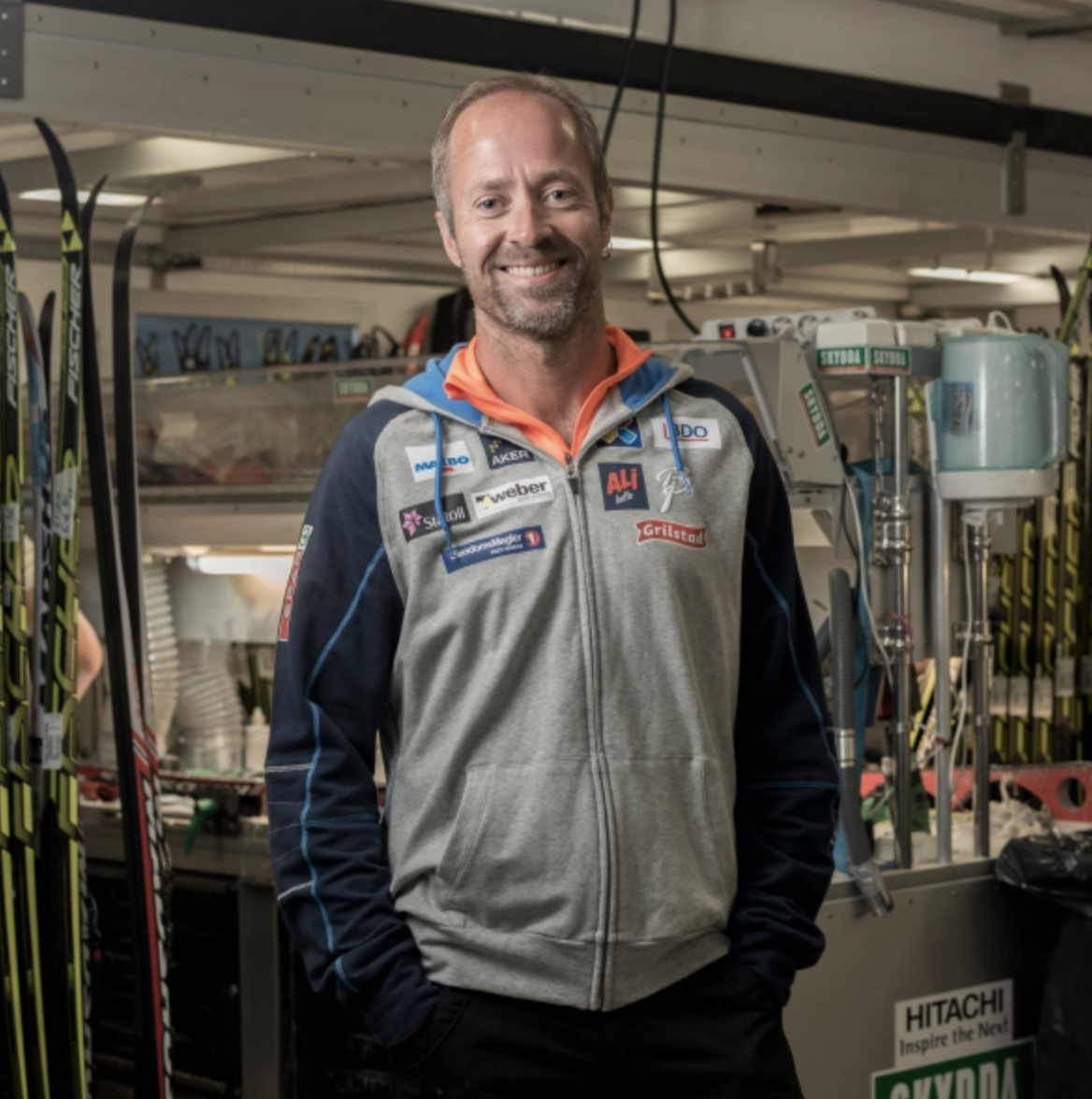
    Knut Nystad provides insight into ski performance theory and why a one-wax call may widen the gap in cross country skiing. (Photo: knutnystad.com)

    Without giving hierarchical ranking, Nystad also discussed the myriad of factors that contribute to the performance of a ski on a given day: the properties of the ski, including flex and splay, the quality of the base and its structure, the manual tools used, and the wax. “And then to top it all off, you have the method methodology that you use to apply the wax.”

    He walked through various ways a particular wax could be applied to yield different results, before echoing Caldwell’s sentiments that equity and uniformity cannot be achieved by restricting the options for wax that can be applied to a ski. 

    “When people say, ‘Well, can’t we just all wax with the same thing? It will make it easier.’ Clearly it will make it easier; you have one less factor to think about. But if the intention was to make it more of an even playing field, it’s not necessarily the truth. Because when you go to a race,  you’re only limited to try to test what you can afford from money, resources, and of course, time being one of those resources. So if you don’t have the test wax, what else can you test? Well, you can test many more skis, with many more properties with many more different bases, with many more structures, with many more manual tools. 

    “So it just opens up other things that you can test to get an advantage. And everything that you’re going to test if you’re going to have more skis, of course, that’s going to cost more. If you’re going to have more structures, different kinds of structures, that will also cost more. If you’re going to add manual tools, that will also cost more.”

    Stay tuned for more insights from Gerlach, Caldwell, and Nystad in Part 2 of this story.


  • MountainFLOW Fluoro Takeback Program: Giving skiers the option to safely dispose of fluoro waxes from anywhere

    MountainFLOW Fluoro Takeback Program: Giving skiers the option to safely dispose of fluoro waxes from anywhere

    The ski community has known there’s a problem for awhile now. Fluorinated waxes, whose extreme hydrophobic properties make them ideal for fast skis, also are by that same property impossible to break down in the environment, allowing them to permeate through the soil into water supplies. The compounds are also known carcinogens, and frequent exposure to these compounds, particularly when heating and inhaling the fumes of waxes in which they are contained, is linked to a myriad of cancers.

    That vice has outweighed their virtue, and now, perfluorinated waxes are inching ever so slightly toward taboo in the ski world. That story has been one which FasterSkier has tracked for years, but up until now, there have been insufficient resources on the safe disposal of these waxes, as well as a lack of available options to facilitate skiers safely getting rid of what they have accumulated in their boxes.

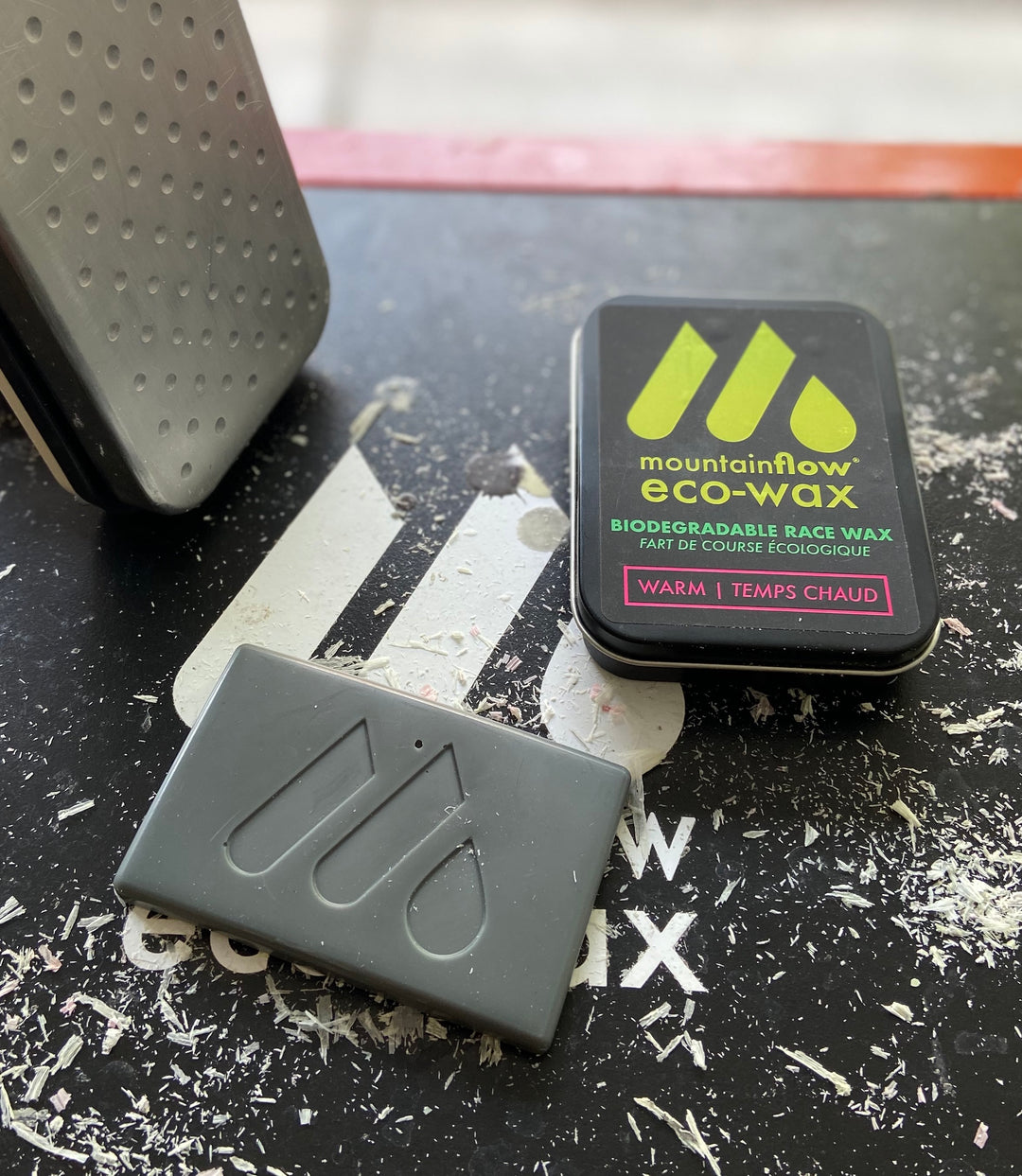
    MountainFLOW Eco Wax launches a fluoro takeback program May 1 – 31, 2022, allowing skiers to mail in their stash of harmful fluoros for safe disposal. (Photo: MountainFLOW.com)

    That’s when Peter Arlein, the CEO and founder of MountainFLOW Eco Wax, had an idea. “When the FIS started talking about prohibiting fluoros two or three years ago, I visited ski shops and realized they were using the stock of fluoros they couldn’t sell on their rental fleets. I thought that was missing the point – we need something that’s going to take fluoros out of the snow, not just the market. We’re a plant-based wax company, maybe there’s a program we could design where we could take back that fluoro wax from them, and replace it.”

    For Arlein, whose company was in the process of pioneering high performance biodegradable alternatives to fluoros, the idea was one that he knew was necessary for the ski world, but also one they wouldn’t have the capacity to institute without willing partners.

    Then in 2021, a representative from the state of Colorado’s Outdoor Recreation Industry Office reached out wondering if he would have any ideas for that year’s Wright Collegiate Challenge. The Wright pairs undergraduate and graduate business students across Colorado with partnering outdoor recreation companies to help pioneer new initiatives and niches. Arlein’s idea of a takeback fluoro program seemed tailor-made. “The students at Western [Colorado University] and [Colorado] Mesa came around and not only did they have the bandwidth to get [this] off the ground, but also to bring their ideas as skiers and students too.”

    MountainFLOW Eco Wax has created a biodegradable plant-based line of race waxes, allowing skiers to have fast race skis without the harmful environmental impacts of petroleum based products. (Photo: mountainFLOW)

    The result, a full-fledged MountainFLOW, is set to launch its first wave of a fluoro take back program May 1st – 31st.

    The overall mechanism of the program is fairly simple: skiers donate their wax, and in return get a discount from MountainFLOW on their waxes.

    Skiers have the option to donate wax either by mail, sending the wax directly to MountainFLOW’s headquarters in Carbondale, CO, or by dropping off their wax at three retail partners in Colorado; Evo (Denver), Salida Mountain Sports (Salida), or Powder7 (Golden).

    MountainFLOW and the team of Wright students will take it from there. The process on the disposal part is, like all things on fluoros, still evolving. Leyla Ericson, an Outdoor Recreation MBA at Western Colorado said in a call with FasterSkier that “there’s only provisional guidance from the EPA right now on PFAs (the environmentally harmful class of chemicals that fluorocarbons belong to) disposal. From our understanding, they’re hoping to finalize those guidelines by summer of 2023, and so if we launch now we can hopefully scale and build a program that’s fully able to quickly process wax when there is a firm procedure for getting rid of these [waxes].”

    MountainFLOW’s launch of their take-back program now also coincides with the end of the last ski season where fluoros could be used in races in the US. With the US Ski and Snowboard instituting a ban after the Olympic qualifiers back in January, programs that were hanging on to their fluoro boxes for when the SuperTour came to town now have an opportune window to look for what’s next in the waxing world. That’s a reality that Arlein says will only continue to encompass more and more organizations, especially, as he says “when the FIS inevitably will put a full ban into place.”

    Kevin Bolger races a freestyle sprint qualifier in late February, 2022. (Photo: NordicFocus)

    With the timing factor for both ski-world and government policy coming together, Ericson said that the Wright challenge students wanted to take the step that many in the wax industry were tip-toeing around with fluoros:

    “We got to a point where we said, well someone has to launch this type of program. The idea has been around for a while, but either because people don’t understand the pressing need or because it wasn’t readily available, there’s been no movement on actually making it happen.”

    And while the program’s on-the-ground footprint will initially be limited to Colorado, the MountainFLOW team is hopeful it can rapidly expand the buy-back program, with Arlein saying “people all over can mail in right now, and then we’re for sure looking to open up disposal sites with more partners…A good example is this year we were at the Birkie expo (read our story on MoutainFlow’s trip to the Birkie here) and talking to their sustainability people, and they were like, you should come next year and have this be a site. It was pretty remarkable too, we were at the expo and the number one question we got from people was ‘How do I get rid of my fluoro waxes?’”

    With enough investment and the right partners, Arlein is hopeful that “we can get all of the fluorinated waxes off retail shelves, and hopefully, off nearly all wax benches too.”

    It’s a goal that requires creativity, cross-industry collaboration, and above all, action. With that coming in equal parts from MountainFLOW and the Wright students, the tip-toeing around the fluoro issue is being stamped over by decisive steps towards action.

    Action that you, me, clubs and teams can all participate in – starting here.

    Note: Skiers wishing to mail in wax to MountainFLOW can send their waxes to 201 Main St., Suite 303, Carbondale, CO 81623. You can also donate to support the MountainFLOW program as it grows and expands here.

  • The Devon Kershaw Show: Inside Olympic Skis and Waxing with Zach Caldwell

    The Devon Kershaw Show: Inside Olympic Skis and Waxing with Zach Caldwell


    In this episode of the Devon Kershaw Show, we bring back Zach Caldwell, one of North America’s leading ski and wax experts. We get into the arcane and arguably misguided rules around the use of fluorocarbon waxes at high-level races, along with potential challenges for wax and ski technicians at the little-studied Beijing Olympic venue.

    You can find a host of resources from Zach on skis, wax, and grinds that might more-directly apply to your own skiing and racing at CaldwellSport.com.

    We’ll be back with an episode on Olympic team selection next week. Send questions and feedback to devon@fasterskier.com and nat@fasterskier.com.

    Zach Caldwell in his element. (Photo: Facebook Caldwell Sport)
  • News Roundup: World Cup Cancellation, Canadian Olympic Trials, US Biathlon Olympic Team Naming, and Illegal Use of Fluorinated Waxes in Falun

    News Roundup: World Cup Cancellation, Canadian Olympic Trials, US Biathlon Olympic Team Naming, and Illegal Use of Fluorinated Waxes in Falun

    Here’s a quick and non-exhaustive look at some recent news in the world of nordic sports. 

    World Cup Cancellation in Les Rousses, FRA and Planica, SLO

    Earlier this week, the FIS announced the cancellation of the final World Cup stop before the 2022 Olympic Games in Beijing, which were scheduled for the 21st to 23rd of January in Planica, Slovenia. This news arrives a week after the cancellation of the Les Rousses, France mini tour, which would have taken place this upcoming weekend. Both cancellations were made based on rising numbers of coronavirus infections with the omicron variant.

    “Due the current acute development of the pandemic in Slovenia, the safety of stakeholders involved at those large scale events could not be guaranteed,” the FIS wrote in the media release.

    Julia Kern tags Sophie Caldwell Hamilton during a December, 2019 team sprint in Planica, Slovenia. (Photo: NordicFocus)

    Of the event stakeholders, athletes in particular would be at heightened risk of a COVID-19 infection that could jeopardize their ability to participate in the upcoming Olympic Games. Surrounding travel to Beijing/Zhangjiakou and admission into the Olympic venue “bubble”, strict coronavirus testing and management protocols will be enforced. Should an athlete test positive within a critical window before travel, they may be unable to attend the Games regardless of the severity of their illness. 

    FasterSkier will cover the topic of athlete safety and COVID-19 risk mitigation separately; stay tuned. 

    Canadian Olympic Trials Wrap Up in Canmore, AB

    The Canadian Olympic trials were held over the last week at the Canmore Nordic Centre Provincial Park in Canmore, Alberta. The event schedule, which mirrored the U.S. Cross Country Championships in Soldier Hollow, included a freestyle sprint, an individual start 10/15-kilometer classic, 15/30k individual start skate, and finished with a classic sprint. These competitions directly influence the selection of Nordiq Canada’s Olympic team. 

    FasterSkier will provide full coverage of these events in the coming week, but here’s a quick recap of results. 

    Jan 6th Freestyle Sprint: 

    Laura LeClaire won the women’s freestyle sprint, narrowly beating Cendrine Browne who took second. A few meters behind, Olivia Bouffard-Nesbitt crossed the finish line in third. 

    In another close finish on the men’s side, Antoine Cyr took the win ahead of Russell Kennedy, with Pierre Grall-Johnson in third. 

    Results

    Phillipe Boucher races the 30k skate during the 2022 Canadian Olympic Trials in Canmore, Alberta. (Photo: NordiqCanada/Nathanial Mah)

    Jan 8th 10/15k Classic: 

    In the classic distance event, Cyr doubled up on his victory, taking the 15k classic win in 41:12.0. Rémi Drolet skied the second fastest time on the course (+26.0), with Russell Kennedy rounding out the men’s podium in third (+36.8). 

    For the women, Katherine Stewart-Jones took the women’s 10k classic win in 34:29.6, with Dahria Beatty 0.5 seconds off her mark in second place. Browne was third on the day (+20.6) to finalize the women’s podium. 

    Results

    Jan 9th 15/30k Skate:

    In the following day’s distance skate race, the women’s podium looked quite similar to the distance classic podium. Stewart-Jones again took the win in 39:47.4, this time with Browne in second (+18.7), and Beatty in third (+42.0).

    On the men’s side, Kennedy advanced to the top spot of the podium, winning the 30k skate by a significant margin in 1:11:54.4. Phillipe Boucher was next to the line in second (+1:35.9), with Cyr in third (+3:34.2) following another sizable gap.

    Results

    A scene from the women’s classic sprint during 2022 Canadian Olympic Trials in Canmore, Alberta. (Photo: NordiqCanada/Nathanial Mah)

    Jan 11th Classic Sprint:

    On the final day of racing, Xavier McKeever earned his first podium of the week. After setting the fastest time in qualification, McKeever made his way through the heats to win the event in 2:55:50. Cyr took the second spot for men (+0.97), with Drolet racing onto his second classic podium of the week in third (+3.86). 

    For the women, Bouffard-Nesbitt again found herself on the sprint podium, smashing the women’s final in 3:22.46, and winning by a large margin over second place Stewart-Jones (+4.78). Third place was Laurence Dumais (+7.82), to close out the women’s podium. 

    Results

    Media releases and more information can be found at NordiqCanada.ca.

    US Biathlon Olympic Team Naming

    On January 9th, U.S. Biathlon announced final selections for the 2022 Olympic Team, which includes four men and four women. 

    In alphabetical order, the team includes: Jake Brown (St. Paul, Minn./Craftsbury Green Racing Project & USBA), Sean Doherty (Center Conway, N.H./National Guard Biathlon & USBA), Susan Dunklee (Craftsbury, Vt./Craftsbury Green Racing Project & USBA), Clare Egan (Cape Elizabeth, Maine/Craftsbury Green Racing Project & USBA), Deedra Irwin (Pulaski, Wis./National Guard Biathlon & USBA), Joanne Reid (Grand Junction, Colo.), and Paul Schommer (Appleton, Wis./Team Crosscut & USBA). 

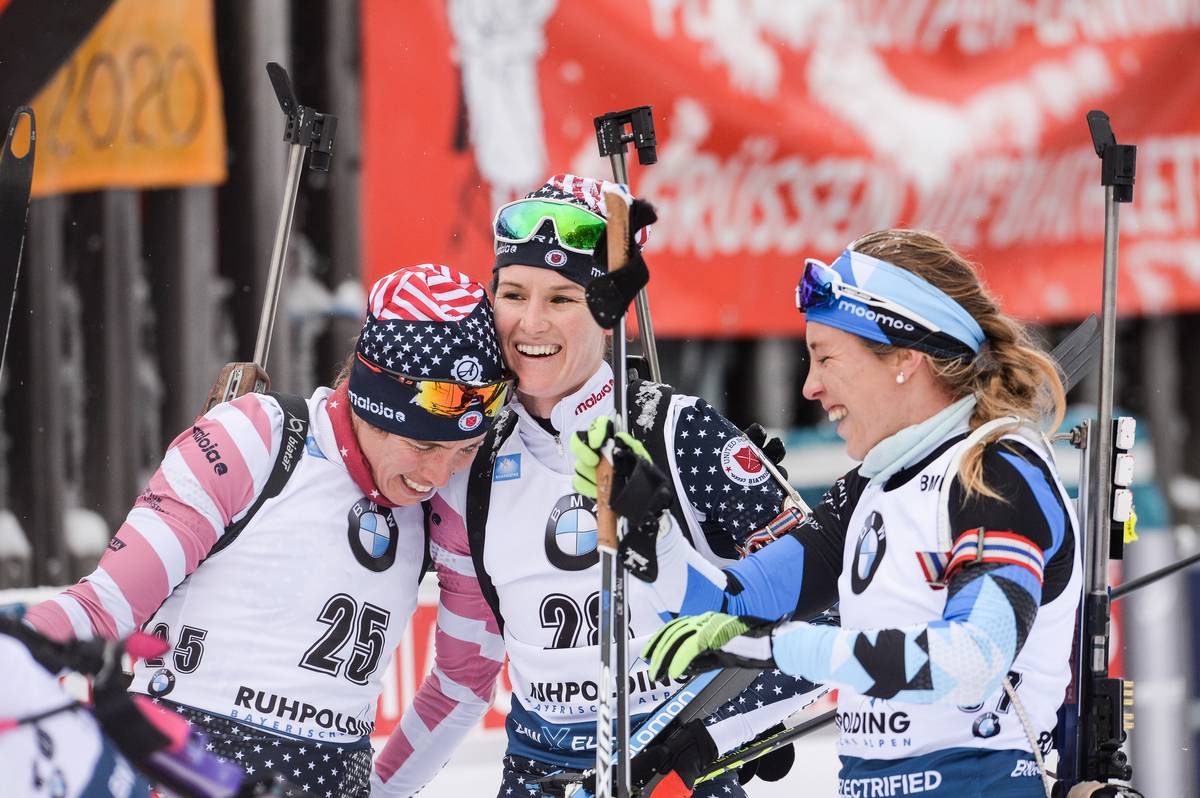
    Susan Dunklee (bib 25) and Clare Egan (bib 28) after the women’s pursuit in Ruhpolding on January 20th, 2020. (Photo: NordicFocus)

    More information can be found in this press release on FasterSkier, or at the U.S. Biathlon page on TeamUSA.org. 

    Cross-country team naming is scheduled for Tuesday January 18th, with an update on the final U.S. men’s quota on Thursday the 20th. 

    The FIS Confirms Illegal Fluoro Use at Scandinavian Cup Races in Falun, SWE

    The Norwegian news outlet NRK reported Monday that Pierre Mignerey, FIS Cross Country Race Director, confirmed suspicions that C8 fluorocarbons had been used in competition during the weekend of Scandinavian Cup races in Falun, Sweden between January 7th-9th. These products have been banned from use and sale in the EU due to their environmental and human health risks; the chemical compounds contained in these perfluorinated waxes do not break down over time and are known carcinogens. 

    With the aforementioned cancellation of upcoming World Cup events, this weekend of racing in Falun saw a competitive field, including names like Swedish sprint-phenoms Maja Dahlqvist and Jonna Sundling, and Norwegian standouts Håvard Solås Taugbøl and Sindre Bjørnestad Skar. 

    “I read an email this morning from the Chief Justice. It was a report about what happened in Falun and which must be discussed at the highest level,” Mignerey told NRK. “The report states that there were rumors and that the rumors were confirmed. Some have admitted that they used C8 products. But why they did it and how, it is not stated in the report.”

    Mignerey declined further comment as to who had been accused or confirmed of cheating, and the extent of the allegations that had been made. 

    FIS Race Director Pierre Mignerey measures the temperature on course during the 2021 opening World Cup weekend in Ruka, FIN. (Photo: NordicFocus)

    At this time, there is no method of testing for these substances during competition. A trust-based agreement has been signed by each national federation stating that their team will not use illegal products, however, violations such as what took place in Falun feed suspicions as to whether teams are adhering to the agreement.

    “Everyone has signed the letter and said that they will not use it in FIS competitions,” said Mignerey in the NRK report. “The problem is that there is nothing about the use of such fluorine products in the competition rules and thus the rules are not formally broken. The jury on the spot can not do anything about the case… But it is not fair behavior. This must be raised to the FIS council or FIS court, if we want to do something about it.”

    A comment from both Taugbøl and Skar was included in the NRK article. Both stated that they had not heard rumors of this cheating or volunteered their own concerns. 

    “I have not heard anything,” said Taugbøl through translation. “But both me and Sindre probably agreed on Saturday that we did not have completely optimal skis. But nothing more than noticing that others had better skis. It is not possible to speculate whether it was illegal fluoride. There will be ski differences anyway.”

    “I have not heard anything either,” seconeed Skar. “I went to two races this weekend where I experienced that I did not have fast enough skis both days. That’s the only thing I can say about it. But I have neither suspected nor heard anything.”

  • IBU Bans Some Fluorinated Products for the 2021-2022 Season

    IBU Bans Some Fluorinated Products for the 2021-2022 Season

    Sweden’s Sebastian Samuelsson training in Nove Mesto (CZE). (Photo: NordicFocus)

    With time to spare before the 2021-2022 race season, the International Biathlon Union clarified on Monday their fluoro wax policy. In a press release titled “IBU bans harmful fluor products from biathlon events,” the sport governing body banned the use of C8 fluorinated products. C8 compounds, also known as PFOAs, are eight chain fluorocarbons that have historically been used to enhance ski speed in certain conditions.

    The IBU’s stance brings it into compliance with current European regulations regarding compounds containing C8. The IBU’s announcement also brings some clarity to a rather murky year or two when it comes to enforcing a potential ban of fluoro ski waxes.

    However, the IBU did not ban fluorinated products outright for the 2021-2022 season. Ski speed products containing C6 fluoros are allowed. (Within the EU, C8 products are not allowed to be produced, sold, or used. C6 compounds are still allowed to be produced, sold, and used in the EU.)

    The ban on C8 and permitted use of C6 in IBU sanctioned events will rely on a signed behavior contract by all relevant stakeholders. “To implement the ban, all National Federations and wax companies accredited for an IBU event are required to sign a declaration stating that their teams and staff participating in IBU events will follow the IBU rules and EU / ECHA regulations. Participation in an event without prior consent will not be permitted,” states the press release.

    The enforcement of a fluoro ban has been a hotly debated topic the past few years as both the IBU and the International Ski Federation (FIS) floated then repealed a total ban on fluorinated wax, powders, gels, and liquids in the ski-prep process. The Fluoro Tracker, the handheld device in development to detect trace amounts of fluoros in real-time, has been held up due to issues with accurately detecting fluoros. According to the IBU, the Fluoro Tracker will not be introduced until after the upcoming race season.

    With no real specifics mentioned, the IBU expressed that it would be enforcing their C8 ban by performing “analyses of materials produced for, or used in, the preparation of skis to confirm compliance with the IBU rules and EU / ECHA regulations. This includes spot checks of materials in use by teams or ski wax companies and individuals at IBU events. Such analyses will be conducted by experts from external and certified laboratories.”

    Historically, testing for fluoros on a ski base has involved swabbing the base and sending the sample to a remote lab for analysis. This often involves a multi-day timeline as the sample is shipped, analyzed, and formal results worked up.

    In their statement, the IBU claimed it was committed to a total ban on fluoros in the future.

  • NRK and Expressen Report Fluoro Testing Device Flawed

    NRK and Expressen Report Fluoro Testing Device Flawed

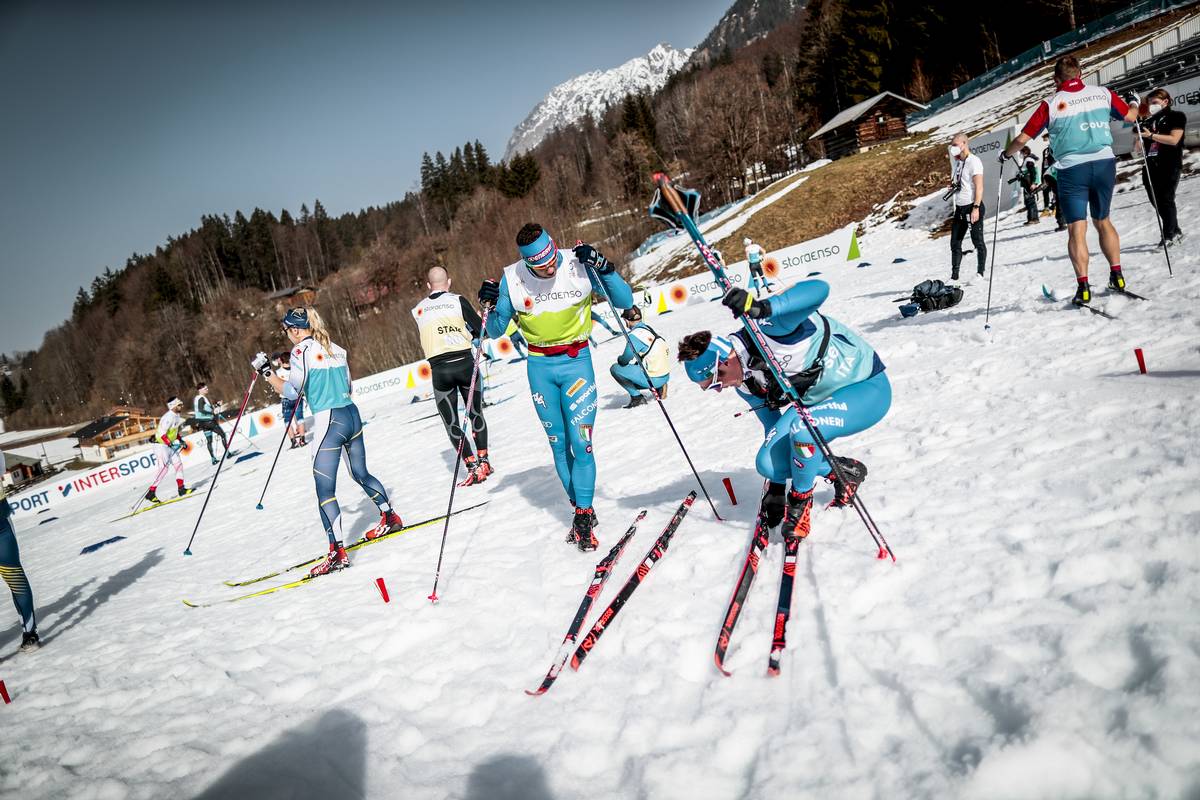
    Picking skis: that’s part of the speed equation. Italy tests skis at the 2021 World Championships. (Photo: NordicFocus)
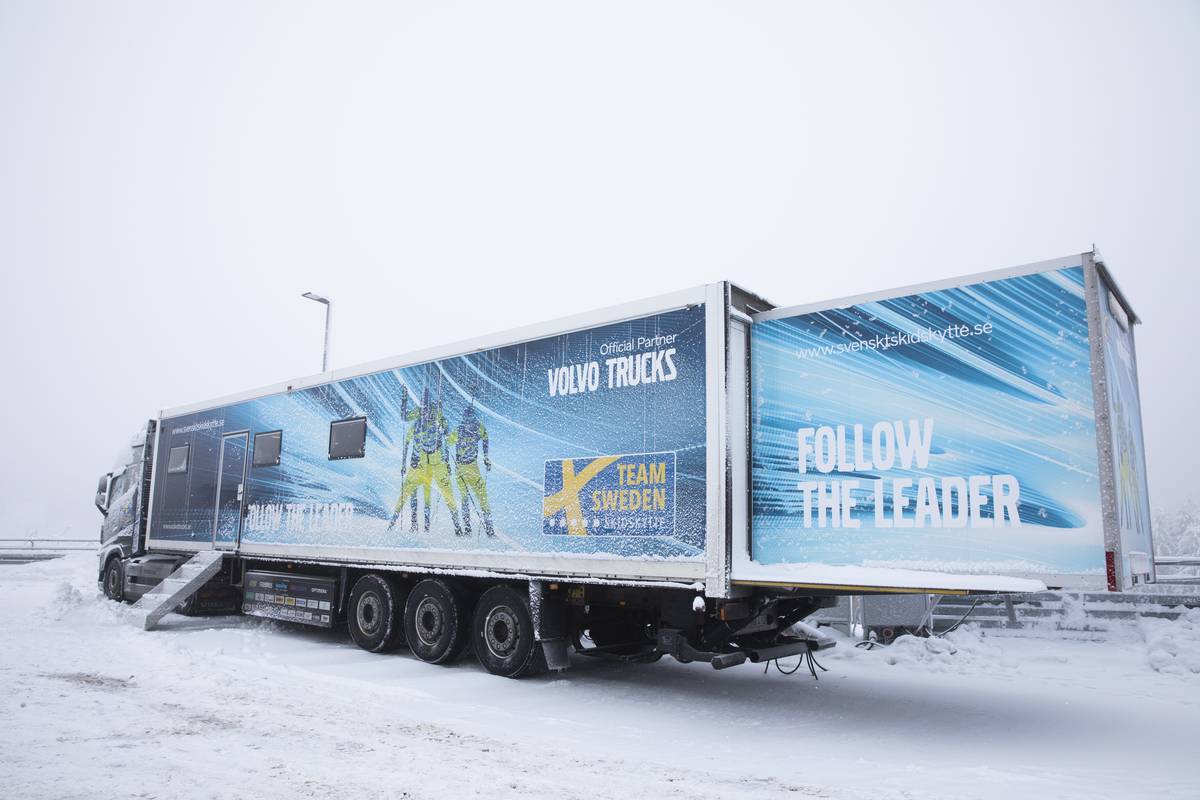
    But what happens in the wax bus matters too: Sweden’s biathlon wax bus flexes. (Photo: NordicFocus)

    Over the past few years, FasterSkier has reported on per-fluorinated waxes, powders, liquids, and pastes. Entities like the Environmental Protection Agency (EPA) and Europe’s equivalent, the European Environment Agency, are phasing out eight-chain fluorocarbons. We know, after diving into the scientific literature, the evidence suggests these compounds are not good for your health, and they persist in the environment as they do not readily breakdown into inert substances.

    We also know that skiers love fluoros. Per-fluoros simply make skis faster, especially when the snow is near its melting point and/or dirty. If you have been reading this site for maybe a year, you are probably aware of the speed benefits per-fluors bestow, and their environmental and health costs.

    As the world turns, so too do the vagaries of regulating per-fluorinated ski speed products. In November 2019, the International Ski Federation (FIS) announced a discipline-wide ban on fluoro waxes for the 2020-2021 season.

    That ban was later delayed until 2021-2022. The reason for the delay, given in October 2020 just a month before the start of the cross-country World Cup, was that the apparatus for testing ski bases for fluoros was flawed.

    (Not to confuse things further, but it is worth mentioning, races solely sanctioned by U.S. Ski & Snowboard this season were fluoro-free. FIS-sanctioned races permitted fluoros.)

    With the end of the cross-country World Cup last weekend in Engadin, Switzerland, comes renewed debate in Europe about the proposed fluoro ban and the efficacy of testing ski bases tainted with per-fluoros. Two news outlets, NRK in Norway, and Expressen in Sweden are reporting that the ban for 2021-2022 is in jeopardy.

    In the translated Expressen article, Sweden’s head of ski service, Petter Myhlback said this about a World Cup weekend in Falun, Sweden last January during which the fluoro-detector was tested in the field: “Yes, we did test measurements then – and it was quite messy. … We felt no security in those measurements. It was results that just swung up and down. Criss-cross.”

    Myhlback continued, “We had skis that were completely non-fluorinated, and some that were highly fluorinated. But … some of those who were highly fluorinated got the green light – and some of the non-fluorinated on the contrary.”

    In the article, Expressen quotes FIS cross-country competition director Pierre Mignerey as saying the FIS Council will need to make a decision and it is his understanding that, “there is a desire to wait until after the Olympics.” They also quote Mignerey as stating, “No. What we saw in Falun clearly showed that it is not good enough,” when asked about the efficacy of the testing device.

    The NRK article quotes Norway’s head of ski service, Stein Olav Snesrud, as also noting flaws in the testing device. NRK writes that Snesrud handed over eight pairs of skis in what was a blind test in Falun.

    According to the translated article, which has been lightly edited for clarity, the following combinations of Norwegian skis were tested:

    • A series of a total of 16 skis, eight pairs, on which fluoride powder was applied many times.
    • Some of these skis were also washed, they put on fluoride cleaner and later put on fluorine-free wax both two, four, and six times. They used fluorine-free spray sliders. In total, there were eight different lubrication options.

    Snesrud goes on to say that he received the results from the Falun tests. “I have to say that they are far away,” said Snesrud in the translation. “Based on the tests they did in Falun, they are nowhere near having a working device.”

    The NRK article indicates the results were off. “Five of the skis that came back and marked ‘no fluoride’ are skis that have only been given one layer of glider over the fluorine powder,” Snesrud said. “On two skis in the same pair, which have received the same treatment, they have found fluoride on one ski and nothing on the other. Then there are four out of 16 skis with no clear answer. There is far too much variation in those answers.”

    Snesrud also claimed that some fluoro-free skis handed over for testing were dinged as positive for fluoros.

    Another chapter in the saga of flouros will certainly be written soon.

  • FasterSkier Explains: How to Clean the Fluoros Off Your Skis So You Can Race the Birkie

    FasterSkier Explains: How to Clean the Fluoros Off Your Skis So You Can Race the Birkie

    (Photo: NordicFocus)

    What: Fluoros, aka perfluorinated waxes, aka ski waxes containing per- and polyfluoroalkyl substances (PFAS), aka the really expensive waxes that you put on for big races, in some or all of block, liquid, or powder form.

    What they do: Make your skis go really, really fast, particularly in the wet or dirty snow conditions that sadly characterize more and more high-end races in an era of artificial snow and climate change.

    What else they do: Exposure to certain perfluoros is associated with thyroid disorders, hypertension and preeclampsia during pregnancy, and testicular and kidney cancer, as well as statistically improbable rates of illness and death for people exposed to it in high quantities. PFAS chemicals have been found in the drinking water in multiple states. Lawsuits have been filed; over a billion dollars in settlements have been paid.

    What’s their status for ski racing: It’s complicated. For the past few decades, fluoros were ubiquitous in high-level ski racing. Then, in November 2019, the International Ski Federation announced that fluorinated waxes would be banned in all FIS races, including the World Cup, effective this race season. Nations began testing fluoro-free alternatives from major wax manufacturers. FIS began working on a workable and efficient fluoro-detection machine. Much upheaval ensued.

    Work on the fluoro-detection device did not go as efficiently as planned. At the eleventh hour, in mid-October of this year, slightly more than a month before the first World Cup race of this season, FIS announced that the fluoro ban would be postponed by a year, and would not go into effect on the World Cup (or at, say, the 2022 Winter Olympics) until July 1, 2021. “Stay tuned,” FasterSkier wrote last month.

    What did Devon Kershaw think about this: He was not a fan of FIS’s lack of competence or professionalism.

    Canadian wax technicians Mike Mappin (l) and Camille Cheskey (r) hard at work during the 2016 Winter Youth Olympic Games on Feb. 10 in Lillehammer, Norway. Yes, they should really have some form of respiratory protection. (Photo: Jon Buckle for YIS/IOC)

    No, really, what’s their status for ski racing: Simply put, fluoros are allowed in FIS races in this country this season, as in any FIS race in any country this season. They are not allowed in races sanctioned by U.S. Ski & Snowboard. (These were formerly known as USSA races. They are also known as NRL races, or National Ranking List races, that is, a points system used to rank domestic athletes.)

    That’s nice, but I’m your average master skier in this country. I’m not a USSS member, and I’m not racing any high-level races. Other than the general health and safety considerations, why do I care about this? Ever hear of a little thing called the American Birkebeiner?

    Yes, the one true ski race for Master Blasters everywhere. But what does that have to do with fluoros? They’re banned at the Birkie, starting this year.

    Really? Really. Here’s American Birkebeiner Event Director Kristy Maki, in an email to FasterSkier this November:

    “The 2021 Birkie Events will be fluoro-free. We are working on determining how testing will be implemented and right now, our goal is to do testing on a limited number of skiers. We have been working on the basic planning of Birkie Events, but I will be updating the Participant Rules soon.

    We have announced previously that we would be fluoro-free in 2021, but it has not gotten a lot of attention lately.”

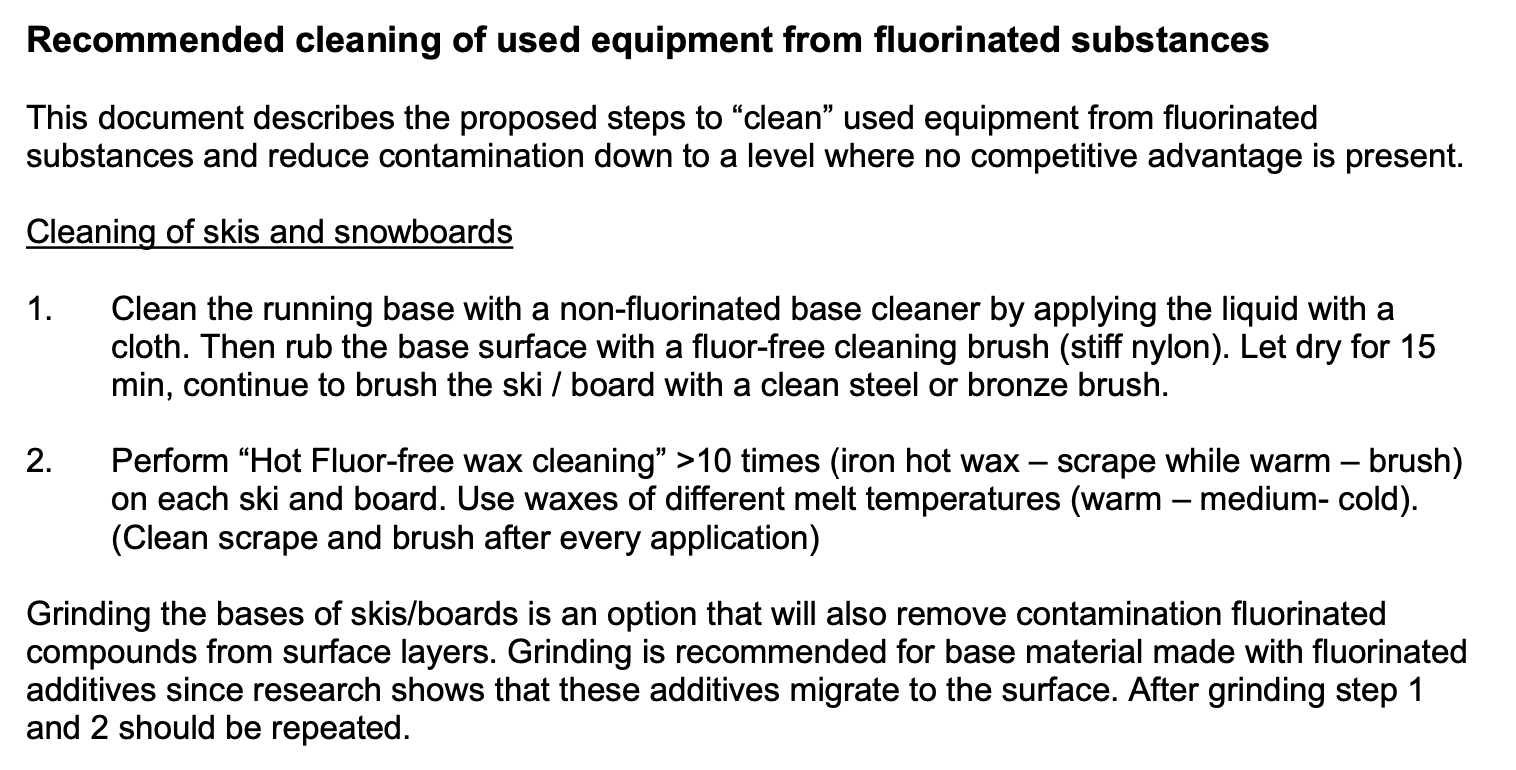
    Okay, I’m listening now. How do I get the fluoros off my skis so I can race the Birkie without breaking the rules? The short version is that you need to clean your skis; de-fluoro your skis; and then wax your skis anew with fluoro-free wax. Here is an excerpt from a longer document prepared by FIS:

    If hot waxing more than 10 times does not seem like enough work, the full document also explains how to clean/purify your iron, scrapers, brushes (but you should really just buy new brushes), roto fleece, wax apron (wash on high “several times”), files and file guides, ski bags, and wax room.

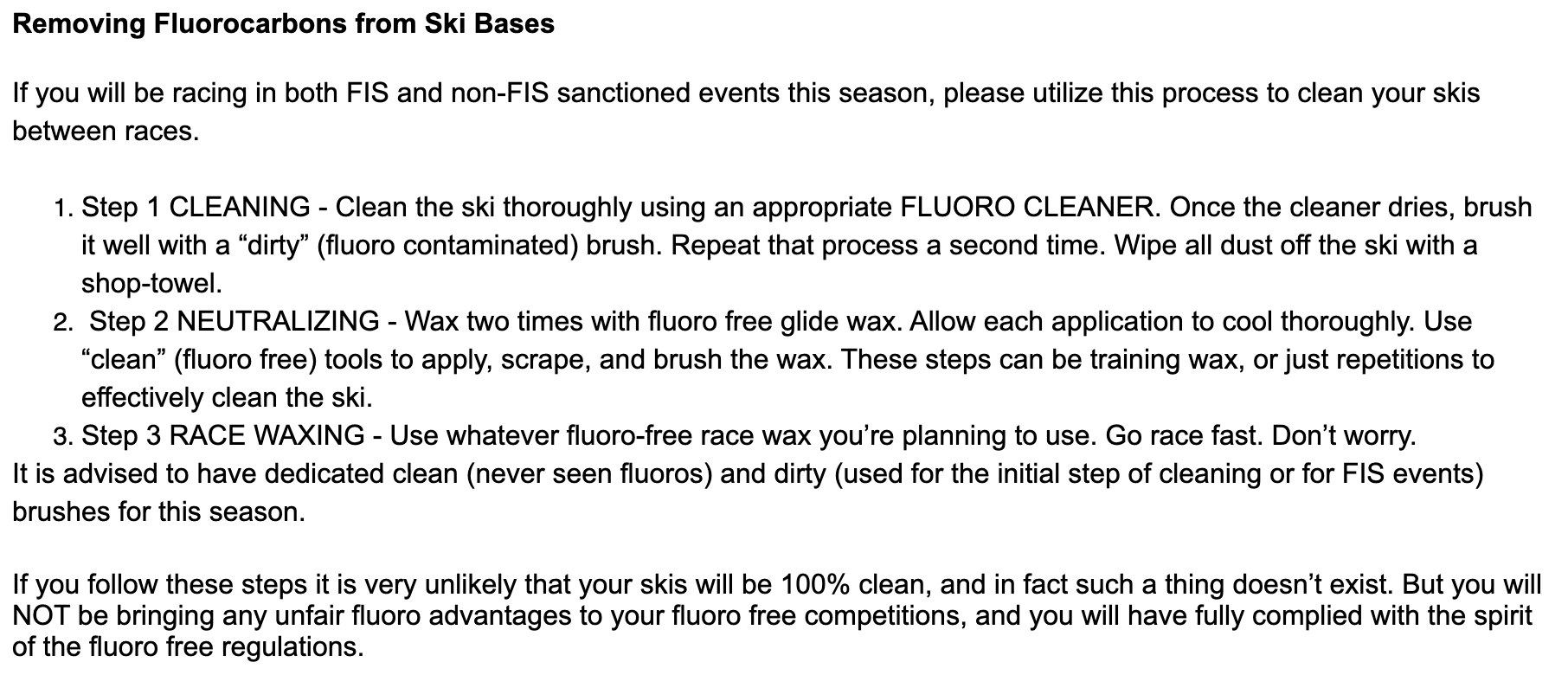
    Wow, that sounds really involved. Do you have a shorter version of what I can do and still achieve some sort of good-faith compliance with these new rules? Thankfully, yes. Here’s what USSS sent out in an email to all members in mid-November:

    The main difference is that it involves far fewer repetitions of the cleaning step, specifically “two times” rather than “more than 10.” (Granted, that’s twice through a normal wax application in which the wax cools each time, rather than 10 times hot scraping, so that’s a little apples to oranges.) But this was sent out by Adam St. Pierre on behalf of U.S. Ski & Snowboard, so this would seem to have USSS’s imprimatur behind it. Also, this accords with the “two layers of NF” protocol used by EISA teams over the past few seasons.

    Bigger picture, USSS seems to envision this as something you could do if if you’re transitioning between, say, USSS and FIS races multiple times this season (or USSS and no-holds-barred citizens races), while the FIS protocol is probably more applicable to making a permanent transition from a fluoros to a no-fluoros world. Which is clearly coming soon, but, depending on where you live and the viewpoints of your local ski club, may not be here yet – citizen races in southcentral Alaska, for example, remain very much fluoro-friendly this season.

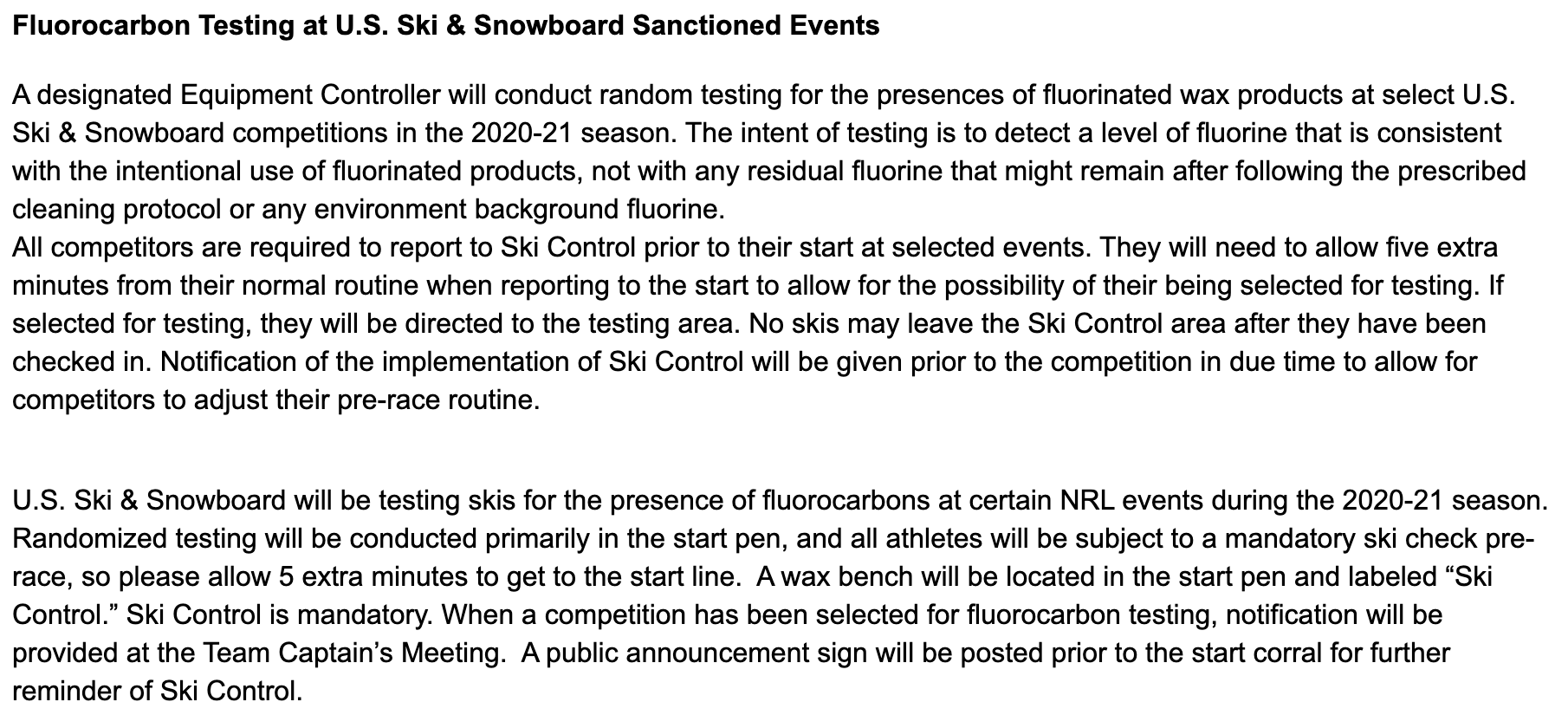
    Okay, I did all this, but I don’t trust my competitors to do this at all. What type of oversight is there going to be at races this season? Probably some but not much. As Maki with the Birkie said, they will be targeting “a limited number” of entrants. Or here’s St. Pierre, in the same mid-November email quoted from above, describing random testing at “select” USSS races this season:

    Full details on the testing protocol (brief version: the ski is swabbed in two places on the glide zone; sample is sent in for analysis; results come back in 10-14 days) may be found here. St. Pierre also explains the possible sanctions for evidence of fluoro use, up to and including disqualification. He adds, “Remember: Testing can indicate the degree of fluoro contamination. Our intention is to catch intentional and unethical fluorocarbon use; the goal is not to sanction individuals for traces of fluorocarbons from prior waxing, those present in the ski base, or the environment.”

    What do you have to say about all this, USSS official site? Here you go: “In order to provide U.S. Ski & Snowboard members, coaches and officials guidance with the [no fluoros] policy, we are providing the following information: …

    Fluorinated Wax Testing: Testing procedures and protocols will be forthcoming.”

    Oh.

    What do you have to say about all this, American ski community? Here’s CXC, writing about its new wax policy for this year’s events (emphasis in original): “Our CXC Cup Wax Policy is first and foremost an honor system, but athletes at Salomon CXC Cup NRL Events are subject to random ski testing for illegal wax by representatives of U.S. Ski and Snowboard. It should also be recognized that ski waxing, especially with non fluoro waxes, is quite variable and often two similarly waxed pairs of skis can have large differences in glide based upon non wax factors such as flex and structure/grind. All competitors and coaches should adopt a culture of compliance, and all our membership should presume their fellow competitors are acting ethically and legally, rather than pointing fingers based upon a subjective idea that someone has fast skis from illegal waxing.”

    Or here’s Boulder Nordic Sport’s Roger Knight, writing in this winter’s version of the BNS catalog, which was prepared at a time when fluoros were going to be completely barred this season, and so was partially obsolete by the time it was printed: “Where does [the absence of widespread fluoro testing] leave us? With an honor system. Will some people cheat? Undoubtedly. Do you want to be one of those people? Only you can answer that question. One thing that we essentially have never had here in the US is a stain of cheating on our cross-country skiing culture. We hope that this continues at all levels of the sport.”

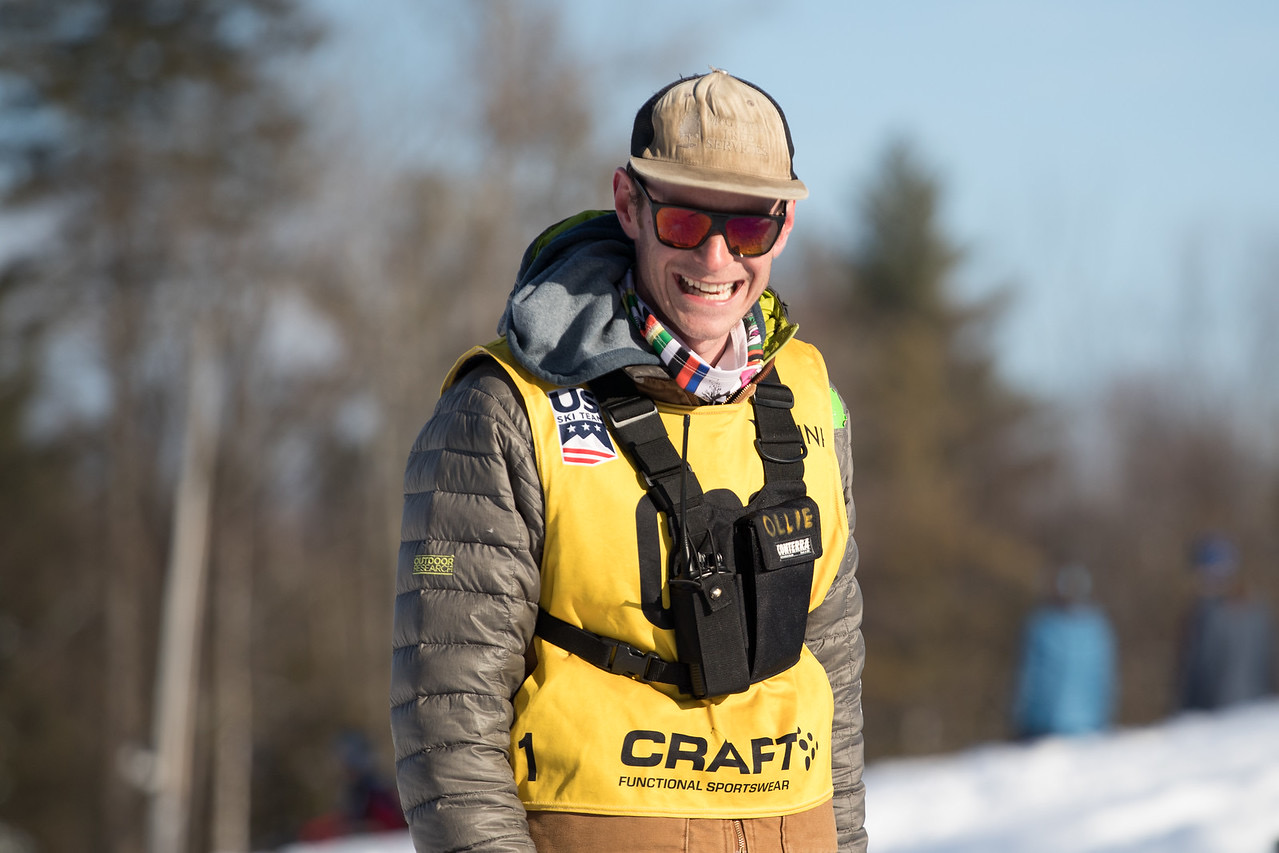
    Ollie Burruss, chief of competition at the 2019 US Nationals in Craftsbury. (Photo: Craftsbury Outdoor Center)

    Finally, here’s FasterSkier writing last month about Craftsbury nordic race director Ollie Burruss: “In Burruss’ estimation, racing at the Outdoor Center is de facto fluoro free. … The Outdoor Center asks you not to use fluoros. That decision, according to Burruss, will be based on trust and a hardened value system relying on people doing the right thing, not necessarily the fastest thing.”

    Burruss added, “We don’t have a community in New England where it’s fraught with suspicion, backstabbing, and people trying to one up each other. We really have, I think, a really tight-knit supportive ski community. And so when we planned on having FIS racing, we weren’t going to test.”

    I’m sorry, but I’m still skeptical that some of my competitors are going to comply with a largely honor system-based protocol, when the advantages of fluoro use in some conditions are so great, and widespread testing or enforcement is not really an option yet. Am I alone in this concern? You are not. Although it was admittedly unscientific, an informal poll conducted on FasterSkier last fall suggested that large portions of the 160 respondents were less sanguine than Burruss or CXC leaders about the ethics of their competitors. (N.b., there was likely no practicable, quick-turnaround, fluoro-detection device on the market at that time. To be fair, there still isn’t.)

    One of the questions in the 2019 survey was, “If a fluoro ban was put in place, would you trust that the field was ‘clean’ with regards to fluorinated ski bases?” Only 25% of respondents answered “yes.”

    Narrative comments made in response to this question included, “A 20%+ advantage in some snow conditions? Yeah, that’s a big incentive. I can’t imagine [a ban] working.” (For perspective, and back to the Birkie for a second, a 20-plus-percent improvement is the difference between qualifying at the back end of the Birkie Elite Wave and making the podium at SuperTours or U.S. Nationals. That’s a pretty big difference.)

    Also, “If there isn’t a simple compliance test, no doubt some people will cheat to win.” Also, “I would like to trust that the field was ‘clean’, but I think I would struggle to do so if it were to actually happen. Furthermore, I think that any stellar performance by an athlete would be subject to suspicion, regardless of whether or not they were ‘clean’, and that this would be unfortunate.” Also, “I am sure several masters racers with large wax stores would still use them until they were depleted; I would expect races to be clean in several years and primarily clean in the interim.”

    Also, and more optimistically: “At the World Cup level, I probably wouldn’t trust the field to be clean, because there is a lot at stake, and some people already dope, so I’m sure they’d have no qualms about fluoro doping. However, at the US level, I have a lot more faith in the nordic ski community and I honestly believe that anybody that is seriously competing to win super tours and represent the US at world championships would do so honestly.”

    In response to other questions, 64% of respondents stated that they would continue to use their existent stock of fluorinated waxes. 56% of respondents stated that they foresaw some sort of black market developing for banned wax products. Again, you can find the full poll results here if you are curious. You may also note this narrative comment, which speaks volumes: “I hate the poison but feel non-competitive without it.”

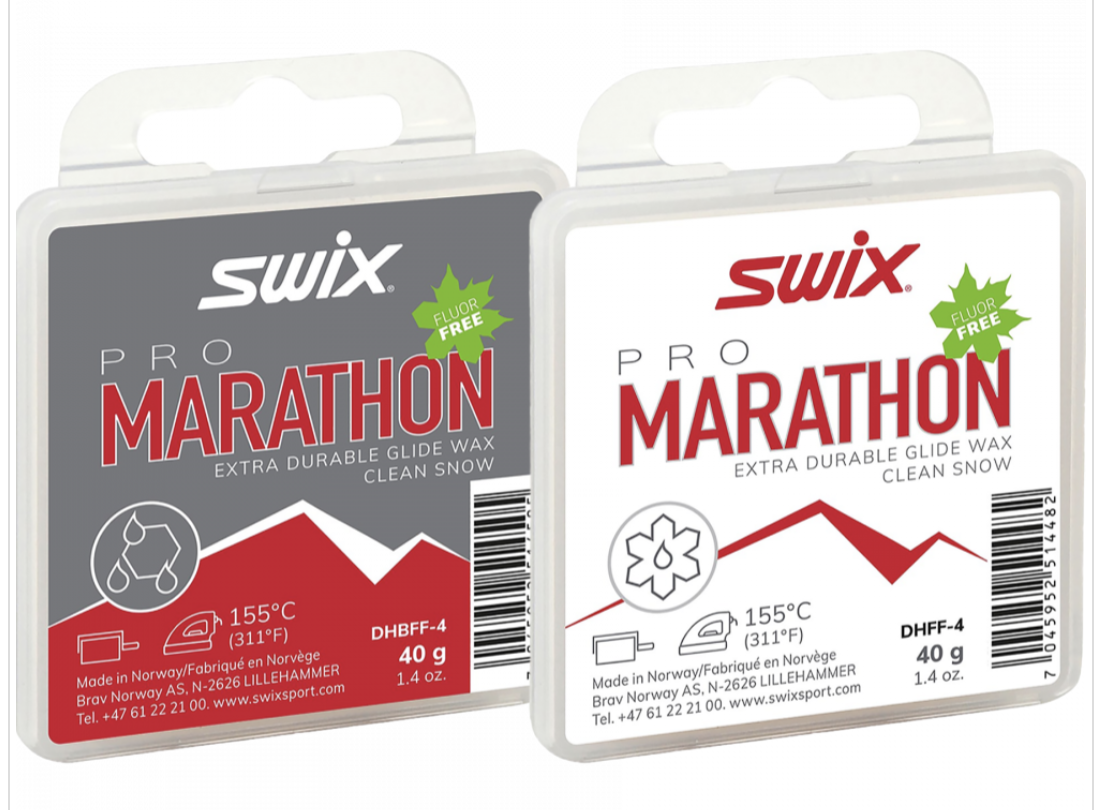
    Swix would be glad to help you restock your wax bench: Swix Pro Marathon Fluoro Free. (photo: screenshot from current BNS catalog)

    So after I clean off my skis, what do I buy to wax with instead? Most wax manufacturers have developed fluoro-free analogues of most of their fluorinated products. Your local ski shop will be well-versed in your new options.

    What else should I buy? Maybe some new skis, or at least some new structure tools. As USST wax tech Chris Hecker wrote, summarizing his testing of World Cup-level non-fluoro waxes during the 2019/2020 season, “I am very impressed with how good some of the non-fluoro alternatives have been. In colder, dry conditions I find a number of brands have found competitive alternatives to fluoro top coats, but when it comes to warm, wet snow days the gap is still fairly large. On warmer days with non-fluoros being present, skis, hand structure and ski grinds will become ever more important.”

    This article has been edited to remove a link to a table of waxes approved for CXC races, because it represented only a portion of fluoro-free waxes currently available.

  • News Round Up:  Canada Will Host 2023 Nordic Junior/U23 World Championships

    News Round Up: Canada Will Host 2023 Nordic Junior/U23 World Championships

    Canadian stoke post-Junior World’s 4 x 5 k men’s silver medal. (Photo: Doug Stephen)

    2023 World Juniors/U23 goes to Canada

    Recently, Canada was awarded the right to host the 2023 Nordic Junior/U23 World Championships. The hosting club is Black Tusk Nordic which runs much of its ski training out of Whistler Olympic Park in the Callaghan Valley. The venue hosted nordic events that included cross-country, jumping, nordic combined, and biathlon at the 2010 Vancouver Olympics. 

    “We are extremely pleased to have the opportunity to bring this prestigious event for aspiring Olympians in the Nordic sports back to North America for just the fifth time ever in its 40-year history,” said Dave Pym, Managing Director & CEO, Canadian Snowsports Association, to the International Ski Federation (FIS).

    According to FIS, over 700 athletes from 500 countries should be attending the event. Whistler Olympic Park sits on the Sea to Sky corridor running between the city of Vancouver and Whistler.

    U.S. Ski & Snowboard Still Plans to Ban Fluoros for 2020-2021 Season

    FIS and the International Biathlon Union have already announced the postponement of their proposed fluoro wax ban until the start of the 2021-2022 season. However, U.S. Ski & Snowboard is moving forward with a fluoro ban for 2020-2021. “U.S. Ski & Snowboard will continue to ban the use of fluorinated ski wax from all non-FIS sanctioned events in the United States for the upcoming 2020-21 ski and snowboard season,” read a statement from the organization. 

    U.S. Ski & Snowboard also mentioned it intends to enforce the new waxing rules by potentially testing skis: “Random testing may be implemented at select U.S. Ski & Snowboard events to gather information to improve the tracking, measuring, and implementation process. Testing results may be published and sanctions may be applied for positive test results.”

    SNOW

    Reports of skiing from across the land have been radioed in. From Duluth to rumors of tracks near Washington Pass: skiing is on for some.


  • FIS and IBU Pull Back from 2020-2021 Fluoro Ban

    FIS and IBU Pull Back from 2020-2021 Fluoro Ban

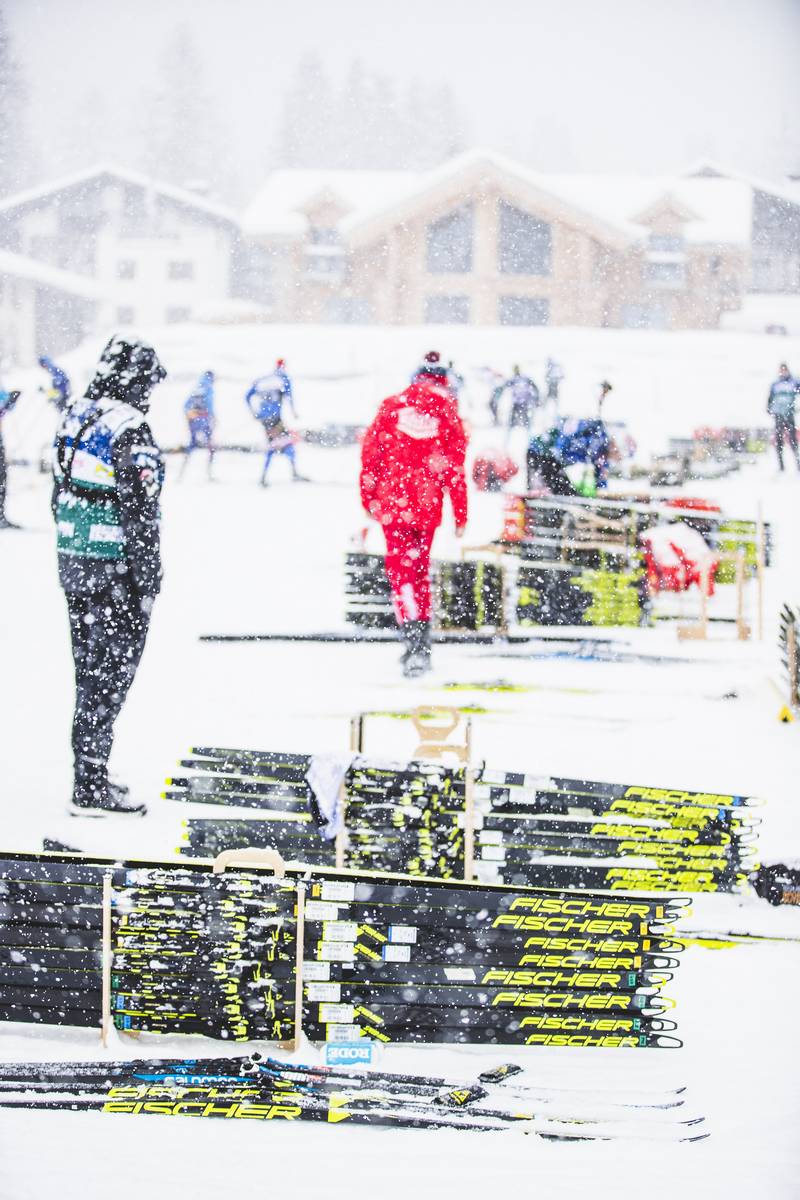
    Testing the Fischer fleet in Davos. (Photo: NoridcFocus)

    This morning the International Biathlon Union (IBU) and the International Ski Federation announced they were postponing their fluoro wax bans until the 2021-2022 season. The stated reason in the IBU press release was the following: “allow more time to test and refine the Fluorine Tracker device that is currently under development.”

    FIS also claimed the device was not ready for use on the World Cup: “Despite the accuracy of the device measurement technology, testing also indicated that there were potential sources of measurement error related to other aspects of the testing system that require further testing and design adjustments to ensure absolutely fair and consistent results for all competitors.”

    FIS stated “user error” could cause discrepancies in fluoro readings. Further, they revealed the device required an additional sensor to eliminate false readings caused by different “base materials, structures and base preparations.”

    Both the IBU and FIS asserted they remain committed to a fluoro free race circuit in the future. This season, waxes that meet EU guidelines are permitted. Effective July 4, 2020 the EU banned ban the use of of PFOAs, otherwise known as C8, below a 0.025mg/kg limit. The threshold is so low, the chemicals are essentially banned from commercial use. In the ski industry, C8 waxes are considerd to impact speed more readily than their C6 cousins in humid and dirty snow conditions. C6 based fluoro waxes are permitted in Europe.


  • Nordic Nation: Ollie Burruss and Shades of Green at Craftsbury

    Nordic Nation: Ollie Burruss and Shades of Green at Craftsbury

    This past fall, the Craftsbury Outdoor Center (COC) updated its wax use policy. The New England institution was one of the first and among the largest cross-country ski centers to implement a policy curbing the use of perfluorinated wax on its premises. The Craftsbury Outdoor Center supports values and practices that try to minimize its impact on the environment while still providing recreational opportunities for visitors.

    The Craftsbury Outdoor Center hopes to help lead the way toward a transition away from fluorocarbons. As it stands today, we see no need for skiers to wax with fluorocarbons for day-to-day skiing at the Outdoor Center. Furthermore, the use of glide wax containing fluorocarbons will not be permitted in our public wax room at any time. This includes perfluorinated “topcoats” and paraffins containing fluorocarbons (colloquially “LF” and “HF” wax products). — From Craftsbury’s Wax Guidelines

    This was no cold turkey move away from fluoros, when the SuperTour came to Craftsbury this winter, teams were allowed to apply and use fluoros in well ventilated ares. However, the day to day ethos at the COC was clear: fluoros use was frowned upon.

    Ollie Burruss, chief of competition, during the classic sprint at the 2019 US Nationals in Craftsbury. (Photo: Craftsbury Outdoor Center)

    We spoke with Ollie Burruss in March to discuss the policy and how it all played out over the winter. Among his many duties, Burruss is the nordic race director at the COC. He’s in the hot seat when it comes to piloting fluoro free policies and practices. Burruss was also the head of the organizing committee and the Chief of Competition at the 2019 US Cross-Country Nationals.

    Background reading on the topic:

  • Nordic Nation: Reporting on the Reporting of Fluoro Use in Norway

    Nordic Nation: Reporting on the Reporting of Fluoro Use in Norway

    If you’ve been following along with the global ski scene and wax, you know this: perfluorinated waxes have been a hot button topic. From issues with importing into the U.S., stories on potential health and environmental risk, and new “green” wax products coming on-line…it’s been hard to keep up with trends. The International Ski Federation announced last month that it would move towards a fluoro-free race series next year. That caught the surprise of many — it was expected that any potential fluoro ban would come down after the 2022 Winter Olympics.

    Norwegian Journalist John Rasmussen is our guest on Nordic Nation (Courtesy photo)

    Perhaps the most wide-ranging series on fluoro use in the cross-country world was published this fall by Norwegian newspaper Dagbladet. The series was multi-faceted. It explored fluoro use and personal stories about illness and even death, and industries response to upcoming EU regulations on C-8 chemistry.    

    We spoke to one of the lead journalists involved with the project, John Rasmussen. He’s based in Oslo and among his beats, is covering the World Cup. 

    Here’s a link to the story series. But keep this in mind: Google Translate often offers rough approximations when translating Norwegian to English. 

  • FIS Moves to Ban Fluorinated Ski Waxes for the 2020/2021 Season

    FIS Moves to Ban Fluorinated Ski Waxes for the 2020/2021 Season


    News today from the International Ski Federation’s Autumn Meeting in Constance, Germany will disrupt modern race-ski prep methodology. The Committee for Competition Equipment which is tasked with defining the technical specifications of all equipment used across the spectrum of FIS sanctioned snow sports: Cross-country skiing, nordic combined, ski jumping, alpine, snowboard, freestyle, and freeski, is calling for a ban on the use of all fluorinated ski waxes for the 2020/2021 season.

    “The use of fluorinated ski waxes, which have been shown to have a negative environmental and health impact were banned for all FIS disciplines from the 2020/2021 season,” read a FIS press release today. “A specialist FIS Working Group led by FIS Experts Atle Skaardal (Alpine Skiing) and Pierre Mignerey (Cross-Country) including the ski and wax industry will be formed to establish the regulations and control procedures.”

    The nascent working group will have a monumental task bringing a diverse group of disciplines and nations into compliance.

    “Overall, the world is moving in a direction that is positive. I’m sure we’ll figure out how to make this the positive thing that it’s meant to be,” said Canadian national team coach Erik Bråten, before a meeting about waxing plans. “I was very surprised that it went before Beijing. I was pretty sure they were going to do something like this, effective from after the next Olympics, but they just went for it. It is kind of cool, I like that they are making decisions, that we are going this way. Let’s wait and see. Let’s stay optimistic until failure has come.”

    – Gerry Furseth contributed

  • From Scarcity to an “Ah Hah” Moment: Reclaimed Fluoros Keep Skis Fast

    From Scarcity to an “Ah Hah” Moment: Reclaimed Fluoros Keep Skis Fast

    For six in the morning, the text message was dark and terrifying. “They are not selling ski crack any more. WTF they can’t be out.”

    At the time of the message, Jarrod had no idea he had a substance abuse issue or how far it would take him down a path of desperation. He just wanted to ski faster. He continues recounting the morning he hit the bottom.

    “With the realization, I might be out I was wide awake and sucking down a second cup of coffee. Not gonna lie, I was super anxious when I opened the dealer’s website. Clicking to the fluoro overlay page; my friend, Bill, was correct. Each fluoro product just said: THESE PRODUCTS TEMPORARILY UNAVAILABLE. Not just pure powder overlay but any wax containing fluoro compounds had the same banner: THESE PRODUCTS TEMPORARILY UNAVAILABLE. Looking around to see if anybody else had been reading my screen, I closed the laptop and hastened out to the shop. Unceremoniously I dumped my wax kit on the work-bench pawing through everything to check on my stash. Ut-oh. I was in trouble.”

    Jarrod was beginning to see he had a problem. His wax kit was almost out of fluoro powder and a web search indicated “ski-crack” as he had joked about, was currently unavailable in the US and foreign distributors would not ship into this country.

    A bit of research found the unavailability is due to wax companies having to comply with The Toxic Substances Control Act (TSCA) which regulates the import or development of new chemicals. Fluorinated compounds have been in use since the 1950s and it is only recently the wax companies have been under scrutiny by the EPA and subject to the petition and request to import or manufacture anything containing a fluorinated molecule.

    A bit more research into fluorinated chemicals determined most of the EPA worries stem from a class of compounds falling under the C8 designation. These compounds are commonly used in the production of plastics used to insulate wire. Bennington Vermont had a very public court battle over an aquifer contaminated by perfluorooctanoic acid (PFOA) and perfluorooctyl sulfonic acid (PFOS). Both chemicals are known to bioaccumulate in wildlife and are suspected to be human carcinogens.

    Whether the impounded ski waxes contain C8 compounds is unknown. In order to avoid potential jail time and large fines, many wax companies voluntarily quarantined the stock of waxes containing fluoros until obtaining EPA approval to import, manufacture and distribute the products. But this may have created a black market for fluoros:

    Jarrod continues explaining his anxiety. “ When I pressed my wax dealer to sell me some fluff he said, ‘Hey, man, the feds are sniffing around. I gotta play it cool. Can’t do any deals online or over the phone. Sorry. No way. But if you’re in the area, dude, stop by the shop for a cup of coffee. Come alone.’ ”

    When Jarrod first approached me with his dilemma it felt surreal. Ski wax is a micro market and fluoro waxes an even smaller slice of a niche market. The expense of covering all bases to comply with TSCA could be significant and delay access to Jarrod’s ski crack.

    Describing how he fell into the almost daily use of fluoro powder Jarrod said at first it was just a fad used for fun.

    “I had found at a price so reasonable powdering the bases was an everyday affair. My racing days are long behind me and having skis move across the snow enhanced by the miracle of better living through chemistry brought pure joy to every day on the trails.

    “This season my habit resulted in using almost 200 grams of pure powder. My stash was down to 15g. With rationing I might make it through this season, but what if my dealer can’t get the dust for next year? To satisfy this dependency another source needed to be found – the sooner the quicker.” Jarrod’s voice began to tremble.

    “The snow was perfect. A few days old with a bit of freeze thaw cycles and impeccable grooming. The skiing would be fast if tar was applied to the bases. But with a touch of crack, orgasmic. I was starting to feel the jitters, that need pulling at my gut, my bases dragging across the snow. The fear of running out.”

    Jarrod skied that day using HF wax with a bit of structure rolled in for good measure. The skiing was fast but it might have been better. While sipping a beer he began hatching a plan to keep his supply of powder and maybe a way to make a little cash too.

    Scenes of young kids in hoodies hanging trailside at busy intersections, furtive glances, a brief exchange of words, a $20 bill handed over, the kid giving instructions like a ski-o map to the pickup intersection, where, with relief and craven fulfillment the small ziplock bag of sanctified white powder, the powder of the Nordic gods, is placed into my gloved hand, quickly stowed in pocket, zipped securely and I ski off knowing I’ll make it through another week of ski waxing.

    The fantasy began to become a reality after receiving a spam text from Expedia advertising cheap airfare. “I considered the lucrative black market potential here. Fly round trip JFK to Oslo (Norwegian Air has convenient, affordable, direct flights and allows two huge checked bags in the Premium Cabin), fill my duffle bags with pure unadulterated dust and set up shop trailside with a few warmly dressed outdoorsy juvenile delinquents as runners. With a little mob-style enforcement I was confident that I could secure exclusive dealer intersection concessions at the largest nordic centers in Vermont. True, I might have to break a few skis or loosen some grips to gain the respect this trade would demand, but I’d be swimming in cash and the demand for product would only grow.”

    In fact, the growth of demand was going to be problematic. Affordable fluoros create quick dependencies. With the EPA banning all fluoros, skiers who have even once felt the bliss of powdered skis might succumb to temptation and be unable to help themselves.

    Now looking relaxed and contemplative Jarrod finished explaining his plan. “I needed to think bigger. Not regional but national in scale. I would need to franchise and manage dealer thugs from Fort Kent, ME to Snoqualmie, WA. I would need a whole crew of travelers going back and forth to Europe with huge duffle bags stuffed with ski fluff – the stuff likely poofing out in huge white clouds as the bags get tossed around. I would need a trucking network. Or perhaps I could piggy back my supply and distribution chains onto an established elicit network….. Perhaps using Russian diplomats in black stretch limos on route to Trump Resorts. Nobody would mess with those guys and they probably had connections to the Chinese who routinely scoff at US environmental laws. Hell, they’d make fluoro powder cheap and maybe for free if it meant they could flip a political finger at the US.”

    “Perhaps” Jarrod paused, “distribution could be piggy backed onto the untold legions of drug dealers and ruthless criminals we’re told are hiking for miles through tortuous desert terrain to enter the US illegally at the virtually unguarded southern border?”

    Looking at his hands before wiping his face he jumped up off the Windsor chair, took a deep breath and continued.

    “NO.” He began thinking about his mom and how she believed her ability to raise a child could only be considered a success if the kids were not a burden on society or in jail by the time they turned 30 years old. Jarrod was 29. His introspection continued. Here he verbalizes his thoughts.

    “There must be a better way to source ski crack – legally – above reproach. More research indicated the industry using the majority of fluoro compounds was the printing and food industries. Floriated compounds along with titanium dioxide are added to inks to harden and brighten the color. The fluoros are added to keep the ink from sticking to other boxes and also from sticking to the shelves. A conversation with my powder supplier revealed the C6 class of Fluoros used in ink is the same used on non-stick cookware and just might be the same compounds used in ski wax. Fluoros are added to ink at a concentration of 100 parts per million (PPM) or one gram per ten kilograms of ink.”

    With less dark thoughts Jarrod recalled some of what he learned in law school which he graduated from but never did anything with his degree but pay for it. A review of RCRA  Resource Conservation and Recovery Act (RCRA) is explicit mentioning Pulping liquors, the solution used to disperse and suspend wood fibers for the paper making process, that are reclaimed as defined in Title 40 of the Code of Federal Regulations (CFR) section 261.1(c), are exempt.  A subset of 261.1(c),  40 CFR section 261.4(a)(6) gave him a loophole to extract the C6 fluoros from the ink and apply it to skis. The only TSCA requirement was filling out a one-page form informing EPA of the exemptions.

    The extraction process is relatively simple although it requires a huge volume of ink covered material. The highest concentrations of fluoro is added to inks used in grocery products. The food producers discovered a long time ago the integrity of the packaging matters to consumers. A deformed or blemished box reminds them of second hand or discount food and is significantly less appealing therefore they buy less of the product. Brand loyalty is also reduced when consumers continue to see blemished boxes on shelves. Boxed food is subject to a wide range of humidity during the manufacture, storage, distribution and display. This moisture causes the boxes to stick together and to shelving hence the value of the added fluoro compounds. More fluoro equals less sticking equals greater sales, market share and profits.

    Finding the products and brands with the highest concentration of fluoro was difficult due to the trade secret protections of the Patent and Trade Office of the US Government. Many corporations do not file for patents on their products because the patenting process demands full disclosure of materials and methods in order to obtain patent protection. Anything declared a trade secret does not carry any exclusive rights to manufacture but unlike the patent process, a trade secret does not have to disclose anything about the product. The trade secret laws, CFR 4.01.2019(a)(f), are how big oil remains exempt from disclosing what is contained in the fluids used during the fracking process.

    With a newfound and responsible way to obtain his desired ski crack, Jarrod became animated describing the next step in his journey.

    “If I was going into business, I intended to do it right. Research-based information would be the foundation upon which I would build this financial empire. And that starts with testing.”

    After a disastrous grocery store aisle experiment designed to ascertain which cereal boxes have the most fluoros, wherein shelves were tipped to (and, sadly, far beyond) the exact angle of boxed product repose and slippage was measured, a better idea presented itself – as is so often the case with such complicated testing procedures. “We made a spring clip to grasp the box by the corners and attached the clip to a scale. By pulling on the scale and tracking the measurements we were able to see which products and brands had the least amount of stiction. Turns out the boxes with the lowest shelf friction contained the highest levels of fluoros. The best part is the test is easily administered right in the store which gave access to a wide variety of products.

    “As a generalization, packaging without liners like pasta are significantly slipperier than packages with an internal plastic liner like cereals and cookies. We found that the spring tension when testing unlined boxed product needed to be significantly lower than for lined boxes – like breakfast cereals –  because the test apparatus flung three-pound boxes of spaghetti down the aisle 20 or 30 feet smashing into displays of K-Cups and Yodels, scattering the dry noodles all over the aisle. We surmise the hydrophilic nature of the pasta is countered by the higher levels of fluoros in the ink. If the product requires a liner there is less incentive to use HF inks, which like ski waxes, are more expensive. For our purposes, the cereal and cracker boxes are less appealing.”

    Acquiring and processing the large volume of pasta boxes was going to take a large capital investment. More research into environmental regulation turned up.  The Personal Responsibility and Work Opportunity Reconciliation Act (PRWORA) signed into law by President Bill Clinton on August 22, 1996 has a provision to grant $1.1M  for startup entrepreneurs who build a business around recycling. The current Administration’s trade tariffs with China has this far east nation once hungry for US recycled paper products finding the raw materials from South America. There is a glut of recycled paper with much of it ending up in landfills as there is a very limited domestic market for this paper. After finding a sympathetic clerk in the Commerce Department whose job it is to find uses for this glut, the paperwork was pushed through and financing was secured.

    “Once we had a process and financing it was as simple as asking the local recycling companies for as much recycled boxboard they had. There is a glut of recycled materials and all suppliers were ecstatic to have a place to offload some of the stockpile. They are even willing to sort the product removing as much of the desired pasta boxes in order to receive the best price for the materials. They even deliver the materials for free just to get rid of it. It’s a win-win all around.”

    The material science and chemistry involved in extracting the finished fluoros from recycled pasta box ink is proprietary. Soon enough boxboard was being processed and the operation moved from the basement into a 20’ by 30’ shop. Employees were hired and the business was legitimized.

    betnovate

    “The quality of the fluorocarbons recovered exceeds our wildest hopes,” says the plant manager and general ski bum who asked us to refer to him only as Jeff K. “By tweaking the extraction with a Birch Extraction we are able to link hydrocarbon molecules from the inks with the fluoros we were after. There were two benefits to this. By selecting for the right colors consistent with the familiar waxing chart we have modified fluoros that are temperature specific and color coded. We also found that when our unique mixes are applied to ski bases they bond structurally to the pores of the ski base – somewhat like the crisp shiny smooth surface on the outside of a pasta box compared to the un-printed inside of the box board – creating an incredibly durable and long lasting fluoro treatment high. In testing we found no deterioration of the glide even after 100km of the gnarliest, most crusted, corn snow you can ski.”

    Jarrod, the ski crack addict turned environmental entrepreneur named the company Box Butter. This wholly US based company has removed 30 million tons of box board from the recycling stream heading to China. All production energy is solar sourced and they are a Green Initiative Certified Zero Emission Company. A side product still in development to repurpose much of the fiber will hit the market shortly: Cracklin’ Cubes fire starters, light easily – even when wet – and burn for 10-12 minutes. “Another totally addictive, environmentally friendly,100% recycled product from the company that brought you environmentally friendly skier’s crack fluoro overlays,” says John Rollings, a competitive biathlete and an early investor. “These guys brought the fun back into skiing after the feds tried to shut down virgin fluoros. And when you’re comin’ down, ready to peel off the boards and sit by a roaring fire, they make it easy to spark up!”

    Jarrod sums up his 11 month journey from crack addict to wealthy businessman. “Sure I still use powders, every time I ski. After setting aside a 55-gallon barrel of the stuff for my own use I can relax. Even if the feds ban the stuff there is enough for me and my ski buddies to last a lifetime and if I run out there is really no point in living through another winter without the powdered white stuff to enjoy.”

    For a limited time Box Butter is offering free samples of Skier’s Crack Reclaimed Fluoro Overlays through their website https://boxbutterbuzz.bz.


  • International News: Norway Bans 16 & Under Fluoro Use, Ustiugov Breaks Thumb (Updated)

    International News: Norway Bans 16 & Under Fluoro Use, Ustiugov Breaks Thumb (Updated)

    Russia’s Sergey Ustiugov (front) leads American Andy Newell (20), Norway’s Finn Hågen Krogh, Russia’s Andrey Larkov (behind Krogh), and Finland’s Iivo Niskanen in Quarterfinal 1 of the Tour de Ski 1.5-kilometer freestyle sprint on Saturday in Lenzerheide, Switzerland. Krogh won that heat, Ustiugov finished second, Larkov was third, Newell fourth, and Niskanen fifth. Ustiugov went on to win the men’s final while Krogh placed fifth overall. (Photo: Fischer/NordicFocus)

    This article has been updated to include quotes from Torbjørn Skogstad.

    Here are a few international news items of note:

    According to an October 21, press release from the Norwegian Ski Federation, fluorinated wax products are banned from all race classes up through the age of 16. The decision came down from the federation’s Cross-Country Committee and will be enacted this season.

    The no-fluoro policy will be enforced by testing skis for fluorinated products.

    “We will use a tape under the athlete’s ski before start,” Torbjørn Skogstad, chairman of Norway’s Cross-Country Committee, wrote in an email. “Then we will send the test-tape to a laboratory in Germany. After a week or so we will get the results from Germany weather there is fluoro on the sole to the ski. This test will be done in cooperation to a Norwegian company called NILU.”

    Testing will occur on the day of competition. Positive results will be communicated approximately a week after testing to clubs and individuals in violation of the fluoro ban. 

    A positive test for the use of fluorinated wax in the specified age group categories carries with it no penalty. “The ban is based on trust,” Skogstad said, according to a translation of the press release.

    “There are several reasons why we don´t want sanctioning towards the athletes,” Skogstad wrote to FasterSkier. “First we are talking about children up to 16 years old and most of them are not preparing their own skis before a race. Second, this method for testing is still developing. As long as we don´t have a method that immediately can give us a result of the test, we think it will be wrong to punish the athlete a week after the competition.”

    From Russia, the website skisport.ru reports that Sergey Ustiugov is at risk of missing the opening World Cups due to a broken thumb. Ustiugov reportedly injured his thumb while rollerskiing in Val Senales, Italy.

    As of press time, Ustiugov was scheduled to have surgery in Moscow. The Russian skier is a two-time gold medalist at World Championships and the 2017 Tour de Ski overall winner. Ustiugov was banned from the 2018 Winter Olympics.


  • Alaska High Schools Call a ‘Wax Truce’

    Alaska High Schools Call a ‘Wax Truce’

    The scene from an Alaska Nordic Skiing State Championships mass start. In Anchorage, high-school nordic coaches recently agreed to ban fluorinated glide wax in non-championship races throughout the 2015/2016 season. (Photo: http://asaa.org/sports/nordic-ski/)
    The scene from an Alaska Nordic Skiing State Championships mass start. In Anchorage, high-school nordic coaches recently agreed to ban fluorinated glide wax in non-championship races throughout the 2015/2016 season. (Photo: asaa.org)

    Anchorage-area schools decided that it had gotten out of hand, so they called a truce.

    “Anchorage region coaches agreed to not use fluorinated glide waxes during all non-championship races,” Anson Moxness, head coach at West Anchorage High School in Anchorage, Alaska, wrote in an email. “Because flouros are expensive and bad for your health. None of the schools really have adequate ventilation systems and many are doing waxing around the skiers.”

    Such bans on fluorinated waxes are becoming increasingly common around the country. Moxness cited various divisions and regions around the country that had agreed to similar bans, including the Eastern Intercollegiate Ski Association (EISA).

    Different coaches had different reasons for supporting the ban, but among coaches interviewed, support was unanimous:

    “I am all for this for many reasons,” Cory Schwartz, head coach of the University of New Hampshire (UNH) nordic team, wrote in an email. “First is the health concerns around putting on powders — even though we all use masks and try to the best of our ability adhere to safety suggestions, none of the college teams have a ventilated wax truck. So we are using masks while ironing on and brushing but the powder gets all over the truck, our skis, and body.”

    Evidence suggests that there are health risks associated with fluoro waxes. Fluorinated compounds are useful in waxes for their ability to repel water, making the skis faster. But they’re also much more expensive.

    “We’re looking at an order of magnitude difference in per gram wax costs of CH and HF waxes,” Moxness wrote. “I don’t see a reason to be spending that much money on waxes for non-championship races.”

    Tools of the trade: Anchorage-area high schools will have one less variable to worry about with the recent decision to ban flourinated glide waxes for all non-championship races.
    Tools of the trade: Anchorage-area high schools will have one less variable to worry about with the recent decision to ban fluorinated glide waxes for all non-championship races.

    He added that the success of this rule depends on coaches’  compliance.

    “If skiers choose to wax skis at home, which some of them do, we have no control over what they put on their skis. If we establish that it is cheating to use anything with fluorination and are consistent in our message, I think it will succeed,” Moxness wrote.

    “Where this will fail is if the coaches aren’t fully behind the fluoro ban, which we all were at our preseason meeting. From what I’ve seen, my skiers realize what we’re doing and the reasons behind it and they respect the ban.”

    “I think the success of the ban lies on the shoulders of the coaches and the parents,” South Anchorage High School Coach Sam Sterling wrote in an email. “If they advertise it as something that is good for the sport, I think it will succeed. If they give their athletes reason to doubt it … then, maybe it won’t. Hopefully, in a couple years the ban will just be a normal part of the AK high school ski scene and nobody will give it a second thought.”

    Chugiak High School in nearby Eagle River is one of the schools involved in the truce. Head coach Cody Priest also supported the ban.

    “Another reason it’s nice,” he wrote in an email, “is that I don’t have to ‘draw the line’ on my team on who gets what wax. With a competitive girls team I would want to use expensive wax on at least my first five, then maybe not the others. How do you explain that to the team?

    “Plus on race day I wont be testing different top coats,” he continued. “I will be just ensuring that I have the correct hardness of base wax.”

    The coaches contacted were also unanimous that the extra time spent testing skis with fluorinated wax was not time well spent.

    “The main thing I see is that [the ban] allows the coaches to actually… coach,” Sterling explained. “The impact of the ban goes beyond the obvious benefits of decreasing exposure to fluoros and reducing overall expenses for high school programs. Each team ranges from junior national champions to foreign exchange students who have never seen snow until coming to Alaska. The more time coaches can spend working with these athletes, and not dealing with waxing, the better off the sport will be.

    Sterling sees it as a simple misallocation of resources.

    “There’s a lot of [coaching] experience and motivation in Alaska high school skiing,” he wrote. “It’d be great to see this resource going more to the development of the athletes, and less towards making a fast pair of skis. It’s a step in the right direction and it was great to see unanimous approval from the Region IV coaches in adopting the ban.”

    Schwartz explained that in the East, there is some concern their region is falling behind others when it comes to testing wax in different snow conditions, “But I do not agree with that,” he wrote. “I actually am more excited to go to the race to see the race instead of being in a wax trailer all day.”

    In addition to being better for individual families bottom lines, Sterling and Moxness explained it’s better for the sport as well.

    “It also lowers barriers of entry into the sport,” Moxness wrote. “If a parent is interested in waxing their kid’s skis and they only have to invest maybe $50 in waxes to have skis that are competitive, instead of $300, they are much more likely to get and stay involved.”

    “That means more growth of the sport and parents who may be more likely to invest that saved money in better quality equipment, which makes way more of a difference than wax.”