From the FasterSkier archive — posts syndicated from athletes’ and coaches’ own blogs between 2004 and 2012, kept online as published. Current coverage is at fasterskier.com.

Tag: fluoro free

  • Fluoro-Free Waxing—Two Years In with Zach Caldwell

    Fluoro-Free Waxing—Two Years In with Zach Caldwell


    SuperTour race weekend in Craftsbury, VT, where Zach Caldwell (left) supported SMS T2 athletes. (Photo: Facebook Caldwell Sport)

    On January 17th, 2022, a US Ski and Snowboard (USSS) ban on using perfluorocarbon-based wax products (“fluoros”) at all International Ski Federation-sanctioned (FIS) races in the country went into effect. The action marked the critical point in a rapid evolution of policies meant to limit competitive nordic skiing’s emission of perfluorocarbons, part of a class of especially environmentally persistent, and potentially health-concerning, chemicals known as PFAs. Overnight, The cumulative knowledge of 40 years on ski preparation nulled. Since then, it’s been a brave new world.

    Step into a wax room these days, and you’re unlikely to hear codewords like “Cera F” and “Jetstream” muffled from behind the gas masks that became standard issue near the end of the fluoro-era. The scramble to take everything into account—from snow temp to air temp, ski selection, grind, and base material too—and funnel it into putting the best ski on the snow for a race is still there. The rules may have changed, but the game is the same.

    Two and half seasons into fluoro-free racing, there have been countless tests by wax technicians across the continent to figure out just what they’re working with on any given race day. Among them has been long-time American “ski whisperer” Zach Caldwell, owner and operator of Caldwell Sport in Putney, Vermont. As New England thawed out from its last snowstorm of the season, and US Skiing from the season that accompanied it, FasterSkier caught up with Caldwell to learn what he’s learned about where the limiter of fluoro-free waxing has started to push ski service.

    Speak to Caldwell, and you’ll quickly get acquainted with jargon that acquaints you with his professorial approach to ski service. He’ll often talk about “solutions,” that is, the singular result of combining the “pie” of factors (see our 2022 discussion on what makes a ski fast featuring Caldwell here) that go into a race-ready ski. In that pie, you’ll find ski camber, ski flex, base grind selection, hand-applied structure, and everything that can be broadly categorized as wax. He also cites how “robust” solutions are the best solutions; that is, where the overall combination of the factors within that ski performance pie can be adaptable to a wide range of conditions. In Caldwell’s view, the ideal ski technician is as much engineer and artist as they are actuary. “Robust solutions limit the risk of sending you in the wrong direction.”

    Zach Caldwell in his element. (Photo: Facebook Caldwell Sport)

    “Wax with fluoro compounds occupied a big part of the whole pie when it came to ski performance,” Caldwell had said previously. His expectation when the US moved to eliminate fluoros from the wax slice of the pie two seasons ago was in line with many ski technicians. “I figured was that we weren’t going to accommodate for the lack of fluoros,” he said. “All we did by eliminating fluoros was make the comparative importance of everything else bigger.”

    The key problems to which fluoros served as a solution were twofold. Fluoros resisted water better than any other compound. Fluoros were also better at helping to keep base-clogging dirt away. Those properties came from a complex interaction of chemical, ski, and snow. When applied to a ski, the chemical differentiation of fluorocarbons from a standard polyethylene ski base meant they formed a “top-coat,” not mixing with the other base wax treatments that helped change the bulk properties of the base. That fluorocarbon top-coat was extremely hydrophobic, which helped discourage water-on-water friction in wetter snow conditions most often found around or above freezing. The fluoro top-coat also abraded with dirt that otherwise would be picked up by the ski base, lending to the sensation of “durability” from skiers. In attempting to replace the water- and dirt-repellency offered by fluoros, ski technicians have most often looked at other slices of the overall solution “pie” to re-produce those qualities.

    The initial expectation from Caldwell was that skiers would look to ski selection and base grind as factors readily available to assist in finding a solution. “When it comes to that, it’s played out 100% as I predicted it would” he said. “We’re selling way more skis, and grinding way more skis [at Caldwell Sport]. There’s a lot more active testing of hand structures.”
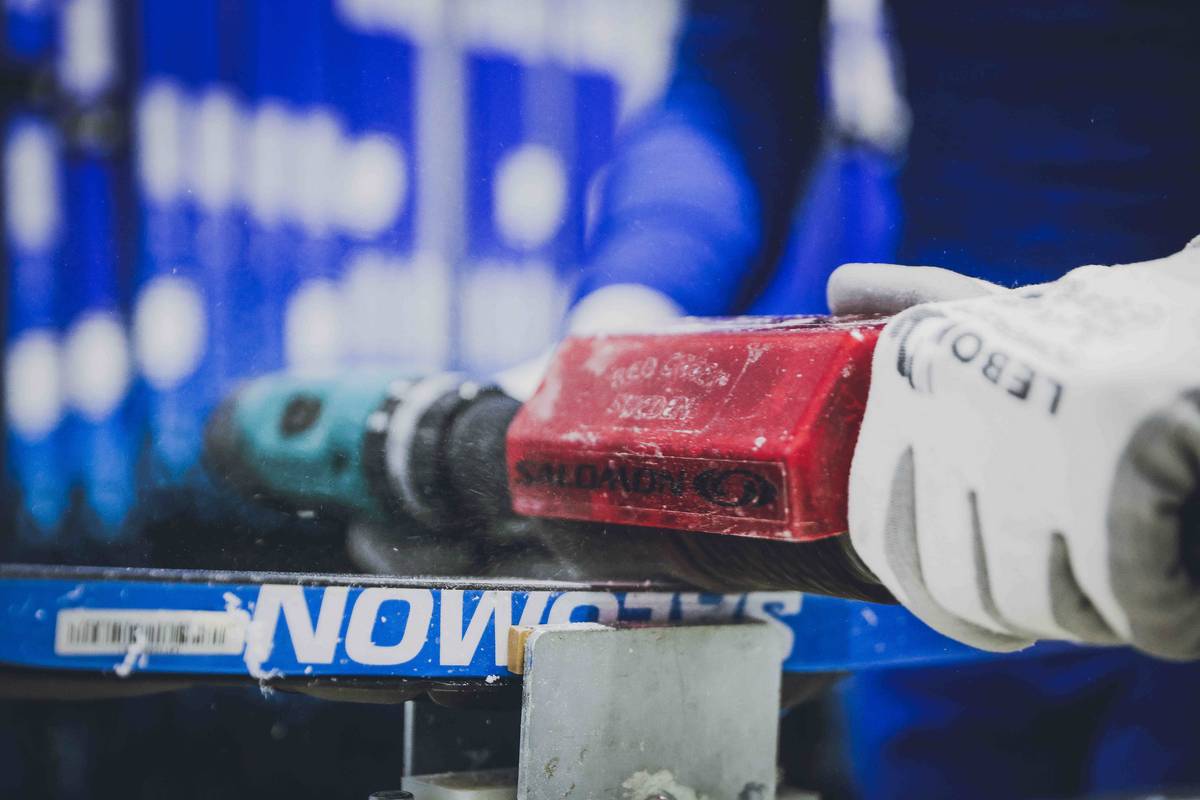
    A ski being brushed. After the elimination of fluorocarbon wax products, ski selection and grind have jumped to the front of many skier’s considerations in race preparation. (Photo: NordicFocus)

    In particular, skiers are looking to add more specialized skis to their fleets in the conditions in which fluoros once excelled. Higher camber skis—skis that ride higher above the snow and often have less prolonged surface run times than comparative skis—can help in having skis not pick up as much dirt. Base Grinds and hand structures, especially “V” shaped chevrons and deeper linear rills, can help channel water away from a ski base in wet conditions.

    The push out to the ski itself, and grind selection, has led to a new dynamic in race day solutions. “In the past, you could show up with an inappropriate camber and get those skis into the game in the right conditions by using fluoros,” said Caldwell. “Now, showing up with the wrong ski or wrong hand structure is not doable. You’re unable to compensate with a great wax solution.

    The dynamic of not being able to wax your way out of a mis-matched ski has come as a result of what Caldwell sees in the selection of new fluoro-free waxes that have been offered on the market.

    “I’ve had to revise my expectations around the wax itself,” he said. “I knew we couldn’t replicate the performance of fluorocarbon chemistry, but thought that the difference between the teams that could test application methods and products ad nauseam and those who couldn’t would be emphasized. As it’s turned out, it has felt like many of the solutions just hit the ceiling for performance at about the same place.”

    The result has been twofold. For one, it takes less resources to reach that lower ceiling of performance, and it can often be done by waxes from a much lower price point than the $150-200 fluoro blocks that used to contribute to a race day ski build. There are also more ways to get to an overall ski solution that precludes having found a particular wax product selection and application. Hence, the turn towards ski, grind, and structure selection for many skiers.

    Caldwell sees a particular pressure point in the ski industry given the way many fluoro-free waxes have hit a similar performance ceiling, often at wildly unreliable price points: “Some of the big companies were very quick to introduce fluoro-free lines in an attempt to make a new market follow old rules.”

    “The price points on those first fluoro-free products reflected that the big wax companies knew that there was a high tolerance high price points among consumers,” Caldwell said. “The thing that gets kind of lost is that those consumer tolerances were built around wax solutions that re-defined the sport.  That’s what those 30-gram Swix Cera F vials did in the late 1980s. They were definitely revolutionary. We’re currently in a place now though, where a nominally $1 per application wax job can beat a $10 per application wax job, and after a while, that’s just going to frustrate consumers.”
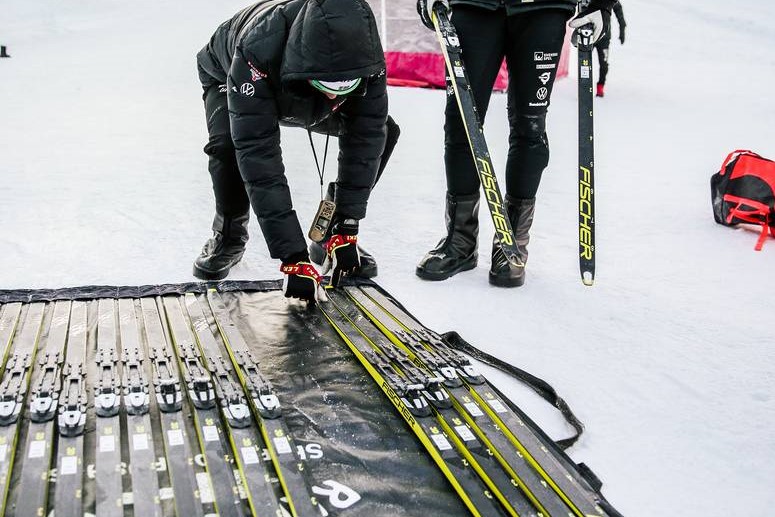
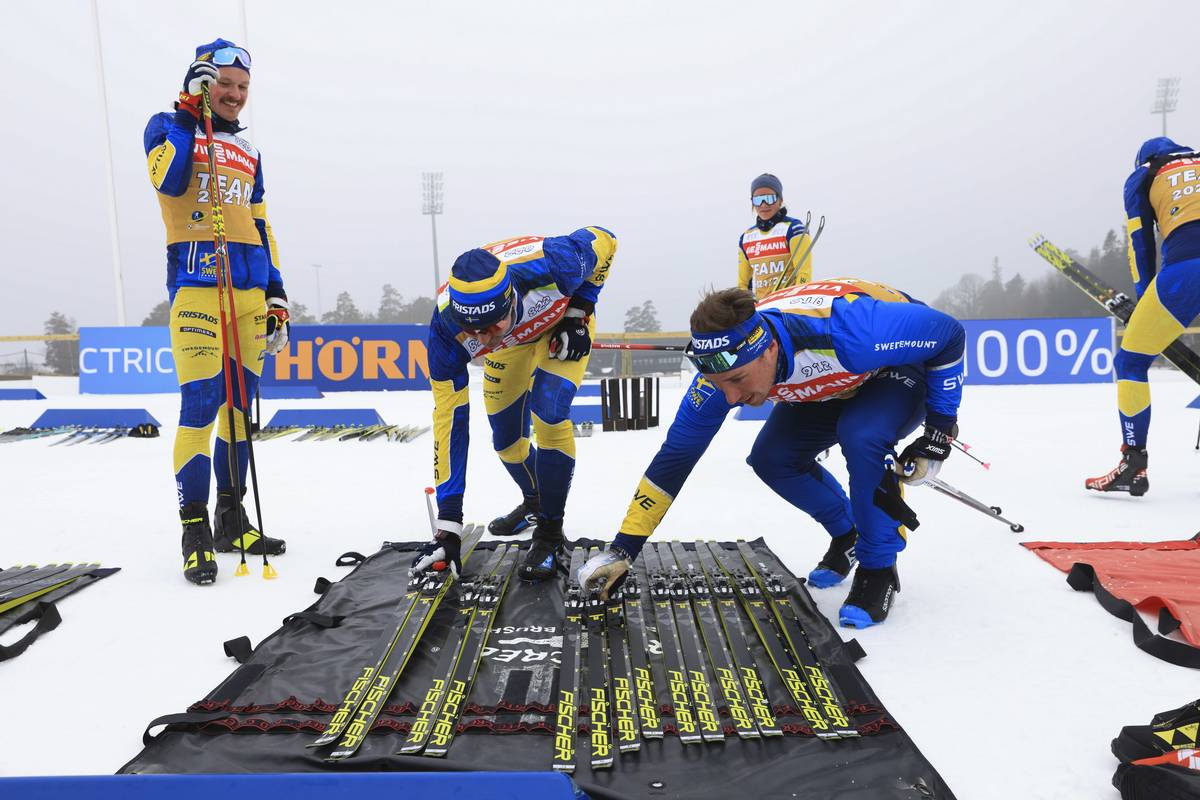
    Ski Techs sorting through test fleet on a race day. (Photo: NordicFocus)

    Caldwell views the muddy value proposition offered by new fluoro-free waxes as contributing to a cultural shift away from the “essentially technical” nature of nordic skiing. “It’s creating an environment where the incentive is stronger than ever to control the role waxing places in the whole solution on race day.” That chiefly includes wax protocols, often modeled after the one introduced by Rocky Mountain Nordic in 2019 that now are enforced across a host of junior and collegiate circuits in the United States. “If we assume that on any given day, without fluoro, there is a certain amount of speed available,” said Caldwell, “[Then] by limiting the role wax plays, you’re decreasing the amount of creativity that can be brought to bear in getting to that total speed available. You end up with more of a disparity than you would have by allowing wax to be brought into the picture.” FasterSkier previously covered the discussion surrounding competitive and technical balance at play in wax protocols here; however skiers might form opinions on where the technical aspect of skiing meets its competitive culture, Caldwell was careful to point out that having those opinions is one of the essential beauties of the sport: “I was pretty young when skating came into the picture,” Caldwell said. “People lost their minds like it was going to change the sport beyond recognition, but what happened? There’s a dialectic that’s healthy, and we ended up with a sport that still includes classic skiing, and even there, a ‘classic skiing’ that is pretty advanced from what they were trying to preserve, right?”

    “Progress is always going to be there,” Caldwell said. “And trying to halt progress is a bad idea… but that doesn’t mean you don’t try to steer progress.”
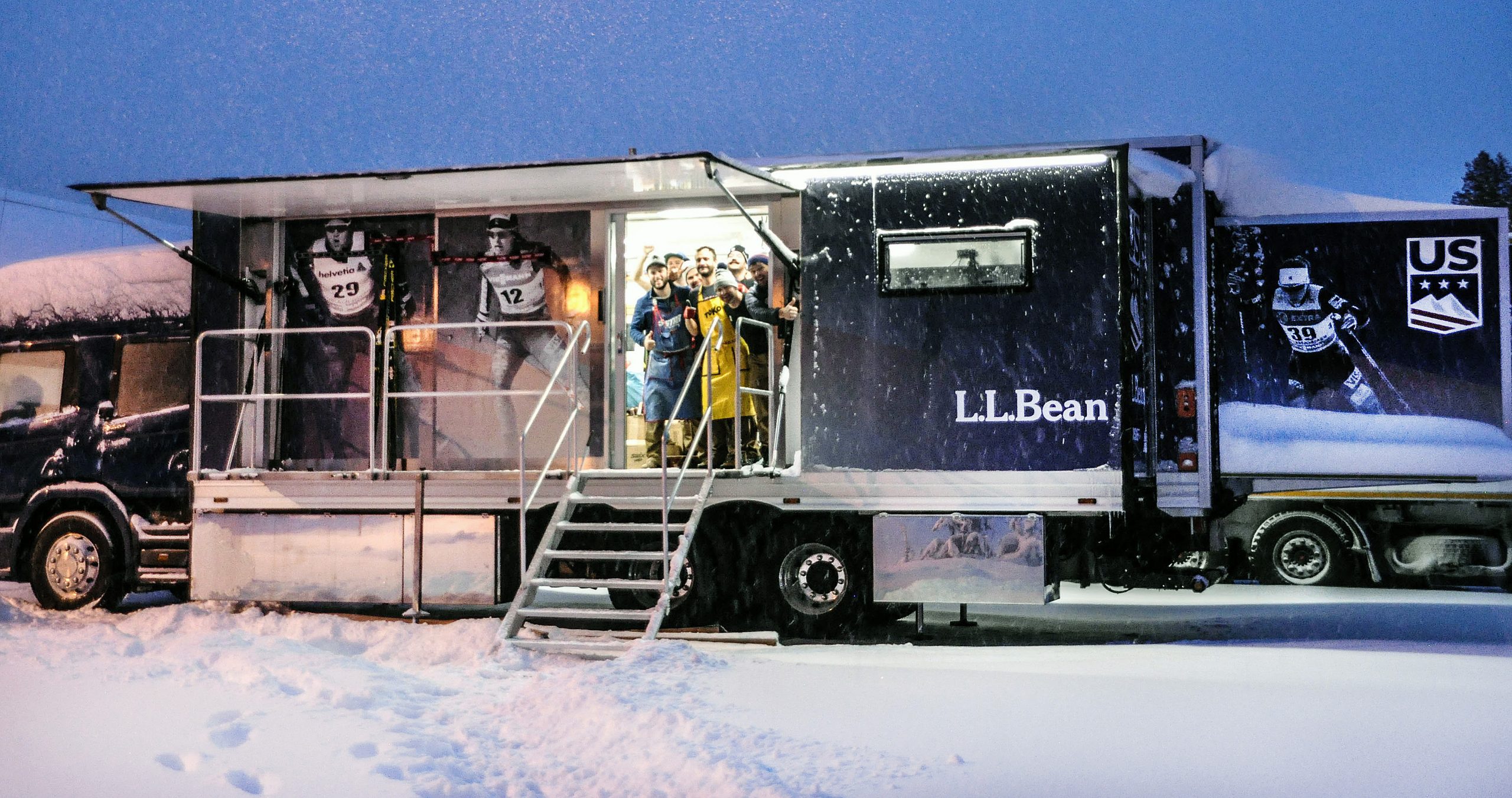
    U.S. Ski Team wax truck during pre-season camp in Rovaniemi, Finland. (Matt Whitcomb)

    On the contrary, the gyre of new ideas and new technologies spinning the sport forward keeps Caldwell, a seasoned-ski expert among seasoned ski experts, excited some fifty years into the sport. He hopes it will keep you excited, too. In that regard, he leads by pure example. In the brave new world catalyzed by fluoro-free, he sees a broad horizon to chart out skiers’ relationship to how they view their skis. He spins visions on how the World Cup could start promoting the technical aspects of the sport, broadcasting wax tests and highlighting ski profiles the way F1 motorsport does. He can rattle off, with passion, a broad architecture to incentivize ski companies to start producing their best skis for all skiers. “Imagine a world where Fischer had to produce a 50th percentile ski that Johannes Hoesflot Klaebo could win on!”

    For Caldwell, all of it comes back to a deeply rooted experience in a nordic community he loves. “One of the really cool things about the US is that the nordic community is quite open, uncharacteristically open, compared to other countries. It’s full of a lot of good people, and I think that culture is, at present, one of the most sophisticated cultures in the world when it comes to ski innovation.” As to where are we in the fluoro-free world, two seasons in? “You mean in a world where you can’t brute force your way to good solutions with more resources?” asked Caldwell. “Well, it’s a world that puts a premium on collaboration and creativity? Turns out we’ve been pretty good at that for a long time over here.”

  • What makes a fast ski? A discussion on league-wide wax protocols and ski performance theory with Andy Gerlach, Zach Caldwell, and Knut Nystad (Part 2)

    What makes a fast ski? A discussion on league-wide wax protocols and ski performance theory with Andy Gerlach, Zach Caldwell, and Knut Nystad (Part 2)

    Cold, firm tracks and perfect corduroy: the stuff of cross country skiers’ dreams. (Photo: NordicFocus)

    Click here to read part 1 of this story.

    In most states, youth skiing is divided between club and high school programming, where club programs support skiers looking to race competitively on a regional, national, or international level, perhaps with goals of NCAA skiing and beyond. High school ski programming is typically more participation focused, and comes with a much lower price tag for families, consequently with a much smaller program budget. It’s less about year-round training, and more about learning to ski, enjoying a low-cost introduction to the sport, and providing a healthy activity to get kids outside in the winter. In some places, athletes may fall into an overlapping Venn diagram of  categories, while in others, it may be a choice of club versus high school racing.

    Within high school programs, it is much less common to have multiple pairs of skis, and conversations on grinds and structures are less likely to be overheard between coaches. Here in Colorado, it’s one of the only (maybe the only?) high school sport that does not have a uniform rule – kids can essentially race in whatever they want; no lycra required.

    In this setting, a universal wax call might be a more reasonable proposition, according to Nystad. 

    “Arguments can be made on both sides. If everyone just agrees: ‘We have one pair of skis and we wax with blue.’ Okay, it probably will be as fair as you can probably make it, but just be aware that still there will be huge individual differences on the quality of the skis and how they differ from different conditions… there will still be variations, it’s not like everyone will start on the starting line having identical skis. That’s not realistic.”  

    Slovenian sprinter Eva Urevc tests skis with her wax technician at the 2022 Olympics in Zhangjiakou, CHN. (Photo: NordicFocus)

    With all of this in mind, is there a way to create equity via equipment or waxing at any level of the sport? 

    “No,” said Caldwell frankly. “No, there isn’t.” Adding perspective from his business, Caldwell explained that the cost of equipment has been steady over time with respect to inflation. That said, among competitive programs, the demand for skis has increased with time, in particular, following the removal of a now-banned leveler that we haven’t yet mentioned: fluorocarbons.

    “It’s a technical sport,” Caldwell said. “And the fact is that people have become more aware of the opportunity to get ahead with material. And I think what we’re seeing is a reaction to the reality of what the sport is. It’s not running. It’s just not. And yet people are doing the same thing in running with these carbon-plated shoes. Now you can only win if you have a high-tech shoe that goes 4% faster. Does that mean that those shoes shouldn’t have been invented? Or should they be banned? Possibly. I mean, whatever, we have to talk about this. 

    “They banned fluorocarbons for a lot of very good reasons, or they’re in the process of it. When it’s health and safety that is the problem, then you have to take the necessary steps. And yet, we also have to acknowledge that removing fluorocarbons really takes a big, big leveling factor out of the equation. There’s no opportunity to take a universal cold grind ski and put it in a wet race. That kid’s screwed. Every single time we remove the opportunity to optimize the solution that’s at hand, you’re penalizing the kids who don’t have the perfect setup.”

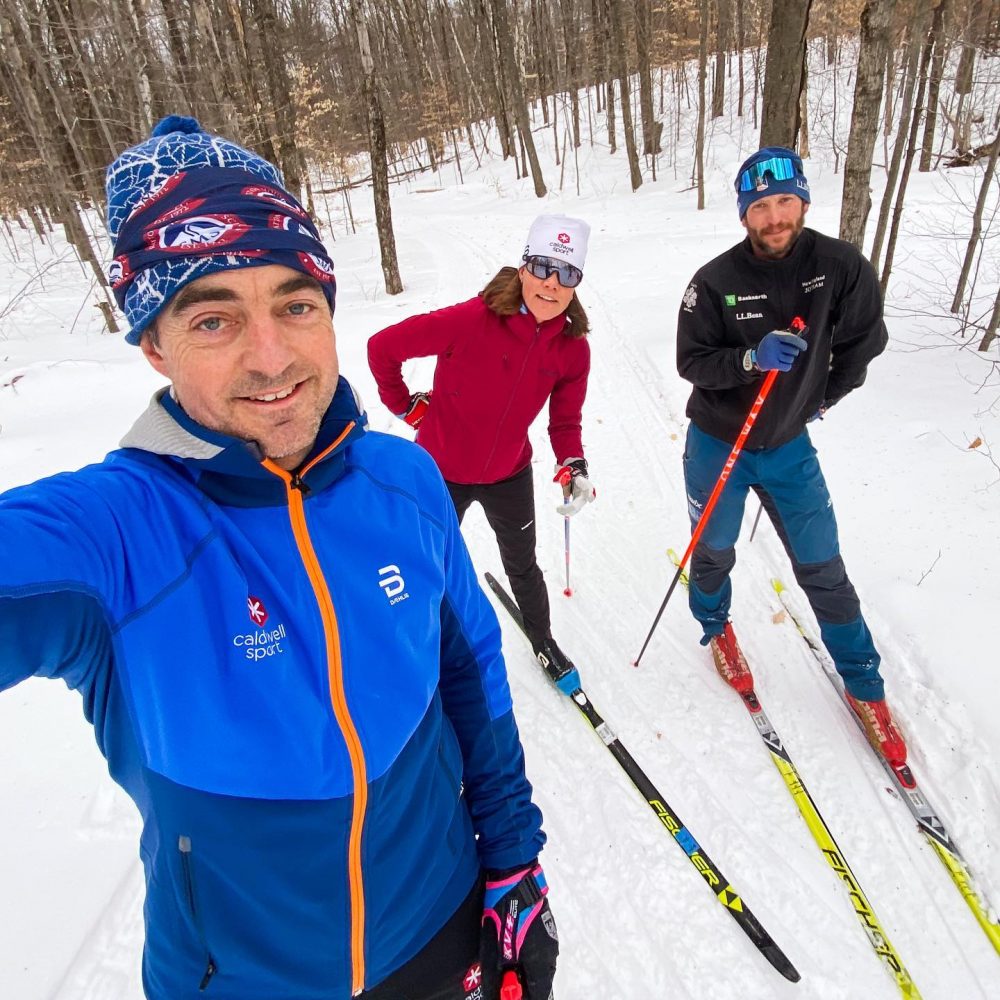
    Zach Caldwell (left) out for a ski with his wife and business partner Amy and Craftsbury Green Racing Project wax tech Nick Brown. (Photo: Facebook Caldwell Sport)

    Making it clear that his opinion is not clouded by the inability of a Colorado, Wisconsin, or Washington-based club skier to use a non-Swix wax purchased through Caldwell Sport, he added, “From a business perspective, with regard to my overall outlook, I probably should be applauding this model because it creates a massive incentive for kids to carry a lot more skis. And we’ve already seen this with the removal of fluoros from competition – you wouldn’t believe the uptick that we’ve seen in demand for warm weather skis, and grinds, and bases.”

    In Caldwell’s opinion, the opportunity for athletes and coaches to optimize a ski through testing and the use of a product line they know well, regardless of brand, is a more viable option for “leveling the playing field” as it could bring any ski closer to what he called it’s “terminal velocity.” A wax protocol that puts every athlete on the same brand and hardness of wax, creates “a situation where that opportunity doesn’t exist and the only way to gain competition advantage is to buy another pair of $800 skis. So it very quickly becomes a sport that, really, is hard to succeed at without a lot of personal resources.” 

    While the focus of these points might suggest that competitive youth skiing will trend toward an arms race, Nystad’s points included a reminder that a skier with limited access to equipment and race-day wax expertise may not be doomed. Other aspects of athlete development remain as important as ever in a skier’s trajectory and long term prospects. 

    “Quite honestly, I don’t want kids to have ten pairs of skis,” Nystad said. “I have kids that ski, but I try to limit the amount of skis and I try to buy used skis and rather look at what properties do the skis have, so that they have okay skis for for each condition. And then we focus on other things that are far, far more important. And that is the mentality to learn to train, to have fun while you’re training, and then to work on technique and tactics. So it’s also a cultural thing.

    “If you only focus on buying yourself time by buying equipment and buying wax and tweaking things and using resources — yes, you are probably going to gain some time, but you have to also say, ‘Are you investing as much time training and enhancing your technique and your tactic as the others are?’ So it’s definitely possible, even if you come from less resources, you can beat the guys with the most resources if you just train well and smart and develop good technique and good tactics.”

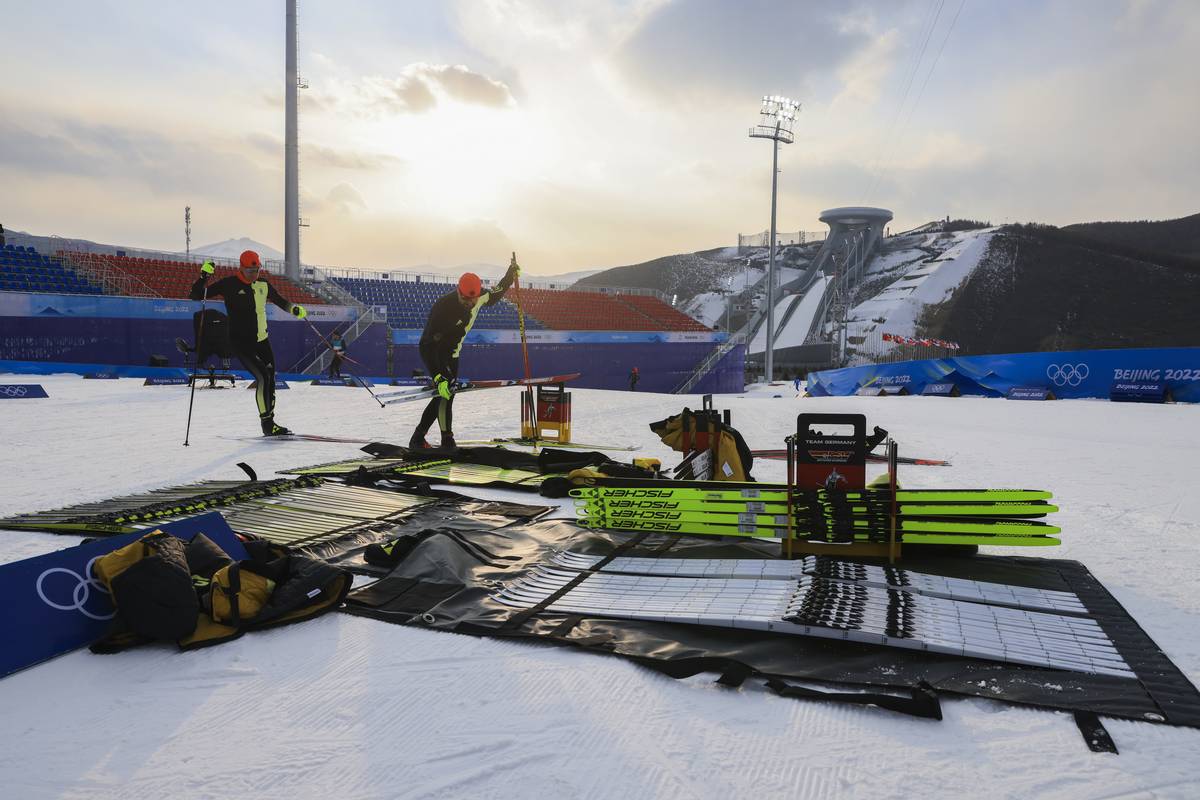
    The German biathlon team tests skis during the 2022 Olympic Winter Games in Zhangjiakou, CHN. (Photo: NordicFocus)

    As a serviceman working at the highest level of sport, Nystad also offered a thought-prompt on the impact to athlete knowledge and the ability to develop a new generation of wax technicians under a protocol, regardless of brand. 

    “If you want to educate athletes to also be able to become great service people at World Cup level races – if you take away that experience in club skiing or in high school skiing or in collegiate skiing, you will have no resources that are going to be able to serve your American athletes going to World Cups or World Championships or Olympics. Where are they going to get the knowledge? Because it’s like anything else, if you want to become good at something, you have to work at it.”

    According to Caldwell, incorporating a wax protocol is “reductionist attempt to level the playing field” that creates more disparity than equity. And so, the goal of leveling the playing field in cross country skiing remains “laudable”, but out of reach, and perhaps unattainable. 

    “I understand the discussion, but I think you have to cater to common sense,” Nystad concluded. “You can always tell people that we decide to [have] one pair skate, one pair classical. I think you can also try to have the waxes [matched]. But still be aware, it’s never going to be fair.” 

    Stay tuned next week for follow-up series which highlights some of the leagues who have enacted a waxing protocol, namely, the Wisconsin Nordic Ski League (high school & club), and coaches from Rocky Mountain, Intermountain, and the Pacific Northwest. This discussion includes the evolution and reasoning behind the protocols, and what advantages/disadvantages have been identified by each league.

  • What makes a fast ski? A discussion on league-wide wax protocols and ski performance theory with Andy Gerlach, Zach Caldwell, and Knut Nystad (Part 1)

    What makes a fast ski? A discussion on league-wide wax protocols and ski performance theory with Andy Gerlach, Zach Caldwell, and Knut Nystad (Part 1)

    FasterSkier shares insights into ski performance theory from Any Gerlach, Zach Caldwell, and Knut Nystad. (Photo: NordicFocus)

    In November 2021, the Wisconsin Nordic Ski League (WNSL), which oversees both high school and club level youth programming state-wide, accepted a sponsorship proposal from Swix and Salomon, which would provide the league with $10,000 in funding per year for three years. The proposal also included stipulation that a standardized wax protocol using Swix waxes would be adopted by the league at all affiliated races, including the state championship. 

    In practice, this would look like an email going out to all coaches a day or two prior to the event indicating which of a subset of Swix glide waxing products should be used by athletes that weekend. Equivalent temperature range and performance level waxes from other companies would be disallowed. In the sponsorship presentation given to the league by Swix, the proposal promoted the simplicity and affordability of a unified wax call, and a shift in focus for coaches away from time-consuming wax testing to race day support of their athletes. 

    The concept is not new, and WNSL is not the first league to adopt such a protocol. An equivalent protocol has been used by the high school, club, and collegiate level ski programs in the Rocky Mountain region (RMN and RMISA) for the last six years, and has more recently been adopted by the Pacific Northwest and Intermountain Division junior club programs. On the whole, these policies have been seen as beneficial by these regions. 

    While an additional $30,000 of funding has the potential to profoundly impact the reach of the WNSL, which will be discussed in a subsequent story, the adoption of the corresponding wax protocol also raised red flags, particularly among members of the Independent Nordic Distributors of America (INDA). The INDA includes distributors of wax products from other smaller companies like Start, Vauhti, Star, and more, and are primarily based in the Midwest. 

    The two primary issues that were flagged were the restriction of trade should Swix monopolize the buyer market encompassed by the WNSL, and also whether limiting the available choices to a single option actually creates the equity and uniformity that one might anticipate from putting all skiers on the same wax. Instead, could it widen the opportunity gap between those who could afford high-end skis with condition specific grinds and those who could not?

    Enjoy Winter’s Andy Gerlach snaps a picture with 2020 Birkie Champion Ian Torchia (SMS T2). (Photo: EnjoyWinter.com)

    In the fall, these issues were brought to FasterSkier by Andy Gerlach, director of Madison, WI based EnjoyWinter, which distributes Start, among other cross country related brands like Blitz Eyewear and Swenor rollerskis. With vested interests in the implications to his own business, but also as someone who offers brand-neutral education on wax theory for coaches, Gerlach actively opposed the decision by WNSL to accept the offer from Swix. 

    “The biggest argument against these exclusive sales agreements and proof that they are bad for the sport, and in fact illegal, is that they decrease the incentive for any other brand to fight for any part of a team’s or consumer’s business,” Gerlach said in the fall. “Why should my business continue to do wax clinics for Madnorski (Madison Nordic Ski Club) members if we know we are no longer getting a large chunk of their business. Why should any brand even visit Colorado clubs if we know we do not have a chance at a large chunk of the business there? Legal marketing arrangements should increase competition in the market, not decrease it. Change the agreements to marketing rights and not sales rights and every other brand would increase their efforts to reach the individual teams.”

    After discussions among the cross-country sport committee during the recent U.S. Ski & Snowboard annual spring congress meetings, Gerlach summarized his objections to wax protocols to the following four points.

    1. “They perpetuate a misconception that waxing is so difficult and mysterious. Our clinics state just the opposite.
    2. “They perpetuate a misconception that extensive testing is effective and needed to select a glide wax that an athlete can race up to their abilities with. Our clinics state just the opposite.
    3. “They increase the likely hood that those skiers with a quiver of skis will have the fastest skis. Multivariable mathematical analysis, as well as ski industry testing and ski sales figures shows this.
    4. “They endorse one brand ‘because it is the most available’ and in so doing extends this advantage.”


    There is plenty more involved in the debate on the legality and consequences on the business end of the decision whether to accept the sponsorship offer from Swix, which will be revisited in subsequent parts of this story. This installment, however, will focus on the underlying principles of ski performance theory, with input from experts, like Gerlach, on what factors ultimately determine ski speed, and whether restricting the waxes available for a given race would level the playing field by reducing variables, or adversely affect the pre-existing disparity between ski performance, thus limiting the potential of the skier clipped into the binding.

    Brimming with insights into ski performance, this thought-provoking conversation should provide fodder for discussion within race-leagues at all levels as they consider waxing protocols and avenues to improve equity within the sport. 

    ***

    We’ll start with what Gerlach identified as the factors that affect the performance of a ski from most to least significant, and where in this process limiting a coach/athlete to a single wax from a single brand becomes significant. 

    “In my hierarchy of ski speed deciding factors, it’s a flexible ski, the freshness of the base is the next important, the structure, then the hardness of the wax, and then the brand,” Gerlach explained in a call. “Now we’re going to take away the hardness of the wax as a differentiator between them. And now, all we have as the only differentiator is the ski model, the freshness of the base, and the structure.” 

    The understanding of this theoretical model underscores the remainder of the question. When we hear “wax tech”, the name seems to imply the key player being adjusted and assessed is the wax. Gerlach explained that this reasoning is misguided.

    “I, and scientific studies, will show you that 95% of this theoretical wax testing is not determining the fastest wax to apply that day. If it was, at US Nationals, or at any of these races, the line Saturday morning two hours before the race start would all be at one wax trailer. But you know, every coach comes up with their own thing… There is a different theoretical ideal wax for a Rossignol with an aggressive grind to the same Rossignol with a fine grind, and you would theoretically wax it differently. If you are testing on your Madshus cold skis and all your kids are on dried burnt out skis, or are on Fisher or on Salmon, theoretically, there’s a different wax [for each ski].”

    It’s a counterintuitive concept to those, like myself, who prefer to focus on the technique and training aspects of the sport, versus the technical side. Why doesn’t putting everyone on Swix PS8 on a day forecasted to be in the right temperature range remove a factor that might create disparity between ski performance, thereby improving equity? Particularly in a larger state, like Colorado, where teams are driving long distances (through vastly different elevation zones) to race without knowing exactly what conditions will be like until arrival, I could see the appeal for coaches of removing a step in the planning process. 

    Swedish Technicians at work at a March, 2022 biathlon World Cup event in Oslo, NOR. (Photo: NordicFocus)

    To simplify the answer on why equity may not be achievable with wax, Gerlach offered an analogy most skiers can relate to, regardless of their background knowledge in waxing theory.

    “If you’ve ever shaved your legs or your face with a razor,” he began. “A sharp, brand-new razor is like a fresh ski with a fresh base. You don’t need shaving cream and that razor works great. But a dull razor – a dried, crappy base – you need that shaving cream. And you need the best shaving cream you can get, and it’s going to help that razor and that shave a whole lot more.”

    How does this affect youth level programming? Ultimately, it accentuates the ever-growing “pay to play” problem of competitive sports. A newer, higher-end ski with a fresh base, or perhaps a quiver of skis that are ideal for different conditions, becomes much more important without the ability of a skier or coach to add versatility and improve the performance of a single pair of skis ski by utilizing a range of products to optimize the wax job. 

    “We have one ski with a great freshness of the base and a great structure, and one ski with a really dried up base. Had I applied wax to [the dry base], it does more to increase the ski speed than applying wax to a great ski… The more skis you can add to that quiver, all waxed the same, one of those is going to highly outperform the others. Versus when you had the ability to not only figure out which ski to go with, but which wax to go with. So by taking away variables that are easy to change, you make it more important to have a very good ski.”

    To include additional knowledgeable voices in the discussion, FasterSkier also spoke with Zach Caldwell and Knut Nystad, two savants in the complex and nuanced world of wax and skis. Caldwell is a leading expert in ski selection, wax, and grinds in the US, and the co-owner of Caldwell Sport. As a distributor of Vauhti, Rode, Star, and other waxes, Caldwell is also a member of the INDA. 

    Nystad is the former head of the Norwegian Wax Team, who still works as a ski serviceman for the Norwegian program at the World Cup, World Championship, and Olympic level. Prior to this work in his home country, Nystad spent twelve years as the head coach at the University of Denver. 

    “The idea of having a fair competition and limiting variables in order to generate more fairness and equity in the racing and create equal opportunity and a lower barrier to entry is a really laudable goal, but it misses the point,” Caldwell said simply in a call. 

    “The fact is that it’s a pretty complex system that we’re working with, with a lot of additive contributing variables that contribute to a whole solution, including ski flex, base material, base preparations, waxing, hand structure, all of it. When you have a lot of variables available to you, you have a lot of different pathways to success. The peak performance that might be available [on a particular ski] can be considered something along the lines of terminal velocity; you’re just not really going to go past a certain level of performance [on a day], the performance that the snow is going to yield. But there are a lot of ways to get there.” 

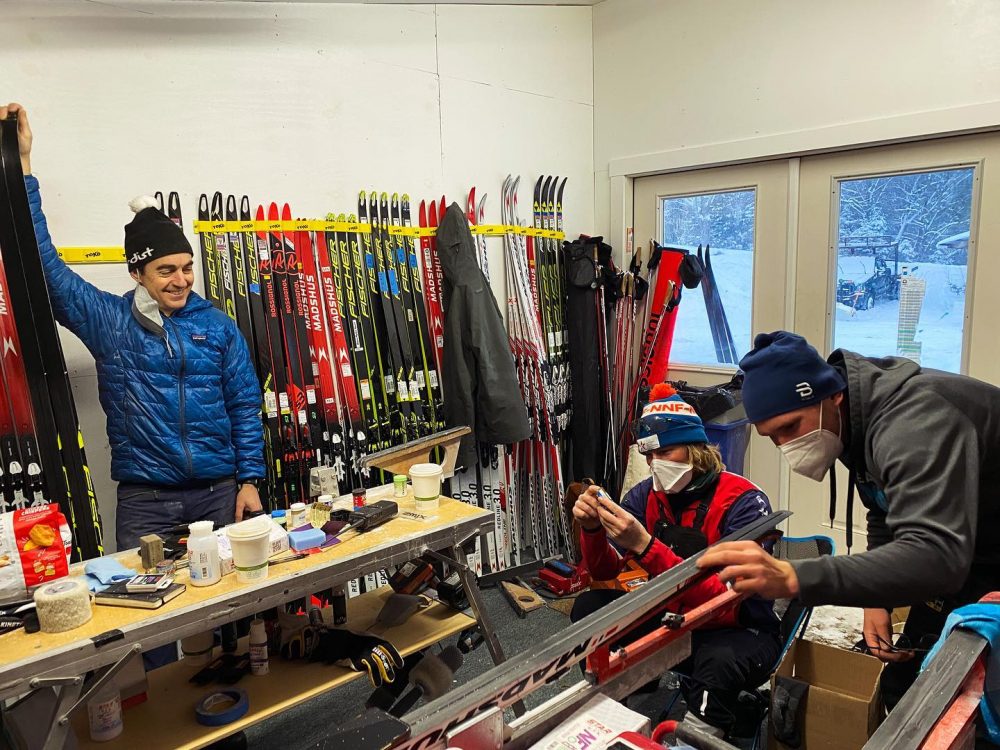
    Inside the wax at a February SuperTour race weekend in Craftsbury, VT, where Zach Caldwell (left) supported SMS T2 athletes. (Photo: Facebook Caldwell Sport)

    “As you begin to limit variables,” Caldwell explained, “you begin to place much more emphasis on other variables. They become proportionally much more important in determining how to get to the best performance possible [on the day]. And as you remove wax, which is a really inexpensive variable per application that can be put on specific to a day, you skew the emphasis toward skis base materials, grinds and hand structures.”

    Individual variation among the skis and in the technique and strengths of the skier on those skis adds additional complexity to the scenario.

    “Think about classic skis; this is a better way to imagine this,” Caldwell pitched. “Some athletes or some skis require different layering and build up of classic wax on a day. But if you’re saying, ‘Oh, you get two layers of extra blue. That’s it.’ That’s asinine. It means some people get to race and others basically have to herringbone.”

    Nystad also questioned the premise of leveling the playing field by creating uniformity in the wax selection.

    “Let’s start with the beginning,” Nystad said. “All of us that have done this for a long time, the only thing we know is that we don’t know. The only thing we know is that we need to test in order to get the answers. But what I can tell you from my experiences is that if you limit one factor, sometimes it just opens up another can of worms…

    “There’s definitely good arguments for trying to make the sport as simple as possible. But I think that for the people that think that just by waxing with blue, that that’s going to make it more equitable. It is a sign to me that they don’t have that much in-depth knowledge.”

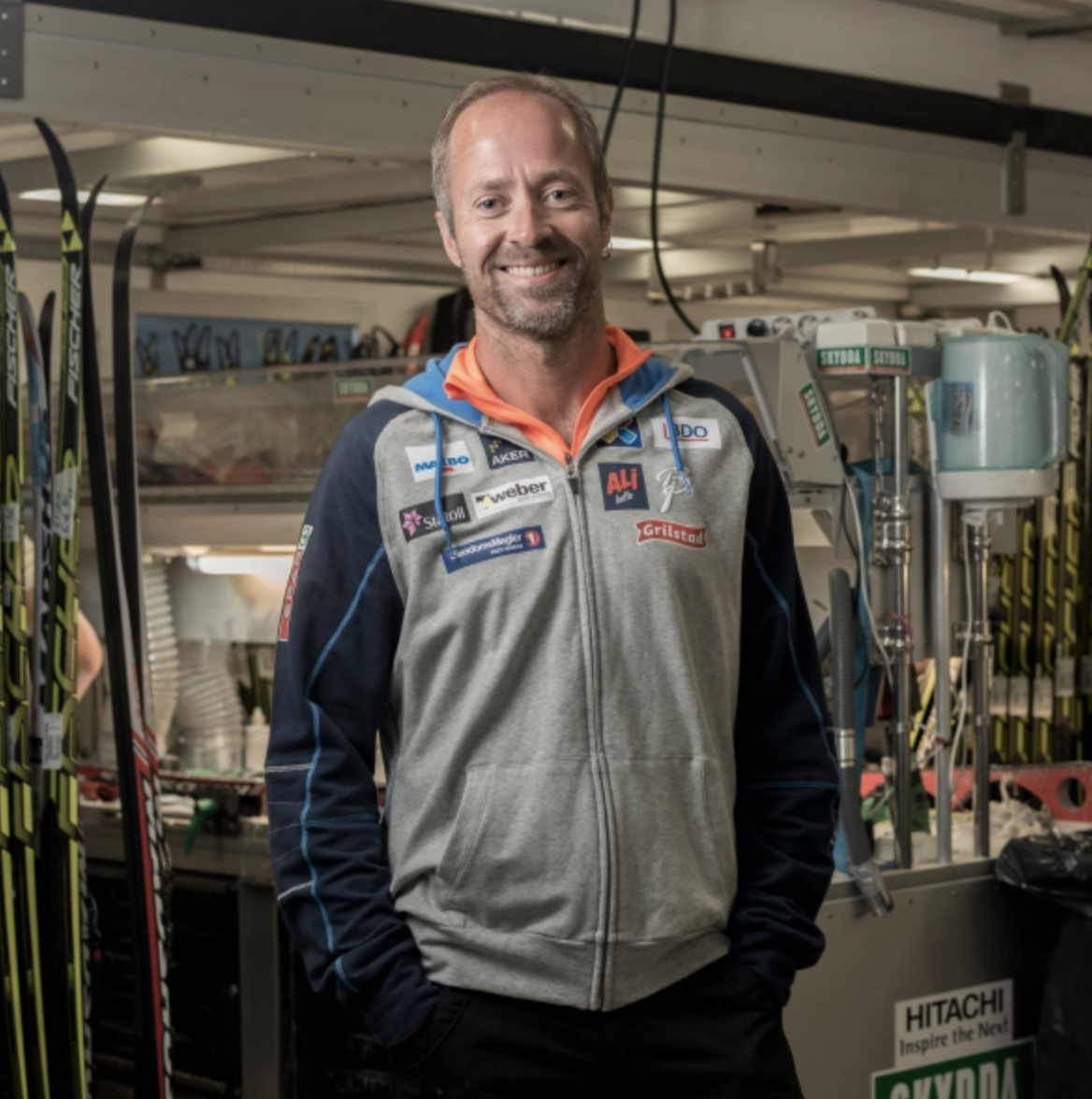
    Knut Nystad provides insight into ski performance theory and why a one-wax call may widen the gap in cross country skiing. (Photo: knutnystad.com)

    Without giving hierarchical ranking, Nystad also discussed the myriad of factors that contribute to the performance of a ski on a given day: the properties of the ski, including flex and splay, the quality of the base and its structure, the manual tools used, and the wax. “And then to top it all off, you have the method methodology that you use to apply the wax.”

    He walked through various ways a particular wax could be applied to yield different results, before echoing Caldwell’s sentiments that equity and uniformity cannot be achieved by restricting the options for wax that can be applied to a ski. 

    “When people say, ‘Well, can’t we just all wax with the same thing? It will make it easier.’ Clearly it will make it easier; you have one less factor to think about. But if the intention was to make it more of an even playing field, it’s not necessarily the truth. Because when you go to a race,  you’re only limited to try to test what you can afford from money, resources, and of course, time being one of those resources. So if you don’t have the test wax, what else can you test? Well, you can test many more skis, with many more properties with many more different bases, with many more structures, with many more manual tools. 

    “So it just opens up other things that you can test to get an advantage. And everything that you’re going to test if you’re going to have more skis, of course, that’s going to cost more. If you’re going to have more structures, different kinds of structures, that will also cost more. If you’re going to add manual tools, that will also cost more.”

    Stay tuned for more insights from Gerlach, Caldwell, and Nystad in Part 2 of this story.


  • Environmental consciousness without performance compromise: the MountainFLOW Eco Wax team takes on the Birkie

    Environmental consciousness without performance compromise: the MountainFLOW Eco Wax team takes on the Birkie

    A team of familiar faces is soon headed to the American Birkebeiner, and rumor has it, their race suits will be something to behold. 

    Spearheaded by brand ambassador Simi Hamilton, the team of Sophie Hamilton (Caldwell), Sadie Maubet-Bjornsen, Liz Stephen, Matt Gelso, Sylvan Ellefson, and Erik Bjornsen will be racing as members of the mountainFLOW Eco Wax team.

    “We’re gettin’ the band back together!” This familiar team of retired skiers is headed to Hayward to represent mountainFLOW eco wax at the American Birkie. (Photo: mountainFLOW)

    Based in the Roaring Fork Valley of Colorado, where Hamilton grew up, mountainFLOW Eco Wax is the maker of a line of plant-based ski waxes and bike maintenance products that spare the environment without compromising the performance skiers and riders expect. The company officially began in 2016 after years of tinkering in founder Peter Arlein’s kitchen. Experimenting with various plant-based alternatives to the petroleum based products that the ski industry has historically relied upon, Arlein ultimately concocted a solution that he felt checked all the boxes. 

    Why consider an eco-friendly wax? 

    “It’s a classic micro-pollution problem where you can’t see the wax coming off [your skis],” Arlein explained in a call. “It’s not like you’re littering and you can see what you threw on the side of the road, but in aggregate, it becomes a big issue. And all of these pollutants are collecting and accumulating in the rivers because they melt in the snow, and then that melts, and then it all flows down into the local watershed.”

    Arlein, who has worked in the ski industry for more than 20 years as everything from a fry cook to a patroller, explained that prior to mountainFLOW, he had tried all the available eco-friendly products, but was never satisfied with the performance relative to the traditional petroleum based products on the market.

    The pillars of mountainFLOW products: 100% plant based and petroleum free, without compromising ski speed and performance. (Photo: mountainFLOW)

    “Eco waxes, for a while, were really bad,” Arlein said simply. “So we’re here to show, first and foremost, our waxes are high performance — and they happen to be non-petroleum and made from plants. Because it can be as green as possible, but if it’s slow, then it’s not a very good product.”

    He explained that most eco-friendly products had historically relied on soy wax as a main ingredient, which is readily available, relatively cheap, and easy to work with.

    “But it’s also super soft,” he said “So, in anything colder than 30 degrees. It’s just too slow.”

    Through experimentation and research, mountainFLOW has developed a set of recipes that use a variety of plant-based waxes to account for the variation in moisture and friction of different temperature ranges, with which cross country skiers are well-accustomed. The ingredients they landed on had traditionally been used in the organic health and beauty industry, which is ultimately where mountainFLOW sources them. 

    “We’ve tweaked the ratio of plant waxes, and the different types of plant waxes that we’re using, to mimic the qualities of a traditional wax. You can measure hydrophobicity, you can measure hardness, which are the main characteristics that a normal wax has.” 

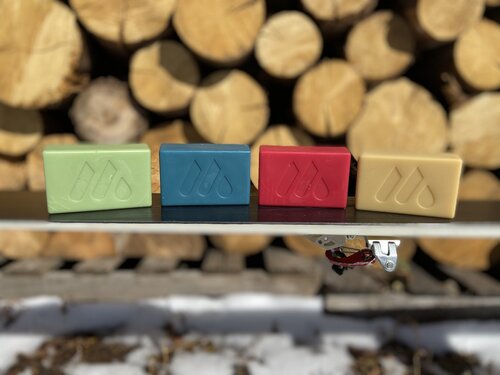
    mountainFLOW’s basic line of ski waxes, akin to Swix Performance line, features three temperature ranges, plus an all-temperature wax to keep the bases of your cross country, alpine, and touring setups fast and protected. (Photo: mountainFLOW)

    Expanding well-past Arlein’s kitchen, the company began to take off in 2019 after appearing on ABC’s Shark Tank.With patents on the wax formulas in hand, mountainFLOW eco waxes quickly found their way into over 600 doors. The products are now sold at retailers nationwide and now reach as far as New Zealand and Europe. Demonstrating commitment to protecting the environment, mountainFlow is a Certified B Corporation with all USDA Certified biobased products, with biodegradable and 100% post-consumer recycled packaging materials to boot.

    With the harmful effects of fluorinated waxes and how to halt their use at the forefront of discussions in the cross country ski community for the last several years, the concept of eco-friendly alternatives should pique the curiosity of environmentally conscious skiers. But what the elimination of fluoros has also perhaps highlighted is that cross country skiers are reluctant to compromise when it comes to ski speed on race day.

    Arlein explained how mountainFLOW has stepped up to this challenge in creating its line of race waxes, innovating with materials developed for purposes well-beyond the scope of sliding around on skinny skis as quickly as possible. 

    “We were able to source this ceramic nanopowder that mimics qualities of fluoros, but it’s totally non-toxic and biodegradable,” Arlein shared. “It was actually developed by the Department of Defense for use in bulletproof vests, because it’s really durable and hard. But it also happens to be super hydrophobic and slippery, so then it started being used to coat runners for luge and bobsled. We found this little lab that was making it in the Midwest, and we licensed the rights to use it for ski wax. And so that’s what we’re putting in our non-fluoro race wax, and that’s what everyone will be skiing on at the Birkie.”

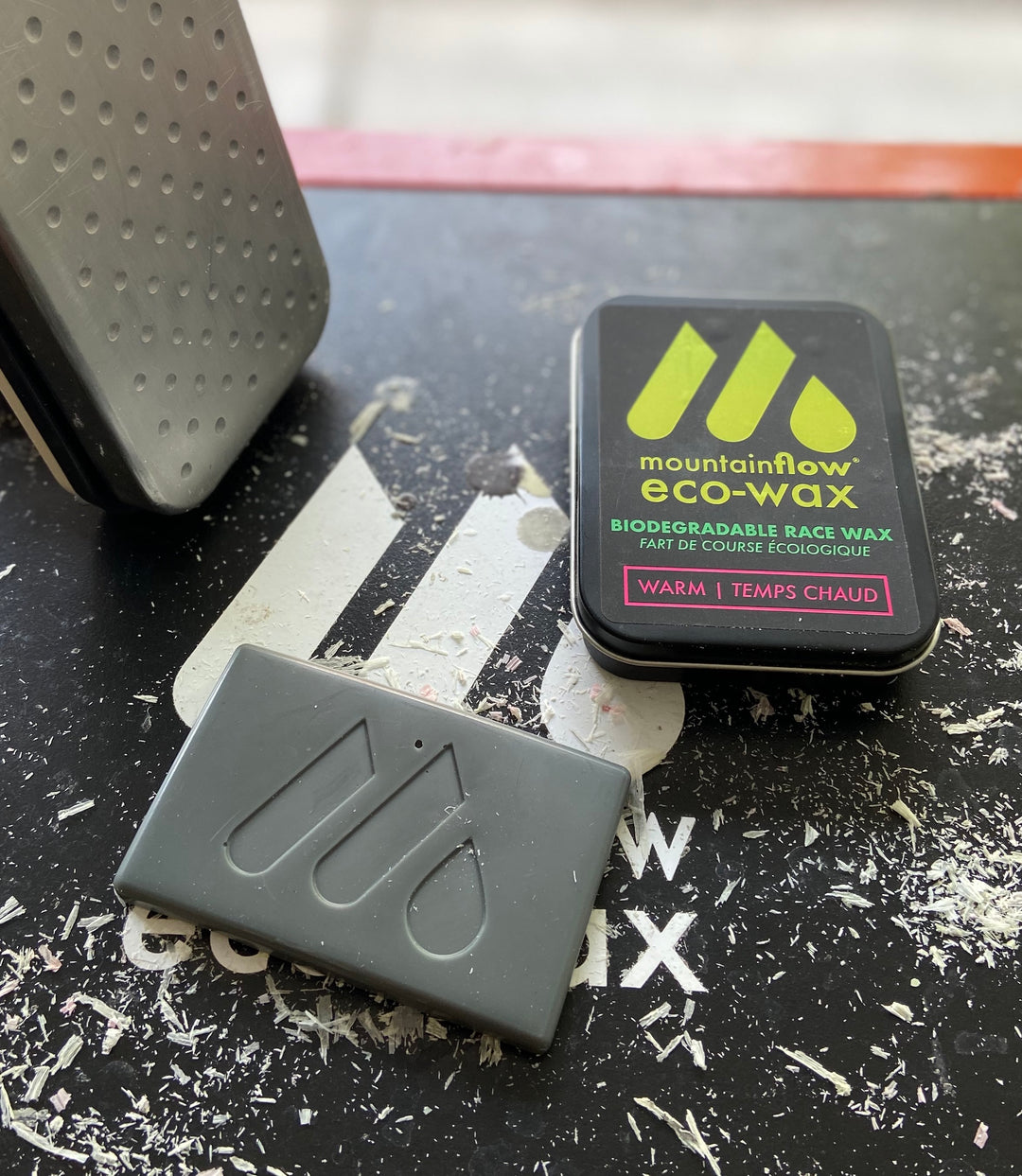
    MountainFLOW Eco Wax has created a biodegradable plant-based line of race waxes, allowing skiers to have fast race skis without the harmful environmental impacts of petroleum based products. (Photo: mountainFLOW)

    The mountainFLOW race wax lineup includes three temperature ranges – cold, cool, and warm – which they’ve tested against comparable products from companies like Swix and Toko. 

    “We’ve found that the wax works especially well in cold temperatures with hard abrasive snow.”

    The mountainFLOW team is in luck. Temperatures in Cable, WI the three nights prior to the American Birkebeiner on Saturday the 26th are currently predicted to be -8, -6, and -1 Fahrenheit.

    Arlein comes from an alpine ski background and says his progression with cross country skiing began last year when he headed out with his wife on skate skis. “We did not go very far. And I was dying. And I looked terrible,” he laughed.

    Luckily, he was already connected with Simi Hamilton, whose older sister had grown up with Arlein’s wife. Knowing the mountainFLOW products would perform just as well on cross country skis as they did on alpine and backcountry boards, he called Hamilton from his car that day hoping to rope him in for some guidance.

    Simi and Sophie Hamilton out for a classic ski near their home in Aspen, CO. (Courtesy photo)

    “I was like, ‘Simi, I need help. I don’t know what I’m doing. I’m not good at this sport. And I don’t know enough about it to speak from an authentic place. Can you help?’”

    Hamilton, who has been a long-time ambassador for Protect Our Winters and spokesperson for environmental policy, quickly agreed. Hamilton paired technique advice with perspective on mountainFLOW’s ability to meet the demands of committed cross country ski racers. Having spent decades racing on the best and most expensive waxes, filled with some of the harshest chemicals, he can speak better than most to the performance of mountainFLOW’s products relative to alternatives. 

    “I’ve been super impressed at how well their waxes have performed,” Hamilton wrote in an email. “I haven’t had a chance to try any of their products in super wet or dirty snow yet (after all, this is Colorado), but I really think the moly is going to work awesome for those springtime conditions. We’ve had a pretty wild winter here with huge temperature fluctuations and periods of big snowfall followed by seemingly endless dry spells, and all of the waxes I’ve used thus far have performed just as well if not better than the fluorinated paraffins I’ve used in the past for hard training sessions, etc. Because I’ve been able to get out on my alpine and backcountry skis more than normal this year, I’ve definitely been better about keeping my gear in good shape with somewhat regular waxing. Without a doubt, I can say that arcing turns in powder or on groomers is way more enjoyable with some fast planks under your feet.” 

    Though Hamilton says he has used mountainFLOW products since the early days of tinkering in Arlein’s kitchen, it was not until this summer when he joined the team as an ambassador and consultant, first testing some of their bike lubes and cleaning products.

    “I was super impressed right off the bat with their stuff. Like the ski waxes, it worked just as well, if not better, than the very best traditional (petroleum-based) lubes and cleaners I’ve found. I’ve gradually become more involved with the company over the last handful of months mostly because I really believe that what they are doing is making a difference in our ski and bike communities. They are throwing out the conventional belief that the petroleum-based products that are already out there are the only products that work well.

    “MountainFLOW is showing the outdoor industry that we can venture into the mountains and use products that are both 100% sustainable and enrich the important mountain experiences we seek,” Hamilton emphasized.

    “And perhaps most importantly, they’re just an awesome company with some incredible people at the helm who love to share the stoke they have for being outside and doing really fun things.” 

    Simi Hamilton enjoying retirement while out for a backcountry ski near his home in Aspen, CO. (Courtesy photo)

    As the two schemed ways to reach the cross country ski market with mountainFLOW products, bringing a team to the Birkie seemed like an obvious choice. Arlein said the team would be “super fun, and maybe not super serious.” Perfect for a group of retirees looking for an excuse to get together. 

    “I was immediately psyched about the idea mostly because Peter’s number one objective was to just go have a great time at what is probably the most iconic ski event in the country. I think cross-country skiers in general are some of the most attentive people out there when it comes to climate change and other important environmental issues, so to be part of a team that can introduce this company, their ethos, and their standard-setting products to a community of people who want to be a part of the solution and not the problem, is super cool. Not to mention it’s just going to be a heck of a good time to hang out with [my former teammates] for a few days. We’re gettin’ the band back together and I couldn’t be more psyched about all these pieces falling into place!”

    Those heading to Hayward this week can find the mountainFLOW team at the Birkie expo, where you can chat with Arlein and the race team about the products and race-day wax recommendations, buy waxes and tools, or have your skis waxed – for free! – by the crew. Otherwise, find mountainFLOW online or at a retailer near you, and try knowing there is a 100% money back guarantee should the products fall short of your expectations. 

  • FasterSkier Explains: How to Clean the Fluoros Off Your Skis So You Can Race the Birkie

    FasterSkier Explains: How to Clean the Fluoros Off Your Skis So You Can Race the Birkie

    (Photo: NordicFocus)

    What: Fluoros, aka perfluorinated waxes, aka ski waxes containing per- and polyfluoroalkyl substances (PFAS), aka the really expensive waxes that you put on for big races, in some or all of block, liquid, or powder form.

    What they do: Make your skis go really, really fast, particularly in the wet or dirty snow conditions that sadly characterize more and more high-end races in an era of artificial snow and climate change.

    What else they do: Exposure to certain perfluoros is associated with thyroid disorders, hypertension and preeclampsia during pregnancy, and testicular and kidney cancer, as well as statistically improbable rates of illness and death for people exposed to it in high quantities. PFAS chemicals have been found in the drinking water in multiple states. Lawsuits have been filed; over a billion dollars in settlements have been paid.

    What’s their status for ski racing: It’s complicated. For the past few decades, fluoros were ubiquitous in high-level ski racing. Then, in November 2019, the International Ski Federation announced that fluorinated waxes would be banned in all FIS races, including the World Cup, effective this race season. Nations began testing fluoro-free alternatives from major wax manufacturers. FIS began working on a workable and efficient fluoro-detection machine. Much upheaval ensued.

    Work on the fluoro-detection device did not go as efficiently as planned. At the eleventh hour, in mid-October of this year, slightly more than a month before the first World Cup race of this season, FIS announced that the fluoro ban would be postponed by a year, and would not go into effect on the World Cup (or at, say, the 2022 Winter Olympics) until July 1, 2021. “Stay tuned,” FasterSkier wrote last month.

    What did Devon Kershaw think about this: He was not a fan of FIS’s lack of competence or professionalism.

    Canadian wax technicians Mike Mappin (l) and Camille Cheskey (r) hard at work during the 2016 Winter Youth Olympic Games on Feb. 10 in Lillehammer, Norway. Yes, they should really have some form of respiratory protection. (Photo: Jon Buckle for YIS/IOC)

    No, really, what’s their status for ski racing: Simply put, fluoros are allowed in FIS races in this country this season, as in any FIS race in any country this season. They are not allowed in races sanctioned by U.S. Ski & Snowboard. (These were formerly known as USSA races. They are also known as NRL races, or National Ranking List races, that is, a points system used to rank domestic athletes.)

    That’s nice, but I’m your average master skier in this country. I’m not a USSS member, and I’m not racing any high-level races. Other than the general health and safety considerations, why do I care about this? Ever hear of a little thing called the American Birkebeiner?

    Yes, the one true ski race for Master Blasters everywhere. But what does that have to do with fluoros? They’re banned at the Birkie, starting this year.

    Really? Really. Here’s American Birkebeiner Event Director Kristy Maki, in an email to FasterSkier this November:

    “The 2021 Birkie Events will be fluoro-free. We are working on determining how testing will be implemented and right now, our goal is to do testing on a limited number of skiers. We have been working on the basic planning of Birkie Events, but I will be updating the Participant Rules soon.

    We have announced previously that we would be fluoro-free in 2021, but it has not gotten a lot of attention lately.”

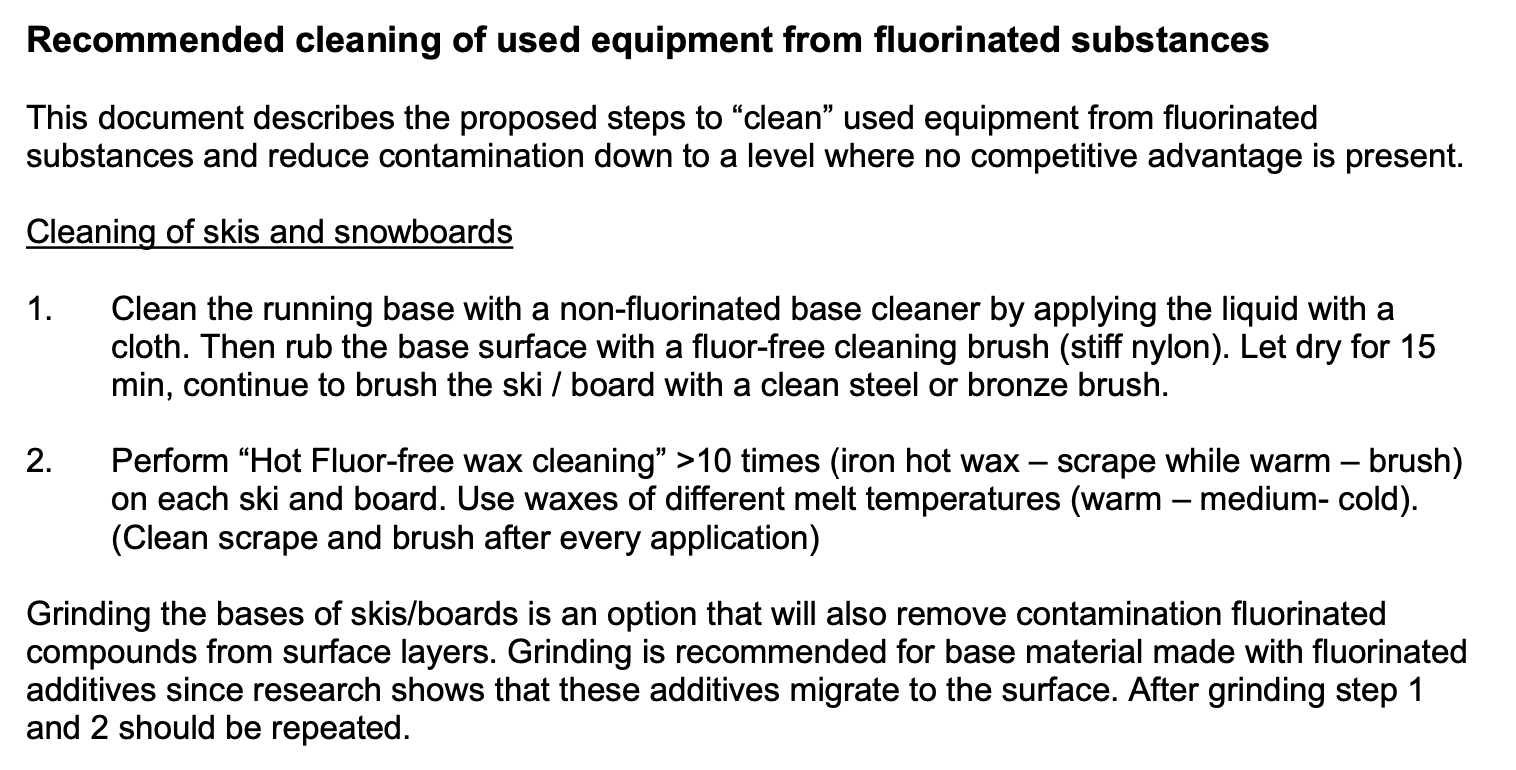
    Okay, I’m listening now. How do I get the fluoros off my skis so I can race the Birkie without breaking the rules? The short version is that you need to clean your skis; de-fluoro your skis; and then wax your skis anew with fluoro-free wax. Here is an excerpt from a longer document prepared by FIS:

    If hot waxing more than 10 times does not seem like enough work, the full document also explains how to clean/purify your iron, scrapers, brushes (but you should really just buy new brushes), roto fleece, wax apron (wash on high “several times”), files and file guides, ski bags, and wax room.

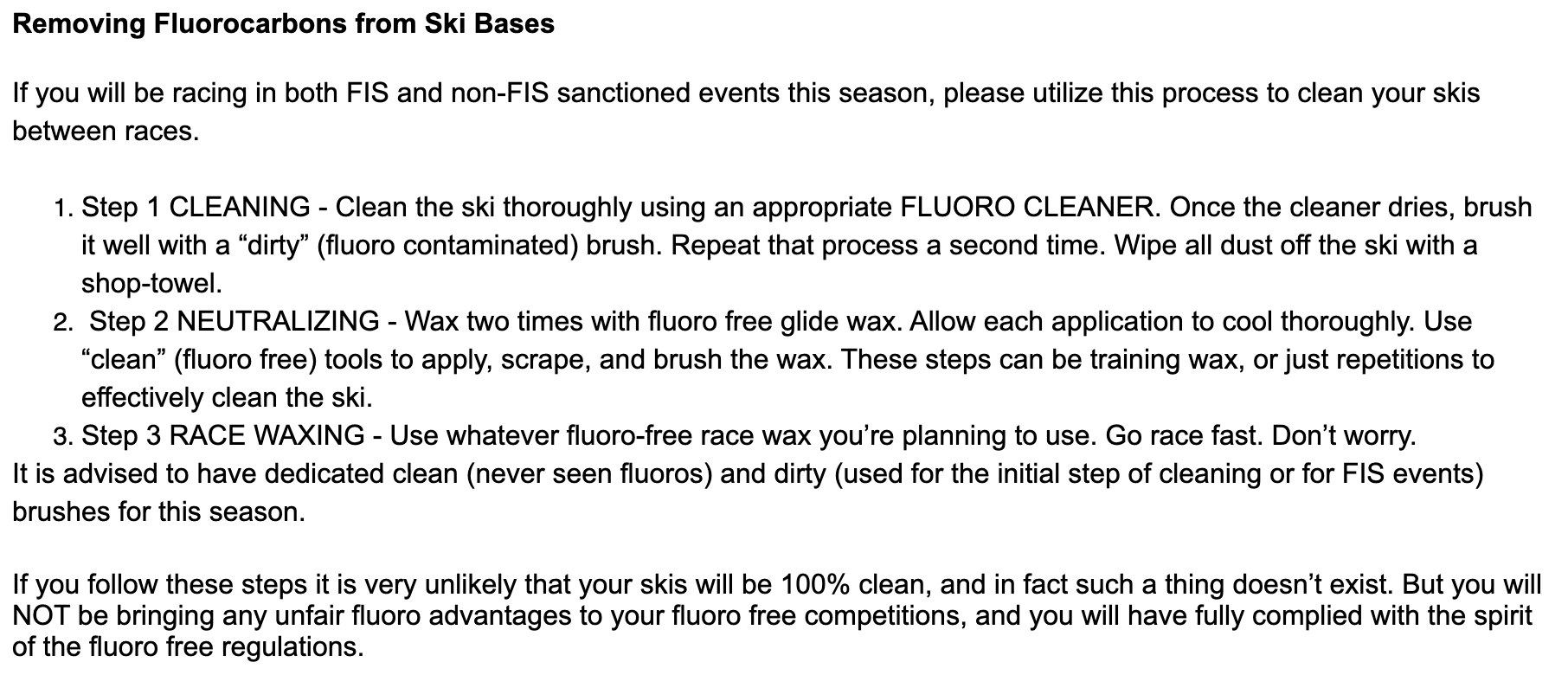
    Wow, that sounds really involved. Do you have a shorter version of what I can do and still achieve some sort of good-faith compliance with these new rules? Thankfully, yes. Here’s what USSS sent out in an email to all members in mid-November:

    The main difference is that it involves far fewer repetitions of the cleaning step, specifically “two times” rather than “more than 10.” (Granted, that’s twice through a normal wax application in which the wax cools each time, rather than 10 times hot scraping, so that’s a little apples to oranges.) But this was sent out by Adam St. Pierre on behalf of U.S. Ski & Snowboard, so this would seem to have USSS’s imprimatur behind it. Also, this accords with the “two layers of NF” protocol used by EISA teams over the past few seasons.

    Bigger picture, USSS seems to envision this as something you could do if if you’re transitioning between, say, USSS and FIS races multiple times this season (or USSS and no-holds-barred citizens races), while the FIS protocol is probably more applicable to making a permanent transition from a fluoros to a no-fluoros world. Which is clearly coming soon, but, depending on where you live and the viewpoints of your local ski club, may not be here yet – citizen races in southcentral Alaska, for example, remain very much fluoro-friendly this season.

    Okay, I did all this, but I don’t trust my competitors to do this at all. What type of oversight is there going to be at races this season? Probably some but not much. As Maki with the Birkie said, they will be targeting “a limited number” of entrants. Or here’s St. Pierre, in the same mid-November email quoted from above, describing random testing at “select” USSS races this season:

    Full details on the testing protocol (brief version: the ski is swabbed in two places on the glide zone; sample is sent in for analysis; results come back in 10-14 days) may be found here. St. Pierre also explains the possible sanctions for evidence of fluoro use, up to and including disqualification. He adds, “Remember: Testing can indicate the degree of fluoro contamination. Our intention is to catch intentional and unethical fluorocarbon use; the goal is not to sanction individuals for traces of fluorocarbons from prior waxing, those present in the ski base, or the environment.”

    What do you have to say about all this, USSS official site? Here you go: “In order to provide U.S. Ski & Snowboard members, coaches and officials guidance with the [no fluoros] policy, we are providing the following information: …

    Fluorinated Wax Testing: Testing procedures and protocols will be forthcoming.”

    Oh.

    What do you have to say about all this, American ski community? Here’s CXC, writing about its new wax policy for this year’s events (emphasis in original): “Our CXC Cup Wax Policy is first and foremost an honor system, but athletes at Salomon CXC Cup NRL Events are subject to random ski testing for illegal wax by representatives of U.S. Ski and Snowboard. It should also be recognized that ski waxing, especially with non fluoro waxes, is quite variable and often two similarly waxed pairs of skis can have large differences in glide based upon non wax factors such as flex and structure/grind. All competitors and coaches should adopt a culture of compliance, and all our membership should presume their fellow competitors are acting ethically and legally, rather than pointing fingers based upon a subjective idea that someone has fast skis from illegal waxing.”

    Or here’s Boulder Nordic Sport’s Roger Knight, writing in this winter’s version of the BNS catalog, which was prepared at a time when fluoros were going to be completely barred this season, and so was partially obsolete by the time it was printed: “Where does [the absence of widespread fluoro testing] leave us? With an honor system. Will some people cheat? Undoubtedly. Do you want to be one of those people? Only you can answer that question. One thing that we essentially have never had here in the US is a stain of cheating on our cross-country skiing culture. We hope that this continues at all levels of the sport.”

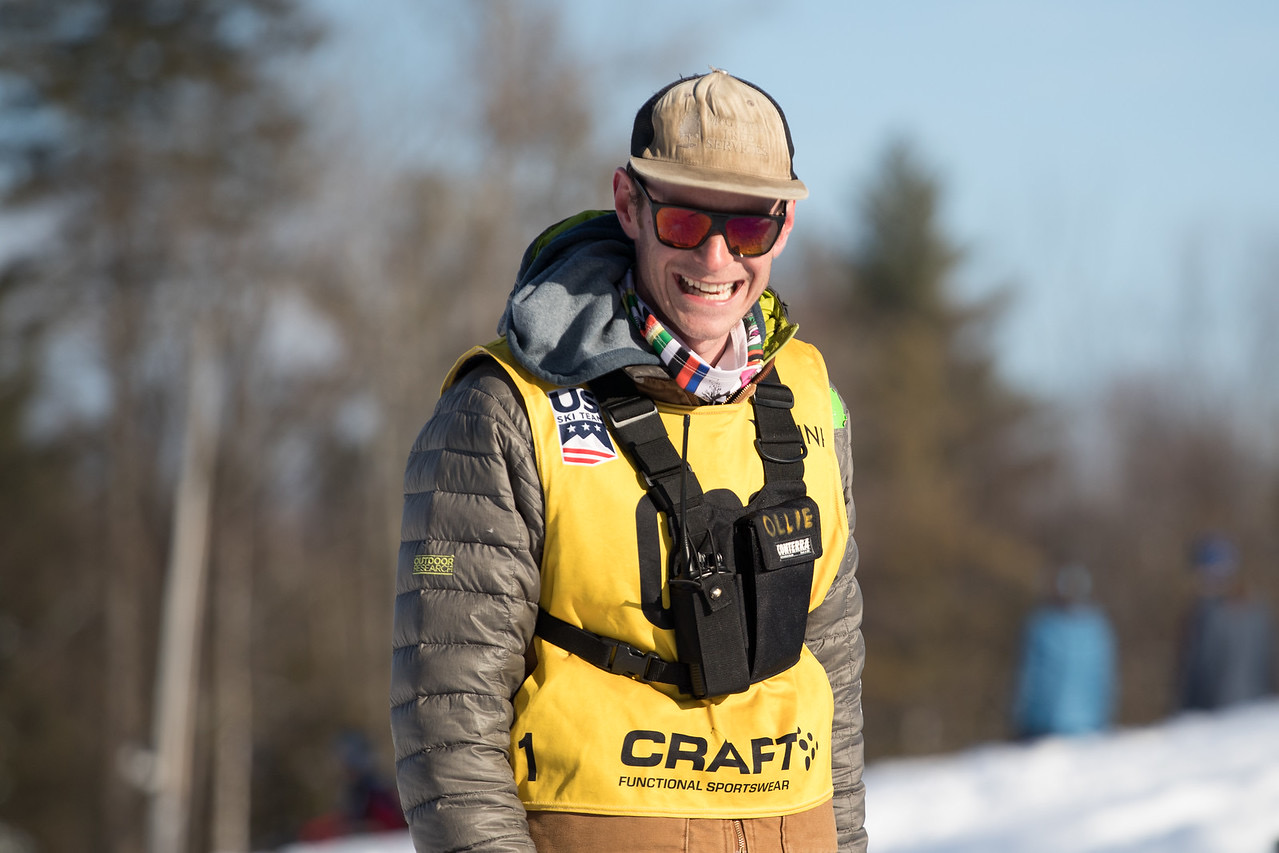
    Ollie Burruss, chief of competition at the 2019 US Nationals in Craftsbury. (Photo: Craftsbury Outdoor Center)

    Finally, here’s FasterSkier writing last month about Craftsbury nordic race director Ollie Burruss: “In Burruss’ estimation, racing at the Outdoor Center is de facto fluoro free. … The Outdoor Center asks you not to use fluoros. That decision, according to Burruss, will be based on trust and a hardened value system relying on people doing the right thing, not necessarily the fastest thing.”

    Burruss added, “We don’t have a community in New England where it’s fraught with suspicion, backstabbing, and people trying to one up each other. We really have, I think, a really tight-knit supportive ski community. And so when we planned on having FIS racing, we weren’t going to test.”

    I’m sorry, but I’m still skeptical that some of my competitors are going to comply with a largely honor system-based protocol, when the advantages of fluoro use in some conditions are so great, and widespread testing or enforcement is not really an option yet. Am I alone in this concern? You are not. Although it was admittedly unscientific, an informal poll conducted on FasterSkier last fall suggested that large portions of the 160 respondents were less sanguine than Burruss or CXC leaders about the ethics of their competitors. (N.b., there was likely no practicable, quick-turnaround, fluoro-detection device on the market at that time. To be fair, there still isn’t.)

    One of the questions in the 2019 survey was, “If a fluoro ban was put in place, would you trust that the field was ‘clean’ with regards to fluorinated ski bases?” Only 25% of respondents answered “yes.”

    Narrative comments made in response to this question included, “A 20%+ advantage in some snow conditions? Yeah, that’s a big incentive. I can’t imagine [a ban] working.” (For perspective, and back to the Birkie for a second, a 20-plus-percent improvement is the difference between qualifying at the back end of the Birkie Elite Wave and making the podium at SuperTours or U.S. Nationals. That’s a pretty big difference.)

    Also, “If there isn’t a simple compliance test, no doubt some people will cheat to win.” Also, “I would like to trust that the field was ‘clean’, but I think I would struggle to do so if it were to actually happen. Furthermore, I think that any stellar performance by an athlete would be subject to suspicion, regardless of whether or not they were ‘clean’, and that this would be unfortunate.” Also, “I am sure several masters racers with large wax stores would still use them until they were depleted; I would expect races to be clean in several years and primarily clean in the interim.”

    Also, and more optimistically: “At the World Cup level, I probably wouldn’t trust the field to be clean, because there is a lot at stake, and some people already dope, so I’m sure they’d have no qualms about fluoro doping. However, at the US level, I have a lot more faith in the nordic ski community and I honestly believe that anybody that is seriously competing to win super tours and represent the US at world championships would do so honestly.”

    In response to other questions, 64% of respondents stated that they would continue to use their existent stock of fluorinated waxes. 56% of respondents stated that they foresaw some sort of black market developing for banned wax products. Again, you can find the full poll results here if you are curious. You may also note this narrative comment, which speaks volumes: “I hate the poison but feel non-competitive without it.”

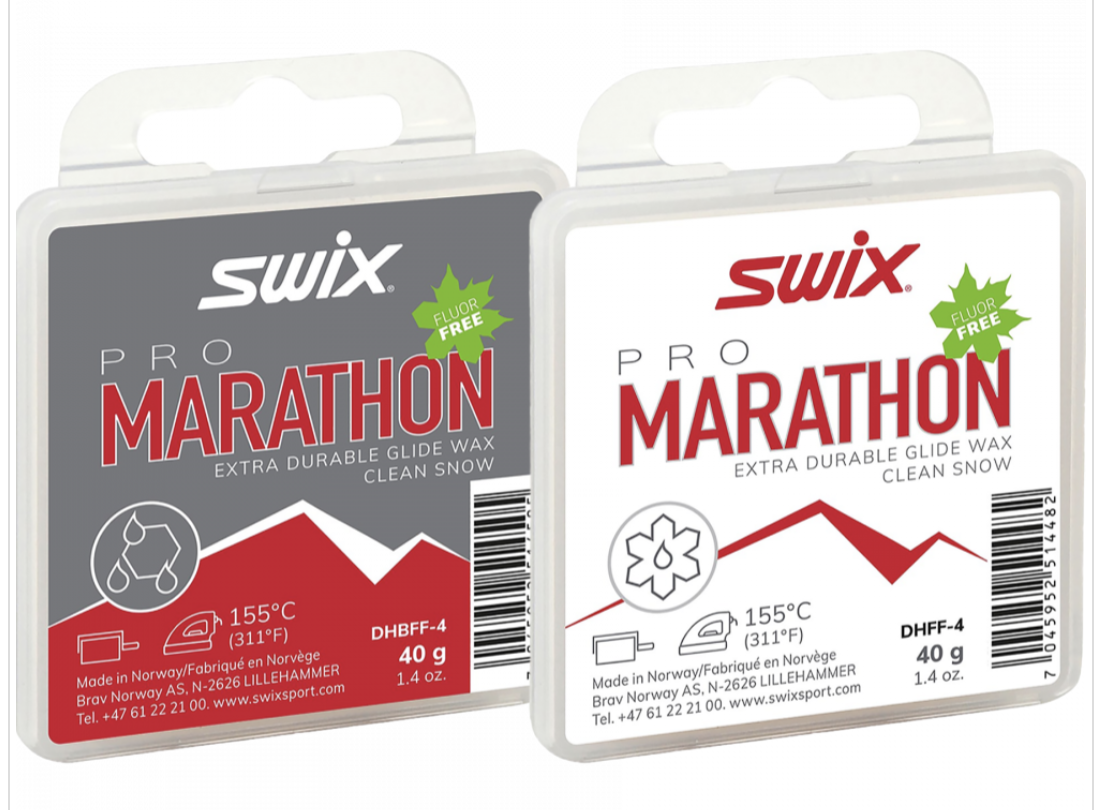
    Swix would be glad to help you restock your wax bench: Swix Pro Marathon Fluoro Free. (photo: screenshot from current BNS catalog)

    So after I clean off my skis, what do I buy to wax with instead? Most wax manufacturers have developed fluoro-free analogues of most of their fluorinated products. Your local ski shop will be well-versed in your new options.

    What else should I buy? Maybe some new skis, or at least some new structure tools. As USST wax tech Chris Hecker wrote, summarizing his testing of World Cup-level non-fluoro waxes during the 2019/2020 season, “I am very impressed with how good some of the non-fluoro alternatives have been. In colder, dry conditions I find a number of brands have found competitive alternatives to fluoro top coats, but when it comes to warm, wet snow days the gap is still fairly large. On warmer days with non-fluoros being present, skis, hand structure and ski grinds will become ever more important.”

    This article has been edited to remove a link to a table of waxes approved for CXC races, because it represented only a portion of fluoro-free waxes currently available.

  • U.S., CANADIAN NGB/NSOs FORM NORTH AMERICAN FLUOROCARBON FREE POLICY WORKING GROUP (Press Release)

    Press Release

    PARK CITY, Utah (June 15, 2020)  – National Governing Body’s and National Sport Organizations (NGB/NSOs), and snow sport organizations from the United States and Canada today are announcing the formation of a Fluorocarbon Free Policy Working Group.

    With representation from U.S. Ski & Snowboard, USA Nordic, U.S. Biathlon, USA Para Nordic, USA Para Alpine, Alpine Canada, Canada Snowboard, Freestyle Canada, Nordiq Canada, Biathlon Canada, Nordic Combined Canada and Ski Jumping Canada in addition to industry wax representatives, the working group is tasked with setting a policy to eliminate the use of fluorinated ski wax from all sanctioned levels of snow sports competition in North America beginning with the 2020-21 season. 

    In 2019, the International Ski Federation (FIS) and International Biathlon Union (IBU) decided that the use of fluorinated ski wax will be banned for all FIS and IBU disciplines beginning with the upcoming 2020-21 season. In addition, U.S. Ski & Snowboard voted to eliminate the use of fluorinated ski wax from all levels of competition at it’s May 2020 meeting. The Canadian Ski Association (CSA) has adopted the FIS Council Ruling and is extending it to all programs that fall under its authority. 

    Fluorinated wax, and the raw perfluorooctanoic acid (PFOA) compounds that make up these wax products, have been scientifically studied for their negative environmental and health impacts. In the United States, many of the compounds found in fluorinated wax products contain ingredients listed in the Toxic Substances Control Act. In July 2020 the European Chemicals Agency will ban the sale, manufacture, and import of all products containing PFOAs. 

    The Fluorocarbon Free Policy Working Group began meeting on a regular basis to facilitate the many facets of developing policy and rules that will harmonize all levels of domestic competition and training with FIS and IBU rules and regulations, and will lead to a complete ban of fluorinated wax products at all levels of sanctioned competition. The Working Group is committed to:

    • Asking manufacturers to work toward providing a list of waxes where the manufacturer represents that the wax is free of fluorinated products 
    • Working with FIS and the IBU to coordinate the testing process and thresholds below the World Championships/World Cup level
    • Establishing rules, deterrents, and appeals process
    • Establishing clear and concise stakeholder communications

    While key questions remain, including testing, enforcement, and ultimately sanctions for using fluorinated products, all participating NGBs in the United States and Canada are fully committed to banning the use of fluorinated wax from all levels of sanctioned snow sports competition starting with the 2020-21 ski and snowboard season.