Tag: fluoros

  • Where Do All the Fluoros Go? The Ins and Outs of Skiing’s PFAs Problem.

    Where Do All the Fluoros Go? The Ins and Outs of Skiing’s PFAs Problem.

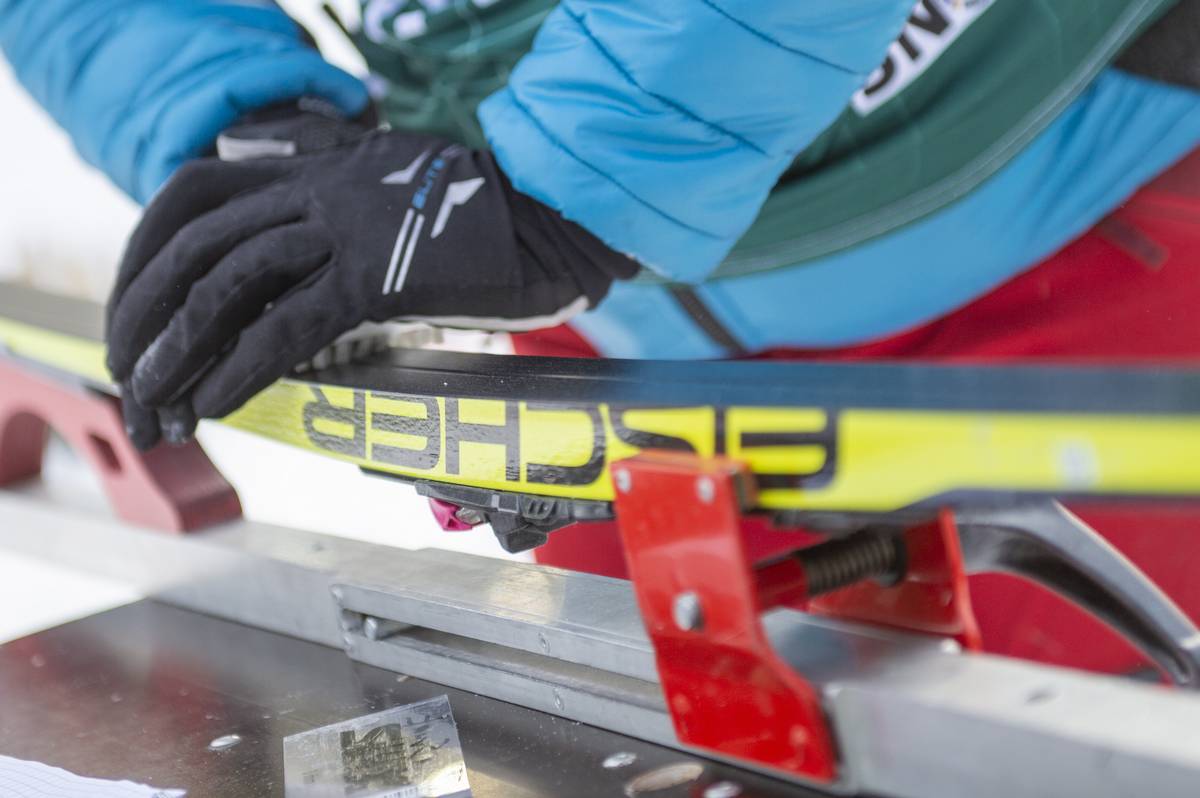
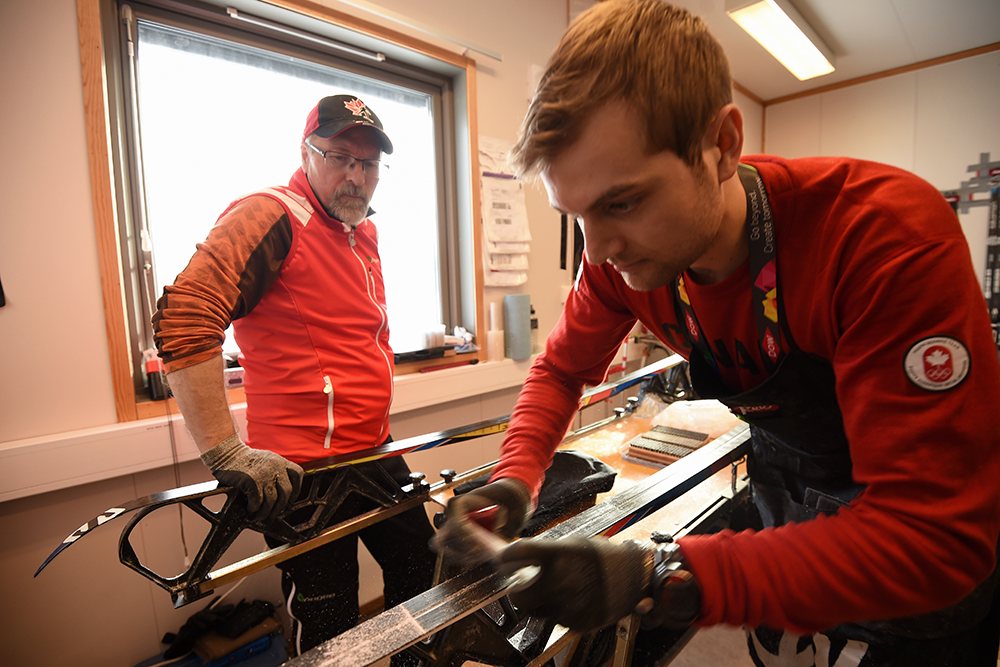
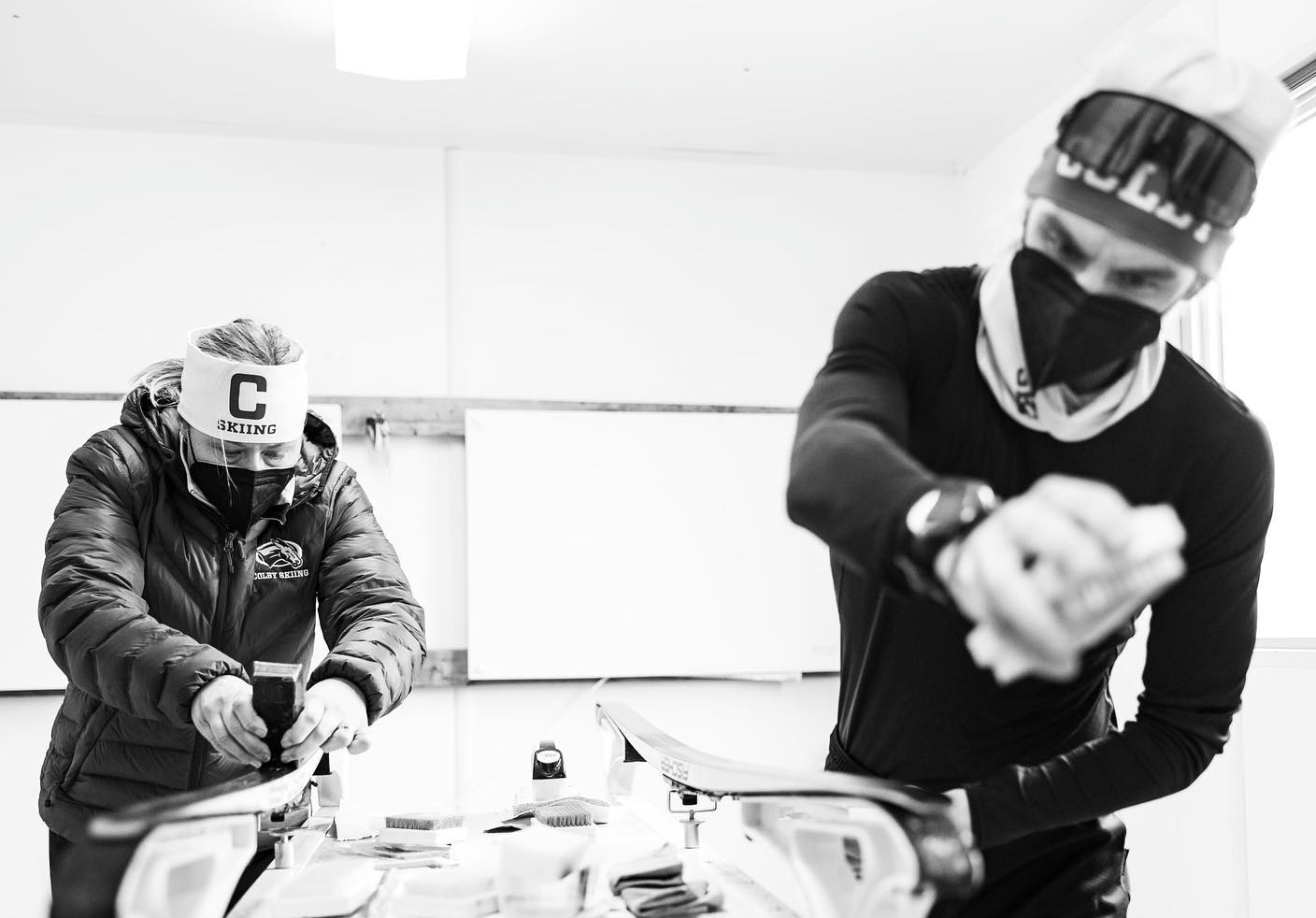
    Colby College Head Coach Tracey Cote and Assistant Brad Ravenelle at work in the wax trailer. (Photo: Colby College Ski Team)

    The International Ski Federation (FIS) recently announced that next season will be the first where the use of fluorinated ski waxes—fluoros—will be banned at the World Cup.

    Or rather, the FIS are planning on enforcing a ban that initially was announced in 2019, and has been delayed year-to-year ever since.

    In its rationale behind the latest delay last August, the FIS responded to reports by the Swedish Newspaper Expressen that the chosen field test for fluoros, the Alpha II, was ineffective in identifying fluoros on ski bases in a quick and enforceable manner. The announcement in March 2023 directly addressed these concerns, saying “the device will provide reliable results to ensure fluor-free competitions.”

    The whole saga has brought to light the tricky, often testy, balancing act of levying ethical obligations to the environment and to health while upholding principles of fair competition.

    Fluoros, which on a molecular level are composed of extremely hydrophobic long-chain fluorocarbons, have been the standard for high performance ski wax since their introduction in the 1980s. Fluoros not only were used to produce glide waxes but used as an additive to aid glide in kick wax, with typical race wax applications using multiple layers of the substance to produce skis that could cover any snow, especially warm and wet snow, faster than any substance on Earth.

    The evolution of ski wax to purer and purer forms of fluorocarbons saw ski waxes become some of the most concentrated per- and polyfluoroalkyl substances, PFAs or PFOAs, in the world. When research a decade ago began revealing that PFAs could be linked to immune suppression and act as carcinogens, their wide-spread use in industrial uses—from firefighting foams to waterproofed textiles—came into question.

    PFAs’ extreme ability to repel water also made them extremely durable in the environment. Once into an ecosystem, PFAs were transported through the water cycle, eventually ending up in water and food systems. A study last Fall found that an estimated 80% of waterways in America are contaminated with PFAs.
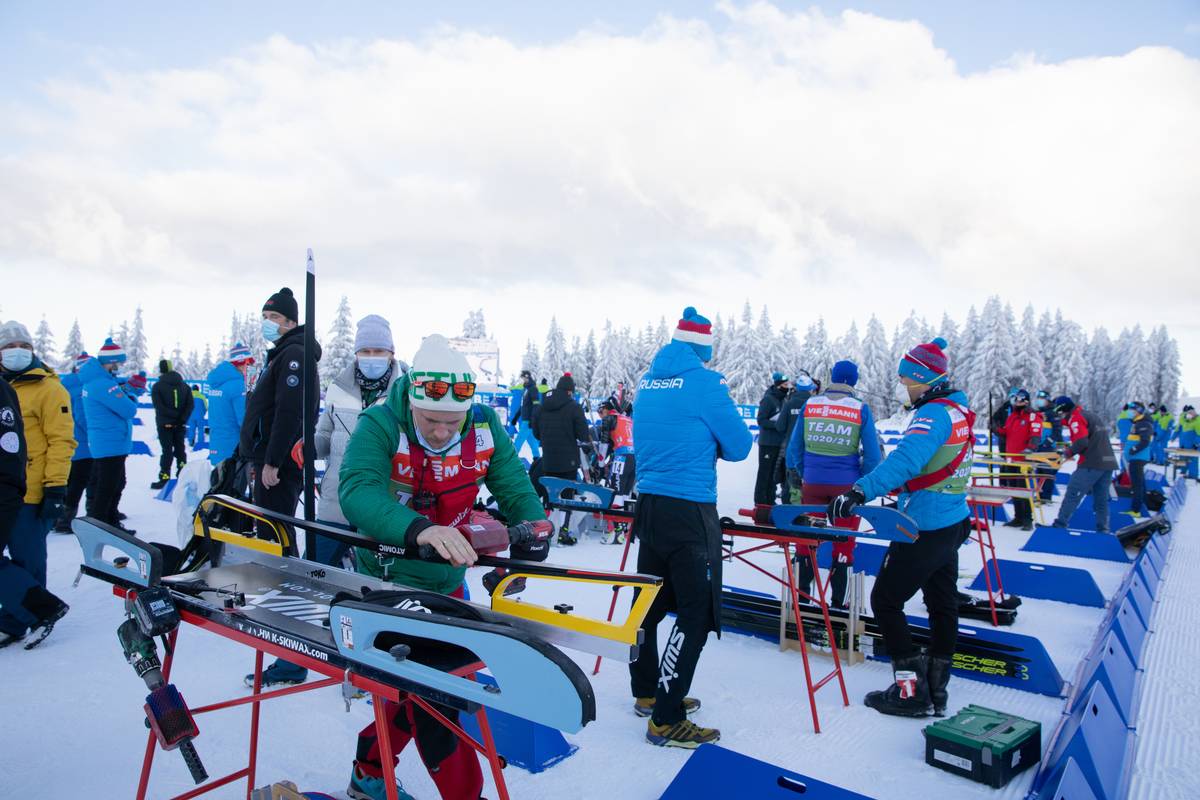
    A typical busy waxing scene in Oberhof, Germany (GER) ahead of a IBU World Cup Biathlon event in 2021. (Photo: NordicFocus).

    The results pointed back to the risks of using PFAs in consumer products, especially when the concentration of the material was the main selling point on the box (such as in ski waxes). A group of Environmental Science students regularly dealing with the substances outside of the classroom—members of the Colby College Nordic Ski Team in Waterville, Maine—saw a unique opportunity to contribute to the emerging body of research on when, where, and what impact, the use of fluoros in ski racing was having on their environment and their health.

    Colby Assistant Professor of Environmental Studies, Gail Carlson, was ready to partner with them. Carlson’s academic expertise focuses on how the environment impacts human health in all its complicated forms. As the mother of a junior racer, her knowledge of skiing made the PFAs issue especially intriguing. Fluoros were a bug in the system: a winter sport that relies on healthy environments, and contributes to the human health of its participants, had a major environmental concern that it would now have to address. Those realizations drove straight to complicated, often difficult questions, about balancing the place of skiing in a world beset by environmental and health concerns. And for every concern about the environment and human health, another sport-driven concern about fairness and competition equity could be raised as a counterpoint.

    What resulted from those conversations was a a first-of-its-kind study that sought to measure the impact that using fluoros at a single ski race had on the environment. Carlson, Colby skier Skylar Tupper, and Colby Ski Team Head Coach Tracey Cote cooperated in creating the study that was published in Chemosphere in 2020.  Conducted at the Colby Carnival NCAA race in January 2020, their study put quantifiable evidence behind long-standing conjecture around how effective fluoros were in making skis go fast, how durable the waxes were, and where all that wax was going once it went into the snow.

    Amid the rapidly changing policy framework in skiing, Carlson’s research has been ongoing. In a conversation with FasterSkier’s Ben Theyerl, Carlson covered her latest findings, the dynamics of fluoros in an ecosystem, their place in the widespread PFAs crisis, and the policy and ethics questions that skiers face in confronting the PFAs problem.

    (This interview has been edited for length and clarity.)

    Ben Theyerl/FasterSkier (FS): What was the impetus of your study with Skylar Tupper in 2020? Is there any follow-up you’ve done to that work?

    Colby College Assistant Professor of Environmental Studies Gail Carlson. (Photo: Colby College).

    Gail Carlson (GC):  It started off with me teaching about PFAs as a family of toxic chemicals in my class. I used the studies that had been done on the Norwegian and Swedish national team wax technicians as an example of the bioaccumulation that these chemicals have in the human body, and a real example of how understanding the link between environmental and human health hazards is still an ongoing process.

    I always had Colby skiers in my class, and naturally, they perked up with cross country skiing getting a billing in a science class. The first person to really want to pursue the issue of PFAs and Fluorocarbons with me was a skier, Jeff Tucker, who actually is currently Head Coach at the Quarry Road Ski Club. It’s cool because when I’m out sampling now, he’s still very actively engaged in the issue when I talk about it with him.

    It took a few years though to have a student to really put the pieces together, and that was Skylar Tupper. She took the ongoing nature of this issue to heart and really pointed out to me that it wasn’t like PFAs and fluorocarbons were being used off in a far-away land, they were being used every weekend at the races that she was racing during the winter, including at Quarry Road, which is literally down the hill from my office. She simply asked me, “why aren’t we testing this?” And it clicked for me.

    We got a small grant from the Buck Lab for Environmental Change, which was to actually get samples tested. My understanding is that is the main issue in governing the use of fluoros in the ski world right now, and I will say that while it’s incredibly easy to get samples, getting them tested is difficult. We had to send our samples down to the State Department of Environmental Protection in Massachusetts. That was the closest lab that could test for PFAs. It’s not super-efficient to study them yet, which has contributed to the issues they cause. We were very limited as a result in that first year that we were doing this study as a result.

    What we did have were pretty easy questions to ask, because they hadn’t been studied at all. Where do the fluoros you put on your skis actually end up? How do they abrade into the snow? And how does that snow melting contribute to adding PFAs to water supplies?

    Colby had a Carnival race that winter, January 2020. The EISA had put policies in place already governing when they could be used, but it wasn’t a full ban yet (the EISA has since moved to a full ban). I don’t remember the exact details, but Colby Head Coach Tracey Cote worked with me ahead of time to let me know that we needed to test during the Individual Freestyle race, because that’s when pure fluoro top coats were being used.

    Carlson’s Research Assistant, and former Colby College skier, Skylar Tupper competing at an EISA Carnival in 2019. (Photo: Gary Solow)

    So, props to Skylar, after she raced, she changed out of her race suit and went right back out to take snow samples. We took samples right at the start, sampled at different points on the lapped course, so 100m, 1 k into the course, and 3.9 k (which is a hill on the course), and then collected snow that wasn’t on course to hopefully act as a negative control ((how much fluoro was detected there could be measured against the detection on course). We also sample water in the actual supplies at Quarry Road, which is a shallow groundwater well, and then run-off to Messalonskee Stream, which sits at the bottom of the ridge that Quarry Road is built into.

    We found the most concerning stuff in those last two sampling sites, because they showed measurable amounts of PFAs in the sources of water that touch Quarry Road which are part of the municipal water supply. There were enormous quantities of snow contamination pretty much all the way around the course from the start line to the very last hill.

    FS: What did the breakdown of the contamination look like?

    GC: Most of the sampled PFAs were right at the start line. There was a chemical fingerprint present later in the course, but it was markedly less at 1 k, and even markedly less at 3.9 k.

    That, after talking to Tracey Cote, wasn’t really all that surprising. The rules at the time didn’t allow for ironing in pure fluoro top coats, and without it, the fluoros were pretty much immediately abrading onto the snow.

    FS: I think to skiers, the figures on just how abrasive the fluoro top coats were are pretty striking. These were a regular part of ski prep for some thirty years, and at various times, they were sold by the ski industry as being not just faster, but more durable, than the hydrocarbon waxes that were cheaper. In your study, they weren’t even making it to 4 k in a race…

    GC: It was that finding that kind of changed our scope for the study. I think going in, we expected to be looking for trace amounts in the run-off or water supplies, but as soon as we saw the sample detections from the sites right at the start-line, we had to take a step back. The values were so high that we were like, what? This is insanity. We’re looking at a whole different scale of contamination that we would have thought.

    FS: You mention that the chemical fingerprint was unique for the ski wax. What allowed you to determine that?

    GC: What we were looking for is just how long the chain of carbons is attached to the fluorine molecule. So most other forms of PFAs you’re looking at 4 molecules of carbon bonded to one molecule of fluorine, what we call C4 fluorocarbons in discussions around this topic. But ski waxes, according to the one study that had been done on them, were majority C6, C8, or sometimes even C10 or C12. And once we got readings from the sample sites on course of what exactly was in the latest and greatest wax, so to speak, we could match the chain signature in the water supplies off the course. We did find that there wasn’t exactly the same signature in the groundwater, which is where the follow-up study is being directed.

    FS: There was another study that showed near the end of their time being on the market en masse, the major companies were essentially creating longer and longer chains of fluoros. Does the length of these fluoros, C4, C8, differ as to how they effect the environment?

    GC: It should be clear, short-chain fluoros are not really an acceptable alternative. The fluoros still are too hydrophobic to break down in the environment, and they still pose the same negative health risks in humans. The other thing to keep in mind is that was is in the wax when you buy it off the shelf is different than the substance that makes it on your ski through ironing and that’s different than the chemicals that actually abrade into the snow.

    FS: Do you have any sense on whether any of the additives to those fluoro waxes—or to non-fluoro alternatives—are being added to make them more resilient to the abrasion factor?

    GC: I really don’t know what exactly they would do with Fluoro waxes to make them more durable. There’s always going to be a super high abrasive factor when you’re looking at the mechanical friction involved in making a ski glide, and when that is facilitated by water, a hydrophobic substance is going to easily abrade. And I don’t have a sense of what is now going into the higher performance line of ski waxes now. I don’t know if anyone has a great sense because the ski companies have a vested interest in not disclosing what exactly they’re using if they don’t have to.

    FS: Right, once the secret was out regarding what was in the fluoros early on, everyone decided that fluorocarbon wax was the standard. But now, we are back to a shroud where if your company can figure out the best alternative first there is a potential to really gain a lot of the market?

    GC: I don’t know the history of the wax industry as well as you, but based on what I’ve seen in terms of what the bigger companies are doing now, branding by “performance-grade” or “speed” rather than how much fluorocarbon is in the wax, I would think that dynamic is at play, especially if you can avoid disclosure by putting stuff into the wax that isn’t controlled under TSCA (the Toxic Substance Control Act), which is a lot. That was what kind of kicked all of this off right, TSCA was amended in 2016, and it was disclosed that the stuff being imported as ski wax contained PFOAs and PFAs that we were learning were pretty nasty chemicals that didn’t breakdown in the environment.

    FS: And wax companies would like to avoid that kind of major shift again…

    GC: Exactly.

    FS: The whole ski world has mobilized around those discoveries made around 2016-17. US Ski and Snowboard banned fluoros at races this past season. Some circuits—like the one I coach in in Colorado—are under wax protocols that dictate exactly which waxes we can use, and the FIS has again announced they’re going forward with the ban they originally announced in 2019.

    The reasoning given for the delays is there’s no field test that is ready and reliable. Does that track with your experience, having actually tested for fluoros in the field?

    GC: If they’re looking for like a gun that you can hold up to the bottom of a ski, zap it, and get a reading, that would be extremely difficult, especially on a hard surface like the base of a ski. I’m not surprised that it has been more difficult than we think to get a reliable field test. The simplest version would be a little handheld spectrophotometer, which could just give you a spike in Flourine. That would be hard to do, but if you’re asking to get readings on the specific make-up of chemicals, then you run into even more issues.
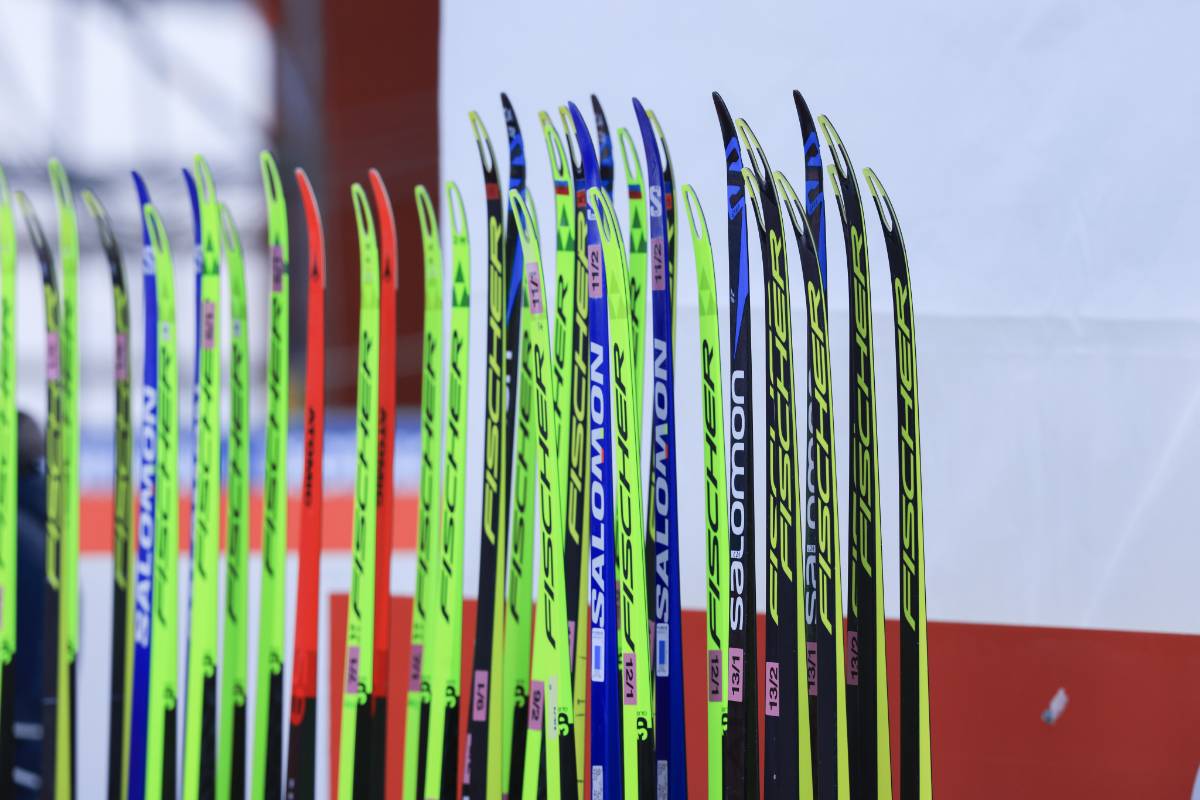
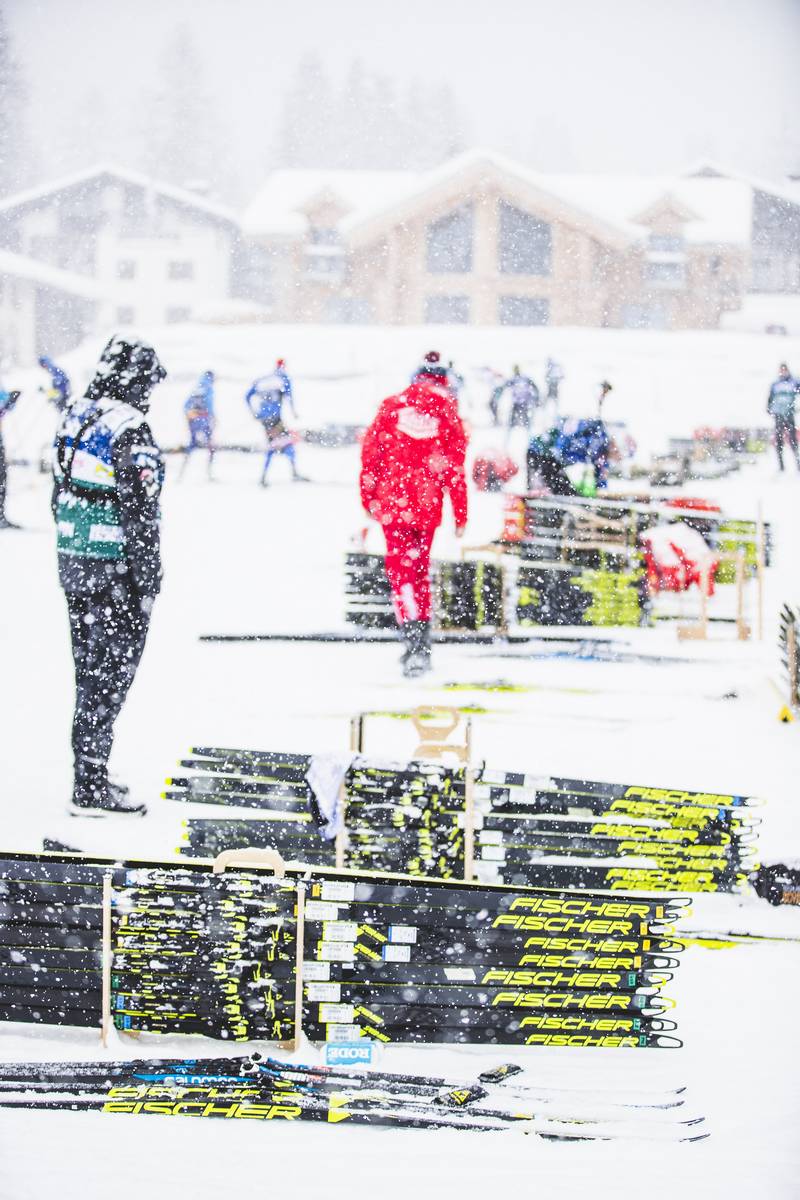
    Skis lined up for Fluoro testing at an IBU Biathlon World Cup test event in Ostersund, Sweden last month. (Photo: NordicFocus)

    FS: There’s a spectrometer, the Alpha II, introduced in 2022, but there were reports pretty immediately that it wasn’t reliable enough to just identify fluoros…

    GC: That would be along the right path. I would hazard a guess that the problem comes when you are having to use such a hard surface to test in the field. Most Spectrometers you end up breaking substances down-putting them in an aqueous solution. You couldn’t do that in a field test on a ski surface, and I would guess it’d be hard to get something that immediately distinguishes the fluoro chemicals from all the other stuff that is in a ski base.

    The answer to the hard surface problem is to take samples of the snow the ski goes over, rather than the ski itself. But that would obviously be a retrospective test, and you know, we’re doing that now and the turnaround time for it in the lab is weeks.

    If you take a step back, it is a good example of where science intersects with policy. We can do a fluoro test right now, but does that test fit the parameters to where it’s useful for the purpose it’s needed for? Is it ok to do retroactive bans for breaking the rules, or is that not incentivizing following them enough…

    FS: It strikes me as reminiscent of the dynamics at play when you start talking doping in sports, and those debates have been going on for years and years…

    GC: There is definitely a similar dynamic at play. Does the USSS ban cover collegiate and high school races and all those circuits?

    FS: Pretty comprehensively, but it is questionable whether that eliminates the market. The other issue I’m sure you’re familiar with is that there is no firm guidance from the EPA yet on how to actually dispose of fluoro waxes, so while buy-back programs have been attempted, the people working on them have had a hard time seeing how they scale.

    GC: You bring up a really interesting point with that issue. The disposal programs are really, truly, all over the map when it comes to PFAs, both in the ski world, and in more industrial uses like firefighting foams. Like at Quarry Road, we did a wax take-back program in partnership with the Maine Department of Environmental Protection, and they ended up just landfilling that wax, which we’ve now shown doesn’t contain the problem.

    FS: The interim guidance released in 2020 mentions incineration…

    GC: The problem with that is that fluorine and fluorocarbons are a halogenated chemical. So if you incinerate, the fluorine is going to go somewhere, it’s not just going to disappear. And, they’re reactive too, they’ll react with anything organic, so what incineration would end up doing is creating a whole new set of chemicals which you either have to contain, or it’s going to release these PFAs in gas form, which, again, with what we know about the health risks, could be worse.

    There is emerging research that shows that it may be possible to do a safe, chemical conversion on some classes of PFAs, so there is hope on this, but from a consumer safety standpoint, this is very similar to the problems we experienced with lead back in the day. The science quickly moved to show that what we thought was an innocuous material used for a lot of things is just simply not, it poses a big risk to the environment and to human health. A lot the reasons that make them unhealthy for humans are the same reasons that make them hard to dispose of, so I’m not surprised the EPA has been very cautious.

    FS: Do you think there are additional measures whereby the ski world could get rid of their stockpiles, or to store them for when guidance does come from the EPA?

    GC: I’m of the opinion that the simplest way is the best way here; hold onto them. Trust that when disposal guidelines do come out, there’ll be a better process to organize, collect, and dispose of these chemicals. You want to make sure that the PFAs that you’re giving over are being really disposed of or destroyed in a safe manner.

    In the meantime, I don’t understand the incentive to use this as a reset for the ski community. If everyone is on the same type of wax, then what is the competitive advantage.

    FS: You bring up an interesting ethical set of concerns for the ski community. The Fluoro issue brings up a lot of existential questions about why people in the sport do the sport. Personal health, or the idea that skiing gives you an appreciation of our environment, are central to many people’s relationship with the sport. In the competitive world, though, concerns towards health and the environment often take a back seat to competitive concerns, and that dynamic really has been the impetus for the story of PFAs and skiing. I’m curious how you—a researcher focused on environmental health—communicate the prescience of your findings?

    GC: It’s a great question that colors all of our research on this issue of PFAs.

    There was an interesting moment for me in January 2022, there was another Colby Carnival, and so myself, my son, and a research assistant, Megan Anderson, used it as an opportunity to do a follow-up. When I talked to Tracey Cote beforehand, I was surprised to find out that there had been pretty swift action on the EISA. She was clear that there were no fluoro waxes allowed, and that collegiate racing was all under a ban. I was surprised by the swiftness of the action there, but Tracey had also said that our research at Quarry Road had been enough to persuade the circuit that erring on the side of acting in this case was a good idea.

    FS: That Colby Carnival was January 14th-15th, 2022. So it was the first race of EISA season, but in the middle of the ski calendar. Notably, it was right after the Cross-Country National Championships in Soldier Hollow, Utah, which still allowed Fluoros under US Ski and Snowboard policy at the time. In your follow-up study, did you find that had any bearing on the findings?

    GC: In fact, it was the finding of that follow-up study. We still found the same pattern of abrasion, with the same chemical footprint, around the course at Quarry Road. Was it less than in 2020? Yes, it was substantially less, like one-hundred times less, but the footprint was remarkably identical. The footprint really reiterated that it couldn’t be recreational skiers that we were measuring, we were measuring residual fluoros from competitive skiers.

    FS: How do you take that result then? It was a lot less, but still there…

    GC: Yeah, there’s two parts. 1) The significantly reduced amount of fluoro in the snow is a powerful sign that banning fluoro products does work. 2) The significant amount we found still on course and in the water supply speaks to why a patchwork policy towards fluoros and PFAs doesn’t really work. PFAs are a problem because they are incredibly persistent, so our policy towards them has to match that persistence.

    FS: What does that level of PFAs in the snow and environment look like in real-terms?

    GC: So I think it’s still a problem, even at reduced levels in the environment, because if you think about it, the sources are all acute, and then the material is dispersed into the environment. I remember when my son first started waxing with the Quarry Road Ski Club, they would all be in a closed wax cabin burning these waxes into the ski. That represents an insane concentration of the risks associated with PFAs right at the source of how they’re getting into the environment. Then the risk disperses when it gets out into the air and deposits in the snow, but when it seeps into the water supplies, it again accumulates on the other end.

    In short, skiers are exposed to concentrations of risky material when that material is concentrated. We’re in a uniquely vulnerable position to these chemicals.

    FS: When you talk about the process of these PFAs going from being applied onto the ski, and then transferred to the environment, what does that look like? Do you have a sense of how great a concentration a single race or event creates, and how large is the area of diffusion for these waxes?

    GC: I don’t think you can extrapolate the amount of material from our one study, per se, but conceptually we can think about it this way; the defining characteristic of PFAs in the environment is that they are extraordinarily hydrophobic. They do not dissolve. That makes them extremely mobile, because wherever water goes, they get carried with it.

    Let’s take our environment in Maine as an example. The PFAs in Quarry Road get carried in the stream here, and that makes its way ten miles downstream to where it cuts through a farmer’s land. If that farmer is using the water from the stream as a drinking source for livestock, or as an irrigation source for crops, those PFAs are making their way into whatever that farmer is producing.

    Maine has a unique problem here. The state started testing for PFAs contamination and found that one of the biggest sources was biosolid fertilizer – essentially human and animal waste that was being sold to farmers – and that is creating a crisis in our agricultural industry, which is a huge part of our economy. And the problem there is we’re one of only two states testing for it (Michigan has also began a biosolids testing program), so there’s no reason to believe that this won’t be a problem across the United States.

    I’d underscore that because the half-lives of these PFAs is in the order of decades, and they have multiple ways of moving through the water and food systems that are part of our everyday lives, they potentially pose an environmental risk that is on the order of something that we haven’t seen before. DDT, PCBs, their half lives were shorter, and they weren’t able to make their way completely through our food and water cycles. PFAs can.

    Quarry Road Ski Area in Waterville, Maine, which sports a snowmaking loop that is increasingly relied on during lean New England snow years. (Photo: Friends of Quarry Road)

    FS: The regulatory framework that is being developed for PFAs looks similar in scale to those previous sets of chemicals that we now look back to in the history of Environmental Policy as a watershed. DDT was the subject of Rachel Carson’s Silent Spring. The Toxic Substance Control Act (TSCA) was a result of concerns around PCBs. What do you think that will look like?

    GC: I still think it’s impossible to say, we’ve only really started to understand the scope of the problem in last couple of years. The recent study finding it’s in something like 80% of water supplies in the United States, like that changes the whole scope of action. State-by-state US action won’t be super effective, this has to be federally regulated by the EPA (Environmental Protection Agency). The European Union (EU) has been looking at a total ban, and even there, the debate over how capricious the definition of what constitutes this class of chemicals is forcing delays and opposition.

    What I think you can say for sure is that regulation is coming, and so, it would be smart for the ski industry to get ahead of it. It’s still, in the grand scheme of things, a very small contributor to the problem. When we’re eating food that contains PFAs in levels that are similar to what we found leached into the water supplies, even a total move away isn’t going to solve the health risks for skiers, but it will remove the additional risk to PFAs exposure that has been part and parcel to being active in the sport for many years now.

    FS: We’ve touched on the ethical concerns posed to the ski community, but I was wondering what you see as being special concerns to our community that you may not see elsewhere with PFAs?

    GC: The hopeful thing is I think by nature of having to think about the impacts of climate change on the sport, and other environmental concerns, skiers are probably pretty well equipped to understand the far-reaching impacts that doing something directly damaging to the environment like using fluoros in your wax has. There is a few though I can think of…

    One is that by the nature of where snowfall accumulates, skiers have an outsized impact on the water supply putting PFAs into the snow. In Waterville, we’re maybe in the middle of our watershed, but especially in the West…

    FS: If you don’t mind, I’ll use myself as an example here. I’m in Crested Butte, Colorado, where the snowfall at 9,000 feet on the western slope has a direct impact on the water supplies as far away as California…

    GC: Perfect example.

    FS: There’s also the different communities from your own that really covers.

    GC: Yes, that’s part of what makes this an Environmental Justice issue. Think about the wealth concentrated in the ski community, and if it’s having a direct negative impact on agricultural communities, that is only worsening persistent problems of inequality.

    It all comes back to the fundamental truth about the environment we are a part of. Even when we are doing the activity that takes us away from the concerns that we have to think about way off in some other place, we still have an impact. I think there is a lot to consider there as skiing looks towards the future.
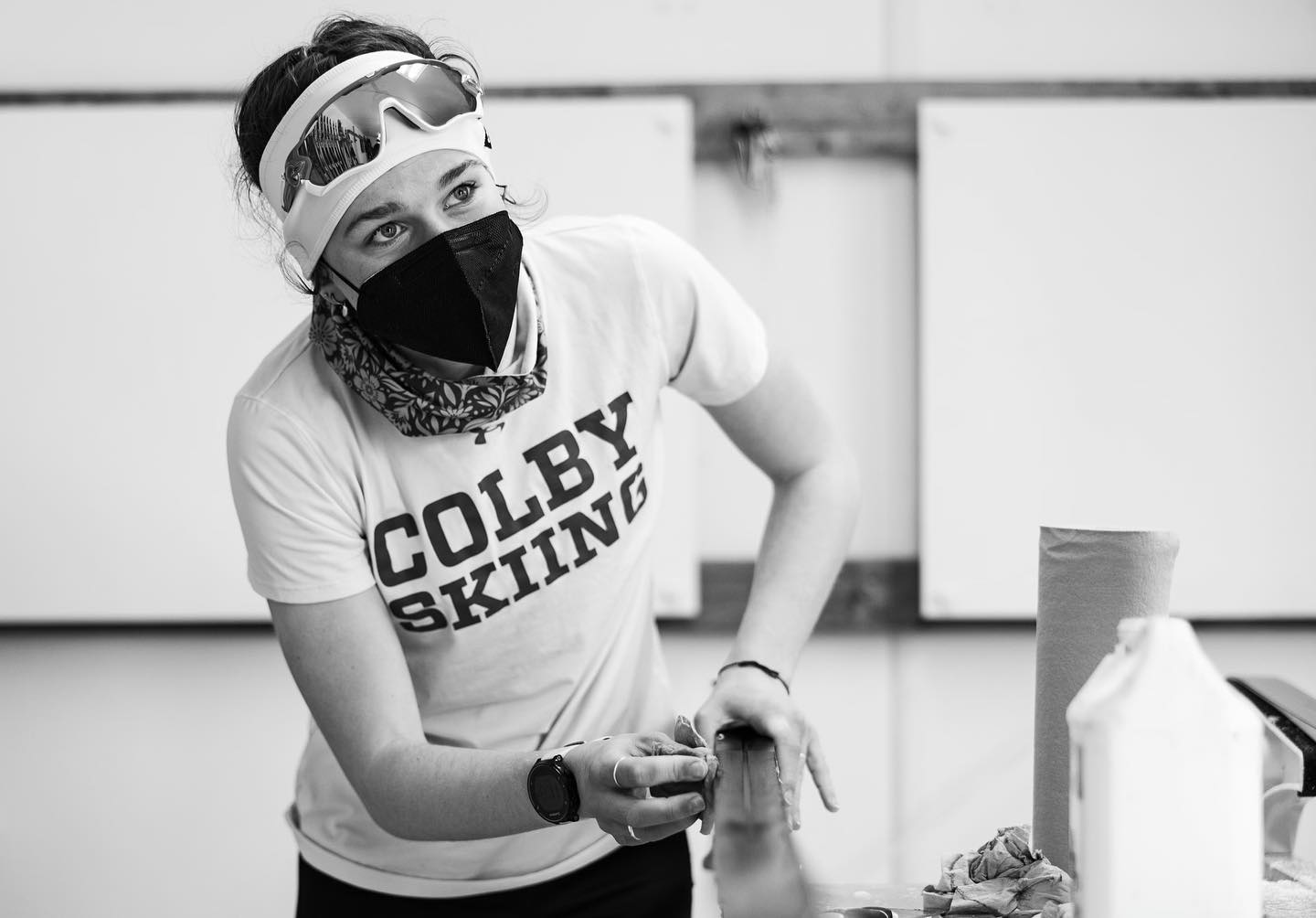
    Colby College skier Rose Clayton cleans ski base at Senior Nationals in Soldier Hollow, Utah in January 2022. (Photo: Colby College Ski Team)
  • MountainFLOW Fluoro Takeback Program: Giving skiers the option to safely dispose of fluoro waxes from anywhere

    MountainFLOW Fluoro Takeback Program: Giving skiers the option to safely dispose of fluoro waxes from anywhere

    The ski community has known there’s a problem for awhile now. Fluorinated waxes, whose extreme hydrophobic properties make them ideal for fast skis, also are by that same property impossible to break down in the environment, allowing them to permeate through the soil into water supplies. The compounds are also known carcinogens, and frequent exposure to these compounds, particularly when heating and inhaling the fumes of waxes in which they are contained, is linked to a myriad of cancers.

    That vice has outweighed their virtue, and now, perfluorinated waxes are inching ever so slightly toward taboo in the ski world. That story has been one which FasterSkier has tracked for years, but up until now, there have been insufficient resources on the safe disposal of these waxes, as well as a lack of available options to facilitate skiers safely getting rid of what they have accumulated in their boxes.

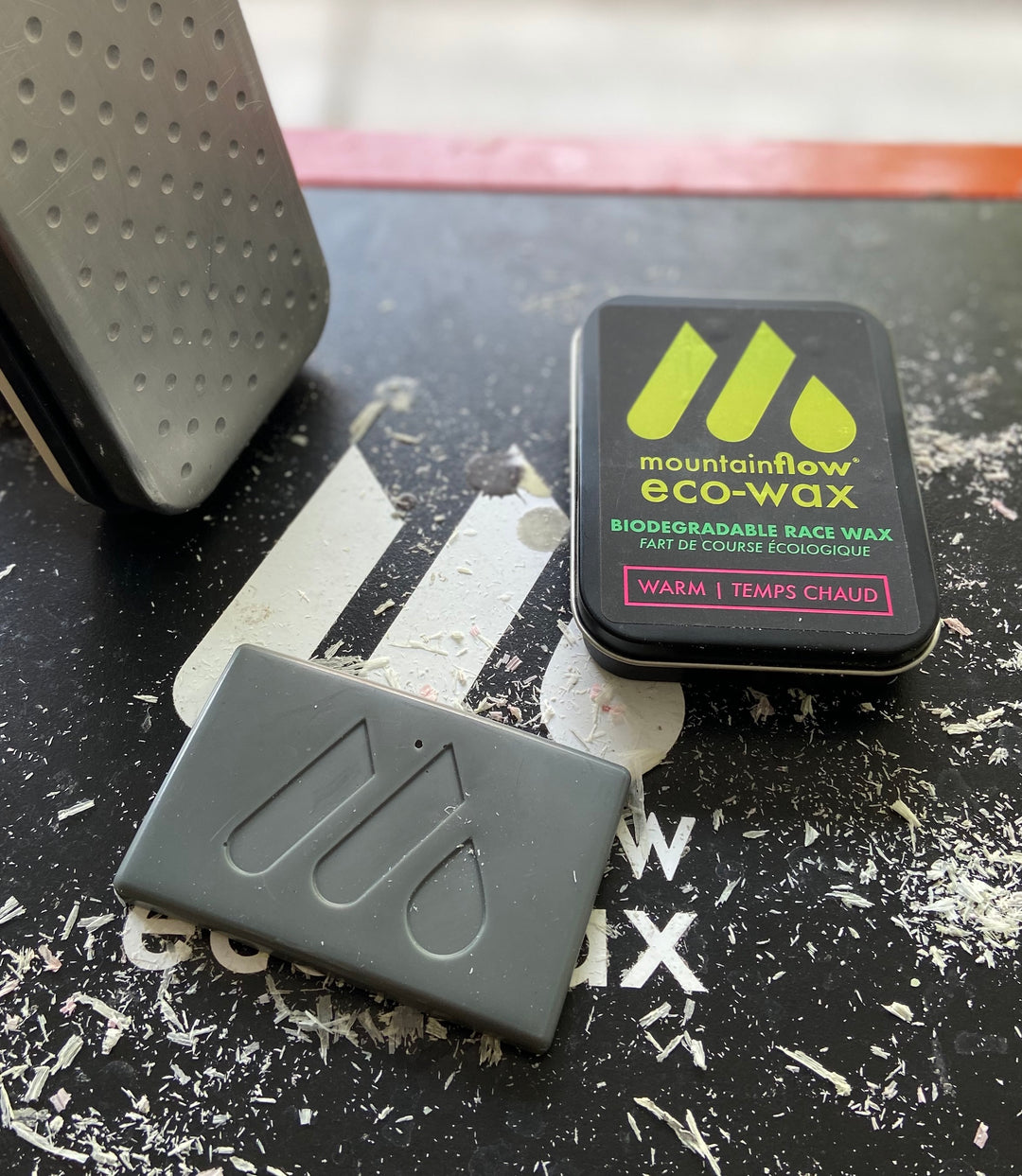
    MountainFLOW Eco Wax launches a fluoro takeback program May 1 – 31, 2022, allowing skiers to mail in their stash of harmful fluoros for safe disposal. (Photo: MountainFLOW.com)

    That’s when Peter Arlein, the CEO and founder of MountainFLOW Eco Wax, had an idea. “When the FIS started talking about prohibiting fluoros two or three years ago, I visited ski shops and realized they were using the stock of fluoros they couldn’t sell on their rental fleets. I thought that was missing the point – we need something that’s going to take fluoros out of the snow, not just the market. We’re a plant-based wax company, maybe there’s a program we could design where we could take back that fluoro wax from them, and replace it.”

    For Arlein, whose company was in the process of pioneering high performance biodegradable alternatives to fluoros, the idea was one that he knew was necessary for the ski world, but also one they wouldn’t have the capacity to institute without willing partners.

    Then in 2021, a representative from the state of Colorado’s Outdoor Recreation Industry Office reached out wondering if he would have any ideas for that year’s Wright Collegiate Challenge. The Wright pairs undergraduate and graduate business students across Colorado with partnering outdoor recreation companies to help pioneer new initiatives and niches. Arlein’s idea of a takeback fluoro program seemed tailor-made. “The students at Western [Colorado University] and [Colorado] Mesa came around and not only did they have the bandwidth to get [this] off the ground, but also to bring their ideas as skiers and students too.”

    MountainFLOW Eco Wax has created a biodegradable plant-based line of race waxes, allowing skiers to have fast race skis without the harmful environmental impacts of petroleum based products. (Photo: mountainFLOW)

    The result, a full-fledged MountainFLOW, is set to launch its first wave of a fluoro take back program May 1st – 31st.

    The overall mechanism of the program is fairly simple: skiers donate their wax, and in return get a discount from MountainFLOW on their waxes.

    Skiers have the option to donate wax either by mail, sending the wax directly to MountainFLOW’s headquarters in Carbondale, CO, or by dropping off their wax at three retail partners in Colorado; Evo (Denver), Salida Mountain Sports (Salida), or Powder7 (Golden).

    MountainFLOW and the team of Wright students will take it from there. The process on the disposal part is, like all things on fluoros, still evolving. Leyla Ericson, an Outdoor Recreation MBA at Western Colorado said in a call with FasterSkier that “there’s only provisional guidance from the EPA right now on PFAs (the environmentally harmful class of chemicals that fluorocarbons belong to) disposal. From our understanding, they’re hoping to finalize those guidelines by summer of 2023, and so if we launch now we can hopefully scale and build a program that’s fully able to quickly process wax when there is a firm procedure for getting rid of these [waxes].”

    MountainFLOW’s launch of their take-back program now also coincides with the end of the last ski season where fluoros could be used in races in the US. With the US Ski and Snowboard instituting a ban after the Olympic qualifiers back in January, programs that were hanging on to their fluoro boxes for when the SuperTour came to town now have an opportune window to look for what’s next in the waxing world. That’s a reality that Arlein says will only continue to encompass more and more organizations, especially, as he says “when the FIS inevitably will put a full ban into place.”

    Kevin Bolger races a freestyle sprint qualifier in late February, 2022. (Photo: NordicFocus)

    With the timing factor for both ski-world and government policy coming together, Ericson said that the Wright challenge students wanted to take the step that many in the wax industry were tip-toeing around with fluoros:

    “We got to a point where we said, well someone has to launch this type of program. The idea has been around for a while, but either because people don’t understand the pressing need or because it wasn’t readily available, there’s been no movement on actually making it happen.”

    And while the program’s on-the-ground footprint will initially be limited to Colorado, the MountainFLOW team is hopeful it can rapidly expand the buy-back program, with Arlein saying “people all over can mail in right now, and then we’re for sure looking to open up disposal sites with more partners…A good example is this year we were at the Birkie expo (read our story on MoutainFlow’s trip to the Birkie here) and talking to their sustainability people, and they were like, you should come next year and have this be a site. It was pretty remarkable too, we were at the expo and the number one question we got from people was ‘How do I get rid of my fluoro waxes?’”

    With enough investment and the right partners, Arlein is hopeful that “we can get all of the fluorinated waxes off retail shelves, and hopefully, off nearly all wax benches too.”

    It’s a goal that requires creativity, cross-industry collaboration, and above all, action. With that coming in equal parts from MountainFLOW and the Wright students, the tip-toeing around the fluoro issue is being stamped over by decisive steps towards action.

    Action that you, me, clubs and teams can all participate in – starting here.

    Note: Skiers wishing to mail in wax to MountainFLOW can send their waxes to 201 Main St., Suite 303, Carbondale, CO 81623. You can also donate to support the MountainFLOW program as it grows and expands here.

  • News Roundup: World Cup Cancellation, Canadian Olympic Trials, US Biathlon Olympic Team Naming, and Illegal Use of Fluorinated Waxes in Falun

    News Roundup: World Cup Cancellation, Canadian Olympic Trials, US Biathlon Olympic Team Naming, and Illegal Use of Fluorinated Waxes in Falun

    Here’s a quick and non-exhaustive look at some recent news in the world of nordic sports. 

    World Cup Cancellation in Les Rousses, FRA and Planica, SLO

    Earlier this week, the FIS announced the cancellation of the final World Cup stop before the 2022 Olympic Games in Beijing, which were scheduled for the 21st to 23rd of January in Planica, Slovenia. This news arrives a week after the cancellation of the Les Rousses, France mini tour, which would have taken place this upcoming weekend. Both cancellations were made based on rising numbers of coronavirus infections with the omicron variant.

    “Due the current acute development of the pandemic in Slovenia, the safety of stakeholders involved at those large scale events could not be guaranteed,” the FIS wrote in the media release.

    Julia Kern tags Sophie Caldwell Hamilton during a December, 2019 team sprint in Planica, Slovenia. (Photo: NordicFocus)

    Of the event stakeholders, athletes in particular would be at heightened risk of a COVID-19 infection that could jeopardize their ability to participate in the upcoming Olympic Games. Surrounding travel to Beijing/Zhangjiakou and admission into the Olympic venue “bubble”, strict coronavirus testing and management protocols will be enforced. Should an athlete test positive within a critical window before travel, they may be unable to attend the Games regardless of the severity of their illness. 

    FasterSkier will cover the topic of athlete safety and COVID-19 risk mitigation separately; stay tuned. 

    Canadian Olympic Trials Wrap Up in Canmore, AB

    The Canadian Olympic trials were held over the last week at the Canmore Nordic Centre Provincial Park in Canmore, Alberta. The event schedule, which mirrored the U.S. Cross Country Championships in Soldier Hollow, included a freestyle sprint, an individual start 10/15-kilometer classic, 15/30k individual start skate, and finished with a classic sprint. These competitions directly influence the selection of Nordiq Canada’s Olympic team. 

    FasterSkier will provide full coverage of these events in the coming week, but here’s a quick recap of results. 

    Jan 6th Freestyle Sprint: 

    Laura LeClaire won the women’s freestyle sprint, narrowly beating Cendrine Browne who took second. A few meters behind, Olivia Bouffard-Nesbitt crossed the finish line in third. 

    In another close finish on the men’s side, Antoine Cyr took the win ahead of Russell Kennedy, with Pierre Grall-Johnson in third. 

    Results

    Phillipe Boucher races the 30k skate during the 2022 Canadian Olympic Trials in Canmore, Alberta. (Photo: NordiqCanada/Nathanial Mah)

    Jan 8th 10/15k Classic: 

    In the classic distance event, Cyr doubled up on his victory, taking the 15k classic win in 41:12.0. Rémi Drolet skied the second fastest time on the course (+26.0), with Russell Kennedy rounding out the men’s podium in third (+36.8). 

    For the women, Katherine Stewart-Jones took the women’s 10k classic win in 34:29.6, with Dahria Beatty 0.5 seconds off her mark in second place. Browne was third on the day (+20.6) to finalize the women’s podium. 

    Results

    Jan 9th 15/30k Skate:

    In the following day’s distance skate race, the women’s podium looked quite similar to the distance classic podium. Stewart-Jones again took the win in 39:47.4, this time with Browne in second (+18.7), and Beatty in third (+42.0).

    On the men’s side, Kennedy advanced to the top spot of the podium, winning the 30k skate by a significant margin in 1:11:54.4. Phillipe Boucher was next to the line in second (+1:35.9), with Cyr in third (+3:34.2) following another sizable gap.

    Results

    A scene from the women’s classic sprint during 2022 Canadian Olympic Trials in Canmore, Alberta. (Photo: NordiqCanada/Nathanial Mah)

    Jan 11th Classic Sprint:

    On the final day of racing, Xavier McKeever earned his first podium of the week. After setting the fastest time in qualification, McKeever made his way through the heats to win the event in 2:55:50. Cyr took the second spot for men (+0.97), with Drolet racing onto his second classic podium of the week in third (+3.86). 

    For the women, Bouffard-Nesbitt again found herself on the sprint podium, smashing the women’s final in 3:22.46, and winning by a large margin over second place Stewart-Jones (+4.78). Third place was Laurence Dumais (+7.82), to close out the women’s podium. 

    Results

    Media releases and more information can be found at NordiqCanada.ca.

    US Biathlon Olympic Team Naming

    On January 9th, U.S. Biathlon announced final selections for the 2022 Olympic Team, which includes four men and four women. 

    In alphabetical order, the team includes: Jake Brown (St. Paul, Minn./Craftsbury Green Racing Project & USBA), Sean Doherty (Center Conway, N.H./National Guard Biathlon & USBA), Susan Dunklee (Craftsbury, Vt./Craftsbury Green Racing Project & USBA), Clare Egan (Cape Elizabeth, Maine/Craftsbury Green Racing Project & USBA), Deedra Irwin (Pulaski, Wis./National Guard Biathlon & USBA), Joanne Reid (Grand Junction, Colo.), and Paul Schommer (Appleton, Wis./Team Crosscut & USBA). 

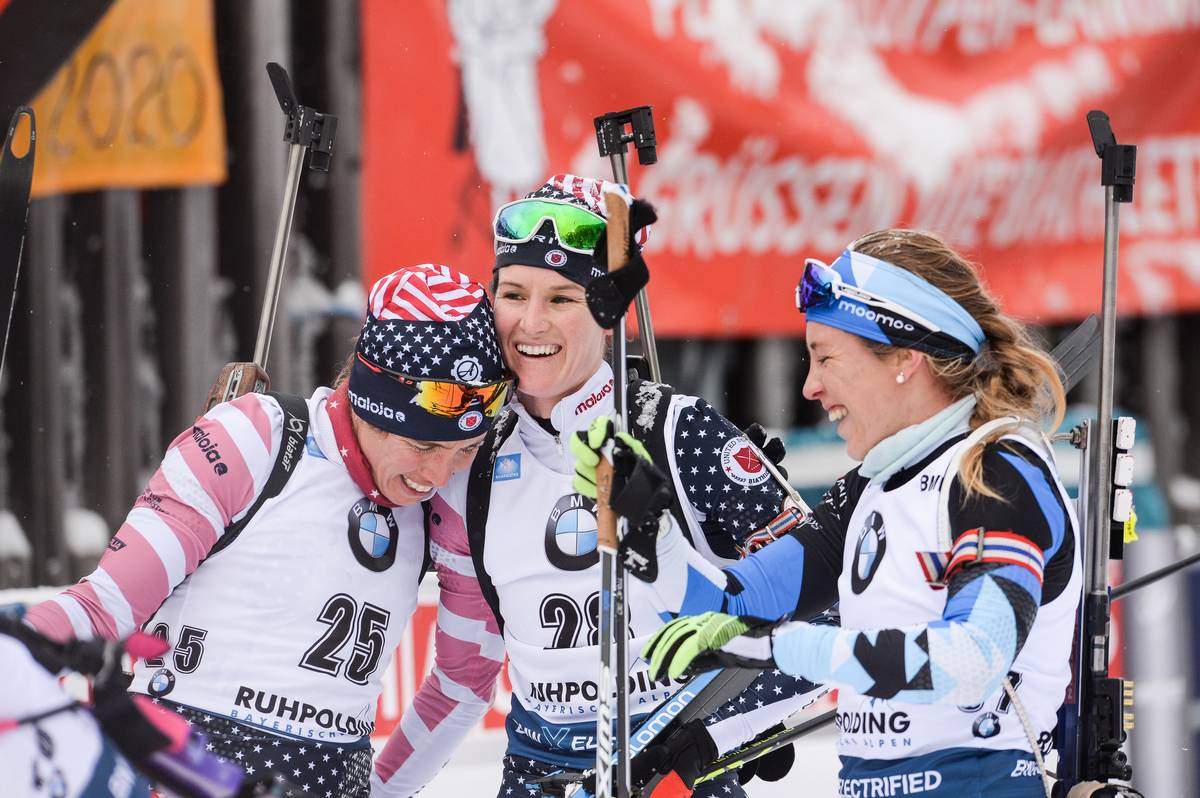
    Susan Dunklee (bib 25) and Clare Egan (bib 28) after the women’s pursuit in Ruhpolding on January 20th, 2020. (Photo: NordicFocus)

    More information can be found in this press release on FasterSkier, or at the U.S. Biathlon page on TeamUSA.org

    Cross-country team naming is scheduled for Tuesday January 18th, with an update on the final U.S. men’s quota on Thursday the 20th. 

    The FIS Confirms Illegal Fluoro Use at Scandinavian Cup Races in Falun, SWE

    The Norwegian news outlet NRK reported Monday that Pierre Mignerey, FIS Cross Country Race Director, confirmed suspicions that C8 fluorocarbons had been used in competition during the weekend of Scandinavian Cup races in Falun, Sweden between January 7th-9th. These products have been banned from use and sale in the EU due to their environmental and human health risks; the chemical compounds contained in these perfluorinated waxes do not break down over time and are known carcinogens. 

    With the aforementioned cancellation of upcoming World Cup events, this weekend of racing in Falun saw a competitive field, including names like Swedish sprint-phenoms Maja Dahlqvist and Jonna Sundling, and Norwegian standouts Håvard Solås Taugbøl and Sindre Bjørnestad Skar. 

    “I read an email this morning from the Chief Justice. It was a report about what happened in Falun and which must be discussed at the highest level,” Mignerey told NRK. “The report states that there were rumors and that the rumors were confirmed. Some have admitted that they used C8 products. But why they did it and how, it is not stated in the report.”

    Mignerey declined further comment as to who had been accused or confirmed of cheating, and the extent of the allegations that had been made. 

    FIS Race Director Pierre Mignerey measures the temperature on course during the 2021 opening World Cup weekend in Ruka, FIN. (Photo: NordicFocus)

    At this time, there is no method of testing for these substances during competition. A trust-based agreement has been signed by each national federation stating that their team will not use illegal products, however, violations such as what took place in Falun feed suspicions as to whether teams are adhering to the agreement.

    “Everyone has signed the letter and said that they will not use it in FIS competitions,” said Mignerey in the NRK report. “The problem is that there is nothing about the use of such fluorine products in the competition rules and thus the rules are not formally broken. The jury on the spot can not do anything about the case… But it is not fair behavior. This must be raised to the FIS council or FIS court, if we want to do something about it.”

    A comment from both Taugbøl and Skar was included in the NRK article. Both stated that they had not heard rumors of this cheating or volunteered their own concerns. 

    “I have not heard anything,” said Taugbøl through translation. “But both me and Sindre probably agreed on Saturday that we did not have completely optimal skis. But nothing more than noticing that others had better skis. It is not possible to speculate whether it was illegal fluoride. There will be ski differences anyway.”

    “I have not heard anything either,” seconeed Skar. “I went to two races this weekend where I experienced that I did not have fast enough skis both days. That’s the only thing I can say about it. But I have neither suspected nor heard anything.”

  • USSS Announces Fluorinated Wax Policy for 2021/2022 Season

    USSS Announces Fluorinated Wax Policy for 2021/2022 Season

    A ski technician brushes a ski, Östersund, Sweden. (photo: Modica/NordicFocus)

    Meet the new boss, same as the old boss.

    In fall 2021, following last-minute revelations that a long-promised fluoro-detecting device did not, actually, work as efficiently as planned, FasterSkier previewed an upcoming domestic race season in which U.S. Ski & Snowboard-sanctioned races would ban the use of fluorocarbon waxes, but anything would be fair game at FIS races. (For an overview of the difference between the sanctioning bodies and the rankings lists they generate, see here.)

    Last week, USSS Cross Country Program Director Chris Grover, writing on behalf of the USSS Cross Country Sport Committee, announced identical standards for roughly the first half of this season: no fluoros at USSS races, anything goes at FIS races. The announcement explains that the substance, and the timing, of the decision are an attempt to maintain a level playing field through the selection period for international competition, most notably the 2022 Winter Olympics but also World Juniors and Period 2 and 3 World Cup races. It specifically cites the lack of a quick-turnaround test for detecting fluoros, and an inability to insure the integrity of a ski race in real time.

    That said, once the selection period closes, things will change for the second half of the 2021/2022 race season.

    “Beginning January 17, 2022,” Grover wrote, highlighting a date after the final January SuperTour race in Sun Valley, “fluorocarbon waxes will be banned at all FIS Cross Country races in the USA, and testing will often support that ban.”

    If you are a Masters or citizen racer in this country, none of this announcement applies to you, at least so long as you are not in the very small minority of Masters racers doing USSS or FIS races. You should instead look to the policies enacted by your local ski club for guidance. A quick, unscientific roundup of some prominent citizen racing areas in this country suggests that the Birkie banned fluoros for the 2021 race; that the Loppet Foundation has banned fluoros at Wirth Park and at all Loppet Foundation events; that all NENSA events have been fluoro-free as of June 2020; and that the Nordic Skiing Association of Anchorage has not yet taken a public position on the issue.

    Grover’s announcement was dated September 29th, and was sent to current USSS members on Friday October 1st. It may be found online here, and is reprinted in full below.

    Wax techs test Fischer skis in the snow in Davos. (Photo: NordicFocus)

    ***

    September 29, 2021

    Dear Cross Country Community,

    This past week, the U.S. Ski & Snowboard Cross Country Sport Committee has voted to support the following fluorocarbon wax protocols for racing within the United States during the 2021-22 season:

    U.S. Ski & Snowboard sanctioned races remain fluorocarbon-free. FIS races will remain open for the use of fluorocarbon waxes from the start of the season through January 16, 2022. This timeframe mirrors the selection period for the Beijing Olympic Winter Games, and also contains team selections for the World Junior and U23 championships, the U18 Nordic Nations team, and selections to World Cup Periods 2 and 3. Beginning January 17, 2022, fluorocarbon waxes will be banned at all FIS Cross Country races in the USA, and testing will often support that ban.

    We realize that the use of fluorocarbon waxes is an understandably contentious issue, and we’ve had months of debate as a community about the best way to balance the transition away from these products with preserving a level playing field for all athletes. Our primary challenge is that the development of fluorocarbon testing technologies has not kept pace with the rapid evolvement of fluorocarbon bans. We do have a proven testing methodology at our disposal, but it requires weeks to get results, a lot of money for each test, and results/penalties can obviously only be applied retroactively. We are in a situation where we wouldn’t have fluorocarbon testing results until well after Championships teams are named, and we may or may not have the ability to remove athletes at that time. This includes the Winter Olympic Games. We are moving in a technological direction that will eventually provide definitive fluorocarbon testing of skis prior to a race start, but we are not there yet. 

    As much as our U.S. Ski & Snowboard staff and our community wants to be fluoro-free immediately, the Cross Country Sport Committee felt it was imperative to guarantee the sanctity of the Olympic selection process, as well as the selection of all of our Championship development teams. We owe this to the athletes, coaches, parents, and race organizers to ensure a level playing field that all participants can feel confident in. 

    Please don’t hesitate to reach out with any questions or concerns you might have.

    Sincerely,

    Chris Grover

    U.S. Ski & Snowboard Cross Country Program Director

    chris.grover@usskiandsnowboard.org

    ***

    Related reading:

    Calendar of 2021/2022 American FIS races

    FS Interview: Chris Grover Discusses the FIS Fluoro Ban and the World Cup in 2020-2021, May 2020

    FIS and IBU Pull Back from 2020-2021 Fluoro Ban, October 2020

    Another Waxing Wormhole: Sanctioning Races and the Use of Fluoros, November 2020

    FasterSkier Explains: How to Clean the Fluoros Off Your Skis So You Can Race the Birkie, December 2020

  • FasterSkier Explains: How to Clean the Fluoros Off Your Skis So You Can Race the Birkie

    FasterSkier Explains: How to Clean the Fluoros Off Your Skis So You Can Race the Birkie

    (Photo: NordicFocus)

    What: Fluoros, aka perfluorinated waxes, aka ski waxes containing per- and polyfluoroalkyl substances (PFAS), aka the really expensive waxes that you put on for big races, in some or all of block, liquid, or powder form.

    What they do: Make your skis go really, really fast, particularly in the wet or dirty snow conditions that sadly characterize more and more high-end races in an era of artificial snow and climate change.

    What else they do: Exposure to certain perfluoros is associated with thyroid disorders, hypertension and preeclampsia during pregnancy, and testicular and kidney cancer, as well as statistically improbable rates of illness and death for people exposed to it in high quantities. PFAS chemicals have been found in the drinking water in multiple states. Lawsuits have been filed; over a billion dollars in settlements have been paid.

    What’s their status for ski racing: It’s complicated. For the past few decades, fluoros were ubiquitous in high-level ski racing. Then, in November 2019, the International Ski Federation announced that fluorinated waxes would be banned in all FIS races, including the World Cup, effective this race season. Nations began testing fluoro-free alternatives from major wax manufacturers. FIS began working on a workable and efficient fluoro-detection machine. Much upheaval ensued.

    Work on the fluoro-detection device did not go as efficiently as planned. At the eleventh hour, in mid-October of this year, slightly more than a month before the first World Cup race of this season, FIS announced that the fluoro ban would be postponed by a year, and would not go into effect on the World Cup (or at, say, the 2022 Winter Olympics) until July 1, 2021. “Stay tuned,” FasterSkier wrote last month.

    What did Devon Kershaw think about this: He was not a fan of FIS’s lack of competence or professionalism.

    Canadian wax technicians Mike Mappin (l) and Camille Cheskey (r) hard at work during the 2016 Winter Youth Olympic Games on Feb. 10 in Lillehammer, Norway. Yes, they should really have some form of respiratory protection. (Photo: Jon Buckle for YIS/IOC)

    No, really, what’s their status for ski racing: Simply put, fluoros are allowed in FIS races in this country this season, as in any FIS race in any country this season. They are not allowed in races sanctioned by U.S. Ski & Snowboard. (These were formerly known as USSA races. They are also known as NRL races, or National Ranking List races, that is, a points system used to rank domestic athletes.)

    That’s nice, but I’m your average master skier in this country. I’m not a USSS member, and I’m not racing any high-level races. Other than the general health and safety considerations, why do I care about this? Ever hear of a little thing called the American Birkebeiner?

    Yes, the one true ski race for Master Blasters everywhere. But what does that have to do with fluoros? They’re banned at the Birkie, starting this year.

    Really? Really. Here’s American Birkebeiner Event Director Kristy Maki, in an email to FasterSkier this November:

    “The 2021 Birkie Events will be fluoro-free. We are working on determining how testing will be implemented and right now, our goal is to do testing on a limited number of skiers. We have been working on the basic planning of Birkie Events, but I will be updating the Participant Rules soon.

    We have announced previously that we would be fluoro-free in 2021, but it has not gotten a lot of attention lately.”

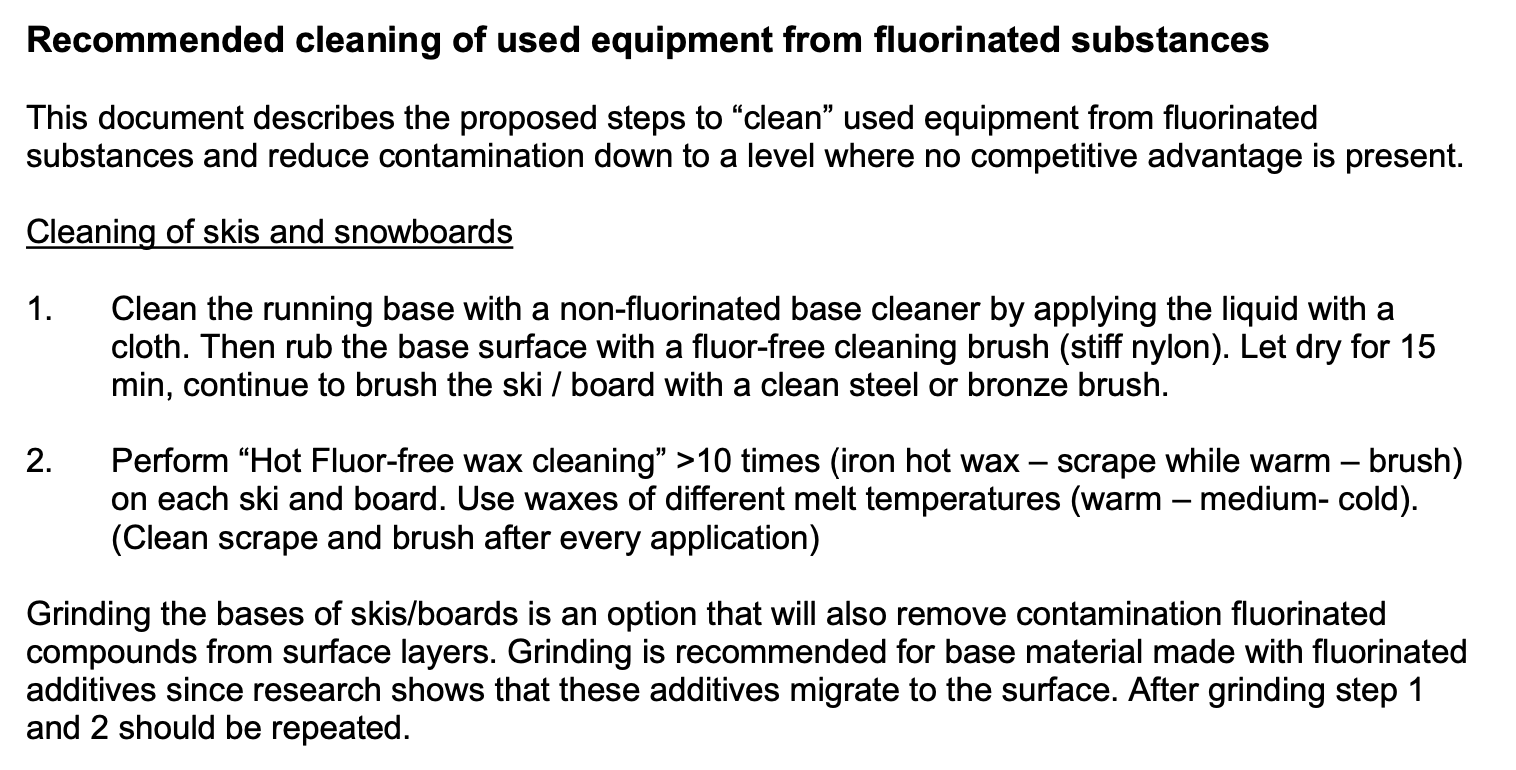
    Okay, I’m listening now. How do I get the fluoros off my skis so I can race the Birkie without breaking the rules? The short version is that you need to clean your skis; de-fluoro your skis; and then wax your skis anew with fluoro-free wax. Here is an excerpt from a longer document prepared by FIS:

    If hot waxing more than 10 times does not seem like enough work, the full document also explains how to clean/purify your iron, scrapers, brushes (but you should really just buy new brushes), roto fleece, wax apron (wash on high “several times”), files and file guides, ski bags, and wax room.

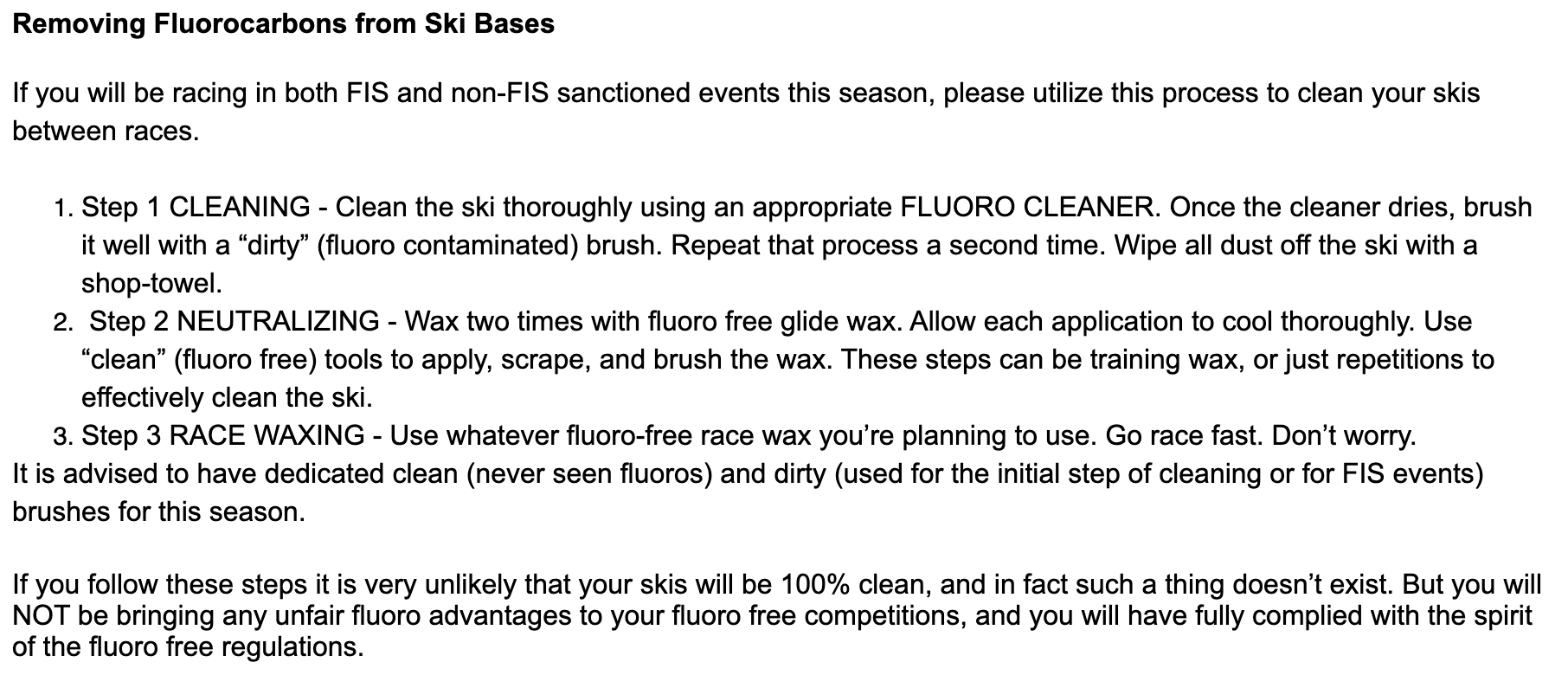
    Wow, that sounds really involved. Do you have a shorter version of what I can do and still achieve some sort of good-faith compliance with these new rules? Thankfully, yes. Here’s what USSS sent out in an email to all members in mid-November:

    The main difference is that it involves far fewer repetitions of the cleaning step, specifically “two times” rather than “more than 10.” (Granted, that’s twice through a normal wax application in which the wax cools each time, rather than 10 times hot scraping, so that’s a little apples to oranges.) But this was sent out by Adam St. Pierre on behalf of U.S. Ski & Snowboard, so this would seem to have USSS’s imprimatur behind it. Also, this accords with the “two layers of NF” protocol used by EISA teams over the past few seasons.

    Bigger picture, USSS seems to envision this as something you could do if if you’re transitioning between, say, USSS and FIS races multiple times this season (or USSS and no-holds-barred citizens races), while the FIS protocol is probably more applicable to making a permanent transition from a fluoros to a no-fluoros world. Which is clearly coming soon, but, depending on where you live and the viewpoints of your local ski club, may not be here yet – citizen races in southcentral Alaska, for example, remain very much fluoro-friendly this season.

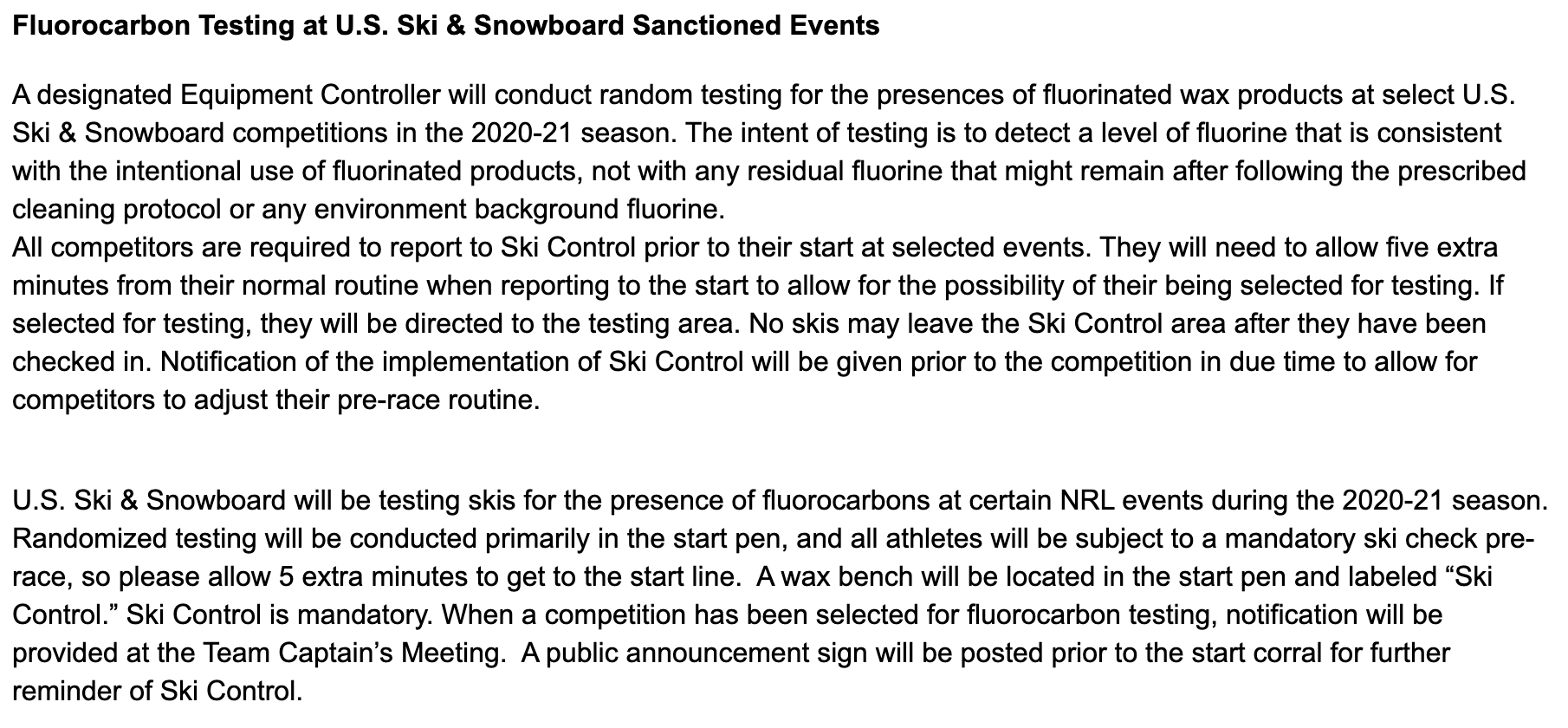
    Okay, I did all this, but I don’t trust my competitors to do this at all. What type of oversight is there going to be at races this season? Probably some but not much. As Maki with the Birkie said, they will be targeting “a limited number” of entrants. Or here’s St. Pierre, in the same mid-November email quoted from above, describing random testing at “select” USSS races this season:

    Full details on the testing protocol (brief version: the ski is swabbed in two places on the glide zone; sample is sent in for analysis; results come back in 10-14 days) may be found here. St. Pierre also explains the possible sanctions for evidence of fluoro use, up to and including disqualification. He adds, “Remember: Testing can indicate the degree of fluoro contamination. Our intention is to catch intentional and unethical fluorocarbon use; the goal is not to sanction individuals for traces of fluorocarbons from prior waxing, those present in the ski base, or the environment.”

    What do you have to say about all this, USSS official site? Here you go: “In order to provide U.S. Ski & Snowboard members, coaches and officials guidance with the [no fluoros] policy, we are providing the following information: …

    Fluorinated Wax Testing: Testing procedures and protocols will be forthcoming.”

    Oh.

    What do you have to say about all this, American ski community? Here’s CXC, writing about its new wax policy for this year’s events (emphasis in original): “Our CXC Cup Wax Policy is first and foremost an honor system, but athletes at Salomon CXC Cup NRL Events are subject to random ski testing for illegal wax by representatives of U.S. Ski and Snowboard. It should also be recognized that ski waxing, especially with non fluoro waxes, is quite variable and often two similarly waxed pairs of skis can have large differences in glide based upon non wax factors such as flex and structure/grind. All competitors and coaches should adopt a culture of compliance, and all our membership should presume their fellow competitors are acting ethically and legally, rather than pointing fingers based upon a subjective idea that someone has fast skis from illegal waxing.”

    Or here’s Boulder Nordic Sport’s Roger Knight, writing in this winter’s version of the BNS catalog, which was prepared at a time when fluoros were going to be completely barred this season, and so was partially obsolete by the time it was printed: “Where does [the absence of widespread fluoro testing] leave us? With an honor system. Will some people cheat? Undoubtedly. Do you want to be one of those people? Only you can answer that question. One thing that we essentially have never had here in the US is a stain of cheating on our cross-country skiing culture. We hope that this continues at all levels of the sport.”
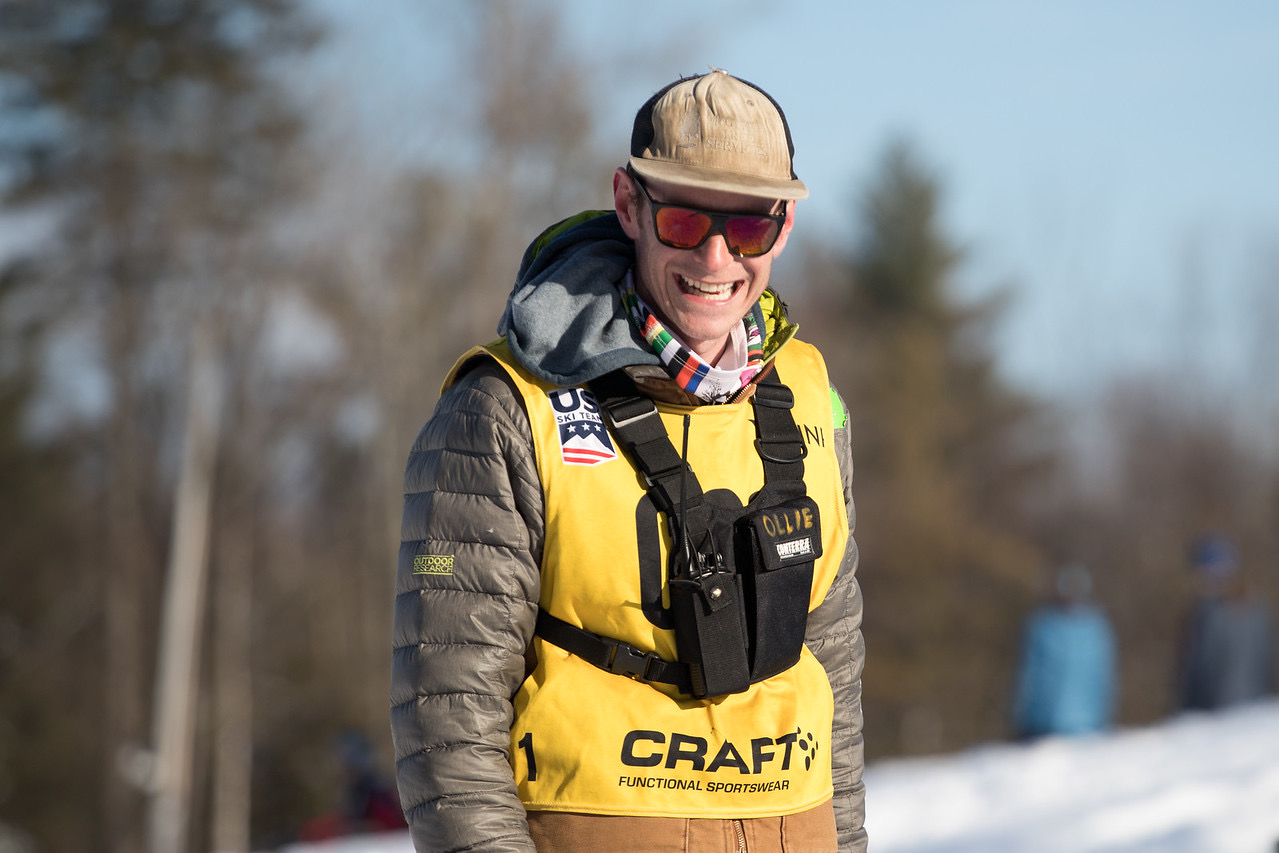
    Ollie Burruss, chief of competition at the 2019 US Nationals in Craftsbury. (Photo: Craftsbury Outdoor Center)

    Finally, here’s FasterSkier writing last month about Craftsbury nordic race director Ollie Burruss: “In Burruss’ estimation, racing at the Outdoor Center is de facto fluoro free. … The Outdoor Center asks you not to use fluoros. That decision, according to Burruss, will be based on trust and a hardened value system relying on people doing the right thing, not necessarily the fastest thing.”

    Burruss added, “We don’t have a community in New England where it’s fraught with suspicion, backstabbing, and people trying to one up each other. We really have, I think, a really tight-knit supportive ski community. And so when we planned on having FIS racing, we weren’t going to test.”

    I’m sorry, but I’m still skeptical that some of my competitors are going to comply with a largely honor system-based protocol, when the advantages of fluoro use in some conditions are so great, and widespread testing or enforcement is not really an option yet. Am I alone in this concern? You are not. Although it was admittedly unscientific, an informal poll conducted on FasterSkier last fall suggested that large portions of the 160 respondents were less sanguine than Burruss or CXC leaders about the ethics of their competitors. (N.b., there was likely no practicable, quick-turnaround, fluoro-detection device on the market at that time. To be fair, there still isn’t.)

    One of the questions in the 2019 survey was, “If a fluoro ban was put in place, would you trust that the field was ‘clean’ with regards to fluorinated ski bases?” Only 25% of respondents answered “yes.”

    Narrative comments made in response to this question included, “A 20%+ advantage in some snow conditions? Yeah, that’s a big incentive. I can’t imagine [a ban] working.” (For perspective, and back to the Birkie for a second, a 20-plus-percent improvement is the difference between qualifying at the back end of the Birkie Elite Wave and making the podium at SuperTours or U.S. Nationals. That’s a pretty big difference.)

    Also, “If there isn’t a simple compliance test, no doubt some people will cheat to win.” Also, “I would like to trust that the field was ‘clean’, but I think I would struggle to do so if it were to actually happen. Furthermore, I think that any stellar performance by an athlete would be subject to suspicion, regardless of whether or not they were ‘clean’, and that this would be unfortunate.” Also, “I am sure several masters racers with large wax stores would still use them until they were depleted; I would expect races to be clean in several years and primarily clean in the interim.”

    Also, and more optimistically: “At the World Cup level, I probably wouldn’t trust the field to be clean, because there is a lot at stake, and some people already dope, so I’m sure they’d have no qualms about fluoro doping. However, at the US level, I have a lot more faith in the nordic ski community and I honestly believe that anybody that is seriously competing to win super tours and represent the US at world championships would do so honestly.”

    In response to other questions, 64% of respondents stated that they would continue to use their existent stock of fluorinated waxes. 56% of respondents stated that they foresaw some sort of black market developing for banned wax products. Again, you can find the full poll results here if you are curious. You may also note this narrative comment, which speaks volumes: “I hate the poison but feel non-competitive without it.”

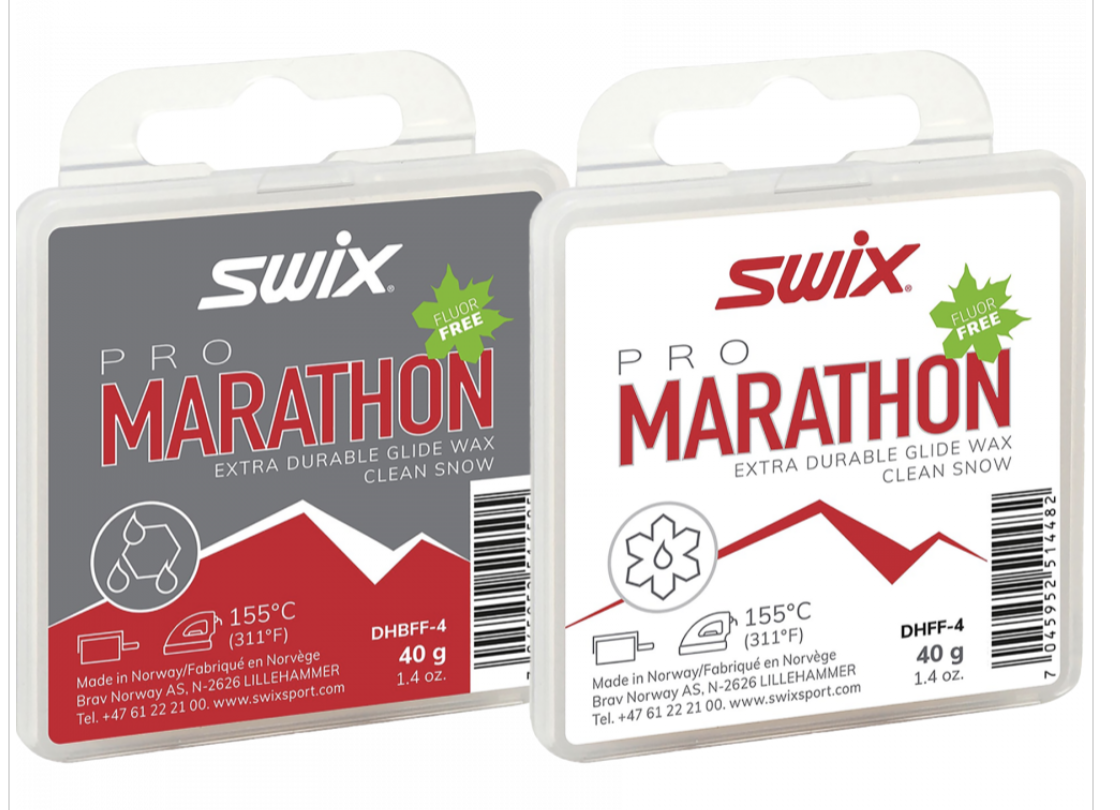
    Swix would be glad to help you restock your wax bench: Swix Pro Marathon Fluoro Free. (photo: screenshot from current BNS catalog)

    So after I clean off my skis, what do I buy to wax with instead? Most wax manufacturers have developed fluoro-free analogues of most of their fluorinated products. Your local ski shop will be well-versed in your new options.

    What else should I buy? Maybe some new skis, or at least some new structure tools. As USST wax tech Chris Hecker wrote, summarizing his testing of World Cup-level non-fluoro waxes during the 2019/2020 season, “I am very impressed with how good some of the non-fluoro alternatives have been. In colder, dry conditions I find a number of brands have found competitive alternatives to fluoro top coats, but when it comes to warm, wet snow days the gap is still fairly large. On warmer days with non-fluoros being present, skis, hand structure and ski grinds will become ever more important.”

    This article has been edited to remove a link to a table of waxes approved for CXC races, because it represented only a portion of fluoro-free waxes currently available.

  • Fluoros, FIS Races, and Foiled Plans: Overview of the 2020/21 Domestic Race Season

    Fluoros, FIS Races, and Foiled Plans: Overview of the 2020/21 Domestic Race Season

    The Chugach Mountains are seen from the Lekisch Loop, part of one of the homologated courses used for FIS races at Kincaid Park in Anchorage, Alaska. (Photo: Adam Verrier)

    This article has been updated with additional information about the Birkie, about all races in Vermont, and about the current state of emergency orders in Anchorage.

    FasterSkier has previously reported on the significance of FIS points, points earned in races sanctioned by the International Ski Federation that can be used to compare skiers to one another even when they did not engage in head-to-head competition. Under normal circumstances, an athlete’s FIS points are used for things like selection to the following season’s national team, while team selection for international competition is generally based more on an athlete’s performance in head-to-head racing in the current season.

    In this year, with all national-level races having been cancelled, FIS points are poised to take on additional significance, as U.S. Ski & Snowboard leadership will necessarily be relying more on discretion to choose teams for international competitions such as 2021 World Championships, in Oberstdorf, and 2021 Junior World Championships, in Lahti.

    As U.S. Ski Team Cross Country Program Director Chris Grover told FasterSkier this fall, when it comes to comparing American performance in domestic competitions held in different parts of the country, “We know the athletes so we can easily gauge the quality of the field. If the race is a FIS race or an NRL race, we also have points to use in determining field quality. Then we simply look for stand-out performances.” Regarding comparisons between Americans racing in Europe and Americans racing domestically, the calculus was similar: “As in the case of domestic racing, it’s easy to judge the quality of the race by seeing which athletes are in the race and what the FIS points look like.”

    So, FIS points are going to be exceptionally important for American athletes this winter.

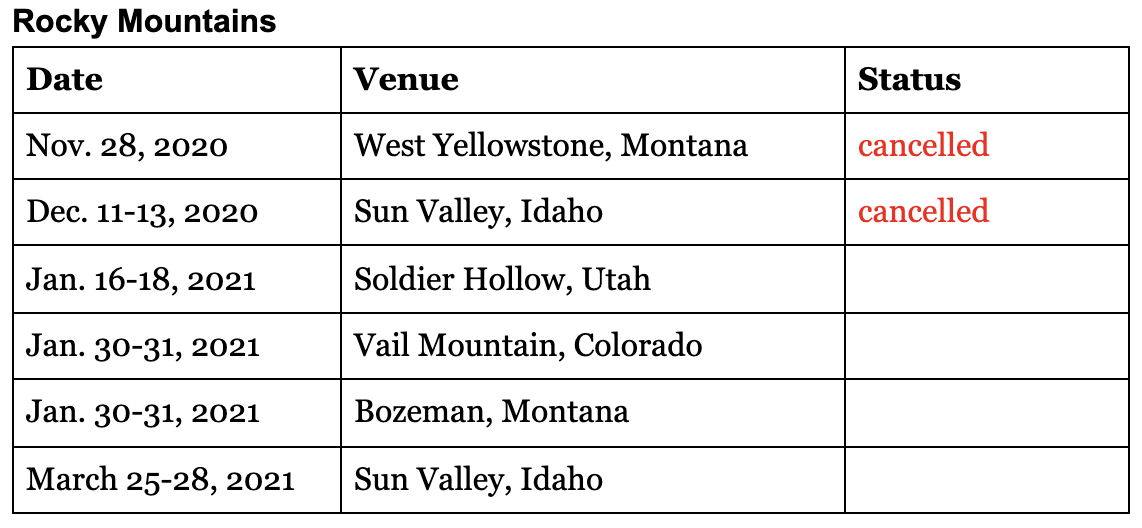
    So where are the FIS races going to be held? The short version of this article is just a link to this page on the FIS website. Here are the American FIS races for the 2020/21 season. Click around and take a look at it. The end.

    Kendall Kramer races in Lahti, Finland, on her way to fourth place in the U20 15 k classic mass start at 2019 World Juniors. (Photo: Doug Stephen)

    But, like many things in life these days, these plans are subject to change. Due to the pandemic and public health considerations, to be sure, but also due to the catch-22 of fluoro use and FIS sanctioning. Accordingly, the rest of this article provides an annotated list of this winter’s American FIS races, organized by geographic region, with an attempt to include the most current information regarding race status. If, four months from now, public health considerations made it impossible to have a single FIS race in this country this winter (and there are already asterisks or outright cancellations around more than half of them), at least this article can serve as a historical artifact from a more optimistic time.

    (As a brief aside, it is worth noting that athletes who are unable or unwilling to race this winter will not see their FIS points suffer, if they buy a FIS membership for this season. As USSS representative Adam St. Pierre wrote in an email to USSS members in October, “Each FIS and [national ranking list] Points list released in the 2020/2021 season will include all races since May of 2019. Your points can not get worse this season, but they can improve if you are able to race and achieve better results than you did in 2019/20. You must have an active FIS license for the 2020/2021 season in order to maintain your FIS points for the 2021/2022 season.” So if you’re sitting out this season of competition but intend to race next year, it may well be worth shelling out for a FIS license simply to preserve your standing.)

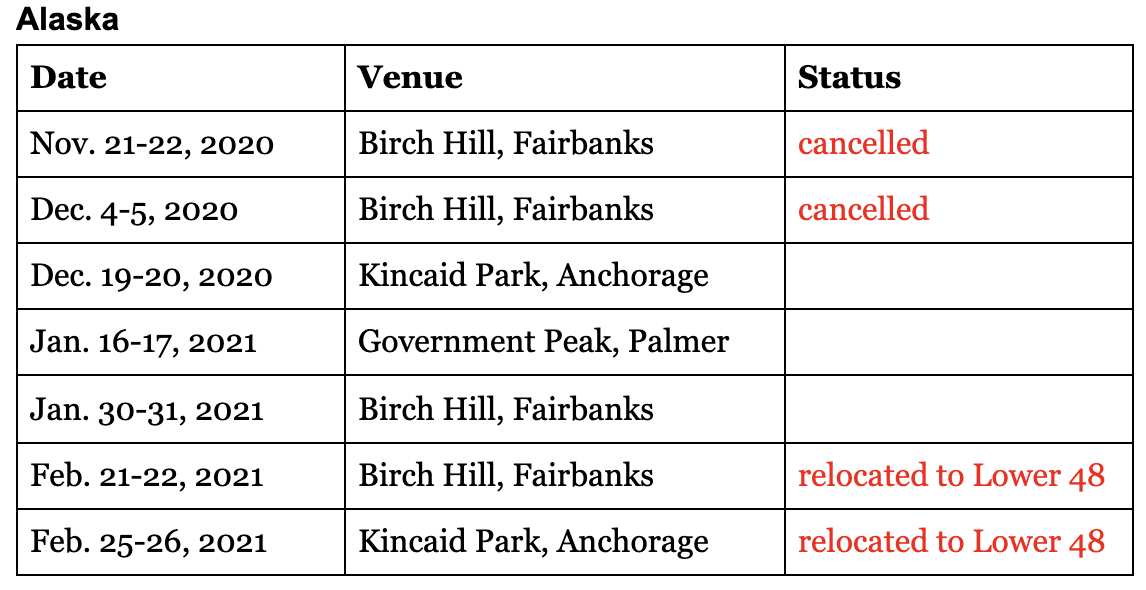
    The opening weekends of racing in Fairbanks were cancelled by race organizers on Saturday, “in light of the current high rate of COVID-19 infections around the state, as well as local and statewide hospital/ICU bed capacity, and given Governor Dunleavy’s extension of the public health emergency through December 16,” according to a statement from the Nordic Ski Club of Fairbanks. In a more detailed follow-up statement posted Sunday, the ski club explained that it is moving all of its scheduled races to virtual events through the end of this calendar year. The advisory group that helped the ski club reach this decision included three physicians alongside the ski club’s race crew.

    “We are disappointed to not be able to compete, though considering where Alaska is with COVID, it is a responsible decision and we support Fairbanks in their decision,” APU head coach Erik Flora told the Anchorage Daily News on Saturday.

    “As coronavirus cases continue to skyrocket in the state, cracks are appearing in Alaska’s fragile health care system,” Alaska Public Media reported on Friday. Providence Alaska Medical Center in Anchorage, the state’s largest hospital, recently requested at least one mobile morgue, the Anchorage Press reported the same day. As of Saturday afternoon, two out of three civilian hospitals in Anchorage were sufficiently full that they were not accepting incoming ambulances.

    The state’s next scheduled FIS race weekend, the December Besh Cups in Anchorage, does not seem to be barred by either the current Emergency Order governing the Municipality of Anchorage or its attachment covering organized sports specifically. However, the attachment explicitly bars spectators from attending sporting events, and states that “events that include participants from outside the Municipality [of Anchorage] should be postponed.” Anchorage Besh Cup races typically include multiple participants from Fairbanks and the Mat-Su Valley.

    The state’s final two scheduled FIS race series, RMISA competitions in Fairbanks and Anchorage, will not be held in Alaska, but rather will be relocated to the Lower 48.

    As of Sunday, Alaska as a whole ranked 14th in the country for daily reported Covid-19 cases per capita for the state overall, with 77 per 100,000 residents. A USSS document setting forth official guidance for domestic competitions advises event organizers to assess current case levels within the community, and defines “high community spread” as more than 25 new reported cases per day per 100,000. “In the event of high community spread,” USSS advises, “it is recommended you speak with your local health authority regarding ICU bed utilization and ventilator availability in the location’s level 1 medical center catchment.” Under this standard, every single venue discussed in this article is currently experiencing “high community spread,” save for those venues in Vermont.

    Athletes leave the start area in a mass start classic race at Government Peak Recreation Area, Palmer, Alaska, on what is now a homologated course used for FIS races, in February 2020. (photo: Russell Hood)

    As FasterSkier reported earlier this month, although some standard programming at the Yellowstone Ski Festival will continue, the biathlon race and FIS nordic race have been cancelled. As a representative of the ski festival told FasterSkier, “We took all of the factors in, gathered all our info, and based on the increase in [COVID] cases and what the county was recommending. With what is going on, we just felt the right thing to do for the community, and for the safety of everyone was to cancel the races.”

    As of Sunday, Montana ranked 8th in the country for daily reported cases per capita, with 103 per 100,000 residents. Utah was 9th, with 99; Colorado was 13th, with 81; Idaho was 15th, with 76.

    Bridger Ski Foundation athletes out for a first ski in West Yellowstone in 2015. (Photo: Courtesy Bernie Nelson)

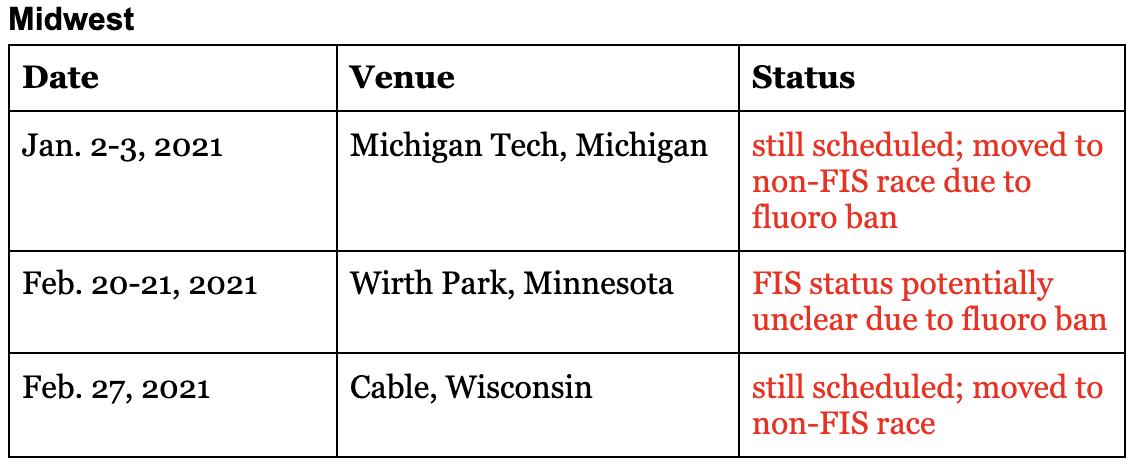
    Michigan Tech is among the American venues caught in a catch-22 following the relatively last-minute decision by FIS to postpone its long-announced ban on fluorinated waxes: FIS is no longer banning fluoros; U.S. Ski & Snowboard still is banning fluoros; Michigan Tech is a fluoro-free venue; in terms of jurisdiction and sanctioning, FIS trumps USSS.

    In response, Michigan Tech representatives emailed FasterSkier earlier this month that they would remove the FIS status from their races in order to remain fluoro-free. “By removing FIS sanctioning from this event, this allows us to place a fluoro ban for this race event, and all race events we are hosting for the 2020-21 season,” wrote Michigan Tech head coach Thomas Smith. “As US Ski & Snowboard has banned the use of fluorinated waxes from all USSS sanctioned events for the 2020-21 season, we will still maintain USSS sanctioning for this January 2-3 event with a fluorinated wax ban.”

    Moving to Wisconsin in late February, the race still listed on the FIS site as “50 km F Mst” likely needs no introduction; this particular 50-kilometer mass-start freestyle race is, historically, the American Birkebeiner, a point-to-point race from Cable to Hayward. But this year’s Birkie has already undergone substantial change, and currently takes the form of a five-day event over a 46-kilometer loop course, “with limited and staged start waves each morning” for five days in a row.

    Birkie representatives stated by email that this year’s race will not be a FIS race: “We are not FIS sanctioned for the 2021 American Birkebeiner, but we are sanctioned by US Ski and Snowboard.” Regarding the status of a fluoro ban at a USSS-sanctioned Birkie, race organizers wrote, “the 2021 Birkie Events will be fluoro-free.  We are working on determining how testing will be implemented and right now, our goal is to do testing on a limited number of skiers.”

    As of Sunday, Wisconsin ranked 5th in the country for daily reported cases per capita, with 119 per 100,000 residents. Minnesota was 6th, with 110 cases per 100,000 residents. Michigan was 19th, with 67 cases per 100,000.

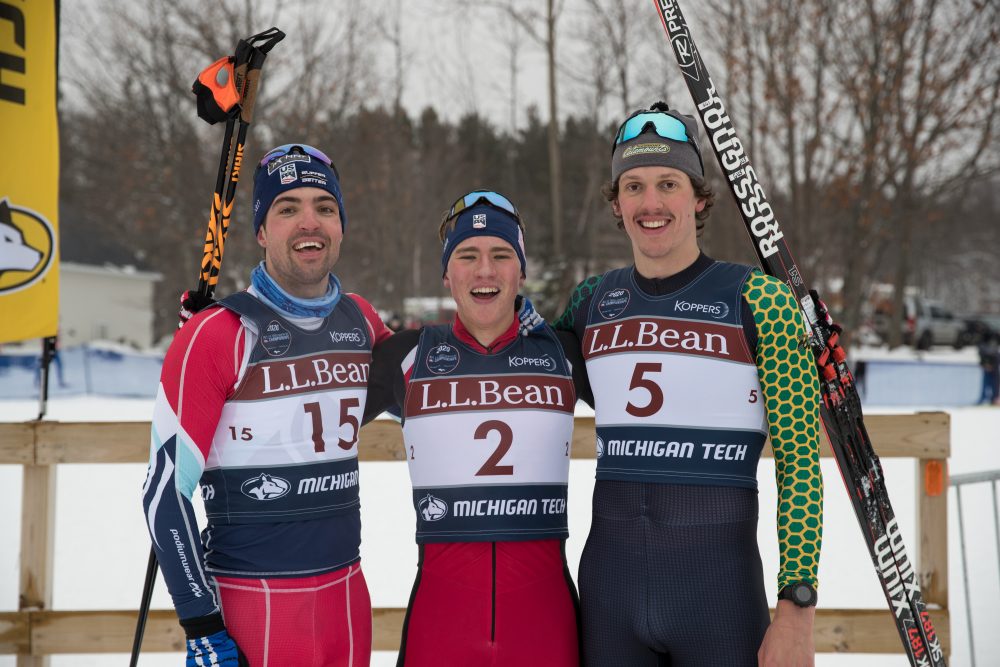
    The Men’s podium from 2020 Senior Nationals in Houghton, MI. Ben Saxton in second, Gus Schumacher first, and Bill Harmeyer third (l-r). (Photo: Reese Brown)

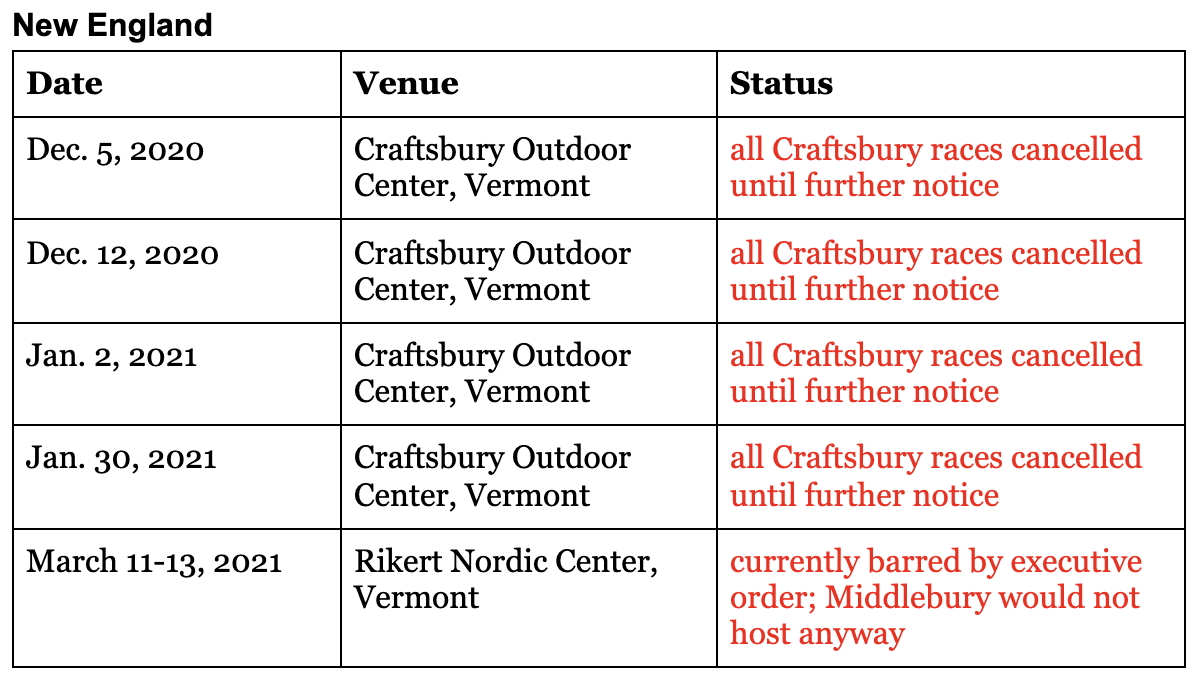
    In a November 13 announcement, the Craftsbury Outdoor Center stated that all ski races on its grounds are currently cancelled: “2. Races are on hold: similarly, all ski races at the Outdoor Center are canceled until further notice.” This update came in response to a new addendum to an executive order from the state’s governor. The order, which went into effect on November 14 and continues through December 15, at which point it will be reassessed, provides that multiple-household gatherings are suspended, and that all recreational sports programs are suspended, save for school-sponsored sports activities.

    If these provisions remain in place in March 2021, the NCAA Championships would not be able to occur, as it is by definition a multiple-household gathering. Moreover, there is currently a quarantine requirement for visitors coming to Vermont from beyond its borders. Finally, Middlebury (the theoretical host) announced last month that it “will not hold any athletic competitions during the winter season.” So even if NCAA Championships happen, in any form, it seems unlikely that this will be within the state of Vermont.

    (While the possibility of these championships occurring at all is outside the scope of this article, the fact that both the Ivy League and NESCAC (New England Small College Athletic Conference) have cancelled winter sports – that’s the ski teams at Dartmouth, Harvard, Bates, Bowdoin, Colby, and Middlebury, among others – poses additional challenges to the possibility of nationwide collegiate skiing competition.)

  • FasterSkier’s 12 Days of FBD Christmas: Day 4

    FasterSkier’s 12 Days of FBD Christmas: Day 4

    FasterSkier's 2016 Holiday Gift Guide: 12 Days of FBD Christmas

    Editor’s note: This year, we opted for a spin on the holiday gift guide. Rest assured, we tasked the right guy — our gear-review guru — with the job of compiling a 12-day list of gift ideas (in various price ranges) for all the nordies in your life.

    ***

    It’s only Day 4, but we’re getting picking up steam here, I can feel it. We’ve teed up a vast array of skiing-related products and gear, but no self-respective gear review is complete without diving headfirst, like Billy Demong into a shallow pool, into tech. And not just tech, TECH. Kinda like when Billy Ray Valentine fought off the police. “It wasn’t COP, it was COPS, with an ‘S’.” (Fast-forward to 7:30 in). This isn’t tech, it’s TECH (still not with a ‘s’, though)!

    Day 4: Tech

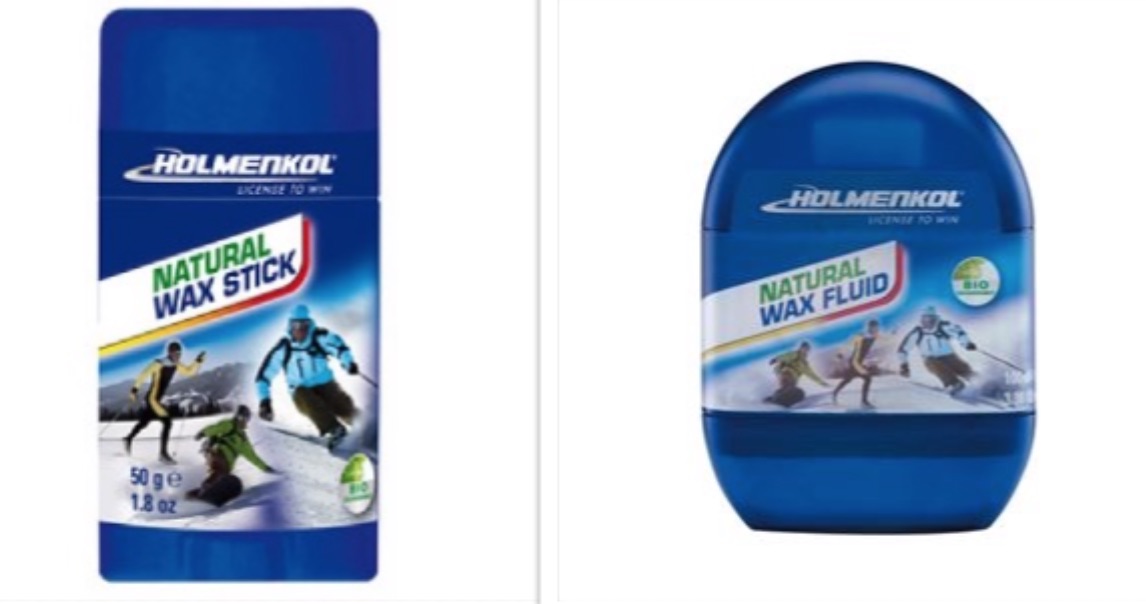
    Under $30: Holmenkol Natural Wax Stick ($17) or Fluid ($20)

    Holmenkol Natural Wax Stick (l) and Fluid (r), FBD pick for under $30
    Holmenkol Natural Wax Stick (l) and Fluid (r), FBD pick for under $30

    Like any good prima donna ski racer, I hate working on my skis. I just want them to be fast. Nathan Schultz and the gang at Boulder Nordic Sport have gotten me race-ready many-a-day. Usually if I ask them what they did, they tell me to STFU. This might seem a bit harsh, but it reality it works out well for everyone as I really don’t want to know, as this would perhaps lead me to think that next time I could do it myself, which we all know that I cannot. Thanks to some “tough love” from both Nathan and Zack Caldwell, I learned long ago that I’m actually better off NOT knowing what’s happening out there in those mysterious shipping containers, as I need to focus all of my energy into skiing fast. Since it’s the holiday season though, Nathan seems to have let his guard down a little, as he gave me one of his secrets, Holmenkol Natural Wax (comes in solid & fluid). I believe his exact quote was, “This stuff is amazing, not only it is fast, but even you can put it on, FBD.” No offense taken, as I’m still going to have him do it. I’m no dummy, this way I can blame him if the race doesn’t go well. #SoPro. Available at Boulder Nordic Sport.

    FS Staff Pick* (*Not necessarily FBD tested): Vauhti K-Base Binder, $25

    On those warm, transformed days when any hard wax that grips wears too fast or ices, this binder lets you run a harder grip wax, solving both problems. A shoulder-season star. Available at CaldwellSport.com.

    ***

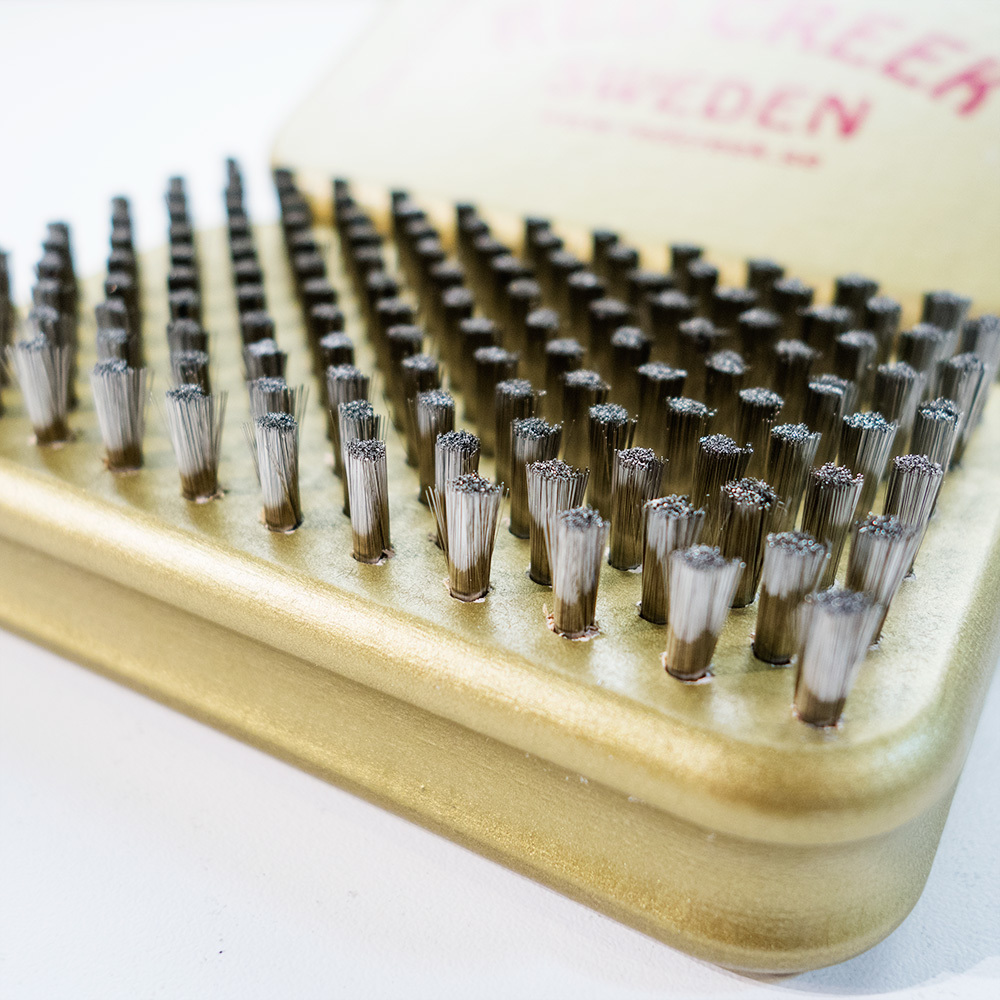
    $30-$100: Red Creek Golden Magic Ultra Steel Brush, $87.50

    Red Creek Golden Magic Ultra Steel Brush, FBD pick for $30-100
    Red Creek Golden Magic Ultra Steel Brush, FBD pick for $30-100

    Speaking of Zach Caldwell and ski-tech curmudgeons, when Zach’s not busy shaming Tad Elliott and me into attempting to properly apply klister (in case you missed it yesterday, here’s the video again), Zach spends his free time putting together what is perhaps simultaneously both the most nerdy and the most awesome article on brushes ever written (be sure to watch the embedded video, too; it’s totally worth it). This of course begs the question: is this the only article on brushes ever written? I sure hope so, but regardless, it’s excellent. I’ll save you the humiliation of having a link to this video in your browser cache by cutting to the chase and telling you to simply get one of these: Red Creek Golden Magic Ultra Steel Brush. Available at Caldwell Sport.

    ***

    $100 – $250: Holmenkol Syntec Race Nordic Fluoro Powders, $189

    Holmenkol Syntec Race Nordic Fluoro Powders, FBD pick for $100-$250
    Holmenkol Syntec Race Nordic Fluoro Powders, FBD pick for $100-$250

    Now we’re approaching super-nerd territory. Love it or hate it, fluoros are like pesticides and condoms — necessary evils. Again, I must have caught the head honcho on a good day, as Nathan was doling out all sorts of secrets. As noted earlier, I hate every part of this process (burning my skis, burning my beautiful, expansive eight-liter lungs, and burning a hole in the Ozone layer just so I can put Smullin in his place in races), so I made Nathan write the description on this one. I’ll see you in Hell, Schultz.

    “These new fluorocarbon powders from Holmenkol are the result of 3 years of development and testing. The investment seems to have paid off – in testing over the winter of 2015-2016 we found this new line to be consistently at the top of our results, and many times far superior to everything else. As a bonus, the new raw materials in the Syntec line are not subject to the pending EU environmental fluorocarbon ban.” (After reading just this one paragraph, I bet you miss me already, right? Don’t lie.) Shop options (cold, mid & wet powder) at Boulder Nordic Sport.

    ***

    Over $250: Star Digital Pro 200C Iron, $399

    Star Digital Pro 200C Iron, FBD pick for $250+
    Star Digital Pro 200C Iron, FBD pick for $250+

    Back to the ultimate ski curmudgeon, Caldwell (hell, his Twitter handle is @GrumpySkier, which pretty much says it all). I love talking to Zach as he’s perhaps the only person in the world more cantankerous than me, which is probably why we get along so well. You know how the saying goes though, “It pays to have friends in low places,” and trust me Zach excels here. He’s logged more time in World Cup wax cabins than almost anyone I know, so when I recommends an iron, you KNOW it’s legit. So legit, that I bought one. (Yes, yes, I know, you’re thinking, “I thought FBD never preps his skis…” HA, I got cha! I rarely race prep my skis. I prep my skis all of the time. So if I am going to be forced into this dreaded task, why not bring a gun to a knife fight and tackle the task with the best iron available to man. Thanks to my incredible foresight and vision, there is mind-blowing continuity in this recommendation as well, as this is the iron of choice when applying fluoros. #MindBlown. Available at Caldwell Sport.

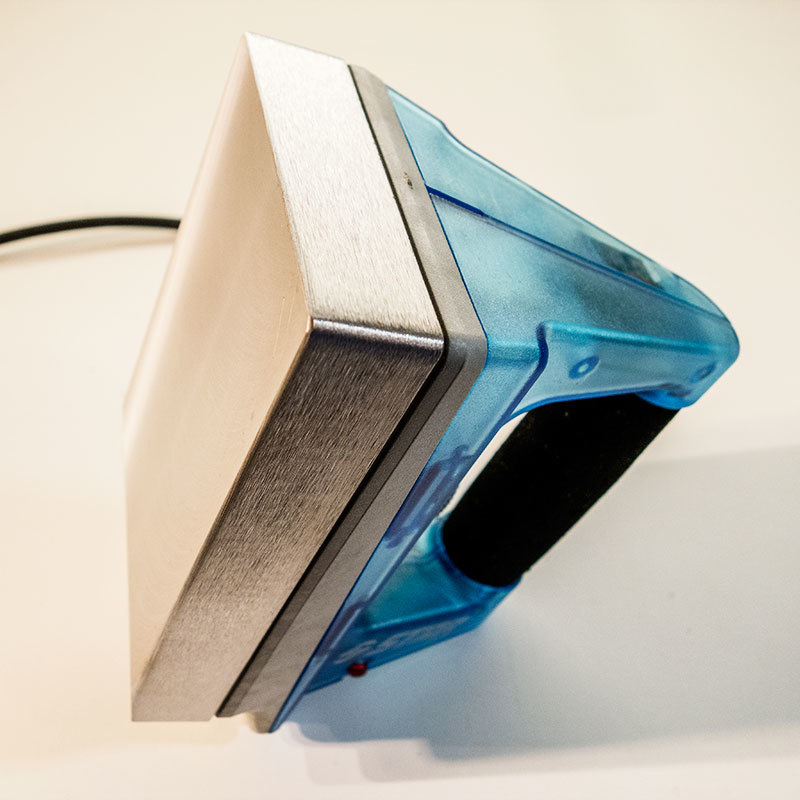
    ***

  • Alaska High Schools Call a ‘Wax Truce’

    Alaska High Schools Call a ‘Wax Truce’

    The scene from an Alaska Nordic Skiing State Championships mass start. In Anchorage, high-school nordic coaches recently agreed to ban fluorinated glide wax in non-championship races throughout the 2015/2016 season. (Photo: http://asaa.org/sports/nordic-ski/)
    The scene from an Alaska Nordic Skiing State Championships mass start. In Anchorage, high-school nordic coaches recently agreed to ban fluorinated glide wax in non-championship races throughout the 2015/2016 season. (Photo: asaa.org)

    Anchorage-area schools decided that it had gotten out of hand, so they called a truce.

    “Anchorage region coaches agreed to not use fluorinated glide waxes during all non-championship races,” Anson Moxness, head coach at West Anchorage High School in Anchorage, Alaska, wrote in an email. “Because flouros are expensive and bad for your health. None of the schools really have adequate ventilation systems and many are doing waxing around the skiers.”

    Such bans on fluorinated waxes are becoming increasingly common around the country. Moxness cited various divisions and regions around the country that had agreed to similar bans, including the Eastern Intercollegiate Ski Association (EISA).

    Different coaches had different reasons for supporting the ban, but among coaches interviewed, support was unanimous:

    “I am all for this for many reasons,” Cory Schwartz, head coach of the University of New Hampshire (UNH) nordic team, wrote in an email. “First is the health concerns around putting on powders — even though we all use masks and try to the best of our ability adhere to safety suggestions, none of the college teams have a ventilated wax truck. So we are using masks while ironing on and brushing but the powder gets all over the truck, our skis, and body.”

    Evidence suggests that there are health risks associated with fluoro waxes. Fluorinated compounds are useful in waxes for their ability to repel water, making the skis faster. But they’re also much more expensive.

    “We’re looking at an order of magnitude difference in per gram wax costs of CH and HF waxes,” Moxness wrote. “I don’t see a reason to be spending that much money on waxes for non-championship races.”

    Tools of the trade: Anchorage-area high schools will have one less variable to worry about with the recent decision to ban flourinated glide waxes for all non-championship races.
    Tools of the trade: Anchorage-area high schools will have one less variable to worry about with the recent decision to ban fluorinated glide waxes for all non-championship races.

    He added that the success of this rule depends on coaches’  compliance.

    “If skiers choose to wax skis at home, which some of them do, we have no control over what they put on their skis. If we establish that it is cheating to use anything with fluorination and are consistent in our message, I think it will succeed,” Moxness wrote.

    “Where this will fail is if the coaches aren’t fully behind the fluoro ban, which we all were at our preseason meeting. From what I’ve seen, my skiers realize what we’re doing and the reasons behind it and they respect the ban.”

    “I think the success of the ban lies on the shoulders of the coaches and the parents,” South Anchorage High School Coach Sam Sterling wrote in an email. “If they advertise it as something that is good for the sport, I think it will succeed. If they give their athletes reason to doubt it … then, maybe it won’t. Hopefully, in a couple years the ban will just be a normal part of the AK high school ski scene and nobody will give it a second thought.”

    Chugiak High School in nearby Eagle River is one of the schools involved in the truce. Head coach Cody Priest also supported the ban.

    “Another reason it’s nice,” he wrote in an email, “is that I don’t have to ‘draw the line’ on my team on who gets what wax. With a competitive girls team I would want to use expensive wax on at least my first five, then maybe not the others. How do you explain that to the team?

    “Plus on race day I wont be testing different top coats,” he continued. “I will be just ensuring that I have the correct hardness of base wax.”

    The coaches contacted were also unanimous that the extra time spent testing skis with fluorinated wax was not time well spent.

    “The main thing I see is that [the ban] allows the coaches to actually… coach,” Sterling explained. “The impact of the ban goes beyond the obvious benefits of decreasing exposure to fluoros and reducing overall expenses for high school programs. Each team ranges from junior national champions to foreign exchange students who have never seen snow until coming to Alaska. The more time coaches can spend working with these athletes, and not dealing with waxing, the better off the sport will be.

    Sterling sees it as a simple misallocation of resources.

    “There’s a lot of [coaching] experience and motivation in Alaska high school skiing,” he wrote. “It’d be great to see this resource going more to the development of the athletes, and less towards making a fast pair of skis. It’s a step in the right direction and it was great to see unanimous approval from the Region IV coaches in adopting the ban.”

    Schwartz explained that in the East, there is some concern their region is falling behind others when it comes to testing wax in different snow conditions, “But I do not agree with that,” he wrote. “I actually am more excited to go to the race to see the race instead of being in a wax trailer all day.”

    In addition to being better for individual families bottom lines, Sterling and Moxness explained it’s better for the sport as well.

    “It also lowers barriers of entry into the sport,” Moxness wrote. “If a parent is interested in waxing their kid’s skis and they only have to invest maybe $50 in waxes to have skis that are competitive, instead of $300, they are much more likely to get and stay involved.”

    “That means more growth of the sport and parents who may be more likely to invest that saved money in better quality equipment, which makes way more of a difference than wax.”

  • Associations, National Teams See Multiple Benefits in Low-Fluoro or ‘Same-Wax’ Race Protocols

    Associations, National Teams See Multiple Benefits in Low-Fluoro or ‘Same-Wax’ Race Protocols

    What's going on in those wax tents? Depending on the race, ski prep could be a lot less fluoro-intense for some Eastern racers.
    What’s going on in those wax tents? Depending on the race, ski prep could be a lot less fluoro-intense for some Eastern racers.

    For most racers, the night before a race is synonymous with ironing in and scraping off base layers of wax for the next day’s competition. Race morning means testing skis and wax, trying different structure, and then watching puffs of fluorocarbon-laden steam roll off their skis as coaches apply expensive powders in the last few minutes before race start.

    Some North American nordic associations, though, have decided that it’s better if this whole process is simplified some of the time. Nobody’s going into a championship event on CH10, but clubs are increasingly agreeing to leave powders out of the equation for regular-season racing – or even to have every skier on the very same wax.

    Their reasons vary widely. For the U.S. Biathlon Association, a “same-wax” protocol is in place at trials so that coaches can accurately compare skiing speed. Biathlon Canada has the same protocol, but besides the benefit of giving a level playing field a big factor is to reduce stress on athletes and coaches.

    The Eastern Intercollegiate Ski Association agreed to stop using powders in regular-season classic races, and they are moving towards implementing the policy in skate races as well. For the EISA, it’s mostly about health: college venues rarely have wax cabins, so there’s not a ventilation system – or if so, it’s the natural variety provided by a cold wind coming off the Saint Lawrence Seaway.

    The three organizations have something else in common in terms of how they implement their wax protocols: once championship events roll around, it’s gloves off and clubs can, and should, do whatever ski preparation they can in order to win. The role of ski preparation in success as a nordic athlete is not eliminated entirely. It’s simply minimized at the times of year that the organizations feel best aid in athlete selection and development.

    All three organizations said that they have had almost entirely positive reviews of their policies, and in two cases are looking to go further. Here’s why.

    EISA

    The EISA agreed in April of 2012 to ban fluoro powders in regular-season classic races. From their 2013 Policies and Procedures Manual:

    “For Nordic classic races, relays and sprints the use of pure flouro powder, liquid or block is prohibited. Maximum HF waxes only. LF cold powders are acceptable.”

    University of Vermont head coach Patrick Weaver, a two-time Olympian, told FasterSkier that he had brought the proposal to the EISA coaches.

    “At the time we decided classic only,” he wrote in an e-mail. “This year we voted to include some skate races as well… I have to say though, the monetary part of it is probably at the bottom of the list. Health is at the top with a bunch of other reason in-between.”

    He also clarified that not only are powders off the table, but high-fluoro liquids and blocks are also not to be used.

    Weaver was particularly interested to know if other groups around the country are making a similar decision. Interestingly, however, the two other major North American groups with policies explicitly say that health is nowhere near the top of their own list of concerns.

    USBA

    USBA has two different wax protocols, both of which apply only to trials racing – which happens several times a year for World Cup, IBU Cup, World Youth and Junior Championships, and every four years for Olympic teams. One protocol is for domestic trials and the other is for trials which happen during other races, for instance IBU Cup races used to select World Cup or Olympic teams. But both require that all the competitors have exactly the same wax on their skis.

    “The main reasons are to be as fair as possible competition between all athletes and for us to see the best pure performances,” USBA Chief of Sport Bernd Eisenbichler wrote in an e-mail. “Still ski brand, flex and grind can make big difference, but like this, you can get it at least as close as possible. It’s also to save money for the regions and clubs, and so athletes learn to understand their skis and learn how to test skis and make decisions on their own. Health is an added benefit.”

    At domestic trials, athletes are allowed to select two pairs of skis for race waxing. The coaches from the various clubs competing are told by a USBA representative what the wax choice will be, and then all the staff work together to prepare all the skis in one large batch.

    At an IBU Cup race, athletes are allowed 45 minutes to test up to four pairs of skis, and then have to pick their one race pair and hand them over to the wax techs an hour before race start. Rather than an easy-to-use wax like might be selected at a domestic trials event, at an international competition the techs are going all out – it’s not just a trial, but also a chance to represent the U.S., and for the team to collect Nations Cup points.

    Eisenbichler emphasized that ski testing is up to the athletes.

    “What I found beneficial is there, that athletes have to really get familiar with their skis and test them alone and get experienced with that, before they enter the WC and everything is taken care for them,” he explained. “The athletes input in the ski selection before grinding in summer or at a race day is crucial, and the athlete has to understand her/his skis for that.”

    Biathlon Canada

    Biathlon Canada uses an identical system for its World Youth and Junior Championships trials races.

    “We think it’s a key part of the selection process, to have everyone on same wax],” Biathlon Canada High Performance Director Chris Lindsay explained in a phone interview. “The main reason for that is that we’re trying to take away not really one of the variables that can affect individualized performance, but we’re actually trying to take away one of the stressors on athletes and coaches during selection processes. Because when we’ve got them racing internationally, they don’t have to deal with that.”

    No matter how good a skier’s support team is at home – or conversely, if they’re more or less on their own and don’t have anyone to help test skis or apply powders – they will all be in the same boat once they get to Europe. For Lindsay, it’s important to remove wax-related stress from the trials process and start moving young athletes towards the working environment they will find once they reach a higher level of competition.

    “The comments that we get back on our yearly surveys tend to be extremely positive about this,” he said. |It is most positive from athletes from lesser programs or who typically don’t have robust support available to them, which is not surprising. The most critical feedback that we get is from programs and coaches who feel that they could provide some sort of advantage to their athletes [through superior waxing].”

    More?

    Lindsay said that his organization is looking into next steps towards an extended waxing protocol. But what would a next step actually look like?

    “We haven’t come up with what the next level is, because of the complication of ski structure and ski compatibility with athletes is a much more significant problem,” Lindsay said.

    One possible direction is something that is already in place in Sweden, according to Kevin Cutts, a former top U.S. junior skier who now coaches a ski gymnasium in Sundsvall.

    “Every kid up to a certain age here – maybe 15 or 16 – is only allowed to have one pair of skate skis and one pair of classic skis that are their race skis,” he told FasterSkier this summer. “They get a sticker that goes on their skis to identify which ones are their race skis, and they can’t have more than that. It’s a good thing, I think, because then it doesn’t come down to, well, John has Fischer Carbonlites, but I don’t. Yeah, you’re going to have kids who have better equipment than others, but you’re not going to have 12-year-olds showing up to a race with 30 pairs of test skis and a full wax team.”

    Do you know of other North American ski associations with interesting wax policies? Let us know in the comments.