Tag: FlyingPointRoad

  • FasterSkier’s Unofficial Guide to 2018 Olympic Cross-Country and Biathlon Suits

    So many suits — The start of the women’s 15 k skiathlon on Saturday, Feb. 10, Day 1 of the 2018 Winter Olympics in PyeongChang, South Korea. (Photo: FlyingPointRoad)

    FasterSkier would like to thank Fischer Sport USAMadshus USAConcept2Boulder Nordic Sport, and Swix Sport US for their generous support, which made this coverage possible.

    ***

    PYEONGCHANG, South Korea — This time last week, we brought you the basics of Olympic cross-country and biathlon cheat sheet, and not long after, we received a comment from a reader asking for a uniform cheat sheet. We, too, found ourselves sometimes befuddled. During Saturday’s skiathlon, this reporter found himself looking for the emblematic stars on the U.S. Ski Team’s new unis. There were stars, think Diggins and Kalla, just no obvious stellar-like branding on the USST suits.

    So for you and for us, here’s a basic cross-country race suit cheat sheet. Disclaimer: we do nordic here at FasterSkier. Which is saying fashion and nordic are often mutually exclusive. Sometimes we do fashion (right FBD?), but not really. For more fashion expertise here’s a site that popped up when googling “most famous New York fashion writer”. Back to race suits.

    Sweden: Out with the all-whites and in with the mostly royal-blue tights. The blue is emphasized on the thighs and blends into yellow knee-highlights, which in turn blends into white on the lower leg. Blue, yellow, white is all Sweden. Here’s Sweden’s own Charlotte Kalla racing to second in Thursday’s 10 k skate.

    Sweden’s Charlotte Kalla racing to second place in the women’s 10 k skate at the 2018 Winter Games in PyeongChang, South Korea. (Photo:FlyingPointRoad)

    Sweden’s biathlon race suits epitomize reductionism. In other words — K.I.S.S. — as in, keep it simple, Sweden. Our wish is their command. Two words to help identify Sweden on the biathlon range or tracks. Canary yellow. Thank you Sweden.
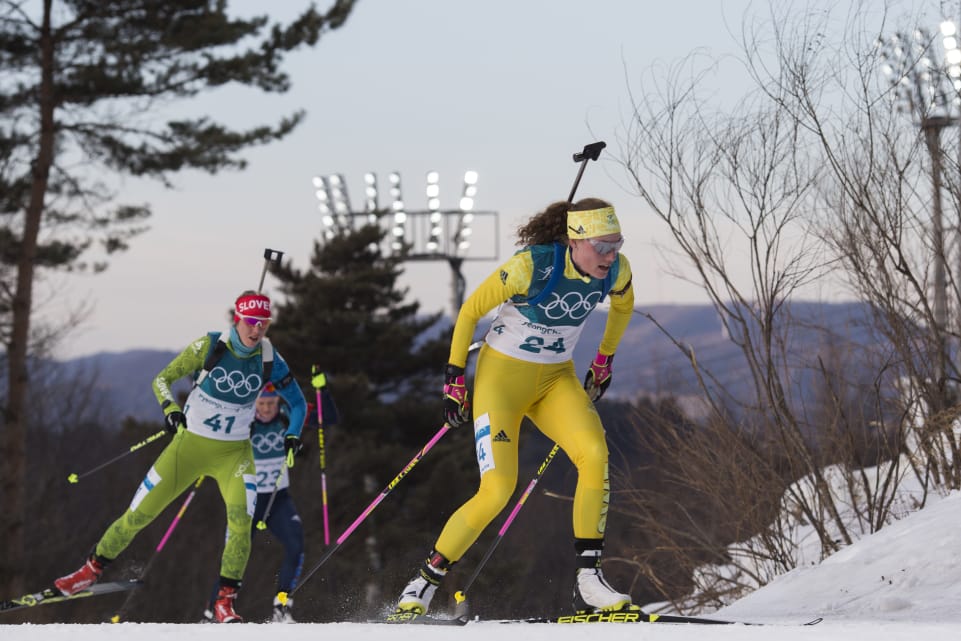
    Sweden’s Hanna Öberg on her way to a gold medal in the women’s 15 k individual at the 2018 Olympics in PyeongChang, South Korea. Öberg skied the sixth-fastest time and shot 20/20. (Photo: IBU/Biathlonworld.com)

    Finland: Every day is a new day. A positive outlook works wonders in the tough-to-win sport of World Cup skiing. Finland’s Krista Pärmäkoski is positive and owning it in Finland’s lycra whites. Yes, there’s navy blue on the forearms and just below the patella, but if you can kill in mostly white, you can kill on the ski course. That’s evidenced by Pärmäkoski’s arm raise: positive vibes and she’s in for the bronze. (Note: if Pärmäkoski is skiing away from you, the Finland suits emphasize blue on the backside. 

    Finland’s Krista Pärmäkoski crosses the line for bronze in the 2018 Olympic women’s skiathlon. (Photo: FlyingPointRoad)

    You’ll have to look past Canada’s Rosanna Crawford and zero in on Finland’s Mari Laukkanen in bib 22 to burn the Finn’s biathlon uniform into the synapses. Finland’s biathlon unis do the flag proud. It’s a zippy look that takes the essentials into play: blue and white. Certainly less white and more blue than their cross-country brethren. For the feisty Finns — they dealt with invading Soviets in winter of 1939 — we say it works.

    Fashionably crushing it, Canada’s Rosanna Crawford (bib 22) in the 7.5 k sprint in PyeongChang. Finland’s Mari Laukkanen (bib 21) skis behind Crawford. (Photo: FlyingPointRoad)

    France: We’re sticking with countries that begin with the letter F. C’est la vie. But we’ll go a little crazy and start with France’s biathlon garb. Why is that? Because of Martin Fourcade — the French force of biathlon. He shoots like a veritable post-doc in Jedi-studies and skis like he could crush the 15 k skate on the cross-country World Cup. France’s biathlon suits get jazzy in a sky blue kind of way on the lower leg. And just when you get complacent with all the blue tones, the right arm gets proud in red. You should get to know this suit, Fourcade is likely to rule these Games; he’s already won the men’s 10 k pursuit.

    France’s Martin Fourcade defending his Olympic gold from four years ago on Monday in the men’s 12.5 k pursuit at the 2018 Olympics in PyeongChang, South Korea. (Photo: FlyingPointRoad)

    France also gets props for keeping it easy on spectators and viewers. If you’ve studied Fourcade’s race suit already, you’re all set. In the image below, France’s Jean-Marc Gaillard (9) proves our point. Biathlon or cross-country, the suits are the same.

    Canada’s Alex Harvey (4) leading France’s Jean-Marc Gaillard (9) and Finland’s Iivo Niskanen (8) during the skate leg of the men’s 30 k skiathlon at the 2018 Olympics in PyeongChang, South Korea. Harvey went on to finish eighth. (Photo: FlyingPointRoad)

    Norway: It’s Norway after all. Nothing too drastic here, and certainly we’re imagining athletes will have several colors schemes to choose from at a later date. For now, the new kind of looks like the old. Which when consulting fashion guides, retro can be cool — think the resurgence of L.L. Bean’s duck boots or those Greg-Lemond-era Oakleys that Harvey has rocked.

    OK, the cross-country suits. Here’s Norway’s race wear as worn by Heidi Weng (bib 1) and Ingvild Flugstad Østberg (bib 2) during Saturday’s skiathlon. The easy thing about trying to identify the Norwegians in a deep field cross-country scrum: look towards the sharp end of the race. Most often in the lead pack you’ll see a predominately red-suited athlete pushing the pace. Yeah, that’s probably Norway. (That said, deference to Canada’s Harvey, we want to get our red suits straight. We’ll get to the maple leaf in a bit, but in the case of Canada just think a different shade of red, because Harvey is a front-pack skier. Big respect for Harvey in red.)

    The start of the women’s 15 k skiathlon on Saturday, Day 1 of the 2018 Winter Olympics, with (front row, from left to right) Austria’s Teresa Stadlober, Norway’s Ingvild Flugstad Østberg, Norway’s Heidi Weng, American Jessie Diggins, and Sweden’s Charlotte Kalla leading out of the stadium in PyeongChang, South Korea. (Photo: FlyingPointRoad)

    Here’s a shot of Norway’s biathlon suit. Again, Norway has gone with reliable themes. Yet in this case, pin striping rules. There’s the red, the deep blue, and the white. The striping certainly gives it a more formal look as if to say “we’re here to shoot clean”.

    Norwegian biathlete Erlend Bjøntegaard on his way to fifth in the men’s 10 k sprint. (Photo: FlyingPointRoad)

    Canada: Why not? Let’s break down Canada’s race gear next. Nothing too crazy here on the XC side from our good friends up north that brought us Bob and Doug McKenzie and sort of Kenny G. (Officially, Kenny G. is American; he was born in Seattle. But his mom is from Saskatchewan. A loose connection, but only separated by one degree. And Seattle is super close to Vancouver.) Like the Norwegians’ cross-country race suit, this is a mostly red affair. But it rocks perhaps the most identifiable flora icon on the planet: the maple leaf. In our opinion, this suit is an instant classic. Maple-leaf patterns run down the length of the arms. Nothing too gaudy here. No fluorescent yellow, no overdoing it with the “Canada-ness” of it all. And there’s just the right amount of white lycra highlights to keep it sleek looking. If you’re looking to impress on the Olympic trails but be simultaneously understated, look no further than Canada. Here’s Alex Harvey racing to seventh, his best individual result in his third Olympics, in Friday’s 15 k skate:

    Canada’s Alex Harvey racing to seventh in Friday’s 15 k freestyle at the 2018 Olympics in PyeongChang, South Korea. (Photo: FlyingPointRoad)

    Under the bright lights of the Alpensia biathlon venue, Biathlon Canada got a wee bit friskier. Down the right arm you’ll note … wait for it … white maple leaves of varying sizes. Little known fact, at least to FS, “an infusion” of maple-tree bark can be used to treat cramps and dysentery. Any chance that infusion works on norovirus? Just asking.

    Lots of digressions here. But this is for certain and maybe it’s a trickle-down effect of honoring the most beautiful autumn tree on the planet. Across the board, XC or biathlon, Canadian athletes are a delight to chat with. You parent-folk raise them well up north.

    Canada’s Brendan Green en route to 82nd in the men’s 10 k sprint at the 2018 Olympics in PyeongChang, South Korea. (Photo: FlyingPointRoad)

    The lower half of Canada’s biathlon unis are trending more towards what we have seen in the recent Canadian lycra past: bigger and badder maple leafs. A big white maple icon sits on the lower right leg, with a smaller slightly more delicate yet distinguished maple icon on the upper left thigh. There you have it. When in doubt, channel the red suit and the maple leaf and you’ll know it’s Canada at any of the nordic venues.

    Canada’s Christian Gow racing to 62nd in the men’s 10 k sprint at the 2018 Olympics in PyeongChang, South Korea. (Photo: FlyingPointRoad)

    U.S.A.: Jingoism = “extreme patriotism, especially in the form of aggressive or warlike foreign policy.” We are not jingoistic here at FasterSkier. Read Saturday’s skiathlon report and it’s clear we’re not jingoistic. The day’s winner Kalla — from Sweden — is given plenty of coverage. Yeah, Jessie Diggins killed, but Kalla was a force, too. 

    Jessie Diggins racing to fifth in the women’s 10 k skate for her third top-six (and second top-five) of the 2018 Olympics. (Photo: FlyingPointRoad)

    So the good ole’ red-white-and-blue (r-w-b). That’s pretty much still the theme. Visually speaking, we think it’s a nice blend of the r-w-b trifecta. It’s mostly blue. And a cool blue at that. Again coolness reigns with the white downward slanting stripes running from the lower thigh to below the knee. Those stripes scream, “Scoreboard!” And the red on the arms? Awesome. And if you’re like this reporter looking around in the pack for the U.S. skiers, it helps to read the bold print on the right upper arm. Read: U.S.A.

    American Noah Hoffman racing in the 15 k freestyle at the 2018 Olympics in PyeongChang, South Korea, where he finished 48th. (Photo: FlyingPointRoad)

    Now to US Biathlon. For starters, the national governing body of biathlon in the U.S. is … US Biathlon. A totally different sporting body than U.S. Ski and Snowboard. And the uniforms on the biathlon side make that clear. There’s little cross-pollination like we see with the Canadian suits.

    For awhile, U.S. Biathlon raced in suits with a distinct mix of blue and red. If you can harken back to elementary school art class, or if you’re in elementary school now, you’d have to pass this basic test to move onto more complex colors.

    Test: How do you make purple. Yes! Mix red and blue together.

    The older U.S. biathlon uniforms had a distinct purple hue on the bottom-half. The top was a tasteful strawberry red called into action by iconic Adidas striping down the arms. That purple hue is no longer. Get rid of that in your mind’s eye. We’re not even posting a photo of that older race suit. It’s so not now.

    Want to know where Susan Dunklee or Lowell Bailey are? Look for uniforms that harness the “blue blazer” in all of us. First let’s zoom in. (See photo below). We note here that it’s not simply a solid-blue pattern. The hat, shoulders and upper torso host a maze of small deep blue “three-stripe” hash marks printed over a lighter bluebird blue. Since those appear on several team’s 2018 Olympic suits (like Sweden, Germany, and the Olympic Athletes from Russia), all of which were made by Adidas, we’re guessing it’s a nod to their uniform supplier? (You know, with the “threes” theme.) Nonetheless, the upper is mostly covered by the bib. And from a distance, as we zoom out, it simply looks blue. But before we do that, here’s Clare Egan — total badass polyglot; she speaks Korean — during the women’s sprint here in PyeongChang.

    Clare Egan (US Biathlon) racing to 61st in the women’s 7.5 k sprint at the 2018 Olympics in PyeongChang, South Korea. (Photo: FlyingPointRoad)

    Now for the zoom out. This shot is great for many reasons, so a shoutout to FlyingPointRoad guru Steve Fuller. Since we are talking colors here, let’s just continue the shout out to Steve. This photo kills because a Swedish skier follows Tim Burke in a canary yellow race suit. Blue and yellow are primary colors. The blue-Burke here stands out more as he’s contrasted by the yellow-Swede. Intentional or not Steve, well done.

    Let’s focus on Tim Burke’s legs. That’s a solid royal blue, right? A basic blue, but a royal blue. There’s just no damn distractions from the business at hand here. Maybe the small USA on the left calf area is a nod to those fans still time-capsuled with Lake Placid’s 1980 gold-medal hockey team and the venerable announcer Al Michaels. That USA on the leg isn’t really yelling U.S.A!!! U.S.A!!! It’s sort of a kinder and gentler u.s.a. (no caps intentional). Like a whisper, saying we come in peace even though we’re charging hard with rifles on our backs. Back to the point. No distractions. #businesstime.

    USA = basically blue. Look for the blue. That’s the U.S. biathlon team. 

    Tim Burke (US Biathlon) en route to 47th in the men’s 10 k sprint at the 2018 Olympics in PyeongChang, South Korea. (Photo: FlyingPointRoad)

    Other notable suits:

    Switzerland: From a country we all associate with Swiss-Army-Knife red, we get thrown a change up. It took us all a few seasons to get accquainted with the race-lycra formal wear donned by the Swiss cross-country team. Cross-country World Cups aren’t exactly formal occasions, but the tuxedo black suits the Swiss have worn for a few years now — a look you’d seek if you were on the race equivalent of a Georgetown cocktail circuit — are gone. The Swiss sport maroon suits with red highlights on the lower legs and arms. 

    (Note: These suits resemble Russia’s cross-country race suits on the World Cup. Alas, they also resemble Russia’s suits during the Games despite the fact that Russia’s skiers are competing under the Olympic flag as Olympic Athletes from Russia (OAR). See photo featuring Great Britain’s Andrew Musgrave — that’s Denis Spitsov of the OAR chasing, not a Swiss skier. It helps that the Swiss skiers wear hats reading “Suisse”.)

    Switzerland’s Dario Cologna racing to gold in the men’s 15 k freestyle on Friday at the 2018 Olympics in PyeongChang, South Korea. (Photo: FlyingPointRoad)

    Great Britain: From the people who brought us the modern navy …  we get navy blue. Nothing says “we are not in your face” more than navy blue. Great Britain’s cross-country race suits are appropriately regal. Think the Queen, Lady Di, and the ever so cool and soon-to-be-in-line-for-the-throne, Meghan Markle. Also, Andrew Musgrave, as this reporter’s grandfather used to say, is the real McCoy. (The Scottish McCoy, not the Irish McCoy). It was a delight to watch the 2018 Olympic skiathlon unfold as a fly-on-the-wall surrounded by British journalists. Move over Chelsea. Move over Man-United. Yeah, that’s right. Musgrave is on your tails sporting navy blue lycra. 

    Britain’s Andrew Musgrave (10) during the men’s 30 k skiathlon in PyeongChang, South Korea, followed by Russia’s Denis Spitsov (16), skiing as a member of the Olympic Athletes from Russia. (Photo:FlyingPointRoad)

    Italy: Ah Italia. They exported high fashion with the house of Gucci and they school us in the color wheel. First, Italy’s cross-country race suits feature a halcyon blue. A blue when blues sang like a pristine alpine sky and times were simpler. A time perhaps when you were finishing an altitude camp in Seiser Alm and all you had to worry about was visiting the physio for a rub-down and connecting for a post-training sesh espresso with the whos who of the World Cup … also finishing an altitude camp.

    Second, we note orange. Orange is many things, but it does not scream Italy. However, we believe Italy is paying respect to its storied-art legacy by deferring to the color wheel — Italy’s suits have just a tad more than a splash of orange on the lower legs and lower arms. Blue and orange are complementary colors. That means they are opposite one another on the color wheel. Opposites attract. And if anything is attracting here, it’s Federico Pellegrino and his panache on the big stage. Dude can classic sprint, too. Here’s Pellegrino an eyeblink before crossing the line in the classic sprint final (he took silver).

    Third, and this may be breaking news, Italy may have a one-off suit for Pellegrino. If you compare the below image with the one below that (behind American Caitlin Patterson, there’s an Italian skier, Sara Pellegrini), newsflash — no splash of orange. Absent the orange, the suit is identical to Pellegrino’s. ITA adorns the upper-left quad area on each suit. Italy’s biathlon team also wears the all-blue suit. Ciao for now.

    Norway’s Johannes Høsflot Klæbo (l) and Italy’s Federico Pellegrino finishing first and second, respectively, in the first semifinal of the men’s 1.4-kilometer classic sprint at the 2018 Olympics in PyeongChang, South Korea. (Photo: FlyingPointRoad)
    American Caitlin Patterson leads Italy’s Sara Pellegrini (not to be confused with Pellegrino) into the finish of the women’s 15 k skiathlon at the 2018 Olympics. They finished 34th and 35th, respectively. (Photo: FlyingPointRoad)

    Austria: What’s black and white and red allover? Austria. Across the board: cross-country, biathlon, and nordic combined, the uniforms are all the same. You’ll never not notice Austria.

    Austria’s Dominik Landertinger racing to bronze in the men’s 20 k individual at the 2018 Olympics in PyeongChang, South Korea. (Photo: FlyingPointRoad)

    Germany: Embracing their inner-Vader is Germany. Like the old Swiss race suits but taking black lycra to “11”. Germany. Add just a sprinkle of white around the shoulders to lighten the mood. The red hat emblazoned with the Bundesadler — the German federal eagle — is a fitting cap for their race wear. As badass as Clare Egan is speaking Korean (go back to U.S.A. for a refresher), the Bundesadler is nearly her avian iconography equivalent.

    Germany’s Eric Frenzel (5) leads Austria’s Lukas Klapfer during the individual normal hill/10 k competition on Wednesday at the 2018 Olympics in PyeongChang, South Korea. Frenzel went on to win while Klapfer placed third. (Photo: FlyingPointRoad)

    Germany’s cross-country, biathlon, and nordic combined teams share the same uniform.

    Germany’s Laura Dahlmeier racing to her first Olympic gold (and first Olympic medal) on Saturday in the women’s 7.5 k sprint, the first biathlon race of the 2018 Winter Olympics in PyeongChang, South Korea. (Photo: FlyingPointRoad)

    We couldn’t cover every team, so we’re aware we left more than a few out. Hopefully this leaves you feeling a little more in-the-know when it comes to Olympic XC and biathlon spectating. Onto the relays (and biathlon mass starts) we go!

    ***

    A message from a Korean fan during the men’s 15 k freestyle on Friday at the 2018 Olympics in PyeongChang, South Korea. (Photo: FlyingPointRoad)
    A message from an unidentified spectator during the men’s 15 k freestyle on Friday at the 2018 Olympics in PyeongChang, South Korea. (Photo: FlyingPointRoad)
  • PyeongChang Olympics 10 k Skate: Quotes and Photos

    The women’s 10 k freestyle podium on Thursday at the 2018 Olympics in PyeongChang, South Korea, with (from left to right) Sweden’s Charlotte Kalla in second, Norway’s Ragnhild Haga in first, and Norway’s Marit Bjørgen and Finland’s Krista Parmakoski tied to third. (All photos: FlyingPointRoad)

    PYEONGCHANG, South Korea — Ragnhild Haga put herself front and center stage on Thursday in the women’s 10-kilometer freestyle individual start, winning by 20.3 seconds over Sweden’s Charlotte Kalla and establishing herself as the latest Norwegian gold medalist on the Olympic scene. Behind them, Norway’s longtime powerhouse Marit Bjørgen tied Finland’s Krista Pärmäkoski for third. That’s right, there were four women on the podium on Thursday in PyeongChang. And American Jessie Diggins was next in line in fifth for her second-straight fifth place and third top six at these 2018 Games.

    While we’re working on a report that will bring you the full details of that cross-country race, here are some quotes and FlyingPointRoad.com photos to hold you over:

    Ragnhild Haga (Norway), 1st:

    “I am not sure if I have dreamt of the gold medal, but I managed to take it today so I’m very happy.”

    “I think I had a better start than usually. I felt very good and got good messages from the coaches, that I was only a few seconds behind. On the last lap I was very afraid that some of the others were going to speed up so I increased my speed and got some more seconds. I just focused on staying on my feet on the last downhill, and to give it all to the finish line. It was just a perfect day.”

    Charlotte Kalla (Sweden), 2nd:

    “I tried to ski very offensive from the first lap. I knew that it will be very tough today. When you are on the bottom of the long downhill, you will work very hard until you are there the next time. It was hard to keep up a good technique today because I became very tired. It was hard to get recovery. I fight the hardest that I could, and I’m satisfied with my performance.”

    Krista Pärmäkoski (Finland), 3rd:

    “I think that it’s better that both of us stand on the place today. Of course Marit is one of my idols when I was younger. It’s really nice to stand on the same podium today.”

    Marit Bjørgen (Norway), 3rd:

    “Today I’m happy to take a medal. I thought that I was out of the podium in the 8 km, but we had a good finish, both me and Krista, I can see that we were racing the same, actually, all the way. So I’m really happy. To share it with Krista, it’s good for me.”

    Jessie Diggins (USA), 5th:

    “To have three top-six finishes at the Games, in totally different events, is like a dream come true for me. And yeah, of course you want a medal, you always want a medal, that’s why we are here, that’s like the point of the Olympics. But there are other things that are also really important besides the actual hardware. And I think it’s important to not put other people’s expectations on me.”

    “To be that close and to be skiing with the best in the world — I have looked up to Marit my entire life, and to be, I don’t know how many seconds I was from her, like four or five … it’s so awesome, and I could not have gone any harder. I can honestly look back and say: I don’t know where I would have found those seconds. I pushed my body way past its limit, I killed myself out there, and I thought I was gonna pass out on that last climb. I was completely locked up. That’s a really good feeling to know you gave it everything that you had and more than you thought you could give, and I’m really proud of today.”

    Sadie Bjornsen (USA), 15th:

    “It was definitely a fun day out there today. It’s pretty much the most perfect conditions that South Korea has delivered yet so it was really fun skiing. Certainly a tough course. I went out there and just tried, you know, no pressure, no expectations, see what I could do. It was fun. Definitely I wouldn’t say it’s the greatest moment ever, but the greatest moment is yet to come in these Games.”

    Kikkan Randall (USA), 16th:

    “I was really happy today to be able to focus on my own pacing. I think what got me at the skiathlon the other day was exploding with that fast pace of the start so I wanted to just ski it in four sections, kind of pick up speed as I went. I think I started nice and controlled but maybe started a little fast so that middle section was kind of tough to keep it together, and Haga passed me and tried to stay with her, but she was clearly skiing on another level. I am just happy that it felt like I paced it well, I skied it ’til the end where I had not much left in my legs, and that was the feeling I was going for today.”

    “It’s certainly been heartbreaking for Jessie because she’s clearly skiing at the top level and just skiing her heart out every single race … I know she has been laying all out there. She has had such a great happy demeanor that we are all feeding off of so it’s tough to see her … not quite get there, but I know all of us seem to rise to an occasion when the relays come around, and it’s what we’ve all been looking forward to. I think it would be pretty special to be able to do it [get a medal] in the relay, but there is obviously going to be some tough competition out there, a lot of countries are putting a lot of people in the top 10 there. It’s going to be challenge, but I think we can ski right in there if we have the right day.”

    Liz Stephen (USA), 30th:

    “I definitely didn’t have the best race I was hoping for, but I mean our team has so much good to focus on, and that’s what I plan on doing.”

    “I think of this [10 k skate individual start] as maybe my strong suit because I do so much training by myself, so I went out with the focus of pacing it and not ever like completely blowing up, because when I blow up its like seconds on seconds I lose, so I tried to pace it really conservatively in the beginning  and then work into it a little bit. I didn’t blow up until maybe like the second-to-last hill, but I think I skied the best that I could ski it so I am happy with the performance. You always want the result to be just like a ‘1’ or something, but yeah, it’s not, only one person gets that.”

    Emily Nishikawa (Canada), 32nd:

    “I had all these little process goals just to ski each section of the course the best I could. I think I really did that. I just focused on technical aspects and just little things like pushing over the tops and working the corners well, and I think I did a really good job of that so I am really, really happy with my race today.”

    Dahria Beatty (Canada), 37th: 

    “I was really happy with today’s race. I just really tried to focus on pushing hard and getting into that hurt locker today and skiing smoothly there. It was defintley the best race so far for me, the first 5 k felt really good and in control, lost a little bit of time in the end, but I was still pushing really hard and I was really satisfied to have a top 40 and feel like I gave everything I had when I crossed the finish line.”

    Cendrine Browne (Canada), 43rd: 

    “… First 5 k was really good, I felt good, I was top 20 for the first 5 k, so I was like, ‘Yes, this will be a great race,’ but then I died unfortunately, so I lost 20 places in 5 k so I am a little bummed right now, but I gave everything I had. I pushed really hard so there’s some days that are just like that. Your body doesn’t respond like you want it to, but I still did my best.”

    Anne-Marie Comeau (Canada), 62nd:

    “I’m happy about just starting the race, like, I am happy about skiing with all the other skiers and to see how fast it is and to get experience each time, so I am not happy with the result, but I am just excited for the next one and happy to be here and compete with all the other skiers.”

    Results

  • PyeongChang Extras: Sprint Qualifier Photos

    Tuesday evening, classic sprint “day” at the 2018 Winter Olympics in PyeongChang, South Korea. (Photo: FlyingPointRoad)

    FasterSkier would like to thank Fischer Sport USA, Madshus USA, Concept2, Boulder Nordic Sport, and Swix Sport US for their generous support, which made this coverage possible.

    ***

    Additional photos from Tuesday’s classic-sprint qualifiers at the 2018 Winter Olympics in PyeongChang, South Korea. All photos: FlyingPointRoad.com (Click on photos to enlarge)

    Qualifier results: Women | Men

  • Junior Worlds Photos: Classic Sprint

    Photos from Monday, Day 1 of the 2017 USANA Nordic Junior World Championships at Soldier Hollow in Midway, Utah, which kicked off with the junior women’s and men’s classic sprints. All photos: FlyingPointRoad.com. Click images to enlarge.

    Results (brackets): Men | Women

    Qualifying results: Men | Women

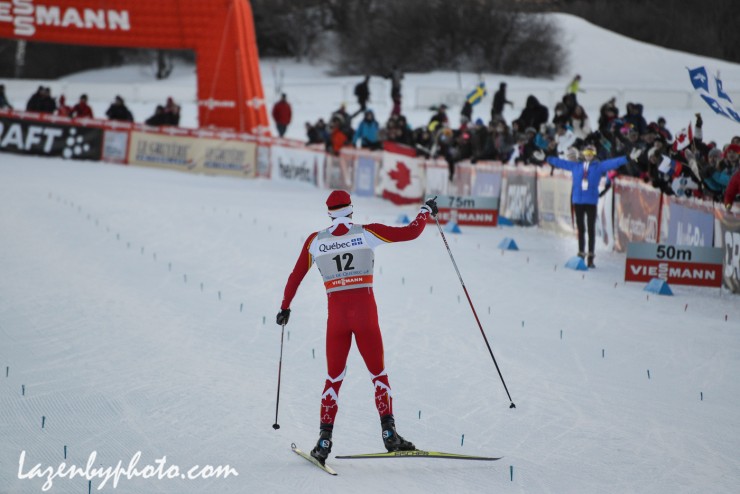
  • STC Photo Gallery: Stage 3 Québec City Freestyle Sprints


    QUEBEC CITY — After an off-day, the Ski Tour Canada picked up again a bit farther east in Québec City with Stage 3: the men’s and women’s freestyle sprints on Friday. Hometown hero Alex Harvey came up big in front of thousands of fans, skiing in second for most of the final and challenging the frontrunner, Russia’s Sergey Ustiugov, for the win in the finishing stretch. In the end, another French-speaking skier, France’s Baptiste Gros took the victory.

    “At the top of the last uphill, I was right behind Ustiugov in the best position possible,” Harvey said in a post-race press conference. “I thought I could win this one, but then Baptiste passed me on my right and surprised everyone.”

    Harvey held on for second place, 0.55 seconds behind, and Ustiugov placed third (+0.79). Behind them, Norway’s Petter Northug placed fourth (+1.91), Maciej Starega of Poland took fifth (+2.12) and France’s Richard Jouve was sixth (+2.18).

    “Right now, I’m in the best shape of this season,” Harvey noted at the press conference. “That was the goal.”

    In the women’s final, Sweden’s Stina Nilsson fended off four Norwegians for the win, beating out Maiken Caspersen Falla by 0.11 seconds at the line. By making the semifinals, Falla achieved her season-long goal and locked up the Sprint World Cup title. Falla led the Norwegians in second place and Heidi Weng was third (+0.56) to take the lead in the overall Tour. Behind her in the sprint, fellow Norwegians Ingvild Flugstad Østberg and Astrid Uhrenholdt Jacobsen placed fourth (+1.09) and fifth (+1.57), ahead Sweden’s Ida Ingemarsdotter in sixth (+9.43).

    Four U.S. women finished in the top 20, with Sadie Bjornsen leading them in eighth, and Simi Hamilton as the top American man in eighth. Canada’s second man behind Harvey, Jess Cockney had his best race of the season by far to place 10th overall. Two other U.S. Ski Team members made the heats, with Erik Bjornsen finishing 20th overall and Andy Newell 29th.

    Stay tuned for comprehensive reports on both races. For now, check out some photos from the day.

    Results:

    Women | Qualifier

    Men | Qualifier

  • Skiathlon Format and Snowfall Make for Tricky Day at World Juniors; Caldwell Notches 10th

    Start of the skiathlon at Junior World Championships on Friday in Val di Fiemme, Italy. (Photo: FlyingPointRoad.com/Proceeds go to the National Nordic Foundation
    Start of the women’s 10 k skiathlon at Junior World Championships on Friday in Val di Fiemme, Italy. (Photo: FlyingPointRoad.com/Proceeds go to the National Nordic Foundation)

    As if skiathlons weren’t rare enough, Friday’s 10- and 20-kilometer races at Junior World Championships in Val di Fiemme, Italy, posed another unique challenge with 2 1/2 feet of new snow from the night before. Tracks had to be set for the races that combined both classic and skate disciplines.

    Paddy Caldwell (Dartmouth) racing to a career-best 10th on Friday in his skiathlon at his first Junior World Championships in Val di Fiemme, Italy. (Photo: FlyingPointRoad.com/Proceeds go to the National Nordic Foundation)
    Patrick Caldwell (Dartmouth) racing to a career-best 10th on Friday in his skiathlon at his first Junior World Championships in Val di Fiemme, Italy. (Photo: FlyingPointRoad.com/Proceeds go to the National Nordic Foundation)

    For American Patrick Caldwell, of Dartmouth College, this was his first skiathlon. After not feeling great following the long trip to Europe, Caldwell wrote in an email: “I think the sprint really helped wake me up and get me ready.”

    Caldwell’s strategy in the skiathlon was to hang on in the classic race, then try to gain ground in the skate.

    “Overall this strategy worked very well,” the 19-year-old freshman said, after finishing 10th for a career-best in his first Junior Worlds.

    Snow kept falling continuously early Friday morning and continued up to the first race: the junior women’s 10 k skiathlon. According to a press release, the Russians took the lead in the classic leg with Alisa Zhambalova and Natalia Nepryaeva, followed by Germany’s Julia Belger and Sarah Schaber, as well as Norway’s Lotta Udness Weng.

    Zhambalova was first through the exchange with about 10 competitors close behind her, and Sweden’s Anna Dyvik led the chase group while trying to close the gap. Halfway through the fourth lap, Weng, Belger, Schaber, and Zhambalova accelerated to the front, but Belger crashed on the second-to-last descent. Schaber stayed on her feet and dropped the pack on the final climb, winning the skiathlon by 2.1 seconds in 30:45.8. Zhambalova placed second and Dyvik outsprinted Weng and Nepryaeva for third (+3.0).

    Japan had a solid showing as well, with two women, Yukari Tanaka and Kozue Takizawa, placing in the top 16.

     
    Dahria Beatty (Alberta World Cup Academy) racing to 29th in Friday's 10 k skiathlon at Junior World Championships in Val di Fiemme, Italy.   (Photo: FlyingPointRoad.com/Proceeds go to the National Nordic Foundation)
    Dahria Beatty (Alberta World Cup Academy) racing to 29th in Friday’s 10 k skiathlon at Junior World Championships in Val di Fiemme, Italy. (Photo: FlyingPointRoad.com/Proceeds go to the National Nordic Foundation)

    Canada’s Anne-Marie Comeau, 17, of the Pierre-Harvey National Training Centre (CNEPH), was the top North American in 21st, her second-best individual result at her third Junior Worlds. Dahria Beatty (Alberta World Cup Academy) placed 29th, Frédérique Vézina (CNEPH) was 30th and Katherine Stewart-Jones (Nakkertok) 31st.

    American Sloan Storey (University of Utah) was not thrilled after finishing 39th, but was happy to be the top American female and to have made it to this level of racing.

    “Today’s race was tough but really fun!” she wrote. “I always find myself getting very nervous before these international races with all the insanely fast-looking Russians, Germans, Norwegians, and Swedes warming up around me, but then I remind myself how amazing it is that I just get to compete against these girls and experience racing at this level. My nerves begin to settle and I just get excited.”

    Unlike Caldwell, Storey, a 19-year-old sophomore, competed in this event last year (and placed 32nd in Nove Mesto), which made her more comfortable with the race format. Regardless, she wrote that her warmup was pretty unorganized and hectic because of the races’ delay of an hour due to continuous snowfall.

    After Storey, Nichole Bathe (University of Alaska-Fairbanks) placed 47th, Stephanie Kirk (University of Vermont) was 52nd and Maggie Williams (University of Vermont) placed 59th.

    Eirik Augdal (12) at the front of the pack in the men's 20 k skiathlon at Junior World Championships on Friday in Val di Fiemme, Italy.  (Photo: FlyingPointRoad.com/Proceeds go to the National Nordic Foundation)
    Eirik Augdal (12) and Evgeniy Vakhrushev (18) at the front of the pack in the men’s 20 k skiathlon at Junior World Championships on Friday in Val di Fiemme, Italy. (Photo: FlyingPointRoad.com/Proceeds go to the National Nordic Foundation)

    On the junior men’s side, Russia dominated yet again as Alexey Chervotkin and Evgeniy Vakhrushev took the lead in the classic part of the race. They were followed by France’s Jules Lapierre and Petr Knop of the Czech Republic.

    Norway’s Eirik Sverdrup Augdal and Johan Hoel joined the lead pack after the transition zone, and formed a chase with the Russians. The Norwegians and Russians both finished with a solid day as Augdal won in 56:09.6, Chervotkin placed second, 10 seconds back, and Hoel took third, 1.3 seconds later.

    Russia had four in the top nine with Vakhrushev placing seventh, Evgeniy Grigoriev in eighth and Alexander Bakanov in ninth.

    While Caldwell was the lone North American in the top 39, Americans Adam Martin (Central Cross Country) placed 40th and John Hegman (University of Vermont) was 59th.

    Scott Hill (NDC Thunder Bay) led the Canadian men in 51st, Ricardo Izquierdo-Bernier (Fondeurs Laurentides) was 57th, Alexis Dumas (Skibec) 60th, and Benjamin Wilkinson-Zan (Nakkertok) 68th.

    Results: Women | Men