Tag: fog

  • No Targets, Or Solution, In Sight for Biathlon As Fog Descends on Sochi Mountains

    No Targets, Or Solution, In Sight for Biathlon As Fog Descends on Sochi Mountains

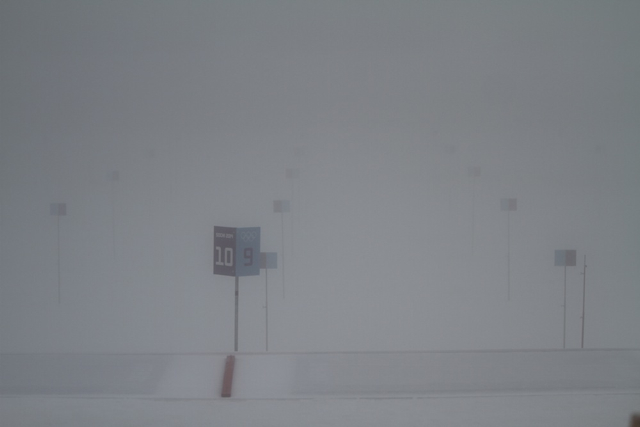
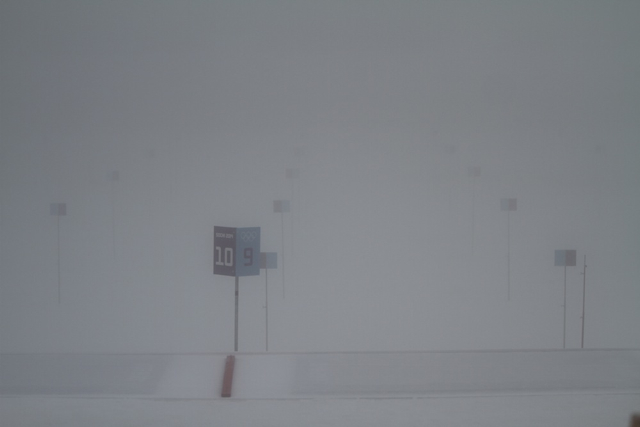
    The view from a shooting mat looking down the range at the Laura biathlon venue in Sochi on Monday morning.
    The view from a shooting mat looking down the range at the Laura biathlon venue in Sochi on Monday morning.

    FasterSkier’s coverage is made possible through the generous support of Swix.

    SOCHI, Russia – About an hour before Sunday’s men’s biathlon mass start competition was supposed to start, it was obvious that there was a problem.

    That issue was a meteorological one with no immediate solution. A heavy fog rolled in over the mountains and completely obscured the stadium and trails. And it didn’t seem to have interest in leaving any time soon.

    “The ski testing was all complete for both Tim [Burke] and Lowell [Bailey], and they had come to the zeroing but hadn’t started to shoot because there wasn’t much you could do,” U.S. High Performance Director Bernd Eisenbichler told FasterSkier.

    There was no point in even looking down the range – it wasn’t even possible to see the back of the boards, much less to distinguish the black circular targets from their white backgrounds.

    Chaos ensued as race organizers had to first delay the mass start for an hour, and then finally postpone it to the next day. Rumors of different start times were flying until an official announcement, just before the revised 8 p.m. start, concluded that 10 a.m. Monday would be the next plan.
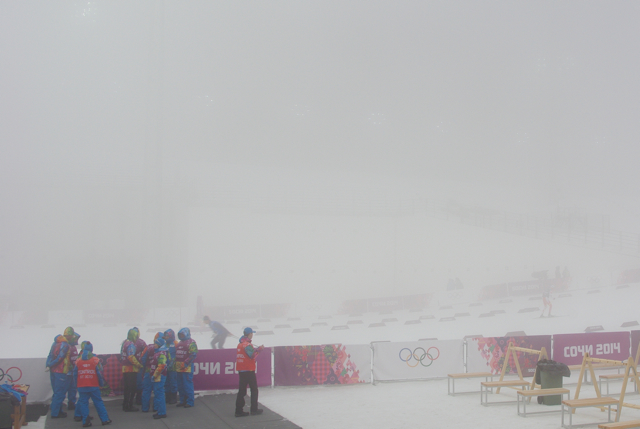
    Athletes warming up on course during the weather delay on Sunday, before the race was eventually postponed to the next day.
    Athletes warming up on course during the weather delay on Sunday, before the race was eventually postponed to the next day.

    That caused even more chaos among biathlon teams. All of the competitions so far have been between 6 and 7 p.m., and to adjust to the strange schedule many athletes have been staying up late and sleeping in very late as well – staying on central European time so that their bodies don’t recognize that they’re actually giving a hard effort when they should be eating dinner.

    A 10 a.m. start was highly problematic given that strategy. Athletes would have to be on the range to begin zeroing their rifles at 9 a.m., a time when they had still been sleeping on some of the previous days.

    “For sure, there was a lot of laughing in the dining hall that night by all the nations,” Eisenbichler said. “I think every team had tried to stay on European time. They were laughing about how early they would have to get up in the morning.”

    Come Monday morning, however, the fog was still sitting tight. It was clear that a competition could not be held, but athletes, coaches, media, and spectators all waited for an official re-scheduling until long after the race was supposed to have gone off.

    “Don’t thank me for having to get up at 7 a.m. for nothing!” French star Martin Fourcade, who has already won two gold medals at the Games, tweeted (in French).

    Eisenbichler said that his two athletes, Burke and Bailey, had woken up, eaten breakfast, and prepared for the race. They were on the way to the venue when the team got word that the race would not happen at 10, even if the eventual start time was still unclear, so the guys turned around and went home.

    “They were in a good mood and not too stressed,” Eisenbichler said.

    Burke was joking about the change in schedule.

    “Hurry up and wait. The race is again delayed because of fog. Back to bed for me!” he tweeted.
    A volunteer walks through the biathlon stadium on Monday morning. The stands, which should be in the background, are not visible at all. Spectators would be able to see neither the shooting range nor even the video screens through the fog.
    A volunteer walks through the biathlon stadium on Monday morning. The stands, which should be in the background, are not visible at all. Spectators would be able to see neither the shooting range nor even the video screens through the fog.

    That is in sharp contrast to the race officials themselves. The problem? Delaying an Olympic event is not an easy feat, especially when it comes to the men’s mass start, a prestigious and exciting competition which draws huge ratings here in Russia as well as on television in Europe.

    First, organizers have to contend with not only conditions on the range and the 7 p.m. start of the women’s mass start the same night. Thousands of fans have tickets for the race – many had showed up on Monday morning despite the weather – but even if athletes could see the range, spectators would be out of luck. With fog this thick, the shooting range is not visible from the stands. Spectators wouldn’t even be able to discern the giant video screens which broadcast both shooting and what is happening out on course.

    Officials also must work around the schedules of rights-holding broadcasters and the Olympic Broadcast Service itself, which has to somehow slot the race in among its previously scheduled coverage. The jury meeting began around 8:30 a.m. this morning but the announcement was not made until 11 a.m., highlighting how compex the decision-making process has become.

    It’s not the first time that biathlon has faced weather problems at the Olympics. In Vancouver, a snowstorm rolled in partway through the men’s sprint, making conditions highly variable between early and late starters. Four years later in hindsight, the consensus is that the race probably should have been called off.

    And there would have been a precedent. In Nagano in 1998, the men’s sprint was canceled partway through, when Ole Einar Bjørndalen of Norway – then just 24 years old! – had finished and was in the lead. The race was rescheduled for the next day and Bjørndalen won again. It was the first gold of his career; in the sprint here in Sochi, he won his seventh.

    At 11 a.m. local time – an hour after the race should have started – it was announced that 3:30 p.m. would be go time, although fog still cloaked the stadium. A French coach said that he doubted the race would happen at all today.

    (UPDATE: at 2:15 p.m. local time, the 3:30 race was called off and postponed until Tuesday. A decision will be made at 4 p.m. regarding the women’s mass start, originally scheduled for 7 p.m. tonight.)

    The Americans, however, remain unconcerned. Eisenbichler said that he believes his team is well-prepared for the uncertainty, as they are used to dealing with jetlag, lots of travel, and all of the ensuing scheduling snafus that issue from being based in North America and never racing at home. They are used to being ready for anything, which Eisenbichler believes is in contrast to the European teams who have more of a base during the World Cup season.

    “It’s all about attitude and approach,” Eisenbichler said. “They were totally positive about it.”
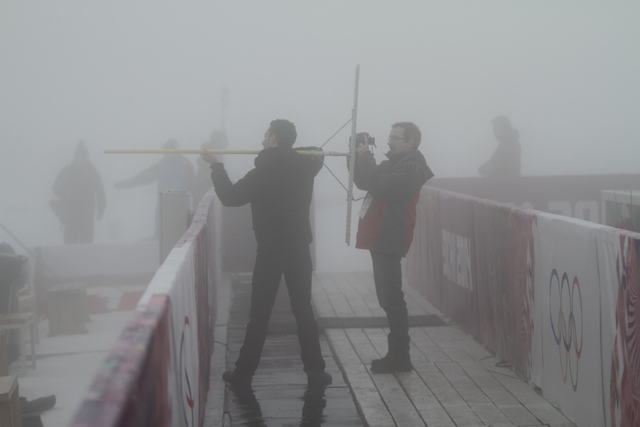
    Journalists pose for pictures of what it might be like to try to shoot on the range, grabbing a snow rake - heavily used to smooth out the slushy snow so far this week - as a prop.
    Journalists pose for pictures of what it might be like to try to shoot on the range, grabbing a snow rake – heavily used to smooth out the slushy snow so far this week – as a prop.
  • Russians On Top Again in Oberhof; Career Weekend for Malyshko, Who Vainquishes Svendsen Again

    Russians On Top Again in Oberhof; Career Weekend for Malyshko, Who Vainquishes Svendsen Again

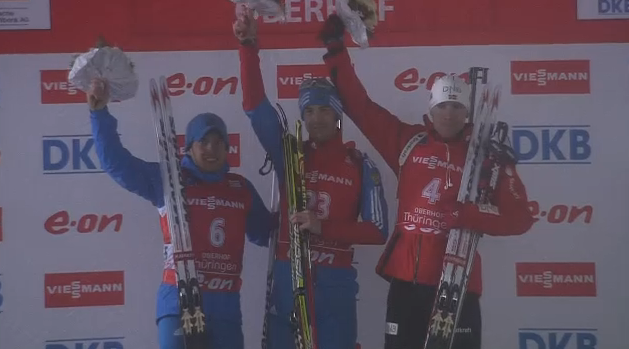
    Emil Hegle Svensen of Norway (right), whose sights are set on the overall World Cup title, had every reason not to grin on the foggy Oberhof podium, after being bested by the Russians for the second day in a row. Dmitry Malyshko (center) won the 10 k sprint and Evgeniy Garanichev (left) took second.

    For the second day in a row, the Russians knocked Emil Hegle Svendsen down from the top of the podium.

    In Friday’s relay, the Norwegian had a slight lead going at the start of the fourth leg, but missed several shots in the standing stage and could never quite catch Dmitry Malyshko, who had passed him on the range. He was crestfallen at the finish.

    Today, Svendsen was the fourth starter in the 10 k sprint and got off to a good beginning, cleaning the prone stage. After collecting one penalty in standing, Svendsen turned on the afterburners; he knew that others would potentially clean the race, and he had to ski faster than they could complete a penalty loop. In fact, he had the fastest last-loop time of the day.

    But Svendsen was only in the lead for about a minute, because Evgeniy Garanichev, the second-leg racer in Russia’s relay yesterday, had started two bibs back and chased hard the whole time. Also collecting one penalty, Garanichev skied a bit slower but was faster on the range and crossed the line with a time just half a second faster than Svendsen’s.

    “I had good control in the first shooting,” Svendsen told Norwegian broadcaster NRK. “But in standing, it was a rough penalty. It was just bad luck that I missed there.”

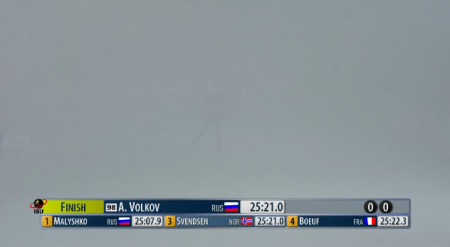
    Oberhof fog: do you see Alexei Volkov? He’s just seven seconds from crossing the finish line…

    Less than ten minutes later, Malyshko himself crossed the line and bumped both athletes down a notch. He also had one penalty, but skied the fastest time of the day. It’s been a good weekend for the 25-year-old Russian, who had never before won a World Cup, not even in a relay. Now he has won two.

    “Yesterday was a special day because I was fighting with Emil—I gave a lot more than I thought I had because it was for the team,” Malyshko said in the press conference. “It is better to win on your own, but it is even better to win with the team.”

    And that happened today, even though it was an individual race. Evgeniy Ustyugov, who hadn’t been part of the relay, placed fifth, and scramble leg racer Alexei Volkov was sixth despite starting all the way back in bib 98.

    “Our team atmosphere is very good,” Garanichev said in the press conference. “We support each other and have a lot of fun together… and The wax techs have been a big part of our success in these conditions. There is a lot of feedback and communication between us; they have prepared some excellent skis this week.”


    While Svendsen didn’t get the win, he did move up in his quest to unseat Martin Fourcade of France in the World Cup overall race. Fourcade was uncharacteristicall slow on his skis, placing 16th despite just two penalties, not a complete disaster on the range by any means; in the past he has won sprints with that score. Svendsen now trails by 62 points. A win is worth 60.

    “Sometimes Martin has bad races and so do I, but I will do my very best to win the World Cup,” Svendsen said in the press conference. “Today was the first time that I really gained any points. I will give my best until the end… it is important to me.”

    Just in front of Ustyugov and Volkov, Alexis Boeuf of France placed fourth. He was the only one of the top five finishers to shoot clean, and with bib nine, was chasing Svendsen and Garanichev. He just wasn’t able to ski quite fast enough, finishing 1.3 seconds behind the Norwegian.

    Fredrik Lindström of Sweden, the very first starter, was the fastest after one shooting stage but then missed two shots in standing. He skied the second-best time of the day and placed seventh. Julian Eberhard of Austria, who started the season on the second-tier IBU Cup, had his best World Cup performance to date and placed eighth.

    For the U.S., it was a disappointing day compared to the team’s success in the relay. Tim Burke placed 26th, Leif Nordgren 36th, and Lowell Bailey 51st; they’ll have a shot at improving in Sunday’s pursuit. Russell Currier just missed out on that opportunity, placing 64th with four penalties.

    Canada’s two starters, Québecois buddied Jean Philippe Le Guellec and Marc-André Bédard, placed 55th and 57th.

    Also of note, it was the first individual race back for three star athletes who couldn’t compete during the first trimester

    2011 World Cup overall champion Tarjei Bø of Norway had been sick for almost six months with a bacterial infection, TWAR, that commonly causes pneumonia. He placed 25th with one penalty. Svendsen told NRK that his teammate was “terribly nervous” before the start, but Bø said that at the same time he had “never felt less pressure.”

    Simon Fourcade of France had compartment syndrome surgery on December fourth. That was quick. He wanted to wait until the spring, but decided he was in too much pain and plans to be back at full force for World Championships in February. The runner up in the World Championships individual race last season, Fourcade placed 30th with two penalties.

    – And, Czech racer Jaroslav Soukup is rejoining the circuit this weekend as well. He had a horrific biking accident over the summer that required multiple surgeries. The bronze medalist in that same World Championships race, Soukup placed 49th in Oberhof despite four penalties.

    Results