From the FasterSkier archive — posts syndicated from athletes’ and coaches’ own blogs between 2004 and 2012, kept online as published. Current coverage is at fasterskier.com.
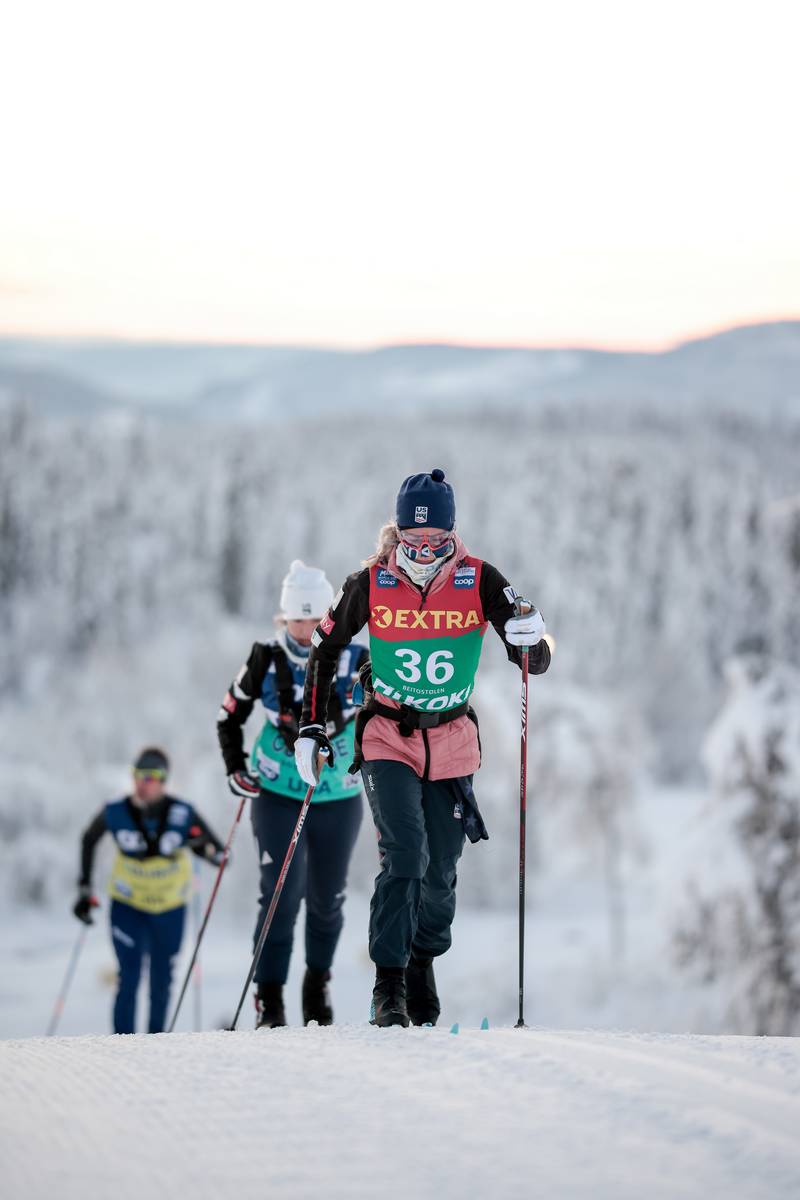
Annika Martell racing during the NENSA club relays, Saturday, March 28, 2026 at Craftsbury. (Photo: Phil Belena)
The Craftsbury Green Racing Project has named Annika Martell as its new Head Ski Coach.
Martell brings a resume that spans nearly every corner of the Nordic skiing world. A Minnesota native, she headed east to ski at Colby College, where she captained the team and earned recognition for her leadership before graduating with a degree in economics and environmental science.
Her coaching career has taken a similarly wide path. Early on, she interned with the US Biathlon Association and coached juniors at Ford Sayre and the Berkshire Nordic Ski Club, before moving into elite-level work as an assistant coach with the Stratton Mountain School T2 Team. She spent four years as an assistant coach at Williams College, during which time she completed two stints as a Trail to Gold Fellow with the US Ski Team and served twice on the wax staff for Team New England at Junior Nationals.
Most recently, Martell was the Head Nordic Coach at St. Michael’s College, where she guided the program to highly competitive results.
Her background extends well beyond the ski tracks. She is a certified weightlifting coach and handled strength and conditioning duties at Williams. She also has experience in finance and operations management, and holds a Master’s degree in Sports Business from Drexel University.
The Craftbury Green Racing Project is still accepting athlete applications for the incoming 2026 snow class — Apply Here
Martell follows Jessie Diggins on course in Beitostolen in 2022. (Photo: Nordic Focus)
Finals week has a way of compressing time. Days shrink into problem sets and exams; nights stretch just long enough to make sleep negotiable. When Jack Lange logged onto Zoom from Hanover in late November, he was finishing his senior fall at Dartmouth, a mechanical engineering major balancing equations while packing for a training block at Silver Star. The snow out west wasn’t cooperating. Races were being reformatted. Nothing felt settled.
That uncertainty didn’t seem to bother him much.
“We’re wrapping up school right now and then heading to Silver Star next Tuesday,” Lange said. “Hopefully, the snow conditions there improve a little bit.”
It was a measured answer—calm, almost deliberately so. Over the next hour, that calm would reveal itself not as indifference, but as something learned the hard way.
Young Jack Lange skiing in a New England BKL race. (Photo: Heidi Lange)
A kid who wasn’t supposed to be good at this
Lange grew up in Vermont’s Upper Valley, skiing out of Green Woodlands and the Ford Sayre Bill Koch League. It was the kind of childhood that feels almost mythic now: full-moon skis to a cabin, hot chocolate on a frozen pond, friends everywhere.
“I’ve always just made sure that that’s the thing that comes first,” he said. “Getting outside and enjoying being outside and enjoying pushing myself and having fun.”
He played everything. Soccer, where he was very aware he wasn’t the best. Swimming, where he gravitated toward breaststroke. Cross-country running. Mountain biking. For a while, he did both alpine and Nordic skiing, until a choice had to be made.
“My sister was doing more Nordic and more of my friends were on the Nordic,” he said. “So I just went with Nordic.”
Lange and friends meeting Jessie Diggins and Sophie Caldwell Hamilton at the Quebec World Cup. (Photo: Heidi Lange)
It wasn’t a natural fit at first. Lange remembers being the odd kid out on relay day—the one paired with a skier from another team because the numbers didn’t work.
“I wasn’t good at it,” he said simply.
What hooked him wasn’t speed. It was curiosity.
“I really like the amount that you can learn from being out in training,” he said. “Not even structured training—just being outside and having fun. I really enjoy the process of figuring out how hard I can push myself.”
By freshman year of high school, something shifted. He trained more. He paid attention. And suddenly the results were better than expected.
“That was kind of the confidence boost that launched me into, like, ‘Oh, this is something I can do.’”
2019 Junior National Championships in Alaska. Lange finished in fifth place with Dartmouth teammate Wally Magill in first. (Photo: Heidi Lange)
The pressure builds—and breaks
Lange’s junior years were uneven. Seasons were disrupted. Races were canceled. One winter meant nine consecutive weekends racing at Craftsbury, all interval starts—an exercise in patience for someone who loved head-to-head competition.
“I love mass starts,” he said. “I love racing next to people. Mind games and competitiveness.”
By his senior year, he had narrowed his focus to Junior Nationals. The goal was simple: qualify. Nothing more.
When he arrived at the 2019 Junior National Championships in Alaska, he was the last skier to qualify from New England. He started near the back in the 5-kilometer skate race at Kincaid Park.
“My goal for the entire season was to make JN’s,” he said. “And I was there, and I was like, I’m in Alaska. This is kind of crazy.”
Mid-race, a coach called out a split.
“One of the New England coaches is like, ‘You’re like three seconds out of top ten,’” Lange recalled. “And I was like, that’s pretty funny.”
He kept skiing. He finished fifth.
“That was way, way beyond where I ever could have expected to be.”
There’s a photo from that day—Lange among a group of skiers who would later become familiar names on the U.S. Ski Team. At the time, it felt surreal. In hindsight, it was clear it wasn’t the performance itself that mattered most, but the conditions under which it happened: no expectations, no fear.
That lesson wouldn’t fully sink in until later.
Lange with his parents, Heidi and Greg. (Photo: courtesy photo)
Dartmouth, and the weight of wanting it too much
Lange chose Dartmouth largely because it felt right. He wanted engineering. He liked the people. He trusted the coach.
“Brayton [Osgood] is such an amazing coach to work with,” Lange said. “He’s never the guy to show up and be like, ‘This is what you’re doing.’ He’s super approachable. He really wants us to find our spot in the sport.”
At Dartmouth, skiing wasn’t isolated from the rest of life—it was embedded within it. That integration became most visible during the most stressful week of the year: NCAAs, which overlap directly with finals.
“My freshman year, that finals week with NCAAs was kind of a dark time,” Lange said. “I was close to tears on the start line of the 20k race. Just so much pressure, so overwhelmed.”
He remembers warming up briefly, then stopping.
“I skied like fifteen minutes in the warm-up and just put my skis down,” he said. “I was completely broken.”
A kilometer into the race, he was in dead last.
And then something shifted.
“I saw Brayton on the side of the trail,” Lange said. “And I was like, you know—I don’t need to take this so seriously. I can show up, do my best at everything, and give 100 percent effort. If I do that, it’s gonna come through.”
It did. That race became one of his best of the season.
Dartmouth Ski Team (Photo: courtesy photo)
The things that make it lighter
The story of Dartmouth skiing is often told through tradition—green suits, first-years with mohawks, time trials. Lange points to different details.
There’s a sauna in the locker room.
“That’s a prime spot to get to know the team,” he said. “We rip this on all the time.”
There’s also life beyond skiing. Every non-freshman on the men’s team is in a fraternity. Lange lives in the Zeta Psi house with teammates and classmates—engineers, computer scientists, people whose lives orbit entirely different centers.
“I’m surrounded by a ton of people who have no clue what skiing means to me,” he said. “And that’s been a really huge part of being at Dartmouth.”
His best season, he said, came immediately after pledging.
“It taught me how to not put as much pressure on myself,” Lange said. “How to make this a sustainable thing that I could really enjoy.”
That balance—academic, athletic, social—isn’t accidental.
“None of the three would be as good without the others,” he said.
Lange’s favorite race: Prospect relay with Cam Wolfe and Cooper Camp. (Photo: Heidi Lange)
“You can’t live nervous”
Lange keeps a training log. He trains consistently. He admits he’s overcooked himself before. What he doesn’t do is chase numbers obsessively.
“I don’t think I’ve ever had an hour’s target that I’m trying to hit,” he said. “I’ve just trained for the enjoyment of it.”
There was a time, early on, when outside voices crept in.
“I was getting a lot of people saying, ‘You’re training too much. You’re doing this wrong,’” he said. “I got a little worked up about it and a little nervous.”
He paused.
“You can’t live nervous.”
It’s the line that keeps resurfacing, whether he’s talking about high school racing, college pressure, or the future beyond Dartmouth.
“I think anyone who’s in high school, middle school—just go out there because you enjoy it,” he said. “You’re gonna have crappy days. But if you go out there every day and just have a good time, and surround yourself with people you like to be around, things will work out.”
That philosophy shapes how he defines success now. Lange talks about team first. About racing in a green suit. About showing up energized.
“The guys here are here for the right reasons,” he said. “They’re skiing because they really enjoy skiing. That’s super energizing.”
Lange with his long time coach and mentor, Dennis Donahue. (Photo: Heidi Lange)
A quiet kind of confidence
Ask Lange where he sees himself years down the road, and he doesn’t reach for outcomes. He talks about process.
“The process of showing up every day,” he said. “How can I be the best athlete I can be today? That’s the most rewarding thing.”
Skiing, he believes, has taught him how to live—how to work, how to recover, how to stay curious.
“Wherever I am fifteen years from now,” he said, “all of the lessons that I’ve learned are still going to be extremely relevant and important.”
For now, there are finals to finish and skis to pack. The snow will either come or it won’t. The races will sort themselves out.
Lange will keep doing what he’s learned to do best: show up, stay loose, and ski without fear.
Because speed, he’s learned, is hard to find when you’re holding your breath.
Love Stories Like This? Help Keep Them Coming.
Feature stories like this one take time, access, and care to produce. If you value thoughtful storytelling and independent ski journalism, please consider becoming a Voluntary Subscriber. Your support directly fuels the work we do to cover the people, places, and moments that make our sport special.
Ford Sayre, a growing ski club that supports nearly 300 Nordic skiers in the Upper Valley of New Hampshire and Vermont, is seeking a full-time head coach to provide leadership and coaching continuity across the club’s cross-country skiing programs (Youth, Juniors, Masters). The head coach will have primary coaching responsibility for the club’s high school (U16/U18/U20) age group.
Ford Sayre Memorial Ski Council is a 501(c3) established in 1950 to promote the sport of skiing in the Upper Valley. The Nordic Club has historically been run by a dedicated group of part-time coaches and volunteers. This new full-time position, reporting to the Ford Sayre Nordic Committee, creates an opportunity for the right individual to engage and leverage this group while establishing a unified, consistent coaching approach across the club’s offerings. Ford Sayre Nordic primarily skis at Oak Hill in Hanover, NH, the ski venue of Dartmouth College. The club includes members from a number of area towns and schools.
Lead a team to oversee the delivery of quality coaching to each of Ford Sayre’s program offerings and to develop new and/or expanded offerings. Currently the program has three main components: Youth (Kindergarten through 8th grade; approximately 225 skiers and 55 volunteer coaches), JNT (Competitive High School Program; 14-20 skiers and 3-5 coaches), and Masters (50 registered skiers).
Assume direct coaching responsibility of the JNT program
Develop annual, period-based training plans for use by athletes and run training sessions throughout the year
Demonstrate a strong knowledge of the physiological, technical, emotional and mental demands of Nordic skiing and the ability to incorporate this knowledge into individualized training planning, execution and assessment
Run at least one summer and one fall training camp for club and out-of-town athletes
Coordinate the plans and provisions for the team’s requirements for out-of-town competitions including transportation, accommodation, wax and equipment, and race entries
Management
Train and recruit coaches to ensure that the club has sufficient high-quality coaching resources for each of its programs
Work closely with Ford Sayre volunteers and two Ford Sayre employees (administrative and IT staff) to administer day-to-day operations of the club
Plan and implement several dryland and on-snow coaching clinics
Coordinate coaching plans with lead coaches of Youth and Masters programs to ensure Ford Sayre is providing a consistent experience across the spectrum of its programs
During the offseason, develop an annual plan for each of the programs in collaboration with lead coaches and supported by members of the Ford Sayre Nordic Committee. This plan will include the development of a draft budget
Communication
Keep the club’s various constituencies informed with regular verbal and written communications. Constituencies include athletes, coaches, the Ford Sayre Nordic Committee, non-coach volunteers, parents, and the local ski community
In all communications within and outside the club, represent the club in a positive and professional manner
Implementing Vision & Strategic Direction
The full-time coach will collaborate with the Ford Sayre Nordic Committee to set the strategic direction of the overall program and implement programming in accordance with Ford Sayre Nordic’s Guiding Principles.
Skills & Qualifications
Demonstrated ability to create a positive, athlete-centered, team experience working with a dynamic group of part-time coaches, volunteers, Nordic Committee members, and community members
Demonstrated leadership skills and the ability to lead and motivate athletes, coaches, and volunteers
Exceptional planning, organizational, and communication skills
USSS (or equivalent) coaching certification
Extensive knowledge and passion for Nordic skiing and ski racing
High level of ski waxing knowledge and proficiency
This is a full-time exempt, salaried position. Compensation range of $35,000-$45,000 annually based on experience with room for growth, with contribution toward healthcare benefits.
Caldwell racing in Sweden last winter in the Scandinavian Cup series. Courtesy photo.
(Note: This is the fourth in a series of interviews with athletes who will be competing at the first-ever winter Youth Olympic Games in Innsbruck, Austria this winter. The first interview was with Sean Doherty, the second with Anna Kubek, the third with Nick Proell, and the fourth with Aleksandra Zakrzewska, all U.S. biathletes. The last was with Danielle Vrielink, a Canadian biathlete.)
As the one of the youngest members of a famous family, Paddy Caldwell has had a lot to live up to.
First of all, there’s the Olympic tradition: his grandfather John competed in the 1952 Games, and his father Tim competed in four more. When Caldwell was selected as America’s sole male nordic skier for the Youth Olympic Games in Innsbruck, Austria in January, he took a big step toward continuing a family habit.
But on a day-to-day basis, things aren’t any easier for the young phenom. The Caldwells of his generation haven’t left much room for slacking, with cousin Sophie named Ski Racing’s 2009 Junior Nordic Skier of the Year; she was a three-time member of the World Junior team, while her sister Isabel has made the trip once. Caldwell’s older sister Heidi abandoned a promising ski career to run at Brown University, and last weekend she finished All-Ivy at Heptagonal Championships in cross-country.
And then there is the academic heritage. John, Tim, Sophie, Isabel, and now Austin Caldwell all attended or are currently enrolled at Dartmouth College. Caldwell’s mother went to Harvard. His oldest sister, Lucy, graduated from Cornell. Caldwell comes from a family of smart cookies.
You might think that all of these expectations would make a young man a bit uptight, but not Caldwell. Growing up in Lyme, New Hampshire, he joined the Ford Sayre Ski Club, where his obvious love of skiing was infectious and coaches said that he was a great friend, mentor, and role model for other athletes.
“He has been a lot of fun to work with because he takes it seriously but has fun at the same time,” said his uncle Sverre, the head coach at the Stratton Mountain School.
Last year Caldwell left Ford Sayre to join the Stratton program. Although he had notched standout results with Ford Sayre, including a junior national championship as a J2, Caldwell took racing to another level at Stratton.
In 2011 he raced inconsistently but seemed to always pop a big race where it counted. As a first-year J1, he finished ninth overall in the 10 k junior skate at US Nationals and secured a spot on the Scandinavian Cup squad. Then in Sweden he finished eighth in the 10 k skate, just over 30 seconds out of the win.
Besides being speedy, Caldwell also quickly integrated himself into the more lighthearted aspects of Stratton’s culture; he starred in one of the Revived Films B-Rolls this summer.
“Paddy was plenty fast before he came to SMS last year,” Sverre Caldwell told FasterSkier. “He is now training quite a bit more year round, and that should help long term, but he has been fast for several years. He is a hard worker; he pays attention to detail and takes care of himself. He is naturally quite strong and he loves the sport and competition. I think that as long as he continues to enjoy the process and work hard, he will do really well.”
There’s no reason to think that Paddy can’t do just that in Innsbruck this winter. FasterSkier talked to the soon-to-be Youth Olympian over e-mail to see how preparations were coming.
FasterSkier: You have a pretty famous last name in the ski world. Could you tell us a little bit about how you got into skiing as a kid?
Paddy Caldwell: Skiing has been part of my life for as long as I can remember. I have skied with my family in Mount Saint Anne since I was five years old. At first I did both alpine and cross country skiing, but never competed in either until I was in fifth grade.
FS: When did you get serious about racing?
Caldwell at the start of the 2010 Silver Fox Trot in Hanover, NH. Photo: Midge Eliassen.
PC: I first raced at the Bill Koch League Festival when I was in fifth grade. The fun and excitement of this event motivated me to attend more competitions. After that I wanted to get faster and to race as much as I could.
FS: You didn’t make the decision to go to Stratton Mountain School until partway through high school; what made you decide to switch clubs, and how easy or difficult was that choice?
PC: Being a part of the Stratton Mountain School team has been amazing. I am really happy to be there. I saw SMS as an opportunity to attend more races and to work with a larger team. Making the choice to switch schools and ski programs, however, was really difficult for me. Skiing with Ford Sayre was amazing, but it was hard missing weeks of school at a time for races. At Stratton we are able to work individually with teachers before and after competitions in order to stay on top of our studies.
FS: The decision seems to have paid off as you had a pretty stellar season last year. Could you talk about some of the highlights?
PC: Placing eighth in Sweden was a big highlight for me. Being a part of the J1 Trip was an awesome experience. I also had some good races at Junior Nationals, placing fifth in both the sprint and individual start races.
FS: Did your eighth-place finish in Sweden surprise you?
PC: That was a really cool experience because I went into the race without any knowledge of my competitors from other countries. I wasn’t really thinking much about results that day. I remember coming into the stadium to start my second lap and hearing over the loud speaker that I was in the top ten. After that I just went for it.
FS: What did you learn from that first major international competition that will help you at the Youth Olympic Games?
PC: I learned that every fraction of a second counts when racing in such deep fields.
FS: Has it changed your approach to the season to know that you will be on this trip, rather than having to focus on racing well to qualify, and then peaking a second time?
PC: Knowing that I have already qualified for the YOG is great because now I can just think about my performance at the competitions. But my approach to this season is the same, there are lots of races later in the winter and every race is important.
FS: There’s only one other American nordic skier going to Innsbruck, and it’s your Stratton teammate Heather Mooney! Do you think it will give you any sort of a boost to have your teammate be someone you already know so well?
PC: Definitely. It will be awesome to travel with a close friend and teammate. Another big bonus is that Sverre will be our head coach for the trip.
FS: What are you looking forward to most about the Games?
PC: I am really excited to see Innsbruck and the Olympic village. I am also looking forward to meeting skiers and other athletes from around the world!
(As full journalistic disclosure, I participated in the Ford Sayre Norway trips in 2003 and 2006. However, I have interviewed multiple other trip participants as well as the coaches to make sure that my interpretation of what’s going on isn’t biased.)
The junior team got to appreciate this scene at the 2010 Holmenkollen 50K. Photo: Greg DeFrancis.
Last month, a group of high school students from New England had the chance of a lifetime: to travel to Norway in time for the biggest and most culturally iconic ski races of the season. While the athletes of the Ford Sayre junior nordic team, based out of Hanover, NH, competed in several races, a large goal of the trip is to expose junior athletes to a culture where skiing is what everyone does, and to a country that is on the whole very different than the U.S. It was an eye-opening and awe-inspiring experience for the skiers, and if the results of past trips are any indication, it might change their approach to skiing forever.
Beginnings
While a small number of clubs have the resources to run trips to Europe, the majority seem to be focused on racing, making the culture focus of Ford Sayre’s trips fairly unique.
Dennis Donahue helped found the Ford Sayre nordic team in the early 90’s, and Scottie Eliassen stepped in as head coach in 1995. After helping run trips to Junior Olympics for several seasons, they had the idea to take skiers to Norway. At the time, there was no Scando Cup trip, so even the highest-level juniors were rarely getting to Europe. In New England, the first JO qualifiers weren’t being held until January, and the season was done by the first weekend in March. One of the ideas behind the trip was to extend the ski season for the athletes, and give them some time to really enjoy skiing after the race season was over (and this is still to some extent the case; in 2010, most of the team had already competed at New England J2 Championships and had no more races on the radar). Because of their experience running JO trips, the logistics of such an endeavor were not intimidating to Eliassen and Donahue.
The first trip was run in 2000. That year, the club partnered with the Holderness School and took a large group of skiers. In 2003, skiers from Gould Academy, Proctor Academy, and the Saint Paul’s School participated. The trip has also been run in 2006 and 2010, with a group solely consisting of Ford Sayre skiers and alumnae.
Since the trip is run every three or four years, the goal is to give skiers in the program a chance to go once during their high school years. It’s not an experience you get to enjoy every year, but rather something you look forward to. Eliassen and Donahue believe that this leads participants to really make the most out of the trip, rather than taking the opportunity for granted.
Oslo and Drammen
The first few days are spent in Oslo. While the itinerary varies, the group usually has the chance to watch some high-level racing: the World Cup sprints in Drammen and/or the 30k/50k and nordic combined races at Holmekollen. In 2003, the group watched a special national J2 championship event at Holmenkollen. They also tour the ski museum there, walk around the city and check out other landmarks.
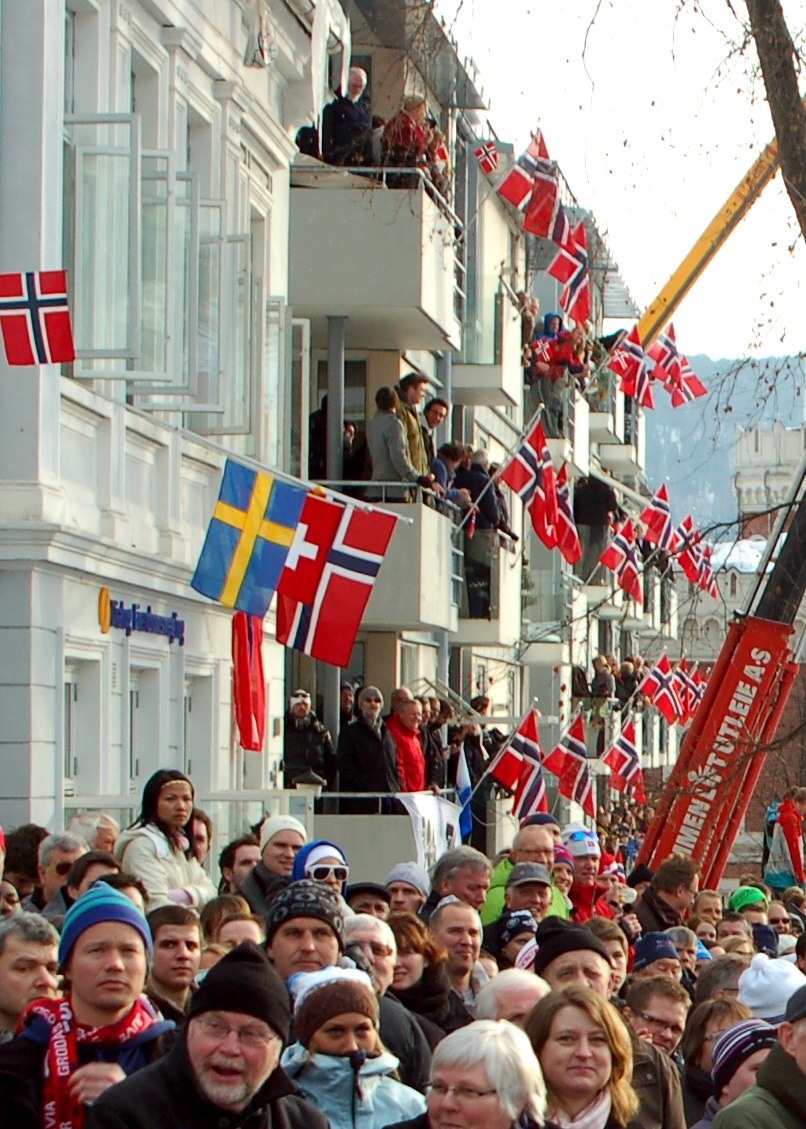
Spectators line the street and hang out of windows at the 2010 Drammen WC sprint. Photo: Greg DeFrancis.
Watching the World Cup races is a highlight of the trip for many athletes. Says Isaiah St. Pierre, a J1 from Charleston, NH, “My favorite part had to be the Drammen Sprint. It just worked out so perfectly to arrive in Norway and the first thing we do is go watch Andy Newell get a podium finish at a World Cup.”
In 2006, the skiers had a chance to meet Sarah Konrad after she competed in the Holmenkollen 30k. It was an unusual opportunity for junior racers, most of whose horizons were no broader than a possible shot at JO’s, to talk about what it’s like to race in a place where skiing is highly valued. Konrad was clearly exhausted after the race, which also might have taught the juniors something about the rigor of World Cup racing.
The Holmenkollen race is an experience in itself, and the athletes got a taste of what it might be like to race in a country that values skiing. Said Rosalie Lipfert, a Ford Sayre alum who is now a freshman at Dartmouth, “Norwegians young and old, fit and out-of shape, come to watch these races…their entertainment for the weekend. Many camp out the night before, build igloos and campfires, and drink lots of beer. Watching a World Cup race is a party. Thousands of people line the sides of the trail, even when getting there means skiing 5k up hill.”
Ford Sayre skiers try to match the Scandinavian cheering squads. Holmenkollen, 2006. Photo: Dennis Donahue.
This year, the team trained with Bærums-Verk club outside of Oslo. The connection was made when a Norwegian epidemiologist came to work for a few months at the Norris Cotton Cancer Center, where Donahue provides computer support. The Norwegian researcher happened to live next to one of the parents of a junior athlete at the club; when Donahue got in touch, they were invited to ski and eat dinner with the junior team.
The differences between the two clubs were drastic. Bærums-Verk was proud to say that they had a junior national champion on their team (Ford Sayre skier Paddy Caldwell won a race at JO’s while the rest of the team was in Norway). The Norwegian team trained together every day, often twice. Due to the combination of high school and club racing in the U.S., the Ford Sayre club only trains together 2-3 times per week, and only races together every couple of weekends. And finally, the Norwegian club team consisted of a few very fast boys and no girls – so inevitably, Ford Sayre’s J2 girls were out of luck.
The Ford Sayre skiers were excited and nervous to ski with their Norwegian counterparts. In St. Pierre’s words, “Originally I expected everyone to be wicked fast, so that a ‘mediocre’ Norwegian would basically be considered world class by most any other country’s standards. When we got to ski with the Baerems-Verk Club, that was almost met.”
And Rosalie Lipfert, a Ford Sayre alum who is now a freshman at Dartmouth , said “I just tried not to embarrass myself too much in front of the coach.”
The Norwegians were excited, too; one boy told his mother that he couldn’t go into the highlands to the family cabin with his father because he wanted to “see the Americans and eat pizza.” The Norwegians led the jet-lagged Americans on a ski out to a beautiful lookout point, then suggested they play some games and have a relay in the stadium. Voila, everyone skiing together. And yes, everyone enjoyed the pizza, too.
Lillehammer
From there the trip moves to Lillehammer, home of the 1994 Olympics. Skiers get to test out a number of different trail systems: the Olympic trails in Lillehammer proper, the Birkebeiner trail in Sjusjøen, and touring trails in the surrounding countryside. They also go on a tour of the Swix factory, sometimes the NTG (Norges Toppidrettsgymnas/College of Elite Sport), and the Olympic ski jumps, as well as walking around the town.
The long ski tour outside of Sjusjøen is always a highlight. Two of these 2006 trip participants now ski in college. Photo: Scottie Eliassen.
Because the majority of the trip is spent in Lillehammer, the skiers get to settle in. I remember browsing at ski shops, where it seemed like there were at least three times as many brands as in the U.S. for most soft goods. We also went to the town library, with its giant statue of the warriors carrying baby King Haakon to safety, to check e-mail.
Almost all of the cooking and shopping is done by the skiers. Walking through a Norwegian supermarket is a lesson in itself. For one thing, almost everything is more expensive, especially meat, and the vegetable selection is more limited. But St. Pierre took away something else, too: “While in the US an athlete might be used to advertise a sports drink or maybe even a car, Norwegian skiers are used to advertise everything from banks to milk and bread.”
Petter Northug graces the front of a bread bag. Photo: Greg DeFrancis.
It’s interesting for skiers to think about the reality of being a ski star in Europe. If you ski fast, you can be famous, wealthy, the whole nine yards; you might be set for life. For talented skiers, even at a young age, decisions are guided by this reality, and athletes might make some different choices than the Ford Sayre athletes would even consider; seeing Northug on a bread bag and Bjørgen on a milk carton taught trip participants something.
One of the main events of the Lillehammer stay, both athletically and culturally, is the Birkebeiner. Each year, a few of the older skiers participate in the long race (there is an age minimum: 16). In 2003 and 2006, the younger skiers competed in the Ungdomsbirken or Youth Birkie, which runs from Sjusjøen to Lillehammer, before returning to some point along the trail to watch the marathon.
Much like at Holmenkollen, the skiers were part of a rowdy spectator base unlike any you would see in the U.S. Unlike the Holmenkollen, however, this time they had a chance to watch Norwegians (and others) from all walks of life compete, 14,000 to be exact. If the whole trip is an essay on how a culture embraces skiing, then surely the Birkebeiner is the statement of its thesis.
Lipfert describes the marathon this way: “I was living in a state of awe the entire day. As we drove into Lillehammer for our 6 a.m. bus ride to the start, hundreds of people were walking from every direction, skis and poles in hand. The bus ride was a true Norwegian experience as well: everyone brought out their meat-and-hearty-bread sandwich.”
St. Pierre racing in the 2010 Birkebeiner. Photo: Greg DeFrancis.
She continued, “We were all in wave 19. This meant that the wave in front of us was the last seeded wave, the slowest people who have skied the Birkie before. I was surrounded by masters with flawless technique, but who were racing just for fun…this was the highlight of their year!”
I raced the Birkebeiner in 2006. There are two things I would say from the experience. The first is that the race is harder than almost any marathon you’ll ever do – Lipfert described it as “brutal” – with the long uphill start over the mountains. And secondly, I had no idea, then, how lucky I was to get to that race. Since then, I’ve many times wished that I had another shot, a chance to race it now that I have a few more marathons under my belt, now that I might be able to really race it. But it turns out getting to the Birkebeiner is no small task. For junior skiers to have the opportunity to do so, well, it’s incredible.
Club Races
On most of the trips, the Ford Sayre athletes have competed in local club races. More so than when practicing with a club team or racing the Birkie, it’s a chance to see how you stack up against Norwegians. Granted, they aren’t the fastest of the Norwegians, but still, it’s a chance. At each race, the team has been warmly welcomed. Race organizers have talked about how their Wednesday-night race series is special this week because it’s the first time there have been Americans, or handed out small Norwegian flags to each of the Ford Sayre racers to say thank you for coming. It’s heartening to see American skiing embraced in this way.
Sometimes, the Ford Sayre kids get dusted. But sometimes, they are right in there. Either way, there is an opportunity to learn from the competition – particularly with regard to classic skiing. Says Jennie Brentrup, a Ford Sayre alum who participated in the 2006 trip, “The race we did showed me how superior [the Norwegians] are even at a young age. They were able to ski with such grace and power, fully exploding from one ski to the next and gliding twice as far. It was an amazing learning experience to hop in behind them and try and mimic their technique. It showed me that Americans are doing some things right, but we still have a lot to learn.”
Ford Sayre's Dylan Grald (now racing at Middlebury) in the mix in a 2006 club race. Photo: Dennis Donahue.
After skiing with the Bærums-Verk club, where the skiers “were just like wicked fast and didn’t seem to be working hard at all,” St. Pierre had a more heartening experience at a local night race. “It really turned my opinion around. Being able to ski right in the mix of the Norwegians made it apparent that they were completely human.”
In addition, the team competed in a pursuit race this year. While pursuits are a staple in international competition and championship events, there hasn’t been one in New England in years, and most of the athletes had never tried one. It was like killing two birds with one stone to get to race against the Norwegians and also familiarize the skiers with a new race format.
Lasting Effects
While the trip is plenty of fun, the whole point is to give the Ford Sayre racers a broader perspective on skiing. Eliassen hopes that spending time in a culture where being active is important “gives credibility to what the skiers do in the club program – they are no longer the ones who are different from their friends in high school,” and their hard work is validated.
Across the board, the Ford Sayre athletes have said the trip changed their perspective about skiing. For St. Pierre, who is still in high school, it simply motivated him for next season. “From this trip I have more confidence for the coming seasons. I now know that I’m capable of skiing with Norwegians, of skiing 54km, and that the training I do with Ford Sayre is similar to how Norwegian juniors train.” He knows that what he is doing is right, and that he has more to accomplish with skiing.
Looking back, Brentrup says that the trip confirmed her desire to ski in college, and helped her make it through the first few months of adjusting to a new team. “I knew that I wanted to continue skiing when I got to college, but going to Norway really solidified that for me because I saw how dedication and hard work could pay off. Being in a country where skiing is such an important part of their lifestyle and getting to watch skiers compete at the World Cups was truly inspiring and influenced me to continue to pursue racing at a high level. When I first got to college, I remember thinking maybe skiing wasn’t for me as I tried to adjust to all of the changes but I remembered the feeling I had in Norway and stuck with it.”
And for Lipfert, the trip changed her perspective on what it means to be an American skier. “I’ve been to Europe many times and this was the first time I was okay with being an American. Even a loud, obnoxious American cheering for Andy Newell. When Andy came in third at the Drammen Sprints and stood on the podium with a Norwegian and a Swede, I felt like we were showing the Norwegians how there actually are legitimate American skiers out there. I was proud to be associated with this accomplishment. I’ve never come close to wearing a U.S. suit and racing internationally, and would be surprised if I ever did, but after this trip I felt like maybe I did represent the U.S. in a small, symbolic way.”
Some of the Ford Sayre program alumnae who are still racing (with Donahue, left, and Eliassen, right); all these skiers went on either the 2003 or 2006 Norway trip. Photo: Greg DeFrancis.