From the FasterSkier archive — posts syndicated from athletes’ and coaches’ own blogs between 2004 and 2012, kept online as published. Current coverage is at fasterskier.com.
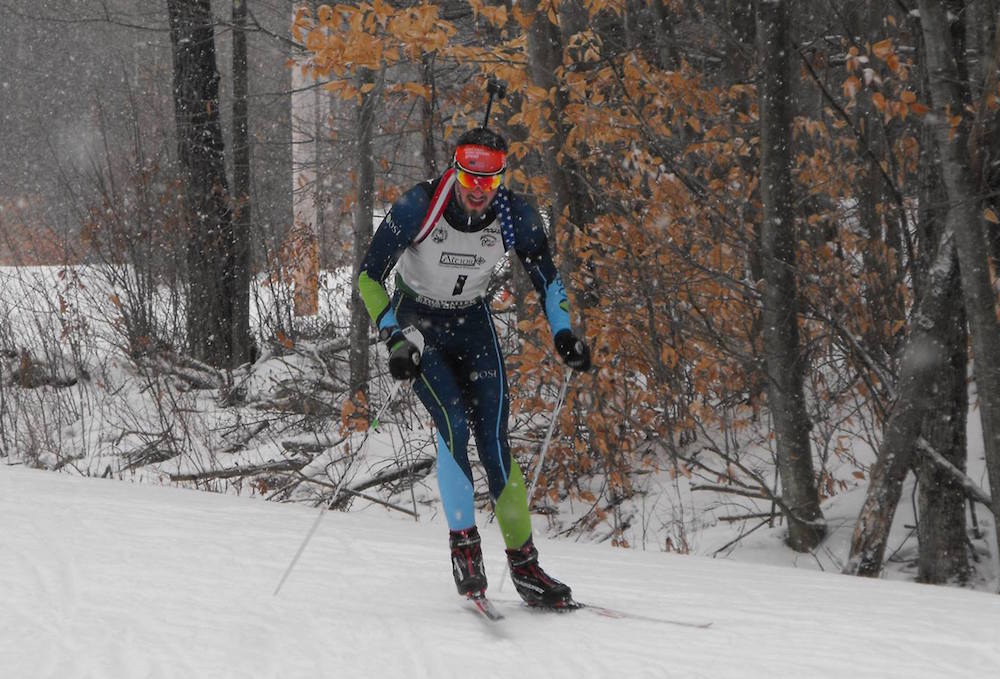
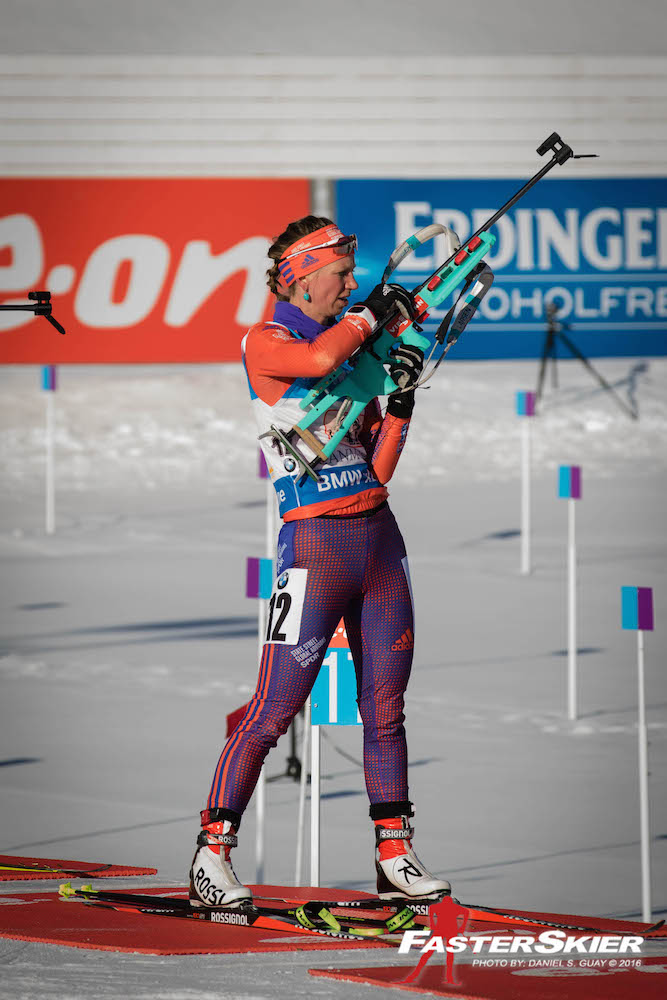
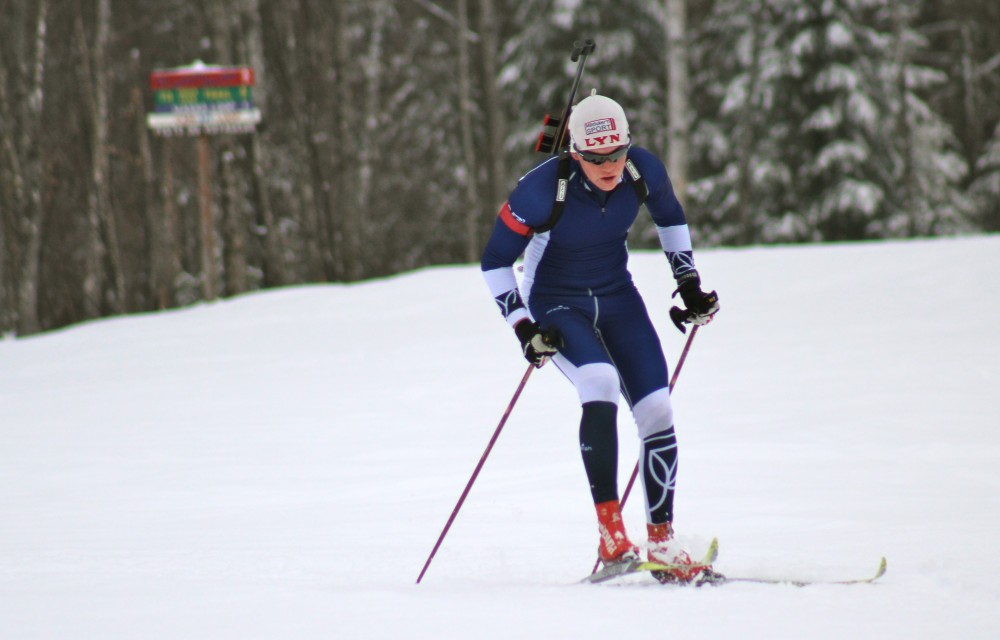
Cody Johnson (OSI) racing at the U.S. team trials for 2017 IBU Youth/Junior World Championships in late December 2016 in Jericho, Vt. (Courtesy photo)
In another 20-something-question, fill-in-the-blanks series, we checked in with the world-class U.S. and Canadian biathletes that will be competing at 2017 International Biathlon Union (IBU) Youth & Junior World Championships Feb. 22-28 in Osrblie (also known as Brezno-Osrblie), Slovakia.
Here’s 19-year-old Cody Johnson, of the Outdoor Sports Institute, who will be representing the U.S. at his second Junior Worlds. On Thursday, Johnson was the top American in 50th in the junior men’s 15 k individual.
***
“My full name is Cody Johnson. I was born in Connecticut, raised in Fort Kent, Maine, and one thing you should know about my hometown is I have a world cup facility 10 mins from where I live that I train at every day.
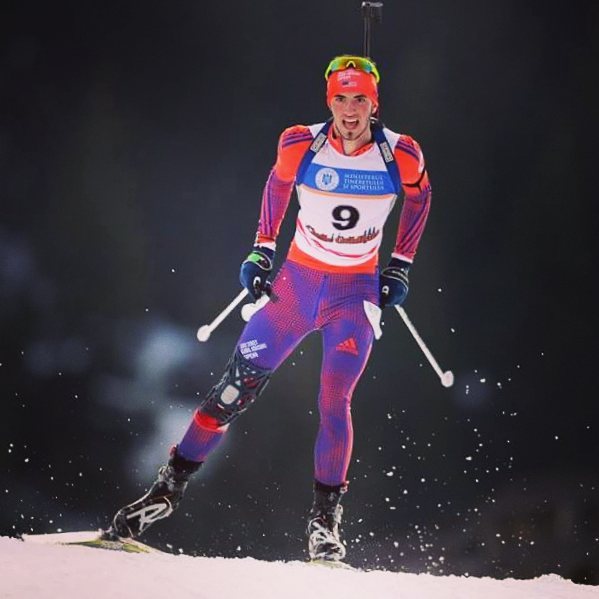
American Cody Johnson racing at 2016 IBU Youth World Championships in Romania. (Courtesy photo)
I started cross-country skiing when I was 9 and started biathlon when I was 10, thanks to Gary Colliander. I currently train in Fort Kent with OSI (Outdoor Sports Institute).
If I’m not skiing, you might find me hunting. If I had to pick a favorite book, it would be ‘Flow‘.
One of the things I’m most excited about for Youth/Junior World Championships in Brezno-Osrblie is racing.
This will be my second Youth/Junior World Championships, and this year, I’m competing as a junior. One race I’m especially targeting there is the individual.
The best advice anyone ever gave me about skiing or racing was ‘have fun’. Thanks Susan Dunklee.
One of the best race memories I have is U.S Team Trials in Alaska when I won the pursuit.
If I could meet one World Cup skier, it would be Simon Eder.
If I don’t end up being a professional skier, I’ll probably be a hunting guide.
I’m missing zero days of school to be here. I am graduated and doing a gap year program with OSI.
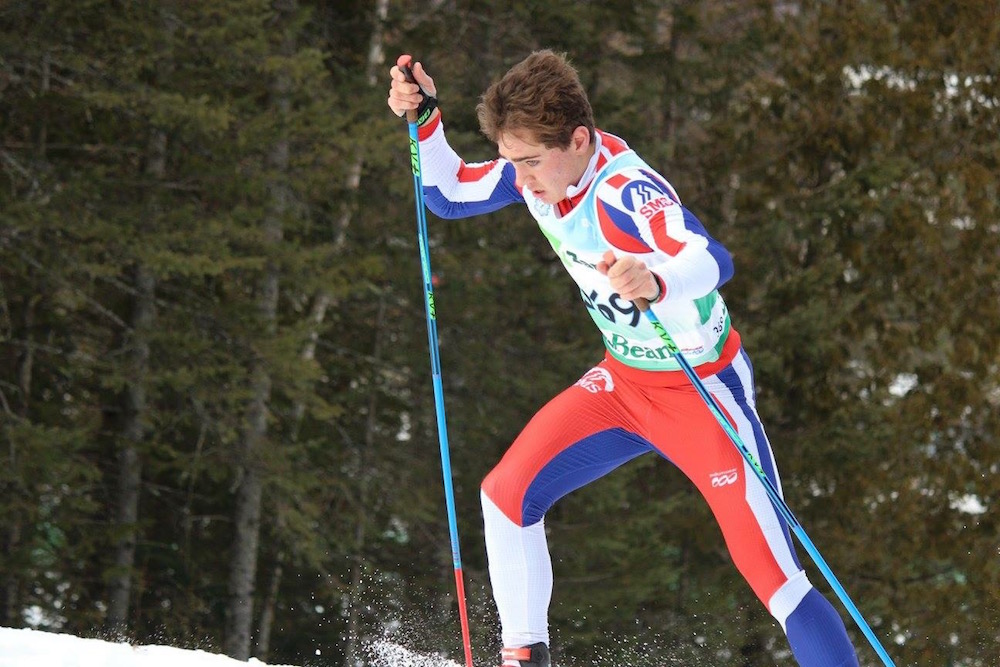
Kam Husain, of the Stratton Mountain School, racing at U.S. SuperTour Spring Series last season in Craftsbury, Vt. (Photo: NENSA/Facebook)
In an effort to showcase the North Americans competing at this week’s International Ski Federation (FIS) 2017 USANA Nordic Junior World Championships and U23 Cross Country World Championships at Soldier Hollow in Midway, Utah, we asked those qualifying athletes several questions about themselves — actually, we had them fill in the blanks. Here we have 19-year-old Kam Husain, of the Stratton Mountain School, who’s representing the U.S. at his first Junior Worlds.
***
“My full name is Kamran Husain, but you can call me Kam. I was born in Leonardtown, Md., raised in Fort Kent, Maine, and one thing you should know about my hometown is we grow lots of potatoes.
I started cross-country skiing when I was six, thanks to MWSC [Maine Winter Sports Center]. I currently train in Stratton, Vt., with SMS [Stratton Mountain School].
If I’m not skiing, you might find me rewatching ‘Game of Thrones’. If I had to pick a favorite book, it would be ‘Outliers‘.
One of the things I’m most excited about for Junior Worlds at Soldier Hollow is racing a skiathlon. One race I’m especially targeting there is the classic sprint.
The best advice anyone ever gave me about skiing or racing was to pace myself. One of the best race memories I have is winning the NENSA J2 Fest.
If I could meet one World Cup skier, it would be Katharine Ogden.
If I don’t end up being a professional skier, I’ll probably be somewhere a little warmer.
I’m missing zero days of school to be here; I’m taking a gap year.
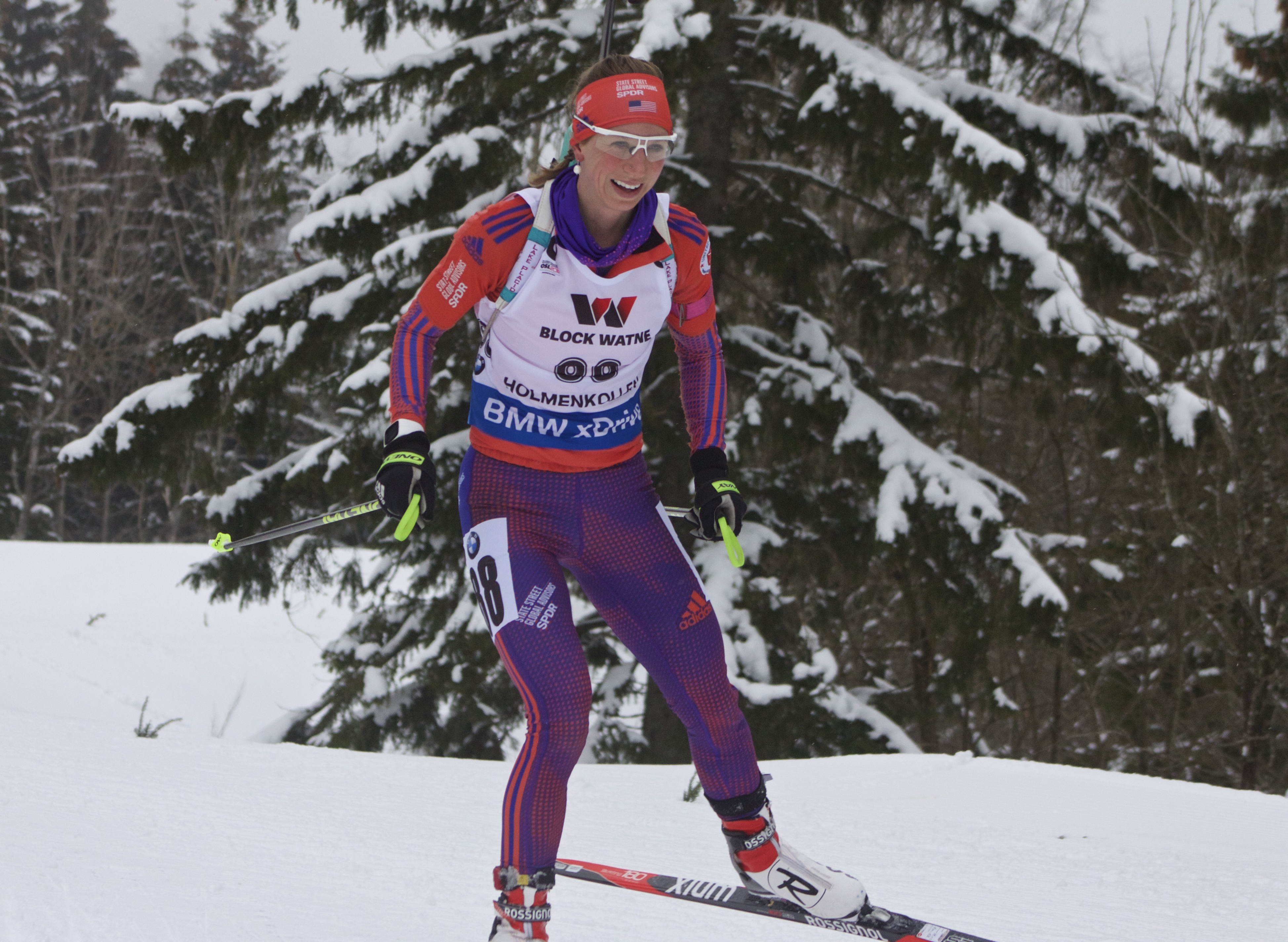
Annelies Cook of the United States on course in the women’s 4 x 6 k relay at 2016 World Championships in Oslo, Norway. (Photo: JoJo Baldus)
The U.S. National Championships/NorAm Championships series didn’t exactly start off badly for Annelies Cook, but it didn’t start off well in Fort Kent, Maine, either.
“Between colds and sleep deprivation, we were all in survival mode but trying to have fun with it,” she wrote of the national team at the first race, a sprint, on Thursday. “The sprint was better than I thought it would be skiing wise, but I missed 4 [targets, out of ten], so that didn’t help.”
Those misses put her back in fourth place, almost two minutes behind teammate Clare Egan. With Egan also shooting well in Friday’s pursuit, making it to the front of the field seemed more or less impossible.
But then Saturday rolled around: a 12.5 k mass start competition, and the very last race of Cook’s career as a professional biathlete. The Saranac Lake native is set to retire at the end of this season.
With the sun and snow and festive end-of-the-year atmosphere, Cook was able to enjoy herself while also racing her hardest.
“Yesterday was a beautiful sunny day with great skiing and we just wanted to have fun,” she wrote in an email on Sunday. “We dogged it the first loop so that everyone could come in shooting together, which was fun and then after that the race started.”
Cook missed only two shots, both in her first standing stage, for 90% shooting overall. That tied her for the best shooting of the day and allowed her to hold off a challenge from Joanne Reid of the Auburn Ski Club and Colorado Biathlon.
Annelies Cook (US Biathlon) during one of her two standing stages in the single mixed relay at the IBU World Cup in Canmore, Alberta. She teamed up with Leif Nordgren to place 16th. (Photo: Daniel S. Guay)
Reid had four penalties, two apiece in each of the standing stages.
“It was my best shooting of the year in a 4-stage race, ironically, and that was good because I knew that Joanne was skiing a lot faster than me so my only hope was in the range,” Cook explained. “I only beat her because we came into the last standing together and I cleaned and she missed two, so I was thankful for that! I didn’t have much fight in me other than to make it around the course.”
She made it, earning a 22-second victory to win the national title in her last start ever.
Sisters Emily and Hannah Dreissigacker took third and fourth, +1:16 and +2:25 with two and four penalties, respectively. Hannah Dreissigacker is also retiring. Egan took fifth, +3:07 with seven penalties.
Cook said that she had been mulling retirement for over a year, but arriving in Oslo everything clicked into place: it was time.
“I don’t think it actually felt real until this week,” she said at the time. “I had been saying to people, ‘I think I’m going to retire, I might retire,’ for a long time. But when I got here it was like, yup, I’m going to retire. This is going to be it.”
Cook has been doing biathlon since she was 13 years old. Back in 2002 she made her first trip to World Junior Championships and finished in the top 20 in every race.
After a stint doing biathlon full-time at the Maine Winter Sports Center and racing on the junior and European Cup circuits, Cook enrolled at the University of Utah in 2006, where she raced for the cross-country ski team and earned NCAA All-American honors in 2009. One of several World Cup biathletes to have taken a detour through the college skiing system, and credited it with enabling her to stay in the sport long-term.
“It was a very much needed break,” she told FasterSkier in 2012. “[But] when I went into college, I told myself, I really want to go back into biathlon when I’m done here.”
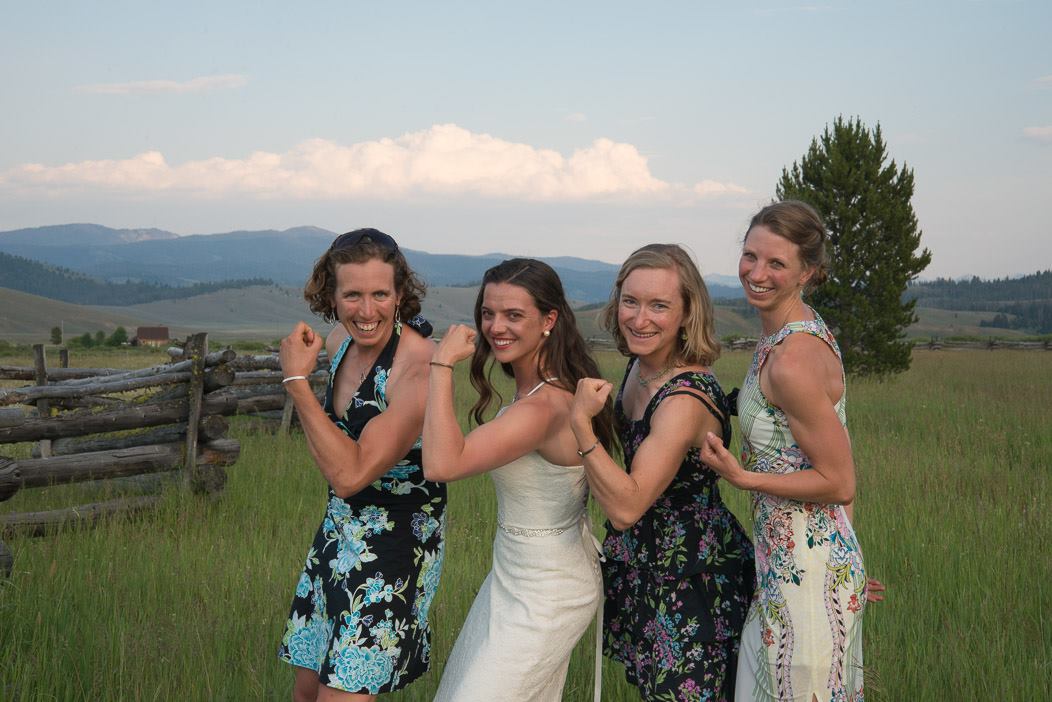
The women of the 2014 Olympic team are a close-knit group. Sara Studebaker (second from l) married Zach Hall in mid July and celebrated with friends and former US Biathlon teammates Susan Dunklee (l), Hannah Dreissigacker (second from r), and Annelies Cook (r) in Stanley, Idaho. (Photo: Sara Studebaker/Facebook)
After graduating, she was immediately invited onto the biathlon national team, but floundered during the transition back into being a full-time athlete. After a year of supporting herself, she raced her way onto the World Cup and has been a national team staple ever since; in 2012 she also renewed her partnership with the Maine Winter Sports Center.
“It has been a really amazing adventure,” Cook said in Oslo. “Biathlon is just such a crazy sport. There have been so many high points and so many really low points. I don’t think there’s a sport like it that makes you feel so much. Such a wide range of emotions.”
A 2014 Olympian, Cook had her best World Cup results in 2013, when she hit the top 20 on three different occasions.
“I’ve loved it so much,” she said. “I love training with my team, and I love racing, and I love my wax techs who always cheer me up if I’m sad. There’s so many good people. That’s why I’ve done it. I haven’t done it because I’m a World Champion athlete, or because I love living out of a suitcase. It’s because I love the people so much. It’s going to be really hard to say goodbye to everyone.”
The women’s team has been particularly close-knit during that time, which adds to the difficulty of those goodbyes.
“We’ve grown up together,” Cook said. I think about what we were like- I mean, I did this when I was 19 and just figuring out how to start being an adult… we’ve just all gotten more mature. We’ve turned into better people I think. We’ve all had our moments of being little shits, and we’ve all learned how to be nicer, better people together. I’m really proud of the people I’ve gotten to work with. That’s what’s really cool about our team: it’s a really genuine group of people.”
That includes not only her teammates, but the myriad others who work with the team.
“The wax techs are always there to take care of us and I am so lucky to have Jonne [Kahkonen] as a coach,” Cook wrote in a later email. “As such a small team, we are incredibly well organized thanks to the outstanding efforts of Bernd Eisenbichler and Max Cobb.”
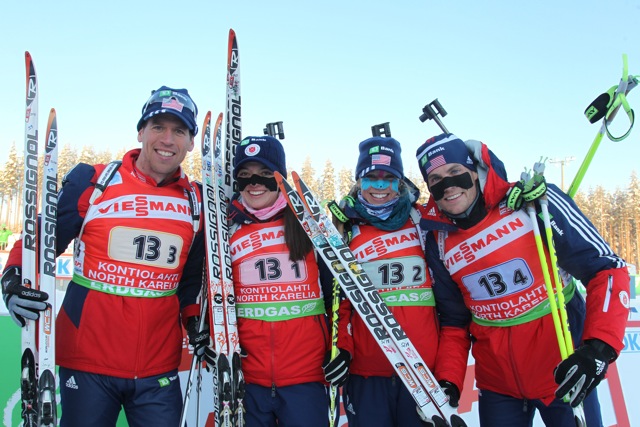
Jay Hakkinen, Sara Studebaker, Annelies Cook, and Tim Burke pose after their sixth-place World Cup mixed relay result in Kontiolahti, Finland, in 2012. (Photo: NordicFocus/USBA.)
Cook is not sure exactly what she’ll do next – “life!” she exclaimed – but her biathlon friends will never be far. That’s particularly true of Tim Burke and Lowell Bailey, who are also from the Lake Placid area and have been longtime teammates of Cook’s through many career stages.
Bailey told FasterSkier in Oslo that he hadn’t yet decided whether to retire or not, but that a decision would be made this spring. Burke will stay in the game.
“I’m going to have fun watching them on TV,” Cook laughed. “We’re close, and we have family history. We’re from the same place. My relationship with them will always be there, with or without biathlon. We’ll probably see each other more when we’re not doing biathlon together. Like, ‘hey, come over for dinner!’ And I can babysit their kids for them.
The women’s team, too, she says will be just fine without her – evidenced in part by strong performances by newcomers Reid and Emily Dreissigacker at the NorAm Championships.
As she cheers for more American success from the comfort of her home, Cook also says that biathlon will never be far.
“I don’t think I could ever really leave biathlon 100 percent,” she said. “It’s just too much a part of me. I did my first biathlon camp when I was 13 ½ years old. It’s more than half of my life that I’ve been involved in biathlon. So I just want to say thank you to everybody, and see you around.”
* * *
In the men’s 15 k mass start, it was Burke who took top honors. With just a single missed shot over the four shooting stages, he claimed a huge win: a minute and 28 seconds over the closest competitor, national team teammate Sean Doherty.
Leif Nordgren was third, +1:41, and Bailey – who had won both the sprint and pursuit – finished fourth, +1:54. Hometown favorite Russell Currier rounded out the top five, +2:54.
In the junior men’s field, Brian Halligan of the Maine Winter Sports Center won with four penalties, one in each stage; in the junior women’s field, MWSC athlete Hannah Streinz beat Caitlin Campbell of Prince Edward Island, Canada, by 52 seconds.
Lucas Boudreau of Prince Edward Island took the youth men’s race by 18 seconds over Matthew Forshey of the Hudson United Race Team.
In the youth women’s race, Chloe Levins of Mountain Top Nordic bested Eliza Thomas of Mansfield Nordic by 2:57.
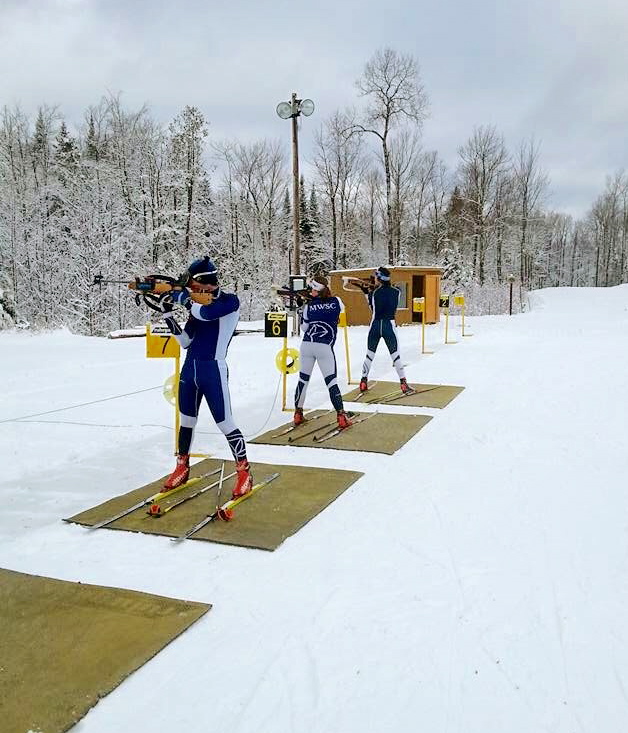
Maine Winter Sports Center (MWSC) biathlete Brendan Cyr finishes his second round of prone shooting during a late-December workout at the Fort Kent Outdoor Center in Fort Kent, Maine.
Before the USA Youth and Junior Biathlon World Championship Team Trials kicked off this week (Dec. 27-30) in Anchorage, Alaska, FasterSkier caught up with the Maine Winter Sports Center (MWSC) biathlon program for a workout to help prepare athletes for the heat of the competition season. The workout can be done once or twice per training cycle and may be easily adapted into a cross-country workout.*
FORT KENT, Maine — What could be better than a rugged set of intervals with Northern Maine’s finest. How about a rugged set of intervals with a rifle?
Though not everyone can handle shooting with a simultaneously high heart rate, Seth Hubbard, biathlon director and head biathlon at the Maine Winter Sport Center (MWSC), said a head-to-head shooting workout is essential for biathletes looking to improve both their skiing and shooting.
“What we’re trying to do is recreate the pressure of coming into the range of a competition with other racers around,” Hubbard said on the phone.
Left to right: MWSC biathletes Brendan Cyr, Mikaela Paluszek and Russell Currier shoot during a head-to-head workout in late December at the Fort Kent Outdoor Center in Fort Kent, Maine. (Courtesy photo)
In order to mimic the high stakes and stress of a race, the workout itself involves a 4 x 1-kilometer mass start, with shooting and 150-meter penalty laps to follow each 1 k interval loop.
“What it does is it puts a lot of pressure on shooting well. You want to shoot fast, but you also want to hit your targets because the penalty loops, in comparison to the 1 k loops, are a pretty large percentage of the [workout],” Hubbard pointed out.
The shorter-distance interval loops allow athletes to push the pace without overexerting themselves too much prior to upcoming competitions, while also providing a practice scenario for shooting with a high heart rate and high pressure.
“This is a workout we use as we get closer to competitions to mimic race efforts and race stress level,” said Hubbard, “It is also something we’ll use periodically throughout the year just to stay in touch with that stress of a shooting competition.”
Brendan Cyr of Caibou, Maine, currently a post-graduate biathlete at the MWSC who plans to attend St. Lawrence University next fall, said the workout strengthened his preparation for the Youth and Junior World Championships trials taking place this week in Anchorage.
“I like the workout because I get to practice shooting with a very elevated heart rate,” Cyr said during an in-person interview. “The head-to-head racing is also great preparation for competitions because [my teammates and I] generally hit the mats at the same time and have the added pressure of shooting with other athletes around.”
Current MWSC biathletes in the program, in addition to Cyr, include Brian Halligan, Cody Johnson, Hannah Streinz, Mikaela Paluszek, Maddie Phaneuf, and elite athlete, Russell Currier.
Brendan Cyr (MWSC) rounds the stadium of the Fort Kent Outdoor during a workout in late December in Fort Kent, Maine.
With a smaller team compared to previous years, Hubbard looks to expand the breadth of their program, as well as its depth.
“We don’t just want to push to get numbers if they’re not going to be the people who are going to mesh well with the program and mesh well with the area,” Hubbard said.
He added that the MWSC program continues to seek dedicated athletes willing to grow individually and athletically in the hillocks of northern Maine.
“Whether or not they’re going to be the next Olympian, we want to draw in and develop more mature athletes. Mature in the sense that they’ve developed — as an athlete and an individual — a better understanding of planning, process, commitment, and goal setting, whether those are in life or skiing.”
The Workout: Head-to-Head Shooting
Warmup: 20-25 minutes easy Level 1 skate skiing
Intervals: 4 x 1 k mass start with shooting and 150-meter penalty laps after each 1 k interval (depending on the amount of targets missed). Skiing should be continuous.
– Shooting format is prone, prone, standing, standing
– 1 k interval effort/pace should be race pace or just above race pace. “You’re trying to get race intensity experience — something that’s going to be a very challenging intensity to be shooting at,” Hubbard explained.
*Cross-country adaptation: Instead of shooting in between each 1 k interval, take approximately two minutes of rest before beginning the next interval piece.
Maine Winter Sports Center (MWSC) biathletes working on uphill pace identification in Fort Kent, Maine. (Photo: Seth Hubbard)
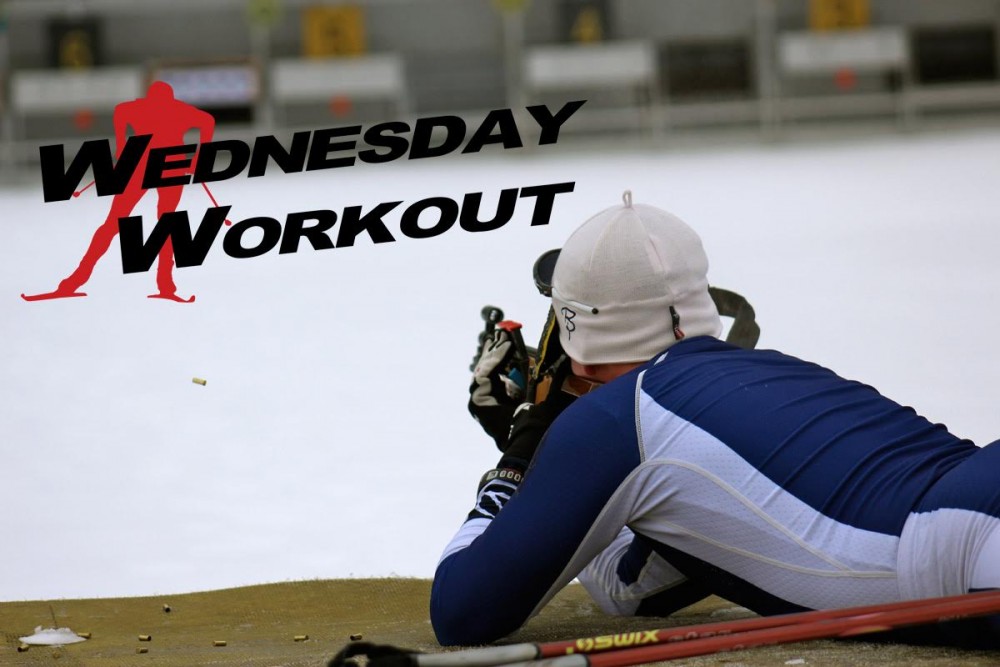
Welcome to Wednesday Workout, where we round up training ideas on a weekly basis. This week Will Sweetser, competitive programs director of the Maine Winter Sports Center, explains how to identify your personal race pace using his Reality Race Pace Progression rollerski workout.
***
Like most clubs around the country, our focus here in northern Maine is on youth and junior skier development. We want, first and foremost, to help the next generation of skiers earn spots on college teams, international trips, and the U.S. Biathlon and U.S. Ski Teams.
While it is quite common for us to hear junior racers vocalize their dreams of representing the red, white and blue, it is equally common to see the same racers destroy any hopes of doing so, through poor pace identification in race after race. The start timer counts down and kid after kid across Maine throws caution to the wind and hammers out of the gate at Level “Go!”.
Over the course of my time here in Aroostook County, I’ve steadily refined a workout aimed specifically at curing this lack of pace sense. I call it: Reality Race Pace Progression. This workout is aimed at identifying one’s 10 kilometer race pace. The beauty of the system is that it gives athletes a tremendous amount of worthwhile feedback.
The concept is simple, and shamelessly stolen from track and field sessions practiced in Africa. All that is required is a lightly traveled stretch of road at least 500 meters long. Athletes should warm up as though it is race day — this is a great way to fine-tune race day prep.
MWSC post-graduate Emily Ramsey (57) racing in the 2012 U.S. Ski Association (USSA) SuperTour at Bohart Ranch near Bozeman, Montana. (Photo: Will Sweetser)
After warm up:
• 1 kilometer time trial at maximum effort.
• 15-20 minutes easy recovery skiing at Level 1.
• 7-12 x 1 kilometer (over the same course as the time trial) at 15-20 percent slower than time trial pace. 2-3 minutes moving recovery between intervals.
• Cool down 15-20 minutes.
The time trial helps identify one’s current performance level. As I said earlier, it’s easy to set a goal of making a team, but most younger athletes do not have any idea of how fast they actually need to ski to do so. With the advent of improved grooming, snow making and sizably better waxing knowledge, most races throughout the year are relatively comparable in terms of per-kilometer times.
Frequently, I’ve had athletes realize that their current sprint pace is not yet fast enough to compete in 10 k races on the New England Nordic Ski Association (NENSA) circuit. Even more often, I’ve had athletes show up and realize after the time trial that they just aren’t ready for the workout. Time trial times just don’t lie!
The repeats, themselves, are aimed specifically at pace averages taken directly from a 10 year sample of International Ski Federation (FIS) sprint and distance races held at the same venue, in the same technique, in stable weather.
All-around European racers averaged 18-percent slower per-kilometer over 10-15 k than they did in sprints. Distance specialists averaged 12-percent slower. Women tended to keep the gap a bit closer at around 15-percent (likely due to the generally shorter race distances for women and relatively longer early race times for women’s sprints). Interestingly, U.S. racers averaged 22-percent slower across the board in distance races versus sprints.
Most athletes will claim immediately that the pace for the repeats is far too slow. It is important to keep the recovery times no longer than equal to repeat time. It’s also critical to emphasize that the goal of the workout is to get through enough repeats to accurately reflect race distance. If the athlete can only get through four repeats, he/she has done it wrong! Remember, these are Reality Race Pace Progression pieces. If the athlete can’t perform 10 repeats at the same pace, it’s not 10 k pace.
With a little bit of research, athletes go into the workout with a goal per-kilometer time in mind. They immediately get feedback from the time trial, and then with each repeat. Athletes can readily identify where they’ve lost or gained time by repeating the same course. Especially with juniors or inexperienced racers, coaches will see athletes able to repeat their time trial time or even improve it through 7, 8, or even 10 repeats. This typically indicates either the need for technique development or an inadequate warm-up.
At MWSC, we use our rollerski loops (paved ski trails at Nordic Heritage Center, 10th Mountain Ski Center) for these workouts. Since we’ve got an established loop, we don’t always use the time trial, especially if we’re repeating this workout within a week of the last time. As many athletes find this workout a bit of a mental strain, we don’t often use it more than 2-3 times per month during the fall. But, for those few times we repeat this workout, we see some fantastic results.
A small selection of the 19 miles of cable used to televise the World Cup biathlon races in Fort Kent.
If you want to know about how biathlon travels from the trails onto television, the first thing you need to know about is cable.
In Fort Kent, the site of Maine’s second biathlon World Cup in as many weeks, the stuff is everywhere.
It’s mostly black, but also orange, blue, white, red, green, and yellow. It snakes along the sides of the trails, hangs neatly coiled from racks, and explodes into massive, spaghetti-like snarls when it reaches the television compound, at the top of a steep hill overlooking the stadium here.
There’s some 19 miles of it in all, connecting 33 cameras to the two trailers used to produce the coverage. The longest run was 4,800 feet—“through conduits, culverts, underneath roads,” according to Rob Heinz, a utility technician in charge of the set-up.
From the feed of races, it’s tough to see the kind of work it takes to produce the television broadcast. Even on site, at the venue, it’s still hard to tell—by the time the races go off, the cables and cameras are hidden, the producers and technical staff blending into a swarm of volunteers.
But in fact, capturing the competitions and beaming them back across the Atlantic to Europe is a massive undertaking—one that demands more than 100 trained workers, including 54 who flew from here from Germany.
Heinz, a gruff, bulky, mohawked New Yorker, is a member of the crew brought in by Kent Gordis Productions, the firm contracted to televise the two biathlon World Cup weekends in northern Maine—the circuit’s first trip to the U.S. in seven years.
It takes a trained eye to distinguish the crew members from volunteers, in the hive of the stadium. For the most part, they move about unobtrusively. But look closely, and you can pick them out—they’re a little bigger, sport sweatshirts rather than Patagonia or North Face jackets, and are the only people on site who would dare light up a cigarette.
Yeah, it’s TV, but it’s not glamorous work—all that cable has to get carried, strung, and labeled by somebody.
The trail heading up from Fort Kent's stadium to the TV production headquarters.
“We build it all, and then we troubleshoot,” Heinz said. “Whatever they tell us to do, as long as the check clears.”
Biathlon may be small potatoes in the U.S., where the only way to see the sport is on the internet. But in Europe, it’s huge: nearly six million Germans watched a single broadcast of last week’s races in Presque Isle.
Work at the two Maine venues began all the way back on January 27th, when crew members for Gordis arrived.
They came with two production trucks rented from a Florida company—$12 million behemoths with top-of-the-line audio and video equipment—along with all that cable, and a massive, house-sized generator to power it all.
Between Fort Kent and Presque Isle, there was 150,000 feet of cable in total—a quantity that is essentially unprecedented, Heinz said, except for maybe the Super Bowl.
“Nothing even approaches this kind of numbers,” he said.
In fact, one of the main reasons that the Florida company, F+F Productions, got the contract to supply the equipment for the biathlon races was because they already owned so much cable–which they acquired by pulling it out of last year’s Olympic venues in Vancouver.
Rob Heinz.
“That’s how they got this gig,” said Dave Crosson, who’s on site as one of two technical managers overseeing production for Gordis.
Because Germany is wild about biathlon, there are actually two separate television feeds that are broadcast from northern Maine—one for the German networks, and one for all the other countries that show the races, like Norway and Russia.
The German station, ZDF, gets more shots and interviews of German athletes, while the international audience sees a more generic show.
Gordis brought in its workers from the U.S. and Quebec; ZDF has its own biathlon production team, including journalists, cameramen, video mixers, and, crucially, its own espresso machine, housed in an editing trailer.
“That’s very important,” said Chris Kirdorf, a ZDF set manager. “You can’t drink the American coffee.”
That Bases Loaded Moment
Biathlon has exploded in popularity in Europe in the past decade, and one of the reasons is that it makes for great television.
Graphics—which are generated electronically by the timing system and targets—help viewers follow athletes while they’re out on course. And each trip to the shooting range provides 30 seconds of some of the most concentrated suspense in sports.
“In every competition, you have that bases loaded, bottom of the ninth, down-by-three-runs moment, when it’s make or break for the athlete on the firing line,” said Max Cobb, the CEO of the U.S. Biathlon Association (USBA). “Who stands on the podium comes down to that last, final shot…and then you still have a ski race to go after that.”
Ironically, biathlon isn’t televised at all in the U.S.—a bid to package the races in Maine and show them nationally fell through when some key USBA contacts retired, Cobb said.
But in Europe, the sport is one of the largest. The International Biathlon Union (IBU) calculates that its World Cup season in 2010 drew nearly 500 million total viewing sessions—and that’s not including the Olympics, which tallied 300 million more.
More of the cable used for the broadcast in Fort Kent.
The rights for the broadcasting are sold by the IBU to the European Broadcast Union—a confederation of stations across the continent. Germany is a huge market, as evidenced by the 5.8 million from that country that saw the prime time mixed relay last weekend in Presque Isle, but Russia and Norway are, too.
Money from the rights makes up the bulk of the revenue for the IBU, according to Nicole Resch, its president.
The last four-year contract, from 2006 to 2010, was for 40 million euros ($55 million), according to numbers obtained by the Christian Science Monitor. Resch wouldn’t release the figures for the new one, from 2011 to 2014, but it’s reportedly 60 percent larger—nearly $90 million—according to one industry insider.
In addition to direct revenue from the rights, the exposure from television also helps the IBU attract its sponsors, which include BMW, beer producer Erdinger, and energy and heating companies.
The Test Event
The racing in Fort Kent happens down in the stadium and out on the trails, but the TV production happens in the two F+F trucks at the top of the hill.
Each one takes inputs from half the cameras, and the feeds are shared on a network to give each truck access to all 33 shots.
One truck is used for the international feed, and the other for the ZDF broadcast—which is directed by a lean, well-coiffed German named Andreas Lauterbach.
On the last day before the first race in Fort Kent, Lauterbach is in position at the middle of his truck’s main
The wall of images in one of the production trucks.
console. To his right is the technical director, a heavyset, balding German with a dazzling array of different-colored buttons in front of him, which he uses to switch between cameras and effects at Lauterbach’s command.
To Lauterbach’s left is his spotter, a mustachioed older man with even less hair than the technical director. In front of all of them is a large wall of LCD screens, each of which is divided into different pictures. In total, there are 78 separate images, showing graphics, commercials, slow-motion relay clips, and the feeds from all 33 cameras.
On this day, last Wednesday, Lauterbach and his team are directing a TV test race, to make sure everything’s firing before the real competitions get underway.
Instead of the best biathletes in the world, the start list includes a mix of former and current second-tier skiers. There are two coaches from the Maine Winter Sports Center, Seth Hubbard and Will Sweetser, along with five other area athletes: Katrina Howe, Russell Currier, Melinda McAleese, Lauren Jacobs, and Meagan Toussaint.
As the screens display images of the athletes preparing in the start area, Lauterbach sits at his post in the darkened truck, giving directions.
“Get me some bib numbers.” “International again. Go to 13. Go to four.”
With the huge number of screens, it takes a while to figure out what’s going on. The live German feed for ZDF is being shown in a large picture on the upper lefthand side of the wall, while the international feed is directly adjacent, to the right.
The rest of the cameras show live shots from around the course, and in the stadium. Each has a number, and when Lauterbach wants to switch, he simply tells the technical director.
The athletes get going, and begin making their way around the course. On the massive climb just a few hundred
Craftsbury Green Racing Project's Lauren Jacobs as Finnish biathlete Mari Laukkanen.
meters from the start, it’s clear they’re not the same caliber of skiers the announcers are used to seeing—the German commentary is being piped into the truck through a PA system—and there’s some good-natured chuckling.
As the racers approach the first checkpoint, each gets a split time. They’ve all been assigned names of elite biathletes: Hubbard is Belarussian Olympic medalist Darya Domracheva; Currier is Julian Eberhard, an Austrian.
Lauterbach’s job seems close to impossible—he somehow has to keep tabs on all the athletes and all the screens, then pick out the shots and graphics he wants from the nearly 80 images. He’s middle aged, wearing glasses, tight jeans, a soft shell, and a turtle-neck, and he seems at home in his chair in front of the console.
Lauterbach only gets agitated when the technical director doesn’t switch between cameras quickly enough, and even then, his sharpness seems more like a way to signal urgency than actual irritation.
“Zoom out. Follow—zoom in. And, wait for four. Go to four, and, graphic.”
On the first loop, it’s Sweetser drawing the attention—he even features in a slow-motion replay. Hubbard cleans his first shooting, and the announcers call it: “Darya Domracheva—suuuupaaah.” But gradually, it becomes clear that Currier, a U.S. National Team member in bib 77, has taken the lead. The spotter lets Lauterbach know when Currier enters each shot.
“Seventy-seven is coming in 27.”
For the most part, the German feed mirrors the international one, until Lauterbach cuts to a finish-line interview—actually one member of the ZDF crew talking to another.
The whole thing wraps up in roughly 40 minutes, from start to finish. Then, Lauterbach chats on an intercom with each of his cameramen, making sure all the shots are dialed in, unseemly cables hidden from view, and advertising banners getting their full exposure.
For the American and Canadian cameramen, it’s rare they’ll have an opportunity like this one, to shoot biathlon or cross-country skiing. The operators in the key positions are experiencedGermans, but according to Crosson, the
Director Andreas Lauterbach (L), with his technical director to the right.
technical manager, everyone else knows enough that the pictures heading over to Europe will still be decent.
“It’s a job, it’s a craft, it’s an art—they know how to do it,” he said. “They are professional enough to know what is a good shot—TV is basically seeing what other people did, and trying to make it better.”
The test race over, the television crew still has to get through four days and six races before they can even think about going home. They’re all staying in Presque Isle, an hour away, and consequently were contending with early-morning wake-ups and long days in single-digit temperatures.
They’ll remain in northern Maine for another day after the athletes, coaches, and spectators have departed—through early Tuesday morning, when Heinz said he’d be on a flight back to New York.
“Three weeks—missing the family, icy weather,” he said. “I get into LaGuardia at 9:40….I’ll be having lunch at home.”
Germany's Magdalena Neuner in Presque Isle last week.
Magdalena Neuner is among the fastest skiers on the biathlon circuit—but that’s never been her problem.
In the past, it has been her shooting that held her back. So when Neuner puts together a good performance on the range, she’s tough to beat.
She did just that in Sunday’s 12.5 k mass start in Fort Kent, hitting 19 of 20 targets to capture a dominating 24-second win over her teammate Andrea Henkel. Belarus’s Darya Domracheva was third, 29 seconds behind, and Sara Studebaker (USA), the lone North American starter, was 23rd.
After three races in as many days, and six races in the last 10, Studebaker said she was tired in the first mass start of her career. But her 18-for-20 shooting—including clean bouts in both standing stages—kept her competitive with the bottom half of the field.
“It was awesome, and to be able to hold it together for [those] last two standing stages when you’re really tired—and being in a very new situation, for myself, it was great,” she said.
Neuner was tight with Henkel after both cleaned their first two shooting stages—Neuner said that she purposefully took things easy out on course to keep things under control in the range.
“I went a little bit slower to shoot very well,” she said.
When Henkel missed a target on the third stage, and Neuner cleaned, the race was essentially over. Neuner had one penalty in the final shooting, but that still left her with a 30-second advantage over her teammate.
Gerald Hoenig, one of the German women’s coaches, told FasterSkier that Neuner’s shooting problems are mental—and that things are easier if she’s doing well.
“When Magdalena has good results, it will be better and better—this is a good situation for her,” Hoenig said. “I think it will be stable, for the moment, and I hope for the World Championships.”
Henkel, meanwhile, took over the yellow bib of overall World Cup leader from Finland’s Kaisa Makarainen. Makarainen had been battling back and forth with Sweden’s Helena Ekholm, but neither of those women were at their best in Fort Kent, allowing Henkel to seize the opportunity with two wins and a second place in her last three races.
“I like winning, but being second to Magdalena today is fine,” Henkel said in the press conference. “I am happy any time I am on the podium.”
Sunday’s women’s mass start was the last of a two-week jaunt by the World Cup to the U.S. According to U.S. Biathlon Association CEO Max Cobb, the International Biathlon Union’s calendar is full through 2014 – the next opportunity for America to host World Cup races will be in 2015.
Lowell Bailey racing in Italy, earlier this year. Photo: nordicfocus.com courtesy of USBA.
Lowell Bailey (USA) was so sure that he wouldn’t be racing in Sunday’s mass start in Fort Kent that he told his family to go home.
His sister still stuck around. But when Bailey did luck into a start, skiing and shooting his way to a career-best ninth place, his mother wasn’t around to see it—she was driving back to New York.
“I owe my mom a little bit of an apology, I guess,” he said in a press conference afterwards.
Only 30 athletes get to compete in the mass start: the top-25 ranked on the World Cup circuit, and five wild cards based on their results from earlier in the weekend.
Bailey’s chances to contest the race had plummeted to next to nil after Saturday’s pursuit, when he took himself out of contention by forgetting two of his clips.
But with the World Championships approaching in early March, an unusually large number of competitors skipped out on Sunday’s race due to illness and injury, giving Bailey the last of the 25 ranked spots.
Bailey had shown up at the venue ready to go, but he didn’t find out he’d gotten lucky until an hour-and-a-half before the start, thanks to some teams that were late turning in their entries. He said he thought his coaches were joking when they informed him he’d be on the line.
“I waited until Bernd [Eisenbichler, U.S. Biathlon’s High Performance Director] showed up with the actual bib in his hand, and then, I knew I was actually racing today,” he said.
The race didn’t start out auspiciously—Bailey was one of just 11 of the 30 starters to miss a shot in the first stage. That put him back into 26th, but he said it didn’t bother him—he proceeded to reel of hits on 14 of his next 15 targets.
“It doesn’t matter how you get 18 hits,” he said. “You miss your first two targets and hit the rest—I’ve seen it…I’ve been there enough to know that you’re not out of it, by any means, if you have a bad stage at the beginning. It almost takes a little bit of the pressure off.”
After a miss in his third shooting stage, Bailey came into the range for the last time in 18th place. It took him just 20 seconds to fire off five more hits—tied for the best time of anyone in the men’s field. That kicked him all the way up to eighth.
“Anything can happen in that last standing,” he said. “If you can clean that stage, crazy things happen.”
But with Norway’s Emil Hegle Svendsen just four seconds behind, and others in the mix, Bailey’s work wasn’t done. While he couldn’t quite hold off Svendsen on the last loop, he did manage to keep Ukraine’s Serguei Sednev and Germany’s Daniel Boehm at bay, before collapsing in a heap at the finish.
“I knew that was top 10,” he said. “I left everything out there.”
After the dejection of the day before, Bailey’s result on Sunday was a catharsis—not just for him, but for the entire U.S. team. Coaches and administrators were already high-fiving after Bailey’s last shooting stage; Eisenbichler greeted him at the line with a huge bear hug.
With two misses, Bailey was just 38 seconds off the winning time—that of Frenchman Martin Fourcade. Since penalty loops take some 23 seconds apiece, that puts him in striking distance for medals at the upcoming World Championships in Russia, in early March, according to U.S. Head Coach Per Nilsson.
“He can be all the way up there—he has that capacity,” Nilsson said. “He skied with the best; he almost followed
France's Martin Fourcade (red bib) on Sunday in Fort Kent. Photo, flyingpointroad.com
the best guy in the world, Svendsen, on the last loop there.”
But if Bailey does have the potential to crack the podium in Russia, that’s not his mindset going in, Nilsson said. In the past, Nilsson said, a focus on results has been a “weakness” for Bailey, but not so any more.
“He’s getting better and better,” Nilsson said. “He has no pressure—he has a really good approach to how he goes into the races.”
Fourcade Finally Gets His Win
In two races World Cup races in Fort Kent, Martin Fourcade (FRA) had been fourth and second. In Sunday’s mass start, he finally got the win he’s been waiting for, passing Poland’s Tomasz Sikora on the final lap.
With two penalties total, Fourcade was third after the final shooting stage, skiing with Germany’s Andreas Birnbacher. Sikora was up ahead, having cleaned all four stages.
Fourcade put in a move after course’s big climb to catch Sikora, leaving him with clear snow in front of him. But he said that he had no idea he was leading the race.
“I didn’t know that [Sikora] was first,” Fourcade said. “When I caught him, my coach told me, ‘now you have to move—you’re first!’ I had no idea, before.’”
Sikora stuck to Fourcade for a bit, but he couldn’t quite match the pace—he trailed in for second, three seconds behind. Norway’s Tarjei Boe was third, another second-and-a-half back.
Boe’s teammate Emil Hegle Svendsen was in contention heading into the final shooting stage, but he couldn’t hold it together, missing two targets. His coaches didn’t have much to say, but in the press conference, Boe said he had talked to Svendsen, who wasn’t pleased.
“He’s a very good biathlete but he knows that he has this weakness on this last shooting,” Boe said. “I think he wanted to prove to himself that he could manage to shoot clean. He’s a top athlete, so when he has two mistakes, he’s very angry…I can understand—he had a chance to win.”
Scottie Pippen checks his rifle in Fort Kent, as reporters and dignitaries watch. Photo, flyingpointroad.com
They were probably the biggest pair of hands ever to grasp a biathlon rifle.
They belonged to Scottie Pippen, the 6’8” basketball Hall of Famer. And they made the gun look more like a pistol, as a dozen reporters and dignitaries looked on.
After watching a pair of World Cup biathlon races on Saturday morning, Pippen had ambled out to point number 27 on the shooting range in Fort Kent, ME. There, he was handed a rifle by Max Cobb, the CEO of the U.S. Biathlon Association.
Pippen gets ready.
“Y’all get back!” Pippen said, waving away some overzealous photographers.
Staff members at the range were ready for him—they even had an extra-large cuff, an armband used by biathletes to steady their rifles. But Pippen wasn’t bothering with any of that stuff—this is a guy who’s been hunting before.
He pulled the rifle up to his cheek—without opening the flaps covering the sights.
With a little help, he got things figured out, and fired off five rounds. The first one was way off; the rest were closer, but not that close.
“I need another clip,” he said. And: “Can I sit down?”
No, this was not a dream. This was actually Scottie Pippen, braving a New England winter in massive rubber boots and a black Nike cap.
He had flown to northern Maine as the guest of Sergey Kushchenko, the CEO of the Russian Biathlon Union. The two are good friends, dating back to Kushchenko’s days as the president of the Russian basketball club CSKA earlier in the decade.
In a press conference on Saturday, Pippen said that he had been a little skeptical of Kushchenko’s offer to visit the biathlon races—“I did go on the internet, and Google it,” he said.
But Kushchenko said that he’d never had any doubts Pippen would come—the two guys are tight.
“If Scottie invited me, for example, to the moon, I would come. And I wouldn’t ask about the weather,” Kushchenko told me earlier this week.
Pippen, from the sitting position.
Pippen flew into the nearby town of Presque Isle on Friday afternoon, drove to Fort Kent, and hit up a parade that evening before quietly spending the night at a local hotel, the Northern Door.
At the races on Saturday, he did his best to blend in, dressing in all black: big puffy snowpants, a cavernous canvas hunting jacket. But it’s hard to be missed when you’re 6’8” and one of a dozen or so African-American people in the entire municipality—and your credential actually says “Scottie Pippen—VIP.”
To his credit, he seemed to take genuine interest in the sport.
“It was great—I enjoyed it,” he said in a quick interview. “I don’t think I could ever compete in it, but I understand it.”
After making an appearance at the awards ceremony, Pippen sat shoulder-to-shoulder in a packed press room with the top three women’s finishers from Saturday’s pursuit race, fielding questions from reporters on topics ranging from his opinion of Maine to the similarities between basketball and biathlon. (“There’s not any.”)
Then, he headed outside, with Kushchenko and Ivan Tcherezov, a star Russian biathlete, in tow. At first, it was just Pippen and a few onlookers, but once people figured out what was going on, a small crowd started to gather. It included a number of photographers who edged out in front of the firing line for a better angle, eliciting some cringes from the biathlon cognoscenti.
On his feet, Pippen missed all five rounds in his first clip. Then, he sat down, pioneering a new shooting position. (In competition, biathletes fire while prone, or standing—not in between.)
With the gun in his lap, Pippen did something that no one expected him to do: he hit a target. Then, another, making him two for two on his second clip. He missed the third shot, but managed to knock down one more. He reloaded, then took down the last two, with a fist pump.
“How many shots it take me?” he asked.
Sure, Pippen’s known for a different kind of shooting percentage, but it sure seemed like he had a knack for this half of biathlon. In the press conference, he was asked what it would take to get him out on skis.
Sara Studebaker (USA) on her way to 27th in Saturday's 12.5 k pursuit. Photo, flyingpointroad.com
Germany’s Andrea Henkel skied to her second straight World Cup win on Saturday in Fort Kent, besting her teammate Magdalena Neuner by 25 seconds in the 10 k pursuit.
Neuner and Henkel came into the final shooting stage together, and Neuner, a stronger skier, looked to have the race wrapped up when she hit her first four targets. But her last round went awry, and she couldn’t overcome the 25-second deficit she accumulated in the penalty loop—not with Henkel going clean.
France’s Marie Dorin was third, moving up from bib number seven as one of just three women to hit all 20 of her targets.
Sara Studebaker (USA), meanwhile, was the top North American in 27th, using a solid 17-for-20 shooting to collect her fourth top-30 in as many individual races. The result helped her become the last woman to qualify for Sunday’s mass start—her first ever—despite struggling on course.
“Out on the tracks, it was not my day,” she said. “On the range, three penalties, with the way I was feeling today skiing—I think it was a good result for me…To not have your best day and still be in the top 30 is pretty good.”
Three Canadians started, in Rosanna Craword, Claude Godbout, and Zina Kocher, but all of them struggled on the range and were lapped.
Germany's Andrea Henkel racing to the win. Photo, flyingpointroad.com
At the front, it was a battle between Henkel and Neuner—the first and third starters—for the latter part of the race.
Their teammate Miriam Goessner, the second starter, was in the mix until the second shooting stage, when she came apart and missed four shots.
Goessner typically struggles with her rifle, but she had held together in Friday’s sprint and raced to second place with just two penalties. Her seven total misses in Saturday’s pursuit knocked her back to 10th, but at just 20 years old, she’s still got plenty of time to figure things out on the range.
“I know if I was 19 or 20 years old, I’d have to collect experience, too. I think it’s normal—when she’s 24, I think she’ll be a really, really good biathlete,” Neuner said.
Neuner herself isn’t known for her prowess in shooting, and indeed, she missed two shots in her first stage on Saturday. It took her two more loops with no misses to draw even with Henkel, who hit 14 of 15 in her first three trips to the range.
When the two came back to the stadium for their final shooting stage, Neuner knew that if she hit all her targets, she’d likely win. But a hiccup on her last shot cost her the race.
“I was thinking, and this was not very good,” she said.
With a third place from Friday’s sprint and a second place on Saturday, Neuner will get one last crack at a win in Fort Kent in Sunday’s mass start. But to do it, she’ll have to scale the course’s massive climb—which she called the “Mount Everest of biathlon”—five more times.
She’ll also have to contend with Henkel, who is on a tear here after less impressive results last week in Presque Isle, where she was still on the mend from an illness.
In two races in Fort Kent, Henkel has won both, hitting 29 of 30 total shots. And over the 10 kilometers of skiing on Saturday, she was just 30 seconds off Neuner, who had the best course time of the day.
To win on Sunday, Neuner can likely afford just one more penalty than Henkel—not to mention the fact that there will be 28 other women gunning for the victory.
“I think it will be a tough race tomorrow,” Neuner said. “But I think my chances are good.”
Norway's Emil Hegle Svendsen outlunging France's Martin Fourcade. Photo, flyingpointroad.com
A real crowd finally showed up on Saturday in Fort Kent, for the first time in three days of World Cup racing.
They got exactly what they came for in the men’s 12.5 k pursuit: an exhilarating, back-and-forth battle culminating in a finishing sprint that was decided by inches—leaving fans and athletes alike unsure of who was the victor.
Five minutes after he lunged with Frenchman Martin Fourcade, Norwegian Emil Hegle Svendsen finally learned that he was the first across the line, collecting his second win in as many days. Svendsen’s teammate Tarjei Boe was third, but it wasn’t close—he was more than a minute back.
With temperatures emerging from their single-digit doldrums, the Fort Kent faithful showed up in force on Saturday. They packed the single stand of bleachers here, lined the trail as it wound through the stadium, and exhorted the athletes with flags and horns.
The thrilling battle on the final lap between Svendsen and Fourcade seemed like it wasn’t to be, though.
Svendsen leading Fourcade. Photo, flyingpointroad.com
The two men started just 10 seconds apart, and after two laps, they were together. Boe and Michal Slesingr (CZE) were also in the mix from the gun, but took penalties early on to fall out of contention.
On the third of four shooting stages, Svendsen cleaned, while Fourcade had one miss. The way the Norwegian was skiing and shooting, with no penalties up to that point, it seemed like the race was over.
But Svendsen missed one on his last stage, and Fourcade cleaned, and they left the stadium essentially dead even for one final lap.
“I saw, just when I finished the penalty loop there, that Martin was clean, and I just thought, ‘oh, no, this is going to be tough,’” Svendsen said.
Fourcade closed the five-meter gap on the huge climb at the start of the course, and the pair settled in for the last of their five 2.5-kilometer loops.
Both men are decent sprinters, so the pace was fairly slow for the first part of the loop. Svendsen made one attempt to shake Fourcade on the last part of the course, but couldn’t do it.
Fourcade came even with Svendsen around the final corner headed into Fort Kent’s downhill homestretch, and the two entered the finish lanes side by side. It was a flailing sprint, starting in a tuck skate and ending with a couple of scrambling V2 strides; Svendsen described the finish as “crazy.”
“You just have to control your legs and your arms, so that you don’t just put one pole in front of your ski and go headfirst there,” he said. “I was sure he was ahead of me, at some point, but over the last meters, I think I was
Svendsen on the range. Photo, flyingpointroad.com
stronger, and I managed to pull it off.”
Svendsen threw his left leg, Fourcade his right, and the difference was no more than a few centimeters.
After Saturday’s win, Svendsen will have the opportunity to go for his third straight victory in Sunday’s mass start.—a trifecta he has never accomplished in a World Cup weekend.
Fourcade, meanwhile, came out on the other side of the second for the second time in three days. In Thursday’s sprint, he was fourth, just four-tenths of a second behind Boe.
As for Saturday’s pursuit, Fourcade said there wasn’t much he could have done differently. The only place he could have made a move was on the major climb at the start of the last loop, he said, and on that hill, he was still closing the small gap to Svendsen.
“For me, it was impossible to attack before the finish,” he told FasterSkier.
Fourcade will get another crack on Sunday, but he said he was more focused on the upcoming World Championships, which begin in early March in Russia.
“I hope to make the same scenario with Emil, but to beat him,” he said.
With his third place finish, Boe held onto the yellow jersey of overall World Cup leader.
The two straight wins by the second-placed Svendsen have closed his deficit, which now stands at 63 points—but not by much. Since Boe was third on both Saturday and in Thursday’s sprint, Svendsen only managed to take back 12 points each of those days.
“I’m trying to win this jersey by going in every competition,” Boe said in the press conference. “Right now, it looks like Emil is in charge, but I still have some points.”
After some strong results in last weekend’s races in Presque Isle, Lowell Bailey appeared to be on his way to another solid finish in Fort Kent.
Through two of four shooting stages in Saturday’s 12.5 k pursuit, the American had just one penalty, and had moved up substantially from his starting bib of 31.
As he skied into the range for the third time, he unslung his rifle, and looked down for his next clip. To his disbelief, his last two were missing, leaving Bailey with a gun, but no bullets to fire.
Distracted by breezy conditions during his zero—the period before each race that biathletes use to adjust for wind—Bailey had somehow forgotten the clips. He signaled frantically for a spare, waving his arm and yelling “clip!” But it took 30 seconds before an official arrived with new ones.
Impressively, Bailey went on to clean the stage, and finish with just one more penalty to end up 25th on the day. But there were 11 other competitors that were within 30 seconds ahead of him at the finish, and the blunder may have cost him an opportunity to race in Sunday’s mass start.
In that race, the top 25 best-ranked athletes in town will get start spots, along with five men with the best results combined from the pursuit, and Thursday’s sprint. Bailey looks to be just outside, according to U.S. Head Coach Per Nilsson.
While it took a while for range officials and the American coaches to see Bailey signaling on the far lefthand side of the range, he blamed no one but himself.
“It was my error. It was my mistake. I just focused way too much on my zero,” Bailey said afterwards. “I was worried about my prone, and the wind, and really focusing on that. I don’t know what else to say—I’m really disappointed.”
Normally, Bailey has a pre-race routine, which entails, among other things, checking to make sure he has all his equipment.
“Every race, I’ve seen him do it,” said Grant Enhart, the U.S. team’s physiotherapist.
For all his years in biathlon, Bailey said, he’d never made a mistake like this one.
“Never. Not even in my first biathlon race. I’ve skied the wrong loops before—this is a first for me,” he said. “I’m shocked.”
If there was one bright spot, it was the fact that Bailey was able to take his new clips and still go on to clean the third stage. In fact, according to Nilsson, it was his most accurate round of the day.
“It was so solid—that standing was right in the middle,” Nilsson said. “There was no question.”
The result, 25th, was still a good one for Bailey, but at the finish, there was no getting over the miscue. “That’s maybe one of the toughest…” he said, trailing off.
Other North American results on Saturday included Jay Hakkinen (USA) in 34th, with three penalties, Canadians Nathan Smith and Brendan Green in 38th and 39th, with four and three penalties, and American Leif Nordgren in 40th, with five penalties. Bailey was the only North American with a shot at making Sunday’s mass start.
Tim Burke (USA) continued to struggle with shooting, racking up eight misses over the four-stage race to finish 49th.
Still on his way back up from an illness that sidelined him in Presque Isle, Burke’s ski speed also wasn’t at its best in Fort Kent—his last major competition before the 2011 World Championships in Russia, in March.
But heading into those races, it’s Burke’s shooting that seems like more of a worrying trend—he hasn’t yet been able to take it to the level of last season, when he briefly wore the yellow bib of the World Cup overall leader. Nilsson said that the problems are mental—Burke’s shooting has been fine in training.
“It’s more in the head than in the technique, and the skills,” Nilsson said. “We’ll see if he can refocus now, to World Champs.”
Germany's Andrea Henkel on her way to the win in Friday's 7.5 k pursuit in Fort Kent. Photo, flyingpointroad.com
Northern Maine is best known for its ties to Scandinavia—both New Sweden and Stockhom are within striking distance of the biathlon venues in Fort Kent and Presque Isle.
But in the raw conditions for Friday’s 7.5 k World Cup sprint, it was the German women who felt more at home in Fort Kent. Battling through frigid temperatures and a swirling breeze, Andrea Henkel led her country to a sweep of the top three, with Miriam Goessner in second and Magdalena Neuner in third.
“It’s cold, it’s windy—I think it’s the German conditions today,” Neuner told FasterSkier afterwards.
American Sara Studebaker put together clean shooting for her second straight sprint race, and with serviceable skiing, finished 17th, for the second-best result of her career. Claude Godbout was the top Canadian finisher, in 48th.
Wind and snow, especially in the latter stages of the race, made things tough. Photo, flyingpointroad.com
Temperatures on Friday were a bit warmer than on Thursday—the mercury hit nine degrees F during the women’s race—but the gusty wind made up for it. It was a tough day for biathlon, and just as tough for the spectators—Studebaker said that she probably wouldn’t have come out to watch.
Consequently, the crowd in Fort Kent wasn’t much larger than Thursday’s, which numbered no more than 500. But with some area schools cancelled for the day, there was a smattering of fervent, flag-waving supporters.
The Fort Kent community is heavily invested in the races here—volunteers have taken full weeks off work—and at least one business owner, Carl Theriault, sent up a half-dozen workers from his car dealership to watch, on the clock.
All three of the medal-winning Germans opted to start in the first seed, and they went out within in eight-minute span. (Like on Thursday, Friday’s start interval was 40 seconds, to help turn the racing from small Fort Kent fields into a full television program.)
Neuner, in bib one, and Goessner, in bib four, each missed two shots, but made up for the errant bullets with fast skiing.
Henkel, at 33 the elder stateswoman of the German team, had been recovering from illness over the last week, and she was still missing a gear on Friday. But she made up for it by shooting clean, and ultimately finished 11 seconds up on Goessner, and 16 ahead of Neuner.
As the girlfriend of American biathlete Tim Burke, Henkel has spent some time training in the U.S. over the past few years. The travel is undoubtedly long, but according to Neuner, crossing the Atlantic is like taking a vacation,
The Germans on the podium. L-R Miriam Goessner, Andrea Henkel, and Magdalena Neuner. Photo, flyingpointroad.com
since in America, the Germans don’t have to contend with their country’s rabid fans and press.
“It’s really relaxed here,” Neuner said. “In Germany, we have a lot of people, and a lot of media.”
Neuner, 24, and Goessner, 20, are of a different generation from Henkel, and Goessner, especially, is a relative newcomer to the German squad.
An erratic shooter, Goessner didn’t qualify for the nation’s Olympic team for biathlon last year. But she’s so fast on her skis—on Friday, she had the best course time by 14 seconds—that she ended up going to Vancouver with the German cross-country skiers.
She has a silver medal in her closet from the relay to show for it, but returned to the biathlon circuit this season and promptly racked up two podiums in the opening World Cups in Sweden.
Her accuracy deserted her through January—a month in which Goessner finished no higher than 17th—but it was sufficient again on Friday.
In the press conference, Goessner said that she benefits from training with Neuner and Henkel, “because they shoot faster and better.”
But Jan Wuestenfeld, the German team doctor, said that the German women also benefited from good conditions on course—unlike Norway’s Tora Berger, the fourth-place finisher, who had to contend with snow flurries that blew in towards the end of the race and slowed the course.
According to reporters from NRK, the Norwegian national broadcaster, the conditions cost Berger some 10 seconds on her last of three 2.5-kilometer loops, which would have pushed her down from second place.
“Obviously, we were lucky,” Wuestenfeld said. “Tora, she had absolutely no chance on her last lap.”
Studebaker, on the other hand, started in the middle of the field. She, along with her teammate Laura Spector, was sporting glove liners to keep her hands warm, but other than that, she had nothing special to say about the weather.
American Haley Johnson on the range. She had two penalties, and finished 43rd. Photo, flyingpointroad.com.
For Studebaker, the 17th place was another example that she’s stepped her racing up a notch. Prior to this season, she’d never finished higher than 34th; this year, she already has five top-30s.
“It has definitely been a breakthrough,” she said. “A little bit shocking, but at the same time, it didn’t feel like anything unattainable when we were training this summer and fall.”
With a month to go until the 2011 World Championships in Siberia, Studebaker’s shooting can’t get much better than it was on Friday—she shot clean, and was 29th-fastest getting into and out of the range.
She said that her skiing still has a little bit of room to improve, and her coach, Jonne Kahkonen, said that on a perfect day, Studebaker could break into the top 10 in Russia. The real target, though, is the 2014 Olympics in Sochi, he said.
“For sure, it’s not realistic for a medal right now,” said Kahkonen. “We have to remember where we started from, in the beginning of the season…Sochi—that should be the goal.”
Women’s racing continues on Saturday with a pursuit. All six North Americans who started Friday’s sprint qualified, in part thanks to a field that was a mere 56 athletes. (The top 60 athletes in sprints make the cut for the ensuing pursuit.)
With her eighth-place finish, Finland’s Kaisa Makarainen retook the yellow bib of overall World Cup leader from Sweden’s Helena Ekholm, who had wrested it away after last week’s races in Fort Kent. Makarainen now leads by eight points over Ekholm, but Henkel’s finish on Friday helped her creep back into contention–she now has 639 points to Makarainen’s 664. Berger is fourth, with 609.
Cold snow, Spartan living, and one wicked long, wicked steep hill—welcome to Fort Kent.
“Reminds me of Russia,” said Norwegian biathlete Tarjei Boe, the leader of the men’s overall World Cup standings.
After a week in the relative metropolis of Presque Isle, the biathlon World Cup circuit has now moved to the small town of Fort Kent, in Maine’s northern-most reaches, for three more races.
Both women and men will race a sprint, a pursuit, and a mass start competition over the next four days, before all the athletes return to their respective homes to prepare for the 2011 World Championships in Khanty-Mansiysk, Russia, in early March.
After the races in Presque Isle last week went off in moderate temperatures on modest courses, athletes are gearing up for bigger challenges in Fort Kent.
Foremost among them is a massive, minute-long climb on the sprint course, just a few hundred meters out of the start. Steep, with two pitches, the hill is so big that some teams asked a trail to be groomed around it, so that athletes could stay at an easy pace while training.
The section is new since 2004, the last time World Cup races were held in Fort Kent; according to U.S. Biathlon CEO Max Cobb, the pitch was constructed as a response to feedback from teams.
“They said…it doesn’t really feel like there’s a test,” he said. “Now, there’s a test.”
Just how tough is the climb? Simon Fourcade, the French star, told FasterSkier that he thinks the pitch is “one of the hardest hills on the World Cup.”
The rest of the course is more like last week’s in Presque Isle—winding, with technical downhills and rolling terrain, hemmed in closely by trees.
“It’s really hard to see where you are on the track,” Fourcade said.
Logically, all those trees seem like they should shelter Fort Kent’s shooting range, which is nestled a bit farther and deeper into the surrounding terrain than the one in Presque Isle, where a stiff breeze plagued athletes last week. But according to Benjamin Weger, a Swiss biathlete, Fort Kent is similarly challenging.
“For shooting, it’s a bit difficult, because of the wind,” he said. “It comes hard, and then easier.”
The cold may also be a factor. After falling below zero Fahrenheit on Tuesday night, temperatures on Wednesday barely broke into double digits, and the predicted high for Thursday is nine degrees—with wind chill down to 10 below. The cutoff for racing is negative four Fahrenheit, so it’s unlikely any events will be cancelled, but it’s certainly possible for them to become unpleasant.
In town, many of the athletes are living in dormitories on the campus of the University of Maine.
Originally, the World Cup was scheduled to fall during vacation, but a shift in the schedule by the International Biathlon Union earlier this year left organizers scrambling to come up with lodging. Some coaches and service staff are actually living in area houses that have been rented for the week.
“It’s very challenging to find enough accommodations here—that remains the crux move for hosting events in Fort Kent,” Cobb said.
Weger, who’s staying at the University, said that housing in Europe is typically “a bit better,” but that things in Fort Kent are “not bad.” As Fourcade put it, “it’s different, too, between Germany and Norway.”
“Of course it’s a different ambience, here,” Fourcade said. “It’s normal—it’s not the same country.”
Who’s here? Well, in addition to Boe and Fourcade, a number of other top competitors have made the trip up to Fort Kent since last week, juicing up a relatively anemic men’s field from the races in Presque Isle.
Norwegian Emil Hegle Svendsen, with three wins on the year already, has flown in, along with German Michael Greis, and Austrians Simon Eder and Christoph Sumann. American Tim Burke will be back in action as well, after missing last weekend’s races due to illness.
The women’s field was stronger in Presque Isle, and it shouldn’t be much different here. (Start lists weren’t yet available for the first women’s race, on Friday, so it’s still tough to say, exactly.)
The action kicks off at 11:30 a.m. on Thursday, with the men’s sprint. Watch it live on biathlonworld.com, or check FasterSkier throughout the day for updates and reports.
NBA Hall of Famer Scottie Pippen could make an appearance at the Fort Kent biathlon World Cup this weekend. Photo, Steve Lipofsky, Basketballphoto.com
There’s plenty of star power already in Fort Kent, in the form of the European athletes preparing for this weekend’s biathlon World Cup. But if everything goes according to plan, there will be at least one more celebrity on the sidelines on Friday and Saturday: former Chicago Bulls basketball player Scottie Pippen.
“Right now, we’re planning for a visit from Scottie Pippen,” said Nancie Thibodeau, the event director for the Fort Kent World Cup.
Pippen, an NBA Hall of Famer, is best known for his play with the Chicago Bulls in the 1990s, when he teamed up with Michael Jordan to win six titles.
No biathlon fan, Pippen would be visiting Fort Kent as a guest of Sergei Kushchenko, the Russian first vice president of the International Biathlon Union who is also the right-hand man of New Jersey Nets owner Mikhail Prokhorov.
“Because of the Nets connection, [Kushchenko] has somehow struck up a friendship with Scottie Pippen,” said Andy Shepard, the president of the Maine Winter Sports Center—the organization behind the Fort Kent World Cup. “Because Kushchenko is here, people are suggesting that Scottie will be, too.”
Shepard cautioned that Pippen’s visit is still unconfirmed, but he said that organizers have lined up lodging for him—in an undisclosed location.
“We have a place for him, if he shows up. No hotels,” Shepard said. “We don’t want 600 basketball fans showing up at this guy’s house.”
If the visit pans out, Shepard said that Pippen would be in Fort Kent on Friday and Saturday—flying into nearby Presque Isle, then making the hour-long drive to the competition venue.
“It’s just as easy to get here as it is Las Vegas,” Shepard said.
Pippen would be by far the biggest American name to appear at the races, but Shepard also said that Paul LePage, Maine’s new governor, would be present as well—at a parade on Friday night, and for the pursuit races on Saturday morning.
Tim Burke capturing the yellow jersey of World Cup overall leader was one of USBA's highlights of the 2009-2010 season (Photo: Nordic Focus/USBA)
For the U.S. Biathlon Association (USBA), the winter of 2010 was one of ups and downs. High points included Tim Burke’s podium performances in the early season, which culminated with his donning of the yellow bib of World Cup overall leader after a race in Slovenia. The Olympics were less successful, with Jeremy Teela’s ninth-place leading the way—but the team’s dissatisfaction with a single top-ten is a testament to how far the program has come in recent years.
Executive Director Max Cobb has worked for USBA on and off for over 20 years, and has been through thick and thin with the organization. He sat down with me in March at the North American Biathlon Championships in Fort Kent to rehash the year and discuss the sport more broadly. As Chief of Range at the Olympics in Vancouver, he had an intimate view of the snafus in the pursuit races there, and with two biathlon World Cup races coming up in the U.S. next year, he was able to give us a few of the details on those. Cobb also discussed some of the challenges of operating a single-sport governing body, as well as development.
Maine Winter Sports Center's Will Sweetser on the SuperTour Finals' uphill climb earlier this week. (The real course will have some switchbacks.)
Everyone’s excited about the three-day mini-tour at the 2010 SuperTour Finals, and why not?
Featuring a mass start classic race, a classic sprint, and an uphill climb, the event has something for everyone: sprinters and distance specialists, climbers and all-rounders, fans, and the media.
The only ones who might have reservations are the coaches, since they have to wax all the skis and tackle the logistics. But a survey of those here in Fort Kent found unanimous approval.
“We’re fired up about it,” said Travis Jones, the coach of the Sun Valley Ski Education Foundation’s Olympic Development Team. “It’s a really interesting format….For us to get some experience in skiing those kind of events, for our best athletes—totally valuable.”
While it’s the first time the Finals have taken this form, tour-style competitions—where athletes race multiple events and aim for the lowest combined time—have been catching on in Europe.
Now in its fourth year, the Tour de Ski took place in February and included eight races over eleven days. The final World Cup weekend has been a mini-tour for the past two seasons. And one step down, on the OPA Cup, the 2010 finale in Slovenia was also a three-race mini-tour much like the one being held in Maine.
According to Will Sweetser, one of the event organizers at Maine Winter Sports Center, it’s about time the U.S. caught up.
“It’s going to get more important if you look down the road…I think it’s an event that’s proven its worth and that it’s going to continue to be here,” he said. “It’s pretty sad that no Americans have taken part until now, so I think we should prep the next generation to get it done.”
Last spring, Sweetser pushed U.S. Ski and Snowboard Association Nordic Director John Farra to let him host a big tour-style event for juniors and under-23 racers in northern Maine. Farra countered by suggesting that the event serve as the SuperTour Finals, and preparations began in earnest.
The first two races—the classic sprint and mass start—will be held at the Four Seasons Trails in Madawaska, where a new, 3,600 square foot lodge was built two years ago entirely by volunteers.
Madawaska has coalesced around cross country skiing, and before a recent storm dropped seven inches of new snow on the trails, the town had gone to extraordinary measures to make sure that its trails were ready for their first major races, hauling 18 dump truck loads of snow onto the sprint course on Monday.
The final race of the tour, the uphill climb, is in Fort Kent, and it includes a section just over one kilometer long that sends athletes straight up the side of the local alpine slope. The lifts will be open on Sunday during the race, Sweetser said, and a portion of the trail adjoining the race course will be open to spectators.
Andy Newell at a race in this year's Tour de Ski. He also completed the mini-tour at the World Cup Finals in Sweden
The array of distances and formats in the mini-tour “forces skiers who are typically good in one event to practice everything,” according to Andy Newell, the only American who has competed in the Tour de Ski.
“You can be good at either distance or sprint, or skate or classic, but in order to succeed in a tour, you really have to be an all-around skier,” he said.
Each event makes its own unique demands on athletes, but so also does the tour in its entirety—especially for anyone who raced the 30/50 k championships on Wednesday.
“Very rarely do our athletes race four times in five days… It’s certainly the way things are going on the world scene, I think, at least during some parts of the season, so we need to learn how to do it. But it is challenging, make no mistake,” said Jones. “I think we’re definitely going to see some people throw down big in the 50 and 30 [k] and be absolutely blown out by the end of the series.”
SVSEF’s Mike Sinnott, who skied well in the OPA Cup mini-tour, said that the key to success is a good start, which sets you up for success in the later races. On the flip side, a single bad race can take you out of contention for the entire event.
For athletes who aren’t contending for the overall, though, there’s still a whole set of competitions within the tour.
Each day has its own cash prizes for podium finishers. Winners of intermediate sprints in the mass start and hill climb get more money, as well as special climbers’ and sprinters’ bibs. Top finishers in each of the first two events get time bonuses.
Some have criticized the new event formats as gimmicky, but athletes and coaches here seem enlivened by the changes to an event that can sometimes drag on at the end of a long season.
“I think we should for sure, in the cross country world, stick to classics like 30 k’s and 50 k’s, individual starts, and things like that,” said Newell. “We don’t want to change everything, but also having mini-tours, I think, is just a fun way to mix it up, keep it different, and also show who the best all-around skier is.”
James Southam (L) leads the pack near the halfway point. Lars Flora, Tad Elliot, and Ivan Babikov follow, L-R
Midway through the U.S. 50 k Championship race on Wednesday, Ivan Babikov was a nation of one.
The lone Canadian in a group of five Americans, he was ineligible for the U.S. title. But that didn’t stop him from skiing away with the win, and the $1,200 check that goes with it.
Nearing the end of the last of five ten kilometer laps, Babikov put the hammer down, dropping CXC’s Tad Elliot and APU’s Lars Flora to ski unchallenged to the finish for his second U.S. 50 k win in three years. Elliot, the first American finisher, got his first national championship.
Like women’s winner Kikkan Randall, Babikov came to Fort Kent straight from the World Cup Finals in Falun, Sweden. He spent one night at teammate Alex Harvey’s house in Quebec before arriving here Tuesday afternoon to check out the trails.
Babikov said he made the trip at the invitation of race organizers, who waxed his skis and set him up with a room at the university in town.
“It’s on the way, because I was coming from Europe, so I’m like, ‘why not?’” he said. “U.S. Nationals has been good to me.”
From the gun, the Russian-born Canadian was the favorite to win today, after two top-ten finishes in distance races at the 2010 Olympics. But it was APU’s James Southam who led early, taking a flier on the first lap.
“The pace was ridiculously slow at the start, and so I just skied, and pretty soon I had a 30-second gap,” he said. “I was never really going that fast.”
Southam wasn’t motivated to ski the whole race by himself, though, and he was swallowed up midway through the second lap.
Tad Elliot taking a turn at the front
At that point, Elliot finally started to get warm.
A professional mountain biker in the summer, Elliot traveled to Maine fresh off some early-season races last weekend in California. He came down with a case of the sniffles and hadn’t skied in the last two days.
“I put my trust in [CXC Coach] Bryan Fish [to] take my skis, wax my skis,” he said. “I walked to the start line, and first 10 k—it was hard.”
But Elliot worked his way into the race, and by 20 k, he was feeling “amazing.”
He took the reins and got down to business, upping the pace and thinning the lead group down to six.
At 30 k, the combined efforts of Elliot and Babikov started taking their toll, and Southam, Garrott Kuzzy (USST) and Bryan Cook (CXC) dropped off one by one over the next ten kilometers. For the final lap, it was down to just Babikov, Elliot, and Flora.
By the time the men started racing in the late morning, the warm temperature combined with the strides of dozens of skiers had flattened the new snow on the course into a nearly rock-hard slab—which did a number on Flora.
“I could tell, maybe the second lap…it was a lot harder on your legs than you would ever imagine,” he said. “That just wore on people.”
While he’s a 2006 Olympian with a lot of k’s under his belt, Flora has only raced three times since early January due to health problems. With two k to go, it finally caught up with him.
With Babikov driving at the front and smelling blood, Flora was trying to stave off cramps when he stuck a pole between his legs. He got tangled with Elliot, bringing the pair to a standstill and letting Babikov get away. And when the cramps finally set in for Flora, the U.S. title was Elliot’s.
Both Americans said that they would have had a tough time staying with Babikov even without the mishap.
Ivan Babikov taking the win
“He really looked smooth, where Tad and I—you could tell our legs were kind of swampy,” Flora said.
It was the third straight Canadian victory in the U.S. 50 k Championships—an American hasn’t won since Kris Freeman in 2007. But the performance by the 21-year-old Elliot—on top of his second place in the Birkebeiner in February—suggests that that streak could soon come to an end.
“Tad, I thought, skied the strongest race,” Flora said. “Every time he took the lead, he just looked really good. It’s exciting…it was sweet for him.”
After four races and flying across half a dozen different time zones in the last week, Kikkan Randall probably had a tough time telling up from down and left from right on Wednesday. But in the U.S. 30 k National Championship, she could still do the one thing she does best: ski fast, and win.
“My body really doesn’t know what to think,” she said. “But it’s in good shape, so we’ll just keep rolling.”
After an hour and a half of tight pack racing, Randall won the sprint over CXC’s Rebecca Dussault and APU’s Holly Brooks, with Caitlin Compton (CXC) and Canadian Brooke Gosling just behind.
With narrow trails and only one track skied in, there was little chance for Randall’s rivals to mount a challenge once she took the lead on the last of three ten-kilometer laps.
“There wasn’t room,” Dussault said. “I made a move to try to get by Kikkan, and it…got shut down, because it was just so easy to block each other.”
While eight inches of snow and a big dose of rain fell overnight, the precipitation had mostly tapered off by the time racing got underway at nine. But there was still enough new snow on the course to keep the women single-file.
Holly Brooks leading a big group in the field early in the race
Randall led the race from the gun, stringing things out to stay out of trouble in the first few kilometers. With Brooks’s help, the lead pack was already down to six by the end of the first lap: Randall, Brooks, Compton, Dussault, Gosling, and SVSEF’s Nicole DeYong.
Taz Mannix (APU/USST) had been left behind in an early split, when she’d been passed by some skiers who couldn’t respond to a pace increase. Mannix managed to chase back to the leaders with Kristina Strandberg (XC Oregon), but the pair couldn’t hold on for long.
For the next 15 kilometers, all six women did their time at the front.
“We…all took one, some maybe took two longer leads,” said Dussault. She said she tried to ratchet the pace up at one point to see who could hang, “and everyone hung.”
Through the end of the second lap, the composition of the lead pack was static. Then, at 25 k, the pace finally ramped up as the women got a whiff of the finish line, and DeYong got popped.
As they dropped down onto the open field that precedes the long, grinding, two-kilometer climb to the finish, Randall was at the front, and from that point, her win seemed inevitable.
“I kind of knew I was going to be stuck out there—I didn’t think a lot of people were going to want to take the lead,” she said. But, she added, she also knew that “with it being such a narrow trail, if I could control the pace on the way up, then I’d have a good shot for the end.”
Randall’s decision proved to be a wise one, as behind her the remaining women did everything but drop their poles and bare-knuckle box for position for the downhill sprint into the finish.
“There’s really no opportunity to pass,” Brooks said. “If someone’s trying to make a move, they just get off in this soft stuff on the side…People were trying all kinds of things—that was more contact than I’ve had in a ski race in a long time, sprints included.”
Brooks made a desperate bid to pass Dussault before the sprint, but couldn’t get by, while Compton elected to stay out of the fray.
“There were some definite fist throws, and poles, and things going on skis everywhere,” said Compton. “I was like ‘oh my gosh, I’m staying out of this one!’”
No one could challenge Randall, though, and with a downhill sprint to the line, she was on overdrive, cruising to the line to beat Dussault by just over a second. Brooks, Compton, and Gosling followed.
Randall crossed the line at about 4:30 PM Swedish time, where just she wrapped up her fourth race in five days on Sunday.
Randall at the line
She said she couldn’t miss partying with the her friends from the World Cup, so she only got about two hours of sleep before catching a four AM shuttle to the airport.
She arrived in Maine at about 11 PM , then slept for seven more hours before heading out for an easy ski on Tuesday. With the coach’s meeting wrapping up late in the evening, she still didn’t get much rest before Wednesday’s race.
A 30 k on top of so much travel probably would have put most skiers in a coma, but “Kikkan’s really, really, really tough, and really good at managing her recovery,” said Erik Flora, her coach at APU.
There was some concern over Randall opening herself to illness, but the two discussed it on Tuesday, and she felt more than good enough to pull the trigger.
It was Randall’s first-ever U.S. Championship in the 30 k, and her success after such a brutal schedule could be a harbinger of things to come next year.
“It kind of gives her a little bit of a look at racing the Tour de Ski,” Flora said.
A sign at a gas station in Fort Kent. Biathlon and cross-country skiing are a big deal up here.
Fort Kent and Madawaska may not be the most scintillating of towns, but there are, in fact, a handful of things to do aside from eat potatoes and chase moose around.
We talked to a couple of locals to get the skinny on Fort Kent and Madawaska. Here are some suggestions.
Fort Kent
In terms of restaurants, there’s pretty much one game in town for dinner, and that’s The Swamp Buck, on Main Street. Nothing special, but perfectly adequate American food. The burgers are probably the best bet—get yours Cajun-style.
For breakfast, go to Doris’s Café—they’ve got “good, cheap diner food.”
If you’ve got your passport, there are also a couple of places across the border in Claire: Goody’s has donuts and cheap sandwiches, and there’s a Chinese place, too—aptly named The Maple Leaf—although you might want to wait to eat there until after your last race is over.
As for bars, you’ve got BJ’s, which needs no explanation.
There’s a movie theater, the Century, which is playing Shutter Island through Thursday, at 7 PM only. The catch: it’s closed Mondays and Tuesdays, so you’ve only got two chances to see it before they switch to their next film Friday.
If you’re getting really bored, you can check out the Blockhouse, which puts the “Fort” in Fort Kent. You can’t go inside during the winter, but it’s worth a look on an off day. Bring your canons and try to storm it.
Madawaska and Edmundston
These two towns are almost one and the same, separated only by the St. John River and a bunch of border guards. (Edmundston’s in New Brunswick.)
Crystal Lynn’s is the best place for breakfast. Also, make sure you find and eat some ployes, a delicious, buckwheat pancake that’s a specialty in the area. It’s cooked only on one side, topped with something delicious, rolled up, and eaten. They probably will be served at the Four Seasons Lodge, where the races are held.
Edmunston has a handful of good French restaurants, and also a few clubs if you’re feeling really ambitious.
Since Friday’s race in Madawaska is in the afternoon, you can warm up at Carter’s Bowling Center on Main Street. Fox Theater is playing Alice in Wonderland nightly at 7:30.
There’s a Wal-Mart in Edmundston, and you haven’t lived until you’ve been to Marden’s. If you live in Maine, you’ve heard their ads on the radio (“I should have bought it, when I saw it, at Marden’s…)—they’re a surplus/department store. Go there, and you’ll find something you never knew you needed. Their current flyers feature organic lawn fertilizer, baseball helmets, and a “telescopic ratcheting jumbo anvil lopper,” whatever the heck that is.
Other
On your way out of town, stop at the Scandinavian shop in Caribou, Monica’s Imports. They’ve got beads, bracelets, and other cool souvenirs.
If you’re driving south, make sure you stop for lunch at Dysart’s, a truck stop just south of Bangor with homemade bread, great food, and pie.
And finally, take some time to interact with the people in town. They’re almost unfailingly friendly, and most are big skiing and biathlon fans.