From the FasterSkier archive — posts syndicated from athletes’ and coaches’ own blogs between 2004 and 2012, kept online as published. Current coverage is at fasterskier.com.

Tag: Fossavatnsgangan

  • First Tracks as a New Parent: Caitlin Gregg (Part Two)

    First Tracks as a New Parent: Caitlin Gregg (Part Two)

    The “First Tracks” series highlights the pregnancy, postpartum, and parenting experiences of noteworthy athletes in cross-country skiing in various stages of their professional careers. The sharing of these experiences can benefit athletes in any stage of their career, whether they are an elite or recreational skier, by demonstrating that it is very possible to return to skiing, competition, and an active lifestyle with a growing family. The series will include the physical challenges of being an athlete during and after pregnancy, balancing family life with skiing, and the joy that starting a family can bring. You can read Part 1 of Caitlin’s story here.
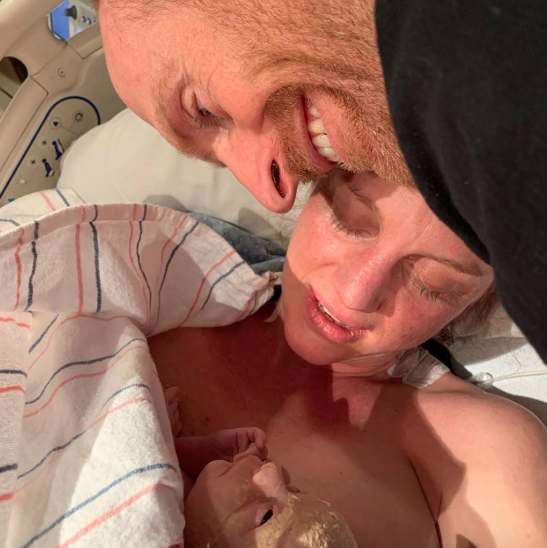
    Caitlin and Brian Gregg meet their daughter, Heidi, who was born on February 5th, 2019. (Photo: @caitlincgregg)

    Heidi Mowgli Gregg was born February 5th, 2019. Caitlin’s mind did shift toward recovery and getting back to training, but not immediately.

    “Honestly, I was so grateful that the delivery went well. I think I had so much fear about delivering on the blood thinners that once that went by I was in such a good place and so excited.” 

    Brian was only able to take five days off surrounding the delivery, then needed to go back to work full-time, but Caitlin still received plenty of support in her transition to new motherhood.

    “I was really lucky because my mother-in-law came and she stayed with us for three weeks in the beginning, which was awesome.” 

    Brian’s mother helped round the clock, helping Caitlin get the rest and care that she needed. Caitlin recounted that it was particularly special to have her help since her own mother had passed away in the fall of 2017. After her mother-in-law left, Caitlin’s closest friend from high school flew out to offer her continued support for a couple of additional weeks.  

    She felt further supported by the women in the local ski community.

    “All of the moms in our ski community stepped up and everyone brought meals and little tidbits of advice. That was incredible. I feel very lucky that I had such good support and I think that was key.”

    As her body healed, Caitlin felt the itch to begin exercising again but did her best to temper her enthusiasm.

    “After the blood clot and I felt confident that I could train, I was able to do a lot of activity for the majority of my pregnancy. But after the delivery, I was really, really encouraged by a lot of people – athletes, non-athletes, my strength coach – to be patient in coming back.”

    Brian Gregg holds his three-week-old daughter, Heidi, during the flower ceremony after his second place finish at the 2019 Birkie. (Photo: Instagram @goteamgregg)

    For the first five weeks, Caitlin only went for short walks and otherwise rested and spent time with Heidi. During that time, they cheered for Brian while he raced to second place in the Birkie. While the weeks passed quickly, she struggled with the change of pace.

    “For me, the hardest part about recovery was for sure being patient and sitting still for five weeks. But at the same time, you have a new baby and everything is so exciting.”

    During that time, she continued to use her FitSplint, no longer to support her large belly during training, but as the postpartum core is like a deflated balloon, the band helped make up for the loss in stability during her walks and general movement.

    “I wore [the FitSplint] for the first couple of weeks walking and I thought it was really helpful to be there when I knew that my abs weren’t quite ready yet to be supporting my body and as things were transitioning and shifting after the delivery.”

    As Heidi arrived at the peak of an incredible winter for skiers in the Midwest, it was hard for Caitlin not to test the waters and get back on her skis.

    “It was probably the snowiest February we’ve had in Minnesota, so all the natural snow trails were open and the skiing was awesome. I remember Brian said, ‘Oh my gosh, let’s go out for a ski.’”

    She was leery of how her newly postpartum hips and loose core would handle skiing but decided the conditions were too good to pass up.

    Team Gregg snaps a photo to capture Caitlin’s first ski postpartum. Brian carried their newborn daughter Heidi zipped inside his jacket in an Ergo carrier. (Photo: Instagram @goteamgregg)

    “We went out and literally five minutes into the ski, I was like, ‘This is too much. I feel like Jell-O, this is just not fun,’” she laughed. “So we took a bunch of pictures and went home, and I waited another month or more before trying to ski again.” 

    Before jumping into heavy training, Caitlin prioritized rehabilitating her core and pelvic floor muscles so her body could function and move properly before being under heavy stress. She began following a program from the MUTU System, which focused on pelvic floor stabilization, and reactivating and strengthening her core from the inside outward. As she progressed through the program, she gradually added other types of training back in. 

    “I started lifting again at about six weeks, and I walked, and then I was able to start skiing again, and the skiing felt so good. Then, I was very patient with the running and would walk-run, so walk for five minutes then run for a minute and gradually increase until I could do a mile, then a couple of miles.”

    While advice for high-level training during pregnancy is limited, more information on athletic recovery is becoming available. Caitlin expressed gratitude for the active women and professional athletes who have spoken out about the challenges with postpartum recovery and how to overcome them and was grateful to learn from both their successes and failures. 

    “I had great advice and resources [for recovery]. From reading about Marit Bjorgen who maybe came back a little bit too quickly when she did start training again and had two pelvic stress fractures, I knew that calcium was super important. And I read that when you’re breastfeeding, you’re more at risk for gestational osteoporosis.”

    Overall, Caitlin was happy with the steps she took to return to training and competing and believes that being conservative, patient, and addressing the underlying small insufficiencies that can create larger problems down the road.  

    “On the flip side, you’re now a mom and you have a lot of things going on. So there were times when I was like, ‘Wow, I feel really good, but I am WAY more busy than I was before.’”

    As far as the conversation about goals for the future, Caitlin described an open-minded approach. They are thrilled with their new addition to the family, but finding time to fit in training full-time is a juggling act. In the mornings, a shared nanny comes to their house to take Heidi from 6:30 until 11:30. During that time, Caitlin is working for the Loppet Foundation leading and training with the Loppet Nordic Racing collegiate program. 
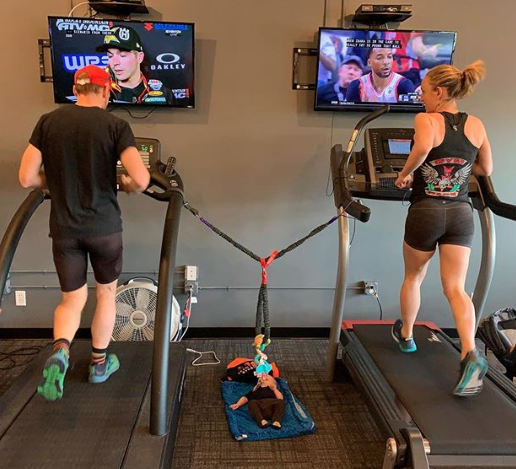
    Caitlin and Brian Gregg demonstrate how they make their afternoon training work with an infant. (Photo: Instagram @goteamgregg)

    In the afternoons, Team Gregg tries to include Heidi in their afternoon sessions. Sometimes she is in the gym with them – Caitlin endearingly called her as a “gym rat” – and sometimes she joins them on a run. These sessions look different than before, but she enjoys including Heidi in their lifestyle. 

    “Maybe you start lifting and she starts fussing. So then you go and take a little break. You hang out with her, and maybe you nurse, or you bounce her around, or you show her the mirror. Or sometimes, she’s your weight and you’re doing goblet squats with Heidi – she thinks it’s hilarious. You find ways to be super creative.

    “We took on this concept where we didn’t know what our lives would be like after Heidi came, so we really dove in with trying to make it kind of an adventure with Heidi,” she continued. “Again, following Kikkan and Holly and other moms we saw, they were bringing their kids out for ski adventures or hikes, so that was something that we were looking forward to.”
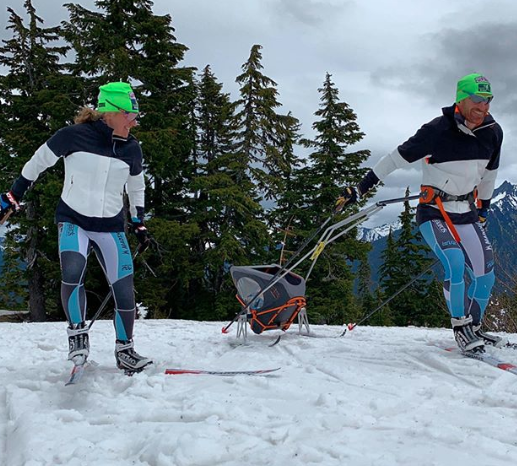
    Brian and Caitlin Gregg tow their daughter both skiing and running with the KidRunner. (Photo: Instagram @goteamgregg)

    The Greggs partnered with a Bend, OR based company called KidRunner who designed a revolutionary chariot-style running stroller. Recently, professional runner Lyndy Davis and fellow KidRunner ambassador clocked a time of 1:21:38 to set the Guinness Book of World Records fastest half-marathon while towing a hands-free stroller. It also has ski attachments, allowing Heidi to join them in the winter as well. 

    “One of our favorite things to do has been to go on a big family run or adventure and bring Heidi. She’s done it either on Brian’s chest, or in the KidRunner, and we’ve been able to bring her into the mountains and all over, which has been really fun.”

    These sessions look different than before, but Caitlin describes Heidi as an easy-going and happy baby who has so far loved joining them, even for 20 plus mile runs with Brian. 

    “So we’ve been trying to do what we did before, except we both have jobs and we have Heidi, which means we don’t get nearly enough sleep,” she concluded with a laugh. “But it’s pretty fun.”

    In early May, when Heidi was just three months old, the Gregg Family headed to Iceland to race the 25-kilometer freestyle and the 50 k classic two days later at the Fossavatn Ski Festival. 

    Apart from racing so soon postpartum, Caitlin felt trepidation around the idea of international travel with a three-month-old. 

    “I was kind of on the fence about Iceland. It seemed like a really fun adventure, but then right before, I got really nervous about what we were about to undertake.”

    Because they were trying to accommodate Brian’s work schedule, they had left Minneapolis on a red-eye flight Tuesday night, arriving midday Wednesday in Iceland then racing Thursday.

    “I’d say the one thing that I completely didn’t think about was that we had a three-month-old, so we weren’t going to sleep at all the night before the flight, and then I was sort of used to, ‘Okay, maybe you don’t get a great night sleep on the plane.’ But we were entertaining a newborn on the plane, so we had no sleep for two days. We were absolute zombies.”

    Unsure of how to navigate the child-care aspect of racing internationally, Caitlin reached out to her family. 

    “The biggest thing that helped was that we had my sister come.”

    Her sister, who lives in southern California, tried skiing for the first time that winter while visiting a pregnant Caitlin in Minneapolis. Caitlin explained that while her sister was excited to try skiing again and to spend time with Heidi while they raced, she also wanted to check out some of the tourist destinations in Iceland, like the Blue Lagoon. The foursome headed to the hot springs shortly after their arrival to Iceland.

    “So we went to the Blue Lagoon where Brian and I proceeded to just pass out and fall asleep,” she laughed. “And my sister was like, ‘What is wrong with them?’”

    The power nap seemed to be effective as Caitlin went on to win the 25 k skate race the next day. 

    “I think there is a lot of adrenaline [at races] and I had been skate skiing all winter, so I actually felt really good in the skate race,” she said.
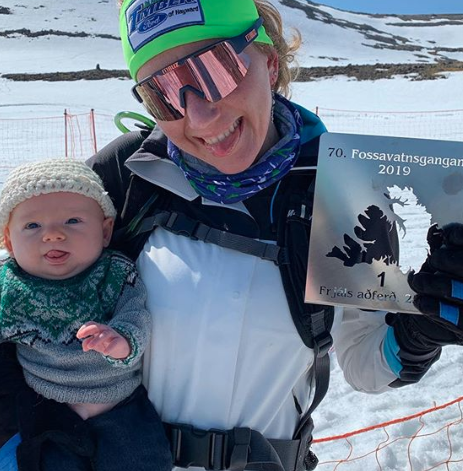
    Tongues out for first place at the Fossavatn 25 k in Isafjordur, Iceland. (Photo: Instagram @caitlincgregg)

    She also took third in the classic marathon, though she did not feel as strong there. Despite the lack of sleep and stress of international travel with an infant, which she felt they underestimated, she and Brian enjoyed racing with different expectations and tried to laugh about the hilarity of their situation rather than dwell on how exhausting and challenging it was. 

    “All in all, I thought we did awesome,” she laughed as she thought back on the trip overall. “I will say it changed my entire perspective on sleep before a race or time-management before a race.”

    Since the Fossavatn, Caitlin has enjoyed hopping into a few running races and will continue to do so as she trains for the 2020 Birkie. 

    “I think my attitude has been that everything now is new PR’s. Maybe I’ll never hit the same level as I was at before being a mom, but everything now is like, ‘Oh, it’s my PR as a mom.’ And I think that’s really fun, and a good way for me not to put too much pressure on myself and have an open mind that anything can happen. Sometimes I surprise myself, and sometimes I’m like, ‘Yup. That’s not that good.’”

    Caitlin has enjoyed the process of seeking out resources during after pregnancy and learning as much as she can about perinatal exercise. Rather than seeing pregnancy as a setback to her athletic career, she described the overall journey as “an exploration” and focuses on what she can learn from the experience. Her postpartum body is different and responds differently to training than before, but she doesn’t see the changes as negative. 

    “I think the biggest thing that I’ve noticed is that I maybe need to slow down a bit and be more aware of ‘How’s my body doing? How are my muscle imbalances?’ All of a sudden, all of these smaller details seem more important before. Maybe it’s because of all the talk about pelvic floor health and the core training, and maybe it’s because of having to take a step back and rebuild my fitness from the ground up. I think all of a sudden, the training has taken on a new challenge and a new fun element for me, so I’ve been having a really good time training. I can’t say that I go out every day and think to myself that I’m stronger or more fit than before or going to set PR’s or things like that, but it’s fun to see the subtle differences. I can’t exactly pinpoint what they are, but they’re different.”

    Some days, Caitlin feels like she can tap into her “mom strength” and nail a workout, other days that is not the case, especially after a rough night of sleep. As she looks to the future, she wants to continue to enjoy the exploration or her limits, while acknowledging that her priorities are now shifted.  The mobile app runs faster than the desktop version, consumes less power, is specially designed for a small smartphone screen, and takes into account the architecture of the mobile gadget. In addition, the mobile parimatch app has extensive functionality with many additional options. The mobile app has a user-friendly interface, high performance, and multilingual support.

    “I’m going to be very open-minded. I’m having fun training and the majority of the time, I feel really good. At the end of the day, I want to be the best mom that I can be and lead by example for Heidi. It’s a neat challenge.”

    Similar to the way Holly Brooks is becoming certified to offer coaching for expectant parents to help them emotionally prepare for the lifestyle change, Caitlin’s experience has inspired her to continue learning about pre and postnatal training with the hope of offering coaching to other female athletes that want to pursue athletic goals after pregnancy. 

    “I’m really fascinated about all of the prenatal and postnatal training and exercise and that I’d really like to dive in. I’m going to start doing more coaching and training, and I would really love to specialize in women who are pre and postnatal and help guide them through how I found my path with it so that they can be successful during their pregnancy and afterward and reach their goals. There’s so much out there, but it’s so hard to track it all down. I’d like to become a resource. There’s a whole world of creative solutions for all things revolving around fitness and new moms.”
  • Race-cation: Erik Bjornsen and Marine Dusser on Iceland and the Fossavatn Ski Marathon

    Race-cation: Erik Bjornsen and Marine Dusser on Iceland and the Fossavatn Ski Marathon

    While many skiers were blowing the dust off of their rollerskis, hitting the track or trail, or looking for crust to cruise on May 1st, Erik Bjornsen and his wife Marine Dusser were previewing the race course for the Fossavatn Ski Marathon, or Fossavatngangan, in Isafjördur, Iceland.   

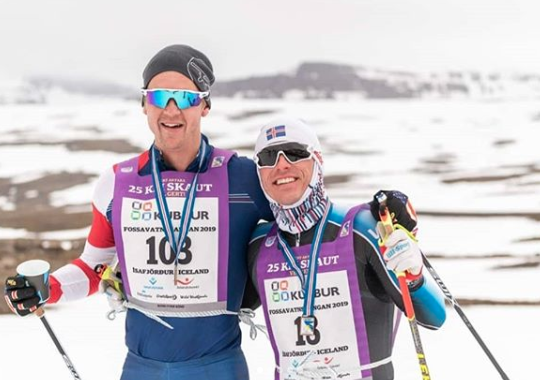
    Erik Bjornsen poses with Snorri Einarsson, an Icelandic World Cup skier, at the finish of the Fossavatn Ski Marathon in Isafjördur, Iceland. (Photo: Instagram @ebjornsen1991)

    While it might seem odd to begin a new season by racing a 21 k followed by a 42 k just two days later, Bjornsen and Dusser agreed that they did not go into the race with performance goals, rather to experience a new place and to enjoy the sport they both love.

    “I feel like we went on vacation and we made a race out of a vacation,” Dusser explained in a call. “We like nordic skiing and we both like racing, but we didn’t really put any pressure [on ourselves].”

    Though the Fossavatn has only been a member of the World Loppet series since 2015, the race dates all the way back to 1935. In addition to the 50-kilometer marathon distance, which is always classic technique, the event features a 25 k skate and classic race and a 12.5 k classic in the days preceding. There are also 1 k and 5 k children’s races. Typically, each of the courses are one loop, but because it has been a low snow year in Iceland, this year the course was rerouted and distances were scaled back as the longest available loop was 21 k, which the marathoners skied twice.

    “It was kind of like skiing on the glacier [in Alaska],” Dusser shared. “You have no trees and pretty mellow terrain. No steep hills, but it’s up and down. Erik was able to double pole the classic race, but for me, it was too hilly, so I was classic skiing.”

    Marine Dusser on her way to a second place finish in the 21 k skate at the 2019 Fossavatn in Isafjördur, Iceland. (Photo: Instagram @marinedusser)

    While they may not have approached the race with goals, both walked away with strong results. Dusser won the 42 k classic and placed second to Caitlin Gregg in the 21 k skate, while Bjornsen was 7th in the classic and 2nd in the skate.

    A glance at the results over the last few years shows names like Iivo Niskanen, Riita Lisa Roponen, and Petter Northug, just to name a few, which begs the question, ‘At an odd time in the year, what is drawing top names to the 66th north parallel for a marathon?’. The duo explained that the race manager, Bobbie Sigujónsson, had contacted Bjornsen about traveling to Iceland for the event, and has enticed other top athletes to do the same.

    “I think he has been pretty good with marketing and communication, and this race is pretty sexy because it’s very pretty there and it’s so different than anything that you can see [elsewhere],” Dusser explained. “And it’s also in May, so it’s easy to get good athletes because people are on vacation. And I think that they are pretty curious about Iceland, so it’s easy to get big names because people can make a vacation out of the race.”

    The couple enjoyed having the opportunity to spend time around the other top athletes attending while away from the World Cup setting.

    wellbutrin sr

    “We got to spend some time with [Nikita] Kryukov and [Alexander] Panzhinzkiy and Iivo [Niskanen],” said Bjornsen. “I mean all those guys have Olympic gold and silver medals, so it was pretty cool to spend more time around them. We were in the same hotel as Kryukov, so we actually got to know him quite well and that was fun.”

    In addition to complimenting race organizers and noting how much fun people were having in the race itself, both Bjornsen and Dusser recommend the event to anyone looking for a novel experience.  

    “There was a big dinner – a “fish party” they called it – where they have live music and an announcer and really good food and stuff,” said Bjornsen. “So I’d just say that we highly recommend it to everybody. It was a really fun experience and if people get the opportunity, it’s a really cool one to do in the spring at the end of the year to have a fun end of the season.”

    While the names at the front of the pack might seem intimidating, Dusser added that the Fossavatn race series is inclusive for skiers of all ages and abilities.

    “There were a lot of masters and I think this race is really open for all of them,” said Dusser. “Because it’s not very all-terrain either — you don’t have very long uphills. I think it’s pretty attractive for all levels. You can see every age and every level can go and have fun, so it’s not just for athletes, so it’s kind of cool.”

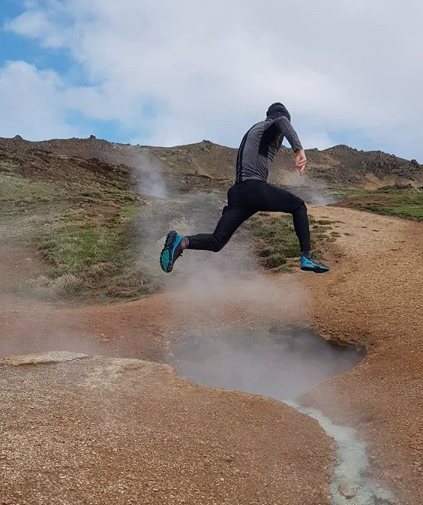
    Erik Bjornsen leaps over a geothermal spring during a trail run in Iceland. (Photo: Instagram @ebjornsen1991)

    Capitalizing on the opportunity, the pair used the week before the race to explore and see other parts of the country, which was new to both of them.

    “We flew into Reykjavik and based out of there for three days, and explored all around that area for day trips,” Bjornsen shared. “We’d head an hour out of town each direction each day and saw different parts of southern Iceland. It’s not a huge place, so we were able to see quite a bit around Reykjavik in those first three days. Then we drove five – 600 miles to the northwestern part of Iceland [for the race]. It was in the west fjords and it was the biggest town in that section of Iceland. So it was really cool. I feel like we saw half of Iceland, or quite a bit of it, and of course snippets of the area along the way.”

    Marine Dusser explores Iceland by foot. (Photo: Instagram @marinedusser)

    Apart from the more obvious features that contrast their coastal Alaskan home – lower mountains and turquoise blue hot springs – they were taken aback by how much closer to the sea they felt there and also by the size of the waves.

    “On the drive up there [to Isafjördur], we actually spotted some whales,” Bjornsen recalled. “You’d drive for an hour and you basically wouldn’t see anybody. We were driving through these fjords and it was a day where there wasn’t a lot of wind, so the sea was pretty quiet, and there were three or four whales that were swimming 150 or 200 meters from the road. We just turned the car off right on the road and watched. In Anchorage, it’s a bit different. You have to drive a ways. We’re in the Cook Inlet right now, and there is a lot of glacier silt, so it’s never very deep. There are some whales that are around but you rarely… it’s just a different feel around here.”

    Looking ahead, Dusser, who has coached for the UAA Seawolves the last two seasons, will be continuing her work with the Alaska Biathlon Association, including coordinating the upcoming spring training camp. In her own ski career, Dusser was a member of the French National Biathlon Team. During that time, she won three medals at the Junior World Championships in biathlon and was the French Junior National Champion six times.

    “We have a camp the first week of June and usually we try to invite a bunch of biathletes,” Dusser explained. “Last year we had a biathlete from Switzerland, she actually won the World Junior championship, and Tim Burke is coming as well to help coach, so that should be fun. It’s pretty busy organizing that camp, it’s pretty big every year, so it’s nice.”

    Bjornsen, who this season advanced to the USST A-Team, will be continuing to work toward the upcoming World Cup season, but is also looking forward to upcoming non-ski-related events this summer.

    “I’m getting back into training,” Bjornsen stated. “Doing a similar camp schedule that I’ve done in the past, so I’ll be heading down to Bend here in about a week, definitely Eagle Glacier this summer, then I’m headed to Norway, and a fall camp with the ski team. My sister is getting married [in July], then we’re having Marine’s parents come to town and my parents are coming of course, so it should be a fun summer.”

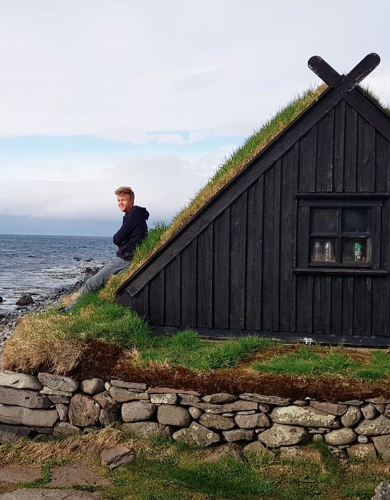
    Erik Bjornsen explores coastal Iceland on a trip with his wife, Marine Dusser. (Photo: Instagram @erikbjornsen1991)
  • Wednesday Workout: ‘Old Lady’ Interval Ladder with ’94 Olympians Hall and McCabe

    Wednesday Workout: ‘Old Lady’ Interval Ladder with ’94 Olympians Hall and McCabe

    Laura McCabe, 1994 and ’98 Olympian, during her weekly Wednesday interval workout. (Photo: Leslie Hall)

    *Note: This article has been updated to include email comments from Laura McCabe as of Wednesday. 

    Don’t let the name “Old Lady Intervals” (designated by Leslie Hall) fool you. The interval ladder she and Laura McCabe complete every Wednesday and submitted to FasterSkier is one that takes experience and willpower. Hall doesn’t recommend the workout for juniors, but more for masters and those with limited time for harder training efforts.

    ***

    If their houses were any closer, Leslie Hall and Laura McCabe could probably comfortably hold conversations from the threshold of their front doors. For a little more than two decades, the duo have been neighbors, living within one-tenth of a mile from each other in northern Washington. But a street name and sidewalk view of the Methow Valley isn’t the only thing the two women share.

    In 1994, they were teammates, representing the U.S. at the Winter Olympic Games in Lillehammer, Norway. Two years later, they moved into their neighboring houses, and close to six years after that, they became co-coaches of Methow Valley Nordic.

    For the past 15-plus years, Hall and McCabe, who are now 53 and 51 respectively, also share Wednesday mornings.

    Following the birth of Hall’s second child and McCabe’s first, the women decided that neither was about to give up interval workouts. Even if it meant having their toddlers in tow.

    “When she stopped competing and had her daughter, my son was close in age, so I was like, ‘What are you doing?’ … and she said, ‘I’m going out and I’m doing intervals and I’m carrying Novie,’ and I’m like ‘OK, I’m going to come,’ so then we just started going together,” Hall explained on the phone.

    Every Wednesday for the next 51 weeks, the women completed the intervals with their babies on their backs.

    “Once they got on a schedule where they were in preschool or something, we’d go off without them,” Hall said. “Now, we drop the kids off at the bus and then we go. It works for both of us because we don’t go into the office at a certain time, so that’s nice.”

    The workout itself, which is a ladder-type interval set totaling 43 minutes of on-time at a pace Hall describes as “as hard as we can,” is not one she recommends for junior skiers, but rather those on a tight training schedule.

    “It obviously wouldn’t be the best workout for someone, say a 14 year old, that’s not going to be the best workout for them,” Hall said. “But for a lot of masters or working people, they always go sort of medium-hard, so having a targeted interval workout helps raise their fitness. … They go easy [during easy days] because they’re either too tired from the interval workout or they know the interval workout is coming up.”

    Both women continue to compete, with Hall jumping into local running and ski races that fit with her coaching schedule and McCabe racing internationally, competing in this year’s Fossavatnsgangan Worldloppet in Iceland (where she placed third in the 25-kilometer skate behind Caitlin Gregg and Britta Johansson Norgren), and the Masters World Cup in Switzerland (where she won two races).

    “Leslie and I have been through a lot of life stuff together, starting with being on the U.S. team to raising our children together, going through the joys and difficulties of life as they are handed to all of us,” McCabe wrote in and email on Wednesday. “Working together as coaches, running the Methow Valley xc ski team and just being great friends. WE have kept each other motivated on Wed for some intensity for many years, as just that 1:30-2 hours pays off if you are consistent. Wed we discuss things that need to happen for the team, the kids, life etc and we both get a good solid workout!”

    Hall couldn’t agree more.

    “I think my favorite part is having someone who makes sure I get out and do it,” Hall added. “I don’t have to worry about how I’m going to fit in some hard training, and that’s really satisfying.”

    The Workout

    • Terrain type: Hilly
    • Warmup: 15-20 minutes jogging followed by 4 x 30 second speeds
    • “Old Lady” (as Hall likes to call it) Interval Ladder: 5-6-5-6-5-4-4-4-4 minutes with 3 minutes recovery between each 
      • i.e.: 5 minutes on, 3 minutes recovery, 6 minutes on, 3 minutes recovery, 5 minutes on, 3 minutes recovery…etc.
    • Interval Effort: Between Level 4-Level 3
    • “We just go and go as hard as we can, which is another thing I don’t recommend for everybody necessarily,” Hall explained. “Some days it’s just naturally Level 3 and some days it’s Level 4. And also it’s longer than what most people would want to do, but that’s just what we’ve gotten to at this point.”
    • Cool down: 15-20 minutes jogging with 4 x 5 second sprints incorporated throughout to “clear out the legs”
    • Total time: 75-80 minutes