From the FasterSkier archive — posts syndicated from athletes’ and coaches’ own blogs between 2004 and 2012, kept online as published. Current coverage is at fasterskier.com.

Tag: Francesco De Fabiani

  • Team Sprint: Klaebo Captures Third Medal, Canada Impresses in Fourth

    Team Sprint: Klaebo Captures Third Medal, Canada Impresses in Fourth

    This World Cup coverage is made possible through the generous support of Marty and Kathy Hall and A Hall Mark of Excellence Award. To learn more about A Hall Mark of Excellence Award, or to learn how you can support FasterSkier’s coverage, please contact info@fasterskier.com. 
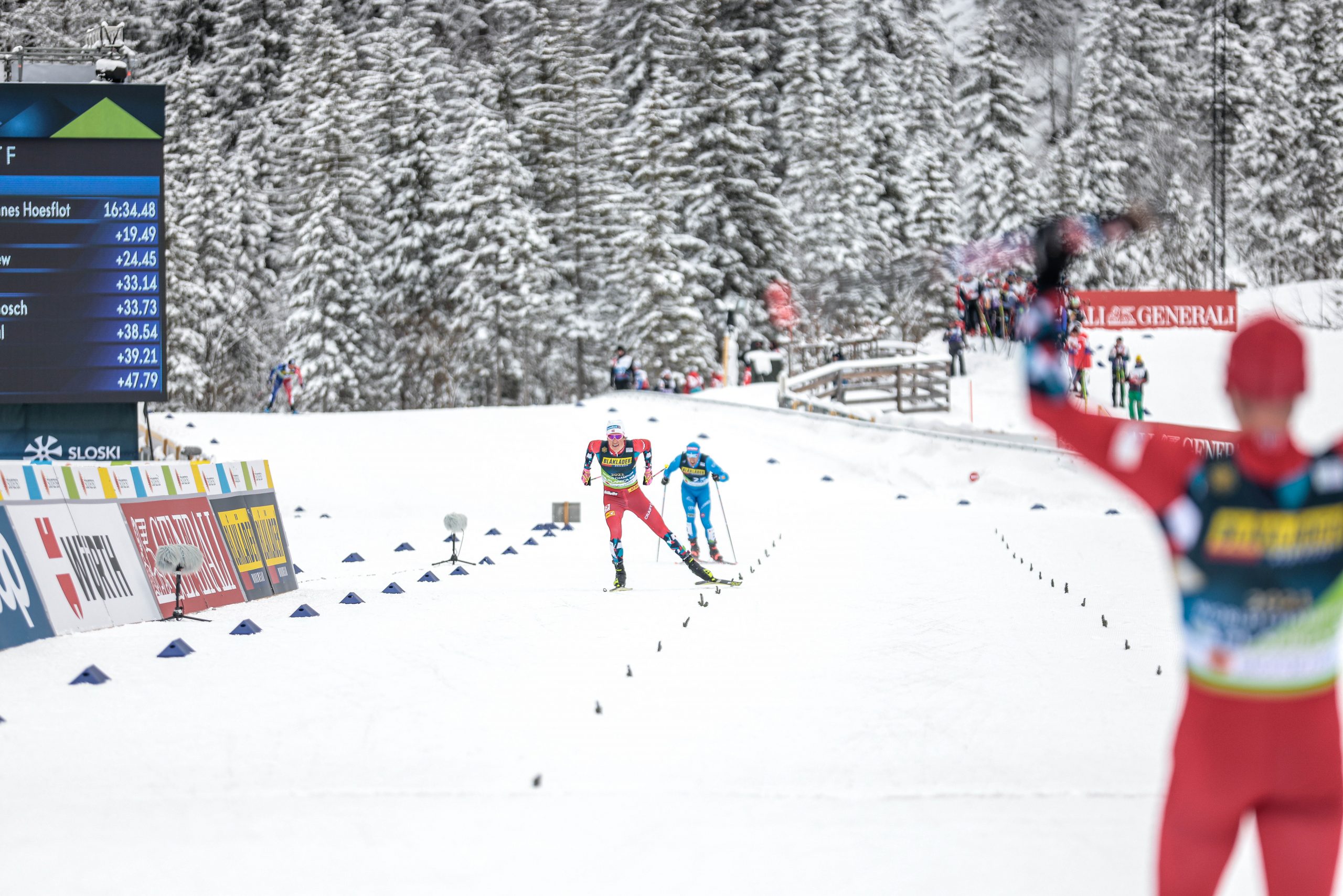
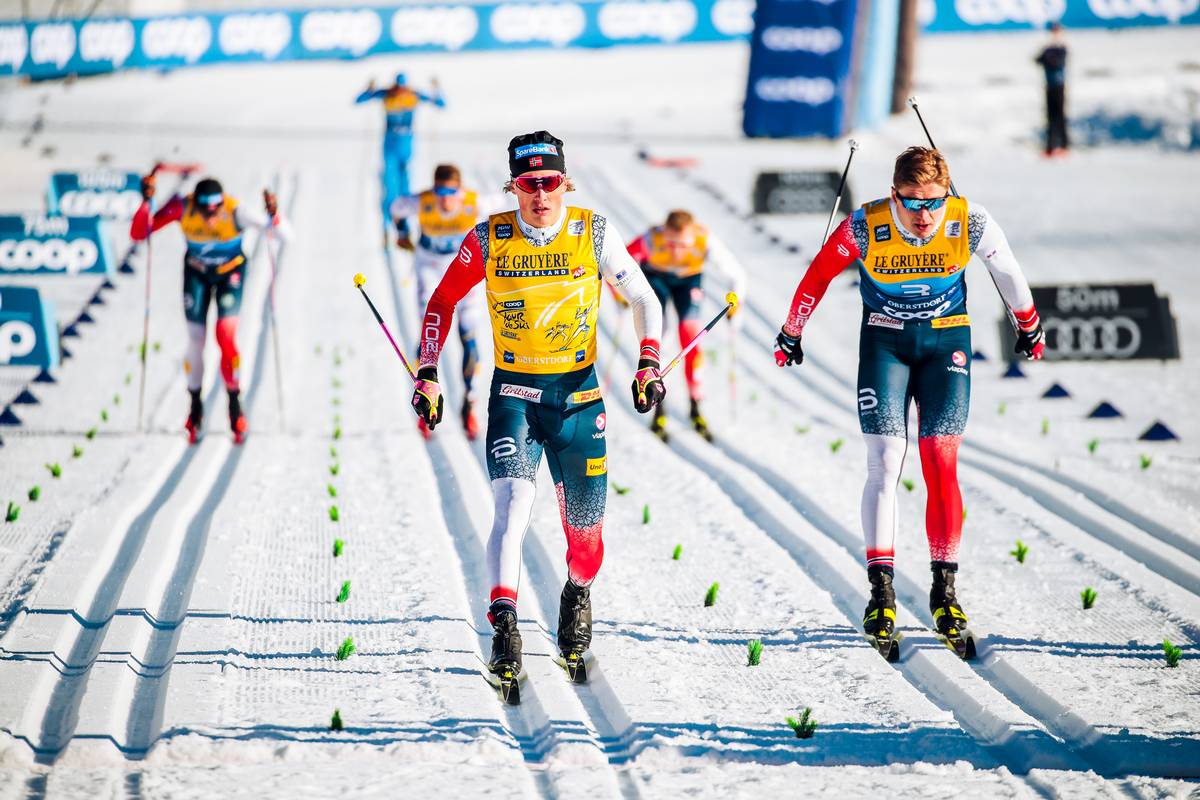
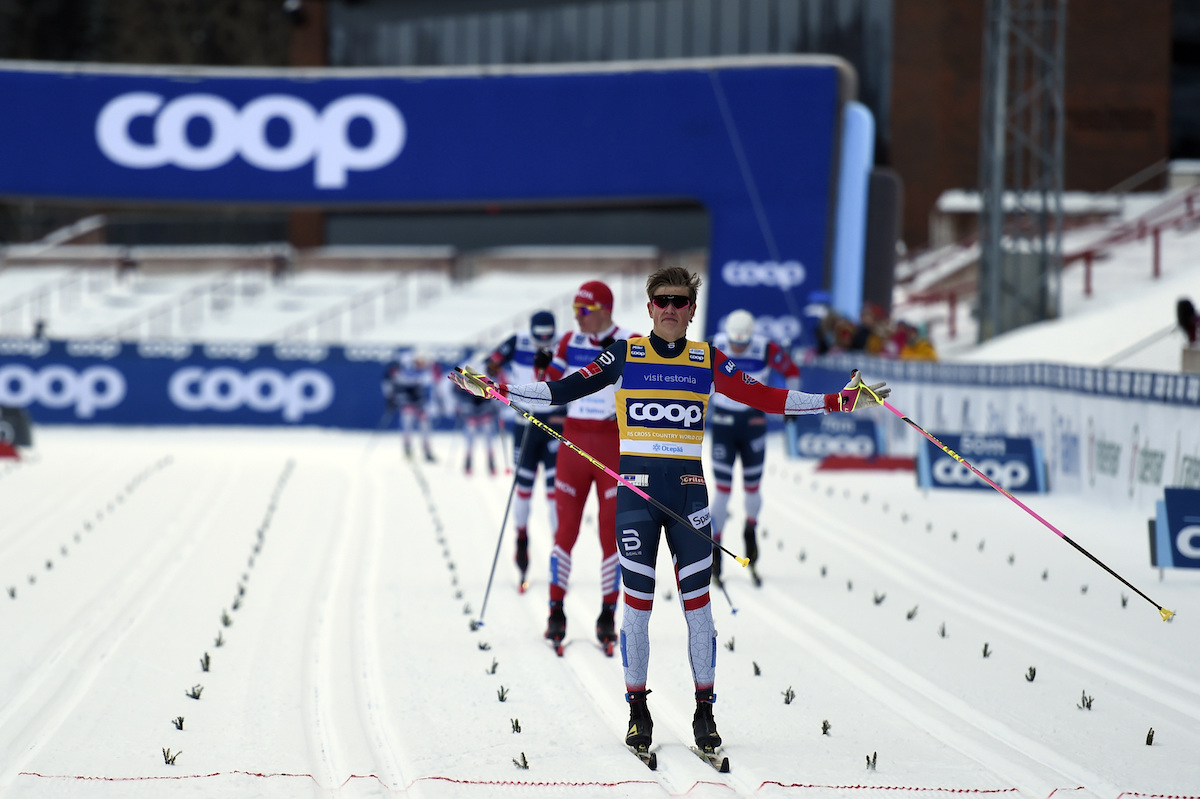
    Johannes Hoesflot Klaebo (NOR) approaches the finish line ahead of Italy’s Federico Pellegrino. (Photo: Modica/NordicFocus)

    Three races: three medals. Johannes Hoesflot Klaebo (NOR) pursues the history that is available to him, but the history he pursues is likely to be marked with an Asterisk. He is one of the few skiers scheduled to compete in every event at these World Championships, and he is expected to medal in every event. Even so, Klaebo, himself, reminded reporters that Saturday’s silver medal in the 30 k Skiathlon was his first World Championship distance medal. He hasn’t always enjoyed this sort of dominance. And while many of the very finest skiers are here in Planica, many of the very finest are not. If Russian skiers were at these World Championships, Klaebo might still be collecting medals, but the racing would be quite different. As it is, the Russians languish at home, their exclusion from these championships (and from theWorld Cup tour) coming as a result of their government’s invasion of Ukraine. The championships go on without them, leaving predictable foregone conclusions: Norway the team to beat, Norway the favorite for victory, Norway on the podium, Norway with the gold. These are the World Championships of Cross Country Skiing . . . and Norway is the team to watch.

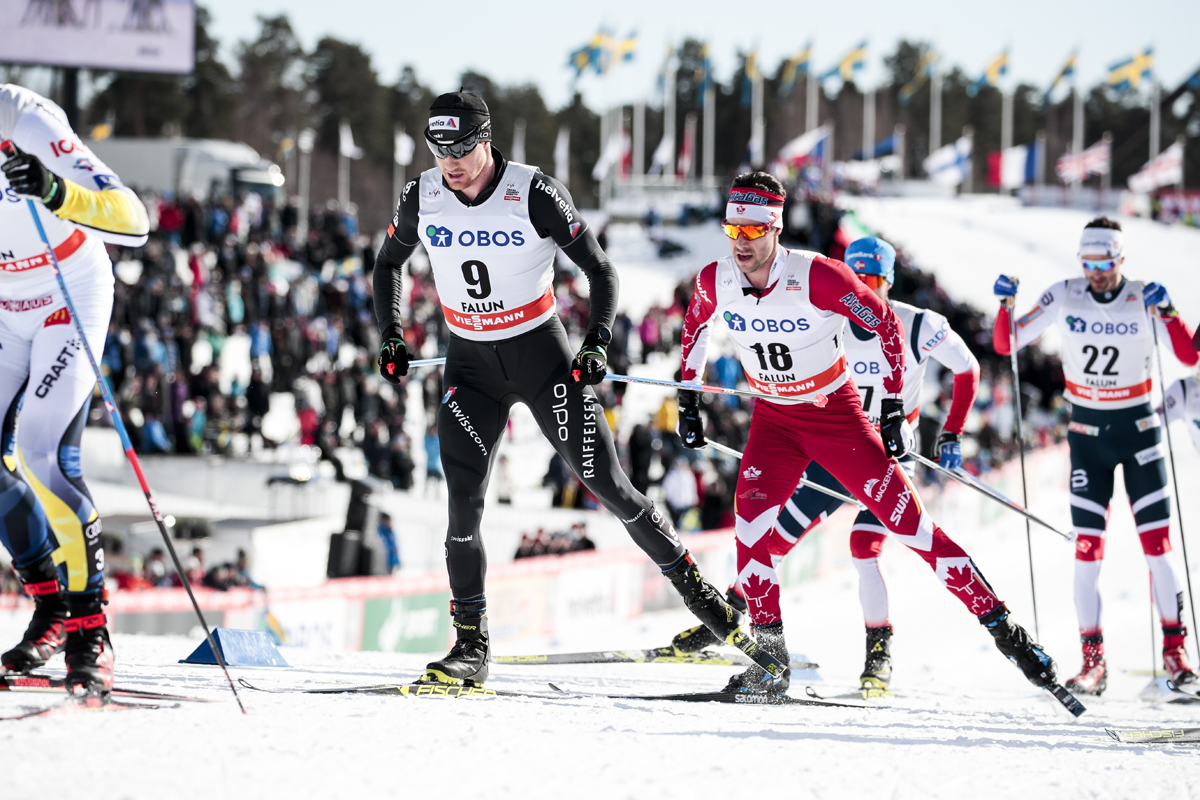
    Antoine Cyr (CAN), and Graham Ritchie (CAN) celebrate their fourth place finish in the Team Sprint at the FIS Cross Country World championships in Planica, Slovenia. (Photo:  Modica/NordicFocus)

    Team Norway—Klaebo and compatriot Paal Golberg—did not disappoint in the Team Sprint, holding off second place Federico Pellegrino and  Francesco de Fabiani of Italy, and third place Renaud Jay and Richard Jouve of France. Among North American teams, Canada was truly remarkable with Antoine Cyr and Graham Ritchie finishing fourth, while Ben Ogden and JC Schoonmaker of the United States finished tenth.

    Men’s Team Sprint

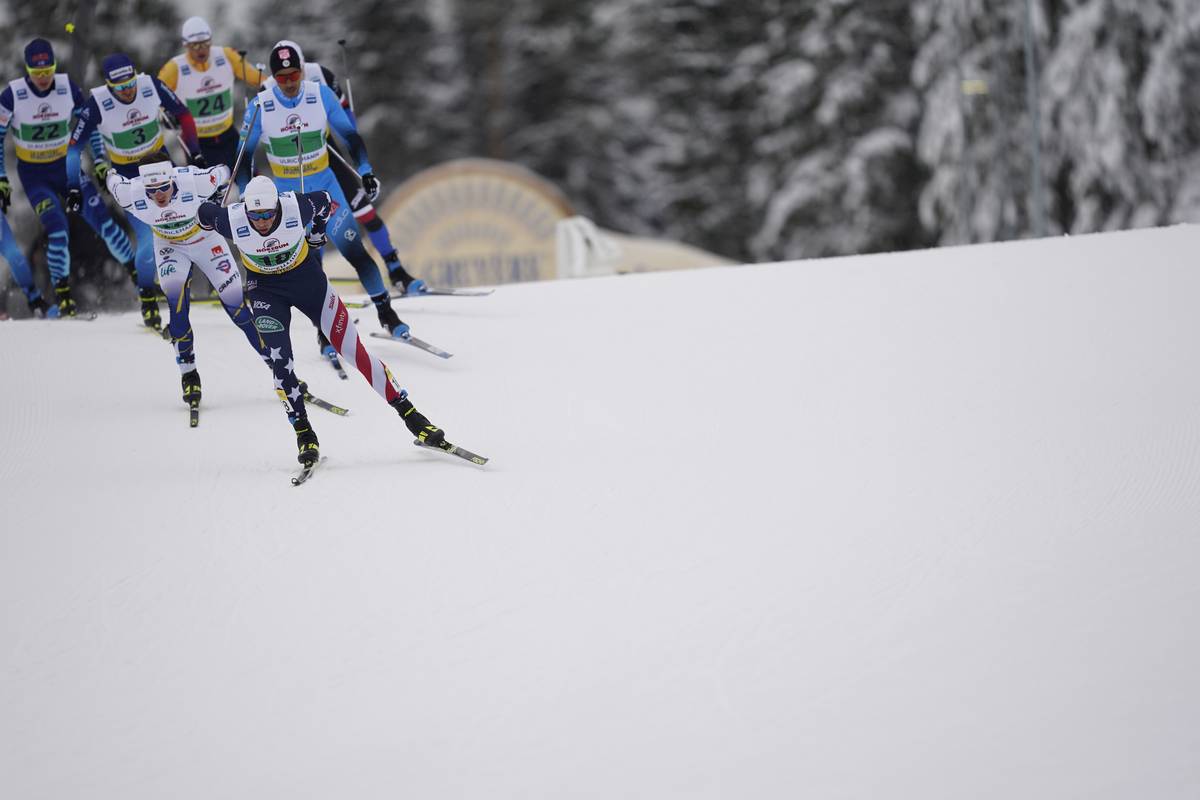
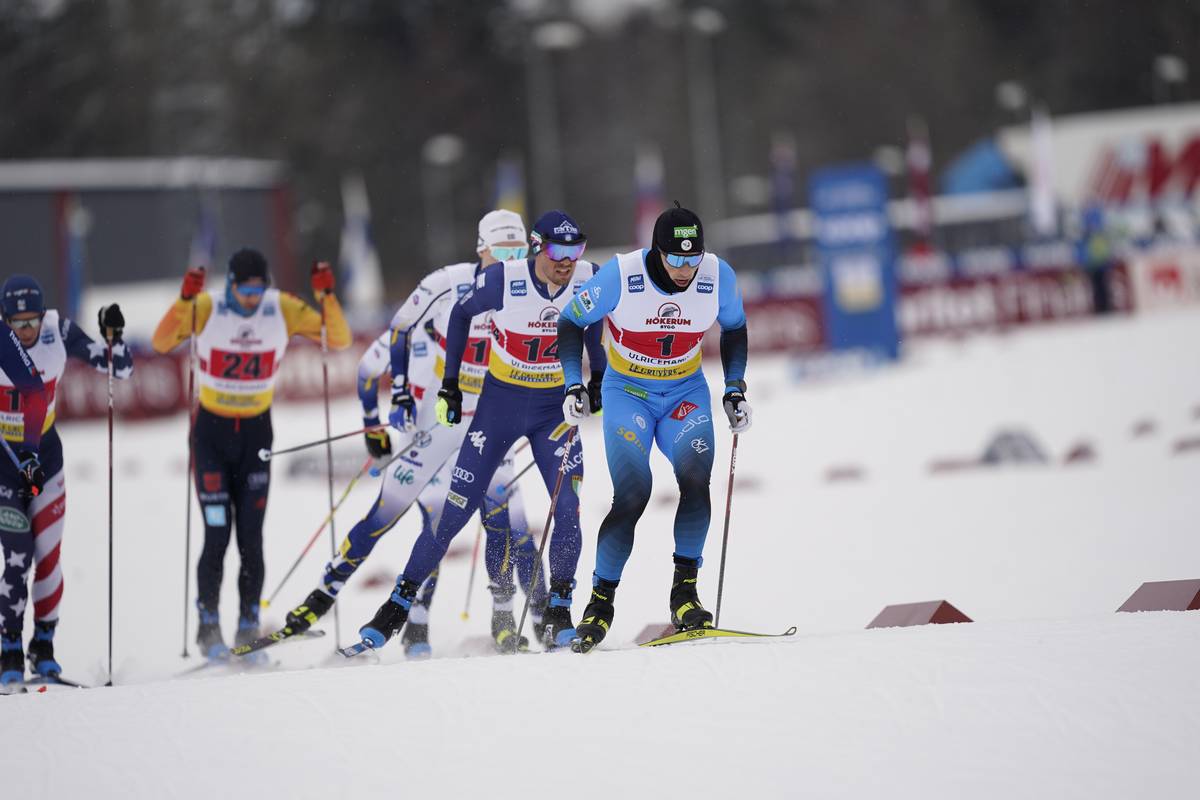
    Having watched the success of Julia Kern (USA) and Jessie Diggins (USA) in the earlier Women’s Team Sprint, it came as no surprise to see Schoonmaker following the example that had earned bronze for his teammates. Schoonmaker moved early to take the first position into the long rolling downhill at the beginning of the Planica course. Golberg and Jay were quick to counter the move, and Golberg went to the front of the pack on the climb with Jay in tow. Schoonmaker held third through the climb, but Golberg’s arrival at the front had subdued the field. Whereas the women’s race had gone full bore from the gun, the men’s race settled into a slightly more tactical affair. Schoonmaker handed off to Ogden in fifth place, with the pack tightly bunched.

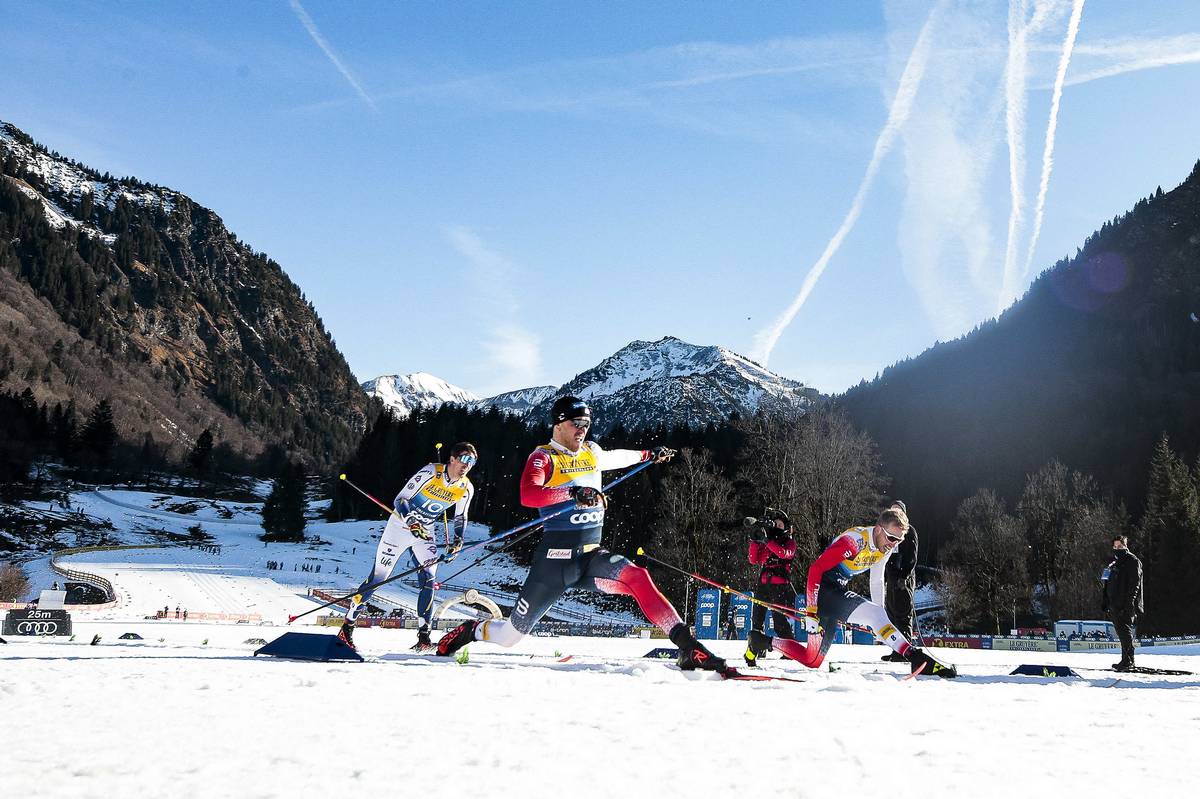
    For the next four exchanges, the Americans did their best to hang on, while the stars did battle at the front. Various accelerations, small attacks, defensive coverages, and tactical speedings and slowings led to the three fastest teams—Norway, Italy, France—pulling away from the field (pursued doggedly by Sweden and Canada). In the end, Pellegrino tried to impress his will on Klaebo in the final leg, but the Norwegian was simply too strong, too fast, too resilient. Into the final hill, Klaebo ignited the hint of promise that had been there all along, skiing away from Pellegrino in a final sprint.
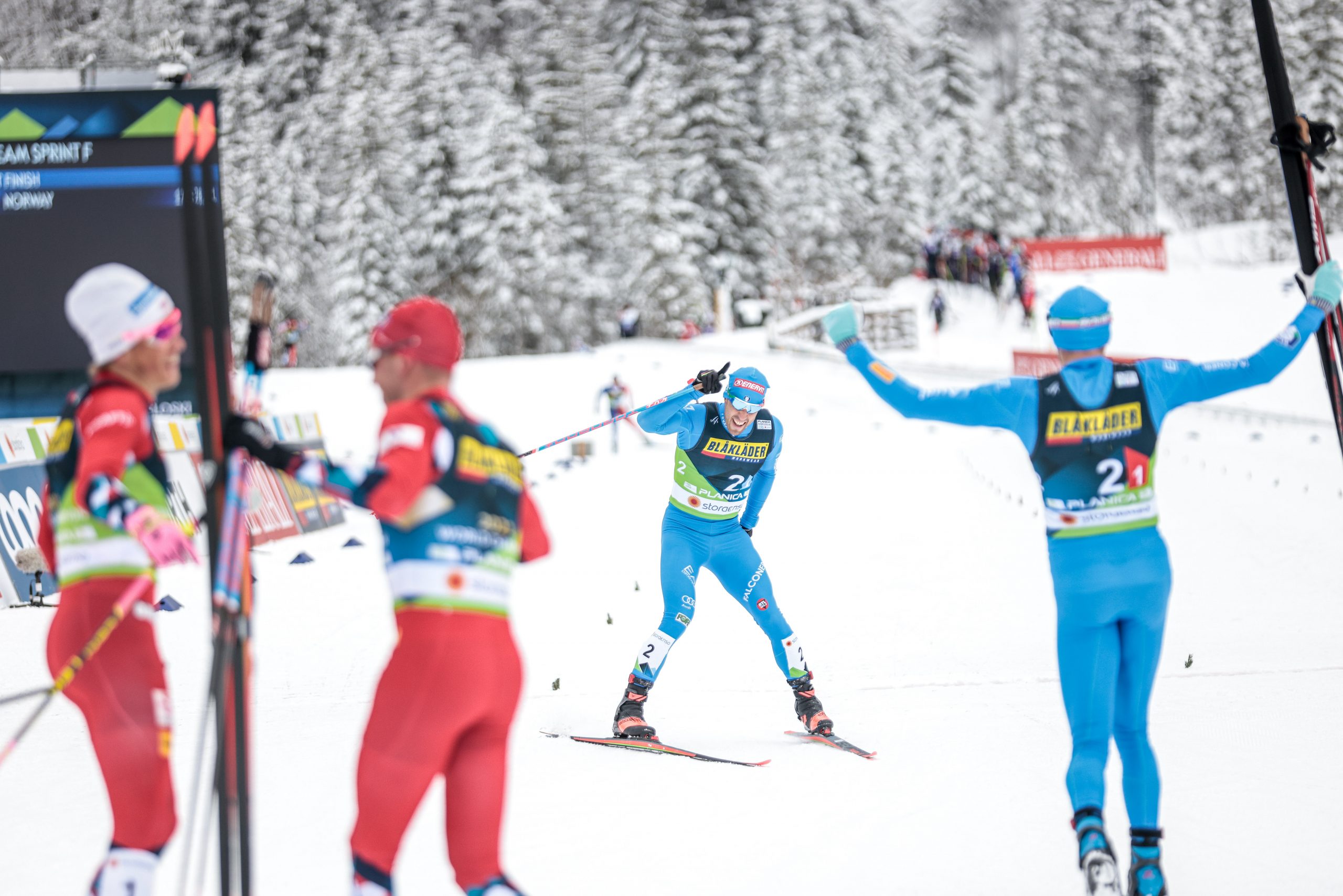
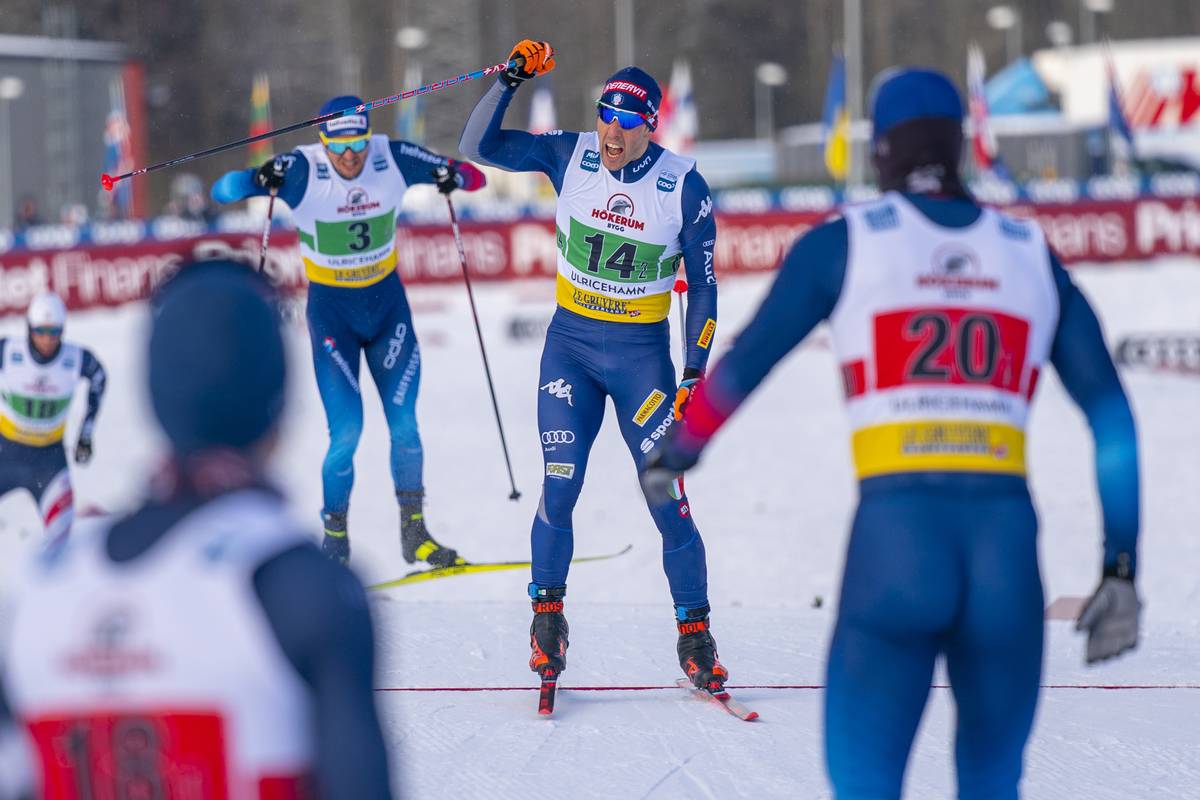
    Federico Pellegrino (ITA) skis into the embrace of his teammate, Francesco de Fabiani, earning silver in the World Championships Team Sprint. (Photo: Modica/NordicFocus)

    Pellegrino’s move on the final climb had landed the Italians second on the podium in definitive fashion. France was third, while Canada—on the back of a strong final closing move from Graham Ritchie—moved into fourth place on the day just ahead of Sweden. The United States moved down to 10th to finish inside the top ten.

    While much had been expected of Norway, it was Canada that exceeded expectations:

    “This was team sprint together, and we’ve set up a game plan that’s worked for us in the past,” said Ritchie. “We decided to not change anything today and see if we could knock off another position and it worked out for us.”

    “We have a good plan,” said Cyr. “Normally, I go in the first leg and move through the pack to get Ritchie in a good position so we push in the last lap. Today it really worked. Being out of the medal again is hard, but we will get there one day . . . It makes you feel like in a couple more years, we will get there.”

    Ritchie summed up the experience of the Canadians: “I had one guy to reel in on the last leg, and it was a good one. I had the whole lap to try and catch him, and was confident that I could . . . Seeing Jouve over the last bump gave me the motivation. We can see [the podium], it’s right there.”

    Men’s Team Sprint RESULTS
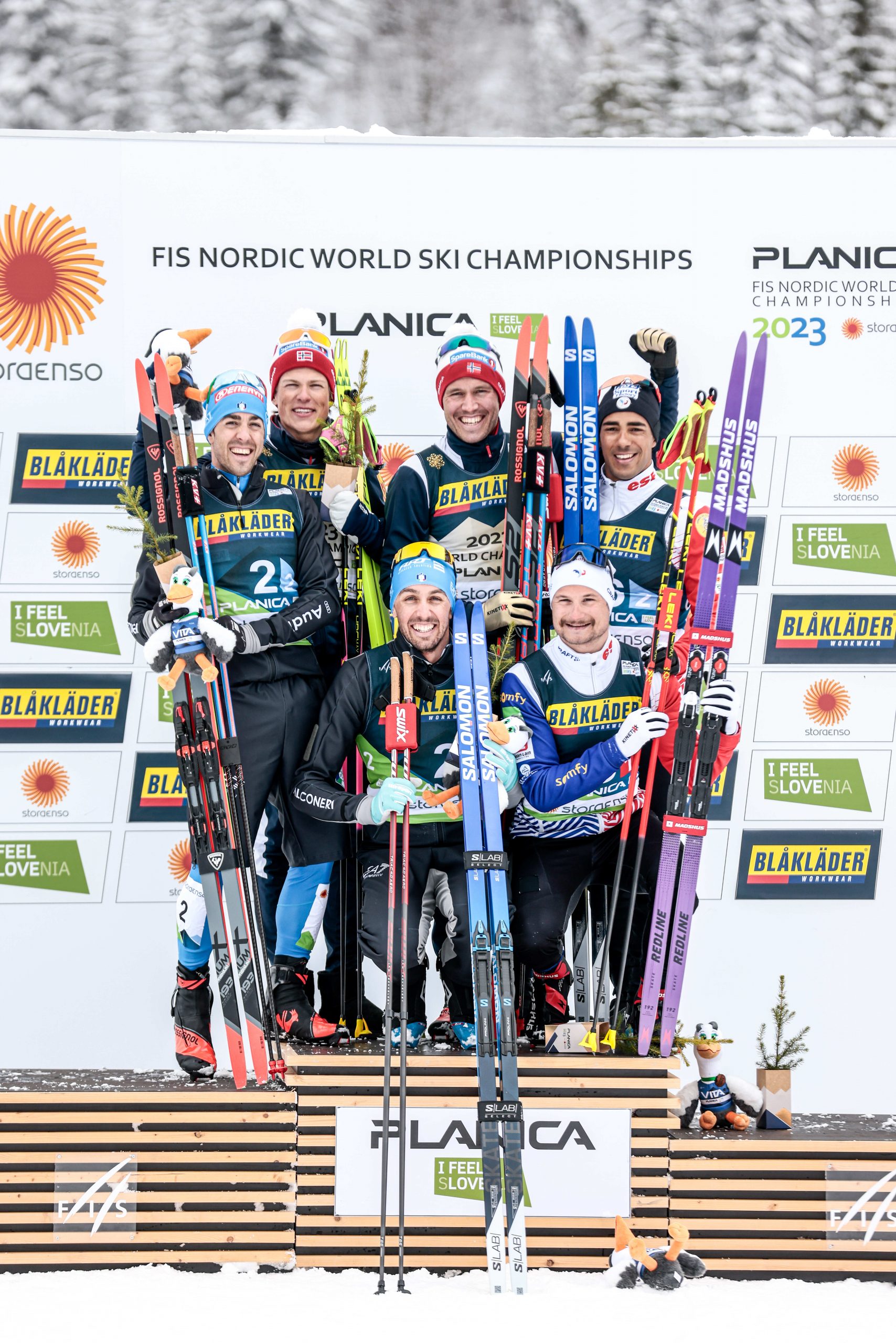
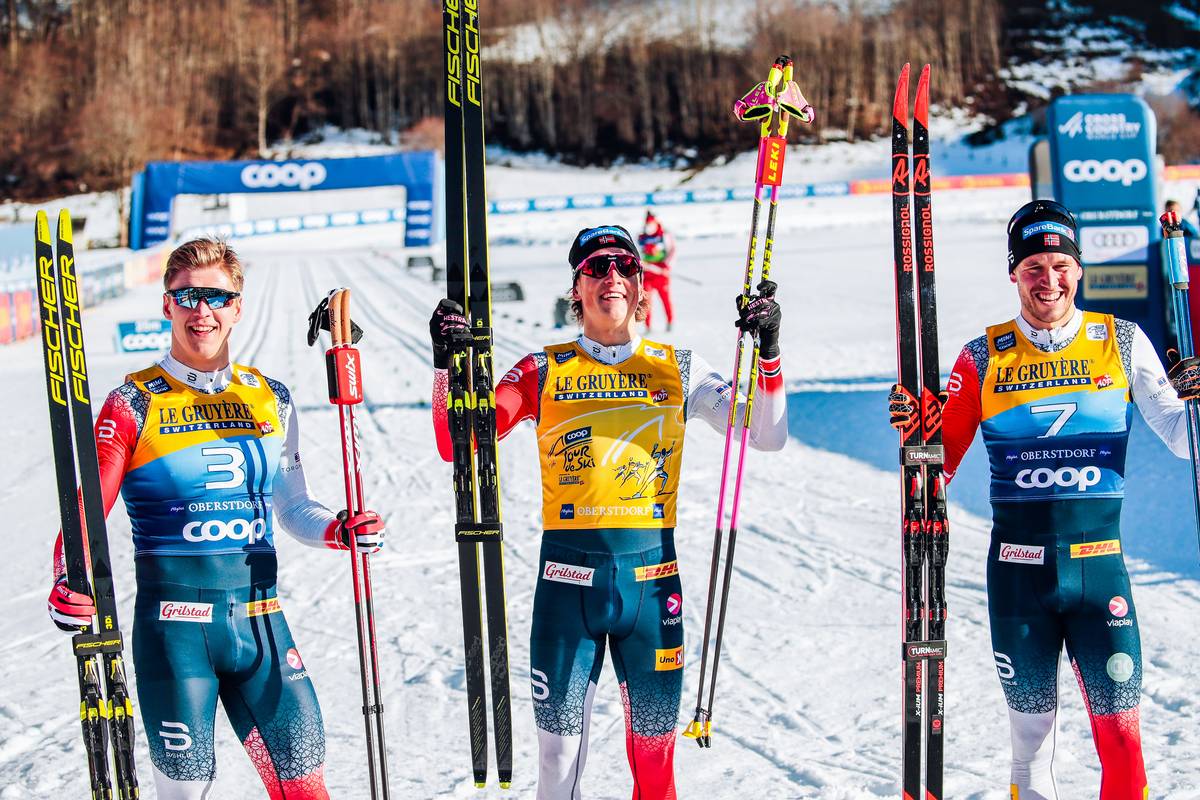
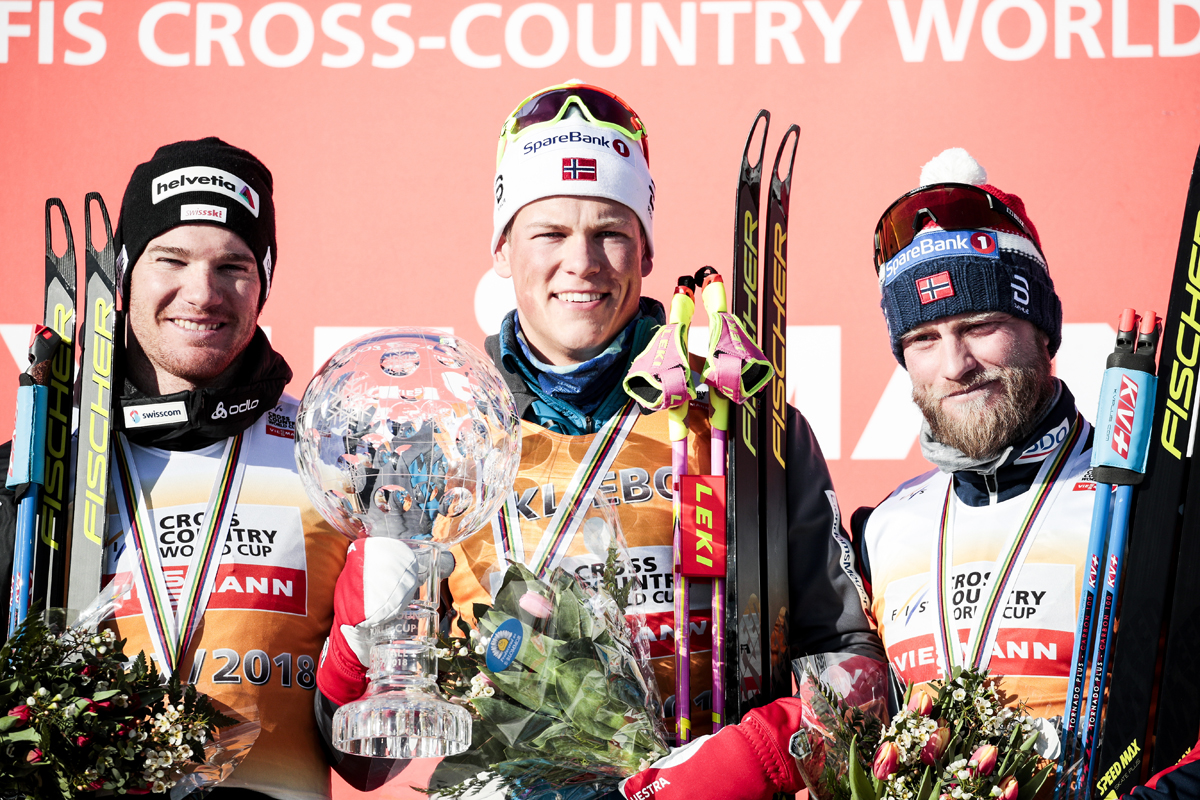
    Federico Pellegrino (ITA), Francesco De Fabiani (ITA), Johannes Hoesflot Klaebo (NOR), Paal Golberg (NOR), Richard Jouve (FRA), Renaud Jay (FRA), the Team Sprint podium at the FIS Cross Country World Championships in Planica, Slovenia. (Photo: Modica/NordicFocus
  • Klæbo Runs Away with Third Stage Win in the Classic Sprint; Ogden 22nd, Jager 27th

    Klæbo Runs Away with Third Stage Win in the Classic Sprint; Ogden 22nd, Jager 27th

    This World Cup coverage is made possible through the generous support of Marty and Kathy Hall and the A Hall Mark of Excellence Award.  To learn more about A Hall Mark of Excellence Award or to learn how you can support FasterSkier’s coverage please contact info@fasterskier.com.


    As we begin Stage 4 of the Tour de Ski, the first classic sprint since the opening race of the season in Ruka, Finland on November 26th, we look back to the last time athletes raced the event on the tracks in Oberstdorf, Germany. 

    During the 2021 World Championships, Johannes Høsflot Klæbo (NOR) took command of the gold medal from the qualifier on a 1.5-kilometer course seemingly designed for his racing style. A quick double pole start from the stadium leads to a long steady first climb where he skied long, strong, and steady, usually in second or third position. After a winding descent, athletes encounter a second short but steep climb of roughly 18 vertical meters, where Klæbo would begin his signature run. Stomping his way to the lead as he crested the top of the climb, stepping around a left-hand curve, and dropping into a tuck on the final descent leading into the stadium, Klæbo was repeatedly in position to advance through each round comfortably, eventually winning the final by several ski lengths. (Video highlights here.) 

    Alexander Terentev races to second place in qualification during Stage 4 of the Tour de Ski in Oberstdorf. (Photo: NordicFocus)

    Winning today’s qualifier in 2:55.78, Klæbo looked to be on track for a repeat victory in Oberstdorf, however, it is worth noting that he did not win the aforementioned other classic sprint this season. In Ruka, it was 22-year-old Alexander Terentev who took hold of the event in qualification and looked to, well, out-Klæbo Klæbo throughout the heats. We saw familiar tactics with a power move on the final climb, paired with impressive acceleration over the final meters to capture the win, but this time, the athlete employing these tactics was in a Russian race suit. While Klæbo has won each of the sprints he has entered since, with Terentev eliminated in the semis, Stage 4 would be a rematch both were eyeing. 

    Setting the stage, Terentev was second in qualification, +1.5 behind Klæbo, with Erik Valnes (NOR) in third (+2.37), Federico Pellegrino 4th (+3.53), and Alexander Bolshunov 5th (+3.61). Ben Ogden was the top American qualifier today, finishing 15th (+8.08), while Luke Jager finished 24th (+10.83). The American selected heats two and five, respectively. 

    Johannes Høsflot Klæbo and Erik Valnes take the lead in the final climb of the quarterfinal, with Ivan Yakimushkin (bib 23) and Iivo Niskanen (bib 29) chasing. (Photo: NordicFocus)

    In the first wave of the quarterfinal, Finland’s Iivo Niskanen, winner of the Stage 2 15k classic, pushed the pace heading up the first climb, perhaps looking to ensure an opportunity for a fast rather than tactical heat, knowing he was up against Valnes and Klæbo and likely would only have the opportunity to advance as lucky loser. However, the Norwegians, unphased, chose not to respond, waiting patiently mid-pack to use the same tactic described at World Champs. In the second climb, both created enough room to look as if they had begun their cooldown as they skied through the finish lanes, with Klæbo addigng a lackadaisical boot slide at the line that put him just ahead of his teammate. Behind them, Niskanen and Ivan Yakimushkin (RUS) sprinted to the line to chase the clock, with the Russian finishing ahead of the Finn. However, their times did not hold up through subsequent rounds and their day had ended.

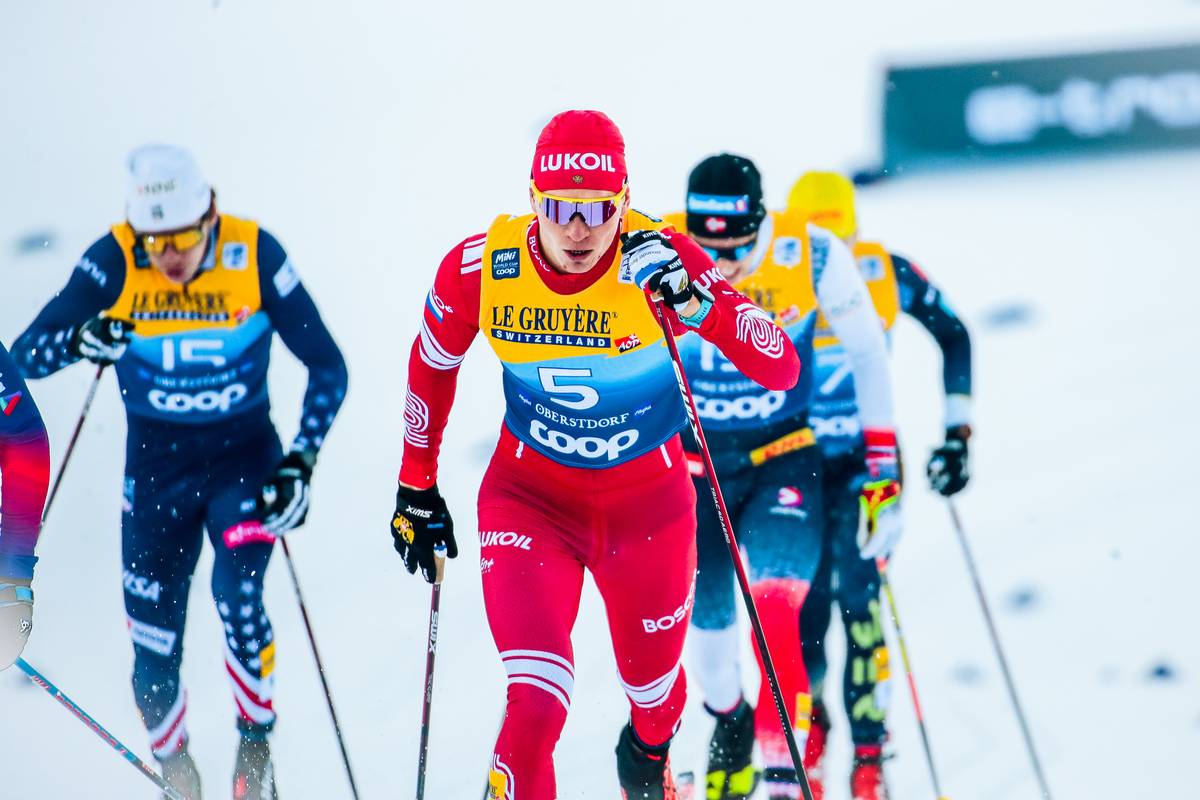
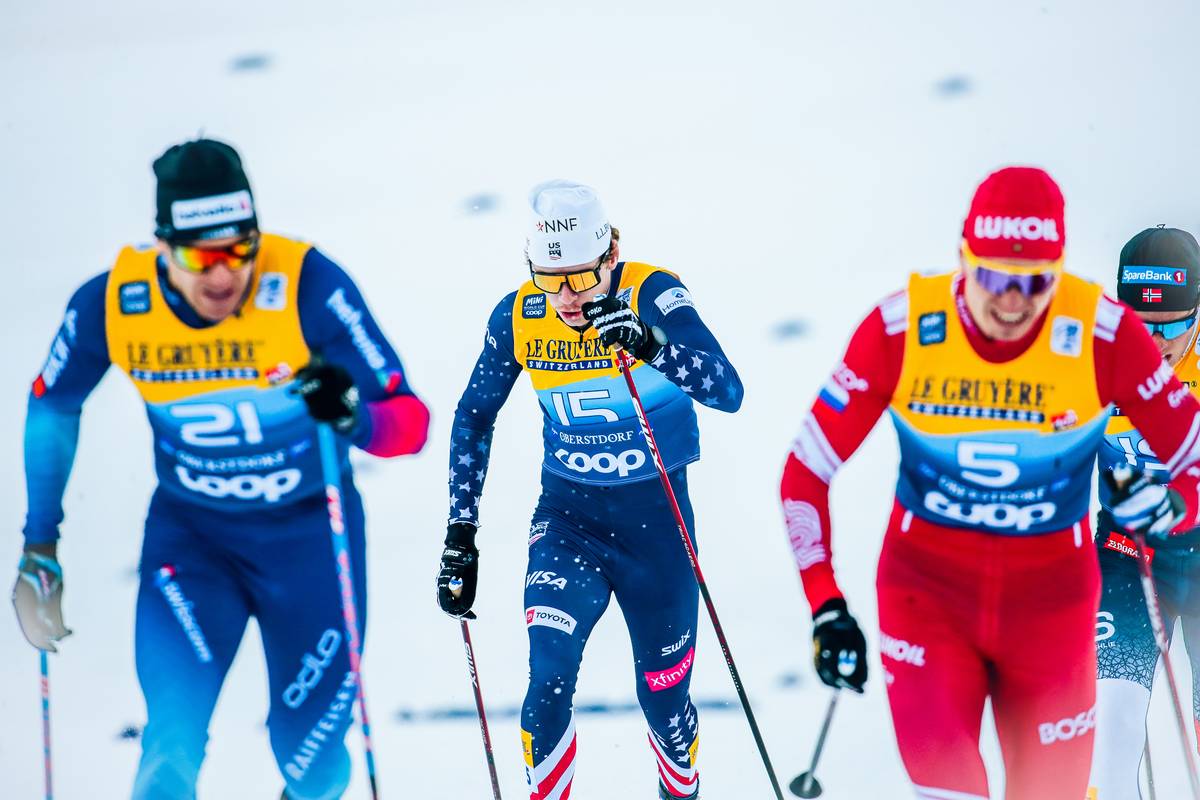
    Alexander Bolshunov leads the quarter final during Stage 4 of the Tour de Ski, with Ben Ogden racing in bib 15. (Photo: NordicFocus)

    In the second heat of the quarters, Ogden lined up alongside Bolshunov, who took control out of the gate. Staying in the pack through the first climb, Ogden found himself in fifth as athletes exited the second and began descending toward the stadium. In the final curves, Ogden couldn’t quite maintain the position needed to contend for a spot as lucky loser, finishing 5th in a fast heat, +1.52 behind Bolshunov.

    Terentev looked as though his day might be over before he could face Klæbo head-to-head. Federico Pellegrino (ITA) stepped on his pole as lanes decreased in the opening stretch, causing it to snap. Terentev calmly accepted a replacement, steadily working his way back into the mix. Running out of the tracks in the final climb, Terentev accelerated around the left-hand curve and into the downhill in the lead, continuing through the finish for the win ahead of Mikal Novak (CZE) to advance comfortably.

    Alexander Terentev leads his quarterfinal during Stage 4 of the Tour de Ski in Oberstdorf. (Photo: NordicFocus)

    In the fifth heat of the quarters, Jager maintained contact with the pack through the first climb, but found himself off the back as he left the second. Jager’s legs wobbled as he found his footing in the descent. Perhaps too flooded to ski as aggressively as was needed to put himself in contention for higher placement, he crossed the line sixth in the heat, +6.88 behind the winner. 

    Luke Jager raced in the fifth quarterfinal during Stage 4 of the Tour de Ski in Oberstdorf. (Photo: NordicFocus)

    On we go to the semifinals.

    In a stacked first heat, Bolshunov and Terentev set the pace at the front heading up the first climb. Striding metronomically, they held Valnes and Klæbo temporarily at bay. As the men charged into the final climb, Klæbo advanced at a run up the outside, rounding the left hand bend with Terentev at the front before beginning the sweeping downhill side by side. 

    Terentev began to move across the track behind Klæbo, looking to finding a line that might be optimal for using the Norwegian’s draft to slingshot into the final lanes at high speed. Not waiting long enough, Terentev caught his tips on the Norwegian’s tails, losing his footing and crashing with a slide into the v-boards. No chance to recover what was lost, Terentev stood up, taking a defeated swing at the ground with his pole, before slowly continuing through the final meters to the finish, now well off the back. 

    As the two had created a small gap to their chasers, Valnes and Bolshunov navigated around the crash easily, racing to the line for second and third. Pulling ahead with his double pole, Valnes snagged second with Bolshunov less than half a second back, hoping for a lucky loser spot in the final.

    With a comfortable lead, Johannes Høsflot Klæbo looks over his shoulder as Erik Valnes and Alexander Bolshunov race to the line in the semifinal. (Photo: NordicFocus)

    Terentev later received verbal warning for a classical technique infraction.

    In the second and less-eventful semi, Pål Golberg and Even Northug attempted to take control of the race in the final climb, but they remained matched by Italy’s Francesco De Fabiani and Sweden’s Calle Halfvarsson as they crested the top. Goldberg picked up the most speed in the descent, accelerating out of the final curve with a sizable gap to his three chasers. Laying off the gas before the line, Goldberg took the win ahead of Northug, who left De Fabiani and Halfvarsson fighting for lucky loser spots on his tails. 

    Calle Halfvarsson and Fracesco de Fabiani take it to the line in the semifinal. (Photo: NordicFocus)

    De Fabiani and Halfvarsson crossed in a photo finish, both just 0.02 seconds ahead of Bolshunov’s mark, allowing them both to advance to the final and ending the Russian’s day.

    With four Norwegians in the final, they were guaranteed at least one spot on the podium. 

    Norway were 1-2-3 coming out of the first climb, with Klæbo sitting in second position. Doublepoling into the next climb, Klæbo matched Valnes as the two ran at the front, Klæbo out of track and Valnes in the inside lane.

    Johannes Høsflot Klæbo leads into the final descent in the last round of the Stage 4 classic sprint in Oberstdorf. (Photo: NordicFocus)

    Klæbo accelerated into the curve at the top stepping in front of Valnes and leading him into the downhill. Klæbo powered into the final stretch still in the lead, with Valnes a ski length back but closing fast with a strong doublepole. Valnes changed lanes, knowing it was his only opportunity if he wanted to try for a win, but there was not enough real estate left and this cost him speed as they came to the line. No time to celebrate this time, Klæbo pushed his boot over the finish to stop the clock at 2:54.77, roughly 3.5 seconds faster than any other rounded, with Valnes 0.3 seconds back for second place. 

    Johannes Høsflot Klæbo takes the win in Stage 4 ahead of teammate Erik Valnes, while Pål Golberg, Even Northug, and Calle Halfvarsson fight for the final spot on the podium behind. (Photo: NordicFocus)

    Behind the duo, the remaining two Norwegians sprinted to the line for a photo finish, with Goldberg edging out Northug for third by just 0.02 seconds. Halfvarsson, still in contention for the podium in the final stretch, crossed 0.5 seconds behind the Norwegians to end his day in 5th, while De Fabiani seemed to have accepted his fate, crossing the line casually +11.71 behind Klæbo. 

    Determining third place, Pål Golberg (center) edges out Even Northug, wit hCalle Halfvarsson just off the mark in fifth. (Photo: NordicFocus)

    Another all-Norway classic sprint podium in Oberstdorf, and a second consecutive win for Klæbo.

    “It’s amazing to start a new year with a victory and also to have two of my best friends coming onto the podium as well,” Klæbo told FIS at the finish. “I am really satisfied with today’s race, and also to start, hopefully, a good new year.”

    After four races in five days, Klæbo was asked whether Tour fatigue had begun to set in. 

    “For sure, I am getting a little bit tired, but still, when the weather is like this and the conditions are pretty nice, it gives you a lot of energy. So it’s just trying to push hard, looking forward to a rest day tomorrow, and trying to push hard in the last two legs.” 

    The all-Norwegian men’s podium after Stage 4 of the Tour de Ski: Johannes Høsflot Klæbo took his fourth win of the Tour ahead of Erik Valnes in second and Pål Golberg in third. (Photo: NordicFocus)

    After the final results were determined, Ogden ended his day in 22nd. 

    “I took the qualifier out really hot, hoping to be in the top 3 in qualification,” Ogden told U.S. Ski & Snowboard cross country communications manager Tom Horrocks at the finish. “I was a little flooded at the end, but not the end of the world. I chose heat 2, which is not always what I do, so I tried something different, and I think I skied well in the heat. It’s been a lot of racing for me early, so I’m a little tired, and wasn’t the smartest out there… but I’d say I’m learning a lot and making progress, so one day I’ll put it together.”

    Full audio clip with Ben Ogden, interviewed by Tom Horrocks.

    Ben Ogden races in heat 2 of the quarterfinals in Oberstdorf. (Photo: NordicFocus)

    It was Jager’s second time qualifying for the rounds in a classic sprint, and his second-best overall World Cup result. Jager was 18th in the opening classic sprint in Ruka, and finished 27th today.

    “I was trying to be competitive, in second, third, or fourth, somewhere where I could potentially get in a draft and have a good finish, hopefully,” Jager told Horrocks post-race. “It didn’t work out that way… Hindsight is 20/20, so maybe I wish I had picked a different lane and just gotten out and ran earlier, but at the end of the day, the pace was just really, really fast. I was and am, chronically and acutely, pretty tired right now, so I just didn’t really have it and wasn’t as aggressive as I should have been going over the top. I like to think if I had another shot in that exact same position, I could make fourth or fifth, but an objective qualification in that [heat] probably wasn’t going to happen for me today.” 

    Luke Jager races to 27th in Stage 4 of the Tour de Ski in Oberstdorf. (Photo: NordicFocus)

    Looking to the bright side, Jager expressed how grateful he has been to have had excellent skis in every race he’s competed this season, which provides confidence even on the days when the body doesn’t want to cooperate. At 21-years-old, Jager’s career is still nascent, and it’s easy to understand how progress at this level may not be linear. 

    “I’m super thankful for the opportunity [to race on the World Cup this season]… It feels often like it’s one step forward, four steps backward over here, just because it’s so brutal. The last month, especially, has been pretty tough and pretty demoralizing at times for me. I’m going home today, so it’s pretty nice to end with a glimmer of hope for what is to come. It’s the real deal. Sometimes it’s easy to forget that because so many Americans are doing well, but it’s pretty damn hard over here.”

    Full audio clip with Luke Jager, interviewed by Tom Horrocks.

    Kevin Bolger races to 33rd in qualification during Stage 4 of the Tour de Ski in Oberstdorf. (Photo: NordicFocus)

    Outside the Top-30, Kevin Bolger and Zak Ketterson were just shy of making the heats, finishing 33rd (+13.10) and 34th (+13.39), less than a second off the time needed to advance. Logan Hanneman was also a near-miss, finishing 37th (+14.08). Gus Schumacher rounded out the American starters in 45th (+16.51) of 73 starters. 

    Looking at the overall Tour de Ski standings with four of six stages complete, Johannes Høsflot Klæbo tops the list for both cumulative time and points after winning three of four events. By time, he sits 1:03 ahead of teammate Pål Golberg and 1:19 ahead of Alexander Bolshunov. With a 15k mass start classic and 10k freestyle hill climb to go, Klæbo is in good standing, but cannot be complacent, as the hill climb, in particular, has historically favored Bolshunov. 

    By points, which favor sprint stages and intermediate sprints in distance races, Klæbo leads with 81 points ahead of Erik Valnes, who holds 50, and Goldberg with 41.

    After a rest and travel day, racing continues Monday in Val di Fiemme, Italy.

    With three wins in four stages, Johannes Høsflot Klæbo leads the overall Tour de Ski standings by both cumulative time and points. (Photo: NordicFocus)

    Stage 4 Results:

    Qualification | Final

    Tour Standings After Stage 4:

    Cumulative Time | Points 

  • Italy’s Pellegrino and De Fabiani to Work With Marcus Cramer and Russian Ski Team

    Italy’s Pellegrino and De Fabiani to Work With Marcus Cramer and Russian Ski Team

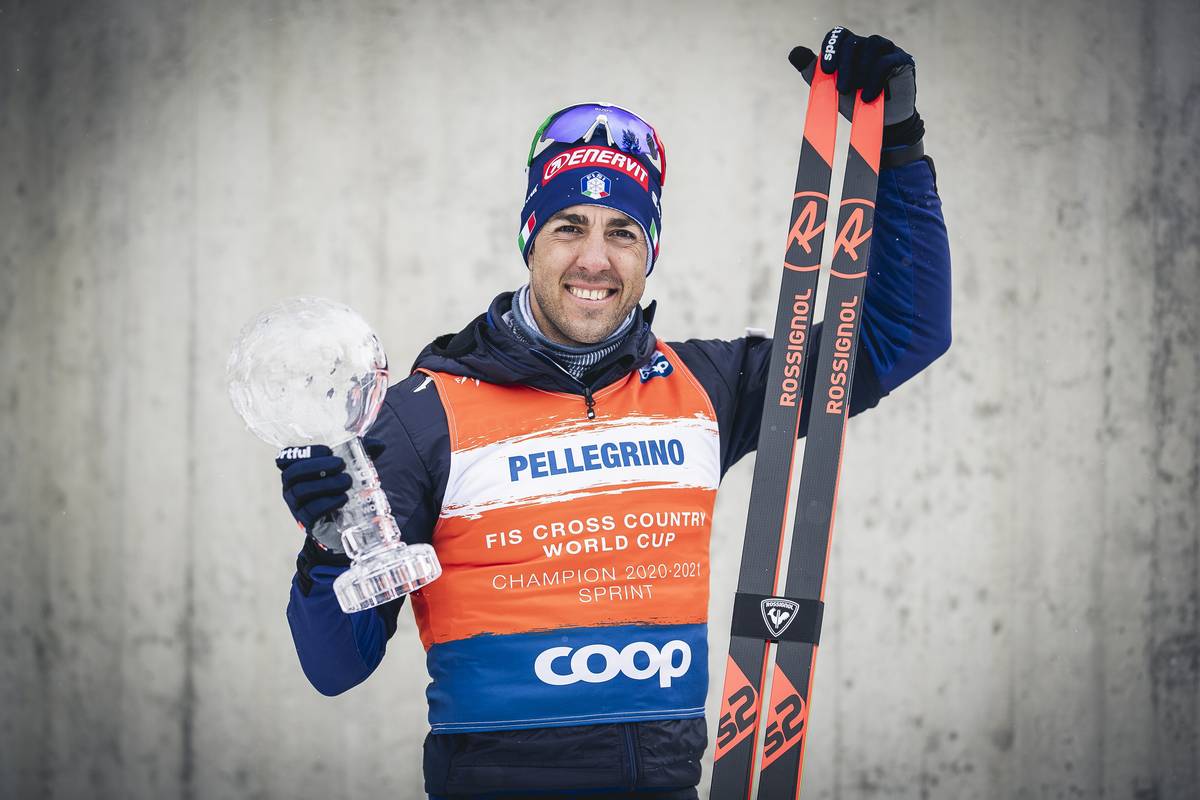
    Federico Pellegrino (ITA) wins the 2020/21 overall sprint globe. (Photo: NordicFocus)

    In a recent press release from FISI (Federazione Italiana Sport Invernali), the Italian Ski Federation, announced some coaching changes for the upcoming season, notably that this year’s World Cup Sprint Globe winner, Federico Pellegrino, and his teammate, Francesco de Fabiani will join the training group of Marcus Cramer who works with the Russian Ski Team. Cramer’s current squad includes Sergey Ustiugov, Gleb Retivykh, Artem Maltsev and Evgeniy Belov on the men’s side and Yulia Stupak, among others, for the women. 

    Gleb Retivykh (RUS) bib 13,  and Evgeniy Belov (RUS) bib 11,  are among two of the top Russians in Marcus Cramer’s training squad.

    The release states that this international working group was set up with the goal of maximizing the summer and fall preparation of both the Italian and Russian’s for the upcoming Beijing Olympics in February 2022 in the best way possible. The training will begin with long periods on snow in Europe starting in May, with the two Italians returning home regularly to join Team Italy for the time in between the on-snow camps. The goal of this project is to experiment with new working methods and intensity, while exchanging Italian and Russian technical knowledge to allow for the growth of both nations’ skiers. 

    Elena Välbe, president of the Russian Cross-Country Ski Association and manager of the Russian National ski team said of this collaboration, “I am optimistic about this proposal from the Italian team. I believe that this collaboration will benefit both Russian and Italian skiers and in particular Federico Pellegrino. This is an excellent step in the development of cross-country skiing, as two different training methods will meet. I am sure that all parties will make the most of this collaboration and the athletes will be able to give their best. ”

    Federico Pellegrino (ITA) on his way to an 8th place finish in Val Müstair, ahead of the French trifecta battling behind him. (Photo: Nordic Focus)

    In light of this change, Federico Pellegrino stated, “It has already happened several times to work with the Cramer team, both in the summer preparation phase and during the winter competitive period. The feedback has always been positive and it will be exciting to undertake this new project together. Surely, in view of the Olympics, starting with all this motivation can only be the best way to approach what may be the most important season of my career. ”

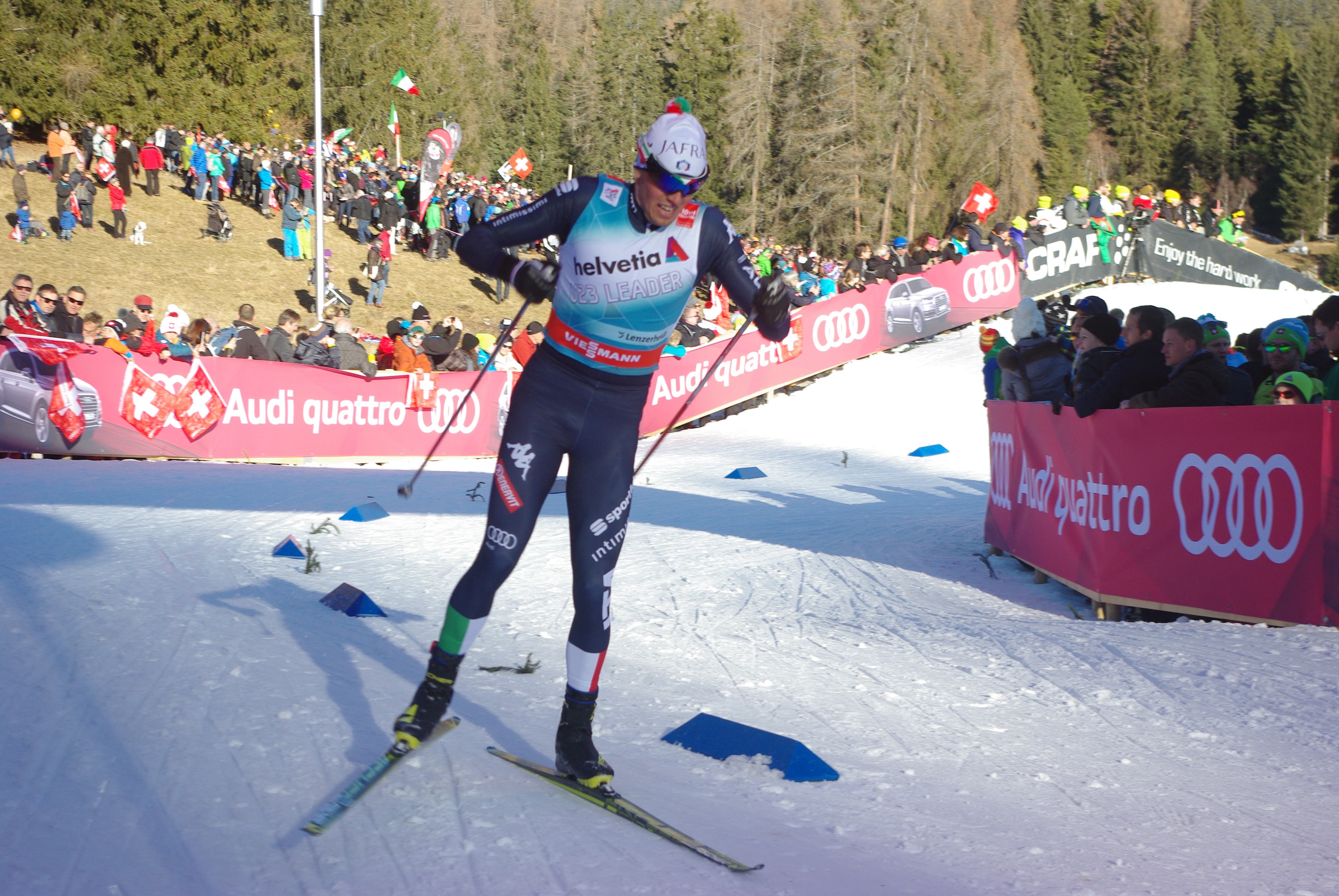
    Fransesco de Fabiani (ITA) wearing the U23 leader bib in 2016 in Falun, Sweden.

    Pellegrino’s teammate, Francesco De Fabiani, said,  “I am very happy with this project because I believe that training with athletes of this caliber is important to copy, understand and grow together and see the differences between what they do and what we do. I believe it is an important opportunity for growth for my future. For now we focus on the Beijing Olympics, but it will also be a useful experience for the following years. Now I focus on the project and I hope to make the most of it.”

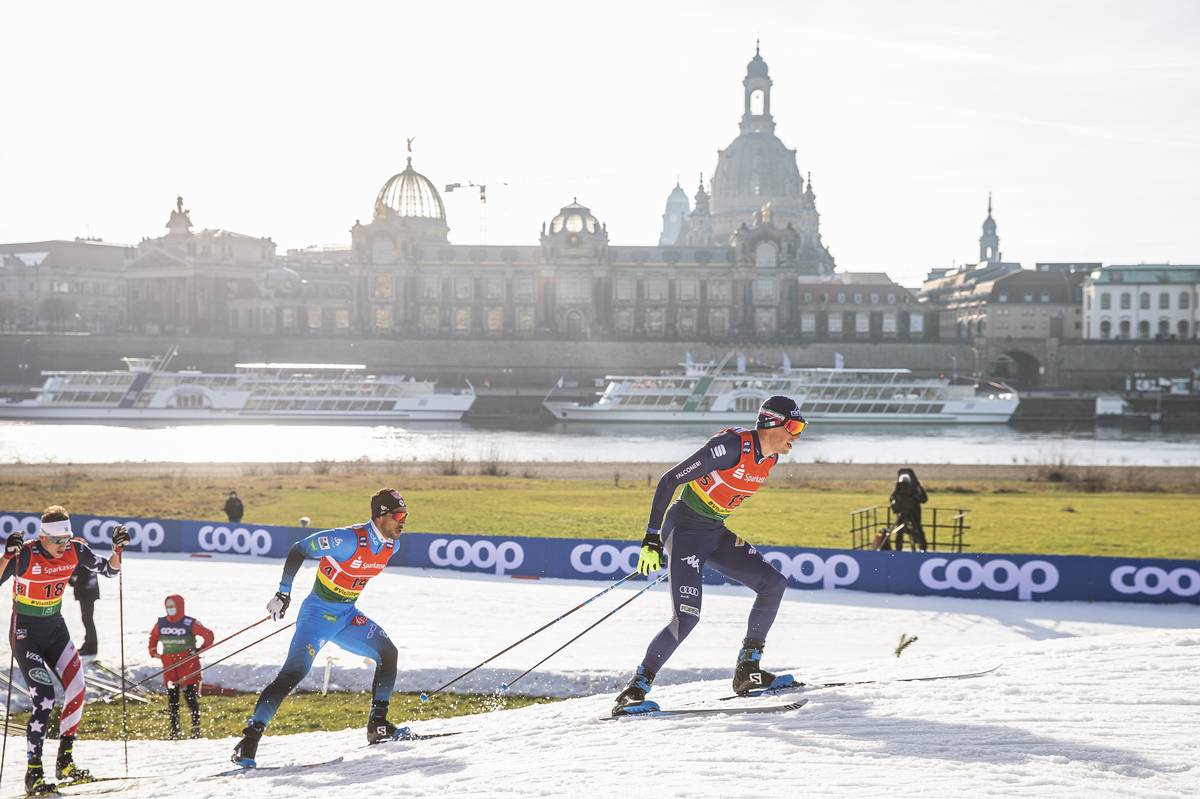
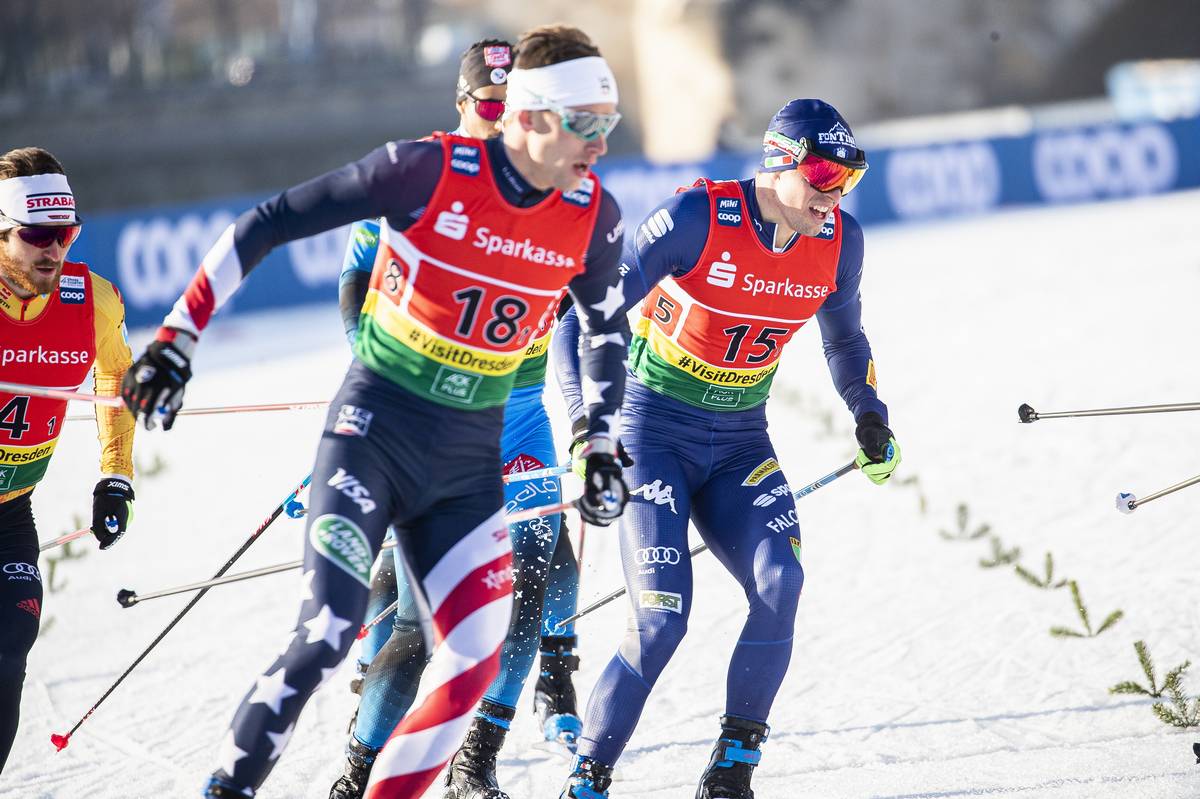
    Francesco De Fabiani tags Federico Pellegrino during the team sprint in Dresden, Germany (Photo: NordicFocus)

    Out of Pellegrino’s sixteen World Cup victories, only one has come in the classic discipline and while he holds a silver medal from the classic sprint in PyeongChang, he will likely be targeting the skate sprint in Beijing 2022. Together, De Fabiani and Pellegrino finished third in the team sprint at the Seefeld World Championships in 2019.

  • Case Closed, Italy Wins Team Sprint in Ulricehamn; Hamilton-Bolger Place Sixth

    Case Closed, Italy Wins Team Sprint in Ulricehamn; Hamilton-Bolger Place Sixth

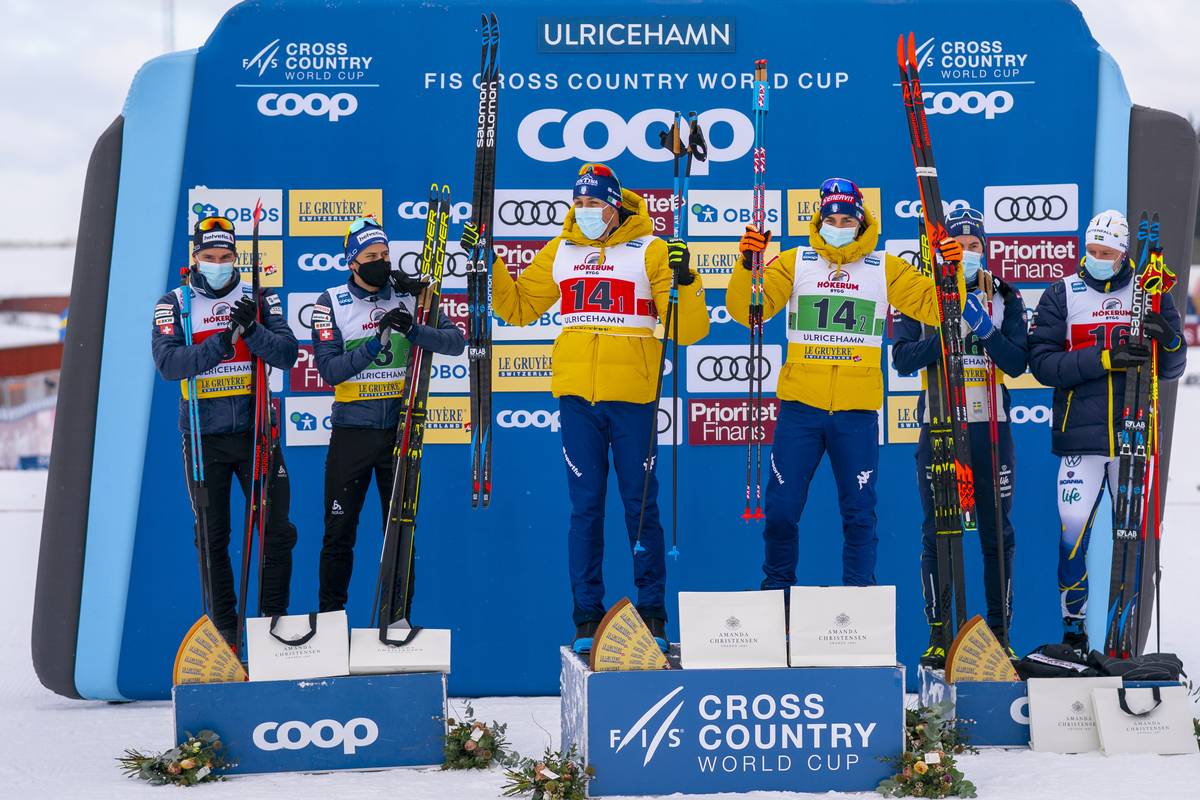
    Men’s team sprint podium, Italy in first, Switzerland in second and Sweden in third. (Photo: Nordic Focus)

    This World Cup coverage is made possible through the generous support of Marty and Kathy Hall and their A Hall Mark of Excellence Award. To learn more about A Hall Mark of Excellence Award or to learn how you can support FasterSkier’s coverage please contact info@fasterskier.com. 

    Ten teams toed the line Sunday morning, representing eight nations (Sweden and Switzerland both having two teams in the final) in the skate team sprint in Ulricehamn, Sweden. After advancing from the semi-final rounds earlier in the day, the men were geared up to race the relatively-flat 1.6 k loop completing three laps per athlete. 

    Heading out for another lap, Ludek Seller (CZE), Jovian Hediger (SUI), and Lucas Chanavat (FRA), (l-r)

    Notably absent from the final was team Russia I, composed of powerhouse sprinters Sergey Ustiugov and Gleb Retivykh who finished 9th (+15.32) in semi-final B and did not advance. Both Russians were in Saturday’s skate sprint final with Retivykh second and Ustiugov sixth. Additionally, no Norwegians were present in the final lineup as both Norway I and II were eliminated in semi-final A.   

    Men’s semi-final B, team Russia I was eliminated although Italy (left) and USA I (bib 18) advanced to the final. (Photo: Nordic Focus)

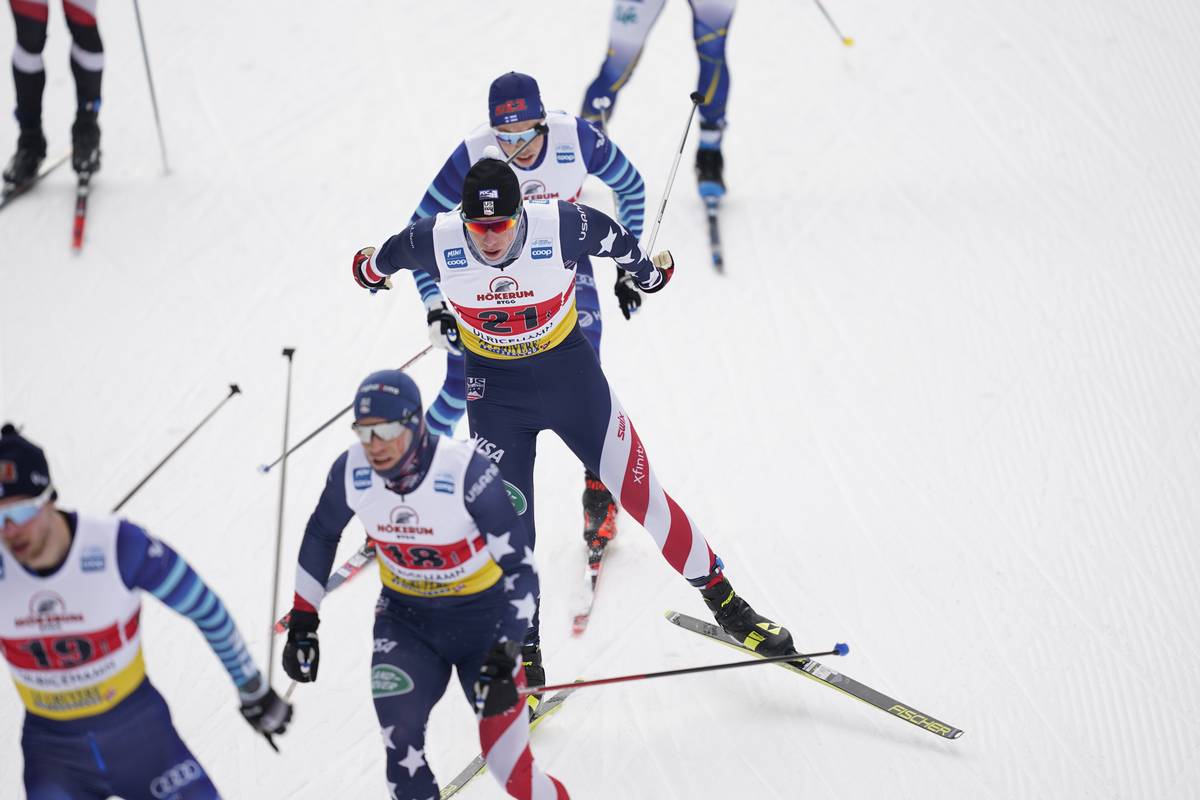
    The race began slow and steady for the first laps, gradually ramping up in intensity. Much like the team sprint earlier this season in Dresden, Germany, the course layout in Ulricehamn featured no punchy climbs. Pack skiing, by default, was encouraged. Fliers off the front were not incentivized. Simi Hamilton and Kevin Bolger, representing team USA I, took on the lead for much of the second and third laps.

    “Our main tactic for both the semis and the finals was to get to the front but if you found yourself off the front in the lead, just ski relaxed and fast, but ski relaxed,” said Hamilton after the race. Ideally, we wanted to be in second, third, or fourth so we could get a good draft on the gradual climb and coming back down from the top. But with such a high-speed course like this, and a few, I would not call them technical corners, but some fast corners and a lot of moving around, we did not want to be stuck in the back where there could be some crashes and some broken poles and you are also spending a lot more energy moving up through the pack.”


    Simi Hamilton makes the descent into the stadium, followed in hot pursuit by Roman Jovian Hediger (SUI) and Francesco de Fabianai (ITA). (Photo: Nordic Focus)


    Kevin Bolger (USA), Richard Jouve (FRA), (l-r). (Photo: NordicFocus)

    Heading into the fifth and final exchange, the men jostled for position as they rounded the corner towards the stadium. Lucas Chanavat, who had held the advantage out front, clipped his skis and went down, effectively eliminating team France I from contention.

    Lucas Chanavat (bib 1), Renaud Jay (bib5), and Sindre Bjørnestad Skar (bib 2), during their semi on Sunday. This image provides a good indication of the tight pack skiing with ten teams on course. (Photo: NordicFocus)
    Lucas Chanavat (FRA) with the lead before a fall took him out of contention (Photo: Nordic Focus)

    The workhorse of the Italian sprint team, and always a threat when skate sprinting for that matter, remains Federico Pellegrino. With his usual Norwegian foils absent this weekend in Ulricehamn, at least on paper, he could be considered a lock for Saturday’s individual skate sprint. He placed third – outhustled and outmaneuvered down the final straight by Oskar Svensson and Retivyk, to place third. Sunday, however, was another day. With speed and precision, Pellegrino took control at the front as the race got real leading into the stadium for the finish. He was closely followed by Roman Furger skiing for Switzerland I. In classic form, which means pulling away and displaying stoke, Pellegrino took the victory for himself and teammate Francesco de Fabiani in a time of 18:29.

    Federico Pellegrino (ITA) celebrates the win. (Photo: Nordic Focus)

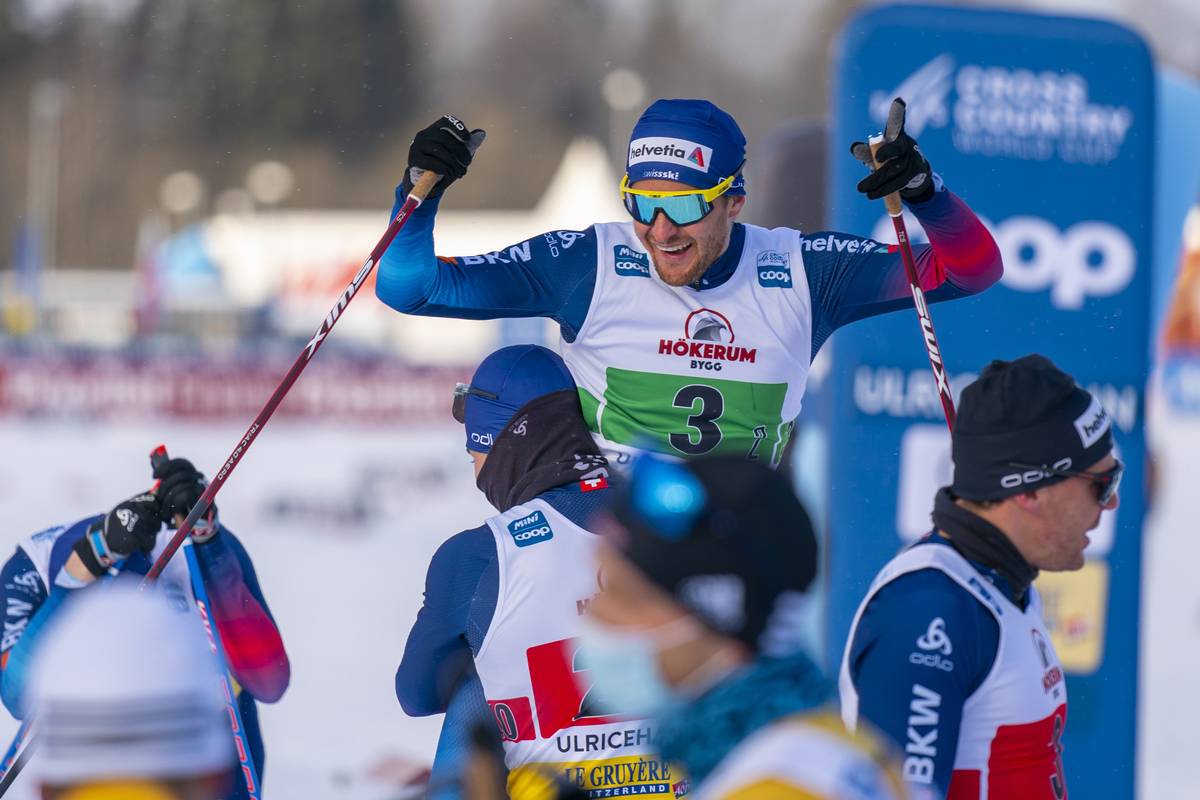
    Securing second, with much enthusiastic cheering and shouting from his teammates, Furger and Jovian Hediger made it a double podium day for the Swiss (the Swiss women having finished third). Rounding out the podium in third was Sweden II, represented by Karl-Johan Westberg and Johan Häggström.

    The Americans, Hamilton and Bolger, finished the day in sixth position, +3.11 back from the Italian victors. 

    Jovian Hediger (SUI) gets a boost from some happy teammates at the finish line. (Photo: Nordic Focus)


    Logan Hanneman (USA) representing USA II in semi-final B. (Photo: Nordic Focus)

    Competing in the first semi-final (A) team Canada placed 10th, +20.74 back from heat winners France I, and did not advance. Racing in semi-final B, team USA II (Logan Hanneman and Peter Holmes) finished 8th (+8.89).

    Men’s Team Sprint Final Results

  • Bolshunov Takes Stage 6 Win; Schumacher with Career-Best Eighth

    Bolshunov Takes Stage 6 Win; Schumacher with Career-Best Eighth

    Yellow bibbed and in the lead after the start of Stage 6 of the Tour de Ski: Alexander Bolshunov (RUS). (Photo: NordicFocus)

    This World Cup coverage is made possible through the generous support of Marty and Kathy Hall and their A Hall Mark of Excellence Award. To learn more about A Hall Mark of Excellence Award or to learn how you can support FasterSkier’s coverage please contact info@fasterskier.com.

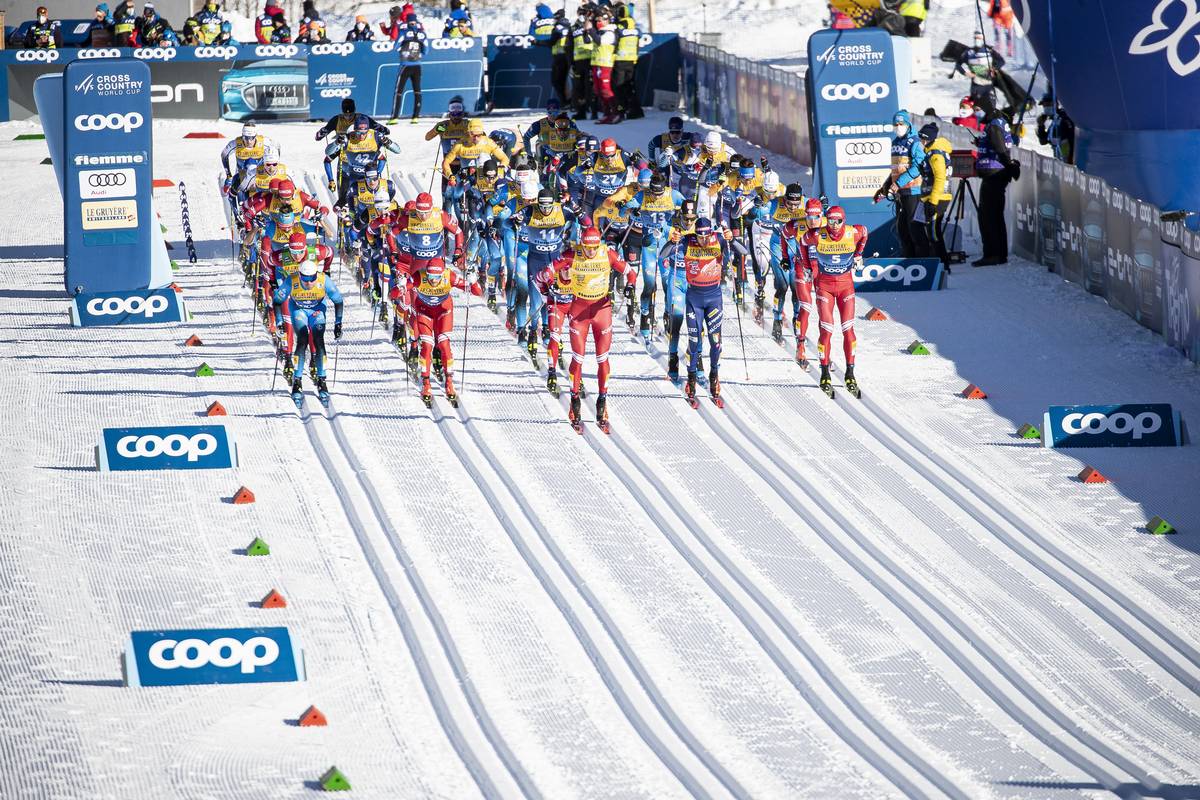
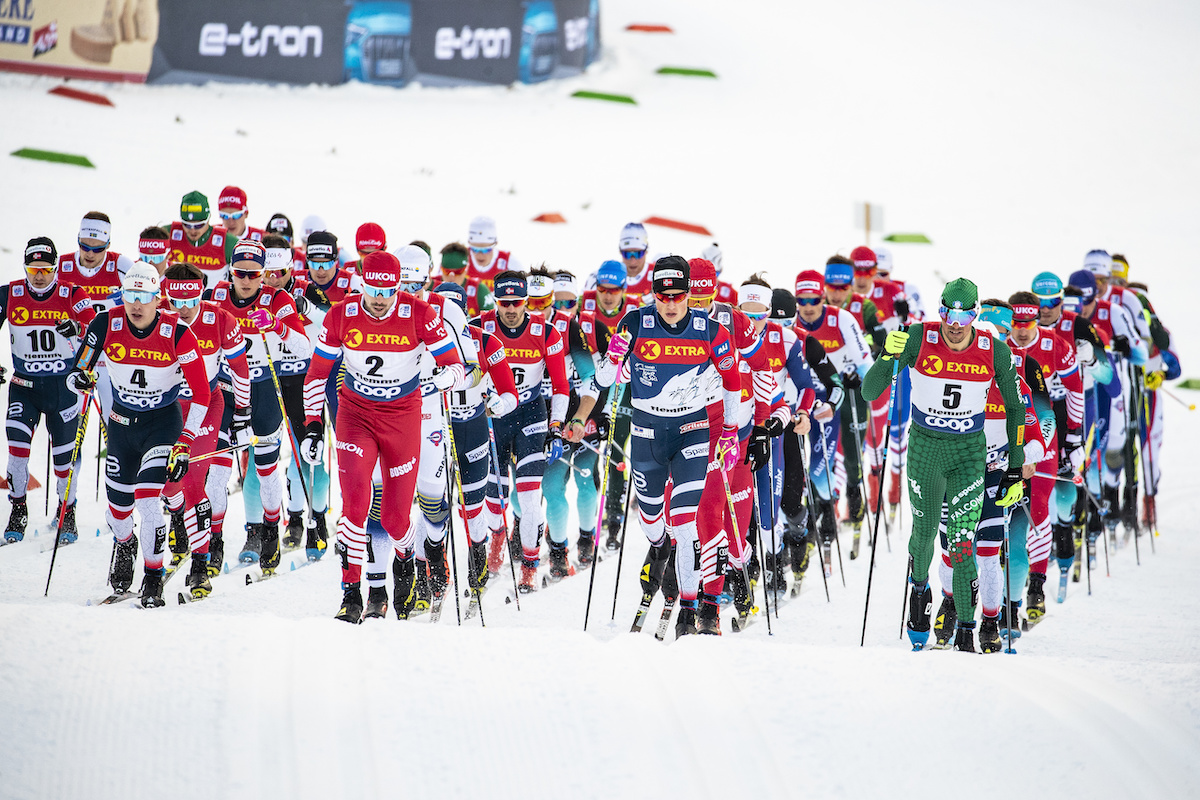
    A crisp and clear day in Val di Fiemme, Italy as the men lined up for Stage 6 of the Tour de Ski. Today’s race, a 6 x 2.5 k classic mass start with a total climb of 96 meters per lap, found them winding around the tight turns of the shadowed side of the valley, poles creaking in the cold snow. With the crack of the starter’s gun, the 53 skiers were off. 

    Stage 6: starting like it finished with Russia’s Alexander Bolshunov in front. (Photo: NordicFocus)

    A bonus points sprint around 1.5 k, won by Richard Jouve of France, caused a slight stretch in the pack, but like elastic they quickly snapped back together. For the better part of the second lap, Evgeniy Belov of Russia tried his hand out front but his teammate Alexander Bolshunov did not let this continue for long as he led the hunt, reabsorbing Belov as they lapped through the stadium for the third time. 

    Evgeniy Belov (RUS) takes a fast corner. (Photo: Nordic Focus)

    The sprint for bonus seconds on the penultimate lap went to Bolshunov, earning him an additional 15 seconds. Throughout all this, Gus Schumacher of the U.S. was gradually working his way up through the pack from his starting position in bib 33. When the cowbell rang signaling the final lap, Schumacher was sitting in 12th, well situated within the lead pack.

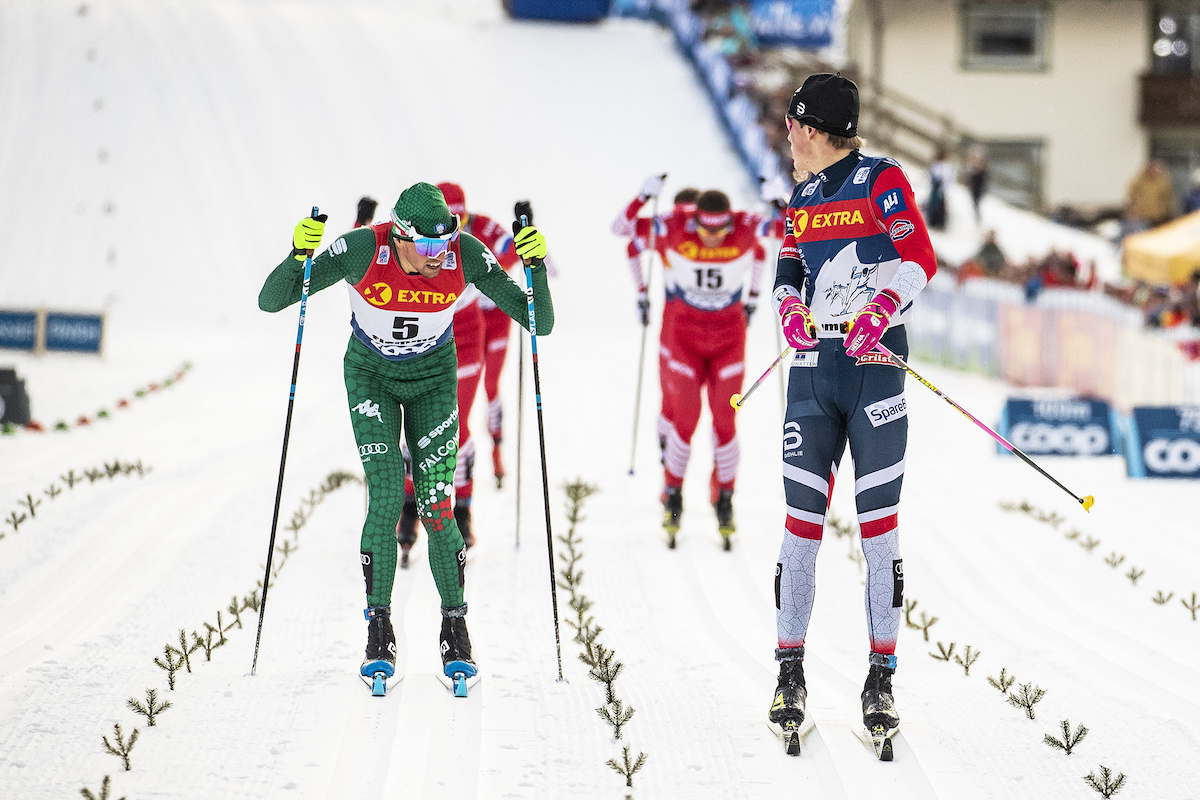
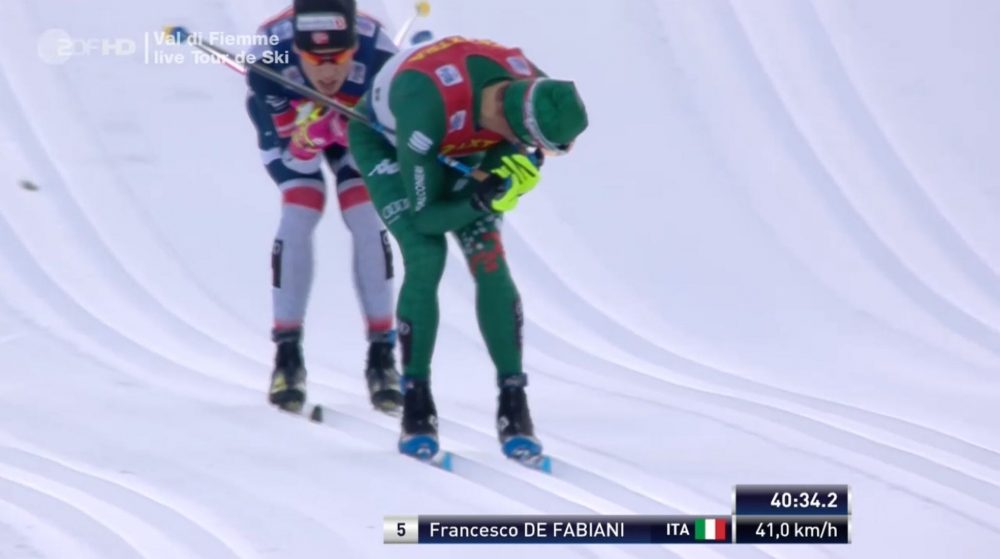
    Francesco de Fabiani of Italy seized an opportunity out front and began to pull away, closely shadowed by Bolshunov. By the time they descended into the massive horseshoe corner for the final time a clear threesome had broken away, led by de Fabiani, then Bolshunov and Russia’s Alexey Chervotkin. De Fabiani entered the downhill towards the finish some meters ahead of Bolshunov, but his skis were no match for the rockets worn by the Russian. Bolshunov shot past de Fabiani and essentially out-glided him to the finish line in a time of 41:33.7. De Fabiani came away with silver, +1.8 seconds behind, and Chervotkin held his own to finish third (+3.7 seconds back).

    Stage 6 podium: Francesco De Fabiani (ITA) second, Alexander Bolshunov (RUS), Alexey Chervotkin (RUS) third, (l-r). (Photo: NordicFocus)

    It appears Val di Fiemme and de Fabiani go well together: last year in this same stage of the Tour (the 15 k mass start classic), he placed second, 0.6 seconds off the top-step to Norway’s Johannes Hoesflot Kleabo, who won. Bolshunov placed third. 

    Bolshunov down the finish straight. (Photo: NordicFocus)

    At a certain point, one begins to run out of superlatives to use, but once again Bolshunov proved his dominance, despite a tricky course for breakaways. Bolshunov now has won five of the six stage races and continues to grow his overall lead in the tour standings. In his post-race interview Bolshunov spoke through a translator, “It was perfect skiing conditions today and due to that, it was really hard to ski away so the fight was at the end and luckily I was able to pull that out.” After his victory today, his lead has now stretched to +2:37 ahead of Maurice Manificat of France who has moved into second place overall.

    Gus Schumacher placed 8th in Stage 6 of the Tour de Ski, a career-best World Cup result. (Photo: Nordic Focus)

    Race of the day, and certainly the year for American distance skiing, belongs to Gus Schumacher. As the pack split apart on the final lap, Schumacher remained in range.  Pacing strategically, and working up through the pack, he was 31st at 5 k (+13.1) then 16th at 10 k (+6.7). Looking for optimism in American men’s distance skiing? Here is your ray of sunshine. 

    At 13.9 k he was in 5th place, behind the three eventual podium finishers and Ilia Semikov of Russia. Minutes later, he crossed the finish line in 8th place, a career best. Schumacher, who took gold in the 10 k classic at World Juniors last year in Oberwiesenthal, Germany, seems to be on a steady upward trajectory in this year’s Tour de Ski. With today’s standout performance he is now seated in 18th place in the tour standings, +6:45 back from Bolshunov (RUS). 

    Another performance worth noting is that of Ireland’s Thomas Maloney Westgaard, who is based in Norway, placed 9th in today’s race. Westgaard’s (IRE) previous best World Cup finish came in February 2020 when he placed 16th in a 15 k classic race in Lahti, Finland. Additionally, Sweden’s Calle Halvorsen did not finish. 

    Scott Patterson (USA) finishes up Stage 6 of the Tour. (Photo: Nordic Focus)

    Scott Patterson of the U.S. finished in 35th (+1:50.5) and Kevin Bolger came in 46th (+3:38.7). Racing continues tomorrow with a classic sprint. 

    Men’s Stage 6 | Men’s Tour Overall

  • Russia, France, and Italy Put On a Show in Dresden’s Team Sprint; Hamilton-Bolger 9th for USA

    Russia, France, and Italy Put On a Show in Dresden’s Team Sprint; Hamilton-Bolger 9th for USA

    This World Cup coverage is made possible through the generous support of Marty and Kathy Hall and their A Hall Mark of Excellence Award. To learn more about A Hall Mark of Excellence Award or to learn how you can support FasterSkier’s coverage please contact info@fasterskier.com.

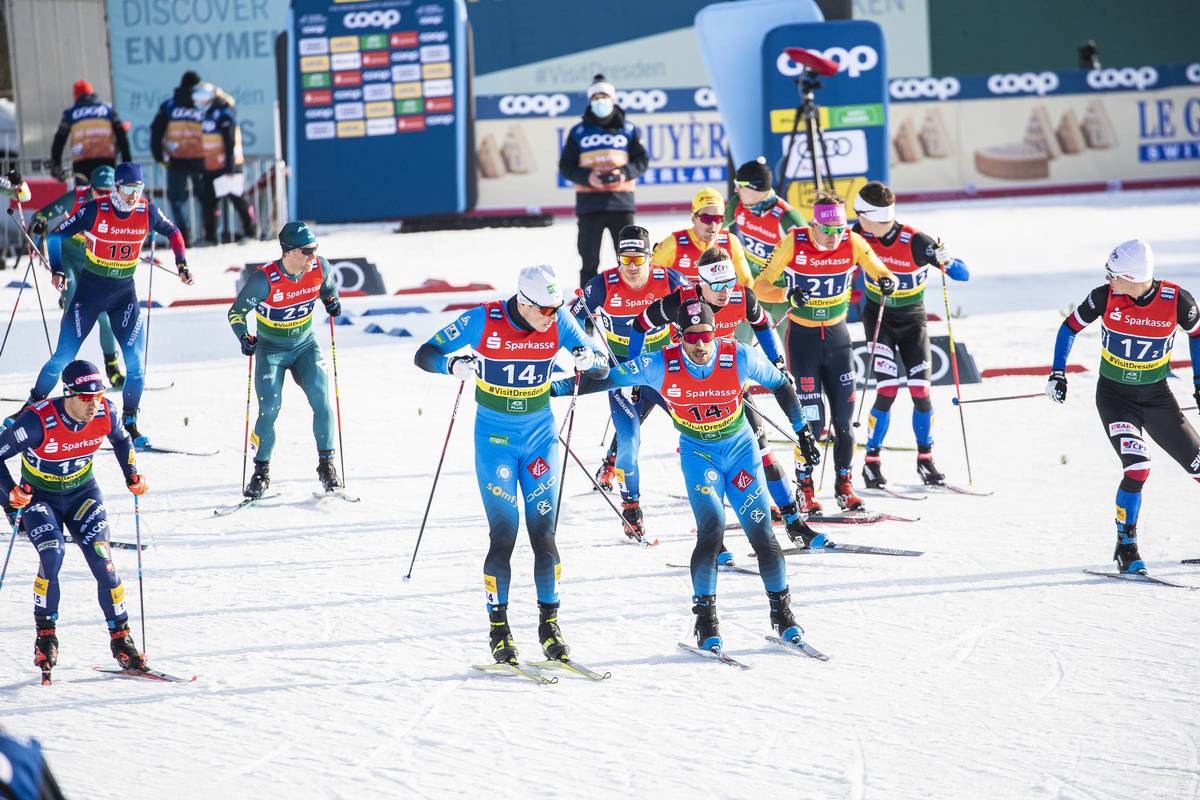
    The team sprint is like a pump rocket, slowly building pressure for a final eruptive takeoff. Six 0.65 km laps each in rapid succession. Short recoveries between legs mean the athletes slowly wind up the effort while staying out of trouble, not wanting the rocket to misfire and lose it’s peak potential. Stay in the pack, drafting and in control, don’t crash or break a pole are sound strategies. 

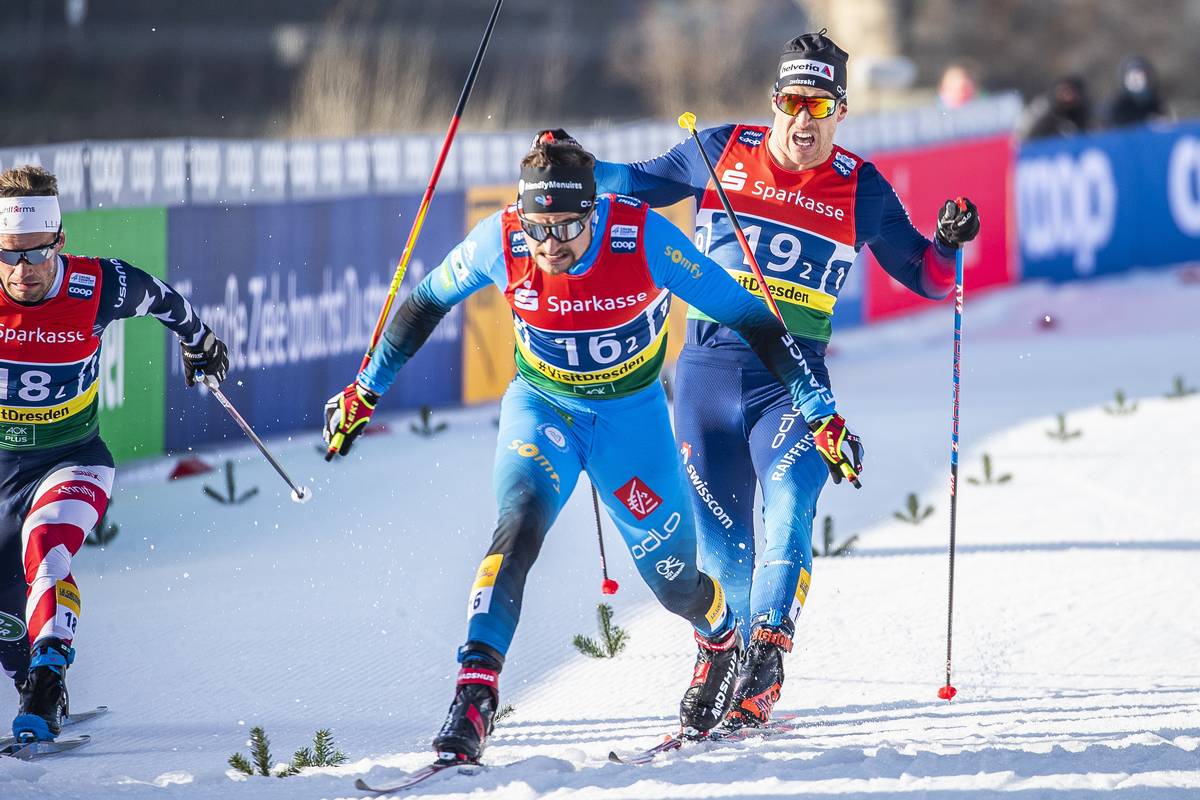
    Chaos in the exchange zone, Richard Jouve tags Lucas Chanavat during the team sprint in Dresden, Germany. (Photo: NordicFocus)

    The men’s event evidenced this metaphor perfectly. The pack stayed close and looked comfortable with no crashes through the first half. As the final four exchanges progressed, you could feel the pressure from the pump steadily rise (in this case, three pumps wearing red, navy, or royal blue lycra) fighting against the confines of the bottle. 

    At the 7th exchange, just after the half-way mark, the pressure reached its limit and the launch began. Richard Jouve of the France 1 team accelerated from the exchange zone, making an effective push to stretch out the field. Italy’s Francesco De Fabiani and Russia’s Alexander Bolshunov kept close on his tails, and although the remaining pack did not immediately lose contact, it became increasingly clear who the podium contenders would be. 

    Foot on the gas, Richard Jouve accelerates to spread out the pack for the final half of the team sprint in Dresden, Germany. (Photo: NordicFocus)

    Next exchange, Russia took the reins, with Gleb Retivykh setting pace. Yesterday’s sprint winner Federico Pellegrino looked confident as he tucked in behind the Russian, the winners of the two qualifying rounds squaring off. Lucas Chavanat of France kept close contact in third.

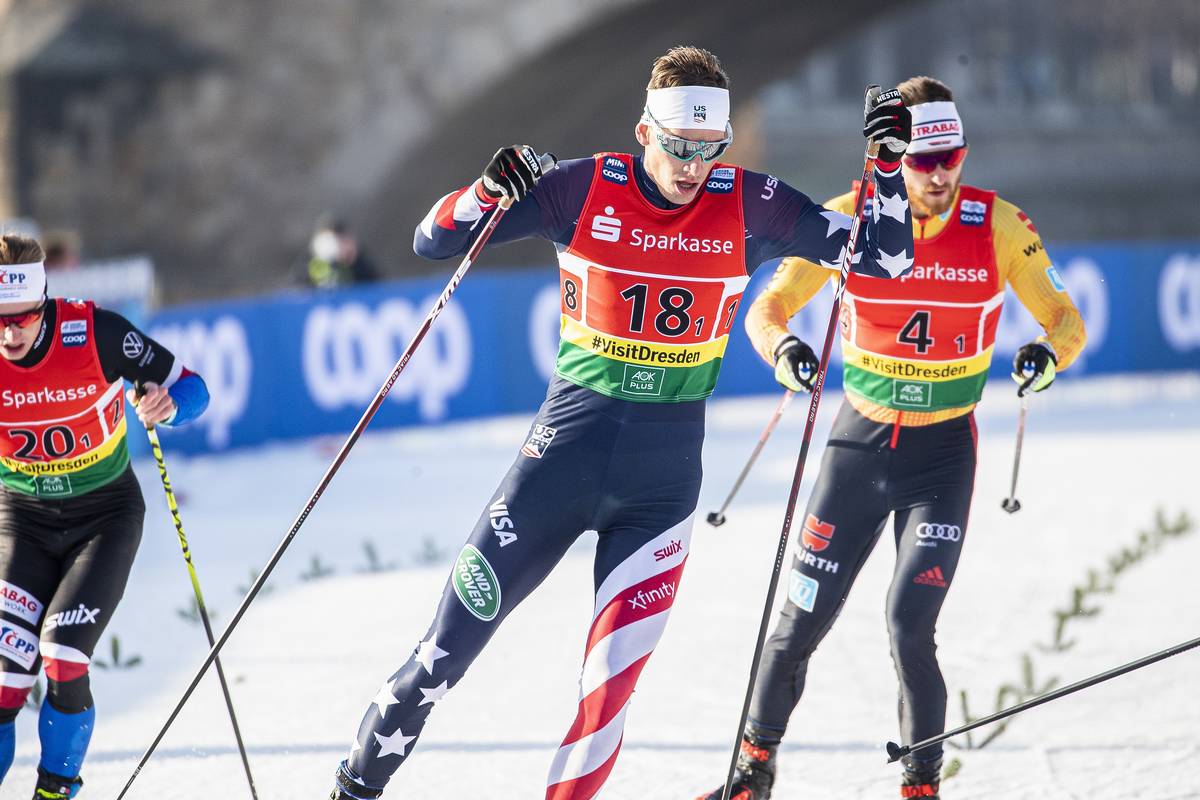
    With the Dresden skyline as a backdrop, Italy’s Francesco De Fabiani leads Richard Jouve of France and American Kevin Bolger during the team sprint. (Photo: NordicFocus)

    Russia continued their up-tempo from the front during the final lap where the three leading teams separated from the chasers. Heading into the lanes, all three teams had a chance. Retivykh took charge off of looker’s left, while Chavanat fought for centimeters on lookers right. Pellegrino tucked in behind the Frenchman, priming himself to sneak a boot around at the line.

    Real estate was limited and Retivykh had unmatched finishing speed on the day, crossing the line for the win in 15:01.14. Chavanat stopped the clock +0.19 seconds behind in second, and Pellegrino carried the Italians to third (+0.58).

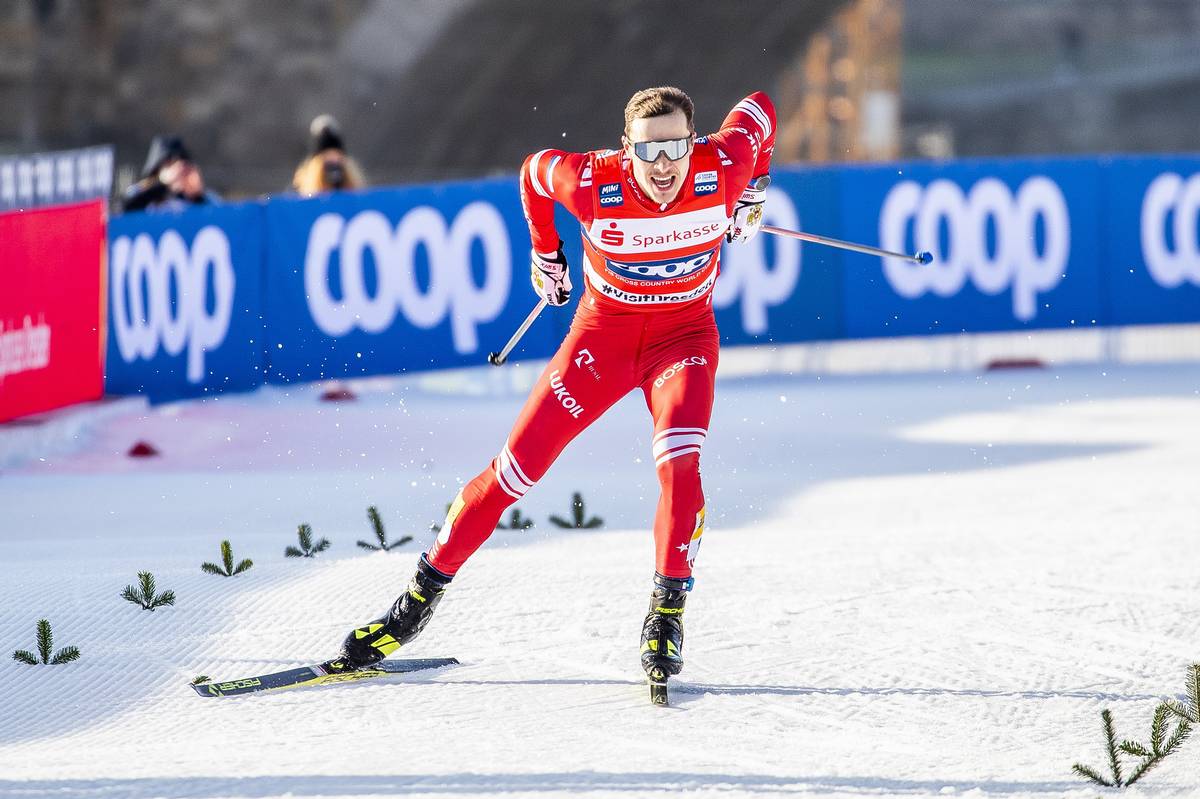
    Down the home strech, Gleb Retivykh takes the victory for Russia at the team sprint in Dresden, Germany. (Photo: NordicFocus)
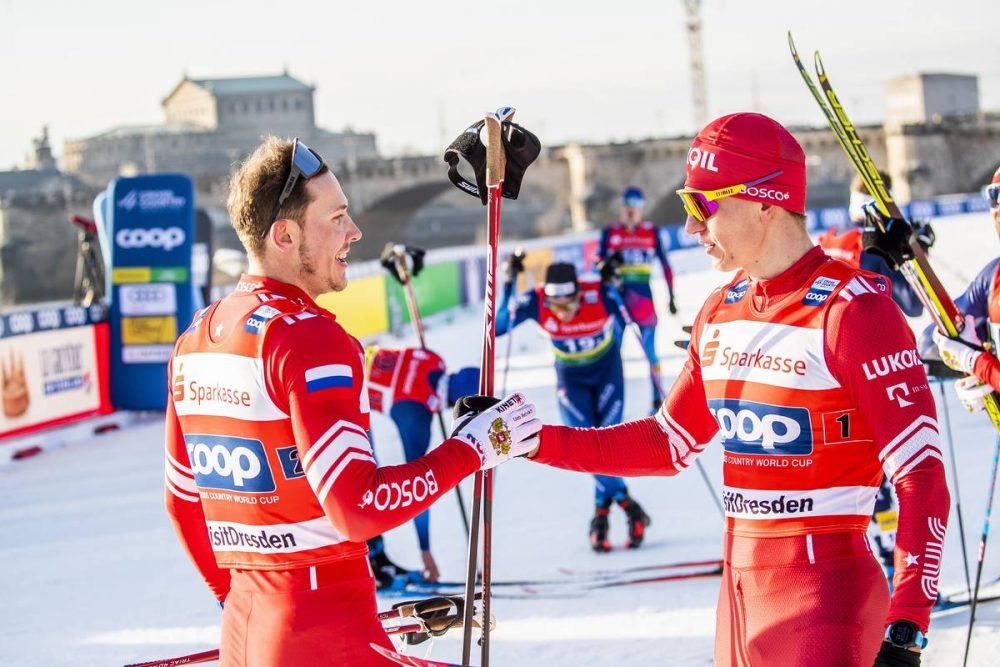
    The Russian victors Gleb Retivykh (L) and Alexander Bolshunov (R) shake hands after the team sprint in Dresden, Germany. (Photo: NordicFocus)

    “It is a very nice competition every time we come to Dresden…” Retivykh told FIS after the race. “We worked together really well and with tactics. The Russian teams took the podium today for women and men. We’re happy.” 

    Prior to today’s win, Russia was in a three-year drought for team sprint victories. Russia last won the event in February, 2017 during a pre-Olympic World Cup in PyeongChang, China. Retivykh was also the anchor on that day.

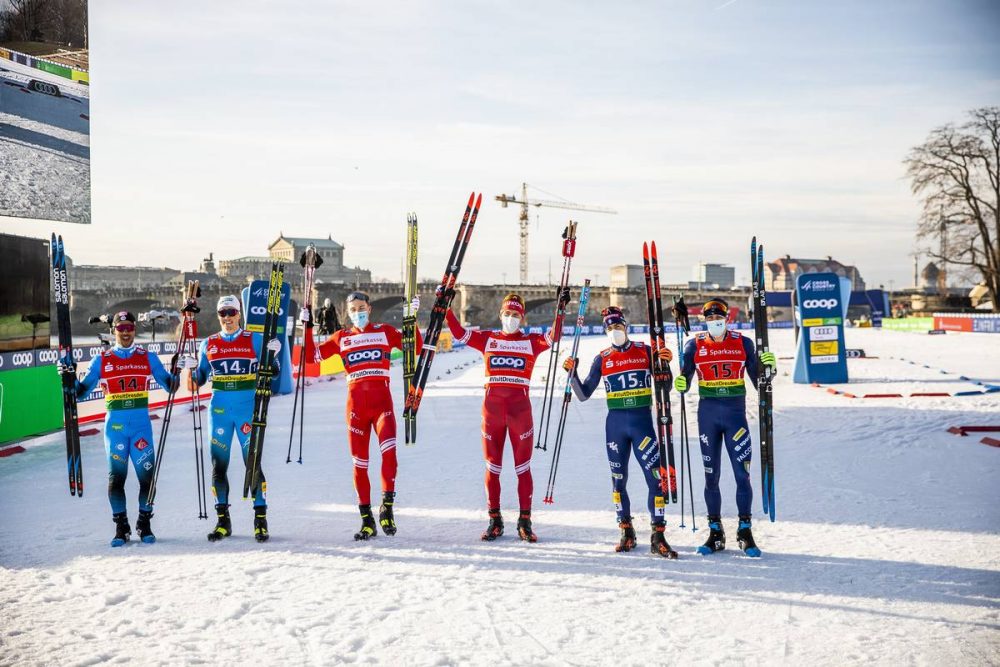
    The men’s podium of the team sprint in Dresden, Germany. The Russia 1 team of Alexander Bolshunov and Gleb Retivykh stole the show, with Richard Jouve and Lucas Chavanat of France in close second, and Italy’s Francisco de Fabiani and Federico Pellegrino in third. (Photo: NordicFocus)

    Behind the podium finishers, the U.S. team of Kevin Bolger and Simi Hamilton stayed in the mix, skiing strong in the middle of the pack and close to the leaders through the final two laps. With two laps of the course to go, Bolger and Hamilton began to lose contact along with the remaining teams, fading from 2 seconds back at 6.5 k to finish 12.57 seconds behind in 9th. 

    Kevin Bolger (bib 18) rounds the curve with Italy’s Francisco De Fabiani during the team sprint in Dresden, Germany. (Photo: NordicFocus)
    Simi Hamilton keeps the U.S. team in the mix during the team sprint in Dresden, Germany. (Photo: NordicFocus)

    “Even though the result wasn’t exactly what we wanted today I thought we skied really well and fought through both heats,” wrote Hamilton after the race. “I felt great in our semi, and still pretty good for the final, but things were incredibly scrappy and we just kind of kept getting caught in the back with tangles, broken poles, and the likes. Team sprinting can be so fun and so frustrating at the same time, but it was just really, really cool to ski with Kevin today and I’m so psyched with how he’s skiing right now.”

    Simi Hamilton fights to the finish with Jovian Hediger (SUI), Renaud Jay (FRA) just behind. (Photo: NordicFocus)

    The Bolger-Hamilton duo had placed fifth in the first semi-final in a tight finish, 0.69 seconds behind winners Italy I ( De Fabiani and Pellegrino).

    In the second men’s semi-final, the U.S. team of Logan Hanneman and JC Schoonmaker placed 10th (+27.21) and did not advance. 

    The World Cup takes a holiday break until the Tour de Ski which is scheduled to begin on January 1.

    Men’s Team Sprint Final Results: Final Results

    Men’s Team Sprint Semi-final Results: Semi-final 1 | Semi-final 2

    Out of the lanes and around the bend, Kevin Bolger keeps the Americans in contention during the team sprint in Dresden, Germany. (Photo: NordicFocus)
  • Klæbo Takes Home a Crystal Globe; Harvey Ends Career with a 2nd Place

    Klæbo Takes Home a Crystal Globe; Harvey Ends Career with a 2nd Place

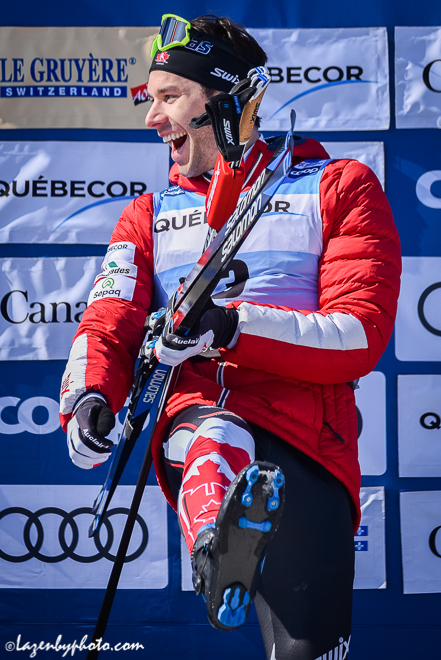
    One more riff: Harvey’s “air -guitar” remains in tune. (Photo: John Lazenby/lazenbyphoto.com)

    Alex Harvey finished his career racing for Canada with a bang today in Québec City, Canada. Harvey placed second to Norway’s Johannes Høsflot Klæbo in today’s 15-kilometer freestyle pursuit. It was Harvey’s second podium in as many races as he can now claim a perfect ending to his career. Another solid ending went to Klæbo, who with his win today earned the overall World Cup title. Although the point differential lent an air of intrigue to the racing as Klæbo and Alexander Bolshunov of Russia were fighting for the overall title today, Klæbo’s knack for theater and endurance left nothing to doubt. Bolshunov placed third on the day and second in the overall standings. 

    “It was a cool race out there, Klæbo told FasterSkier after the race. “Bolshunov and Harvey were really strong and I think Bolshunov did most of the job today. On the second lap there, I felt the pace behind was quite high so I decided to let them in and I saw that when they took the head with me I felt like it was much easier to stay behind. This was a really cool race and it’s really cool to have Harvey on the podium again. I am really happy for him and it was important for me that he took Bolshunov as well. I was saying thank you to him after the race. I think he was really happy, he said so.”

    For the Win. Johannes Høsflot Klæbo (NOR) wins the Overall World Cup Title at the World Cup Finals in Quebec City, Canada

    Klæbo’s sentiments weren’t guaranteed with Bolshunov as the chaser. Klæbo started the pursuit 52 seconds ahead of Bolshunov and Harvey. Because of this, Klæbo skied the first half of the race alone. But, in a chase lead by Bolshunov, Harvey and Bolshunov continued to make up time on the Norwegian. Just before the 8k mark, Bolshunov and Harvey came into eyesight of Klæbo and by the 8.2 checkpoint, the three skiers were skiing together. They were locked as a trio until near the finish.

    Bolshunov lead the second half of the race, with Harvey in second and Klæbo sitting in behind. But during the final climb, Klæbo found a last bit of energy and attacked, pulling ahead of Bolshunov and Harvey. He kept this lead to the finish, ending the race +2.8 seconds ahead of Harvey.

    Bolshunov seemed to have second place in the bag when he and Harvey came around the corner into the finishing stretch. Harvey came from behind with an inspiring final push and managed to overtake Bolshunov and grab second place. Today’s podium was the 28th and final podium of Harvey’s World Cup Career as he is set to retire at the end of this season. Bolshunov is ending his 2018/2-19 season with 10 podiums, five of which were wins.

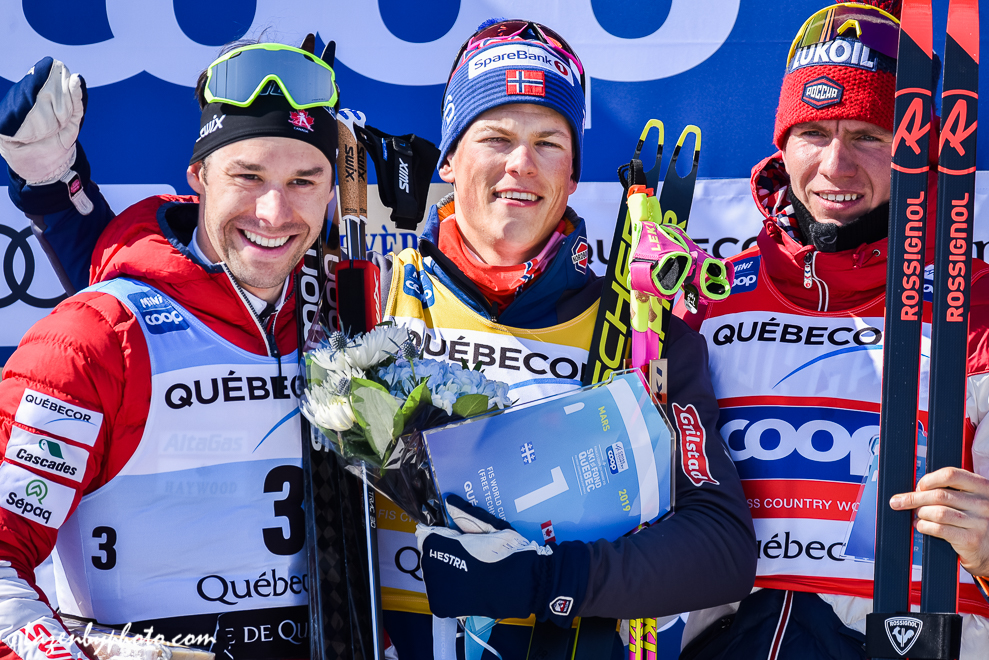
    All smiles at the end of the season. From left to right, Alex Harvey (CAN) was 2rd, Johannes Høsflot Klæbo (NOR) was 1st and Alexander Bolshunov (RUS) was 3rd.

    “I didn’t feel as strong today and I think that the pace behind was really high, so I decided to just let them get in and go behind and stay behind before the end there and then try to push all into the last uphill and before the finish there, “ Klæbo said of his race strategy. “The tactic worked quite good and it was even better to see Harvey beat the Russian guy, that was amazing.”

    Yet Klæbo qualified his statements to note that he harbors no deep-seated resent for the Russians. 

    “I don’t have any bad things to say about Russia at any time,” Klæbo said. “It’s good to have this type of duels I think. It’s really fun and exciting for the sport that we have this tight duel. I don’t know how many points it was at the end there, but I don’t think it was that much. It’s cool to have this type of competition and today was a lot of points to ahead today. The Canadian guys, it’s just friendly. No enemies at all, so it’s really cool and I think we all are very happy about Harvey and the way he can end his career.”

    Harvey and the podium stoke. (Photo: John Lazenby/lazenbyphoto.com)

    Harvey spoke to FasterSkier about his season and ending his career.

    “The last 5 months for me, basically since November, have been a struggle for me this year, so it’s a good way to end it. This is the best way to end a career with two podiums like that at home, so that’s the end.”

    The chase pack, consisting of Norwegians and Italians fought hard to gain time of the leaders, but in the end, the leader of the chase pack, Francesco De Fabiani of Italy, finished +1:13.3 behind Klæbo. Norway finished the day with six men in the top ten and Italy with two.

    lioresal

    Sjur Røthe was third in the Overall World Cup results. In today’s race, he was 10th, but he has won three World Cups and was second in a fourth race. Six Norwegian athletes finished in the top 10 of the season-long overall standings. De Fabiani and his teammate Federico Pellegrino were seventh and eighth respectively.   

    U.S. Ski Team member Erik Bjornsen was the next North American to finish, placing 20th. This is Bjornsen’s fifth top-20 this season.

    “It’s been kind of an up and down season,” Bjornsen said in the mixed zone. “I’ve usually been pretty consistent in the past and this seasons, there’s been a lot of doubts, I’ve also had some of my best results so I’m looking forward training harder this summer and having a little bit more of a relaxed summer and hopefully getting more consistent results next year.”

    Simi Hamilton placed 26th. Hamilton blasted the course to ski the third fastest time of day. Harvey and Bolshunov, wh0 turboed to catch Klæbo, were first and second respectively. Hamilton’s time of 28:48.9 was 33.5 seconds behind Harvey’s who skied the fastest time of day. British skier Andrew Young marked the fourth fastest time, 0.1 seconds slower than Hamilton.

    “It was good, it was really fun fast skiing, good course, short course, not a ton of climbing, but really rolly,” Hamilton said. “My skis were awesome, you never really know how a pursuit is going to go, just because there is so much that depends on the people you’re skiing with and obviously with the wind today it was just so good to be in someone’s draft, I was really lucky to start in front of the first wave so it was basically guaranteed to skiing with people the whole time and I felt great. It went awesome. It was a good one to end on.”

    Kevin Bolger and Scott Patterson skied together during today’s race, they finished 44th and 45th respectively. Also racing for the US were David Norris who was 55th, Logan Hanneman who was 65th and Ben Saxton who was 69th.

    The US started a number of athletes who are new to the World Cup circuit. The was the first World Cup weekend for Gus Schumacher who placed 52nd, Ben Ogden who placed 66th, and Peter Holmes who placed 70th.

    Schumacher spoke with FasterSkier after his race, “It was really good, I felt strong, and my skis were good. It was nice to just fight and race how I could. Yesterday was a little tough, conditions-wise, and today I just felt like it was kind of just me and my fitness out there.”

    The US Super Finals begin on March 28th in Presque Isle, Maine. These are the final races of the season for the U.S Ski Team.

    Men’s Results | Overall World Cup Standings- Men’s | Time of Day

  • Norway Sweeps Freestyle Sprint in Falun; Hamilton 22nd, Bolger 27th

    Norway Sweeps Freestyle Sprint in Falun; Hamilton 22nd, Bolger 27th

    Norway swept the men’s podium of the 1.4-kilometer freestyle sprint in Falun, Sweden. With a narrow margin, Johannes Høsflot Klæbo (center) took the win over Emil Iversen (l) and Sindre Bjørnestad Skar (r). (Photo: Instagram Screenshot @fiscrosscountry)

    The World Cup made its final European stop in Falun, Sweden before the field heads across the pond to Quebec City for the final series. For the men, the weekend opened with a 1.4-kilometer freestyle sprint, a last test before the freestyle sprint in Canada.

    Heading into the weekend, Norway’s Johannes Høsflot Klæbo sat comfortably in the lead for the overall sprint standings with string of six back-to-back wins, not including a win at the World Championships. The 22-year-old phenom had earned a remarkable 604 points and held a lead of 145 points over second place, his friendly rival from Italy, Federico Pellegrino. Klæbo had not lost a sprint since the second World Cup weekend in Lillehammer where a broken pole in the semifinal took him out of contention. He was also humbled in the first race of the season where he looked over his shoulder and laid off the gas too soon, allowing Russia’s Alexander Bolshunov to take him at the line.  

    While the top of the podium might be more memorable than the other positions, in reflecting on the season, one cannot overlook Pellegrino’s freestyle sprint results. The Italian has landed on the podium, most frequently in second, in all but one skate sprint event this season — the city sprints in Dresden where he was issued a yellow card for obstruction in his quarterfinal, leaving him in 30th for the day.  Eirik Brandsdal of Norway sat in third, followed by his teammate Sindre Bjørnestad Skar in fourth, and Gleb Retivykh of Russia in fifth.

    Despite Falun sitting roughly 60 degrees north in latitude, a fair amount of grass showed aside the ski jumps and between the folds of the ribbon of snow making up the course. Above freezing temperatures and plenty of sun quickly caused the windy course to become chewed up, especially on some of the downhills and corners. With variable weather leading into the weekend as well, the event coordinators reportedly kept the course closed, even to athletes, techs, and coaches in an effort to preserve a solid track. But despite their best efforts, the course was no match for the sun.

    As athletes skied their qualifier, the course eroded; uphills became soft and piles of corn snow could be found on the outside of the curves. This made for an exciting day of races as the sprints became a test of both speed and surefootedness. With numerous crashes in the heats for both men and women, tactics had to include staying on their feet as the athletes’ primary goal.

    Federico Pellegrino (right) leads Johannes Høsflot Klæbo (yellow bib), Ristomatti Hakola (bib 4), and Lauri Vuorinen (bib 30) during the quarterfinal of the 1.4-kilometer freestyle sprint in Falun, Sweden. (Photo: Instagram screenshot @chiccopelle/@nordicfocus)

    As expected given their introduction, Klæbo and Pellegrino went one-two in the qualifier. The two then met head to head in the first heat of the quarterfinal, where they debuted their chosen strategy of hanging back for the first half of the race, then slowly moving into better position before the last 30 seconds where they fired on all cylinders. Klæbo made his move a bit sooner than Pellegrino, demonstrating his signature powerful jump skate as he climbed a granular hill. Pellegrino took things closer to the wire, blasting his way into second place with a no pole skate in the final stretch. The two finished just 0.4 seconds apart in a heat where less than 1.5 seconds separated first through fourth.

    The remainder of the quarterfinal heats proved to be close as well, in particular, the third heat, which ended in a four-way photo finish between Skar, Francesco De Fabiani of Italy, Richard Jouve of France, and Andrew Young of Great Britain. As the heat did not prove to be the fastest, only Skar and De Fabiani advanced even though the men were only separated by 0.2 seconds in all.

    The course continued to keep things interesting in the semis, where Klæbo and Pellegrino faced Martin Bergström of Sweden, Bolshunov, Skar, and Miha Simenc of Slovenia. Again, Klæbo could be found toward the back 1:30 into the race, but his tactic did not play out as smoothly for him as it did in the quarters.

    Rounding a curve late in the long downhill that caused so many skiers to lose their footing, Klæbo found himself boxed out by Bolshunov, forcing him wide into the loose corn on a turn. This robbed the Norwegian of some of his momentum, making it harder for him to position himself with a  jump to the front as he did before.

    Federico Pellegrino (right) leads Alexander Bolshunov, Johannes Høsflot Klæbo (left), and Miha Simenc (back) around a turn through loose granular snow during the semifinal of the 1.4-kilometer freestyle sprint in Falun, Sweden. (Photo: Instagram screenshot @chiccopelle/@nordicfocus)

    Charging down the final stretch, Skar held the lead with Pellegrino on his tails. Klæbo surged desperately close behind, battling for position with Bolshunov and Bergström. With a final lunge, Pellegrino slid his boot across the line first, just 0.11 seconds head of Skar. Klæbo crossed 0.27 seconds behind Pellegrino in third, holding his breath that the heat would be fast enough to allow him to advance to the final as a lucky loser. Bergström finished fourth 0.91 seconds back, with an unlucky Bolshunov only 0.03 seconds behind him in fifth.

    While not as close as the first, the second semi still kept spectators on edge. A broken pole took out Lucas Chanavat of France who had qualified in fifth and was seen as a favorite to win the heat. From there, Emil Iversen and his teammate Brandsdal skied comfortably to take first and second in the heat respectively. Luckily for Klæbo and Bergström, the second heat was indeed slower than the first, so both were able to advance. This put Bergström, who skied for the University of Utah, in unchartered territory, as the 27-year-old had never before made the finals in a World Cup sprint.

    Perhaps this fact made Bergström more inclined to take the plunge. At the top of the perilous downhill midway through the final, the six men who had skied as a group to that point stood up and exchanged glances, not wanting to lead until later in the race. While his opponents paused, Bergström charged down the hill in front, staying on his feet through the curves. His lead did not last long, as he was overtaken by the three Norwegians, Iversen, Skar, and Klæbo, and by Pellegrino.

    Neck in neck at the finish of the 1.4-kilometer freestyle race in Falun, Sweden. Johannes Høsflot Klæbo (far right) took the win over Emil Iversen (left) and Sindre Bjørnestad Skar (right center). Federico Pellegrino (left center) walked away empty-handed in fourth. (Photo: Instagram screenshot @chiccopelle/@nordicfocus)

    Heart rates collectively increased for the racers and the crowd as Skar rounded the corner into the finish in first, just ahead of Pellegrino.

    Had Klæbo’s tactic failed him again? Just on the leaders’ tails, Klæbo and Iversen skied furiously to reel them in. With little room to spare, Klæbo battled his way to the front, throwing his foot to stop the clock at 2:52.38. Iversen too overtook the fading Skar and Pellegrino, sliding across the line just 0.1 seconds behind Klæbo, with Skar 0.18 seconds behind to close out the Norwegians’ podium sweep. Pellegrino was left with the wooden medal after crossing the line in fourth, 0.71 seconds behind Klæbo. Bergström took fifth (+1.97) and Brandsdal sixth (+2.18).

    “It was a really hard race,” Klæbo told the International Ski Federation (FIS) after the finish. “The conditions are quite difficult, especially on the downhills. So it was tough, but in the end there, it was really good conditions and it was a fair fight to the finish. So a bit of struggle in the semifinal, but in the final, a bit better.”

    The Norwegians celebrate after sweeping the men’s podium of the 1.4-kilometer freestyle sprint in Falun, Sweden. With a narrow margin, Johannes Høsflot Klæbo (center) took the win over Emil Iversen (l) and Sindre Bjørnestad Skar (r). (Photo: Instagram Screenshot @emilivers)

    U.S. skier Simi Hamilton (USST), qualified in 16th, but a hangup on an uphill early in his quarterfinal robbed him of his momentum and disrupted his plan, leaving him fifth in his heat. Hamilton ended the day in 22nd overall. Kevin Bolger (USST) advanced to the heats where he was eliminated, finishing in 27th overall.

    Also for the U.S., Logan Hanneman (APU) placed 39th, and Ben Saxton (SMS T2) was 60th.

    Alex Harvey of Canada ended his race in 31st. He was the only Canadian entered.

    While two out of four entrants finishing in the top-30 is a positive result for the U.S., head coach Chris Grover explained that luck was not in their favor. In both the men’s and women’s races, crashes and tangles plagued the Americans throughout the day.

    “Today was a day where everything started great, but it seemed like one version of misfortune struck followed by another, unfortunately,” Chris Grover told FasterSkier in a call. “But people were healthy, the service team made great skis all day long, so that was really good.”

    Bolger had perhaps the best luck of the day.

    “Kevin might have been the only guy who didn’t have a significant hangup or bauble out there,” reported Grover. He also felt that Bolger skied well technically, though Bolger felt his race left room for improvement.

    “I’m very happy to have come here and qualified with such a strong field,” wrote Bolger in an email. “I was feeling very strong leading into the quarterfinal, unfortunately, a few mistakes led to me losing some time and positioning in my heat, so I can say I’m a little upset leaving the day not having moved on or finishing better.  But every race is a learning experience, and I’m looking forward to the next race and applying new tactics!”

    Despite feeling strong, Hamilton struggled a bit to feel powerful in the soft conditions during his qualifier. At the start of the heats, he felt poised for a good day but was struck by the poor luck Grover mentioned.

    Simi Hamilton on course during the 1.4-kilometer freestyle sprint in Falun, Sweden. (Photo: Instagram screenshot @simihamilton/@nordicfocus)

    “In the quarter, I wanted to get up front, or as far up as I could, just so I could have the first line into those downhill corners and try to control the heat,” explained Hamilton in a call. “I got off to an okay start, not great, but I just kind of slotted behind Chanavat, knowing that he would probably ski pretty well and ski toward the front, so I felt like I was in a great position.

    “At the end of the long straightaway at the start, there’s a hard right-hand corner that goes into the little steep climb, and I just got completely skied into by one of the Finns, Mæki,” he continued. “I almost went down, but kind of saved it, but lost some pretty valuable time there and ended up getting stuck at the back. I still felt good at that point, my energy felt great, but I couldn’t really make any moves past people on the two climbs. And the nature of how the course was holding up today, it was pretty much impossible to pass people on the downhill corners, just because there was basically one line through the corners today and it was incredibly sketchy.”

    This experience was frustrating for Hamilton, who is known for his agility on skis. Typically, the downhills and corners would have played to his strengths.

    relafen

    “I’m still psyched about where my fitness and shape are right now, and I’m still mentally engaged with everything, so I’m looking forward to the races coming up in Quebec,” he concluded.

    The season has left Hamilton with “mixed feelings” as he has not been able to achieve the results he has felt capable of. He has also faced his fair share of illness.

    naprosyn online

    “I think there have been points in the season that I’ve been really proud of an happy about,” he reflected. “I feel like I’ve had quite a few races this year where I was really close to having a great day, but for whatever reason, I couldn’t quite get there. I’m thinking specifically about the two skate sprints in the Tour [de Ski], both of those were bittersweet because I felt great for both of those, and in Toblach, I had that weird fall on the uphill, and then in Val Mustair, I felt pretty good again but had a pretty tough heat with Chanavat and Pellegrino and couldn’t quite move on. So I’ve felt like in quite a few races, I was just ready to break through and it didn’t quite happen.

    “But at the same time, I think that there were a lot of positive moments and positive signs,” he continued. “I knew that my fitness was quite good all season, so I have a little more confidence in that, and have just kind of tried to enjoy it. It was definitely a bummer to get sick in January and miss Dresden, and then January and early February were just not awesome for me with getting sick and missing some training, and then a pretty bad weekend in Lahti. There were some down moments for sure, but looking back on the good races, I’m pretty proud of those.”

    After three Olympics and consistently racing on the World Cup circuit since 2010, the 31-year-old Aspen, CO native feels that he is in the twilight of his career.

    “All season, I was debating whether I was going to keep coming after this year or not, and right now I feel pretty fired up still and pretty motivated. I know that there are some really specific things that I can work on, so I haven’t fully made a decision yet, but I am definitely leaning toward skiing one more year. So right now, I’m just trying to focus on putting together the best sprint in Quebec and the best weekend in general that I can and have fun there skiing with a big North American team and have a lot of friends and family cheering us on, so I’m looking forward to that.”

    Racing in Falun continues tomorrow with 10/15k freestyle events.

    Qualification | Final Results

  • Paired Once Again, Iversen & Klæbo Win World Champs Classic Team Sprint for Norway

    Paired Once Again, Iversen & Klæbo Win World Champs Classic Team Sprint for Norway

    Norwegian Johannes Hoesflot Klæbo and Emil Iversen celebrating their win in the men’s 6 x 1.6 k classic team sprint at World Ski Championships in Seefeld, Austria. (Photo: John Lazenby/lazenbyphoto.com)

    Redemption. As the old saying goes, it is sweet, particularly in sport, even if the occasion only arises every two or four years. Or perhaps the wait makes it savory.

    Two winters ago, Norwegian Team Sprint finalists Johannes Høsflot Klæbo and Emil Iversen had been on their way to a potential gold or silver World Championships medal in Lahti, Finland when Iversen crashed taking out Finland’s Iivo Niskanen and putting Norway out of medal contention. 

    For Norway, tallying podiums is a point of national pride. The missed one in Lahti was a visceral loss. The only other time the Norwegians had missed a team sprint top 3 was at the 2013 World Champs in Val di Fiemme when they placed 11th.

    Norway’s Emil Iversen leading his one of his legs of the men’s 6 x 1.6 k classic team sprint at World Ski Championships in Seefeld, Austria. (Photo: John Lazenby/lazenbyphoto.com)

    Prior to this Sunday at the World Ski Championships in Seefeld Austria, the Norwegians, according to a International Ski Federation press release, have accumulated altogether, three gold World Champs medals and one silver, the second most of any nation–Russia has them beat with five.

    With Iversen and Klæbo paired up once again–though this time Iversen taking the first leg and Klæbo the anchor–Norway was in the rare position of holding its breath by the start of the race. With ten teams taking to the 6 x 1.6-kilometer classic sprint final there would plenty of opportunity for things to go wrong. Norway was going to avoid as many of those as they could.

    From the gun, Iversen went to the front and leading the pace with France’s first leg, Richard Jouve just behind in second followed by Italy’s Francesco de Fabiani in third, Finland’s Niskanen in fourth, the U.S.’s Simi Hamilton in fifth and Russia’s Gleb Retivykh in sixth.

    From right to left: Norwegian Johannes Hoesflot Klæbo, Russia’s Alexander Bolshunov and American Erik Bjornsen during the men’s 6 x 1.6 k classic team sprint at World Ski Championships in Seefeld, Austria. (Photo: John Lazenby/lazenbyphoto.com)

    In that order through the first exchange and with the tempo slowing following that, Canada’s Len Valjas and Erik Bjornsen skiing for the U.S., took a pull at the front during the course’s first climb. Norway’s Klæbo was back to the front by the second exchange with Alexander Bolshunov of Russia stuck just behind. Italian Federico Pellegrino had maintained Italy’s position in third, while Sweden’s Calle Halfvarsson had moved the team into fourth. Bjornsen came through positioned in eighth, Valjas 10th.

    As Iversen once again took the reins at the front during the third lap, the attrition of teams began. Canada’s Evan Palmer-Charette lost touch with the pace and by the exchange, Hamilton was four seconds off Iversen’s lead pace. France, Sweden, Italy and Russia still remained in contact with Norway in the lead.

    Klæbo charged the to front on the fourth lap along with Bolshunov. Despite a slight tangle at the exchange between the two Russian teammates, Retivykh maintained his spot with the forerunners and Norway going into Lap 5.

    In the fifth lap, Iversen’s last for the day, the Norwegian avoided any spills heading into the final lap. Still, six teams remained in play for a podium position, including France, Sweden, Norway, Italy, Russia, and Finland.

    Bolshunov took the pace out hot in the first climb out of the stadium, though by the top of the second uphill, the pace had slowed to an actual crawl. Skiers burst to life once again as they descended the the course’s major downhill, with Team Finland’s Ristomatti Hakola crashing in its sweeping left turn.

    buy skelaxin no prescription

    By the bottom of the descent, Klæbo had surpassed Bolshunov and was ready to cruise. He sailed up the final climb with time enough to glance back at a fading Bolshunov. The 22 year old Norwegian cruised his way to the finish line, crossing arms outstretched for Team Norway’s first place in a time of 18:49.86.

    “Yes it was a revenge because of Lahti. But we did not just ski as a team today but more also as friends and this makes the win even more special for us,” Iversen said to FIS, according to a press release. “To be able to cross the finish line in the first position is of course always a special moment. We now enjoy the day and see what other goals we will set for us.”

    American Simi Hamilton (r) leading Great Britain’s Andrew Young during the 6 x 1.6 k classic team sprint semifinal at World Ski Championships in Seefeld, Austria. (Photo: John Lazenby/lazenbyphoto.com)

    Russia crossed 1.88 seconds later for the silver medal and claiming the bronze was Italy, finishing 4.03 seconds back from Norway.

    The U.S.’s Hamilton and Bjornsen finished in eighth (+28.56) and Canada’s Palmer-Charette and Valjas in 10th (+1:40.99).

    Results

    Norwegian Johannes Hoesflot Klæbo and Emil Iversen snag the men’s 6 x 1.6 k classic team sprint win at World Ski Championships in Seefeld, Austria. (Photo: John Lazenby/lazenbyphoto.com)
  • Sunday Rundown from Seefeld World Champs (Updated)

    Sunday Rundown from Seefeld World Champs (Updated)

    Sweden (center) wins the women’s 6 x 1.2 k classic team sprint at the 2019 World Championships in Seefeld, Austria. Slovenia (r) took second place, with Norway (l) in third. (Photo: Garrott Kuzzy)

    FIS Nordic World Ski Championships Seefeld, Austria Women’s/Men’s Classic Team Sprint

    The furious pace of the World Championship racing schedule continued on Sunday in Seefeld, Austria with the women’s and men’s classic team sprint.

    Sweden’s Stina Nilsson and Maja Dahlqvist won the women’s 6 x 1.2-kilometer classic team sprint final in 15:14.93 minutes. Katja Visnar and Anamarija Lampic of Slovenia placed second (+0.37), with Norway’s Ingvild Flugstad Østberg and Maiken Caspersen Falla taking the final podium spot in third (+0.60).

    Russia’s Natalia Nepryaeva and Yulia Belorukova raced to fourth (+0.93). Sadie Bjornsen and Jessie Diggins were paired for the U.S. where they placed fifth (+2.79).

    Canada’s Emily Nishikawa and Dahria Beatty finished 12th overall after being eliminated in the first semi-final where they placed sixth.

    buy naltrexone revia

    Women’s Team Sprint Results

    The men’s 6 x 1.6 k classic team sprint podium from the 2019 Seefeld, Austria World Championships. Russia (l) took second, Norway (c) first, and Italy (r) third. (Photo: Garrott Kuzzy).

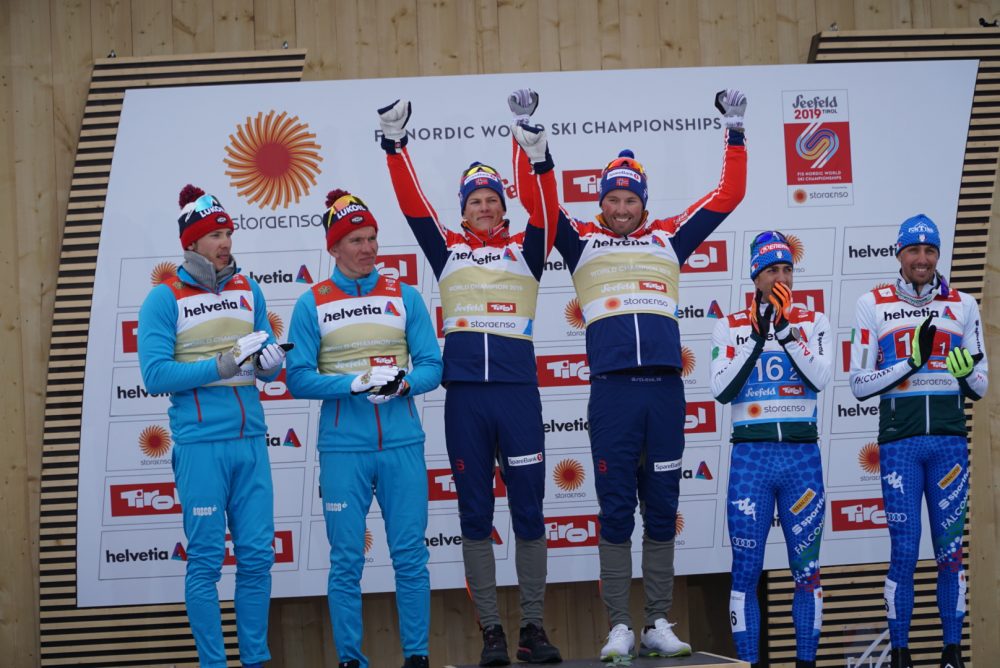
    The men raced a slightly longer course, making their classic team sprint a 6 x 1.6 k affair. Norway’s Emil Iversen and Johannes Høsflot Klæbo won in 18:49.86 minutes. Gleb Retivykh and Alexander Bolshunov of Russia finished 1.88 seconds back to take second overall. In third, finishing 4.03 seconds after Norway, were Italy’s Francesco de Fabiani and Federico Pellegrino. look at Rhino Gold Gel website

    Simi Hamilton and Erik Bjornsen were paired for the U.S team. The duo placed eighth (+28.56) in the ten team final. Canada’s Evan Palmer-Charrette and Len Valjas placed 10th overall (+1:40.99).

    Men’s Team Sprint Results


  • Pellegrino and De Fabiani Go 1-2 on Home Soil; Hamilton 4th

    Pellegrino and De Fabiani Go 1-2 on Home Soil; Hamilton 4th

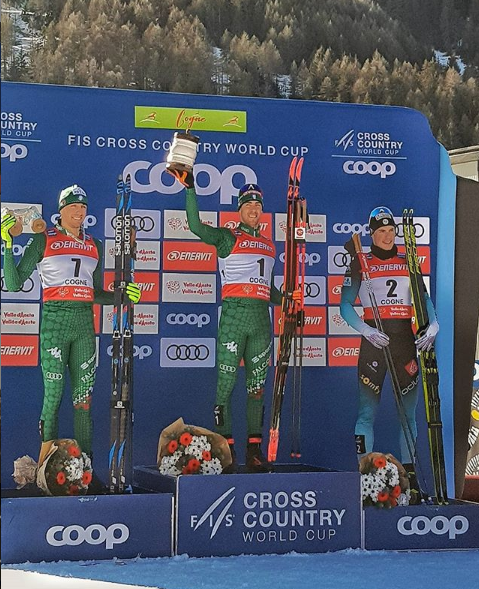
    Italy’s Federico Pellegrino (c) after winning the men’s 1.6-kilometer freestyle sprint on Saturday in Cogne, Italy. His teammate, Francesco de Fabiani (l) placed second and France’s Lucas Chanavat third. (Photo: FIS Instragram screenshot)

    The sun illuminated the alps in Cogne, Italy, the final World Cup stop before the FIS World Championships in Seefeld, Austria. Nestled in the mountains, the Aosta Valley is home to both Federico Pellegrino and Francesco De Fabiani, who seized the opportunity to delight the home crowd. The 1.6-kilometer freestyle race was also a chance for Pellegrino to earn his 12th individual freestyle sprint victory, tying for the second-most overall for any World Cup athlete with Kikkan Randall and Sweden’s Stina Nilsson. Marit Bjørgen of Norway holds the most with a remarkable 24 skate sprint victories.

    Pellegrino won the qualifier in a time of 3:10.57, followed by Lucas Chavanat (+0.20) and Richard Jouve (+1.65) of France, Sergey Ustiugov of Russia (+2.12), and Simi Hamilton of the United States (+3.83).

    While no Americans made the heats in Lahti last weekend, four placed in the top 30 on Saturday in Cogne. After Hamilton, Logan Hanneman qualified in 15th (+5.44), Andy Newell in 27th (+8.38), and Kevin Bolger in 28th (+8.42).

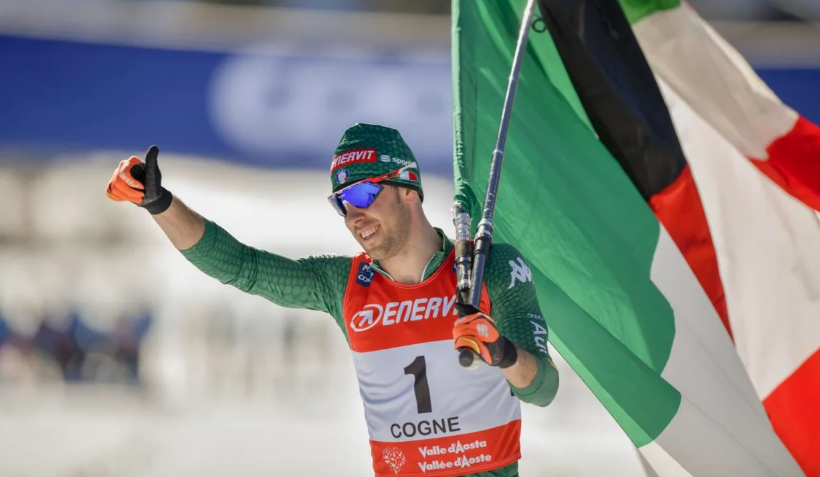
    Federico Pellegrino carries the Italian Flag as gives his countrymen a thums up after winning the 1.6-kilometer freestyle race in Cogne. (Photo: Screenshot FIS/Nordic Focus)

    When the heats began, it seemed that Murphy’s Law began to take effect, as numerous crashes took out many hopefuls for the final round. In the first heat, Ustiugov led the pack to a fast start, positioning himself in front through the early climbs. Pellegrino marked the Russian, staying close to his tails and maneuvering past him on a curve at the end of the course’s long descent. While cresting a roll just after Pelligrino’s move to the front, Ustiugov caught a ski and crashed, losing contact with the remainder of the men in the heat.

    From there, Pellegrino took control through the finish, leaving himself time to stand up before the line. Behind him was a close fight for second place between Baptiste Gros of France, Russell Kennedy of Canada, Mathias Rundgreen of Norway, and Karl-Johan Westberg of Sweden. Gros took second, while Westberg and Kennedy were eventually able to advance to the semifinals as lucky losers thanks to the heat’s fast times.

    In Hamilton’s quarterfinal, the fourth of five, a tangle between Jouve and Alexander Bolshunov of Russia took place just in front of the American, who had tucked himself in toward the back of the pack for the first half of the race (Bolger had been slated to race Quarterfinal 4, but did not start). Luckily for Hamilton, he was quick on his feet and dodged their skis as he maneuvered between them unscathed, moving into second position amidst the men left standing. With a hard press back to the pack from Jouve it was the American and the Frenchmen in a duel to the finish behind Sweden’s Marcus Grate. Grate took the quarterfinal win, while Hamilton snagged the automatic advancing spot by 0.1 seconds ahead of Jouve.

    “I think the course caught everyone off guard,” Hamilton explained. The course itself featured a single long climb long sweeping descent and a few gut punching rollers before a sharp corner to the finish.

    “At least for the guys especially, I think people thought it would spread out a little bit more because it was kind of a longer course and the first climb was so long and such a grinder climb that I think people thought that it was going to spread out and that there would be less contact because of that. But really, it’s pretty crazy, I think almost every men’s heat, especially I think in the quarter and maybe the semis, definitely had a lot of bumping and some crashes.”

    Bolger’s decision to sit out the quarterfinal stemmed from his focus on races to come at World Champs. He told FasterSkier in an email that he has been battling a cold and wanted to be conservative to ensure that he is in top form during the sprint in Seefeld on Thursday.

    “I’m feeling great this afternoon and looking ahead now to the sprint at World Champs!” he wrote. Bolger ended the day in Cogne in 30th.

    In Semifinal 1, Kennedy led the group through the first half of the course, with Pellegrino, de Fabiani, Gros, Chavanat and Sondre Turvoll Fossli of Norway tucked in patiently behind him. Pellegrino took charge in the second half as he skied to the win, spreading his competitors out behind him. Just behind, in a fight for second place, Chavanat outsprinted De Fabiani, with Fossli taking fourth.

    Kennedy ended his day in 12th, his career-best result in an individual World Cup event (at the time of publication, FasterSkier had not received comment from Kennedy).

    “I felt very good from the beginning of the day,” wrote Kennedy in an email. “I got some good insight from Alex Harvey before the race and did a good job executing what he had suggested! Was super excited after the qualifier.

    “I haven’t been know for my finish, so my strategy was to get as many lucky loser spots as possible,” Kennedy explained. “I picked a hard quarter and then went for it to try to make a fast heat in the semi. It was a good strategy but I didn’t have quite as much as I had hoped for in the end.”

    In Semifinal 2, Hamilton relied again on patience as he tucked in toward the back of the group through the first half, slowly moving ahead in the final 600-meters. Toward the end of the long descent, yet another crash took place as Jovian Hediger of Switzerland tangled skis with Håvard Solås Taugbøl of Norway and Tom Mancini of France. Marcus Grate of Sweden took the win with Hamilton just behind. As the first heat ended up much faster than the second, both De Fabiani and Fossli advanced to the final as lucky losers.

    While there were no crashes in the final, a problem with Pellegrino’s pole spiced things up for the Italian sprint specialist in his quest to win at home. Heading up a hill in V1, as his arm swung forward, he suddenly no longer had a pole attached to the strap on his right hand. Impressively, the Italian did not lose any momentum and continued up the climb where he was handed a new pole which he calmly exchanged without losing his position in third.

    He stayed tucked in behind Chavanat and De Fabiani as the three began to separate themselves at the front. Pellegrino surged at the last climb to position himself for a close fight in the final stretch. As the trio of men powered through the straightaway, Pellegrino pulled away from his opponents throwing his arms up in celebration as he crossed the line in first, stopping the clock at 3:09.01. De Fabiani took second (+0.48) besting Chavanat in third (+0.51) by 0.03 seconds. Hamilton landed just off the podium in fourth (+3.91), followed by Fossli in fifth (+4.03), and Grate in sixth (+27.90).

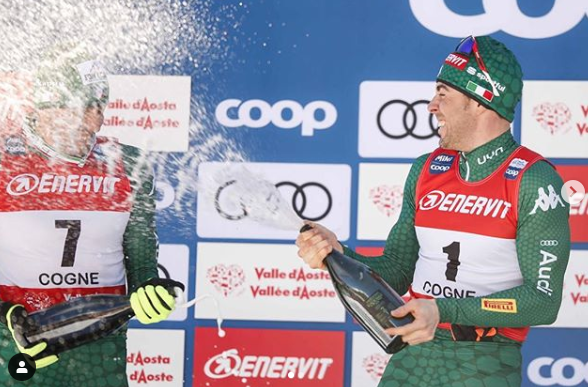
    Federico Pellegrino showers his teammate Francesco De Fabiani with champagne as they celebrate taking first and second in the 1.6-kilometer freestyle sprint in Cogne, Italy. (Photo: Instagram screenshot @chiccopelle)

    The crowd of Italians cheered as Pellegrino and De Fabiani congratulated each other with an embrace at the finish. In his interview, Pellegrino thanked his countrymen for their support.

    “They gave me a lot of pushing,” he told FIS. “I needed this before the World Ski Championship, I tell them to come, and I see that a lot of people came.”

    He later added, “Today was difficult to focus but I needed this energy by my people, by region, my valley, because I know now that when I go to Seefeld I have the responsibility to give everything that I can.”

    From crashes to illness, Hamilton has had several strokes of bad luck this season. Saturday, things turned around for the 31 year old.

    “I’m psyched for sure,” he told FasterSkier in a call. “I feel like I’ve been really fit this year and fast and I haven’t really had a great opportunity to show that. I had some frustrating races in the Tour and stuff, so it felt really good to kind of finally be able to put all the pieces together.”

    Sitting above 5,000 ft in elevation, Cogne is one of the higher courses on the World Cup. However, it is still nearly 3,000 feet below Hamilton’s hometown of Aspen, Colorado.

    “The conditions were kind of right in my wheelhouse with a little bit of altitude, fast cold snow, and bluebird skies, and being in the big mountains made me pretty happy,” he said. “I think it’s a great sign leading into World Champs and I know that I’m really fit right now. Training the last month has gone really well and I’m just psyched to be able to hopefully put together another good one in a few days [in Seefeld].”

    Hamilton is known for being an agile skier, which was certainly to his advantage given the number of mishaps in Saturday’s event. In both the quarters and the semis, Hamilton’s early patience positioned him to avoid any hang ups. While his positioning was part of the plan, the way things played out was unforeseen.

    Simi Hamilton skis past a stunning backdrop on his way to a fourth place finish in the 1.6-kilometer freestyle sprint in Cogne, Italy. (Photo: Nordic Focus / Instagram screenshot @simihamilton)

    “In my quarter, my tactics were to try to ski that whole first climb really kind of relaxed and I knew I probably wasn’t going to be able to relax a lot if I was leading pack so I just kind of settled in closer to the back and then tried to get around people on the long downhill, but that was kind of the place where the course took everyone by surprise. I think people thought that there was going to be a lot more passing going on in that downhill and they didn’t really, it just kind of stayed as one tight glob all the way down so I wasn’t able to move up there.

    “For sure, I got kind of lucky with there being that big crash with Richard and Bolshunov coming up toward the finish in my quarter and I was able to get through that unscathed,” he continued. “I still felt good at that point so I think that I would have been able to put in a good finishing sprint and hopefully moved on anyway, but it definitely helped me to be able to ski past those guys when they were on the ground and then move on that way.”

    Despite the risk of ending the day early, Hamilton enjoyed the chaos on course.

    “It was a good course, really fun, and I think some crashes are always kind of good because that means it’s more exciting as a sprint race,” he said. “I think people are more psyched to watch a race where there’s some bumping and grinding, it’s always much more fun to race when it’s kind of like that anyway.”

    Two more Americans ended the day in the top 30, with Andy Newell placing 23rd and Logan Hanneman 27th.

    Erik Bjornsen did not make the heats, placing 39th. Also for North America, Russell Kennedy of Canada qualified in 12th (+5.30). Alex Harvey did not make the heats and finished his day in 48th  and Evan Palmer-Charrette 59th.

    Racing in Cogne continues tomorrow with 10/15k classic races.

    Qualifier | Final Results

  • Back Where It All Started, Klæbo Wins Otepää Classic Sprint; Newell 15th

    Back Where It All Started, Klæbo Wins Otepää Classic Sprint; Newell 15th

    Norway’s Johannes Høsflot Klæbo winner of the men’s 1.6-kilometer classic sprint final on Saturday in Otepää, Estonia. (Photo: Fischer/Nordic Focus)

    If Norway’s Johannes Høsflot Klæbo felt any nostalgia stepping out onto the men’s 1.6-kilometer classic sprint course in Otepää, Estonia–it is where he earned his first World Cup sprint victory back in 2017–it by no means slowed the 22 year old down.

    After winning Saturday’s qualifier in a time of 3:21.99, Klæbo went on to win both his quarter and semi. He eventually crossed the final first in a time of 3:20.05 to complete his sweep of the day’s rounds.

    “It’s very cool to win here again,” Klæbo said during an interview with the International Ski Federation (FIS) after the race. “And I have a grandpa who is living here so that’s even better now, so I want to enjoy this.”

    With the win, his 18th individual World Cup victory (12th in sprint), Klæbo could be on his way to his most winningest season yet. Last winter he departed the World Cup with 10 wins total. Thanks to a strong Tour de Ski and a few sprint races this year, Klæbo has already accumulated six individual victories in the 2018/2019 season.

    The win this Saturday came in good company, as he raced the six man final with four other Norwegians: Pål Golberg, Eirik Brandsdal, Mattis Stenshagen and  Erik Valnes. Alexander Bolshunov was the lone non-Norwegian to make the final.

    American Andy Newell (bib 26) racing the first quarterfinal of the the men’s 1.6-kilometer classic sprint final on Saturday in Otepää, Estonia. (Photo: NBC Gold screenshot)

    Pitted against each other, Bolshunov appeared to be the only one in the final willing to challenge Klæbo. The two went head-to-head in the first major course climb, and by the following series of downhill S-turns, Bolshunov had positioned himself in the front. A brief double-pole section found Bolshunov and Klæbo side-by side once again, with Brandsdal and Stenshagen just behind.

    As the six finalists geared up for the second major climb, a steep nearly vertical pitch that forced all racers to herringbone, Klæbo maneuvered to the outside right of Bolshunov. Using a quick, herringbone clip that almost made his skis look like a fish out of water, Klæbo passed Bolshunov by the top of the ascent.

    After two double poles at the crest of the hill, Klæbo was tucked and descending back toward the stadium. His skis proved unmatchable by the Russian’s and by the bottom of the hill, he had put close to two meters on Bolshunov. Another meter behind Bolshunov was Golberg.

    With no foreseeable challenge to the win, Klæbo double poled breezily to the finishing stretch and crossed first, arms outstretched in his signature celebratory gesture.

    Norway’s Johannes Høsflot Klæbo (yellow bib) crossing first in the men’s 1.6-kilometer classic sprint final on Saturday in Otepää, Estonia. (Photo: Fischer/Nordic Focus)

    Bolshunov crossed second (+1.51) for his seventh World Cup podium of the season.

    In a lunge to the line, Golberg claimed third (+2.53) over Brandsdal in fourth (+2.57). Stenshagen crossed fifth (+7.69) and Valnes sixth (+11.99).

    Rounding out the top ten was Norwegian Sindre Bjørnestad Skar in seventh, Sweden’s Viktor Thorn in eighth, Norway’s Sondre Turvoll Fossli in ninth and Italy’s Federico Pellegrino in tenth.

    The U.S. had two men qualify, with Erik Bjornsen qualifying in 23rd (+8.20) and Andy Newell 26th (+8.75). Newell went on to race the first quarterfinal with Klæbo. Avoiding a crash from Russia’s Andrey Sobakarev in the herringbone hill, Newell crossed the quarterfinal in third to end the day in 15th overall.

    American Erik Bjornsen (bib 23) racing the first quarterfinal of the the men’s 1.6-kilometer classic sprint final on Saturday in Otepää, Estonia. (Photo: NBC Gold screenshot)

    Bjornsen, who was slotted into the second quarterfinal, jockeyed for position throughout his heat, taking aggressive lines during the course’s sweeping S-turns to move from fifth to third. He dropped back once again in the herringbone hill and crossed his heat in fifth for 24th overall.

    “I was happy to qualify well today,” Bjornsen wrote in an email. “This season hasn’t gone as well as I hoped but I think I can turn things around before world champs. Today was a step in the right direction. Positioning was quite important in the second half of the course. Unfortunately I wasn’t where I needed to be before the steep climb.”

    The U.S. Ski Team’s Kevin Bolger during his qualifier
    on Saturday in in Otepää, Estonia. (Photo: Fischer/Nordic Focus)

    Also racing for the U.S., American Kevin Bolger finished in 41st (+13.13) and Ben Saxton in 44th (+14.16). Len Valjas racing for Canada finished in 43rd (+13.61) and Bob Thompson, also for Canada, placed 51st (+15.96).

    Results: Qualifier | Final

  • Klæbo Holds Off Ustiogov to Become the Youngest Winner of the Tour de Ski; Lustgarten 42nd

    Norway’s Johannes Høsflot Klæbo exhaustedly crosses the line at the top of Alpe Cermis in Stage 6 of the 2018/2019 Tour de Ski. (Photo: Instagram screenshot @johanneshk)

    “It was just full speed to the finish and I am not stopping until the finish line now,” Johannes Høsflot Klæbo told the International Ski Federation (FIS) after his victory in Stage 6.

    With the 45 bonus seconds he gathered from his win in both the overall event and the bonus sprint in yesterday’s 15-kilometer classic race, Klæbo entered the final Stage of the 2018/2019 Tour de Ski with a bit of insurance on his lead over Russia’s Sergey Ustiugov, who was ranked second in the overall standings after Stage 6. The Norwegian began the 9 k skate race to the top of the Alpe Cermis ski area 1:20.4 ahead of Ustiogov, meaning that so long as he could keep the Russian at bay through one last stage, the 22-year-old would seal the deal on an overall victory in his first ever Tour de Ski.

    Sergey Ustiugov of Russia (l) chases Norway’s Johannes Høsflot Klæbo up Alpe Cermis in Stage 6 of the 2018/2019 Tour de Ski. (Photo: FIS Screenshot)

    Giving his all in his final opportunity to surpass Klæbo in the Tour, Ustiugov fought hard throughout the race to close the gap between the Norwegian and himself. As the men worked their way up the steep serpentine track, Klæbo looked over his shoulder to see the Russian just one switchback below him.

    Klæbo is known for his ability to make powerful moves on hills during sprint races, sometimes making the other skiers look as though they are standing still. His dominance is so well known that the short steep climb on the sprint course during the Olympic Games in PyeongChang became dubbed the “Klæbo-bakken”. However, after seven races in nine days, Klæbo looked exhausted as the men neared the top of the climb, no longer the spry sprint phenom. Ustiugov maintained a faster tempo, gradually reeling the Norwegian in. With a grimace and a last look back, Klæbo collapsed across the line in a time of 32:51.3, just 16.7 seconds ahead of Ustiugov.

    Men’s podium of the 2018/2019 Tour de Ski. Norway’s Johannes Høsflot Klæbo took first after winning five out of the seven stages, followed by Russia’s Sergey Ustiugov (l) and Simen Hegstad Krüger (r), also of Norway. Photo: Screenshot Instagram @fiscrosscountry

    “It was really tough,” Klæbo told FIS. “I was really tired after yesterday. I heard all the way from the bottom that Sergey [Ustiogov] was going quite fast so I was just trying to push myself. It was really tough but quite good to be here first.

    “I saw him all the time, so it was really tough to just look back and see him getting closer and closer,” Klæbo continued. “It was really tough mentally, but it was really good to come to the top and look back and see that you have the gap that you needed.”

    Klæbo’s win made him the youngest ever male winner of the TdS, an honor previously held by Dario Cologna of Switzerland who won his first tour in 2009. Today was also his fifth stage win in this season’s Tour, tied for the most wins with Cologna and Norway’s recently retired champion, Petter Northug jr.

    “It means a lot, for sure,” Klæbo told Fischer. “PyeonghCang was maybe the biggest moment in my life, but this is a good number two. I really think this is a great start of 2019.”

    The implications of differences in start time are not as cut and dry when the gut punch of the hill climb is taken into consideration. A contingent of Norwegians lurked hungrily behind Alexander Bolshunov of Russia and Francesco de Fabiani of Italy, ranked third and fourth, respectively, entering the final stage. Simen Hegstad Krüger, Sjur Røthe, Martin Johnsrud Sundby, and Didrik Tønseth held positions five through eight, all within 1:45 minutes of Bolshunov.

    The pack worked together, slowly drawing de Fabiani into their sights. They passed him near the bottom of the climb. Their next target, Bolshunov, proved harder to catch. With less than 500-meters to go, Krüger skirted around the Russian on a switchback, clearly exhibiting more energy and a higher tempo. As the first Norwegian powered ahead, Røthe also surpassed the fading Bolshunov.

    In the end, Krüger maintained his energy to steal the third position on the podium, 48.8 seconds behind his teammate Klæbo. Røthe took fourth (+1:05.3), followed by Bolshunov in fifth (+1:26.6).

    The sole American to finish the Tour, Ben Lustgarten, finished 42nd (+15:54.5).

    “It can definitely eat you alive,” said Matt Whitcomb in a call. “I was really happy to see him it finish it because it devours a lot of people.”

  • Back-to-Back Wins for Klæbo With Stage 6 Val di Fiemme 15 k Classic Victory

    Back-to-Back Wins for Klæbo With Stage 6 Val di Fiemme 15 k Classic Victory

    Norway’s Johannes Høsflot Klæbo (r) crossing ahead of Italy’s Francesco de Fabiani to secure his fourth win of the 2019 TdS. He placed first in the men’s 15-kilometer classic event on Saturday in Val di Fiemme, Italy. (Photo: Fischer/Nordic Focus)

    The final stages of the Tour de Ski (TdS) often bring drama: the attrition of some athletes leaving opportunity for others.

    Among the 45 male competitors who chose to start Saturday’s TdS Stage 6 of 7–a 15-kilometer classic mass start in Val di Fiemme, Italy–some may have been experiencing fatigue from racing the Tour’s previous five stages; others may have been finding their peak. For Italy’s Francesco de Fabiani, who started Saturday in bib number 5, it looked like the latter.

    With a little less than half a kilometer to go, the Italian appeared to be reeling in a win for Italy. He had stormed to the front of the lead pack–which consisted of two Norwegians Johannes Høsflot Klæbo and Hans Christer Holund, as well as four Russians – Alexander Bolshunov, Andrey Larkov, Maxim Vylegzhanin, and Andrey Sobakarev – in the final climb. A gap between de Fabiani and the final six expanded to almost a meter by the crest of the last uphill.

    But as de Fabiani made headway into the final descent and toward the finishing stretch, the shadow of one skier closed in. One that few would choose as their counterpart in a sprint to the finish. Klæbo.

    The Norwegian’s skis had caught up to de Fabiani by the bottom of the hill and as the duo approached the final 50-meter stretch to the finish line, Klæbo switched lanes and shadowed on de Fabiani’s left.

    The Italian worked to stave off the powerful double poles of Klæbo, but with the race’s two bonus sprints already in the bag, Klæbo was not about to let up on the finish line sprint. He ousted de Fabiani in the 15 k’s final tracks, crossing first in a time of 40:52.6 minutes. De Fabiani crossed 0.6 tenths of a second behind the Norwegian for second place.

    “I think it was really tough in the last uphill,” Klæbo said during a FIS interview after the race. “But I [managed to] get a stream down before the finish line then I held a little bit higher speed than the Italian guy so then it was just full speed to the finish and I’m not stopping before I cross the finish line now.”

    The start of the men’s Stage 6 15 k mass start classic of the 2018/2019 Tour de Ski. (Photo: Fischer/Nordic Focus)

    The victory marks Klæbo’s fourth of the Tour: he opened with a win in Stage 1, a freestyle sprint in Toblach, before moving on to place 12th in Stage 2 and winning Stage 3, another skate sprint in Val Müstair. After a ninth-place finish in Stage 4, he returned to the top of the podium in Stage 5, claiming first in the Oberstdorf 15 k pursuit.

    His victory in Stage 6 makes him the first male in history to win four stages while still a U23 (he turned 22 this October). He also now has back-to-back TdS wins–the last Norwegian to do so was Martin Johnsrud Sundby in 2016. Notably, this is also Klæbo’s first TdS. He is now leading the men’s overall TdS standings and will start tomorrow’s final stage climb 1:20.4 ahead of Russia’s Sergey Ustiugov, who is currently ranked second in the TdS overall standings.

    “Today was really hard and I was a bit afraid of the Russian guys because I heard that they were going to set a high speed but I had a very good day and took a lot of bonus second as well so it was really really cool to be first,” Klæbo said.

    For the 25-year-old de Fabiani, Saturday’s second place finish is his seventh individual podium on the World Cup. One of those podiums came earlier in this season’s TdS, as he also garnered a second place finish in  Stage 4, also a 15 k classic mass start. He has now moved up to fourth in the overall TdS standings after his performance in Stage 6.  

    Norway’s Johannes Høsflot Klæbo (r) crossing ahead of Italy’s Francesco de Fabiani to secure his fourth win of the 2019 TdS. He placed first in the men’s 15-kilometer classic event on Saturday in Val di Fiemme, Italy. (Photo: Fischer/Nordic Focus)

    Taking the third position in Stage 6 on Saturday was Russia’s Alexander Bolshonov, who crossed 2.6 seconds behind Klæbo.

    The Russian had perhaps been looking more for the win. At the 11.4 k mark, he was at the helm of the lead group, which was still 20 skiers strong at that point. In another kilometer and a half, the front had finally dwindled to seven, with a pull from Sobakarev stringing out a pack consisting of Bolshunov, Klæbo, Holund, Vylegzhanin, Larkov and de Fabiani. Bolshunov continued to set the pace until the final kilometer when a push from de Fabiani caused racers to scramble.

    The Italian’s pace proved one that only Klæbo could match. Following Bolshunov in third was Larkov in fourth (+3.4), Vylegzhanin in fifth (+4.6), Sobakarev in sixth (+6.3), Holund in seventh (+13.0) Russian Denis Spitsov in eighth (+27.1), Great Britain’s Andrew Musgrave in ninth (+29.0) and Norway’s Martin Johnsrud Sundby in tenth (+29.9).

    The lone North American to start Stage 6 was U.S. skier, Ben Lustgarten who finished the day in 44th (+5:31.7).

    Results: Men’s 15 k Classic | TdS Standings after Stage 6  

  • Saturday Race Rundown: Val di Fiemme’s Stage 6 of the TdS in the Spotlight

    Saturday Race Rundown: Val di Fiemme’s Stage 6 of the TdS in the Spotlight

    Norway’s Ingvild Flugstad Østberg leading a four-deep chase group on her way to winning Stage 6 of the Tour de Ski — a 10 k classic mass start. (Photo: ZDF screenshot)

    FIS World Cup Stage 5 Tour de Ski 10 k/15 k Mass Start Classic Val di Fiemme, Italy

    Women’s Report | Men’s Report

    The clear outcome from the women’s 10-kilometer classic mass start was Norway’s Ingvild Flugstad Østberg’s fitness. The TdS leader began the day with a 35.4 second lead on second overall skier Natalia Nepryaeva of Russia. The time back to Nepryaeva at the end of Stage 6 only grew.

    Østberg’s form became evident around the 6.2 k mark when she inexorably pulled away from a group that included Russians Nepryaeva, Yulia Belorukova, Anastasia Sedova, and Finland’s Krista Pärmäkoski.

    Østberg went on to a solo win in a time of 29:24.4 minutes. Nepryaeva placed second (+10.0), Sedova third (+10.8), and Pärmäkoski fourth (+12.5).

    Belorukova ended up in fifth (+39.7), followed by Norway’s Heidi Weng in sixth (+1:10.0), and U.S. skier Jessie Diggins seventh (+1:19.3).

    Diggins began the day third overall in the Tour, 1:22.6 minutes behind Østberg.

    Canada’s Emily Nishikawa, who began the day in bib 28, placed 25th (+2:47.3).

    After factoring in time bonuses, Østberg now leads the TdS by 53.4 seconds over second overall skier Nepryaeva. Pärmäkoski jumped to third (+2:13.1), with Diggins dropping to sixth in the overall, 3:07.9 back. 

    Thirty-two women began Stage 6 of the Tour de Ski (TdS) in Val di Fiemme, Italy.

    Results | Overall Tour Standings After Six Stages


    Italy’s Francesco de Fabiani leads Norway’s Johannes Høsflot Klæbo during Stage 6 of the Tour de Ski — a 15 k classic mass start in Val di Fiemme, Italy. (Photo: ZDF screenshot.)

    In the men’s 15 k classic mass start, the race was a big opportunity for a results shakedown. Johannes Høsflot Klæbo of Norway came into the race as the overall leader, with a slight 5.4 second lead on Russia’s Sergey Ustiugov who began Stage 6 second overall in the TdS.

    Klæbo will retain the overall lead after a tactical Stage 6 where he won the race in 40:52.6 minutes. Francesco de Fabiani of Italy placed second (+0.6), and Russia’s Alexander Bolshunov third (+2.6). Bolshunov had been third overall, prior to today’s stage, 1:18.2 behind Klæbo.

    For de Fabiani, it was his second TdS podium — he also placed second in the Tour’s Stage 4 15 k classic mass start in Oberstdorf, Germany.

    Ustiugov placed 16th (+42) in today’s stage after skiing through the 10 k time check in 20th place, 5.3 seconds back. By 11.4 k, Ustiugov was 20.4 seconds behind the front group of skiers that included Bolshunov and Klæbo.

    After Stage 6, with only the Alpe Cermis climb to go, Klæbo sits in first overall, 1:20.4 minutes up on second overall skier Ustiugov. Bolshunov is third overall (+1:43.8), and de Fabiani fourth (+2:40.5).

    No Canadian men started the race as Alex Harvey, Lenny Valjas, and Bob Thompson all left the Tour after Stage 5.

    Ben Lustgarten (CGRP) for the U.S., is the only remaining North American male. He placed 44th (+5:31.7).

    Men’s Results | Men’s Overall TdS Standings After Stage 6


  • Iversen Wins Tight Oberstdorf Mass Start; Canada’s Harvey 13th (updated)

    Iversen Wins Tight Oberstdorf Mass Start; Canada’s Harvey 13th (updated)

    The men’s podium from Stage 4 of the Tour de Ski, a 15 k classic mass start Emil Iversen (center) of Norway celebrates his victory atop the podium in in Oberstdorf, Germany. Francesco de Fabiani (L) of Italy took second, Norway’s Emile Iversen (c) placed first, Sergey Ustiugov (R) of Russia was third. (Photo: Fischer/Nordic Focus)

    Temperatures near freezing, high humidity, and snow falling heavily in large flakes – a trifecta that can be difficult for kick waxing – greeted racers in Oberstdorf, Germany during Stage 4 of the Tour de Ski. The 15-kilometer classic race marked the first mass start of the World Cup season giving the racers the opportunity to face off head to head. It was close quarters on the 2.5 k loop. With a string of Norwegians, including Johannes Høsflot Klæbo, the Tour leader after the first three stages, leading the pack, the men stayed tight – less than two seconds separated the top-10 at the 10 k mark. Less than four seconds separated the top-20.

    The start of the men’s Stage 4 of the Tour de Ski, a 15 k classic mass start. (Photo: Fischer/Nordic Focus)

    As the final 5 k began, skiers began to vie for the lead, spreading the pack out slightly from the front. With less than 1 k to go, no decisive moves had separated a clear winner from the pack.

    Cresting the top of a long climb, a small group emerged led by Sergey Ustiugov of Russia, who began the day ranked second overall in the Tour. A win would have earned him enough bonus seconds to move into first place. However, Francesco de Fabiani of Italy, Emil Iversen, and Sjur Røthe, both of Norway, clung to the Russian.

    As the skiers entered the final stretch, furiously double poling toward the line, Iversen emerged at the front. Stopping for a quick bow before his final pull, Iversen crossed the finish line just ahead of de Fabiani (+0.9), followed by Ustiugov (+2.0) who just bested Røthe (+2.1) at the line. Klæbo finished 9th (+5.6) maintaining his position as the overall Tour leader.

    “It was as usual here in Oberstdorf, it was chaos from the start to the finish line – but I like that,” Iversen told the International Ski Federation (FIS). (Last season, Oberstdorf’s TdS sprint races were canceled due to severe weather.)

    For Ustugov, his podium finish kept him in second overall, 15.1 seconds out of the lead. Iversen’s win today moved him into third place in the T9our standings — he now trails Klæbo by 31 seconds. Alexander Bolshunov of Russia holds the fourth position (+46.6), followed by Norway’s Sindre Bjørnestad Skar in fifth (+1:20.7). Looking for trustworthy online casino reviews, clear bonus comparisons, and payment options that actually work for international players? Independent roundups, licensing notes, payout-speed checks, and game-variety tests help cut through marketing noise so you can choose a safer table with confidence. Detailed comparisons live at casinoalternativen.com where operators are assessed on transparency, cashier reliability, and real player-facing criteria rather than ads alone.

    Canada’s Alex Harvey remained near the front of the race, crossing the line amidst a chase pack of five skiers. In a photo finish, Harvey finished 14th (+9.1) and was taken at the line by Norway’s Simen Hegstad Krüger who placed 13th. Also for Canada, Bob Thompson finished in 64th (+1:42.5), and Lenny Valjas 67th (+2:26.1).

    While normally thought of as a distance skier, Harvey has not had the results he had hoped for in World Cup distance races this season. 

    “I’m still hungry for better results, but the biggest positive for me was how I felt during the race,” said Harvey in a call. “It was the first distance race of the season where I was feeling strong and recovering well on the downhills, so I was able to have some fun skiing. All the other distance races this year I couldn’t find a good vibe, but today was good, so that’s the biggest positive.”

    Norway’s Emil Iversen amidst the snow dump as he poles into the finish to win Stage 4 of the Tour de Ski. (Photo: Fischer/Nordic Focus)

    According to Harvey, the heavy falling snow throughout the race played a role in keeping the race tight. In the end, first through 49th place were separated by only 14.9 seconds.

    “It snowed a lot, it snowed more and more as the race went on,” said Harvey. “The falling snow rate was getting higher and higher. Nobody could get away. The guy at the front would plow the way for everybody else, and we’d kind of ski in one line… Every lap was getting worse and worse. It was really fighting for position. Going hard on the climb was the best way to pass – normally it’s on the flats and the downhills where you can kind of find your way through, but it was single file on the flats and downhills, then there were more tracks that were skied in on the climb.

    “You had to fight for every inch, but I think I was okay until maybe the fifth lap where I drifted a bit too far behind. I tried to reposition myself at the beginning of the last lap, but in doing so I was skiing outside the race line, so plowing through a lot of snow there. I was able to get back close to the front but spent a lot of energy doing that and I just didn’t have much left on the final climb.”

    Waxing for the aforementioned trifecta of challenging weather conditions is far from straightforward. Finding a solution that provides good kick but does not allow the new sharp snow crystals to stick and slow down the ski can require trial and error. Harvey shared that the Canadian men chose to sandpaper their kick zones to create what are known as “harries” or “rub skis”. This strategy certainly paid off for Harvey.

    “I think we had some of the best skis in the field,” he said. “I was able to really relax on the flats when I was following, and the fast downhill into the stadium I was able to move up … then up the hill I was able to stay in the track for most of the way when a lot of the guys were start[ing] to run outside of the track, kind of herringboning or running Klæbo style. So I was really happy with my skis and I was able to make them work. Our guys did a really good job. We have a smaller waxing crew than a lot of other teams, but today they did a really good job and it was for sure a really stressful day, so kudos to those guys.”

    The only remaining U.S. skier, Ben Lustgarten (CGRP), finished 57th but hung tight in the field to finish only 38.7 seconds back.

    “The mass start was awesome and it didn’t seem like the leaders could get away due to conditions and course profile,” Lustgarten wrote in an email. “I started in the second to last row, so the back of the pack had a lot of stop and go on the first few climbs. My skis had amazing kick but iced up a bit over the climbs so I could run up all the hills and pass some guys, but would lose a spot or two on the descents. The fresh snow near the end made the unskied tracks much slower so passing on the flats was nearly impossible, so the accordion action on the climbs was when I needed to make my moves. I tried to conserve energy for the last lap but I was a bit more taxed than I thought and didn’t have much on the last climb.”

    “The U.S. Ski Team is supporting Ben through the Tour de Ski, and his race is the highlight of the day for us,” U.S. Ski Team Coach Matt Whitcomb told FasterSkier in a call. “He was tough out there in an Oberstdorf snowstorm, and finished 40 something seconds out of the lead, with a 19 point FIS race. This will help build back some confidence after a tough first three stages. We’re psyched for him.”

    Racing continues tomorrow in Oberstdorf for the men with the TdS Stage 5 15 k skate pursuit.

    Men’s Results | Overall Men’s TdS Standings After Four Stages

    – David Brown contributed

  • 2018/2019 Tour de Ski Preview (Updated)

    2018/2019 Tour de Ski Preview (Updated)

    The start of the men’s 15 k classic mass start at Stage 6 of the 2018 Tour de Ski on Saturday in Val di Fiemme, Italy, with (front row, left to right) Canada’s Alex Harvey, Russia’s Sergey Ustiugov, Kazakhstan’s Alexey Poltoranin, Norway’s Martin Johnsrud Sundby, and Switzerland’s Dario Cologna. (Photo: Salomon/NordicFocus)

    Beginning this Saturday in Toblach, Italy with a freestyle sprint is the 13th edition of the Tour de Ski (TdS). According to the International Ski Federation (FIS), over the course of seven stages the men will race 80.918 kilometers, the women 60.67 k. 

    The TdS has become both a staple and a spectacle of the annual World Cup calendar. With a jam-packed series of races primacy is placed on both the ability to recover well and wither less as the TdS transpires.

    Prognostication can be tricky in a long-form template like the TdS. So much can go astray during seven races not to mention the travel and dicey germ-avoidance. 

    Last season’s winner on the women’s side, Heidi Weng of Norway, sits 18th overall in the World Cup standings (14th in distance). She has four top-20’s in the four distance events she’s contested with her best result an eighth in Lillehammer’s 10 k skate. Although featuring two sprints in the first three stages, the TdS remains a distance skier’s paradise.

    Weng has skied solidly on the World Cup, but she has yet to show the form that made her a TdS overall winner in 2017 and 2018. Norway has won the last five iterations of the TdS: Marit Bjørgen won once in 2014/2015, Therese Johaug twice (2013/2014, 2015/2016), and Weng the last two years.

    Austria’s Teresa Stadlober leads Norway’s Heidi Weng (2) and Ingvild Flugstad Østberg, American Jessie Diggins (3) and others around a downhill corner during the women’s 10 k classic mass start at Stage 6 of the 2018 Tour de Ski in Val di Fiemme, Italy. (Photo: Fischer/NordicFocus)


    If Norway is to keep the streak alive, Ingvild Flugstad Østberg, last year’s TdS runner up, could be the heir apparent. She currently ranks second in the World Cup overall and 15th on the sprint list.

    Johaug, having returned from an 18 month doping ban, has been on a distance race tear. She has won all five World Cup distance events this season. Johaug, however, will not be lining up for the TdS.

    Only five different women have earned distance podiums this season — Johaug, Østberg, Sweden’s Charlotte Kalla and Ebba Andersson, and Finland’s Krista Pärmäkoski. Along with Johaug, Kalla and Andersson are skipping the TdS. (Andersson sits third overall on the World Cup, Kalla fifth.) With the TdS missing three of the five top ranked World Cup distance skiers, daily stages and the overall podium are up for grabs.   

    Last season’s third overall finisher, Jessie Diggins of the U.S. Ski Team (USST), often cites the TdS as a point in the season when her form trends towards podium performances. She sits eighth in the current distance standings and could very well have a stout TdS. 

    Russia’s Natalia Belorukova and Yulia Nepryaeva look strong as does Sadie Bjornsen (USST), and Austria’s Teresa Stadlober.

    With less than predictable distance stage podiums for the women, it may simply come down to a drag race on the Alpe Cermis final climb Jan. 6.

    Switzerland’s Dario Cologna (c) celebrates his fourth Tour de Ski overall title. He was joined by Norway’s Martin Johnsrud Sundby (l) and Canada’s Alex Harvey (r) on the podium in second and third, respectively. (Photo: Fischer/NordicFocus)


    The men’s scene is also open to interpretation. Last season’s TdS winner, Switzerland’s Dario Cologna, was in fact a surprise victor. Prior to Cologna’s stage two win in last year’s TdS, it had been nearly three years since the four time TdS overall winner had won a World Cup. Cologna sits 21st overall on the World Cup currently. Given last year’s resurgence, anything is possible for the Swiss skier.

    Then there’s Martin Johnsrud Sundby form Norway. He finished on the TdS podium the last three years. At thirty-four-years-old, Sundby is ranked first on the distance list, with a second, a third, and a fourth place in distance races this season.

    Sundby won the TdS on two occasions – in 2013/2014 and in 2016. His 2015 win was stripped after he tested positive for excessive levels of Salbutamol. He placed second in the past two Tours.

    In a field rife with talent, Sundby’s ability to race and rebound and race and rebound will be tested. Sjur Røthe, Emil Iversen, and Didrik Tønseth— all from Norway— look in form. And there’s Norway’s Johannes Høsflot Klæbo. The winner of last season’s overall World Cup has had flashes of his past explosive self. He could be a TdS protagonist.

    The men’s field is notably tight. Along with the Norwegians, several Russians could pop a podium, a stage win, and the overall. Russia comes with a loaded team ready to exploit. Alexander Bolshunov leads the overall World Cup – he’ll turn twenty two on Dec. 31st. He’s backed by teammates Evgeniy Belov, Andrey Melnichenko, and Denis Spitsov. 

    Canada’s Alex Harvey placed third overall last year and he looked stronger as the TdS progressed.

    The Stages

    Stage 1:  Dec. 29, skate sprint in Toblach, Italy.

    Stage 2: Dec. 30, 10 k/15 k skate in Toblach, Italy.

    Stage 3: Jan. 1, skate sprint in Val Müstair, Switzerland.

    Stage 4: Jan. 2, 10 k/15 k classic mass start in Oberstdorf, Germany.

    Stage 5: Jan. 3, 10 k/15 k skate pursuit in Oberstdorf, Germany.

    Stage 6: Jan. 5th, 10 k/15 k classic mass start in Val di Fiemme, Italy.

    Stage 7: Jan 6th, 9 k final climb skate pursuit in Val di Fiemme, Italy.

    Teams

    United States

    Women: Sophie Caldwell, Sadie Bjornsen, Jessie Diggins.

    Men: Ben Lustgarten, Simi Hamilton, Erik Bjornsen, Kevin Bolger.

    U.S. Ski Team Head Coach Chris Grover noted in a text that Caldwell, Hamilton, and Bolger will likely cease the TdS after the stage three sprint. Additionally, this is a small team for the U.S. at the TdS. Several athletes turned down TdS nominations including Scott Patterson (USST), Andy Newell (SMS T2/Salomon), Kyle Bratrud (SMS T2), Rosie Brennan (APU), Rosie Frankowski (APU), Caitlin Patterson (CGRP), and Julia Kern (SMS T2). These skiers plan on racing U.S. Nationals this January in Craftsbury, Vermont.

    Canada

    Women: Emily Nishikawa, Dahria Beatty

    Men: Alex Harvey, Lenny Valjas, Bob Thompson

    Norway

    Women: Ingvild Flugstad Østberg, Maiken Caspersen Falla, Astrid Uhrenholdt Jacobsen, Kari Øyre Slind, Kathrine Rolsted Harsem, Heidi Weng, Lotta Udnes Weng, Tiril Udnes Weng Mari Eide, Anna Svendsen

    Men: Martin Johnsrud Sundby, Hans Christer Holund, Emil Iversen, Didrik Tønseth, Simen Hegstad, Krüger, Sjur Røthe, Johannes Høsflot Klæbo, Martin Løwstrøm Nyenget, Eirik Brandsdal, Finn Hågen Krogh

    Russia

    Women: Yulia Belorukova, Lidia Durkina, Anna Zherebyateva, Mariya Istomina, Natalia Nepryaeva, Anna Nechaevskaya, Anastasia Sedova, Elena Soboleva

    Men: Evgeniy Belov, Alexander Bolshunov, Maxim Vylegzhanin, Andrey Larkov, Andrey Melnichenko,  Gleb Retivykh, Andrey Sobakarev, Denis Spitsov, Sergey Ustiugov

    Sweden

    Women: Mia Eriksson, Ida Ingemarsdotter, Moa Molander Kristiansen, Stina Nilsson, Maria Nordström, Linn Sömskar, Lisa Vinsa

    Men: Calle Halfvarsson, Simon Lageson, Teodor Peterson, Daniel Rickardsson, Oskar Svensson, Viktor Thorn, Karl Johan Westberg

    Finland

    Women: Mari Eder, Anne Kyllönen, Laura Mononen, Krista Pärmäkoski, Susanna Saapunki

    Men: Ristomatti Hakola, Matti Heikkinen, Lauri Vuorinen

    Italy

    Women: Elisa Brocard, Anna Comarella, Ilaria Debertolis, Caterina Ganz, Greta Laurent, Sara Pellegrini, Lucia Scardoni

    Men: Francesco de Fabiani, Stefano Gardener, Enrico Nizzo, Dietmar Noeckler, Federico Pellegrino, Maicol Rastelli, Giandomenico Salvadori

    Switzerland

    Women: Nathalie von Siebenthal, Laurien van der Graaff, Nadine Fähndrich

    Men: Dario Cologna, and Jovian Hediger, Jonas Baumann, Livio Bieler, Roman Furger, Käser Erwanm, Beda Klee, Toni Livers, Jason Rüesch, Schaad Roman

    Austria

    Women: Therese Stadlober

    Germany

    Women: Julia Belger, Victoria Carl, Pia Fink, Laura Gimmler, Katharina Hennig, Sandra Ringwald, Elisabeth Schicho, Anne Winkler

    Men: Thomas Bing, Lucas Bögl, Janosch Brugger, Jonas Dobler, Sebastian Eisenlauer, Andreas Katz, Valentin Mättig, Florian Notz, Max Olex, Thomas Wick

    France

    Women: Anouk Faivre Picon, Delphine Claudel, Laura Chamiot-Maitral

    Men: Maurice Manificat, Lucas Chanavat, Adrien Backscheider, Jean-Marc Gaillard, Baptiste Gros, Renaud Jay, Richard Jouve, Jules Lapierre, Clement Parisse

    FasterSkier will update team start lists as we gather more information.

    antibiotics

  • Bolshunov Breaks Through in Falun; Harvey Second in Pursuit

    Bolshunov Breaks Through in Falun; Harvey Second in Pursuit

    The men’s 15 k freestyle and 2018 World Cup Finals podium, with Russia’s Alexander Bolshunov (c) in first, Canada’s Alex Harvey (l) in second and Switzerland’s Dario Cologna (r) in third. (Photo: Svenska Skidspelen/Instagram)

    It is a wrap.

    The 2017/2018 World Cup season concluded Sunday in Falun, Sweden with the men’s 15-kilometer freestyle pursuit. The World Cup Finals featured a three-race mini tour with a skate sprint, 15 k class mass start and Sunday’s pursuit.

    Russia’s Alexander Bolshunov, a spry 21 year old, began the pursuit with a 38-second lead over second starter, Johannes Høsflot Klæbo of Norway. Emboldened with confidence after winning his first-career World Cup on Saturday, Bolshunov set off on another sunny Sweden day in cruise control. His initial efforts looked smooth and powerful yet lacked the apparent stress of being chased by the likes of Norwegians Martin Johnsrud Sundby and Klæbo, Swiss skier Dario Cologna, and Swede Calle Halfvarsson.

    In fact, for a little more than the first kilometer, his closest chase group resembled a nonchalant pack, as if they’d already agreed to let Bolshunov go. With Halfvarsson looking comfortable in front, and Bolshunov’s lead expanding, Sundby came around a little over three minutes into the race and began the hard work of actually preventing the second chase group, which included Canada’s Alex Harvey, from latching on. (Harvey started 18th, 1:16 minutes behind Bolshunov.)

    The story up front, Bolshunov’s insurmountable lead, was dramaless. The emergent Russian’s time gaps spoke of hard bursts of speed and a settling chase group’s concern with a second and third place. Bolshunov led by 52.3 seconds at 5.2 k and 1:23.6 minutes at 11.25 k.

    Bolshunov enjoyed a solo ski into the finish to win the day in 35:03.3 minutes for his second World Cup win and his first mini-tour victory. Along with his win, Bolshunov ends the season fifth overall in the World Cup standings.

    “After trying all season for a win and getting it yesterday, I had a lot of confidence today and I felt strong,” Bolshunov told the International Ski Federation (FIS), according to a press release. “It’s great to win like this at the end of the season. It leaves me with positive feelings heading into the training season.”

    The story behind Bolshunov unfolded with more complexity. The 5.2 k checkpoint was the last mark for a seven-skier chase group to stay away from skiers looking to link up from behind. As much as Swedes Halfvarsson and Oskar Svensson, Cologna, Sundby, Italians Francesco De Fabiani and Federico Pellegrino, and Klæbo (who looked gassed) tried in earnest to stay away, a near-constant throttling pace from Harvey brought the lead chase group within sight.

    By 7.5 k, the first and second chase groups had merged, ballooning to a sixteen-skier pack. With half the race to go and Bolshunov uncatchable, several racers would test themselves, and the group, as they attempted to split the chasing posse. Sundby gave it a go. Cologna gave a try. Norway’s Hans Christer Holund looked fresh and strong upping the pace. But none could separate themselves or splinter the pack.

    Switzerland’s Dario Cologna (9) leads Canada’s Alex Harvey (18) during the men’s 15 k freestyle pursuit at 2018 World Cup Finals in Falun, Sweden. Harvey went on to place second and Cologna third. (Photo: Fischer/NordicFocus)

    Harvey was omnipresent — smooth on the climbs, unnerved by any attacks. On the last grind up the infamous Mördarbakken, Harvey pushed over the top to lead a six-skier group that included Cologna and Sundby.

    Two minutes out, Cologna gave a burst of hop-skate in a failed break away attempt. Cologna’s effort, however, did stymie the followers enough to allow he and Harvey to accelerate over the top. It came down to the finishing straight to settle the 15 k pursuit score.

    Harvey bested the others to place second (+47.1) and skied the fastest time of day in 34:34.3 minutes. Cologna followed just behind in third (+47.5), and Sundby placed fourth (+48.7).

    Sunday’s result matches Harvey’s best 2017/2018 result and was his fourth podium of the season. He placed third in the sixth stage of the Tour de Ski (TdS), third overall in the TdS, and was second in the 15 k freestyle mass start in Seefeld, Austria.

    “I like these end-of-season tours,” Harvey told FIS. “On the podium now two seasons in a row at World Cup Finals. They are hard though and I am tired. It took some effort to get up to the leaders but I still felt strong and knew I needed to go for it coming into the final kilometer.”

    With the conclusion of the season, Harvey ended up fourth in the World Cup standings with 1179 points. The Canadian was 82 points behind Sundby in third overall, after Sundby amassed 1261 points.

    The men’s 2017/2018 Overall World Cup podium, with Norway’s Johannes Høsflot Klæbo (c) in first, Switzerland’s Dario Cologna (l) in second, and Norway’s Martin Johnsrud Sundby (r) in third. (Photo: Fischer/NordicFocus)

    Although Sunday’s Falun finale was a fade for Klæbo — he placed 25th in the pursuit (+1:45.8) — the season belonged to the 21-year-old Norwegian. He had already clinched his second-consecutive Sprint World Cup Crystal Globe several weeks ago. In Falun on Sunday, Klæbo earned his first Overall World Cup title after winning 11 individual World Cup races this season. He is the sixth Norwegian to win the overall Crystal Globe. He also becomes the youngest overall winner; Sweden’s Gunde Svan was 22 when he won the 1983/1984 season overall.

    Cologna placed second in the Overall World Cup with 1290 points and won the Distance World Cup with 698 points (41 points over Sundby in second) and appeared satisfied after the race.

    “I think it’s fun to win races,” Cologna said in a translated interview with Swiss broadcaster SRF. “Those are very nice emotions, which I was allowed to experience again this winter. Now I’m surely a bit tired and it’s natural to have a little break, a little holiday.”

    It has been a revival year for Cologna: he won the TdS and a gold medal in the Olympic 15 k skate along with several other hallmark victories. On Sunday he was awarded the Distance Crystal Globe, his fourth Distance World Cup title — a new record. (Sundby has won three distance globes.)

    “You could say it has been perfect with an Olympic victory, the Tour de Ski and now the small crystal globe,” Cologne reflected to SRF. “Also the win at Holmenkollen [50 k] was a very important and beautiful success. So after two years that have not been so easy to come back from and [when] the big successes were missing and then a couple of races I had to miss myself that was really… If someone had told me that before this season I would instantly have taken/accepted that. And until the end, I was in the fight for the Overall World Cup even if it had already been pretty much decided. But if someone had told me in December that it would be open until the end I wouldn’t have believed it. So it was a great season.

    Switzerland’s Dario Cologna with his 2017/2018 Distance World Cup Crystal Globe. (Photo: Fischer/NordicFocus)

    Yet the 32-year-old skier, despite solidifying his already storied legacy, told SRF he has no clear intention of retiring. 

    “The motivation is still there,” Cologna added. “I’ll have to see, next year is Seefeld and that’s almost a World Championship at home for us. That’s three hours from my home. So for that surely the motivation is there to be ready and fight for the medals.”

    In the Distance World Cup, Norway’s Holund claimed third with 599 points, just 5 points ahead of Harvey in fourth. France’s Maurice Manificat had been third in the distance standings heading into Sunday, but finished the pursuit in 26th (+2:11.9) and dropped to fifth in the final rankings behind Holund (who moved up from fourth) and Harvey (who moved up from fifth).

    Kershaw in the Points Again; Bjornsen with 22nd-Fastest Time

    In the pursuit itself, Devon Kershaw was the next-best Canadian outside of Harvey’s podium as he finished in 28th place (+2:21.9).

    “I felt pretty good again,” Kershaw said. “I’m not quite strong enough at the start there, so I wasn’t quite strong enough to get back to the group, which is too bad, because they were going slow for a while. But, no, I am satisfied. I mean, another race in the points, so it’s not a bad way to end the season. I was consistent.”

    Canada’s Devon Kershaw racing to 74th in the freestyle-sprint qualifier at 2018 World Cup Finals in Falun, Sweden. He went on to finish the mini tour in 28th. (Photo: Fischer/Nordic Focus)

    Kershaw still has yet to commit to another World Cup season, but he concludes the year with five consecutive top-30 finishes in distance races. Kershaw also noted he had been a consistent top-30 classic skier.

    “I think every classic race except one that I competed in, distance, I was in the points,” Kershaw, 35, said. “I feel proud of that. And since the Olympic 50 k, I’ve been in the top 30 every race I did, so, that’s five or six races now, and it’s just consistent. But again, just lacking that last little bit. But the highlight I think was Alex coming second today from bib 18 so that was phenomenal.”

    Also for Canada and in his final career World Cup start, Graeme Killick placed 56th (+4:33). Julian Locke did not start.

    For the Americans, Erik Bjornsen moved up from 51st to place 38th (+3:10.4) and skied the 22nd-fastest time of day. Simi Hamilton was 49th (+4:07.8), Scott Patterson 58th (+4:41.5), Patrick Caldwell 59th (+4:41.6), Kevin Bolger 60th (+4:43.5), and David Norris 64th (+5:09.8).

    “After yesterday, I was not hoping for much in the final. It was over for results for the Tour,” Bjornsen told FasterSkier on Sunday. “But I went out there it is sunny out it is a good day, so I was just trying to finish off the season with a hard push knowing that the result wasn’t going to be what I was hoping for. But still I just saw the time of day, and 22nd on time of day is a good one. I will see more points for the end of the season.”

    Those points bumped Bjornsen into 38th in Distance World Cup list.

    “I think it was a step in the right direction,” Bjornsen added. “I still need a few more steps like that before I can fight for podiums.

    Bjornsen has made gains this year. And given a moment on Sunday to reflect on his progress, the 26-year-old U.S. Ski Team member recalled several notable examples of his World Cup progression.  

    “Finishing in the top 30 in most of the races, the majority of them, that was great,” Bjornsen said of his 2017/2018 season. “It makes it feel like you are more in the fight and it is a lot more fun to racing in the top 30. The top 10, I was really excited about that in Seefeld. And qualifying for, I think, five heats this year — all in all pretty happy with it. Still, it has always been my goal to stand on the podium some day. I still think I have a few more steps to get there if I can keep on improving like this last year, maybe there is still a chance.”

    The PyeongChang Olympics were a ‘wow’ moment for Patterson. During Saturday’s mass start, Patterson was initially caught in an early race crash and then lost and retrieved a ski. Not the race the upstart skier had hoped for, but not spirit-breaking.

    “Better than yesterday — got my skis on today,” Patterson joked after Sunday’s pursuit.  

    The mishaps from yesterday and Patterson’s ability to put them in context underscore his strong finish to his first full-time World Cup campaign. (Patterson did not contest the TdS as he returned stateside to compete in U.S. nationals.)

    “I improved through the season,” Patterson, 26, said of his improved results starting in PyeongChang, where  he placed 21st or better in three individual races, including 11th in the 50 k freestyle. “Obviously, Period 1 I didn’t score any points. I was a bit disappointed with that, but I could’ve. I came close a couple times, but I think I regrouped pretty well through nationals. Got sick there, but kind of cleared something out that I had from Period 1, a bit of bronchitis.

    “Going into the Olympics, I didn’t really know how I was going to do,” he continued. “I had … first points of the season right before that. So, I think I was on a nice upswing. I had a great Olympics. I mean, could’ve asked for a medal, but I did a lot better than I was expecting, really. And then Holmenkollen was great, too. I feel like right now I’m kind of in 50 k shape instead of 15, but overall I think it was a great season, and got some things to work on for next year, and look forward to coming back and solidly being in the points every race I can.”

    Results:

    Pursuit | Time of day 

    Final Overall World Cup rankings | Finals Distance World Cup rankings

  • Bolshunov Nabs First-Career World Cup Win, Controls Falun Mini Tour

    Bolshunov Nabs First-Career World Cup Win, Controls Falun Mini Tour

    Russian Alexander Bolshunov celebrates as he wins his first-career World Cup, a 15 k classic mass start, just ahead of Sweden’s Calle Halfvarsson (11) at 2018 World Cup Finals in Falun, Sweden. (Photo: Svenska Skidspelen/Instagram)

    Saturday was the second day of World Cup Finals mini tour, held in Falun, Sweden, which conclude the 2017/2018 season. Friday’s first stage began with a skate sprint, while Saturday featured a 15-kilometer classic mass start for the men.

    As the season is no longer young, the fitness for some athletes frayed, a mass start could offer the opportunity for some to hide in the pack and others to exploit. On a sunny and cold Saturday in Falun, the leading distance skiers on the World Cup were unable to separate. The terrain was World-Cup hilly, yet the pace was never decisive enough to shatter the field.

    That field was 91-skiers full. 182 poles. 182 skis. Churning from the start, only those skiers in the front rows of the start pyramid could pole and stride away unscathed. As is the nature of 91 skiers fighting for classic-track scarcity — the lanes taper down in number — pile-ups are the norm. So while some skiers like U.S. Ski Team members Erik Bjornsen and Scott Patterson lost time in a starting-scrum spill, others were looking for brighter opportunities up front.

    Russia’s Alexey Chervotkin (43) and Canada’s Alex Harvey (32) lead another Russian Maxim Vylegzhanin 59), Sweden’s Calle Halfvarsson (11) and Italy’s Francesco De Fabiani (10) up a climb during the men’s 15 k classic mass start at World Cup Finals in Falun, Sweden. (Photo: Fischer/NordicFocus)

    From the start the pace was hot. There was Finland’s Iivo Niskanen, Sweden’s Emil Jönsson, Norway’s Johannes Høsflot Klæbo, Martin Johnsrud Sundby, Niklas Dyrhaug, Canada’s Alex Harvey, Kazakhstan’s Alexey Poltoranin, Russians Alexey Chervotkin and Alexander Bolshunov, and Swedes Calle Halfvarsson and Marcus Hellner, all in either a strung-out or condensed formation 3.75 k into the race. Skiers were slowly slipping off the back. But even with the surging up front, the tactics playing out appeared to place a premium on safety in numbers.

    Bolshunov surged at 4.5 k to snag the highest-value time bonus. Otherwise, for much of the race, identifying specific skiers was a task in itself. Coming down the hills a third through the race, the top-50 skiers were a sinuous and continuous line separated by 17.7 seconds. At the bottom of climbs, the compressive part of the accordion effect was in play. Skiers in front could push, those behind became a more dense cluster of lycra-clad athletes.

    Despite the prevalent pulsing of pace, skiers like Chervotkin and Harvey had their moments of pluckiness. Each paced a long line of skiers through the 9.3 k mark. But clear at this point was that the pattern of this race would be defined by the collective mass of skiers that began the mass start. Yes, time gaps would balloon a bit by the finish, but at 12 k (the second time bonus), a gap of 1.7 seconds separated first through 35th place.

    The move that mattered in this race came from the birthday boy, Halfvarsson. According to FasterSkier’s reporter on the ground, the Swedish crowd serenaded Halfvarsson, 29, with a happy birthday rendition prior to the start. Maybe it was birthday stoke, maybe it was an acknowledgment that with age comes fewer opportunities to seize the win, but with one kilometer to go, Halfvarsson ran like Klæbo. Up and over the hill, the Swede forged a small gap on the 30-plus chasers.

    Again on the last short incline before the speedy descent into the stadium, Halfvarsson performed a masterful high-step run. Only Bolshunov at this point could suck up near the Swede’s tails. For a moment, rounding into the final straight, it looked like Halfvarsson’s icing on his birthday cake would be a Falun stage win.

    The men’s 15 k classic mass start podium at 2018 World Cup Finals in Falun, Sweden, with Russia’s Alexander Bolshunov (c) in first, Sweden’s Calle Halfvarsson (l) in second, and Italy’s Francesco De Fabiani (r) in third. (Photo: FIS World Cup Svenska Skidspelen/Facebook)

    Halfvarsson came into the straight out of the tracks. As he zeroed in to begin the double-poling finish, the birthday boy stumbled slightly slotting into the nearest lane. Bolshunov flew by with a supreme double pole and took the win in 36:59.8. Halfvarsson placed second (+1.3), Italy’s Francesco De Fabiani third (+3.1), Poltoranin fourth (+3.7) and Chervotkin fifth (+5.2).

    For the 21-year-old Bolshunov, it was his first-career World Cup win. Prior to Saturday’s win, Bolshunov had stood on the podium six times in his first full season on the World Cup. (Bolshunov’s only World Cup start last season was in Drammen, Norway, in March 2017.) Along with Klæbo, also 21, Bolshunov has risen into one of the sport’s top athletes. He claimed three silvers and a bronze medal in PyeongChang. His two individual Olympic medals were a second in the 50 k classic mass start and third in the classic sprint.

    “I have had many second and third place finishes this season so I am very happy to finally have a win,” Bolshunov told the International Ski Federation (FIS) after the race. “This feels good. I will do what I can tomorrow for another good result but for now, I will enjoy this win.”

    Sunday’s final men’s race of the season and last race of the three-stage mini-tour, will be a 15 k freestyle pursuit. Bolshunov leads the mini-tour standings in first with a total elapsed time of 38:37 minutes. Klæbo, who finished 22nd (+13.6) on Saturday, sits in second (+38.0), while Halfvarsson is third (+39.2).

    The Swede took away the positives from the day’s near-win in front of the home crowd.

    “I tried today to get a win but it was too much,” Halfvarson told FIS. “Off the final corner, I was really tired. I am still happy with second place. I have been on a podium a few times this season and always third. So at least second place is an improvement even if I didn’t manage the win.”

    Canada’s Alex Harvey was the best placed North American in 20th place (+10.7). He’ll begin Sunday’s pursuit in 18th (+1:16.1).

    Canada’s Graeme Killick (75) skiing with Sweden’s Jens Burman during the men’s 15 k classic mass start at World Cup Finals in Falun, Sweden. Killick went on to finish 41st. (Photo: Fischer/NordicFocus)

    Teammate Devon Kershaw finished 26th (+14.6) for his fourth-straight race in the top 30 (including his 26th-place finish in the Olympic 50 k classic). Graeme Killick placed 41st (+1:13) and Julien Locke was 81st (+3:29) for Canada.

    “I felt quite good today,” Kershaw said after the race. “I was a little disappointed with the last kilometer because I was kind of out of position a little bit after Mördarbakken and couldn’t quite get up through traffic, but it’s really close. And a little disappointed to be 26th again; it seems like that’s kind of where I’ve lived all year, but it was a good race for me.”

    Kershaw, a 35-year-old staple of the Canadian team, has been seeking a return to top form.

    “Just races like today where I feel good and can execute decently well,” Kershaw explained.
    “To be honest this year I am super motivated after the championship. I’ve [been] having major, major asthma issues at the Olympics and that really really affected me and it took a long time to get a little better, but I felt like by the time I got to Lahti I was feeling quite a bit better. So that really helps, I mean, I can breathe again and I’m feeling good.”

    Kershaw is expected to mull over the prospects of continuing his ski career in the coming weeks.

    “We’re not sure, I’ll talk to the wife next week [Norwegian former elite skier Kristin Størmer Steira],” Kershaw said of his future plans. “You know there’s a lot of issues right now in Canada so I’ll have to think about it. A lot of guys are saying that they’re gonna call it a day. And I’m not getting any younger, but I still feel quite good, and I mean a race like today shows that I can still compete with the best in the world so that’s motivating, but we’ll definitely have to take some weeks to think about it.”

    Nowhere to go: U.S. skiers Erik Bjornsen (bib 57) and Scott Patterson (bib 67) stuck in a pile-up after the start of the men’s 15 k mass start classic at World Cup Finals in Falun, Sweden. (Screenshot: SRF Sport broadcast)

    For the U.S., Erik Bjornsen finished 52nd (+1:47.1), Simi Hamilton 62nd (+2:06.4), Kevin Bolger 69th (+2:27.1), David Norris 70th (+2:31.2), Scott Patterson 71st (+2:40.6), Paddy Caldwell 75th (+2:52.7), and Andy Newell 86th (+4:47).

    Patterson’s race did not go as planned.

    “I was in a big pile-up right at the start,” Patterson told FasterSkier after. “I was the second-to-last one out of the stadium and then the first time up Mördarbakken, my ski fell off. So I skied halfway down, got my ski back on, just turned back around and then just like stupidly chasing the rest of the race. …

    “I felt OK,” Patterson added. “[Without] those two stupid things it would have been a good race. But I was so far off and then it was really hard to get back to the pack and then it was like, ‘Well, I can’t get to the pack. I am here with those guys.’ ”

    Lately, Patterson, 26, has been a highlight for the U.S. distance skiing prospects. The first-year U.S. Ski Team member notched three individual top-20 results at last month’s Olympics, including 11th in the 50 k classic. Last weekend in Oslo, Norway, Patterson proved that was no fluke, as he placed 16th in a traditionally deep field at the Holmenkollen 50 k skate.

    World Cup Finals conclude with 10/15 k freestyle pursuits on Sunday.

    Results | Falun mini-tour standings| Men’s pursuit start list

    — Gabby Naranja, Harald Zimmer and Alex Kochon contributed

    The Italian men’s team after Saturday’s 15 k classic mass start at 2018 World Cup Finals in Falun, Sweden, with (from left to right) Federico Pellegrino, Giandomenico Salvadori, Francesco De Fabiani, Maicol Rastelli, and Dietmar Nöckler. (Photo: Fischer/NordicFocus)
  • Saturday Rundown: Pärmäkoski Beats Bjørgen in Falun 10 k Classic; Bolshunov Notches First Win

    Saturday Rundown: Pärmäkoski Beats Bjørgen in Falun 10 k Classic; Bolshunov Notches First Win

    The women’s 10 k classic mass start podium at 2018 World Cup Finals in Falun, Sweden, with Finland’s Krista Pärmäkoski (c) in first, Norway’s Marit Bjørgen (l) in second and Ingvild Flugstad Østberg (r) in third. (Photo: FIS World Cup Svenska Skidspelen/Facebook)

    FIS Cross Country World Cup Finals (Falun, Sweden): 10/15 k classic mass starts

    Women’s report

    Men’s report

    Day 2 of World Cup Finals in Falun entailed 10- and 15-kilometer classic mass starts on Saturday, and in the first race of the day, Finland’s Krista Pärmäkoski pulled out a thrilling finishing-sprint victory over Norway’s Marit Bjørgen.

    After American Jessie Diggins led early in the first 2.5 k loop, Bjørgen set the tone from the front for most of the race. With less than a kilometer to go, Norwegian powered up the final horseshoe-shaped climb in first, with Pärmäkoski and Bjørgen’s Norwegian teammate Ingvild Flugstad Østberg just behind her. The three had dropped the field while lapping through the stadium around the 7.5 k.

    While Østberg fell off the pace on that final uphill, Bjørgen accelerated as she took a few quick strides over the top, gaining a few meters on Pärmäkoski as they headed into the descent. The finishing stretch is long in Falun, and Pärmäkoski was able to come on strong just before she and Bjørgen entered the final 100 meters before the finish. There, Pärmäkoski’s double-pole speed not only matched Bjørgen, but beat her, as Pärmäkoski passed her with several meters to go and took the win by 0.2 seconds in 26:00.5 minutes. It was Pärmäkoski’s second win of the season and fourth of her career (including time-of-day pursuit stage wins).

    Just behind Pärmäkoski and Bjørgen, who congratulated each other immediately at the finish, Østberg finished 5.1 seconds back in third. Five women fought for fourth place, with Sweden’s Ebba Andersson taking it (+14.5) ahead of Japan’s Masako Ishida in fifth (+14.8), Sweden’s Charlotte Kalla in sixth (+15.2), Austria’s Teresa Stadlober in seventh (+15.4), and Diggins in eighth (+15.5).

    Norway’s Astrid Uhrenholdt Jacobsen was the next finisher across the line in ninth (+24.8), then Finland’s Kerttu Niskanen in 10th (+26.2) and American Sadie Bjornsen in 11th (+26.3).

    Canada’s Emily Nishikawa was the next North American in 36th (+1:31.1), and she led her teammates Cendrine Browne, who placed 50th (+2:05.7), Dahria Beatty in 61st (+2:46.6) and Zina Kocher in 69th (+6:12).

    For the U.S., Sophie Caldwell finished 41st (+1:36.1), Rosie Frankowski 44th (+1:43.7), Caitlin Patterson 47th (+1:54.8), Ida Sargent 52nd (+2:10.2), Liz Stephen 54th (+2:20.0), Kikkan Randall 57th (+2:34.1), and Kaitlynn Miller 64th (+2:50.7). Rosie Brennan did not start.

    The men’s 15 k classic mass start podium at 2018 World Cup Finals in Falun, Sweden, with Russia’s Alexander Bolshunov (c) in first, Sweden’s Calle Halfvarsson (l) in second, and Italy’s Francesco de Fabiani (r) in third. (Photo: : FIS World Cup Svenska Skidspelen/Facebook)

    In the men’s 15 k classic mass start on Saturday afternoon, Russia’s 21-year-old Alexander Bolshunov notched his first-career World Cup win after reaching the podium seven other times this season (placing third in six of those seven races).

    Bolshunov hung in the pack and took the lead at the start of the final lap at 11.25 k, ahead of four of his Russian teammates, Alexey Chervotkin in second, Evgeniy Belov in third, Andrey Larkov in fourth, and Maxim Vylegzhanin in fifth. Behind them, Switzerland’s Dario Cologna skied just ahead of Norway’s Martin Johnsrud Sundby and Canada’s Alex Harvey, who were among 29 skiers within four seconds of first.

    While Sweden’s Calle Halfvarsson led the final climb before the stadium, Bolshunov caught him on the downhill and out-double-poled him in the finishing stretch, taking first by 1.3 seconds in 36:59.8. Halfvarsson finished second and Italy’s Francesco de Fabiani scored his second World Cup podium of the season in third (+3.1).

    Kazakhstan’s Alexey Poltoranin missed the podium by 0.6 seconds in fourth (+3.7), Chervotkin followed in fifth (+5.2), ahead of Cologna in sixth (+5.6) and Italy’s Federico Pellegrino in seventh (+5.6), after they finished together. Sundby and his Norwegian teammate Niklas Dyrhaug also crossed the line at the same time in eighth (+6.3) and ninth (+6.3), respectively, just 0.1 seconds ahead of another one of their teammates, Sjur Røthe, in 10th (+6.4).

    Less than five seconds later, Harvey finished 20th (+10.7), ahead of Norway’s Johannes Høsflot Klæbo in 22nd (+13.6). Klæbo slipped out of contention on the third of four laps, as he dropped from fourth to 22nd in less than two kilometers.

    Canada’s Devon Kershaw finished 26th (+14.6) for his fourth-straight race in the top 30 (including his 26th-place finish in the Olympic 50 k classic mass start), Graeme Killick placed 41st (+1:13) and Julien Locke was 81st (+3:29).

    Erik Bjornsen was the top American man in 52nd (+1:47.1), Simi Hamilton finished 62nd (+2:06.4), Kevin Bolger was 69th (+2:27.1), David Norris 70th (+2:31.2), Scott Patterson 71st (+2:40.6), Paddy Caldwell 75th (+2:52.7), and Andy Newell 86th (+4:47).

    World Cup Finals conclude with 10/15 k freestyle pursuits on Sunday.

    Results: Women | Men

    ***

    IBU World Cup (Oslo, Norway): Women’s relay + men’s pursuit

    Women’s relay report

    Men’s pursuit report

    France won the International Biathlon Union (IBU) World Cup women’s 4 x 6 k relay to start the day at Holmenkollen, ahead of Germany and Italy, while the Canadian women’s team (Sarah Beaudry, Julia Ransom, Emma Lunder, and Rosanna Crawford) placed 11th and the U.S. (Clare Egan, Susan Dunklee, Joanne Reid, and Emily Dreissigacker) came back from 21st to finish 15th.

    In the men’s 12.5 k pursuit that followed, France’s Martin Fourcade won his 10th race at Holmenkollen, putting himself 49 points ahead of Norway’s Johannes Thingnes Bø with three individual races in Tyumen, Russia, remaining. US Biathlon’s Sean Doherty tied his second-best result this season in 17th and his teammate Lowell Bailey raced up to 28th with the 19th-fastest time of day. Leif Nordgren placed 40th and Tim Burke was 47th, while Canada’s Scott Gow finished 51st and Christian Gow was 54th.

    Results: Women’s relay | Men’s pursuit