From the FasterSkier archive — posts syndicated from athletes’ and coaches’ own blogs between 2004 and 2012, kept online as published. Current coverage is at fasterskier.com.
FasterSkier’s Coverage of the Biathlon World Championships is made possible through the generous support of the Craftsbury Outdoor Center: New England’s finest snowmaking, world class race venues and touring trails, healthy food in abundance, comfortable accommodations at Craftsbury: Sports, Sustainability, Stewardship.
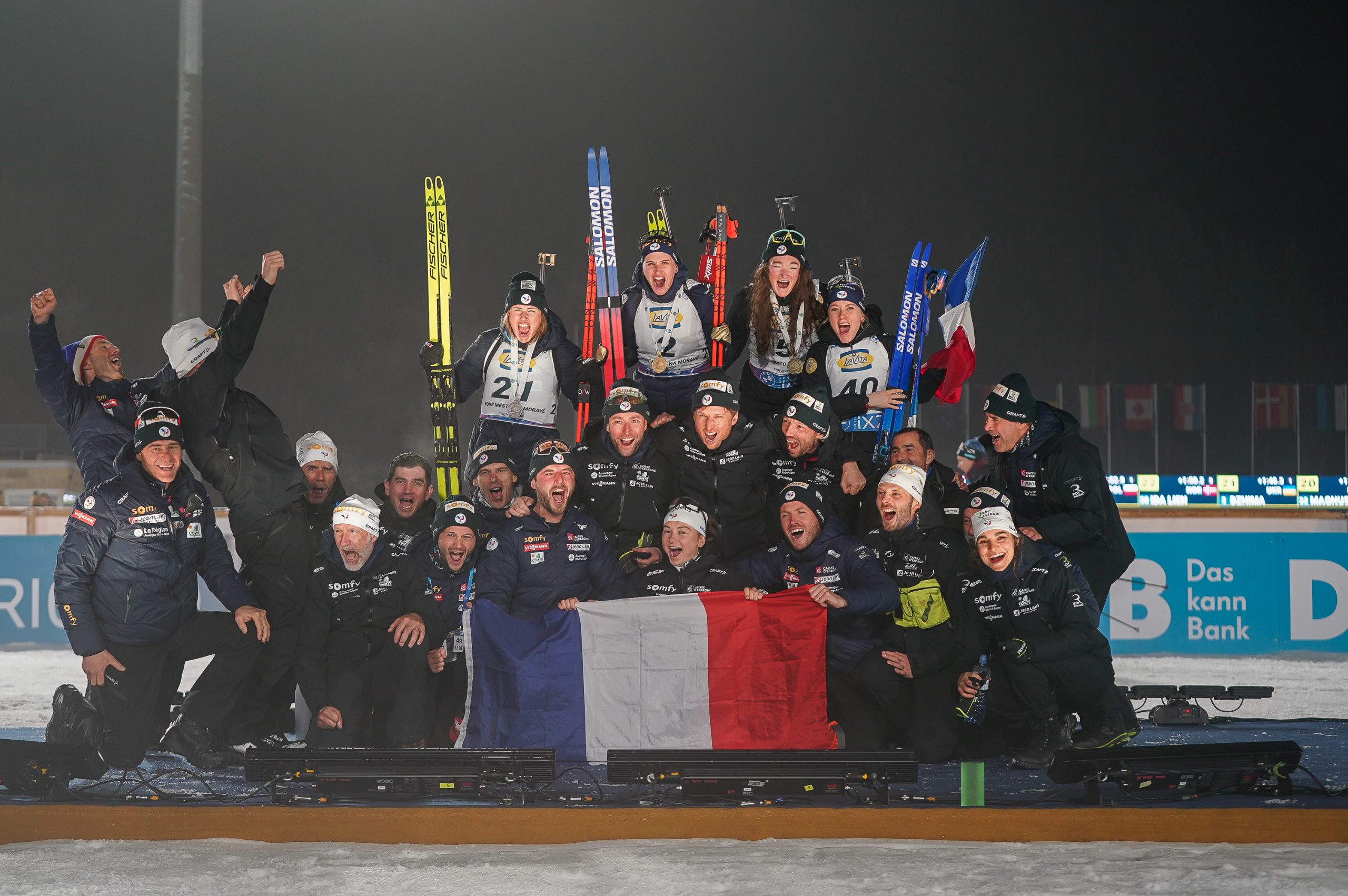
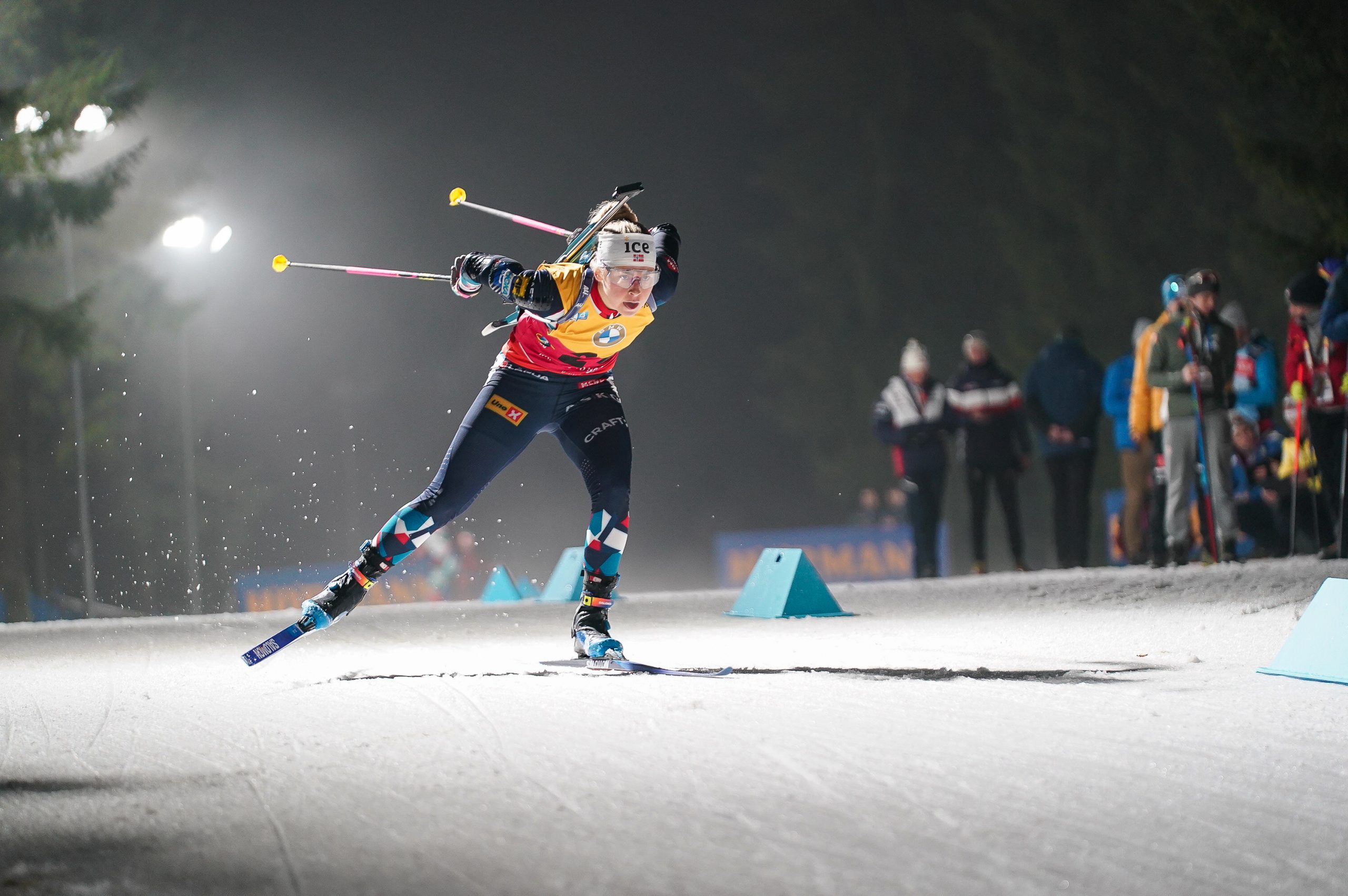
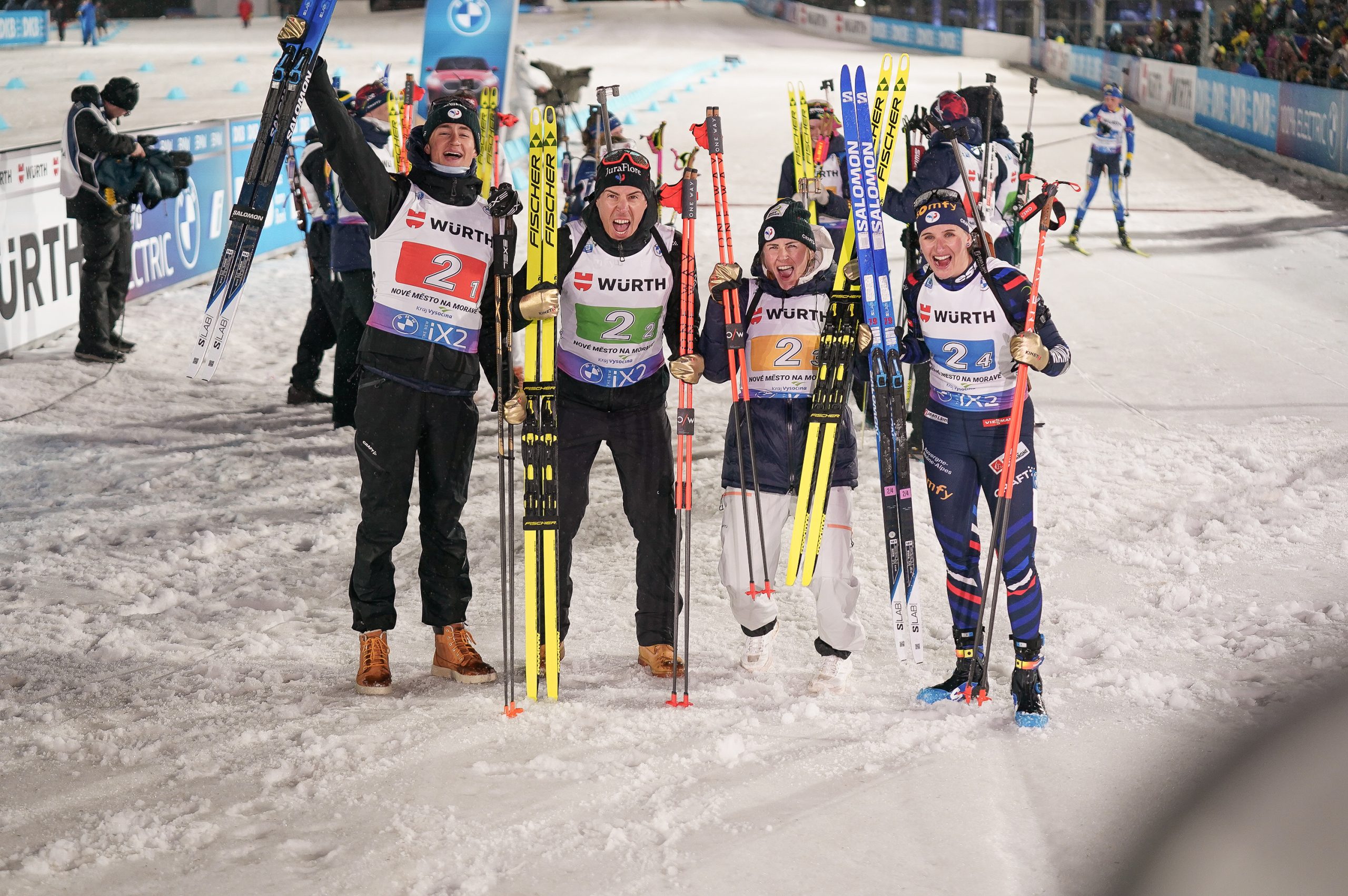
France swept places 1-4 in the Sprint at the 2024 Biathlon World Championships. (Photo: NordicFocus)
Ever since France upset Norway to win the opening Mixed Relay of the 2024 Biathlon World Championships, their magnificent esprit de corps has been on display. After that race, the entire team gathered around the podium and belted “La Marseillaise” in the rain as the French flag was raised in the Vysocina Arena in Nove Mesto na Morave, Czech Republic. That same winning energy pulsed through the French women’s team Friday as they delivered an historic sweep of the first four places—a feat not seen since the inaugural Women’s Biathlon World Championships in 1984 when the Soviet Union swept the 10 k Individual. (American Kari Swenson was fifth.) There were 35 finishers in that race. In Friday’s 7.5 k Sprint, The French quartet of Julia Simon, Justine Braisaz-Bouchet, Lou Jeanmonnot, and Sophie Chauveau bested a field of nearly 100.
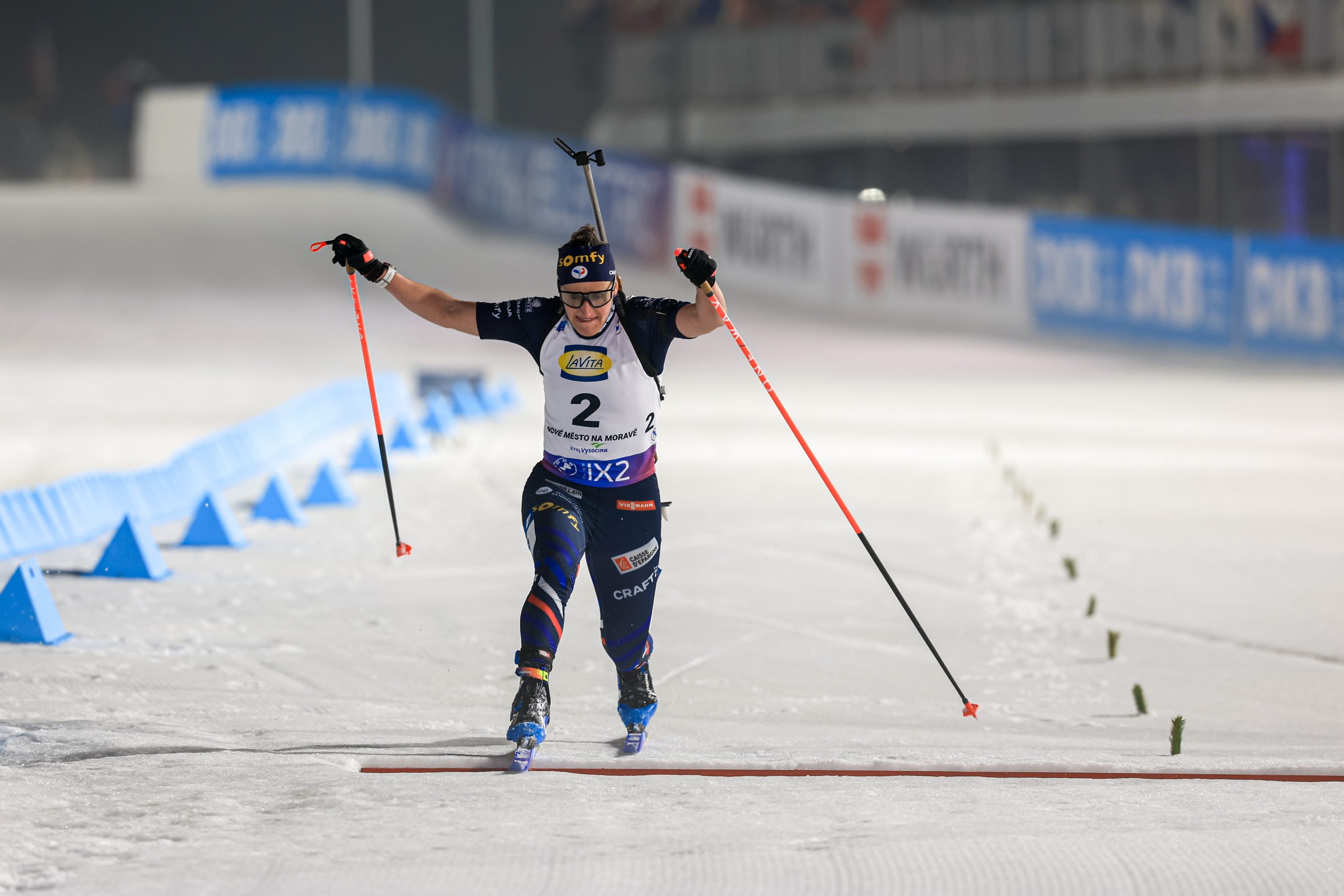
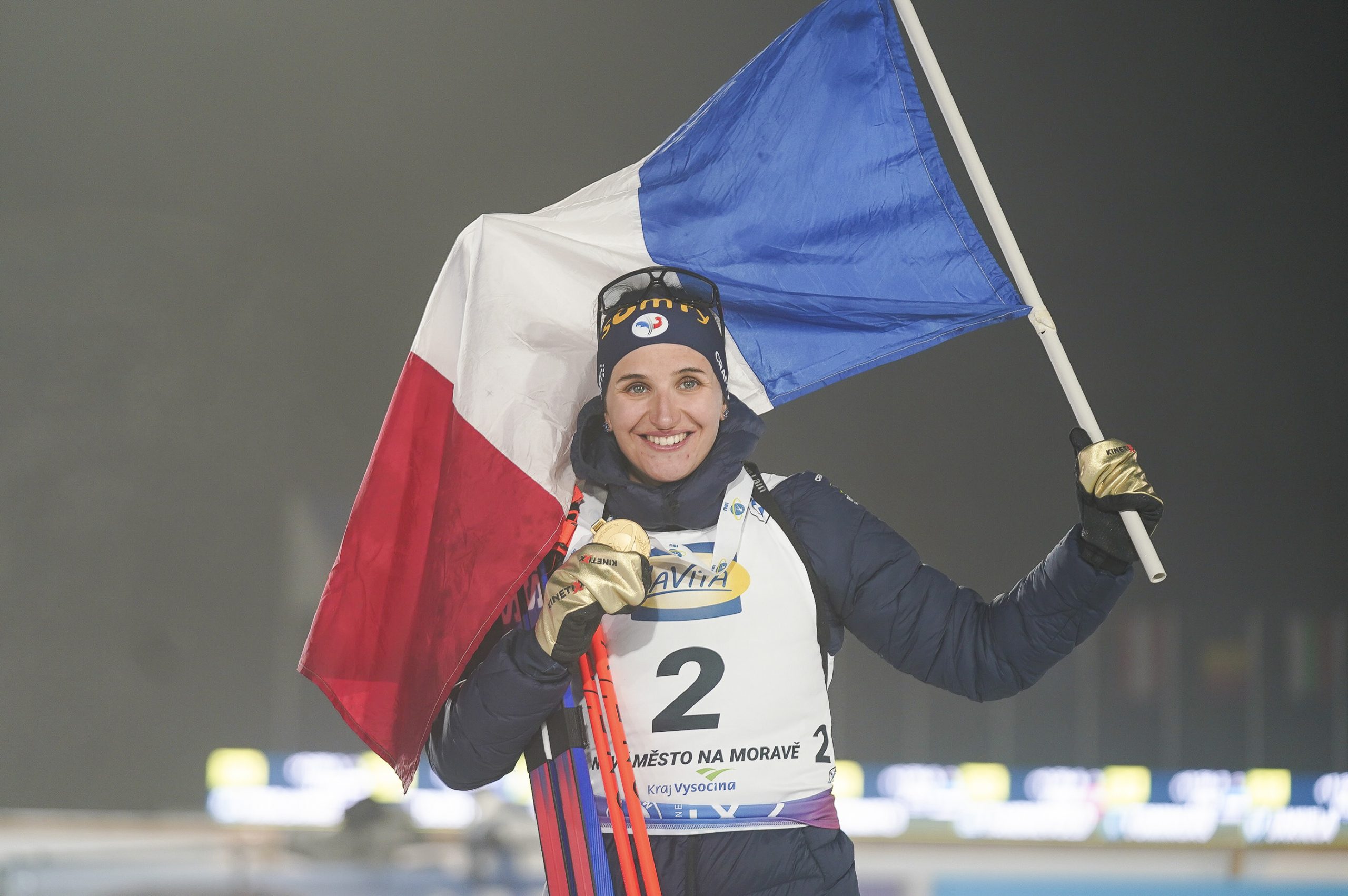
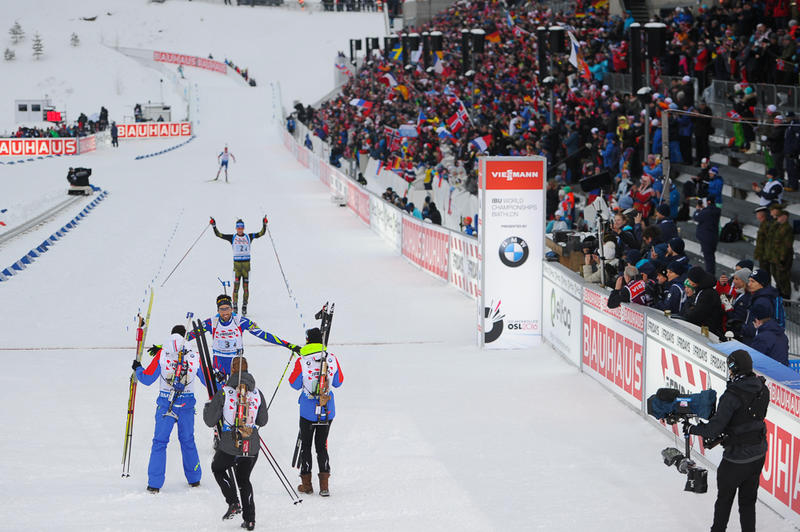
Early starter Julia Simon (FRA) crosses the finish line, setting the time to beat in the Women’s Sprint. (Photo: NordicFocus)
All eyes were on Simon, wearing bib 2, to set the time to beat for the day. After laying down a perfect anchor leg in Wednesday’s Mixed Relay, she picked up where she left off with another 10/10 performance, leaving little room for any challengers. Simon’s ski time ranked fourth and her total shooting time of 42 seconds for prone and standing was the fastest of the day. It was a dominant Sprint performance from the 2023 World Cup Overall champion, who is better known for her head-to-head racing.
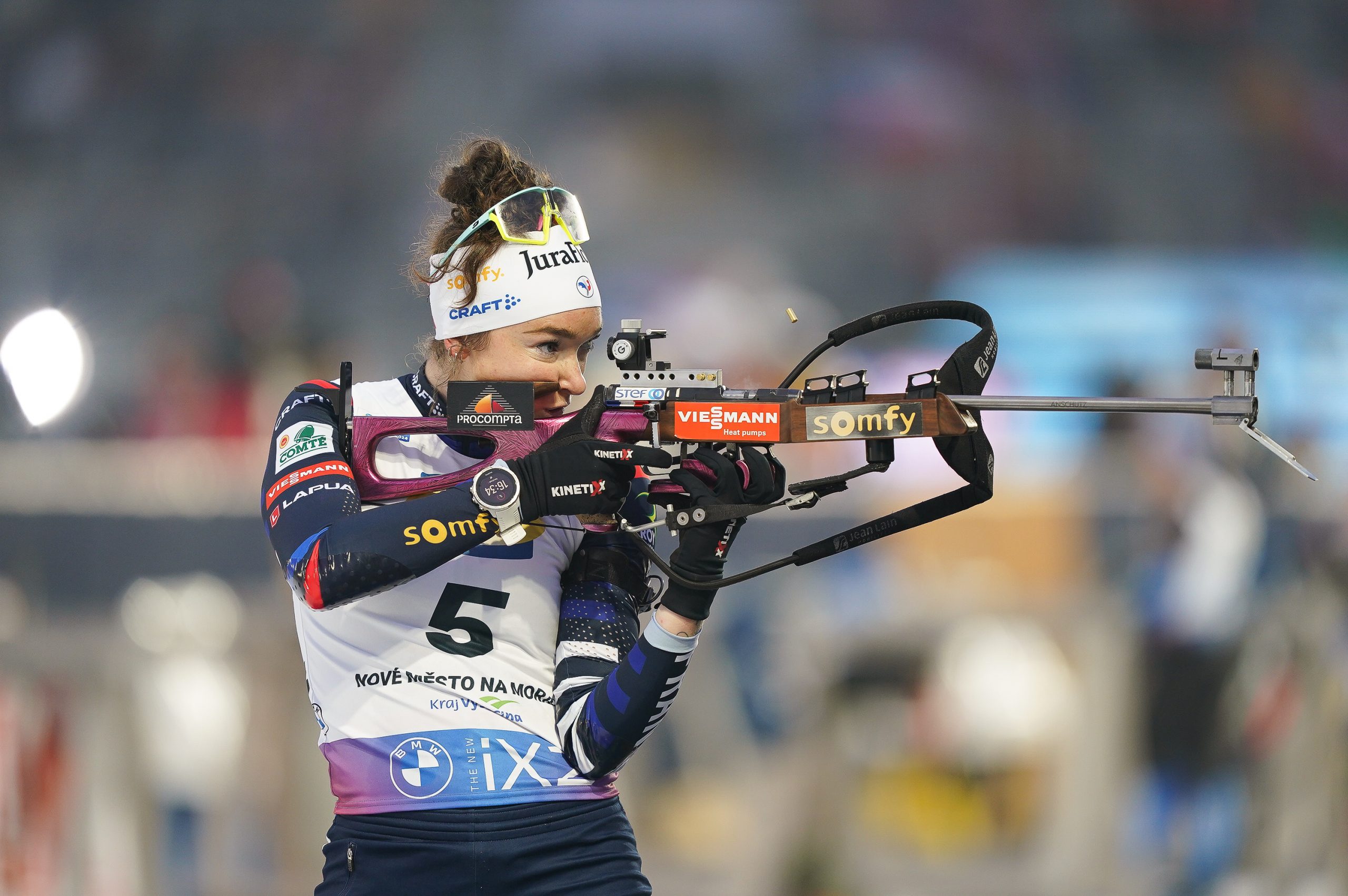
Lou Jeanmonnot (FRA) shot 9/10 to land on her first World Championships podium, taking home the bronze for France. (Photo: NordicFocus)
Another early starter, Jeanmonnot in bib 5 matched Simon’s speed on the course but lost some time to her on the range (like everyone else) and missed one target in standing, eventually finishing 40 seconds back. It seemed inevitable that other competitors would fill that gap, but as the race went on it became clear that the only athletes skiing fast enough to challenge the French women were their own teammates.
Justin Braisaz-Bouchet (FRA) outskied the field by nearly 30 seconds to take silver despite one miss. (Photo: NordicFocus)
Out-skiing the field by over 30 seconds in Wednesday’s Mixed Relay, Braisaz-Bouchet demonstrated that she is one of very few athletes who can ski a penalty loop and still fight for gold. That scenario nearly played out in Friday’s Sprint, as Braisaz-Bouchet gapped the field by 28 seconds, missed one in prone but then hit all of her standing targets, leaving the range with just a 13-second deficit to clean-shooting Simon. She closed the gap in the final kilometers but couldn’t quite catch Simon, crossing the line just 4.9 seconds behind.
World Cup Overall leader Ingrid Landmark Tandrevold (NOR) led the race after the first shooting but then fell to 25th after a disastrous three misses in standing. (Photo: NordicFocus)
The two Italian stars, Lisa Vittozzi and Dorothea Wierer, were early challengers for the podium, both showing their trademark poise on the range with 10/10 hits, but they didn’t have the ski speed to keep up with the French women and ended up seventh and tenth. Swedish sisters Hanna and Elvira Oeberg did the reverse; they skied well but both missed in standing and dropped to eighth and ninth.
The only other athlete who could challenge Simon for the gold was World Cup Overall leader Ingrid Landmark Tandrevold (NOR) in bib 26. She came through the prone shooting in the lead, 1.5 seconds ahead of Simon, but then suffered a disastrous standing bout, missing three targets and falling to 25th place—her worst result of the season.
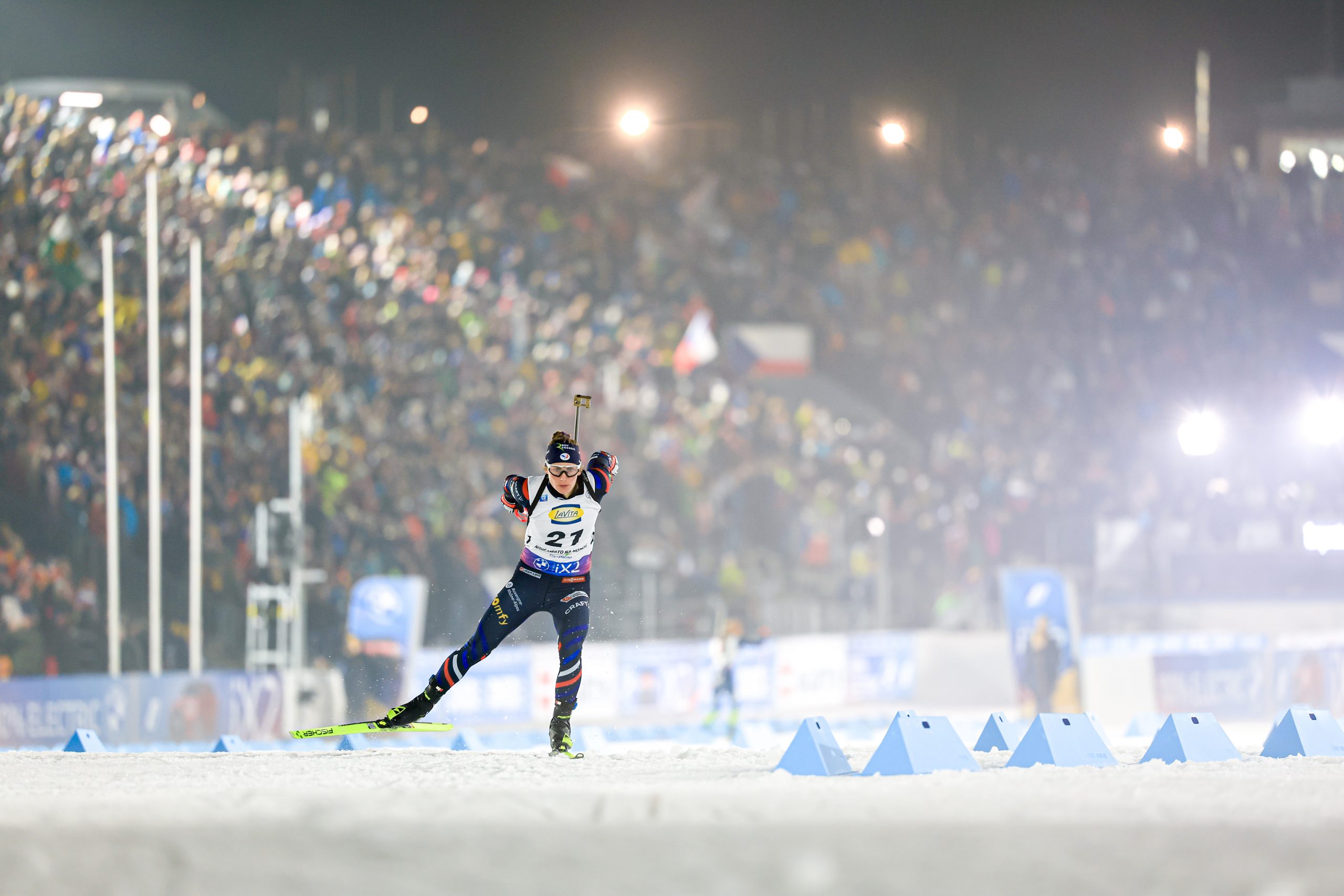
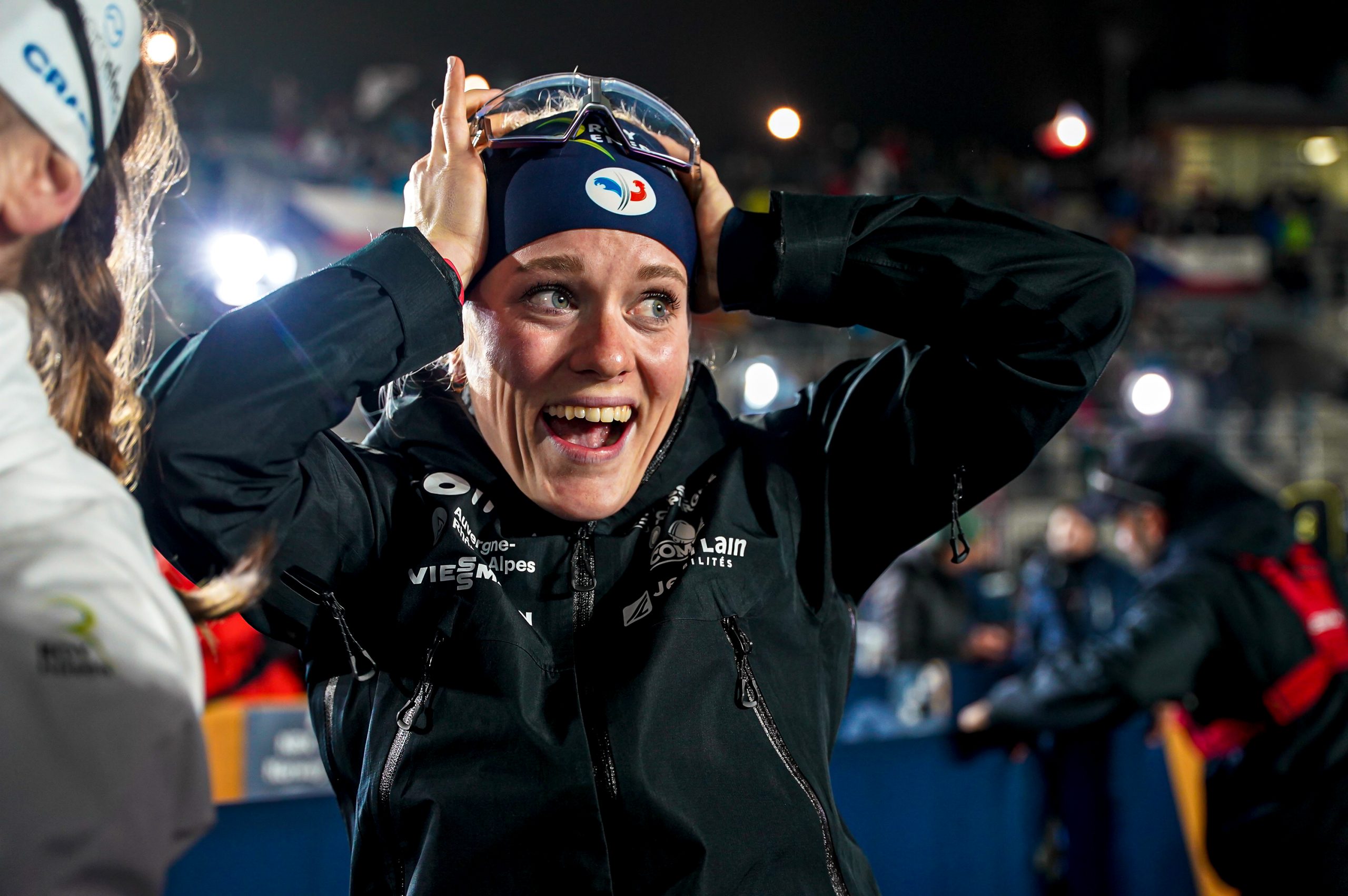
Sophie Chauveau (FRA) reacts to her team’s one-through-four sweep. (Photo: NordicFocus)
The podium positions seemed secure until Chauveau, wearing bib 40, nearly overtook Jeanmonnot. Chauveau found herself down in 30th after a miss in prone but then launched into podium contention with her clean standing shooting and third-ranked course time. In the finish she was a mere four seconds off the podium.
Simon’s gold is her first Sprint podium of the season and only her second-ever Sprint victory. Braisaz-Bouchet, who skipped last season to have her first child, had never finished better than 25th in a World Championships Sprint, despite taking part in every edition since 2015 and winning a list of World Cup races and an Olympic gold medal in Beijing along the way. Jeanmonnot’s bronze is her first World Championship medal, and Chauveau’s fourth place ties her second-best career finish. She earned her first World Cup medal, a bronze, in January of this year.
While the French women shot exceptionally well, they owe their sweep to their ski speed. Four of the top-five fastest skiers in the Sprint were French. The other was 2021 cross-country World Cup Overall Sprint champion, Anamarija Lampic of Slovenia, who missed five and finished 36th. Reflecting on the role that ski preparation played today, US Biathlon ski technician Federico Fontana said, “The dirt and the wet in Nove Mesto is always challenging. The French had incredible skis.”
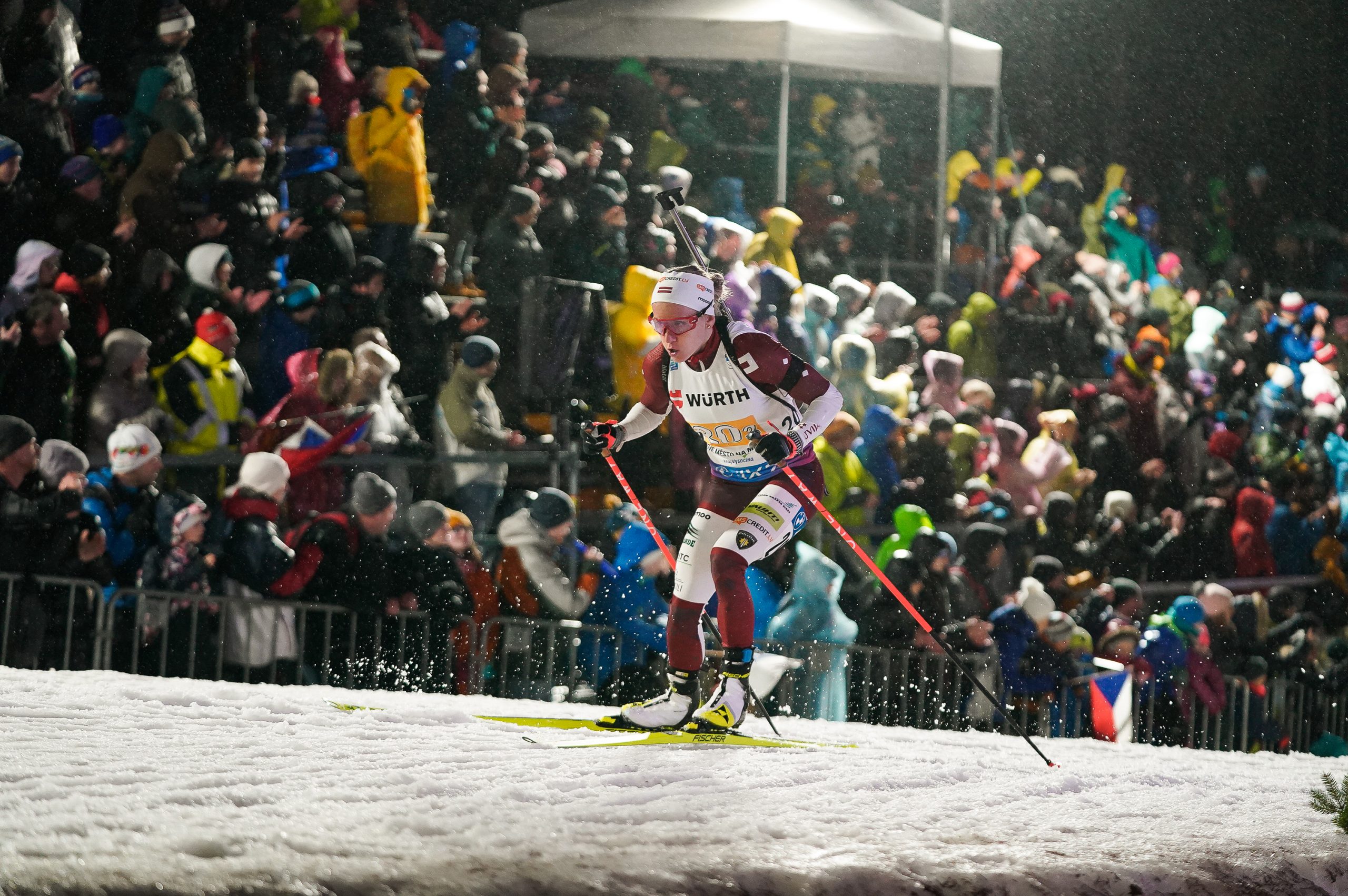
Baiba Bendika (LAT) skied the seventh-fastest course time and hit 9/10 to tie her career-best finish of fifth. (NordicFocus).
The surprise of the day was Latvia’s Baiba Bendika, who finished fifth to match her career-best result, having given birth to her first child in October—just four months ago. She had a chance to break up the French sweep but missed her last shot. Franziska Preuss of Germany completed the Flower Ceremony, also with one standing miss.
Irwin and Geraghty-Moats Qualify for Pursuit
Deedra Irwin was the top American in the Sprint, finishing 39th with one miss each in prone and standing. She wrote on her Instagram account, “It isn’t what I wanted but then I realized that it is my personal best World Champs Sprint finish!” Irwin has consistently been scoring World Cup points in the top 40 this season and has the potential to move up significantly in Sunday’s Pursuit. She’ll be joined in the Pursuit for the first time by teammate Tara Geraghty-Moats, who sneaked into the top-60 qualifiers with a new personal-best of 58th.
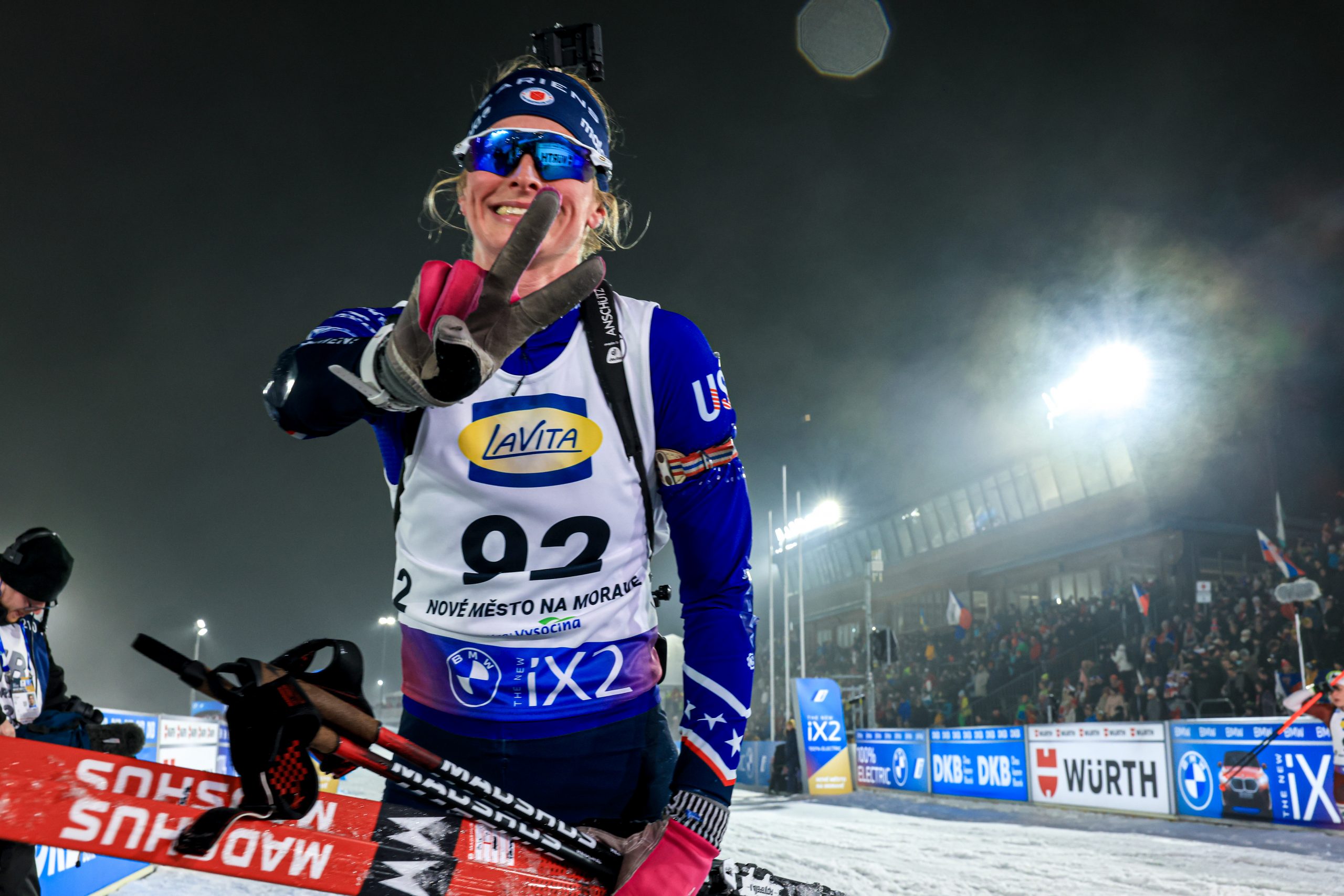
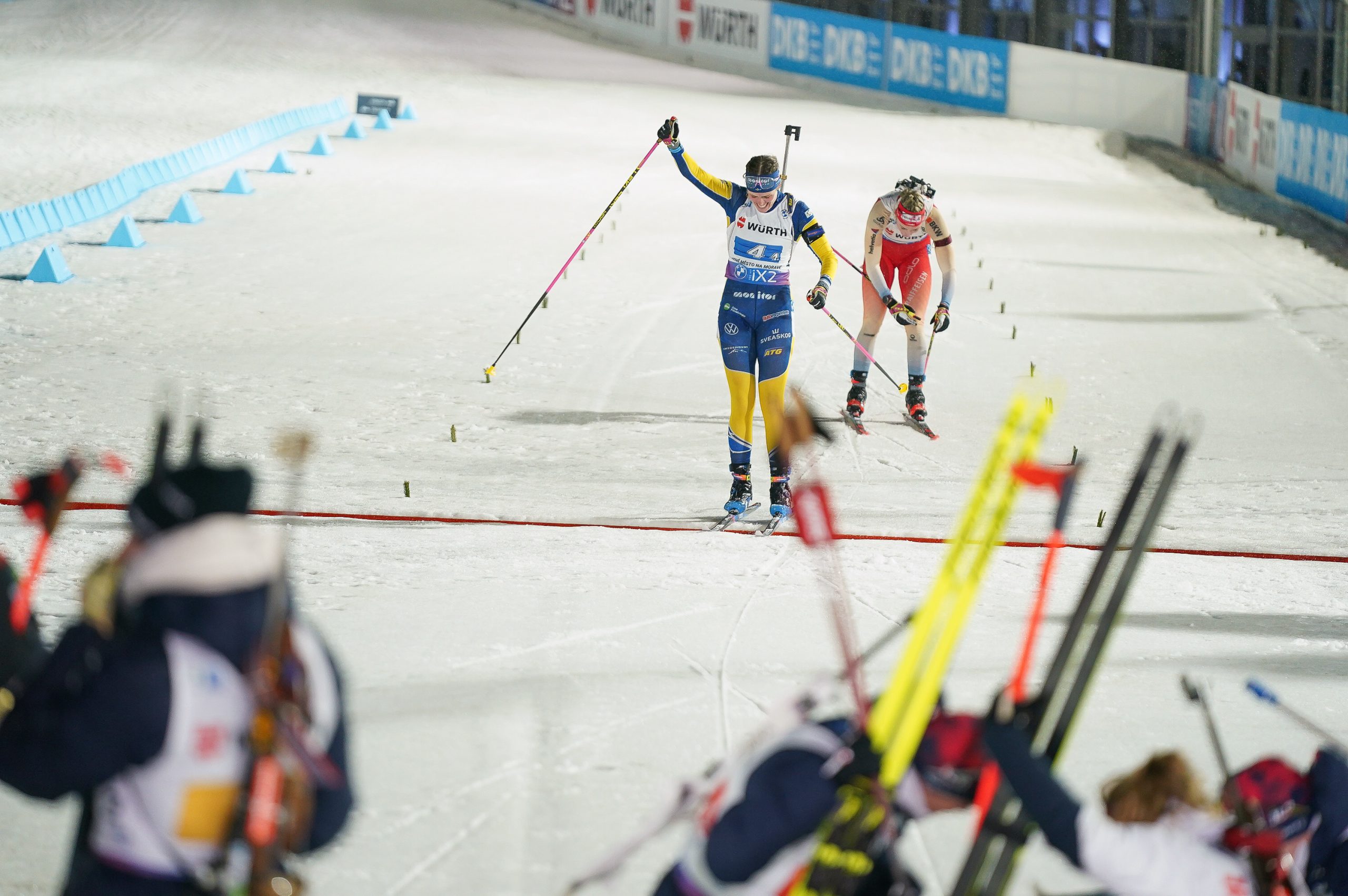
Tara Geraghty-Moats (USA) smiling in the finish line after setting a new personal-best of 58th to qualify for her first Pursuit. (Photo: NordicFocus)
Geraghty-Moats cited her start position as playing a role in her qualification. “I had good course conditions with the second-to-last starting bib. With the warm temperatures, I thought the course would degrade a lot by the time I raced but it didn’t.” She had the advantage of watching earlier athletes go through, and drawing on their energy. “It looked so epic. It made me super excited to go out there. With the results I’ve had this winter I didn’t think I would make the Pursuit so I just wanted to have a race where I executed my plan well.”
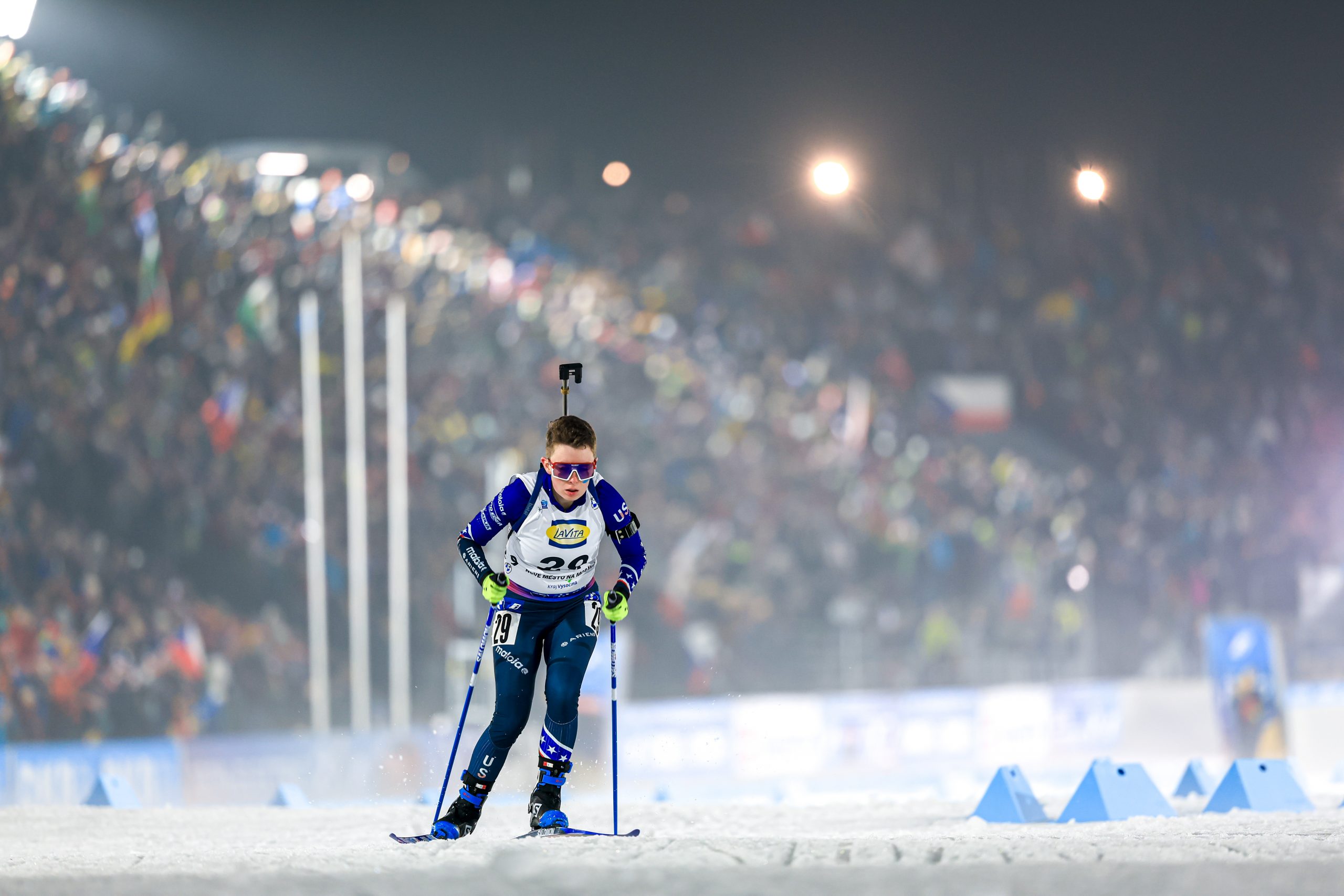
Jackie Garso (USA) racing in her first World Championships. (Photo: NordicFocus)
Chloe Levins and Jackie Garso completed the US roster in Friday’s race. Levins echoed Geraghty-Moats’ comments about the atmosphere in the stadium: “The energy under the lights in Nove Mesto was electrifying tonight.” Levins, who finished 80th with two misses, is coming off a training season that was interrupted by a number of health issues. “I’m nowhere near satisfied with my result, but continue to gain great experience and feel myself racing back into shape.” Garso, competing in her first World Championships, finished 87th with three misses. She, too, was shocked by the crowds: “It’s unbelievably loud! You can’t even hear yourself breathe.”
FasterSkier’s Coverage of the Biathlon World Championships is made possible through the generous support of the Craftsbury Outdoor Center: New England’s finest snowmaking, world class race venues and touring trails, healthy food in abundance, comfortable accommodations at Craftsbury: Sports, Sustainability, Stewardship.
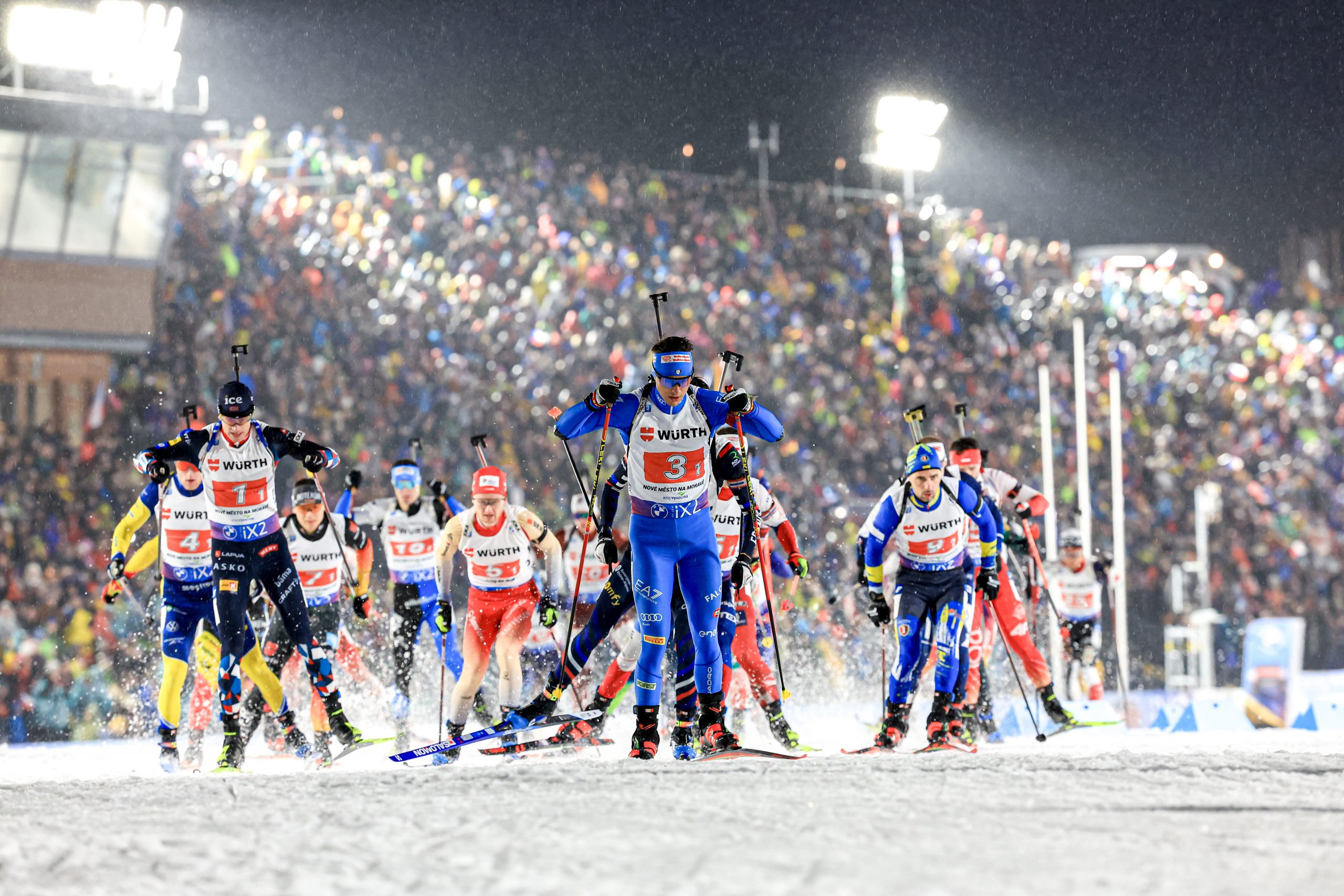
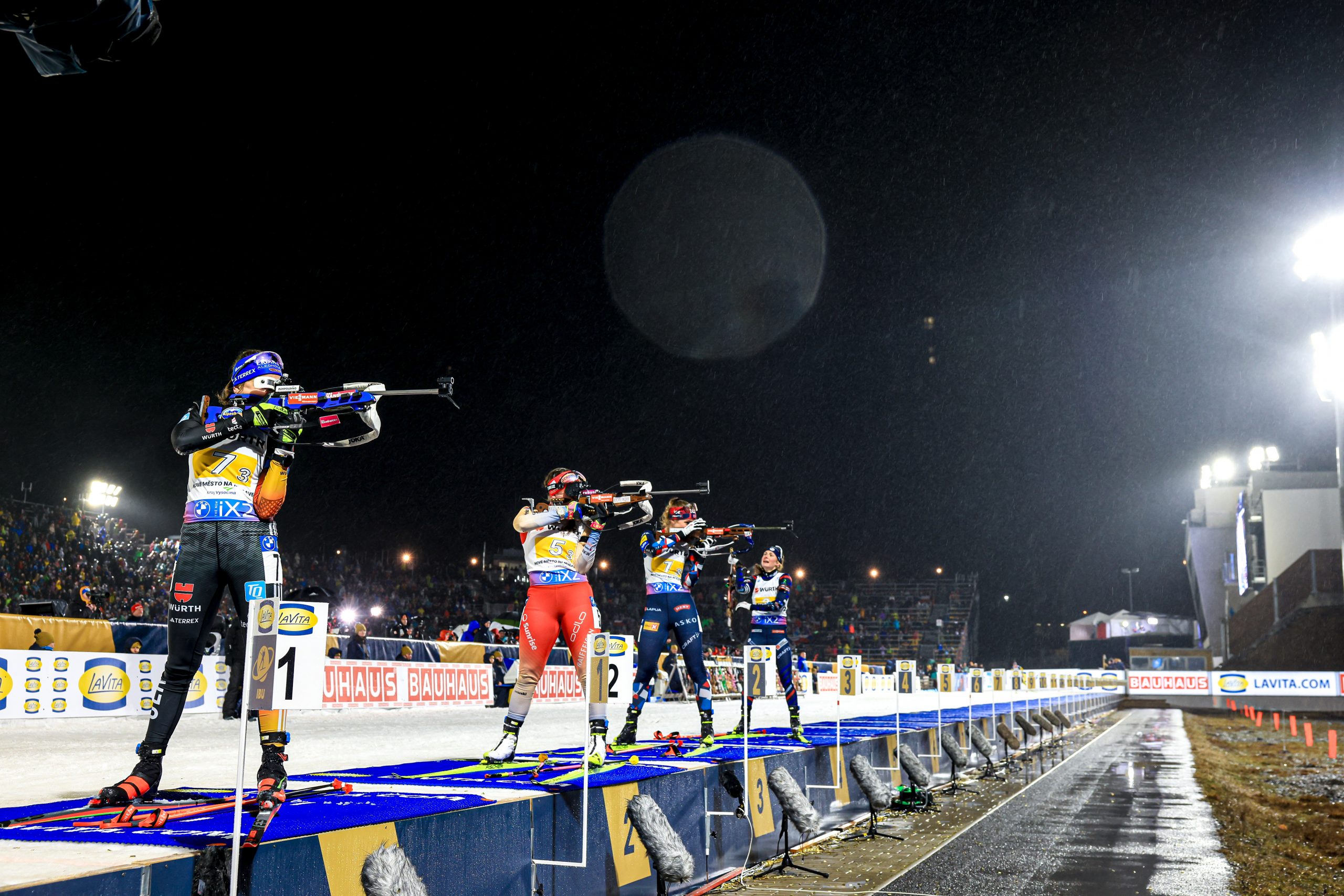
The start of the Mixed Relay at the 2024 Biathlon World Championships in Nove Mesto na Morave, Czech Republic. (Photo: NordicFocus)
In the opening race of the 2024 Biathlon World Championships, France overcame heavy favorite Norway to take gold in the 4×6 k Mixed Relay. It was a tightly contested race with 25 nations on the start line and only 40 seconds separating the top five teams at the third exchange. On the final leg, Norway and Sweden overtook Switzerland to capture silver and bronze. The Swiss ended up a mere 1.2 seconds off the podium in fourth—their best finish ever in a World Championships Mixed Relay. Steady freezing rain did not stop 30,000 biathlon-crazed fans from packing the Vysocina Arena in Nove Mesto na Morave, Czech Republic, making for an electric atmosphere on opening night.
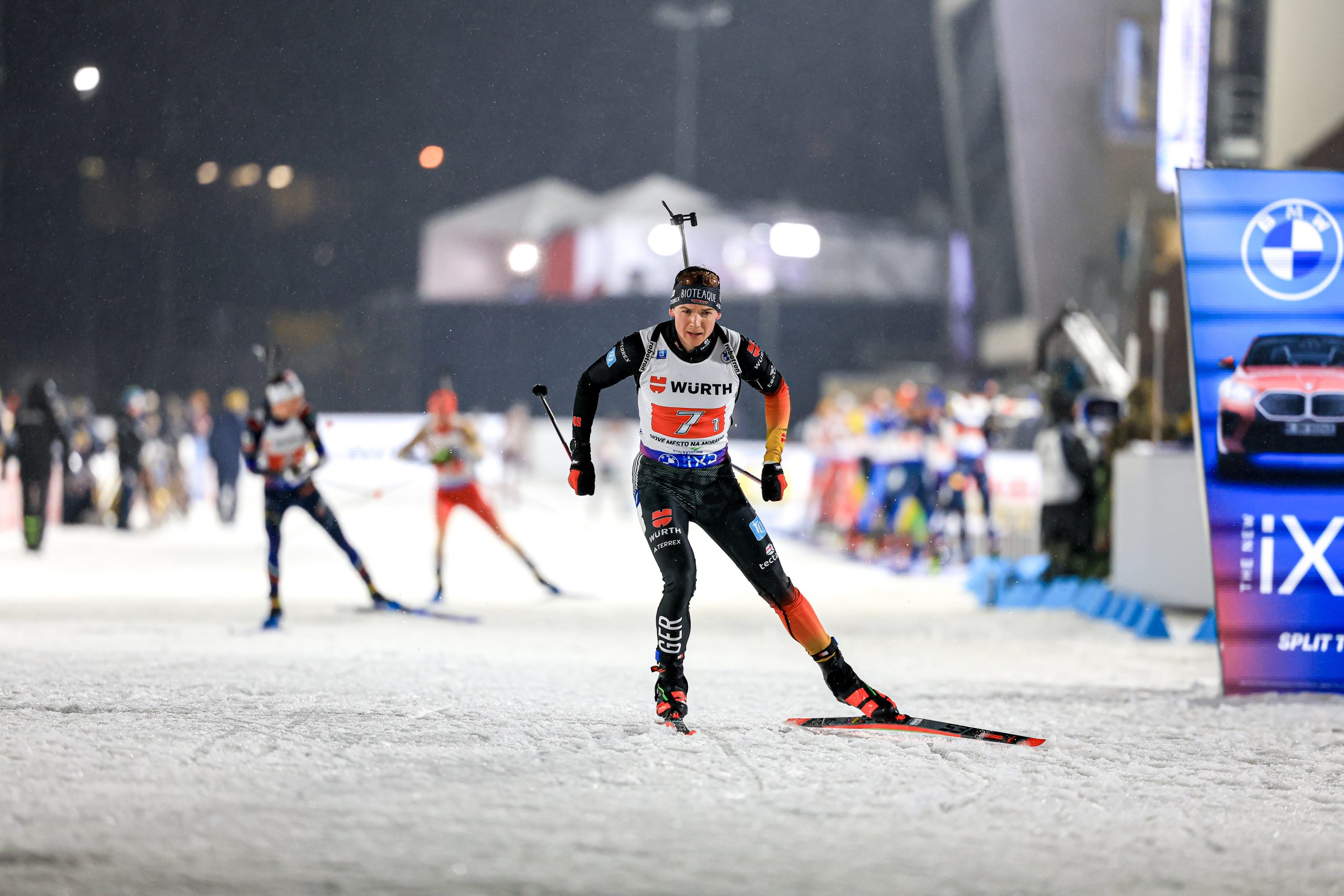
Germany led early in the Mixed Relay thanks to exceptional shooting by Justus Strelow and Phillip Nawrath. (Photo: NordicFocus)
The unofficial “ice breaker” of World Championships, the Mixed Relay tends to be chaotic and full of surprises, and today’s race was no exception. Ranked sixth going into the race, the home Czech team met disaster on the very first visit to the shooting range when Michal Krcmar incurred a penalty loop and found himself in second to last, a full minute behind the leaders. Krcmar exchanged in 21st, two minutes back. Third-ranked Italy fared even worse: Didier Bionaz incurred two penalty loops in his standing shoot and tagged off in 23rd. Meanwhile, 19th-ranked Kazakhstan and 17th-ranked United States tagged in fifth and sixth, thanks to world-class performances from Alexandr Mukhin (KAZ) and Vincent Bonacci (USA).
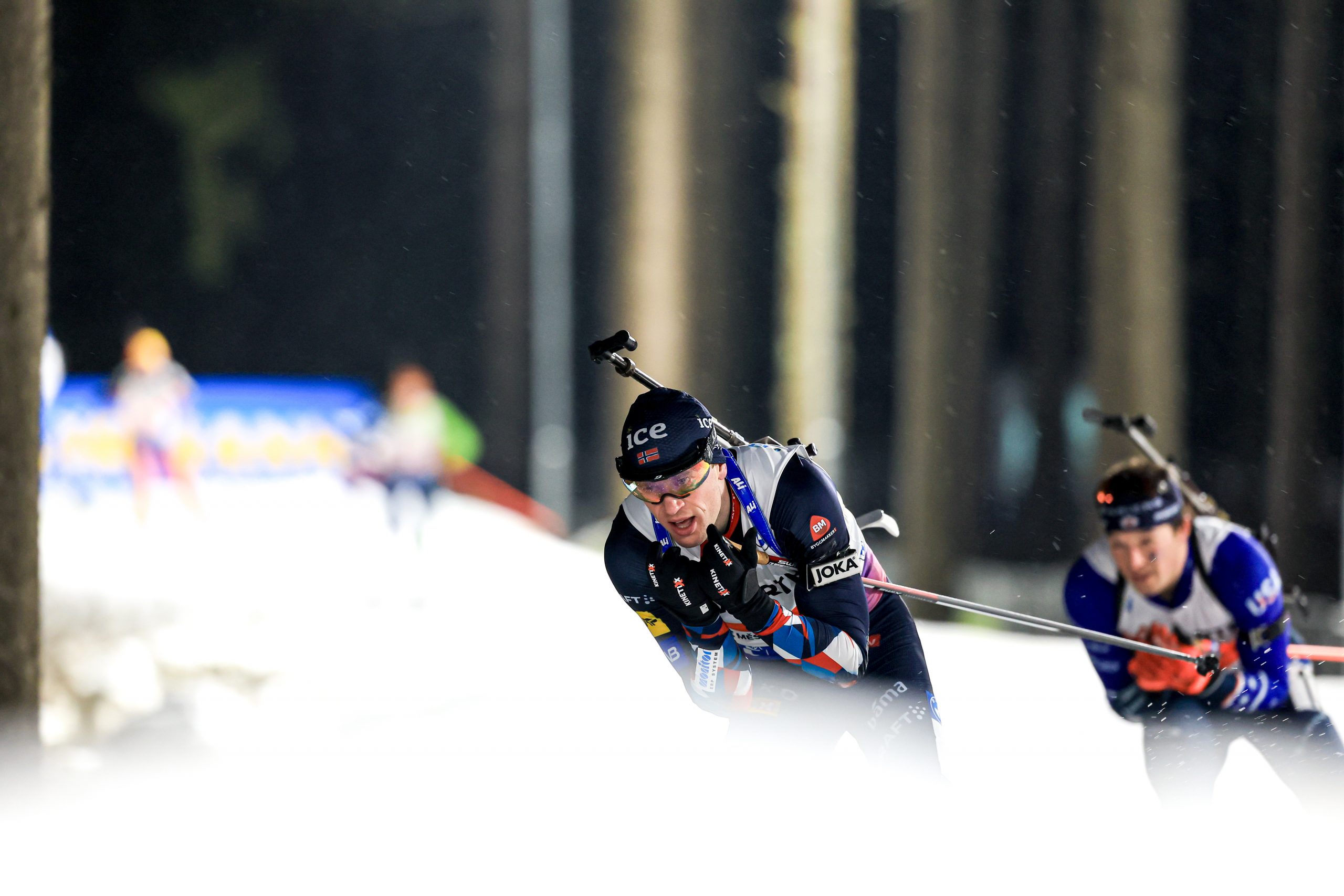
Tarjei Boe (NOR) is followed by Vincent Bonacci (USA) in the first leg of the Mixed Relay. (Photo: NordicFocus)
The big surprise on the second leg was that Norway did not come through on top. Norwegian brothers Tarjei and Johannes Boe—ranked third and first in the men’s World Cup overall standings—are such a powerhouse combination that they were all but guaranteed to deliver a Norwegian lead at the half-way point; however, they both lost time on the range that they were unable to recover on skis. Germans Justus Strelow and Phillip Nawrath combined to put 48 seconds into the Norwegians just in shooting time. At the halfway point, Germany led, with France eight seconds back and Norway another twenty behind. The US and Canada tagged in ninth and tenth, just 15 seconds outside the top six.
Franziska Preuss (GER) fell from first to fifth after incurring a penalty loop in her standing shoot in the Mixed Relay. (Photo: NordicFocus)
Anyone who bet on the Norwegians for gold would have felt uneasy going into the third leg, with the German and especially the French women’s teams both very strong on paper. But it was a rollercoaster for all. France’s Justine Braisaz-Bouchet went into the penalty loop in prone and dropped to fifth place, giving Franziska Preuss of Germany a 39-second advantage. Then their fortunes switched in standing when Preuss went into the penalty loop! Braisaz used a single spare and out-skied the field in leg three by a whopping 33 seconds, making an enormous comeback for France and tagging in first. At the third exchange, only eight seconds separated the top three teams, with Switzerland moving up into second and Norway hanging in third. After a quiet first half, Sweden’s Hanna Oeberg brought her team within striking distance on the third leg, tagging her younger sister Elvira in fourth, just 14 seconds off the podium. Germany fell to fifth. Both the USA and Canada held in the top ten.
Sweden’s Elvira Oeberg out-skied Switzerland’s Amy Baserga to take bronze in the Mixed Relay. (Photo NordicFocus)
In the final leg, Julia Simon left no room for any contest, blazing down all her targets, taking a bow, and then skiing to the finish with a comfortable 45-second lead for France. Switzerland’s Amy Baserga performed flawlessly under pressure, shooting ten out of ten, but was overtaken on her first loop by the World Cup overall leader Ingrid Tandrevold of Norway and then on the last loop by Elvira Oeberg, who captured the bronze for Sweden by just one second.
Julia Simon (FRA) takes a bow on the shooting range after clinching gold for France with her flawless final shoot. (Photo: NordicFocus)
The US stayed in the top ten until the very last loop when the Italians came clawing their way back from the dead and pushed the US down into 11th. Canada finished 13th, just in front of the Czech Republic.
Next up is the women’s 7.5 k Sprint on Friday, February 9th.
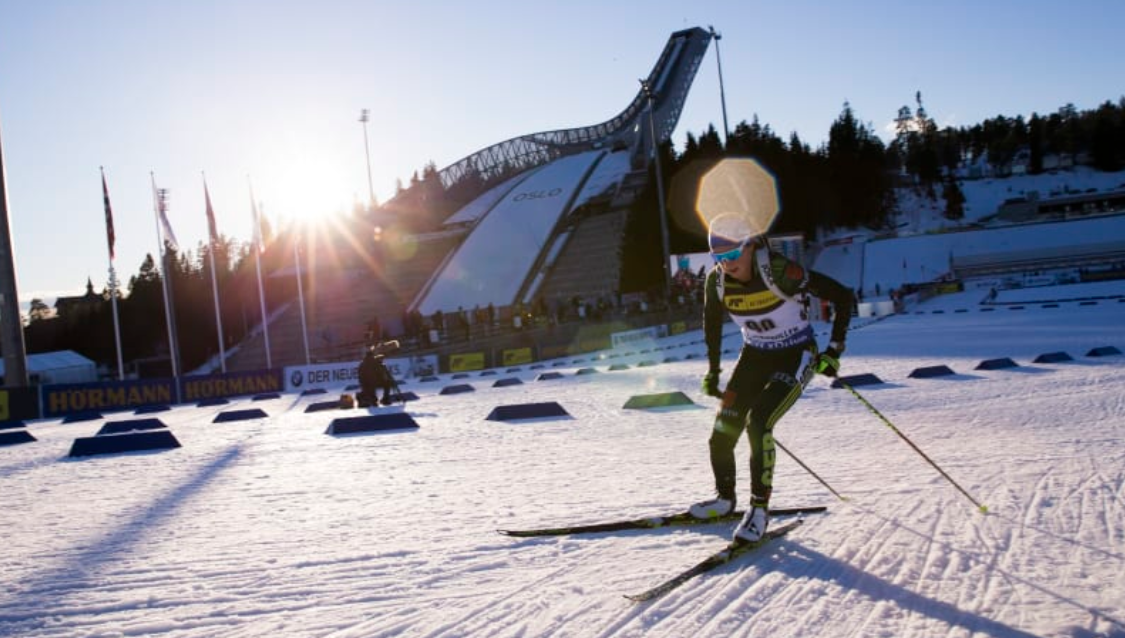
Sunny skies at the 2019 IBU World Cup women’s 7.5 k sprint in Oslo, Norway. (Photo: biathlonworld.com screenshot)
The IBU World Cup resides in Oslo this week. The women began the racing with the 7.5-kilometer sprint on Thursday.
The podium rundown goes like this: Slovakia’s Kuzmina Anastasiya shot 1+0 to win in 19:56.2, Germany’s Franziska Preuss placed second (+21.2, 0+0), with Paulina Fialkova of Slovakia in third (+25.1, 0+0).
This was Kuzmina’s fifth win at Holmenkollen and secured her the IBU sprint overall title.
Canada’s Emma Lunder was the top North American in ninth place. Lunder clean both shooting bouts and was 49.0 seconds behind the winning time. This was a career best individual result for Lunder on the IBU World Cup.
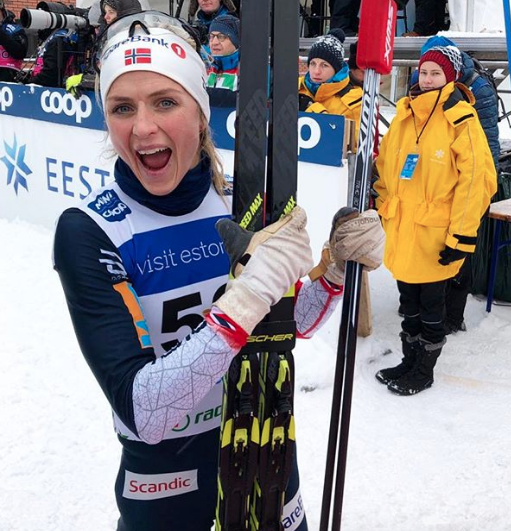
World Cup cross-country action returned to the Otepää race venue on Sunday, with athletes reconvening after Saturday’s classic sprints for the weekend’s distance classic event. In the women’s 10-kilometer individual start classic race, Norway’s Therese Johaug finished first in a time of 29:53.7 for the win. Sweden’s Ebba Andersson finished second (+48.4) while Russia’s Natalia Nepryaeva claimed third (+56.7).
Skiing for the U.S. Ski Team (USST), Jessie Diggins was the top North American woman on Sunday, placing 13th (+2:26.0). Two more Americans skied into the Top 30, with Rosie Brennan finishing 27th (+3:09.9) and Sadie Bjornsen 29th (+3:11.3).
Also skiing for the U.S. on Sunday, Caitlin Patterson and Ida Sargent finished in 39th (+3:50.9) and 41st (+4:17.2), respectively. Dahria Beatty was the lone Canadian to enter the race, placing 43rd (+4:42.5).
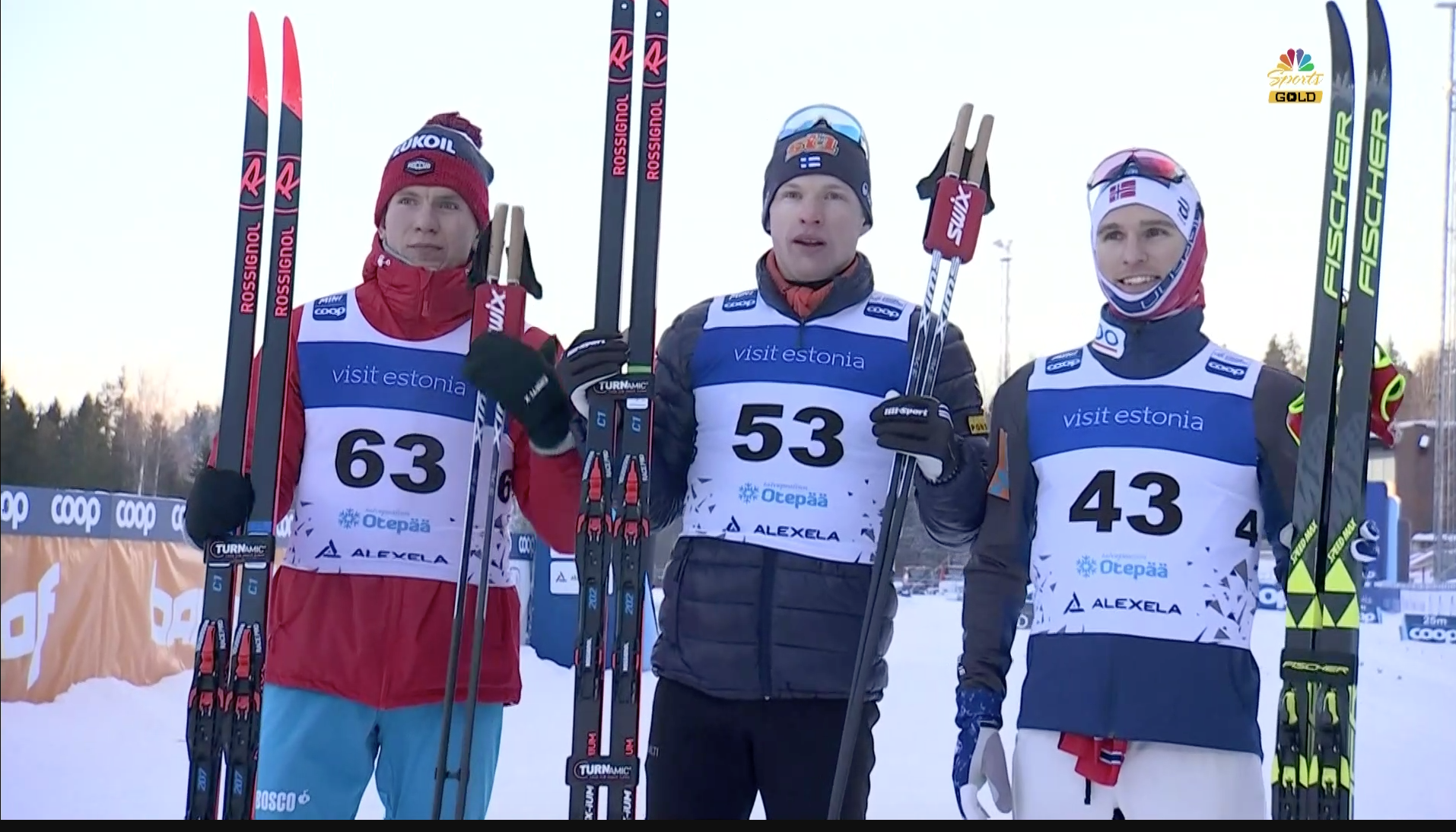
The men’s 15-kilometer classic podium on Sunday in Otepää, Estonia with Russia’s Alexander Bolshunov (left) in second, Iivo Niskanen of Finland (center) in first and Norwegian Didrik Tønseth (right) in third. (FIS screenshot)
In the men’s 15 k, Finland’s Iivo Niskanen took first, completing the course in a time of 40:07.1. Russia’s Alexander Bolshunov finished in second place (+15.9) and Norway’s Didrik Tønseth in third (+46.4).
The USST’s Erik Bjornsen led the charge for the Americans, placing 30th (+2:35.7). Scott Patterson placed 36th (+3:01.0), while Ben Lustgarten finished in 53rd (+4:41.1). Kevin Bolger placed 56th (+4:57.3) and Andy Newell did not start.
Racing for Canada, Len Valjas placed 43rd (+3:56.9) and Bob Thompson 52nd (+4:24.0).
The NorAm weekend wrapped up with mass start free technique on shortened courses. The predicted extreme cold and extreme snow didn’t materialize with a relatively balmy -13C recorded by the jury.
Katherine Stewart-Jones (CNST) continued her dominance with a win in 48:25.5, gapping Cendrine Browne (CNST) on the third and final lap for a 8.4 second separation. That is two wins and a second for Stewart-Jones. Zoë Williams (Nakkertokk) was third again, 1:38.2 behind. The shortened course was 14.3km, with one 4.3km lap and two 5km laps.
Russell Kennedy (Team R.A.D.) collected his first win of the weekend to earn his trip to World Championships, finishing alone at 57:12.6 on the four lap 19.3km race. Scott Hill (Hardwood) was second at 23.4 seconds behind. Evan Palmer-Charrette out-sprinted the remains of the original six leaders to complete the podium at 1:07.0.
IBU World Cup Ruhpolding, Germany 15 k / 12.5 k Mass Start
Career-best days are good days. That’s the main narrative from US Biathlon’s Sean Doherty 15-kilometer mass start in Ruhpolding, Germany on Sunday.
Doherty’s previous best in the mass start was a 24th place. In the 30-athlete field, Doherty began in bib-30. In his first two shooting stages, both prone, he skied a single penalty lap in each. As he found his ski-speed groove for his second two laps, marking the third fastest ski split for lap three and the fifth fastest split for lap four, Doherty also made his mark on the shooting range as he shot clean for for both his standing stages.
Doherty finished in 13th overall which matched his individual career best on the IBU World Cup. Johannes Thingnes Bø of Norway won the mass start in a time of 36:43.8 minutes while shooting clean for his first three stages and skiing one penalty lap on his fourth. Doherty’s finishing time was 42.2 seconds behind Bø’s.
Canada’s Christian Gow also posted a career best IBU World Cup results with an 11th place. Gow skied a single penalty lap after missing a target on his second prone stage. Otherwise, he shot clean to finish 34.3 seconds behind Bø.
Austria’s Julian Eberhard placed second (+0.6, 0+1+0+1), and France’s Quentin Fillon Maillet was third (+2.8, 0+1+0+0). Teammate Martin Fourcade skied to fourth (+8.6, 0+0+0+1).
Bø’s win on Sunday marked his 10th win (including relays) this season on the IBU World Cup. He leads the overall points series.
It was time for a first in the women’s 12.5 k mass start. Franziska Preuss of Germany won the race – an IBU World Cup career first for her — in a time of 32:34 minutes. Preuss shot clean on her way to the win.
Norway’s Ingrid Landmark Tandrevoldplaced second (+0.2, 0+0+0+0). For Tandrevold it was a her first IBU World Cup podium. Paulina Fialkova of Slovakia was third (+15.1, 0+0+0+0).
US Biathlon’s Clare Egan placed 24th (+1:59.7, 0+0+3+2), teammate Susan Dunklee 25th (+2:12.5 2+1+1+0).
No other North American women qualified for the mass start.
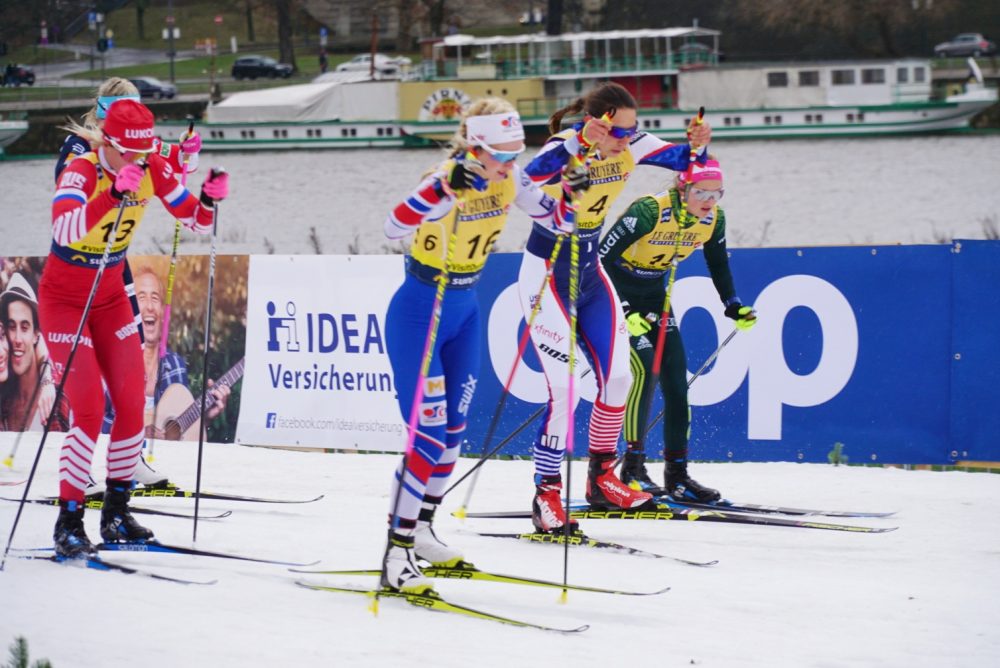
Racing in bib 4 for the U.S., Julia Kern keeps pace in the women’s team sprint during the Dresden, Germany World Cup on Sunday. (Photo: Garrott Kuzzy).
FIS World Cup Dresden, Germany 6 x 1.6 k Freestyle Team Sprint
The first World Cup team sprint of the season was run amidst drizzle and the Dresden, Germany city-scape as the women raced a total of six 1.6-kilometer laps.
Round and round on the looping course, the pace was a mix of tactically subdued speeds with sustained bursts of energy to break the pack.
After all the speed changes and exchanges with one athlete tagging off to the next, it came down to a 1.11 second difference between first place Sweden I and the three closet teams chasing from behind that ended in a photo finish.
Sweden I’s Stina Nilsson and Maja Dahlqvist won in a time of 24:02.5 minutes. Sweden II’s Ida Ingemarsdotter and Jonna Sundling placed second (+1.11), and Norway I, with Eide Mari and Maiken Caspersen Falla in third (+1.11).
U.S. I, featuring Julia Kern and Sophie Caldwell placed fourth (+1.11) after the photo finish was reviewed.
The U.S. entered a second team, consisting of Ida Sargent and Hannah Halvorsen. That duo contested the first semi-final, the same semi as U.S. I, but did not advance after placing fourth (+5.44). The top-three teams from each semi advance to the final, along with the next four fastest teams which are the combined “lucky losers”. Today, the second semi was the faster of the two. The four lucky loser team advancing to the final all originated from the second semi.
In the men’s 6 x 1.6 k skate team sprint race, Norway I and Norway II took the top two podium spots.
In a lunge at the line, Norway I’s Erik Valnes and Sindre Bjørnestad Skar won the final in 22:38.72 minutes. Pål Golberg and Eirik Brandsdal of Norway II placed second (+0.75) and Russia I’s Artem Maltsev and Gleb Retivykh third (+0.80).
Canada’s Bob Thompson and Len Valjas placed seventh (+2.46) in the first semi-final and did not advance to the final. It was the same fate for the only U.S. team entered in the men’s team sprint. Andy Newell and Erik Bjornsen placed 10th (+3.66) in the second semi, and failed to make the finals.
Canada placed 15th in the final standings, the U.S. 19th.
IBU World Cup Oberhof, Germany 4 x 6 k / 4 x 7.5 k Relay
In the women’s 4 x 6 k relay, Russia placed first in a time of 1:18:46.4 hours. Evgeniya Pavlova, Margarita Vasileva, Larisa Kuklina, and Ekaterina Yurlova-Percht made up the team that used eight spares on their way to the win.
Germany placed second (+33.5) with two penalty loops and 10 spare rounds. Karolin Horchler, Franziska Hildebrand, Franziska Preuss, and Denise Hermann comprised Germany’s second place team that had two penalties while using 10 spares. The Czech Republic’s Lucie Charvatova, Veronika Vitkova, Marketa Davidova, and Eva Puskarcikova placed third (+36.7) with 1 penalty loop and six spares.
The top spot for the podium came down to the final leg, when Yurlova-Percht pulled out the win when Hermann skied two penalty loops. The Russian used three spares but escaped with no penalties to take the lead out of the shooting range on the final ski loop.
Susan Dunklee, Clare Egan, Joanne Reid, and Emily Dreissigacker all represented the U.S. and placed 12th (+5:35.8) while skiing five penalty loops and using 16 spares.
Canada’s Sarah Beaudry, Emma Lunder, Megan Bankes, and Rosanna Crawford finished in 13th (+5:58.8) with four penalty loops and 15 spares.
Russian also claimed the men’s relay, winning in a time of 1:20:54.3 hours. The winning team of Maxim Tsvetkov, Evgeniy Garanichev, Dmitry Malyshko, and Alexander Loginov skied no penalty laps and used six spares on their way to victory.
Antonin Guigonnat, Simon Desthieux, Quentin Fillon Maillet, and Martin Fourcade raced for France. The French team placed second (+1:01.1) while skiing a single penalty lap and using eight spares.
Austria’s Tobias Eberhard, Simon Eder, Dominik Landertinger and Julian Eberhard placed third (+2:18.6) with one penalty lap and using seven spares.
Canada’s Scott Gow, Christian Gow, Jules Burnotte, and Brendan Green and the U.S. team of Leif Nordgren, Sean Doherty, Travis Cooper, and Max Durtschi were eventually lapped. Neither team was given an official finishing time.
Canada was ranked 18th in the final standings, the U.S. 19th.
For both relays today, the snowy weather and tough course conditions made for a strenuous day of shooting and skiing.
While we covered who’s still skiing — casually, recreationally, backcountry, basically anything other than full-on training — last week, the start of May marks the beginning of a new season for year-round skiers. And with the first few days of May have come some training pics via social media. Here’s a roundup of some that caught our eye on Instagram:
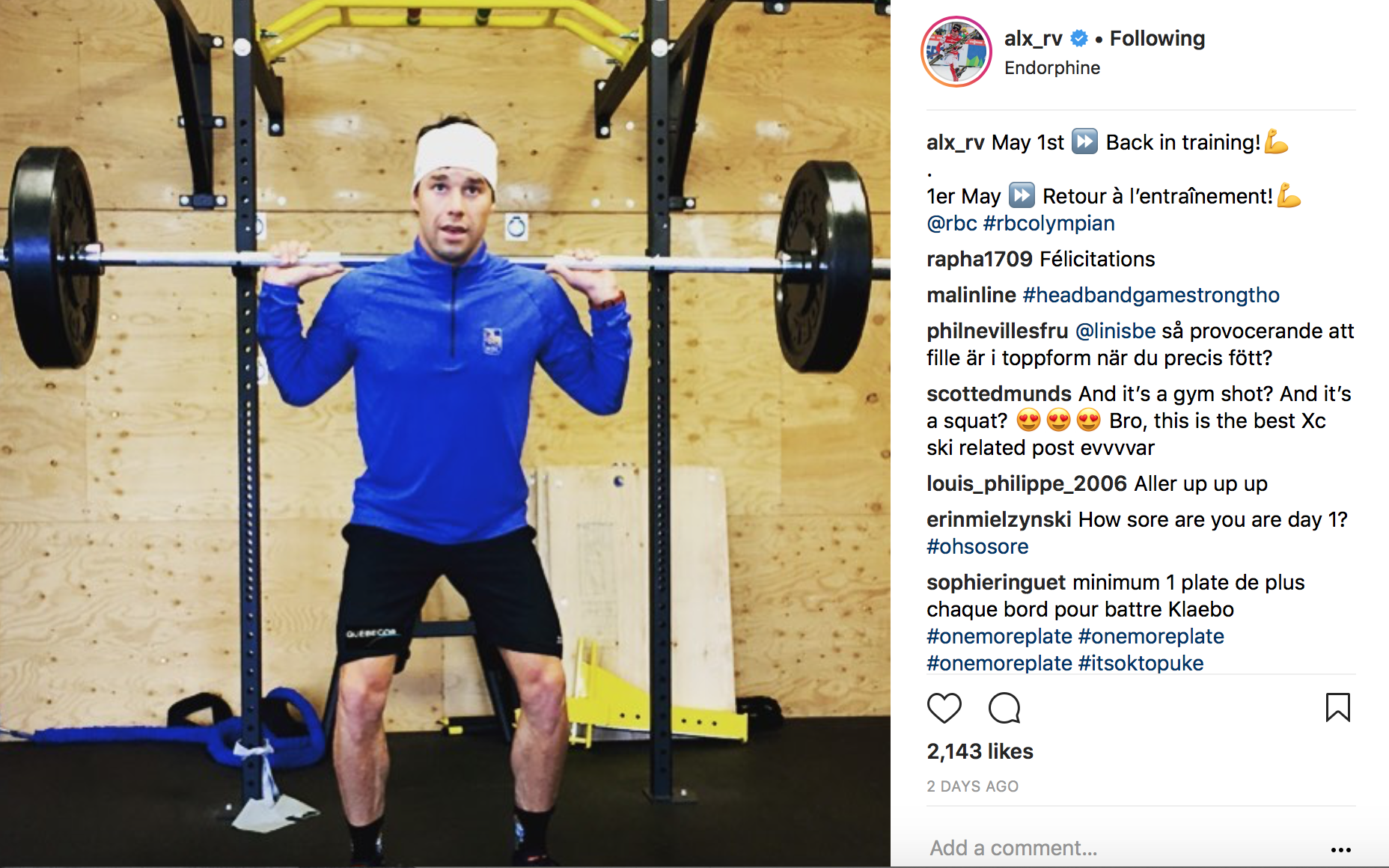
Alex Harvey:
Alex Harvey hitting the weights hard: “May 1st ⏩ Back in training!💪”
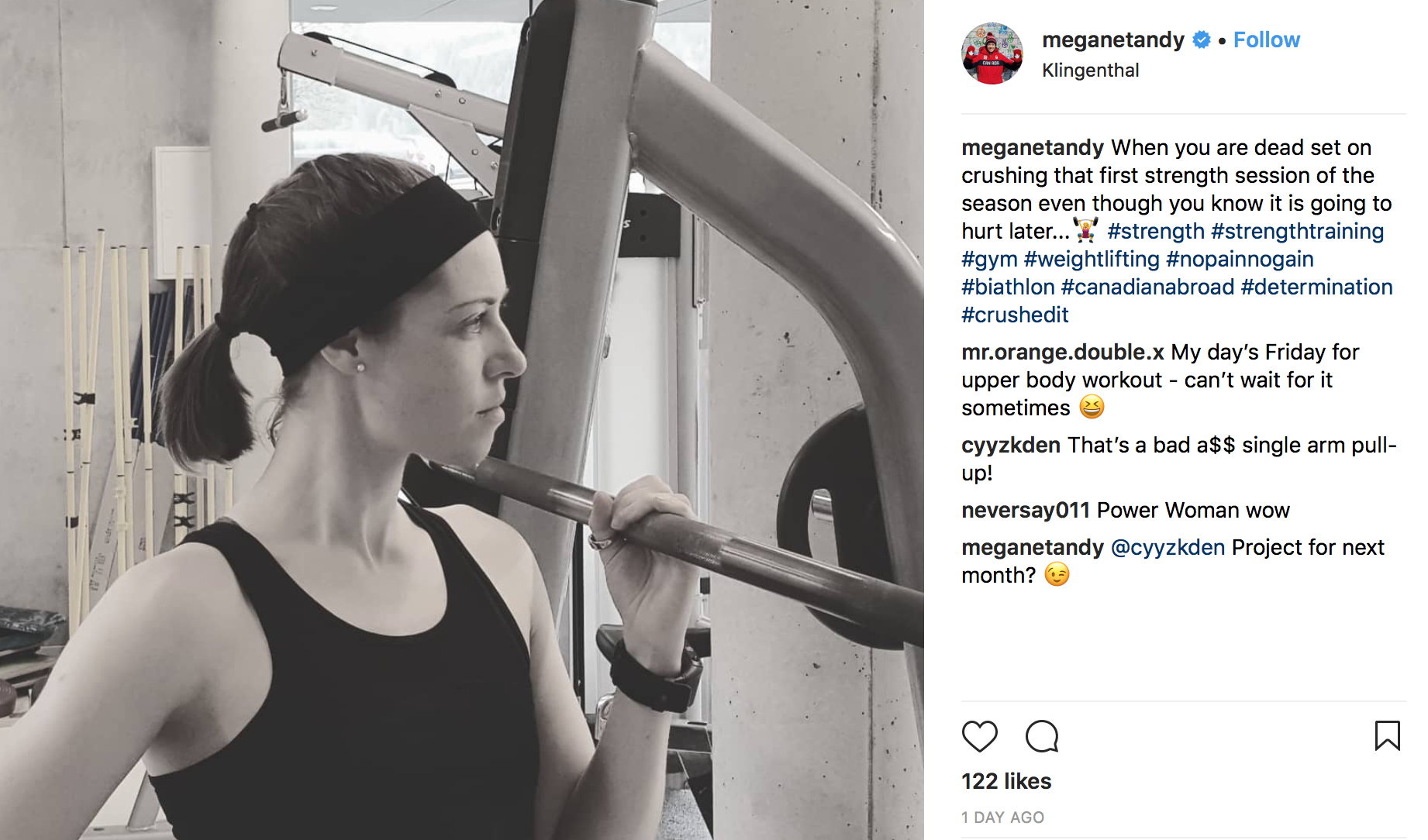
Megan Tandy:
Another determined Canadian athlete in the gym: biathlete Megan Tandy at her training base in Klingenthal, Germany.
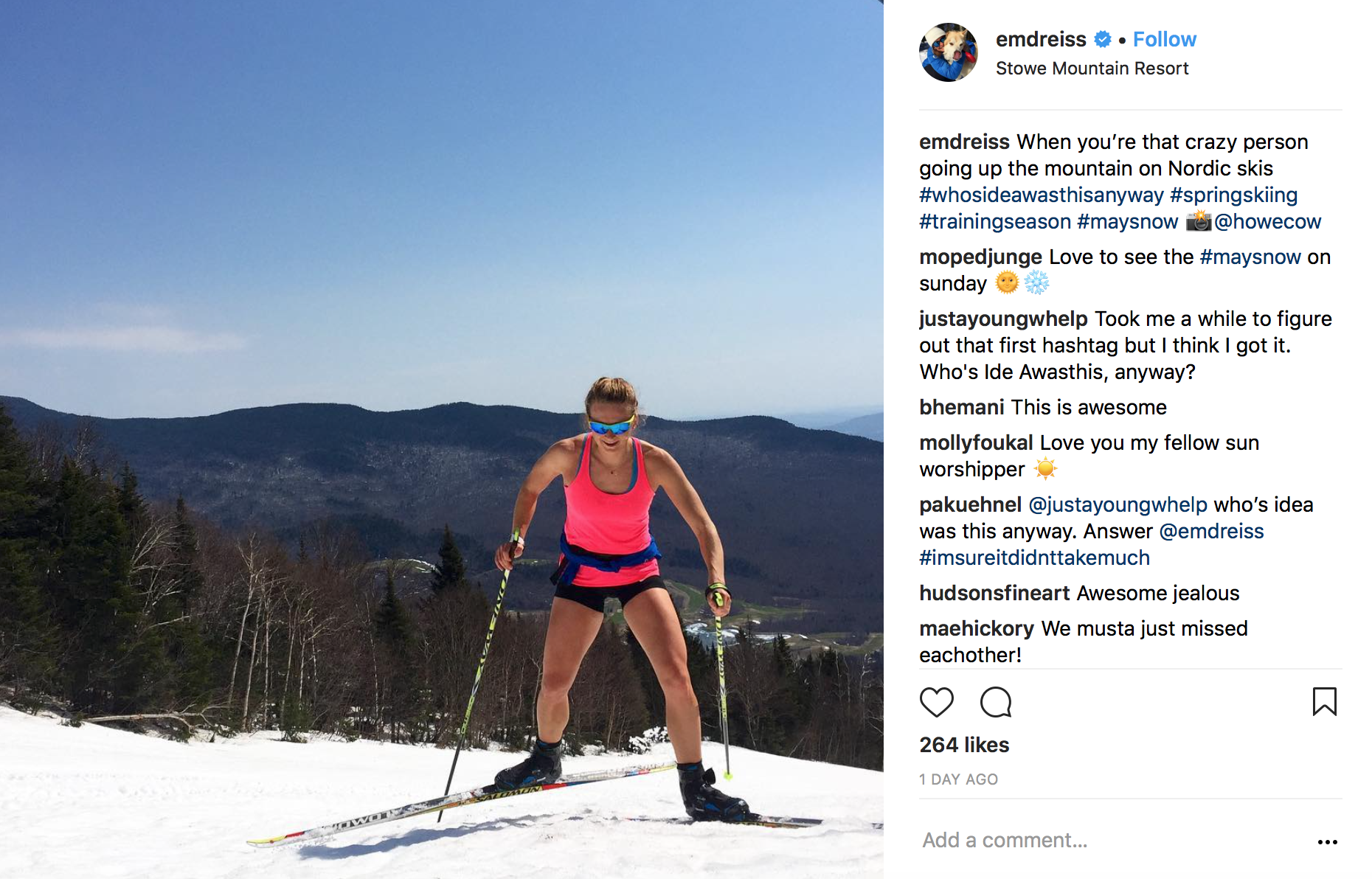
Emily Dreissigacker:
Newly minted US Biathlon High-Performance Team member Emily Dreissigacker skied up Stowe Mountain in Vermont on May 2.
Emma Lunder:
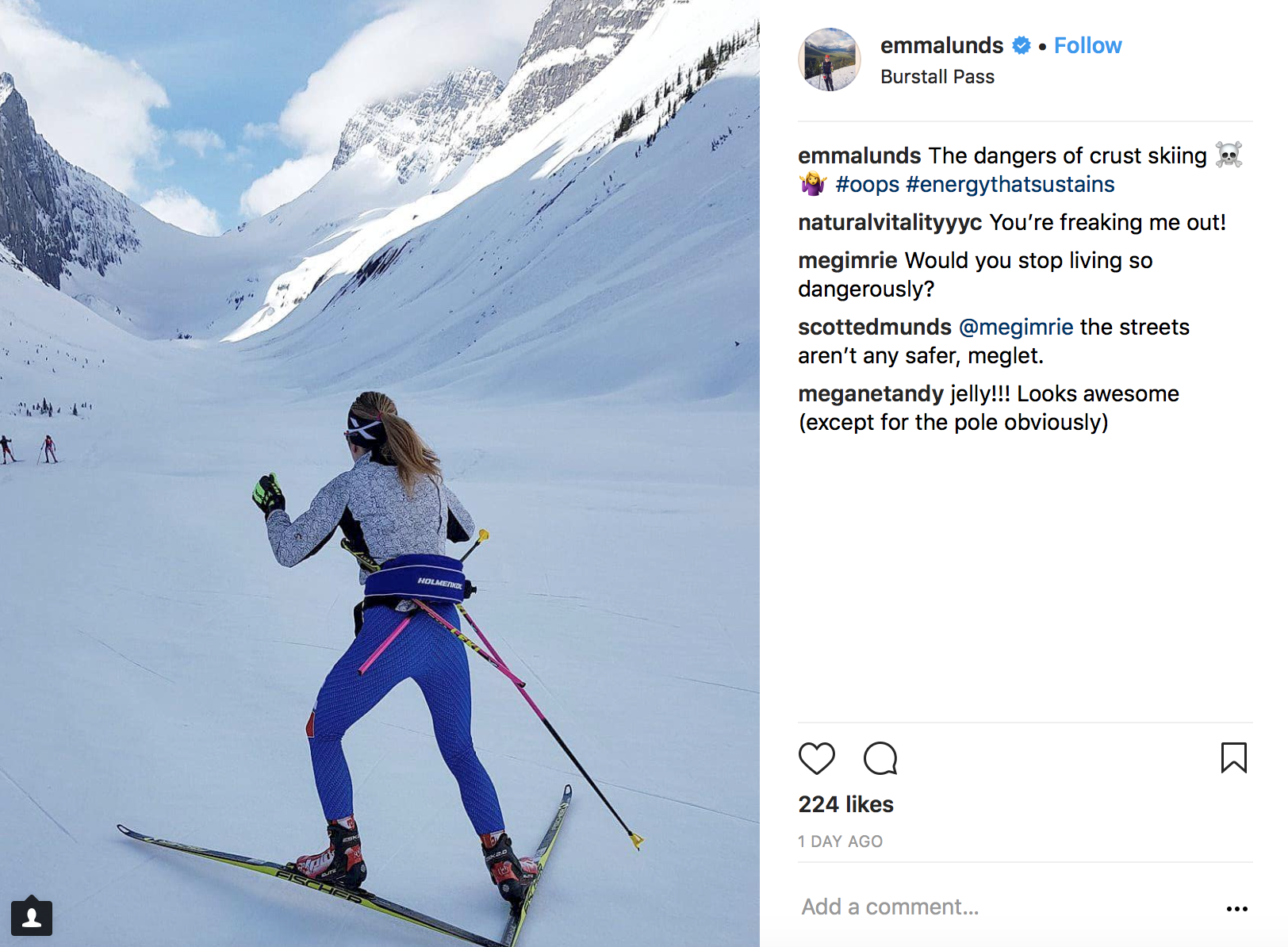
Meanwhile near Canmore, Alberta, Canadian biathlete Emma Lunder broke a pole while crust skiing at Burstall Pass.
Scott Patterson:
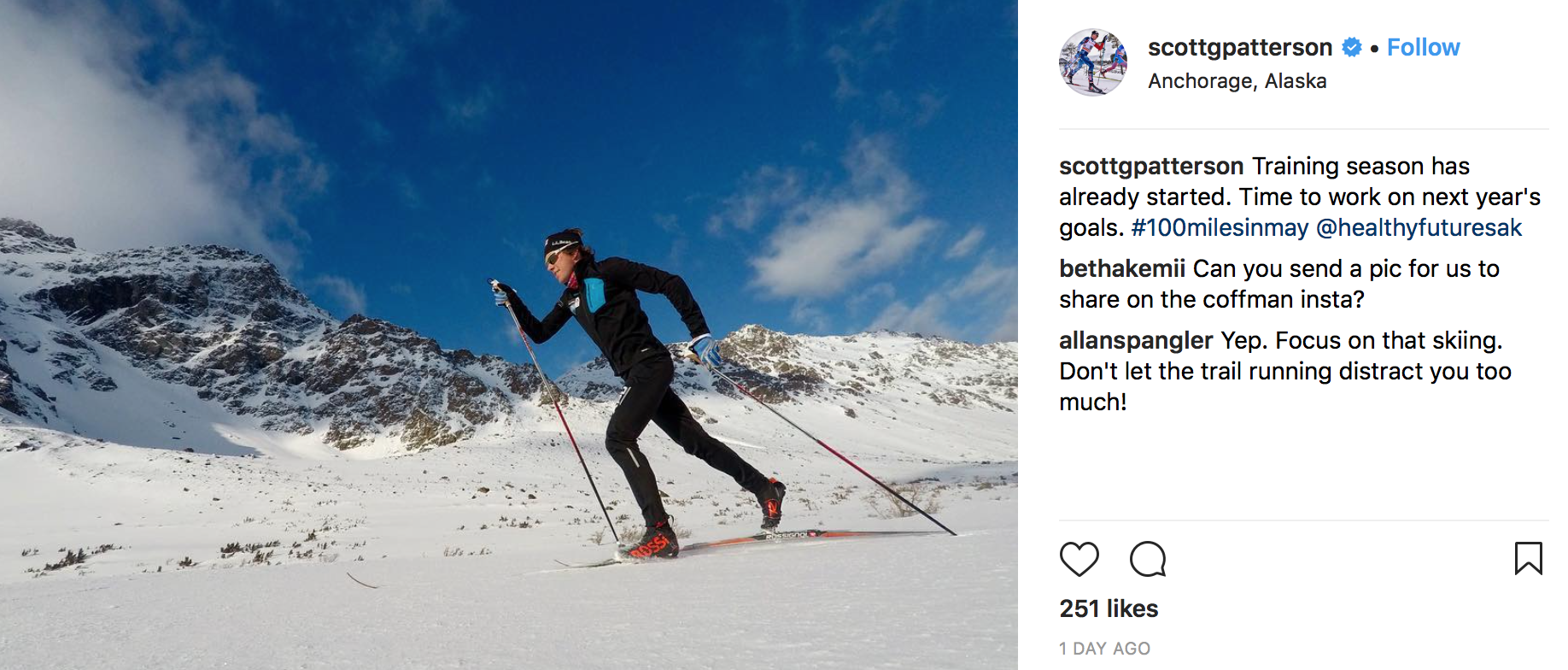
Looks like Alaska Pacific University skier and U.S. Ski Team member Scott Patterson is ready to go the distance, specifically 100 miles in May.
Sadie Bjornsen:
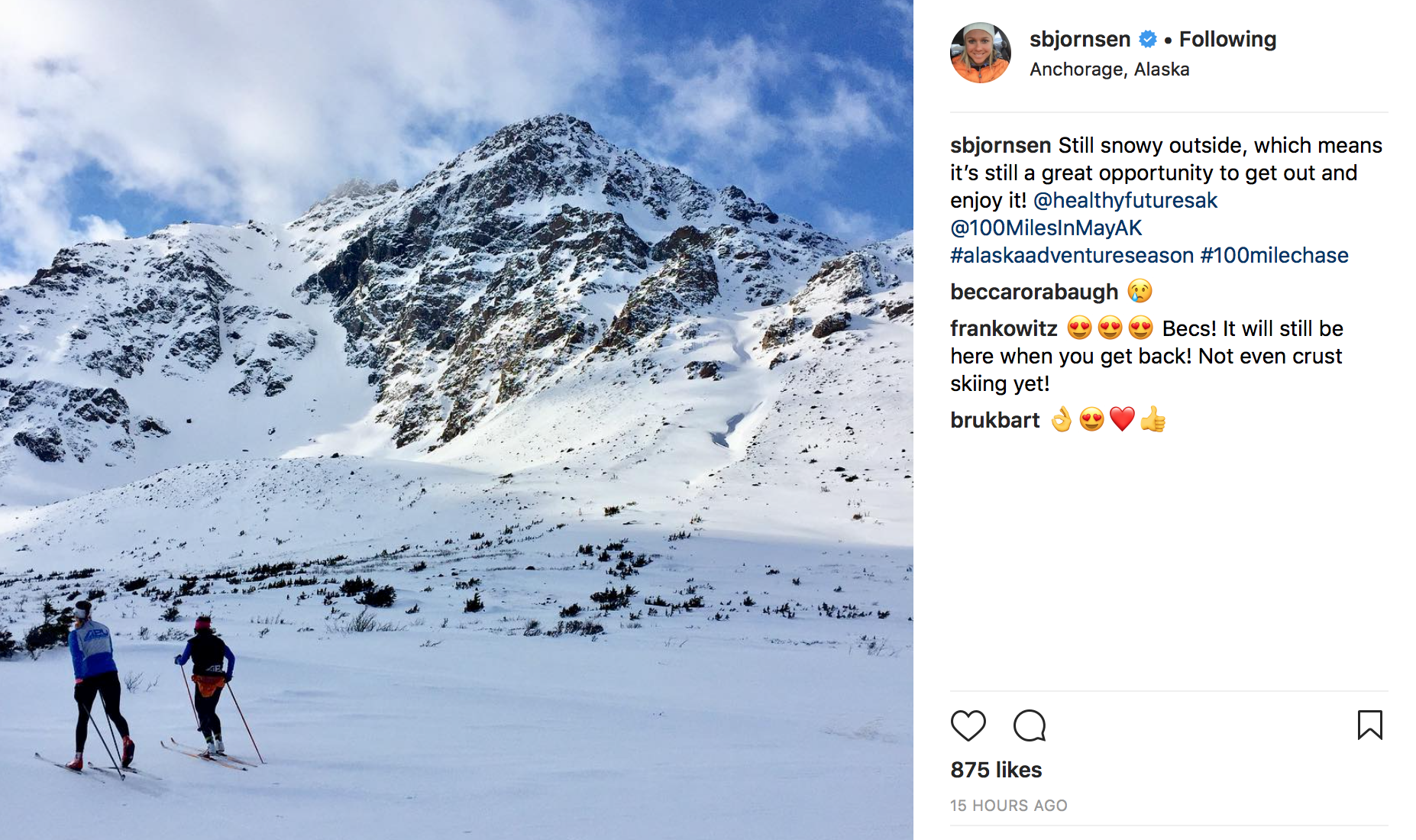
Scott Patterson isn’t the only one with a 100-mile goal for this month. His APU and U.S. Ski Team teammate Sadie Bjornsen is right there with him, getting out on snow in Anchorage, Alaska.
Erik Bjornsen:
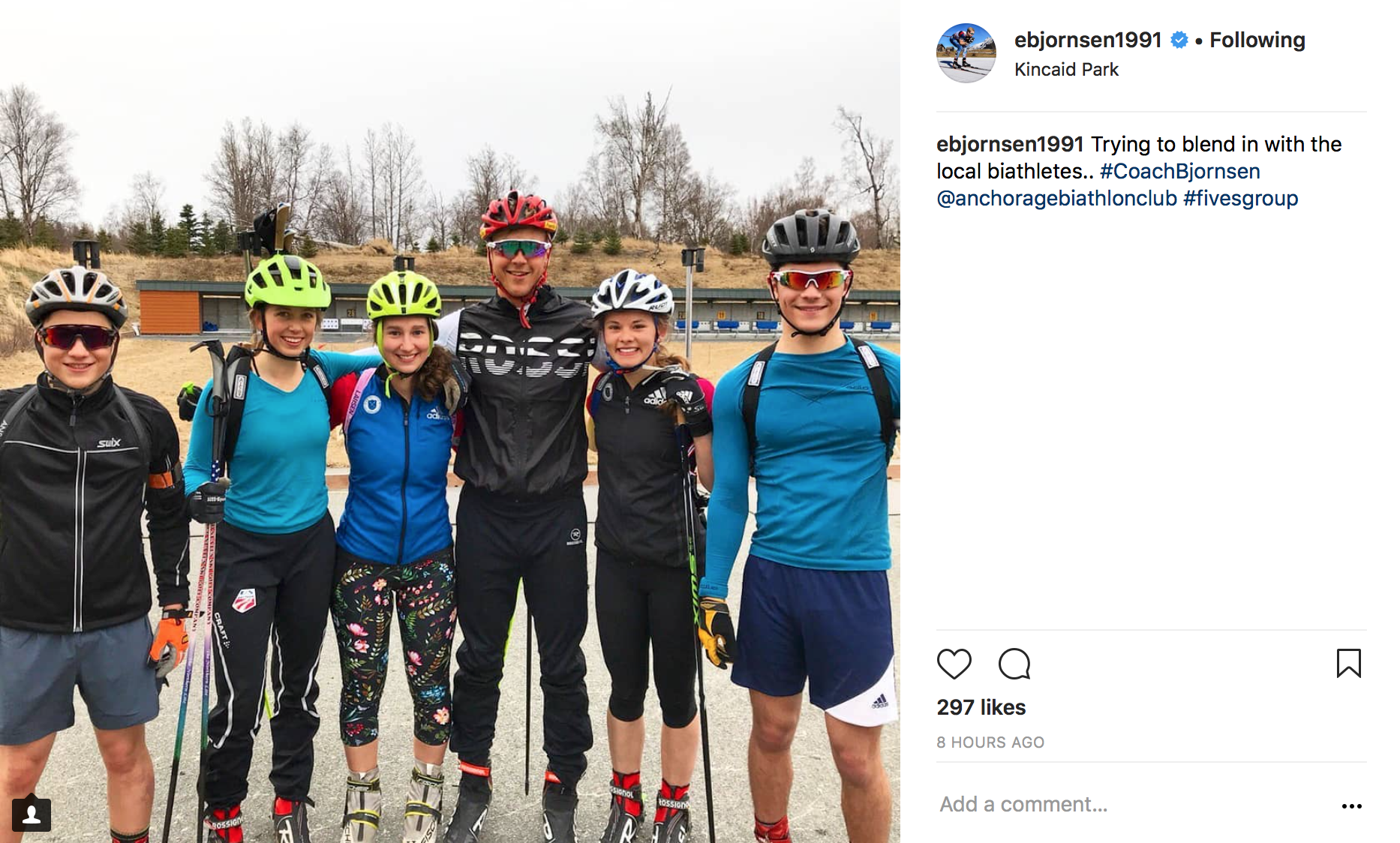
Speaking of the Bjornsens, Erik (c) got some ski-specific training in yesterday as a substitute coach for the Anchorage Biathlon Club at Kincaid Park in Anchorage.
Johannes Høsflot Klæbo and Eirik Brandsdal:
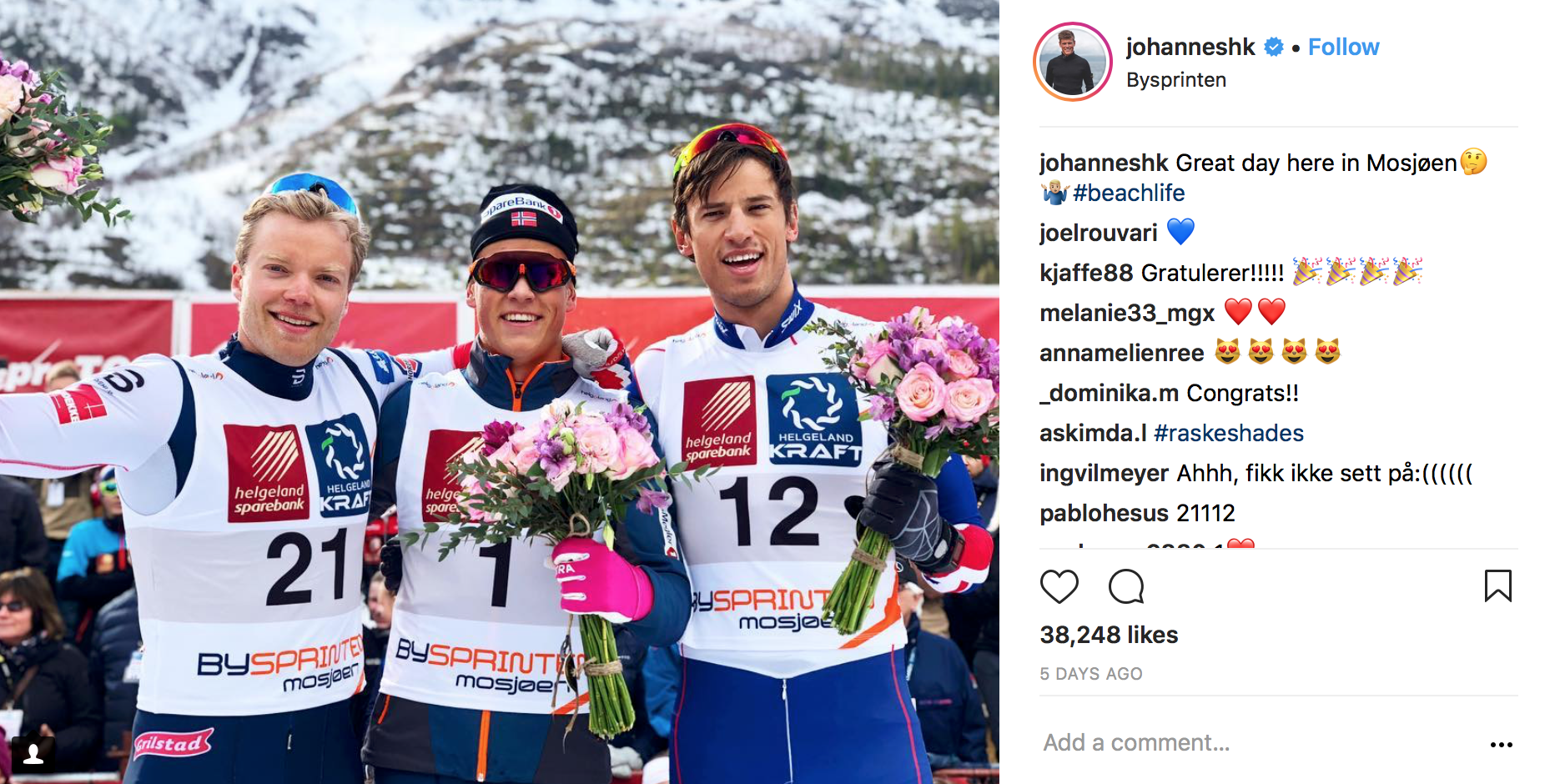
Norway’s Johannes Høsflot Klæbo (c) and Eirik Brandsdal (l) were still racing (and reaching the podium) last weekend at Bysprinten in Mosjøen, Norway.
Krista Pärmäkoski:
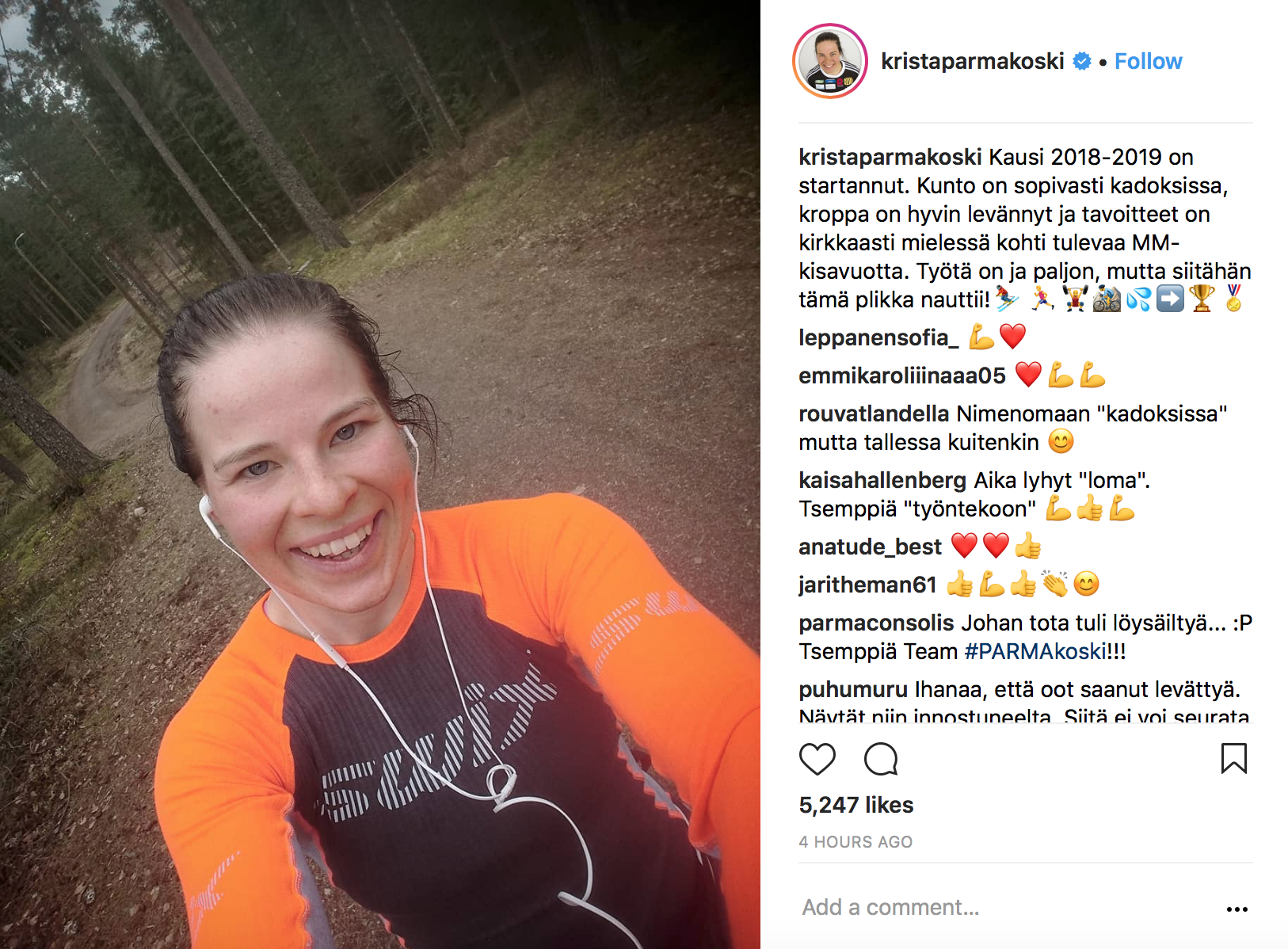
Finland’s Krista Pärmäkoski was all smiles while listening to some tunes during a recent dryland workout. She wrote about the start of the new season and being well-rested and focused on her World Cup goals. “There is work and a lot, but that’s what this is about.”
Dario Cologna:
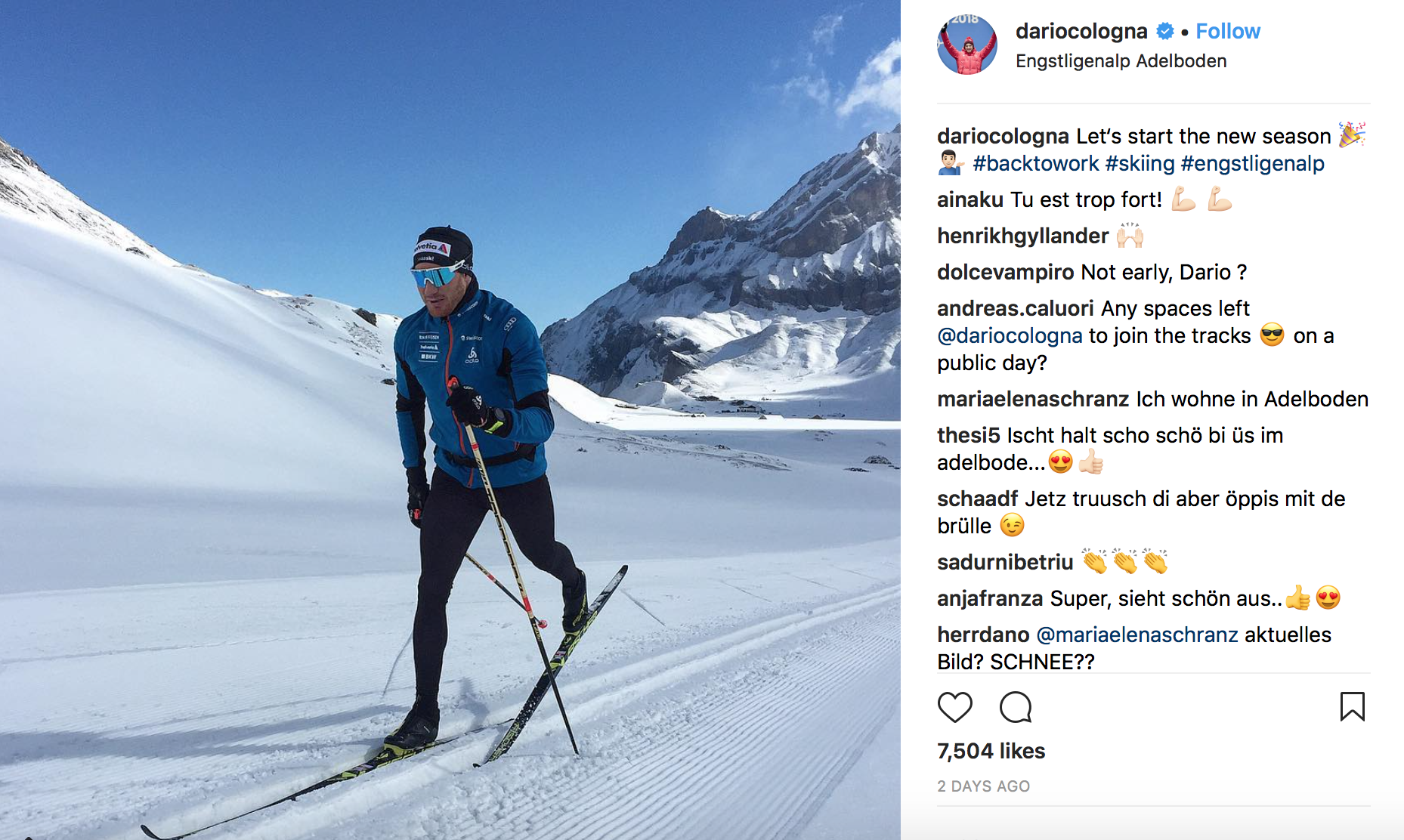
Swiss superstar Dario Cologna is “back to work,” according to one hashtag in this May 2 post, where he’s seen skiing on the Engstligenalp plateau in the Swiss Alps. “Let‘s start the new season,” he wrote.
Laurien van der Graaff:
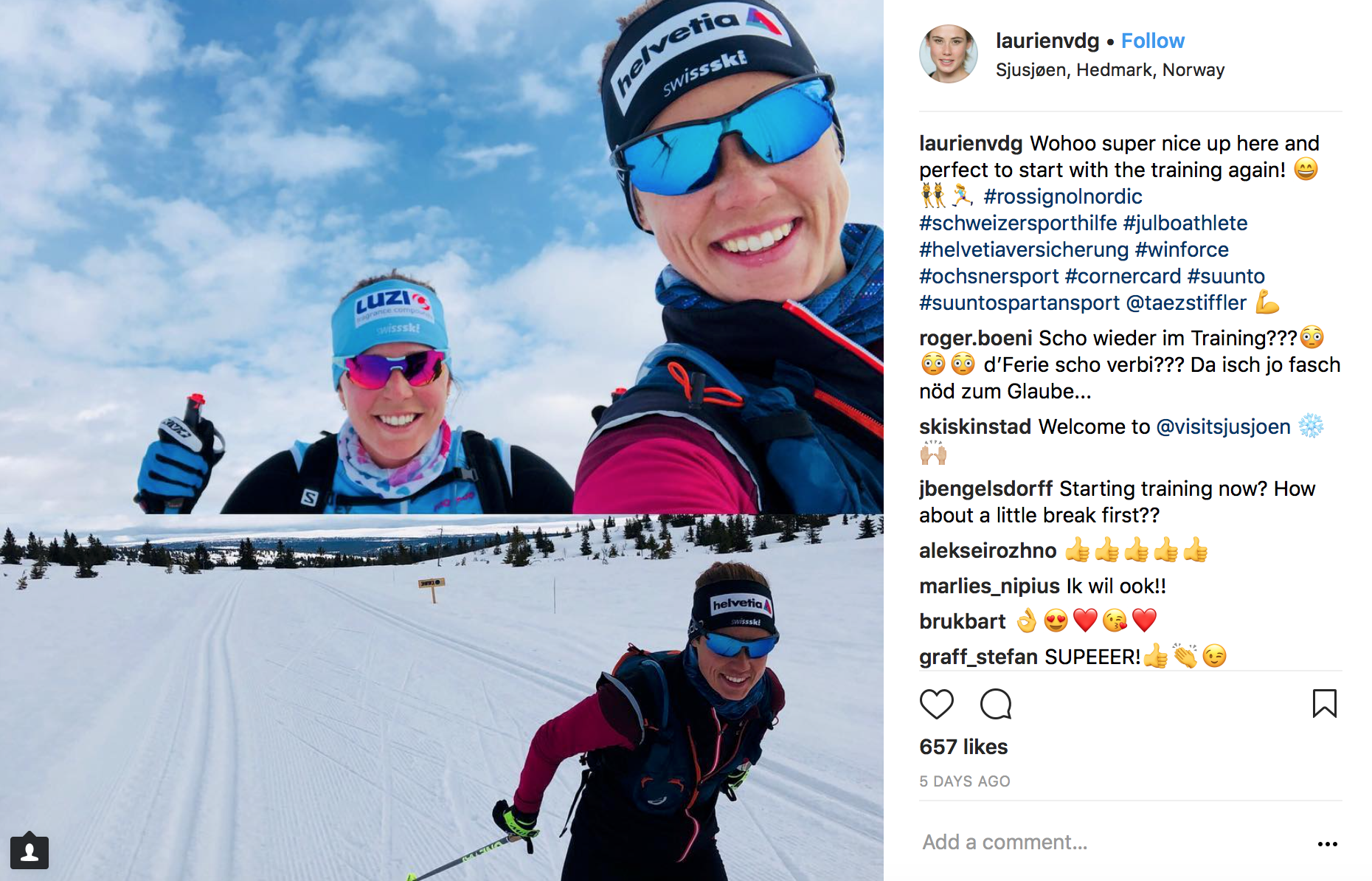
Another Swiss skier Laurien van def Graaff (bottom and top right) is back at it in Sjusjøen, Norway.
Charlotte Kalla:
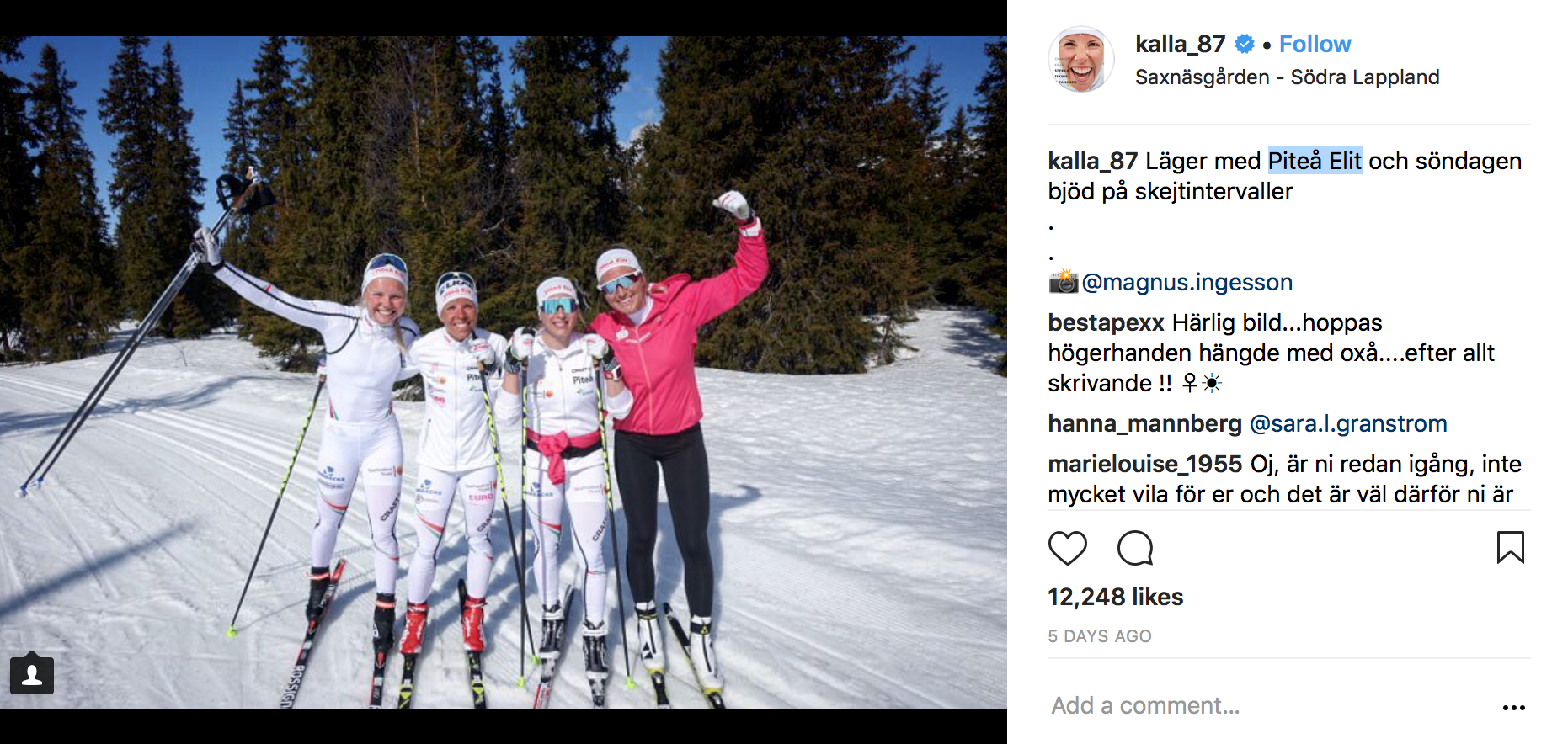
Sweden’s Charlotte Kalla (second from right) hasn’t wasted any time getting back on snow as evidenced by this photo she took with her Piteå Elit Ski Club teammates on Sunday in Finland’s Southern Lapland region.
Therese Johaug:
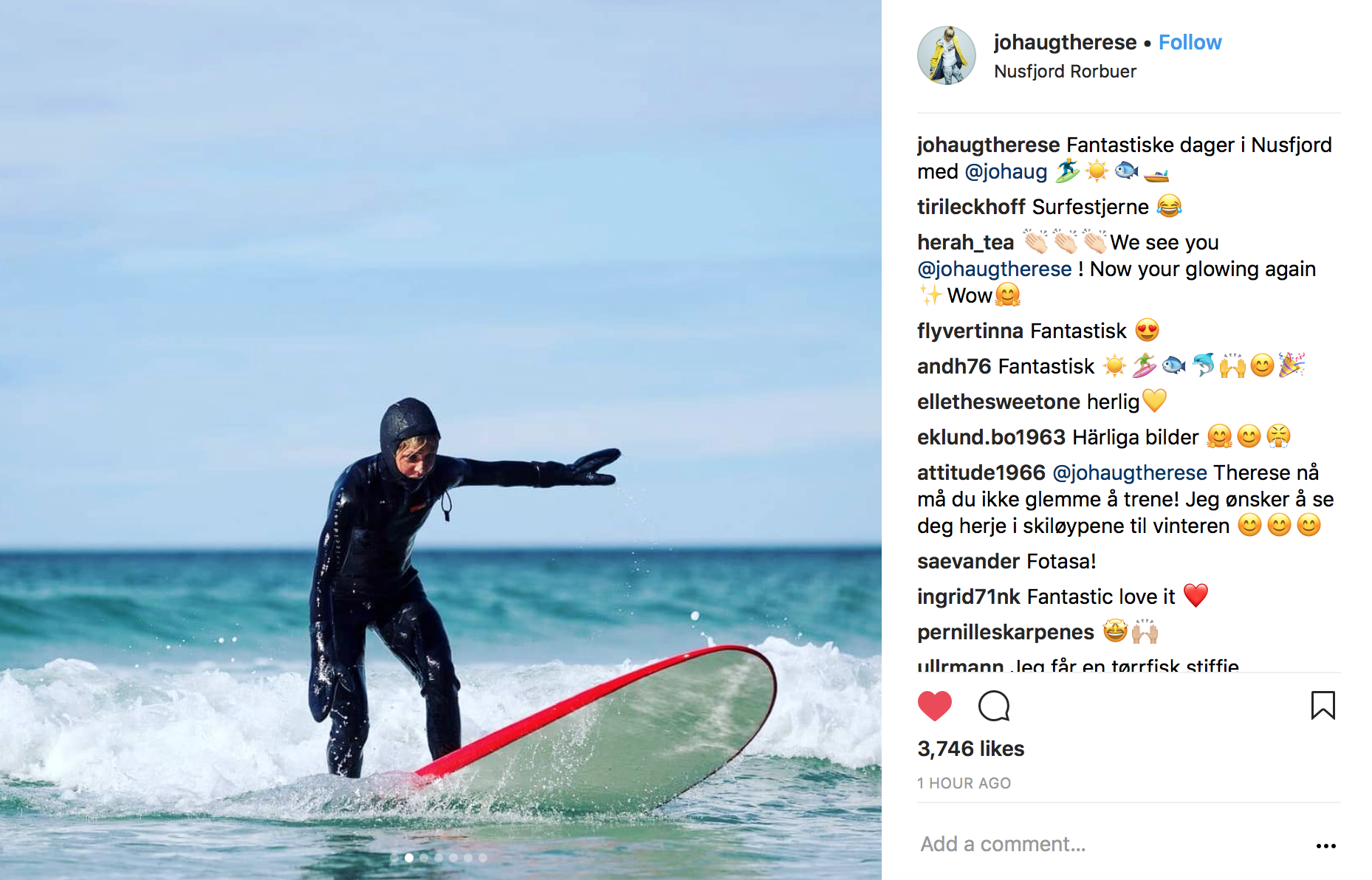
Looks like Therese Johaug has been logging some cold-water surf sessions on the Lofoten archipelago in northern Norway, as well as some fishing.
Martin Fourcade:
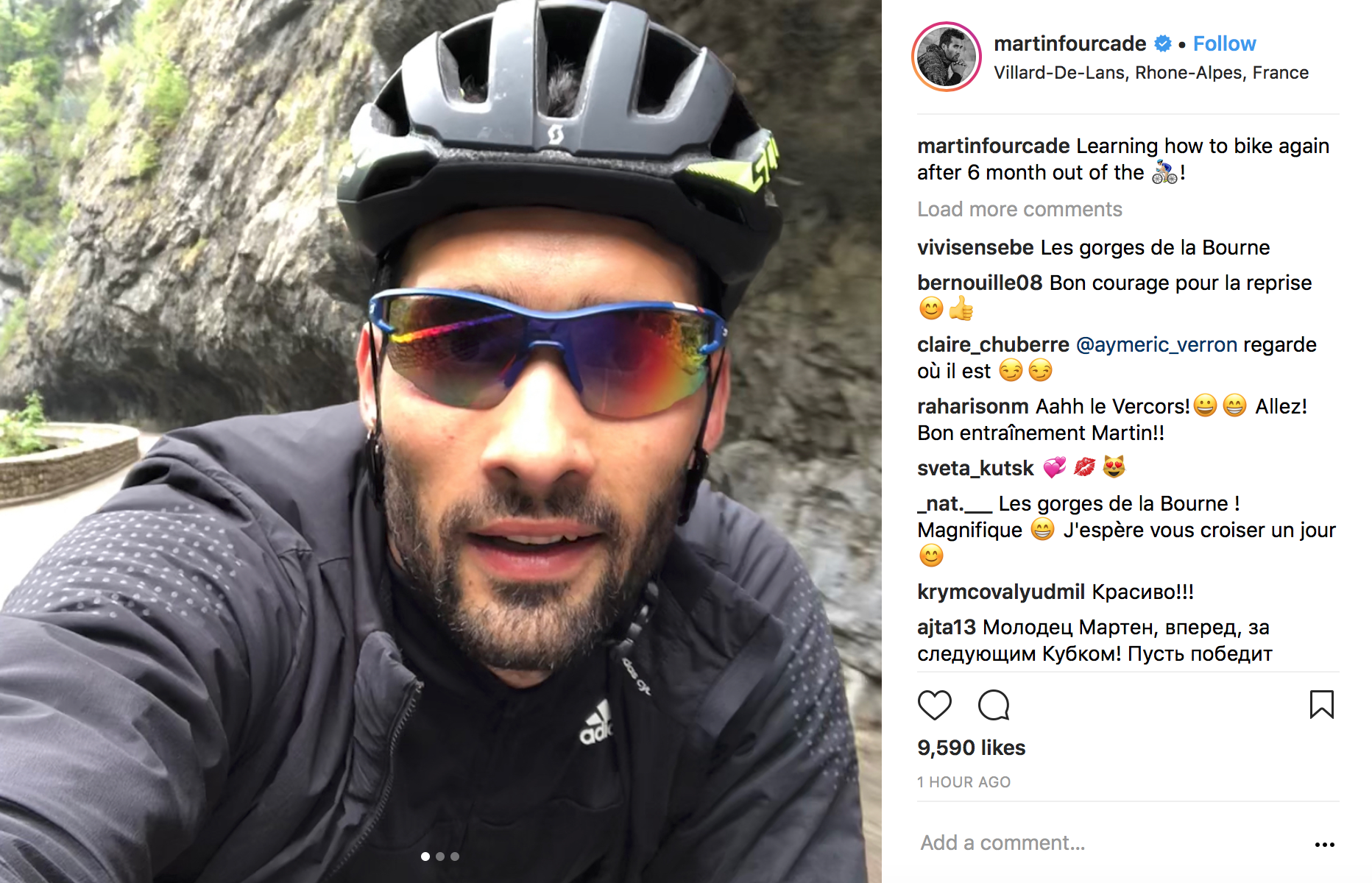
France’s defending IBU World Cup champ Martin Fourcade has been cross-training and logging some long-lost time in the saddle.
Franziska Preuss:
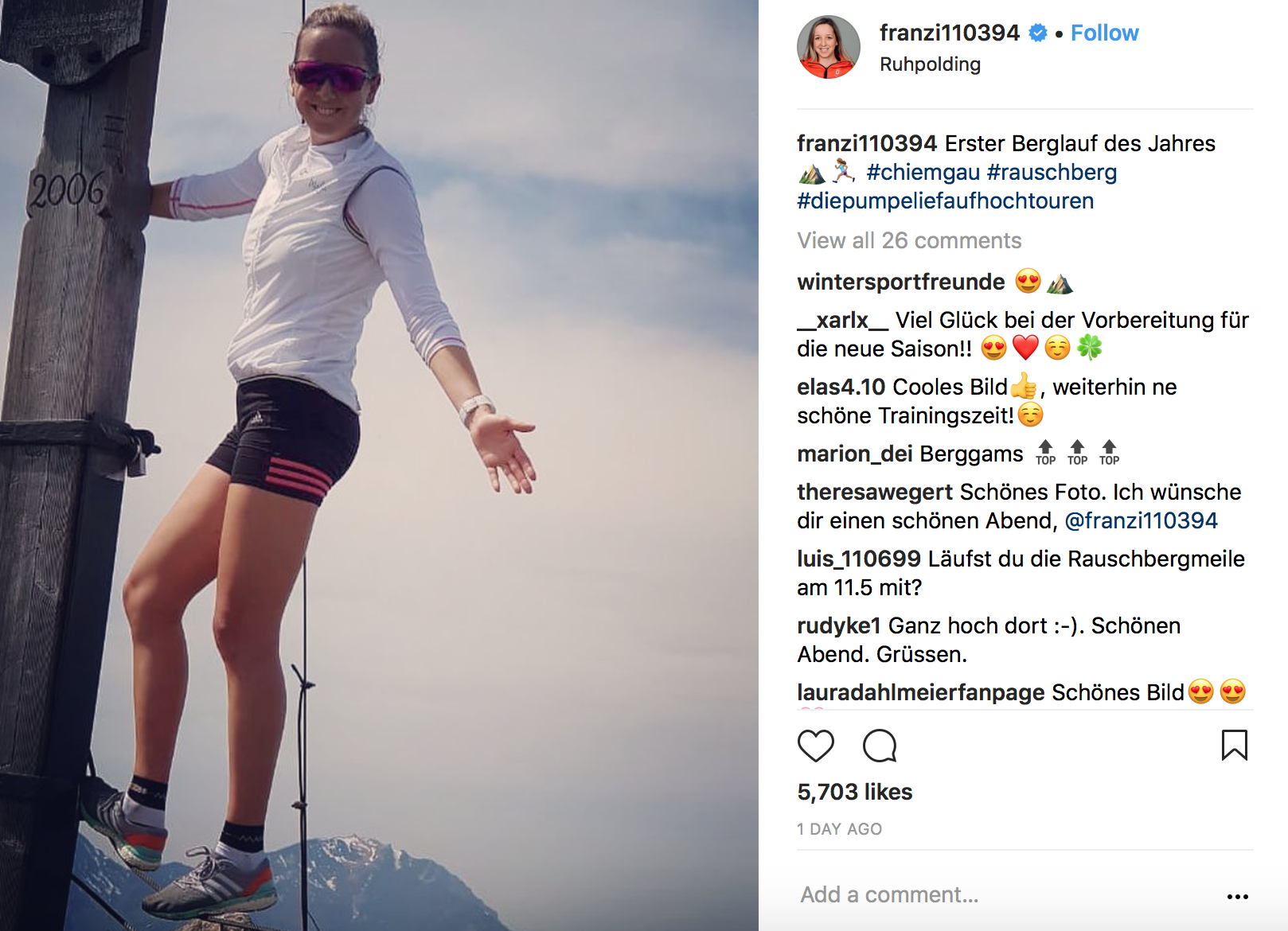
German biathlete Franziska Preuß (or Preuss) documented her “First mountain run of the new year” in Ruhpolding, Germany. And look, she’s higher than the mountains.
Leif Nordgren:
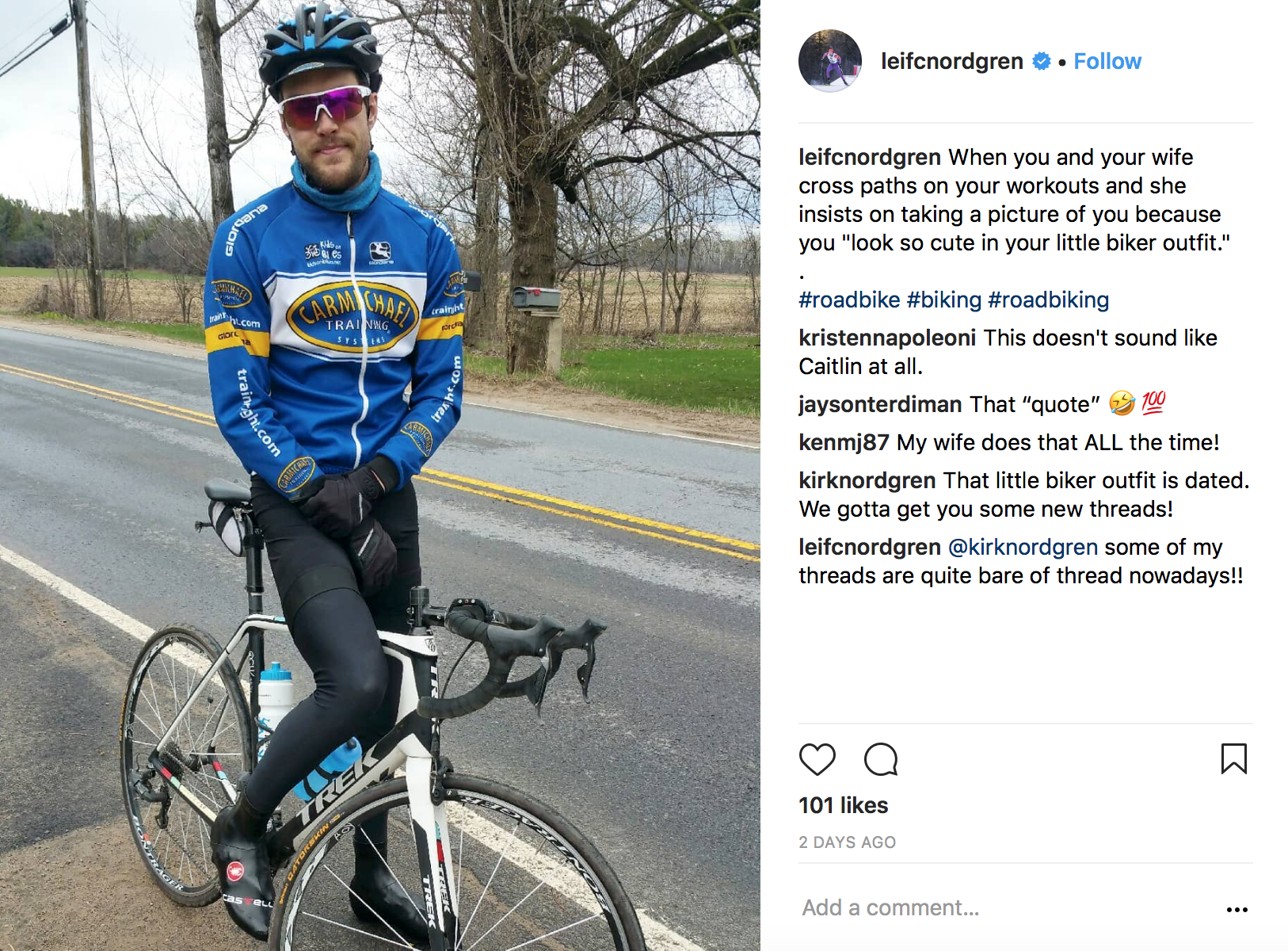
U.S. biathlete Leif Nordgren went road biking with his wife, Caitlin Napoleoni, whom he married in December.
Niklas Dyrhaug, Richard Jouve and Robin Duvillard:
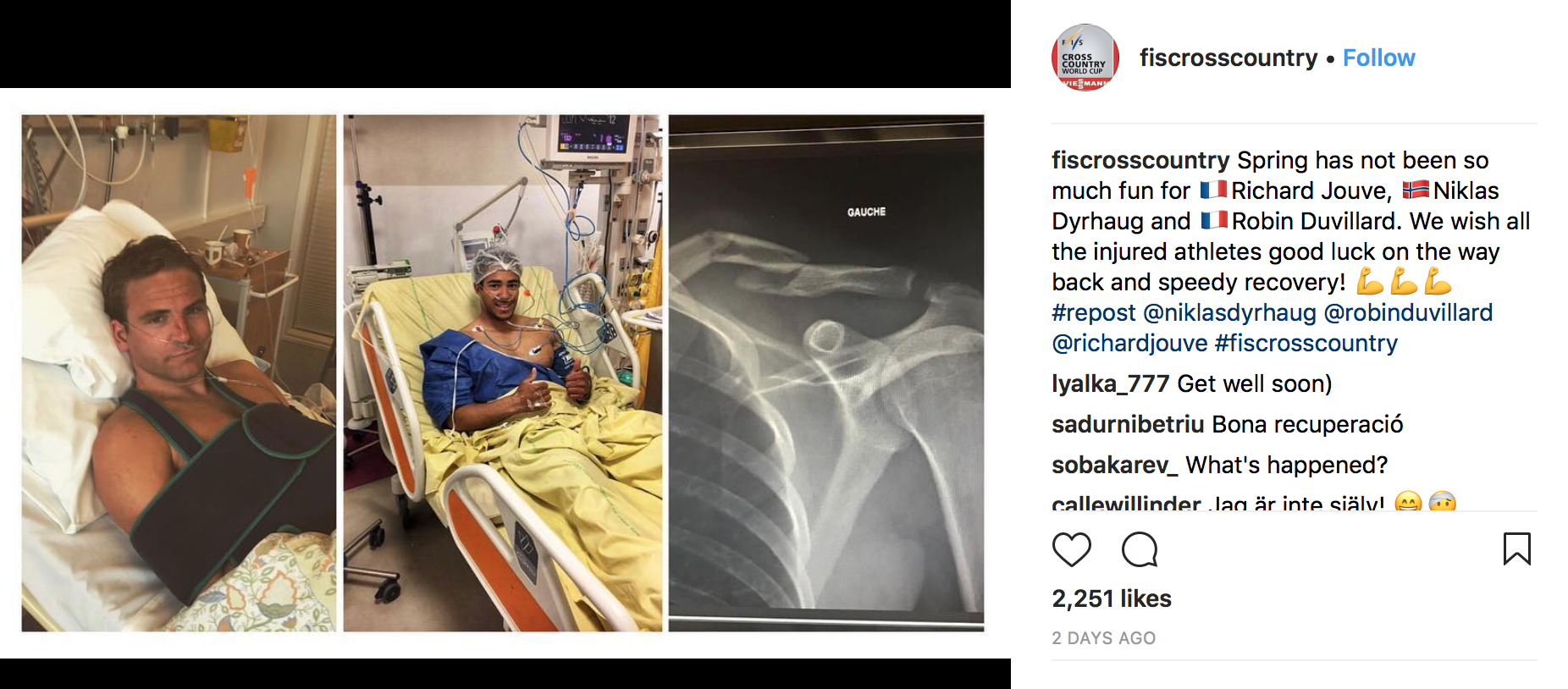
Meanwhile athletes like Norway’s Niklas Dyrhaug (l) and France’s Richard Jouve (c) and Robin Duvillard are on the road to recovery, according to this FIS Cross Country post.
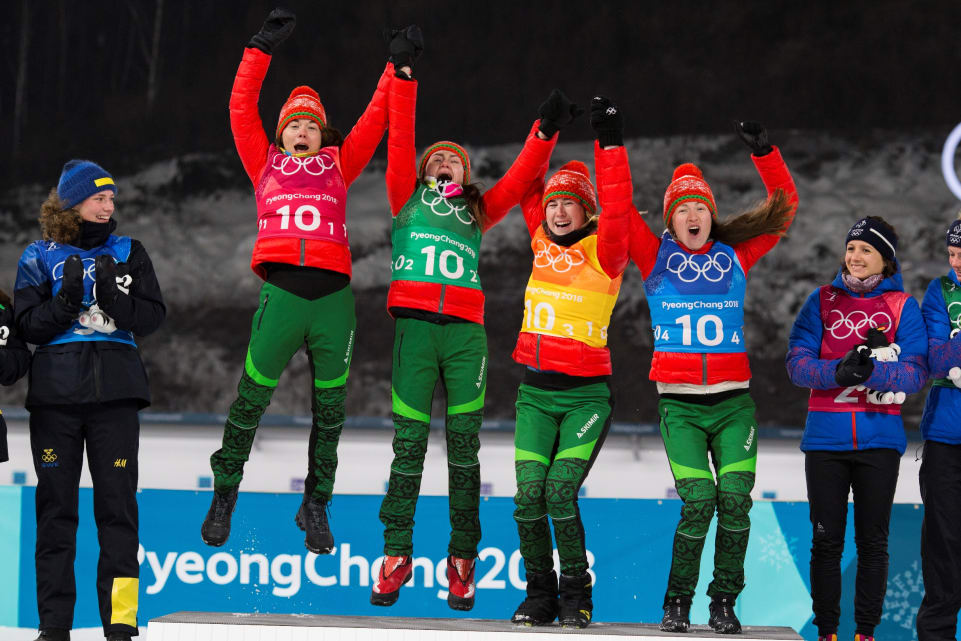
The Belarusian women’s biathlon team, with (from left to right) Nadezhda Skardino, Iryna Kryuko, Dzinara Alimbekava, and Darya Domracheva, celebrates winning a historic gold for their nation in the 4 x 6 relay at the 2018 Olympics in PyeongChang, South Korea. They were ranked 10th coming into the day. (Photo: IBU/Biathlonworld)
PYEONGCHANG, South Korea — Some things were the same on Thursday night: the attention-grabbing biathlon stadium announcer generating an atmosphere of stoke, thumping house music, and shivering yet engaged fans. Making it feel like true winter, a heavy snow squall settled in over the Alpensia Biathlon Center for the women’s 4 x 6-kilometer relay.
Ultimately, Belarus won gold in a time of 1:12:03.4 hours with Nadezhda Skardino, Iryna Kryuko, Dzinara Alimbekava, Darya Domracheva. Sweden’s Linn Persson, Mona Brorsson, Anna Magnusson, and Hanna Öberg took silver (+10.7), while France’s Anaïs Chevalier, Marie Dorin Habert, Justine Braisaz, and Anaïs Bescond claimed bronze (+17.6).
For the first few legs, however, all three medaling teams seemed an outside shot at the podium. On a windy and, for the first time at the Olympics, snowy evening, the win was up for grabs from the start.
After the first lap, a rainbow of suits came into the shooting range together, 7.8 seconds separating the leader from the field’s tail. America’s lead-off skier, Susan Dunklee, skied out of the range first after shooting clean in prone. The U.S. skier was followed by Ukraine, 2.9 seconds back. And Canada’s Sarah Beaudry had also cleaned without any spares to put her team in third, 7.1 seconds back.
Dunklee held her lead through the 2.9 k checkpoint and by 3.6 k, she was up to 8.1 seconds ahead of Japan chasing in second. Canada had fallen to 12th, 14.9 seconds back. With dumping snow and blustery wind before their second shooting round, it was Dunklee all entering the range all alone that was featured on the stadium’s jumbotron.
For her standing stage, Dunklee missed one target, but cleaned it with one spare. She left the range 5.2 second behind Italy’s Lisa Vittozzi, who had also cleaned with one spare. After the first leg’s final shooting stage, the field started to spread out. Beaudry used three spares to clean standing and avoided the penalty lap, returning to the course in 13th, 50.5 seconds out of first.
Susan Dunklee skiing the first leg of the mixed relay on Tuesday at the 2018 Olympics in PyeongChang, South Korea. She tagged the team in fifth and they went on to place 15th. On Thursday, she skied the U.S. women’s 4 x 6 k relay into second by the first exchange. (Photo: FlyingPointRoad)
“There’s some, as a friend of mine would call it, Disneyland snow, falling from the sky so it makes it exciting in the relay,” Beaudry told FasterSkier after her race. “Everyone shoots at the same time so I wouldn’t say anything is unfair. It makes opportunity. So hopefully my teammates can take advantage of that.”
Dunklee came through the 5.6 k checkpoint trailing Vittozzi by 7.2 seconds. At the first exchange, Italy tagged off first and Dunklee handed off to Clare Egan 7.6 seconds back in second.
“It has been a tough Games. We came in here with a lot of expectations and certainly haven’t really lived up to them,” Dunklee told FasterSkier after her leg. “It’s extremely frustrating. To think about every decision you make in your life over four years, with your best training in mind and your best performance in mind, and then getting sick at the wrong time is tough. The guys have struggled.
“We have had some bright spots with the girls; Emily and Joanne have carried us, they have had PR’s here. That is exciting,” Dunklee added, before looking up at the screen to see Egan skiing in third. “And this is exciting today. This is really exciting! Anything is possible.”
Beaudry tagged Canada’s Julia Ransom in 15th, 1:15 minutes out of first.
“I was really happy with my first lap and my prone,” Beaudry said after her first Olympic relay. “I tried to keep with the group on my second lap and I think that left me a little shaky in standing. I’m not too pleased with my two spares, but I mean, I missed three and I didn’t miss a spare, so at least shoot a spare, hit a spare.”
After the first loop of the second leg, Italy was still in first, with Dorothea Wierer at the helm. In prone, there was a reshuffling of leaders as Slovakia’s Anastasiya Kuzmina cleaned with one spare to move into first, 15.3 seconds ahead of Norway’s Tiril Eckhoff, who had cleaned with a single spare, in second. Egan cleaned without a miss and left the range in third (+17.3). Meanwhile, Wierer still had two targets standing after using all three spares, leaving her with two costly penalty laps and 1:11 minutes back in 13th.
Finland’s Kaisa Mäkäräinen shot clean to put her team in fourth, 23.9 seconds behind Kuzmina. France was sixth (+32.6), and Belarus ninth (+46.6). Canada’s Ransom shot clean without any spares and left the range in 12th (+1:08.3) while Sweden was 15th (+1:16.4).
While Kaisa Mäkäräinen moved into second behind Kuzmina on the next loop, Eckhoff and Egan followed them into the range in third and fourth, respectively. There, during an especially blustery standing stage, Kuzmina missed her first three shots and ended up with a penalty lap, which put her 20 seconds back in eighth. Wierer cleaned to reclaim first for Italy, just 0.9 seconds ahead of Mäkäräinen in second, who used two spares to avoid a penalty. Belarus’s Kryuko shot clean to leave the range in third (+7.9), and Egan hit five more shots without any spares to follow her in fourth (+10.7).
Ransom used three spares to avoid the penalty lap and headed back on the course in 10th (+44.2) for her final 2 k loop.
“Oh my gosh, I was really due for this,” Egan said after. “It’s by far my best race of the season so I couldn’t be more happy with my race.”
By the time the skiers came in for the second exchange, the order had changed again. Finland handed off in first, Italy second, 14.2 seconds back, Slovakia third (+16.1) and U.S. fourth (+16.8). Canada came through in 10th (+1:09.5).
“Kuzmina kept being behind me and then passing me,” Egan reflected. “I think every lap Kuzmina passed me so there is a lot of really fast skiers, most teams put their fastest skiers on their second legs. I tried to stay with them, but I can’t always do that. I did have people around me the whole time though so I was able to keep fighting.”
“All you can do is just leave it all on the track no matter what it is,” Ransom said of her race. “My standing was a little bit precarious, missing three from the clip. But I’m happy I was able to hit the precious spares. It was very gusty.”
Egan tagged off to Joanne Reid for the third of four legs. Reid slipped to sixth on her first loop and during her first prone shooting, she used three spares and had to ski a penalty lap, returning to the course in ninth, 33.6 seconds behind Italy’s Nicole Gontier, who cleaned with three spares, in first. Gontier skied just 0.4 seconds ahead of Slovakia’s Terezia Poliakova, who used one spare to clean.
Belarus had moved into third (+2.4), France into seventh (+19.2), while the Swedes sat in 11th (+1:33.6) and Canada, with Emma Lunder who had to ski a penalty, was still in 12th (+1:45.7).
As the leaders came in for their standing bout, it was Italy, France, Belarus, Norway, Finland, Slovakia, Poland, and U.S.A. Belarus’s Alimbekava took the lead after using one spare, Poland chased in second (+6.2), Slovakia was next, followed by Italy. The U.S. was back up to fifth (+28.1) after Reid used one spare to clean. France was sixth (+29.2) and Sweden eighth (+1:10). Lunder cleaned to put Canada in 11th (+1:24.7).
“I had a pretty good standing, but we need every second we can get,” Reid said after. “You never know what will happen in the next stage and the wind picking up. So even if we’re in fifth you never know. I was just trying to hang on on that uphill and give it everything I had.”
“I didn’t feel amazing, skiing, but I ripped off my standing with no spares, like, record fast, so I was really pumped about that,” Lunder reflected. “I moved up like a ton in the range there. So I think I tagged Rosanna in a decent position to be with some girls and fight a bit.”
Poland’s Krystyna Guzik caught Belarus’s Alimbekava and by the final exchange, it was Poland in first, France in second, Italy in third, and Belarus in fourth. Reid handed off to Emily Dreissigacker in sixth (+21.4) while Lunder tagged Rosanna Crawford in 13th (+1:22.6). Sweden exchanged in eighth (+59.1)
The skiers had maintained their order as they approached the range for the seventh round of shooting. Belarus’s anchor leg, Domracheva, shot clean to take the lead. France was now in second, Poland third, and the U.S. in seventh (+41.1), after Dreissigacker used two spares to clean. Sweden was back in ninth (+41.9), while Crawford cleaned with one spare and out for her second loop in 12th (+1:28.6).
Coming into the final shooting shooting round, Belarus teetered on a lock for gold, 24.8 seconds ahead of France in second. Poland still clung to third, 34.5 seconds back, while Sweden was now ranked seventh, 56.4 seconds back. The U.S. had moved back to tenth, while Canada was right behind them in 11th.
Domracheva missed three targets standing, but used three spares to clean and avoid any penalties to hang onto first. France’s Bescond needed three spares to clean but stayed out of the penalty lap and headed out on the final loop in second (+6.4). Sweden’s Öberg cleaned her second-straight stage without any misses to move all the way up into third (+10.9).
For the U.S., Dreissigacker used her three spares to clean standing, but experiencing unsteady winds, took her time to steady her shot and left the range in 12th (+1:20.2). Canada’s Crawford used one spare to clean and moved up to 11th (+1:19.9).
“It was really windy for my standing,” Crawford noted. “I really waited it out.”
“It wasn’t great,” Dreissigacker, a first-time Olympian, said of her race. “I didn’t feel that great skiing, might’ve went out a little hard, and the shooting just wasn’t good either. I was happy to at least hit them all with my spares, but standing especially, I took all three spares and the wind came up like crazy, right before I started shooting my spares, so I had to like stand there and wait out the wind, which cost me a lot of time.”
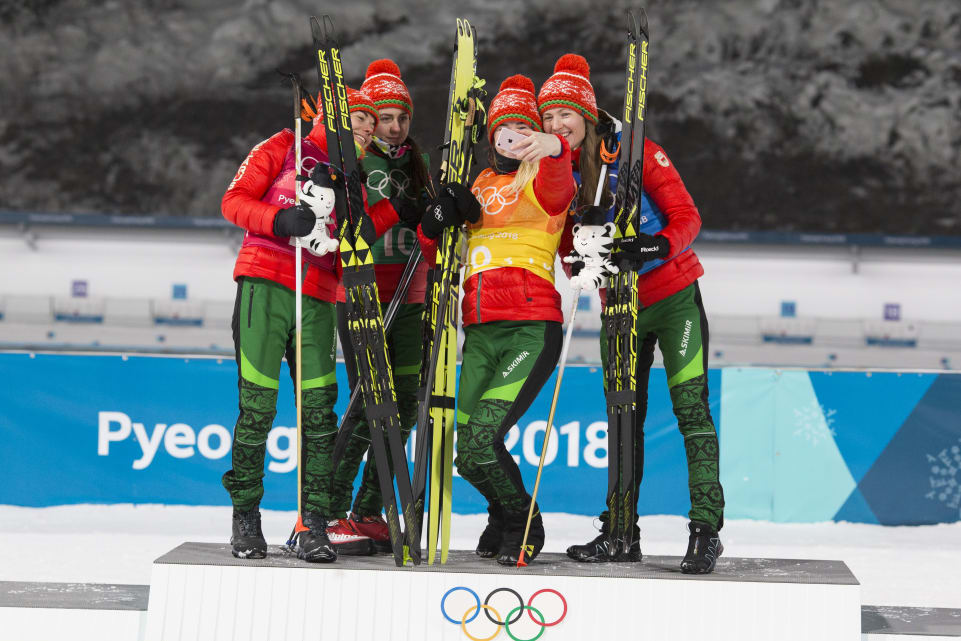
The Belarusian women’s biathlon team, with Nadezhda Skardino, Iryna Kryuko, Dzinara Alimbekava, and Darya Domracheva, snaps a podium selfie after winning their first relay gold on Thursday at the 2018 Olympics in PyeongChang, South Korea. (Photo: IBU/Biathlonworld)
Over the last 2 k of the race, Domracheva kept her competition behind her and crossed the line first for Belarus’s first relay gold in 1:12.03.4 (after its mixed relay team placed fifth two days ago).
Öberg passed Bescond to claim silver for Sweden, 10.7 seconds back, while Bescond anchored France to bronze (+17.6), ahead of Norway in fourth (+29.7), Slovakia in fifth (+38.4), Switzerland in sixth (+43.5), Poland in seventh (+43.6), Germany in eighth (+53.9), Italy in ninth (+1:04.1), and Canada in 10th (+1:33.4). The U.S. finished 13th (+2:01.9) of 18th teams.
With the first-place finish, Domracheva is the most decorated female biathlete in Olympic history, with six medals (four golds, a silver and a bronze) between three Olympics. Her husband, Ole Einar Bjørndalen of Norway, is the most successful Olympic biathlete of all time with 13 medals.
“I didn’t think that before you said it,” Domracheva, 31, said of her medal record during the post-race press conference. “Of course it was a lot of challenges for me on the way. Such days and such medals mean that it’s important to believe in yourself, important to believe in your team and overcome some difficulties, and then all doors are open for you.”
In the last four Winter Olympics, France has claimed three relay medals. Before Thursday’s bronze, their most recent was silver in 2010 and prior to that, bronze in 2006.
Sweden’s silver medal was its first in the women’s 4 x 6 k relay at the Olympics.
“This team worked together really hard for the last couple of years,” said Öberg, who won her first medal — gold — in the 15 k individual race earlier in the Games. “That we are here today is unbelievable. I’m really happy to share this medals with the rest of the girls.”
Crawford caught Ukraine’s Anastasiya Merkushyna in her final lap to anchor Canada to 10th while the U.S. finished three places later in 13th.
“My last loop I could hear Julia [Ransom] and Sarah [Beaudry] all around the course,” Crawford told FasterSkier. “They managed to be everywhere really cheering me on, and that fueled me to catch the Ukrainian.
“I’m just so proud of this women’s team,” Crawford added. “We fought so hard out there today. We’ve been through a lot this summer and really supported each other. And I’m just really proud of the team and I think biathlon in Canada has the potential to have a bright future.”
It was a disappointing opening to the Olympics for Johannes Thingnes Bø of Norway, who despite winning eight World Cup races this season started the Games with finishes of 31st and 21st in the sprint and pursuit. But on Thursday he showed why he was a medal favorite and won the 20 k individual race – only by 5.5 seconds, but that margin becomes impressive when you consider that he had two penalties, and thus two minutes of penalty time, while silver and bronze medalists Jakov Fak of Slovenia and Dominik Landertinger of Austria (+14.2) shot clean.
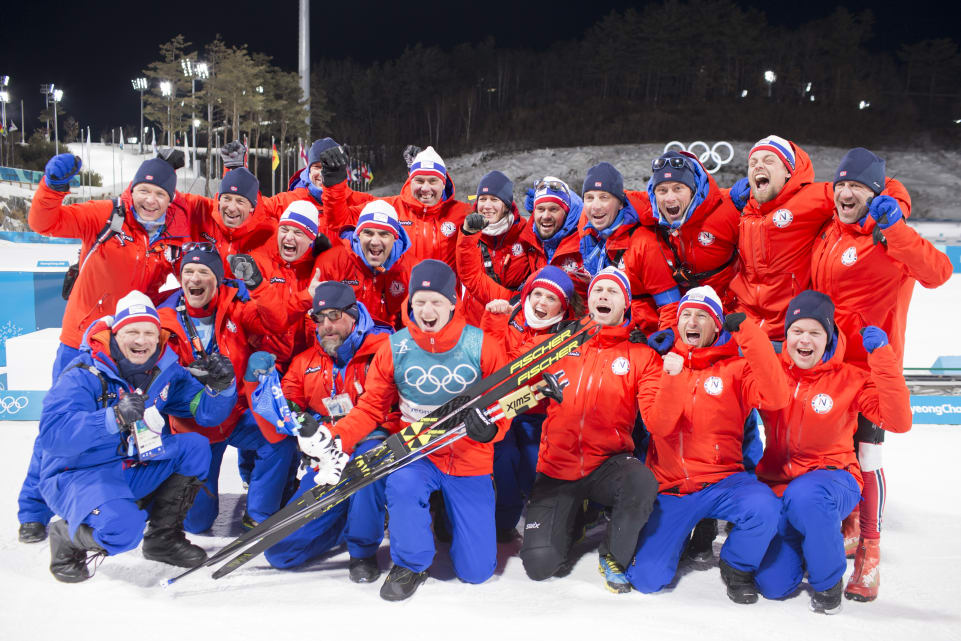
Johannes Thinges Bø celebrates with Norwegian team staff after winning Olympic gold in the 20 k individual despite two missed shots. (Photo: IBU/Biathlonworld.com)
Sweden’s Sebastian Samuelsson followed up a silver medal in the pursuit with fourth place in the individual, missing one shot and notching a time 29.1 seconds behind Bø. France’s Martin Fourcade, gold medalist in the pursuit, missed two shots like Bø but finished in fifth (+42.4). Switzerland’s Benjamin Weger placed sixth (+48.6) with one penalty.
It was a good day for Canada on the back of strong shooting: Scott Gow placed 14th (+2:02.5) with one penalty for a career-best result result; he had previously had two 16th-place finishes on the World Cup this season. With the same shooting, Brendan Green placed 22nd (+2:26.6). Christian Gow had two penalties to finish 26th (+2:57.2). Canada’s fourth man, Nathan Smith, missed five shots and placed 81st (+8:11.9).
For the United States, shooting was not as successful and Tim Burke led the way in 41st (+4:01.9) with four penalties. With one less penalty Sean Doherty was close behind in 44th (+4:21.8). Lowell Bailey placed 51st with four penalties (+4:53.0) and Leif Nordgren missed five shots to finish 66th (+6:27.3).
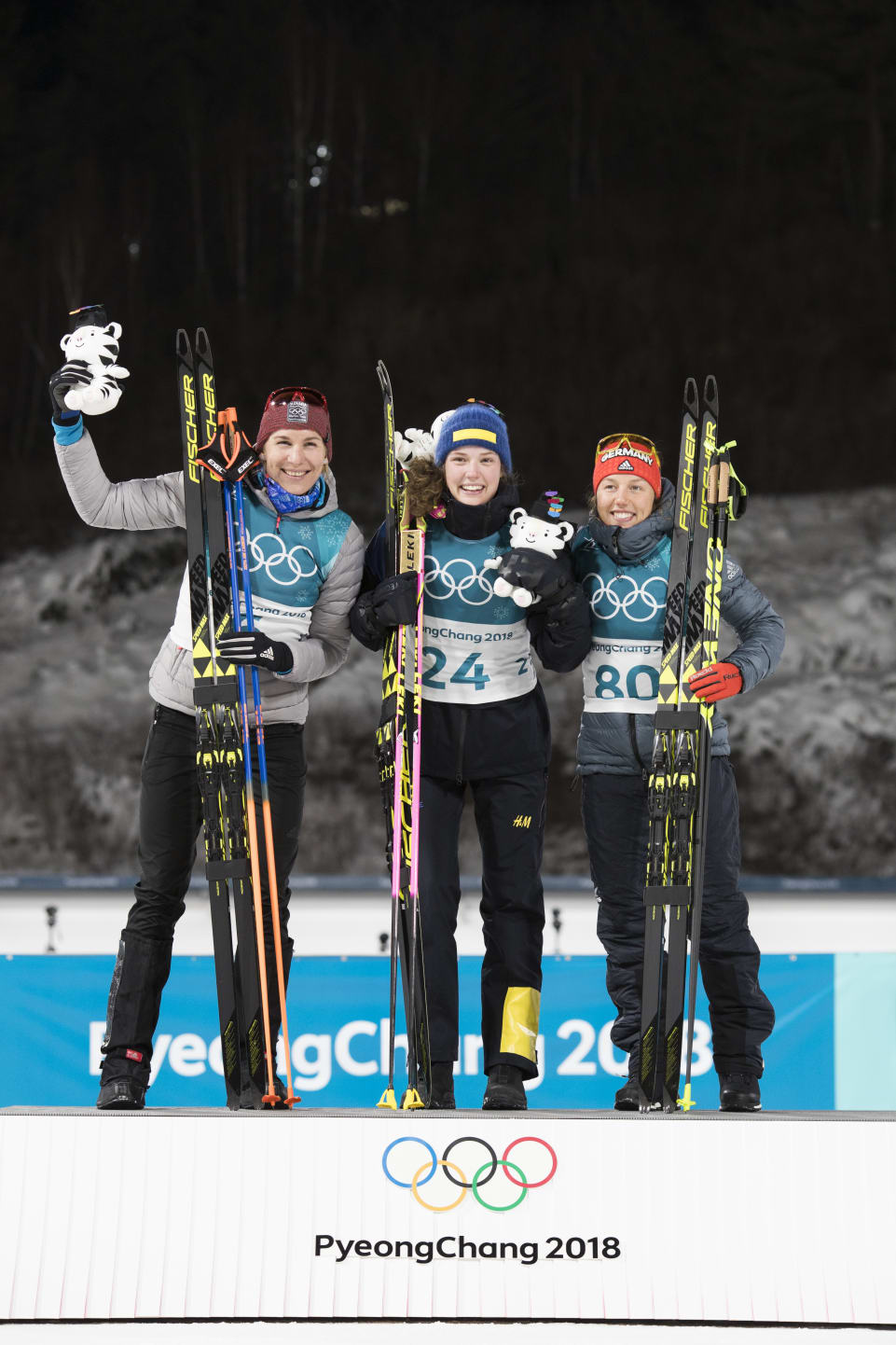
Sweden’s Hanna Oeberg (center) won gold in the biathlon women’s 15 k pursuit, followed by Slovakia’s Anastasiya Kuzmina (left) in silver and Germany’s Laura Dahlmeier in bronze. (Photo: IBU/Biathlonworld.com)
A few days after teammate Samuelson scored a career-best result to earn silver in the pursuit, Hanna Öberg of Sweden used perfect 20-for-20 shooting to capture gold in the women’s 15 k individual. The 22-year-old’s previous best results were fifth place in both Monday’s pursuit, and in a World Cup race last season.
She bested the two pre-race favorites: Anastasiya Kuzmina of Slovakia had two penalties but still managed a silver medal, her second of the games, finishing +24.7. And double gold medalist Laura Dahlmeier of Germany had one penalty and earned bronze (+41.2).
It was a good day for both of those teams as Franziska Preuss of Germany finished fourth, +59.0 with clean shooting, and Paulina Fialkova of Slovakia placed sixth (+1:02.3) with one missed shot. Poland’s Monika Hojnicz finished sixth (+1:54.8) with one missed shot as well.
The United States was led by Susan Dunklee in 19th, with two penalties (+3:26.3). Her teammate Joanne Reid finished 22nd (+3:34.1), her best-ever result in top-level international competition, with just one missed shot. Clare Egan finished 62nd (+6:53.6) and Emily Dreissigacker 67th (+7:09.2) with four penalties apiece.
For Canada, Rosanna Crawford led the way in 26th (+3:48.7) with two penalties and Sarah Beaudry was close behind in 29th (+3:58.4) with one missed shot. Emma Lunder finished 54th (+5:49.4) with three penalties and Julia Ransom was 74th (+8:31.4) with five missed shots.
Montana State University student Johanna Talihärm of Estonia finished 50th (+5:36.8) with three penalties.
Thursday afternoon saw more of the same for the women’s cross-country ski events at this year’s Winter Olympics: Scandinavia filling up the podium, with American Jessie Diggins tantalizingly close to that breakthrough American podium in fifth. This time it was Norwegian Ragnhild Haga in first in the 10 kilometer freestyle individual start, Charlotte Kalla of Sweden in second (+20.3), and Finland’s Krista Pärmäkoski and Norway’s Marit Bjørgen tied for third (+31.9).
The bronze is Bjørgen’s 12th lifetime Olympic medal, moving her into a tie with fellow Norwegian Bjørn Dæhlie for the most Olympic medals won by a cross-country skier. Countryman Ole Einar Bjørndalen, a biathlete, holds the overall Winter Olympics record with 13.
Diggins was 35.2 seconds back of Haga in fifth. She was in seventh place through 1.6 k, up to fifth at 5 k, up to third at 6.2 k, and still in third at the 8.4-k time checkpoint, 1.9 seconds up on Bjørgen and five seconds up on Pärmäkoski. But her form seemed to break down over the final uphill, and Diggins lost just enough time on Bjørgen and Pärmäkoski over the final 1.6 k to slip off the podium.
Between a 4.6-second deficit to third in Saturday’s skiathlon and a 3.3-second gap here, Diggins has now missed two bronze medals by a combined 7.9 seconds over 25 kilometers of racing.
Jessie Diggins pushing to the finish in the Olympic 10 k skate. The American finished fifth. (Photo: FlyingPointRoad)
Sixth place went to Swiss skier Nathalie von Siebenthal (+49.8), who slowed slightly after a fast start that saw her with the second-ranked time through 1.6 k. Ingvild Flugstad Østberg (+1:05.5), in seventh, was the third Norwegian in the top seven.
Olympic Athlete from Russia Anastasia Sedova (+1:07.3), Austrian Teresa Stadlober (+1:15.6), and Olympic Athlete from Russia Anna Nechaevskaya (+1:24.3) rounded out the top ten.
Sadie Bjornsen (+1:42.1) in 15th and Kikkan Randall (+1:49.9) in 16th were the next two Americans. Randall started relatively early with bib number 23, and was the leader in the clubhouse when she crossed the finish line. Liz Stephen (+2:35.4) was 30th.
For the Canadians, Emily Nishikawa (+2:41.) led the way in 32nd. Dahria Beatty (+2:48.4) was 37th, Cendrine Brown (+3:11.9) 43rd, and Anne-Marie Comeau (+4:10.8) 62nd.
Also of note, Australia’s Jessica Yeaton, who lives and trains in Anchorage with Alaska Pacific University, recorded an Olympics personal best finish of 41st (+3:09.1). University of Alaska Anchorage student Casey Wright, also competing for Australia, finished 81st (+6:55.8).
University of Colorado skier and NCAA champion Petra Hyncicova of the Czech Republic finished 60th (+4:09.4). University of New Hampshire alum Annika Taylor of Great Britain finished 75th (+5:52.4).
And Jaqueline Mourau of Brazil, who lives and trains in Quebec, was 74th (+5:49.8).
The women’s freestyle sprint podium on Saturday at the World Cup in Dresden, Germany, with Sweden’s Hanna Falk (c) and Maja Dahlqvist (l) in first and second, and American Sophie Caldwell (r) in third. (Photo: FIS Cross Country/Twitter)
FIS Cross Country World Cup (Dresden, Germany): Freestyle sprints
For her second-straight World Cup sprint, Sophie Caldwell of the U.S. Ski Team reached the podium in the women’s 1.2-kilometer freestyle sprint on Saturday in Dresden, Germany.
Caldwell placed third in the final behind Sweden’s Hanna Falk, who won it in 2:11.02 minutes, and Maja Dahlqvist, also of Sweden, who placed second (+0.23). Caldwell and Dahlqvist both lunged in a photo finish for second, which Dahlqvist took by 0.07 seconds.
Also in the final, which included four Swedes, Switzerland’s Laurien van der Graaff finished fourth (+0.58), and Sweden’s Anna Dyvik followed in fifth (+0.68) and Stina Nilsson sixth (+7.56) after tripping.
Falk started the day by winning the women’s qualifier in 2:06.34, by just 0.02 seconds over Nilsson in second. Caldwell qualified 11th (+2.02). and another American Ida Sargent made it into the heats in 14th (+2.44). Kikkan Randall missed the top 30 by 0.6 seconds in 34th (+6.57), Julia Kern placed 38th (+7.78), and Caitlin Patterson, of the Craftsbury Green Racing Project (CGRP), was 40th (+8.56) out of 49 women in the qualifying round.
Sargent finished fourth in her quarterfinal, 043 seconds behind Sweden’s Ida Ingemarsdotter in first, to finish the day in 17th overall.
For Caldwell, who went on to advance in second in her quarterfinal and third in her semifinal, the podium came after she finished second in the last World Cup skate sprint (the first stage of the Tour de Ski) on Dec. 31 in Lenzerheide, Switzerland.
Her boyfriend and fellow U.S. Ski Team member Simi Hamilton came close to reaching the men’s 1.2 k sprint final on Saturday after qualifying in 15th then placing second in his quarterfinal and fifth in the second semifinal, 0.38 seconds behind Sweden’s Emil Jönsson in first.
France’s Lucas Chanavat won the qualifier in 1:50.42, 0.15 seconds ahead of Norway’s Johannes Høsflot Klæbo in second. Hamilton was 4.32 seconds back in the qualifier, and his U.S. teammate Andy Newell also qualified in 18th (+4.91). Erik Bjornsen missed qualifying by 0.23 seconds in 32nd (+6.15) and Ben Lustgarten (CGRP) finished 49th (+8.64) out of 67 men.
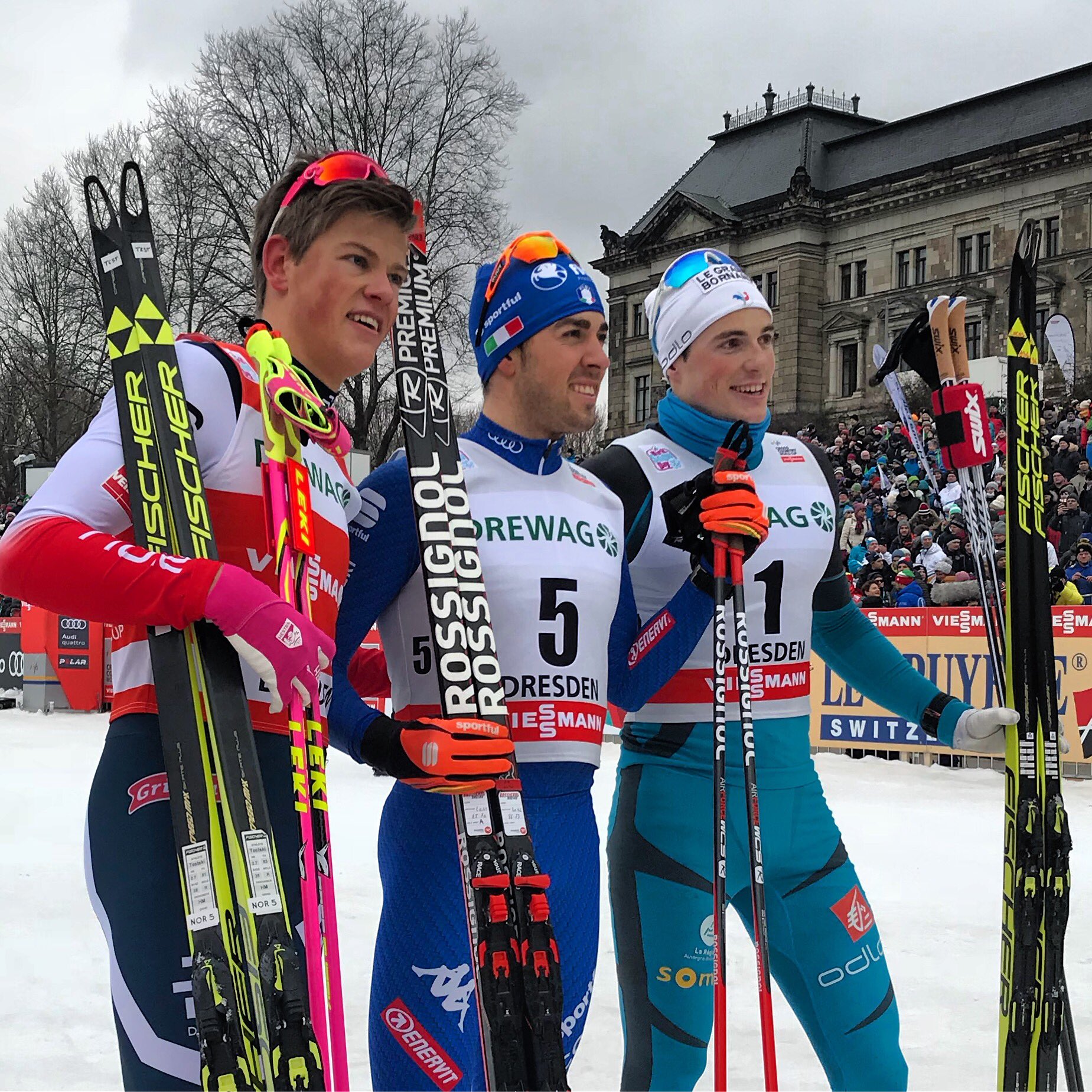
The women’s freestyle sprint podium on Saturday at the World Cup in Dresden, Germany, with Italy’s Federico Pellegrino (c) in first, Norway’s Johannes Høsflot Klæbo (l) in second, and France’s Lucas Chanavat (r) in third. (Photo: FIS Cross Country/Twitter)
While Hamilton’s day ended in the semifinals, putting him 10th overall (and Newell finished sixth in his quarterfinal to place 27th overall), Italy’s Federico Pellegrino timed his attack perfectly in the final, challenging Klæbo for the win down the finishing stretch. The Italian took it by 0.18 seconds in 1:52.77, Klæbo placed second and Chanavat third (+0.98).
France and Norway had two men in the final, with France’s Richard Jouve placing fourth (+1.23), Sweden’s Jönsson taking fifth (+2.36) for his best individual World Cup result since December 2016. Norway’s Even Northug finished sixth (+12.04) after breaking his pole out of the start.
Canada’s Julien Locke of the National U25 Team and Black Jack Ski Club had a career-best day, finishing 15th overall. He qualified 16th (+4.61) then placed third in his quarterfinal, crossing the line just 1 second behind Norway’s Fredrik Riseth, who won that heat. Hamilton was second in that quarterfinal, 0.67 seconds back.
Also for Canada, Bob Thompson (NTDC Thunder Bay) finished 50th in the qualifier (+8.67), Dominique Moncion-Groulx (Alberta World Cup Academy) was 59th (+9.99) and Antoine Briand (Pierre-Harvey National Training Centre) 60th (+10.12).
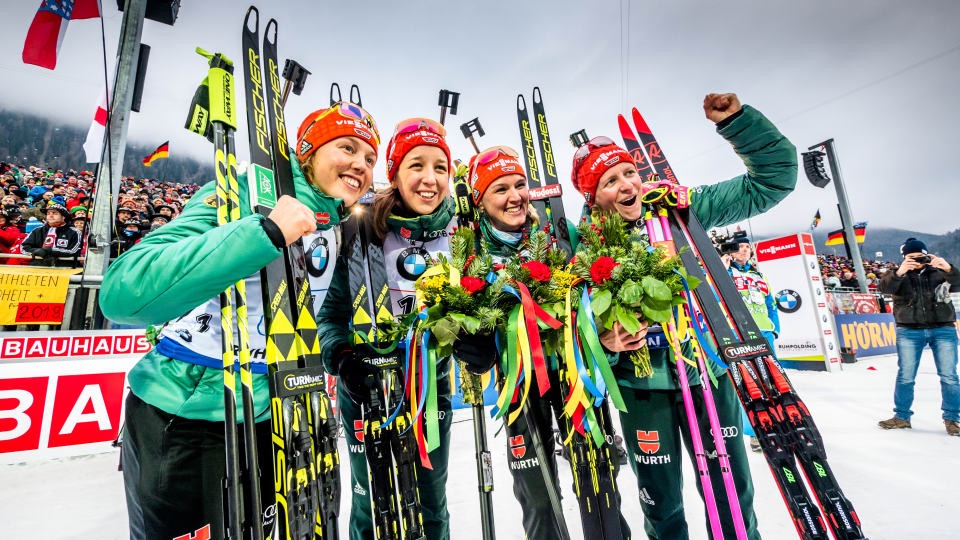
Germany’s Laura Dahlmeier, Franziska Preuss, Denise Herrmann and Franziska Hildebrand (left to right) celebrating their win in the women’s 4×6-kilometer relay at the 2018 IBU World Cup in Ruhpolding, Germany. (Photo: IBU/Biathlonworld)
IBU World Cup (Ruhpolding, Germany): Women’s relay
The teams from Germany and Italy dueled for the top position all race in Saturday’s 4 x 6-kilometer women’s relay at the IBU World Cup in Ruhpolding, Germany. Cheered on by some 20,000 home-crowd fans, Germany’s anchor Laura Dahlmeier stayed on the ski tails of Italy’s Federica Sanfilippo after the last shooting stage, then passed her before the last major climb and held a narrow lead around the rest of the course to cross the finish line first in a time of 1:08:47.0 hours, with Italy 2.9 seconds behind. German had a team total of zero penalties and nine spares.
“It’s incredibly fun to win in front of this audience here today,” Dahlmeier told German broadcaster ZDF in an interview right after the race, according to a translation. “I think this will boost our whole team morale. We showed today that we are a team to be reckoned with in relays. It was just a nice race.”
Germany with Franziska Preuss, Denise Herrmann, Franziska Hildebrand, and Dahlmeier was never more than 30 seconds behind the pace, even though Hildebrand temporarily fell back from leading the field to tagging off to Dahlmeier in fourth position.
“My race held all kinds of surprises today,” Hildebrand told ZDF with a laugh. “It started with a fall on an icy patch 100 meters after it began… Then I dropped my pole, also had to exchange the replacement one, and then three spares [in prone] to avoid the penalty. Today everything conspired in my race.”
Italy with Lisa Vittozzi, Dorothea Wierer (coming off a victory in the individual race on Thursday), Nicole Gontier and Sanfilippo had the best shooting performance of the day, with no penalty and just three spares.
“That last loop with Laura was really tough,” Sanfilippo said in the press conference. “I gave my best, I tried all for my team. I knew that I can be strong on the last loop. I tried to attack, but Laura was a little bit stronger. But I am also really happy that we finished in second place, I think that was really important for our team.”
Sweden with Linn Persson, Mona Brorsson, Anna Magnusson and anchor Jenny Öberg was third, 17.2 seconds back, with no penalty and five spares. Brorsson and Öberg managed to move the team up to the podium positions, for the second one in a row following a third place from Oberhof, Germany, a week ago. Before that, the Swedish women’s team had been on a six-year hiatus from those lofty positions.
“It’s cool to be on the podium again,” Persson said in the press conference.
“This is like our second home and there were a lot of Swedes here, so we had big support during the race on the tracks,” Brorsson added.” That was an advantage for us.”
Just a few seconds off the podium, Norway with Synnøve Solemdal, Tiril Eckhoff, Ingrid Landmark Tandrevold and Marte Olsbu was fourth (+23.1, with no penalty and nine spares), with Olsbu outsprinting Poland’s anchor Weronika Nowakowska on the finish stretch (+24.5, with no penalty and five spares). For both teams it was their best relay result of the season so far.
Switzerland with the three sisters Elisa, Selina and Aita Gasparin reinforced by Lena Häcki surprisingly led the race at the third exchange after Selina had moved them in front, but her youngest sister Aita could not hold that position, falling back with a penalty lap in the last standing stage to finish eighth (+1:37.1, with one penalty and 11 spares).
Biathlon Canada’s team of Emma Lunder, Julia Ransom, Sarah Beaudry, and Rosanna Crawford started the race with a setback after Lunder incurred a penalty in her prone stage, leaving the range in 23rd position at the end of the field and already almost a minute behind the leader. She managed to limit the gap with a clean standing stage to exchange still in 23rd position and 1:47 back.
Taking over Ransom then remained clean in both stages to move the team up to 17th, tagging off 2:14 behind. Beaudry only required one spare in her prone stage (0+1, 0+0) to improve to the 12th position even making up 3 seconds to the leaders.
Then Crawford, fresh off her first career podium in the individual race on Thursday, managed to also shoot clean in both stages and overtook the teams from Slovakia and Ukraine while further decreasing the gap to finish the race in 10th position, 1:56.7 back, with one penalty and just four spares.
“Things were a bit softer and slushy today compared to the individual, but nothing too bad,” Crawford commented on the conditions in an email to FasterSkier. “There was quite a bit of wind on the range, which I think was tricking people, the wind flags weren’t showing much but I had to make 6 left correction during zero [target practice].”
“Today was a solid showing from our team,” she added regarding their result. “Everyone cleaned standing, I think we can be really happy of this race, and take some real confidence going into the Olympic relay.”
Previously this season Canada had finished the relay in Oberhof, also Germany, in 14th position, and the first one in Hochfilzen, Austria, in ninth.
For US Biathlon with Susan Dunklee, Clare Egan, Emily Dreissigacker, and Joanne Reid, it was the first women’s relay of the year after missing out on the first two races of the season in this discipline.
Thus starting at the very end of the field, veteran Dunklee moved up through the pack and got through the prone stage with one spare. But then she had to fight against a penalty lap in her standing stage requiring all three spare rounds, leaving the range in 12th position. With the fastest course time on the opening leg, she managed to slightly decrease the gap to 21.6 seconds and made up three positions to exchange in ninth place.
Egan missed the first two shots in her prone stage, but hit the targets with her spares leaving the range over a minute back. She followed that up by cleaning her standing stage and left the range 1:29.5 back, then only lost five more seconds on the last loop to exchange in 14th.
Dreissigacker also needed just one spare in her prone shooting, but then incurred two penalties in her standing stage, doubling the gap and falling back to 19th position at the exchange and 3:51 back.
Anchor Reid needed three spares on her leg (0+2, 0+1) and managed to still overtake the teams from China and Finland to finish 17th, 4:57.7 behind Germany, with two penalties and 13 spares overall.
“Finally we had a full team and raced a relay!” Dunklee wrote on Instagram. “Competing on a foreign continent has its challenges.”
Ski Classics (Seefeld, Austria): 60 k Kaiser Maximilian Lauf
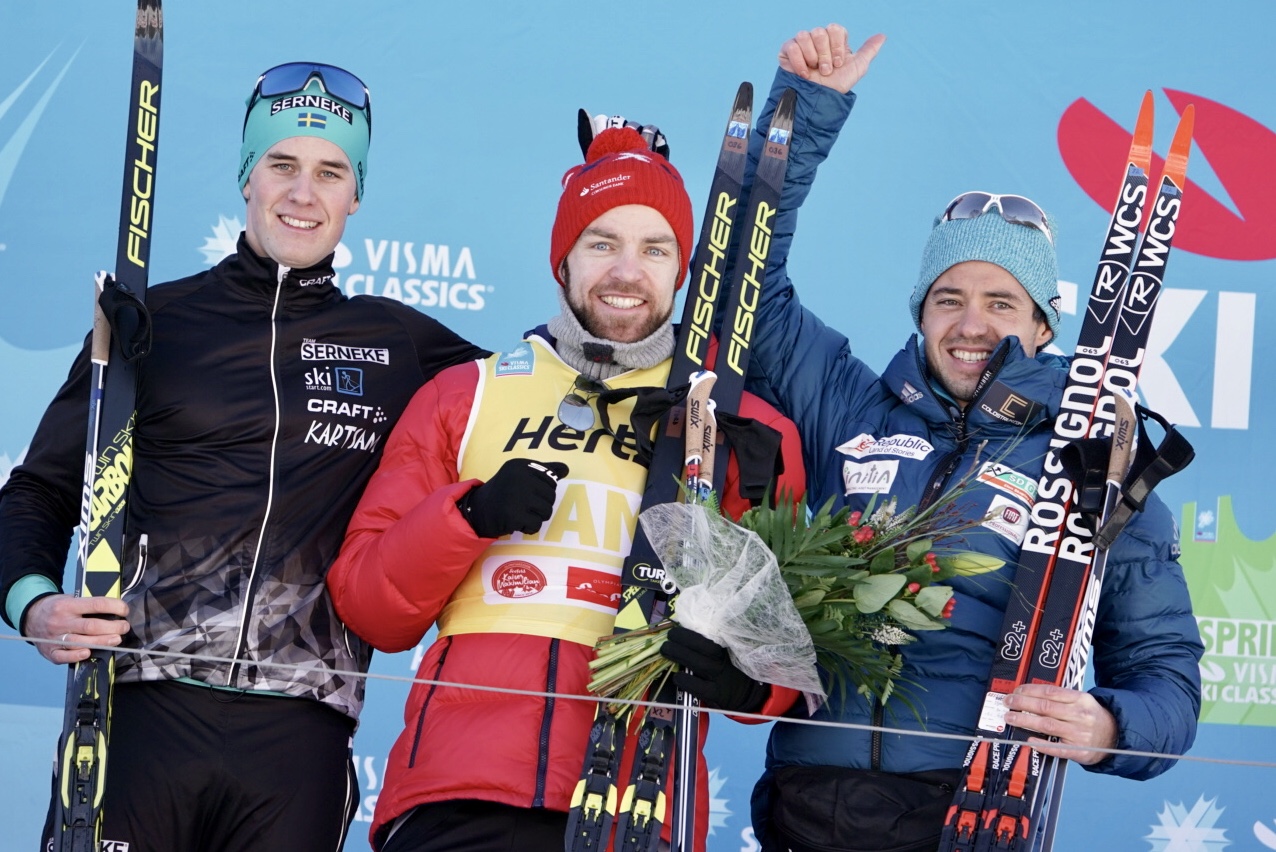
The men’s podium at the Kaiser Maximilian Lauf 60 k Ski Classics marathon in Seefeld, Austria, with Norway’s Tord Asle Gjerdalen (c) in first, Sweden’s Andreas Holmberg (l) second, and Russia’s Ilya Chernousov (r) third. (Photo: Visma Ski Classics)
At the third Ski Classics event of the 2017/2018 season, the 60-kilometer Kaiser Maximilian Lauf on Saturday in Seefeld, Sweden’s Britta Johansson Norgren (Lager 157 Ski Team) and Norway’s Tord Asle Gjerdalen (Team Santander) took the women’s and men’s victories, respectively.
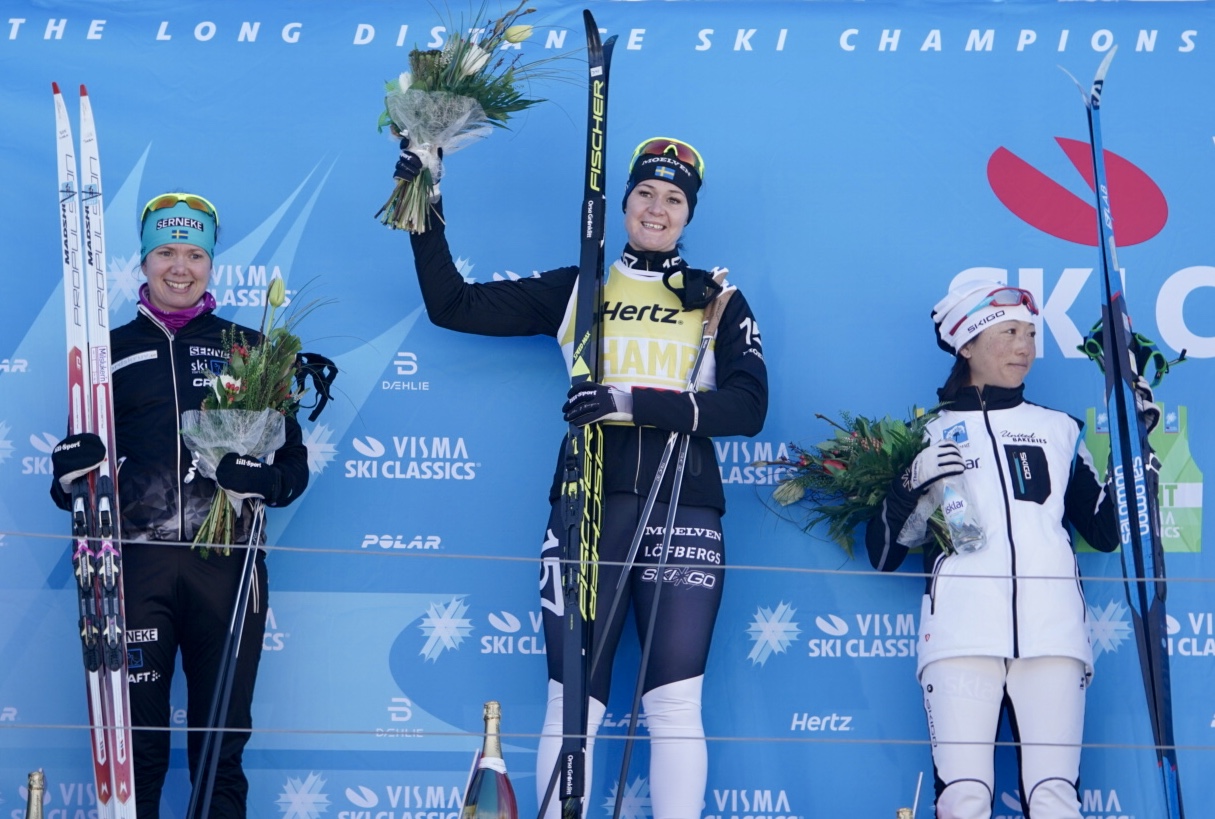
Johansson Norgren and Japan’s Masako Ishida (Team Koteng) broke away shortly after the start. The two went back and forth for a while until Johannson Norgren gapped Ishida in the Leutasch valley. While Ishida was caught by a chase pack with Sara Lindborg (Team Serneke), Kari Vikhagen Gjeitnes (Santander) and Lina Korsgren (Åre Ski Team), she reined Johansson Norgren back in on the long climbs after the valley. Ultimately, Johansson Norgren took the win in 2:49:16.0 hours, while Lindborg claimed second, 37.5 seconds back. Ishida finished third (+58.9), Gjeitnes placed fourth (+1:40.7) after injuring her ankle about 2 k before the finish, and Korsgren fifth (+2:05.1).
The women’s podium at the Kaiser Maximilian Lauf 60 k Ski Classics marathon in Seefeld, Austria, with Sweden’s Britta Johansson Norgren (c) in first, Sweden’s Sara Lindborg (l) second, and Japan’s Masako Ishida (r) third. (Photo: Visma Ski Classics)
“It was my plan to go full speed from the beginning,” Johansson Norgren said, according to a Ski Classics press release. “I knew Ishida will go fast in the climbs, but I felt strong from the beginning. It was really hard skiing alone in the valley, and when Ishida caught me up, I wasn’t sure if I could win the race. But the last part of the course was perfect for me and I had no problems securing the victory today.”
The Leutasch valley was the turning point of the men’s race as well, where Vinjar Skogsholm (Team Parkettpartner) and Andreas Holmberg (Team Serneke) broke away from the pack and had built a 90-second gap on the chase group as they left the valley. There on the first climb out of the valley, Holmberg pushed the pace and dropped Skogsholm, while Gjerdalen and Ilya Chernousov (Bauer Ski Team) worked to catch Holmberg up front. They caught him 3 k before the finish and Gjerdalen was first across the finish line in 2:27:49 hours, 14.8 seconds ahead of Holmberg in second.
Chernousov finished third (+32.0), Ermil Vokuev (Russian Marathon Team) was fourth (+1:07.6), and Anton Karlsson (Lager 157) fifth (+1:08.2).
“I didn’t like the fact that we gave too much leeway for Holmberg and Skogsholm,” Gjerdalen said, according to the press release. “I’m happy that Ilya helped me in our attempt to catch up with Holmberg, but I wasn’t really sure if we were going to make it. You never know how the other person is feeling in the front, what kind of skis he has and what goes on in his mind. But I managed to win today and it feels great to be back on the top.”
In the overall “Champion” standings, Nordgren leads with 450 points, 110 ahead of Lindborg in second. Gjerdalen is first in the men’s champion standings with 330 points, 50 points ahead of Morten Eide Pedersen in second.
The Ski Classics tour moves to Zuoz, Switzerland, next weekend for the 65 k La Diagonela.
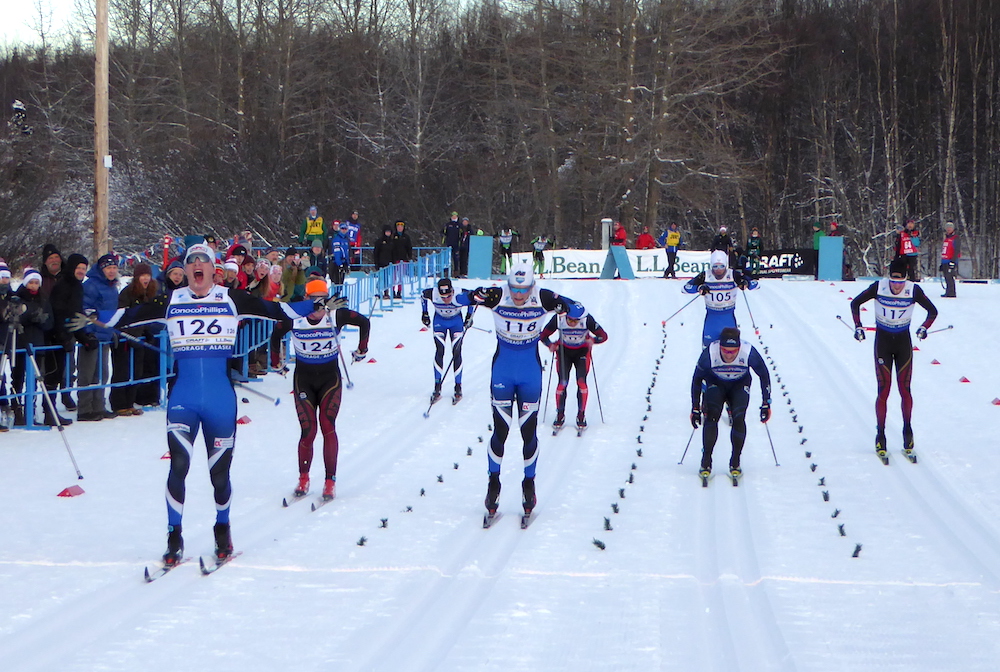
APU’s Tyler Kornfield (126) leads APU’s Eric Packer (118) and DU’s Eivind Romberg Kvaale (124) to the line in the men’s 30 k classic mass start at 2018 U.S. Cross Country Championships on Sunday in Anchorage, Alaska. Kornfield, Packer, and Kvaale finished first, second and third, respectively. Kris Freeman (10, second from left) was fourth overall and the third American.
U.S. Cross Country Championships (Anchorage, Alaska): 20/30 k classic mass starts
Sweden’s Hedda Bångman denied Caitlin Patterson of her first outright victory of the week at 2018 U.S. Cross Country Championships, but Patterson as the first American racked up her third-straight national title in the women’s 20-kilometer classic mass start at Kincaid Park on Sunday in Anchorage, Alaska.
The top-three Americans in the women’s 20 k classic mass start on Sunday at 2018 U.S. nationals in Anchorage, Alaska, with Caitlin Patterson (1) of the Craftsbury Green Racing Project (CGRP) in first, Rosie Frankowski of APU (l) in second, and Kaitlynn Miller (r) of CRGP in third.
Bångman, a 22-year-old freshman at the University of Colorado Boulder (CU), pulled off a 15.9-second win in the mass start, crossing the line in 1:00:55.3 hours. Patterson, of the Craftsbury Green Racing Project (CGRP), finished second, but was the top American in the event for the third time this week, and Rosie Frankowski, of Alaska Pacific University (APU), notched third (second American), 19.6 seconds back.
Rounding out the top 10 was Jessica Yeaton, who trains with APU and races for Australia, in fourth (+44.1), Kaitlynn Miller (CGRP) as the third American in fifth overall (+1:13.5), Alayna Sonnesyn of the University of Vermont (UVM) in sixth (+1:25.3), Chelsea Holmes (APU) in seventh (+1:55.4), Norwegian CU skiers Christina Rolandson and Anne Siri Lervik in eighth (+1:55.7) and ninth (+1:56.1), respectively, and Erika Flowers of the Stratton Mountain School (SMS) Elite Team in 10th (+2:14.6).
The men’s 30 k classic mass start was incredibly close, with APU’s Tyler Kornfield taking his first-ever distance national title (he was the 2012 classic sprint national champion) in 1:21:43.6. He edged his teammate Eric Packer by 0.7 seconds at the line, and Eivind Romberg Kvaale, a sophomore at the University of Denver (DU), finished 1 seconds back in third.
Kris Freeman (Caldwell Sport) was just off the overall podium in fourth (+1.6), but was the third American. Another DU skier, Dag Frode Trollebø, also from Norway, finished fifth (+2.0), and APU had three in the top six with David Norris in sixth (+2.5). Noah Hoffman (Ski & Snowboard Club Vail) finished seventh (+2.6), Scott Patterson (APU) eighth (+3.6), and Craftsbury’s Adam Martin and Ben Lustgarten followed in ninth (+14.7) and 10th (+14.9), respectively. With Brian Gregg (CXC/LNR/Team Gregg) in 11th (+16.1), the men’s top 11 were separated by less than 17 seconds.
IBU World Cup (Oberhof, Germany): Men’s and women’s relays
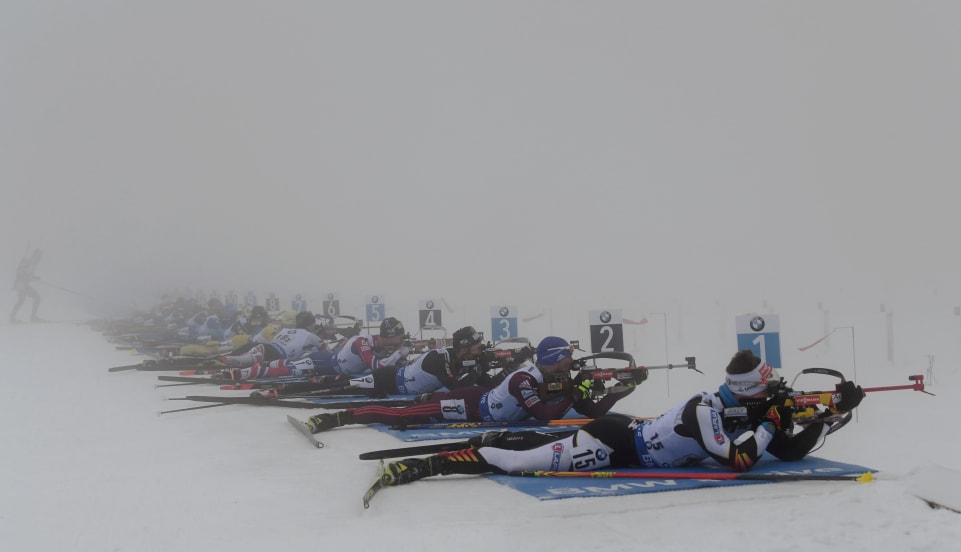
Racers on the range during the men’s 4 x 7.5 k relay on a foggy Sunday at the IBU World Cup in Oberhof, Germany. (Photo: IBU/Biathlonworld)
The Swedish men’s team and French women won the second relays of the International Biathlon Union (IBU) World Cup season on Sunday, with Sweden winning the men’s 4 x 7.5 k relay by 1:10.8 over Italy, and France besting Germany by 32.4 seconds.
Notably, most of the top teams didn’t start all of their “A” teamers.
In the men’s race, Sweden’s Martin Ponsiluoma, Jesper Nelin, Sebastian Samuelsson, and Fredrik Lindström combined for their first win together — and the first win for most of the members on the team.
“It is a dream when you are a kid to compete in a World Cup,” Samuelsson said, according to an IBU press release. “To have a win is really amazing!”
The Swedish women’s team also landed on the podium in third (+48.2).
“What a race by the whole team,” said Lindström, who also has one non-relay World Cup win (from 2012) to his name. “It could not be better.”
Conditions could not have been much more difficult for shooting on Sunday, with the fog that had descended early in the day for the women’s race worsening for the men’s race. When there wasn’t fog, there was wind.
Misses were common throughout the two races, and even with racers being able to use three spares per shooting stage to clean, there were a high number of penalty laps.
But the Swedish men kept their penalties to a minimum, with just one for the entire team and a total of nine spare rounds used among them. After Ponsiluoma came through the first exchange in sixth, Nelin skied them into third, Samuelsson picked off another place despite skiing a penalty after his standing stage to put them in second, and Lindström anchored them to first.
“The conditions today were so special. Somehow I felt not so nervous, I was calm and had luck on my side,” Lindström said at a post-race press conference about his nearly flawless shooting (0+0; 0+1).
“I have never [been first] before,” he added. “Not like this in a relay at least. That’s really fantastic.”
“I had to look up to see if I was aiming the right way,” Nelin said after cleaning prone (0+0) then using two spares to clean standing (0+2). “I had no idea where I was aiming, so it was really difficult. But I hit, and it was good. Maybe these conditions fit me and I should never see anything.”
Italy placed second with Thomas Bormolini, Lukas Hofer, Dominik Windisch, and Thierry Chenal combining for two penalties and 11 spares. Hofer had skied them up from eighth to second, and Windisch then took the lead on the third leg to put them in first at the final exchange, 1 minute ahead of Sweden. But Chenal slipped with the seventh-fastest last leg time and a penalty after standing.
“Being on the podium with the team is always a special feeling,” Hofer said at the press conference. “For Thierry, it’s the first year in the World Cup, and he does a really good job, not just today. I am really happy that he could close out this relay. Second place is like a win for us.”
Norway placed third (+2:04.6) with Vetle Sjåstad Christiansen, Henrik L’Abée-Lund, Lars Helge Birkeland, and Tarjei Bø. Together, they had three penalties (two from L’Abée-Lund and one from Birkeland) and 14 spares.
“I grew up on Holmenkollen so I practiced a lot there [in fog],” L’Abée-Lund said. “But today was really really hard, I didn’t see anything in prone. Standing was OK, but prone was really difficult.”
“It’s great to be on the podium,” Christiansen said. “Of course Norway always wants to win, but today we are very happy for our brothers in our neighbor-country Sweden.”
The Canadian men placed 10th (+6:23.1) out of 25 teams with Christian Gow, Scott Gow, Brendan Green, and Carsen Campbell having a combined six penalties and 20 spares. Three of those penalties came on Scott Gow’s second leg, two from Campbell’s anchor leg, and one on Christian Gow’s first leg.
After a penalty on his first prone stage (1+3), Christian cleaned standing with a spare (0+1) and tagged Scott in 11th, 53 seconds out of first. Scott then had two penalties in prone and three in standing, but managed to improve to eighth given how much everyone else was struggling with the shooting as well. Green kept them in eighth with two clean stages (0+2, 0+3), and Campbell, in his first World Cup relay, cleaned prone (0+2) but had two standing penalties (2+3) to put the team in 10th at the finish.
In an interview with German broadcaster ARD halfway through the race, Canadian coach Matthias Ahrens called the range conditions, which ranged from thick fog to unpredictable wind, “very hard to assess.”
“… To be honest, the good thing was that conditions were very bad,” he later added. “So regarding visibility, almost everyone was on the range at the same time [with the same irregular conditions]. They had to wait very long, and of course had bad conditions to shoot, but much of the field was there at the same time.”
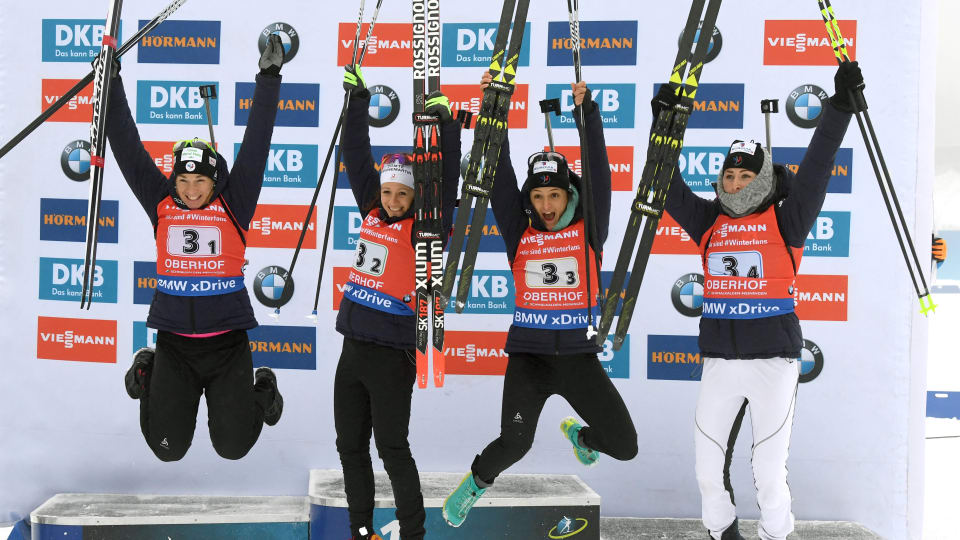
The French women’s team, of Anais Bescond, Anais Chevalier, Celia Aymonier, and Justine Braisaz, celebrate their relay victory on Sunday at the IBU World Cup in Oberhof, Germany. (Photo: IBU/Biathlonworld)
In the women’s race, with better shooting visibility, France’s Anais Bescond, Anais Chevalier, Celia Aymonier, and Justine Braisaz took the win in 1:12.42.4, with one penalty and 10 spares. After Bescond put them in first through the first exchange, 6 seconds ahead of Italy in second, Chevalier had to ski a penalty loop after prone but cleaned standings (1+3, 0+0) and tagged off in second, 23 seconds behind Italy, now in first.
One loop later, France was back in first thanks to Aymonier, who cleaned with just two spares (0+0, 0+2), and they extended their lead from 0.8 seconds at the last exchange to 32 seconds at the finish with Braisaz, who shot 0+1, 0+3, and skied the fastest anchor leg.
“I know that it’s always good for Justine to start in the first position, so I really wanted to pass the relay to her in that,” Aymonier said in a press conference after.
“I was nervous, too,” Braisaz said. “That kind of shooting turned my mind upside down, actually. The crowd was very loud, and … I wasn’t very focused on what I did. It was a bit foggy, too, so that made it harder. But finally it was a French day, maybe.”
“In my mind the whole team is really strong, and really able to get the first place,” Bescond said. “After years and years and years behind Germany’s team we finally did it. So just Oberhof spirit I think.”
Germany placed second with Vanessa Hinz, Denise Herrmann, Franziska Preuss, and Maren Hammerschmidt. They combined for two penalties and 13 spares; with a penalty on Hinz’s first leg and one more on Hammerschmidt’s last shooting. After being tagged in 14th, Herrmann skied them into fourth, 40 seconds out of first, and Preuss elevated them to second, which Hammerschmidt held onto.
“I was struggling a little bit in the prone shooting,” Herrmann said. “But the skiing was good today, and also the standing [shooting]. I tried to go fast on the track and catch some girls.”
Sweden, with Linn Persson, Anna Magnusson, Elisabeth Högberg, and Mona Brorsson, avoided the penalty loop and used eight spares to reach the podium for the first time in six seasons. In sixth place at the first exchange, they slipped one place to seventh on the second leg, but Högberg raced them up to fourth with near-perfect shooting (0+0, 0+1) with one leg to go. Brorsson then anchored them to third with clean shooting (0+2, 0+1) and the third-fastest last leg.
“It’s just super nice for us! I am super happy,” Magnusson said. “We were very emotional at the finish.”
When Brorsson was asked if she believe she could fight for the podium, she responded, “Not really. But I said to Linn, ‘Maybe it is our day today. Please let it be our day today.’ ”
The Canadian women finished 14th (+6:37.5), out of 20 teams, with two penalties and 13 spares. Sarah Beaudry initially put them in 15th after shooting 0+1, 0+2, then Julia Ransom had a standing penalty (0+2, 1+3) to slip one place to 16th. Megan Tandy picked off three places with clean shooting (0+0, 0+2) and tagged Emma Lunder in 13th, and Lunder had a penalty in prone but cleaned standing (1+3, 0+0) to finish in 14th.
The men’s overall 2018 Tour de Ski podium atop Alpe Cermis after the final Stage 7 hill climb: with Switzerland’s Dario Cologna (c) in first, Norway’s Martin Johnsrud Sundby (l) in second and Canada’s Alex Harvey (r) in third. (Photo: FIS Cross Country/Twitter)
Dario Cologna of Switzerland added a fourth Tour de Ski (TdS) title to his list of accolades on Sunday, winning the 2018 edition of the race in dominant fashion, with a 1:26.5-minute win over Norway’s Martin Johnsrud Sundby. And Canada’s Alex Harvey scored his first TdS overall podium in third.
The 31-year-old Cologna started the 9-kilometer freestyle pursuit up Alpe Cermis 1:15 ahead of Kazakhstan’s Alexey Poltoranin in second. Russia’s Sergey Ustiugov, slated to start third, did not start due to a back injury. Thus Harvey was the third man off the start line, 1:23 behind Cologna.
(Sweden’s Marcus Hellner, 13th after Saturday’s Stage 6, also did not start the Tour’s final stage.)
Early on, Cologna started putting time into his competitors, extending his lead on Poltoranin to 1:20.5 and Harvey to 1:24 at 1.8 k.
By 4 k, however, Harvey had used his speedy skiing on the flatter portions of the race leading up to the climb to catch Poltoranin, and the two clocked through that checkpoint 1:19.4 behind Cologna. Behind them, Russia’s Alexander Bolshunov skied just ahead of Sundby, another 21 seconds and 22 seconds back, respectively, in fifth and sixth.
While Harvey clawed back a few more seconds on Cologna, he was still 1:17.8 back at 6.2 k, with Poltoranin just 0.7 seconds behind him in third.
Harvey remained in second until around 8.5 k; with just a half kilometer to go, Sundby had caught both Poltoranin and Harvey, passing them both. Sundby held that position and finished second, 1:26.5 behind Cologna, who won in 28:52.1.
Harvey stayed strong for third (+1:30.6) while Poltoranin dropped off the Canadian’s pace in the final half kilometer and finished fourth (+1:41.7). Norway’s Hans Christer Holund placed fifth (+2:17.8), Bolshunov lost a spot to finish sixth (+3:09.7), France’s Jean-Marc Gaillard finished seventh (+3:16.7), Sweden’s Daniel Rickardsson eighth (+3:20.8), and Russia’s Alexey Chervotkin and Andrey Larkov took ninth (+3:33.5) and 10th (+3:37.8), respectively.
France’s Maurice Manificat, known for his strength in freestyle hill climbs and pursuit races, rose from 14th to 11th (+3:45.7) with the second fastest time of day, 12.8 seconds slower than Sundby as the time of day winner in 28:36.4. Cologna’s time was fourth fastest (+15.7), behind Russian U23 skier Denis Spitsov in third (+14.3) (Spitsov started 20th and finished 13th). Holund’s time ranked fifth (+20.6) and Harvey’s time was sixth fastest (+23.6) of the 43 men that finished the race.
The lone American man to complete this year’s Tour, Paddy Caldwell (U.S. Ski Team) skied the 22nd fastest time of day for 38th overall (+11:54.8).
Heidi Weng (center) celebrates her second Tour de Ski victory, with teammate Ingvild Flugstad Østberg second and the U.S. Ski Team’s Jessie Diggins third. (Photo: FIS Cross Country/Twitter)
In the women’s hill climb that kicked off the day, Heidi Weng raced to her second consecutive TdS title. The Norwegian started the day within two seconds of teammate Ingvild Flugstad Østberg, and the two skied together for the flat section of the nine-kilometer stage of the competition. But when the climbing got steep on Alpe Cermis, Weng left her teammate behind and eventually racked up a 48.5-second win.
The battle for third was less predictable. Jessie Diggins of the United States started the day in fourth, but made up the ten seconds to third-place KristaPärmäkoski of Finland in the first few kilometers. The pair climbed together for a while before Diggins attacked. Pärmäkoski tired on the final sections of the Alpe Cermis and Diggins took the podium in definitive style, 2:23.2 behind Weng and 24 seconds ahead of Pärmäkoski. It’s the first overall Tour de Ski podium for Diggins or any American athlete.
Teresa Stadlober of Austria finished fifth (+3:09.4), Kerttu Niskanen of Finland sixth (+4:17.0), Russia’s Anastasia Sedova seventh (+4:49.6), and Switzerland’s Nathalie von Siebenthal eighth (+4:56.1).
Sadie Bjornsen started eighth and slipped one spot to finish ninth (+6:15.0), giving the U.S. two top-ten finishers in the Tour de Ski for the first time. Liz Stephen finished 16th (+8:25.8) and Rosie Brennan 24th (+10:59.6).
En route to her win, Weng notched the fastest time of the day on the 9 k stage. Stadlober’s time was second, Diggins third, Østberg fourth, and Stephen fifth.
32 women finished this year’s edition of the Tour de Ski.
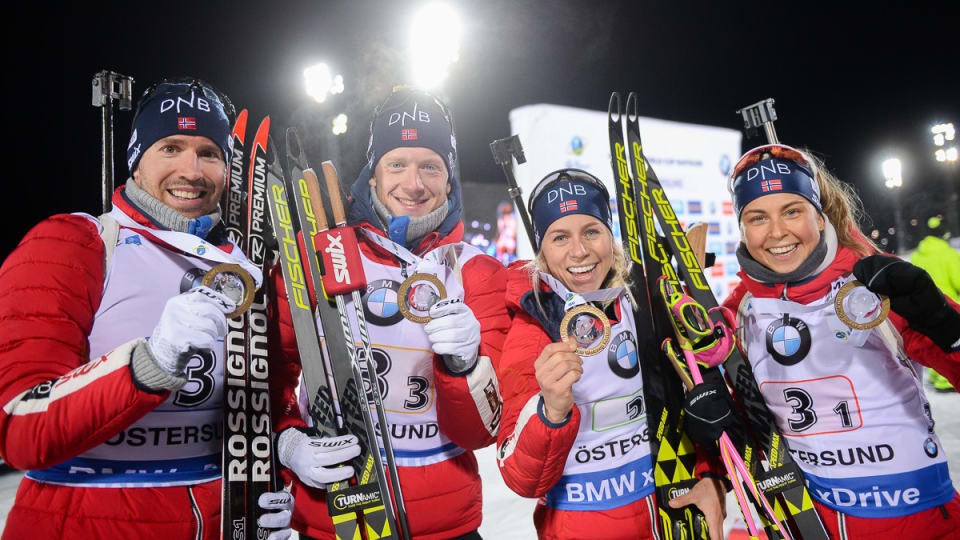
(Left to right) Norwy’s Emil Hegle Svendsen, Johannes Thingnes Bø, Tiril Eckhoff and Ingrid Landmark Tandrevold show off their medals after winning the mixed relay on the opening day of the 2017/2018 IBU World Cup season in Östersund, Sweden. (Photo: IBU/biathlonworld)
Even the most renowned athletes and national teams in the mixed relay on Sunday afternoon admitted they had not yet found their perfect groove in Östersund, Sweden, on the opening day of the 2017/2018 International Biathlon Union (IBU) World Cup season.
Nevertheless it still made for an exciting race, with four teams vying for the podium on the last lap. And in the finishing stretch, anchored by veteran Emil Hegle Svendsen, the same country prevailed as in the last two seasons in the same race and at the same place: Norway.
In a time of 1:11:31.7 hours, Svendsen held off a final push from Italy’s Lukas Hofer by 5.3 seconds. Norway required 13 spare rounds on the shooting range while Italy needed just six; however Hofer incurred a penalty lap in his prone stage, momentarily falling back 30 seconds and to fourth place before returning to the top three.
Germany, anchored by Arnd Peiffer, placed third, 6.4 seconds back with 10 spare rounds and no penalties, with Peiffer managing to overtake Slovakia’s Matej Kazar on the final lap. Slovakia narrowly finished off the podium after a strong team performance with its best World Cup result in a mixed relay in five seasons. The team finished 7.7 seconds out of first, with nine spares and no penalties.
“It was a really tough fight with Lukas just behind,” Svendsen recounted of the final lap during the post-race press conference. He had used all of his spares to clean his standing stage.
“I was happy to walk away with the win. I looked back, it’s impossible not to I think, but I felt quite strong…,” he continued. “I was unsure if I should just let him come to me and then we can finish in a sprint, but I looked behind and I had about a five-second gap so I just said to myself to just go and see what happens … Always a good feeling to start the season with a victory, good for the team, good for the spirit.”
“The last lap, when I went out from the stadium, I saw Emil in front of me and tried to close the gap as fast as possible,” Hofer said at the press conference. “But it was a bit too much because he also pushed so strong, and normally he is one of the best on the last loop. I was happy to finish like this… It was a really good start into the season.”
In the mixed relay format, with a 2 x 6 + 2 x 7.5-kilometer course length, two women followed by two men hand off to one another on the track, and each can use up to three spare rounds per shooting stage to avoid a penalty lap.
This time of the year, the sun sets early in Östersund in central Sweden. In a race under floodlights with mostly calm wind conditions, Norway, with Ingrid Landmark Tandrevold, Tiril Eckhoff, Johannes Thingnes Bø and Svendsen, combined for the best performance once again.
“I was really nervous, but I think everyone was, especially on the first loop,” Tandrevold said at the press conference, after she got the nod to start, replacing sick teammate Marte Olsbu. “The standing shooting was really hard, but I think the rest of my race was good. I was happy to be in front on the last downhill, because last year I fell [there] so I was a bit scared.”
“I was a bit rusty, I need some more races, then hopefully it will be a really good season,” added her teammate Eckhoff.
“Full speed from the start, that was the only plan I had,” Bø explained the tactics on his leg, where he required two spares in the prone shooting and all three in standing. “Of course I didn’t plan to use five extra [shots]. All in all I am satisfied, but there are still some things I need to improve on. A little bit faster skiing, a little bit better shooting.”
That prompted laughter from his teammates and his competitors on the podium.
Italy’s Dorothea Wierer tags Dominik Windisch at the halfway point of the mixed relay in Östersund, Sweden. The team went on to finish second on the day to open the 2017/2018 IBU World Cup season. (Photo: IBU/biathlonworld)
Italy, with Lisa Vittozzi, Dorothea Wierer, Dominik Windisch and Hofer, narrowly missed out on its first victory in the mixed relay, tying its second place from two seasons ago in Canmore, Alberta.
“I was sure that Lukas would catch Emil!” Wierer said in the press conference with a laugh. “I think we can be satisfied. Of course we are not in perfect shape yet right now. I for sure didn’t have the best autumn, I was sick three times in two months. So it wasn’t perfect, but with some more races I can get in shape.”
The defending mixed relay world champion Germany, with Franziska Preuss, Maren Hammerschmidt, Benedikt Doll and Peiffer, was also happy with its outcome. Last season’s 2017 World Championships star Laura Dahlmeier will likely miss the whole opening weekend following an illness.
“It’s always a good feeling to start the season with a podium,” Hammerschmidt said at the press conference. “First race, I am always very nervous.”
“It was OK. In prone I could have hit my shot if I had taken a little more time,” Peiffer told German broadcaster ARD in an interview after the race, according to a translation. “It was a hard last lap, they really pushed the tempo right out of the shooting range and then I immediately had a small gap. I am glad that I was able to make up one more position and secure the podium … You are always nervous before a relay, with a big audience, and you have to race against all the good guys again who you didn’t see all year, so everyone is a bit excited.”
Slovakia, with Paulina Fialkova, Anastasiya Kuzmina, Tomas Hasilla and Kazar, had to settle for fourth place, but still the team was all smiles in an interview with the IBU.
“I am really surprised, but it was great,” Fialkova said. “It was close to the podium, but we hope maybe next time.”
“A good start to the season, and we will do it again and again,” Kuzmina added.
“I was really happy for the shooting and also running, a good result for the team today, good motivation,” their teammate Hasilla agreed.
“Very happy from this competition,” Kazar said. “Very hard last lap, going from [second] place after the final shooting to fourth place in the finish. There were really good men [racing against me].”
The home team from Sweden, with Hanna Öberg, Anna Magnusson, Jesper Nelin and Fredrik Lindström, was fifth on the day (+34.5, with one penalty and five spares), delighting the fans in Östersund after Öberg tagged off in first place after the first leg.
Another surprise of the day was Finland, with Mari Laukkanen, Kaisa Mäkäräinen, Tero Seppälä and Tuomas Gronman, leading the race at the halfway point behind a strong performance from Mäkäräinen, who moved up from eighth to first place with the best first-leg course time.
“It was a hard race, especially with Kaisa Mäkäräinen, she was really fast today,” Eckhoff said during the press conference.
The two Finnish men could not quite hold on to that position, but still finished in eighth place, 1:32.4 back with one penalty and eight spares.
It was Finland’s best World Cup mixed relay performance since placing seventh during the 2011/2012 season and sixth at 2009 World Championships in PyeongChang, South Korea, host of the upcoming Olympics.
Also with Mäkäräinen and Laukkanen, Finland actually won the gold medal in the mixed relay at the 2016 summer biathlon world championships, a rollerski biathlon event typically skipped by a number of the world’s best athletes. Similarly three of Slovakia’s starters on Sunday had placed second in that event last summer, gaining some positive experiences for the upcoming season.
Canadians Satisfied with First Race, Despite ‘Race Jitters’
For Biathlon Canada, Emma Lunder, Julia Ransom, Scott Gow and Brendan Green formed the relay team on Sunday.
“Today was the second mixed relay I’ve ever done on the World Cup circuit, and I felt pretty calm going into the race,” the 26-year-old Lunder wrote in an email to FasterSkier. “My plan was to sit back on the first lap as I know it can get really frantic, and I didn’t want to get tangled up with anyone.”
She cleaned her prone stage, coming back on the course in 12th place just 13 seconds out of first.
“I’ve never raced in Östersund before and I’ve always heard that it’s notorious for tricky winds, but the flags were almost totally still during both my zero [target practice] and the race,” Lunder wrote. “I was really proud of my prone as I’ve been working hard to improve my accuracy and speed this summer.”
In the standing stage, she had to use all three spares to avoid skiing a penalty lap, but improved positions nonetheless as other teams struggled as well.
“I had a bit of a problem when I came into standing with my contact lens moving around leaving my eye blurry,” she explained. “I think I paid a little bit too much attention to that, and wasn’t as focused on the standing shooting as I would’ve liked.”
On the last loop, she was passed by three teams fighting for positions in a pack, but didn’t lose any more time to the top.
“We had amazing skis after a great performance from our wax team, so I was able to take advantage of that on the downhills and zip past people,” Lunder wrote. “It was pretty exciting for me to be skiing with a pack where I could actually see the leader of the race, and I felt strong for the most part. Overall I was happy with my race today.”
Lunder exchanged to Ransom in 13th position, still only 24.2 seconds out of first.
“I was very excited for Emma Lunder’s race,” Ransom wrote. “She handled the start leg calmly and confidently, tagging me off in a great position.”
Like Lunder, Ransom also shot clean in her prone stage, then needed two spares to also clear her standing targets.
“The shooting range was really calm, especially in comparison to past years I’ve raced here,” Ransom wrote. “I was happy that I kept my shooting somewhat together. That was a big improvement from last year’s mixed relay in Östersund.”
But on the course she had some trouble holding up with the pace set by the race leaders, losing more than 40 seconds to them on both her second and third loops.
“Today was a tough day for me. My legs were lead on the course, but I half expected that to be the case [on] day three after travel,” she wrote.
Ransom tagged Gow in 15th place, 1:46.2 back.
“It was nice to be back racing again,” Gow wrote in an email. “This was probably the most calm I have been for a season opener.”
The older brother of Christian Gow, who raced the single mixed relay with Rosanna Crawford earlier in the day, required all three spares in his prone stage and another two in standing.
“I was mostly happy with my race except for my shooting. The conditions can be very tricky here, but my problem was with my head, not the wind,” Scott Gow wrote. “I was so wrapped up in the race and trying to make as much time as possible that I think I was too excited going in to each shooting. I will try to be more relaxed for the upcoming races.”
He he tagged Green in 16th place, after losing more than another minute to the leaders (+3:03.9).
“Östersund can often provide some very tricky racing conditions, but today was actually almost perfect in terms of wind,” Green, Canada’s anchor, wrote in an email. “In my experience, it’s rare to see a day like this.”
He only needed one spare each in his prone and standing stages, and with the 15th-ranked course time improved again by one position to finish 15th, 3:28 minutes behind Norway, without any team penalties and a total of 12 spares.
“I always find the season opener quite tough,” Green explained. “Digging deep to find that extra gear always hurts at the beginning of the season, but hopefully it will get easier and start to feel better from here on out.”
The Canadians agreed that all in all, the race was a good building block to start off the new season.
“From chatting with the team I think we all had some good parts of our races, and a few things we’ll work on between now and the individual races,” Lunder concluded. “It was a good start today, and we can definitely build and improve from here!”
“After a few more days of adjustment I think our team is positioned for some great results this coming season,” Ransom wrote.
“I think I held us back a little bit with my shooting, but otherwise we did a decent job,” Gow wrote. “We got the race jitters out and now I think we will be ready to give it our all next week.”
“I think each of us were able to take away some positive aspects from todays race, but as a whole we are for sure expecting to improve upon today,” Green concluded. “It was good to get the first world cup race out of way, and we are looking forward to more racing this coming week.”
U.S. Still ‘Blowing Out The Cobwebs’
US Biathlon’s Paul Schommer racing the third leg of the mixed relay on the opening day of the 2017/2018 IBU World Cup season in Östersund, Sweden. (Photo: USBA/NordicFocus)
US Biathlon’s original race lineup included 2017 World Championships gold medalist Lowell Bailey and silver medalist Susan Dunklee, Clare Egan, and former Junior World Champion Sean Doherty.
But on race day, teammate Paul Schommer had to take Bailey’s spot after he “woke up with congestion,” according to a US Biathlon press release.
“We had planned on racing Lowell for the third leg, he didn’t feel 100% today so Paul was subbed in,” Doherty explained in an email to Fasterskier. “Just no risk in pushing it with the hardest individual race of the year on Thursday.”
Dunklee started the team out well, taking the lead on the course to come into the first shooting stage and leaving in eighth position, just under 10 seconds back after needing one spare. She moved up with a pack out on course, but in the standing stage required all three spares after initially missing one target.
“I felt strong and relaxed skiing during the first two loops and I think my technique is already a notch above last year,” Dunklee wrote in an email. “The third loop was a bit painful as my legs flooded with lactic acid and I wasn’t quite able to reel in the pack ahead. I struggled in standing with the spare rounds despite favorable conditions but shooting can often improve with my better race fitness.”
Coming back on the course in 11th position and 26.1 seconds back, she still managed to cut the distance to the leaders in half on her final lap and tagged off in ninth place.
Egan got off to a strong start, both on the course and in her prone stage, where she cleaned without any spares and started her second loop in 11th. But with athletes like Mäkäräinen and Kuzmina setting a high pace up front, she explained she was struggling.
“This was my first race of the year and it was a rude awakening,” Egan wrote in an email to FasterSkier. “From the very beginning the pace seemed crazy and I was just trying to hold on. I am reminded now that the level is super high and I just need to go harder and faster all the time. I’ll get better as I race more but today was a bit of a shock.”
In the standing stage, she quickly ran out of spares and had to ski two penalty laps, which put her back to 20th (+2:27) when she returned to the course for her final loop.
“Conditions were perfect for me on the range today,” Egan wrote. “Last year in this race I did the exact same thing. I think the shock to the body makes it almost impossible to keep my mind where it needs to be for shooting. My prone is automatic — I am at the level of ‘unconscious competence’ — where I can do it right without thinking about it. But in standing I’m at the ‘conscious competence’ level. I really have to use my brain to execute all the steps.
“Today, I shot all 5 rounds from the clip plus 1 spare before suddenly having a moment of clarity and saying (out loud actually), ‘where have I even been aiming??’ …may or may not have included an expletive,” Egan continued. “Then, using my brain, I was able to easily hit my last two shots.”
She tagged Schommer in 21st, 2:51.5 minutes back.
Schommer lost more time on the course, but with a good shooting performance — needing just one spare in each of his stages and a range time ranked in the middle of the field — he avoided getting lapped and held the team in 21st, 4:29.5 seconds back.
It was only his second World Cup appearance in a mixed relay, following an eighth place last season in Kontiolahti, Finland.
From there, Doherty anchored the team to 21st place, also requiring just one spare round in each of his shooting stages.
“The conditions were uncharacteristically calm,” Doherty wrote in an email. “But I would not expect the conditions to stay calm for all the races so I forecast some challenging shooting on the [next] weekend.”
“It felt great to be back on the world stage,” he added. “It is a fantastic atmosphere. I enjoy competing on the world cup and I am always looking forward to the start of the season. The level of competition is just as high as I remember it last year and I am excited to see where I stack up after a great summer of training.”
“The good news was that I was never nervous, which is something I’ve struggled with in the past, and I shot fast today,” Egan reflected. “My shooting has been excellent in training since we got on snow, so I just need to transition into race mode. Today was what you might call ‘blowing out the cobwebs’!!!”
“The first race of the season is typically a tune up race for us and not one where we necessarily try to optimize our performance,” team veteran Dunklee concluded. “There are more nerves, there’s jet lag, and it often takes a few real races before the body starts to feel fully sharp again. We didn’t end up very high on the results list tonight, but I have no doubt that our best is yet to come.”
“I was impressed watching Emily [Dreissigacker] lead the first loop of the single mixed relay – she looked very comfortable in front of the pack,” Dunklee also commented on the performance of her teammates in Sunday’s single mixed relay. “Most rookies are terrified of trying something like that. You’ll see more of her in the future for sure.”
Racing will continue on Wednesday with the women’s 15 k individual, and the men compete on Thursday in the 20 k individual.
Next season, Östersund will host the 2019 IBU World Championships. Norway surely wouldn’t mind making it four wins in a row in Östersund in the mixed relay there.
Finland’s Kaisa Mäkäräinen on her way to a win in Saturday’s IBU World Cup women’s 7.5 k sprint in Ruhpolding, Germany. (Photo: IBU)
Kaisa Mäkäräinen skied in a league of her own on Saturday.
The five biathletes currently leading the International Biathlon Union (IBU) women’s overall standings also occupied the top five of Saturday’s 7.5-kilometer sprint in Ruhpolding, Germany. But when Mäkäräinen shoots clean in a race, even those fast skiers cannot keep up with “the Finnish flash,” as an announcer for German TV broadcaster ARD dubbed her, as she finished in 20:51.8 minutes for her first World Cup win of the season and 20th victory of her career.
The Czech Republic’s Gabriela Koukalová came closest (+22.0, with no penalties), knocking the German home-crowd favorite Laura Dahlmeier to third (+30.1 with no penalties).
“It was almost a perfect race,” Mäkäräinen told ARD after. “I didn’t feel super, super strong today, even though I had good skis and ski times, but it was quite the slow snow and really deep and tricky.“
“I was really tired in the finish because there are no places where you can rest, you have to work all the time here,” she added during the press conference.
While the course conditions weren’t exactly easy for Mäkäräinen, they were at least as difficult for her competitors, who might not have caught the Finn even if she had incurred a penalty.
In light snowfall and wind, the competitors nevertheless had to shoot near-flawlessly to be at the top on Saturday, which eight of the top 10, including all of the podium finishers, achieved. Mäkäräinen hit all of her targets for the first time in an individual race since almost a year ago at the same venue, also in a World Cup sprint in Ruhpolding.
“Quite slow, I took it like one shot at a time,” she said of her approach to ARD. “But in standing I feel better, especially after shooting clean there in the relay [on Thursday].“
Asked what was more important to her, winning the “yellow bib” of the overall World Cup (Total Score) leader or a medal at the upcoming IBU World Championships, she had to laugh.
“Both!” Mäkäräinen exclaimed. “Both! I would be happy with both, or one of them. It’s really hard competitions right now compared to last year, so every day has to be a good day.”
For now, Koukalová defended the yellow bib against her closest rivals, but explained in the press conference that this was not exactly her main goal for the year.
“Everybody asks me about the yellow bib all the time,” Koukalová said. “But I have to say again, this year it is not the main goal of the season to be the first one in Total Score. I try to focus for the World Championship in Hochfilzen [next month].”
She added that it was a good decision to start in a later start group as “conditions were getting better and better. It was very nice to ski on faster snow than for the first athletes.”
“It’s fun to race in front of this audience, to fully attack,” Dahlmeier told ARD. “You could see that Kaisa is in a bit of a different league in terms of ski speed. I couldn’t touch that today, but I still tried to give it my best. So I am super happy about another position on the podium.”
Starting late in the race with bib 75, France’s Marie Dorin Habert challenged for the podium, but with a miss in her standing stage (0+1) while the top three stayed clean, she came up 15.5 seconds short (no thanks to the 20-30 seconds it takes to ski through the 150-meter penalty lap) in fourth place (+48.6).
Also slated to start Sunday’s pursuit within a minute behind Mäkäräinen will be Italy’s Dorothea Wierer, who took fifth (+57.7) on Saturday with clean shooting, as well as Germany’s Franziska Hildebrand, who also cleaned for sixth place (+59.8).
“Of course it’s good, [shooting] zero-zero,” Wierer told IBU TV in a post-race interview. “But on the track I’m really not in a good shape at the moment. I don’t know what happened. I feel like I would be sick, but I’m not … [For the pursuit on Sunday] we have to shoot four times zero, if not Kaisa is really really fast at the moment. We have to hope that she has some mistakes and we [don’t], but that’s biathlon.”
Four North Americans onto the Pursuit
US Biathlon’s Susan Dunklee shooting prone in the women’s 7.5 k sprint of the 2017 IBU World Cup in Ruhpolding, Germany. (Photo: USBA/NordicFocus)
Susan Dunklee once again led the North American woman in the sprint in 33rd (+2:13.5), despite a penalty in each of her shooting stages (1+1). She had the 29th-fastest time on the range, and skied the 20th-ranked overall course time, including a very fast first loop where she skied right behind Koukalová, who was entering her second loop and ultimately posted the third-fastest course time of the day.
“I put myself in the race right from the start, taking advantage of a great ride behind Gabi for a loop,” Dunklee said, according to a US Biathlon press release. “Unfortunately, my pace fell off in the loops after that and my range performance was mediocre.
“I will have a great pack of athletes within two seconds ahead of me to chase tomorrow,” she added, referencing experienced competitors such as Germany’s Franziska Preuss (who placed 31st on Saturday, +2:12.8) and Ukraine’s Valj Semerenko (30th, +2:11.8).
Biathlon Canada’s Rosanna Crawford at the start of the women’s 7.5 k sprint at the 2017 IBU World Cup in Ruhpolding, Germany. (Photo: ARD broadcast screenshot)
Canada’s Rosanna Crawford finished 55th (+2:54.0) with one standing penalty (0+1), also shooting fast with the 19th-ranked range time, but still searching for her ski speed from last season with the 78th-ranked course time.
Her Biathlon Canada teammate Megan Tandy, who lives and trains near Ruhpolding for part of the season, finished her race just one position and 0.3 seconds behind in 56th (0+1, +2:54.3).
Returning to the World Cup after a training block at home in Canmore, Alberta, skipping the races in Oberhof last week, the third Canadian Julia Ransom finished 60th (+3:07.2), also with one standing penalty (0+1) to make the top-60 cutoff for the pursuit.
Teammate Emma Lunder missed qualifying for the pursuit in 89th (3+0, +4:21.7).
Also missing the top 60 was Americans Joanne Reid in 71st place (0+2, +3:25.2), Clare Egan who was 77th (2+1, +3:51.0), and Maddie Phaneuf who finished in 94th place (0+2, +4:36.5).
US Biathlon’s Maddie Phaneuf at the start of the women’s 7.5 k sprint at the 2017 IBU World Cup in Ruhpolding, Germany. (Photo: ARD broadcast screenshot)
“Well…feeling like garbage on the skis doesn’t help with racing fast haha!” Phaneuf commented on her race on Facebook. “Not super happy with my shooting, 0,2 and ended up 94th. No Pursuit for me tomorrow. But on the bright side, I have clean laundry, currently drinking a glass of wine, and my standing shooting was the 8th fastest of the day! Next stop…Antholz, Italy on Monday.”
It was the first World Cup week of the season for Phaneuf, who also raced the second leg of the U.S. women’s relay, which finished 17th on Thursday. She was called up after posting 10th- and 12th-place IBU Cup finishes earlier this month. She saw her first World Cup start last season on U.S. soil in Presque Isle, Maine, finishing 65th in the sprint.
The women’s freestyle-sprint prologue podium on Thursday, the final day of 2017 U.S. Cross Country Championships at Soldier Hollow in Midway, Utah. Canada’s Dahria Beatty (AWCA/NST U25 Team) took first, Hannah Halvorsen (Sugar Bowl Academy/USST) second, and Caitlin Gregg (Team Gregg) third.
U.S. Cross Country Championships (Soldier Hollow): Freestyle-sprint prologue
[UPDATED] One and done. That was the case Thursday for the U.S. Cross Country Championship’s freestyle sprint at Soldier Hollow (SoHo) where only a qualifier was held to determine the final standings — no heats were contested. With just-under-freezing temps and a light snow falling, the men set off at 15-second intervals.
The men’s podium was an all-Canadian affair as they swept the top-three positions. Jess Cockney of the Canadian World Cup B-team placed first in 3:15.20. Julien Locke of the Alberta World Cup Academy (AWCA) and Canadian National U25 Team skied to second (+2.69), his AWCA/U25 Team teammate Knute Johnsgaard was third (+2.72).
The top American skier was Alaska Pacific University’s Logan Hanneman in fourth (+3.37). The second-fastest U.S. skier was Sun Valley Ski Education Education Foundation (SVSEF) Gold Team skier Cole Morgan (+5.03). Morgan was the sixth-fastest athlete overall. The third American and seventh overall was John Hegman (+5.71) also of the SVSEF Gold Team.
The women’s skate sprint also featured a preliminary with no heats. Canada’s Dahria Beatty (AWCA/NST U25 Team) placed first in 3:13.60. Sugar Bowl Academy and U.S. Ski Team Development Team member Hannah Halvorsen was second (+3.15), and Team Gregg’s Caitlin Gregg third (+4.80). The third-fastest American was APU’s Chelsea Holmes (+7.24) who finished sixth overall.
The national championship week at Soldier Hollow has concluded.
IBU World Cup (Ruhpolding, Germany): 4 x 6 k women’s relay
[UPDATED: includes quotes from Canada’s Rosanna Crawford and Americans Susan Dunklee and Maddie Phaneuf]
The women’s 4 x 6-kilometer relay in Ruhpolding, Germany, came down to the very end, with Germany’s Laura Dahlmeier holding off France’s Celia Aymonier and Norway’s Marte Olsbu to the finish. Dahlmeier secured the win in the first women’s relay of 2017, crossing the line in 1:09:53, just 3.5 seconds ahead of Aymonier and 4.5 ahead of Olsbu.
The Germans used six spare rounds and avoided the penalty lap for the victory, with Dahlmeier lifting them from fifth at the final exchange to first at the finish.
While both Aymonier and Olsbu cleaned both shooting stages without any spares, Dahlmeier had to use one on the final standing stage. She had to pass Olsbu twice to secure the victory.
“I wanted to slowly pull myself up to her, not over-pace, and have enough energy left for the next climb,” Dahlmeier recalled in a post-race interview with Germany’s ARD. “At some point I knew we had the top equipment today. If I’m ahead for the last downhill then I will bring the win home.”
The German women’s 4 x 6 k relay team, with (from left to right) Vanessa Hinz, Maren Hammerschmidt, Franziska Preuss, and Laura Dahlmeier after winning Thursday’s IBU World Cup at home in Ruhpolding, Germany. (Photo: IBU)
She teamed up with Vanessa Hinz, Maren Hammerschmidt and Franziska Preuss for the win. It was Preuss’s first race back after a long break due to illness. While she said she was “very nervous”, Preuss cleaned her prone stage and used two spares to clean standing.
On the second leg, Hammerschmidt and Fenne tangled on a downhill turn. The came through the exchange in second and fourth, respectively, behind Ukraine’s Anastasiya Merkushyna (who brought her team from 10th to first by the race’s halfway point).
“Thankfully, it still worked out fine in the end,” Hammerschmidt told ARD.
France took second, using a total of seven spares and no penalties, with Anais Chevalier, Justine Braisaz, Anais Bescond, and Aymonier, respectively.
Norway had near-flawless shooting all around with just one spare, used by third-leg skier Tiril Eckhoff, who teamed up with Kaia Wøien Nicolaisen, Hilde Fenne and Olsbu for third place.
The Norwegians held off Ukraine by 4.3 seconds for the final spot on the podium.
Canada placed 10th (+3:00.6), using just three spares and no penalties, with Megan Tandy, Rosanna Crawford, Emma Lunder, and Julia Ransom. Crawford elevated the team to eighth after the second leg, but they slipped two spots over the third and fourth legs.
“We had a great shooting day today, and some really fast skis,” Crawford said, according to a Biathlon Canada press release. “I think with just three spares for the whole team, our expectations should be quite a bit higher, but this year the ski speed seems to be below where we usually are.”
The U.S. women finished 17th (+5:08.2), with 11 spare rounds and no penalties, with Susan Dunklee, Maddy Phaneuf, Clare Egan, and Joanne Reid. Dunklee started the team off and raced to 11th at the first exchange, then they slipped back to 16th and finally 17th at the finish out of 23 teams.
“I enjoy the extra challenge of starting at the back of a mass start,” Dunklee said, according to a US Biathlon press release. “I’m good at weaving through crowds and it’s incredibly satisfying to pass lots of people.”
“Shooting on Point 2 is exactly where I wanted to be at that point in the race, and I felt comfortable there,” she added.
Dunklee tagged to Phaneuf, who, in her first World Cup race of the season, used two spare rounds to clean 10 targets.
“I’m happy to have the opportunity to be racing on the World Cup again,” Phaneuf told US Biathlon. “Today’s race went OK, the shooting was average for me and the skiing was tough. The atmosphere here in Ruhpolding is so amazing, so that made the racing very exciting. I’m looking forward to race the sprint on Saturday. Huge shoutout to the wax techs and staff for some fast skis and support.”
“It was wonderful to finally put together a full women’s team and we look forward to improving upon today’s performance in the coming weeks,” Dunklee added.
Canada’s Macx Davies celebrates as he is cheered on by 42,000 fans during the final lap of the 2016 Biathlon auf Schalke invitational race. The Canadian relay team, with his partner Megan Tandy, finished 10th. (Photo: Biathlon-aufschalke.de)
A biathlon relay with athletes skiing around and through a huge soccer arena in a city with no snow seems like a crazy idea.
But in the 1990s, the German cross-country skier and biathlete Herbert Fritzenwenger, who had retired from active sports after competing in the 1988 Calgary Olympic Games, believed there had to be some way to make biathlon even more attractive for viewers. He wanted to mix sports and entertainment bringing the sport out of the forest and closer to the people, the way city sprints are now doing it for cross-country. He also believed a discipline where women and men compete together would be more interesting to watch.
Thus the World Team Challenge was born, a two-person mixed relay invitational, with each team representing a country. In 2002, Frizenwenger took the next step to bring that race to an even higher level of awareness. Together with the then-manager of first-league soccer team Schalke 04, he moved the event to the team’s newly constructed Veltins Arena in Gelsenkirchen, Germany. Only problem: The arena, which features a retractable roof, is located in a flat region of the country far away from any mountain range with predictable snowfall. But using manmade snow from a nearby ski hall to create a course just for this race every year the concept instantly worked, and has drawn some of the biggest crowds for any biathlon event in the world ever since.
Now in its 15th year, the “Biathlon auf Schalke” race has become a Christmas holiday break tradition on TV in Germany, also broadcast live in several other countries. Many biathletes love the event for its atmosphere in front of 42,000 raucous fans in the arena, and as an interesting way to keep the race shape sharp during the break.
This year’s edition took place on Wednesday evening, and it was the first time a Canadian relay was at the start, with Megan Tandy and Macx Davies teaming up to represent Canada in a show event that combines a mass start with a pursuit after a short “halftime” intermission.
In both races, the Canadian pair quickly incurred a number of penalty laps (unlike in other relays the athletes are not allowed to use spares in the fast-paced competition) and slipped to the back of the field of 10 teams, tagging off to the partner after each shooting stage to chase once more over the 1.3-kilometer course around the arena.
But Davies finished the event to huge cheers, with the audience elated by a victory of the home teams seemingly not wanting the show to be over yet, and screaming until he had crossed the line.
“The atmosphere was GREAT!!!” Davies wrote in an email to FasterSkier. “Very loud and very fun crowd. They even cheered most of our shootings! (When we were the only ones in the range.) It was amazing to ski through the tunnel the last time to such a big ROAR from the stadium.”
The arena was rocking particularly loudly as Germany’s fan-favorite Simon Schempp entered the finishing stretch for his first victory at Schalke with his partner Vanessa Hinz, crossing the line in a time of 33:11.4 minutes (with four penalties).
Originally, the German coaches hadn’t selected Hinz to compete at Schalke, but she replaced her sick teammate, Franziska Preuss, to team up with Schempp. Last year, Hinz and Schempp had placed third in the World Team Challenge, with Hinz also subbing in at the last moment. This year, it was their time on the top of the podium.
“Yeah, this is pretty crazy,” Schempp told German TV broadcaster ZDF after the race, in an interview that was heard throughout the arena. “That must be how soccer players feel every week. The atmosphere is gigantic. This is much more extreme than in a biathlon arena because there is a roof. I don’t know how many exactly, but I believe 40,000 people are here and it’s just crazy fun. [Cheers in the arena] You can hear it, craziness.”
The announcer asked Hinz how she stayed so calm in front of her home crowd on the shooting range.
“That’s what we do all year, but in front of such an audience your knees get weak,” she said. “It’s just brutal. We just want to say many thanks, because to experience something like this is unique.”
The audience in the arena was happy to hear that, erupting in huge cheers again. Germany last won the event in 2013 with Laura Dahlmeier and Florian Graf. Dahlmeier, the current women’s overall IBU World Cup leader, took a break this year, as did the defending World Team Challenge champions Marie Dorin Habert and Martin Fourcade of France.
The 2016 Biathlon auf Schalke podium on Wednesday night, with (from left to right) Germany’s Erik Lesser and Franziska Hildebrand (second place), Germany’s Simon Schempp and Vanessa Hinz (first place), and Russia’s Olga Podchufarova and Alexey Volkov (third place). (Photo: Biathlon-aufschalke.de)
Despite usually entering multiple teams at Schalke, Germany had not been able to claim first and second on the podium — until this year, which sent the arena into frenzy.
For Germany’s second team, Franziska Hildebrand teamed up with Erik Lesser for the second-straight year after the duo finished seventh in 2015. They came close to the overall victory this time, winning the mass start by 15 seconds ahead of Hinz and Schempp, and later staying in their vicinity throughout the pursuit. But Lesser missed his final standing shot when he still had a small chance to catch up to Schempp in first.
“Of course [the atmosphere] is pushing me,” Hildebrand had told ZDF at halftime, after the mass start. “It’s such an incredible audience. It’s so beautiful when you come into the arena as a German athlete and experience such a loud support. That is always a total buzz, a breathtaking moment.”
On the first loop of the pursuit Lesser broke his pole after stepping on it, and did not receive a replacement until after the exchange to Hildebrand.
“For the shooting I don’t need a pole, and afterwards that half-a-second I lost I can deal with that, before someone runs over and probably breaks his foot,” he told ZDF after the race, causing a big laughter in the arena. “Such a great atmosphere. The spectators are really picking it up. And that’s why I am here.”
At times more than a minute ahead of the field, the German teams made the race relatively close again with two laps to go, when standing next to each other both Hinz and Hildebrand shot two penalties despite their otherwise almost-flawless shooting performances.
The third place on the podium went to Russia’s Olga Podchufarova and Alexey Volkov (who won gold with the men’s relay at the 2014 Olympics), narrowly edging out France’s Anaïs Bescond and Jean-Guillaume Béatrix (+42.6), Austria’s Julia Schwaiger and Simon Eder (+43.0) and Norway’s husband-and-wife team of Fanny Horn Birkeland and Lars Helge Birkeland (+43.3) on the final loop and finishing sprint.
Long Day on a Challenging Course
Originally, Tandy — who trains and lives in Germany for part of the year — had planned on racing with Biathlon Canada teammate Nathan Smith, but Smith returned to Canada after struggling in the initial World Cup races of the season with unclear symptoms, which he has since been trying to resolve.
“After Nathan went home I was talking with Megan and [coach] Matthias Ahrens about if it would be possible to race,” Davies explained. “Because I have been watching this race for a long time now and always thought it would be an awesome event to compete at, which it is! So I changed my plans so we could start an all-Canadian team and I am very happy to have raced the World Team Challenge!”
View of the indoor section of the ski track and the shooting range inside the domed Veltins Arena during the 2016 Biathlon auf Schalke invitational. (Photo: Biathlon-aufSchalke.de)
Even more so than a regular IBU World Cup, the race is held in a huge party atmosphere, with athletes skiing through a winter village park with food stands and sponsor exhibition tents lining the artificial snow track around the huge soccer arena, before entering the pitch inside the arena again via a darkened tunnel with light effects. And then having to shoot in front of the 42,000 fans, frequently with loud music blaring, and the noise level amplified indoors many times.
The World Team Challenge relay race is also executed in a special format, with one woman and one man forming a team and exchanging repeatedly, each skiing a loop of about 1.3 k and having to clean a shooting stage — or ski a shorter-than-usual 75-meter penalty lap — before tagging off to their teammate again. While one athlete was out on the track, crews of wax technicians hurried to clean and prepare the skis of the athlete who was receiving a short break. This mode of competition is fairly similar to the new single mixed relay in biathlon or the team sprint in cross-country.
It was a long race day for the athletes, with a “shootout” followed by the main event split into two “halftimes,” as the organizers called it, borrowing the terms from soccer. At first a nine-loop mass start (the women skied four loops, the men five including the final loop) on the 1.3 k course, followed by a pursuit race of that same length after just a short intermission. Thus the women had to ski about 10 k in total, while the men had to ski 13 k.
The gaps to the best team in the mass start were halved respectively, capped at a maximum of 45 seconds for the pursuit, so even the teams at the back of the field like Canada could still have a realistic shot at the podium.
Prone and standing stages interchanged with each partner shooting twice in prone and twice in standing per race, and because the loops were comparatively short and intense, like a sprint, shooting accuracy was at least as important as in regular World Cup races.
“I really like the format of this race, and think maybe it should replace the Single Mixed relay,” Davies explained in his email. “But maybe only race once, doing both was very challenging. But it is a fun event nonetheless!”
In the first few years of the Biathlon auf Schalke event, the course was a relatively flat loop, but after a redesign last year added longer climbs and a downhill section on the part of the track that meanders through the park outside the arena, it is supposed to more closely resemble what athletes would see “on the World Cup level,” as the organizers announced in a presentation before the race.
Using artificial snow mostly coming from a ski hall in the nearby city of Neuss, every loop is now 1,300 meters long, featuring 30 meters of vertical climb nicknamed the “Ruhrpott Glacier”, which added up to about 300 meters for the men and 240 for the women for the whole race day.
“It’s really not just a show race,” Schempp told broadcaster ZDF. “The legs are really burning very much. Because you have those short individual loops, but that just makes it even worse because you just ski that kilometer even faster than at normal competition speed. And because of that it is really challenging, but still is a lot of fun.”
“The course is really good for what they have,” Davies wrote in his email. ”The stadium is exciting with all the corners and I think the track is decently difficult, though below World Cup level. I think they did a better job on the downhill corner this year, because it was easier to ski, the athletes don’t like to see crashes.”
The athletes had fewer problems with that downhill section leading into a sharp-right hairpin turn than during the prior year when that was introduced, but the Czech Republic’s defending World Cup winner Gabriela Koukalová fell this year, grimacing and rubbing her thigh as she got back up. She finished seventh with her partner, Michal Šlesingr, after placing second with Ondrej Moravec in 2015.
“We just saw [a replay of] Gabriela slipping out there,” Hildebrand told ZDF when questioned about her more conservative downhill snowplow technique. “I wanted to avoid that at all costs, so I chose the safety version.”
After some years where the organizers experimented with rifles using a laser-aiming system, the athletes now use their own rifles with real ammunition on the 10-position range again, with bulletproof glass walls and an empty section behind it to protect the audience.
The difficulty of the course was once again evident during the races. Despite the indoor shooting range with almost no wind influence, many athletes who are known as good shooters incurred more misses and thus had to skate more penalty loops than they normally would in a World Cup.
“The shooting range was good, no wind, which is nice, but you are skiing very hard into the range and must shoot fast and accurately to stay with the leaders,” Davies commented.
2016 World Team Challenge Results
Germany I (Vanessa Hinz/Simon Schemp) 33:11.4
Germany II (Franziska Hildebrand/Erik Lesser), +16.7
Russia (Olga Podchufarova/Alexey Volkov), +40.2
France (Anaïs Bescond/Jean-Guillaume Béatrix), +42.6
Canada’s Megan Tandy at the start of the pursuit race during the 2016 Biathlon auf Schalke invitational event. (Photo: ZDF broadcast)
Tandy and Davies became the fifth North American team to be invited to the Biathlon auf Schalke event, and the first Canadian one. In 2008 and 2009, Lanny Barnes and Jay Hakkinen represented the U.S., placing ninth and sixth for the best finish by a North American team to-date. In 2010, Tracy Barnes-Coliander and Tim Burke finished 10th, and in 2012, Susan Dunklee teamed up with Burke for 10th.
“What a fun event last night,” Davies summed up his experience on his Facebook page. “I am very thankful to have been able to compete in the Biathlon World Team Challenge and I hope to be invited back to show you how good Canada can be! (Unfortunately we didn’t do very well this time…) Till next year.”
“I second everything Macx wrote ☺ ☺ ☺,” Tandy commented on his status.
Pre-Race Events with a Farewell to a Former World Champion
Before the two main races of the evening, Russia’s Volkov won a “shootout” event among all participating women and men, narrowly edging out Austria’s Eder, who is known for his fast shooting performances on the World Cup circuit, with Germany’s Hildebrand finishing third and Schempp fourth. Tandy and Davies had not qualified for the final of that event.
In this competition the athletes — while not wearing skis — were required to run up to the shooting mats and hit 20 targets as fast as possible (5 prone, 5 standing, 5 prone, 5 standing), using as many spare rounds as necessary.
The organizers also used the shootout event as a farewell to Germany’s national team member Daniel Böhm, men’s relay gold medal winner at the 2015 World Championships in Kontiolahti, Finland, and silver medalist in the relay at the 2014 Olympics in Sochi, who announced his retirement from biathlon earlier this month. He qualified for the final round of the shootout, where he finished fifth. Böhm plans to begin a training program to become a helicopter pilot with the German federal police.
“In the shootout I was a little bit shaky,” Böhm told ZDF. “It is something very special to compete here at Schalke. And I think there is nobody who can completely tune this out. It’s crazy what the fans are doing here, and great that I am allowed to say goodbye on this stage. That is a special honor, and now I can enjoy it looking on from the outside.”
While the IBU has adopted the mixed and single mixed relay formats in the last years as attractive new disciplines, Biathlon auf Schalke is an invitation-only race not hosted by the IBU, so there were no World Cup points to win in the event. However about €168,000 ($175,000 dollars) in prize money were awarded.
The IBU World Cup will resume next week Jan. 5-8 in Oberhof, Germany, with sprint races, pursuits and mass starts.
Canada Biathlon’s Megan Tandy (in black) greets her relay partner Macx Davies in the tech service area after the mass start race during the 2016 Biathlon auf Schalke invitational event. (Photo: ZDF broadcast)
Joanne Reid (US Biathlon) racing to a career-best 29th in the IBU World Cup women’s 15 k individual on Wednesday in Östersund, Sweden. She led her team, with Clare Egan also finishing in the points in 40th. (Photo: USBA/NordicFocus)
Wind and Joanne Firesteel Reid — a dangerous combo that worked to the American’s favor on Wednesday.
In her fourth-ever individual World Cup race (as in, not counting relays), US Biathlon’s fastest-rising up-and-comer finished 29th for a career best in the first individual race of the 2016/2017 International Biathlon Union (IBU) World Cup season: the women’s 15-kilometer individual in Östersund, Sweden.
Considering that Reid, 24, picked up the sport a little over a year ago, it’s even more impressive that she recorded her first World Cup top 30 in the longest-format (four-stage) biathlon race on one of the windiest race days in recent memory.
“This was definitely my best result, probably more due to luck than anything else,” Reid wrote in an email on Wednesday night.
Of 99 finishers, only one woman hit all 20 targets: third-place finisher Darya Yurkevich of Belarus. Four racers hit 19 of 20, and Reid was among 10 with three penalties or less.
Joanne Reid (US Biathlon) during her final shooting stage of Wednesday’s 15 k individual IBU World Cup in Östersund, Sweden. Reid missed two in that stage (for a total of three penalties) and placed 29th for a career best.
A member of US Biathlon’s X-team, she ended up leading the U.S. women on Wednesday.
“Had I been the top American because I cleaned the whole race, and skied unbelievably fast, that would be a much different feeling than being the top American because I happened to wander into the range when the wind wasn’t quite as crazy,” Reid wrote. “You are no more your best race than you are your worst race, really. But an individual is a very strange race to ski, and I actively chose to not go out and ski like the ground was on fire, because I watched so many misses happening with all the early starters — a minute penalty per miss is a LOT, and a lot of skiing leeway time.”
Reid started 72nd, at the opposite end of the field of Germany’s Laura Dahlmeier, who wore bib 3 and won in 46:14 minutes. About 30 minutes into the individual-start race, the wind noticeably picked up.
“It was a relatively difficult race today,” Dahlmeier said in a post-race interview with German broadcaster ARD. “I had an early bib, and I didn’t get right into it from the start. My feeling was that I was a bit on the slower side, but apparently that feeling was deceiving.”
She ended up winning by 15.8 seconds over France’s Anais Bescond, who cleaned three-straight stages until missing on the final standing.
“I believe it was a difficult race for everyone,” Dahlmeier continued. “It was very icy, a lot of grainy snow. No easy conditions, and in addition there was the wind on the shooting range. During the last shooting, I stood there forever together with Doro [Wierer]. I think I’ve never experience a shooting stage where Doro stood that long on the range. I had to really fight, but in the end it now looks very very good. I would not have expected that.”
Known for her fast and accurate shooting, Wierer, of Italy, ended up 31st on the day, 5:11.5 minutes out of first with seven penalties (0+2+2+3). Reid was about 10 seconds faster in 29th (+5:01.8) with three misses (0+1+0+2).
“An individual is a very strange race to ski, and I actively chose to not go out and ski like the ground was on fire, because I watched so many misses happening with all the early starters.” — Joanne Reid, (US Biathlon) 29th for a career best on Wednesday
After the first three stages, Reid, whose previous best was 57th in a sprint last season, was skiing in 11th at one point. But she didn’t know it.
“I believe the whole staff was under strict instructions not to tell me [what place I was in],” Reid wrote. “It’s not always wise to tell a shooter something that will make them feel more pressure, especially one that’s as new as myself. So, I had absolutely no idea.”
Two more penalties on her final prone stage put her in 26th, but she held on for a top 30 — despite dropping a pole while leaving the range for the last time.
“Oh yeah, I dropped my pole. Not because the pole was defective, but mostly because I’m defective,” Reid wrote. “If you’re fast and skilled at it, you can slide the loop of the Leki strap right into the pole as you push off, but those are brand new poles (two days ago) and the system is just a touch different than my old pair, so I didn’t click in correctly, and I also didn’t realize. It was completely my fault, I shouldn’t have tried that with a brand new pole at speed mid-race. But hey, maybe I skied faster because I knew I had to make up seconds after I picked it up, who can really say?
“I did pause for a split second trying to figure out if I actually had to pick it up, or if I should keep skiing, or if the range rules require that I pick it up,” she added. “In the end, it’s my pole and I wanted it, so I went back for it. No pole left behind!”
Overall, her range and shooting times ranked in the middle of the pack in 64th and 54th, respectively. And she pointed out that her prone stages brought that shooting time down, with both of those range times ranking 84th or slower.
“Since I have very little experience shooting in wind, but I do a lot of shooting slow, I decided to take my time in the range and really focus,” she explained.
“When I arrived for the second prone stage the wind was blowing the other direction, so I moved three back to center and then three left, only when I looked up again it had died down, so I moved three back right (to center), and this ended up being so distracting to me (I’m still learning wind) that I forgot to actually load my next magazine into my rifle,” she recalled. “So I had to come back up, unhook the sling, load the magazine, and shoot. Pretty sure THAT helped the range time….”
Comparably, Dahlmeier took her time to shoot more accurately than most, with her overall range and shooting times ranking 60th and 69th. She skied her way to first place with the fastest overall course time.
“I never would have expected that my course time would be so good,” Dahlmeier said. “I was pretty satisfied in terms of skiing technique, but I had pretty heavy legs, so I thought I wasn’t quite as fast and that surely there would be faster ones. But I said to myself‚ ‘It’s all right,’ and to just focus on my shooting. The individual race has a strong emphasis on the shooting, so that’s what matters…”
The fastest shooter of the top three and the only competitor to clean, Yurkevich was the 22nd fastest on the range and the 29th fastest shooting overall. She ended up 1:17.3 behind Dahlmeier at the finish for third place.
Germany had three in the top 10 with Franziska Preuss in fourth (+1:37.9, three misses) and Vanessa Hinz in 10th (+3:32.0, three misses).
“I am really satisfied with [the race] today. That’s the best individual race performance I’ve had here [in Östersund],” Preuss told ARD. “Normally I remember this course as very tough, but today it went all right, and on the shooting range I am pretty satisfied with the three misses considering the difficult conditions.
“There were changing winds, and then you start to think, then the legs start shaking from standing around for so long,” she added.
Germany’s women’s coach Gerald Hönig was impressed with Dahlmeier and the women’s team in general.
“This is a great debut for Laura, she just picked up where she left off last year, and that is very successful,” German women’s coach Hönig told ARD afterward. “As a team, one can only wish for a debut like this. … And that shows the last weeks in training went very well, since we didn’t specifically prepare for the start of the season in Östersund because it is a long season, but we are already in pretty good shape. And that lets us look confidently into the future.”
Clare Egan finished 40th (+6:19.3) for the U.S. with five penalties (1+4+0+0), and Canada’s Julia Ransom was 42nd (+6:23.4), also with five misses (0+2+2+1).
Canada’s Megan Tandy placed 53rd (+7:33.0) with five penalties (1+1+0+3), American Susan Dunklee was 73rd (+8:53.6) with nine minutes worth of penalties (4+2+0+3), and Canada’s Rosanna Crawford was 80th (+10:06.2) with eight penalties (2+3+2+1).
“I had the misfortune of shooting during some big gusts for three of my four stages,” said Dunklee, who started 32nd, according to a US Biathlon press release. “The wind was consistent and manageable for my second prone. Four minutes is a disheartening amount of time to lose in the first stage. All I could focus on then was just putting one foot in front of the other.”
She described the snow as “sugary and deep with some ice patches beneath.”
” ‘Wallowing’ might be the right word to describe the uphill skiing,” Dunklee added. “We had two women in the World Cup points today, which is a great achievement. We lost two of our top women to retirement last spring, Hannah (Dreissigacker) and Annelies (Cook), so it is very hopeful to see Joanne and Clare performing so well.”
On the podium in the single mixed relay: France (Martin Fourcade and Marie Dorin Habert), Austria (Simon Eder and Lisa Theresa Hauser), and Germany (Erik Lesser and Franziska Preuss). (Photo: IBU/Evgeny Tumashov/Twitter)
By mid-afternoon in Östersund, Sweden, on Sunday, Norway had already claimed a win in the mixed relay. But there was another event still on the schedule: the single mixed relay, a relatively new format with just one man and one woman per team, skiing short loops of a kilometer and a half. Each athlete skis and shoots twice, then tags off, then repeats: two relay legs each for a total of eight shooting bouts.
While Norway had put their best athletes in the traditional mixed relay — perhaps because it is a World Championships event, unlike the newer format, and some teams considered it important to have relay teams begin to gel — a few other countries had decided to put all their eggs in the single mixed relay basket.
Namely: France, who paired the two most successful athletes of the 2016 IBU World Championships into one team toeing the start line. Marie Dorin Habert was never far from the lead, and by the time Martin Fourcade crossed the finish line 16 seconds clear of second-place Austria, he made it look like just another training session.
“The single mixed relay is that kind of competition when you have to be in both: a good shooter and good skier,” Fourcade said in a post-race press conference. “I am satisfied about my fast prone shooting.”
The French pair used just four spare rounds total across the eight shooting stages, representing some of the best shooting of the field.
“As we all know, Fourcade and Marie Dorin are a tough pair to beat,” Canada’s Nathan Smith wrote in an email.
Second place went to Austria’s Lisa Theresa Hauser and Simon Eder, who, like the French, were nearly perfect on the range; the pair combined for six spare rounds. Eder, a constant threat for individual wins, had the crux performance in the anchor leg to hold off Erik Lesser of Germany. But it was 22-year-old Hauser, who had her first two World Cup top-10s last season, who surprised by turning in the fastest third-leg time of the field.
“Of course it is great to stand on the podium already in the first race,” she said in an Austrian Ski Association press release. “Today the second loop on the first leg was surely the hardest to race, because the tempo was extremely high at the start.”
Lesser and German teammate Franziska Preuss finished third (+25.2).
“I am happy that I came through the shootings fine today,” Preuss said in an interview with German television station ZDF. “I tried to shoot fast because it’s a single mixed relay, and two misses is alright. I already noticed during the summer that I took a step forward, became more consistent, technically clean in my skiing, and just going all-out.”
Canada followed France and Austria in putting their top athletes in the two-person race, and the strategy had previously paid big dividends. Last season, Rosanna Crawford and Nathan Smith had a breakthrough in this event and finished second in Östersund, the first relay medal ever for the team. The pair were together again on Sunday, and ended up seventh (+1:44.7).
Crawford led out of the start and stayed out of trouble in the chaotic mass start, but then used two spare rounds in her first prone.
“I really wanted to start strong and get to the front of the pack so I could control things a little bit more, and I’m happy with how I executed that part of my race,” Crawford wrote in an email. “I struggled a little bit with prone today but had some solid standing which was nice… my first loop I felt quite strong and then things just got a little bit slower from there, some heavy concrete-feeling legs. We got here from Canada late Wednesday evening, so still dealing with a bit of jet lag.”
Despite feeling heavy, Crawford had the fifth-ranked times for both of her relay legs; Smith’s were ranked 10th and 13th.
“We knew that a medal would be possible today but everything would have to go our way like last year,” Smith explained. “Rosanna was definitely strong enough to put us in contention. If I had felt better and perhaps using a couple less spares it would have been possible to threaten for a podium. It also seems like a few more teams put their strongest two athletes in the mix this year.”
Smith mentioned that he had been dealing with fatigue in the last few weeks before leaving for Europe, but thought that he had his health sorted out. Nevertheless, it remains to be seen whether he would get off to the same start that saw him place ninth in the sprint this opening week in both 2015 and 2014.
“I had some good feeling intensity sessions shortly before travelling to Europe,” he wrote. “I’ve generally had some strong results in Östersund the last few years. However this has only been the case maybe 50% of the time in the relays, so I know not to be overly concerned with perhaps a rougher than hoped-for start physically.”
Crawford is also hoping for strong performances when individual racing kicks off later in the week. She won two trials races in Canmore, Alberta, before leaving for Europe, as well as two cross-country ski races against some of Canadian national team.
“Even though I had some strong races in Canmore, it’s hard to know how you’re going to compare against the Europeans,” she wrote. “This race is so short and so quick on such a small loop that it’s hard to know how this will relate to our longer individual races. I think it was a really good opportunity to blow out the cobwebs and get ready for the races for the rest of the season. I learned a few things about shooting that I need to work on and am happy to have two days to fine-tune those things.”
The American team of Joanne Reid and Leif Nordgren had a penalty loop and seven spare rounds, finishing 19th; they were lapped before completing the race course.
France’s Marie Dorin Habert (l), Finland’s Kaisa Mäkäräinen (c) and Italy’s Dorothea Wierer (r) on the podium of the women’s 10-kilometer pursuit at the IBU World Cup in Khanty-Mansiysk, Russia. (Photo: IBU/Evgeny Tumashov)
Six women went out closely together for the final loop of the 10-kilometer pursuit at the International Biathlon Union’s (IBU) final World Cup in Khanty-Mansiysk, Russia. The last one of the group, though only 4.6 seconds back, was Kaisa Mäkäräinen.
But by the finish, the 33-year-old Finn had overtaken everyone to secure her second victory in as many days in 30:06.7 with two penalties (1+0+1+0), following up on her win in Thursday’s sprint.
It was Mäkäräinen’s 19th World Cup victory and her fourth one of the season.
“I am really happy with my result today,” Mäkäräinen said at the post-race press conference. “I think two penalties for me is OK. It’s 90 percent. It’s better than my average, so I have to be satisfied with it. I was happy that the distance was not longer today, because it was quite tight in the end.”
Finland’s Kaisa Mäkäräinen starting the women’s 10-kilometer pursuit at the IBU World Cup in Khanty-Mansiysk, Russia. (Photo: IBU)
France’s Marie Dorin Habert, the big winner at World Championships in Oslo, Norway, earlier this month with six medals including three gold, finished just 1.5 seconds behind her, with one penalty (0+0+0+1). In Oslo, Mäkäräinen earned bronze in the mass start.
Italy’s Dorothea Wierer secured third place (+5.7) after outsprinting the Czech Republic’s Gabriela Soukalová and Germany’s Franziska Preuss. Wierer finished with one penalty (0+0+1+0).
Despite missing the podium by 0.8 seconds, Soukalová, who had two penalties (1+0+0+1), still achieved the ultimate season-long victory by securing the overall World Cup title, ahead of Dorin Habert and Wierer.
Soukalová would have required at least the ninth place to do so already before the final mass start, and was the most consistent athlete throughout a season where she never placed worse than 11th (the pursuit in Oslo) in a race.
“Words are missing in this moment,” Soukalová told German TV broadcaster ZDF immediately after the race. “It’s very emotional. I am so happy for this. It’s very nice to have the Globe [trophy]. It’s awesome.”
Asked if she had been thinking about the World Cup title during the race, she added: “Before the last shooting maybe. That was the reason why I did a mistake.”
“It’s one of the biggest dreams of my life,” she later said in an interview with the IBU. ”I think I will never forget this moment. It was the main goal of the season. I am so happy, because World Championships in Oslo was a little bit unlucky for me.”
Depending on your historical perspective, this was the first or second biathlon World Cup title for the Czech Republic, after Jiřína Adamičková-Pelcová from the precursor state of Czechoslovakia (which later split up into the Czech Republic and Slovakia) also won the women’s World Cup in the 1989/1990 season more than 25 years ago.
Gabriela Soukalová of the Czech Republic with her “small Crystal Globe” for the pursuit discipline title for the 2015/2016 IBU World Cup season. She also locked up the overall World Cup title on Saturday, but that will be awarded after Sunday’s mass start. (Photo: Gabriela Soukalova/Instagram)
In addition to the “big Crystal Globe” for the overall title, Soukalová also won the “small globe” discipline titles for the sprint and pursuit this week, and could still win the mass start discipline title on Sunday, which she currently leads.
“This is quite fun, I would say,” Mäkäräinen, a two-time overall World Cup winner, said of Saturday’s race and the last loop during the press conference. “Even if it feels heavy on the tracks. I like this sport!”
Reflecting on her fast skiing and still being in great shape just as the World Cup season ends, Mäkäräinen explained how she intends to close out her year.
“I think I will take part in cross-country Finnish championships, and not biathlon,” she said. “It’s more of a challenge for me. I will also make one classic race there again. I think that will be a good finish to this season.”
Dorin Habert left the range in first place after the final shooting, but Mäkäräinen quickly passed her and the French biathlete was unable to keep up.
“Kaisa was so strong,” Dorin Habert said at press conference. “When she passed us, we could not do anything. She was so fast. I just tried to race with the other girls.”
Preuss had taken the lead of the chase group behind Mäkäräinen out of a long one-minute downhill section, but was overtaken and boxed out by Dorin Habert, Wierer and Soukalová before the final climb. Dorin Habert created a small gap to the rest of the pack out of the climb into the arena to secure the second place, and Wierer won the three-women sprint for bronze thanks to excellent positioning on the last narrow turns in the arena.
“It was really a tough race,” Wierer said at the press conference. “When I went out from the last shooting range … we were six I think. Everybody passed me, and I was only saying ‘Oh my God! Oh my God!’… I am really happy that I made the third place today, because I was sure I would arrive sixth or something like that.”
Losing out in the finish sprint with Wierer and Soukalová, Germany’s Preuss finished fifth (+6.6 seconds with one penalty, and just 0.1 behind Soukalová).
“Khanty is the last competition on the World Cup, and somehow I am always able to bring out my last remaining energy here,” Preuss told ZDF. “The course suits me really well, and I am happy with the shooting range today. It’s cool to end the season like this.”
“Before the final climb there is a long descent,” she said of the last loop. “Someone always came out of the draft, and when I was in front I knew, ‘Oh now, they’ll surely pass me again.’ And then they were ahead on the climb, and it’s really difficult to overtake there … I already noticed during the climb I couldn’t quite keep up, but I am nevertheless completely satisfied with the fifth place.”
Norway’s Fanny Horn Birkeland placed sixth (+13.1, with one penalty) as the last athlete from the top group that left the range closely together onto the final loop.
Before the race, the organizers in Khanty had asked spectators and athletes for a minute of silence for the victims of a plane crash in southern Russia, and the Russian biathlon team competed with black ribbons on their arms on Saturday.
“The crowd did observe a moment of silence for the crash victims,” American Susan Dunklee wrote in an email. “During the race, they brought their same great energy they always bring here. This is one of the loudest stadiums that we race in.”
Dunklee 22nd, Ransom Knocks Off 20 Places with Clean Shooting
Dunklee started the pursuit in 25th and initially shot clean in both of her prone stages. This moved her up all the way to 15th place, just 41.4 seconds behind the leader when she left the range.
Susan Dunklee (US Biathlon) racing to 22nd in the women’s pursuit on Saturday in Khanty-Mansiysk, Russia. (Photo: USBA/NordicFocus)
On the track, she was able to keep up with the top of the field, overall skiing the fourth-fastest course time, and just half a second slower than the winner Mäkäräinen.
“I get the sense that practically everyone is exhausted, physically and mentally,” Dunklee wrote. “I am fighting off a sore throat but my energy levels felt good today and I am still hungry to compete. I often do well relative to the field when we hit this point in the season.”
But then in the first standing shooting, her race took a turn for the worse when she missed three targets.
“There was nothing difficult about the conditions for my third stage,” Dunklee wrote of that stage. “I approached that stage the same way I approached all the others. It was a simple case of me pulling the trigger when the rifle wasn’t pointed at the center of the target.”
Those penalties set her back more than an additional minute, and she set back out on the course in 23rd and was unable to make up the deficit.
In the last standing shooting, she incurred another penalty and left the range in 25th, before making up three positions on the final loop to finish 22nd (+2:13.2) with four total penalties.
Canada’s Julia Ransom as the only other North American starter in the pursuit had a perfect day on the shooting range, cleaning all of her targets in the four-stage race.
Earlier this season, Ransom also achieved 20-for-20 shooting at the pursuit in Antholz, Italy, as well as in the 15 k individual at the World Championships earlier this month. Both performances put her within the top 20 of those races; on Saturday, she picked off 20 places after starting 54th to finish 34th (+2:56.5).
Of 57 starters, Ransom was one of three women to shoot clean. Ukraine’s Yuliia Dzhima did so to place ninth, and Sweden’s Mona Brorsson finished 24th.
The two other North American starters at the World Cup in Khanty, Canada’s Rosanna Crawford and American Clare Egan did not make the top 60 to qualify for the pursuit. Dunklee is the lone North American woman qualified for Sunday’s mass start, the final race of the World Cup season.
“The course here is one of my favorites because of the good climbs and I especially like the hilly 2.5 km loop that we’ll use tomorrow,” Dunklee concluded in her email.
The ninth and final World Cup of the season ends with the men’s and women’s mass starts on Sunday. The women’s 12.5 k mass start begins at 5:20 a.m. Eastern, followed by the men’s 15 k mass start, with Americans Tim Burke and Lowell Bailey racing, at 8 a.m. Both races will be streamed live on Eurovision.
France’s Martin Fourcade crosses the finish first to meet his teammates after anchoring the mixed relay to gold to open the 2016 IBU World Championships in Oslo, Norway, Germany’s Simon Schempp secures second behind him, and Norway’s Tarjei Bø comes onto the final stretch to claim bronze. (Photo: IBU/Evgeny Tumashov)
Martin Fourcade versus Simon Schempp: Two perennial rivals who still greatly respect each other’s performances, duking it out on the final loop of Thursday’s mixed relay.
It was a fitting end to the first race of the 2016 International Biathlon Union (IBU) World Championships in Oslo, Norway, a finish sprint into the famous Holmenkollen ski arena with two athletes at the top of their game, in a repetition of a scene similar to what biathlon fans have witnessed repeatedly in recent seasons.
This time, France’s overall World Cup leader Fourcade prevailed against Germany’s anchor, skiing over the last bridge in the stadium and taking a little bow in the style of a telemark ski turn. He crossed the finish line in 1:14:01 and celebrated the gold medal with his excited teammates. Combined, the four-person French relay had no penalties and seven spare rounds.
Martin Fourcade celebrates with his teammates after anchoring France’s mixed relay to gold in the first race of 2016 IBU World Championships in Oslo, Norway. (Photo: IBU)
“Today was really emotional, because it was my first, our first victory in a team race in World Championships since 2009,” Fourcade said at the post-race press conference.
“Of course we were among the favorites so we were thinking about [the gold medal],” Fourcade added in an interview with the IBU. “But in biathlon you never know until the last shooting. We were fighting for gold as well as for the fourth place.”
Germany finished second, just 4.3 seconds back, and also with seven spares.
“I tried to bring out everything I had, but in the end I honestly was too exhausted,” Schempp told German TV broadcaster ARD. “We are totally happy about silver.”
“The way Fourcade threw himself into the snow afterwards, I think that shows Simon [Schempp] pushed him to his limits,” Germany’s third leg skier Arnd Peiffer told ARD. “Martin definitely didn’t have it easy on the final loop today … With that ‘telemark’ move he was just showing his excitement, that had nothing to do with arrogance.”
Another 10 seconds back, Norway’s anchor Tarjei Bø secured the bronze medal for the home team (+14.4), with ten spares, to the huge joy of the audience.
The U.S. finished 10th (+2:19.6), with five spares, falling back on the last three legs after starter Susan Dunklee rocketed through the first exchange in first place. Canada placed 11th (+2:30.8), with 11 spares, unable to quite keep up with the leaders throughout the race due to too many misses on the shooting range.
After a festive opening ceremony at a central square in Oslo on Wednesday night, the Biathlon World Championships opened with the mixed relay, including two women and two men per team, with all other rules just like in a traditional relay.
The two women begin, and each ski 6 kilometers with one prone and one standing shooting stage, while the men have to ski 7.5 k each. The athletes can use three spare rounds per stage, and if they fail to clean their targets with those spares, they have to ski a 150-meter penalty lap for every miss.
The IBU first experimented with mixed relays 11 years ago as a special event during the World Cup finale. Since 2007, the discipline has been part of the official program at World Championships.
Initially it was a bit of an afterthought, with a number of countries with large teams using it as an opportunity to give their lower-ranked biathletes a start at championships, and saving their best ones for the individual starts and the traditional women’s and men’s relays.
That has changed in recent years, since the event also became part of the program at the 2014 Olympics in Sochi, Russia. This year in Oslo, small and larger teams alike certainly pulled out all the stops, with almost every nation entering the its best athletes.
Low-hanging clouds and fog on the range had been predicted, but for Thursday’s competition, the view of the targets on the shooting range was actually clear despite a cloudy sky and a little fog shrouding the big ski jumps that tower over the Holmenkollen arena.
The French team, with Anaïs Bescond, Marie Dorin Habert, Quentin Fillon Maillet, and Fourcade, initially hit a snag when Bescond required all spares to hit her targets in her standing stage, narrowly avoiding the penalty lap and coming through the exchange in seventh place, 35 seconds behind Dunklee.
Then Dorin Habert crashed in a ski tunnel out on the course, in snow conditions some athletes described as “glazed” in certain sections.
“Nothing terrible, it was just a mistake by me,” Dorin Habert said of her fall at the press conference.
She quickly recovered and moved her team into third place at the next exchange, with Fillon Maillet and finally Fourcade able to close out successfully by pushing hard up the final small climb and U-shaped turn in the arena to create a little gap.
Similarly to France, Germany’s starter Franziska Preuss initially lost 20 seconds to the top due to two misses in her first prone stage, but moved back up to fourth place at the exchange. Then Franziska Hildebrand and Peiffer kept the team in contention for the podium, before Schempp was able to claim the silver medal.
Germany’s Simon Schempp after one of his shooting stages during Thursday’s mixed relay at IBU World Championships in Oslo, Norway. He anchored Germany to second, 4.3 seconds behind France. (Photo: IBU)
In his last shooting, Schempp thought he had hit all shots taking down his rifle to head back out on the course, before realizing he had missed one and — like Fourcade -– still had to use a spare. Schempp made his shot and left the range just 1.7 seconds behind Fourcade. While Schempp was able to catch up on the course, he did not have the energy left to beat his rival in the final sprint.
Ahead of World Championships, fans and the media put a lot of expectations on the home team from Norway with Marte Olsbu, Tiril Eckhoff, Johannes Thingnes Bø and his older brother Tarjei Bø.
At the 2014 Olympics, Norway had won the gold medal in the mixed relay, though only Eckhoff, who grew up just a stone’s throw away from the Holmenkollen arena, was a part of the lineup back then.
In front of thousands of spectators, including Norway’s King Harald V, the team did not disappoint, with Olsbu and Eckhoff delivering some of their best performances of the season to tag off in second and first place, respectively. From there, the Bø brothers kept the team in podium contention.
“I was very nervous,” Olsbu said at the press conference. “I am just so happy that I made a good race today.”
Johannes Bø tried to make a move on his last loop, yet the other teams just behind him closed the gap again before the exchange.
After needing all spares in his prone shooting on the anchor leg, his brother Tarjei fell back 18.4 seconds, but was able to reduce that again to 7.4 with fast skiing and a clean final shooting stage. While he tried everything in his power, he could not quite catch up to Fourcade and Schempp again.
“Of course we are happy to have a medal at the Championships [at] home,” Johannes said during the press conference. “But we are athletes who want to win. So we are 90 percent happy [with bronze], and we take the last 10 percent next week.”
“Simon and Martin were too strong for me,” anchor Tarjei Bø said.
When a French journalist asked his rivals if Fourcade maybe gained a psychological advantage for the remainder of the World Championships after a win on Thursday, Tarjei Bø laughed and exclaimed: “Yeah, he is unbeatable. He’s so unbeatable that I will not race any more at these World Champs!”
“That’s a good idea,” Fourcade replied with a big smile on his face.
For a long time, four teams had been in close contention for the medals, but after a strong race Ukraine, with Valj Semerenko, Olena Pidhrushna, Sergey Semenov and Dmytro Pidruchnyi, could not quite keep up on the anchor leg with two spares in the last shooting. Ukraine finished fourth (+29.8), with nine spares.
Fifth place (+1:07.1) went to Austria, with Dunja Zdouc, Lisa Theresa Hauser, Simon Eder and Dominik Landertinger, which combined for a team total of just three spares, the fewest of any nation. Meanwhile, the defending world champions in the mixed relay, the Czech Republic, with Veronika Vitková, Gabriela Soukalová, Michal Slesingr and Michal Krcmar finished sixth (+1:23.3), with five spares.
Dunklee in the Lead
Susan Dunklee (US Biathlon) trails France’s Anais Bescond during the first leg of the mixed relay at 2016 IBU World Championships on Thursday in Oslo, Norway. Dunklee went on to tag off in first, 1.6 seconds ahead of Norway. (Photo: USBA/NordicFocus)
For US Biathlon, Dunklee started out strong, shooting clean in the first prone stage to leave in second behind France’s Bescond. Then she again hit all of her targets in standing to leave the range 4.5 seconds behind Norway’s Olsbu and Italy’s starter Dorothea Wierer (an athlete with multiple World Cup victories this season. Italy went on to finish eighth).
This time, Dunklee was not satisfied just staying behind the athletes at the top, immediately attempting to overtake Wierer and move up to Olsbu.
“I love the thrill of starting relays,” Dunklee wrote in an email after the race. “I have been close behind the leader tagging off many times, but I have never tagged off in first. On the last loop I was hungry to finally win my leg today and I wanted to give Hannah [Dreissigacker] the experience of leaving in the lead in front of a packed Norwegian crowd.”
Of all the first-leg skiers, Dunklee’s course time was the fastest.
“I do love the Holmenkollen crowds and the hilly course,” she wrote. “I felt relaxed and focused on the shooting range and felt very strong skiing. Our staff put together incredible skis today.”
“I love the thrill of starting relays. I have been close behind the leader tagging off many times, but I have never tagged off in first. I was hungry to finally win my leg today…” — Susan Dunklee, who put the U.S. in first at the first exchange on Thursday
Dreissigacker initially was able to keep up on the course with France, Norway, Ukraine, and Germany at the top.
“It was a fun race and definitely a real thrill [to] get the tag in first place,” Dreissigacker wrote in an email. “Susan really did us all proud out there. I did my best to ski my own race, but it’s always hard when you have lots of adrenaline and find yourself in first place.”
After requiring a spare in prone, she was still in third place, only 1.7 seconds back. Then having more trouble maintaining the leaders’ pace on the next loop and with another missed shot in standing, she fell back 22.7 seconds to fifth place. On her final loop, Soukalová, the overall World Cup leader, passed her on the course, and Dreissigacker lost another half a minute to the leaders, tagging off in sixth, 51.3 seconds back.
“I felt like I was in control on the first and second laps, trying to keep in touch with the leaders as much as possible without overdoing it,” Dreissigacker explained. “But I definitely didn’t have too much gas left in the tank for the last lap, and it didn’t help that I had really lost all contact with the women ahead of me. But that was also a group of the very fastest women in the world, so I am not surprised that they put lots of time on me in the last lap.”
The U.S. team’s third leg, Lowell Bailey had a strong performance on the shooting range and stayed clean both times just like Dunklee, but continued to lose time on the course, and his course time ultimately ranked 19th of the third-leg skiers. He tagged off in eighth place, 1:35.5 minutes back.
“The course was tricky today,” Bailey wrote in an email. “The new snow packed down and glazed, making some of the downhills and especially the stadium fairly treacherous. It wasn’t my best day on skis, but hopefully I’ll feel better as the Championships roll forward.”
Anchoring the U.S. relay, 20-year-old Sean Doherty required a spare in both his prone and standing stages, and with the 16th-ranked course time on his leg, he slipped two positions to finish 10th (+2:19.6), one position ahead of Canada.
“Today’s race was an exceptionally high level,” Doherty said in a US Biathlon press release. “We showed that we can shoot with the best teams and be very competitive. I am really happy with my leg and feeling strong looking ahead to the sprint.”
“The mixed relay is a format we often think of as one of our best medal hopes, so from that perspective our result today is disappointing,” Dunklee wrote. “After our 4th place in Canmore I think we all went into today with high hopes… On the range we put together an excellent performance, one of our best I would say. Tenth is solid, but we know with that good of [a] shooting we can be capable of much more. The good news is that we have many races still to come.”
“It was just tough, tight competition out there and I think we had a really solid team performance,” Dreissigacker commented. “Using only 5 spares for the whole team is great shooting!”
As Bailey pointed out, a top 10 is a top 10.
“It is a tight field and we were close to the leaders for a significant part of the race,” he wrote.
The Canadian team with Julia Ransom, Rosanna Crawford, Nathan Smith, and Brendan Green was hoping to build on its ninth place in the mixed relay in Östersund, Sweden, and sixth place at home in Canmore.
On Thursday, Ransom started in bib 5, and had some trouble to keep up with the leaders. With one miss in both her prone and standing stages, she found herself 36.5 seconds behind going onto the final loop, and then lost more time to tag off in 11th place, 1:03.4 minutes back.
Crawford was able to maintain the pace with the seventh-best course time on her first loop, before dropping off a bit the third time around the Holmenkollen 2 k course.
“It was nice on those first two laps to be working with Sweden and trying to stay with Soukalová,” Crawford wrote in an email. “I had a tumble on the same hill as Dorin [Habert] in warm up and broke a pole, but the race was smooth and I didn’t have to deal with any sketchy people on the downhill.”
But she couldn’t make up positions or time with a miss in her prone shooting and two spares in the standing stage, where she had some additional issues.
“I had some trouble with standing where my shell got stuck, and I wasted some time getting that fixed, and then missed two targets on top on that,” Crawford wrote. “So I am quite disappointed with my shooting. Getting the jitters out before Saturday’s race though hopefully!”
She handed off in 14th place, 1:27.7 back.
Currently the highest-ranked Canadian on the World Cup, Smith skied fast on the course, posting the fifth course time on his leg.
“I’m very happy with my skiing today,” Smith wrote in an email. “I’ve been struggling over the last 7 weeks to feel good on the skis. I wouldn’t say I felt like a total beast skiing, but I knew my shape was good just because I was able to more or less maintain position with top guys like [Russia’s] Garanichev and [Austria’s] Eder… I don’t actually particularly like this arena. I find the gentle ramp through the stadium surprisingly challenging. The ski loops are interesting though, and obviously great views.”
But like his teammates, he could not quite stay clean on the range, requiring two spares in prone and another one in standing.
“Shooting conditions were perfect,” Smith stated. “Very little wind and no fog. Earlier in the day it looked nasty but everything cleared up for us.”
Smith moved up the team a few positions to tag off in 10th (+1:35.9).
“I wouldn’t say I felt like a total beast skiing, but I knew my shape was good.” — Nathan Smith, who skied the fifth-fastest course time on the third leg to bring Canada from 14th to 10th
Canada’s anchor, Green also did not have a perfect day on the range, needing one spare round in prone and two in the final standing stage. Combined with his skiing (13th ranked course time), he lost some additional time to the top, with Canada closing out the race behind the U.S. in 11th place, 2:30.8 behind the winners.
“In my portion of the race there wasn’t anything too out of the ordinary,” Green wrote in an email. “The track was really glazed in some sections and the skiing in general felt like a bit of a balancing act at times.
“There has been a bit of wind during the last few days [of] training, but it dropped a bit this afternoon which was nice,” he wrote of the shooting conditions. “A slight but manageable wind from the left. I was a bit worried about the fog that was lingering throughout the day but fortunately it moved off and the range was clear.”
Asked if their team result was within expectations, Crawford wrote, “11th is a disappointing result for our team, we are capable of a top 8 on an average shooting day and for sure top 6 if we all have a great day on the range. 11 spares is not a normal day for our team I’d say.”
“11th is nothing to write home about but still a decent result,” Smith stated. “We knew everyone would be putting in their best teams.”
“Overall, today wasn’t a true representation of what our team is capable of,” Green wrote. “It’s day one of the Championships and I know we’re all hungry for more.”
Races in Oslo continue on Saturday with the first individual races: the men’s and women’s sprints. All races as well as shorter recaps can be streamed live or time-shifted (most with English commentary) on Eurovision Sports.
“I just want to get one [individual] title, that’s my aim,” Fourcade said at the press conference.
“The atmosphere was great!” Bailey wrote. “Cheering along the track and extremely loud in the stadium. I think it will be even bigger on the weekend.”
“On Saturday we’ll come out fighting,” promised Green. “The atmosphere was pretty awesome today. The stands were full and the stadium was loud. It’s a good vibe and if today is any indication, we’re going to be in for a fun couple weeks of racing.”
Norway’s Håvard Bogetveit leads American Lowell Bailey into the finish in a race for third in Sunday’s mixed relay at the IBU World Cup in Canmore, Alberta. The U.S. placed fourth for a team best in the event’s 11-year history. (Photo: Daniel S. Guay)
Considering anything better than sixth would have been a first-ever for either the U.S. or Canada in the IBU World Cup four-person (2 x 6 + 2 x 7.5-kilometer) mixed relay, that put Lowell Bailey in a bit of a position heading into the final loop of the last relay leg on Sunday.
Here he was, in fifth with 2.5 k to go, and just three seconds ahead of France’s Quentin Fillon Maillet in sixth and 4.6 seconds behind Canada’s Brendan Green in fourth. In front of both the Canadian and American teams, Norway set out on the final loop in Canmore, Alberta, 16 seconds ahead.
What or whom do you focus on? Should Bailey go for fourth? Should Green try to catch the Norwegian and the final spot on the podium? Or is it best to hold your own and not risk too much?
According to Bailey, a lot was going through his head after emerging from the final standing with clean shooting, thanks to two spares, shortly behind Green, who cleaned both stages without any spare rounds.
Tim Burke (l) after tagging U.S. teammate Lowell Bailey in fourth, about 36 seconds behind Norway in third, during the last exchange of the mixed relay at the IBU World Cup in Canmore, Alberta. (Photo: Daniel S. Guay)
“To be honest, I know [Fillon Maillet] and I know how good of a skier he is, he’s top 10 in the overall [World Cup],” Bailey said in a phone interview after the race. “So the thoughts going through my head on the last lap was, ‘OK, I’ve got to stay focused here,’ … My goal was to ski the first half of the loop well enough that France wasn’t going to get into my draft.”
The second half of the course was uphill and into the wind, and tactically, a skier able to catch a draft off someone in front of them on that part could be fresher for the last 700 meters to the finish.
In his effort to drop Fillon Maillet and make sure he wasn’t on the losing end of that strategy, Bailey inadvertently caught Green on the second-to-last major climb before the finish.
“It just so happened that I felt pretty good so I just went for it,” Bailey recalled.
After passing Green in fourth, he looked up and saw Norway’s Håvard Bogetveit, a 23-year-old Norwegian B-team member, in third.
“I didn’t see Norway until about halfway up that climb,” Bailey said. “I’m not sure if the Norwegian, if he was tired or what, but it didn’t become clear that there was a chance at third until that last uphill. Our team and ski technicians and coaches and staff were cheering me on and hoping that I could catch that gap.”
Meanwhile, Green, who had been tagged in seventh and climbed into fourth with perfect shooting, started to come undone.
“I really tried to race more aggressive. I had to. After the sprint on Thursday and knowing that my form wasn’t where it needed to be, I knew I couldn’t afford to hold back at all this race,” Green wrote in an email, referring to Canmore’s opening sprint last Thursday, where he placed 40th with one miss. “As for the shooting today I think I was just feeling confident. Canmore is often a very difficult range to shoot on, but I felt that [Saturday] I was really able to get a grasp of the wind while training, and was able to bring that confidence and shooting form into today.
“When I left [the range] in 4th I knew I was going to have my work cut out, especially given the pace of my second loop with France,” Green recalled. “That said, I gave it my all. I started to blow up and just couldn’t maintain the pace, but I think with a bit better form I could have hung on.”
Racing up and over the final climbs and into the finish, Bailey pushed to catch Bogetveit. He came within 1.7 seconds at the finish, but Norway secured the final spot on the podium, 1:23.8 minutes behind the German winners, and the U.S. claimed the so-called wooden medal in fourth. Regardless, it was the best showing for a U.S. mixed relay since its inception, officially at 2005 World Championships.
US Biathlon’s previous best mixed relay was sixth place four years ago at the World Cup in Kontiolahti, Finland, with Jay Hakkinen, Sara Studebaker, Annelies Cook, and Tim Burke. This time around, Susan Dunklee, Hannah Dreissigacker, Burke, and Bailey teamed up for fourth, 1:25.5 behind Germany. (Earlier in the day, Annelies Cook and Leif Nordgren raced the single mixed relay, placing 16th.)
“It didn’t become clear that there was a chance at third until that last uphill. Our team and ski technicians and coaches and staff were cheering me on and hoping that I could catch that gap.” — Lowell Bailey, who anchored the U.S. mixed relay to a team-best fourth on Sunday
“It’s easy to say, ‘Oh man, if I had known, I would’ve skied two seconds faster,’ but I really don’t think I could’ve,” Bailey said of finishing less than two seconds out of third. “I put everything I could have into that last lap. It’s bittersweet, but it’s also our best result ever in the mixed relay. … Fourth is where we ended up, and I think we have to be satisfied with that and keep that momentum going forward.”
Behind him, Green anchored Canada to sixth, 3.6 seconds behind Fillon Maillet, who notched fifth for France (+1:30.7). The result tied the Canadians’ best in a mixed relay after placing sixth in 2011 in Hochfilzen, Austria. Like the U.S., that team only included one of the same athletes from Sunday’s relay — Green — who had teamed up with Megan Imrie, Zina Kocher and JP Le Guellec in 2011. (Julia Ransom and Nathan Smith raced Sunday’s single mixed relay, placing 12th.)
“We’ll get to the podium eventually — it will just be a matter of small consistent steps, nothing drastic,” Green wrote. “The team was awesome today. Everyone did a really great job and set the race up well for the next person. I couldn’t have asked for more from them today.”
Germany in It to Win It
Germany topped the podium with a 1:12.9-minute win in the mixed relay on Sunday at the IBU World Cup in Canmore, Alberta, with (from left to right) Franziska Hildebrand, Franziska Preuss, Arnd Pfeiffer, and Simon Schempp. (Photo: Daniel S. Guay)
In the race for first, Germany established itself as a frontrunner early when Franziska Hildebrand tagged Franziska Preuss in third, just 1.4 seconds out of the lead. Switzerland’s Selina Gasparin had moved to the front of the first leg after cleaning her standing stage and leaving the range five seconds ahead of Italy’s Dorothea Wierer in second.
Wierer had previously been the first out of prone, 3.4 seconds ahead of Dunklee in second. Both women cleaned prone without needing any of three possible spares. Dunklee left the range two seconds ahead of Kazakhstan’s Alina Raikova in third, and almost immediately, the American caught Wierer. The two remained together off the front of the pack for the next loop, skiing 4.2 seconds ahead of Gasparin in third while Raikova dropped 13 seconds back to sixth before the second shooting.
There, Wierer needed two spares to clean and Dunklee used all three, but both avoided the penalty loop to leave the range in second and sixth, respectively. Wierer followed Gasparin into the final loop before the exchange, 5.1 seconds back, while Germany’s Hildebrand cleaned with no spares to move into third, 7 seconds out of first.
“I didn’t expect anything special today,” Dunklee wrote in an email, a day after placing 30th in the mass start with 10 penalties. “To be honest, I’ve been struggling this week to find my normal race hunger and my physical shape has felt flat.
Italy’s Dorothea Wierer (l) leads Susan Dunklee of the U.S. in first and second on the second loop of their first leg of the IBU World Cup mixed relay in Canmore, Alberta. Italy went on to place second and the U.S. notched a best-ever fourth. (Photo: Daniel S. Guay)
“[On Saturday] I dirtied a stage,” she said of missing every target — the opposite of “cleaning.” “Probably my first time doing so on the World Cup. Today I felt like a completely different animal. It was a good reminder that things can turn around suddenly.”
After leaving the range in sixth, 22.5 seconds behind Gasparin in first, Dunklee made up one place on the next loop to tag Dreissigacker in fifth, 16 seconds back, at the first exchange.
Meanwhile, Crawford used one spare on each stage to climb from ninth after the first shooting to fourth after the second stage. She left the range just ahead of Dunklee, 21.1 seconds out of first with one loop to go, and came through the exchange just 0.3 seconds behind Dunklee to tag Beaudry in sixth.
Also on that loop, Sweden’s Emma Nilsson slipped from fifth to eighth, and Norway’s Marte Olsbu improved from seventh to fourth.
“Susan passed me like I standing still, it was very impressive, but then she slowed down again and I tried to hang onto Norway once they passed me,” Crawford explained in an email. “It was a tough fight on that last loop, my legs and lungs were screaming, but I knew that in about 3min I could collapse in the snow.”
On the first shooting of the second leg, Preuss cleaned prone quickly to move into first, 5 seconds ahead of Switzerland’s Aita Gasparin, who also cleaned without any spares.
Dreissigacker leapt into third for the U.S. with flawless prone shooting as well, 17 seconds behind Preuss. She needed one spare to clean standing but remained in contention in fourth, just 0.2 seconds behind Sweden’s Mona Brorsson in third and 31.6 seconds behind Preuss up front with one loop to go.
“I’m happy with my whole race,” Dreissigacker wrote in an email. “One spare in standing is good for me. And I got some good rides, skiing behind [Norway’s Synnøve] Solemdal and then battling with Mona Brorsson on the last loop. Skiing with people really helps me ski more efficiently.”
Hannah Dreissigacker (r) skied the second leg for the U.S. mixed relay on Sunday and brought the team to fourth by the second exchange. Norway’s Synnøve Solemdal (l) tagged in second, 23 seconds behind Germany (not shown) in first. (Photo: Daniel S. Guay)
She held her position to the exchange, tagging Burke in fourth, 1.5 seconds out of third and 36 seconds from the lead.
“I think that confidence was the biggest key to my shooting today. I just told myself, ‘I can do this. Just do what I always do. It doesn’t have to be perfect, just normal,’ ” Dreissigacker explained.
After starting her season on the World Cup, Dreissigacker, a 29-year-old U.S. A-team member, was put on the IBU Cup squad in January. At the last IBU Cup in Arber, Germany, she placed 10th in the sprint and 16th in the pursuit to earn World Cup starts in Canmore. In the Canmore on Friday, she finished 28th in the sprint for one of her top-six career results.
“You have to really respect the trajectory that Hannah’s taken over the season,” Bailey, 34, said. “I’ve been there, I know what it’s like to start off a season with high expectations and fall short early on and have to refocus. A lot of athletes give up, but the fact that she stuck it out and really believed in her ability is a testament to her as an athlete and an individual.
“I think this week she showed that she can be there, and especially today — Susan had a great leg and handed off to Hannah in a fairly high-pressure scenario,” he continued. “… It was great to see Hannah handle that pressure. She had an awesome, awesome performance and kept us in contention for the medals.”
Last spring, Dreissigacker made up her mind that she would retire after this season. She explained that decision “has nothing to do with how this season has gone or will go. It’s a decision about my life and what I want to do with it and what will make me most happy. For this season I’ve been trying to not think about that decision and just ‘be here now’ and enjoy it,” she added.
In terms of pressure, she had a new way of handling that.
“I made a promise with myself a few weeks ago that I would be done with feeling pressure in a negative way about racing,” she wrote. “I definitely got nervous today, but I decided to call it ‘excitement’ and not think about pressure.”
“It’s a decision about my life and what I want to do with it and what will make me most happy. For this season I’ve been trying to not think about that decision and just ‘be here now’ and enjoy it.” — Hannah Dreissigacker, on her decision to retire after this season
Sarah Beaudry used just one spare to clean two stages during the second leg of the IBU World Cup mixed relay in Canmore, Alberta, to come through the second exchange in sixth. Canada ultimately placed sixth to tie the team’s best result in the mixed relay. (Photo: Daniel S. Guay)
Canada’s Beaudry, also getting the call up from the IBU Cup for the Canmore World Cup, kept her team in sixth with a perfect prone and just one spare in standing. In her second shooting stage, she moved into fifth, 10 seconds behind Dreissigacker in fourth, but slipped one spot back to sixth when Italy’s Karin Oberhofer passed her on their last loop.
At the second exchange, she tagged Davies 1:07.3 behind Germany, while the Germans skied 23 seconds ahead of Norway in second place.
“On the range overall I wanted to be confident and relaxed,” Beaudry wrote in an email. “I shoot on this range all the time know the winds and wanted to use that as an advantage. The last lap I tried to give it everything I had to be able to give Macx every extra second I could. I was very happy with my performance and as a team we were definitely stoked with where we ended up tying Biathlon Canada’s previous personal best.”
Two days earlier, the 21-year-old British Columbia native posted her World Cup personal best in 38th.
“It has definitely been super exciting posting my best results at home in Canmore, for my family to be able to watch and all the Canadian Biathlon community,” Beaudry wrote. “I feel like I managed to take full advantage of my start spot in the sprint with the windy conditions being worse at the beginning. However this being my second World Cup weekend of the season and my other weekend [in Ruhpolding, Germany] being a last minute decision and three days of driving before the race I was able to be way more prepared for this event.”
The third-leg skiers for the U.S. and Canada, Burke and Davies, put their teams in fourth and seventh, respectively, by the final exchange.
Burke came within six seconds of third place after a clean prone without any spares, but had some trouble in standing, using all three spares and appearing to have problems loading at least one of them. He ended up with a penalty — the first and only penalty for the U.S. — and left the range in fifth, 1:36.6 behind Germany’s Arnd Peiffer, who shot flawlessly in both stages to take a 56-second lead over Norway.
Canada’s third leg of the mixed relay, Macx Davies used one spare to clean his standing stage and left the range in seventh before handing off to anchor Brendan Green (not shown) in the IBU World Cup mixed relay in Canmore, Alberta. Canada placed sixth to tie a team best. (Photo: Daniel S. Guay)
Thirty seconds behind Sweden’s Tobias Arwidson with one loop to go, Burke caught the Swede and moved back into fourth by the exchange — 36 seconds behind Norway in third.
As for Davies, he used two spares in prone and one to clean standing, leaving the range in seventh after both stages.
“After getting tagged in sixth I was hard pressed to stay with [Switzerland’s] Benjamin Weger and lost a bit of time on the first loop, so I was a little worried that I was skiing slowly, but when it came to the shooting range, that’s where I know you can make lots of time,” Davies wrote in an email. “So I was very focused going into prone on a fast clean bout. … My performance today was good [on] skis and in the range, nothing exceptional but I had a good day out there and very happy that I could stay in 7th on the final lap.”
Germany’s anchor, Simon Schempp mostly had to go through the motions to ensure the win after receiving the tag in first, 1:02.9 ahead of Italy in second and 1:03.6 clear of Norway in third. (Bailey was 1:40 back at the tag in fourth.)
Schempp used one spare in both stages and ended up sealing the win in 1:05:38.8, by 1:12.9 over Italy’s Dominik Windisch in second place and 1:23.8 ahead of Norway’s Bogetveit in third.
“I still started out fairly hard, make my own race, work clean on the shooting range, and after the standing shooting I noticed that it would be sufficient,” Schempp said in a post-race interview with Germany’s ZDF. “But before that you are never sure, anything can happen, so you can’t relax.”
He felt comfortable enough to high-five some of his teammates on the final loop.
“I saw a few [national-team] green jackets out of the corner of my eye on the edge of the course. And on the prior loops I already heard a few familiar voices,” he recalled. “So when you have the time and the whole team is celebrating with you, that’s something you can enjoy very much.”
Italy placed second in the mixed relay at the IBU World Cup in Canmore, Alberta, with Dorothea Wierer (second from r), Karin Oberhofer (second from l), Lukas Hofer (r), and Dominik Windisch. (Photo: Daniel S. Guay)
For the Italians (Wierer, Oberhofer, Lukas Hofer, and Windisch), another podium in Canmore was beginning to create expectations. In Canmore, Wierer finished third in the women’s sprint on Friday, then won the mass start on Saturday and Windisch won the men’s mass start that same day.
“Everyone at home expects bigger things every week,” Italy’s third leg, Hofer told the IBU afterward. The team finished with one penalty (from Oberhofer’s prone stage) and required 10 spares.
And Norway’s B-team (with its top athletes opting to skip the Canmore weekend and come to Presque Isle instead) wasn’t surprised with a podium: “We always try to be on the podium, but you never know,” Olsbu told the IBU. Olsbu, Solemdal, Alexander Os, and Bogetveit combined for third with seven spares and no penalties.
For Bailey, fourth (with a team total of one penalty and nine spares) was one step closer to the medals — a goal US Biathlon has been focused on for the last several years, specifically in the mixed relay, he said.
“Sochi was the first Olympics where we had it as a medal event now it’s a legit medal event,” he explained. “We realized that we had strong women at the top and strong men at the top and when you combine those, we start to be able to compete with the powerhouses.”
While fourth was “bittersweet,” he added that it was promising.
“It was by no means a perfect race for any of us. I guess that’s a good thing… that means you can do better,” he said. “We can feel satisfied, but we also have the momentum and the knowledge that … if we put together an excellent performance, we can be on the podium.”
“I’ve dreamed of being in the top 6 in a world cup relay for years and to be 2 seconds out of third is absolutely incredible!” Dunklee wrote. “Today was a great team effort. Hannah had a very rough start to the season with injury and it’s been truly inspiring to watch her turn it around. Lowell skied a heroic last loop leaving his pack behind and almost catching Norway, who didn’t seem within reach when he left the range.”
Canada’s Brendan Green acknowledges the crowd at the IBU World Cup mixed relay in Canmore, Alberta, after anchoring his team to sixth, tying a team best. “It was really fun and definitely special,” he said of the experience racing at home. (Photo: Daniel S. Guay)
Canada, with no penalties and six spares, was happy, too.
“We had a different team out there today with Brendan and I the veterans and Macx and Sarah the young guns in their first mixed relay!” Crawford pointed out. “We are showing more depth in our team that we can put together 4 athletes and come out with a pretty good mixed relay! We’ve been knocking on the door of the podium for mixed relay for a while and I am sure it will happen some day!
“It was so special having so many fans in the crowd, friends and family, that everywhere on course people were cheering for you, during warmup, the race and cool down!” she added. “Even though it was a disappointing sprint, it was super cool to have everyone cheering for me, and that they didn’t care how I did, they were just pumped to watch me race!”
On Monday, the U.S. team flew on a direct charter to Presque Isle, where the World Cup will pick back up again on Thursday through Sunday. The U.S. team will race on home soil while the Canadians still aiming to qualify for World Championships (Emma Lunder, Zina Kocher, Audrey Vaillancourt, and Erin Yungblut) will race in Maine, along with Smith, who ranks 19th in the overall World Cup standings.
Those prequalified for World Championships, including Crawford, Beaudry, Green, Davies, Ransom, Scott Gow, and Christian Gow, will train in Canmore until Feb. 22.
Canada’s Julia Ransom racing in front of a home crowd in Canmore, Alberta, to tie her IBU World Cup career-best 19th in the women’s 7.5 k sprint on Friday. (Photo: Daniel S. Guay)
The way some of the Canadians were tossing around the term “Chinook wind” on Friday, one might have thought that gusts hard enough to knock rifles off their stands was a regular occurrence in Canmore, Alberta. It wasn’t, according to one Canmore native, Rosanna Crawford.
“It was windier than I’ve seen it here in Canmore in a long time,” the 27-year-old Biathlon Canada veteran recalled in an in-person interview after the women’s 7.5-kilometer sprint at the IBU World Cup in Canmore. “So it was definitely luck of the draw if you were going to get a calm range or not.”
She wasn’t one of the lucky ones. Crawford started sixth and missed two off the bat in the first prone shooting stage. She wasn’t alone; most of the rest of the top-seeded skiers failed to hit all five prone targets as well.
Early on, it appeared that France’s Anais Bescond, in bib 8, and Italy’s Dorothea Wierer, bib 17, might be fighting for a podium. Both were the only women to clean prone through the first 24 starters.
Then Krystyna Guzik, a 32-year-old Polish biathlete who last reached the IBU World Cup podium two seasons ago in third in a pursuit in Hochfilzen, Austria, entered the mix. In bib 25, she cleaned prone to leave the range in first, 6.7 seconds faster than Wierer. Guzik went on to clean standing as well, while Wierer missed one, to hold a 7.3-second lead after the second shooting.
Poland’s Krystyna Guzik (l) trails France’s Marie Dorin Habert during the women’s 7.5 k sprint at the IBU World Cup in Canmore, Alberta. Guzik went on to place second while Habert finished 29th. (Photo: Daniel S. Guay)
On the final loop, Guzik stayed ahead of Wierer — who had initially finished first, 21 seconds ahead of Gabriela Soukalova of the Czech Republic— to bump the Italian to second place by 12.4 seconds at the finish.
Meanwhile, Bescond had missed two in standing to slip out of contention and nearly 1 1/2 minutes behind Guzik at the finish. It might not have been her fault; the winds were extremely variable — those Chinook (western interior) winds.
Canada’s Julia Ransom, who has lived and trained in Canmore for the last five years, started 38th and later said she felt the wind in prone and adjusted accordingly.
“I knew the wind. I know Canmore. I know how Chinook winds work and I did correct for prone, a lot,” she told FasterSkier afterward. “Really cranked the sights, and it wasn’t a hurricane for standing so maybe I lucked out a bit there.”
Ransom, who turned 23 on Thursday, cleaned both stages and was one of seven women in the field to do so. Initially 12th at the finish, she ended up 19th, 1:19 behind the winner and the top North American on the results sheet.
Moreover, Ransom tied her World Cup best, which she set two weeks ago in 19th in the pursuit at the last World Cup in Antholz, Italy.
Canada’s Julia Ransom racing to 19th in the women’s 7.5 k sprint at the IBU World Cup in Canmore, Alberta. (Photo: Daniel S. Guay)
“Double nineteenth!” she exclaimed upon realizing she had secured the result again on Friday.
While she cleaned the four-stage pursuit in Antholz on Jan. 23, this was the first time she hit all her targets in a World Cup sprint.
“I knew leaving standing that my family was in for an exciting race,” Ransom wrote in an email. “I was hoping to maintain 12th, but that rarely happens when you start in the earlier seeds. However I am very excited with another top 20. It is a confidence booster going into world champs. I’ve got my sights on those single digits now!
“19th at home is obviously amazing!” she continued. “It’s always nice sharing personal bests with the friends and community that supports me all year round.
Originally from Kelowna, British Columbia, Ransom celebrated her birthday the night before with “a little wine and some little minion cupcakes from my Dad,” she explained in a Biathlon Canada press release. “It was a perfect pre-race meal. … [On Friday] it was a balance between not being too anxious with everyone here to watch and being so excited I couldn’t even contain myself at the start.”
It appeared that most of the racers who started 25th or later, including Guzik, benefited from the sudden calm once the winds subsided considerably.
“It was crazy windy on my first loop,” Crawford recalled of the late-morning (11:15 a.m.) start. “The wind was so strong that I was almost at a stop on one of the uphills…”
She placed an uncharacteristic 72nd, with four penalties — two in prone and two in standing. But considering she’s been sick for the last week and a half, Crawford said she couldn’t completely blame the wind.
“I knew that today was not going to be my best race of the season, but it’s still hard to go out there and have a tough race,” she said.
Susan Dunklee (US Biathlon) had three penalties en route to 35th in the women’s 7.5 k sprint at the IBU World Cup in Canmore, Alberta .(Photo: Daniel S. Guay)
The first U.S. starter in bib 18, Susan Dunklee watched from the start pen while the winds blasted through the stadium.
“When I was in the start gate, the first [competitors] were coming through the range and there were some crazy gusts,” Dunklee said. “We were in the start pen and this huge gust comes up and the rifles started falling off the rack.” They were caught just before hitting the ground.
“I hear this is what they call a Chinook or something like that,” the American added. “It made things interesting…”
Personally, Dunklee found Canmore’s altitude challenging, about 4,600 feet above sea level. Not feeling her usual self skiing, Dunklee placed 35th (+1:58.9) with three misses (1+2). Typically one of the faster skiers in the field, her course time ranked 35th.
“It wasn’t great, but it was OK,” she said of her result.
“It’s pretty nice to be here. I really like being in beautiful places with mountains like this,” she added. “This is my first time racing in North America for a World Cup and that’s something special. I mean, I’ve been looking forward to it for years.”
Dunklee wasn’t alone: Canada’s 33-year-old Zina Kocher, of Red Deer, Alberta, had been waiting to race a World Cup in Canada for at least the last two years, since deciding to continue her career beyond the 2014 Olympics.
“It was a dream I always had to race here and I finally accomplished it,” Kocher said in the team press release. “I was looking for a little inspiration last night and I started pulling out newspaper clippings and looking at photo albums of my career.”
In 2006, she became the second Canadian to reach the IBU World Cup podium when she placed third in Östersund, Sweden.
“I realized I will just miss all of my teammates and coaches. We worked hard at this together, and we were a family,” Kocher said. “It is nice to see the program now getting the results.”
While she told FasterSkier she was “overall not very happy with today’s result,” in 56th with five penalties (2+3), Kocher said she felt good skiing and might have been affected by some nerves on the range.
“But it was awesome to race at home and be in front of the home crowd and have my friends and family out there,” she said.
(Story continues below)
Women’s 7.5 k sprint at the IBU World Cup in Canmore, Alberta. (Photo: Daniel S. Guay)
Women’s 7.5 k sprint at the IBU World Cup in Canmore, Alberta. (Photo: Daniel S. Guay)
Susan Dunklee (US Biathlon) during the Women’s 7.5 k sprint at the IBU World Cup in Canmore, Alberta. (Photo: Daniel S. Guay)
Women’s 7.5 k sprint at the IBU World Cup in Canmore, Alberta. (Photo: Daniel S. Guay)
Women’s 7.5 k sprint at the IBU World Cup in Canmore, Alberta. (Photo: Daniel S. Guay)
Women’s 7.5 k sprint at the IBU World Cup in Canmore, Alberta. (Photo: Daniel S. Guay)
Post-Retirement, Pidhrushna Takes the Win
While Guzik appeared to have locked up her first World Cup victory, several other surprises were making charges from behind. Ukraine’s Olena Pidhrushna, back after a one-year retirement, started 43rd and cleaned both stages to finish 7.5 seconds faster and seize the win in 19:56.9. She bumped Guzik to second and Wierer to third (+12.4).
For the 29-year-old Ukrainian, it was her second-career World Cup victory after winning a sprint in Nove Mesto, Czech Republic, four seasons ago.
“This is why I returned,” Pidhrushna told the IBU in a post-race interview through a translator. “A year ago, I couldn’t imagine being back here and being on the podium. Only at the beginning of this [season] I realized how much I miss biathlon and how I need it.”
The women’s sprint podium at the IBU World Cup in Canmore, Alberta: with winner Olena Pidhrushna (c) of Ukraine, Poland’s Krystyna Guzik (l) in second and Italy’s Dorothea Wierer (r) in third. (Photo: Daniel S. Guay)
Behind her, some names of the past and future like Poland’s Monika Hojnisz (bib 65) and Latvia’s Baiba Bendika (bib 63) made a run for the podium to end up fourth (+14.1) and fifth (+23.7), respectively.
“Good joke, wake me up when this dream is over!” Bendika, 24, posted with a photo of Friday’s flower ceremony on Instagram. She had shot clean for her first individual top 40. “I guess there is not much to stay, it’s just- CRAZY!!”
Also 24, Hojnisz previously placed fifth in the 2014 Olympics mass start and took bronze in the pursuit at 2013 World Championships. On Friday, she had one prone penalty and cleaned standing en route to fourth, 1.7 seconds off the podium.
Germany’s Franziska Preuss in bib 40 rebounded from a broken tailbone to place sixth (+33.2) with a single standing miss, just 0.4 seconds ahead of Soukalova in seventh. It was Preuss’s second-best result of the season after placing fourth in the Östersund sprint. She crashed in a race there and missed much of the next two months of competition.
“It was the first race of the new year for me,” Preuss told German TV broadcaster ZDF. “I am just happy that it worked so well, that felt good for my psyche. Those were some hard weeks. … sitting in the gym on the ergometer and having to watch the others race. But you learn from every situation and get stronger. Of course you ask yourself, ‘Why does this have to happen?’ but yeah… tick it off and now I am happy that the re-entry went so well.”
“Itʼs just been a weird season for illness and injury,” Tandy said on the phone Friday. “In Pokljuka, I passed out on course, and I struggled over the next weeks to feel fit and energized again. Then in Antholz, I finally had a day where I was like, OK, Iʼm starting to feel back in shape, the ski speedʼs there,ʼ and then this happened.
“Iʼm making the best of it, or trying to,” she added.
Dreissigacker 28th; Beaudry in the Points
Sarah Beaudry, who shares Tandy’s hometown of Prince George, B.C., started the sprint and rose to the occasion in her absence. The 21-year-old Beaudry notched her first World Cup points in 38th (+2:02.3) with Canada’s second-best result after Ransom.
In her fifth-ever World Cup, Beaudry started 77th, cleaned prone and had one standing penalty to set a new career best by 16 places.
“I was happy that I managed to hit nine, especially on this windy day,” Beaudry said. “Overall I’m happy with how I performed and to get a personal best, first points at home, and especially when you never know when the next opportunity to race at home will be, it’s exciting to be able to do well.”
She’s lived in Canmore the last four years.
“I’m excited that Julia and Sarah were able to represent with some good shooting today,” Crawford said. “Overall, the team seems to be a little bit flat ski-speed-wise so that’s unfortunate. There’s so much excitement around these races…”
Next week, she explained that the B-team will represent Canada at the next Word Cup in Presque Isle, Maine, while most of the team’s World Cup regulars recover and train in Canmore.
Hannah Dreissigacker (US Biathlon) racing to 28th for her best IBU World Cup result of the season on Friday in the women’s sprint in Canmore, Alberta. (Photo: Daniel S. Guay)
The top American on Friday, Hannah Dreissigacker of US Biathlon’s A-team had received the call back up to compete at the World Cup in Canmore, where she placed 28th (+1:42.8) with one penalty in each stage.
“I got off to a really slow start this year, especially skiing-wise,” Dreissigacker noted. “I’ve been struggling to really get going on the course, and I think today I may have gone too fast on the first loop, but that’s better than never going fast at all.”
She spent the last several weeks racing the IBU Cup, where she’s been working to find her speed again.
“Today, two misses was good because it was windy and I got a little lucky with the shooting,” Dreissigacker wrote. “To be honest, I should’ve hit more than I hit. I gave one away in prone, my last shot, I just pulled the trigger too early I wasn’t even on the target. That was a bit of a bummer, but on the whole, I think 80 percent [shooting] was good today.”
Behind her, U.S. teammate Annelies Cook finished 47th with three penalties, all in prone.
“I’ve had a really rough string of racing so my confidence has gotten really low,” Cook said. “I missed three prone which was too bad, but for me, looking at how I shot, it was actually OK. I had a good group and I just didn’t take enough clicks that I needed. What was really important to me is that when I came back in standing, I cleaned and I cleaned fast, and that felt really, really good.
“I think three was kind of average shooting today,” she added. “It wasn’t great but it wasn’t terrible, either.”
Dabbling in biathlon for the first time this year, Joanne Reid of the U.S. explained she just learned how to “click,” or adjust the sights on her rifle, one day before the race.
“I’d love to blame it on the wind but … I think I got a little overexcited about clicking,” Reid said after placing 57th, exactly 5 seconds back from Kocher and 2:33.2 behind the winner. Aside from her six penalties (3+3), her overall course time ranked 16th.
On Saturday, men’s and women’s mass starts will be held (at 10 and 11:30 a.m. Mountain time, respectively) with Dunklee qualifying in the overall World Cup top 30. Crawford and Ransom were listed as reserve athletes based on a provisional start list.
— Seth Adams, Harald Zimmer and Chelsea Little contributed reporting
“I’m super happy that we can show the world how awesome Canmore is and hopefully be able to get more races of this caliber here,” she said. (Photo: Daniel S. Guay)
Women’s 7.5 k sprint at the IBU World Cup in Canmore, Alberta. (Photo: Daniel S. Guay)
Women’s 7.5 k sprint at the IBU World Cup in Canmore, Alberta. (Photo: Daniel S. Guay)
Beaudry finished 38th in the 7.5 k sprint at the IBU World Cup in Canmore, Alberta, in 2016, before making her first trip to World Championships. (Photo: Daniel S. Guay)
Joanne Reid representing the United States in the women’s 7.5 k sprint at the IBU World Cup in Canmore, Alberta. (Photo: Daniel S. Guay)
She posted the 16th fastest overall course time. (Photo: Daniel S. Guay)
Women’s 7.5 k sprint at the IBU World Cup in Canmore, Alberta. (Photo: Daniel S. Guay)


 FasterSkier’s Coverage of the Biathlon World Championships is made possible through the generous support of the Craftsbury Outdoor Center: New England’s finest snowmaking, world class race venues and touring trails, healthy food in abundance, comfortable accommodations at Craftsbury: Sports, Sustainability, Stewardship.