From the FasterSkier archive — posts syndicated from athletes’ and coaches’ own blogs between 2004 and 2012, kept online as published. Current coverage is at fasterskier.com.

Tag: Frederic Touchette

  • Cold Continues, Races Carry On at Middlebury Carnival

    Cold Continues, Races Carry On at Middlebury Carnival

    MIDDLEBURY, Vt. — Cold temperatures have been the norm for this season of EISA racing. The Middlebury Carnival was no exception, as some of the coldest predicted temps of the season lead to changes in race schedules in hopes of maintaining a safe and fair event. New snow also came along with the cold temperatures, creating slow and grueling conditions for both Friday and Saturday’s competitions. The Tormondsen Family Race Course, site of action at the 2013 NCAA Championships, featured plentiful natural snow and pristine conditions. A 10-kilometer classic race was held on Friday for both men and women, while 5 and 10-kilometer freestyle races were contested on Saturday.

    Friday: 10 k Classic

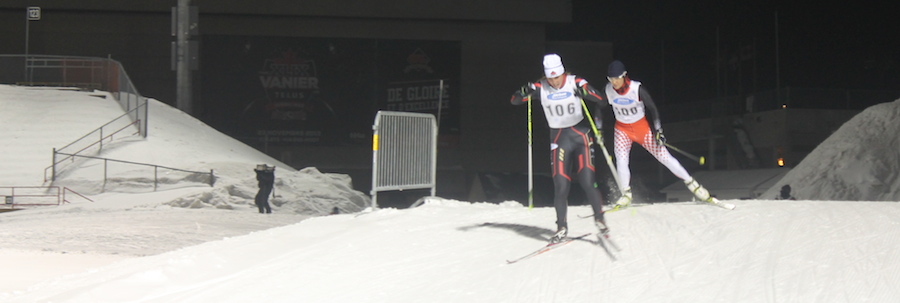
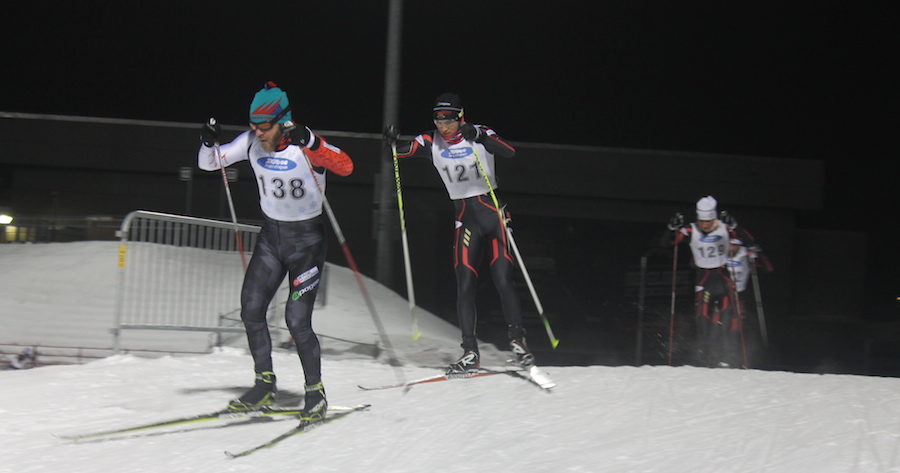
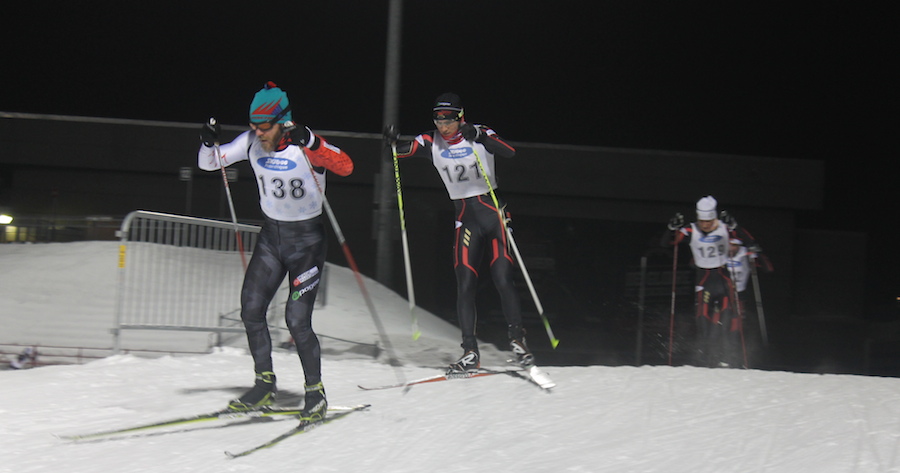
    Eirik Fosnaes (UNH) and Hugo Fontaine (LAV) round a corner in the men's 10k classic at Middlebury (photo: Silke Hynes)
    Eirik Fosnaes (UNH) and Hugo Fontaine (LAV) round a corner in the men’s 10k classic at Middlebury (photo: Silke Hynes)

    A familiar scene took place in the women’s race on Friday: three racers battling it out for the win, while others chased for fourth. Despite the individual-start format, it was once again the trio of Heather Mooney (Middlebury), Annika Taylor (UNH) and Corey Stock (Dartmouth) claiming the podium. The Panther cheering squads were out in force, and on her home course Mooney prevailed by 10 seconds over Taylor. Stock settled for third, another 23 seconds back.

    With the exception of occasional appearances by other strong racers, the top of the women’s field has been relatively consistent this season. Mooney, Taylor and Stock have finished on the podium in many of the past few races, with Mooney and Taylor taking the lion’s share of the wins.

    Mooney led the Panthers to a win in the team score, though the women of Bates College were the only team to put three racers in the top 10 en route to second place. Hallie Grossman, Sadie James and Tara Humphries finished in fifth, eighth and 10th place, respectively, helping the Bobcats edge the UVM women by one point.

    The men’s podium was a much closer affair, with the top three men separated by a mere eight seconds. Jorgen Grav of UVM took the top spot, with Dartmouth’s Silas Talbot taking second.

    Not far behind was Laval’s Frederic Touchette, who ended up less than three seconds behind Talbot. The first three men had a clear gap to fourth, as classic specialist Per Lindgren picked up his third top-10 of the season in 4th, 26 seconds back.

    Saturday: 5/10 k Freestyle

    Annika Taylor skates to a win in the Middlebury 5km freestyle (photo: Silke Hynes)
    Annika Taylor skates to a win in the Middlebury 5km freestyle (photo: Silke Hynes)

    While the thermometer may have read a little warmer than the low single-digits of Friday, a damp day and some wind made Saturday’s freestyle event feel quite frigid. Most racers, accustomed to such conditions after multiple weeks of battling the cold, were well-prepared with buffs, face-tape and overboots.

    Through the cold snow it was Annika Taylor of UNH who took the win for the women, swapping places with Friday’s classic champion Heather Mooney of host Middlebury. Mooney nearly earned a sweep of the weekend, finishing less than three seconds from the win.

    For the second day in a row Dartmouth racer Corey Stock took third, and the women’s podium players remained consistent for both days of competition.

    In the men’s race, Rogan Brown of UVM continued an impressive streak of freestyle performances with a win over Dartmouth’s Paddy Caldwell. Recently returned from strong results at the U23 World Championships in Almaty, Kazakhstan, Caldwell was unable to match Brown’s pace and settled for second place.

    Finishing on the podium for a second day in a row was Catamount Jorgen Grav who, along with Jack Hegman in fifth, gave UVM a decisive hold on the team score for the event. In fourth was Laval’s Frederic Touchette.

    The EISA will take a break this coming weekend. The EISA Regional Championships will be held February 27th and 28th in Lake Placid, New York. Saint Lawrence University will host the events on the 1980 Olympic trails of Mt. Van Hoevenberg, and will also play host to the 2015 NCAA Championships two weeks later.
    Results

  • Skiing in a Football Stadium: Laval’s Inaugural Sprint Draws Nearly 125 Racers

    Skiing in a Football Stadium: Laval’s Inaugural Sprint Draws Nearly 125 Racers

     Marc-André Bédard leads David Grégoire in the first-ever Sprint Rouge et Or on Jan. 28 at Laval University's football stadium. Grégoire went on to win the lap-by-lap elimination sprint, in which skiers rounded a 400-metre course designed by Pierre Harvey and tried to stay in the top six.
    Marc-André Bédard (l) leads David Grégoire (second from l) in the first-ever Sprint Rouge et Or on Jan. 28 at Laval University’s football stadium. Grégoire went on to win the lap-by-lap elimination sprint, in which skiers rounded a 400-metre course designed by Pierre Harvey and tried to stay in the top six.

    QUEBEC CITY — After the World Cup sprints took place in the historic part of the city last year, Quebec City recently saw another spectacle in cross-country skiing, with Laval University bringing the action even closer to the crowd. With the help of local Olympic skiing hero Pierre Harvey, organizers created Sprint Rouge et Or with a “last-to-go” formula, a new event on the athletics track at the Rouge et Or football stadium.

    This past Tuesday night, close to 125 athletes participated in the inaugural race on manmade snow at the Laval University campus. The cold temperature didn’t stop the enthusiasm of skiers from ages 7 to 54, and a couple of “retired” skiers even put their skis on.

    Harvey, the father of Quebec’s current nordic-skiing favorite Alex Harvey, designed he 400-metre track complete with several bumps — some as high as 10 meters — to challenge the skiers. On Tuesday, it was well-groomed with hard-packed snow.

    Compared to other urban sprints, the biggest difference and advantage was that spectators could visually follow racers from start to finish, seeing all of the action. The big screen at the opposite end of the field was great for zooming in on the expressions and emotions of skiers as they passed by the camera.

    With a friendly atmosphere, good vibes filled the stadium as well-known commentator Randy Ferguson gave the play-by-play. The evening started with a sprint prologue for all 11 categories. The beauty of the event was that anybody could enter it.

    “We had a great participation of skiers in the region but also outside,” event director Martin Guay said in a Rouge et Or press release, according to a translation. “The course was world-class through the snow HKD Turbo and the work of the groomer Printoh, Inc., not to mention the efforts of volunteers and field staff of the Department of Sports Laval University.”

    Camille Pepin leads Claude Godbout in the women's race at the inaugural Sprint Rouge et Or on Jan. 28 at Laval University's snow-covered athletics track in Quebec City. Godbout went on to win and Pepin placed second.
    Camille Pepin leads Claude Godbout (r) in the women’s race at the inaugural Sprint Rouge et Or on Jan. 28 at Laval University’s snow-covered athletics track in Quebec City. Godbout went on to win and Pepin placed second.

    Last-to-go

    The big show started at 21:00 [9 p.m.] with the last-to-go: eight laps for the women and 10 for the men. Racers had two laps to position themselves in the pack before elimination started, after which the last four skiers on each lap were pulled out. The idea was to have six or seven skiers remaining for the final lap.

    The women separated quickly after Canadian national-team biathlete Claude Godbout broke away at the beginning of the second lap. Only Camille Pepin of Laval could match her pace. There were a couple of good battles at the end of the pack to stay in the race. Godbout ended up winning, Laval’s Pepin and Myriam Paquette finished second and third, respectively.

    The men’s race was closer to the finish with a pack of 20 fighting sticking together. After 10 laps, Laval’s David Grégoire outsprinted biathlete Marc-André Bédard and Frédéric Touchette (Laval) to take the win. Bédard placed second and Touchette was third.

    Overall it was a great evening despite some delays; most everyone seemed to really enjoy the moment. After expecting a smaller turnout for its first event, organizers are planning future sprints there and hoping to one day fill the 15,000-capacity stadium.

    While the spectacle drew participants from various regions in Quebec, organizers are considering inviting athletes from other Canadian universities as well as the U.S. According to the release, the Rouge et Or team already participates annually in about half a dozen of NCAA races in the northeastern U.S.

    “We’re already thinking about next year!” Guay said.

    Results: Prologue | Final results

  • New Year’s Day Workout: Super Session with Laval University

    New Year’s Day Workout: Super Session with Laval University

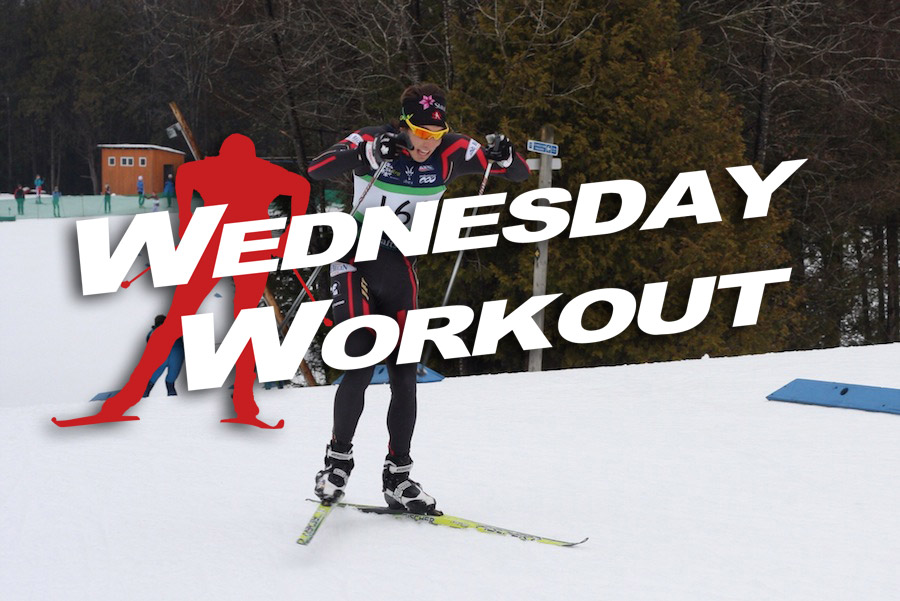
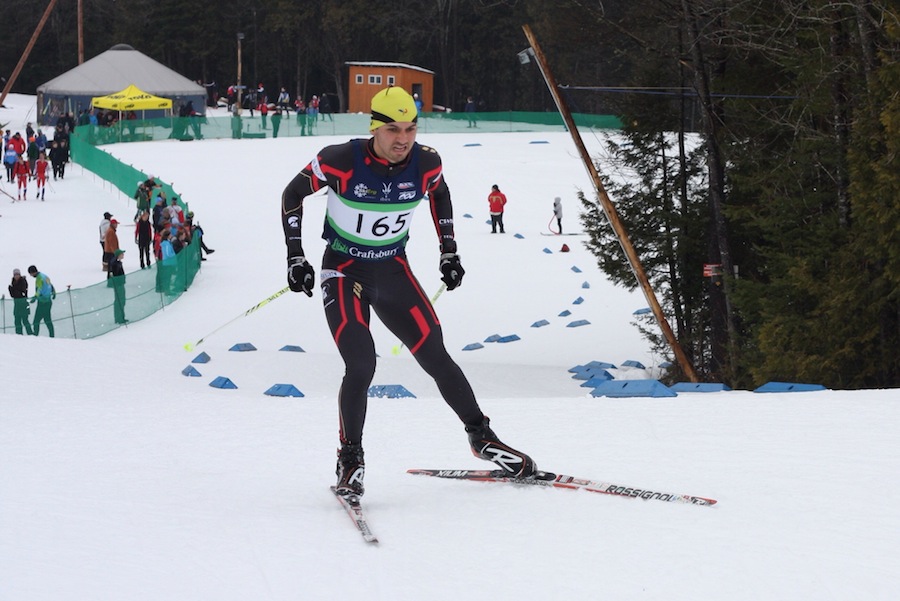
    Frédéric Touchette (Laval University) en route to second in the Eastern Cup skate sprint Dec. 21 in Craftsbury, Vt. (Photo: Rouge et Or)
    Frédéric Touchette (Laval University) en route to second in the Eastern Cup skate sprint Dec. 21 in Craftsbury, Vt. (Photo: Rouge et Or)

    Luc Germain, head coach of Rouge et Or cross-country ski team at Laval University in Québec City, agreed to share part of the training plan of his student-athletes during the holidays as they are getting ready for racing the EISA circuit in U.S. in the upcoming weeks.

    ***

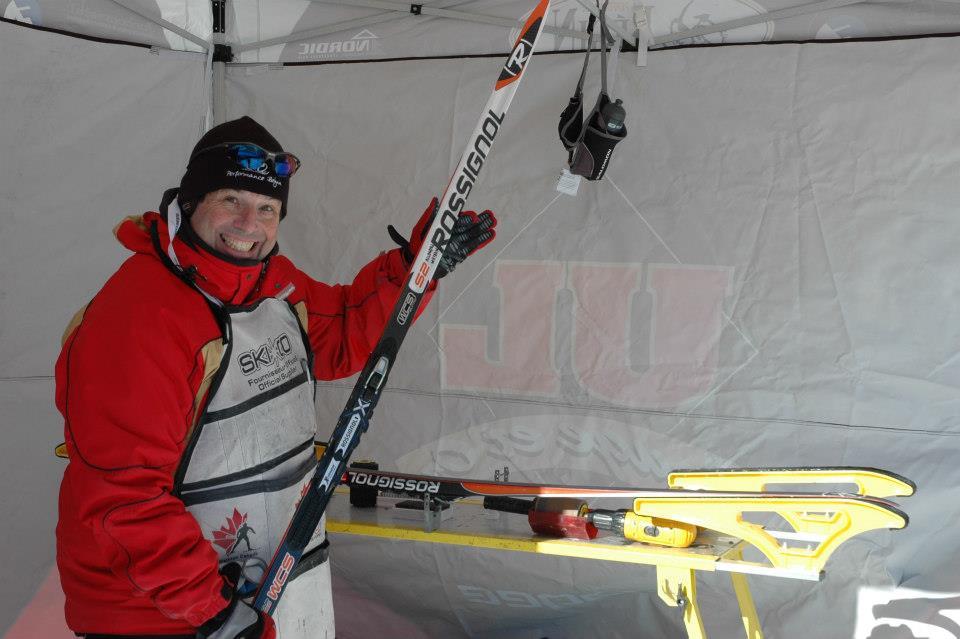
    Laval head coach Luc Germain prepping skis for athletes (Photo: Rouge et Or)
    Laval head coach Luc Germain prepping skis for athletes (Photo: Rouge et Or)

    “First of all, I wish Happy New Year to every skier!

    For the university athletes that I coach, the holidays give them the chance to take time off school to do more distance and intensities training. During the semester, it’s almost impossible for my athletes to do long hours with their busy schedule, like most people working during the week.

    The most important for us is to start with a couple of distance trainings before [revving] up the speed and do some intensities during the holidays in order to get the body in race shape.

    Here’s typical training session I give to my athletes to do between family reunions.

    I know that maybe on January 1st, some of my athletes will be tired after a good celebration of the New Year, so I suggest them to come back to the basics and concentrate on skiing well technically and do only the first part of this super session, but if they can handle more, then the whole workout will leave them tired and happy!

    Super Session

    • Warm-up: Starting by doing a good 30 minutes warm-up at a slow pace before starting your intensities.

    It’s also a good idea to include some drills to improve your technique and work on your weaknesses. Here are a couple of examples of what you can do; combine 1-2 of the drills below and adjust their length in function of the intensities that should remain your main focus.

    Since it’s during holidays, you probably have friends or family at home, why not take your time warming up and ski with them and give them a few tips!

    Find a challenging hill and try to stay in one-skate as long as you can while keeping your technique fairly good during the process.

    Do offset [V1] with only one pole, the one that is giving the power climb a hill (the higher pole)

    Do free skate during 10-15 minutes and make sure to use your legs efficiently and get your weight at the right place on the skis

    • Short Intensities: 

    Do two sets of five repetitions each x 1 min in Zone 4, recovery time should be the same as the intensities lengths (1 min). Between sets, take 5 minutes to rest and get ready for the next and final set. Your effort should be at approximately 90 to 100 percent of your maximum heart rate.

    These short intervals will have an effect on both, maximal aerobic power and anaerobic capacity, two important qualities in skiing, but are only slightly developed through continuous training. Beware, not to go at your maximum at each repetition, but to choose a degree of intensity that you will achieve the expected number of times without having to slow down.

    • Cool-down: Make sure to take 10-15 minutes to cool-down the body after the intensities.

    I think it’s a really good typical session for skiers whom will be starting their racing season mid-January. Finally, one last coach tip, don’t forget to take one day off per week, it’s as important as a training session, especially for the full time student and workers and even more during the busy holiday weeks.

    I hope you [make] good skiers’ resolutions for 2014 and take advantage of the most awesome winter sport. Have fun on skis!”

    David Grégoire (Laval University) racing the sprint in Craftsbury. (Photo: Rouge et Or)
    David Grégoire (Laval University) racing to 15th in the Eastern Cup skate sprint Dec. 21 in Craftsbury. (Photo: Rouge et Or)
  • Notes and Quotes: Canadian Edition from Day 1 in Canmore

    Notes and Quotes: Canadian Edition from Day 1 in Canmore

    Coverage of the Alberta World Cup made possible through the generous support of Travel Alberta and Tourism Canmore.

    Alberta World Cup Academy/Canadian Senior Development Team members Kevin Sandau (r) and Graeme Killick (c) and Erik Bjornsen (U.S. Ski Team) charge up a climb about halfway through the Alberta World Cup men’s 15 k classic mass start on Thursday.

    CANMORE, Alberta – Twenty-nine Canadians, count them, put their bodies to the test Thursday in the first of three races at the Alberta World Cup. On tap was the 10- and 15-kilometer classic mass starts – not the easiest format to start with, especially not on Canmore’s challenging mini loops.

    The women worked their way around the stadium three times and the men did four loops, and by the end, some slurred their speech, others didn’t want to rehash the suffer-fest, and guys like Devon Kershaw had a hard time seeing.

    But the course was the same for everybody, and just think of how some of those nation’s group skiers felt. Even though several of the Canadians hail from Canmore, it didn’t make it much easier out there, certainly not for some in their first World Cup races (or first in a few years).

    “Rough day to have a rough day,” said 21-year-old Patrick Stewart-Jones of the Alberta World Cup Academy (AWCA), which is located on-site at the Canmore Nordic Centre, after finishing 58th in his first World Cup.

    “There is no forgiveness in the World Cup,” he added. “I felt decent at the start, but after that, the wheels came off a little. I can’t be too disappointed, I just did a World Cup and I finished, and it was a beautiful day.”

    His teammate, Graeme Killick, who is on Canada’s Senior Development Team (NST) as well, had done two World Cups in Otepää, Estonia, two seasons ago. Those didn’t really count, he said, after placing 40th on Thursday.

    “I look on this as kind of my debut,” Killick said. “I’ve only done one World Cup, it was before U23s in Estonia, it wasn’t the greatest for me. … [Today was a] good experience, for sure. Couple things I might improve on. All in all, it was good.”

    Something out of his control was breaking a pole on the first lap. After the finish, he still had one labeled “Newell.”

    “Someone’s leg went through [my pole at] the bottom on the first lap,” Killick explained. “Luckily I got a pole pretty quick.”

    Anne-Marie Comeau (Pierre-Harvey National Training Centre) en route to placing 46th in her first World Cup on Thursday in Canmore, Alberta. The 16-year-old was the second top Canadian female in the 10 k classic mass start.

    The youngest of the Canadian bunch, Anne-Marie Comeau of the Pierre-Harvey National Training Centre (CNEPH) had one of the best results in 46th. She was just over a minute behind the top Canadian female, Brittany Webster (Highlands Trailblazers) in 38th, and Comeau’s only 16. (She turns 17 on Jan. 6).

    “It is hard, but I like the trails here,” Comeau said. “It is bonne [French for ‘good’] to race against the best in the … countries.”

    As for the 15 k skiathlon she plans to start Sunday: “I don’t expect anything,” Comeau said. “I just want to have fun and no stress.”

    Far more experienced as a former Canadian National Team member, Webster, 25, said she felt the same.

    “It’s great to be able to get this one out of the way,” Webster said in her first World Cup since racing in Canmore in February 2010. Back then, she placed 57th in a 10 k skate race.

    “What I really like about this, too, is they made all [the distance races] mass start,” Webster added. “I think for Canadians and the U.S. Ski Team, it’s really good for us to have that opportunity because if you’re doing an individual start, you don’t get to see the pace as much. You’re kind of skiing your own race more so. It’s great to be able to ski with a whole crowd of girls and sort of see where they’re at, see how they climb the hills and see how they double pole and everything like that. It helps you race faster.”

    Emily Nishikawa (AWCA/NST), who was 48th, said the spectators also helped.

    “It was a great experience, really cool to have so many fans out here,” she said. “It was just so loud with all the crowd cheering.  It was really cool to race on our home turf.  I was really happy about that.”

    In terms of racing, she’s hoping for a better result in Saturday’s skate sprint or Sunday’s skiathlon.

    “I started a little bit fast … but my body was a little tired today and I lost a little on the last two laps,” Nishikawa said.

    Another AWCA and Senior Development skier, Kevin Sandau placed 39th and said he was happy with how his body felt considering.

    “I was able to really push over the hills so that was good for me,” he said. “I was hoping to be a bit closer to the leaders. Kind of midway through the race, I made a few bad tactical choices just with lane choices on the hills, so learn from that for the 30k. … If I can build on today, that should be a better day.”

    Eighteen-year-old Frédérique Vézina (CNEPH) simply followed the lead of others in her first World Cup, putting her 51st.

    “It was pretty tough, but really nice to see how fast those girls go,” she said. “The fastest in the world are here, it was nice to complete against them. … It was just a good experience.”

    One spot behind her, 19-year-old Julia Ransom of the Biathlon Alberta Training Centre in Canmore was somewhat surprised with placing 52nd.

    “I think it was a little better than I was expecting actually. I am happy with how I placed, in terms of Canadians,” she said. “I was so excited just to race. Getting onto the top uphill I just realized how much fun skiing is, how much fun racing is.  I went in with no expectations and just went out and had fun.”

    Back in the game, Frédéric Touchette (CNEPH/NST) placed 54th in his first World Cup since 2009 in Vancouver, British Columbia (where he was 21st in a 30 k pursuit and 33rd in a classic sprint).

    “I haven’t raced much in the last two years because I was injured,” he said. “I am kind of getting back in the racing mode. I am not in as good shape as three years ago, but it is getting back. It is fun.”

    — Gerry Furseth contributed reporting

    Canadian women’s results | Canadian men’s results


  • Goldsack Leads Canadian Sweep in Season-Opening NorAm Sprint

    Drew Goldsack of the Canadian National B-Team continued his winning ways in the first NorAm competition of the 2011 season, besting National Team teammate Frederic Touchette in the final of the classic sprint in Vernon, British Columbia on Saturday.

    Goldsack won both SuperTour sprints over Thanksgiving in West Yellowstone. Those races were qualifier-only, but Goldsack had no problem with the heats today, leading a Canadian sweep of the podium.

    Graham Nishikawa finished third, just ahead of the only American in the A-Final, Mike Sinnott (SVSEF).

    48 men started the race meaning that over half the field advanced to the heats.

    Goldsack posted the fastest qualifying time, less than a second ahead of Nishikawa, before winning each of his heats on the way to victory.

    “I was mostly trying to stay out of trouble,” Goldsack said of his heat strategy. “There are some pretty tight corners, and I wanted to stay out of harms way.”

    He was pushed some on the early climbs, but was able to move into the driver’s seat every round.

    Goldsack described the course, new this year, as “pretty tough,” noting that the combination of three solid, if not huge, climbs, combined with the three-and-a-half minute length made for a challenging loop.

    In the finals, he made sure to enter the last big sweeping corner in front, and proceeded to ski away in the final flat.

    “I was feeling really strong double poling today,” said Goldsack, “so I was confident coming into the finishing stretch that I would be able to hold everyone off.”

    Despite temperatures well below freezing, the skiing was not as straightforward as may have been expected.

    According to Goldsack, the tracks were somewhat powdery and the snow a bit “strange.”

    “You had to ski with a little soft striding to make sure your were getting grip,” he explained.

    The event marked the first North American Continental Cup with sprint heats of the season.

    “It is definitely nice to do some heats and get that experience under my belt this year,” Goldsack said.

    He also pointed out, with a laugh, that it took a day of sprint heats to make him realize how easy qualifier-only days are.

    With just four skiers in the top-14, the Americans took a solid beating from their hosts. Lars Flora (APUNSC) won the B-Final to finish 7th on the day, ahead of CXC’s Bryan Cook, and APUNSC teammate Reese Hanneman.

    “Any day we get good competition from the Americans, it is nice to come out on top,” said Goldsack. But he did not put too much stake on the early season results, pointing out that everyone is on a different training plan, and working toward different goals.

    NorAm racing continues on Sunday with a 10/15km individual start freestyle.

    All the top racers in the sprint are expected to start, along with James Southam (APUNSC) and Leif Zimmermann (BSF/Madshus).

    Men’s 1.4km Classic NorAm Sprint – Complete Results

  • Gaiazova Wins Classic Race in Rovaniemi, Touchette 12th

    Gaiazova Wins Classic Race in Rovaniemi, Touchette 12th

    Dasha Gaiazova (CAN) competing in yesterday's classic sprint.

    Canada’s Dasha Gaiazova continued her strong skiing in Rovaniemi, Finland today, winning the women’s 5 k classic by 8 seconds over Victoria Melina of Russia. Gaiazova finished second in the classic sprint yesterday, and appears to be in good form heading into the World Cup mini-tour in Kuusamo next weekend.

    In the men’s 10 k, Frederic Touchette led Canada and the rest of North America with a twelfth-place finish. He was 45 seconds behind Vasili Rotchev of Russia, who eked out a 0.4-second win over countryman Sergey Shiriaev.

    Gaiazova’s win was commanding – as teammate Chandra Crawford pointed out yesterday, there were no World Cup skiers in the field, but the next three spots went to Russians, who have one of the deepest domestic fields in the world. Crawford, who won yesterday’s sprint, finished fifth, 33 seconds behind Gaiazova.

    American Hannah Dreissigacker (Craftsbury Green Racing Project) also repeated her success from yesterday. After finishing 8th in the sprint, she moved up one spot to 7th in the distance race, finishing 42 seconds behind Gaiazova and only nine behind Crawford. With those two women headed to the World Cup next weekend, Dreissigacker has clearly proved that she has the speed to be competitive at the international level, at least in Continental Cups. Her teammates Chelsea Little and Lauren Jacobs finished 36th and 37th, and Audrey Weber of Go! Training placed 41st.

    For Touchette, leading his teammates was particularly important considering that these races are trials to determine which Canadian men get to start the Kuusamo mini-tour. Stefan Kuhn followed in 24th place, 27 seconds behind Touchette. Lenny Valjas, who turns 22 today, and Phil Widmer rounded out the Canadian roster in 40th and 46th places.

    The next North American was Tim Reynolds (Craftsbury Green Racing Project) in 38th place. He was followed by Pat O’Brien and Dylan McGuffin in 57th, and Ollie Burruss in 91st place. Teammate Matt Briggs had a tough day, crashing hard in his warm-up, and didn’t make it to the start.

    It was a tough day for the Bridger Ski Foundation, with Leif Zimmerman and Glenn Randall finishing 72nd and 82nd. Both athletes had strong skate races in Muonio, but told FasterSkier earlier this week that they weren’t hoping to ski their absolute best at these races, and were instead focusing on training and preparing for more important races later in the season.

    Fred Bailey led the Maine Winter Sports Center with an 85th-place finish. He was followed by Sam Tarling in 93rd and Mike Lessard in 95th. Nick Michaud chose to race in the under-20 race, where he finished 23rd, 3 minutes and 36 seconds behind winner Niko Ruuskanen of Finland.

    Almost all of the North American teams will be leaving Rovaniemi tomorrow or the next day. While the Canadians are headed to Kuusamo, the Craftsbury Green Racing Project and most of the NCCSEF-funded Maine Winter Sports Center trip will return to the United States. Torin Koos of the Methow Olympic Development Project, who sat out today’s race, will travel to Norway for two more weeks of racing.

    Vasili Rotchev took the win in Rovaniemi today.
    Sergey Shiriaev (RUS) leads Ville Nousiainen (FIN).
    Frederic Touchette led the Canadian team.
  • Canucks Kick Off in Bruksvallarna

    Devon Kershaw will start his 2011 campaign on Saturday in Bruksvallarna, Sweden.

    While the Americans started their European campaign Friday with much fanfare in Muonio, Finland, news from the Canadian National Ski Team (CNST) has been more sparse this past week. Nonetheless, the Canucks will kick off their own competition season on Saturday and Sunday with two races in Bruksvallarna, Sweden—albeit a little more quietly.

    Most of the athletes on the team’s World Cup squad, along with a few up-and-comers, are scheduled to start Saturday’s sprint and Sunday’s 15 k, both freestyle races. Nearly 400 others will be in attendance, including members of the Swedish, French, Polish, and Japanese national teams.

    “Nobody got sick (yet), and people seem to have handled the travel well,” Devon Kershaw wrote in an e-mail to FasterSkier on Thursday. “Everyone on our national team seems to have had a great year of training, and everyone is fired up.”

    The Canadians flew across the pond on Sunday night, then spent their first two days in Sweden living trailside and training in Ostersund, the country’s winter sports capital.

    All of the members of the Canadian A-team are present save George Grey and Ivan Babikov, who will parachute into Sweden next week in time for the first World Cup in Gallivare.

    According to Kershaw, Ostersund had stored enough snow (“a whack load”) to cover six kilometers of trails, and the coverage combined with temperatures in the mid-teens made conditions “pretty sweet for training.”

    On Thursday, the team departed for Bruksvallarna, a resort town near the Norwegian border, roughly 100 miles southwest of Ostersund.

    That’s where the Canadians will suit up nine athletes for the sprint race on Saturday: Kershaw, Alex Harvey, Stefan Kuhn, Phil Widmer, Brent McMurtry, Len Valjas, Frederic Touchette, Dasha Gaiazova, and Chandra Crawford. All but Crawford will get a second start in the distance race on Sunday.

    The fields are competitive, though perhaps not quite as deep as the other season openers in Muonio and Beitostolen, Norway. Saturday’s sprint features Swedish stars of both genders: Hanna Falk, Charlotte Kalla, and Anna Haag on the women’s side, while men will face Emil Jonsson and Bjoern Lind. On Sunday, Sweden’s double Olympic gold medalist Marcus Hellner will be in the mix, as well.

    Kershaw won the season-opening distance race in Bruksvallarna last November, but he said that his current fitness isn’t quite at the same level that it was this time last year—and it doesn’t need to be.

    “Like always, I am training pretty hard (four hours a day), to get a volume block in prior to [the World Cup mini-tour in] Kuusamo and beyond…so Bruksvallarna and Gallivare could be a bit iffy,” he said. “We won’t all be racing ridiculously fast out of the gun, or we won’t all have boss seasons—that’s for sure…Patience is the key, though. Regardless what happens the next few weeks, it’s early November. I think I speak for most on our team to say that we want to be ready in February, so there’s still plenty of work to do!”