Tag: Frederico Pellegrino

  • Bright Lights for Pellegrino, Sprints to Victory in Tour de Ski Stage 1

    Bright Lights for Pellegrino, Sprints to Victory in Tour de Ski Stage 1

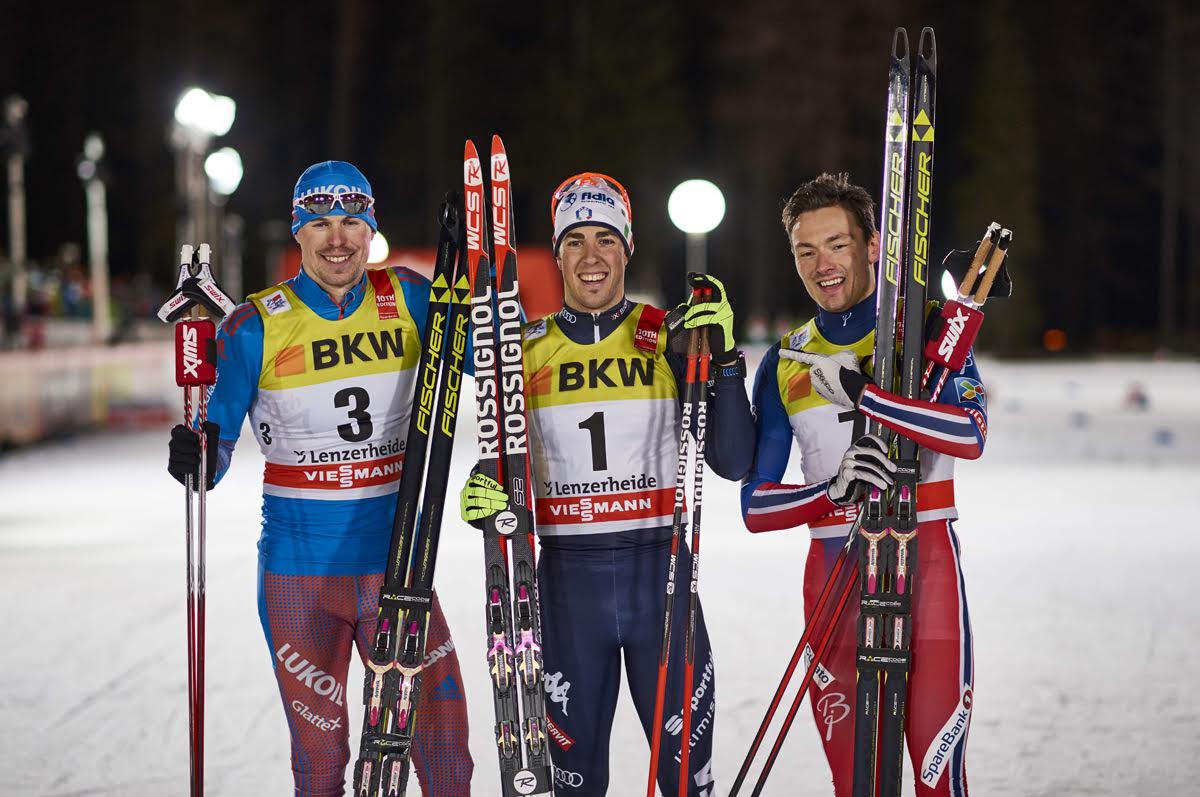
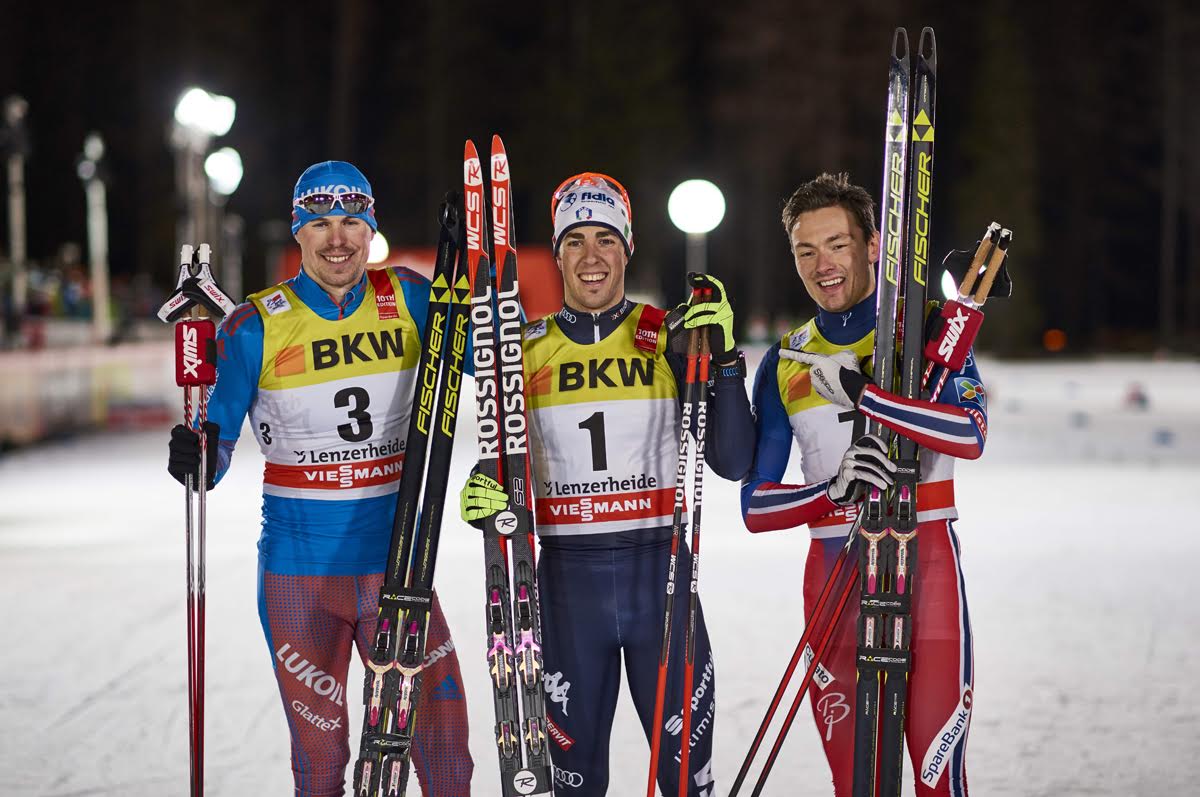
    With his third-consecutive World Cup win, Federico Pellegrino (c) became Italy's most successful sprinter of all time on Friday. He won the 1.5 k freestyle sprint, the first stage of the 2016 Tour de Ski, ahead of Russian runner-up Sergey Ustiugov (l) and Norway's Finn Hågen Krogh (r) in Lenzerheide, Switzerland. (Photo: Fischer/NordicFocus)
    With his third-consecutive World Cup win, Federico Pellegrino (c) became Italy’s most successful sprinter of all time on Friday. He won the 1.5 k freestyle sprint, the first stage of the 2016 Tour de Ski, ahead of Russian runner-up Sergey Ustiugov (l) and Norway’s Finn Hågen Krogh (r) in Lenzerheide, Switzerland. (Photo: Fischer/NordicFocus)

    It’s a new year, yet some things remain the same. Jan. 1 marked the opening stage of the 2016 Tour de Ski, a 1.5-kilometer freestyle sprint in Lenzerheide, Switzerland. It also marked the third World Cup sprint victory in a row for Italy’s Federico Pellegrino.

    The 25-year-old Pellegrino dominated the day. He qualified first with a time of 2:45.92. Across the official results sheet, a pattern of 1’s next to Pellegrino’s name tells the story; the only aberration on his way to the win, a second place in his semifinal by a margin of 0.11 seconds.

    Under a nighttime sky illuminated by what looked like modernist street lamps, Pellegrino won the final in 2:43.14. He out sprinted Russian Sergey Ustiugov who placed second (+0.40). Norway’s Finn Hågen Krogh skied to third (+1.25).  

    Not considered a sprint specialist, but certainly considered the favorite for this year’s 10th edition of the Tour de Ski, Norwegian Martin Johnsrud Sundby placed fourth (+10.09). In fifth was Sweden’s Emil Jönsson (+12.270, followed by Swiss veteran and three-time Tour de Ski champion, Dario Cologna in sixth (+59.01).
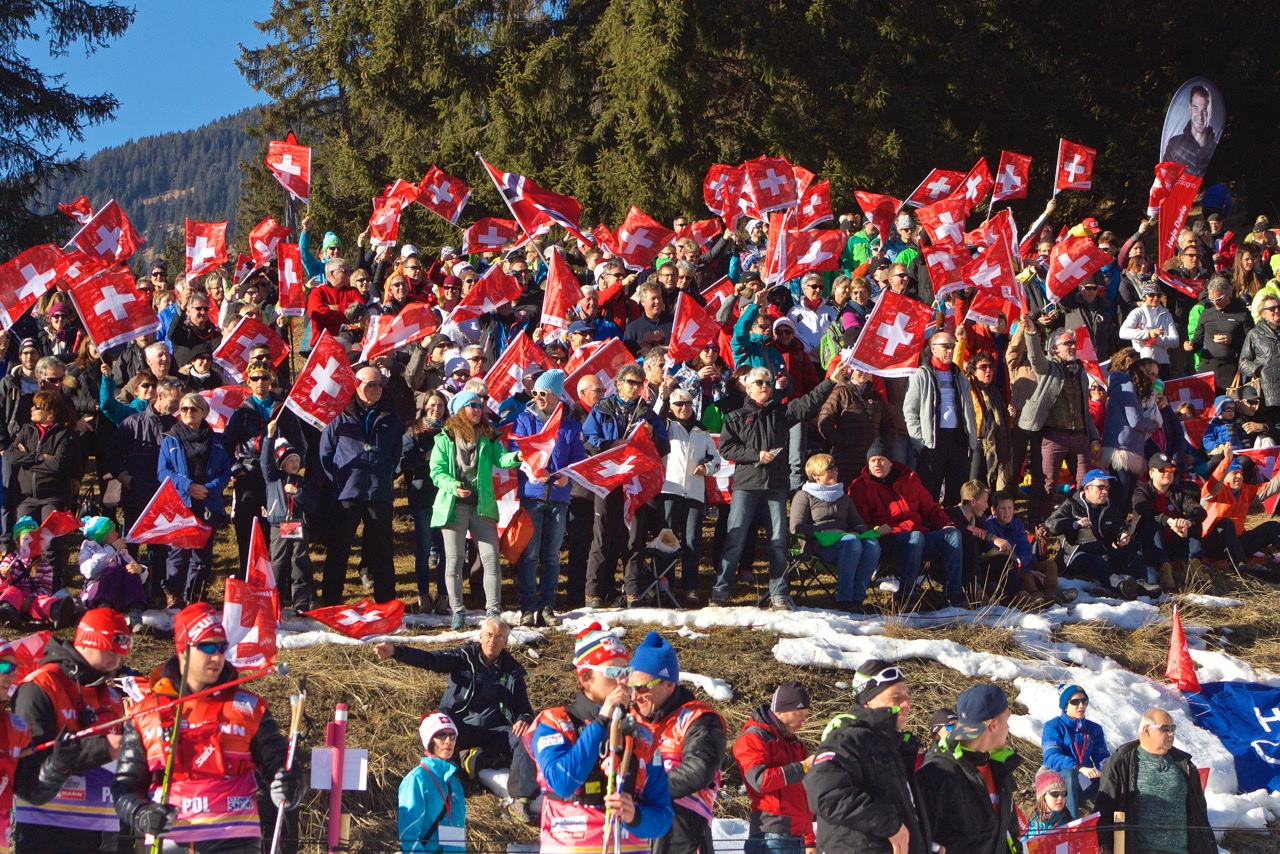
    Swiss fans were out in force in Lenzerheide, cheering raucously for their own team. Laurien Van Der Graaf had the best Swiss finish in the women's race, placing eleventh. (Photo: JoJo Baldus)
    Swiss fans were out in force in Lenzerheide, Switzerland, cheering raucously for their homegrown athletes, especially three-time Tour de Ski champion Dario Cologna, who made the final and placed sixth after falling. (Photo: JoJo Baldus)

    Cologna is a good place to start this sprint final’s tale. It was a partisan crowd. And when Cologna’s name was announced as he stepped forward in his lane, the crowd became electric — it was a sea of waving red and white Swiss flags.

    From the gun, Ustiugov led out with a scrum of V2ing skiers trailing close behind. After a series of short roll-overs, Cologna slotted into second and eventually dropped into third.

    Just over a minute into the race, when it was clear Ustiugov was making a powerful move on the flats, Cologna became tangled with himself, and fell. That left only five skiers, with a clear separation of Ustiugov, Krogh and Pellegrino developing with Sundby dangling off the back.

    Then, just over two minutes in, it was a three-person race with Pellegrino taking the lead, accelerating around a turn with what appeared to be the slickest skis in the field. He crossed the line with a cursory foot outstretched, as if the results were in question.
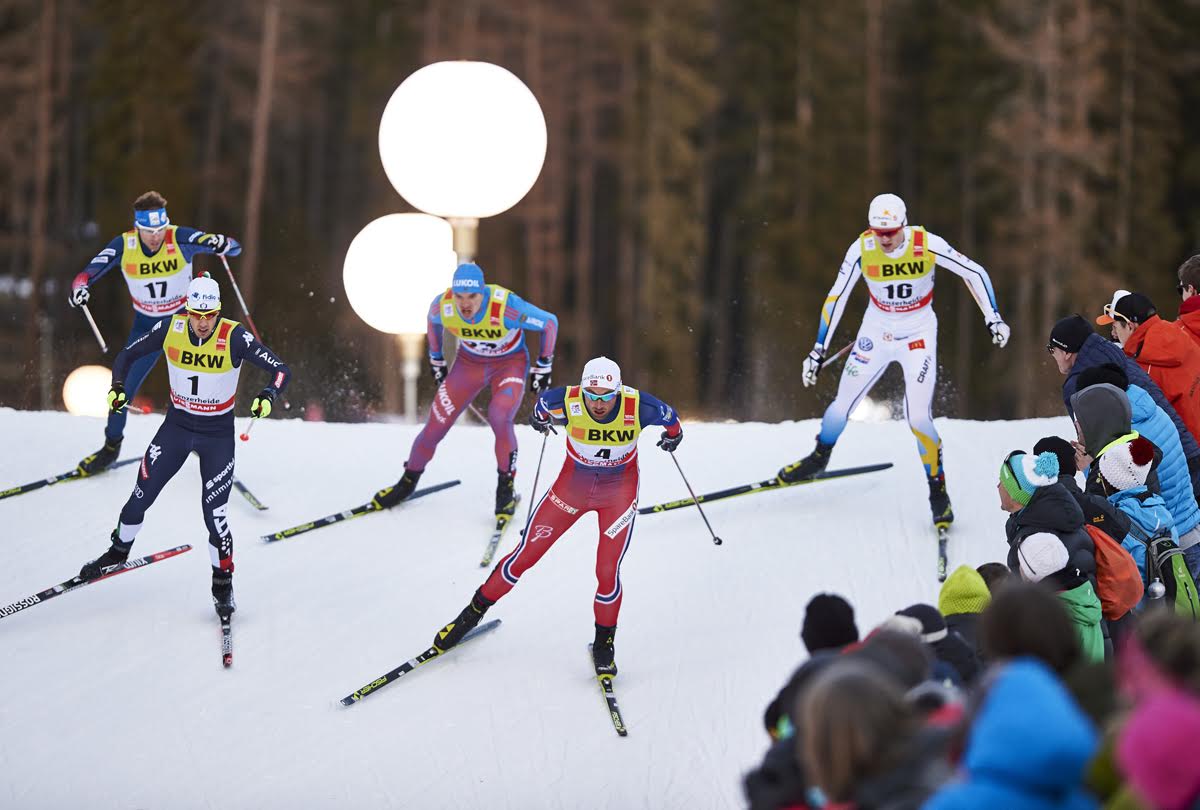
    The second men's quarterfinal, with Italy's Federico Pellegrino (1) and Norway's Petter Northug (4) leading, followed by American Andy Newell (17), Russia's Andrey Larkov (c) and Sweden's Oskar Svensson (r) at the Tour de Ski freestyle sprint in Lenzerheide, Switzerland. (Photo: Fischer/NordicFocus)
    The second men’s quarterfinal, with Italy’s Federico Pellegrino (1) and Norway’s Petter Northug (4) leading, followed by American Andy Newell (17), Russia’s Andrey Larkov (c) and Sweden’s Oskar Svensson (r) at the Tour de Ski freestyle sprint in Lenzerheide, Switzerland. (Photo: Fischer/NordicFocus)

    The only blip in Pellegrino’s day — second place in his semifinal — proved a valuable learning opportunity. In the post-race press conference, he admitted his tactics would need to change after his semifinal.

    “I learned how to play in the final, so I didn’t make the same mistake,” he said. “I knew that if I arrived in the final 100 meters in the front of the race, I should win. It’s what I made, and so I happy for having do it.”

    As a sprint aficionado, and now the winningest Italian World Cup sprinter, with six wins total, (Italian Cristian Zorzi won five World Cup sprints), Pellegrino is still undecided about finishing out the Tour.

    “Tomorrow, we have a 30 k. I just have to pay attention to not make a big bonk, and save some energies for [the classic sprint in] Oberstdorf, but I want to be good,” he said. “Maybe in the last five kilometers, I will push as hard as I can, but before, I have to be patient, and quiet and wait. Then we are 10 k in skate, I want to have good sensations in this distance. Then in Oberstdorf, we will have a classic race.  We have, I think, two very hard uphills, and in classic, this is my bread.  I want to be good there, too.”
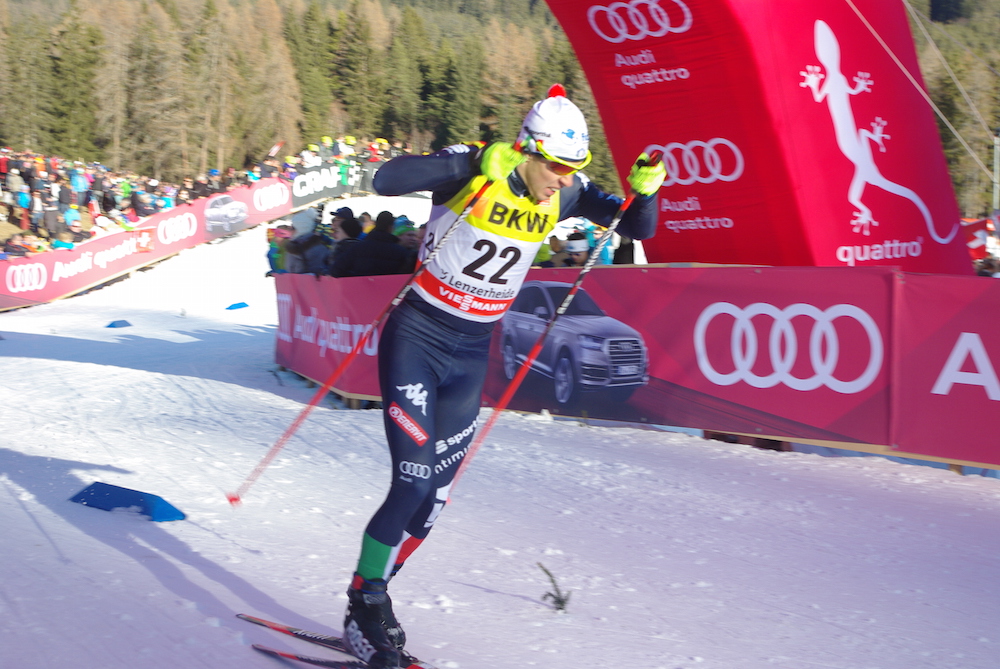
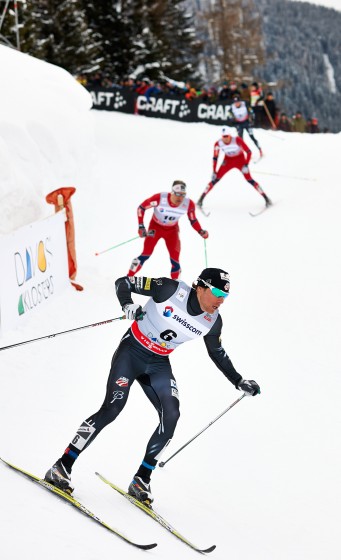
    Italy's Federico Pellegrino racing to first in the freestyle sprint qualifier at the first stage of the 2016 Tour de Ski in Lenzerheide, Switzerland. He went on to win the final for his third consecutive World Cup sprint victory.
    Italy’s Federico Pellegrino racing to first in the freestyle sprint qualifier at the first stage of the 2016 Tour de Ski in Lenzerheide, Switzerland. He went on to win the final for his third consecutive World Cup sprint victory.

    He’s now shooting for an unprecedented four-consecutive World Cup freestyle sprint victories. With another World Cup win, he’ll become Italy’s winning-most World Cup skier.

    “I don’t know if I will finish the Tour de Ski, because then we have [the World Cup weekend in] Planica [Slovenia], and I want to make history and win the fourth sprint skate in a row. I am undecided on my goals,” he said.

    Ustiugov avenged his lack of prime results this season with his first podium of the year. Through a translator at the press conference, he showed respect for Pellegrino.

    “I tried everything in the final, but Frederico was actually faster than me in the end. Next time, I will try again,” Ustiugov said.

    Krogh in third seemed content after the race, nodding to the first- and second-place finishers as simply better on this day.

    “The two guys who are one-two today are faster than me, nothing to do about that, so I am very happy with third place,” Krogh said.

    As for the Swiss favorite, Cologna, even he surpassed his sprinting expectations — his goal was to make the semis. “Of course I would have liked to get on the podium, but I’m more than satisfied,” Cologna told Swiss TV broadcaster SRF 2. “The semifinal was the goal in order to get a few bonus seconds. Now I could show a good race in the final, prove that I’m in shape. That was a good start to the Tour.”

    As a potent threat to Sundby’s overall Tour aspirations, Cologna has set himself up well for Saturday’s 30 k classic mass start, but he has no illusions about overturning the Distance World Cup hierarchy, which Sundby reigns.

    “I think it will be a very hard race. The loop has a lot of vertical meters, eight times,” Cologna said. “Sundby will create a lot of pressure early on, and I don’t think it will end with a mass sprint. So you have to save strength whenever possible on the loop, always run a smart race, and hopefully stay in contact with the top until the final.”

    The overall Tour standings reveal a tight grouping after the first stage — Pellegrino in first, Ustiugov in second (+6.6), and Krogh in third (+11.6).

    But heading into the first distance race, some notable names fared well after a day of freestyle sprints. Sundby is placed fourth, 15.3 seconds out of first, followed by Jönsson, (+20.5), while just over a second back lurks Cologna, with Norway’s Petter Northug Jr., in seventh, 23.1 seconds out. (Note: Saturday’s race is a mass start, but overall time back is cumulative throughout the Tour.)
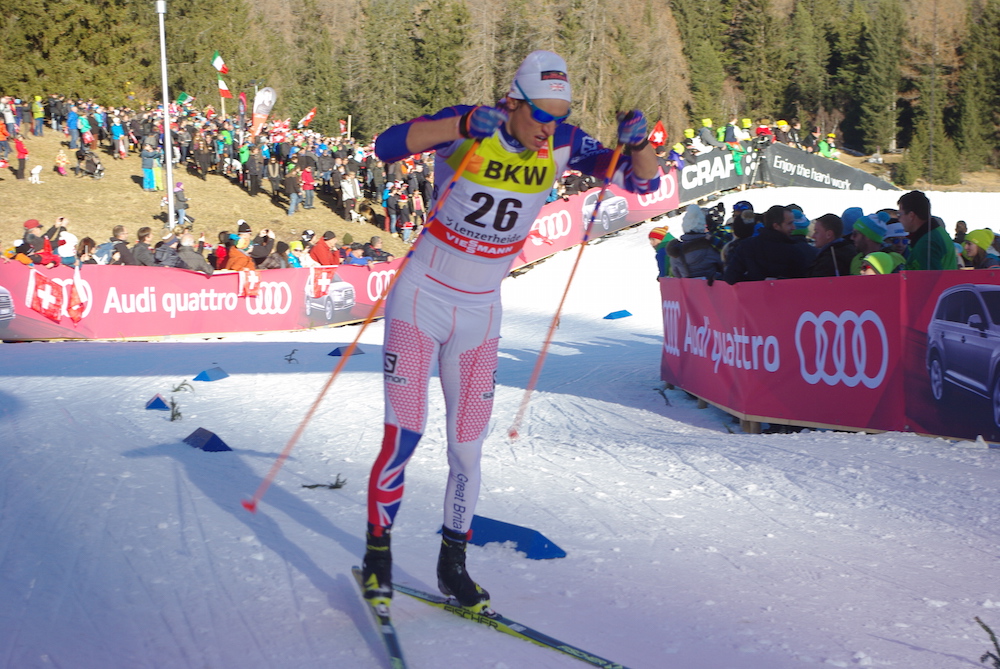
    Andrew Young of Great Britain qualified second in the first stage of the 2016 Tour de Ski on Friday in Lenzerheide, Switzerland. He went on to place 30th overall after colliding with an inflatable archway in his quarterfinal.
    Andrew Young of Great Britain qualified second in the first stage of the 2016 Tour de Ski on Friday in Lenzerheide, Switzerland. He went on to place 30th overall after colliding with an inflatable archway in his quarterfinal.

    For the British, a potential storyline piggy backing on Andrew Young’s third-place sprint podium in Toblach, was derailed in the fifth quarterfinal. Young began race day with a qualifier to be proud of: he qualified second overall, two seconds behind the day’s winner, Pellegrino.

    Skiing close to the front, and with no sign of fatigue, approximately 38 seconds into the fifth quarterfinal and moments after skiing under an inflated Audi archway, Young fell to ground — he had been skiing inches from the barrier when he tumbled.

    After the race, Young and his coach/father, Roy Young, reviewed the heat’s video with the race jury. Afterwards, the jury ruled in Young’s favor that a course obstacle did impede the skier.

    In an email, Roy Young said the TV review showed “a rope dangling from Audi arch caught his arm. This spun him under the advert at side of track where he got stuck.  Effectively out of the race bye time he was freed & with bruised arm he decided to stop & tell officials what had happened. For stopping I think they have ranked him 30th rather than last in his quarter. (About to check the rules, but it all seems unfair. ) But we go on and get ready for tomorrow  – better go and win then. :)”

    The Tour de Ski continues Saturday with 15/30 k classic mass starts.

    Sprint results | Tour overall standings | Tour sprint standings

  • Brandsdal Rolls to Drammen Classic-Sprint Win, But Krogh Takes Overall Sprint Globe

    Brandsdal Rolls to Drammen Classic-Sprint Win, But Krogh Takes Overall Sprint Globe

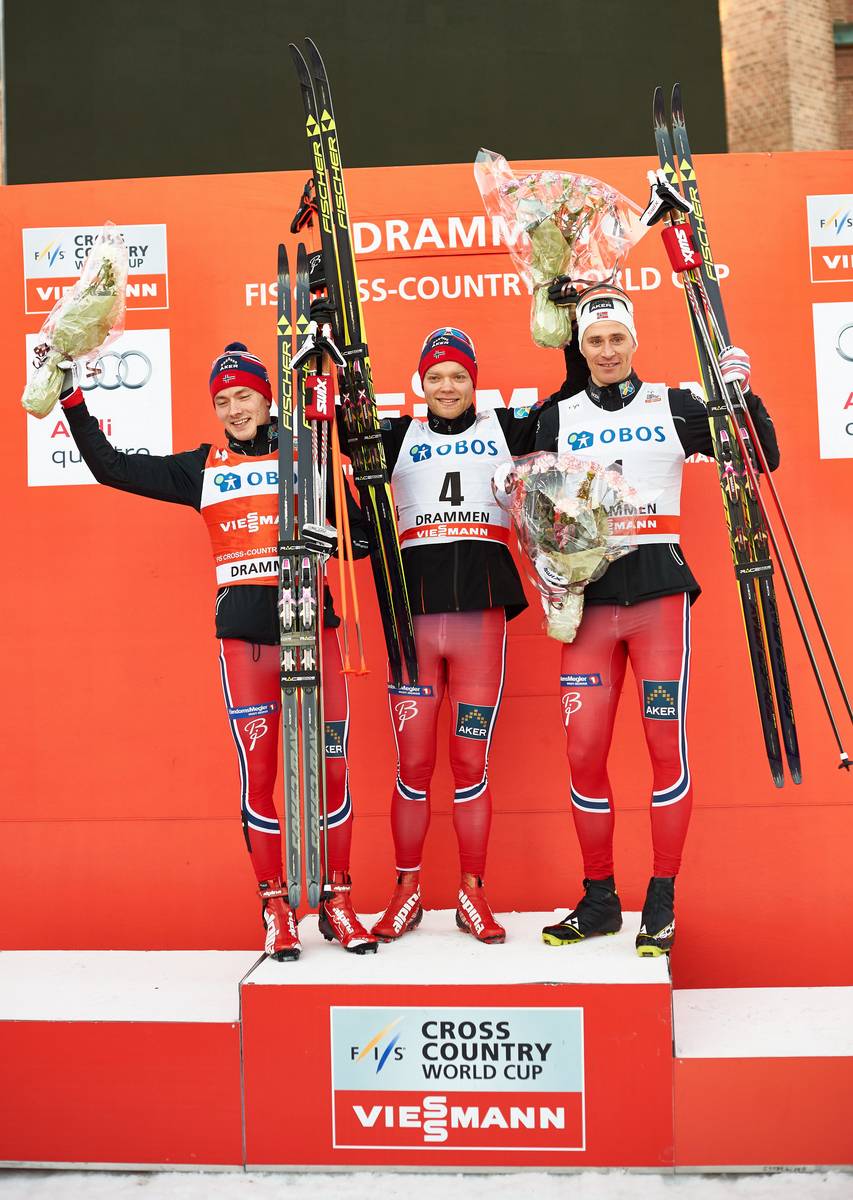
    The all-Norwegian men's classic sprint podium in the last World Cup sprint of the season on Wednesday in Drammen, Norway: (from left to right) runner-up Finn Hågen Krogh, winner Eirik Brandsdal, and Ola Vigen Hattestad in third.  (Photo: Fischer/NordicFocus)
    The all-Norwegian men’s classic sprint podium in the last World Cup sprint of the season on Wednesday in Drammen, Norway: (from left to right) runner-up Finn Hågen Krogh, winner Eirik Brandsdal, and Ola Vigen Hattestad in third.
    (Photo: Fischer/NordicFocus)

    Wednesday’s 1.3-kilometer classic sprint in Drammen, Norway, was essentially two races in one: the race for the win and the race for the overall Sprint World Cup.

    Drammen marked the final World Cup sprint this season. Going into the race, Norway’s Finn Hågen Krogh led the Sprint World Cup with 399 points, 33 points ahead of Italy’s Federico Pellegrino and 57 points ahead of fellow Norwegian Eirik Brandsdal.

    All three men were still mathematically eligible to win the overall title. Brandsdal won last weekend’s freestyle sprint in Lahti and neither Krogh nor Pellegrino had ever qualified for the final in Drammen. Pellegrino had only qualified for one World Cup classic-sprint final in his career.

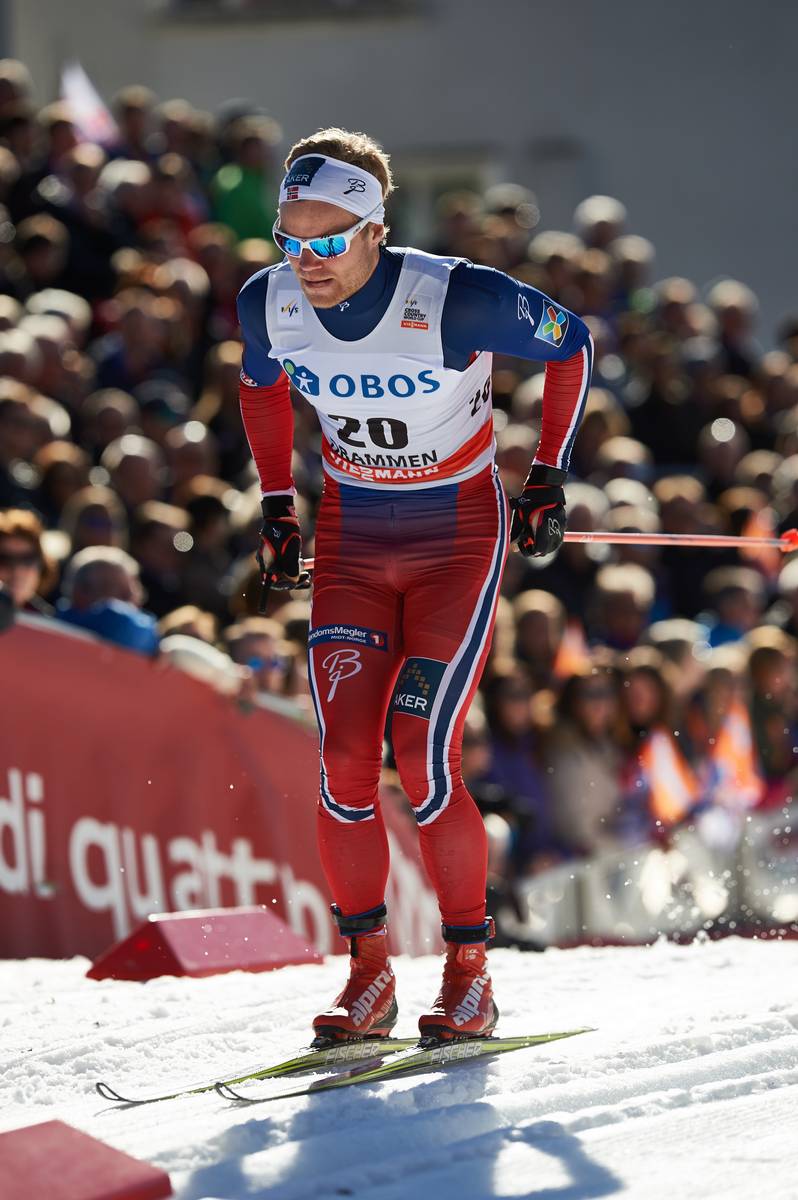
    Eirik Brandsdal racing to the victory in the men's 1.3 k classic sprint in Drammen, Norway. While he won the race, he took second overall in the Sprint World Cup to teammate  Finn Hågen Krogh. (Photo: Fischer/NordicFocus)
    Eirik Brandsdal racing to the victory in the men’s 1.3 k classic sprint in Drammen, Norway. While he won the race, he took second overall in the Sprint World Cup to teammate Finn Hågen Krogh. (Photo: Fischer/NordicFocus)

    Over the course of the qualification round, the snow at Drammen turned very soft with temperatures around 50 degrees Fahrenheit. Earlier in the morning, organizers hauled in two truckloads of snow to slow the rate of thawing on the course. Several skiers opted to use skate skis and take their chances double poling instead of making decisions regarding classic skis and what to use for kick.

    As the first quarterfinal heats got underway, it appeared that Norwegian Petter Northug’s decision to use skate skis over classic might be the way to go. He had very fast skis and only lost to Brandsdal in a photo finish. Brandsdal took the quarterfinal win in 2:37.55, and both advanced to the semifinals.

    One-third of the race for the Sprint World Cup was decided after the first quarterfinal. Pellegrino finished fifth, 2 seconds behind Brandsdal, ending his chance of winning his first ever overall sprint title.

    Last year’s Drammen and overall Sprint World Cup champion, Ola Vigen Hattestad of Norway was a decisive winner in heat two. He qualified in 2:35.91, and teammate Timo Andre Bakken advanced as well, 1.71 behind.

    Krogh kept his title hopes alive when he and Russia’s Anton Gafarov advanced out of the third quarterfinal. Krogh won it in 2:38.34, and Gafarov was 0.21 seconds behind in second.

    Also advancing to the semifinals were Russia’s Sergey Ustiugov and three more Norwegians: Sondre Turvoli Fossili, Pål Golberg and Fredrik Riseth. American Andy Newell qualified as well.

    It was an all-Norwegian lineup for the first semifinal. Still on skate skis, Northug jumped out to a fast start and lead up the first climb, but in the slushy conditions, he fell behind quickly and never came back into contention. Brandsdal dominated the race, crossing the line first at 2:36.3, ahead of Hattestad in second.

    Fossli and Ustiugov advanced from the second semifinal, as did Russia’s Nikita Kriukov in third. Fossil’s winning time was 2:35.41, Ustiugov finished 0.39 seconds back, and Kriukov was 0.61 seconds back in third. Kriukov and Krogh advanced as lucky losers.

    The finals were set, with two Russians Ustiugov and Kriukov, and four Norwegians: Brandsdal, Fossli, Hattestad, and Krogh. With his spot in the finals, the sprint title was wrapped up by Krogh before the final started. His margin over Brandsdal was too big of a deficit for Brandsdal to overcome even if he won.

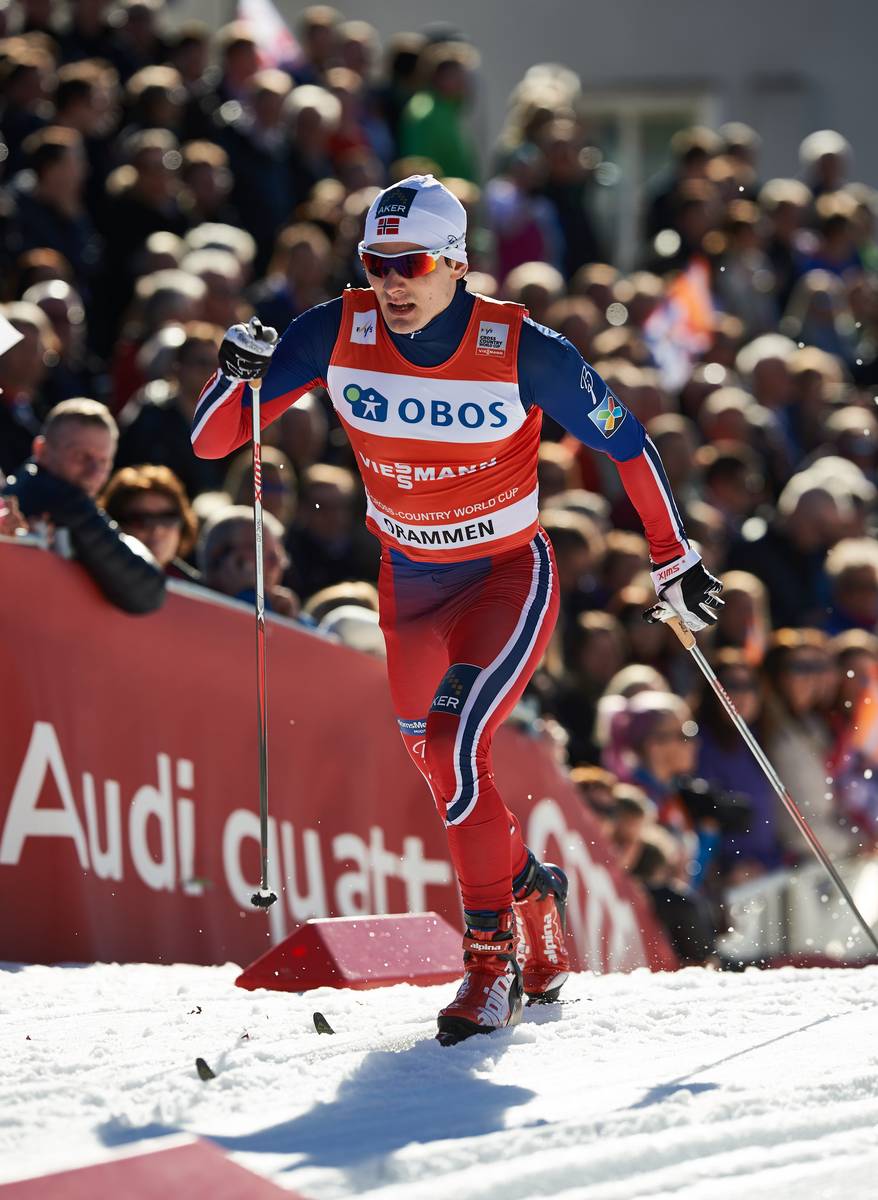
    Norway's Finn Hågen Krogh placed second in Wedneday's classic sprint in Drammen, Norway, to secure his first Sprint World Cup Crystal Globe. (Photo: Fischer/NordicFocus)
    Norway’s Finn Hågen Krogh placed second in Wedneday’s classic sprint in Drammen, Norway, to secure his first Sprint World Cup Crystal Globe. (Photo: Fischer/NordicFocus)

    At the start, Ustiugov led up the first climb and started to pull away from the pack. The group started to string out with Ustiugov leading to the second hill then an unforced error took out the two Russians at the same time.

    Ustiugov on skate skis tried to herringbone up the second hill in the middle lane. Since he had no grip he tried to cut the corner short by going to the inside. He wasn’t aware that Kriukov was there and both men collided and lost momentum. Kriukov was later relegated to last in the heat.

    With this happening at the back of the pack, the Norwegian train with Hattestad up front rocketed down the hill towards the finish. On the last turn, Brandsdal ultimately made the winning move, gliding past Hattestad and into the lead. He crossed the line first at 2:38.18. Krogh followed Brandsdal past Hattestad as well and finished second, 0.56 seconds later. Hattestad held onto third to complete the all-Norwegian podium.

    “The World Championships in Falun did not go as I had planned. I wanted to end the season strong,” Brandsdal told FIS after the race. “I did everything I could to fight for the crystal globe for the sprint.”

    While he didn’t get it, Brandsdal did win his sixth World Cup race.

    Krogh used his disappointment from not being named to Norway’s World Championships sprint team as motivation.

    “I have little to put a finger on what has been bad this season. Everything has gone according to plan,” Krogh told NRK, according to a translation. “This has been a bright season.”

    This Sprint Crystal Globe was Krogh’s first. He won it by 57 points over Brandsdal and 103 points over Pellegrino. Hattestad won it last season, ahead of Brandsdal in second, and Brandsdal was third in the sprint overall in 2011/2012.

    Results

  • Valjas, Cockney Make Davos Sprint Quarterfinals for Canada

    Valjas, Cockney Make Davos Sprint Quarterfinals for Canada

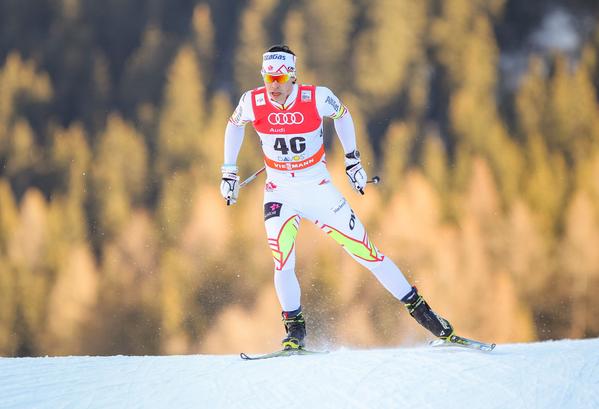
    Jesse Cockney races during qualifiers of the World Cup freestyle sprint in Davos, Switzerland. Cockney would be the 23rd qualifier and finish 29th overall. Photo: CCC/Twitter
    Jesse Cockney races during qualifiers of the World Cup 1.3 k freestyle sprint in Davos, Switzerland. Cockney would be the 23rd qualifier and finish 29th overall. (Photo: CCC/Twitter)

    Two Canadians finished in the points in the men’s World Cup 1.3-kilometer freestyle sprint on Sunday in Davos, Switzerland, though neither made it beyond the quarterfinals.

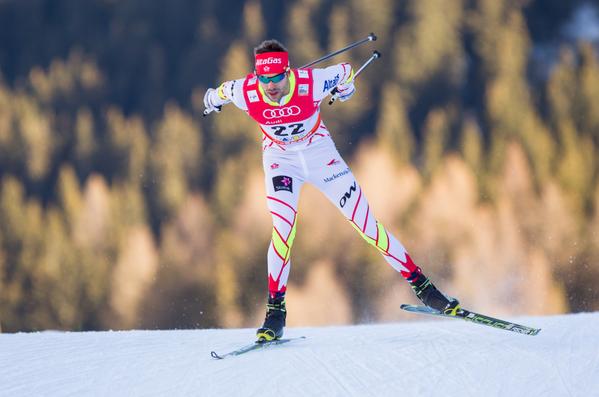
    Lenny Valjas, of the Canadian World Cup Team, followed a strong performance last week in Davos — when he finished 13th overall — by finishing in 18th after qualifying in 12th. Meanwhile, national B-team member Jesse Cockney qualified in 23rd and finished 29th overall — his best individual World Cup result since taking ninth in a 2012 freestyle sprint in Canmore, Alberta.

    Frederico Pellegrino of Italy won the final for his first-ever World Cup victory.

    Valjas, who has been coming back from knee surgery for over a year, was pleased with his qualifying round. He explained in an email that he took advantage of the fast conditions, which were preferable to the icy conditions of Saturday’s 15 k freestyle.

    He also felt strong during his quarterfinal heat, but fell just short of qualifying for the semifinals, finishing in the fourth, 0.56 seconds behind Sweden’s Calle Halfvarsson. He was behind the leaders for most of the heat and was not able to make a pass during the finishing surge.

    “It’s hard to move through people on the tight course, and I wish it was a bit longer in the finishing straight,” the 26-year-old Valjas wrote.

    Cockney was also happy with his qualifier.

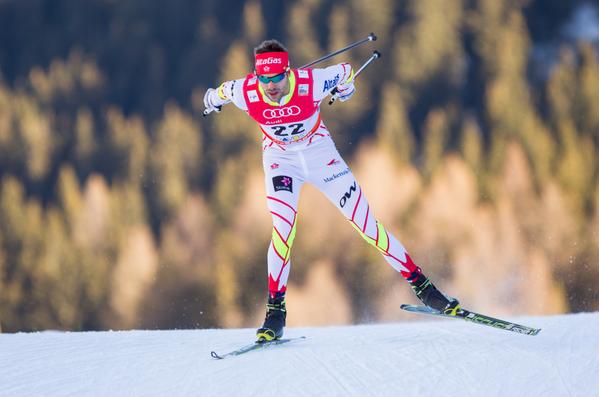
    Lenny Valjas on his way to taking 12th in qualifiers and 18th overall during the World Cup 1.3 k freestyle sprint in Davos, Switzerland, on Sunday.
    Lenny Valjas on his way to taking 12th in qualifier and 18th overall during the World Cup 1.3 k freestyle sprint in Davos, Switzerland, on Sunday. (Photo: CCC/Twitter)

    “I’ve been skiing relaxed and smooth in qualifiers all year and it feels awesome to finally get into the heats again,” the 25-year-old Cockney wrote in an email.

    However, Cockney ended up in the fastest quarterfinal heat, which was led by eventual third-place finisher Finn Hågen Krogh of Norway (2:16.37). Cockney finished sixth, 4.88 seconds behind Krogh.

    “I wasn’t strong enough [to stay] with them at that speed so I ended up skiing the whole race in sixth place,” he wrote.

    Canadian World Cup Coach Tor-Arne Hetland was pleased with the results, but disappointed that no one pushed through the quarterfinals.

    “We had good races today from both of them [Valjas and Cockney], but when you’re in the heats, you always hope to get to the next level so that is a little bit disappointing,” he said on the phone. “When you’re starting in the heats you want to be in the final.”

    But Hetland was optimistic about future races, especially based on Cockney’s performance, saying Cockney has been steadily improving and that he was happy to see him break the top 30.

    As for Valjas, “he’s showing that he is back on his level and I think he will be improving in each week coming up,” Hetland said. After Sunday, Valjas stood 52nd in the World Cup standings.

    “I’m happy with grabbing a few more points this weekend, and look forward to a small Christmas break and then racing the Tour de Ski,” Valjas said.

    On the women’s side, the lone Canadian starter was Perianne Jones, who placed 39th in qualifiers and failed to make the heats. She was 7.53 seconds behind the qualifying leader and eventual winner, Marit Bjørgen (2:37.59).

    Results: Men | Women

  • Newell Rises to Fourth in Davos Sprint, Second in World Cup Sprint Standings

    Newell Rises to Fourth in Davos Sprint, Second in World Cup Sprint Standings

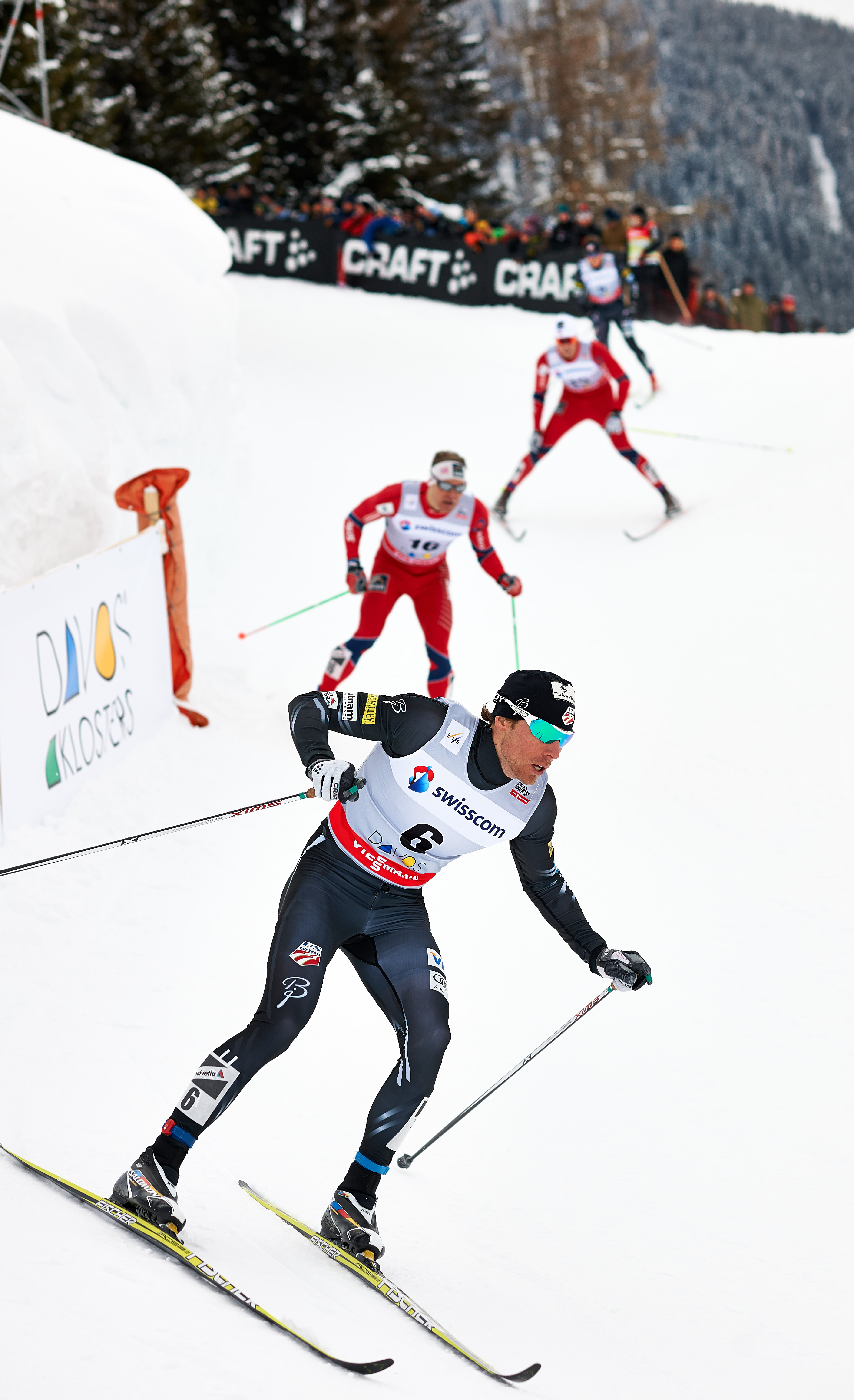
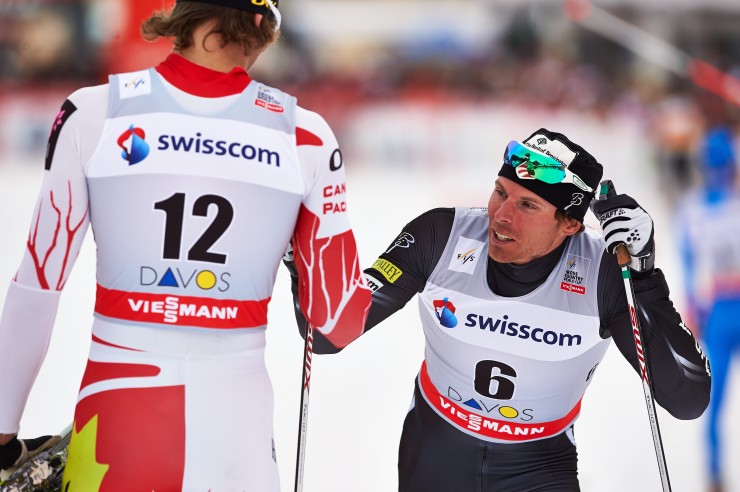
    US Ski Team member Andy Newell (6) checks in with Canadian Lenny Valjas after the World Cup classic sprint final on Saturday in Davos, Switzerland. Newell was fourth for his best result in more than two years, and Valjas placed sixth. (Photo: Fischer/Nordic Focus)
    US Ski Team member Andy Newell (6) checks in with Canadian Lenny Valjas after the World Cup classic sprint final on Saturday in Davos, Switzerland. Newell was fourth for his best result in more than two years, and Valjas placed sixth. (Photo: Fischer/Nordic Focus)

    It didn’t matter how close Andy Newell came to the podium this season, the 28-year-old US Ski Team veteran always said he wanted more. It’s not like he hadn’t been there before – Newell won silver in a World Cup skate sprint in 2008 and placed third in a World Cup classic sprint after the 2010 Olympics – but the latter came almost three years ago.

    Already this season, the Vermont native made it into three sprint finals, where he placed fifth twice and also sixth. Not good enough, he thought. Still, the consistency was positive, and it put Newell in contention for the World Cup sprint title.

    On Saturday, the Stratton Mountain School T2 Team skier came one step closer to that Crystal Globe, moving to second in the sprint standings just 34 points behind Sweden’s Emil Jönsson. To do so, Newell notched fourth in the 1.5-kilometer classic sprint in Davos, Switzerland, qualifying in sixth then winning his quarterfinal and placing second in the semifinal for a considerably dominant day. He ran out of gas in the final, but acknowledged the strength of Kazakhstani winner Alexey Poltoranin, whom he challenged in the semifinal.

    “It was frustrating not to be the on the podium,” Newell said on the phone after finishing 9.09 seconds behind Poltoranin in the final on 0.41 back from him in the semi. “He’s for sure probably the best classic skier I think in the world when it comes to uphill striding so he’s obviously a hard guy to hang with on the uphill.”

    Switzerland’s Dario Cologna was second (+5.49) and Frederico Pellegrino of Italy placed third (+6.02) ahead of Newell, who said they were within reach.

    American Andy Newell leads Norwegians Kent Ove Clausen (c) and Amund Lid Byggland (in third) down a hairy descent in the Davos World Cup classic sprint quarterfinal in Switzerland on Saturday. Newell comfortably won the heat, while teammate Simi Hamilton (in back) did not advance in third. (Photo: Fischer/Nordic Focus)
    American Andy Newell leads Norwegians Kent Ove Clausen (c) and Amund Lid Byggland (in third) down a hairy descent in the Davos World Cup classic sprint quarterfinal in Switzerland on Saturday. Newell comfortably won the heat, while teammate Simi Hamilton (in back) did not advance in third. (Photo: Fischer/Nordic Focus)

    “I could totally see Pellegrino slipping a little bit and Dario, and I just got right on their asses,” Newell said with a laugh. “I was really hoping for that podium, but I just lost a little too much over the top of the hill unfortunately.”

    With a two-lap sprint course marked by a technical uphill turn and long double-pole finish, Newell felt it was critical to play his cards right and not blow up. He conserved appropriately, adding more kick wax after the qualifiers then being careful not to lead the first lap while controlling the pace. He won his quarterfinal by 1.13 seconds over Norway’s Kent Ove Clausen, and went with Poltoranin in the semi to gap the field and advance in second.

    Fellow US Ski teamer Simi Hamilton (Sun Valley Ski Education Foundation) joined Newell in the third quarterfinal after qualifying in fifth. However, Hamilton struggled with his start in the heat and got caught up in traffic early on. Despite a strong double-pole finish, he took third in the photo finish with Clausen.

    The first-quarterfinal winner, Cologna had thrown down a blistering pace – more than three seconds faster than Newell’s quarterfinal time. That eliminated Hamilton’s shot at advancing as a lucky loser and he ended up 13th for an individual season best.

    “In the past, long and gradual double poles have been a bit of a weakness for me, so I am psyched with my finishing speed in the quarter,” Hamilton wrote in an email. “But still, to be so close to a lucky loser spot after fighting very hard is frustrating. It will come though.”

    U.S. coach Matt Whitcomb was impressed with the team’s performance on Saturday, one of two days of World Cup racing less than a week before World Championships begin in Val di Fiemme, Italy.

    “We had a really good day; it’s the kind of day we wanted to have before going to World Champs and our sprinters will go there with some good confidence now,” Whitcomb said.

    He called Newell’s move to second in the sprint standings “an enormous deal” paired with the season-long achievements of Kikkan Randall, who is 134 points ahead as the women’s sprint leader.

    “It’s a pretty cool thing for the U.S. team,” Whitcomb said. “[Newell] looked great today. It was maybe a course that aerobically challenged Sochi, certainly technically it exceed Sochi, and to be able to look good on a course like that is quite a feat. I’d pair Simi in that category, too, so we’re feeling good about this.”

    The good news for Newell, who felt a little flat in the qualifier after taking it easier in training this week, is that if he doesn’t reach that coveted podium in the classic sprint at World Championships, there’s always the rest of the season.

    “I’ve had four finals so far this year and no podiums,” Newell said. “I think that’s making me even more hungry to get one in at World Champs and if not there then sometime in the next few weeks. … I’m really excited to keep racing after world champs, too. Emil’s definitely not out of striking distance [for the World Cup sprint title] so it’s going to be a really cool battle for the rest of the year for that.”

    Two other Americans in Saturday’s sprint, Dakota Blackhorse-von Jess (Bend Endurance Academy) placed 52nd (+14.92) and Erik Bjornsen (US Ski Team/Alaska Pacific University) was 66th in the qualifier.

    For Blackhorse-von Jess, who was about six seconds out of qualifying, his first World Cup race in Europe was all about the experience. Interestingly, he wrote in an email that he felt less pressure than say, U.S. Nationals, where he expects to win qualifiers.

    “Today, I was loose and relaxed, had a plan, and went out and tried to execute,” Blackhorse-von Jess explained. “The only real difference is that this course is harder than anything we’ve raced back home.

    “I thought I did a really good job following my plan and felt really good and really encouraged going into the climbs the second lap,” he added. “Stayed loose, hammered the double pole between the laps and could tell I was in the mix. Then… I exploded. Hard to ski up big hills when you’re flooded like that. Elevation racing, ha.”

    Disappointed with his result at 1,560 meters (5,120 feet) above sea level, Blackhorse-von Jess wrote that he’s still feeling great about his skiing.

    “Today’s result is not an indication of how [the World Cups in] Lahti and Drammen will go other than to be an encouragement that if I was only 6 seconds out of qualifying given how badly I came apart at the end, everything is gonna be okay,” he wrote.

    Bjornsen wasn’t happy where he ended up after crashing on the skied-out downhill corner.

    “I knew that if I went hard through the corner both times I could probably make up a couple seconds even though it was a little risky,” Bjornsen wrote. “I hammered over the top of the hill and didn’t slow my speed down at all and when I hit the icy section I was not able to stay upright. After I fell I skied the rest of the course hard, but it’s really difficult to be motivated after a fall because as soon as you fall in a sprint race your day is over.”

    Looking forward, Bjornsen’s still shooting for a top 30 and feels it’s possible to get there.

    “I feel like I’m in the best shape of my life right now,” he wrote. “I just know I have to have an exceptional race and be willing to take the risk of falling or blowing up.”

    — Audrey Mangan contributed reporting

    Results