Tag: Fredrik Aukland

  • Klæbo, Falla Defend Beito Sprint Titles; Newell 16th, Hart 31st for U.S.

    Klæbo, Falla Defend Beito Sprint Titles; Newell 16th, Hart 31st for U.S.

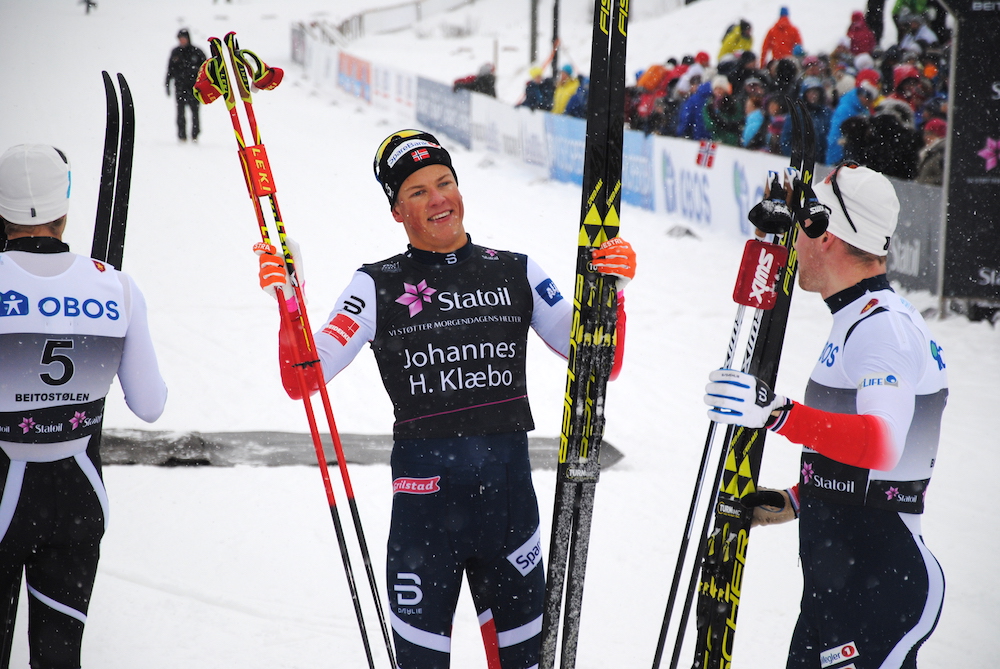
    Norway’s Johannes Høsflot Klæbo celebrates his first win of the season on Saturday in the men’s 1.5 k classic sprint FIS race in Beitostølen, Norway. (Photo: Aleks Tangen)

    BEITOSTØLEN, Norway — A year ago, 20-year-old Johannes Høsflot Klæbo leapt onto the scene with a season-opening skate-sprint win in Beitostølen. Before that, he made waves at 2016 U23 World Championships, winning gold in the skate sprint, 10-kilometer classic and 4 x 5 k relay. But until last season, Klæbo, a member of Norway’s national U23 team, was hardly a household name to those outside of Norwegian skiing circles.

    That all ended in Beito. Klæbo landed on the podium in the first World Cup sprint of the 2016/2017 season, placing third in the classic sprint in Kuusamo, Finland, and accumulated half a dozen podium finishes throughout last winter. He capped the season as the men’s U23 World Cup champion as well as the Sprint World Cup winner.

    Now a full-fledged member of the Norwegian Sprint World Cup Team, Klæbo, who turned 21 last month, returned to Beitostølen to post a second- and first-place finish so far in two International Ski Federation (FIS) races there. He started his season off by taking second in Friday’s 15 k classic, 18 seconds behind reigning Overall World Cup champion Martin Johnsrud Sundby.

    On Saturday, Klæbo won the 1.5 k classic sprint in Beitostølen without so much as a blemish, winning the qualifier to start the day then topping each of his heats en route to the final.
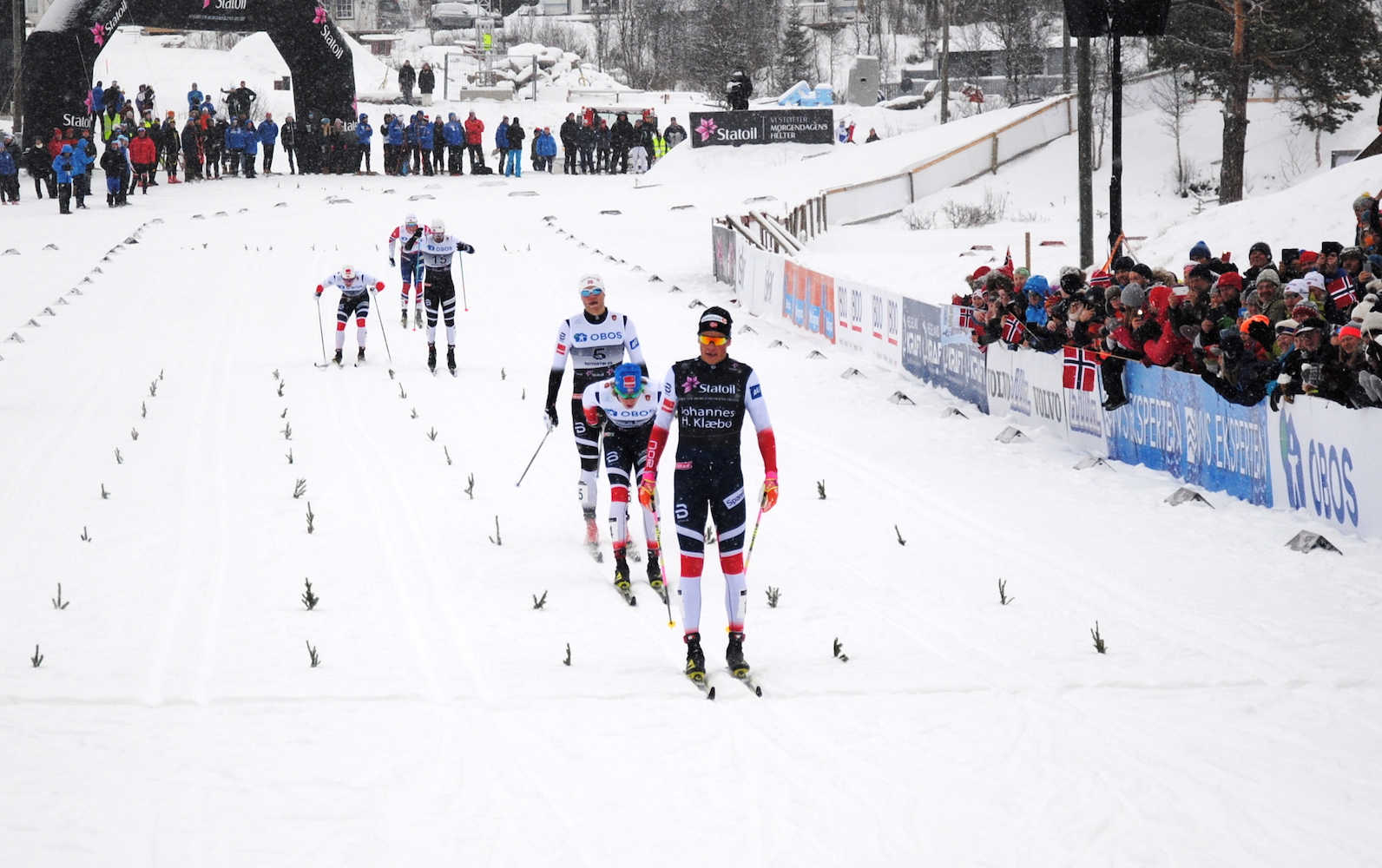
    Norway’s Johannes Høsflot Klæbo crossing the line first for the win in the men’s classic sprint final on Saturday at the FIS season-opener in Beitostølen, Norway. (Photo: Aleks Tangen)

    Up against five other Norwegians in the final, Klæbo raced to first once more in 3:50.4 minutes, finishing 1.1 seconds ahead of runner-up Kasper Stadaas. World Cup sprinter Eirik Brandsdal followed in third (+1.8), Fredrik Riseth was fourth (+6.4), Sondre Turvoll Fossli crossed in fifth (+6.7), and Emil Iversen was sixth (+9.2).

    “My goal was to ski a good race,” Klæbo told a group of reporters after. “I wanted to get away from the pack towards the end and luckily the gap remained until the end.”

    Iversen called attention to the young Norwegian while speaking with reporters after the race. “There has never been a talent like him,” Iversen said.

    With snow starting to fall just before the men’s qualifier, Klæbo fared best on the course, racing to a 3.07-second qualifying win over Riseth with a time of 3:39.76.

    Norwegian sprint coach Arild Monsen emphasized Klæbo’s ability to accelerate in and out of turns.

    “Cross-country skiing has seen some development in recent years with specific techniques in specific zones, and Johannes has developed an ability to take advantage of that,” Monsen told a group of reporters. “We saw that very clearly today. The trick is to technically skilled when you’re tired and he’s able to do that almost to point where we don’t understand how.”

    Klæbo went on to win his quarterfinal by 0.5 seconds over Norway’s Gjøran Tefre, then his semifinal by 0.2 seconds over Brandsdal. U.S. Ski Team member Andy Newell faced him in the quarterfinal, where Newell finished fourth in the heat, 3.7 seconds behind Klæbo and 2.6 seconds behind Norway’s Emil Nyeng in third. Newell missed advancing to the semifinals and finished the day in 16th overall.

    “I knew we were going to have a fast heat because Klæbo had set a pretty strong pace from the first hill on, so we were really close to lucky losers,” Newell told FasterSkier in a post-race interview. “The second heat was just barely faster.”

    With his second Beitostølen sprint victory, Klæbo told NRK that he was glad to get this race under his belt.

    “This felt good, and I’m glad that sprint is up and running,” he said. “This was a good race considering what will happen next weekend.”

    The World Cup kicks off next weekend in Kuusamo with a classic sprint on Nov. 24, followed by 15 k classic and 15 k freestyle races for the men on Nov. 25 and 26.

    The lone American man in Saturday’s race, Newell qualified in 11th, 10.86 seconds off Klæbo’s time.

    “Felt good in qualification, skis weren’t perfect because it started snowing just before,” Newell told FasterSkier after. “Skis were fast, but not quite enough grip, so we did a little re-wax for the heats.”

    He noted that he’s been working with Fischer in Beitostølen as he’s there without his team (the rest of the U.S. Ski Team is currently training in Rovaniemi, Finland).

    For the first 300 meters of his quarterfinal, six skiers started at a relaxed pace with Klæbo and Newell at the back of the pack leading into the the first downhill. While both were able to work their way to the front on the first climb, Newell lost steam on the second-to-last hill, “Danskebakken” (Danish hill).

    “I was stuck in the back up the first hill, so I had to burn a match to get to the front, which probably made me a little tired for the last hill,” Newell reflected.

    With what he called “great grip” up the big climb, he felt like he was dragging a bit over the top.

    “I was definitely getting a little tired on the flat part over the top,” he said. “Because it’s the first sprint, maybe I wasn’t aggressive enough in the transitions, maybe it’s because the skis were a little draggy, but it seemed like I would get passed by somebody or two people going into each hill.”

    With enough grip on the climbs, he would pass those racers back.

    “So tried to finish strong but not quite there, but it’s a long season and hopefully the body will feel a little better in Kuusamo,” Newell said. “It’s all good, just training so looking forward to the World Cup.”

    Out of the 30 men who qualified for Saturday’s sprint heats, only two were not Norwegian: Newell and Great Britain’s Andrew Young (who qualified 22nd). Young went on to finish the day in 23rd overall after finishing fifth in his quarterfinal.

    Falla Stuns with Late Attack 
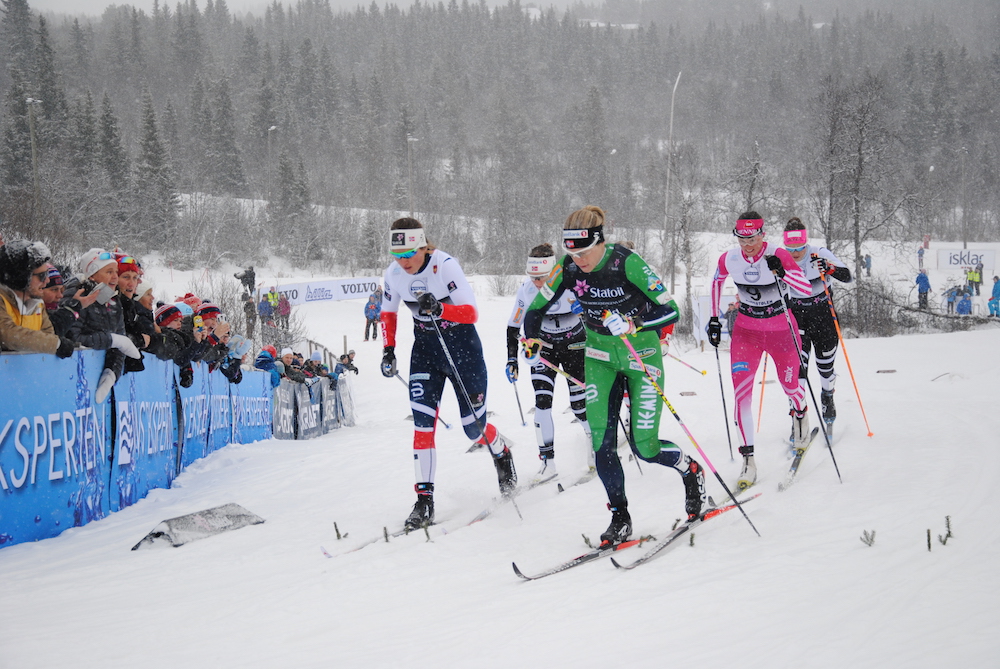
    Maiken Caspersen Falla (l) leading the women’s final up a climb, along with fellow Norwegian national team member Astrid Uhrenholdt Jacobsen (in green) during the women’s 1.5 k classic sprint FIS race on Saturday in Beitostølen, Norway. (Photo: Aleks Tangen)

    In the women’s race, Maiken Caspersen Falla controlled the women’s race in a similar fashion to Klæbo, winning the qualifier, quarter, semi, and ultimately, the final.

    In the final, Falla, who won last year’s Beitostølen skate sprint as well as her second-straight Sprint World Cup Crystal Globe, skied with the pack until the final climb where she made her move before entering the final stretch alone. Falla, 27, finished 3.7 seconds clear of anybody in 3:01.1. In another all-Norwegian final, Mari Eide placed second and Astrid Uhrenholdt Jacobsen claimed third (+4.8). Tiril Udnes Weng placed fourth (+6.7), Kari Vikhagen Gjeitnes was fifth (+11.1) and Ane Appelkvist Stenseth was sixth (+18.5).

    Falla started the morning with a qualifying win in 2:54.86, 1.77 seconds ahead of Slovenia’s Katja Visnar in second. She didn’t slow down much for the heats, racing to first in each in 3:01.7, 3:02.3 and 3:01.1, respectively.

    “I felt that it went better and better and it’s wonderful to have that feeling when you’re sprinting,” Falla told NRK after.

    After watching her attack and pass three women on the final hill, NRK commentator Fredrik Aukland called her “the best sprinter in the world”.

    When asked if this performance was good enough to win any race in the future, she told a group of reporters, “I hope so, of course. There is finishing hill already next weekend that is kind of similar to this one and I have practiced running up hills a lot so it’s obviously fun to test it in a race.”

    Teammates with Newell on the Stratton Mountain School (SMS) Elite Team, Anne Hart raced to 31st for the second day in a row, missing qualifying in the top 30 by 0.28 seconds.

    “I am happy about my qualification,” she told FasterSkier immediately after her race, before she knew whether her time was fast enough for the heats. “The course is a lot faster than yesterday, good condition.”

    Hart started the qualifier third out of 58 women, just ahead of Visnar in bib 4. Her time was 17.55 seconds back from Falla’s.

    “I skied with Katja Visnar and she is really good classic sprinter,” Hart said. “… It feels really good to be able to ski with all these World Cup skiers.”

    Nichole Bathe, who was born in the U.S. but is racing for Great Britain, finished 33rd (+19.26), about 2 seconds out of the top 30.

    Canada’s Isabella Howden of Barrie Cross Country (BXC) finished 58th (+57.28) in the qualifier. In the men’s qualifier, her teammates Joey Foster and Scott James Hill finished 74th (+32.45) and 84th (+36.64), respectively, and fellow Canadians Ryan Jackson and Maks Zechel (who are training in Norway with Team Asker) finished 97th (+43.99) and 102nd (+48.48), respectively, out of 109.

    The Beitostølen weekend concludes with 10/15 k freestyle individual starts on Sunday.

    Results:

    Men’s qualifier | Men’s brackets

    Women’s qualifier | Women’s brackets

  • Cologna Tops a Patched-Up Podium in Olympic 15 k Classic

    Cologna Tops a Patched-Up Podium in Olympic 15 k Classic

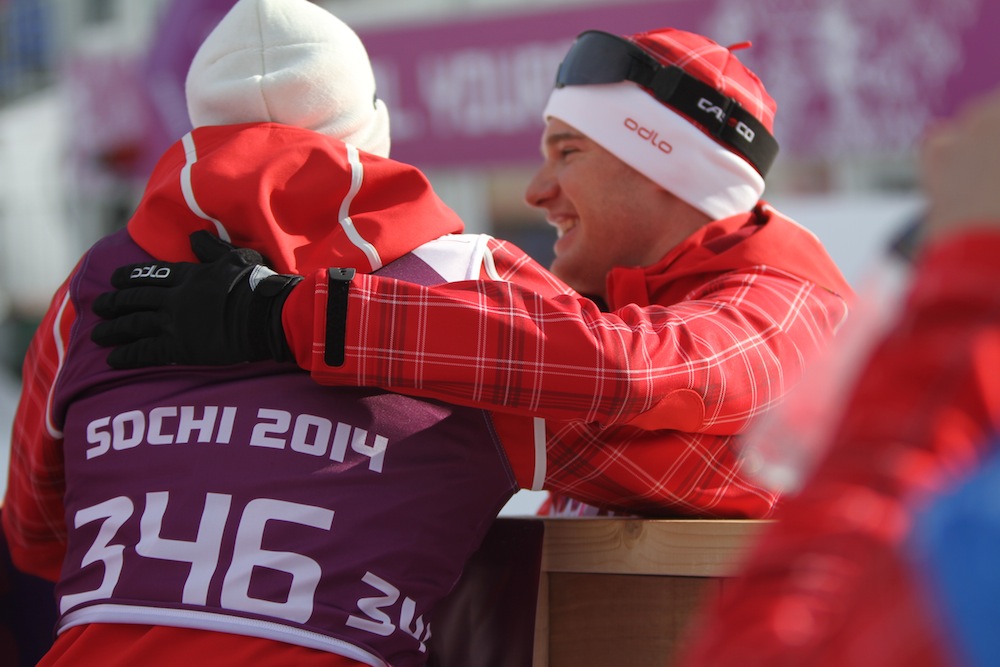
    Dario Cologna hugs a member of his team, after the Swiss skier won Friday's 15 k classic individual start at the 2014 Winter Olympics in Sochi, Russia.
    Dario Cologna hugs a member of his team, after the Swiss skier won Friday’s 15 k classic individual start at the 2014 Winter Olympics in Sochi, Russia.

    FasterSkier’s coverage is made possible through the generous support of Rudy Project.

    SOCHI, Russia — Leading into the Olympics here, Swiss cross-country skier Dario Cologna had raced just twice at an international level this season, an ankle injury putting off his start to the season until mid-January. He’s still walking with a slight limp.

    Sweden’s Johan Olsson was doing only a little better. He has been plagued by a rib injury and illness, and has entered just three international events this year, all in December. Until Friday, he hadn’t raced in two months.

    And while Olsson’s teammate Daniel Richardsson had been racing all season, he’d been at far from his best form, after tearing a ligament in his knee over the summer in a car accident that killed one of his friends.

    Nonetheless, in Friday’s 15-kilometer classic race, all three managed to beat out the 84 other competitors, most of whom had had the whole season to prepare at full strength.

    Cologna demolished the field, finishing in 38-and-a-half minutes to win his second gold of the games, and the third of his career. Olsson was 30 seconds behind, and Richardsson another 10 seconds back to round out a patched-up podium.

    “It was not easy, but we made the best of the situation,” Cologna said, referring to the performances of the top three. “It’s quite special.”

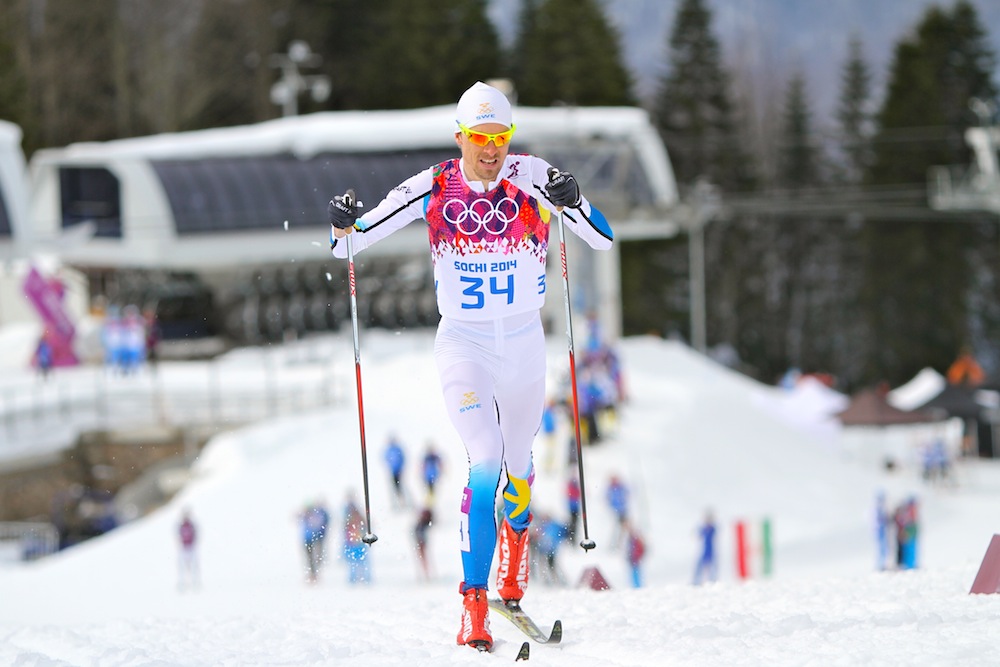
    Sweden's Johan Olsson racing to second place in the 15 k at the Olympics in Sochi.
    Sweden’s Johan Olsson racing to second place in the 15 k at the Olympics in Sochi.

    How did these three convalescent competitors ski away from the rest? The explanation wasn’t immediately clear, but several factors appeared to be involved.

    Among them were the conditions. After several consecutive days of temperatures far above freezing, the men were again skiing on a soft, sloppy mess of a course on an uncomfortably warm day—so warm, in fact, that Norway’s Chris Jespersen raced in tights that had been cut off at the thigh.

    Patrik Noak, the Swiss team’s doctor, thought that the heat favored Cologna, since the mushy track didn’t provide a firm surface that his competitors could better kick from, with their ankles at full strength.

    “These weather conditions, for him, are perfect. Because the snow is really deep, and you have to be really strong in the upper body,” Noak said.

    There was also the lack of expectations—Cologna has already won a gold medal at the Olympics here, and hopes were not especially high for the two Swedes in Sochi, given their starts to the season.

    “That’s just an advantage for them—they had no pressure beforehand, and they can do what they were planning to do,” Fredrik Aukland, Cologna’s coach, said in an interview.

    They didn’t have to worry about being in shape for races earlier in the season, either, Aukland added, which allowed them to aim solely at the games.

    “They had to have focus only on the Olympics,” he said.

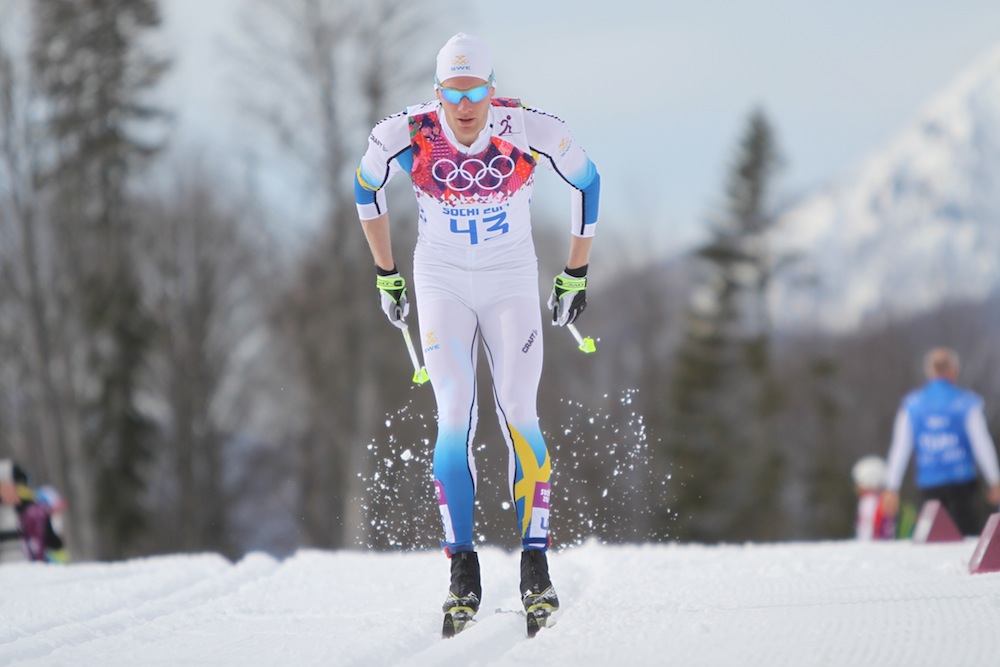
    Sweden's Daniel Richardsson skiing to a bronze medal in Friday's 15 k classic at the Olympics in Sochi
    Sweden’s Daniel Richardsson skiing to a bronze medal in Friday’s 15 k classic at the Olympics in Sochi

    That was not the case for their competitors like Norway’s Martin Johnsrud Sundby, the World Cup leader and Tour de Ski winner, who was supposed to contend for a medal on Friday.

    Instead, he finished more than a minute and a half behind, telling Norwegian broadcaster NRK that he was “fucking disappointed.”
    “The body does not work,” he said. “I’m not even close to being close.”

    Olsson had the advantage of skiing some of the race with Cologna, who caught him “like a rocket,” Olsson told Aftonbladet, a Swedish newspaper.

    “If you stay behind him, you can win a medal,” Olsson said he told himself.

    That turned out to be true. Cologna had opened the individual-start race at a slower pace, knowing that the warm temperatures, and

    a course that climbed more than 1,500 vertical feet, would require him to save some energy for the last five-kilometer lap.

    He was even with Olsson and a Russian skier through five kilometers, and actually trailed the Finnish skier who ultimately placed fourth.

    But just over halfway through the race, Cologna had taken the lead, and then with Olsson in tow, he roared to the finish.

    So did Richardsson, who was in sitting in fourth place with just half a kilometer to go, but got some information that helped him claw back a couple of seconds over that distance from Iivo Niskanen, the Finnish skier, who was ultimately displaced from the podium by a fraction of a second.

    “I heard that Iivo was really tired at the end, and that was the thing that improved my power,” Richardsson said. “I did everything on the last uphill and into the finish, and I managed 0.2 seconds, and I’m really happy.”

    The race was also a triumph for Cologna, who had to have surgery in November to repair a torn ligament.

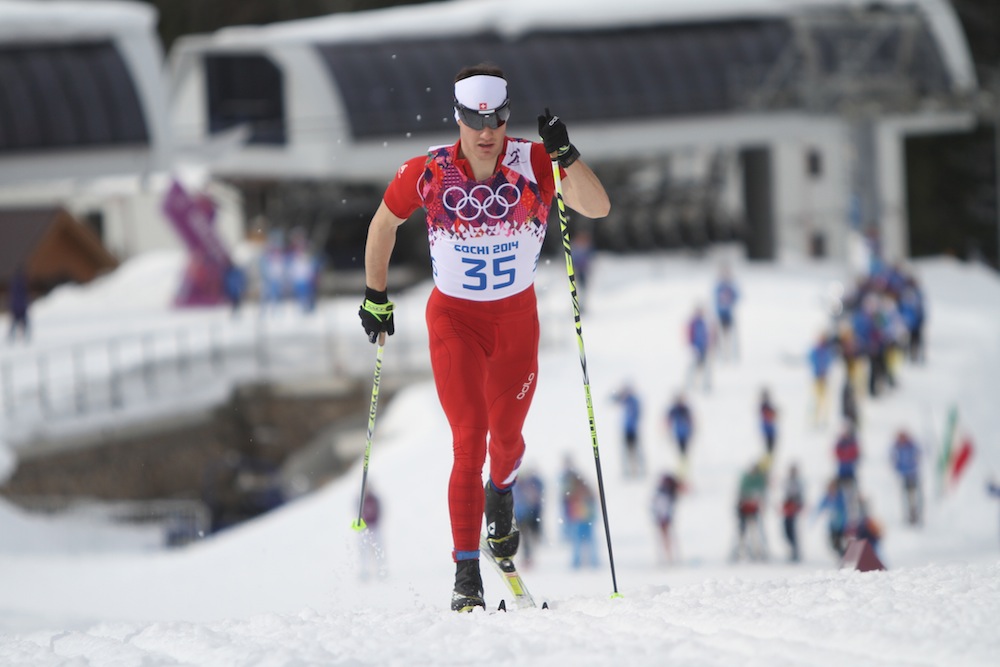
    Dario Cologna racing to his second gold of the 2014 Olympics in Friday's 15 k classic individual start.
    Dario Cologna racing to his second gold of the 2014 Olympics in Friday’s 15 k classic individual start.

    The surgeon, Noak said, was a foot specialist who’s also an avid participant in the sport of orienteering; the procedure was a new method called a tightrope—a band that held together Cologna’s tibia and fibula, Noak said.

    During his recovery, Cologna trained by double-poling from a chair affixed to a pair of skis, and kept his legs active on a special treadmill that allowed him to run while only bearing 20 percent of his weight.

    Nonetheless, Noak said: “We were a little bit afraid that the time was really a little bit too short.”

    Now, Cologna said during the post-race press conference, “I am here with two medals, and it’s unbelievable.”

    It’s unclear whether Cologna will race in the men’s relay on Sunday, but he said he’ll definitely compete in the team sprint later in the Games, with his brother Gianluca.

    “That will be something that’s very special,” Cologna said.

    Then, there’s the last event—the 50-kilometer skate race, which Aukland, Cologna’s coach, said was a big goal.

    “That’s been a long time, his dream: to win the 50 k,” Aukland said.

    Asked whether Cologna might inflict another injury on himself before the next set of championships, given the results this time around, Aukland paused, then answered.

    “Maybe that’s a good idea,” he said.

    — Alex Matthews contributed reporting

    Results

  • FIS Classics: Ulvang shocked over König Ludwiglauf Fair Play Violation

    “Ski Classics can’t just go in there and appoint their own jury. Only the FIS jury can judge in cross-country skiing,” Vegard Ulvang said to Langrenn.com.

    Ulvang is reacting to the Sandra Hansson’s case of unfair play in the 2011 König Ludwiglauf in Germany last weekend, which resulted in Hansson having her points for winning the FIS Ski Classic race reduced as a penalty for her actions.

    “I am shocked that Nils Marius Otterstad (ed. Hansson’s team manager) and Ski Classics steps up and plays jury here. They do not have the right to do that. Only an FIS-appointed jury that can make these decisions. That is the first principle, and this is shocking,” Ulvang said to Langrenn.com.

    “This is a clear example that private players in this field are a concern,” Ulvang added.

    – But why didn’t FIS act on this after the incident?

    “I don’t want to comment on this case. The FIS had a jury on site, and as far as I know, this jury did not act on the situation. Nobody else can put together a jury of their own and make these decisions,” Ulvang said. “If anyone is discontent, they have the right to appeal,” he emphasized.

    – Nils Marius Otterstad criticized the FIS for not taking action, and argue that the FIS doesn’t care about the ski marathons. What is your comment on that?

    “If he criticizes the FIS, he is basically criticizing himself. The FIS has a separate citizen race and marathon committee, consisiting of representatives from all the major ski marathons. This committee appoints the jury,” Ulvang explained.

    David Nilsson: – We had to take action

    David Nilsson, the Ski Classics director, said to Langrenn.com that in their opinion, the Hansson incident was grave enough that they felt required to step in.

    “If we hadn’t reacted in this case, that would have been damaging to both the reputation of the Ski Classics, and ski marathons in general. We have a point system, and there is a lot of prize money at stake,” Nilsson said.

    While Langrenn.com was interviewing Nilsson, they were informed that the Swiss Ski Association (representing the offended skier Seraina Boner) had submitted a formal protest to the FIS about the incident between Hansson and Boner.

    “To us, it would be peculiar if the FIS doesn’t react to this incident,” Nilsson concluded.

    “They totally didn’t care about König Ludwiglauf”

    Jørgen Aukland (NOR/Team XtraPersonell) said the FIS has ignored marathon racing for too many years.

    Aukland has raced the FIS marathon circuit for a decade and argues that FIS never cares.

    “FIS has neglected and ignored marathon racing for far too long,” Aukland said to Langrenn.com.

    After Sandra Hansson (Team United Bakeries) was stripped of a portion of her points due to the incident in the König Ludwiglauf in Germany last Sunday, several people have reacted both to Hansson’s unfair behavior in the race and to the Ski Classic organizers taking matters in their own hands.

    “But what should the Ski Classic organizers have done? FIS didn’t care about the König Ludwiglauf. Nowbody knew where the technical delegate was, he didn’t have a cell phone on him, there was no coaches’ meeting and there was no m formal seeding. This was all just a mess. How should the racers deal with that? Nobody did anything,” Aukland said to Langrenn.com.

    Aukland is mad

    “I understand that this creates a conflict of interest, but Otterstad and Ski Classics have already publicly apologized for that. But that’s not what this is about. I’ve never seen Vegard Ulvang at a FIS marathon before. He speaks before he even knows the details. Nothing has happened on the marathon circuit for the last decade. Ski Classics really does a great job exposing this aspect of ski racing and contributes to unite the cross-country communities. It’s awesome that someone finally took action in the incident on Sunday,” Aukland said to Langrenn.com.

    “All the racers I’ve talked with supports the Ski Classic’s decision in this case,” he added.

    The youngest Aukland brother in the strong ski family tried repeatedly to contact Ulvang on Tuesday but was unable to get a hold of him.

    “I just wanted to give him my opinion. This is a hopeless situation,” Fredrik Aukland said.

    “The FIS is sleeping in class, and during the König Ludwiglauf they definitely didn’t do their job. Then someone else has to do it, and it’s good that they did,” he concluded.

    From Langrenn.com, February 8 and 9, 2011 By Ola Jordheim Halvorsen, translation by Inge Scheve

  • Team 9: Switzerland

    Team 9: Switzerland

    Switzerland

    Nations Cup Ranking: 9th (2013 pts)

    Men: 7th (1729 pts)

    Women: 15th (284 pts)

    2010/2011 World Cup Team

    Men

    Dario Cologna

    Curdin Perl

    Toni Livers

    Remo Fischer

    Women

    Silvana Bucher

    Bettina Gruber

    Doris Trachsel

    What you may have missed last season:

    After going from zero to hero between 2007 and 2009, Dario Cologna took a step backwards in 2010, falling to fourth in the race for the Crystal Globe. While he was still undeniably one of the strongest men in the World Cup field, as his bronze medal on the Tour de Ski and gold in the Olympic 15 k  show, Cologna’s leg injury in the fall slowed him at start to the season. He failed to crack the top 10 until December 19 in Rogla, Slovenia, and his first medal came during the fifth stage of the Tour de Ski, during a slightly awkward sprint finish with Petter Northug and Marcus Hellner.

    But more importantly, Switzerland wasn’t just the Dario Cologna show last year. Curdin Perl was a solid-if-not-spectacular distance skier, and more

    Curdin Per's FIS profile picture

    importantly, looks like he really loves life. Toni Livers and Remo Fischer were similar, and after the first race at the Olympics, where all four skiers finished a Canadian-esque top 17 on the day, hopes were high for the relay. But they were unable to pull off a Czech-like upset there.

    As for the sprinters, Eligius Tamborino was the best after Cologna. His chief problem is his abysmal classic sprinting, in which he failed to qualify for a single set of heats, while in skate he made the cut.

    As for women, things are a little light. Silvana Bucher was the best of the lot, collecting all her points in just three stops on the circuit – most notably finishing sixth in the competitive skate sprint in Oslo, Norway. Meanwhile Bettina Gruber, currently nursing a shoulder injury, skate sprinted well, although like Tamborino, her classic technique could use some work.

    In other news, longtime women’s team stalwart Laurence Rochat has decided to end her career. At the same time, sprinter Seraina Mischol, who scored over 500 World Cup points in 2008, was pegged to retire after collecting just one point last season. But she’s still training hard.

    What You Should Know For This Season

    Despite finishing fourth and taking a large hit in World Cup points in 2009-2010, Cologna is nowhere near finished. He is arguably the third best all-around skier on the World Cup, after Northug and Hellner, and is a good bet to finish in the top 10 no matter what race is on tap.

    While he may have the worst nickname on the circuit (Super Dario – really?) Cologna does have a massive fan club, with nearly 6,000 fans on Facebook. In comparison, FasterSkier has a paltry 600.

    If you thought the Canadians had a confusing and convoluted coaching history, check out Switzerland. The Swiss briefly picked up Canadian castoff Inge Braten this spring, but he failed to stick, and after dismissing him this fall, they opted instead for Guri Hetland (wife of former Norwegian sprint star and current Swiss sprint coach, Tor Arne Hetland) to lead their distance team, with Fredrik Aukland, Dario Cologna’s personal coach, in a support role. Still not really sure who is coaching whom in Switzerland? Yeah, us neither.

    Also, if you’re a Nikolai Pankratov fan, and you’re disappointed that he won’t be skiing this winter, blame the Swiss – their border guards were the ones who busted him.

    Who You Should Watch

    For immediate World Cup success, Silvana Bucher is the best bet. She has the speed, obviously knows the sprint course in Oslo quite well, and won two distance races plus the sprint at Swiss National Championships last year.

  • Cologna Checks Out the Oslo2011 Courses

    OSLO, Norway – Dario Cologna and his Swiss teammate Curdin Perl are familiarizing themselves with the terrain for February’s events and training on the courses for the Oslo 2011 World Championships. But although Cologna was in town, he sat out the uphill race called “Oslo’s Steepest” last Saturday – an event that has lactic acid gushing through every muscle fiber for about 15 brutal minutes of running.

    “Dario didn’t want to risk anything. He is suffering from a minor leg injury,” said his personal coach Fredrik Aukland, who accompanied Cologna. However, Cologna hung out at the finish to greet his teammate Curdin Perl as he hauled into a respectable fourth place.

    “Petter Northug will be the guy to watch at the Worlds. The pressure is on him after the last season and the Worlds being on home turf,” Cologna said to the Norwegian TV station TV2, and he also mentioned Marcus Hellner (SWE) as a serious contender. While Cologna admits that a gold medal at the Worlds is one of his season goals, he doesn’t want to get ahead of himself.

    Taking notes at Holmenkollen

    Cologna and Perl just finished their five-day stay in Oslo with their coach Fredrik Aukland, where the Swiss skiers spent their days studying the courses at Holmenkollen down to the smallest detail.

    Dario Cologna won the 15 k freestyle at the 2010 Olympics, the opening event for the cross-country skiers in Whistler. He was also third at the 2010 Tour de Ski last season, while he won that event the previous season. He also won the overall World Cup in 2009.

    Curdin Perl could be an outsider contender. He was second at the U-23 World Championships mass start in 2004 (behind Cologna), and he has won the massive Norwegian marathon event, the Skarverennet – a race that is capped at 12,000 participants and filled up within an hour after the online registration for the 2011 event opened last week. Perl feels particularly at home in Oslo now that he is dating the Norwegian national team racer Astrid Urenholdt Jacobsen.

    From Langd.se, October 4, 2010 By Kjell Erik Kristiansen, translation by Inge Scheve