Tag: freestyle mass start

  • Zanden McMullen’s Closing Argument

    Zanden McMullen’s Closing Argument

    This article was made possible through the generous support of our voluntary subscribers. If you value coverage like this, please support FasterSkier with a voluntary subscription.

    Zanden Mcmullen (USA) during the World Cup 10 k Freestyle in Trondheim (NOR) in December. (Photo: Modica/NordicFocus)

    There is a particular kind of quiet that settles in before a decisive weekend—not the calm that follows certainty, but the stillness that comes when outcomes are no longer yours to predict. Zanden McMullen arrived in Oberhof, Germany, this week carrying that quiet with him. Period Three of the World Cup season is underway. These races are the final ones that will be considered for U.S. Olympic Team selection. The committee will meet after Sunday’s races. Until then, there is nothing to do but race.

    “I’m pretty much taking it one week at a time right now and keeping my hopes up,” McMullen said earlier this week via text. “The races should be really fun this weekend, and my focus is on those right now.”

    It is the kind of message that sounds simple until you sit with it. One week at a time. Focus on the races. Fun. Behind those words is a career that has moved forward incrementally, without shortcuts, and a season that has already required recalibration. McMullen’s path to this weekend—both geographically and personally—has been anything but linear.

    Growing Up Where Winter Is Normal

    McMullen was born and raised in Anchorage, Alaska, a place where winter does not arrive as a novelty or an interruption. It simply is. He grew up outdoors, moving easily between sports—hockey, soccer, lacrosse—before skiing gradually took precedence.

    “I grew up doing a bunch of sports,” he said. “Skiing wasn’t really a main focus until maybe, like, first year of high school, when I was like, all right, this is going to be my main sport.”

    Cross-country skiing entered his life less as an ambition than as a community. His mother took him out. He joined a club. He found friends. He was good enough that there was never much reason to stop.

    “I just kind of found my group,” McMullen said. “And then as I progressed and just kept getting better and better, there was never really a reason for me to leave.”

    Anchorage has produced lots of elite skiers, but McMullen has never been particularly interested in mythology. When asked why Alaska continues to turn out athletes capable of racing at the highest level, his answer is understated.

    “We have access to great outdoor activities,” he said. “And I feel like that’s probably a pretty big foundation to our success. The community is great and has always been supportive of ski racing.”

    It is not a romantic explanation. It is a practical one. Snow matters. Time outside matters. People matter.

    Zanden McMullen (APU/Team Alaska), center, won the men’s U18 10K classic mass start race Friday at
    the 2019 U.S. Ski & Snowboard Cross Country Junior National Championships at Kincaid Park. Johnny
    Hagenbuch (Sun Valley SEF/Intermountain), left, was second, followed by Griffin Wright (Craftsbury
    Nordic Ski Club/New England), right. (Photo: Michael Dinneen)

    The First Crack in the Horizon

    For much of his early skiing life, McMullen’s world remained bounded by Alaska. The high school circuit was competitive enough that it was difficult to tell where he stood nationally. That changed almost accidentally.

    “A pretty pivotal point in my ski career was the Anchorage U.S. Nationals,” he said. “I wasn’t planning on going. I was still pretty young, but because it was in Anchorage, it was like, sure, of course I’ll do those races.”

    In the mass start 10-kilometer race, McMullen had what he still describes as a standout performance. The result earned him a spot on a U18 international trip.

    “That was one moment where I was like, holy crap, I can’t believe I made that,” he said.

    The next year, he qualified for World Juniors. Then another benchmark. Then another.

    “Every year was like I hit that next benchmark,” McMullen said. “And I was like, okay, wow, this is really happening.”

    What is striking in retrospect is how little certainty accompanied those steps. McMullen did not grow up believing he would race World Cups. He arrived there gradually, often surprised by his own progress.

    “I never really believed that I was going to be able to do that,” he said. “All the way up until, like, pretty much two years ago when I was like, damn, I’m really ripping the World Cup circuit.”
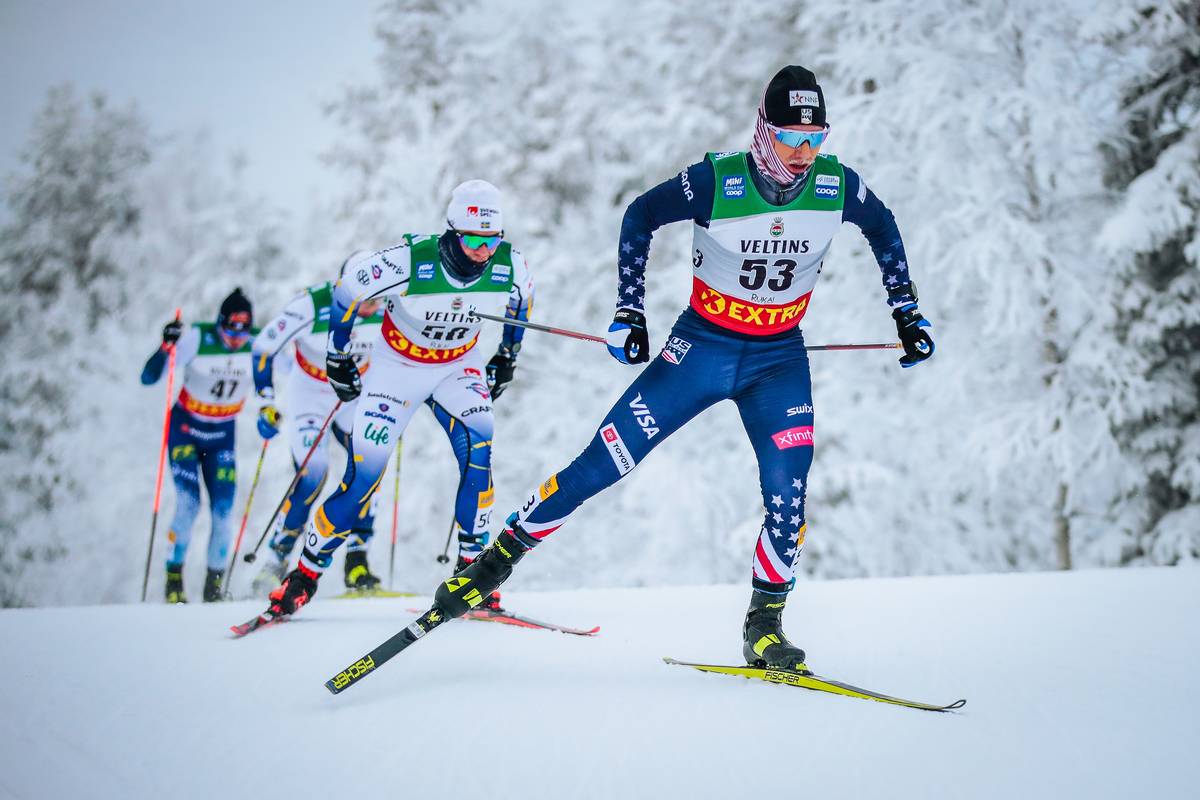
    Zanden McMullen races a skate pursuit in Ruka, Finland in November, 2021. (Photo: NordicFocus)

    Learning the Long Way

    McMullen’s development has mirrored that of a broader cohort of American men who have risen together, without a single breakout prodigy defining the group. The men’s team has become competitive not through sudden transformation, but through accumulation.

    “There’s definitely a core group of us that have been doing this for a long time and have just been hitting that next level every year together,” McMullen said. “Honestly, I’d say we just have a great attitude towards it, and I think that’s really contagious.”

    Central to McMullen’s progression has been his relationship with coach Eric Flora, who began working with him after high school. The partnership is not flashy. It is deliberate, methodical, and built on constant communication.

    “We all have individual phone calls with him about once a week,” McMullen said. “He’ll be driving to practice every morning, and he’ll just rip through all of us.”

    Training plans are personalized but similar. Adjustments are fluid. There is room to adapt when conditions—or bodies—require it.

    “Training is super fluid,” McMullen said. “There’s no reason to be super methodical about it.”

    If there is a defining value that underpins the approach, it is consistency. McMullen returns to the concept repeatedly, almost reflexively.

    “I don’t enjoy when I’m hot and cold,” he said. “I know I’m in a good place when I’m just consistent.”

    Racing Through Fog

    Consistency, however, is not something that can be summoned on demand. When the World Cup season opened in December, McMullen entered Period One with a clear process goal: race distance events, avoid panic, see where he stood.

    “It’s so challenging going into Ruka every year,” he said. “You just have really no idea what kind of shape you’re in.”

    He described the feeling as “looking through fog.” The metaphor fits. Fitness tests and workouts provide clues, but racing offers the only real clarity.

    “Those could both result in amazing races,” he said. “Or they could be pretty crappy races. I have no idea.”

    December did not unfold the way McMullen had hoped. Results were not disastrous, but they were not convincing enough to quiet questions—his own included. Olympic qualification, with its layers of objective criteria and discretionary judgment, hovered in the background, offering no reassurance.

    “Nothing’s for sure until the last race is over,” he said.

    As Period One ended, McMullen faced a decision that athletes rarely frame publicly: whether to stay in Europe and press on, or to step away and reset.

    Davos to Regroup

    McMullen stayed in Davos to train and regroup during the holidays before flying back to the United States for Nationals.

    The decision was not dramatic. It did not come with declarations or explanations. It was simply what made sense.

    Settling in to training through the holidays stripped things back to essentials. Favorite trails. Simple routines. Fewer variables.

    For McMullen, training has never been a place to escape. It is where things become clear.

    The reset did not guarantee anything. But it restored something harder to quantify: alignment between effort and intention.

    By the time McMullen boarded a flight for Lake Placid in January, he carried less expectation and more readiness.

    Zanden McMullen charges for the win in the Men’s 20 k Freestyle Mass Start last week at the US National Cross-Country Ski Championships in Lake Placid, New York. (Photo: Nancie Battaglia)

    Lake Placid: Evidence

    The U.S. Senior National Cross-Country Ski Championships arrived with their own weight. Nationals are never just Nationals in an Olympic year. Results echo beyond the finish line.

    On Thursday, McMullen won the 20-kilometer Freestyle Mass Start. The race unfolded honestly, favoring patience and pacing. McMullen looked comfortable in control.

    The next day, he returned to win the Classic Sprint.

    Two wins, two very different demands, back to back.

    The performances were not loud. They were authoritative.

    For an athlete who measures progress in consistency, the week in Lake Placid did not feel like redemption. It felt like confirmation.

    Zanden McMullen with his second win in two days in the Classic Sprint last week at the US National Cross-Country Ski Championships in Lake Placid, New York. (Photo: Nancie Battaglia)

    Oberhof

    From Lake Placid, McMullen traveled to Germany for the final races that will be considered in the Olympic team selection. Oberhof will decide whether his season will continue toward Milan or pivot elsewhere.

    “I’ll know by the end of the weekend if I have made the Olympic team,” he said via text. “If I don’t, I’ll head back with a little bit of Birkie fever.”

    The phrasing is characteristically restrained. There is no bargaining, no projection beyond what he can control.

    “I’m in Oberhof now for P3 World Cup, and will stay with the team through Goms,” he said. “I’m pretty much taking it one week at a time right now.”

    That outlook has been hard-earned. McMullen understands that racing well is not the same as demanding belief. His approach is simpler.

    “Let the racing speak,” he said in November. “There’s no reason to freak out about it.”

    The Space Before the Answer

    By Sunday evening, the committee will meet. Names will be discussed. Arguments will be weighed. Decisions will be made.

    McMullen will not be in the room.

    What he will have is a body of work that stretches back much further than this weekend: a childhood shaped by Alaska winters, a career built on incremental belief, a season that required adjustment rather than insistence, and a January that reaffirmed who he is as a racer.

    Whether or not the Olympic team includes his name, McMullen has reached a threshold that is difficult to cross. He is no longer auditioning for relevance. He is racing for a place.

    “I just want to be consistent,” he said. “I feel like when you are consistent, and you find yourself in a position where you might have a standout result, then it’s just that much higher.”

    In Oberhof, consistency will not announce itself. It rarely does. It will show up quietly, in decisions made at speed, on terrain that rewards honesty.

    For now, that is enough.


    Love stories like this? Help keep them coming.

    Feature stories like this one take time, access, and care to produce. If you value thoughtful storytelling and independent ski journalism, please consider becoming a Voluntary Subscriber. Your support directly fuels the work we do to cover the people, places, and moments that make our sport special.

    Join the FasterSkier community!


  • Canmore NorAm Roundup: Sandau and Beatty Win Two of Three

    Canmore NorAm Roundup: Sandau and Beatty Win Two of Three

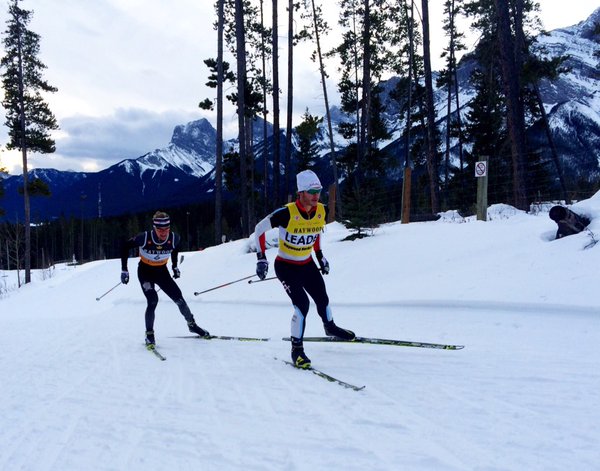
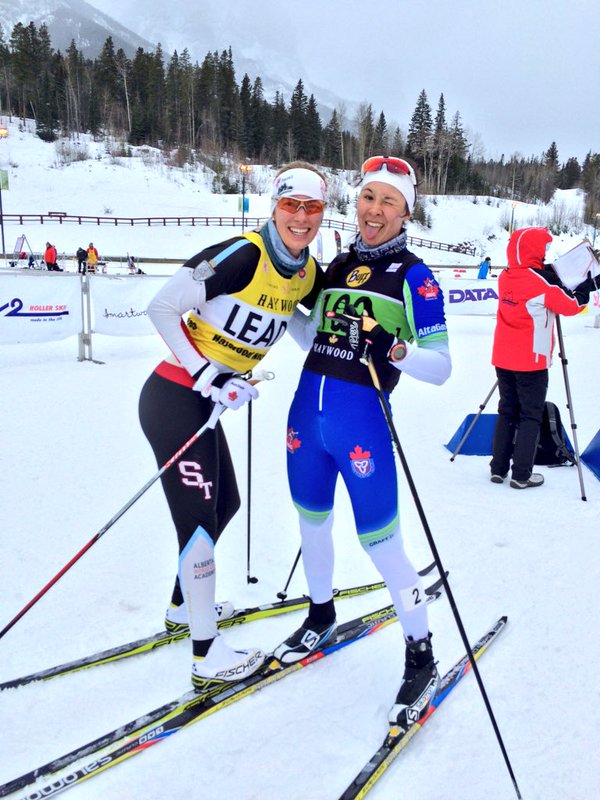
    Kevin Sandau in the NorAm leader's bib sets the pace from the front of the pack in the men's 16.5 k freestyle mass start on the second day of the NorAm opener in Canmore, Alberta. His Alberta World Cup Academy teammate, Knute Johnsgaard, chases him down. (Photo: Alberta World Cup Academy/Twitter)
    Kevin Sandau in the NorAm leader’s bib sets the pace from the front of the pack in the men’s 16.5 k freestyle mass start on the second day of the NorAm opener in Canmore, Alberta. His Alberta World Cup Academy teammate, Knute Johnsgaard, chases him down. (Photo: Alberta World Cup Academy/Twitter)

    You’ve seen it on the World Cup, and now it’s happening at the domestic level: double poling a classic distance race, as seen at Canada’s NorAm opener in Canmore, Alberta.

    The top men went without kick wax for the 10-kilometer classic interval start on Saturday, Dec. 5, double poling around a 2.5 k biathlon loop.

    Kevin Sandau of the Alberta World Cup Academy powered to the win in 24:42.9 minutes, edging his AWCA teammate Knute Johnsgaard (National U23+ Development Team) by 2.9 seconds. Ian Murray (Capital Region Training Group) skied the fastest last lap to edge Brian McKeever of Canada’s Para Nordic Ski Team by 3.5 seconds for third, 9.5 seconds back from Sandau.

    In an email, Sandau, 27, explained that double poling was essentially a no-brainer on the Canmore Nordic Centre’s biathlon trails — flatter than the usual race course with shorter climbs.

    “Off the start I knew I needed to be aggressive as it was going to be a fast race,” he wrote. “Just gunned it off the start and trusted my body could clear the lactate from my arms on the downhills. Felt pretty solid throughout so wasn’t a bad plan.”

    Johnsgaard explained he would have preferred striding over double pole, so considering that, he was happy with second place.

    “Of course I would have liked to be 3 seconds faster! I was being extra careful not to do any skate or step turns, perhaps too careful,” Johnsgaard wrote in an email. “I just tried to pace things right and find the fastest part of the track. I was outside the track almost the whole race.”

    For Murray, third stood as his NorAm career best.

    “At the age of 37 I guess you could say I am coming into my groove,” Murray wrote. “I was 22nd on the first lap which was a bit slower than I hoped to start.  Kevin Sandau passed me when I was on my second lap and that kicked me into gear. I have been focusing on ski marathon racing the last couple of years so I’m still figuring out the pacing for the 10 and 15km races.”

    McKeever explained that he tried to build into the race, but was missing a few gears. “[I] was overly cautious about not skating, and consequently was not aggressive enough,” he wrote in an email.

    In his first time double poling a distance race, Colin Abbott (Yukon Ski Team) in seventh (behind CNEPH’s Alex Dumas in sixth) observed that the pacing is different.

    “You don’t max out aerobically as easily so the concern for pacing is trying not to burn your arms too soon in the race,” Abbott wrote. “I went out maybe a bit faster than was ideal, and definitely slowed on the last lap but don’t think the end result would have changed much if I started slower.”

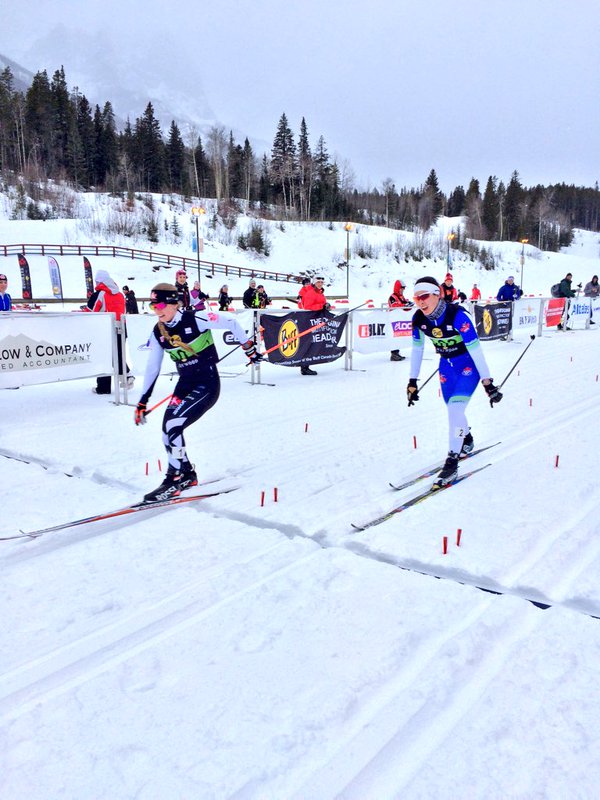
    NDC Thunder Bay athletes (in green) took second, third and fourth in the women's NorAm 5 k classic interval start, behind  Sophie Carrier-Laforte (c) of the Pierre Harvey National Training Centre in first. (Photo: NDC Thunder Bay/Twitter)
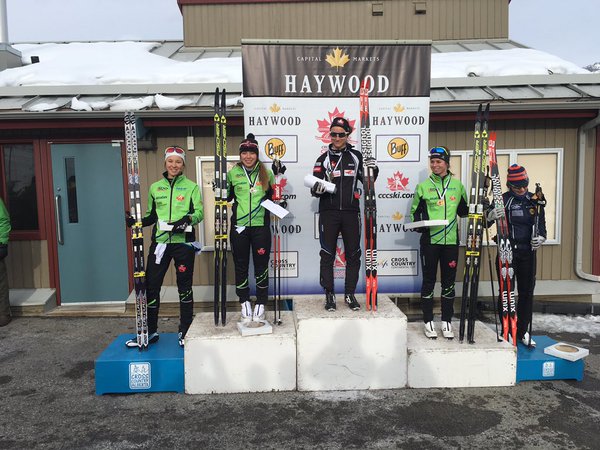
    NDC Thunder Bay athletes (in green) took second, third and fourth in the women’s NorAm 5 k classic interval start, behind Sophie Carrier-Laforte (c) of the Pierre Harvey National Training Centre in first. Katharine Stewart-Jones (second from l) placed second, Alannah Maclean (second from r) with third, and Jenn Jackson (l) was fourth. Rocky Mountain Racers’ Andrea Dupont (r) placed sixth. (Photo: NDC Thunder Bay/Twitter)

    In the women’s 5 k classic race, Sophie Carrier-Laforte of the Pierre Harvey National Training Centre (CNEPH) won the two-lap race in 14:31.5, followed by U23 Development Team member Katherine Stewart-Jones (NDC Thunder Bay), 10.3 seconds back.

    Thunder Bay had two on the podium with Alannah Maclean in third, 17.9 seconds behind Carrier-Laforte, and another athlete in fourth: Jenn Jackson (+30.8)

    “I was aiming for a podium this week but didn’t expect to get it today,” Stewart-Jones wrote in an email. “It’s a very short race so I planned on going out really hard and just try to hold on to the same pace. On the first lap, I focused on skiing efficiently and then just went as hard as I possibly could on the second [lap].”

    She added that her double-pole work this summer appears to have paid off.

    While Stewart-Jones’s first lap ranked fourth and second lap was second-fastest among the women, Carrier-Laforte skied the fastest last lap. Andrea Dupont (Rocky Mountain Racers) was fastest on Lap 1, but faded on Lap 2 to place fifth (+36.0). Maclean posted the second-fastest opening lap.

    Saturday’s 10/15 k classic results: Men | Women

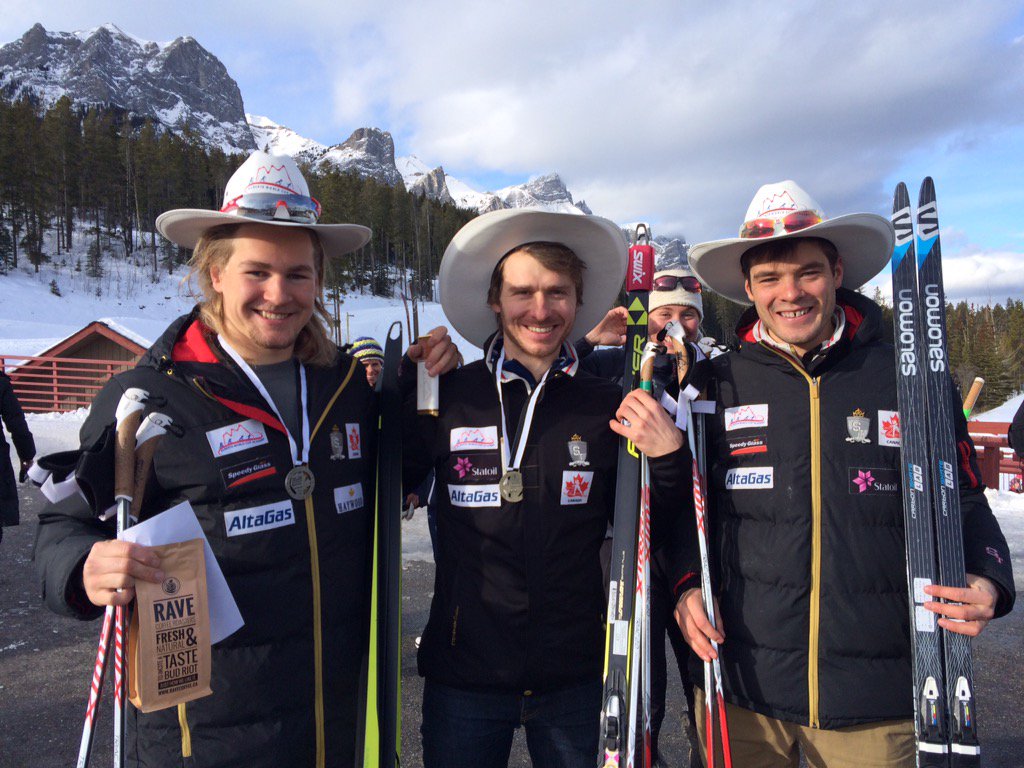
    Kevin Sandau (c) and his Alberta World Cup Academy teammates Knute Johnsgaard (l) and Patrick Stewart-Jones (r) placed first, second and fourth, respectively in the men's NorAm 16.5 k freestyle mass start on Dec. 6 in Canmore, Alberta. (Photo: Alberta World Cup Academy/Twitter)
    Kevin Sandau (c) and his Alberta World Cup Academy teammates Knute Johnsgaard (l) and Patrick Stewart-Jones (r) placed first, second and fourth, respectively in the men’s NorAm 16.5 k freestyle mass start on Dec. 6 in Canmore, Alberta. (Photo: Alberta World Cup Academy/Twitter)

    On Sunday, Dec. 6, Sandau repeated with a win in the second race of the season: the men’s 16.5 k freestyle mass start. The races were once again held on Canmore’s biathlon trails, this time on a 3.3 k loop.

    Sandau won it in 38:59.9, again ahead of Johnsgaard, who finished 36.6 seconds back in second. About a minute and 3 seconds behind Sandau, McKeever placed third, four-tenths of a second ahead of fourth-place finisher Patrick Stewart-Jones (AWCA).

    For Sandau, the race and the victory were even better than the day before.

    “The 15km skate played out a lot more to my strengths and really let me test out my fitness,” he wrote. “I knew before the start I just wanted to go full throttle right from the gun. It was a mass start, and there was a crazy westerly wind, so I knew this race was going to be easier to bunch up and make it harder to break away.”

    He strategized his pace changes for the bottom of the five-lap course, where there were two “decent climbs,” he explained. His fourth time around, he broke away from Johnsgaard and skied the rest of the race alone.

    “I knew once I could break away from anyone, I could really start to put some time in because they had to fight the wind just as much as I did at that point on,” Sandau wrote.

    Johnsgaard anticipated that Sandau would be the man to beat, “so the two of us started hard right out of the gate to try and lose the field as soon as possible,” Johnsgaard wrote.

    They broke away around 5 k, and while Sandau’s pace felt fast, Johnsgaard explained holding on until the last 3.3 k lap.

    “By that time I was hurting pretty bad and lost a lot of time on my last lap,” he wrote. “I thought everyone would catch back up to me but luckily we had opened up a big enough gap earlier on.”

    McKeever noted the superior shape of Sandau and Johnsgaard compared to him and the rest of the field. “It went as well as it could have,” McKeever wrote. “I played the tactics right and made the most of the day.”

    Dahria Beatty of the U23 Development Team and AWCA charged hard on the last lap of the women’s 10 k freestyle mass start to win by 8.8 seconds in in 27:07.5. Frédérique Vézina placed second and her CNEPH teammate Cendrine Browne (NST U23 Development Team) took the final podium step in third, 13.7 seconds behind Beatty. Another CNEPH skier Jaqueline Mourao, originally from Brazil, was 1.4 seconds off the podium in fourth. Mourao turns 40 later this month.

    “It’s always amazing to be able to win a race!” 21-year-old Beatty wrote in an email after her second senior NorAm victory. “I ended up leading most of the race. My original plan had been to sit back for the first lap in the pack and then if I felt strong push the long climb that was on both the second and third lap.”

    As she approached the climb on the second of three laps, she explained she tried to keep the pace high to “string out the pack.”

    “On the final lap on the same long climb I had a ski lengths gap coming off the downhill so I took advantage of that small gap and just skied as hard as I could without looking back,” Beatty wrote. “I didn’t let off at all until the final 500 meters when I finally checked to confirm the gap my coaches had been telling me I had.”

    Vézina wrote that, while she made a race plan and executed it well, mass starts are a toss up.

    “You can expect some things but at the end you can really make intelligent decisions once you are in the race,” Vézina wrote. “I’m happy with the way I managed my race.”

    Despite a broken pole at the beginning of the race and losing contact with the leaders, Browne was pleased to see where she stacked up at the start of the season.

    “You always ask yourself if you are in shape or not compared to the other skiers,” Browne wrote. “The tactics didn’t play out as planned … I was planning on leading with Dahria but it didn’t really work out because I had to make my way back to the front.”

    Sunday’s 10/16.5 k freestyle mass start results: Men | Women

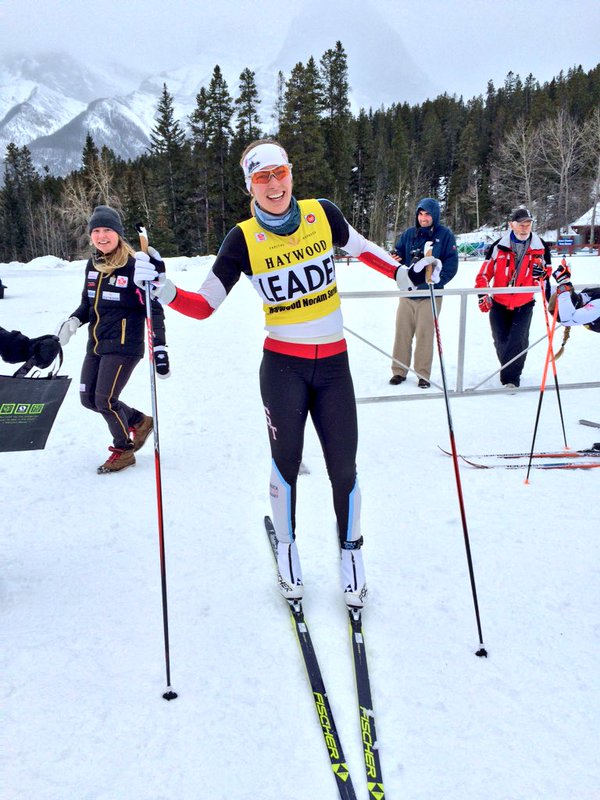
    Women's Canmore NorAm classic sprint winner Dahria Beatty (AWCA/NST U23 Development Team) after her A-final victory. (Photo: CCC/Twitter)
    Women’s Canmore NorAm classic sprint winner Dahria Beatty (AWCA/NST U23 Development Team) after her A-final victory. (Photo: CCC/Twitter)

    On Tuesday, the final day of NorAm racing in Canmore, Beatty went on to win the women’s 1.5 k classic sprint final by 2.51 seconds over Browne. Earlier in the day, Browne topped the qualifier in 4:36.2, and Beatty was 6.8 seconds off the pace to qualify in fifth.

    Browne and Beatty both won their quarterfinals before facing off in the semifinal, where Browne took first by 1.62 seconds over Beatty in second. In the final, Beatty explained that for the first time in a race, she screamed in elation as she crossed the finish. It was her first senior sprint victory.

    “Going into this race I wanted to ski in the top two in all heats to avoid being stuck at the back of an accordion-effect after the herringbone climb. In all my heats I was able to do that,” she wrote. “Everyone’s skis were icing after this climb so it was easy to lose time kicking it off at the top. For the final I asked my coach to put a less sticky wax on so I would ice less and I think that made a big difference. I was still able to make it up the hills but more importantly I was able to crest the hill super aggressively on both laps, thus carrying more speed into the downhill.”

    With two big climbs separated by two downhills, Beatty explained that it made sense to push hard each time up. That made pacing simple; she simply wanted to be in front.

    “When I came down the last hill in the lead I went into sprint mode and didn’t look back,” she wrote. “I had to look at the results afterwards to realize how far behind the others were.

    Another great thing about today was the rain waited until the women’s race was over, bonus.”

    Dahria Beatty (l) and Jenn Jackson after Tuesday's NorAm classic sprint in Canmore, Alberta. Beatty won the race for her second-straight victory of the weekend, and Jackson placed third behind Cendrine Browne (not shown). (Photo: CCC/Twitter)
    Dahria Beatty (l) and Jenn Jackson after Tuesday’s NorAm classic sprint in Canmore, Alberta. Beatty won the race for her second-straight victory of the weekend, and Jackson placed third behind Cendrine Browne (not shown). (Photo: CCC/Twitter)

    Browne was pleased to win a sprint qualifier for the first time in her career and did so by four seconds over Jenn Jackson. Later in the final, she edged Jackson by 0.25 seconds for second place. Jackson was third, ahead of Andrea Dupont in fourth, Vézina in fifth, and Marie Corriveau (CNEPH/National Junior Team) in sixth.

    For Browne, 22, it was her second podium in a senior sprint.

    “In the semi final, my plan was to climb the last hill faster then Dahria so I would have more speed than her in the downhill. I had the same plan in the A final but it didn’t work out as well,” she explained. “I had a pretty high level of energy today but I still tried to manage it in the quarter final and in the semi final. … My skis were great. I had great kick and my skis were fast, and that helped me a lot.”

    Bob Thompson (Thunder Bay NDC) made the top 30 to qualify for the heats in the 1.5 k men’s sprint, but was more than 17 seconds off the pace in 20th. Johnsgaard set the time to beat in the qualifier in 3:51.05.

    In the quarterfinals, Thompson placed second to Julien Locke (Black Jack), but came back to beat Locke in the semifinal by 0.15 seconds. Thompson went on to win the men’s final by 1.24 seconds over Patrick Stewart-Jones.

    Cendrine Browne (CNEPH) edges Jenn Jackson (NDC Thunder Bay) for second in the women's NorAm classic sprint final. (Photo: CCC/Twitter)
    Cendrine Browne (CNEPH) edges Jenn Jackson (NDC Thunder Bay) for second in the women’s NorAm classic sprint final. (Photo: CCC/Twitter)

    “Definitely great to finish the day and the weekend with a win, seems I’m becoming notorious for coming off a poor qualifier and then figuring things out in the heats,” Thompson wrote in an email.

    After the quarterfinal, he switched from grip skis to zeros/rub skis, he wrote, “and they made a huge difference.

    “I definitely let my skis do a bit of work so I tried to keep the first lap in control and just keep a solid position in second or third and then just make sure to stay close over the top into the downhill to get the draft,” he added. “Tough day to try and lead into the downhill and finish.”

    “Bob was really strong in the finish today and I have to accept that,” Stewart-Jones wrote. “The final was a little bizarre because the pace started out fast, but then on the top of the climb on the second lap it slowed right down because it was so narrow and no one could get by the leader. The pack bunched right up and from there on it was pretty much a 6 way drag race to the finish.”

    Andy Shields (NDC Thunder Bay) placed third, 1.35 behind Thompson. Sandau was fourth, Locke fifth and Johnsgaard sixth.

    “The classic sprint was a big turnaround from how I was skiing on the weekend,” Shields wrote. “Distance skiing so far this year has felt terrible. Luckily my sprinting pep is still strong. I went on wax for the quarter and it was unbelievably fast.”

    With wet snow and rain before his semifinal, Shields switched to zeros, “which had crazy grip but lacked a bit in glide,” he wrote. “The techs were able to tune my zeros for the final. … Happy with now having NorAm podiums in both skate and classic sprinting, as well as podiums in both skate and classic distance.”

    Tuesday’s classic sprint results: Overall | Qualifying

  • Junior Nationals Video: Freestyle Mass Starts

    Junior Nationals Video: Freestyle Mass Starts

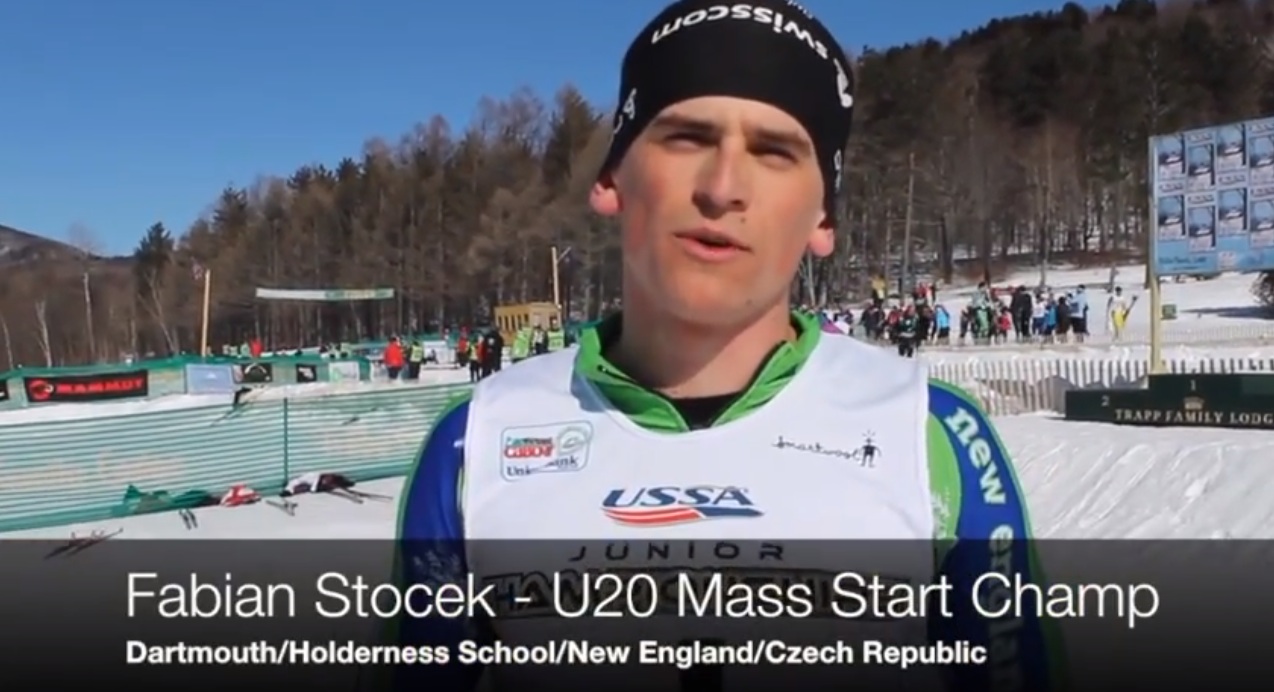
    Fabian Stocek, Dartmouth freshman from the Czech Republic, after winning the 15 k freestyle mass start at Junior Nationals on March 7.
    Fabian Stocek, Dartmouth freshman from the Czech Republic, after winning the 15 k freestyle mass start at Junior Nationals on March 7.

    STOWE, Vt. — The mass starts are always a highlight at any championships — let alone Junior Nationals. Here’s a look at the action that took place last Friday, March 7, at U.S. Junior Nationals in the 15-, 10- and 5-kilometer freestyle mass starts at Trapp Family Lodge in Stowe, Vt.

    Top-10 Recognition

    Trouble viewing video? Click here.

  • Junior Nationals: Mass Start Top-10 Recognition

    Junior Nationals: Mass Start Top-10 Recognition

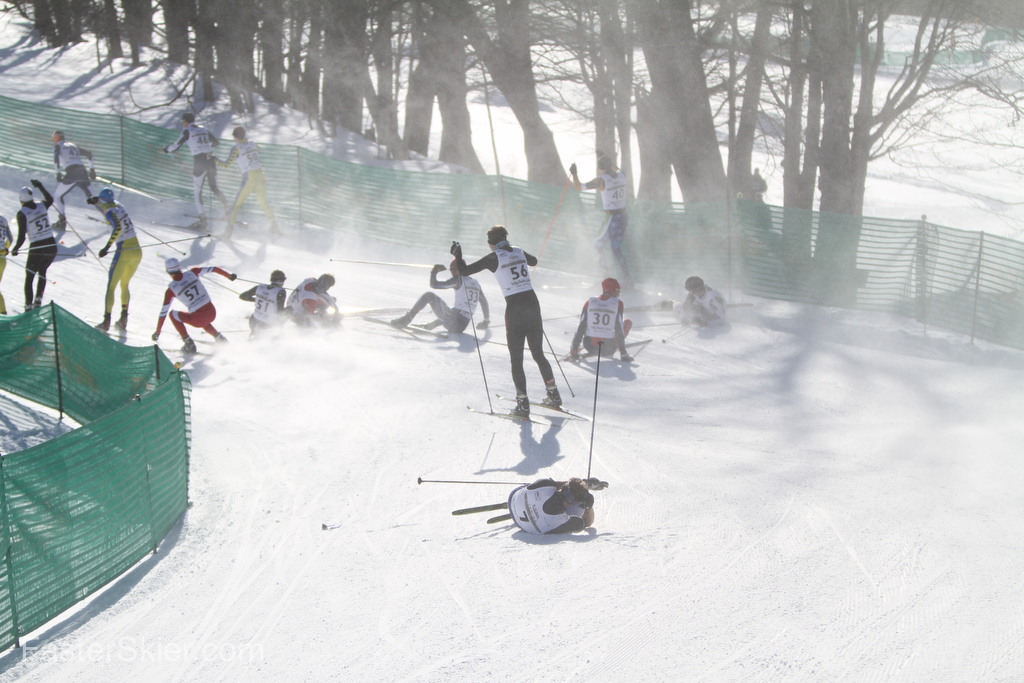
    A massive pileup on the first corner shortly after the start of the U20 men's 15 k freestyle mass start on Friday at 2014 Junior Nationals in Stowe, Vt.
    A massive pileup on the first corner shortly after the start of the U20 men’s 15 k freestyle mass start on Friday at 2014 Junior Nationals in Stowe, Vt. Far West’s Patrick McElravey, also of Middlebury College, in bib 7 needed medical attention.

    STOWE, Vt. — The youngest child of the original von Trapp family, Johannes von Trapp was the man of the hour almost every hour for the start of six freestyle distance races on the last day of individual racing at 2014 Junior Nationals on Friday.

    With a rifle in hand, Von Trapp, 75, fired the starting signal for each of the U16, U18 and U20 mass starts. After that, it was up to the racers to determine where they’d end up at the finish — save for a few early pileups in the U20 and U18 men’s races, where one racer did not finish.

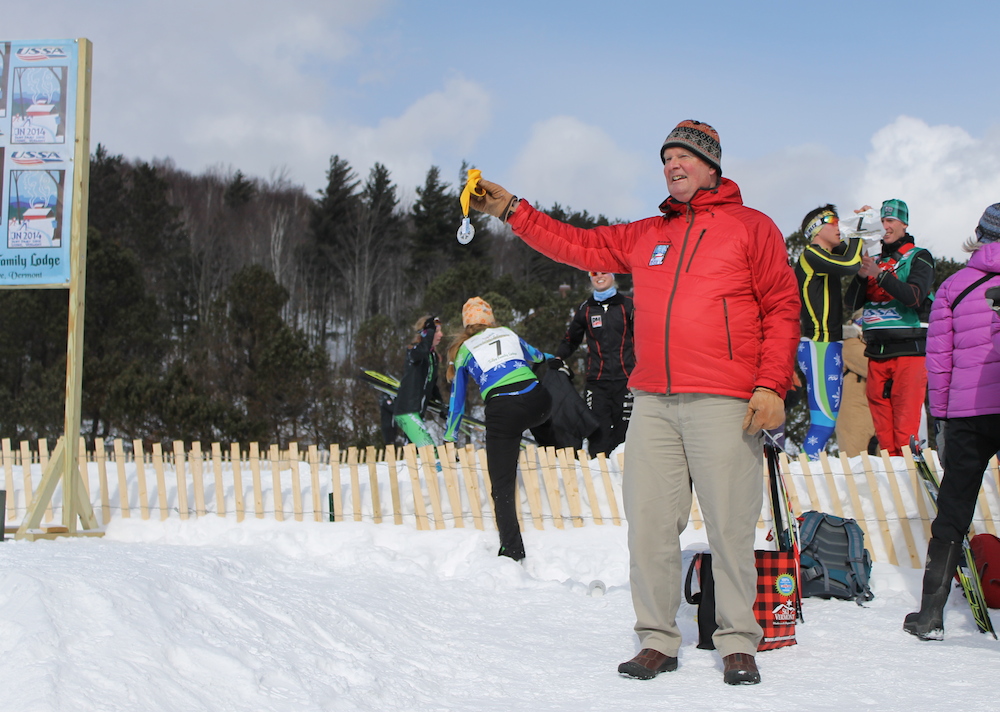
    Johannes von Trapp of Trapp Family Lodge presenting medals at 2014 Junior Nationals earlier this week in Stowe, Vt.
    Johannes von Trapp of Trapp Family Lodge presenting medals at 2014 Junior Nationals earlier this week in Stowe, Vt.

    The worst series of crashes came in the first race, the U20 men’s 15 k freestyle, which left Far West’s Patrick McElravey seeking medical attention. He was OK (and was listed to start on Saturday), but the incident prompted USSA Nordic Manager Joey Caterinichio to come up with the idea for a paced start.

    For every race after the U20 women’s race, a Midwest coach led hundreds of competitors out of the start, down the troublesome 180-degree corner and back up out of the stadium, until passing a set of cones that gave skiers the go-ahead to go for it.

    The method generally worked (except for the accordion effect that caused another crash in the U18 men’s race in nearly the same spot coming out of the corner), and by early afternoon, six national champions had been named.

    Here’s a look at who made the top 10 and All-American status on Friday in the last of three individual races at Junior Nationals. Relays wrap up the championships on Saturday, starting at 9:30 a.m.

    Complete mass start results

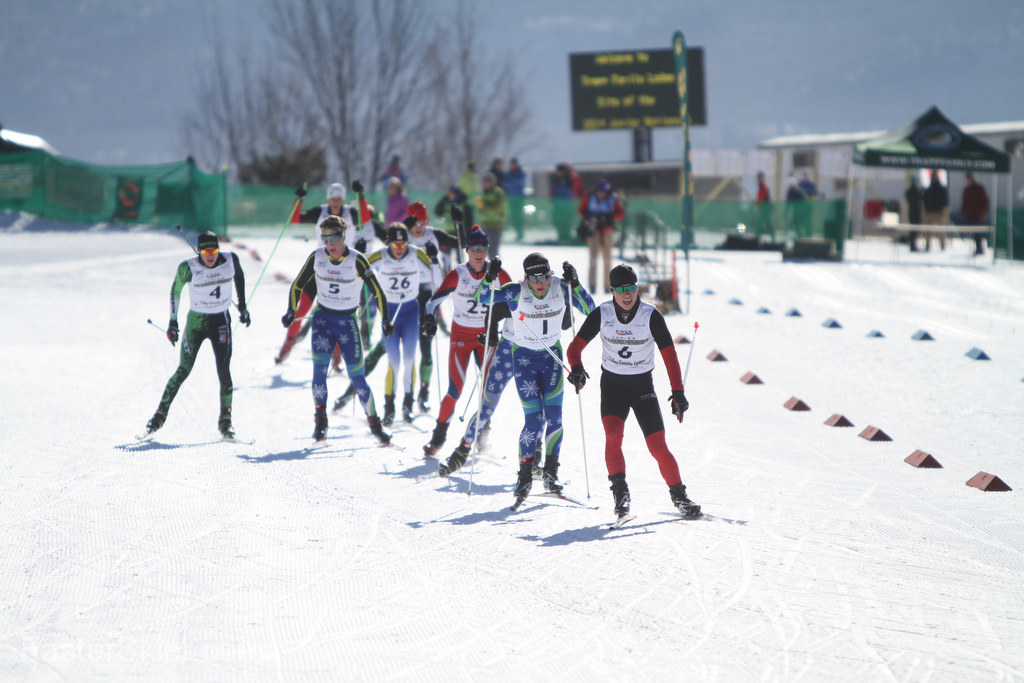
    New England's Fabian Stocek (1) follows Rocky Mountain's Jack Hill (6) in the U20 men's 15 k freestyle mass start at Trapp Family Lodge in Stowe, Vt. Stocek went on to win the Junior Nationals race by 7.5 seconds.
    New England’s Fabian Stocek (1) follows Rocky Mountain’s Jack Hill (6) in the U20 men’s 15 k freestyle mass start at Trapp Family Lodge in Stowe, Vt. Stocek went on to win the Junior Nationals race by 7.5 seconds.

    U20 Men’s 15 k  

    1. Fabian Stocek (Holderness School/New England)
    2. Jack Schrupp (Gunstock Nordic/New England)
    3. Thomas Bye (CXC/Midwest)
    4. Cole Morgan (University of Vermont/New England)
    5. Mathew Nichols (University of Wisconsin Green Bay/Midwest)
    6. Shane Christian (Unleashed Coaching/Far West)
    7. Jan Ketterson (Loppet Nordic Racing/Midwest)
    8. Jack Hegman (UVM/New England)
    9. Oscar Friedman (Dartmouth/Rocky Mountain)
    10. Jackson Hill (University of Colorado/Rocky Mountain)

    Fun Fact: A Czech Republic native, Stocek, 19, is a Dartmouth College freshman and has lived in the U.S. for the last four years. “[I’ve] made a lot of connections with friends all over New England so that’s been making a support for me,” he says. “My parents are still in the Czech Republic so I have a great way of connecting with people around New England. I like that a lot, traveling around, recognizing all the aspects that the aspects has to offer. … And continuing at Dartmouth, not a bad place to be for skiing.”


    U20 Women’s 10 k

    1. Maggie Williams (Sun Valley/Intermountain)
    2. Marion Woods (Alaskas Winter Stars/Alaska)
    3. Hannah Benson (Williams Outing Club/New England)
    4. Kristen Bourne (Northern Michigan University/Midwest)
    5. Hannah Stevens (Alaska Nordic Racing/Alaska)
    6. Kelsey Phinney (New England)
    7. Nora Gilbertson (St. Olaf College/Midwest)
    8. Sonja Hedblom (LNR/Midwest)
    9. Maria Hauer (Flyer Nordic/Midwest)
    10. Cara Piske (Steamboat Springs WSC/Rocky Mountain)

    Fun Fact: Originally from Ketchum, Idaho, Williams is a freshman at the University of Vermont and this is her first Junior Nationals victory. When she’s not racing: “I like to knit and make stained-glass artwork, kind of some grannie hobbies,” she says. “That’s something I’ve kind of been doing my whole life.”


    U18 Men’s 10 k 

    1. Gavin McEwen (Cambridge Sports Union/New England)
    2. Lars Hannah (Steamboat Springs/Rocky Mountain)
    3. Ian Torchia (LNR/Midwest)
    4. Thomas O’Harra (Alaska Pacific University/Alaska)
    5. Karsten Hokanson (Wasatch Nordic/Intermountain)
    6. Paolo Takagi-Atilano (Boulder Nordic/Rocky Mountain)
    7. Zak Ketterson (LNR/Midwest)
    8. Peter Holmes (Unleashed Coaching/Far West)
    9. John Farr (APU/Alaska)
    10. Zane Fields (Woodstock/New England)

    Fun Fact: For 16-year-old McEwen, this is his first Junior Nationals win. “I don’t usually like to think about race [until] about 10 minutes beforehand,” he says. “I got up kind of late because it was a later start than we usually have, I finished my bowl of oatmeal, which is kind of unusual for me because usually I feel kind of sick. But I felt really good.”


    U18 Women’s 10 k 

    1. Katharine Ogden (Stratton Mountain School/New England)
    2. Aja Starkey (Bridger Ski Foundation/Intermountain)
    3. Vivian Hett (LNR/Midwest)
    4. Sophie McDonald (Park City/Intermountain)
    5. Caroline Brisbois (Endurance United/Midwest)
    6. Racquel Wohlk (Nordicwerks/Midwest)
    7. Alayna Sonnesyn (Endurance United/Midwest)
    8. Hannah Peterson (Durango/Rocky Mountain)
    9. Mattie Watts (Endurance United/Midwest)
    10. Gretchen Burkholder (Steamboat Springs/Rocky Mountain)

    Fun Facts: This is Ogden’s second win of the week and she did so in impressive fashion, breaking away around 4 k and winning by 20 seconds. “I was inspired by Caitlin Gregg’s performance at U.S. nationals so I decided to go for a similar method,” Ogden says. “Channeling my inner Caitlin Gregg for sure.”

    Gregg won the 30 k mass start at U.S. nationals in January by more than a minute and 30 seconds. 

    Ogden explained she’s been knitting between races to channel the rest of her energy.

    “I knit when I’m nervous before races,” she says. “I’ve knit almost an entire buff this week, a neckie, so I’m pretty proud.”


    U16 Men’s 5 k 

    1. Hunter Wonders (APU/Alaska)
    2. Leo Lukens (Mt. Bachelor/Pacific Northwest)
    3. Russell Boswell (SMS/New England)
    4. Max Polito (Jackson Hole/Intermountain)
    5. Zach Williams (Sun Valley/Intermountain)
    6. Peter Wolter (Sun Valley/Intermountain)
    7. Jack Consenstein (APU/Alaska)
    8. Forrest Hamilton (Mansfield/New England)
    9. Daniel Streinz (Maine WSC/New England)
    10. Benjamin Koenig (NSCF-Fairbanks-FXC/Alaska)

    Fun Facts: In his first Junior Nationals, this is Wonder’s first time to Vermont. “My first time on the East Coast,” he says. “It felt super nice. Today was super relaxed and just pushing the tempo at the very end.”

    The 15-year-old Anchorage native won by nearly six seconds. “My goal for the whole season was to make it to the Junior Nationals and once I did that I was going for any kind of medal,” he says. “I guess gold’s fine.”


    U16 Women’s 5 k 

    1. Hailey Swirbul (Aspen Valley SSC/Rocky Mountain)
    2. Chloe Levins (Mountain Top/New England)
    3. Hannah Halvorsen (Sugar Bowl/Far West)
    4. Kathleen O’Connell (Steamboat Springs/Rocky Mountain)
    5. Leah Lange (Park City/Intermountain)
    6. Mackenzie Rizio (SMS/New England)
    7. Leah Brams (Cambridge Sports Union/New England)
    8. Brooke Dunnagan (Bogus Basin Nordic/Intermountain)
    9. Erin Moening (Endurance United/Midwest)
    10. Anna Darnell (APU/Alaska)

    Fun Fact: After capturing her first Junior National title in the 5 k classic earlier this week, Swirbul, 15, did it again in the skate mass start. “I have been dreaming of this moment to win a mass start since last Junior Nationals where I got third and it has never tasted sweeter to win a race,” she says. Also relatively sweet is her favorite food: sweet potatoes.