From the FasterSkier archive — posts syndicated from athletes’ and coaches’ own blogs between 2004 and 2012, kept online as published. Current coverage is at fasterskier.com.
Stifel Lake Placid Finals, a Coop FIS Cross-Country World Cup, to Bring Elite Ski Racing and Winter Festival Atmosphere to Lake Placid
FIS Cross-Country World Cup racing, fan experiences, athlete engagement, and live entertainment coming March 19–22
LAKE PLACID, N.Y. — The Stifel Lake Placid Finals, a Coop FIS Cross-Country World Cup, will offer more than world-class competition this March. The event will transform Lake Placid into a multi-day winter sports festival featuring themed race days, live entertainment, film screenings, interactive expo activations, and family-friendly programming.
In collaboration with the New England Nordic Ski Association (NENSA), the 10th Mountain Division, U.S. Ski & Snowboard, and the International Ski and Snowboard Federation (FIS), the Olympic Regional Development Authority (Olympic Authority) has curated a dynamic schedule that celebrates Nordic skiing and outdoor winter-sport culture.
A central focus of the week will be spotlighting women and girls in sport, networking opportunities, and hands-on activities. Fans will also have unique opportunities to connect with athletes through meet-and-greets, alumni celebrations, and special legacy moments — including Sunday’s “Last Lap” ceremony honoring retiring World Cup athletes.
Together, these events are designed to foster engagement, connection, and shared celebration across the Lake Placid community and the global ski family.
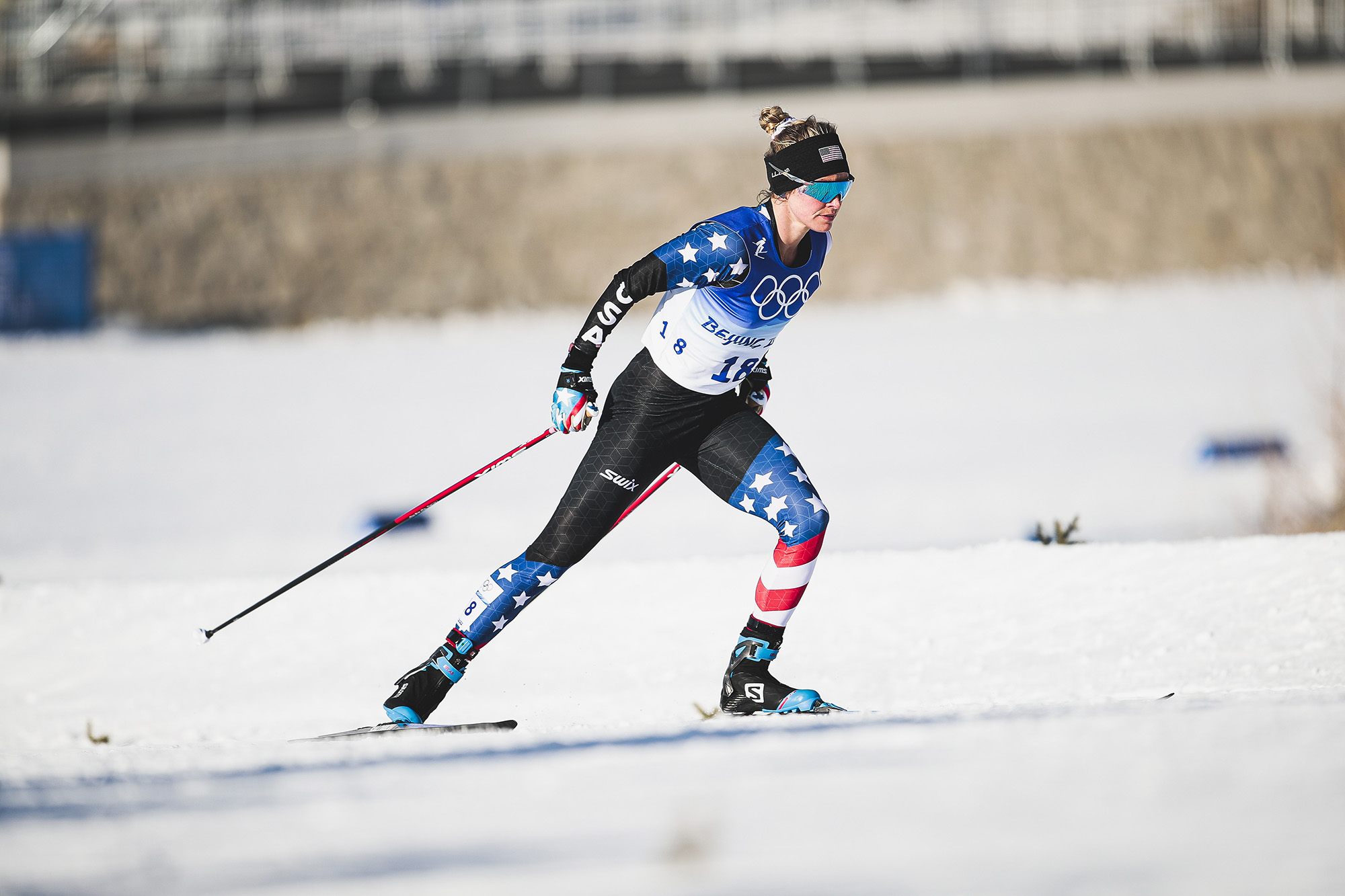
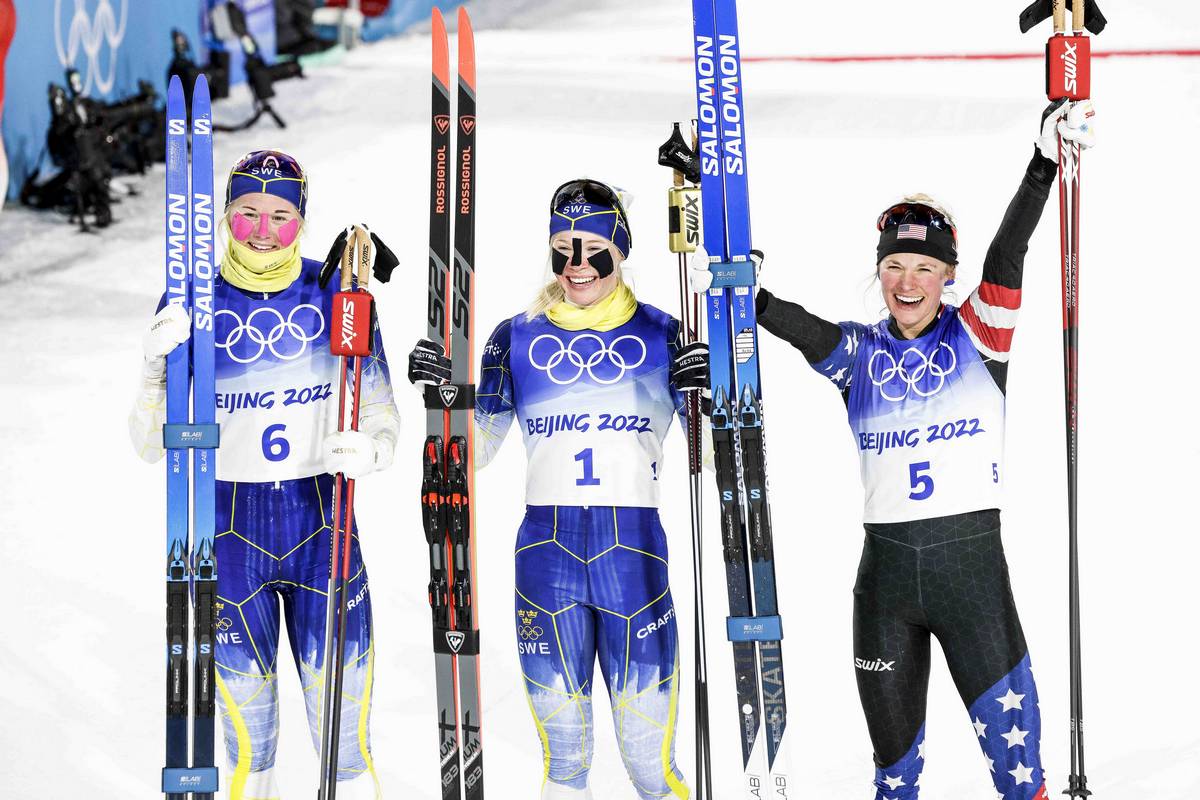
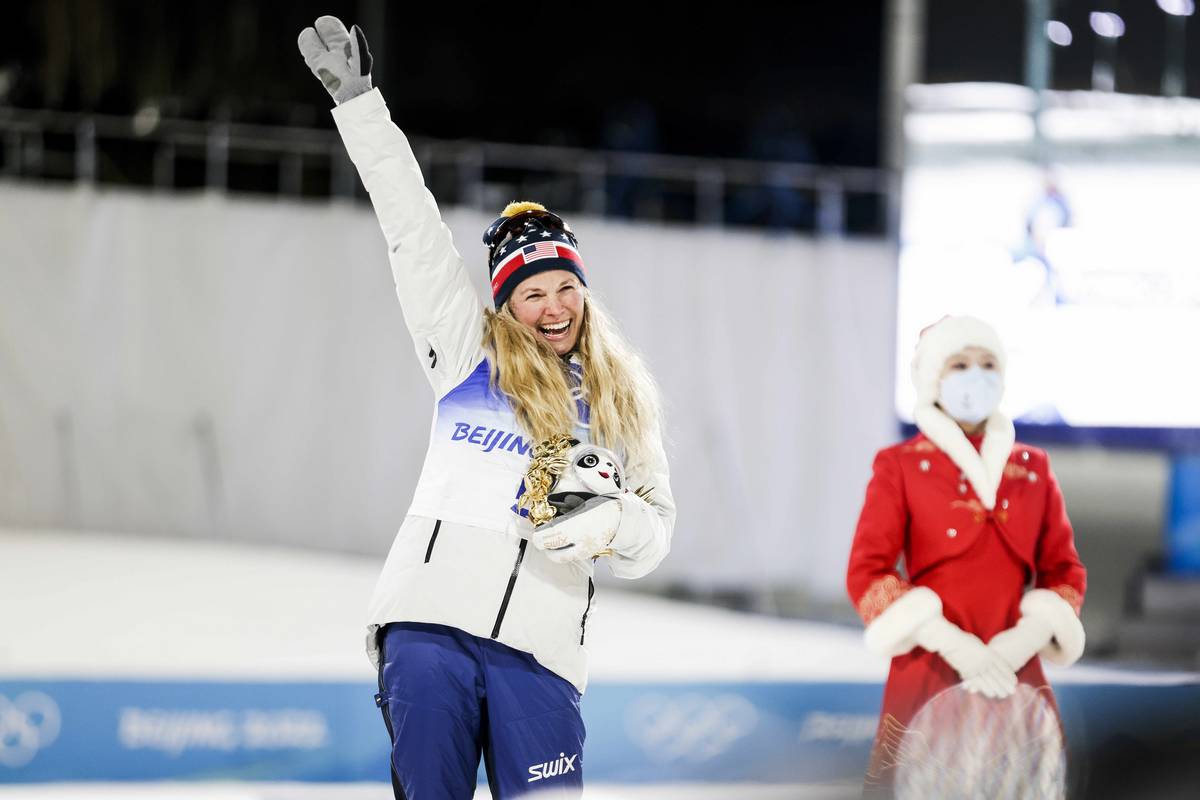
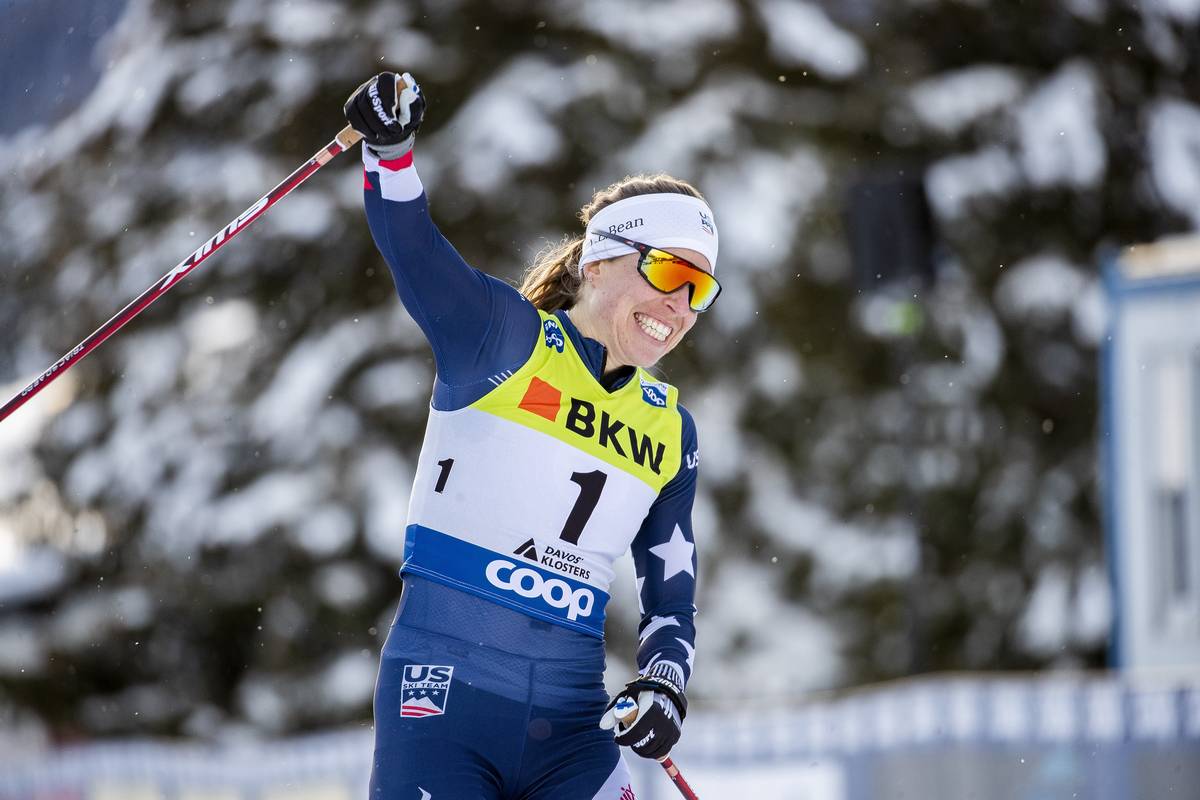
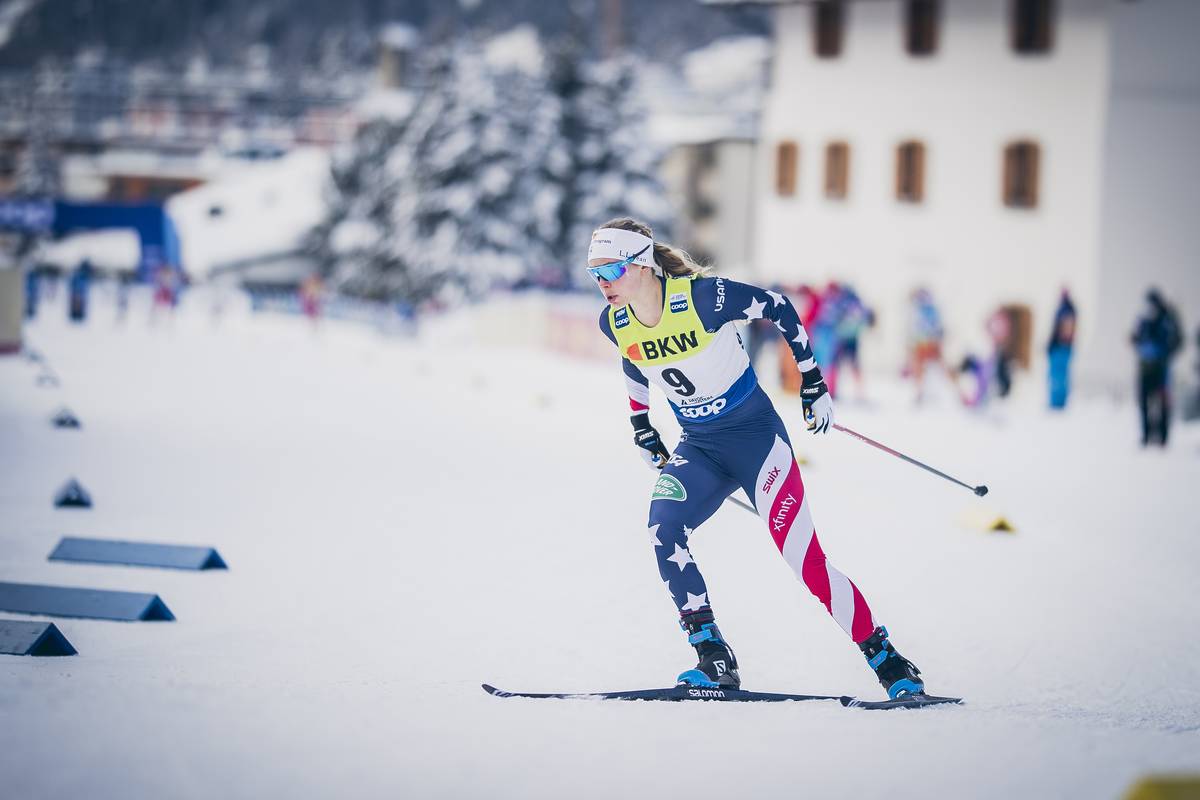
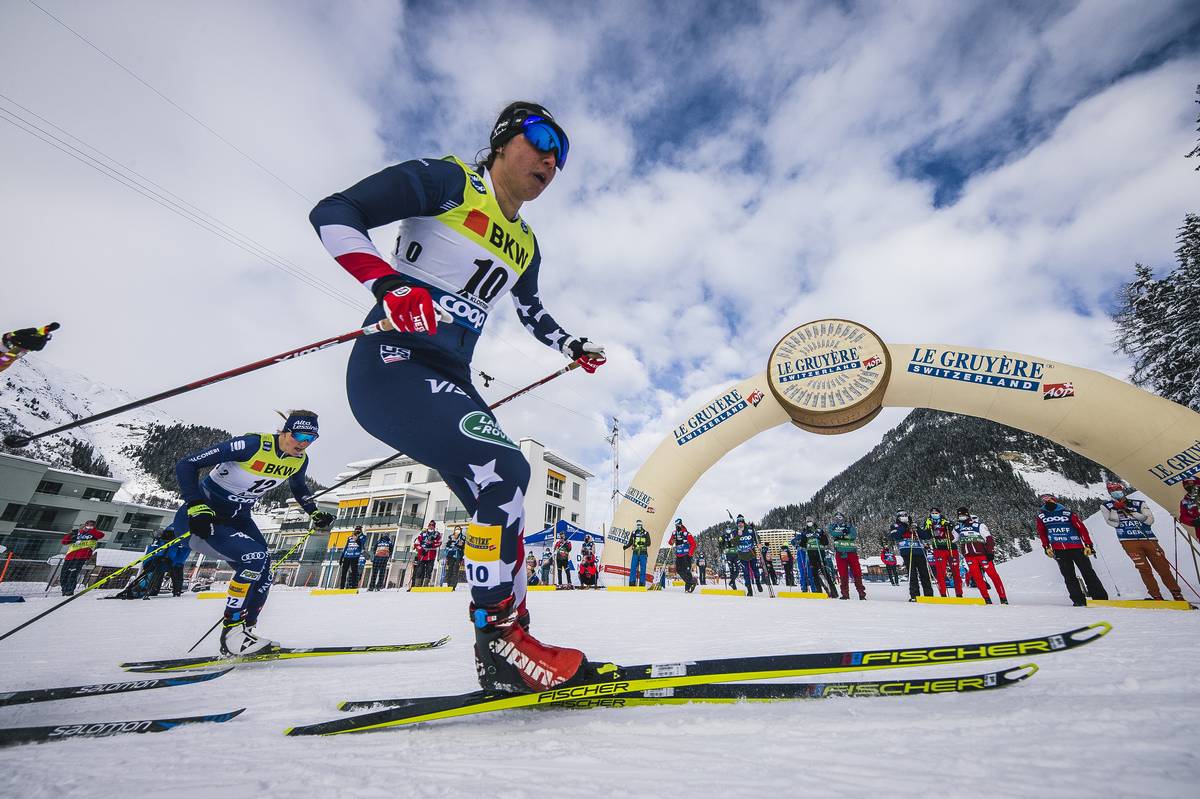
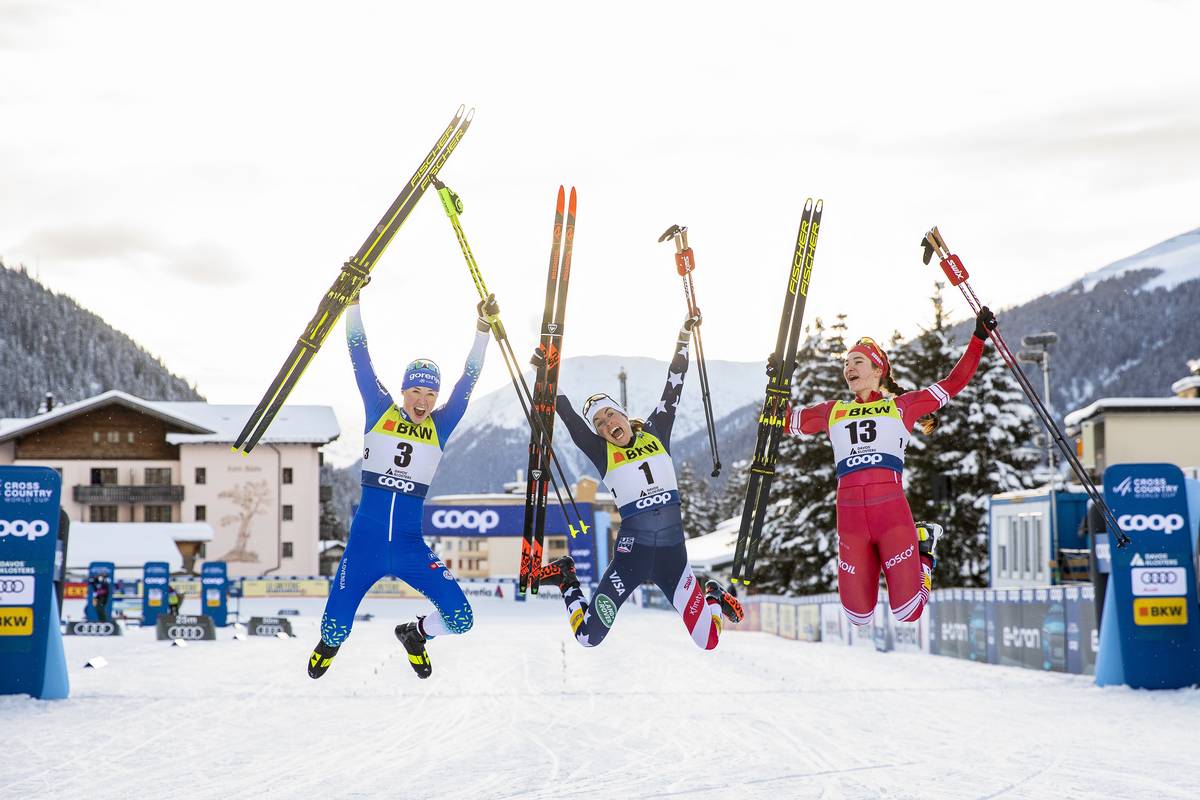
One final celebration of Jessie Diggins (USA) amazing career. (Photo: Authamayou/NordicFocus)
Event & Community Programming
In addition to World Cup racing, the Stifel Lake Placid Finals will feature a range of community events, athlete appearances, and festival programming throughout the week. Activities include youth programming, athlete conversations, live music, demonstrations, and opportunities for fans to connect with past and present champions.
Programming details may evolve, and additional events may be added throughout the week. Visitors are encouraged to check the official event schedule for the most up-to-date information.
Thursday, March 19 – Community & Kickoff
Opening day features official training and festival programming at Mt Van Hoevenberg, along with an evening film screening at the Palace Theatre that kicks off the festivities in downtown Lake Placid.
Friday, March 20 – Theme: Past
Friday celebrates the legacy of Nordic skiing and Olympic history in Lake Placid. The venue opens with festival programming, including the NENSA Terrain Park and Expo with L.L. Bean, regional athlete recognition connected to the 2026 Winter Olympics, and Adirondack Birds of Prey demonstrations. Fans can also watch presentations from the 10th Mountain Division, enjoy live music, and attend athlete interviews and meet-and-greets throughout the day. A highlight of the afternoon is the “One More Lap” legacy ski, featuring international and U.S. Ski Team alumni, including Olympic legend Thomas Wassberg and American champion Bill Koch, before World Cup racing and awards ceremonies conclude the day.
Saturday, March 21 – Theme: Future
Saturday’s programming focuses on the next generation of Nordic skiing. Activities include the NENSA Terrain Park and Expo with L.L. Bean, athlete appearances, and fan engagement opportunities. The Women in Sports Heroic Panel highlights leadership and opportunities for girls and women in athletics, while fans can also attend athlete meet-and-greets and participate in interactive programming throughout the venue. Competition highlights include the freestyle sprint finals, followed by Crystal Globe presentations. Youth racing also takes center stage with the World Cup Future Stars Sprint. Additional programming includes Lollipoppers to Olympians: A Celebration of New England Skiing, a live recording of the Skirious Podcast featuring Ben Ogden and special guests at the Olympic Jumping Complex, and evening film screenings at the Palace Theatre.
Sunday, March 22 – Theme: Present
Championship Sunday features entertainment, athlete appearances, and the season-ending races of the World Cup Finals. Live music, a DJ set, and ceremonial elements, including the 10th Mountain Division Color Guard and flyover, set the stage for the final competition. The afternoon concludes with awards ceremonies and the “One Last Lap” ceremony honoring retiring World Cup athletes.
Gus Schumacher (USA) and Ben Ogden (USA), (l-r) celebrate their silver medal at the Olympic Winter Games in Tesero, Italy. (Photo: Vanzetta/NordicFocus)
Competition Schedule | FIS Cross-Country World Cup Finals
Mt Van Hoevenberg | March 19–22, 2026
World Cup official training and competition runs March 19–22 at Mt. Van Hoevenberg, where the world’s top U.S. and international cross-country skiers will compete for overall and discipline Crystal Globe honors. The weekend culminates on Sunday with championship racing, awards presentations, and the “One Last Lap” ceremony recognizing retiring athletes.
Full competition schedule:
Thursday, March 19, 2026:
11:00 – 1:00 pm | 10km Official Training
1:00 pm – 3:00 pm | Sprint Official Training
Saturday, March 21, 2026:
10:30 am | Women’s Sprint Qualification Free
10:30 am | Men’s Sprint Qualification Free
1:00 pm | Women’s Sprint Final Free
1:00 pm | Men’s Sprint Final Free
Sunday, March 22, 2026:
12:30 pm | Men’s 20km Mass Start Free
2:30 pm | Women’s 20km Mass Start Free
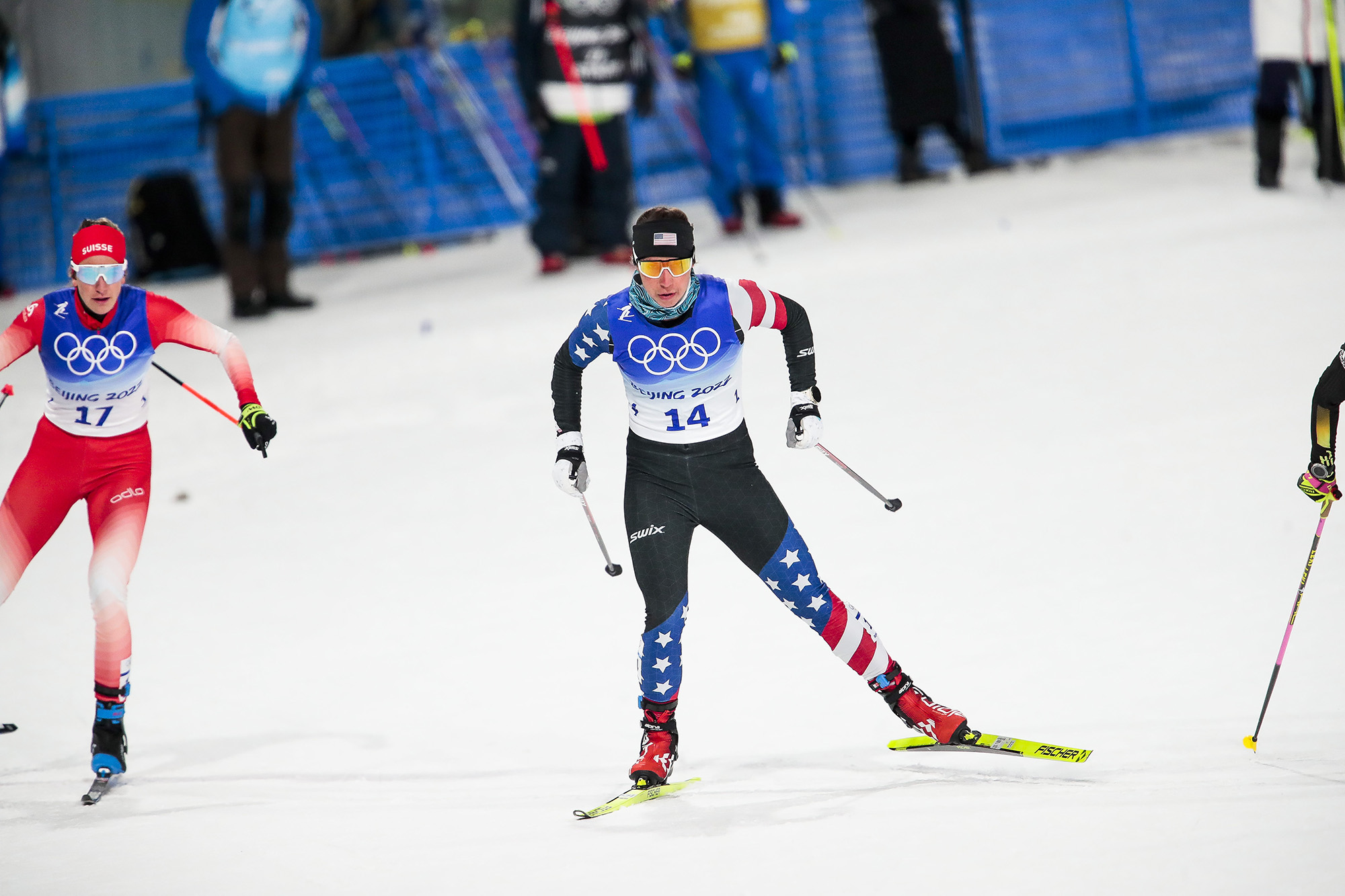
Jessie Diggins (USA) and the US Ski Team celebrate in Goms. (Photo: Authamayou/NordicFocus)
Broadcast Schedule
NBC will air the Sprint Finals live on Saturday, March 21, from 1–2 p.m. ET. CNBC will air coverage of the Men’s and Women’s 10km Interval Starts on Saturday, March 21, from 2–4 p.m. ET. NBC will also air the Women’s 20km Mass Start on Saturday, March 29, from 1–2 p.m. ET on tape delay.
This coverage is made possible through the generous support of Marty and Kathy Hall and A Hall Mark of Excellence Award. To learn more about A Hall Mark of Excellence Award, or to learn how you can support FasterSkier’s coverage, please contact info@fasterskier.com.
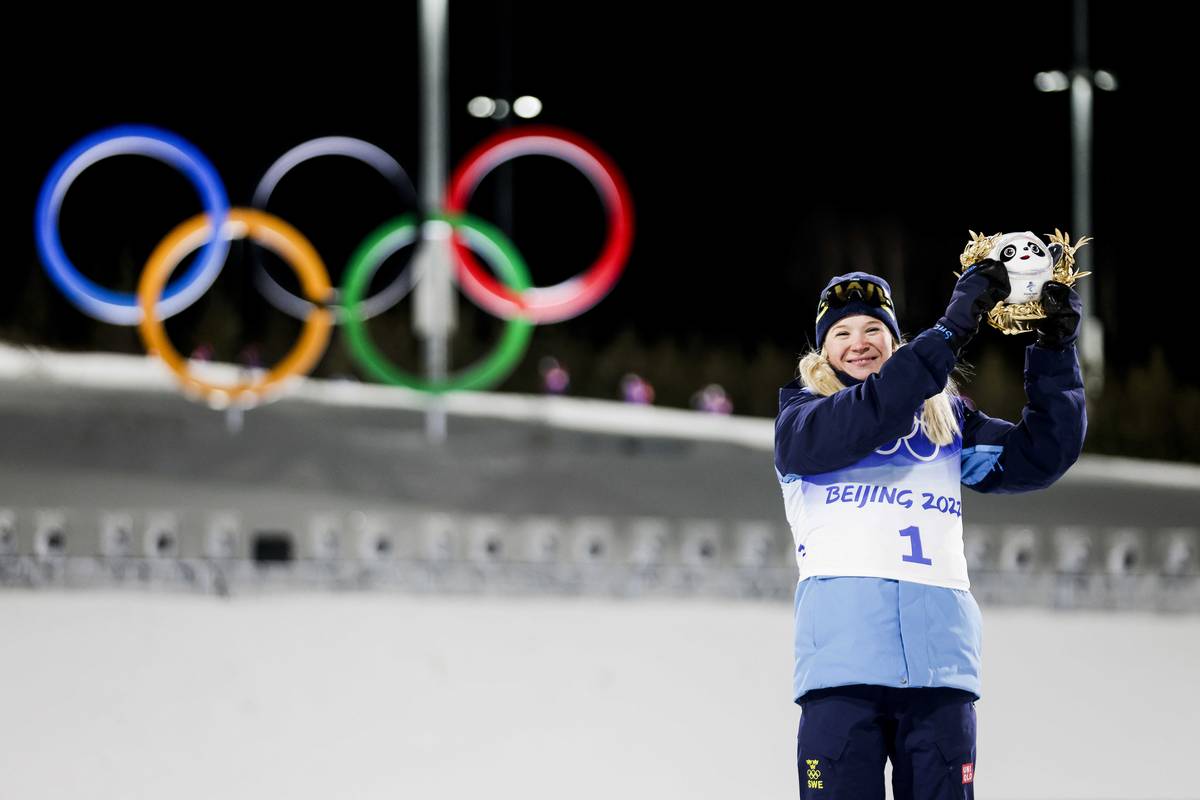
Jonna Sundling (SWE) during qualification in Lahti, Finland. (Photo: Authamayou/NordicFocus)
The World Cup season returned to Finland this weekend, closing a circle that began more than three months ago in Ruka. In the time since Olympic teams were selected, dreams realized or deferred, experience forged, and farewells offered week after week as the long winter wears on. If the stakes in Lahti feel slightly lower than they did earlier in the season, they are tightening in another way — especially in the races for the Crystal Globes.
With only a handful of races remaining in the season, the women’s Freestyle Sprint offered more than just another podium. The fight for both the Sprint Crystal Globe and the Overall Crystal Globe continues to tighten.
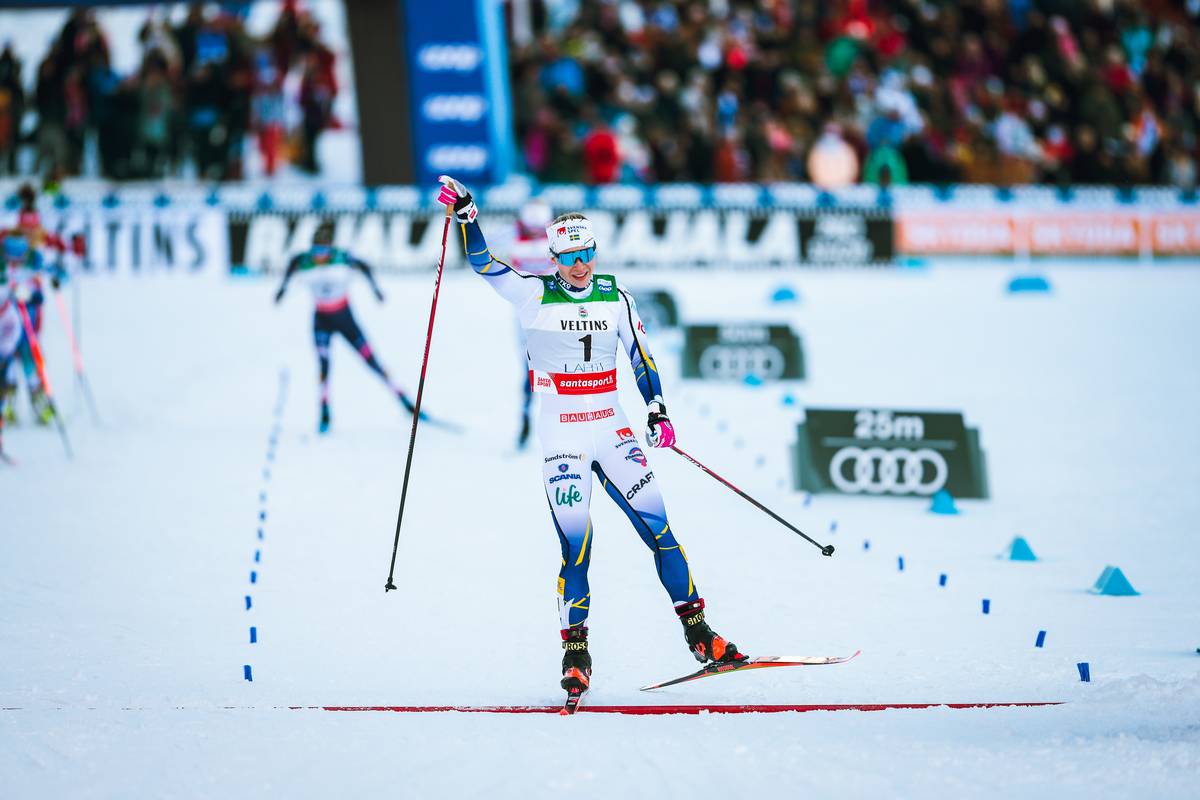
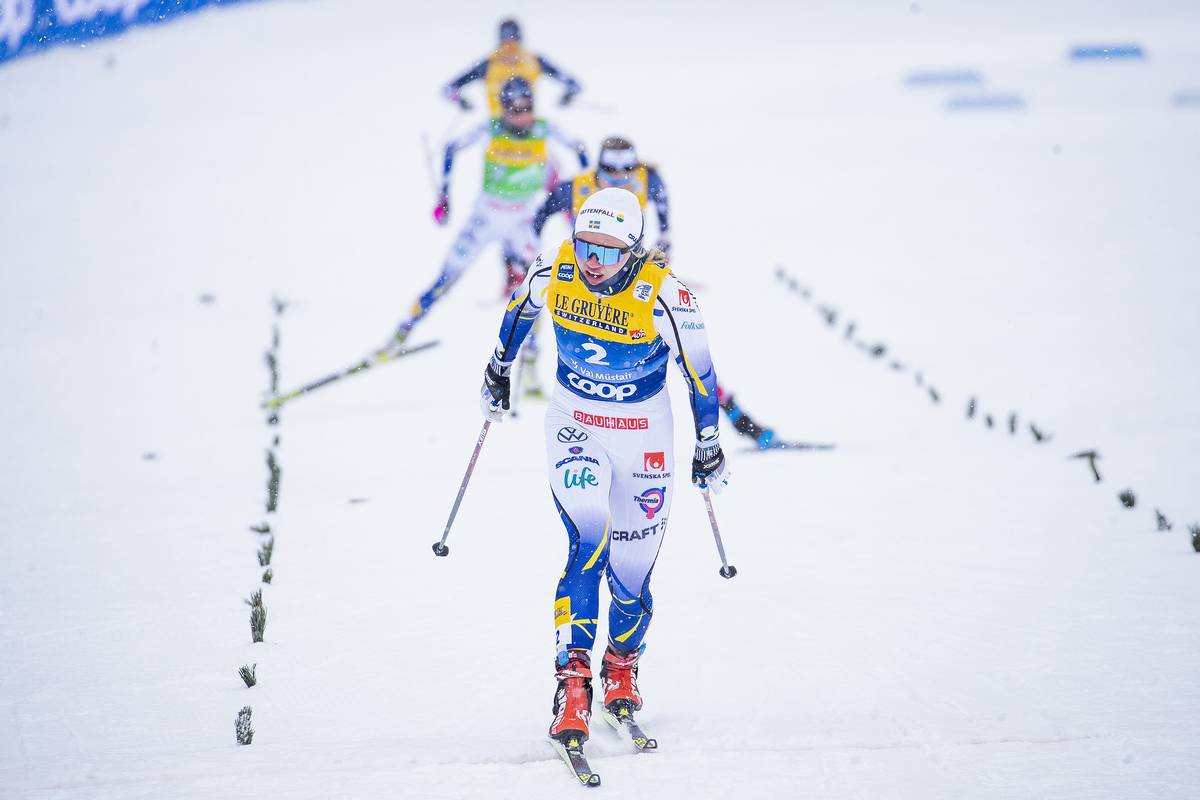
In tricky conditions, Sweden’s Jonna Sundling emerged as the day’s winner, navigating the heats with authority before closing out the final to claim victory.
“I think all day it’s been difficult with the conditions because it seems so nice, but when you ski it’s like icing underneath,” Sundling said in a post-race interview with FIS on the broadcast. “There were some challenges with the skiing, but I’m glad that I could ski as I did today and go all the way.”
The victory marked a strong return for Sundling, who said she had recently been dealing with a cold and missed racing in Falun before arriving in Lahti.
One of the most interesting moments of the women’s race came when Kristine Stavaas Skistad (NOR) was disqualified during the semifinals for what appeared to be a very minor incident. She received a yellow card for the incident, and because she was already carrying one from a previous violation, she was disqualified. (Photo: Authamayou/NordicFocus)
A Tactical Sprint Course
The Lahti freestyle sprint course rewarded patience as much as power. After the individual qualification round, the top 30 athletes advanced into the head-to-head heats — five quarterfinals of six athletes each, with the top two finishers and the two fastest “lucky losers” advancing to the semifinals.
From there, the field narrowed again: two semifinal heats would determine the six skiers racing for the win.
While the course appeared straightforward on paper, athletes quickly discovered the conditions made positioning critical. The climb before the final hairpin offered one of the few reliable passing opportunities before the long run to the finish, which saw the race often gather back together around the final corner before the finishing stretch. And throughout the heats, several favorites discovered how narrow the margin for error could be.
Maja Dahlqvist (SWE) got out well, but was unable to advance from the quarterfinals. (Photo: Authamayou/NordicFocus)
Globe Leaders Falter
Two of the athletes who have dominated the sprint standings this season — Maja Dahlqvist (Sweden) and Nadine Fähndrich (Switzerland) — both saw their days end earlier than expected, failing to advance beyond the quarterfinals.
Their early exits added intrigue to the sprint globe race as the season heads toward its final stretch.
Meanwhile, Sundling continued to build momentum, advancing smoothly through her heats despite the difficult snow conditions.
“I’m super motivated,” Sundling said of the final weeks of the season in the broadcast interview. “It’s my favorite time of the year.”
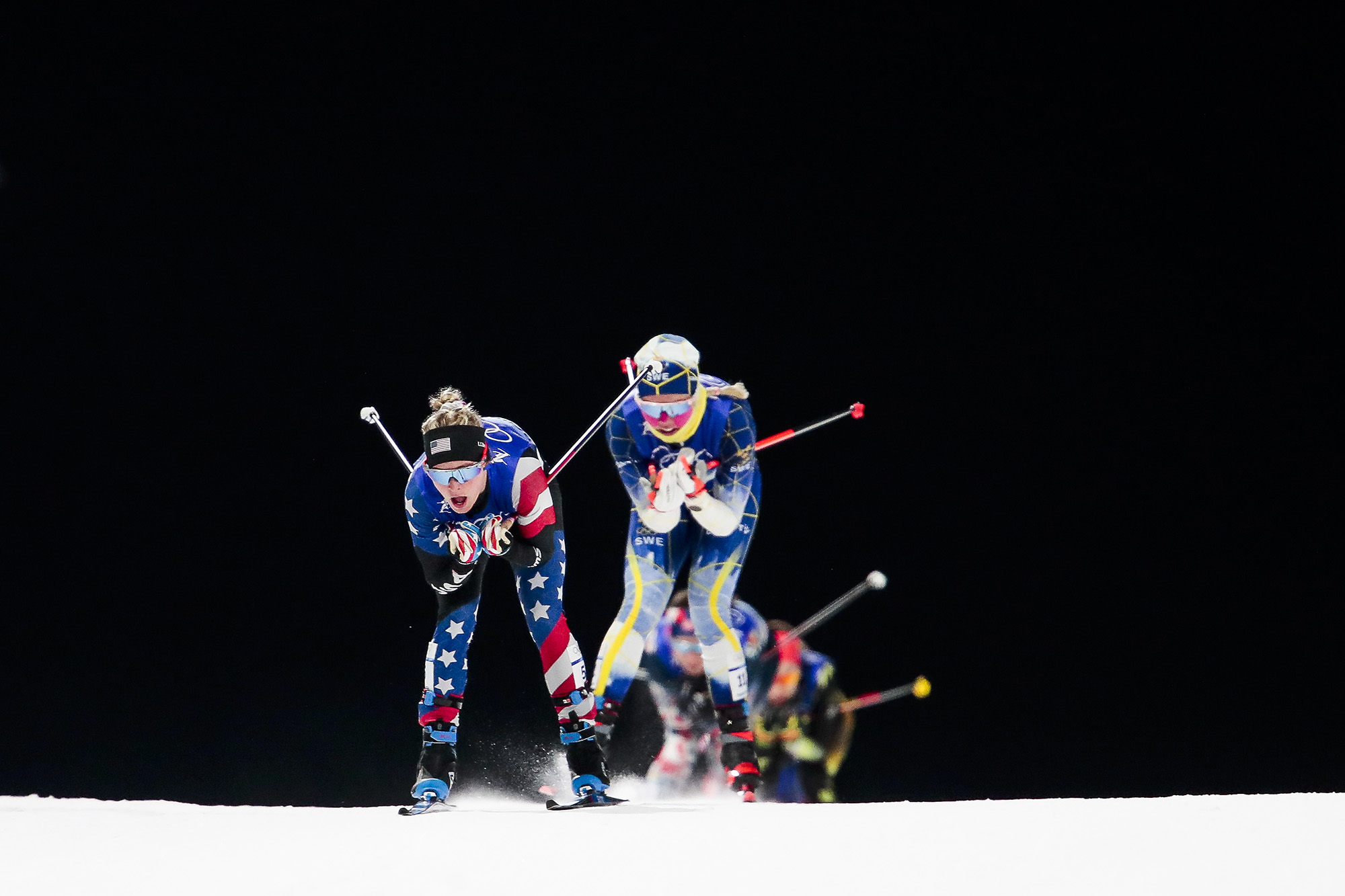
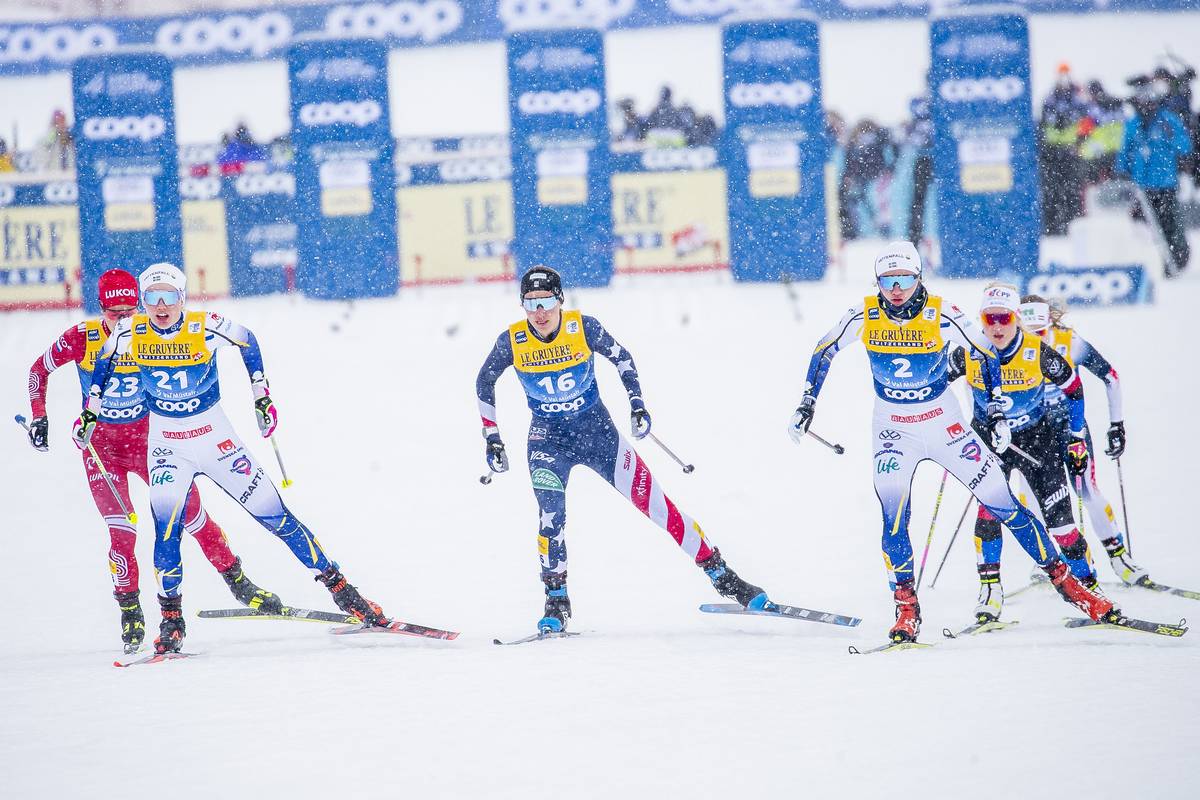
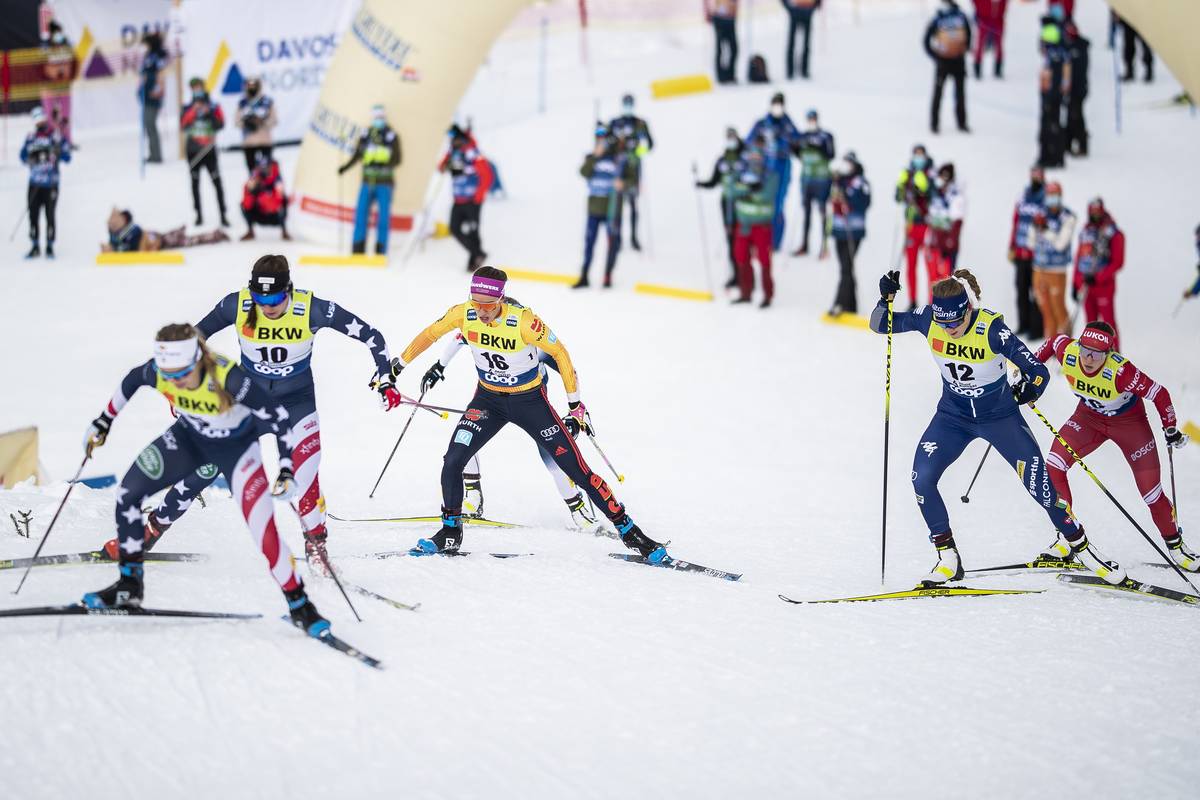
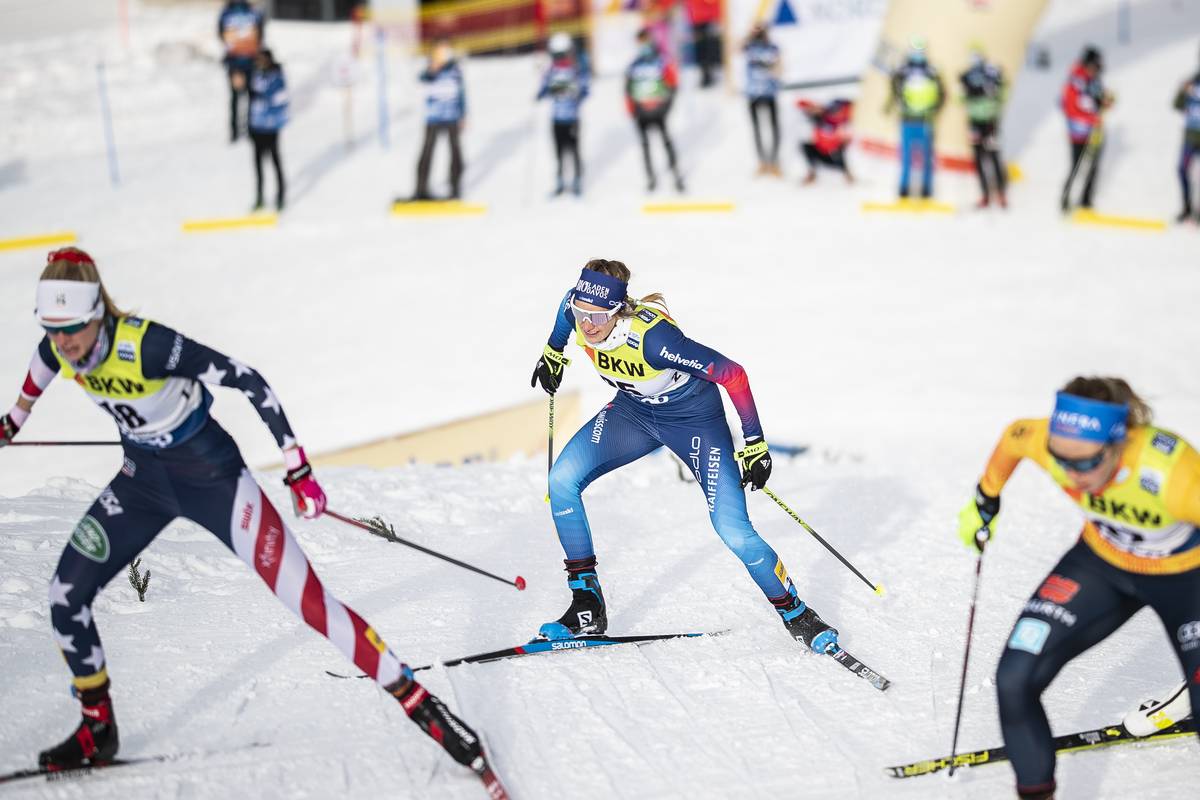
Hilla Niemela (FIN), Johanna Hagstroem (SWE), and Jessie Diggins (USA) (l-r) charge up the opening climb of the Freestyle Sprint in Lahti, Finland. (Photo: Authamayou/NordicFocus)
Diggins Attacks, But Falls Short
For the United States, Jessie Diggins came closest to advancing deep into the rounds.
In her quarterfinal, Diggins launched a decisive move on the final climb, surging to the front of the group in an effort to create separation before the tight hairpin turn at the top of the hill. Over the crest, she continued the attack, aggressively no-pole skating the downhill in an attempt to open a gap.
For a moment, the tactic appeared to work.
But the chasing group quickly organized behind her, the draft pulling them back together on the descent into the stadium. Sweden’s Johanna Hagström surged in the final meters, lunging at the line to edge Diggins and end the American’s day in the quarterfinal.
Diggins said the Lahti crowd helped make the experience memorable.
“It was so cool to hear the crowd roaring. There were so many people out, really filling the stadium and along the course. It’s just a very cool environment. It was sunny and beautiful, which made it really fun.
“I was really happy with my energy today. I feel like I skied a pretty good race and did everything I could. But again this year, I feel like I just don’t quite have that ultimate power, especially in the finishing stretch.
“I’m excited for tomorrow and just excited to be finishing out my last stretch here in Europe. That feels really special. It’s kind of cool to take a moment to reflect on my many years spent on the road in Europe. That chapter is coming to a close now, which is really cool and really special. I’m just grateful thinking back on all the memories over all the different years.”
Rosie Brennan (USA) fighting to maintain contact with the group as Gina Del Rio (AND) takes the opening climb out fast during their quarterfinal. (Photo: Authamayou/NordicFocus)
Brennan Knocked Out in Quarterfinal*
Veteran American Rosie Brennan also reached the quarterfinals but was unable to advance.
Lauren Jortberg (USA) on her way to 37th place in qualification in Lahti, Finland. (Photo: Authamayou/NordicFocus)
Jortberg Reflects on Qualification Miss
For Lauren Jortberg, the Lahti sprint was a reminder of how thin the margins can be in World Cup qualification.
Jortberg finished 37th in the qualification, just outside the top-30 cutoff needed to advance to the heats. After the race, she said the conditions on the Lahti course made it difficult to find the right balance between glide and stability.
“There was kind of an ice sheet underneath with some sugar on top,” Jortberg told FasterSkier after the race. “So it was hard to find skis that were running really well while also being able to push off and plant well. It made the skiing a little tricky, but that’s pretty typical for what we’ve seen in Lahti the last few years.”
Jortberg also felt she left something on the course in terms of pacing.
“I think I just didn’t pace it very well,” she said. “I probably paced it too much. I didn’t really finish feeling that tired, so that was a bit of a bummer.”
Part of that caution, she explained, stemmed from having dealt with illness in the days leading into the race.
“I had been sick the last week, so I think I held back a little bit,” Jortberg said. “That’s frustrating because I felt really good and I think I could have been competitive today.”
Even so, Jortberg said the past months of racing have helped build confidence as she continues gaining experience on the World Cup circuit.
“One of the big takeaways from these World Cup weekends is that when I can put down a really solid qualifier, I’m very much in the mix,” she said. “Even though today wasn’t a great qualifier, I wasn’t that far out of the heats, so I think that’s something I can take confidence from going into the next few weekends.”
Julia Kern (USA) during qualification. (Photo: Authamayou/NordicFocus)
Julia Kern Trying to Get Back to Form*
Julia Kern, returning to racing after illness following the Olympic Games, placed 44th in the qualification round.
Albrecht Gaining World Cup Experience
Emma Albrecht, competing in her fourth World Cup weekend, finished 48th in the qualification round in Lahti as she continues gaining experience at the highest level of the sport.
Albrecht said one of the biggest adjustments to racing on the World Cup has been the razor-thin margins in sprint qualification.
Emma Albrecht (USA) gaining experience during the qualification in Lahti, Finland. (Photo: Authamayou/NordicFocus)
“The biggest adjustment to racing at this level is how tight the race margins are,” Albrecht told FasterSkier after the race via email. “The U.S. SuperTour field is obviously not as competitive, and it has been a shift — especially in sprinting — to have to have a fast qualifier. You are no longer guaranteed to make heats.”
The Lahti sprint course also served as a reminder of the confidence and technical skills required to compete in crowded sprint fields.
“Today’s qualification reminded me to take up space on the course and not be afraid of a little hop skate,” she said.
Even with the challenges, Albrecht said the experience is fueling motivation heading into the offseason.
“This weekend is making me very excited for summer training,” she said. “A field as deep as this really highlights weaknesses on course. I would love to become a more efficient jump skater and be more confident in my high-speed V2. I’m definitely walking away with a lot of motivation to improve.”
Liliane Gagnon (CAN) charges up the first climb during her quarterfinal, where she narrowly missed advancing to the semifinals. (Photo: Authamayou/NordicFocus)
Canadian Results
Canada’s top performance came from Liliane Gagnon, who finished third in her quarterfinal — just short of advancing to the semifinals.
Teammates Olivia Bouffard-Nesbitt and Katherine Weaver placed 43rd and 46th, respectively, in qualification.
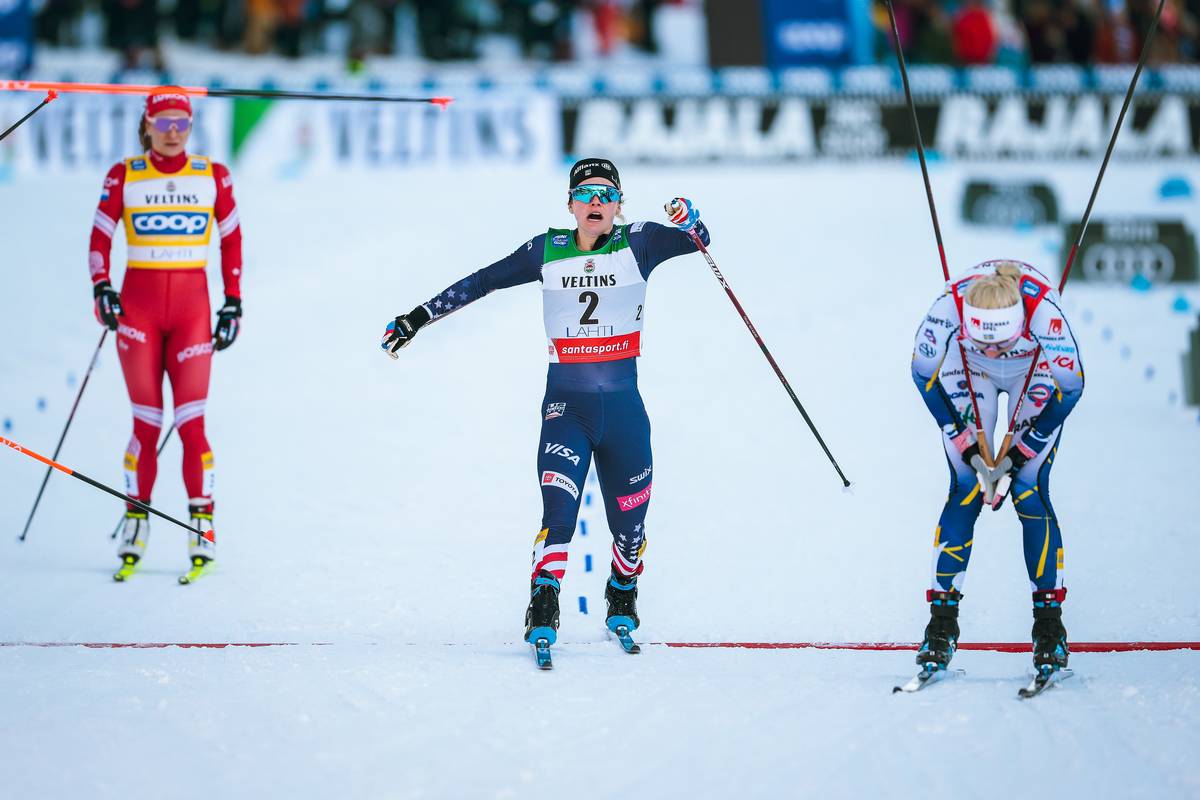
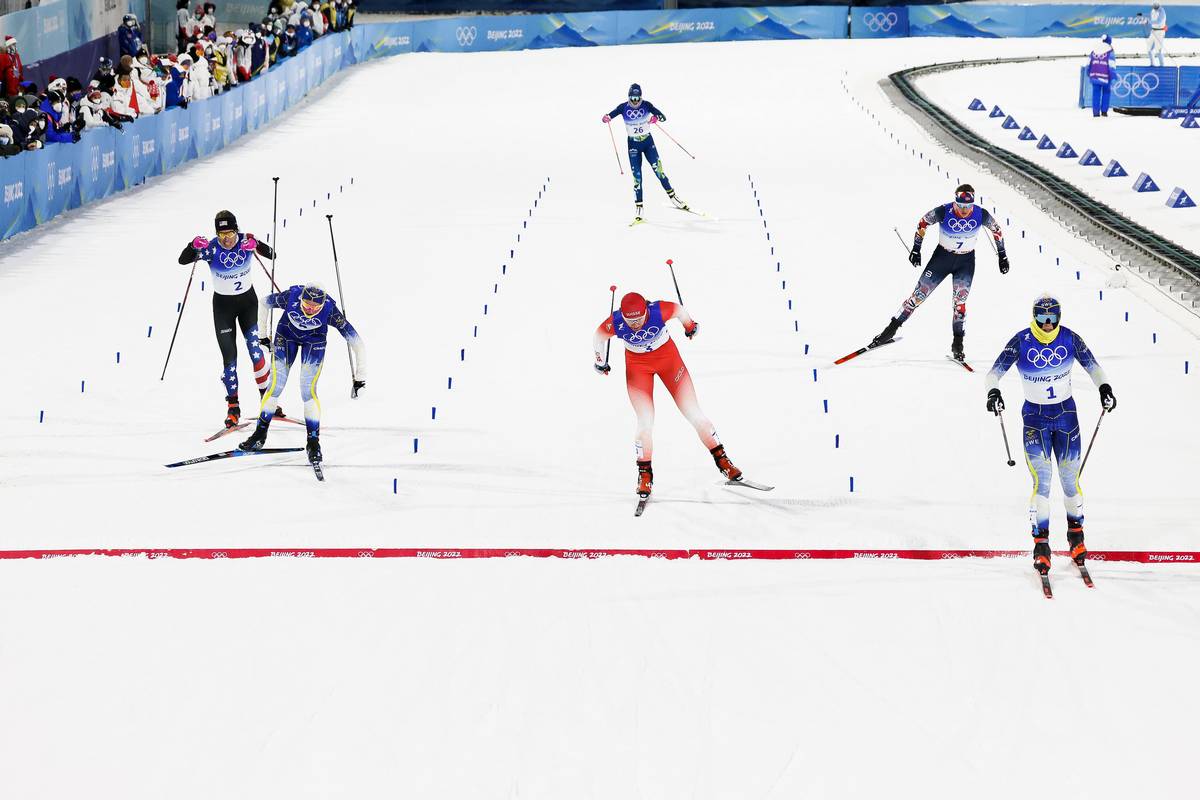
Jonna Sundling (SWE) celebrates the win while Coletta Rydzek (GER) and Johanna Hagstroem (SWE) lunge for third behind her. (Photo: Authamayou/NordicFocus)
The Season’s Final Push
With only a handful of races remaining on the World Cup calendar, the results in Lahti could prove important in shaping the final standings.
For Sundling, the victory served as both a return to form and a statement heading into the closing weeks of the season.
“I’m looking forward to the rest of the season,” she said.
For others — particularly those chasing the Crystal Globes — the margin for error continues to shrink.
And with more racing still ahead in Lahti this weekend, the battle for the season-long trophies is far from settled.
*We hope to add more quotes above from athletes if we hear back from them, but wanted to get this race report posted in a timely fashion.
Love Stories Like This? Help Keep Them Coming.
Feature stories like this one take time, access, and care to produce. If you value thoughtful storytelling and independent ski journalism, please consider becoming a Voluntary Subscriber. Your support directly fuels the work we do to cover the people, places, and moments that make our sport special.
The highs were high and the lows were low in the Olympic team sprint in Italy, with the Ogden-Schumacher men’s team claiming silver and the Diggins-Kern women’s pair finishing out of the medals. Devon and Nat break the whole thing down.
We’ll be back after Saturday’s men’s 50 k. Reach us at devon[at]fasterskier.com and nat[at]fasterskier.com. We’re really grateful for all the support during the Olympics — thanks for notes and encouragement.
A reminder: This is a homegrown podcast done by two guys working long hours and late nights. We’re also paying real money to be here in Italy. If you can, support the show and FasterSkier’s ongoing coverage with a voluntary membership. We’re also offering a bonus during the Olympics: a WhatsApp group with notes on Nat’s experiences in Italy, the food he’s eating, interview transcripts and more.
Send nat[at]northernjournal[dot]com a confirmation of your voluntary membership and the number he should use for WhatsApp and we’ll get you signed up. You can also Venmo him directly at @nat-herz if a membership isn’t for you. We’re suggesting a minimum of $10, but we also won’t turn anyone away who wants to join because of an inability to pay.
Help Support Our Olympic Coverage!
FasterSkier will have our own Nat Herz on the ground at the Olympics, which, to be honest, is a very big financial lift for us. If you value the thoughtful work and access FasterSkier provides at championships like this one, please consider becoming a Voluntary Subscriber. Your support directly fuels the work we do to cover the people, places, and moments that make our sport special.
This article was made possible through the generous support of our voluntary subscribers who have helped us put our Nat Herz on the ground reporting at the Olympics. If you value coverage like this, please support FasterSkier with a voluntary subscription.
Jonna Sundling (SWE) follows Jessie Diggins (USA) during the Olympic Women’s Team Sprint in Tesero, Italy. (Photo: Vanzetta/NordicFocus)
PREDAZZO, ITALY — Eight years ago, on a different continent, the words “Here Comes Diggins!” by Chad Salmela vaulted American cross-country skiing into a new era. On Wednesday in Val di Fiemme, the event that changed everything for the United States returned to the Olympic stage.
The Women’s Freestyle Team Sprint has long been one of the Americans’ signature races. In the PyeongChang 2018 Winter Olympics, Kikkan Randall and Jessie Diggins delivered the nation’s first Olympic gold medal in cross-country skiing. Last March in Trondheim, Diggins and Julia Kern claimed World Championship silver.
On Wednesday, Diggins started the race in the first leg, handing off to Kern for the anchor leg, as they had in their previous medal run. They hoped for one more shared championship moment.
It was not to be. The Americans finished fifth, in a race that required not just fitness but flawless execution. Sweden’s Jonna Sundling and Maja Dahlqvist took gold. Switzerland’s Nadja Kaelin and Nadine Faehndrich secured silver. Germany’s Laura Gimmler and Coletta Rydzek won bronze after a late-race crash by Finland opened the door in the final turn.
For the Americans, the margin was not dramatic. But close, at this level, does not bring home a medal.
Jessie Diggins (USA) and Jonna Sundling (SWE), (l-r) come through the stadium during the Olympic Women’s Team Sprint. (Photo: Vanzetta/NordicFocus)
“Honestly, left it all out there.”
The Team Sprint is one of the sport’s most punishing formats. Two skiers qualify individually; their times are combined to determine which 15 nations reach the final. In that final, the athletes alternate laps — three each — on a course that offers no reprieve.
Often, one skier brings distance strength, and the other sprint speed. For the United States, Diggins and Kern blur those categories. Both are capable of driving pace. Both can finish.
From the gun, Diggins did what she has done throughout her career: she went to the front.
She and Sundling stretched the field immediately, driving into the Zorzi Climb, the race’s defining ascent. The early order — Sweden, the United States, Norway, Canada — hinted at the nations prepared to dictate terms.
Jonna Sundling (SWE) stretches her lead. (Photo: Vanzetta/NordicFocus)
When Sundling surged later in the race, Diggins expected it.
“I knew she was probably going to do that,” Diggins said afterward. “And I was like, just do the best that you can do. You know, like, you can’t control anything except your effort and your heart. And I was like, skiing out of my body, and I just did everything that I could, and I’m proud of that.”
That theme — control what you can — carried through her reflections.
“Honestly, I almost passed out like four different times,” she said. Then, clarifying: “No, from going that hard, no regrets. Honestly, left it all out there. I feel like we did everything we could, and that is the only thing you can control at the end of the day.”
Julia Kern (USA) and Jessie Diggins (USA), (l-r) gather in the finish area after the race, Diggins racing in the US team’s relay socks for the final time. (Photo: Barbieri/NordicFocus)
One final lap with ‘Relay Socks’
By the last exchange, Sweden had carved out daylight. Switzerland began clawing into Finland’s hold on silver. Behind them, Germany, Norway, the United States, and Finland battled for bronze.
On the final descent, Finland’s anchor, Jasmin Kahara, lost her balance in the sweeping right-hand turn and fell, sliding out on her stomach. Germany and Norway slipped past in their tucks. Kern, just meters behind, fought to the line, but the podium had narrowed to two.
Coletta Rydzek (GER) brings home the bronze medal for Germany with Norway’s Julie Bjervig Drivenes just off camera. (Photo: Vanzetta/NordicFocus)
As they drove for the line side by side, aerodynamically no-pole skating with everything they had, it was clear this was going to be close. Germany claimed bronze while Norway left empty-handed in fourth. Just behind, Kern brought the United States to the finish in fifth.
For Diggins, the moment carried a different weight. It was, by her admission, her last Olympic relay leg.
“I love racing with this girl. I’m so, so proud of her,” she said of Kern. “And, yeah, it’s emotional to feel like I’m never gonna pull on those relay socks again.”
When asked whether there was a sense of handing the event forward, she reflected on the arc of her career — from her first team sprint world title in 2013 to the growth of youth programs back home.
“It’s just really cool to be part of the evolution of American skiing,” she said.
Julia Kern (USA) and Nadine Faehndrich (SUI), (l-r) find their lines around a tricky corner. (Photo: Vanzetta/NordicFocus)
Whitcomb knows they can win
For Head Coach Matt Whitcomb, the analysis was candid and clear-eyed.
“Yeah, it was a good race,” Whitcomb said. “Of course, this is an event that we know we can win, and we didn’t today.”
In a format this tight, small imperfections are decisive.
“For even a bronze medal to happen, both legs have to be firing exquisitely,” he said. “We swung as hard as we could. We did our best. We were prepared to win today, and we just didn’t.”
Of Kern’s anchor leg, Whitcomb offered both empathy and affirmation.
“Julia is an incredible performer, and one thing you can always trust from her is that you’re gonna get her absolute best,” he said. “We saw it on the final climb. I was happy with how she climbed. Just didn’t quite have the entire thing today, and that’s okay.”
Jessie Diggins tags Julia Kern (USA), while Jonna Sundling tags Maja Dahlqvist (SWE), (l-r) in the exchange zone between laps. (Photo: Vanzetta/NordicFocus)
Diggins in the best fitness of her life
Diggins has raced these Games managing injury concerns, including rib pain after a fall in the opening Skiathlon. But when asked whether her fitness was lacking, she pushed back.
“I feel like I’ve come into this with the best fitness in my life,” she said. “And that’s one of the only things I could control.”
There is comfort, perhaps, in that certainty — in knowing preparation was not the missing piece.
“I was skiing out of my body,” she said. “And I just did everything that I could.”
In Olympic-level team sprinting, that is sometimes enough. On Wednesday, it was not quite.
But the American women did what Diggins described as the only thing you can in cross-country skiing: you have to leave it all on the course without regret.
FasterSkier will have our own Nat Herz on the ground at the Olympics, which, to be honest, is a very big financial lift for us. If you value the thoughtful work and access FasterSkier provides at championships like this one, please consider becoming a Voluntary Subscriber. Your support directly fuels the work we do to cover the people, places, and moments that make our sport special.
This coverage is made possible through the generous support of Marty and Kathy Hall and A Hall Mark of Excellence Award. To learn more about A Hall Mark of Excellence Award, or to learn how you can support FasterSkier’s coverage, please contact info@fasterskier.com.
Jonna Sundling (SWE) and Laura Gimmler (GER), (l-r) during the heats of the World Cup Freestyle Sprint in Oberhof (GER). (Photo: Authamayou/NordicFocus)
By the time the stadium lights fully took over in Oberhof, the snow had begun to change its mind.
What started as a pliable winter surface—the kind that both softens and creates mistakes—tightened as the temperature dropped, and each pass of a ski left a polished, glistening trail under the lit German night. The Thuringian Forest, quiet by geography but loud by reputation, had settled into one of those evenings that reward certainty. Edges held if you trusted them. Hesitation showed immediately. And in an Olympic season, there was very little room for either.
Saturday’s women’s Freestyle Sprint marked the World Cup’s return after the Tour de Ski, but the pause had not dulled the stakes. For several nations—and particularly for the United States—Oberhof represented the final sprint in the window that matters most for Olympic selection. That context did not announce itself loudly. It rarely does. Instead, it threaded through the day in subtler ways: in heat selection, in how aggressively athletes protected space, and in the quiet tension between racing for today and building the version of yourself you’ll need in February.
At the front, the results followed familiar lines. Jonna Sundling (SWE) qualified near the top and then won every round she entered, finishing the job decisively for her 15th individual World Cup victory. Coletta Rydzek (GER), fed by a home crowd that never stopped leaning forward, closed hard for second. Maja Dahlqvist (SWE) completed the podium in third, another entry in Sweden’s sprint abundance—a luxury that, paradoxically, can complicate Olympic selection rather than simplify it.
But Oberhof was not only about dominance. It was about positioning, intent, and the quieter victories that occur well outside the top three—where a season can tilt not with a trophy, but with a single, well-timed decision in a quarterfinal.
Hailey Swirbul (USA) take the first corner during her quarterfinal in Oberhof (GER). (Photo: Authamayou/NordicFocus)
A Course That Punishes Drift
Oberhof’s sprint course is deceptive in its simplicity: an out-and-back layout, one major climb, a technical descent, and a finishing stretch that arrives already under load. What separates it from more straightforward sprint venues is how early it demands decisions. The opening stretch funnels athletes into a tight corner almost immediately, compressing the field before it has a chance to stretch. The central climb—long, steep, and increasingly rutted and churned as the day progresses—forces skiers to declare themselves sooner than they might like.
There is little room to hide here. Miss the first corner, and you’re fighting for oxygen before the race has found its rhythm. Drift into the wrong line on the climb, and the surface punishes you. Get boxed entering the final turn, and momentum disappears instantly. Oberhof rewards skiers who are decisive without being reckless, aggressive without being impatient.
Those dynamics shaped the day for the Americans in distinctly different ways, producing four very different American stories inside the heats—plus one clarifying, unfortunate footnote that mattered for selection math and for morale: Alayna Sonnesyn (USA) did start, but crashed and did not finish.
Jessie Diggins (USA) during qualification in the World Cup Freestyle Sprint in Oberhof (GER). (Photo: Authamayou/NordicFocus)
Before the Racing: Compassion, and a Reminder Not to “Try Harder”
On paper, the Olympic selection criteria reads like a legal document—because, in many ways, it is one. It is also, inevitably, a psychological environment: a room everyone lives in, even when no one speaks about it.
U.S. Head Coach Matt Whitcomb described the team’s internal emphasis heading into Oberhof in terms that had nothing to do with points or spreadsheets.
The first message, he said, was simple: have compassion—for yourself and for your teammates.
“This is a stressful job,” Whitcomb said. Some athletes may feel safely “inside” the team; others may feel perched on the edge; others may already feel disappointment. And the team, he stressed, needs to remember that everyone is absorbing the same pressure in different ways. “Read the room,” he said, especially if you have a great race—take care of each other through a stressful period.
His second point was the one that, in a sprint weekend like this, can save an athlete from the most common selection-week mistake: mistaking urgency for a new identity.
Because “this may be one’s last opportunity,” Whitcomb said, it’s tempting to believe you can manufacture something extra—try harder, ski differently, do something dramatic. But that instinct is usually the trap.
“You can’t try something dramatically different,” he said. “What you have to do… is you ski the way that got you here.”
In Oberhof, Whitcomb felt the athletes largely did that. The plans were executed; warm-ups and routines stayed intact. “We qualified a bunch of people,” he said. The day simply didn’t convert into the results they wanted.
That, too, is sprinting: sometimes you do many things right, and the course—plus the speed of the other nations—still asks for more.
Jessie Diggins (USA) during qualification in the World Cup Freestyle Sprint in Oberhof (GER). (Photo: Authamayou/NordicFocus)
Racing as Training: Jessie Diggins
For Jessie Diggins (USA), Oberhof was never meant to stand alone.
Coming off the Tour de Ski, Diggins framed this weekend not as a test of peak form, but as a carefully placed piece of a longer arc: racing as a training stimulus, not a destination.
“Essentially, I’m using these races as training stimulus,” Diggins said. “It’s a chance to get more reps—working on the tactics, working on communication, just working on all the little things that you really can’t practice any other way unless you’re racing World Cup.”
That philosophy has long guided Diggins’ career. She has rarely spoken about “peaking” the way outsiders want athletes to: as a clean line on a calendar, a simple on/off switch. For her, form is something you keep building in public, in the only environment where it truly exists—under the clock, in contact, with consequence.
“So [I’m] keeping the training load really quite high,” she explained, “but just recovering enough that I can still punch some hard race efforts and have that be part of the training and the lead-up. And for me, that’s always been a really important thing.”
She added a line that sounds like personal preference until you watch her career and realize it’s closer to a blueprint: “I think I race well when I am racing pretty often. I might not do every single race, but just enough that I feel like I’m using them as a really helpful part of my lead-up.”
Diggins’ day ended in the quarterfinals—13th overall on the official results sheet. But that early exit doesn’t necessarily conflict with the way she described the weekend. In an Olympic season defined less by accumulation than timing, Diggins tends to measure progress in subtler signals than finish position: how quickly the body responds, how efficiently it recovers, whether the details are sharpening rather than dulling.
Oberhof, in that sense, fits neatly into the plan. Not every race has to be a verdict. Some are simply data—hard efforts taken at speed, recorded by the body, filed away for February.
Samantha Smith (USA) during qualification in the World Cup Freestyle Sprint in Oberhof (GER). (Photo: Authamayou/NordicFocus)
A Wild Arc, Embraced: Samantha Smith
If Diggins arrived in Oberhof as a veteran calibrating form, Samantha Smith (USA) arrived by a far less conventional route—one that still feels almost implausible when you say it out loud.
The last couple of months, Smith said, have been “wild.” She helped Stanford reach the NCAA soccer final. She put her skis on for the first time this season in December. She raced into shape at U.S. Nationals. And suddenly, she was back on a World Cup start line—aware of the stakes, but determined not to let the stakes steal the experience.
“I’m so grateful for the opportunities that I’ve had,” Smith said. “To have a chance to play for Stanford has been such an incredible journey… and now to be back skiing, it feels great to be out here and competing with everyone.”
Smith kept returning to the same theme: presence. She likes the work itself—the daily process—whether it’s skis or soccer.
“I really enjoy the process,” she said. “I love to train, I love to race, I love to play soccer games. So [I’ve] just been trying to focus on enjoying every moment… embracing the opportunities that I have and just trying to be very present.”
That presence mattered on a day when nerves were unavoidable.
“Coming in today, I was definitely nervous,” Smith said. “I feel like the first World Cup races of the year are a bit nerve-wracking, especially when you haven’t had a ton of time on snow or a ton of opportunities to really gauge fitness.”
So she narrowed her goals to what she could actually execute: ski clean; work transitions; be diligent in the “working sections” where Oberhof can hand you time or take it away quietly.
“I didn’t really have an outcome goal,” she said. “It was just to ski hard, do what I could, and if I got into heats, to really compete.”
And then, in her quarterfinal, came the moment that extended her day—and changed, materially, what this weekend could mean.
Smith described herself as not being in the position she wanted over the first big hill. She could see the risk: that the heat would compress into a pure sprint finish, where you either have the lane or you don’t. And then—briefly—she did.
“Into the last climb before the finish, I saw a window on the inside,” Smith said. “I saw the space open up, and I just tried to take it. To be honest, I wasn’t really expecting that it was going to open up.”
It did. She went. And she made the move that sprint racing requires: the one that looks obvious in replay and feels like a gamble in real time.
“I was worried it was going to come down to a complete sprint finish at the end,” she said, “but I think I got pretty lucky… There was a bit of open space, and I was able to make my way up.”
The reward was tangible: Smith advanced to the semifinals and finished 12th overall. Just as important—at least in the language of selection criteria—she also climbed to 42nd on the women’s Sprint World Cup standings after Oberhof.
In a season where criteria can hinge on ranking thresholds, that is not a small detail. It is the kind that turns a good day into a consequential one.
Whitcomb’s reaction captured the strange emotional geometry of selection weekends: elation, paired with an awareness that someone else is hurting.
“We’re absolutely ecstatic with Sammy,” he said—and then, almost immediately, he acknowledged the other side of it: “It’s always bittersweet because on literally every race I’ve ever been to, there have been people that have good races and then people that are really disappointed.”
In sprinting, the margins are often only a few meters. In Olympic selection, those meters can echo.
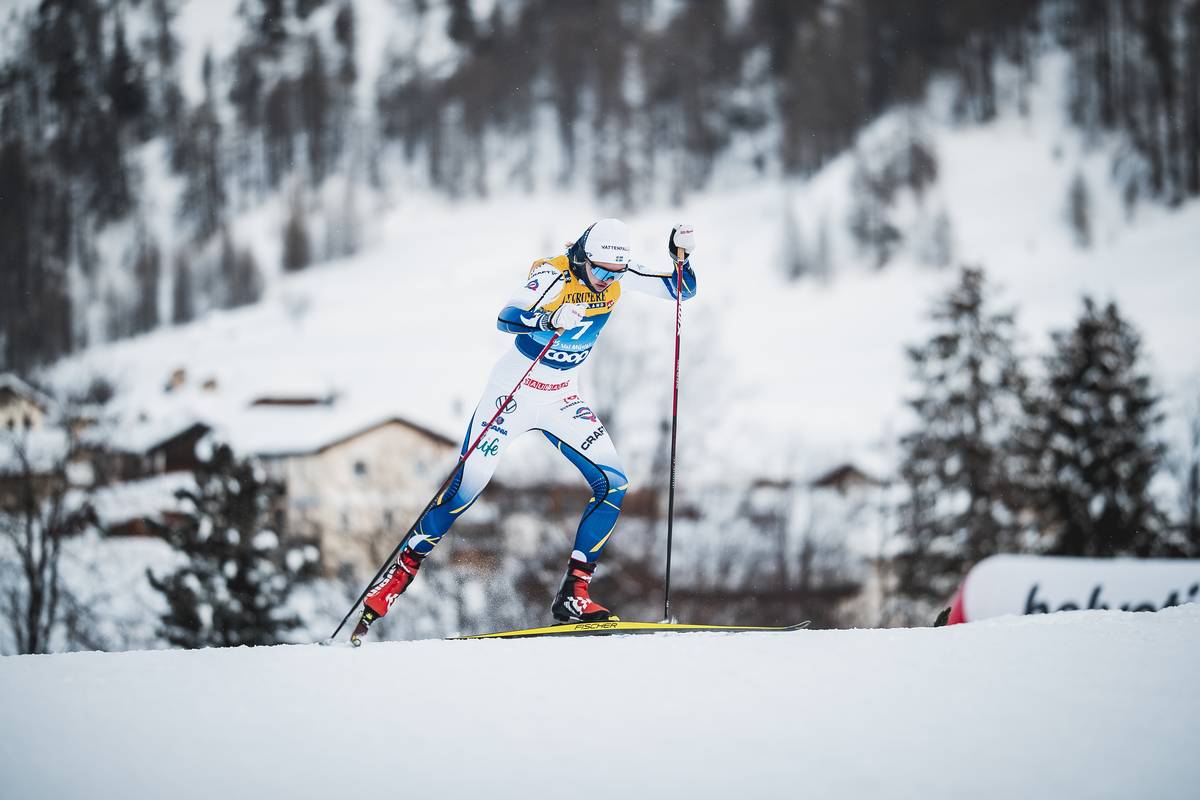
Hailey Swirbul (USA) during qualification in the World Cup Freestyle Sprint in Oberhof (GER). (Photo: Authamayou/NordicFocus)
Joy Without Illusion: Hailey Swirbul
For Hailey Swirbul (USA), the day began with something rarer than confidence: uncomplicated joy.
“I was genuinely excited just to be back racing and to make the rounds today,” Swirbul said. “It felt like a treat. Honestly, I wasn’t expecting it. I was hopeful that I might have that opportunity, but getting to be in the heats was really fun.”
What stood out wasn’t that she smiled—it was why.
“My smiles were genuine out there,” she said, “and I felt an excitement and joy to get to be part of it, rather than a fear or pressure… to live up to some expectation that I might set for myself.”
Swirbul approached qualifying with a clear-eyed strategy built around her own technical history. She identified the steep jump-skating (V1) section that had dominated the day’s conversation and made a choice.
“There’s a lot of pressure, a lot of expectation around that steep V1 hill in the middle of the course,” she said, “and that’s just historically not my strength… I felt like I was able to do the working sections well.”
The plan worked. She advanced into the heats and finished 22nd overall.
In the quarterfinal, the course delivered its blunt lesson: once you lose contact, you often don’t get it back.
“I maybe tried to ski my own race a little too much,” Swirbul said. “Once you’re off the main pack, it’s really hard to get back on… I was excited to have a strong finish… but it’s just not enough at this level.”
The sentence contains both honesty and optimism—because Swirbul wasn’t treating Saturday as an endpoint. She was treating it as preparation for what, in her case, may be the weekend’s more natural opportunity: Sunday’s 10-kilometer classic interval start.
“I’m excited—really looking forward to the classic 10 k tomorrow,” she said. “I’ve had a couple of good ones this year, so [I] hope I can keep the momentum going.”
And then she said something that explains why so many distance skiers quietly enjoy sprinting before a 10 k: it’s a way to wake the system up.
“I do actually really like racing a sprint, especially a qualifier plus a quarter right before a 10 k,” she said. “I think that’s kind of ideal race prep for 10 k. So I’m hoping that can help power me through tomorrow’s race.”
Swirbul’s mindset for Sunday, she said, would be built on a simple distinction: what she can control, and what she can’t.
“Every course and every day has so many variables… out of my control,” she said. “So I just want to try to control what I can and do my best at those things.”
It’s a professional skier’s sentence. It’s also, in an Olympic season, a survival skill.
Lauren Jortberg (USA) during qualification in the World Cup Freestyle Sprint in Oberhof (GER). (Photo: Authamayou/NordicFocus)
Boldness, Not Regret: Lauren Jortberg
Lauren Jortberg (USA) did not set out to lead her quarterfinal. It happened anyway, fast and almost accidentally—the kind of start that changes your entire heat because it changes your options.
“I took control early… wasn’t necessarily on purpose,” Jortberg said. “I just had a really fast start, and there’s a big corner right away, so I wanted to have good positioning there.”
She connected that early positioning to what she sees as a strength: the major climbs. In Oberhof, you don’t get to drift into those climbs. You arrive either with space or without it.
“I wanted… good positioning for the major climbs,” she said. “I feel like that’s one of my strengths.”
Late in the heat, the day turned on a familiar sprint mechanism: contact and congestion at exactly the wrong time.
“I got a bit of a tangle… into the final turn,” Jortberg said. “I lost all my speed there.”
Importantly, she rejected the clean narrative that would blame her early assertiveness for the late cost.
“I don’t necessarily think that leading… came at a cost,” she said. “I just think… I lost all my speed when we got tangled.”
And then she said what, in an Olympic-selection sprint, many athletes think, but not all athletes will say out loud: she did not come to Oberhof to hide.
“With the Olympic implications, I don’t really want to sit in the back and just chill,” Jortberg said. “That’s not really how I like to race heats.”
She described her approach as an attempt to avoid the passive sprint fate: getting boxed in, stuck behind, hoping someone else would make a mistake.
“I just really want to try to ski well,” she said. “At least [I] tried to move… and try to ski my best out there rather than just… getting boxed.”
Jortberg finished 29th overall. But what she took from the day was not despair—it was proof of belonging.
“A lot of my confidence is just knowing that I really can ski with these women who are really strong,” she said. “That’s important for confidence moving forward.”
Even in a heat that didn’t break her way, she will leave Oberhof with something World Cup weekends can either confirm or erase: the belief that she belongs on this stage.
Maja Dahlqvist (SWE), Jonna Sundling (SWE) and Iris De Martin Pinter (ITA), get set to start their semifinal in the Freestyle Sprint in Oberhof (GER). (Photo: Authamayou/NordicFocus)
The Final, and the Moment That Changed It
The women’s final unfolded at speed—and then, briefly, at the mercy of chance.
Sundling drove the pace as expected, forcing the field into single-file. Dahlqvist tracked smoothly. Rydzek hovered, patient and dangerous. Behind them, Iris De Martin Pinter (ITA) skied with poise well beyond her years, positioned to contend.
And then she wasn’t.
De Martin Pinter fell, fracturing the race at the worst possible moment—the kind of incident sprinting produces with brutal efficiency. Sundling’s growing gap became decisive. In a course that rewards momentum and punishes disruption, the fall functioned like a door closing: abruptly, unfairly, and permanently.
Sundling closed the remaining distance with authority. Rydzek surged for second. Dahlqvist held on for third.
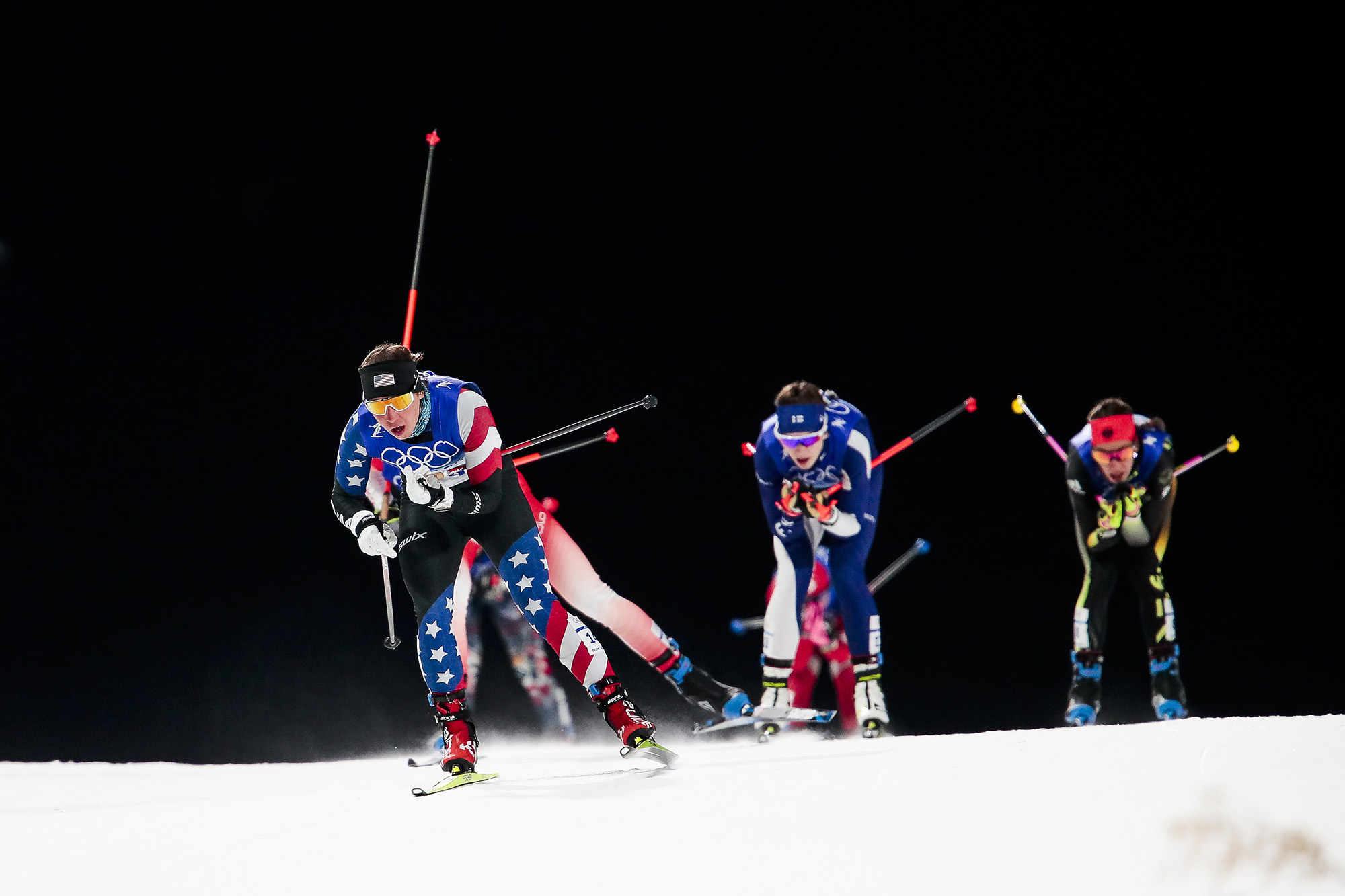
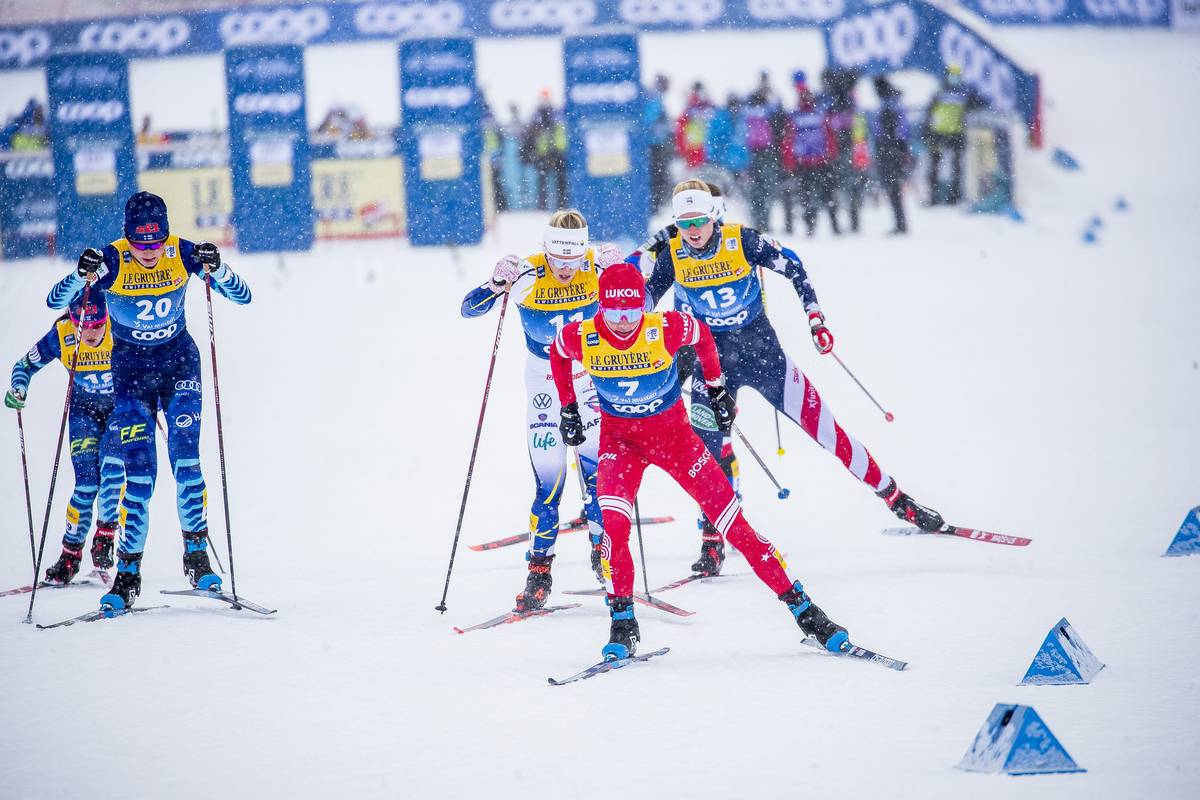
Jessie Diggins (USA), Hilla Niemela (FIN), Nicole Monsorno (ITA), Milla Andreassen (NOR), Samantha Smith (USA), Alina Meier (SUI), (l-r) come around the first corner of their quarterfinal. (Photo: Authamayou/NordicFocus)
Skis, Speed, and the Truth You Can See on a Downhill
No sprint weekend exists in a vacuum. Equipment matters, and in Oberhof, that reality was visible in the most unforgiving place: the downhills where small gaps become facts.
Whitcomb, careful about specifics because he had not yet been fully able to review the race video, acknowledged what many observers sensed: the U.S. skis were close, but not quite at the level of the very best nations on the day.
“I think that’s a safe and fair assessment,” Whitcomb said. He emphasized that the team was competitive—but in sprinting, “competitive” is often not enough.
“You need the best skis to go up against other teams that have the best skis,” he said, citing nations that, on this day, appeared to have exceptional speed.
It’s the part of sprinting that can feel cruelest to athletes: you can execute your plan, hit your cues, make good tactical decisions—and still watch a gap open on a downhill you skied correctly. In Oberhof, where the course magnifies drift, ski speed is not a luxury. It is oxygen.
Samantha Smith (USA) for the first time advanced into the semifinals in the World Cup sprint in Oberhof (GER). (Photo: Authamayou/NordicFocus)
Selection Without Ceremony
For the United States, day one in Oberhof didn’t resolve Olympic selection questions. It narrowed them.
U.S. Ski & Snowboard’s selection language ties nomination, in part, to World Cup standings thresholds, with specific mention of Top 50 (or Top 45 under certain conditions) in the Sprint or Distance World Cup standings on January 18, 2026.
Inside that structure, Saturday’s most significant American movement belonged to Smith.
With her semifinal, she, in just one World Cup race, vaulted to 42nd in the Sprint World Cup standings. That is the kind of number that changes the texture of a season, because it moves her into the zone where the objective criteria has been met.
The other Americans’ days mattered in quieter ways. Diggins stayed on her February-focused arc, treating racing as stimulus and sharpening. Swirbul used the sprint as both a joyful return to the rounds and a deliberate set-up for Sunday’s classic 10k, a race she believes suits her. Jortberg confirmed her willingness to race with intent rather than hide from consequence, even when the margin for error is razor-thin.
And Sonnesyn’s crash—real, abrupt, and emotionally expensive—served as a reminder that selection seasons do not always give you clean data. Sometimes they give you a fall, a DNF, and the long work of resetting.
Jonna Sundling (SWE) comes to the line for the win in the finals. (Photo: Authamayou/NordicFocus)
What Remains
By nightfall, the snow had hardened completely. The course no longer absorbed uncertainty. It reflected it.
Some athletes left with podiums. Others left with confirmation, calibration, or unfinished business. In an Olympic winter, not every race is meant to answer questions outright. Some exist to refine them—to strip them down to what actually matters.
Whitcomb’s framing, in that light, felt less like a coach’s speech and more like a survival manual for the next month: be compassionate; don’t weaponize the criteria against each other; and when the moment arrives, resist the temptation to become someone new out of panic.
You can’t “try harder” into an Olympic team. You can only ski the way that got you here—cleanly, boldly, and with enough self-trust to hold your line when the window opens.
In Oberhof, Samantha Smith did exactly that. And for one night in the German cold, that single choice—one inside lane, one late move—was the difference between a good day and a consequential one.
Feature stories like this one take time, access, and care to produce. If you value thoughtful storytelling and independent ski journalism, please consider becoming a Voluntary Subscriber. Your support directly fuels the work we do to cover the people, places, and moments that make our sport special.
This coverage is made possible through the generous support of Marty and Kathy Hall and A Hall Mark of Excellence Award. To learn more about A Hall Mark of Excellence Award, or to learn how you can support FasterSkier’s coverage, please contact info@fasterskier.com.
Lars Heggen (NOR) overpowered the field in Oberhof, but many of the world’s best sprinters—his Norwegian teammates—were absent from the day’s racing. (Photo: Authamayou/NordicFocus)
Some day, Norway won’t be the only force in Men’s World Cup cross-country skiing. Some day, the participation of other nations will truly matter. Other nations will hear their anthems played, other skiers will excel, other results will be cited and praised. Some day, France may figure it out, or Finland may remember its heritage, or Sweden may return to prominence. The USA may identify another Bill Koch, or Italy another Pellegrino, or Switzerland another Cologna, or Russia another Bolshunov. Some day, the podium of the Men’s Cross-Country Skiing World Cup will not be decorated exclusively in Norwegian flags. While that’s not yet the cross-country skiing world that we live in, it is this upcoming World cup weekend in Oberhof where we expect to witness a kind of “It’s A Wonderful Life” view of Nordic skiing . . . the chance to see what the world would be like without them.
France stayed home from Oberhof, presumably for national championships and team selections of their own. But everyone else is here, hoping to add to their World cup résumés with some of the scraps left on the tablecloth by absent Norwegians. Finland has sent its best (their Sprinters, anyway), and Sweden (in Norway’s absence they could make a splash), and the Italians (Federico Pellegrino and Elia Barp will see their chances to capture glory). The Czechs and the Swiss are here as well, hoping to grab World Cup distinction while the Norwegians are at home. And Team USA has sent it’s own hungry skate-sprinters, as well. Ben Ogden and Jack Young will be vying to return to the finals . . . even to imagine standing atop the podium (dare we say). JC Schoonmaker will be desperate to prove he belongs on the team that marches into Milano-Cortina. Gus Schumacher will be itching to prove that he and Ogden make a compelling Team Sprint team. There’s a lot going on . . . the same sort of drama that goes on every single week of the World Cup season, but no one really notices it because we’re so distracted by the Norwegian that tsunamis through every World cup venue.
And where’s Norway? Well, Norway has more important business to attend to. World Cup wins, World Cup podiums, World Cup points: those are every-week occurrences for ski-crazy Norway. But 2026 is an Olympic year . . . the big prizes will be awarded at the Games of Milano-Cortina. So, this weekend in Oberhof, Norway sends stand-ins while the true contenders refine their technique or taper their training, or just put their feet up for a few hours before the headlong streak toward Norwegian immortality in Milano-Cortina continues.
The elder Northug bother—Petter—was one of Norway’s greatest champions, but even he faced disappointment when it came to Olympic qualification. If Lars Heggen fails to make the team for Milano-Cortina, he will understand the parallels between his pain, and Northug’s. (Photo: Nordnes/NordicFocus)
Norway Still Expects to Win
Lars Heggen (NOR) is 20 years old . . . and he just dominated the Sprint competitions at the recent Norwegian Nationals. Granted, a number of Norway’s very best Sprinters weren’t there (no Klaebo, no Valnes, no Amundsen), but Heggen made enough of an impression that many Norwegian ski-pundits called for his immediate elevation to the Olympic Team. We can assume that Petter Northug was not among that enthusiastic group of pundits . . . especially since a 20-year-old Northug dominated 2006 Norwegian Nationals in an even more commanding manner than Heggen did in 2026. And Northug was unceremoniously denied an Olympic berth because of the selection committee’s assertion that, at only 20, he was too young for the pressures of Olympic competition, that Northug would benefit from more development time before being tossed into the Olympic maelstrom. Northug’s career turned out all right in the end, but it may have been even better if he’d collected another Olympic medal or two at the 2006 Games in Torino.
Northug’s little brother, Even, competes for Norway in the World Cup Sprint this weekend in Oberhof. Like his brother 20 years ago, Even Northug has already been told that no spot is reserved for him on the Norwegian Team at the upcoming Olympic Games. Well, he’s still a world class Sprinter . . . it will be interesting to see how the younger Northug uses this weekend’s Sprint opportunity to comment on his being the second Northug to have been ignored in his efforts to make a Norwegian Olympic Team.
But first, you need to qualify . . .
The top American qualifier in Oberhof, JC Schoonmaker (USA) leading Even Northug (NOR), and Zanden Mcmullen (USA) in their quarterfinal heat. (Photo: . Authamayou/NordicFocus)
Qualifying
We don’t know exactly why, but it’s been reported that top 30 in today’s Sprint qualifying will be rewarded with increased FIS World Cup points (nearly double when compared to normal World Cups, or to races in tour de Ski that received only 50% points). It’s a good reason to be at your best in this particular qualifying event . . . and a pretty good way to continue shuffling the deck for numerous nations that are still choosing their Olympic Teams. And while a number of Norway’s best sprinters decided to sit this one out, Norway still manages to dominate most men’s Wold Cup racing. Case in point: six of Norways seven entries qualified for the heats, with Lars Heggen doing the job he was sent to do—winning the qualifier by 1.5 seconds.
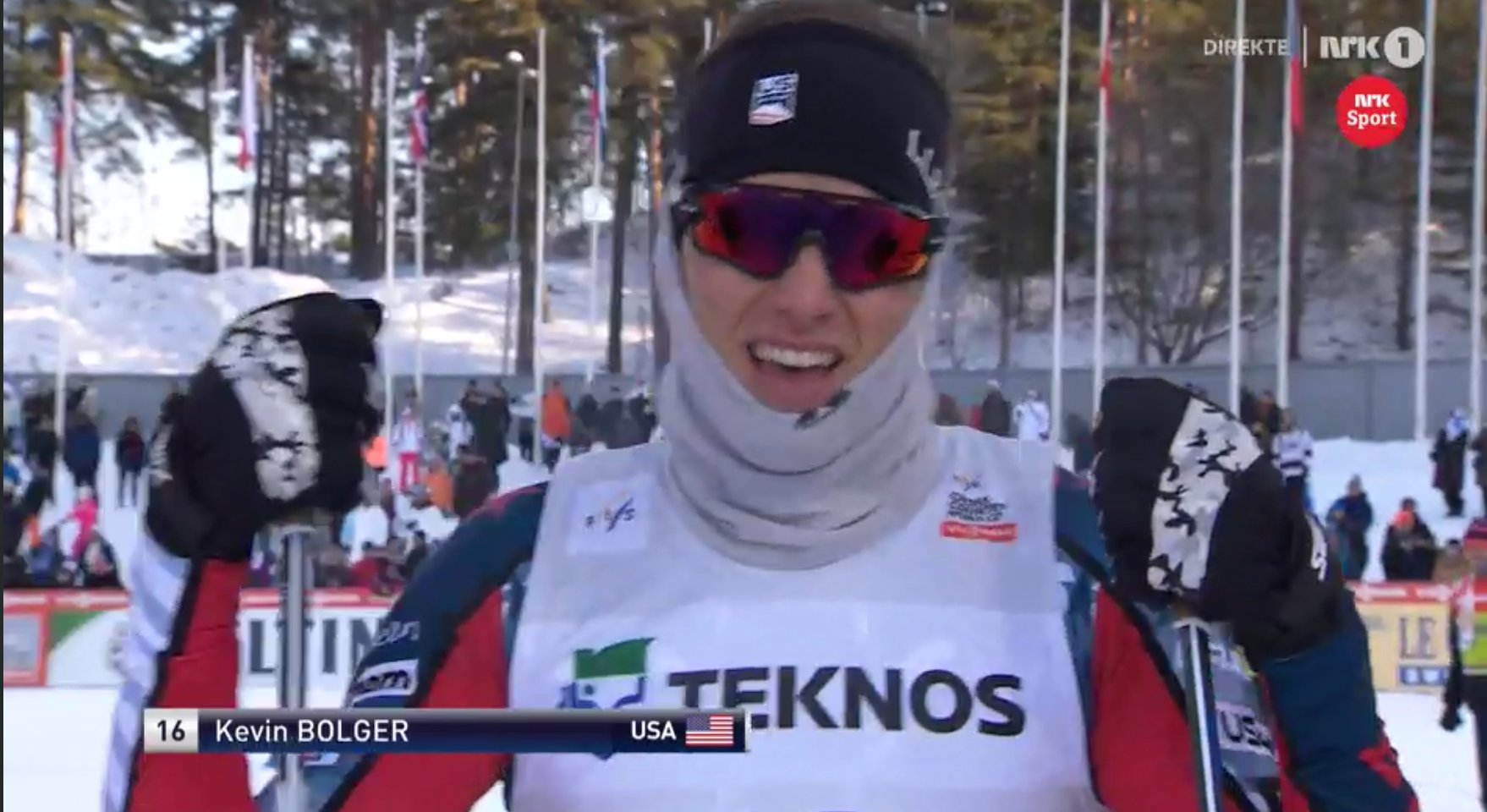
Americans took advantage of this diluted World Cup field with JC Schoonmaker finishing 13th, Jack Young 22nd, Zanden McMullen 28th, Michael Earnhart 35th, Kevin Bolger 44th, Owen Young 54th.
“The heat selection strategy was definitely a bit different today with a lot of normal World Cup guys not being here,” said Schoonmaker. “I went for heat 1 because that felt like a good one to move on from and it was a better option than usual with Klaebo not here. Other than heat selection the strategy didn’t differ at all for me, just trying to race my best!”
McMullen is better known as a Distance skier, but his strong qualifying effort proved his versatility. “I do actually like using sprint races as a bit of a warm up,” said McMullen. “It puts my mind and body into a race mentality that I can’t really achieve on a race prep day. Sprints also typically feel lower stakes to me, so it’s just a nice way to go out and have some fun!”
Sprint Heats—New Cast, New Strategies
Skiing can be such a strange sport. Oberhof is a famed biathlon venue; if this were a weekend of biathlon races the grandstands would be packed. As it is, this was a cross-country weekend, and the stadium stood all but empty. The German fans who could’ve been here definitely missed a good show, and a fair indication of what the future of what World Cup Sprint events may look like in the near future. Even with a number of bright stars missing from the days entry list, the racing proved fast and furious.
There was a lot going on in Quarterfinal 1: Lars Heggen wearing the green U23 World Cup leaders bib, alongside JC Schoonmaker, Zanden McMullen, and Even Northug. Everybody with something to prove, everybody with something to gain, and only two minutes of Heat 1 in which to do it. Schoonmaker led through the early parts of the course, but faded by mid-race. Heggen accelerated up the hill before the finish, sufficiently gapping his rivals and easing up before the finish line which he was followed across by a scrambling Even Northug. McMullen would finish fourth in the heat, followed by Schoonmaker in fifth. On the day, McMullen and Schoonmaker would finish 20th and 23rd, respectively.
Pellegrino advanced out of Quarterfinal 2 in which Jack Young’s day would end with a fifth place heat finish. Young had led early in the quarterfinal, evidently hoping to press the pace in the hopes of advancing as a lucky loser. His strategy was bold, but it left him one place short. Young would finish 24th on the day.
“I wanted to get to the front and control the race,” said Young. “Sadly, I wasn’t able to hold my position into the big climb—this wasn’t part of the plan. I then made up sole ground, but I didn’t have the energy to hold my position through the working finish.”
Semifinal 1 included Heggen, Pellegrino, and Northug who all came in together at the bottom of the final climb. Heggen would V2 the entire climb, while Pellegrino switched to a high-tempo V1 to scoot past into the hole-shot. Northug faded as Lauri Vuorinen (FIN) edged into the top three. Pellegrino would coast across for the heat win, followed by Heggen’s lunge for second ahead of Vuorinen in third and Northug fourth. Those lucky losers would sit and wait for the results of the second semifinal.
That second semifinal included one well known Sprinter—Switzerland’s Valerio Grond—who was joined by a cast of names we’re less accustomed to hearing: Filip Skari (NOR), Jaume Pueyo (ESP), Emil Liekari (FIN), Jiri Tuz (CZE), and Martino Carollo (ITA). Grond would finish second in the heat behind Liekari to advance to the final. Vuroinen and Northug—lucky losers from Semifinal 1—would advance as well.
Federico Pellegrino (ITA) used a high-tempo V1 to position himself on the steep uphill of Oberhof’s Sprint course. But Heggen’s V2 would prove stronger. (Photo: Reichert/NordicFocus)
Plenty at Stake in the Final
In the absence of truly dominant skiers, no one really knows what to do. The Sprint Final would become a bit of a curiosity as Heggen hoped to solidify his Olympic credentials . . . but Northug would be harboring similar plans of his own, and they’d both need to figure out how to deal with the cagey veteran, Pellegrino. In the final, Heggen and Pellegrino went to the front to control things, but neither looked eager to really drive the pace. Both the leaders chose the far-right line up the first climb as Liekari spun his wheels in the loose snow on the inside line. That was the point at which Grond took control, charging over the top of the climb. But Heggen’s fast skis could not be contained onthe subsequent downhill. He coasted easily into the lead, followed to the base of the final climb by Pellegrino and Northug. The final hill had offered a contrast in styles all day: Heggen’s V2 power vs. Pellegrino’s V1 tempo. This time up the hill, it was Heggen’s strategy that proved strongest, fending off Pellegrino’s V1 charge and holding on across the finish line for his first World Cup win. Northug would cross the line in third, a fine World Cup finish that was likely to be overlooked in Norway’s construction of its Olympic roster.
The 20 year old upstart bested the 35 year old veteran. The question that remained was this: was the Norwegian Olympic Team Selection Committee watching?
Oberhof World Cup Men’s Freestyle Sprint QUALIFYING
The Men’s Freestyle Sprint Podium in Oberhof—Federico Pellegrino (ITA always contends, Lars Heggen (NOR) hopes he proved his point, Even Northug (NOR) left wondering if anyone had noticed. (Photo: Authamayou/NordicFocus)
Love Stories Like This? Help Keep Them Coming.
Feature stories like this one take time, access, and care to produce. If you value thoughtful storytelling and independent ski journalism, please consider becoming a Voluntary Subscriber. Your support directly fuels the work we do to cover the people, places, and moments that make our sport special.
This World Cup coverage is made possible through the generous support of Marty and Kathy Hall and the A Hall Mark of Excellence Award. To learn more about A Hall Mark of Excellence Award or to learn how you can support FasterSkier’s coverage please contact info@fasterskier.com.
Snapping back after a week away from racing, the World Cup resumed in wintery Lahti, Finland with a 1.6 kilometer freestyle sprint. The American women made their presence immediately known, landing three of five athletes in the top-five in qualification, with four in the top-30.
Rosie Brennan skis to fifth in qualification in Lahti. (Photo: NordicFocus)
On the heels of a bronze medal in the event, Jessie Diggins was second in qualification, +6.71 behind the time of 3:17.37 posted by Sweden’s Olympic champion Jonna Sundling. Julia Kern was next for the U.S. in fourth (+7.59) behind Russia’s Natalia Nepryaeva, with Rosie Brennan just behind in fifth (+8.61). Hailey Swirbul also raced into the heats, skiing to 26th in qualification (+16.56).
Jessie Diggins posts the second fastest time in qualification during the freestyle sprint in Lahti, FIN. (Photo: NordicFocus)
Leading the Canada team Cendrine Browne raced to 29th in qualification (+17.37), advancing to the heats.
Racing in heat five, Diggins moved to the front of the pack inside the first minute of racing, with Kern on her tails heading up the first climb, with Julia sliding back to third in the following descent. Nevertheless, the Americans maintained control of the heat heading up the climb and around the course’s hairpin turn, where cheers could be heard from the sidelines, urging “Alright, Jessie! Alright, Julia! Hard over the top! Hard over the top! Come on, push, push, push!”
Rounding the final bend to the finish, the Americans were side by side at the front, with Sweden’s Anna Divyk looking for an opportunity to sneak through from their draft. Kern was on the inside of the bend, stepping powerfully to maintain her momentum as the threesome headed into the final 100 meter sprint. Still right alongside her teammate, Kern led the boot throw to win the heat, with Diggins +0.1 back, and the Swede on their tails to cross the line +0.39 seconds back in third. As the fifth heat proved to be the fastest of the quarterfinal, Czech athlete Katerina Janatova also advanced as a lucky loser after finishing in fourth, just over a second behind Divyk.
Julia Kern and Jessie Diggins take to the course during the quarterfinals of Lahti’s freestyle sprint. (Photo: NordicFocus)
In the first semifinal, it was Sundling and Dahlqvist at the front, with teammate Emma Ribom and Nepryaeva jockeying for the third and fourth positions through the first half. The Swedes rounded the hairpin in first through third, but Nepryaeva, Nadine Fähndrich (SUI), and Janatova remained close on their heels. Coming into the finish lanes, it was Sundling in front, with Ribom nipping Dahlqvist at the line by 0.11 seconds. Nepryaeva crossed fourth, 0.6 back from Dahlqvist, leaving the two awaiting the outcome of the next semi to determine their fate heading into the final round.
The Americans raced in the second semi, along with an additional two Swedes, Divyk and Johanna Hagström, plus Slovenia’s Anamarija Lampic and a German, Coletta Rydzek.
Julia Kern tucks into Jessie Diggins draft during the freestyle sprint heats in Lahti, FIN. (Photo: NordicFocus)
Heading up the climb to the hairpin, it was Diggins at the front, with Hagström on her tails and Lampic maintaining contact. The group had thinned, leaving the remaining three women trailing behind on the descent with a gap between each.
In the adrenaline-filled final meters, it looked like Hagström would hold the advantage to the line, but a high tempo Diggins and accelerating Lampic were closing fast. Throwing their boots three abreast, the women crossed the line dead-even for a three-way photo finish.
A slow motion replay of the slide showed that it was Lampic who crossed first, with Diggins .03 seconds behind, and Hagström in third, separated by an additional 0.01 second. With Lampic’s time clocked roughly 0.7 seconds slower than Nepryaeva’s in the first semi, only the top two women advanced, leaving Hagström just off the mark.
Kern crossed fourth in the heat (+1.94) to end her day in eighth overall.
“Today was a lot of fun,” Kern said in a U.S. Ski & Snowboard press release. “The conditions were great, the stadium and course were filled with lively spectators and I was really excited to get back to racing the World Cup! I felt like I had a lot of great energy today, skied well, and enjoyed the awesome atmosphere while racing side-by-side with Jessie in the heats! I was stoked to put down maybe my best World Cup qualifier and see that my body is ready to fire after the Olympics.
“I have only raced two races in the last two months,” Kern continued, “so I have been excited for Period 4 World Cups with lots of racing opportunities. I am someone who loves to race. I had a blast skiing with Jessie in the heats today, we train together all year long, working hard and pushing each other, and also rooming together, so it is fun to ski well together and take charge of the heats. ”
Julia Kern races to eighth place in Lahti’s freestyle sprint. (Photo: NordicFocus)
Sundling looked to leave nothing to chance in the final, gapping the field before the halfway point, with Lampic and Ribom leading the chase group a few seconds back.
Descending from the hairpin, the Swedes were in first through third, with Sundling still well off the front. Diggins had moved up onto Dahlqvist’s tails in fourth, which she held heading around the final bend into the stadium and into the lanes.
Jonna Sundling (SWE) cruises through the final to win the 1.6 kilometer freestyle sprint in Lahti. (Photo: NordicFocus)
While Sundling cruised cross the line for the win in 3:12.86, it was Ribom and Dalqvist fighting for the second and third spots to determine the order of a Swedish podium sweep. It was Ribom in second at the line (+3.28), fending off Dahlqvist in third (+3.67), interrupting her streak of World Cup wins this season.
Diggins held her ground close behind the Swedes in fourth (+3.93), with Lampic closing fast for fifth (+4.01). Nepryaeva closed out the women’s final in the sixth spot (+4.69).
Jessie Diggins throws her boot for fourth in the final round of Lahti’s freestyle sprint. (Photo: NordicFocus)
Following the race, Diggins said she was happy to be feeling like herself again following the brief post-Olympic break. It was just six days ago that Diggins fought through food poisoning induced fatigue, cramping, and delirium to earn a silver medal in the 30 k skate.
“I was incredibly tired after the Olympics,” Diggins said in a post-race audio clip, embedded below. “That 30 k took more out of me than maybe any race in my entire life. So I was just feeling lucky to be out there and racing and able to feel like my body is back.”
In addition to providing insights into how things shook our for her, Diggins commented on the experience of watching newer members of the team earn their first World Cup starts, specifically Lauren Jortberg, Bill Harmeyer, and Logan Diekmann.
“Happy to be part of that rite of passage. That was really, really fun.”
Sweden’s Jonna Sundling hugs Emma Ribom (right) after finishing one-two in the freestyle sprint in Lahti, FIN. (Photo: NordicFocus)
“I feel amazing right now,” Sundling said of her win in a post-race interview with FIS at the finish. “I think I’m in a good place in my career and it feels really good to ski right now. Today, I just tried to trust my skiing and it went really [well], so I’m happy.”
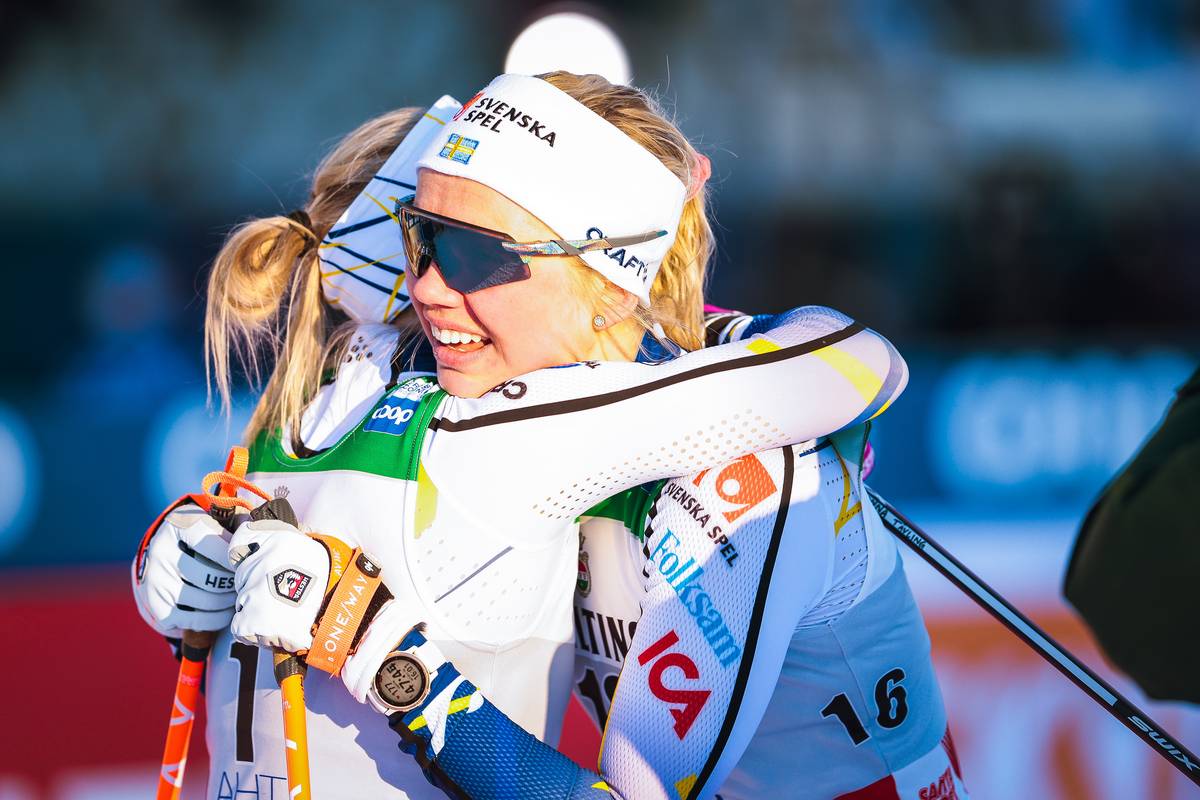
When asked about the Swedish podium sweep, Sundling broke into a wide grin. “I’m so happy, and for Emma, it is her first, so it’s really good.”
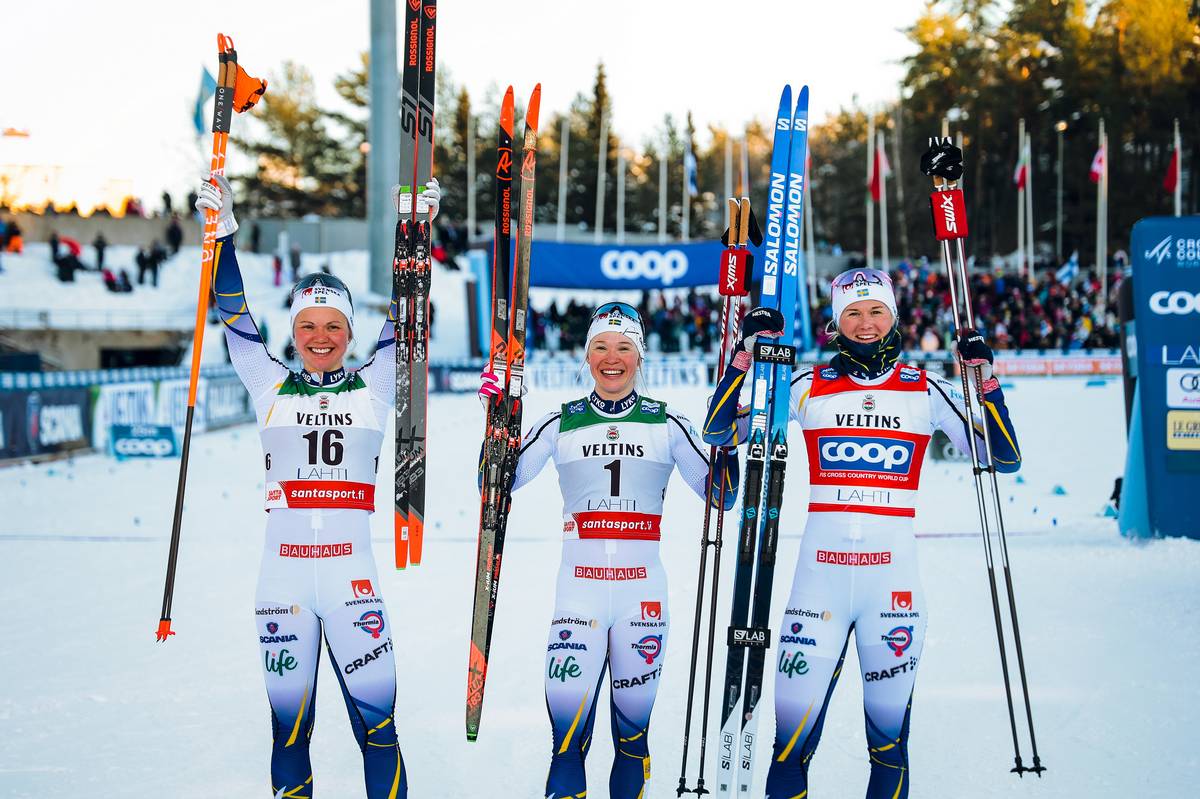
A Swedish podium sweep in Lahti, with Jonna Sundling taking the top spot ahead of Emma Ribom and Maja Dahlqvist. (Photo: NordicFocus)Rosie Brennan races in the fourth quarterfinal heat in Lahti, FIN. (Photo: NordicFocus)
After sharing the lead with Slovenia’s Lampic through the second half of the fourth quarterfinal, Brennan rounded the final bend into the finish in second position, moving to Lampic’s right with 50 meters to go. While Lampic maintained a lead by several meters, Germany’s Rydzek crept up alongside Brennan, throwing her boot at the line to edge out the American by 0.04 seconds. As the third heat saw times roughly four seconds faster than the fourth, Brennan was unable to advance as a lucky loser and ended her day in 13th.
Crossing in sixth in heat one of the quarterfinal, which saw Sundling and Nepryaeva go one-two, Swirbul finished 28th today. Swirbul maintained contact with the lead pack through the hairpin turn, where Sundling and Nepryaeva accelerated off the front to thin the pack.
Hailey Swirbul races in the first quarterfinal heat in Lahti. (Photo: NordicFocus)Cendrine Browne (CAN) races in the second heat of the quarterfinals in Lahti, FIN. (Photo: NordicFocus)
Canada’s Browne also ended her day in the quarters after racing in heat two. Browne was +2.19 behind Sweden’s Maja Dahlqvist who comfortably won the heat, with the Canadian in sixth to end her day in
Also racing for the U.S., BSF Pro Team’s Lauren Jortberg raced was pulled up from the SuperTour for her first World Cup appearance. Jortberg is ranked 11th overall in the SuperTour standings and is third on the sprint list behind APU’s Rosie Frankowski and Becca Rorabaugh, both of whom opted to race the American Birkie this weekend.
Lauren Jortberg (BSF Pro) makes her first World Cup appearance in the 1.6 k freestyle sprint qualifier in Lahti, FIN. (Photo: NordicFocus)Olivia Bouffard-Nesbitt (CAN) races the 1.6 k freestyle sprint qualifier in Lahti, FIN. (Photo: NordicFocus)
Outside the top-30 for Canada, Olivia Bouffard-Nesbitt was 33rd today, less than a second away from the heats, with her teammate Dahria Beatty just 0.25 seconds behind her in 34th. Laura Leclair was the final Canadian racer in the women’s field, finishing 54th in qualification (+25.41).
Women’s racing continues tomorrow in Lahti with a 10 k individual start classic.
ZHANGJIAKOU, CHINA — Rosie Brennan brought two left boots to her cross-country ski race at the Olympics on Tuesday.
Then, she crashed.
Just speed bumps on her way to history.
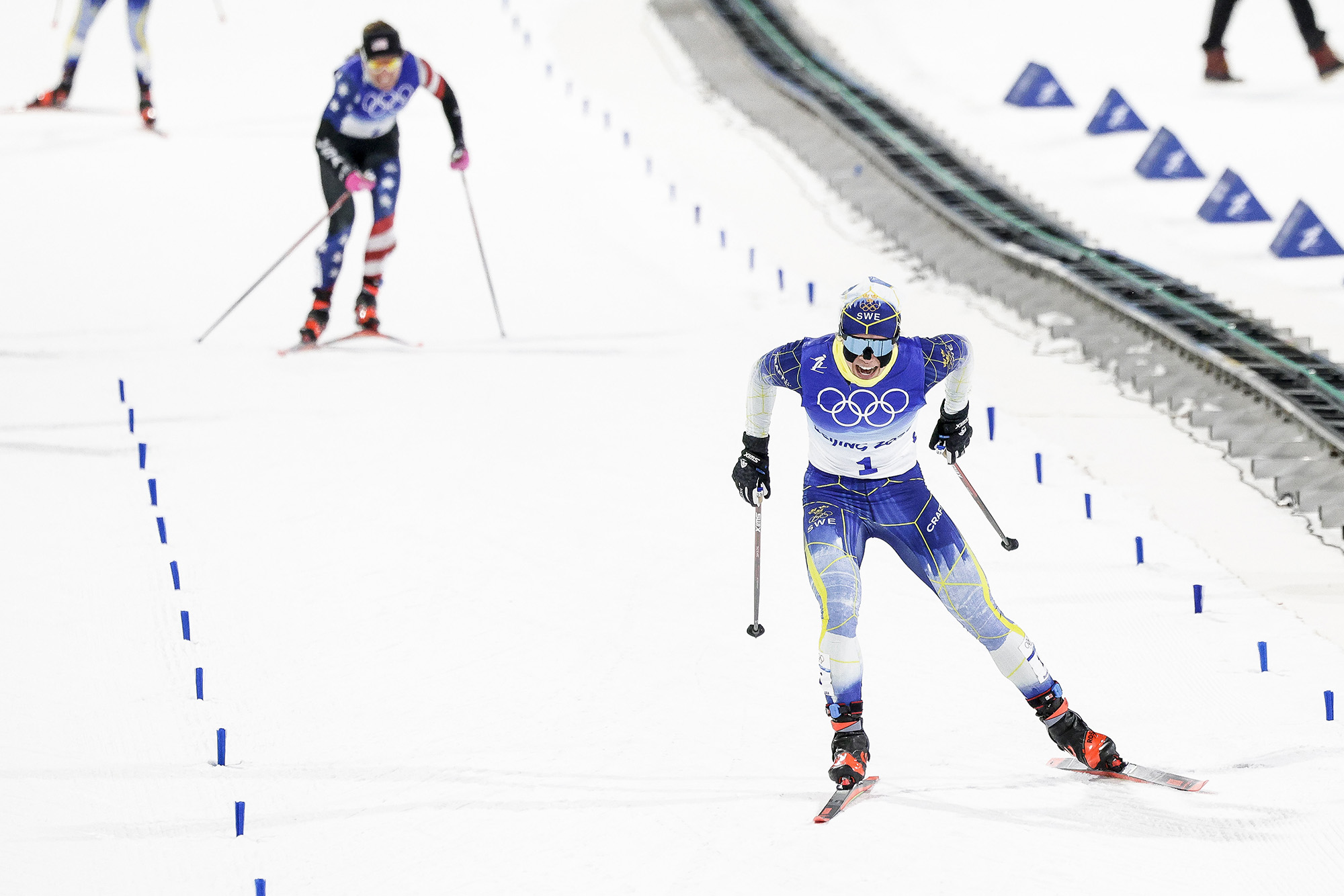
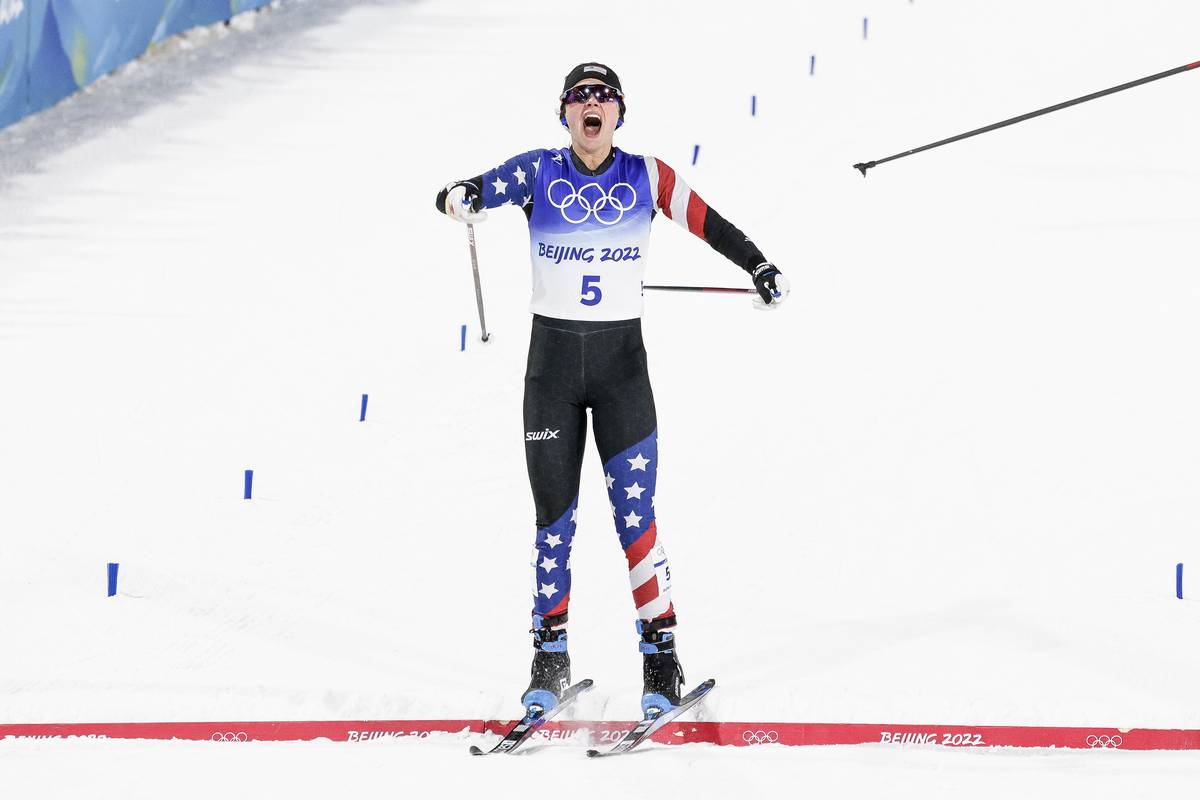
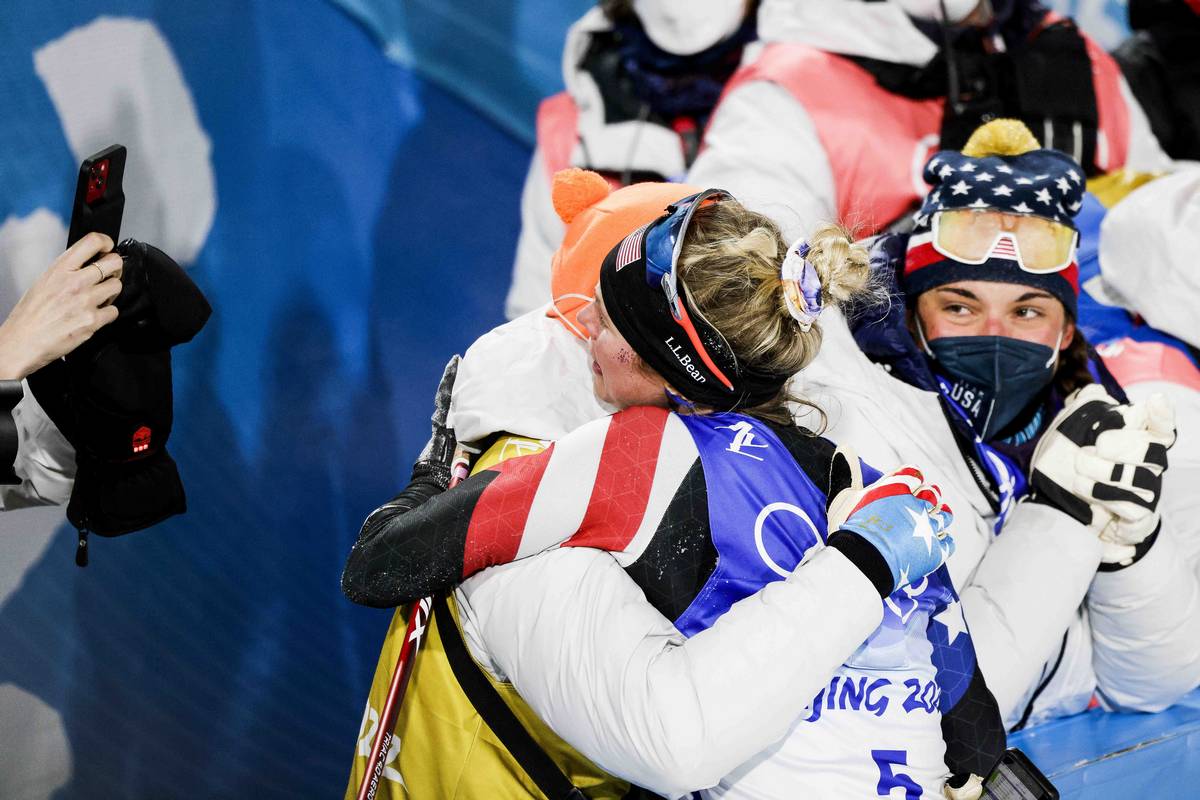
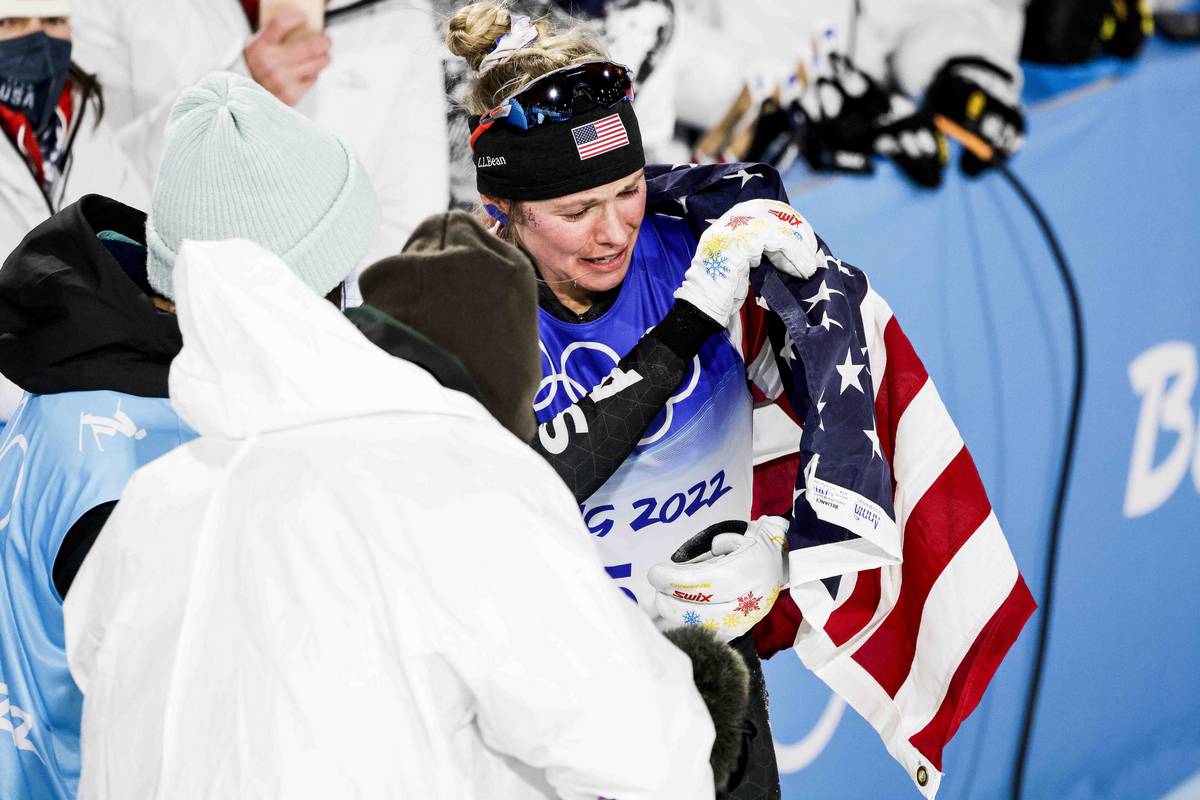
Brennan’s fourth place in Tuesday’s sprint, in the skating technique, was overshadowed by her teammate Jessie Diggins’ bronze — only the third Olympic cross-country skiing medal in U.S. history, and the first individual medal for women.
Rosie Brennan (USA) on her way to the 2nd fastest time during qualification. (Photo: NordicFocus)
But Brennan’s result is arguably just as big of an achievement. It’s also the best-ever American women’s Olympic result in her sport by someone who isn’t named Diggins or Kikkan Randall.
Brennan, a 33-year-old Utah native and Anchorage resident was cut not once but twice from the U.S. Ski Team. She’s fought through a car crash, other injuries, mononucleosis and nearly walked away from the sport.
And on Tuesday, she was a couple of ski lengths away from an Olympic medal — a result that was simultaneously exhilarating and agonizing.
“Fourth place is hard. You feel really happy and also frustrated at the same time, so I have a lot of mixed emotions about it,” she told reporters after the race. “But I did everything I could today.”
Brennan has long excelled at distance racing, but her world-class talent in sprinting has only emerged in the past few years.
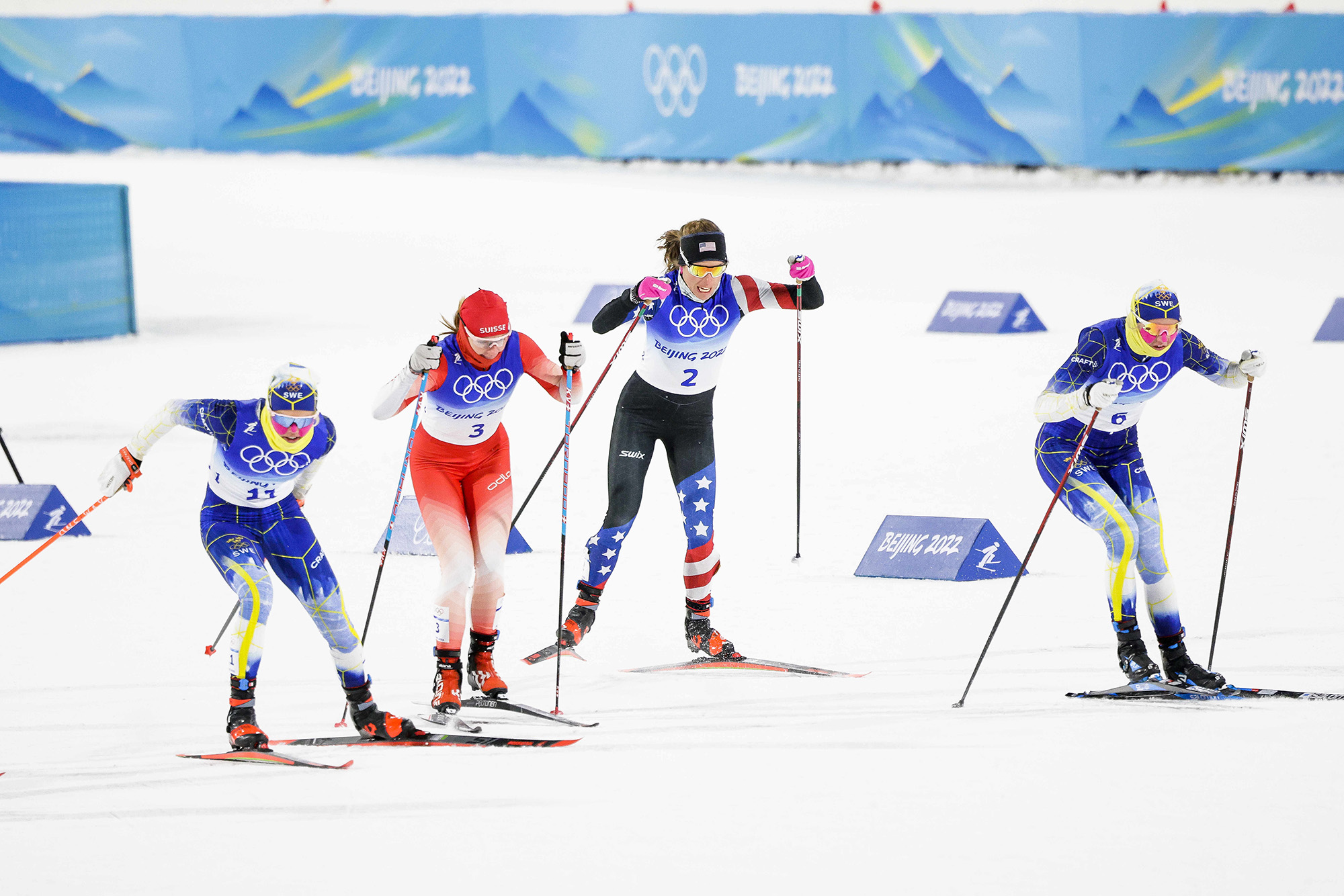
Emma Ribom (SWE), Nadine Fähndrich (SUI), Rosie Brennan (USA) and Maja Dahlqvist (SWE), (l-r) get up to speed at the beginning of the women’s individual sprint final. (Photo: NordicFocus)
Tuesday’s result was not a surprise, however: She’d been a podium contender in sprints on the top-level European World Cup circuit earlier this season.
The grinding sprint course also favored Brennan. It’s at altitude, a setting where she’s produced good results in the past, and the snow was cold and slow — a tough combination some of pure sprinters competing who lack Brennan’s endurance capacity.
But Brennan’s day in Zhangjiakou, a resort town outside Beijing that’s hosting the Olympic cross-country ski events, began inauspiciously, when she arrived with the two left boots.
The U.S. men’s team bailed her out, grabbing the right one for Brennan on their way to the skiing venue.
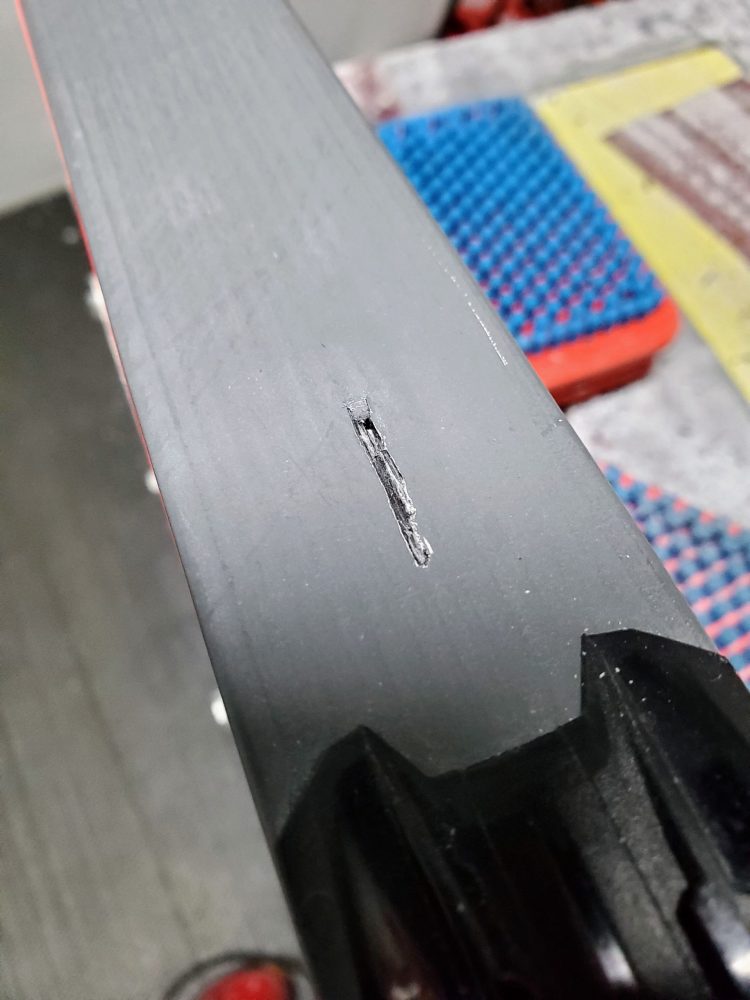
Then, in her quarterfinal heat — the first of a series of head-to-head knockout races — she tripped as soon as the starter’s gun went off. A closer look at her ski revealed she had poled directly onto it, punching through the top sheet.
A close up of the hole left by a bad pole plant at the start of Rosie Brennan’s freestyle sprint quarterfinal. (Photo: Nat Herz/FasterSkier-ADN)
Immediately, Brennan found herself 10 yards behind her five other competitors, a near-eternity in a race that lasts three minutes. The U.S. Ski Team’s cross-country director, Chris Grover, was watching from the side of the trail.
“I was like, ‘Okay, that was one of our best shots, and her day’s over,’” he said.
Ironically, Brennan said she’d been practicing her sprint starts for the past six weeks with help from her boyfriend Tyler Kornfield, a former national champion sprinter.
“The first thing on my mind was, ‘Tyler’s going to kill me, I just messed that up so badly,’” she said. “But then I had to be like, ‘Well, the start can be his thing, the uphill’s my thing. So let’s go.’”
She did. Brennan picked herself up and went in such fierce pursuit that she’d reeled in the pack on the first hill, then managed to place second in the heat — a performance Grover described as “nothing short of miraculous.”
In her next heat, a semifinal, Brennan was stuck racing against Jonna Sundling and Maja Dahlqvist, the two Swedes who went on to win gold and silver medals. The heat was scorching fast, but Brennan skied well enough to advance.
That put her in the final with Diggins, where Brennan didn’t quite have the speed to match her teammate and the two Swedish women. Grover, the coach, said Brennan was likely paying the price for the two big efforts she’d made in the previous heats.
“She had to really lay it out so much in the quarterfinal. She didn’t have the best semifinal,” he said.
“For her to regroup and still be fourth in the final,” he added, “is really amazing testament to what her fitness is.”
While it was tantalizing to be so close to an Olympic medal, both Grover and Brennan said her result gives her a shot of confidence for upcoming races where she could also contend for hardware: two more distance events, a relay and a team sprint where Brennan and Diggins form a formidable pair.
Jessie Diggins (USA) and Rosie Brennan (USA) find their position in the early moments of the women’s final. (Photo: NordicFocus)
That mental boost is especially welcome, Brennan said, given what she described as a disappointing 14th-place result in Saturday’s Olympic opening event, the skiathlon.
“I feel like I’m back on track now, and this is where I want to be,” she said. “So, I have a lot of hopes for the rest of the week, too.”
And while Brennan may have to grapple with the mixed emotions of an Olympic fourth place, her teammates were free to offer some unrestrained enthusiasm.
“This quote is your reminder to never sleep on Rosie Brennan. Never sleep on Rosie Brennan,” said Luke Jager, one of her teammates at the Alaska Pacific University club who also raced Tuesday. “She persevered and grinded. She had some tough years there, I know. But she made it happen, and it’s really amazing.”
This World Cup coverage is made possible through the generous support of Marty and Kathy Hall and the A Hall Mark of Excellence Award. To learn more about A Hall Mark of Excellence Award or to learn how you can support FasterSkier’s coverage please contact info@fasterskier.com.
The History:
A survey of the last five Olympic cycles shows a clear trend in American women’s sprint results: upward. In the 2002 Games in Salt Lake City, no Americans qualified in the freestyle sprint. Tessa Benoit was the top qualifier in 38th, with an up-and-coming Kikkan Randall next for Team USA in 44th. Randall was then 20 years old.
In the freestyle sprint four years later in Torino, Randall was the only American to qualify for the heats. She was 10th in qualification, then moved to 9th in the final standings. Switching to classic for the 2010 Games in Vancouver, Randall again qualified in 10th to be the only American in the heats, this time racing her way up to eighth.
And then there was Sochi.
The 2014 Games in Sochi were a turning point for the American squad, with all four women qualifying inside the Top-30 in the freestyle sprint. This time, a new name topped the list for qualification: Sophie Caldwell in 9th. Not to be overlooked, USA also had Jessie Diggins 12th, Kikkan Randall 18th, and Ida Sargent 25th.
Racing in her first Olympiad, Caldwell (now Hamilton) entered uncharted territory as she won her quarterfinal to advance into the semis, which she finished in a thrilling boot slide to be 0.1 seconds behind heat winner Ingvild Flugstad Østberg of Norway. Though she crashed in the final, she again moved the needle upward for the Americans by finishing sixth in the final heat.
The remaining American women also finished inside the Top-20, though none made it beyond the quarterfinals. Diggins was 13th, Randall 18th, and Sargent 19th.
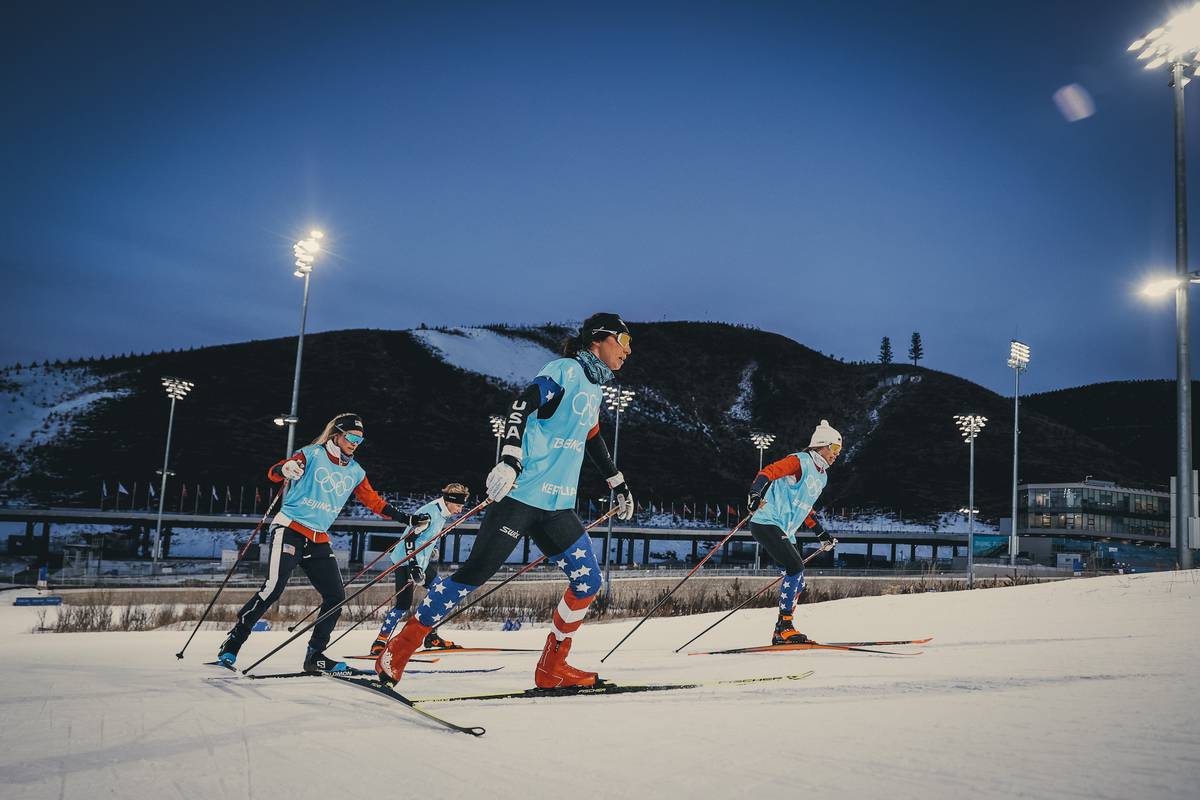
The American women’s sprint team prepares for the individual freestyle sprint. (Photo: NordicFocus)
Carrying momentum from these Games through the next Olympic quad, the Americans had three women in the Top-30 for the classic sprint in PyeongChang in 2018, with Sargent just outside in 33rd.
This time it was Diggins in 7th – the top Olympic qualification result of any American woman – with Sadie Bjornsen 9th, and Caldwell 12th.
Despite it being her weaker technique, Diggins raced with confidence, landing in second in both her quarter and semi to advance automatically into the final. Losing touch with the leaders, Diggins repeated Caldwell’s historic result to finish 6th overall.
Perhaps a less apparent victory, Caldwell also raced into the semis, finishing 8th overall after taking third in her semi and missing a lucky loser spot in the final by just 0.18 seconds. Bjornsen was eliminated in her quarter after taking third in her quarter, on the wrong side of the lucky loser mark, but just barely, to end her day in 14th.
Fast forward four years and get excited.
Rosie Brennan (USA) on her way to the 2nd fastest time during qualification. (Photo: NordicFocus)
Sweden’s Jonna Sundling smashed the qualification round of the 1.5-kilometer freestyle sprint, setting the mark at 3:09.03. The next name on the list? Rosie Brennan in second (+5.80), ahead of Nadine Fähndrich (SUI) in third (+6.62), Yulia Stupak (ROC) fourth (+7.98), and… Diggins in fifth (+8.69).
Have you been reading closely? Both Brennan and Diggins both exceeded the previous best result in qualification from any American woman in history.
Also posting a strong qualifier, Julia Kern was 14th in qualification (+11.66), rebounding from Saturday’s skiathlon which left her wanting more. The final American starter, Hannah Halvorsen, finished 43rd (+20.10) in qualification – outside the Top-30, but still above Randall’s result from her first Olympic Games 20 years ago.
Jessie Diggins (USA) skis the 5th fastest time during qualification. (Photo: NordicFocus)
You may be wondering about the spread of times; the top-10 were nearly 11 seconds apart. After a quick descent out of the stadium, the course in Zhangjiakou features a 30-meter climb – nearly 100 vertical feet – followed by a sweeping downhill that leads back toward the stadium. From there, athletes face a 14-meter climb back into the stadium, finishing with a gradual rise to the line. Combined with cold dry snow, these factors can contribute to an above-average spread amongst the top qualifiers.
Here we go: the heats.
Brennan lined up alongside Sweden’s Sundling in the first quarterfinal heat. With nerves running high, a false start brought the six women back into the gate after the first starting beep. On the second go, the women pushed through the wands cleanly, but on one of her first doublepole pushes, Brennan caught the edge of her boot, dropping down to her knees and losing any momentum she had picked up as the field rocketed away from her.
Not willing to let the day end there, Brennan collected herself and focused on the task at hand, regaining contact with the group at the bottom of the climb and grinding her way into second position, looking strong as she crested the top of the hill just behind Sundling and rounded the curve to head into the descent.
After stumbling out of the start, Rosie Brennan (USA) charges back to the front of her quarterfinal heat. (Photo: NordicFocus)
Given the effort required for such a comeback, would there be enough left in the tank for the B-climb or had the matches been burned early? With Sundling holding steady in the lead Brennan was challenged by Slovenian sprint champion Anamarija Lampic as the women pushed up the final climb, but found another gear for a commanding second-place finish, +2.4 behind Sundling, but +0.7 ahead of Lampic, who would advance as a lucky loser.
The second heat featured medal favorite Maja Dahlqvist of Sweden, who qualified in sixth. Norway’s Tiril Udnes Weng set the pace, leading up the A-climb with Dahlqvist alongside, and Russia’s Natalia Nepryaeva on their tails. Powering out of the B-Climb, Dahlqvist held the advantage at the front, while Nepryaeva and Weng slid over the line in a photo finish for second and third. A closer look showed Weng’s boot accelerate as she reached forward, just in time to nip Nepryaeva at the line by 0.03 seconds for the automatic advancement to the semifinal. The second heat was six seconds slower than the first, leaving Nepryaeva out of the running for a lucky loser spot.
A fast third heat saw Nadine Fähndrich of Switzerland and Maiken Caspersen Falla advance automatically, pulling Germany’s Victoria Carl over the line as the second lucky loser.
Dancing and smiling in the start gate, Diggins got out with a clean start, positioned near the front and looking powerful as the women headed into the downhill curve out of the stadium. Around this curve, she was pushed to the outside as she skied defensively to dodge potential snags with the other skiers’ equipment, leaving the curve near the back of the pack.
Jessie Diggins (USA) leads Emma Ribom (SWE) in the early rounds. (Photo: NordicFocus)
Then, Diggins put on a show up the climb. Steadily moving up along the outside, she was perfectly balanced in a crisp V2 while other were in V1, catching the Swedish leader Emma Ribom. Leading over the top, Diggins kept the pace high to take the sting out of other sprinters. Carrying momentum out of the descent and again holding a strong V2 up the B-Climb, Diggins carried her lead through the finish to win by over 2 seconds, with Ribom next. There was no doubt that Diggins was looking good heading into the semi.
In the final quarter, Julia Kern pushed the pace in the first half, positioning herself in the lead as the pack headed out of the climb. She held her position through the downhill and around the hard right turn, carrying momentum into the hill. Perhaps paying for her efforts early on, Kern was dropped on the final climb as Veronika Stepanova (ROC) and Sofie Krehl (GER) broke away before heading into the stadium. Kern kept herself in the fight, staying in contact with Alina Meier (SUI) through the false flat to the finish, but ended up fourth in the heat, +3.5 back from the leader and behind the mark needed for a lucky loser spot in the semis. A gusty and tactical performance in her first Olympic sprint appearance.
Julia Kern (USA) led her quarterfinal early during the individual freestyle sprint. (Photo: NordicFocus)
To regroup: we now have two Americans in the semi, matching the previous best result from 2018.
Lining up in the first heat of the semis, Brennan got out of the start smoothly, tucking into the back of the back to safely descend out of the stadium and carry momentum out of the left-hand bend and into the A-climb.
Following the effective, albeit unforeseen, strategy from her first round, Brennan pushed her way up the A-Climb, moving from sixth place into the lead. The American kept the effort high as she pulled Sundling, Dahlqvist, Fähndrich. Brennan charged the downhill, stepping powerfully around the right hand bend to head into the B-climb at high speed. In the second climb, the two Swedes, Sundling and Dahlqvist, worked their way around Brennan, with Fähndrich also accelerating. No relief until the finish, Brennan did not let up in the undulating terrain that follows the B-climb, rounding the final curve in fourth place just behind Dahlqvist.
After setting a fast pace for the heat, Rosie Brennan finishes fourth in her semifinal to advance as a lucky loser. (Photo: NordicFocus)
Sundling stretched out the spread of the top-four in the final stretch to take the win in 3:11.94, with Fähndrich second, Dahlqvist third, and Brennan fourth, +1.35 behind Sundling. Brennan’s efforts to keep the pace hot contributed to a lightning fast heat, with Sundling’s time nearly four seconds faster than the top finish in the quarterfinal. This left Brennan in good standing for a lucky loser spot in the final, but she would need to hold her breath to see what the second heat would decide.
The second semi was quick out of the gate, with Sweden’s Ribom leading up the start of the A-climb. Diggins was comfortably tucked into the pack, beginning to set her race plan into action as she V2ed steadily up the side of the track, holding her form longer than the others as she moved into the lead. Nearing the high point, Diggins switched to a rapid tempo V1 with Norway’s Falla matching pace to head out of the climb in first and second.
Diggins sat in a low tuck at the front, stepping around the sweeping left-hander and heading into the B-Climb with Ribom and Falla trying to match pace and challenge at the front. Ribom moved ahead near the top of the climb to lead into the final curve. Diggins sat on the Swede’s tails, with Stepanova alongside. A bobble zapped some of Diggins’ momentum and could have been devastating, but the American kept her composure and stayed upright, staying in contact with Ribom as they headed into the finish lanes.
With Ribom in the lead, Diggins powered toward the finish line to secure a second place auto-qualifier spot for the final. She crossed the line +0.4 behind Ribom’s mark of 3:15.22, with Falla and Stepanova crossing in third and fourth a few meters back.
As the second heat times were roughly four seconds slower than the first, Brennan could let out a sigh of relief. The second lucky loser spot was now hers.
And now, we watch history unfold. Two American women in the final, as Brennan and Diggins set a new mark for the stars and stripes.
The final lineup saw Sundling, Dahlqvist, and Ribom racing for Sweden, alongside Diggins and Brennan, with Fähndrich representing Switzerland in red.
Emma Ribom (SWE), Nadine Faehndrich (SUI), Rosie Brennan (USA) and Maja Dahlqvist (SWE), (l-r) get up to speed at the beginning of the women’s individual sprint final. (Photo: NordicFocus)
Taking charge from the start, Sundling skied with authority, smoothly leading her teammates Dahlqvist and Ribom up the A-climb to put Sweden in first through third heading out of the climb. Diggins was fourth as they crested the high point, with Fähndrich on her tails and Brennan just behind.
Utilizing the speed of her skis and her strength in the downhill, Diggins moved up alongside the Swedes in the descent, looking for position heading into the final climb. Maintaining her command of the race, Sundling rocketed off the front to gap the remaining five women who all remained in contention for a medal leaving the climb.
Ribom quickly fell off the pack, leaving Dahlqvist leading a tight group of four over the undulating terrain that led to the final bend before the stadium. Diggins and Brennan looked to be boxed out as they headed around the final curve in third and fourth, respectively, but the Americans were patient versus panicked, which could put them at risk of a fall.
Coming out of the curve, Diggins accelerated around Fähndrich to challenge Dahlqvist for the silver medal. Brennan followed her teammate to surge past the fading Swiss athlete, setting the stage for a three-way sprint for two podium positions.
Sundling had gold on lock, nearly three seconds ahead as she crossed the finish line in 3:09.68.
Jonna Sundling (SWE) with a commanding victory in the individual freestyle sprint comes to the finish with Rosie Brennan (USA) in the background on her way to fourth. (Photo: NordicFocus)
In her wake, Dahlqvist and Diggins were taking it to the line, with the Swede carrying a slight advantage in the final meters. Still, with Brennan close behind and both Fähndrich and Ribom off the back, the Americans were almost guaranteed their first individual medal in history.
Skiing their fastest splits of the day, Dahlqvist held her ground to the silver medal (+2.88), with Diggins on her right, less than a ski length back for bronze (+3.16).
Jessie Diggins crosses the line in third to earn the first individual Olympic medal in women’s cross country ski history. (Photo: NordicFocus)
Just over a second back, Brennan crossed fourth (+4.49), for the second best individual finish in American women’s history. The Americans maintained a gap to Fähndrich in fifth (+7.21) and Ribom sixth (+11.11).
Diggins collapsed to the ground, overcome by the emotion of what she had accomplished. Perhaps a testament to her team-centric approach, she was heard saying, “Good job, Rosie!” between gasps, as she got back to her feet to immediately hug the coaches, support staff, and teammates that lined the edge of the course.
Jessie Diggins hugs her coaches and teammates after finishing third in the individual freestyle sprint in Zhangjiakou. (Photo: NordicFocus)An emotional Jessie Diggins wraps the American flag around her shoulders after taking bronze in the freestyle sprint. (Photo: NordicFocus)
Tearfully wrapping an American flag around her shoulders, Diggins was aglow as she savored the moment before heading back to the finish to stand alongside Sundling and Dalhqvist for the podium shot.
Jonna Sundling (SWE) takes gold in the freestyle sprint, ahead of Maja Dahlqvist (SWE) and Jessie Diggins (USA). (Photo: NordicFocus)
Though she was the one whose name would be highlighted in history books, Diggins focus on the importance of those around her remained at the forefront as she celebrated the many victories of the American team in today’s event.
“It was so cool to be there with Rosie,” Diggins said in the mixed zone. “She’s skiing so amazingly well… and I’m just so grateful. That’s the overwhelming emotion, because it takes so much from such a huge team to make this happen. And we had obviously amazing skis, but also amazing teammates for years and years and years, helping me train, pushing me, supporting me – amazing coaches, amazing volunteer staff. You can’t even imagine how much it took from so many people, and so I’m just so thankful because I feel like this medal belongs to about 1000 different people. And I hope they really feel that and know that.”
Jessie Diggins takes Olympic bronze in the freestyle team sprint. (Photo: NordicFocus)
Of her approach to the course, Diggins gave a simple response, acknowledging that she has a way of blacking out while having great races, “which is really annoying,” she laughed, “because I’d love to be able to remember exactly what I did.”
“I was just so focused on trying to push as hard as I could,” Diggins explained. “Just trying to ski as well as I could and stay balanced. The snow felt a little greasy, so especially in the finishing lane, just trying to put as much power as I could into every single push. And honestly, that’s all I can remember.”
Jessie Diggins (USA) on her way to the USA’s first ever individual women’s medal in the Olympics. (Photo: NordicFocus)
Perhaps the FasterSkier audience needs no reminder that Diggins came into the 2022 Games as a gold medalist, having won the freestyle team sprint with Kikkan Randall in 2018, a day that brought many Americans, including this writer, to tears. Diggins was asked to reflect on the last four years, and the progress she’s made in her career.
“The last four years, I’ve really found my voice,” Diggins said confidently. “I’ve really found a lot of my purpose, and I feel like I’ve grown a lot. But also, I’m exactly the same person in pretty much every other way. I think one of the big things has been dealing with is the pressure and expectations, because there’s been a lot of it, and it hasn’t been easy. So for me, I think it was such a victory just to make it to the final and know that I’m skiing well. I came into this as prepared as I could be, which one of my biggest goals was to come in prepared. The second goal, cross the finish line with nothing left. And the third goal was to just have fun, and keep focusing on the process, because that’s what gets me where I am today. Like win, lose, or draw, it’s just focusing on the process and, and executing those process goals to the very best of my ability, because then I’m always proud of how I finished. I’m just proud of this effort today as I was at the skiathlon, even though they were different outcomes.”
Jessie Diggins was all smiles as she passed through the mixed zone following her bronze medal performance in the women’s individual sprint. (Photo: Nat Herz/FasterSkier-ADN)
Fourth place at the Olympics – fourth in the world on its most prestigious stage – is both a truly incredible feat and perhaps the most challenging final rank to wrap one’s head around. The “wooden medal”, just shy of the Olympic hardware skiers dream about from their youth.
“Fourth place was hard,” Brennan said honestly in the mixed zone. “You feel really happy and also frustrated at the same time. I have a lot of mixed emotions about it. But I did everything I could today, and maybe not everything went perfectly my way. But I have to be happy with that at the end of the day.”
Jessie Diggins (USA) and Rosie Brennan find their position in the early moments of the women’s final. (Photo: NordicFocus)
Asked what she would have said if four years ago, someone told her she would be in this position, Brennan laughed, “I probably wouldn’t have believed it so much.”
She talked through a rough start to the day, sharing that she has always struggled with start gates and had spent the last six weeks practicing to ensure a clean start.
“So, there I was on the ground, I was like, ‘So much for all that practice.’ But I knew my strength was in the climb, so I just had to pull it back [together] and focus on the all the time I had left and see what I could do to try and make it up.”
On her approach through the heats, Brennan played to her strengths, recognizing she could take the lead, work the hills, and not let her heats unfold as a casual first 1200 meters with a tactical final sprint that might leave her in the dust.
“My strength lies more in the endurance aspect of it,” she explained. “I tried to just keep the pace high so that I could count on being a lucky loser – by having a fast heat time. So that was my strategy in the semifinal, and it worked. Once I got to the final, I tried to then be a little more smart about my racing. I tried to be patient and wait until the last climb. I was a little far back, so I kind of got the door closed on me to make it through. So I had to kind of adjust and go for a strong finish sprint, which isn’t always my strength. But I did all I could do.”
With Ben Ogden racing into the semis in the men’s race, it was an historic day for the American program as a whole. Speaking to this landmark day, Brennan concluded with an inspiring message for those who dream of following in their footsteps.
“I think it shows the growing depth in our country. And I hope it shows a lot of people just to have some patience and keep training, keep going for it. You never know where you’ll end up.”
Jonna Sundling (SWE) takes gold in her first Olympic appearance in the women’s freestyle sprint. (Photo: NordicFocus)
Taking a closer look at the winner, Sundling is the 2018 World Champion in the freestyle sprint. Returning from injury, she has built her way into the season. Though Dahlqvist has shined as the undefeated World Cup star for Sweden, Sundling has crept up alongside, taking second to Dahlqvist in the individual sprint in Dresden, and working together to win the team sprint. Sitting out the Tour de Ski, Sundling beat Dahlqvist in their next matchup in a Scandinavian Cup race in Falun, Sweden.
This is Sundling’s first Olympic appearance, though she and Dahlqvist will be a likely pairing in the classic team sprint next Wednesday.
Once the final rounds were complete, Kern’s final placement was determined to be 18th. This marks a significant step forward from her first appearance in the skiathlon, where she finished 53rd.
Julia Kern (USA), who finished in 18th place overall, pushes to the finish during her quarterfinal round. (Photo: NordicFocus)
“It was really tough out there, but a lot of fun to have a challenging course and give it my all,” Kern told FasterSkier in the mixed zone.
Dahria Beatty 28th in qualification (+14.51) to be the only Canadian woman to make the heats. Beatty raced in the first semifinal, where she finished fifth in the heat to finish 25th on the day.
Just 0.7 seconds off the top-30 mark, Cendrine Browne was 35th in qualification (+15.82) with Olivia Bouffard-Nesbitt close behind in 40th (+16.89). Laura Leclair rounded out the Canadian team in 58th (+26.28).
Dahria Beatty (CAN) races in the quarterfinals on her way to 25th place overall. (Photo: NordicFocus)
An Australian dual citizen who is a long-time APU team member, Jessica Yeaton was 52nd (+23.82) in the qualifying round.
SuperTour racing continued on Friday in Craftsbury, Vermont, as part of the Henchey Memorial Carnival, which also included Eastern Cup and collegiate racing. The three-day event is presented by the Craftsbury Outdoor Center, NENSA, U.S. Ski & Snowboard, and the University of Vermont (UVM), the EISA carnival host school.
Racers were faced with snowy conditions for the opening 1.4-kilometer freestyle sprint as a winter storm made its way across the Northeast. Friday morning’s grooming report mentioned 6 inches of fresh snow, as more continued to fall throughout the morning.
On the women’s side, last weekend’s 10k freestyle winner, Alayna Sonnesyn (SMS T2), won the qualifier in 3:58.27, ahead of BSF Pro Team’s Lauren Jortberg in second and APU’s Rosie Frankowski in third. Perhaps a nod to the wintery conditions, these top three finishers were separated by over six seconds.
Sonnesyn advanced from the first heat of the quarterfinals into the semis, where she finished third in the first heat behind Katharine Ogden (SMS T2) and Ava Thurston (Mansfield Nordic Club), who crossed the line together, roughly 0.4 seconds ahead of Sonnesyn. As the second semi, which was won by Jortberg, was roughly four seconds faster on average, Sonnesyn did not earn a lucky loser spot in the final. Instead, Jortberg advanced with Anna Bizyukova of UVM, Frankowski, and Craftsbury’s own Margie Freed.
Despite the trend seen in the qualifier, the final featured tight racing, with the top five athletes finishing within two seconds of one another. Just 0.6 seconds separated second from fifth.
A scene from the women’s final of the 1.4k freestyle sprint in Craftsbury. (Photo: Instagram @nensa_nordic)
Coming out on top was Ogden, who won the final in 3:59.08. After racing on the World Cup from the opening races in Ruka through the midway point of the Tour de Ski, Ogden has gone three-for-three in SuperTour sprints since returning stateside, winning classic sprints in Soldier Hollow and Lake Placid before checking off a skate win today.
Just behind, Jortberg took second place (+1.30) with U18 athlete Thurston closing in third (+1.78). Bizyukova was next to the line in fourth (+1.86), with Frankowski less than a meter behind in fifth (+1.91). Freed rounded out the women’s final in sixth (+4.51).
“I think that the biggest thing to note about today was that it was blizzarding!” wrote Ogden in a post-race email. “The heavy falling snow made the heat racing very tactical and rewarded being very quick off of the line. There was one lane on the course that was packed down by traffic and the other areas were pretty soft!”
Ogden was just 11 points behind Caitlin Patterson on the Olympic qualification distance list, based on the athletes’ best two distance races on the SuperTour or at the U.S. Cross Country Championships, during which Ogden competed in only one race – the 10k individual start classic where she was second to Patterson. The following weekend in Sun Valley, she was second in one distance race and fourth in the other, behind three Olympians and ahead of Patterson in each. As the races at U.S. Nationals were scored at a higher point value, Patterson took the final Olympic spot, leaving Ogden on the wrong side of the cusp.
Nevertheless, Ogden has found silver linings in the additional time back east.
“It was a blast to be able to race with the EISA. I miss skiing for Dartmouth (Ogden graduated in 2021), so it was fun getting to ski with some of my old teammates and some new Dartmouth skiers. It was also pretty great to ski in lots of natural snow, we rarely get a snowstorm this big anymore and it was undeniably very fun.”
The women’s podium after the opening freestyle sprint race which kicked off a weekend of SuperTour, Eastern Cup, and EISA racing. (Photo: APU Nordic Ski Center / Instagram)
As Thurston is, remarkably, still in high school, Bizyukova was the top collegiate racer to earn today’s EISA sprint title. The second and third placed collegiate racers both hailed from Dartmouth College, with Callie Young finishing fifth in the first semifinal and 10th overall, and Jasmine Drolet taking sixth in the second semi for 11th overall.
The men of the Sun Valley Ski Education Foundation (SVSEF) Gold Team swept the top-three spots in the men’s qualifier, with Karl Schulz leading the way in 3:23.48. Peter Holmes was 0.33 behind in second, with Johnny Hagenbuch in third (+1.21).
Schulz carried momentum from the qualifier win into the first quarterfinal, which he won by half a second, but his day ended soon after in the semifinal. Racing in a fast first heat that contained two eventual podium winners and found both lucky losers, Schulz was fifth in the heat, +1.72 behind winner Matias Øvrum of UVM. Sam Wood (SVSEF) was second in the heat, ahead of last weekend’s sprint winner Zak Ketterson (Team Birkie) and Gregory Burt (UVM).
In the second semi, which was nearly three seconds slower, Canada’s Étienne Hébert (CNEPH) edged out Holmes by 0.1 seconds to go 1-2 and advance to the final round.
Zak Ketterson leads up the final climb in the men’s freestyle sprint final in Craftsbury. (Photo courtesy Zak Ketterson)
The top two spots in the final were decided by a close finish between Ketterson and Øvrum, with Ketterson crossing 0.28 ahead in a time of 3:22.57 to earn his third SuperTour sprint title of the season. Øvrum was second, though he was named the collegiate race winner for UVM, with Hébert crossing the line a few meters behind on his own in third (+2.17).
“I’ve always really liked racing at Craftsbury,” Ketterson wrote to FasterSkier after the race. “It’s an awesome place and this year Team Birkie has been lucky enough to stay right at the Outdoor Center. The race course is right out our back door!”
Ketterson also provided insights to the final round for those following from afar.
“The final was really close! I gave it everything I had at the top of the last hill but I definitely started to get tired and bogged down a bit into the finish. Matias skied a smart race and gave me a really good challenge in the last few meters but luckily I was able to fend him off. It was a tricky day with super soft fresh snow and I’m happy I was able to execute.”
Zak Ketterson races a snowy freestyle sprint qualifier in Craftsbury. (Photo courtesy Zak Ketterson)
Wood was fourth in the men’s final (+6.9), with Burt fifth (+7.17), and Holmes sixth (+10.82).
The men’s freestyle sprint podium after the opening day of SuperTour racing in Craftsbury. (Photo: Instagram @nensa_nordic)
As mentioned, Øvrum was the top collegiate racer, with Burt second, going one–two for UVM. Third place among college athletes was Allan Luke of Dartmouth, who finished sixth in the first semifinal and 12th overall.
Craftsbury’s Day 1 coverage of the the 2022 Henchey Memorial Carnival: SuperTour, NENSA Eastern Cup and UVM EISA carnival.
Federico Pellegrino of Italy crosses the line first for his third World Cup sprint win in a row. (Photo: NordicFocus)
This World Cup coverage is made possible through the generous support of Marty and Kathy Hall and their A Hall Mark of Excellence Award. To learn more about A Hall Mark of Excellence Award or to learn how you can support FasterSkier’s coverage please contact info@fasterskier.com.
A new year, new snow, and some welcome faces at the start of the 2021 Tour de Ski in Val Müstair, Switzerland. In this 15th edition of the TdS, the first three stages of eight take place in Val Müstair. The tour then proceeds to stages in Toblach and Val di Fiemme, Italy.
Friday’s 1.4-kilometer freestyle sprint was a two-lap race on a course featuring banked turns, waves, and a small jump. This cross-country sprint playground was exactly that for Italy’s Federico Pellegrino (30) won the final’s in 3:08.44 as steady snow fell over the iconic alpine valley setting. The final featured Russians Alexander Bolshunov, Gleb Retivykh, and Artem Maltsev, with Frenchmen Richard Jouve and Lucas Chanavat rounding out the group of six.
On the first lap, the Russians played coy and skied behind, while Chanavat commanded the pace. As the second loop began, Pellegrino began his surge creating a small gap to Bolshunov in second and Jouve third. Careening down the winding curves, Pellegrino free skated his way into the rollers, pumping over the top to accelerate into the final curve and maintain command from the front as he entered the final lanes.
Alexander Bolshunov, the overall favorite for this edition of the TdS, places second, a spot behind Italy’s Federico Pellegrino who won the day. (Photo: NordicFocus)
Though Bolshunov was closing hard behind him, Pellegrino stayed strong enough to comfortably take the stage. The Russian locked up second (+0.57) with Jouve in third (+2.43). Retivykh placed fourth (+4.33), Maltsev fifth (+4.82), and Chanavat sixth (+28.28).
“[My legs] hurt; it hurts a lot… I think the feeling was better in the qualification than in the final, but I knew that I wanted to be really good here today,” Pellegrino told FIS after the race. “I had a lot of pressure, just made by myself, because after two victories, for sure you feel that you can continue to win.”
Federico Pellegrino and Alexander Bolshunov setting the pace. (Photo: NordicFocus)
Pellegrino made his dedication and intent clear from the beginning. He posted the fastest qualifying time on course by over two seconds, stopping the clock at 3:02.19.
“This is my job,” he said about his participation in the Tour. “To race here is really important.”
The Italian continued by commenting on how the pandemic has affected his country and the traditional New Year’s celebrations that occur. He expressed his wishes to provide an uplift and source of national pride during this challenging time.
“I hope to have given a little bit of sunshine on this new 2021 year.”
Wearing the yellow bib as the overall World Cup leader, Bolshunov is the real threat for the TdS overall. He won last season’s edition, which offered a full complement of racers from Norway. (Norway is not contesting the TdS due to the ongoing pandemic). On his way to winning the 2020 TdS, Bolshunov won a single stage of the TdS, stage 4’s 15 k classic pursuit, before securing the overall on the Val di Fiemme final hill climb.
Let’s take a step back into the earlier rounds.
Simi Hamilton amidst a slew of Russian skiers, placed 13th overall on Friday after qualifying in 4th. (Photo: NordicFocus)
Showing great form, Simi Hamilton led the American men with a 4th place finish (+2.9) in the qualifier. Kevin Bolger snagged the final spot in the top-30 (+9.23) and both men stepped into the starting gates in the second heat of the quarterfinals.
Unfortunately, a broken pole near the start robbed Bolger of the chance to truly compete. He lost contact with the pack and ended the day in 30th.
Kevin Bolger takes a tumble in Val Müstair, Switzerland. (Photo: NordicFocus)Bolger, recovering after a snapped pole in his quarterfinal. Simi Hamilton in bib 4. (Photo: NordicFocus)Bolger upright and on the go as the pack gains ground. Bolger finished 30th overall. (Photo: NordicFocus)
Racing with the agility and tactics for which he is known, Hamilton tucked in behind the three Russians that led the first lap of the heat. As they accelerated into the tight downhill S-turns, Hamilton edged his way up in the group, reaching his hand out to touch the skier next to him, signaling his presence with confidence and authority to diffuse a potential tangle.
In his second lap, Hamilton held second position on the tails of Andrey Melnichenkov (RUS), seemingly getting in position for a top-two finish early. Coming into the final turn, Hamilton was forced to stay wide, allowing Gleb Retivykh the more direct line. Hamilton fought with Melnichenkov and Retivykh all the way to the line, but couldn’t quite make up the ground. He finished third in the heat, 0.02 seconds off the time needed to advance to the semi as a lucky loser. Hamilton ended the day 13th.
“Today was nothing amazing result-wise, but I think there were a lot of good signs for me that indicates I’m skiing at a strong level right now,” Hamilton wrote in an email to FasterSkier after the race. “Obviously I wanted to be back in the final, but the near-perfect racing it takes for me to do that didn’t shake out today. I was really psyched with my qualifier, and my body felt quite good during that effort.”
Hamilton continued with insight into his approach to the tour and his outlook after today’s very near miss.
“I’ve been feeling a little tired the last few days, so I’ve been taking it very, very easy, and I wasn’t sure how everything would respond after basically taking three days totally off. Obviously, my main goal for the tour is to perform well in the sprints, but I’d like to feel good on the distance days too so I wasn’t really preparing this week like I would have if I were putting all my eggs in today’s basket. Instead, I took a much more conservative approach to things to make sure I was giving my body the rest it needs for this whole eight race event. In my quarter I felt pretty strong and I thought I skied it tactically well, but I got boxed out on the outside coming into the finish lanes and I lost what turned out to be a very important tenth of a second from that. So, yeah, frustrating but you can’t always just look at the results to decide whether a race went well or not.”
Gus Schumacher of the U.S. during qualification. He placed 31st overall, just missing the rounds. (Photo: NordicFocus)
Barely outside rounds, Gus Schumacher ended his day after the qualifier in 31st (+9.55). Distance racer Scott Patterson took 79th (+22.72).
Racing continues tomorrow as stage 2 of the Tour de Ski offers up a 15 k classic mass start for the men.
Sweden’s Linn Svahn winning the first stage of the 2021 TdS in Val Müstair, Switzerland. (Photo: NordicFocus)
This World Cup coverage is made possible through the generous support of Marty and Kathy Hall and their A Hall Mark of Excellence Award. To learn more about A Hall Mark of Excellence Award or to learn how you can support FasterSkier’s coverage please contact info@fasterskier.com.
Out with 2020, in with 2021. Here in the world of multicolored lycra and skinny skis, we are kicking off the new year with the opening of the Tour de Ski on the sprint track of Val Müstair, Switzerland. As snow fell lightly but steadily, the usually remarkable mountain backdrop was veiled, narrowing our focus to the athletes as they embark on the grueling eight stages over ten days that is the TdS.
The two-lap 1.4-kilometer sprint course in the alpen valley featured two punchy climbs per lap leading down into fast and tight S-turns. Small rollers after these turns kept the skiers on their toes as they charged around the course.
Though the Norwegian athletes remain absent from the World Cup and TdS, the Swedish women are back in full force. They made their sprint prowess known in the qualifier, with 26-year-old Maja Dahlqvist setting the fastest time by nearly three seconds in 3:30.86. Seven members of their squad qualified for the heats, with an additional three in the top 10: Linn Svahn in 2nd, Moa Lundgren 4th, and Frida Karlsson in 8th. Though Karlsson is normally known for her distance racing (in particular besting Norway’s dominant Theresa Johaug at last year’s Holmenkollen 30 k), her possession of the green U23 Overall World Cup leader bib evidenced that she was not to be dismissed as a contender for the stage.
Wearing the yellow Overall World Cup leader bib, Rosie Brennan was the top American qualifier in 5th (+4.38), followed by Hailey Swirbul in 13th (+8.65), Jessie Diggins in 14th (+8.96), Sophie Caldwell Hamilton in 16th (+9.77), and Julia Kern in 25th (+12.61).
Brennan raced in a stacked first heat of the quarterfinals, racing against two of the top Swedes, Dahlqvist and Lundgren, in addition to Russia’s Natalia Nepyaeva, teammate Kern, and Switzerland’s Laurien van der Graaff. Brennan stayed near the front and in position to advance from the get-go, but couldn’t break from the lead group of four. She finished in a three-way photo finish with Nepyraeva and Lundgren, taking third but snagging a lucky loser spot allowing the threesome to all advance into the semis.
Jessie Diggins finding her form in Val Müstair, Switzerland where she placed second overall in the TdS stage 1 sprint. (Photo: NordicFocus)
Also advancing from the quarters from the fifth heat, Diggins held a position near the front throughout her heat, showing with her lightning-fast tempo that she intended to advance. She pushed Karlsson and Italy’s Greta Laurent break from the remainder of the group. In the second lap, Diggins had the fastest V1 cadence on the climbs and stayed smooth in the descents, priming herself for good positioning in the final sprint to win the quarter.
Ending their day after the quarters, Caldwell Hamilton marked Swedes Svahn and Emma Ribom. In her usual calm, cool, collected manner, she skied smoothly through the S-turn and tucked in comfortably on Ribom’s tails. Despite great position coming into the final lanes, Caldwell Hamilton could not quite overtake Ribom and finished centimeters behind for third in the heat. Swirbul stayed close to the leaders but was unable to fight for the top two and ultimately ended the heat in third also. Neither heat was fast enough to obtain a lucky loser spot.
Sophie Caldwell (bib 16) qualified in 16th and placed 16th overall in Friday’s skate sprint. (Photo: NordicFocus)Hailey Swirbul, here in bib 13 during stage 1 of the 2021 Tour de Ski, placed 15th overall. (Photo: NordicFocus)
On to the semifinals. Racing on home soil in the tight first heat, Nadine Fähndrich (SUI) edged out her opponents for the win in a three-way photo finish with Slovenia’s Anamarija Lampic and Sweden’s Dahlqvist. Considering Lampic and Fähndrich both finished in the top four of the last two freestyle sprints in Davos and Dresden, this result serves as a testament to the depth of the sprint field in those venues despite the lack of Swedes, Finns, and Norwegians.
Brennan and Diggins took off in the second heat, marking Swedes Svahn and Karlsson who held the front in the first lap. In the second lap, Brennan upped the tempo on the climbs, while Diggins pushed over the top and worked the downhill, free skating out of the rollers and putting herself into position to charge down the lanes ahead of Karlsson to hold onto the second position and a secure advance to the final.
Frida Karlsson (SWE), Jessie Diggins (USA), Greta Laurent (ITA), (l-r) during stage 1 of the 2021 TdS. (Photo: NordicFocus)
Fighting for millimeters, Karlsson and Brennan were just behind in third and fourth. Both squeaked through as lucky losers, but only just as Brennan’s time was a mere 0.1 seconds faster than the next fastest time.
The pace stayed hot and the pack stayed tight in the first lap of the final. Diggins and Brennan stayed in the mix near the middle of the pack and in contention for the podium.
As the racers rounded the bend into the second lap, Svahn began firing on all cylinders, taking off at the front with Lampic and Fähndrich marking her from a couple ski lengths back. Just when the top-3 positions seemed locked up, Lampic and Fähndrich brushed skis in the downhill S-turn causing Fähndrich to crash, losing sight of the podium. Svahn continued to hammer, flying down the final stretch to take the win with Lampic nearly a second behind her.
Seizing the opportunity, Diggins nimbly dodged around the downed Fähndrich, hopping over her pole and hitting the gas to drop a chasing Karlsson and snag third.
Linn Svahn during qualification in Val Müstair, Switzerland. (Photo: NordicFocus)
“I didn’t know how I’d feel in high altitude,” Svahn told FIS after the race. (Val Müstair sits above 4000 ft.) “I tried to take the first lap to get into my own zone and technique, then I tried to push all I had in the last uphill since the other girls were going really strong beside me.”
FIS also asked about Svahn’s goals for the tour ahead.
“I try to focus on each race, and now I’ll just focus on getting my legs working again after these tracks,” Svahn said with a tired laugh.
After a lengthy review, during which Diggins demonstrated the importance of staying on top of nutrition during the arduous tour by refueling with a bowl of pasta on the sidelines, Lampic was deemed to have interfered and was disqualified. This moved Diggins into the second position on the podium, with Karlsson stepping into third.
“Today was a fun way to start 2021,” wrote Diggins in a post-race email to FasterSkier. “But I think it’s important for me to say that I’m equally as proud of my all-out effort and our team today as I am when I’m not on the podium! It was just another day of giving it my absolute best effort, but the patience and trust in the training plan that Cork and I set down together has been paying off and my race form is coming into sharper focus now.”
Jessie Diggins finishing second overall on Friday’s stage 1 sprint. (Photo: NordicFocus)
So far this season, Diggins had a near miss at the podium with a 4th place at the individual sprint in Dresden and was unable to advance from the quarterfinals in Davos after getting boxed out on a curve just before the final straightaway. Today marks her first podium of the season in sprint or distance.
“The final was exciting, for sure,” she wrote. “I fell behind a bit on the steep climb, and was working my way down the downhill sections with as much speed as I could when I saw Nadine go down and slide around the corner in front of me. I didn’t want to hit her (or break her equipment, or my own) so I jumped over her pole while rounding the corner! In sprinting you can get lucky or be the recipient of incredibly bad luck, and today the luck definitely came my way (and I’m grateful for it).
“It was so exciting to have Team USA be 1/3 of the women’s final,” concluded Diggins. “And for myself, it was exciting to be out there having fun, not putting pressure on myself but still skiing with confidence and enjoying the banked turns and rollers all at the same time.”
Rosie Brennan (l) and Jessie Diggins in Val Müstair, Switzerland after the first stage of the TdS. (Photo: NordicFocus)
“It was a surreal day to be starting the Tour de Ski with the yellow bib,” Brennan wrote in a post-race email to multiple news outlets. “My one goal was to fight with what I had and I felt I did that well so I am proud of my effort out there today. I still have to remind myself just how far my sprinting has come and not change my expectations so quickly. This was only my second final ever and I am just so excited by the gains I’ve made.
“This might be the hardest sprint course I have ever raced,” Brennan continued. “It’s long, at altitude, and had some slow snow out there today. With that in mind, I tried to keep things under control, but also use my strengths. I had a near miss in the quarterfinal and was really happy about my quick acceleration in the finish after getting stopped up. I worked hard in the semi to keep the pace high to ensure our heat would have lucky losers which I then benefited from. However, I was pretty beat by the time we got to the final. I tried to open up on the second lap, but there wasn’t much there. I stayed out of trouble and for that was rewarded another two places. That’s a sprint race for you…That was a tough start to the Tour so the focus will now be on recovery to get ready for tomorrow and all the races to come. It’s also very cool to note that we had our 4th different girl on the podium in just 4 weeks of racing. Our team is really working hard to get through this tough season together and support one another as we navigate the world.”
Outside the top 30, Katharine Ogden finished 49th in the qualifier (+20.07), followed by Caitlin Patterson in 57th (+22.25).
Rosie Brennan was all smiles after her first World Cup victory and podium in Davos, Switzerland. Photo: NordicFocus
This World Cup coverage is made possible through the generous support of Marty and Kathy Hall and their A Hall Mark of Excellence Award. To learn more about A Hall Mark of Excellence Award or to learn how you can support FasterSkier’s coverage please contact info@fasterskier.com.
With a thick, fresh coat of fluffy white snow that fell over the last week, Davos, Switzerland looked regal as ever despite the smaller field and lack of spectators for today’s 1.5-kilometer freestyle sprint. FIS described conditions as hard-packed, elevating what Sophie Caldwell Hamilton, who landed on the podium in Davosthe last two years, called in a pre-race interview with FIS as a “technical and tactical” two lap course. Pumping music and cheering coaches, though perhaps a muted version of the norm, made the stadium feel significantly more full than the no-spectator reality.
With the Scandinavian teams out of the running as they withdrew from the December rounds of the World Cup due to Covid-19 concerns, it would be easy to focus on who did not in Davos. Let’s instead focus on who did.
Rosie Brennan during the skate sprint qualification in Davos, Switzerland. Brennan won the qualifier – a career-best for the American. (Photo: Nordic Focus)
On a roll this season, Rosie Brennan won the qualifier by 1.75 seconds in a time of 2:40.03. Rounding out the Americans in the finals, Caldwell Hamilton took second, Diggins fifth, Julia Kern 10th, and Hailey Swirbul 18th.
Jessie Diggins racing to 5th in the Davos sprint qualifier. (Photo: Nordic Focus)
In the quarterfinals, Caldwell Hamilton faced off with Switzerland’s Nadine Fähndrich in what would be the fastest heat. The pack stayed together in the first lap, but the two peeled off to finish comfortably off the front, Fähndrich in the lead.
The next heats were much closer. Brennan finished second in a pack of four behind Slovenia’s sprint star Anamarija Lampic in heat two, and after taking the lead in the second lap, Kern won the third heat.
Jessie Diggins (left) leads Julia Kern (bib 10) at the front of the group during the quarterfinal of the 1.5 k sprint in Davos, Switzerland. (Photo: NordicFocus)
Dropping into a tuck on the last descent and on Kern’s tails in the fast and furious final turn into the stadium, Diggins was in a tough position. Rather than putting herself in position for the sprint to the finish, she maneuvered to avoid tangling skis with Kern and lost some of her momentum. Despite powering down the straightaway and throwing her boot, she took third in the heat and was not fast enough to earn a lucky loser spot.
Round the bend, Julia Kern in the lead heading into the final straight during the quarterfinal of the 1.5 k skate sprint in Davos, Switzerland. (Photo: NordicFocus)
Swirbul was also eliminated in the quarters after taking fourth in her heat.
Hailey Swirbul climbs amidst the pack during the quarterfinal of the 1.5 k skate sprint in Davos, Switzerland. (Photo: NordicFocus)
In the semis, the three remaining American women lined up together in a stacked first heat with Lampic and Fähndrich. Brennan and Caldwell Hamilton held strong in the middle of the group while the Swiss and the Slovene set the pace. The foursome stayed tight, jockeying for positions in the second lap.
It was anyone’s game in the final straight, but Fähndrich held the others off on home turf to win the heat with Lampic and Brennan in a photo finish for second and third, respectively, behind her and Caldwell half a ski length further back in fourth. Both were able to secure lucky loser positions to advance into the final. Kern was eliminated after finishing 6th in the heat.
To the line, Rosie Brennan (L) leads Switzerland’s Nadine Fähndrich and teammate Sophie Caldwell Hamilton in the final sprint during the semifinal of the rounds in Davos, Switzerland. (Photo: NordicFocus)
Eva Urevc of Slovenia and Natalia Nepryaeva of Russia advanced from the second heat of the semifinals.
Fähndrich and Lampic again took the pace out hot in the final round, but Brennan kept herself in the mix. Challenging Fähndrich, she powered into the lead on the final climb, cresting the hill in front and dropping into a tuck on the downhill. Brennan held her lead out of the final turn and into the straightaway, but Lampic, Fähndrich and Nepryaeva were close on her tails.
Adrenaline pumping and poles lashing, Brennan held her lead by a narrow margin, pumping her fist in the air as she crossed the finish line in 2:37.36, breaking into a wide grin as she gasped for air.
Rosie Brennan celebrates her victory and first World Cup podium after the freestyle sprint in Davos, Switzerland. (Photo: NordicFocus)Rosie Brennan celebrates her victory and first World Cup podium after the freestyle sprint in Davos, Switzerland. (Photo: NordicFocus)
“It’s wild,” Brennan told FIS after the race. “I’ve never considered myself a sprinter, so to find myself on the podium is something I couldn’t even dream of.”
Lampic finished on her tails in second (+0.28), with Nepryaeva and Fähndrich in a photo finish for the final podium spot. They finished third (+0.49) and fourth respectively (+0.53).
The women’s podium at the 1.5 kilometer skate sprint in Davos, Switzerland. (Left to right) Anamarija Lampic (SLO) 2nd, Rosie Brennan (USA) 1st, Natalia Nepryaeva (RUS) 3rd. (Photo: NordicFocus)
After losing contact with the lead group, Caldwell Hamilton finished fifth (+6.83), with Urevc behind in sixth (+15.58).
FasterSkier spoke with Brennan while she awaited a blood draw at antidoping. Still euphoric, Brennan recounted her day and a result that she called “pretty unbelievable” and hadn’t fully set in. In fact, she thought there may have even been a mistake in the timing when she saw her name at the top of the qualifying list. Brennan also discusses training separately with clubs throughout the season, then coming together as a full American squad in Europe.
Post-race interview with Rosie Brennan.
Exhale. Sophie Caldwell in the mix during the heats of the 1.5 k skate sprint in Davos, Switzerland. (Photo: Nordic Focus)
In a post-race interview, Caldwell Hamilton discussed her own strategy to keep herself out of risk of becoming tangled up with other skiers while staying in contention throughout the heats. She also shared how significant today’s results are for the team as a whole, regardless of the presence of the Scandinavian teams.
Post-race interview with Sophie Caldwell Hamilton.
Hannah Halvorsen, qualifying in 38th, in her first World Cup since suffering devastating injuries when she was hit by an automobile in 2019. (Photo: Nordic Focus)
Returning to the World Cup just over a year after being struck by a car and sustaining severe injuries, Hannah Halvorsen placed 38th in today’s qualifier. Halvorsen provided an optimistic comment on how she feels after her first race.
“It was such a thrill to be able to get back on the race course,” wrote Halvorsen in an email. “I was both nervous and excited going into today’s race because I wanted to put down my best race. Everything went really well today so I am quite happy. Thanks to the coaches and wax techs, I had great skis and support. This feels like a great starting point, and I hope to improve off of this as the season continues. It is such an opportunity and honor to be here. The US team performed incredibly well today, and I couldn’t be more proud to be a part of this team.”
Post-race interview with U.S. Head Coach Matt Whitcomb.
Johannes Hoesflot Klæbo (NOR) winner of the men’s 1.6 k freestyle sprint at the 2019 World Championships in Seefeld, Austria. (Photo: John Lazenby/lazenbyphoto.com)
It was a dramatic day at World Championships in Seefeld, Austria on Thursday. Norway’s Johannes Hoesflot Klæbo can now call himself a World Champion after a tactical and hard-fought victory in the 2019 World Championship 1.6-kilometer freestyle sprint. Federico Pellegrino of Italy won silver finishing 0.23 seconds behind Klæbo. Russian skier Gleb Retivykh placed third, 1.37 seconds back.
Klæbo qualified fifth, then proceeded to win his quarterfinal and advance to the finals after placing second in his semifinal. This is where the day’s big drama played out.
The semi was stacked: featuring Klæbo, Russia’s Sergey Ustiugov, and skate sprint crusher Federico Pellegrino of Italy. Atop the course’s first major climb at 1:38 minutes, the six skiers, led by Ustiugov came to a near standstill. The with a burst of V2, the Russian made his move, peeking under his legs to determine the damage as he descended. Any lead Ustiugov gained had dissipated by the free-skating straight nearly 30 seconds later.
When the distance back from Norway’s Johannes Hoesflot Klæbo is measured in meters – a win could be in play. Here Klæbo skis in his quarterfinal at the 2019 World Championships in Seefeld, Austria. (Photo: John Lazenby/lazenbyphoto.com)
Coming into the tight right-hander that would swing skiers into the final climb, Klæbo slotted to the inside, his ski tail centimeters away from Ustiugov’s ski tip. The Russian stumbled slightly, as Klæbo kept his balance and V2 momentum — Ustiugov appeared to push off Klæbo’s back during the Norwegian’s move.
Atop the final hill, Pellegrino sped down first with Klæbo in third and Ustiugov chasing. Pellegrino closed out the semifinal win as Klæbo placed second after an after-burner effort. As the skiers collected themselves after crossing the line, a visibly upset Ustiugov engaged Klæbo with several shoves in the finish pen. Ustiugov received a yellow card for pushing Klæbo during the race as well as a second yellow card for his unsportsmanlike conduct after the race. According to FIS and ICR 352.23, two yellow cards in one race results in a disqualification which is reflected in today’s results.
Klæbo described this event to the FIS reporter, “It was really strange, at the top [of the first hill] everyone was stopping and no one wanted to go first so we were just standing there and after some seconds, one person was going down and everyone was following him.”
In the day’s sprint final, the podium places came down to the finishing stretch. Pellegrino’s raw speed was overcome by Klæbo just meters before the line. It was Klæbo’s first time competing at World Championships where he now compliments his three Olympic golds with a FIS championship medal.
From left to right, Federico Pellegrino (ITA) in second, Johannes Hoesflot Klæbo (NOR) in first, and Gleb Retivykh (RUS) third in Thursday’s World Championship skate sprint. (Photo: John Lazenby/lazenbyphoto.com)
Pellegrino won last weekend’s World Cup in Cogne, Italy. As he remains on form, his second place today is his fourth World Championship medal. Pellegrino won both his quarterfinal and his semifinal. He won his quarterfinal easily, waiting until the last uphill to take the lead. As he gained distance on the final downhill he skied unchallenged across the finish line. He spent a good deal of his semifinal in the back of the pack, but he was able to maneuver his way towards the front right before the finish, and once again place first.
For Retivykh, it was his first World Championship medal and his second individual sprint podium of the season.
Gleb Retivykh (RUS) celebrating his first World Championship podium finish. (Photo: John Lazenby/lazenbyphoto.com)
Simi Hamilton was the best placed American in ninth overall. He qualified 11th and was fourth in his fast-paced quarterfinal. Hamilton snagged the second lucky loser position and moved onto the semis. He raced in the first dramatic semifinal with Klæbo and Pellegrino.
Atop the first hill in his semi, Hamilton tangled with Pellegrino. Both skiers stayed on their feet, but Hamilton was unable to gain back his lost time as he placed sixth.
“The quarter-finals were really tough, it was a fast heat,” Hamilton told FasterSkier in a call. “Viktor Thorn, I think because he had a really good qualifier, wanted to push the pace the whole time, so that made it really hard. But it also ensured that both lucky losers came from that heat. So I was really psyched about that. A top-10 at World Champs is a result you can be proud of. Obviously, I would have like to be in that final today, I think I’m still that caliber of skier but, it’s pretty cool being top-10, so I’m happy with today.”
Simi Hamilton (USST) Skiing into 9th place overall in the World Championship skate sprint in Seefeld, Austria. (Photo: John Lazenby/lazenbyphoto.com)
U.S. skier, Logan Hanneman (APU) qualified 20th today and finished sixth in his quarterfinal for 26th overall. It was Hanneman’s first World Championship start. At last weekend’s World Cup skate sprint, in Cogne, Italy Hanneman qualified 15th and placed 27th overall.
“The racing today was tough for sure,” Hanneman emailed. “I am sure that you have seen the course, but the guys course is very front-half heavy, with a large hill right out of the start. Last year when I raced the World Cup here, I found that I lost most of my time to the leaders from the start to the base of the large hill, so today in the qualifier my goal was to get to the hill as fast as possible, and then get up it. The rest of the course, I was just hanging out for dear life. I was so flooded!”
Hanneman comes to this championship admittedly new to World Cup sprint heats.
“It was only my second heat ever at the level, and the learning curve is steep,” he continued. “Obviously if I was faster and fitter, it wouldn’t be too much of an issue, but opportunities to pass are rare and come very quickly here, and I need to just be more confident in my abilities to take those windows.”
Logan Hanneman of the U.S. skiing to 27th overall in Thursday’s skate sprint at the 2019 World Championships in Seefeld, Austria. (Photo: John Lazenby/lazenbyphoto.com)
USST member, Kevin Bolger qualified 23rd today. He was in the first quarterfinal with Klæbo and Ustiugov where he placed fourth. Bolger finished 18th overall for his best result of the season.
“Great job by Logan and by Kevin in their first World Championship sprint heats,” U.S. Ski Team Head Coach told FasterSkier in a call. “Neither of those guys really have a lot experience yet skiing heats, they are at the place where they aren’t qualifying in the top part of the field yet either so it kind of makes sense that they are going to end up 5th or 6th in their heat until they can take another step forward in their qualification and also just build their experience and learn how to really ski in the heats with these guys.”
Bolger told FasterSkier about his quarterfinal via email, “I picked Heat One because it looked like a A.) it would be a fast heat and B.) it looked like a competitive heat where the guys were going to ski and not play any games. Unfortunately, my time wasn’t fast enough to move on. Ustiugov made a move going up the first hill and I was wasn’t quite able to respond and get in the tail of it! But of course, I’m happy to have skied competitively with my heat!”
U.S. skier Andy Newell was 41st in the qualifiers today. According to Grover, Newell is suffering from a back strain.
“Newell has been struggling with a light strain to his back for a little bit here,” Grover said. “So I think if he had been healthy, he’s easily qualifying material. Then you go into a world championship field with only four starters from each nation, he would have easily made that. So bummed for Andy that he wasn’t 100% healthy and ready to really unleash it today, it would have been awesome to have four guys in there.”
For Canada, Alex Harvey, who announced he will retire from the World Cup after the finals in Quebec this March, placed 16th overall.
“It was a good start today and the body felt really good,” said Harvey in a Cross Country Canada press release. “I just wanted to come in today and get some good feelings heading into the rest of the championships. I did that so I’m happy.”
The men’s 1.6 k freestyle sprint podium at Saturday’s World Cup in Lahti, Finland, with Italy’s Federico Pellegrino (c) in first, Russia’s Gleb Retivykh (l) in second and Norway’s Johannes Høsflot Klæbo (r) in third. (Photo: Fischer/NordicFocus)
The men’s freestyle sprint final in Lahti, Finland, started in almost comical fashion: the six men who had made it to the final heat of the day skied slowly, then even slower, as nobody wanted to lead.
The final was full of dangerous men. Norwegian youngster Johannes Høsflot Klæbo has won five sprints this season, and he just became an Olympic gold medalist in the sprint in PyeongChang, South Korea, a mere ten days ago. In his quarterfinal and semifinal heats, he had put in big turns of speed which had dropped most of the field.
They hadn’t dropped Italy’s Federico Pellegrino, though, and the 2017 World Champion was the only man competing in Lahti who had beaten Klæbo in a sprint this season.
Then there was France’s Lucas Chanavat, who put in a huge burst of speed up a hill in his own quarterfinal, perhaps mimicking the move that Klæbo usually makes to test it out or prove a point.
They were all lurking there in the final, along with Russia’s Gleb Retivykh, Finland’s Ristomatti Hakola – consistently one of the fastest qualifiers on the World Cup – and Norway’s Sindre Bjørnestad Skar.
Norway’s Johannes Høsflot Klæbo leading his quarterfinal, which included Italy’s Federico Pellegrino (3) and American Erik Bjornsen (29), in the men’s 1.6 k skate sprint at the World Cup in Lahti, Finland. (Photo: Fischer/NordicFocus)
Klæbo finally got up to some sort of speed on a gradual downhill, stringing out the field after a full 90 seconds of being clumped together and moving at walking pace. But he still wasn’t going full bore. On one of the final opportunities, it was Skar who went to the front and sprinted up a hill, finally turning the speed dial to “full”.
Coming down the final hill into the stadium, it was Skar, Klæbo, and Pellegrino, who overtook the leader going into the last turn. In the finishing stretch, the two Norwegians seemed to just fade away; Pellegrino sprinted for the line and a big win of 0.77 seconds.
“I think that when I returned after the Olympics, back home I had a very good time, really good weather in the Alps,” Pellegrino – the silver medalist in the PyeongChang sprint – said in a post-race interview with FIS. “And it was very good to recover and train a lot, so that I could come here in the best shape. I’m really proud of this.”
Also surging past the Norwegian duo was Retivykh, who had accelerated into and through the final corners and pulled away in finishing lane.
“I have been waiting quite long for the World Cup podium,” said Retivykh, according to FIS. “Last time I was top three was in PyeongChang last year. So it feels great to be back. I am not surprised to be second because I knew I could do it. It feels great… I am sharing the podium with two great athletes.”
Klæbo hung on for third, +0.90 seconds, and Skar was fourth, +1.30. He edged Hakola (+1.44) while Chanavat was left in sixth (+7.55).
Coming into the final as the giant everyone feared, Klæbo’s tactics had not paid off.
“I’m glad this was not the Olympics,” Klæbo told Norwegian broadcaster NRK, according to a translation. “Pellegrino was too strong. I had nothing to answer with. Then you have to be thankful for third place. And I’m still smiling pretty wide.”
Pellegrino, meanwhile, played his cards exactly right. He also beat Klæbo here one year ago to win World Championships gold, and he channeled that experience.
“I lost too many races in the past when I was leading almost the whole race,” he told FIS. “I think that on this track I know how to do it.”
And with the win, Pellegrino became the most decorated skate sprinter in men’s World Cup history. It was his tenth skate sprint victory, a new record.
With third place, however, Klæbo has sealed this year’s overall Sprint Cup trophy even though there are still two sprints to come in Drammen, Norway, and Falun, Sweden.
“That is a bright spot, then,” he told NRK. “It helps a little, but there was no snap today. The [qualifier] was good, but otherwise it was a bit dead.”
By placing 11th in the freestyle sprint in Lahti, Sun Valley’s Kevin Bolger won some Gruyere cheese for being the top-ranked Continental Cup skier of the day. (Photo: Matt Whitcomb)
Bolger 11th in World Cup Debut, Bjornsen 20th
You didn’t have to scroll very far down the qualifier results sheet to find the name of a World Cup debutant. In 16th place was Kevin Bolger of the Sun Valley XC Gold Team. The SuperTour leader made the most of his opportunity, and NRK broadcasters referred to him as “the surprising man – Kevin Bolger.”
“Honestly, I didn’t necessarily expect him to qualify in a Scandinavian World Cup, in his first go at it,” Bolger’s coach Chris Mallory wrote in an email. “He generally builds into sprint days as they progress, as he’s a bit of an all-arounder. But he really stepped up to the plate today.”
In his quarterfinal, Bolger was last out of the start gates and sat in sixth place for much of the race. But near the end of the heat he moved into fifth and then coming into the finish turned on the afterburners to move up to fourth.
The last of the quarterfinals, it also turned out to be the fastest one, and both Bolger and third-place Karl-Johan Westberg of Sweden moved on to the semifinals as lucky losers behind Retivykh, the heat’s winner, and second-place Franceso De Fabiani of Italy.
“He’s a big glider, and can carry his speed really well, but he’s focused a lot on improving his speed this year,” Mallory wrote of that finishing sprint.
In the semifinal, Bolger couldn’t quite pull the same move. He was again in sixth out of the gate, but Pellegrino broke a pole, dropping to last. The two traded off places as Pellegrino then caught back up, and then replaced his pole again. Then Bolger passed Emil Iversen, but the Norwegian passed him back by the finish and Bolger ended up sixth in the semifinal and 11th on the day.
Bolger before the start of his semifinal heat. (NRK screencap)
Bolger graduated from the University of Utah last year and it is his first season as a full-time senior racer with the Gold Team, although Mallory said that Bolger had trained with Sun Valley for two years as a high school postgraduate before heading to college.
Before heading to Europe for the World Cup, Bolger had won a SuperTour sprint in Ishpeming, Michigan, and placed second and sixth in 20 k and 10 k races there. Earlier in the season, he was second in the skate sprint and fifth in the classic sprint at U.S. National Championships.
“My goal was for him to get some World Cup starts and a top 30 this season, so those opportunities would keep coming,” Mallory explained. “I watched FIS live timing all night, normally not so exciting, but last night it was!”
Erik Bjornsen of the U.S. Ski Team and APU qualified in 29th place and in his quarterfinal, had a poor start position as a result of his bib and was immediately shunted to the back of the heat.
“Up the first climb I tried to make a couple moves, but I was just kind of boxed in,” he explained.
He was in the first quarterfinal, along with Klæbo, Pellegrino, and Renaud Jay of France. By late in the heat Bjornsen was able to move up to fifth when Poland’s Maciej Starega, who had led early, began to fade. Then in the final downhill he moved into fourth and held that position through the finish.
Norway’s Johannes Høsflot Klæbo and Italy’s Federico Pellegrino (3) going head to head down the finishing stretch in the first men’s quarterfinal at the World Cup 1.6 k skate sprint in Lahti, Finland, with American Erik Bjornsen (l) chasing. (Photo: Fischer/NordicFocus)
But he hadn’t been able to get to the front early in the heat, and by the finish, the two eventual podium finishers were jetting off at hyperspeed. Though he wasn’t able to catch onto their tails, Bjornsen said that he was feeling better than he had at the Olympics, where his results had been disappointing.
“I definitely kind of struggled,” he admitted of the 2018 Olympic experience. “It was some of my worst distance racing of the year, so it was obviously very frustrating.”
After today’s sprint, however, there might be light at the end of the tunnel.
“I felt like I had good energy left,” Bjornsen said of his heat. “I tried making moves on both sides… the fitness is feeling a lot better than it was a couple of weeks ago. And so, I mean, the peaking plan for the Olympics didn’t work as planned. But it’s been a relatively good season for me, pretty consistent. I had a lot of top 30 finishes… I’m just trying to move past [the Olympics] and have a solid period four on the World Cup.”
He now looks to the 15 k classic on Sunday, which he called “one of my favorite races.”
And on getting upstaged by Bolger, Bjornsen seemed the opposite of upset.
“I was just really psyched to see that,” he said. “The kid has put in a lot of work the last few years and – I mean, I was very surprised. It was great to see. I like to see those younger dudes coming here and having successful results. It’s really impressive. You know, it’s his first World Cup and he just looked comfortable and good out there. It’s just the perfect transition to the World Cup. Keep it up!”
Canada’s Julien Locke on his way to 42nd in the men’s 1.6 k skate sprint at the World Cup in Lahti, Finland. (Photo: Fischer/NordicFocus)
“It was so awesome to have two World Cup first timers, Kelsey [Phinney] and Kevin, have such impressive results,” agreed teammate Sophie Caldwell. “Kevin had the race of the day and it was so inspiring for our entire team, staff, and hopefully all the skiers back home to see that success in a young, up and coming racer who just sent it today. We were going crazy!”
The rest of the North American field did not make it into the quarterfinals. In the qualifier, Logan Hanneman (APU) placed 49th (+11.45). Paddy Caldwell (U.S. Ski Team/SMS T2) finished 59th (+13.55), and APU’s Reese Hanneman and David Norris placed 61st (+14.33) and 67th (+19.27).
Julien Locke led Canada in 42nd place (+9.78), and Andy Shields finished 60th (+14.29).
Logan Hanneman (Alaska Pacific University) on his way to 49th in the men’s 1.6 k skate sprint at the World Cup in Lahti, Finland. (Photo: Fischer/NordicFocus)
The men’s 1.6 k freestyle sprint podium at Saturday’s World Cup in Lahti, Finland, with Italy’s Federico Pellegrino (c) in first, Russia’s Gleb Retivykh (l) in second and Norway’s Johannes Høsflot Klæbo (r) in third. (Photo: FIS Cross Country/Twitter)
FIS Cross Country World Cup (Lahti, Finland): Men’s & women’s freestyle sprints
The defending world championships from the 2017 freestyle sprint prevailed again in Lahti on Saturday, with Norway’s Maiken Caspersen Falla winning the women’s 1.4-kilometer freestyle sprint final and Italy’s Federico Pellegrino coming out on top in the men’s 1.6 k final at last year’s World Championships venue.
Falla’s rise to the final started with her qualifying in 12th, 7.96 seconds off the fastest qualifying time set by Sweden’s Hanna Falk in 2:54.72. Russia’s Natalia Nepryaeva qualified second (+0.63) and Finland’s Krista Pärmäkoski third (+3.62), just ahead of Germany’s Victoria Carl in fourth (+3.88) and American Sadie Bjornsen in fourth (+3.88). Four American women qualified for the heats, with Sophie Caldwell in 17th, Ida Sargent in 21st and Rosie Brennan in 29th.
The women’s 1.4 k freestyle sprint podium at Saturday’s World Cup in Lahti, Finland, with Norway’s Maiken Caspersen Falla (c) in first, and Sweden’s Stina Nilsson (l) and Hanna Falk (r) in second and third, respectively. (Photo: FIS Cross Country/Twitter)
Falla went on to place second in the first quarterfinal, 0.71 seconds behind Sweden’s Stina Nilsson in first. According to the race jury’s ruling, Carl obstructed Pärmäkoski coming out of the last downhill before they entered the finishing straight and both crashed out of contention, with Pärmäkoski finishing fifth in the heat (+12.11) and Carl sixth (+49.5). Carl was relegated to last (30th place) for the obstruction.
Falla then won the first semifinal by just 0.04 seconds over Nilsson in second. The two other Swedes in that heat, Falk and Ida Ingemarsdotter, advanced to the final as well as lucky losers with fast-enough times.
In the final, Falla found herself at the front of the pack early then held her position to the finish, crossing the line in 2:54.83 and beating Nilsson by 0.36 seconds. Sweden had two on the podium with Falk in third (+0.78), Germany’s Sandra Ringwald placed fourth (+0.88), Ingemarsdotter was fifth (+1.83), and Switzerland’s Laurien van der Graaff placed sixth (+3.02).
Caldwell was the lone American woman to make it past the quarterfinals, as she placed second in her quarterfinal, 0.25 seconds behind Ringwald in first, then fourth in the second semifinal, 1.46 seconds behind Ringwald, who also won that heat. Overall, Caldwell finished the day in eighth.
Bjornsen placed 17th overall after finishing fourth in her quarterfinal, 2.84 seconds behind Falk in first. Sargent had been second in her quarterfinal until the final tight lefthand corner into the finishing straight, where she slipped to sixth and ultimately finished sixth, 1.07 seconds behind Sweden’s Anna Dyvik in first. Overall, Sargent finished the day in 27th, and Brennan placed 29th overall after finishing sixth in her quarterfinal, 4.91 seconds behind Ingemarsdotter in first.
Two American men advanced to the heats as well, with Kevin Bolger of the Sun Valley Ski Education Foundation (SVSEF) qualifying in 16th in his World Cup debut, 6.38 seconds behind Norway’s Johannes Høsflot Klæbo, who topped the qualifier in 2:59.06. Erik Bjornsen of the U.S. Ski Team qualified 29th, 8.29 seconds back.
Meanwhile, Pellegrino qualified for the heats in third (+1.9) behind France’s Baptiste Gros in second (+1.23).
There, Pellegrino won the first quarterfinal by 0.19 seconds over Klæbo, with the Norwegian visibly backing off before the finish — comfortable enough to automatically advance to the semifinals in second place. But Klæbo showed Pellegrino what he’s made of in the first semifinal and beat the Italian by nine-hundredths of a second.
Bolger also raced in that first semifinal after placing fourth in his quarterfinal, 0.73 seconds behind Russia’s Gleb Retivykh in first. Bolger’s time was good enough for one of two lucky loser spots in the semifinals, where he went on to finish sixth, 1.86 seconds after Klæbo. Overall Bolger finished the day in 11th.
Erik Bjornsen placed 20th on the day after finishing fourth in the first quarterfinal (with Pellegrino and Klæbo), 1.56 seconds out of first.
In the final, Klæbo set the tone, slowing the pace to almost a stop at one point, while he and Pellegrino stood side by side at the top of the course. On the way down, they accelerated, but Norway’s Sindre Bjørnestad Skar was the one who truly attacked. It might’ve been a bit too early, as Pellegrino caught him by the top of the final climb and took the lead on the following downhill into the stadium. Pellegrino held off his challengers, including Retivykh who came on strong out of the downhill, to take the win in 3:16.73, 0.77 seconds ahead of Retivykh in second and 0.9 seconds ahead of Klæbo in third. Skar settled for fourth (+1.3), Finland’s Ristomatti Hakola placed fifth (+1.44) and France’s Lucas Chanavat finished sixth (+7.55).
In the qualifier, Canada’s Dahria Beatty finished 34th, +13.39 and just 0.9 seconds from making the quarterfinals. She was the only Canadian woman competing.
American Kelsey Phinney (SVSEF) was also close to making the cut. In her first European World Cup, she placed 36th in the qualifier, +13.74. Caitlin Patterson and Kaitlynn Miller, both of the Craftsbury Green Racing Project, placed 56th (+20.12) and 61st (+21.70).
Mathilde Petitjean of Togo, a primarily Quebec-based skier, finished in 59th (+20.80).
In the men’s qualifier, Logan Hanneman (APU) placed 49th (+11.45). Paddy Caldwell (U.S. Ski Team/SMS T2) finished 59th (+13.55), and APU’s Reese Hanneman and David Norris placed 61st (+14.33) and 67th (+19.27).
Julien Locke led Canada in 42nd place (+9.78), and Andy Shields finished 60th (+14.29).
American Chloe Levins racing to seventh in the junior women’s 7.5 k sprint on Saturday at IBU Junior World Championships in Otepää, Estonia. (Photo: Terri Dickson)
Poland’s Kamila Zuk won her second race in a row, taking gold in the junior women’s 7.5 k sprint after also winning the individual at World Junior Championships. Zuk had one penalty to two by second-place Marketa Davidova of the Czech Republic, who finished 26.0 seconds back. Bronze went to Myrtille Begue of France, who shot clean to finish 52 seconds back.
The sole U.S. starter, Chloe Levins followed up her sixth-place finish in the individual with seventh place in the sprint. Levins had a single penalty and finished +1:31.7.
For Canada, Megan Bankes was close behind Levins in ninth, with two penalties and +1:49.5. Teammate Nadia Moser was 21st, also with two penalties, +2:46.2. Emily Dickson finished 36th, +3:50.5 with two penalties, and Zoe Pekos just missed the pursuit cutoff in 66th (+6:22.4) with four missed shots.
In the junior men’s 10 k sprint, Vasilii Tomshin of Russia took the gold with perfect shooting. France’s Martin Perillat Bottonet was second, less than a penalty-loop’s worth of time back at 20.5 seconds – and he did have one penalty. Norway’s Sverre Dahlen Aspenes took bronze (+29.4) with two missed shots.
Trevor Kiers led Canada in 16th, a breakthrough result; his previous World Juniors best was 39th in the pursuit last season. Kiers missed two shots, both in prone, and finished 1:34.9 behind the time set by Tomshin.
Adam Runnalls placed 26th for Canada (+2:08.3) with three missed shots. Teo Sanchez also qualified for the pursuit by placing 53rd (+3:19.2) with one penalty, and Angus Tweedie was left on the outside looking in with 69th place (+4:41.3) with three missed shots.
Cody Johnson led the Americans in 37th, with clean shooting, 2:31.1 back from Tomshin’s time. Tim Cunningham was the next finisher in 71st (+5:13.5) with seven missed shots, followed by Jacob Pearson in 79th (+6:24.2) with two penalties and Cam Christiansen in 86th (+7:52.5) with three penalties.
Jessie Diggins (SMS Elite) leads fellow U.S. Ski Team member Kikkan Randall (APU) to the finish of the women’s freestyle sprint final on Wednesday at SuperTour Finals in Fairbanks, Alaska. (Photo: Max Kaufman)
U.S. SuperTour Finals (Fairbanks, Alaska): Freestyle sprints
On Wednesday the 2017 U.S. SuperTour Finals, also referred to as Spring Series, the last of the year’s elite level sprints went down in Fairbanks, Alaska.
The women raced a 1.5-kilometer course while the men skied a slightly longer 1.6 k course, both run at the Birch Hill Recreation Area in Fairbanks.
Earlier in the week, Jessie Diggins of the Stratton Mountain School (SMS) Elite Team and U.S. Ski Team (USST) showed why she’s one of the World Cup’s top overall skiers as she dominated the SuperTour Finals skiathlon.
Once again, and early on, Wednesday’s sprint had the appearance of another race to lose for Diggins. She qualified first, completing the course in 3:34.09 minutes. Her nearest competitor in qualification was Kikkan Randall of Alaska Pacific University (APU) and the USST, 6.72 seconds back.
As the heats progressed the looks of a Diggins-Randall show was in the makes. Both skiers were convincing in their trajectory to the finals as they placed first in their respective quarters and semis. And in the finals it became a two-skier race with the pair skiing decisively off the front.
Diggins scorched the finals, toeing the line in 3:30.39 minutes, nearly four seconds faster than her qualifying time. Randall, who skied in a tight race with Diggins until the closing stretch, placed second (+2.39).
The women’s freestyle sprint podium at SuperTour Finals on Wednesday night in Fairbanks, Alaska, with Jessie Diggins (c) in first, Kikkan Randall (l) in second and Erika Flowers (r) in third. (Photo: Max Kaufman)
Erika Flowers (SMS Elite Team) reached the podium in third (+15.65), ahead of her teammate Sophie Caldwell (SMS Elite Team/USST) in fourth (+19.03), Kelsey Phinney (Sun Valley Ski Education Foundation) in fifth (+23.06), and Ida Sargent (Craftsbury Green Racing Project/USST) sixth (+27.77).
“I thought it was normal, given I set the pace, so I did it to myself,” Diggins said on the phone, recalling the final. “I thought it felt like a pretty normal, brutal World Cup final. I was going out hard, playing for keeps, that is what you do when it comes to Spring Series, you still have fun but you race hard.”
Asked is she felt any added pressure to perform well racing stateside, Diggins noted she attempts to keep things in perspective.
“There is some pressure and at the same time there’s not,” Diggins added. “Because my goals for the year focused around World Championships and the Tour de Ski, that is where I am aiming to be fast and those are the targets I am intending to hit. So coming here, you are always wanting to ski fast … I feel like there is not an incredible amount of pressure because it is the end of the season and everybody is in a totally different place and mentally I am super excited for that place flight to Hawaii I am going to be on the day after the races. I think everyone is in very different places and I think it’s not fair for us to put pressure on ourselves. I think we just go out and have fun and race hard. This isn’t how you qualify for the Olympics and there is good reason for that.”
SMS Elite Team Head Coach Pat O’Brien provided some insight into the large time gaps in the women’s final.
“Coarse was pretty long and hard, I think it plays to people with some more muscular endurance and less fast twitch, especially this late in the season when people are tired,” O’Brien wrote in an email. “This isn’t a 3 min sprint on manmade that prioritizes finishing speed like a European World Cup. It was just straight tough out there! … No falls, just a bunch of tired ladies slugging it out at 8PM at night near the arctic circle. Hard work by all!”
Local skier Logan Hanneman (APU), who grew up and attended college in Fairbanks, made the hometown proud. He eventually pulled out the win in the men’s final.
Hanneman qualified fourth (+6.27) behind Simi Hamilton (SMS Elite Team/USST) who topped the qualifier in 3:11.35 minutes. (After the qualifier Hamilton pulled from the competition).
Logan Hanneman (APU) leads Canada’s Evan Palmer-Charrette (13) of NTDC Thunder Bay and Tyler Kornfield (16), his APU teammate, in the men’s freestyle sprint final on Wednesday at SuperTour Finals in Fairbanks, Alaska. (Photo: Max Kaufman)
In the men’s final, several skiers appeared to be in play for the win. Hanneman placed first in his quarter and semi. Canadian skier Evan Palmer-Charrette (NTDC Thunder Bay), also looked like a threat as he proved a knock-out type closer. Another guest skier, Norway’s Haakon Hjelstuen, a former Michigan Tech skier, skied heady and strong.
Also appearing in the men’s finals were two skiers who are known to pounce when opportunity knocks: Tyler Kornfield (APU) and Dakota Blackhorse-von Jess (Bend Endurance Academy). Tad Elliott (Ski & Snowboard Club Vail) completed the six-skier final.
Heading into the last technical descent on course Hanneman was third behind Kornfield and then Palmer-Charrette. A few tight corners remained with a climb back up to the finish.
“I ended up taking the last sweeping left corner very wide and accelerated as I moved right,” Hanneman explained in an email. “Then we were able to hit the bottom of the climb basically 3 abreast. Once I saw that I had a lane open I just opened it up and went for it!”
Here’s how the final played out: Hanneman placed first in 3:16.77 minutes, Palmer-Charrette was second (+1.08), Kornfield third (+3.84), Hjelstuen fourth (+3.98), Blackhorse-von Jess fifth (+6.38), and Elliott sixth (+7.17).
It appears Hanneman was able to channel his nervous energy into positive forward momentum.
“I definitely put a lot of pressure on myself to win this race,” Hanneman wrote of performing in front of his hometown crowd. “To have these races in my hometown is one thing, but then knowing that I could do well in the sprint added a lot of nerves to the equation. I definitely really wanted to perform well for the volunteers, the crowd, etc. they have supported me through all of the skiing programs here in Fairbanks for years and I really wanted to ski my best for them. I am so very happy that this is how it turned out!”
Hunter Wonders (APU) won the junior men’s sprint in 3:32.76 (he was also the winner of Monday’s 11.25 k classic) with a hard-charging final push, Max Donaldson (University of Alaska Fairbanks) placed second (+0.40) and Logan Mowry (Nordic Ski Club of Fairbanks/FXC) was third (+4.76).
For the junior women, Hannah Rudd (University of Alaska Anchorage) took the lead on the final climb and secured the win in 4:08.46, Dottie Anderson (Loppet Nordic Racing) placed second (+1.96) and Jenna Difolco (Nordic Ski Club of Fairbanks/FXC) was third (+7.64).
Racing continues Friday with a mixed gender/mixed technique relay.
The men’s freestyle sprint podium on Wednesday night at SuperTour Finals in Fairbanks, Alaska, with Fairbanks native Logan Hanneman (c) in first, Canada’s Evan Palmer-Charrette (l) in second and Tyler Kornfield (r) in third. (Photo: Max Kaufman)
An Austrian athlete tests skis as he glides back into the main stadium. (Photo: John Lazenby/Lazenbyphoto.com)
LAHTI, Finland — Tuesday at Lahti’s venue for the 2017 Nordic World Ski Championships, the sun sets early. Although technically sunset was 5:22 p.m., the sun on this clear-sky day was still wintertime reluctant. It seemed too short a time for the sun’s transect to thaw Lahti. Temps were in the mid-to-low 20 degrees Fahrenheit. But a brisk wind called for down coats and insulated pants for those not actively skiing — in the shade, it felt like the teens.
Basked in an early evening glow, Lahti’s three iconic ski jumps dominate the 2017 Nordic World Championships venue. (Photo: John Lazenby/Lazenbyphoto.com)
For athletes, it was a day of pre-competition ski and wax testing on bulletproof tracks that gradually deteriorated on the steeper climbs. The ski loops have good coverage. The snow remains coarse, as the tracks are covered with predominately manmade snow with trace amounts of natural snow tilled in.
Lahti’s most dominant feature are its ski jumps, which are among the first objects to catch morning light. The surrounding landscape isn’t marked by serrated mountains, but by subtle hills that make the venue’s three domineering jumps (a K 116, K 90, and K 64), that much more ominous. First nordic-combined skiers then women’s ski jumpers had an opportunity for test flights off the K 90.
On the non-skiing side of things, the venue was abuzz of last-minute prep: television cables being covered for protection before the onslaught of spectators, event producers testing the stadium’s Skycam, sponsors unpacking schwag, and media arriving to pick up credentials. Like the athletes fine tuning before the competition begins, Lahti’s organizers are near set for the big show.
On Wednesday, two qualification races will ensue: the women’s 5-kilometer classic and men’s 10 k classic individual starts. These races are for athletes from “non-skiing” nations who have not met the FIS-point benchmark to participate in the championships. Start rights to Lahti’s distance races are granted to the top-10 male and female finishers. (All skiers are granted start rights for Thursday’s freestyle sprint regardless of their results in Wednesday’s qualifier.)
The men’s 10 k classic mass start, with Canada’s Alex Harvey in bib 5 behind Norway’s Niklas Dyrhaug (28) and Sweden’s Marcus Hellner (18) heading out of the stadium on Sunday at the second stage of the Tour de Ski in Val Mustair, Switzerland. (Photo: Fischer/NordicFocus)
With the opening stages of the Tour de Ski in Val Müstair, Switzerland, behind us, we wanted to share some athlete and coach comments that didn’t make it into the race reports:
***
On training over the holidays leading up to the Tour:
“We were in three different main locations over Christmas: France, Austria, and Switzerland, depending on which athlete you were. You kind of come back and see where everybody is. I think we all know each other so well that the feedback we got from France, even though as a coach, I wasn’t there, kind of told me where people were in terms of health and fitness.”
— U.S. coach Matt Whitcomb after Saturday’s freestyle sprint
On American Kikkan Randall qualifying for the heats for the first time this season in 29th, then going on to place 15th in the freestyle sprint on Saturday:
“Who skis poorly on their birthday? We knew Kikkan was going to get in there today. Even though she’s been coming from a different place than she’s ever been, it was cool to see her squeak in there and really fun to see her mix it up in what was actually a pretty fast heat. To be right there at the finish, to hit the gas like Sophie did, and to have some speed to access, says great things for the Tour.”
— Whitcomb
“We took a chance with entering Kikkan in this Tour, and she knows that. This is an investment, and she hadn’t scored points yet, she’d been close in Davos, she told us you know, ‘Hey, I want this, but I respect your call.’ We decided to make an investment and give her these starts because we really believe it’s going to help her get back to a place where she’s been before. Today, made me really happy to see her so happy about her results. She had a Christmas break where several key workouts went very well in Davos, she came out of there with some confidence and that’s always a good combination at the beginning of a World Cup.”
— Whitcomb
On American Sophie Caldwell qualifying in fifth and going on to place 13th on Saturday:
Sophie Caldwell (U.S. Ski Team) skating to fifth in the women’s freestyle sprint qualifier at Stage 1 of the Tour de Ski last Saturday in Val Mustair, Switzerland. She went on to place 13th overall. (Photo: Fischer/NordicFocus)
“One of the best qualifications that she’s ever had, certainly her best this year. It’s great to see her healthy again. She was sick over Christmas, she was the last of the team to go down. She’s healthy again, and so that qualification said great things. She got stepped on, on the final climb and had to cover a gap that got opened up. I was curious to see, at altitude sometimes she can run out of gas and have less than what is required in the finish, and she was really punchy, she hit the gas and got speed out of it, and there was just too many people to go by. She lost by five-hundredths of a second. It could have gone either way; it could have gone fantastically or it could have gone the way that it went.”
— Whitcomb
“I was really psyched with the qualifier today. This is a pretty long, hard course at altitude, so to qualify that high was a really good day for me. It’s funny because this is the second time I’ve raced here, and because it’s long hard and because it’s at altitude, both times I’ve had to tell myself to go easy the first lap or 2/3rds of a lap. Of course you never actually go easy in a race, but if I keep telling myself to go easy, then I can at least take it out a little slower and pace it pretty well.”
— Sophie Caldwell on Saturday’s qualifier
“I’m someone who has a lot of fast twitch and I can get up to speed quite quickly, which is sometimes a blessing and sometimes a curse. On a quick course it can be a great thing, but on a longer course at altitude, I risk having an epic blowup if I start out too hot. So after the first uphill today I was like, ‘okay, good job, your legs don’t hurt and you’re not breathing hard’, then across the long gradual uphilll I started picking it up a bit and then tried to hammer up the hill the second time and of course, my legs hurt, but they were fresh enough to make it over the hill. I didn’t know I was having a good race because it’s hard to feel like you’re crushing it when you’re really trying to pace, but I was really happy to see I was fifth.”
— Caldwell on her qualifier
“Being .01 from advancing was tough, but I’ve also been on the winning end of a lunge before and I guess you can’t always be the lucky one!”
— Caldwell on placing third in her quarterfinal
On American Simi Hamilton:
“I’m expecting big things out of [Simi] in Toblach [at the regular-season World Cup Jan. 14-15]. I think he’s set up for success there. In sprint racing, that doesn’t mean anything, but it’s the best we can ask for. He’s starting to feel better, it’s just today he had a conservative approach to the start as a way of conserving energy, and in this particular heat it put him in sixth, and he had trouble finding windows to make any moves. That didn’t go well tactically today. I think it wasn’t that he was scrambling to hang on, he looked good, he had good acceleration through the finish, he was able to pick off a couple guys. He finished fourth in his heat, and 18th on the day. It’s positive for sure, it’s not where he can race. We’ll see him on the podium again.”
— Whitcomb after Saturday’s freestyle sprint
“I wasn’t surprised with how the qualifier went. I was definitely happy with it. It obviously wasn’t the best qualifier, if you look at the time out from the leader. If you take Ustiugov out of the equation, I think I was somewhat close. I definitely treat it as a sign that things are moving in the right direction.”
— Simi Hamilton after Saturday’s freestyle sprint, where he qualified 14th and went on to place 18th
On the decision for some U.S. Ski Team members to withdraw from the Tour:
“That’s been a part of the plan. It’s not something we decided on the spot. [Sophie Caldwell and Simi Hamilton] will participate in the OPA Cup in Slovenia along with Ida Sargent and Andy Newell this coming weekend. We saw a better opportunity for some of our sprinters than a skate sprint on Friday and a 10 skate on Saturday that they’ll do in Val di Fiemme, [Italy].”
— Whitcomb
On choosing between classic or skate skis for Sunday’s classic mass start:
Canada’s Alex Harvey (5) racing alongside Norway’s Niklas Dyrhaug (28) and Russia’s Andrey Larkov (7) in the men’s 10 k classic mass start at Stage 2 of the Tour de Ski on Sunday, Jan. 1, in Val Mustair, Switzerland. (Photo: Salomon/NordicFocus)
“I tested the skate skis, I was ready to go. I had my pursuit boots, I was ready to go double pole, but the final call was just going to be whatever my competitors were doing. In the end, all the Norwegian guys, Dario [Cologna of Switzerland], and [Finland’s Iivo] Niskanen went classic skis, so I just made the call, kind of looking at what these guys were doing … classic was probably a safer bet and thinking ahead, thinking for the next few days it is a bit easier on the body to stride, and apply the pressure and use all your muscles rather than just the arms and the core so could be a bit better to stride.”
— Canadian Alex Harvey, after placing eighth in Sunday’s 10 k classic mass start
On the classic mass start course:
“There was one, just not super steep, but very long climb like when you started at the bottom of the stadium. It was kind of all gradual for almost four minutes so that was tough, but it was not steep. On the second lap I was skiing behind [Great Britain’s Andrew] Musgrave [who was double poling] the whole way up and not catching him, just going the same speed, but then at the end of the lap, you would hit the sprint hill that we did twice yesterday and that is kind of steep and that is where the double polers were getting bogged down and crashing even. [Others] were trying to herringbone around them and hitting their ski tips, I think had it not be that hill, more people would double pole. That hill, even though it is short, is just enough to put so much stress on the arms that after, you’re kind of paying for it the rest of the course.”
— Harvey on Sunday
On rebounding from illness:
Sadie Bjornsen (U.S. Ski Team) racing to eighth in the Stage 1 freestyle sprint qualifier last Saturday in Val Mustair, Switzerland. She went on to place 23rd on the day. Like teammate Jessie Diggins, Bjornsen was also racing for the first time in several weeks after missing the La Clusaz World Cup due to illness. (Photo: Fischer/NordicFocus)
“I was really nervous coming to this Tour for a couple of reasons; for one, when you felt great, and then you get sick, you almost lose confidence in your immune system, and you’re like ‘What the heck? Am I going to wake up sick before the tour as well?’ It was a big relief to wake up, and be like ‘OK, I feel good, I feel healthy, I’m racing; this is awesome!’ It felt funny because I hadn’t raced in three weeks, and then we’re at this long sprint course at altitude. It was definitely an awkward start. I didn’t feel like I was really going, and I’m sure a lot of people didn’t feel that either, on this course at this altitude. … I was just thrilled to make it to the final, that was a surprise, but a very welcome one.”
— American Jessie Diggins, who placed sixth in Saturday’s sprint final after missing the World Cup in La Clusaz, France, two weeks earlier because of illness
“A lot of people look at illness as a negative thing, it’s really only negative in that you miss some races. [It can be a] somewhat positive recovery process that just unfortunately has to happen. We come out of it feeling fresh and sometimes faster than we were. I think in Jessie’s case, very happy with where she is, I know she’s feeling good.”
— Whitcomb on Saturday
On baby-friendly venues:
Kikkan Randall (c) racing in the 5 k classic mass start on Sunday, Jan. 1, at Stage 2 of the Tour de Ski in Val Mustair, Switzerland. She ended up 19th on the day. (Photo: Fischer/NordicFocus)
“The [Val Müstair] organizers did an amazing job with this race and had a really nice baby room that my mom utilized with Breck. They had diapers, a changing table and toys to play with plus gifts for all the mothers. It’s really neat to see the [organizing committees] getting behind the support for mothers!”
— Randall after Sunday’s 5 k classic mass start
On strategy and expectations for the next few stages:
“It’s easy to try and overcomplicate things as a coach. I mean, we really want what we have to say make a difference to these athletes, but sometimes I think it’s better to just step back and make sure they stay happy, make sure they have access to good food and lodging, and effective travel schedules, fast skis, and just trust that if they show up and the start line feeling happy, relaxed, and with trust of their teammates and service staff and their coaches, that it’s going to go as well as it possibly can. So we don’t overcomplicate things with regards to strategy in a Tour. There may be an occasional point here or there on a sprint day or on a mass start, but basically show up on the start line rested and happy is our Tour strategy.”
— Whitcomb after Stage 1 on Saturday
“I’m definitely not over-analyzing. For a Tour, there’s so many things that need to go right every day for you to be in a top position, and I take it day-by-day. I don’t dwell on the past, I don’t dwell on the future. It’s just the right now I need to drink a lot, eat a lot, recover, foam roll … I just live in the moment during the Tour, because tomorrow when we’re going to drive four hours, then we’re going to do this, it’s a few too many things. … That helps conserve my energy, and not worry about things I can’t help.”
— Diggins on Saturday
“Moving into Oberstdorf, it’s just going to be more of the same. Try and recover with the demanding travel schedule, try and stay hydrated, we’re moving down from altitude, so that should help. And keep having fun.”
— Whitcomb after Stage 2 on Sunday
The men’s 10 k classic mass start at Stage 2 of the Tour de Ski, with Norway’s Martin Johnsrud Sundby (l) leading Russia’s Sergey Ustiugov, in Val Mustair, Switzerland. (Photo: Fischer/NordicFocus)
The women’s and men’s podiums at Stage 1 of the Tour de Ski, with (top) women’s winner Stina Nilsson (c) of Sweden, Norway’s Maiken Caspersen Falla (l) in second, and Norway’s Heidi Weng (r) in third. (Bottom) Russia’s Sergey Ustiugov (c) won the men’s final, ahead of Italy’s Federico Pellegrino (l) in second and Norway’s Finn Hågen Krogh (r) in third. (Photo: FIS Cross Country/Twitter)
FIS Cross-Country Tour de Ski Stage 1 in Val Müstair: Freestyle sprint
[UPDATED] After qualifying in fifth, eighth and ninth, respectively, Sophie Caldwell, Sadie Bjornsen and Jessie Diggins proceeded to represent the U.S. in the quarterfinals of the 1.5-kilometer freestyle sprint in Val Müstair, Switzerland, on Saturday, along with a fourth U.S. woman, Kikkan Randall.
Randall turned 34 on Saturday and reached the heats for the first time this season, where she placed third in her quarterfinal for 15th overall. Caldwell was just ahead of her in 13th overall after finishing third in her quarterfinal and missing out on advancing as a lucky loser by one-hundredth of a second. Bjornsen placed fifth in her heat after leading it into the finishing stretch for 23rd overall, and Diggins rocketed all the way to the final, where she ended up sixth overall.
Diggins secured an automatic bid for the semifinals with a second place in her quarterfinal, behind eventual winner Stina Nilsson of Sweden. Nilsson won the qualifier to start the day in 3:28.28. (Norway’s Ingvild Flugstad Østberg qualified second (+1.28) and Switzerland’s Nadine Fähndrich qualified third (+2.34).)
Diggins met Nilsson again in the first semifinal, which Nilsson won by 1.04 seconds over Norway’s Maiken Caspersen Falla. Diggins finished third, 1.36 seconds back, and advanced to the final as a lucky loser with Switzerland’s Laurien van der Graaff, who placed fourth (+2.10) in that heat.
In the final, Diggins struggled with her positioning and ended up sixth, 7.64 seconds behind Nilsson in first. Nilsson took control early in the final and built a comfortable lead into the finish, with only Falla coming relatively close in second (+2.48). Norway took second, third and fourth with Heidi Weng in third (+6.47), and Kathrine Rolsted Harsem, who won a photo finish for fourth (+6.95), ahead of van der Graaff in fifth (+6.96).
In the qualifier, birthday-girl Randall make the top-30 cutoff in 29th (+10.77). Rosie Brennan was 2.66 seconds outside the top 30 in 35th (+13.91) and Liz Stephen finished 57th after coming back from illness. No Canadian women are competing in the Tour.
In the men’s 1.5 k skate sprint, Canada’s Alex Harvey reached the final after qualifying in 25th, 9.61 seconds behind eventual winner Sergey Ustiugov, of Russia, who won the qualifier in 3:01.24. Ustiugov went on to win his quarterfinal and semifinal, and outlasted his competition in the final with Italy’s Federico Pellegrino coming closest in second (+2.03). Norway’s Finn Hågen Krogh reached the podium in third (+2.8) ahead of fellow Norwegian Martin Johnsrud Sundby in fourth (+3.52). Behind them, France’s Lucas Chanavat placed fifth (+10.25) and Harvey finished sixth (+15.93) after slipping to the back of the pack early in the final.
Harvey won his quarterfinal and again automatically advanced in second in his semifinal, finishing 0.65 seconds back from Pellegrino in the semi. Like Diggins, Harvey is currently positioned in sixth heading into Stage 2 — 5/10 k classic mass starts — of the seven-stage Tour.
Two Canadians qualified for the heats with Len Valjas posting the 21st fastest qualifying time, 9.19 behind Ustiugov. Valjas went on to place 16th overall after finishing third in his quarterfinal.
American Simi Hamilton was the lone U.S. man to reach the heats after qualifying in 14th (+7.95). He went on to finish fourth in his quarterfinal for 18th overall.
Also for the U.S., Erik Bjornsen placed 64th and Noah Hoffman 76th in the qualifier. Canada’s Devon Kershaw finished 51st and Graeme Killick 57th.