From the FasterSkier archive — posts syndicated from athletes’ and coaches’ own blogs between 2004 and 2012, kept online as published. Current coverage is at fasterskier.com.
Open-water swimming: turn a dip into a workout. Andy Newell recently blogged about his “stay-cation” in Vermont, which included an evening swim with Erika Flowers (pictured above) in North Burlington. (Photo: Andy Newell/blogs.fasterskier.com/andynewell)
When the weather gets hot, Andy Newell goes for a swim in Stratton’s snowmaking pond — and a couple times a month he makes a workout out of it.
“It’s great if you need to rest the legs a little bit from impact or if you have some kind of injury,” Newell wrote in an email, a little over a month after recovering a back injury. “Or if you want to get a break from the heat and humidity.”
Those of us not on a full-time training regimen are usually trying to escape the latter: the dog days of summer that make us suckers for AC.
Rather than hop in an indoor or outdoor pool, Newell recommends open-water swimming. For the calorie-conscious, it’s more work swimming in variable water, especially against a current (but we recommend calm lakes or ponds over rivers and oceans for safety reasons).
“I always do open-water swimming because it’s way more exciting,” Newell explained. “We have a great spot for it here at the Stratton snow making pond. The water is nice and clear and it’s big enough to keep it interesting. Down and back is about .5 miles or you can swim loops of you don’t mind always turning.”
Rather than go for distance, swim for a set amount of time. Newell usually goes for an hour.
“Any longer it starts to get tiring,” he explained. “Often I will bring my surf board down to the pond, or you could use a stand up paddle, and I do the remainder of the workout paddling. It’s a pretty fun workout for the summer.”
In terms of tips, he recommends the following:
Wearing a wet suit can make long-distance, open-water swimming a little easier (and less scary since you’re more buoyant).
Use goggles. Clear are best.
Breathe often. Newell alternates sides, breathing every other stroke. “A lot of the time people don’t breath enough especially people who aren’t strong swimmers so they get claustrophobic,” he explained. “It won’t slow you down that much to breath more.”
Keep the elbows high and think about long, full-body pulls in the water.
For open-water swimming, use the shoreline when you breathe to make sure you’re going straight. No need to keep popping your head up.
FS extra: Opt for non-motorized bodies of water if possible. Stay close to shore and swim early if that’s not possible.
In terms of stroke, pick whichever you feel most comfortable with. Most people pick freestyle, but swimming breaststroke for an hour will burn a similar amount of calories as a fast freestyle workout, according to active.com. Backstroke is equivalent to a slower freestyle, and butterfly is the “king of calorie-burning swimming workouts,” Active editor Ryan Wood writes.
Try to cover as much distance as possible in 30 minutes. Compare between workouts and try to go farther on the same course (or do more laps in the pool).
Mix it up with a main set:
(10-minute warm-up, 15-minute main set, 5-minute cool down)
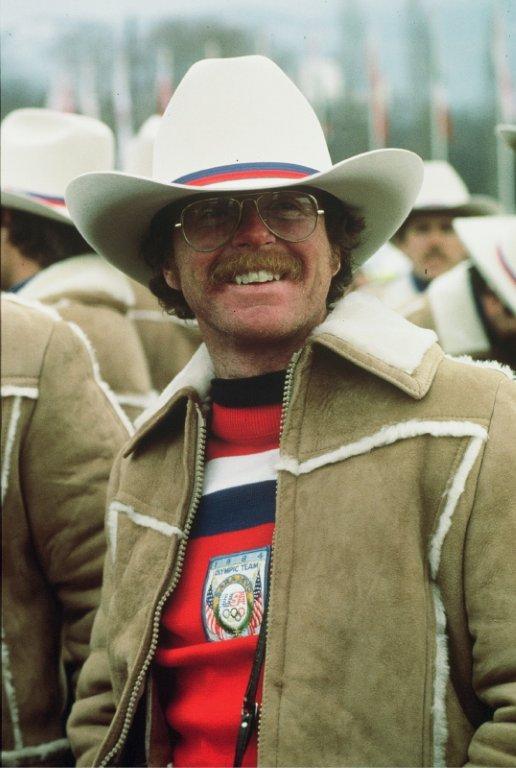
Peter Ashley at the 1984 Sarajevo Olympics opening ceremony. Now the nordic vice president at Fischer Skis USA, he was the U.S. Ski Team women’s coach from 1984-85. (Courtesy photo)
Peter Ashley is “Mr. Fischer” in the United States. For over 18 years, he has been vice president of the nordic division at Fischer Skis. He is responsible for everything that has to do with Fischer Nordic USA: ski selection, pricing, marketing, reps, budget, and more.
Peter Ashley during a recent cruise near Portsmouth, N.H. (Photo: John Estle)
Although Fischer is his life these days, Ashley has been involved with cross-country skiing in many other capacities for decades before working for Fischer. He has truly been around the nordic block. Ashley has had just about every job that skiing offers and has experienced the evolution of the sport firsthand. FasterSkier’s Nancy Fiddler caught up with him recently on the phone in a conversation about the development of cross-country skiing and some of his best stories from a pivotal period in the 1980s.
Ashley, 62, lives in Contoocook, N.H., with his wife, Rhonda, and three Maine Coon cats. New England is his home now, but Ashley is a self-declared westerner with strong roots in Jackson Hole, Wyo. For Ashley, the West was where the whole skiing thing started.
Growing up, his family was hugely involved with skiing and the Jackson Hole Ski Club (JHSC). Ashley trained and raced alpine, then nordic with the JHSC, making his first Junior National nordic team in the mid 1960s when he was in eighth grade. He continued to race alpine and nordic until his junior year in high school, when he admits that his size and athletic talent were more suitable to cross-country skiing.
It has been all nordic ever since for Ashley, who went on to race at the University of Colorado under the direction of Bill Marolt. After graduating in 1974 with a degree in finance, the same year that fiberglass skis were introduced, Ashley returned to Jackson Hole to try his hand at coaching. He got his feet wet coaching juniors for four years as head coach of JHSC, the beginning of a 12-year run of coaching that took him all the way to the U.S. Ski Team. Along the way, Ashley worked with a lot of interesting characters, traveled the world, and witnessed firsthand some big changes in skiing.
“Skiing was a very, very different sport 25 years ago.”— Peter Ashley
World Cup cross-country ski racing has been divided into two disciplines since the 1986/1987 season: classic and freestyle (skating). The evolution of skiing from an all-classic technique sport to a two-discipline sport took place over the course of several rocky seasons and saw some major battles.
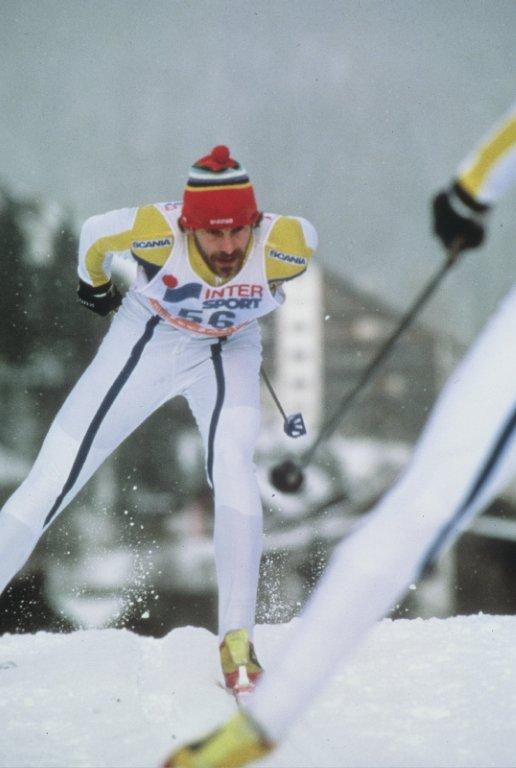
A multiple Olympic gold medalist, Sweden’s Thomas Wassberg, after whom the “Wassberg” skating technique is named, freestyle racing at the 1985 World Championships in Seefeld, Austria. (Photo: Peter Ashley)
The year was 1985; the place: Seefeld, Austria, and the event: the 35th Nordic World Ski Championships. There was a lot of drama in the days leading up to the races, and the hot topic was skating. The question surrounding the final preparation was whether skating would be allowed in the championship races, or just the traditional classic skiing.
Left to the Norwegians, who had already banned skating in junior competition in Norway, there would not have been any skating at the 1985 Worlds. The prevailing attitude is best summed up by Norwegian Ivar Formo, Controller of Equipment, who said, “no one can be the World Champion on skis without grip wax.”
The women’s coach for the U.S. Ski Team (USST) from 1984-85, Ashley was in the thick of this historical debate. Cross-country skiers had been experimenting with skating for a couple of years. As he remembers it, skiing had taken on a hybrid form by the time of the Seefeld World Championships. Skiers were still using kick wax, but moving with the marathon skate and a gliding herringbone, which eventually morphed into a rudimentary V1 technique.
With narrow trails with set tracks and athletes using short poles, long skis and kick wax, the stage was hardly set for the break out of skating. Still, athletes were looking for faster and faster methods of skiing. At Seefeld, just days before the first race, Swedish skier Gunde Svan was seen experimenting with one very long pole and no kick wax. This silliness by the eventual-double gold medalist was quickly put down by the organizers, who were desperately looking for a way to prohibit skating at the Championships.
According to Ashley, the way it finally went down was with a nations’ meeting where a vote would temporary prohibit skating in Seefeld. A unanimous vote was required. All it took was a single “no” vote from the Australians, and the rest is history.
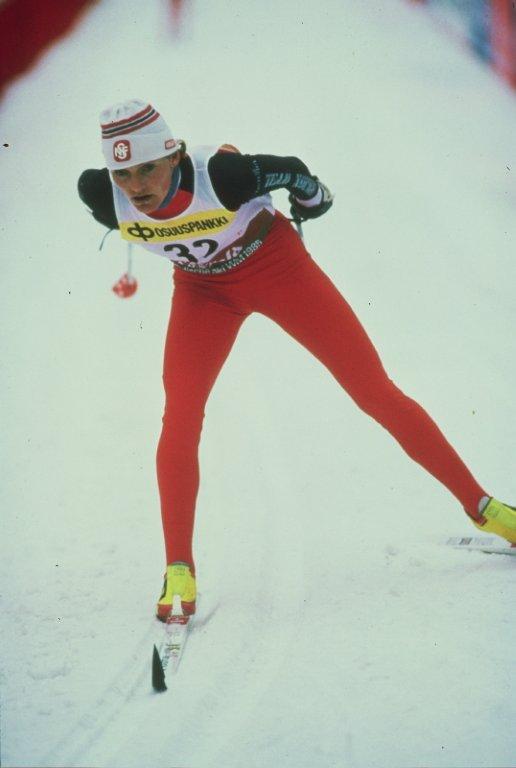
Annette Bøe of Norway skating at the 1985 World Championships in Seefeld, Austria (Photo: Peter Ashley)
Ashley recalls snow conditions on the Seefeld courses contributing to the decision by some teams to abandon kick wax entirely. As if 32 degrees Fahrenheit wasn’t bad enough, the snow was extremely dirty. “Nothing was kicking and everything was slow,” Ashley said.
For some athletes, this was the first time they would race without kick wax. The Americans had been fooling around with the skating techniques and little to no kick wax for some time on classic equipment, according to Ashley, who recently learned that was a different story for the Norwegians, whose ski leaders did not embrace skating.
In a conversation two years ago with former biathlete and nordic skier Grete Nykkelmo, Ashley said he learned that the Norwegian women were not allowed to skate in training. Nykkelmo, who won four medals at 1985 World Championships: a gold in the 20 k, bronze in the 5 and 10 k, and a silver medal in the relay, said that the Norwegian women had to quickly get with the program. In the end, skiers who went with kick wax were losers. The Norwegians managed to top the medal charts at Seefeld, but the battle wasn’t over yet.
The 1984-85 World Cup season was fraught with conflict over skating. Ashley remembers that in the races prior to the World Championships, organizers went to great lengths to keep skating out. He describes barriers built on the race trails to prevent any kind of skating, ugly coaches’ meetings and threats of disqualifications.
After Seefeld, things were still not resolved and for the rest of the season, race organizers tried everything possible to keep classic skiing as part of every race. Some races (Falun ’85 World Cup) had sections of course that were classic only and other sections on the same course that were “freestyle.”
“We were just trying to make sense of all the technical changes that were happening.” — Ashley
A season later, the 1985-86 World Cup was all skating. Classic skiing had all but disappeared for the time being (except for in Norway). Poles got longer, skis got shorter, and a good solution for boots was yet to be arrived at. In short, it was an equipment revolution and nordic skiing experienced a huge bump in sales.
U.S. cross-country skiing great Bill Koch, who pioneered the skating/freestyle technique in the 80s. (Photo: Peter Ashley)
Only a decade earlier, cross-country skis went from wood fabrication to fiberglass, a phenomenon that changed the sport completely, according to Ashley. Fischer fiberglass skis first appeared at the 1974 Falun worlds. Adidas was the first company to do away with the bulky three-pin bindings and duck-billed boots, replacing them with running-shoe-like boots and 38-millimeter bindings. The skis were faster and the boot-binding system sleeker, but it was still classic skiing.
In 1986 and 1987, Ashley once again found himself in the middle of everything. He was now responsible for Cross-Country Coaches Education for the U.S. Ski and Snowboard Association (USSA). He recalls this period an “extremely challenging” time to be trying to teach the country how to ski. Skating was here to stay, but by 1987, thanks largely to the Norwegians, classic skiing was back in international competition. It was now no longer possible to use any form of skating in a classic race.
What started as a hybrid classic-skate technique was now two distinctive methods of skiing. While classic skiing remained much the same, advances in skating equipment like higher cut, plastic-cuffed boots caused skating techniques to change almost overnight. Pole timing to match terrain evolved and Ashley was running to keep pace with all of it. V1, V2, V2 Alternate – these were names Ashley and others came up with to describe the new techniques. He remembers this period in U.S. skiing history as a bit chaotic, with too many experts and no definitive organization. He also recognizes this time as when the sport was thrown “wide open.”
The Path to Fischer
After the 1986-87 season, Ashley found himself without a job. It was a time of change, and USSA and the USST, in preparation for a merge, let the coaching staff go. For Ashley, it was time to move on, but he wasn’t ready to let go of the sport entirely.
For a year, he cut trails at Jeremy Ranch in Park City before beginning a stint working at Pacific Mountaineer in Palo Alto, Calif. The move to the Bay Area was a big one for Ashley, who had always lived in the mountains, but he stayed involved with skiing by coaching masters near Lake Tahoe.
In 1994, Ashley got a phone call from former skier Dan Simoneau, who presented an opportunity that ultimately led to Ashley’s current position at Fischer. A two-time Olympian and current nordic director at Mt. Bachelor Sports Education Foundation, Simoneau was getting ready to leave Fischer, then owned by Raichle Molitor, for a new job at Timex. He offered Ashley a position as Fischer product manager and Ashley took him up on it. By November, Ashley was living in Connecticut and quickly learning everything there was to know about Fischer skis. He admits that on his first purchasing trip to Europe, he felt more than a little bit unprepared.
Going on 19 years with the company, Ashley has landed and is thriving. He is grateful for the success of Fischer and acknowledges that the company is grateful that people believe in them at the top of the sport.
“This is not an un-cool sport to be in nowadays.” — Ashley
Ashley has seen tremendous growth and change in the sport of cross-country skiing in the U.S. He believes the sport is benefiting already from the recent success of the U.S. women’s team. This success in a sport dominated by Europeans was a long time coming. Ashley has seen generations of female cross-country skiers in our country pave the way for today’s champions. There have been many hurdles to cross, like doping, politics and funding problems over the years, but the image of cross-country skiing has never looked better, he said.
Looking back over the decades, Ashley sees nordic skiing as much more main stream now than 20 years ago. Nordic skiers used to be branded as eccentric, loner types in the ’70s and ’80s, dedicated athletes in a fringe winter sport with very little media exposure. Kooky behavior was not uncommon and almost expected of the athletes of this period.
There are higher expectations for today’s nordic athletes. The sport is maturing in the U.S. and is highly professional for athletes and coaches alike. Social media has increased the visibility of today’s skiers, who are able to manage their own brand. Media training is necessary for athletes to help them deal with this increased visibility. The bar has been raised, according to Ashley, and there is no better example than Kikkan Randall of a nordic skier who “acts the right way.”
Finally, Ashley is excited to see the success of U.S. skiers directly affecting the numbers of kids entering the sport today. It’s a new, very cool sport to be a part of.
Peter Ashley is putting together a slideshow of the history of skating, the cast of characters of the time, and the international scene from the early to mid-80s to present this fall at FinnSisu in St. Paul, Minn.
Continuing with my summer reading of XC news, I again perused an one of FIS’s short interviews, this time with Switzerland’s Laurien Van der Graaff.
Unlike Masako Ishida, whom we considered earlier this week, Van der Graaff is a sprint specialist, and a freestyle sprint specialist at that. Van der Graaff really did have a bit of a breakthrough season last year:
As you can see, it was only really her third season of racing “full time” at the World Cup level. She jumped from occasionally qualifying for the heat, to qualifying all but once, and continuing on through at least the semis numerous times.
She only did three classic sprints last season, so it’s not like she’s racing both techniques the same amount and doing better in one. You’d think that if she’s going to tackle that weak spot, she’ll have to start entering more classic sprints.
One thing that does concern me looking at her results from just last season is that she seemed to fade significantly as the season progressed:
Van der Graaff started off with her best race, and then things sort of went downhill from there. It’s possible that the increased number of WC starts had something to do with that. She had a total of 15 last season, compared to only 6 and 5 in the previous two seasons (that’s sprint and distance combined). If I look at all FIS races, she did more last season as well, but not as dramatically: 17, compared to 10 and 14 the previous two seasons. But certainly the the WC starts could plausibly be considerably more draining over the course of a season.
Assuming freestyle sprints are still going to be her best bet for top results next season, the schedule itself won’t be doing her any favors. She’ll have to travel to Canada for the only early season freestyle sprint. There’s a freestyle sprint buried in the middle of the Tour de Ski, but that seems like a big investment if you’re really just focused on sprinting. Then there’s a freestyle sprint in Russia which could be sparsely attended (because it’s in Russia) or it could attract all the big guns (because it’s a preview of the Sochi Olympic venue).
The individual sprint in World Champs is classic, of course, and then there’s just the Lahti sprint immediately following.
All in all, if she travels to Canada, I’d look for her to have some strong results in the freestyle sprints there, but she hasn’t (yet) shown that she can sustain that through a full season.
The weekend after the Tour finishes will have smaller fields, and this was no different. Still, The Americans will take the results regardless of who else shows up. Here’s how the women’s finalists progressed during the day:
Flat courses will tend to produce times like this, where the qualification round is quite fast, and then things slow down in the heats as tactics become more important. Still, the final turned out to be relatively fast. I didn’t watch the race (as usual) but I wonder if that was also tactics, with Kikkan (and maybe Ida) deciding to try to avoid dealing with navigating around people by simply pushing the pace. Semifinal 2 was slightly faster this time:
The men’s times, with the flat course, ended up looking remarkably similar:
Times were much faster in qualification than in the subsequent heats. Interestingly, Semifinal 2 was faster for the men as well:
Christopher Tassava chimed in with another request, regarding the news this week about Christian Hoffman’s 6 year suspension. Since I did post looking at who stood to gain if you removed Andrus Veerpalu from past results, he wanted to know what it would look like if we did the same thing with Christian Hoffmann.
It turns out in this case that the beneficiaries aren’t nearly as concentrated on a few individuals, so I’m going to pick and choose who I highlight here. Removing Hoffmann from the results would impact the winner in three instances. One is of course the famous 2002 Olympic race, in which the “official” second place finisher was Mikhail Botvinov, so let’s just call that new podium Skjeldal, Piller Cottrer and Bjoerndalen. For the other two, it would have meant regular WC victories for Teichmann and Sommerfeldt.
Ultimately, I think Piller Cottrer and Skjeldal would have the biggest complaints, since they also would be bumped up from 4th to 3rd on at least one other occasion. Alexei Prokourovov would also have gained two 3rd place WC finishes, but the rest were split between a range of skiers.
Moving back to the top ten, we can turn to an American, Carl Swenson, who would have notched two more top ten results. Vincent Vittoz would have picked up three additional top ten results.
As for scoring WC points at all, we can identify a few North Americans again: Carl Swenson would have picked up WC points on two more occasions, James Southam (once), Donald Farley (once), Stephan Kunz (once) and reaching way back, Marcus Nash (once). At this level, the list of names is an eclectic mix of the famous (Piller Cottrer, Elofsson, Hjelmeset, etc.) to the not so famous (Diego Ruiz, Kay Bochert, Peter Michl, etc.).
In all, 90 different skiers would have gained an additional top 30, top 10 or victory. That includes several other skiers also suspected or convicted of a doping offense. Maybe during the off-season I’ll attempt a more complete assessment that attempts to remove every single skier possibly connected to doping, but that’s a bigger project.
Seefeld
Some of the other US skiers skipped the sprint relay to do a FIS race in Austria on Sunday, and by all accounts skied fairly well. Liz Stephen rather handily won the 5k freestyle, and Noah Hoffman finished 3rd, 9 seconds ahead of Kris Freeman.
But of course, comparing Hoffman to just Freeman is risky, since any one skier can have an off day. So let’s see how that result compares to his past results against the entire field:
So, remember that positive, higher values indicate better performances for Hoffman. Up is good.
The blue dots are from this particular race in Seefeld (notice only two are below zero, corresponding to the folks who beat him). You can see that this is more or less in line with how he’s fared against these skiers in past seasons. Perhaps a little better, but not dramatically so.
As for Liz Stephen, here is the equivalent graph for her race:
Keep in mind that the 2012 section of this time series is based on a very small number of races. So the relevant comparison to make here is the blue dots to the shaded area in previous seasons. And this race was significantly better than she’s fared against these skiers in past seasons. By a large margin. Reason for optimism, I think, for when she returns to the World Cup.