Tag: French national team

  • Looking at France: a Conversation with Thibaut Chene

    Looking at France: a Conversation with Thibaut Chene

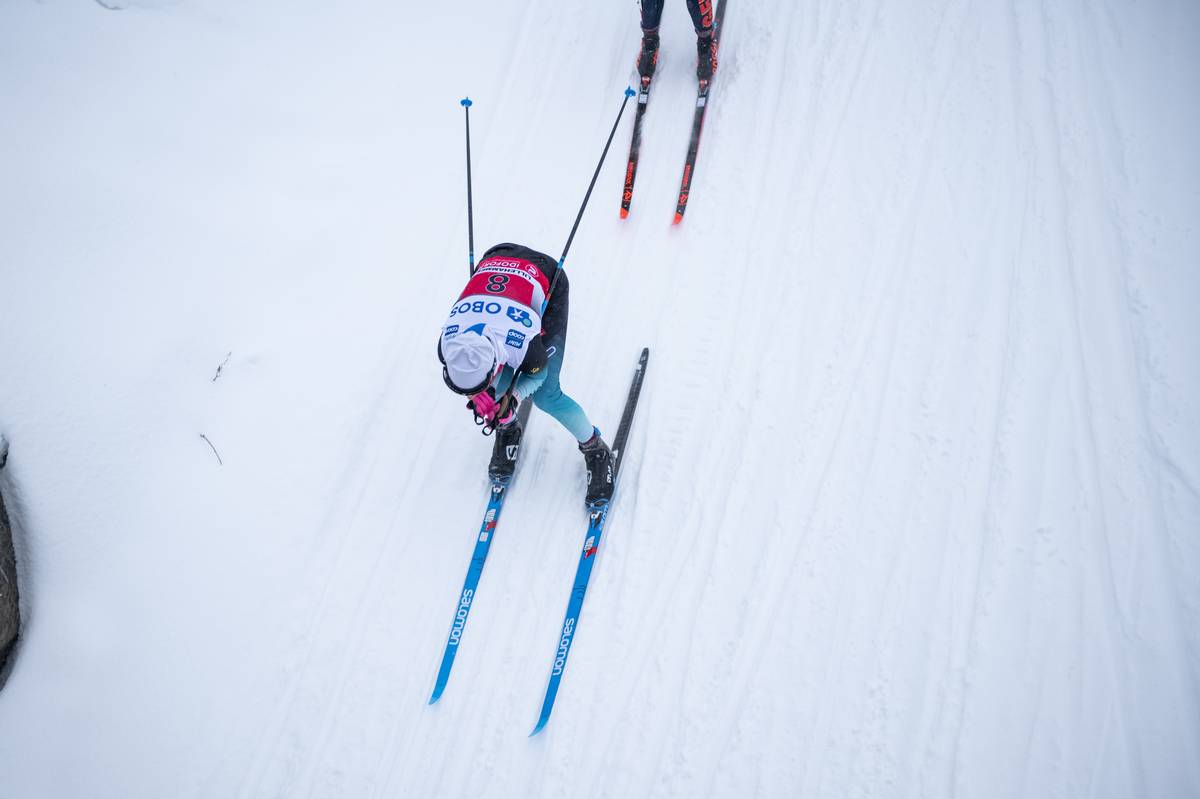
    Delphine Claudel (FRA) racing the 4x5km women’s relay in Lillehammer, Norway. (Photo: NordicFocus)

    Pursuing my interest in the French women’s team further, I was put in contact with Thibaut Chene, the women’s coach for L’équipe de France. Before coaching the women’s national team, Chene worked with the French junior team for four years. Thus, many of the women now at the senior level have worked with him since they were junior skiers. In 2015, the prior women’s team coach, Anaël Huard, left and Chene took over. An article written at the time stated, “the French women’s cross-country ski team is shattered. They were five in group A a year ago; there are only two left.”

    These two remaining women were Anouk Faivre-Picon and Coraline Thomas-Hugue and following that season, they were not renamed to the A-Team. After thirteen years of racing at the World Cup level, Thomas-Hugue retired in 2018. When the team for the 2019/2020 season was announced, Faivre-Picon was also absent from the list, choosing a different path to focus more on marathon racing. As such, the French women’s A-Team for the 2019/20 season had no athletes, while eight women were named to the B Team. Of those eight, Delphine Claudel, who was 24 at the time, was the most senior member. Half of the eight had yet to race a World Cup event when they were named to the team. Absent older and more experienced leadership, Chene and his group of relative newcomers forged ahead. After finishing the 2019/20 season ranked 32nd overall in the World Cup standings and 26th in distance, Claudel was the first woman named to the A-Team since 2015/16.
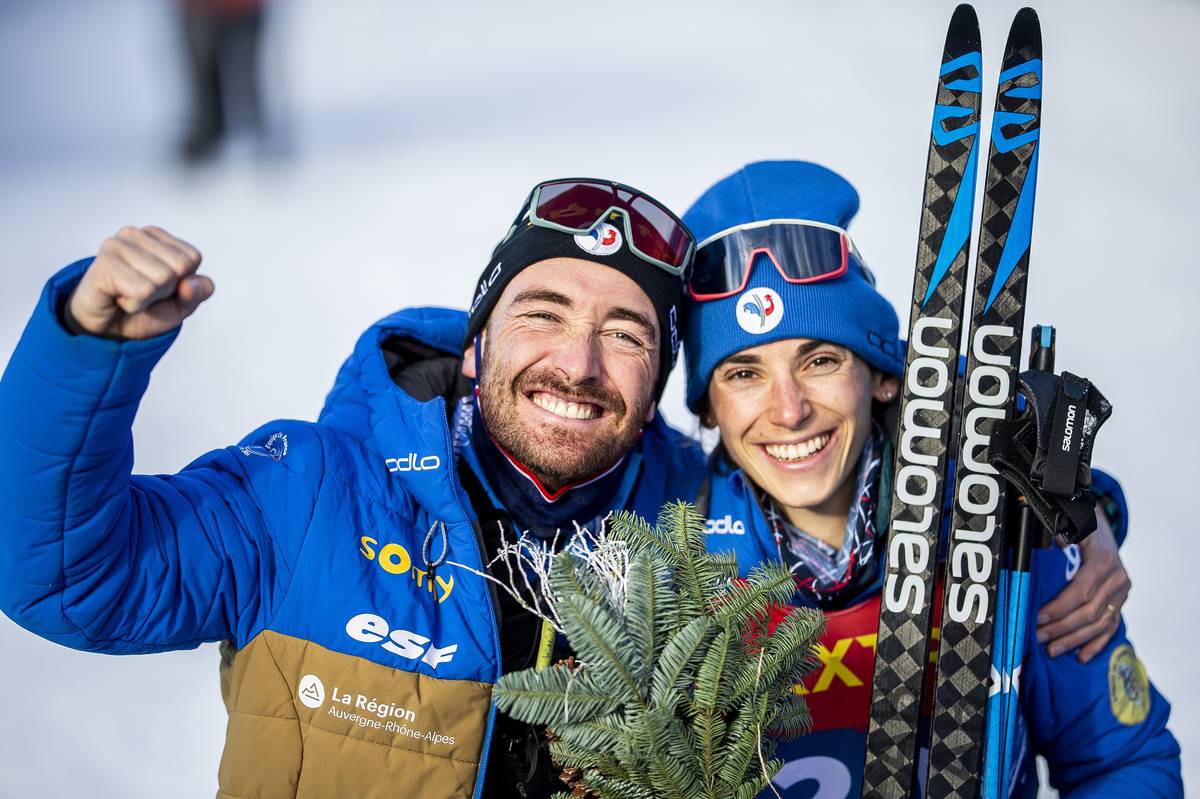
    Thibaut Chene with Delphine Claudel after her maiden World Cup podium, finishing third in the Alpe Cermis hillclimb during the Tour de Ski. (Photo: NordicFocus)

    In his interview, Chene alluded to various reasons for this gap in the women’s team, ranging from systematic inequality in sport in France to the popularity of biathlon in Europe. However, with the recent success of Delphine Claudel and as his young athletes gain more experience on the World Cup circuit, Chene is hopeful about the future. The following interview was conducted in French and has been translated and edited slightly for clarity.

    * * *

    Faster Skier: While no nation is equally balanced in success and ability between their men’s and women’s teams, the depth of the French men’s team is unmatched on the women’s side. In your view, are there systemic reasons for this or would you attribute it simply to the cyclical nature of athletes and success? 

    Thibaut Chene: This observation is real. And in France, it is extremely true in all sports. For example, France is the only nation in the top 8 for Olympic medals at the Summer Olympics that does not have parity in its medals (around 20% of Olympic medalists are women). Women’s sport is therefore a sector which remains to be developed in order to increase the number of medals or successes. Personally, I think that this comes above all from the relationship to sports education for girls in France as a whole. In the approach to sport, in education, or in French culture, it is not natural to play sports for girls. In any case, it is not as natural as for boys (an OECD study showed that less than 30% of young French people under the age of 15 played sport outside of school, against 50% of boys. And many countries such as Norway, Sweden, or the USA exceed 50%. France is generally well below the OECD average) This is a finding, a fact that I regret and on which it is important to fight. The reasons for the imbalance in France are therefore systemic and multiple. However, it is up to us to change the situation and work to correct it.

    FS: From the perspective of capturing a younger athlete, how difficult is it in France to attract, and retain young athletes… Does it differ for men vs. women?

    TC: World-wide, cross-country skiing has had a rather declining image lately indeed. The competition with the biathlon is complicated because, in terms of audience, performances, or career opportunities, we suffer by comparison. And this is also a global phenomenon.

    The hardest part is keeping athletes between the ages of 20 and 25 because they don’t all make a living from their sport and these are big sacrifices. And with the girls, quitting is often done before the age of 20. This relates to what I said previously about sports culture in France etc … Still, there is one thing to remember: We are having amazing times and we have a great life. We are lucky and cross-country skiing remains a traditional sport with a strong history. It is practiced in the heart of nature and allows you to exercise. We are able to accommodate many young people who want to exercise outside and surpass themselves.

    Covid-19 has also enabled many people to see how interesting and stimulating outdoor sports are. It’s up to us to develop and promote our sport.

    Flora Dolci (FRA) leads Laurien Van Der Graff (SUI) during the team sprint at the 2021 Oberstdorf World Championships. (Photo: NordicFocus)

    FS: Does France collaborate with other international programs at the junior level to increase the level of competition and exposure for their junior women?

    TC: This is often done informally when we meet in the same places. We often shared joint sessions with the Italians, or Laurien Van Der Graaf (of Switzerland) in Davos for example in November. After that, we have no official collaboration with another country. Everyone also has their own program and plan of action and it is often difficult to coordinate. In the end, the current situation suits us quite well.

    On the other hand, we collaborate a lot with our male teams. Gender diversity is a lever on which we have relied. Last year, we shared all of our preparation with the French distance and sprint teams. This is a very important axis and the men’s teams are helping us a lot.

    FS: What/who are some international models you look towards for guidance?

    TC: Norway or Sweden among the ladies are the undisputed leaders. So these are the best to watch to beat them. But I prefer to be inspired by a model more similar to France in terms of Nordic culture, let’s say much more restricted. In this sense, the success of the USA in terms of the women’s team or leader like Jessie Diggins is exemplary. This is the model we look at most, especially in the state of mind. It’s a team that makes you want to. Likewise, Slovenia is also a very strong team with Lampic. It is up to us to be inspired and also to invent our model.
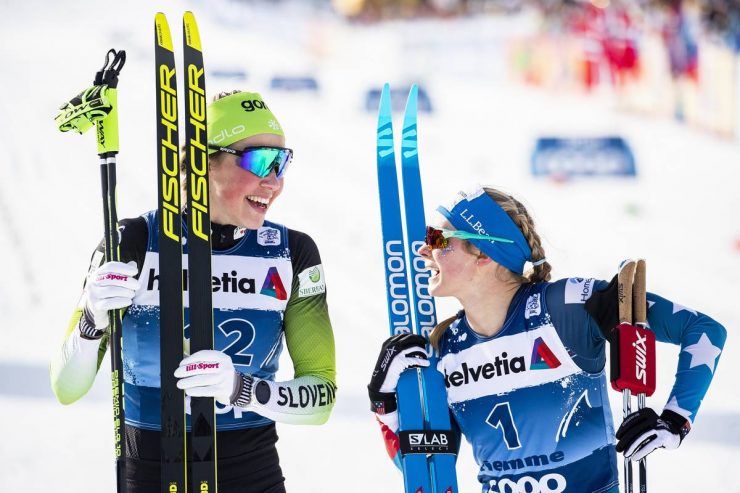
    All smiles at the finish, Jessie Diggins (3rd) celebrates with winner Anamarija Lampic after the 1.5-kilometer classic sprint in Val di Fiemme. (Photo: NordicFocus)

    FS: In a previous interview, you talked about a “hole” in the French women’s team with Delphine Claudel being ten years younger than the previous generation, why is that and what is your approach for moving out of this “hole”? 

    TC: Yes, indeed. I had spoken of a generation gap to explain why it had taken us time and energy to rebuild a team when I arrived in 2015 in the U20 women team.

    This hole happened for multiple reasons which added up. The strong success of biathlon in France meant that many young girls naturally turned to this sport, as did seniors with Célia Aymonier at the time, for example. Likewise, we may also have had a deficit in our support for the next generation during this period. This is why we made every effort to work in this sector and to support the girls who were taking over at that time, which included Delphine Claudel.

    We are trying to continue the work in this direction.
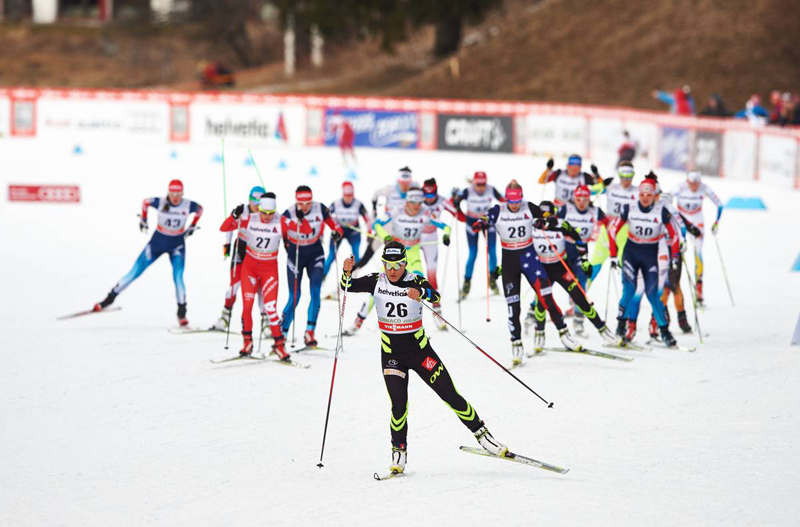
    Celia Aymonier (FRA), leads ahead of the wave start, before she transitioned to biathlon. (photo: Fischer/Nordic Focus)

    FS: This season Delphine Claudel had her first podium finish and top-ten World Cup results, do you think her performance will influence the rest of the team and/or the upcoming generation of female skiers?

    TC: Yes I think so. She broke the glass ceiling of the result. She shows that it is possible for the whole young generation of cross-country skiers. Telling yourself that it is possible and seeing that it is, are two important dimensions to inspire other girls.
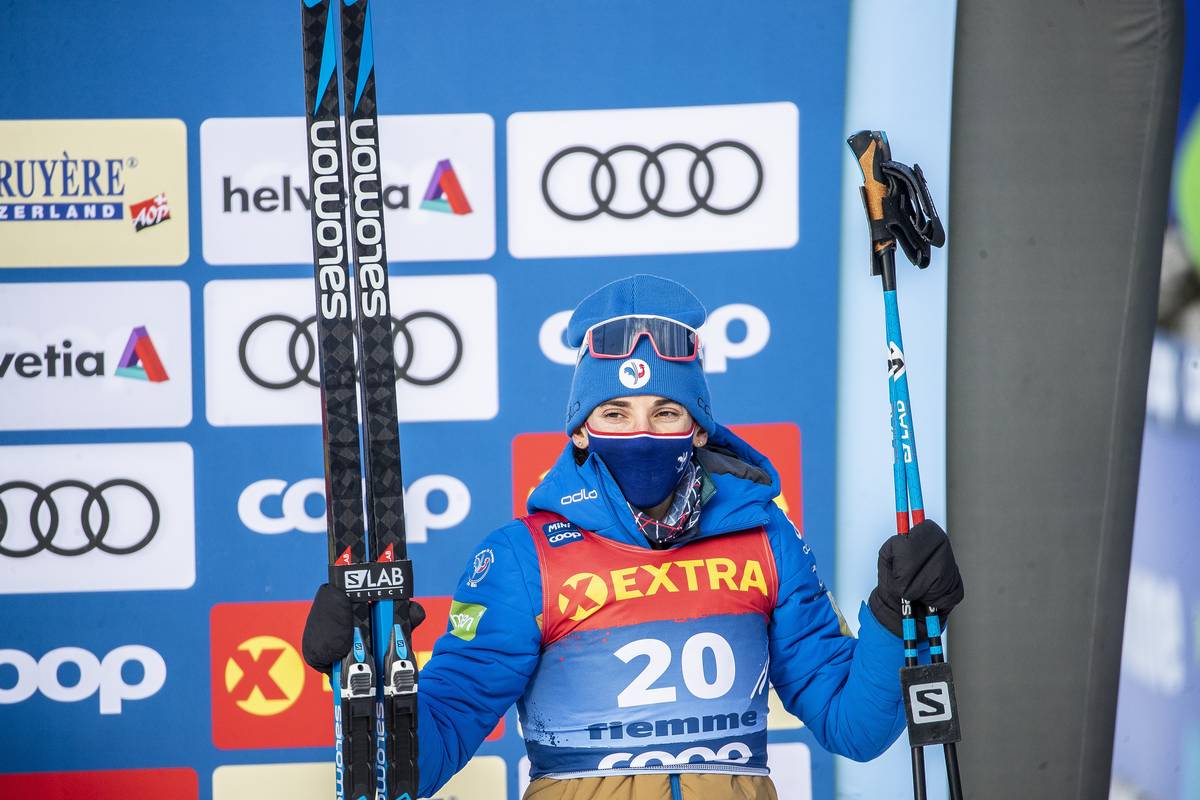
    Delphine Claudel (FRA) finished 3rd in the final stage of the 2020/21 Tour de Ski, her first podium finish. (Photo: NordicFocus).

    FS: What are your goals for this team and the women’s program in the next few years? 

    TC: Our objectives are diverse:

    – Continue to play the leading roles in the world with Delphine and to progress against the backdrop of the Olympic Games of course.

    – Support new girls emerging on the World Cup circuit with Léna Quintin in sprint or Flora Dolci in distance for example.

    – Continue to train female skiers and allow the emergence of talent in women’s cross-country skiing.

    – Participate in the influence of the French team as a whole: men and women, seniors and juniors.

  • Foreigners Add to Canadian Nationals, Reflect on Week

    Foreigners Add to Canadian Nationals, Reflect on Week

    French delegation at Canadian Ski Nationals (from left to right): National team sprint coach Matieu Fort, Baptiste Gros, Renaud Jay and Roddy Darragon after the skate sprints on Thursday.

    MONT SAINTE-ANNE, Québec — It all started with a little buzz about Québec hosting a World Cup.

    After the province’s native Alex Harvey and Devon Kershaw struck gold in the team sprint at the 2011 World Championships in Olso, Norway, Cross Country Canada and the International Ski Federation got to talking.

    The World Cup should feature a few races in Canada, and why not consider bringing it to the eastern part of the country?

    Once FIS accepted Québec City’s application to hold a sprint weekend Dec. 8-9, 2012, the race was on to generate more attention toward the brand new site.

    The director of events at CCC, Dave Dyer said the association almost immediately turned to Sport Canada, which governs the country’s sport policy and supports athletes and programs financially.

    They needed international hype and some competitive racers to see Québec beforehand.

    With the help of an under-$50,000 grant from Sport Canada’s International Hosting Program, CCC was able to pay the way of seven foreign athletes and three coaches to the Canadian Ski Championships, which ended Saturday in Mont Sainte-Anne, Québec.

    Norwegian National Junior Team members Sindre Bjornestad Skar (l) and Martin Loewstroem Nyenget after placing first and second, respectively, in the 30 k classic mass start at Canadian Ski Nationals on Saturday.

    The first to jump at the offer, Norway sent four racers – two juniors and two under-23’s – to Canada along with two coaches: head U23 coach Sjur Ole Svarstad and national women’s sprint team coach Roar Hjelmeset.

    France was next in line for a trip to Canadian nationals. The team’s head sprint coach, Mathieu Fort, accompanied three athletes: Roddy Darragon (World Cup sprint specialist and two-time Olympian) and U23 racers Baptiste Gros and Renaud Jay.

    Dyer said this wasn’t the first time Sport Canada had helped CCC host international competitors, but it was by far the most significant.

    “We did it last time we were here [at 2007 Canadian nationals] in Mont Sainte-Anne and got a very modest amount of support,” he said. “But I think that as the profile of our sport and the team increases, people are taking notice. It certainly has helped us on the overall funding perspective as far as support for the team.

    “I think the success we’ve had at the World Cups and hosting the World Cups has proven the benefits of inviting Europeans to come ski on our turf,” Dyer added.

    He designated Canadian National Ski Team coach Eric de Nys to invite teams, and de Nys said he spoke with several coaches at U23 World Championships in Erzurum, Turkey, in February. The idea was to entice juniors to give them a taste for jet lag and racing outside of Europe.

    “We had this pot of money and we were able to sort of talk to the Italians, the French, the Swedes, the Norwegians, the Germans, Japanese,” de Nys said. “Lots of them couldn’t come because they had nationals and OPA finals and things like that. But the French, the moment I said it, they’re like, ‘Yeah, we’ll come.’ ”

    With pre-existing good relations with Norway and France, this furthered the effort to bridge the global gap. It also gave Québec race organizers a chance to host athletes in preparation for its upcoming World Cup, with individual and team freestyle sprints.

    Dyer said this year’s sprint competition featured timed splits thought the heats, requiring more precision than seeding athletes by qualification time. A CCC Officials Level 3 Certification course was also in action at nationals.

    Organizers and officials had just one day to practice at the Plains of Abraham, where the World Cup is scheduled, after unseasonably warm weather melted most of the snow on the historic park in downtown Québec City.

    While they managed to hold classic team sprints there March 17 on a 1-kilometer loop, the open freestyle sprints were moved about 45 minutes away to the trails at Mont Sainte-Anne on March 22.

    Dyer said the experience with timing, officiating and helping international athletes find their way around was useful nonetheless for organizers. It also made nationals one of the most competitive in years.

    In his 30th year with CCC, Dyer said this was by far the association’s biggest international hosting effort. In 1986, they brought four Norwegians to nationals in Whitehorse, Yukon. The only other Canadian championship that was nearly as competitive was the one before the 2010 Vancouver Olympics.

    By bringing overseas skiers here, Dyer said it benefited Canada’s own athletes.

    “Whereas we might send 10 athletes to the World Juniors or to the U23 champs, there’s probably 85 juniors [at nationals] that get a chance to rub shoulders with Norwegians and find out they’re not superhuman,” Dyer said.

    First Impressions

    For most of the Europeans on the start line, it was their first time in Canada. Several soaked up the opportunity to race against some of the world’s best, including Kershaw, Harvey and Len Valjas.

    It’s a good experience because I never ran with in a final of the same level,” said 21-year-old Gros, of France, after placing fifth in the skate sprint A-final behind the three Canadian National Team athletes.

    Earlier this season, Gros finished 13th in a World Cup freestyle sprint in Szklarska Poreba, Poland. His teammate, Darragon was fifth in Poland and 11th in the sprint at Canadian nationals.

    Roddy Darragon of France crashing and burning near the B-final winner of Thursday's skate sprint at Canadian Ski Nationals, Drew Goldsack. Darragon placed fifth in the B-final and 11th overall, and literally got a rug burn on his knee after cutting his race suit above the knees on the balmy afternoon.

    While he had raced in other parts of Canada before, Darragon said coming to Québec was a first. On the tail end of his season, he was mostly interested in racing for a chance to see the World Cup venue.

    “When the coach told us that [we were invited], we said, ‘Yes, we go, immediately,’ ” Darragon said with a smile. “We wanted to travel and wanted to discover the country.”

    Although Darragon and his teammates didn’t get to ski on the Plains, he said they drove by it. Before flying back to France on March 23, the day before the distance mass starts, Darragon cut off his race suit above the knees. Shorts were better in hot weather, and 20 degrees Celsius was much warmer than what they were used to in France in March.

    “It will be a great souvenir,” Darragon said of his suit, looking down at his bloody knee after falling across the finish of the B-final.

    He said he’d be back next year, possibly a few weeks before the World Cup to train.

    On the Norwegian side of the wax cabins, all four of their athletes raced the classic distance races on Saturday. In the 30 k junior men’s race, National Junior Team skiers Sindre Bjornestad Skar and Martin Loewstroem Nyenget captured first and second.

    2012 Canadian Nationals women's 30 k classic mass start podium (from left to right): 2. Britt Ingunn Nydal (NOR), 1. Chandra Crawford (CNST), 3. Ragnhild Haga (NOR)

    In the women’s 30 k, Britt Ingunn Nydal and Ragnhild Haga of the Norwegian National Development Team placed second and third, respectively, after Chandra Crawford (CNST).

    “We probably knew we had a better chance here than at the sprint,” said Haga, who recently placed 33rd in a World Cup 30 k at Holmenkollen in Oslo. There, Nydal was 38th.

    “We’re very happy being on the podium, both of us,” the 21-year-old added.

    She and Nydal, 22, had one more 30 k remaining in Norway later this week. They planned to leave Sunday, but not before some sightseeing and a night out in Québec City.

    “It has not only been the races, we’ve been able to look around also,” Nydal said. “It has been an amazing week.”

    As for what they’d remember about their first trip to Canada, Haga said the heat. Skar said the size of things.

    “Everything is big,” Skar said. “The cars and the roads and the shops, everything is much bigger than in Norway. In Norway, everything is not so big.”

    “But it’s really nice here,” Nydal added.

    “The weather is great,” Skar continued.

    In southern Norway, he said there was no snow. Haga said skiing in such balmy conditions throughout most of the week reminded her of orienteering in the summer.

    “It’s a little weird to go cross-country now,” Nydal said.

  • Changing of the Guard in French Skiing

    Vincent Vittoz, who has now retired, racing in the 15 k classic in Otepaa, Estonia, earlier this season.

    When Emmanuel Jonnier, a thirteen-year veteran of the French national team, announced his retirement earlier this month, it was picked up by every major news source in his home country.

    But even then, it was nothing compared to the coverage his teammate, Vincent Vittoz, got two weeks prior when he announced his own retirement – which had happened at about the same time that Roberto Gal, the team’s Italian head coach, also declared that he was leaving.

    For Jonnier, the loss of his teammate and coach played a part in the decision to retire, although he also said that it would have been difficult to keep the form he had in previous years (Jonnier placed 4th in the 50 k at the 2006 Olympics in Torino, which is still France’s best-ever Olympic distance result).

    “With the news of the departures of Vincent Vittoz and Roberto Gal, a page is turning,” Jonnier said in a statement posted on his blog and quoted in the press. “The generation which was my own is going. It’s the right moment.”

    Both Vittoz and Jonnier were born in 1975, and had spent more than a decade skiing together. In the beginning, they raced with the likes of Vladimir Smirnov, Bjoern Daehli, and Vegard Ulvang; in the end, with Marcus Hellner, Dario Cologna, and Petter Northug.

    In 2007, the pair made history by putting two Frenchmen on the podium in a World Cup race for the first time. Vittoz finished second and Jonnier third behind Tobias Angerer of Germany in a 15 k skate race in Changchun, China.

    While Jonnier has his country’s best Olympic result, Vittoz owns a World Championship from the continuous pursuit in Oberstdorf in 2005. Vittoz’s star rose earlier, and he has been lauded by many as the athlete who led a resurgent French team to their current success. Since 2000, Vittoz has stood on the World Cup podium 29 times, including relays, and also won a stage of the Tour de Ski.

    “When I was young, someone told me, ‘why do you do cross-country skiing, a Frenchman will never make it,’” Vittoz told ski-nordique.net, a French ski news site. “That stuck with me. I am satisfied to have succeeded… in the end, I have no regrets, not even the Olympics, because I always gave all that I could.”

    Throughout that decade of success, Gal was by his side.

    “Roberto came to the French team after the Olympic Winter Games in Nagano, so that was in the summer of 1998,” Vittoz told FIS Cross Country. “Back then French skiing was not at the level where it is now.

    “We spent twelve or thirteen years together and yes, we have created a good team in a country where cross-country skiing is not the number one sport, as for example in Norway. During that time we achieved some great results such as the victory in the World Cup relay in La Clusaz in 2004… We proved the French cross-country skiers could fight with the best.”

    While Vittoz joked about the state of the men’s team when Gal took over, the French weren’t actually that bad. The men had a top-20 result in each individual race they entered in the 1998 Olympics, and a different athlete led the team in each competition. However, the team finished an unimpressive 13th in the relay.

    Jonnier, crushed at the finish of the 2010 relay.

    Twelve years later, Jonnier anchored the French team in the relay at the Vancouver Olympics. The team was in it until the end; Jonnier tried to secure silver by making a move to drop Martin Koukal of the Czech Republic and outrun Petter Northug of Norway, but in the end he tired and was betrayed by his slower finishing speed. He was the fourth man across the finish line, and the team considered it a disappointment – quite a change from a decade before.

    “When I arrived, I didn’t think that we could have these results,” Gal told ski-nordique.net last summer. “We waited three years before Vincent had his first podium. Since then, each season it has been between six and ten.” (This is a slight exaggeration.)

    On his blog, Vittoz acknowledged Gal’s years of work with the French team.

    “Thank you for the thirteen years we have passed together,” he wrote. “You invested yourself 100 percent in a team that didn’t look like much at the start. In ten years, you brought much more success to French skiing than in the 50 years which came before.”

    He nevertheless said that Gal’s departure did not affect his own decision.

    “Before he announced his decision, I already felt that it was complicated for me,” Vittoz told ski-nordique.net. “You could have said that having a new coach and new training programs could have motivated me to continue, but I preferred to stop before becoming completely overloaded.”

    Vittoz was widely quoted as saying that in January, he had lost his aggression and was no longer in his place on the World Cup circuit. His last season had ups and downs; after injuring his leg shortly before World Championships, he had a frustrating week and finished 34th in the pursuit, the event he had won four years prior. However, in Lahti, Finland a week later, he stood on the World Cup podium one final time, placing third in a 20 k pursuit.

    Vittoz says he isn’t sure what he’ll do next; on April 14th, he tweeted, “future ????????????”

    He has two young daughters and a farm just west of the Alps. But while a retreat from the spotlight sounds relaxing, there is speculation that Vittoz will take over as the coach of the French U23 national team.

    At World Championships in Oslo, French skiing’s technical director, Fabien Saguez, noted that he would be changing the organizational structure of the team. A new sprint group will be formed, while the “B” team will consist of only U23 athletes. Technique coach Christophe Deloche will keep his job, and a new physical trainer, Patrice Paquier, has been hired.

    The French federation has offered Vittoz the “B” team/U23 position, which he has yet to either accept or decline, but nobody knows who will replace Gal at the head of the program.

    “I hope the new coach will understand that the French Cross-Country team is a small group of people, but that they have a big heart and can achieve great things,” Vittoz told FIS Cross Country in a recent interview.

    With the rise of younger stars like Maurice Magnificat and Jean-Marc Gaillard, Jonnier and Vittoz can rest assured that they aren’t dooming their team to mediocrity as they move on, at 36 years of age, to a new life.