
Tag: Frode Estil

  • Norwegians on Volume: More Isn’t Necessarily Better

    Norwegians on Volume: More Isn’t Necessarily Better

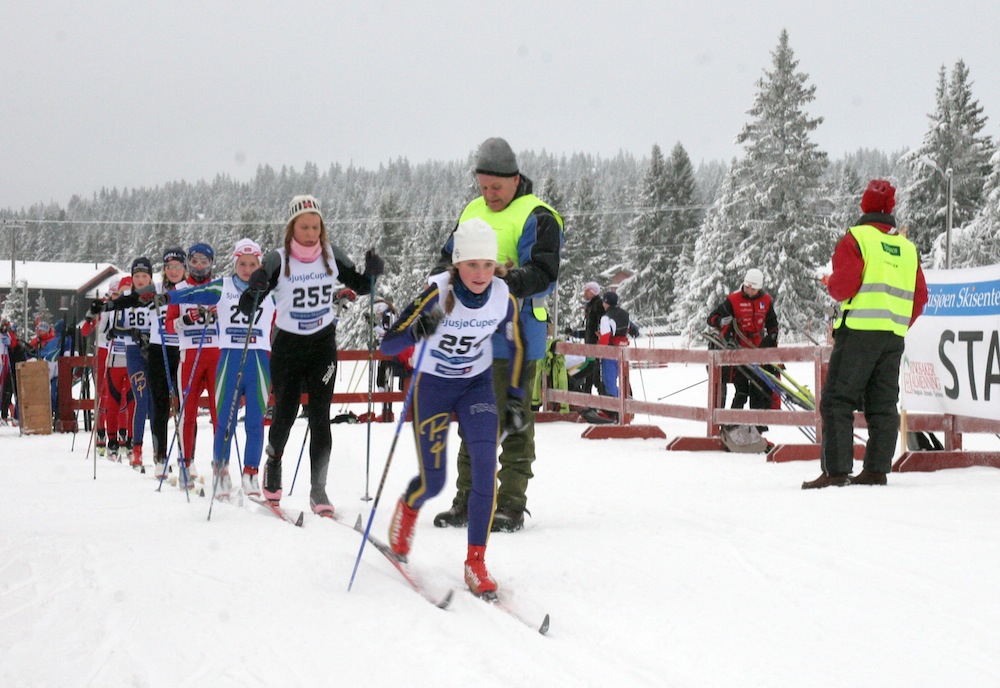
    Junior skiers jet out of the start at the Sjusjøcupen, part of the Hedmark state race series in Norway. (Photo: Inge Scheve)
    Junior skiers jet out of the start at the Sjusjøcupen, part of the Hedmark state race series in Norway. (Photo: Inge Scheve)

    Frode Estil says it’s not how many hours you train. It’s how you train.

    The two-time Olympic gold medalist and individual world champion from Norway says skiers are focusing too much on hours at the expense of training quality.
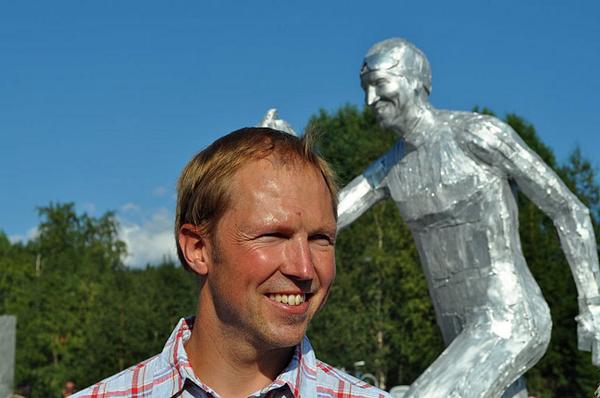
    Frode Estil, an individual Olympic and World Champion from Norway, by a statue of himself in his hometown of Lierne in July. (Photo: FIS Cross Country/Twitter)
    Frode Estil, an individual Olympic and World Champion from Norway, in July after being commemorated with a statue of himself in his hometown of Lierne. (Photo: FIS Cross Country/Twitter)

    “I’m afraid focusing too much on logging hours can be counterproductive to the main goal: ski fast,” Estil, 42, told the Norwegian newspaper Namdalsavisa. “How fast you become depends on more than just how many hours you put in.”

    Estil, who is currently coaching and teaching at the Meråker ski academy in Norway, blames the media and their excessive emphasis to how many hours the World Cup racers train in a year, as well as coaches and athletes for latching onto the elite skiers’ training programs without critical assessment. Other coaches support him.

    Former elite skier Mona Hjellsand, now a coach and coaches’ instructor in the Meråker region north of Trondheim, agrees with Estil. She pointed out that too many training hours can have negative physical consequences.

    “Overuse injuries can be hard to heal, and some can last for life,” Hjellsand told Namdalsavisa. “Biathlete Tora Berger has repeatedly harped that you should not train if you feel run down. You should always be in a good flow, she says, and she is definitely onto something.”

    She added that focusing on completing shorter workouts with 100-percent attention to the task will increase the training quality.

    “It’s important to not burn all your fuel at once,” Hjellsand said. “The younger the athletes, the more important quality is over quantity. The idea is to increase volume over time.”

    “The younger the athletes, the more important quality is over quantity. The idea is to increase volume over time.” — Mona Hjellsand, a former Norwegian elite skier who has spent the last two decades coaching in the Meråker region

    Hjellsand said that youth and junior coaches have to take their part of the blame for the current trend with extreme focus on logging hours.

    “There are still a lot of old-school coaches out there who are focused on training hard and putting in lots of hours. Based on that, I’m really glad that credible resources such as Frode Estil initiate a debate on this topic. It’s an extremely important debate,” she said.

    In her opinion, the biggest issue is curbing the drop off and keeping the skiers in the sport.

    “When I ask the 16 and 17 year olds why they chose to drop out, the answer is almost always the same. There is just too many training hours, and they’re always tired,” she said.  “When the air goes out of the balloon at such a young age, there is something wrong with the way we approach training.”

    “When the air goes out of the balloon at such a young age, there is something wrong with the way we approach training.” — Hjellsand

    The ski coach, who also travels to visit various clubs and teams and give presentations on training, is certain that the juniors are seeing what they do, and are comparing their own training programs to what the World Cup elite is reportedly doing.

    “Skiers such as Marit Bjørgen and Therese Johaug bring the standard for annual volume to a whole new level,” she explained. “The big difference is that these athletes have a support system that takes care of them 24/7. You can’t compare yourself to the full-time elite.

    “I’ve seen so many cases where the junior skiers as well as senior level racers lose the joy of training and their passion for skiing because there is such an emphasis on training hard and logging volume,” she added. “It shouldn’t be like that.”

    Ultimately, she stressed a single priority: make sure training is fun. “The day it’s no longer fun, there is no reason to stick with it,” Hjellsand said.

  • Hjelmeset Concerned About Trend to Skip Cold Races

    GÅLÅ, Norway – There is no doubt in Odd-Bjoern Hjelmeset’s mind about this: “Skiing in extreme cold can be a nightmare for some racers. Martin Johnsrud Sundby (NOR) is one example, he can barely breathe when it gets really cold,” Hjelmeset told Langrenn.com.

    But Hjelmeset is also certain about this: “Among those who sat out the races at Gålå (Norway), this weekend, there were a number of skiers who don’t suffer from cold-induced asthma as well.”

    Hjelmeset, who chose to race at Gålå this weekend, said that it was cold, but not a big deal. “Sensitivity to cold is a very individual thing. I would compare skiing in extreme cold to training at altitude. Some do well with it, while others can barely handle it. You just have to know your own body and your own limits. But now it seems like the trend is going the direction that skiers are a little too influenced by other racers’ limits,” Hjelmeset said.

    Hjelmeset observes that the term “cold-induced asthma” is used frequently by the media. “During the broadcasts from Kuusamo, I think the term was used at least a hundred times. Of course, that will affect people’s perception of racing in the cold, and a lot of them would probably handle the cold just fine. I really think people are influenced by the media and what they report on, and of course what the elite racers say about it,” Hjelmeset said.

    Point in Case: The Torsby Tunnel

    The past year, Hjelmeset has made an observation in the Torsby ski tunnel in Sweden, which he wants to point out as an example of how people are affected by the media and reporting.

    “For a long time, it has been unpleasant to breathe inside the ski tunnel in Torsby. Racers of all levels have seen and heard that the national team skiers often use the ‘lung plus’ device or ski with a face mask in the tunnel,” Hjelmset said, explaining that he constantly reconsiders and adjusts based on his own perceptions, not the common belief.

    “This year, the air in there has been a lot better, and I’ve stopped using the ‘lung plus’ all together. I’ve been there several times this fall, and I think it’s strange that so many still are scared about the air in the tunnel.”

    Be serious about temperature cutoffs

    Hjelmeset emphasizes that when it comes to cold temperatures, some people will always run into big trouble. And he argues that temperature cutoffs were instated for a reason.

    “During the Norwegian national championships in Bardufoss a few years ago, it was extremely cold. I didn’t have any serious breathing problems before I raced there, but after those races, it’s been a lot harder for me. Several racers ruined large periods of their races seasons by skiing too hard up there. Kristian Horntvedt is one who struggled for a very long time after those events,” Hjelmeset recalls.

    However, skiing in extreme temperatures is nothing new for the veteran, who is racing outside the national team structure this year for the first time in a decade. He particularly recalls a race in Russia.

    “There was a race over there in Russia, a few years back, that was held despite the temperature being far below -20 C. It was so cold that we layered up with newspapers under the race suits, and Frode Estil decided to race with his warm-ups under his lycra. Of course, that was not healthy.”

    From Langrenn.com, November 29, 2010. By Ola Jordheim Halvorsen, translation by Inge Scheve

  • Northug Faces Piller Cottrer, World Elite at Home

    Petter Northug (r) racing at the 2010 Olympics in Whistler.

    Petter Northug Jr. is excited to welcome World Cup greats onto his home turf in Troendelag on June 25 through 26. The event, the Tour de Troendelag, consists of three races: a roller ski city criterium on June 25 in Trondheim, then a summer ski race on the Kirkebyfjellet mountain on the morning of June 26 and concludes with a roller ski pursuit race in the afternoon.

    “I’m excited to welcome Pietro Piller Cottrer (ITA), Anders Soedergren (SWE), Jaak Mae (EST) and other top World Cup racers to my stomping grounds. It will be fun to race against those guys in a slightly different setting,” Northug says to www.langrenn.com.

    Northug, the defending champion from last year’s Tour de Troendelag, will arrive at the race venue straight from a national team training camp and is prepared to fight. Northug will face a Piller Cottrer who is eager to make up for the painful loss to Northug at the Holmenkollen 50K this winter, and a Soedergren who is reported to be in killer shape these days. But Northug doesn’t think he’ll be at a disadvantage.

    “I’ll do my first workout that Friday with the national team in Sandane, then the Stjoerdal race as my second. I don’t fear racing after a flight,” says Northug.

    Former Olympic gold medalist, world champion and Norwegian national team member Frode Estil is among the event organizers. He is working hard to get both Alexander Legkov (RUS) and Axel Teichmann (GER) to compete next week, and is confident at least one of them will show. He regrets to report that Dario Cologna (SUI) won’t be coming, although it looked promising for a while. Among the local favorites are international stars including Eldar Roenning and Johan Kjoelstad, as well as Team Troendelag’s next generation of elite skiers.

    “This is one of the few arenas where juniors and the up-and-coming elite skiers can race with the best in the world. And the feedback is that they find it incredibly motivating,” says Estil, explaining that recruitment is one of the main goals of the Tour de Troendelag.

    Source: Langrenn.com