From the FasterSkier archive — posts syndicated from athletes’ and coaches’ own blogs between 2004 and 2012, kept online as published. Current coverage is at fasterskier.com.
For those who have yet to experience the beauty of Canmore, Alberta, a Google search for photos of the town alone should provide sufficient motivation to put it on your travel bucket list. A dramatic skyline of rugged and imposing peaks provide a backdrop to main street, the Nordic Centre, and pretty much anywhere else you could visit in the Kananaskis Valley. Smaller than its perhaps better-known neighbor, Banff, the streets of Canmore are lined with mom-and-pop shops that offer a low-key and inviting atmosphere. Canmore is home to many long-term residents and families, and has what local Lindsey Sinclair refers to as a “home-grown feeling”.
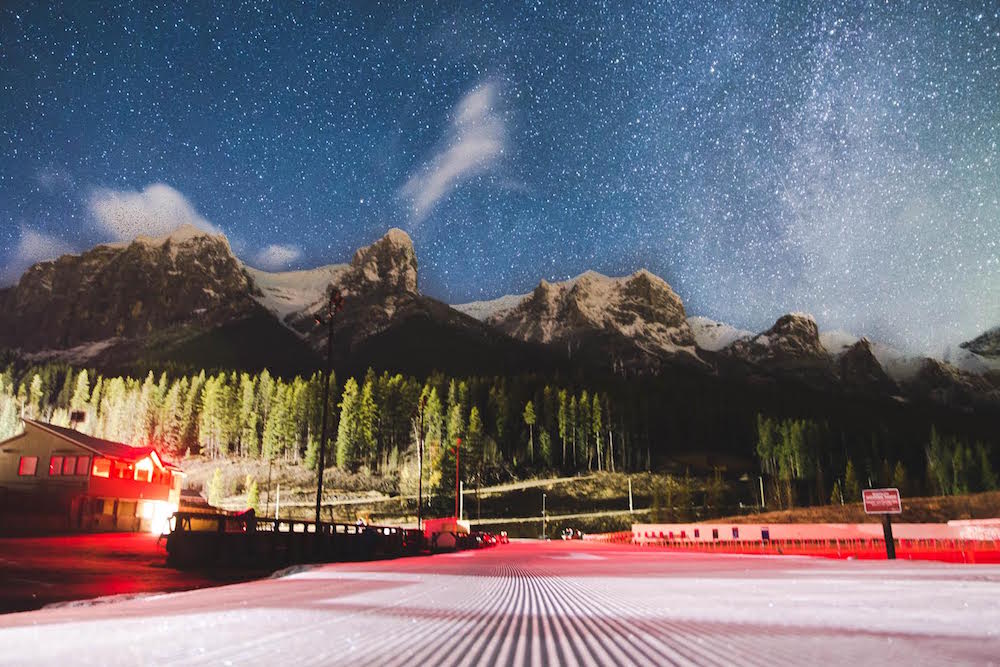
The town of Canmore lit up on a wintery night with the Canadian Rockies looming above (Photo: Travel Alberta)
As a cross country skier, you have likely heard of Canmore and it’s fabulous nordic center. Whether it be because of the 1988 Winter Olympics, the FIS World Cup in2005,2008,2010,2012 and2016, the annual Frozen Thunder race hosted in early November, or simply the 60+ kilometers of beautiful trails, the Canmore Nordic Centre Provincial Park is well known in North America.
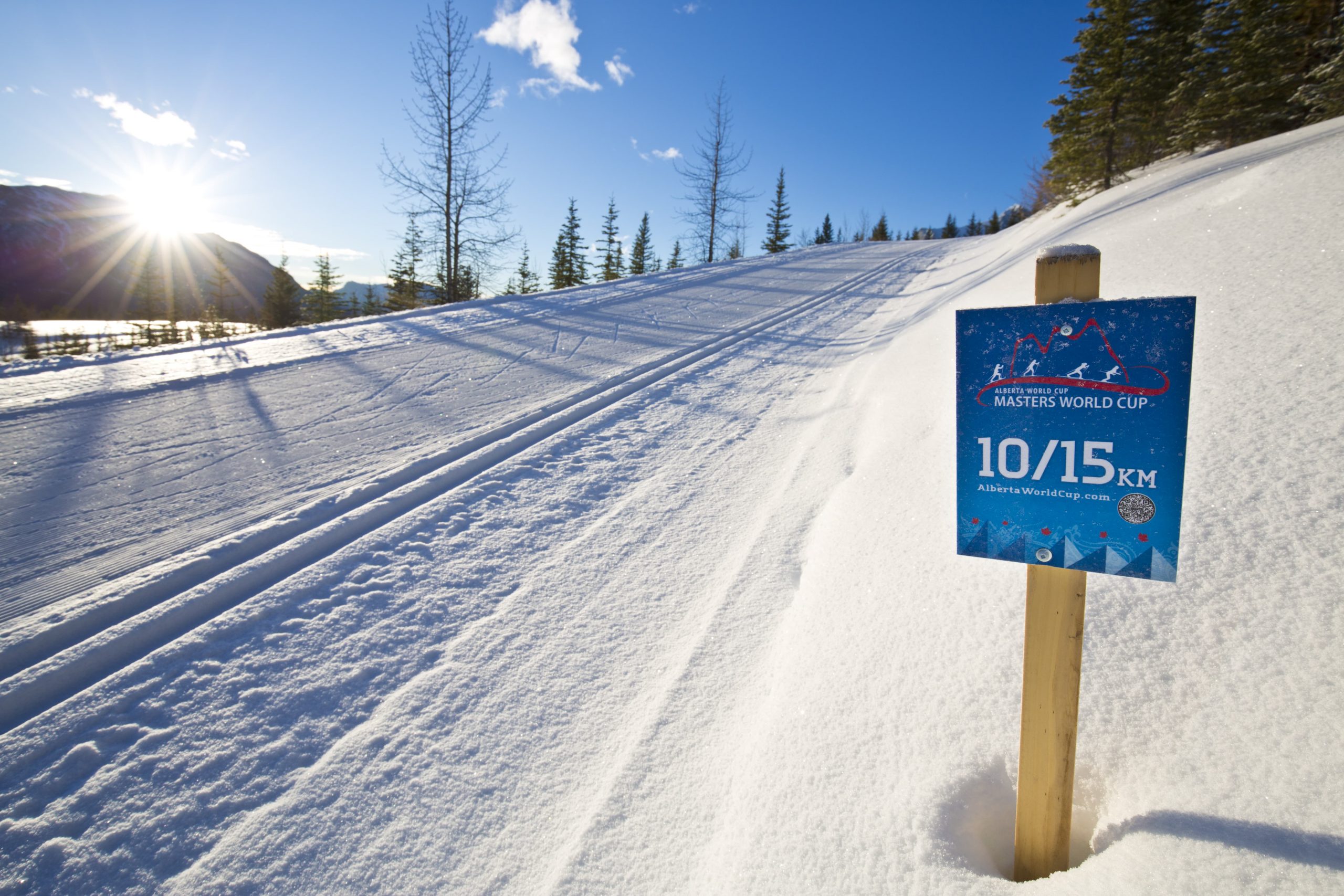
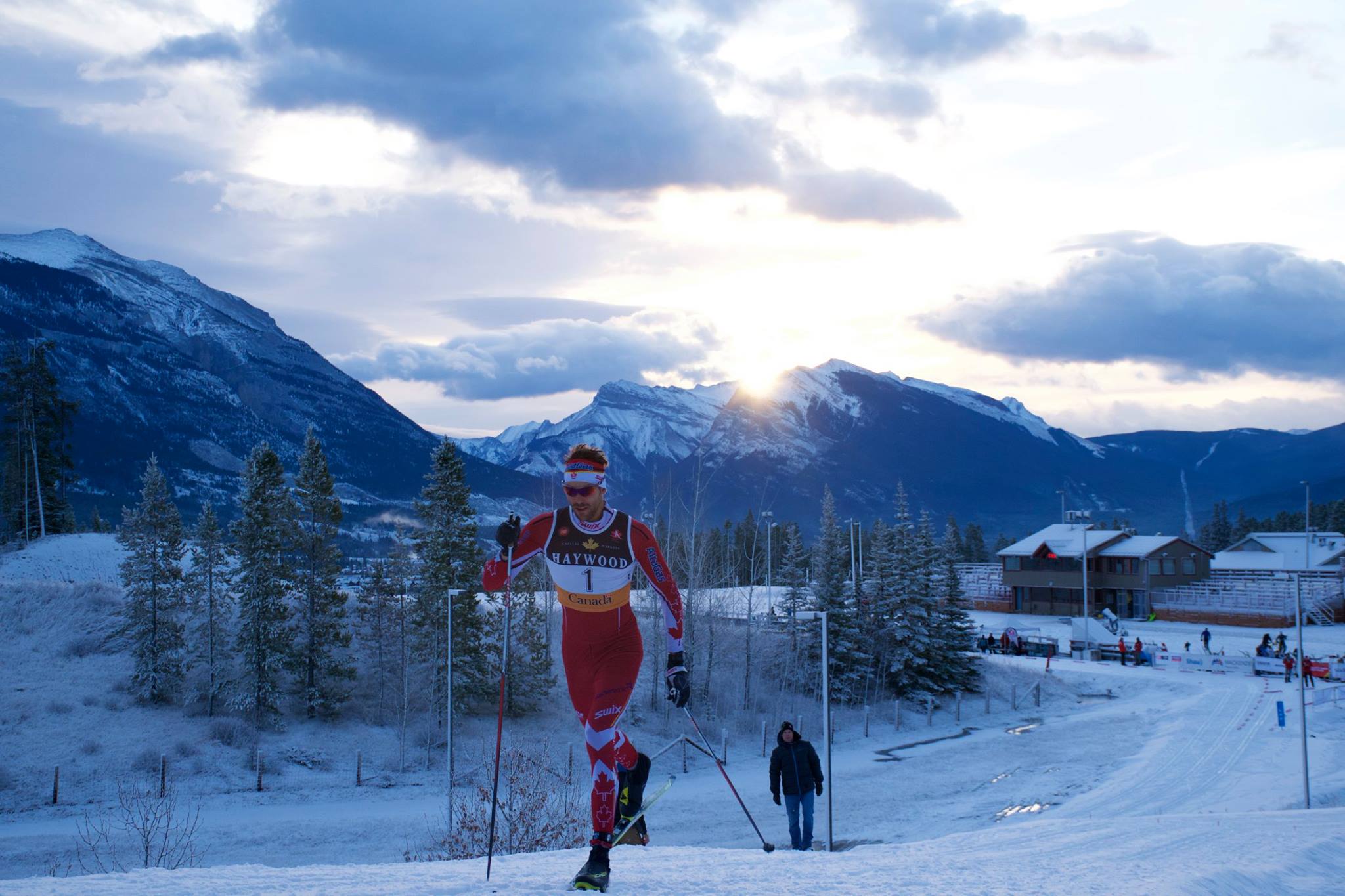
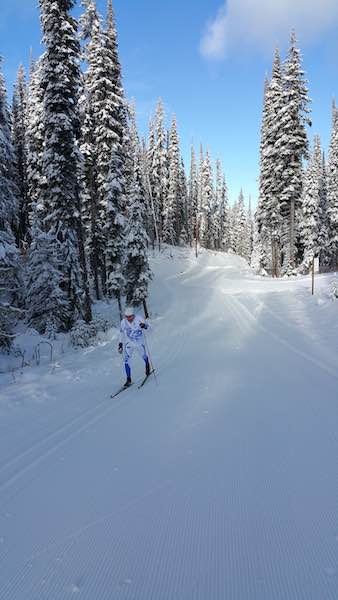
Inviting tracks sparkle in the sun along the 10/15km race course for Masters World Cup in March 2022 (Photo: GibsonPictures)
In March 2022, Canmore will be host to the annual Masters World Cup of Cross Country Skiing. Skiers from around the world will meet in Canmore for ten days of fun racing and camaraderie. But Canmore and the greater Kananaskis area has much more to offer than just great ski trails. For those looking to fully experience Canmore, the opportunities are numerous and varying in physicality. With a mix of culture and outdoor adventure, there is something for everyone.
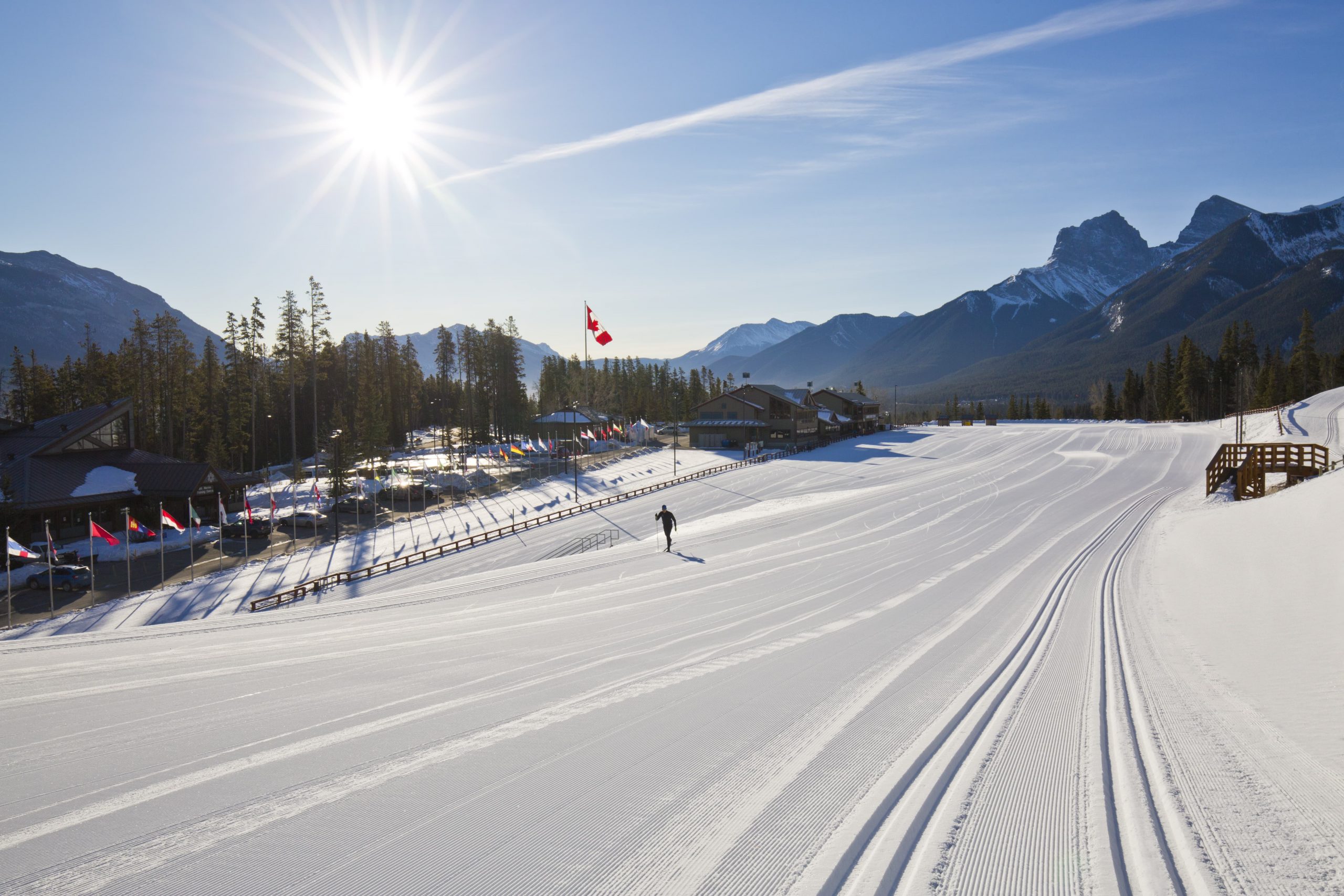
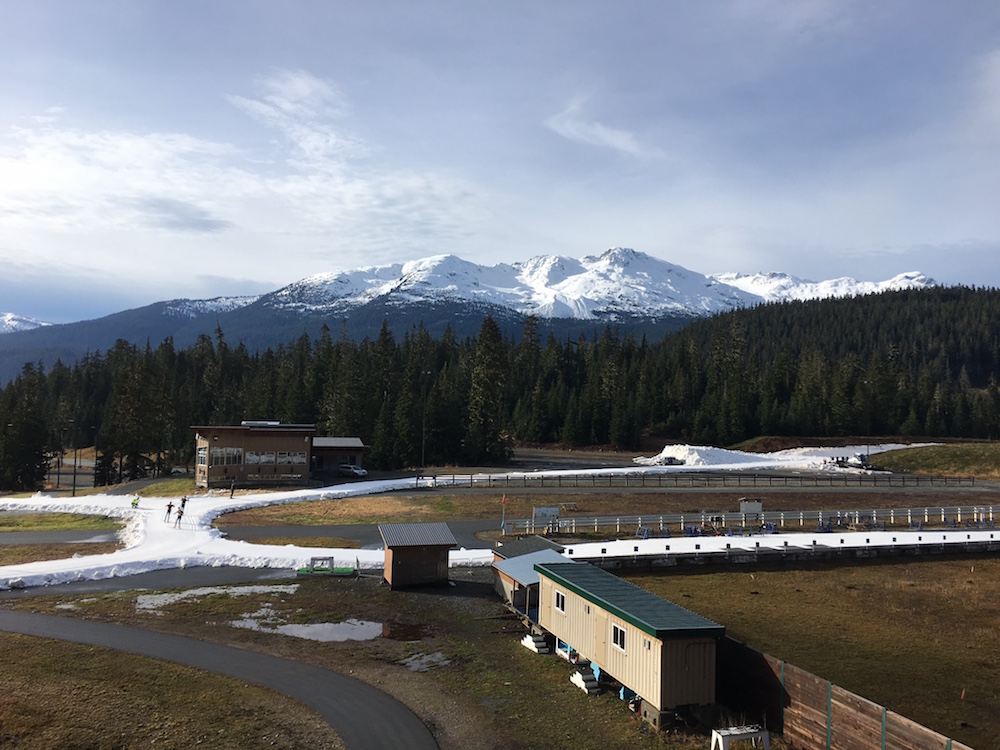
The wide and inviting stadium at the Canmore Nordic Center (Photo: GibsonPictures)
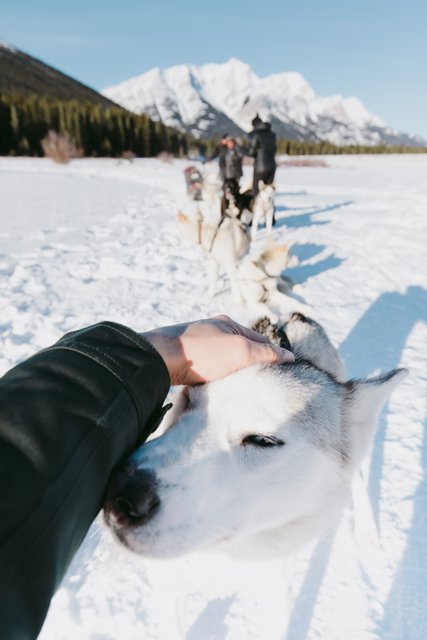
For off-ski outdoor recreation that keeps the energy output to a minimum, a dog-sledding adventure is one way to experience more of the area through a unique form of transport.Snowy Owl Sled Dog Tours was started in 1983 by Connie and Charles Arsenault with one team of ten dogs. The operation has since grown into a thriving business with sixteen teams of sled dogs. They offer a range of outings and experiences that are sure to give you a taste for both the community and scenery in the Canmore area.
You could enjoy a sunny sled dog ride just like this with Snowy Owl Sled Dog Tours (Photo: Travel Alberta)
A caving tour or evening ice walk could also be a great way to pass time spent away from the ski trails.Canmore Cave Tours offers tours to Rat’s Nest cave under Grotto Mountain. These excursions are more pleasant than the cave name suggests and feature 7,000-year-old animal bones and pictographs in a cave that is completely untouched by development. Similarly, an evening walk down Grotto Canyon will take you away from town and towards the amazing ice formations of the canyon’s frozen waterfalls.
Experience a very different type of outing with a cave tour (Photo: Travel Alberta)
Ice climbing and frozen waterfall viewing in Grotto Canyon (Photo: Travel Alberta/Mike Seehagel)
When you’ve had your fill of the outdoors for the day, downtown is ready to welcome you because, as Sinclair says, “Canmore is home to a little bit of everything.” With five breweries and distilleries in town, taking a trip through town with theCanmore Brewery and Distillery Tours would be a great way to learn more about the local craft beverage scene. The guides from this locally-owned business are professional, experienced, and well-versed in just about everything in the area has to offer, plus they will transport you to and from stops while keeping you entertained with stories.
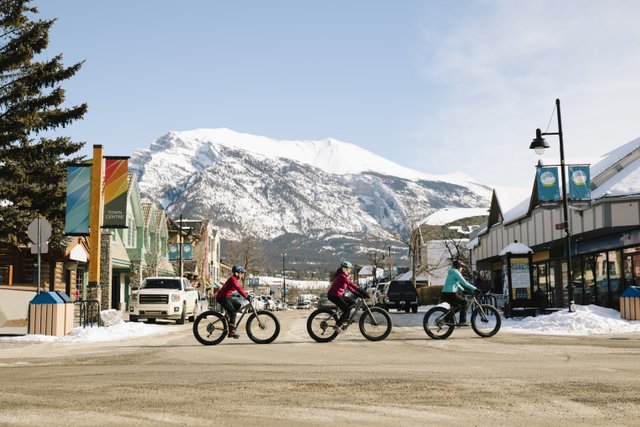
A crew of fat-bikers heads through downtown Canmore (Photo: Hero Images)
For morning, midday, or anytime pick-me-up beverages, the award-winningEclipse Coffee Roasters is a sure bet. Not only do they have a diverse selection of over ten freshly roasted bean varieties available, but they are also well-stocked with delectable baked goods to fuel you out on the ski trails.
After a fortifying cup of coffee, you’ll be ready to dive into the arts and culture scene that flourishes in Canmore. Home to world renowned sculptures, painters, and photographers, Canmore has a multitude of art galleries that are worth visiting. Stroll down main street and enjoy the beautiful collections on display. Then, if you find yourself inspired and in a creative mood, head toCrock A Doodle where you can paint your own pottery.
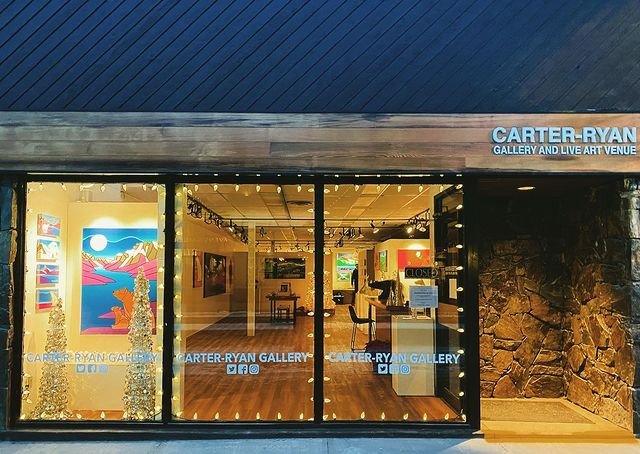
The Carter-Ryan Gallery and art venue found in Canmore (Photo: @carterryangallery)
After a hard day out on the ski trails, visiting one of Canmore’s spa or wellness centers would be the perfect place to recover.Back At It Sports & Wellness caters specifically to sports, therapeutic massage, and acupuncture. Maybe you’re too sore to even leave the hotel room? Not a problem becauseMobile Massage Canmore will come to you. They offer in-home and hotel massage therapy and will bring their table, lotion, music and highly skilled RMTs directly to your doorstep.
Speaking of hotels, it is worth stopping by thePaintbox Lodge, even if you don’t end up staying there. Owned and operated by Olympic silver-medalist, Sara Renner and her husband, former World Cup Champion in alpine skiing, Thomas Grandi, the Paintbox Lodge is an award-winning boutique hotel located downtown. They offer five unique and comfortable suites and rooms with complimentary breakfast featuring a legendary sourdough bread. Additionally, you and your party can sign up for a kitchen party, harvest table dinner or tapas party at “the BOX.”
Spray Valley at night, in the greater Kananaskis area (Photo: Travel Alberta)
Whether you’re there to race at World Masters, on a ski vacation, or simply to enjoy the mountains in winter, there are plenty of activity options in Canmore and the greater Kananaskis area to keep you interested and engaged during your stay. For assistance with planning your trip or any other questions about Canmore, the staff at the Visitor Information Centre are ready and eager to help. The Centre is staffed daily and can respond to emails sent to: canmore.vic@gmail.com.
A 2016 photo from Frozen Thunder in Canmore, Alberta. (Photo: Matthias Ahrens)
Yesterday, RMOTODAY.com, reported 11 “active” cases of Covid-19 linked to Frozen Thunder, an early season on-snow event organized at the Canmore Nordic Centre. According to the news report, athletes, clubs, and national governing bodies like Nordiq Canada and Biathlon Canada were notified about the cases on November 17.
RMOTODAY contacted Chris Dornan, Nordiq Canada’s communications director, who emailed, “These individuals are in quarantine and following all of the required protocols in place to protect themselves and the community at large.”
Dornan added, “Contact tracing has also been initiated and those who have deemed to have been in close contact have been notified of their risk of exposure. These individuals have also been advised of steps that need to be taken.”
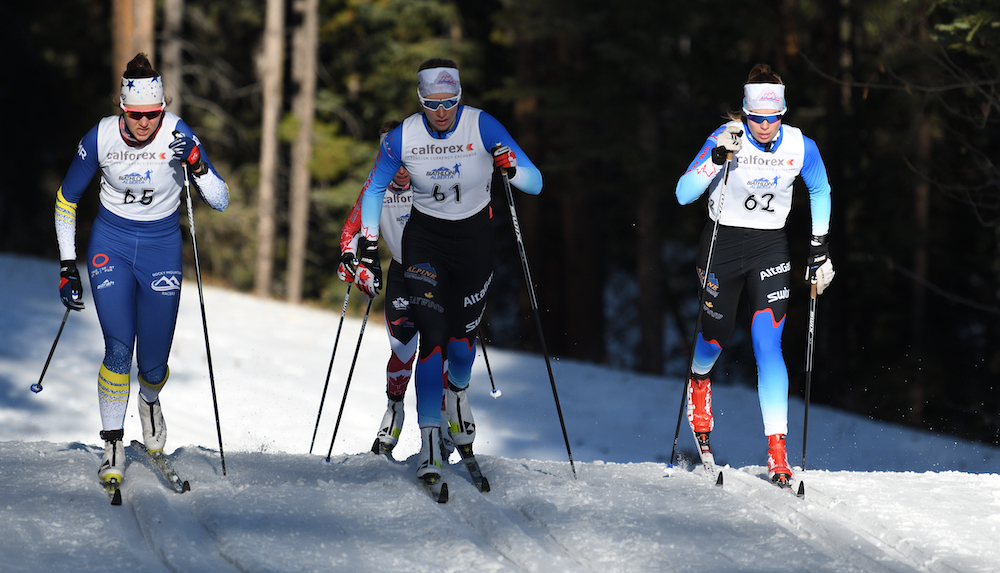
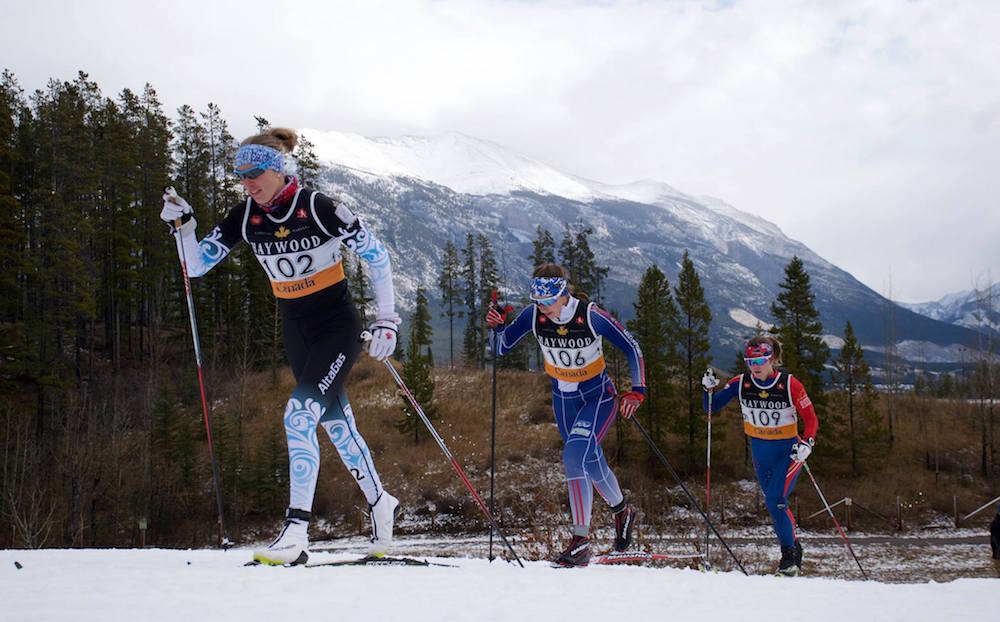
Katie Weaver, Dahria Beatty, and Maya MacIsaac-Jones lead Katherine Stewart Jones in the women’s A final at Nordiq Thunder 2019 (Photo: Doug Stephen)
The unofficial kickoff to the western Canadian racing season was held on November 13th and 14th. The traditional King’s Court sprint and interval start distance races are now called Nordiq Thunder — a re-brand from Frozen Thunder – but the relaxed feel and clockwork organization remain the same.
With no trip selections on the line, the 93 sprinters and 105 distance racers were there to test their fitness and tune up for the races that matter.
While the results are less important, Canadian National Team coach Erik Bråten shared his impressions from the two days with FasterSkier.
“Not going to over analyze these results too much. But for the seniors, Dahria [Beatty] had two good days with a win and a second. Antoine Briand, Bob Thompson and Maya MJ [MacIsaac-Jones] all looked strong on the sprint and I am looking forward to see what they can do when the NorAms start up in a few weeks in Canmore. Sam Hendry and Jesse Cockney both did strong on the distance race. And Katherine SJ [Stewart-Jones] also looked strong and got an ok result on the distance despite that her coach messed up (me) and she thought she was doing 5 laps until it was 400m left on the 4th and actual last lap.”
The King’s Court sprint format mixes all the categories so the men, women, juniors, and paras all get three hard heats, with only the fastest four in each category getting a category-specific final heat. In distance, all males skied five 2km laps and all females skied four identical laps, which makes it easier to compare results.
“We are also seeing some juniors doing really good even in the open category so that is very exciting from a development perspective,” Bråten wrote. “Several interesting names there in both genders, but Tom Stephen was for sure looking super strong both days.”
The reliable schedule for snow at Nordiq Thunder allows athletes to plan their early season and also provides local skiers with weeks of quality training.
National Team member Sam Hendry, in his first year as a senior, made the trip from the University of Utah to get some early snow and spend time with Bråten, who collaborates with Utah coach Miles Havlick on his plan.
“It was really nice for me to have the chance to come home and ski on snow in Frozen Thunder especially with the lack of snow in Utah. Getting to complete two races is a great experience to have and a bit of an edge over other competitors when we arrive for the season start in Canmore,” Hendry wrote.
American Andy Newell made the trip from Bozeman, where he is training with the Bridger Ski Foundation, to test his recovery from last season’s back issues.
“I just drove up to Canmore from Bozeman for a quick trip just to jump in the Frozen Thunder races and will be driving home right after the race tomorrow,” Newell wrote.
“I like the Frozen Thunder races because they fit really well as the first starts of the year. There is always really good competition here, the race organizers are pro, but at the same time it feels pretty fun and laid back. It’s great to get a classic sprint in early because it can be so much different than rollerskis. After this I will be in West Yellowstone and back here in Canmore for the first SuperTours racing with BSF.”
Fastest junior Isabel Hendry leads Maya MacIsaac-Jones in the 8km free. (Photo: Doug Stephen)
MacIsaac-Jones was one of the casualties when Nordiq Canada reduced the national team size to fit their reduced budget this season. The chance to train and race at home has to be welcome for an athlete who has reduced support this season.
“I’m really happy with the Frozen Thunder races,” MacIsaac-Jones wrote. “My race shape is getting closer every week and I’m feeling ready for winter. I’ve made some changes to my training, but what’s reallymotivating me is my goal to be competitive in World Cup sprint heats this winter. I joined AWCA this year and it’s been great being a part of a new team. I’ve put in a lot of consistent, hard work and I’m excited to see how the race season plays out!”
MacIsaac-Jones was also happy not to be talking about rehab, after a few seasons with injuries.
Nordiq Thunder Working for the Community
In it’s 10th season, Nordiq Thunder continues to draw western Canadian athletes to the farmed snow starting the third weekend in October every year. The loop may be small, ranging from just over 1km to 2.5km depending on the year, but the availability of high quality track setting every year is an essential part of many athletes’ preparation.
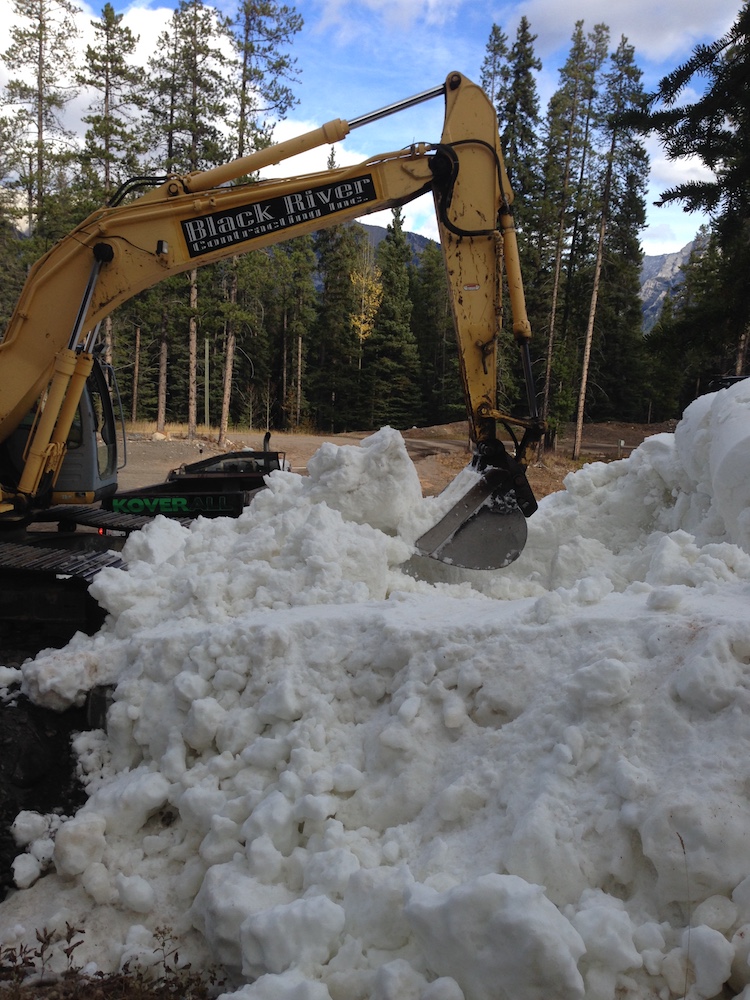
“The Canmore Nordic Center staff, they contribute about $85,000 in value in kind services, this includes the snowmaking, grooming and on the ground management,” Winsport’s Mike Norton confirmed from the FIS TD conference in Minnesota. The rest of the funding comes from 7 sport partners, Nordiq Canada, Biathlon Canada, the Alberta World Cup society, the Alberta Biathlon Training Center, Foothills Nordic ski club, Canmore Nordic Ski club, and Winsport Canada, along with a private donor, Gary di Silva. “These partners contribute approximately$70,000 in cash, this pays for the heavy equipment to deploy the 13,000 m3 of snow and any new sawdust needed for the insulation.” A cubic metre is pretty close to a cubic yard, for residents of Myanmar, Liberia, and the US. Official site Pin-Up Casino and Betting on pinup , all links and iformation, best regard
“We learn a bit every year on how to make the snow deployment more efficient and cost effective,” Norton wrote, which is a bit of Canadian understatement for the significant progress made over the last decade.
Nordiq Thunder mornings are reserved for registered athletes with bibs, while the the afternoons are open to the general public. This helps with the crowding until more trails open and the regular season begins.
What is often overlooked in the focus on racing and elite athletes is that Nordiq Thunder’s farmed snow allows the Centre to focus their existing snowmaking capabilities on opening more trails, which provides a longer season to all skiers. While the elite skiers get all the attention, the entire community gains.
Photographer (and proud parent) Doug Stephen was there both days and has posted albums on Flickr: sprint and distance. Athletes are welcome to download and use full resolution photos as long as they credit Doug Stephen (@vr45Photography).
Sam Hendry leads Graham Ritchie in the 10km free. (Photo: Doug Stephen)
Sunrise in Canmore courtesy of Mother Nature. Today was distance day for the men and women. The women contested a 7.5 k individual start freestyle race, the men huffed and puffed for 10 k. (Photo: Linden Mills-Connery)
On Tuesday, Frozen Thunder at the Canmore Nordic Centre in Canmore, Alberta hosted women’s and men’s individual start freestyle races. The women raced 7.5 kilometers, the men 10 k.
Canada’s Emily Nishikawa (AIAWCA/CNST) won the women’s 7.5 k skate race in a time of 21:05.9 minutes. Nishikawa’s pacing was peerless as she skied the fastest splits at every checkpoint. Dahria Beatty (AIAWCA/CNST) placed second, stopping the clock 24.0 seconds slower than Nishikawa for a time of 21:29.9 minutes. Third place went to U.S. skier Catherine Feldman (SVSEF Gold Team) who skied the course in 21:42.2 minutes.
Another U.S. skier, Dartmouth’s Lauren Jortberg, skied to fifth (+59.2), while Canadian Biathlon National team member Emma Lunder placed sixth (+1:22.5). Cate Brams (SVSEF Gold Team), also from the U.S., was sixth overall (+1:37.9).
U.S. skier, Adam Luban (SVSEF Gold Team) placed second (+32.6), with Canada’s Graham Nishikawa (CPNST) in third (+34.4). Nishikawa races as a guide for Canada’s Para Nordic Team. Len Valjas (CNST) was 39.8 seconds in back of Kennedy to place fourth overall.
(Feldman, Brams, and Luban of the SVSEF Gold Team are also 2018 Middlebury College graduates.)
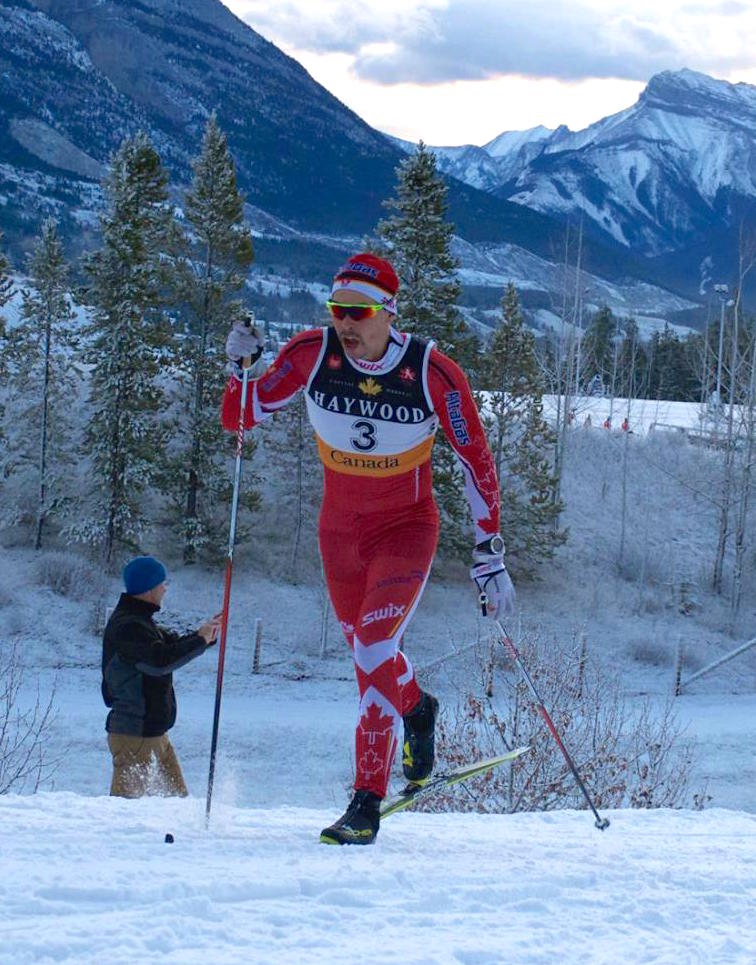
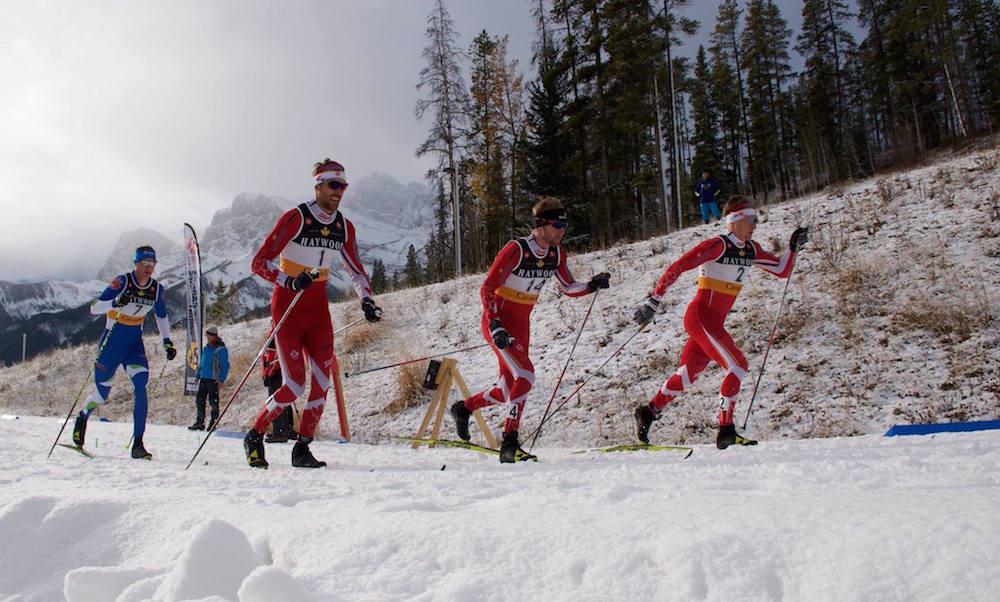
Len Valjas (CNST) overall winner of the Frozen Thunder classic sprint in bib 2 leads Reed Godfrey (bib 7) in round 2 of the Frozen Thunder classic sprint. (Photo: Doug Stephen)
The North American season kicked off today with classic sprints at Frozen Thunder in Canmore, Alberta. Most of the top athletes were treating this as a chance to do some race intensity and were more focused on training and process goals than on actual results.
Chief of Competition Thomas Holland had expected a smaller turnout this year, partly from fewer people traveling to Frozen Thunder in a non-Olympic year and partly because the event is not used for trip selection this year. In years past, Frozen Thunder races have been used to fill Canada’s remaining World Cup period 1 starts. While there were less elite athletes present, the overall entries rose to 159, with a large increase in juniors.
“There’s a lot of happy athletes putting in a lot of time here, and it’s great to see the energy,” Holland said in a phone interview while waiting for doping control to finish. “The numbers are up, there’s more women this year.”
Dahria Beatty during the 2018 Frozen Thunder classic sprint qualifier. (Photo: Doug Stephen)
The King’s court heat format has been a good fit for the early season racing. It ensures every skier gets to ski three heats against people of similar speed.
“You get guys skiing against girls, disabled skiing against able-bodied, there’s a lot of magic there,” Holland said.
This year’s course is new, adding a hill and switching to a single lap of about 1.5km.
Below are quotes from athletes to provide insight into North America’s first day of head-to-head racing.
Athletes on Tactics and Race Goals
“I was happy with my race today. I executed my technical goals well and was able to maintain my speed around the entire course without slowing down much which has been something I’ve been working on this summer.” — Dahria Beatty (CNST, Q 1st, H 1st)
“Once I got the ‘king heat’ I felt for sure like the underdog being a first-year senior man. So, my goal was just to stay in there as much as possible and hopefully beat at least one guy to stay in the king heat for the A final. It was a super fast group of guys today so I was pretty excited to be racing in the final.” — Reed Godfrey (Team R.A.D., Q 6th, H 4th)
“My plan for the heats was to press hard from the gun in every round. My focus today was on doing a good effort at full race pace. At this time of year, I’d prefer to get the hard racing in my legs rather than racing tactically for the win.” — Julien Locke (CNST, Q 2, H 5)
“Unfortunately, my klister caught 2/3 of the way through the semifinal and I face planted into the snow while the other guys skied around me. I pushed hard in the B-Final, leading from start to finish. The snow softened and made for a far more challenging loop. I was happy to have good power through the last round and also to see my fellow BC NST teammate Gareth [Williams] skiing well and holding on to a good pace.” — Locke
“I was really happy with the whole day. I found I executed my plan like I wanted too and that I skied the course well both in the qualifier and during the heats. I will have to work on my pacing for qualifiers, I went a bit to slow up the first climb at the start. I wish I could have stayed in front of Lenny in the last 100m, but I did not have enough gas. Never count this guy out ;)” — Dominique Moncion-Groulx (Team R.A.D., Q 3rd, H 2nd)
Athletes on Feeling Fit. Or Not.
“My shape was surprising considering I only started full-time training less than a month ago. Double pole felt stronger than I remember and the legs felt good on the climbs. I’ll attribute my podium performance to the SkiGo klister I was using.” — Andy Shields (Lappe, Q 9th, H 3rd) Shields is the Canadian rep for SkiGo waxes.
“I didn’t have high expectations today coming off an altitude block in Mammoth, but I ended up being super happy with how the day went. It’s obvious that the race shape isn’t there yet, but it was really fun battling it out with with some very solid skiers today!” — Reed Godfrey
“Today’s races were pretty smooth, didn’t expect much since I just returned from the NST camp in Mammoth, California. I felt alright in the qualifier and managed to move up to 6th on the day.” — Gareth Williams (CNST, Q 8th, H 6th)
“I was super happy to have a good qualifier [which] shows good fitness but I tried double poling and haven’t done enough on snow yet to hold my fitness through the heats.” — Russell Kennedy (Team R.A.D., Q 1st, H 7th)
“The race today was tough, I just got on snow and coming off a volume camp in Mammoth lakes the body wasn’t too happy trying to push to the max. It was solid intensity, but hopefully not where the race shape will be. “ — Evan Palmer-Charrette (Team R.A.D., Q 11th, H 8th)
Athletes on the King’s Court Format
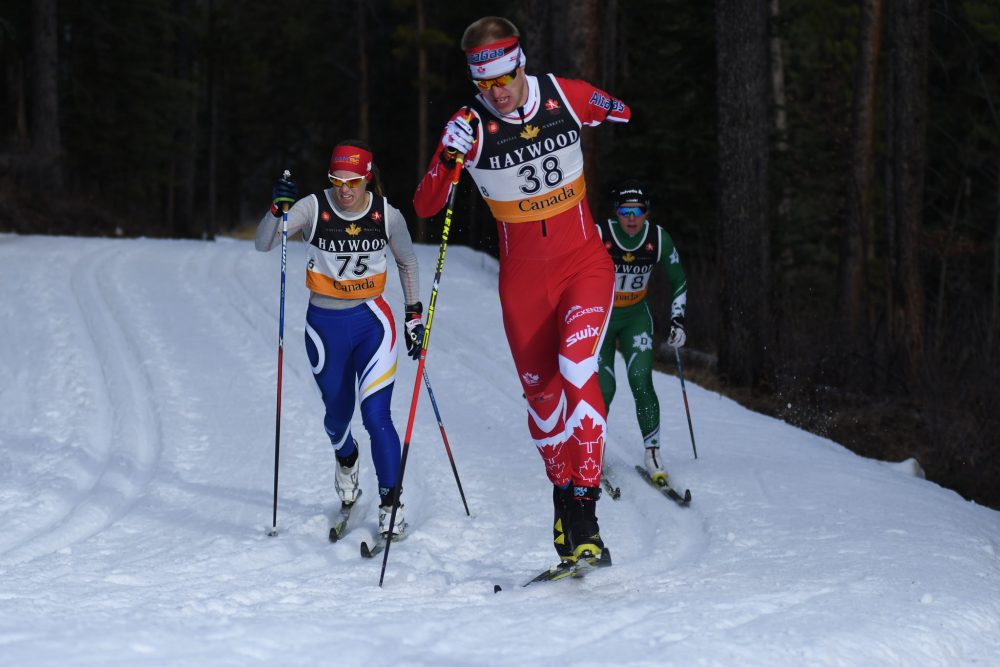
Mark Arendz (CPNST) in bib 38, leading Hannah Mehain (Bib 75) and Dartmouth’s Lauren Jortberg (bib 118) in round 1 of Frozen Thunder’s King’s Court sprint format. (Photo: Doug Stephen)
“The King’s court format was changed slightly this year with only the winners of the heats moving up. The 2nd and 3rd skiers stayed where they were and 4th place dropped down. With the new format it meant you couldn’t cruse into 2nd place and advance like you use to – you had to get after those ‘Ws’ which was a great improvement on the part of the organizers. It made for a lot more high-stakes lunges at the line.” — Shields
“Kings court format is a great training tool because it puts you against people who were a similar speed to you in qualifying allowing people to be in the mix for most of the heat versus the big spread you see in a normal quarter-final. I think it’s perfect for early season prep races like Frozen Thunder and as a development tool, giving everyone the opportunity to race four times.” — Beatty
“King’s courts is nice because it allows everyone to race a full set of heats, which is a really good training benefit this time of year. It’s also nice to have everyone fighting to move up and up in the heats throughout the day.” — Reed Godfrey
“Kings court is a great format to help people improve their race fitness in the early season and work on tactics in a low pressure situation.” — Palmer-Charette
“The King’s Court format allows everyone in the ski community the opportunity to race multiple times. The format allows for you to race skiers of similar speed, as well as challenging yourself as you progress through the rounds. For me, I have an opportunity to race the Senior Women, [as] our ski speeds are very similar. That close head-to-head competition is always good to develop skills and tactics for future races.” — MarkArendz (CPNST)
Athletes on Early season racing
Emily Nishikawa (CNST) during the 2018 Frozen Thunder classic sprint qualifier. Nishikawa qualified in second place and skipped the heats. (Photo: Doug Stephen)
“It has been really great to get back on snow for training and racing this past week. Having on snow races early season is super valuable and is a great way to figure out what needs to be fine tuned before the season starts.” — Beatty
“It’s important to break that barrier of racing now early in the season to learn what you need to work on moving forward to when it really starts to really count. The quicker we can make that pavement to snow transition definitely helps going into the the races in late November and December.” — Reed Godfrey
“I leave for the World Cup in 10 days and it’s time to start ramping up the on-snow speed. No better way to do that than a good race! Frozen Thunder is such an asset for us here in Canmore. It’s a huge benefit to be back on snow before the season and it gives us an edge in our preparation for the season.” — Locke
“I think getting on snow in the early season can be really important for people looking to race fast in period one. For everyone going overseas to the World Cup I feel like it’s essential and for those of us racing domestically it elevates the level of competition for everyone.” — Palmer-Charrette
“You can’t replace hard races with intensity. If you want to go fast at some point in the season, you need to get enough race starts throughout the year.” — Arendz
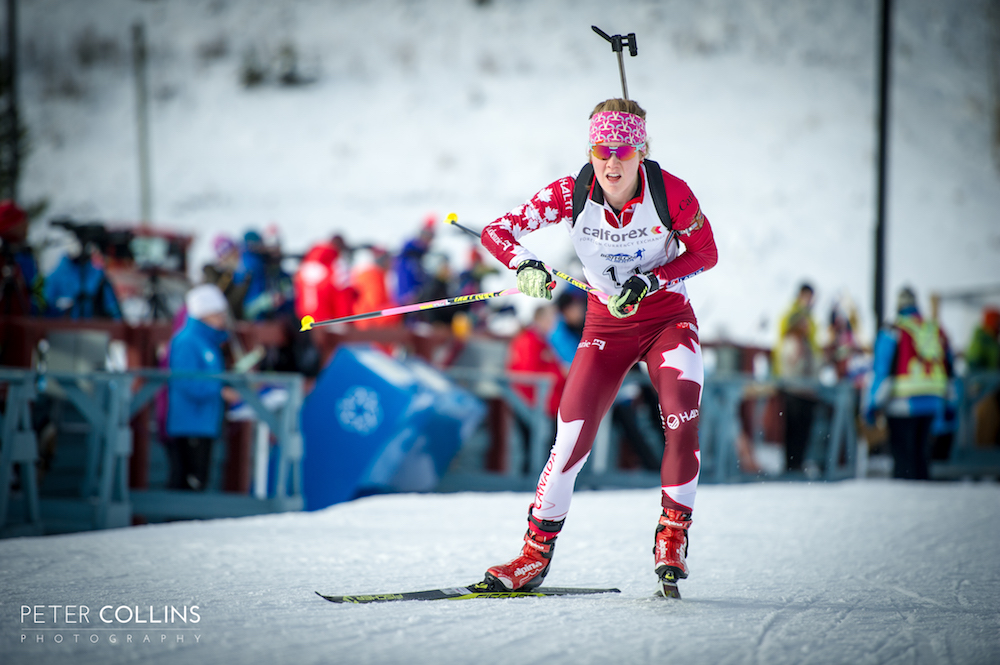
Emma Lunder, of Biathlon Canada’s Senior National Team, racing to second in the women’s modified sprint on Friday, Nov. 10, the last day of Biathlon Canada’s team trials. After reaching the podium three times in three races, she was selected to the IBU World Cup team for the first trimester. (Photo: Peter Collins/petercollinsphoto.com)
Note: This article has been updated to include comments and verification from Biathlon Canada High Performance Director Roddy Ward, and explain the modified shooting format used for Friday’s sprint.
***
Almost exactly two weeks before Biathlon Canada sends the rest of its World Cup team to Europe for the first trimeter of International Biathlon Union (IBU) World Cup racing, the national team held trials this past Tuesday through Friday on snow in Canmore, Alberta. Three sets of races in four days (all sprints*) determined which Canadian men and women will start the season at the World Cup opener in Östersund, Sweden, Nov. 26-Dec. 3.
The national-team trials, also known as the “Tour 1 Selection Trials”, ultimately boil down to what Biathlon Canada calls performance percentages, which measures an athlete’s finishing time in a given race against the average of of the top-three finishers’ times in that race. One bad race isn’t a deal-breaker; they consider the best two out of three. At the end of the trials, an athlete’s top-two results (specifically their performance percentages) are averaged for their overall ranking.
Going into the trials, two women and one man on Biathlon Canada’s senior team had prequalified for the first World Cup tour (World Cups 1, 2 & 3): Rosanna Crawford, Julia Ransom and Scott Gow, according to a national-team program dated Aug. 30, 2017.
According to the same document, two additional women’s spots and three men’s openings remained. Those went to the two highest-ranked women at the Nov. 7-10 trials — Megan Bankes and Emma Lunder, respectively — and the top-three ranked men — Nathan Smith, Brendan Green and Christian Gow, respectively.
Emma Lunder (r) with fellow Biathlon Canada national-team member Rosanna Crawford after the women’s modified sprint at Biathlon Canada’s team trials in Canmore, Alberta. Lunder placed second in that race to secure one of the last two spots on Canada’s IBU World Cup Team, while Crawford, who had been pre-selected for the team, placed sixth in that race. (Photo: Peter Collins/petercollinsphoto.com)
All of the eight aforementioned athletes were nominated to Canada’s 11-member National Senior Team in June. The three remaining biathletes are Sarah Beaudry, who had the third-best overall women’s percentage at trials, Megan Tandy, who ranked fourth and was reportedly coming off an illness after traveling from Germany, and Macx Davies, who ranked seventh in the men’s final percentages after Matthew Hudec of the Biathlon Alberta Training Centre (BATC) in fourth, Carsen Campbell (BATC) in fifth, and Jules Burnotte (Biathlon Estrie) in sixth. (Scott Gow, Crawford and Ransom were not factored into the final percentages.)
The eight athletes that just missed the World Cup team will start the season on the IBU Cup. Four men and four women earned spots on Canada’s IBU Cup team as a direct result of their performances at trials: Hudec, Campbell, Burnotte, and Davies, and Beaudry, Tandy, Nadia Moser (BATC), and Leilani Tam von Burg (BATC).
Biathlon Canada’s High Performance Director Roddy Ward described the recent team selections as “straight-up trials”. Based on its published criteria, Biathlon Canada has the option to use discretion in choosing a fourth man and fourth woman for its IBU Cup team, but instead stuck to results, selecting the fifth- through eighth-ranked athletes at trials.
“We filled the team based on trials,” he explained on the phone on Sunday.
Ward said he was “feeling really good” about how the World Cup team shook out, with four of their top men returning to the circuit. He mentioned that Smith is healthy and back at full strength, and noted Green’s consistency at trials.
“On the women’s side, it’s just really good competition … with places changing every day,” he continued.
Most of the 16 athletes selected to Canada’s World Cup and IBU Cup teams spent much of the offseason together “time-trialling and integrating,” Ward said, which has brought up the level of training as well as made for closer competition among them.
“My hope is we go to the World Cup and do well and go to the IBU Cup and do well,” he said.
The Canmore trials began with sprints on Tuesday, which Beaudry and American Lowell Bailey (US Biathlon) won. The only woman to shoot clean, Beaudry topped the women’s 7.5-kilometer sprint by 8.9 seconds over Crawford with a finishing time of 21:57.7 minutes. Crawford missed one in each shooting stage (1+1) for second place and Lunder placed third, 21.1 seconds back, after a single standing miss (0+1). Tandy followed in fourth (+1:05.5) with two penalties (1+1), and Joanne Reid was the top American in fifth (+1:13.9) with one miss (0+1).
Christian Gow (Biathlon Canada Senior National Team) racing to ninth in the men’s modified sprint on the last day of Biathlon Canada’s team trials in Canmore, Alberta. With the third-best performance percentage of the trials, Gow was the fourth man named to Canada’s IBU World Cup team for the first trimester of racing. (Photo: Peter Collins/petercollinsphoto.com)
In the men’s 10 k sprint, Bailey also cleaned to beat out Smith by 13.4 seconds with a finishing time of 25:02.5. Smith had to ski one penalty loop after a prone miss (1+0) and Green placed third (+14.5) after two prone penalties (2+0). Scott Gow and his younger brother Christian finished fourth (+29.4) and fifth (+38.8), respectively, and Tim Burke (US Biathlon) was the second American in sixth overall (+1:11.0).
On Thursday, Smith won the second sprint of the week outright with a 26.1-second victory in the men’s 10 k with perfect shooting and a finishing time of 24:25.3. Green once again followed in second with clean shooting as well, and Artem Prima of Ukraine took third (+1:09.3) with two misses (2+0). While the Americans didn’t compete on Day 2 of the trials, Team Ukraine did, accounting for nearly the same amount of competitors (40 in the men’s race, 20 in the women’s race, compared to 40 in the men’s race and 26 in the women’s race two days earlier).
Scott Gow finished fourth in the Day 2 sprint (+1:17.0), followed by Hudec in fifth (+1:29.4).
In the second women’s 7.5 k sprint, a new winner emerged, but second through fourth place were exact repeats from Day 1. Bankes claimed the win in 22:03.5 with clean shooting, while Crawford followed in second, 26 seconds back with two standing penalties (0+2), Lunder placed third (+1:02.8) with two prone misses (2+0), and Tandy was fourth (+1:16.2) with two prone penalties (2+0) as well. Beaudry placed fifth (+2:16.6) with three penalties (2+1).
After sitting out the first two days of trials, Ransom won Friday’s modified sprint (6.8 k for the women) by just a tenth of a second over Lunder. Ransom hit all of her targets and posted the win in 20:20.4, and Lunder was just off her mark in second place after “cleaning” as well. Per the modified format, each athlete could use up to three spare bullets per shooting bout, similar to a modified relay.
“We all know [sprints] are important races; they lead to pursuits they lead to mass starts,” Ward explained. “We want to make sure we’re picking good biathletes, but also favoring on the ski-speed side.”
In addition to giving an athlete more chances on the shooting range, the relay format showed who could excel in those types of races, Ward said.
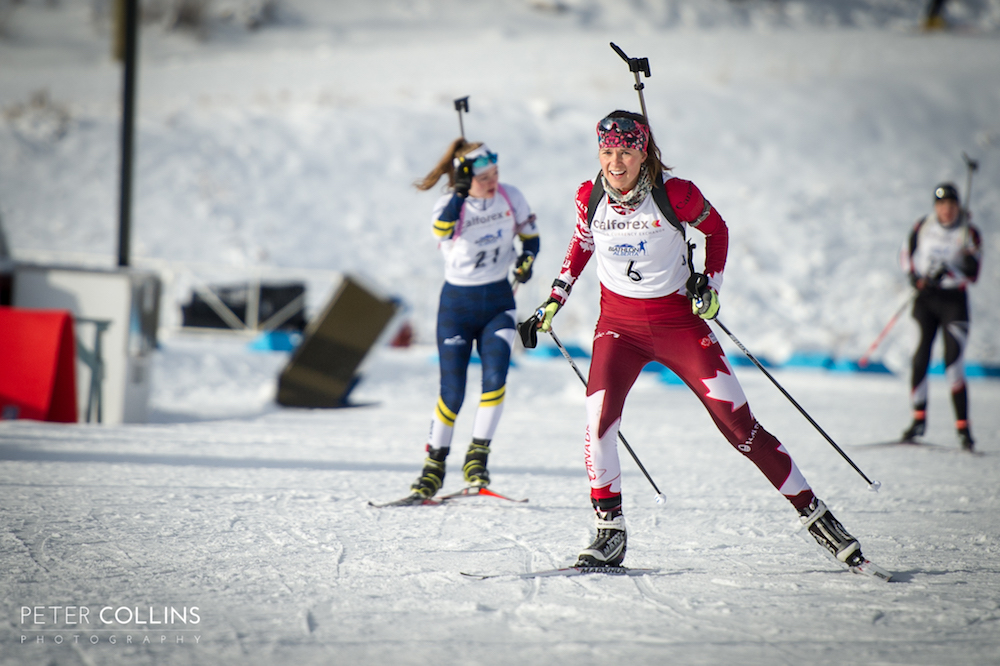
Julia Ransom (6) racing to the win in the women’s modified sprint on the last day of Biathlon Canada’s team trials on Nov. 10 in Canmore, Alberta. (Photo: Peter Collins/petercollinsphoto.com)
As a result of the modified-sprint format, the top-five women avoided the penalty loop. Bankes placed third, 6.7 seconds off Ransom’s time. Bankes’s BATC teammate Nadia Moser finished fourth (+8.6), ahead of American Susan Dunklee (US Biathlon) in fifth (+18.6). Crawford finished sixth (+48.0) with two penalties (2+0) and Tandy placed seventh (+1:13.9) with one miss (1+0).
In the men’s modified 7.5 k sprint on Friday, Smith emerged as the top Canadian for the third-straight race, winning in 18:42.0 with “clean” shooting. The top-eight men hit all their targets. Green finished second (+11.5) once again, and Scott Gow improved to third (+36.4).
Prima followed in fourth (+41.5), his Ukrainian teammate Sergey Semenov finished fifth (+1:05.9), Campbell and Burnotte tied for sixth (+1:08.2), and Davies placed eighth (+1:20.2). Christian Gow finished ninth (+1:40.9) with one penalty (1+0), Burke was the top American in 10th (+1:47.7), followed by Bailey in 11th (+1:47.9). Both Americans finished without any penalties.
Both the U.S. and Ukrainian teams raced two out of the three days of trials, contributing to the total field size of 45 men and 26 women on the last day. Ward emphasized that those teams’ presence made for “some really good competition”, and added that having Canadian juniors race alongside seniors (same distances, same races) showed them a clear path to reaching the World Cup level.
US Biathlon held the last of its own trials last month and planned to finalized its IBU World Cup team after its Canmore training camp.
For the Canadian World Cup team, Green and the Gow brothers planned to leave Sunday for Sjusjøen, Norway, where they’ll race at Norwegian biathlon trials. According to Ward, Lunder will depart on Thursday for Sjusjøen, where she’ll start her season with the first IBU Cup sprint on Nov. 23 before meeting the rest of the World Cup team in Östersund. Smith, Crawford, Ransom and Bankes planned to leave Canada on Nov. 22.
Most of the IBU Cup team will depart on Dec. 1, while Campbell and Beaudry will start their seasons earlier at the IBU Cup opener Nov. 23-26 in Sjusjøen.
(*Why were all of these trials sprint races? When it comes to individual events, IBU Cup and IBU World Cup venues typically open with sprints to determine which athletes qualify for the remaining races of the week at each stop. For instance, the top 60 in the sprint qualify for the following pursuit race, and approximately the top 30 in the overall World Cup rankings qualify for mass starts.)
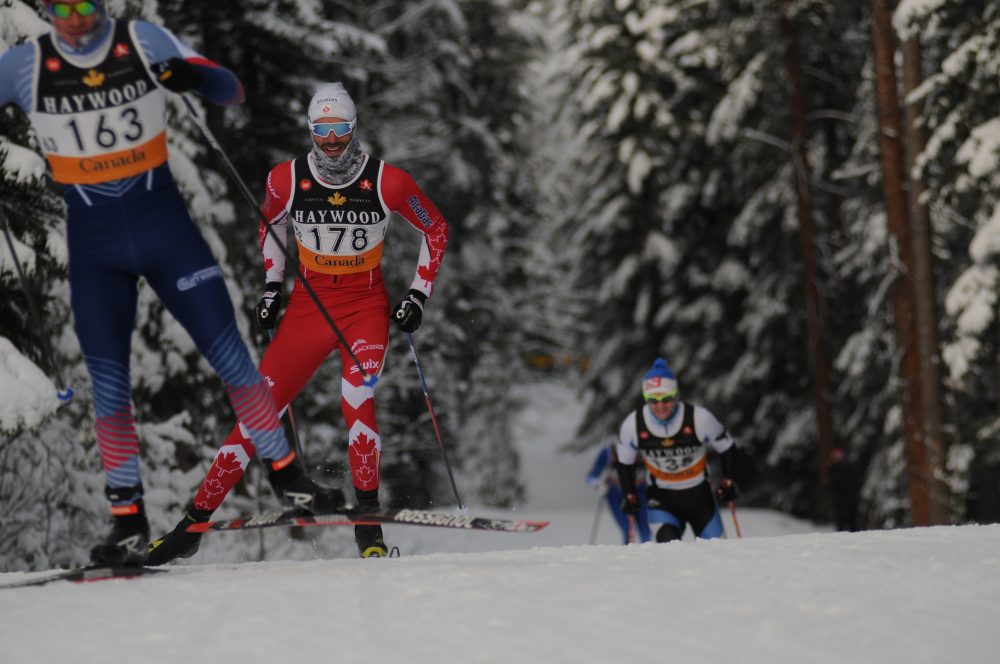
Canadian World Cup Team member Len Valjas (178) chases American Rogan Brown of the Sun Valley Ski Education Foundation (163) during the Frozen Thunder 10-kilometer freestyle on Friday in Canmore, Alberta. (Photo: Doug Stephen)
Frozen Thunder lived up to its name on Friday, with temperatures hovering below the legal race limit prior to the start of the second competition series of the week: the women’s 7.5- and men’s 10-kilometer freestyle individual starts.
An hour delay was enough time to see temperatures rise to -10 degrees Celsius (14 Fahrenheit), and many skiers bundled in Buffs in prep for the five to six laps of racing. Overcast skies were a celestial reminder of the nearly 18 centimeters of snowfall that Canmore, Alberta, had seen over the past three days, Mother Nature’s own personal pass at the center’s snow-farmed track.
Thirty-six athletes entered the women’s skating event, many of whom raced Wednesday’s classic sprint, including the sprint-final winner, Maya MacIsaac-Jones (Canadian U25 Team/Rocky Mountain Racers), American Chelsea Holmes of Alaska Pacific University (APU), Dahria Beatty of the Canadian World Cup Team and Alberta World Cup Academy (AIAWCA), Frédérique Vézina of the Pierre Harvey National Training Centre (CNEPH), and Annika Hicks (AIAWCA).
Covering the women’s five-lap race in a time of 21:26.6 minutes was Holmes for first place.
With her husband working and living in Banff, Alberta — a 20-minute drive from Canmore — competing in the Frozen Thunder races for Holmes was not just about getting some races in before the start of the season, but also spending time with her husband before flying to Europe.
“I have Period 1 starts this year, which I’m super excited about, but it’s definitely a bit of time of the road,” Holmes said on the phone after the race. She earned those November/December World Cup starts as the overall leader of the U.S. SuperTour circuit last season.
“I just figured this time of year and I needed to spend some time with Luke and not be traveling too much, which was a hard decision to make,” she continued. “Part of me really wanted to go back to Alaska for a while, but to be a little bit more mellow and to be here was super important to me.”
Holmes, 30, plans to head to Finland on Nov. 15, where she will meet with the U.S. Ski Team and prep for the World Cup opener in Kuusamo. Frozen Thunder presented an opportunity to race against fellow North Americans before competing abroad.
“You push yourself so much harder than you do in intervals,” she said of her decision to race both Wednesday’s sprint and Friday’s distance event. “Even like a time trial by yourself. It changes it when you put a bib on.”
Dahria Beatty, who was promoted to Canada’s World Cup B-team this sprint, racing to second in the women’s 7.5-kilometer freestyle on Friday at Frozen Thunder in Canmore, Alberta. (Photo: Doug Stephen)
Emerging as the top Canadian was Beatty in second place, 34.4 seconds back from Holmes’s winning time. Though Holmes started before her and Beatty received splits off her time, Holmes created a time gap on her competitors with more than two-thirds of racing remaining.
“Chelsea was strong today, she started really fast and had given herself a big lead after the first two laps,” Beatty wrote in an email. “My goal for the distance race today was to push hard from the start and focus on using as much one skate [V2] as possible and having smooth transitions. I was happy with how I skied today and I am excited to build on how I felt today over in Europe.”
With Beatty’s next stop being Gällivare, Sweden, for a weekend of International Ski Federation (FIS) races, both the Frozen Thunder sprint — in which she only raced the qualifier — and distance race served as tools to remind Beatty of her race-pace mentality on snow.
“Frozen Thunder races are always a great way to get into the race mindset at home before heading over to Europe,” she wrote. “For Wednesday’s sprint race I made the decision with my coach beforehand to only do the qualifier. Having returned from Park City only one week before I didn’t want to stress my systems too much too soon. The qualifier went well for me. I made few small mistakes that often come with the first race of the season but I was able to give a solid effort that I was happy with.”
She won Wednesday’s qualifier by 8.56 seconds over Holmes, the second-fastest female qualifier.
Rounding out the podium in the women’s distance race was Canadian World Cup Team member Emily Nishikawa in third (+53.0). Hicks, who was second in Wednesday’s sprint final, placed fourth (+1:38.8) and junior India McIsaac (Canadian Junior National Team/Rocky Mountain Racers) claimed fifth (+1:50.0) overall.
Russell Kennedy of the Canmore-based Team R.A.D. racing to third in the men’s 10-kilometer freestyle on Friday at Frozen Thunder in Canmore, Alberta. (Photo: Doug Stephen)
In the men’s 10 k that followed, 68 skiers started the six-lap race, many of whom were also repeats from Wednesday’s sprint, including Canadian World Cup Team member Len Valjas, Dominique Moncion-Groulx (AIAWCA), Andy Shields (Lappe Nordic), Russell Kennedy (Team R.A.D.), Bob Thompson of the Thunder Bay National Team Development Centre (NTDC), and Julien Locke (U25 Team/Black Jack), who won Wednesday’s qualifier to earn start rights with Canada’s Period 1 World Cup team.
Doubling up on his wins for the week (he also won Wednesday’s sprint final), Valjas raced to first in the men’s distance race, covering the course in a time of 22:13.2. Valjas, who plans to depart for Gällivare, Sweden, on Nov. 11, explained that Frozen Thunder was the perfect last stop before heading to Europe.
“I chose to compete in the Frozen Thunder races because it’s a great stress-free chance to ski hard and shake some of the rust off from summer training,” Valjas wrote in an email. “It always takes a few good hard efforts for me to feel good again. I was very happy with both of my races.
“My goals for the early season are to try and race as many distance and sprint races as I can. I find racing is the best training I can do,” he continued. “Even as a sprint specialist, I have had my best seasons when I have entered all the distance races early in the season. Even if they don’t go well, the training I get from them pays off later.”
Taking second place, 6.2 seconds off Valjas’s time was American Rogan Brown of the Sun Valley Ski Education Foundation. Kennedy took the final podium spot in third (+11.4), Shields placed fourth (+18.1), Canadian World Cup Team member, Knute Johnsgaard finished fifth (+24.9).
“I was hoping for a podium in today’s race and just some sprint practice/ good intensity in the sprint,” Kennedy wrote in an email. “I started maybe a little on the hard side but I was right in the mix the whole race and really just lost the lead the last two laps. It would have been nice to have a ride but I was pretty much solo the whole race. That was good practice for me since I had to just pace myself and push hard the whole time. My fitness feels right on where I would like it to be and now I just have to find a couple extra gears before I leave!”
Tom Stephen (Foothills Nordic) racing to third in the junior men’s category and 21st overall in the 10 k freestyle on Friday at Frozen Thunder in Canmore, Alberta. (Photo: Doug Stephen)
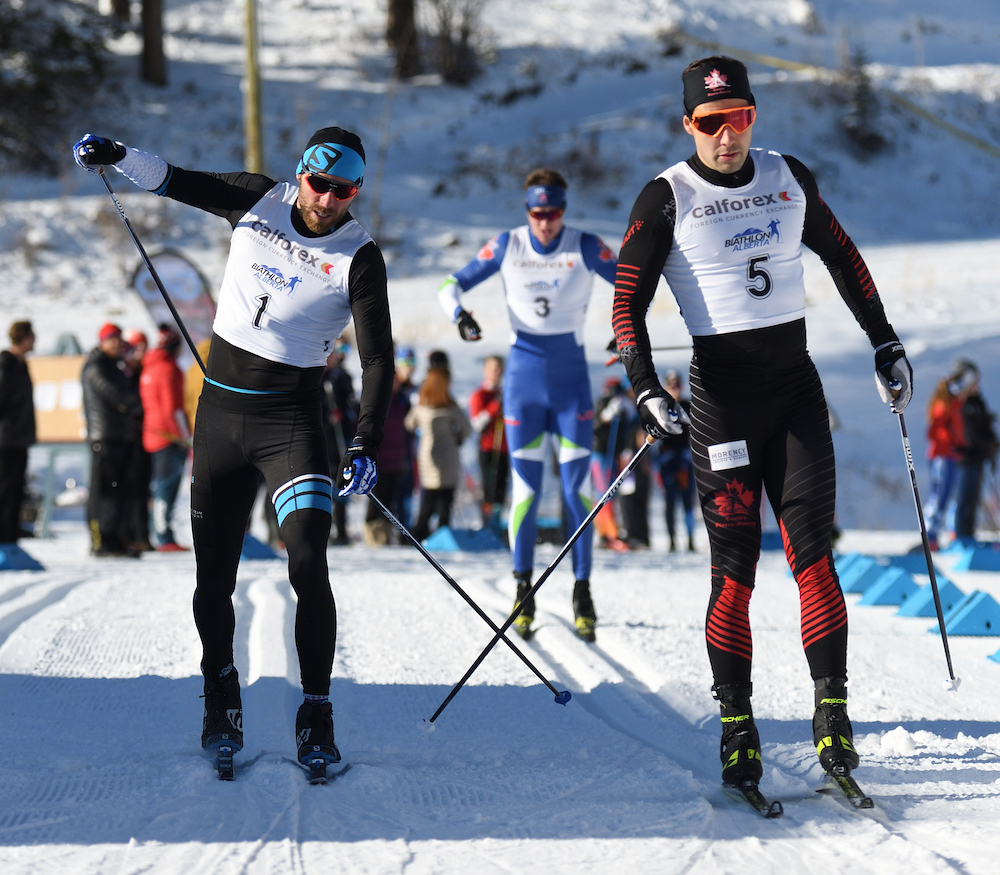
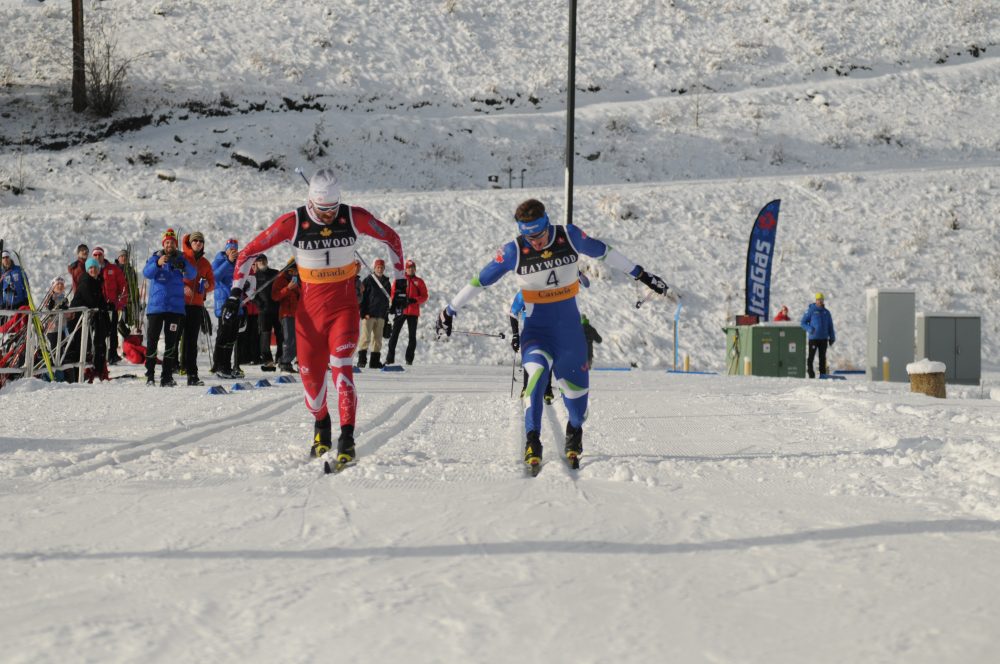
Canadian World Cup Team member Len Valjas (1) and Bob Thompson (NTDC Thunder Bay) lunge to the line during Wednesday’s Frozen Thunder classic sprint at the Canmore Nordic Centre in Canmore, Alberta. (Photo: Doug Stephen)
Clouds heavy with building snow and a winter-storm warning already in effect cast a second anticipatory shadow over a jittery group of racers gathered on Wednesday for the first Frozen Thunder race of the season at the Canmore Nordic Centre in Canmore, Alberta.
At stake for some of the top Canadians participating in the day’s classic sprint was the opportunity to secure the final spot on the men’s World Cup team for the first period of World Cup racing starting later this month. Nearly 12 centimeters of snow had fallen the night before on the two-lap race track, and for many stepping out onto the freshly groomed trails, months upon months of training prep was in the barn.
“That World Cup spot. That has been a goal for pretty well the whole year,” said Bob Thompson, who trains with the Thunder Bay National Team Development Centre (NTDC), on the phone after Wednesday’s races.
Thompson, 26, was not the only one hoping to book a plane ticket for World Cup Period 1, which starts Nov. 24 in Kuusamo, Finland, and continues through December. Sixty-six skiers started Wednesday’s men’s sprint qualifier and anyone in the hunt for that World Cup spot would have to outperform them all, excluding the Americans and Canadian World Cup Team member, Len Valjas, who was prequalified for the World Cup.
Even with the competition’s added edge, many racers went about business as usual on race day and in the days leading up to the event, Thompson explained.
“It’s been fairly carefree the week we’ve been here,” said Thompson, who arrived in Canmore with his NTDC teammates on Oct. 23. “The morning [of the sprint] I wouldn’t say things were a bleak atmosphere or super serious, it was just kind of everyone was doing their thing.”
Thompson went about his warmup the way he normally would on race day. In retrospect, he saw his plan as well-executed and his warmup as strong, despite breaking a pole during his intensity segment. For him, the qualifier went “really well,” he said.
Julien Locke (Canadian U25 Team/Black Jack) after winning the men’s classic sprint qualifier at Frozen Thunder in Canmore on Wednesday and securing the final spot on the Canadian men’s team for World Cup Period 1. (Photo: Cross Country Canada)
But Julien Locke, of the Canadian U25 Team and Black Jack Ski Team, was the fastest man in the open men’s qualifier and thus earned that coveted World Cup spot. Locke, 24, posted the top time of 3:37.81 minutes, nearly a second ahead of Valjas in second (+0.97) and 3.57 seconds ahead of the third qualifier, Dominique Moncion-Groulx of the Alberta World Cup Academy (AIAWCA). Thompson qualified fourth, 4.15 seconds off of Locke’s winning time.
“I didn’t have regrets or second thoughts on how I raced,” Thompson said. “Julien had a great race, props to him. I’ll just have to come back next time.”
Locke could not be reached at press time, but he spoke with Cross Country Canada (CCC) in a video posted on Twitter after the race.
“I’m really excited to have won the race this morning and qualified for Period 1 World Cup, but the Olympics is the big goal this year,” Locke said. “It’s super important to go get results on the World Cup, and I’m excited to have a chance to do that.”
According to CCC High Performance Director Thomas Holland, Locke and the rest of the World Cup Team (excluding Alex Harvey and Cendrine Browne) will head to Gällivare, Sweden, on Nov. 10, where they’ll compete in a weekend of International Ski Federation (FIS) races from Nov. 17-19. Meanwhile, Harvey and Browne, who train out of the Pierre Harvey National Training Centre (CNEPH) with coach Louis Bouchard in Quebec, will train in Davos, Switzerland, in advance of the World Cup opener in Finland.
But let’s get back to Frozen Thunder. With the qualifier behind them and the heats slated to take place in a zero-elimination King’s Court format, many racers approached the rest of Wednesday adamant on getting in some solid race efforts.
“The King’s Court format that we use in the heats was a great showcase for athlete development whereby every athlete entered in the race gets to race all 3 heats,” Holland explained in an email. “The format sees men and woman and para-skiers in some of the same heats – super fun event for all the athletes.”
In the first heat, Thompson, Locke, Valjas, and Moncion-Groulx went head to head, yet with the heats starting one minute apart on the two-lap track, there was a constant influx of skiers and some overlap.
“I think comments were made that we were dogging it a little bit,” Thompson said of that initial round. “There were other heats that we were basically skiing in the first lap with that were going faster than us … they were running pretty quick through the starts.”
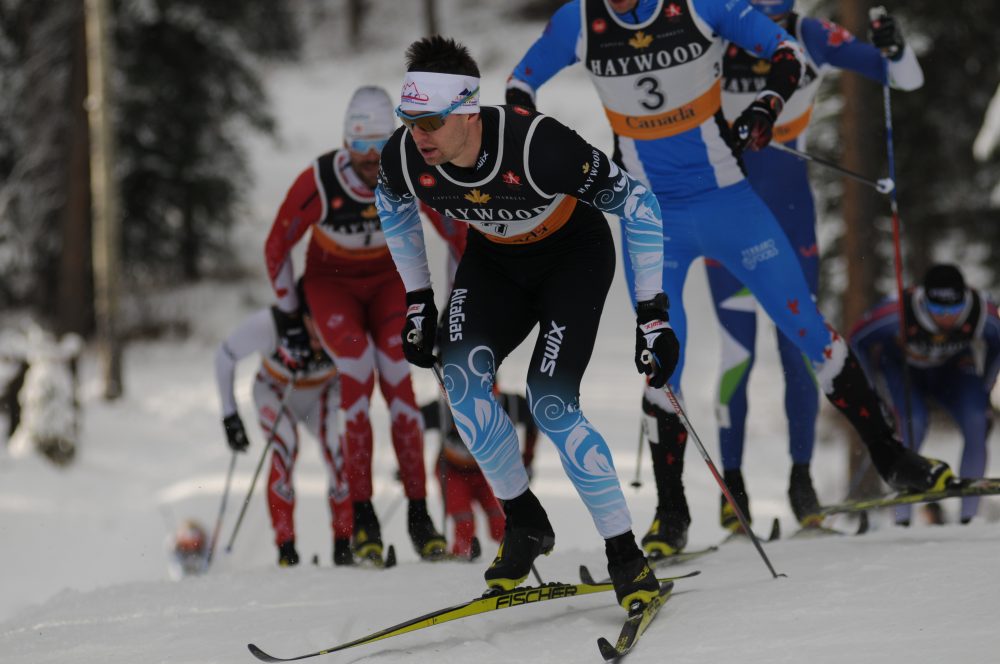
Dominique Moncion-Groulx (Alberta World Cup Academy) leads Julien Locke (3), of Canada’s U25 Team and Black Jack, and Len Valjas (l), of the Canadian World Cup Team, during a Frozen Thunder classic sprint heat on Wednesday at the Canmore Nordic Centre in Canmore, Alberta. (Photo: Doug Stephen)
In the second heat, Locke and Valjas paired up with Knute Johnsgaard (Canadian World Cup Team/AIAWCA) and American Cole Morgan, of the Sun Valley Ski Education Foundation (SVSEF). Thompson and Moncion-Groulx faced another American SVSEF skier, Kevin Bolger, as well as NTDC Thunder Bay’s Andy Shields. Four men advanced to the senior men’s final: Bolger, Thompson, Locke and Valjas.
In the final, Thompson recalled creating what he saw as “a bit of a gap” between himself and Valjas, yet Valjas, a seasoned World Cup sprinter, caught him in the lunge to the line for first. Overall on the day, Valjas placed first, Thompson second, Locke third, and Bolger fourth.
With the King’s Court format, female racers competed in the same same qualifier as the men, with Dahria Beatty (U25 Team/AIAWCA) emerging as the fastest female qualifier in 4:20.66. Her time was 8.56 seconds clear the second woman, American Chelsea Holmes, of Alaska Pacific University (APU), and 10.03 seconds ahead of Katie Weaver (Hollyburn Ski Club) in third. The third-placed Canadian woman in the qualifier, Annika Hicks (AIAWCA) clocked in fourth (+13.25).
In the heats, the women continued to race with the men. In the all-women final, Maya MacIsaac-Jones (U25 Team/Rocky Mountain Racers) took the win, Hicks placed second, Holmes third, and Frédérique Vézina (CNEPH) fourth.
Frozen Thunder racing continues Friday with men’s 10 k and women’s 7.5 k distance races, starting at 9 a.m. Mountain time. In a press release, CCC anticipated a turnout of 115 participants.
Macx Davies, Christian Gow, and Scott Gow of Biathlon Canada training at the Canmore Nordic Centre last weekend in Canmore, Alberta. (Photo: Matthias Ahrens)
Frozen Thunder is back, but it’s not the same Frozen Thunder you knew before.
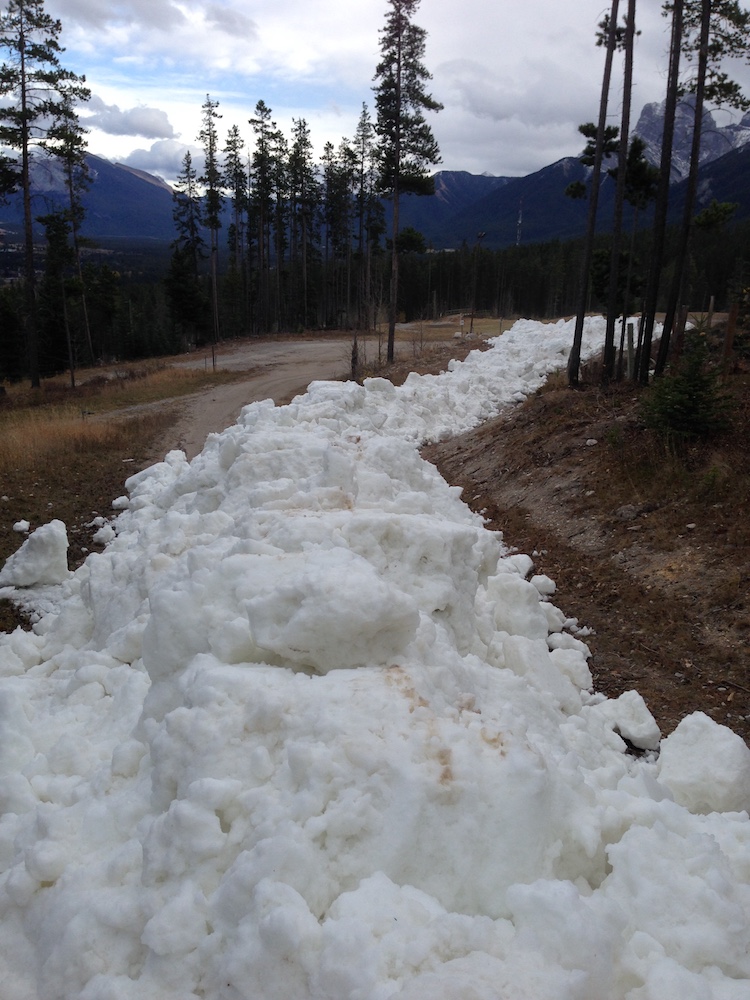
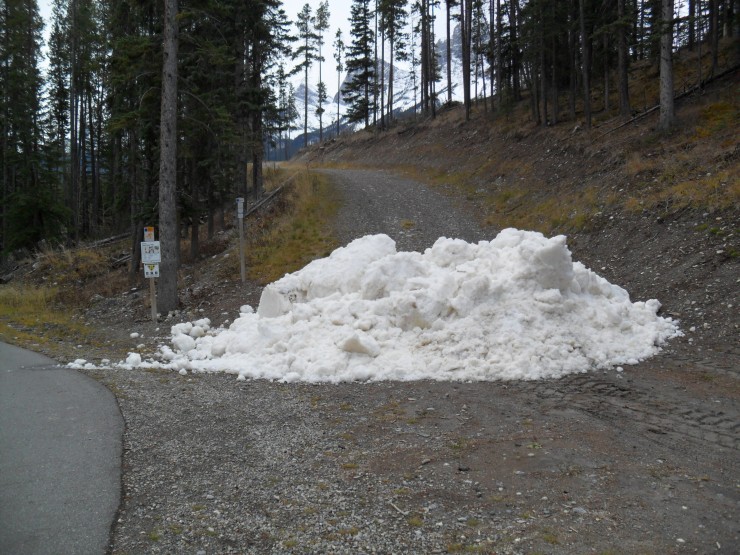
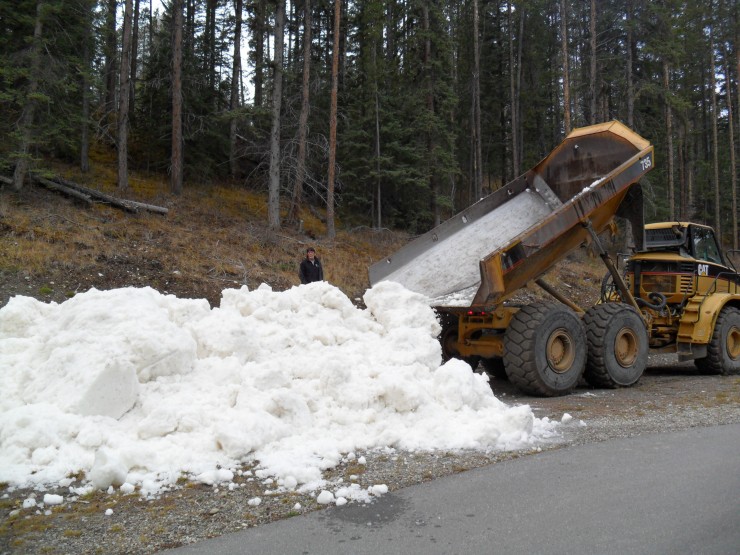
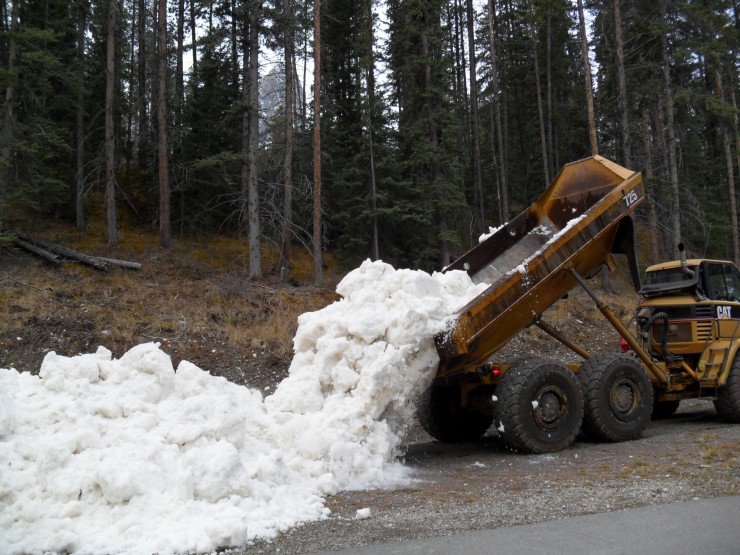
Every year, snow is stored all summer at the Canmore Nordic Centre in Canmore, Alberta, and rolled out in October to provide local ski and biathlon teams with on-snow training opportunities. This year, the loop has changed.
“It feels good to be back on the snow after such a long time away,” Biathlon Canada’s Nathan Smith wrote in an email. “The loop has been lengthened and improved. There is a steeper climb now, which means mandatory offset.”
“They’ve set a new track compared to previous years which is much better for training,” Cross Country Canada’s Jesse Cockney agreed.
Biathlon Canada Head Coach Matthias Ahrens explained that the changes were needed to make the loop more comparable to courses used in international competition. National teams for both biathlon and cross-country skiing will be using competitions on Frozen Thunder to pick their World Cup teams, so they wanted the course to be difficult.
“We were doing intensity Monday,” Ahrens wrote in an email. “The athletes started skiing on Saturday and have not really experienced much challenge to adapt from rollerskiing. We are in the last preparation phase before the first World Cup happens in four weeks, and the training volume is reduced now, but the intensity increased to do the final race sharpening.”
The Space Dogs Ski Club out in force on Frozen Thunder. (Photo: Bob Truman/www.skierbob.ca)
Aside from national team athletes and World Cup hopefuls, the loop has been home to high school racers, families and masters teams.
“The reason you will see a lot of athletes wearing bibs is actually that we have training times for elite athletes from 8-noon,Monday–Friday, since the National and Development Teams have a big stake in funding Frozen Thunder as early season training venue,” Ahrens explained. “Only those who have contributed money to Frozen Thunder get bibs and are allowed to ski in the mornings, just a way to control who is on it. On weekends and afternoons it is open to the public.”
“It was a quiet start to Frozen Thunder with a lot of teams away, so that was lovely to enjoy the new track (a fun turn and more climbing) and not play Rush Hour,” wrote Erin Yungblut, a Canmore-based biathlete. “I think it’s really exciting to have so many teams and talented athletes out… I love being able to ski behind others and learn from as many as I can.”
Among that group is the Space Dogs Ski Club masters team.
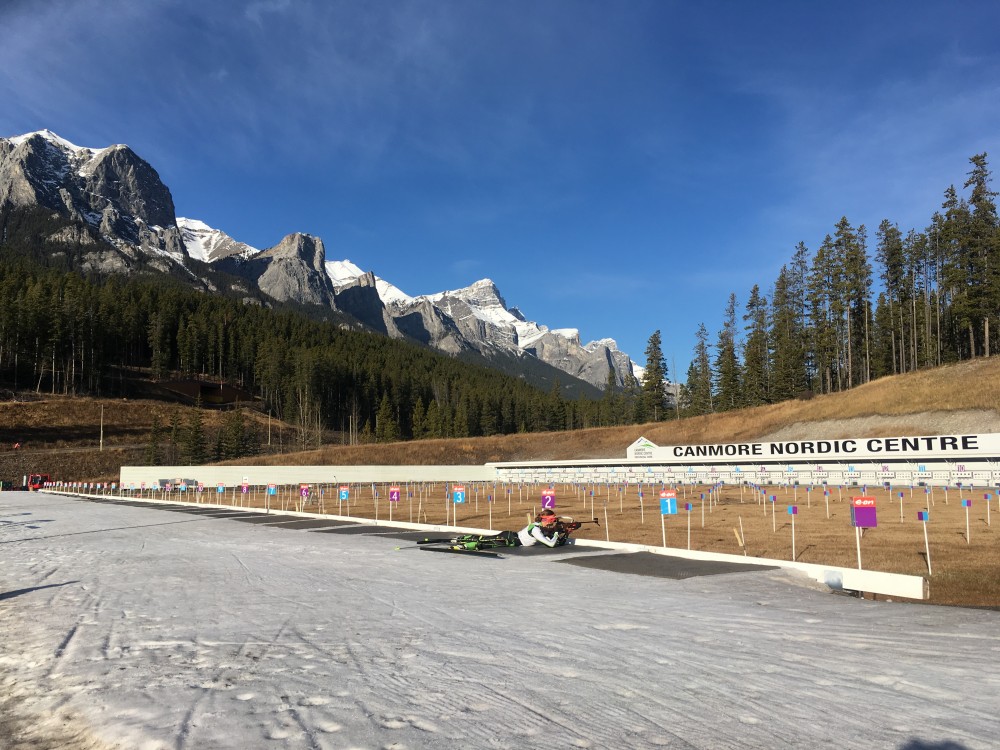
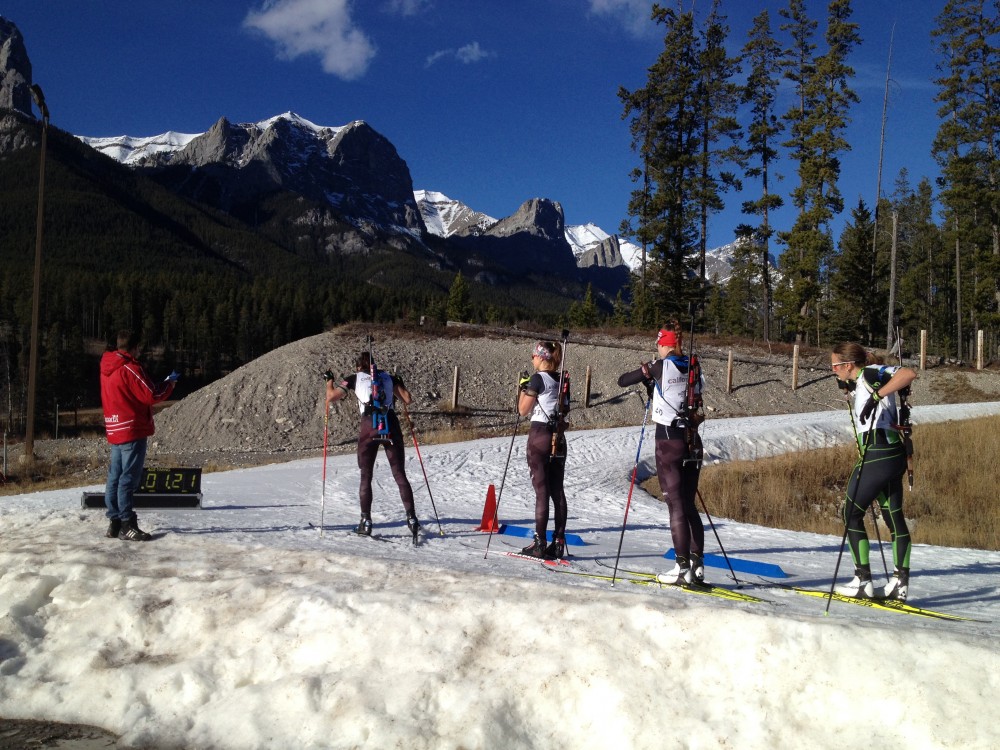
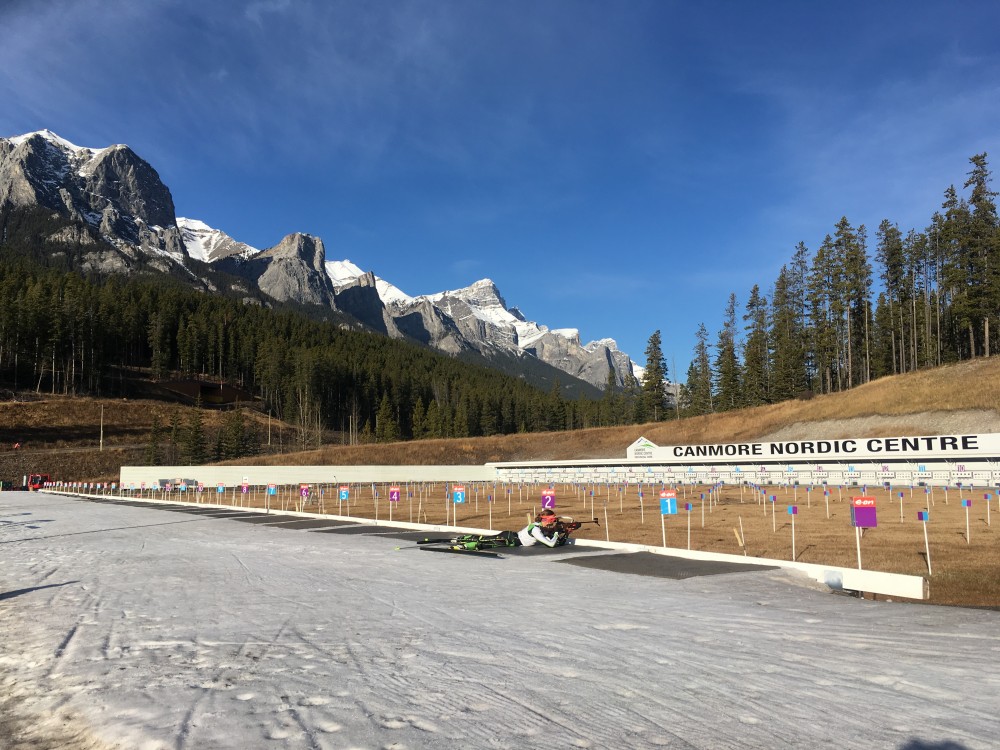
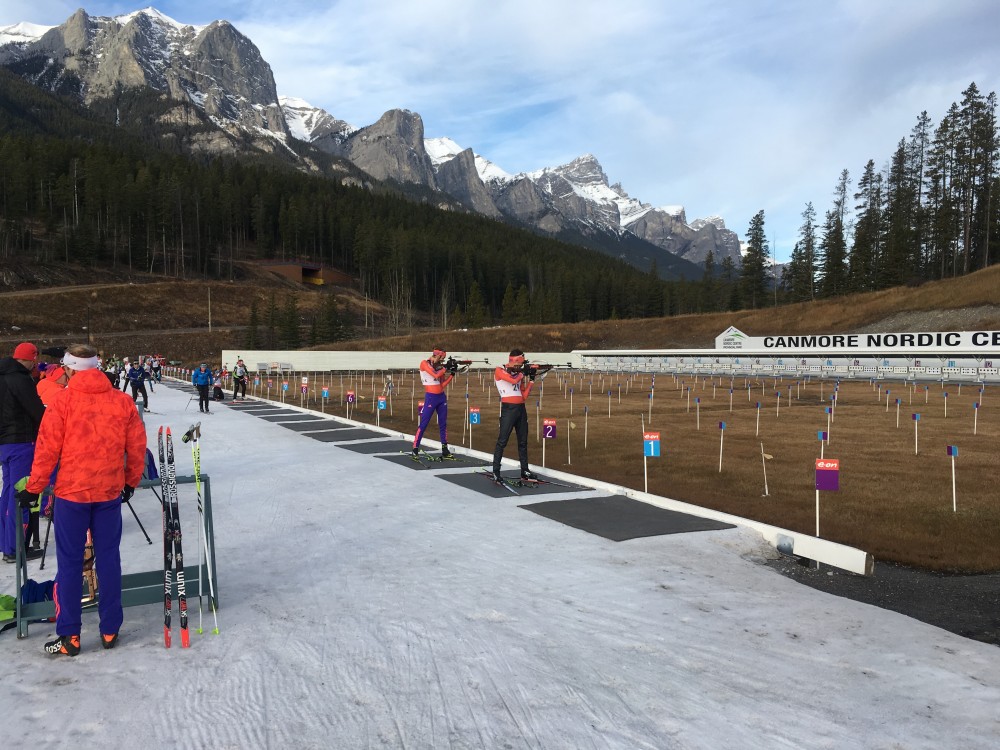
Canadian biathletes training on the shooting range in Canmore. (Photo: Matthias Ahrens)
“For our masters performance group, getting on early snow is probably equal parts technical advantage and motivation/excitement,” wrote Dasha Gaiazova, a Space Dogs coach and former Olympian. “We are grateful that we, and many other skiers of all abilities have an opportunity to train on early snow so close to home. I also believe it makes the Frozen Thunder project more self-sustainable, through sale of general public ski passes, early season ski lessons, and providing great visibility for the sport of cross-country skiing in Canmore.”
Frozen Thunder is getting busier. The Canadian National Ski Team returned from a training camp in Park City, Utah — Cockney had done a shorter camp, thus returning home and getting some extra time on snow. The Canadian biathlon squad already had its first time trial on the course on Thursday. The U.S. biathlon team is also in town now for an on-snow training camp, and the two teams will have joint competitions on Nov. 7-10. Meanwhile, next Wednesday and Friday the cross-country team will hold a classic sprint and skate distance race.
Below, a roundup of some more reactions to getting back on snow before the start of the season:
“It is super fun to be back on snow – rollerskiing is great training, but it simply isn’t the same! I am here in Banff to spend time with my husband before I hit the road for winter racing. I would love to be training with my APU crew in Alaska (there really is no place like Alaska… and yes I am biased as it has and will always be home), but I have been super busy going between Alaska and Banff this summer and I felt it was more important to have this short time with my husband and limit travel these last couple weeks. Not to mention, the Bow Valley is very close to my heart. The terrain in Canmore is great training, lots of transitions and a new stair-stepping climb – they fit a lot into that 2 k loop.”
— Chelsea Holmes, Alaska Pacific University
“Getting on snow the day after returning home from Park City camp was an awesome transition, but I’m quite tired after the time at altitude so I’ll take a couple easy days to get energy back now. I wasn’t so much planning my shorter camp around more time on snow, I was just being careful with energy this late in the training season. As it turns out I may have overdone it anyway in Park City, but it was a really good call to come home and try to recover a bit sooner than the rest of the gang.”
— Jesse Cockney, Canadian National Ski Team
“It’s so amazing to be back on snow again; I still can’t get over how lucky we are to live and train in Canmore with such an epic facility. The transition back to snow has been pretty quick and easy for me as I did a lot of yo-yo camps up at the Haig Glacier this year, so I’m used to icy starts/soft sugar underfoot. Racing definitely feels closer now, and I couldn’t be more excited. I literally have zero pressure or expectations on myself, as I’ve come to realize I’m pursuing biathlon because I love the challenge of it… and the results will be what they are. I don’t think I’ve ever expanded this much [as a person] so quickly. It sounds corny, but I’m finally starting to figure out how to control the controllable and forget the rest of it.”
— Erin Yungblut, Rocky Mountain Racers
“Being on snow as much as possible is one of our priorities for Space Dogs members for a number of reasons:
1. Master skiers usually have full-time jobs, and families to look after, so their training schedules are compressed, and the workouts have to be as specific as possible.
2. Many masters have old injuries and accumulated damage to their knees / back / hips, which makes it impossible for some to run, or to do other dryland-type workouts. The more they can ski, the more training is accomplished pain-free.
3. Training around high-performance athletes allows for learning through watching, and through imitating. Sometimes, seeing someone ski with good technique is a lot more powerful than having it explained in concept terms.
4. Skiing in crowded spaces is beneficial for loppet racing practice. We purposely arrange some of our workouts around busy trail times, so that our skiers are more comfortable skiing on crowded trails, which is what a loppet race experience usually feels like.”
— Dasha Gaiazova, coach, Space Dogs Ski Club
“I’d say the transition had gone smoothly and no different than previous years. I’m careful not to adapt my technique in the summer for rollerski efficiency. I’m feeling pretty strong and have been performing fairly well vs. my team mates in time trials. Of course, that is just a sample of 5 athletes. I think it’s dangerous to proclaim that everyone is fit and crushing it before the reality check of World Cup. I’ve seen that this can build up unrealistic expectations. That being said, I’m feeling confident and have a good feeling that things are going to work out well. I will be in top fitness when the time comes in Europe and Korea.”
— Nathan Smith, Biathlon Canada National Team
“With not getting onto the Haig Glacier because of snow melt, our team hasn’t been on snow since May. The transition was easy for me this year and it feels like second nature to be back on snow. I will admit to the first couple of strides feeling like skis are quite long, but that didn’t last long… It was a bit sad while they were pushing out Frozen Thunder, because we had about three days of rain. So far it is holding up nicely and we just have to hope that colder temps are in the forecast.”
Early season skiing at the Sovereign Lake Nordic Centre on Oct. 14, 2017. (Courtesy photo)
When you think of skiing in Canada in October, Canmore’s Frozen Thunder is probably one of the first places that comes to mind. There are more options and some snowmaking that might surprise you.
This month, Canadians are skiing on natural snow, machine-made snow and farmed snow. We know skiers are already out and about in Alaska and other parts of the U.S. as well, which is why we want this year’s early season “Where The (Skiable) White Stuff Is” to compose of reader submissions. If you know where there’s November or even October skiing in the U.S. or Canada, please write us with details (When does it open or how long has it been open? How many groomed kilometers are there? Is there snowmaking? Any special events planned, like American Thanksgiving camps? Anything else we should know?)and original photos at info@fasterskier.com with the subject line: “Fall Skiing”. Deadline for submissions is Nov. 3.
To get the ball rolling, FasterSkier’s Gerry Furseth checked in with several nordic venues across Canada. They’ve already celebrated Thanksgiving, and full-on skiing is just around the corner.
Frozen Thunder
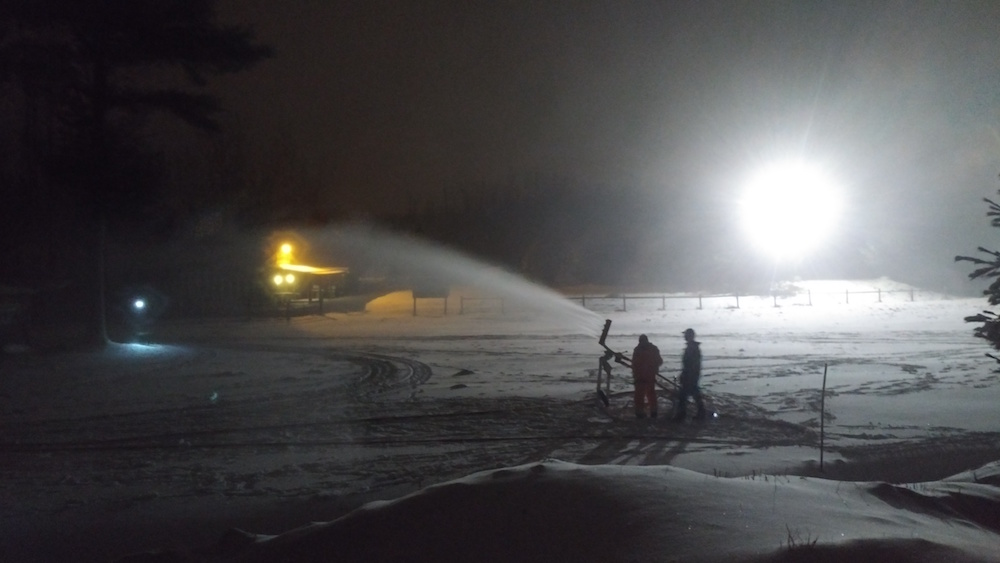
Canmore has started building Frozen Thunder for 2017. This is what it looks like with five days to go. (Courtesy photo)
The action starts on Oct. 21 with some changes for the eighth season. There will be a bigger hill as requested by the national teams and a new emphasis on avoiding exposed south-facing slopes.
The Canmore Nordic Centre (in Canmore, Alberta) is an unusual venue, one of the select few that has machine-made snow, farmed snow and natural snow.
“There is obviously an issue [with manmade snow] around warmer temperatures,” Area Manager Michael Roycroft told FasterSkier. “Last year is a good example where most of November was too warm to make snow, and that’s where Frozen Thunder comes in. That’s why we have our storage option, that allows us to essentially have snow no matter what.”
Frozen Thunder is funded mostly by national and provincial ski organizations and the focus is on providing training opportunities for high-level competitors. The snowmaking has a broader focus.
“The natural snow is obviously helpful, and it covers the rest of our trail system that’s further to the west and higher up, but it wasn’t for machine-made snow in Canmore and the nordic centre, we simply would not be able to run as a nordic facility,” Roycroft said.
Machine-made snow covers 30 kilometers, leaving 40 k dependent on natural snow.
A big job requires big machinery. (Photo: Canmore Nordic Centre)
Whitehorse
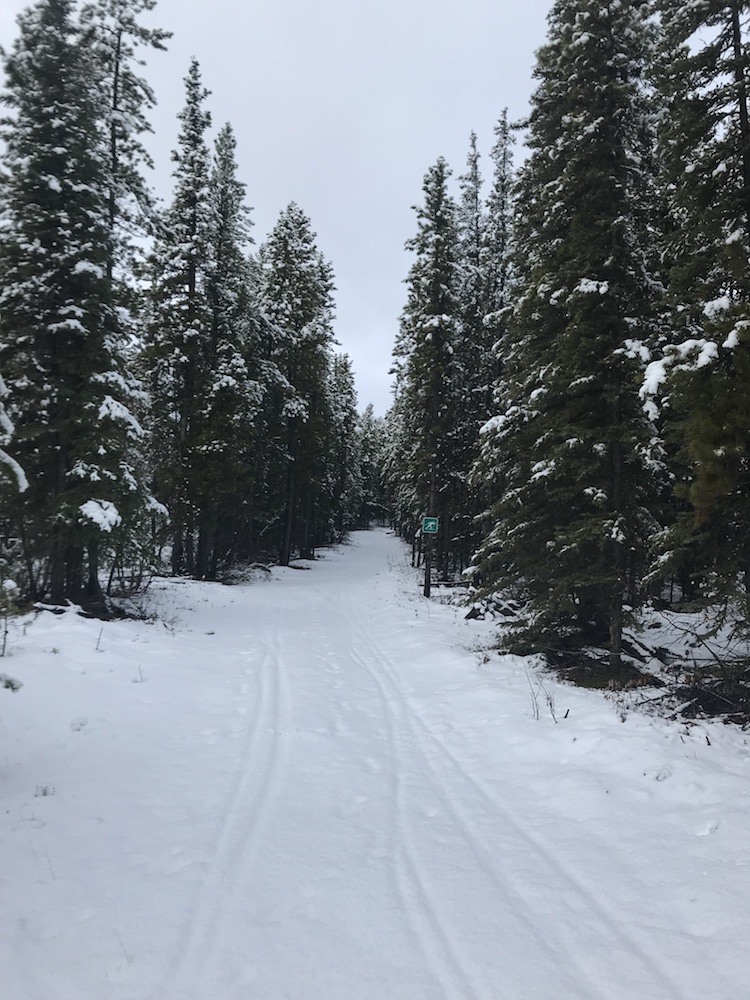
Whitehorse ski trails on Oct. 15, 2017. Another 5 centimeters was needed to set track. (Photo: Alain Masson)
When you think of Whitehorse, you probably don’t think of snowmaking. But Cross Country Yukon’s Alain Masson does.
“In the past, we often had snow available for skiing for our more advanced skiers, but it was not available to everyone,” Masson wrote in an email. “This year, our developing skiers will all have access to some early skiing in good man made snow conditions a month earlier than usual.”
Much of the early season skiing in Canada is not intermediate friendly. Thin snow, tripping hazards and travel to elevation create a barrier to less advanced or less committed skiers. The Whitehorse Cross Country Ski Club is using snowmaking to make the early season more inclusive.
The new snowmaking equipment will be used for the first time on Oct. 22.
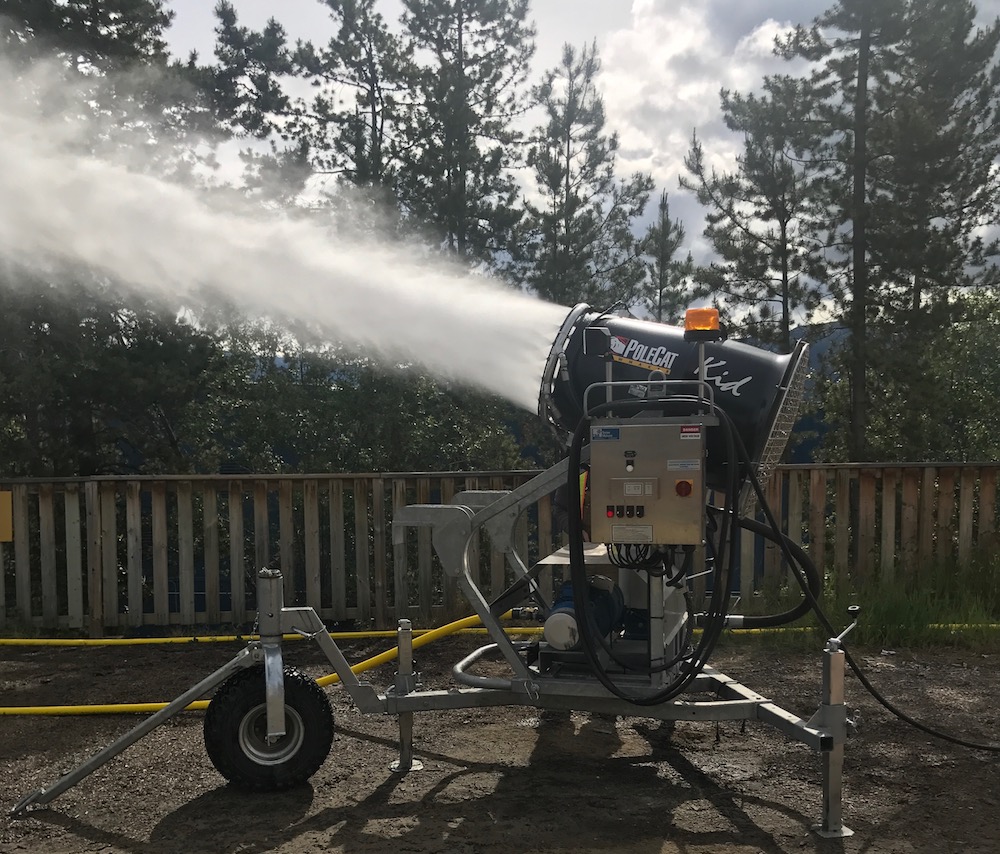
Testing the new gun in June 2017. (Photo: Alain Masson)
Sovereign Lake
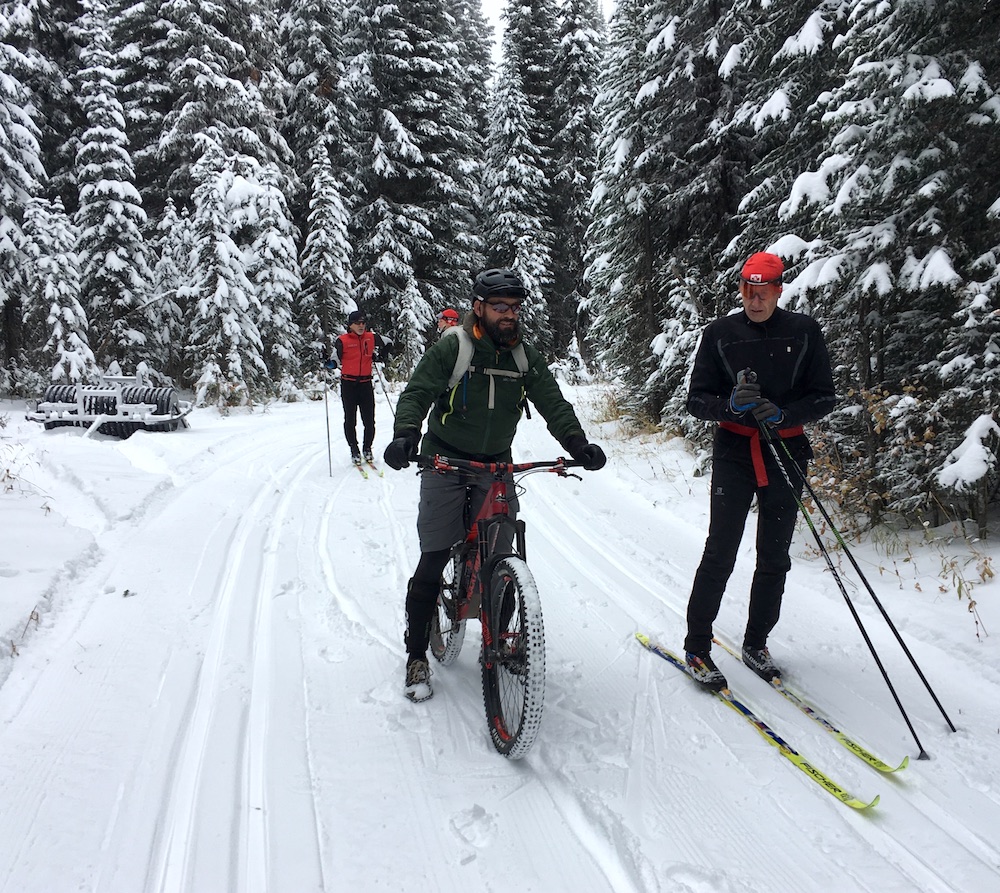
There is a difference of opinion on what season Oct. 14 belongs to. The bikers might have chosen fat bikes over plus bikes if they had realized how much snow they would see on their epic ride from Vernon to Lumby, B.C. (Photo: Gerry Furseth)
The Sovereign Lake Nordic Centre (near Vernon, British Columbia) is well known for November skiing and NorAm races. The season is limited not by loss of snow, but by biking conditions in the valley below.
“As soon as Sovereign gets snow in the fall we want to conserve as much as possible by rolling and track setting,” General Manager Troy Hudson wrote. “All of our early season grooming is done with Quads and snowmobiles to ensure a firm and supportive snowpack for the remainder of the season. Our high elevation (1,680m) and typical higher humidity in late October provides unpredictable weather that can often result in snowstorms of 10-15cm at a time.”
With 20 centimeters of fresh snow, the club set about 5 k of classic track on Oct. 14. While certain trails are open for preseason skiing, the nordic centre officially opens Nov. 10 for pass holders and day ticket sales.
Menihek Nordic
Menihek is another former national-team favourite destination that has since been replaced by Frozen Thunder. Located near Labrador City, Newfoundland and Labrador, it is a less-visited gem. While the Menihek Nordic Ski Club hasn’t received much snow to date, it is a safe bet that by the end of October they will be setting upwards of several kilometers of track.
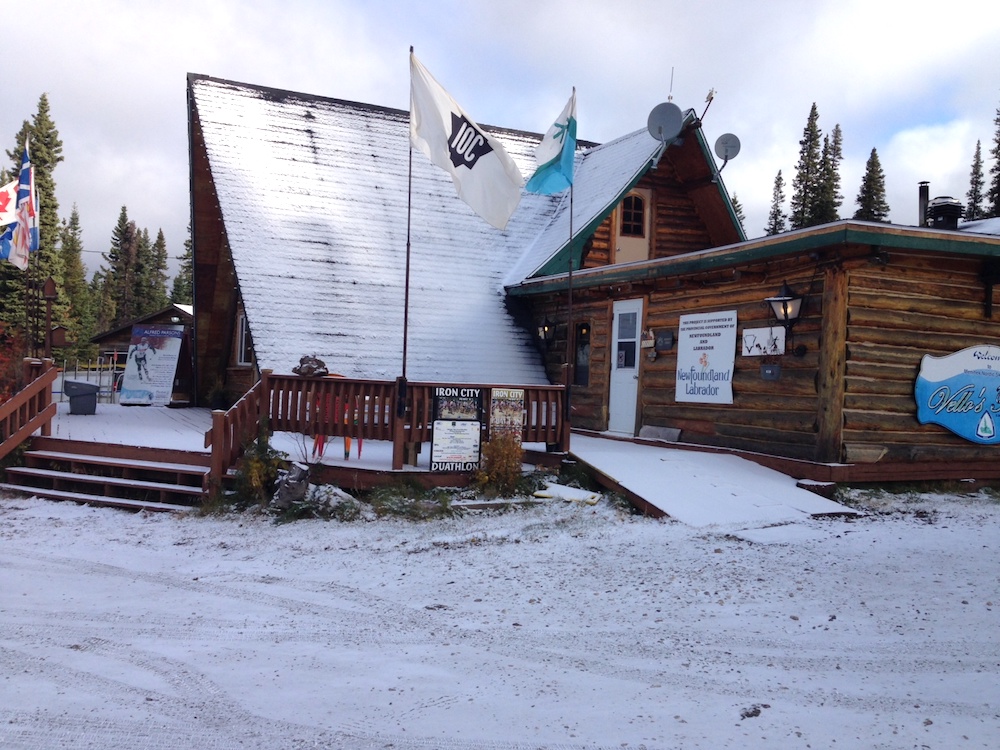
On Oct. 12, a dusting of snow was seen at the lodge. (Photo: Gerry Rideout)
Bob Thompson (NTDC Thunder Bay) competing at last season’s World Cup in Lillehammer, Norway. He’s shooting for another round of Period I World Cup starts this season and, he hopes, an Olympic berth. (Photo: Fischer/Nordic Focus)
Bob Thompson won his first NorAm in 2014, at Olympic trials in Canmore, Alberta. The then-22-year-old Canadian cross-country skier skied safe and smart and took the victory after two pre-race favorites, Jesse Cockney and Phil Widmer, collided near the finish.
That win didn’t earn Thompson an Olympic berth for Sochi. But this year, the Thunder Bay National Team Development Center (NTDC) athlete is hoping to get to PyeongChang, South Korea – and hopefully, to avoid needing an Olympic trials win to do so.
“I’ll do the Frozen Thunder race [in Canmore in November] – I think it’s just one race this year – to get Period I [World Cup] starts,” Thompson, 26, said of his goals for the beginning of the season. “So then get on the Period I World Cup, and then from there that’s the only chance to get another two top 30s to get the Olympic qualification locked in.”
After finishing 30th in the World Cup Finals sprint in Quebec City in March – his first World Cup points – Thompson is one-third of the way to qualifying for the Olympic team, most likely.
Nominations go preferentially to athletes who have finished twice in the top-16, or have one top-12 distance result or one top-six sprint result, or are part of a podium relay or team sprint. Five men have hit those marks.
Bob Thompson sprinting to second in the 2016 skate-sprint qualifier last fall at Frozen Thunder in Canmore, Alberta. The performance earned him the final spot on Canada’s 2016 Period I World Cup team. (Photo: Drew Goldsack)
But if the team is not filled yet with men meeting those criteria – and it probably won’t be, as the Canadian team intends to take around seven men – the next spots will go to athletes with three top-30 World Cup results. That’s the mark Thompson is after.
He already has one result in the bag.
And he is familiar with Period I World Cups, considered by many to be the most difficult and competitive World Cups of the season. Most countries send a full team of athletes to every event, not true some other weekends of the year. And when World Cups are hosted in Norway and Finland, the 15 “extra” athletes the home country is allowed to enter as a “Nations Group” are pretty high-caliber skiers.
“From an actual racing standpoint, I had [Russia’s Sergey] Ustiugov go by me when I was on my first lap and he was on his second lap,” Thompson said of a distinct memory from those races last season. “He just dropped me immediately. It was this realization, that, OK, I should be going a lot faster. I’m trying to do that … getting more World Cup experience under the belt.”
But despite the wake-up call of racing the very best and deepest fields in the world, Thompson felt that he had executed well last season and now has experience to build on.
“Those races were really good,” Thompson said of the 2016 races. “I guess I didn’t do as well as I had hoped – I had hoped I would get a top 30 in that period – but in Lillehammer I tied my previous best World Cup result, which was my very first one from Gatineau from the Ski Tour Canada. I was 52nd.”
Thompson had another opportunity to get World Cup points last season when he was selected to race in PyeongChang for the World Cup test events. Like many countries, Canada didn’t send most of its A-team because the races were before World Championships and team leaders worried about fatigue. Thompson, Cockney, Simon Lapointe, and Julien Locke joined World Cup regular Len Valjas in PyeongChang.
Bob Thompson (NTDC Thunder Bay) racing to second in the men’s classic sprint qualifier at 2016 Western Canadian Championships in Prince George, B.C. He went on to win the men’s final. (Photo: Sally Connon)
It was a bitter moment for Thompson, in a way, because he finished 31st in the sprint qualifier, just 0.01 seconds out of the quarterfinals. That would have guaranteed him a top 30 and, perhaps, something much better than that.
It was a race effort imperfectly executed, something that Thompson remembers.
“I definitely knew multiple places where I didn’t ski it well enough,” he said. “There was one place where my wax caught on me, and then I tried to prevent that from happening again and took a corner too wide, easily losing at least a second. … I definitely felt like I could have had a decent result there. I mean, anyone can say that, but, yeah.”
The pressure of having a good result is something that Thompson has grown used to, as he is constantly trying to qualify for something – a competition, a team, funding.
“Every World Cup start I’ve had so far has had pressure to get that top 30,” he explained. “I always felt like I had to have near my best day to do it.”
So in a way, this year’s Period I (if he gets there via Frozen Thunder) won’t be any different. The big change is that now he does have one top-30 under his belt, and in a field more competitive than in PyeongChang, too.
If he doesn’t hit the top 30 twice in the initial period of World Cup racing, Thompson will need to manage the transition back to Canada better and excel at January’s Olympic trials, to be held in Mont Sainte Anne, Quebec.
That will require refocusing, and Thompson had an important cautionary lesson about it last season. It had been his first time spending a whole period on the World Cup, and between the racing and the travel it took more out of him than he had expected.
“Coming out of that is where I guess I learned the most,” he admitted. “We came back from Europe and were set on doing a bit of a recovery period before the U.S. Nationals races, which were trials races. But we decided we couldn’t pass up the opportunity for the Rossland NorAm weekend because it was the Period II qualification, for whoever won the weekend. We thought that I had raced well so I was going to be fast. And it turned out that in hindsight, that was a mistake as it was a bit too much travel for me or a bit too much load.”
This year, with so much on the line, Thompson is trying to be aggressive but also careful.
His plans hit a snag in August when Thompson fell ill and missed several weeks of training. With his coaches he has made the tough decision to skip an on-snow camp on the Dachstein glacier in Austria and try to gradually build back into full training without overdoing it. By November’s race in Canmore, he hopes to be back fully to himself.
Before getting sick, things had been going well.
“Maybe I was a little more tired than I should have been, but it was starting to get better, especially around the Alignment Camp we hosted in Thunder Bay,” Thompson said. “That was a lot of fun and a well-organized event. It was really good to have everyone who came to that, to train with us, and we could showcase the training venues in Thunder Bay. … I think I was not getting enough recovery after a few key workouts, but in July I made note that I was feeling a little bit run down and I started to address that.”
He is also taking advantage of some non-coaching support systems available in the Thunder Bay area.
“We have been focusing this year on nutrition,” Thompson explained. “We have been working with the Canadian Sport Institute Ontario a little bit more. I’ve been getting plans from their nutritionist as well as doing more work with their sports psychologist and physiologist. Those are a few of the small things that I hoped would be that extra percentage to help ramp me up for this Olympic year.”
And another thing has changed for Thompson as well. Thanks to that 30th-place finish in the Quebec World Cup, he is now a “carded” athlete, receiving a monthly stipend from Sport Canada.
It’s not enough money to change the material aspects of his life, but it has done two things. The first is to release Thompson from some of the pressure to do odd jobs whenever the opportunity arises.
“Previous years, I have worked for older former skiers who have properties or rentals that need fixing up,” he said. “A number of us on the team have been doing that. But now it’s sometimes like, well, actually, I don’t have time. I have too much training. I don’t necessarily feel like I need to take all those opportunities which could take away from training opportunities due to fatigue levels and spending time not resting.”
And secondly, having his own money to live on has been mentally freeing.
“I have been very fortunate from my parents being very supportive of my racing,” Thompson said. “But just the fact that I wasn’t paying for it myself, or was paying for limited aspects of it – to have skied fast enough to have that income now, takes the strain off my parents and the pressure off myself for feeling like I was draining them too much.”
It might seem trivial, but along with the sports psychology work it has made a big difference in Thompson’s outlook.
“That in itself, the mental relief – I think I have been looking for that for the last five years, ever since I’ve been a senior athlete,” he said. “Ever since I entered the realm of, OK, now I should really be able to make it if I’m competing at the top level in Canada. So I think most of all it has been a good mental boost just to have that.”
(From left to right) Bob Thompson (NTDC Thunder Bay) chases Lenny Valjas (Canadian World Cup A-Team), Graeme Killick (AWCA/NST B-team), and Knute Johnsgaard (AWCA/NST U25 Team) at the start of a classic sprint heat at 2016 Frozen Thunder in Canmore, Alberta, on Nov. 1. (Photo: Jenn Jackson)
As promised, the Canadian version of “Where the (Skiable) White Stuff Is” (a.k.a. November skiing) is here, minus the bit about where to ski at Thanksgiving. Canada doesn’t usually have much snow at Thanksgiving, mostly because Canadian Thanksgiving is in early October. But by the time U.S. Thanksgiving rolls around in late November, there is an abundance of reliable snow to choose from in Canada.
In addition to major camps and well publicized early season track setting, there are a lot of places in Canada where people quietly start skiing when there is snow. Whitehorse in the Yukon is one of those places where “early” doesn’t have the same meaning as it does in the south. No one will advertise October skiing at Barkerville, British Columbia, but the Caledonia Nordic Ski Club in Prince George can tell you about it. FasterSkier’s West-Coast based Canadian contributor was on snow Oct. 8 this year.
All of the western venues mentioned here were affected by the same weather pattern than forced the cancellation of the Bozeman SuperTour. A heatwave rolled in on Nov. 3, starting with a very warm classic sprint in Canmore, Alberta, and ending in spectacular flooding near Whistler, B.C. It has been a better start in the east.
This article will focus on reliable set track and camps open to the public in November — in Canada (for the U.S. version, click here). If your favourite early season spot isn’t featured, you are in good company. Let us know in the comments below.
And if you are visiting Canada, remember that the U.S. dollar is worth $1.35 up here.
***
CAMPS
XC SuperCamp
Where: Sovereign Lake Nordic Centre and Silver Star Mountain Resort, Vernon, B.C.
A trailside photo from 2015 SuperCamp at Sovereign Lake/Silver Star (Courtesy photo)
SuperCamp has evolved over 30 years, but its always been held on natural snow and it’s always run camps in November. Four of this season’s seven camps are in November, and biathlon options were offered this month as well.
“SuperCamp is a very comprehensive nordic experience,” Shane Landreville, SuperCamp coordinator, wrote in an email. “Trail passes are included, as are lunches, off snow programs, wax sessions, massages, and ski demos.”
Ski-in/ski-out accomodation and restaurants are available at Silver Star. Vernon, a 20-minute drive and 1,200 metres lower in elevation, offers a wide range of food and lodging alternatives. Some of the November camps sold out in mid-October when registration opened.
Glenn Bond XC Ski Camps
Where: Labrador City, Newfoundland
The 2016 Glenn Bond XC Ski Camp at Menihek Nordic on Nov. 3. (Courtesy photo)
The four-year old Glenn Bond XC Ski Camp program travelled to Menihek Nordic in Labrador City, Newfoundland, for a November camp on natural snow.
“[This camp] was November 3-6 with 70-80 cms of snow and big smiles,” Bond wrote. “Menihek Nordic wins the prize for best early season xc ski conditions this year hands down.”
(Longtime SuperCamp attendees remember Bond from his time with that program.)
NATURAL SNOW
Menihek Nordic
Where: Labrador City, Newfoundland and Labrador
Fifty centimetres (roughly 20 inches) of natural snow at Menihek Nordic in Labrador City on Oct. 23, 2016. (Photo: Menihek Nordic)
Mention ‘Lab City’ to a national team member from the 1980s and you will see the good memories scrolling behind the smile. In the glory days of Pierre Harvey, the national team would kick off its season at Menihek before moving on to Silver Star for an early season elevation camp. After that national team stopped visiting the venue in 1988, it quietly dropped off the radar, to the point that FasterSkier missed this October skiing opportunity in last year’s guide.
Labrador City is not visited by many tourists. It’s at least a 13-hour drive from Quebec City, which is the nearest major population centre. But there are some big-name skiers that have visited, including Sweden’s Gunde Svan, Americans Bill Koch and Tim Caldwell, Norway’s Anette Bøe, and the Firth sisters from Canada’s Northwest Territories. Menihek Nordic hosted the 1983 World Cup Final, the 1985 World Cup opener and was a national training centre from 1981 to 1988. Mining communities are often multicultural: the World Cup hosts were able to find local translators for 20 languages from a population of less than 10,000. Koch designed some of the trails in 1981.
What makes this venue unique, other than reliable October-to-May skiing?
“Labrador is unique in that it is nearly the last frontier,” Menihek Nordic Ski Club President Gerry Rideout explained. “There is a certain magic about Labrador, it gets in your blood.”
This season, Menihek opened on Oct. 23, held four camps in November, had the full 34 k system set on Nov. 3, and plans to stay open to the first week of May (as usual).
Sovereign Lake/Silver Star
There were lots of smiles during U.S. Thanksgiving at Sovereign Lake. Methow Valley Nordic coach Laura McCabe (a two-time Olympian) led 30 kids over the top from Silver Star and FasterSkier caught them on the way back. Locals know to start at Sovereign and stop for a croissant in Silver Star village to fuel the second half of the ski. (Photo: Gerry Furseth)
This destination is actually two ski areas. The Sovereign Lake Nordic Centre (also Sovereign Lake Nordic Club) has been operating since the 1930s under a variety of names, while Silver Star Mountain Resort is more recent, opening as an alpine-skiing area in 1958. The two organizations have 105 kilometers of interconnected nordic trails and a surprisingly good relationship between the commercial resort and the volunteer-based club (which is one of the largest cross-country ski clubs in B.C.). Silver Star hosted a World Cup in 1991, Sovereign Lake in 2005.
Daily track setting runs from November to early April, with the full 105 k usually available from late November to mid-March. Sovereign Lake reopens in May for team camps and diehard skiers.
This season, both sides opened 10 days late on Nov. 20, with 57 k set by Nov. 25.
“We are still well below our average snow pack for this time of year, but are optimizing our small machine grooming to create great tracks and corduroy,” Sovereign Lake manager Troy Hudson wrote in an email on Nov. 24.
There were at least eight private camps in November, ranging from a master’s women’s group to biathletes to a combined U.S. club camp with the Mt. Bachelor Sports Education Foundation, Methow Valley Nordic and Momentum Northwest from Oregon and Washington.
MANMADE & STORED SNOW
Frozen Thunder
Where: Canmore Nordic Centre in Canmore, Alberta
Canmore is perhaps the best known of Canada’s nordic venues. Between the 1998 Olympics, reoccurring World Cups and last season’s final stages of the Ski Tour Canada, it is famous beyond the skiing world. Each October, Frozen Thunder opens a small loop with a combination of stored snow and manmade snow.
This year, Frozen Thunder opened on Oct. 22 with a 1.7 k loop. The regular season began on Nov. 19 and is scheduled to run to April 30. So far, Canmore has hosted seven days of cross-country ski races and three biathlon races in November. All the camps were private, with the Ukraine biathlon team traveling the farthest to Canmore.
Boreal Glide (Glisse Boréale)
Where: Forêt Montmorency, owned by the Université Laval, in Saint-Ferréol-les-Neiges, Quebec
Skibec skiers on the Boreal Glide at Forêt Montmorency north of Quebec City. (Photo: La Forêt)
Located 45 minutes north of Quebec City and belonging to Laval University, the ‘Boreal Glide‘ is an early season favourite in Quebec. Set in the largest teaching and research forest in the world (at 412 square kilometers), La Forêt Montmorency has 2.5 k of early season trail using stored snow and a larger system that depends on natural snow. As of Nov. 20, it had 20-24 inches of packed snowed and track groomed for both skating and classic.
“If I had to invest my money in one single cross-country skiing area in North America, I would honestly choose the Forêt Montmorency,” La Forêt’s Director of Operations Hugues Sansregret wrote in an email. “The fact that it sits on top of the Laurentian mountains is the best guarantee for early skiing.”
Boreal Glide opened on Oct. 28 without any official camps or events — just skiing. Can’t argue with that.
Callaghan Gold
Where: Whistler Olympic Park, Callaghan Valley, B.C.
Callaghan Gold on Nov. 7, 2016, at Whistler Olympic Park in Callaghan Valley, B.C. New this year, the loop includes the biathlon range. (Courtesy photo)
Canada’s other Winter Olympic venue has created Callaghan Gold, an early season loop of stored snow. The regular season opens on Nov. 24 (U.S. Thanksgiving) and ends in early April. Located in a cool valley surrounded by rainforest, this venue has been known for lots of snow in non-Olympic years. Weather has been a challenge in the fall of 2016, eased by two last-minute storms that expanded the stored snow loop to 21 k during the opening weekend.
In the project’s four-year history, Callaghan Gold has met some challenges. In its experimental year, the stored snow came out ‘gold’, coloured by the sawdust insulation. In 2014, the storage methods were improved and an 800-metre loop of lovely, white snow greeted skiers on opening day. In 2015, record-setting warm weather melted all the snow in March, leaving nothing to store. In 2016, Callaghan Gold opened on Oct. 29 with 600 metres of trail, expanding to 1.4 k on Nov. 4.
“The warm temps and significant rainfall of November took its toll on the Callaghan gold trail depth but we feel it held up well considering,” managing director Tim Hope wrote in an email.
Nakkertok Nordic
Where: Gatineau, Quebec
Nakkertok snowmaking in action for the first time in November, 2016. (Courtesy photo)
With two sets of ski trails just outside Ottawa and Gatineau, Nakkertok is the newest addition to reliable November snow. This month, one of the country’s largest ski clubs recently turned on its brand-new snowmaking equipment (which was largely funded by from its Project Play grand prize) and opened for skiing on Nov. 25.
According to Nakkertok Head Coach Kieran Jones, the club turned on five snow guns for the first time on Nov. 20 and was excited to test its new system and equipment. That night, the trails received an additional 15 to 20 centimeters of natural snow.
“Winter has definitely come to Ottawa-Gatineau, which is awesome!” Jones wrote. “Our initial goal was to create an 800m loop that covered our stadium, and extended out both ends. At that point we could then begin to push snow further to create 1 km of skiable terrain with a couple of quality climbs as well.”
He hoped they would have 1 k open for skiing by the end of last week.
“For now, the focus is on making sure we can have skate grooming,” Jones added. “Classic tracks will depend on the depth of snow that we’re able to produce. Nakkertok isn’t officially open to the public for day usage of the loop yet, but we’ll let you know as soon as it is!”
The Nakkertok Early Season Ski Loop (NESSL) is an important step for the region.
“It is great for the club, other clubs in the region and should allow a quality early season race site in the East,” Nakkertok fundraising mastermind Toni Scheier wrote in an email. “It will also ensure snow for the Easterns where clubs from across the country attend, (700 plus competitors) and for our Nationals bid, likely 2019.”
Left to right: Biathlon Canada’s Rosanna Crawford, Julia Ransom, Megan Tandy, and US Biathlon’s Susan Dunklee at the start of the women’s 7.5 k sprint on Wednesday, Nov. 9, at this year’s Biathlon Canada team selection time trial races at Frozen Thunder in Canmore, Alberta. (Photo: Matthias Ahrens)
(Note: Biathlon Canada’s World Cup team trials wrapped up last Thursday, but selections had not been publicized as of Monday. Stay tuned for the final team selection details.)
While pushing past the overgrown, browning grass lining the Canmore Nordic Centre’s shooting range last Wednesday, Rosanna Crawford could feel the pressure.
Not pressure to qualify for a team, pressure to prove she deserved her preselected spot on Biathlon Canada’s A (officially “Eh!”) squad.
The 28-year-old team veteran did just that by the end of Biathlon Canada’s two-day team selection races, which ran this year from Wednesday, Nov. 9 to Thursday, Nov. 10 at Frozen Thunder in Canmore, Alberta. Crawford took the wins in both women’s sprint events. However, even after winning Wednesday’s 7.5-kilometer sprint by more than 30 seconds, Crawford wanted more from her shooting after she missed three shots (2+1).
Biathlon Canada High Performance Director Eric de Nys (l) with US Biathlon’s Susan Dunklee (c) and Biathlon Canada’s Sarah Beaudry (r) at the start of the women’s 7.5 k sprint on Thursday, Nov. 10, at this year’s Biathlon Canada team selection time trial races at Frozen Thunder in Canmore, Alberta. (Photo: Matthias Ahrens)
“With being pre-qualified you always want to prove that you deserve to be pre-selected,” Crawford wrote in an email on Wednesday. “I had high focus and expectations for shooting and am really disappointed with 3 misses, that won’t do on the World Cup. I have been training quite a bit leading into these races, so I am looking at it as a good chance to practice pushing hard while tired and shooting well. Today was a mentally and physically draining race, but conditions that we might encounter in the winter.”
Crawford explained that Wednesday’s conditions were particularly challenging, with a fair amount of wind and temps hovering above 16 degrees Celsius, turning the 2.6 k race loop into slush.
“It was quite windy and not really consistent which definitely hurt people on the range,” Crawford wrote. “My race started off with a good first lap and then it turned into a slow crawl by the finish, it just got slower and slower as the sun beat down on the tracks. We did the same race [format] on November 4th which took 21 minutes, and today [Wednesday] was 27 minutes!”
US Biathlon national-team members Joanne Reid and Susan Dunklee also competed in Wednesday’s competition, finishing second and third, respectively. Reid clocked in 34.4 seconds back from Crawford’s time with three misses (1+2) and Dunklee also finished with three misses (2+1), 35.5 seconds behind Crawford. Reid explained that for the U.S. women, competing in the time trial provided an opportunity to fine tune their racing prior to the official start of the IBU World Cup season.
US Biathlon’s Susan Dunklee shooting prone during the women’s 7.5 k sprint on Thursday, Nov. 10, at this year’s Biathlon Canada team selection time trial races at Frozen Thunder in Canmore, Alberta. (Photo: Matthias Ahrens)
“Since our trials races are over and the women’s team is already selected, there is no results pressure for us. Instead we are focusing on getting all the pieces together to launch into a successful first period of the World Cup,” Reid wrote of herself, Dunklee and Clare Egan, all on the U.S. women’s biathlon team, in an email on Wednesday. “All three of us are still adapting to some changes, different trigger weights, entirely new actions, sight risers, that sort of thing, so these time trials were just about practicing these new developments in a race environment.”
In Thursday’s women’s 7.5 k sprint, Crawford repeated with another victory, completing the course in a time of 22:08.2 with three misses (2+1). While desiring better shooting, Crawford remained optimistic about being able to hone in on her accuracy within the next few weeks.
“Today was a lot better than yesterday, I think it went below freezing and conditions stayed pretty hard and consistent through the women’s race,” Crawford wrote in an email on Thursday. “Still really frustrated with my shooting, prone has actually been quite good this summer and fall, so not sure what has changed. But I’ve got 3 weeks to get things back to normal, and feel confident that things will be better come the race season.”
Finishing 3.5 seconds off the winning time, after cleaning prone but missing two standing shots (0+2), was Crawford’s teammate Julia Ransom in second place. Following Ransom, 8.2 seconds back from Crawford with one miss (0+1), was Megan Tandy (also of Biathlon Canada) in third.
In the men’s 10 k sprint, Volodymyr Siemakov of Ukraine took first on Wednesday, finishing the 10 k in a time of 28:36.0 with one miss (1+0). Finishing 4.5 seconds behind Siemakov in second after shooting clean was US Biathlon’s Lowell Bailey. In an email, Bailey explained that even with temperatures better saved for summer, Wednesday’s race was a good start to his on-snow season.
“I think of these competitions as a ‘test-run’ for the upcoming world cup,” Bailey wrote on Thursday. “These races are a good chance to try out all of the new elements I’ve been working on throughout the training year. After two races, I’ll analyze the weak points of those performances and focus my energy on those areas in the lead-up to Östersund.”
In third, 8.9 seconds behind Siemakov was another Ukrainian skier, Artem Pryma, with two missed shots (0+2).
Canada’s top man on Wednesday was Biathlon Canada’s Scott Gow in sixth, 45.5 seconds behind Siemakov with one miss (0+1). Gow indicated that given Wednesday’s conditions, he was satisfied with his performance and the direction his summer and fall training have taken him prior to the start of the ski season.
US Biathlon’s Tim Burke and Leif Nordgren zeroing their rifles prior to the start of the men’s 10 k sprint on Thursday, Nov. 10 at this year’s Biathlon Canada team selection time trial races at Frozen Thunder in Canmore, Alberta. (Photo: Matthias Ahrens)
“It was a very warm morning with very slushy, slow snow so it was a challenge to push through and stay motivated,” Gow wrote in an email on Wednesday. “It was also tricky wind conditions during zero, and there were gusts of wind during the race. Being able to shoot 90% and suffer through the skiing was a big plus for my confidence…I don’t think I will change very much heading into the next few weeks. I’m happy with my prep and performances at this point and I don’t want to mess with a good thing.”
Gow was also the leading Canadian man on Thursday, placing third, 1 minute and 8.6 seconds behind US Biathlon’s Tim Burke, who won in 24:38.9. Burke shot clean, while Gow had four misses (0+2+2+0). Finishing in second again was Bailey with two misses (1+0+1+0), 44.5 seconds behind Burke.
“It was great to start the winter season off with two races in Canmore, but I am definitely not reading too much into the results,” Burke wrote in an email on Friday. “Most athletes are training through these races and everyone is in different stages of preparation for the season. I am happy with my execution on the shooting range [Thursday]. The conditions were a bit tricky, with some wind gusts, so I was happy with a clean race. ”
Gow explained that, as an athlete who is already prequalified for Canada’s World Cup team, the races offered him the chance to experiment with his racing tactics prior to the start of another season.
“I didn’t have to worry about the pressure of needing to perform and instead could focus on using these races as a tune-up,” Gow wrote. “My main goals were to push the ski speed and race right near the line where I am almost out of control, but also be able to come in to the range with a clear mental focus. I accomplished that [Wednesday], which makes me happy … I was definitely able to push the ski speed again [Thursday] … Now the key is to maintain confidence without becoming too over confident.”
Brendan Green training in Canmore, Alberta, on his birthday last Friday, Nov. 4. (Photo: Rosanna Crawford/Instagram)
Chiropractor appointments, massage sessions, physical therapy, yoga, you name it and Biathlon Canada ‘Eh!’ team member Brendan Green has probably tried it. After suffering from a herniated disc in his lower back five years ago, undergoing surgery, a re-herniation, and a second surgery, post-surgical treatments had almost become part of Green’s training plan.
However, the past few winters tested his pain tolerance too far and by the end of last season, Green decided to give both his treatments, and his back, a rest.
“I was at a bit of a crossroads trying to figure out what to do,” Green, who turned 30 last week, said on the phone from Canmore, Alberta. “So come springtime, I took some time off and gave [my back] time to recover.”
When Green rejoined Biathlon Canada for training this summer, keeping his back feeling better remained part of the plan. But returning to treatments was not the way Green wanted to go. Instead, deriving inspiration from other athletes and social media, he made a slight change to a another training component: his core.
Biathlon Canada’s Brendan Green making friends with some sheep during a road bike in the Rockies this summer. (Photo: Scott Gow)
“I mean, you see [the Norwegian guys] on Instagram and it’s like, holy cow, half that stuff I could probably not even do one rep of,” Green said. “So that got me thinking, if I could really, really strengthen the core, maybe I could strengthen the back.”
Green began incorporating two extra core circuits a week, each 20-minutes long, relying heavily on physio ball work that targets ski specific motions.
“My core is exhausted after, but that’s what I want to achieve with this,” Green wrote in an email. “And this summer has actually been one of my better summers in terms of training and not getting sidelined with nerve pain or back problems.”
Along with more fine-tuned concentration on his core, another novel nuance to Green’s summer training included traveling to the Snow Farm for Biathlon Canada’s first summer training camp in New Zealand.
“This year, the team decided that one of the goals would be spending more time on snow for the training season,” Green said of the team’s three-week camp in August. “New Zealand is a beautiful country, but also an ideal training set up as well. … [At the Snow Farm] you can eat breakfast and walk out your door and you’re on snow.”
Earlier in the offseason, Green also attended his men’s team’s second-annual “ManCamp” in Jasper, Alberta. Green explained that for the past two years, the men’s and women’s national biathlon teams have split training camps in the summer, with the men spending a week in Jasper and the women traveling to Kelowna, British Columbia, for a weeklong “Wine Camp.”
“I was at a bit of a crossroads trying to figure out what to do … Come springtime, I took some time off and gave [my back] time to recover… andthis summer has actually been one of my better summers in terms of training and not getting sidelined with nerve pain or back problems.” — Brendan Green, Biathlon Canada A (technically, ‘Eh!’) team member
“Two years ago at World Champs, Nathan [Smith] had a podium, so he had a little more input than normal into some of the early season training camps and Nathan really wanted to go to Jasper, so we thought we’d give it a try,” Green explained. “There’s no shooting range [there], so we leave our rifles at home and we just focus on volume training. There’s lots of good rollerskiing there and it’s fun. Jasper is a good way to start the season.”
‘King’ and ‘Queen’ of the mountains, Brendan Green (r) with his girlfriend and teammate Rosanna Crawford after Biathlon Canada’s summer “testival”. (Photo: Matthias Ahrens)
Currently competing at Biathlon Canada’s World Cup team-selection trial races at Frozen Thunder in Canmore this week (he is already prequalified for the World Cup), Green is excited about the quickly approaching race season and the prospect of more podiums for his team.
“In the past, the big names have been a little more solidly consistent — [France’s Martin] Fourcade, [Norway’s Ole Einar] Bjørndalen — but now it seems to be changing up a little more,” he said. “I feel like there’s a lot more podium possibilities or potentials on the horizon. You have to have a good day obviously, but I think it’s within reach.”
***
We asked Green to give our ’17 Questions for 2017′ a go. Here are his responses:
1. Biggest change in your life in the last five or so months since the ski season ended?
My longtime teammate Scott Perras retired at the end of last season. He was a machine and I used to do almost all of my training with him. It was definitely a change not having him around when I started training again this spring.
2. Biggest change in your training?
I’ve taken a different approach to my core strength training, but otherwise no significant changes, just sticking to the plan while trying to put in high quality hours.
3. Major areas of improvement you’ve seen so far?
It’s so difficult to say until race season rolls around. I think I’ve put in good work but we will find out for sure in just a few weeks!
Biathlon Canada’s Brendan Green (r) rollerskiing at his team’s “ManCamp” in Jasper, Alberta. (Photo: Matthias Ahrens)
4. Whom you’ve been working closest with this offseason (coaches or training partners)?
This season the Men’s and Women’s team split off into more separate training groups, so the men’s team has been working closer together as a whole.
5. Best trip in the last five months (and why)?
This summer the team did a training camp in New Zealand. It was a fun change of venue for us and New Zealand has a lot to offer. It’s a beautiful country.
6. Favorite cross-training?
I bought a new mountain bike in the spring which has been fun. There is lots of great riding around Canmore.
7. Favorite non-athletic activity or pastime this summer?
A friend gave me some sourdough starter this spring and since then I’ve been making a few loaves of bread a week. I’m also always trying to up my espresso-making game.
10. First thing you pack in your bag when you leave for Europe?
Ear plugs. Can’t sleep without them!
11. Venue/event you’re most excited to visit this season?
Our World Cup in Antholz, Italy, is always my my favourite stop on tour, but I think the World Championships in Hochfillzen, Austria, will also be exciting.
12. Who will win the men’s and women’s World Cup titles this year?
Martin Fourcade and Kaisa Makarainen
13. Biggest sacrifice you feel you’ve made choosing this career path?
I live a long ways from where I grew up, so for me definitely time spent with family. And education.
14. If you could change one thing about your sport, what would it be?
Doping.
15. What did you have for breakfast this morning?
Sourdough pancakes.
16. In 5 years, I’ll be ____?
Hopefully still able to call Canmore home.
17. In 50 years, I’ll be ____?
In 50 years I’ll be 80, so in all likelihood there is a pretty good chance I’ll be dead?
Overall winner Scott Patterson (APU) distances himself from the field on a snowy day on Archangel Road, near Hatcher Pass, Alaska, in the Race to the Outhouse #1. (Photo: Sam Sterling)By Jeff Kase
There was an Alaska State Parks ranger with his lights on parked at the bottom of the switchback that leads up the hill to the trailhead and parking lot. The ranger had been turning cars around since the early morning because of a crime that was being investigated. The usual mischief of graffiti, shooting signs, or motorized vehicles in a non-motorized use area would not normally close the road, so I suspected something was afoot.
A few days later, the Alaska Dispatch News published an article titled, “Brothers Kidnapped, Shot, Left for Dead in Hatcher Pass; Anchorage Man Charged.” (Both brothers survived.) It is scary to think about this kind of violence happening in a place where healthy, peaceful people congregate to recreate, but what was really on my mind was the fact that the Mat-Su Ski Club had groomed the night before, and since the ranger had been turning people away all morning, there was untouched corduroy just waiting for the road to open and people to go ski it.
The corduroy was the result of a late-October snowstorm that blanketed southcentral Alaska with 4 to 24 inches of fresh snow. The skiers rejoiced as nearly every trail across the land was groomed and skiable. While most people were thoroughly enjoying this early season dump, some mountain travelers were caught unexpectedly on the far side of the mountain.
A distress call came from one such group of multi-fortunate mountaineers. Fortunate because of the improved glacier skiing they encountered, but unfortunate because of the extreme difficulty in traveling back home through snow-covered boulders, steep terrain, intermittent visibility, and the unexpected return of a long-dormant medical problem. The request for assistance was the excuse I needed to drop everything, call my most trusted, prepared, and physically fit friends, and hit the trail on skis at 1 a.m. By 5 a.m. we found them surviving but miserable in a snow cave. After some dry clothes and hot drinks we were all in much better spirits.
Snow in October is good, but how good? In Canada, Frozen Thunder officially opened Saturday, Oct. 22, after an estimated 400 truckloads of snow were distributed onto a 1.3-kilometer loop at the Canmore Nordic Centre in Alberta. The U.S. Ski Team wrapped up its final dryland training camp of the season in Park City, Utah, on Oct. 31.
On Oct. 22, a skier had posted about Anchorage on a local trails forum, “Good snow cover on all Hillside trails” and “Quite a few people out there breaking in the season.” While here in the Mat-Su Valley a post on the same website from a day earlier accurately depicted the situation: “The road up to Independence Mine has not been plowed – not passable. When DOT plows, we will move equipment up there and groom.” The grooming report posted the morning of Nov. 5, the day of my first race of the year, read as follows: “Better than expected. I scratched the ice in the skate lanes. My prediction is moderate to good skiing for the first 100 people.”
Women’s winner Maggie Meeds (APU) skis away from author Jeff Kase in the Race to the Outhouse #1. (Photo: screenshot from Sam Sterling video)Saturday, Nov. 5, saw the Race to the Outhouse #1, hosted by the Mat-Su Ski Club. It is believed to be the first ski race of the 2016/2017 winter in this country, and the season’s first ski race on natural snow anywhere in North America.
The morning of race day was cold enough for me to want to wear long underwear. (In the official results, Race Director Ed Strabel described conditions as “18 Degrees, light snowfall on packed powder/ice.”) The trailhead parking lot was nearly full of Subarus and vans topped with Rocket Boxes. I recognized many faces, and there was no mistaking the sea of blue uniforms from the Alaska Pacific University (APU) ski team.
I signed the entry form with a lobster-mitted hand and received bib #9. The 6-7 k race course is an out-and-back loop on an old mining road that is wide enough for tracks on both sides and skaters to pass in between without inconvenience. There is a bit of an extended incline near the turnaround area that allows skiers to get their heart rates up, but most of the trail is fairly flat and good for gliding.
Scott Patterson and Maggie Meeds won the skate race. Ryan Brickford and Elizabeth Mars won the classic race.
Despite what the results show, I may have been the biggest winner of the day. I stood on the start line with World Cup contender Scott Patterson (APU), who incorporated this race into his three-hour workout and afterwards wrote that he “felt like [the race was] a good way to shake out some faster muscles and lay down the law on some juniors and masters.”
In an email to FasterSkier, Patterson explained that the low-key race was a spontaneous addition to his training schedule, and a welcome intermezzo to his scheduled OD. “Although it wasn’t on my training plan, the race up Archangel [Road] provided a fun opportunity to mix in some variety to a somewhat monotonous overdistance workout,” Patterson wrote. “I tried to convince a few of the other APU Elite Team guys to jump in with me, but lingering effects from a hard bounding interval set the day before kept them all away. … I took things relatively chill after pulling away as I enjoyed the time on snow with a little more pop in my skate then might otherwise be found in a 3-hour workout. It was nice to get some more early-season skiing after Anchorage’s snow had melted into ice.”
Patterson expressed confidence in his training and looked forward to the race season ahead.
“With regards to training and the upcoming season, I think my fall and summer have gone quite well. I put in large volume while having fun, avoiding injury, managing to stay healthy, and racing quite a few running races. Right now I am looking to sharpen up a bit and then move right into the SuperTours. I will be starting the year domestically but will be looking to try and get a SuperTour overall spot and a world championship berth with the idea to be racing world cups and world championships from nationals through Spring Series.”
I may be the biggest winner today because I only got beat by one girl (and a high-school girl at that). I often measure the success of my race by how many women ski faster than me, and one is a better than normal result.
When FasterSkier asked Maggie Meeds, 17, who attends South Anchorage High School and trains with APU, about her race, she responded, “It was really fun. I went out hard in the beginning, and I V2-ed basically the whole thing up to the top, and then the downhill was pretty easy; I just glided the whole way down. It was really fun.”
APU and U.S. Ski Team members (l to r) Sadie Bjornsen, Rosie Brennan and Kikkan Randall cheer for skier Gavin Kentch (APU) in the Race to the Outhouse #1. (Photo: Sam Sterling)Meeds added that she had won running races before, but not a ski race, and that her big goals for the winter include winning a ski race in the Anchorage high-school race season.
All doubt was removed about my “winning it” status as I skied a cooldown lap first in front of and then behind the APU Women’s Elite Team, including Kikkan Randall, Sadie Bjornsen, Chelsea Holmes, and Becca Rorabaugh.
Depending on where you are when you read this article, Winter is coming? Or Winter is Here!
Racing continues in the Mat-Su Valley with the Icicle Double, a two-day ski race at Government Peak Recreation Area on Dec. 31, 2016, and Jan. 1, 2017. Cash prizes for the top three finishers in each gender from the two-day 30 k race (30 k classic and then 30 k skate, lowest combined time wins) will be $300, $200, and $100 for first through third places. Shorter distances are also available.
Friday night, Oct. 28, after the freestyle distance interval starts on Day 1 of Frozen Thunder racing at the Canmore Nordic Centre in Canmore, Alberta. (Photo: Russell Kennedy)
For most racers, Frozen Thunder is about getting quality hours on snow. Below is what several athletes had to say about the trails, the snow and the experience of racing in Canmore, Alberta, last week. For details about the races, see distance, classic sprint, and skate sprint recaps. For the photos, keep scrolling down.
***
“Frozen thunder has been warm but with solid snow of course and it’s always great coming out to the early snow. With my southern Ontario background, I still don’t get tired of snow in October when I used to have to wait until well into December to be able to ski at home.” — Bob Thompson (NDC TBay)
“This is my first year coming to Frozen Thunder! It is so incredibly beautiful up here, so that makes it worth it even without the great skiing. I think it has been really beneficial to get some big hours on snow before we start traveling to races. We’re lucky because we had the month of August on snow as well and now we have this big week to add to that. This is the most time I’ve had skiing on snow in the offseason ever, which is pretty cool! We’ll see if I can tell the difference once we get into the race season.” — Kelsey Phinney (SVSEF)
“The track had broken down and was soft where the guys had skied, but there were a few sections of fast, firm snow to be found near the edges of the trail.” — Olivia Bouffard-Nesbitt (AWCA/NST U25 Team), on the skate-sprint conditions Nov. 3
“Frozen Thunder has been an awesome opportunity so far this year! I have been able to test most of my new skis already, work on technique, get in some high intensity on snow intervals and now have a couple of race starts behind me! It’s also been great to be surrounded by so many high level athletes everyday. I have learned a lot by just following other athletes throughout the loop.” — Caitlin Gregg (Team Gregg/Madshus)
“Frozen Thunder is not looking so good right now. It’s been quite warm in Canmore, with some rain and no temps below zero at night, so it is for sure hurting! The weather forecast doesn’t look very promising either. So everyone get out there and do your cold and snow dance please! This time last year we had a big dump of snow around the start of November and the temperatures during the day were about -5, so there snow guns were going. So things look very different this year. Might have to pull out the roller skis for a few afternoon workouts for sure.” — Dahria Beatty (AWCA/NST U25 Team) on Nov. 3
“It’s a huge help to be on snow this early for us and the fact that it’s available in my hometown is incredibly lucky.” — Jess Cockney (Canadian World Cup B-team)
“CCC did a great job running the races and it was nice to see nearly 100 skiers out on course. For the first time that I have seen in Canada, they had a TV crew on-site broadcasting the races live. Great work Shaw [TV Calgary]!” — Julien Locke (Black Jack/NST U25 Team)
“The conditions were slow but everyone was on the same wax, at least for the qualifier so we all suffered together!” — Knute Johnsgaard (AWCA/NST U25 Team) on the classic sprint.
“Frozen Thunder is such a good way to enter the season. Every year they have made improvements on laying it down and its nice to have the ability to mix up workouts with rollerskiiing and on snow training.” — Graeme Killick (Canadian World Cup B-team)
“Being able to have Frozen Thunder and be back on snow is a huge benefit as we prepare for the season. Having already done two races in the past week and with another race and a time trial coming up later this week it is a great bonus to be able to do this prep period on snow instead of roller skiing.” — Beatty
“These races are really good for figuring out what work still needs to be done before the start of the season. I can take a few lessons from today to feel better prepared come December. I’m really excited to get things going now because it’s been a really great summer and fall of training.” — Annika Hicks (AWCA)
“We had fantastic conditions… it was a little bit like the APU summer training grounds on Eagle Glacier :), couple inches of wet corn snow! With the rain the last two days- they did a great job with the courses. Course crowding was definitely not a problem, and it is always fun to have more people on course!” — Chelsea Holmes (APU)
“I am so grateful that Frozen Thunder and the organizers of the training ground as well as the races. I love skiing exponentially more than roller skiing so I couldn’t be happier to not only have the opportunity to be skiing but also to be able to put a bib on and kick start the year.” — Holmes
“The conditions were great practice today! It was pretty soft but I tried to figure out how to maintain speed by playing around with my power, tempo and technique. I find myself racing some softer loop courses during the year and wishing I had more practice for those conditions so today was a great learning day! The wax was PRE-set for everyone so that made waxing super easy (although I do have fantastic skis) and a non-factor.” — Caitlin Gregg on the Oct. 28 distance race
“This is my first couple of days on snow since last March! I spent my summer and fall training with my local Loppet Nordic Racing (LNR) in the Midwest and focused on my dry land fitness. I love coming to Canmore, AB and look for any excuse to spend as much time as possible here 😉 The scenery is gorgeous, the training is fantastic and most importantly the training partners are amazing! [My husband] Brian and I skipped Frozen Thunder last year and I have been looking forward to coming back for another fall! I am very grateful to my sponsors and community for the opportunity to be here training again!” — Gregg on the experience
“The organizers behind Frozen Thunder do an incredible job and the skiing is fantastic! The coverage is great and you can expect most days to be firm skate skiing and toko blue/red klister in the morning and softer skating and Toko yellow klister classic skiing in the afternoon.” — Gregg
“We spent 3 weeks in New Zealand this summer, which was a great way to get on snow. I think it’s really great that Canmore puts in so much effort to ensure we have this early season snow. It can take a bit of time to get that snow feeling back! It’s also really great that we no longer need to do roller ski trials in the summer/early fall. Roller skiing is quite different from snow skiing, some athletes can be quite fast on roller skis and then not have that transfer over to snow.” — Rosanna Crawford (Biathlon Canada)
“Frozen Thunder has only been open for a week, but this year our team spent 3 weeks training at the Snow Farm in New Zealand earlier this summer. This training season encompassed the most time I’ve ever spent on snow, and I think this has been really positive for me.” — Brendan Green (Biathlon Canada)
“Getting on snow at this point in the season is crucial. It is important to enter the first race series in December with as much immediate on snow time as possible. An extra week of skiing at the end of October goes a long way towards being prepared to race well in early December. I went to Australia for the month of August to ski- the SVSEF Gold Team organized a training trip and we got 4 weeks of skiing at Falls Creek. The trails and snow were great and it was a very productive trip, so I have had a substantial amount of ski time on the last 2.5 months.” — Matt Gelso (SVSEF)
“Conditions have been good up here. Although the rain has soaked the snow through, the water has been draining out well, keeping the snow icy and fast. In the mornings when the snow is very firm it is great, and as it softens throughout the day it is a little challenging to ski in at times but still solid skiing. It is nice to have the full loop open this year as well.” — Gelso
“Frozen Thunder is definitely a huge asset to western North America. There is no doubt that it helps get you into ski shape long before the season starts.”– Russell Kennedy (AWCA)
“The conditions have been unreal this year! Until yesterday when it started raining haha. It has been really excellent though most days firm and fast!” — Kennedy
“Since April, I had one 7 day camp of skiing on the Haig Glacier [near Canmore] in June/July. I tried to get up on the Eagle Glacier too but there was no space available. I love skiing on snow! The setup on Frozen Thunder is fantastic too as it offers the ability to easily test skis in a variety of snow conditions. Although it is unique to be on snow that has been saved all summer, we are finding ourselves racing more and more on transformed man made snow. This is a great time of year to get to understand the different characteristics of each of our skis. It is also great to have many other strong skiers training in the same place. As you can see the Biathletes skied well today, as they usually do and it has been good to train beside them. The US Biathlon team is here as well and I have a lot of respect for those guys. Skiing on snow is a real treat, but it is also really good to be in a camp environment. Caitlin and I love being able to spend so much time with the community and many of our camps have been with our LNR Club this year. Our camp here at Frozen Thunder is important time for us to be able to focus on our personal preparation.” — Brian Gregg (Team Gregg/Madshus) on all the topics
Caitlin Gregg sprinting to third in the Frozen Thunder skate sprint qualifier. (Photo: Glen Crawford Production Services)
Len Valjas sprinting to victory in the skate sprint qualifier at Frozen Thunder on Thursday in Canmore, Alberta. (Photo: Glen Crawford Production Services)
Brendan Green leads a group with Olexandr Zhrynyi (#4), Jack Carlyle, Soo Finish, #11), Bob Thompson (NDC TBay, #19) and Gareth Williams (Telemark, #1) (Photo: Matthias Ahrens)
Rosanna Crawford on her path to victory in the Frozen Thunder 2016 skate sprint (Photo: Glen Crawford Production Services)
Olivia Bouffard-Nesbitt sprinting at Frozen Thunder 2016 (Photo: Glen Crawford Production Services)
Canmore Nordic’s Jonah Steinberg pushes across the finish line. (Photo: Matthias Ahrens)
The start of an all-women’s heat at the 2016 Frozen Thunder classic sprint, which followed King’s Court format. (Photo: Matthias Ahrens)
Russell Kennedy in the classic qualifier at Frozen Thunder 2016 (Photo: Jenn Jackson)
The Ladies A final at Frozen Thunder 2016 (Photo: Jenn Jackson)
(From left to right) Bob Thompson (NTDC Thunder Bay) chases Lenny Valjas (Canadian World Cup A-Team), Graeme Killick (AWCA/NST B-team), and Knute Johnsgaard (AWCA/NST U25 Team) at the start of a classic sprint heat at 2016 Frozen Thunder in Canmore, Alberta, on Nov. 1. (Photo: Jenn Jackson)
A truck out on the 2-kilometer trail at the Canmore Nordic Centre. (Photo: Bob Truman)
Christian Gow in the skate sprint qualifier (Photo: Matthias Ahrens)
Scott Gow and Brendan Green at the biathlon range after the skate sprint. (Photo: Matthias Ahrens)
Len Valjas on his second lap as Russell Kennedy starts the classic sprint qualifier. (Photo: Martine Zilligen)
Len Valjas (#1), Graeme Killick (#14), and Knute Johnsgaard (#2) lead Bob Thompson in a classic sprint heat. (Photo: Martine Zilligen)
Jess Cockney (Canadian World Cup B-team) racing to first in the men’s classic sprint qualifier at Frozen Thunder on Tuesday in Canmore, Alberta. The win should secure his spot with the Canadian national team at World Cup Period 1. (Photo: Jenn Jackson)
Update: Early Thursday, Cross Country Canada (CCC) announced that Jess Cockney has been selected for World Cup Period 1, referencing both his Olympic history and last season’s World Cup top-10 result.
***
For most of the 88 racers at the Canmore Nordic Centre on Tuesday, it was a chance to train with a race bib on. But for some top male sprinters seeking World Cup starts, it was already one of the most decisive days of their season.
The Frozen Thunder classic sprint followed a King’s Court format, a more casual approach that guarantees all racers three heats. After the qualifier, competitors were divided into groups of four based on their finish times, regardless of gender or category. In each heat, the top two moved up one group and the bottom two moved down one group.
As an example, Canadian Para-Nordic standout Mark Arendz qualified 64th and shared his first heat with three junior women. After winning two heats, Arendz reached the final, where he lined up alongside Friday’s female distance winner Chelsea Holmes and two junior men.
The format resulted in a relaxed day for most, with evenly matched heats. As with Friday’s 7.5- and 12-kilometer freestyle interval starts, everyone used the same wax for qualification. The addition of a no-double-pole zone for the qualifications ensured that everyone chose grip.
For the Canadian male sprinters who hadn’t already qualified for World Cup Period 1, the pressure was on. For the winners of the sprint qualifiers on Tuesday and Thursday (with a freestyle sprint qualifier only on Thursday at 9 a.m. Mountain time), they would each be rewarded with one of two remaining World Cup spots.
Len Valjas (Canadian World Cup A-team) racing to second in the men’s classic sprint qualifier on Tuesday at Frozen Thunder in Canmore, Alberta. Valjas is pre-selected for World Cup Period 1. (Photo: Jenn Jackson)
On Tuesday, Jess Cockney of the Canadian World Cup B-team staked his claim, winning the classic-sprint qualifier in 3:51.66, 4.09 seconds ahead of World Cup A-team sprinter Len Valjas. Distance specialist Graeme Killick posted the third-fastest qualifying time, 6.98 seconds back and 0.49 seconds ahead of fourth-place finisher Knute Johnsgaard, completing a top-four sweep for the Canadian national team.
“It’s a huge help to be on snow this early for us and the fact that it’s available in my hometown is incredibly lucky,” Cockney, who trains in Canmore, wrote in an email about the Frozen Thunder trials races.
The other favourites for the remaining World Cup spot finished fifth through seventh: Bob Thompson, of the Thunder Bay National Development Centre (NDC), who was 9.12 seconds behind in fifth; Simon Lapointe, of the Pierre-Harvey Training Centre (CNEPH) in sixth (+9.95), and Julien Locke (U25 Team/Black Jack) in seventh (+10.26).
After Tuesday’s races, Cockney explained that he expected to be chosen for the first World Cup period as a result of his qualifying win.
“I haven’t heard anything official but that was the understanding I had of the criteria,” Cockney wrote.
According to Cross Country Canada’s published criteria, sprint selections for World Cup Period 1 “may be made” based on the race winner or winners in each of the two Frozen Thunder sprints. If unable to select the winners (i.e. pre-selected athletes win), second-place finishers may be chosen. There were other possibilities, in less preferable order, and ultimately, a five-person selection committee will determine who gets to go.
Cockney skipped the heats, explaining that he felt “under the weather a bit [Monday] and I’m trying to make sure I don’t make it any worse.” Killick and Valjas skied two heats before ending their days early due to similar concerns.
In the heats, Locke, a national-team rookie, won all three of his heats to take the overall victory. Brian McKeever of the Para-Nordic Ski Team placed second and John Hegman of the Sun Valley Ski Education Foundation (SVSEF) in Idaho was third.
“I was happy to see my teammate Jess Cockney ski very well and make the criteria,” Locke wrote in an email. “Personally, I had a subpar ski in the qualifier but everything went well in the heats. I felt that I was skiing well technically in the soft snow and I’m satisfied with where the shape is at right now. I am looking forward to the final selection on Thursday.”
Locke was one of several skiers excited by live TV coverage: “For the first time that I have seen in Canada, there had a TV crew on-site broadcasting the races live. Great work Shaw [TV Calgary]!”
Canadian television stations typically edit and delay broadcast of nordic races.
(From left to right) Bob Thompson (NDC Thunder Bay) chases Lenny Valjas (NST A-team), Graeme Killick (AWCA/NST B-team), and Knute Johnsgaard (AWCA/NST U25 Team) during a classic sprint heat at Frozen Thunder in Canmore, Alberta. (Photo: Jenn Jackson)
“These races are a fun way to get into the racing spirit!” McKeever wrote in an email. “Other than that, I don’t put any importance on them seeing as how it’s October and the big races are a long ways off.”
He appreciated the casual-sprint format for training purposes.
“King’s Court is a good way for every starter to get a full set of rounds in a sprint, regardless of qualification time,” he wrote. “It also pits people against others of similar ability which can be fun instead of getting shelled by the top guy/girl in the quarterfinal as happens sometimes. However, it does take a lot of time to get through the series of races and it makes for a lot of fatigue. I think I’m more tired after today than after a long Ski Classics race!”
Fatigue was a common theme among the racers as most are in the middle of a high-volume, on-snow block. Johnsgaard finished sixth in the A-final after qualifying in fourth.
“I feel really good about my race today,” Johnsgaard wrote. “I’m fortunate to already be qualified for Period 1 on the World Cup, so I can focus on the road ahead rather than the races this week. The conditions were slow but everyone was on the same wax, at least for the qualifier so we all suffered together!”
In addition to Johnsgaard, of Canada’s U25 Team and Alberta World Cup Academy (AWCA), pre-selected skiers for the World Cup Period 1 include Valjas, Killick, Alex Harvey, Devon Kershaw, and Andy Shields.
“It’s a great chance for me to practice going fast on snow but to me it’s not nearly as important as to the guys trying to nab the last World Cup spots,” Johnsgaard added.
Killick was also in training mode, but as with most elite athletes, the competitive urge is always there. “I took the qualifier pretty seriously,” Killick wrote. “It’s a good chance to gauge my speed with all the top guys competing for a spot over-seas.”
Pre-selected Beatty Top Female Qualifier; Phinney Wins Final
Dahria Beatty (102) leads Kelsey Phinney (106) and Annika Hicks (109) in the women’s final at the Frozen Thunder classic sprint on Tuesday in Canmore, Alberta. (Photo: Jenn Jackson)
With all of the national-team senior women prequalified for World Cup Period 1, the women’s qualifier and heats had a more relaxed feel, especially for an American like Kelsey Phinney. The Sun Valley skier won her final and explained in an email that she’s enjoying her first visit to Frozen Thunder.
“King’s Court sprinting was really fun! I liked that it allowed the women and men to do heats together, and that it gave the day a relaxed feel,” she wrote. “I’ve done King’s Court sprints in training before, and I like that everyone gets the experience of racing a full round of heats. I was skeptical at first with so many racers, but Zone4 did an incredible job timing and it ran really smoothly. The big difference between regular heats and King’s Court is that your qualification place matters more because there are only a couple heats to move up to get into the A final.”
Phinney qualified 49th in 4:40.40, 4.14 seconds behind Canadian U25 Team member Dahria Beatty, who was the first woman in 44th. Annika Hicks (AWCA) qualified in 47th as the second woman, 1.57 seconds back.
Dahria Beatty (AWCA/NST U25-team) was the fastest woman in the classic sprint qualifier on Tuesday at Frozen Thunder in Canmore, Alberta. (Photo: Jenn Jackson)
In the third heat, the organizers pulled the top women together for their own A-final. There, Phinney beat out Beatty and Hicks.
“I’m happy with today!” Phinney wrote. “I love racing heats, so I’m always happy to get a full day of heat racing with speedy competitors. We’ve put in a big volume week on snow and so it was good to end this block with a fun day of sprinting. I was pleasantly surprised that I felt pretty fast despite being tired from a big week of training. Also there was fresh snow on top of the man made loop, so we had some tricky conditions. It was definitely a good day to work on skiing in tough conditions.”
“My race was alright,” Beatty wrote in an email. “I definitely feel like I am still missing my top speed but that’s what these races are for. They are the perfect opportunity to get tuned up for the race season and remind the body how to move really fast.”
Hicks rounded out the podium with enthusiasm. “I felt strong today and it was a good confidence booster going into the start of the season,” she wrote. “Qualifying second behind Dahria was a huge surprise though! I’m usually not a strong qualifier but felt like I skied really well today.”
Biathlon Canada’s Brendan Green (r) leads Ukrainian biathlete Olexandr Zhrynyi (4) and Canadians Jack Carlyle, (11), NDC Thunder Bay’s Bob Thompson (19) and Gareth Williams (1) during the men’s 12 k freestyle interval start on Friday at Frozen Thunder in Canmore, Alberta. (Photo: Matthias Ahrens)
On Friday, the Canmore Nordic Centre celebrated Day 7 of Frozen Thunder with freestyle interval-start distance races, Canada’s first unofficial on-snow races of the 2016/2017 season. As with previous years, the nordic community has been out in force on Alberta’s early season ski trails.
Local skiers include members of Canada’s cross-country, biathlon and Para-Nordic teams as well as three larger clubs. The U.S. and Ukrainian biathlon teams are also in Canmore, along with a salting of top cross-country skiers from the western U.S.
With no points or selection opportunities on the line for Friday’s race, most considered it a training race. A second day of rain led some athletes to drop out or skip the distance race altogether, leaving a grand total of 97 finishers, all using the same low-fluoro wax.
Chelsea Holmes of Alaska Pacific University (APU) won the women’s 7.5 k freestyle in 18:18.6.
“We had fantastic conditions,” she wrote in an email. “It was a little bit like the APU summer training grounds on Eagle Glacier :)”
The men started first, leaving the women with a chewed-up surface of a few inches of wet, corn snow on a firmer base. Regardless, conditions remained mostly consistent from the first to last female starter.
Holmes explained she came to Canmore to spend time with her husband, who works in nearby Banff, and “to get in a race effort with a bib on and try to get my body going” before heading back to natural snow in Alaska.
Caitlin Gregg (Team Gregg/Madshus) placed second, 6.3 seconds off of Holmes’s winning time.
“I was pretty happy with my race today,” Gregg wrote. “It was honestly one of those days when I didn’t feel great (energy-wise) on course but I skied well and the result was quite good. I raced on a new pair of my Madshus skis and felt like they were a huge part of my speed out there when I was a bit off ;)”
Whereas Holmes had four weeks of glacier skiing in the summer, Gregg hadn’t been on snow since March.
Biathlon Canada’s Rosanna Crawford (113) racing to third in the women’s 7.5 k freestyle on Friday at Frozen Thunder in Canmore, Alberta. (Photo: Matthias Ahrens)
“It was pretty soft [conditions] but I tried to figure out how to maintain speed by playing around with my power, tempo and technique,” Gregg wrote. “I find myself racing some softer loop courses during the year and wishing I had more practice for those conditions so today was a great learning day!”
Biathlon Canada’s Rosanna Crawford, who lives and trains in Canmore, was the top Canadian, placing third, 42 seconds back from Holmes.
“Today was not great for me,” Crawford wrote in an email. “Definitely didn’t feel great on the skis. Heavy legs. We are at the end of a pretty tough intensity block with 5 sessions on the roller ski treadmill that can leave you feeling pretty drained. The soft slushy snow also doesn’t work great for a tall girl like me!”
Crawford spent three weeks of August skiing in New Zealand with the national team and is excited to be wearing a bib on snow again.
“I love sprints and wish that I could race more of them!” she wrote. “We did a prologue in our fall Testival this year, a 3km race and that went really well for me, so hopefully I can transfer that over to snow for the skate qualifier next week!”
Like the other racers, she didn’t take the race results too seriously.
“These races don’t mean much […] because you don’t know how loaded or tired athletes are going into them. It’s just fun to get back on snow and feel the race vibes and nerves!”
Olivia Bouffard-Nesbitt of the Alberta World Cup Academy (AWCA) and U25 national team placed seventh (+1:14.7), behind her teammate on both teams Dahria Beatty in fourth, Julia Ransom (Biathlon Canada) in fifth, and Mary Rose, of the Sun Valley Ski Education Foundation (SVSEF) Gold Team, in sixth.
Biathlon Canada’s Julia Ransom racing to fifth place in the women’s 7.5 k freestyle on Friday at Frozen Thunder in Canmore, Alberta. (Photo: Matthias Ahrens)
“I was very happy with the race today, Bouffard-Nesbitt wrote in an email. “I had a tough summer, spending 3 months on crutches due to a foot injury. My first real intensity session was only a couple of weeks ago, so I really had no expectations going into the race today. I’m happy with my decision to race because; it felt good to push hard and I was happy to see that I hadn’t lost too much fitness over the summer. This was definitely a training race for everyone, not much ski testing was done and everyone was on the same wax (LF6).”
She added that snow skiing caused less pain in her foot than rollerskiing, and Frozen Thunder marked the first time she had been on snow since March.
“[That’s] probably the longest I’ve gone off snow for the last 5 or 6 years, so it feels really good,” Bouffard-Nesbitt wrote.
Green Edges Gelso
Another leading member of Biathlon Canada, Brendan Green won the men’s 12 k, completing the six laps in 23:11.2 to edge out Matt Gelso (SVSEF Gold Team) by 4.6 seconds.
“All in all I think I raced well,” Green wrote in an email. “This was our first hard effort on snow and I feel like I was able to put in quite a good effort. There are still areas for me to work on but today was a good test.”
Green is seeing value from three weeks of New Zealand snow and the first week of Frozen Thunder. “This training season encompassed the most time I’ve ever spent on snow, and I think this has been really positive for me,” he wrote.
After ideal snow at New Zealand’s Snow Farm and first five days at home in Canmore, Green explained he was happy to race in trickier conditions.
“The course was soft but not unlike conditions we often face while racing in Europe, so in that regard it was good practice,” he wrote, adding that the Frozen Thunder course has been holding up well.
“Honestly I felt a little slow motion out there today, but that is pretty standard for an early season effort like this,” Gelso wrote in an email. “It certainly feels great to have performed as well as I did today, but the races that count begin in December and that’s when I want to be skiing fast.”
Gelso saw having bib 16 of 65 as an advantage.
“Conditions did change throughout the men’s race with much later starters seeing a pretty soft and chopped up course for their whole race instead of just the last 4 laps or so,” he wrote.
Despite four weeks of skiing in Falls Creek, Australia, with his team this summer, “an extra week of skiing at the end of October goes a long way towards being prepared to race well in early December,” Gelso noted.
Third place went to Ukrainian biathlete Olexandr Zhyrnyi, who finished 8.1 seconds back. Para-Nordic star Brian McKeever placed fourth, 4.3 seconds behind Zhyrnyi and 1.3 seconds ahead of Russell Kennedy (AWCA).
Russell Kennedy (AWCA) leads Christian Gow (Biathlon Canada) in the men’s 12 k freestyle on Friday at Frozen Thunder in Canmore, Alberta. (Photo: Matthias Ahrens)
“I felt good about my race today,” Kennedy wrote in an email. “It’s always good to start the season on a positive note!”
Kennedy didn’t travel for summer snow, which made local skiing more important to him.
“Frozen Thunder is definitely a huge asset to western North America. There is no doubt that it helps get you into ski shape long before the season starts,” he wrote.
Brian Gregg (Team Gregg/Madshus) was a bit disappointed with his 14th place, 39.2 seconds back, but is more focussed on preparing for future races.
“It is nice to not have to worry about the wax component of the race,” he wrote after Friday’s race. “30 second intervals gave plenty of room on the course and the course is at least two skiers wide. The organizers and volunteers have a dialed operation.”
With only a week on snow in summer at Haig Glacier, Gregg is enjoying the chance to learn about his skis and be surrounded by elite skiers.
“I love skiing on snow!” he wrote. “The setup on Frozen Thunder is fantastic too as it offers the ability to easily test skis in a variety of snow conditions. Although it is unique to be on snow that has been saved all summer, we are finding ourselves racing more and more on transformed man made snow.”
Racing continues with a classic sprint on Tuesday, Nov. 1 and a freestyle sprint on Thursday, Nov. 3, both starting at 9 a.m. mountain time. Two Canadian men will be selected for the World Cup Period 1 based on the qualifying results. If you live in the region, Shaw TV Calgary will have live coverage of the classic sprint from 10 a.m.
FasterSkier is seeking photos from the 2016 races at Frozen Thunder. Please email submissions with caption and credit info to info@fasterskier.com.
Building the biathlon range for Frozen Thunder 2016 at the Canmore Nordic Centre in Canmore, Alberta. (Photo: Matthias Ahrens)
Frozen Thunder officially opened this Saturday, Oct. 22, after an estimated 400 truckloads of snow were distributed onto a 1.3-kilometer groomed-and-trackset loop at the Canmore Nordic Centre. Another roughly 700 meters were expected to be added on Sunday making the loop a full 2 k long. Thanks to Bob Truman of SkierBob.ca for the photos.
Racing will begin Friday, Oct. 28, with 7.5/10 k freestyle individual starts. Two sprints on separate days will be held, with Frozen Thunder’s typical “King’s Court” format classic sprint on Tuesday, Nov. 1, and freestyle qualifier (no heats) on Thursday, Nov. 3.
According to a race notice, the sprint qualifiers on Nov. 1 and 3 will be used for selecting male skiers to the early season (November-Decemeber) World Cups.
The first truckload of snow being used to make a 2-kilometer loop at Frozen Thunder this past Monday, Oct. 17. (Photo: Bob Truman)
Trucks dumped snow from Monday Oct. 17 until Friday Oct. 21 in order to cover 2-kilometers of trails at the Canmore Nordic Centre. (Photo: Bob Truman)
Canmore Nordic Centre blogger Bob Truman (not shown) estimated that it would take 400 truckloads to fully cover the Frozen Thunder 2-kilometer loop (Photo: Bob Truman)
Snow being trucked this past Monday, Oct. 17 to make a 2-kilometer loop for the Frozen Thunder races taking place at the Canmore Nordic Centre. (Photo: Bob Truman)
A patch of dirt waiting to be covered on Tuesday Oct. 18 in order for Frozen Thunder to be ready for skiers by it’s official opening on Saturday Oct. 22. (Photo: Bob Truman)
The Canmore Nordic Centre projected having 2-kilometer loop of snow ready for skiing by Saturday Oct. 22. (Photo: Bob Truman)
A truck out on the 2-kilometer trail at the Canmore Nordic Centre. (Photo: Bob Truman)
Snow covering the start of a 2-kilometer loop at Frozen Thunder on Tuesday Oct. 18. (Photo: Bob Truman)
Snow covering one section of a 2-kilometer loop at Frozen Thunder on Tuesday Oct. 18. (Photo: Bob Truman)
A groomer gets started on the 2-kilometer loop being made at the Canmore Nordic Centre for Frozen Thunder. (Photo: Bob Truman)
A groomer smoothing out the snow chunks on Frozen Thunder’s 900-meter loop this past Thusday Oct. 20. (Photo: Bob Truman)
A view of the Canmore Nordic Centre’s biathlon range sans snow on Tuesday Oct. 18. (Photo: Bob Truman)
Brian Gregg (r) heads out onto Frozen Thunder’s 1.3-kilometer loop on Saturday Oct. 22. (Photo: Bob Truman)
Skiers getting solid time on snow while skiing on Frozen Thunder’s 1.3-kilometer loop on Saturday Oct. 22 (Photo: Bob Truman)
Two skiers spend a little time enjoying the classic tracks set on the Frozen Thunder ski trail this past Saturday Oct. 22. (Photo: Bob Truman)
A group of happy skiers on snow this Saturday Oct. 22 while training at the Canmore Nordic Centre. (Photo: Bob Truman)
A group of skiers convene for a water break on Saturday Oct. 22 while training at Frozen Thunder (Photo: Bob Truman)
A view of one of the Frozen Thunder loop’s hairpin turns on Saturday, Oct. 22. The loop is projected to be a total of 2-kilometers by Sunday Oct. 23. (Photo: Bob Truman)
Sun stretches over the hills during a cross-country lesson at Crested Butte in Colorado. The nordic center there is hosting its annual Crested Butte Nordic Thanksgiving Camp from Thursday to Sunday. (Photo: Xavier Fane)
We’ve been hearing about West Yellowstone since, well, the U.S. Ski Team officially started its annual Fall Camp there in 1978. But surely, Montana’s southern tip can’t be the only place to get on snow this time of year…
That’s why we provided a guide to Thanksgiving on-snow camp venues in the U.S. and Canada (we realize this week isn’t Thanksgiving in Canada, but we’re sticking to areas that offer skiing around this week in late November for all intents and purposes). If we’re missing an early season camp, we apologize — it’s a big continent — but let us know so we can feature that camp in next year’s guide.
***
What:Yellowstone Ski Festival
Where: West Yellowstone, Montana
Each year, the Rendezvous Ski Trails see hundreds of skiers each day during the Yellowstone Ski Festival on Thanksgiving week in West Yellowstone, Mont.
When: Tuesday, Nov. 24, to Saturday, Nov. 28, 2015
How many years running? 20+
Target audience: Masters and beginners (clinics available for both), as well as elite racers
Endurance United team members get ready for a day of skiing during a morning run in West Yellowstone, Mont., at this year’s 2015 Yellowstone Ski Festival. (Photo: Gabby Naranja)
Anticipated participation: An estimated 4,000-5,000 skiers throughout the week. “It varies from year to year depending on the snow conditions and the snow level,” West Yellowstone Ski Education Foundation Program Director Moira Dow explained. “Because we’ve gotten snow early this year and good snow, we have been able to get the word out. Like right now the trails are packed. We will probably have a lot of people coming for longer periods of time.”
Advance reservation required? Racers must preregister. Trails are open to public; trail pass required.
Grooming report: Essentially everything is open. “It’s full-coverage skiing on good skis with full tracks,” Dow said. More details | Webcam
Green Mountain Valley School nordic skiers meet up during a ski on the Rendezvous Ski Trails this week in West Yellowstone, Mont. (Photo: Gabby Naranja)
What makes this camp unique? “The number of trails and the quality of snow that we have. We’re one of the few places in the country that does have consistent, early, good snow. In addition to that, we have a lot of industry participation. And we have great evening programs for people. We have not just skiing, we have the full package for everybody and anyone, from the beginner skier who wants to get out on the snow for the first time, to the SuperTour elite athlete who can train at high altitude, and good snow in the early part of the season.”
Special events:
U.S. Ski Team Development Coach Bryan Fish and the former vice president of Fischer Skis U.S. nordic division, Peter Ashley, will be featured speakers
Freebies: “Everything at the indoor expo at night is free. Anybody who has a trail pass can get into the outdoor demo area for free. In addition, on Wednesday and Friday night we have ‘après-ski’… [with] complimentary adult beverages and junior beverages, sledding, some music, and fun stuff like that. Just a little bit more of a party atmosphere after the sun goes down and before the expo opens.”
***
What:Crested Butte Nordic Thanksgiving Camp
Where: Crested Butte, Colorado
The Crested Butte Nordic Thanksgiving Camp, now in its 14th year, is a fundraiser for Crested Butte Nordic, a nonprofit dedicated to getting people on the local trails. (Photo: Xavier Fane)
Skiing at Crested Butte Nordic in Colorado. (Photo: Xavier Fane)
How many years running? 14 as an official organized camp: “Crested Butte has really good and reliable early season snow so the Nordic Center decided we should try to get folks to come here and get some instruction from our great instructors,” said Drew Holbrook, marketing director for Crested Butte Nordic and the Grand Traverse ski race. “We also have a wonderful venue for early season nordic skiing and we’ve been fortunate enough to have been on-snow every year.”
Target audience: All ages and abilities, “from never-evers to master blasters looking to improve their technique,” Holbrook said. “If parents are skiing along with children, kids ski free. All kids 17 and younger get free passes and rentals. And, actually, all season long we do that — people 17 and younger ski free. At the Thanksgiving Camp we also do free kids clinics. So if a parent is taking a clinic, then they can have their kids taken care of all day.
Anticipated participation: Several hundred skiers on the trails throughout the long weekend. For clinics, projecting 75-80 participants.
Advance reservation required? Pre-registration recommended for clinics.Nordic Center trail passes available any time. Skiing at Lily Lake, a 10 k early season trail system four miles up Kebler Pass Road, is free.
Trail pass rates: $18/day, skiers 17 & younger ski free. $130 for a 10-punch transferable pass.
Grooming report: With about a foot of snow at the venue in town, “it’s looking like in-town skiing for the camp,” Holbrook said. As of Tuesday, Ruthie’s Run (5-kilometer loop at the nordic center and up on the bench) and Lily Lake (six miles west of town up on the pass) were groomed. “We’ll have over 10 kilometers of high quality skiing available,” Holbrook added. More details
Here’s a deal: Kids 17 and under enjoy free rentals, passes and clinics at the Crested Butte Nordic Thanksgiving Camp. (Photo: Xavier Fane)
What makes this camp unique? “As a non-profit, our mission is to get people out on the trails skiing. We are not making a ton of money off it,” Holbrook said.
“We just want people to come here and use our trails and make it affordable. A lot of people come back year after year and work with the same instructor. They get to know each other and get to know the other people that come into camp. So it’s definitely got this small feel to it, it’s kind of personalized.”
Special events:
For the first time, a race (on Sunday): 5/10 k freestyle + kids’ race with new homologated course on Ruthie’s Run. “It’s engineered, seeded, and mowed,” Holbrook said. “Due to the engineering, we are able to groom the race course with a lot less snow than we used to need. That enables us to count on having this race and count on have a good race venue close to town.”
Winter Kick-Off Party (Saturday night): Fundraiser for Crested Butte Nordic, tickets $30/adult,$10/children.
Wax clinic, nutritional talk and Nov. 25 is opening day at Crested Butte Mountain Resort, with free skiing all day.
***
What: CXC Thanksgiving Nordic Festival
Where: Telemark Trails in Cable, Wisconsin
After three nights of blowing snow, CXC Thanksgiving Nordic Festival organizers were ready to groom the Telemark Trails in Cable, Wis., on Nov. 22. (Photo: Facebook)
When: Wednesday, Nov. 25, to Sunday, Nov. 29, 2015
How many years running? First year. “Our goal for the festival is to show the template to other communities, what it takes to make snow … to provide a business and operations template to other places around the Midwest so they can do these festivals in late November and then have a reliable loop for the winter,” CXC Executive and Athletic Director Yuriy Gusev explained.
A 1 k loop was made and groomed for the first-annual CXC Thanksgiving Nordic Festival in Cable, Wis. (Photo: Facebook)
Target audience: All skiers; open to the public
Anticipated participation: Based on the camp’s Facebook page, at least 75 plan on attending, and Gusev estimated that paired with a local turnout would amount to 200-300 skiers. “We don’t want to make it a big deal … just to show the community this is an opportunity to ski,” he said.
Advance reservation required? Yes, for clinics (instructed by Gusev on Friday, Saturday and Sunday).Trails open to public.
Trail pass rates: $50 season passes, good for the festival and the whole winter. Trail passes can be purchased at www.cxcskiing.org/skipass, Telemark condominium office and Cable Area Chamber of Commerce Office.
Grooming report: Skiing on a 1 k loop at Telemark started on Sunday: “Usually there’s no natural snow this time of year, so our plan was to make snow,” Gusev said. “It just didn’t get cold like it normally does.” Once temperatures finally cooled late last week, the snowmaking crew was able to work on blowing and laying out a 1-kilometer manmade loop, some of which will be used for the 2016 Junior Nationals sprint course. More details
What makes this camp unique? “Anytime you have early snow, you stand out. I think it can be a key component to have this … to provide a reliable base for the rest of the winter, especially for youth programs where the snow is critical and also for entry-level participants. We’ve seen already with the couple snowmaking areas in the Twin Cities how much impact these have on the ski industry and local ski shops. They’ve been able to actually do relatively well in snowless winters.”
Special events: Fischer Demo
***
What: Snow Mountain Ranch Nordic Ski Camp
Where: Granby, Colorado
A November day at Snow Mountain Ranch, which opened for skiing earlier this month and remains open with 50 k groomed with a set track. (Courtesy photo)
How many years running? First time in recent years
Target audience: Beginner skiers to seasoned racers
Advance reservation required? Yes.
November skiing at Snow Mountain Ranch in Granby, Colo. For the first time this year, a five-day camp was held for masters. It ended on Tuesday. (Courtesy photo)
Participation: Capped at 24. “Smaller is better from both a coaching and athlete viewpoint,” Snow Mountain Ranch’s Nordic Center Director Bill Pierce explained. In its first year with little marketing, the five-day camp attracted four athletes.
“It was really small, but it was great,” Pierce said. “It’s so early that people don’t expect there to be snow [when] it’s 60 degrees in Boulder. … We just want to put another option out there; a lot of skiers want to be on snow in early November and Denver is really easy to get to.”
Trail pass rates: $350 for the camp, includes all coaching sessions and day passes
Grooming report: 50 kilometers groomed and track-set. Snow Mountain Ranch started grooming Nov. 4 and opened for skiing on the 14th. According to Pierce, they have anywhere from a 4-5 inch base to 10 inches in some places. It was snowing there on Thanksgiving, with four inches of snow expected to fall today. More info | Webcam
What makes this camp unique? “This is the earliest masters camp in North America on-snow as a pre-Thanksgiving camp,” Pierce explained.
The idea was to run a masters camp similar to an elite or junior camp, with two-a-day sessions combining workouts and technique — all at 9,000 feet above sea level. The focus was on transitioning from dryland training to snow skiing, with an emphasis on technique and slow volume at high altitude.
With a small but mighty coaching staff (two of which are USSA certified), Pierce said the ability to work with athletes helps them set, understand and achieve skiing goals.
“We all speak the same language,” he said of the coaches. “You can go to a lot of places, and a lot of places you feel like you’re getting a lesson. There’s a difference between a lesson and coaching.”
“[This camp is] just another opportunity in the country to go skiing all day,” he added.
When: 2 1/2-day weekend and 5-day midweek camps (schedule):
A gaggle of skiers at a junior camp head out on the trails at the Sovereign Lake Nordic Centre on Nov. 14 in Vernon, British Columbia. Roughly 800 skiers took to the trails that day. Each winter, Sovereign Lake hosts a series of weekend and weekday camps, called SuperCamp. (Photo: Gerry Furseth)
Camp #1:Nov. 20-22
Camp #2: Nov. 23-27
Camp #3: Nov. 27-29 (with Pro-camp option)
Camp #4: Nov. 30-Dec. 4
Camp #5: Dec. 4-6
Camp #6: Jan. 15-17
Camp #7: Feb. 19-21
How many years running? 26 (The SuperCamp program started in 1989)
Target audience: All ages and skill levels from beginner to elite racer.
Advance reservation required? Yes.
Anticipated participation: Typically around 225 to 250 participants, hoping for 260 this year.
“In its heyday in the early ’90s [SuperCamp attracted] upwards of 400,” Sovereign Lake Nordic Center General Manager Troy Hudson explained. “We want to get back to those numbers by offering some great new initiatives like focussed Masters Pro camps for racers and more options such as the biathlon camps which are proving to be very popular.”
Trail pass rates: Dual area trail passes included in camp fee, ranges from $339 to $925 Canadian dollars per person (depending on length of camp, and half or full days). Pricing
VR40 blue-wax skiing on Nov. 16 at the Sovereign Lake Nordic Centre in Vernon, B.C. (Photo: Ryan Olson)
Grooming report: Sovereign Lake has 40 kilometers groomed and Silver Star has an additional 40 k open. More details (and webcam)
What makes this camp unique? “I’m often asked, what is Supercamp?” SuperCamp coordinator Shane Landreville wrote in an e-newsletter. “That’s a great question and because Supercamp offers so much more than a traditional ski lesson, it’s a difficult concept to explain and it’s difficult for people to wrap their heads around it. Quite simply, Supercamp is a Nordic experience.”
SuperCamp attracts top-level coaches, as many come from across Canada to get early snow before they start their season at home. Each camp includes lectures and lessons on waxing, how to build a training plan, and sports nutrition, as well as access to the national altitude training centre gym, and best of all, 105 kilometers of trails between Sovereign Lake and Silver Star — many of which are used for World Cup, NorAm, and World Master events.
With half- and full-day options, the camp is at an altitude of 1,600 metres (5,250 feet). Many of the accommodation options are on the nordic trails. You can ski or walk to restaurants and bars in the evening.
Biathlon camps are either five days long or a single afternoon, and a new Pro camp is more racing focused.
The Silver Star alpine area opened earlier this week, as did the separate Fat Bike trail system.
Special events:
Keynote speakers, a sports nutrition lecture, and wax clinics
Stretching classes, body pre-activation sessions, and for 5-day campers, two 30-minute massages. “Skiing for a solid 2 days or 5 days is tough, it really is, so taking care of your bodies is important,” Landreville wrote. “For our 5 day camps, you can also take part in the excursion to the spa and pools at Sparkling Hill Resort.”
***
Also: Canada’s Early Season XC Venues
What: Frozen Thunder
Where: Canmore, Alberta
Fresh snow at the Canmore Nordic Centre: A n Olympic Legacy Venue now a regular host of Canadian based World Cups. (Photo: Pavlina Sudrich)
How much snow: Boreal Glide, a 2.5 k manmade loop, is open for both freestyle and classic. Course map | Weather
Good to know:
According to according to Julie Moffet, the regional operations coordinator at Forêt Montmorency, la Forêt is the only place in North America with cross-country skiing as early as Oct. 30 all the way to Easter in April.
No races or special events are scheduled, simply skiing and snowshoeing for all.
To reserve a room on the trails (with two single beds and a shared bathroom), with access to a cafeteria, two lounges with a fireplace, game room, auditorium, and wax room, visit http://www.foretmontmorency.ca/en/lodging/