From the FasterSkier archive — posts syndicated from athletes’ and coaches’ own blogs between 2004 and 2012, kept online as published. Current coverage is at fasterskier.com.
The stats are simply mind-boggling. Essentially, Norway’s Marit Bjørgen has the mostest. The most decorated Winter Olympic medalist: 15 total medals, eight gold, four silver, and three bronze — over five Olympiads from 2002 to 2018. The most World Championships bling: 26 total medals, 18 gold, five silver, and three bronze. Bjørgen won 114 individual World Cups and podiumed 184 times on the World Cup.
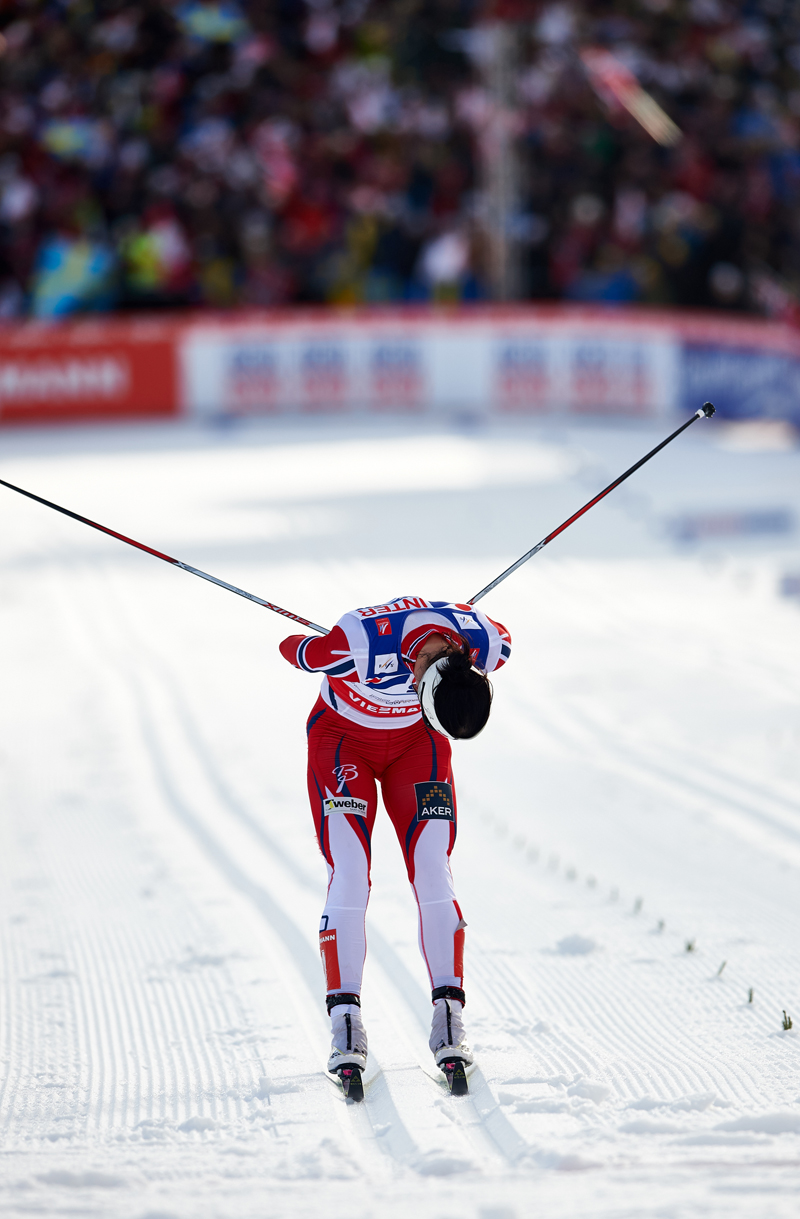
Take a bow. Marit Bjørgen of Norway winning the 30-kilometer classic mass start at 2015 World Championships in Falun, Sweden. (Photo: Nordic Focus/Fischer)
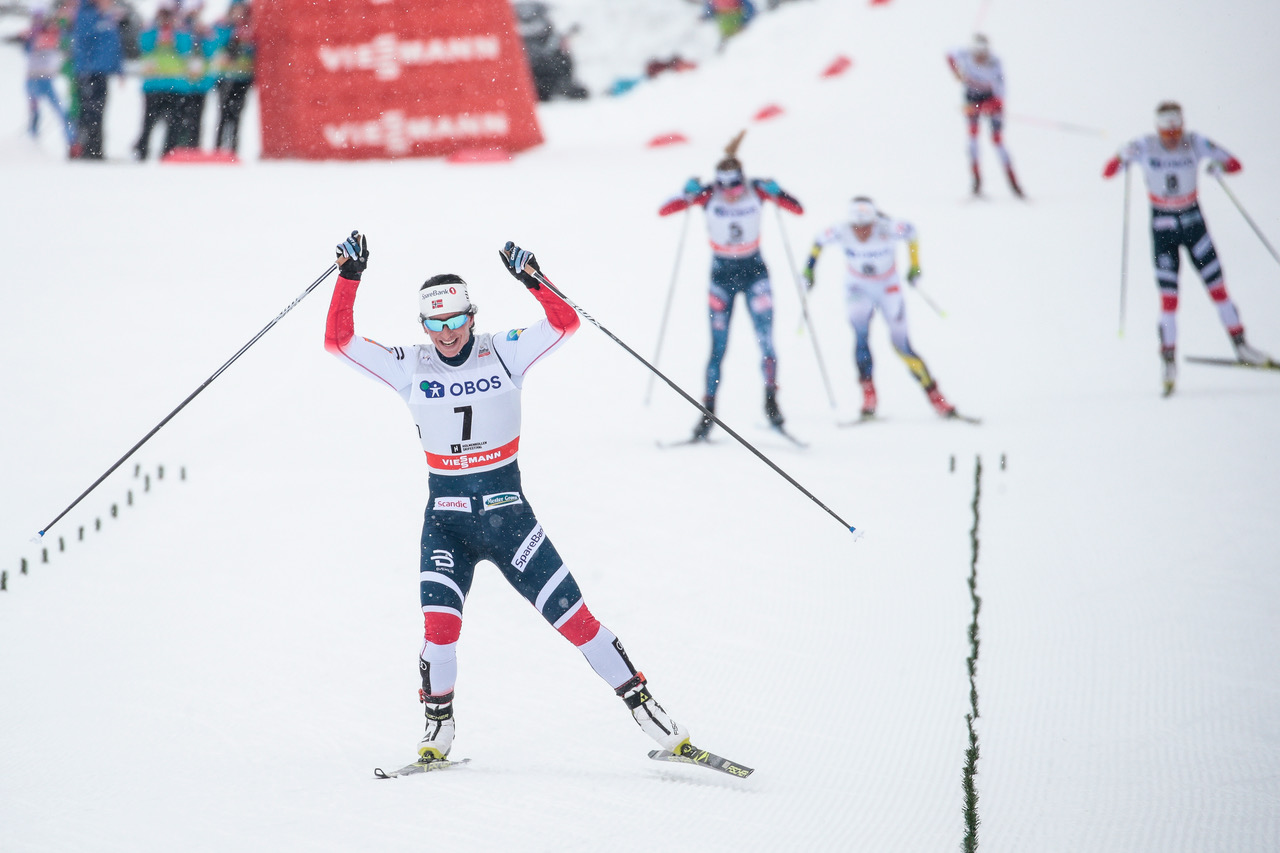
Norway’s Marit Bjørgen celebrates her seventh Holmenkollen 30 k victory in Oslo, Norway, ahead of American Jessie Diggins, Norway’s Ragnhild Haga (not shown) and Sweden’s Charlotte Kalla. (Photo: Fischer/NordicFocus)
This brings us to the point that this is the 50th episode of Nordic Nation. So, we wanted to go big. Really, no one is bigger than Bjørgen in the sport. In this ‘Take a Bow’ episode with Marit, we cover motherhood, training, racing, the media, and growing up in a small Norwegian club with three racers. The newly retired Bjørgen, 38, was interviewed last Tuesday, July 10.
Let’s face it, nordic ski racing is about the most physically taxing of sports. Pre-race, mid-race, post-race, it’s easy to come up with excuses and to complain. My tech missed the wax, I’m overtrained, I’m undertrained, sore muscles, no muscles … there’s a lot to whine about.
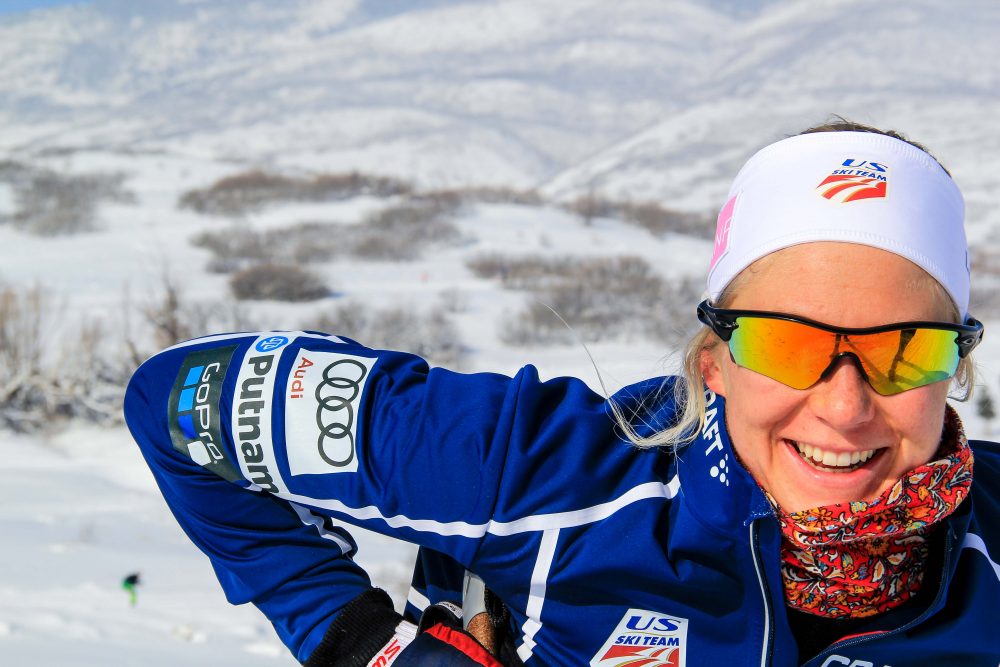
A young Jesse Knori in the skating zone: no pole style = moxie too. (Courtesy photo)
Mostly the sport is rife with teeth-grinding athletes seeking the sufferfest. One of those athletes is 23-year-old Jesse Knori, a 2017 University of Colorado-Boulder (CU) graduate and native of Jackson Hole, Wyo.
On the spectrum of sufferfesting skiers, Knori is an outlier. For a young adult, Knori has already dealt with more than her fair share of physical and emotional pain. (For all the details, you’ll have to listen to the podcast episode below.)
Jesse Knori (University of Colorado-Boulder) leading Estonia’s Anette Veerpalu during their quarterfinal of the women’s classic sprint at U23 World Championships at Soldier Hollow in Midway, Utah. Knori finished third in that heat (while Veerpalu was sixth). While she didn’t advance to the semifinals, Knori was the top U.S. woman in 15th on the day. (Photo: FlyingPointRoad.com)
As a middle schooler, Knori was diagnosed with severe rheumatoid arthritis. Knori skied at CU and notched 15th in the classic sprint at this year’s U23 Nordic World Championships in Utah. Clearly, Knori didn’t let her autoimmune condition dictate her goal setting.
Bottom line, Knori is as tough as they come. And she’s a sixth-generation Jackson Hole native and new coach at the Bend Endurance Academy in Oregon. She’s the guest on Nordic Nation’s first edition of its “Moxie Episode”.
Jesse Knori (University of Colorado-Boulder) representing the U.S. at 2017 U23 Worlds at Soldier Hollow in Midway, Utah. (Photo: Bernie Nelson)
Bryan Fletcher (U.S. Nordic Combined) jumping to 20th on the normal hill at 2015 World Championships in Falun, Sweden. (Photo: FlyingPointRoad)
Nordic combined is exactly that: a combination of the two discrete nordic-sport disciplines. There’s the cross-country side, which if you read FasterSkier regularly, you’re pretty comfortable with in terms of technique, gear, and the nuts and bolts of race dynamics. If you’re like me, the jumping side is a bit more foreign. I took the opportunity in this podcast episode to explore ski jumping.
For nordic combined competitions, it is the ski jumping portion that dictates the start order for the freestyle pursuit-style race. So to fully understand the discipline, and know why, for example, a skier starts one minute back from the morning’s ski-jump winner, I reached out to Bryan Fletcher, a 30-year-old old U.S. Nordic Combined Team veteran (he’s also a new dad), and Clint Jones, a former U.S. Ski Team jumper and currently a jumping coach and team director for USA Nordic, which encompasses nordic combined and ski jumping.
From those two we get a jumper’s perspective of a massive ski flying hill in Planica, Slovenia, and firsthand knowledge of jumping technique. Jumping may not be for the faint of heart, but understanding how it sets up the cross-country ski race after the jumps is critical to following nordic combined.
And when you listen to the podcast, you’ll hear Bryan Fletcher say this: “For me, I’m kind of an adrenaline junkie. I’ve done a lot of stupid adrenaline things in my life. And one of those is base jumping off of the bridge in Twin Falls, [Idaho]. And typically they recommend you have 100 sky dives before you ever go base jumping. Instead I spent two months learning how to pack a parachute, and then went and took six jumps off the bridge. And to give you perspective, base jumping I didn’t know anything about … However with ski jumping, you kind of have those rumors and commentary from other jumpers, I was more nervous getting on the bar of a ski flying hill for the first time than I was crawling over the railing of a bridge to base jump for my first time.”
You’ll also learn the difference between a ski flying hill — the type of jump Fletcher refers to in his base-jumping quote — and a regular, Olympic-style ski jumping hill. It’s always a good day to learn something new.
For skiers aspiring to World Cup starts, a World Championship or Olympic birth, the International Ski Federation’s (FIS) website can be either a glimmer of hope or something to smudge out dreams. The FIS site allows for a query of any single athlete: there you can analyze the full historical record of a skier’s FIS race results. It’s essentially an elite skier’s domestic and international rankings laid bare.
This last year of domestic racing proved it may be time for 25-year-old Alaska Pacific University (APU) skier David Norris to break into the international racing scene. A quick analysis of his recent results on the FIS site reveals a skier steadily becoming one of America’s top-tier skiers.
In January of this year, Norris won his first Super Tour in Lake Placid, N.Y., a freestyle sprint. The next day, he came up huge again, winning the 10 k classic. Three weeks later, Norris capped off the cold months of winter with an American Birkebeiner win.
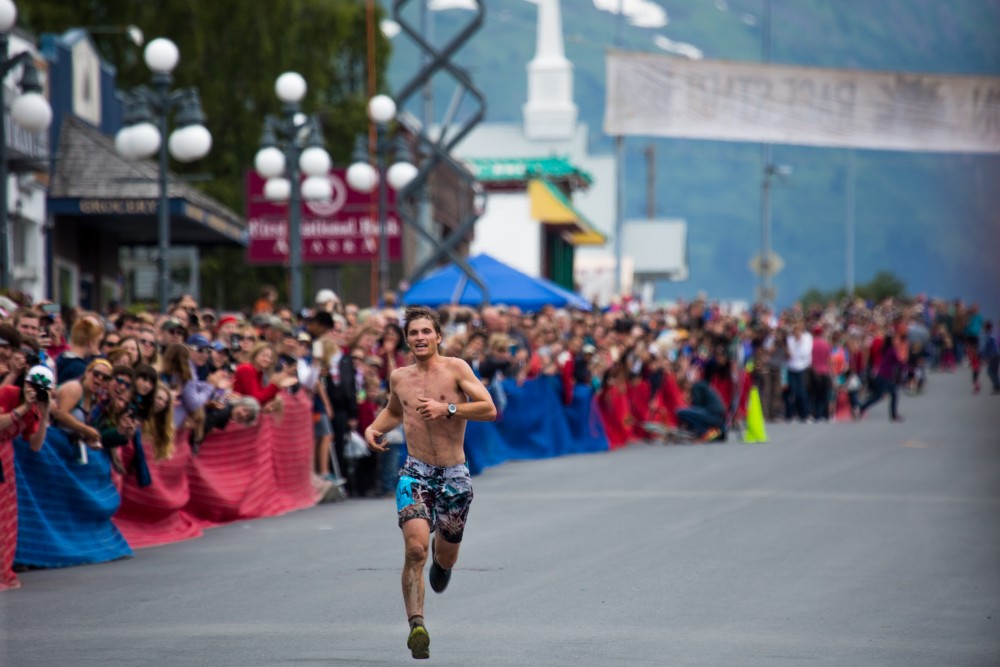
Despite the uptick in positive results, Norris’s late-season push did not qualify him for U.S. start rights at the Ski Tour Canada. His strong finish to the season, he also placed third in the 50 k classic at U.S. Distance Nationals, makes him a skier to watch this winter. He’s also a mountain runner to watch — Norris won his first-ever Mt. Marathon Race, a storied uphill and downhill running/scrambling race in Seward, Alaska.
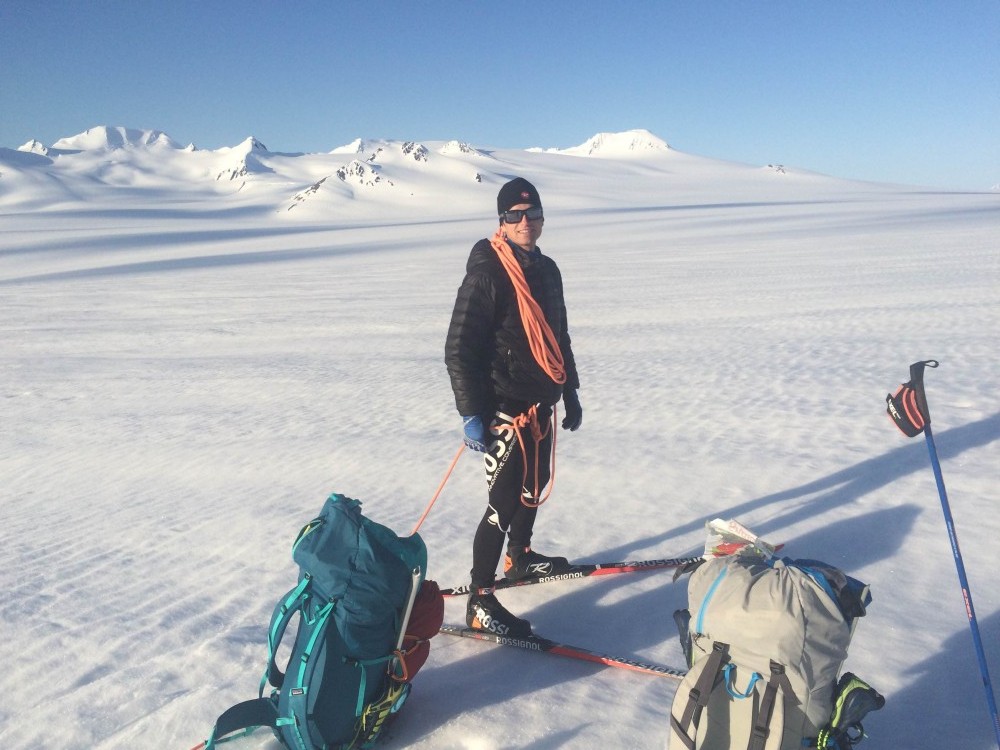
David Norris on an Alaskan-style backcountry skate ski on the Harding Icefield. (Photo: Scott Patterson)
FasterSkier interviewed Norris for its latest podcast episode. Norris describes his efforts to heal from a debilitating virus which prevented him from training seriously during the 2013/2014 season and his uncanny ability to pretty much just show up and crush the Mt. Marathon course in record time. He did so even after last year’s Mt. Marathon men’s winner, international trail-running and ski-mo star Kilian Jornet, set a new benchmark.
“I did go camp in Seward for a weekend a few weeks before the race. I went to the top only once, but I did a few laps of the lower section, where there’s more, I think there’s more danger, and more importance on knowing the specific route you want to take. So I practiced that a few times,” Norris said of his less than hyper-detailed study of the Mt. Marathon course.
What is clear is that Norris is a quick study, calculated risk taker and able to harness his serious lung power when it’s on the line.
For the full podcast interview click the play arrow below.
A busy, busy week on the anti-doping front. The big news for cross-country fans was the hit Norway’s reigning World Cup champion Martin Johnsrud Sundby took regarding his asthma-medication use two seasons ago. But casting an even bigger net — one that has implications for global sport and Russia in the both short and long term — was the McLaren report released Monday morning. (You can find the full McLaren report here).
In this podcast episode, FS takes a shallow dive into the report, illuminates the thoughts of athletes on both the World Anti-Doping Agency (WADA) Athlete Commission and International Olympic Committee (IOC) Athlete’s Commission, and seeks some answers from FS Editor-At-Large Chelsea Little. Yup, there’s a lot in there.
You’ll hear from Richard McLaren, WADA’s independent counsel/investigator, Beckie Scott (Canada) chair of WADA’s athlete committee; Adam Pengilly (United Kingdom) of the IOC athletes’ commission for skeleton/bobsleigh, Hayley Wickenheiser (Canada) of the IOC athletes’ commission for ice hockey, and Ben Sandford (New Zealand) of the WADA athletes’ commission for skeleton.
Note: The interview with Little was recorded Thursday before the International Biathlon Union (IBU) responded to the McLaren report with a press release on Friday.


 The stats are simply mind-boggling. Essentially, Norway’s Marit Bjørgen has the mostest. The most decorated Winter Olympic medalist: 15 total medals, eight gold, four silver, and three bronze — over five Olympiads from 2002 to 2018. The most World Championships bling: 26 total medals, 18 gold, five silver, and three bronze. Bjørgen won 114 individual World Cups and podiumed 184 times on the World Cup.