From the FasterSkier archive — posts syndicated from athletes’ and coaches’ own blogs between 2004 and 2012, kept online as published. Current coverage is at fasterskier.com.
National Nordic Foundation Allocates $154,280 to 2015 – 2016 Pillar Projects
Supported by the grassroots nordic skiing community, the National Nordic Foundation exists to support athletic excellence in developing U.S. nordic athletes. Through a variety of Pillar Projects, the NNF dispenses funding aimed at creating skiing opportunities, opportunities that might go unsupported if not for the community behind the NNF, “Bridging the funding gap between strong club programs and the World Cup circuit is such a valuable and necessary component for every nation….and the NNF is there for us in the U.S.” explained NNF Board member, Craig Ward. This year over $154,000 has been pledged to support skiing in the U.S. “We’ve had another strong Drive for 25,” described Dave Knoop, NNF Board Chair. “Each fundraising drive is different, but in the end, with the help of community events and longtime donors, we raised a large amount of money to support our mission.”
For more on the NNF or to make an end-of-the-year donation, log onto http://nationalnordicfoundation.org The National Nordic Foundation funds projects year round. This is the first allocation since this year’s Drive for 25 held in October and November.
NNF Cross Country Allocations 2015- 2016
U18 Scandinavian Championships $24,000
U23/Junior World Championships $36,029
Post WJC Continental Cup $13,251
World Cup $45,000
Total Allocation $118,280
NNF Nordic Combined Allocations 2015 -2016
COC P1 Park City & SoHo $7500.00
COC P2 Hoydalsmo Norway, Ruka Finland $5000.00
COC P3 Kuusamo, Finland, Chaikovsky, Russia $5000.00
World Juniors $10,000
REG & Devo Camps $3500
Total Contributions: $36,000
The post-Olympic funding announcements have come and gone, and while few sports see an increase at the end of a quadrennial cycle, some are hit harder than others. The U.S. Biathlon Association (USBA) isn’t one of them.
“We ended up being well-supported by the U.S. Olympic Committee,” USBA CEO Max Cobb told FasterSkier. “We didn’t end up getting exactly what we asked for, but the support from them remains really strong. That’s incredibly – it’s very important for us, to continue all of our programs.”
The American national team had a strong season last year, placing three different athletes on the World Cup podium. But nobody feels safe going into funding deliberations, Cobb said, implying that this might be particularly true for smaller sports.
“It’s a huge relief,” he said. “You never know, when a quad comes to an end, how the funding will be for the beginning of the next quad. So we’re incredibly grateful for this partnership with the USOC. We feel really good about how this has just improved every single year.”
USBA also has another trick up its sleeve: the U.S. Biathlon Foundation, a fundraising arm which contributed roughly $90,000 to USBA in 2012 (2013 tax documents are not yet available from Guidestar). USBA is also kicking off the new quad in style with its foundation, which is hosting a golf fundraiser at the end of the month in Ipswich, Massachusetts.
“It wil be hosted by Mark Burton, the chairman of our foundation, and Ray Bourque, one of our foundation trustees,” Cobb said. “Lowell, Tim, Susan, and Hannah are for sure coming, and maybe a couple of other athletes as well. The foundation continues to be a really important part of our overall program, and gives us extra resources we need to be able to run a strong program.”
Cobb, who besides his work at USBA also has a volunteer role as the head of the International Biathlon Union’s Technical Committee, says that he’s had to sink a not insignificant amount of time into getting the foundation going: “from a time management standpoint, it’s a lot of work.” There’s plenty for him to do already at the office without even getting into this new venture – but it’s worth it.
“I think every sport CEO or Executive Director has to devote a lot of time to generating resources,” he said. “I really enjoy all the time I spend with foundation trustees, because they are just super people, and they are very enthusiastic about our team. It’s great to see that. So it has always been fun.”
The USOC recently gave USBA an organizational development grant to hire an assistant, Audrey Chapman, to help with the Foundation work. That, Cobb said, has been another relief and will help the group do even more in the future.
As it stands, a single golf fundraiser like the one to be held in Massachusetts can generate considerable resources for the organization.
“In the past they have raised anywhere from $25,000 to $60,000,” Cobb said.
It’s very hard to predict. It’s a significant amount of our fundraising, for sure.”
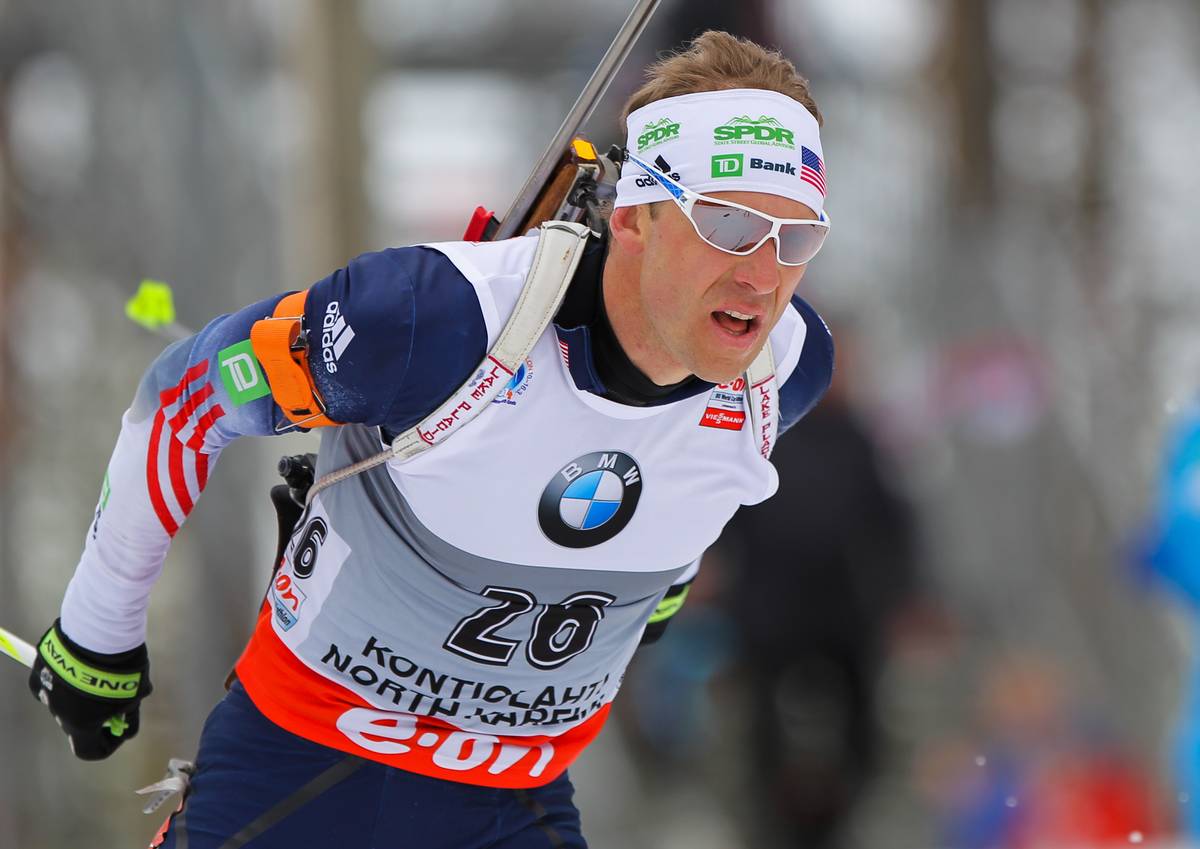
After World Cup podium performances from Lowell Bailey (above), Tim Burke, and Susan Dunklee, the US Olympic Committee rewarded biathlon with relatively strong support in the post-Olympic year. (Photo: USBA/Nordic Focus)
Besides the actual money, it’s fostering relationships between donors and athletes that make these events a success, Cobb said, and hopefully one that will extend into the future.
“It’s a nice chance to get people together with the athletes in an environment that isn’t freezing cold, and the athletes are enjoying a beautiful day and a beautiful place and aren’t under any pressure, so it’s very different than meeting up at a World Cup,” he explained. “And the nice thing is, it’s a chance for us to bring people from outside our circle to meet the athletes and hear about the sport. It’s a good opportunity to spread the word about what we’re doing and perhaps find some more people who want to help support us.”
Between support from USOC and the foundation, Cobb says that USBA will be able to continue its programs unchecked this year and spur further success.
“It will allow us to do the right things with the national team over the course of the next year without any compromised,” he said.
That includes a summer training camp in Scandinavia which will send three athletes to the annual Blink rollerski festival in Norway for the first time, as well as allow the women’s team to train alongside Kaisa Makarainen of Finland, a two-time World Cup overall champion.
“In general, Bernd Eisenbichler and the coaches have tried to put together more opportunities and more side-by-side training with other top athletes from around the world,” he said. “And that has been well-received on both sides. The very positive side is that the Europeans are psyched to train with us as well.”
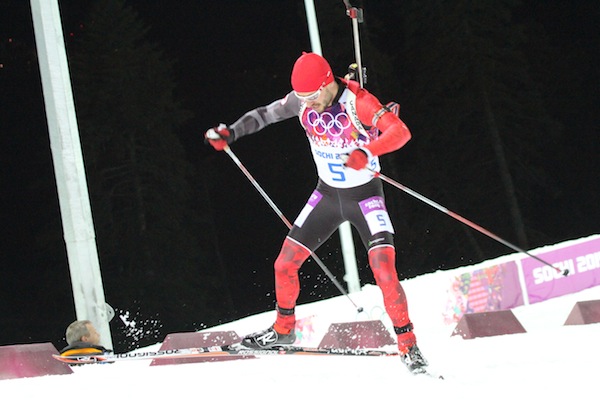
Jean Philippe Le Guellec of Canada leading the Olympic 12.5 k pursuit after 6 kilometers, before being undone by a crash. His 5th-place finish in the sprint was the best-ever by a Canadian man at the Olympics.
When Own The Podium (OTP), one of the two main funding sources for Olympic sport national governing bodies, released their funding numbers to the sports last Monday, Biathlon Canada was in for both good news and bad news.
The good news: they are set to receive more money for the 2014-15 year than they had for the previous year.
“[It’s] $250,000 in high performance enhancement money, as opposed to $200,000 last season,” Biathlon Canada High Performance Director Chris Lindsay told FasterSkier. “We received an increase, which we are thankful for, and which we certainly feel we deserved – the performance of the athletes makes it clear that we deserve an increase.”
The bad news: it still wasn’t close to the amount of money that they requested. While Lindsay noted that not once has OTP ever matched their full request, it was potentially a surprise based on the last time Biathlon Canada went through this process in a post-Olympic year.
“In the beginning of this quad, I would have preferred to see a number that was more in line with what we received at the beginning of the previous quad, when we received $430,000 in performance enhancement money,” he said.
It’s notoriously tough to parse OTP decisions. For one thing, the organization almost certainly has a smaller overall budget to work with compared to when they were coming off a home Olympics with huge public enthusiasm for winter sports in particular. And funding priorities have shifted for plenty of other sports too, for instance, he said, from sports like speedskating and figure skating towards freestyle skiing and snowboarding.
But despite the acknowledged challenges for OTP, Lindsay wasn’t entirely pleased with the decision.
“I base my concern off of what I see as better results coming out of the Sochi Olympics than what we were able to achieve out of the Vancouver Olympics, and also the prospect for having multiple athletes capable of winning medals at World Championships and, with appropriate support 4 years down the line, at Olympic Games, is greater than the long-term prospects that we had post-Vancouver,” he explained.
In Sochi, Jean Philippe Le Guellec re-set his own best mark for a Canadian man by finishing 5th in the sprint, and Brendan Green and Nathan Smith notched finishes of 9th and 11th. On the women’s side, Megan Imrie became the first Canadian woman to qualify for the 30-racer mass start competition since the format was introduced to the Olympics. After the Games, Zina Kocher and Megan Heinicke finished 13th and 15th in World Cup races, while Rosanna Crawford collected her first top-10 in the last race of the season.
Of that group, only Le Guellec and Imrie have retired. The rest of the team is already back training toward 2015 World Championships in Kontiolahti, Finland.
For OTP, though, only championship medals matter. And Canadian biathlon didn’t find any of those, despite some close calls.
Methods vs. Vision
The decision highlights a common issue faced by Nordic sports in North America: whether it’s cross country or biathlon, Nordic combined or jumping, in the U.S. or Canada, major funding bodies, be it OTP or, in the case of U.S. Nordic combined, the U.S. Ski and Snowboard Association, don’t always see these programs as good investments.
And like many, Lindsay sees that as a problem for countries who set goals like winning the overall medal count or the gold medal count.
“If the goal is to really be on top of the podium, we need to be constantly re-evaluating where we are going to get our next medals,” he said. “I see great potential in the Nordic sports where a single athlete who is at that level – similar to where we had JP, where we have Nathan Smith and Brendan Green – can win multiple medals.”
He noted that there are 11 Olympic medals available in biathlon, and a similar number in cross country. Furthermore, athletes in both sports have shown that they have the potential to be on the podium, even if they haven’t done it at the Olympics yet.
“They can show up on the first day of competition and be legitimately in the hunt for a medal,” Lindsay asserted. “And then the next day of competition they can be legitimately in the hunt for a medal. On the fourth day of competition, they can legitimately be in the hunt for a medal. And also on the relay days. This seems to me like a multiple opportunities for an athlete to be on a podium, as opposed to some other sports where it’s all one shot, and potentially it’s over one day where if they have a bad day on that day, there’s no getting that day back.”
At the moment, OTP is not prioritizing that possibility, despite the fact that Jean Philippe Le Guellec was in the hunt for medals in two different races and the men’s relay team was also at the front of the pack for part of the race.
“I don’t think that anyone disagrees with the goals of Own the Podium,” Lindsay said. “The goals are clear: we want to win the Olympics. Or, that we want to have Canadian athletes on Olympic podiums. Nobody has a problem with this. The execution of those goals, and the side goals that pop up from time to time, are not quite as clear.”
As he perceives it, less popular and historically successful sports are not being seriously supported in working towards that goal.
“I think we’re going to get to a point eventually where Canada is going to put an athlete on every single sport’s podium at the Games,” he asserted. “But if we continue down the path we’re on, we’re potentially going to be missing out on a bunch of those podiums. That’s a significant chunk of the Games that we’re not putting as a priority… [and] the potential is there. All it takes is one superstar, and the resources dedicated to creating one superstar, to potentially have multiple medals at the Games. We saw this back in 1992 and 1994 where Biathlon Canada was able to put together the resources for Myriam Bédard, and this payed off tremendously for us with one bronze and two gold medals over those two Olympics.”
Other Options
OTP is not the only funding source for Biathlon Canada, and there’s actually more money available. While OTP has made its decisions on high performance funding, they are still dividing up research and development money, which Lindsay hopes will help.
“The focus of R&D money for this next quad has moved away from the Nordic consortium model where each of the Nordic sports would be able to benefit from this technology and projects if they chose to, and has moved to a system where the R&D money will be allocated directly to the sports project by project again,” he said.
Biathlon made the most of the Nordic consortium going into Sochi, and had noticeably fast skis at the Laura stadium. If the organization can use this to appeal for more money from this pot, then their high performance budget will loosen slightly.
There’s also support from the other major funder in Canada, Sport Canada. One of its main methods for funding is to provide money for “carding” athletes, basically giving them a salary which allows them to train and travel without having to worry about having a job. Unlike OTP which focuses on podiums at championship events, Sport Canada considers top-8 finishes as well as other subjective factors.
In the previous season, Biathlon Canada had carding money for eight athletes. After the Olympics, Sport Canada recognized their strong performances and gave them an additional card. And this week, they confirmed that they would bring the total up to 11.
Because a governing body can also divide cards into smaller pools and give the amount of money from two full cards to three developing athletes as smaller amounts, Biathlon Canada will now be able to fully salary its “A” and “B” teams, which it has never done before. That’s a total of 13 athletes. Lindsay still estimated that his team lags behind cross country in carding money, while a sport like track and field might receive 80 or more full cards.
And finally, Lindsay hopes that biathlon might eventually be considered along with the other, medal-winning, sports for higher OTP funding. At the moment OTP has placed the sport on a 1-year “probational” funding scheme, since it doesn’t “fit” into any of the categories the organization has created depending on how many medals have been won in the last three Olympics.
“But OTP does recognize the potential that we have, and we will be working out with OTP a set of goals that we will try to achieve over the next season to continue proving that we have potential for medals in 2018,” Lindsay said. “I have absolutely no concerns that we will be able to meet whatever goals which are put up for us.”
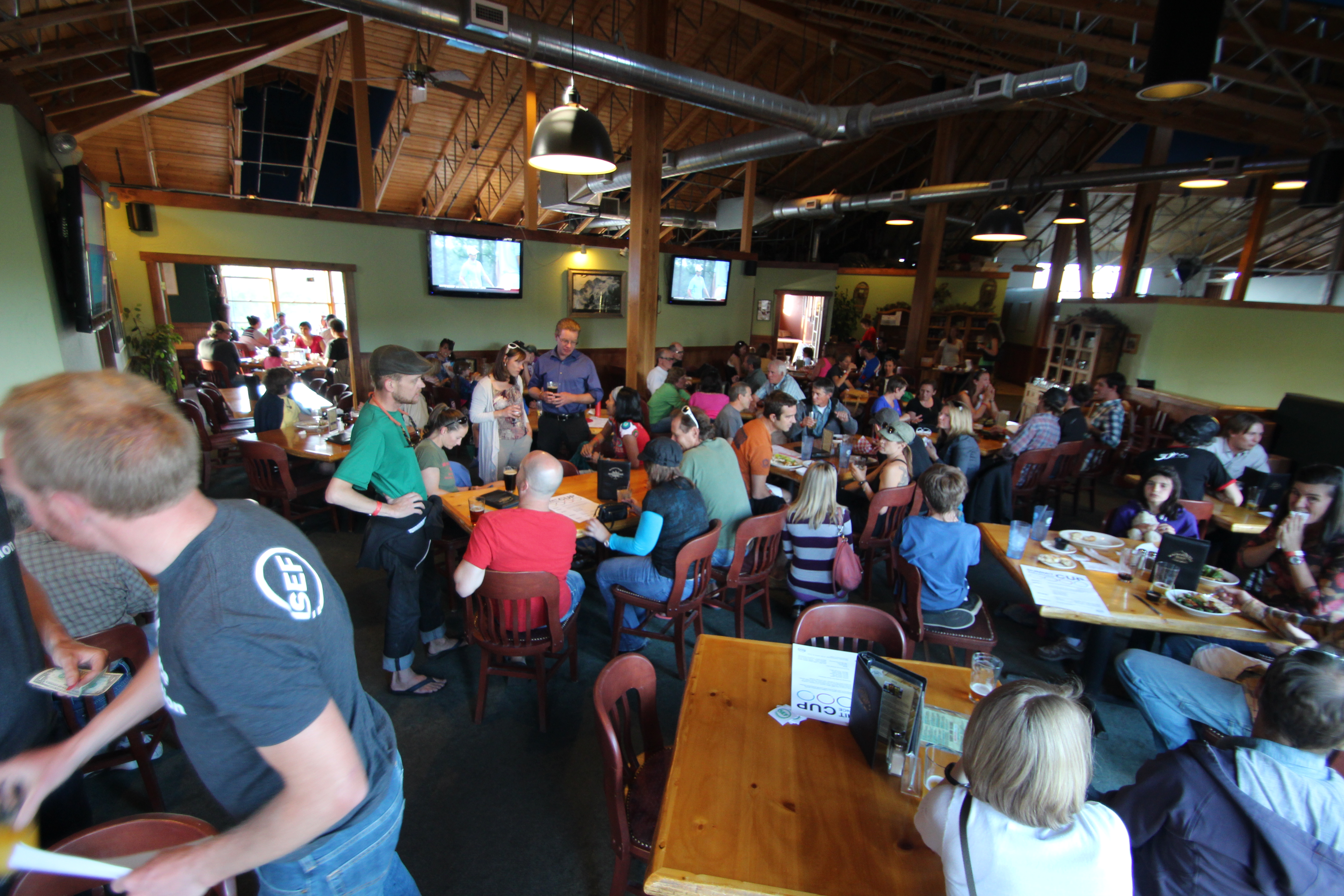
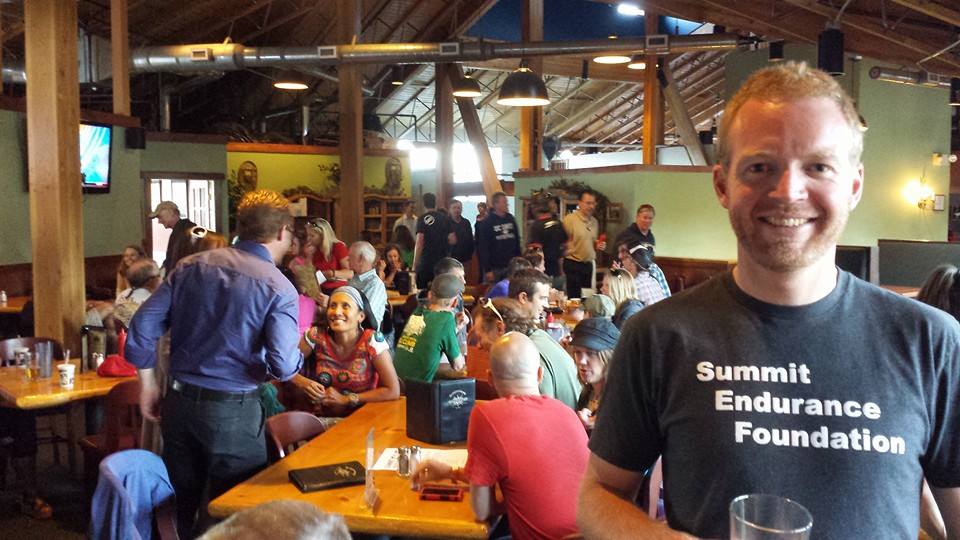
A crowd of supporters gather at the Summit Endurance Foundation Kickoff Party June 12 at the Backcountry Brewery in Frisco, Colo. to support the Foundation’s aim to financially aid young endurance athletes in Summit County. (Photo: Matt Dunkerly)
The story is one known all too well. A friend, a relative, an acquaintance who is interested in joining the nordic-ski community becomes daunted by the costs of training, equipment, travel and racing and thus is forced to stop pursuing the sport.
It’s a problem that plagues ski clubs across the country. The costs not only impact an individuals ability to engage in the sport, but also inhibit the growth and development of cross country skiing at a national level. Even with aggressive fundraising by local organizations and some funding from the U.S. Ski and Snowboard Association (USSA), the support is often not enough.
What if it didn’t have to be that way?
The Summit Endurance Foundation is attempting to answer this question by entering uncharted territory. Led by Executive Director Joe Howdyshell, former head coach of the Summit Nordic Ski Club in Summit County, Colo., the organization is making an effort to not only financially support young cross country skiers, but also other youth endurance athletes such as runners and bikers. The new and innovative strategy was one that Howdyshell developed as he saw the need grow in his community.
An endurance athlete since the age of 14, Howdyshell participated in cross country skiing and running both in high school and in college at West Point Military Academy and the University of Wyoming. For the last four years, he has been the head coach and program director of Summit Nordic.
During his time as a coach, he noticed a trend amongst his youth athletes. “I kept seeing athletes either missing opportunities or being held back because of a lack of funding, or not even getting into the sport at all because their families couldn’t afford it,” Howdyshell said in a phone interview.
Like many across the country, Howdyshell was frustrated with the trend and decided to look at why there was no support system in place. Through his experience in endurance sports he came to the conclusion that many small clubs, whether focused on running, skiing, or biking, have limited resources to raise enough money to cover the costs of participation, especially when these costs continue to rise.
Joe Howdyshell (l) at the Summit Endurance Foundation Kickoff Party June 12 in Frisco, Colo. Howdyshell is the Foundation’s Executive Director and full-time fundraiser. (Photo: Kathryn Grohusky)
“I’ve been a part of several organizations where the parent volunteers are running the club. They work their butts off to make sure their bases are covered,” he said. “They just can’t possibly hope to have enough time to run an organization or fundraise enough to offer 100% scholarships and get equipment for low income families or to be able to send a small business owner’s kid to junior nationals.”
In order to combat the challenges clubs face when raising money, Howdyshell hatched a plan that involved the creation of a foundation that was not sport specific, but rather focused on fundraising for athletes that had one thing in common: endurance.
“Most places try to bring people together through a winter-sports club, and very few places have brought people together through endurance sports,” Howdyshell explained. “The athletes are more similar. Your summer mountain bikers are going to be much more similar to your winter cross country skiers. We think of it as trying to build a community of people who like to breath hard.”
While a small group of organizations, like the Summit Endurance Academy (owned and coached by Howdyshell) or the Bend Endurance Academy in Bend, Ore., have instituted a similar philosophy of creating a community of endurance sports, the emphasis has rarely been on fundraising, Howdyshell said.
The Summit Endurance Foundation aims to build a community of endurance athletes in the mountains of Colorado while also trying to ensure that anyone who wants to train and compete can do so without having to worry about finances.
The Foundation has a three-pronged approach in order to accomplish its goals. By having a full-time fundraiser in Howdyshell, the Foundation can hit a larger geographic area. While many clubs stick to their small communities, the Foundation has the resources to branch out and send Howdyshell to surrounding communities in Colorado and neighboring cities such as Denver.
The second unique aspect of the program offers is its ability to fundraise for a variety of sports that have much in common, rather than a single sport. The Foundation will focus on cross country skiing, distance running, distance biking, and ski mountaineering.
“There are more people who are interested in those sports: there is a bigger pool of donors, a bigger pool of grants, and a bigger pool of supporters in general.”
Finally, by focusing on fundraising the Summit Endurance Foundation can diversify it’s sources of revenue, Howdyshell explained. Traditionally, most clubs rely on a combination of events and grants. With the Foundation, he hopes to see revenue come in from such techniques, but also from corporate sponsorships and big-money investors.
“They [philanthropists] don’t want to give $25 dollars, they want to give $5,000 a year for five years because they believe in the cause,” he said.
By increasing it’s geographical footprint, increasing the fundraising scope by increasing support, and by having a diverse fundraising model the Summit Endurance Foundation believes that it can provide $150,000 in scholarships in the next three years.
Aside from its monetary goals, the Foundation hopes make sure that it can steadily increase participation in endurance programs.
Supporters of the Summit Endurance Foundation gather at the organizations kickoff event June 12 in Frisco, Colo. The event had over 75 attendees and raised over $2,000. (Photo: Matt Dunkerly)
“For the first three years the biggest goal is that no youth-endurance athlete misses an opportunity due to financial limitations. We want to see more kids getting into sports, excelling in these endurance sports. We want to develop the model, because there is not really anyone doing it this way.”
Once the model is developed Howdyshell sees the organization going in several possible directions. One direction would be to extend the scope of the Foundation to encompass the rest of Colorado. Another path the organization could take would be to focus on more athletes in Summit County and become the Summit Sports Foundation.
The need for an organization like the Summit Endurance Foundation highlights what many might consider a weakness in the American nordic-skiing community. With limited support from national organizations like USSA for smaller club programs, many have claimed that the lack of national financial support has made skiing a sport for society’s well-off.
The Summit Endurance Academy’s new financial model may be a future path for local clubs, with endurance sports joining forces to fund their athletes and rallying around their shared values.
“The athletes are different, the parents are different, the values are different [than other sports]. That’s not to say that either one of them is good or bad. They are just different,” Howdyshell said. “In my eyes it makes much more sense to align sports that are going to have the same participants and a lot of the same values through a local endurance foundation.”
Whether or not Howdyshell’s fundraising model will be a success remains to be seen. However, the Foundation has already had a promising start with its first event.
The Summit Endurance Foundation Community Kickoff Party, which took place June 12 in Frisco, Colo., had over 75 attendees and raised over $2,000 for the new organization. Money, however, was not the main goal of the event.
“Most importantly we wanted to develop this core group of supporters that can help us at events, who can talk us up to friends, and who can build our presence through the coming years,” Howdyshell said.
According to Howdyshell, the Summit Endurance Foundation hopes to fund over 200 athletes a year beginning in 2016.
Another nordic sport with its own governing body also jumps to mind: biathlon. The United States Biathlon Association, founded in 1980 after splitting from modern pentathlon, has had medals and podium finishes at every level except the Olympics: from World Youth and Junior Championships through the World University Games, World Military Championships, World Cup, and senior World Championships.
Recently, USBA felt financially secure enough to restart its development program. IRS financials are not released yet for the last year, but in 2011 and 2012 had total revenues of $2.6 and $2.4 million. In the past years USBA has forged close ties with the U.S. Olympic Committee (USOC), much to its benefit.
So, what did it take to get there, and what advice might USBA have for Nordic Combined, if they choose the separate-NGB route? FasterSkier called up Max Cobb, the President and CEO of USBA, to chat.
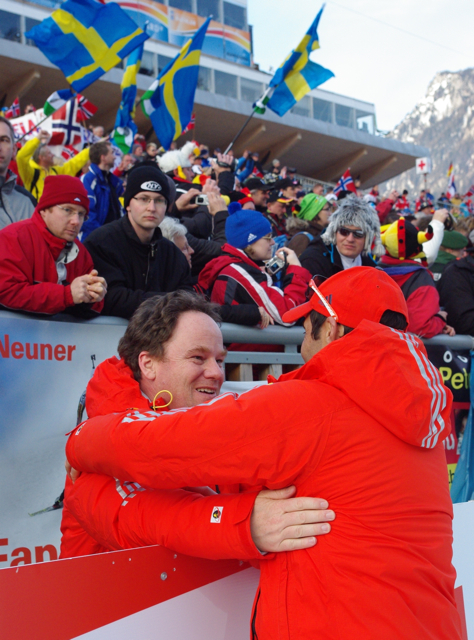
Max Cobb, who besides acting as CEO of USBA also chairs the International Biathlon Union’s Technical Committee, receives a hug from a fellow official after U.S. athlete Susan Dunklee placed fifth in the 2012 World Championships.
FasterSkier: I’m assuming that you’ve been following, to some extent, the news about USSA and Nordic Combined.
Max Cobb: Yes, I have heard some of the news.
FS: As someone who is running an NGB for a small nordic sport, do you have any words of wisdom for them? Advice? Warnings?
MC: I think that the good thing for the Nordic Combined guys is that they have a track record of being super successful. Like us, it takes time to reach that level.
FS: So that’s what you need to be able to make your case?
MC: I don’t really know enough about what is going on with those guys and with USSA. So I don’t know what I can say other than that I think the important thing is to continue to demonstrate that there’s an orientation towards high-performance success, and if you can demonstrate that the right the athletes are in the system for achieving that, then I think it’s possible to gain support from both sponsors and donors.
FS: Do you have a sense of how long, after USBA was started, it took for the organization to start to feel like it was on its feet?
MC: I think it grew very gradually. It wasn’t really until the late 80s or mid- to late-80s, after the 1984 Olympics, that the USOC provided a really substantial and reliable source of funding. We were able to offer fairly strong programming starting in 1986, and then in 1987 Josh Thompson won a silver medal [at World Championships] so there was a big push for the 1988 Games. So I think that was when biathlon really came into its own. But I think a lot of that … there was not very much funding available from the USOC between 1980 to 1984.
FS: It seems like there are more and more sports now, compared to back in 1980. Do you think it’s harder to get USOC’s attention if you are starting your own NGB now?
MC: In terms of what is different now, I would just say that in general, there are more resources available and more sophisticated fundraising around Olympic sport than there were in the mid-80s. That’s very clear to me.
FS:So that is good for nordic sports?
MC: I think in terms of identifying donors – just look at what the National Nordic Foundation has been able to do. They have raised a huge amount of money [note: for the 2012/2013 year, the National Nordic Foundation had revenue of just over $350,000]. It has been very impactful for the sport. That kind of relatively grassroots fundraising didn’t exist at all in the 1980s. You look at things like Rally Me and our whole digital communication, and that has made it much easier to bring together a very diffuse group of people who care, of supporters. When you think about doing paper mailings to groups like that [when USBA was getting started], it would have been impossible.
FS: Is that what you think Nordic Combined should be focusing on?
MC: I just make those comments in general. It’s not necessarily specific to what’s going on with Nordic Combined because I don’t really have a sense of what is envisioned there.
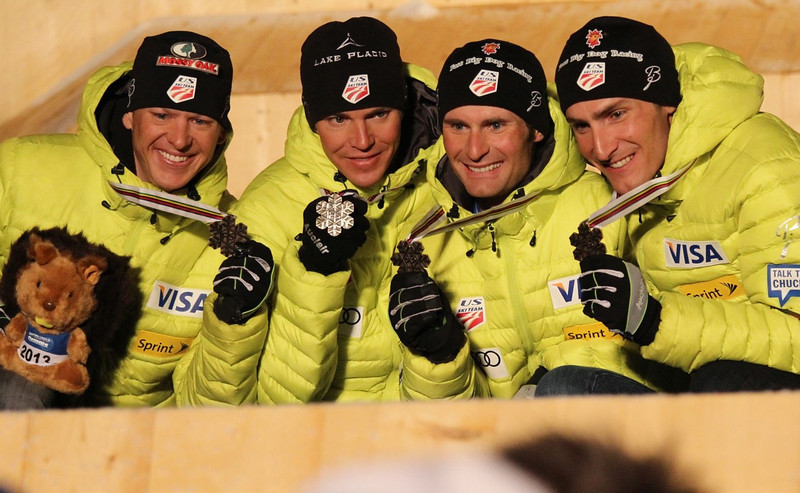
U.S. Nordic Combined’s Todd Lodwick (l), Billy Demong (second from l), Bryan Fletcher and Taylor Fletcher (r) after winning bronze in the 2013 World Championships team event in Val di Fiemme, Italy. (Photo: Fiemme2013)
When U.S. Nordic Combined coaches Dave Jarrett and Greg Poirier sat down with Tiger Shaw and Luke Bodensteiner of the U.S. Ski and Snowboard Association (USSA) on Monday, Jarrett said he wasn’t exactly sure what they were in for.
The national-team head coach for the last six years, he had a sense of what was in store for his sport — challenges, big ones, before and after the Olympics. But every nordic “free-heel” sport deals with the same thing, he said.
By 8 a.m. Monday, it became pretty clear what Shaw, USSA’s new CEO, and Bodensteiner, vice president of athletics, wanted to talk to them about in person. After July 31, 2014, USSA would no longer fund nordic combined’s “traditional team infrastructure,” according to a mass email from Shaw that was sent to Jarrett and several other stakeholders. That would leave U.S. Nordic Combined essentially on its own for financial support, which Jarrett said will most immediately affect the employment of himself and Poirier, the development coach.
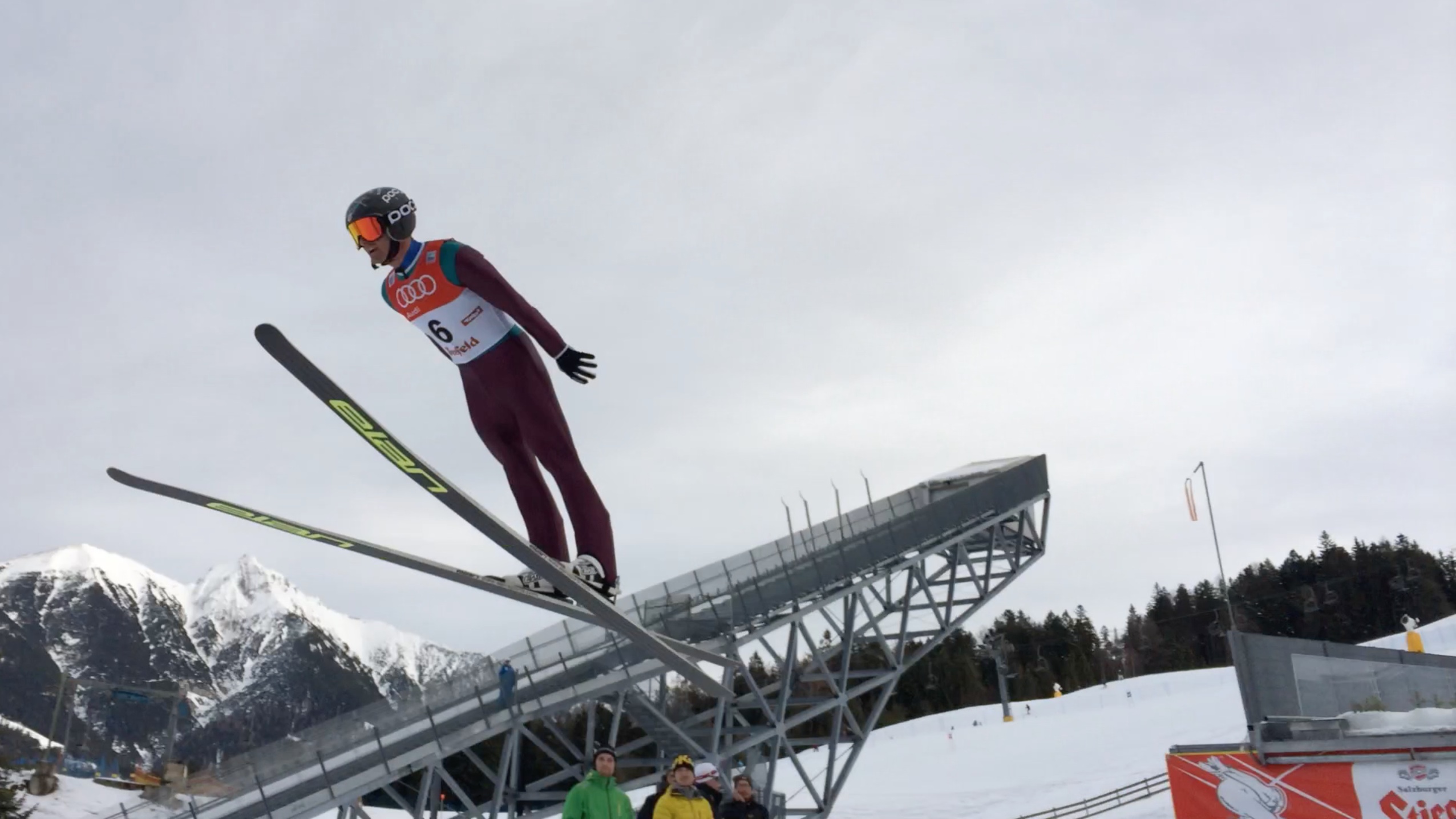
Bryan Fletcher (U.S. Nordic Combined) at the Nordic Combined World Cup Triple last season in Seefeld, Austria. (Photo: Fast Big Dog)
In the meantime, he said not to worry about the athletes — they’ll train for next season as usual. The ones that were in Park City, Utah, on Monday — Billy Demong, Bryan Fletcher and Taylor Fletcher — also spoke with Shaw and Bodensteiner in a second meeting about the decision.
“I had a sense for a while that something wasn’t right,” Jarrett said on the phone Tuesday. “Planning started as normal and then it took a slight detour with the timeline of how you get things done. It became clear that something wasn’t right. I knew something wasn’t totally clear. Luke gave us a heads up that this was a scenario.”
That didn’t necessarily soften the blow, but rather than retaliate, Jarrett said he began to brainstorm. Women’s Ski Jumping USA and men’s USA Ski Jumping did it on their own — they could, too.
“We haven’t stopped spinning from the news,” Demong told Steamboat Today. “We have to turn that into solution making.”
“Based on [USSA’s] study in 2010 that eliminated jumping in other sports, they didn’t think nordic combined was a podium-potential sport for 2018 or 2022,” Jarrett explained. “As of July 31st, it’s gonna be the end of my job and Greg’s job, so funding stops then. In the meantime, if we’re able to raise operating capital, they have offered to run [fundraising] through USSA. If somebody wanted to donate or underwrite our needs that they would be able to donate to USSA [which would go] directly for nordic combined.”
There’s also the possibility of U.S. nordic combined signing sponsors outside of USSA’s contracts. According to Shaw’s email, USSA “will continue to provide direct funding for qualifying elite athletes. … We will work with the nordic combined community to look at alternatives in structure and funding. The USA has an engaged and passionate club-based pipeline, especially in communities of Lake Placid, Steamboat Springs and Park City. The USSA will continue to work with these clubs to provide an infrastructure for athletic success and sport development.”
“Unless you win the Powerball or something, there’s no way to create a slush fund for a rainy day for this to happen.” — U.S. Nordic Combined Head Coach Dave Jarrett
Jarrett emailed members of the nordic community on Tuesday morning with the subject heading: “Tall Order”. While many were disappointed and some shocked by the news, he said he encouraged them to think of solutions.
“I see this challenge as an opportunity for autonomy of our program,” his email stated. “All revenue we generate will go directly to our program. The more we generate the deeper we can reach as a program while at the same time remaining within the USSA. If we want to have an A-Team, B-Team and Junior Team it is up to us. We need to think about all options, opportunities and ideas.”
Jarrett said he’d spent much of the last two days gathering information and talking to people like Dave Knoop of the National Nordic Foundation (NNF), which directly raises money for U.S. nordic combined and cross-country skiing, as well as Alan Johnson of USA Ski Jumping and Robbie Beck of Women’s Ski Jumping USA.
“‘[We’re] trying to just use this as a rallying cry for the nordic-combined community specifically, but also for everybody that this is around the corner for any program,” Jarrett said. “Instead of being pissed or feeling sorry for ourselves … we need to rally around this and find solutions. I think there’s solutions out there.”
While he aims to assemble as much support as possible and explore the idea of uniting all nordic sports — men’s and women’s ski jumping, nordic combined and cross-country skiing — into one autonomous entity, Jarrett’s also looking forward to getting nordic stakeholders together at the USSA Spring Congress in a month.
“We knew that this was always a possibility,” Jarrett explained. “While we wanted to be prepared for this, unless you win the Powerball or something, there’s no way to create a slush fund for a rainy day for this to happen. … I said it a few years ago after ski jumping: everybody now should be looking over their shoulder because you never know when it’s gonna fall. I don’t think there’s any program that’s safe from it, maybe alpine is the only one that they’re never gonna cut out, but that’s the fact of life. And we have to play the cards we’re dealt.”
As for what it would take to keep the nordic-combined program going, Jarrett said he wasn’t sure whether they’d decide to fund it from bottom up, starting with development, or take care of the elite A-team skiers first. Either way, he said 12 years of experience as a national-team coach had taught him what he can do with a million-dollar budget, half-a-million dollars, or $250,000 — whatever they end up with.
Bodensteiner told Steamboat Today that USSA had funded nordic combined between $580,000 and $650,000 annually for equipment, travel, lodging, food, coaches and wax technicians. In a four-year Olympic cycle, the cost added up to nearly $3 million. He said the decision was based on a number of factors, including nordic combined’s size, as measured by participation, membership, public relevance, and future potential.
“The main thing is that we need to be proactive, looking at all options, all partnerships,” Jarrett said. “We’re all in this kind of nebulous state and perhaps there’s a way to organize everybody or at least parts of it. We can be partners with USSA or partners with each other.”