From the FasterSkier archive — posts syndicated from athletes’ and coaches’ own blogs between 2004 and 2012, kept online as published. Current coverage is at fasterskier.com.
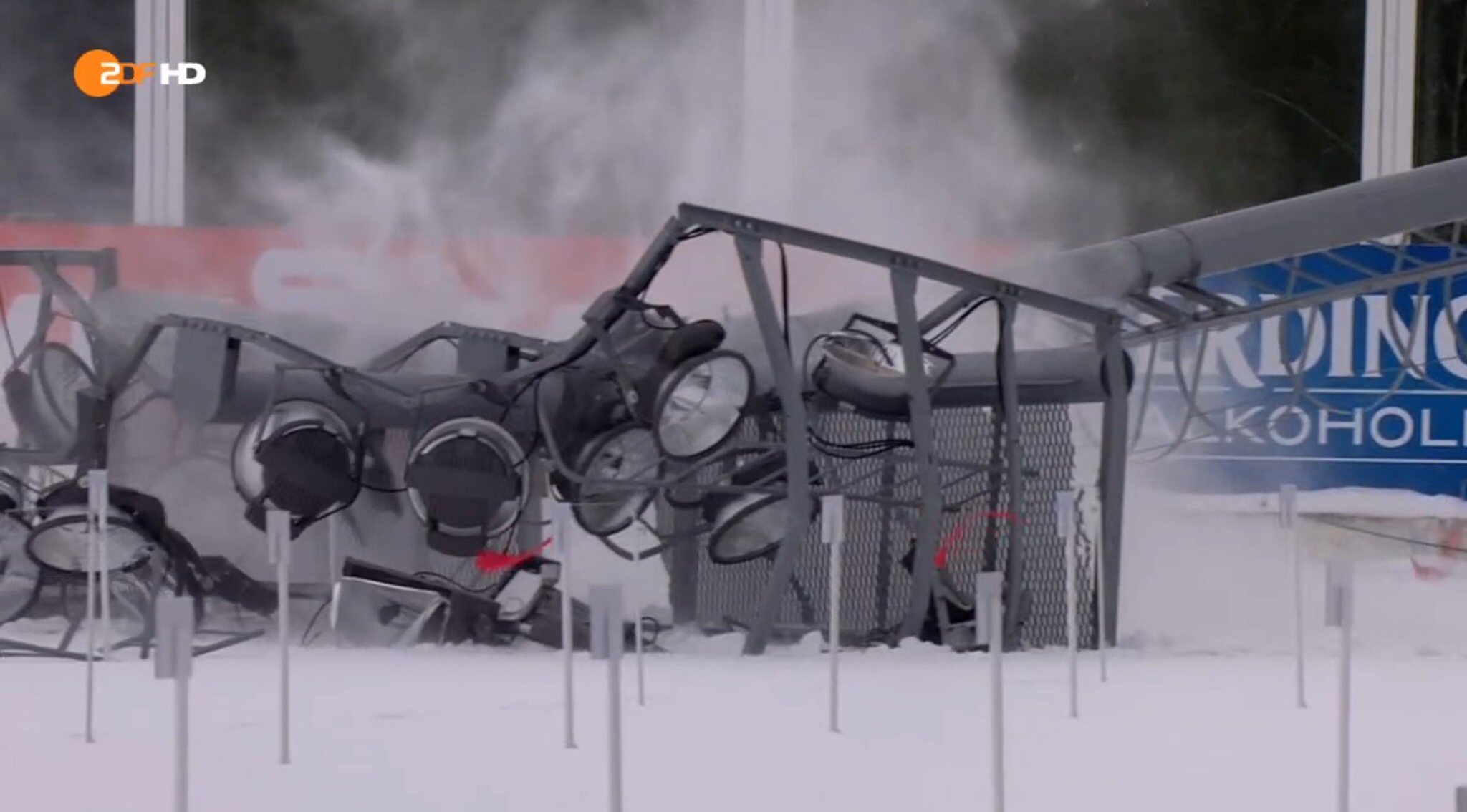
Strong winds led to the cancellation of Sunday’s mass starts, the final races of the IBU World Cup season, after a light post (at left) fell onto the shooting range in Khanty-Mansiysk, Russia.(Photo: IBU/Evgeniy Tumashov)
(Note: This post has been updated to include comments from Americans Susan Dunklee, Tim Burke and Lowell Bailey, and Canadians Rosanna Crawford and Nathan Smith.)
Just like that, the season’s over. After strong, gusty winds on Sunday led organizers to postpone the women’s mass starts in Khanty-Mansiysk, Russia, the decision was eventually made to cancel both the women’s and men’s competitions for security reasons.
According to an IBU press release, a light pole on the shooting range toppled over, but nobody was injured. Athletes, spectators and staff were instructed to leave the stadium for their safety.
Strong winds knocked over a light post in the stadium on Sunday in Khanty-Mansiysk, Russia, leading to the cancellation of both mass starts for safety concerns with the continued gusting winds. (Photo: ZDF screen shot)
“The season is therefore over,” the press release stated. “You can find the final standings shortly on www.biathlonworld.com and the remaining Globes will be handed over tonight.”
Gabriela Soukalova of the Czech Republic secured her hold on the World Cup Total Score with her fourth-place finish in Saturday’s pursuit, and France’s Martin Fourcade won the men’s overall World Cup title long ago by building an insurmountable lead. Both will be officially recognized at Sunday night’s award ceremony.
Three Americans finished the season in the top 20 overall, with Susan Dunklee becoming the best-ever ranked U.S. female biathlete in 14th, Tim Burke placing 15th and Lowell Bailey in 17th. Canada’s Nathan Smith stayed within the top 30 in 28th, and Rosanna Crawford was just outside in 32nd.
“It is my personal best overall finish yet and I am proud of it,” Dunklee wrote in an email.
“It would have been nice to have one last race and a little more closure, but I believe cancelling the race was the right decision because of serious safety concerns,” she explained.
“I’m definitely disappointed about the decision, but I also think they had little choice,” Bailey wrote in an email. “… It will take a lot of work just to clear the debris. Additionally, there were trees down on the course. And this doesn’t even get to the fact that it would be incredibly difficult to shoot in winds in excess of 30mph.”
“I nearly got blown over out running this morning,” Burke explained in an email. “The condition would have been totally unfair and dangerous. One of the huge light towers actually blew over in the stadium. I think that was the point when they decided to call it off and not delay anymore.”
“Today has been epic!” Crawford wrote. “We were walking back from town and could barely move the head wind was so strong! Our hotel has about 15 floors and some of the top floors the windows have been blown out and smashed on the ground below. Luckily no one was hurt.”
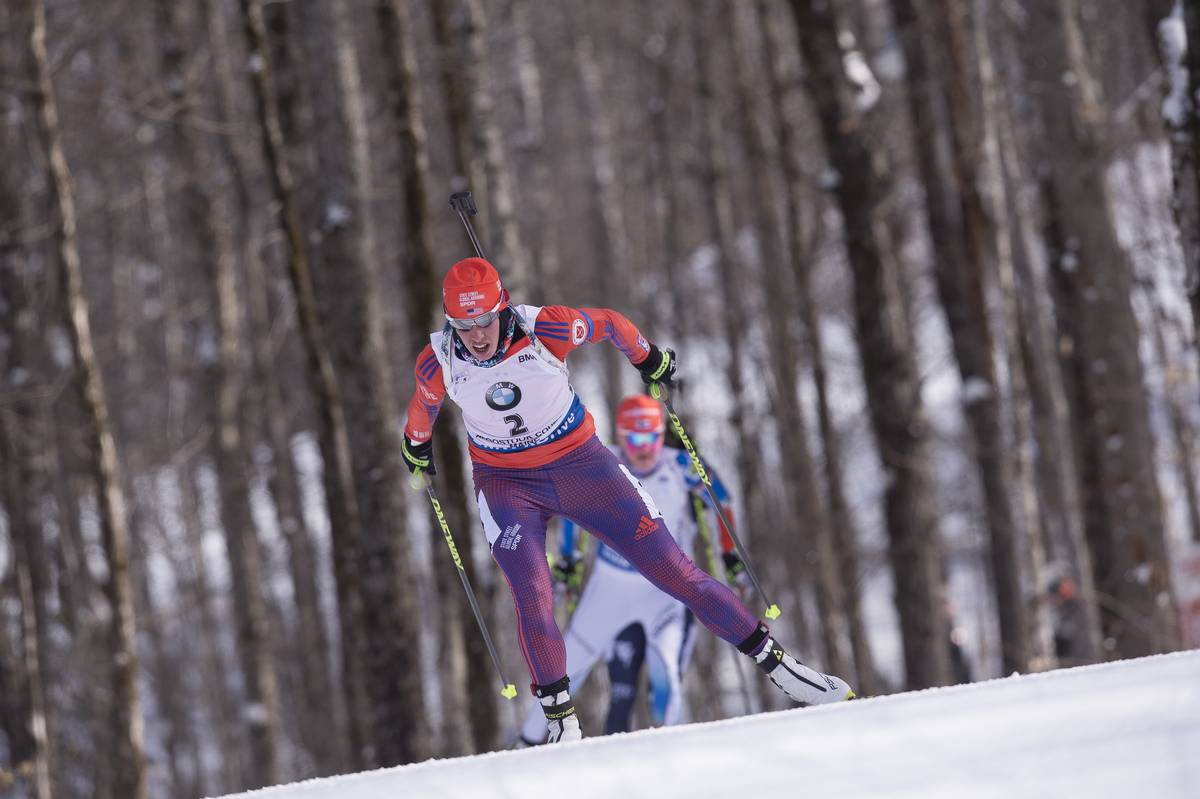
Tim Burke after placing sixth in the men’s pursuit on Saturday, repeating his season-best sixth place finish in Friday’s sprint, at the IBU World Cup in Khanty-Mansiysk, Russia. (Photo: USBA/NordicFocus)
Reflecting on their 2015/2016 race seasons, Burke explained his was solid overall.
“I feel like I proved that I can still be competitive with the best guys on a good day,” he wrote. “I’m not sure, but I think I probably had more top 15 results this season than in any previous season. I am just a little disappointed to be missing that podium finish. I had a few great opportunities for a podium finish but it just never completely came together.
“The competition in the men’s field is by far the strongest that I have ever seen and everything needs to be perfect for me now to get on the podium,” he continued. “Even though I have been doing this for a long time, I am still motivated to evolve and work at becoming a better biathlete. I already have a few things that I am excited to work on for next season!”
“I’m happy with the season,” Bailey wrote. “It is my second-best career result for overall ranking, at 17th, and a big improvement over last season.”
After missing out on qualifying for Saturday’s pursuit, Crawford explained she was somewhat disappointed with her season.
“The ski speed just wasn’t where I was hoping it to be and the results I was expecting never happened. But on the other hand, things started off great in Ostersund and I was at my peak for the World Championships,” she wrote. “There were a few glimpses of what I wanted to achieve this year, like qualifying for [World Championships] mass start, but for the most part I came up short. We will change a few things going into the training season and hopefully I can come back stronger next year!”
Nathan Smith racing earlier this season in the IBU World Cup 15 k mass start in Canmore, Alberta. (Photo: Daniel S. Guay)
Smith did not race at all this weekend after battling an illness for the better part of the last week.
“I haven’t been this sick very many times in my life, very unusual. Sore throat ears, eyes, muscles,” Smith wrote on Sunday from Khanty. “It’s pretty disappointing because I was in really good shape in Oslo and I feel like that would’ve continued here.
“I was hoping for overall a bit better of a season, but I feel like I was kind of unlucky in that my strong skiing days seemed to always align with poor shooting,” he added. “Can’t complain too much though with the two relay medals and a few top 10s.”
The U.S. team leaves Russia on Monday and will compete at U.S. nationals this week in Fort Kent, Maine.
Crawford explained she’ll be home in Canmore, Alberta, on Tuesday.
“Brendan and I will head to Silver Star [British Columbia] at the end of March for some cross country skiing and then in April we will go to Arizona for a week to visit my Aunt and Uncle,” she wrote.
“I’ll probably stick around the Canmore area this spring,” Smith wrote. “I’ve got some condo painting to do, and I’ll be sure to fit in some backcountry skiing.”
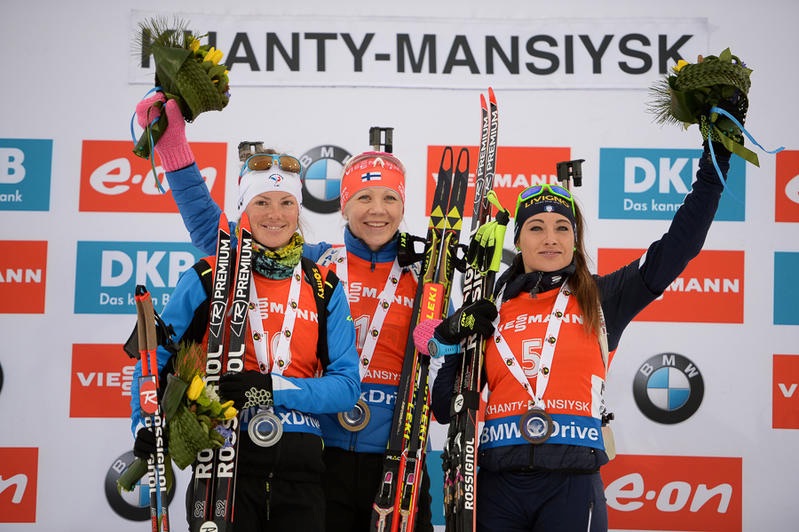
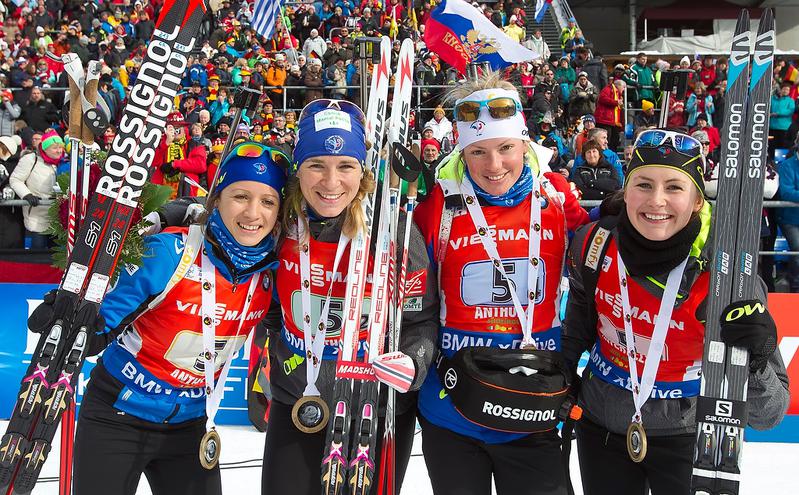
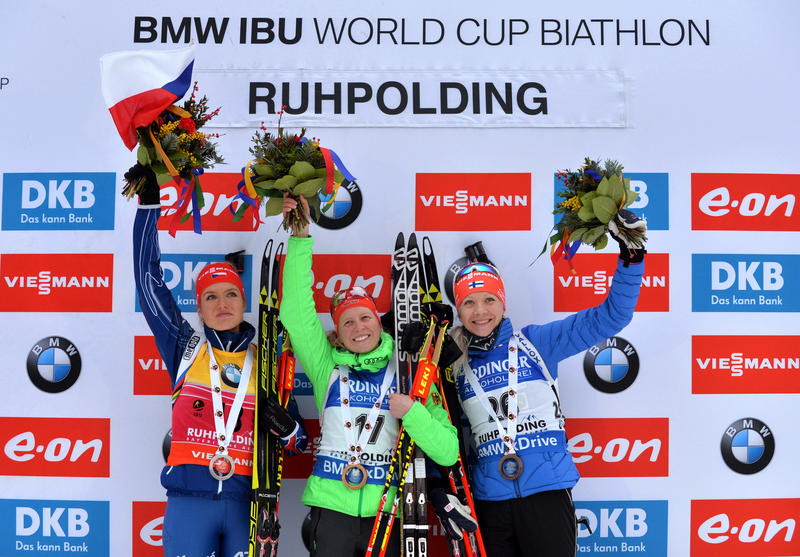
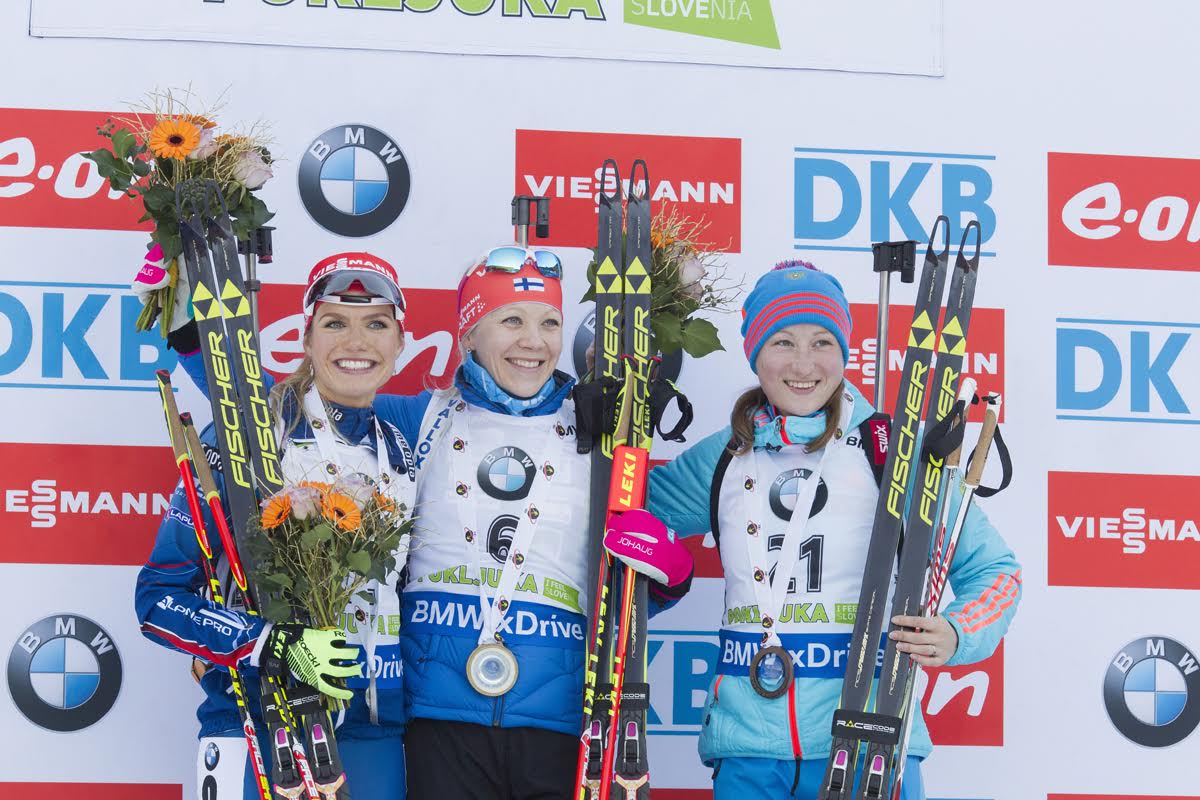
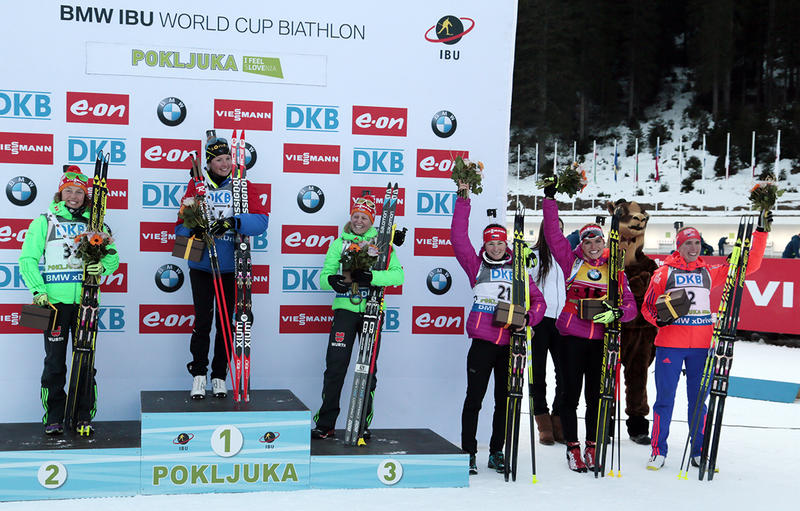
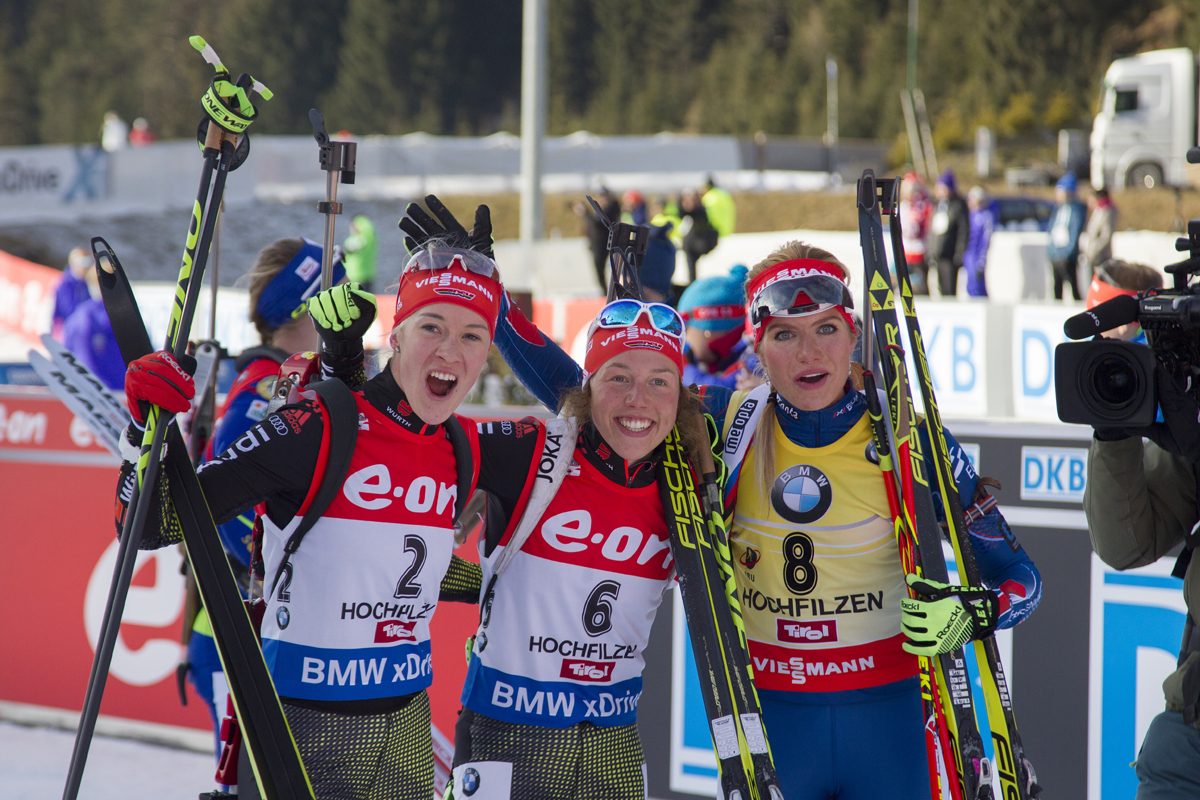
France’s Marie Dorin Habert (l), Finland’s Kaisa Mäkäräinen (c) and Italy’s Dorothea Wierer (r) on the podium of the women’s 10-kilometer pursuit at the IBU World Cup in Khanty-Mansiysk, Russia. (Photo: IBU/Evgeny Tumashov)
Six women went out closely together for the final loop of the 10-kilometer pursuit at the International Biathlon Union’s (IBU) final World Cup in Khanty-Mansiysk, Russia. The last one of the group, though only 4.6 seconds back, was Kaisa Mäkäräinen.
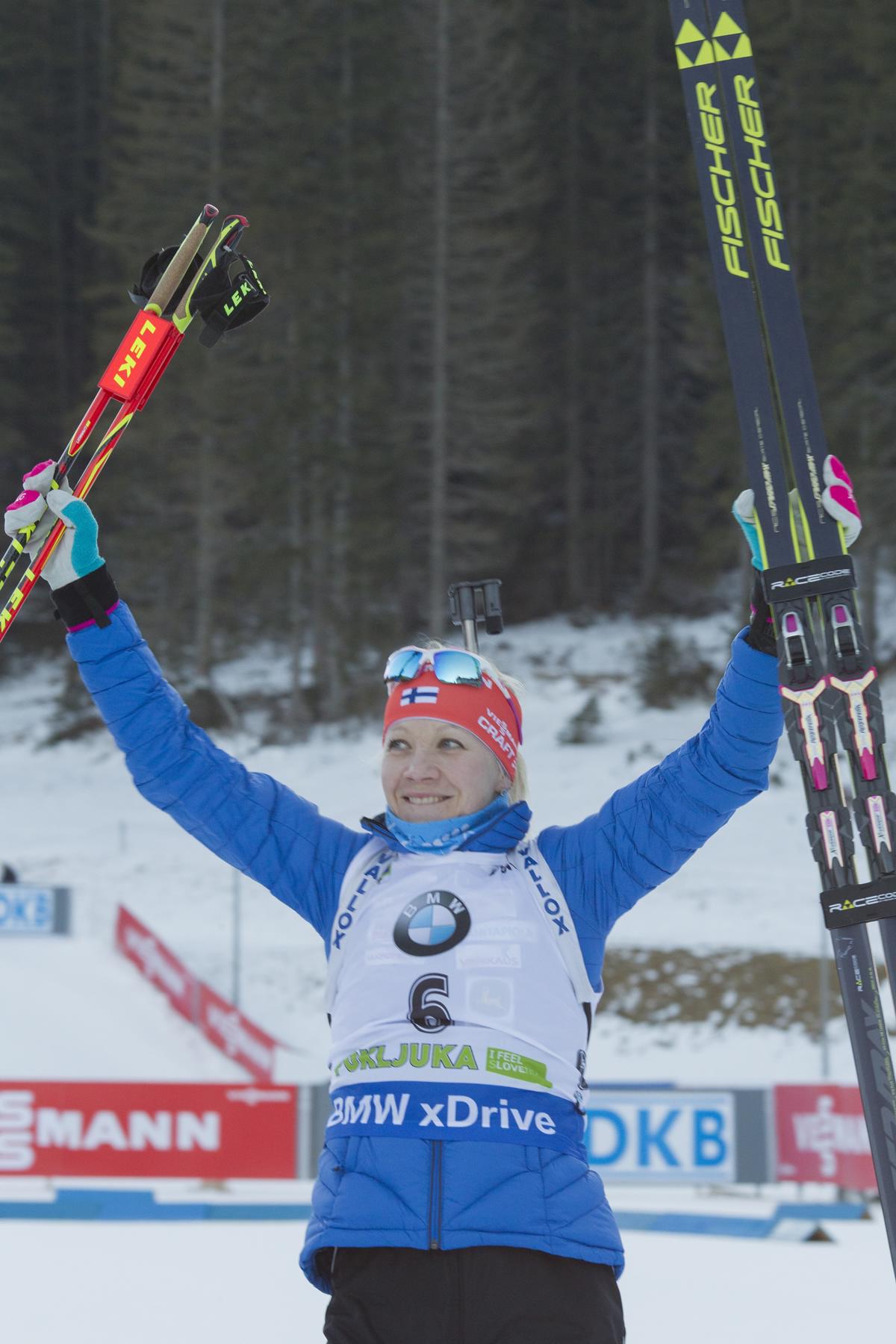
But by the finish, the 33-year-old Finn had overtaken everyone to secure her second victory in as many days in 30:06.7 with two penalties (1+0+1+0), following up on her win in Thursday’s sprint.
It was Mäkäräinen’s 19th World Cup victory and her fourth one of the season.
“I am really happy with my result today,” Mäkäräinen said at the post-race press conference. “I think two penalties for me is OK. It’s 90 percent. It’s better than my average, so I have to be satisfied with it. I was happy that the distance was not longer today, because it was quite tight in the end.”
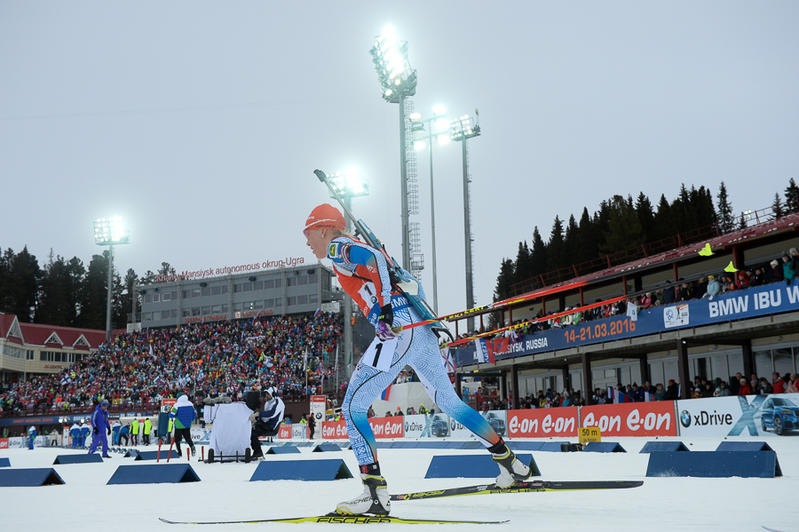
Finland’s Kaisa Mäkäräinen starting the women’s 10-kilometer pursuit at the IBU World Cup in Khanty-Mansiysk, Russia. (Photo: IBU)
France’s Marie Dorin Habert, the big winner at World Championships in Oslo, Norway, earlier this month with six medals including three gold, finished just 1.5 seconds behind her, with one penalty (0+0+0+1). In Oslo, Mäkäräinen earned bronze in the mass start.
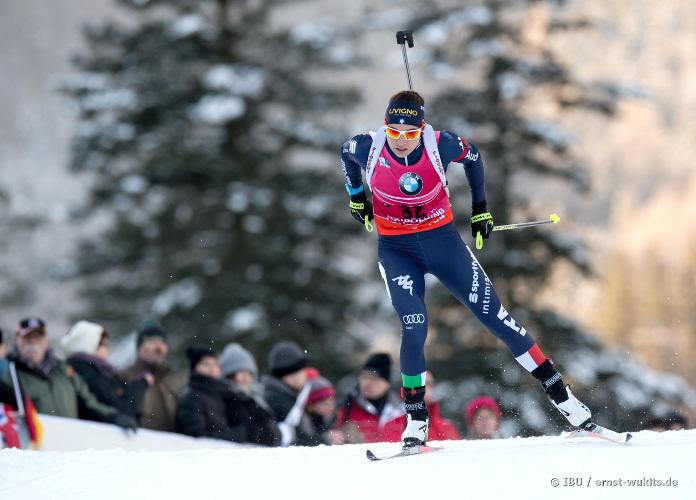
Italy’s Dorothea Wierer secured third place (+5.7) after outsprinting the Czech Republic’s Gabriela Soukalová and Germany’s Franziska Preuss. Wierer finished with one penalty (0+0+1+0).
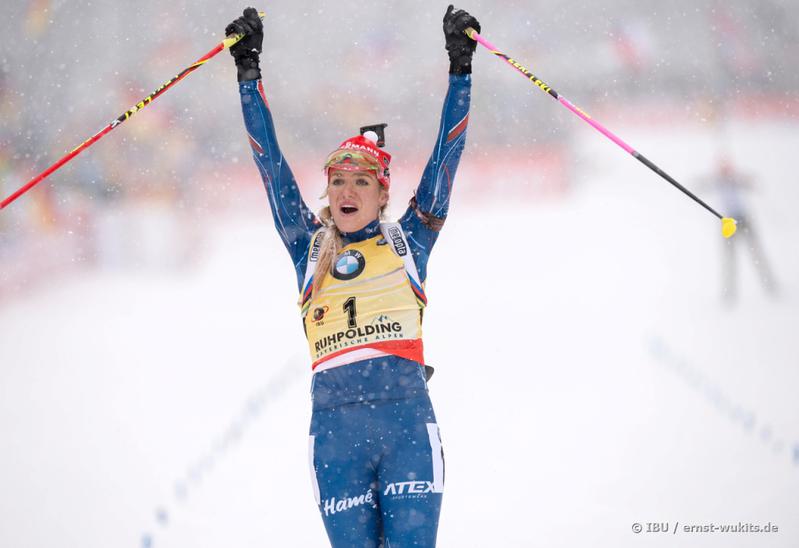
Despite missing the podium by 0.8 seconds, Soukalová, who had two penalties (1+0+0+1), still achieved the ultimate season-long victory by securing the overall World Cup title, ahead of Dorin Habert and Wierer.
Soukalová would have required at least the ninth place to do so already before the final mass start, and was the most consistent athlete throughout a season where she never placed worse than 11th (the pursuit in Oslo) in a race.
“Words are missing in this moment,” Soukalová told German TV broadcaster ZDF immediately after the race. “It’s very emotional. I am so happy for this. It’s very nice to have the Globe [trophy]. It’s awesome.”
Asked if she had been thinking about the World Cup title during the race, she added: “Before the last shooting maybe. That was the reason why I did a mistake.”
“It’s one of the biggest dreams of my life,” she later said in an interview with the IBU. ”I think I will never forget this moment. It was the main goal of the season. I am so happy, because World Championships in Oslo was a little bit unlucky for me.”
Depending on your historical perspective, this was the first or second biathlon World Cup title for the Czech Republic, after Jiřína Adamičková-Pelcová from the precursor state of Czechoslovakia (which later split up into the Czech Republic and Slovakia) also won the women’s World Cup in the 1989/1990 season more than 25 years ago.
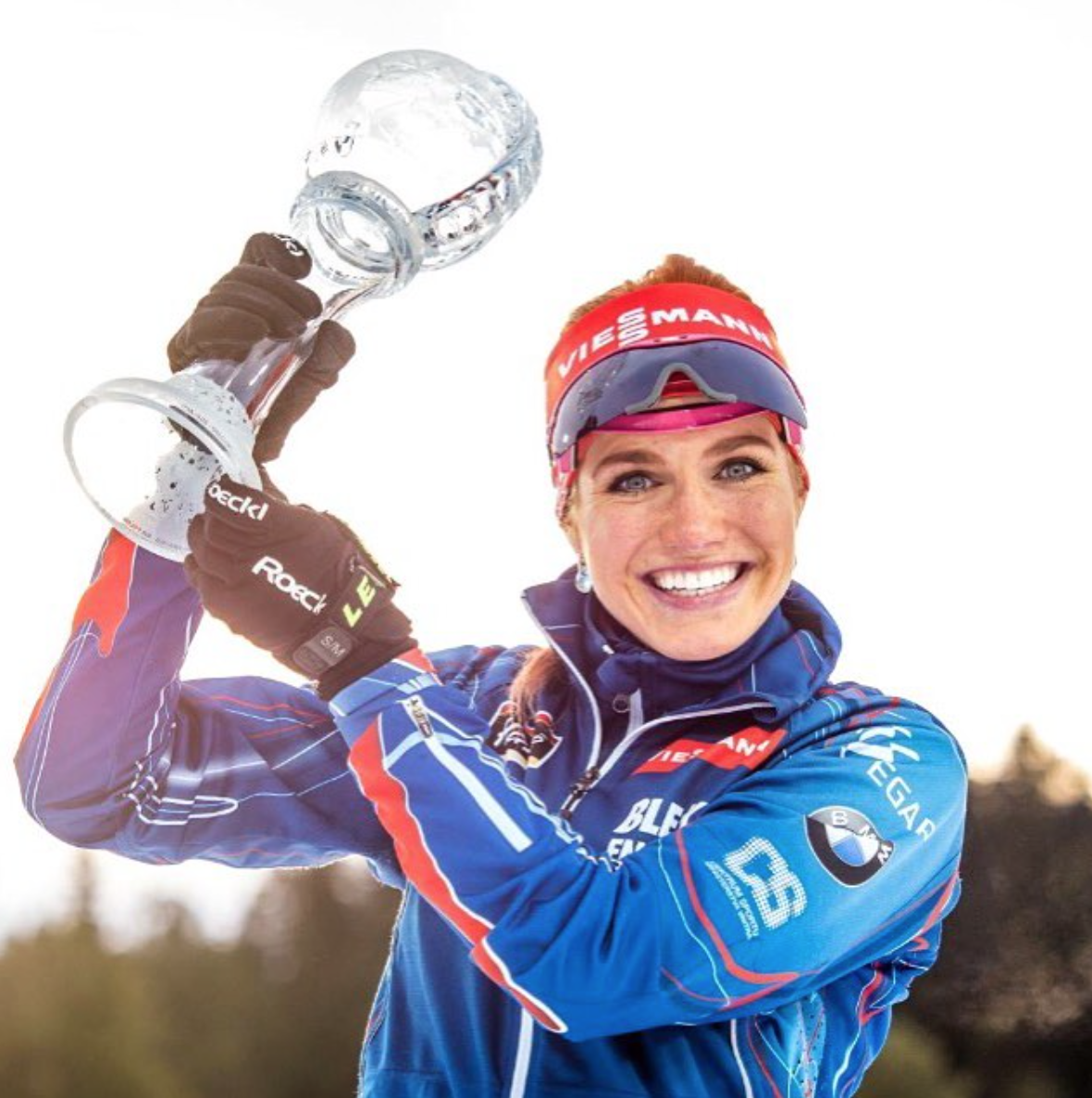
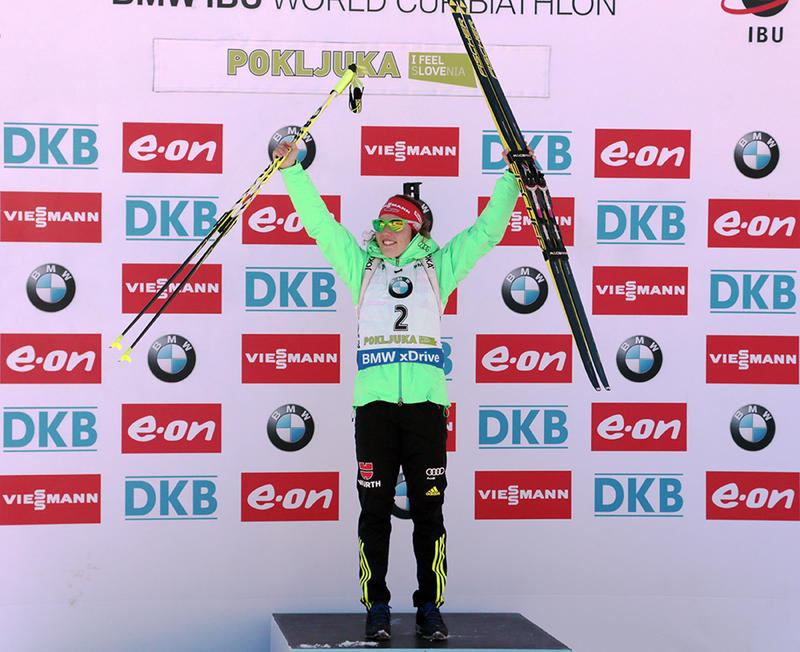
Gabriela Soukalová of the Czech Republic with her “small Crystal Globe” for the pursuit discipline title for the 2015/2016 IBU World Cup season. She also locked up the overall World Cup title on Saturday, but that will be awarded after Sunday’s mass start. (Photo: Gabriela Soukalova/Instagram)
In addition to the “big Crystal Globe” for the overall title, Soukalová also won the “small globe” discipline titles for the sprint and pursuit this week, and could still win the mass start discipline title on Sunday, which she currently leads.
“This is quite fun, I would say,” Mäkäräinen, a two-time overall World Cup winner, said of Saturday’s race and the last loop during the press conference. “Even if it feels heavy on the tracks. I like this sport!”
Reflecting on her fast skiing and still being in great shape just as the World Cup season ends, Mäkäräinen explained how she intends to close out her year.
“I think I will take part in cross-country Finnish championships, and not biathlon,” she said. “It’s more of a challenge for me. I will also make one classic race there again. I think that will be a good finish to this season.”
Dorin Habert left the range in first place after the final shooting, but Mäkäräinen quickly passed her and the French biathlete was unable to keep up.
“Kaisa was so strong,” Dorin Habert said at press conference. “When she passed us, we could not do anything. She was so fast. I just tried to race with the other girls.”
Preuss had taken the lead of the chase group behind Mäkäräinen out of a long one-minute downhill section, but was overtaken and boxed out by Dorin Habert, Wierer and Soukalová before the final climb. Dorin Habert created a small gap to the rest of the pack out of the climb into the arena to secure the second place, and Wierer won the three-women sprint for bronze thanks to excellent positioning on the last narrow turns in the arena.
“It was really a tough race,” Wierer said at the press conference. “When I went out from the last shooting range … we were six I think. Everybody passed me, and I was only saying ‘Oh my God! Oh my God!’… I am really happy that I made the third place today, because I was sure I would arrive sixth or something like that.”
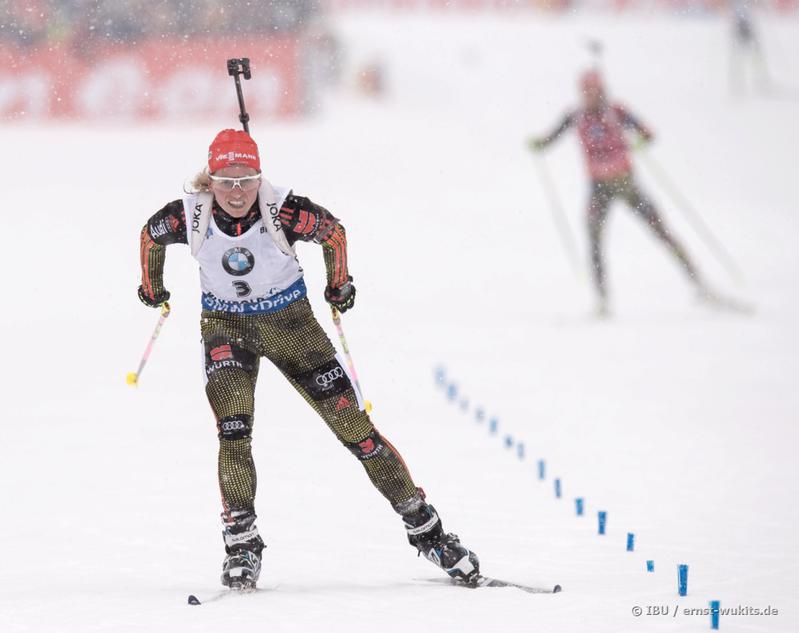
Losing out in the finish sprint with Wierer and Soukalová, Germany’s Preuss finished fifth (+6.6 seconds with one penalty, and just 0.1 behind Soukalová).
“Khanty is the last competition on the World Cup, and somehow I am always able to bring out my last remaining energy here,” Preuss told ZDF. “The course suits me really well, and I am happy with the shooting range today. It’s cool to end the season like this.”
“Before the final climb there is a long descent,” she said of the last loop. “Someone always came out of the draft, and when I was in front I knew, ‘Oh now, they’ll surely pass me again.’ And then they were ahead on the climb, and it’s really difficult to overtake there … I already noticed during the climb I couldn’t quite keep up, but I am nevertheless completely satisfied with the fifth place.”
Norway’s Fanny Horn Birkeland placed sixth (+13.1, with one penalty) as the last athlete from the top group that left the range closely together onto the final loop.
Before the race, the organizers in Khanty had asked spectators and athletes for a minute of silence for the victims of a plane crash in southern Russia, and the Russian biathlon team competed with black ribbons on their arms on Saturday.
“The crowd did observe a moment of silence for the crash victims,” American Susan Dunklee wrote in an email. “During the race, they brought their same great energy they always bring here. This is one of the loudest stadiums that we race in.”
Dunklee 22nd, Ransom Knocks Off 20 Places with Clean Shooting
Dunklee started the pursuit in 25th and initially shot clean in both of her prone stages. This moved her up all the way to 15th place, just 41.4 seconds behind the leader when she left the range.
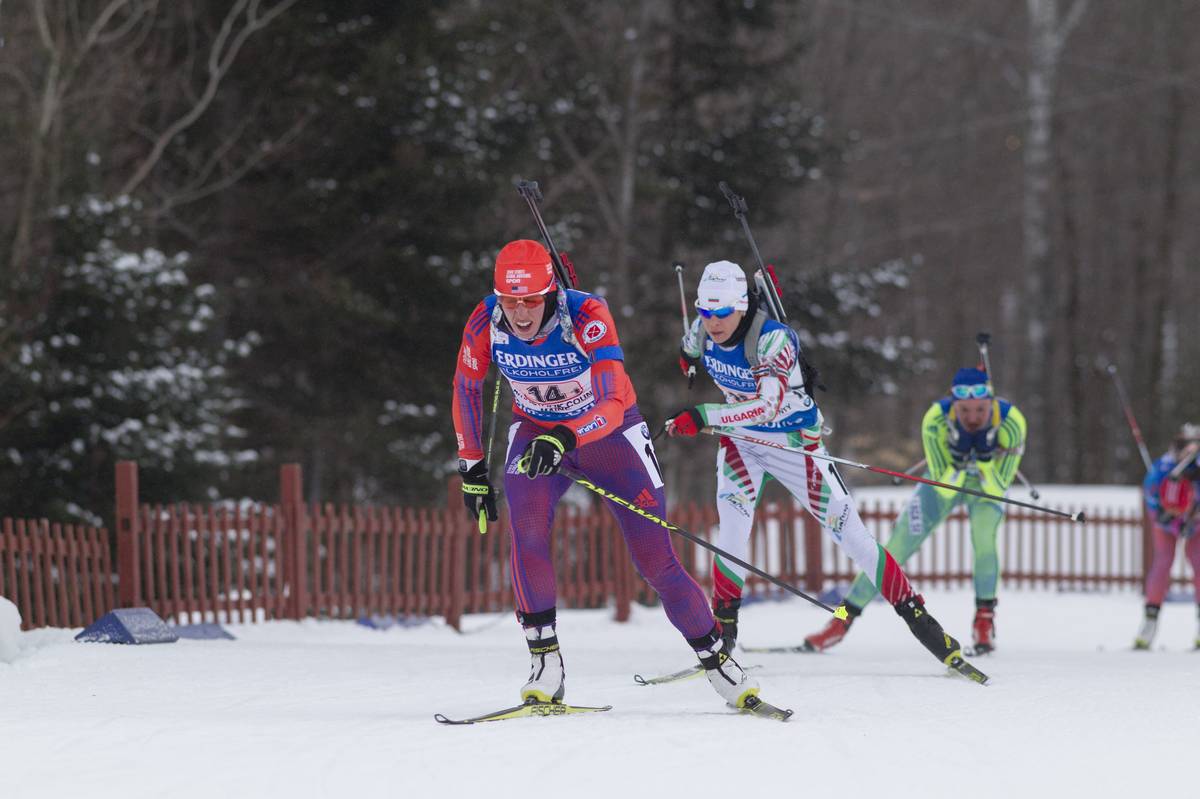
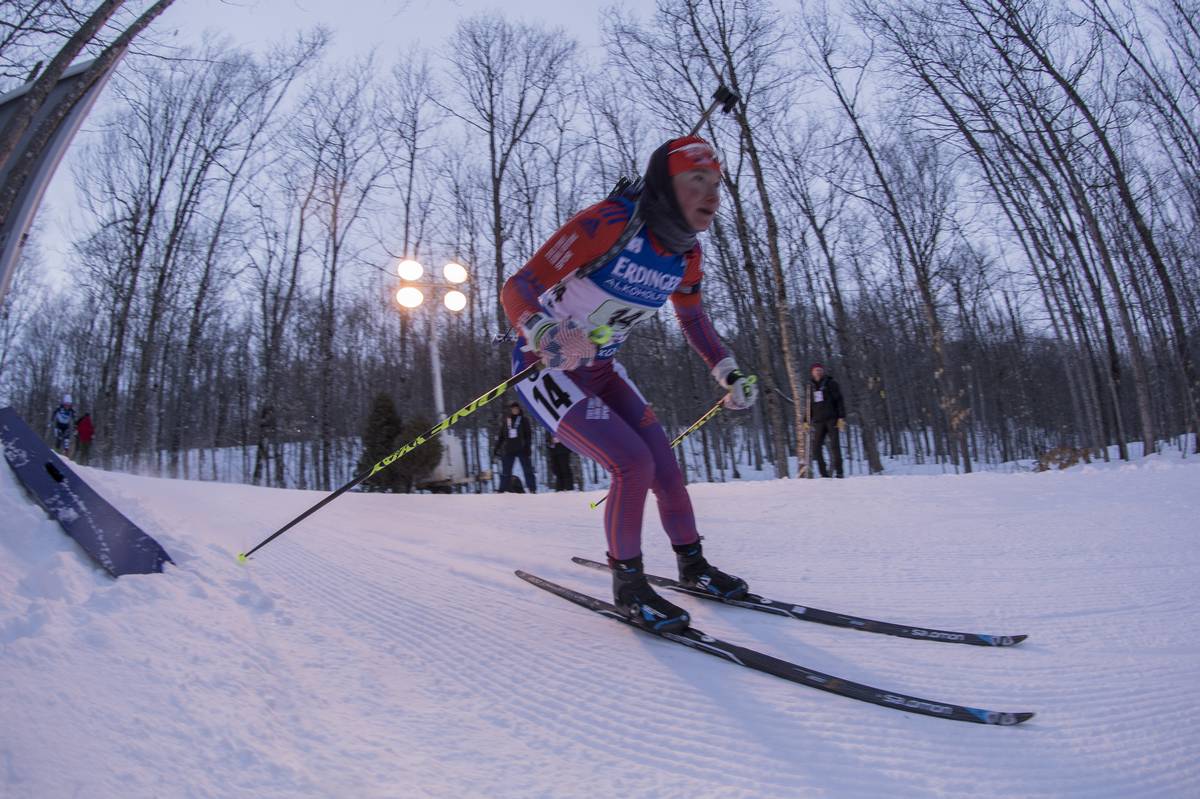
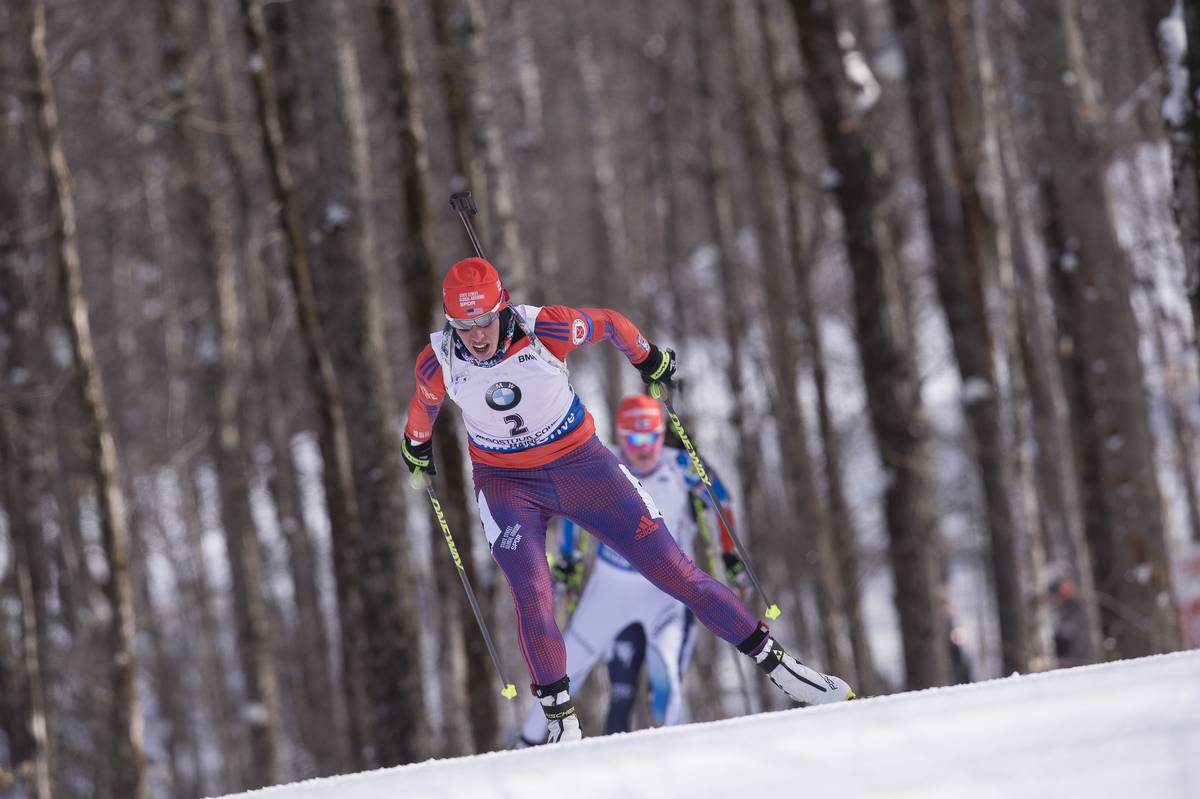
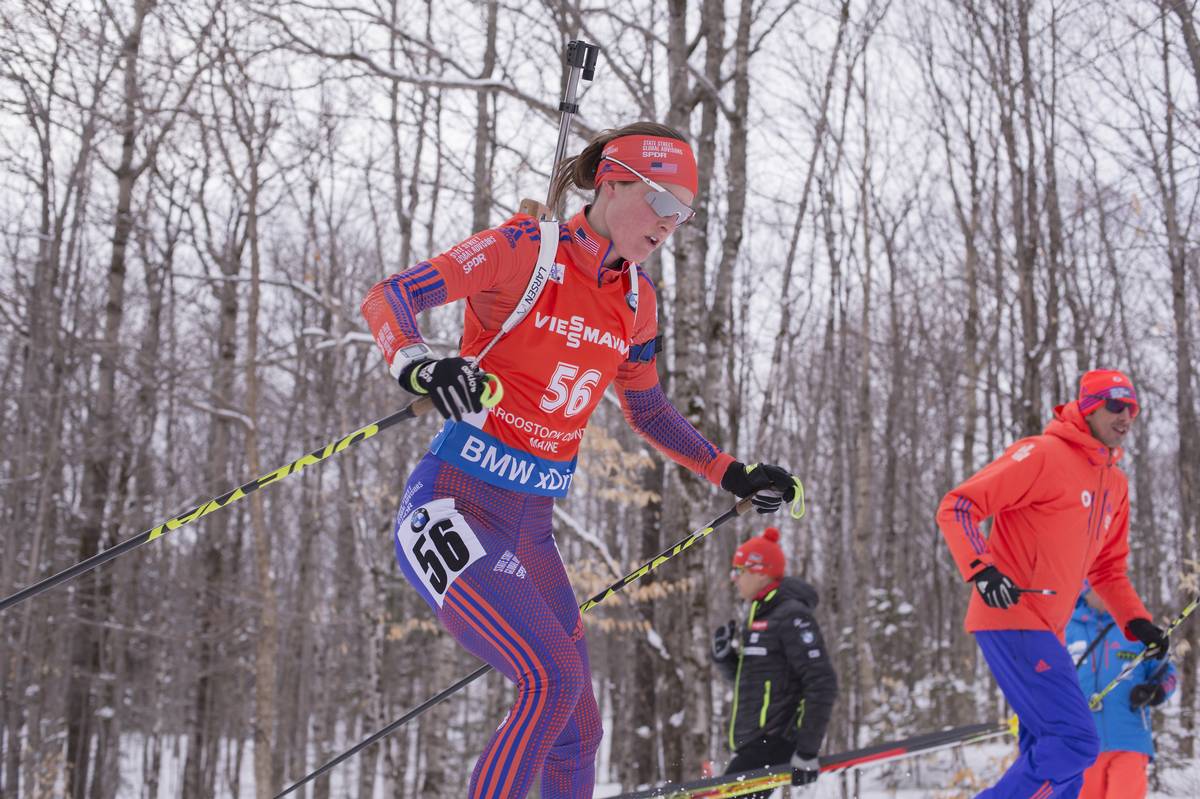
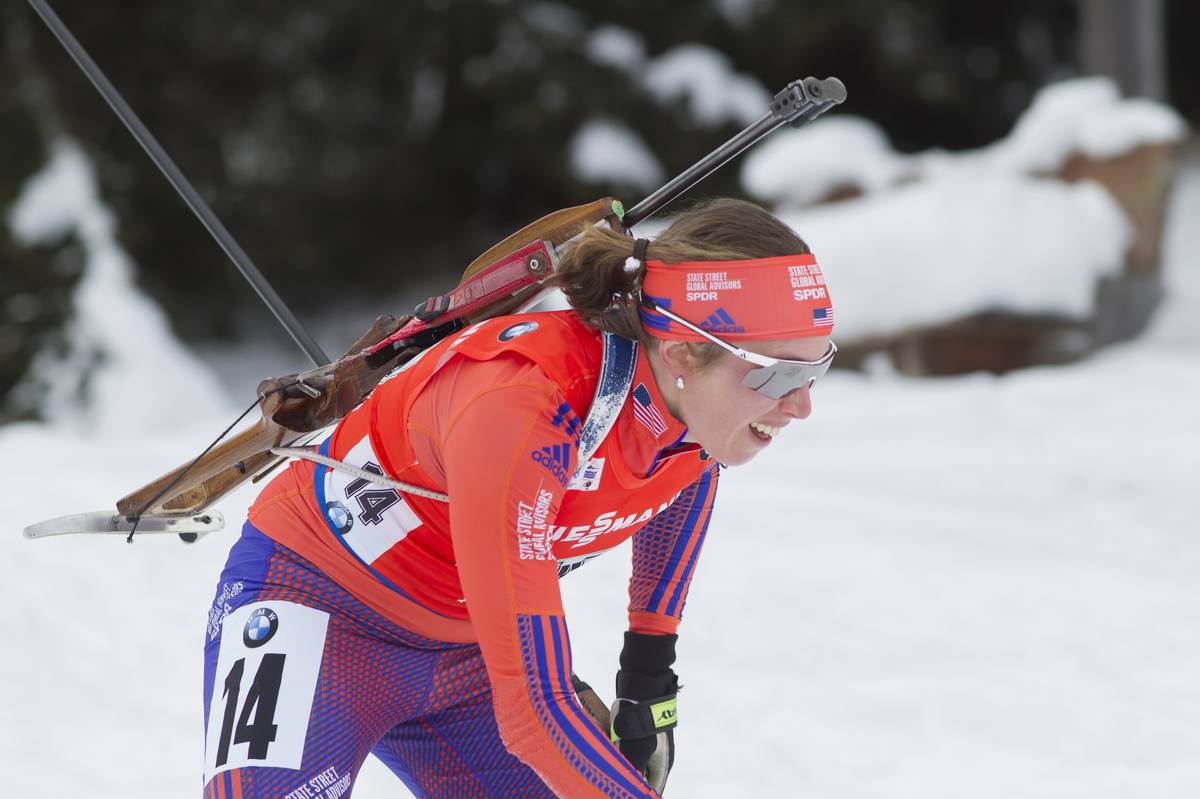
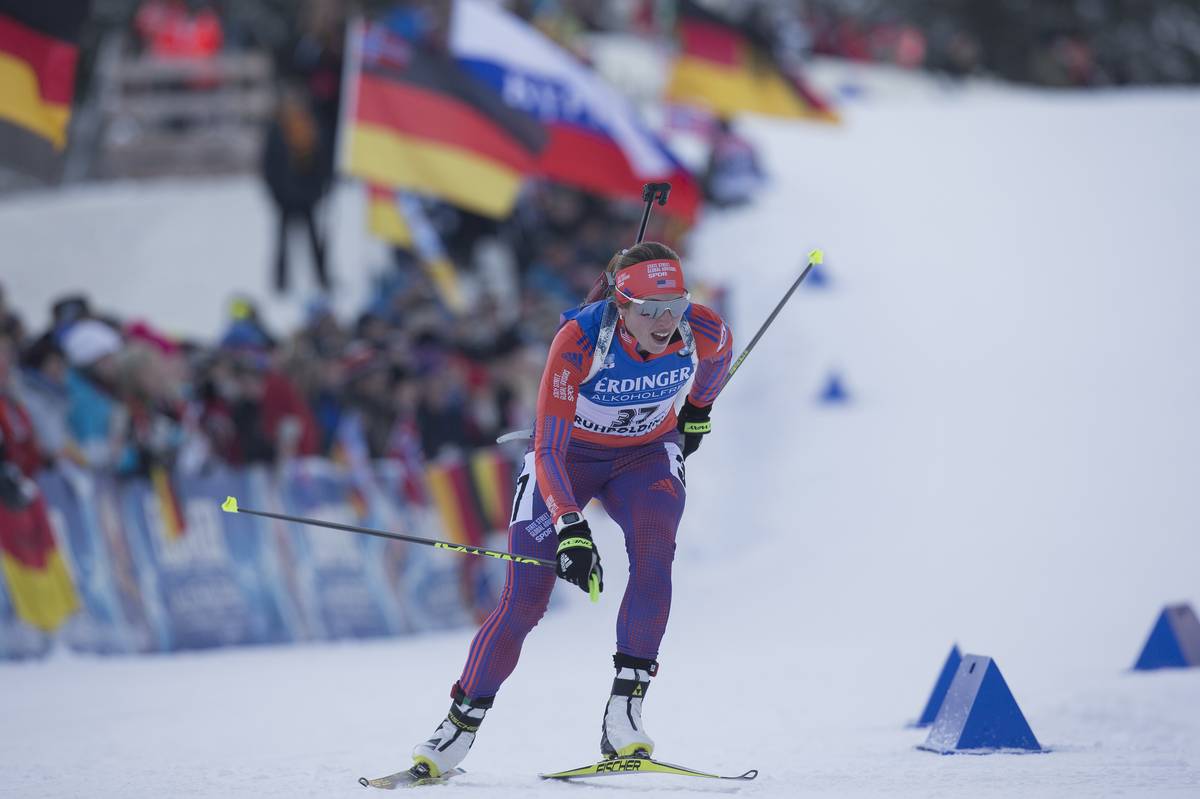
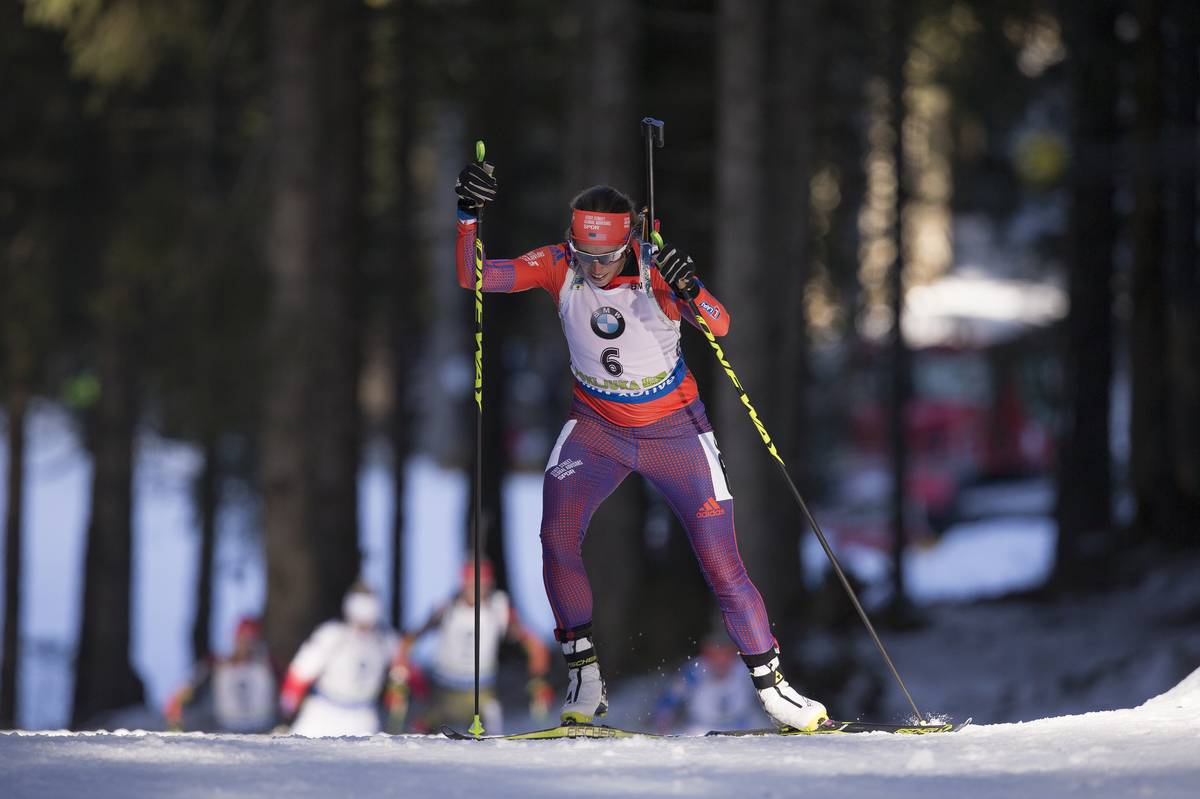
Susan Dunklee (US Biathlon) racing to 22nd in the women’s pursuit on Saturday in Khanty-Mansiysk, Russia. (Photo: USBA/NordicFocus)
On the track, she was able to keep up with the top of the field, overall skiing the fourth-fastest course time, and just half a second slower than the winner Mäkäräinen.
“I get the sense that practically everyone is exhausted, physically and mentally,” Dunklee wrote. “I am fighting off a sore throat but my energy levels felt good today and I am still hungry to compete. I often do well relative to the field when we hit this point in the season.”
But then in the first standing shooting, her race took a turn for the worse when she missed three targets.
“There was nothing difficult about the conditions for my third stage,” Dunklee wrote of that stage. “I approached that stage the same way I approached all the others. It was a simple case of me pulling the trigger when the rifle wasn’t pointed at the center of the target.”
Those penalties set her back more than an additional minute, and she set back out on the course in 23rd and was unable to make up the deficit.
In the last standing shooting, she incurred another penalty and left the range in 25th, before making up three positions on the final loop to finish 22nd (+2:13.2) with four total penalties.
Canada’s Julia Ransom as the only other North American starter in the pursuit had a perfect day on the shooting range, cleaning all of her targets in the four-stage race.
Earlier this season, Ransom also achieved 20-for-20 shooting at the pursuit in Antholz, Italy, as well as in the 15 k individual at the World Championships earlier this month. Both performances put her within the top 20 of those races; on Saturday, she picked off 20 places after starting 54th to finish 34th (+2:56.5).
Of 57 starters, Ransom was one of three women to shoot clean. Ukraine’s Yuliia Dzhima did so to place ninth, and Sweden’s Mona Brorsson finished 24th.
The two other North American starters at the World Cup in Khanty, Canada’s Rosanna Crawford and American Clare Egan did not make the top 60 to qualify for the pursuit. Dunklee is the lone North American woman qualified for Sunday’s mass start, the final race of the World Cup season.
“The course here is one of my favorites because of the good climbs and I especially like the hilly 2.5 km loop that we’ll use tomorrow,” Dunklee concluded in her email.
The ninth and final World Cup of the season ends with the men’s and women’s mass starts on Sunday. The women’s 12.5 k mass start begins at 5:20 a.m. Eastern, followed by the men’s 15 k mass start, with Americans Tim Burke and Lowell Bailey racing, at 8 a.m. Both races will be streamed live on Eurovision.
Finland’s Kaisa Mäkäräinen racing to a 3.1-second win in the final women’s sprint of the IBU World Cup season on Thursday in Khanty-Mansiysk, Russia. It was her third win of the season. (Photo: IBU/Evgeniy Tumashov)
Something in the air in Khanty-Mansiysk, Russia, just works for Kaisa Mäkäräinen. Could be the Siberian temperatures, which reached a high of about 19 degrees Fahrenheit during race time on Thursday. Could be the time of year. Either way, the Finnish biathlete won the final IBU World Cup sprint of the season, beating overall World Cup leader Gabriela Soukalova of the Czech Republic by 3.1 seconds in 20:42.3. Mäkäräinen won the same race — the women’s 7.5-kilometer sprint in Khanty last year — and this year it marked her third World Cup victory of the season.
Mäkäräinen started 17th and after a clean prone and one miss standing, she left the range in second place, trailing Norway’s Marte Olsbu (in bib 14) by six seconds. Mäkäräinen bested the 25-year-old Norwegian by 4.8 seconds with the fastest last loop. In fact, out of 80 women in the race, Mäkäräinen was the fastest on every loop. That put her first at the finish despite a penalty, leaving Soukalova, the 38th starter who shot clean in both stages, and others to chase her down.
Overall IBU World Cup leader Gabriela Soukalova of the Czech Republic racing to second in the women’s sprint on Thursday in Khanty-Mansiysk, Russia. (Photo: IBU/Evgeniy Tumashov)
Ultimately, Soukalova came up 3.1 seconds short. She left the range for the last time with a 9.8-second lead on Mäkäräinen, but tangled skis with Russia’s Svetlana Sleptsova, who was headed for the penalty loop.
“I think there was no chance to hear me because of the spectators,” Soukalova told German broadcaster ZDF afterward. “It happens sometimes, what can I do?”
Soukalova’s final loop time ranked second fastest to Mäkäräinen by 13 seconds, and she settled for second place, 1.7 seconds ahead of Olsbu. Regardless, she said that near-crash fueled her on her last loop.
“I was very sad for it, but maybe that’s the reason why I tried to go a little bit faster than usual,” Soukalova said. “So I think it’s one of the best races of my life. I am so happy for it.”
Sleptsova ended up 67th with two penalties, one in prone and another in standing.
Meanwhile, Olsbu achieved her first-ever World Cup podium in third with perfect 10-for-10 shooting.
Norway’s Marte Olsbu celebrates placing third for her first career IBU World Cup podium in the women’s sprint on Thursday in Khanty-Mansiysk, Russia. (Photo: IBU/Evgeniy Tumashov)
“It feels very good. I am very motivated after my relay leg in Oslo,” Olsbu said at a post-race press conference, referring to World Championships when she anchored Norway to gold in the women’s relay on March 11. “My shooting in the World Championships was not good, so I was happy about my clean shooting today.”
For Mäkäräinen, it marked her second-consecutive sprint win in Khanty and 18th career World Cup victory.
“I am a little surprised that it is possible to win the race with one penalty,” she said. “I like the competitions here in Khanty. It was great to win a medal on the last day in Oslo, I was also quite tired, but I slept until 12 o’clock. I think it was my key to victory today.”
At the last race of World Championships, the 12.5 k mass start on Sunday, March 13, Mäkäräinen placed third behind France’s Marie Dorin Habert and Germany’s Laura Dahlmeier, respectively.
Four days later, they were back at it again in the final World Cup of the season — four time zones east.
“The chilly temperatures, the 4 hour time change and the evening race schedule have all been a shock to the system,” American Susan Dunklee wrote in an email after placing 25th in Thursday’s sprint in Khanty. She finished 1:19.8 back from Mäkäräinen with two prone penalties.
“In Oslo I was in the best shape of my life and I was looking forward to these last few World Cup races as chances to chase after more top tens, maybe even a podium,” Dunklee added. “Today certainly wasn’t what I had hoped for. To be competitive in this tight field you need near perfect shooting but today I botched my prone stage and shot very slowly.”
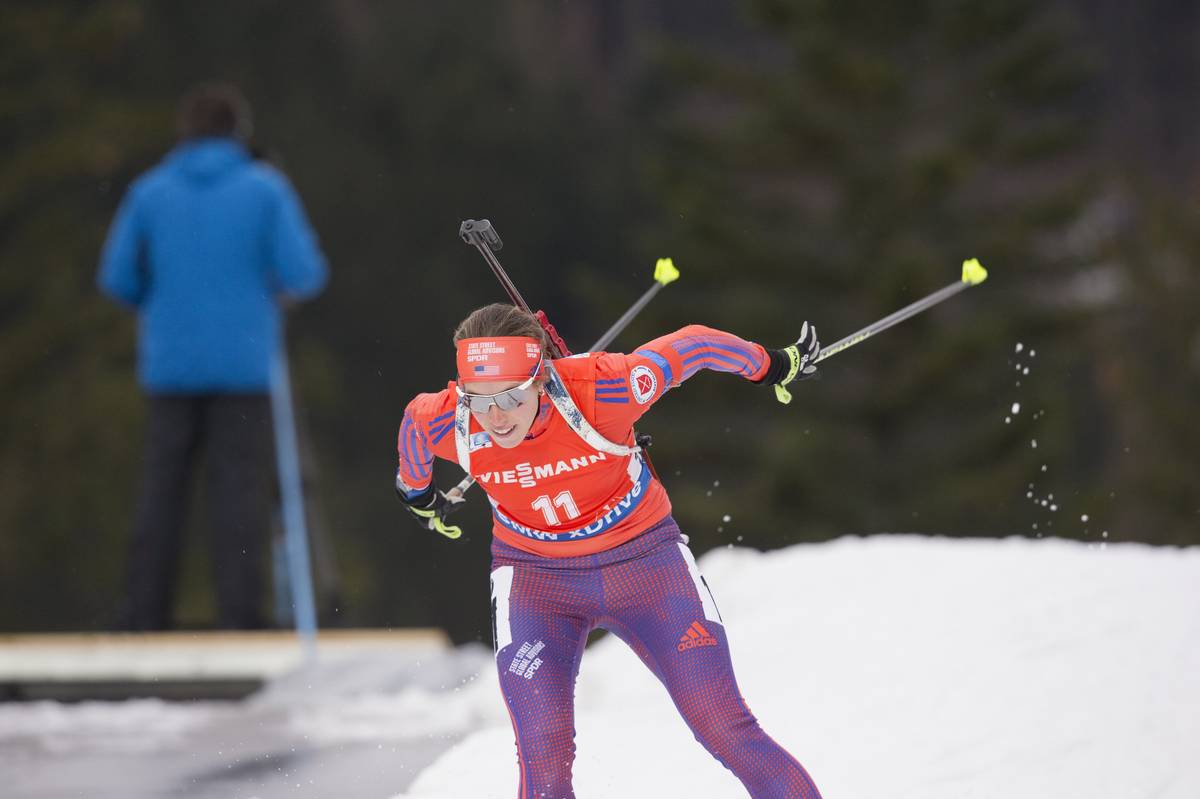
Susan Dunklee (US Biathlon) racing to 25th in the women’s 7.5 k sprint on Thursday in Khanty-Mansiysk, Russia. (Photo: USBA/NordicFocus)
While her overall course time ranked 10th fastest, her range time was 70th.
“I also struggled on skis the last two laps and couldn’t capitalize on a great ride behind Kaisa,” Dunklee explained. “Even with a rough start, it’s always worth fighting for every second until the finish, especially with pursuit start positions on the line. I know there are a lot of tired ladies here, both physically and mentally, so I see opportunity ahead in these last two races.”
Going into the final individual race of the season, Saturday’s pursuit, Dunklee is 13th overall in the World Cup standings — the best ranking of any U.S. female biathlete in history.
She qualified well within the pursuit’s top 60, and will be joined by Canada’s Julia Ransom, who placed 54th (+2:07) on Thursday with one standing penalty.
American Clare Egan tied Sweden’s Linn Persson for 63rd (+2:38.9) with three standing misses. Canada’s Rosanna Crawford missed two on each bout for a total of four penalties and finished 70th.
“After getting off to a promising start with perfect prone shooting and fast skiing, I tied my worst shooting performance of the year with three standing penalties and missed qualifying for the pursuit by three places,” Egan said in a US Biathlon press release. “This loss really hurts. I can only wish my teammates success now.”
The men’s 10 k sprint starts Friday at 9:15 a.m. Eastern time, and can be watched live on Eurovision with English commentary by Chad Salmela.
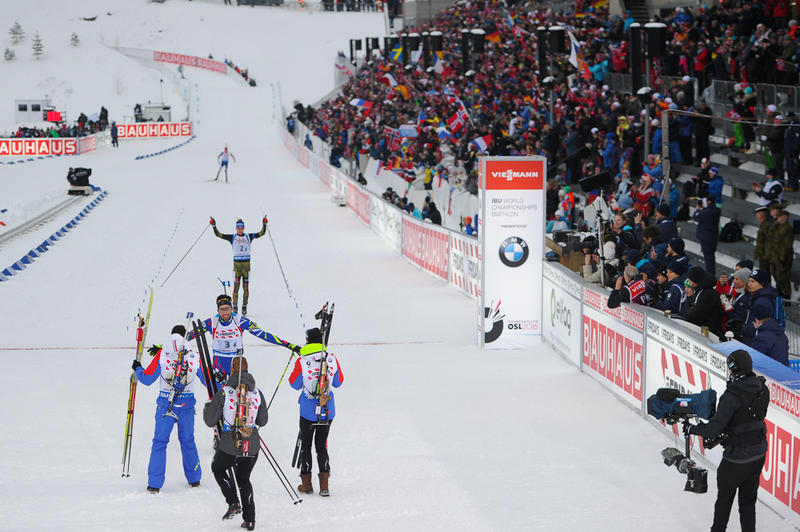
France’s Martin Fourcade crosses the finish first to meet his teammates after anchoring the mixed relay to gold to open the 2016 IBU World Championships in Oslo, Norway, Germany’s Simon Schempp secures second behind him, and Norway’s Tarjei Bø comes onto the final stretch to claim bronze. (Photo: IBU/Evgeny Tumashov)
Martin Fourcade versus Simon Schempp: Two perennial rivals who still greatly respect each other’s performances, duking it out on the final loop of Thursday’s mixed relay.
It was a fitting end to the first race of the 2016 International Biathlon Union (IBU) World Championships in Oslo, Norway, a finish sprint into the famous Holmenkollen ski arena with two athletes at the top of their game, in a repetition of a scene similar to what biathlon fans have witnessed repeatedly in recent seasons.
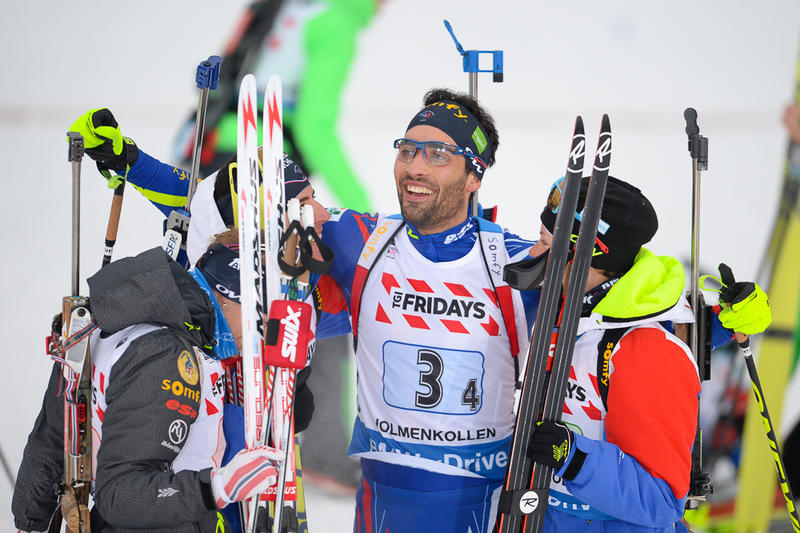
This time, France’s overall World Cup leader Fourcade prevailed against Germany’s anchor, skiing over the last bridge in the stadium and taking a little bow in the style of a telemark ski turn. He crossed the finish line in 1:14:01 and celebrated the gold medal with his excited teammates. Combined, the four-person French relay had no penalties and seven spare rounds.
Martin Fourcade celebrates with his teammates after anchoring France’s mixed relay to gold in the first race of 2016 IBU World Championships in Oslo, Norway. (Photo: IBU)
“Today was really emotional, because it was my first, our first victory in a team race in World Championships since 2009,” Fourcade said at the post-race press conference.
“Of course we were among the favorites so we were thinking about [the gold medal],” Fourcade added in an interview with the IBU. “But in biathlon you never know until the last shooting. We were fighting for gold as well as for the fourth place.”
Germany finished second, just 4.3 seconds back, and also with seven spares.
“I tried to bring out everything I had, but in the end I honestly was too exhausted,” Schempp told German TV broadcaster ARD. “We are totally happy about silver.”
“The way Fourcade threw himself into the snow afterwards, I think that shows Simon [Schempp] pushed him to his limits,” Germany’s third leg skier Arnd Peiffer told ARD. “Martin definitely didn’t have it easy on the final loop today … With that ‘telemark’ move he was just showing his excitement, that had nothing to do with arrogance.”
Another 10 seconds back, Norway’s anchor Tarjei Bø secured the bronze medal for the home team (+14.4), with ten spares, to the huge joy of the audience.
The U.S. finished 10th (+2:19.6), with five spares, falling back on the last three legs after starter Susan Dunklee rocketed through the first exchange in first place. Canada placed 11th (+2:30.8), with 11 spares, unable to quite keep up with the leaders throughout the race due to too many misses on the shooting range.
After a festive opening ceremony at a central square in Oslo on Wednesday night, the Biathlon World Championships opened with the mixed relay, including two women and two men per team, with all other rules just like in a traditional relay.
The two women begin, and each ski 6 kilometers with one prone and one standing shooting stage, while the men have to ski 7.5 k each. The athletes can use three spare rounds per stage, and if they fail to clean their targets with those spares, they have to ski a 150-meter penalty lap for every miss.
The IBU first experimented with mixed relays 11 years ago as a special event during the World Cup finale. Since 2007, the discipline has been part of the official program at World Championships.
Initially it was a bit of an afterthought, with a number of countries with large teams using it as an opportunity to give their lower-ranked biathletes a start at championships, and saving their best ones for the individual starts and the traditional women’s and men’s relays.
That has changed in recent years, since the event also became part of the program at the 2014 Olympics in Sochi, Russia. This year in Oslo, small and larger teams alike certainly pulled out all the stops, with almost every nation entering the its best athletes.
Low-hanging clouds and fog on the range had been predicted, but for Thursday’s competition, the view of the targets on the shooting range was actually clear despite a cloudy sky and a little fog shrouding the big ski jumps that tower over the Holmenkollen arena.
The French team, with Anaïs Bescond, Marie Dorin Habert, Quentin Fillon Maillet, and Fourcade, initially hit a snag when Bescond required all spares to hit her targets in her standing stage, narrowly avoiding the penalty lap and coming through the exchange in seventh place, 35 seconds behind Dunklee.
Then Dorin Habert crashed in a ski tunnel out on the course, in snow conditions some athletes described as “glazed” in certain sections.
“Nothing terrible, it was just a mistake by me,” Dorin Habert said of her fall at the press conference.
She quickly recovered and moved her team into third place at the next exchange, with Fillon Maillet and finally Fourcade able to close out successfully by pushing hard up the final small climb and U-shaped turn in the arena to create a little gap.
Similarly to France, Germany’s starter Franziska Preuss initially lost 20 seconds to the top due to two misses in her first prone stage, but moved back up to fourth place at the exchange. Then Franziska Hildebrand and Peiffer kept the team in contention for the podium, before Schempp was able to claim the silver medal.
Germany’s Simon Schempp after one of his shooting stages during Thursday’s mixed relay at IBU World Championships in Oslo, Norway. He anchored Germany to second, 4.3 seconds behind France. (Photo: IBU)
In his last shooting, Schempp thought he had hit all shots taking down his rifle to head back out on the course, before realizing he had missed one and — like Fourcade -– still had to use a spare. Schempp made his shot and left the range just 1.7 seconds behind Fourcade. While Schempp was able to catch up on the course, he did not have the energy left to beat his rival in the final sprint.
Ahead of World Championships, fans and the media put a lot of expectations on the home team from Norway with Marte Olsbu, Tiril Eckhoff, Johannes Thingnes Bø and his older brother Tarjei Bø.
At the 2014 Olympics, Norway had won the gold medal in the mixed relay, though only Eckhoff, who grew up just a stone’s throw away from the Holmenkollen arena, was a part of the lineup back then.
In front of thousands of spectators, including Norway’s King Harald V, the team did not disappoint, with Olsbu and Eckhoff delivering some of their best performances of the season to tag off in second and first place, respectively. From there, the Bø brothers kept the team in podium contention.
“I was very nervous,” Olsbu said at the press conference. “I am just so happy that I made a good race today.”
Johannes Bø tried to make a move on his last loop, yet the other teams just behind him closed the gap again before the exchange.
After needing all spares in his prone shooting on the anchor leg, his brother Tarjei fell back 18.4 seconds, but was able to reduce that again to 7.4 with fast skiing and a clean final shooting stage. While he tried everything in his power, he could not quite catch up to Fourcade and Schempp again.
“Of course we are happy to have a medal at the Championships [at] home,” Johannes said during the press conference. “But we are athletes who want to win. So we are 90 percent happy [with bronze], and we take the last 10 percent next week.”
“Simon and Martin were too strong for me,” anchor Tarjei Bø said.
When a French journalist asked his rivals if Fourcade maybe gained a psychological advantage for the remainder of the World Championships after a win on Thursday, Tarjei Bø laughed and exclaimed: “Yeah, he is unbeatable. He’s so unbeatable that I will not race any more at these World Champs!”
“That’s a good idea,” Fourcade replied with a big smile on his face.
For a long time, four teams had been in close contention for the medals, but after a strong race Ukraine, with Valj Semerenko, Olena Pidhrushna, Sergey Semenov and Dmytro Pidruchnyi, could not quite keep up on the anchor leg with two spares in the last shooting. Ukraine finished fourth (+29.8), with nine spares.
Fifth place (+1:07.1) went to Austria, with Dunja Zdouc, Lisa Theresa Hauser, Simon Eder and Dominik Landertinger, which combined for a team total of just three spares, the fewest of any nation. Meanwhile, the defending world champions in the mixed relay, the Czech Republic, with Veronika Vitková, Gabriela Soukalová, Michal Slesingr and Michal Krcmar finished sixth (+1:23.3), with five spares.
Dunklee in the Lead
Susan Dunklee (US Biathlon) trails France’s Anais Bescond during the first leg of the mixed relay at 2016 IBU World Championships on Thursday in Oslo, Norway. Dunklee went on to tag off in first, 1.6 seconds ahead of Norway. (Photo: USBA/NordicFocus)
For US Biathlon, Dunklee started out strong, shooting clean in the first prone stage to leave in second behind France’s Bescond. Then she again hit all of her targets in standing to leave the range 4.5 seconds behind Norway’s Olsbu and Italy’s starter Dorothea Wierer (an athlete with multiple World Cup victories this season. Italy went on to finish eighth).
This time, Dunklee was not satisfied just staying behind the athletes at the top, immediately attempting to overtake Wierer and move up to Olsbu.
“I love the thrill of starting relays,” Dunklee wrote in an email after the race. “I have been close behind the leader tagging off many times, but I have never tagged off in first. On the last loop I was hungry to finally win my leg today and I wanted to give Hannah [Dreissigacker] the experience of leaving in the lead in front of a packed Norwegian crowd.”
Of all the first-leg skiers, Dunklee’s course time was the fastest.
“I do love the Holmenkollen crowds and the hilly course,” she wrote. “I felt relaxed and focused on the shooting range and felt very strong skiing. Our staff put together incredible skis today.”
“I love the thrill of starting relays. I have been close behind the leader tagging off many times, but I have never tagged off in first. I was hungry to finally win my leg today…” — Susan Dunklee, who put the U.S. in first at the first exchange on Thursday
Dreissigacker initially was able to keep up on the course with France, Norway, Ukraine, and Germany at the top.
“It was a fun race and definitely a real thrill [to] get the tag in first place,” Dreissigacker wrote in an email. “Susan really did us all proud out there. I did my best to ski my own race, but it’s always hard when you have lots of adrenaline and find yourself in first place.”
After requiring a spare in prone, she was still in third place, only 1.7 seconds back. Then having more trouble maintaining the leaders’ pace on the next loop and with another missed shot in standing, she fell back 22.7 seconds to fifth place. On her final loop, Soukalová, the overall World Cup leader, passed her on the course, and Dreissigacker lost another half a minute to the leaders, tagging off in sixth, 51.3 seconds back.
“I felt like I was in control on the first and second laps, trying to keep in touch with the leaders as much as possible without overdoing it,” Dreissigacker explained. “But I definitely didn’t have too much gas left in the tank for the last lap, and it didn’t help that I had really lost all contact with the women ahead of me. But that was also a group of the very fastest women in the world, so I am not surprised that they put lots of time on me in the last lap.”
The U.S. team’s third leg, Lowell Bailey had a strong performance on the shooting range and stayed clean both times just like Dunklee, but continued to lose time on the course, and his course time ultimately ranked 19th of the third-leg skiers. He tagged off in eighth place, 1:35.5 minutes back.
“The course was tricky today,” Bailey wrote in an email. “The new snow packed down and glazed, making some of the downhills and especially the stadium fairly treacherous. It wasn’t my best day on skis, but hopefully I’ll feel better as the Championships roll forward.”
Anchoring the U.S. relay, 20-year-old Sean Doherty required a spare in both his prone and standing stages, and with the 16th-ranked course time on his leg, he slipped two positions to finish 10th (+2:19.6), one position ahead of Canada.
“Today’s race was an exceptionally high level,” Doherty said in a US Biathlon press release. “We showed that we can shoot with the best teams and be very competitive. I am really happy with my leg and feeling strong looking ahead to the sprint.”
“The mixed relay is a format we often think of as one of our best medal hopes, so from that perspective our result today is disappointing,” Dunklee wrote. “After our 4th place in Canmore I think we all went into today with high hopes… On the range we put together an excellent performance, one of our best I would say. Tenth is solid, but we know with that good of [a] shooting we can be capable of much more. The good news is that we have many races still to come.”
“It was just tough, tight competition out there and I think we had a really solid team performance,” Dreissigacker commented. “Using only 5 spares for the whole team is great shooting!”
As Bailey pointed out, a top 10 is a top 10.
“It is a tight field and we were close to the leaders for a significant part of the race,” he wrote.
The Canadian team with Julia Ransom, Rosanna Crawford, Nathan Smith, and Brendan Green was hoping to build on its ninth place in the mixed relay in Östersund, Sweden, and sixth place at home in Canmore.
On Thursday, Ransom started in bib 5, and had some trouble to keep up with the leaders. With one miss in both her prone and standing stages, she found herself 36.5 seconds behind going onto the final loop, and then lost more time to tag off in 11th place, 1:03.4 minutes back.
Crawford was able to maintain the pace with the seventh-best course time on her first loop, before dropping off a bit the third time around the Holmenkollen 2 k course.
“It was nice on those first two laps to be working with Sweden and trying to stay with Soukalová,” Crawford wrote in an email. “I had a tumble on the same hill as Dorin [Habert] in warm up and broke a pole, but the race was smooth and I didn’t have to deal with any sketchy people on the downhill.”
But she couldn’t make up positions or time with a miss in her prone shooting and two spares in the standing stage, where she had some additional issues.
“I had some trouble with standing where my shell got stuck, and I wasted some time getting that fixed, and then missed two targets on top on that,” Crawford wrote. “So I am quite disappointed with my shooting. Getting the jitters out before Saturday’s race though hopefully!”
She handed off in 14th place, 1:27.7 back.
Currently the highest-ranked Canadian on the World Cup, Smith skied fast on the course, posting the fifth course time on his leg.
“I’m very happy with my skiing today,” Smith wrote in an email. “I’ve been struggling over the last 7 weeks to feel good on the skis. I wouldn’t say I felt like a total beast skiing, but I knew my shape was good just because I was able to more or less maintain position with top guys like [Russia’s] Garanichev and [Austria’s] Eder… I don’t actually particularly like this arena. I find the gentle ramp through the stadium surprisingly challenging. The ski loops are interesting though, and obviously great views.”
But like his teammates, he could not quite stay clean on the range, requiring two spares in prone and another one in standing.
“Shooting conditions were perfect,” Smith stated. “Very little wind and no fog. Earlier in the day it looked nasty but everything cleared up for us.”
Smith moved up the team a few positions to tag off in 10th (+1:35.9).
“I wouldn’t say I felt like a total beast skiing, but I knew my shape was good.” — Nathan Smith, who skied the fifth-fastest course time on the third leg to bring Canada from 14th to 10th
Canada’s anchor, Green also did not have a perfect day on the range, needing one spare round in prone and two in the final standing stage. Combined with his skiing (13th ranked course time), he lost some additional time to the top, with Canada closing out the race behind the U.S. in 11th place, 2:30.8 behind the winners.
“In my portion of the race there wasn’t anything too out of the ordinary,” Green wrote in an email. “The track was really glazed in some sections and the skiing in general felt like a bit of a balancing act at times.
“There has been a bit of wind during the last few days [of] training, but it dropped a bit this afternoon which was nice,” he wrote of the shooting conditions. “A slight but manageable wind from the left. I was a bit worried about the fog that was lingering throughout the day but fortunately it moved off and the range was clear.”
Asked if their team result was within expectations, Crawford wrote, “11th is a disappointing result for our team, we are capable of a top 8 on an average shooting day and for sure top 6 if we all have a great day on the range. 11 spares is not a normal day for our team I’d say.”
“11th is nothing to write home about but still a decent result,” Smith stated. “We knew everyone would be putting in their best teams.”
“Overall, today wasn’t a true representation of what our team is capable of,” Green wrote. “It’s day one of the Championships and I know we’re all hungry for more.”
Races in Oslo continue on Saturday with the first individual races: the men’s and women’s sprints. All races as well as shorter recaps can be streamed live or time-shifted (most with English commentary) on Eurovision Sports.
“I just want to get one [individual] title, that’s my aim,” Fourcade said at the press conference.
“The atmosphere was great!” Bailey wrote. “Cheering along the track and extremely loud in the stadium. I think it will be even bigger on the weekend.”
“On Saturday we’ll come out fighting,” promised Green. “The atmosphere was pretty awesome today. The stands were full and the stadium was loud. It’s a good vibe and if today is any indication, we’re going to be in for a fun couple weeks of racing.”
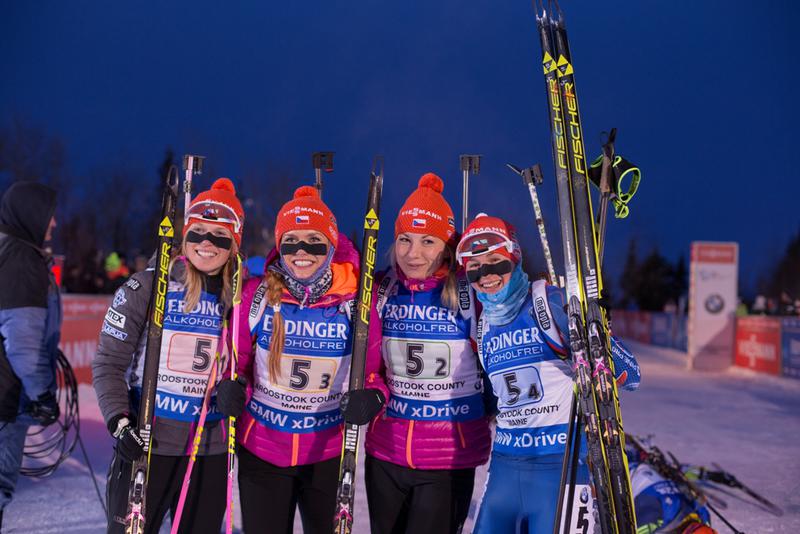
The Czech Republic women’s team, which won the 4 x 6 k relay on Saturday at the IBU World Cup in Presque Isle, Maine, with (from left to right) Eva Puskarcikova, Gabriela Soukalova, Lucie Charvatova, and Veronika Vitkova. (Photo: IBU/NordicFocus)
“It’s good to try a romantic atmosphere,” World Cup leader Gabriela Soukalová of the Czech Republic joked about the dark and cold course conditions at the end of the International Biathlon Union (IBU) World Cup women’s 4 x 6-kilometer relay in Presque Isle late Saturday afternoon, when the sun had long set behind the trees and hills of northern Maine for the final 6 k. “I appreciate it so much. I was thinking about my boyfriend,” she said in an post-race team interview with the IBU.
“Candles…” her teammate Eva Puskarcíková added.
The Czech women had every reason to be in a good mood. In the final race before the upcoming IBU World Championships in Oslo, Norway, their team had asserted its intention to be on the podium there in March, achieving the first relay victory of the season in a time of 1:07:11.0, with one penalty and 14 spare rounds.
After narrowly avoiding a penalty lap in the last shooting, anchor Veronika Vítková had a large enough lead to ski to the side of the track and look for a national flag for the final stretch, but none was immediately available from coaches or fans, so she celebrated across the line just by raising her arms, before her teammates hugged her at the finish.
The women’s relay was moved up from Sunday to Saturday due to extremely cold temperatures in the forecast, with a start time of 4:10 p.m. following the men’s relay, giving the athletes the rare experience of racing in the dark on the final loops, dimly lit by portable lights on a few sections of the course. (Evening Biathlon World Cup races are occasionally on the schedule, for example in Oberhof, Germany, but that course is equipped with large fixed floodlights.)
With the athletes emerging from the darkness into the slightly brighter Nordic Heritage Center stadium, the race for second and third place on the podium was decided in an exciting sprint finish between the relays from Germany, Ukraine, and Poland.
Germany’s exhausted anchor Karolin Horchler tried to rescue her once-comfortable lead after the final shooting that had diminished precariously into the finish, with a double-pole effort on the final meters before she collapsed across the line.
Ukraine’s Olena Pidhrushna passed her with quick skating steps to claim second place, 25.2 seconds behind the winners, with a team total of zero penalties and 12 spares. Pidhrushna edged Horchler by just 0.2 seconds as the Germans took third (+25.4), with one penalty and seven spares, after erasing a 30-second deficit on the final loop. Poland’s Krystyna Guzik came into the finish narrowly off the podium in fourth place (+26.0), with a team total of zero penalties and seven spares.
The U.S. with Susan Dunklee, Hannah Dreissigacker, Clare Egan and Annelies Cook finished the race in 10th (+2:12.4), with one penalty and 12 spare rounds. It was their best result in a women’s relay this season.
Czech Republic joins this season’s other podium finishers — Ukraine, Italy, France, Germany, and Russia — as the favorites for the women’s relay in Olso, with a few more “dark horses” also in the mix.
After the flower ceremony, several women fielded questions at the indoor post-race press conference, still wearing protective tape on their cheeks and noses.
“Today’s race was very hard because of the very big cold,” Czech Republic’s starter Puscarcíková said. “My fingers were frozen. But I am happy we are first again. Last year we won in Oslo this time of the year. It’s very fantastic and unbelievable for me.”
“I had trouble because I shot my third bullet under the target,” Lucie Charvatová explained at the press conference. She had a penalty on her second relay leg and fell back to 11th, before tagging off 47.7 seconds back in ninth place. “After that I was so, so nervous. I ran fast and tried to do the best I could. But I am also happy.”
“I don’t know what I can say,” World Cup leader Soukalová said at the press conference, trying to explain how she had moved her team back into first place on the third leg, following two straight individual wins in Presque Isle. “It was a really fantastic weekend. It’s amazing. I was feeling really good during the race. I don’t remember when I [last] have been in the same shape. It’s a perfect performance before the World Championship.”
“It was very hard because on the track it was dark,” Vítková recalled of the anchor leg and the final shooting. “I have seen nothing. On the shooting range, too. And I was a little bit nervous, because I needed three extra [rounds of] ammunition.”
Ukraine, winner of the relay in Ruhpolding, Germany, earlier this season, was in fourth place with its lineup of Iryna Varvynets, Natalya Burdyga, Juliya Dzhyma and Pidhrushna for most of the race, before Pidhrushna moved her team up with the fastest skiing on the last loop, and beat Germany at the line.
“It’s difficult to recall a relay that was so close and tough,” a smiling Dzhyma said during the press conference, through a translator. “Maybe the one in Hochfilzen [where Ukraine finished third, though with a much larger gap to second and fourth place]. It was really interesting and tough, not just because of the close results, but also because of the frost in this cold weather. In the end we are really happy to be in second, and to be on the podium.”
“At the beginning of my leg, I couldn’t see any uphills, any downhills,” anchor Pidhrushna explained, via a translator. “It was like racing blind. When I came to the shooting range, my only thought was to shoot clean and not go to the penalty loop.”
“It’s already a legend,” a happy Pidhrushna later added in an interview with the IBU when asked about her final loop. “It was again a funny situation after the last shooting. I had no idea which place I was in, going away from the shooting range. One of our staff members shouted so loud, then I realized I was somewhere close, because I couldn’t see the screen, I couldn’t see anything because it was already dark. I just had to think that I was close so I had to fight for it again.”
“Krystyna [Guzik] from Poland was behind me, and we were running so fast to chase the German girl,” she explained. “But I couldn’t even think of doing that, actually.”
“I didn’t know what was happening behind me, I just tried to race,” Germany’s Horchler told ARD, after she had advanced her team from fifth to second, requiring one spare in prone and staying clean in her final shooting. “But I had brutal pain in my shins, and was already pushing into the downhill. I am really annoyed by that two-tenth of a second [at the finish]. But I am just pleased about my 0-5 shooting in standing, because with that I settled a few things in this competition so the relay could still make the podium.”
“Hats off to the organizers,” she added. “They put up makeshift lanterns, and I am happy about my prescription lenses in my glasses, otherwise it would not have been possible for me to see anything.”
“I as very nervous, because it’s been a long time since I took the starting position,” Germany’s Franziska Preuss said at the press conference. “The last time was Sochi [2014 Olympics, where Preuss crashed and got snow into her rifle sights, falling back far, as German failed to medal for the first time in an Olympic women’s relay]. But now I am really happy that it was a good race for me… I think nobody expected Germany on the podium today.”
Germany started a lineup without Franziska Hildebrand and Laura Dahlmeier, their two highest-ranked athletes on the World Cup.
“Temperatures were better today than yesterday,” second leg Luise Kummer told ARD. “We feared it would become really cold by now, but today it was bearable. And the audience is really participating with the action, so it was definitely fun. You actually get warm during the race. One would not believe that, in training we were also worried. But in normal competition it is no problem at all.”
“I just could not handle the standing position on the range here, and unfortunately also not today,” Germany’s third leg Miriam Gössner, who had her team’s penalty, told ARD. “I don’t know why. I really tried to do my best. In the prone shooting and out on the course I felt really, really good. So I think I could compensate for that penalty lap fairly well.”
Poland, with Magdalena Gwizdon, Monika Hojnisz, Weronika Nowakwska, and Guzik (formerly Palka) finished just 0.4 seconds off the podium, after losing the sprint against Ukraine and Germany.
“We had to fight not only with our rivals, but mainly with low temperatures,” Hojnisz later posted on Facebook, according to a translation, after she had avoided a penalty in her first prone shooting but lost about 45 seconds to the top. “I was not the best link in today’s relay, so thank you girls for your faith and fight to the last meter.”
“I held her until the end of the climb and tried to overtake on the flats,” Guzik said of Pidhrushna on the last loop, as told to Polish sports website SportoweFakty, according to a translation. “Unfortunately, none of the three attempts worked. Olena took it well tactically. It is a pity that the course was not a little bit longer, because I could fight to the finish. … I am sad that I could not lead us to a medal. We need this podium in the relay. I still believe that soon we will succeed.”
A number of teams started different lineups than they will likely have at World Championships, including France, which won the previous relay in Antholz, Italy, but on Saturday gave its top athlete, Marie Dorin Habert, a break. France finished sixth (+48.2), with one penalty and 13 spares, after Anaïs Chevalier had tagged her teammate Justine Braisaz in second place at the last exchange.
U.S. Achieves Season-Best 10th
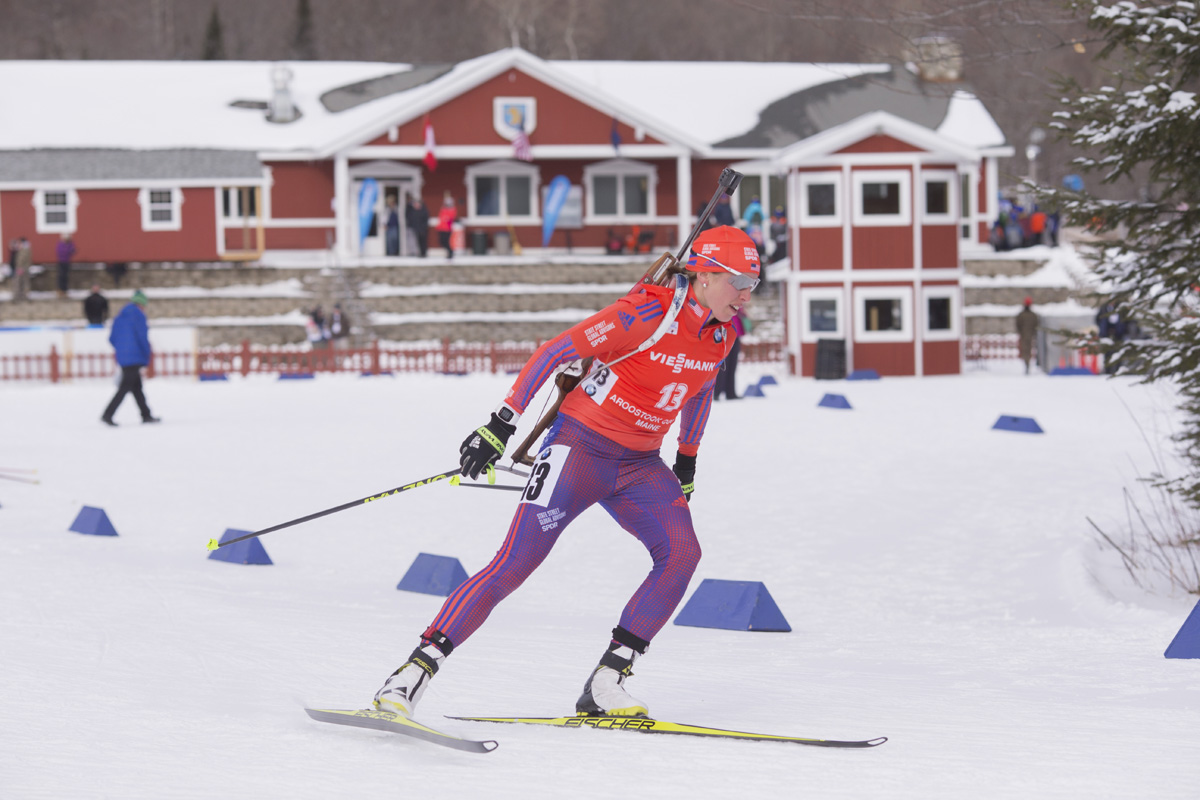
Susan Dunklee (US Biathlon) racing the first leg of the women’s 4 x 6 k relay on Saturday at the IBU World Cup in Presque Isle, Maine. Her team went on to place 10th for a season best. (Photo: USBA/NordicFocus)
Coming off a historic week for US Biathlon with Dunklee’s silver medal in the sprint and fifth place in the pursuit, the team’s leading woman was picked to start Sunday’s relay (after racing the second leg in the three prior relays this season), followed by Dreissigacker, Egan and Cook.
“We are still experimenting with the order,” Dunklee wrote in an email. “Last week’s mixed relay went well with myself leading and Han [Dreissigacker] going second so we tried that again.”
As for moving the race up to Saturday, Dunklee wrote, “I think most athletes would agree that moving the race to today was the right call in light of the cold forecast.”
But that made for a pretty hectic race day for the women, as they had very little time to prepare with the men’s relay only wrapping up about an hour before their own.
“Today was a great opportunity for dealing with unusual challenges on race day,” Dunklee explained. “We had some struggles getting to the venue on time, then I had a broken firing pin right before zero [target practice to adjust the rifle sights before the start], which is very tricky to replace, and finally 13 minutes before the start, I heard that the course got changed and didn’t get to preview it.”
“With the short turn around from the guys race, we only had 25 minutes to zero 4 people,” she continued. “I didn’t fit in more than 10-15 minutes of skiing warmup, a new record for me. Dealing with chaos is an extremely important skill for a biathlete to have and we all did well today in spite of the challenges.”
Dunklee’s performance didn’t seem to suffer much despite those unusual circumstances, she she used just one spare to clean the first prone stage, and another two in her standing bout. She also skied the fastest course time of all starters in 13:55.4, and second-best among every woman in the relay, behind France’s anchor, 19-year-old Braisaz.
Hannah Dreissigacker racing the second leg of the U.S. women’s 4 x 6 k relay on Saturday under darkening skies at the IBU World Cup in Presque Isle, Maine. Her team went on to place 10th for a season best. (Photo: USBA/NordicFocus)
Dunklee tagged off to Dreissigacker in fourth, only back 11.1 seconds behind Switzerland’s Selina Gasparin, who was then leading the pack (Switzerland went on to finish 12th).
For Dreissigacker, a regular member of the U.S. relays last year including at 2015 World Championships, it was her second World Cup relay of the season after spending some time on the second-tier IBU Cup, before returning to the World Cup in Canmore, Alberta, and Presque Isle, where she most recently placed 27th in the sprint and 24th in the pursuit.
Like Dunklee, she didn’t let the stressful race preparation get to her.
“It was definitely a little bit rushed today before the race for everyone,” she wrote in an email. “We had to rearrange things and it got a bit hectic. But it was fine for me anyways… a good adrenal warm-up, as I like to call it!”
Dreissigacker needed one spare in prone and two in standing, just like Dunklee, and lost a little more time on the course, handing off in seventh, 43.7 seconds behind the leaders.
“I am a little disappointed that I didn’t hit my last standing shot, and then took two spares to hit it, but it could have been worse!” Dreissigacker wrote. “I had a good battle with Austria [Lisa Theresa Hauser] and France [Anaïs Bescond] at the end of my leg which was fun and made me go hard.”
Egan, who had started the prior relay for the U.S. in Antholz, moved back to the third leg, which she had also raced in Ruhpolding and Hochfilzen earlier this season.
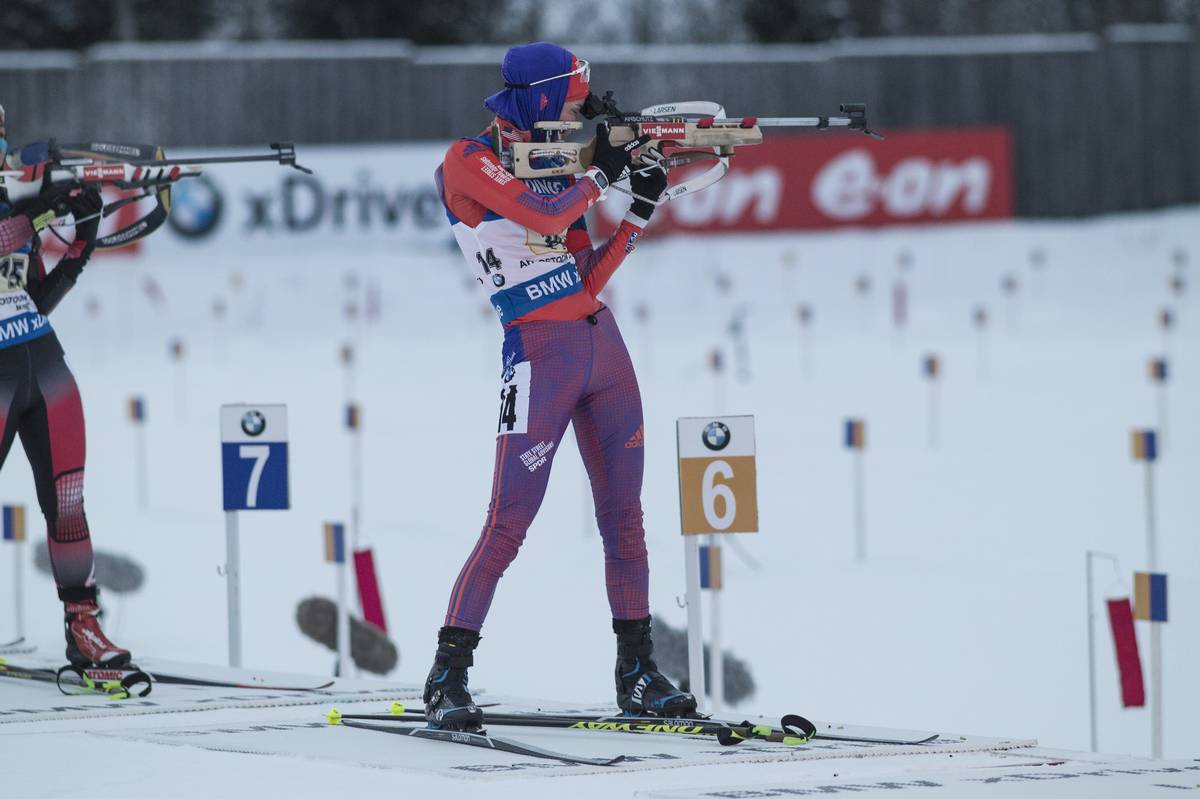
Clare Egan (US Biathlon) during her standing stage of the women’s 4 x 6 k relay at the IBU World Cup in Presque Isle, Maine. Her team went on to place 10th for a season best. (Photo: USBA/NordicFocus)
In Presque Isle, she had finished 32nd in the sprint and 23rd in the pursuit. She continued her solid recent shooting performances in Saturday’s prone stage, cleaning her targets to leave the range in seventh position (+41.4).
After moving up to sixth place on the next loop, Egan came into the standing stage fighting for position with France, Ukraine and Austria. There she was unable to hit her last target with her three spares, having to ski through the 150-meter penalty lap.
“The conditions for my standing shooting were fine, I am just not as solid in standing as I am in prone,” Egan wrote in an email. “I missed two from the clip and then fired the first spare accidentally before I was ready. Then I had two bullets for two targets and unfortunately I only hit the first one. I should have taken more time to make a perfect hit on my last shot.”
She left the range in 12th, and tagged off to Cook in that position, having lost an additional minute to the leaders by the exchange (+1:50.6).
Just like it was for her teammates, Cook’s race leadup was a bit hectic.
“The preparation was actually funny today,” Cook wrote in an email. “I did not get to ski the course before the race started, and the girls actually had to tell me that they took out a sketchy corner, so I had never even done our course before I was on it racing it.”
On the shooting range, she matched the performance of Dunklee and Dreissigacker, requiring one spare in her prone stage and two in standing, but had to overcome an additional challenge: the sun had set when the anchors were on their relay legs, and large sections of the course had fallen into darkness.
“I was glad that nothing crazy happened on the downhills because it was definitely a shadowy course, not like the huge floodlights that we are accustomed to,” Cook explained. “But I didn’t mind. It reminded me of how night races were growing up at my local ski area, with little light bulbs hanging over the course. The range was a bit dark and the big movie screen flashed really brightly while I was shooting prone, so the light changed drastically and suddenly and that was distracting. But it worked out okay.”
She was able to overtake two more relays, moving the U.S. up to 10th in the finish. The U.S. women were satisfied with their result, though believed there was still additional room for improvement.
“As a team, we all had okay shooting performances and it is exciting to see us move up so much already even without a great day,” Dunklee concluded. “Oslo will be exciting.”
“I think we are all happy with 10th since its our best relay of the year, but we also know we can do better and today was a good sign of that!” Dreissigacker wrote.
“Despite my penalty lap this was the best relay result we have had with this group of four athletes,” Egan explained. “Our previous best was 12th which we got twice last year (World Cup 6 Antholz, World Championships). It is also a season best. Of course we can still do better and intend to do so in Oslo.”
“I still know we can do better in the relay, but it is a hard, hard thing for everyone to have stellar races on the same day,” Cook concluded. “And luckily, we know that all we have to do is have a good normal day and we can be right up there.”
With Some New Faces, Canada 17th
Without Rosanna Crawford and Julia Ransom, Canada did not have two women in Presque Isle who will likely be part of the women’s relay at World Championships in Oslo. Crawford and Ransom started in all three other relays this season where the team finished 10th in Hochfilzen, and ninth in both Ruhpolding and Antholz.
Instead, with veteran Zina Kocher (in her third relay this season), Emma Lunder (who had one relay start before in Hochfilzen), Audrey Vaillancourt and Erin Yungblut struggled on Saturday, quickly falling to the back of the field, with Kocher having to ski a penalty loop in her first prone.
After leaving the range in 16th out of 17 teams (with Norway and Slovakia pulling their teams before the start due to illness), Canada was never able to catch back up to the top 10, losing time to the leaders as the race progressed.
Kocher tagged off to Lunder 2:14.3 back, who then incurred another penalty in her prone stage (1+3, 0+1) to exchange 4:28.1 back in 17th place.
Vaillancourt then put in a strong performance on the range with two clean shooting stages, but was slower on the course and passed on the penultimate loop by the leading teams. She handed off to anchor Yungblut 6:38.6 back.
After requiring three spares to hit her targets (0+1, 0+2), Yungblut then was taken out of the race and scored as lapped in 17th position before her final loop.
On to Oslo
The athletes will now have two weeks of additional training and preparation, before traveling to Norway for the World Championships, beginning on Thursday, March 3 with the mixed relay.
Susan Dunklee (US Biathlon) leads Finland’s Kaisa Mäkäräinen on the fourth of five loops in the IBU World Cup women’s 10 k pursuit on Friday in Presque Isle, Maine. Dunklee went on to place fifth while Mäkäräinen raced to second. (Photo: USBA/NordicFocus)
When Susan Dunklee woke up Friday on a sub-zero morning in Presque Isle, Maine, it took her a moment before her eyes focused in on a shiny new object on a table in her room. Oh yeah, my silver medal, she thought.
“I had forgotten,” Dunklee said on the phone Friday evening, after her second of two IBU World Cup races in Presque Isle. The 29-year-old U.S. biathlete, who turns 30 on Saturday, had placed second in the sprint on Thursday to tie the best result by an American in a biathlon World Cup. It was a surreal moment back then, and even now, it was still sinking in.
But she had to move on. Dunklee had a pursuit ahead of her, one in which she’d start closer to the race leader than she ever had before.
“I knew for today, I had to set that aside and enjoy it for what it was and know I’ll have that to cherish for the rest of my life,” she said. “But today I had another race and another great opportunity in front of me.”
One of three US Biathlon skiers in the women’s 10-kilometer pursuit, Dunklee started second, 18 seconds behind Gabriela Soukalova of the Czech Republic, who led the 60-woman field out in first. Soukalova had been the only woman faster than Dunklee in the sprint, beating her by 17.8 seconds.
And so she started first, but was in danger of being penalized for jumping the start. Soukalova quickly realized her mistake in starting too soon, and hesitated briefly before continuing on her first of five loops. She wasn’t penalized, and Dunklee — who had a front-row view of the slipup — said it was kind of comical.
“I had a good laugh at that, actually,” Dunklee said. “Normally, fifteen seconds or eighteen seconds before I’m starting, I’m very focused and I’m looking down the track and trying to stay serious and focused. But it was funny, Gabby started off and I think she wasn’t sure if she was supposed to go yet or not, so she stopped and came back, and she just looked very confused. Sometimes it is nice to have something silly like that to lighten the mood.
“I can kind of understand why it happened because we are used to being at venues where there’s a huge stadium with people roaring and counting down, ‘Ten, nine, eight, seven…’ ” Dunklee explained. “And it was so anticlimactic that way, it’s just like, ‘Oh, there’s a clock, and it’s at zero. It’s time to go.’ ”
Gabriela Soukalova of the Czech Republic after winning the IBU World Cup women’s 10 k pursuit on Friday by 34 seconds. (Photo: IBU/NordicFocus)
Off went Soukalova, the overall World Cup leader, cleaning two consecutive stages before having some trouble on the range on a windy, 8-degree Fahrenheit afternoon at the Nordic Heritage Center. She led up until that point, while Dunklee hung in second through the first loop and first shooting stage, after starting 1 second ahead of Poland’s Krystyna Guzik, the third starter, and 2 seconds ahead of France’s Marie Dorin Habert in fourth.
“My plan for the first loop was to let the girls behind me lead because they are very strong skiers and I often ski more efficiently behind people,” Dunklee explained. “But they never came up alongside of me and tried to pass, so I wasn’t just going to stop and pull over, you know? I ended up holding on to second coming into the first shooting, which had not been the plan, but it was fine.”
There, rather than think about what could be — the possibility of winning or another podium — Dunklee focused on the four simple words she uses to get into the ideal mindset for shooting.
Open. That involves breathing, opening her “ventilation system, opening my eyes and seeing what’s going on in the range, what the wind flags are doing, opening my snow covers,” she explained. “The importance of a good key word is it’s one word that can cover a lot of things that you need to be done in an instant.”
Relax. “Take my rifle off my back, try to keep my movements smooth and relaxed, changing the clips quickly but relaxed, setting up, getting a good tripod sort of feeling with my body with my rifle sitting on top of it,” she said.
Set. This is what she thinks about when getting ready to shoot. “Set means ready. It has a feeling of readiness. My finger is set on the trigger, taking 90 or so percent of the trigger pressure so all I have to do is squeeze it very gently for the shot to go off,” she said.
Quiet. Once on target, that’s all that goes through her mind. “I’m trying to quiet my mind so it’s a very narrow thought focus,” she said. “Feeling quiet with my body, being quiet on the target and being quiet after the shot goes off as a good follow through.”
Dunklee nailed her execution on the first prone stage and cleaned all five targets to leave the range in second, 11.5 seconds behind Soukalova. Italy’s Dorothea Wierer, the seventh starter, cleaned as well to move into third, 8.3 seconds behind Dunklee. Guzik and Finland’s Kaisa Mäkäräinen, in bib 5, cleaned as well to hang close in fourth and fifth, respectively, about 2 seconds behind Wierer, while Dorin Habert missed one to drop to seventh, another 20 seconds back.
One loop later, Soukalova — still skiing alone — hit every prone target to leave the range again in first, 11.7 seconds ahead of Wierer, who quickly cleaned her targets to move into second. Dorin Habert cleaned to take hold of third, 35 seconds behind Soukalova, while Dunklee had one penalty to slip to sixth, 44.6 seconds out of first.
According to Dunklee, the wind was much more variable for the second stage.
“The first shot the wind was strong, but I could see the wind dying down and I did what we call shading,” she said. “Instead of taking clicks to correct, you aim a bit off the center of the target so you correct with your aiming. It takes a bit more skill in a way and is riskier, but it is very useful in situations that the wind is fading.”
Despite over-shading, aiming too far off the target on her last shot, Dunklee was pleased to leave the range with one penalty.
“I was really happy with where my head was at that whole process,” she said. “In the middle of the race, I was thinking, this is fun, this is a game, this is a challenge, I got this. And I wasn’t afraid of messing it up. That is a pretty novel and cool mental place to be in a high-pressure situation for me.”
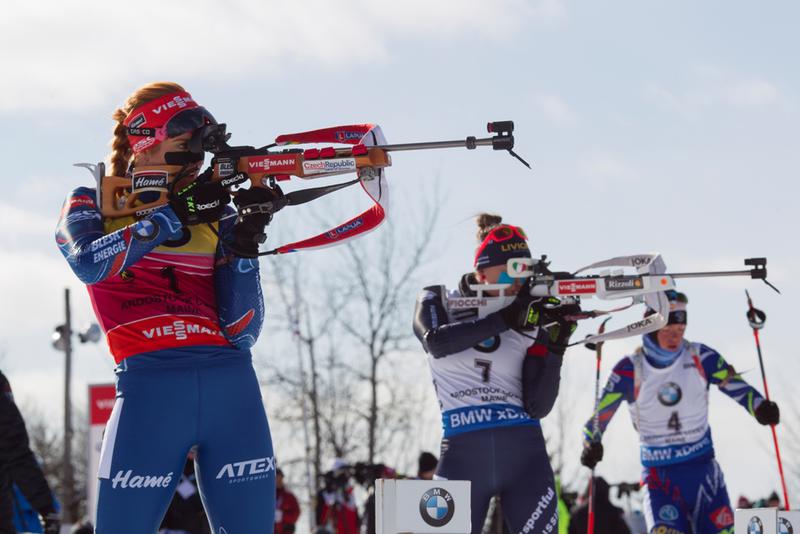
From left to right: Gabriela Soukalova of the Czech Republic, Italy’s Dorothea Wierer and France’s Marie Dorin Habert line up for the first standing stage during the women’s pursuit on Friday at the IBU World Cup in Presque Isle, Maine. Soukalova and Wierer both missed three, and Dorin Habert missed four on that stage. (Photo: IBU/NordicFocus)
On the third shooting — the first standing stage, things got interesting. Soukalova missed three, Wierer missed three, and Dunklee took her time to hit three of five targets for two penalty loops, which put her in third, 21.5 seconds behind Wierer, who had taken the lead.
“My legs started to shake and maybe I started to be afraid of the wind because it was a little bit stronger than before,” Soukalova said in a post-race press conference. “Sometimes it happens.”
“There was significant wind and it was changing,” Dunklee explained. “It would catch your body and rock you. I think you saw all the athletes waiting for the gusts to subside. I tried to take shots in between them and I missed a couple.”
The penalty loop in Presque Isle is unique in the fact that the ski lodge blocks the view of other racers in the loop. Dunklee couldn’t see Soukalova or Wierer, and didn’t have much of a sense where she stood until she received splits back out on course that she was still in the mix for a podium.
“You are usually not that high up after missing two in a pursuit, but it was tricky conditions and everyone was missing,” she said. “You can never give up a biathlon race because these things happen.”
Ahead of her, she could see both Wierer and Soukalova, in second by 2.3 seconds leaving the range. About four seconds behind Dunklee, Mäkäräinen moved into fourth with two misses, while Dorin Habert dropped to 10th, 49 seconds out of first, with four penalties.
“In the middle of the race, I was thinking, this is fun, this is a game, this is a challenge, I got this. And I wasn’t afraid of messing it up.” — Susan Dunklee, on the tricky shooting conditions during Friday’s pursuit
Mäkäräinen passed Dunklee on an uphill and led her into the range for the last time, positioned in third and fourth, respectively.
“It was really helpful,” Dunklee said of catching a ride off Mäkäräinen. “She is a good skier and I ski more efficiently when I am behind someone.”
By the final standing stage, the wind had subsided comparatively. Wierer once again shot quickly but missed three to fall into eighth place (and eventually finish ninth), while Soukalova cleaned to regain control of first. Mäkäräinen hit all of her targets as well to jump into second, 25.6 seconds back with 2 k to go, and Guzik cleaned to move back into third (after one penalty in the second stage, and two misses in the third stage), 39 seconds behind Soukalova.
Dunklee missed one to leave the range in fourth, 11 seconds behind Guzik and 1.7 seconds ahead of Dorin Habert in fifth. After a rocky previous stage, Dorin Habert took a pause before her final shot of the day to clean the all five targets.
On the final loop, Soukalova charged ahead to secure her 12th World Cup win (and fourth of the season) in 31:24.6 minutes, 34 seconds ahead of Mäkäräinen in second. Dorin Habert charged past Dunklee to take hold of fourth, then picked off Guzik as well to claim third (+38.8).
“It was not in my plan to have five penalties,” Dorin Habert, who ranks second to Soukalova in the overall World Cup, said in the press conference. “The coach told me after the last shooting that I had a chance to catch the podium. I felt good today and I made it.”
“It is awesome like yesterday,” Soukalova said of her second-straight victory in Presque Isle. “Maybe the atmosphere it a little bit easier than Europe, for example, there’s a lot of spectators. … It’s not so noisy and maybe it helps us.”
Guzik finished five seconds later in fourth (+43.9) and Dunklee placed fifth (+56.9) for her best-ever pursuit finish and second-best result of the season.
“I was happy to still be in the fight coming out of that loop,” Dunklee said. “Marie Dorin was right behind me and I hung with her for the first hill after she passed me, but she took off and I didn’t have that sort of gas today.”
Would she have liked to clean that last stage and fight for an even better result? Yes, but Dunklee said she had a plan, she executed it, and she could feel proud about that.
“Today my skiing felt good and felt strong, it felt a bit flat though,” she added. “I think there is still some peak form not there yet, but this is exactly where I want to be sitting going into Oslo [World Championships]. Having some great results here to feel really confident, but also knowing there is a little bit more.”
After one more race day in Presque Isle, the men’s and women’s relays on Saturday, the IBU World Cup will take a break until the 2016 World Championships in Oslo from March 2-13.
Dunklee will team up with Hannah Dreissigacker, Clare Egan and Annelies Cook in the women’s 4 x 6 k relay, which starts at 4:10 p.m. Eastern time on Saturday.
Egan 23rd, Dreissigacker 24th
According to both Dunklee and US Biathlon CEO and President Max Cobb, the U.S. women’s team had one of its best days in recent memory in the pursuit, with three in the top 24.
Egan improved from starting 32nd to finish 23rd (+2:34.0), with three penalties (0+1+1+1), and Dreissigacker placed 24th (+2:41.6) after starting 27th and missing three as well (0+2+1+0).
“I started about 5 seconds behind a big pack including Hannah, so from the start I had my eyes on the orange and purple,” Egan wrote in an email, referring to the US Biathlon team suits. “I caught her pack as we came into the first shooting.”
There, both Dreissigacker and Egan cleaned to move into 22nd and 23rd, respectively, about 1 1/2 minutes behind the leader. The two had to make some major adjustments on that prone stage after zeroing, or setting their rifle sights before the race, on Point 2 — where their teammate Dunklee was slotted based on her start position.
“Cleaning the first prone stage was a major accomplishment for Hannah and me,” Egan explained. “We zeroed our rifles on point 2, where there was strong wind, and then came into the shooting range for the first prone stage on points 29 and 30 — the opposite end of the range and there was no wind. We both took around 8 clicks, which translates to the entire width of the prone target. When I hit the first target I knew I had taken the correct amount of clicks and I was so psyched!!!”
Dreissigacker and Egan skied three of five loops together, with Egan passing her teammate on the second loop. After the second prone stage, Egan left the range in 18th with one miss, about 40 seconds ahead of Dreissigacker, who missed two in that stage to slip to 30th.
“On the last lap I knew she must have cleaned the final standing because I could hear our fans (!!) yelling both of our names on our last lap,” Egan wrote of Dreissigacker. “She was right behind me in the finish.”
With her best shooting in a four-stage race, Egan explained that she was satisfied.
“I did miss my 20th shot and I could have been in the top-20 with a clean last stage, so that is a bit of a let down but I can learn from this and hit it next time,” she added.
“It was fun to ski a lot with Clare,” Dreissigacker wrote in an email. “We were pretty close together for the first two loops, and then I had an extra penalty loop and got behind but then we were really close again for the last lap–I tried to catch her but couldn’t quite do it!
“I am very happy with my race today and really proud of our performance as a team,” she added. “And once again the wax techs and coaches did a really stellar job with the skis and support out there.”
Canada’s lone woman in the pursuit, Zina Kocher placed 46th (+4:36.5) after starting 42nd, with five penalties (2+1+0+2).
On Saturday, Kocher will ski the first leg for Canada’s relay, followed by Emma Lunder, Audrey Vaillancourt and Erin Yungblut.
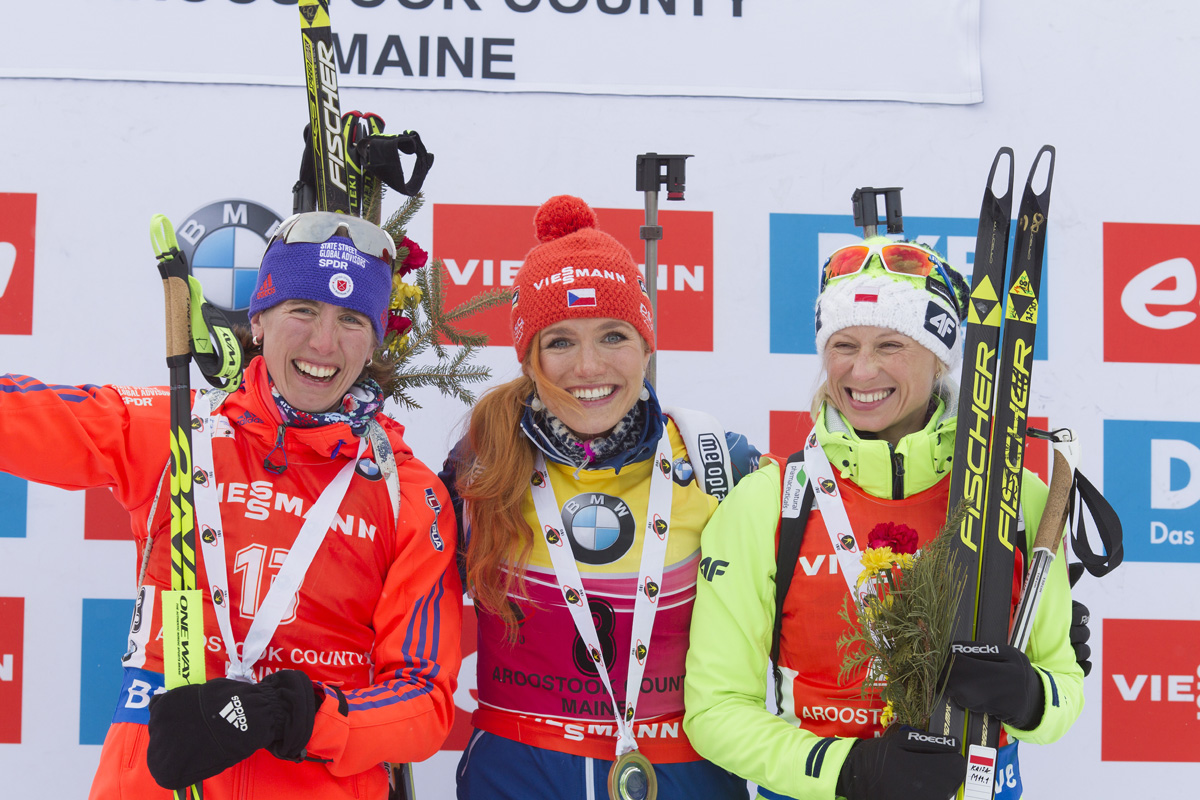
American Susan Dunklee (l) after achieving her best IBU World Cup finish in second place on Thursday and tying the best World Cup result by a U.S. biathlete. She finished second to Czech Gabriela Soukalova (c), and Poland’s Krystyna Guzik placed third (r) in the women’s 7.5 k sprint in Presque Isle, Maine. It was the first IBU World Cup held in the U.S. since 2011. (Photo: Fischer/NordicFocus)
Gazing out at the crowd, standing on the second step of the podium on Thursday, Susan Dunklee recognized dozens of faces: family, friends, people from her home base in Craftsbury, Vt., US Biathlon board members, colleagues from the Lake Placid Olympic Training Center, not to mention her team and support staff.
It had all the makings of a local-race feel, except for the implications of a World Cup podium — and the flashing lights, silver medal and media attention that came with it.
Two days before her 30th birthday, Dunklee had the best race of her career. The 13th starter, she raced to second in the women’s 7.5-kilometer sprint on the first day of the IBU World Cup in Presque Isle, Maine, finishing 17.8 seconds behind Gabriela Soukalova of the Czech Republic, the winner in 20:02.2 and overall World Cup leader.
Nearly 400 miles and a seven-hour drive from her hometown of Barton, Vt., Presque Isle is less than a half an hour away from Canada. Yet in her first U.S. World Cup, and the first World Cup in the states since it was last held in Presque Isle in 2011, Dunklee felt somewhat at home.
“To be able to have a best result on home soil and we only have a North American World Cup every five years, I couldn’t ask for anything better,” Dunklee said on the phone after the race. “It’s just phenomenal.”
In order to achieve her best World Cup result by one place (she finished third in a sprint two seasons ago in Oslo, Norway), Dunklee rekindled her joy in both the sport and Presque Isle’s course specifically, putting herself in a happy place she had been struggling to find in the last week.
“Last week was a little tough for me,” Dunklee said of the last World Cup in Canmore, Alberta. “I felt like I was going through the motions but not really feeling hungry for it.”
That changed on the final day of racing there, when she skied the first leg of the U.S. mixed relay, which went on to place fourth for the team’s best-ever finish in the event. Being within two seconds of a podium recharged her and reminded her to stay the course.
“Coming here I was like, ‘OK, there’s going to be random things that happen that are going to throw me off, but I’m just going to take the positive things that I can and use those to my advantage,’” Dunklee said.
On the team’s first training day in Maine on Tuesday, she skied the Presque Isle World Cup course for the first time. Dunklee had previously raced a NorAm there in 2009, but missed out on the 2011 Presque Isle World Cup as the team’s fifth woman at the time, when it only took four.
That was frustrating, she said, but she moved on from it — taking advantage of an opportunity instead in Ruhpolding, Germany, where she raced and previewed the course a year out from 2012 Ruhpolding World Championships. There, a year later at her first World Championships, she broke through in fifth in the 15 k individual.
Susan Dunklee (US Biathlon) racing to a career-best second on Thursday in the women’s 7.5 k sprint at the IBU World Cup in Presque Isle, Maine. (Photo: Fischer/NordicFocus)
Memories aside, Dunklee was excited about what she saw in Presque Isle earlier this week.
“I skied the course and I’m like, wow … this is a John Morton course. This is what I grew up skiing on and this is what I’m good at,” she recalled. “This is what I’m going to thrive on. I love the ups and downs, the steep climbs, the roller-coaster flow, and that’s what really set the tone right away.”
On Thursday, it was cold in northern Maine, but busloads of schoolchildren came out for the first of four days of World Cup racing. Dunklee wasn’t in her home state, but with everyone speaking English and cheering “USA!” out on the course, it was the closest she had felt to being there.
“The community is extremely welcoming and they go out of their way to accommodate us and make us feel like home,” Dunklee explained.
She started behind Soukalova, an early leader with perfect shooting in both her prone and standing stages. No sooner had Finland’s Kaisa Mäkäräinen in bib 6 finished and taken the lead from Czech Veronika Vitkova (the second starter) by 20 seconds, Soukalova in bib 8 charged across the finish line moments later, 24.5 seconds faster than Mäkäräinen to take hold of first place.
The day was young, but most of the top-ranked skiers were on course at the beginning of the 88-woman field. Dunklee followed Soukalova out, cleaning prone as well to take the lead by 0.8 seconds after the first shooting.
Her shooting didn’t feel automatic, Dunklee recalled. That wasn’t necessarily a good thing, but it wasn’t bad, either.
“I was very aware of each shot I was taking; it wasn’t flowing automatically like it usually does, and usually you want that automatic flow in a race,” she explained. “Instead I had all these thoughts going through my head, but what was great about today is I was able to take those thoughts and just say, ‘It’s OK that I’m distracted. I’m going to put that thought aside and go back to what I’m focused on right now in the present moment.’ ”
She had similar feelings earlier this year in Ruhpolding, where she placed sixth in the mass start. Recognizing this, she resolved to keep calm.
On the second shooting stage — standing — Dunklee cleaned again and left the range with 9.3 seconds to make up on Soukalova.
A US Biathlon staff member (l) cheers on Susan Dunklee (r) as she races to a career-best second place in the 7.5 k sprint on Thursday at the IBU World Cup in Presque Isle, Maine. (Photo: Fischer/NordicFocus)
What came to mind then? “You still need to fight like hell,” she recalled. “When you’re having that sort of race, you don’t want to lose a second anywhere … I’ve just got to fight for the next seven minutes or whatever it takes.”
With 1 k remaining, she was 17.6 seconds off Soukalova’s time. Half a kilometer later, Soukalova still held her ground, 17.4 seconds ahead. By the finish, Dunklee was 17.8 seconds back in second, and she wasn’t even sure she was second — but she smiled at the cameras anyway.
“I knew I probably had one of my best races in my life and I’d done it at home and my parents were there,” she said. “I just felt really good about my performance. I was really happy.”
US Biathlon Women’s Coach Jonne Kähkönen knew she was on track for a career best.
“I knew that if she would clean the race today, she would be fighting for the podium, even if there were a few fast athletes starting behind her,” he said on the phone. “Not nervous, but just wanted to wait and see what the later starters would do.”
France’s Marie Dorin Habert presented the most immediate threat. After starting 24th and cleaning prone, Dorin Habert left the range in first, 4 seconds ahead of Dunklee. However, during her second stage, she missed one standing shot. The penalty loop put her in fourth, 25.5 seconds behind Soukalova and 16.2 seconds behind Dunklee, with one loop to go.
Meanwhile, Poland’s Krystyna Guzik had started 20th and cleaned both stages to leave the range for the last time in third, trailing Dunklee by 4.4 seconds. She couldn’t catch the American on the final loop and finished 1.3 seconds behind her in third.
“Shooting is so hard; it is not sure that every day I will shoot well,” she said in a post-race press conference. “I thought that this was a new day and do my best to shoot well and run fast. I just could not catch Susan; she was too fast on the last loop. For me, the last loop today was really hard.”
Ultimately, the three podium finishers were the only ones in the top eight to shoot clean. Soukalova had the fifth-fastest overall course time, Dunklee’s course time ranked 12th and Guzik’s 15th.
Overall World Cup leader Gabriela Soukalova of the Czech Republic racing to a 17.8-second win (over American Susan Dunklee) in the women’s sprint on Thursday at the IBU World Cup in Presque Isle, Maine. (Phot: Fischer/NordicFocus)
“I have to say everything was perfect,” Soukalova said in the press conference. “I started to feel a little tired after the long trip from Canada, but I started to feel good after the start. … We had good service, good skis today so I am very satisfied with this result.”
Dorin Habert crossed the line in fourth, 20.5 seconds behind Soukalova and 1.4 behind Guzik, bumping Mäkäräinen, with a single standing miss, into fifth.
The top five would stand, and Dunklee would tie the best result by a U.S. biathlete (male or female) joining the ranks of Joan Smith (1994) and Anna Sonnerup (1991).
Current men’s team member, Tim Burke placed second in two World Cup races in 2009/2010 and earned silver at 2013 World Championships. Before him, Josh Thompson also took silver at 1987 World Championships.
“What a great day for @USBiathlon with 6 athletes in the top 30 and @SusanDunklee on the podium! #homecourseadvantage!”Burke tweeted on Thursday, after he, Sean Doherty and Lowell Bailey placed in the top 20 in the men’s sprint. Dunklee, Hannah Dreissigacker and Clare Egan finished in the top 32 of the women’s race.
“Today Susan cemented her place as a world class biathlete,” US Biathlon President and CEO Max Cobb wrote in an email. “It was a historic performance, matching the best World Cup finish by an American.”
“You spend years and years working on this, trying to perfect things,” Dunklee explained. “And at first progress is pretty good, you make big gains pretty fast, and then to get that last one percent or so of performance, it just takes so much more work.”
You need that 1 percent, she added.
“There’s times where you work your way at something for months and you just don’t make progress on it or you even go backwards because you’re trying so hard, she continued. “I don’t know, somehow things came together and I’m just amazed. It’s exciting.”
‘A Culmination of a Whole Lot of Effort’
What is it about progress, or maybe more specifically about biathlon, in which someone like Dunklee can turn a last-place finish in Canmore’s mass start, complete with a “dirty” stage (five missed targets), around less than a week later with a silver-medal performance?
“We’ve talked about this actually a couple of times over the season,” Kähkönen said of Dunklee’s ability to overcome adversity and less-than-desirable results. “It’s been a little up and down. We’ve been trying to track down in the training log if we can find some reasoning behind it and be able to narrow it down better in the future as well. But now it looks like everything is on track in terms of the physical training.”
Susan Dunklee (US Biathlon) racing to a career-best and historic second place in the women’s sprint at the IBU World Cup in Presque Isle, Maine. (Photo: USBA/NordicFocus)
In the last World Cup before World Championships in Oslo in early March, Dunklee said the timing of this result was “perfect.”
“I think Susan, ever since last week, she was able to put distractions on the side and focus on what matters,” Kähkönen said.
“In order to have my best performances in biathlon or anything in life, to be a person that takes joy out of life … I really have to find what I love about it,” Dunklee explained. “… I think that hunger is honestly my most valuable asset as an athlete.”
Looking ahead to the rest of the races in Presque Isle, Dunklee had fewer than 24 hours to absorb what she’d done on Thursday and prepare for Friday’s pursuit. At 1:10 p.m. Eastern time, Soukalova will start the 10 k pursuit first. Dunklee will head out 18 seconds later in second, and Guzik 1 second after Dunklee in third. Dorin Habert will follow, 3 seconds after Dunklee.
“I’ve got the best setup I’ve ever had before going into a pursuit,” Dunklee explained. “Starting pretty close behind the leader, and that’s another wonderful opportunity to have a great result. I’m going to enjoy tonight and celebrate a bit, but at the same time I’m going to try to wind down a bit, have a little Susan-time to myself and get some good sleep tonight because I really want to see what I can do tomorrow.”
Asked about the task of refocusing after a result like Thursday’s, Kähkönen said that’s the key to consistent top results.
“With this schedule, we just don’t have the luxury of getting stuck on the current or especially the past,” he said. “You just need to stay focused on what’s coming up next.”
But Thursday was a pretty incredible day to be part of US Biathlon, in the same state (albeit 270 miles away) as its headquarters in New Gloucester, Maine.
“It’s unbelievable,” Kähkönen said. “Just to be able to grab the podium on the home soil, home World Cup, even if it’s not the hometown, but there’s a lot of friends and family and fans that are great support. The local community is just awesome, so it means the world to us.”
“It’s not just my success,” Dunklee stated. “It’s a culmination of a whole lot of effort over lots of years by this whole group of people who care a lot about our team.”
Dreissigacker 27th, Egan 32nd, Kocher 42nd
Joining Dunklee in the pursuit will be two other U.S. women and one Canadian. Dunklee’s teammate on the national team as well as Craftsbury Green Racing Project, Hannah Dreissigacker placed 27th for her fourth-best sprint result, finishing 1:33.7 behind Soukalova with a single prone penalty.
Hannah Dreissigacker (US Biathlon) racing to 27th in the women’s 7.5 k sprint at the IBU World Cup on Thursday in Presque Isle, Maine. (Photo: USBA/NordicFocus)
“I was really happy to clean standing — I am normally a better prone shooter than standing, but I knew that I had to clean standing if I wanted to really do well,” Dreissigacker, the 41st starter, wrote in an email. “I’m very happy that I was able to concentrate for all of the shots and make it happen.
“It felt really special to have my family here, and so many other Americans out there cheering for us,” she wrote. “I actually started just after I heard on the loud speaker that Susan had cleaned. So then she came around the building and headed out on her last lap just a bit behind me. That was a fun lap — I was excited for her, and also all of the staff and fans were out there cheering so hard for her and I could tell that she was gaining on me, and also that she was probably going to podium. I felt like we were doing that lap together, though she only caught me at the very end.”
Also for the U.S., Clare Egan finished 32nd (+1:38.5) with one standing penalty. The 56th starter, Egan looked to be in contention for a top 20 after cleaning prone, but slipped into 28th after standing.
Clare Egan (US Biathlon) racing to 32nd, her second-best IBU World Cup result, in the women’s 7.5 k sprint on Thursday in Presque Isle, Maine. (Photo: USBA/NordicFocus)
“I was thankful to clean prone because it put a little less pressure on the standing, which is the harder discipline for me,” Egan wrote in an email. “I was very shaky in standing and I had to stop and reset my position after missing my 3rd shot, but that worked and I hit the last two.
“This is my 2nd best result ever and by far my best result since World Cup 1,” she explained. “My ski speed took a major hit in December but I am now recovered to where I think I should be so that is a huge relief. I had a top-30 ski time today and 90% shooting so that is an almost perfect day.”
Originally from Cape Elizabeth, Maine (and a teammate of Dunklee and Dreissigacker at Craftsbury), Egan described the experience of racing in her home state.
“My parents, my teammates’ families, and some USOC staff and USBA board members are here,” she wrote. “I heard my name all along the course from voices both familiar and unknown– and that was a first.”
Friday will be Egan’s second time racing a World Cup pursuit.
Maddie Phaneuf (US Biathlon) on her way to 65th in the second individual IBU World Cup of her career on Thursday in Presque Isle, Maine. (Photo: USBA/NordicFocus)
The fourth U.S. woman, 20-year-old Maddie Phaneuf, in her second individual World Cup race, placed 65th (for her best result by 28 places) with a clean prone and two standing penalties.
“My goal was to shoot well and ski strong … which I didn’t feel I reached fully,” Phaneuf wrote. “I felt pretty good on the skis, but not nearly as strong as I was in Romania.”
“My result-goal was to make the Pursuit, which I just missed,” she wrote of Thursday’s World Cup race, in which she needed a top 60 to advance to the pursuit. “But I’m still happy with the result and know that I have the potential to achieve more.”
On behalf of her team, Dreissigacker noted, “Our skis were phenomenal today. Our wax techs definitely deserve a share of the credit for the great day that we had as a team.”
The top Canadian, Zina Kocher placed 42nd (+2:02.0) with three misses (2+1). Overall, she had the 20th-fastest course time.
“I was focused on having consistent solid performances this week in order to qualify for World Champs,” Kocher wrote in an email. “Knowing that it is a trials situation though does bring a bit more nerves into the equation.
“I had thought I had focused on attacking from the start, however looking at the breakdown in ski speeds, looks more like I went out for a casual ski lap 1, & lap 3 an explosion went off,” she wrote of her course times, which ranked 54th on the first loop, then 46th on the second, and finally, third on the last loop. “I’d say I’m happy with 3rd fastest last lap but will work on a more aggressive warm up for the next sprint or relay I do to make sure I’m starting out a bit quicker!”
Also for Canada, Emma Lunder placed 68th with two penalties (1+1), Audrey Vaillancourt was 80th with four misses (2+2) and Erin Yungblut 87th in her World Cup debut, also with four penalties (1+3).
Note: In the men’s 10 k sprint, Sean Doherty led the U.S. in 13th (0+1), Lowell Bailey was 15th (0+1) and Tim Burke 20th (1+1).
“The men were just really consistent,” Kähkönen said. “Everybody close together and just the whole field for the top athletes, so it puts them into a very good place looking ahead for tomorrow’s pursuit race. Hopefully Susan’s podium will give them another push.”
Stay tuned for a separate report on the men’s race.
Watch the men’s and women’s pursuits live on Eurovision (Friday at 11:30 a.m. and 1:30 p.m. EDT)
Susan Dunklee with her parents Judy (l) and Stan (r) after Dunklee tied the best-ever U.S. result in an IBU World Cup in second in the women’s sprint in Presque Isle, Maine. (Photo: USBA/NordicFocus)
Dunklee celebrates a career-best second place in the women’s sprint at the IBU World Cup in Presque Isle, Maine. (Photo: USBA/NordicFocus)
Dunklee celebrates a career-best second place in the women’s sprint at the IBU World Cup in Presque Isle, Maine, in February. (Photo: USBA/NordicFocus)
Italy’s Dorothea Wierer (2) leads out of the start of the women’s 12.5 k mass start at the IBU World Cup on Saturday in Canmore, Alberta, along with Gabriela Soukalova (1) in the World Cup leader’s bib. (Photo: Daniel S. Guay)
Let’s pretend, for a moment, that we’re in the gunslinging days of the Wild West — perhaps not so far off in Canmore, Alberta, where wide-brimmed cowboy hats are a trademark today.
You meet Italy’s Dorothea Wierer — sans the modern-day mascara, flashy sunglasses and questions of how she got to Canada in the late 1800s — on the dusty road and it’s time for a draw. Bottom line, you should put your hands up.
More than a couple times this season, the 25-year-old Wierer has proved that she can shoot under pressure. Just over three weeks ago, she cleaned the four-stage 15 k individual race at the IBU World Cup in Ruhpolding, Germany, to take the win. She pulled off a similar feat in the individual race at the early season World Cup in Östersund, Sweden, for her first career win.
So when France’s Marie Dorin Habert took an extra breath or two to clean her final shot in the third shooting stage of the women’s 12.5-kilometer mass start on Saturday, Wierer pounced. She had followed Dorin Habert into the range, just a few seconds behind but enough to give the French skier enough time to start firing first. Wierer proceeded to clean her five targets with the fastest range time for the second-straight stage, then sped out of the range before Dorin Habert could react.
The race leader’s in Saturday’s 12.5 k mass start during the third shooting stage, with France’s Marie Dorin Habert (r), Italy’s Dorothea Wierer (second from r), Germany’s Franziska Hildebrand (c), France’s Celia Aymonier (second from l), and Gabriela Soukalova of the Czech Republic (l). (Photo: Daniel S. Guay)
Wierer took the lead by 1.8 seconds, overcoming an early penalty in her first prone by cleaning the next two stages, while Dorin Habert chased her into the fourth of five loops. Over the next 2.5 k, the two race leaders skied together, exchanging a few words at one point. Dorin Habert, 29, hadn’t lost the race, but she had lost her edge over the gutsy Italian. A day earlier, Wierer placed third in the 7.5 k sprint with 9-for-10 shooting, and Dorin Habert finished 29th with four misses.
“I decided to attack today,” Dorin Habert told the IBU after the mass start. “My standing has not been very good at times this season, so I was more aggressive today.”
Meanwhile, she and Wierer skied about five seconds ahead of Gabriela Soukalova of the Czech Republic, who, like Dorin Habert, had cleaned all three stages up to that point to put herself in third.
The last time they entered the range, Wierer led Dorin Habert in to take the first shooting position. Dorin Habert stood on Point 2, and Soukalova on Point 3.
Bang-bang-bang-bang-bang! Wierer rattled off her shots, hitting all five targets with the fastest range time once again. She flew out of the range, again in first, but this time, Dorin Habert and Soukalova each missed one behind her. The penalty loop put Dorin Habert 30.6 seconds back in second while Soukalova followed about eight seconds later in third.
By that point, the race was essentially over. Barring any catastrophic last loop for Wierer, 30 seconds is simply tough for anyone to overcome in 2.5 k. And Wierer was racing to what ended up being the fourth-fastest overall course time.
While Dorin Habert reduced the deficit to 22.7 seconds with 0.7 k to go (while Soukalova skied 39.6 seconds back in third), Wierer raced to the finish uncontested for her third-career World Cup win in 36:50. Dorin Habert finished 20.8 seconds later in second, and Soukalova was 50.3 behind in third.
Italy’s Dorothea Wierer celebrating her third career World Cup win and first mass start victory on Saturday at the IBU World Cup in Canmore, Alberta. (Photo: Daniel S. Guay)
The win was Wierer’s best mass start result after placing sixth in the event two seasons ago in Pokljuka, Slovenia. An hour earlier, Italy’s Dominik Windisch won the men’s mass start in Canmore, and Wierer completed the Italian sweep with the women’s victory.
“I was so nervous for Dominik when I was watching his race,” Wierer told the IBU after her race. “This is a great day for the Italian team; this has never happened before. It is historic!”
While the winds were nowhere near as troublesome as during Friday’s sprint (nor were they as prevalent as during the men’s race earlier Saturday afternoon), the women’s mass start wasn’t without occasional gusts and light snow. Wierer explained she had trouble with zeroing before the race.
“I must have shot 10 times; I never do that, and it still was not very good,” she said. “So I went out there thinking it would either be good or horrible. I have never had a good mass start before, until today!”
Wierer led set the pace for the field early on, leading much of the first loop with Kaisa Mäkäräinen and Germany’s Miriam Gössner following close behind. On the first prone shooting, 13 women cleaned; Wierer was not one of them. She missed one and left the range in 14th, 15.8 seconds behind Germany’s Franziska Hildebrand in first. Austria’s Lisa Theresa Hauser trailed Hildebrand by 1.3 seconds and Russia’s Daria Virolaynen left the range 3.7 seconds back in third.
A color commentator for the IBU’s live online broadcast of the Canmore races, retired German biathlete Andrea Burke (formerly Henkel) noted that if you’re going to miss, it’s better to miss sooner than later.
By the next shooting stage, the number of athletes without a miss was down to six. Dorin Habert, Hildebrand, France’s Celia Aymonier, and Soukalova were among them.
Susan Dunklee (US Biathlon) finishing the women’s 12.5 k mass start on Saturday at the IBU World Cup in Canmore, Alberta. She placed 30th with 10 penalties. (Photo Daniel S. Guay)
Meanwhile, American Susan Dunklee fell out of contention and into 26th place (1:52 behind the leaders) with three penalties in the second stage (on top of one miss in the first prone). In the third shooting, she missed all five to drop to 30th and 4 1/2 minutes back.
“I’m not entirely sure what caused my shooting struggles today and why, but I don’t plan to analyze things too much yet,” Dunklee wrote in an email after finishing 30th, 6:24.9 back with 10 penalties (1+3+5+1). “Tomorrow is a new day and right now that is my focus.”
As she came through the finish more than a minute after Switzerland’s Selina Gasparin in 29th, she looked up at the crowd and shrugged.
“I was appreciative of all the North American fans still cheering me on as if I were winning the race,” Dunklee wrote. “It’s not every day that I get to race in front of a home crowd.”
The overall World Cup leader, Soukalova smiled as skied toward the finish in third, and had enough time to turn around and ski backwards over the line.
“A fairy tale,” she said of her season thus far. “I just try to focus on each race and have fun. That is the most important thing, to have fun.”
Mäkäräinen recovered from three early misses in the first stage and one more in the second prone to place fourth (+1:11) and Hildebrand missed one on each standing and finished fifth (+1:13.5). The German was less than a second ahead of France’s Anais Bescond in sixth (+1:14.4) with three misses (2+0+0+1).
For the final day of racing in Canmore, two different relays will be held: the single mixed relay (with Canada’s Julia Ransom and Nathan Smith, and for the U.S., Annelies Cook and Leif Nordgren) at 10:10 a.m. Mountain time, and the four-person mixed relay (with Canada’s Rosanna Crawford, Sarah Beaudry, Macx Davies, and Brendan Green; and for the U.S., Dunklee, Hannah Dreissigacker, Tim Burke, and Lowell Bailey) at 2:05 p.m. MT.
In the men’s mass start, Burke notched a season best in seventh, Smith was 16th and Bailey 20th. Stay tuned for a separate report on that race.
Canada’s Julia Ransom racing in front of a home crowd in Canmore, Alberta, to tie her IBU World Cup career-best 19th in the women’s 7.5 k sprint on Friday. (Photo: Daniel S. Guay)
The way some of the Canadians were tossing around the term “Chinook wind” on Friday, one might have thought that gusts hard enough to knock rifles off their stands was a regular occurrence in Canmore, Alberta. It wasn’t, according to one Canmore native, Rosanna Crawford.
“It was windier than I’ve seen it here in Canmore in a long time,” the 27-year-old Biathlon Canada veteran recalled in an in-person interview after the women’s 7.5-kilometer sprint at the IBU World Cup in Canmore. “So it was definitely luck of the draw if you were going to get a calm range or not.”
She wasn’t one of the lucky ones. Crawford started sixth and missed two off the bat in the first prone shooting stage. She wasn’t alone; most of the rest of the top-seeded skiers failed to hit all five prone targets as well.
Early on, it appeared that France’s Anais Bescond, in bib 8, and Italy’s Dorothea Wierer, bib 17, might be fighting for a podium. Both were the only women to clean prone through the first 24 starters.
Then Krystyna Guzik, a 32-year-old Polish biathlete who last reached the IBU World Cup podium two seasons ago in third in a pursuit in Hochfilzen, Austria, entered the mix. In bib 25, she cleaned prone to leave the range in first, 6.7 seconds faster than Wierer. Guzik went on to clean standing as well, while Wierer missed one, to hold a 7.3-second lead after the second shooting.
Poland’s Krystyna Guzik (l) trails France’s Marie Dorin Habert during the women’s 7.5 k sprint at the IBU World Cup in Canmore, Alberta. Guzik went on to place second while Habert finished 29th. (Photo: Daniel S. Guay)
On the final loop, Guzik stayed ahead of Wierer — who had initially finished first, 21 seconds ahead of Gabriela Soukalova of the Czech Republic— to bump the Italian to second place by 12.4 seconds at the finish.
Meanwhile, Bescond had missed two in standing to slip out of contention and nearly 1 1/2 minutes behind Guzik at the finish. It might not have been her fault; the winds were extremely variable — those Chinook (western interior) winds.
Canada’s Julia Ransom, who has lived and trained in Canmore for the last five years, started 38th and later said she felt the wind in prone and adjusted accordingly.
“I knew the wind. I know Canmore. I know how Chinook winds work and I did correct for prone, a lot,” she told FasterSkier afterward. “Really cranked the sights, and it wasn’t a hurricane for standing so maybe I lucked out a bit there.”
Ransom, who turned 23 on Thursday, cleaned both stages and was one of seven women in the field to do so. Initially 12th at the finish, she ended up 19th, 1:19 behind the winner and the top North American on the results sheet.
Moreover, Ransom tied her World Cup best, which she set two weeks ago in 19th in the pursuit at the last World Cup in Antholz, Italy.
Canada’s Julia Ransom racing to 19th in the women’s 7.5 k sprint at the IBU World Cup in Canmore, Alberta. (Photo: Daniel S. Guay)
“Double nineteenth!” she exclaimed upon realizing she had secured the result again on Friday.
While she cleaned the four-stage pursuit in Antholz on Jan. 23, this was the first time she hit all her targets in a World Cup sprint.
“I knew leaving standing that my family was in for an exciting race,” Ransom wrote in an email. “I was hoping to maintain 12th, but that rarely happens when you start in the earlier seeds. However I am very excited with another top 20. It is a confidence booster going into world champs. I’ve got my sights on those single digits now!
“19th at home is obviously amazing!” she continued. “It’s always nice sharing personal bests with the friends and community that supports me all year round.
Originally from Kelowna, British Columbia, Ransom celebrated her birthday the night before with “a little wine and some little minion cupcakes from my Dad,” she explained in a Biathlon Canada press release. “It was a perfect pre-race meal. … [On Friday] it was a balance between not being too anxious with everyone here to watch and being so excited I couldn’t even contain myself at the start.”
It appeared that most of the racers who started 25th or later, including Guzik, benefited from the sudden calm once the winds subsided considerably.
“It was crazy windy on my first loop,” Crawford recalled of the late-morning (11:15 a.m.) start. “The wind was so strong that I was almost at a stop on one of the uphills…”
She placed an uncharacteristic 72nd, with four penalties — two in prone and two in standing. But considering she’s been sick for the last week and a half, Crawford said she couldn’t completely blame the wind.
“I knew that today was not going to be my best race of the season, but it’s still hard to go out there and have a tough race,” she said.
Susan Dunklee (US Biathlon) had three penalties en route to 35th in the women’s 7.5 k sprint at the IBU World Cup in Canmore, Alberta .(Photo: Daniel S. Guay)
The first U.S. starter in bib 18, Susan Dunklee watched from the start pen while the winds blasted through the stadium.
“When I was in the start gate, the first [competitors] were coming through the range and there were some crazy gusts,” Dunklee said. “We were in the start pen and this huge gust comes up and the rifles started falling off the rack.” They were caught just before hitting the ground.
“I hear this is what they call a Chinook or something like that,” the American added. “It made things interesting…”
Personally, Dunklee found Canmore’s altitude challenging, about 4,600 feet above sea level. Not feeling her usual self skiing, Dunklee placed 35th (+1:58.9) with three misses (1+2). Typically one of the faster skiers in the field, her course time ranked 35th.
“It wasn’t great, but it was OK,” she said of her result.
“It’s pretty nice to be here. I really like being in beautiful places with mountains like this,” she added. “This is my first time racing in North America for a World Cup and that’s something special. I mean, I’ve been looking forward to it for years.”
Dunklee wasn’t alone: Canada’s 33-year-old Zina Kocher, of Red Deer, Alberta, had been waiting to race a World Cup in Canada for at least the last two years, since deciding to continue her career beyond the 2014 Olympics.
“It was a dream I always had to race here and I finally accomplished it,” Kocher said in the team press release. “I was looking for a little inspiration last night and I started pulling out newspaper clippings and looking at photo albums of my career.”
In 2006, she became the second Canadian to reach the IBU World Cup podium when she placed third in Östersund, Sweden.
“I realized I will just miss all of my teammates and coaches. We worked hard at this together, and we were a family,” Kocher said. “It is nice to see the program now getting the results.”
While she told FasterSkier she was “overall not very happy with today’s result,” in 56th with five penalties (2+3), Kocher said she felt good skiing and might have been affected by some nerves on the range.
“But it was awesome to race at home and be in front of the home crowd and have my friends and family out there,” she said.
(Story continues below)
Women’s 7.5 k sprint at the IBU World Cup in Canmore, Alberta. (Photo: Daniel S. Guay)
Women’s 7.5 k sprint at the IBU World Cup in Canmore, Alberta. (Photo: Daniel S. Guay)
Susan Dunklee (US Biathlon) during the Women’s 7.5 k sprint at the IBU World Cup in Canmore, Alberta. (Photo: Daniel S. Guay)
Women’s 7.5 k sprint at the IBU World Cup in Canmore, Alberta. (Photo: Daniel S. Guay)
Women’s 7.5 k sprint at the IBU World Cup in Canmore, Alberta. (Photo: Daniel S. Guay)
Women’s 7.5 k sprint at the IBU World Cup in Canmore, Alberta. (Photo: Daniel S. Guay)
Post-Retirement, Pidhrushna Takes the Win
While Guzik appeared to have locked up her first World Cup victory, several other surprises were making charges from behind. Ukraine’s Olena Pidhrushna, back after a one-year retirement, started 43rd and cleaned both stages to finish 7.5 seconds faster and seize the win in 19:56.9. She bumped Guzik to second and Wierer to third (+12.4).
For the 29-year-old Ukrainian, it was her second-career World Cup victory after winning a sprint in Nove Mesto, Czech Republic, four seasons ago.
“This is why I returned,” Pidhrushna told the IBU in a post-race interview through a translator. “A year ago, I couldn’t imagine being back here and being on the podium. Only at the beginning of this [season] I realized how much I miss biathlon and how I need it.”
The women’s sprint podium at the IBU World Cup in Canmore, Alberta: with winner Olena Pidhrushna (c) of Ukraine, Poland’s Krystyna Guzik (l) in second and Italy’s Dorothea Wierer (r) in third. (Photo: Daniel S. Guay)
Behind her, some names of the past and future like Poland’s Monika Hojnisz (bib 65) and Latvia’s Baiba Bendika (bib 63) made a run for the podium to end up fourth (+14.1) and fifth (+23.7), respectively.
“Good joke, wake me up when this dream is over!” Bendika, 24, posted with a photo of Friday’s flower ceremony on Instagram. She had shot clean for her first individual top 40. “I guess there is not much to stay, it’s just- CRAZY!!”
Also 24, Hojnisz previously placed fifth in the 2014 Olympics mass start and took bronze in the pursuit at 2013 World Championships. On Friday, she had one prone penalty and cleaned standing en route to fourth, 1.7 seconds off the podium.
Germany’s Franziska Preuss in bib 40 rebounded from a broken tailbone to place sixth (+33.2) with a single standing miss, just 0.4 seconds ahead of Soukalova in seventh. It was Preuss’s second-best result of the season after placing fourth in the Östersund sprint. She crashed in a race there and missed much of the next two months of competition.
“It was the first race of the new year for me,” Preuss told German TV broadcaster ZDF. “I am just happy that it worked so well, that felt good for my psyche. Those were some hard weeks. … sitting in the gym on the ergometer and having to watch the others race. But you learn from every situation and get stronger. Of course you ask yourself, ‘Why does this have to happen?’ but yeah… tick it off and now I am happy that the re-entry went so well.”
“Itʼs just been a weird season for illness and injury,” Tandy said on the phone Friday. “In Pokljuka, I passed out on course, and I struggled over the next weeks to feel fit and energized again. Then in Antholz, I finally had a day where I was like, OK, Iʼm starting to feel back in shape, the ski speedʼs there,ʼ and then this happened.
“Iʼm making the best of it, or trying to,” she added.
Dreissigacker 28th; Beaudry in the Points
Sarah Beaudry, who shares Tandy’s hometown of Prince George, B.C., started the sprint and rose to the occasion in her absence. The 21-year-old Beaudry notched her first World Cup points in 38th (+2:02.3) with Canada’s second-best result after Ransom.
In her fifth-ever World Cup, Beaudry started 77th, cleaned prone and had one standing penalty to set a new career best by 16 places.
“I was happy that I managed to hit nine, especially on this windy day,” Beaudry said. “Overall I’m happy with how I performed and to get a personal best, first points at home, and especially when you never know when the next opportunity to race at home will be, it’s exciting to be able to do well.”
She’s lived in Canmore the last four years.
“I’m excited that Julia and Sarah were able to represent with some good shooting today,” Crawford said. “Overall, the team seems to be a little bit flat ski-speed-wise so that’s unfortunate. There’s so much excitement around these races…”
Next week, she explained that the B-team will represent Canada at the next Word Cup in Presque Isle, Maine, while most of the team’s World Cup regulars recover and train in Canmore.
Hannah Dreissigacker (US Biathlon) racing to 28th for her best IBU World Cup result of the season on Friday in the women’s sprint in Canmore, Alberta. (Photo: Daniel S. Guay)
The top American on Friday, Hannah Dreissigacker of US Biathlon’s A-team had received the call back up to compete at the World Cup in Canmore, where she placed 28th (+1:42.8) with one penalty in each stage.
“I got off to a really slow start this year, especially skiing-wise,” Dreissigacker noted. “I’ve been struggling to really get going on the course, and I think today I may have gone too fast on the first loop, but that’s better than never going fast at all.”
She spent the last several weeks racing the IBU Cup, where she’s been working to find her speed again.
“Today, two misses was good because it was windy and I got a little lucky with the shooting,” Dreissigacker wrote. “To be honest, I should’ve hit more than I hit. I gave one away in prone, my last shot, I just pulled the trigger too early I wasn’t even on the target. That was a bit of a bummer, but on the whole, I think 80 percent [shooting] was good today.”
Behind her, U.S. teammate Annelies Cook finished 47th with three penalties, all in prone.
“I’ve had a really rough string of racing so my confidence has gotten really low,” Cook said. “I missed three prone which was too bad, but for me, looking at how I shot, it was actually OK. I had a good group and I just didn’t take enough clicks that I needed. What was really important to me is that when I came back in standing, I cleaned and I cleaned fast, and that felt really, really good.
“I think three was kind of average shooting today,” she added. “It wasn’t great but it wasn’t terrible, either.”
Dabbling in biathlon for the first time this year, Joanne Reid of the U.S. explained she just learned how to “click,” or adjust the sights on her rifle, one day before the race.
“I’d love to blame it on the wind but … I think I got a little overexcited about clicking,” Reid said after placing 57th, exactly 5 seconds back from Kocher and 2:33.2 behind the winner. Aside from her six penalties (3+3), her overall course time ranked 16th.
On Saturday, men’s and women’s mass starts will be held (at 10 and 11:30 a.m. Mountain time, respectively) with Dunklee qualifying in the overall World Cup top 30. Crawford and Ransom were listed as reserve athletes based on a provisional start list.
— Seth Adams, Harald Zimmer and Chelsea Little contributed reporting
“I’m super happy that we can show the world how awesome Canmore is and hopefully be able to get more races of this caliber here,” she said. (Photo: Daniel S. Guay)
Women’s 7.5 k sprint at the IBU World Cup in Canmore, Alberta. (Photo: Daniel S. Guay)
Women’s 7.5 k sprint at the IBU World Cup in Canmore, Alberta. (Photo: Daniel S. Guay)
Beaudry finished 38th in the 7.5 k sprint at the IBU World Cup in Canmore, Alberta, in 2016, before making her first trip to World Championships. (Photo: Daniel S. Guay)
Joanne Reid representing the United States in the women’s 7.5 k sprint at the IBU World Cup in Canmore, Alberta. (Photo: Daniel S. Guay)
She posted the 16th fastest overall course time. (Photo: Daniel S. Guay)
Women’s 7.5 k sprint at the IBU World Cup in Canmore, Alberta. (Photo: Daniel S. Guay)
The French women’s 4 x 6 k relay team, including Justine Braisaz, Anaïs Bescond and Anaïs Chevalier, hugs and kisses anchor Marie Dorin Habert at the finish, after Habert secured their IBU World Cup victory by 17 seconds over the Czech Republic on Sunday in Antholz, Italy. (Photo: IBU/Rene Miko)
After Ukraine, Germany and Italy occupied the podium in the first two International Biathlon Union (IBU) World Cup women’s relays of the season, on Sunday it was time for three other nations to shine in front of more than 20,000 fans in a packed arena in Antholz, Italy.
On a beautiful day with blue skies, almost no wind, and surrounded by the spectacular mountain scenery of the South Tyrolean Alps, the French team with Justine Braisaz, Anaïs Bescond, Anaïs Chevalier, and Marie Dorin Habert shot well and skied fast to stay near the top throughout the 4 x 6-kilometer relay. Habert as the anchor received the tag with a 10.6-second buffer to Russia in second, then closed out the race with clean shooting in both stages, eliminating any chance of other teams challenging her.
After she crossed the finish line in first for France with a time of 1:07.53.5, her teammates hugged her enthusiastically. Overall the French women shot no penalties and required just eight spare rounds.
“It was a very nice race for the team,” starter Braisaz said during the post-race press conference. “I was a bit [too] excited on my first shoot. But it was a good experience to start the relay. And I am very happy today.”
“A very happy end to my week,” her teammate Bescond told the media. “Today I felt very good on my skis. I think all of the team made a very good job.”
“I am very tired, especially this week,” Habert said, reflecting on her season and the race. “It’s a very good thing to finish in the first position.”
The French women’s relay after winning Sunday’s 4 x 6 k IBU World Cup relay in Antholz, Italy. With Justine Braisaz (l), Anaïs Bescond (second from l), Anaïs Chevalier (r), and anchor Marie Dorin Habert (second from r). (Photo: IBU/Rene Miko)
“This is the first time we tried our relay for the World Championships [in Oslo], so it’s important to [get] a good position to see that this formation of the relay is functioning,” she later said in another interview with the IBU.
On the last loop, the Czech Republic, Russia and Italy battled for the positions on the podium, with Veronika Vitková able to create a small gap to secure second place for the Czech team, 17.2 seconds behind France.
Initially, the outlook didn’t look good for the Czech Republic, after second-leg Lucie Charvátová skied two penalty laps and slipped to 12th at the exchange. Later she could be seen in the finish pen with tears in her eyes, while being consoled by team staff.
“After my leg I didn’t think [it would be possible to come back], because I was such a bad shooter in each relay I started this year. So I was afraid, afraid all race, all year,” Charvátová, 22, said during the press conference. “I am so under pressure. So I am very happy, because those other girls are the best.”
Gabriela Soukalová (l) tags Czech teammate Veronika Vitková in fourth during the final exchange in the IBU World Cup women’s 4 x 6 k relay. The Czech Republic team went on to finish second with just two spares from Vitkova. (Photo: IBU/Rene Miko)
Her veteran teammates, World Cup leader Gabriela Soukalová and Vitková turned the race around with solid shooting and fast skiing, recording the best and fourth-best course times on their legs, respectively, to capture second. Overall, the team incurred two penalties and required seven spare rounds. It was the best performance for the Czech relay team this season, after two sixth-place finishes before.
“It’s very surprising,” starter Eva Puscarciokova said during the press conference. “I am very happy today, because it was very hard after my race in Ruhpolding [Germany] when I went to the penalty loop.”
Third place on the podium went to the Russian team with Ekaterina Shumilova, Anastasia Zagoruiko (who replaced Daria Virolaynen from the last relay in Ruhpolding), Ekaterina Yurlova, and Olga Podchufarova, finishing 21.2 seconds back, with no penalties and 10 spare rounds.
Yurlova, Saturday’s pursuit winner, lifted her team from sixth to second, skiing fast — with the second-best course time of the third-leg skiers — and only needing two spares.
“I am really happy about my leg, and especially about my standing [shooting],” Yurlova said at the press conference. “Because I am really, really tired after two competitions before. And now I was really afraid about my standing. It was all shaking, but I am really happy that I could do it clean. Overall I am really satisfied about this World Cup.”
In the finishing stretch, Italy’s anchor, Dorothea Wierer, and Russia’s Podchufarova (who had beaten Wierer in the sprint last Friday) fought for third, as they had done earlier this season at the end of the relay in Ruhpolding, Germany, where Italy came out ahead. But this time, Podchufarova prevailed, to the huge excitement of her teammates who immediately ran into the finish area and piled onto her. Wierer crossed the line just 0.5 seconds behind (+21.7), after having made up nearly 15 seconds after the final shooting.
“My only thought was to come into the finish in the third position,” Podchufarova said in the press conference. “I didn’t know at first that [Wierer] was behind me, only when I came into the stadium I saw it on the monitor. Then I tried my best to get the third place for the team.”
“I wanted to go on the podium, but I was too [many] seconds behind,” Wierer said in a post-race interview with the IBU. “On the finish line I couldn’t anymore, because I was flushed pushing from the first loop, and in the final I had no more energy.
“It was a really nice [weekend], but I am a little disappointed today,” she added with a laugh. “You want always more and more, that is the problem.”
Norway, with Kaia Wøien Nicolaisen, Fanny Horn Birkeland, Marte Olsbu and Tiril Eckhoff, had been in third position behind France and Russia coming into the last shooting, but Eckhoff — a fast skier who has struggled with her shooting all season, hitting 68 percent of her standing targets — again had problems and ended up skiing a penalty lap. She finished fifth for Norway, 47.1 seconds back from France, with a team total of one penalty and 10 spares.
“I had the opportunity and screwed it up. This was real sh*t. This was not the way I wanted to end [my] last World Cup race before the World Championships,” Eckhoff told Norwegian broadcaster NRK after the race, noting she and her coaches were aware of some technical corrections she still plans to implement.
Ahead of the upcoming World Championships on their home turf in Oslo, the Norwegian women have yet to reach the podium since earning bronze in the relay at the 2014 Olympics.
Arguably the biggest surprise of the day was Sweden, with Emma Nilsson, Mona Brorsson, Ingela Andersson, and Linn Persson, in sixth place (+50.5) just 3.4 seconds behind Norway, with no penalties and seven spare rounds.
After the race, the Swedish women claimed they knew they were on a very good trajectory this season.
“We expected it,” Brorsson said during in a group interview with the IBU.
“We really thought we had a chance to be top six,” Andersson added.
They credited their coach, Wolfgang Pichler, for their improved performance, after he helped several Swedish biathletes, such as Magdalena Forsberg, Helena Ekholm and Anna Carin Olofsson (now Zidek) reach Olympic and World Championship medals, before returning last summer after a stint with the Russian biathlon team.
“I think that’s the big difference this year,” said Brorsson. “He always finds a way to motivate you. On the track, he is incredible. He knows what he is doing.”
Ukraine, winner of the last relay in Ruhpolding and usually a team with very solid shooting performances, had some difficulties on the range on Sunday and finished ninth (+1:45.5). The team with Iryna Varvynets, Valj Semerenko, Olga Abramova (replacing Juliya Dzhyma) and Olena Pidhrushna stayed near the front for most of the race and Semerenko even exchanged in the lead. But Abramova needed five spares, and anchor Pidhrushna had to ski a penalty lap, setting them farther back (12 spares overall).
Similarly, Germany had been in second place for both relays this season. On Sunday, with their regular anchor Laura Dahlmeier taking a break after a respiratory infection, the team struggled almost right out of the gate. Starter Karolin Horchler required five spare rounds and only narrowly avoided the penalty lap in her prone stage, leaving in last position at that time. She tagged off already a minute behind the best in 15th, before Miriam Gössner and Vanessa Hinz moved up a bit, but each incurred a penalty to slow down the chase. Anchor Franziska Hildebrand still managed to improve her team two positions on her leg, ultimately finishing 10th (+1:51.8).
“I don’t know why, but my legs felt like a sewing machine today in standing, that hasn’t happened to me in a long time,” Gössner told German TV broadcaster ARD in an interview while the race was still going on. “I stood there, and already from the first shot my legs were shaking so much that I really didn’t have myself under control anymore. Even though I went slowly on the prior loop. I tried to fight and prevent the penalty lap, but unfortunately I did not succeed.”
“My race was all right. All in all I am satisfied,” Hildebrand told ARD. “We somehow struggled a bit in Antholz. Next time it hopefully will be better again for us. There are weekends where not everything works out, and this was one of those.”
Switzerland, with Saturday’s pursuit runner-up Selina Gasparin, started the relay very strong, with Gasparin tagging off in the lead, and her younger sister Aita Gasparin keeping the team in contention in fourth. Then two less-experienced skiers closed for Switzerland, with Irene Cadurisch tagging off in fifth place, before anchor Ladina Meier-Ruge faded a bit and lost two minutes to the front. They finished 12th with nine spares, one place ahead of Canada.
Canada 13th, U.S. 17th
After achieving her first-career top 20 in Saturday’s pursuit, Canada’s Julia Ransom had said her team was “fired up” for the relay, and that they were eager to reach the top six after feeling they had come close in ninth a week ago in Ruhpolding.
Unfortunately on Sunday, the performance on the shooting range did not allow that to happen for the Canadian team with Ransom, Rosanna Crawford, Megan Tandy, and Zina Kocher.
Starting as the scramble leg, Ransom missed two targets in her first prone stage, then required all three spares to clean them, narrowly avoiding the penalty but only leaving the range again in 18th position, already 41 seconds back.
After skiing a fast second loop (with the third-best course time, seventh-best overall) and a clean standing shooting, she moved the team back up significantly and tagged Crawford in ninth place, 32.2 seconds behind the top.
Crawford had two solid shooting performances, requiring one spare round in her prone stage and two in standing. Skiing the 11th-fastest second-leg course time, she brought her team close to the top six in seventh place, just 32.5 seconds out of first.
Tandy skied a very fast first loop (fourth-best), and came through her prone stage with two spare rounds, leaving still in 10th position. After a slower loop, she then struggled in her standing position, and was unable to avoid the penalty lap (0+2, 1+3), losing a minute to the top. She tagged off in 13th place (+1:58.7).
Kocher as the team’s anchor initially held 13th and had a solid first prone shooting with one spare round, but lost another minute on the next loop. In the final standing, similar to Tandy, she also ran out of spares and had to ski a penalty lap, leaving the range in 14th and more than four minutes behind the leaders. On the final loop she was able to pass Bulgaria’s anchor Daniela Kadeva, finishing 13th for Canada (+4:12.2 minutes) with two penalties and 15 spare rounds.
In an email, Biathlon Canada’s head coach Matthias Ahrens explained that the team was packing up Sunday afternoon, driving to Munich, Germany, then flying back to Canada early Monday morning. The Canadian athletes could not be reached for immediate comment.
“Women’s race started excellent with Julia and Rosanna, then unfortunately Megan and Zina could not match that Performance,” Ahrens briefly noted about the women’s result before leaving Antholz.
Susan Dunklee (US Biathlon) used a total of four spares between two stages in the women’s 4 x 6 IBU World Cup relay, handing off in 14th. (Photo: USBA/NordicFocus)
The U.S., with Clare Egan, Susan Dunklee, Annelies Cook, and Joanne Reid, adapted its lineup order a bit again on Sunday compared to the first two relays, with Egan starting and Cook moving to the third leg.
“Today I got my first mass-start experience at the World Cup level,” Egan wrote in an email. “It reminded me of how much I thrive on head-to-head racing. The decision was made with the intent of giving me that head-to-head experience, both because it will be useful in the future for pursuits and mass starts, and because I think my coaches thought I would like it.”
She skied at a steady pace in the middle of the field, and required just one spare in each of her shooting stages.
“The altitude is a challenge here, for the skiing of course but also for recovering before the shooting,” Egan wrote of the biathlon trails situated some 2,000 meters (6,500 feet) above sea level. “The range approach does not provide rest, so I have been making rest for myself by skiing into the range extra easily.”
“There was a light wind but it was constant, so with the correct sight adjustments the wind was not a factor,” Egan explained. “I had super fast skis and put them to good use passing people on course, but then despite using only one spare round per stage, I still lost places on the range to faster shooters.”
On the last loop, Egan sped up her pace and skied the sixth-fastest course time of her leg, catching six other teams in front of her to hand off in 12th place (+53.9)
“The highlight for me was on the last lap when I passed Team Germany,” she wrote.
After receiving the tag from Egan, Dunklee set out fast with the best course time on her first loop, but then required three spare rounds in her prone shooting. After skiing her second loop at a slightly lower pace, she managed to miss only one target in standing. She slipped two spots to tag off in 14th (+1:10.1), with the third-best course time overall.
Cook was initially able to hold that position, despite requiring two spares in her prone. Then in standing, she used all three spares and had to ski a penalty lap. That set her back to 18th place, more than three minutes behind the leaders. She tagged off still in that position (+3:36.7).
In the second World Cup weekend of her career, Reid, 23, skied as the U.S. anchor for the second time. She posted the ninth-best course time on her first loop and managed to shoot clean in prone, but then was lapped by the top teams after another penalty in her standing. That kept Reid from skiing her last loop and ended the race for the U.S. in 17th place with two penalties and 14 spares. Estonia and Romania behind them were lapped as well.
Next Stop: Canmore/Canada
The IBU World Cup picks back up again in two weeks in Canmore, Alberta, with sprints on Thursday, Feb. 4 and Friday, Feb. 5, followed by mass starts on Saturday, Feb. 6, and single-mixed relay (1 woman, 1 man) and mixed relay (2 women, 2 men) relays on Sunday, Feb. 7.
Several strong athletes will not make the trip overseas, notably several members of the Norwegian team, such as Eckhoff and Synnøve Solemdal, citing a focus on instead preparing for the upcoming World Championships.
Sitting in second in the overall World Cup standings, Habert plans to be there to fight for more points: “Just five days to recover, and then we will fly to Canmore,” she said at the press conference.
“We are still in discussion with the coaches about the best approach,” Germany’s Hildebrand told ARD. “In order to stand nicely relaxed and regenerated at the start in Oslo.”
Note: The U.S. men placed sixth in the men’s 4 x 7.5 k relay to match a season best, despite using 13 spares and skiing a penalty lap, with Lowell Bailey, Tim Burke, Leif Nordgren, and Sean Doherty. Canada’s men, with Christian Gow, Nathan Smith, Macx Davies, and Scott Gow, placed 11th with eight spares and no penalties.
Stay tuned for a complete report on the men’s race.
Gabriela Soukalová on her way to third in the IBU World Cup women’s 15 k individual in Ruhpolding, Germany, on Thursday. On Saturday she won the 12.5 k mass start. (Photo: IBU/Ernst Wukits)
Gabriela Soukalova has worn the yellow World Cup leader’s bib for all but three starts this season – but up until Saturday she had only won a single World Cup, the sprint in the opening week of racing in Östersund, Sweden.
In the 12.5 kilometer mass start in Ruhpolding, Germany, the Czech rectified that situation by capitalizing on the errors of her main rival, Marie Dorin Habert of France. When both Habert and Franziska Hildebrand of Germany picked up penalties in the final round, Soukalova found herself in the lead and skiing uncontested in the final loop to take a 13.9 second victory – the tenth win of her career.
“I almost don’t believe this experience,” Soukalova said in an interview with Czech news service iDNES.cz. “Just before the start of the season, I was talking with a friend about whether I would ever this tenth World Cup. I put ten as a goal before the finish [of the season]. So that now I’ll have to increase that a little.”
Soukalova celebrating her win in the mass start. (Photo: IBU/Ernst Wukits)
It was heavy skiing, with snowfall slowing down the course. Soukalova rarely led. Instead it was Dorin Habert who was far and away the fastest and most aggressive skier of the day, and was leading coming into the final stage. But the French athlete missed four shots there, sending her to a long bout of purgatory in the penalty loop.
“It was bad from start to finish,” Habert, who eventually finished ninth, told L’Equipe of that last stage. “I sent the shots any which way, I forgot all the fundamentals, in fact I thought of nothing. I missed my shots… I’m really disappointed. It’s a bad way to end the week… four missed shots, it doesn’t happen to me often, but it happened to me today.”
Soukalova, on the other hand, was the only woman in the 29-starter field who hit all 20 of her targets.
“I thought that those two would somehow handle it,” she told iDNES. “But I really am not able to perceive anything of what was happening around me. In addition, I came to the last so tired that no one probably imagine it. I was glad when I pulled the trigger, and tried to focus on the entire process.”
Leaving the range with a 22-second margin to Hildebrand, Soukalova still didn’t feel safe. She felt the support, but also the pressure, of the sold out stadium in Ruhpolding.
“It’s really nice to feel the big support of my family here,” she said in a video interview with the IBU’s Jerry Kokesh. “We have a lot of members of my family here. Also I appreciated that I could hear the voices of the Czech spectators on the track during the race. It’s an atmosphere like in Nove Mesto.”
Franziska Hildebrand of Germany pushing to the finish for second place, as teammate Laura Dahlmeier lurks in the background. (Photo: IBU/Ernst Wukits)
While Dorin Habert missed four, Hildebrand beside her missed just one. She closed a few seconds on Soukalova on the final loop, but not enough to take the win (finishing second +13.9). She also had to push to hold off her charging teammate Laura Dahlmeier, who closed hard for third place (+24.4).
“I’m just happy that today it worked so well and I’m on the podium in a mass start,” Hildebrand, who sits third in the World Cup overall score, told German broadcaster ZDF. “I just noticed that Marie had shot a miss, aside from that I just focused on myself. I hit four, and the fifth scurried away. But I was satisfied to get through that with one [miss].”
Dahlmeier was the third-fastest skier of the day, which is how she earned third despite two penalties, one each in the second and fourth stages.
“I think you could see on the first round, everyone stayed together in a pack, nobody wanted to take the lead,” she told ZDF regarding the snowfall. “It was a bit like a traffic jam on the autobahn (highway), stop and go. That was a new experience, but also fun to ski in a pack. Of course it was slower, but I just enjoyed it, the first real winter day. It’s nice if it’s all white every once in a while.”
Tiril Eckhoff of Norway used the second-fastest ski time of the day to earn fourth place, catching and outsprinting Maren Hammerschmidt of Germany on the final loop.
Susan Dunklee, the lone American starter, agreed with Dahlmeier’s assessment of the start.
Susan Dunklee (US Biathlon) at the flower ceremony for last Sunday’s mass start in Ruhpolding, where she finished sixth. This time around it was 22nd. ” I’ll be looking to find that good feeling on the range again like I had last week. It’s there, I know it is,” she wrote. (Photo: Fischer/NordicFocus)
“Conditions weren’t as challenging as they looked,” she wrote in an email. We got a lot of new snow last night, but the groomers packed it down very well. The new snow on top was slow, but I much rather have that than a deep slog through mush. I’ve never seen the women’s field take the first loop out so slowly. It felt like we were doing an OD. Nobody wanted to lead.”
For Canada’s Rosanna Crawford, the conditions were more challenging.
“I do struggle a bit in soft, fresh snow,” she wrote in an email. “I’m a big girl and it’s hard carrying that through soft snow! Skiing was really hard for me today, even though it’s been 7 days since I got to Europe I do find that I take a bit longer to get over jet lag, day 5 is usually good, which was the Individual. I tried really hard to stay on any pack that passed me, but just couldn’t.”
Crawford only found out she was racing 90 minutes before the race, since she was on the reserve list for the competition. But she had had a good idea that Kaisa Makarainen of Finland wasn’t starting, and then Franziska Preuss went out with a hairline fracture in her tailbone. She is out for at least one more weekend, perhaps more.
“I was pretty excited when I found out and had to tell my self to calm down about 3 times before I left for the venue!” Crawford wrote. “I looked at it like a nice surprise and a good opportunity to get some more points.”
Crawford had only a single miss, coming in the last shooting bout. Despite that, she finished 19th, +2:16.5.
“Roddy [Ward, Crawford’s coach] and I chatted a bit about how lane 30 was with the wind compared to the other lanes, so that was on my mind for the race,” she wrote. “I didn’t have to make any corrections though and my prone hits were solid… I think [the tough skiing] allowed me to be more calm in the range, because I knew that today was not a top 10 day. Shooting felt easy today and that showed with my shooting speed. It was fun to leave the range in 1st after the first prone, but I knew it wouldn’t last!”
Dunklee had a tough day on the range, hitting the penalty loop six times. She finished the day in 22nd, +2:40.7.
“My physical shape feels good and we had great equipment today, but I can’t expect to stay in the mix with six misses,” she wrote. “Going forward I’ll be looking to find that good feeling on the range again like I had last week. It’s there, I know it is.”
Both North Americans hope they can improve their performances for Sunday’s relay, the final competitions before the World Cup moves to Antholz, Italy.
“Looking forward to tomorrows relay and hopefully my legs will fell better,” Crawford wrote.
Italy’s Dorothea Wierer racing to the second IBU World Cup win of her career in the women’s 15 k individual in Ruhpolding, Germany. (Photo: IBU/Ernst Wukits)
The next time the women’s 15-kilometer individual race is scheduled on the IBU’s World Cup competition calendar will be at the 2016 World Championships in March in Oslo, Norway.
Italy’s Dorothea Wierer will be one of the favorites there after winning Thursday’s 15 k individual World Cup race in Ruhpolding, Germany, in 40:19.9 minutes, and thereby repeating her success in the same discipline from earlier this season in Östersund, Sweden. The 25 year old shot with both speed and accuracy to clean all 20 targets, securing the second World Cup victory of her career.
All biathlon races are heavily influenced by shooting, but in the somewhat old-fashioned individual discipline, misses are that much worse. Each missed target tags one minute onto the competitor’s time, in place of them skiing a penalty lap or being allowed to use spare rounds. This steep penalty leads many athletes to shoot more deliberately than in a sprint, for example. Not so for Wierer.
Italy’s Dorothea Wierer after notching the second IBU World Cup win of her career in the women’s 15 k individual in Ruhpolding, Germany. (Photo: IBU/Ernst Wukits)
“I usually shoot zero [misses] when I shoot faster, I don’t know why,” Wierer told Germany’s ZDF, with a laugh. “Maybe because I don’t think about it, it just works all by itself.”
“I don’t even like [individual] that much,” she added in the IBU’s post-race press conference. “It is too long, and I have so much time to think about it during the race.”
Wierer won by nearly a minute, finishing 54.9 seconds faster than Finnish runner-up Kaisa Mäkäräinen, who had one penalty in her first shooting and posted the second-fastest overall course time.
“It is my first time ever in Ruhpolding that I’m better than third place, so I am happy about that,” Mäkäräinen said at the press conference. “I am not thinking about the mistake today, one miss in four shootings is a good result. … I was not skiing that fast in the first four loops, so I had some energy left.”
Third place went to Gabriela Soukalová of the Czech Republic, 1:09.9 minutes back with one penalty. Soukalová posted the best initial times starting early with bib 7, before Mäkäräinen and later Wierer improved on them. She retained the “yellow bib” of the overall World Cup leader.
“I think I am getting older. I know what I want to do many times better than a couple years ago,” Soukalova said of her race and season so far at the press conference. “And I think I was training harder than the last seasons, so maybe that’s the reason. … I am very happy that I can race like this.”
Canada’s Rosanna Crawford recorded the best North American result in 18th (+2:52.6), with two penalties (0+1+1+0).
Almost 10,000 fans packed the stands in the arena in Ruhpolding on Thursday, with several thousand more out on the course.
“I love racing in Ruhpolding, the fans are great and cheer for everyone from every country,” Crawford wrote in an email. “They take the effort to learn our names and wherever you go there are people cheering GO CANADA! It’s really a fun atmosphere!”
Gabriela Soukalová on her way to third in the IBU World Cup women’s 15 k individual in Ruhpolding, Germany. (Photo: IBU/Ernst Wukits)
Before the holiday break, the the IBU polled athletes on their “favorite biathlete (not yourself)”. Norwegian legend Ole Einar Bjørndalen and perennial World Cup leader Martin Fourcade of France received several mentions, but Norwegian Tarjei Bø had someone else in mind, even above his brother Johannes:
“My favorite biathlete would be Dorothea Wierer,” Bø said. “She’s a funny woman, she’s a good biathlete, and I love to watch her race because she is one of the few girls who are really attacking on the shooting range. She’s a fast shooter, and a great shooter, and also she likes to have fun. So yeah, I like her.”
Thursday’s race was a good exhibit for that assessment. Wierer recorded the fastest shooting and range times, faster than many athletes are able to do in a sprint or pursuit, despite the one-minute penalty for each miss.
“I don’t know why, that sometimes happens,” Wierer said in her interview with ZDF. “When I think too much, the mistakes come.”
By winning both individual races this season, the Italian retains the “red bib” of the discipline leader.
“Honestly, I was expecting to wear it today for the last time,” Wierer said. “But four times zero [misses], that’s as good as it gets today.”
Last summer, Wierer supported an Italian charity providing disaster relief to victims of the earthquake in Nepal earlier that year, asking for donations for a chance to win her wedding dress. She had worn it in May, walking through an “archway of skis,” held by family and friends, including her teammates, after the ceremony.
Race conditions on Thursday were sunny (though much of the course is in the continual shadow of a mountain range) with fairly calm winds, unlike the snowstorm that plagued the men’s race on Wednesday.
“Thankfully it wasn’t as bad as the men had it yesterday, we were really lucky for that. I’m still feeling the effects of my illness [over the Christmas break], but it’s improving from week to week,” Wierer said of her skiing to ZDF, after recording the 11th-fastest course time on Thursday. “In the second and third loop today, I thought to myself, ‘Oh, I’m really tired, will I be able to make it?’ But yeah, then I fought through it, and am really happy.”
“I like these conditions very much, because there was no deep snow, so this is very comfortable to race,” Soukalová said. “Even though I felt like I was getting slower and slower.”
Rosanna Crawford (Biathlon Canada) during an IBU World Cup relay last season in Oslo, Norway. (Photo: Biathlon Canada/NordicFocus.com)
“Today we were a lot luckier than the men, it was hard packed and fair conditions for the whole race,” Crawford agreed in her email. “I didn’t get to race the Ruhpolding World Cup last year due to sickness, so it was a new track to me. I liked it, but the downhills are a bit easier than 2 years ago, which is too bad, because I for sure excel at downhills compared to most women!”
Fourth place and 0.9 seconds off the podium, Germany’s Franziska Hildebrand missed a shot in her first prone, but was still in contention for a spot on the podium in the final shooting. There she could be seen struggling before the final shot, having to get out of and back into her stance.
“For my last shot, so from four to five, somehow my breathing didn’t quite work out,” Hildebrand told ZDF. “Then I had the opportunity, I could have pulled the trigger two or three times already. I did not pull it, and instead decided to breathe deeply again, in order to really make the shot.”
Asked if that decision was a result of her increased experience instead of just firing a likely miss more quickly, she added: “Probably. In the last days it really dawned on me again how important a flawless shooting on the range has become. Especially in the individual, how much a [penalty] minute hurts, so it was really worth it to wait a bit.”
Selina Gasparin, 31, a Swiss biathlete and mom, in a video interview with the IBU following Thursday’s 15 k individual, where she placed fifth for her nation’s best result of the season. (Photo: IBU/Ernst Wukits)
Behind her in fifth place and 1:23.8 minutes out of first, Switzerland’s Selina Gasparin shot clean, something she last achieved at the 2014 Olympics in Sochi, Russia, where she took silver in the individual competition. It was the best result for a Swiss athlete so far this season, which she achieved despite a crash on the first loop.
“In the fall in the downhill, the barrel of my rifle hit against my head,” Gasparin said in Swiss Ski Federation press release. “Probably that sorted out my brain cells.
“My shape is quite good, but the shooting is my problem,” Gasparin told the IBU. “Only in Sochi I shot clean, so it’s the second time in my life, and I’m really happy because I worked so hard for this.”
On being both a mom and a professional biathlete, Gasparin, 31, added, “It’s quite hard. I have not so much time for other things. I have, like, two full-time jobs, but for me it’s really nice and fun to do both.”
She is competing in the World Cup with her two younger sisters Elisa, 24, and Aita, 21.
Along with Wierer and Gasparin, three other women also shot clean: Russia’s Olga Podchufarova in 10th, Norway’s Synnøve Solemdal in 13th, and Kazakhstan’s Galina Vishnevskaya in 15th.
France’s Marie Dorin Habert placed sixth (+1:25.6) with the fastest course time, but two penalties, and remains in second in the overall World Cup standings behind Soukalová.
Starting just a few positions behind Wierer, Norway’s Tiril Eckhoff had the best chance to challenge the Italian, shooting clean and skiing fast to chase down on Wierer’s split times after each of the first three loops and stages. But three penalties in the final shooting ended Eckhoff’s hopes at a podium, and she ended up 21st (+2:55.1).
Crawford in Top 20; Reid’s World Cup Debut
While Crawford finished 18th to lead the North Americans on Thursday, she said her goals going in had been related to the process rather than results.
“My races before Christmas weren’t that great so my expectations were low,” she said in a Biathlon Canada press release.
A cold kept her from racing last week in Ruhpolding; instead she continued to train at home in Canmore, Alberta, before flying to Germany.
“It felt better than it has this year, I felt like I could start strong and keep that going better than the first 3 World Cups,” she explained of her race on Thursday. Her ski time ranked 31st overall. “Our skis were also good today, the techs did a good job!”
Like Wierer, Crawford explained that she generally doesn’t go into individual races any differently than into a sprint or pursuit race despite the harsh penalty for a miss:
“I approach individuals the same as any other race, you don’t want to change your mentality just because misses add one minute, you need to shoot just like you do in training, just like you do in any other race. This is also one of the easiest ranges on the World Cup, no wind almost ever, so I knew that 90% would be the very lowest I could shoot if I wanted a chance at the mass start, and even with that I am on the edge of making it!“
Susan Dunklee (US Biathlon) skied the seventh-fastest overall course time but missed five targets for five minutes of penalties to end up 50th in the women’s 15 k individual at the IBU World Cup in Ruhpolding, Germany. (Photo: USBA/NordicFocus)
Coming off a career-best mass-start result of sixth last Sunday, American Susan Dunklee was the top U.S. women in 50th place (+5:13.9). Her course time ranked seventh-fastest overall, but five penalties kept her out of contention (1+1+2+1).
“This sport sure knows how to keep a person humble,” Dunklee said in a US Biathlon press release. “A mediocre range performance held me back today.”
In her very first World Cup, Joanne Reid started very late in bib 93 out of 96 starters, after first qualifying for and then being called up from the IBU Cup within the last few weeks. In fact, it was also her first race in the individual format ever, so she had to remind herself of some important details.
“Was I chanting prone, standing, prone, standing to myself (to remember the order) before the start? Yes, indeed!!” Reid, 23, wrote in an email.
She opted for a steady approach, though the former cross-country NCAA champion did ski the 47th-best time overall and a fast last loop: “I just wanted to try really hard not to miss. … And to do that I wanted to moderate my ski speed both coming into the range and a little bit on the standing loops, since standing is generally my weakest, and definitely slowest (slowest range time on the entire World Cup, thank you very much) section of a race. This is something I’ve been working on since [the US Biathlon tryouts in] Canmore, where I came flying into the range for a standing bout and hit only one target.”
She had one miss in the first prone shooting stage, then cleaned her first standing stage, before incurring two more penalties in the second prone shooting, and one more in the final standing stage (1+0+2+1).
“I’m just learning to deal with wind and corrections to the sights during racing, so any time there’s wind in the range it throws me off. But, I’m working on it,” she explained.
In the days before the race, Reid had a minor technical issue with her rifle, but she was able to get that fixed in time once she had the right tools available.
“Because of the way it’s assembled, it’s very hard to understand, my dad built and drilled all these pieces himself, and someone tried to put it back together incorrectly.”
2013 NCAA champion (in the 15 k freestyle mass start) Joanne Reid racing at last year’s U.S. Cross Country Championships in the women’s 10 k freestyle in Houghton, Michigan
During the race, Reid tried not to get too influenced by the many spectators watching the race, who often audibly react to every shot — especially those of local biathletes — with cheers or sighs which can be distracting for other athletes on the range at the same time.
“The Colorado biathlon club cheers just as loud per bullet as Ruhpolding, actually, so I’d say I’m pretty used to it. KIDDING. ;)” she wrote.
Reid finished her first World Cup in 72nd place (+7:20.5), but ahead of a number of more experienced athletes.
“I’m just really excited to be here with all these amazing athletes, and thrilled to be in the sport of biathlon. It’s an amazing sport, with amazing people, that I find twice as fun and twice as difficult as just pure skiing,” she concluded in her email.
“Our rookie, Joanne Reid, who recently switched over from cross-country skiing, put together a great World Cup debut and has been impressive in training all week,” Dunklee commented. ”I am excited to see what more she will accomplish!”
Teammate Clare Egan was 74th, incurring a penalty in her first prone shooting and three in the first standing stage, before being able to adapt to the conditions and cleaning the next two (1+3+0+0).
The fourth American, Annelies Cook opened the race in bib 1 to a huge cheer by the audience, excited that the competition was about to begin. After incurring two penalties in her first prone shooting, she skied most of her race outside the focus of the TV cameras, finishing 88th with eight penalties (2+1+2+3).
Canada’s Megan Tandy, who skipped the first weekend in Ruhpolding, finished 73rd with four penalties, 0.4 seconds behind Reid and 2.1 seconds ahead of Egan. Also for Canada, Julia Ransom finished in 78th with five penalties, and Zina Kocher was 94th with nine penalties.
The second-straight IBU World Cup in Ruhpolding continues with the men’s relay on Friday (at 9:30 a.m. EST, streamed live at www.eurovisionsports.tv/ibu), followed by mass starts on Saturday (for which Dunklee is qualified via her World Cup standing, and Crawford is on a reserve standby list), and concluding with the women’s relay on Sunday.
Germany’s Franziska (1) leads Gabriela Soukalova of the Czech Republic (2) and German teammate Laura Dahlmeier in the women’s 10 k pursuit at the IBU World Cup in Ruhpolding, Germany. Dahlmeier started fourth and finished first, 7.3 seconds ahead of Soukalova. (Photo: IBU/Eberhard Thonfeld)
It was a pursuit race, but it must have felt more like a mass start.
The first four women all started within the first three seconds of one another in Saturday’s 10-kilometer pursuit at the IBU World Cup in Ruhpolding, Germany. Franziska Hildebrand of Germany started first, followed by Gabriela Soukalova of the Czech Republic, Finland’s Kaisa Mäkäräinen, and another German, Laura Dahlmeier in fourth.
Hildebrand and Mäkäräinen didn’t hold on to their top spots, each accruing too many penalties in such a tight field to remain competitive for a spot on the podium. After an initial miss in the first prone shooting took her out, Hildebrand ended up ninth and 1:24.3 behind the eventual winner with four penalties (1+0+1+2). Behind her, Mäkäräinen took 13th (+1:52.1) after skiing five penalty laps (0+1+2+2).
But Dahlmeier and Soukalova stayed neck-and-neck at the front of the race, each earning one penalty — Dahlmeier on the second-to-last stage, Soukalova on the final standing stage. Dahlmeier passed Soukalova on the last lap, much to the delight of the German crowd, holding on to win by 7.3 seconds in 32:35.9.
Ruhpolding’s already-sloppy course got worse, along with the weather, as the race went on. Light rain ensured mushy conditions, a factor that Soukalova cited in losing her lead to Dahlmeier. “Traditionally, I am not very strong on the last loop,” the runner-up said in a post-race press conference. “Besides, I am not very light for this kind of snow.”
Italy’s Dorothea Wierer moved up from sixth to claim the final podium spot in third (+53.6) despite two penalties (0+1+0+1). She led a tight pack into the finish, including Norway’s Tiril Eckhoff in fourth (+57.3), France’s Marie Dorin Habert in fifth (+57.5), and Slovakia’s Paulina Fialkova in sixth (+1:01).
Susan Dunklee (US Biathlon) racing to 15th in the IBU World Cup women’s 10 k pursuit on Saturday in Ruhpolding, Germany. (Photo: USBA/NordicFocus)
American Susan Dunklee started 11th and finished 15th (+2:04.1) in a sprint to the line with Karin Oberhofer, edging the Italian by 0.1 seconds.
Over the four-stage race, Dunklee accrued three penalties, all of which came in the last two standing stages (0+0+2+1).
“It was one of those days when it is difficult to apply any sort of power effectively without simply wasting energy,” Dunklee explained in an email. “The race started great. … I moved up as far as 6th.”
However, she experienced some technical difficulties, and lost a clip while putting her rifle back on after the second prone stage. She got a new one, but “I didn’t do a perfect job of regaining control of my focus before beginning shooting,” she explained. She missed two shots in next shooting stage.
Julia Ransom was Canada’s top finisher, gaining four spots to finish 45th (+4:19.6), with two misses (0+0+1+1), followed by teammate Sarah Beaudry, who improved one place to 54th (+6:12.4) with three penalties (0+1+0+2). American Annelies Cook started 43rd and finished 58th (+7:50.6) with eight penalties (1+2+3+2).
“I had an exciting sprint battle with Karin Oberhofer of Italy for 15th place,” Dunklee wrote. “Inspired from watching the Tour de Ski all week, I thought it was the perfect opportunity to use a finishing lunge. The good news: I outlunged Karin. The bad news: I broke my rifle stock when I crashed after the line.”
Was it worth it?
“Worth it, I think. The stock will be fixed by tomorrow.”
Dunklee will start Sunday’s 12.5 k mass start in bib 23 (of 30). Race starts at 8:45 a.m. Eastern time. Watch here.
Germany’s Franziska Hildebrand on her way to winning her second IBU World Cup during Friday’s sprint in Ruhpolding, Germany. (Photo: IBU/Eberhard Thonfeld)
In a 7.5-kilometer sprint that came down to the wire on Friday afternoon, Germany’s Franziska Hildebrand, who has made Ruhpolding her training ground in recent years, achieved the second World Cup win of her season and career in front of thousands of excited fans, clamoring for a good result after the German men failed to reach the podium earlier that day.
Hildebrand crossed the finish line in 19:46.5 minutes, just 0.3 seconds ahead of Czech World Cup leader Gabriela Soukalová who had been the race leader until then. Finland’s Kaisa Mäkäräinen, who won the last race of the 2015 before the holiday break, could not make up a deficit on the final loop, taking third, just 2.3 seconds back. All podium finishers cleaned both shooting stages.
Susan Dunklee achieved the best results for a North American biathlete on Friday, finishing 11th, 45 seconds back from Hildebrand with one penalty (0+1).
Despite no direct sunshine on most of the track, snow conditions on the course started to get softer compared to the earlier men’s race where athletes had still described the track as “icy,” giving a slight advantage to starters with an earlier bib.
“Starting early was good today,” Hildebrand said in a post-race interview with German TV broadcaster ARD. “On that long climb back there, the snow was pretty deep because temperatures are above freezing point, you can see on the [TV] images that we kind of had to dig through that.”
Soukalová, starting in a red bib 13 as the overall World Cup leader, initially set the best split times on the course and at the finish by hitting all 10 of her targets. A slight mistake cost her several seconds, when she rushed to leave the mat on the range but dropped a ski pole, having to step back to pick it up.
Starting four positions behind her, Hildebrand skied fast while opting to shoot slow and methodical, only recording the 65th fastest time on the range (all podium finishers ranked in the bottom half of that statistic). After the second shooting, Hildebrand left the range 5.1 seconds behind the Czech, but was able to make up the deficit by skating the third-fastest last loop (and second-fastest course time overall). She received split times from her coaches, while Soukalová clocked the seventh-fastest final loop.
The IBU World Cup women’s sprint podium on Friday in Ruhpolding, Germany, with German winner Franziska Hildebrand (c), Gabriela Soukalova of the Czech Republic (l) in second, and Finland’s Kaisa Mäkäräinen in third. (Photo: IBU/Eberhard Thonfeld)
Hildebrand took time to waive to the crowd and kiss her skis in the finish: “We had really great skis today, and that was the foundation for the outstanding result,” she told ARD.
“I expected this today, it’s my home track so I’m very powerful,” Hildebrand added.
“It was a big surprise for me today,” she said in a post-race press conference. “It is difficult to compete in Germany with so many spectators, and so it’s unbelievable that I finished first. Over a couple of years, I think I can manage it better and better. I remember the first time when I competed in Oberhof [in front of a home crowd], it was a difficult feeling for me, because all the people screamed when they saw me.”
“I am very happy to have this result after Christmas, this is amazing for me,” Soukalová said during the press conference. “Sometimes you just don’t know what to expect, as other people might have better preparation than you.
“I was a little bit afraid of the range conditions, because I have seen the track after the guys’ race,” she added. “But I thought it was definitely quite well, and snow was not as deep as I thought. I just tried to do everything like in the training.”
One of the later starters to land on the podium, Finland’s Kaisa Mäkäräinen in bib 26, considered one of the best skiers in the field with frequently the best course times, could not quite make up a 12-second deficit to Hildebrand on the final loop, significantly reducing, but not closing the gap despite her coaches’ encouragement to catch the German.
“I was really really happy to shoot clean today. It has been many years since my last sprint zeroes,” Mäkäräinen said in the press conference. “Skiing in these conditions when it’s a little bit soft and no big uphills, it’s not my favorite, but I tried to do my best. I was quite behind the fastest skiers, so I still have work to do and am waiting for the more difficult track.”
Asked about the increasing level of competition, she added: “It looks like that. Many girls can now ski the fastest times, there are no big differences anymore. As you see, the women shoot always very well so if you want to be on the podium, you also need really good shooting. Some years ago I could shoot two penalties in the sprint still get high on the result list, but not anymore.”
Hildebrand recalled Mäkäräinen telling her in the locker room that she had not cleaned a sprint in a long time.
The top three all shot clean, but fourth-place finisher Laura Dahlmeier did not: widely missing her first shot of the competition to the audible dismay of many spectators. She could not know it then, but in the end, this mistake cost her a spot on the podium despite skiing the fastest course time by 17.7 seconds. She finished 2.8 seconds behind Hildebrand and just 0.5 seconds back from Mäkäräinen (a penalty lap typically costs racers about 20 seconds).
Dahlmeier achieved all that despite still suffering from the aftereffects of a cold, according to her interview with ARD.
“I am pretty surprised by that [course time], especially because it was so decisive,” Dahlmeier said. “I am extremely happy that it works so well so early again, but it’s all the more annoying that I shot the miss.
“I was not really nervous, but I just didn’t know where that shot went, and now I am irritated by that,” she recounted of her prone miss. “But well, that’s biathlon, that’s only human.”
“I think this [race] was an argument for how close the German team, and in general the international women’s biathlon field, is grouped together these days,” Dahlmeier added.
Also all shooting clean, Russia’s Olga Podchufarova finished fifth (+22.3), 0.2 seconds ahead of Italy’s Dorothea Wierer in sixth place (+22.5).
Shuffled Squads for North Americans; Dunklee Leads 4 in Pursuit
Susan Dunklee (US Biathlon) racing to 11th in the women’s 7.5 k sprint at the IBU World Cup in Ruhpolding, Germany. (Photo: USBA/NordicFocus)
The U.S. and Canadian women’s teams came to Ruhpolding out of the holiday break with changed and smaller rosters.
US Biathlon assigned regular A-team member Hannah Dreissigacker to the second-level IBU Cup in Nove Mesto, Czech Republic, reinforcing a team with her sister Emily Dreissigacker, Maddie Phaneuf and Joanne Reid.
As with the men, the plan is to call up the best finisher for the next World Cups, in order to have the chance to collect Nation Cup Score points and secure at least the fourth starter spot for next season. Phaneuf is also pre-qualified for the upcoming Junior World Championships in Cheile Gradistei, Romania.
Thus only three U.S. athletes started the Ruhpolding sprint on Friday: Dunklee, Annelies Cook and Clare Egan.
“The break was good. I enjoyed spending a couple weeks at home in Craftsbury [Vermont],” Dunklee wrote in an email. “I stayed healthy and got in a super training block with the [Craftsbury Green Racing Project] biathletes and visitor Maddie Phaneuf.
“Normally the first races after the break aren’t my finest, but this week I have been adjusting to jet lag better than I ever have before and feel well rested and relaxed,” she continued. “I tried to approach the race without any expectations and just do my normal thing and see what happened.”
Dunklee added that she was glad to be racing in Ruhpolding two weeks in a row, after the originally scheduled IBU World Cup 4 in Oberhof, Germany, had to be moved to Ruhpolding for this week.
“Ruhpolding isn’t my favorite skiing course because everyone’s ski times tend to be very tight, but I love the general atmosphere and have great memories of this place,” she wrote.
In the 2011/12 season, Dunklee had achieved fifth in an individual-start race in Ruhpolding, her first major World Cup breakthrough.
On Friday, Dunklee started early in bib 14, one position behind eventual runner-up Soukalová. Dunklee went out of the gate fast, recording the ninth-fastest course time on the first loop. Nevertheless, she hit all five prone targets in what looked like a fluid sequence by her usual standards on the range (with the eighth-fastest shooting). After skiing a slower second loop, she went on to miss one of her standing targets (0+1).
“My prone shooting has been going well lately but standing has been challenging all winter,” Dunklee reflected. “Although it wasn’t perfect, I was satisfied to have a good standing stage today.”
Dunklee skied the 11th-fastest course time overall, but as she explained, an error on the last loop — out of the sights of TV cameras — might have cost her an even better position.
“On the last loop I planted my pole between my legs and fell which cost me a couple places but I’m hoping to make those up tomorrow!” she explained.
One position behind Dunklee was France’s Marie-Dorin Habert in 12th. Ranking second in the overall World Cup standings, Habert missed two (1+1) and finished 53.4 seconds back from Hildebrand.
Starting closer to the middle of the field in bib 41 when course conditions already had started to deteriorate, Cook also qualified for Saturday’s pursuit in 43rd place. Like Dunklee, she initially shot clean, before missing one shot in the standing stage (0+1), and finished 1:47 back.
Egan started even later in bib 79, and two misses in the standing shooting (0+2) cost her a better result after initially skiing in 49th after the first loop and prone stage. In the end she finished in 74th (+3:08.6), over 30 seconds out of the top 60 needed to qualify for the pursuit.
Like the U.S., Biathlon Canada also only had three women at the start of Friday’s sprint.
Rosanna Crawford, who stands as Canada’s best woman in the overall World Cup, caught a cold over the holiday break and decided to stay home in Canmore, Alberta, to rest and train.
Thus Zina Kocher and Sarah Beaudry were called up from the IBU Cup team, while first-trimester World Cup starter Emma Lunder was assigned to join a group heading to Nove Mesto.
Kocher notched fifth in an individual 15 k and sixth in a 7.5 k sprint race in Obertilliach, Austria, just before the holiday break. Beaudry had placed 12th in the sprint and 37th in the 15 k there.
In Ruhpolding, they joined Julia Ransom as the only woman who already competed in the World Cup weekend in Pokljuka, Slovenia. On Friday, 22-year-old Ransom achieved the best result for her team in 49th (+2:02.1). She initially cleaned prone, leaving the range in 25th, but missed two shots in standing (0+2), while skiing the 44th-fastest course time overall.
Beaudry finished 55th (+2:23.0) after missing one shot (0+1), narrowly qualifying for the pursuit 10 seconds ahead of 60th.
Kocher finished 76th (+3:10.7), after skiing four penalty laps (1+3). She ended up just behind Egan, also missing the pursuit.
Pursuit Race on Saturday
“Tomorrow will be another very close race,” Hildebrand predicted of the 10 k pursuit. “I am not actually getting chased, the four of us [Hildebrand, Soukalová, Mäkäräinen, Dahlmeier] are only 2.8 seconds apart going on the first loop, so it rather has a mass-start character. I hope we can benefit from each other and pull each other, because the others are also extraordinary skiers.”
“For tomorrow I think everything is wide open,” her teammate, Dahlmeier added. “I think the four of us will go on the first loop [together]. It will surely be a suspenseful race that will be decided on the shooting range again. I feel strong in terms of skiing, especially on the final loop. This will be an exciting race in front of a home crowd.”
View of the indoor section of the ski track and the shooting range inside the arena at the Biathlon auf Schalke, or World Team Challenge, in Gelsenkirchen, Germany. (Photo: Biathlon-aufSchalke.de)
Biathletes competing in the international IBU World Cup tour are used to large crowds by now, with races often attended by 5,000 to 10,000 spectators per day. But the annual World Team Challenge, a two-person relay invitational in Gelsenkirchen, Germany, is on something of a different level. Athletes skied on artificial snow through a park around a huge soccer arena, before entering the pitch inside via a tunnel, and then shooting in front of nearly 41,000 raucous fans, with music blaring and the noise level amplified indoors many times.
Two days ago on Monday, France’s Marie Dorin-Habert and her relay partner Martin Fourcade managed to perform the best among the 10 participating teams in this wild atmosphere, winning the final pursuit in 33:57.6 minutes (for about 12 kilometers of skiing, plus six penalty laps). The Czech Republic’s Gabriela Soukalová and Ondrej Moravec placed second, 12.6 seconds back (with three penalties), and third place went to local fan favorites, Germany’s Vanessa Hinz and Simon Schempp, 22.2 seconds behind with four penalties.
Fourcade already had two 2014 Olympic gold medals, six World Championships titles, and 46 World Cup wins in every discipline and just about every World Cup location. But he had yet to seize a victory in Gelsenkirchen’s arena and was eager to change that.
“It’s amazing, this is the only competition I did not win yet,” he explained in an interview with host TV broadcaster WDR after the race. “This morning I talked to Marie that it would be great to finally win it, and together we are a really strong team.”
The World Team Challenge relay race is held in a special format, with one woman and one man forming a team and exchanging repeatedly, each skiing a 1.3-kilometer loop and having to clean a shooting stage, or ski a short 75-meter penalty lap, before tagging off to their teammate. This mode of competition is fairly similar to biathlon’s new single mixed relay or the team sprint in cross-country.
Yet the location is vastly different, far away from any mountain range, in a flat region of Germany formerly known for its coal mines. And with the teams entering a darkened soccer stadium to a light show, a PA announcer, and loud music including the theme from “Pirates of the Caribbean,” the scene can be likened to the entrance introductions of NBA players or professional boxers.
The World Team Challenge, also known as “Biathlon auf Schalke” by the name of German first-league soccer team Schalke 04, which plays its home games in the domed Veltins Arena under a retractable roof and a large JumboTron-style video cube, was created to be a fun race event during the World Cup season’s holiday break.
The 2015 World Team Challenge podium, with France’s Martin Fourcade and Marie Dorin-Habert (c) celebrating their victory, the Czech Republic’s Ondrej Moravec and Gabriela Soukalova in second place (left), and Germany’s Vanessa Hinz and Simon Schempp in third place (right). (Photo: Biathlon-aufSchalke.de)
Even more so than a regular World Cup, the race is held in a huge party atmosphere. The outdoor portion of the track meanders through a so-called “winter village” Christmas market with food stands for the fans. An abundance of Christmas trees inside the arena form little forests to delineate the track and shooting range, and entertainment includes a “shootout” to determine the starting order, the “Snowball Fight World Championship” (however undisputed that title may be), multiple live pop music performances, and an indoor fireworks show.
Now in its 14th season, the World Team Challenge has become a fixed institution circled on the calendar for many biathletes during the holiday break, ever since the German duo Michael Greis and Martina Glagow (now Beck) won the inaugural event in 2002.
The athletes invited to the race, by and large, take it seriously each year and are impressed by the atmosphere.
“Oh, it’s huge. It’s amazing to ski in front of such an audience,” Germany’s Hinz told WDR. “It’s something very different, the pressure is a little higher because everything goes by so fast … I was just overwhelmed.”
For Hinz and Schempp, it was their first podium finish and first time participating. Hinz, a former cross-country skier who switched to biathlon two seasons ago, achieved her first major success as a member of Germany’s gold medal-winning women’s relay team at the 2015 World Championships. For the World Team Challenge, she hadn’t planned to compete until the night before, as she replaced Schempp’s original partner Laura Dahlmeier who was sidelined with an illness.
“I was completely nervous,” Hinz said, according to news agency SID. “The fans were crazy, a huge compliment to the audience.”
There are no World Cup points to win in the event, yet the stakes are still high. World Team Challenge organizers guaranteed prize money of at least €10,000 for all starting duos, and this year, the winners got €14,000 per person, as well as a newly introduced challenge cup trophy.
In the past, sometimes the winners also received a new car, but arguably that prize was harder to split between two people, plus a small crew of coaches and technicians. Overall, €156,000 ($170,000) in total prize money was awarded.
“The form of this competition, short rounds, fast shootings, I like that, it’s pretty cool, a spectacular show for the viewers,” Germany’s Erik Lesser said in an interview with WDR. Lesser was last year’s runner-up with teammate Franziska Hildebrand.
“In my opinion, this is an event to show people who normally don’t get to watch us what biathlon is all about, and I think we managed to do that today.”
New Track ‘On World Cup Level’
Ukraine’s Valj Semerenko (bib 1, left) and Germany’s Vanessa Hinz (bib 2, right) lead a group of athletes on the outside section of the ski track during the 2015 World Team Challenge in Gelsenkirchen, Germany. (Photo: Biathlon-aufSchalke.de)
For the 2015 edition, the Biathlon auf Schalke organizing committee, led by Herbert Fritzenwenger, an Olympic cross-country skier and biathlete who’s currently a color commentator for biathlon broadcasts on the German TV network ZDF, designed a new track through a park that incorporated multiple more difficult climbs and downhill sections on the part that is built outside the soccer arena.
In the past it was a rather flat loop, but this year it was supposed to more closely resemble what athletes would see “on the World Cup level,” as the organizers announced in a presentation before the race.
“It’s not exactly ‘The Wall’ of Ruhpolding or the ‘Birxsteig’ in Oberhof,” Fritzenwenger said, referencing two notoriously difficult climbs at the two World Cup locations in Germany. “But the athletes will feel that it is more difficult than in prior years.”
Using snow mostly coming from an artificial ski tunnel in a nearby city, every round was now almost 1300 meters long with 30 meters of vertical climb, which added up to about 300 meters for the men and 240 for the women for the whole day.
After some years where the organizers experimented with rifles using a laser aim, the athletes now use their own rifles with real ammunition on the 10-position range again, with bulletproof glass walls and an empty section behind it to protect the audience.
The increased difficulty of the course was evident during the races. Despite an indoor shooting range with no dreaded wind influence, most athletes produced more misses and thus had to skate more penalty laps than they normally would in a World Cup, also due to the fact that they were not allowed to use spare rounds.
The new track was also designed to be wider, offering more possibilities to pass each other and thereby make for more interesting race situations than in prior years.
“The athletes really enjoy it,” Fritzenwenger said in a pre-race press release.
Yet during the competition, it quickly became obvious that a sharp right hairpin turn coming out of a new downhill section was rather difficult. Many athletes not only had to use all their cornering skills to pass this section safely, but even had to resort to snowplowing to slow down and not crash into a fence, something especially the men rarely do during World Cup races. Those who didn’t reduce speed enough had to pay for it, with Russia’s Evgeniy Garanichev falling twice in the same spot, potentially costing his team a podium finish. Other athletes also made contact with the snow in this turn, including Germany’s Lesser and Slovenia’s Teja Gregorin.
“It was quite exhausting,” Hinz said in a post-race interview with WDR. “You can’t relax in the downhill sections because you have to focus so much. In the first rounds it’s still fine, but then it becomes increasingly difficult. It was really hard for me today, because those climbs were also pretty steep.
“We aren’t machines, everyone is giving their best, but for us, this is a regular competition,” she added. “We are trying to win, that’s why were are giving it all we have.”
(Photo: Facebook/Biathlon-aufSchalke.de)
(Photo: Facebook/Biathlon-aufSchalke.de)
(Photo: Biathlon-aufSchalke.de)
(Photo: Facebook/Biathlon-aufSchalke.de)
Two ‘Halftimes’: Mass Start and Pursuit
As in prior years, the field of 10 teams was indeed world class. It was not just comprised of athletes who are all active on the World Cup circuit, but several who are currently in the top 10 in the overall World Cup ranking for both women (1. Soukalová, 2. Dorin-Habert, 3. Hildebrand, 5. Wierer) and men (1. M. Fourcade, 3. Schempp, 8. Garanichev).
It was a long race day for the athletes, with a shootout (more on that later) followed by the main event split into two “halftimes” as the organizers called it, borrowing a term from soccer. At first, a nine-loop mass start (the women skied four loops; the men five) on the 1.3 k course, followed by a pursuit race of that length the same evening, after just a short intermission break. Thus the women had to ski about 10 k, while the men had to ski 13 k.
Prone and standing shootings interchanged, and because the loops were comparatively short and intense, shooting accuracy was even more important than in regular World Cup races. It turned into an up-and-down event, and almost all teams remained in contention for the podium for a long time.
While one athlete was out on the track, crews of wax technicians hurried to clean and prepare the skis of the athlete who was receiving a short pause, very similar to a cross-country team sprint.
“We are mostly using fluid spray-on wax, that is faster [to apply], and also because temperatures outside are about 8 degrees Celsius,” a technician for the two German teams explained, while simultaneously preparing skis during a brief in-race interview with WDR, before his athletes needed them back in the exchange zone.
After what the organizers called the “first half,” the mass-start part of the event, Russia with Ekaterina Yurlova and Garanichev was in the lead with a winning time of 33:47.6, ahead of defending champion Ukraine, with Valj Semerenko and Sergei Semenov 12.8 seconds back, and France 14.3 seconds back in third place. Germany’s Hinz and Schempp were 15.2 seconds out of first in fourth.
The “winter village” outside the arena at the 2015 Biathlon auf Schalke, or World Team Challenge, in Gelsenkirchen, Germany. (Photo: Facebook/Biathlon-aufSchalke.de)
But the organizers have come up with a clever way to make things more interesting for the viewers, and give all teams a fair chance and motivation until the end. They did so by reducing the deficit to the winner by halving each team’s time back, and making the maximum deficit 45 seconds. Thus Sweden and Italy, who had finished the mass start only in ninth and 10th, respectively, still had a chance to move up.
And the podium indeed would be flipped during the “second half” pursuit race.
The Czech Republic with overall women’s World Cup leader Soukalová and teammate Moravec had only finished in seventh, 53.1 seconds behind, but were able to make up a lot of ground in the pursuit, helped by the start rule and shooting only three more penalty laps.
With six rounds left in the pursuit, local favorites Schempp and Hinz briefly took the lead when Hinz managed to clean her targets, while Russia’s Yurlova and Ukraine’s Semerenko had to ski into the penalty loop, causing very excited standing ovations from the home crowd.
“One can only dream to come into the arena in first place, that roar and those masses of people were incredible,” Hinz told WDR.
“The atmosphere when we were in the lead was gigantic, this is something very unique,” added her partner Schempp.
However that excited feeling of being the leaders in front of their fans didn’t last very long. After Hinz missed a shot on the next stage, Dorin-Habert caught up with her again.
As they did repeatedly in the last World Cup weekend in Pokljuka, Slovenia, Schempp and Fourcade skied together for one loop after the exchange, but with three loops to go, Schempp caused another miss in a prone shooting stage while Fourcade cleaned his targets with amazing speed, and was able to create a small gap to Schempp, Moravec, Garanichev, and Ukraine’s Semenov.
“Of course he took a lot of risk in that last prone shooting, he finished very, very fast, but went out with a zero while I had one miss,” Fourcade’s opponent Schempp remembered in a post-race interview with WDR. “Then there was a gap, but nevertheless we can be very satisfied [with the third place], participating for the first time while they already had experience. And we indeed are!”
After Dorin-Habert had managed to keep the lead, Fourcade skied another fast round, jumping up the climbs to come into the final shooting in first place. He cleaned all his targets just before Moravec as the closest pursuer had even begun shooting. Fourcade knew he had beaten out his competitors, immediately turning and raising his right fist.
Moravec managed to clean his shooting stage, too, and defended the second place for the Czech team 12.6 seconds behind France, greeted in the finish by Soukalová.
It was a special event for Moravec not just because of the excellent result, but also because he is soon expecting the birth of his child sometime during the next week.
Schempp was able to still secure the third place for his team, cleaning his last standing shooting after coming into the range behind Austria’s Simon Eder, Garanichev and Semenov, and skiing to the finish 22.2 seconds back.
After coming in fourth place just 7.4 seconds behind the podium, Garanichev was a bit disappointed to have given up the Russian lead from the mass start with too many penalty laps and his two crashes on the track. But it was a hectic race also due to his personal life circumstances. Similar to the Czech Republic’s Moravec, he told reporters that he intended to board a plane back to Russia at 6 a.m. the next morning, hoping to be home in time for the birth of his child expected already for Jan. 1.
Ahead of the pack, Fourcade was able to ski a relaxed final round, repeatedly slowing down a bit to waive to the fans. Dorin-Habert waited for him behind the finish line to hug him immediately after he had crossed it, with the audience cheering for all remaining teams until they were in the finish, too.
“Maybe he has three legs, or three lungs, he is so strong,” a smiling Dorin-Habert joked after the race with WDR. “I don’t know how he does it, he is so fast. And if he is not in shape for once, he [still] shoots very well.”
It was France’s first victory in the event, after the same two athletes had achieved a second place in 2012, and four more podium finishes for other French athletes before.
“In 2012 I was in the lead with Marie Dorin here,” Fourcade recalled. “But then I fell on the last lap and hurt my shoulder. We only came in second, so I was very disappointed.”
This year everything worked out for the French team. “It was a wonderful competition,” Fourcade said. “My family, my friends are here. This is the best way to end 2015.”
French teammates Martin Fourcade and Marie Dorin-Habert hoist the new cup challenge trophy after winning the 2015 Biathlon World Team Challenge on Dec. 28. (Photo: Biathlon-aufSchalke.de)
Official Race Results: 2015 World Team Challenge
France (Marie Dorin-Habert, Martin Fourcade), 33.57.6
Czech Republic (Gabriela Soukalová, Ondrej Moravec), +12.6
Germany I (Vanessa Hinz, Simon Schemp), +22.2
Russia (Ekaterina Yurlova, Evgeniy Garanichev), +29.6
Ukraine (Valj Semerenko, Sergei Semenov), +31.7
Austria (Lisa Hauser, Simon Eder), +46.8
Germany II (Franziska Hildebrand, Erik Lesser), +1:46.8
Slovenia (Teja Gregorin, Jakov Fak), +1:57.6
Italy (Dorothea Wierer, Lukas Hofer), +2:27.1
Sweden (Emma Nilsson, Tobias Arwidson), +2:55.3
Notably Absent
No North American athletes participated in the World Team Challenge this year. In 2008 and 2009 Lanny Barnes and Jay Hakkinen represented the U.S. (placing ninth, then sixth for the best finish to date), in 2010 Tracy Barnes-Coliander and Tim Burke placed 10th, and in 2012 Susan Dunklee again with Burke finished 10th.
As for Biathlon Canada, no Canadian team has participated in the event to date.
It was unknown to the author whether North American teams had not been invited, or simply chose the longer rest over the holidays without additional travel and competition stress.
Norway, which usually has been a mainstay at this event, declined to send a team this year, citing a season preparation focus on the upcoming World Championships at home in Oslo.
Fun Pre-Race Events (i.e. The Shootout)
The 2015 Snowball Fight World Championships took place on Dec. 28 as part of the Biathlon auf Schalke in Gelsenkirchen, Germany. (Photo: Biathlon-aufSchalke.de)
Before the main event there also was a race among local junior teams called the “German Team Challenge,” with the duo Anna Weidel (age 19, perhaps best-known in the U.S. as a silver medalist in sprint and pursuit at the 2014 IBU Junior World Championships in Presque Isle, Maine) and Dominic Reiter (20) victorious.
Also before the two main races, Slovenia’s Gregorin won a lighthearted “shootout” event among all participating women and men, coming from behind after several other athletes missed their final shot and lost time having to reload spares manually. In this competition the athletes — while not wearing skis — were asked to hit 20 targets as fast as possible (five prone, five standing, five prone, and five standing), using as many spare rounds as necessary. Gregorin narrowly beat out Lesser, with Austria’s Eder in third, Fourcade in fourth, Ukraine’s Semereko in fifth, and Czech Republic’s Soukalova in sixth place. Gregorin had already won the women’s first round to move into the final of the best three women and three men.
As for the winners of the mentioned “2015 Snowball Fight World Championships” between 24 three-person teams? That honor went to the defending champions “Hau do Jus” from Wuppertal, Germany, narrowly beating out team “Snow Turtles” with 72 to 70 hits.
Nobody asked Fourcade and Dorin-Habert if they intend to also aim for this title next year.
Next World Cups
The regular IBU Biathlon World Cup season will resume on Jan. 7, with the next two World Cups both held in Ruhpolding, Germany, after the organizing committee in Oberhof, also Germany, had to cancel due to complete lack of snow in the region combined with too warm temperatures to produce artificial one.
“I’m happy that Ruhpolding has accepted the challenge and is doing everything to successfully host this World Cup,” Germany’s Schempp, who has made the town his home, described the difficult snow situation in an interview with German network ARD over the weekend. “It won’t be easy, but they are going all-out to make it happen. Two days ago I was training there, and right now it doesn’t look great with regards to the track, there is only about 1.2 or 1.3 kilometers. But with everything they do and it [the weather] supposed to become colder, I believe we’ll find really good conditions to race there in early January.
“Of course the situation is bitter for Oberhof,” he added.
Finland’s Kaisa Mäkäräinen celebrates her second IBU World Cup victory of the 2015/2016 season on Sunday at the 12.5 k mass start in Pokljuka, Slovenia. (Photo: Fischer/NordicFocus)
“I know I will probably feel tired, but everyone else in the race will be exhausted from the past month so that shouldn’t be a big problem,” US Biathlon’s Susan Dunklee predicted in an email to FasterSkier on Friday.
Several other athletes had echoed this feeling of really looking forward to a break, including France’s Marie Dorin Habert and Germany’s Laura Dahlmeier, winners of the IBU World Cup races last Friday and Saturday, respectively.
A bit of mental and physical exhaustion toward the end of a long stretch of eight races was evident in the women’s 12.5-kilometer mass start race on Sunday afternoon. Even athletes who had already been highly successful this season skied slower and shot more misses than usual. At least one woman seemed to be at the top of her game: Finland’s Kaisa Mäkäräinen.
After achieving third place in Saturday’s pursuit, the two-time Overall World Cup champion improved on that by winning the mass start in 34:40.2 minutes.
Despite a penalty lap in the first prone shooting, which set her back to 20th place, with her skiing strength as the fastest athlete on the course and three-consecutive clean stages thereafter (1+0+0+0), Mäkäräinen was able to close the gap to the leaders again.
On the final loop, she managed to distance herself from the Czech Republic’s Gabriela Soukalová and Russia’s Olga Podchufarova, two athletes who cleaned the entire four-stage race.
“When I had one penalty in the first prone, I thought the day would not be that good,” Mäkäräinen said in the post-race press conference. “But I decided it would be my last mistake for this competition!”
On the third loop, she had come back to the top of the field and was skiing in a small group with Soukalová and her Czech teammate Veronika Vítková. Both strong skaters with the eventual fifth- and seventh-fastest course times, they nonetheless had no chance to keep up with Mäkäräinen when she decided to push the tempo.
She came first into the final shooting and fired before the others had reached their positions, hitting all her targets, and left the stage 4 seconds ahead of Soukalová in second. On the last loop, she almost tripled that lead until the finish.
Soukalová finished second, 11.8 seconds back, and Podchufarova placed third, 27.7 seconds after Mäkäräinen. Vítková was fourth, 12.5 seconds off the podium, with her only miss in the final stage.
The women’s IBU World Cup mass start podium in Pokljuka, Slovenia: with Finland’s winner Kaisa Mäkäräinen (c), runner-up Gabriela Soukalova (l) of the Czech Republic, and Russia’s Olga Podchufarova (r) in third. (Photo: Fischer/NordicFocus)
For Mäkääainen, the win was her 17th in an IBU World Cup and her second one of the season.
Asked in an English interview with German TV broadcaster ZDF if the improved shooting was most likely reason for her recent successes, Mäkäräinen said, “Probably. It seems like all the women are shooting really well, and skiing times are more and more close to each other, so I cannot do that much on the course even if I feel strong. So I also need to shoot well.”
“I now plan to go home to Joensuu [Finland] to spend time with my family, with my parents,” Mäkäräinen said when asked about her plans for the holiday break.
“I think the first week is a little more easy, and then I will start preparing for Oberhof [Germany, the site of the next World Cup races Jan. 6-10].”
Runner-up Soukalová was satisfied with her result, commenting in the press conference about the race and about Pokljuka in general, the site where she achieved her first World Cup victory.
“I am so happy, I was feeling that I lost energy from yesterday,” Soukalová said. “My teammate Veronika Vítková was helping me on the track. Pokljuka is my favorite destination, I would like to continue to be on the podium here.”
After Vítková had shot a miss in the final shooting, Podchufarova was still able to overtake her to grab the final spot on the podium. It was the Russian’s first World Cup podium, and while this result might have been unexpected to outside observers, she believed she executed her game plan well.
“I am not surprised. I had a certain plan before the competitions, and everything went according to the plan,” Podschufarova said at the press conference. “I was almost the last one at the start, as I was trying to take it slowly and save my energy for the final loops.”
Susan Dunklee (US Biathlon) placed sixth in the IBU World Cup sprint on Friday, Dec. 18, in Pokljuka, Slovenia. (Photo: Fischer/NordicFocus)
Podchufarova added that she expects this result will also help her team, since this was the first podium for the Russian women this season.
“I think it’s because of the last preparation period, it was hard for us to start,” she said. “With this podium, things will get easier as the pressure will be off.”
At the halfway mark, 22-year-old Norwegian Hilde Fenne had been in the lead, after creating a little gap to a larger chase group. But in the first standing, she missed three of five shots and lost almost a minute in the penalty laps. She finished in 16th place with four penalties (0+0+3+1), 1:40.2 minutes back from Mäkääainen.
Austria’s Lisa Theresa Hauser, also 22, was one of four athletes in the women’s field to clean all four shooting stages, but could not quite keep up with the fastest skiers on Sunday, coming in eighth place (+1:08.7) to tie her career best.
“Four times zero, that’s amazing. The mass start seems to be my race,” Hauser told Austrian TV broadcaster ORF. “I am almost surprised it worked so well today because the last two days were quite hard. Today I even could improve on the track during the course of the race. I am super happy. Now I can really enjoy the holidays.”
Dunklee was the lone North American to qualify for the mass start as the best athlete outside of the top-25 due to her results in the preceding two races (sixth in the sprint and 10th in the pursuit) in Pokljuka. She finished 22nd (+2:29.5) after missing four targets throughout the mass start( 1+0+1+2).
Starting out of the ninth row in bib 26, Dunklee initially attempted to improve her position on the first round, but broke or lost a ski pole early in the first loop. After recording a miss in the first prone, she exited the penalty loop in 22nd place, already 31.9 seconds behind the leaders.
After the second loop and a clean second prone shooting, she improved to 16th and 38.4 seconds behind. She skied a strong third loop with the 11th-fastest course time, but a miss in the first standing prevented her from moving up more, as she fell back 30 more seconds to 19th place.
Then in the final shooting, Dunklee had two more penalties, almost doubling her time back behind the leaders to 2:11.6 in 22nd place. She kept that position to the finish, only losing a bit more time to Mäkäräinen.
New Women’s World Cup Leader is The Old One
Martin Fourcade tweeted the following photo on Saturday of him and French teammate Marie Dorin Habert holding up the overall World Cup leader’s bibs: “This does not happen every day!” he wrote. (Photo: Martin Fourcade/Twitter)
On Saturday evening, a proud World Cup leader Martin Fourcade posted a picture on Twitter that showed himself and teammate Dorin Habert both holding up the “yellow bibs” of the Overall World Cup score leaders, with the caption “this does not happen every day!”
While Fourcade was able to defend his position on Sunday, Dorin Habert, who had said in a press conference after the pursuit that she hoped, “I won’t wear it just for one competition,” didn’t get her wish granted after finishing seventh on Sunday.
When the World Cup resumes in Oberhof next month, Soukalová will be the woman in yellow again, leading the overall standings with 359 points to Dorin Habert’s 345. After eight competitions, Germany’s Franziska Hildebrand is in third place (307), while Mäkäräinen moved up to fourth (278).
“This is really good motivation for me,” Soukalová said. “I know that the season will be long. We will have a lot of competitions, and girls are very strong. We will see.”
Dunklee improved to 27th place in the World Cup standings with 97 points, and Biathlon Canada’s Rosanna Crawford, the other North American in the top 30, ranks 29th with 91 points.
Germany’s Laura Dahlmeier after winning the women’s 10 k pursuit at the IBU World Cup in Pokljuka, Slovenia. (Photo: IBU/Kvetoslav Frgal)
The IBU Biathlon World Cup season, and especially this weekend of races in Pokljuka, Slovenia, is shaping up more and more as a duel between German and French athletes at the top.
Just like Martin Fourcade and Simon Schempp battled it out on the men’s side, the women’s weekend was highlighted by close races between France’s Marie Dorin Habert and Germany’s Laura Dahlmeier.
In Friday’s sprint, Dorin Habert prevailed by just over a second. But after skiing together for most of the pursuit on Saturday, the positions on the podium were reversed and Dahlmeier was victorious, finishing first in 30:08.9 minutes, 18 seconds ahead of her French rival, just like she had publicly announced as her goal after the race on Friday.
In sunny and warm conditions on Saturday afternoon with almost no wind on the shooting range, the two athletes quickly established a sizable lead to the rest of the field, which kept growing until the finish as neither incurred a penalty lap in the four shooting stages.
Third place went to Finland’s Kaisa Mäkärainen, winner of the first pursuit of the season in Östersund, Sweden, who has since been struggling with her shooting accuracy. Mäkärainen missed just one target in her final stage in this race (0+0+0+1) and left the range in fourth, just behind the Czech Republic’s Gabriela Soukalová (0+0+1+0) in third. Mäkärainen was able overtake her on the last loop and finish 9.4 seconds ahead of her for the final step on the podium. Mäkärainen skied the fastest course time of 55 finishers.
“It’s very nice to be back on the podium,” Mäkärainen said in a post-race press conference. “I felt very good today and very happy about my range time. I hope to be back in the top five every competition, but most important are the World Championships in Oslo next March.”
After Gabriela Soukalová in fourth, Germany’s Franziska Preuss placed fifth, edging teammate Vanessa Hinz in sixth by 0.5 seconds. Both had only one penalty in the third shooting (0+0+1+0).
Susan Dunklee (US Biathlon) racing to 10th in the women’s 10 k pursuit at the IBU World Cup in Pokljuka, Slovenia. (Photo: USBA/NordicFocus)
US Biathlon’s Susan Dunklee, who started sixth, 31 seconds behind Dorin Habert, hit 18 of 20 targets (1+0+1+0) and finished the day in 10th (+1:35.4).
“I realized halfway through the race that my typical greatest strength, my skiing, wasn’t quite in top form today,” Dunklee explained in an email. “Usually I move up through packs, but today big trains of people passed me and I had to let them go.
“Perhaps I overdid it in the second loop,” she added, referring to the loop where she posted the third-fastest course time. “Luckily I had another great day on the shooting range and that kept me in the race.”
Friendly Rivalry
Unlike in the men’s race where Schempp and Fourcade seemed to disagree about skiing tactics, not wanting to make the pace for each other, Dorin Habert and Dahlmeier skied together from the start and frequently exchanged in the lead in order to create a gap to the rest of the field.
“I was lucky that I could ski all four loops with Marie Dorin. I think we distributed that well, with her taking the first part of the round, and me taking the lead on the second part being faster out of the downhill,” Dahlmeier told the German TV broadcaster ZDF. “I think that was decisive. And then of course a zero [clean shooting] on the shooting range is still required.”
The crucial situation deciding the race happened on the third loop leading into the final stage, when Dorin Habert stumbled in soft snow in a sharp downhill turn, falling on her belly and just narrowly avoiding the V-boards on the edge of the track. She quickly got back up, and at the next split time, she was still only 7.4 seconds behind Dahlmeier.
France’s Marie Dorin Habert (l) and Germany’s Laura Dahlmeier stuck together for the majority of Saturday’s pursuit at the IBU World Cup in Pokljuka, Slovenia. (Photo: IBU/Kvetoslav Frgal)
“I don’t know what happened,” Dorin Habert said in an English interview with ZDF.
“I think I just made a wrong movement with my ski, and that’s why I was a few seconds late behind Laura, and I think that’s why I lost the win because of that. But no problems, it’s good to be second.”
In the press conference, she elaborated: “It was a stupid error. I made the wrong move with my skis,” she said. “Falling on a downhill is stressful, as it’s hard to come back to the race.”
In addition to the seconds Dorin Habert lost when she fell, Dahlmeier gained another advantage when she was able to hit her first targets before the French skier even reached the shooting mat. In previous shooting stages, Dorin Habert had put some pressure on the Dahlmeier by beginning and cleaning her targets first.
“I let her in front before the shooting range because we had zeroed our aim [before the race] on range 3 and 4 and the French on 1 and 2, and you always prefer to shoot there,” Dahlmeier said of another tactic. “I generally try to focus just on my own targets, clean the shots one by one. Of course you notice when the spectators are yelling [after a hit or miss], but I try to ignore that as much as possible.”
Both cleaned all targets for the fourth time, but Dahlmeier left the range 10.8 seconds in front of Dorin Habert, who was not able to catch up to her again on the last loop. Despite opening her ski pole straps and waiving to the crowd already on the final stretch, in the finish Dahlmeier expanded that lead, winning by 18 seconds.
Germany’s Laura Dahlmeier after winning the women’s 10 k pursuit at the IBU World Cup in Pokljuka, Slovenia. (Photo: IBU/Kvetoslav Frgal)
Despite her mishap, Dorin Habert was not disappointed at all with second place.
“No, no, no, because we made a perfect race with Laura,” she told ZDF. “It was very exciting to compete with her all the time. I am very happy that my shooting was perfect, I always want to do races like that, and congrats to Laura.”
The two athletes hugged each other after the finish, exhausted but smiling.
“Today you had to run a smart race,” Dahlmeier said. “The strength is fading towards the finish, and this is the last block of races before Christmas.”
Despite the pursuit loss, Dorin Habert achieved a different kind of victory on Saturday by taking over the yellow bib as the overall women’s World Cup leader. She has 309 points after seven competitions, and is currently five points ahead of Soukalová, and she’ll wear the bib in Sunday’s mass start.
“I don’t want to compete tomorrow. It will be very hard. I hope to get a good sleep and perform well tomorrow,” Dorin Haber joked in the press conference. “Yellow is a very nice color, I like it a lot. I hope I won’t wear it just for one competition.”
10th for Dunklee
Dunklee finished the pursuit in 10th and seemed happy with that result, briefly pumping her right fist and later waiving to the many spectators in the arena that was filled to capacity. She recorded the 12th-fastest skiing time on the course among all athletes, but was most satisfied with her shooting with just two misses (1+0+1+0).
“Cleaning the last standing stage especially is extremely important in a pursuit,” Dunklee wrote. “I was pleasantly surprised to hear I was in tenth heading out on the last loop. I realized I had to fight hard early in that loop to dissuade Doro [Dorothea Wierer of Italy] from thinking she might be able to hunt me down.”
Her effort got rewarded, with Dunklee skiing the 10th-fastest final loop, and Wierer, who had already won a World Cup 15 k in Östersund this season, finishing 14 seconds behind her.
Biathlon Canada’s Julia Ransom, who achieved her best World Cup result of 31st in Friday’s sprint, held her position for a long time, then missed three shots in the final shooting (1+0+1+3), which set her back. After leaving the range in 47th, she finished 44th (+4:46.2).
One position and a second behind her in the finish was teammate Rosanna Crawford, who started the race in 23rd, but got off to a problematic start after missing four shots in the first prone. That put her in 54th heading into her second loop.
“My misses were all high but moving around, so not a group,” Crawford explained in an email. “I think I was maybe so focused on wanting to hit my standing shots that I didn’t give my prone enough thought and focus. It’s amazing how quickly you can go from thinking you are a good shooter to missing 4 in your first bout!”
She had two more penalties before the finish (4+1+0+1), yet steadily picked off racers along the way to end up 45th (+4:47.4).
“For the next 3 shootings I was mostly over it, I didn’t hammer the skiing, just thought of it as a good opportunity to work on some good ski technique and cleaning my standing,” Crawford wrote.
Canada’s third woman in the pursuit, Megan Tandy had a scare when she lost consciousness on the course. After starting in 51st position, she skied the 39th fastest time on the first loop, then had to ski three penalty laps after the first stage. Shortly after that on the second loop, she was seen on the TV broadcast suddenly collapsing to the ground on a fairly flat section, seemingly not caused by an obvious skiing error or contact with another athlete.
A bit later she was shown sitting on the side of the track, conscious and receiving attention from coaches and course staff. She could not finish the race.
“Unfortunately, my race ended unexpectedly early today when I lost consciousness on course, eek,” she later posted on Facebook. “While passing out on TV during the pursuit was a far cry from my idea of a “good day”, I can assure you that the footage looked much worse than it felt. Not to worry, I am already feeling much better and am being well taken care of. Thanks a lot to all the people who helped me out today. After a good Christmas break I will be ready to go again ☺”
In an email, she confirmed that she was unharmed by the incident: “I am really not sure what happened, I felt unwell skiing and a bit lightheaded, but I was just thinking to make it to the top of the hill so I could tuck and rest a second, and then I was aware of blackness closing in very fast – but I don’t remember falling at all,” Tandy wrote. “There were several people around me when I came to and they had already taken my skis and rifle off.”
She had not noticed any warning signs ahead of time: “Only that I was feeling exhausted and unwell during the race for a minute or two before. Other then that, no — I actually had a good ski performance yesterday and felt completely healthy and normal.”
This was only the second time she did not finish a race, she explained.
“I think I will be just fine, I am just taking it easy and feeling a bit weak / tired,” she wrote.
Most of the team plans to return to Canada on Monday for the holiday break.
Mass Start on Sunday
The weekend in Pokljuka concludes Sunday with the first mass start of the season, 10 k for the women and 15 k for the men. In this discipline, all participants start at the same time in 10 rows of three athletes each. The 25 best athletes on the World Cup total-point score standings at that time of the season are pre-qualified, plus five more athletes not among those top 25, who achieved the best results in the events that race weekend, make the cut.
Via this second criterion, Dunklee qualified for the women’s race, and is scheduled to start out of row 9 (bib 26).
“One more day left of full focus and full gas for the mass start. I know I will probably feel tired, but everyone else in the race will be exhausted from the past month so that shouldn’t be a big problem,” Dunklee wrote.
No other North American woman made the cut, though Crawford would be the first athlete on the “reserve standby list” in case another qualified athlete would not be able to start, for example due to illness.
“I thought I was a bit safer for the mass start in the overall World Cup standing, but I guess not,” Crawford wrote in an email. “Now I am sitting as first reserved for tomorrows race. So that’s disappointing. Looking forward to heading home and getting back to real winter and some family time.”
On the men’s side, Canadian Nathan Smith as well as Americans Tim Burke and Lowell Bailey qualified.
Susan Dunklee (US Biathlon) placed sixth in the IBU World Cup sprint on Friday in Pokljuka, Slovenia. (Photo: Fischer/NordicFocus)
(Photo: Fischer/NordicFocus)
Note: This article has been corrected to include Susan Dunklee’s sixth-place pursuit finish last season in Antholz, Italy. On Friday in Pokljuka, Slovenia, Dunklee tied her best result last season and posted her best sprint finish in two years.
***
For Susan Dunklee, it felt really good to smell the roses (and gerbera daisies or whatever those orange flowers were) on Friday at the third International Biathlon Union (IBU) World Cup stop in Pokljuka, Slovenia.
It’s not that she hadn’t been to the flower ceremony before; the 29-year-old US Biathlon veteran placed sixth in a pursuit last January in Antholz, Italy, and she reached the podium two seasons ago at a World Cup sprint in Oslo, Norway. Before that in January 2014, Dunklee placed fourth in a sprint in Antholz, Italy, which, at the time, stood as the best result by a U.S. female biathlete since 1994.
In the time since Dunklee’s 2014 sprint podium, she has continued to lead the U.S. women’s team while experimenting with some tweaks to her training and her approach.
“Biathlon is a notoriously up and down sport,” Dunklee wrote in an email after Friday’s 7.5 k sprint, in which she placed sixth for her best result in two seasons.
In two weeks of racing beforehand, Dunklee had not finished higher than 31st this season. She placed 64th in the World Cup opening sprint in Östersund, Sweden, then 53rd at the sprint last weekend in Hochfilzen, Austria. In both races, she missed four of 10 targets.
“After getting off to a rough start this season, I realized that my biggest challenge would be to remain happy and confident, and to keep my focus forward,” Dunklee explained.
She described her summer training as high-quality.
“I took a lot more ownership in the planning, specifically targeting my weakest areas,” she wrote. “After seeing huge steps forward in training, I was hoping for big things this winter. In those first few races of the season I did a great job executing my race plan, but the results didn’t reflect that at all. That was frustrating and disappointing.”
Susan Dunklee (US Biathlon) racing to sixth in the women’s 7.5 k sprint at the IBU World Cup in Pokljuka, Slovenia. (Photo: Fischer/NordicFocus)
Thank goodness for breakthroughs. On Friday, Dunklee knocked down 9 of 10 targets for her best shooting of the season. Combined with fast skiing (with her overall course time ranking seventh of 103 finishers), she ended up sixth, 30.6 seconds behind winner Marie Dorin Habert of France and 17.6 seconds off the podium.
Dunklee started second and set a long list of split times to beat for those behind her. Her time on the first loop held up as third-fastest of the day, and her last loop ranked eighth.
The eventual top four — Dorin Habert in first, Germany’s Laura Dahlmeier in second (+1.1) and Franziska Hildebrand in third (+13.0), and Veronika Vitkova of the Czech Republic in fourth (+16.4) — all cleaned the two-stage race. Another Czech skier, Gabriela Soukalová in fifth (+25.2) missed one prone shot, like Dunklee. Fortunately, prone hasn’t been Dunklee’s problem.
“Skiing and prone shooting have already been strong,” Dunklee observed. “Standing shooting has been what held me back this season. I’ve been working to fix a very minor issue with my timing. The trigger-finger/brain connection has been off and caused my shots to land left.”
In Pokljuka, her standing shots grouped more toward the center, she explained. She cleaned that stage, and that was the moment she knew Friday’s race could be a good one.
The second starter, she didn’t hear much in terms of split information, so she told herself to imagine she was fighting for a top 10. Dunklee finished first and held the lead until Soukalová in bib 15 finished 5.4 seconds faster.
“I felt relaxed today,” Dunklee noted. “Everything seemed so quiet that first loop — it reminded me of starting bib number 1, at Ruhpolding World Championships in 2012 when I had one of my best performances [placing fifth in the 15 k individual]. I tried to recreate that feeling.”
Back then, she was 26 and only four years into her biathlon career. Fifth stood as the best result ever for a U.S. woman at IBU World Championships.
Susan Dunklee and the US Biathlon support crew following Dunklee’s sixth-place finish in the women’s IBU World Cup sprint in Pokljuka, Slovenia. (Photo: Fischer/NordicFocus)
Three and a half years later, she was back at the flower ceremony and within striking distance of the podium.
“This is a huge confidence booster for me going into the Christmas break and reaffirms the work I did this summer,” she wrote. “I am very happy today. Our whole staff is happy. Seeing them so excited at the flower ceremony reminds me of how many people are behind creating a good performance.”
According to US Biathlon Chief of Sport Bernd Eisenbichler, the last few weeks haven’t been easy for Dunklee.
“She struggled a bit in the last weeks with her confidence, especially in standing shooting, but made a great step forward in the pursuit in Hochfilzen and today was just perfect,” he said in a US Biathlon press release. “She worked hard to cut her shooting times over the summer and showed that today very impressively. On the track she looked good and the seventh ski time reflects that. But I also know there is quite more to come for her on the ski speed in the coming weeks.”
U.S. Women’s Coach Jonne Kähkönen said he’d seen her progression throughout the summer and fall, but knew Dunklee needed a good race “to get the ball rolling.”
“Susan had the patience to analyze and the hunger to keep working during the first weeks of racing,” Kähkönen said. “We talked a lot about the challenges of the shooting specifically at this venue and it is just great to see her stick with the plan and get a reward for all the hard work. What is even greater is the fact that this was not by all means a perfect race, so there are still things to keep working on and trying to get even better — as always.”
Dunklee will start Saturday’s 10 k pursuit in sixth, 31 seconds behind Dorin Habert.
“I am very happy today. Our whole staff is happy. Seeing them so excited at the flower ceremony reminds me of how many people are behind creating a good performance.” — Susan Dunklee, sixth in Pokljuka sprint
Also qualifying for the pursuit, Canada’s Rosanna Crawford finished 23rd (+1:11.4) in the sprint with a single standing penalty. She started early in bib 10 and while her race was slower than Dunklee’s (her course time ranked 38th overall), Crawford cleaned standing, and hit every target up until her last shot.
At that moment, she let out an audible scream, which TV cameras picked up, and she shook her head as she skated out of the range and into the penalty lap.
“I’m feeling a bit frustrated with my ski speed right now,” Crawford said afterward in a Biathlon Canada press release.
Like Dunklee, the 27-year-old Crawford also tried something different this training season. Specifically, she was hoping to peak later this winter.
“The shooting has been pretty good but the shape isn’t quite there,” Crawford said. “I knew that with changing things the first trimester of racing might now be where I want to be. Hopefully things pay off and the ski speed will come.”
About 15 seconds behind her, Crawford’s teammate Julia Ransom placed 31st (+1:26.3) for a new career best, improving upon 32nd in the Östersund sprint this season. The 22-year-old Ransom finished the day with a single prone penalty.
A third Canadian woman, Megan Tandy, made the pursuit in 51st (+2:00.8), finishing with three penalties (1+2). One of the latest starters in bib 95, Emma Lunder got some TV time during her shooting stage, where she missed two in addition to two preceding prone penalties en route to 89th (+3:31.7).
In the men’s race on Thursday, five Canadians qualified for the pursuit — a first for their team.
“This has been a pretty good start for the team, and our younger athletes are definitely ahead of where I was at their age,” Crawford said. “I think the good results by the older athletes in the past few years has allowed us to better prepare athletes coming up. With more support on Tour, less Tour fees, and more money put towards summer training – the results are showing with many of the team members getting World Cup points.”
Three U.S. women missed the top-60 pursuit criteria, with Hannah Dreissigacker finishing 7.3 seconds back from 60th in 64th (+2:20.5) with a single standing miss. Clare Egan placed 84th (+3:18.8) with two prone penalties, and Annelies Cook finished 94th (+3:47.0) with five misses (2+3).
Saturday’s races start at 11:15 CET (5:15 EDT) with the men’s pursuit, followed by the women’s pursuit at 13:30 CET (7:30 EDT).
The women’s 7.5 k sprint podium on Friday at the IBU World Cup in Pokljuka, Slovenia, with winner Marie Dorin Habert of France (c), and two Germans: Laura Dahlmeier (l) in second and Franziska Hildebrand (r) in third. (Photo: Fischer/NordicFocus)
Note: This article has been corrected to include American Susan Dunklee’s sixth-place pursuit finish last season in Antholz, Italy. On Friday in Pokljuka, Slovenia, Dunklee tied her best result last season and posted her best sprint finish in two years.
This season, several of the best cross-country skiers in the world, including Norway’s Marit Bjørgen, Kikkan Randall of the U.S. Ski Team, and Finland’s Aino-Kaisa Saarinen, are taking a sabbatical while expecting the birth of their first children. If the skiing of France’s young mother Marie Dorin Habert is any indication, they really don’t need to worry about making successful comebacks.
For quite a while during the women’s 7.5 kilometer sprint at the International Biathlon Union (IBU) World Cup in Pokljuka, Slovenia, it looked like Germany could achieve another victory on Friday — just like the team did a week ago with a podium sweep of the sprint in Hochfilzen, Austria. But Dorin Habert had other plans and claimed the top spot on the podium with a winning time of 20:17.8 minutes.
France’s Marie Dorin Habert takes aim during the standing stage of Friday’s sprint at the IBU World Cup in Pokljuka, Slovenia. She cleaned the two-stage race and won by 1.1 seconds. (Photo: IBU/Kvetoslav Frgal)
Last March, the 29-year-old French biathlete was the big surprise of 2015 IBU World Championships in Kontiolahti, Finland, with two gold medals (in the sprint and pursuit) and two silvers (relay and mixed relay), which she achieved just half a year after the birth of her daughter Adele in September 2014. She returned to the World Cup last January.
On Friday, Dorin Habert added and first victory of the season (and third World Cup win) to her list of achievements, beating two Germans, Laura Dahlmeier — the winner of last week’s pursuit — by 1.1 seconds and Franziska Hildebrand, the winner of last week’s sprint, by 13.0 seconds.
Under sunny skies with calm, stable wind, just like the men raced in Thursday, all of the three women on the podium shot clean in the two-stage race, incurring no penalties.
Asked how she is managing her life with a 1-year-old while competing as a World Cup athlete, Dorin Habert explained in an English interview with German broadcaster ZDF: “It is very complicated to organize everything. I am lucky because my husband [retired French biathlete Lois Habert] can sometimes go with me. He is a commentator on TV for Eurosport France,” she said.
He and the baby joined her at the first IBU World Cup in Östersund, and last week, Adele returned home while Dorin Habert raced in Hochfilzen.
“This week she is with me in the hotel in Bled [Slovenia] with the nanny,” she explained. “So very nice, but very complicated to organize the travel and flights and everything.”
Dorin Habert started 35th on Friday and after two flawless stages, she left range for the second time trailing Dahlmeier, in bib 30, by 5.4 seconds.
“My standing [shooting] was very bad throughout all the start of the season,” Dorin Habert told ZDF. “[Today is] the first time that I am okay, so I’m very happy for that.”
Already skiing fast and with the added advantage of hearing her coaches call out split times to the leaders, Dahlmeier and Hildebrand, Dorin Habert pushed hard on the final loop to make up the deficit. Descending down a small ramp into the stadium, she entered the finishing straight with long, gliding steps while swinging her arms without using her poles, and crossed the line 13 seconds faster than Hildebrand (who started 20th) to take the lead. At the end of the day, nobody else out of 105 starters could catch her, although Dahlmeier came within 1.1 seconds at the finish.
“I am not surprised, but I am very happy,” Dorin Habert said of her win at an IBU press conference. She posted the third-fastest course time.
“I did a good job on the shooting range. I worked hard on my standing shooting,” she added. “It was hard on the skis, as we had a lot of races last week. I tried to be very concentrated on each target.”
Germany’s Laura Dahlmeier racing to second in the women’s IBU World Cup sprint in Pokljuka, Slovenia. (Photo: Fischer/NordicFocus)
Looking like the winner for a long time, Dahlmeier shot clean and skied the fourth-fastest overall course time.Despite missing out on another win by just over a second, the 22-year-old German was very satisfied with her performance.
“This is the first time this season that I’ve managed to shoot a ‘zero’ [no misses],” she told ZDF. “I’m extremely excited to be back on the podium. I knew it would be a close race, and that you really would have to deliver a ‘zero’ on the shooting range.
“It was a perfect day for me,” she said at the press conference. “Marie was first today, we will see what happens tomorrow. I am happy about my form. We are a little higher above sea level, and that’s stressful [on the body]. I am already looking forward to the Christmas break.”
Dahlmeier missed the World Cup opener in Östersund, Sweden, with a nagging cold. She’ll start Saturday’s pursuit 1 second behind Dorin Habert and 12 seconds ahead of Hildebrand, her teammate.
Like the other two podium finishers, Hildebrand, 28, took her time on the shooting range to hit all 10 targets. Her standing shooting time ranked 96th.
“I had to catch my breath after the second or third shot. From my point of view that was a great series, all very secure hits, everything in, everything white,” Hildebrand told ZDF. “That saved me today.”
But she more than made up for a few lost seconds on the range by avoiding the penalty lap and skiing fast, recording the fifth-ranked overall course time. From the last shooting to the finish she still lost about ten seconds to Dahlmeier, but for a reason: “I’m a little bit under the weather today,” she said. “I didn’t know how it would work. I felt during the race, especially on the last lap, that I was not quite as fresh anymore. But I think it was still a great race, and overall I’m really satisfied.”
Showing the depth of their team, all six of Germany’s starters finished in the top 15 with Maren Hammerschmidt in seventh, Franziska Preuss in ninth, Vanessa Hinz in 13th, and Miriam Gössner in 15th. Less than two years after leaving the 2014 Olympics without any women’s biathlon medals — and with several decorated athletes such as Magdalena Neuner and Andrea Henkel (now Andrea Burke) having retired in recent years — the team feels like it is on a good trajectory again.
“We trained hard. We are a good team, and we can push each other to become better,” Hildebrand said in the press conference.
“We have proven that we have arrived at the top again, and you always have to account for us,” Dahlmeier told ZDF. “I hope we can keep this up all season, and then achieve our peak at the World Championships [in March].”
Fourth place went to Veronika Vítková of Czech Republic, who finished 16.4 seconds behind Dorin Habert, also with two clean stages. Her teammate and overall World Cup leader Gabriela Soukalová placed fifth (+25.2), as the best athlete who had to ski a penalty lap (with a single standing miss).
American Susan Dunklee placed sixth for her best sprint result in two seasons. She finished 30.6 seconds behind Dorin Habert and 17.6 seconds off the podium. She might have been able to make it had she avoided her penalty lap in the prone shooting, and was the second-best athlete with a penalty on Friday. She’ll start 31 seconds back in the pursuit.
The women’s top six at the flower ceremony following the IBU World Cup sprint in Pokljuka, Slovenia, with Marie Dorin Habert of France in first, Germany’s Laura Dahlmeier and Franziska Hildebrand in second and third, respectively, Veronika Vitkova (third from r) and Gabriela Soukalova (second from r) of the Czech Republic in fourth and fifth, and American Susan Dunklee (far right) in sixth. (Photo: IBU/Kvetoslav Frgal)
Pursuit up next
The times back from Dorin Habert as the winner of the sprint carry over into the pursuit race on Saturday.
“Everyone can expect a very exciting race,” Dahlmeier told ZDF. “The shooting range will be decisive again. You just have to shoot well, and then everything is possible, I am looking forward to it.
“Everything is possible,” she said in the press conference. “It is difficult to predict who will win, but I will fight for the first place in tomorrow’s competition.”
Germany’s 22-year-old Laura Dahlmeier takes a bow as she wins the women’s pursuit at the IBU World Cup in Hochfilzen, Austria, by 13.3 seconds on Saturday. (Photo: Fischer/NordicFocus)
This offseason, the avid mountaineer Laura Dahlmeier achieved one of her dream goals: she summited the steep face of the iconic 4,478-meter (14,692-foot) Matterhorn in the Swiss Alps. On Saturday, she reached a lower elevation-yet-more-difficult summit, the top of the podium of the International Biathlon Union (IBU) World Cup 10-kilometer pursuit in Hochfilzen, Austria.
After sitting out the first World Cup races in Östersund, Sweden, because of a nagging cold, the 22-year-old German biathlete gave a strong debut to her season in Friday’s sprint in sixth place. While she was out of the limelight, so to speak, her teammates pulled off a German podium sweep.
But Saturday, none of the other women in the 60-skier field could keep up with Dahlmeier on the icy and narrow pursuit course, cheered on by roughly 8,000 spectators in the arena and around the track.
“No drift Laura!” yelled one of her coaches, sprinting to keep up with a group of German athletes who led the field on a steep climb after the first shooting stage — meaning there was no need to compensate for wind on the range and that she should “zero” her aim on the center of the target.
She went on to clean the next two shooting stages as well, before missing a shot on the last standing. Regardless, she left the stadium after the 150-meter penalty lap with a 17-second lead.
On the final lap, Dahlmeier, who earned silver in the pursuit at 2015 IBU World Championships in Kontiolahti, Finland, held onto a less-than-comfortable lead over the athletes chasing her, and preserved 13.3 seconds of it to the finish.
“It was agonizing, but all starters sometimes have to torture themselves to the max on the round, and those who manage to do that best stand at the very top in the end,” she told German TV broadcaster ARD.
Informed that the color commentator nicknamed her a “fighting hog” and “fighting dwarf” during the races, which were meant as endearing terms, she laughingly accepted that description of her race style.
“I believe that’s pretty fitting,” she said. “I think you need to be a little bit like that [in this sport], otherwise it’s not possible.”
The victory was Dahlmeier’s first in a World Cup pursuit, after having won a mass start and sprint last season, as well as in five relays.
“Of course you have goals for a day like this,” she told ARD. “I knew my starting position was a good one. I wanted to be at the top, but of course one could not expect this. This is a dream, a perfect day for me!”
The IBU World Cup women’s pursuit podium on Saturday in Hochfilzen, Austria, with winner Laura Dahlmeier (c), her German teammate Maren Hammerschmidt (l) in second, and Gabriela Soukalova (r) of the Czech Republic in third. (Photo: Fischer/NordicFocus)
In 15 months, Hochfilzen will host the 2017 IBU World Championships, and Dahlmeier will likely associate good memories of the renovated arena with a brand-new facility building for athletes.
In yet another strong performance, only missing one shot in each of the two standing stages on the range, Maren Hammerschmidt — Germany’s least-experienced skier on Saturday in terms of World Cup starts — was able to defend her second-place finish from Friday’s sprint for yet another 1-2 German finish.
In a pre-race interview from the stands, Hammerschmidt’s twin sister and former biathlete Janin said she was “very nervous, but also very excited.” Asked what the sisters talked about Friday night following her surprising podium? “Just planning gifts for Christmas!” Janin said.
On the last two laps, Hammerschmidt, 26, was still going strong, and able to hold off a five-person chase comprised of her teammates and international veteran racers, posting the 14th-fastest course time.
“I wouldn’t have thought that it will work as well again today!” Hammerschmidt told ARD afterward. “I had a good preparation phase in Sjusjøen (Norway), and felt good knowing I could keep up. And if it then also works in shooting, you can race to the top. In Östersund it didn’t work out for me, but here the shooting range is just great.”
Germany’s Maren Hammerschmidt, 26, racing to her second-straight podium at the IBU World Cup in Hochfilzen, Austria. She placed second on Saturday in the women’s 10 k pursuit. (Photo: Fischer/NordicFocus)
Informed that her twin sister predicted a top-10 finish before the race, Hammerschmidt said with a laugh, “Next time she can very well be a bit more optimistic! No, just kidding.”
Gabriela Soukalova of the Czech Republic prevented another German podium sweep by dropping Friday’s winner Franziska Hildebrand on the final lap to place third (+18.5).
Hildebrand had shot well again and stayed at the top of the field for most of the race, at times by over 18 seconds. But two crucial misses in the standing stages sent her to the penalty lap, which opened the door for Dahlmeier, who only had to compensate for one miss in the final stage. Hildebrand pushed hard trying to keep up with Soukalova’s fresher legs on the final round, but the Czech prevailed and Hildebrand finished fourth just 6.5 seconds off the podium.
Soukalova was only five seconds behind Hammerschmidt at the finish, almost catching up to the German on the last stretch. Even so, she told the IBU that she was still very happy about her position.
“To be again in the top 10 is amazing. I enjoy skiing in yellow,” Soukalova said, referring to the overall World Cup leader’s jersey. “I tried to improve in a shooting and have clean targets, but sometimes you need a longer time to achieve this.”
Rounding out the top five was Norway’s Tiril Eckhoff, who advanced all the way from her unusually late starting position of 30th, in large part by skiing the second-fastest course time only behind Kaisa Mäkärainen of Finland. Eckhoff might even have reached the podium, had she not missed her only 2 shots of the day in the last stage.
Friday’s third place finisher Miriam Gössner of Germany again demonstrated her strong skiing form by posting the fourth-best overall time on the icy loop. But four misses (0+1+2+1) made her lose contact with the top skiers on Saturday and she finished 15th (+1:07).
Dunklee Narrowly Misses Top 30
Susan Dunklee racing to 21st place last season at the 7.5 k World Cup sprint in Oberhof, Germany. (Photo: USBA/NordicFocus.com)
Starting the pursuit 53rd, 1:49 minutes behind Hildebrand as Friday’s winner, US Biathlon’s Susan Dunklee raced to the 17th-fastest course time to help her finish 31st (+2:25.2).
“Of course I’d rather start near the front of a pursuit, but starting at the back like I did today can be a ton of fun,” Dunklee wrote in an email. “There is less pressure because there’s nowhere to go but up, plus I love chasing people down.”
She cleaned all of her targets on the first shooting, then missed one shot on each of the next three stages. The performance was still good enough to propel her up 22 spots from to 31st place, just five seconds behind Veronika Vitkova of the Czech Republic in 30th.
“My season has gotten off to a disappointing start,” Dunklee continued, “mostly due to some slight problems with timing in my standing shooting. Today was a great opportunity to regain confidence and practice implementing small changes I’ve made to fix the timing problems.”
Canada’s Rosanna Crawford started 39th, 1:25 behind Hildebrand. She began her race by cleaning the first prone stage, but then, like Dunklee, she also went on to miss one target in each of the next three stages. Her skiing times on the round deteriorated as the race went on, opening with the fourth-fastest time on the first loop, but closing with the 49th-ranked time on the final loop. Ultimately, Crawford improved slightly to finish 35th (+2:42).
Her Canadian teammate Julia Ransom, in her first season starting out on the World Cup, raced up 11 spots to place 43rd with three penalties (1+1+1+0). Megan Tandy missed five shots (3+1+0+1) and had to skate 750 extra meters, but ended up 48th, up eight spots from her starting position.
Upcoming Relay
On Sunday the biathlon races in Hochfilzen will wrap up with the first relay of the season for the women and men. Asked about the chances of the presumed favorite, Germany, Dahlmeier didn’t say whether she would start the 4 x 6 k relay or take a break after two hard races following an illness.
“I have to see how I feel health-wise,” she said. “I have not competed in races for a long time now, and this was just intended as a first check of my form. I am surprised that it worked so brutally well already, but don’t want to risk anything and consult with the coaches and doctors first.”
With the deepest roster of the weekend so far, Germany should be able to cope either way.